
The Higginbotham-Pearlstone Building
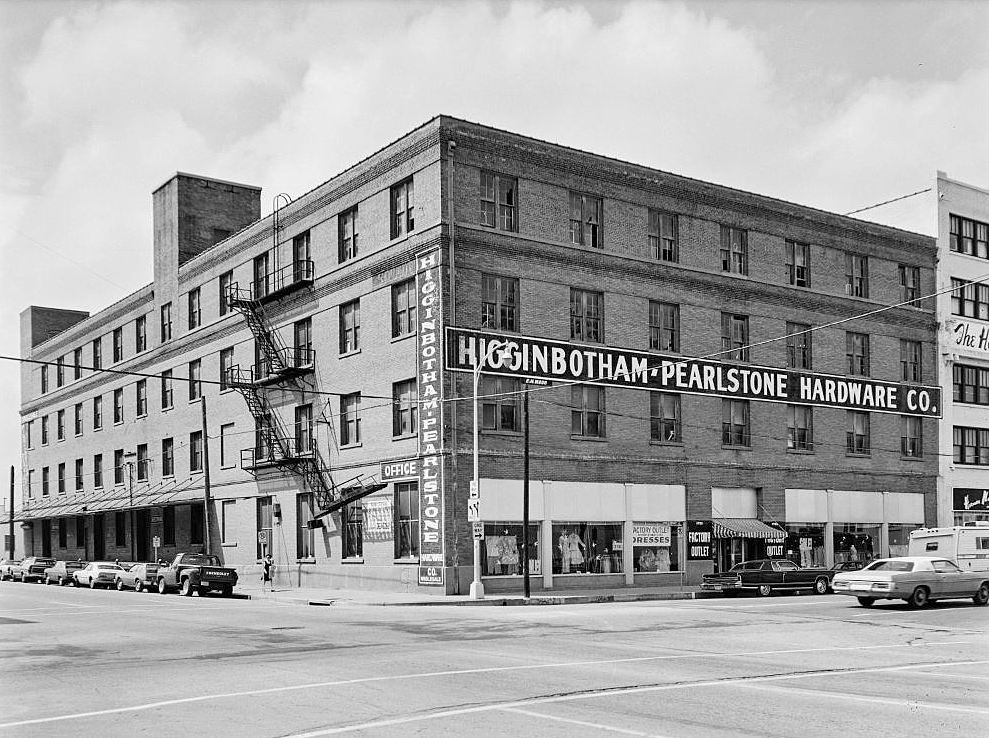 Higginbotham-Pearlstone Building, 1978
by Paula Bosse
In a previous post, “The South End ‘Reservation’ Red-Light District — ca. 1907” (which, amazingly, has generated so much traffic, that, in one month, it has gotten almost 4 times as many views as the most popular post of last year got all YEAR…), I mentioned that the reason I stumbled across the main photo from that post was because I was searching for a photo of the Hobson Electric Co. in the West End (the photo was originally described as showing the West End, but it actually showed the other side of downtown). So why was I looking for something which, let’s be honest, doesn’t sound all that exciting? The Hobson Electric Co.? Because an anonymous reader asked recently in comments of a post from 2019 — “Caterpillars On the Job at Ross and Market — 1922” — what businesses had been in the building at 1701 N. Market in the West End, known as the Higginbotham-Pearlstone Building. And here, anonymous question-asker, is what I found.
But before any building at all was there, what was there? (See the “Sources & Notes” section at the bottom of the page to see this location on six Sanborn maps from 1885 to 1921.) Before any building sat on the northwest corner of N. Market and Ross Avenue (originally Carondelet), it was a wagon yard/camp yard — a place where people coming to the city could stable their horses and stay the night. As seen on the 1899 Sanborn map, it was near the MKT freight and passenger depots. By 1905, that block was the site of a lumber yard.
In 1910, the Hobson Electric Co. (“for everything pertaining to electric light and telephone plants, largest supply house in the Southwest”) opened their new building at the northwest corner of Market and Ross (they were formerly in what is now the 700 block of Commerce). The new building was described thusly:
The above new building of the Hobson Electric Company, located near Market street and Ross avenue, Dallas, is an example of modern construction which secures a low insurance rate. The front is 100 feet, depth 200 feet. There are three stories with a total floor space of 60,000 square feet. The foundation is of concrete, the walls of light colored brick 18 inches thick; the interior is of mill construction of unusually heavy and special type, the floorboards being five inches in thickness. The general construction is of the best available at this date. The building is heated by the hot water system, electrically lighted and equipped with the automatic sprinkler system for fire protection. (Dallas Morning News, April 16, 1910)
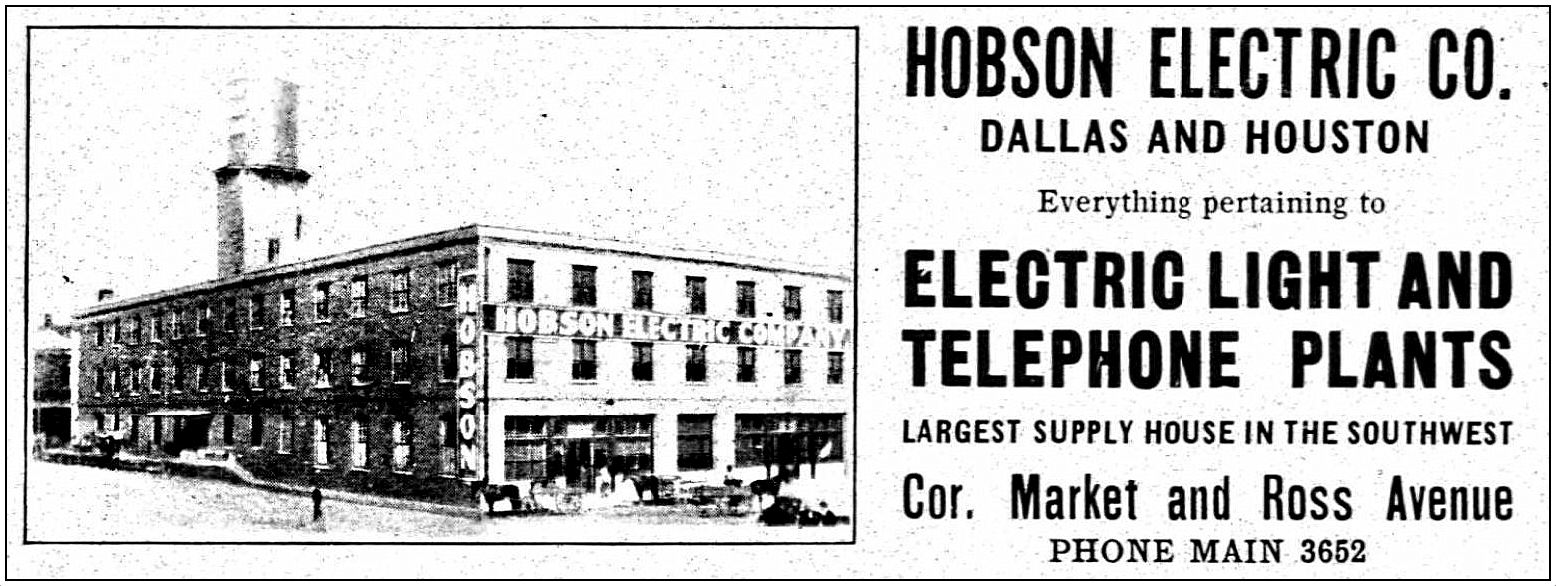 1911 city directory
In January 1913, Charles W. Hobson changed the name of his company to the Southwest General Electric Co., (Hobson was the Southwest manager of General Electric/G.E.), as can be seen in this photo of the building from 1922:
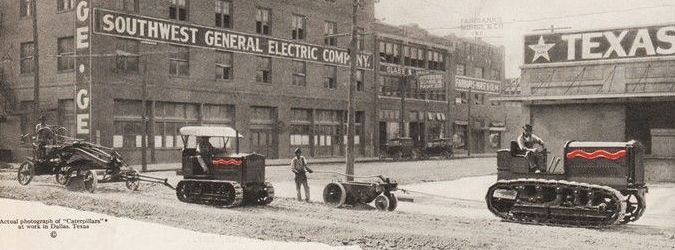 Detail of a 1922 ad for Caterpillar tractors
In October 1923, the Moroney Hardware Co. (est. 1875) moved in. “You will find everything here that a modern, progressive wholesale hardware house should carry. Shipping everywhere in the large Dallas trade territory” (ad, Sept. 23, 1923).
 DMN, Oct. 14, 1923
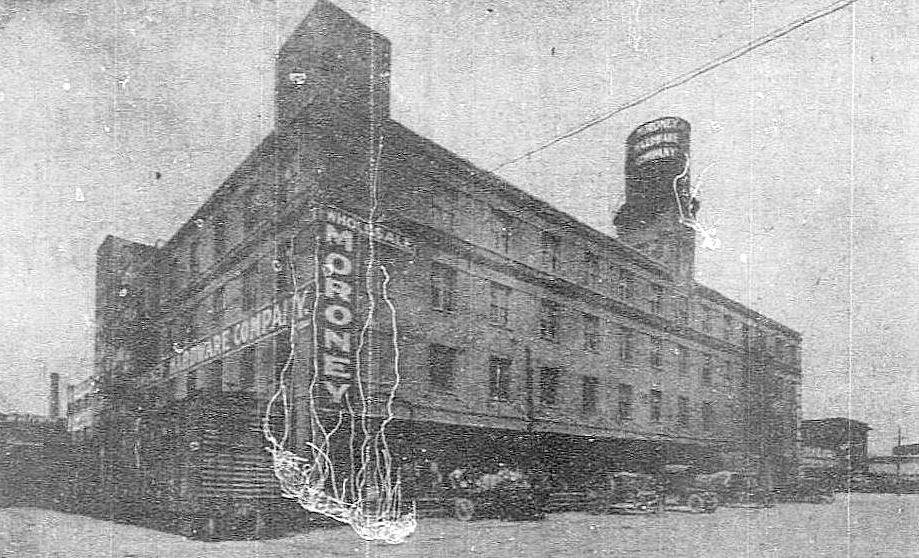 DMN, Nov. 23, 1925
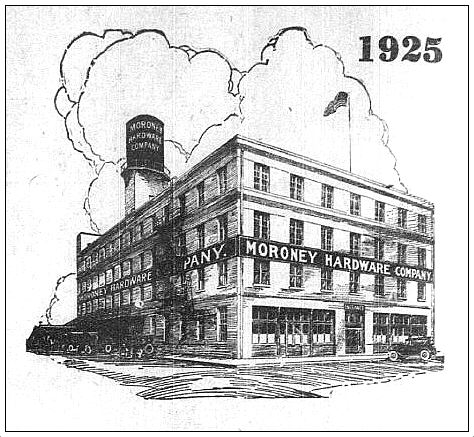 50th anniversary ad detail, Nov. 23, 1925
In February 1926, the Moroney company (having just celebrated its 50th anniversary) announced the sale of the pioneering Dallas business (as well as its building) to R. W. Higginbotham and Hyman Pearlstone — the new wholesale company would be called the Higginbotham-Pearlstone Hardware Co.
 ca. 1954
Higginbotham-Pearlstone lasted until about 1977, when they vacated the building (but their name remained on it). The photo at the top of this post shows the building in 1978, as does the photo below — at that time, it (or part of it) became home to a factory-outlet clothing store. Below, a slightly different view, looking north on Market from Pacific.
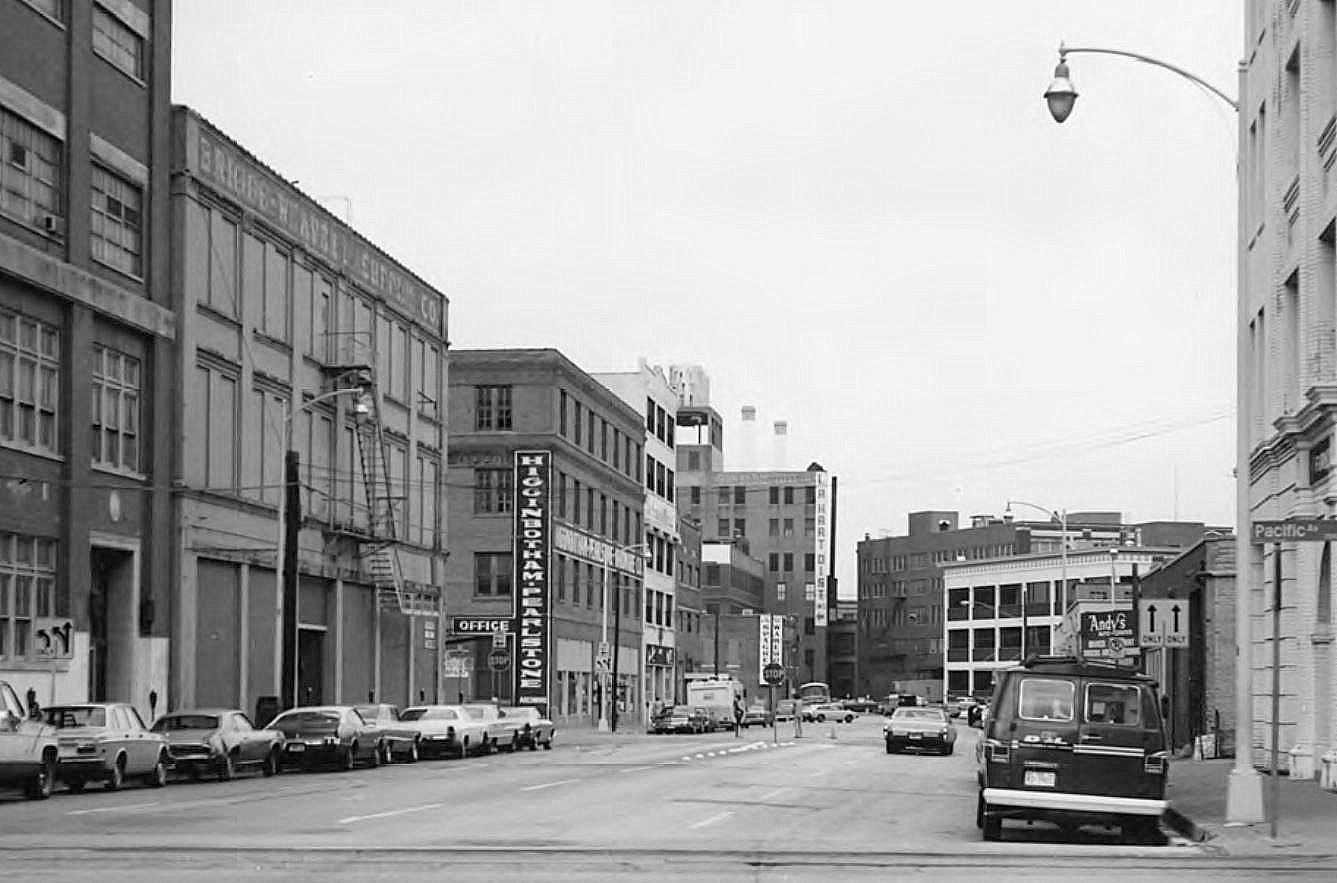 1978
1978
It continues to be an important landmark in the Historic West End, and it still looks great — see the building on Google Street View, here.
***
Sources & Notes
The top photo, from 1978, is from the collection of the Texas Historical Commission, via the Portal to Texas History.
The 1954 Higginbotham-Pearlstone photo is from eBay.
The second photo (which I have cropped slightly), from 1978, is also from the Texas Historical Commission — it was taken in March 1978 by Danny Hardy. It is part of a nomination form for “National Register of Historic Places” designation — the whole 90-page application can be viewed as a PDF, here (this photo is on p. 50). There are lots of great photos of West End buildings from 1978 in this!
Other sources as noted.
See Sanborn maps which include this block (northwest corner of N. Market and Carondolet) in 1885, 1888, 1892, 1899, 1905, and — the “modern” block which, finally, is home to our building — in 1921.

*
Copyright © 2024 Paula Bosse. All Rights Reserved.
 Flashback : Dallas