Flashback : Dallas

A Miscellany: History, Ads, Pop Culture

Category: 1910s

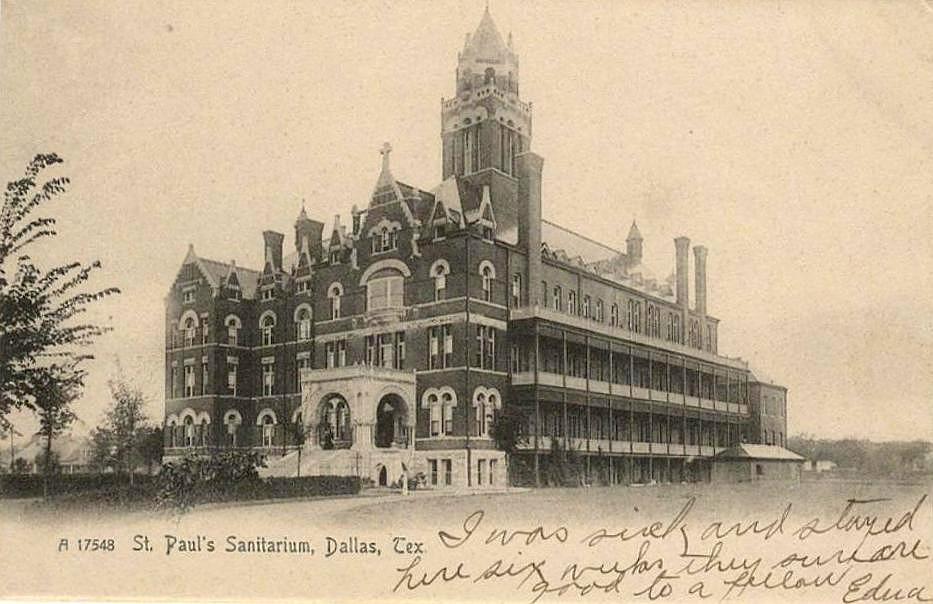
St. Paul’s Sanitarium — 1910

st-pauls_postcard_de-paul-univSt. Paul’s Sanitarium, located at Bryan & Hall (click for larger image)

by Paula Bosse

My posting has been infrequent as of late, due, in part, to obligations concerning a family member’s hospital stay. So, since I have a short time before I have to rush off to run errands and make visits, why not focus on a historic Dallas hospital?

St. Paul’s Sanitarium was opened in a small cottage on Hall Street in 1896 by the Daughters of Charity of St. Vincent de Paul, but it soon moved to the new large H. A. Overbeck-designed building on Bryan Street in 1898. In 1927 the name changed to St. Paul’s Hospital, and in 1958, the name changed again, this time to St. Paul Hospital. The imposing building and annex (and whatever other structures were contained in the complex) were demolished in 1968.

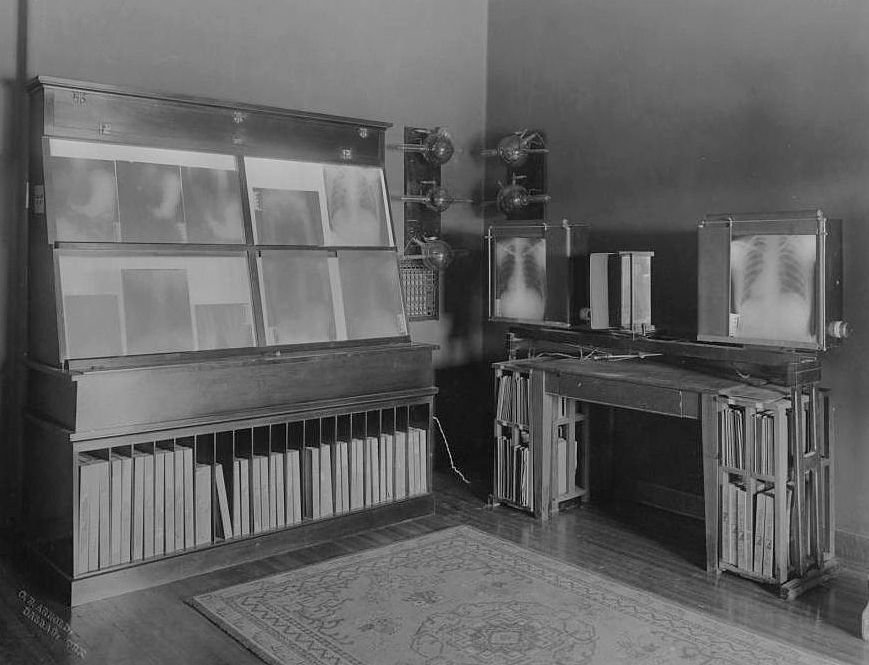
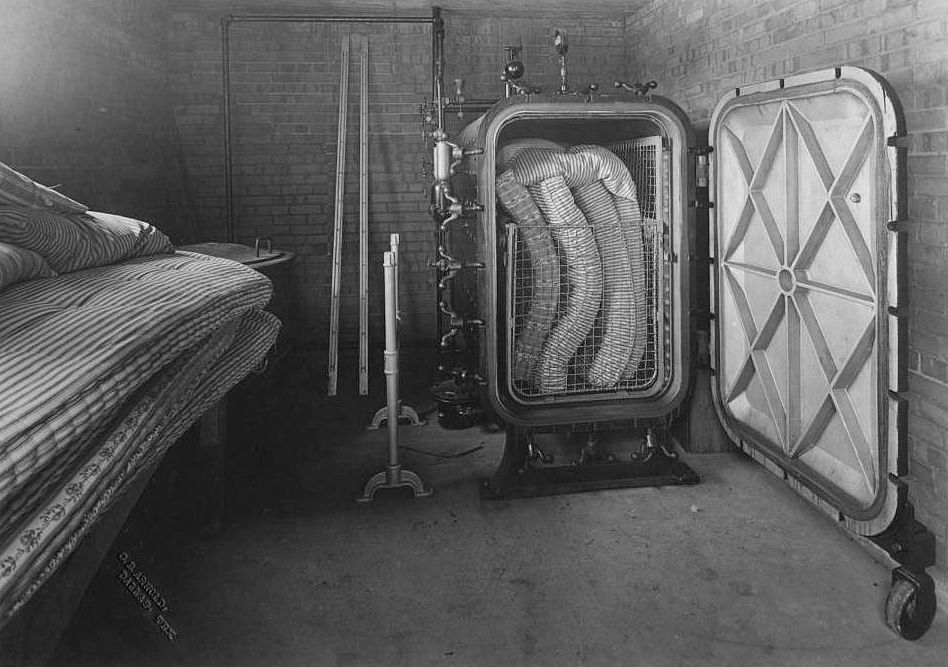
Below are several wonderful photographs taken inside the sanitarium around 1910 by one of Dallas’ best photographers, C. E. Arnold. They are from the St. Paul Hospital Collection in the UT Southwestern Library (click links below photos to see info about each picture).

*

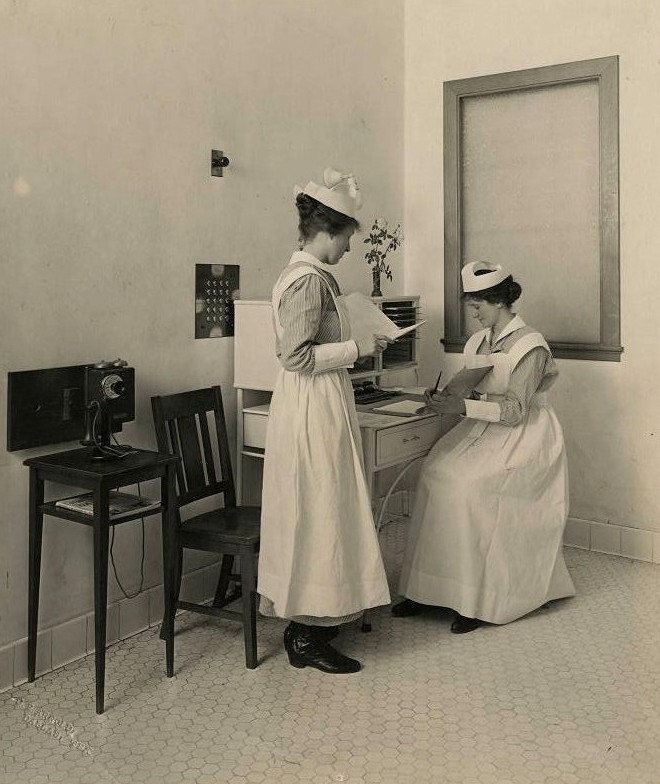
st-pauls_nursing-stn_1910_utsw_smThe nursing station.

*

st-pauls_mexican-ward_1910_utswThe “Mexican Ward” (as noted on the back of the photograph).

*

st-pauls_sleeping-porch_1910_utswA patient ward on a screened-in sleeping porch.

*

st-pauls_waiting-room_1910_utswA waiting room.

*

st-pauls_xray-room_1910_utswThe x-ray room.

*

st-pauls_nurses-library_1910_utswThe nurses’ library. (I LOVE this photo! Check out the crazy typewriter stand attached to the desk — I’ve never seen anything like that before.)

*

st-pauls_student-nurses-dorm_1910_utswThe nurses’ dormitory on the top floor.

*

st-pauls_mattress-sterilization-room_1910_utswAnd, my favorite, the ominous-looking mattress sterilization room in what appears to be a dungeon.

*

st-pauls_flickr_coltera

**

UPDATE: Check out some fantastic historic photos of the hospital and its nurses contained in this UT Southwestern Medical Center publication, “St. Paul University Hospital, A Legacy of Caring,” here.

***

Top postcard is from the Vincentiana Postcard Collection, Special Collections and Archives, DePaul University Library, Chicago; it can be found here.

Bottom postcard, with the cheerful message from Edna, was found on Flickr, here.

All photographs are from the St. Paul Hospital Collection in the UT Southwestern Library. Other photos from this 1910 collection can be found here. (For fuller descriptions, click the linked text beneath the photos in this post.)

An interesting article on the photographer, Charles Erwin (C. E.) Arnold, and the technique used in capturing his interiors, can be found here.

A historical timeline of St. Paul’s can be found in a PDF here.

Wondering where St. Paul’s Sanitarium was located? It was at Bryan and Hall streets, across from Exall Park. Here is the location, from a 1919 map:

st-pauls_1919-map

All images larger when clicked.

*

Copyright © 2015 Paula Bosse. All Rights Reserved.

Movie Houses Serving Black Dallas — 1919-1922

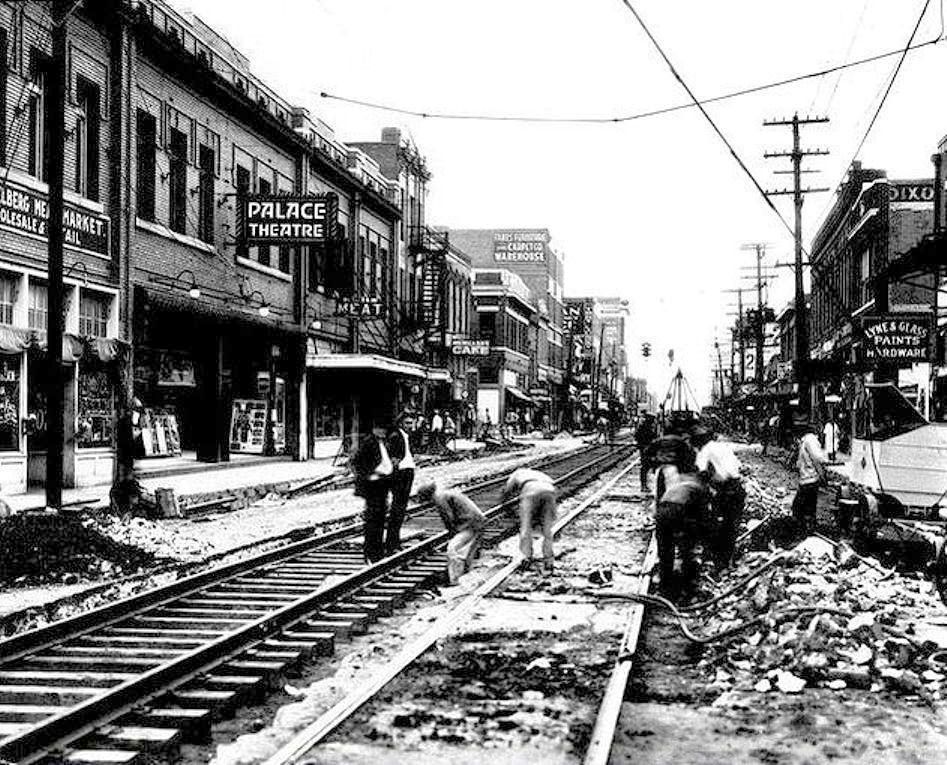
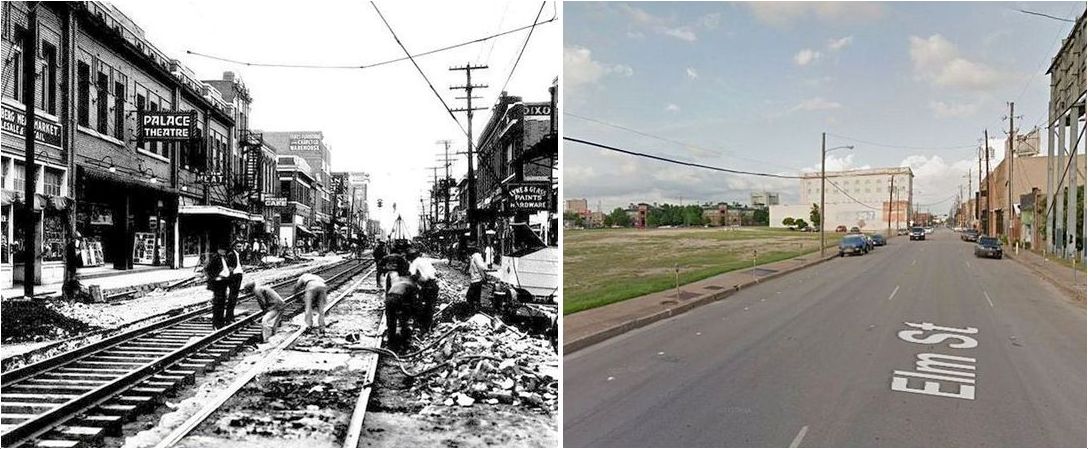
palace-theatre_elm-st_1922-dplThe Palace Theatre, Elm St., Deep Ellum, 1922 (click for larger image)

by Paula Bosse

In 1920, movie theaters — like most places in Dallas at the time — were segregated. If black customers were allowed at all in the downtown white vaudeville and movie houses, they had separate entrances and restricted seating areas (generally in the balcony). But Dallas’ African-American community had their own popular theaters, run by enterprising and energetic men who endlessly promoted their jam-packed and constantly-changing bills.

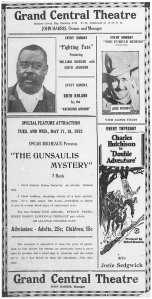
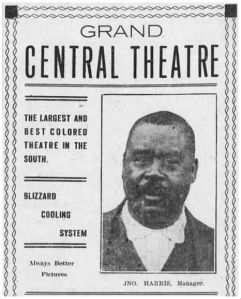
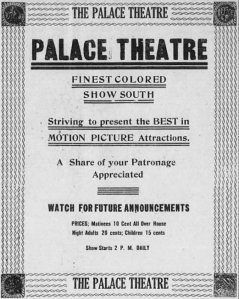
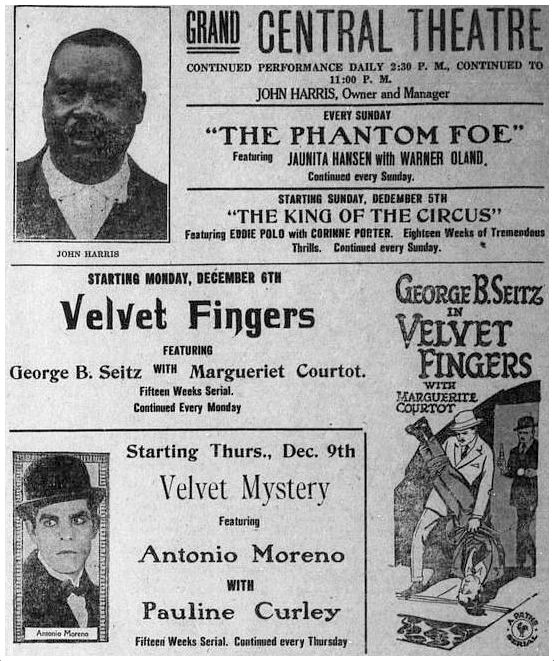
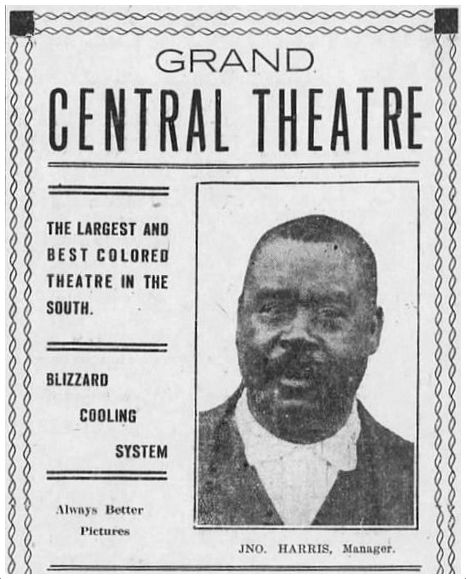
Judging by the amount of ad space purchased in the black-owned and operated Dallas Express, there were four main movie theaters catering to black Dallasites around 1920: the Grand Central Theatre, run by John Harris, the Mammoth Theatre, run by Joe Trammell, the Palace Theatre, run initially by Felix Moore, and the High School Theatre, run by Herbert Batts; the first three of these houses were in Deep Ellum, the last one was in what was then called “North Dallas.’ The theaters played both “white” films and films with “all-Colored casts.” The advertising for these theaters is great — far more ad space was available in the tiny Express to publicize the movies, the popular but now-forgotten Silent Film stars of the era, and the proprietors themselves than was available to the theaters on the other end of Elm Street in the much larger, white-owned News, Journal, or Times Herald. Sometimes it’s good being the big fish in the little pond — absolutely everybody knows who you are.

*

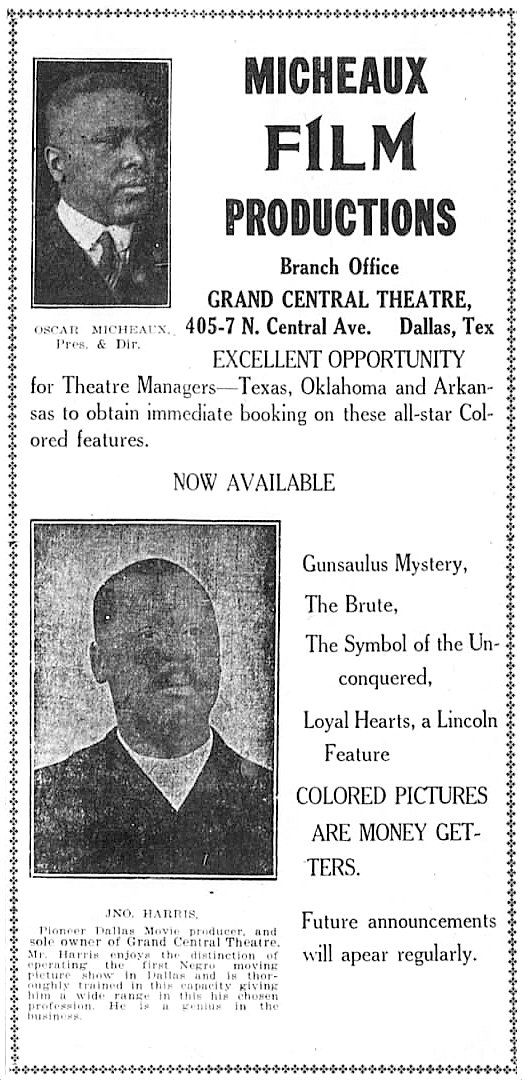
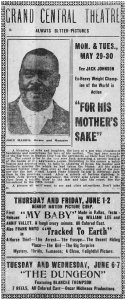
The Grand Central Theatre was at 405-407 N. Central Ave. (which later became Central Expressway), between Swiss and Live Oak on the outer northern edge of Deep Ellum. John Harris, the owner, put himself in practically all of his ads. He included this autobiographical sketch in one of them:
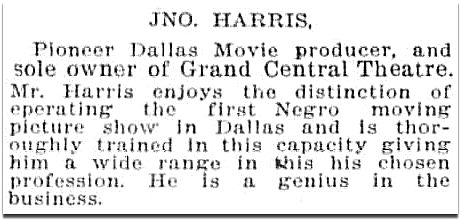
micheaux-grand_dallas-express_052821-detDallas Express, May 28, 1921

I’m not sure if he operated “the first Negro moving picture show in Dallas,” but I wouldn’t doubt it — the man was a dynamo who possessed not only a bold self-confidence, but he also seems to have had an unlimited promotional budget. UPDATE: The first appearance of a theatrical enterprise by John Harris shows up in the 1913 city directory (directories generally collected their information the previous year, so he was probably in business in 1912). Harris is listed under the “Amusements” section at the same address as the Grand Central Theatre, a name which came later. The same 1913 directory also lists the Star Theatre, which later became the Palace (see below). These are the only two theatres designated as “colored.” It’s unclear whether the theaters hosted live performances or showed movies. Or both.

The Grand Central advertised relentlessly. (Click ads to see larger images.)

grand-central-theatre_dal-express_120420Dec. 4, 1920

grand-central-theatre_dal-express_051421May 14, 1921

grand-central-theatre_dallas-express_080621Aug. 6, 1921

Below, an ad showing one of the offerings to be a Ben Roy Motion Picture Corp. movie called “My Baby” which was “made in Dallas, featuring William Lee and All Colored Cast.”
grand-central-theater_dal-express_052722May 27, 1922

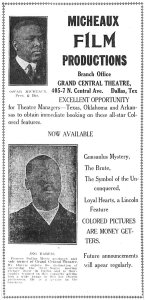
Harris was connected with the legendary black filmmaker Oscar Micheaux. Not only did he regularly run his films, but he also seems to have been working as a booker, promoter, and distributor of Micheaux’s films and ran the Micheaux Film Productions branch office out of the Grand Central. “Colored Pictures are Money-Getters.”
micheaux_dallas-express_051421May 14, 1921

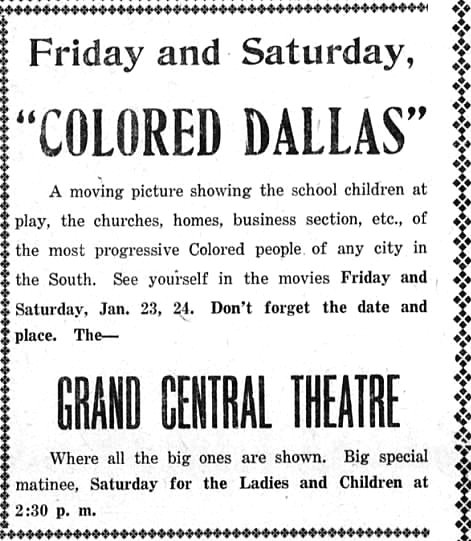
One ad that caught my attention was this one, for a locally-shot film called “Colored Dallas.” I really, REALLY want to see this, but the possibility of an extremely minor, 95-year-old silent film having survived into the 21st century is slim.

colored-dallas_dallas-express_012420Jan. 24, 1920

*

The Mammoth Theatre was located at 2401 Elm Street, between Central and Hawkins. It opened in late 1919 — the run-up to the opening was publicized in this Dallas Express item.
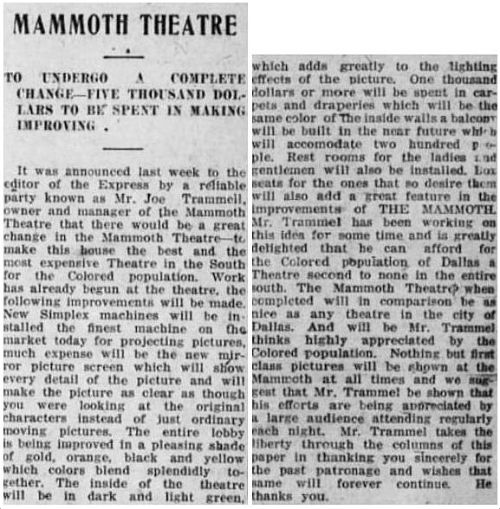
mammoth_dallas-express_112219Nov. 22, 1919

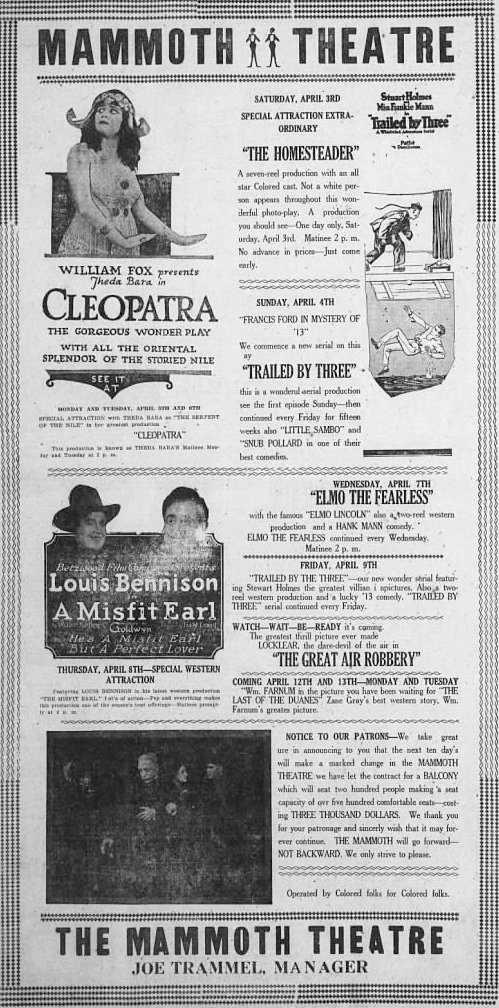
The Mammoth might not have advertised quite as much as the Grand Central did, but it frequently took out splashy full-page ads. Full-page! I bet that royally irked John Harris. Below, a Mammoth ad from 1920.
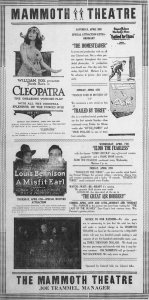
mammoth_dallas-express_040320April 3, 1920

Two details from the above ad:
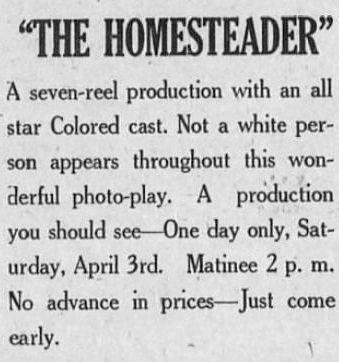
mammoth_dallas-express_040320-det-2

mammoth_dallas-express_040320-det
“Operated by Colored folks for Colored Folks.”

The owner, Joe Trammell, seems to have had an inexhaustible source of money for advertising — those frequent full-pagers (unusual for the time) must have cost a pretty penny. I couldn’t find much information about any of these men, but I stumbled across this photo of Trammell, tacked on to one of his … um … mammoth ads.

mammoth_joe-trammell_dallas-express_021221Feb. 12, 1921

*

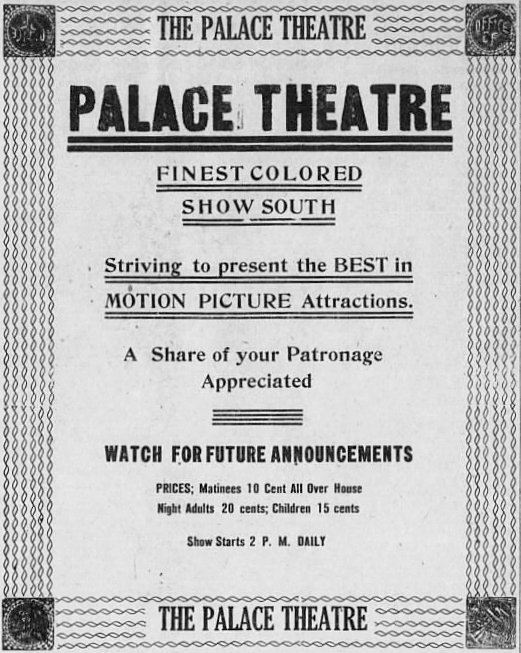
The Palace Theatre, seen in the photo at the top, was at 2407 Elm Street, just a couple of doors down from the Mammoth. (This Palace is not to be confused with the “white” Palace Theatre, the stalwart of Theater Row at the other end of Elm.) It opened in 1920 in the remodeled space formerly occupied by the Star Theatre,
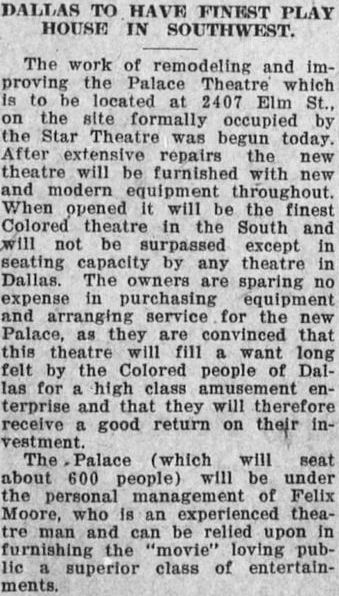
palace_dallas-express_030620March 6, 1920

palace_dallas-express_050820May 8, 1920

*

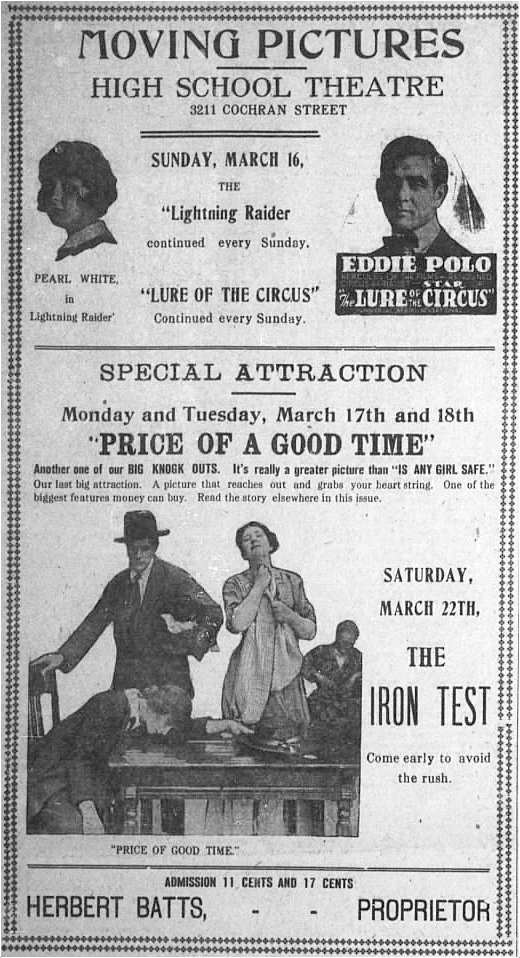
Lastly, moving up to North Dallas, we find the High School Theatre, located at 3211 Cochran, between Central and N. Hall Street. The reason for its name was its close proximity to the Colored High School (the only high school for African-American students at the time — it would soon merge with and relocate to the new Booker T. Washington High School a short distance away). The following businesses were in this same block: the High School Cold Drink Stand, the High School Cafe, the High School Shine Parlor, and the High School Tailor Shop. Location, location, location.
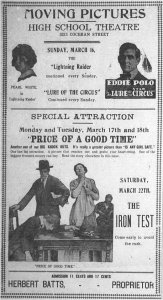
high-school-theater_dallas-express_031519March 15, 1919

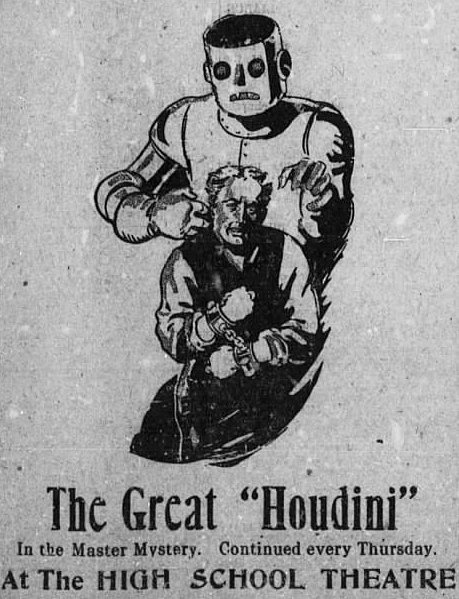
My favorite High School Theatre ad is this one, touting a serial called “The Master Mystery” starring Houdini … one of the screen’s first appearances of a robot! (Check out a scene featuring both Houdini and the robot/automaton, here.)
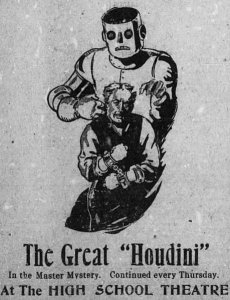
houdini_dallas-express_031519March 15, 1919

*

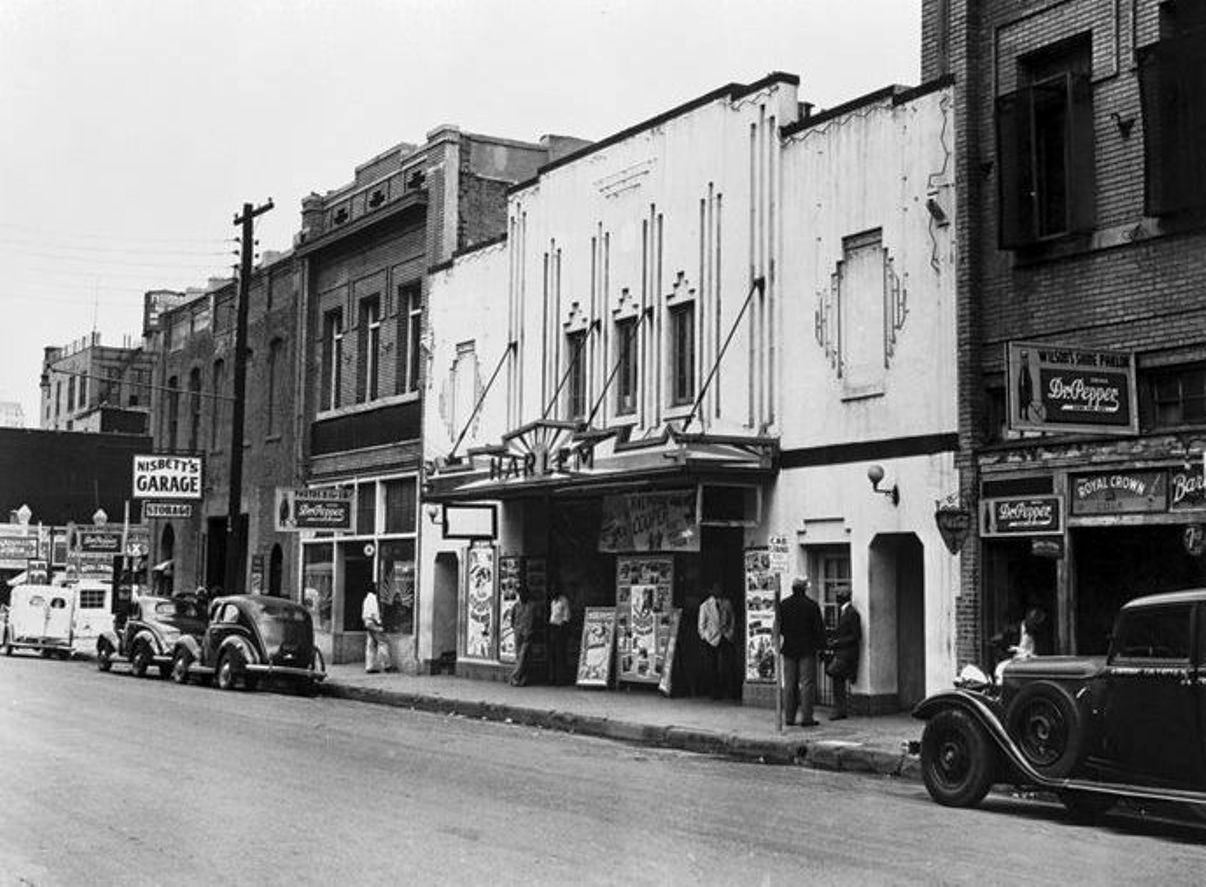
The only one of these theaters still in business in 1930 was the Palace. by 1937, the Palace had become the Harlem Theatre.
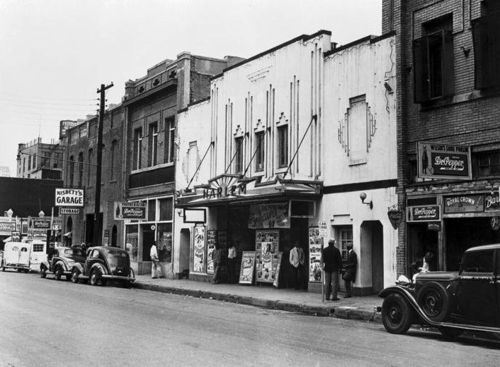
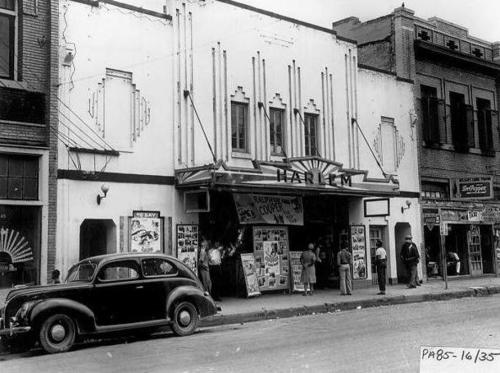
harlem-theatre_deep-ellum

harlem-theatre_dpl

***

Sources & Notes

Top photo showing Elm Street and the Palace Theatre and the bottom two photos showing the Harlem Theatre are from the Texas/Dallas History & Archives Division, Dallas Public Library. The upsetting view of what that stretch of Elm looks like now can be seen on Google Street View, here. Below, side-by-side, 1922 and 2015 — Elm St. looking east to Deep Ellum, the Knights of Pythias temple in both images down the street on the left. Look what we’ve lost.

elm-looking-east_1922-2015

All ads and clippings from The Dallas Express, as noted. A few years’ worth of this important newspaper, which served Dallas’ African-American community, can be accessed here.

More on Oscar Micheaux, here.

Another Flashback Dallas post on a theater serving the black community is “Oak Cliff’s Star Theatre — 1945-1959.”

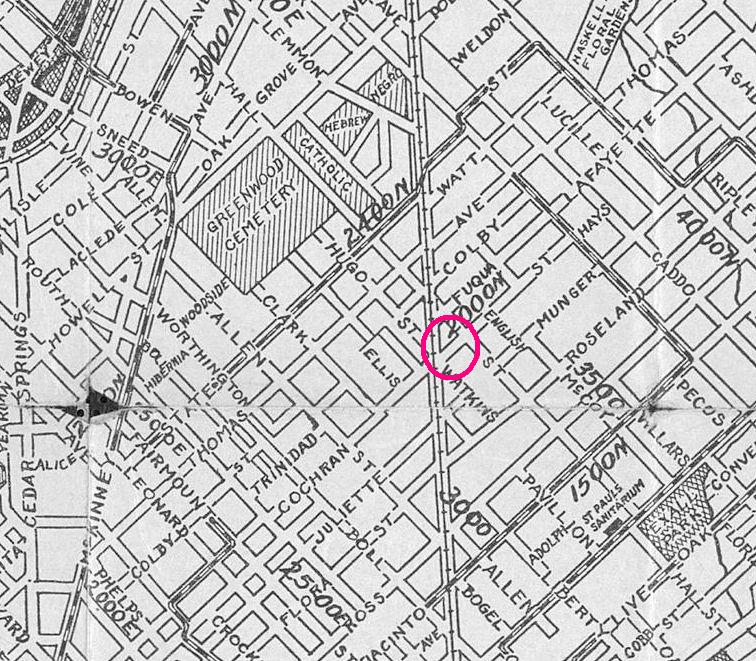
A 1919 map from UNT’s Portal to Texas History shows the location of the Grand Central Theatre (red square), the Mammoth (blue), and the Palace (yellow).

black-cinemas_ca1920_deep-ellum

The High School Theatre — up in “North Dallas” (adjacent to present-day Uptown) — is seen on a different portion of the same map, below.
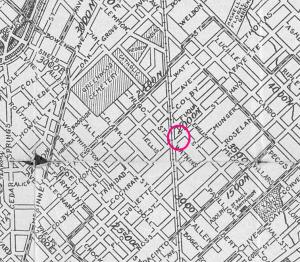
black-cinemas_ca1920_north-dallas

Most images are larger when clicked.

*

Copyright © 2015 Paula Bosse. All Rights Reserved.

Three of Dallas’ Earliest “Photoplay Houses” — 1906-1913

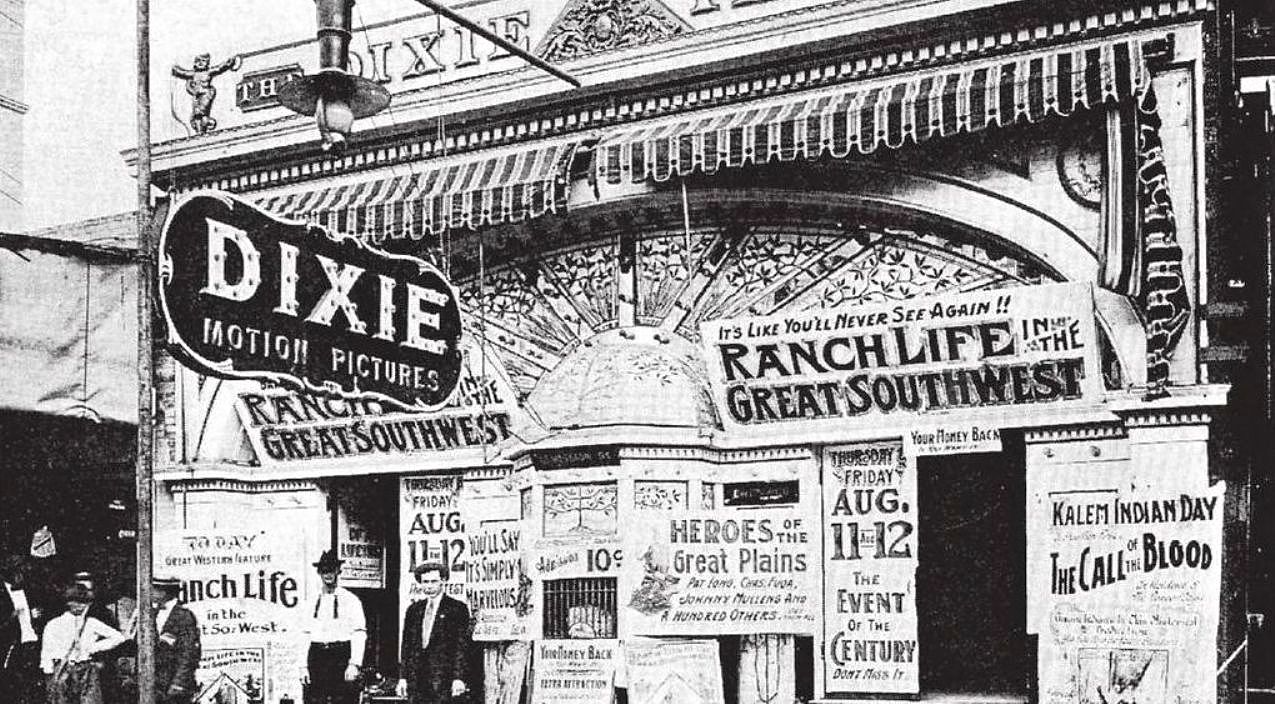
dixie-theater_1910_sherrod_smuDallas’ first movie house, here in 1910 on its third name (click for larger image)

by Paula Bosse

I seem to be deep into an unintended “Movie Week” here, all because I’ve been researching a photo of a little-known early suburban movie theater — and that’s how I stumbled onto a great article about Dallas’ first “picture shows.” The rather clunky title of the extremely informative Dallas Morning News article (which is linked below) is: “Startling Progress of Picture Shows; One-Third of Dallas’ Population Daily Entertained; History Local Houses; Dark Storerooms and Rickety Chairs Give Way to the Modern Photo-Play Theater” (March 9, 1913).

Some of the facts in the article are a bit off, but it’s fascinating to read that the first (or certainly ONE of the first) showings of a moving picture in Dallas was at the State Fair in 1897, when a boxing promoter presented what was one of the earliest “pay for view” matches in history — he showed footage of the highly publicized Jim Corbett-Bob Fitzsimmons Heavyweight Championship fight which had taken place a few months previously — the fight was originally intended to be fought in Dallas, but it was moved to Nevada, causing, one would assume, much consternation to those involved with the staging of and promotion of the fight. Not only did the promoter make back all the money he had invested locally in the thwarted boxing match, but he made a hefty profit trundling the film around the country for curious viewers (which included a large number of women who were not generally allowed to watch boxing matches).

Later, two men set up a projector in a second-story window and began showing movies on an open-air screen across the street, at Main and Lamar. It was popular, but it was also something of a traffic hazard. Also, there were itinerant hucksters who came and went, showing motion pictures wherever they could, moving from city to city.

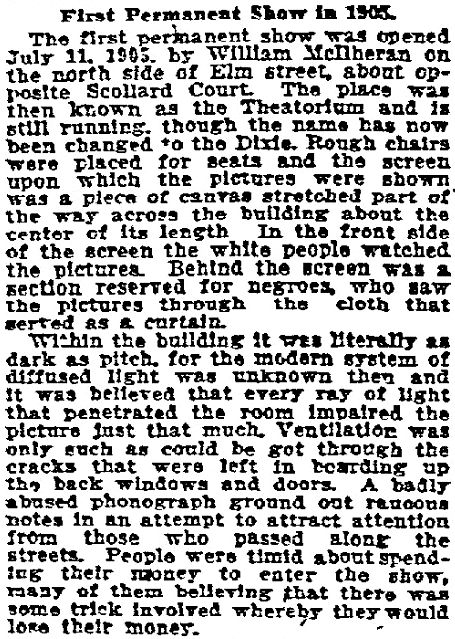
It wasn’t until the summer of 1906 that Dallas got its first permanent movie house when William McIlheran opened the Theatorium (a common word used around the country back then for a movie theater, but which, to virgin ears, sounds as odd as “Sportatorium” must to people who have never heard that word). It was at 311 Elm Street (which later became 1315 Elm), at about where Field is today, and it was the first movie theater on Theater Row! I love this description of what the place was like, from the DMN article mentioned above — even though the opening date is off by a year (click for larger image):

theatorium_dmn_030913DMN, March 9, 1913

theatorium_sherrod

With the arrival of this permanent theater (one with an actual roof over it), the moving picture had finally became more than just a mere novelty, and the success of the Theatorium started a mad dash of entrepreneurs opening up their own theaters. Within a month of the Theatorium’s opening, at least four more such houses were open for business.

At some point the Theatorium became the Wonderland (in 1907 or 1908), and it began showing so-called “talking films” (the talking was, apparently, provided by an off-stage actor providing the spoken dialogue while trying to match the silent actors’ lips on screen).

cameraphone_talking-pictures_dmn_101908The “Cameraphone” — DMN, Oct. 19, 1908

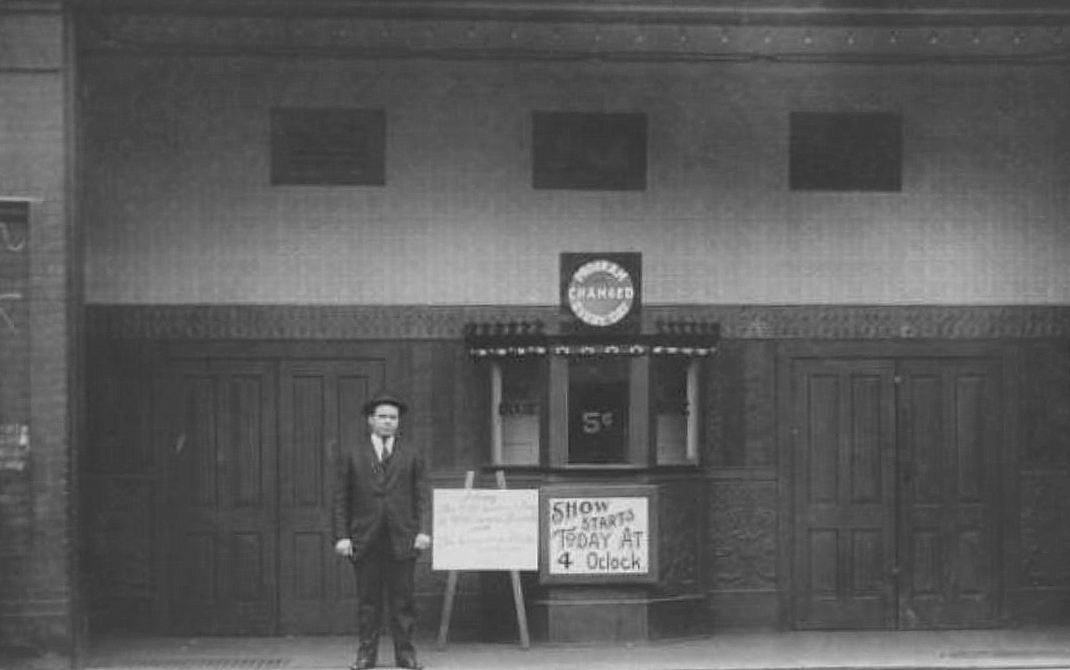
And finally, the Wonderland turned into the Dixie, seen at the top, in 1910, and below, in 1909.

dixie-theatre_1909_cook-colln_degolyer

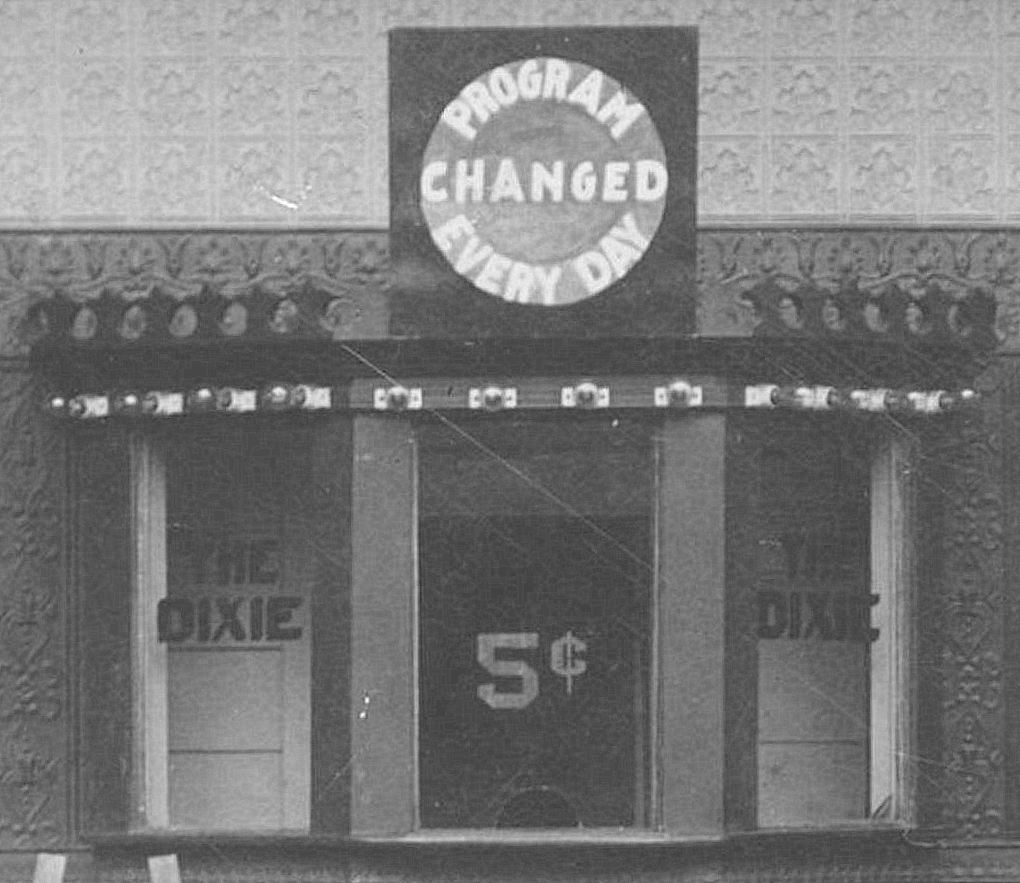
dixie-theatre_1909_cook-colln_degolyer_detBox office, detail (click for larger image)

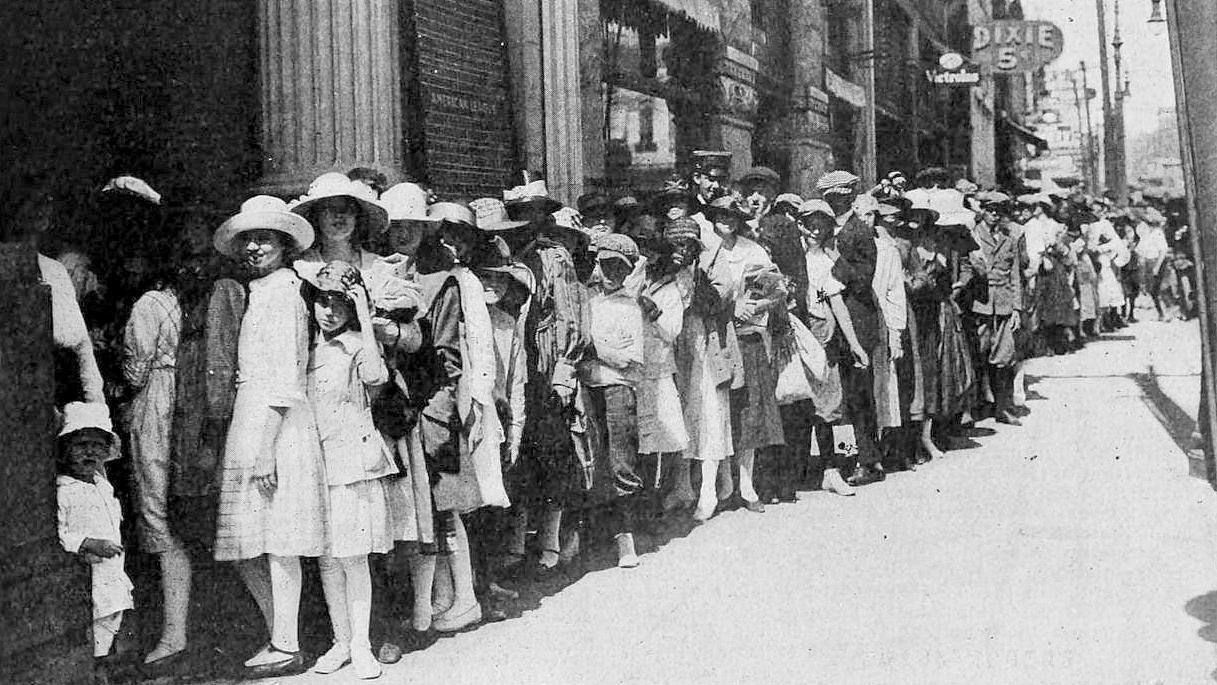
Another photo, from 1918, shows mostly children lined up in front of the theater, with the sign in the background. (They were lined up to see a WWI-related movie at the nearby Hippodrome; the photo is looking east along the north side of Elm, near where Field now intersects.)

hippodrome_dixie_elm-street_moving-picture-world_062218from The Moving Picture World magazine, June 22, 1918

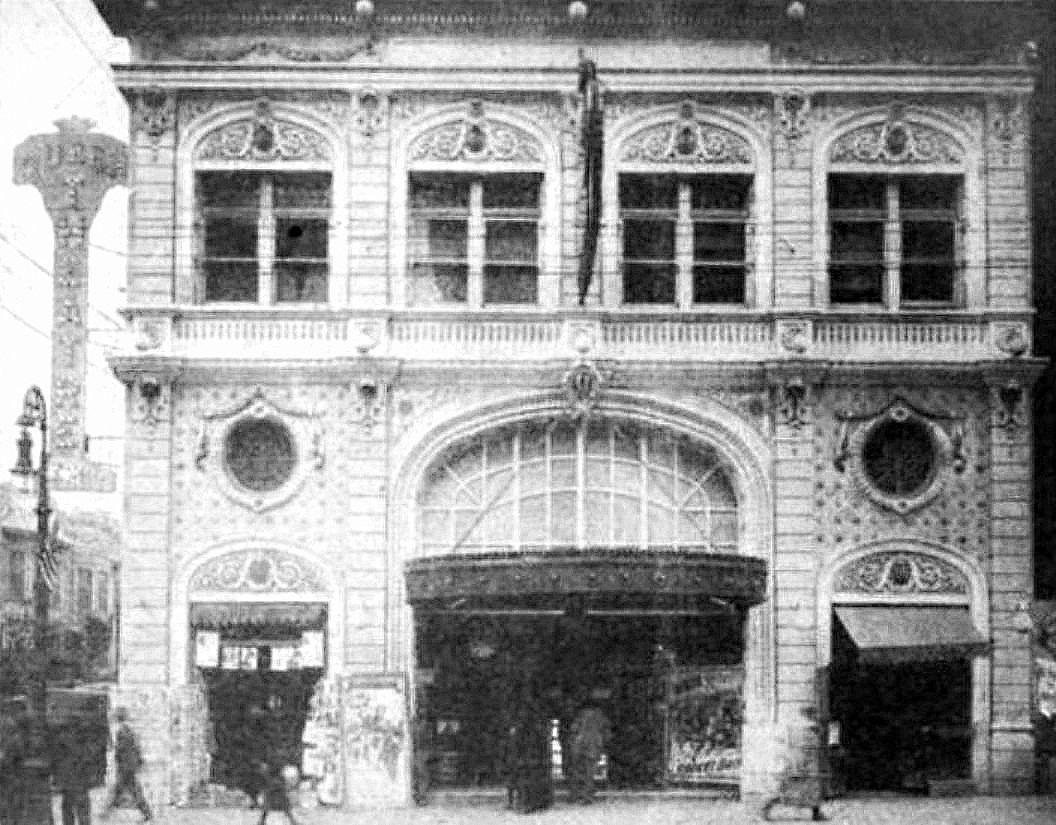
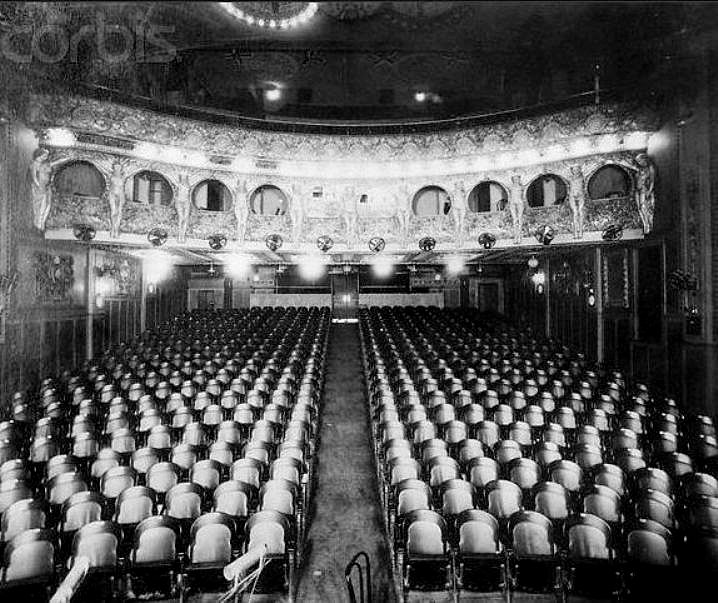
But it wasn’t until the beginning of 1913 that the first “palaces” arrived. The Queen Theatre opened first, at the corner of Elm and Akard. The DMN raved: “The most beautiful Photo-Play Theater in the South. Every man, woman and child in Texas should see this theater — truly a credit to the State” (DMN, Feb. 2, 1913).

queen_bldg-code-bk_1914Photo from Building Laws of the City of Dallas, 1914

queen_cinema-treasuresElm St. about 1917, with Queen on left — photo from CinemaTreasures.org

queen-theater-1939-CORBISInterior, 1930s — photo from CorbisImages.com

queen-theatre_dmn_102012DMN, Oct. 20, 1912

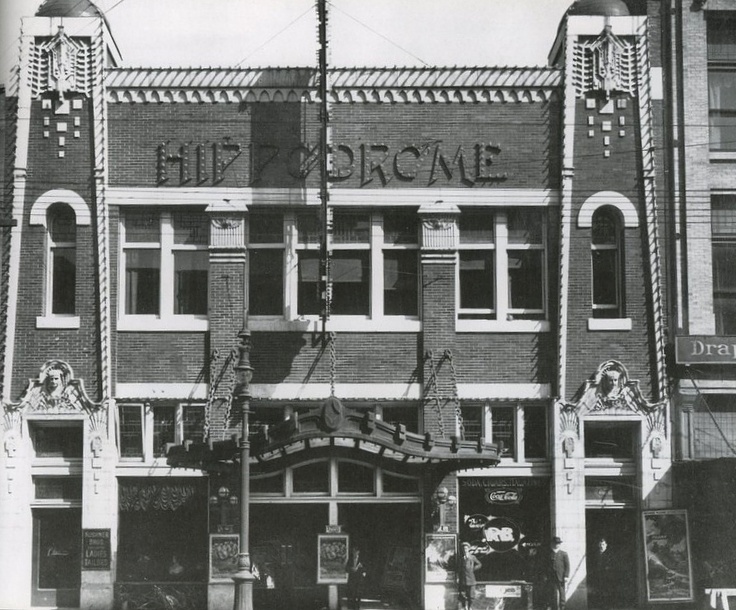
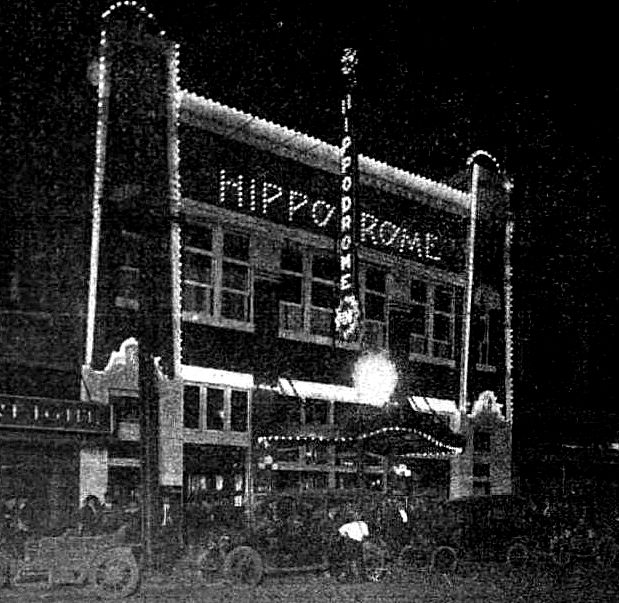
The Queen opened to rapturous crowds in January, 1913, but moviegoers barely had time to catch their collective breath when the Hippodrome opened at 1209 Elm, just a few weeks later, on March 1, 1913. It was “…conceded to being the finest moving picture house in the United States” (DMN, March 9, 1913).

hippodrome

hippodrome_bldg-code_1914Photo from Building Laws of the City of Dallas, 1914

hippodrome_dmn_022813DMN, Feb. 28, 1913

By the time the Queen and Hippodrome opened, movies had become a popular and profitable form of entertainment. In 1913 Dallas had 28 “picture shows” — 24 for white patrons and 4 for black patrons. Even vaudeville houses occasionally ran short films to pad out their live shows. And, notably, movie houses had begun to pop up away from downtown: in 1913 there were a dozen “suburban” theaters in residential areas of town (many of these, though, showed movies outdoors and thus operated only in the warmer months and at night).

There was a tremendous appetite for movies in Dallas in those early years, and when the money men realized that motion pictures weren’t just a here-today-gone-tomorrow novelty but a burgeoning industry, they dived in with enthusiasm.

Any tendency to cast the movies aside as a passing fad has given way to a realization that they are here to stay and that the crest of their popularity has not yet been approached. (DMN, March 9, 1913)

And Theater Row was off and running.

***

Sources & Notes

The top photo of the Dixie Theatre and the Theatorium ad are from the Hamon Arts Library, Southern Methodist University. I found them in Historic Dallas Theatres by D. Troy Sherrod. Sherrod’s passage on the Theatorium/Wonderland/Dixie is well worth reading, here. The second Dixie Theatre photo, with the man standing next to the box office, is from the George W. Cook Dallas/Texas Image Collection, DeGolyer Library, Central University Libraries, Southern Methodist University; it can be found here.

The very informative Dallas Morning News article of March 9, 1913 on the history of movie theaters in Dallas can be read here (it opens in a PDF, click the plus-sign at top of page to increase the text size).

Background on the Corbett-Fitzsimmons fight is here. Background on the now-legendary FILM of the fight is here; highlights of the 1897 film can be viewed here.

Many images larger when clicked.

*

Copyright © 2015 Paula Bosse. All Rights Reserved.


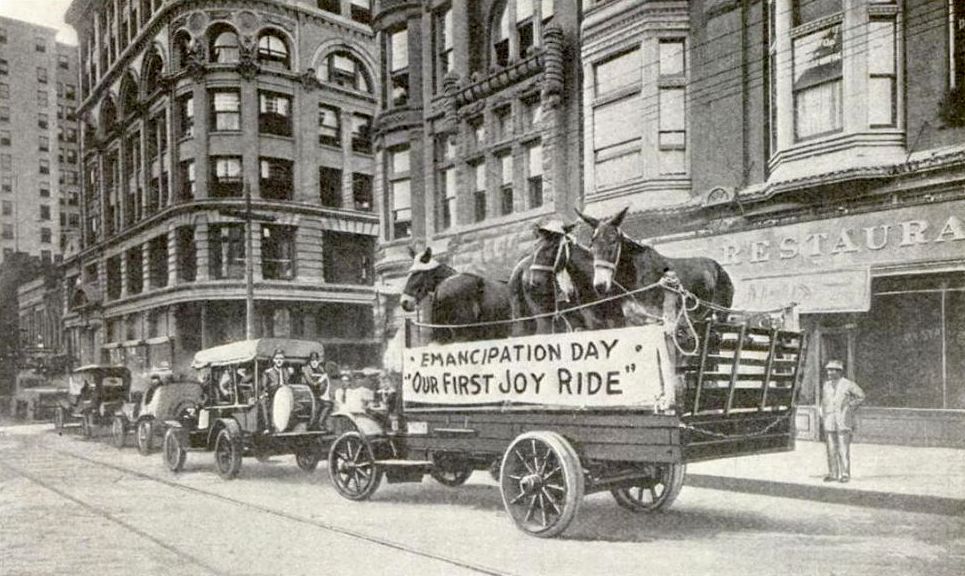
“Our First Joy Ride” — 1911

mule-joyride_pop-mechanics_jan-1912Mules taking a load off, Main & Ervay, 1911

by Paula Bosse

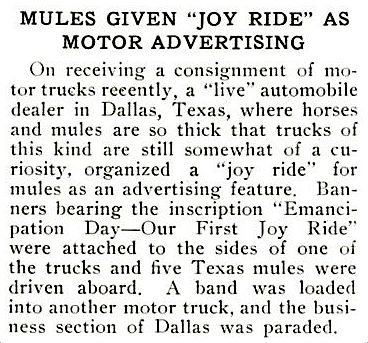
Flipping through the pages of a Jan. 1912 issue of Popular Mechanics — as one does — I came across a photo of a truckload of joyriding mules which was accompanied by this explanatory text:

mule-joyride_pop-mechanics_jan-1912-text

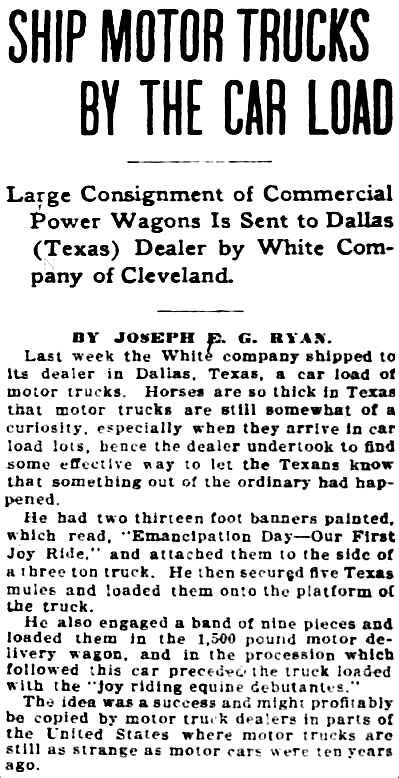
Ah, a publicity stunt. A Chicago newspaper offered a bit more background, and gave us the delightful phrase “joy-riding equine debutantes.”

mules_chicago-inter-ocean_102311Chicago Inter Ocean, Oct. 23, 1911

Another report added that the mules were “adorned with a collection of discarded women’s hats and bonnets elaborated with all the old ribbons, feathers and similar gee-gaws […] securely tied on with pink and red mosquito netting…. The procession was headed by Dallas’ most prominent business men in a brand new White 1912 ’30.'” (Automobile Topics magazine, Oct. 28, 1911)

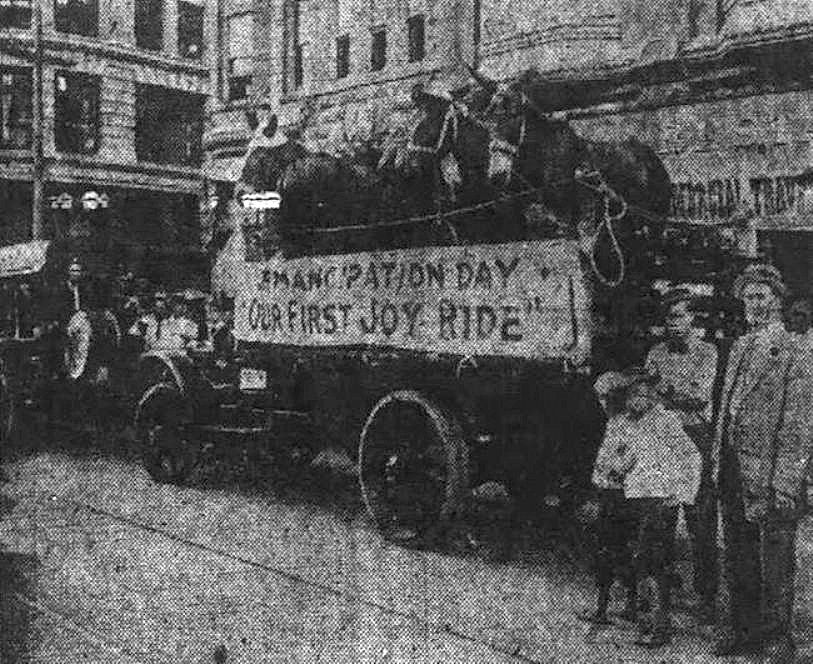
Despite the fact that this, let’s face it, pretty unusual “parade” happened on Main St., with apparent participation by “prominent businessmen,” I can find no mention of it in local newspapers. Maybe because it was a publicity stunt and there was no advertising fee collected by the papers. The story ran in a handful of newspapers (Chicago, San Francisco, Washington, DC), and the Washington Post ran the photo below under the headline “New Way to Advertise Motor Trucks.”

mules_washington-post_102211Washington Post, Oct. 22, 1911

The White Motor Company (makers of the mule-laden truck) must have been quite taken with the unnamed entrepreneur’s banner, because they used the exact same wording on a banner draped on one of their trucks which was a featured attraction on Transportation Day at the 1915 Panama-Pacific International Exposition in San Francisco.

Let’s hope the original Dallas guy got a little something out of all this.

*

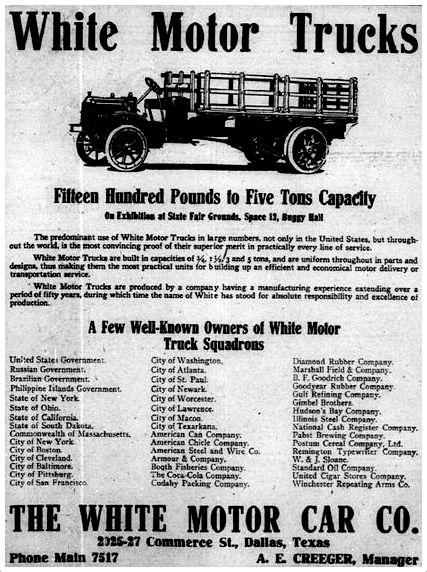
On further investigation into The Case of the Joyriding Mules, it appears that this was the brainchild of the General Manager of the White Motor Co., A. E. Creeger (or perhaps that of one of his gung-ho underlings). In a 1912 article in The Dallas Morning News, Creeger talks about the relatively soft truck market in Texas (!), and it’s easy to see why he was doing all he could to draw attention to his company’s line of trucks — even if it meant loading them up with “emancipated” livestock.

And here’s one of his ads from almost exactly one year after the mule stunt:

white-motor-co_dmn_101312Oct. 13, 1912

***

Sources & Notes

Top photo appeared in the January, 1912 issue of Popular Mechanics.

The “parade” (which took place sometime in the middle of October, 1911) is seen heading west on Main Street, just about to pass Ervay. The inescapable Wilson Building dominates the photo, with the tall, white Praetorian Building in the background. The restaurant at the right — at 1705 Main — was the California Restaurant, a Dallas eatery specializing in Chinese food since at least the 1890s.

*

Copyright © 2015 Paula Bosse. All Rights Reserved.

Newsboy

newsboy_RPPC_ebay_sm“Nickel a copy, mister.”

by Paula Bosse

In 1912, The Dallas Morning News reported that there were over 700 newsboys in the city of Dallas, over 200 messenger boys, and “hundreds of other working boys between the ages of 6 and 17” (DMN, July 19, 1912). Some of these boys were working to help out their families, but many were homeless. Child labor was a major concern throughout the country, and most larger cities, such as Dallas, had “newsie homes” and associations to look after the interests of the boys.

***

Sources & Notes

Newsboy photo found on eBay.

To read “Story of a Street Waif” (DMN, Dec. 22, 1912) — a somewhat Dickensian fictionalized account of a resilient Dallas newsboy written by Mrs. M. L. Kauffman (Sam Houston’s granddaughter, the former Margaret Belle Houston) — click here.

Photographer Lewis Wickes Hine had perhaps the greatest impact on the reform of child labor laws. Hine traveled the country photographing and interviewing working children in order to put a human face to a growing problem. Some of his photos can be seen here; his Wikipedia entry is here.

Photos of newsboys from previous Flashback Dallas posts can be found here.

*

Copyright © 2015 Paula Bosse. All Rights Reserved.

Main Street and Flags, Flags, Flags — ca. 1917

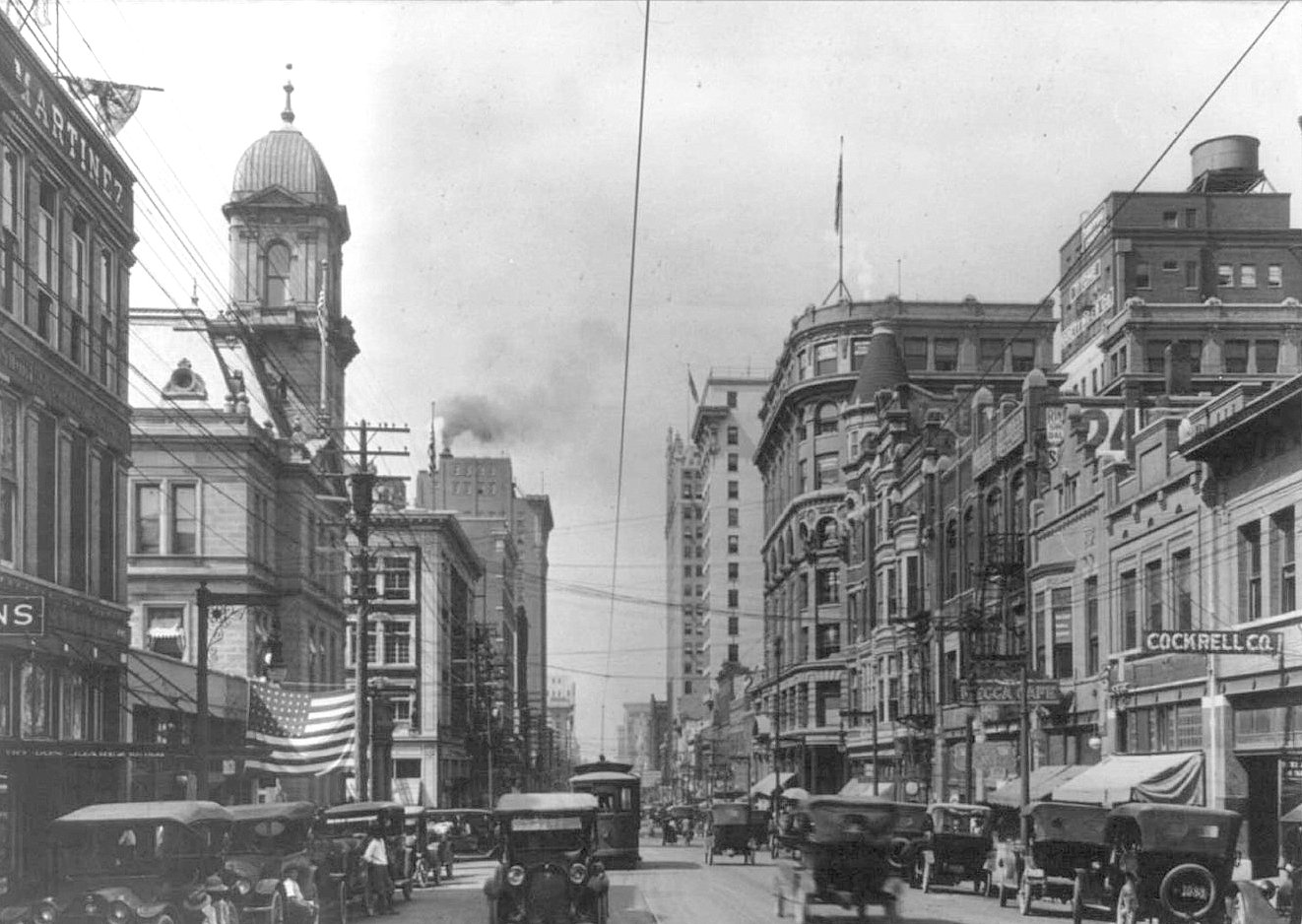
downtown_ca1917_LOCFind the flags! (click for larger image)

by Paula Bosse

This is a cool photo. I have no idea if it was taken anywhere around July 4th, but I post it today because today is July 4th, AND I see 5 — possibly 6 — American flags in this photograph of Main Street. The patriotism displayed here may have more to do with World War I than Independence Day, but why not post it on the 4th of July?

Enjoy the holiday!

***

Photo identified as “Texas, Dallas, 1917, Business section” by the Library of Congress; photo info here.

For the previous Flashback Dallas post “4th of July — Sweating in Formation,” which shows a parade from the 1870s or 1880s, click here.

*

Copyright © 2015 Paula Bosse. All Rights Reserved.

Elm Street, Looking West from Griffin

elm-west-from-griffin_UTA-special-collThe 1000 block of Elm Street: small-business central

by Paula Bosse

A really incredible view of Elm Street, probably from the late-teens to the early-20s. (Almost all of the businesses seen in this photo were listed in the 1922 city directory.) The landmark businesses seen here — all founded in the 19th century — would be Huey & Philp Hardware, Charles Ott (gunsmith) (the sign can be seen just above the Huey & Philp sign at the right), and down the street on the corner of Lamar, the beautiful 8-story Sanger Bros. department store (now part of El Centro). I know it’s a like hearing a broken record, but I really wish downtown Dallas still had some of this old, quirky flavor. (Click picture for larger image.)

And here’s a shot of the same view, but street-level:

elm-street_UTA

***

Sources & Notes

Photos from the Fort Worth Star-Telegram Collection, Special Collections, University of Texas at Arlington.

If you want to see what the same view looks like today, click here. Personally, I prefer the “before” to the “after.” I’m generally a fan of tall buildings, but all those skyscrapers absolutely decimated street-level businesses, which, sadly, seem to be gone for good. You can’t undo a skyscraper.

*

Copyright © 2015 Paula Bosse. All Rights Reserved.

A Distant Dallas Hall on the Horizon — 1914

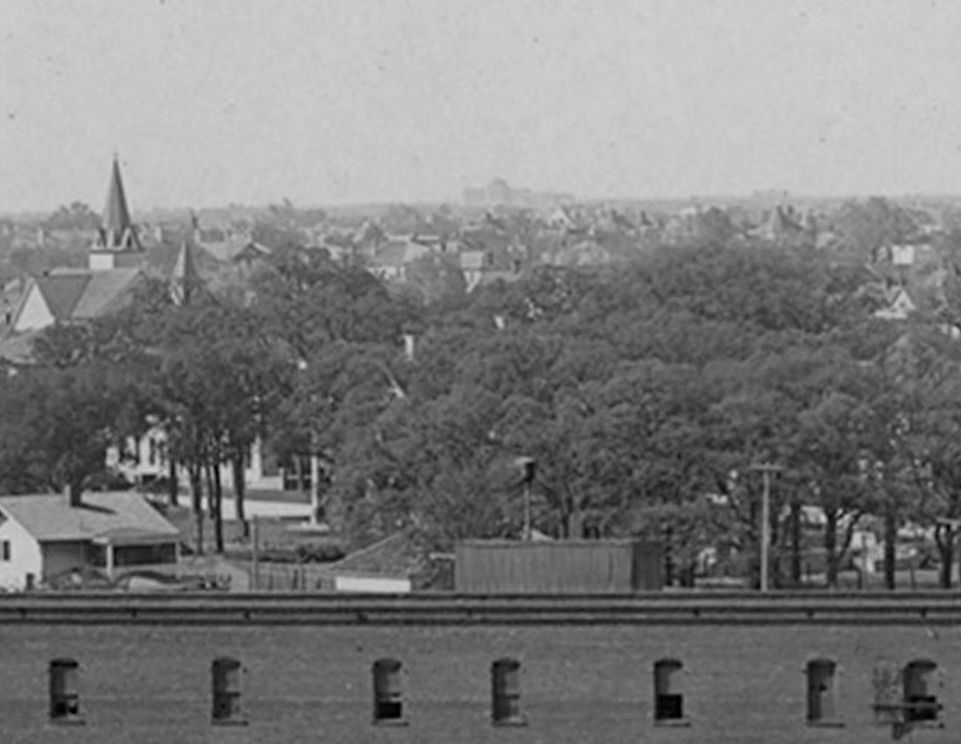
dallas-hall_continental-gin_det_1914A clear line of sight, from Deep Ellum to SMU (click for larger image)

by Paula Bosse

A quick “bonus” post: a detail of an incredible photo of the Continental Gin building which shows a ghostly Dallas Hall looming in the distance. Dallas Hall was the first building on the SMU campus, and in 1914 — a year before classes began — the far off building was way, way out in the country. SMU is a little over 5 miles from Deep Ellum. That’s quite a view.

***

This detail is from a photo featured in a previous Flashback Dallas post, “The Continental Gin Complex — 1914,” which can be seen here. I’ve just added this detail — and two other magnified details showing Baylor Hospital and the old Ursuline campus — to the post.

The original photograph, titled “Continental Gin Company on Elm Street, Facing North” by Charles Erwin Arnold, is from the George W. Cook Dallas/Texas Image Collection housed at the DeGolyer Library, Central University Libraries, Southern Methodist University. The photo and its details can be viewed here. It really is one of my favorite historical Dallas photos ever.

*

Copyright © 2015 Paula Bosse. All Rights Reserved.


The Adolphus & Its Annex

adolphus_lang-witchell_arch-yrbk_1922The Adolphus Hotel and its annex, circa 1922 (click for larger image)

by Paula Bosse

Built in 1912, the ornate and luxurious Barnett, Haynes, and Barnett-designed Adolphus Hotel (which was modeled on/inspired by the Plaza Hotel in New York) quickly became THE hotel in Dallas. It was so successful that in only four years an expansion was already underway. The 12-story “Annex” (seen above, just to the left of the original building) was designed by preeminent Dallas architects Otto Lang and Frank Witchell. The so-called “Junior Adolphus” was built around 1916/17 and added 229 rooms to Dallas’ most glamorous hotel. A third addition (“Adolphus III”) came along in the 1920s.

Below, a few views of the Adolphus complex at different stages of its growth. (Click photos for larger images.)

*

adolphus-construction_dallas-then-and-nowBuilt at the northwest corner of Commerce and Akard streets, the Adolphus Hotel was built on the spot previously occupied by the City Hall. This photo, looking northeast, shows the site’s excavation by Vilbig Brothers Construction.

*

1913-pano-2In this detail from an April 1913 panoramic photograph of the city’s skyline, the Adolphus can be seen just six months after its opening at the end of 1912. (A previous post devoted to the full panoramic photo can be accessed here.) The Oriental Hotel, with its rounded topknot, can be seen across Commerce from its sister hotel (both were built by beer king Adolphus Busch). Seen in the background is the Praetorian Building — once the tallest structure in Dallas (it is the tall building, second from the right).

*

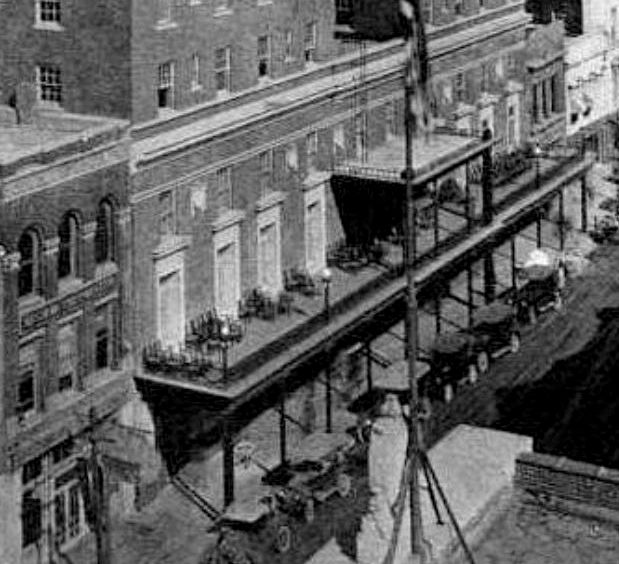
adolphus_lang-witchell_arch-yrbk_1922-detThe the Lang & Witchell-designed annex came along around 1916/17 (see top photo). My favorite detail is what looks like an open-air terrace, with tables and chairs, overlooking Commerce Street.

*

adolphus-annex_dallas-hotelsAnother view, showing the hotel and annex in 1924.

*

adolphus-annex_dallas-hotels-detA closer look shows that the terrace is now enclosed.

*

adolphus-hotelA few years later, a further, taller addition was built.

***

Top photo from the 1922 Yearbook of the Dallas Architectural Club.

Photo of the excavation from Dallas Then and Now by Ken Fitzgerald (San Diego: Thunder Bay Press, 2001); photograph from the Texas/Dallas History and Archive Division of the Dallas Public Library. A similar photo can be seen on the fascinating history page of the Vilbig & Associates website, here.

Detail of 1913 panoramic photo from the Jno. J. Johnson photo in the Library of Congress. (For more info, see previous post, “‘New Dallas Skyline’ — 1913,” here.)

Photo of the Adolphus with the Coca Cola sign in the lower left from Historic Dallas Hotels by Sam Childers (Charleston: Arcadia Publishing, 2010). The author’s extremely informative caption can be read here.

See a wonderful pictorial history of the Adolphus Hotel on the Dallas Morning News website here.

The official website for the Adolphus Hotel is here.

Click photos for larger images.

*

Copyright © 2015 Paula Bosse. All Rights Reserved.


“New Dallas Skyline” — 1913

1913-pano-3Dallas skyline panorama detail, 1913 (click for larger image)

by Paula Bosse

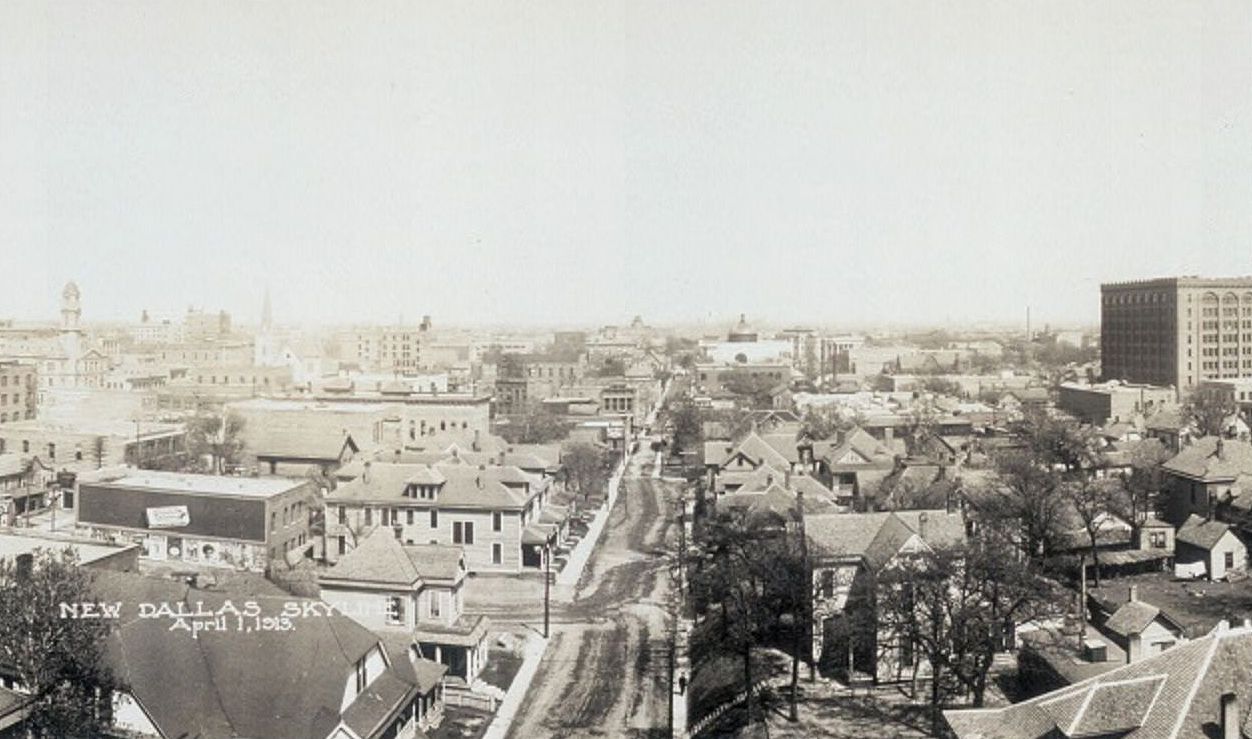
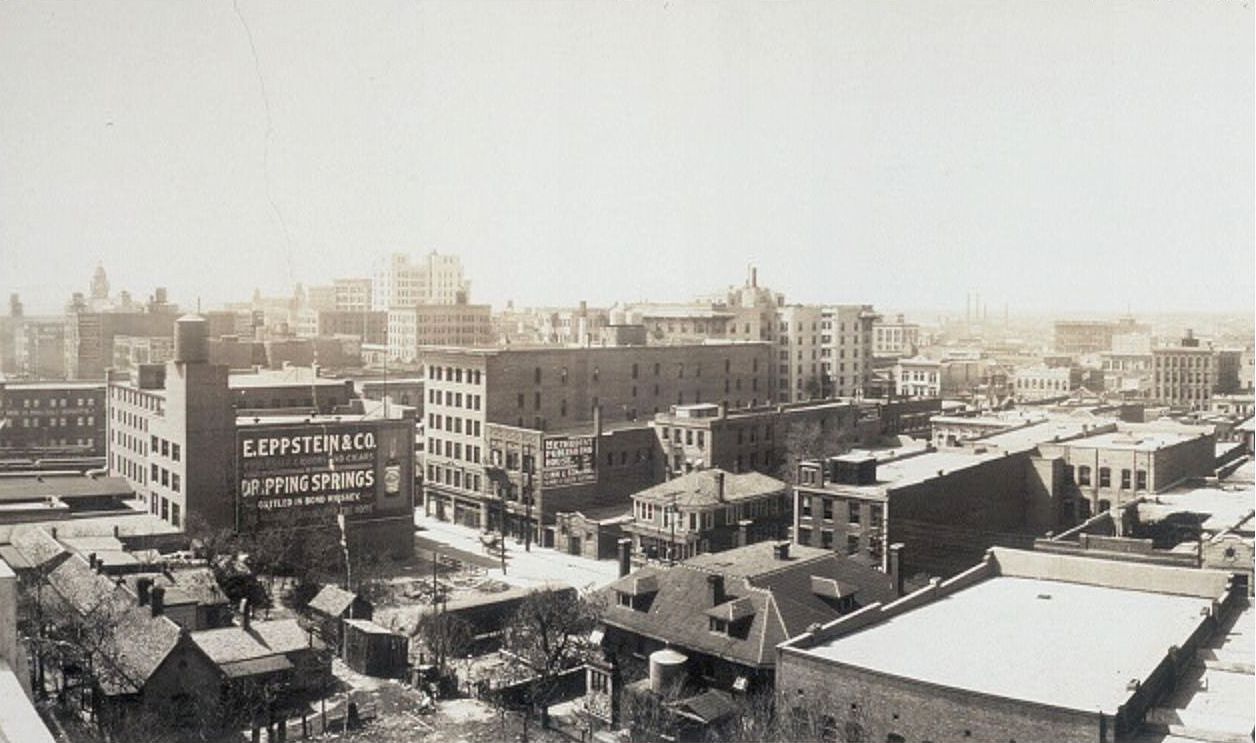
On April 1, 1913, one of Dallas’ most prominent photographers, Jno. J. Johnson, took a wonderful panoramic photo of the Dallas skyline. Dallas was, even then, boasting an impressive skyline. I’ve zoomed in a bit on the photo, breaking it down into four separate images. Johnson’s original photograph, titled “New Dallas Skyline — April 1, 1913,” is below. (Click to enlarge all images.)

dallas-panorama-skyline_april-1913_LOC(Click this photo!)
*

Below, the first portion of the photo.

1913-pano-1E. Eppstein & Co., wholesale distributors of whiskey and cigars, was at 1300-1302 Jackson.

*

1913-pano-2Above, the second portion, showing S. Akard Street, looking north — at the end of the street is the 6-month old Adolphus Hotel (then the tallest building in Dallas), built by beer baron Adolphus Busch, located on Commerce Street, catty-corner from his other hotel, The Oriental (the darker building in the center, with the distinctive top-knot on its northwest corner). The Praetorian Building (on Main) — a previous “tallest building in Dallas” — is the still tall-ish white building, second from the right.

*

The third portion (at the top) shows, I believe, Wood Street, looking east. The Post Office tower on Commerce can be seen at the far left. At the top, to the right of Wood Street (at S. Harwood) is the still-familiar sight of the First Presbyterian Church dome (brand new — the paint inside and out was probably still wet when this photograph was taken); to the right of the dome is the also-still-standing (and beautiful!) Scottish Rite Temple, also brand new.

*

1913-pano-4The final portion shows what I guess would be considered the northern edge of The Cedars? I love old photos that show residences in what we now consider the Central Business District. It’s so weird seeing these houses! The hulking turreted building at the top is Butler Brothers (built in 1910-11) at 500 S. Ervay; it later changed its name to the Merchandise Mart, and it is now undergoing renovation.

***

Panoramic photograph by Jno. J. Johnson, from the Library of Congress, here.

For those who want to play along at home, a 1919 street map of the area can be found at the ever-indispensable Portal to Texas History, here.

Click pictures for much larger images.

*

Copyright © 2015 Paula Bosse. All Rights Reserved.