Flashback : Dallas

A Miscellany: History, Ads, Pop Culture

Category: 1910s

Vickery Place: “Above the City” — 1911

vickery-place-dmn_061111“An Unstinted Supply of the Very Best Water” (click for larger image)

by Paula Bosse

Vickery Place is the place to be!

  • Most Convenient
  • Most Reasonable
  • Most Desirable

And the water! Gobs of it! Look for the flag on the derrick over the artesian well — you can see it from St. Mary’s College on Ross!

***

Ad for the new Vickery Place Addition appeared in the June 11, 1911 edition of The Dallas Morning News.

Vickery Place website is here.

Vickery Place wiki is here.

*

Copyright © 2014 Paula Bosse. All Rights Reserved.


Cowboys and Indians on Elm Street — 1915

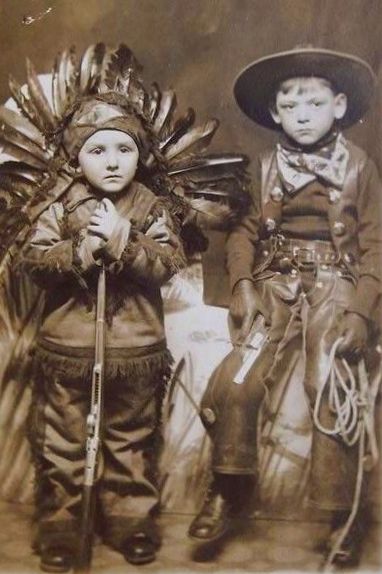
lawrence_kiddie-photoPhoto by Joe Lawrence, circa 1915

by Paula Bosse

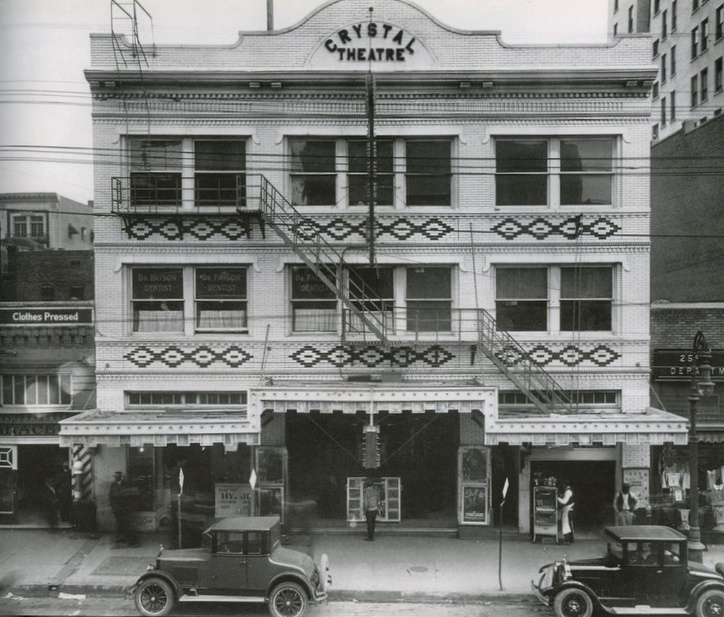
The photo above, showing two not-terribly-thrilled children dressed up in Old West costumes, was taken by Joe Lawrence in his “Crystal Electric Studio” at 1608 Elm Street, one of many small businesses located above the Crystal Theater.

crystal-theaterThe Crystal Theatre — with office space above (click for larger image)

Joseph Z. Lawrence (1884-1943) was born in Romania and settled in Dallas in 1909. In 1915 he was doing business as a photographer at 1608 Elm Street. Lawrence later owned the Lawrence Art Galleries on Pacific Avenue, and, along with his son Harry, was an early supporter of the Dallas Nine artists.

***

Sources & Notes

Top studio photo by Joe Lawrence, found on eBay.

Photo of the Crystal Theater found on Pinterest, here. A photo of the 101-year old building taken during the recent spate of downtown demolition — with the wrecking ball literally INCHES away from it — is here. The Dallas Morning News article it comes from is here.

At some point the address of the building (originally 1608-10) became 1610 Elm, perhaps when it was extensively remodeled in the late 1920s and became a retail store.

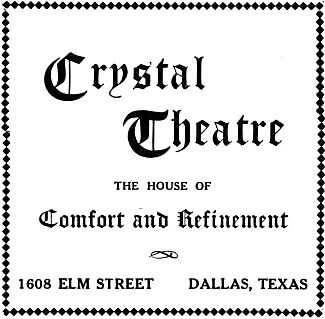
crystal-theater_building-code-bk_19141914 — “Comfort & Refinement”!

*

Copyright © 2014 Paula Bosse. All Rights Reserved.

Union Station’s Empty Backyard — ca. 1920

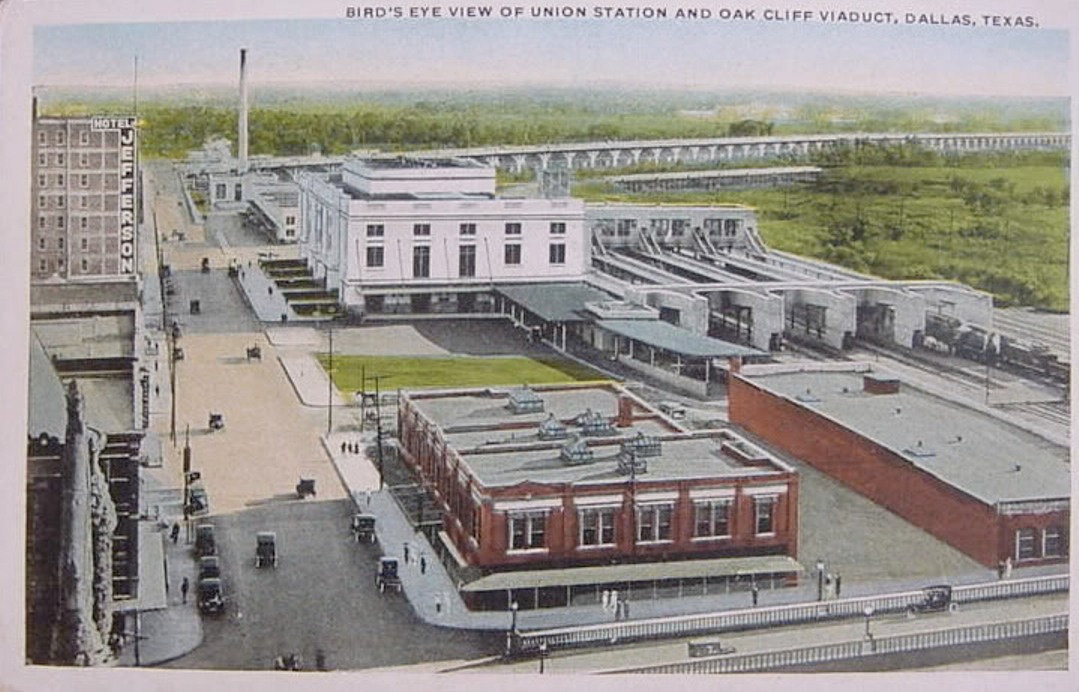
union-stn_ca1920The western edge of downtown, looking south (click for larger image)

by Paula Bosse

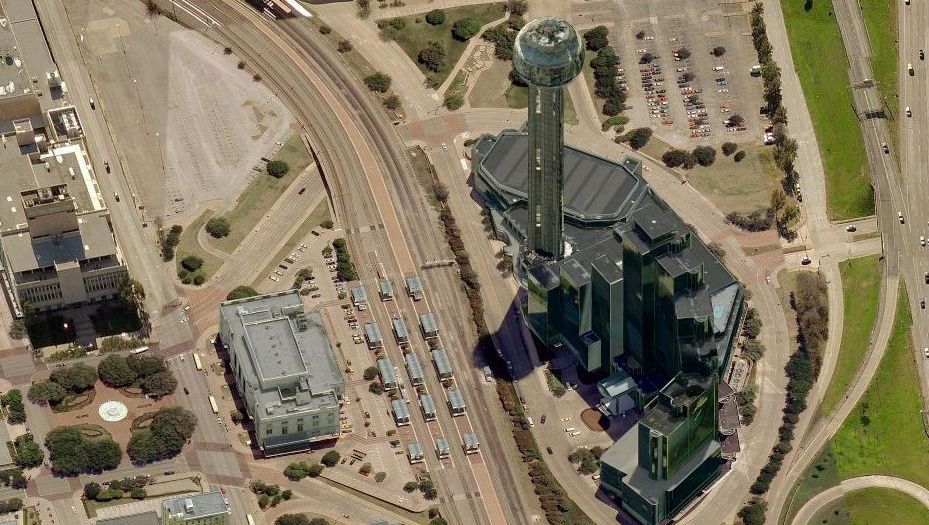
Here’s a postcard view you don’t see that often, Houston Street, looking south, with the Old Red Courthouse at the lower left, the gleaming white Union Station in the upper middle, and the fantastic Houston Street viaduct at the top. It’s a little hard to imagine that sixty-or-so years later, Reunion Tower would be plunked down at the far right of this picture, in that grassy field behind the tracks at Union Station.

union-stn_bing_20014

***

Postcard from the DallasMetropolis.com forum, here (see comment for the very interesting description of what’s what in this image).

Present-day bird’s-eye view from Bing (click for larger image).

*

Copyright © 2014 Paula Bosse. All Rights Reserved.


Refusing to Give Up One’s Seat Might Set Off a Melee — 1919

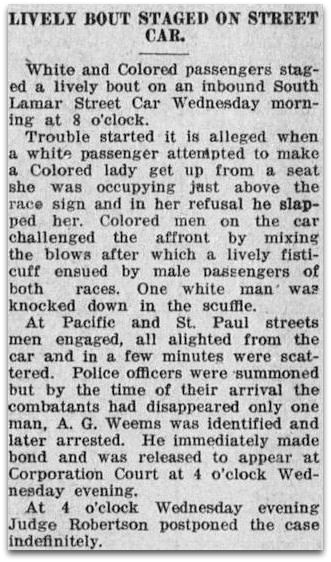
streetcar-fight_dal-express_100419The Dallas Express, Oct. 4, 1919

by Paula Bosse

On this, the anniversary of Civil Rights icon Rosa Parks‘ act of defiance in refusing to give up her seat on a bus to a white passenger in Alabama in 1955, it’s interesting to note a couple of accounts of similar incidents in Dallas, but 36 years earlier. And more violent.

The article above — which appeared in The Dallas Express, a weekly newspaper printed by and for Dallas’ black community — describes a melee (or “riot” as The Dallas Morning News called it) that occurred when an unnamed black woman refused to give up her seat (which was in the part of the streetcar reserved for white passengers) when a white man demanded that she move. When she steadfastly refused, he slapped her (!), and that set off a wild fight between black and white male passengers … on a moving streetcar! When the car stopped, everyone spilled out into the street and scattered. Only one person was arrested, Mr. A. G. Weems, a black businessman and former school teacher who was active in the black community and later represented African-American interests and residents as a member of the Negro Chamber of Commerce.

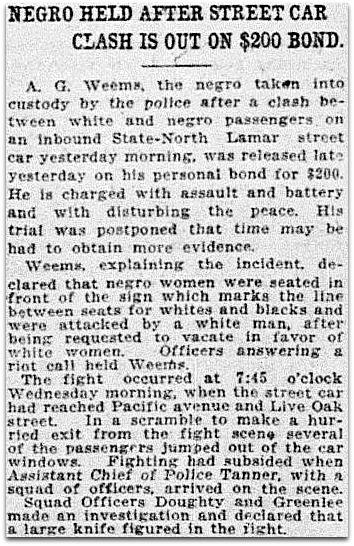
The Dallas Morning News also carried a report of the incident:

streetcar-fight_dmn_092519Dallas Morning News, Sept. 25, 1919

It sounds as if Weems could have gotten away, had he wanted, but perhaps he was making a statement.

In the previous months of 1919, there were several similar incidents reported in the pages of The Dallas Express. Sometimes altercations were a result of black passengers sitting in “whites-only” sections of streetcars, but sometimes trouble arose when the white section was full, and white passengers sat in the seats designated for black passengers:

streetcar-fight_dal-express_071219Dallas Express, July 12, 1919 (click for larger image)

There was also an incident that had occurred in February of that year in Birmingham, Alabama in which a white conductor was shot (and presumably killed) after he threatened to slap a black woman in a dispute over the fare. A black vigilante had appeared out of nowhere, shot the man, and disappeared into the night.

The antagonism, disgust, and violence caused by this “peculiar law of the Southland” continued until 1956 when the Supreme Court finally banned segregation on public transportation.

*

Copyright © 2014 Paula Bosse. All Rights Reserved.

Armistice! — 1918

wwi_returning-troops-parade_1919_portalDowntown parade for returning troops — June, 1919 (click for larger image)

by Paula Bosse

Dallas found out that the Great War had finally ended at around 3:00 in the morning of November 11, 1918 when the siren atop the Adolphus Hotel sounded with “maniacal shrieks.” People poured into the streets to celebrate.

The crackle of revolver reports began to sound. Sleep was murdered, even had one been so disposed, and many residents from all parts of the city foregathered in the downtown district to jubilate and exult in various ways until daylight came. (Dallas Morning News, Nov. 12, 1918)

Giddy celebrations and impromptu parades were the order of the day, and the joyous spirit that erupted throughout the city is reflected in this Dallas Morning News report of “the first day of world peace since August, 1914” (click to see larger image):

wwi_armistice-in-dallas_dmn_111218
DMN, Nov. 12, 1918

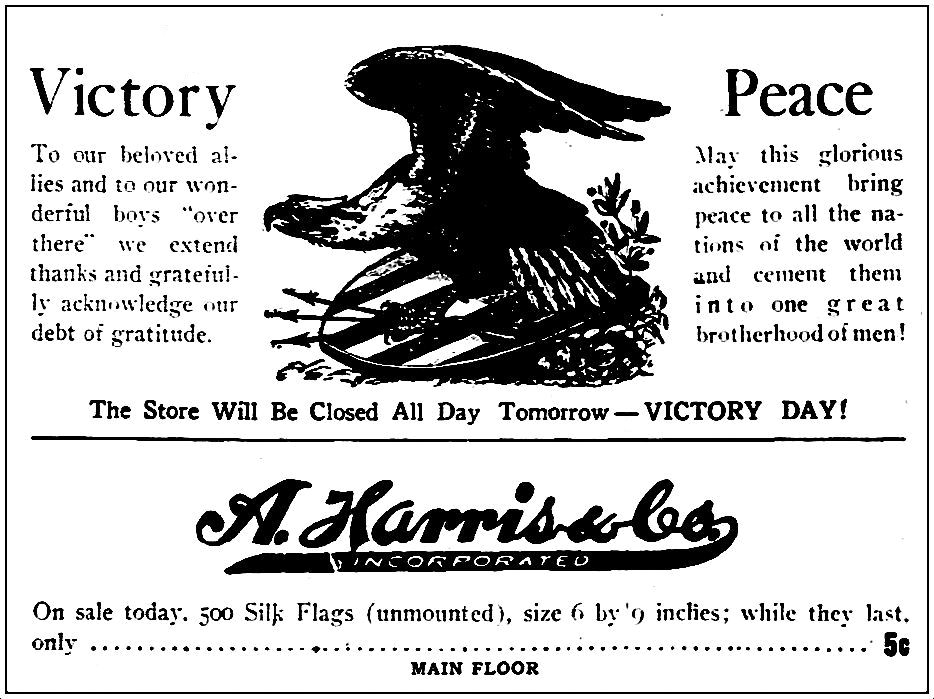
Local businesses got in on the action by placing heart-felt patriotic advertisements (some of which also quietly reminded readers that Christmas was just around the corner).

armistice_linz_dmn_111218

armistice_kahn_dmn_111218

ad-dreyfuss_dmn-111218

wwi_armistice_a-harris_dmn_111218

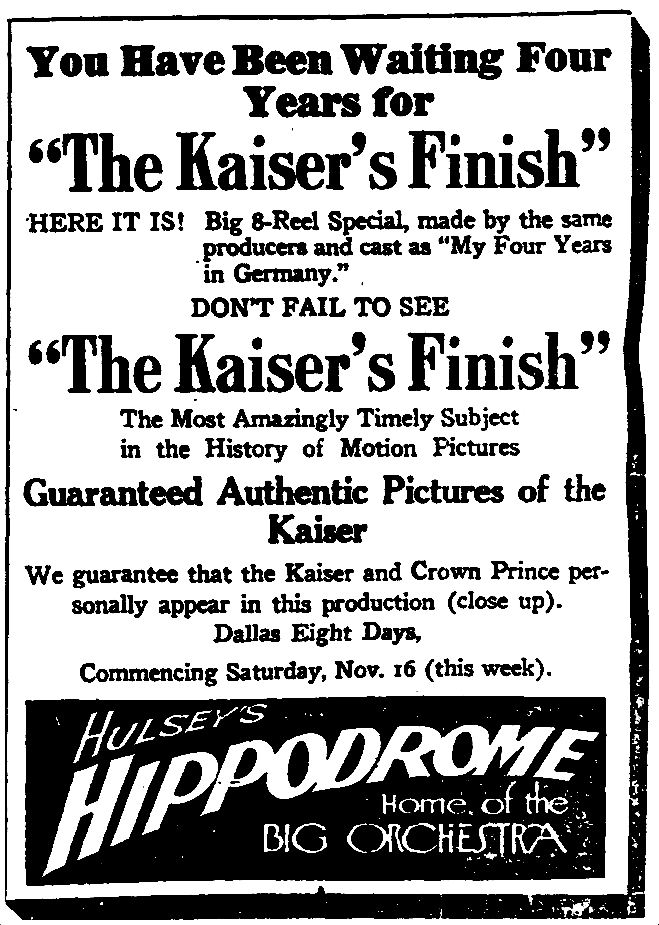
wwi_armistice_hippodrome_dmn_111318

wwi_armistice_hurst-bros_dmn_111318

When World War I officially ended on November 11, 1918, the military and civilian deaths and casualties totaled more than 37 million. All everyone wanted was for their loved ones to return home safely and for life to return to normal as quickly as possible. There was a lot to be thankful for that Thanksgiving.

***

Sources & Notes

Photo of the 111th Engineers from the Tarrant County College Northeast, Heritage Room, via the Portal to Texas History, here. It shows the 1500 block of Main Street, looking west toward Akard. See the same view today here (the short white  building at 1520 Main is currently occupied by the Iron Cactus; in the 1919 photo, that address is occupied by Thompson’s in what looks like the same building). (See another parade photo of the same block here. The detail is much, much better!)

1500-block_main_1919_2015

Ads from the Dallas Morning News, Nov. 12 and 13, 1918.

The Wikipedia entry for World War One casualties is here.

Click pictures for larger images.

*

Copyright © 2014 Paula Bosse. All Rights Reserved.


Simulcasting the World Series In Dallas In the Days Before Radio, Via Telegraph

world-series_dmn_100422-smThe later version, for radio listeners, 1922…

by Paula Bosse

It’s 1912. You’re a huge baseball fan, and the World Series is about to begin — New York vs. Boston! But you live in Dallas, a million miles away from the action. You can’t wait for the results in the paper the next day because you’re an impatient S.O.B., and radio won’t be introduced for another ten years. Do you panic? No! Because you live in a big city with a taste for new technology, and the Dallas Opera House is going to present a sort of early simulcast of the games on a “mammoth automatic score board.” Your sports prayers have been answered!

1912_world-series_dmn_100612DMN, Oct. 6, 1912

You lean back in your comfy theater seat and smoke your smokes in plush and civilized surroundings as each play is sent by telegraph to Dallas from the ballpark back East where the game is being played RIGHT NOW, hundreds of miles away. The telegraph operator in Dallas will relay the play-by-play information to personnel in the theater who will somehow do something to some sort of “automatic electric board.” And, according to promoters of these “reproductions” of baseball games, you’ll feel like you’re right there in the thick of the action. You’ll “see” the game played before your eyes!

I’ve read several articles about these boards and these reproductions, but I can’t for the life of me figure out how it worked. I assume there was a large traditional scoreboard on stage that lit up, keeping track of the score, runs, outs, etc. But apparently there’s more, and I just can’t picture it. Here’s a somewhat confusing description of what happened during these productions:

WORLD SERIES WILL BE SHOWN AT THE OLD MILL

Manager Buddy Stewart of the Old Mill Theater announced that he secured the New Wonder Marvel Baseball Player Board to reproduce the World Series baseball games. This board is declared the greatest board ever invented for reproducing baseball games. It is not a mechanical board and no mechanical devices are used, and very little electrical appliances are necessary. The games are reproduced by a crew of six experienced baseball players who are carefully rehearsed and each has a part or position to play. No other board is so complete as this. The board does not require sign cards to denote players as in other boards. You see the ball going and do not have to look in any other direction to see what it means.

Spectators will see each play reproduced in less than two minutes after it is made on the playing fields of the World Series as the board is connected with a direct wire to the baseball field, and as fast as the telegraph operator receives the play it is reproduced with as much realism as on the field. The players are seen to run bases, the ball is seen bouncing or soaring to the infield or outfield, and anyone who is familiar with baseball will know just exactly what is happening on the field by the plays made on the board with very little left for imagination.

Every hit, run, error, strike or ball, the number of strikeouts, or balls made by pitchers, or the number of hits, runs or errors made by the players is always prominently shown on the board which makes it [un]necessary for individual scoring during the progress of the game. (DMN, Oct. 3, 1920)

Doesn’t really help much. It sounds as if people are on the stage acting out each play. That would be weird. These “reproductions” of World Series games were quite popular in Texas (and probably elsewhere) for at least 15 years. If anyone reading this has a photo or diagram of one of these vaunted Marvel scoreboards, I’d love to see it!

*

An earlier description of the 1912 Opera House reproduction sounds more like an audience watching a baseball game on a giant Lite-Brite “score board.”

1912_world-series_dmn_100812DMN, Oct. 8, 1912

The trick to keeping the telegraph operators calm and on-their-toes during a lengthy baseball game? Make sure they have no interest in the game.
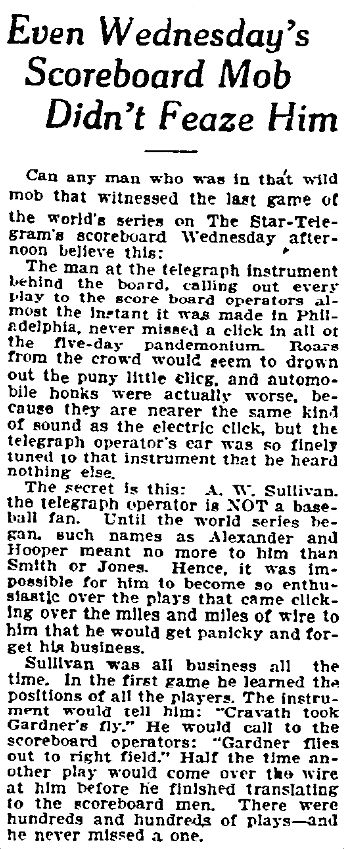
1915_world-series_FWST_101415Fort Worth Star-Telegram, Oct. 14, 1915

Fort Worth was also getting in on the action. And they had celebrities — people like Clarence (Big Boy) Kraft and Ziggy Sears (who I’m going to assume have something to do with baseball). I’m not sure what these celebrities were doing exactly, but whatever it was, they were there doing it.

1921_marvel-score-board_FWST_100221FWST, Oct. 2, 1921

These theater programs weren’t for everyone, though. If you couldn’t take the time out of a busy work day to swan over to a theater to leisurely witness one of the early “reproductions” (or if the admission price was too steep for your budget), you could always ring up the operator to have her tell you the current score:

automatic_dmn_101112-world-series
DMN, Oct. 11, 1912

These things seemed to be a popular annual event, but in 1922, something more technologically advanced than the Marvel board appeared on the scene: radio! WFAA and WBAP began broadcasting in 1922, and, suddenly, following sports became a whole lot easier. In something of a transitional technology, there was the outdoor board as described below. The games were not only broadcast live on WFAA, but The Dallas Morning News (WFAA’s parent company) also erected one of those old-fangled “electric boards” out on the street so that passersby could keep up with the scores. (Portable transistor radios were decades and decades away.)
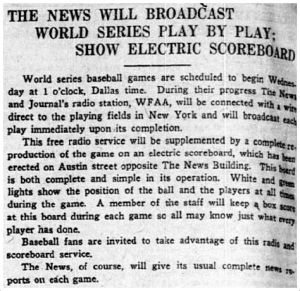
1923_world-series_dmn_101023DMN, Oct. 10, 1923

It was surprising to see that the “Marvel score boards” were still being used as late as 1926 (Yankees vs. Cardinals, at the Capitol Theater). Every baseball fan worth his salt should have had his own radio by then so he could listen to the World Series in the comfort of his own home and curse and cheer as loudly as the vicissitudes of the game demanded. Eat my dust, Marvel board! Radio changed everything, and radio was here to stay.

*

UPDATE: Thanks to Kevin’s link in the comments below, I can share this GREAT article from Uni-Watch.com about another of these boards called the Play-o-Graph: “Photography of Playography by Paul Lukas — it answers all my questions, and it even has photos (and links to photos) of crowds watching the boards. He also links to a 1912 article, “The Automatic Baseball Playograph”  by J. Hunt, in the Yale Scientific Monthly which describes how the board works and has this photo:

play-o-graph_yale-scientific-monthly_1912The “Play-o-Graph,” 1912 (click for larger image)

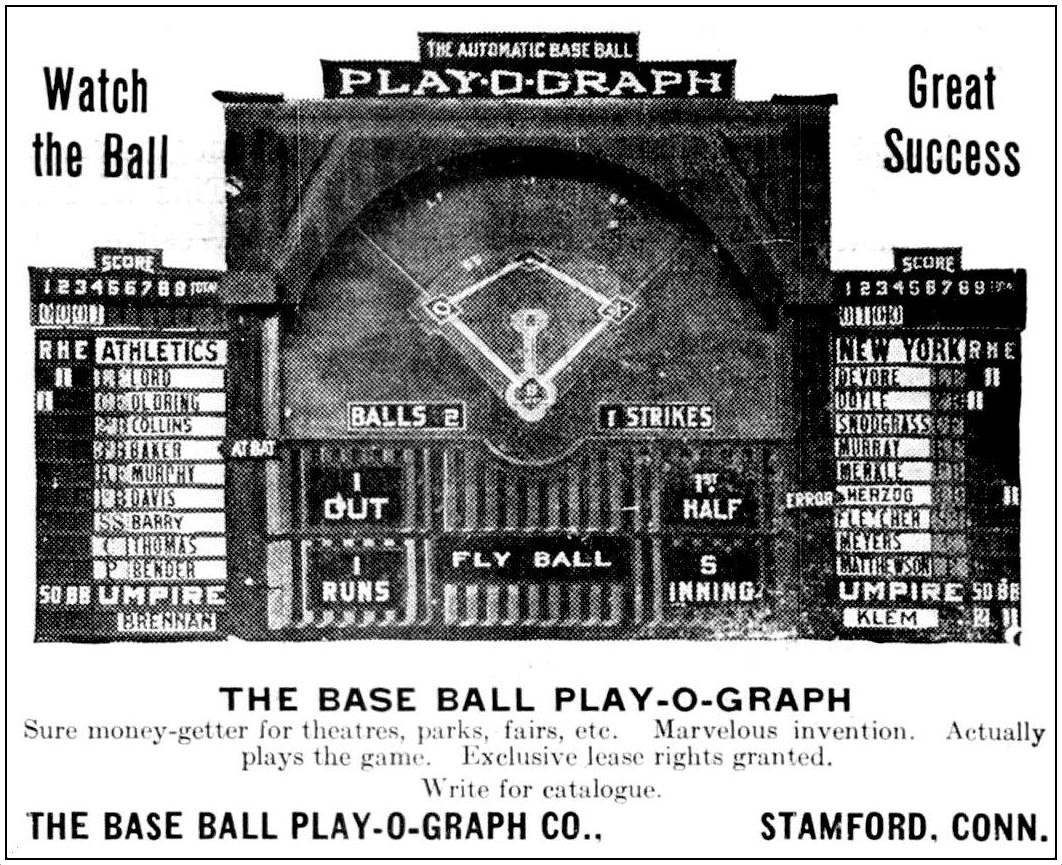
And, for completists, here’s an ad for the Play-O-Graph, from 1913:

baseball-simulation_play-o-graph_billboard_032213Billboard, Mar. 22, 1913

Makes a bit more sense now! Thanks, Kevin!

***

Sources & Notes

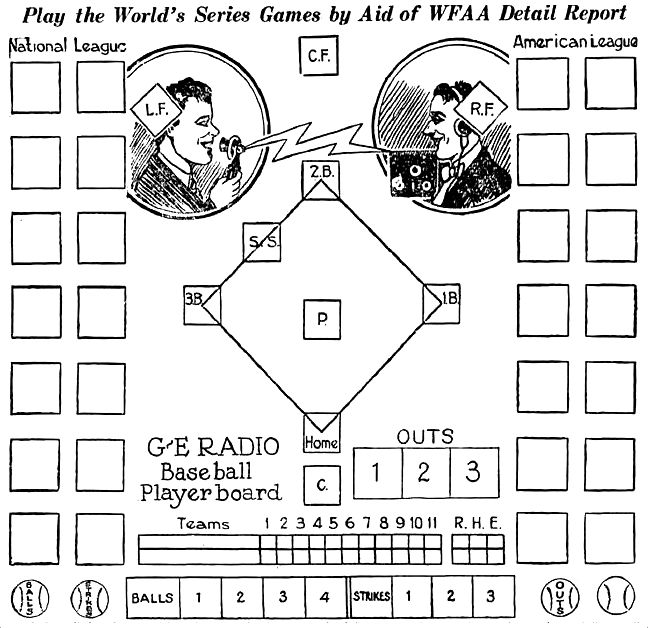
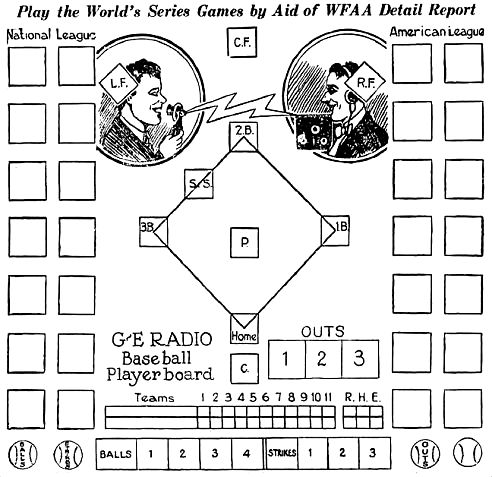
The top image is the “G.E. Radio Baseball Player Board” — a sort of home version of the big scoreboards used in theaters, printed for WFAA listeners in The Dallas Morning News on Oct. 4, 1922. The instructions are in a PDF, here. And feel free to print one out and use it while you watch the Series this year. Still works in the 21st century!

For an article on listener response to the successful first broadcast of the World Series by WFAA radio (listeners picked up the signal in England!), see the DMN article from Oct. 6, 1922 in a PDF, here.

And because they have such great names, you might want to know who Clarence “Big Boy” Kraft and Ziggy Sears were. If you’ve read this far, you owe it to yourself. “Big Boy,” here; Ziggy, here.

*

Copyright © 2014 Paula Bosse. All Rights Reserved.

“Dear Folks: Dallas’ New Filtration Plant Is Simply Glorious! Weather Great! Wish You Were Here!”

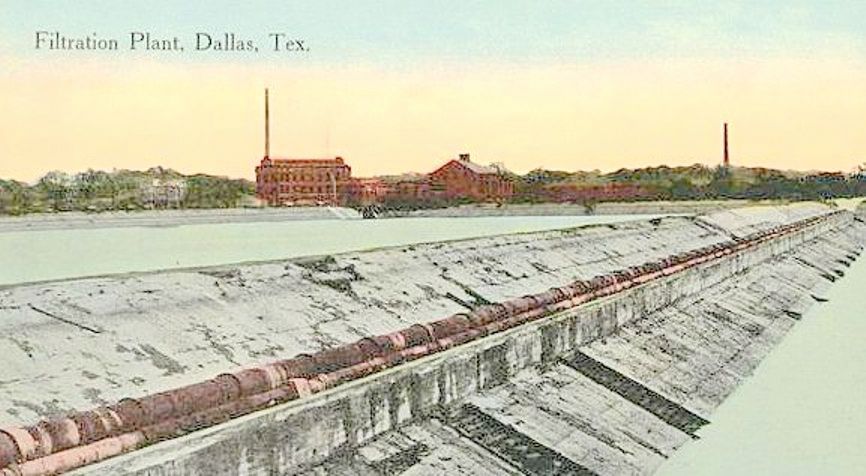
filtration-plant_c1916_lgA famed Dallas beauty spot, circa 1916

by Paula Bosse

Above, a postcard from a lady visiting Dallas in 1916, sent to her “dear friend” back home in Wilmette, Illinois. The card has a short, chirpy “hello, hope everyone’s well, be home in a couple of weeks” type of message on it. But there is no mention of the fact that the picture on the other side shows a water filtration plant. …A water filtration plant. Dallas was a big and impressive city in 1916, and there were a lot of beautiful postcards to choose from, so one wonders why she chose THIS one. I’m not even sure why there would be a picture postcard of a water filtration plant in the first place. Maybe to make municipal workers in other cities jealous. “Dallas has a magnificent state-of-of-the-art sedimentation basin, and you don’t!” But, actually, it’s kind of a cool postcard.

This water filtration plant and pumping station was located along the Trinity (before the river’s course was changed), at what is now Oak Lawn and Harry Hines (now home to the Sammons Center for the Arts, a designated historic landmark which contains part of the old Turtle Creek Pump Station).

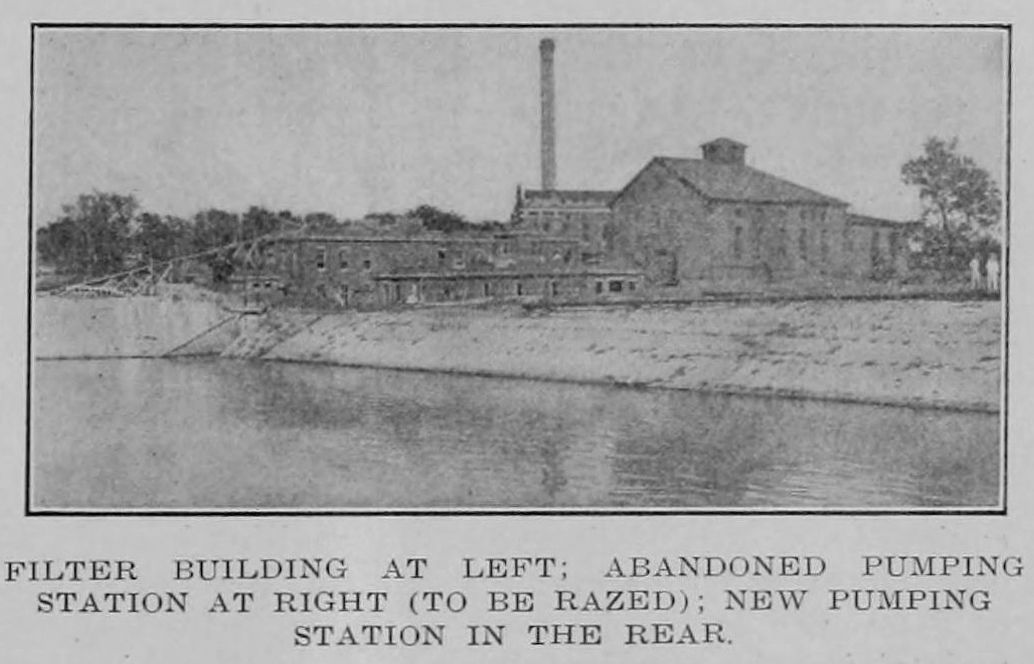
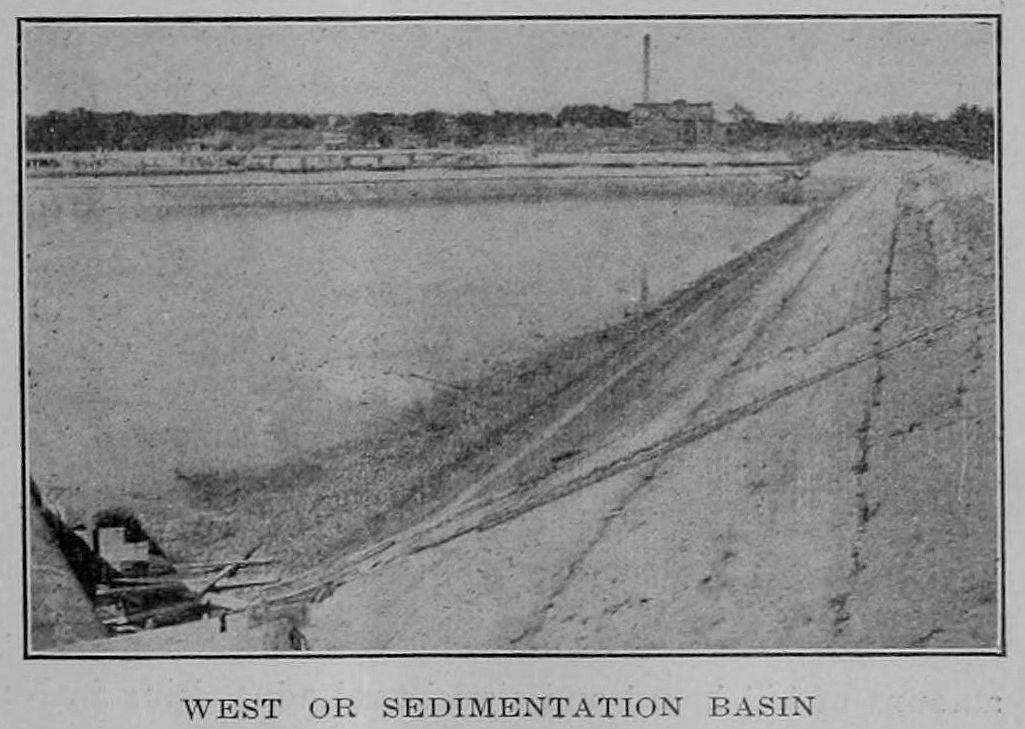
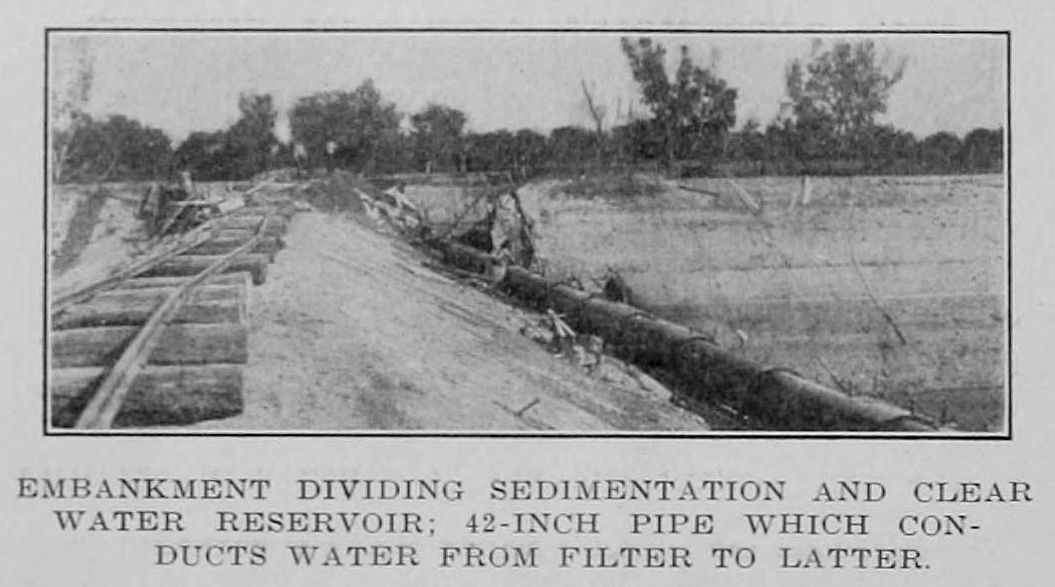
The filtration plant was built in 1913. Here are a few photos of its construction (click to see larger images):

water-filtration_photo1_102313

water-filtration_photo2_102313

water-filtration_photo3_102313

A large-capacity water filtration plant is a necessary thing for the city to have, certainly, but it still doesn’t explain why Mrs. [Illegible] was sending a postcard of it to her friend in Illinois.

***

Sources & Notes

Postcard of the filtration plant (wow, I’ve typed that a LOT today) from a site that sells postcards. It shows the reverse of the card with the hard-to-read message, here.

Photos of the filtration plant (…there it is again…) from the Oct. 23, 1913 issue of Municipal Journal, here. The entire article should be of interest to people who are interested in … this sort of thing.

Even MORE about this plant, along with diagrams, photos, and an in-depth analysis on its operation, can be found in the July 16, 1914 issue of Engineering News, here.

History page for the Sammons Center is here.

A couple of other early photos of the Turtle Creek Pump Station (from 1894 and 1908) can be seen in a previous post — “City Hospital, a Pump Station, and the County Jail — 1894” — here.

*

Copyright © 2014 Paula Bosse. All Rights Reserved.

“So Sorry, Bill, But Albert is Taking Me to The State Fair of Texas”

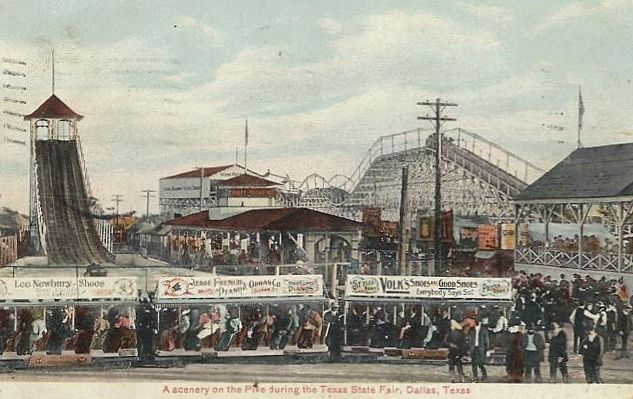
state-fair_1909_flickr“The Pike” — 1909

by Paula Bosse

Hey, y’all — guess what ends this weekend? Hurry!

One doesn’t really need an excuse to post a bunch of photos of the Great State Fair of Texas, but it IS the closing weekend, so why not enjoy a few images from the past few decades.

Above, a view of the Midway in 1909 (then called “The Pike”), with the Log Ride-like “Chute” and its ramp, a roller coaster, and a loaded tram festooned with shoe ads (including one for Volk’s).

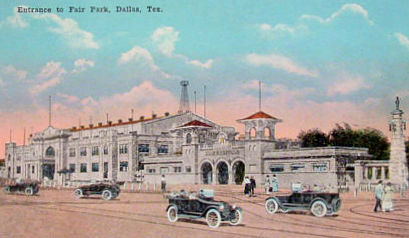
Below, the Fair Park entrance in 1919:

fair-park-entrance_1919

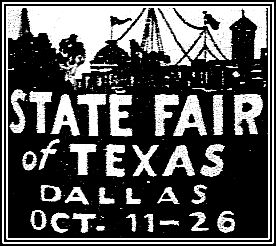
A nice little newspaper ad from 1924:

state-fair_092724

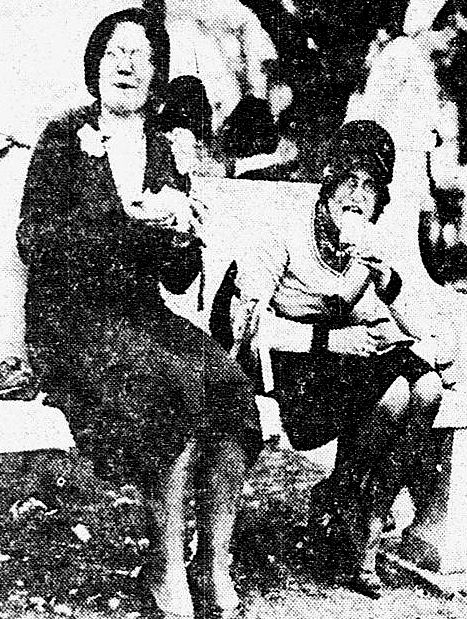
Two women enjoying ice cream in 1930 — State Fair food has always been one of the main joys of visiting the fair.

state-fair_dmn_101530

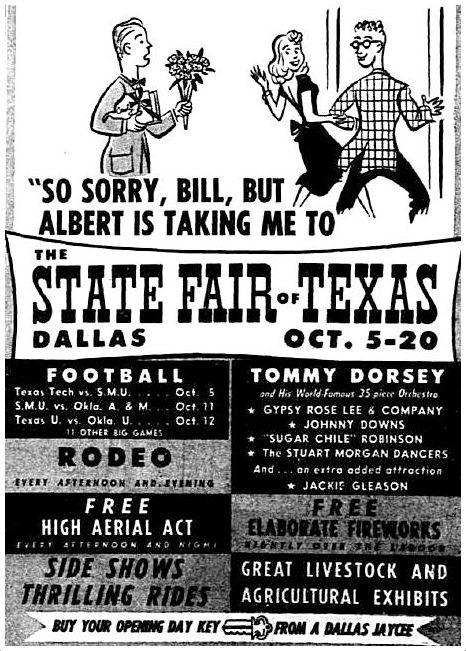
Ad from 1946: “So sorry, Bill, but Albert is taking me to the State Fair of Texas.” The grown-up entertainment that year was provided by Tommy Dorsey, Gypsy Rose Lee, and Jackie Gleason.

state-fair_dmn_092446

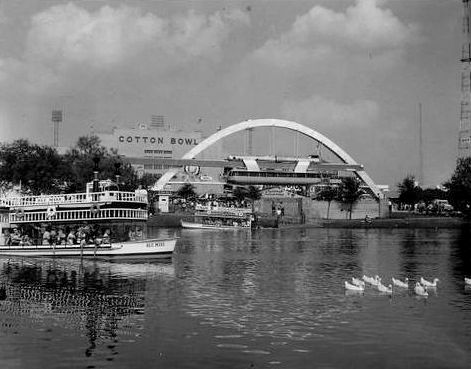
In 1958, Fair Park had a monorail (the only one then operating in the United States) and a paddle-wheeler in the lagoon:

state-fair_lagoon_squire-haskins_dmn-1958

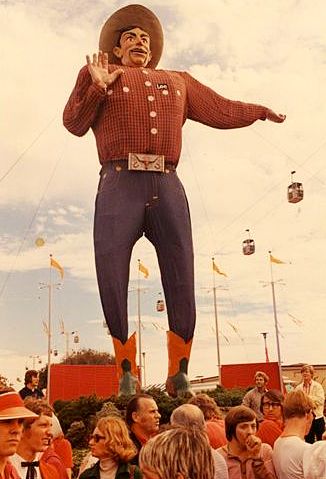
And then there’s this guy, who spans the decades:

big-tex_briscoe-center

***

Sources & Notes

1958 photo featuring the monorail by Squire Haskins, from a Dallas Morning News online article featuring TONS of cool photos of the fair over the years, here.

Big Tex photo (undated) from the Dolph Briscoe Center for American History.

Another post of random images of the SFOT through the decades — “The Fair Is In the Air — Let’s Go!” — is here.

*

Copyright © 2014 Paula Bosse. All Rights Reserved.


The First Texas-OU Game in Dallas — 1912

tx-players_dmn_101912bWatch out, Oklahoma: giant Texas linemen await…

 by Paula Bosse

The Texas-OU game is a football tradition, held annually in the Cotton Bowl during the State Fair of Texas. The first game of the so-called “Red River Rivalry/Showdown/Shootout” was held in Dallas (aka “neutral ground”) in 1912. As the Cotton Bowl hadn’t been built yet, the game was held at Gaston Park, a sporting field with a large grandstand where Dallas teams played baseball, football, and, yes, even soccer. It was located at Parry & Exposition, in the spot where the State Fair Auditorium (now known as the Music Hall) was built in the 1920s.

Since my grasp of sports is tentative, I’m not going to go into any particulars of the actual game (which — spoiler! — Oklahoma won, 21-6); instead, I thought I’d mention a few of the incidental things leading up to the game that I found interesting. (For those who are interested in the particulars of the game, fret not — there is a link at the bottom of the post.)

So here are a few of the things that I found amusing or entertaining:

  • The 1912 football season began with new rules: downs were increased from 3 to 4; touchdowns were now 6 points instead of 5; the playing field was reduced from 110 yards to 100; the onside kick was abolished; a touchdown was permitted when caught over the goal line; the ball was kicked off from the 40-yard line instead of midfield; the intermission between quarters was reduced from 2 minutes to 1.
  • Fort Worth felt slighted that they had missed out on hosting the game (“it might just as well have been played in Fort Worth,” the Fort Worth Star-Telegram groused). Local Fort Worth-friendly UT alumni swore to try “strenuously” to get the game for Cowtown the following year, because, damn it, “next year is Fort Worth’s turn” (FWST, Oct. 15, 1912). (Sorry ’bout that, FW….)
  • The Sooners’ coach, 37-year old Bennie Owen (whom I gather is something of an OU legend), had only one arm, the result of a hunting accident. The Dallas Morning News wrote that Owen was “one of the most able [coaches] in the country. He is disabled to some extent by having but one arm, but evidenced by his success during the past season, this does not trouble him to any great extent” (DMN, Oct. 6, 1912).
  • The Longhorns’ coach, Dave Allerdice, was only 25 years old. He had been hired to fill the spot left vacant in the wake of the death of UT’s previous coach who had died rather exotically as the result of “a fall out of the window of his bedroom” (DMN, Oct. 10, 1912).
  • Both Allerdice and Owen had been coached as students by the same man, Coach Yost, at Michigan.
  • The Gaston Park crowd was estimated at over 6,000. The crowds going to the game and to the fair were so great that the streetcars and Interurbans were jam-packed. In fact, both teams had difficulty making it to the game on time because they couldn’t find transportation to get there, and the game had to be started late to allow for the players to arrive and warm up.
  • Oklahoma dominated the game, and the Sooners won, 21-6.

And so began the annual Texas-OU tradition in Dallas.

*

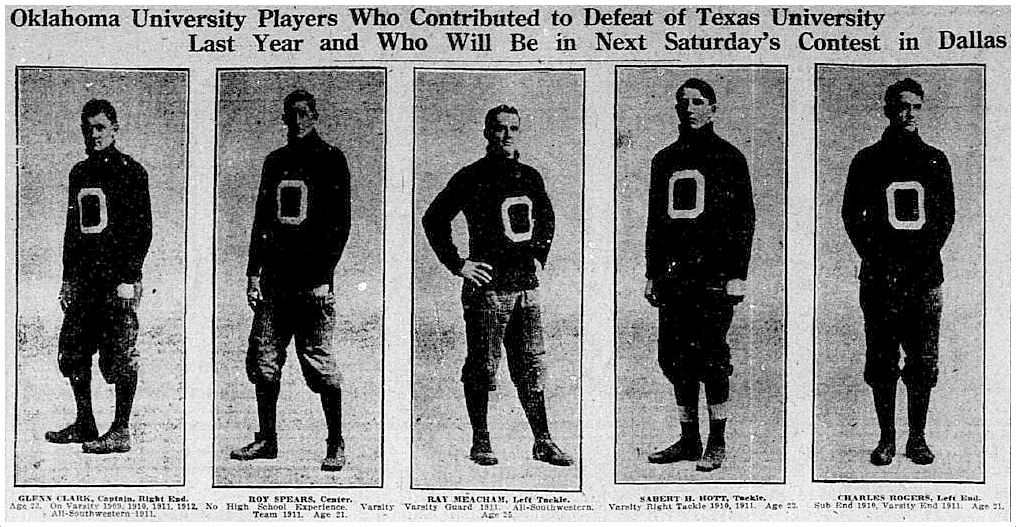
Below, Sooner boys: 0-0-0-0-0.

sooners_1912_dmn_101812DMN, Oct. 18, 1912

*

Grainy, off-kilter image of the crowd-frilled grandstand at Gaston Park.

tx-ou_crowd_dmn_102012DMN, Oct. 20, 1912

*

It’s a bit hard to see anything in these 100-plus-year-old photos, but here are a couple of “action photographs” of the game.

tx-ou_game-photos_dmn-102012DMN, Oct. 20, 1912

*

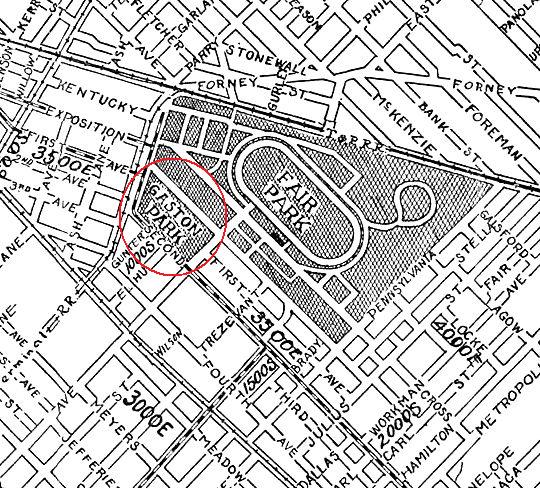
Gaston Park? Here’s where it was (a lot of street-renaming has gone on since this map was drawn in 1919).

gaston-park_fair-park_ca-1919

***

Sources & Notes

All photos from The Dallas Morning News.

1919 map (detail) from the Portal to Texas History, here.
For slightly better photos of Gaston Park (in 1908), see a previous post, here.

Wikipedia roundup:

  • Gaston Park, here.
  • Bennie Owen, here.
  • Dave Allerdice, here.
  • “Red River Showdown” (which I’ve never actually heard anyone other than TV commentators and promoters say to describe what everyone I know calls the “Texas-OU game”), here.
  • Defenestration, here.

The Dallas Morning News and The Fort Worth Star-Telegram are filled with numerous contemporaneous articles about this game. If you have a handy-dandy Dallas Public Library card (free!), you can pore over these articles to your heart’s content. To read what was printed the day of the game (Oct. 19, 1912), click  here. To read about the results and the game coverage, click here.

Click pictures for larger images. They will still be muddy and grainy, but, by God, they’ll be bigger.

*

Copyright © 2014 Paula Bosse. All Rights Reserved.

When the Spanish Influenza Hit Dallas — 1918

spanish-influenza_love-field_otis-historical-archives_nmhm_110618
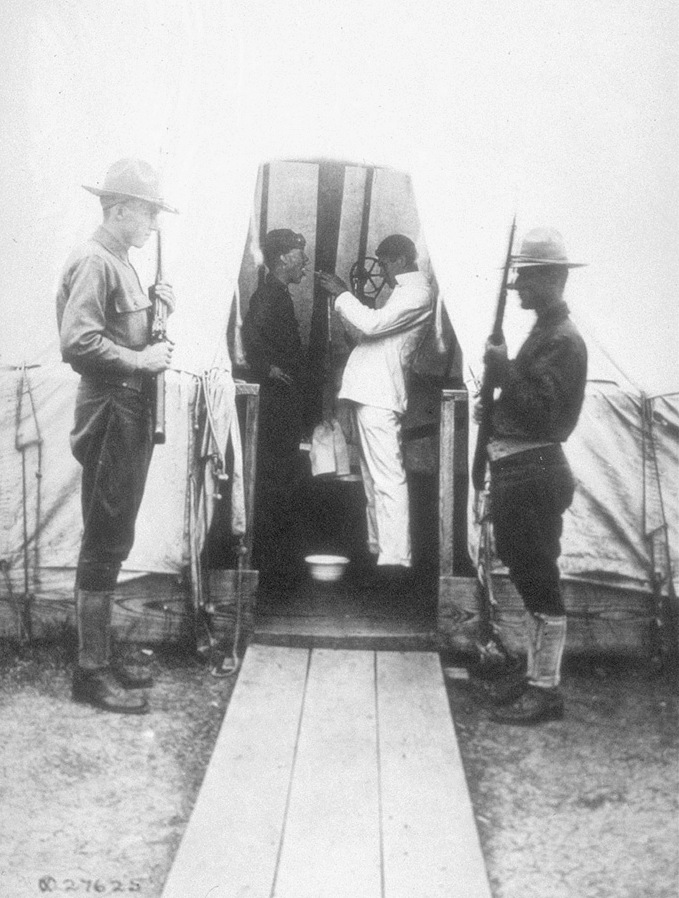
American Red Cross at Love Field, spraying soldiers’ throats, Nov. 6, 1918

by Paula Bosse

The Spanish Influenza pandemic of 1918-1919 caused as many as 50 million deaths worldwide — about 600,000 of which were in the United States (11 times greater than the number of American casualties during World War I). Locally, the influenza first hit the soldiers at Camp Bowie in Fort Worth in September, 1918. The flu spread quickly, and on Sept. 27, it was reported that there were 81 cases in the camp. Well aware of the devastation the flu had wrought in other U.S. cities, most notably at military camps, Fort Worth was, understandably, taking the situation seriously. Dallas leaders, on the other hand, were all-but pooh-poohing the need for concern. On Sept. 29, The Dallas Morning News had a report titled “Influenza Scare is Rapidly Subsiding” — the upshot was that, yeah, 44 reported cases of “bad colds” had been reported in the city, but there’s nothing to worry about, people.

In the opinion of the military and civil doctors, the Spanish Influenza scare is unwarranted by local conditions. The few cases of grip, it is claimed, are to be expected as the result of the recent rainy weather.

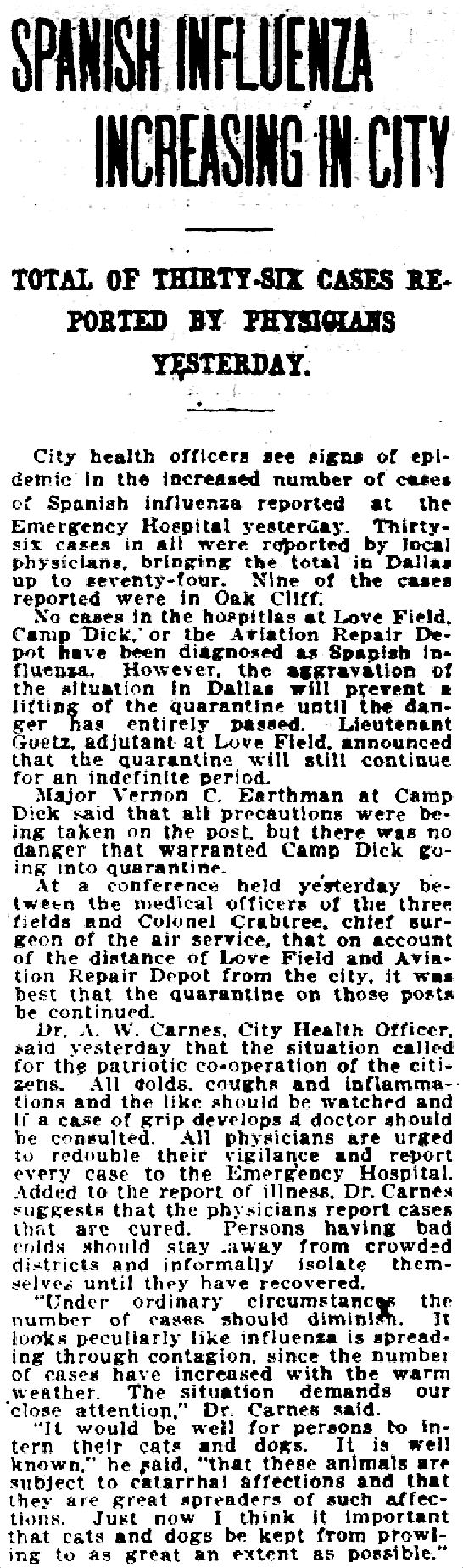
Just two days later, though, officials were jolted out of their complacency when the (reported) cases jumped to 74 (click for larger image):

spanish-influenza-dmn-100218DMN, Oct. 2, 1918 (click for larger image)

The months of October and November were just a blur: the city was plunged into an official epidemic. There was no known cure for the flu, so a somewhat ill-prepared health department preached prevention. People were encouraged to make sure their mouths were covered when they coughed or sneezed, and they were directed to not spit in the street, on streetcars (!), in movie theaters (!!), or, well, anywhere. (Handkerchief sales must have soared and spittoon sales must have plummeted.)

At one point or another, places where people gathered in large numbers — such as schools, churches, and theaters — were closed. Trains and streetcars were required to have a seat for every passenger (no standing, no crowding) (…no spitting). The number of mourners at funerals (of which there were many) was limited. And there was a major push for citizens to clean, clean, clean their surroundings in an attempt to make the city as sanitary as possible. Instructions appeared often in the newspapers.

spanish-influenza_dmn_101218_tipsDMN, Oct. 12, 1918

It was estimated that there were 9,000 cases of Spanish Influenza in Dallas in the first six weeks. By the middle of December, when the worst of the outbreak was over, it was reported that there had been over 400 deaths attributed to the Spanish Influenza and pneumonia in just two and a half months.

spanish-influenza_FWST_121118Fort Worth Star-Telegram, Dec. 11, 1918

As high as these numbers were, Dallas fared much, much better than many other parts of the United States.

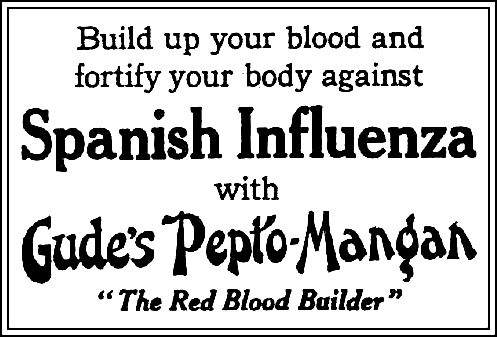
spanish-influenza_ad_dmn_101818_pepto-manganAd, DMN, Oct. 18, 1918

***

Sources & Notes

Photo at top was taken on November 6, 1918 and shows American Red Cross Workers spraying throats of military personnel based at Love Field in hopes of preventing the spread of the influenza. The photo is from the Otis Historical Archives, National Museum of Health and Medicine; I found it on the NMHM site, here. (Click photo for larger image.)

Ad for Pepto-Mangan (“The Red Blood Builder”) was one of a flood of medicines and tonics claiming to be effective in the fight against Spanish Influenza (none were).

For a detailed and remarkably well-researched, comprehensive history of the Spanish Influenza in Dallas, see the article prepared by the University of Michigan Center for the History of Medicine, here. It’s pretty amazing.

To read about the history of pandemics (including several good links regarding the Spanish flu), see the Flu.Gov site, here.

And, NO, Ebola is not transmitted like the flu. But it’s still good practice to cover your mouth when you cough or sneeze,wash your hands frequently, and never EVER spit in the street, because that’s just disgusting. ((This post was originally written in 2014 while Dallas was the center of the Ebola universe.))

More on the Spanish Influenza pandemic can be found in the Flashback Dallas post “Influenza Pandemic Arrives in Dallas — 1918.”

*

Copyright © 2014 Paula Bosse. All Rights Reserved.