Flashback : Dallas

A Miscellany: History, Ads, Pop Culture

Category: 1970s

The State Fair of Texas Over the Decades

state-fair-of-tx_midway_kodachrome_1961_ebaySFOT midway, 1961… (click for larger image)

by Paula Bosse

The history of the State Fair of Texas is also the history of Dallas — if you live in Dallas, you know a lot about the fair, if only by osmosis. Here are a few images from the decades since the fair began in 1886.

Below, from 1889, a sedate advertisement for the Texas State Fair and Dallas Exposition (from The Immigrant’s Guide to Texas, 1889). (All images are larger when clicked.)

state-fair_imm-gd_1889

*

A great-looking poster from 1890, colorful and exciting:

sfot_poster_1890

*

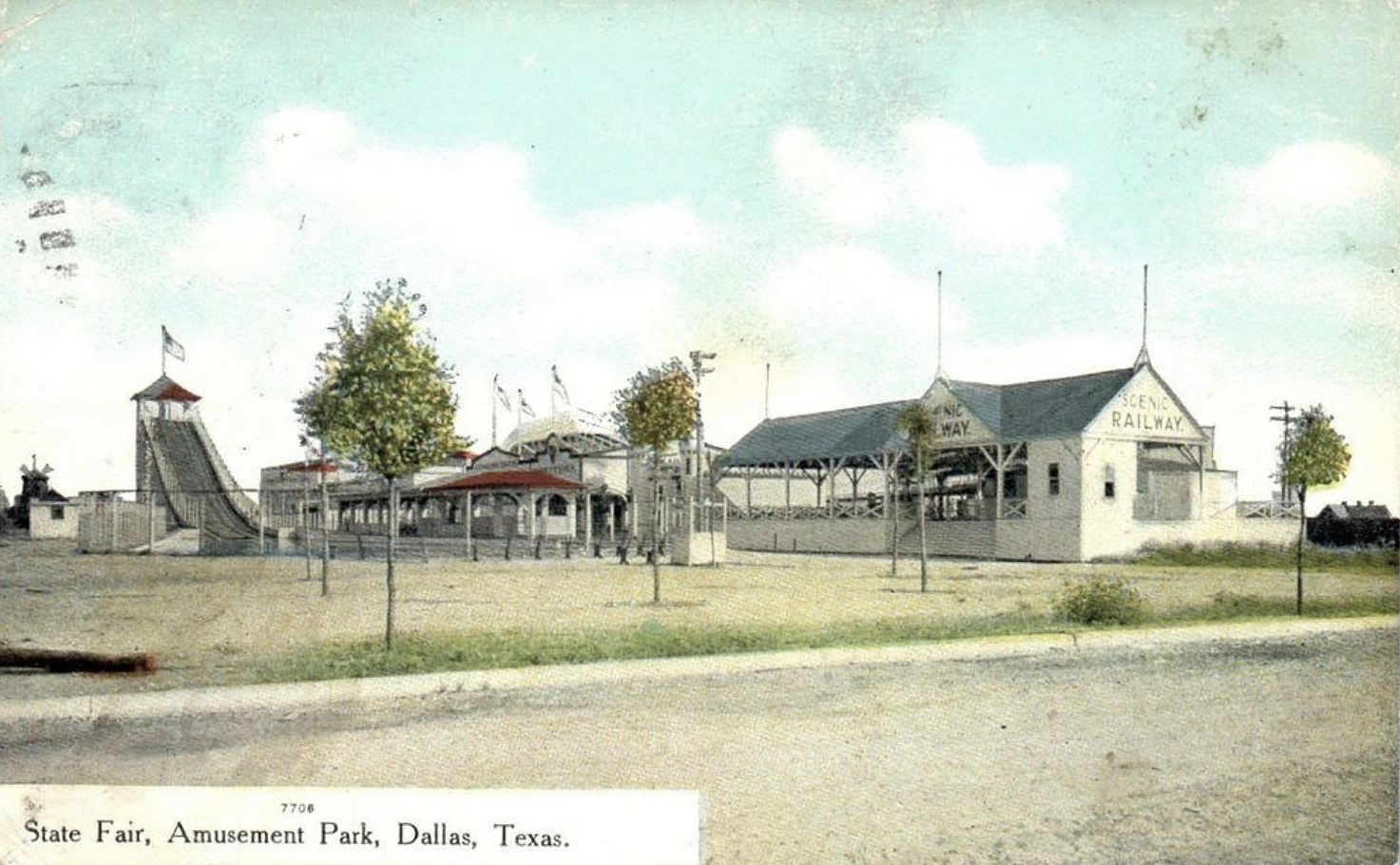
A midway in its infancy, in the aughts. (I wrote about the “The Chute” water ride, here.)

shoot-the-chute_postcard_ca-1906

*

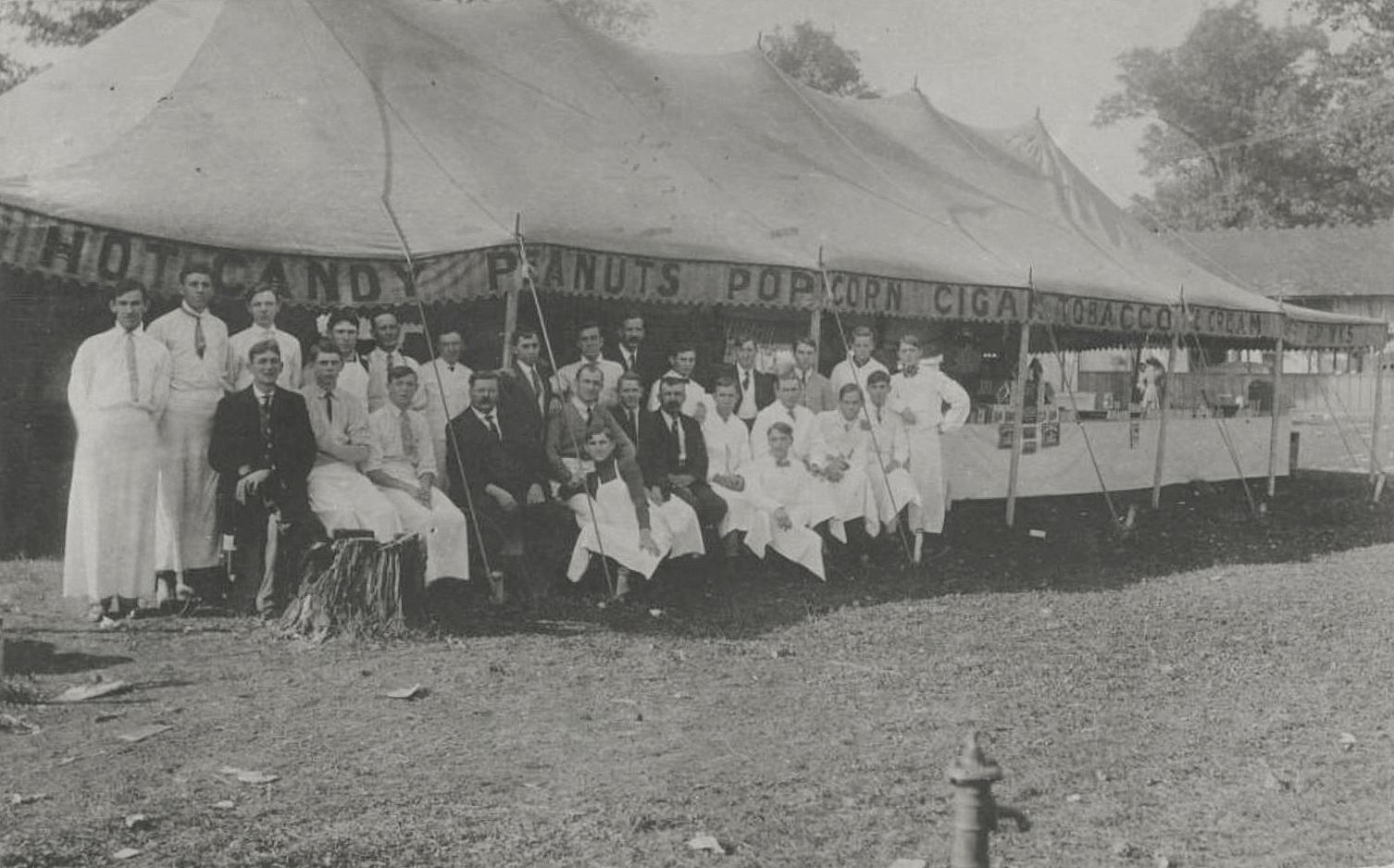
Here’s a group photo showing the food vendors at the 1910 fair. No corny dogs in 1910, but plenty of candy, peanuts, popcorn, ice cream, and, sure, why not, cigars and tobacco.

state-fair-concessionaires_1910_cook-colln_degolyervia George W. Cook Collection, DeGolyer Library, SMU

*

In the 1920s, Fair Park looked a lot smaller:

fair-park_mcafee_degolyer_SMU_ca-1920s
via George A. McAfee Collection, DeGolyer Library, SMU

Here’s a handy 1922 map of the grounds, from the fine folks at Caterpillar (don’t miss those tractors!) — you can see where the people in the photo above are walking.

state-fair-map_caterpillar_ad_1922

*

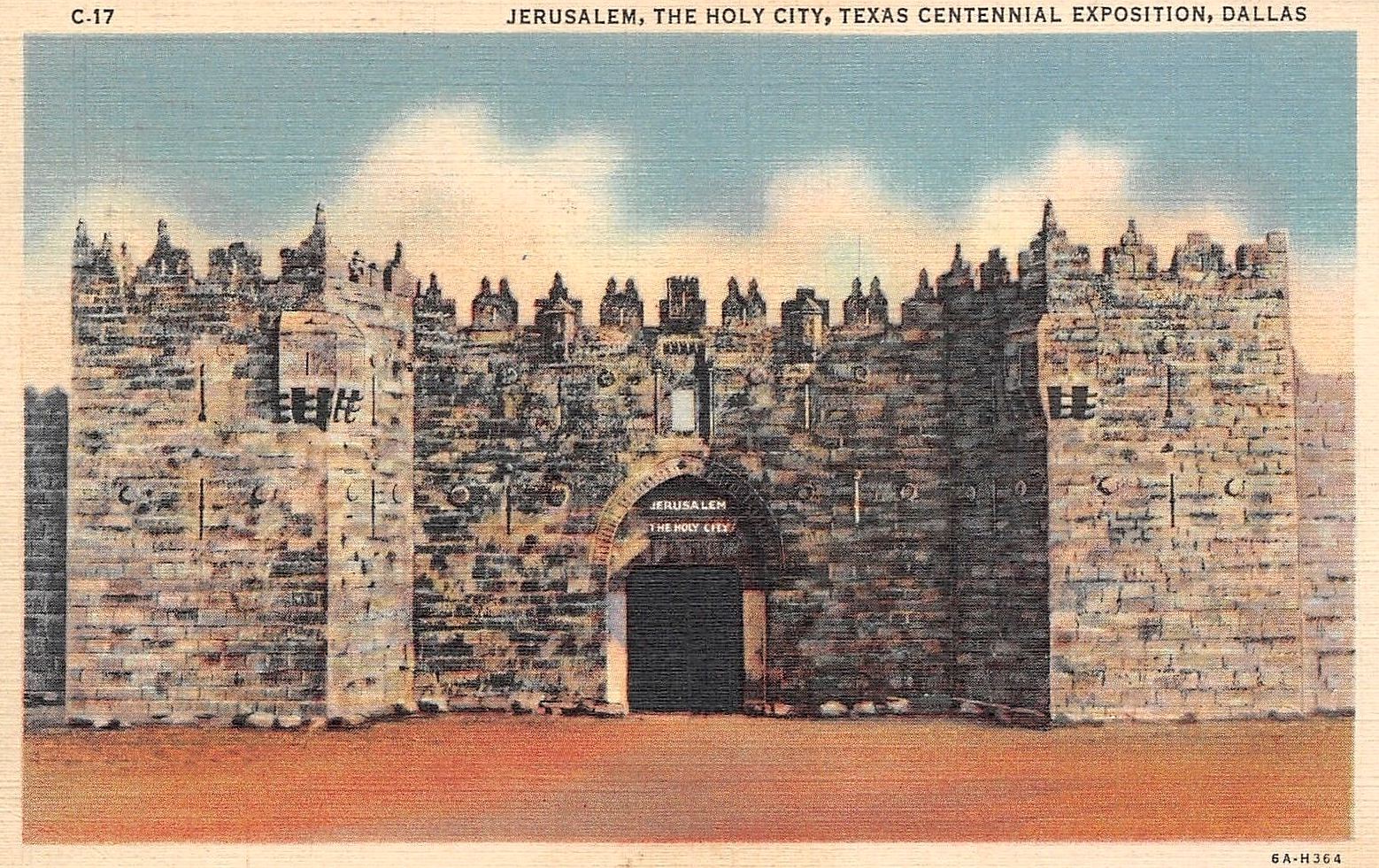
If it’s 1936, it’s gotta be the Texas Centennial — and here’s an exhibit I’d never heard of: Jerusalem, The Holy City. This was one of many exhibits at the Texas Centennial previously seen at the 1933 Chicago World’s Fair, where it apparently had attracted more than one million visitors. In the weeks leading up to the Centennial’s opening, it was described thusly: “The Holy City will contain a collection of religious artworks and other material. The entrance will represent the Damascus gate of Jerusalem. No admission will be charged but donations will be asked visitors” (Dallas Morning News, May 17, 1936).

tx-centennial_jerusalem-the-holy-city_postcard

*

The State Fair of Texas was not held during much of World War II, but it was back in 1946, with Tommy Dorsey, Gypsy Rose Lee, and Jackie Gleason.

state-fair_sept-1946_ad-cow
Sept., 1946

*

Neiman-Marcus was at-the-ready in 1950 with suggestions on stylish footwear for ladies wanting to trudge around the Fair Park midway in heels.

For the Million-Dollar Midway — For taking in this famous “main drag” of the State Fair — get into our famous-maker midway heel shoes. Most everybody — after walking a block or two in them — says they’re worth a million! Have all the comfort of low heels, plus the high-heel’s way of making your ankles look prettier.

sfot-neiman-marcus_ad_101650October, 1950

*

The 1960s were certainly colorful, and this is a great color photo from 1961 (currently available on eBay as a 35mm Kodachrome slide) — it’s the photo at the top of this post, but in order to cut down on unnecessary scrolling, I’ll slide it in again right here:

state-fair-of-tx_midway_kodachrome_1961_ebay

*

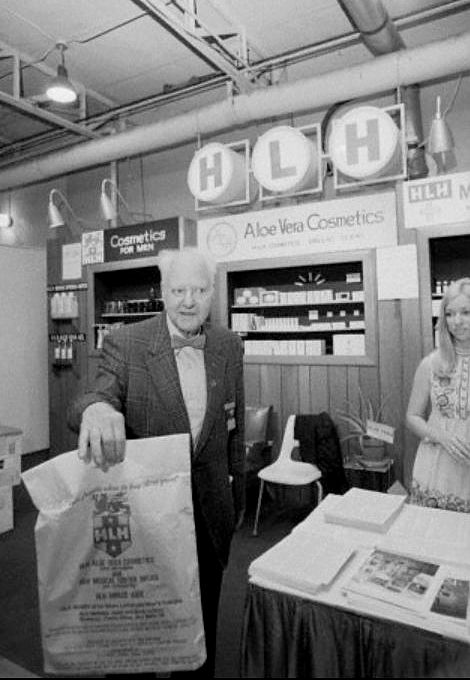
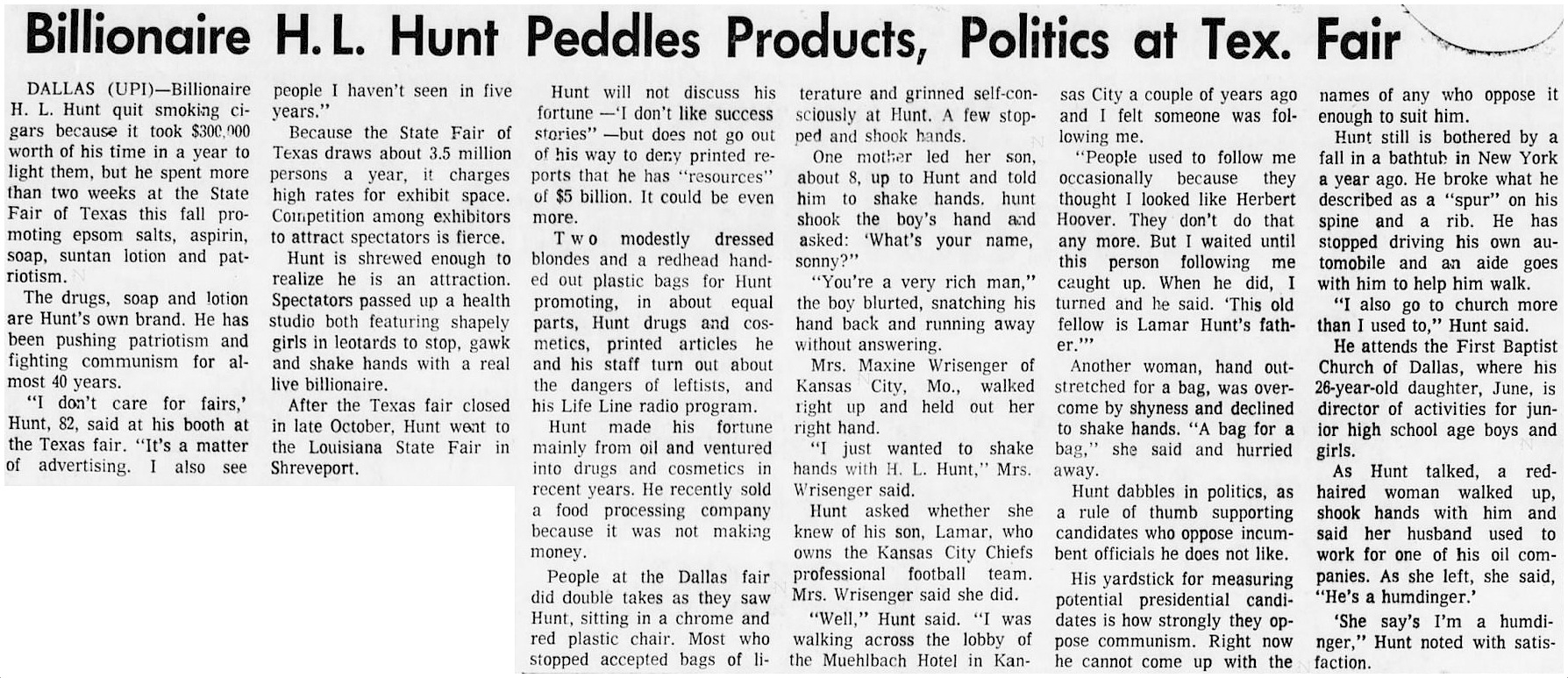
The 1970s was a weird decade, and what better way to start off a weird decade than with 80-something-year-old oil tycoon (and eccentric Dallas resident) H. L. Hunt handing out cosmetics at a booth at the State Fair? Hunt — whom Frank X. Tolbert described as “probably the world’s only billionaire health freak” — manufactured a line of cosmetics and other products containing aloe vera, the wonder elixir. Imagine seeing the world’s richest man handing out plastic goodie-bags to awe-struck passersby. Like I said, weird.

h-l-hunt_state-fair_1971

hunt_state-fair_pomona-progress-bulletin_CA_111471Pomona (CA) Progress-Bulletin, Nov. 14, 1971 (click to read)

*

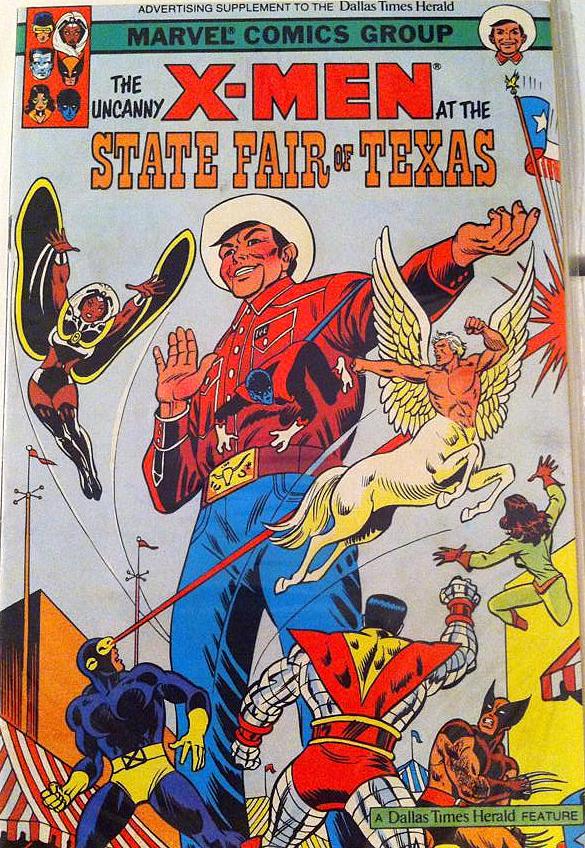
And, finally, the 1980s. A century after the State Fair of Texas began, the X-Men came to Big D to do whatever it is they do — and The Dallas Times Herald got a cool little advertising supplement out of it. (If this appeals to you, check out when Captain Marvel came to Dallas in 1944, here, and when Spider-Man came to Dallas in 1983, here.)

sfot_xmen_comic-book_1983

***

Sources & Notes

Sources (if known) are noted.

All images are larger when clicked.

I wrote a similar State-Fair-of-Texas-through-the-ages post a few years ago: “So Sorry, Bill, But Albert Is Taking Me to the State Fair of Texas,” here.

*

Copyright © 2018 Paula Bosse. All Rights Reserved.

Casa Linda Park — 1947-1977

casa-linda_aerial_baseball-diamond_squire-haskins_072047_dallas-municipal-archives_portalThe idyllic Casa Linda countryside, 1947…

by Paula Bosse

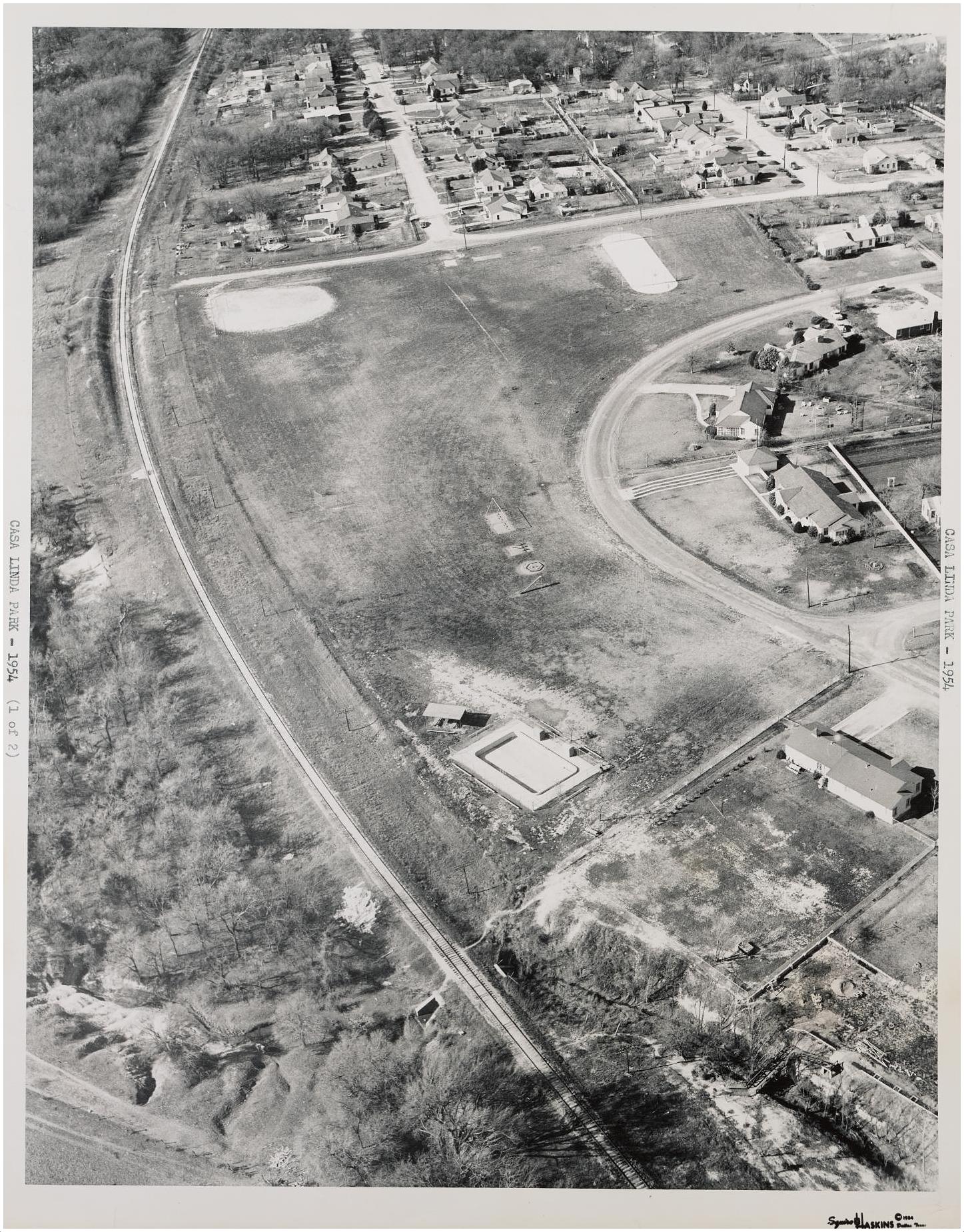
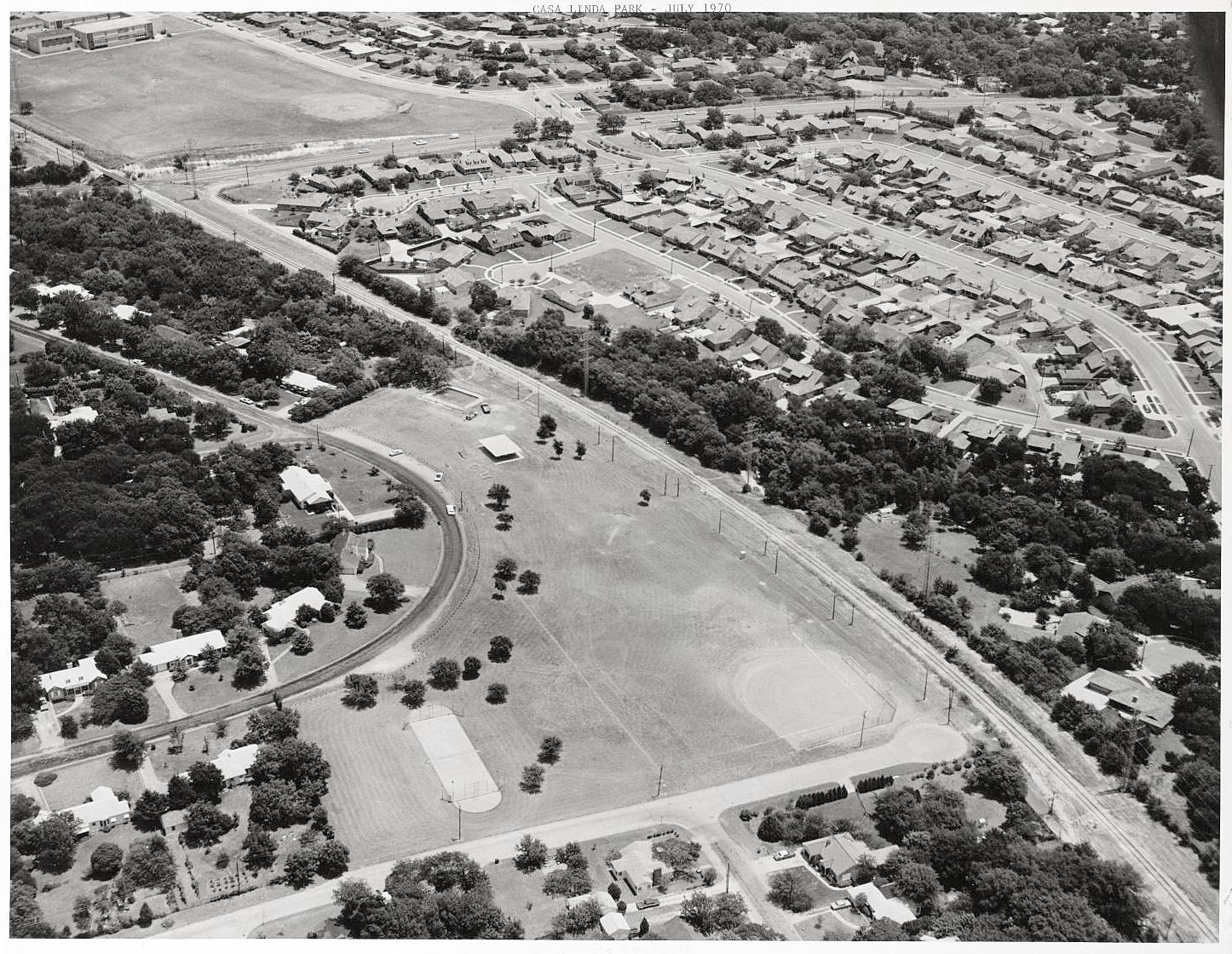
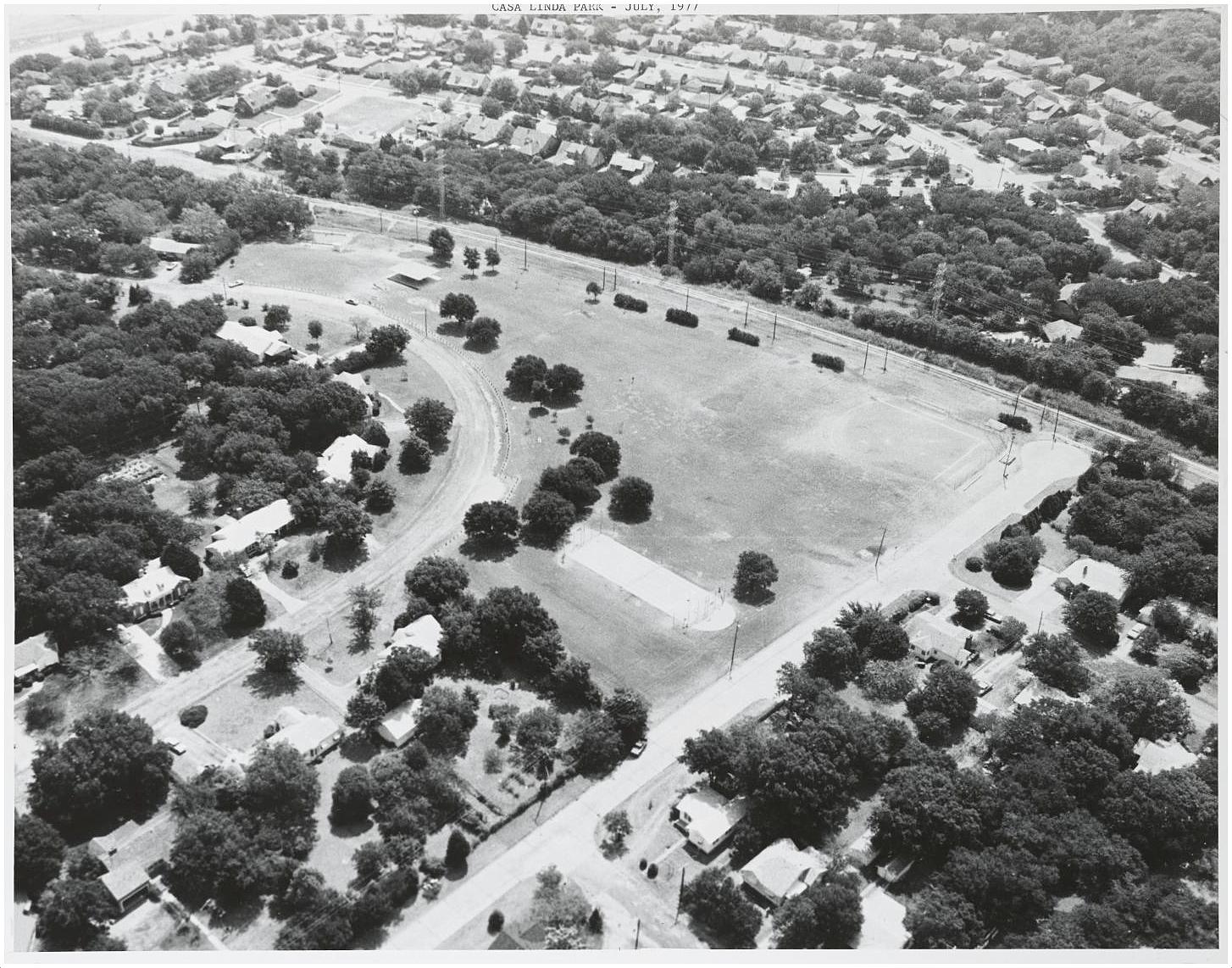
Here are several aerial photographs, taken over a 30-year span, showing Casa Linda Park, located east of White Rock Lake — most (if not all) were taken by noted Dallas photographer Squire Haskins. When the little 6.3-acre park opened in 1947, it was described by The Dallas Morning News as “rustic and picturesque” (DMN, Aug. 19, 1947), a description which could be used for the whole Casa Linda area which was being developed at the time by Carl Brown.

The land for Casa Linda Park was purchased by the City of Dallas in March, 1947, and it is bounded by Old Gate Lane on the southwest, the curving San Saba Drive on the north, and what used to be the Santa Fe Railway railroad tracks on the southeast, between White Rock Lake and Buckner Blvd. I’m not exactly sure where Little Forest Hills ends and Casa Linda begins, but both neighborhoods could claim this cute little park as their own, I suppose.

These aerial photos are from the Dallas Municipal Archives, via the Portal to Texas History (links can be found at the bottom of this post). All photos are larger when clicked. See your house?

At the top, the earliest photo of the park in this collection, taken in July, 1947 by Squire Haskins.

Below, the second Haskins photo, from 1954:

casa-linda_aerial_baseball-diamond_squire-haskins_1954_dallas-municipal-archives_portal

Below, another Haskins photo, from January, 1966:

casa-linda-park_aerial_baseball-diamond_squire-haskins_jan-1966_dallas-municipal-archives_portal

Another Haskins photo, from July, 1970:

casa-linda_aerial_baseball-diamond_squire-haskins_july-1970_dallas-municipal-archives_portal

And lastly, a photo by an unidentified photographer, from July, 1977 — 30 years to the month after the photo at the top was taken:

casa-linda-park_aerial_july-1977_dallas-municipal-archives_portal

*

An aerial Google view of the park today can be seen here.

***

Sources & Notes

These photos are from the Dallas Municipal Archives, and are included in the collection “Dallas Parks Aerial Photographs” provided to UNT’s Portal to Texas History site; all photos above can be found here.

See aerials of nearby Casa View Park — taken by Squire Haskins between 1954 and 1974 — in the Flashback Dallas post “Casa View Elementary/Casa View Park — 1954-1974,” here.

*

Copyright © 2018 Paula Bosse. All Rights Reserved.

Main & Ervay, Pedestrians — 1970

DTC_pedestrians-2_main-ervay_1970_SMU

by Paula Bosse

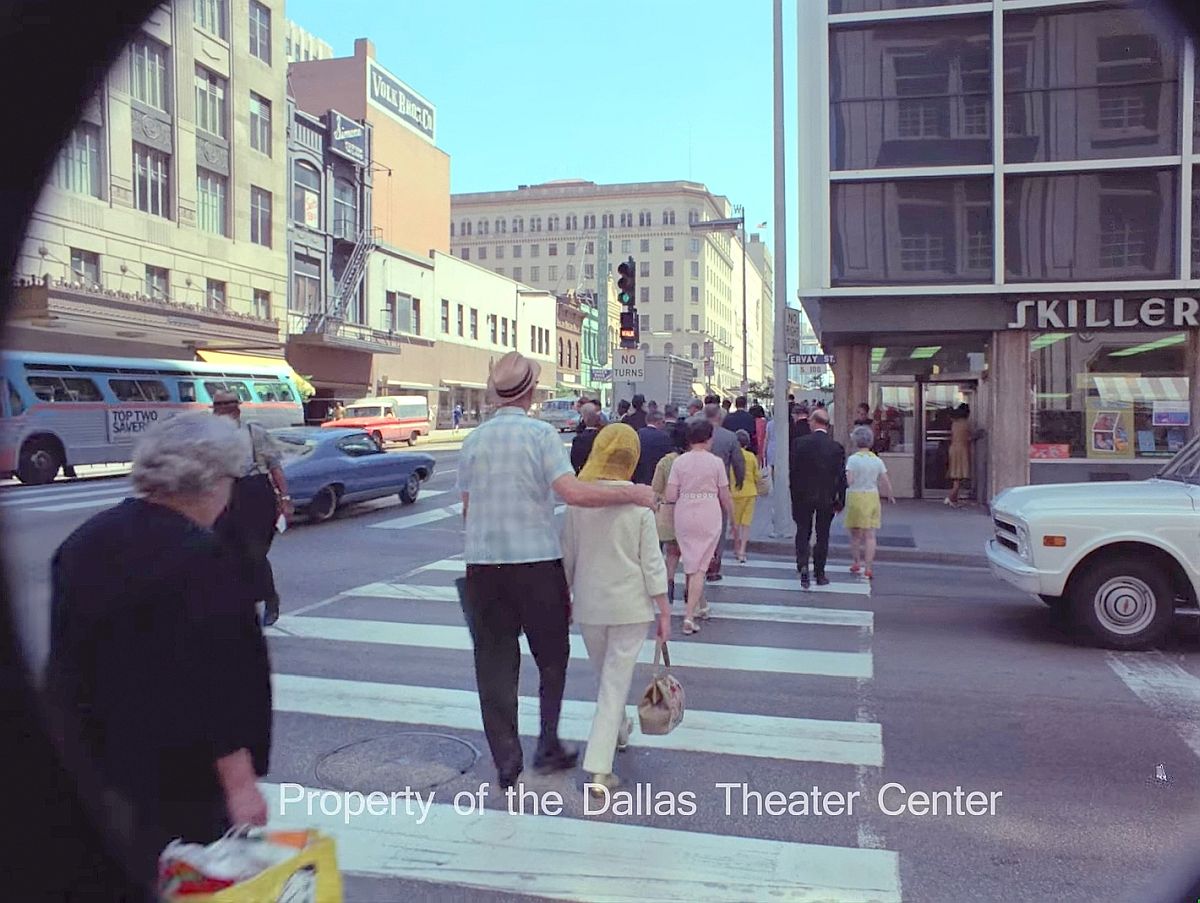
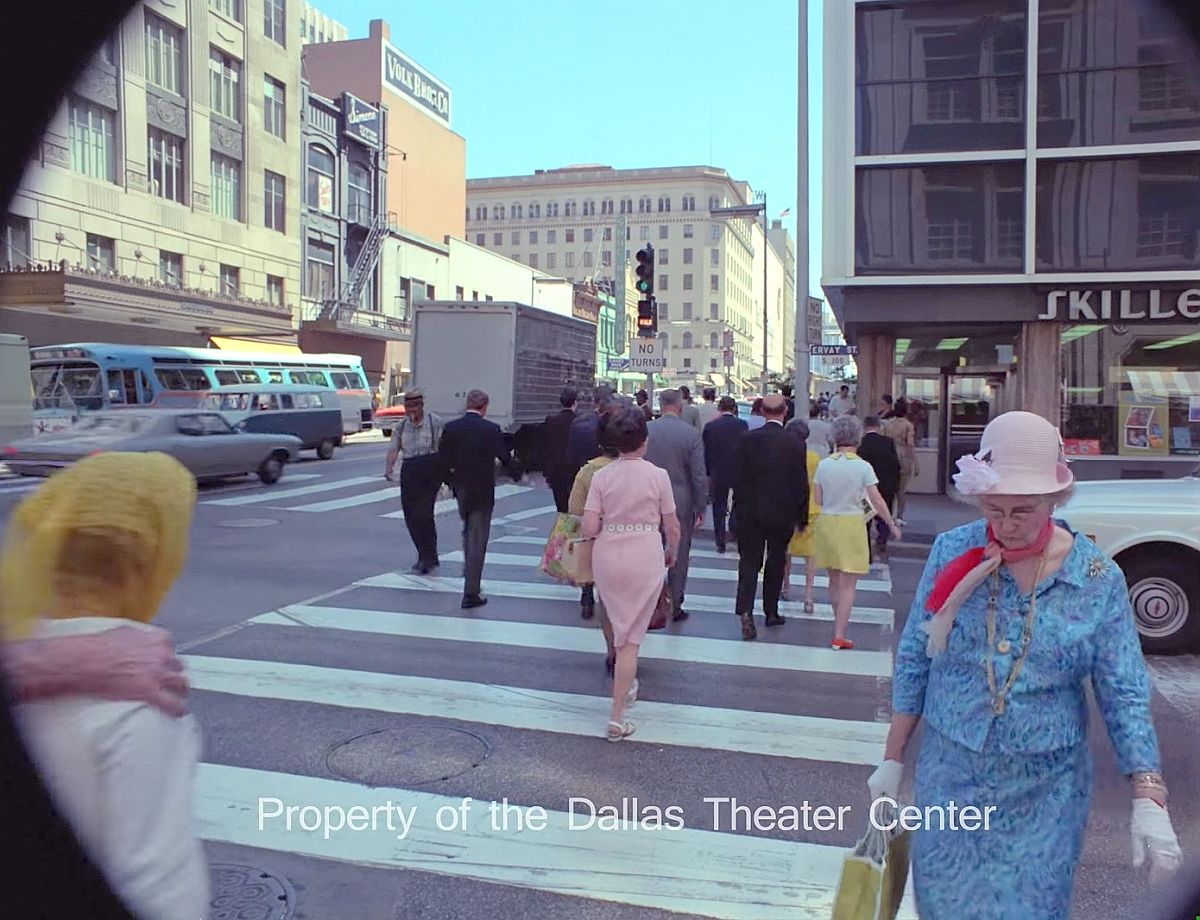
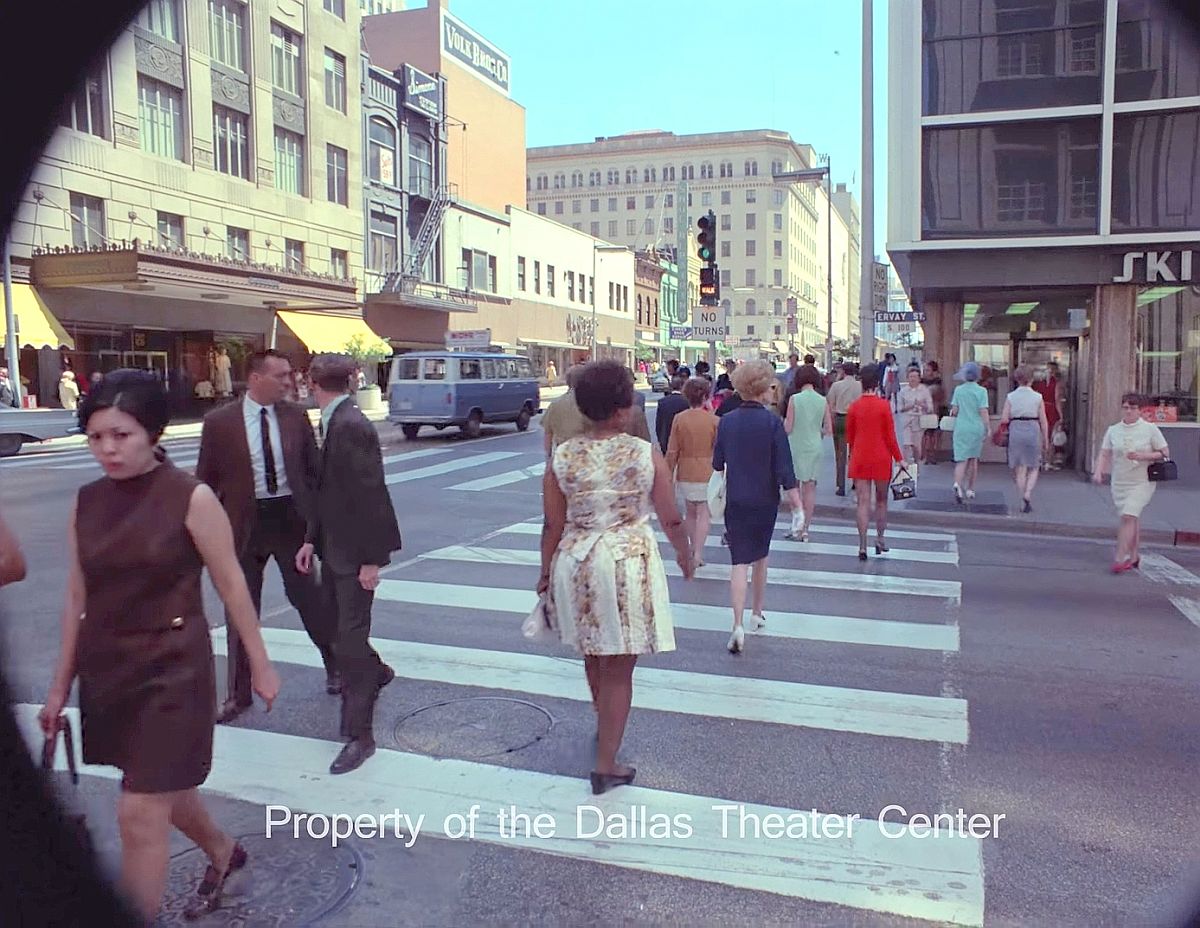
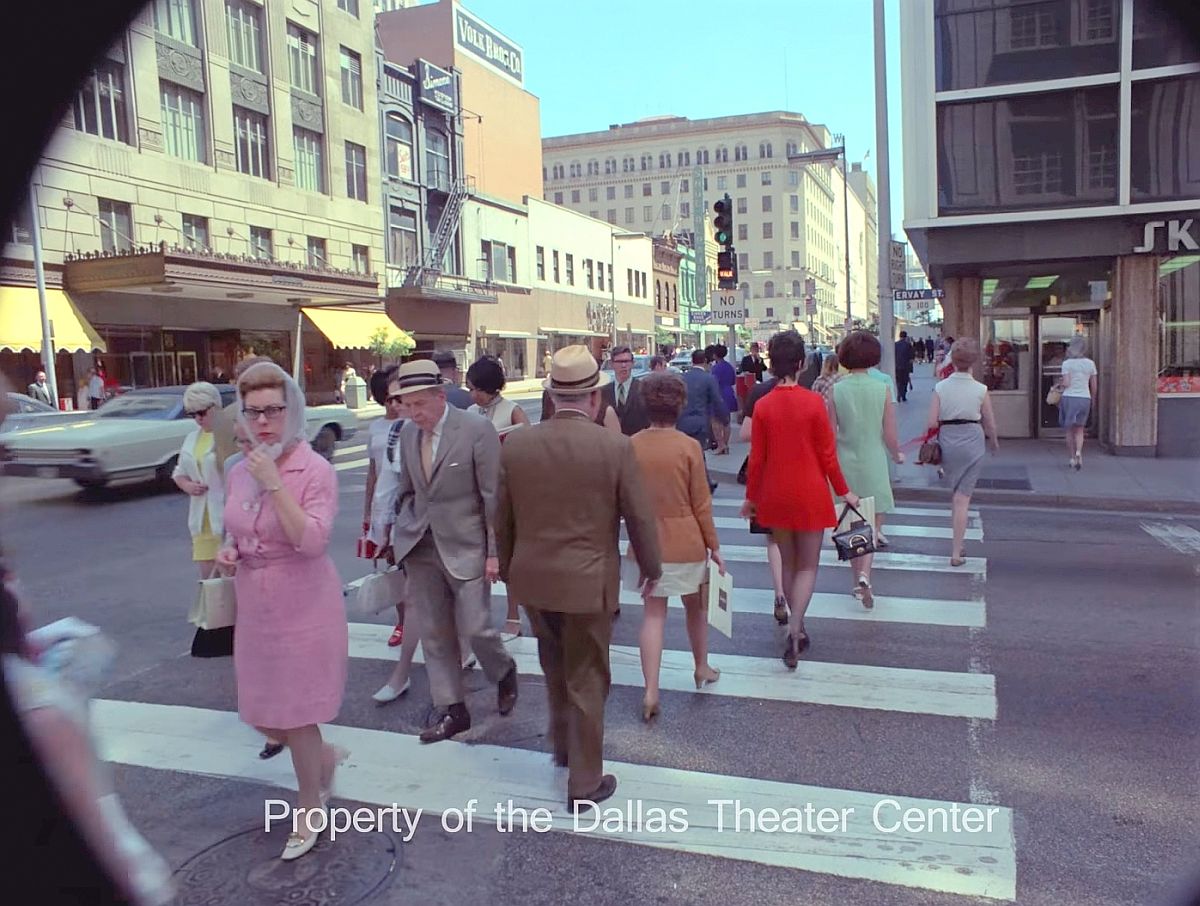
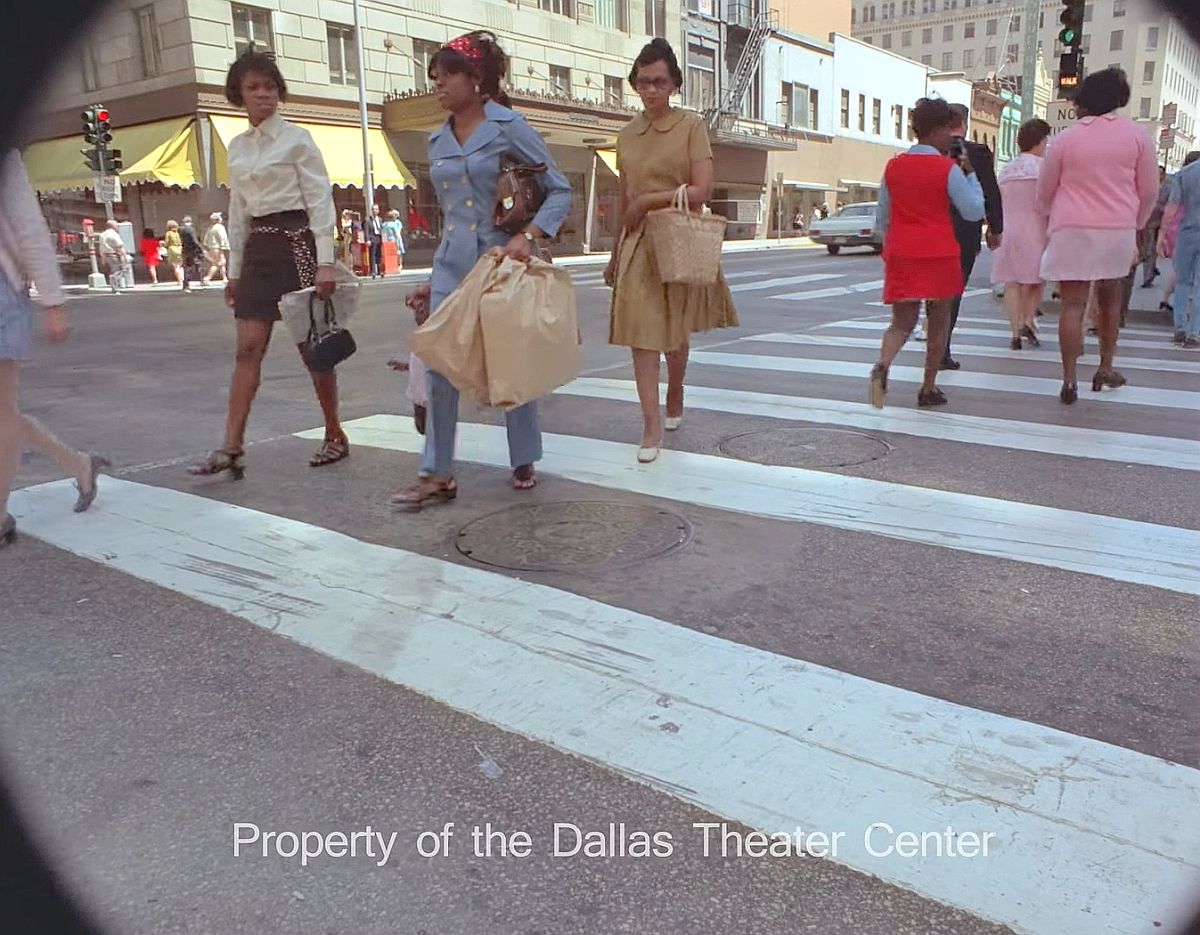
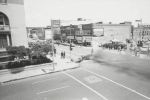
The other day SMU released fantastic 35mm color film footage captured from a camera mounted atop a car cruising downtown streets in 1970. Today they released a little more, this time a short clip showing pedestrians walking across the intersection of Main and Ervay (be sure to watch this silent footage in full-screen mode).


*
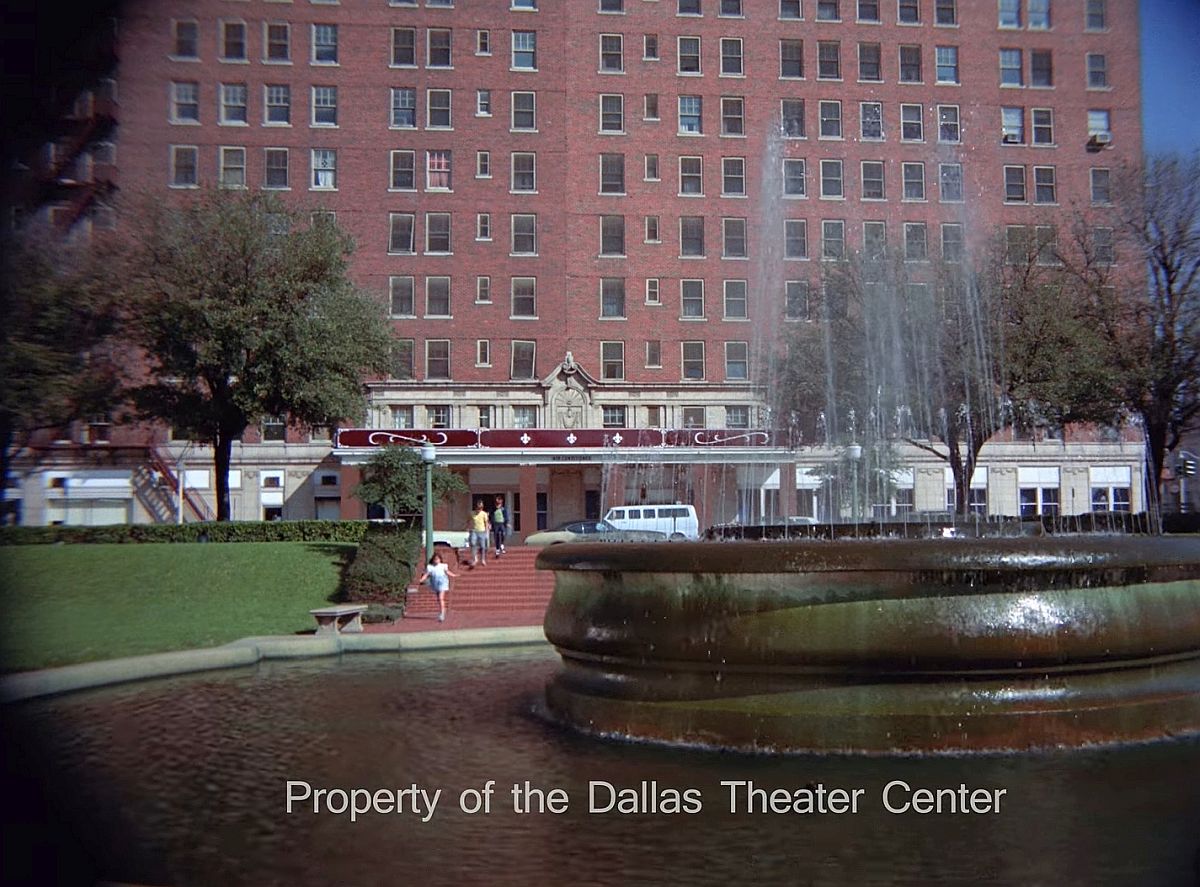
The Skillern’s drug store in this footage was at 1700 Main, on the southeast corner of Main and Ervay, in the Mercantile Bank Building complex; the building across Main on the northeast corner was Dreyfuss & Son Men’s Clothing, and the large building in the distance (at St. Paul) is the Titche’s department store. The end of the clip has shots of the (surprisingly red) (and no longer standing) Jefferson Hotel; sharing the frame is the fountain in Ferris Plaza (Union Station would be to the left of the camera operator, across Houston Street). This footage was shot for Dallas Theater Center productions, which I hope to write about soon.

Cool footage, SMU. Keep it coming!

*

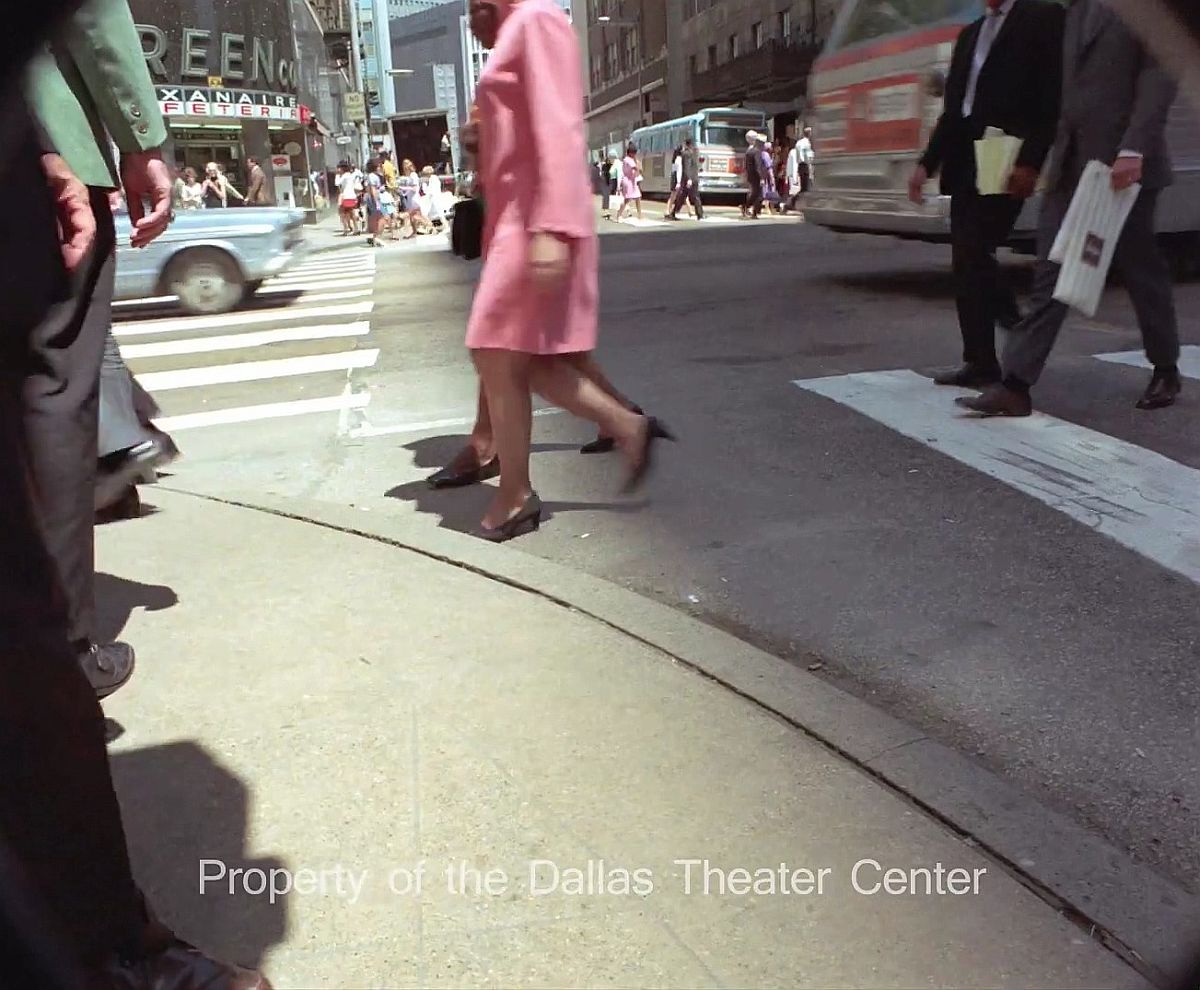
Here are a few screenshots. There were a lot of vivid colors being worn by downtown workers and shoppers in 1970. I’m so accustomed to seeing black-and-white images of Dallas, that all this color is a little startling!

DTC_pedestrians-1_main-ervay_1970_SMU


DTC_pedestrians-4_main-ervay_1970_SMU


DTC_pedestrians-3_main-ervay_1970_SMU


DTC_pedestrians-5_main-ervay_1970_SMU

Below, a brief glimpse of the H. L. Green store, in the Wilson Building on the northwest corner of Main and Ervay. (And evidence that, yes, men also shop on their lunch hour.)

DTC_pedestrians-6_main-ervay_1970_SMU_sm


DTC_jefferson-hotel_1970_SMU

***

Sources & Notes

These screenshots are from 35mm color film footage owned by the Dallas Theater Center, held at Southern Methodist University (the direct link to the YouTube video is here). Again, thanks to SMU curator Jeremy Spracklen.

See more of this fantastic color footage of downtown in the Flashback Dallas post “A Drive Through Downtown — 1970.”

*

Copyright © 2018 Paula Bosse. All Rights Reserved.


A Drive Through Downtown — 1970

DTC_main-harwood_SMUDowntown Dallas, in living color… (click for larger image)

by Paula Bosse

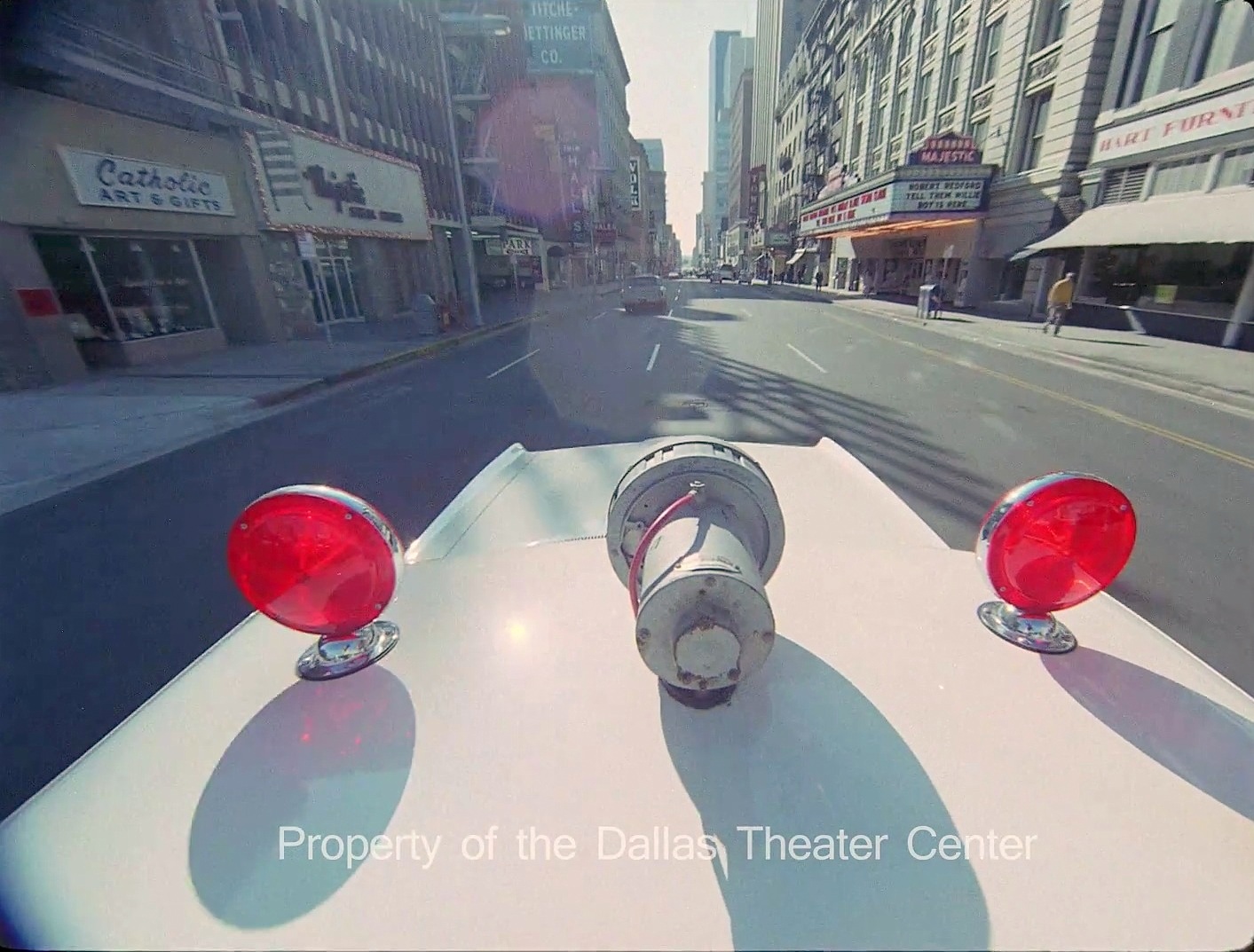
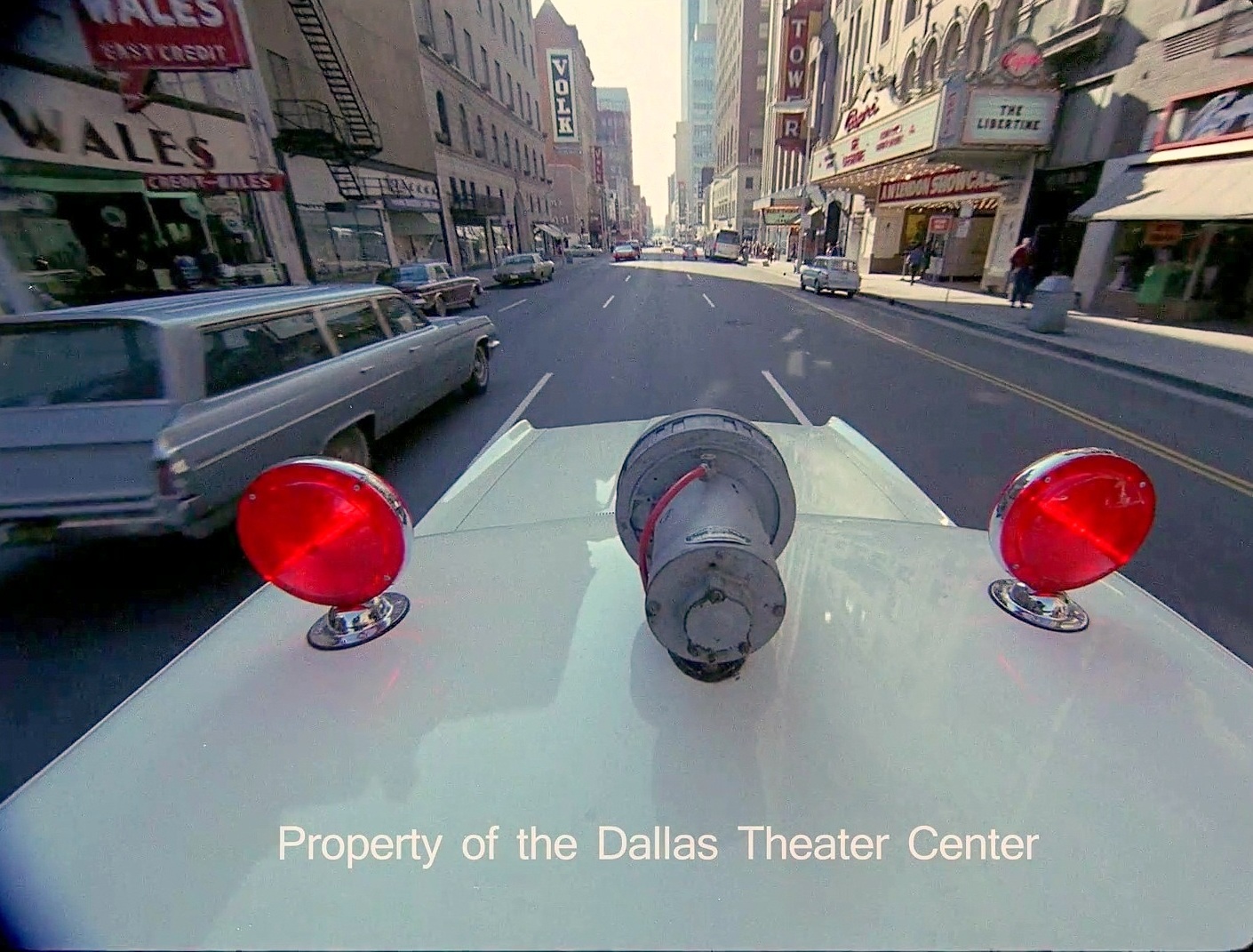
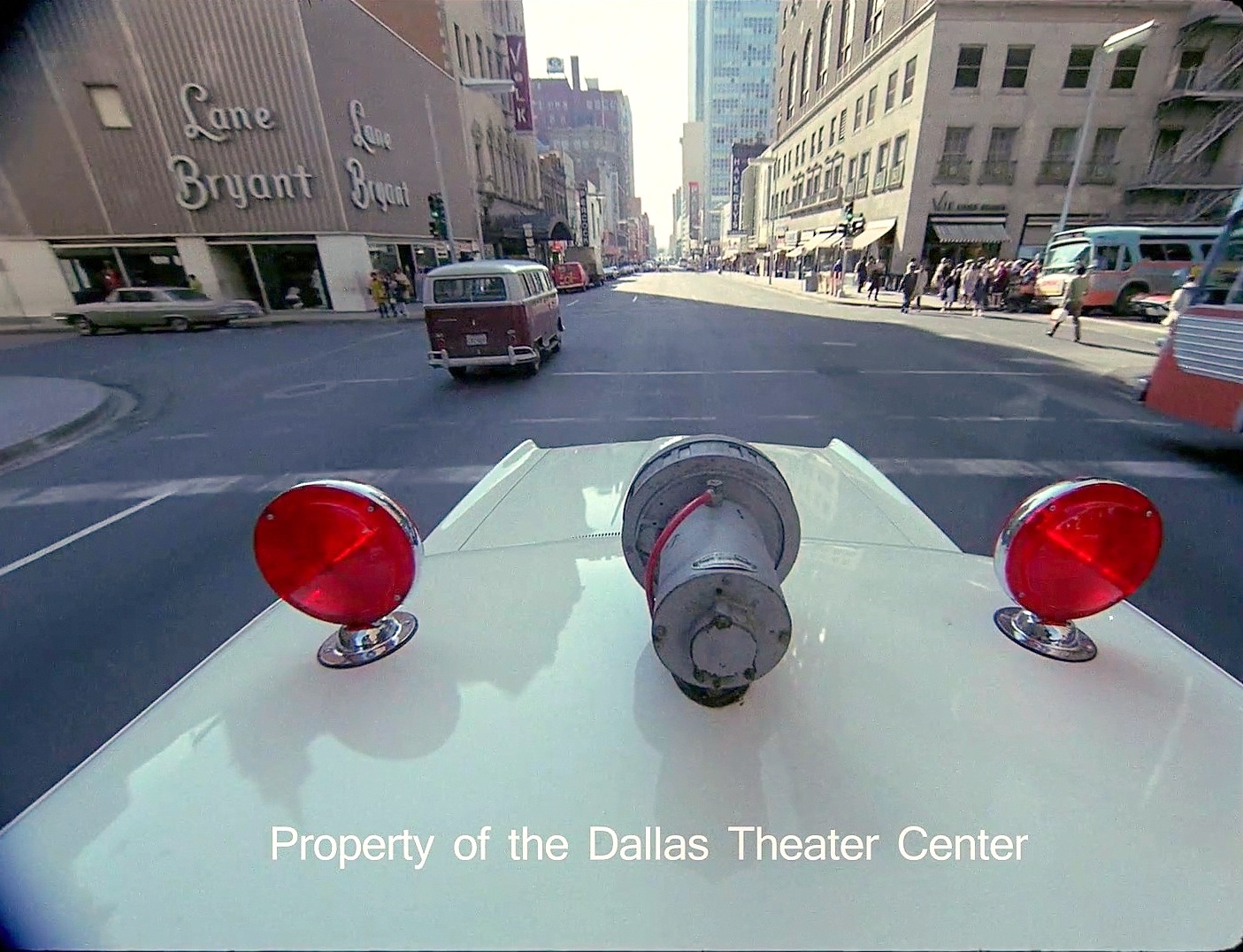
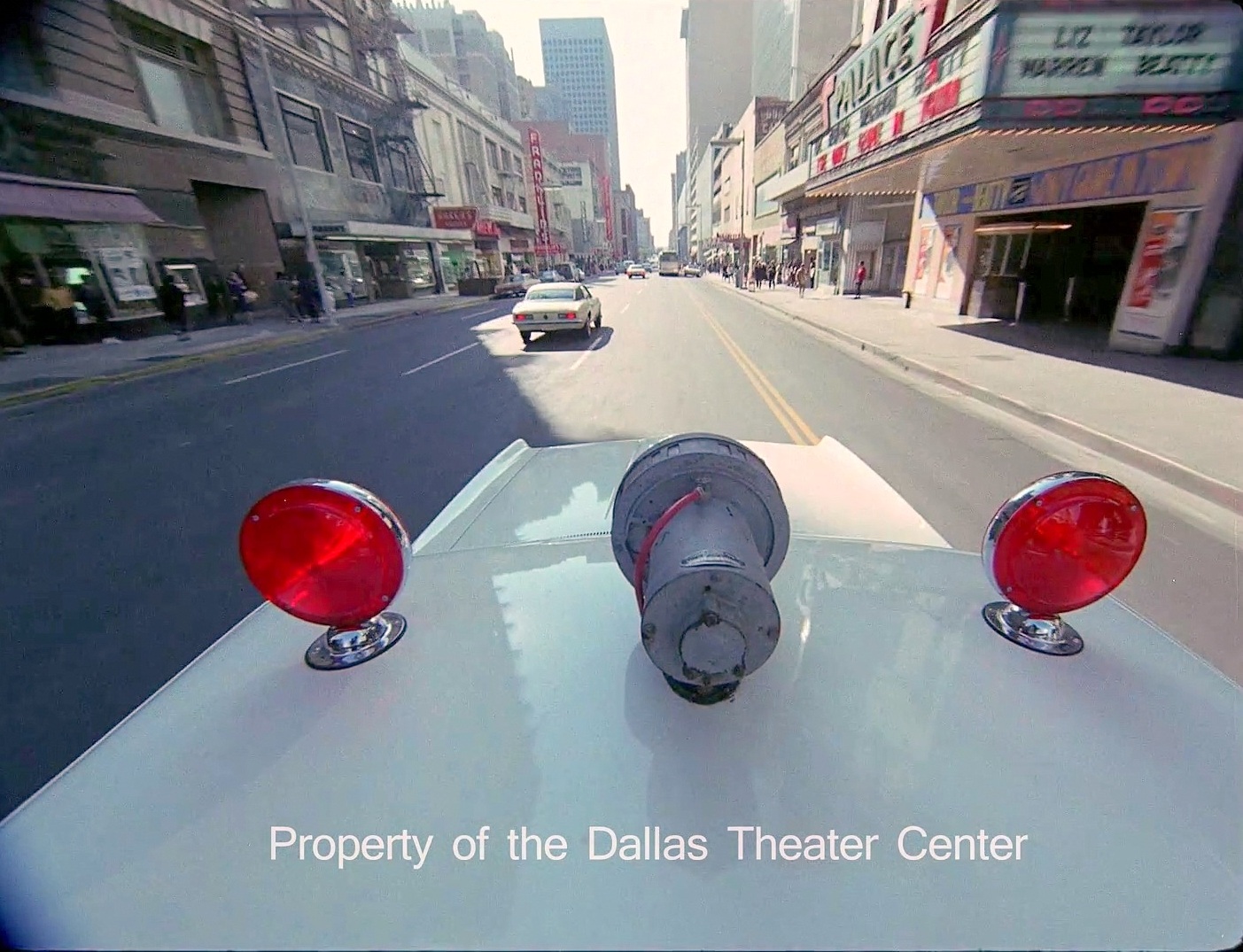
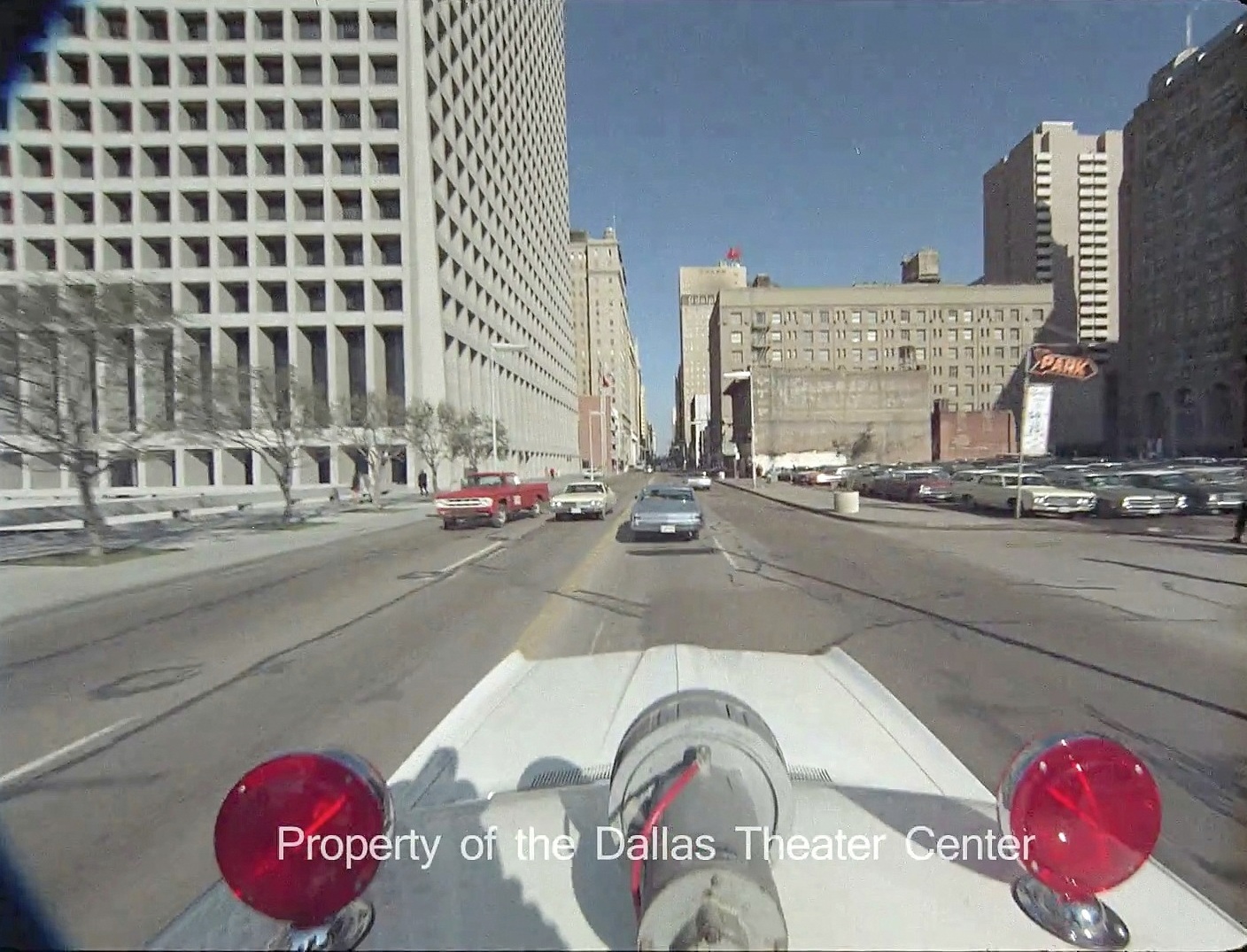
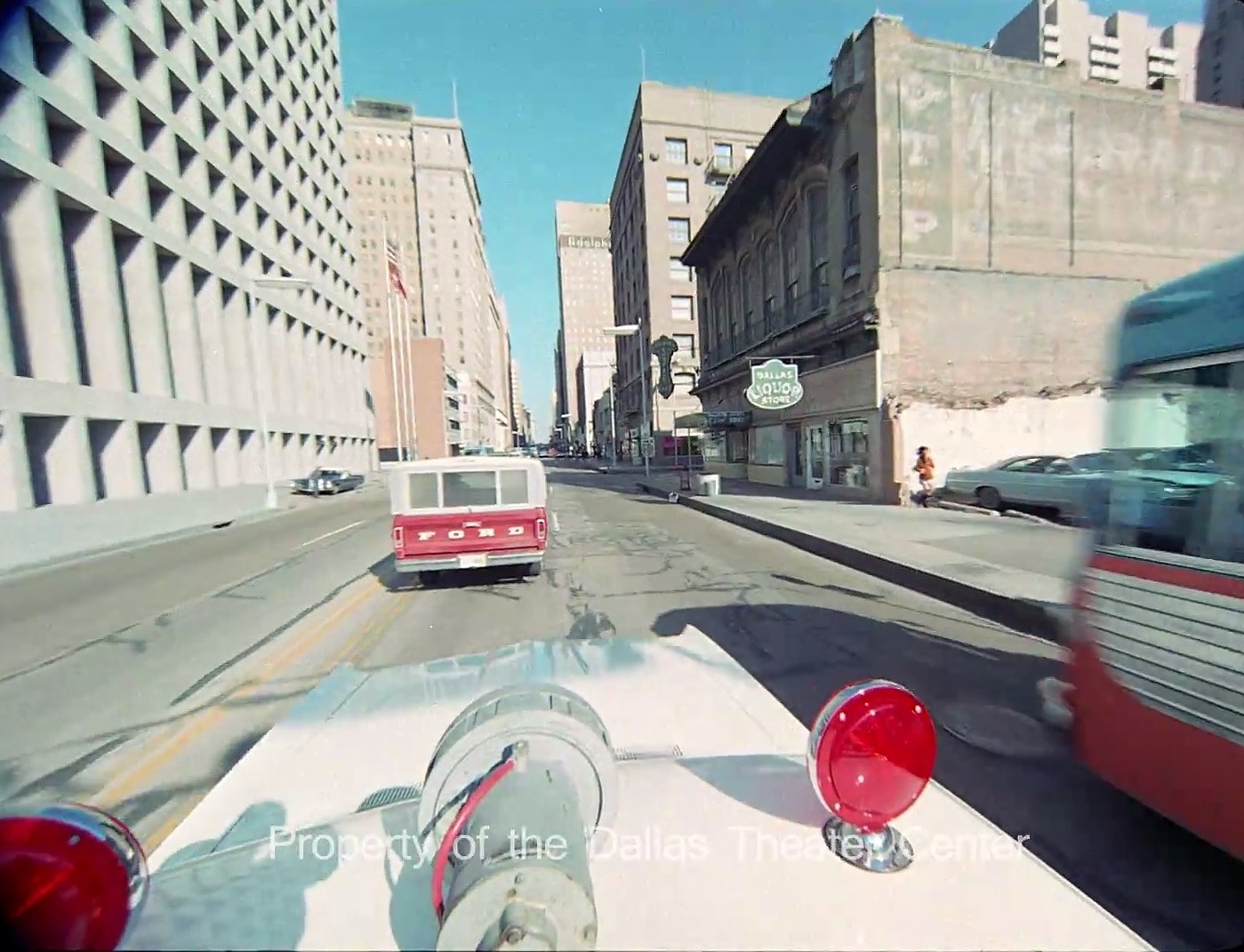
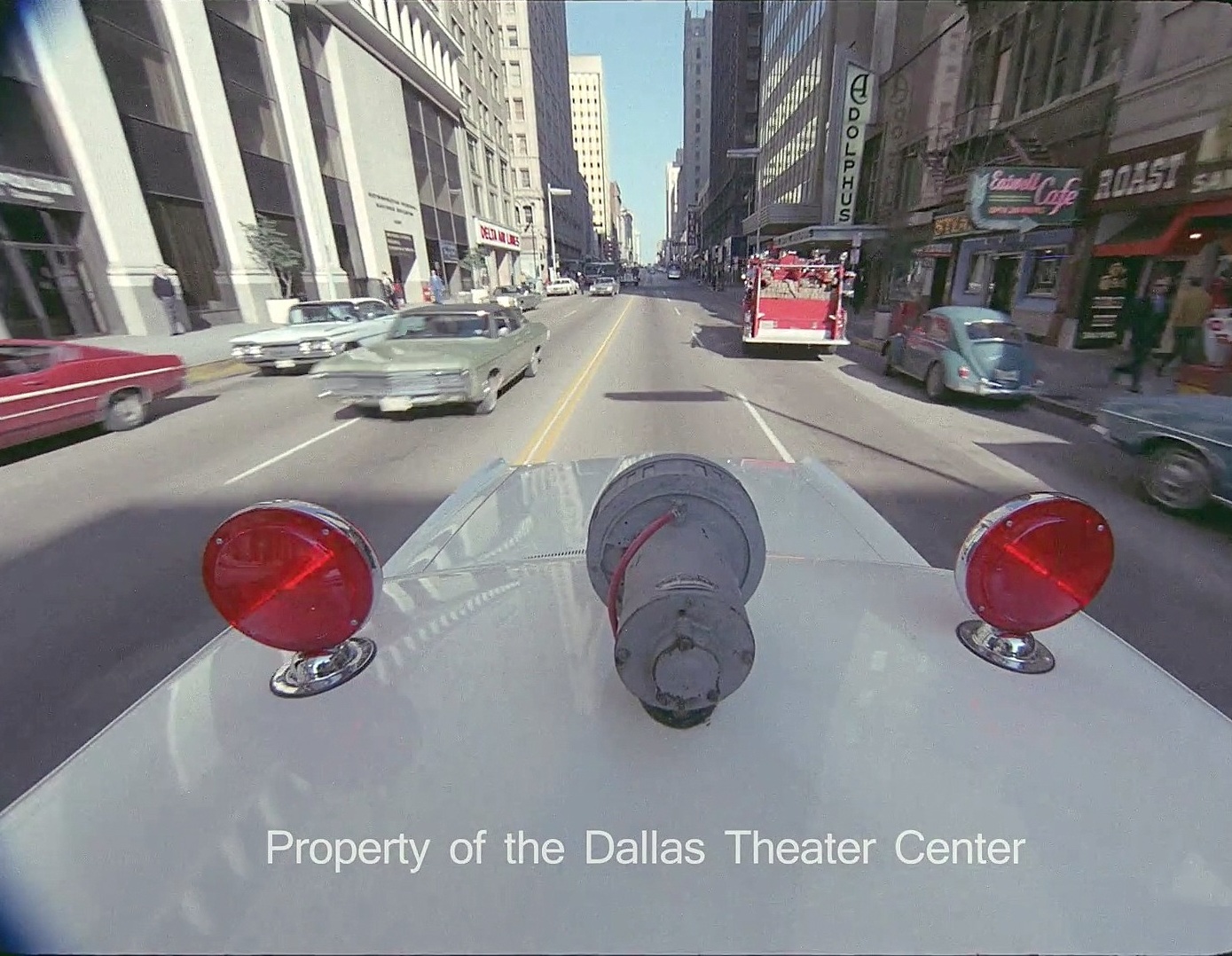
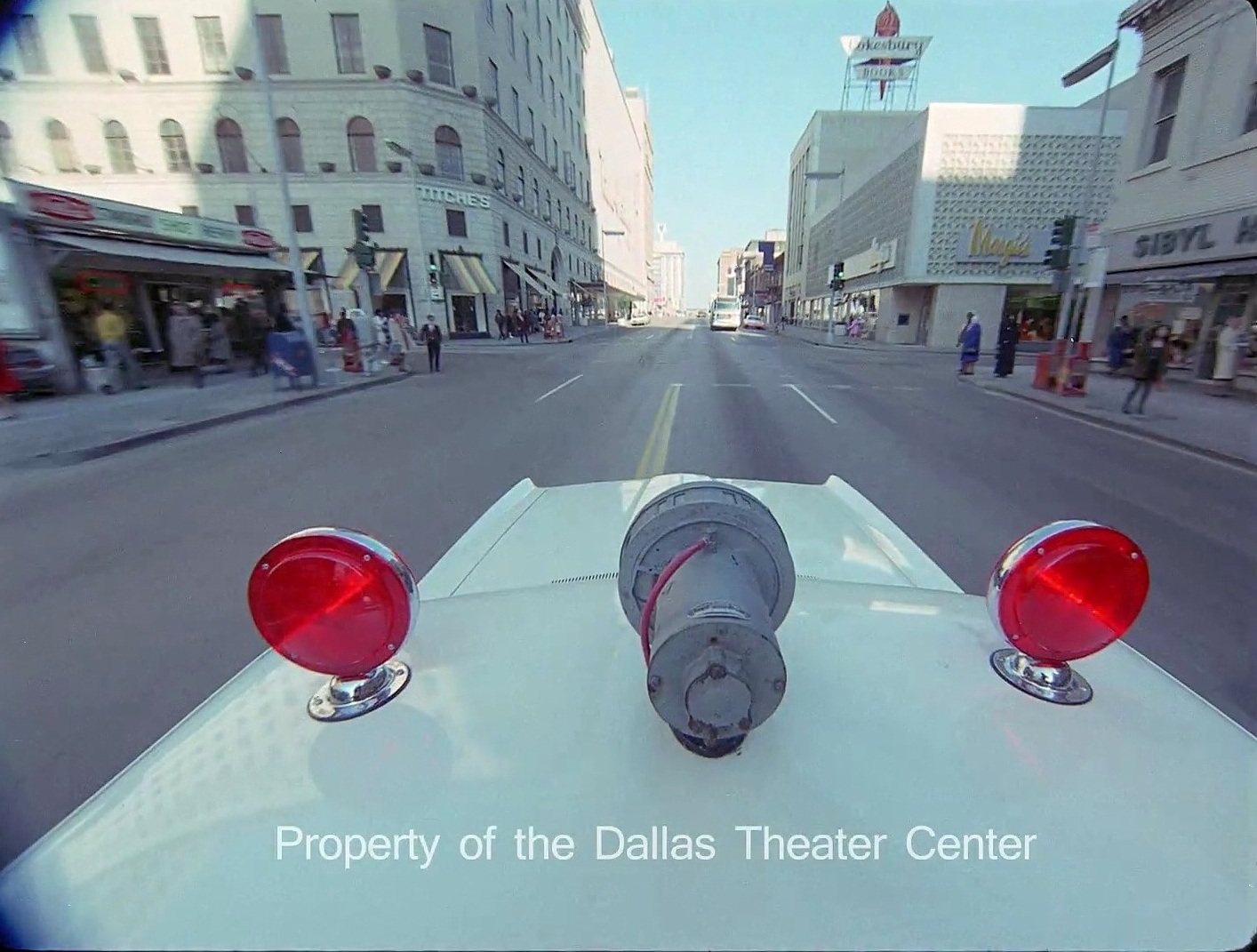
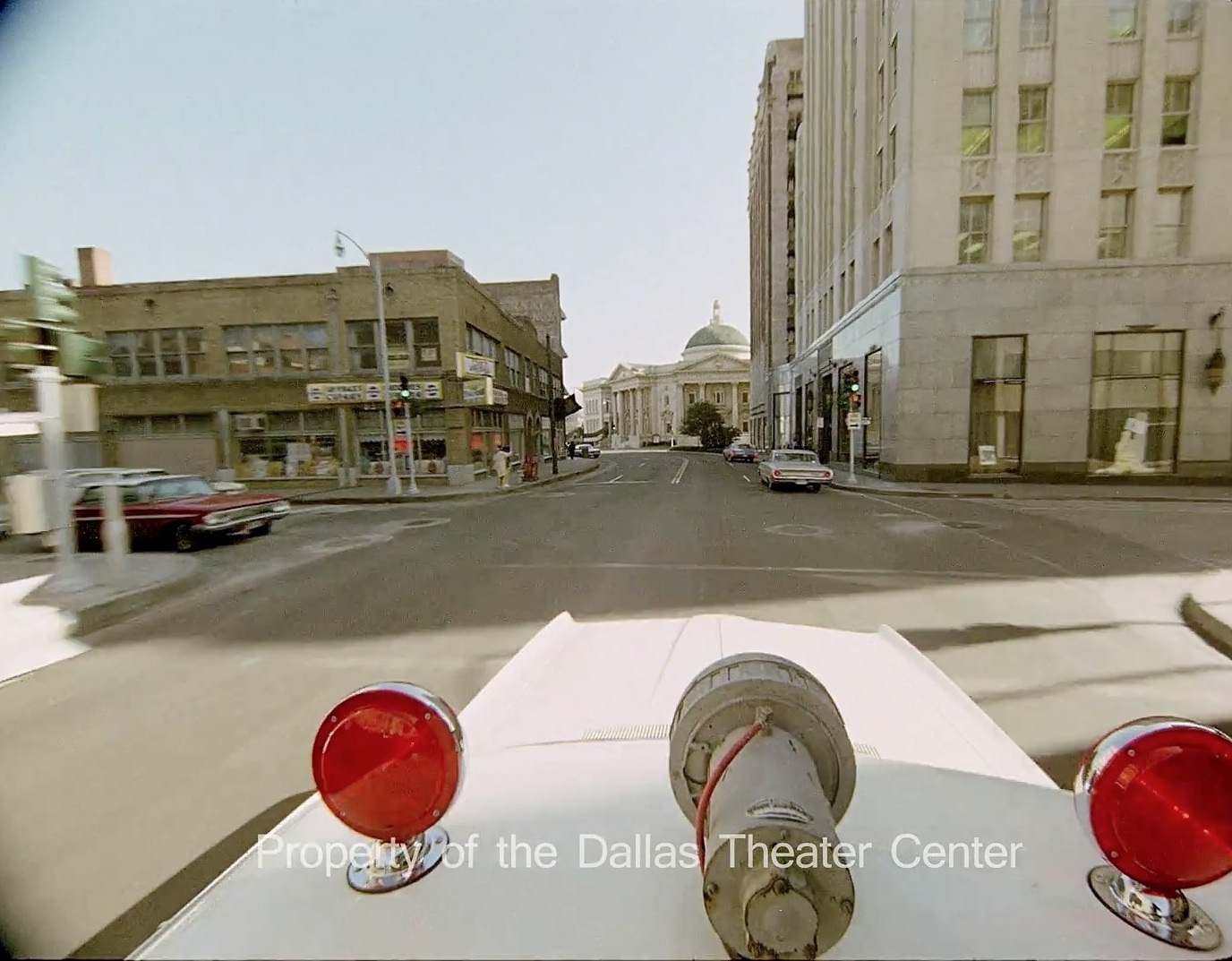
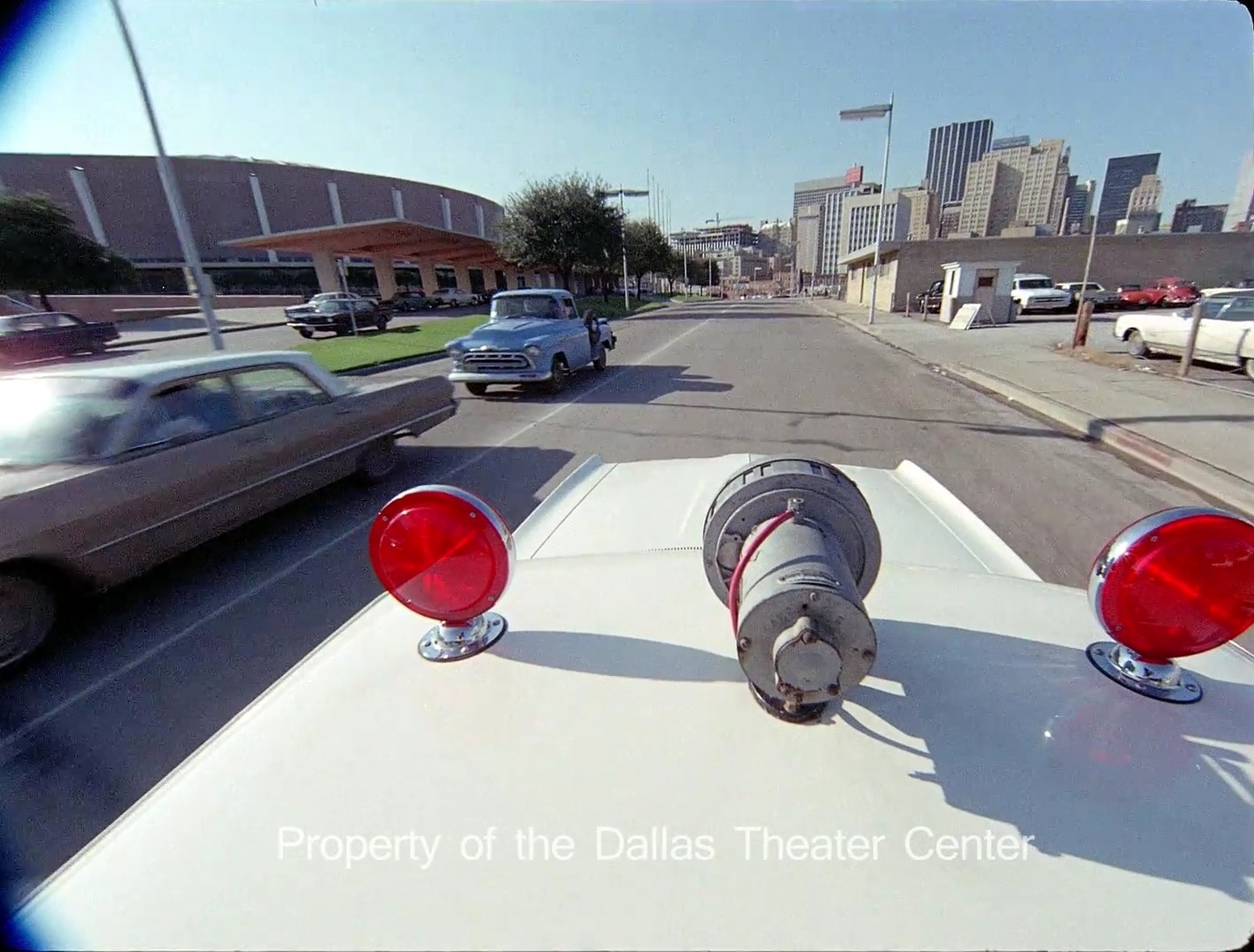
The curators of the G. William Jones Film & Video Collection at SMU have released a short film from the Dallas Theater Center Collection. This wonderful 35mm color footage shows downtown Dallas in about March of 1970 (the four movies shown on the marquees of the Majestic, the Capri, the Tower, and the Palace were all playing that month). The camera has been mounted on top of an (off-duty) emergency vehicle, and it’s a leisurely (silent) drive around downtown — it’s kind of thrilling when the slo-mo kicks in. A few screen captures are below, but you really must watch the film — and be sure to expand it to a full-screen view. (There is more to come from this source, and I will write about this Dallas Theater Center project when SMU unveils further footage.)

*

A few screenshots (apologies for the graininess — the video is much crisper):

1. Main and Harwood, heading east (seen at the top of this post) — the White Plaza hotel (now the Indigo) is on the left, the Municipal Building is on the right. Same view today is here. [EDIT: the Google Street View links appear to work only on a desktop computer. When I try clicking the links on my phone I get views which show only the general vicinity. So … argh.]

2. Elm Street, heading west (below) — the Majestic Theatre is at the right (now playing: Tell Them Willie Boy Is Here with Robert Redford). Same view today is here. (All images are larger when clicked.)

DTC_elm_majestic_SMU

3. Elm Street — the Capri (showing the X-rated Italian film The Libertine) and the Tower (showing Jenny, with Marlo Thomas and Alan Alda). Same view today is here.

DTC_elm-capri-tower_SMU

4. Elm and St. Paul. Same view today is here.

DTC_elm-st-paul_SMU

5. Elm Street, just past Ervay — the Palace (showing The Only Game in Town with “Liz” Taylor and Warren Beatty). Same view today is here.

DTC_elm-palace_SMU

6. Main Street, heading east toward Griffin — One Main Place on the left, a blobby Pegasus straight ahead. Same view today is here.

DTC_one-main-place_main-and-griffin_SMU

7. Main Street, a little further east — that fantastic old building with the T & P ghost sign and home of the wonderfully seedy-looking Dallas Liquor Store (1112 Main) is now the pretty little Belo Garden. Same view today is here.

DTC_one-main-place_1100 block-main_SMU

8. Main, approaching Akard. (The Eatwell Cafe was at 1404 Main.) Same view today is here.

DTC_1400-block-main_SMU

9. Main and St. Paul — Titche’s department store on the left, Margie’s Dress Shop and Cokesbury Books (great sign!) on the right. Same view today is here. (Big change!)

DTC_main-st-paul_SMU

10. Main and Harwood, turning right onto Harwood. Same view today is here.

DTC_main-harwood_turn_SMU

11. South Harwood and Jackson, heading south — First Presbyterian Church is straight ahead. Same view today is here.

DTC_harwood_SMU

12. South Akard heading north — Dallas Convention Center is on the left. Same view today is here.


DTC_convention-center_s-akard_SMU

***

Sources & Notes

Screenshots from the video “DTC Downtown Dallas” on YouTube, here; from the Dallas Theater Center Collection, held at Southern Methodist University. Many thanks, as always, to curator Jeremy Spracklen.

More 35mm color footage from this Dallas Theater Center project will be released in the near future. Keep up to date on these films as well as other fantastic archival DFW footage held by SMU by following @SMUJonesFilm on Twitter or SMUJonesFilm on Facebook.

UPDATE: Watch a short clip from the DTC Collection showing a colorful parade of pedestrians at Main and Ervay, as well as a nice shot of the old Jefferson Hotel — all captured on 35mm color film in 1970 — here.

*

Copyright © 2018 Paula Bosse. All Rights Reserved.
 

1971 Yellow Pages Cover: SMU Gets the Karl Hoefle Treatment

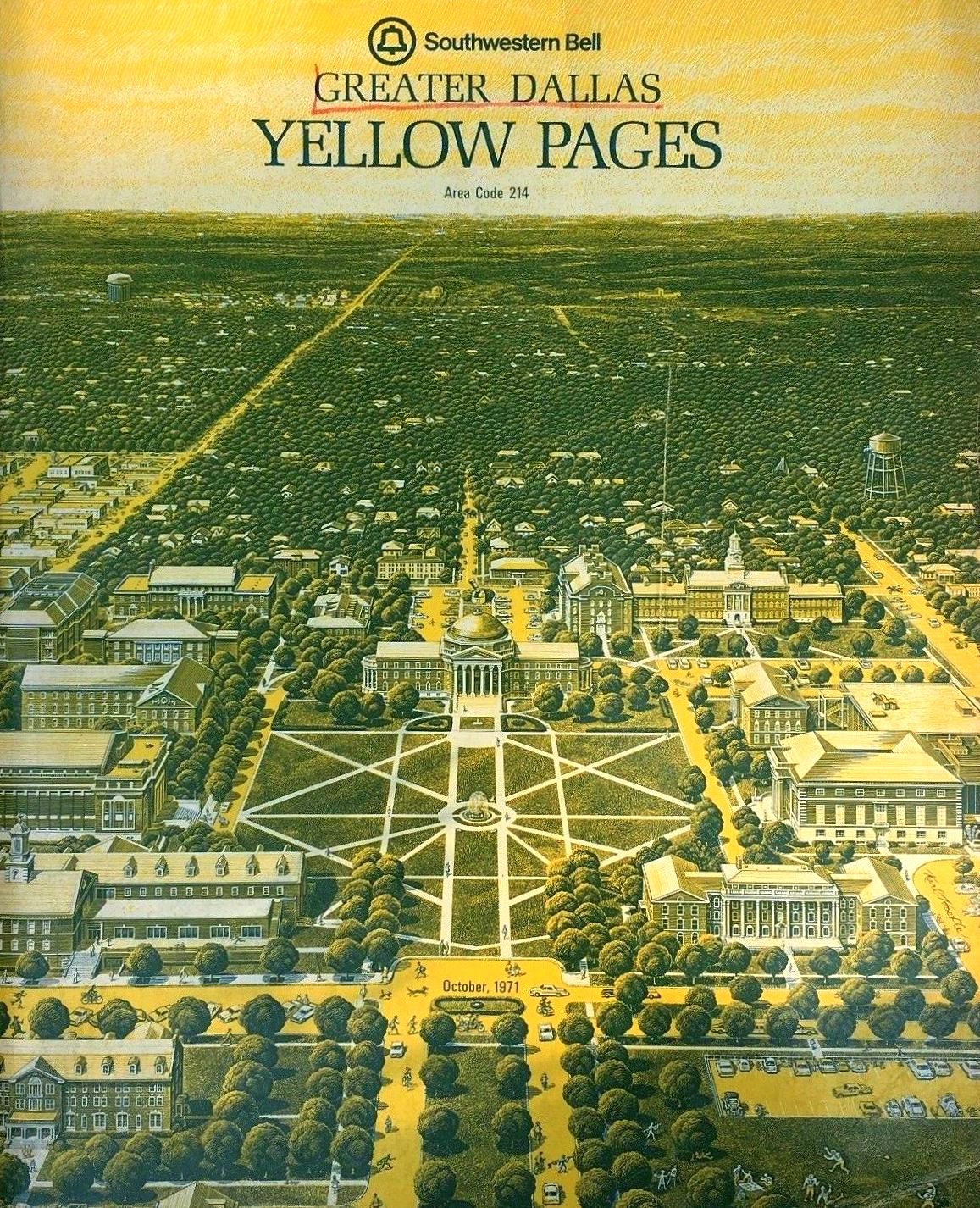
hoefle_yellow-pages_1971_smuUniversity Park gets Hoefle-ized… (click for larger image)

by Paula Bosse

Karl Hoefle’s wonderfully detailed (and painstakingly rendered) Yellow Pages illustrations were pretty much loved by everyone who saw them. As a kid, I loved searching for the hidden jokes — the dinosaurs, the cowboys, the rocket ships. I’ll try to write something in-depth about Karl someday. But, in the meantime, here is one of his covers from 1971, showing the SMU campus, Hillcrest, Snider Plaza, that water tower on Northwest Highway, and, heck, even an observatory. And possibly an elephant (although it might just be an elephant-ish-looking mustang…). (Click the image!)

*

Copyright © 2018 Paula Bosse. All Rights Reserved.
Flooding Along Gaston

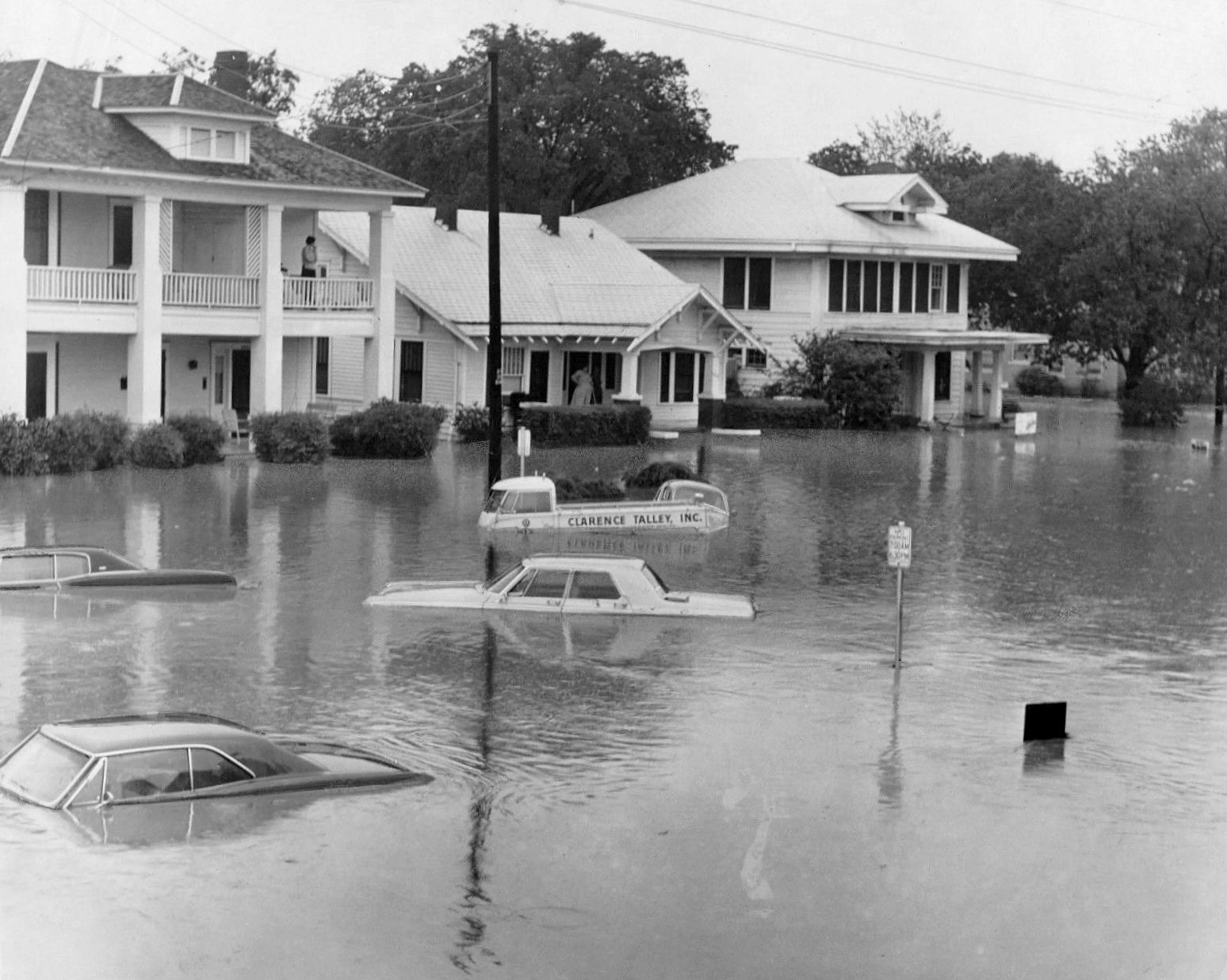
flood_flooding_gaston-avenue_ebayI do believe some of these vehicles have drifted out of their lanes…

by Paula Bosse

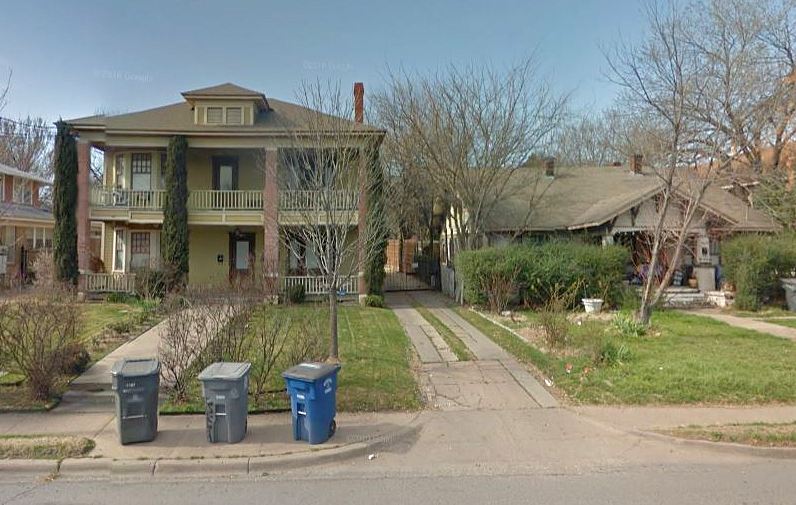
It’s been a rainy, flood-y day — why not post a picture of part of Big D underwater? The photo above appeared on eBay several months ago, minimally described as capturing a scene of a flooded Gaston Avenue in Old East Dallas (Peak’s Suburban Addition). I took a virtual drive down Gaston via Google Street View to see if I could find the exact location of the photo, and it looks like it was taken in the 4600 block of Gaston at Annex (Gaston, between Carroll and Fitzhugh). The two houses on the left in the photo above are still standing, the house on the right has been replaced by an apartment building. Below is a Google view from 2014. (The most recent Google Street View capture is here.)

gaston-annex_google-feb-2014Google Street View, Feb., 2014

Stay dry!

***

Sources & Notes

Top photo from eBay.

Color image from Google Street View.

A 1961 Clarence Talley ad featuring the same (or very similar) dropside VW pickup is here. Speaking of Volkswagens and flooding, might as well watch a 1967 TV commercial showing that, yes, a VW Beetle does float, here.

Click pictures to see larger images.

*

Copyright © 2018 Paula Bosse. All Rights Reserved.

Santos Rodriguez: The March of Justice — 1973

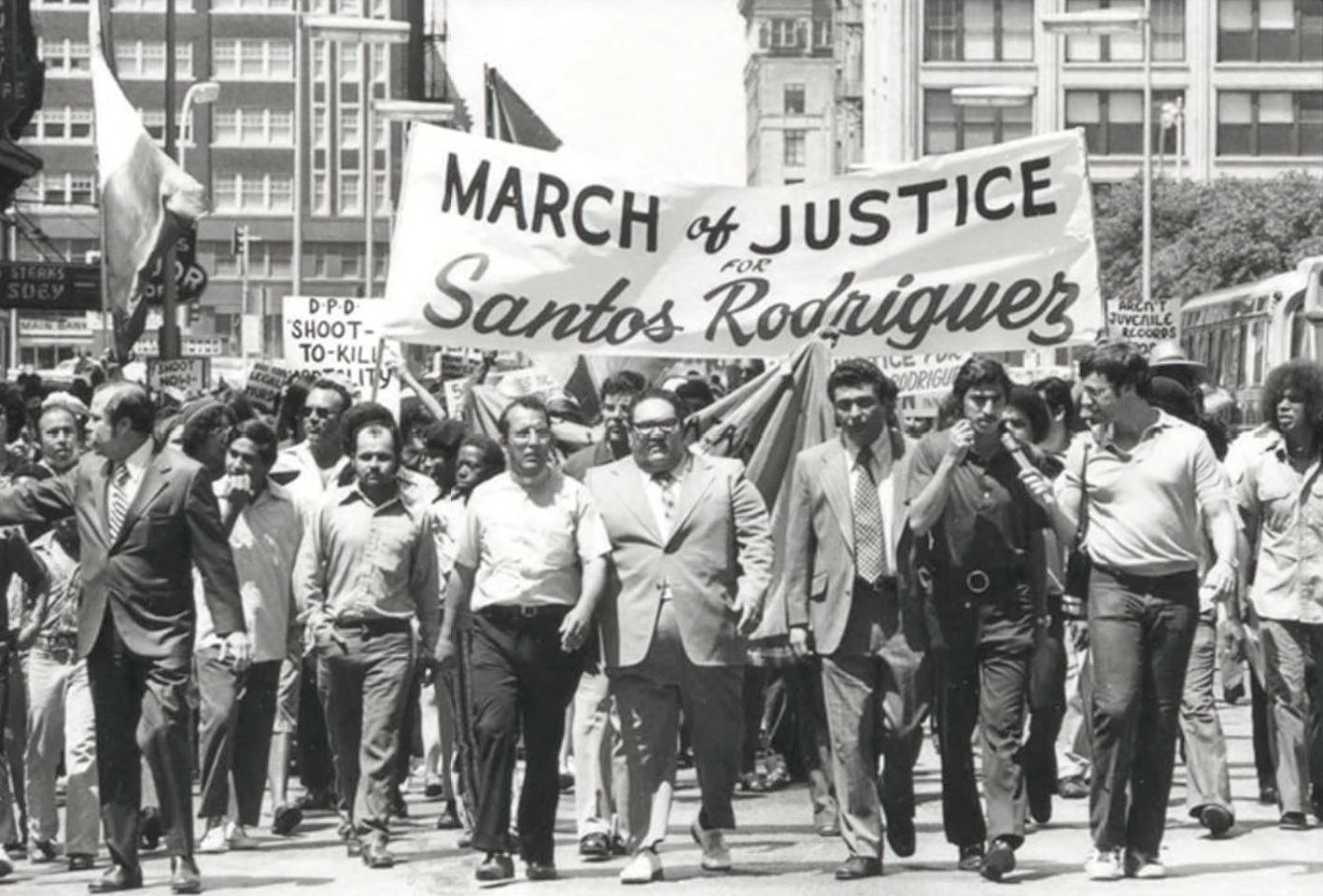
santos-rodriguez_march_contact-sheet-12_andy-hanson_degolyer_SMUThe March of Justice, July 28, 1973… (photo: Andy Hanson / SMU)

by Paula Bosse

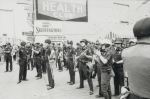
In the wee hours of the morning of Saturday, July 24, 1973, 12-year-old Santos Rodriguez — who was handcuffed in the front seat of a police car — was shot in the head by a Dallas police officer attempting to coerce a confession in a deadly game of Russian roulette. Santos died instantly, as his 13-year-old brother — also handcuffed — watched in horror from the back seat. The shooting (which I wrote about here) set off an explosion of outrage in Dallas, with the bitterest and angriest coming from the Mexican American community.

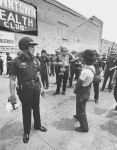
Four days after Santos was killed, a “March of Justice for Santos Rodriguez” was scheduled to be held in downtown Dallas, beginning at the Kennedy Memorial and ending at City Hall (the old Municipal Building, at Main and Harwood). The event was to be a peaceful march to show the solidarity of the Hispanic community and to protest what many felt was racial prejudice within the Dallas Police Department.

The march down Main Street to City Hall was earnest, and the speeches at City Hall by Dallas activists and concerned civic leaders were impassioned calls to action. After the speeches, many of the marchers headed back to the Kennedy Memorial. About halfway back, they encountered another group of marchers.

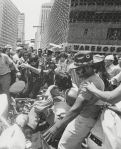
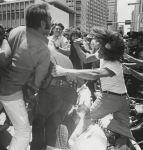
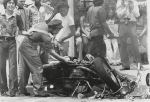
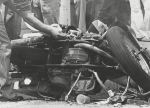
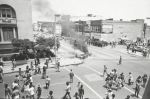
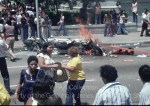
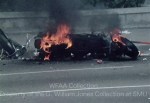
At some point, various groups described as “outside agitators” arrived. While the first crowd was listening to speeches at City Hall, a second (and perhaps later even a third) group of protestors assembled and began their own march to City Hall. These new arrivals (many said to be from Fort Worth and Waco) appear to have been the spark that set off what has been described as a “riot,” which erupted back at City Hall, with protesters attacking the police (who had been ordered to refrain from retaliation), breaking windows, and looting several downtown businesses. The image most emblematic of the day was a burning police motorcycle lying in the street just outside City Hall.

…[A]ll was havoc. A motorcycle was burning, a news vehicle was smashed, several officers injured and the sound of shattering glass filled the street… [T]he stench of burning rubber filled the air.” (“Police Taunted By Crowd” by Mitch Lobrovich, Dallas Morning News, July 29, 1973)

Luckily, there were few injuries, and the crowd dispersed after less than an hour.

A couple of days after the protest, the Rodriguez family issued this statement:

The Rodriguez family would only ask that when the people of Dallas hear the name Santos Rodriguez they think not of the unwanted violence that became associated with his name Saturday; but they think of the real Santos Rodriguez, a gentle and well-liked 12-year-old boy who had his life tragically taken from him.

*

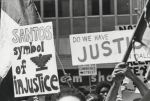
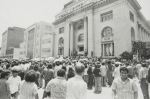
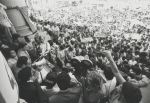
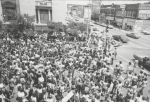
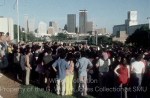
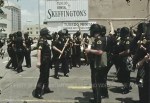
Below (and above), photos taken that day by Dallas Times Herald photographer Andy Hanson which were recently unearthed by curator Anne Peterson, from the collection of his photographs at SMU’s DeGolyer Library:

**

The only footage I’ve found of the actual march is this video, uploaded recently to YouTube by Mountain View College. It was apparently shot by a Dallas police officer. There is no sound. This is great. Thank you, Mountain View, for preserving this important historical moment.


*
***

Sources & Notes

Photos taken by Andy Hanson on July 28, 1973; from the Collection of Photographs by Andy Hanson, DeGolyer Library, Southern Methodist University. See the rest of the photos from this day, here. (Note: this does not appear to be the entirety of Hanson’s photos taken that day.) Read about the full Andy Hanson Collection at SMU, here

Read “Honoring Santos Rodriguez” by Anne E. Peterson, Curator of Photographs at the DeGolyer Library (and the person who unearthed these Andy Hanson photos), here.

The YouTube video is titled “Santos Rodriguez 1973 News Footage,” with the description “Rare news footage taken during the 1973 protests in downtown Dallas following the tragic shooting death of 12 year old Santos Rodriguez by a Dallas Police officer. No audio.” I’d like to know more about the story behind this footage.

The coverage of the march(es) and ensuing riot is confusing. A couple of months after the march, Jose Antonio Gonzales wrote a fascinating and (seemingly) comprehensive report for The Fort Worth Star-Telegram on how the events developed and unfolded, with an almost moment-by-moment timeline and insight into the individuals involved. Read his fantastic job of reporting in the (awkwardly-titled) article “Chicano Leadership Unity Faulted in Study of Boy’s Death” (FWST, Sept. 16, 1973): part one is here; part two is here.

My previous post on Santos Rodriguez — “Santos Rodriguez, 1960-1973” — is here.

Click pictures to see larger images.

*

Copyright © 2018 Paula Bosse. All Rights Reserved.

Santos Rodriguez, 1960-1973

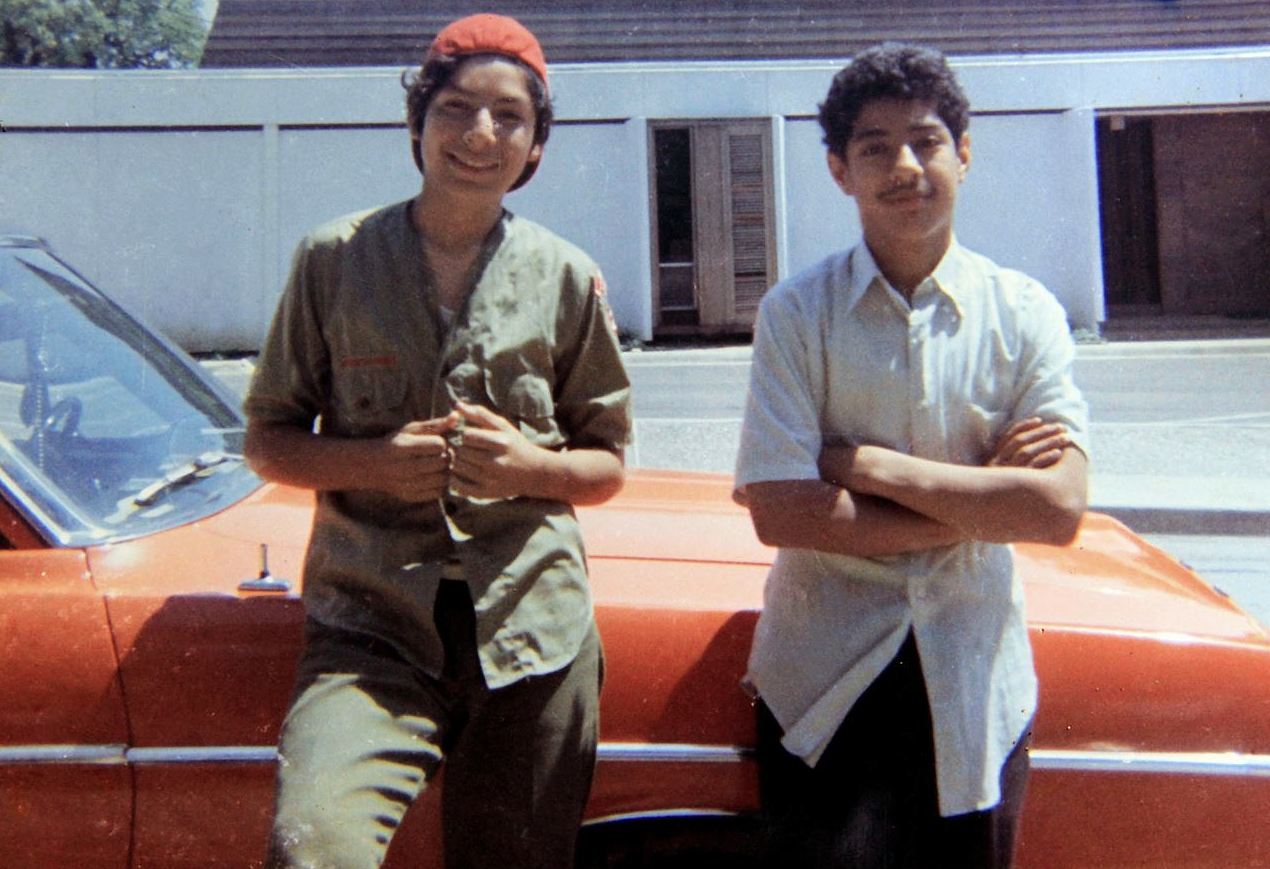
david-and-santos-rodriguez_austin-american-statesmanDavid and Santos Rodriguez (via Austin American-Statesman)

by Paula Bosse

Today is the anniversary of the tragic shooting of Santos Rodriguez, the 12-year-old boy who, on July 24, 1973, was shot in the head by a policeman as he and his 13-year-old brother David sat handcuffed in a police car. It shocked the city of Dallas in 1973, and it is still shocking today.

Santos and David had been awakened and rousted out of bed by Officers Darrell L. Cain and his partner Roy R. Arnold who were investigating a late-night burglary at a nearby gas station where money had been stolen from a cigarette machine — the boys matched a witness’ vague description. The boys said they had nothing to do with the burglary but were taken from their home as their foster-grandfather (an elderly man who spoke no English) watched, helpless, as they were handcuffed and placed in a squad car.

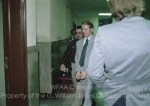
The boys were driven back to the scene of the burglary — a Fina station at Cedar Springs and Bookhout. Santos was in the front passenger seat, and Cain sat behind him in the backseat, next to David. Cain insisted the two boys were guilty and, in an attempt to coerce a confession, held his .357 magnum revolver to Santos’ head. He clicked the gun, as if playing Russian Roulette, telling Santos that the next time he might not be so lucky. The boys continued to insist they were innocent. And then, suddenly, Cain’s gun went off. Santos died instantly. Stunned, Cain said that it had been an accident. He and Arnold got out of the car, leaving 13-year-old David, still handcuffed, in the backseat of the police car — for anywhere from 10 minutes to half an hour — alone with his brother’s bloody body. (It was determined through fingerprint evidence that Santos and David did not break into the gas station that night.)

More in-depth articles about this horrible case can be found elsewhere, but, briefly, Cain (who had previously been involved in the fatal shooting of a teenaged African American young man named Michael Morehead) was charged with committing “murder with malice” and was found guilty. He was sentenced to 5 years in prison but ended up serving only two and a half years in Huntsville.

The killing of Santos Rodriguez sparked outrage from all corners of the city, but particularly in the Mexican American community. All sorts of people — from ordinary citizens to militant Brown Berets — organized and protested, persistently demanding civil rights, social justice, and police reform. If anything positive resulted from this tragic event, perhaps it was a newly energized Hispanic community.

**

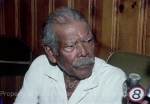
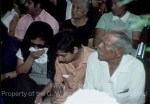
I am ashamed to say that I was not aware of what had happened to Santos Rodriguez until I began to write about Dallas history a few years ago. This was an important turning point in the history of Dallas — for many reasons (namely in the Chicano movement, race relations, the fight for social justice, and an examination of Dallas Police Department procedure). Over the past week I’ve read a lot of the local coverage of the events of this case, and I’ve watched a lot of interviews of people who were involved, but perhaps the most immediate way I’ve experienced the events and emotions swirling about this case has been to watch television news footage shot as the story was unfolding. Thanks to the incredibly rich collection of TV news footage in the possession of the G. William Jones Film & Video Collection at SMU, I’ve been able to do that.

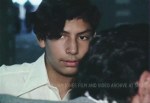
Below is footage shot by KDFW Channel 4, which has, most likely, not been seen since 1973. Some of it appeared in news reports, and some is just background B-roll footage shot to be edited into news pieces which would eventually air on the nightly news. The finished stories that aired do not (as far as I know) survive, but we have this footage. It’s choppy and chaotic and darts from one thing to the next, which is how a red-hot news story develops. Of particular interest is the short interview with 13-year-old David at 9:16 and the violent aftermath of what began as a peaceful march through downtown at 19:54.

A more comprehensive collection of the events — from just hours after the shooting to the conviction of Darrell Cain — can be found in this lengthy compilation of WFAA Channel 8 news footage. This and the Channel 4 footage are essential sources.

*

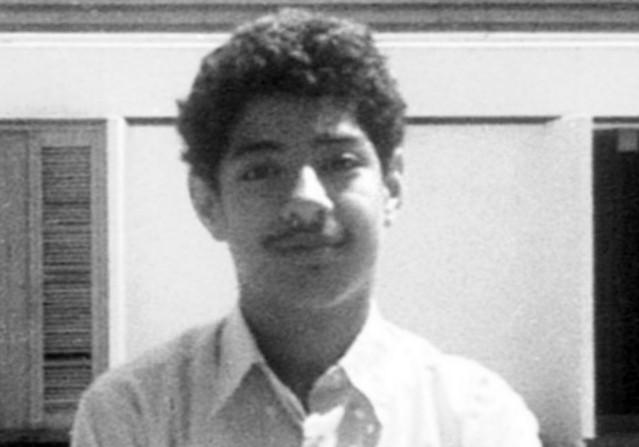
santos-rodriguez-cropped_smuSantos Rodriguez (Nov. 7, 1960 – July 24, 1973)

***

Sources & Notes

Top photo is a family photo, from the Austin American-Statesman article “Is It Time for Dallas to Honor Santos Rodriguez?” by Gissela Santacruz, here.

My sincerest thanks to Jeremy Spracklen at SMU for alerting me to these two collections of important historical news footage from KDFW-TV/Ch. 4 and WFAA-TV/Ch. 8, both of which are held by the G. William Jones Film & Video Collection, Hamon Library, Southern Methodist University. (All screenshots are from these two videos.)

An excerpt from the 1982 KERA-produced documentary “Pride and Anger: A Mexican American Perspective of Dallas and Fort Worth” (the Santos Rodriguez case is discussed) is on YouTube here.

“Civil Rights in Black & Brown” is a fantastic oral history project by TCU. I watched several of the interviews focusing on Santos Rodriguez, but I was particularly taken with the oral history of Frances Rizo — her 2015 interview is in two parts, here and here.

More on the events surrounding the killing of Santos Rodriguez can be found at the Handbook of Texas History site, here.

My continuation of this story can be found at the Flashback Dallas post “Santos Rodriguez: The March of Justice” — 1973,” here.

*

Copyright © 2018 Paula Bosse. All Rights Reserved.
Willie’s Picnic Or Bust

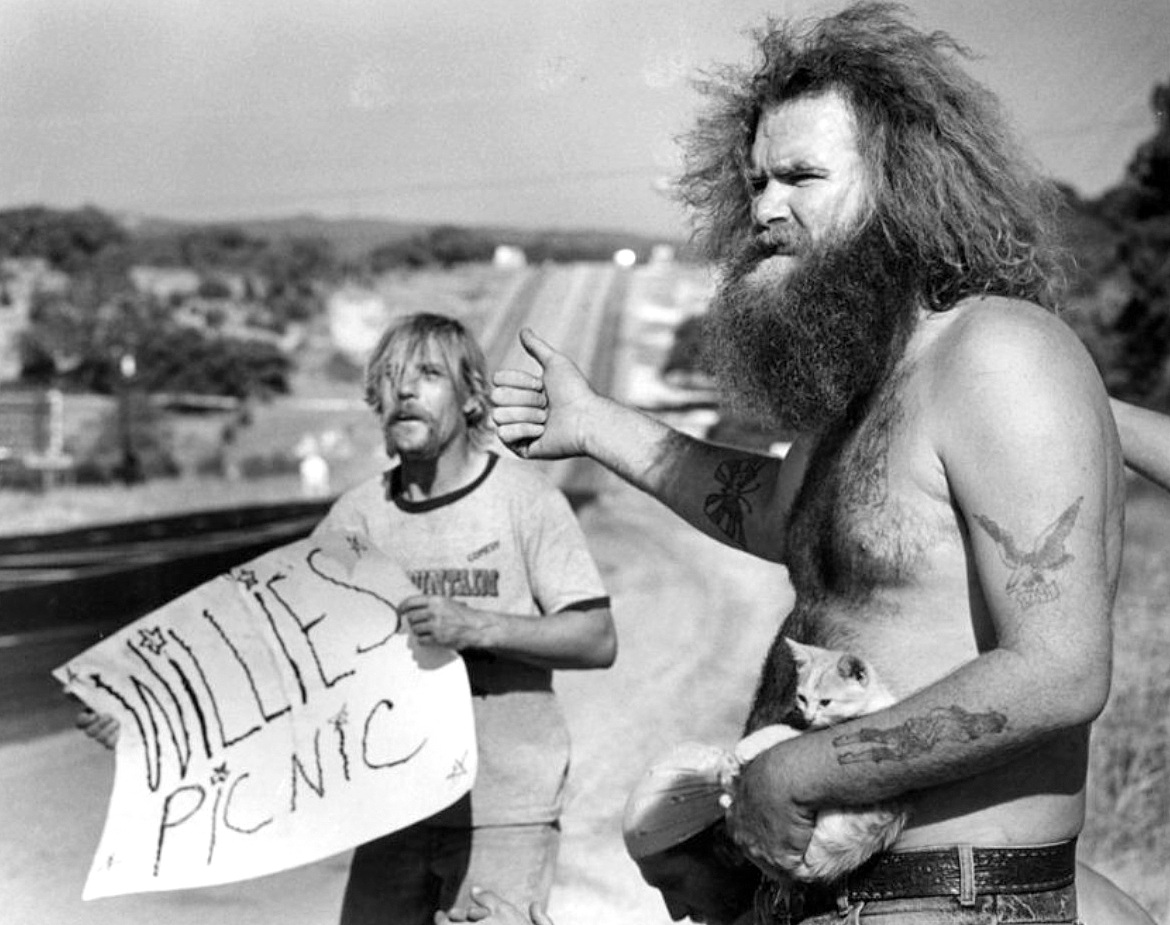
willie-nelson-picnic_1980_austin-american-statesman“All’s we need is a ride, man…”  (photo: Austin American-Statesman)

by Paula Bosse

Today is July 4th, 2018 — the 45th anniversary of the first Willie Nelson 4th of July Picnic. The photo above — taken by Austin photographer Stanley Farrar — ran in The Austin American-Statesman in 1980 and shows hitchhikers (including a bare-chested Jerry Rundell and his go-with-the-flow cat “Precious”) thumbing it on Highway 71, hoping for a ride to that year’s picnic at Willie’s Pedernales Country Club, near Austin.

Take a look at the full illustrated program for the second Picnic, which was held at the Texas World Speedway in College Station, July 4-6, 1974, in a PDF, here. The huge line-up included Dallas natives Michael Murphey, B. W. Stevenson, Ray Wylie Hubbard (all three of whom attended Adamson High School in Oak Cliff), and singer-turned-DJ-turned-singer, Johnny Dallas (aka Groovey Joe Poovey). To make this a somewhat Dallas-y, I’ve pulled out a few of the local ads (click ’em to see larger images).

willie-nelson-program_cover-1974

willie-nelson-program_1974_kzewKZEW — from the Zoo’s “Progressive Country” years?

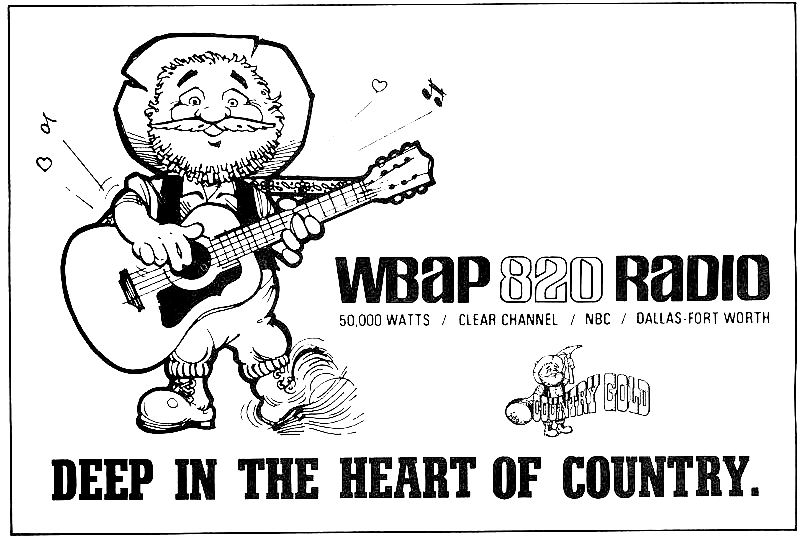
willie-nelson-program_1974_wbapWBAP — how much Ray Wylie Hubbard was WBAP playing?

Speaking of Ray Wylie Hubbard:

willie-nelson-program_1974_ray-wylie-hubbard_mother-bluesMother Blues had a one-buck cover charge, and Gertie’s was rocking until 5 a.m.

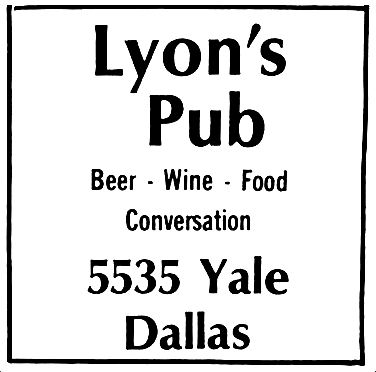
willie-nelson-program_1974_lyons-pubLyon’s Pub, 5535 Yale Street.

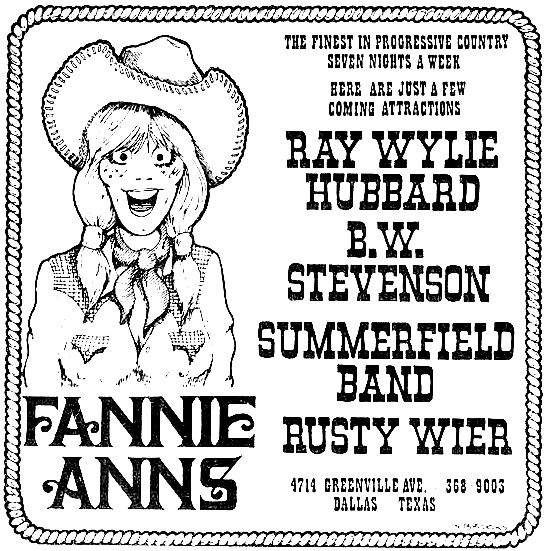
willie-nelson-program_1974_fannie-annsFannie Ann’s, 4714 Greenville Avenue, the lower part of Upper Greenville.

willie-nelson-program_1974_lone-star-opryhouseThe Lone Star Opry House, 1011 S. Industrial, at Cadiz (formerly the Aragon Ballroom). Willie appeared during its first week in business.

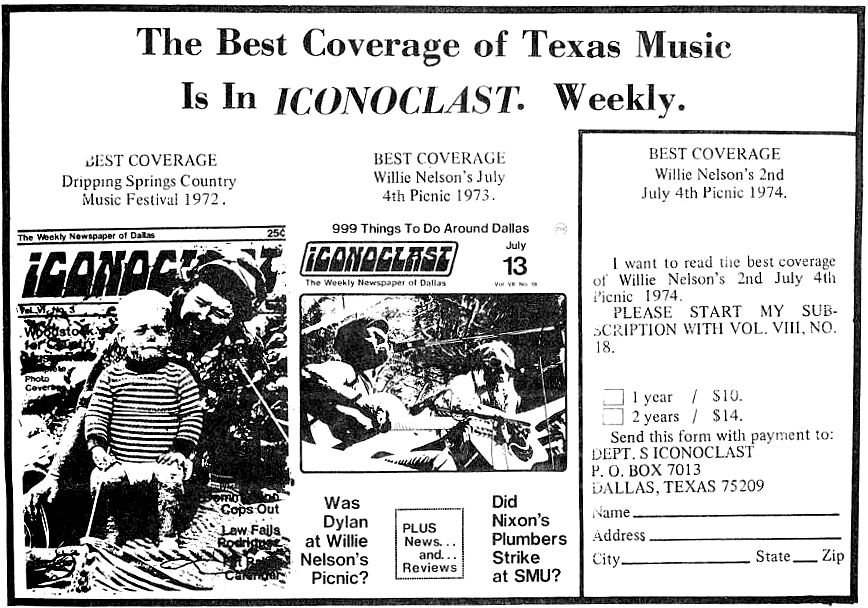
willie-nelson-program_iconoclastThe Iconoclast, Dallas’ underground newspaper, which began as Stoney Burns’ Dallas Notes.

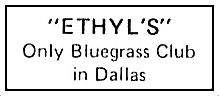
willie-nelson-program_1974_ethylsEthyl’s (“Only Bluegrass Club in Dallas”), 3605 McKinney Avenue.

***

Sources & Notes

Top photo from The Austin American-Statesman (July 4, 1980); photo taken by photographer Stanley Farrar. See many more photos of Willie Nelson 4th of July Picnics in an American-Statesman slideshow, here.

I wonder if Willie’s picnics have their own Wikipedia page? Of COURSE they do! Have at it.

I’ve written about it before, but, hey, it’s the 4th of July, so here’s Willie’s very … um, unusual ode to Dallas:

*
Happy 4th!

*

Copyright © 2018 Paula Bosse. All Rights Reserved.


Sam Ventura’s Italian Village, Oak Lawn

italian-village_photo-holder_PEB

by Paula Bosse

In amongst photos and belongings of my mother’s aunt, I recently came across this wonderful graphic of Oak Lawn’s Italian Village (3211 Oak Lawn, at Hall). It was on the cover of one of those cardboard photo holders which contained photos of diners and club-goers captured by photographers wanting to memorialize celebrants’ special occasions — they would take your photo and you would later purchase prints, which would be tucked inside the souvenir folder. (I don’t recognize any of the people in the photo which was  inside — the photo is here.)

The Italian Village complex (which contained all its various tangential enterprises over he years) was an Oak Lawn fixture for over 45 years — it was apparently still around during my lifetime, but I have no memory of ever seeing it. But by the time I would have been aware of it, things had begun to get a little weird and its profile had definitely dipped. (More on that later.)
Italian Village began its life in 1934 when Sam Ventura (1907-1997) bought a popular drive-in restaurant in Oak Lawn from a man named Levi F. “Speck” Harper. In Ventura’s obituary in The Dallas Morning News, his wife said: “He bought it from a man named Speck Harper who told him, ‘Give me $250 and my hat, and you’ll never see me again.’ Sam had to go and borrow the money.” (DMN, June 1, 1997) ($250 in today’s money would be about $4,700.)

speck-harper_july-1934July, 1934

Not only did $250 start Ventura on a very successful career as a restaurateur, it also assured him ownership of what would quickly become a primo piece of real estate. (Ventura dabbled in real estate and, in 1937, along with fellow restaurant man Sam Lobello, he purchased land at Preston Road and Northwest Highway which would one day become Preston Center.) (It might be worth noting here that Sam Ventura was not affiliated with the very popular Sammy’s restaurants, run by Dallas’ Messina family.)

italian-village_matchbook_front_ebay        italian-village_matchbook_back_ebay
Matchbook, via eBay

Italian Village — a restaurant which operated for many years as a private club in order to sell liquor — was originally co-owned by brothers-in-law Sam Ventura and Nick DeGeorge (DeGeorge was later married to Ventura’s sister Lucille). By the time the ad below appeared in 1939, the place had been newly remodeled and was on its ninth (!) expansion. There were lots of new “rooms”: the Can-Can Room, the Plaid Room, the Hunter’s Room, the Gazelle Room, and the Marionette Room, the latter of which featured entertainment in the form of a marionette show with puppets made in likenesses of the owners. (All images are larger when clicked.)

1939_italian-village_feb-1939Feb., 1939

In June, 1940, Italy entered the War in Europe as a member of the Axis forces. As a result, Ventura and DeGeorge immediately asserted their patriotism and their American-ness (both were born in the United States to Italian immigrants) by changing the name of their restaurant: arrivederci, Italian Village, hello, Oak Lawn Village. The owners placed an ad in Dallas newspapers explaining their decision (see ad below) — this made news across the country, garnering both positive national publicity as well as fervent local support.

italian-village_ad_june-1940
June, 1940

Not only did the restaurant’s name change in 1940, so did its ownership. Nick DeGeorge and his wife (the sister of Sam Ventura) embarked on a very lengthy, very bitter divorce (newspapers reported that Nick and Lucille were each on their fourth marriages). The result of this marital split spilled over and also caused a business split: Ventura became the sole owner of Italian Oak Lawn Village, and DeGeorge left to start his own (very successful) restaurant career (DeGeorge’s, Town & Country, etc.). Sam announced that he was “sole owner” in a September, 1940 ad. (I hope Nick at least got custody of his mini-me marionette….)
1940_oak-lawn-village-ad_sept-1950Sept., 1940

oak-lawn-village_matchbook_flickr-coltera
Oak Lawn Village matchbook cover, via Flickr

In June, 1941 yet another remodeling/expansion was announced, with architectural design by longtime friend of Ventura and DeGeorge, Charles Dilbeck, and murals by Russ Ellis. In addition to the Gazelle Room (“for comfort”) and the Hunter’s Room (“for private parties”), there was now the San Juan Capistrano Room (“follow the swallows”), the 42nd & Broadway Room (“for luxury”), the South American Room (“for romance”), the Dude Ranch Room (“where the west begins”), the Rain Room (“for private parties”), the Banquet Room (“seating capacity 150 guests”), and an outdoor Italian Garden Terrace (“beneath the stars”).
1941_oak-lawn-village_dmn_june-41June, 1941

That $20,000 remodel (which would have been equivalent to about $350,000 in today’s money) went up in smoke — literally — in April, 1944, when the restaurant was “virtually destroyed” by fire. Ventura said he would rebuild when war-time government regulations would permit him to do so. At the end of the year he announced that he would build a new restaurant, of shell stone and marble construction, lit in front by decorative tower lights. The new place was built and in full swing — and back with its original name — in the summer of 1945.

1945_italian-village_aug-1945Aug., 1945

An ad for Dallas’ S. H. Lynch & Co.’s Seeburg Scientific Sound Distribution system appeared in the Aug. 10, 1946 issue of Billboard magazine, showing photos of Sam Ventura, the exterior of the new building, and an interior shot showing a Seeburg jukebox. (See full ad here.)

1946_italian-village_billboard_081046_ad-det-1Sam D. Ventura, 1946 (ad detail, Billboard magazine)

1946_italian-village_billboard_081046_ad-det-2

1946_italian-village_billboard_081046_ad-det-3Italian Village exterior and interior, 1946 (ad detail, Billboard magazine)

In January, 1951 another remodeling (to the tune of $75,000!) introduced the 300-seat Flamingo Room, which meant the entire Italian Village now had a seating capacity of more than 700 (Ventura had said that the original post-Speck’s restaurant seated only 40 or 50 people). The “modernistic styling” was the work of architect J. N. McCammon.

1951_italian-village_flamingo-room_jan-1951Jan., 1951

italian-village_postcard_flamingo-room_ebay

italian-village_postcard_yellow_ebay

italian-village_postcard_interior_ebay

italian-village_postcard_interior_caption_ebay

italian-village_menu_ebay_1     italian-village_menu_ebay_4
Front and back of 1955 menu, via eBay

Below, a shot of the Italian Villa’s four odd brick structures seen from across the street (in a screen capture from unrelated January 1955 news footage).

italian-village_oak-lawn-natl-bank_wbap-news_012355-portalKXAS-NBC 5 News Collection, UNT

Further changes came to 3211 Oak Lawn in the fall of 1954 with the arrival of the Village Club, which featured live entertainment (including a rotating piano) and shared a kitchen with Italian Village. It was also a “private locker club” with personal liquor lockers available to members to keep their bottles in at a time when it was not legal for restaurants in Dallas to sell liquor-by-the-drink — “set-ups” were sold and the demon alcohol was poured from the member’s stash (or, more likely, from the communal stash).

In 1961 there was yet another remodel, which enlarged the club — now called Club Village — and shrank the restaurant. The swanky new club was designed by Charles Dilbeck and had a sort of Olde English theme (and, for some reason, featured a waterfall, a glass cage behind the bar containing live monkeys, and two live flamingos named Lancelot and Guenevere).

italian-village_dallas-entertainment-awards_1961_SMUvia DeGolyer Library, SMU

1965_club-village_oct-1965Oct., 1965

Around this time the (apparently short-lived) Francisca Restaurant appeared.

francisca-restaurant_menu_1961_ebayvia eBay

club-village_francisca_new-years-eve_dec-1961New Year’s Eve, Dec., 1961

1961 also marked the club’s debut on national television, appearing in scenes of the hit show Route 66, which were filmed in November. Below is a screen-capture from the episode “A Long Piece of Mischief,” with the waterfall in the background. (The entire episode, shot around the Mesquite Rodeo, can be watched on YouTube here — the two Club Village scenes begin at the 26:42 and 38:15 marks.)

1961_club-village_route-66Route 66 (screen capture) — Nov., 1961

In late 1966, Dallas filmmaker Larry Buchanan shot his cult classic Mars Needs Women in various locations all over town. I’m pretty sure one of the very first scenes was shot inside the club, after yet another remodel. (Incidentally, see what the lively neon-ified corner of Oak Lawn and Lemmon, a couple of blocks away, looked like in Buchanan’s film, here.)

1966_club-village_mars-needs-women
Mars Needs Women (screen capture) — 1966

In August, 1964 a new club opened: Gringos (sometimes spelled Gringo’s). This public club, featuring mostly rock bands, was the brainchild of Sam Ventura, Jr. (who said in an interview that he had rather brazenly sprung the whole thing as a big surprise on his father, who had been out of town on a lengthy vacation — luckily, the club was a hit and Sam, Sr. was pleased). Club Village continued as a private club, but from newspaper accounts it seems that the new discotheque displaced the Italian Village and/or Francisca restaurant completely. So now on one side you had the long-running “sophisticated” private club, and on the other side, the “new concept in continuous entertainment,” with its Mexican-themed decor and Watusi-dancing waitresses (“Las Mata-Dollies…”), which catered to a younger set. The Fort Worth Star-Telegram described Gringos thusly:

Newest “port of call” for Dallas revelers on the bistro beat is the just-opened and lavishly-done Gringos Club on Oak Lawn Ave. near the Melrose Hotel and in the location formerly occupied by the Italian Village Restaurant and Village Club. Open to the public, this night time Camelot with Mexican decor features, among other flings, Jesse (brother of Trini) Lopez and his handful of musical consorts on the bandstand and a covey of revealing young handmaidens called “Las Matta-Dollies” [sic], sort of Spanish-type Playboy Bunnies who are worthy of your scrutiny. (Chris Hobson, FWST, Aug. 27, 1964)

1964_gringos_aug-1964Aug., 1964

In May, 1967, Sam Ventura, Jr. (“Sammy,” who had taken over the family business when Sam, Sr. retired in 1966) declared that Gringos was dead: “There will be absolutely no rock-and-roll in this room anymore. It’s dead. Our whole concept [now] is for sophistication, for adult entertainment” (DMN, May 24, 1967). So adios, Gringos, hello an even bigger Club Village. (In 1968 a club described as a “new” Gringos  opened a block away, at 3118 Oak Lawn — it’s unclear whether this was affiliated in any way with the Ventura family.)

In June, 1968, the never-ending improvements, remodelings, and reconfigurings of 3211 Oak Lawn continued with Sammy’s announcement of a new (public) restaurant, the Wood ‘N Rail. This steakhouse featured a revolving “ice bar” (the old revolving piano bar, repurposed), which contained a display of raw meat — from this, customers would choose whichever cut of beef called to them, and before the meat was escorted into the kitchen, the patron would sear his or her initials into it with a “red-hot branding iron.” The restaurant’s slogan was “Personalized Beef.” The unstoppable Club Village continued as a private club and restaurant in the adjoining complex.

1968_wood-n-rail_oct-1968Oct., 1968

1971 began with a fire. The (once) unstoppable Club Village was destroyed. The adjacent Wood ‘N Rail emerged unscathed. So, yes, more remodeling! By 1972, 3211 Oak Lawn boasted three (three!) restaurants at one address: the continuing Wood ‘N Rail (steakhouse), Fisherman’s Cove (seafood), and — hey! — the return of Italian Village. As the ads said: “3 RESTAURANTS UNDER ONE ROOF!”

1972_fishermans-cove_march-1972March, 1972

1972_three-restaurants_may-1972May, 1972

Also big news in 1971: it finally became legal to order liquor and mixed drinks in bars and restaurants — the whole “private club-membership” thing in order to get around liquor laws was mostly a thing of the past (unless you lived in a dry area of the city…).

Then, in 1974, things really changed. After a “profound religious conversion,” Sammy Ventura stopped all sales of alcohol and told the TABC he didn’t need or want that ol’ liquor license. This made news around the country.

1974_kings-village_panama-city-FL-news-herald_081274UPI wire story, Panama City [FL] News Herald, Aug, 1974

Unsurprisingly, business plummeted. Two of the three restaurants closed. Italian Village continued to limp along, even weathering the introduction of the King’s Village, “Dallas’ first Christian dinner theater.”

1976_kings-village_june-1976June, 1976

This change in direction of the the 40-plus-year-old family business caused a huge rift between Sammy and his father. Sam, Sr. put his foot down, and The King’s Village (“the nation’s first non-liquor, Christian nightclub”) closed in June, 1977.

1977_kings-village_pampa-daily-news_062177
AP wire story, Pampa Daily News, June 21, 1977

Oak Lawn’s decades-old Italian Village was no more (although Sammy appears to have opened his own Italian Village restaurant in Richardson’s Spanish Village for a while). The last mention I found of Italian Village was in Feb., 1979:

After 45 years, the Italian Village restaurant has changed to another venture, the Crazy Crab. Sam Ventura opened the Italian Village in 1934 and the last event before the changeover was a surprise birthday party honoring Sam. (DMN, Feb. 23, 1979)

It’s a shame Italian Village’s last incarnation was a mere shadow of its former go-go glory, but it’s almost unbelievable that a restaurant in Dallas was in business for 45 years. Sam Ventura’s $250 gamble in 1934 paid off very, very well.

***

Sources & Notes

Top image is the front cover of a cardstock photo-holder (with linked photo by the Gilbert Studios, 4121 Gaston); collection of Paula Bosse.

All clippings and images are larger when clicked.

*

Copyright © 2018 Paula Bosse. All Rights Reserved.