Flashback : Dallas

A Miscellany: History, Ads, Pop Culture

Category: Banking & Insurance

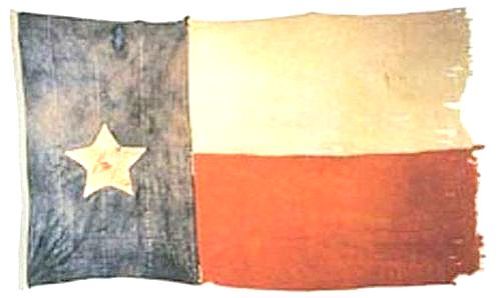
Texas Independence Day: The Most Patriotic Bank Ad EVER — 1921

tx-flag

by Paula Bosse

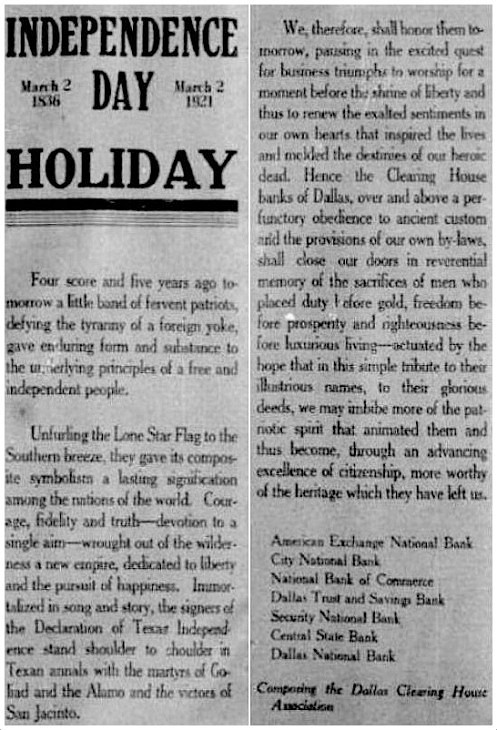
Today is the anniversary of Texas Independence. Below, you will find the most heart-swellingly patriotic bank ad ever penned. Before you plunge in, you might want to get a hanky. (Transcription below.)

tx-independence_ad_dmn_030121Dallas Morning News, March 1, 1921

Four score and five years ago tomorrow a little band of fervent patriots, defying the tyranny of a foreign yoke, gave enduring form and substance to the underlying principles of a free and independent people.

Unfurling the Lone Star Flag to the Southern breeze, they gave its composite symbolism a lasting signification among the nations of the world. Courage, fidelity and truth — devotion to a single aim — wrought out of the wilderness a new empire, dedicated to liberty and the pursuit of happiness. Immortalized in song and story, the signers of the Declaration of Texas Independence stand shoulder to shoulder in Texan annals with the martyrs of Goliad and the Alamo and the victors of San Jacinto.

We, therefore, shall honor them tomorrow, pausing in the excited quest for business triumphs to worship for a moment before the shrine of liberty and thus to renew the exalted sentiments in our own hearts that inspired the lives and melded the destinies of our heroic dead. Hence the Clearing House banks of Dallas, over and above a perfunctory obedience to ancient custom and the provisions of our own by-laws, shall close our doors in reverential memory of the sacrifices of men who placed duty before gold, freedom before prosperity and righteousness before luxurious living — actuated by the hope that in this simple tribute to their illustrious names, to their glorious deeds, we may imbibe more of the patriotic spirit that animated them and thus become, through an advancing excellence of citizenship, more worthy of the heritage which they have left us.

American Exchange National Bank
City National Bank
National Bank of Commerce
Dallas Trust and Savings Bank
Security National Bank
Central State Bank
Dallas National Bank

Composing the Dallas Clearing House Association

*

Remember the Alamo! And remember the men who placed “righteousness before luxurious living”! (Even though that last part’s not exactly a sentiment that Dallas is typically known for….)

*

Copyright © 2015 Paula Bosse. All Rights Reserved.

Mercantile National Bank Ad — 1960

merc_ad_1960-det

by Paula Bosse

I love you, Merc! Why aren’t you in EVERY Dallas ad?

ad-mercanitle_city-directory-1960(click for larger image)

***

Ad from the 1960 city directory. I don’t know who did the artwork for this ad, but I love it.

*

Copyright © 2014 Paula Bosse. All Rights Reserved.

Babe Didrikson, Oak Cliff Typist

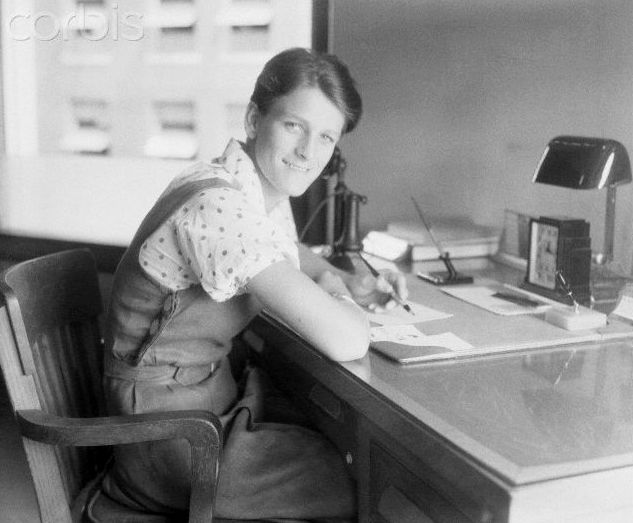
babe-corbis_102132Babe Didrikson at a desk she was probably pretty unfamiliar with, 1932

by Paula Bosse

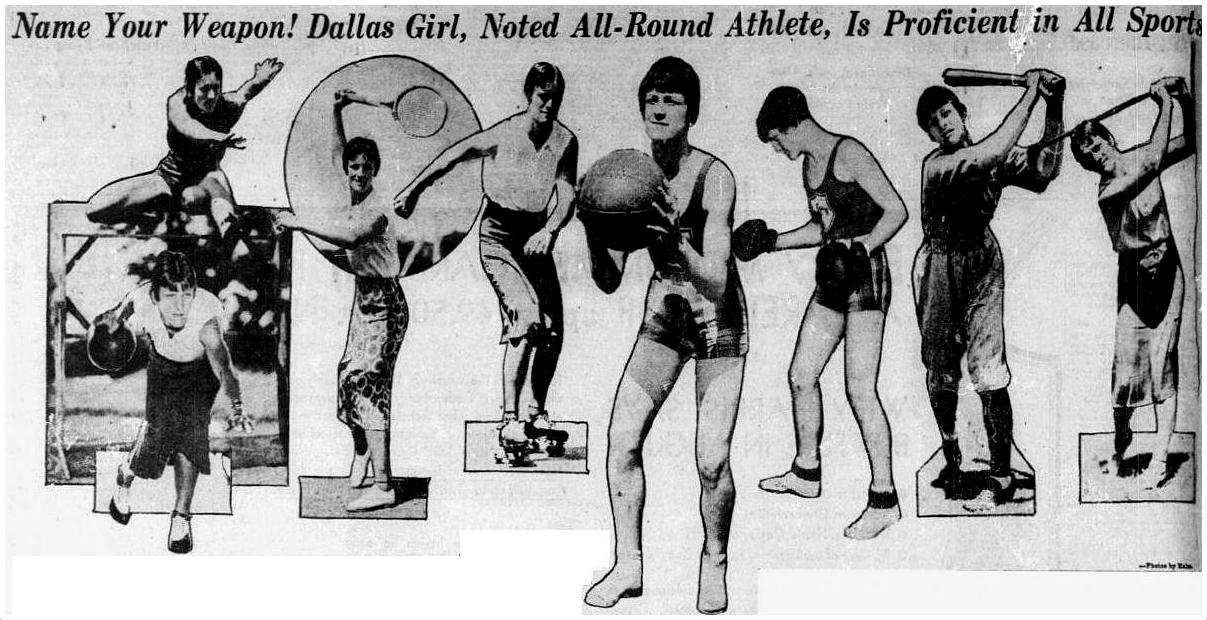
Mildred “Babe” Didrikson has been called the greatest athlete of the 20th century — male or female. She was an All-American basketball player, she set a number of world records in a wide variety of track and field events (she was so good at all of the individual sports that she was entered at least once as an entire TEAM — a team of one!), she won two gold medals and one silver (which should have been three gold medals…) at the 1932 Olympics, and she was, perhaps most famously, a champion golfer who was a founder of the LPGA. She was also highly proficient in softball, bowling, diving, swimming, roller skating, and tennis, and she dabbled in hockey, skeet-shooting, billiards, and even football. There was no sport she didn’t try — and even if she had never tried it before, she was probably pretty good at it. And she spent an important period of her life in Dallas.

babe_dmn_0802311931

Babe Didrikson was born in Port Arthur, Texas in 1911 and grew up in nearby Beaumont. She excelled in sports in school, especially basketball. In the late-’20s, a man named Col. M. J. McCombs, who was the head of the women’s athletic program for an insurance company, saw Babe in action and recruited her to play for his company’s basketball team in Dallas. She was offered a job to do vague secretarial work for the Employers’ Casualty Company (which had offices in the old Interurban Building downtown), with the understanding that she was really being taken on in order to play on the company team. With the blessing of her Norwegian immigrant parents, she interrupted her high school education in Beaumont to accept the $75-a-month job and was moved into a Haines Avenue rooming house in Oak Cliff.

Babe soon became the star of the Golden Cyclones, her company’s championship-winning team which participated in an “industrial” league governed by the national Amateur Athletic Union (the AAU). In the off-season she was introduced to track and field events by McCombs, and she quickly mastered them all.

babe_emp-cas-coFlying the company colors

She soon began breaking world records. Watch her compete at an AAU meet at SMU in July 1930, where one of the records she broke was for the javelin throw, here.

didrikson-babe_070730_track-meet_SMU_javelin_critical-past_screenshot-cropJuly 1930, Dallas

Before she knew it, it was the summer of 1932, and the Olympics were being held in Los Angeles — the 21-year old won three medals, emerged as the star of the games (she was frequently referred to as “the wonder girl from Dallas”) and began her climb up the ladder of celebrity.

After the Olympics, the city of Dallas gave her a victory homecoming, with a parade, a luncheon, and various presentations, all covered widely in the local press. The Dallas Morning News described it as “a demonstration the magnitude of which has never before been accorded a son or daughter of this city” (DMN, Aug. 12, 1932), bigger even, they said, than the reception that had greeted Charles Lindbergh on his Dallas visit.

U625776INPBabe’s post-Olympics parade through downtown Dallas — Aug. 11, 1932

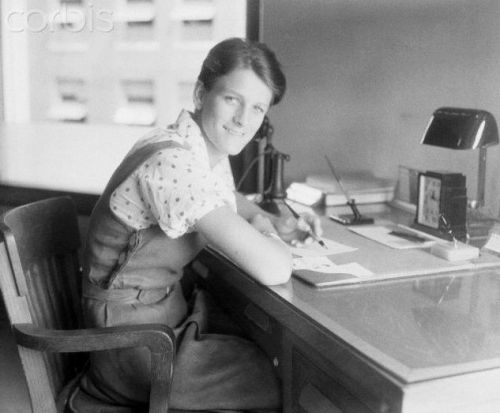
After the celebrations had settled down, Babe Didrikson, sports superstar, was back at “work” — at least long enough to have photographs of her taken at the most uncluttered desk imaginable. (Though to be fair, Babe did claim to have been a typing champion in high school. Even if that were true — and she was known to be something of an exaggerator — it’s still almost impossible to imagine this world champion athlete typing up an afternoon’s dictation on insurance matters.)

babe_insuranceEmployers’ Casualty Co.’s casual employee — Oct. 21, 1932

Babe eventually turned pro, left Dallas, married wrestler George Zaharias, and became an incredibly successful golfer. She died from cancer in 1956 at the early age of 45, but her legacy lives on as one of the greatest and most versatile athletes of all time (…who, for a few short years, also happened to do a bit of light secretarial work for an insurance company in Dallas).

**

Below are a few of my favorite random Babe-related tidbits.

babe_hat_dmn_0712321932

Babe was often ridiculed by male sportswriters for her bearing and physique, which they thought were not feminine enough for their tastes. This criticism — ridiculous though it was — must have stung, because she occasionally made efforts to placate them, some of which seemed very awkward, such as this. The caption of the above photo: “Mildred (Babe) Didrikson (left) and her chaperon, Mrs. Henry Wood, are pictured above as they appeared Monday afternoon just before boarding a train for Chicago, Ill. for the national AAU track and field championships in which Babe […] hopes to carry off high honors and win a berth on the American Olympic team. This is the first picture ever taken of Babe with a hat on. She has never worn one before.”

*
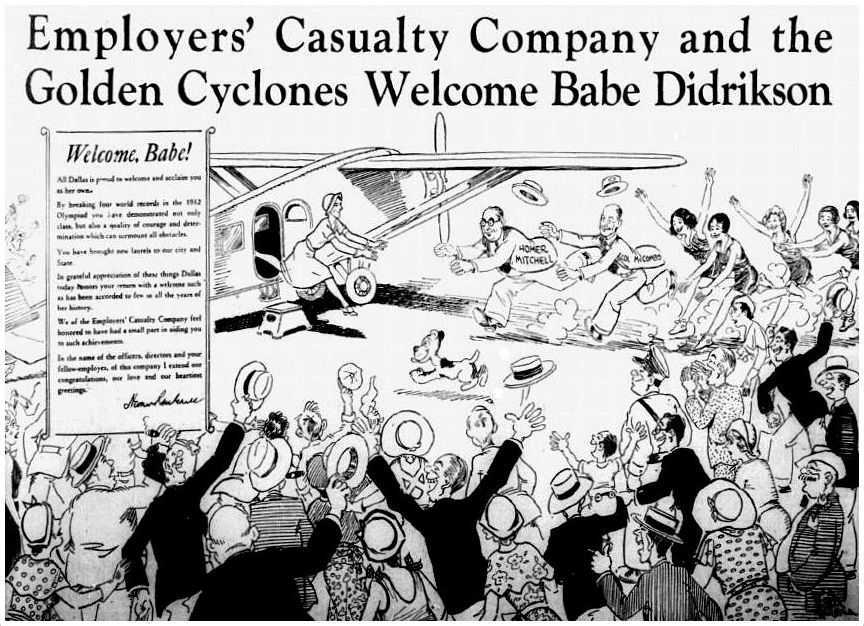
babe_insurance_ad_dmn_081132Aug. 11, 1932

babe_insurance_ad_dmn_081132-detAug. 11, 1932 — ad inset

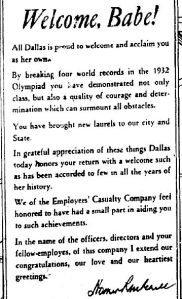
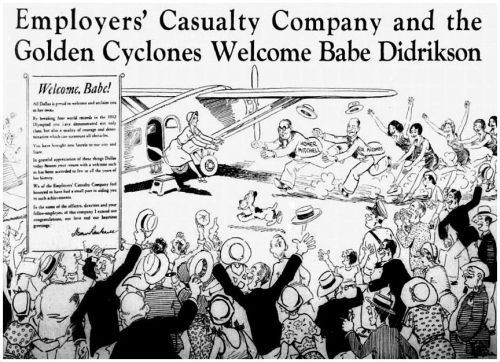
Above, an ad taken out by the Dallas company Babe worked for, welcoming her back home from her Olympic triumph. Drawing by Jack Patton. (Even though Babe had buckled to pressure with the whole hat thing, I can’t quite picture her wearing gloves.)

*

babe-and-babe_081247

Babe and the other Babe, August 12, 1947. I love this photo.

*

babe_vanity-fair_1933

Fantastic photo of Babe in her prime by Lusha Nelson, from the January, 1933 issue of Vanity Fair.

*

babe

***

Sources & Notes

The two photos of Babe Didrikson at her desk, the photo of the parade in Dallas, and the photo with Babe Ruth are from the huge selection of photographs of Babe at CorbisImages. See a lot of photos of her throughout her career, here. The photos of her training and in action are exhilarating, but it’s nice seeing her looking so happy and relaxed in her later golfing days. She definitely smiled a lot more after she started making more than the measly $75 a month she was making in Dallas.

An interesting article from 1975 about Babe in which former co-workers and teammates from Employers Casualty remembered their time with her can be found in the Dallas News archives: “Friends Recall Babe’s Prowess” by Temple Pouncey (DMN, Oct. 26, 1975).

For more on Babe’s time in Dallas and Oak Cliff, she writes about it in her autobiography, This Life I’ve Led (1955), here. (The entire book can be read for free at the link.) Also, check out this article by Gayla Brooks that appeared in the Oak Cliff Advocate.

A really well done, comprehensive overview of Babe Didrikson Zaharias’ career (with lots of great photos), can be found at Pop History Dig, here.

One of my favorite weird Babe things is the record she made with her “golf protege” Betty Dodd. Betty sings (not very well) and is accompanied by Babe on harmonica, an instrument she loved all of her life and which she taught herself to play as a child. The song — and a bit of backstory on Babe and Betty’s relationship — is here (click the arrow at the left of the strip beneath the record label to hear the song “I Felt a Little Teardrop”). Babe’s solo starts at about the 1:06 mark.

And, lastly, newsreel footage of Babe over the years, from the early track meets and the Olympics, to her later career as a golf superstar can be watched here and here.

*

Copyright © 2014 Paula Bosse. All Rights Reserved.

The Texas Land & Mortgage Company — 1912

ad-texas-land-mortgage_19121912

by Paula Bosse

The Texas Land and Mortgage Company of London, Ltd. was the first mortgage company in the state of Texas. The Dallas branch of the English company opened in 1882 at a time when British investment across Texas was booming; it was one of the few speculation firms in the state that grew and prospered into the 20th century. Much development of the city in this period can be attributed to loans granted by the Texas Land & Mortgage Company.

The building they occupied (built by them in 1896) was located at the northwest corner of Commerce and Field, across Field from where the Adolphus has stood since 1912. The building in the 1912 ad looks a little different from the one in the photo below, taken four years earlier. It’s not a terribly attractive building in either photo, but there is some improvement in the later picture, and it IS vastly superior to the 7-Eleven occupying that corner today.

texas-land-mortgage_grtr-dal-ill_19081908

***

Advertisement from the pages of The Cattle Raisers’ Association of Texas, March 1912.

Bottom photograph from Greater Dallas Illustrated (Dallas: Friends of the Dallas Public Library, 1992 — originally published in Dallas in 1908).

For a short biography of A.G. Wood, the Scottish general manager of the Texas Land & Mortgage Co., see the Encyclopedia of Texas (1922) entry here.

Click pictures for larger images.

*

Copyright © 2014 Paula Bosse. All Rights Reserved.
The Republic National Bank Building: Miles of Aluminum, Gold Leaf, and a Rocket

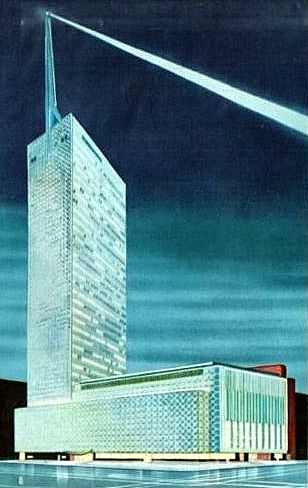
republic-national-bank_beacon_front

by Paula Bosse

THIS is another great idealized image of a great building, The Republic National Bank Building, built in 1954. The blurb on the back of this postcard reads:

40 stories, cost 25 million dollars, the world’s tallest building faced in aluminum and glass.The mighty half-billion candle-power beacon atop the 150-foot spire is visible up to 120 miles.

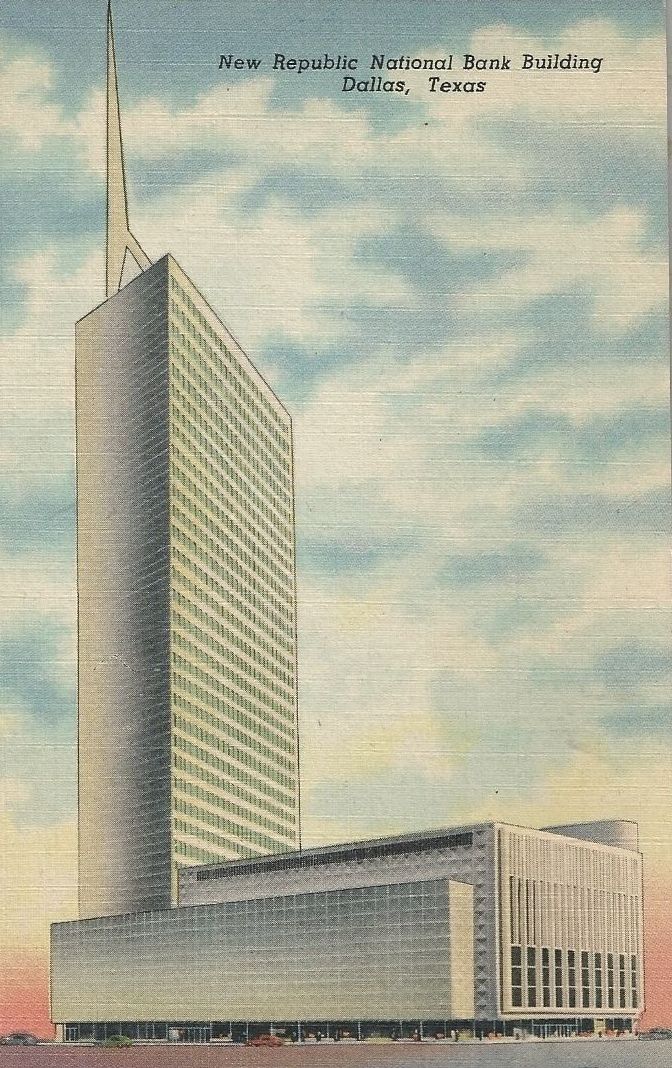
This building was built to be the tallest building in Dallas — to dwarf the rival Mercantile (by a whole 53 feet!). Which it did for a while — it boasted of being the tallest building west of the Mississippi. Until … the Southland Life building came along a few short years later and knocked it off its pedestal (although, dammit, it was the “WORLD’S TALLEST BUILDING FACED IN ALUMINUM AND GLASS”!). For years, the powers-that-be seemed overly concerned with the “tallest” building thing and engaged in architectural pissing contests for years.

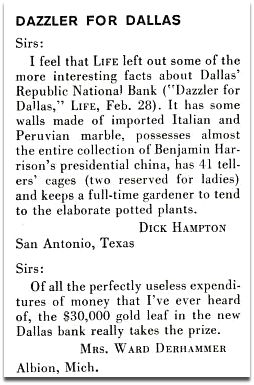
But forget the exterior. INSIDE. Lordy. Legendary bank president Fred Florence went all out, with Life magazine saying the lavish interior reflected Florence’s belief that a bank’s design and appointments should be “an outward showing of solvency.” This included generous helpings of gold leaf, inlaid teak, and endless marble imported from Italy and Peru (“nearly as long as a football field”). One wonders if Florence muttered something about “Rosebud” on his deathbed. Of its forty-one teller’s cages, two were — for some reason — reserved exclusively for women. There was a full-time gardener on staff. And, of course, there were “gold curtains in the executive washrooms.” There was “all-season air-conditioning.” There was a motor bank in the basement. And, if they couldn’t have the tallest building in town, they were damn sure going to have the fastest elevators in the elevator-using world. And they did.

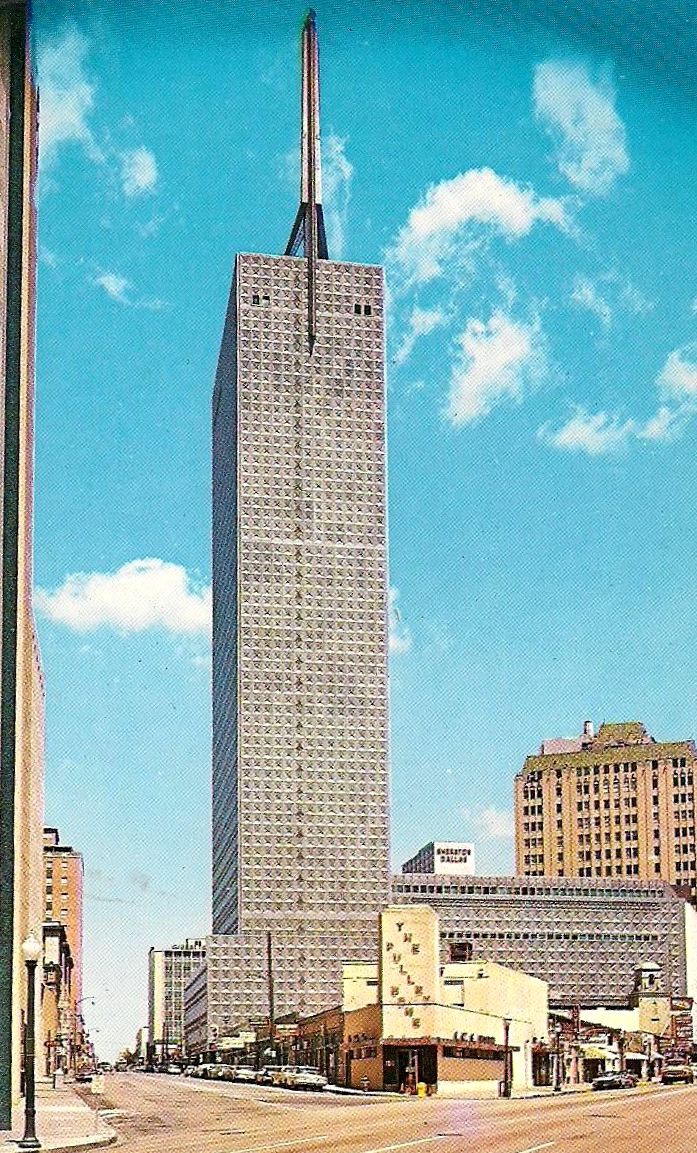
And then there was that rocket. I love that rocket. Sixty years later, it’s still one of the most recognizable buildings on the skyline.

republic-national-bank_S

republic-national-bank_postcard-sm

The missed-by-my-mother’s-generation Pulley Bone diner is in the foreground (click for larger image).

republic-national-bank_photo-post-sm

***

An absolutely fantastic collection of photographs apparently shot by Life magazine to accompany the article from their Feb. 28, 1955 article (linked below) but not used (and, seriously, check them out) are on an unassuming message board. Scroll down a little ways and you’ll see 13 large images of the interior and exterior — see them here. (UPDATE: These photos seem to have disappeared. I’ll keep the link in hopes that user “Dallas boi” will repost!)

Scroll through the 4-page spread “Dazzler for Dallas: Its New Bank is Huge, Handsome and Full of Gold” in Life magazine (Feb. 28, 1955) here.

And here are a couple of readers’ responses to the story, which appeared in a later issue (Mrs. Ward Derhammer is not amused):

republic-national-bank_life_032155

Republic National Bank Building info from the Republic Center website can be found here, from Wikipedia here, and from the Dallas Public Library here.

All postcard images (except the first one) are larger when clicked.

*

Copyright © 2014 Paula Bosse. All Rights Reserved.