Flashback : Dallas

A Miscellany: History, Ads, Pop Culture

Category: City Government

Dallas in 1879 — Not a Good Time to Be Mayor

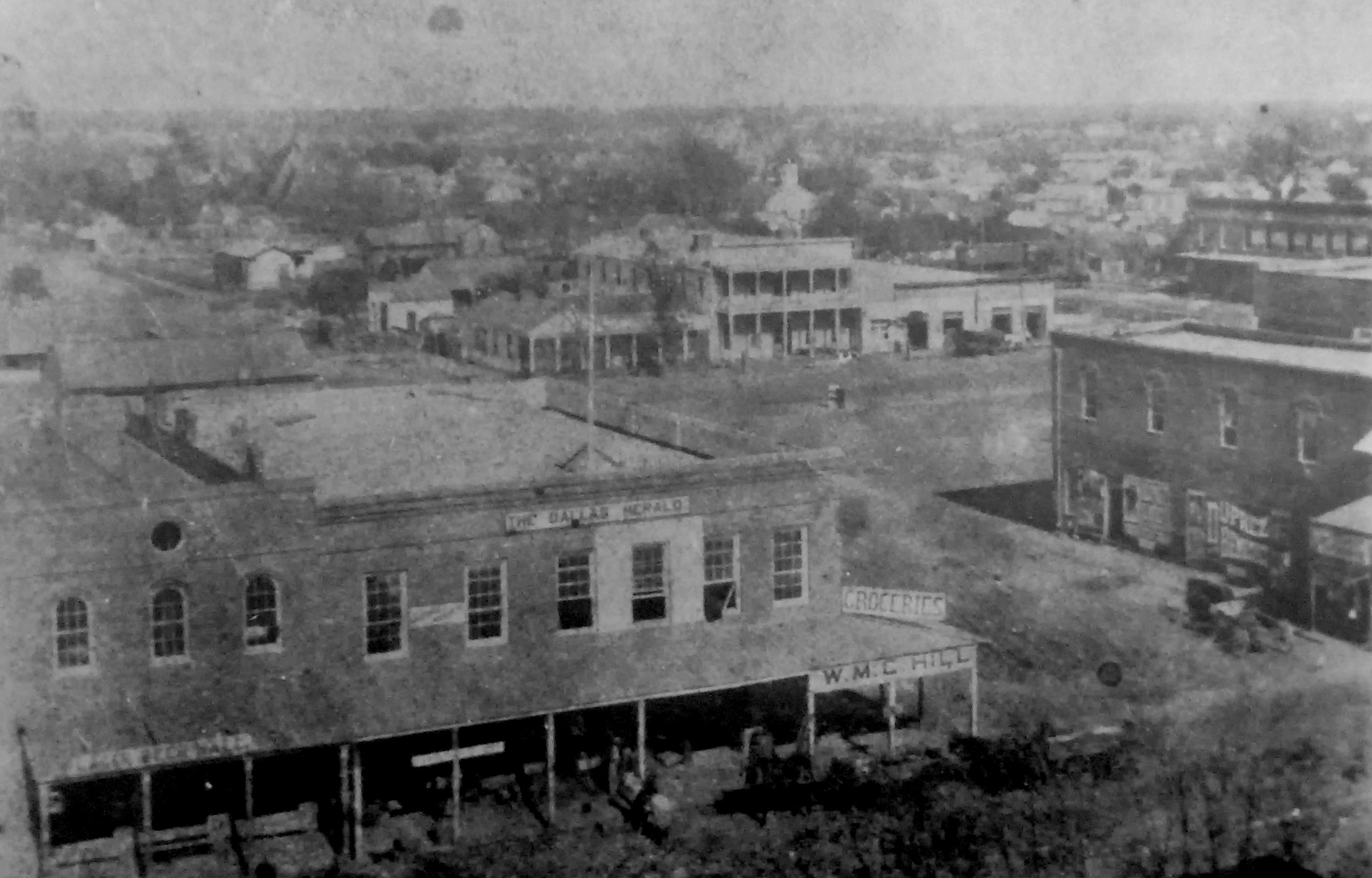
main-jefferson_1879_greeneA view from the courthouse, looking north (click for larger image)

by Paula Bosse

Above, a view of Dallas in 1879, looking north from the courthouse (one of many in the city’s past that eventually burned down); the intersection in the right foreground is Main and Jefferson (now Record Street).

This is such a cool photo that, on a whim, I checked to see what exciting things might have happened in Dallas in 1879. I found that the city’s voters had just elected a new mayor, James M. Thurmond, who had run on an “independent reform and morality ticket.” Yawn. On the surface, that hardly seemed very interesting — a  historical fact, yes, but not all that exciting. But, wait, there’s more to the story.

Thurmond’s post-election honeymoon was short-lived because, even though he had won a second (one-year) term, he had made some serious enemies in his first term. He was removed from office in 1880 by the city council in a lack-of-confidence vote, the result of a nasty trial and probably slanderous accusations by lawyer Robert E. Cowart.

The feud between Thurmond and Cowart grew more and more bitter as time passed, and on March 14, 1882 — moments after the two men had exchanged angry words in Judge Thurmond’s courtroom — Cowart shot and killed Thurmond. Witnesses described the shooting as an act of self-defense. They said that Cowart shot when the judge reached for his pistol. (For an incredibly gruesome account of this incident, the contemporary newspaper report is linked below.)

The photograph above was taken from the courthouse where this shooting took place. When the photograph was taken in 1879, the animosity between the new mayor and an unhappy lawyer had already begun to percolate. I suppose men with “Esq.” after their names in the 1880s were predisposed to shoot-outs indoors in well-appointed courtrooms rather than out in the dusty streets at high noon. It’s classier.

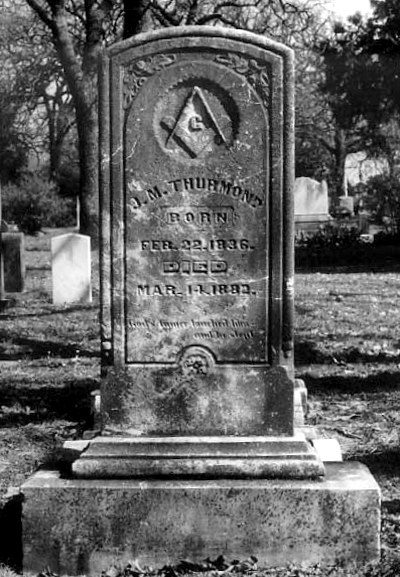
thurmond_headstone_greenwood-cemetery_findagraveGreenwood Cemetery, Dallas (photo: David N. Lotz)

***

Top photo is from Dallas, The Deciding Years — A Historical Portrait by A. C. Greene. (Austin: The Encino Press for Sanger-Harris, 1973); photo is from the collection of the Dallas Public Library.

Photo of J. M. Thurmond’s headstone in Greenwood Cemetery is from Find A Grave, here. Cowart — who died in 1924 — is buried in a nearby plot in the same cemetery. (Incidentally, Cowart’s claim to fame — other than shooting a judge in his own courtroom — appears to be that he was the person who inadvertently came up with Fort Worth’s nickname, “Panther City” when he wrote a tongue-in-cheek newspaper article about Fort Worth in 1875. Read a great history of this amusing kerfuffle in Hometown by Handlebar’s post, here — scroll to the second story.)

For an interesting contemporary report of the shooting — including gruesome eyewitness accounts — check out the article from the March 15, 1882 edition of The Dallas Herald (under the headline “The Deadly Pistol”), here, via the Portal to Texas History.

A short background on the Thurmond-Cowart feud, from the WPA Dallas Guide and History (which includes the verdicts of Cowart’s two trials for murder), can be read here.

Click top photograph for HUGE image.

*

Copyright © 2014 Paula Bosse. All Rights Reserved.

“There Are Eight Million Stories in the Naked City…” — ca. 1920

1-ervay

by Paula Bosse

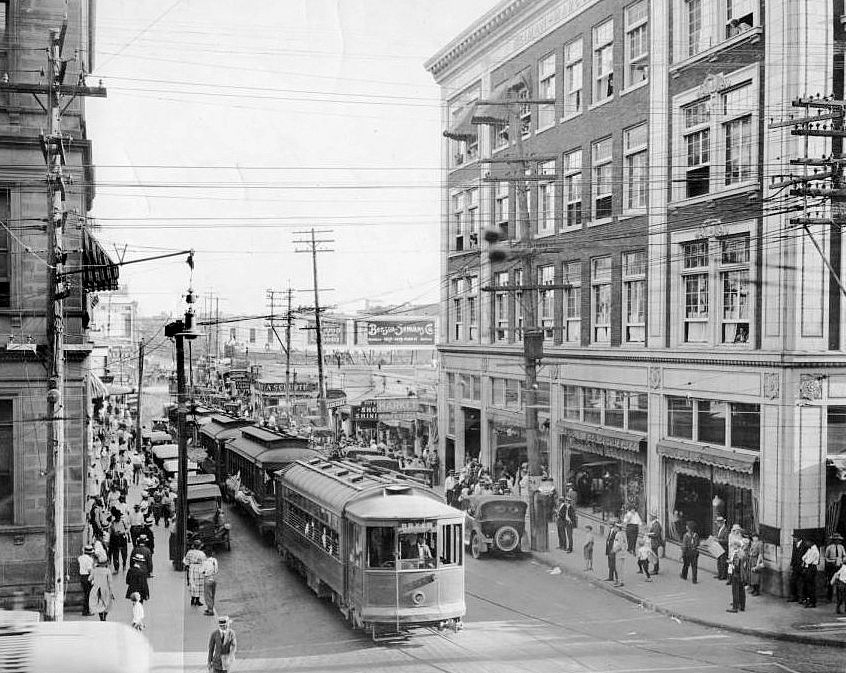
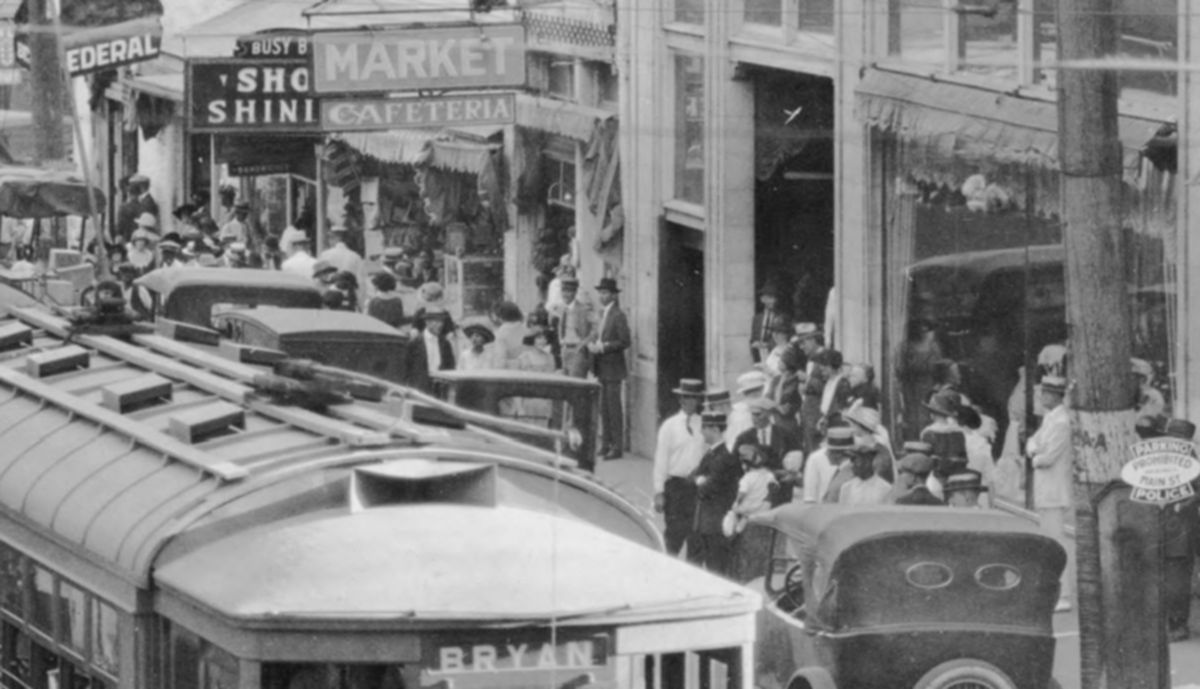
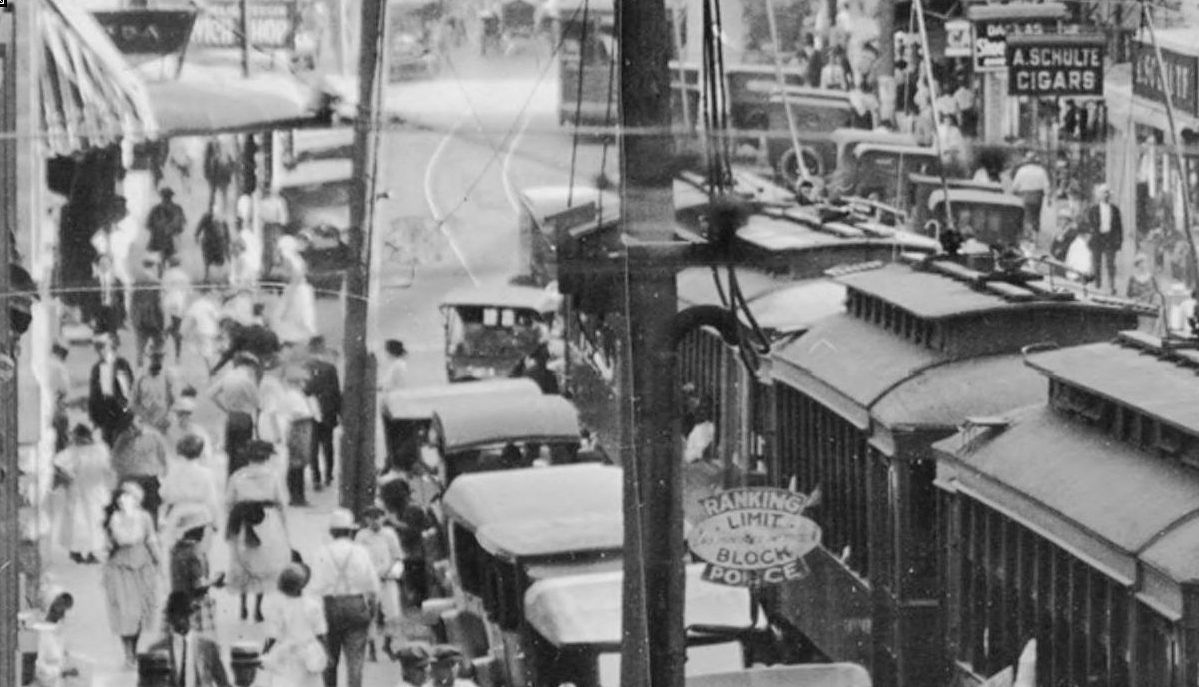
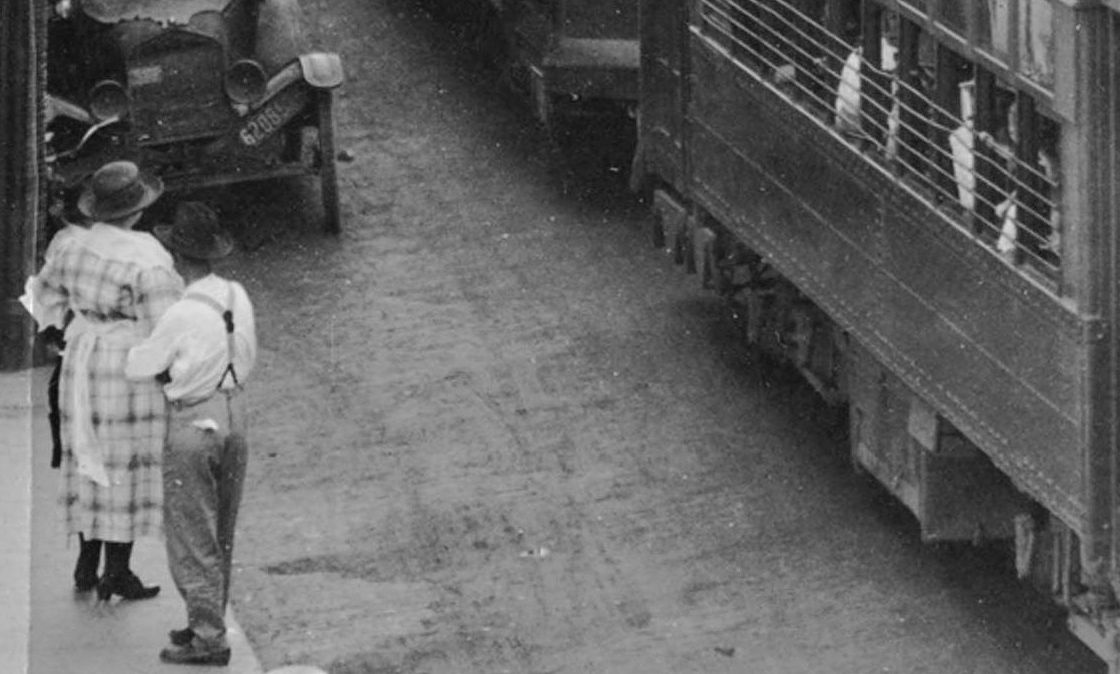
The photograph above, by George A. McAfee, shows Ervay Street, looking south from Main, in about 1920. Neiman’s is on the right. I’m not sure what the occasion was (I see special-event bunting….), but the two things that jump out right away are the number of people on the sidewalks and the amount of  congestion on the streets. In addition to private automobiles (driven by “automobilists” or “autoists,” as the papers of the day referred to them), the street is also packed with cars standing in the taxi rank (cab stand) at the left, and a long line of hulking streetcars. This busy intersection is jammed to capacity.

The city of Dallas was desperately trying to relieve its traffic problems around this time, and there were numerous articles in the papers addressing the concerns of how to manage the congestion of streets not originally designed to handle motor vehicle traffic. Dallas and Fort Worth were working on similar plans of re-routing traffic patterns and instituting something called “skip stop” wherein streetcars would stop every other block rather than every block. Streetcars, in fact, though convenient and necessary, seemed to cause the most headaches as far as backing up and slowing down traffic, as they were constantly stopping to take on and let off passengers. There was something called a “safety zone” that was being tried at the time. I’m not sure I completely understand it, but it allowed cars to pass streetcars in certain areas while they were stopped.

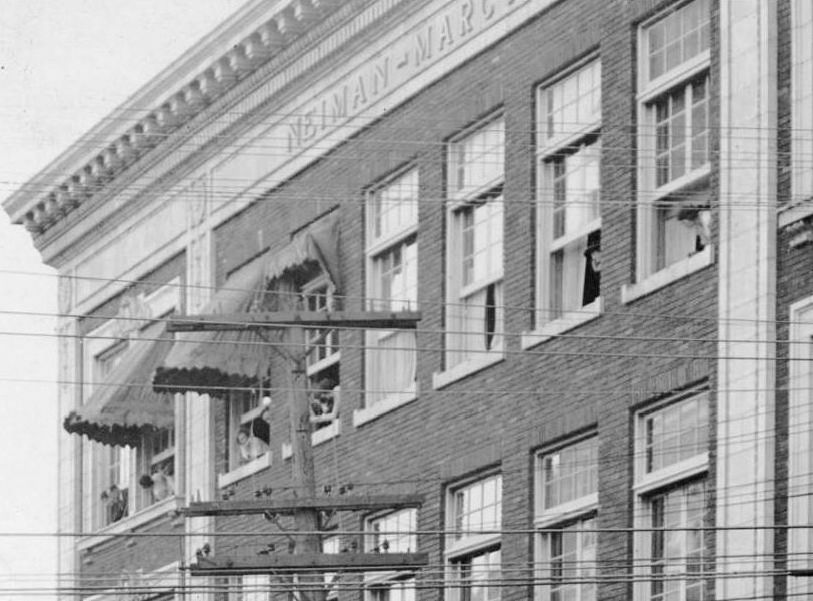
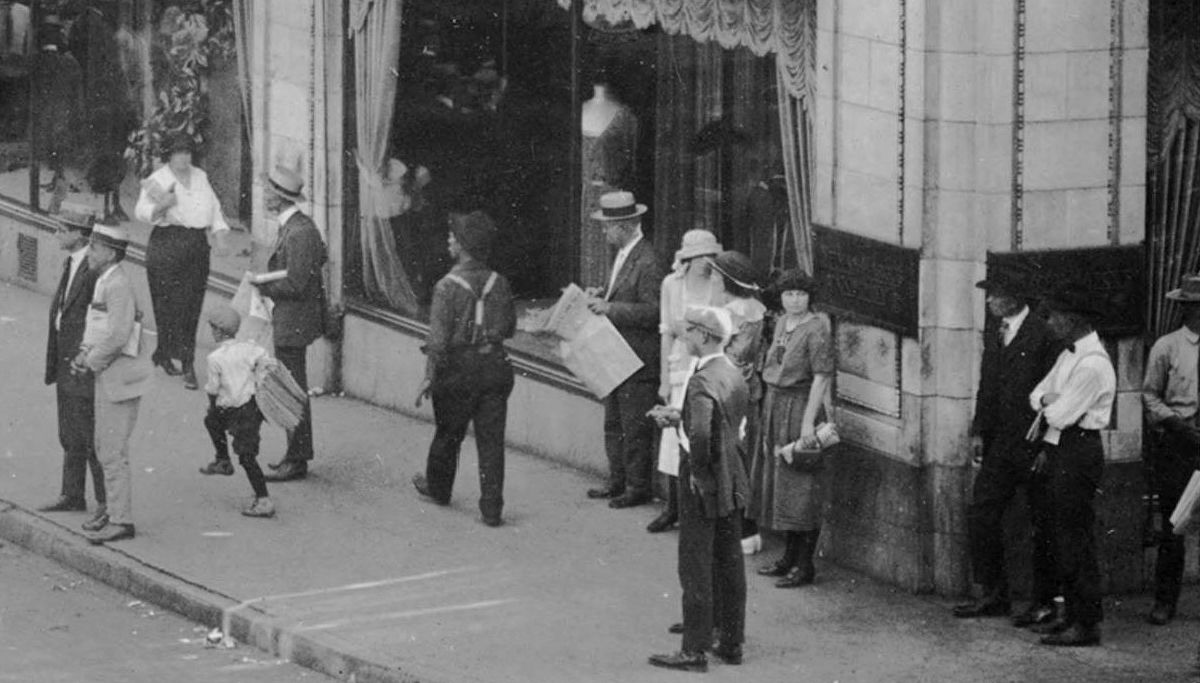
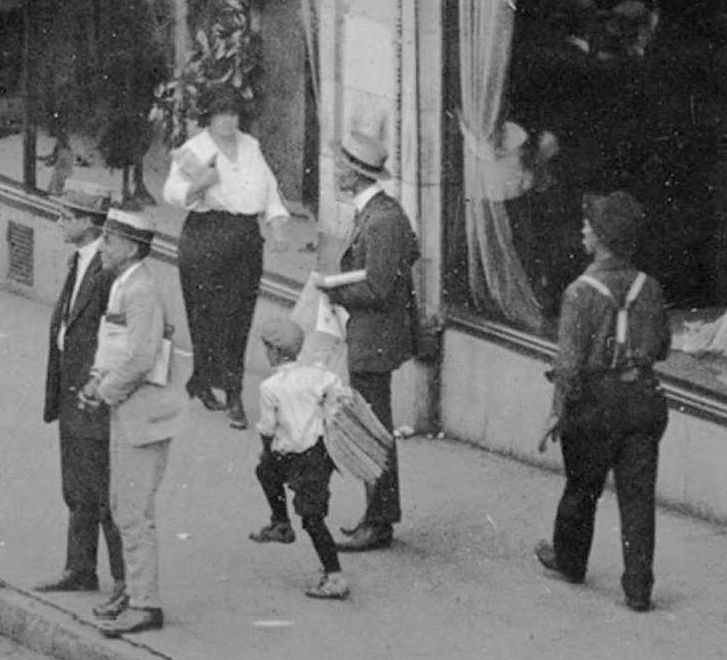
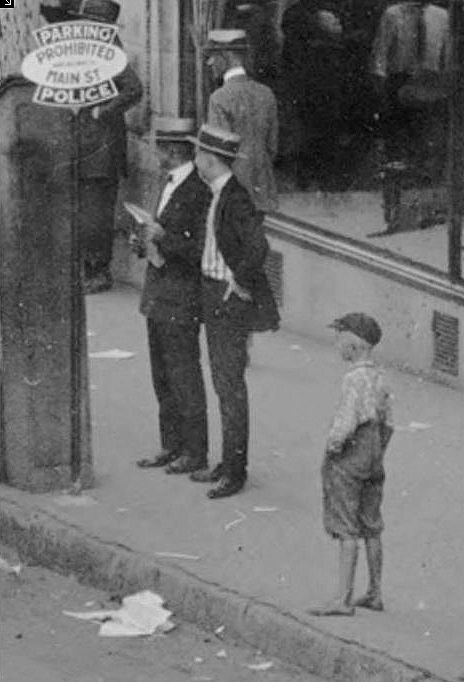
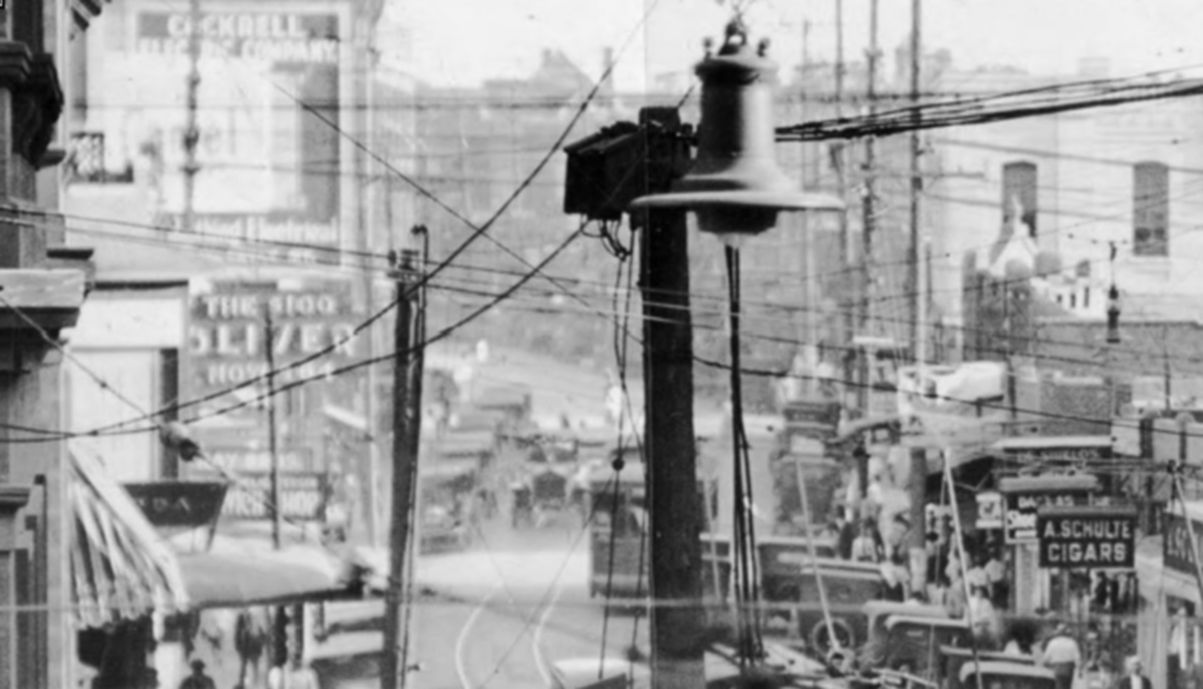
That traffic is crazy. But, to be perfectly honest, it’s far less interesting than all that human activity — hundreds of people just going about their daily business. It’s always fun to zoom in on these photos, and, below, I’ve broken the original photograph into several little vignettes. I love the people hanging out the Neiman-Marcus windows. And all those newsboys! Not quite as charming was all that overhead clutter of power lines and telephone lines; combined with the street traffic, it makes for a very claustrophobic — if vibrant — downtown street scene. (Click photos for larger images.)

2-ervay

3-ervay

4-ervay

5-ervayMy favorite “hidden” image in the larger photograph. The only moment of calm.

6-ervayI love this. The woman in front of the Neiman-Marcus plaque looking off into the distance, the display in the store window, the newsboy running down the street, the man in suspenders, the women’s fashions, and all those hats!

7-ervay

8-ervayA barefoot boy and litter everywhere.

9-ervay

10-ervay

11-ervayThe congestion is pretty bad above the streets, too.

12-ervay

13-ervayCabbies, newsboys, and working stiffs.

14-ervay

15-ervayI swear there was only one streetcar driver in Dallas, and he looked like this! Those motormen had a definite “look.”

***

Sources & Notes

Original photograph attributed to George A. McAfee, from the DeGolyer Library, Central University Libraries, Southern Methodist University, accessible here.

For other photos I’ve zoomed in on the details, see here.

*

Copyright © 2014 Paula Bosse. All Rights Reserved.

That Time When Dallas Changed the Numbers of Every Single Street in Town — 1911

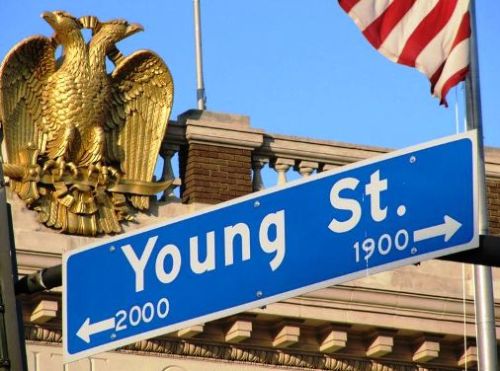
young-street-sign_flickrPhoto by Silver Lighthouse/Flickr

by Paula Bosse

Here’s a topic that isn’t very sexy, but it’s one of those mammoth-scale city-wide operations that had to be done, but no one wanted to tackle it because it was a huge undertaking and it was going to be a big hassle: re-numbering the streets. All of them. Throughout the entire city. I wasn’t aware that something like this had ever happened until I started using old criss-cross directories to try to pinpoint the location of old buildings that were originally built on streets that no longer exist (such as Poydras and Masten).

Why, for instance, is the current address of the Majestic Theatre 1925 Elm St., but in 1909 that same parcel of land on Elm had an address of 463 (-ish)? Weird, huh? Obviously street numbers changed at some point, but when? And why? Eventually I zeroed in on 1910 or 1911 as the year when addresses seemed to have changed, but I was having a hard time finding any information about what prompted the change in the first place. Until I hit on the key phrase “century system.” After that, my search became much easier.

As far back as the 1880s, the city seemed poised to address the haphazard street numbering situation, as it was causing “endless confusion” — the powers-that-be had even seemed to settled on the “century system” (so called because each block is numbered up to 100, with a new hundred starting in the next block). But progress moves at a snail’s pace in city government, and the plan didn’t start picking up steam until fifteen or twenty years later.

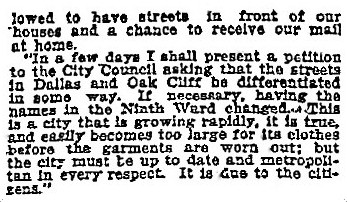
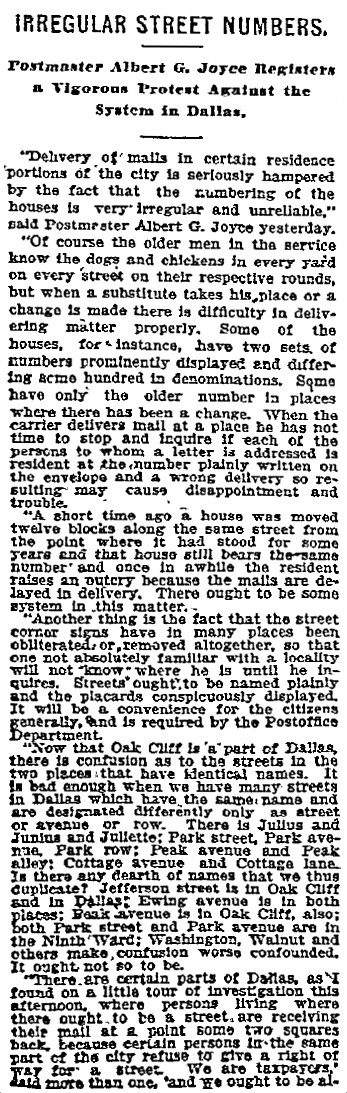
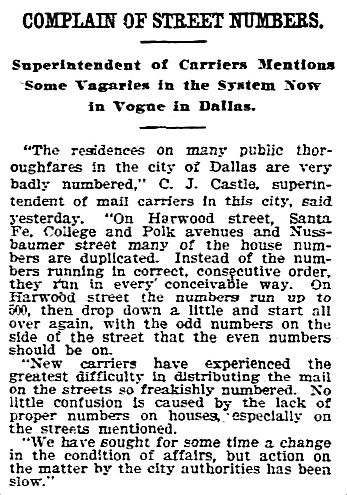
In the early days of the 20th century, the numbering of Dallas streets was, as one mail carrier described it, “freakish.” Numbers weren’t always consecutive. Sometimes odd and even numbers were on the same side of the street. Sometimes a run of numbers would suddenly start all over again. Houses sometimes had TWO numbers. People would move and expect to take their number with them. Buildings and houses often had NO numbers. Street signs were few and far between, and it wasn’t uncommon for street names to be duplicated in different parts of town. As you can imagine, unless you were intimately familiar with the area or neighborhood, chances were that you weren’t going to  be able to find anything. Unsurprisingly, the real pressure to come up with some sort of logical, uniform street numbering system came from the city’s postmasters and postal employees (that they managed to regularly deliver mail to the proper recipients is just short of miraculous).

Postmaster Albert G. Joyce (one in a line of several postmasters who tried to effect change over the years) wrote an impassioned/frustrated plea for action in 1904:
1904_street-numbering_dmn_051804a

1904_street-numbering_dmn_051804b(DMN, May, 18, 1904)

Everyone agreed that something needed to be done — especially as the city’s population was growing at an astronomical rate, but … nothing got done. Here, at the end of 1907, another exasperated postal employee shared examples of the problem:
1907_street-numbering_dmn_120707(DMN, Dec. 7, 1907)

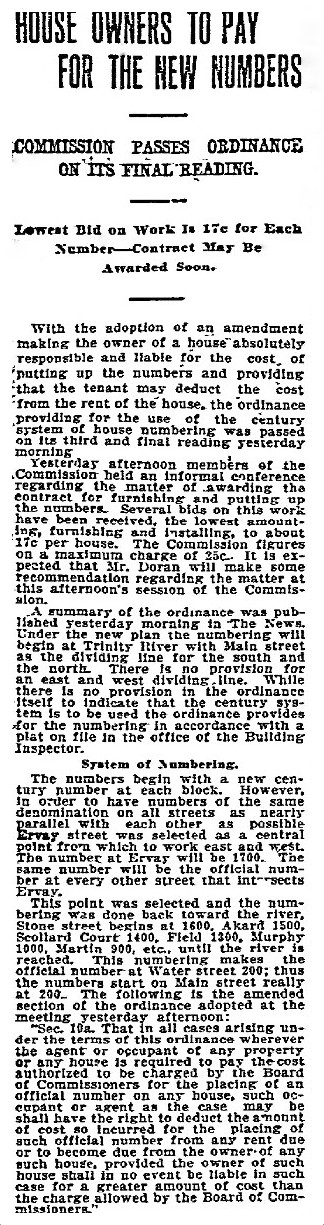
 By 1909, a plan was finally starting to come together. This article describes how the numbering system would be implemented downtown, starting from the Trinity River, with Main and Ervay being the east-west and north-south anchors:
1909-street-numbering_dmn_121709-ervay(DMN, Dec. 17, 1909)

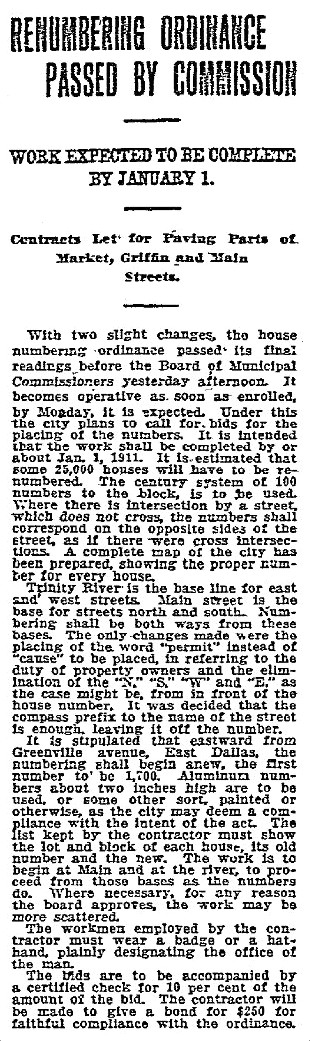
Even though the plan had basically been decided on, it wasn’t put into action for at least a year. There were three main reasons to delay the implementation: city directories had already been compiled and were to be issued soon, the 1910 census survey was about to begin, and the post office (which would bear the brunt of the impact of the drastic change) asked that the changeover take place before or after the busy holiday season.

By the end of 1910, the final details had been hammered out. The main change to the previous version of the plan was that the city, rather than the property owners, would pay for the re-numbering. Also, I don’t know if this was a new detail or not, but there is mention here that numbering east of Greenville Ave. would “begin anew.” The re-numbering was expected to be completed in January, 1911.
1910-street-numbering_dmn_100110(DMN, Oct. 1, 1910)

By the middle of January, 1911 the long-put-off task was completed, ending in Oak Cliff. The cost to the city of the “number placement” and the new street signs was $10,500.
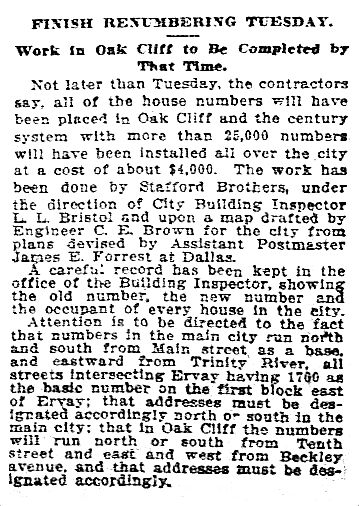
1911_street-numbering_dmn_011511(DMN, Jan. 15, 1911)

The problem that had been moaned about for decades had been fixed, and a uniform system of street numbering had finally been put in place.
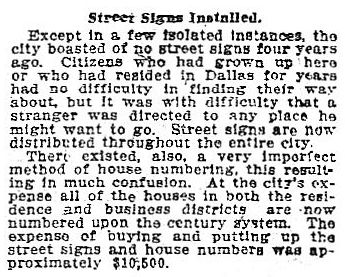
 1911_street-numbering_dmn_043011(DMN, Apr., 30, 1911)

 I can’t imagine how much of a headache and how unbelievably confusing the whole process and aftermath must have been. Several businesses, concerned that their clientele might have a difficult time “finding” them, hedged their bets by including BOTH address — the old and the new — on their letterhead and in their ads. This two-address thing went on for quite a while with some businesses — in fact, leading real estate man J. W. Lindsley was so annoyed by this practice that he complained about it to the Morning News in 1916 (a full five years after the switch!). Even though, ahem, Lindsley was one of the few advertisers in the Blue Book Directory for 1912-14 who did that very thing:
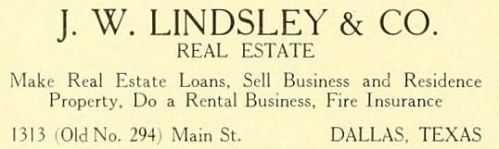
lindsley-ad-blue-bk_1912

Unlike his competitor, Murphy & Bolanz, who had just the one (but still felt compelled to add the “new” to the address):

murphy-bolanz-ad_blue-bk_1912

And that is today’s lesson on how Dallas finally bit the bullet and gave the entire city new addresses.

(And now I know that Neiman Marcus apparently IS the center of Dallas.)
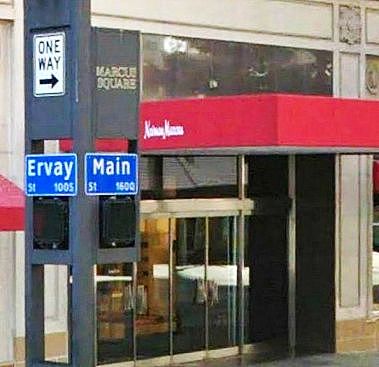
main-ervay_NM

**

UPDATE: HOW TO FIND THE OLD OR NEW ADDRESS. When I first wrote this, I’m not sure if I knew about the very handy resource Jim Wheat provided on his website: the 1911 Worley’s Dallas street directory, here. This is one way you can determine what the post-address-changeover was if you know the pre-1911 address (or vice-versa): find the street name and click on it. You’ll find two columns: one showing the “new” address, and the other the “old” address. (These aren’t always exact, but it at least gets you in the right block number to investigate further.) If you don’t know a specific address, you can make an educated guess according to the cross-streets. Thank you, Jim Wheat!

***

Photo of Young St. sign from Flickr, here. It’s great.

All newspaper articles from The Dallas Morning News.

The two real estate ads from The Standard Blue Book of Texas, 1912-14, Dallas Edition (Dallas: A. J. Peeler and Company, n.d.).

 Slightly fuzzy Ervay-Main sign from Google Street View.

An early article about this issue, “Street Numbering, A Neglected Matter to Receive Attention Soon” (Dallas Daily Times-Herald, Nov. 22, 1889) can be found here.

And if you’re interested in just what goes into tackling a problem like this in modern times, hie yourself over to “Street-Naming and Property-Numbering Systems” by Margaret A. Corwin (American Planning Assn., ca. 1976). Read the entire report here, in a PDF. I’m nothing if not thorough.

dallas-st_sign_nyt_120713

*

Copyright © 2014 Paula Bosse. All Rights Reserved.

“How to Use Central Expressway” — 1949

by Paula Bosse

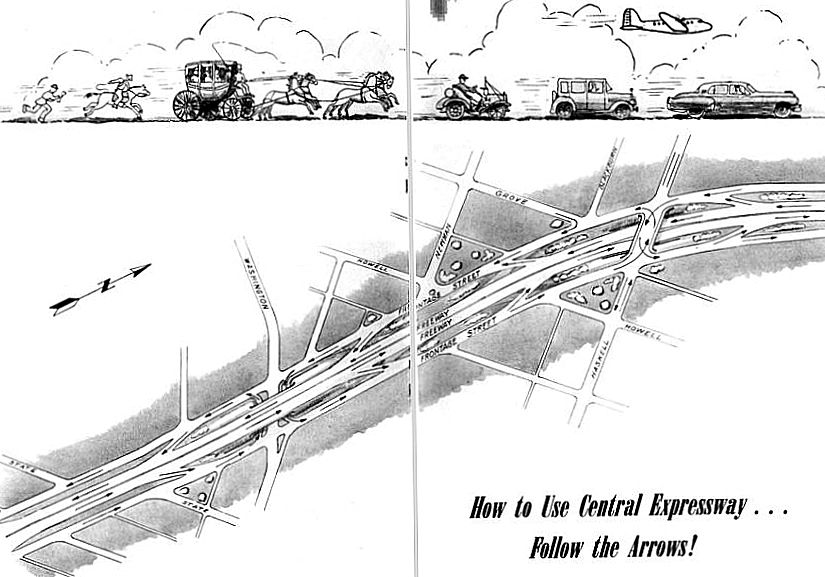
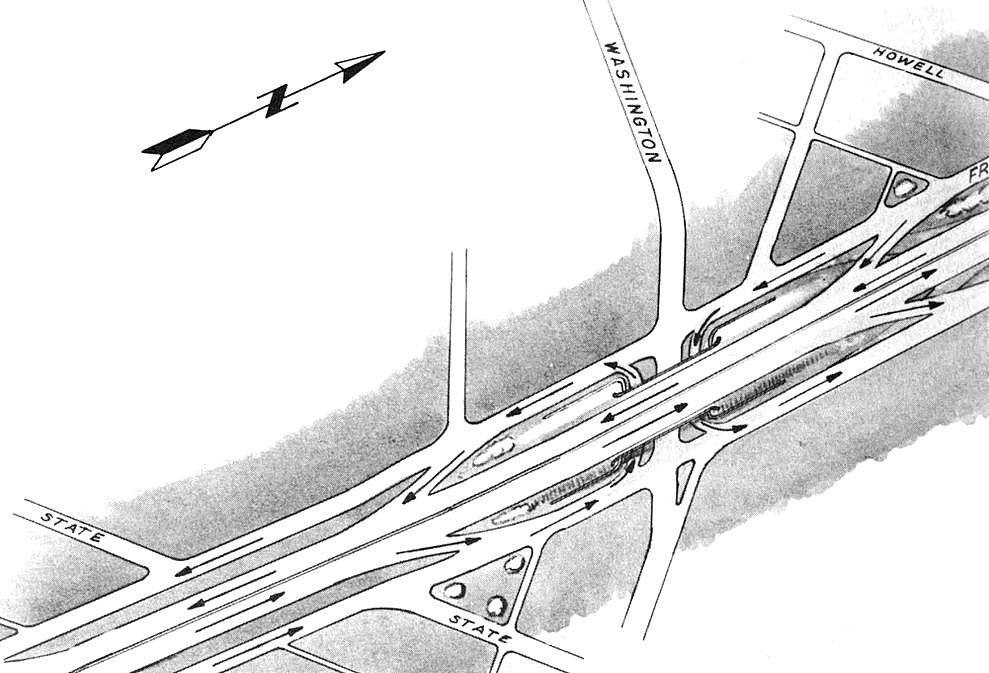
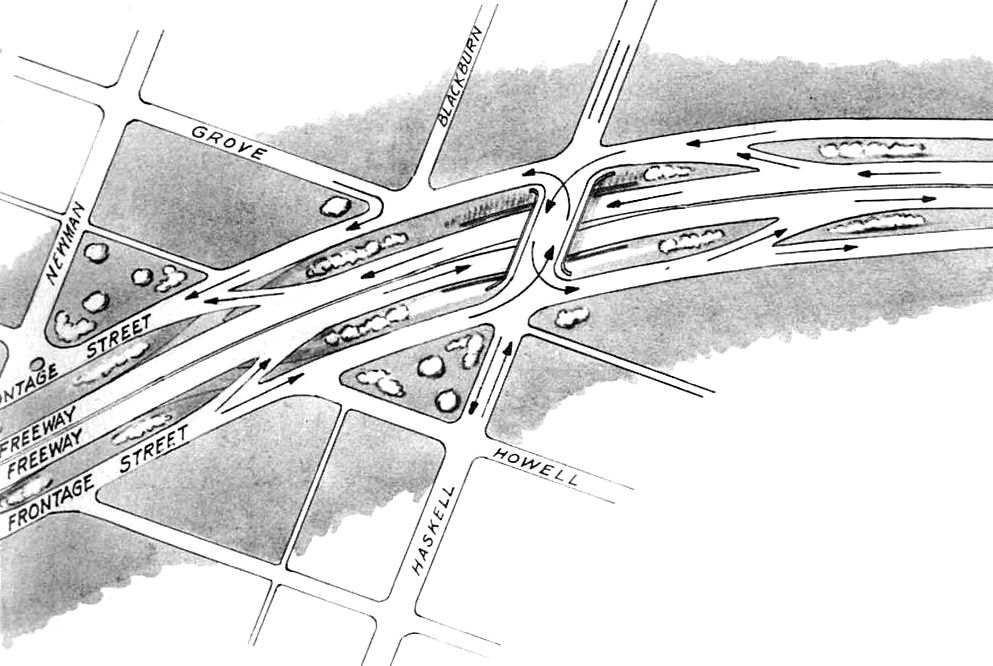
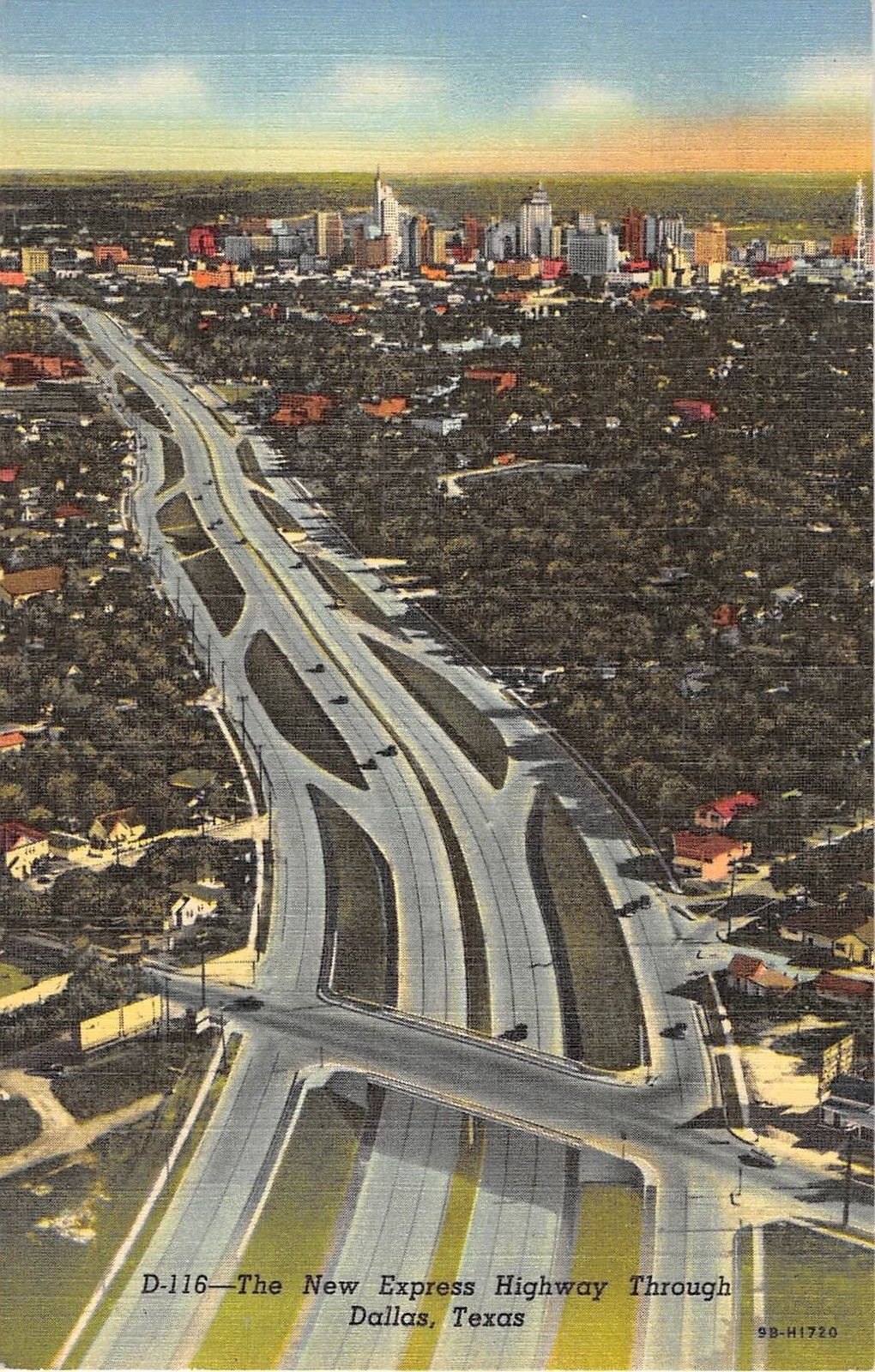
It got only to Fitzhugh from downtown at this point, but the freeway concept was new enough that Dallas drivers needed some instruction on how to use Central Expressway. Cute.

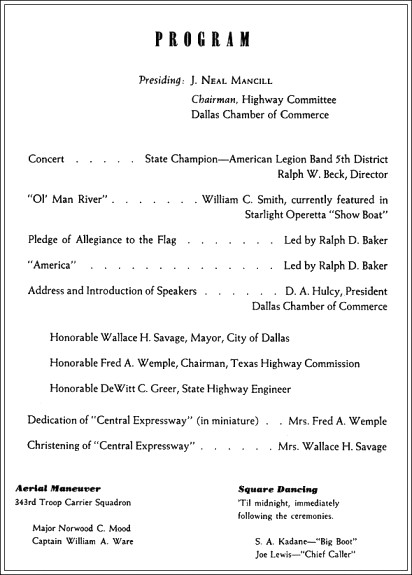
Cuter still, the dedication ceremony. It included the singing of — what else? — “Old Man River,” the Pledge of Allegiance, some sort of aerial fly-over, and, of course, square dancing (two square dances, one for white dancers, one for black). Oh, and the mayor’s wife christened the expressway with a bottle of cologne. (How much more Dallas can you get?) (Many of the images and articles below are larger when clicked.)

The opening ceremonies were covered extensively by the local papers. My favorite tidbit from the coverage was a quote by Mayor Wallace Savage on how the new highway will psychologically benefit the city’s drivers. His hope and expectation is that driving along Central Expressway will make drivers “more relaxed when they get home from the office, and in a better mood when they get to the office from home.” Again, cute.

*

central_opening_haskins_briscoe-ctr1

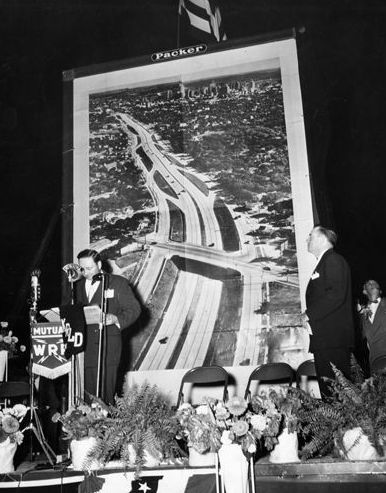
Above, Neal Mancill, Chairman of the Highway Committee of the Dallas Chamber of Commerce. Photo by Squire Haskins.

central_opening_haskins_briscoe-ctr2

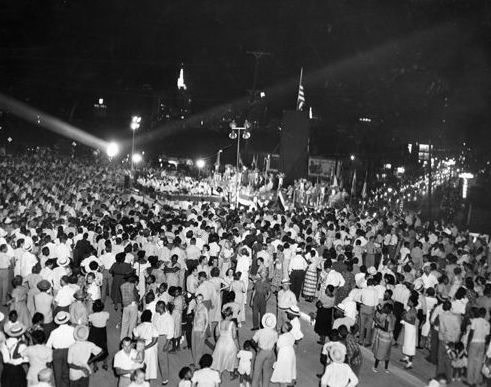
The segregated celebration had black celebrants in one area and white celebrants in another. Photo by Squire Haskins.

central_opening_haskins_briscoe-ctr3

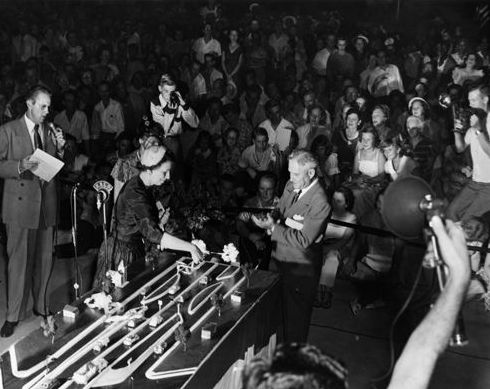
Mrs. Fred Wemple, wife of the Chairman of the Texas Highway Commission, cutting the ribbon on a miniature replica of Central Expressway. Photo by Squire Haskins.

*

But back to the lesson. THIS is how you use Central Expressway — just follow the arrows! The two halves of the larger map above are here magnified (click!) to more easily facilitate wistful inspection of an artifact from a simpler time when the city looked forward to experiencing a calm, restful, non-stop drive along the Central Expressway.

ht-use-central-1

ht-use-central-2

central-expressway

***

To peruse the entire pamphlet titled Central Expressway… San Jacinto to Fitzhugh, Dedication August 19, 1949 (Dallas: Dallas Chamber of Commerce, 1949), click here.

Photos by Squire Haskins from the Dolph Briscoe Center for American History.

Postcard from a photo by Squire Haskins (click to see GIGANTIC image).

When in doubt, click pictures to see if images are larger.

*

Copyright © 2014 Paula Bosse. All Rights Reserved.
Meet Your City of Dallas Flag, 1916-1967

Oh dear, no….

by Paula Bosse

This was the official flag of the City of Dallas, from 1916 to 1967. Um … ick.

The flag of Dallas County, adopted in 1975 and seen below, is actually worse.

dallas-county-flag

***

More Texas flags can be seen here.

*

Copyright © 2014 Paula Bosse. All Rights Reserved.