Flashback : Dallas

A Miscellany: History, Ads, Pop Culture

Category: HOF

The Gateway to Junius Heights

junius-streetcar_junius-gates_DPL_sm
Welcome to Junius Heights!

by Paula Bosse

If you’ve driven along Abrams Road, between, say, Beacon and the Lakewood Country Club, you’ve probably passed two tall stone pillars which stand across Abrams from one another, and you’ve probably asked yourself, “What are those things?”

These things:

junius-heights-pillars_google-street-viewGoogle Street View here

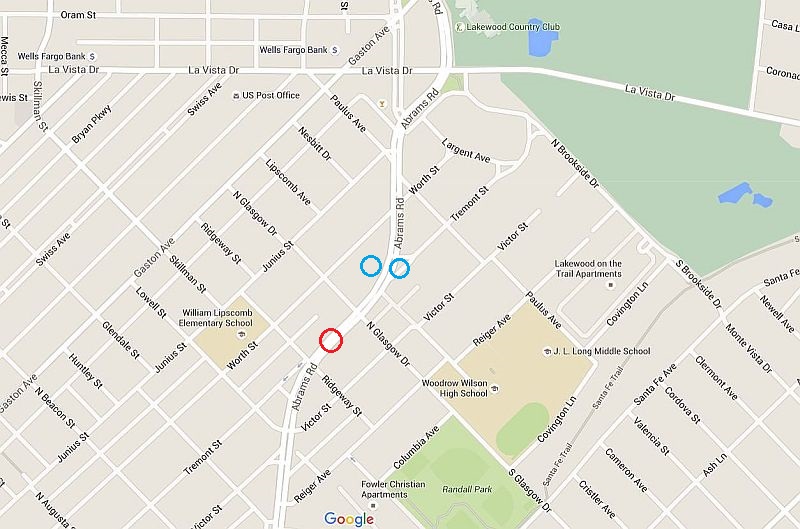
They were built as gateway markers to the Junius Heights neighborhood in about 1909 — they’re just not in their original location anymore. They were originally on either side of Tremont Street, half a block east of Ridgeway. They’ve been moved, but they’re only a stone’s throw from their original site.

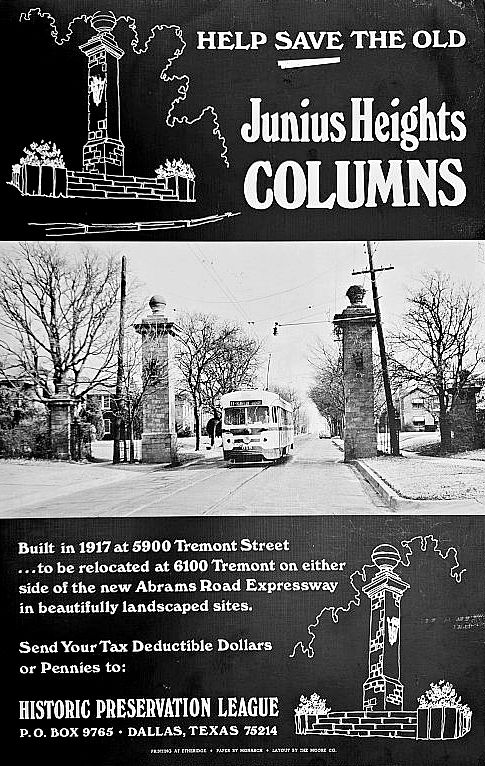
In 1973, when the city was in the midst of widening and connecting Abrams with Columbia, the 30-foot pillars were situated on a roadway which was going to be demolished. The pillars would have been destroyed were it not for the efforts of a small group of preservation-minded neighborhood residents who managed to raise enough money to have the historic East Dallas structures dismantled and moved. It took a while for the money to be fully raised, but the pillars were placed on their new sites in 1975.

The thing that is most interesting about the saving of these columns is that this took place at a time when this part of East Dallas — Swiss Avenue included — was on something of a downslide. Many of the houses were in disrepair and many residents had moved out, seeking newer homes and better (i.e. newer) neighborhoods. Thankfully, in the early 1970s people began to focus on historic preservation, and the area began to make a slow comeback. Thanks to the preservation efforts of these people, their persistence in gaining “historic district” status for Junius Heights and Munger Place, and their successful fights on zoning issues, the areas surrounding these stone pillars are once again highly desirable neighborhoods, full of homeowners who are good caretakers and thoughtful preservationists.

**

When researching this post, it was very difficult to determine when the pillars had been built. For some reason 1917 seemed to be a popular guess, and it was repeated in several articles I came across. But it was actually earlier. The earliest photo I’ve found (and I was pretty excited to have stumbled across it!) was one that first appeared in a November, 25, 1909 ad for a new development called “Top o’ Junius Heights.” (All photos and clippings are larger when clicked.)
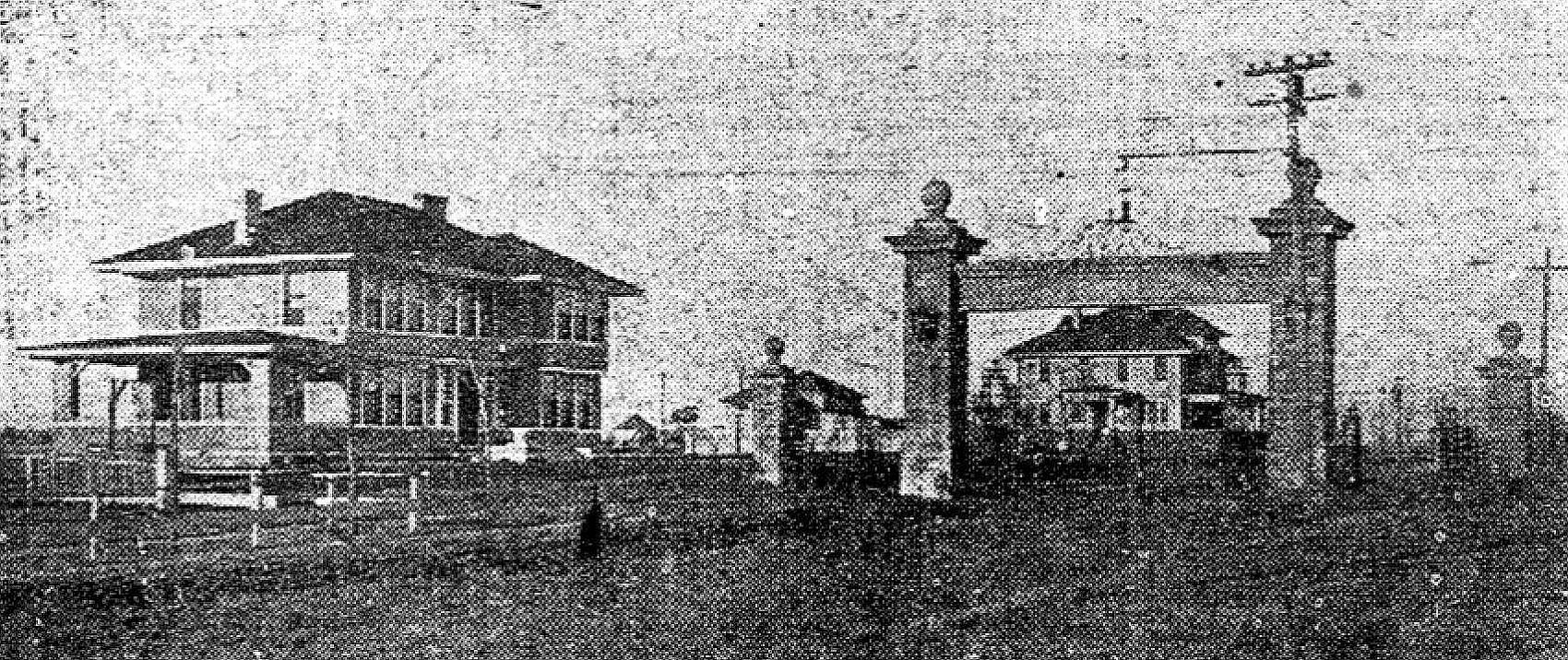
ad-junius-heights_dmn_112509-det

Here’s the full ad:

junius-heights_dmn_112509Dallas Morning News, Nov. 25, 1909

Note how similar this entrance looks to the entrance to Fair Park from the same time:
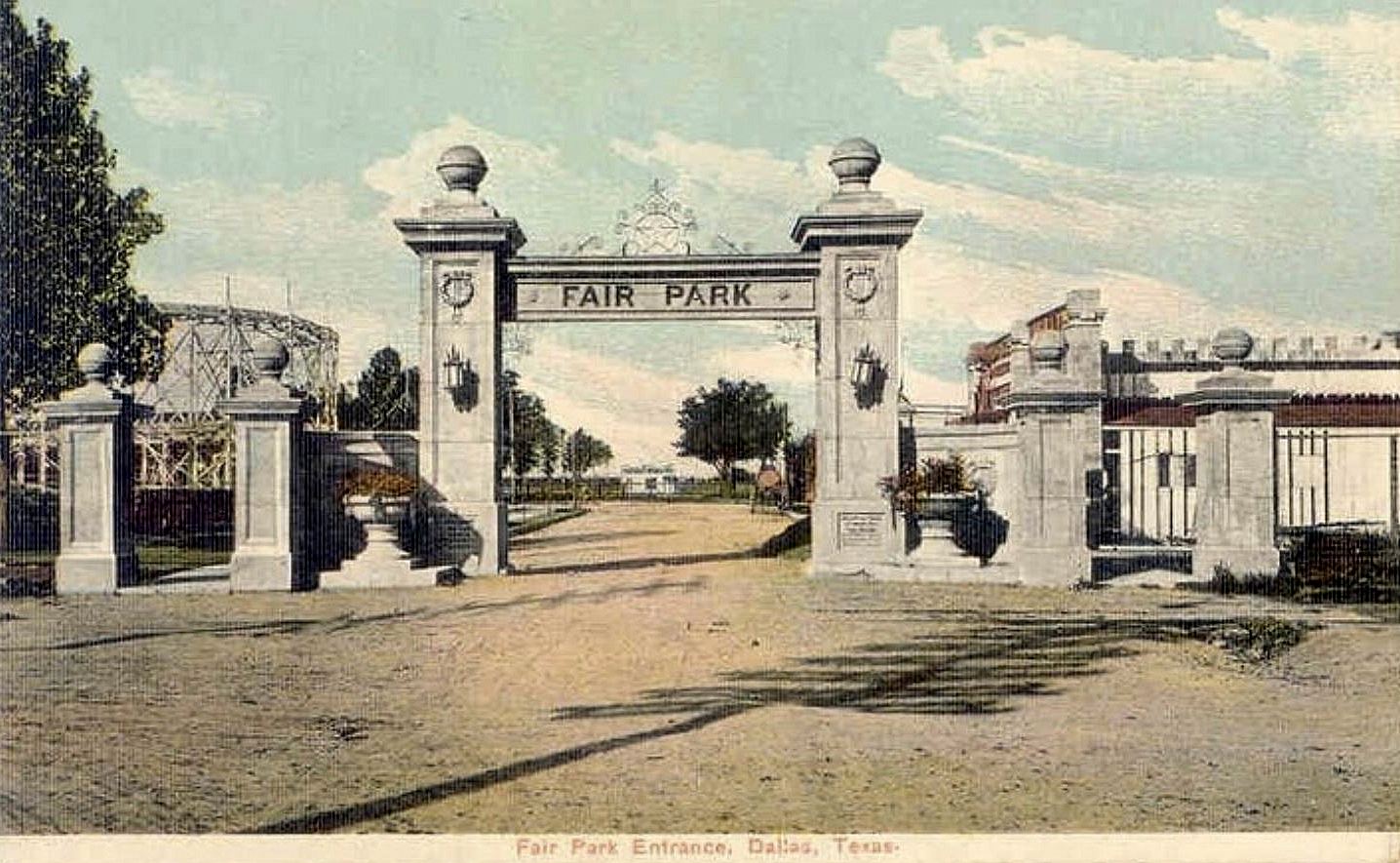
fair-park-entrance_1910_flickr_coltera

The same photo was used in another ad a few months later. If you live in Junius Heights, perhaps you can find your house in the diagram:
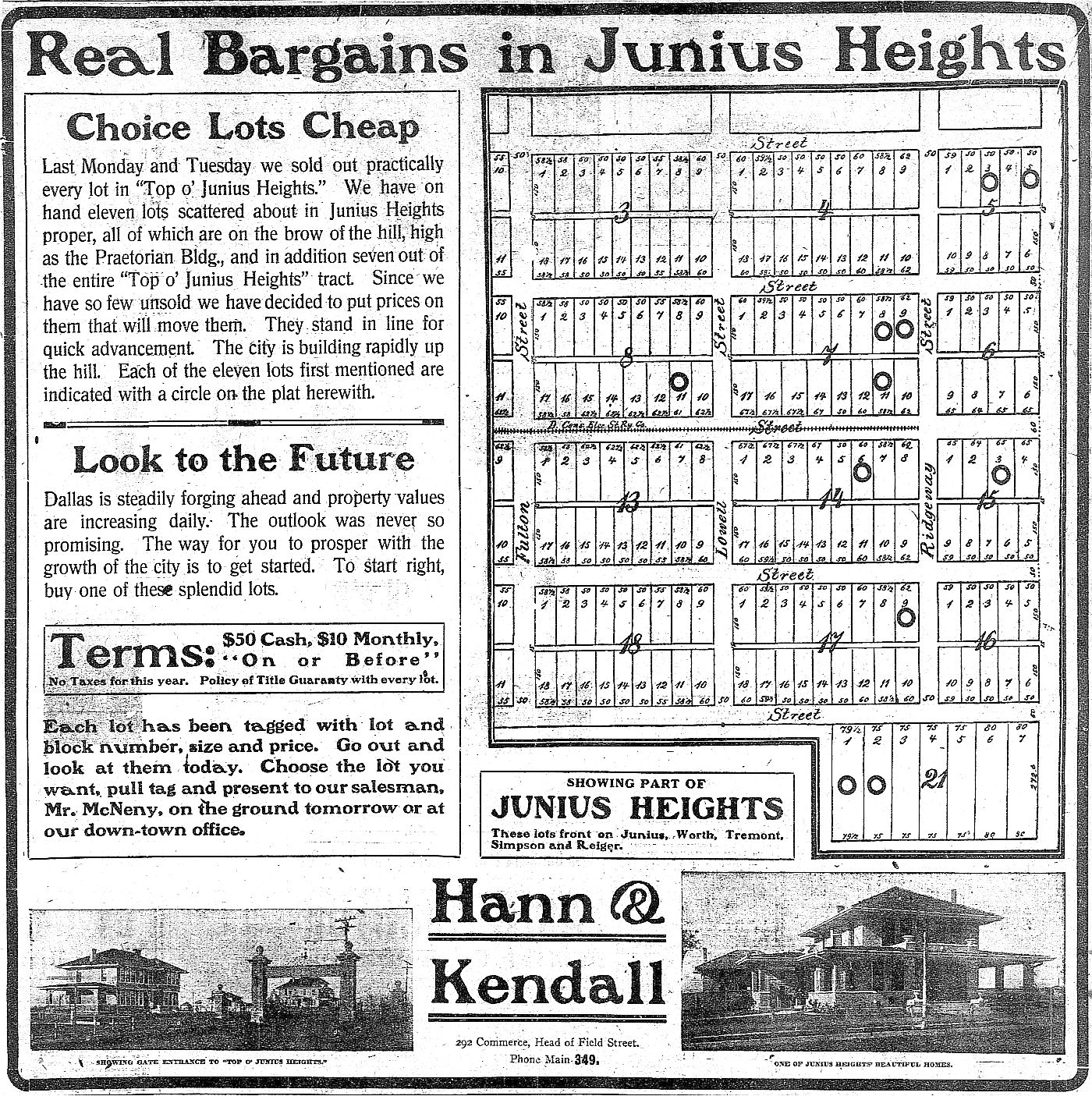
ad-junius-heights_dmn_050810DMN, May 8, 1910

The pillars were actually built as a gateway — the columns connected at the top, spanning Tremont. Lots in Junius Heights first began to be sold in 1906; in 1909, the second addition — called “Top o’ Junius Heights” — began to be offered for sale. The opening of the second addition appears to be when the gateway might have been built. Not only did this gate serve as an entrance to Junius Heights, it actually separated the two additions (see clippings below). It was also a handy landmark, and for many years it stood at the end of the Junius Heights streetcar line (which ended at Tremont and Ridgeway).

Below, part of an ad for Top o’ Junius Heights that appeared in The Dallas Morning News on Nov. 28, 1909, in which the “big stone gate entrance” is mentioned:

junius-heights-ad_dmn_112809_det

Part of another ad for Top o’ Junius Heights:

junius-heights-gates_dmn_050110_ad-det
DMN, May 1, 1910

And part of an ad for just plain ol’ Junius Heights, mentioning that the gate can be seen as a boundary:

junius-heights-gates_dmn_090410_ad-detDMN, Sept. 4, 1910

Here’s a detail from a 1922 Sanborn map which might make the location of the gate a little easier to visualize (and, again, these streets no longer look like this): the blue line represents the streetcar line (which ran all the way to Oak Cliff — the photo at the top of this post shows the Hampton streetcar), and the red circles are about where the pillars were originally planted. (The full map is here.)

junius-heights-gate_1922-sanborn_sheet-394

It was pretty exciting finding that photograph from 1909, but it was also pretty exciting seeing a photograph posted in the Dallas History Facebook group by Jerry Guyer which shows a dreamy-looking view of the gate as seen from the yard of the home owned by his great-uncle, A. P. Davis, who lived at 5831 Tremont between 1911/12 and 1921/22 (see what the house looked like back then, here).  The house was on the northwest corner lot of Tremont and Ridgeway (it is still standing), only half a block away from the gate. This detail of that photo is fantastic!

junius-gates_ca-1920s_guyer_dallas-history-fb

*

Another very early photo of the pillars/columns/gateway can be seen in this photo. (I’m afraid it’s a little odd-looking as I took a photo of it on the wall of The Heights restaurant in Lakewood and lights are reflecting off the picture. Please check this large photo out in person. Not only are there other great historical photos on the walls, but the coffee is great.)

junius-heights-gateway_the-heights-restaurant

Here is the same photo as the one at the top. Note that this “gateway” has actual iron gates and that there are smaller secondary pillars on the opposite side of the sidewalks. Also note that the pillar on the right actually extends into the narrow street.

junius-streetcar_junius-gates_DPL

And here’s another view I just came across (I’ve added so much since I originally wrote this post!), from a DVD called Dallas Railway & Terminal — this from 1951 or 1952, showing the Junius streetcar coming through the “gates” (sorry for the low-res):

junius-gates__early-1950s_streetcar-video

***

Sources & Notes

Top photo is from the Texas/Dallas History & Archives Division, Dallas Public Library (with special thanks to M C Toyer); DPL’s call number for this photograph is PA87-1/19-59-193.

Photo of the view of the gate from the home of Andrew P. Davis is from the collection of Jerry Guyer, used with permission.

More info on Junius Heights and the saving of the pillars can be found on the Preservation Dallas site, here. Here is a poster from the Dallas Public Library Poster Collection (with an incorrect date on it….).
junius-heights-columns_1973_DPL_poster

A few Dallas Morning News articles on the fight to save the pillars:

  • “Residents Try Saving Pillars From the Past” by Lyke Thompson (DMN, May 30, 1973, with photo of pillar)
  • “Columns Come Down” (DMN, June 2, 1973, with photo)
  • “Cash Raised for Pillars” (DMN, June 7, 1973)
  • “Cornerstone Placed In East Dallas Area” by Michael Fresques (DMN, July 29, 1973, no photo, but description of pillars lying in pieces, awaiting funds to reconstruct them)
  • “Junius Dedicates Columns” by Doug Domeier (DMN, June 16, 1975, pillars finally relocated, with photo of preservationist Dorothy Savage standing beneath one of the pillars)

East Dallas and Old East Dallas are fiercely proud of their history and fight for preservation issues.

old-east-dallas_dmn_072775
July, 1975

*

It’s a bit difficult for me to visualize where these pillars were originally. Here’s a 1952 map showing Tremont with the approximate location of the columns before they were moved.

junius-heights-columns_1952-mapsco
1952 Mapsco

And here’s a present-day map, showing the post-Abrams extension. I’m not sure exactly where those pillars originally stood, but it was near the intersection of Tremont and Slaughter seems to have been between Ridgeway and Glasgow (location edited, thanks to Terri Raith’s helpful comments below) — this location is circled in red on the map below; the locations of the pillars today are in blue.
junius-heights-columns_google

*

Copyright © 2016 Paula Bosse. All Rights Reserved.
South Central Expressway Under Construction — 1955

central-expwy_forest-ave_092955_squire-haskins_UTAComing soon to a neighborhood near you… (UTA Special Collections)

by Paula Bosse

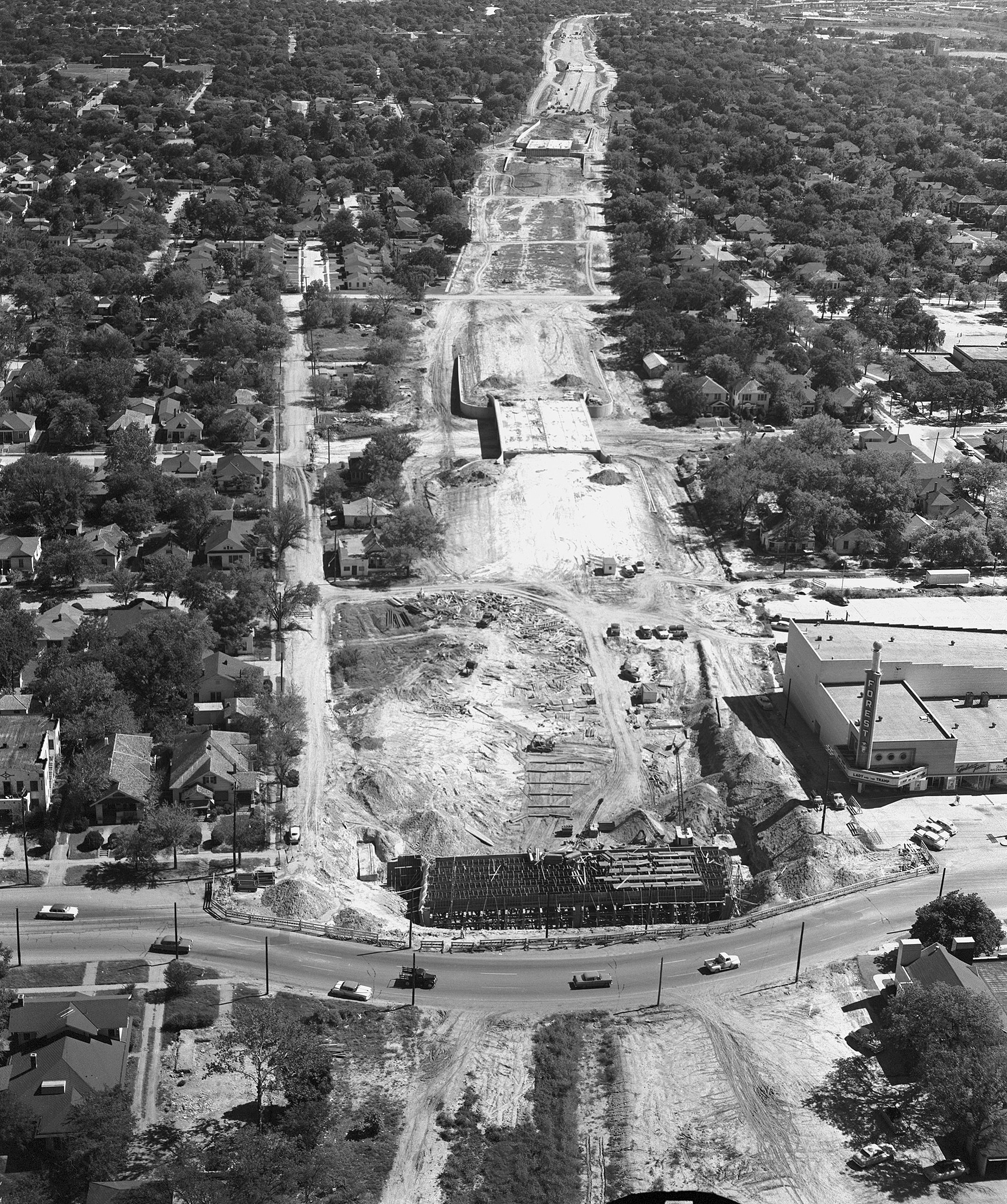
Behold, a photo of South Dallas on Sept. 29, 1955, showing a lengthy stretch of bulldozed land cleared for the imminent construction of South Central Expressway. We’re looking south, with Forest Avenue (now Martin Luther King Blvd.) running horizontally in the foreground. To the right is the Forest Theater (now playing: “Lady and the Tramp”). And if you zoom in, you can just see the post-Ross Avenue location of the famed Jim Beck recording studio to the right of the theater.

This great swath of land cut through an established tree-filled residential area — it ran alongside the once-swanky Colonial Hill neighborhood. Zoom in and take a last look at some of those straggler houses that haven’t yet met their maker. …But they will. …And they did.

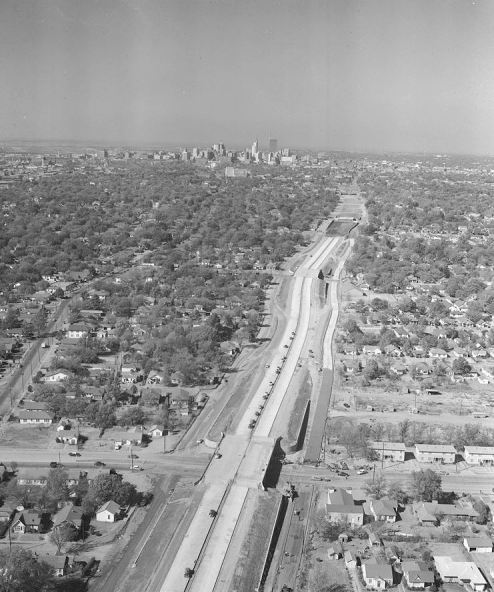
Below is another Squire Haskins aerial photo looking north, toward downtown, taken a few weeks later, on Nov. 11, 1955 (see a very large image of this photo on the UTA website here).

south-central-expwy_squire-haskins_nov-1955_UTASquire Haskins, Nov. 1955, UTA Special Collections

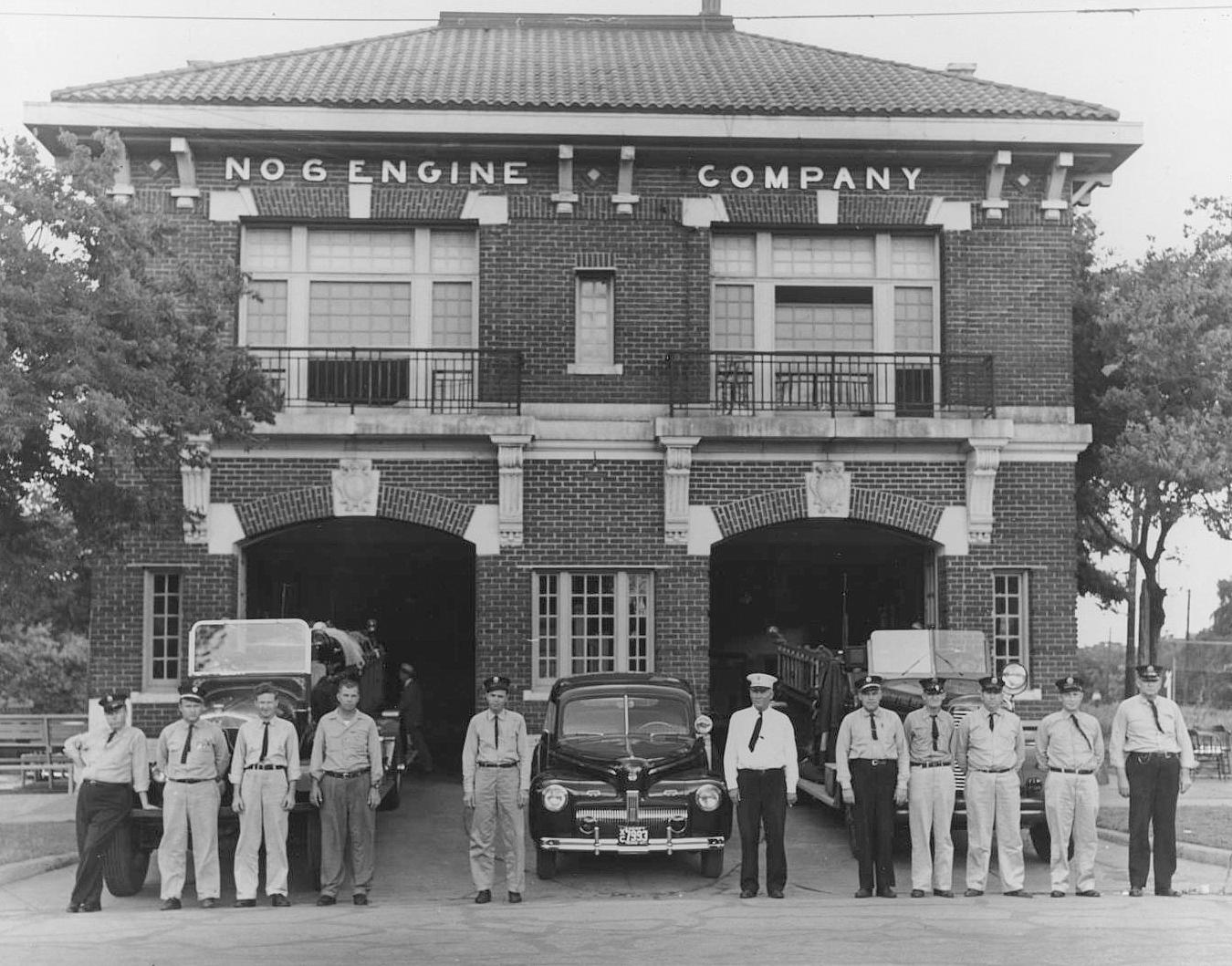
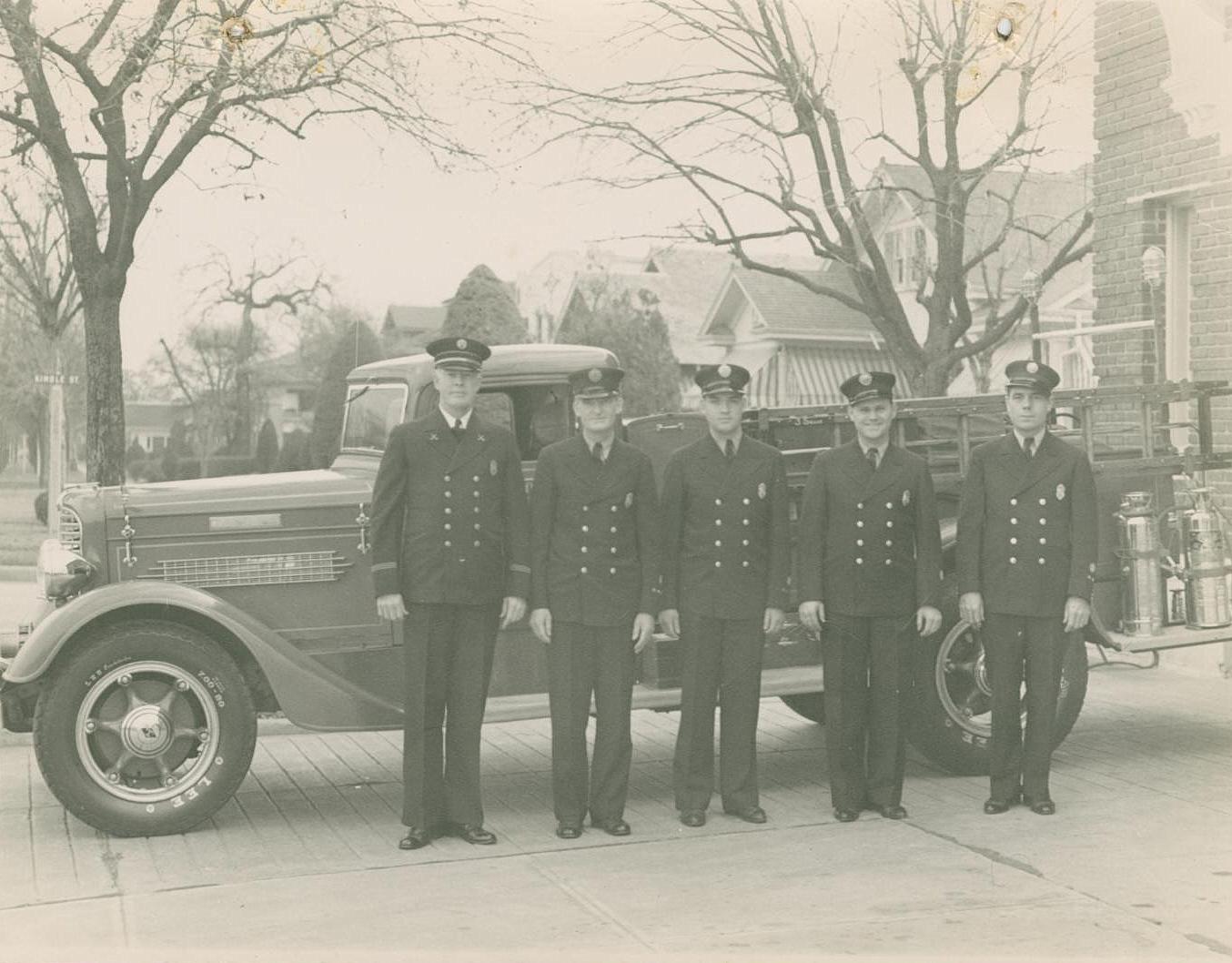
I wondered what had been demolished on Forest between the houses to the left and the theater to the right. It was Fire Station No. 6, at 2202 Forest Avenue. I looked in my bulging file of miscellaneous photos and was surprised to actually find a couple of photos of that No. 6 Engine Company, which was built in 1913.

fire-department_no. 6_forest-ave-mlk

The station was on the south side of Forest Avenue, alone in a very short block. As we look at the station in the photo above, the H&TC railroad runs just to the right of the station, and Kimble Street runs along the left. See a Sanborn map of this area in 1922, here.

The photo  below shows what Forest Avenue once looked like, from the front of the firehouse looking east (the intersection with Kimble is on the other side of the firetruck — you can see the street sign). These houses are still standing in the 1955 photo at the top.

forest-central_fire-station_portal

When you know what this intersection looks like today (see this same view today, here), it’s hard to believe it ever looked like a cozy neighborhood. Progress is a helluva thing, man.

**

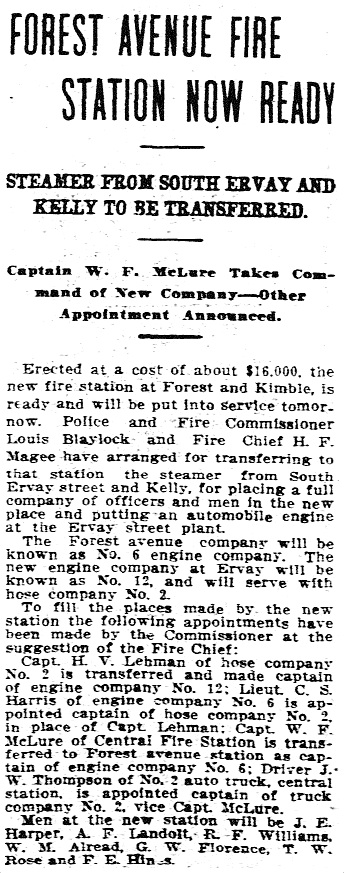
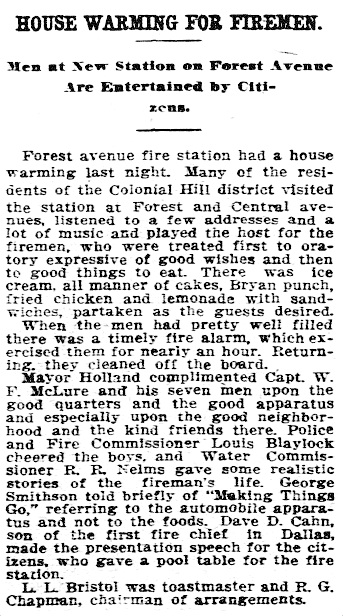
A couple of short articles for those who might want a little more info about the fire station, which was demolished sometime between April and September of 1955. (Click articles for larger images.)

forest-central_fire-station_dmn_070613
Dallas Morning News, July 6, 1913

forest-central_fire-station_dmn_072213
DMN, July 22, 1913

*

forest-ave-central_today_bing
Bing Maps

***

Sources & Notes

Top photo by Squire Haskins, from the Squire Haskins Photography, Inc. Collection, UTA Libraries, Special Collections, University of Texas at Arlington; it is accessible here.

Second photo by Squire Haskins, from the Squire Haskins Photography, Inc. Collection, UTA Libraries, Special Collections, University of Texas at Arlington; it is accessible here.

The two fire station photos are from the collection of the Dallas Firefighters Museum, via the Portal to Texas History, University of North Texas. The first photo can be viewed here, the second photo here.

*

Copyright © 2016 Paula Bosse. All Rights Reserved.
The Union Depot Hotel Building, Deep Ellum — 1898-1968

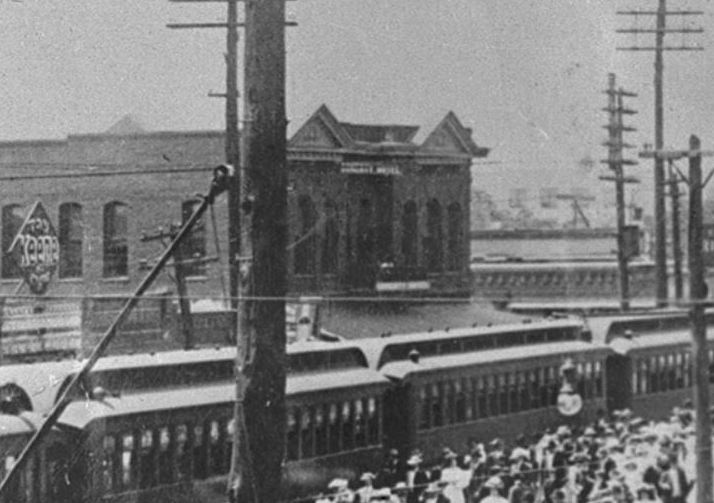
union-depot-hotel_1909_uta-detThe old Union Depot Hotel, about 1909 (click for larger image)

by Paula Bosse

Above, we see the hotel known originally as the Union Depot Hotel, built in 1898 across from the very busy old Union Depot, at the intersection of two major rail lines: the Houston & Texas Central (the H&TC, which ran north-south) and the Texas & Pacific (the T&P, which ran east-west). The tracks crossed at the intersection of Central and Pacific — streets named after the two railroads — in the area east of downtown we now call Deep Ellum. The hotel was on the southwest corner of that intersection.

The large, two-story hotel (which also housed a popular cafe and bar) was built by William S. Skelton — more commonly known as Wiley Skelton — to cash in on the large number of travelers coming to Dallas via the bustling passenger depot right across the street. When it opened, it was charging a hefty two bucks a day (the equivalent of about $60.00 in today’s money) — a large-ish sum in 1899, but … location, location, location. This two-dollar-a-day rate to stay at Skelton’s hotel was the same as the base rate of Dallas’ ritziest, priciest hotels, The Windsor and The Oriental. How could Skelton’s “wrong side of the tracks” hotel charge similar rates as the city’s most elegant hotels? Convenience, convenience, convenience. The Union Depot Hotel could not have been more convenient to weary travelers unless it had been located inside the depot.

union-depot-hotel_houston-post_012599Houston Post, Jan. 25, 1899

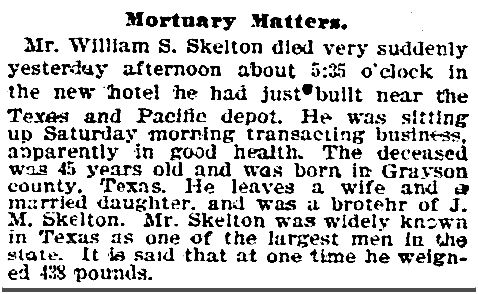
Skelton was a popular and successful businessman (and noted saloon pugilist) who was known far and wide for his substantial physical bulk. He was a founding member of the city’s “fat men’s club” and was reported to be the heaviest man in the city. When he died suddenly at the age of 45 (probably not a huge surprise, as his obituary mentioned that his weight had, at one time, reached 438 pounds), his new hotel had been open only weeks (perhaps only days).

skelton_dmn_011699Dallas Morning News, Jan. 16, 1899

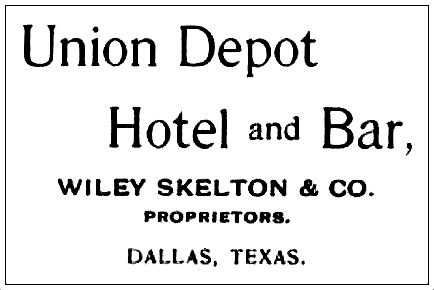
His unexpected death threw the running of the hotel into confusion. His brother (another famed “fighting fat man”) took over the business side of its operations and occasionally placed ads in the paper seeking a hard-to-find buyer.

union-depot-hotel_1901_portal1901 ad

union-depot-hotel_dmn_111602DMN, Nov. 16, 1902

Eventually the hotel was sold, and it went through several owners and name changes over the years. Then, in 1916, a major catastrophe struck: brand new Union Station, which was waaaay on the other side of town, opened, consolidating passenger rail service to one depot, resulting in the shuttering of most of the city’s smaller depots. Location, location, location wasn’t such a great thing for the old Skelton hotel after this.

The hotel went through many changes over the years, but after the closing (and later razing) of the old Union Depot, it was on a general, inevitable, slide downward. By the time it was demolished in 1968 — when large swaths along Central Avenue were leveled to facilitate highway construction — the building was in disrepair and, apparently, long-vacant. It stood for 70 years.

*

Below is a photo taken from Elm Street in 1908 or 1909, when the hotel (seen at the top left) was owned by Charles S. Conerty and named the Conerty Hotel (you can see the name on two signs, but you have to really zoom in to make them out). Conerty, an Irishman who had previously run bars, owned the hotel very briefly. By May of 1909, plagued with legal troubles stemming from his being charged with selling liquor on a Sunday, Conerty sold the hotel (which he seems to have been running as a boarding house), stating in his classified ad that he was “leaving city.” (He did not leave the city.) In 1910, with a new owner, the hotel was once again known as the Union Depot Hotel.

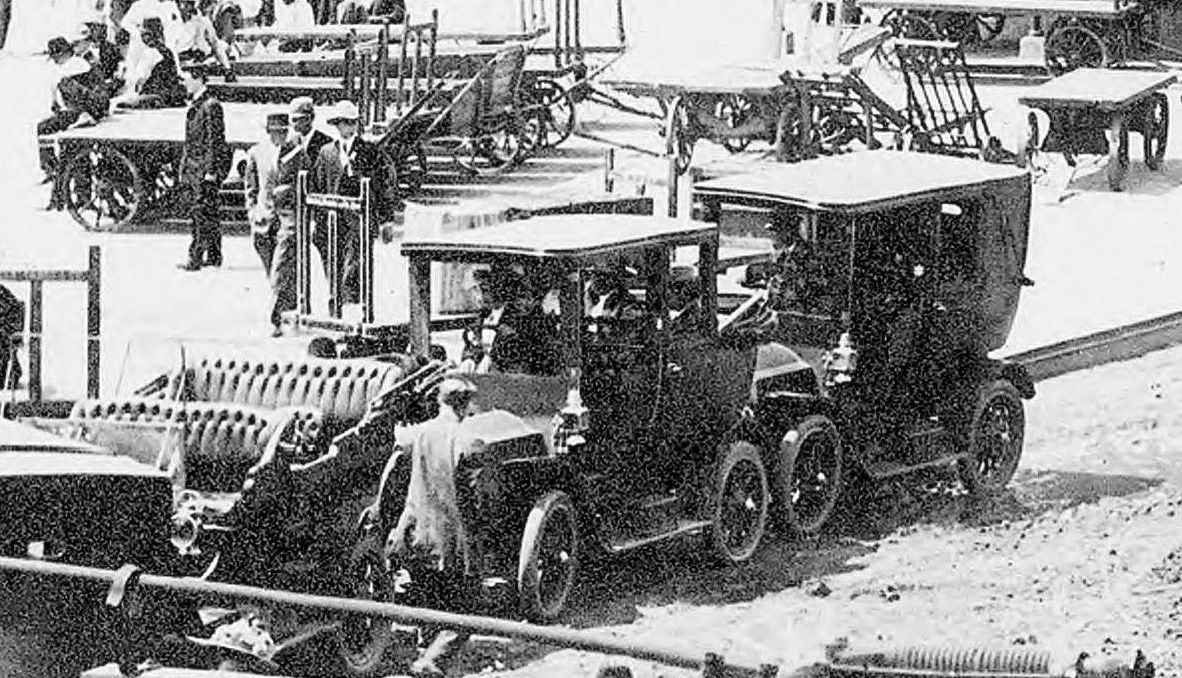
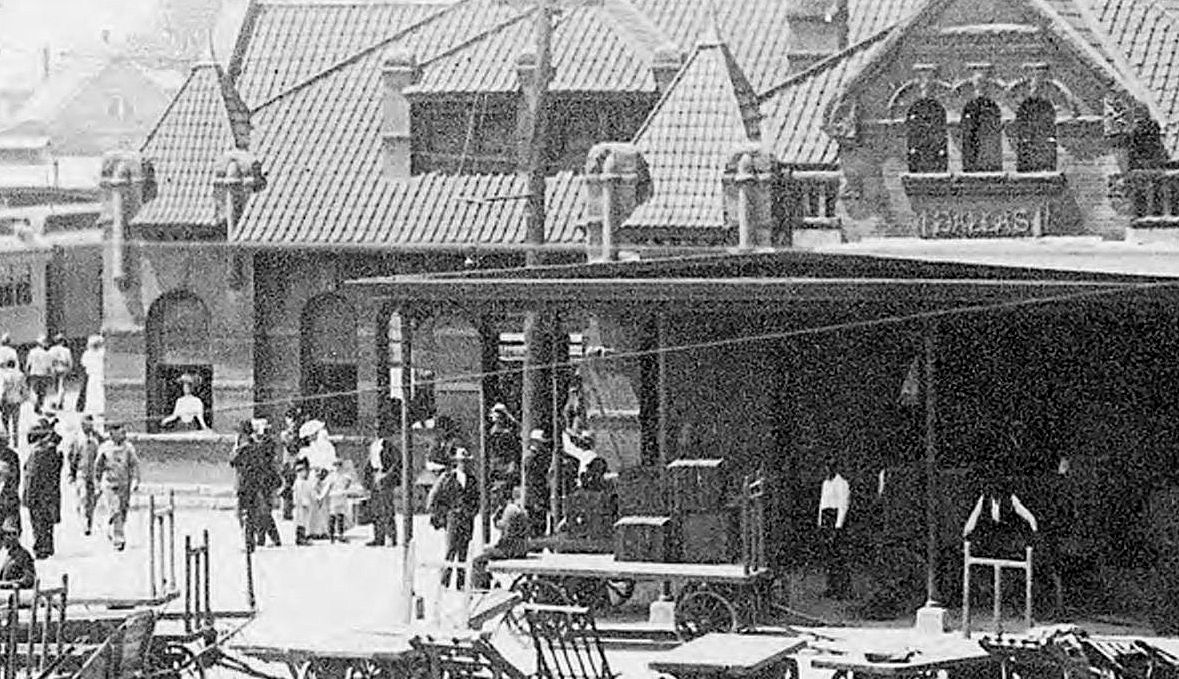
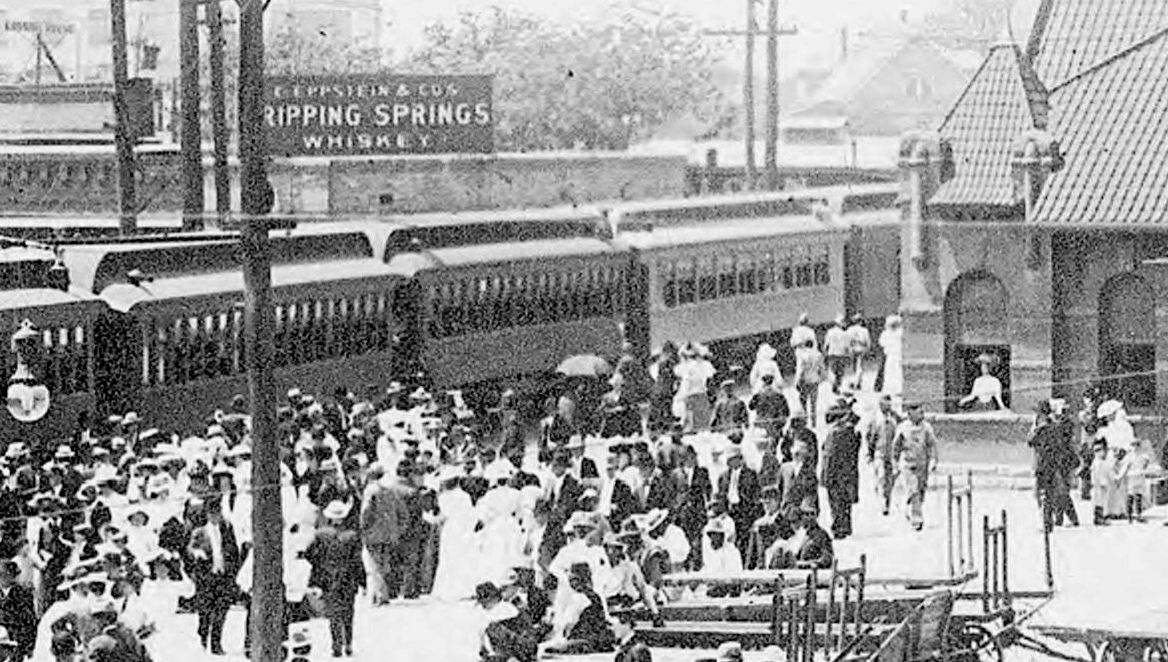
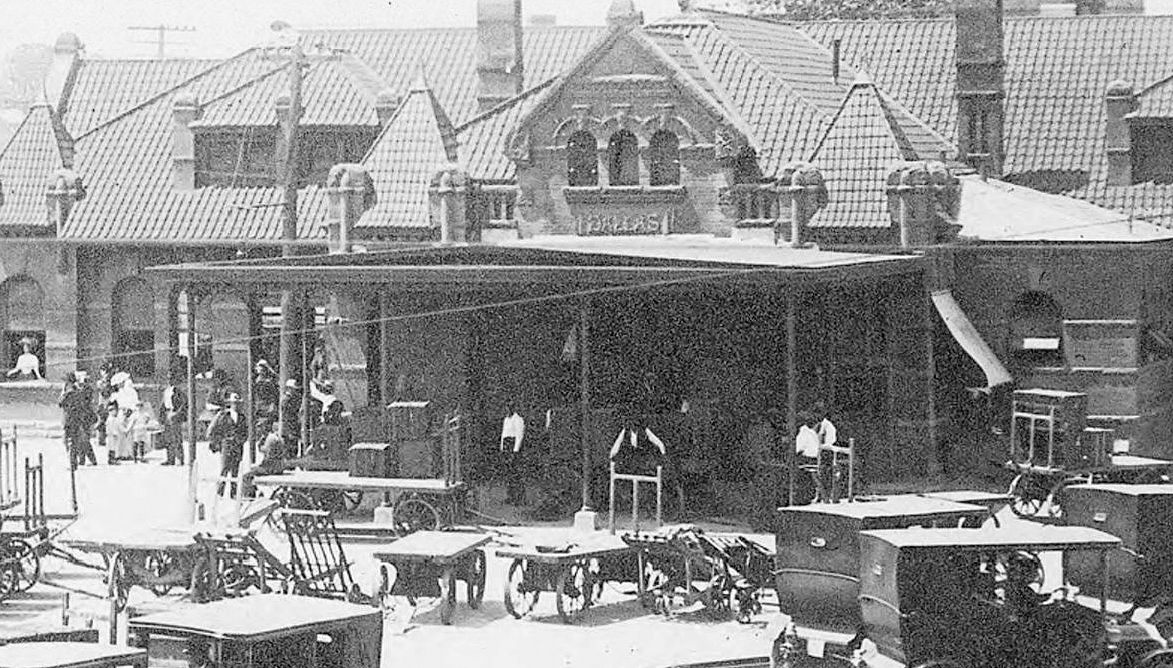
Back to the photo. Across Central Avenue from the hotel is the old Union Depot, where there was always a lot going on. Let’s look at the photo a little more closely. (Click photos to see larger images.)

old-union-depot_degolyer_ca1910

old-union-depot_degolyer_det1

old-union-depot_degolyer_det2

old-union-depot_degolyer-det3

old-union-depot_degolyer_det4

old-union-depot_degolyer_det5

old-union-depot_degolyer_det6

Just seven or eight years after this photo was taken, all that human traffic was gone.

In the fall of 1968, having been vacant for years and counting down its final hours, Dallas Morning News writer Doug Domeier wrote about the old run-down hotel which had long outlived the passenger depot it had been built to serve (see the article “Demolition Leveling Once-Noisy Deep Elm,” DMN, Oct. 19, 1968). Domeier’s entertaining article about those early days includes memories of Lizzie Mae Bass, who once worked in the hotel’s cafe as a waitress and remembers when “horses back[ed] away in fright when a locomotive pulled in at the lively intersection linking the Houston and Texas Central with the Texas & Pacific.”

And today? You’d never EVER suspect that that patch of empty land at the edge of Deep Ellum was ever occupied by one of the city’s busiest train depots.

*

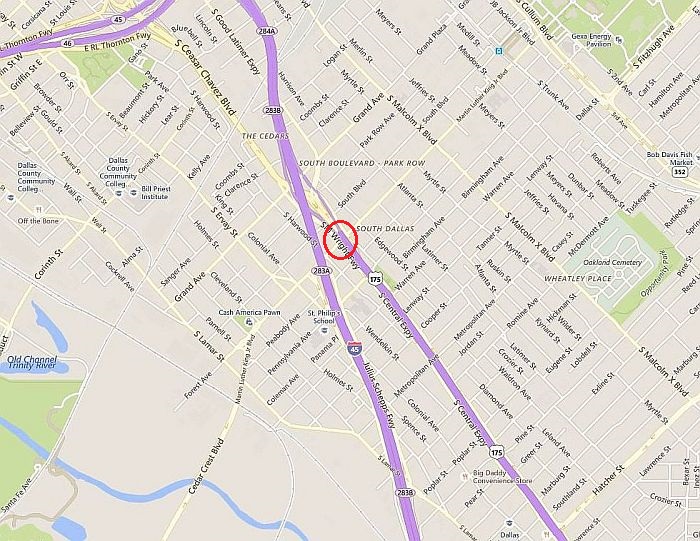
So where was it? Get a good visual idea of how things were laid out in the Sanborn map from 1905, here. Below is a street map that shows where the hotel was (red star) and where the train depot was (blue star). These days? Depressing. See it here (the view is looking north from Elm — the hotel would have been under the overpass, the train station straight ahead).

union-depot-hotel_1952-mapsco1952 Mapsco

It’s interesting to note that during the heyday of the Union Depot, the west side of the block of Central Ave. which ran between Elm and Pacific was the only block in this area not filled with black-owned businesses or residences. When the depot shut down and white-owned businesses moved out, the block began to fill with popular African-American establishments. It’s also interesting (to me, anyway!) to realize that the Gypsy Tea Room of the 1930s was just a few steps to the left of the hotel in the top photo. It took me forever to try to figure out where the Gypsy Tea Room had been — I wrote about it here.

***

Sources & Notes

Top photo is a detail of a larger photo, from the Squire Haskins Photography, Inc. Collection, University of Texas at Arlington Libraries; it is accessible here. The same photograph is shown in full farther down the post — this copy is from the DeGolyer Library, Central University Libraries, Southern Methodist University, and it is accessible here. The quality of both photos makes it difficult to zoom in on them with much clarity, but both sites offer very large images to view.

As mentioned above, an entertaining Dallas Morning News article full of historical info about the area around the depot is highly recommended: “Demolition Leveling Once-Noisy Deep Elm” by Doug Domeier (DMN, Oct. 19, 1968). (I’m not sure why the hotel is referred to as the “Grand Central Station Hotel” throughout — just substitute “Union Depot Hotel” whenever you come across that incorrect name.) The article also has a few paragraphs about the Harlem Theater which was also about to be torn down as part of what Domeier described as the “brutal change” then affecting Deep Ellum.

See a great early-’20s photo of the hotel building (the Tip-Top Tailors moved in around 1922) in the book Deep Ellum: The Other Side of Dallas by Alan Govenar and Jay Brakefield, here (the view is from Pacific to the southwest).

A related Flashback Dallas post — “The Old Union Depot in East Dallas: 1897-1935” — can be read here.

All images larger when clicked.

*

Copyright © 2016 Paula Bosse. All Rights Reserved.


On the Grounds of the Ursuline Academy and Convent

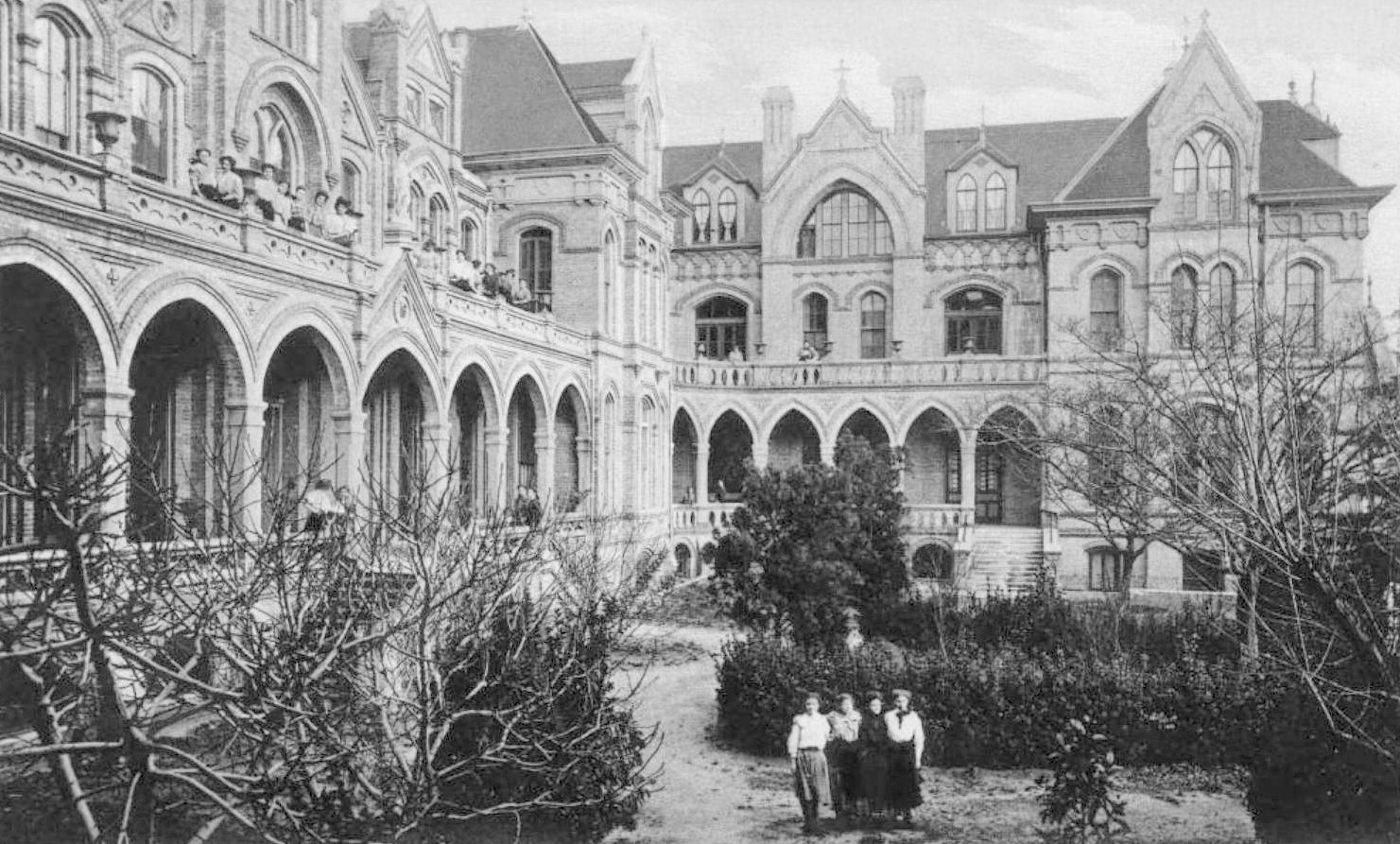
ursuline-convent_cook-colln_degolyer_smuBetween classes… (click for much larger image)

by Paula Bosse

I love this photo of Ursuline girls at the fantastically ornate school and convent in Old East Dallas. See more photos of the school, convent, and grounds in my post “Nicholas J. Clayton’s Neo-Gothic Ursuline Academy,” here.

***

Sources & Notes

Photo by Clogenson, from a postcard in the George W. Cook Dallas/Texas Image Collection, DeGolyer Library, Central University Libraries, Southern Methodist University; it is accessible here. I have un-colorized it.

See the scale of the Ursuline property on a 1922 Sanborn map, here. It is now mostly a parking lot, across from the Dallas Theological Seminary; a sad 21st-century view of what the former campus property looks like is here.

*

Copyright © 2016 Paula Bosse. All Rights Reserved.


Tomatoes, Cokes, Dominoes: Cadiz Street — 1959

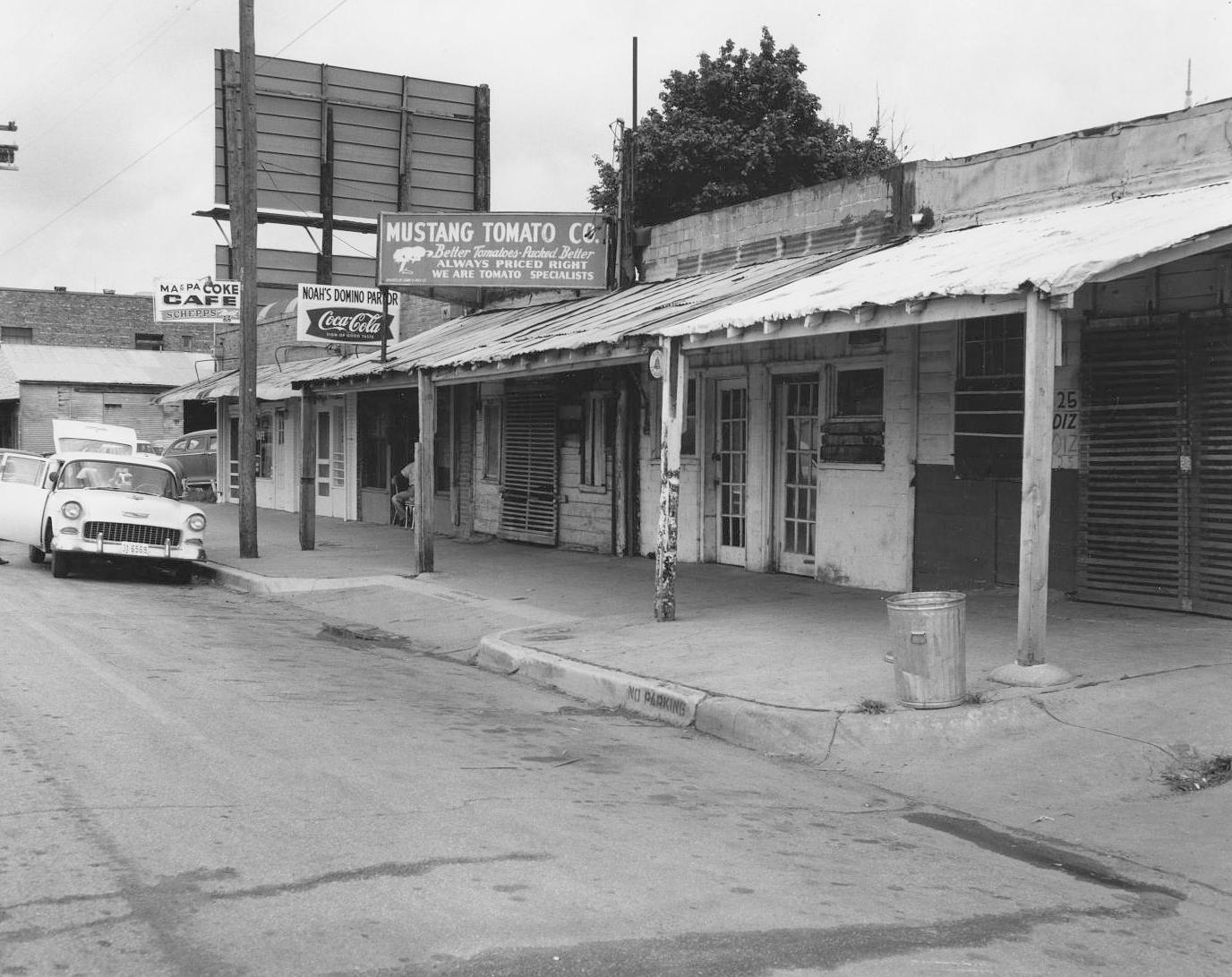
farmers-mkt-area_dominoes_portalThe farmers market area in 1959

by Paula Bosse

Above, a photo showing the block of Cadiz Street between what was then the S. Pearl Expressway and S. Central Expressway (now Cesar Chavez). The view is southwesterly, with the (oddly placed) billboards facing toward Pearl.

I’m sure most people considered such a view urban blight in 1959 when this photo was taken, but (I know I sound like a broken record…), I will always prefer this seedy and run-down version of the farmers market area to the current, relentlessly sterilized, pre-fab, insta-city which took its place. By 1961, this little stretch of businesses had been leveled for a parking lot, which, frankly, was probably more of an eyesore than a ramshackle domino parlor with peeling paint.

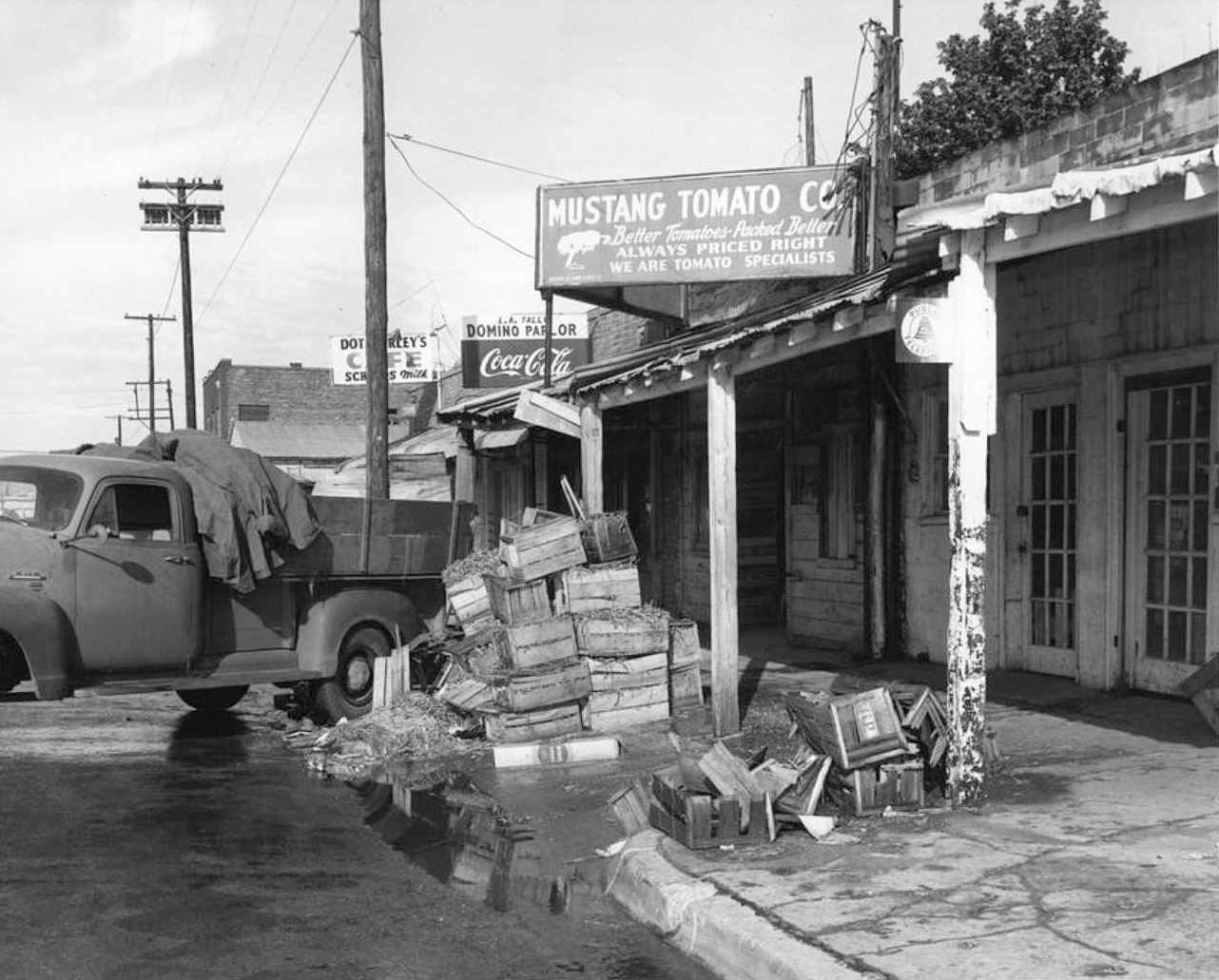
Below, a photo taken in the same block, about a year earlier. It’s not quite as interesting to look at as the top photo, but it does show that this was a working neighborhood, where vegetable crates frequently spilled into the streets as part of the day’s activities.

cadiz-businesses_1958_portal

*dot-curley-cafe_1958-directory1958 city directory

talley-domino_1957-directory
1957 directory

ma-and-pas-cafe_1960-directory
1960 directory

noahs-domino-parlor_1960-directory
1960 directory

This part of Cadiz doesn’t exist anymore. Here’s the view from S. Pearl these days, looking east (these businesses would have been on the left).

Here’s a map from 1962, when the area was a thriving wholesale and retail produce district.

cadiz_1962-map_det

***

Sources & Notes

Both photos are from the  Dallas Farmers Market/Henry Forschmidt Collection, Dallas Municipal Archives, via the Portal to Texas History; the top one can be found here, the bottom one, here.

See other Flashback Dallas posts about the Dallas Farmers Market here — every time I see these great old photos I just shake my head and wish I’d been around to see this part of the city when it was at its grittiest.

*

Copyright © 2016 Paula Bosse. All Rights Reserved.

The Blue House on Browder

blue-house_homewardboundinc_2000
The Rosenfield house, in about 2000 (photo courtesy Homeward Bound, Inc.)

by Paula Bosse

Perhaps you’ve been following the recent brouhaha over the plans to demolish one of the last remaining 19th-century residences in the Cedars area, south of downtown — Robert Wilonsky of The Dallas Morning News has been covering the story here and here and here. The house is in terrible disrepair, but it has the beautiful details of the period, and it’s obvious that it was once a lovely house in a well-to-do neighborhood. Preservation Dallas posted this in-better-days photo on their Facebook page:

browder-house_preservation-dallas-FB-page

I thought I’d see what I could find about the history of the house — mainly I wanted to see if I could find who built it and when.

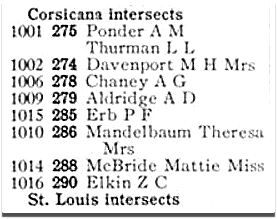
The house currently has the address 1423 Griffin, but before highways were built and streets were moved around, its address was 1015 Browder. Dallas changed almost every address in 1911, so I checked Jim Wheat’s very helpful scan of that year’s directory which tells us both the new and the old addresses of houses and businesses and also shows what cross-streets those addresses are between.

browder-house_1911-directory1911 directory, Browder Street

The original address of the Blue House was 285 Browder Street, between Corsicana and St. Louis. In 1911, P. F. Erb was living there.

Next, I checked the Sanborn maps. The earliest Sanborn map I could find which actually showed this part of Browder was the one from 1892. Here’s a detail showing the two-story frame house on the northwest corer of Browder and St. Louis, with Browder running horizontally along the top. The address is 285 Browder. (The house next to it is 169 St. Louis — more on that house later.)

sanborn_1892_285-browder_nw-corner-st-louis_sanborn-1892_sheet-21

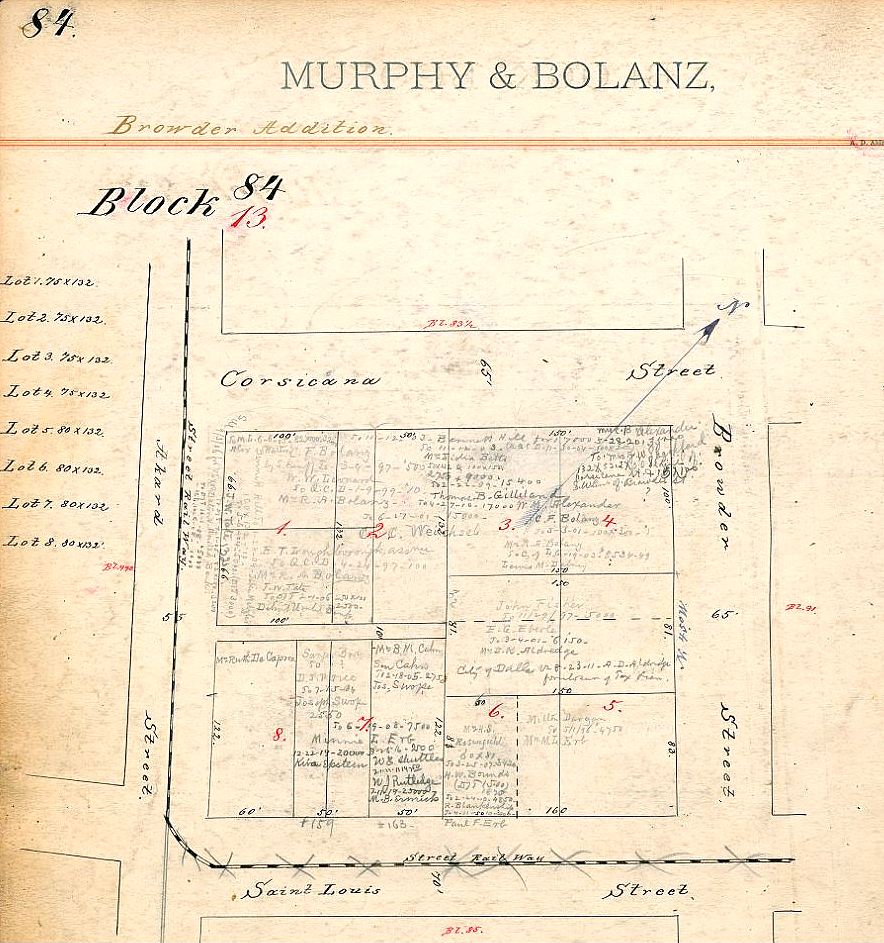
When you look at the full-page map this detail comes from (here), you’ll see larger numbers in the middle of the blocks. The block I’m interested in is block 84. Then I hopped over to the Murphy & Bolanz block book to see what I could find there. (I haven’t actually used this block book much, mostly because my old computer would not work with the plug-in required to view the pages, and it takes a while to figure out what you’re looking at.) When I clicked on “Block 84” in the index, I found this (click for larger image):

murphy-bolanz_block-13_block-84

Here’s the detail of the pertinent block:

murphy-bolanz_det

The names and other assorted scrawls indicate title change (I think). This page was very helpful, because it told me that this block was originally part of Browder/Browder’s Addition, and it was originally classified as Block 13. The lot in question is Lot 5 (and probably Lot 6, because Erb’s name shows up under both. So now I had terms to search on.

And then it was just a tedious slog through the Dallas Herald archives (not to be confused with the Dallas Times Herald archives), the Dallas Morning News archives, and old city directories. Here’s what I found.

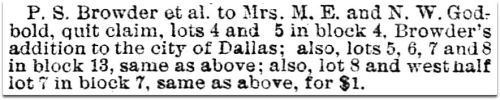
First mention of this particular parcel of land was in The Galveston News on March 24, 1883. P. S. Browder, a Browder family executor, transferred a lot of property — including the two lots I was interested in — to Mr. & Mrs. Nathan Godbold as part of a quitclaim deed (I’m probably not using the correct terminology here…). For one dollar.

1883-march_browder_galveston-news_032483_QUIT-CLAIMGalveston News, Mar. 24, 1883

A few inches of print over, the record shows that Godbold immediately sold Lots 5 and 6 to Dallas real estate czar Charles Bolanz (misspelled below). For $1,000.

1883-march_browder_galveston-news_032483_to-bolanzGalveston News, Mar. 24, 1883

A few months later, in July, it was reported that Bolanz had sold the adjoining two lots to T. S. Holden, a young man who worked as a salesman for a wholesale grocery firm but seemed to be engaged in land speculation on the side. (It’s a little odd that Bolanz sold it so quickly for a $200 loss, but I’m sure there was probably more to the story.)

1883-july_browder_galveston-news_070283_HOLDENGalveston News, July 2, 1883

At some point, these two lots were sold to Max Rosenfield, another young man who was buying up land in the hopes that its value would increase. From Dallas Rediscovered by William L. McDonald:

“The year 1884 also saw the opening of a new housing subdivision by two Jewish real estate speculators, Gerson Meyer and Max Rosenfield. Their development, bounded by Akard, Corsicana, Browder, and St. Louis streets, was sold primarily to Jewish families who had begun to arrive as early as 1872 as part of the ‘Corsicana crowd’ — the terminal merchants who followed the construction of the H&TC.”

[I couldn’t find anything else about this block being a “sub-division,” but there definitely was a “Rosenfield & Meyer’s Addition” in East Dallas as early as 1886 — see the bottom of this post for more information on Gerson Meyer and the Murphy & Bolanz map of their East Dallas addition.]

In the 1886 city directory, Max Rosenfield is listed as residing at 1118 Browder, which may well have been an address that lasted for a very, very short time — Browder is a very short street, and I wonder if Rosenfield was renumbering addresses in his new development. It does appear to be Lot 5 of the block he and Meyer were developing, though. (Henrietta Rosenfield, widow of Jonas Rosenfield, was Max’s mother, and she lived with or near Max for several years.)

1886_rosenfield_1886-directory_1118-browder1886 Dallas directory

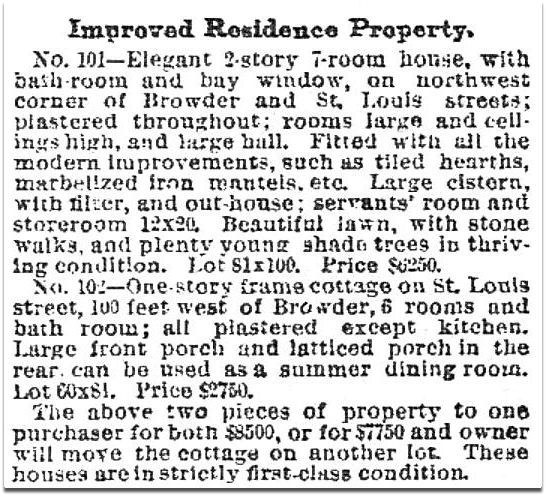
In early 1887, a For Sale ad appeared in the Herald — real estate agents Ducker  & Dudleigh were offering what appears to be Lots 5 and 6. By this time, houses had been built on both lots. (The  numbers 101 and 102 are confusing here, but the property being offered is the lot at the northwest corner of Browder and St. Louis and the lot adjoining it.) The price for the two-story house on Lot 5 was $6,250, which the Inflation Calculator adjusts to being about $166,000 in today’s money, taking into account inflation (but not taking into account Dallas’ outrageous real estate prices!).

1887_browder_dmn_050887-FOR-SALEDMN, May 8, 1887 (click for larger image)

It doesn’t look like either property sold, because a few months later, the 1888 directory showed Max still living in the Lot 5 house facing Browder and mother Henrietta living in the Lot 6 house at 169 St. Louis.

1888_rosenfield_1888-directory1888 Dallas directory

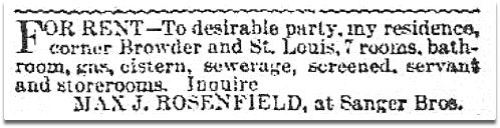
Rosenfield placed a For Rent ad in the paper in Feb. of 1889, offering his corner house on Browder.

1889_rosenfield_dmn_021389DMN, Feb. 13, 1889

This appears to have been when businessman Milton Dargan moved in. He is listed as moving into the house at about this time in the addenda section of late changes for the 1889 directory (directories were usually compiled in the year before they were actually published).

1889_dargan_1889-addenda-listing1889 Dallas directory

In that same directory, Rosenfield had moved in with his mother in the adjoining property.

1889_rosenfield_1889-directory1889 Dallas directory

At some point Dargan bought the corner house. Henrietta continued to live in the St. Louis-facing house until about 1892, when she moved in with Max at his new home on Akard.

And, finally, the “285” address shows up in a directory, in 1891.

1891_dargan_1891-directory1891 Dallas directory

Paul F. Erb bought the Browder house from Dargan in 1896 (he also bought the adjoining Lot 6 house facing St. Louis in 1910).

1897_erb_1897-directory1897 Dallas directory
And we’re back to Paul Erb, seen in the 1911 directory listing old and new addresses at 1015/285 Browder.

browder-house_1911-directory1911 Dallas directory

Yay!

**

That was a long way to go to establish a chain of ownership. (I’m sure it would have been faster and easier to have consulted city records.)

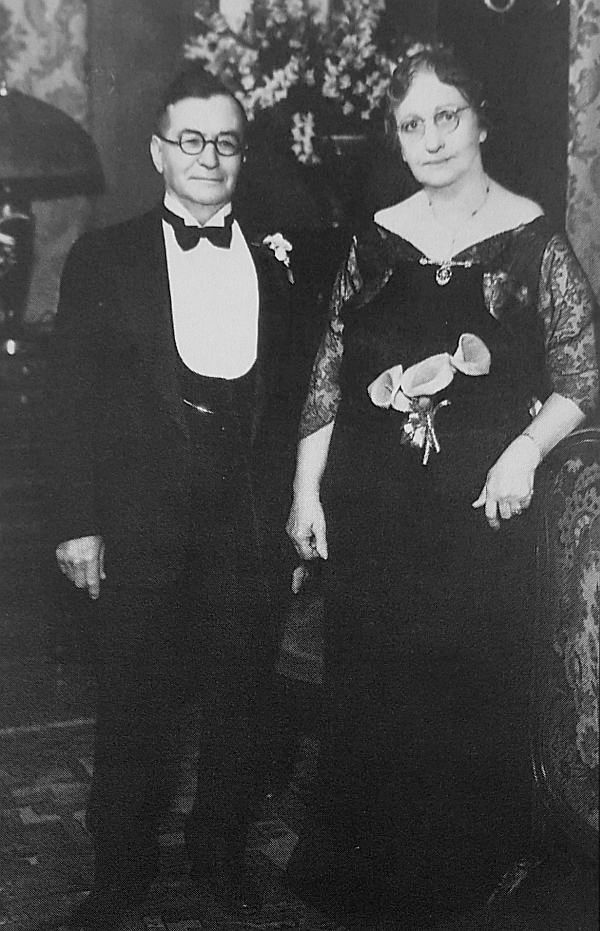
So. Without access to building permits, it looks as if Max Rosenfield (who, by the way, was the father of John Rosenfield — born Max John Rosenfield, Jr. — legendary arts critic for The Dallas Morning News) was the person who built the 130-year-old house now going through the process of probably being torn down soon. It appears to have been built in 1884 or 1885. In a 1935 Dallas Morning News article celebrating the 50th wedding anniversary of Mr. and Mrs. Max Rosenfield, the house is mentioned: “…their first home, a house built by Mr. Rosenfield and still standing on the northwest corner of Browder and St. Louis streets…” (see the article “Mr. and Mrs. M. J. Rosenfield To Observe 50th Anniversary,” DMN, Jan. 6, 1935).

Below is a photo of Max Rosenfield and his new bride, Jenny, probably taken the same year the house was built, 1885-ish, when Max was 26 years old.

rosenfields_ca-1885_ancestry

Thank you for building such a pretty  house, Mr. Rosenfield. Maybe some magnanimous person with deep pockets can have it moved to a new location and restore it to its former loveliness.

rosenfield-max_1935Mr. and Mrs. M. J. Rosenfield, on their 50th anniversary

**

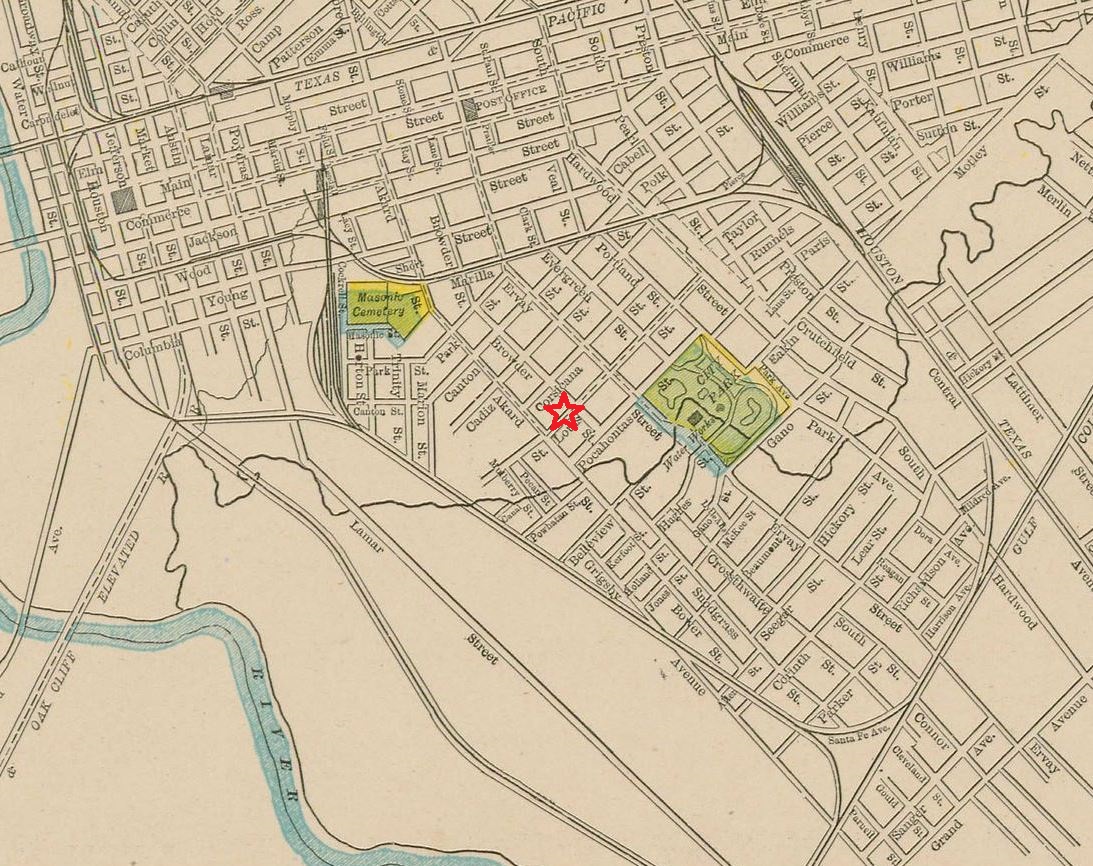
Here’s a detail of an 1893 map of the area, with the house in question marked.

browder-house_1893-map

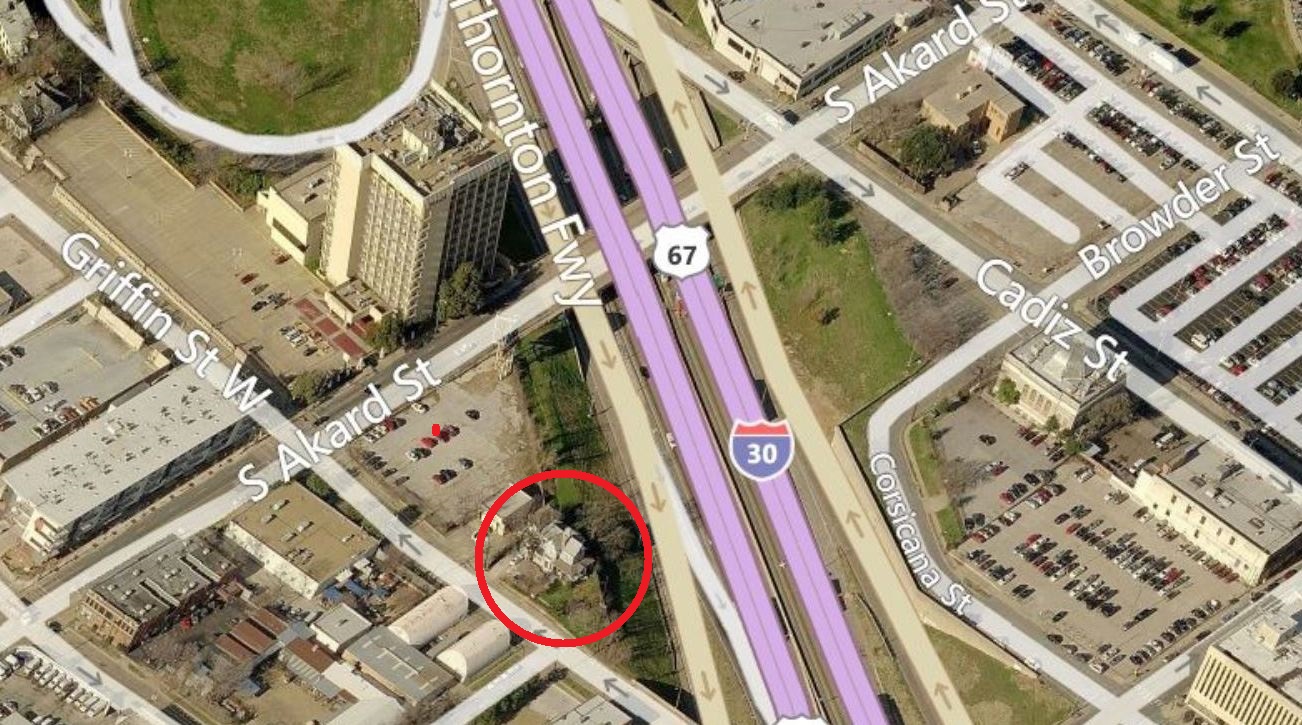
And here’s the lonely little house in its present hemmed-in location.

browder-house_bingBing Maps

***

Sources & Notes

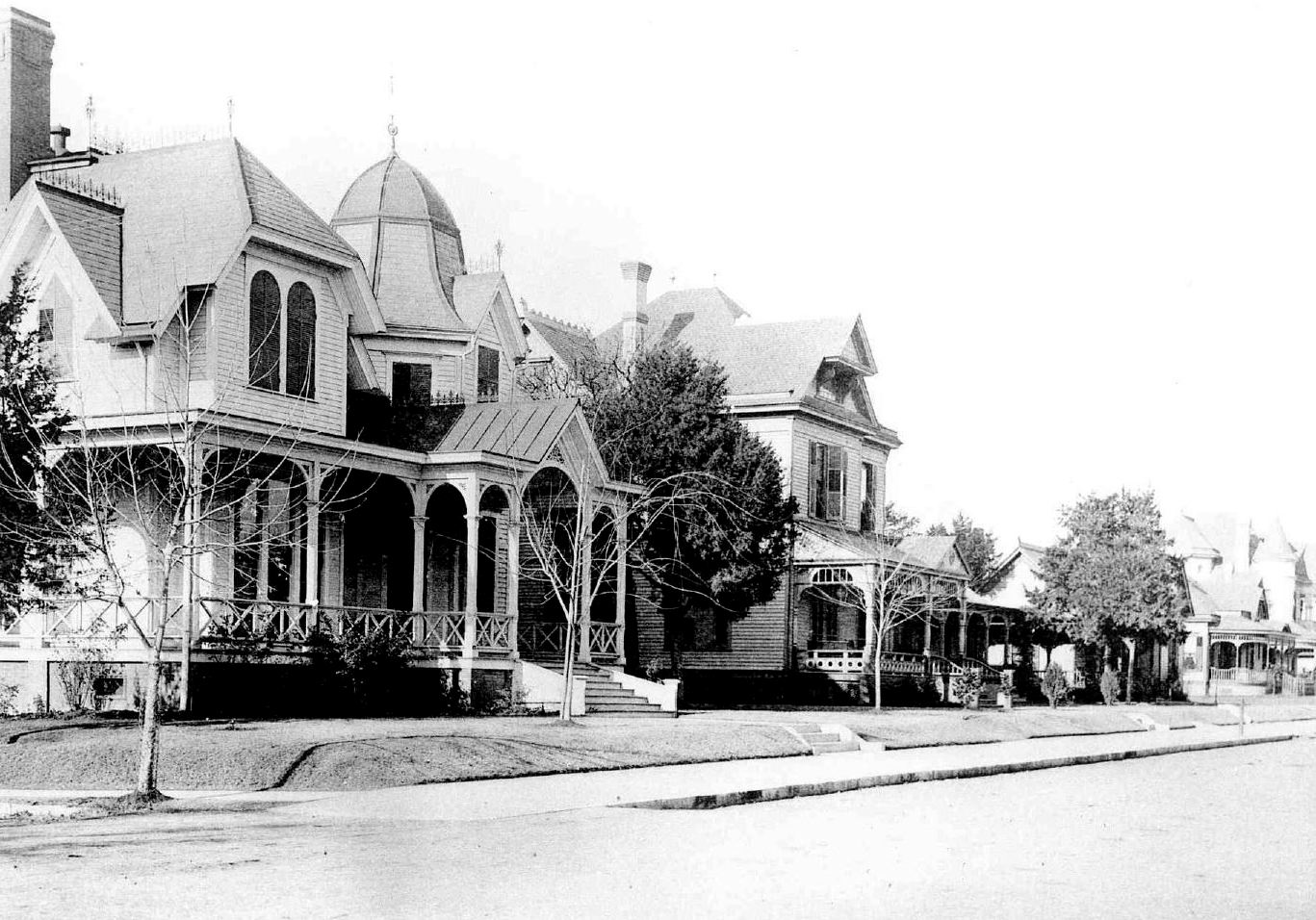
Top photo, taken around 2000, from Homeward Bound, Inc., used with permission. Homeward Bound, Inc. took over the house in 1986 (and owned it until October, 2015) for use as Trinity Recovery Center, a substance abuse treatment center. The organization tried hard to save the house, but, according to Homeward Bound, Inc. Executive Director Douglas Denton, when they approached Dallas’ Landmark Commission in the 1990s, “they were not interested in the building.” Thanks to Mr. Denton for allowing me to use this photo, which shows the beauty of the old house better than any other photo of it that I’ve seen. He points to the photo below as an example of what this Cedars neighborhood once looked like. The caption for the photo in McDonald’s Dallas Rediscovered (p. 125): “Looking north toward downtown along Browder Street near the corner of Cadiz, 1895. These homes, built in the early 1890s, began to be razed in the late 1930s and early 1940s for parking space in the expanding business district.” (Photo: Dallas Public Libary)

browder-near-cadiz_ca1895

This would have been about two blocks from the Rosenfield house. Imagine what that neighborhood once looked like!

Watch a news report on the outcry over the possible demolition of this house on the WFAA website, here.

The Dallas Morning News article on the 50th wedding anniversary of Mr. and Mrs. Max Rosenfield in which it is mentioned that Max built the house (“…their first home, a house built by Mr. Rosenfield and still standing on the northwest corner of Browder and St. Louis streets…”) is “Mr. and Mrs. M. J. Rosenfield To Observe 50th Anniversary” (DMN, Jan. 6, 1935).

Photo of the Rosenfields as a newly married couple found on Ancestry.com.

50th anniversary photo of Mr. and Mrs. Rosenfield is from the book John Rosenfield’s Dallas by Ronald L. Davis (Dallas: Three Forks Press, 2002).

All other sources as cited.

Max J. Rosenfield died in 1935 at the age of 76. His very interesting obituary (probably written by his son, John Rosenfield, amusements editor of The Dallas Morning News), can be found in the Dec. 2, 1935 edition of The News: “M. J. Rosenfield, Business Leader Many Years, Dies.”

It’s worth trying to figure out how to use the Murphy & Bolanz block books, courtesy of the Texas/Dallas History and Archives Division of the Dallas Public Library. Background on these very useful books can be found here.

If I’ve made any mistakes or have drawn any incorrect assumptions, please let me know!

browder-house_then-now

*

UPDATE: Max Rosenfield developed a real estate partnership with Gerson Meyer, both of whom worked for Sanger Bros. department store. They bought and sold real estate (often to fellow Sanger’s employees), apparently as a lucrative side-business (Rosenfield even conducted his real estate transactions from his Sanger Bros. office). They apparently had acquired enough land by 1886 to have their own “addition” — “Rosenfield and Meyer’s Addition” in East Dallas. The earliest mention I found of it was this ad from May, 1886.

rosenfield-and-meyer-addition_dmn_052786DMN, May 27, 1886

Their addition was in East Dallas. Below, the map from the Murphy & Bolanz block book (click for larger image):

rosenfield-and-meyers-addition_murphy-bolanz

Gerson Meyer (a Jewish German immigrant, just a couple of years older than Rosenfield), moved to St. Paul, Minnesota in 1897 and continued working for several years in men’s clothing.

If something looks too small, click it!

*

Copyright © 2016 Paula Bosse. All Rights Reserved.


The Gypsy Tea Room, Central Avenue, and The Darensbourg Brothers

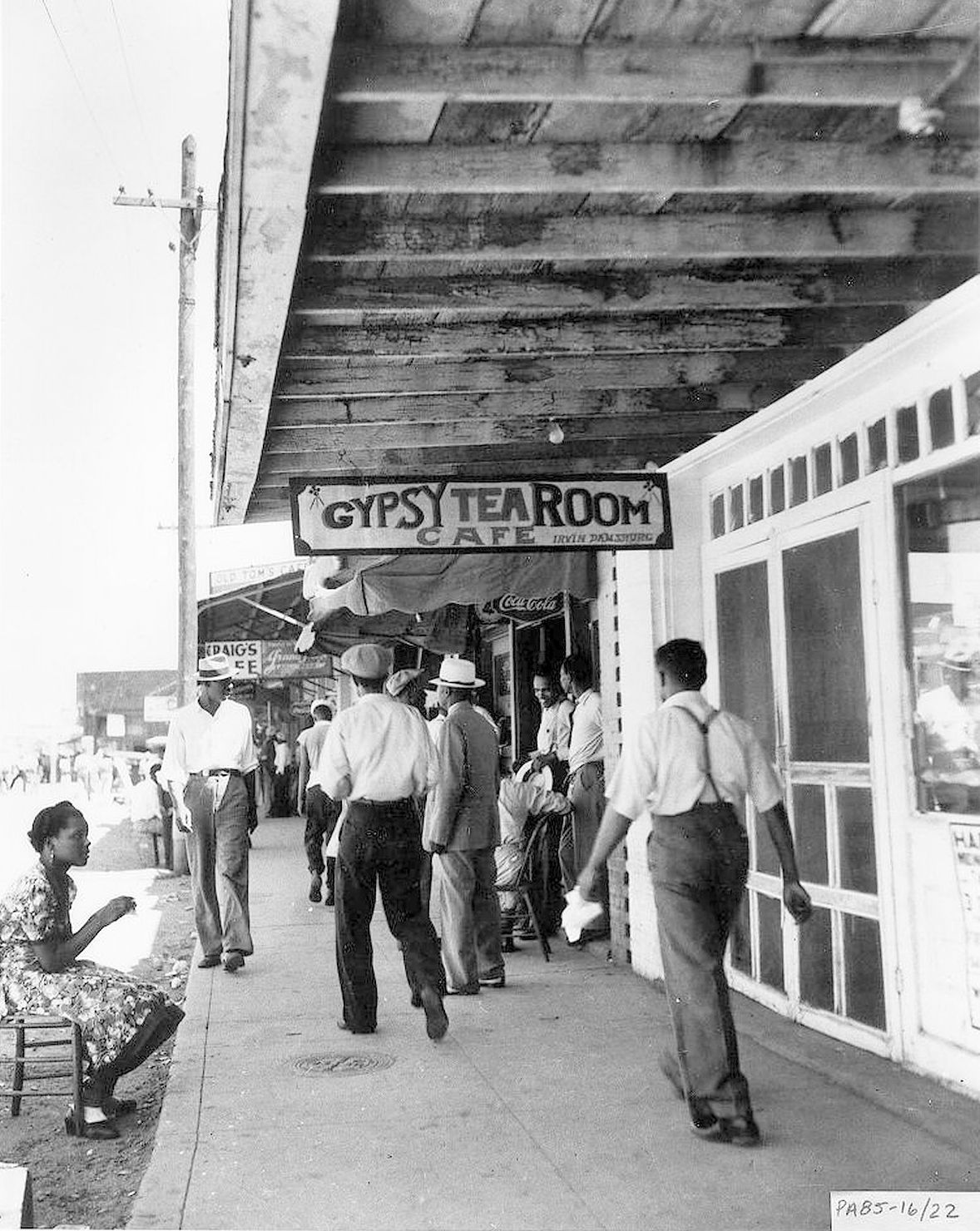
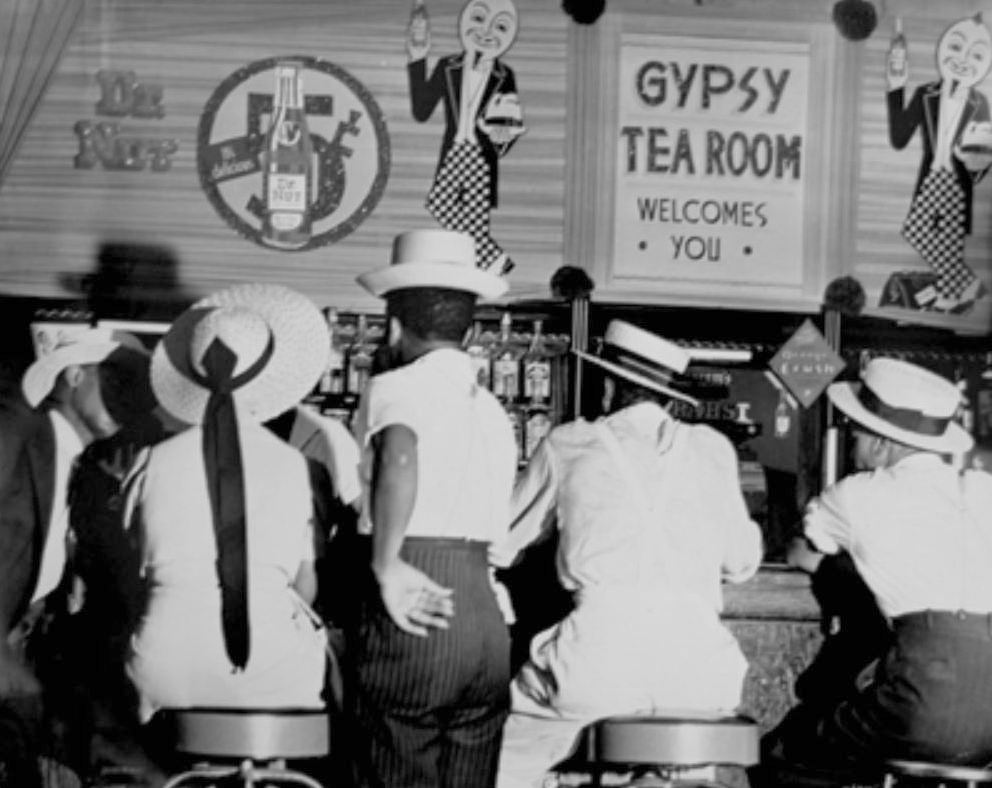
gypsy-tea-room_dallas-public-libraryThe 200 block of Central Ave., about 1937…  (Dallas Public Library photo)

by Paula Bosse

I’ve seen this photograph of Deep Ellum for years, and I’ve always loved it. But for some reason, I always thought this showed Elm Street — across from the Knights of Pythias Temple, just west of Good-Latimer (probably because that’s where a recent club with the same name was located). In fact, this scene was captured a couple of blocks west, just north of Elm, on Central Avenue, sometimes referred to as Central Track, along the Houston & Texas Central railroad tracks — a part of Deep Ellum that’s been gone for more than 60 years.

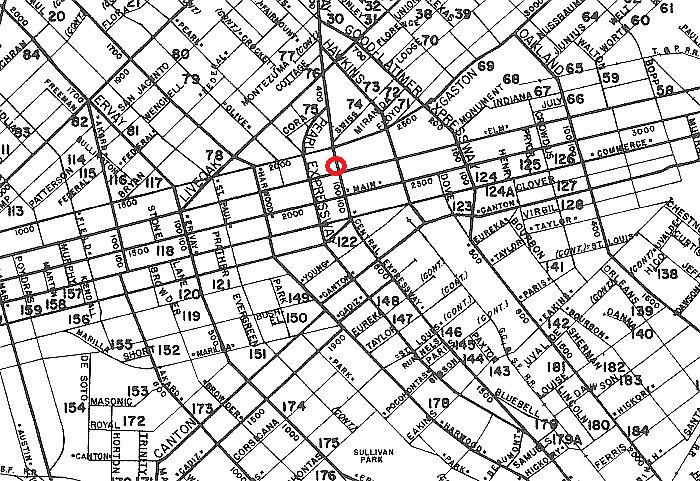
gypsy-tea-room-location_1952-map.jpgAfter Central Expwy. replaced Central Ave. (1952 Mapsco)

This area — which many have described as being the very heart of Deep Ellum in the 1920s through the 1940s (and which was somewhat ironically referred to as “the gay white way of the Negro in Dallas” by an uncredited WPA writer) — was demolished to make way for the construction of North Central Expressway (which closely followed the H&TC Railway tracks). This photo was taken in the 200 block of North Central Avenue, looking south toward Elm (the building farthest in the background, jutting out to the left, is across Elm, on the south side of the street). To the immediate left of this photo (out of frame) was the old union depot (read about it here).

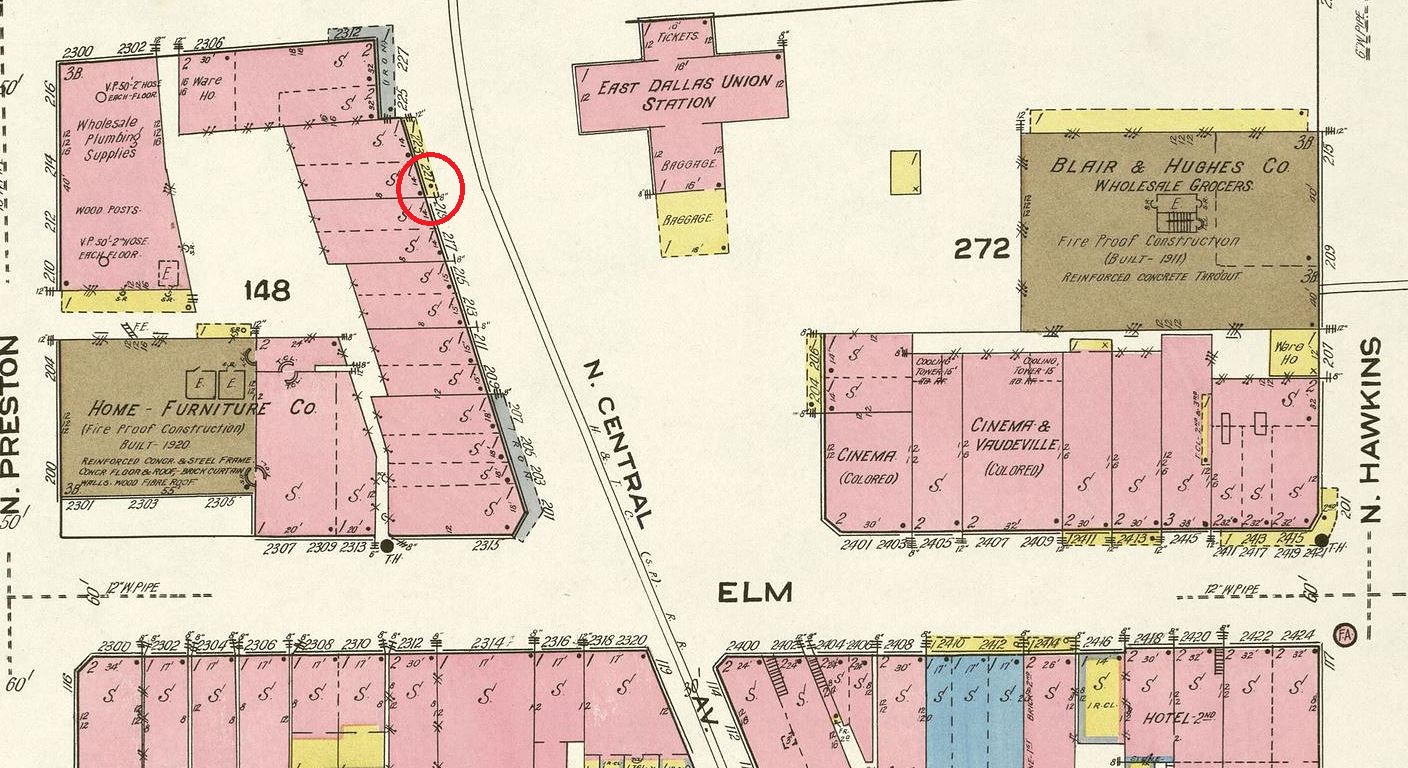
You can see that the Sanborn map from 1921 shows that same building jutting out. (See the full Sanborn map here; it might be more helpful to see this detail rotated to show the same view as the photo, here.)

sanborn-map_1921_sheet-17-det1921 Sanborn map, detail (click for larger image)

Information about The Gypsy Tea Room is scant. The proprietor was a man named Irvin Darensbourg, whose family was from the black community of Killona, Louisiana in St. Charles Parish; they appear to have been of French Creole extraction, and the family’s last name was probably correctly spelled as D’Arensbourg.

The Darensbourgs were an interesting family (and not just because their mother’s maiden name was Louise Jupiter!). There were several children, and at least two of them were professional musicians: Percy Darensbourg (1899-1950) and Caffery (often spelled “Caffrey”) Darensbourg (1901-1940). Both played with several jazz bands, and Percy even made a few recordings, playing banjo. Below are a couple of promotional photos showing them at work in the 1920s, when they were still based in New Orleans, before they settled in Dallas. (These are cropped details — click pictures to see the full photos.)

Percy Darensbourg, with Lee Collins‘ band, 1925 or 1926:

percy-darensbourg_duke_det

Listen to Percy on banjo, here:


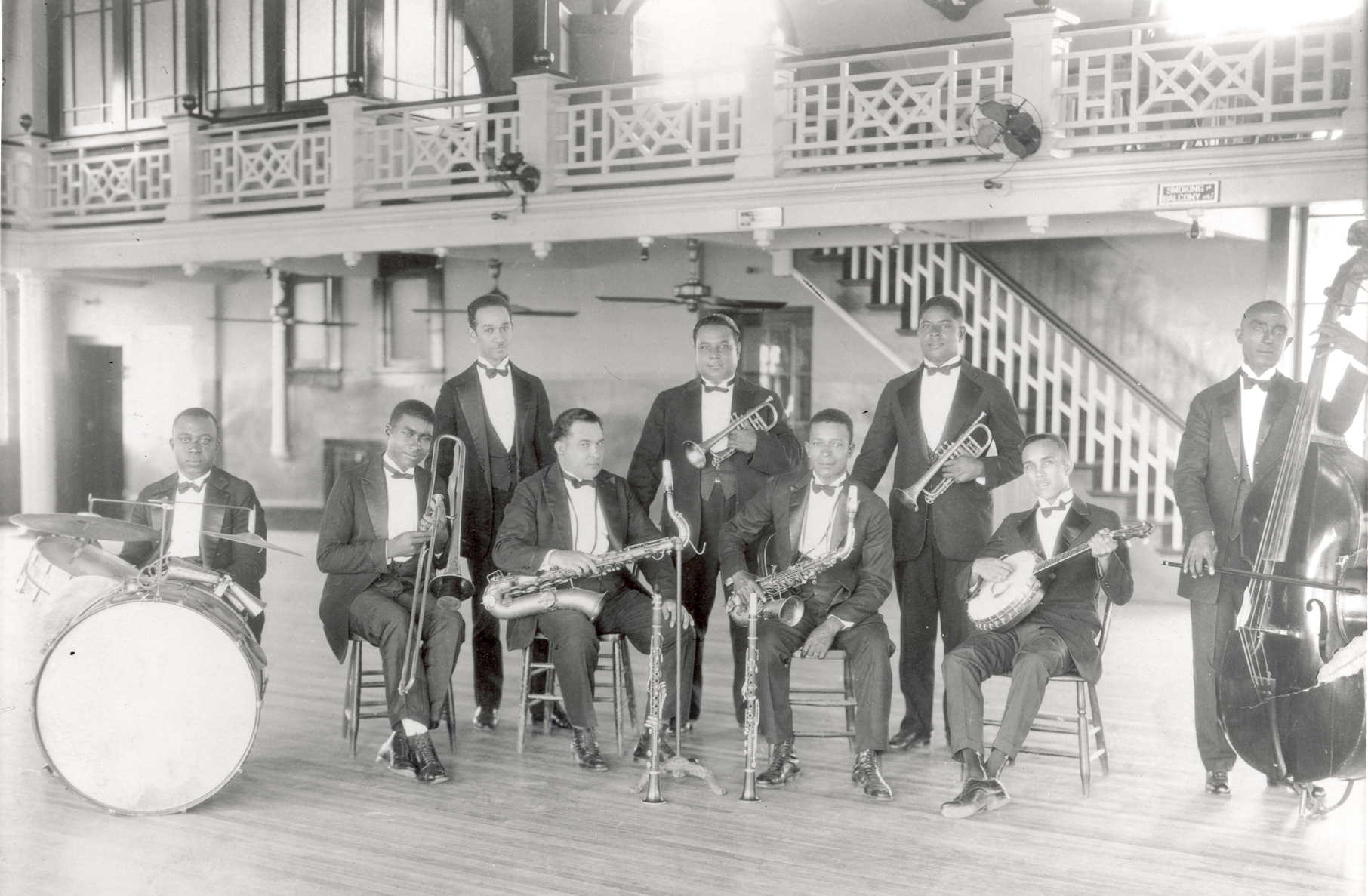
And, below, Caffery Darensbourg, with Manuel Perez’s Garden of Joy Orchestra (click photo to see full band — the other band members are identified here):

caffery-darensbourg_tulane-library

The first of the brothers to arrive in Dallas from New Orleans was Percy, in about 1929, and for the next few years he continued to make his living as a professional musician. Caffery followed in 1932 and opened the short-lived Frenchie’s Creole Inn on Boll Street. Their non-musician brother Irvin was here by 1935 and promptly opened the Green Tavern at 217 Central Avenue, just a few doors down from Percy’s drinking establishment, the Central Tavern Inn, at 223 Central. At about this same time, Percy was also running a club at 3120 Thomas called The Gay Paree — which The Dallas Morning News described as a “swanky negro night club” (April 12, 1938) in a short mention of Percy’s being fined for selling alcohol to an already-inebriated customer.

But back to that 200 block of Central Avenue — the one pictured in the photo at the top. Between 1937 and 1939, Irvin also owned/ran a small restaurant or cafe — and later a pool hall — out of 219½ Central. The Darensbourgs had that block locked up.

*

In 1935, a song called “In a Little Gypsy Tea Room” by Bob Crosby swept the country. It was a huge hit. Suddenly there were scads of places popping up all over calling themselves The Gypsy Tea Room or The Little Gypsy Tea Room. Some might have been actual tearooms, but there were also a lot of clubs and bars with the “tea room” name — the most famous of these was The Gypsy Tea Room in the Tremé district of New Orleans, at Villere & St. Ann, which opened the same year the song was being played incessantly by every dance band in the nation. This famous New Orleans nightclub booked the biggest jazz bands around and was a legendary musician’s hangout.

gypsy-tea-room_new-orleans_1942_tulane-libNew Orleans’ Gypsy Tea Room, 1942 (via Tulane University)

gypsy-tea-room_NOLA_myneworleansNew Orleans’ Gypsy Tea Room, 1930s (via MyNewOrleans.com)

The Darensbourgs most likely knew the club, its owner, its patrons, and the musicians who played there. Perhaps Irvin Darensbourg decided to name his own little Gypsy Tea Room in Dallas in honor of the New Orleans landmark. Whatever the case, Deep Ellum’s Gypsy Tea Room appears to have come and gone fairly quickly (and one assumes there was more than tea being sipped inside).

*

The life of a tavern and club operator could be a hard one, especially in those days, especially in the black neighborhoods of Deep Ellum and North Dallas. Irvin seemed to be forever sleeping on a relative’s couch and had a different address every few months. By 1940 he had moved to Fort Worth to open another bar, and after that … I’m not sure what became of him — but one hopes that he met a less violent end than his brothers did here in Dallas. According to Caffery’s death certificate, he died in 1940 after having been shot in the abdomen while “in a public place.” His death was ruled a homicide. Percy, who by all indications was the most stable and successful of the brothers, was also killed — in 1950 he was stabbed in the neck (!) while out on the street at 4:20 AM.

**

As for the original photograph, I’ve pored over it and looked through directories, but I can’t pinpoint the exact year this photo was taken or determine what the actual address of the Gypsy Tea Room was. Since it was mentioned in the WPA Dallas Guide and History, which was written and compiled between 1936 and 1940 and contains the only contemporary mention of the Tea Room, my guess is that this photograph was taken about 1937, as this was the last year that Old Tom’s Tavern (209 ½ Central) seems to have been in business (although the bar that replaced it was owned by the same person, and the sign seen in this photograph could well have remained up for a while).

Craig’s Cafe, at 213 Central, was in business between 1929 and at least 1946 when property began to be demolished in order to begin construction on the expressway. The Gypsy Tea Room looks to be either two or three doors down from Craig’s place. My guess is that it’s 219 Central. The 1937 street directory has Irvin Darensbourg (whose name is constantly mangled and misspelled everywhere) listed as being the proprietor of both the Green Tavern (at 217 Central) as well as an unnamed restaurant at 219-A (sometimes written as 219 ½) Central. The 1938 and 1939 directories specify Darensbourg’s business at this address in those years is a pool hall, not a restaurant. So I’m going to venture that Irvin Darensbourg ran the Gypsy Tea Room at 219 Central Avenue in 1937. 

1937_gypsy-tea-room_central_1937-directory
1937 Dallas directory
That was exhausting!

***

Sources & Notes

Photo of the Gypsy Tea Room at the top of this post is from the Texas/Dallas History & Archives Division of the Dallas Public Library: “Gypsy Tea Room Cafe located in Deep Ellum” is from the WPA Dallas Guide & History Collection of the Dallas Public Library — its call number is PA85-16/22.

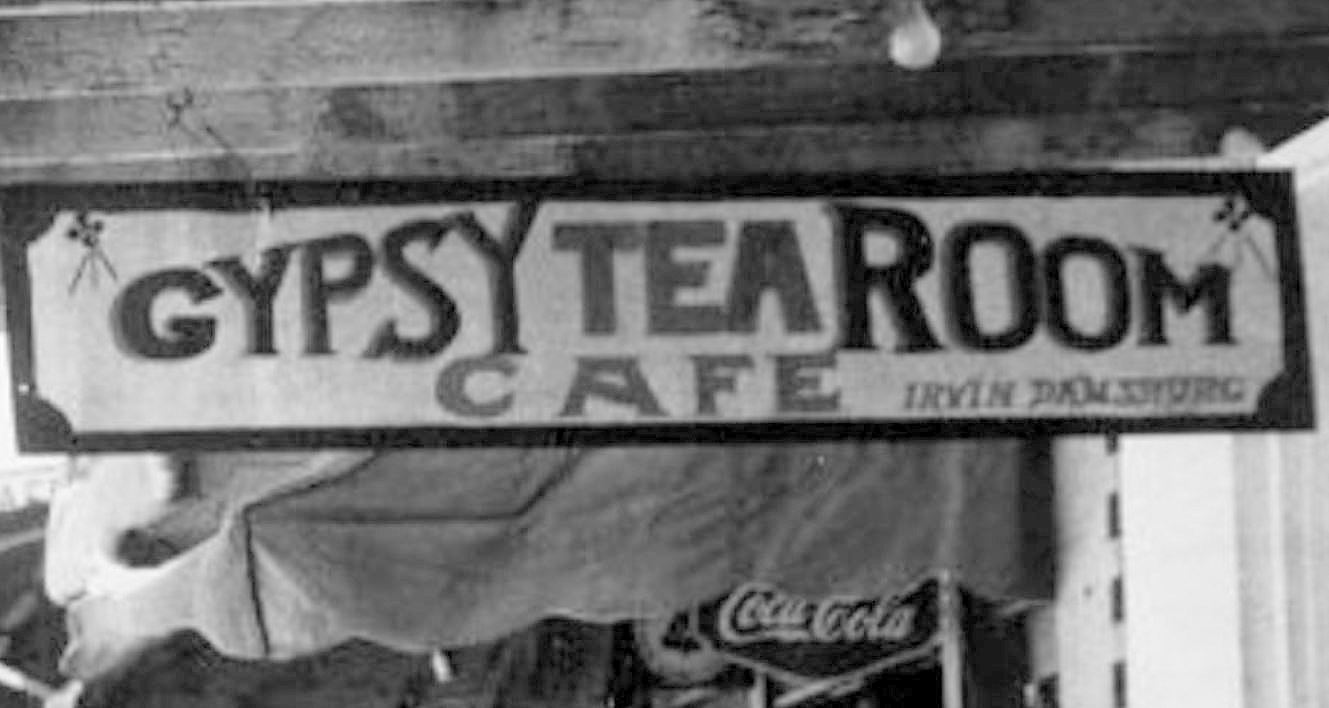
Thanks to Bob Dunn of the Lone Star Library Annex for deciphering “Darensbourg” from this badly garbled printed name on the Gypsy Tea Room sign.

gypsy-tea-room-sign

Here are a few of the numerous ways this Darensbourg’s family’s name is misspelled across the internet:

D’Arensbourg
Darensbourg
Darensburg
Darenbourg
Darenburg
Darnburg
Darnsberg
Dansberg

Darensborough

And I’m still not actually sure whether it’s “Irvin” or “Irving,” or “Caffery” or “Caffrey.”

When clicked, the photo of Percy Darensbourg above opens up to show the full band — the personnel is identified in a caption from the book Oh, Didn’t He Ramble: The Life Story of Lee Collins: “Lee’s band in Dallas, 1925 or 1926. From the left: Coke Eye Bob (Arthur Joseph?), Mary Brown, Freddie ‘Boo-Boo’ Miller, Octave Crosby, Henry Julien, ‘Professor’ Sherman Cook, Lee, and Percy Darensburg [sic].”

A couple of other versions of “In a Little Gypsy Tea Room,” if you must:

  • The version by The Light Crust Doughboys (no strangers to Deep Ellum), recorded in 1935 in Dallas at 508 Park, is here.
  • The at-least-peppier version by Louis Prima and His New Orleans Gang, also recorded in 1935, is here.

See what the area once occupied by the vibrant street life of Central Track looks like now, here. The expressway overpass is now planted about where the photo was taken. It’s a shame this important part of town — in a way it was Dallas’ second downtown — was bulldozed into oblivion.

*

Copyright © 2015 Paula Bosse. All Rights Reserved.

Ervay, Live Oak, and Elm: Just Another Wednesday Night — 1953

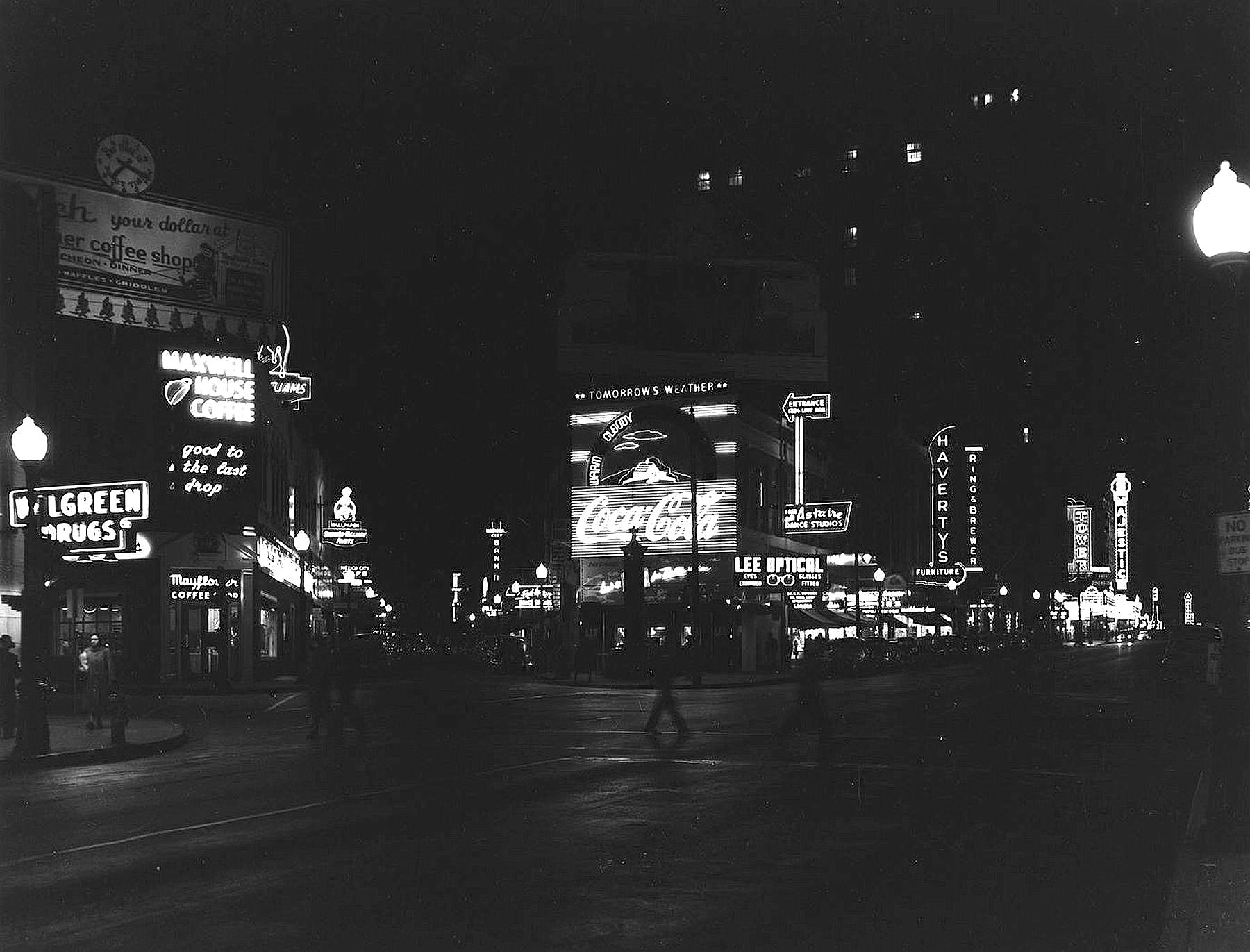
ervay-live-oak-elm_haskins_uta_010753“Tomorrow’s weather: warm & cloudy”

by Paula Bosse

Here’s what 7:18 PM looked like at the old five-point intersection of Ervay, Live Oak, and Elm streets on January 7, 1953, a Wednesday night. All that neon — especially that Coca-Cola sign, which was probably flashing and strobing like crazy — gives this scene a sort of mini-Times Square feel. Imagine this intersection on a Friday or Saturday night when the streets and sidewalks would have been packed with people heading to theaters, restaurants, and night clubs!

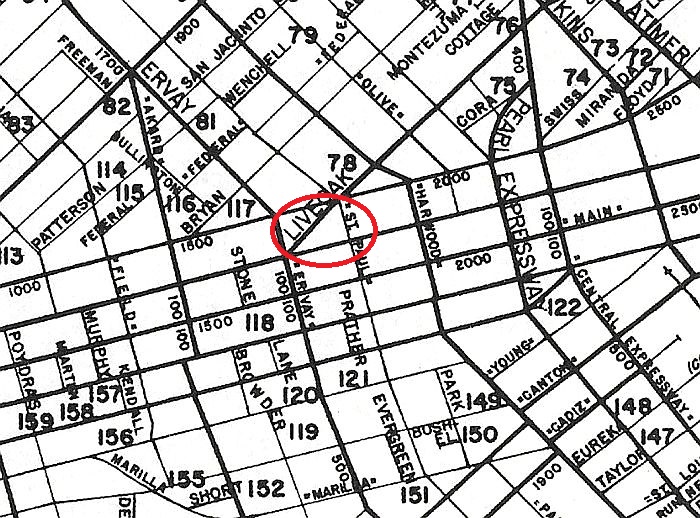
On the left, at the street light (I love those street lights!) and the Walgreen’s sign, is N. Ervay. To the left of the Coca-Cola sign is Live Oak, which used to come through to Elm. To the right, Elm Street, heading east.

So many interesting things here: the Mayflower Coffee Shop (with its “Anytime Is Donut Time” clock and its animated Maxwell House Coffee sign), that incredible neon sign above the Lee Optical store which gave the forecast, that Fred Astaire Dance Studios sign (with “Astaire” in a fantastic neon font), and the Tower and Majestic theater signs lit up for moviegoers who ventured to the movies on a school night. Unseen: the public restrooms (or “public comfort stations”) hidden beneath the street, with the entrance (I think) on the Lee Optical triangular “corner.”

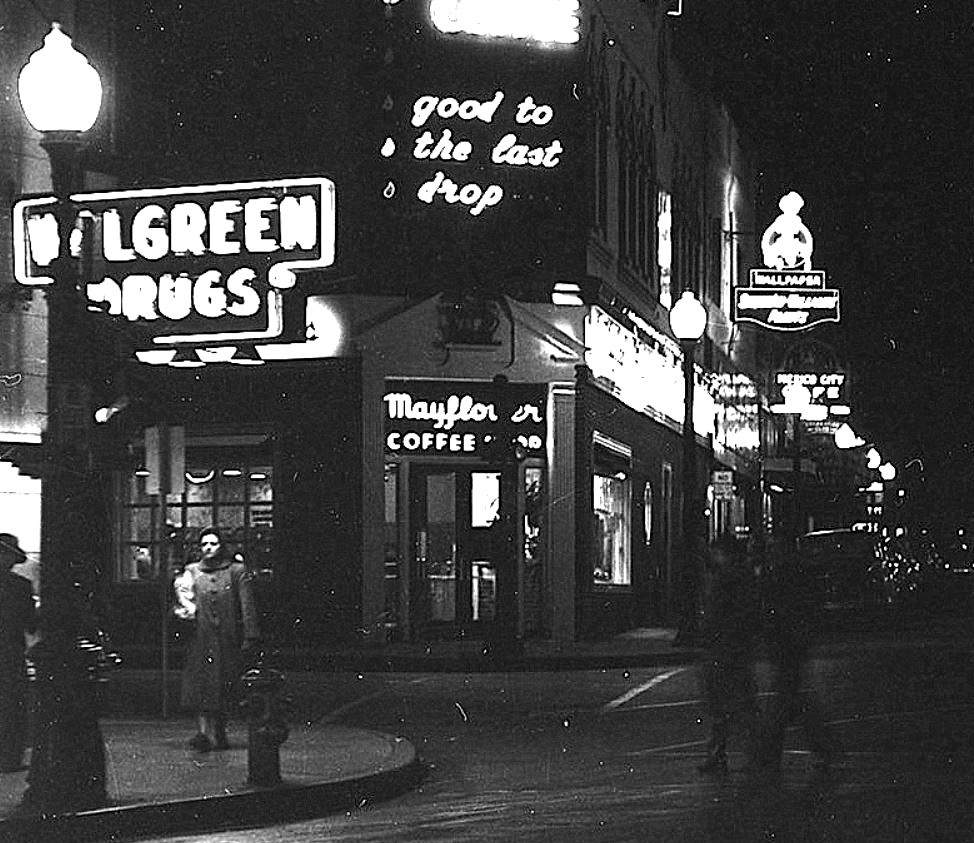
I love all the neon, but this quiet little vignette of a woman carrying some sort of sack or parcel down a chilly downtown street is why I wish I had been around back then — it’s weird to feel nostalgia for a time and place you never actually experienced.

elm-ervay-live-oak_squire-haskins_uta_010753-det

*

A map showing that this intersection once had five points.

ervay-elm-live-oak_1952-mapsco1952 Mapsco (click for larger image)

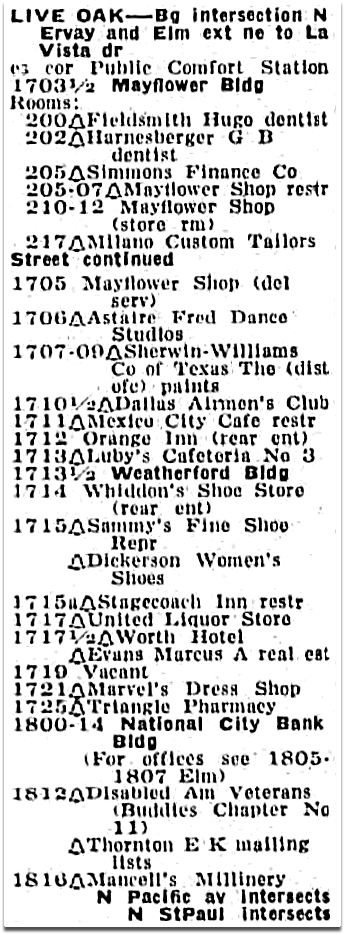
A listing of the businesses along Live Oak, between N. Ervay and N. St. Paul, from the 1953 city directory (click to read):

live-oak_1953-directory

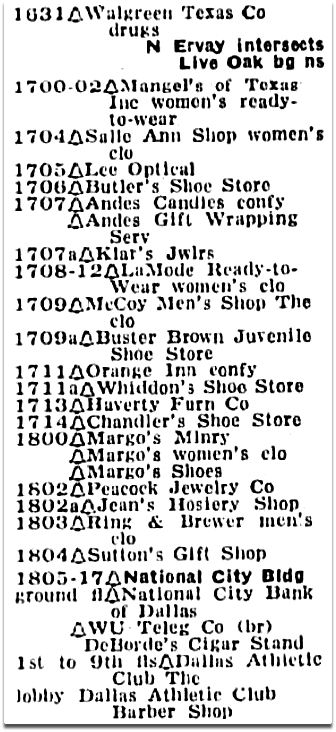
And the businesses along Elm, between N. Ervay and the old Dallas Athletic Club:

elm-st_1953-directory-1

***

Sources & Notes

This photograph — an untitled night scene — was taken by Squire Haskins on Jan. 7, 1953; from the Squire Haskins Photography, Inc. Collection at the University of Texas at Arlington Libraries, Special Collections, accessible here.

See this same view during the DAY in the post “Tomorrow’s Weather at Live Oak & Elm — 1955-ish,” here.

*

Copyright © 2015 Paula Bosse. All Rights Reserved.

When a Virgin Sacrifice at Fair Park Almost Caused an International Incident — 1937

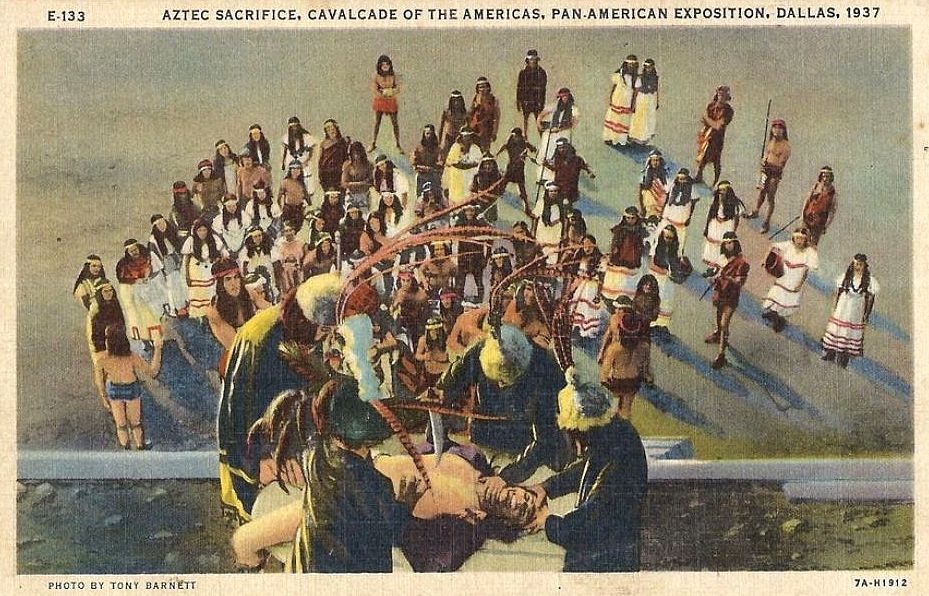
pan-american_aztec-sacrifice_colteraAztec sacrifice with a warrior, not a virgin, on the official postcard

by Paula Bosse

The Greater Texas and Pan-American Exposition at Fair Park was a four-and-a-half-month extravaganza which opened in June, 1937 as a follow-up of sorts to the previous year’s Texas Centennial Celebration. According to promotional material, its goal was to celebrate the Americas and “to promote the feeling of international goodwill between the twenty-one independent nations of the New World.” (It was also hoped that the city could rake in some more Centennial-sized cash.)

One of the biggest attractions of the Pan-American Expo was a huge production called Cavalcade of the Americas, which presented highlights from the history of Latin America and the United States. There were scenes from ancient Mexico, Columbus’ landing, the Revolutionary War, Stephen F. Austin’s arrival in Texas, the settling of the Old West, etc., right up to FDR’s participation in the Inter-American Peace Conference in Argentina in 1936. Utilizing much of the same infrastructure as the previous year’s Cavalcade of Texas, it was staged outdoors, in the old racetrack, with a 300-foot stage and elaborate scenery depicting an ocean, mountains, and a smoking volcano. Horses, wagons, “ships,” and a cast of hundreds took part in the production.

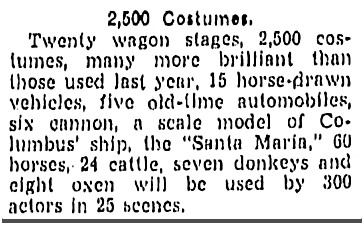
cavalcade-americas_FWST_060637Fort Worth Star-Telegram, June 6, 1937

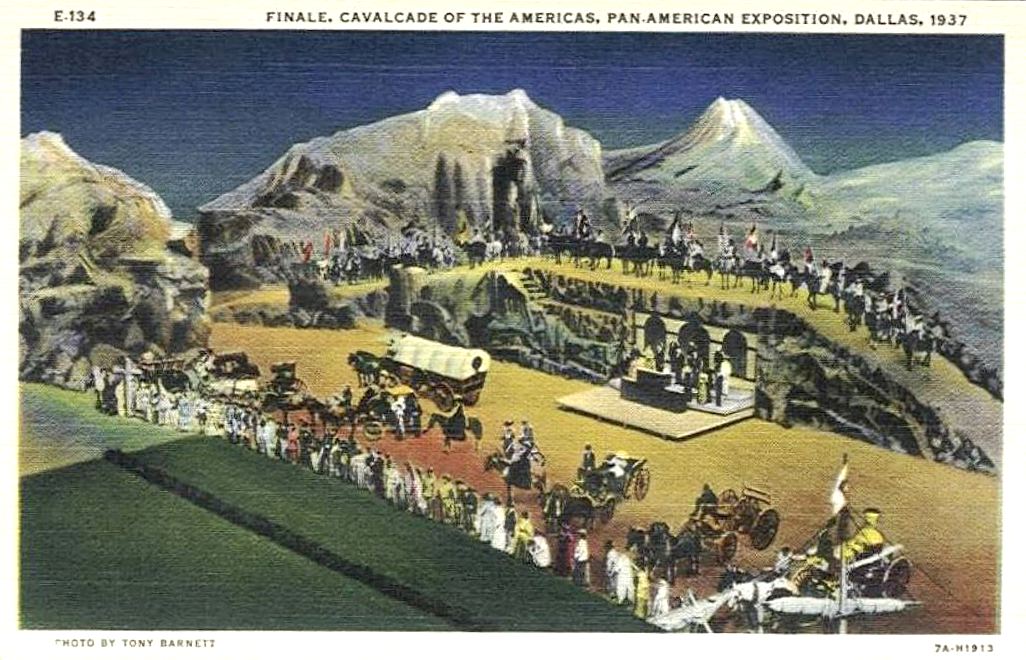
It was quite elaborate. The postcard view below will give you an an idea of the scale of what was being billed as the world’s biggest stage.(I  believe the whole thing revolved — or at least part of it did — with another stage on the side facing away from the audience; the scenery, cast, and perhaps the donkeys, would change out before revolving to face the audience.)

cavalcade_1937

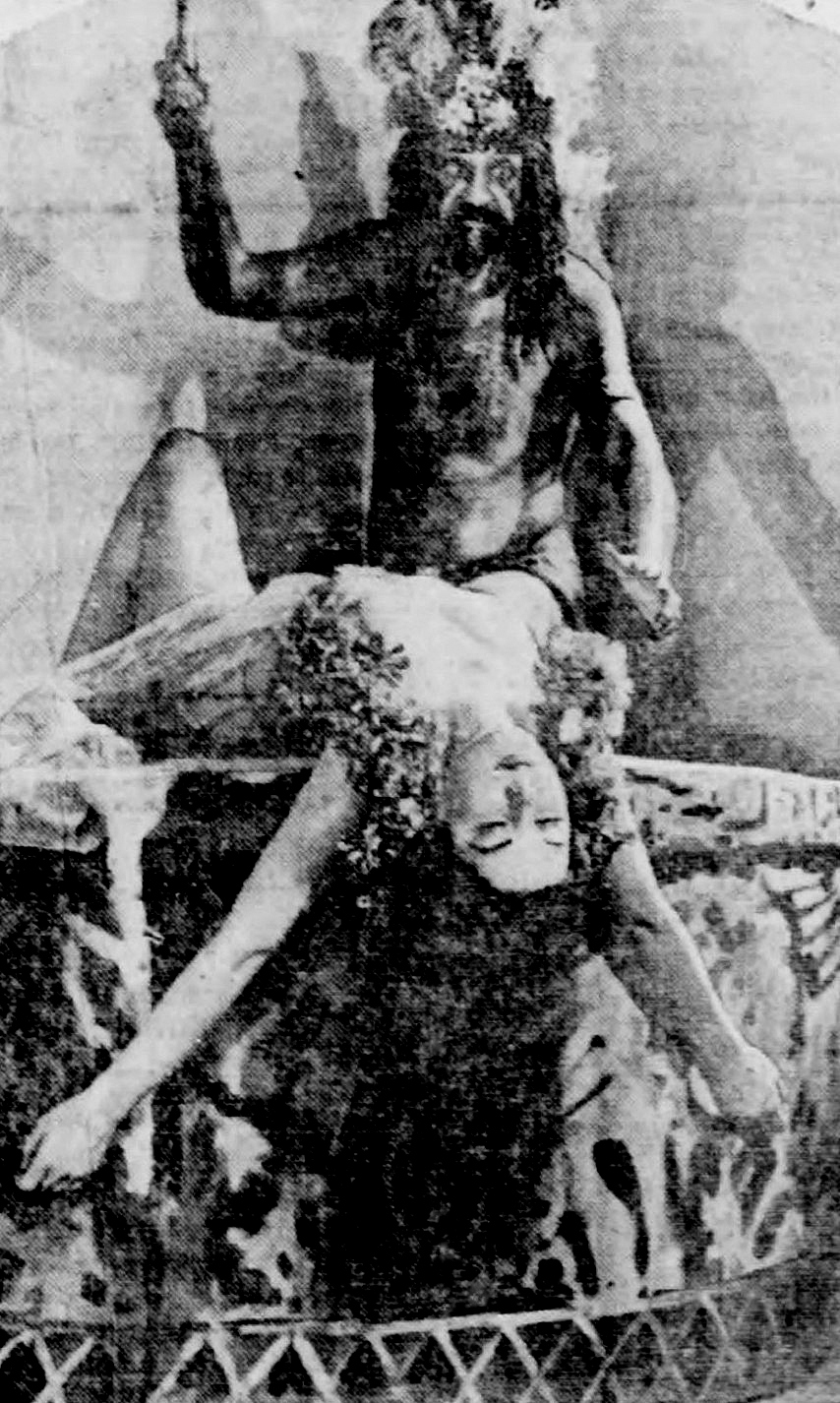
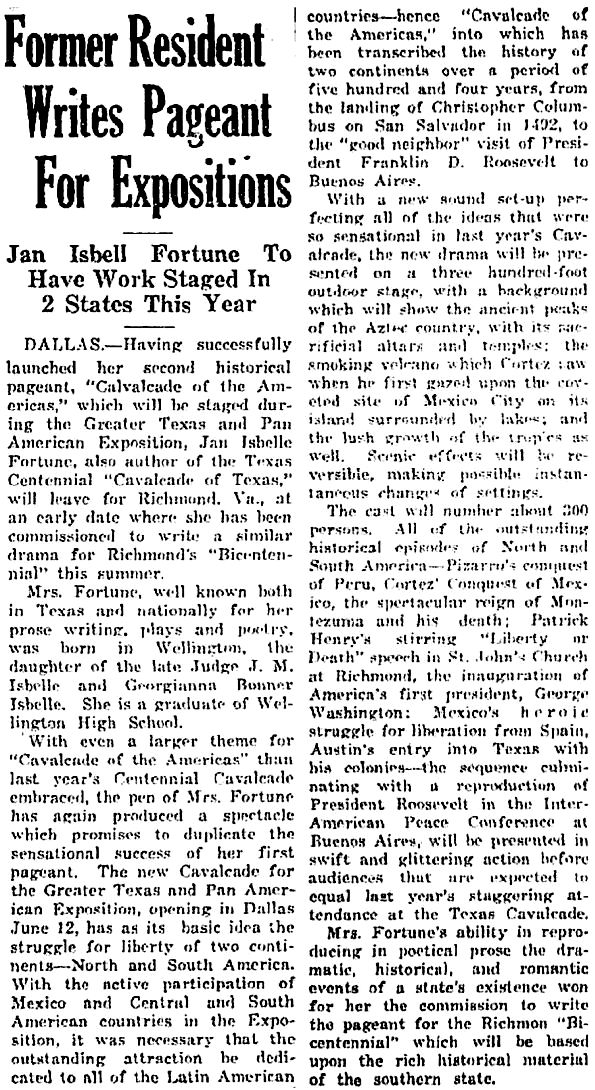
The opening scene featured an Aztec sacrifice and an angry volcano. Start big! This relatively brief portion of the show caused a lot of headaches (and/or much-welcomed publicity) for the producers, State Fair organizers, and, probably, the image-conscious Dallas Chamber of Commerce. But why? As originally written (by the remarkably prolific Jan Isbelle Fortune), the Aztec sequence involved the sacrifice of a struggling young maiden atop a blood-stained pyramid. Two months before the opening of the Expo, a rather sensationalistic photo of this historical reenactment appeared in the pages of newspapers across the country, no doubt resulting in raised eyebrows and whetted appetites. (Click to enlarge!)

aztec_greencastle-indiana-daily-banner_080437Greencastle (Indiana) Daily Banner, 1937

The star of this scene was 17-year-old Geraldine Robertson, who had been crowned Queen of the Centennial the previous year and who played a multitude of roles in the current production, including Cortés’ “lover and interpreter,” a young woman in a Boston Massacre scene, Martha Washington, and the wife of Jim Bowie. Here she is in real life in 1936, with Jean Harlow platinum-blonde hair, posing for one of a seemingly endless number of publicity photos.

robertson-geraldine_queen-of-centennial_1936Geraldine Robertson, 1936

And the thing that caused so much trouble? Probably not what you would assume.

Before the Exposition opened, the Dallas-based Mexican Consul, Adolfo G. Dominguez, became aware of this casting choice. And that was when the mierda probably first hit the ventilador. Dominguez was adamant that the virgin be replaced with the more historically accurate male warrior. He probably said much the same thing to the Cavalcade producers when confronting them about his concerns before the Expo began as he did when he said this in a Dallas News article on the topic weeks later:

“We Mexicans feel that use of a girl in the role can bring nothing but racial prejudice and misconception of the true meaning of the Aztec human sacrifice as it was performed, not thousands of years ago, as has been wrongly represented, but as late as 1521.” (DMN, July 28, 1937)

The producers acquiesced, and when the Exposition began its run on June 12, 1937, the opening scene of the Cavalcade did, in fact, feature a sacrificial warrior. But on Sunday, July 25, the producer of the extravaganza brought the scantily-clad virgin back and nixed the warrior, hoping the added sex appeal and pizzazz would increase audience numbers. (Interestingly, when the Exposition opened, tickets to Cavalcade of the Americas cost 50⊄ — about $8.00 in today’s money — but on July 18, it was announced that, except for 600 reserved seats, admission to the show would be free. Promoters said this was being offered as a gesture of goodwill to Expo visitors, but one wonders if they weren’t having a hard time filling the 3100-seat grandstand.)

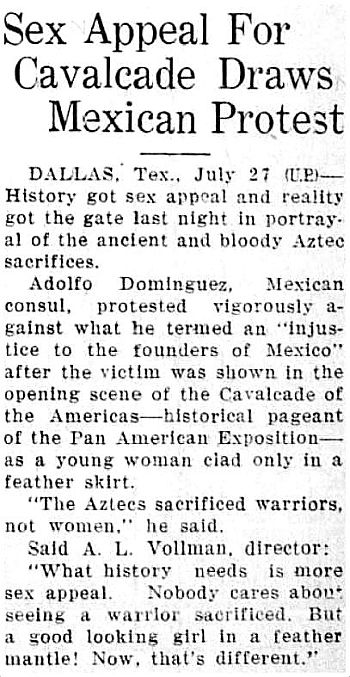
Señor Dominguez was not amused by this sexed-up revamping and protested. A. L. Vollman, the Cavalcade’s producer-director pooh-poohed the diplomat’s protestations and responded in true impresario fashion: “What history needs is more sex appeal.” That didn’t go over particularly well with the consul, who thought he’d already dealt with the problem weeks before. (Click to see larger image.)

aztec_waxahachie-daily-light_072737Waxahachie Daily Light, July 27, 1937

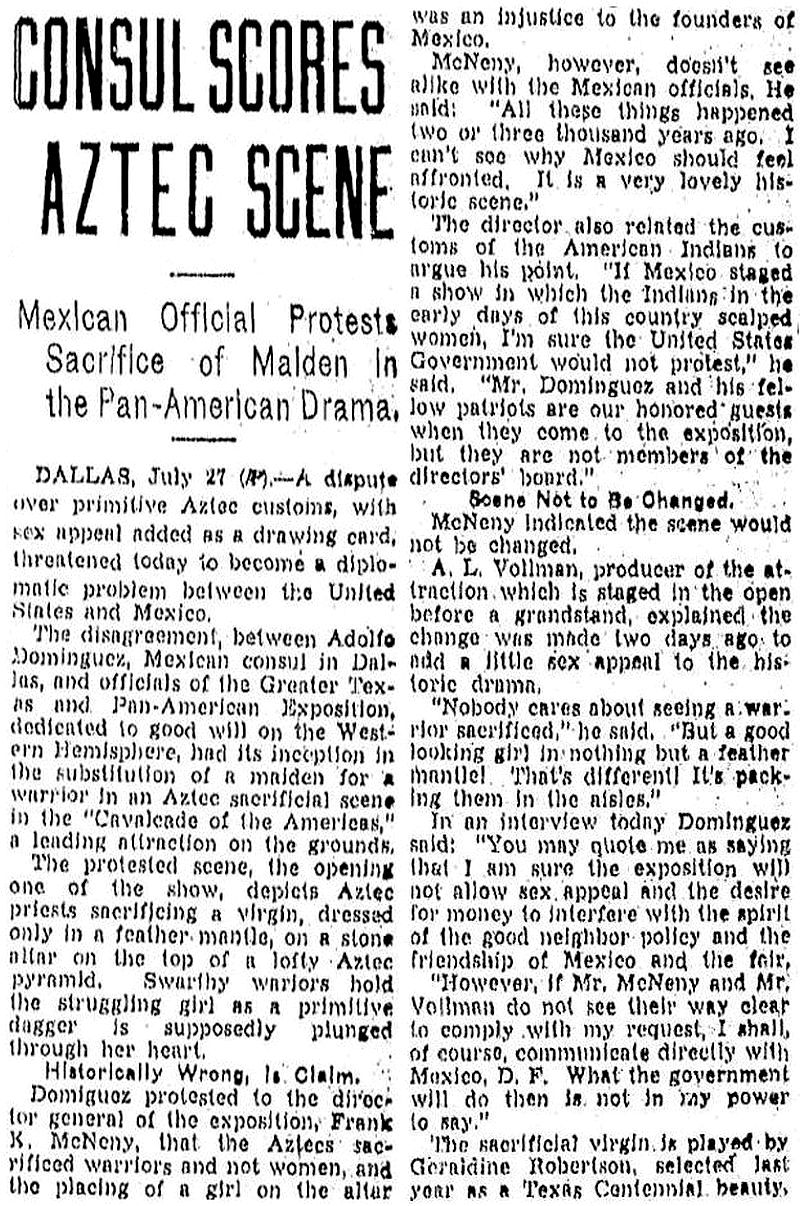
Dominguez complained to Frank K. McNeny, Director General of the Exposition, saying that the scene was historically inaccurate and was an injustice to the founders of Mexico. McNeny disagreed, saying that the scene involving the plunging of a dagger into the breast of a sacrificial virgin was “a very lovely historic scene.” He declined to bring back the warrior, because, as Vollman noted, the revamping had increased attendance: “It’s packing them in the aisles.” An exasperated Dominguez said that if the change from maiden back to warrior was not made, he would take the matter to the Mexican government.

aztec_FWST_072837FWST, July 28, 1937

At this point, a disagreement over the gender of a character in what was, basically, an oversized school history pageant was dangerously close to setting off an international incident. It was also causing embarrassment for local civic leaders who were looking upon the Exposition as a major marketing tool for the city as well as a symbolic display of Pan-American solidarity and goodwill. Can’t we all just get along, amigo?

The refusal of the Cavalcade to UN-revamp the show did not deter the Mexican Consul who, by now, was probably more het-up than ever. Dominguez decided to go over McNeny’s head. He pulled out the written agreement he had made with fair officials back in the spring — which clearly stated that a male warrior and NOT a young woman would feature in the theatrical human sacrifice — and he took it to the top man, State Fair president Fred F. Florence. Florence discussed the matter with his board of directors who voted “to a man” to uphold the original agreement.

The warrior would be reinstated as the writhing victim on the bloody sacrificial stone. The sexy maiden would have to hand over the 30-foot-long robe, which had been made from 9,000 feathers and which had trailed behind her as she was carried up the great pyramid at Tenochtitlán. The actor playing the warrior was probably happy to get back in the spotlight. Geraldine Robertson, the virgin who had trailed that robe, was relegated to a role as a daughter of Montezuma.

Presumably the dagger kept plunging into the flailing warrior’s heart twice nightly for the remainder of the show’s run, and the memory of that short-lived international squabble was quickly forgotten (…until now).

And they all lived happily ever after. / Vieron felices por siempre.

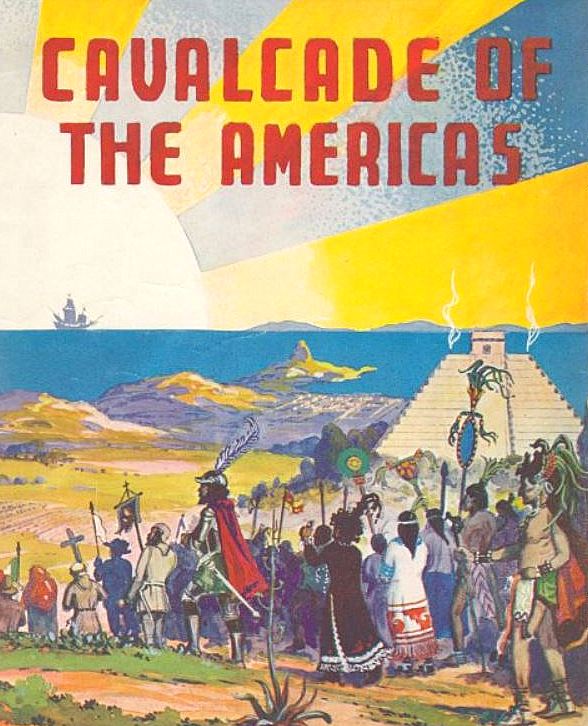
panamerican_cavalcade_watermelon-kid

*

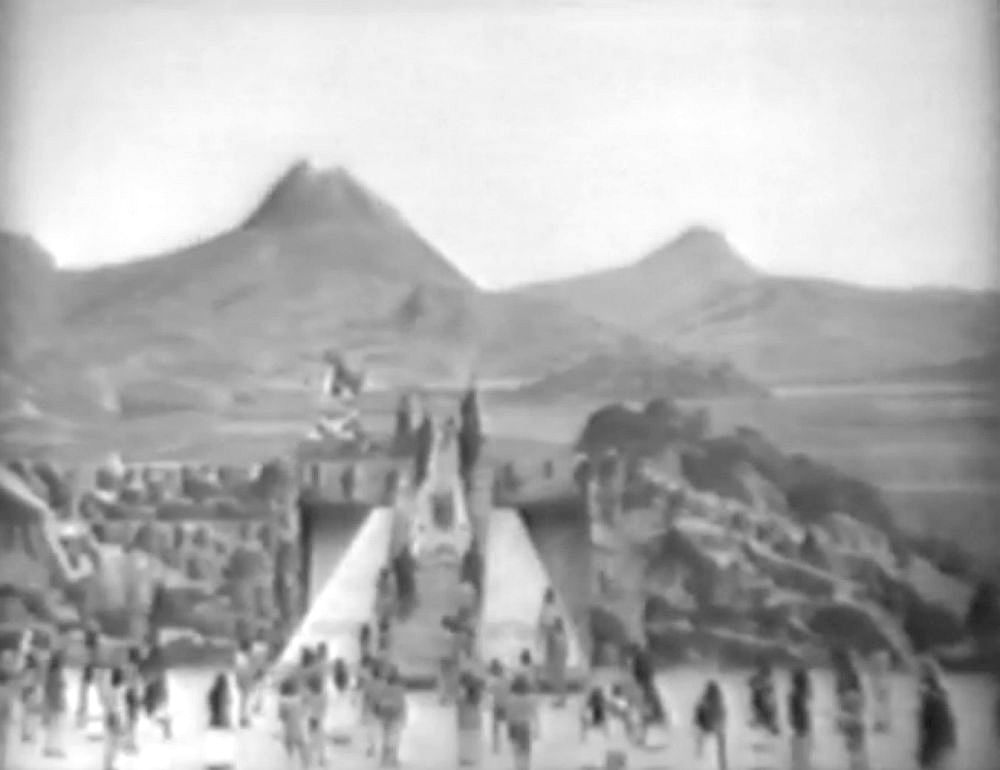
Hey! If you’ve read this far, here’s a little reward. A Universal Newsreel titled “Pan-American Exposition Is Opened For 1937, Dallas, Tex.” — which contains 20 whole seconds of the Aztec (warrior) scene!  — can be viewed on the T.A.M.I. (Texas Archive of the Moving Image) site, HERE. The entire short newsreel is interesting (sadly, it has no sound), but if you want to jump to the sacrifice scene, it begins at the :49 mark. (If you’re watching on your desktop, make sure to click the little square just to the left of the speaker icon beneath the viewing area to watch it full-screen.

aztec_newsreelSuper-grainy screenshot from the Universal newsreel, 1937

***

Sources & Notes

Postcards of the Pan-American Exposition are from “the internet.”

Color souvenir program image from the Watermelon Kid site; background on the Pan-American Exposition can be found on the same site, here.

All other clippings as noted.

Related Dallas Morning News articles:

  • “As Sacrificial Virgin, Star of Cavalcade Put In Showy Opening Act” (DMN, July 26, 1937)
  • “Cavalcade Dispute Is Won by Consul As Virgin Is Replaced” (DMN, July 28, 1937)

Below, an interview with Jan Fortune on her Cavalcade of the Americas; it appeared in her hometown newspaper, The Wellington (Texas) Leader on March 18, 1937. She also wrote the Centennial’s big production, Cavalcade of Texas, the previous year, in 1936.

jan-isbell-fortune_wellington-tx-leader_031837

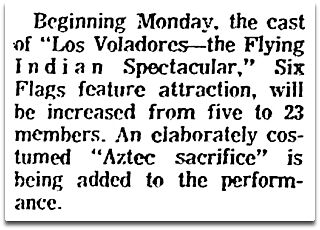
And, speaking of Aztec human sacrifices in DFW (a phrase I don’t believe I’ve ever written…), the following tidbit was contained in an article about Six Flags Over Texas’ 1970 season.

aztec_FWST_052170-six-flagsFWST, May 21, 1970

Promotional material about Los Voladores — a group of aerialists from Mexico — informs us that in their show “a beautiful maiden’s life is given as tribute to Tlaloc, the rain god.” Those beautiful maidens can’t catch a break. Sorry, Adolfo.

*

Copyright © 2015 Paula Bosse. All Rights Reserved.

Snag Boat Dallas — 1893

snagboat_dplSnag Boat Dallas of Dallas, Trinity River

by Paula Bosse

“Snagboat.” It’s a great word. And if you’ve taken even a glancing look into the history of the Trinity River, you’ve probably come across it. What is it? According to the Wikipedia entry, it is “a river boat, resembling a barge with superstructure for crew accommodations, and deck-mounted cranes and hoists for removing snags and other obstructions from rivers and other shallow waterways.” If you’re from Dallas, “shallow waterway” will immediately bring to mind our very own Trinity River, which, unless it’s flooding, you probably rarely even think of as being an actual river. But Dallas money-men have tried their damnedest for what seems like EVER to make the Trinity do what they wanted it to do.

In the late 19th century, a group of Dallas businessmen organized the Trinity River Navigation and Improvement Company and began to sink large sums of money into it. The goal was to make the Trinity navigable for large boats between the Gulf of Mexico and Dallas. They knew that if they could open this waterway to vessels carrying all manner of freight that they could make a lot of money. A lot.

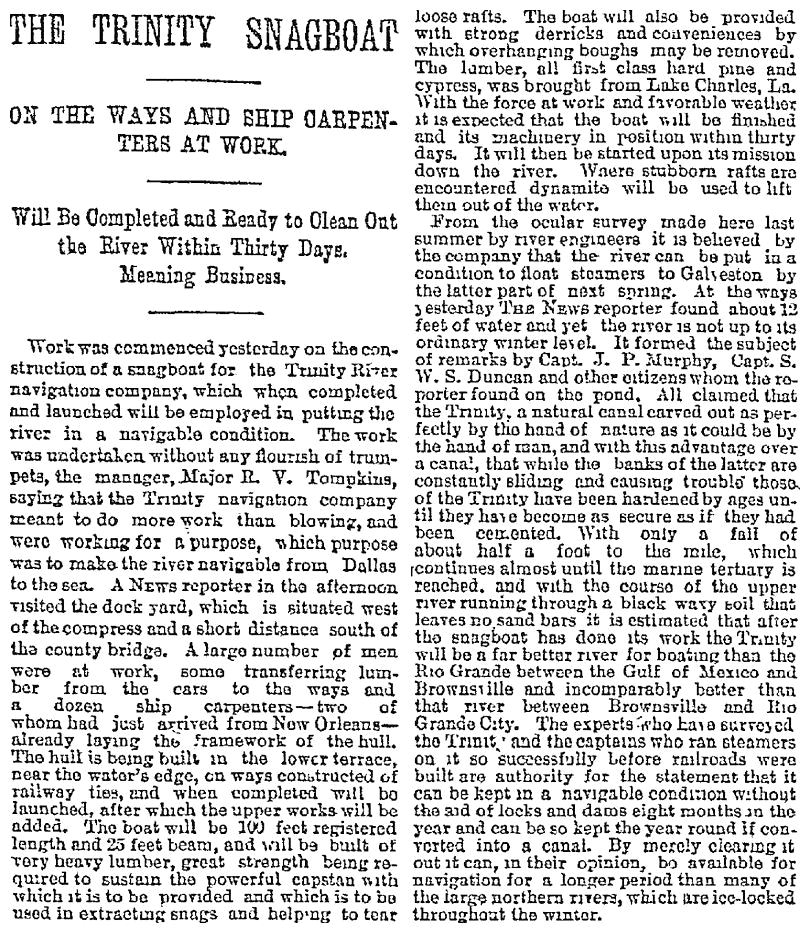
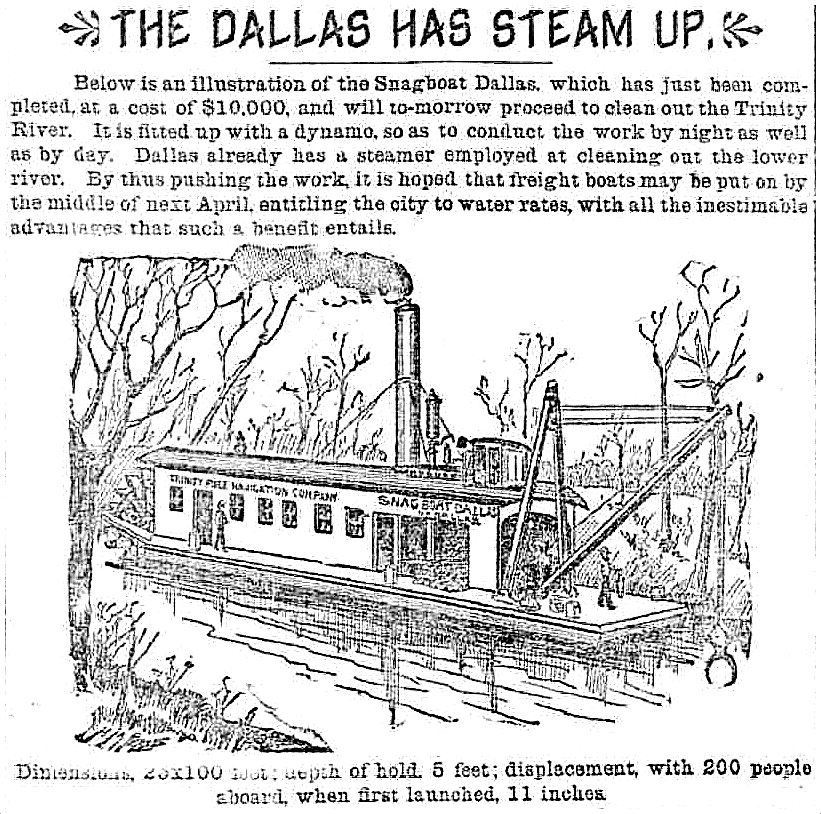
In order to make the Trinity navigable, it first had to be cleared of all sorts of impassable debris in it, on it, over it, and along it. The stretch of the river around the soon-to-be inland port of Dallas was particularly snarled with all sorts of things making passage of large boats through its waters impossible. A snagboat was needed, and construction on the Snag Boat Dallas of Dallas began in November of 1892.

snagboat_dmn_112692Dallas Morning News, Nov. 26, 1892

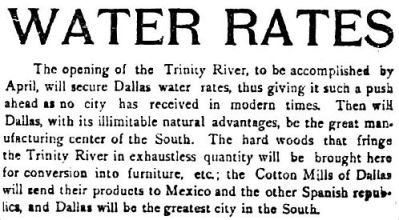
The construction of the boat was followed closely in the Texas papers, and giddy ads/editorials like this one were filling the pages of Dallas newspapers.

ad-water-rates_dmn_011593DMN, Jan. 15, 1893

“Water rates” — charges for freight shipped via boat — were lower than the rates charged by railroads. Were the Trinity able to support freight traffic, this new competition would mean that railroads would lower their rates, and the savings for manufacturers and builders would  be substantial. As a result, manufacturing and building in the city would boom, and before you knew it, Dallas would become “the greatest city on Earth in the South”!

A few days before the official launch of the boat, reporters, businessmen, and the public were invited to a preview. An interesting account in The Galveston Daily News described the boat’s machinery (which included a “liquid battering ram”) and took the reader on a tour of the crew’s quarters (which had separate sleeping and dining areas for black and white crew members, per the “Separate Coach Law” of 1891).

snagboat_galveston-daily-news-021993Galveston Daily News, Feb. 19, 1893

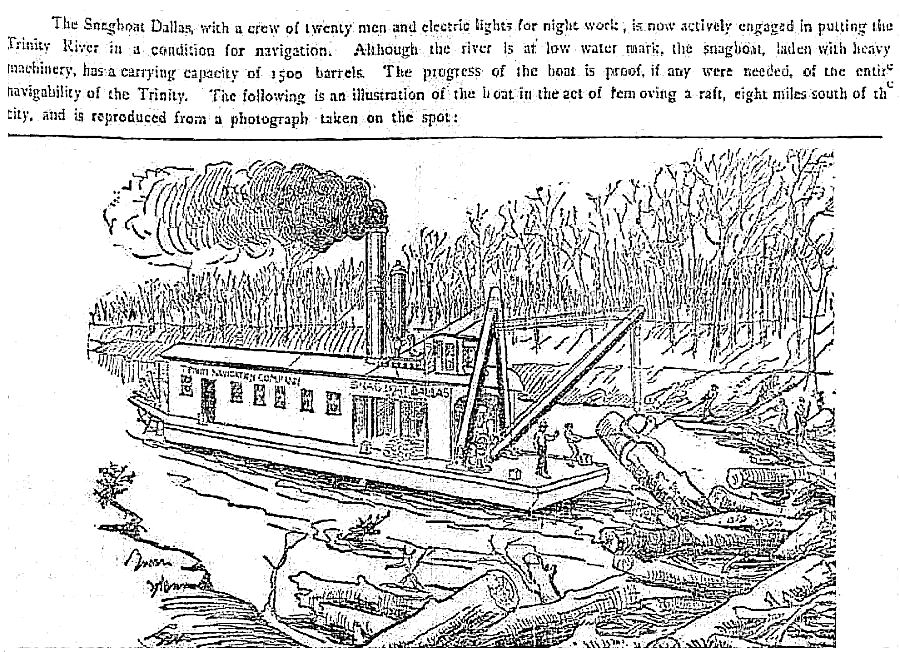
The boat began its snagging work in February, 1893, and, in order to keep readers abreast of all Snag Boat Dallas developments, there were almost daily updates on its progress in the newspapers, and (in lieu of photographs) Dallas Morning News illustrators provided scenes of the boat’s important work.

snagboat_dmn_021293DMN, Feb. 12, 1893

snagboat_dmn_022693DMN, Feb. 26, 1893

The celebrity snagboat succeeded in clearing the debris, and in May, 1893, the steamer H. A. Harvey, Jr. arrived in Dallas, having, yes, navigated the Trinity River from the Gulf, even though it had faced two months’ worth of difficulties along the way (problematic water levels, low bridges which had to be dismantled in order for it to pass under, underwater impediments which had to be dynamited into oblivion, etc.). When it finally pulled into Dallas — accompanied by the hard-working snagboat that had paved its way — the city shut down and had a massive celebration. The Dallas Morning News went so far as to print several of its pages in red ink (!). This proof that the Trinity River was, in fact, navigable, meant that the city was on the cusp on becoming “the greatest city in the South.” The DMN (which was not shy in its almost rabid boosterism of this project) published an editorial for those Dallasites who might “not fully comprehend” the significance of why they were celebrating.

harvey-impact_dmn_052293DMN, May 22, 1893

Dallas would become an important inland port. “It can be done.”

Except that we know that it couldn’t be done. Too many other natural forces were working against the Trinity River entrepreneurs. The Harvey and the snagboat didn’t actually do much after that tumultuous reception in 1893. Sure, they moved some small loads back and forth along the Dallas stretch of the river, but that grand vision of taming the Trinity never came to pass. Even now, more than 120 years later, it still has yet to happen. Dallas has done pretty well without the Trinity River being truly navigable, but people can’t seem to stop trying to somehow monetize it. It’s probably time we just appreciated our little section of the Trinity River for what it is: a little trickle of a river that has (so far) survived everything we’ve tried to do to it in the name of “progress.”

*

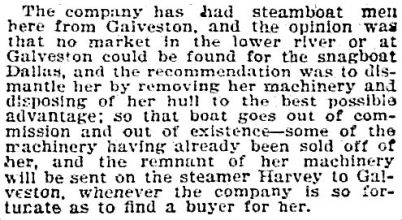
For closure, snagboat fans: the hard-working little Dallas had an ignominious end. It was tied to an old pier and left to rot on the water before it was eventually cannibalized and slowly picked apart. Its end came in January of 1898 when it was finally “broken up.”

rip_dmn_052897DMN, May 28, 1897

RIP, Snag Boat Dallas of Dallas — we hardly knew ye.

*

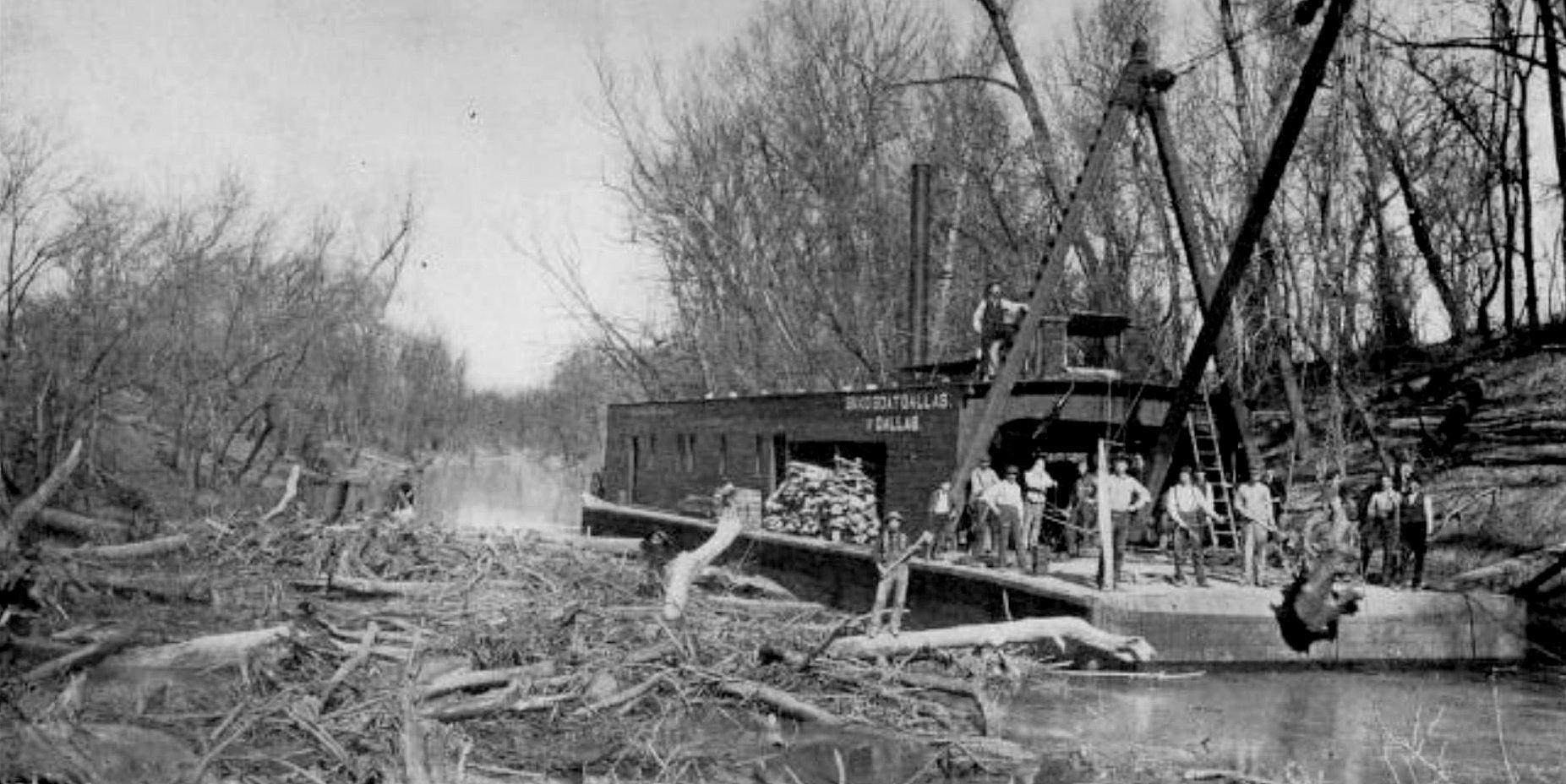
The Harvey (which quietly left town when it was sold to a Louisiana company in 1898) has gotten the lion’s share of the historical attention, but the snagboat is the one that did all the work. Here are two more photos of the Dallas and its crew taking a break from snagging to pose for posterity.

snagboat_dfwurbanwildlife

The photo below shows just what the crew of the snagboat was up against. The caption was written by C. A. Keating, president of the Trinity River Navigation Company.

snagboat_keating_1890s

snagboat-caption_keating

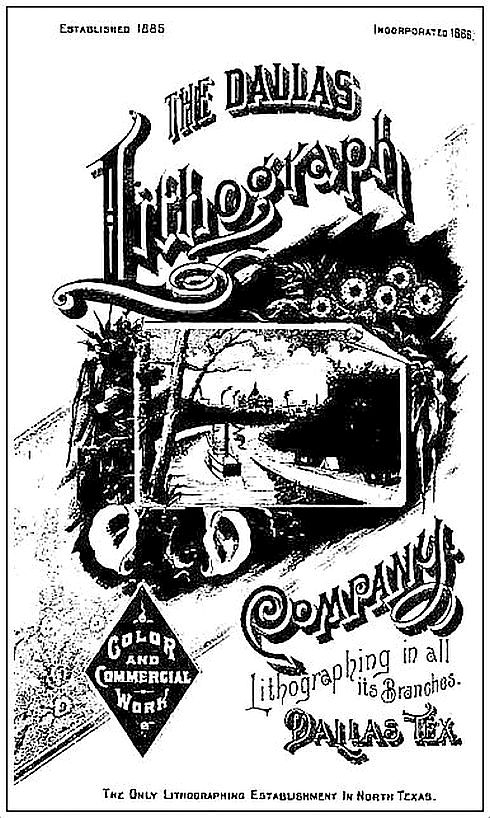
And, finally, what prompted me to find out more about the snagboat in the first place: this ad for the Dallas Lithograph Company from the 1893 city directory. It featured an illustration of a little boat chugging along on the idyllic (and blissfully snag-free) Trinity River, with the Old Red Courthouse in the background and a little tent pitched on the bank. I wasn’t all that familiar with snagboats, but that’s what I thought it looked like. I’m sure it’s supposed to be something grander, but I’ll think of it as a snagboat anyway.

ad-dallas-lithography-co_1893-directory-det

ad-dallas-lithograph-co_1893-dir1893 Dallas directory
***

Sources & Notes

I came across the top photo (which is from the archives of the Dallas Public Library) on the web page for the 99% Invisible podcast, here. I was so enthralled with the pictures on this page that I didn’t even realize until just now that there was a podcast to listen to, called “The Port of Dallas” — about this very topic! Listen to it at the top of the page — it’s very entertaining. I think Julia Barton and I were separated at birth!

There are lots of other photos on that page, including a photo of the H. A. Harvey, Jr. and a photo showing what the Dallas Morning News looked like printed in red.

Second photo of the Snag Boat Dallas is from the DFW Urban Wildlife blog, here. More great photos there!

The final photo of the Dallas and the photo’s caption are from C. A. Keating’s autobiography, Keating and Forbes Families and Reminiscences of C. A. Keating (Dallas: self-published, 1920).

All other clippings, as noted.

To read about how people have tried and tried and tried over the years to make the Trinity River do what they wanted it to do — and failed — read the article “Navigating the Trinity, A Dream That Endured for 130 Years” by Jackie McElhaney (Legacies, Spring 1991), here.

UPDATE: I swear I was completely unaware of Julia Barton’s podcast about the “Port of Dallas” when I wrote this post, but I’m happy to report there is ALSO a video, from a presentation she did at the TEDxSMU talks in October. Watch it here. (Thanks, for alerting me to that this, Julia — my “internet twin”!)

*

Copyright © 2015 Paula Bosse. All Rights Reserved.