Flashback : Dallas

A Miscellany: History, Ads, Pop Culture

Category: Holidays/Celebrations

“Life” at the State Fair of Texas — 1951

fair-park-midway_life_1951On top of the world, 1951

by Paula Bosse

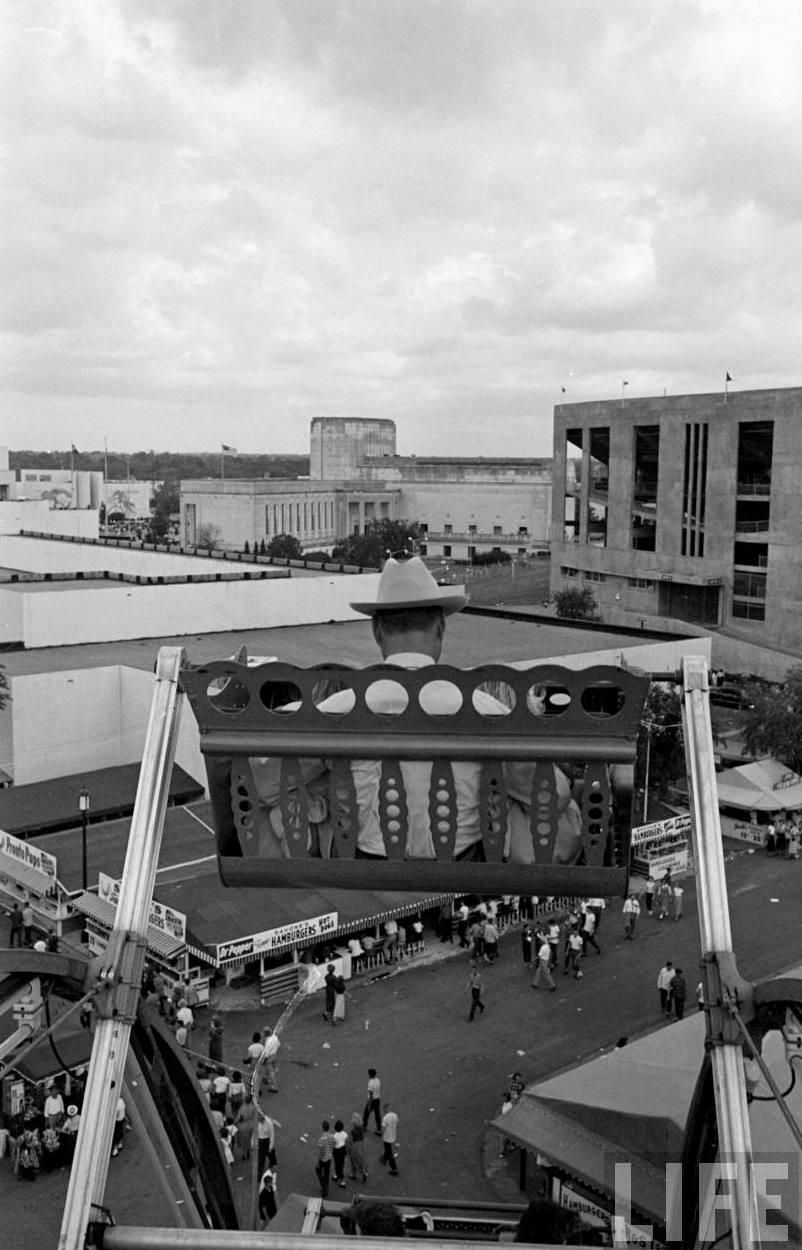
A Life magazine photographer moseyed down to Dallas in 1951 and captured a couple of cool shots of the State Fair. The photo above (so sweet, and one of my favorite Midway shots ever) was captioned:

In Dallas a rancher takes the kids for a ride in a 92-foot-high double Ferris wheel.

The photo below shows a tractor-pulled tram (fare: 15 cents) as it wheels past the Hall of State, full of well-dressed men and women. (That kid in the boots, cowboy hat, and letterman jacket … had I been around in 1951, I would have had a big ol’ crush on him.)

Click both of these wonderful photos to see larger images. You can practically smell the Brylcreem and cotton candy.

fair-park_tour_life_1951Life magazine, 1951

***

Sources & Notes

Both photos taken at the 1951 State Fair of Texas for Life magazine by an uncredited photographer. The top photo (cropped differently) ran in the Oct. 22, 1951 issue of Life as part of a feature titled “It’s a Bumper Year For Fairs” — it was the only photo that appeared in the magazine shot at the Texas fair. The bottom photo did not run in the magazine.

*

Copyright © 2014 Paula Bosse. All Rights Reserved.

Parade Day — 1909

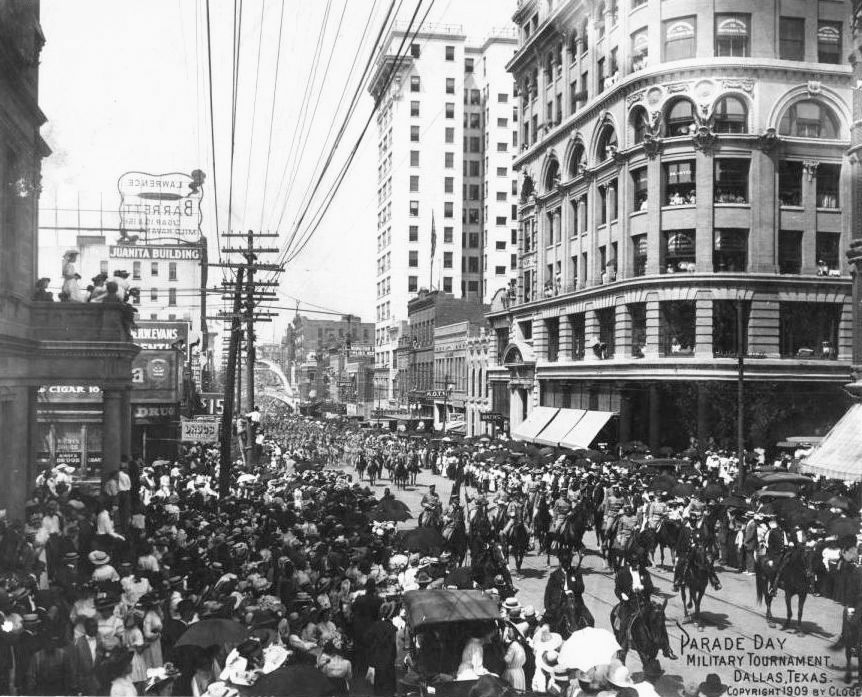
parade-day_1909_clogenson_degolyerMain Street looking west from Ervay, 1909

by Paula Bosse

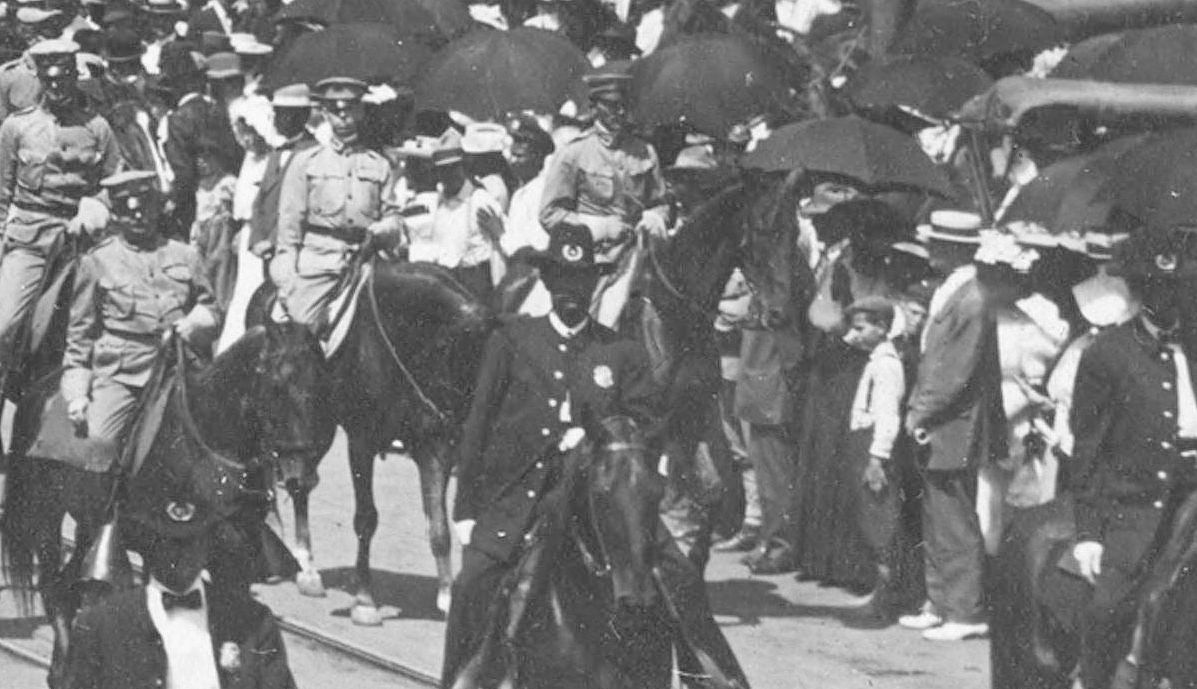
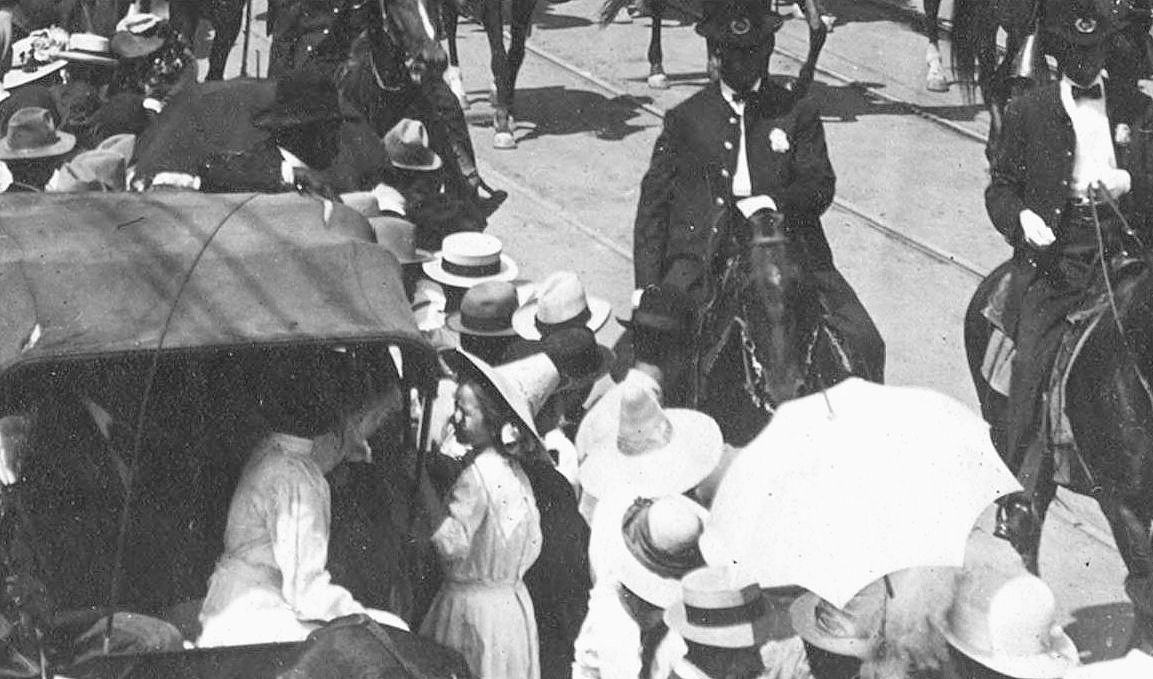
Sun-bronzed, khaki-clad soldiers representing the three important branches of the army, paraded through the city evoking the admiration of 60,000 persons who lined the streets all the way from Fair Park to the end of the downtown business district. (Fort Worth Star-Telegram, Aug. 24, 1909)

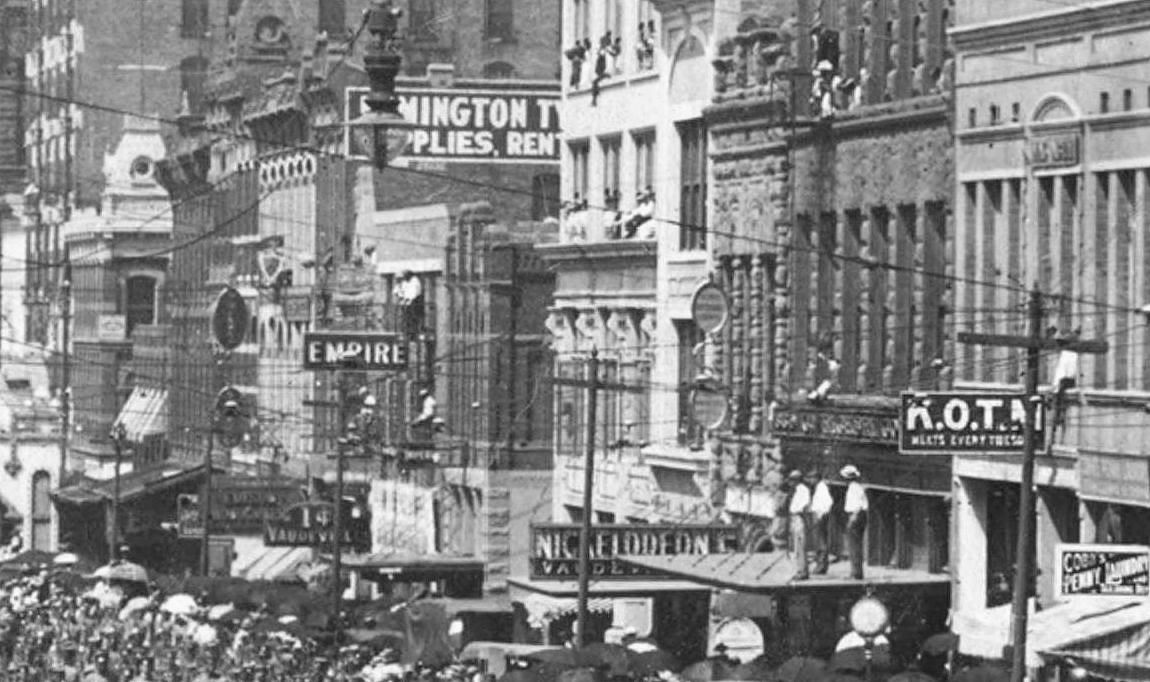
This is a GREAT photograph, looking west on Main Street from Ervay, with the Wilson Building in the foreground at the right, and, a few doors down, the tall white Praetorian Building at Stone Street. With so much going on in this photo, it’s a great opportunity to zoom in on the crowd and look a little more closely at the details. (All photos are much larger when clicked.)

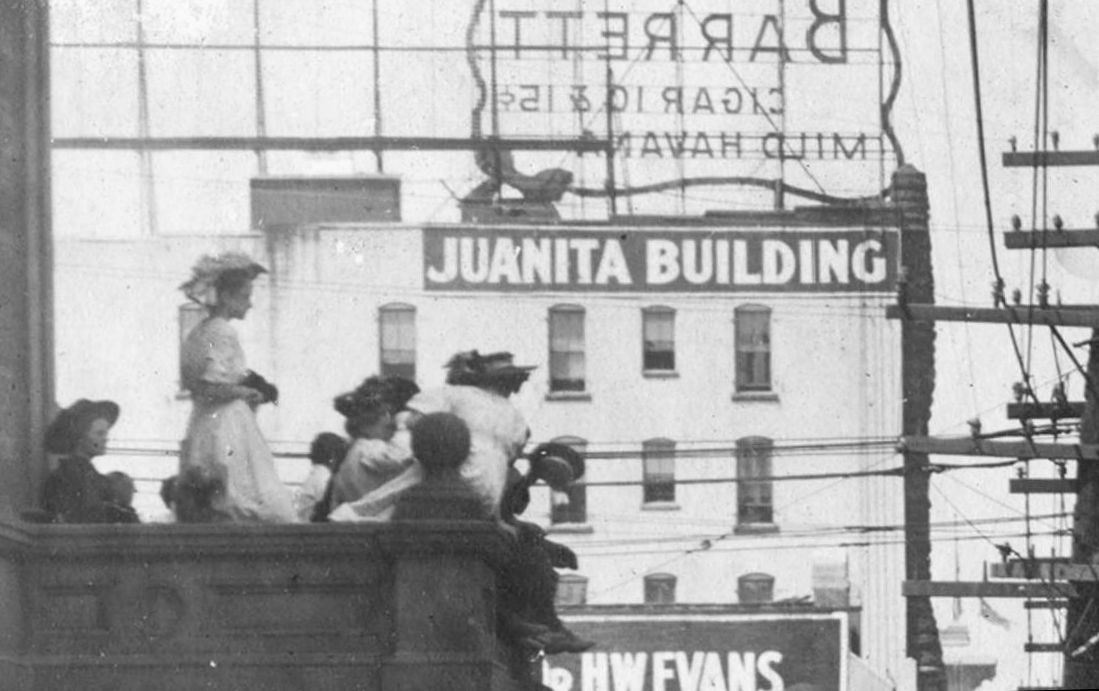
parade-day_1909_det1My favorite “vignette” from this photograph, with the Juanita Building in the background.

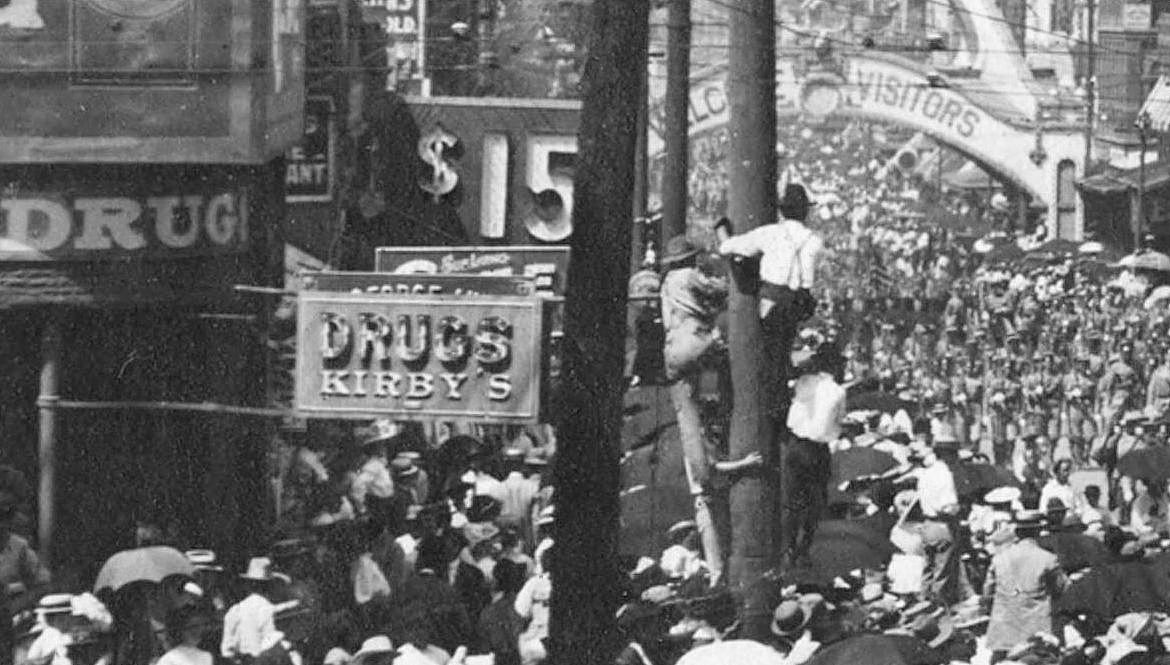
parade-day_1909_det2Dedicated parade-watchers. The Elk’s Arch welcoming visitors spans Main Street, a holdover from the 1908 Elk’s convention.

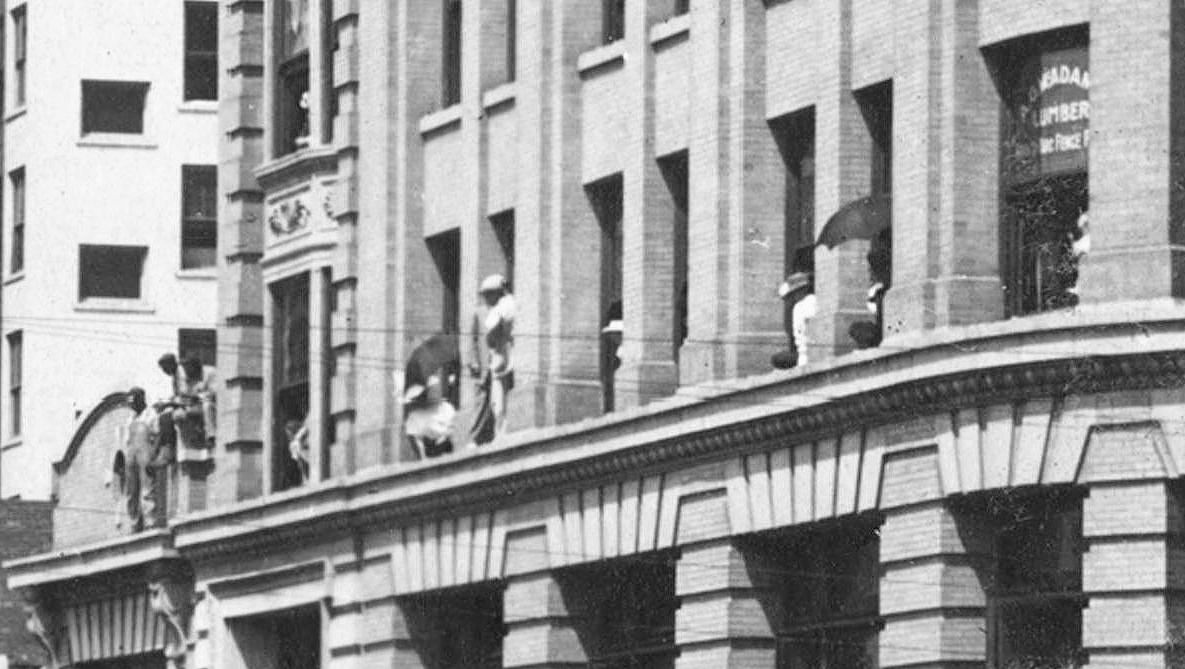
parade-day_1909_det3The dark-colored three-story building behind the three men in white shirts standing above the crowd (1611 Main) was demolished yesterday, Sept. 21, 2014. (A better view of the full building can be seen in the post “1611 Main Street — Another One Bites the Dust,” here.)

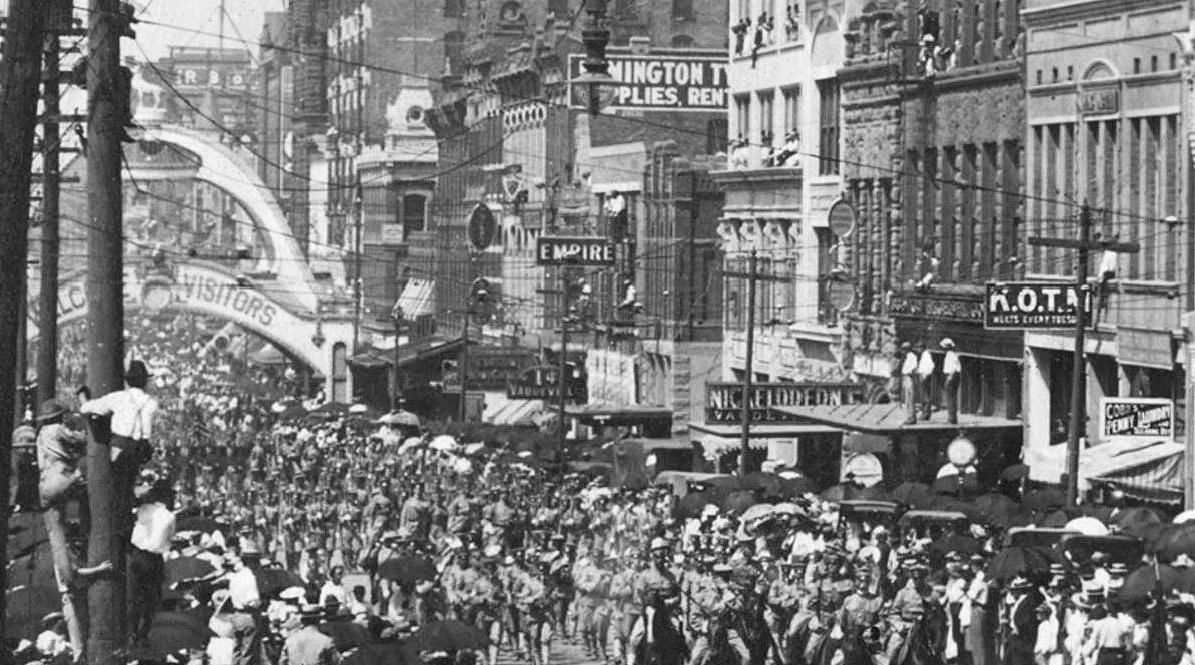
parade-day_1909_det4Note the vaudeville theaters.

parade-day_1909_det4aWorkers in the Wilson Building with a pretty great, unobstructed view.

parade-day_1909_det5When this photo was taken, Labor Day was fast approaching — that guy had two more weeks to wear those shoes.

parade-day_1909_det6Watching from shaded splendor.

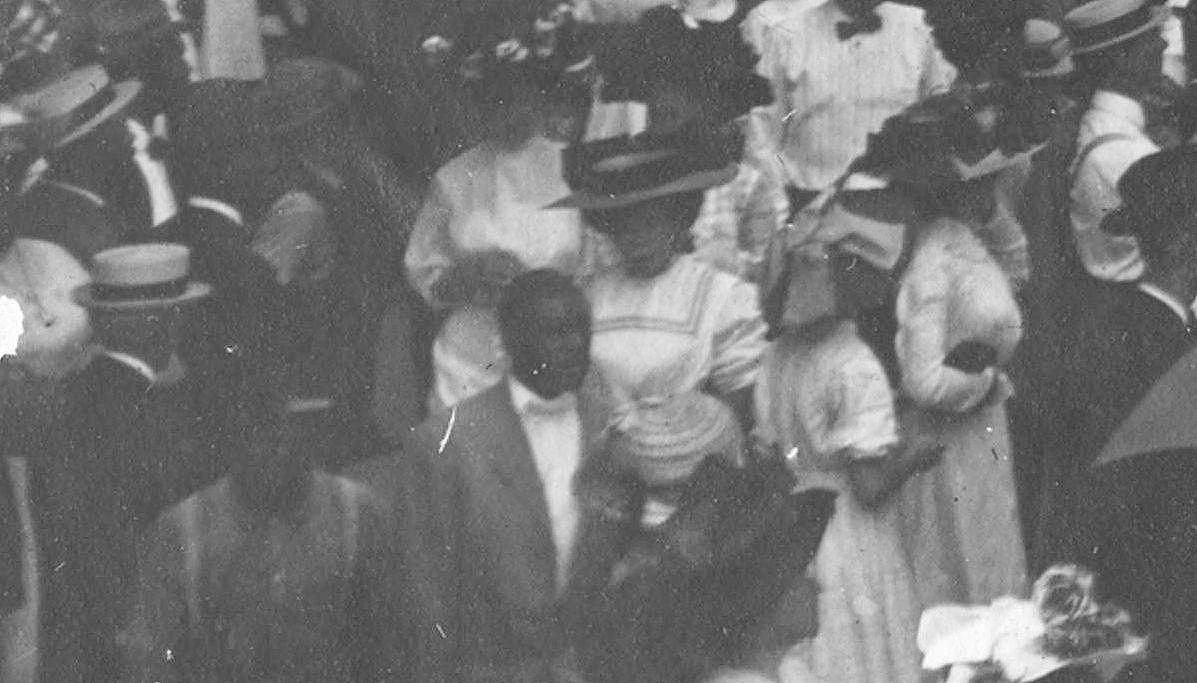
parade-day_1909_det7Big hats, cinched waists, and African American bystanders.

***

Sources & Notes

Original photo by Clogenson, titled “Parade Day, Military Tournament, Dallas, Texas,” taken August 24, 1909; in the collection of the DeGolyer Library, Central University Libraries, Southern Methodist University. The photo can be viewed here.

Newspaper articles describing exactly who was involved in the parade and why it was happening can be read in the easily digestible report from the Fort Worth Star-Telegram, here, and the drier, more comprehensive report from The Dallas Morning News, here (each opens as a PDF). (This photo accompanied the DMN article.)

See other photos I’ve zoomed in on, here.

*

Copyright © 2014 Paula Bosse. All Rights Reserved.

“Howdy, Y’all!”

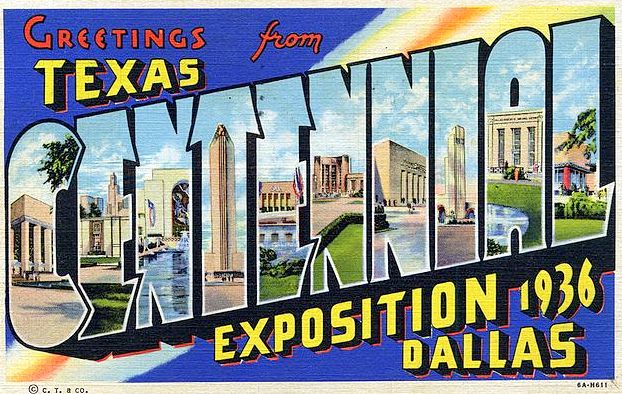
tx-centennial_postcard_1936

by Paula Bosse

Thanks so much to the fine folks at The State Fair of Texas for the Throwback Thursday social media love today! They graciously shared our Texas Centennial posts. Welcome, new visitors!

And don’t forget, Big Tex is counting down those days….

***

State Fair of Texas website is here. Get ready, y’all!

*

Copyright © 2014 Paula Bosse. All Rights Reserved.

Neiman-Marcus Brings France to Big D — 1957

neiman-marcus_french-fortnight-poster_1957

by Paula Bosse

In 1957, Neiman-Marcus presented their very first Fortnight celebration — a tribute to France, which included filling the department store with French products and couture, hosting celebrated fashion icon Coco Chanel on her first visit to Texas, promoting French culture and tourism, and even elaborately decorating the outside of their downtown building to resemble the Rue du Faubourg Saint-Honoré. It was a huge success, and it became a much-anticipated annual event in Dallas.

n-m_french-fortnight_stanley-marcus-papers_degolyer-lib_SMU_color_1957A little bit of Paris on Ervay Street (via DeGolyer Library)

The Fortnights became very popular and were celebrated city-wide. There were all sorts of non-N-M events around town that tied in with whatever country was being honored that year (plays, art exhibits, lectures, etc.), and businesses soon realized that it was easy to share in the Fortnight spotlight and momentum by either blatantly or subtly customizing their advertisements to have a bit more international flavor for two weeks every year.

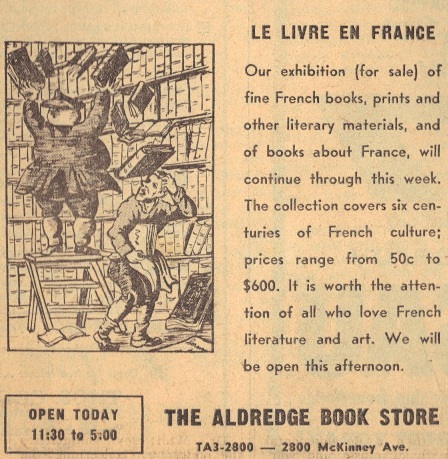
As I have a personal connection to The Aldredge Book Store, I’ll use them as an example. The ad below is one of the earliest examples of a Fortnight tie-in ad. Sawnie Aldredge, the original owner of the store, was an enthusiastic Francophile, and Stanley Marcus had been a regular customer from the day the doors opened in 1947. It seems likely that the two would have discussed the event at some point, and this type of piggy-backing seems like a mutually beneficial sales opportunity made in heaven. Even though N-M was not specifically mentioned, readers of the ad would certainly have known of the connection to the well-publicized promotion. As the Fortnights became more and more popular, everyone in town began jumping on the bandwagon, and between 1957 and 1986, the whole city went crazy for one specific country for two weeks every year. It was great. And I still miss them.

ABS_lelivreenfrance_1957“From 50¢ to $600” (1957)

***

Sources & Notes

Neiman-Marcus “France Comes to Texas” poster by Raymond Savignac.

Photograph of the Frenchified facade of the N-M building from the Stanley Marcus Papers collection, DeGolyer Library, SMU Libraries, Southern Methodist University; more information on this photo is here.

Aldredge Book Store ad from October, 1957.

One of my favorite pieces of ephemera from this first French Fortnight is a lavish advertisement insert that appeared in the October 1957 issues of American and French editions of Vogue. The 30-plus page insert has been scanned by SMU (it is in the collection of Stanley Marcus’ papers at the DeGolyer Library). It is great. If you are interested in fashion advertising of the 1950s, you’ll enjoy the sophisticated-but-fun-and-frothy art direction, seen in a PDF, here.

For an entertaining look back at the various Fortnights (including the year when Mr. Stanley & Co. had to invent a country one year when Australia pulled out at the last minute!), read “Fabulous Fortnight” by Si Dunn in D Magazine (Oct. 1984), here.

And for my previous post on Coco Chanel’s visit to Dallas (during which she attended a barbecue!), “When Coco Chanel Came to Dallas — 1957” can be found here. This wasn’t an official part of the first Fortnight, but it was a sort of prelude, preceding the 1957 French Fortnight by a month.

*

Copyright © 2014 Paula Bosse. All Rights Reserved.

4th of July Parade — Sweating in Formation

july-4_degolyerI’m parched just looking at this…

by Paula Bosse

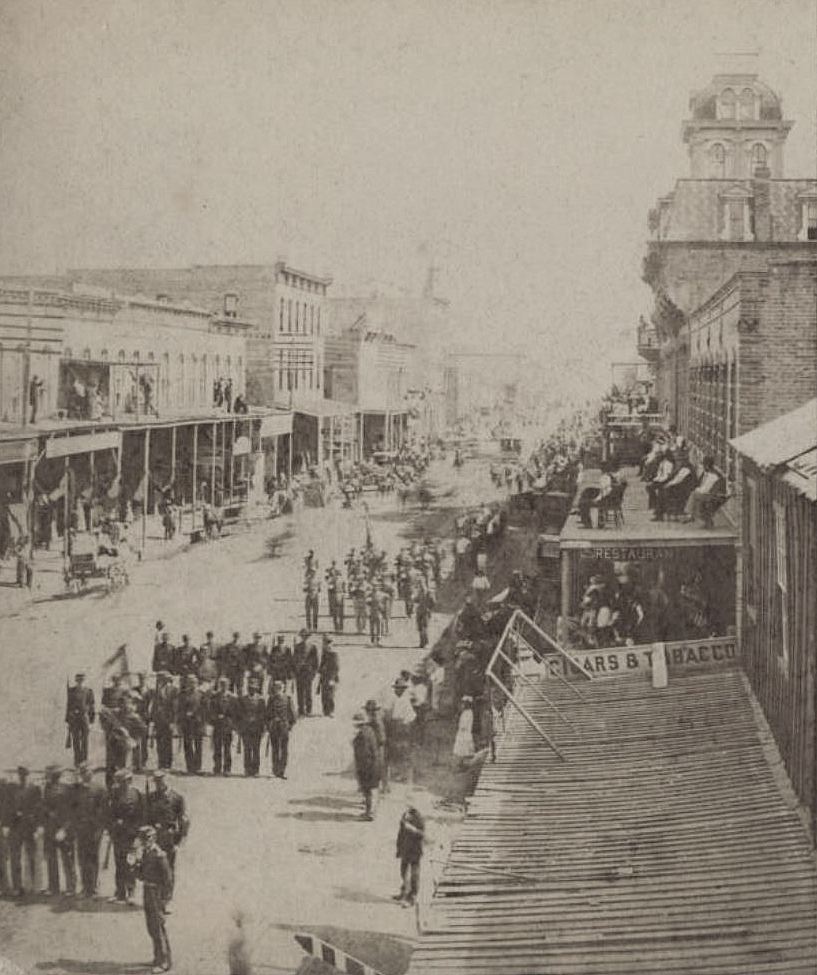
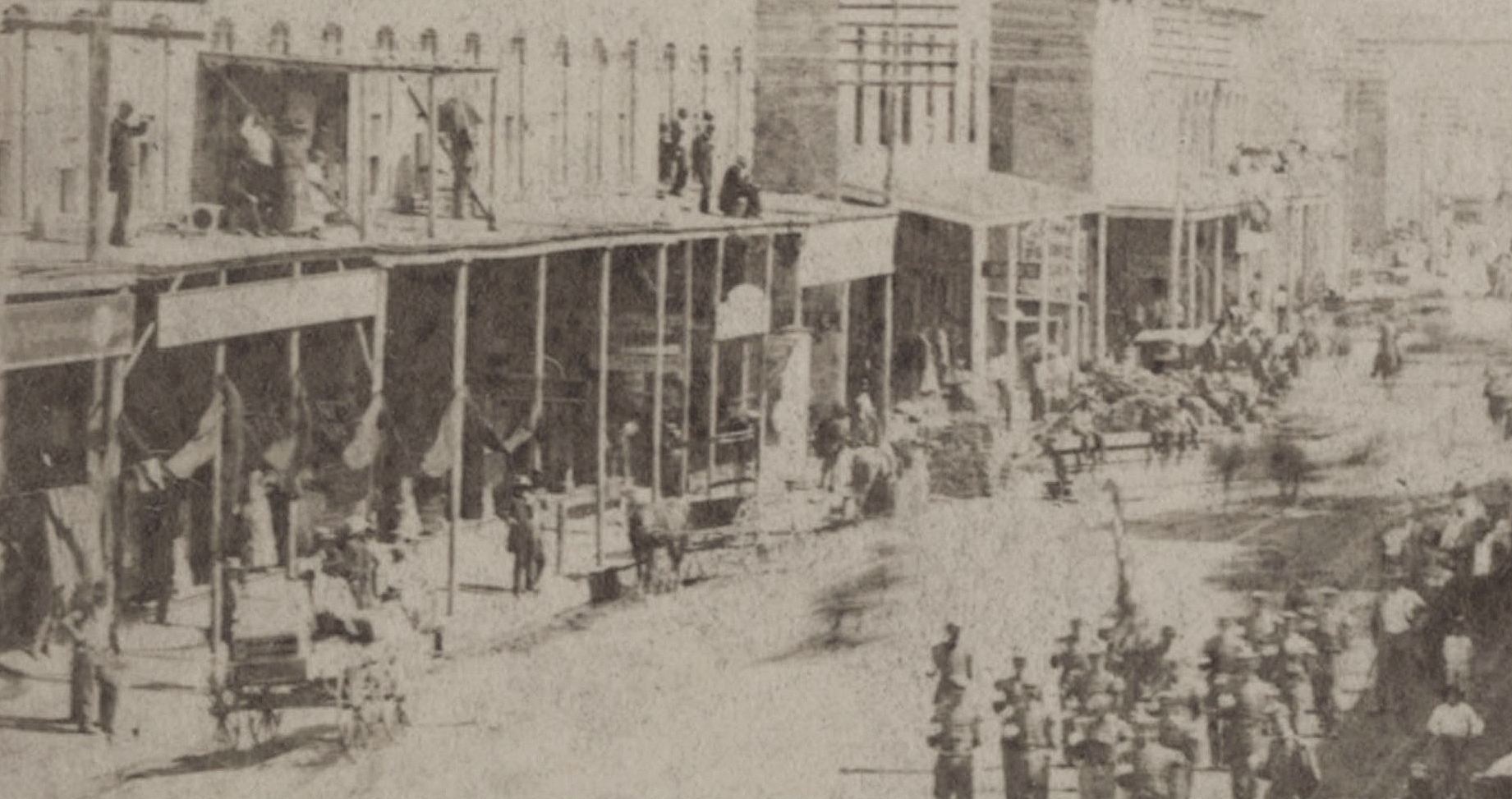
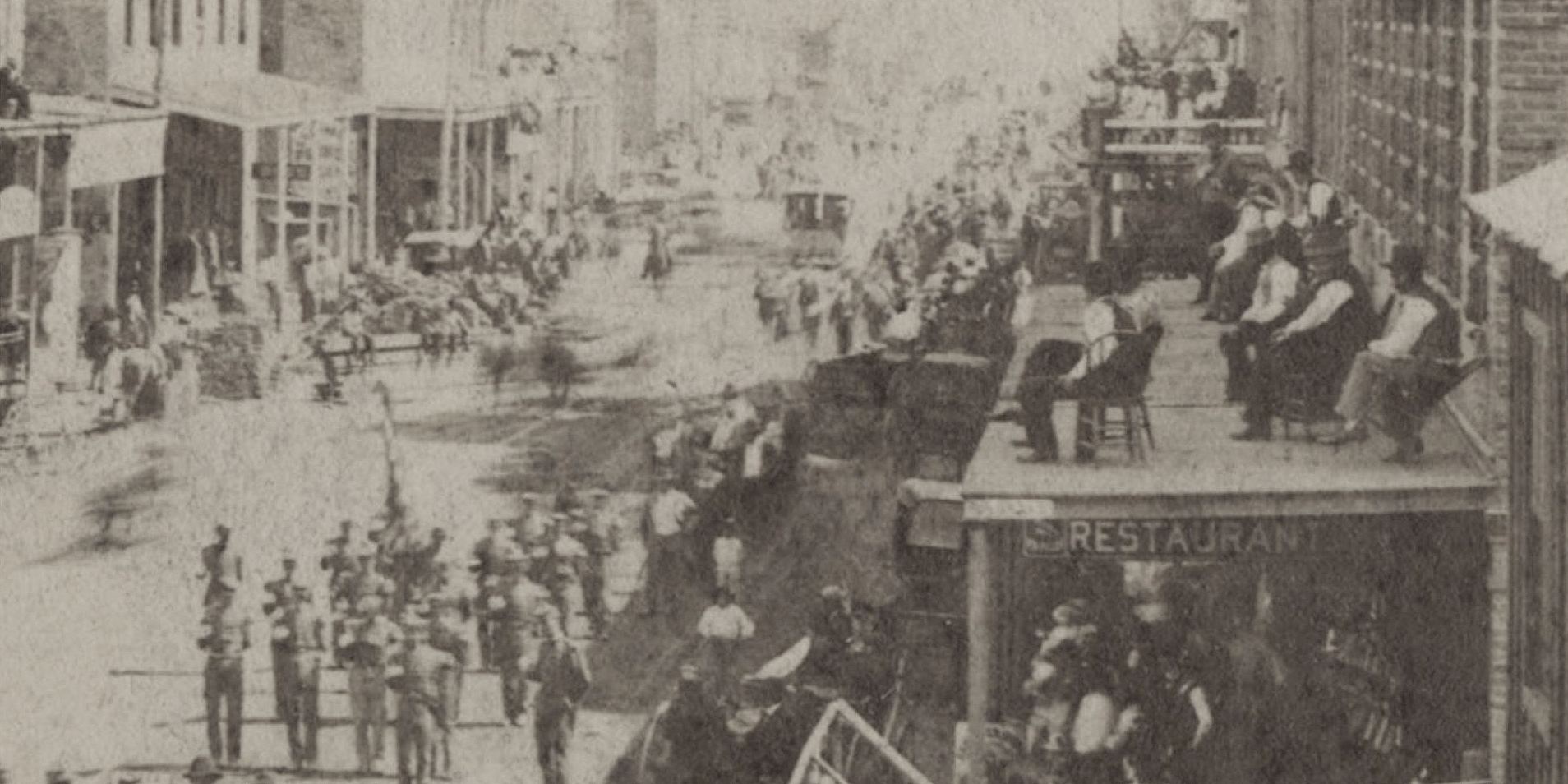
Fourth of July parade in Dallas, 1870s or 1880s. Bet it was hot in those uniforms.

Picture quality leaves a bit to be desired, but here are a few details (click for larger images).

july-4_degolyer_a

july-4_degolyer_b

july-4_degolyer_c

***

Sources & Notes

Stereograph photo by Alfred Freeman, from the Lawrence T. Jones III Collection, DeGolyer Library, SMU Libraries, Southern Methodist University; the uncropped original can be seen here.

*

Copyright © 2014 Paula Bosse. All Rights Reserved.

Juneteenth at the Texas Centennial — 1936

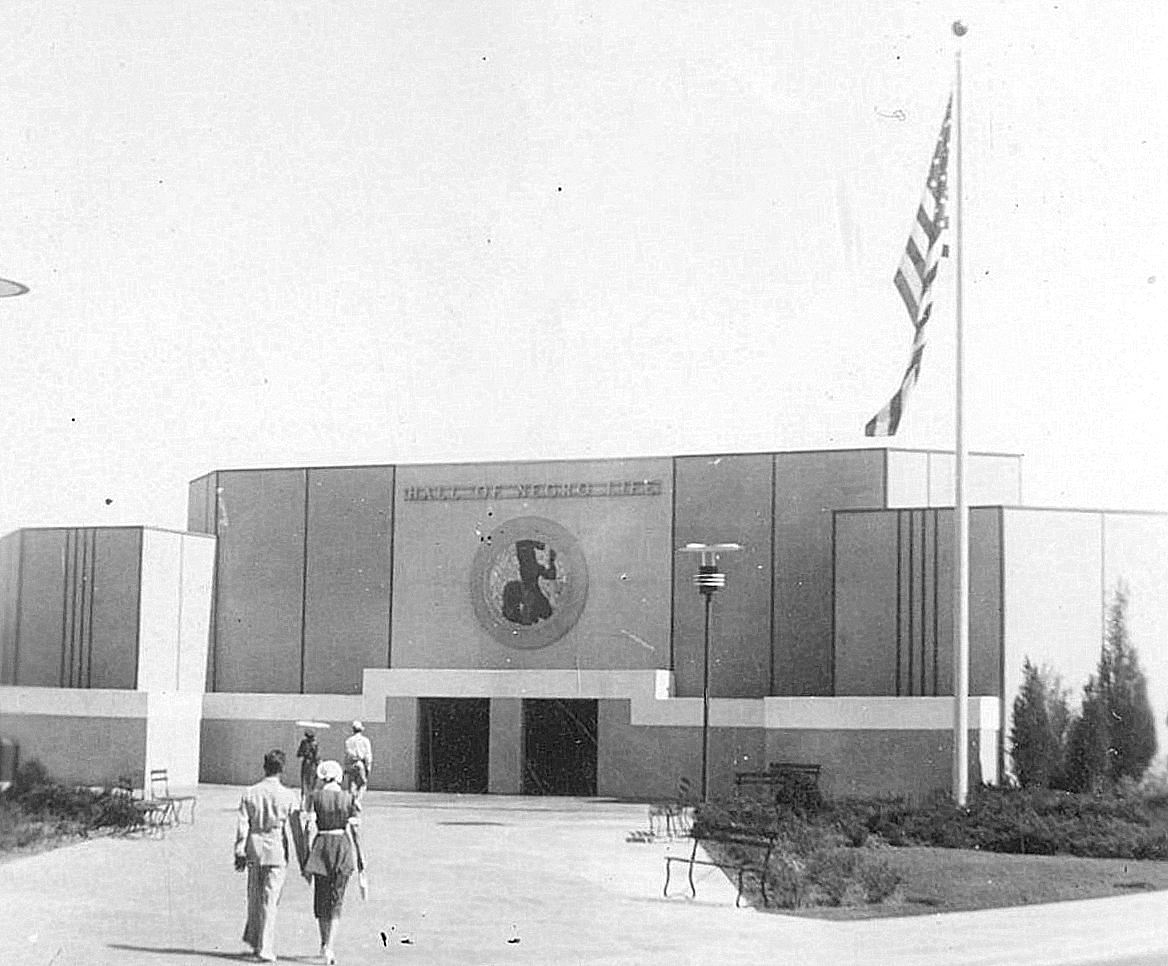
hall-of-negro-life_centennialThe Hall of Negro Life at the Texas Centennial Exposition, Fair Park

by Paula Bosse

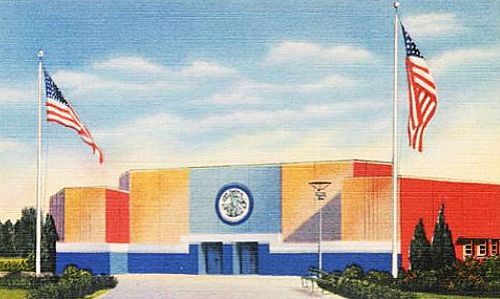
Juneteenth, the anniversary of the date that African American Texans learned they were freed from slavery, was celebrated at the Texas Centennial Exposition with a day of entertainment and exhibits. It was also the day that the Hall of Negro Life — a federally funded exhibition hall acknowledging and honoring the history and accomplishments of African Americans in the United States — was officially dedicated.

tx-centennial_hall-of-negro-life_portal

One of the more interesting things I’ve stumbled across is a drawing of the proposed building (published in J. Mason Brewer’s The Negro In Texas History in 1935). I don’t believe I’ve seen this before. It’s interesting to note the changes from original proposal to finished product.

hall-of-negro-life_proposed_the-negro-in-texas-history_1935

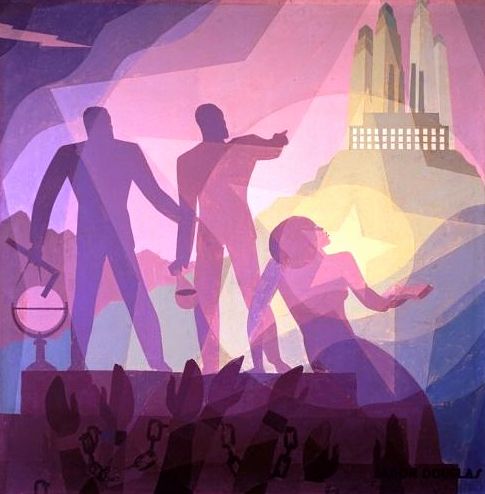
Among the large collection of art by black artists displayed in the Hall of Negro Life were four murals by the artist Aaron Douglas, depicting black history in Texas. Below are the two murals that survive, “Into Bondage” and “Aspiration.” These are incredible murals, and it must have been an emotional experience for those Juneteenth visitors in 1936 to be surrounded by all four powerful pieces in the lobby of a government-backed project that formally recognized the contributions of fellow African Americans.

aaron-douglas_into-bondage_1936_corcoran“Into Bondage” by Aaron Douglas, 1936 (Corcoran Gallery of Art)

aaron-douglas_aspiration_1936“Aspiration” by Aaron Douglas, 1936 (Fine Arts Museum of San Francisco)

***

Sources & Notes

Black-and-white photograph of the Hall of Negro Life from the Private Collection of Mary Newton Maxwell, Portal to Texas History, here.

Photo of proposed Hall of Negro Life from An Historical and Pictorial Souvenir of the Negro In Texas History, written by J. Mason Brewer (Dallas: Mathis Publishing Co., 1935).

“Into Bondage” by Aaron Douglas (1936) is from the collection of The Corcoran Gallery of Art.

“Aspiration” by Aaron Douglas (1936) is from the collection of The Fine Arts Museum of San Francisco. (There is an amazing interactive look at this painting here.)

More on the Hall of Negro Life, from the Handbook of Texas, here.

More on the Hall of Negro Life from The Crisis, the magazine of the NAACP, in the July, 1936 article “Negroes and the Texas Centennial” by Jesse O. Thomas, here.

How was this important Juneteenth celebration at the Texas Centennial covered by The Dallas Morning News? Well, the paper actually devoted a lot of space to the day’s events in a fairly lengthy article which appeared on June 20, 1936. I think the DMN editorial board probably thought they were being magnanimous in the amount of coverage given, but, really, the article — though brimming with a certain amount of probably well-intentioned jubilation — is so unremittingly racist that it’s actually shocking to see this sort of thing in print in a major newspaper. I encourage you to check out the article published on June 20, 1936 which carries the laboriously headlined and sub-headlined “Negroes Stage Big Juneteenth at Centennial; Dallas Eats Cold Supper and Cotton Patches Emptied as Thousands Inspect Magic City; Hall Is Dedicated; Dusky Beauties Prance; Cab Calloway Does His Stuff For Truckers.”

*

Copyright © 2014 Paula Bosse. All Rights Reserved.

Night Life Along the Centennial Midway — 1936

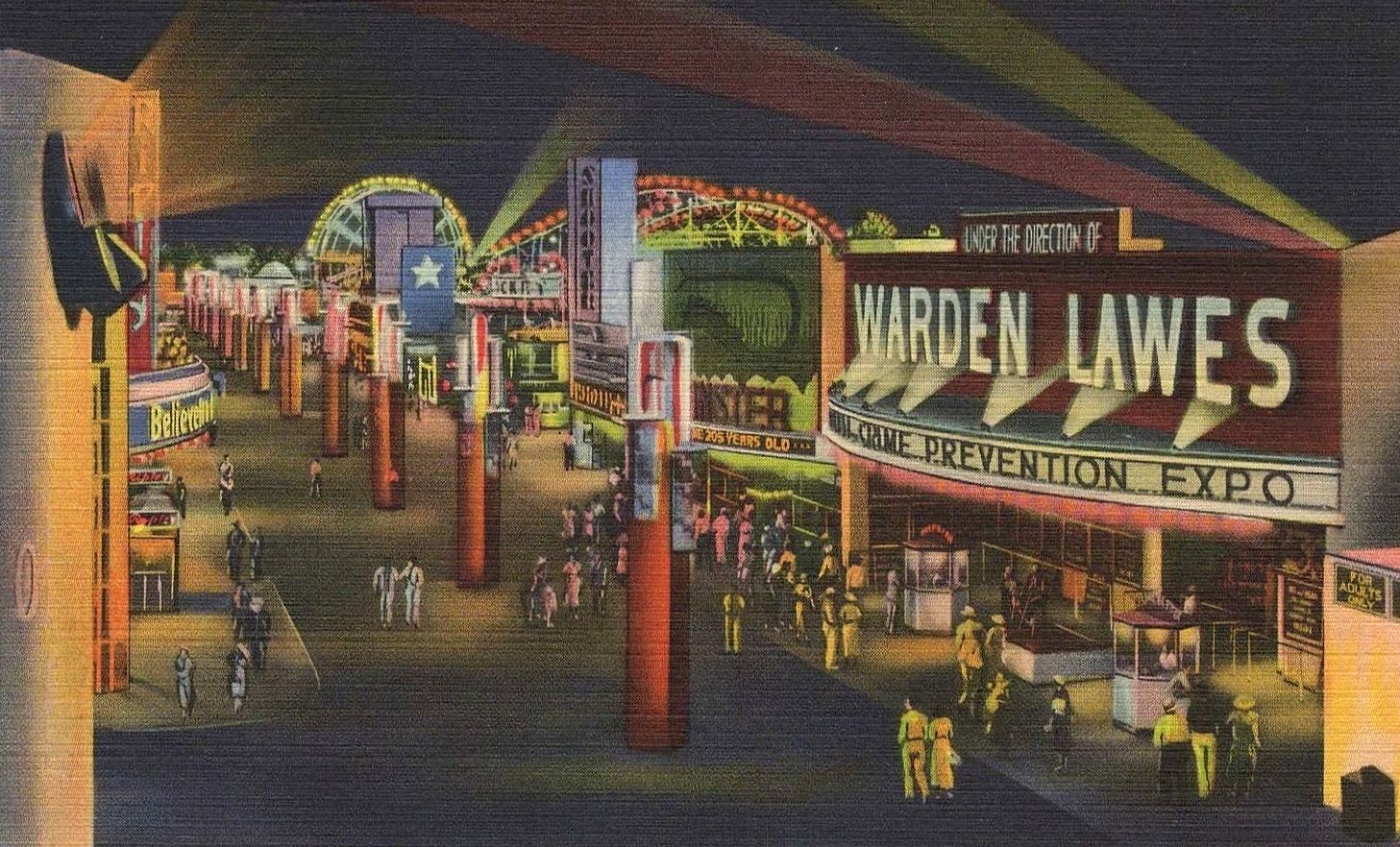
tx-centennial_night-midwayThe magical midway at night (click for larger image)

by Paula Bosse

Glamorous night shots as seen in not-quite-real-looking postcards from the 1930s and ’40s are among my favorites. And this shot, of the Texas Centennial Exposition Midway at night-time is so, so GREAT!

The text on the back of the card:

Night life in all its glory and glamour. Oddities, Animal Shows and Girl Shows to charm the most fastidious, along the Midway.

***

Compare to the shots of this stretch of the Midway from the other direction, in my previous post here.

Click picture for MUCH larger image!

*

Copyright © 2014 Paula Bosse. All Rights Reserved.

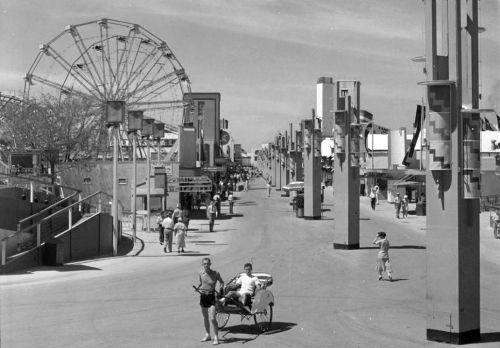
Forget the Ferris Wheel, Take a Ride in a Centennial Rickshaw — 1936

tx-centennial-midway_1936_ucrYour rickshaw awaits…

by Paula Bosse

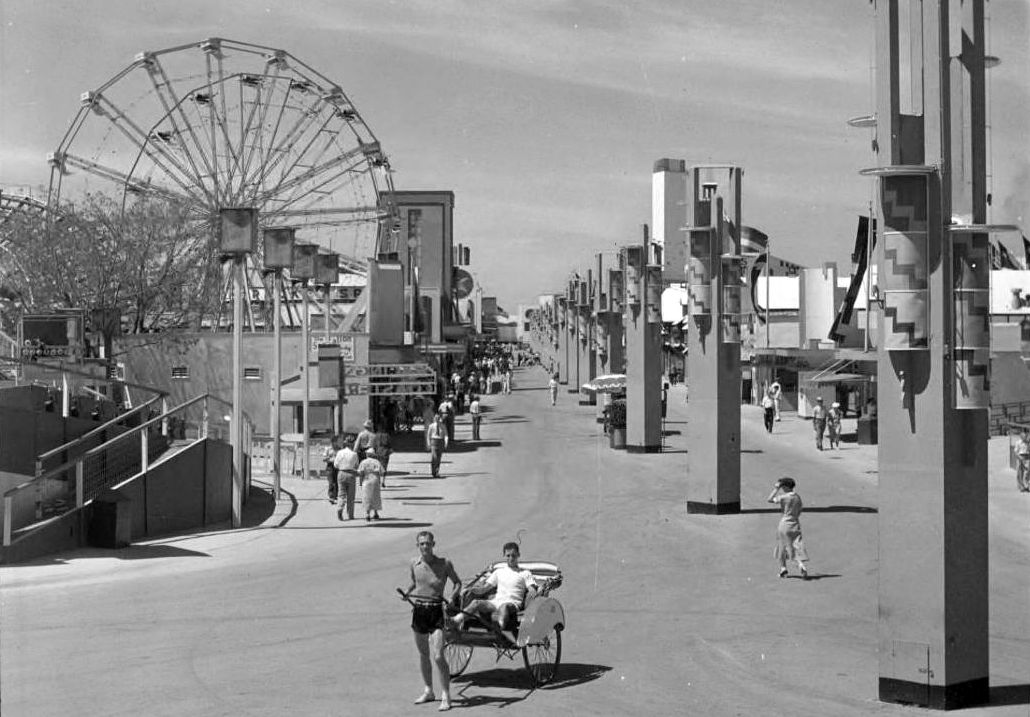
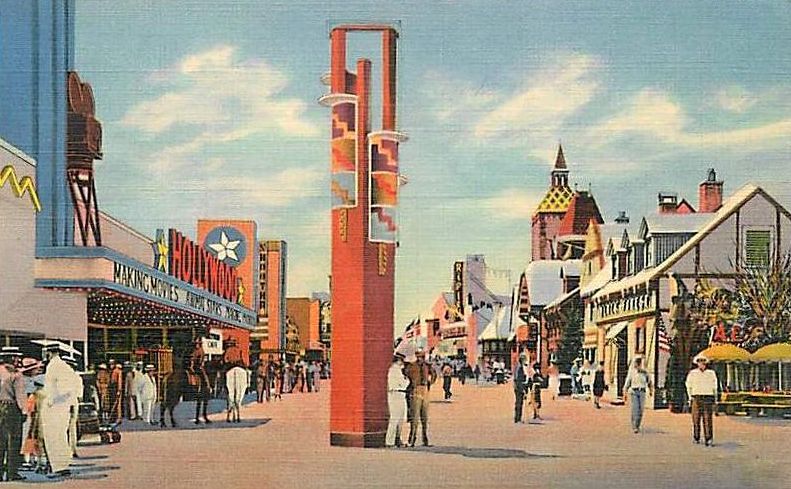
Here’s an odd photo of the Midway at Fair Park, taken in 1936. The whole thing feels a little weird. It’s just so … bright. And empty. It’s kind of bleak-looking for the glamorous Texas Centennial Exposition. And then there’s that rickshaw (?). What this scene needs is a little postcard-colorizing magic. Below, a similar scene, sans rickshaw.
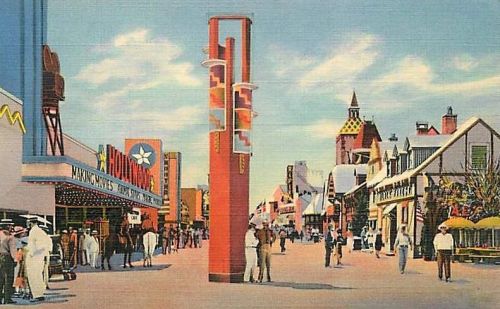
fair-park_hollywood_centennial_midway

Better … but still kind of odd.

But back to that rickshaw. According to the the Treasury of Texas Trivia, Vol. II:

The Texas Centennial in Dallas had one feature that, considering its uncountable sights and sounds that one had to take in, may very well have been forgotten. College boys, as a means of earning tuition as well as keeping in shape, pulled foot-weary fairgoers from street to street and plaza to plaza in rickshaws during the 1936 celebration of our state’s one hundredth birthday.
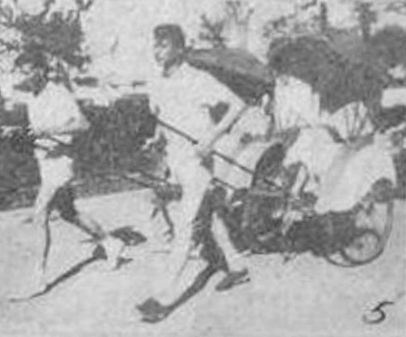
rickshaw_tx-centennial-1936

This exotic mode of transportation was even appearing in local advertisements — like this one, from an ad placed by the A. Harris department store:
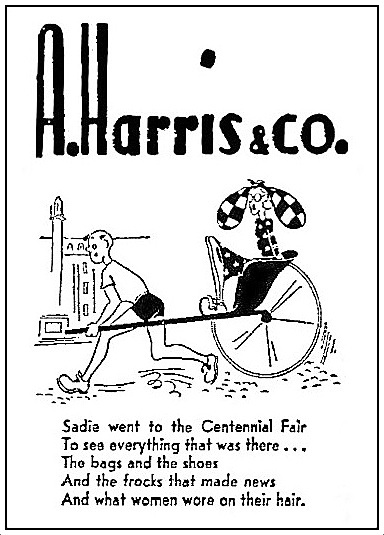
ad-a-harris_centennial_rickshaw_dmn_052536_detA. Harris ad (det) , 1936

One of the most notable rickshaw-riders of the Dallas Centennial was none other than celebrated fan-dancer, Sally Rand, whose “Nude Ranch” show (check Google for risque film footage) at the competing Frontier Centennial Exposition in Fort Worth was packing them in in Cowtown. Even Sally had to come over and check out the Centennial. The photo below shows her autographing the shorts of one of the “ricksha-toters,” a lucky young man named Guy Johnsen. The caption of the July, 1936 news photo reads:

Sally Rand, who says she never knew success until she thought of taking her pants off, autographs those of Guy Johnson [sic], her ricksha toter, on a visit to the Texas Centennial Exposition at Dallas. With her is Mrs. Voln Taylor, Chairman of the Centennial Advisory Board.

centennial_rickshaw_sally-rand_cook-coll_smuCook Collection/DeGolyer Library/SMU

And now I know.

***

Sources & Notes

Top photo — titled “The Gay Midway of the Texas Centennial Exposition, Dallas” — from the Keystone-Mast Collection, UCR/California Museum of Photography, University of California at Riverside; see here.

Quote from Treasury of Texas Trivia, Vol. II by Bill Cannon (Plano: Republic of Texas Press, 2000).

Sally Rand photo (“Sally Rand Gives an Autograph”) from the George W. Cook Dallas/Texas Image Collection, DeGolyer Library, Central University Libraries, Southern Methodist University; more info on this photo is here. (Arne Miller “Guy” Johnsen — known later as “Swede” Johnsen — was a native South Dakotan who had left home and arrived in Dallas just in time for the Centennial, where he got a job pulling visitors around Fair Park in a rickshaw. This paragraph is from his 2005 obituary: “Raised on a farm in Volin, South Dakota, ‘Guy’ (as he was nicknamed by his mother), left home on a quest for better opportunities. In 1936, his travels found him pulling a rickshaw at the Dallas Centennial Fair. His claim to fame was pulling the famous and beautiful fan-dancer Sally Rand throughout the centennial fair grounds.” I guess a moment like that really stays with a person!)

To see this stretch of the Midway from the other direction — and AT NIGHT (!) — see my companion post here.

I find that — by complete coincidence — I’ve posted this on June 6th, the anniversary of the opening day of the Texas Centennial Exposition.

*

Copyright © 2014 Paula Bosse. All Rights Reserved.

Neiman-Marcus Celebrates the Texas Centennial with “Cactus Colors” and Cattlebrands Burned Into Rawhide Belts — 1936

neiman-marcus_shoes_vogue-1936-det

by Paula Bosse

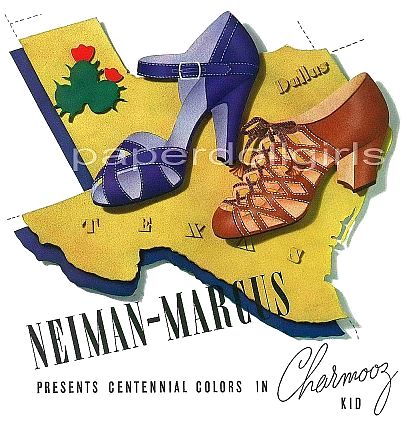
Texans celebrate history with — what else? — fashion! Below, text from a Neiman-Marcus ad which appeared on the eve of the huge Texas Centennial celebrations in 1936.

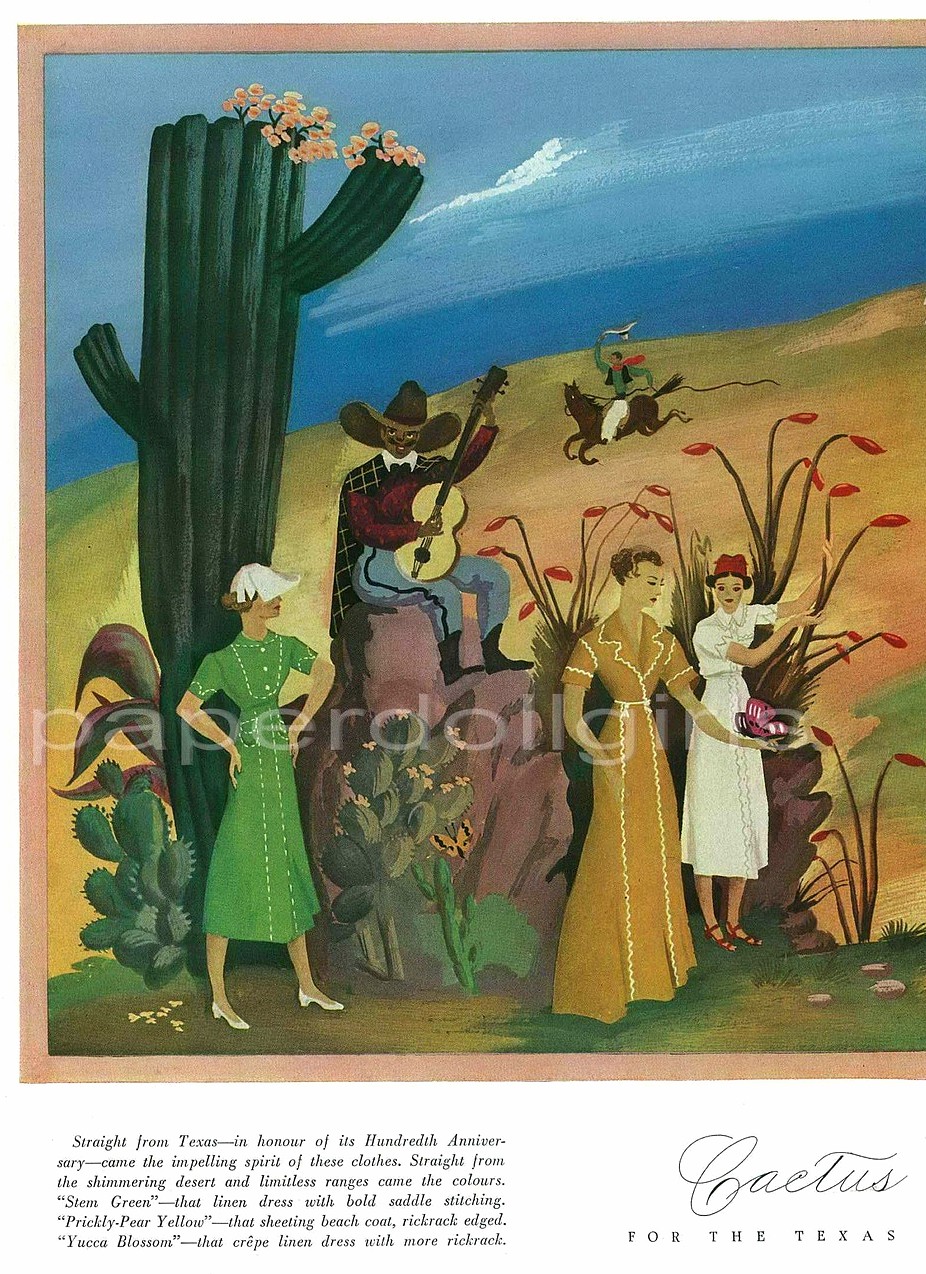
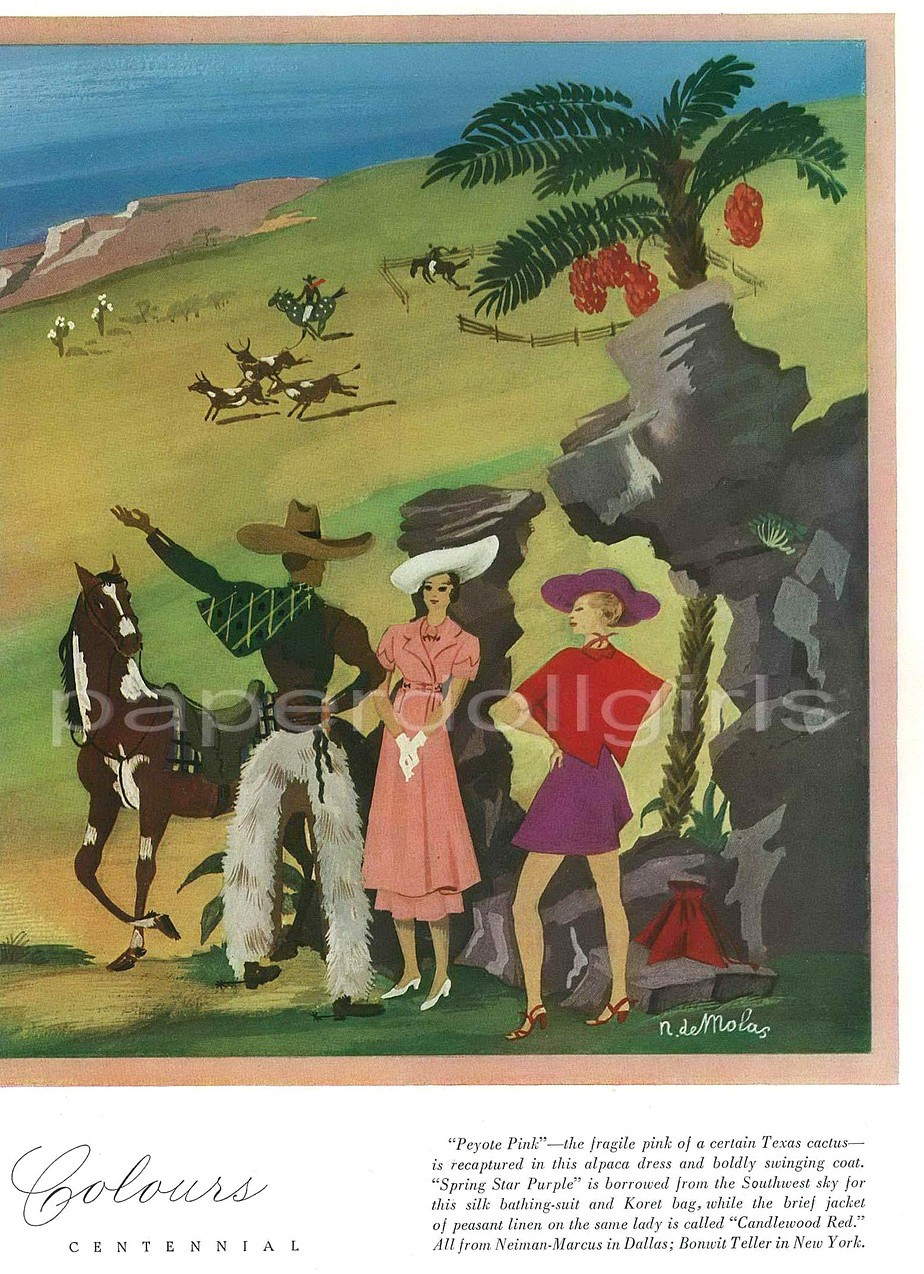
Five days before the Centennial finds Neiman-Marcus keyed for last-minute demands … both in selections and service … Spectator clothes and accessories in cactus colors (see current Vogue), and Artcraft stockings, thin as a web, in Texas range colors … Cool snowy crepe dresses for the afternoon and printed chiffon jacket dresses for Centennial sightseeing … Cottons gifted with importance … Crownless roof hats and trailing garden party dresses … Cattlebrands burned on a rawhide belt that girdles a crisp white watching dress. All in the best of taste and at a happy range of prices.

And then I looked for the Vogue ads mentioned and … wow! I’ve had a vintage advertising blog for several years, and I’ve seen a lot of ads … but these may be my favorites! All as a tie-in to the Texas Centennial, celebrated in Dallas in 1936, spear-headed by Stanley Marcus himself. Thanks, Mr. Stanley!

neiman-marcus_shoes_vogue-1936

neiman-marcus_cactus-colours_vogue-1936a

neiman-marcus_cactus-colours_vogue_1936b

***

Color ads from Vogue, June 1936. I found them on Etsy from this seller (the ads have, apparently, been sold). I would LOVE to see these with the watermarks removed, and I’d also love to know what became of the original artwork and who “N. de Molas” was. I love Texas kitsch and I love fashion illustration from this period, and this is fantastic! Click color pictures for much larger images! And read that copy, man.

If you want to wander around a whole bunch of vintage advertising, my Retro Adverto blog is here, but it has been sadly neglected since my immersion into this blog!

*

Copyright © 2014 Paula Bosse. All Rights Reserved.
 

Pike Park, Fiesta Central — 1926

little-mexico_1926_dmahl-facebook-pagePike Park (click for MUCH larger image)

by Paula Bosse

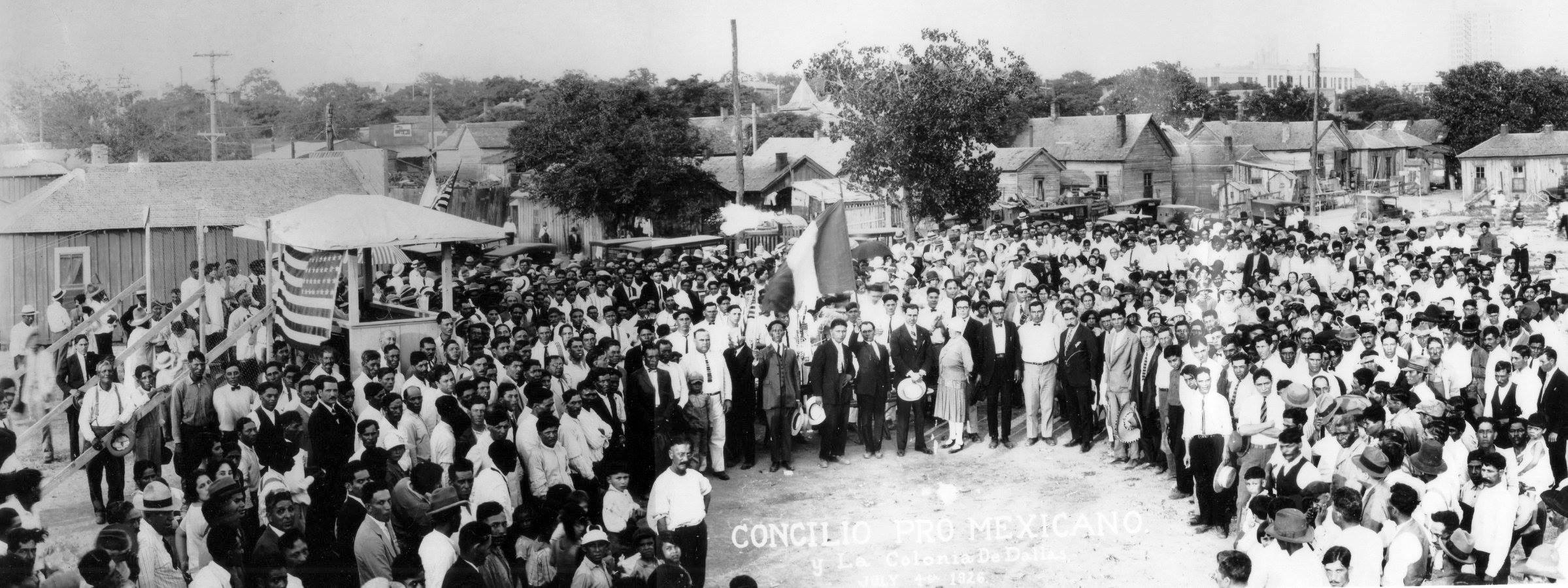
Fantastic photo of a 4th of July celebration in Little Mexico’s Pike Park in 1926, with the caption reading “Concilio Pro Mexicano y La Colonia de Dallas.”

Today is Cinco de Mayo, which, before it was co-opted by the gringo, was primarily a big party in communities populated by Mexican-Americans and Mexican immigrants. In Dallas, that meant a fiesta of music and food at Pike Park. I remember going to a few of these when I was a child, and my unmistakably Anglo family stood out in the crowd, but we were always welcomed and we had a great time. I loved it. Not to be a killjoy, but I’m not a fan of what Cinco de Mayo has become — just another excuse to drink to excess (St. Patrick’s Day with margaritas). But, if you’ve pulled out that novelty sombrero from the back of your closet and you’re celebrating today, well … olé. But pace yourself, amigos.

***

Photo from the Dallas Mexican American Historical League; it accompanied a great Dallas Morning News blog post by Dianne Solís regarding Pike Park, here.

A CNN interview with the always-entertaining Gustavo Arellano — the man behind the very funny “Ask a Mexican” column — on why he believes the Cinco de Mayo holiday is “pointless” is here.

And Arellano’s article “Gringo de Mayo”  is here.

That photo is gigantic. Click for larger image.

*

Copyright © 2014 Paula Bosse. All Rights Reserved.