Flashback : Dallas

A Miscellany: History, Ads, Pop Culture

Category: Entertainment

Vaudeville at the Sportatorium? — 1936

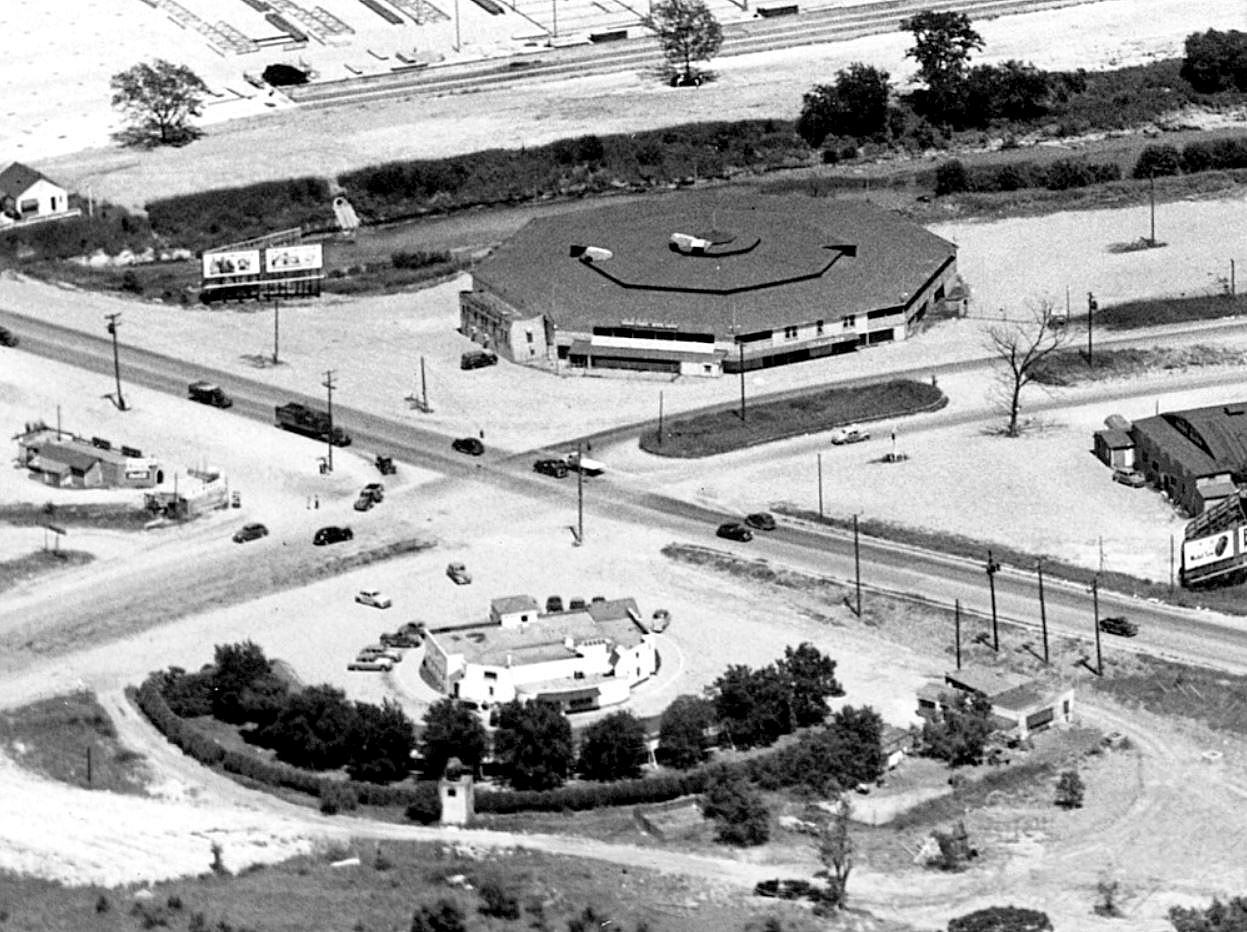
Original Sportatorium, in all its octagonal glory

by Paula Bosse

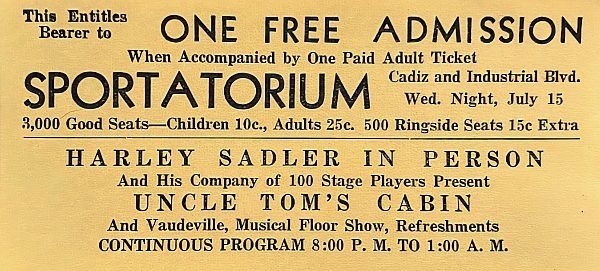
I saw this ticket recently on eBay:

SPORTATORIUM, Cadiz and Industrial Blvd.
Harley Sadler In Person
And His Company of 100 Stage Players Present
UNCLE TOM’S CABIN
And Vaudeville, Musical Floor Show, Refreshments

…What?!

The ticket is undated, but “vaudeville” had mostly faded by the 1930s. The original (octagonal!) Sportatorium was built in 1935 and opened as a premiere sporting venue for wrestling (and boxing) in December 1935.

The new sports bowl, under construction at Cadiz and Industrial, will have its official opening Monday night, December 9, when Promoter Bert Willoughby will offer the biggest wrestling program ever staged in Texas, if present plans go through as outlined. This 10,000-seating capacity structure, built as the home of wrestling, will also entertain many other events, such as boxing, basketball, indoor circuses, style shows [!], conventions and gatherings of all kinds. (Dallas Morning News, Dec. 1, 1935)

Sounds huge. But it’s really hard to keep those seats full — especially on nights when wrestling is not scheduled. By the end of April, there were already plans to do something about one of their biggest problems.

“We feel,” declared [manager W. T.] Cox, “that this concern is too big and that there is too much money already invested to have five or six dark nights a week, so we are going to make it possible for everyone, with anything to show, to bring it to our place, whether it be a political gathering, religious services or merchants’ and manufacturers’ exhibits. The policy of the house will be to encourage and promote sports, but it will be available to all.” (DMN, Apr. 20, 1936)

Sportatorium management came up with the idea of presenting a massive show on non-wrestling nights. They gave Harley Sadler — a longtime traveling Texas showman (and later a politician) — a long-term engagement in which he basically crammed as much “show” into one evening as was humanly possible. A stage was built, and many of those 10,000 seats were removed in order that patrons could sit at tables to enjoy the relentless, non-stop entertainment. Sadler’s company consisted of 100 players. 100!

So what could a Sportatorium visitor expect on one of these Harley Sadler nights? Brace yourself:

The Sadler players will offer two complete plays each evening — an original four-act [play], “The Siege of the Alamo” — and a three-act modern comedy farce, “This Thing Called Love.” In addition to those two complete plays, he will offer vaudeville acts, a band, novelty numbers, and 32 singing waitresses […]. The show will start at 8:30 and run for 8 hours, for those who care to stay that long. (DMN, July 8, 1936)

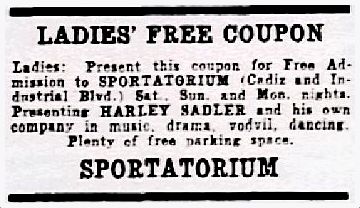
EIGHT HOURS! And, there were 3 different shows produced weekly. That’s a lot of entertainment. Perhaps too much entertainment. But ladies got in free.

July 12, 1936

I’m not sure how long this “residency” lasted, but however long it was, I assume all involved — performers and spectators alike — were exhausted afterward.

***

Sources & Notes

Source of the top photo of the Sportatorium is unknown, but I came across it on the wrestling website World Class Memories. (this Sportatorium page is a great read). (If you know the source of this photo, please let me know.)

Sportatorium ticket was found on eBay (still there, as I write this).

More on the history of the Sportatorium here.

More on empresario Harley Sadler can be found at the Handbook of Texas, here.

Previous Flashback Dallas posts on the Sportatorium can be found here.

*

Copyright © 2025 Paula Bosse. All Rights Reserved.

When Big D Had No Love for Bruce — 1974

Imagine what coulda been… (click for larger image)

by Paula Bosse

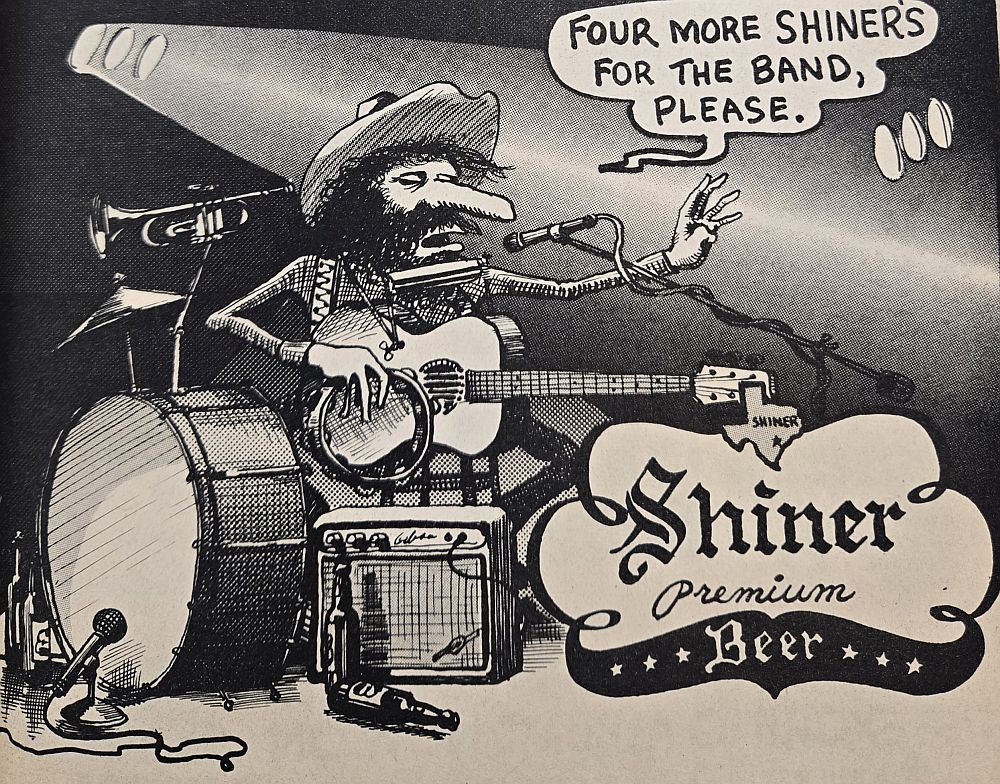
First off, apologies for the image quality of this advertisement. It’s from eBay (“He’s from Barcelona…”).

I thought it was an interesting ad, because I never knew that Bruce Springsteen played the Sportatorium, Dallas’ legendary wrestling mecca and off-and-on home to the Big D Jamboree. How had I never heard about this? (This was a show put together by local promoter Gene McCoslin, who had a long history with Willie Nelson.)

1974 was pretty early for Bruce to play in Dallas. He was starting to gain notice nationally, but he wasn’t a star yet. The tickets to the Sportatorium show were $4.50 in advance/$6.00 at the door (roughly $30 and $40 in today’s inflation-adjusted money). As it turns out, the show was canceled, because — hold onto yourselves — only 28 advance tickets had sold. …TWENTY-EIGHT.

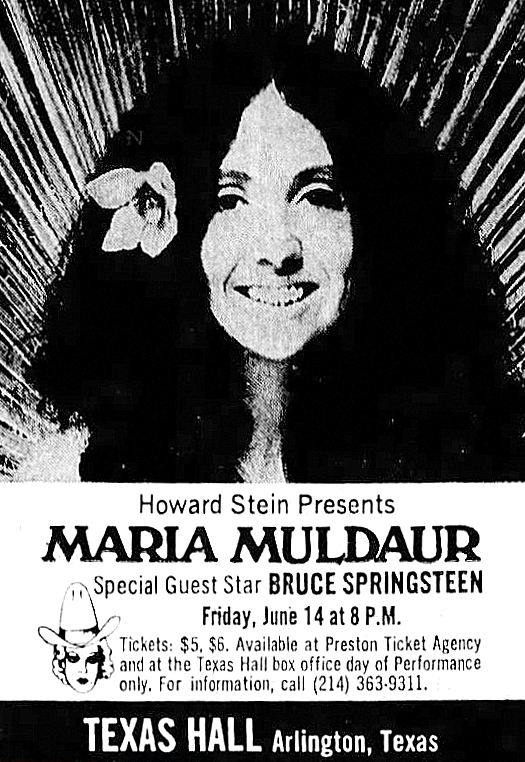
That show was scheduled for November 10, 1974. A few months earlier — in June 1974 — Bruce was, for some inexplicable reason, booked as the opening act for… Maria Muldaur (“Midnight at the Oasis”). That show was scheduled at the UTA campus in Arlington. The Dallas Morning News reported that Bruce was a last-minute no-show, claiming a bout with the flu, but, apparently, he was unhappy with the small turnout and just didn’t go on. (Trouper Maria, having lost her opening act, performed for nearly 2 hours, and got rave reviews.)

Fort Worth Star-Telegram, June 9, 1974

Springsteen’s first actual performance on a Dallas stage appears to have been sometime in the same year as those two ill-fated non-gigs: 1974. Freelance rock critic Kim Martin-Pierce remembered it: “He always had a troubled history here. [He was booked to play at the old Mother Blues nightclub, but] he sold so poorly at Mother Blues that they moved him over to Gertie’s on Lemmon Avenue. He didn’t draw well at all there either, but he gave the greatest performance I’ve ever heard in a small club.” (DMN, “Springsteen Finally Shows Big D Who’s Boss” by John Anders, Nov. 30, 1984, after Bruce’s two sold-out shows at Reunion Arena)

Sorry, Bruce, for the cold shoulder! I think Dallas eventually came around. But you missed out. Playing the Sportatorium would have been really, really cool. And those 28 people would still be talking about the most amazing show they had ever seen.

***

Sources & Notes

Top ad from the Dallas underground newspaper Iconoclast, Nov.8-15, 1974; found on eBay in April 2024.

This post appeared previously in a slightly different form on the Flashback Dallas Patreon page.

*

Copyright © 2025 Paula Bosse. All Rights Reserved.

Lulu Roman, 1946-2025

In a Dallas courtroom, 1971

by Paula Bosse

Lulu Roman — known for her appearances on the TV show Hee Haw and her numerous gospel recordings — died last week (on April 23, 2025). She was a Dallas native and a graduate of Samuell High School. A summary of her life and career can be found in the Hollywood Reporter obituary and her Wikipedia entry.

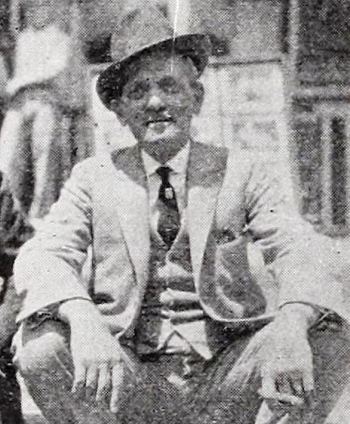
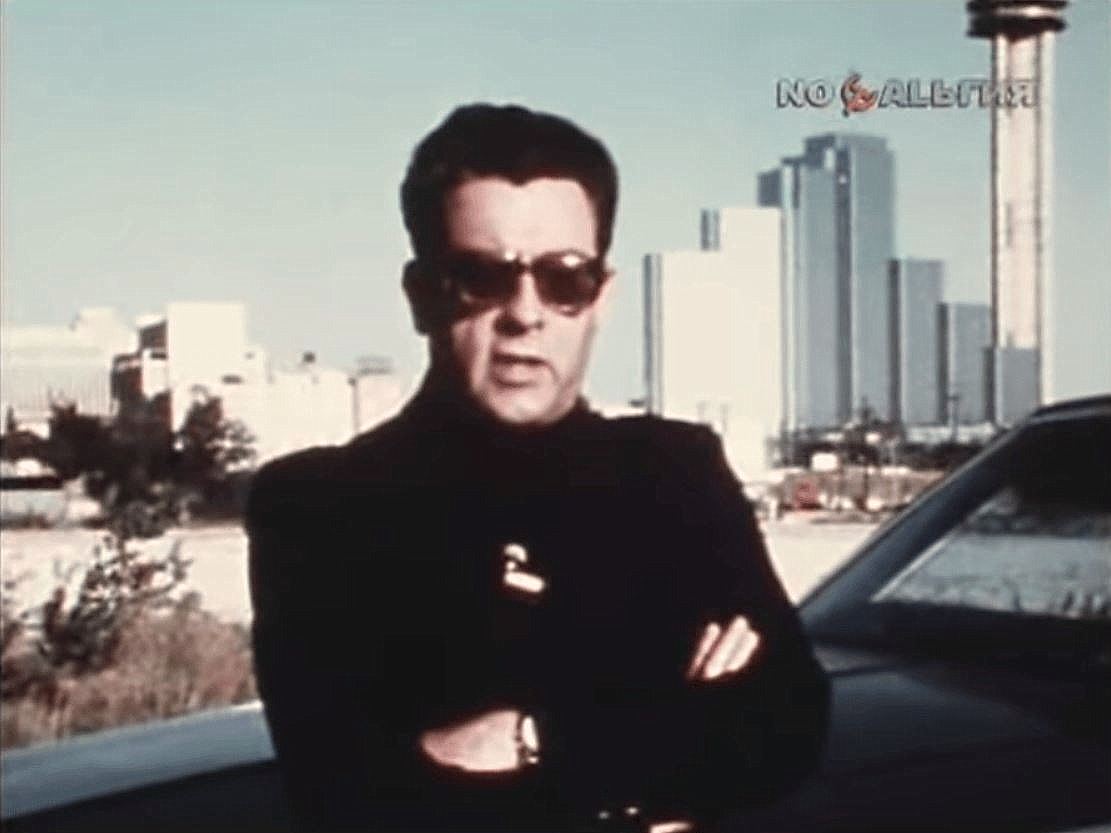
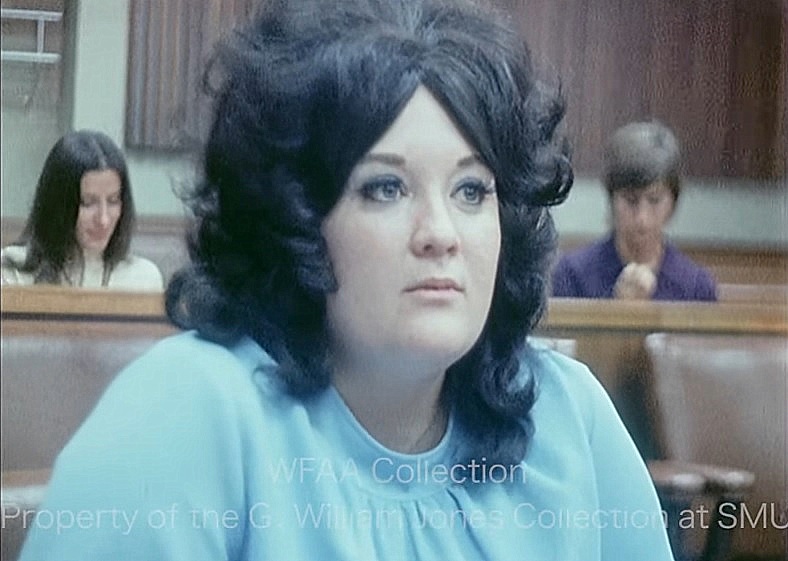
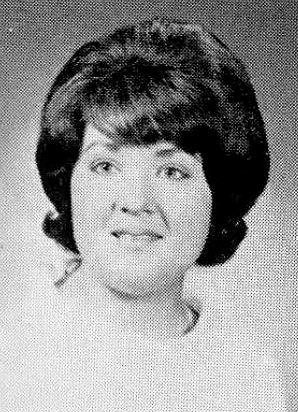
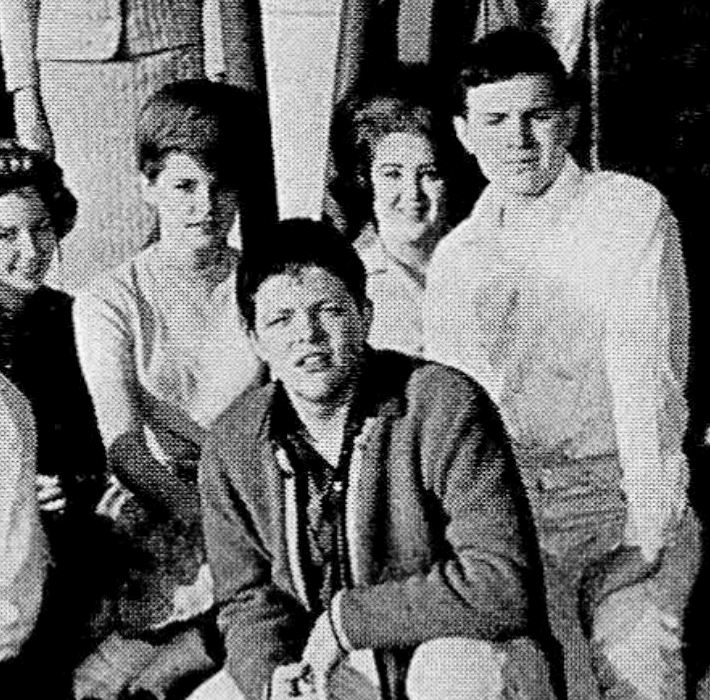
She graduated from W. W. Samuell High School in 1964 (her name back then was Louise Hable), and five years later, she became an original member of the cast of Hee Haw. In 1971, her Oak Lawn apartment (2627 Douglas) was raided by seven narcotics agents, who seized 5.5 pounds of marijuana and small amounts of LSD and hashish. She was booked for drug possession, and this effectively ended her connection with Hee Haw (she later found religion, gave up drugs, and was welcomed back to the show when she was clean — you can see her talk about her new-found “high” to a Channel 8 reporter in 1973 on YouTube here). (The photo at the top is from one of Lulu’s appearances in court in 1971.)

She then went on to a successful career as a gospel singer. RIP, Lulu.

1963 Samuell yearbook, Junior class photo

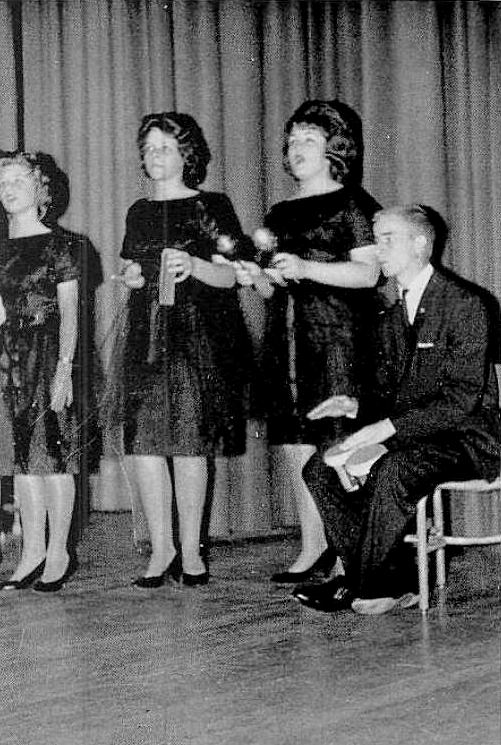
Performing a “Calypso Christmas carol”:

1963 Samuell yearbook

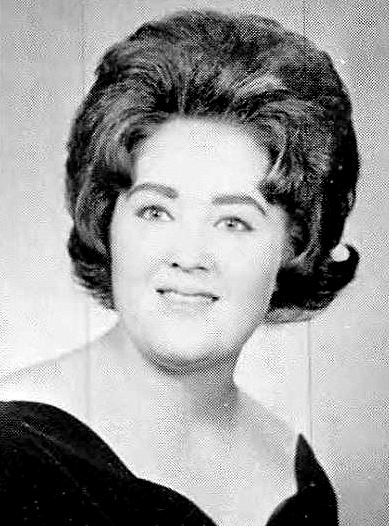
1964 Samuell yearbook, Senior class photo

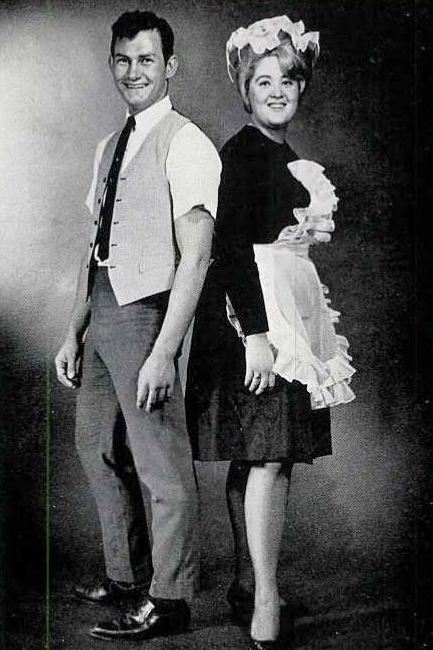
With classmate David Henderson, in costume for a theatrical production.

1964 Samuell yearbook

Detail of a photo of members of the Thespians Club:

1964 Samuell yearbook

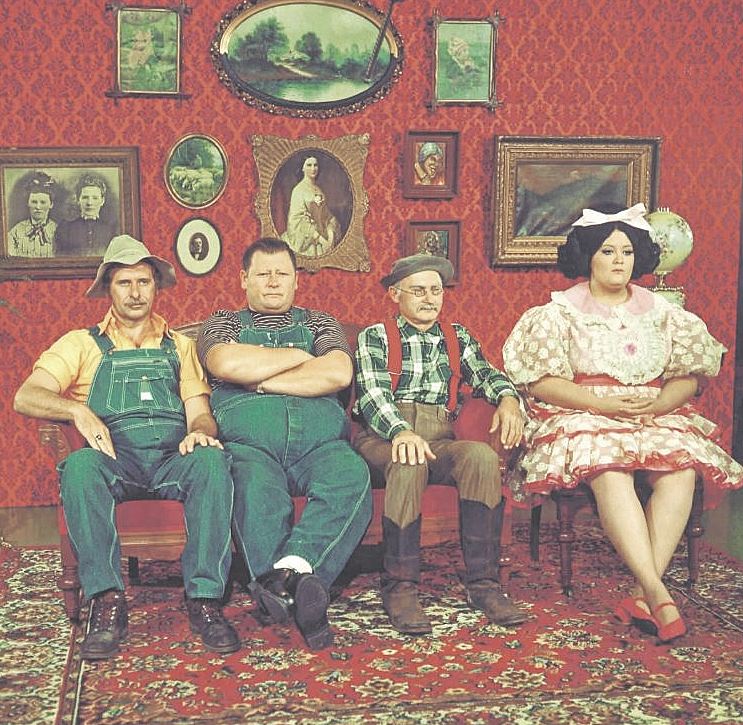
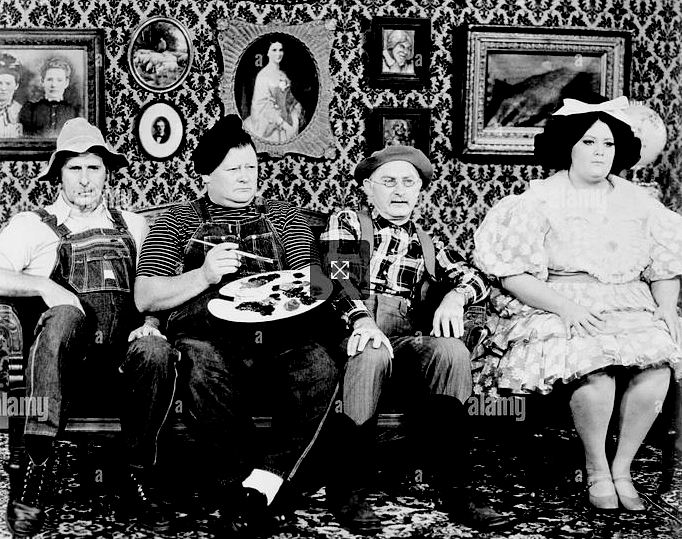
Hitting the big-time, on Hee Haw:

***

Sources & Notes

Top image is a screenshot from Channel 8 news footage of Lulu’s drug possession trial in Dallas on Sept. 3, 1971, from the WFAA Collection, G. William Jones Collection, Hamon Arts Library, Southern Methodist University.

School photos from the 1963 and 1964 Samuell High School yearbooks.

Color photo of some of the Hee Haw cast members (Gordie Tapp, Junior Samples, Grandpa Jones, and Lulu Roman), from The Tennessean; black-and-white photo from Alamy.

*

Copyright © 2025 Paula Bosse. All Rights Reserved.

The Bright Lights of Big D — 1951

…Forget all your worries, forget all your cares…

by Paula Bosse

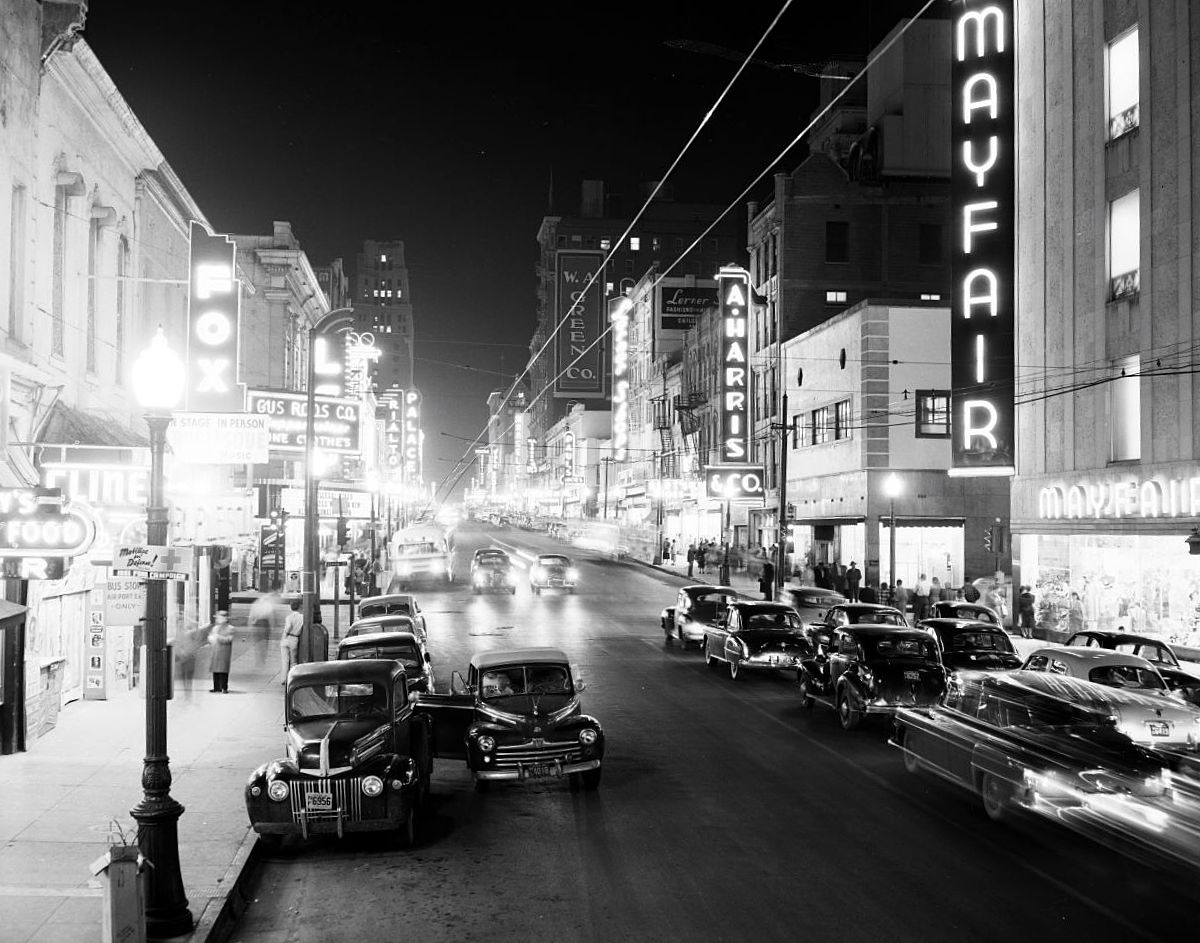
This is the downtown Dallas I’ve always wished I had seen.

Check out a clipping from the 1953 city directory for a list of the businesses in this immediate block, from about Akard to Ervay, here.

Then click over to the 2015 post “Dazzling Neon, Theater Row — 1929” to see how drastically Elm Street — and Movie Row — changed in just 22 years.

***

Sources & Notes

Photo by Denny Hayes, Hayes Collection, Dallas History and Archives, Dallas Public Library; Call Number PA76-1-576-2.

*

Copyright © 2024 Paula Bosse. All Rights Reserved.

KVIL: The “VIL” Stands for Village

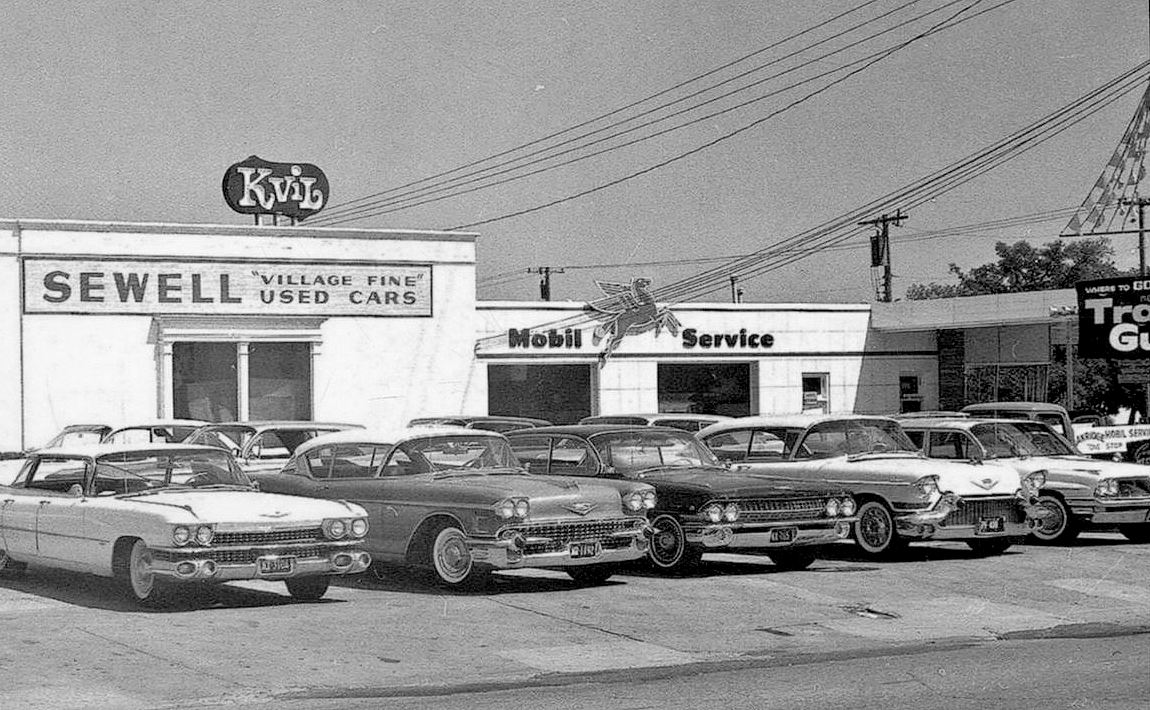
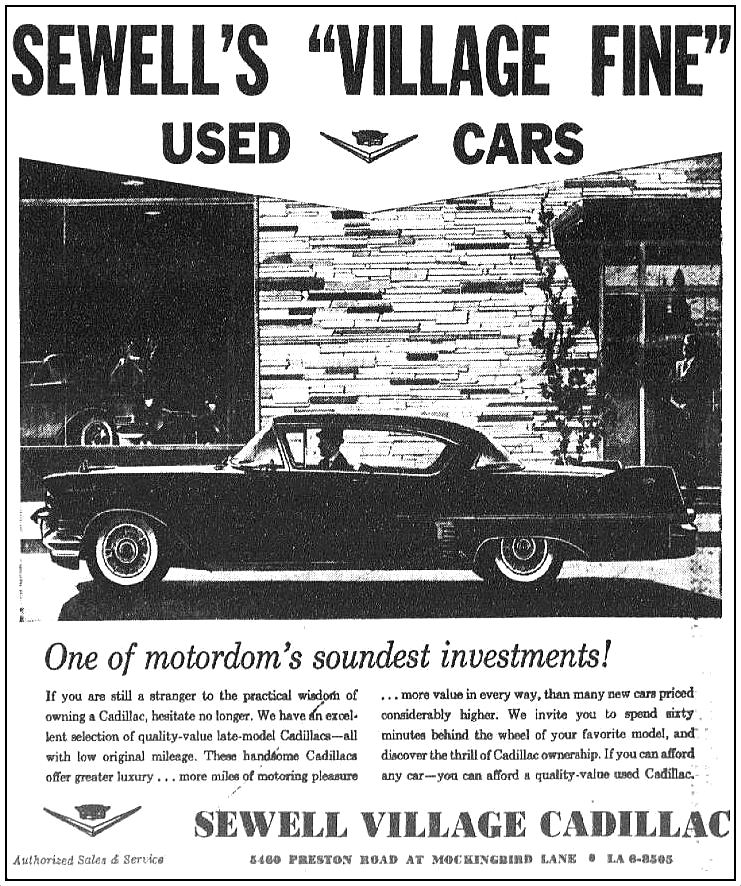
sewell-auto_KVIL_ebayNortheast corner of Preston & Mockingbird…

by Paula Bosse

Sewell Village Used Cars and a Mobil station were at the northeast corner of Preston and Mockingbird (Sewell was at 5460 Preston Road), catty-corner from Highland Park Village. The KVIL studios were right around the corner, at 4152 Mockingbird Lane, across the street from the Dallas Country Club — you can see the jauntily-lettered sign in the background of this undated.photo. I am really bad at determining car-model years, but let’s say this is about 1960. What does this corner look like these days? It looks like this.

I just learned (from the KVIL Wikipedia page) that the “VIL” in the station’s call letters stood for “Village,” as in Highland Park Village. Who knew? The AM station began broadcasting on March 1, 1960, and the FM station hit the airwaves on Aug. 25, 1961. I believe both stations had a strict “no-rock-and-roll” policy. In the early days, a block of programming was aimed directly at housewives:

The program policy followed by the station is designed to fit the various hours of the day. For the driving hours when listeners drive to work (5:45 to 9 a.m.) and return (4:30 to 6:55 p.m.) the music is livelier. “Sing Along” is the order of the day from 9 a.m. to noon for the housewife’s work hours. (“KVIL Mark’s First Birthday Wednesday,” Dallas Morning News, March 1, 1961)

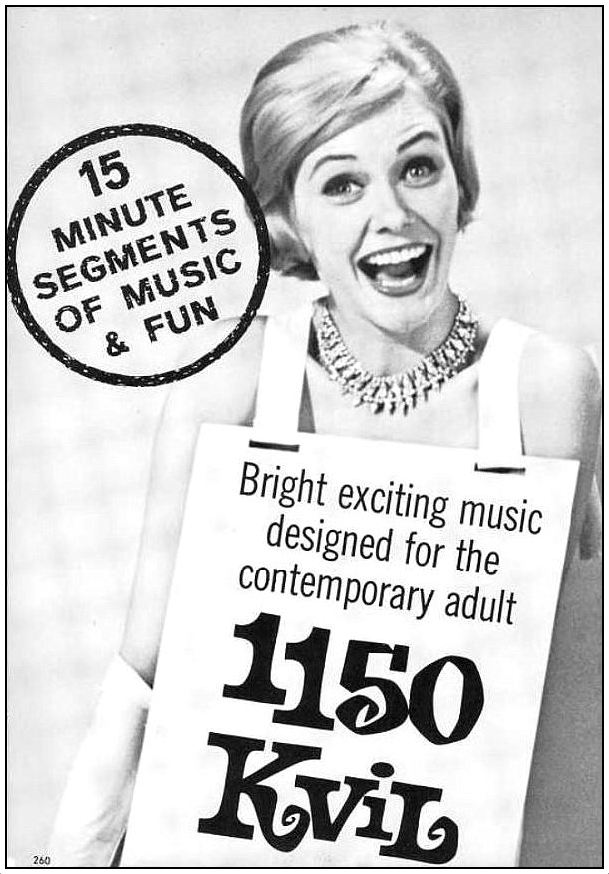
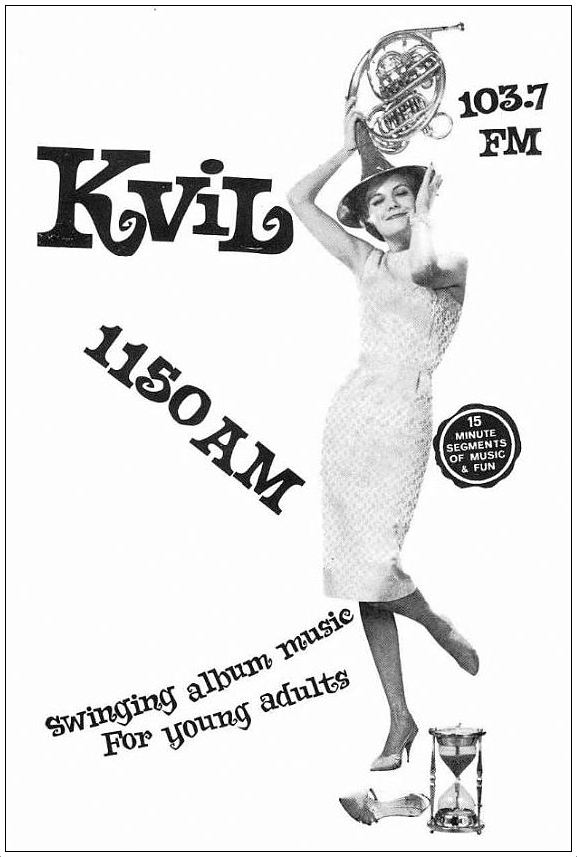
Here are a couple of hep, caffeinated KVIL ads from those early days:

patreon_KVIL_HPHS_1961-yrbk1961 ad

patreon_KVIL_HPHS_1962-yrbk1962 ad

kvil-logo_broadcasting-mag_122462_ad-det1962 logo

Most of my sort of generally vague awareness of KVIL was in the 1980s, when it was an absolute powerhouse in the ratings. But even its most stalwart fans would probably not describe its playlist as “bright,” “exciting,” or “swinging.” But look how much fun the promotions department imagined the effect on “young adults” was!

*

And what about Sewell Village Cadillac and its selection of “Village Fine” used cars? If circa-1960 Highland Park is going to have a used car lot, you better believe it’s going to be populated with Cadillacs. (UPDATE: Thanks to Peter K’s link in the comments, check out what appears to be the original photo by Squire Haskins, with a wider view, at the UTA Libraries website, here.)

sewell-village-cadillac_032158March 1958

***

Sources & Notes

Photo from eBay.

KVIL ads from the 1961 and 1962 Highland Park High School yearbooks.

KVIL logo is a detail from an ad that appeared in the Dec. 24, 1962 issue of Broadcasting magazine.

This post appeared in an abbreviated form on the Flashback Dallas Patreon page.

sewell-auto_KVIL_ebay

*

Copyright © 2024 Paula Bosse. All Rights Reserved.

Jimi Hendrix in Dallas, 4/20/69

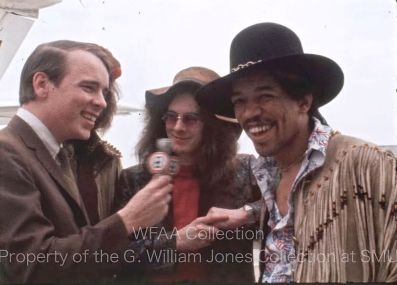
jimi_WFAA_042069_SMU_aDoug, Mitch, Noel, and Jimi

by Paula Bosse

Today is 4/20 Day. An alternate (or parallel) way to celebrate the already alternative “holiday” is to mark the anniversary of one of Jimi Hendrix’s best interviews, on the Love Field tarmac on April 20, 1969, given to Dallas reporter Doug Terry (still a college student when he was at WFAA-Channel 8). The band was in Dallas for a show at Memorial Auditorium. It’s just a fantastic, laid-back, cool interview.

I had tried contacting Doug several years ago to let him know this clip was racking up the hits on YouTube, in case he wasn’t aware it was there, but I didn’t hear back from him until this week! He had seen the post I had written about this interview and wrote a bit about that momentous occasion in the email. He also adds some interesting behind-the-scenes tidbits I always find interesting (the following is used with Doug’s permission):

I was still a college student most of the time I worked at WFAA. I handed in my resignation after covering the north Texas pop festival in that same year. [Watch one of Doug’s reports from the Texas International Pop Festival here.] Your comment about being in a large city and its advantages was something that I did not fully grasp until years later. The access was wonderful, I saw Hendrix at least three times, on one occasion being in the dressing room with a camera when he warmed up for a show (that footage is nowhere to be found).

There are two aspects to mention about that interview. First, I was a weekend reporter and late night news anchor at Ch. 8 and I assigned myself to go interview him. In those days, one could call up the airlines when a notable person was coming in and they would give the flight number and arrival time. Amazing. Most of the people at the station at that time probably had no idea who Jimi was and wouldn’t have cared if they did know.

The other interesting point is the work of the photographer. Ordinarily, we did over the shoulder interviews, the camera to the back and side of the reporter. The fact that this was shot from the side made all the difference. As a shooter, he was not otherwise outstanding but this interview would be much less interesting if it had been shot in the traditional line-up sort of way. The two bandmates goofing around was distracting but great.

Thank you so much for getting in touch, Doug!

My original 2017 post about this interview (with the film clip of Jimi, Mitch Mitchell, and Noel Redding at Love Field) — which includes additional info about Jimi’s other performances in Dallas — is here: “Jimi Hendrix, Glen Campbell, Tiny Tim — In Dallas (…Separately), 1969.”

jimi_WFAA_042069_SMU_b

***

Sources & Notes

Screenshots from the WFAA Collection, G. WIlliam Jones Film and Video Collection, Hamon Arts Library, SMU.

Excerpt from Doug Terry’s email to me (April 16, 2024), used with permission.

jimi_WFAA_042069_SMU_a

*

Copyright © 2024 Paula Bosse. All Rights Reserved.

The Forest Theater You’ve Never Heard Of — ca. 1912-1914

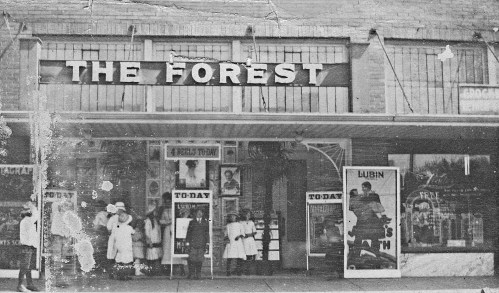
forest-avenue-theater_1638-forest_mike-cochranForest & Colonial in 1914 (courtesy Mike Cochran)

by Paula Bosse

There are so many posts I’ve begun but, for whatever reason, never finished. This is one of them. I started this one in 2015! I was sidetracked by a family member’s lengthy health setback, and I just never got back to it. But I’ve thought about it every time I’ve written about something in South Dallas.

This great photo — from about 1914 — was sent to me by Mike Cochran (he has a site on Denton history here). It shows a theater with a tie to his great-grandfather, Oscar F. Gould, who became something of a legend in the running of Interstate theaters in Dallas and Fort Worth (most notably the Majestic Theatres in both cities).

I think the reason I never finished the post was because it was hard to research. The theater lasted only a couple of years, and its name was incredibly confusing!

The Forest Avenue Theatre/Theater was in operation in, for sure, 1913 and 1914 — and possibly part of 1912 and part of 1915. It was located at 1638 Forest Avenue (now MLK Blvd.), at Colonial. The owner appears to have been Mike’s great-grandfather, O. F. Gould — as he was busy with the Dallas Majestic at the time, the Forest was managed by his son, Harry Gould.

Family lore suggests that the Forest was the first suburban theater in Dallas. There might have been a couple that pre-dated it in South Dallas and Oak Cliff, but it definitely is a very early moving-picture house outside of the downtown area.

The main Forest Avenue theater confusion has to do with its name. Oscar Gould’s theater was at 1638 Forest Avenue from… let’s just say 1913-1914. It was on the southwest corner of Forest and Colonial, in the heart of the lively South Dallas business district. About the time the Forest closed, the Colonial Theater popped up across the street, at 1702 Forest Avenue, on the southeast corner of Forest and Colonial. (I don’t think there was any relation, but there had been a previous Colonial Theater downtown about 6 years earlier — it can be seen in the foreground of the right side of this photo, at what would now be 1520 Main.) At some point, the Colonial changed its name to… guess what? The Forest Theater! THEN… in 1949, decades later, it changed its name back to “Colonial.” Why? Because there was a NEW Forest Theater (my head…), several blocks away, at 1914 Forest Avenue (which is still standing and is perpetually being re-envisioned). I don’t know how much arm-twisting was done, but in order to, I guess, prevent confusion between the modest neighborhood theater and the much larger and more sophisticated showplace down the street, the (second) Forest reverted back to “Colonial.” And that didn’t last long, because, in the blink of an eye, the “Colonial” at 1702 Forest disappeared and was replaced in 1949 by the Theater Lounge, which started out (I think) as a club presenting Black entertainment, before it eventually became Barney Weinstein’s famed South Dallas stripper mecca. So, there were (at the very least) three different Forest theaters, two (or, really, three) Colonial theaters, and two Theater Lounges.

That paragraph is why it’s taken me 9 years to write this post.

These buildings are still standing. Below is what the original Forest Avenue Theater looked like in 2019, before renovation work began on the block. (The numbering is different these days. See a 1922 Sanborn map here. The theater would have been in the “MainView” building.)
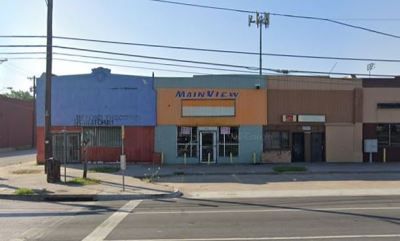
forest-ave-theater-block_google-street-view_may-2019_detGoogle Street View, May 2019

See the most recent Street View, here (the “original” Forest Avenue Theater building is on the right, the Colonial/Forest/Colonial/Theater Lounge is on the left).

**

Oscar F. Gould was an interesting person, and I hope his great-grandson Mike Cochran has written about him (and will direct me to a link I can add here). He protested the state law that made it illegal for theaters to open on Sundays, going so far as to be fined multiple times and to sue the state.
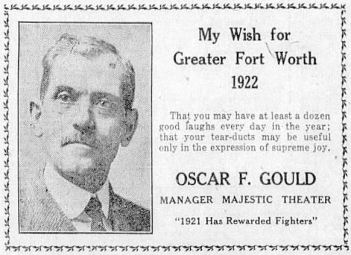
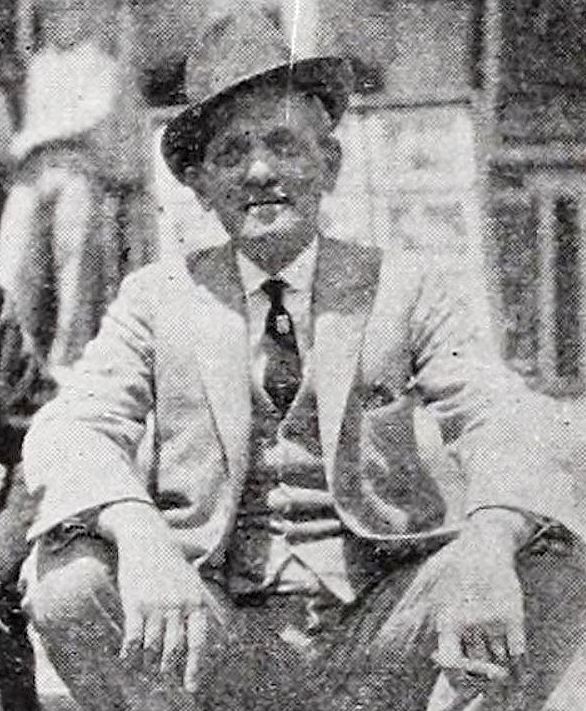
gould-oscar_FW-record_010122Fort Worth Record, Jan. 1, 1922

gould-oscar_exhibitors-herald_010926O. F. Gould, Exhibitors’ Herald, Jan. 9, 1926

*

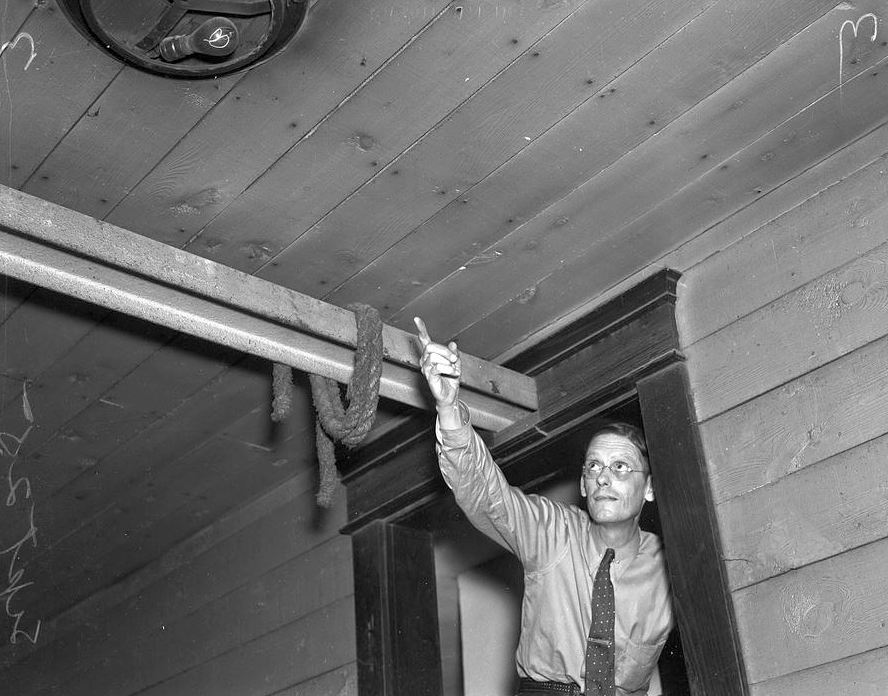
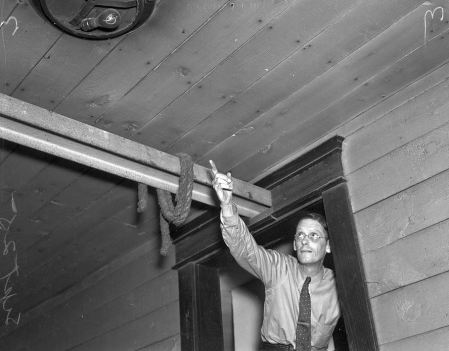
I like this related tidbit. The man who ran the Forest Avenue Theater was Oscar Gould’s son, Harry Gould, who, like his father, had a long and respected career running theaters. When the Forest closed, he operated theaters in Waco, Houston, and eventually Fort Worth. After several years, he ended up at the Palace in Fort Worth. This is a photo from his days at the Palace — the 1936 photo ran with this caption in the Fort Worth Star-Telegram:

Harry Gould, manager of the Palace Theater, points out the electric light which has burned continuously for the last 28 years, except when the current was shut off at the electric company’s power plant. Gould and other showmen who have been connected with the palace are superstitious about the light, believing it will bring good luck as long as it remains lighted.
gould-harry_palace-theatre-fort-worth_UTA_090536_FWST_longest-burning-bulb

I think the bulb is still burning, into what must be its 116th year. That’s a pretty good bulb. It was moved — still burning — when the theater was demolished and, last I saw, was in the Stockyards Museum in Fort Worth. (The lightbulb was profiled by Channel 8 in 1973, in a short, filmed report here.)

**

Thank you, MIke Cochran, for sharing your family photo! I’m sorry it took me NINE YEARS to write this!

***

Sources & Notes

The top photo is from the collection of Mike Cochran, used with permission. (Thank you, Mike!) On the left of the photo was Chapman’s Pharmacy, and at the right was Leader Grocery,

The movie showing is “A Man’s Faith,” produced by Siegmund Lubin and released in 1914.

Photo of Harry Gould and the lightbulb (Sept. 25, 1936) is from the Fort Worth Star-Telegram Collection, University of Texas at Arlington Libraries, here.

Need a daily dose of Dallas history? Please consider supporting me on Patreon!

forest-avenue-theater_1638-forest_mike-cochran_detail

*

Copyright © 2024 Paula Bosse. All Rights Reserved.

Oak Lawn Ave. — Keep on Truckin’ (1971)

iconoclast_oak-lawn-avenue_iconoclast_aug-1971

by Paula Bosse

This is a great little ad, which includes a bunch of notable Oak Lawn landmarks in the neighborhood’s hippie-fabulous days. I love this artwork — it’s almost as good as a photograph!

The 3500 block of Oak Lawn — between Lemmon and Bowser — is depicted in super-groovy, early-’70s, patchouli-scented artwork (inspired by R. Crumb). Starting at the left, here’s what we see:

  • A tiny portion of the sorely missed diner mainstay, LUCAS B & B, 3520 Oak Lawn
  • Next, NAME BRAND SHOES (men’s shoes), 3516 Oak Lawn
  • Next, R.F.D. No. 1 COUNTRY STORE (clothing), 3514 Oak Lawn, subject of the ad (formerly El Chico, which you can see in the second and third photos here)
  • Next, THE FOG (rock club), 3508 Oak Lawn
  • Next, SUPERIOR BAKERY, 3502 Oak Lawn
  • Next, NATIONAL AUTO SOUND OF DALLAS (car stereos), 3500 Oak Lawn (at Lemmon)

iconoclast_oak-lawn-avenue_aug-1971_1972-directory1972 city directory

*

Watch silent home movie footage shot in this block around this same time at the Portal to Texas History, here (unfortunately, there are only glancing images of The Fog, which I would have liked to have seen more of). The Oak Lawn footage begins at 10:34 and continues until the end, with scenes shot at Lee Park. (There’s a guy who looks like he should be someone important — he looks a bit like Harry Nilsson — at 10:59.)

*

The illustration is by Steve Brooks, a 1967 graduate of Sunset High School who has had quite the career in illustration, commercial art, and rock posters. He’s worked extensively with Willie Nelson and Buddy magazine, and… yes, if you saw that drawing above and thought “head shop,” he’s the guy (THE guy) behind all the artwork connected to The Gas Pipe (which deserves a post of its own as a truly iconic Dallas success story!). Read an interesting biography about Brooks here. See some of his work in the collection of his alma mater, UNT, here.

***

Sources & Notes

Ad from the August 1971 issue of the underground newspaper, The Iconoclast.

iconoclast_oak-lawn-avenue_iconoclast_aug-1971

*

Copyright © 2024 Paula Bosse. All Rights Reserved.
The South End “Reservation” Red-Light District — ca. 1907

south-end_hobson-electric_southeast-from-courthouse_ca-1907_cook-collection_degolyer_SMUThere’s a lot going on here that you can’t see… (DeGolyer Library, SMU)

by Paula Bosse

I am reminded how much fun it is to just dive into something with no idea where you’re heading and end up learning interesting things you might have been unaware of had you not wondered, “What am I looking at?”

Yesterday I was working on a future post that involves the Hobson Electric Co., and I was looking for photos. The one above popped up in one of my favorite collections of historical Dallas photos, the George W. Cook Collection at SMU’s DeGolyer Library. I was looking for a post-1910 West End photo — this photo is identified as just that [the title has now been updated by the SMU Libraries], but the presence of the Schoellkopf Saddlery Co. building (center left, with the Coca-Cola ad on it) puts this location on the other side of the central business district — Schoellkopf was at S. Lamar and Jackson. Even knowing that, this scene didn’t look familiar at all.

I checked a 1907 city directory to find out the address of the Hobson Electric Co. before it moved to the West End in 1910 — it was located at 172-74 Commerce Street (in what is now the 700 block), between S. Market and S. Austin. The view here is to the southeast, probably taken from the courthouse.

I don’t think I’ve seen this particular view before — it shows hardly any of the downtown area but shows instead the area to the south. I was really intrigued by the block of houses facing Jackson (between Market and Austin) — the block the horse-and-buggy is moving past, at the center right. The trees. The low buildings. That block really stood out. It was kind of quaint. Did people live there? While I had the 1907 directory open, I checked to see who the occupants were. (I just picked 1907 because the Hobson Co. changed its name from “Duncan-Hobson” around 1906, and it had moved away from Commerce by mid 1910.) Here were the occupants of those houses in 1907:

jackson-between-market-and-austin_1907-directory1907 Dallas directory

That seemed odd. Three single women occupying three separate houses, all next door to one other. There weren’t a lot of single women living in houses alone in 1907. Hmm. I checked all the directories between 1905 and 1910 to see who was living in that block. Every year, each of those houses showed a new occupant, and, with one exception, all were single woman (the exception was a man who owned a saloon across the street and who had faced charges at one point for “keeping a disorderly house”). …Okay. I got the picture.

I checked the Sanborn map from 1905 for this block and saw something I’d never seen before: the designation of a building with the letters “F.B.” What did that mean? Turns out, it means “Female Boarding House.” Or, less euphemistically… a brothel. Look at the map here (more maps are linked at the bottom of this post) to see the frankly ASTRONOMICAL number of “F.B.” buildings in this one small area. (There weren’t as many saloons — designated with “Sal.” — as I expected, but I’m pretty sure a lot of saloons in this area were operating illegally.)

You might have noticed that all of those F.B.s are south of Jackson. Not one of them is north of Jackson. This area — the southwestern part of downtown — was referred to at the time as the “South End” or “The Reservation” (some called this general area “Boggy Bayou,” but I think that was technically farther south). Its boundaries were, basically, S. Jefferson Street (now Record Street) on the west, Jackson on the north, S. Lamar(-ish) on the east, and beyond Young Street on the south. If you wanted to avail yourself of illicit things and engage in naughty behavior, this was the place for you: Ground Zero for a sort of wide-open, lawless Wild West. There were other red-light districts in Dallas (most notably “Frogtown,” which was north of downtown in the general area formerly known as Little Mexico) (does anyone still call this now-over-developed area “Little Mexico”?), but if you wanted the primo experience of one-stop-shopping for drinking, gambling, drugging, and “consorting with fallen women,” you were probably familiar with the South End, where all of these activities were tolerated and, for the most part, ignored by the police (they might mosey by if there were an especially egregious shooting or stabbing or robbery). In fact, this vice-filled area had been created by a helpful city ordinance in the 1890s. So, enjoy!

Prostitutes were allowed to ply their trade in this specified chunk of blocks because the city fathers felt that it would be best to keep all that sort of thing in one somewhat controllable area, away from the more reputable neighborhoods. But once a prostitute stepped outside the Reservation to sell something she shouldn’t have been selling… laws suddenly applied, and she’d be thrown in jail and/or fined. Do not step north of Jackson, Zelma!

So, at one time, Dallas had legal brothels. Depending on whose account you read, these houses of ill repute ranged from godawful “White Slavery” operations and bubbling cauldrons of sin and sleaze to, as Ted Dealey remembers in his book Diaper Days of Dallas (p. 74), “ultra-fashionable houses of prostitution” which attracted Big D’s moneyed movers and shakers. Something for everyone.

Eventually, people started to get really bent out of shape about this, and there was a big push to get these houses shut down — or at least moved out of the area. The Chief of Police reported to the City Council in 1906 that, among the many Reservation-related problems, the area was getting cramped because the railroads were buying up real estate in the area and kicking people out. The city-sanctioned no-man’s land was getting too small, so city officials needed to find a bigger place to move the red-light district to. The Chief thought that North Dallas (i.e. Frogtown) was “the most logical place” — except that residents of nearby swanky neighborhoods there were not at all keen on this. But that idea seemed to stick. It took several years to actually happen, but a relocation of sorts occurred, and the South End brothel-hotspot was pretty much scrubbed of all offending “disorderly houses” by 1910. (Frogtown bit the dust around 1913, after those unhappy well-to-do North Dallas neighbors complained bitterly, loudly, and effectively.)

So, anyway, I never expected to find such an exciting photograph! I wonder if the photographer took this photo as a way of documenting the very controversial, in-the-news, not-long-for-this-world Reservation, or whether it was just a nice scenic view. I have to think it was the former, because the Reservation was well-known to everyone, near and far, and this shot would have been an unusual vista to, say, reproduce for postcards (or at least postcards sold to the general public!). Whatever the case, I’ve never seen this view, and it’s really great — and it comes with an interesting slice of Dallas history. I had heard of the Frogtown reservation to the north, but I’d never heard of the South End reservation. And now I have. And here’s a photo of it!

Let’s bring back the neighborhood designation of “South End.” It was good enough for 1900, it’s good enough for today.

*

Here are a few zoomed-in details of the photo. Unless I’m imagining things, I think I can see women sitting on their porches, advertising their wares, as was the custom. (All images are larger when clicked.)

south-end_cook-collection_degolyer_SMU_det-1

*

south-end_cook-collection_degolyer_SMU_det-2

*

south-end_cook-collection_degolyer_SMU_det-3

*

Below is an excerpt from a blistering directive to city lawmakers by W. W. Nelms, Judge of the Criminal District Court (from an article with the endless headline “Calls For Action; Judge Nelms Charges Police Chief, Sheriff and Grand Jurors; Warfare on Crime; Says Lawbreakers Shall Not Construe Statutes of State to Suit Themselves; Stop Murder and Robbery; Declares Harboring Places for Thugs, Thieves and the Like Must Be Destroyed,” Dallas Morning News, Oct. 15, 1907).

reservation_judge-w-w-nelms_DMN_101507DMN, Oct. 15, 1907

*

Below, the general area of the South End Reservation around 1907 (this map is from about 1898). The blue star is the Old Red Courthouse; the Reservation is bordered in red. In 1893, the original area was loosely designated as the area bounded by Jackson Street, Mill Creek, the Trinity River, and the Santa Fe railroad tracks, in which “women of doubtful character […] were not to be molested by police” (from “Passing of Reservation,” DMN, Dec. 11, 1904). As noted above, the area shrank over time, and the red lines show the general Reservation area about 1907, the time of the photo at the top.

south-end_reservation_1898-map_portalDallas map, ca. 1898 (det), via Portal to Texas History

***

Sources & Notes

Top photo — “[Jackson Street, Looking Southeast from the Courthouse, Including a Partial View of the South End ‘Reservation’]” (previously incorrectly titled “[Dallas West End District with View of Railroad Yards]”) — is from the George W. Cook Dallas/Texas Collection, DeGolyer Library, SMU Libraries and can be accessed here. (I appreciate SMU for responding to my request to re-title and re-date this photograph — it’s always worth notifying archival collections with corrections!) (And, as always, I WELCOME corrections. I make mistakes all the time!)

The 1905 Sanborn map I linked to above (Sheet 104) is here and seems to be the epicenter of the booming brothel trade; more evidence of this can be seen just south of that in Sheet 102; and it continues just east of that in Sheet 105 (it’s interesting to note the specially designated “Negro F.B.” bawdy houses). (Sanborn maps do not open well on cell phones — or at least on my cell phone. You may have to access these from a desktop to see the full maps. …It’s worth it.)

Read more about this whole “Reservation” thing in the lengthy and informative article “Not in My Backyard: ‘Legalizing’ Prostitution in Dallas from 1910-1913” by Gwinnetta Malone Crowell (Legacies, Fall 2010).

Also, there’s a good section on this (“Fallen Women”) in the essential book Big D by Darwin Payne (pp. 48-56 in the revised edition).

If you enjoy these posts, perhaps you would be interested in supporting me on Patreon for as little as $5 a month — in return, you have access to (mostly!) exclusive daily Dallas history posts. More info is here.

south-end_hobson-electric_southeast-from-courthouse_ca-1907_cook-collection_degolyer_SMU_sm

*

Copyright © 2024 Paula Bosse. All Rights Reserved.

“This Month In Dallas” — Aug./Sept. 1962: The Clubs

club-dallas_this-month-in-dallas_aug-sept-1962_ebay_detClub Dallas, Browder Street

by Paula Bosse

Downtown Dallas was a cool place for entertainment and dining in the early 1960s, from high-class clubs and lounges to famous and infamous strip joints (some of which were higher-class than others). A few months ago on eBay, someone scanned a bunch of pages of a magazine called This Month in Dallas (“Where to Go, What to Do”), which seems to have been aimed at the conventioneer or out-of-town visitor. (I’ve never heard of this publication, but I would LOVE to see more!)

this-month-in-dallas_aug-sept-1962_cover_ebay

As far as image quality, I’m at the mercy of the person doing the scanning, but here are several of the ads featured in the eBay listing. All appeared in the Aug./Sept. 1962 issue of This Month in Dallas. (At the top, a detail from an ad for Club Dallas — the full ad is below.)

*

Let’s just do them alphabetically.

ARAGON BALLROOM, 1011 S. Industrial Blvd. (now S. Riverfront). Featuring the Aragon Red Jackets Western Swing Band, the “Over 30” Club Dance, and Chuck Arlington and His Orchestra.

aragon-ballroom_this-month-in-dallas_aug-sept-1962_ebay

*

CAROUSEL CLUB (or “New” Carousel Club), 1312½ Commerce, at Field. Jack Ruby, proprietor. “Dallas’ Newest and Most Intimate Burlesque Nite Club.” This ad (the first of several) features stripper Peggy Steele, “America’s Suzie Wong.”

carousel_peggy-steel_this-month-in-dallas_aug-sept-1962_ebay

More CAROUSEL. “Dallas’ only burlesque nite club with a continuous girl and comedy show. No stopping, 9:00 PM ’til 2:00 AM.” America’s Suzie Wong” is back, now spelled Peggy Steel. MC’d by comic Wally Weston.

carousel_wally-weston_this-month-in-dallas_aug-sept-1962_ebay

More CAROUSEL. Here’s Mili Perele, “the Little French Miss.”

carousel_mili-perele_this-month-in-dallas_aug-sept-1962_ebay

More CAROUSEL. Heck, let’s throw in another Peggy Steel/e mention.

carousel_steel-paggy_this-month-in-dallas_aug-sept-1962_ebay

More CAROUSEL (Jack’s advertising budget was impressive). Tammi True, then in the midst of a pinching brouhaha.

carousel_tammi-true_this-month-in-dallas_aug-sept-1962_ebay

*

Pat Morgan’s CLUB DALLAS, 206½ Browder (just south of Commerce). I love this ad, but I’m not familiar with the establishment or Mr. Morgan. Looks like it opened in the summer of 1962 (“Owner Pat Morgan has eliminated the semi-nude waitresses and aims for the family trade” — Dallas Morning News, July 27, 1962), changed its name in September 1962 to simply “Pat Morgan’s,” and finally closed in February 1963. I bet he rued the day he dumped those semi-nude waitresses….

club-dallas_pat-morgan_this-month-in-dallas_aug-sept-1962_ebay

*

CLUB VEGAS, 3505 Oak Lawn. Yes, there was swinging nightlife beyond downtown. Club Vegas was famously owned by Jack Ruby’s sister, Eva Rubenstein. This club booked a lot of Black and Hispanic bands (for mixed audiences), including Joe Johnson and Trini Lopez. (I’ve been meaning to write about this place for the past 10 years!)

club-vegas_joh-johnson_this-month-in-dallas_aug-sept-1962_ebay

*

CLUB VILLAGE / ITALIAN VILLAGE RESTAURANT, 3211 Oak Lawn. Another happening place in Oak Lawn. I wrote and wrote and wrote about Sam Ventura’s Italian Village here.

club-village_italian-village_this-month-in-dallas_aug-sept-1962_ebay

*

COLONY CLUB, 1322½ Commerce. Abe Weinstein, proprietor. The “high-class” strip joint. Also featured acts like Deacon & Co., King and Queen of the Limbo.

colony-club_limbo_this-month-in-dallas_aug-sept-1962_ebay

More COLONY CLUB. An unnamed exotic.

colony-club_this-month-in-dallas_aug-sept-1962_ebay

*

GUTHREY’S CLUB, 214 Corinth, at Industrial (now Riverfront). Very popular back in the day. “Girls! Girls! Girls! Set-ups, beer, wine.” This ad features Dave Martin’s Tom Toms (James McCleeng, Glenn Keener, Gene Summers — vocalist, Charlie Mendian, Melvin Robinson, and Dave Martin).

guthreys_dave-martins-tome-toms_this-month-in-dallas_aug-sept-1962_ebay

*

THE SPOT, 4906 Military Parkway. This ad features Joe Wilson & The Sabers.

spot_military-pkwy_this-month-in-dallas_aug-sept-1962_ebay

THE SPOT, the “other” location, 10635 Harry Hines. House band The Spotters.

spot_harry-hines_this-month-in-dallas_aug-sept-1962_ebay

*

THEATER LOUNGE, 1326 Jackson, at Akard. Barney Weinstein, proprietor. “Glamour Girls Galore.”

theater-lounge_this-month-in-dallas_aug-sept-1962_ebay

*

TOWN PUMP, 5021 Lovers Lane. “Dallas’ Original and Largest ‘Sing Along’ Piano Bar.” That is one scary sentence.

town-pump-piano-bar_this-month-in-dallas_aug-sept-1962_ebay

***

Sources & Notes

All ads from the Aug./Sept. 1962 issue of This Month in Dallas.

club-dallas_this-month-in-dallas_aug-sept-1962_ebay_det_sm

*

Copyright © 2023 Paula Bosse. All Rights Reserved.