Flashback : Dallas

A Miscellany: History, Ads, Pop Culture

Category: Military

Rubber Stockpile: Forty-One Mountainous Piles of Tires — 1943
rubber-stock-pile_dallas-1943_ebay-det
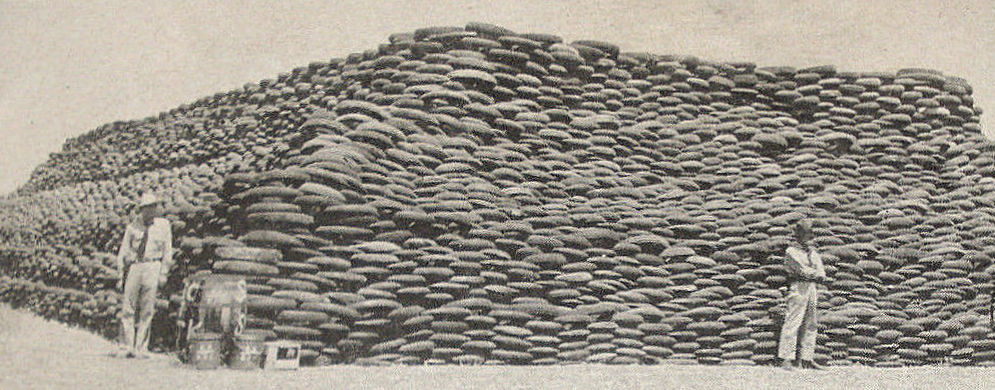
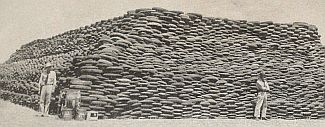
Guarding wartime scrap rubber, near Love Field…

by Paula Bosse

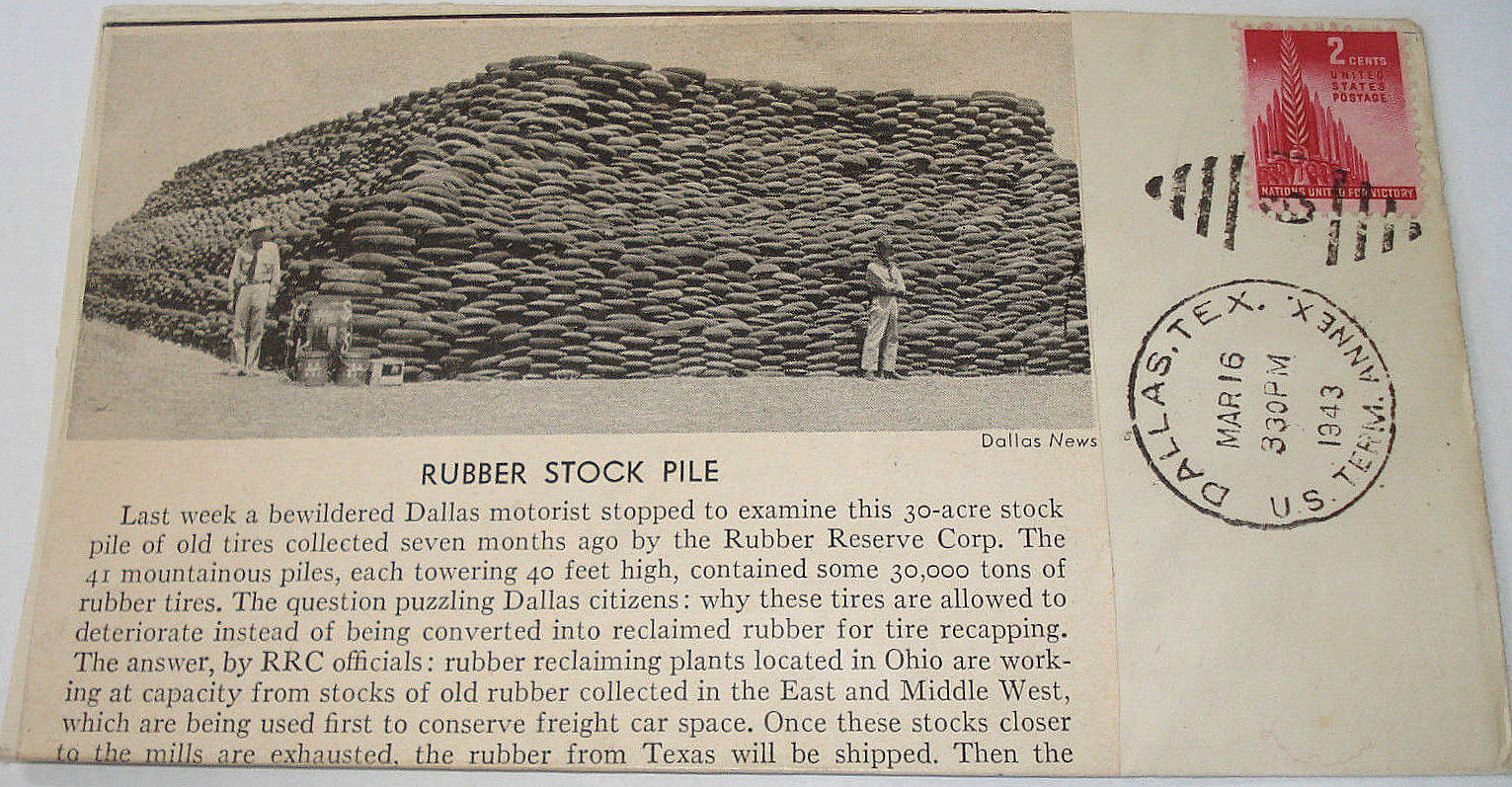
You don’t see this everyday: a photo of a pile of tires so large it dwarfs the armed guards who stand in front of it. (For that matter, you don’t often see armed men guarding tires.) What’s going on here? All is explained in the accompanying Time magazine article from March, 1943, which appears to have been cut from the magazine and pasted onto an envelope.
rubber-stock-pile_dallas-1943

The article reads:

RUBBER STOCK PILE
Last week a bewildered Dallas motorist stopped to examine this 30-acre stock pile of old tires collected seven months ago by the Rubber Reserve Corp. The 41 mountainous piles, each towering 40 feet high, contained some 30,000 tons of rubber tires. The question puzzling Dallas citizens: why these tires are allowed to deteriorate instead of being converted into reclaimed rubber for tire recapping. The answer, by RRC officials: rubber reclaiming plants located in Ohio are working at capacity from stocks of old rubber collected in the East and Middle West, which are being used first to conserve freight car space. Once these stocks closer to the mills are exhausted, the rubber from Texas will be shipped. Then the 25 armed guards, who watch Dallas’s [illegible] day and night, can go home.

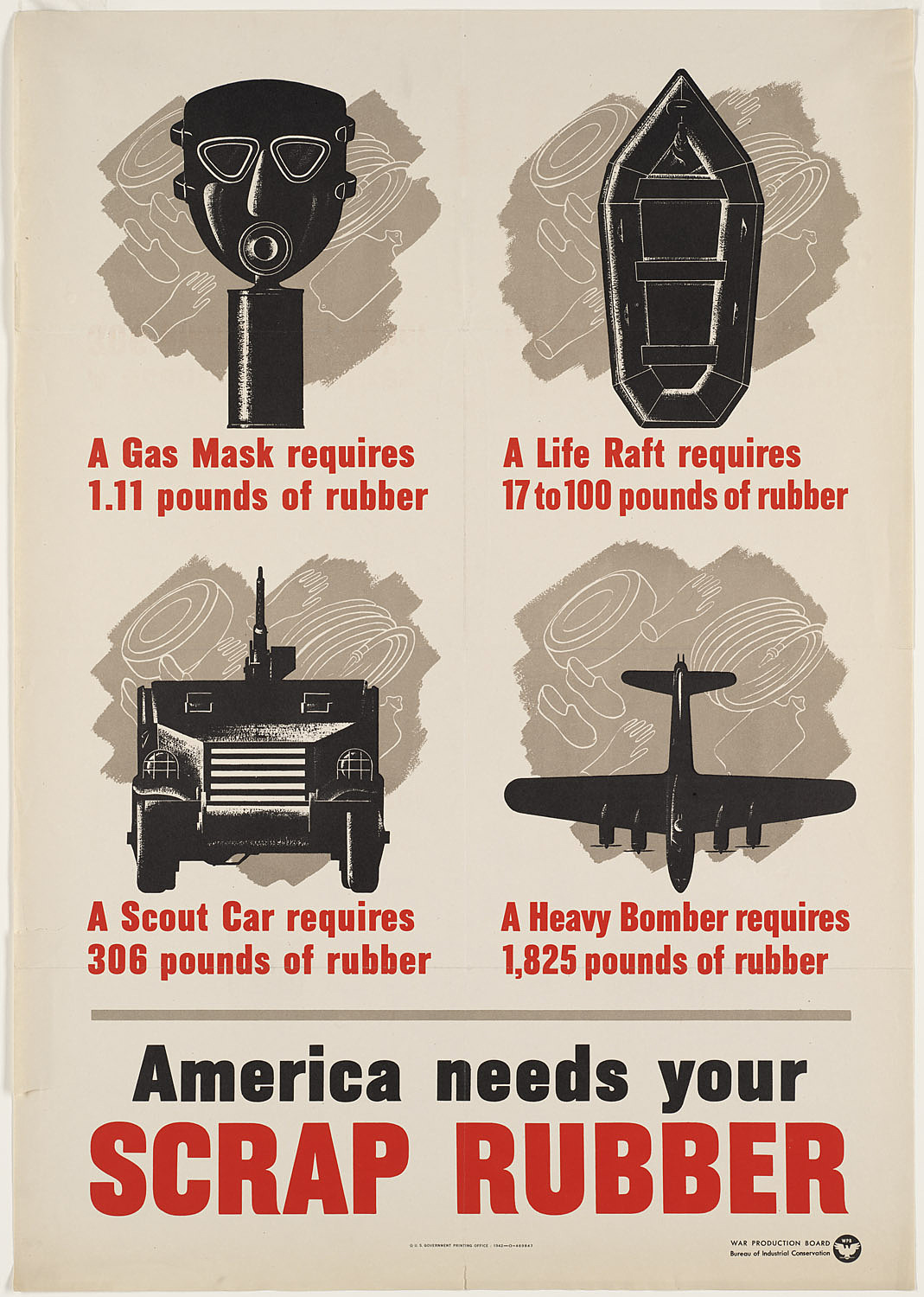
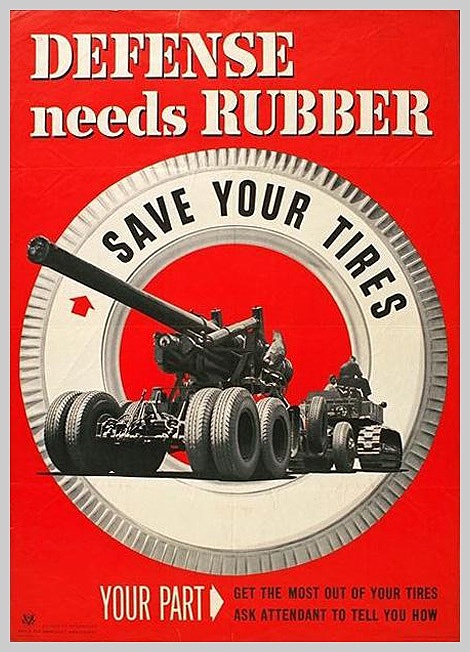
Ah, that mound of tires was the result of one of World War II’s many scrap drives. The national rubber drive ran from June 15, 1942 until July 10, 1942. The government requested that all Americans collect any old or unused rubber items in order to help with the supply of rubber in the U.S. (Japan controlled the bulk of rubber imports, and those imports had stopped when the United States entered the war). Rubber was needed for military purposes, but it was also necessary for essential domestic needs, mainly as tires needed to transport goods and people. Americans were told they needed to treat their automobile’s tires like gold: drive safely, drive slowly, and drive only when necessary — don’t wear your tires out, because you don’t know how long it’ll be until they’re manufactured again and/or how long it will be until large-scale production of synthetic rubber would become a reality. 
defense-needs-rubber_sarah-sundin

scrap-rubber-poster_sarah-sundinPosters via SarahSundin.com

When the rubber drive began, people were basically told that if they collected enough scrap rubber, the dire prospect of nation-wide gas rationing might be unnecessary (at the time only a few states in the northeast had been suffering through the rationing of gasoline) — the thinking was that if the government withheld gasoline that citizens would conserve rubber simply because they were unable to drive as much. Texans really like their cars and trucks, and we have long distances to drive, so it’s no surprise that throughout the rubber drive, Texas out-performed almost every state in per capita tonnage collected. In the first day of the drive, a Dallas gas station at Harwood and Young reported that 4,500 pounds of collected scrap rubber had been left throughout the day by Dallasites performing their patriotic duty. And that was just one day and one gas station! The government was paying a penny a pound, but many people refused payment.

What sorts of things were people dropping off at their neighborhood gas station (the government-directed drop-off points)? Other than used tires, everything you could imagine:

  • Automobile floor mats
  • Galoshes and raincoats
  • Bathing caps
  • Hot water bottles
  • Garden hoses
  • Girdles
  • Doorstops
  • Tennis and golf balls
  • Rings from jelly jars
  • Baby pants
  • Dolls
  • Toy mice
  • Slingshots
  • Soles of athletic shoes
  • Roadside debris
  • Mats found under office furniture and cuspidors

That stuff adds up fast.

*

Below are several ads exhorting readers to do their bit for the war effort by collecting and donating scrap rubber during the national rubber drive. (All images are larger when clicked.)
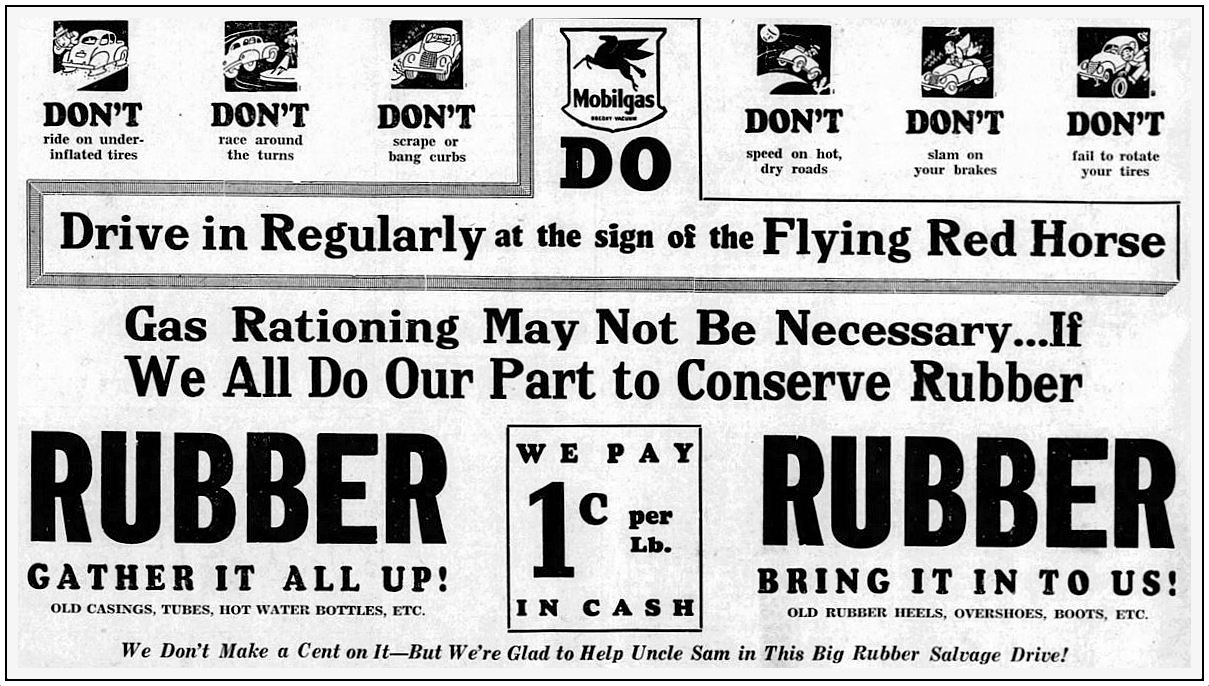
conserve-rubber_ad_nebraska_061642Mobil ad detail, June 16, 1942

Scrap could be dropped off at any service station.
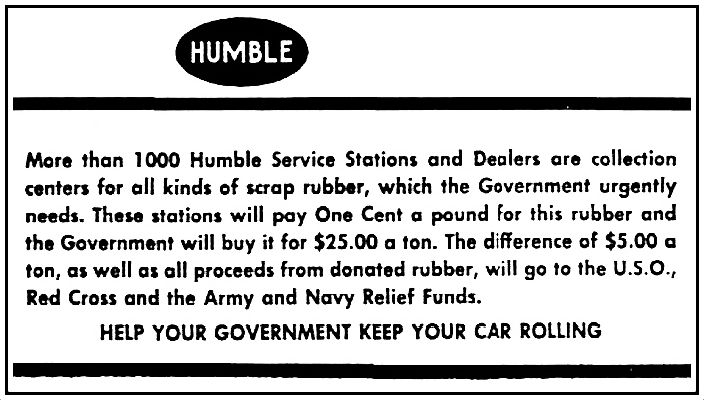
humble-ad_061742_detHumble Oil ad detail, June 17, 1942

If you needed home pick-up service, Sanger Bros. would send a truck.
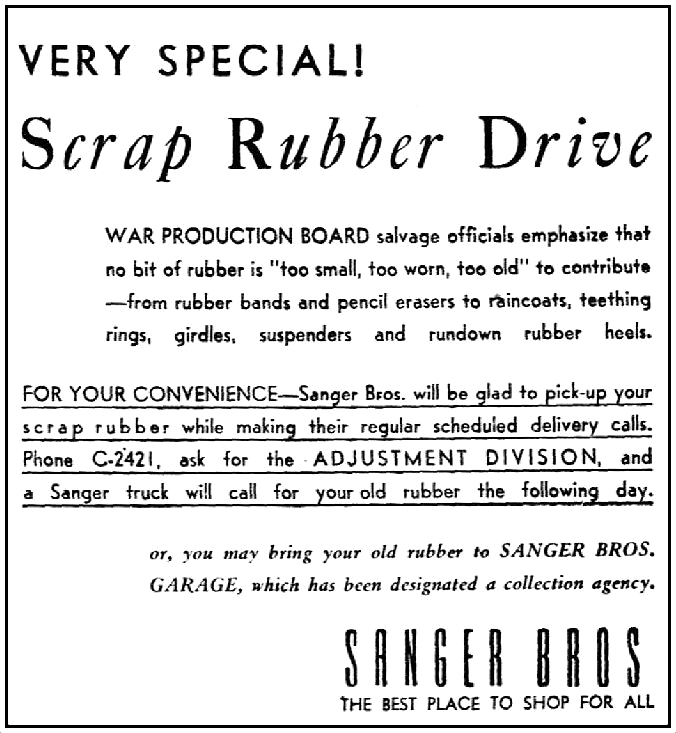
rubber-drive_sangers_061642Sanger Bros. ad, June 16, 1942

As would Titche’s.
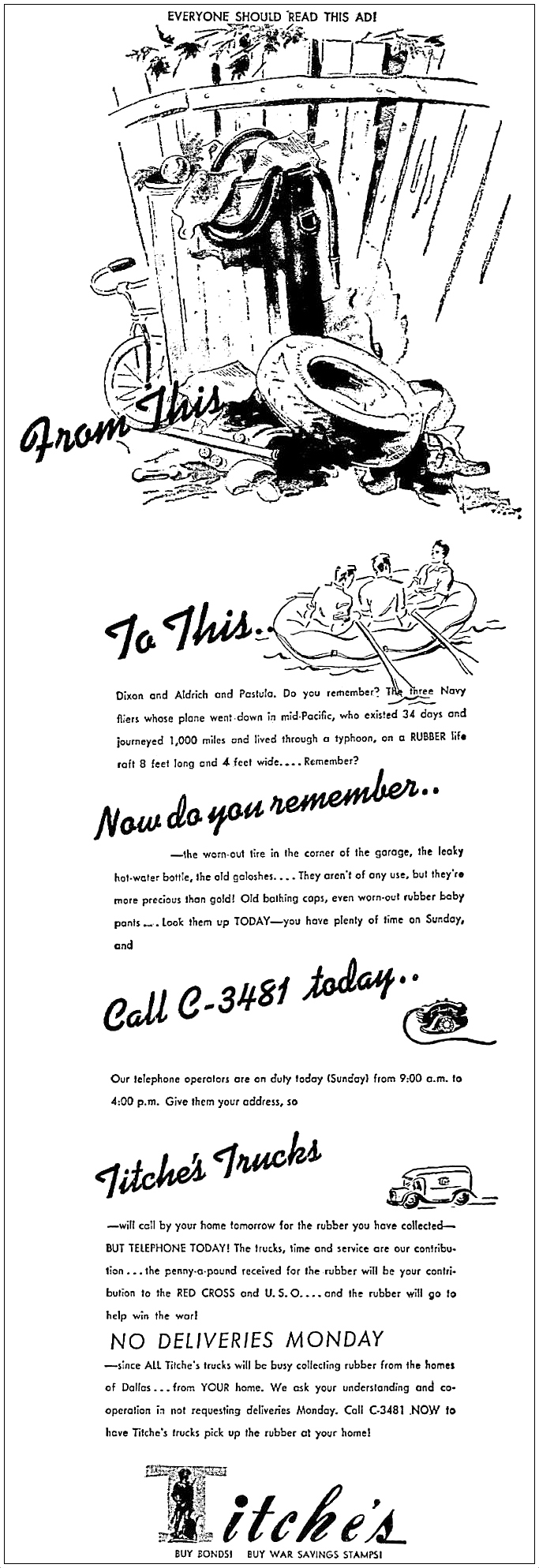
rubber-drive_titches-ad_062142Titche’s ad, June 21, 1942

Reminders to ferret out that rubber were added to many advertisements, as seen in this detail from a larger grocery store ad. (The drive was originally intended to run through June 30, but ended up being extended through July 10.)

rubber-drive_safeway-ad_062642_detSafeway ad detail, June 26, 1942

This appeared in an ad from the men’s and boys’ clothing store Reynolds-Penland.
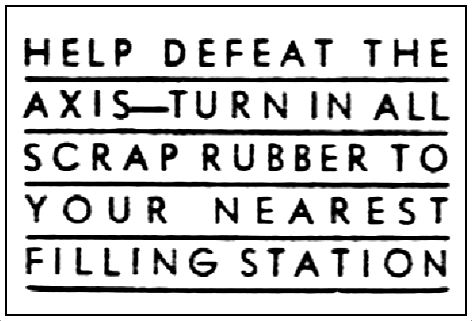
rubber-drive_reynolds-penland-ad_062642_detReynolds-Penland ad detail, June 26, 1942

As well as things were going in Big D, according to the government, things weren’t going well nationally, and the powers-that-be were more loudly threatening gas rationing for the entire country, including the states which were actually collecting the most, Texas and California.
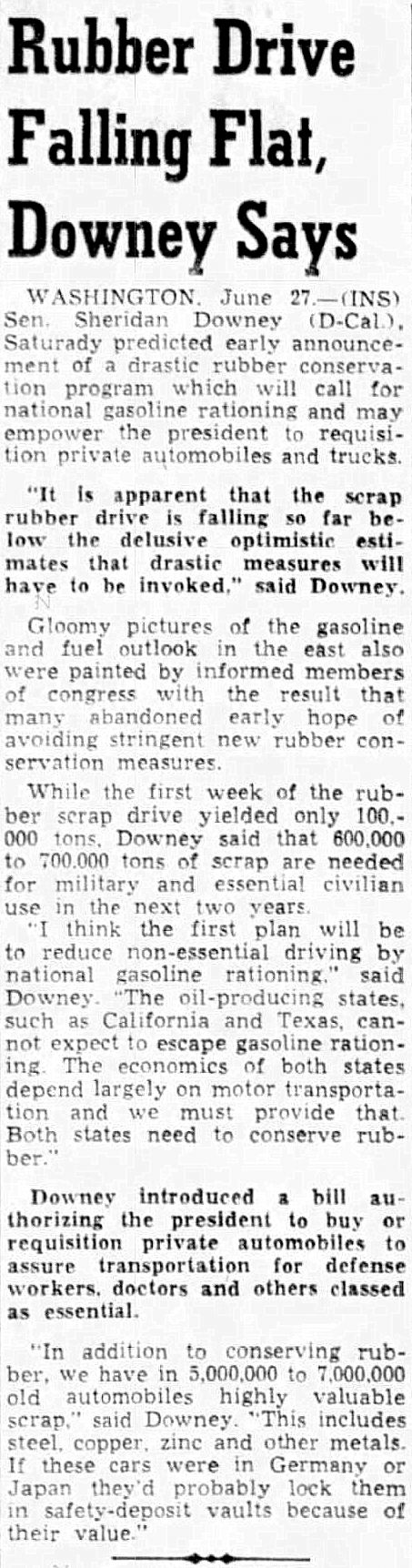
rubber-drive_austin-statesman_062742
Austin Statesman, June 27, 1942

The deadline was extended until July 10, with hopes that people would knuckle down and collect much, much more. This Neiman’s ad asked the question “What’s rubber got to do with me?” and answered its own question with an emphatic “EVERTHING!” The ad ended with a barn-burner: “We must not be too late with too little. The stake is life and freedom, and civilization itself. When did Texas ever fail in its patriotic duty?”
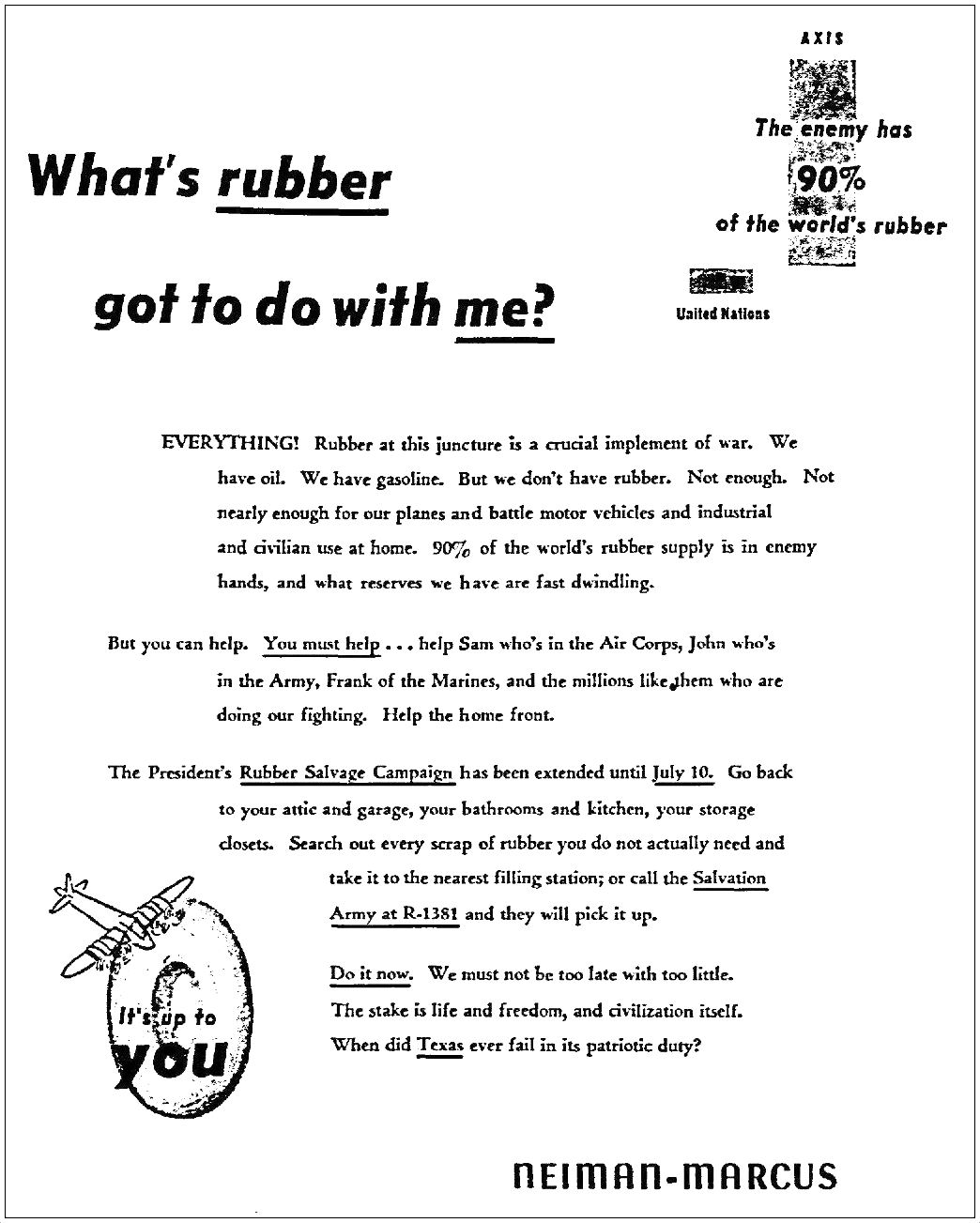
rubber-drive_neiman-marcus_070342Neiman-Marcus ad, July 3, 1942

The drive ended with Texas and the western states collecting the most scrap rubber. At the very bottom were New York, New Jersey, and Pennsylvania, all of which were already rationing gasoline. Ultimately, FDR considered the rubber drive to have been a failure, but, like the other scrap drives, it whipped up patriotism and resulted in a feeling of shared community as people worked together for the sake of the country — something which might have been more valuable than rubber.

Synthetic-rubber production slowly increased, but, even so, tire manufacturer B. F. Goodrich wanted everyone to continue to make sure their tires lasted as long as possible, because, after all, ” Hitler smiles when you waste miles.”
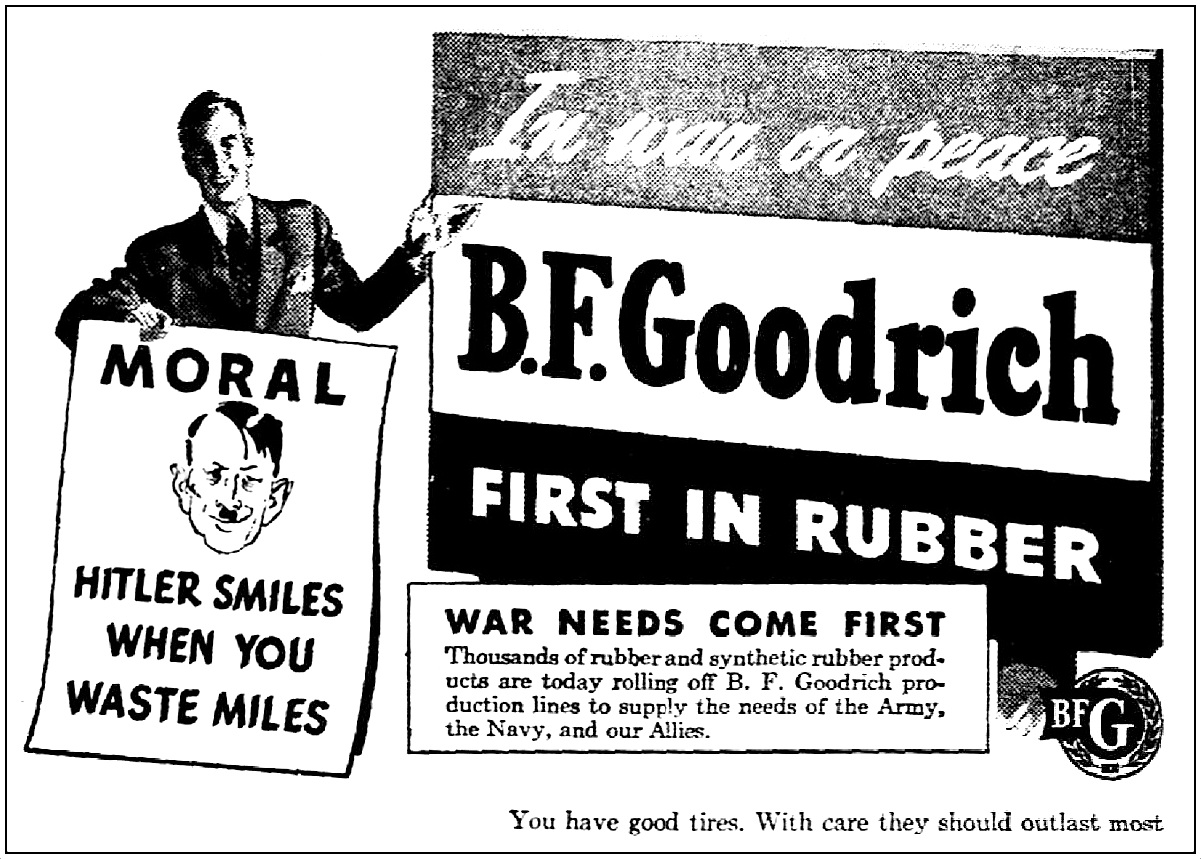
rubber-drive_b-f-goodrich-ad_071942_detB. F. Goodrich Tires ad detail, July 17, 1942

**

So where exactly was that massive used-tire mountain range? According to The Dallas Morning News, it was in a large open field “at the intersection of the MKT Railroad switch and Cedar Springs, just west of the Coca-Cola plant” (DMN, July 13, 1942), between Inwood and W. Mockingbird, not far from Love Field. The map below (from 1949) shows the general location of the yard, marked with a black star.
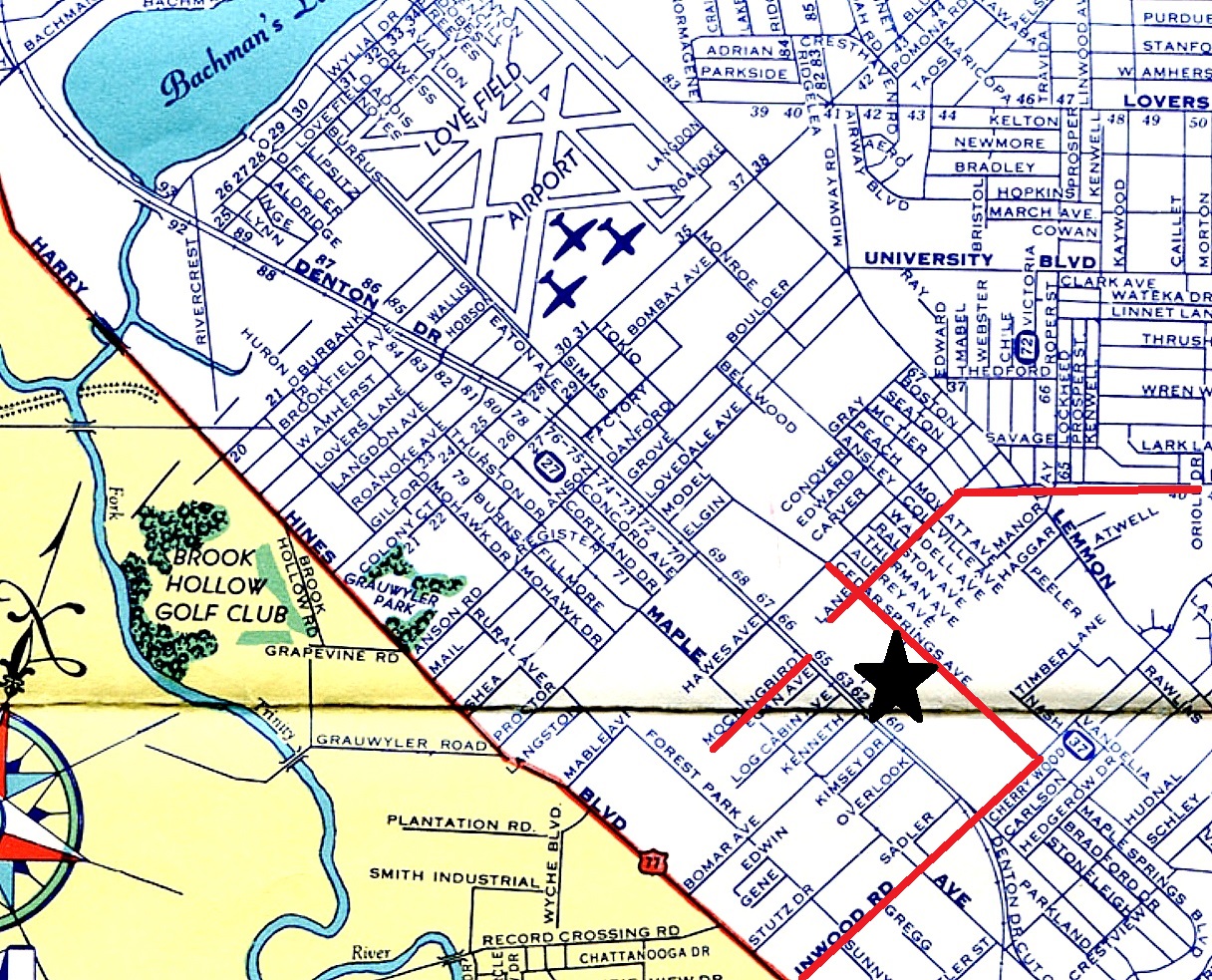
tire-mountain_1949-ashburn-map_dallas-freeways-site_det1949 Ashburns’ map detail, via DFW Freeways site

Initially, the salvage yard was to be contained on a 13-acre plot of land, surrounded by an 8-foot board fence. There were to be several tall guardhouses, and the “precious pile of vital war material” would  be patrolled 24 hours a day by armed guards “to protect it from fire hazards, thieves, or saboteurs” (DMN, Aug. 6, 1942). The fear of a potentially huge and uncontrollable fire was the main concern — a special fire plug was installed on the property and a direct phone/alarm line to the central fire station was set up. By August, the size of the yard increased by 50% to accommodate the 30 or more freight carloads which were arriving daily with scrap rubber from all over Texas (except the Panhandle). This huge salvage yard was meant to hold the rubber-drive scrap until reclamation plants in Ohio could accommodate it.

Several months later, the Time article put the expanded size of the yard at 30 acres, containing 30,000 tons of rubber material. By January, 1944, it was estimated the mammoth tire graveyard contained a whopping one million tires. Rather anti-climactically, a local tire dealer was contracted by the Rubber Reserve Corporation to “pick out the repairable and recappable carcasses” (DMN, Jan. 23, 1944) which were estimated to number about 150,000 tires; they would then be dispersed to Texas dealers who would either sell  them to consumers or vulcanize them. Despite the frenzied rubber drive of 1942 and almost a year and a half of sitting forlornly in an open field guarded by men with guns, it looks like those tires never made their trip to Ohio.

*

The land that these “tire mountains” occupied appears to have been leased from Carl C. Weichsel, member of a noted Dallas pioneer family. 23 acres of the land was sold to the Coca-Cola Company in 1937 — a $1,000,000 syrup plant and warehouses were built on ten of the acres, at Lemmon and W. Mockingbird. (Coca-Cola bought ten more acres in 1947 in order to expand.) A few weeks after the Coca-Cola land-purchase was announced, Dallas County granted the Missouri-Kansas-Texas Railway right of way across Cedar Springs, just south of Mockingbird, for a switch track to the Coca-Cola plant. 

In the mid 1940s, the Airlawn Industrial District sprang up in this area. The planning and development of Airlawn was spearheaded by none other than the Katy Railroad, beginning when Coca-Cola decided to move to the area. 

The […] plans were drawn up by the Katy’s industrial research and development department with the aid of experts versed in the problems of present day industry. […] The Katy maintains a Diesel switch engine on duty twenty-four hours a day to handle the switching operations in the Airlawn area. One section gang is assigned to this area to maintain the miles of track that interweave the industrial buildings. (DMN, Oct. 9, 1949)

The MKT was working to attract businesses along their lines: they needed the businesses, and the businesses needed them. Win-win! (It’s interesting to note that another major manufacturer that the Katy worked with on securing a location was another soft drink company: the Dr Pepper plant on Mockingbird, near Central.)

Below is a map from 1952 which shows the railroad spurs which were used by the Airlawn businesses. I’m not sure why I find this so interesting, but I do! (Are these tracks still in use?)
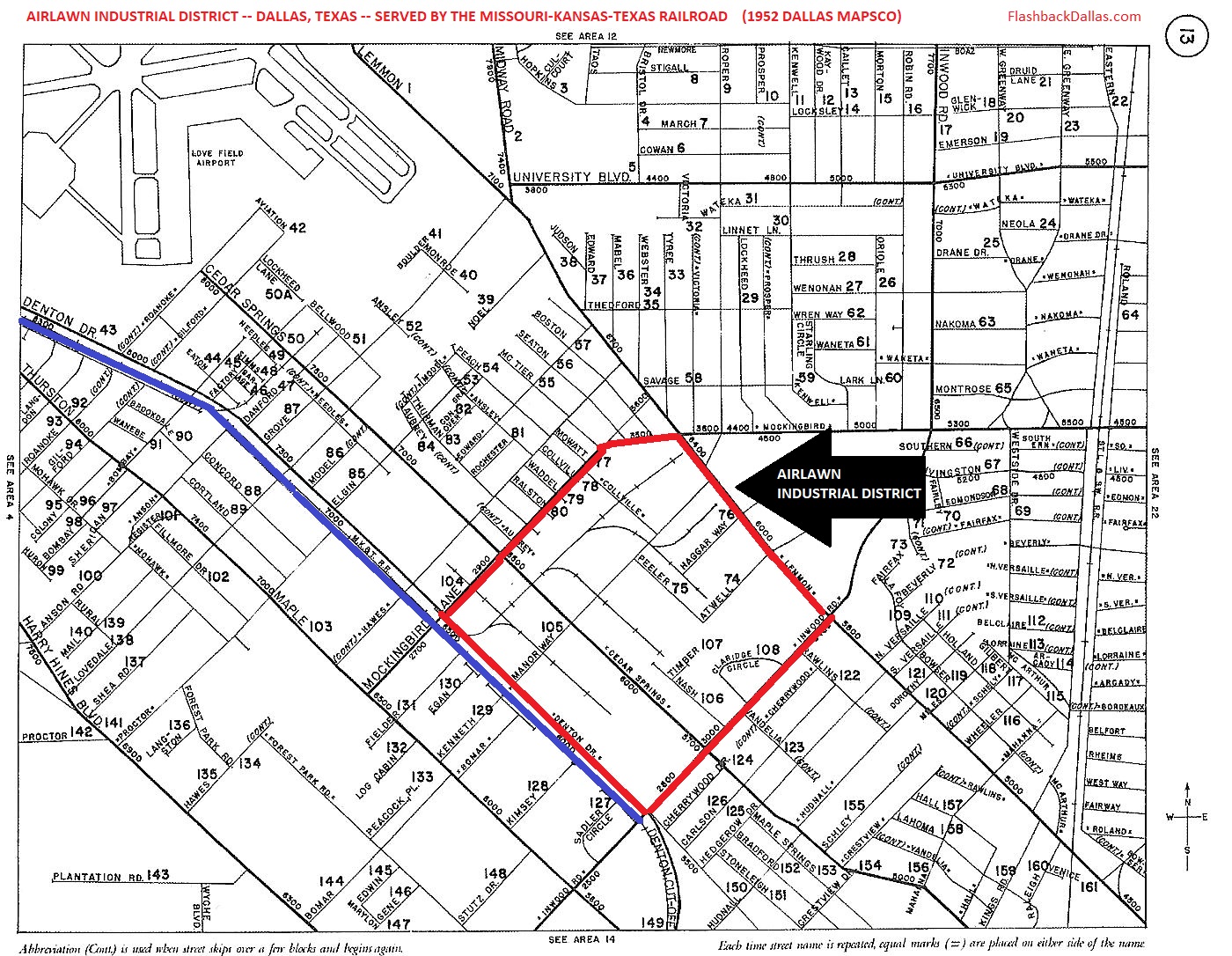
airlawn-industrial-district_mapsco-19521952 Dallas Mapsco

***

Sources & Notes

First and second image are from an old eBay listing; it appears that someone pasted a Time magazine article (March 15, 1943) to an envelope; the postmark and cancellation shows that it was mailed from Dallas on March 16, 1943, even though there does not appear to be an address on the front or back of the envelope.

A really interesting article on the various WWII scrap drives — “Getting In the Scrap: The Salvage Drives of World War II” by Hugh Rockoff, of the Economics Dept. of Rutgers University — is well worth a read, here. From his abstract: “While the impact of the drives on the economy was limited, the impact of the drives on civilian morale, may well have been substantial.”

Another very informative article on the national rubber drive of 1942 can be found in the post “Make It Do — Tire Rationing in World War II” by Sarah Sundin, here.

See a variety of patriotic posters encouraging Americans to participate in WW2 scrap drives here.

Pertinent Dallas Morning News articles about this rubber salvage yard:

  • “Work Begun on Rubber Storage Plant” (DMN, July 13, 1942)
  • “Close Guard Is Kept On Rubber” (DMN, Aug. 6, 1942 — includes a photo of the yard, similar to the one that appeared in Time magazine)
  • “150,000 Usable Tires Believed Salvageable From Waste Pile” (DMN, Jan. 23, 1944)
rubber-stock-pile_dallas-1943_ebay-det_sm

*

Copyright © 2019 Paula Bosse. All Rights Reserved
 

Armistice Day Centennial

wwi_cook-collection_degolyer-library_SMU

by Paula Bosse

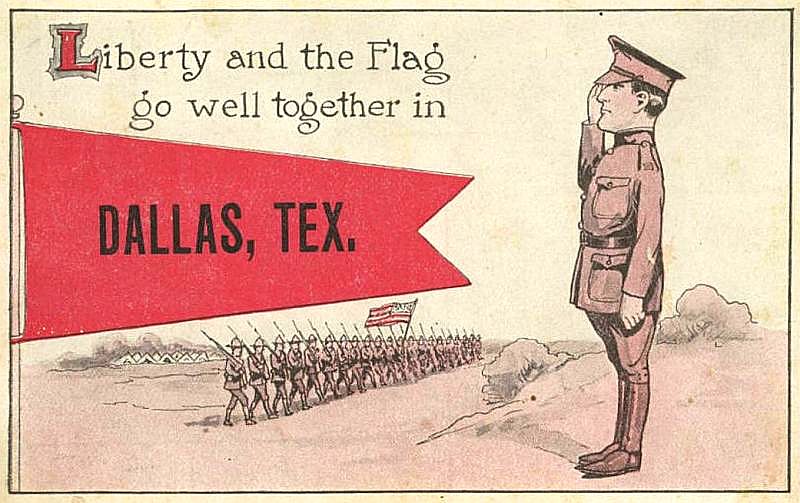
Today we observe the 100th anniversary of the end of World War I, with sincere hopes we never again see a war with such devastating loss of life. Read how Dallas celebrated news of the armistice in the Flashback Dallas post “Armistice! — 1918,” here. More posts on Dallas and WWI can be found here.

***

Sources & Notes

“Liberty and the Flag go well together in Dallas, Tex.” postcard is from the George W. Cook Dallas/Texas Image Collection, DeGolyer Library, SMU Libraries, Southern Methodist University; more information on this item may be found here.

*

Copyright © 2018 Paula Bosse. All Rights Reserved.

Preston Sturges: Camp Dick’s Most Famous Former Cadet? — 1918

preston-sturges_camp-dick_dallas_1918
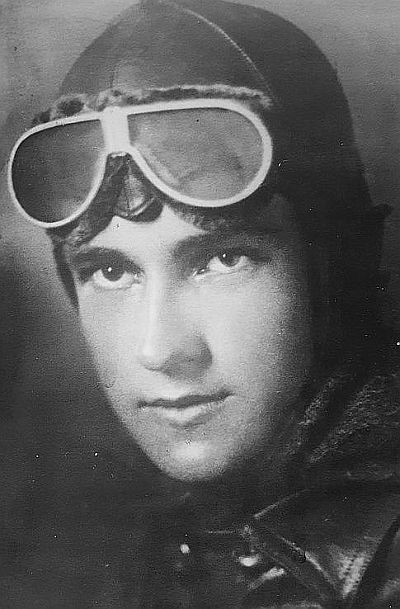
Preston Sturges playing dress-up, Camp Dick, Dallas, 1918

by Paula Bosse

While researching my Veteran’s Day post on Camp Dick cadets, I came across a 1941 Dallas Morning News article about Hollywood screenwriter and director Preston Sturges, whose latest movie The Lady Eve was about to open at the Palace. The article mentioned that Sturges had been stationed at Camp Dick, the WWI aviation boot camp for the U.S. Signal Corps, located in the old racetrack at Fair Park. Preston Sturges — a master of the screwball comedy — is one of my favorite writer-directors (in addition to The Lady Eve, everyone should watch Sullivan’s Travels), so I was interested to find out more about his time in Dallas. I didn’t think I’d find anything but a passing mention of it anywhere, but, surprisingly, it turns out Sturges himself wrote about his Camp Dick days — in a book I actually own and had started but had never finished!

Sturges was sent to Dallas in March, 1918. He was 19 years old. Born in Chicago, he had spent much of his childhood in France, tagging along with his eccentric four-times married bohemian mother who seems to have known every intellectual and artiste of the day (not only was she a close friend of dancer Isadora Duncan and Marcel Duchamp, she had also been romantically involved with Aleister Crowley — you can’t get much more bohemian than that!).

Sturges’ account of his time at Camp Dick (which appeared in Chapter 28 of the posthumously-published Preston Sturges by Preston Sturges) is amusing, describing such things as the heat (“the midday temperature of a Texas summer wasn’t really intended for human beings”), the latrines, and the food. He also remembered the nightmare of the Spanish Influenza pandemic, which was particularly deadly in the close quarters of military camps. (You can read the entirety of Sturges’ memories of his days at Camp Dick here.)

The heat was a real problem for the cadets. One of my favorite images conjured by Sturges’ chapter on the camp is this one:

Out on the parade ground, boys fell over from [the intense heat] all the time and had to be revived with cold water and a sponge. Nights we would climb up the shaky apex of the large roller coaster in the corner of the fairgrounds to try to find a breeze.

One of his memories stumped me a bit, though. He wrote the following about the buildings that stood around Fair Park:

In Dallas, we were sent to a place called Camp Dick, then known as a concentration camp. In a later war, such a facility was called a boot camp. Camp Dick was actually the Dallas fairgrounds with a fence thrown around them. Most of the buildings on the fairgrounds were huge reproductions of the products for sale within them in the prewar days when the fair was open. There was a building in the shape of a gigantic Mazola bottle; another like a huge Gulden’s mustard pot; an enormous Log Cabin Syrup edifice; a massive chili bowl; buildings representing almost anything edible or potable that one could think of….

My last memory of Camp Dick is of standing retreat against the hot sunset, the cadets at attention against the silhouetted background of the massively enlarged Sanka coffee pot, Bromo Quinine bottle and Coca-Cola bottle buildings, and in front of us Lieutenant Pennypacker, more or less at ease on the back of the fiery steed presented to him by the grateful citizens of Dallas.

I’ve never heard of any Fair Park buildings shaped like these things. (There was that giant cash register at the Texas Centennial….) Perhaps Mr. Sturges misremembered? Or indulged in a little fanciful poetic license? Or maybe these buildings DID exist? (And if they did, I’d love some corroboration, ’cause that would be cool.)

Sturges was at Camp Dick only a few months. From there he was sent to the School of Military Aeronautics in Austin and then to Park Field in Millington, Tennessee. He was in the middle of flight training there when, anti-climactically, the war ended. After several years of working in a family business, he became a successful Broadway playwright and was soon whisked off to Hollywood, where, in 1940, he won the first Oscar ever awarded for screenwriting (The Great McGinty). He was considered then — and is considered now — to be one of Hollywood’s greatest comedic screenwriters.

If you’d like to read Preston Sturges’ memories of training at Camp Dick, mosey on over here. Among other tidbits, you’ll read the amusing story behind the be-goggled photo of Cadet Sturges at the top of this post.

***

Sources & Notes

The romanticized photo at the top (the one Sturges wrote about in the book) was taken at Camp Dick in 1918. The quoted passage is also from the book, Preston Sturges by Preston Sturges, His Life In His Own Words, adapted and edited by Sandy Sturges (New York: Touchstone/Simon & Schuster, 1991). I highly recommend getting this book if you’re a fan of classic Hollywood. You can browse through it on Google Books, here, and purchase it here.

More on Sturges at Wikipedia, here.

Dive deeper: another photo of Sturges taken in Dallas in 1918 appeared in The Dallas Morning News on March 27, 1941, titled “At Camp Dick” — it shows a smiling Sturges sitting in a “dummy pilot seat.” If the photo was taken at Camp Dick, the unnamed photographer must have taken “action shots” as well as portraits of the camp’s cadets which Sturges wrote about in his autobiography. (Sturges writes in his amusing story that none of the cadets had ever been near a plane at that point, but they all wanted to be seen as dashing goggle-and-scarf-wearing flying aces.)

*

Copyright © 2016 Paula Bosse. All Rights Reserved.

Children and Cadets: Junior Red Cross Parade — 1918

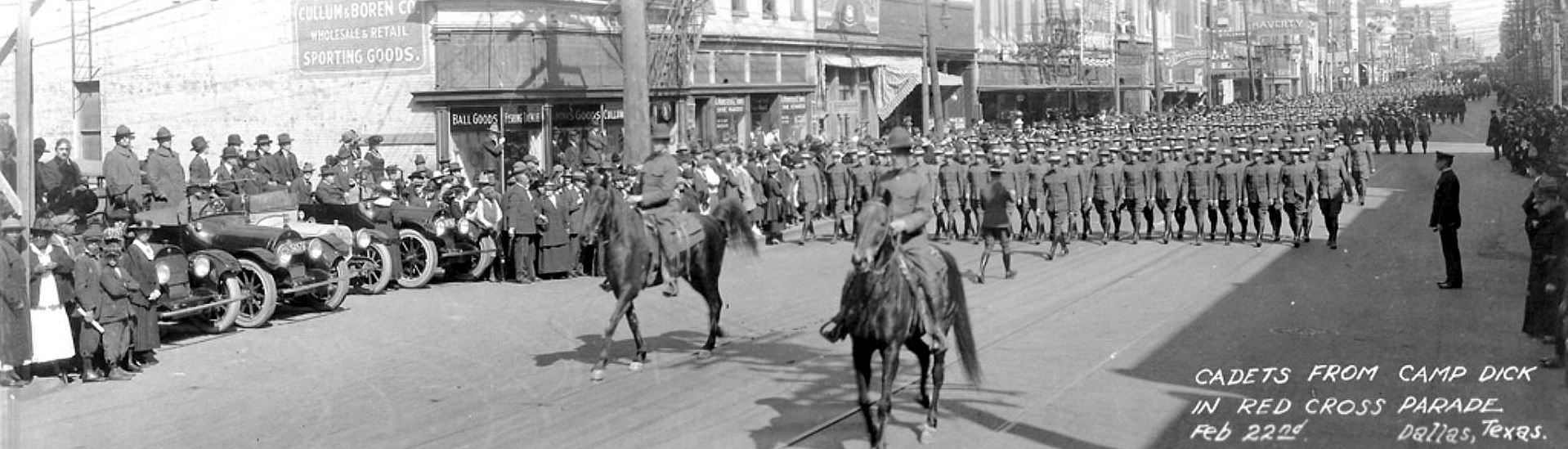
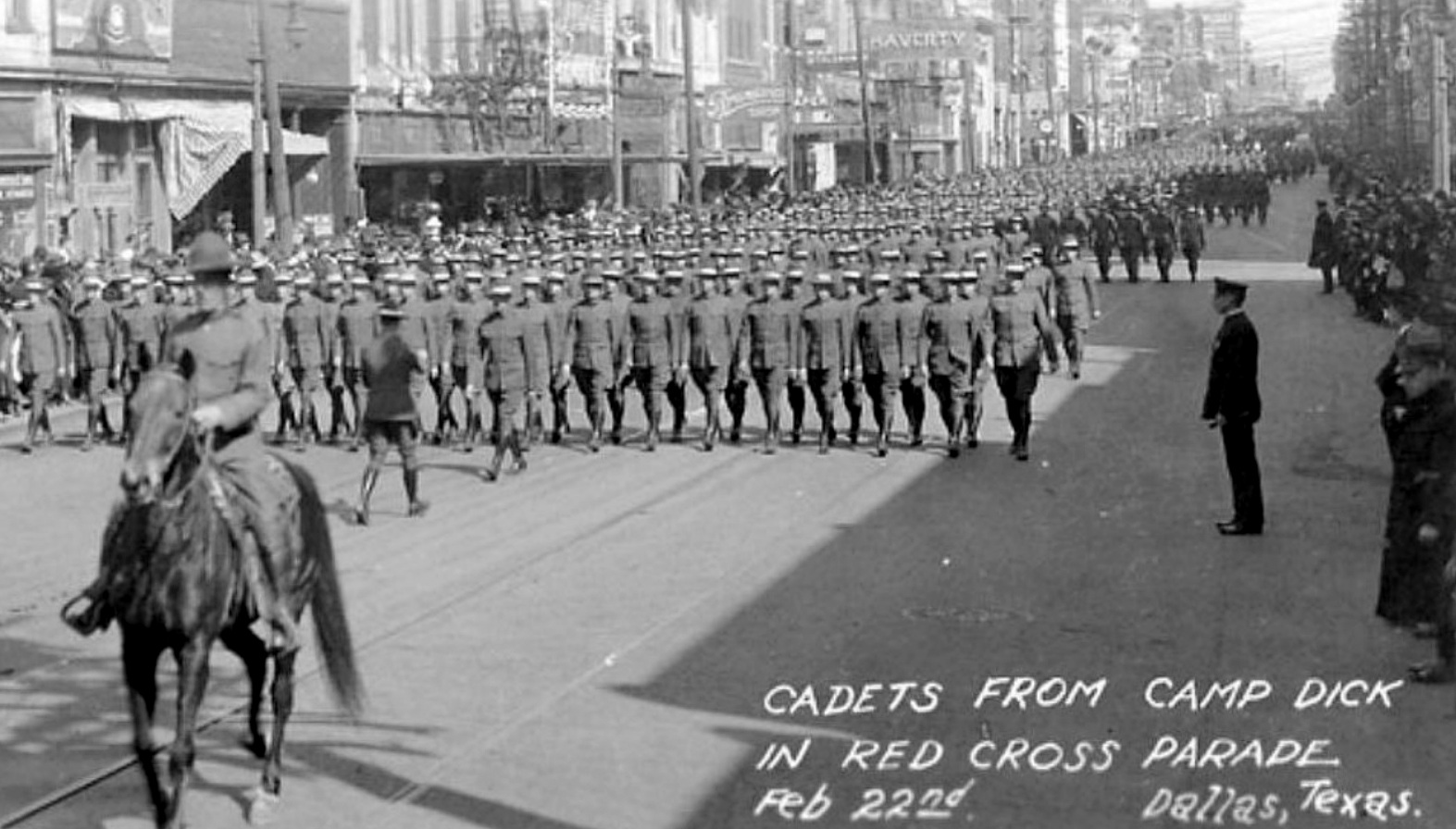
wwi_jr-red-cross-parade_022218_camp-dick-soldiers_waruntold-siteCadets from Camp Dick march down Elm… (click for larger image)

by Paula Bosse

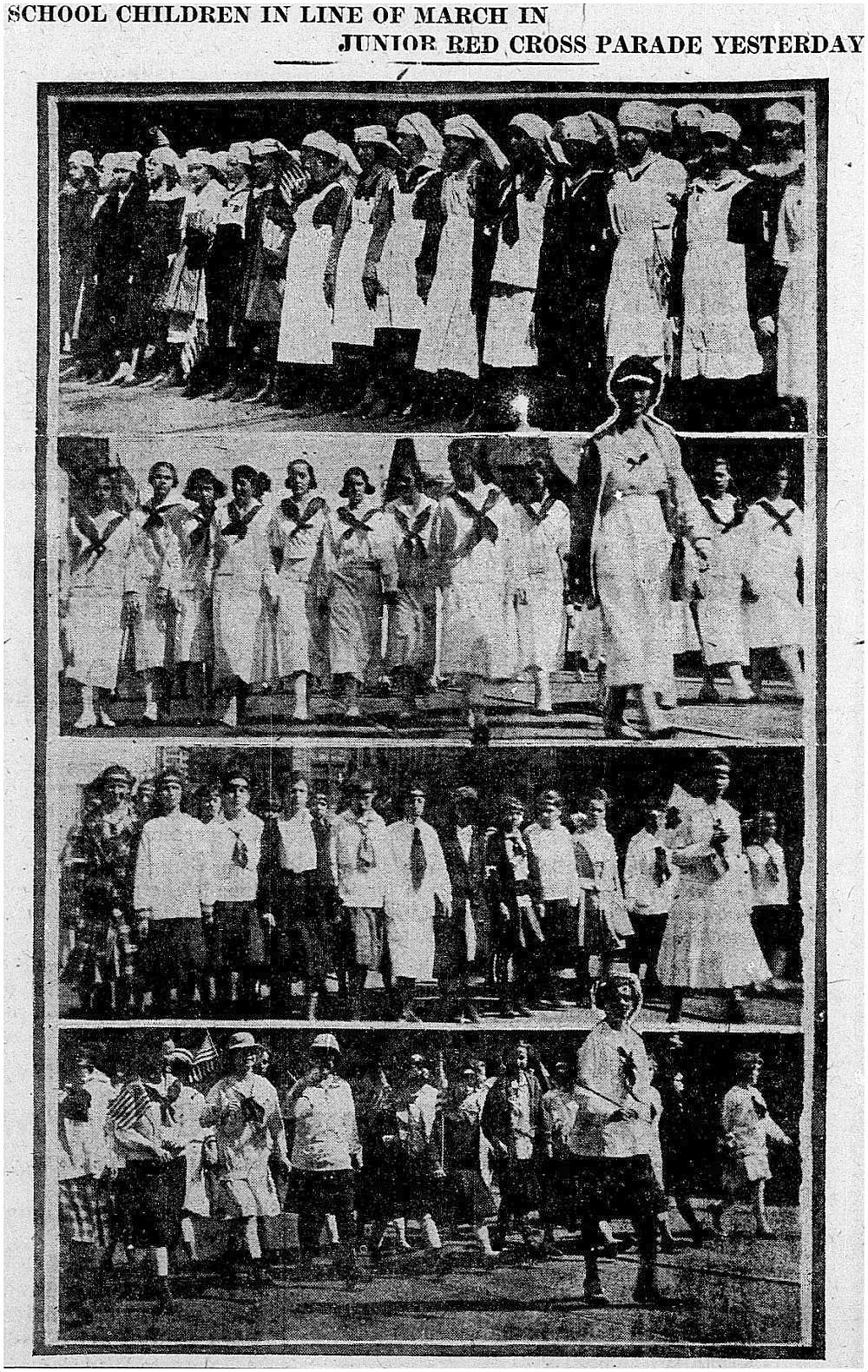
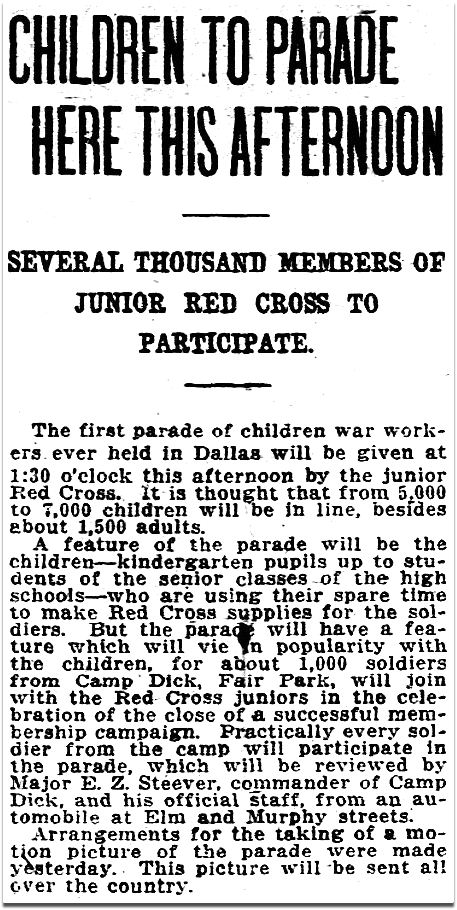
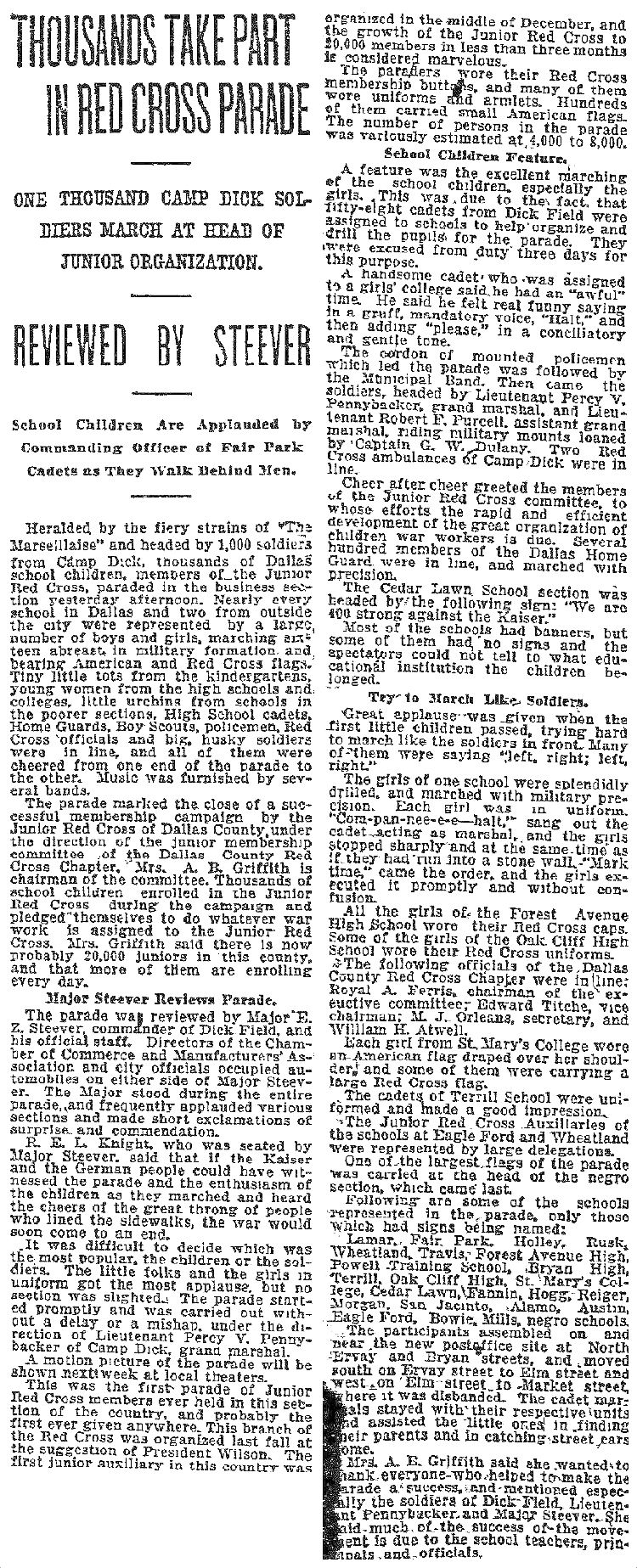
Today is Veteran’s Day, a national day of observance which originally began as Armistice Day in 1919 to mark the end of hostilities in World War I. I was thinking of posting something non-WWI-related, but I stumbled across this wonderful photo showing a WWI-era parade down Elm Street and couldn’t pass up the opportunity to share it. The parade was comprised almost entirely of children who had contributed to the war effort through the Junior Red Cross. The parade was described as “the first parade of children war workers ever held in Dallas.” The number of children (said to represent every school in Dallas) was estimated at up to 8,000 marchers, from kindergarteners to high school seniors.

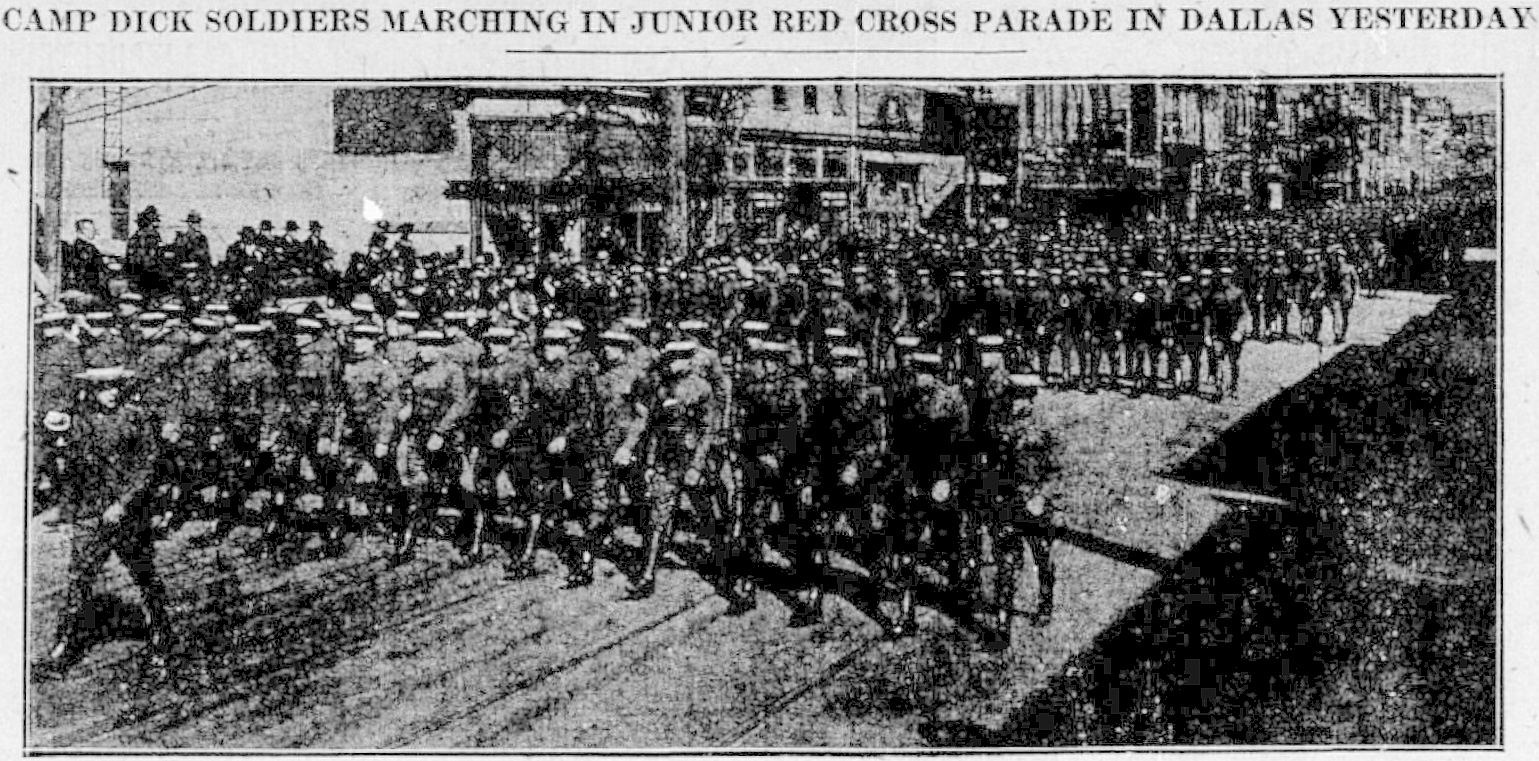
The parade — which took place on February 22, 1918 — also featured 1,000 or so men based at Camp John Dick, the Air Service training camp at Fair Park. Seeing this parade must have been quite a novelty for Dallasites, as cadets had begun to arrive at Camp Dick only 16 days previously (airmen had been stationed at Love Field a little longer, but only by a couple of months).

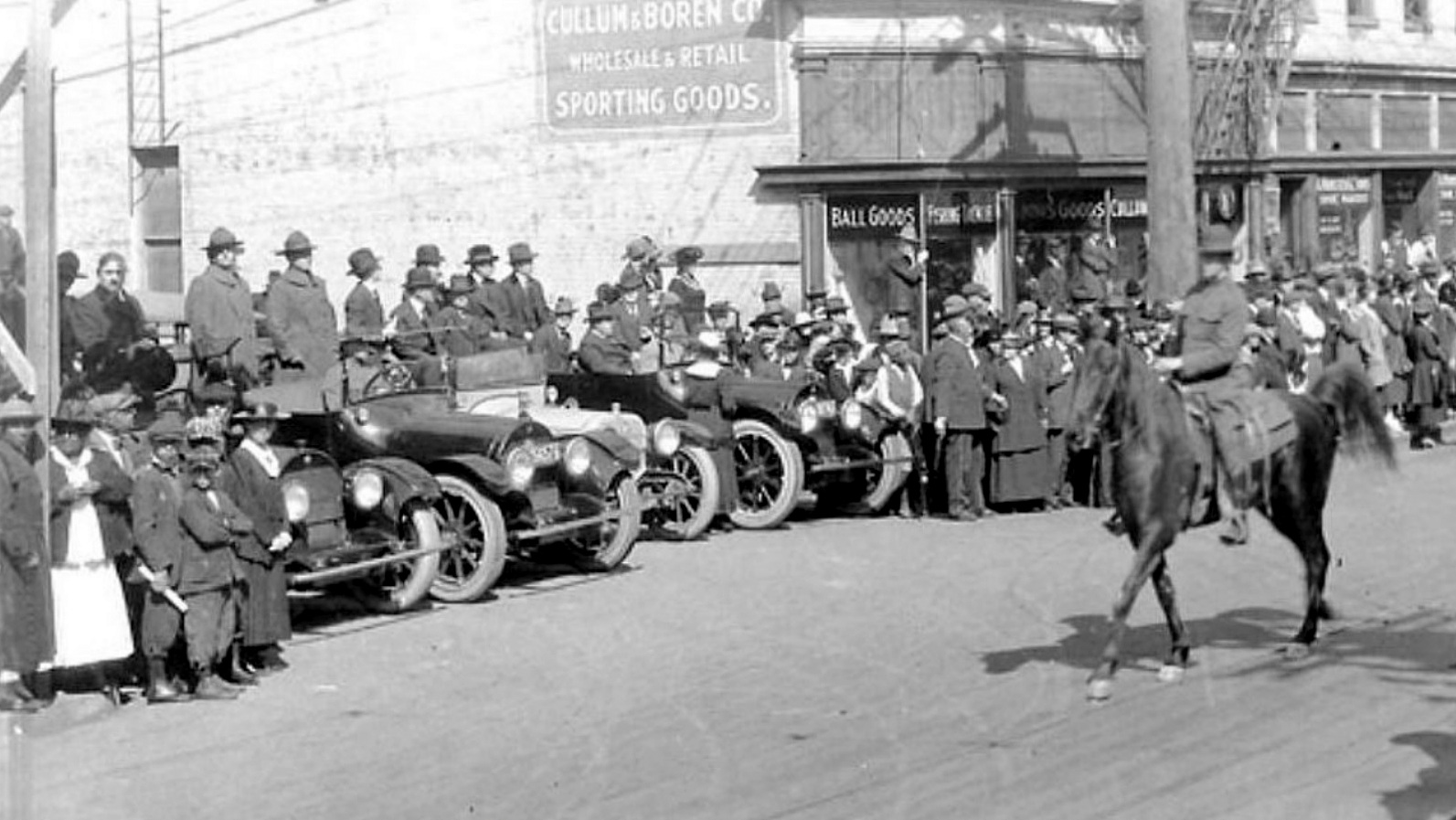
Below, I’ve taken the photo from the top and broken it into two halves and then magnified them. The parade was heading west on Elm Street and can be seen here passing Cullum & Boren (1509-1511 Elm), a downtown sporting goods mainstay just a few doors east of Akard. (See a similar view of Elm Street from later that year — in September — from a Dallas Times Herald photo, here.)

wwi_jr-red-cross-parade_022218_det1

wwi_jr-red-cross-parade_022218_det2

And the children.

wwi_jr-red-cross-parade_dmn_022318Dallas Morning News, Feb. 23, 1918

wwi_jr-red-cross-parade_dmn_022218
DMN, Feb. 22, 1918

wwi_jr-red-cross-parade_dmn_022218_camp-dick-soldiers

wwi_jr-red-cross-parade_dmn_022318
DMN, Feb. 23, 1918, photo and article

***

Sources & Notes

Top photo titled “Cadets From Camp Dick in Red Cross Parade, Feb. 22nd, Dallas, Texas” found on the site War Untold, The Collection of Andrew Pouncey, here (click “continue reading” at  bottom of post).

More on the Camp John Dick Aviation Concentration Camp from The Atlantic in the article “What America Looked Like: Bayonet Practice During WWI” (with a great photo), here.

Other Flashback Dallas WWI-related posts here:

Armistice Day Wikipedia page is here.

All pictures and clippings are larger when clicked.

*

Copyright © 2016 Paula Bosse. All Rights Reserved.


“Tough ‘Ombres on Main Street” — WWI Victory Parade, 1919

tough-ombres_flickr90th Infantry Division, 1500 block of Main Street (click for larger image)

by Paula Bosse

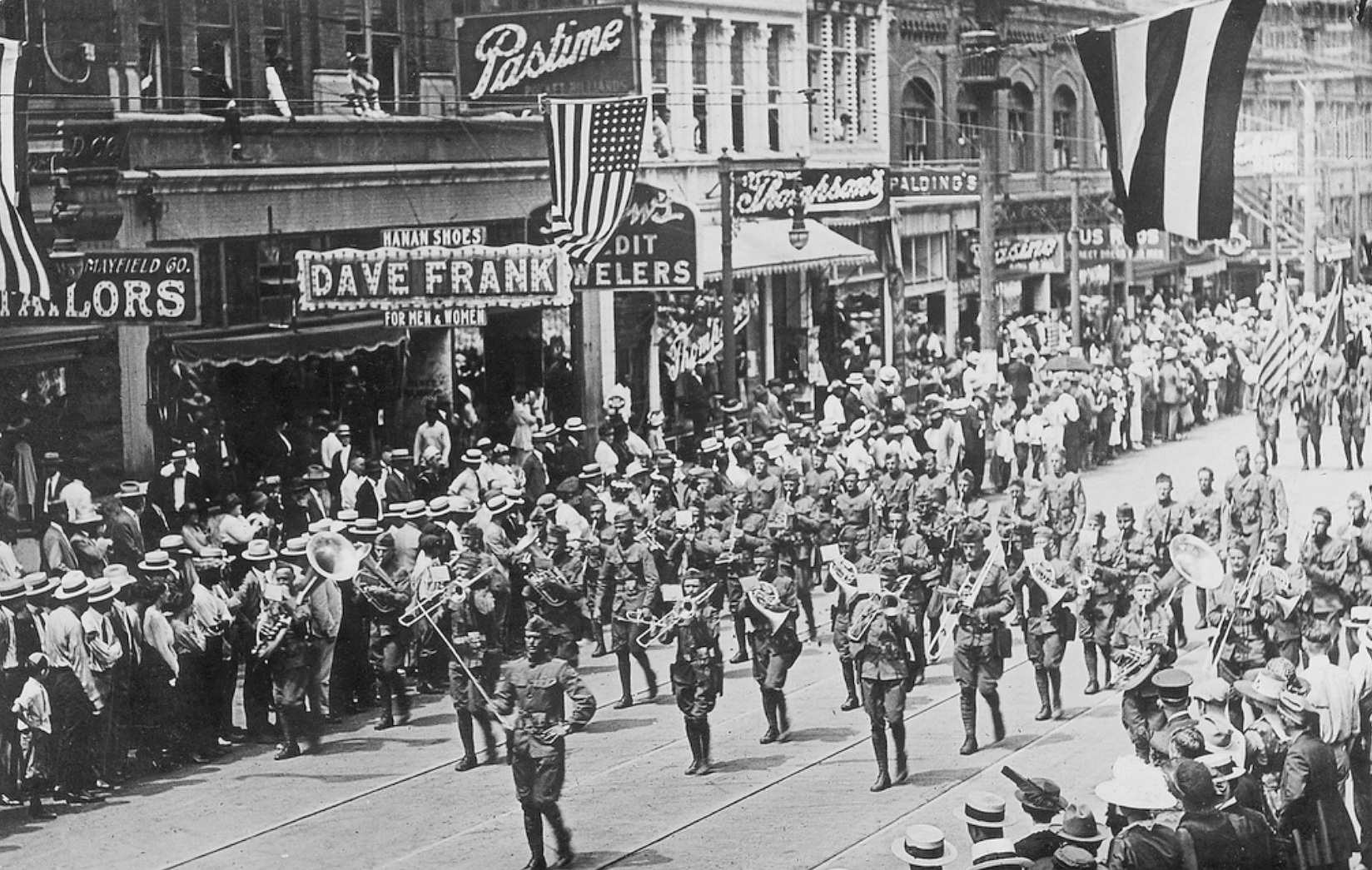
In my previous post “From the Vault: Armistice Day! — 1918” (seen here), commenter “Not Bob” linked to the above photo which was taken from almost the exact same vantage point as the photo I had posted previously. This one is much better! It shows the U.S. Army’s 90th Infantry Division (known as the “Tough ‘Ombres”), just back from Europe, marching past the 1500 block of Main Street, heading east. The white building in the center (“Thompson’s”) appears to be the same building currently occupied by Iron Cactus, at 1520 Main.

Great picture — thanks, Not Bob!

***

Sources & Notes

This photo was posted by Bob Swanson on Flickr, here. The comments are very interesting and explain why this infantry division was marching in various Texas cities.

More on the 90th Division here and here.

My post “Armistice! — 1918” contains another parade photo taken at the same spot, here.

*

Copyright © 2015 Paula Bosse. All Rights Reserved.


An Afternoon Outing with SMU Frat Boys & Their Dates — 1917

smu_omega-phi_dallas-hall_1917_degolyerCampus couples, 1917

by Paula Bosse

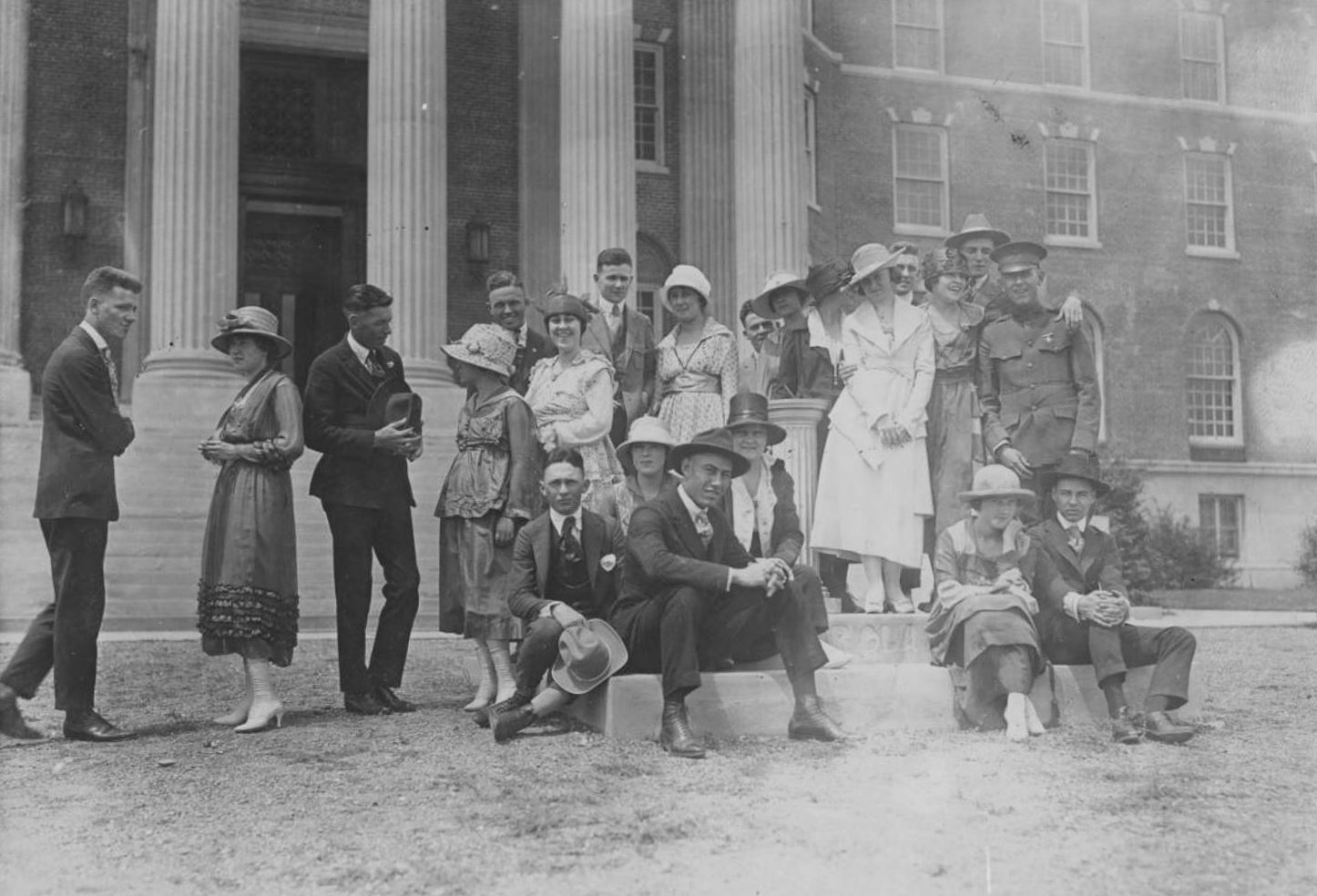
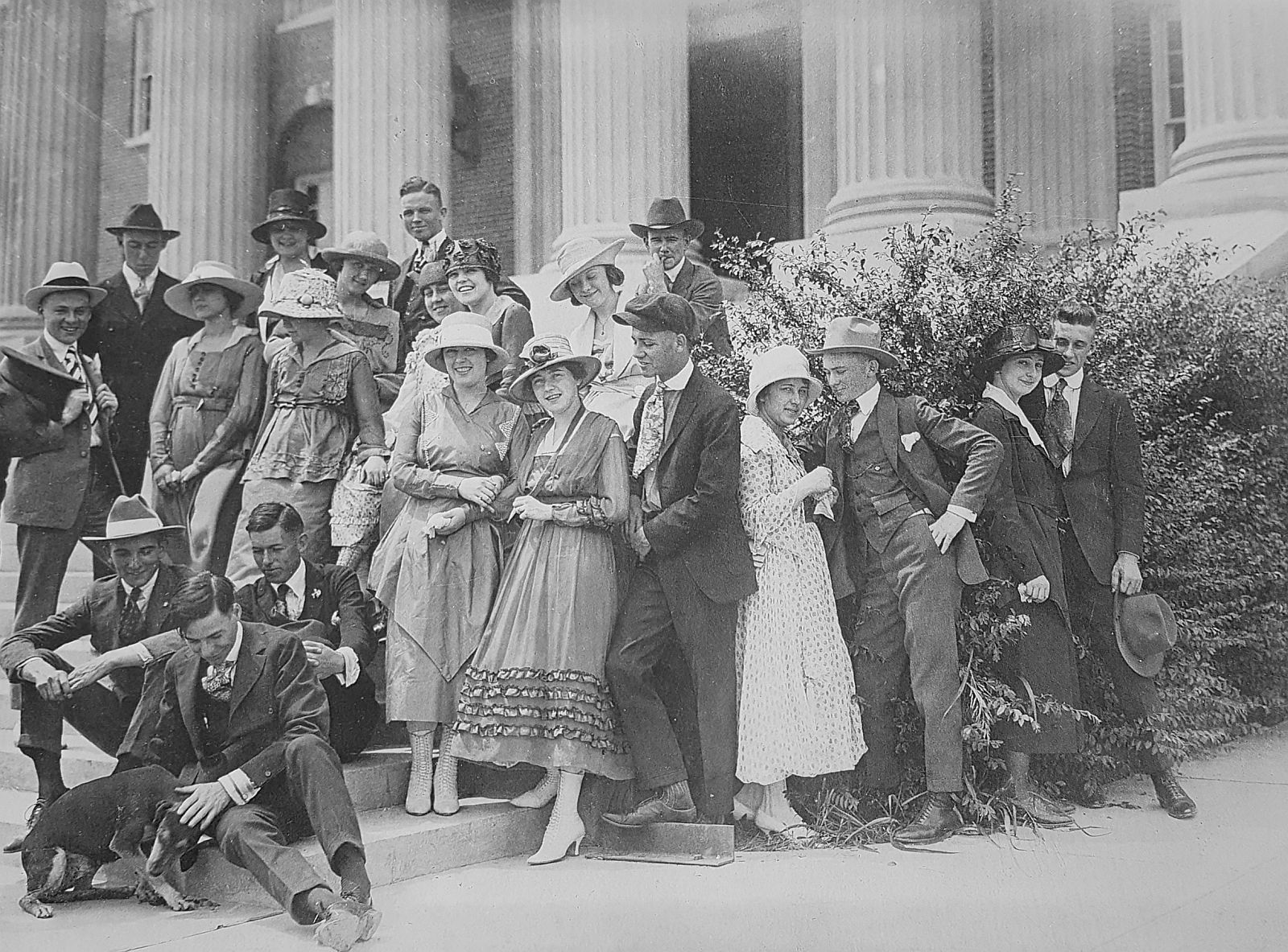
I came across three wonderful World War One-era photos in the SMU archives while I was looking for something else. You know how you can become enthralled by the charm of old photos and sit for long stretches of time staring at every little detail and wondering about the lives of the unidentified people who populate them? That happened to me with these. There is one particular young woman who stands out more than anyone else. Not only is she the best-dressed person in the photos, she also seems calm, collected, and serene. She looks friendly. She was probably very pleasant to have around.

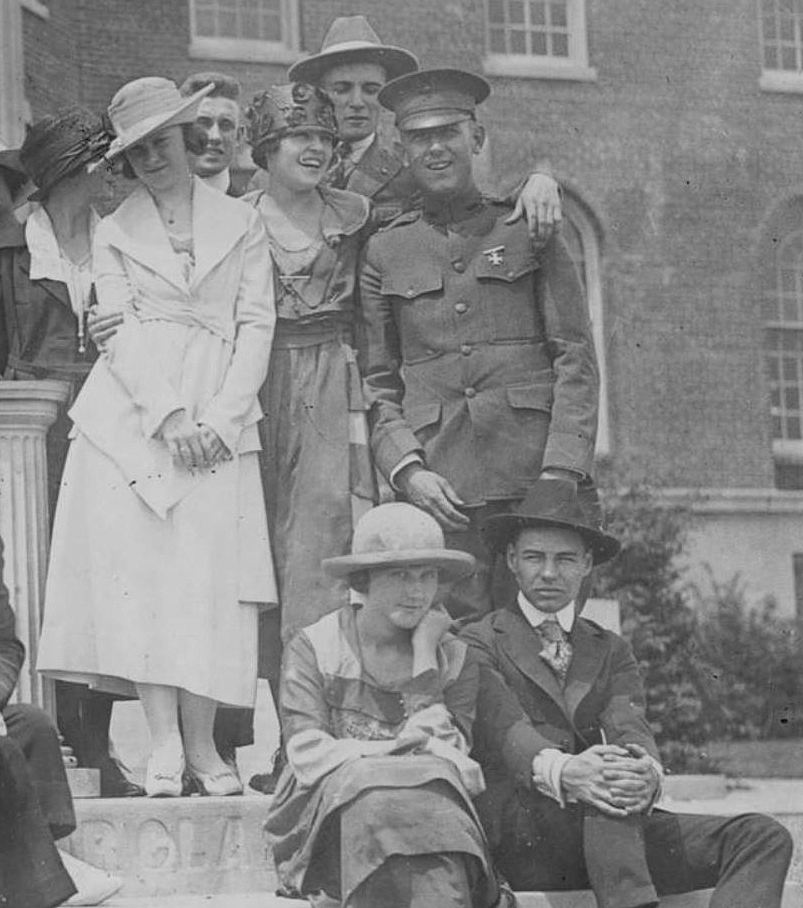
These three photographs show a group of ten young couples and a pair of chaperones spending a beautiful sunny day together, with the highlight of the day being a trip to Highland Park’s Exall Lake. The men are SMU students, identified only as members of the Omega Phi fraternity. The women are identified merely as “dates,” but I’m sure that some of them were also SMU students. The photograph above shows the crowd gathered on campus in front of Dallas Hall. The woman in white looks like she’s on a pedestal, glowing in a spotlight. Below, a closer look at her stylish outfit (as well as a look at the young be-medaled WWI soldier next to her).

smu_omega-phi_dallas-hall_1917_degolyer-det1

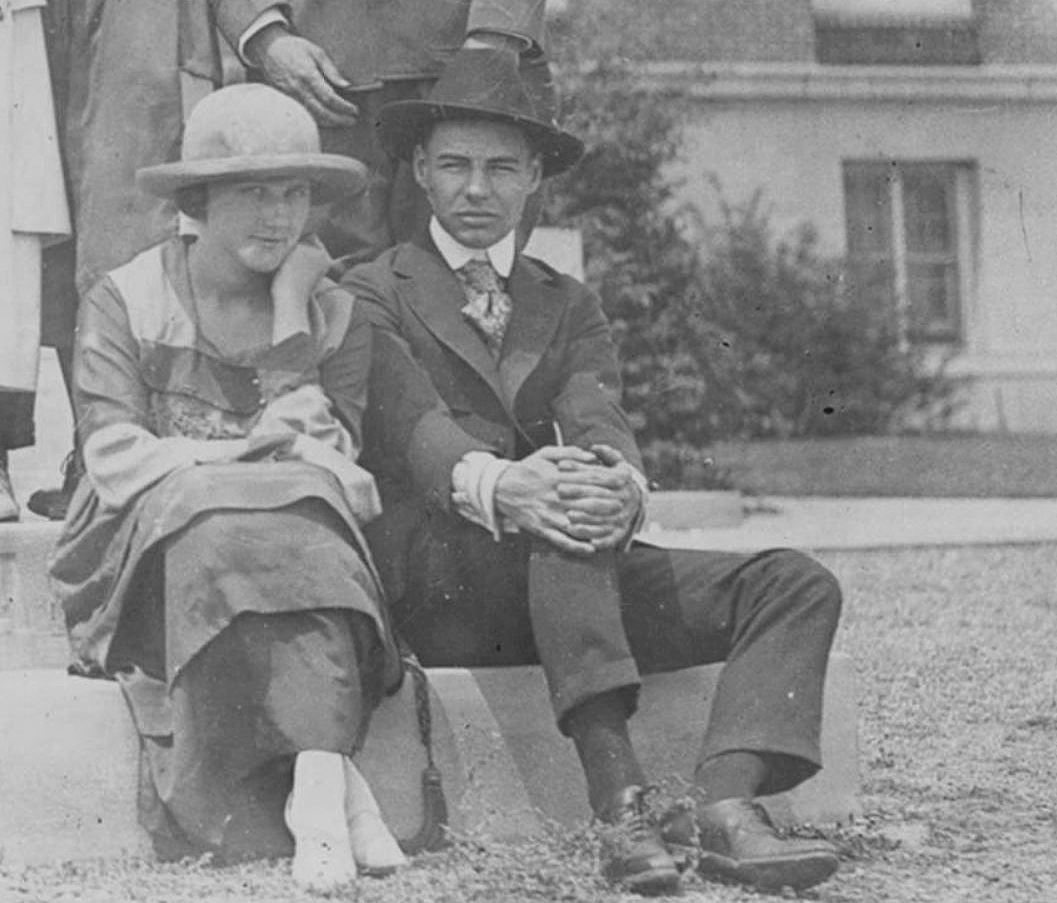
And, below, a similar detail, but this one showing the daintily crossed ankles of another pretty girl, seated beside a sour-looking companion.

smu_omega-phi_dallas-hall_1917_degolyer-det2

And here’s the gang on the idyllic banks of Exall Lake. Diane Galloway included this photograph in her book The Park Cities, A Photohistory with this caption:

At one time a bridge crossed Exall Lake near the Cary house, shown in the distance. The photographer was standing on the bridge to capture this picture of well-dressed SMU students going boating on the lake. A trip to Lakeside Drive was one of the few off-campus excursions permitted in 1917.

I love this photo. If I didn’t know what the Turtle Creek area looked like, I’d be hard-pressed to identify this as Dallas!

smu_omega-phi_exall-lake_1917_degolyer

Here’s a close-up of the beatific, smiling woman in white. I like the kid lurking in the background.

smu_omega-phi_exall-lake_1917_degolyer-det1

And the boat.

smu_omega-phi_exall-lake_1917_degolyer-det2

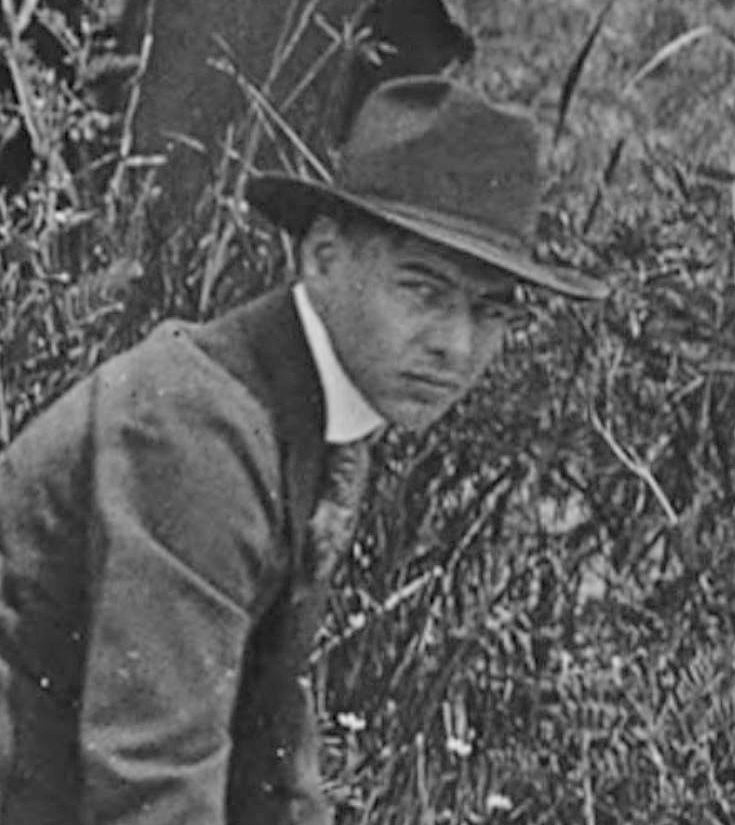
And the sour-looking guy again, looking even more annoyed than before.

smu_omega-phi_exall-lake_1917_degolyer-det3

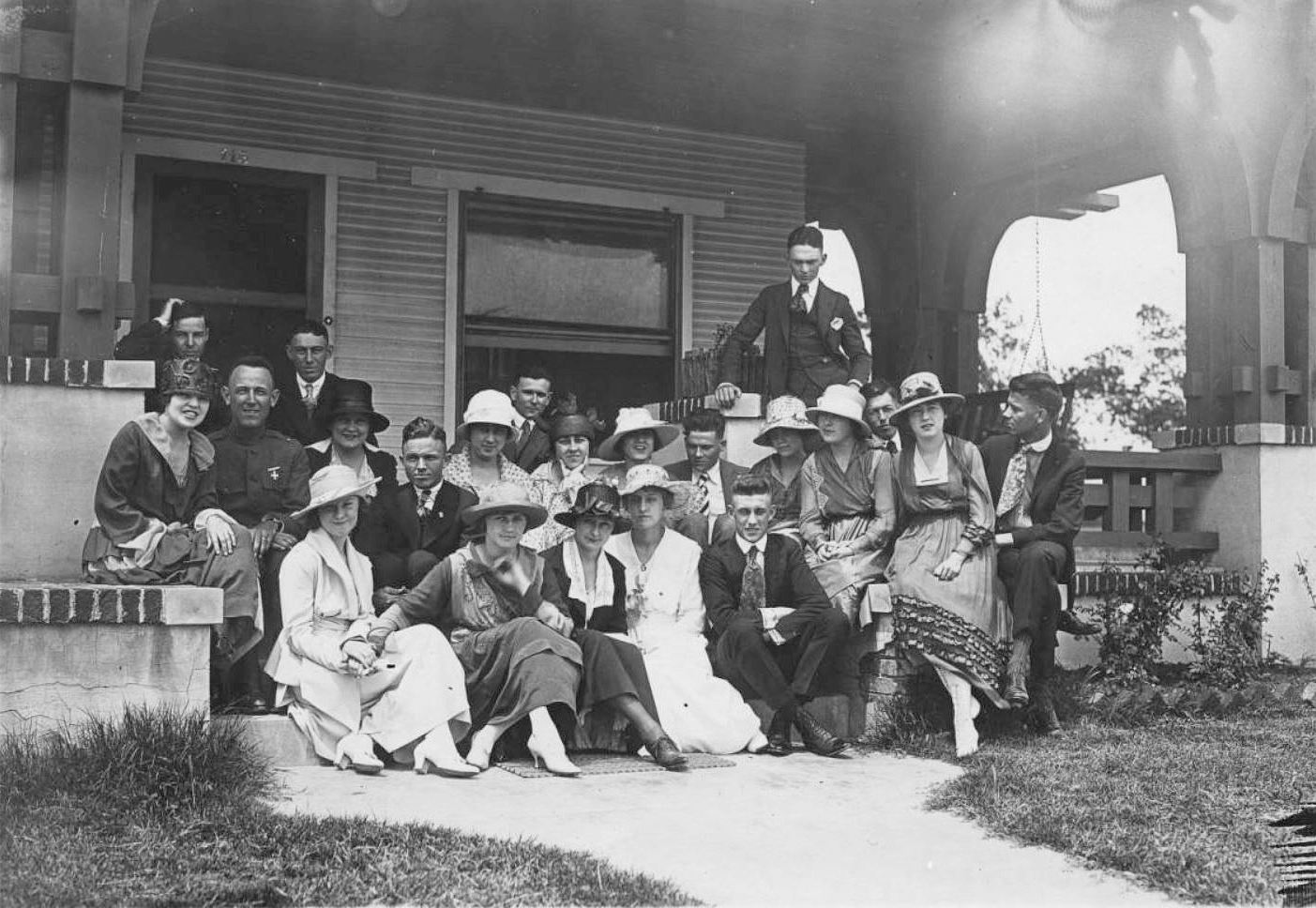
And here’s the crowd sitting on the steps of the frat house (which was located at Haynie and Hillcrest). The personnel has changed a little bit (they gained a woman and lost a man), but (almost) everyone seems pretty happy.

smu_omega-phi_porch_1917_degolyer

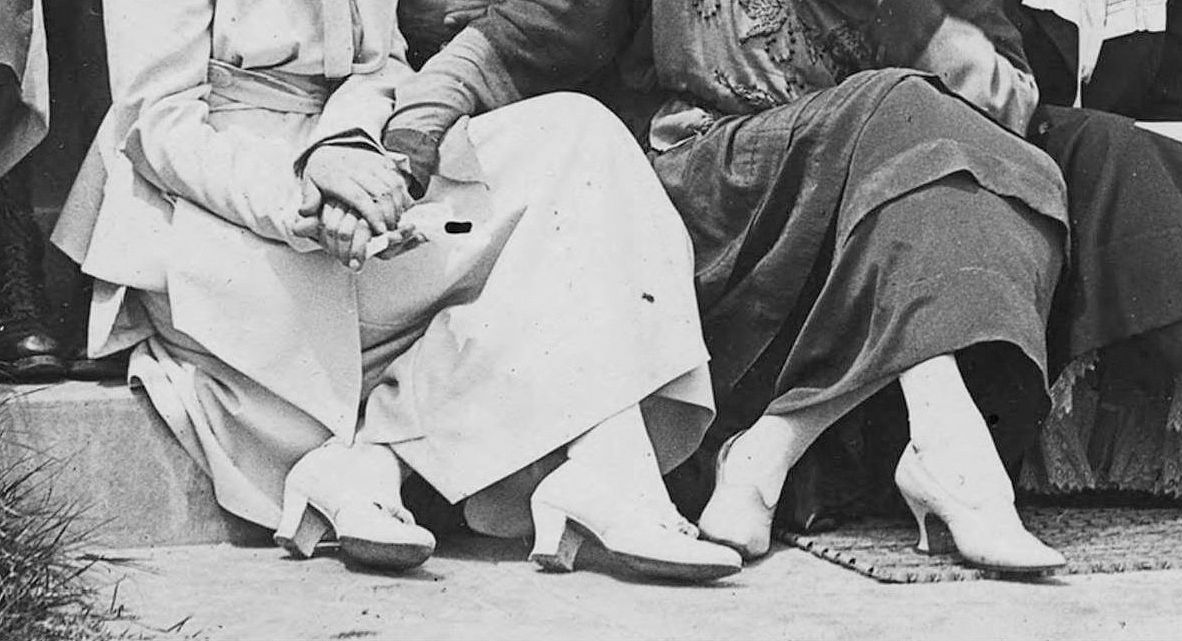
And, below, my very favorite detail from these three photos.

smu_omega-phi_porch_1917_degolyer-det1

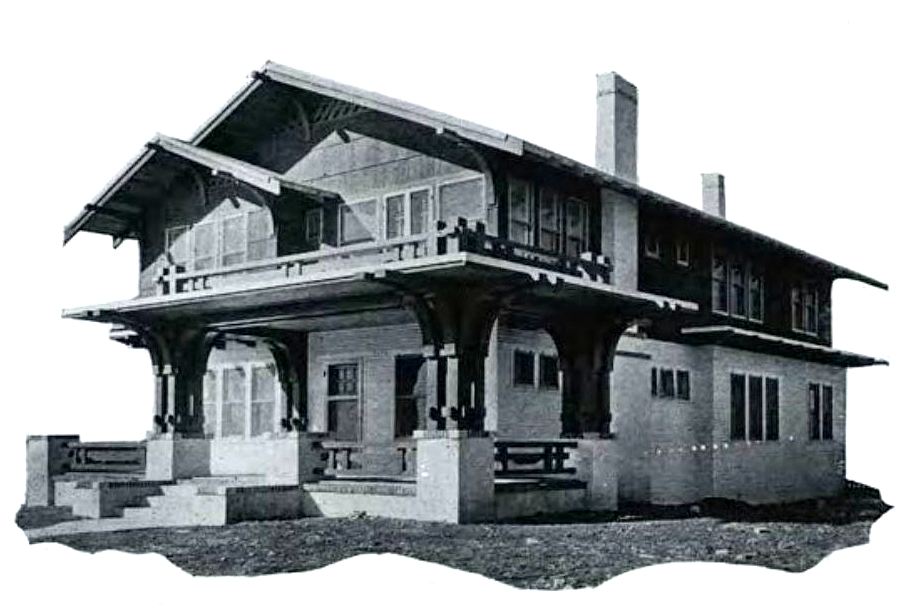
After a bit of sleuthing, I found a picture of the house at the time these photos were taken. It was actually a residence which was, I think, being rented out to the small group of Omega Phis. They had a proper fraternity house built several years later.

omega-phi-house_rotunda_1917

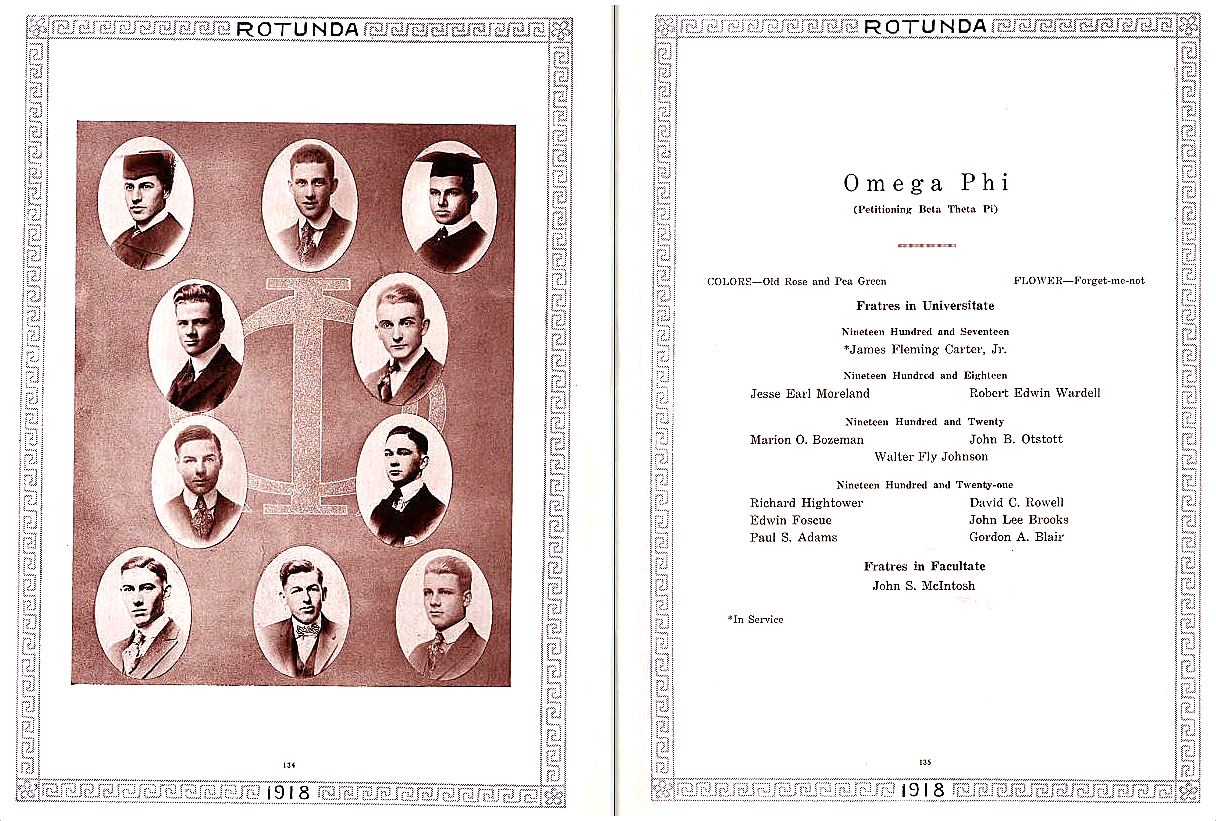
The top photo had “1917” written on the back, so I checked SMU’s Rotunda yearbooks from around that time. Here’s a look at the men who were members of Omega Phi in 1918. Several of these faces match the ones in the photos of the afternoon outing.

omega-phi_rotunda-1918

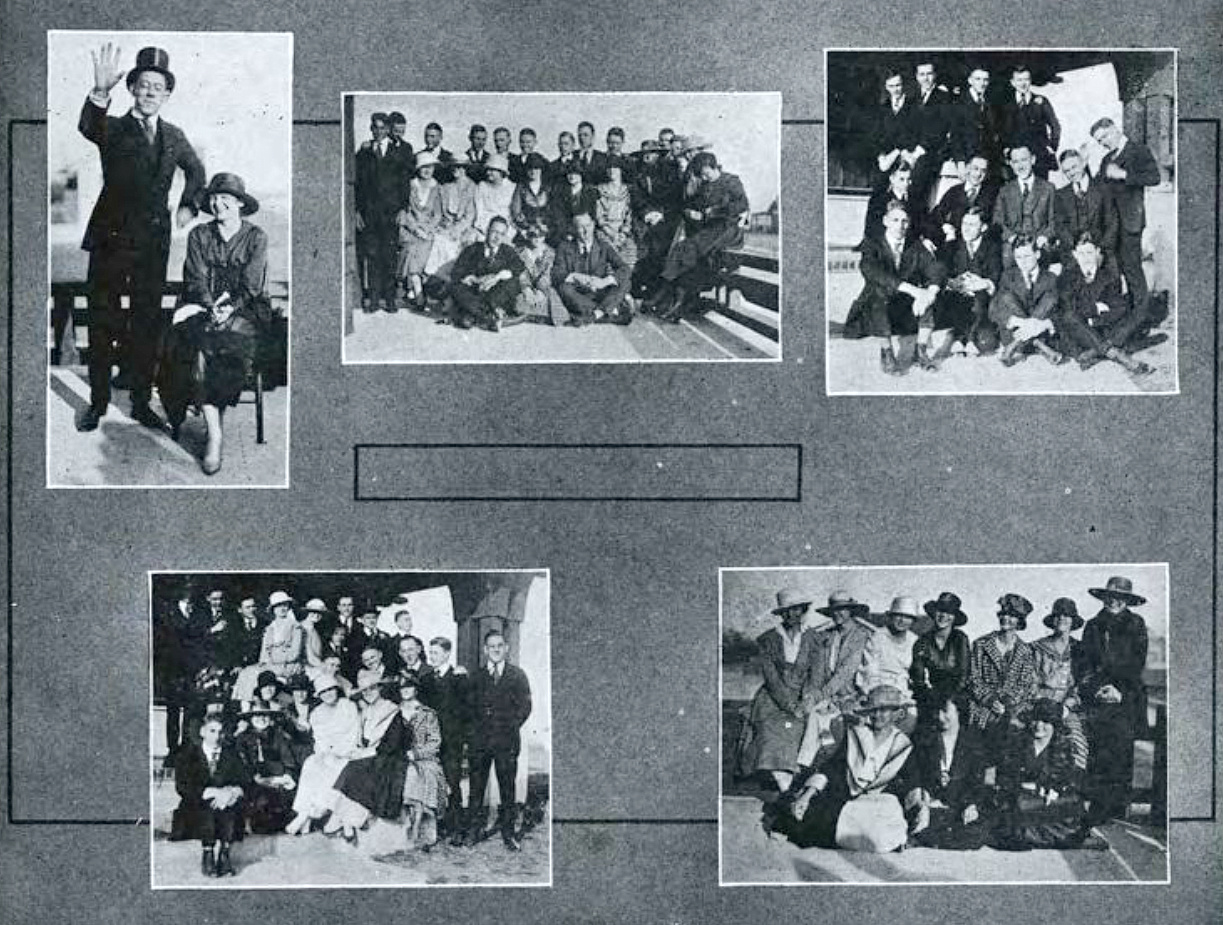
And, below, a photo collage from the Omega Phi page of the 1917 Rotunda. Several of the women look familiar. I see the Woman in White in at least one of these snapshots.

omega-phi_photos_rotunda_1917

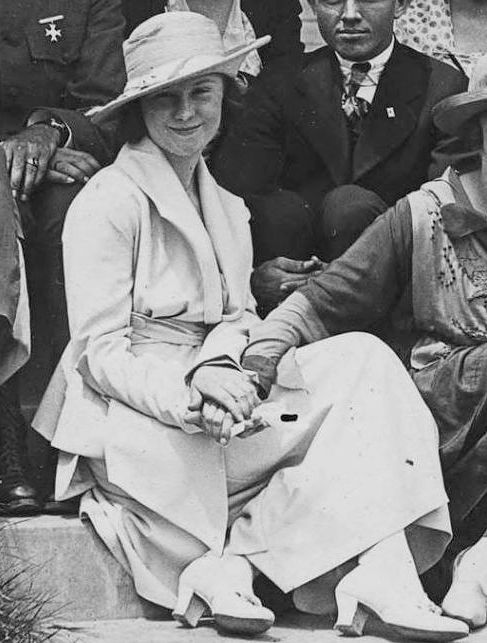
And here she is, close up. I hope she was as happy, intelligent, and confident in her real life as she appears to be in these photos.

smu_omega-phi_porch_1917_degolyer-det2

***

Sources & Notes

The three photos of the afternoon outing all come from the collection of the DeGolyer Library, Central University Libraries, Southern Methodist University:

  • “Omega Phi Fraternity members and their dates in front of Dallas Hall” is here.
  • “Omega Phi Fraternity member outing to Exall Lake” is here.
  • “Omega Phi Fraternity members and their dates on porch” is here.

The quote from Diane Galloway comes from her FANTASTIC book, The Park Cities, A Photohistory (Dallas: Diane Galloway, 1989), p. 24.

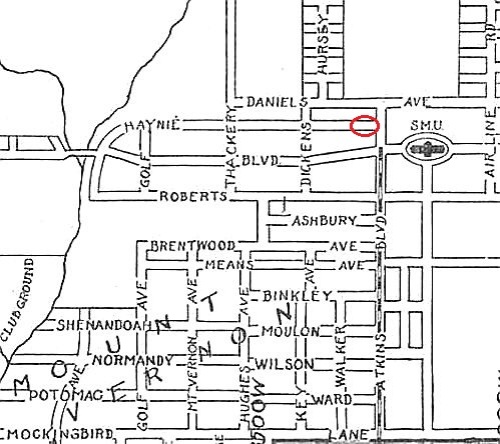
The ersatz Omega Phi fraternity house was located at 115 Haynie Avenue, just west of Atkins (now Hillcrest). (The photo of the exterior of the house is from the 1917 SMU Rotunda yearbook.)

omega-phi_map_19191919 map (detail), Portal to Texas History

I have absolutely no idea how college fraternities work, but it seems that when they formed on the SMU campus in 1915, the Omega Phi group was not actually affiliated with a national fraternity. They “petitioned” to be chartered by national groups, but they finally stopped trying after 11 years of, I guess, being repeatedly turned down — in 1926 they declared themselves to be an “independent society.” But one year later, they were granted a charter by the national Kappa Sigma fraternity. In the Dallas Morning News article announcing the news, this sentence was included: “The local chapter will be known as Delta Pi chapter.” I have no idea what any of that means, but if you’re really into these things, read the DMN article “Kappa Sigmas Grant Charter” (Sept. 26, 1927), here.

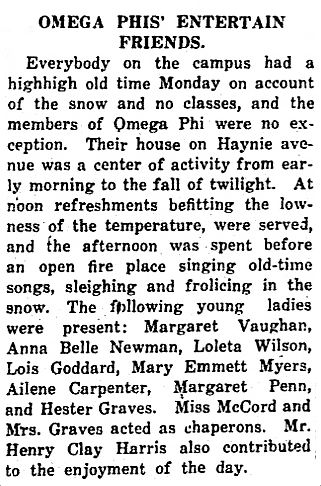
As for the identities of the women in the photos, it’s a mystery. I would assume, though, that at least some of them were the women mentioned in this little article about a cozy winter get-together at the Haynie Ave. house:

omega-phi_smu-campus_011917DMN, Jan. 19, 1917
If you’re not familiar with beautiful Exall Lake, you can watch a short, minute-long video of the lake’s history, produced to celebrate the 100th anniversary of Highland Park, here.

For other posts featuring photos I’ve zoomed in on to reveal interesting little vignettes, click here.

UPDATE: I stumbled across another photo of this group, from Diane Galloway’s book The Park Cities, A Photohistory:

smu_group-date_park-cities-photohistory_galloway

*

Copyright © 2015 Paula Bosse. All Rights Reserved.

World War II: The Homefront — 1944

WWII-mother_dmn_051444Mrs. A. H. Curry

by Paula Bosse

This touching photo appeared in The Dallas Morning News on Mother’s Day, 1944. The caption:

HER DAY — Sons are scattered all over the world in a fight for a deep cause. Mother’s Day, 1944, isn’t the brightest we have ever had, but it is the most hopeful for the future. And it serves to call attention again to the fact that Mothers are still the greatest heroes of all. In Dallas, Mrs. A. H. Curry, 3719 Miramar, a Mother with six sons in the service — one of them missing in action — looks over the pictures of the men she reared who now fight for her safety at home.

(More about the Curry boys can be read in the full Mother’s Day article that accompanied this photo — an article written in the purplest of patriotic prose by Dallas Morning News editor Felix R. McKnight; read it here.)

curry_dmn_012465
Ethel Walz Curry (1883-1965)

Below, a photo of the Curry sons with their father, A. H. Curry (whose early career was spent with the Edison Company, working personally with Thomas Edison).

curry-brothers_dmn_091242DMN, Sept, 12, 1942

***

Sources & Notes

Photo and text appeared in The Dallas Morning News on May 14, 1944, Mother’s Day. Photo by E. W. Odom.

Mrs. Curry also had two daughters, Catherine and Carolyn. In one of those “everything is connected” discoveries, Catherine married Robert E. Grinnan who grew up in the Connor house I wrote about here.

*

Copyright © 2015 Paula Bosse. All Rights Reserved.

Armistice! — 1918

wwi_returning-troops-parade_1919_portalDowntown parade for returning troops — June, 1919 (click for larger image)

by Paula Bosse

Dallas found out that the Great War had finally ended at around 3:00 in the morning of November 11, 1918 when the siren atop the Adolphus Hotel sounded with “maniacal shrieks.” People poured into the streets to celebrate.

The crackle of revolver reports began to sound. Sleep was murdered, even had one been so disposed, and many residents from all parts of the city foregathered in the downtown district to jubilate and exult in various ways until daylight came. (Dallas Morning News, Nov. 12, 1918)

Giddy celebrations and impromptu parades were the order of the day, and the joyous spirit that erupted throughout the city is reflected in this Dallas Morning News report of “the first day of world peace since August, 1914” (click to see larger image):

wwi_armistice-in-dallas_dmn_111218
DMN, Nov. 12, 1918

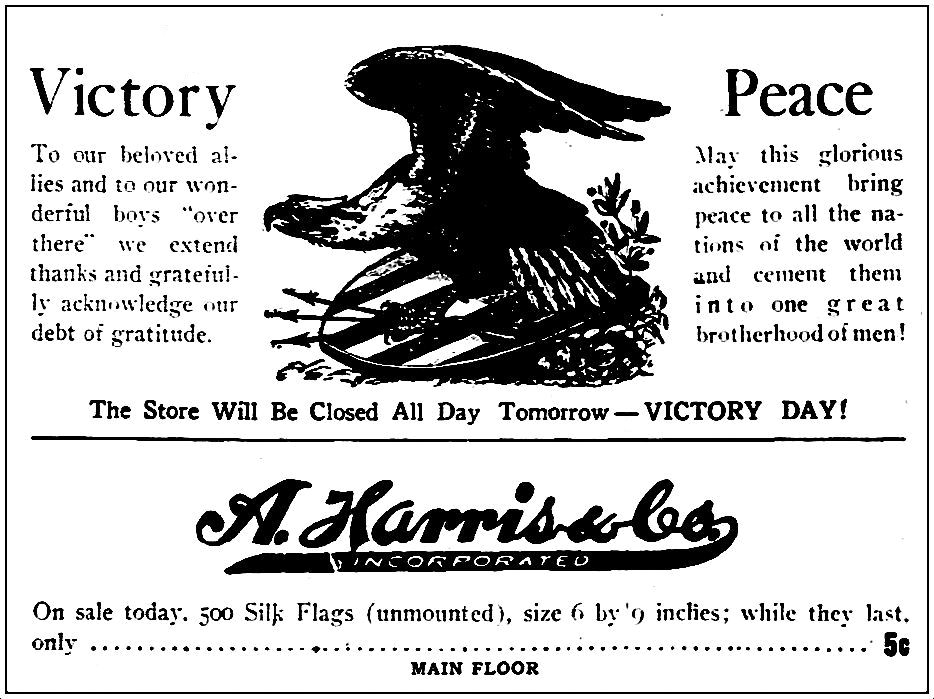
Local businesses got in on the action by placing heart-felt patriotic advertisements (some of which also quietly reminded readers that Christmas was just around the corner).

armistice_linz_dmn_111218

armistice_kahn_dmn_111218

ad-dreyfuss_dmn-111218

wwi_armistice_a-harris_dmn_111218

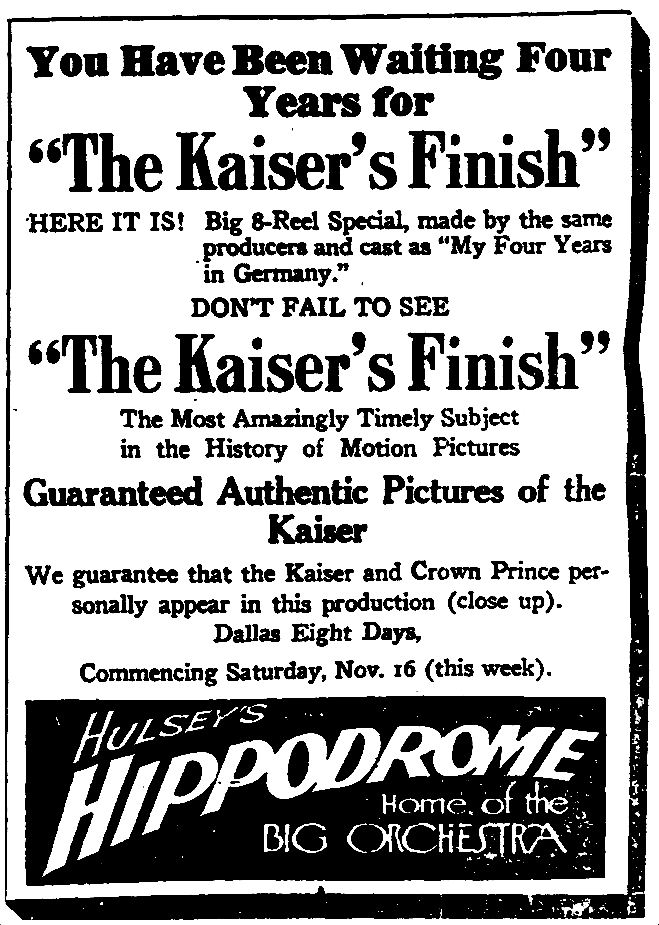
wwi_armistice_hippodrome_dmn_111318

wwi_armistice_hurst-bros_dmn_111318

When World War I officially ended on November 11, 1918, the military and civilian deaths and casualties totaled more than 37 million. All everyone wanted was for their loved ones to return home safely and for life to return to normal as quickly as possible. There was a lot to be thankful for that Thanksgiving.

***

Sources & Notes

Photo of the 111th Engineers from the Tarrant County College Northeast, Heritage Room, via the Portal to Texas History, here. It shows the 1500 block of Main Street, looking west toward Akard. See the same view today here (the short white  building at 1520 Main is currently occupied by the Iron Cactus; in the 1919 photo, that address is occupied by Thompson’s in what looks like the same building). (See another parade photo of the same block here. The detail is much, much better!)

1500-block_main_1919_2015

Ads from the Dallas Morning News, Nov. 12 and 13, 1918.

The Wikipedia entry for World War One casualties is here.

Click pictures for larger images.

*

Copyright © 2014 Paula Bosse. All Rights Reserved.


When the Spanish Influenza Hit Dallas — 1918

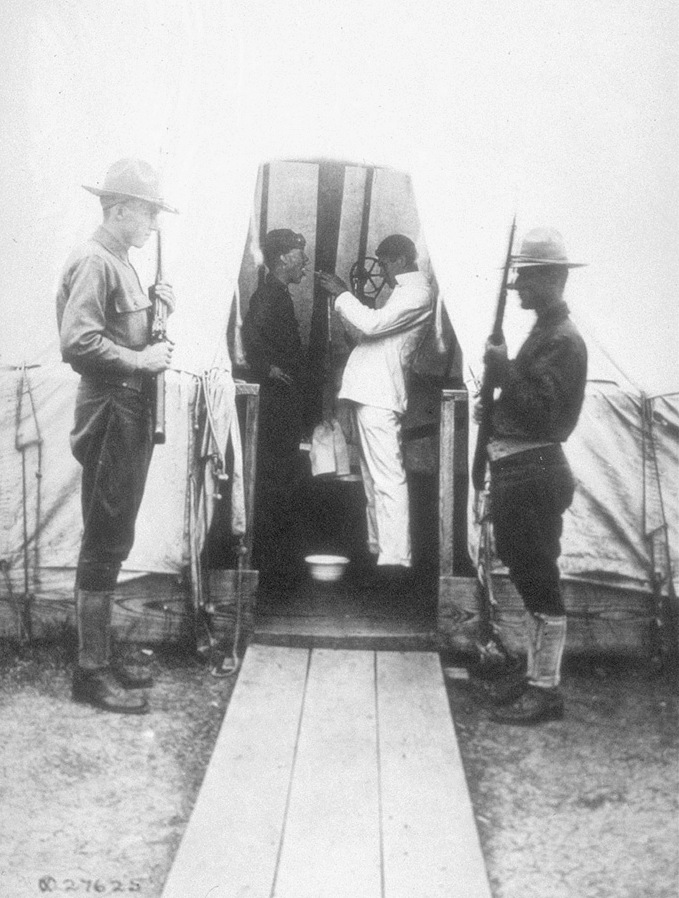
spanish-influenza_love-field_otis-historical-archives_nmhm_110618
American Red Cross at Love Field, spraying soldiers’ throats, Nov. 6, 1918

by Paula Bosse

The Spanish Influenza pandemic of 1918-1919 caused as many as 50 million deaths worldwide — about 600,000 of which were in the United States (11 times greater than the number of American casualties during World War I). Locally, the influenza first hit the soldiers at Camp Bowie in Fort Worth in September, 1918. The flu spread quickly, and on Sept. 27, it was reported that there were 81 cases in the camp. Well aware of the devastation the flu had wrought in other U.S. cities, most notably at military camps, Fort Worth was, understandably, taking the situation seriously. Dallas leaders, on the other hand, were all-but pooh-poohing the need for concern. On Sept. 29, The Dallas Morning News had a report titled “Influenza Scare is Rapidly Subsiding” — the upshot was that, yeah, 44 reported cases of “bad colds” had been reported in the city, but there’s nothing to worry about, people.

In the opinion of the military and civil doctors, the Spanish Influenza scare is unwarranted by local conditions. The few cases of grip, it is claimed, are to be expected as the result of the recent rainy weather.

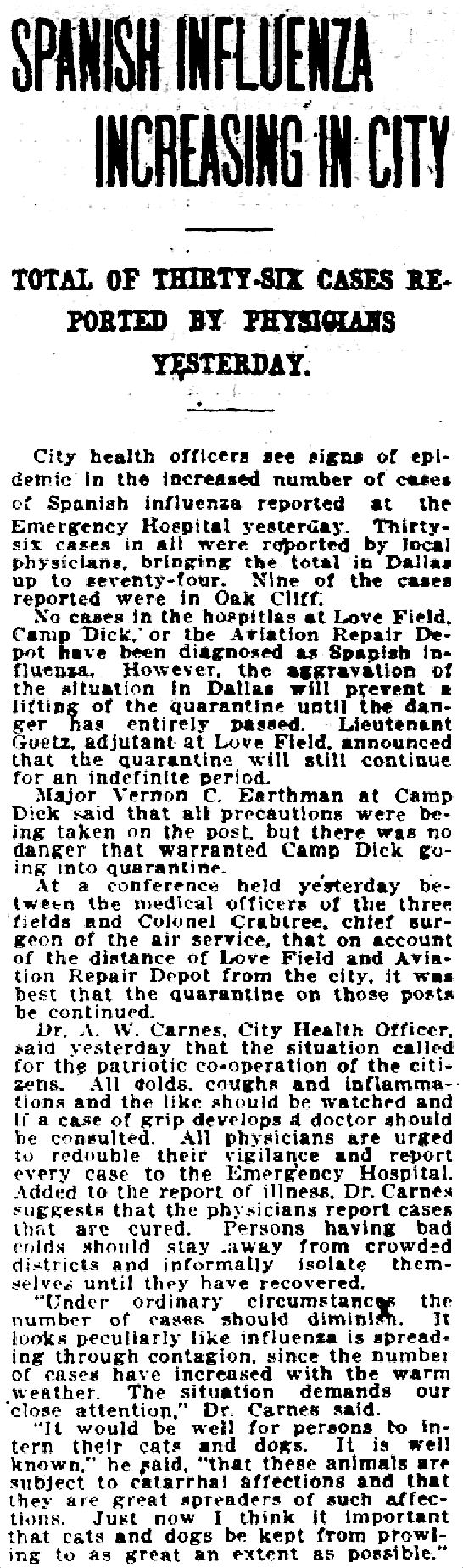
Just two days later, though, officials were jolted out of their complacency when the (reported) cases jumped to 74 (click for larger image):

spanish-influenza-dmn-100218DMN, Oct. 2, 1918 (click for larger image)

The months of October and November were just a blur: the city was plunged into an official epidemic. There was no known cure for the flu, so a somewhat ill-prepared health department preached prevention. People were encouraged to make sure their mouths were covered when they coughed or sneezed, and they were directed to not spit in the street, on streetcars (!), in movie theaters (!!), or, well, anywhere. (Handkerchief sales must have soared and spittoon sales must have plummeted.)

At one point or another, places where people gathered in large numbers — such as schools, churches, and theaters — were closed. Trains and streetcars were required to have a seat for every passenger (no standing, no crowding) (…no spitting). The number of mourners at funerals (of which there were many) was limited. And there was a major push for citizens to clean, clean, clean their surroundings in an attempt to make the city as sanitary as possible. Instructions appeared often in the newspapers.

spanish-influenza_dmn_101218_tipsDMN, Oct. 12, 1918

It was estimated that there were 9,000 cases of Spanish Influenza in Dallas in the first six weeks. By the middle of December, when the worst of the outbreak was over, it was reported that there had been over 400 deaths attributed to the Spanish Influenza and pneumonia in just two and a half months.

spanish-influenza_FWST_121118Fort Worth Star-Telegram, Dec. 11, 1918

As high as these numbers were, Dallas fared much, much better than many other parts of the United States.

spanish-influenza_ad_dmn_101818_pepto-manganAd, DMN, Oct. 18, 1918

***

Sources & Notes

Photo at top was taken on November 6, 1918 and shows American Red Cross Workers spraying throats of military personnel based at Love Field in hopes of preventing the spread of the influenza. The photo is from the Otis Historical Archives, National Museum of Health and Medicine; I found it on the NMHM site, here. (Click photo for larger image.)

Ad for Pepto-Mangan (“The Red Blood Builder”) was one of a flood of medicines and tonics claiming to be effective in the fight against Spanish Influenza (none were).

For a detailed and remarkably well-researched, comprehensive history of the Spanish Influenza in Dallas, see the article prepared by the University of Michigan Center for the History of Medicine, here. It’s pretty amazing.

To read about the history of pandemics (including several good links regarding the Spanish flu), see the Flu.Gov site, here.

And, NO, Ebola is not transmitted like the flu. But it’s still good practice to cover your mouth when you cough or sneeze,wash your hands frequently, and never EVER spit in the street, because that’s just disgusting. ((This post was originally written in 2014 while Dallas was the center of the Ebola universe.))

More on the Spanish Influenza pandemic can be found in the Flashback Dallas post “Influenza Pandemic Arrives in Dallas — 1918.”

*

Copyright © 2014 Paula Bosse. All Rights Reserved.


Black Troops from Dallas, Off to the Great War

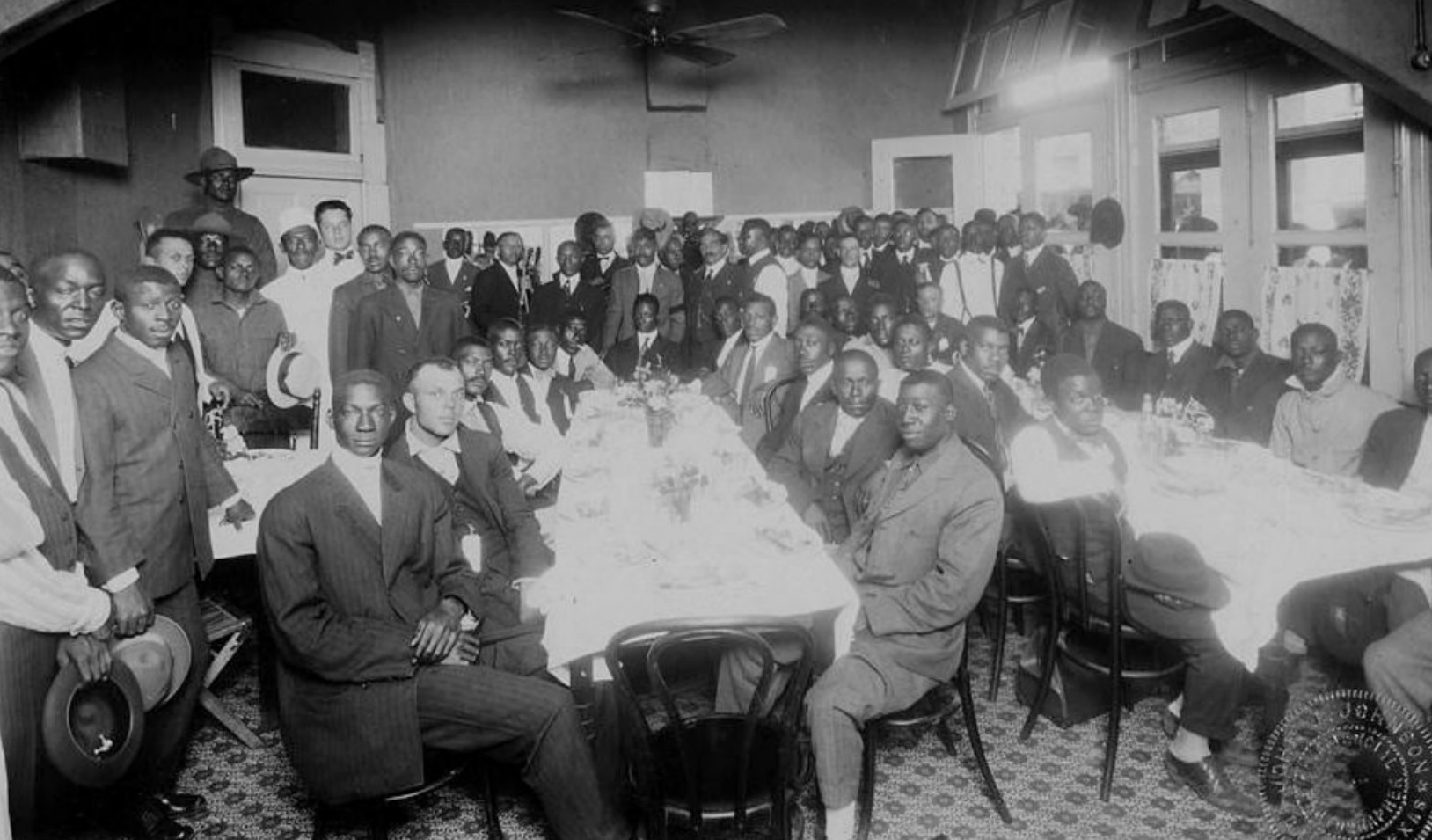
WWI_black-soldiers_dallasRecruits in Dallas

by Paula Bosse

Above is a photo from the National Archives, described only as “Negro recruits having a turkey dinner just before leaving for a training camp. Dallas, Texas.” At the bottom right is the seal of Dallas photographer John J. Johnson who had worked for The Dallas Morning News as a photographer before World War I but was apparently working in a commissioned or freelance capacity here. The photo was taken on June 11, 1918, but the location is not known.

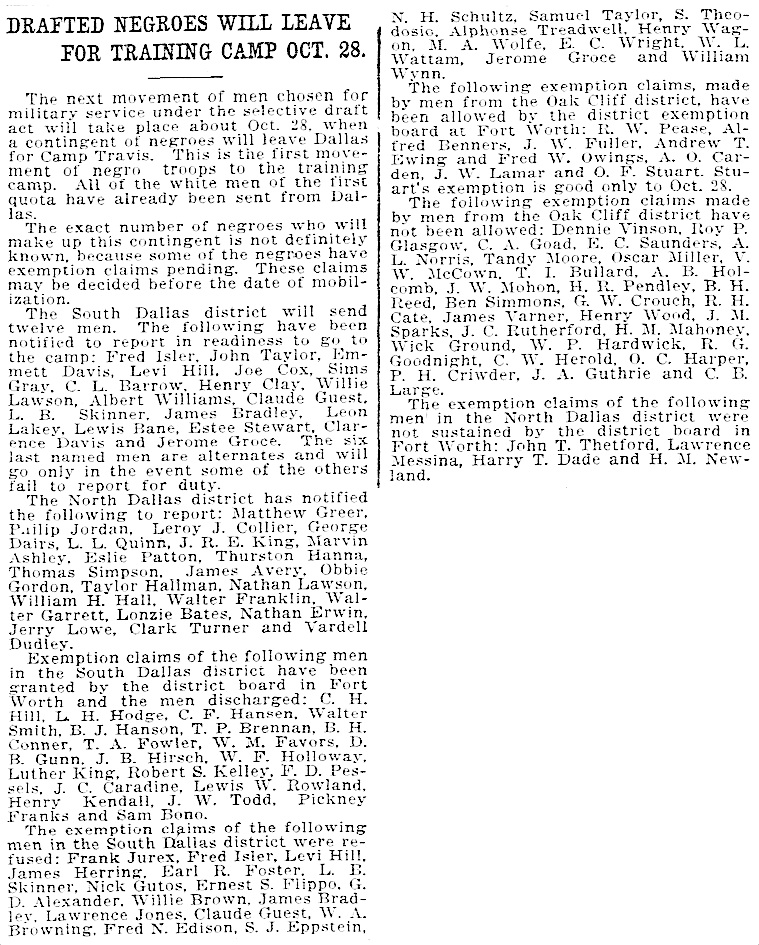
Eight months earlier, Black draftees left Dallas for the first time — they were headed to Camp Travis in San Antonio. (Click articles for larger images.)

WWI_black-draftees_dmn_101817Dallas Morning News, Oct. 18, 1917

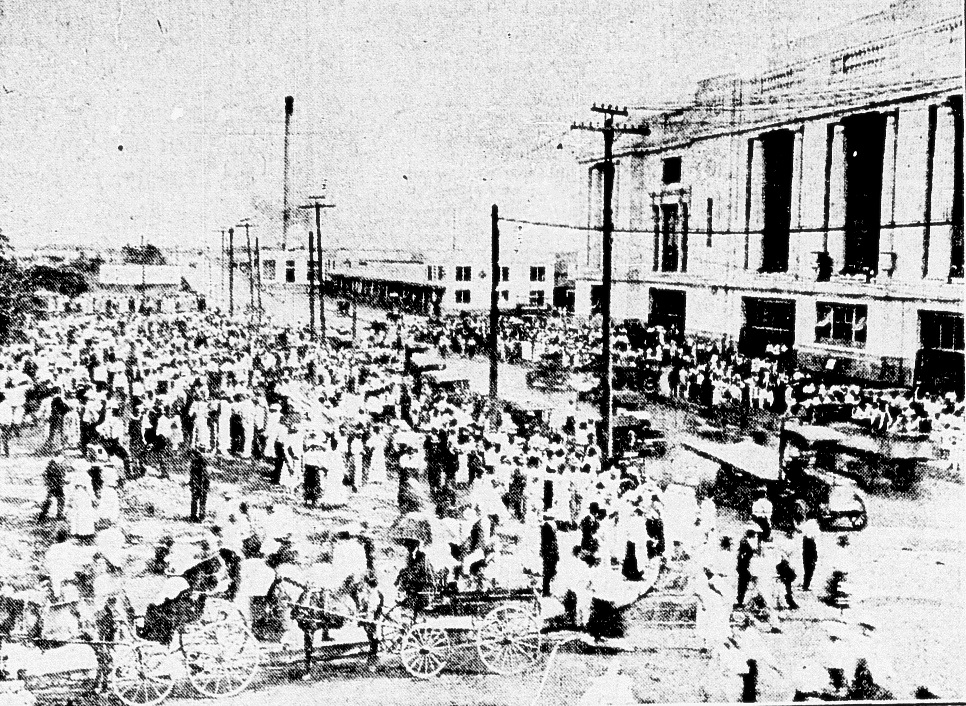
Much larger contingents of Black men left for training camp in the summer of 1918: more than 500 men left from Dallas and more than 200 from Fort Worth at the end of July. The photo below appeared in The Dallas Morning News under the headline “Scene at Union Station Last Night, When 500 Negroes Left for Camp.” (This photo was taken by John J. Johnson, the same photographer who took the photo at the top of this post.)

black-recruits_dmn_073118-photo

black-recruits_dmn_073118_captionPhoto and caption from the DMN, July 31, 1918

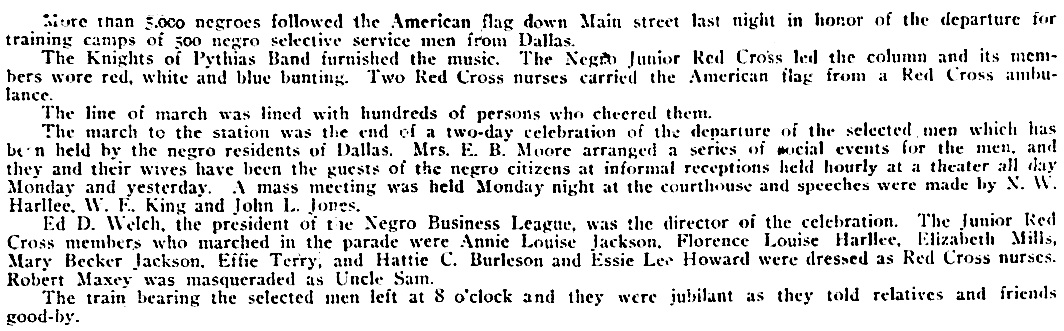
black-draftees_FWST_073118
Fort Worth Star-Telegram, July 31, 1918

There was a sizable number of Black soldiers at Camp Bowie in Fort Worth, and many of the reports from Fort Worth on the training of the “negro troops” are hard to read. I don’t think of myself as naive, but the blatant racism that was absolutely everywhere in the mainstream press at the time is stunning. Even when attempting to be complimentary, you see things like this:

If you imagine that the fact that these recruits are negroes made any difference to the white soldiers in camp you are mistaken, for the white soldiers cheered and threw up their hats as truck after truck of negroes passed by, and the darkies shouted back lustily. […]

“I’se glad I got heah at last,” said a big negro as he lined up for classification. “I won’t have to pick no mo’ cotton, no sah; all I’se have to do is to parade in a nice new uniform an’ get three meals an’ a nice new gun….” (Fort Worth Star-Telegram, Sept. 25, 1918)

I’m sure the white soldiers were happy to see fellow recruits showing up, but the journalists — in story after story — treated the “negroes” (they were rarely called “men”) as bumbling caricatures, inevitably quoted in dialect. The United States armed forces were not integrated until 1948, and Black troops were segregated from white troops, both in camp and on the battlefield (when they were allowed to fight — they were largely kept in service positions such as stevedores).

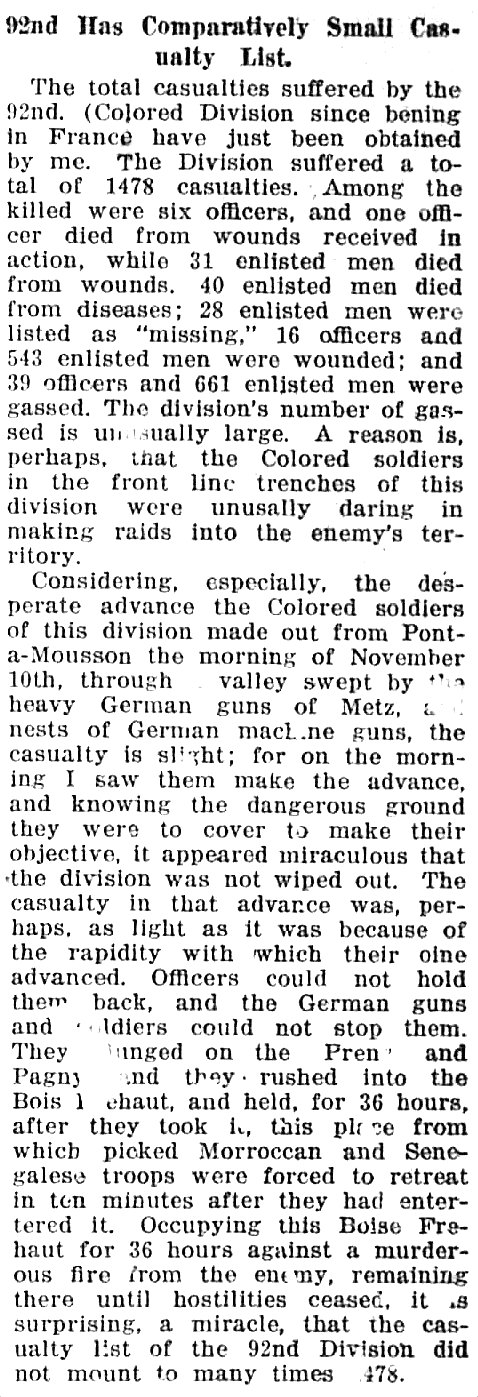
On this Memorial Day, I share a report from Ralph W. Tyler, a Black journalist who had reported throughout the war from the front lines, on the casualties of African American soldiers who died during World War I in the service of the U.S. Army:

casualties_black-troops_dallas-express_011119Dallas Express, Jan. 11, 1919

***

Sources & Notes

Top photo by John J. Johnson, from the National Archives is titled “Negro recuits [sic] having a turkey dinner just before leaving for a training camp. Dallas, Texas”; it can be accessed on the National Archives site here. An annotated version of this same photo appears under the title “Colored Troops — Negro recruits having a turkey dinner just before leaving for a training camp. Dallas, Texas” is here. (If anyone has additional info on the details of this photo, I’d love to know.)

“92nd Has Comparatively Small Casualty List” is an excerpt from Ralph W. Tyler’s article “General Order Commends Colored Officers” which appeared in The Dallas Express, Jan. 11, 1919. The full article can be read here.

For more info on the history of Black American soldiers, see the Wikipedia entry here; for info on the all-Black 92nd Infantry Division, see here.

Also, check out the blurb for the book Unjustly Dishonored: An African American Division in World War I by Robert H. Ferrell, here.

I’ve put a few articles on African American soldiers in WWI (including those cited above) in a PDF. A few of the articles appeared in the major Dallas and Fort Worth newspapers, and a couple appeared in The Dallas Express, the city’s newspaper published for a Black readership (including a rousing article by N. W. Harllee on the parade and celebration thrown by the city to honor the returning Black troops — WELL worth reading). Also included are a couple of unbelievable articles from the national press (including a lengthy one by a noted Stars and Bars reporter titled “Negro Soldiers Stationed at French Ports Sing and Dance While Unloading Ships”). The PDF can be accessed here (with articles in varying degrees of legibility).

The stirring and exhortative article “Dallas Gives Soldiers Befitting Celebration” by N. W. Harllee is in the PDF just mentioned, but it can also be found in a scan of The Dallas Express, here. UPDATE: Every scan of this article is hard to read, so I’ve tweaked the contrast to make it easier to read. You’ll have to magnify this sucker to read it, but it’s in a PDF here.

*

Copyright © 2014 Paula Bosse. All Rights Reserved.