Flashback : Dallas

A Miscellany: History, Ads, Pop Culture

Category: Downtown

The Washington Theater — Dallas’ First Movie Palace
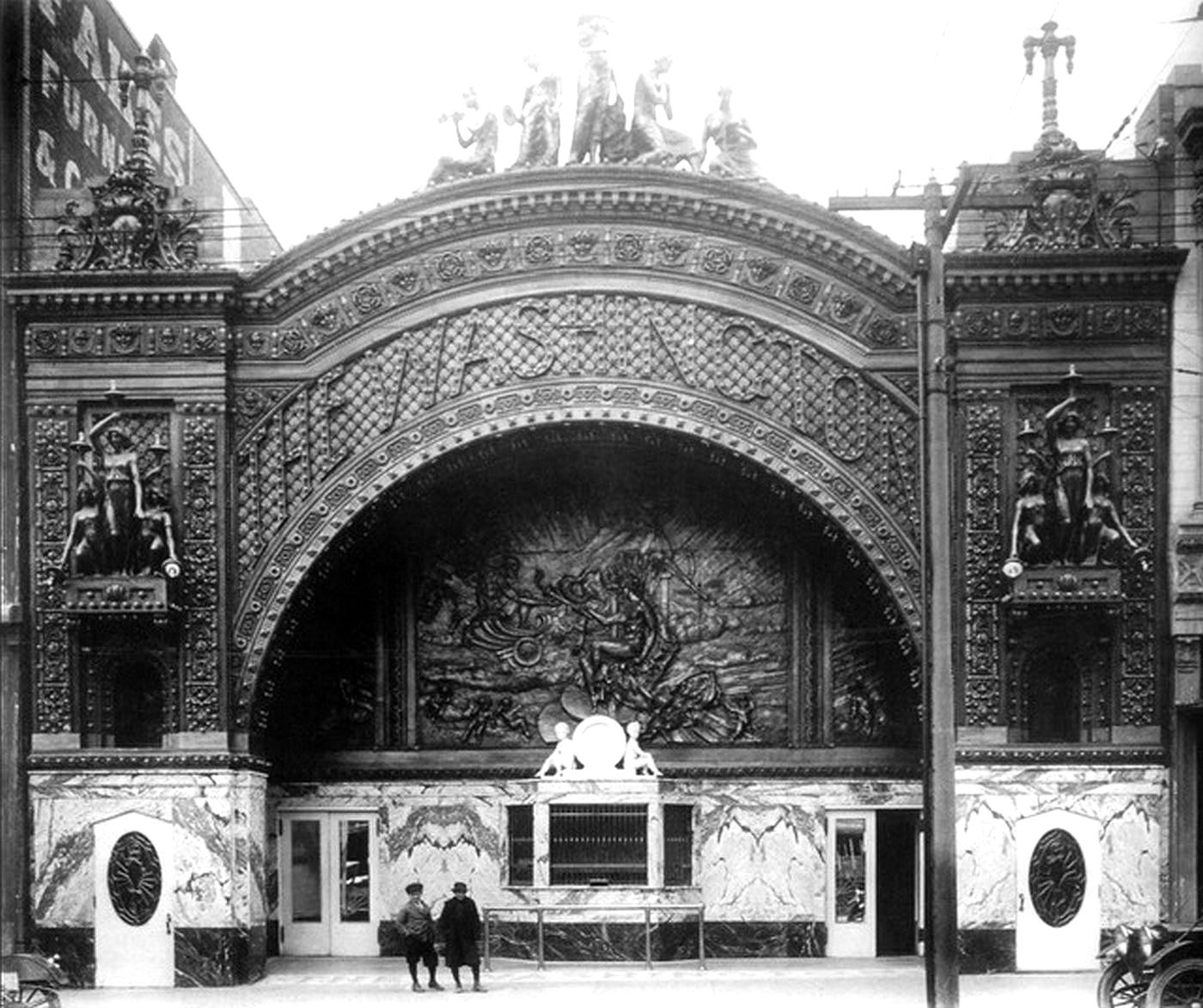
washington-theatre_cinema-treasures_lgThe Washington, 1615 Elm

by Paula Bosse

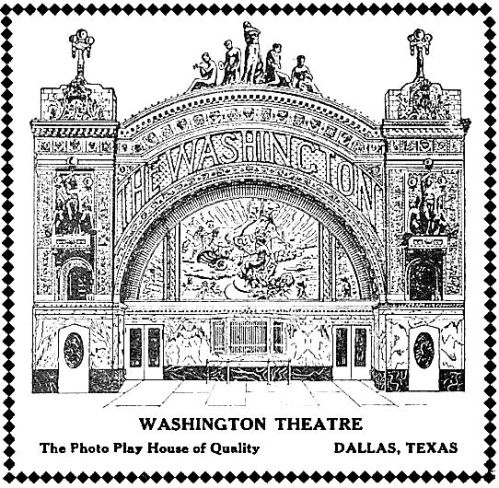
The outrageously ornate Washington Theater was built in 1912 by W. D. Nevills (1872-1945), a man who had been running cheap little store-front nickelodeons in Dallas for several years. Three of his most popular were The Nickelodeon, The Candy, and The Palace (not to be confused with any later theaters in Dallas called the “Palace”).
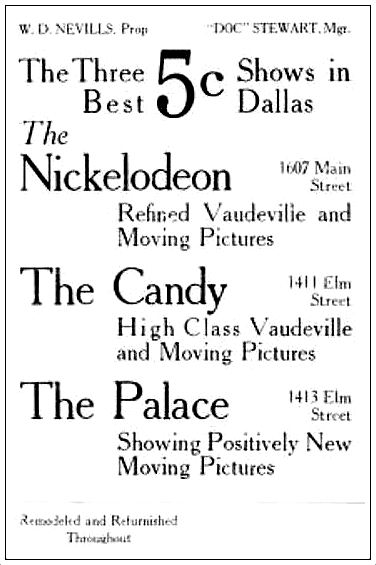
nevills_standard-blue-book-of-tx_1912-14Standard Blue Book of Texas, 1912-1914

His Nickelodeon on Main Street can be seen in the lower center of this detail from a larger 1909 parade photo.
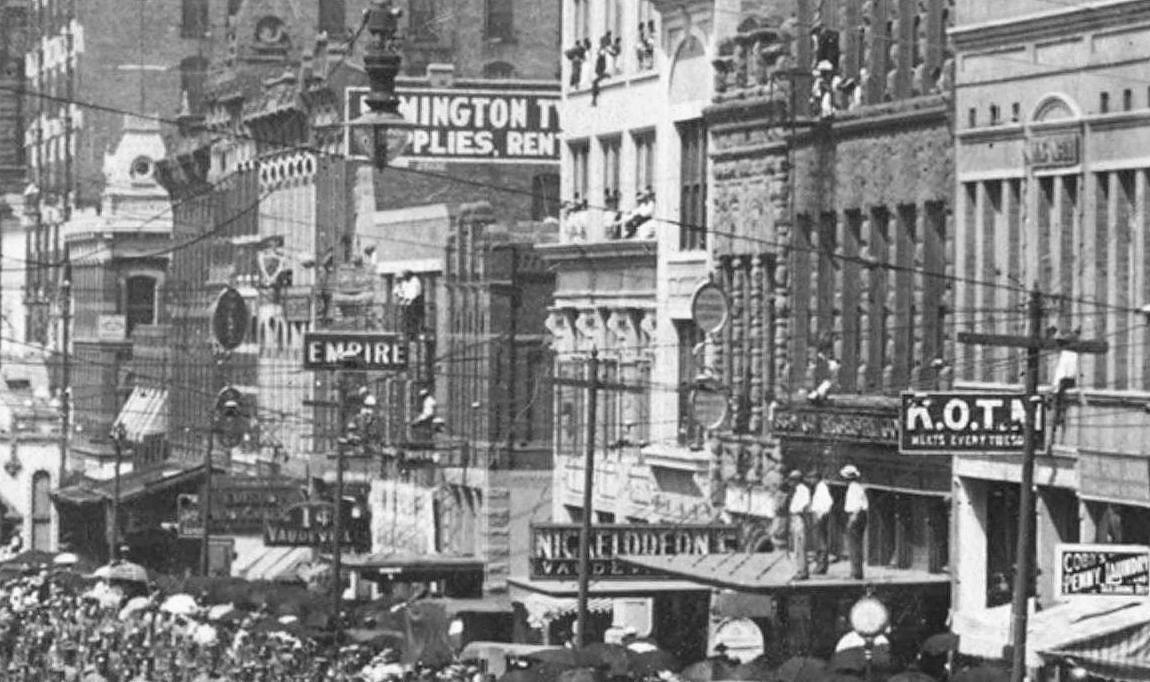
parade-day_1909_det41

Nevills must have raked in a lot of nickels, because when his Washington Theater opened at 1615 Elm Street, it was the most spectacular motion picture “photoplay house” in Dallas. Nevills spared no expense for the theater’s furnishings and facade.
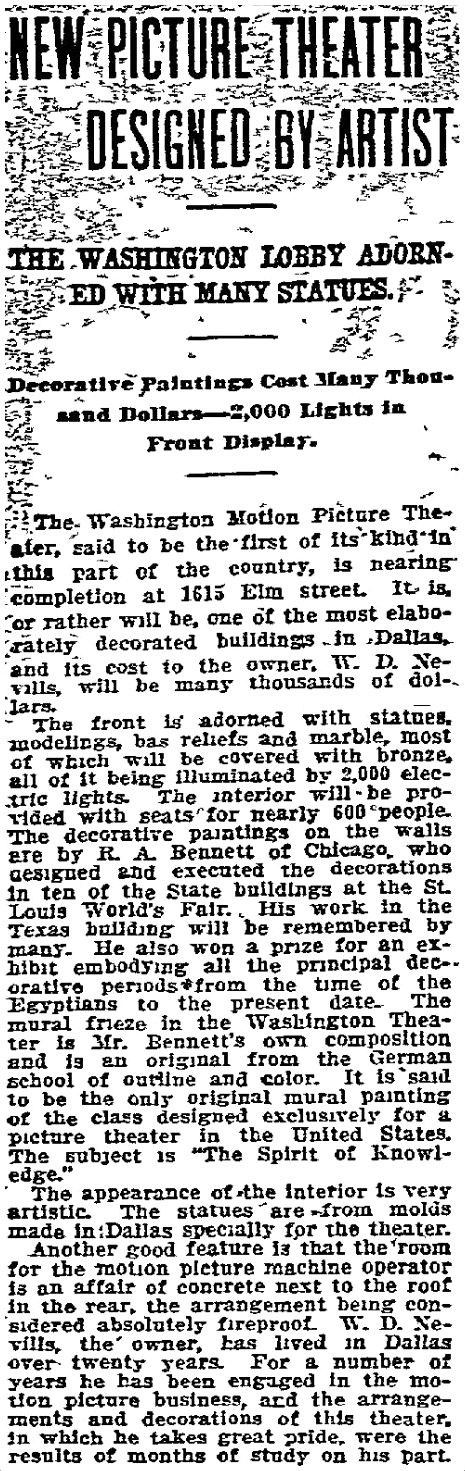
washington-theater_dmn_111712Dallas Morning News, Nov. 17, 1912 (click to read)

What might seem a little gaudy now, was probably still gaudy back then, but it was a fresh, NEW gaudy! And 600 Dallasites could all watch a movie at the same time. 600! Unheard of!

The Washington opened on Thanksgiving Day, 1912. Complete with “Human Pipe Organ.”
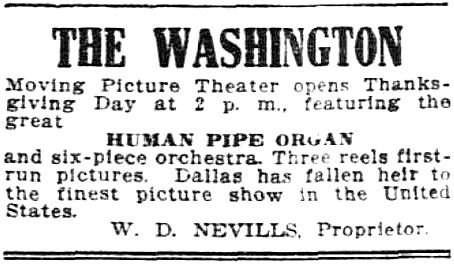
washington-theater_dmn_112712DMN, Nov. 27, 1912

The Washington was the king of the roost for only a short while, though — until young whippersnappers like the Queen began to steal its thunder. 600 seats? Pfft! It was a thousand or nothing now. The theater began to lose its luster and look more old and hulking than young and exciting, and after riding out its very long lease, the Washington Theater closed on July 1, 1927.

This little classified showed up a couple of weeks later, and it must have been a melancholy Nevills who had to write it up.
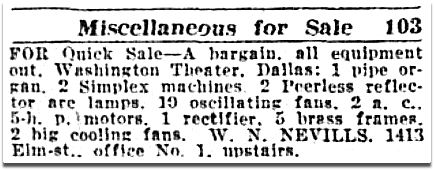
washington-theater_dmn_071327DMN, July 13, 1927

The theater continued to be used for a while — mostly for evangelical meetings or events. I’m not sure exactly when the building was demolished, but a report of the building’s being sold and plans for its razing appeared in The Dallas Morning News in October, 1927.

*

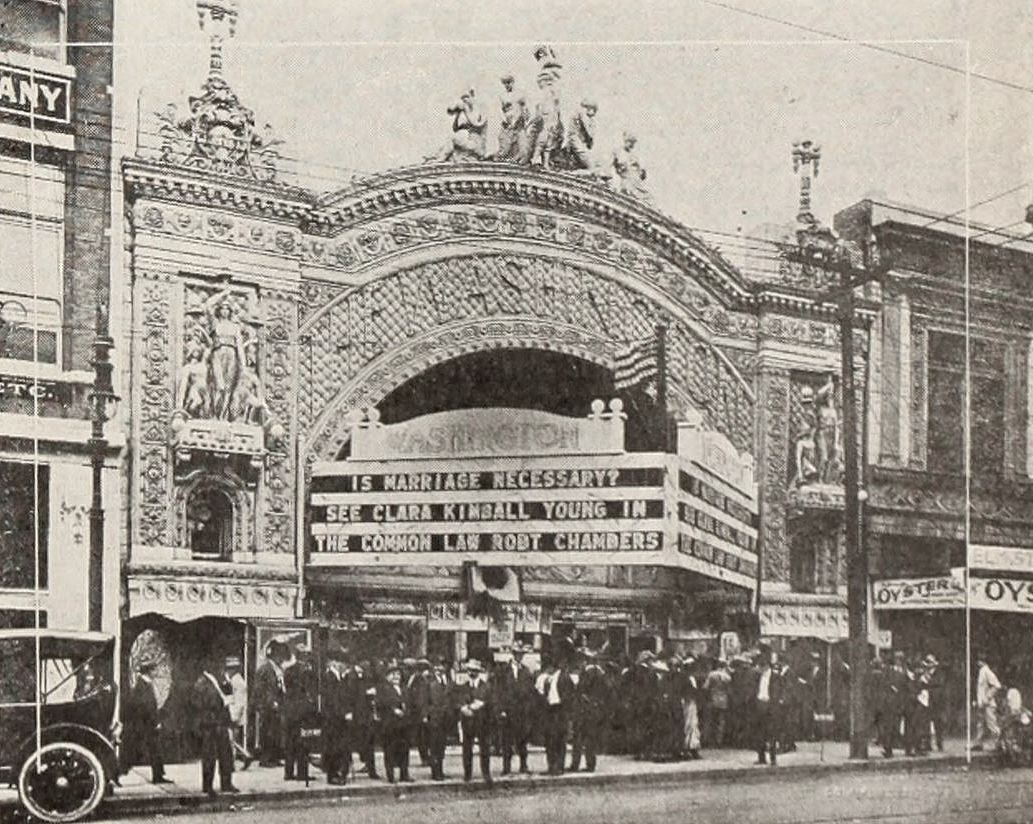
Let’s look at a couple of details from that top photo. The Washington was built without a marquee, but the outside of the building was studded with an eyeball-popping TWO THOUSAND LIGHTS! Imagine what that must have looked like — in 1912! Here’s an extreme close-up of the theater’s facade — look at all those bulbs!
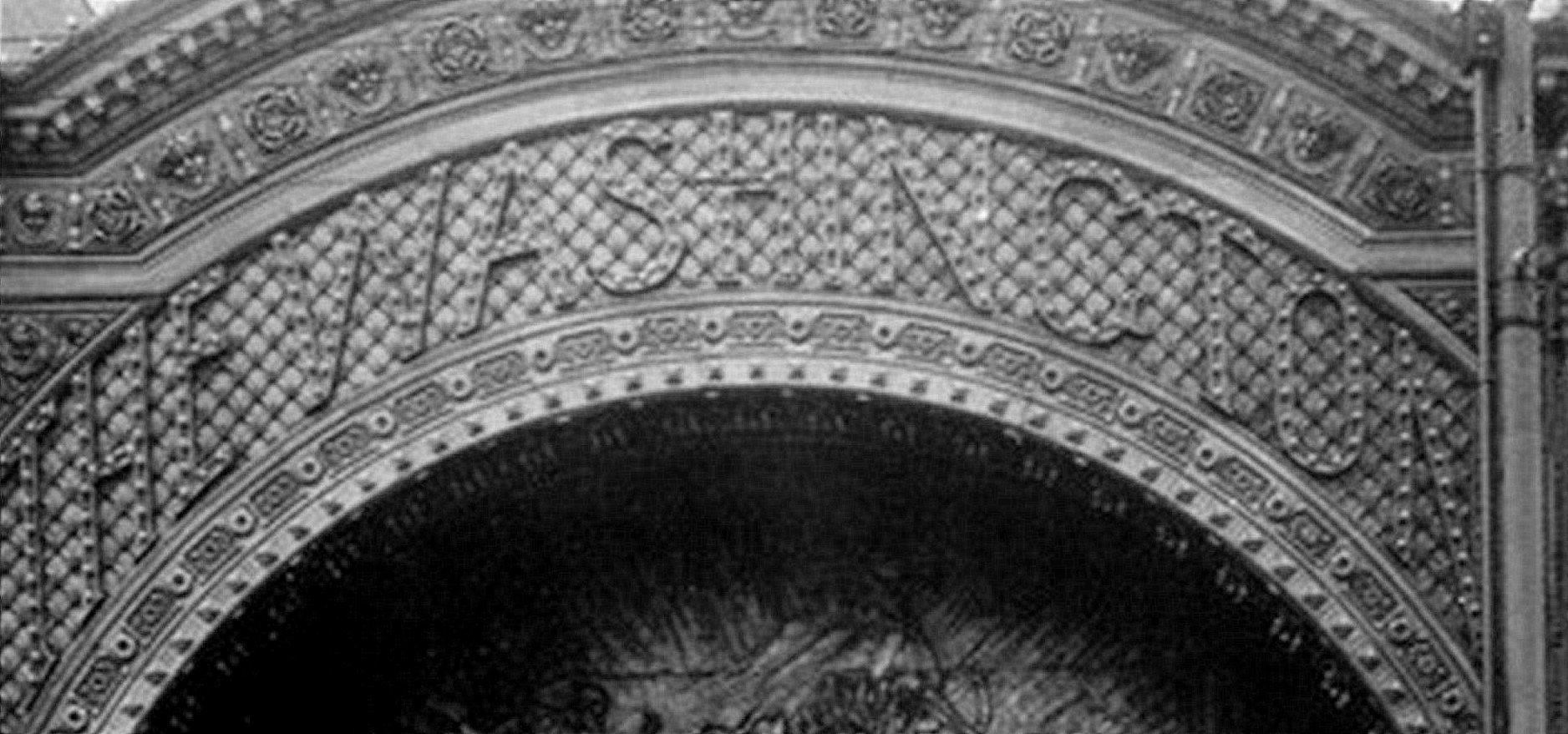
washington-theatre_cinema-treasures_det1

And, below (was one of these men W. D. Nevills?):

washington-theatre_cinema-treasures_det2

Another shot, this one showing how one worked without a typical illuminated marquee — you just string a banner up (the needle is hitting a solid “8.5” on the visual clutter scale here):
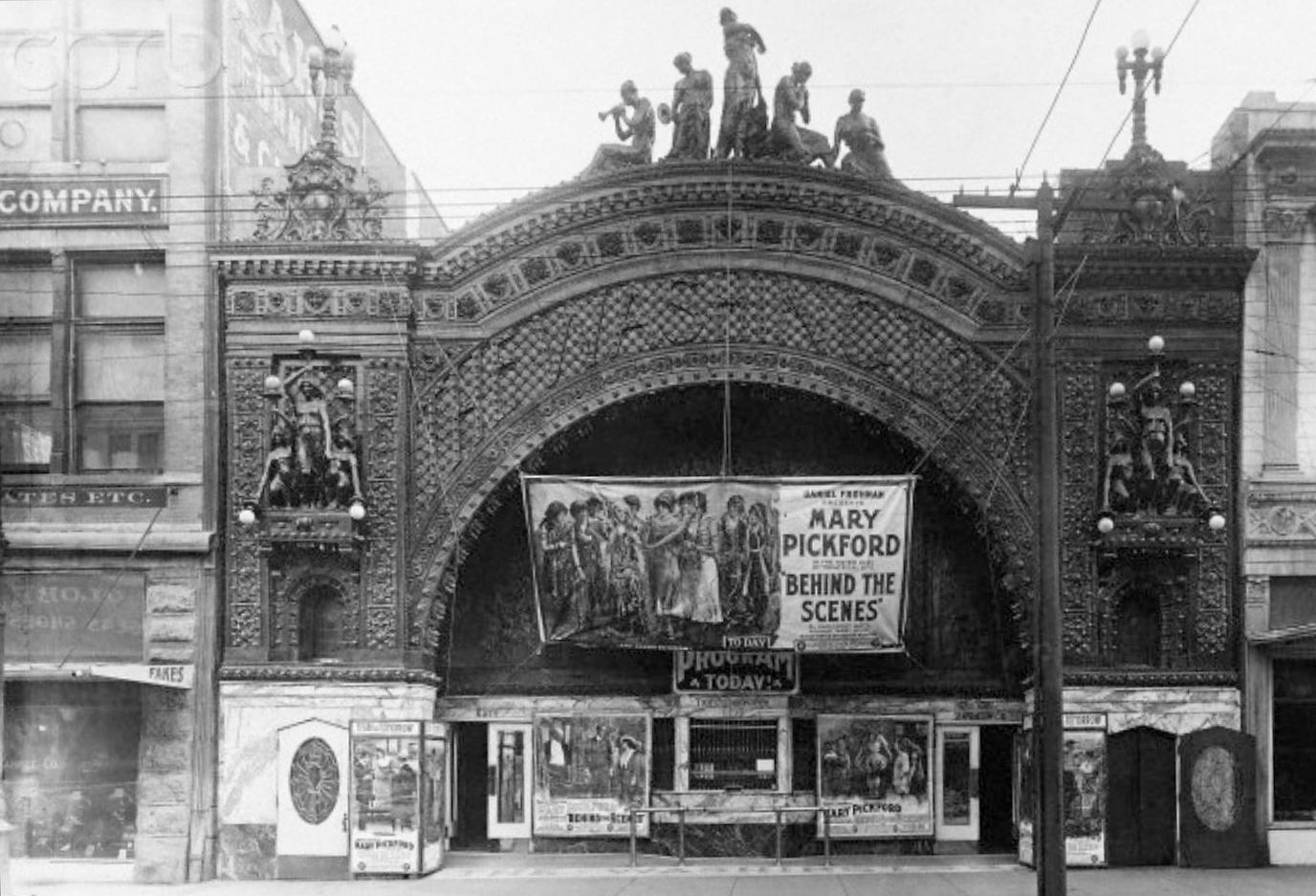
washington-theatre_corbis_19141914 via CorbisImages

Here it is, ablaze at night:
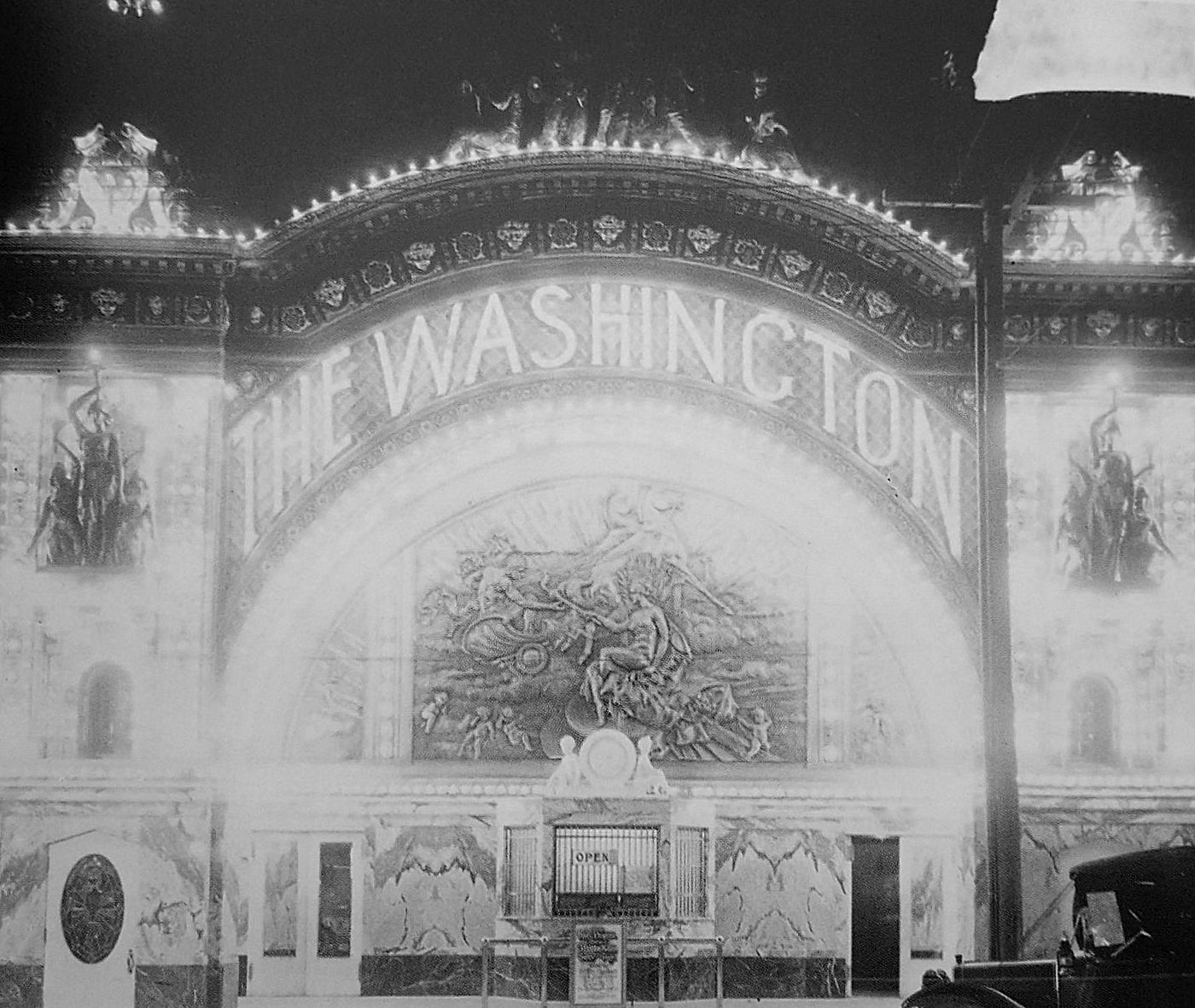
washington-theater_night_dallas-rediscovered_DHS

In an ad from 1914:

theater_washington_bldg-code_1914

Photo from October 1916:

theaters_washington-theatre_exhibitors-herald-and-motography_june-1919_photo-from-oct-1916

And in “color” from a picture postcard:
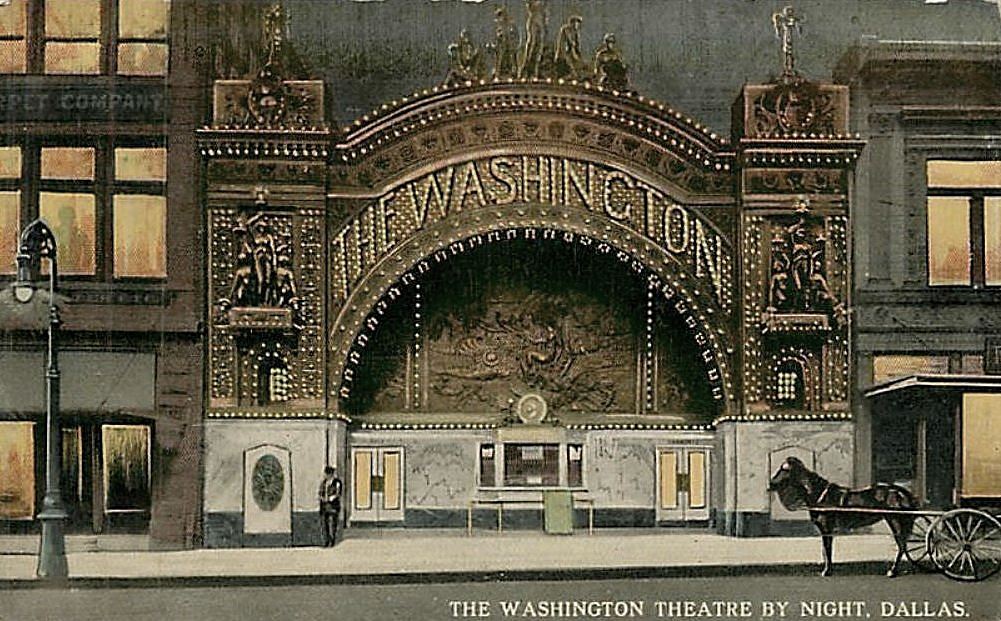
washington-theatre_ebay

***

Sources & Notes

Top photo from Cinema Treasures; to read a history of the Washington Theater from Cinema Treasures (and to see another photo), see here. (Photo’s original source appears to be the Dallas Historical Society.)

The photo of the theater with the Mary Pickford banner is ©Schenectady Museum; Hall of Electrical History Foundation/CORBIS; more info is here. (The movie “Behind the Scenes” was released in 1914.)

Photo of the theater at night is from Dallas Rediscovered by William L. McDonald — source: Dallas Historical Society archives.

The ad is from the 1914 Dallas Building Code.

Photo with the marquee showing “The Common Law” is from Oct. 1916, but the photo didn’t appear in the trade magazine Theatre Exhibitors Herald and Motography until June 1919.

The color postcard is from eBay.

Read about the closing of the Washington in an article available in the Dallas Morning News archives: “Washington Theater, Earliest Dallas ‘Movie Palace,’ Shows Last Close-Up After 15 Years” (DMN, July 4, 1927).

The Washington Theater must have been W. D. Nevills greatest achievement. It’s interesting to note that “Operator Washington Theater” appears on his death certificate. Nevills died in 1945, eighteen years after the theater closed.
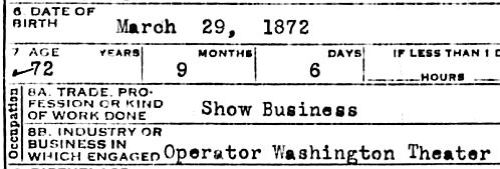
nevills_death-certificate_010545_det

For other Flashback Dallas posts on this era of movie theaters, see the following:

  • “Three of Dallas’ Earliest ‘Photoplay Houses’ — 1906-1913,” here
  • “Movie Houses Serving Black Dallas — 1919-1922,” here

*

Copyright © 2016 Paula Bosse. All Rights Reserved.

A Bird’s-Eye View Over the Washington Theater

washington-theater_aerial_dmn_lost-dallas_dotyAs the crow flies…

by Paula Bosse

This wonderful photo shows an aerial view looking northeasterly over the top of the Washington Theater, Dallas’ first ornate movie palace. It was located between N. Akard and N. Ervay, at 1615 Elm Street — now the site of Thanksgiving Tower. I think the street at the top right edge of the photo is Live Oak, which used to come all the way through to Elm. I love this photo.

***

Sources & Notes

Photo from Lost Dallas by Mark Doty (Charleston: Arcadia Publishing, 2012).

Bird’s-eye view today-ish (with 1615 Elm marked):

1615-elm-street_bingBing Maps

The Washington Theater was in business at 1615 Elm from 1912 to 1927. More on the Washington in the Flashback Dallas post “The Washington Theater — Dallas’ First Movie Palace,” here.

*

Copyright © 2016 Paula Bosse. All Rights Reserved.

The Hilton Hotel, Main & Harwood

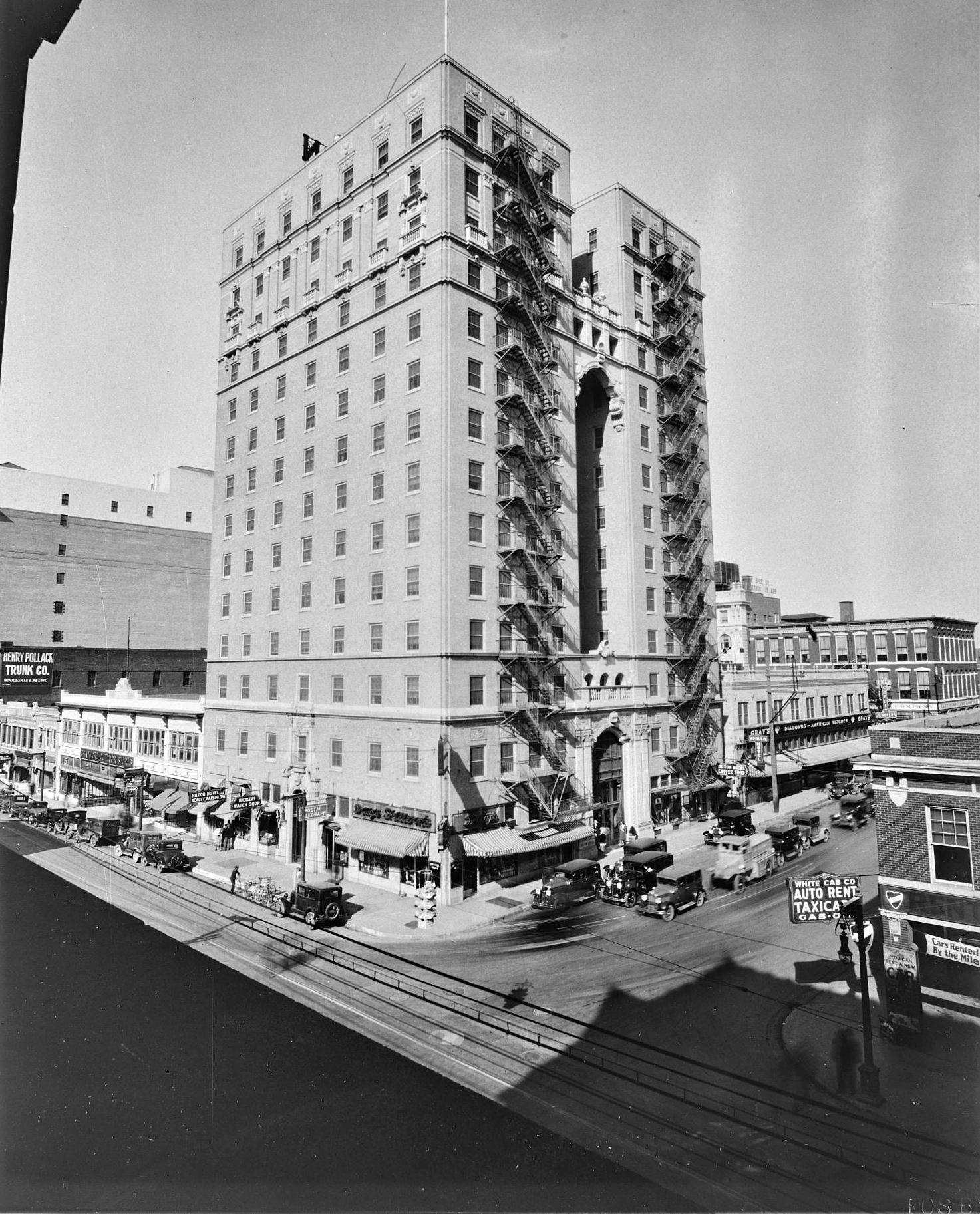
hilton-hotel_1930_portal_smThe Hilton, Main & Harwood, 1930 (click for much larger image)

by Paula Bosse

When Conrad Hilton built the Lang and Witchell-designed Hilton Hotel in Dallas in 1925, it was the first hotel he had built from the ground up. It’s been through several name changes over the years (its White Plaza Hotel incarnation was its longest), and, remarkably (for Dallas), the building still stands — it is now Hotel Indigo

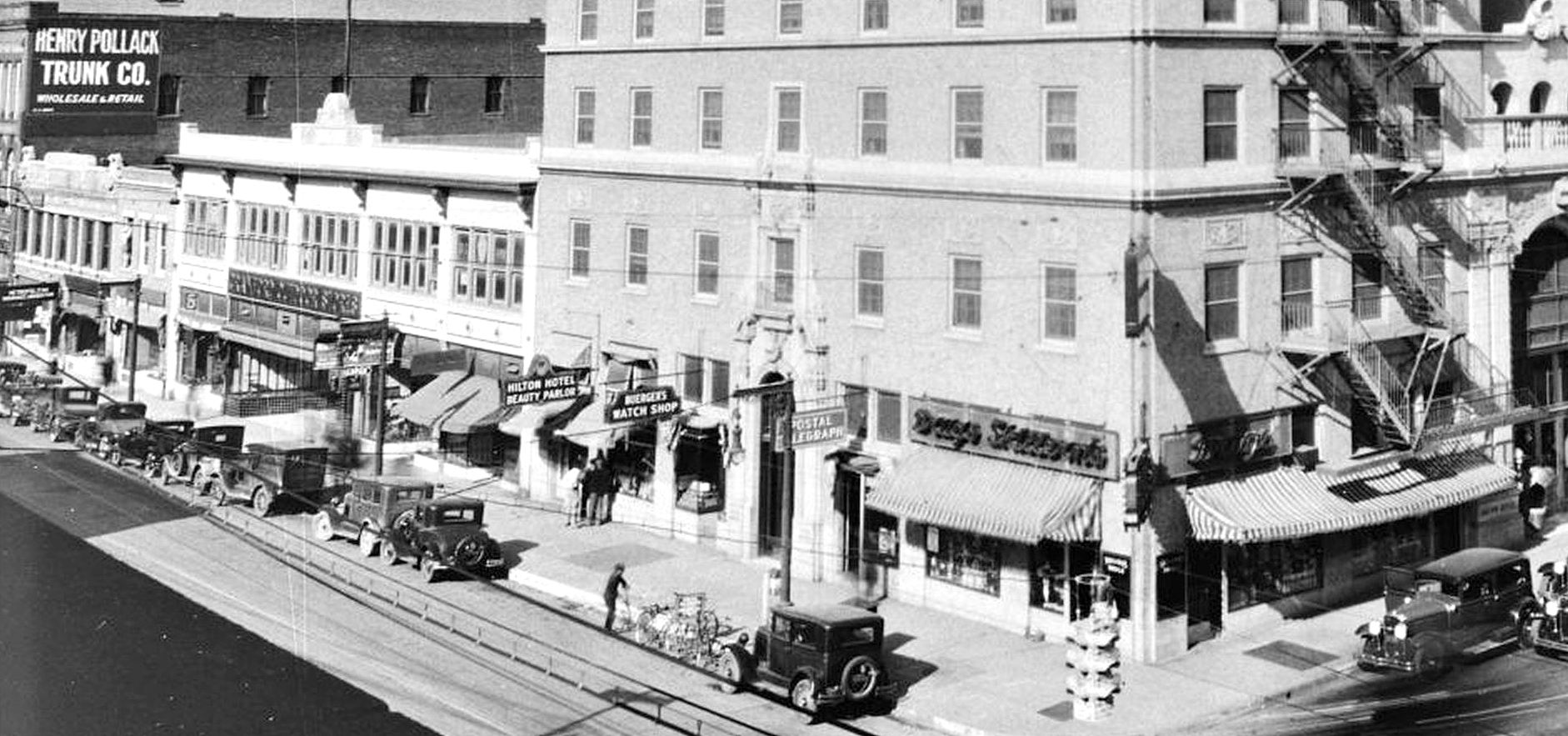
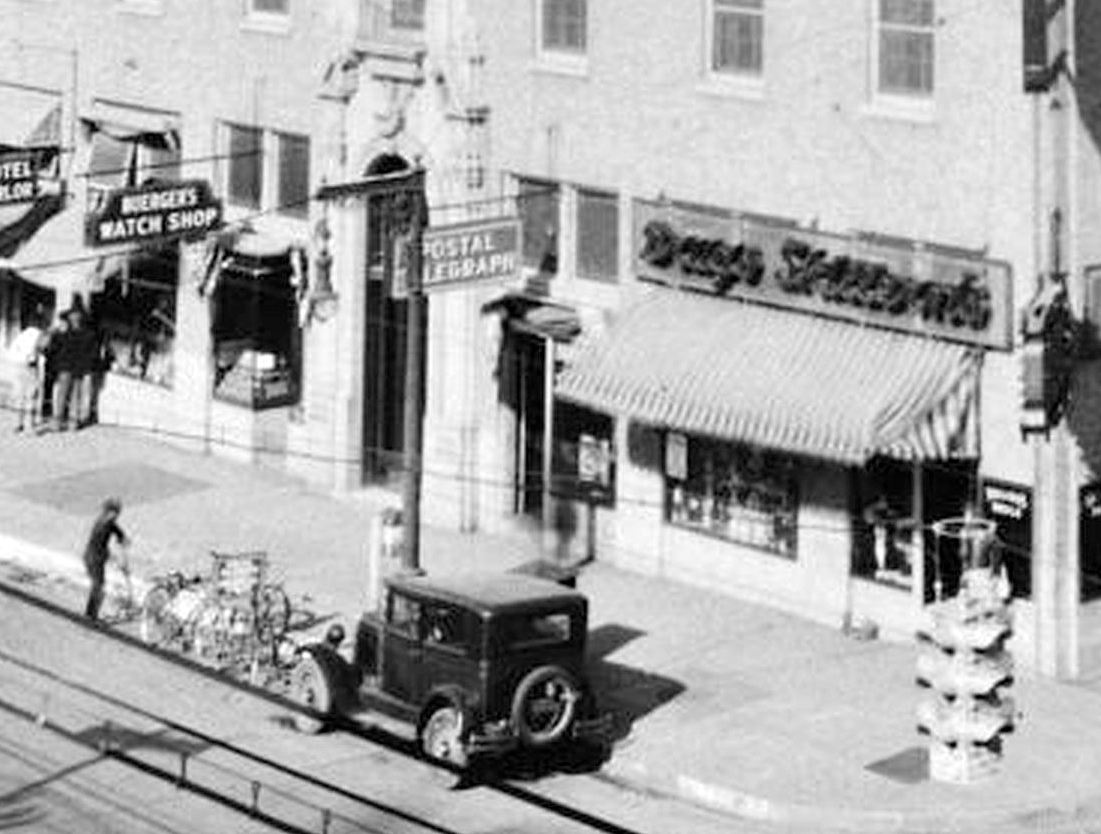
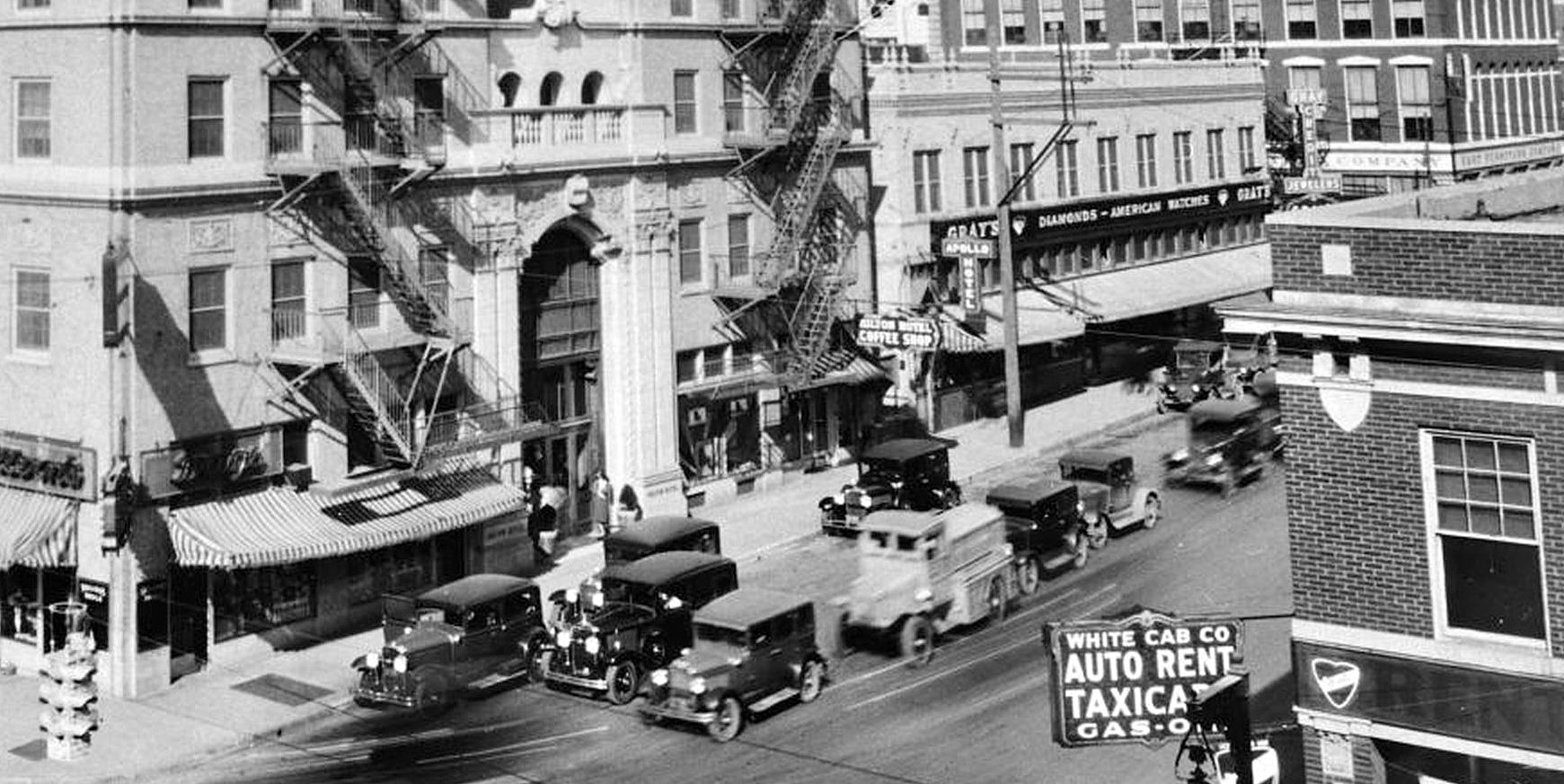
Above, a photo from 1930, with so much going on, it’s worth zooming in to see some of the details. All images are pretty big when clicked.

The left side of the photo shows Main Street looking west.

hilton_1930_det-1

I’m not sure what’s going on with the man at the curb — construction? Street cleaning? And I’ve looked and looked at that small tower-like thing on the corner but can’t figure out what it is. (UPDATE: Ha! Thanks to a helpful comment below, I now see that this “tower” which was confusing me so much is, not, in fact, an odd structure set on the sidewalk but is — of course! — a traffic light suspended above the street!) (UPDATE #2: I think another commenter was right when he said it is a uniformed telegram boy at a bicycle stand. I’ve never considered that telegram offices would have had bike stands — but of course they would!)

hilton_1930_det1a

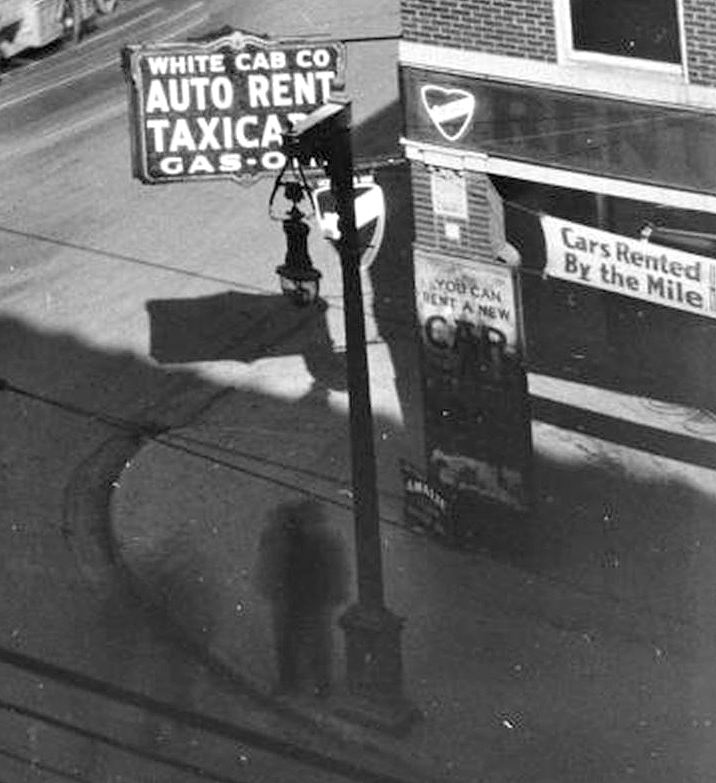
The right side shows Harwood looking north.

hilton_1930_det-2

hilton_1930_det3

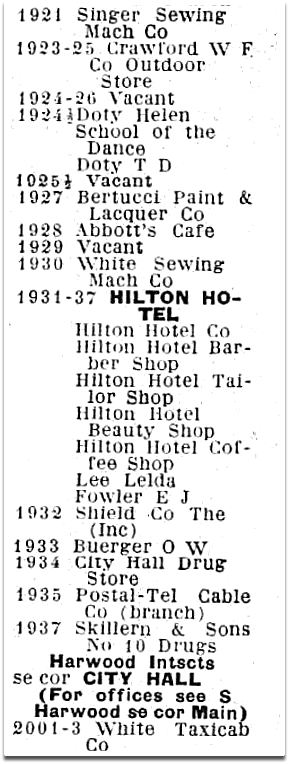
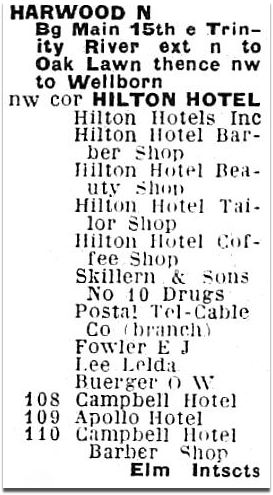
Here are the businesses listed in these blocks in 1930:

hilton_main_1930-directory1930 Dallas directory

hilton_harwood_1930-directory1930 Dallas directory

As a bonus, here’s a detail of another photo, showing the same intersection, around the same time, taken from the steps of the Municipal Building (then the city hall). The Drake’s Drug Store would be replaced by a Skillern’s in later years.

hilton_from-municipal_1927_det

***

Sources & Notes

Top photo from the Texas Historical Commission Historic Resources Survey Collection, via the Portal to Texas History, here.

The Wikipedia entry for Dallas’ first Hilton Hotel (not to be confused with the Statler-Hilton of the ’50s) is here.

The Hotel Indigo website is here.

All images larger when clicked.

*

Copyright © 2016 Paula Bosse. All Rights Reserved.
The Forney Car

forney-fair-park-car_ebayEastbound on Commerce (click for larger image)

by Paula Bosse

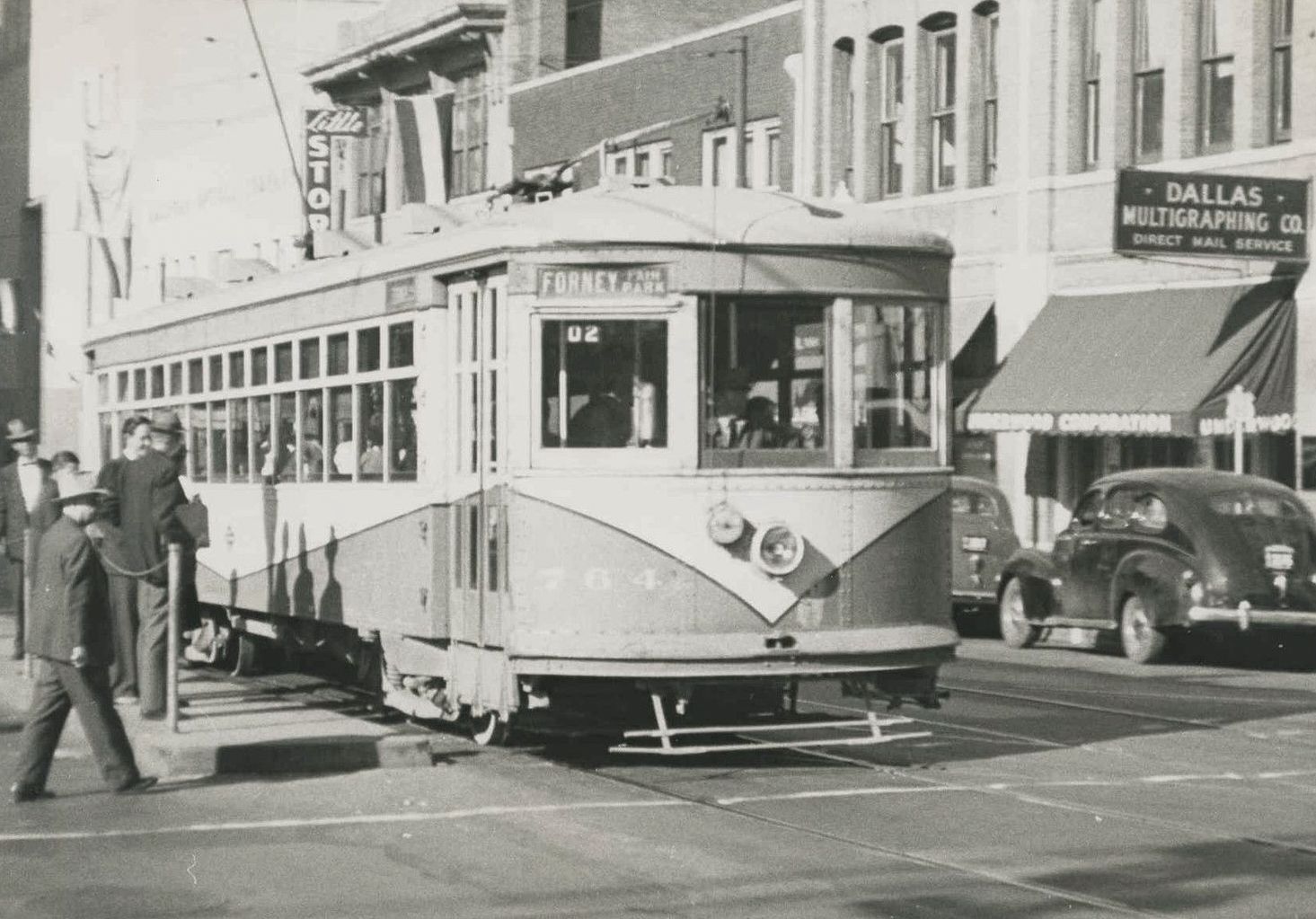
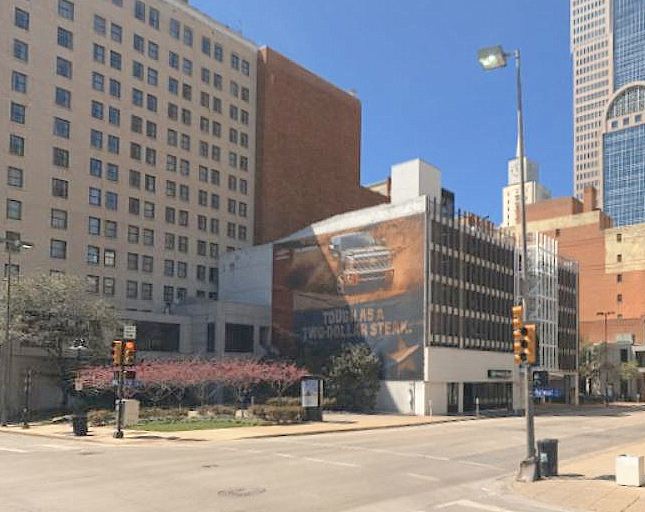
I’m a sucker for streetcars. Here’s car 764 heading east on Commerce, between Prather and S. St. Paul.

forney-car_1800-block-commerce_googleGoogle Maps

***

Photo from eBay.

The Underwood Corporation was at 1805-7 Commerce, and Dallas Multigraphics was at 1807 1/2 Commerce — they both moved to this location sometime between 1936 and 1943. This stretch of Commerce was once jam-packed with typewriter companies.

Forney Avenue ran along the northeastern side of Fair Park, about where Haskell does today, starting at Parry — if one continued along it past the city limits, one would reach the town of Forney. In 1922 Interurban track was laid between Dallas and Terrell, with the train entering Dallas along Forney Avenue, terminating at Union Station. The Forney streetcar and the Interurban traveled over the same tracks.

terrell-forney-ave_dmn_061621Dallas Morning News, June 16, 1921

forney-ave_1919-mapDetail of a map from 1919

For more on the Dallas-Forney-Terrell Interurban, check out the 1925 publication “Making Neighbors of the People of Dallas and Kaufman Counties and the Towns of Terrell, Forney, Mesquite and Dallas by the Opening of the Texas Interurban Railway” — the 16-page pamphlet has been scanned by the fine folks at UNT’s Portal to Texas History, and it can be accessed here.

Images larger when clicked.

*

Copyright © 2016 Paula Bosse. All Rights Reserved.
Elm & N. Harwood — ca. 1960

elm-harwood_ca-1960_dmn-tumblrIt’s 4:50 — where’s all the traffic? (click for larger image)

by Paula Bosse

A nice shot of the 1900 block of Elm Street, looking vastly more interesting in 1960 than it does now.

elm-harwood_bingBing StreetSide

***

Sources & Notes

Top photo by Hank Tenny.

Google Street View of this corner is here.

*

Copyright © 2016 Paula Bosse. All Rights Reserved.
 

The Eisenlohr Family and Dallas’ First Christmas Tree — 1874

eisenlohr_1885_ebayThe Eisenlohr Market Drug Store, 1885 (click for larger image)

by Paula Bosse

According to the memories of Dallas artist E. G. Eisenlohr (1872-1961), his German-born parents brought the first decorated Christmas tree to Dallas in 1874 (or, according to a version of the story published a few years later, 1876). There had been Christmas trees in Dallas before this, but the Eisenlohrs’ tree may have been the first tree — or one of the first — to be brought inside and decorated with tinsel and ornaments.

According to E. G. Eisenlohr’s Christmas memories which appeared in The Dallas Morning News on Oct. 1, 1935:

The candles, holders and tinsel for that first Christmas tree in the village of Dallas in 1874 was ordered from the East. For days my mother baked cookies in the shapes of stars, ships, [and] boots [using] hand-carved molds, some more than 100 years old, that illustrated folk tales…. For days before Christmas Eve the children had been locked out of the room where Kris Kringle was decorating the tree and permitted to enter only after our parents played their Christmas concert and appeared at the window in answer to the cheers from the crowd in the streets. There may have been other trees in the village before we had ours but I have not heard of any and many persons said ours was the first here. I believe we had the first tinsel and glass decorations, for many persons told me later that their parents had told them of the decorated trees back in their old homes before they came to Texas.

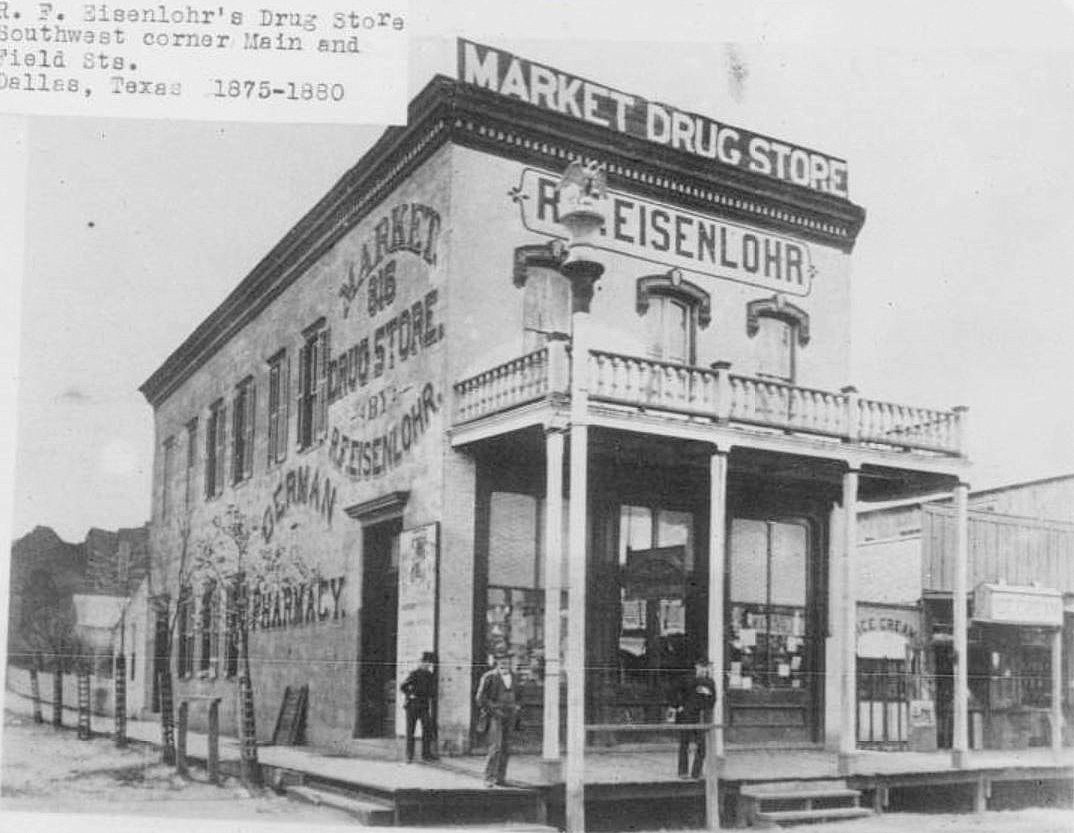
eisenlohr-store_degolyer-lib_SMUThe store, ca. 1875-1880 (via DeGolyer Library, SMU)

But what kind of tree was it? According to Kenneth Foree’s 1946 News article about the Eisenlohr tree, it was “a beautiful cedar tree (cut from an Akard and Young thicket by moonlight when the children were asleep” (DMN, Dec. 24, 1946).

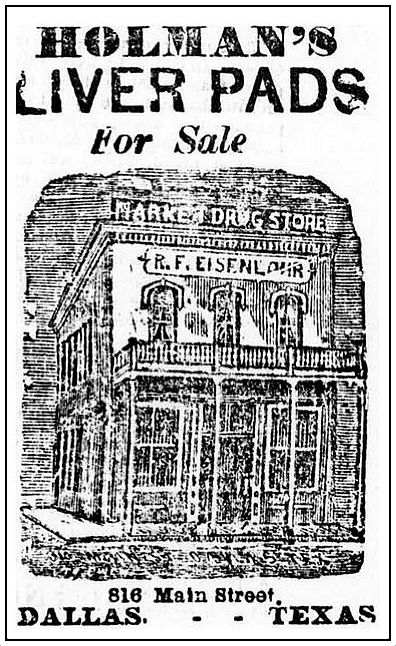
Eisenlohr’s father, Rudolph F. Eisenlohr, owned the Market Drug Store (seen above), which was at the southwest corner of Main and Field (the current view of that corner can be seen here, via Google Street View, and the 1885 Sanborn map of that block can be found here.) The family lived upstairs. Imagine that first decorated tree — actually inside someone’s home! — lit with candles in one of those upper windows, attracting a crowd of people below who had never before seen such a sight in the little village of Dallas.

eisenlohr_photoR. F. Eisenlohr (1846-1933)

eisenlohr_market-drug-store_dallas-herald_021877
The Dallas Herald, Feb. 18, 1877

eisenlohr_dallas-directory_1878
Dallas city directory, 1878

eisenlohr_nortons-union-intelligencer_102383
Norton’s Union Intelligencer, Oct. 23, 1883

***

Sources & Notes

More on this tree can be found in these three Dallas Morning News articles:

  • “Christmas of ’74 Featured by First Yule Tree in City — Intended for Eisenlohr Children, but Served for All of Youngsters ” (DMN, Oct. 1, 1935)
  • “Happy Citizens of the Little Town of Dallas Saw Their First Glass and Tinsel Ornaments in 1876 on a Tree Which Glittered Through the Eisenlohrs’ Window Upstairs Over Their Drug Store” (…that is one crazy-long headline…) by Mattie Lou Frye (DMN, Dec. 18, 1932)
  • “First Tree” (crazy-short headline…) by Kenneth Foree (DMN, Dec. 24, 1946)

Photo of the Eisenlohr store found on eBay.

More on artist E. G. Eisenlohr here and here.

*

Copyright © 2015 Paula Bosse. All Rights Reserved.
 

Merry Christmas From the Dallas Police Department’s Parking Enforcement Squad

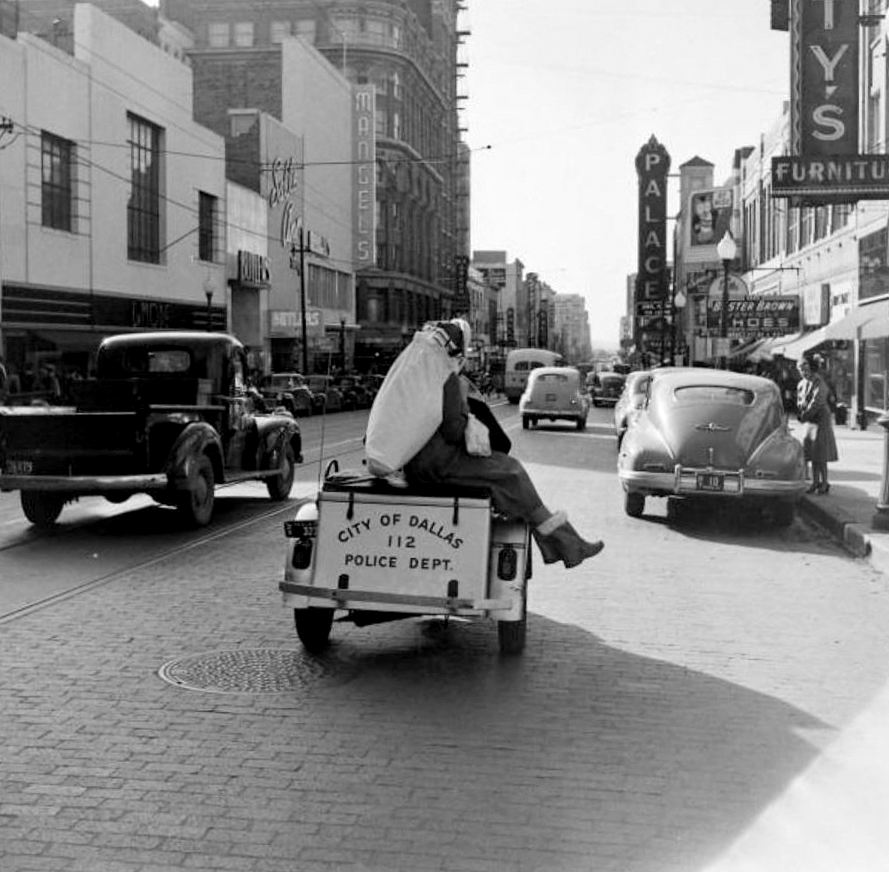
xmas_santa_DPDSanta on Elm Street (click for larger image)

by Paula Bosse

I don’t know what the story is behind this photograph of Santa Claus riding on the back of a three-wheeled motorcycle (they were used by the Dallas Police Department to patrol downtown streets for parking violations). Maybe Santa’s sleigh has broken down and he’s thumbed a ride to get to a scheduled event at a department store. Let’s hope it wasn’t the result of said sleigh being parked in a No Parking zone and a rather too strenuous ticket dispute by Mr. Claus necessitating a visit to the station to discuss the situation further. (Look at the brick-paved street!)

***

I’m not sure of the original source of this photo, but I want to thank reader Chris Walker for sending this to me. Thank you, Chris!

*

Copyright © 2015 Paula Bosse. All Rights Reserved.
The Wilson Building, Early Days

wilson-bldg_RPPC_ebay_pm1908_smallMain & Ervay (click for larger image)

by Paula Bosse

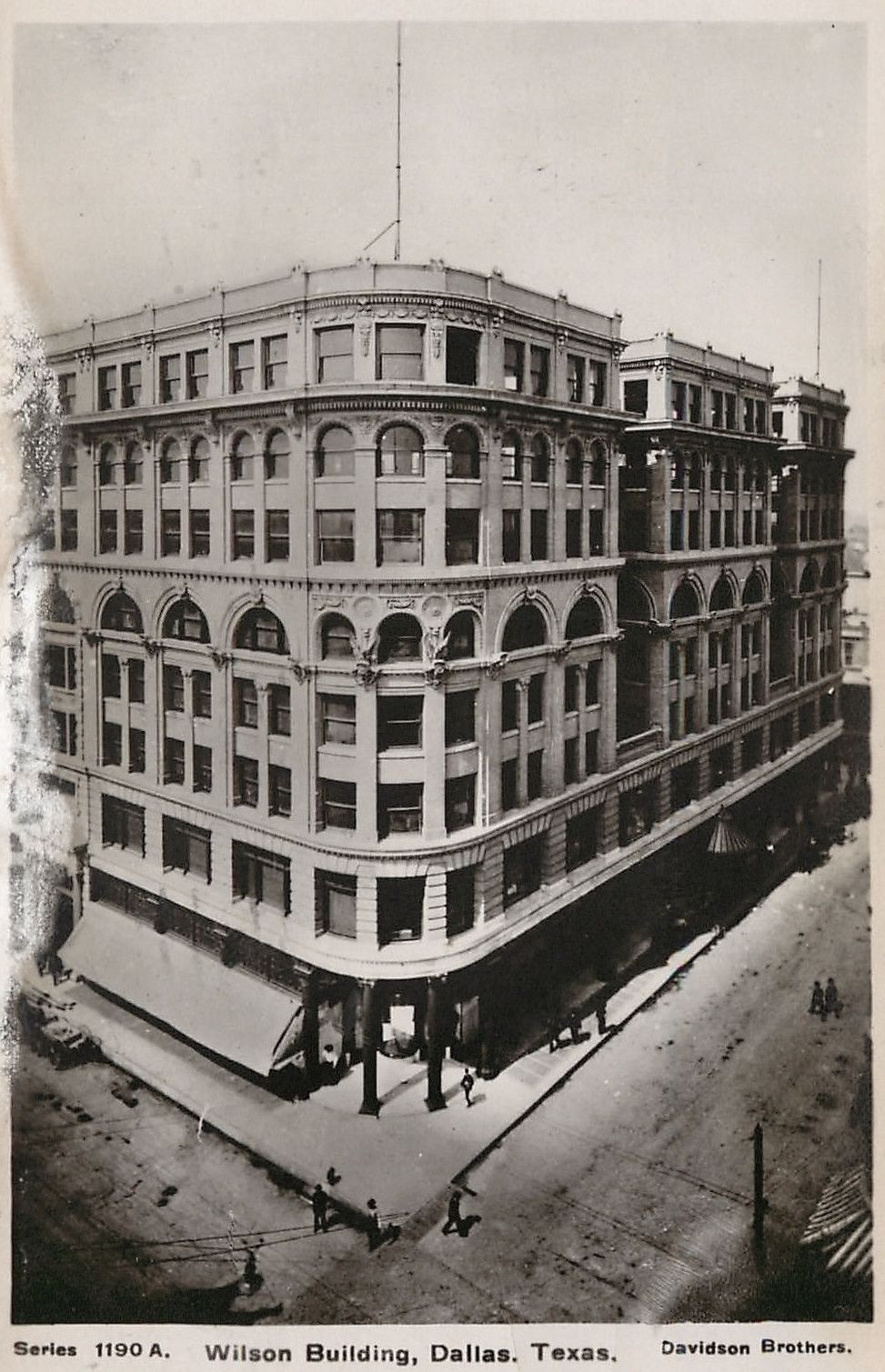
Yet another view of one of Dallas’ most beautiful buildings!

***

Postcard from eBay, postmarked 1908.

For meatier Wilson Building posts, see the previously posted “The Wilson Building Under Construction — 1902,” here, and “The Wilson Building & Its Tenants — 1908/1909,” here.

Click for larger image.

*

Copyright © 2015 Paula Bosse. All Rights Reserved.
Main Street — ca. 1942

main-street-canyon_ebay_smallThe Merc, Titche’s, the White Plaza (click for much larger image)

by Paula Bosse

I love postcards like this. All signs of people, automobiles, and streetcars have been magically erased. Poof! This lunchtime scene of empty streets and sidewalks — looking west down Main from Harwood at 12:30 PM — was definitely a view never seen by a human being!

In trying to figure out the year of this image, I narrowed it down to about 1942 — that was the year the Mercantile Building was completed, and that was also about the time that Henry Pollock’s luggage store packed up (…as it were…) and vacated 1911-13 Main (the store was no longer listed at this address by the time the 1943 directory was issued). That’s not to say that the sign painted on the side of the building didn’t remain after Pollock had left, but later occupants would most likely have painted over it as soon as they moved in.

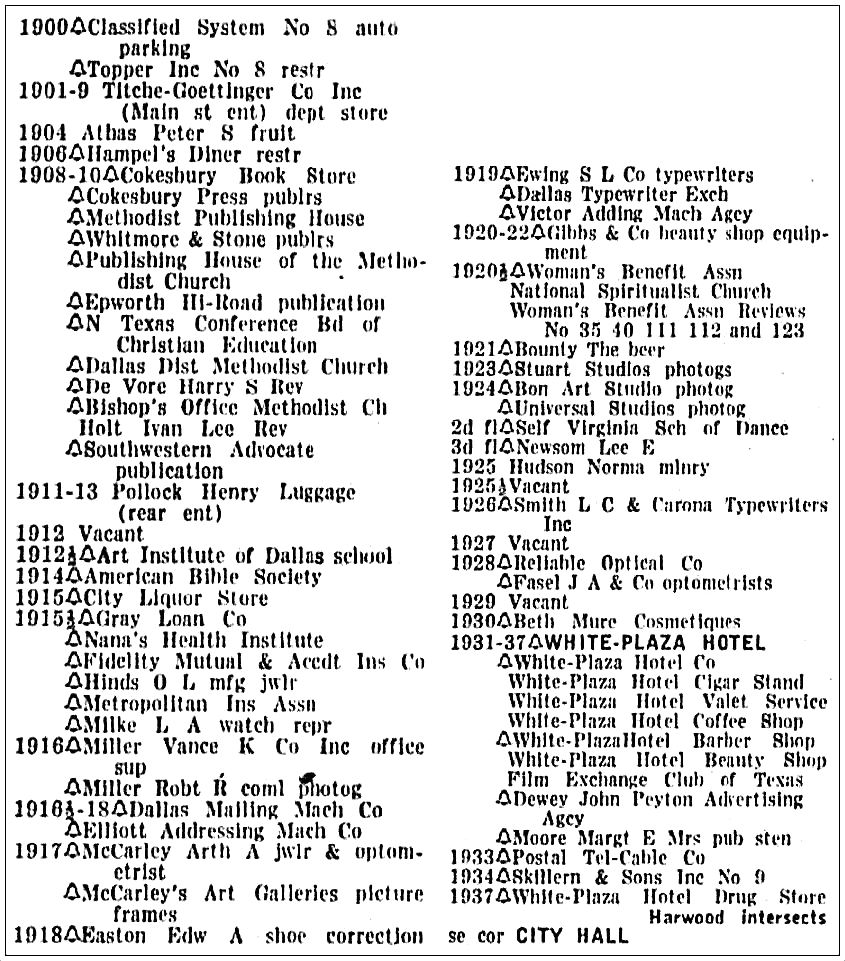
Speaking of directories, here’s a look at the businesses in the 1900 block of Main — between St. Paul and Harwood — in 1941. (Click for larger image.)

main-st_19411941 Dallas directory

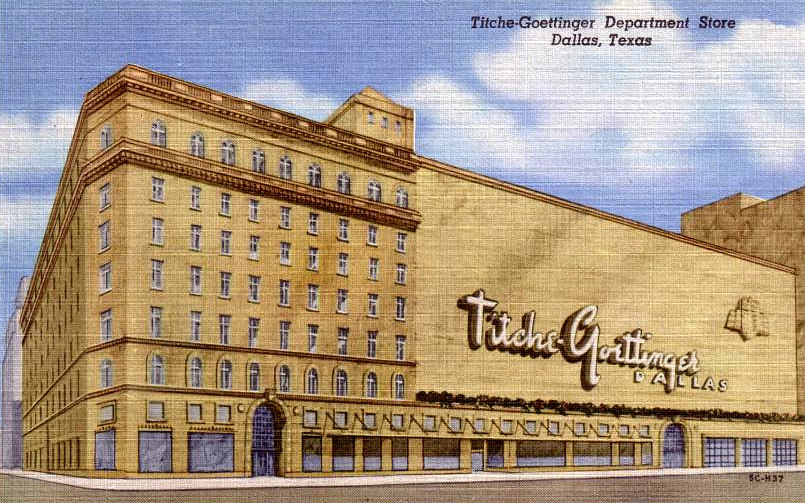
For me, the interesting thing about this postcard is seeing the Titche’s building (at the corner of St. Paul) before it was expanded. The small buildings between Titche’s and the White Plaza Hotel (a hotel which was originally Dallas’ first Hilton — Conrad’s first-ever hotel to bear his name) were demolished sometime around 1952, and the expansion began that year, its 50th in business in Dallas.

The original building was built in 1929, designed by George Dahl (whose office was, a few years later, right across the street); the architectural firm responsible for the expansion was Thomas, Jameson & Merrill.

Here’s what the building looked like before the expansion (with another magic erasure — this time, the hotel at the end of the block has been removed to make way for an unobstructed view of the moon):

titches_night.jpg

And here’s the building after its expansion:

titches

***

Sources & Notes

More on the Titche’s expansion in the Dallas Morning News article “Titche’s Reports Plans to Double Present Size” by Edd Routt (Sept. 7, 1952).

Present-day photo of the Titche’s building, from Wikipedia, is here.

Present-day street view showing roughly the same vantage point as the postcard at top, can be seen on Google Street View, here.

A previous Flashback Dallas post — “George Dahl’s Titche-Goettinger Building” — is here.

All images larger when clicked.

*

Copyright © 2015 Paula Bosse. All Rights Reserved.
 

Ervay, Live Oak, and Elm: Just Another Wednesday Night — 1953

ervay-live-oak-elm_haskins_uta_010753“Tomorrow’s weather: warm & cloudy”

by Paula Bosse

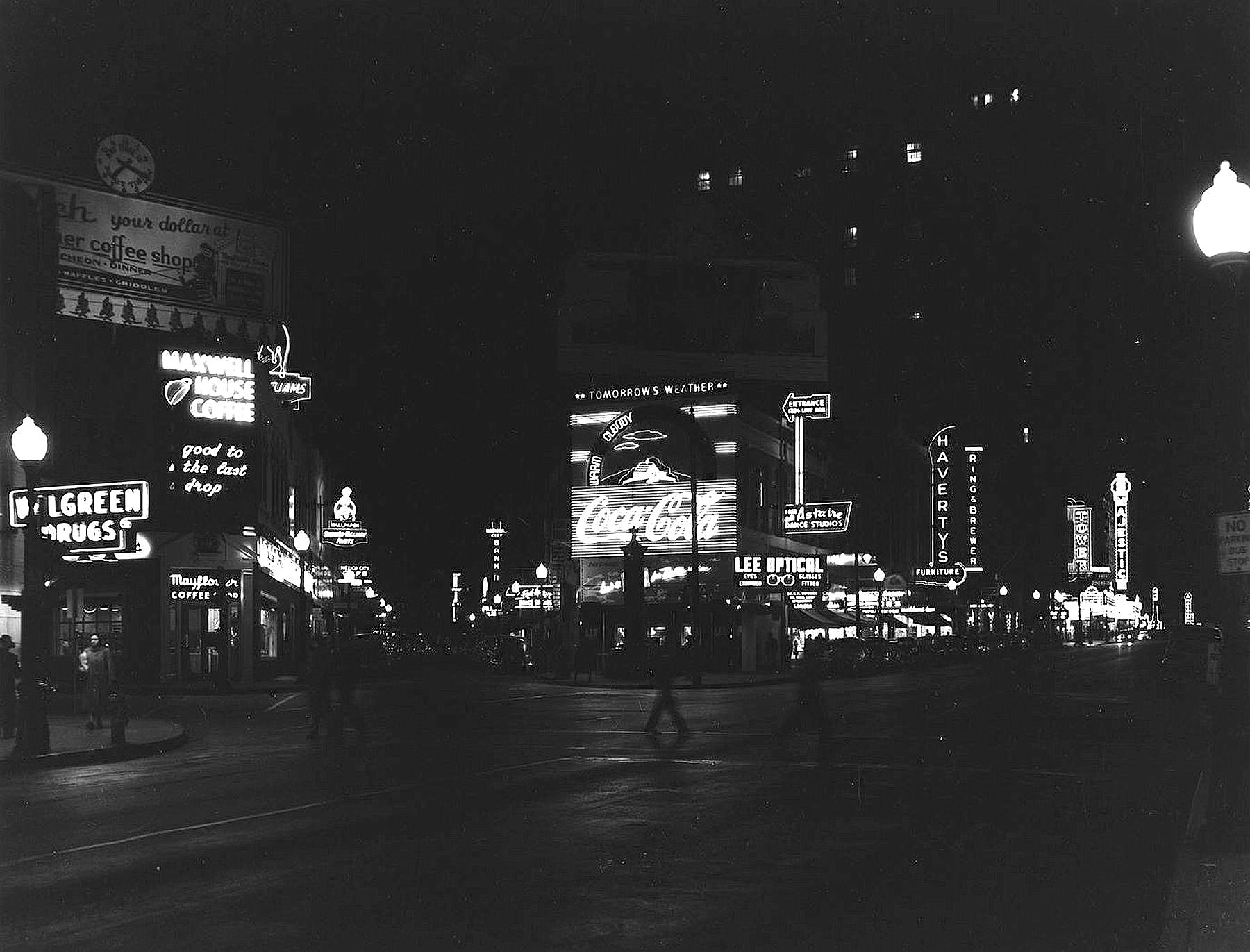
Here’s what 7:18 PM looked like at the old five-point intersection of Ervay, Live Oak, and Elm streets on January 7, 1953, a Wednesday night. All that neon — especially that Coca-Cola sign, which was probably flashing and strobing like crazy — gives this scene a sort of mini-Times Square feel. Imagine this intersection on a Friday or Saturday night when the streets and sidewalks would have been packed with people heading to theaters, restaurants, and night clubs!

On the left, at the street light (I love those street lights!) and the Walgreen’s sign, is N. Ervay. To the left of the Coca-Cola sign is Live Oak, which used to come through to Elm. To the right, Elm Street, heading east.

So many interesting things here: the Mayflower Coffee Shop (with its “Anytime Is Donut Time” clock and its animated Maxwell House Coffee sign), that incredible neon sign above the Lee Optical store which gave the forecast, that Fred Astaire Dance Studios sign (with “Astaire” in a fantastic neon font), and the Tower and Majestic theater signs lit up for moviegoers who ventured to the movies on a school night. Unseen: the public restrooms (or “public comfort stations”) hidden beneath the street, with the entrance (I think) on the Lee Optical triangular “corner.”

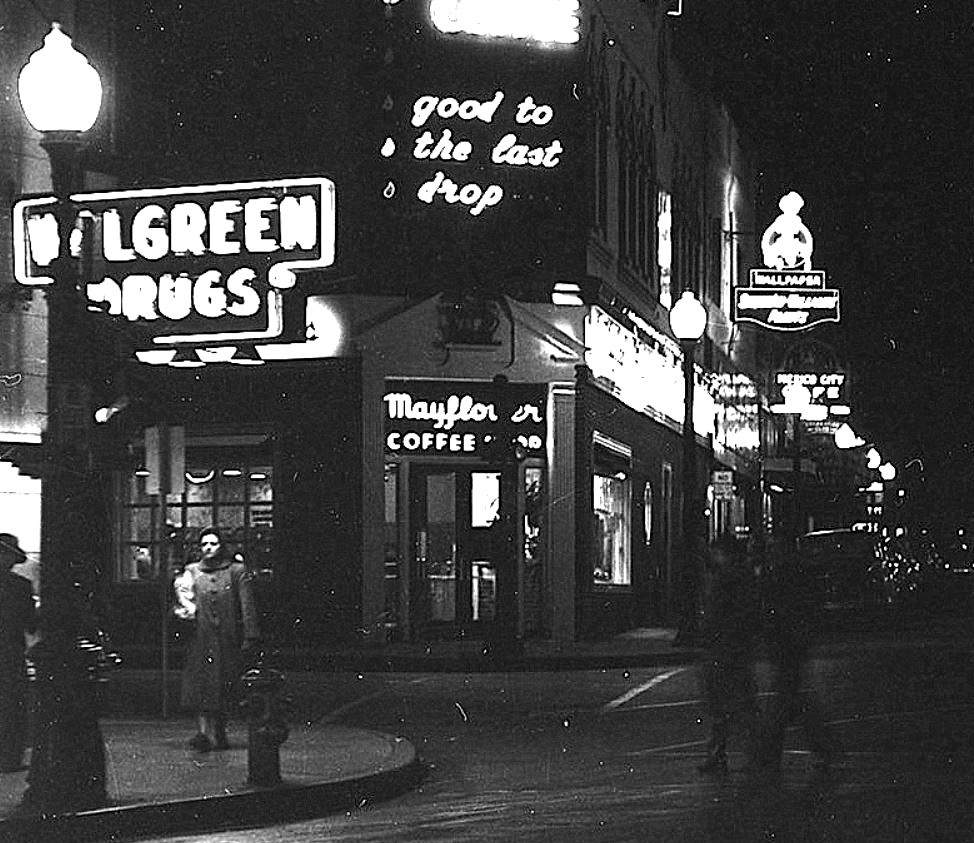
I love all the neon, but this quiet little vignette of a woman carrying some sort of sack or parcel down a chilly downtown street is why I wish I had been around back then — it’s weird to feel nostalgia for a time and place you never actually experienced.

elm-ervay-live-oak_squire-haskins_uta_010753-det

*

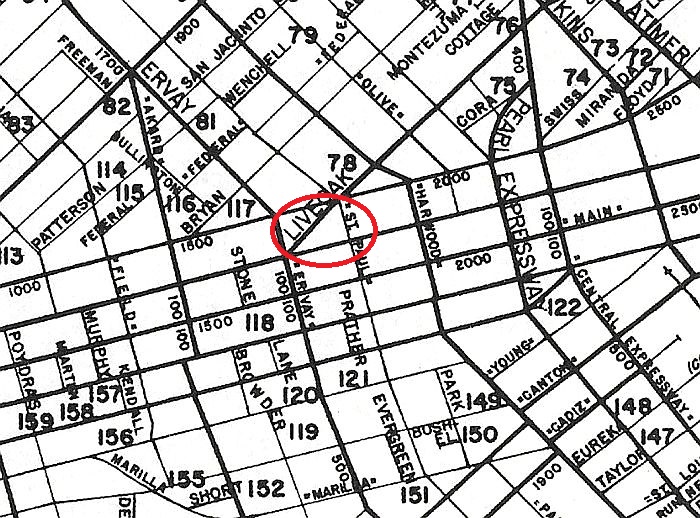
A map showing that this intersection once had five points.

ervay-elm-live-oak_1952-mapsco1952 Mapsco (click for larger image)

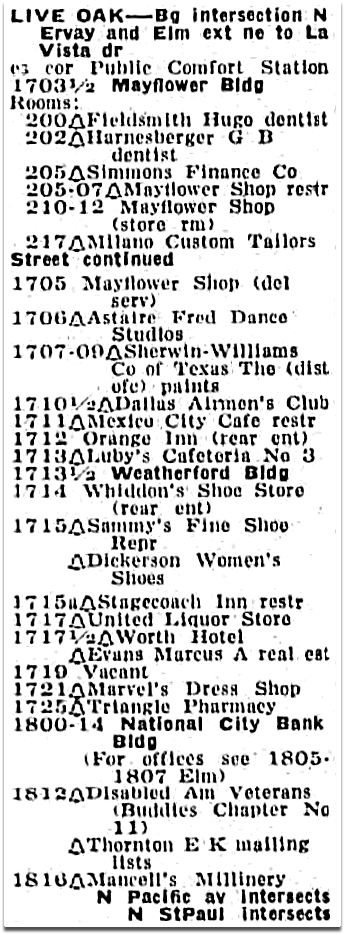
A listing of the businesses along Live Oak, between N. Ervay and N. St. Paul, from the 1953 city directory (click to read):

live-oak_1953-directory

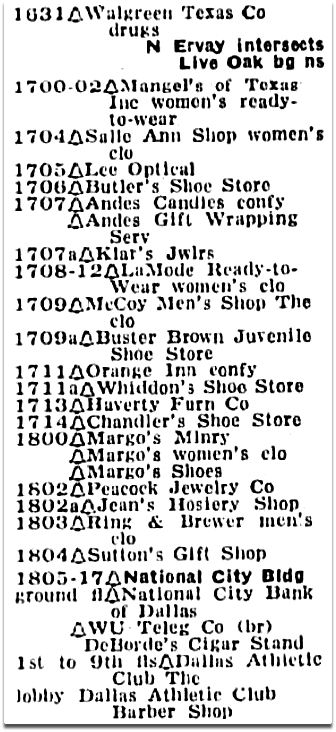
And the businesses along Elm, between N. Ervay and the old Dallas Athletic Club:

elm-st_1953-directory-1

***

Sources & Notes

This photograph — an untitled night scene — was taken by Squire Haskins on Jan. 7, 1953; from the Squire Haskins Photography, Inc. Collection at the University of Texas at Arlington Libraries, Special Collections, accessible here.

See this same view during the DAY in the post “Tomorrow’s Weather at Live Oak & Elm — 1955-ish,” here.

*

Copyright © 2015 Paula Bosse. All Rights Reserved.