Flashback : Dallas

A Miscellany: History, Ads, Pop Culture

Category: Fair Park

Proposals From the Bartholomew Master Plan For Dallas — 1940s

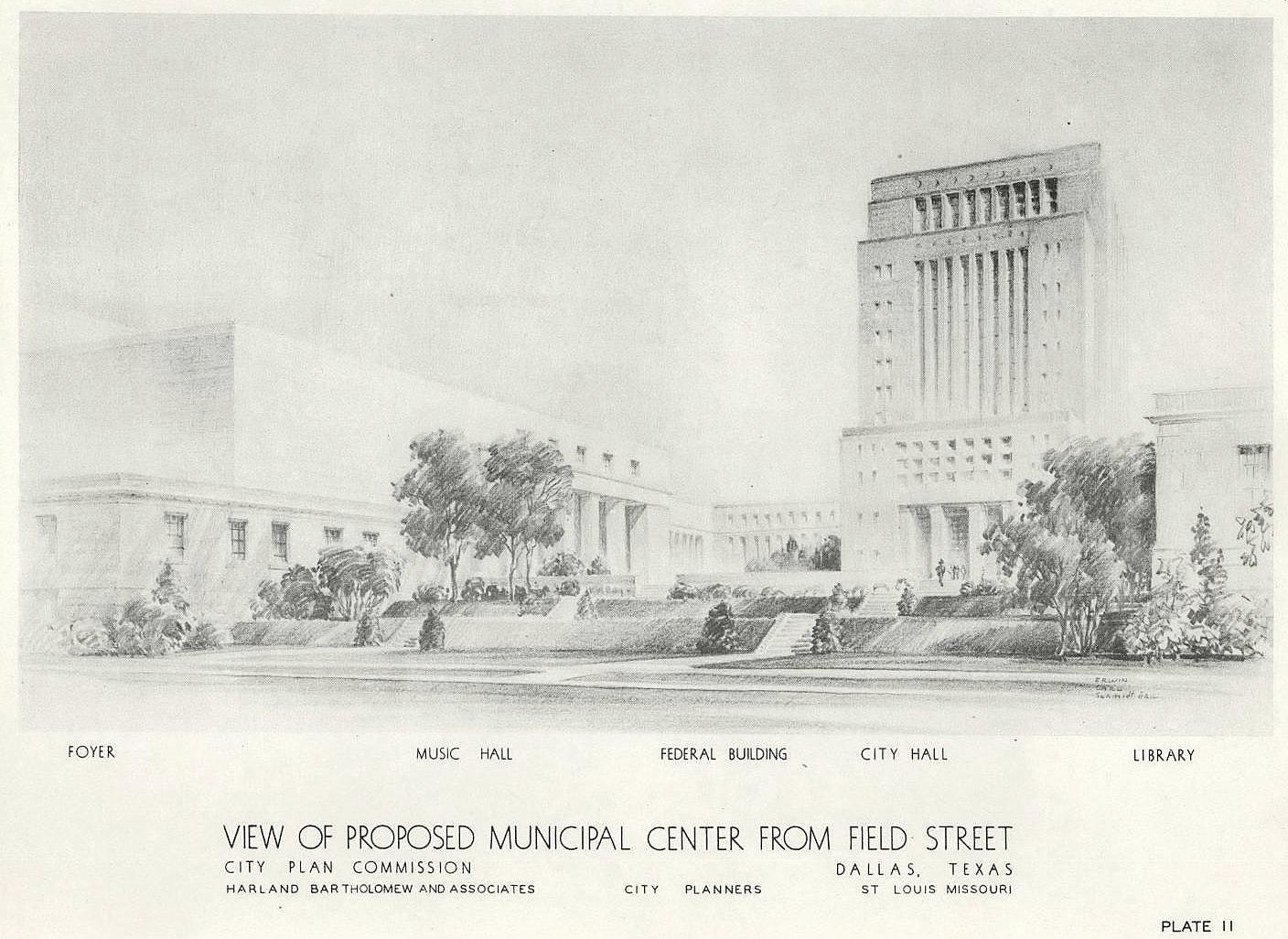
municipal-center_erwin-earl-schmidt-rendering_bartholomew-plan-1946Behold… (click for larger image)

by Paula Bosse

A few proposals from the Dallas master plan for post-war development and planning, commissioned by the city from the St. Louis firm of Harland Bartholomew and Associates (in association with Hare & Hare Landscape Architects). The scanned reports which made up this plan — submitted between 1943 and 1946 — can be found on the Portal to Texas History site, here, courtesy of the Dallas Municipal Archives. If you’re interested in urban planning and maps, these reports are fascinating.

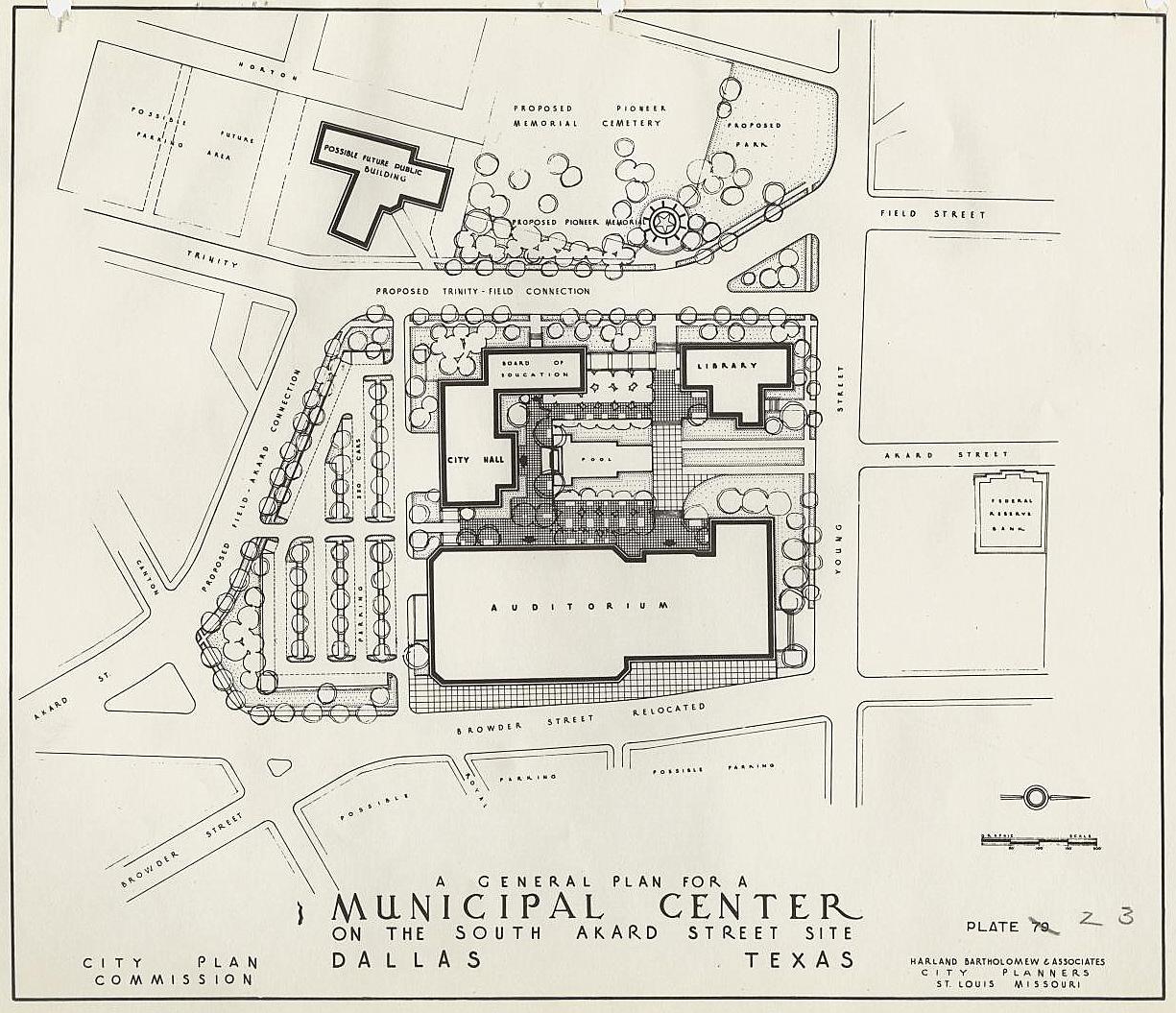
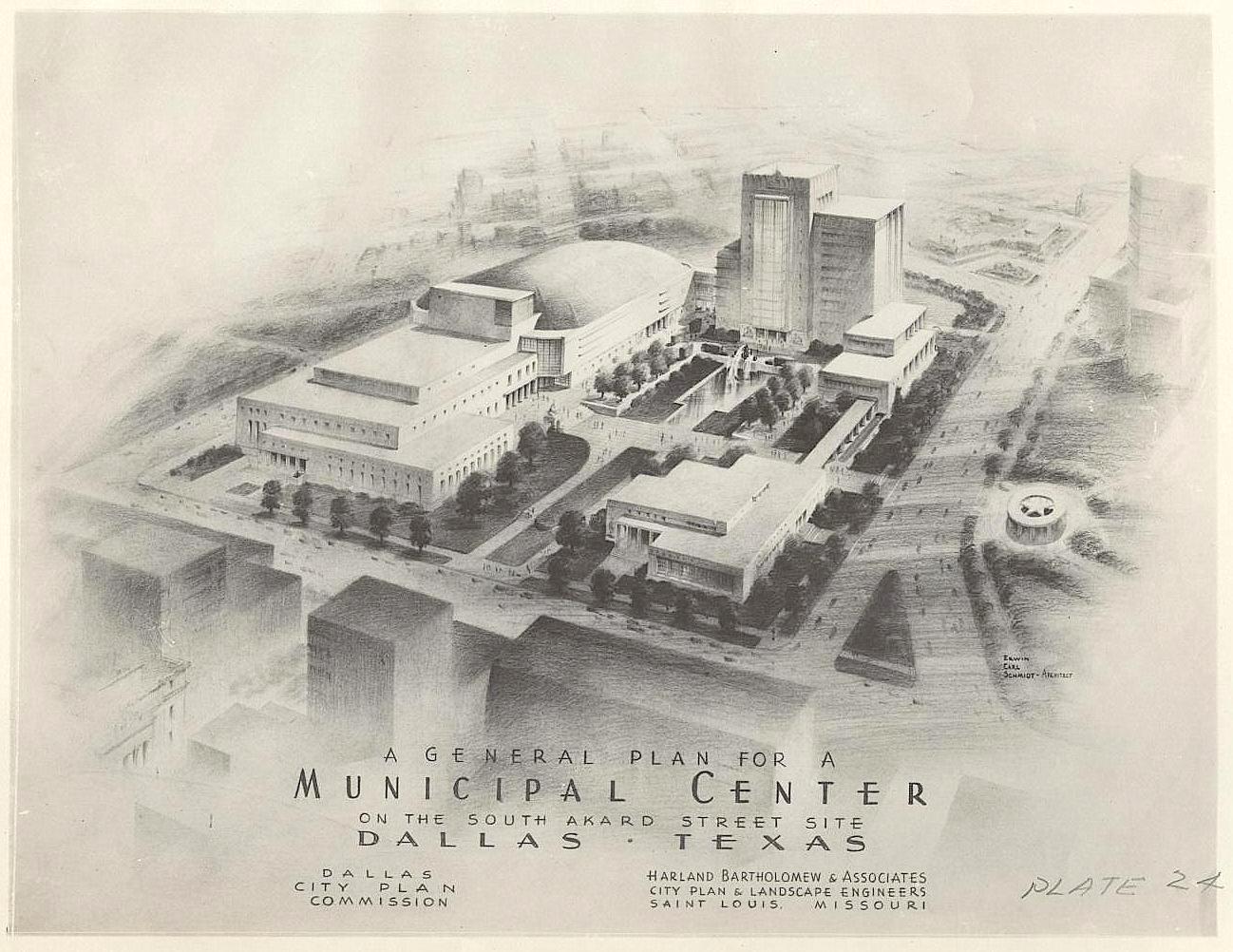
The image above (from 1946, rendered by architect Erwin Earl Schmidt) shows a proposed municipal center on the familiar “South Akard Street Site.” The plan is below. (All images are larger when clicked.)

municipal-center_bartholomew-plan-1946

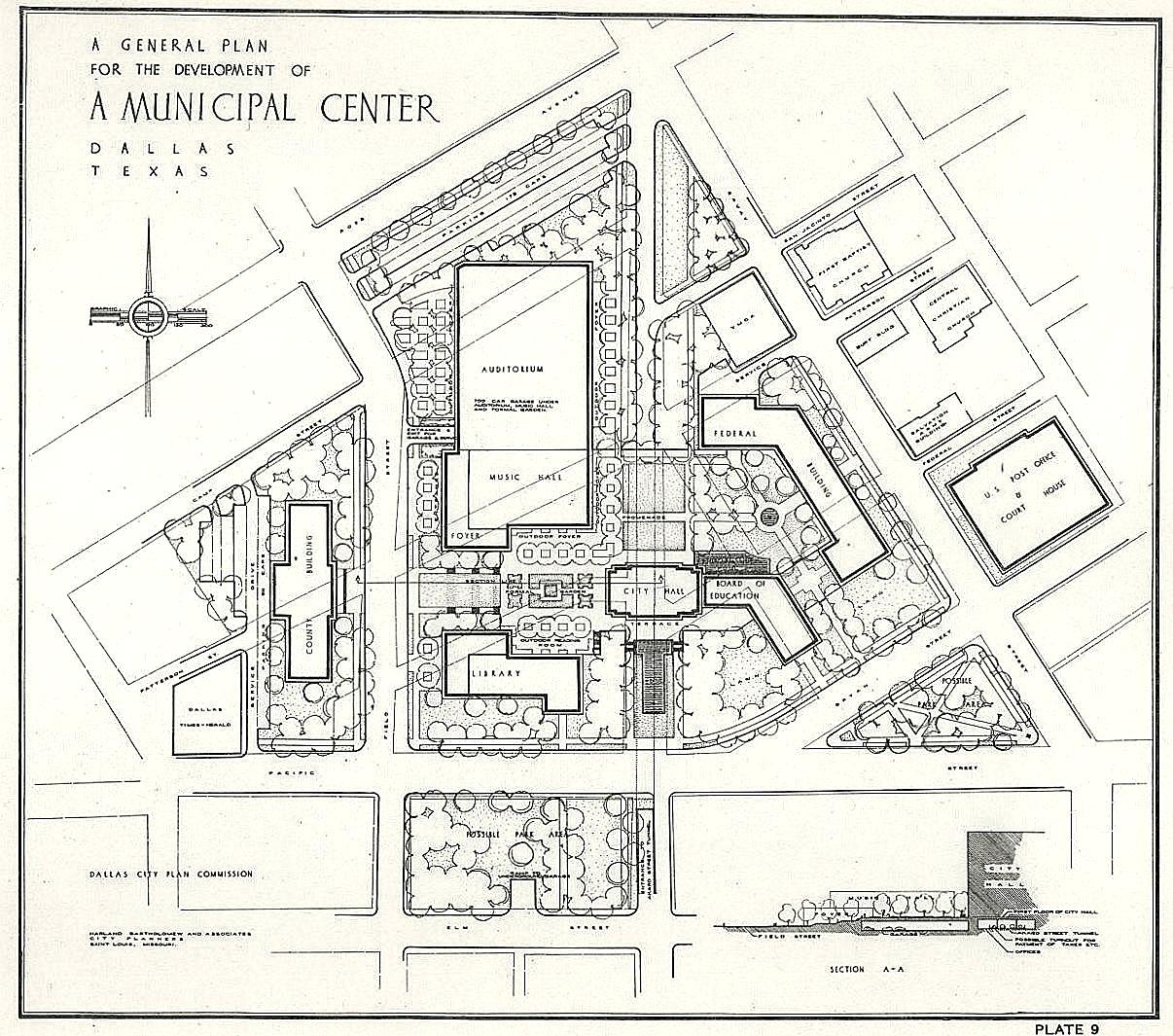
The previous year, the site for this proposed municipal center was north of Pacific:

municipal-center-plan_bartholomew-plan-1945

And Schmidt’s rendering for that compound is just as interesting:

municipal-center_erwin-earl-schmidt-rendering_bartholomew-plan-1945

Also discussed in the plan was what to do with Fair Park. Here’s a 1945 redevelopment proposal:

fair-park-redevelopment_bartholomew-plan-1945

And here’s the 1946 re-jiggering (the Cotton Bowl’s getting a lot of action):

fair-park_preliminary-plan_bartholomew-1946

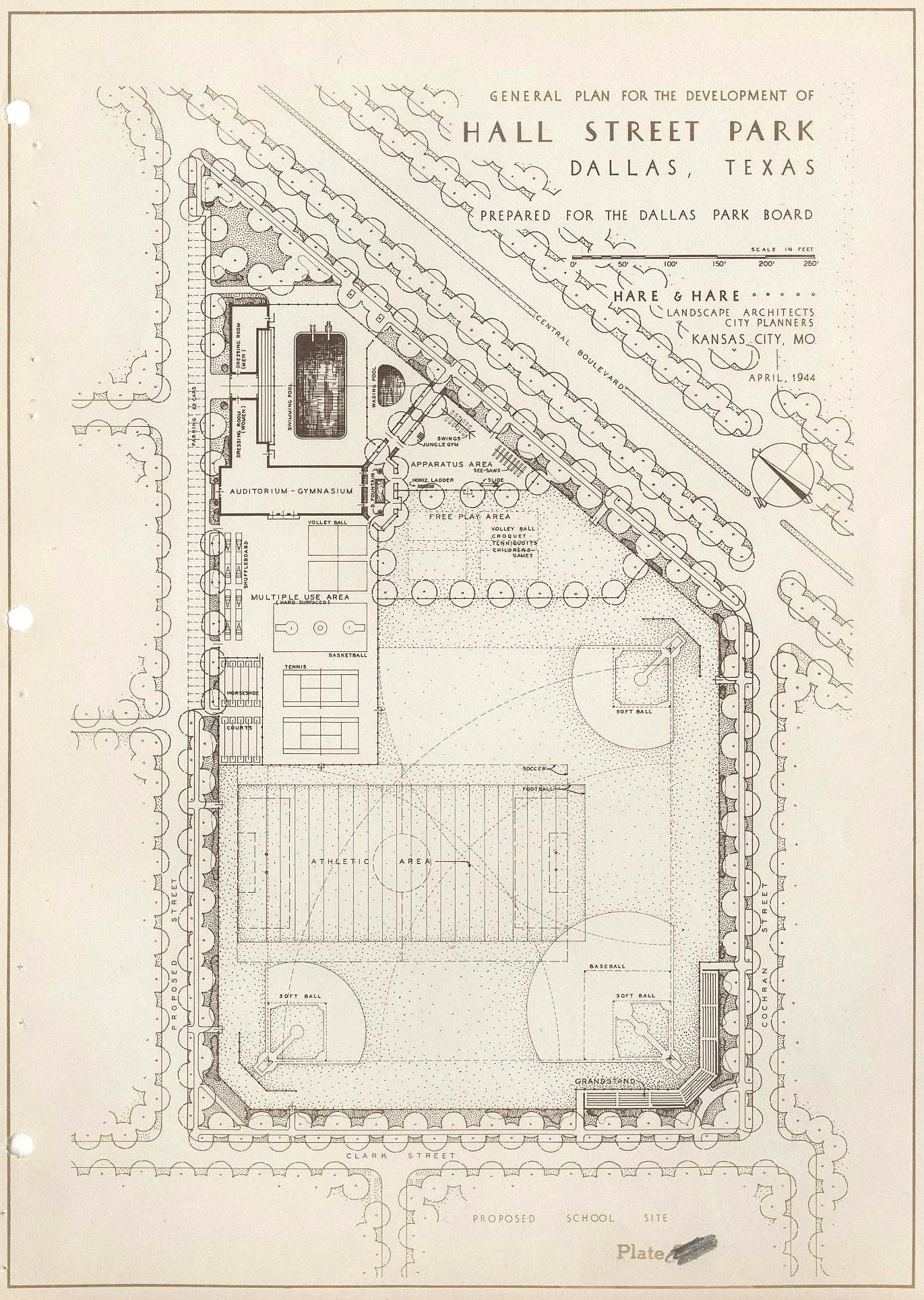
And, lastly, a 1946 plan for expansion of the “Hall Street Park for Negroes.” I’m not sure that any of this ever happened. The last mention I see of this park was in 1945 (the first mention I found of the park in the Dallas Morning News archives was 1922, and it had clearly been around for a while before that — perhaps it was absorbed into the existing Griggs Park? “Central Boulevard” would soon be built and renamed Central Expressway, the highway that sliced through the thriving black neighborhood centered around Hall Street.

hall-street-park_bartholomew-plan-1946

***

Sources & Notes

The 1945 plates can be found in the original publication here; the 1946 plates here.

All illustrations are from the Bartholomew master plan proposal; these reports are from the collection of the Dallas Municipal Archives, accessible on UNT’s Portal to Texas History, here.

Additional images from the plan can be found in the Flashback Dallas post “‘Your Dallas of Tomorrow’ — 1943,'” here.

All images larger when clicked.

*

Copyright © 2017 Paula Bosse. All Rights Reserved.

The G. B. Dealey Library and Reading Room at the Hall of State

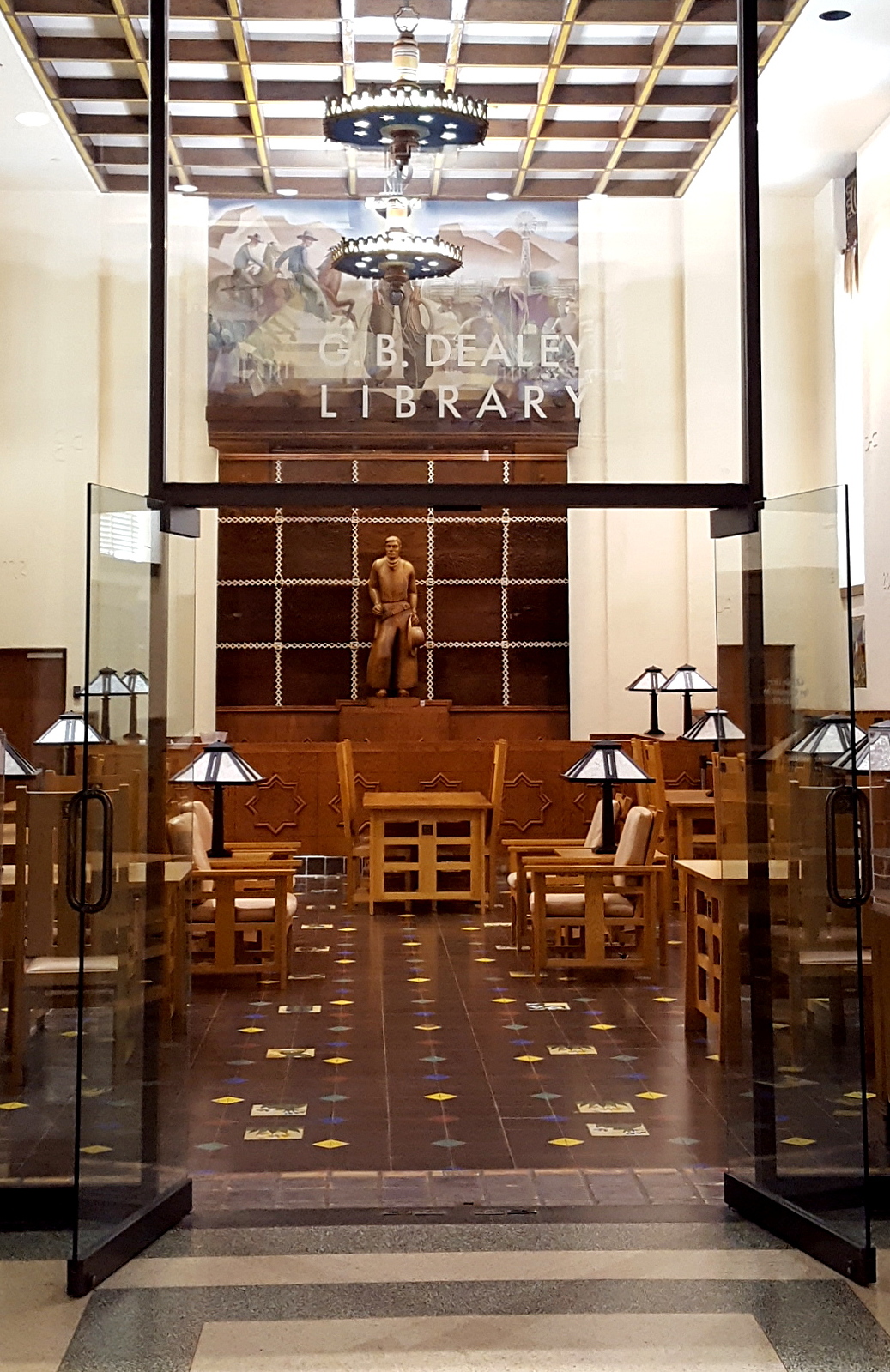
hall-of-state_dealey-library_entrance_042517A quiet place to read or study… (click for larger image)

by Paula Bosse

I spent time this week walking around the G. B. Dealey Library and Reading Room at the Hall of State in Fair Park. It is part of the Dallas Historical Society, and it is a quiet, high-ceilinged, airy-but-cozy Western-themed oasis filled with lots of warm wood and featuring two large murals by legendary El Paso artist Tom Lea. If you haven’t seen it, I highly encourage you to go take a look.

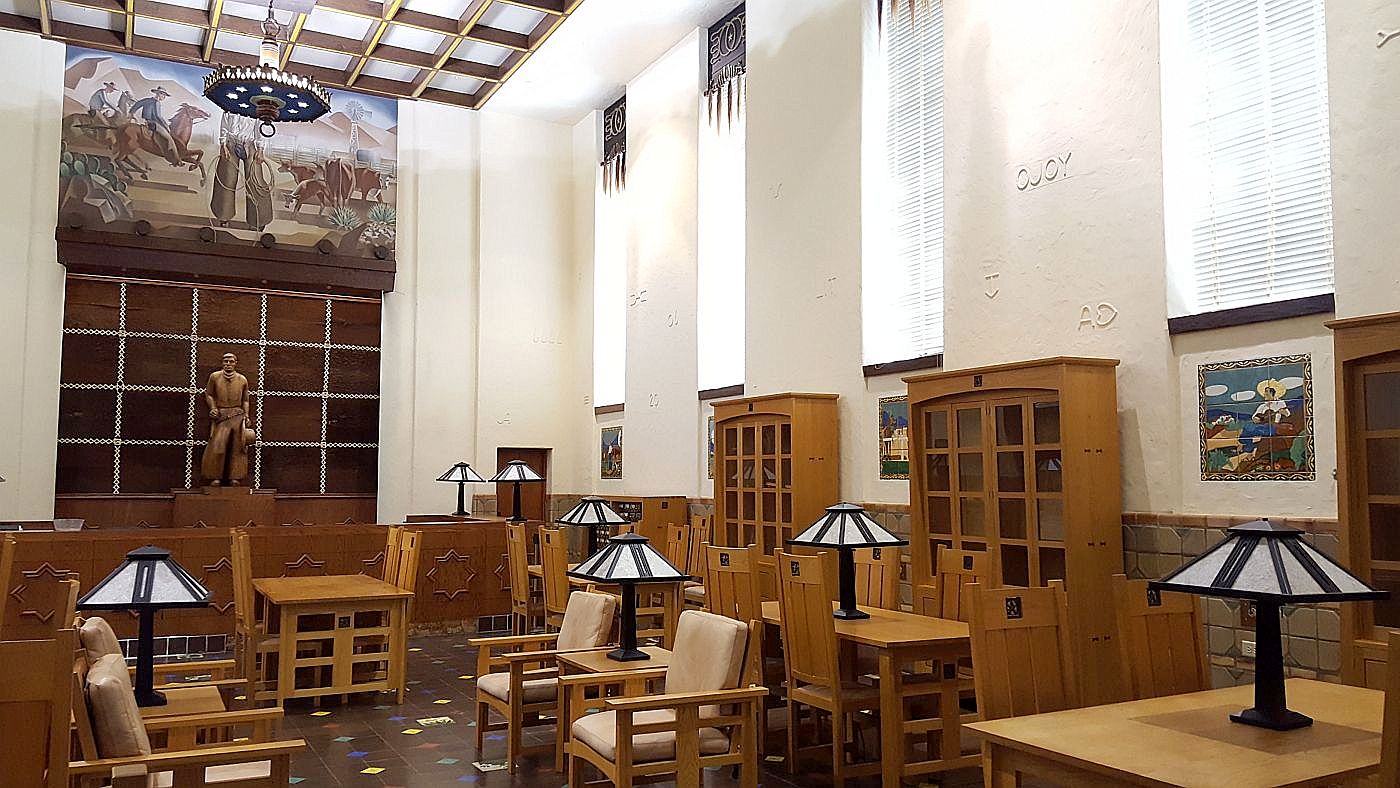
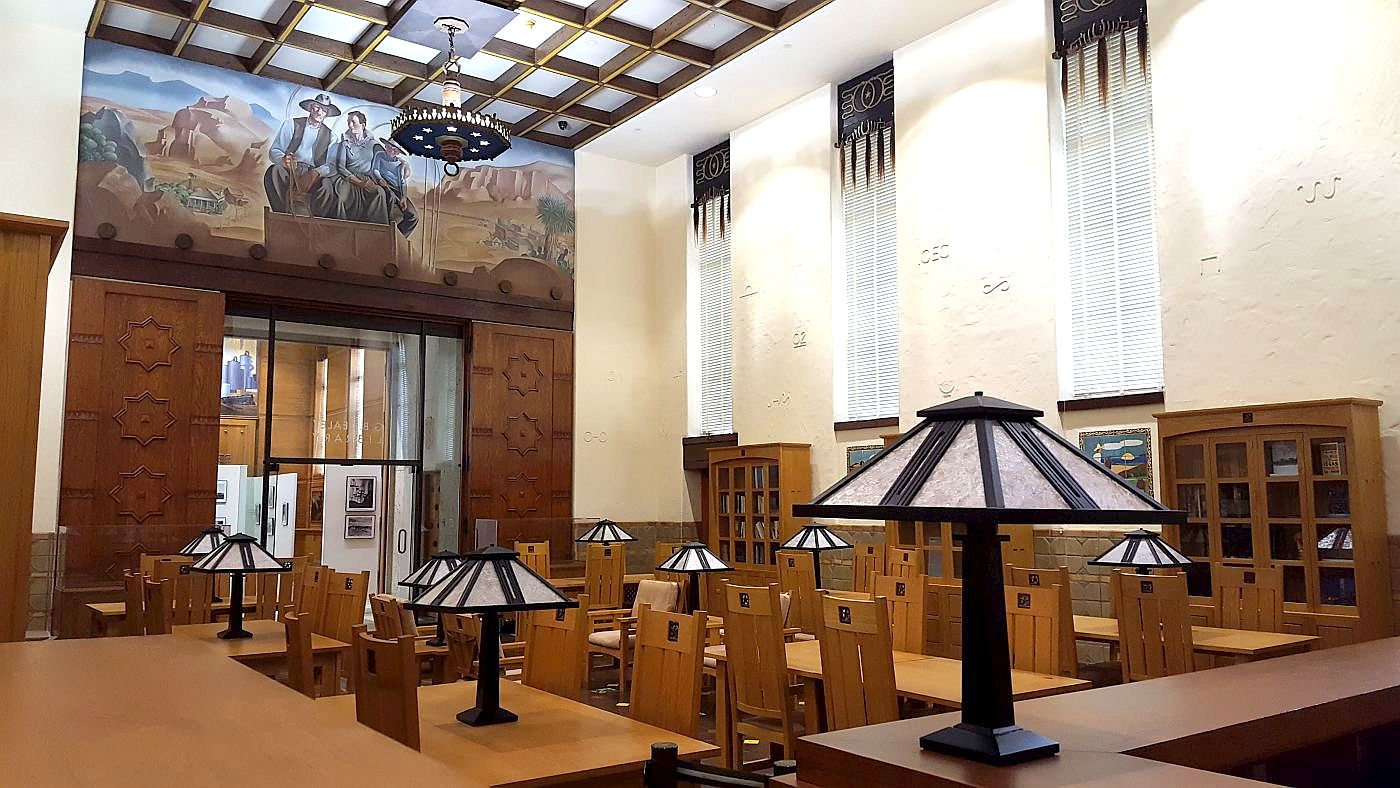
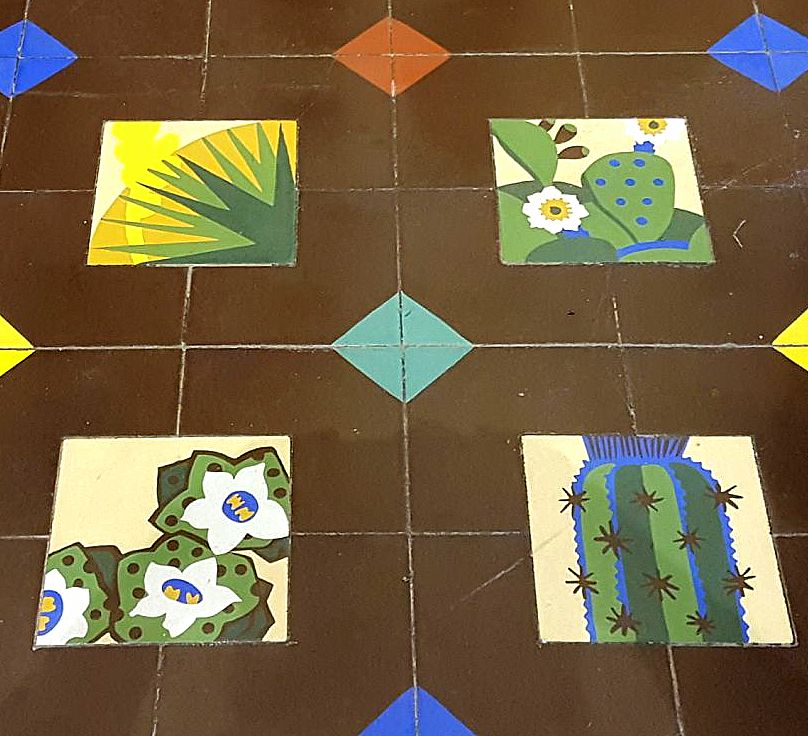
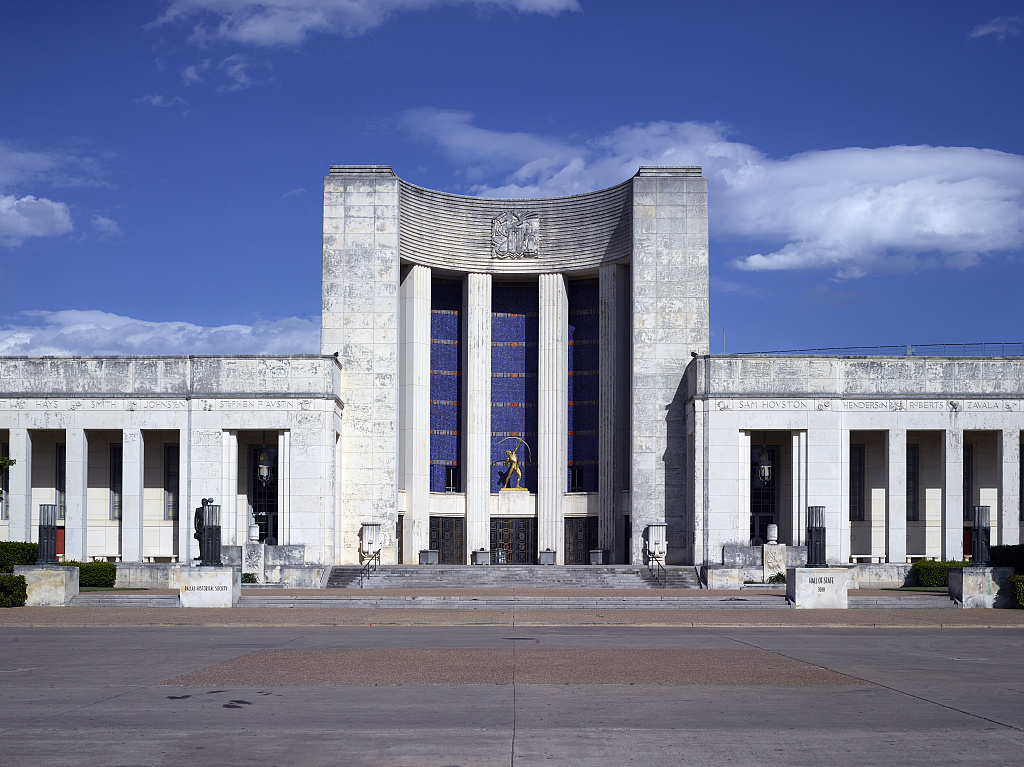
What we now call the Hall of State was the architectural jewel in the crown of the Art Deco splendor created throughout Fair Park for the Texas Centennial Exposition in 1936. The room now housing the Dealey Library was originally the West Texas Room — one of four geographically-specific rooms in the Hall of State. The two Tom Lea murals (one depicting a cowboy, the other, pioneers) are on opposite walls (walls finished with an adobe-like plaster, decorated with famous Texas brands, in relief). One wall is covered with cowhide. There are painted ceramic tiles set into both the walls and the floor (the ones on the floor decorated with images of cactus are great!). There is a wood sculpture of a cowboy, carved by Dallas artist Dorothy Austin, who was only 25 years old when the Centennial opened. And … well — like everything in the Hall of State — everywhere you look you see incredible attention to detail. Every fixture, grating, knob … everything is absolutely wonderful.

In 1989, after a two-and-a-half-year renovation, the West Texas Room became the home of the G. B. Dealey Library (named in honor of the former publisher of The Dallas Morning News). The project was headed by architect Downing Thomas who took great care in choosing the Arts and Crafts-style furniture (the chairs, tables, and bookcases were handmade by Thomas Moser in Portland, Maine, the chairs emblazoned with bronze Texas stars and upholstered in tanned leather), reading lamps with mica shades (made by Boyd Lighting of San Francisco), and a woven rug by Sally Vowell of Fort Worth (I don’t recall seeing a rug, but there’s a lot to take in and I might have missed it). I really love this room.

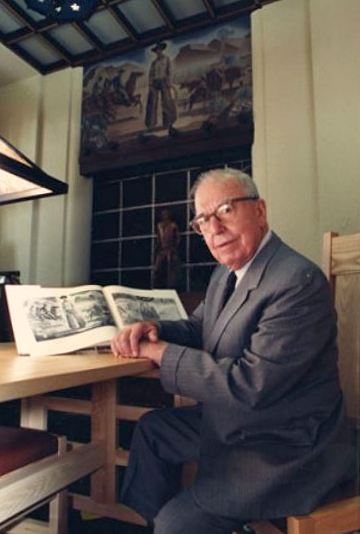
When the library opened in November, 1989, the first guest through the doors was Tom Lea who had been shocked to learn that his then-53-year-old murals were still in place. And they’re still there, 81 years after Lea created them. And you should go see them.

The library and reading room is open Tuesday-Sunday, same hours as the Hall of State. If you are interested in researching materials from the collection of the Dallas Historical Society, you are encouraged to contact the staff in advance of your visit and make an appointment; though the room is open to the public, research hours are limited. More about this and the hours of operation can be found here.

*

Below, one of the Tom Lea Murals can be (partially) seen above the cowhide wall-covering and above Dorothy Austin’s cowboy sculpture. (Click photo to see a larger image.) That light fixture is fantastic! (See the full Tom Lea mural here.)

hall-of-state_dealey-library_042517_inside-entrance

Here’s the view from the back corner looking toward the entrance, over which can be seen Lea’s second mural.

hall-of-state_dealey-library_042517_toward-entrance

In the photo at the very top, you can see the floor, which is studded with all sorts of cactus-themed tiles. Here are examples of four of them.

hall-of-state_dealey-library_042517_floor

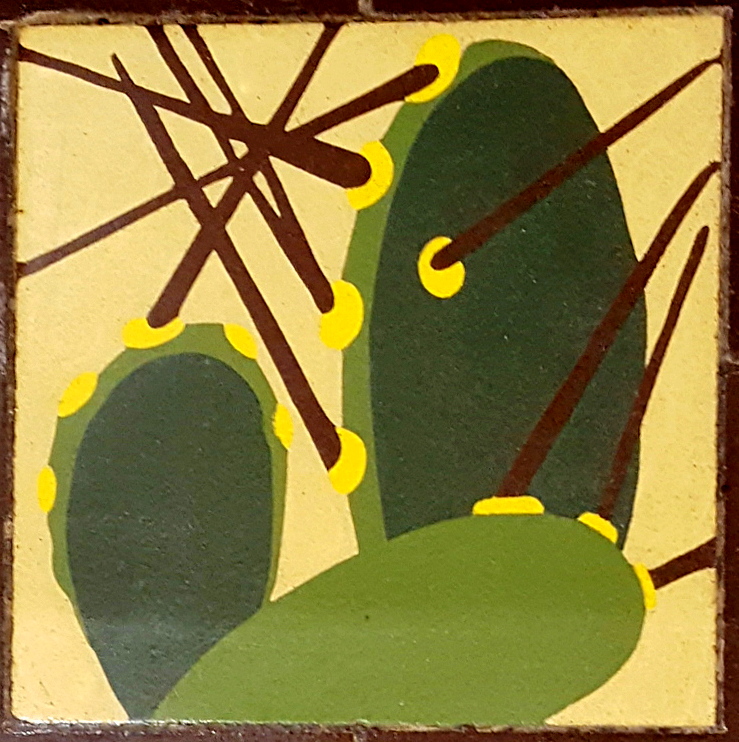
My absolute favorite of the cactus tiles is this one, in a very Japanese-like rendering.

hall-of-state_dealey-library_cactus-tile

*

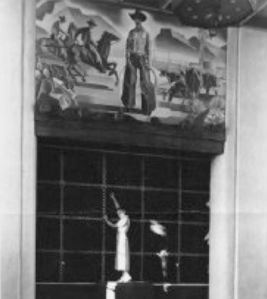
That’s what the room looks like today. Here are a few photos of the West Texas Room under construction in 1936 (photos from the Dallas Historical Society’s Centennial Visual Collection). The first one shows Dorothy Austin standing below the Tom Lea mural, about where her cowboy statue would be placed. Those ceilings are pretty high.

tom-lea_dorothy-austin_west-tx-room_DHS

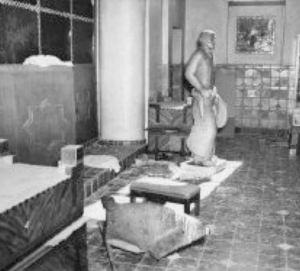
And here’s the statue. (See Austin’s statue close up, here, in a 2014 photo by Carol M. Highsmith, from the Library of Congress.)

dorothy-austin_cowboy-sculpture_west-tx-room_DHS

And here is a look into the room from the entrance, showing a construction crew at work.

west-tx-room-construction_hall-of-state_DHS

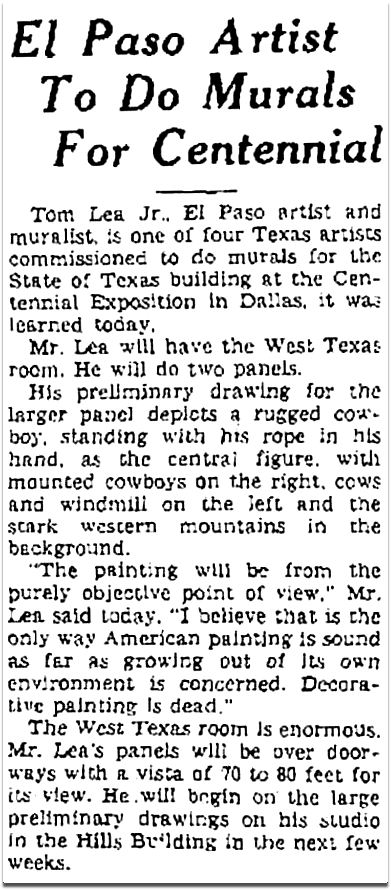
Below are 28-year-old Tom Lea’s thoughts on being informed of his important commission, from the El Paso Herald Post, March 24, 1936.  (Click to see larger image.)

tom-lea_west-tx-room-murals_el-paso-herald-post_032436

It seems strange that Lea was only in the preliminary-drawing stage of the murals’ creation in March — the Centennial was scheduled to open in June, less than three months away. (It’s worth noting that even though the Centennial — which ran for almost six months — opened in June, the Hall of State did not open to the public until September, three months behind schedule and the only Exposition building that did not meet its deadline. It was finally dedicated on September 5, 1936, the 100th anniversary of Sam Houston’s election as the first President of Texas.)

Below, a photo of Mr. Lea at the 1989 opening of the Dealey Library, with his 1936 mural behind him.

tom-lea_west-texas-room_1989_tom-lea-institute
via Tom Lea Institute

*

To read more details on the 1989 opening of the G. B. Library and the renovation of the West Texas Room, please check out these articles from The Dallas Morning News archives:

  • “A Rare Blend — Art Deco, Western and Shaker Unite for a Modern Adaptation at the Hall of State” by Mariana Greene (DMN, Nov. 12, 1989)
  • “G. B. Dealey Library Dedicated at Fair Park — Center Will House Texas Documents” by Todd Coplivetz (DMN, Nov. 13, 1989)
  • “How the West was East at the Hall of State Redo”  by Alan Peppard (DMN, Nov. 14, 1989)
  • “An Old Friend Triumphs Anew: The Hall of State Redo Affirms the Power of Great Architecture” by David Dillon (DMN, Nov. 14, 1989)
  • “Reviving a Cultural Paean to Dallas — Fair Park Changes Designed to Restore Centennial’s Glory” by David Dillon (DMN, April 9, 1986) (this article concerns Fair Park as a whole)

***

Sources & Notes

Photos of the Dealey Library and Hall of State door (below) are by me.

Photos of the West Texas Room from 1936 are from the collection of the Dallas Historical Society. You can search through low-res thumbnails of some of the images from their very large collection here.

As mentioned above, if you plan a trip to the Dealey Library in order to inspect or research items from the DHS collection, these materials must be requested in advance and an appointment must be scheduled (info here).

More on Tom Lea (1907-2001) can be found at the Tom Lea Institute website, here (with specific information on the Hall of State murals here); a profusely illustrated blog post with an emphasis on his time as a WWII artist-correspondent can be found here.

Obituary for Dorothy Austin Webberley (1911-2001) can be found on the Dallas Morning News site, here; family obituary is here.

Detailed info on the architecture and design of the Hall of State can be found in a Dallas Historical Society PDF, here. The Wikipedia entry is here (someone please correct the erroneous info that the Dealey Library is in the “East” Texas room!), and the always informative Watermelon Kid site has information on the East Texas and West Texas rooms here.

A series of photos of Fair Park, taken in 2014 by Carol M. Highsmith, can be found at the Library of Congress website, here. Her photo of the Hall of State is below.

hall-of-state_library-of-congress_carol-m-highsmith_2014

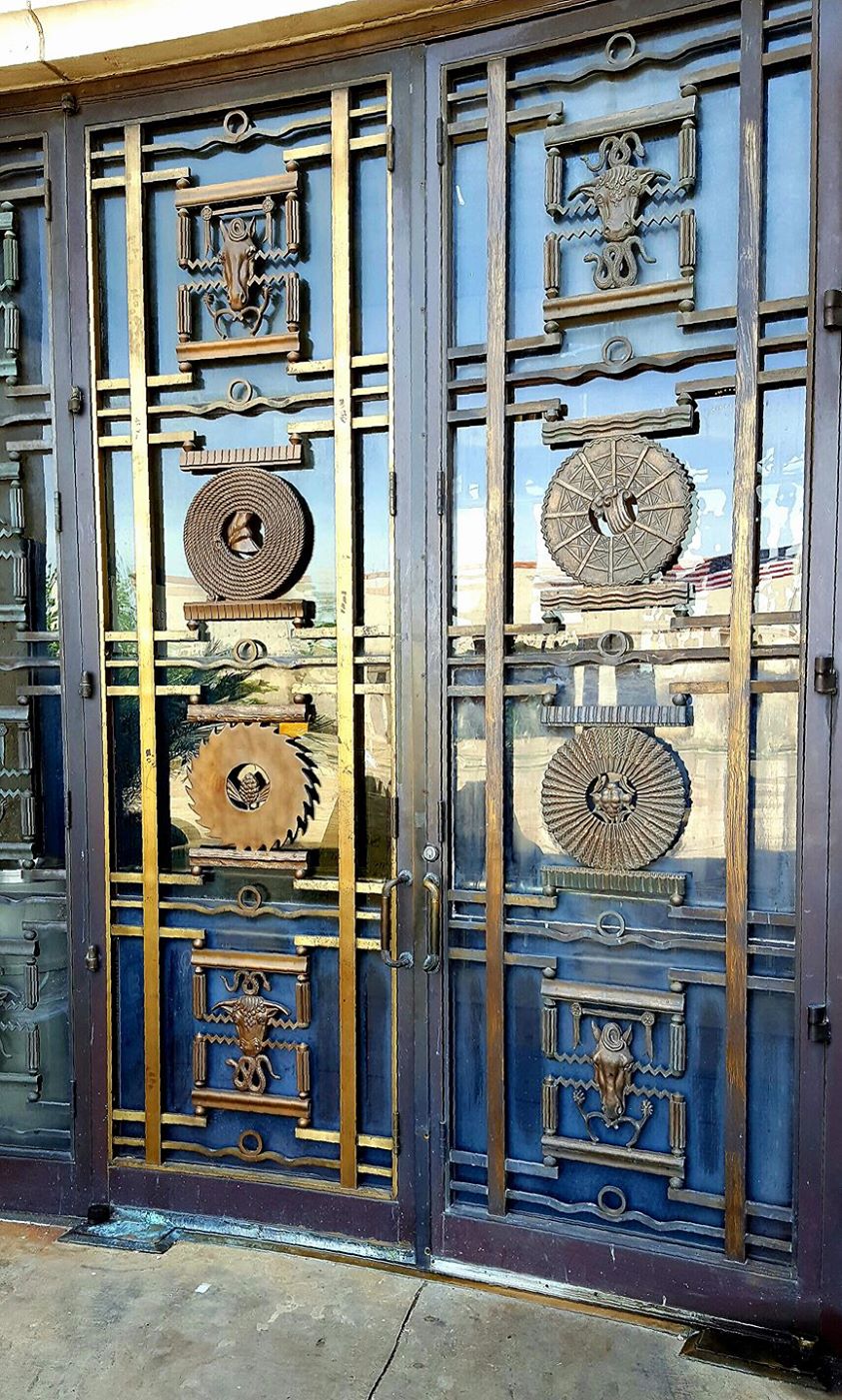
And, lastly,  a photo I took showing one of my favorite elements of a building packed with aesthetically pleasing details (seriously, everywhere you look): one of the doors of the main entrance to the Hall of State, designed by Houston architect Donald Barthelme, honoring Texas industry (ranching, timber, oil, agriculture, etc.). That sawmill blade gets me every time. And the aerial perspective of oil coming up through a derrick (middle right) is pretty cool, too. (Click to see a larger, more exciting image!)

hall-of-state-doors_042517_bosse

*

Copyright © 2017 Paula Bosse. All Rights Reserved.


Albert Einstein “Threw the Switch” in New Jersey to Open the Pan-American Exposition in Dallas — 1937

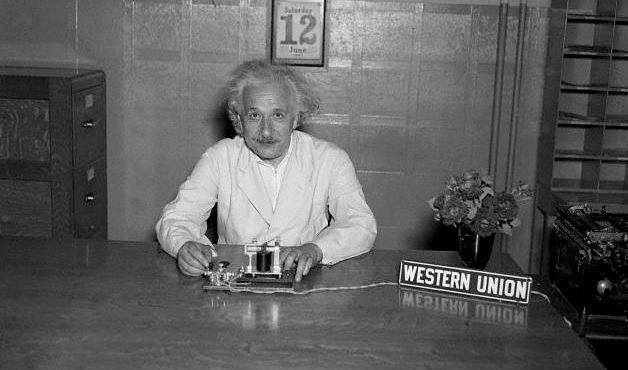
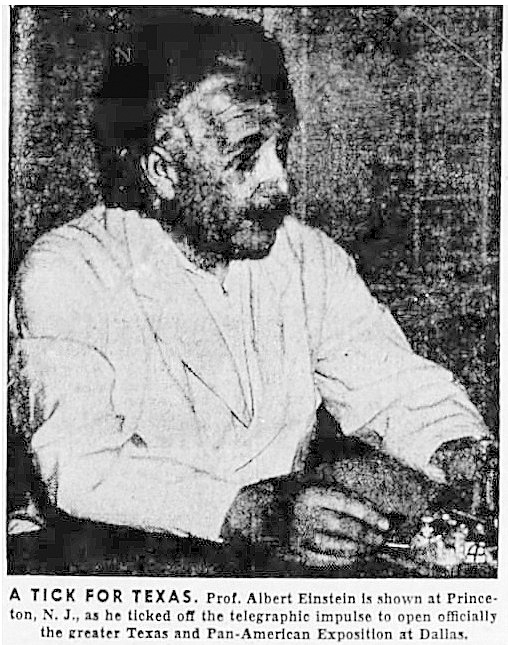
pan-american-expo_einstein_061237Einstein at the switch, June 12, 1937…

by Paula Bosse

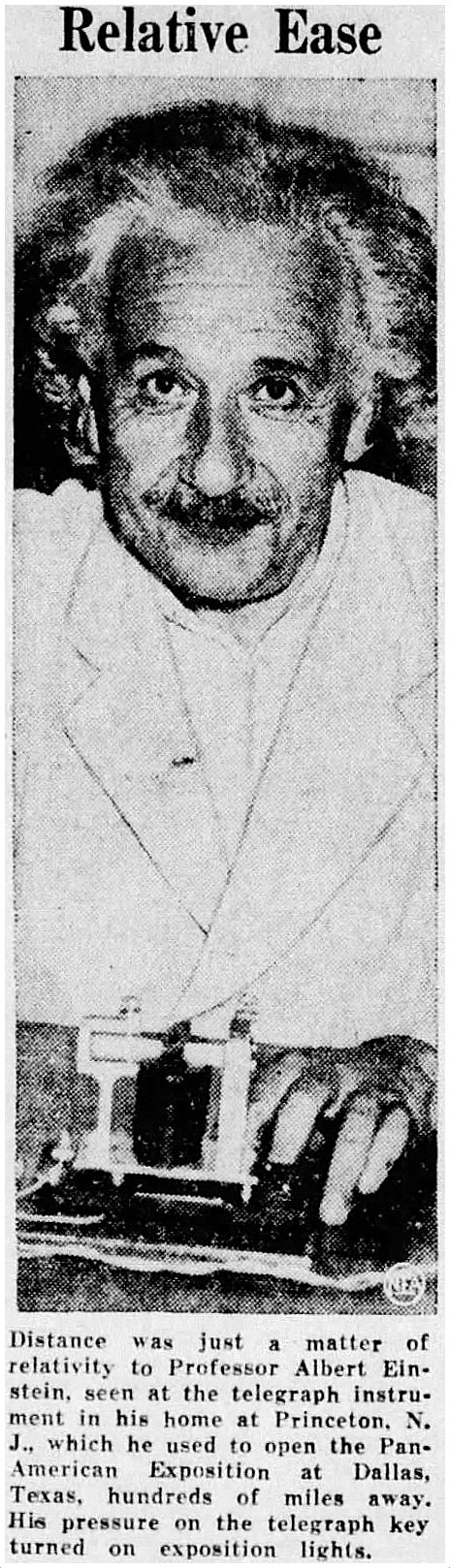
Who knew? Albert Einstein, the world’s most famous physicist, helped open the Greater Texas and Pan-American Exposition. The exposition was held at Fair Park for 20 weeks, from June 12, 1937 to October 31, 1937, as a follow-up of sorts to the Texas Centennial (the city had built all those new buildings — might as well get their money’s worth!). I’m not quite sure how Einstein got roped into this, but looking at the photo above, he seemed pretty happy about what was, basically, a long-distance ribbon-cutting. Via telegraph.

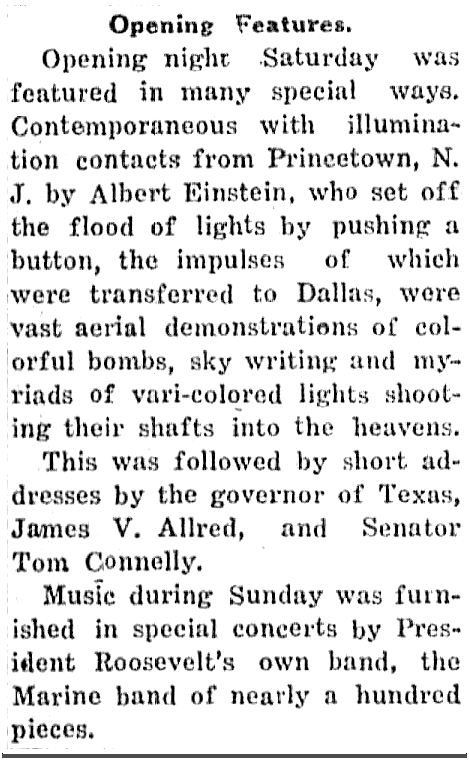
The plan was for Professor Einstein to officially open the Pan-American Exposition by “throwing the switch” which would turn on massive displays of lights around Fair Park. He would do this from Princeton, New Jersey, where he lived, by closing a telegraph circuit which would put the whole thing in motion. Newspaper reports varied on where exactly Herr Einstein was tapping his telegraph key — it was either the study in his home, in his office, in a Princeton University administration building, or in the Princeton offices of Western Union (the latter of which was mentioned in only one report I found, but it seems most likely).

Einstein was a bona fide celebrity, and this was national news — newspapers around the country ran stories about it, and the ceremony was carried live on coast-to-coast radio. Almost every report suggested that Einstein’s pressing of the key in New Jersey would be the trigger that lit up the park in Texas, 1,500 miles away — which was partly correct. According to The Dallas Morning News:

Lights on the grounds will be turned on officially at 8:40 p.m. when Dr. Albert Einstein, exponent of the theory of relativity, presses a key in his Princeton home to fire an army field gun. With the detonation of the shell, switches will be thrown to release the flood of colored lights throughout the grounds. (DMN, June 10, 1937)

So on June 12, 1937 he pressed a telegraph key somewhere in Princeton, NJ, an alert was instantly wired to Dallas, an army field gun (in some reports a “cannon”) was fired, and that blast was the cue for electricians positioned around the park to throw switches to illuminate the spectacular displays of colored lights.

The Western Union tie-in gimmick was a success. Newspaper reports might have been a little purple in their descriptions, but from all accounts, those lights going on all at once was a pretty spectacular sight.

Dr. Albert Einstein, celebrated scientist, threw a switch that flashed a million lights over the 187-acre exposition park. The flash came at 8:40 o’clock and instantly the huge park became a city of a million wonders. Flags from a thousand staffs proclaimed their nationality [and] bands played the national airs of the nations of the Western Hemisphere as lusty cheers roared with thunderous approval. The Greater Texas and Pan-American Exposition was formally opened. It is on its way. (Abilene (TX) Reporter News, June 13, 1937)

The Dallas News describes the crowd as stunned into silence:

The waiting participants in the ceremonies at Dallas heard the results [of Einstein’s telegraph signal] when a cannon boomed. Electricians at switches around the grounds swung the blades into their niches and the flood of light awoke the colors of the rainbow to dance over the 187-acre park. Its breath taken by the spectacle, the crowd stood silent for a moment, and then broke into a cheer. (“Pan-American Fair Gets Off to Gay Start” by Robert Lunsford, DMN, June 13, 1937)

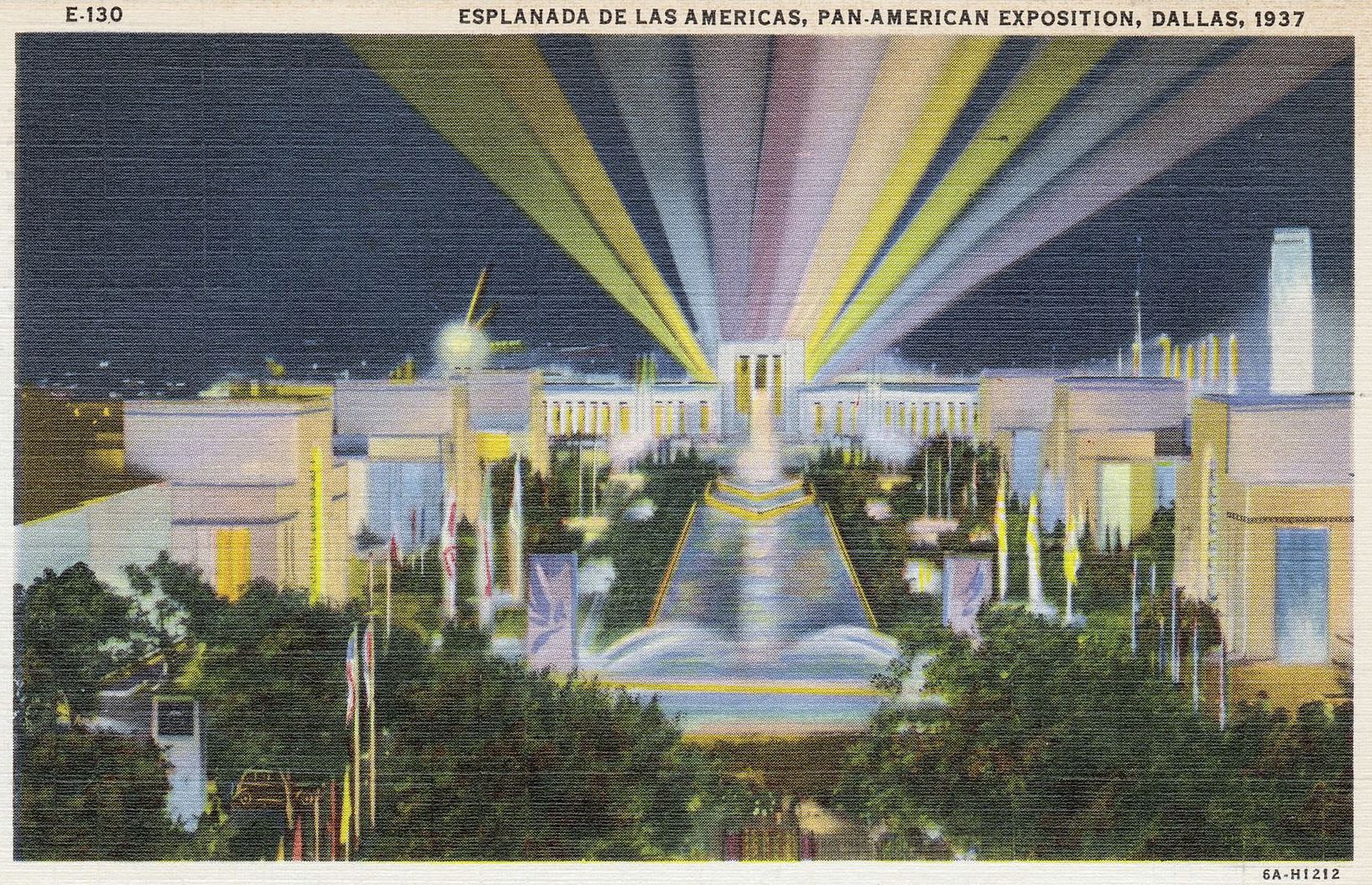
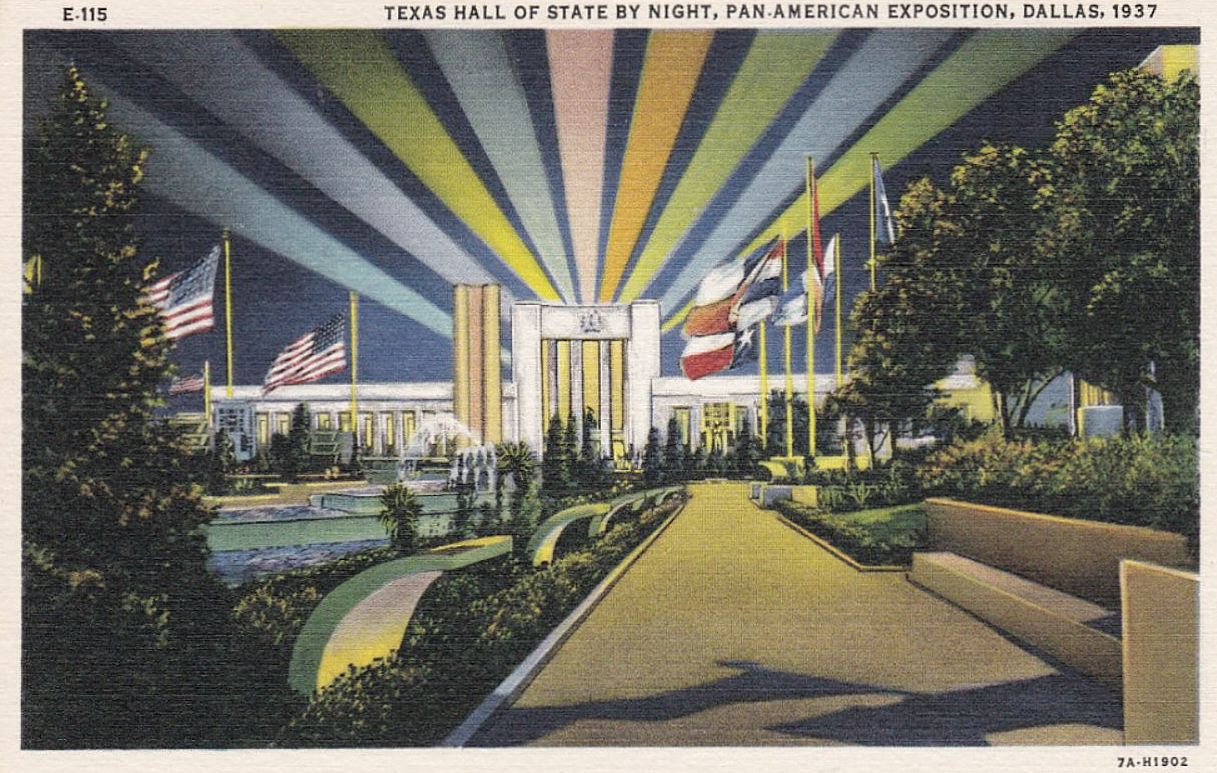
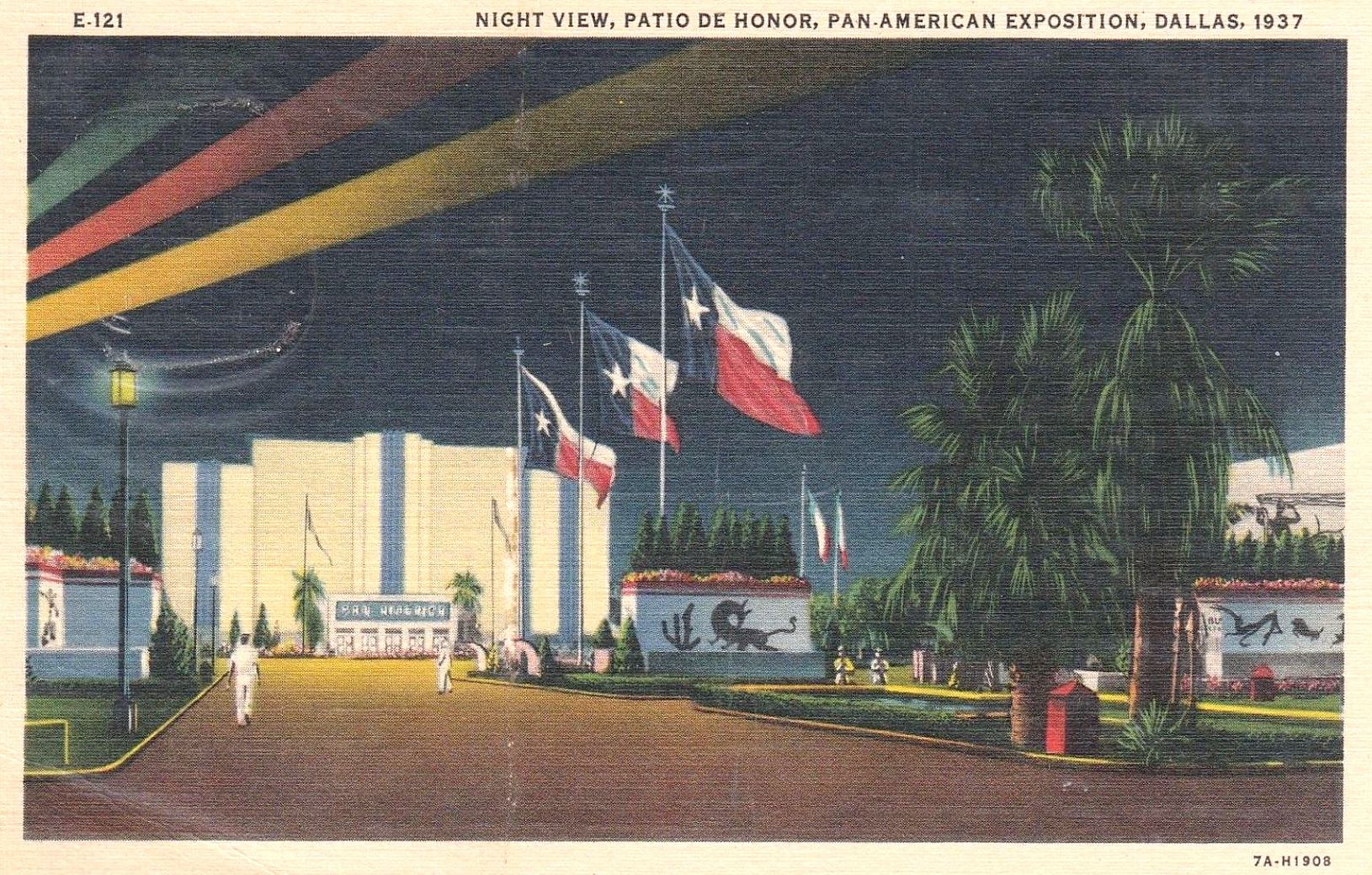
Many of the lighting designs and displays had been used the previous year during the Centennial, but, as with much of the attractions and appointments throughout the park, they were improved and spectacularized for the Pan-American Expo. And people loved what they saw.

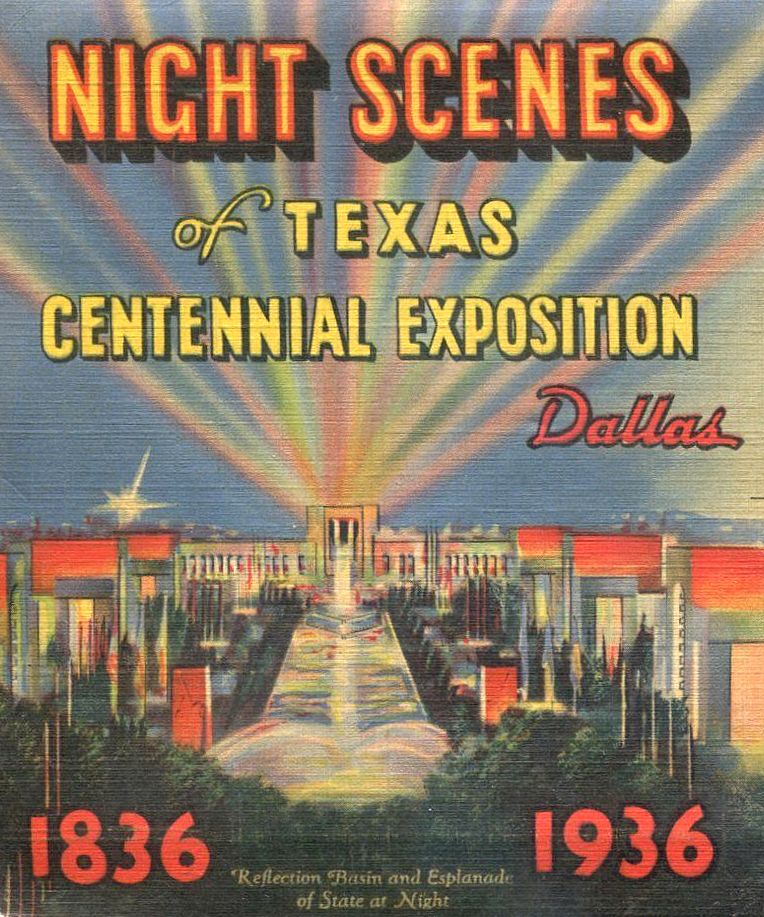
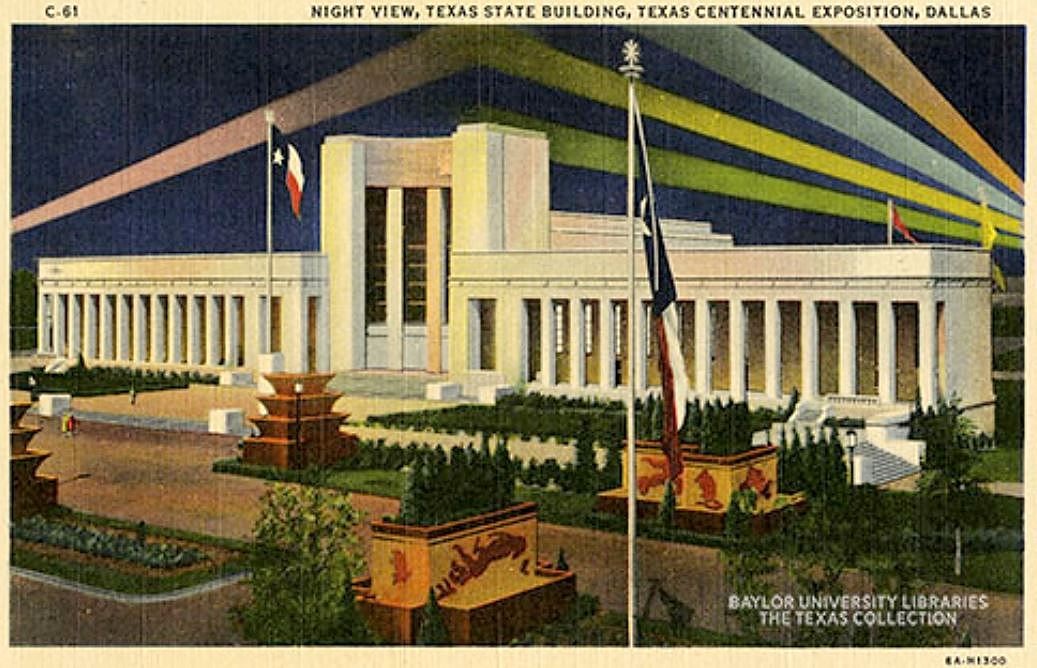
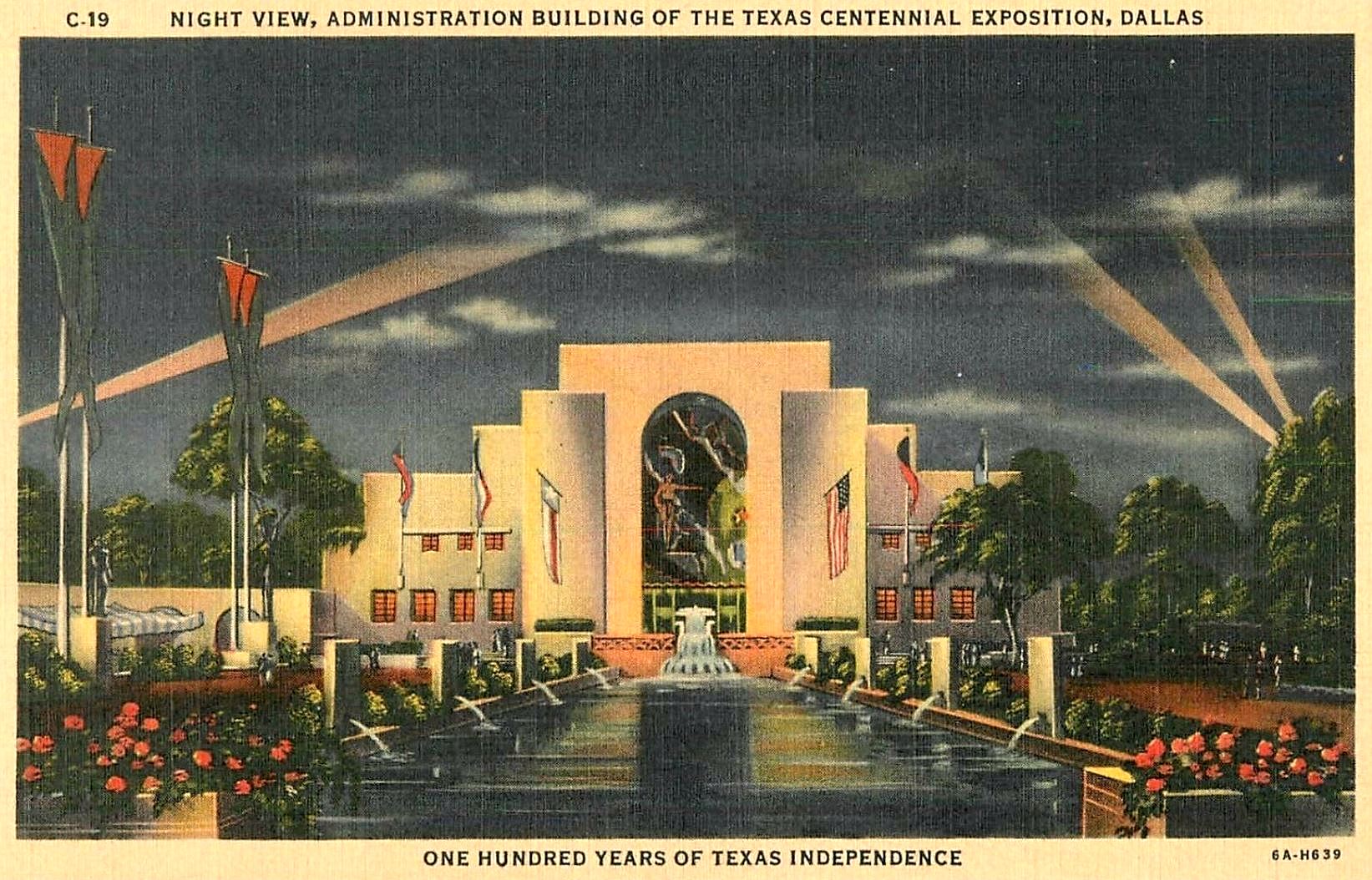
Despite the multi-million dollar structures, air conditioning demos, works of art and other newfangled additions to the space, when people left the Centennial Exposition one thing was on everyone’s tongues, according to historical pollsters: the lights.

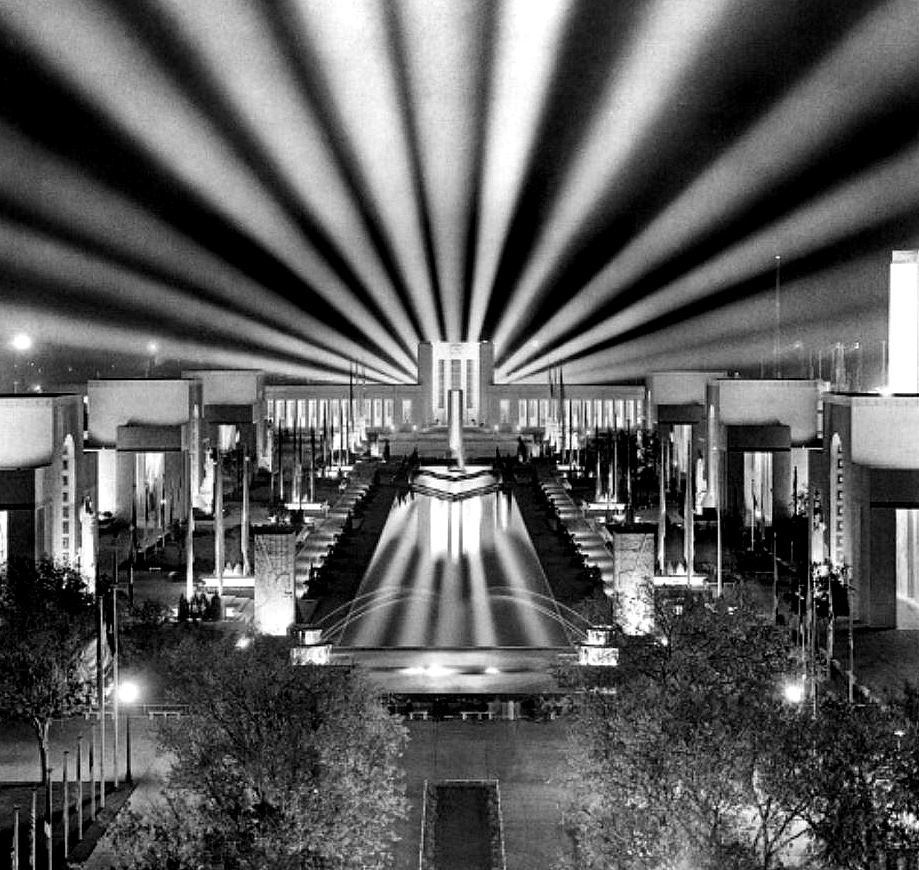
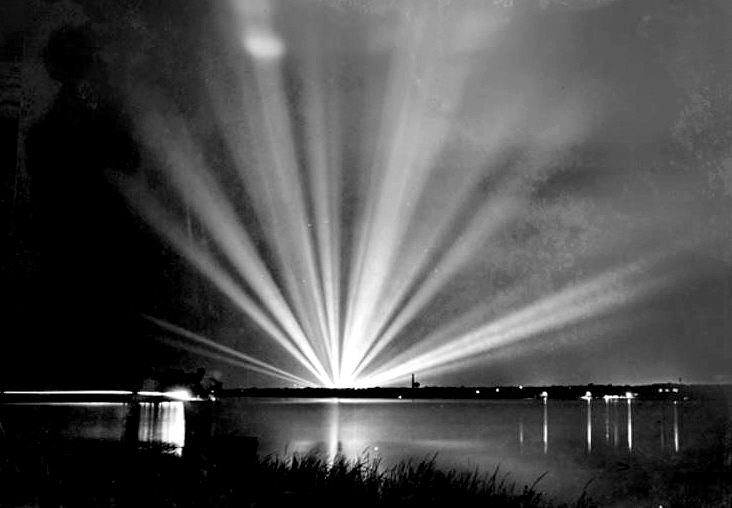
Positioned behind the Hall of State were 24 searchlights scaffolding into a crowned fan shape. “They all moved and were different colors,” says [Jim] Parsons [co-author of the book Fair Park Deco]. “It sounds gaudy, but people loved it.” The lights, he goes on to tell, were visible up to 20 miles away.

Considering most of the people who were visiting the fairgrounds were coming from rural farming communities with no electricity, the inspiring nature of those far-reaching beams makes a lot of sense. (Dallas Observer, Nov. 7, 2012)

Thanks for doing your part for Dallas history, Prof. Einstein!

pan-american-expo_esplanade_postcard

pan-american-expo_hall-of-state_postcard

pan-american-expo_patio-de-honor_ebay

Below, photos from the Texas Centennial, 1936. The multicolored lights could be seen from miles away — here’s what they looked like from downtown and from White Rock Lake.

centennial_pan-american_lights

skyline_downtown-to-fair-park_1936_GE-colln_museum-of-innovation-and-science

fair-park-lights_white-rock-lake

tx-centennial_night-scene_espalanade_hall-of-state_lights_ebay

tx-centennial_night_hall-of-state_lights_flickr_baylorvia Baylor University Flickr stream

tx-centennial_night_administration-bldg_lights_ebay

*

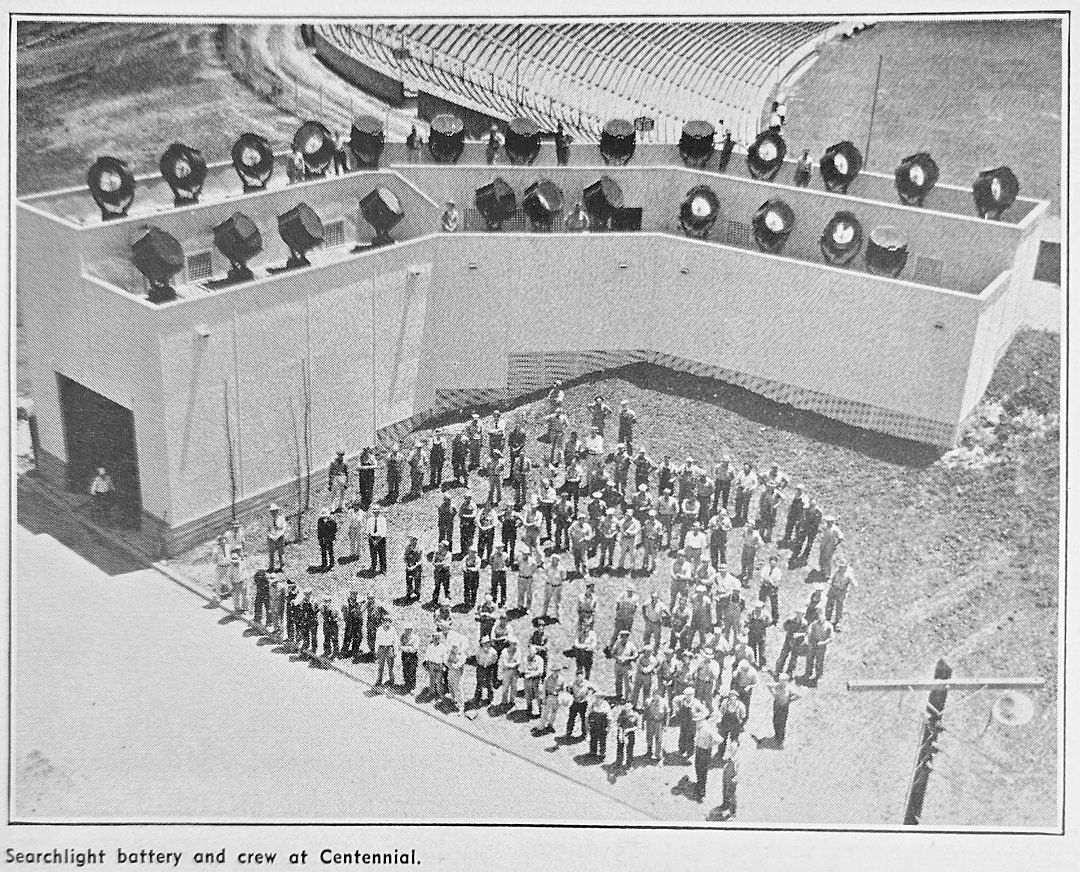
A look behind the scenes: “The general lighting effect is a battery of twenty-four 36-inch searchlights as powerful as the giants that flash from the dreadnoughts of Uncle Sam’s navy. Each searchlight will produce 60 million candlepower. Combined, the battery has a total candlepower of 1.5 billion. A 350,000-watt power generator will produce this colossal quantity of ‘juice.’” And the accompanying photo of the searchlight battery crew manning the candlepower:

tx-centennial_lights_southwest-business-mag_june-1936_photoSouthwest Business, June 1936

**

(All pictures and clippings are larger when clicked.)

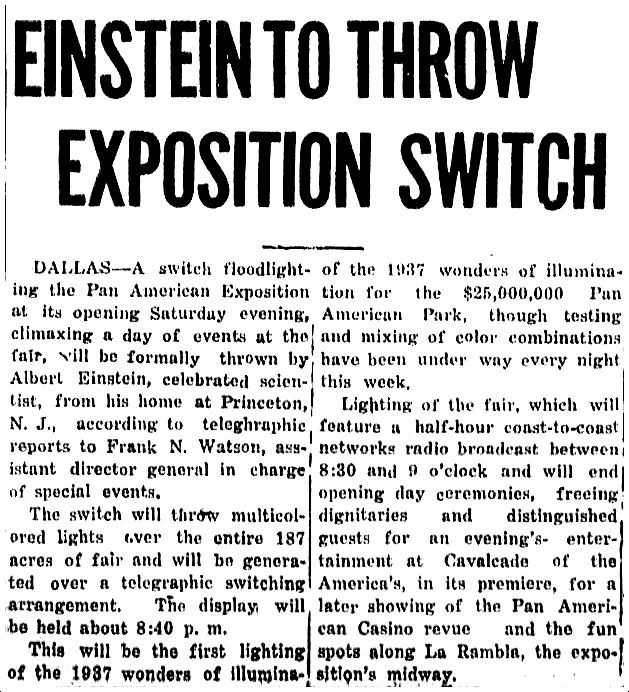
einstein_pan-am-expo_denison-press_060937
Denison Press, June 9, 1937

*

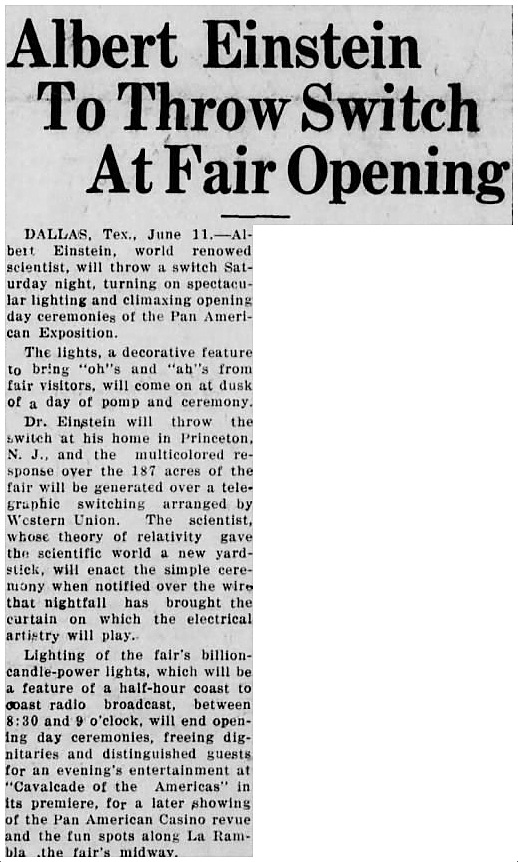
einstein_pan-am-expo_waxahachie-daily-light_061137
Waxahachie Daily Light, June 11, 1937

*

einstein_pan-am-expo_denison-press_061437
Denison Press, June 14, 1937

*

einstein_pan-am-expo_medford-oregon-mail-tribune_062337
Medford (Oregon) Mail Tribune, June 23, 1937

*

einstein_pan-am-expo_vernon-daily-record_062437
Vernon Daily Record, June 24, 1937

*

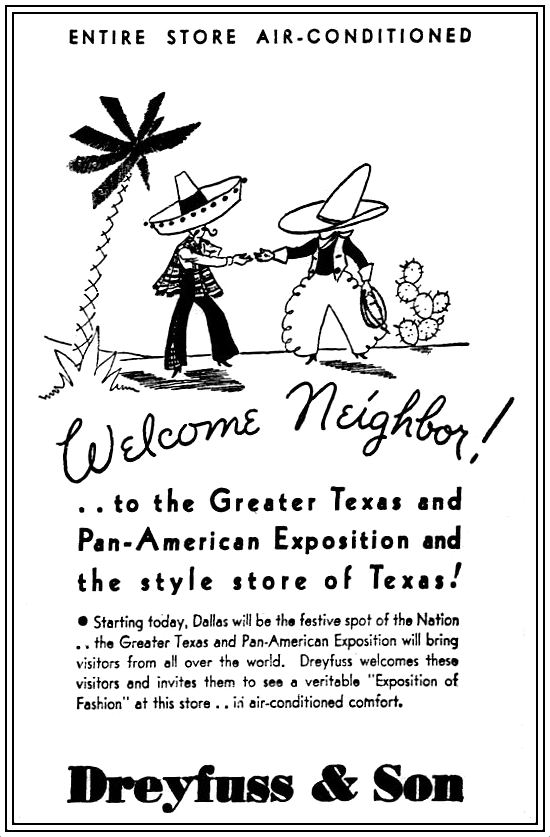
pan-american-expo_drefuss-ad_dmn_061237
1937

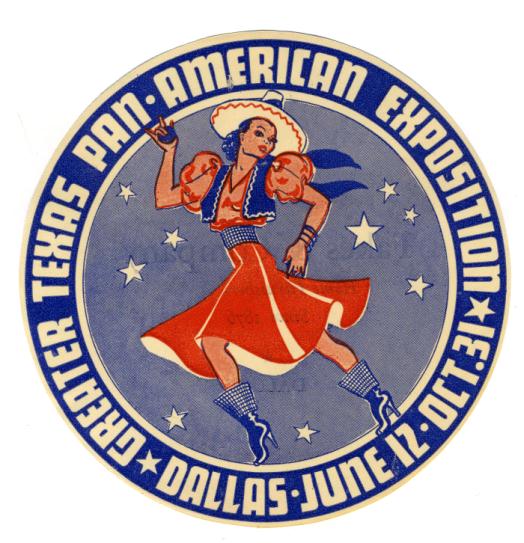
pan-american-expo_sticker_1937_cowgirl

***

Sources & Notes

Top photo from the old Corbis site.

Black-and-white photos from the Centennial seen from Fair Park and White Rock Lake are from the Texas/Dallas History and Archives Division of the Dallas Public Library; the photo of the lights seen from downtown Dallas (titled “New skyline at night from Dallas, Texas”) is from the GE Photo Collection, Museum of Innovation and Science (more info on that photo is here).

Sources of other images and clippings cited, if known.

More on the Pan-American Exposition from Wikipedia, here, and from the fantastic Watermelon Kid site of all-things-Fair-Park, here.

*

Copyright © 2016 Paula Bosse. All Rights Reserved.

Preston Sturges: Camp Dick’s Most Famous Former Cadet? — 1918

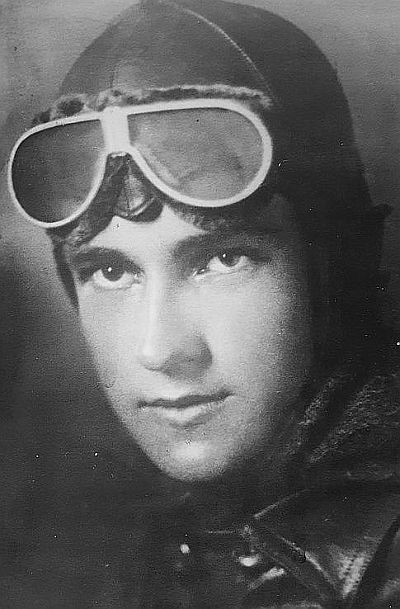
preston-sturges_camp-dick_dallas_1918
Preston Sturges playing dress-up, Camp Dick, Dallas, 1918

by Paula Bosse

While researching my Veteran’s Day post on Camp Dick cadets, I came across a 1941 Dallas Morning News article about Hollywood screenwriter and director Preston Sturges, whose latest movie The Lady Eve was about to open at the Palace. The article mentioned that Sturges had been stationed at Camp Dick, the WWI aviation boot camp for the U.S. Signal Corps, located in the old racetrack at Fair Park. Preston Sturges — a master of the screwball comedy — is one of my favorite writer-directors (in addition to The Lady Eve, everyone should watch Sullivan’s Travels), so I was interested to find out more about his time in Dallas. I didn’t think I’d find anything but a passing mention of it anywhere, but, surprisingly, it turns out Sturges himself wrote about his Camp Dick days — in a book I actually own and had started but had never finished!

Sturges was sent to Dallas in March, 1918. He was 19 years old. Born in Chicago, he had spent much of his childhood in France, tagging along with his eccentric four-times married bohemian mother who seems to have known every intellectual and artiste of the day (not only was she a close friend of dancer Isadora Duncan and Marcel Duchamp, she had also been romantically involved with Aleister Crowley — you can’t get much more bohemian than that!).

Sturges’ account of his time at Camp Dick (which appeared in Chapter 28 of the posthumously-published Preston Sturges by Preston Sturges) is amusing, describing such things as the heat (“the midday temperature of a Texas summer wasn’t really intended for human beings”), the latrines, and the food. He also remembered the nightmare of the Spanish Influenza pandemic, which was particularly deadly in the close quarters of military camps. (You can read the entirety of Sturges’ memories of his days at Camp Dick here.)

The heat was a real problem for the cadets. One of my favorite images conjured by Sturges’ chapter on the camp is this one:

Out on the parade ground, boys fell over from [the intense heat] all the time and had to be revived with cold water and a sponge. Nights we would climb up the shaky apex of the large roller coaster in the corner of the fairgrounds to try to find a breeze.

One of his memories stumped me a bit, though. He wrote the following about the buildings that stood around Fair Park:

In Dallas, we were sent to a place called Camp Dick, then known as a concentration camp. In a later war, such a facility was called a boot camp. Camp Dick was actually the Dallas fairgrounds with a fence thrown around them. Most of the buildings on the fairgrounds were huge reproductions of the products for sale within them in the prewar days when the fair was open. There was a building in the shape of a gigantic Mazola bottle; another like a huge Gulden’s mustard pot; an enormous Log Cabin Syrup edifice; a massive chili bowl; buildings representing almost anything edible or potable that one could think of….

My last memory of Camp Dick is of standing retreat against the hot sunset, the cadets at attention against the silhouetted background of the massively enlarged Sanka coffee pot, Bromo Quinine bottle and Coca-Cola bottle buildings, and in front of us Lieutenant Pennypacker, more or less at ease on the back of the fiery steed presented to him by the grateful citizens of Dallas.

I’ve never heard of any Fair Park buildings shaped like these things. (There was that giant cash register at the Texas Centennial….) Perhaps Mr. Sturges misremembered? Or indulged in a little fanciful poetic license? Or maybe these buildings DID exist? (And if they did, I’d love some corroboration, ’cause that would be cool.)

Sturges was at Camp Dick only a few months. From there he was sent to the School of Military Aeronautics in Austin and then to Park Field in Millington, Tennessee. He was in the middle of flight training there when, anti-climactically, the war ended. After several years of working in a family business, he became a successful Broadway playwright and was soon whisked off to Hollywood, where, in 1940, he won the first Oscar ever awarded for screenwriting (The Great McGinty). He was considered then — and is considered now — to be one of Hollywood’s greatest comedic screenwriters.

If you’d like to read Preston Sturges’ memories of training at Camp Dick, mosey on over here. Among other tidbits, you’ll read the amusing story behind the be-goggled photo of Cadet Sturges at the top of this post.

***

Sources & Notes

The romanticized photo at the top (the one Sturges wrote about in the book) was taken at Camp Dick in 1918. The quoted passage is also from the book, Preston Sturges by Preston Sturges, His Life In His Own Words, adapted and edited by Sandy Sturges (New York: Touchstone/Simon & Schuster, 1991). I highly recommend getting this book if you’re a fan of classic Hollywood. You can browse through it on Google Books, here, and purchase it here.

More on Sturges at Wikipedia, here.

Dive deeper: another photo of Sturges taken in Dallas in 1918 appeared in The Dallas Morning News on March 27, 1941, titled “At Camp Dick” — it shows a smiling Sturges sitting in a “dummy pilot seat.” If the photo was taken at Camp Dick, the unnamed photographer must have taken “action shots” as well as portraits of the camp’s cadets which Sturges wrote about in his autobiography. (Sturges writes in his amusing story that none of the cadets had ever been near a plane at that point, but they all wanted to be seen as dashing goggle-and-scarf-wearing flying aces.)

*

Copyright © 2016 Paula Bosse. All Rights Reserved.

“Dallas Midway, Night Illumination” — 1936

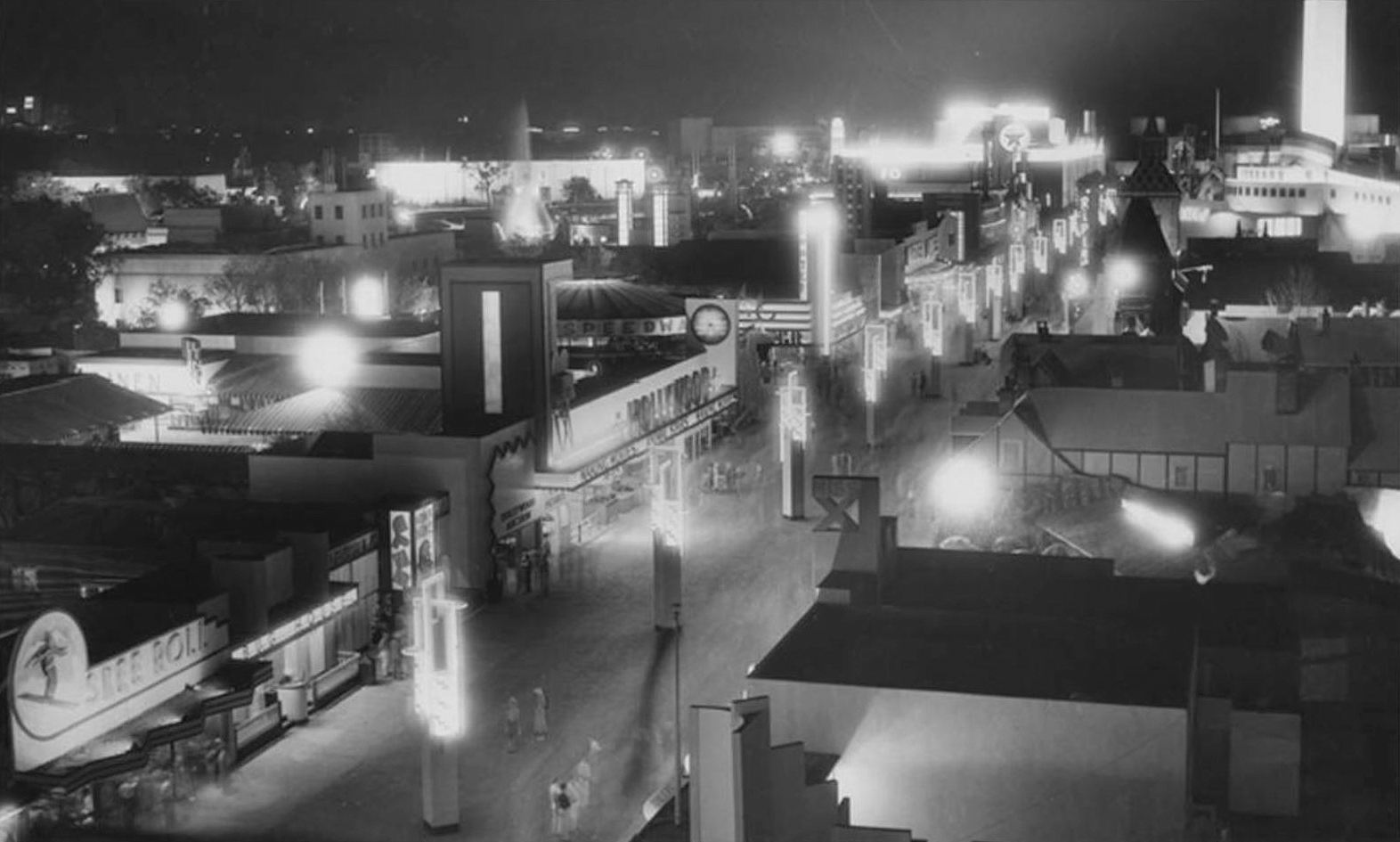
tx-centennial_midway_night_cook-coll_smuAll calm in Fair Park along the Centennial Midway (click for larger image)

by Paula Bosse

Above, a nighttime shot of an almost empty Midway during the Texas Centennial. All this scene needs in order to boost the moody atmosphere is a little fog. Go a little further and add some zither music, Joseph Cotten, and Orson Welles running past the Texaco Building and you’d have a pretty cool setting for a Texas version of The Third Man.

***

Photo titled “Dallas Midway, Night Illumination, Centennial Exposition, State Fair of Texas” (taken by an unknown photographer on Oct. 16, 1936) is from the George W. Cook Dallas/Texas Image Collection, DeGolyer Library, Central University Libraries, Southern Methodist University; more info here.

*

Copyright © 2016 Paula Bosse. All Rights Reserved.

Fair Park’s Statue of Liberty

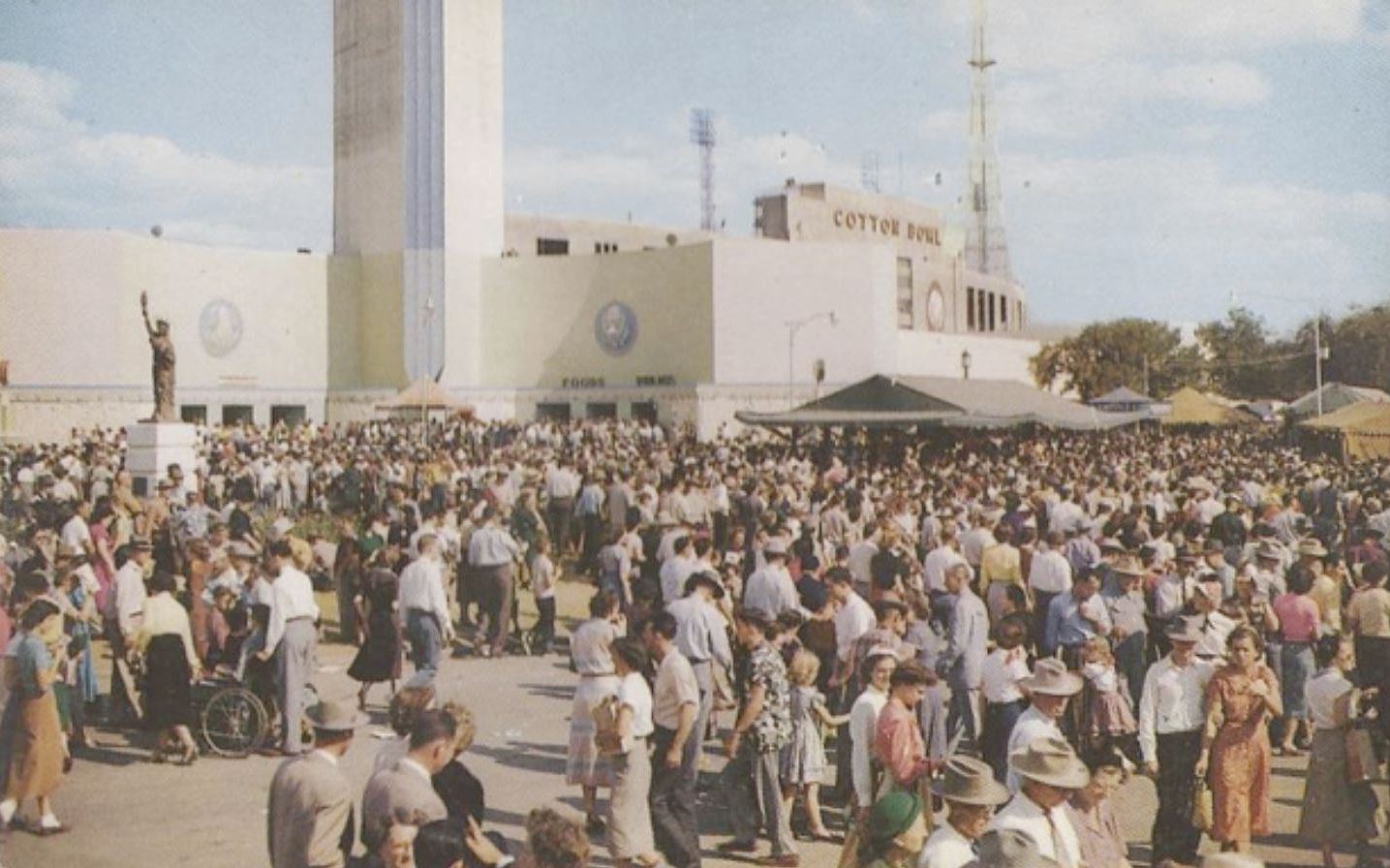
statue-of-liberty_fair-park_flickr_colteraGetting a bit lost in the crowd…

by Paula Bosse

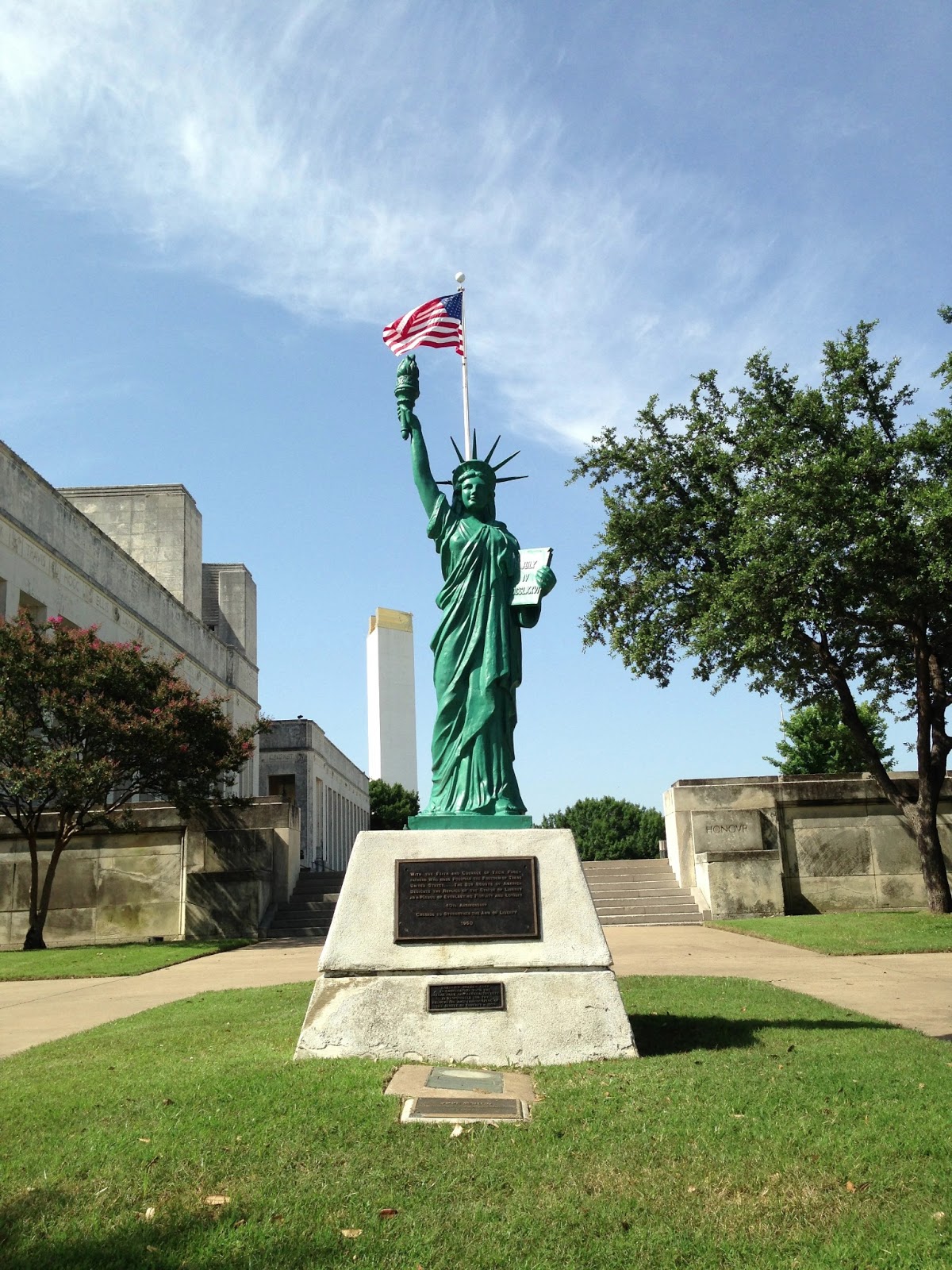
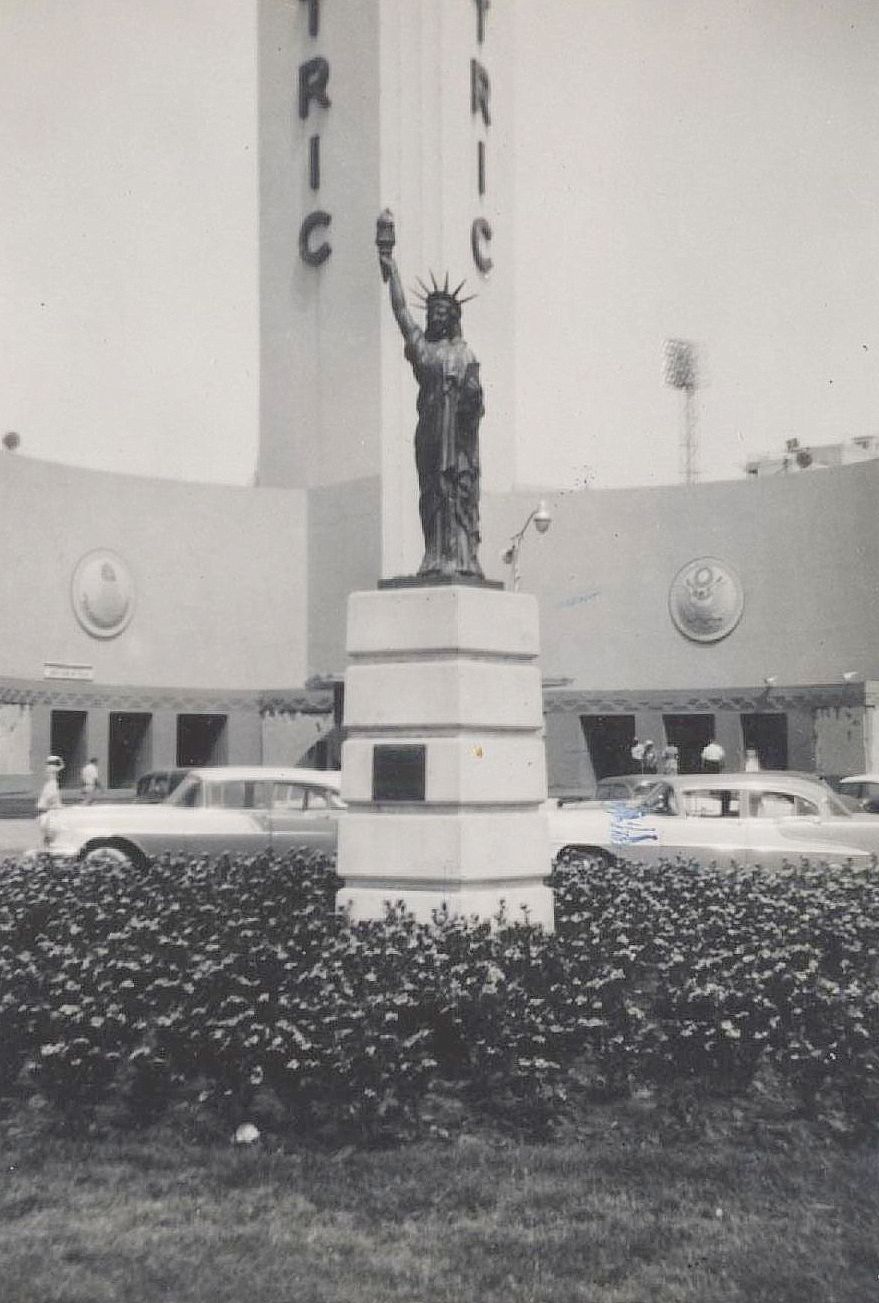
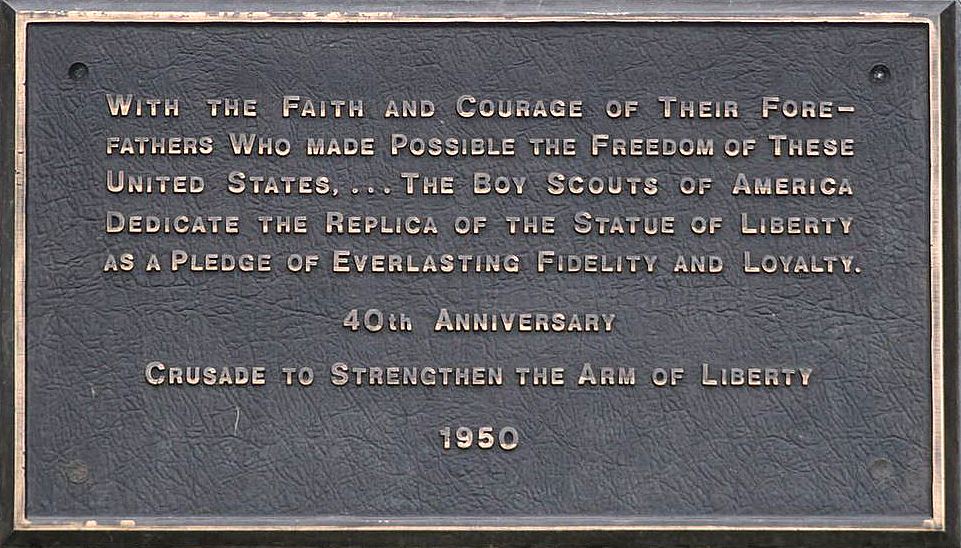
Somehow I missed the fact that October 28th was the 130th anniversary of the dedication of the Statue of Liberty in New York Harbor. And somehow I also forgot that there is a replica of the Statue of Liberty here in Dallas, at Fair Park. It was a gift from the State Fair of Texas to the Boy Scouts and the people of Texas and was dedicated by the Boy Scouts of Circle Ten Council on July 4, 1950. (These miniature replicas of the Statue of Liberty were placed all over the United States in 1950 to commemorate the 40th anniversary of the Boy Scouts of America.)

Below, the plaque at the base of the statue which stands near the Hall of State in Fair Park. (Click pictures to see larger images.)

statue-of-liberty_fair-park_plaque_flickr_aringo

Were they sentient, I’m sure Lady Liberty’s numerous miniature offspring would join me in sending belated birthday greetings to their full-size non-replica progenitor.

statue-of-liberty_fair-park_roaming-itinerant-blog
Photo: Adam Cruz/Roaming Itinerant

Here’s another view of Mini Lady Liberty welcoming the huddled masses to the State Fair of Texas in 1956:

fair-park_statue-of-liberty_ebay_stamped-1956

***

Sources & Notes

Photo of the Statue of Liberty replica amidst the crowd outside the Cotton Bowl is from Flickr user Coltera, here.

Photo of the plaque is from Flickr user Aringo, here.

Photo of the replica with the Hall of State in the background is by Adam Cruz, from his blog, The Roaming Itinerant.

1956 photo is from eBay.

A list of the Statue of Liberty replicas in Texas is here.

Perhaps we should send NYC a replica of Big Tex to keep Lady Liberty company. (The Statue of Liberty is kind of like a New York version of Big Tex, right?)

*

Copyright © 2016 Paula Bosse. All Rights Reserved.

Three Flags Over Texas at the Entrance to Fair Park — 1936

tx-centennial_flags_entrance_nyplMexico, France, and Texas welcome visitors…

by Paula Bosse

Another State Fair of Texas is winding down. Here’s what the entrance to Fair Park looked like when the Texas Centennial opened in June 1936. This Associated Press photo was accompanied by the following caption when it ran in newspapers:

FLAGS  WAVE  AT  TEXAS  CENTENNIAL
Dallas, June 6 — Three of six flags which have flown over the Lone Star State, waved over the main entrance to the Texas Centennial celebration at its opening here today. Buildings throughout the grounds of the exposition are ultra modern in design.

This view — taken at about Parry and Exposition — hasn’t changed all that much. See it on Google Street View here.

***

Sources & Notes

Associated Press photo from the New York Public Library’s digital collections, here.

*

Copyright © 2016 Paula Bosse. All Rights Reserved.

Lady Godiva and the “Flesh Shows” of the Texas Centennial — 1936

tx-centennial_streets-of-paris_ticket_cook-coll_smuGeorge W. Cook Collection/SMU

by Paula Bosse

When one thinks of the Texas Centennial Exposition, the splashy 6-month extravaganza held at Fair Park to celebrate the 100th anniversary of Texas independence, one might not immediately think of the three things associated with the big show that were making headlines around the country (and were undoubtedly responsible for healthy ticket sales): according to Variety, the Centennial had “all the gambling, wining and girling the visitor wants” (June 10, 1936).

The Dallas exposition (and the coattail-riding Frontier Exposition, which was held at the same time in Fort Worth) was “wide open” in 1936: there was gambling, liquor, and nudity everywhere. The Texas Rangers cracked down on some of the gaming in the early days, but alcohol and girlie shows continued throughout the expo’s run.

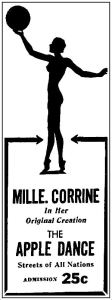
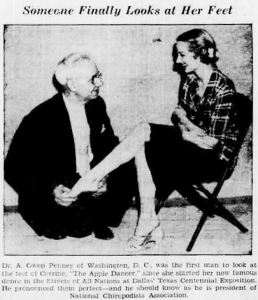
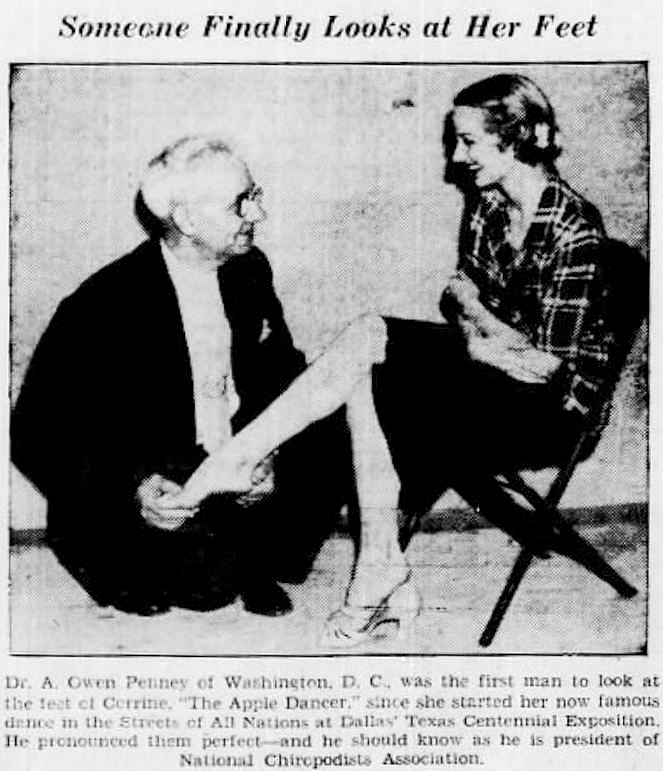
As far as the nudity, it really was everywhere. It’s a little shocking to think that this sort of thing was so widely accepted in very conservative Dallas — 80 years ago! — but it was (despite some local pastors disdainfully referring to the big party as the Texas Sintennial). Many of the acts — and much of the personnel — had appeared in a version of the same revue in Chicago in 1933 and 1934. Some of the offerings for the Centennial visitor: peep shows a-plenty, the clad-only-in-body-paint “Diving Venus” named Mona Lleslie (not a typo), a naked “apple dancer” named Mlle. Corinne who twirled with a “basketball-sized ‘apple'” held in front of her frontal nether regions, and the somewhat obligatory nude chorus girls. There was also an “exhibit” in which nude women were on display as “artists’ models,” posing for crowds of what one can only assume were life-drawing aficionados who were encouraged to render the scene before them artistically (…had they planned ahead and brought a pencil and sketchpad); those who lacked artistic skill and/or temperament were welcome to just stand there and gawk. (Click photos and ads to see larger images.)

corinne_apple-dancer_cook-collection_smu

tx-centennial_apple-dancer_dmn_070536

tx-centennial_apple-dancer_franklin-ind-evening-star_071136Franklin, Indiana Evening Star, July 11, 1936

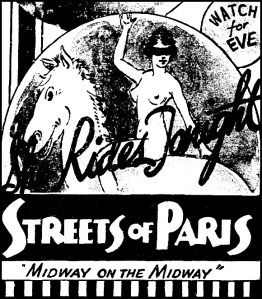
Another attraction was Lady Godiva, who, naked, rode a horse through the Streets of Paris crowds. Her bare-breastedness even made it into ads appearing in the pages of staid Texas newspapers. (Click to see larger images.)

tx-centennial_lady-godiva_dmn_060436_sm
June, 1936

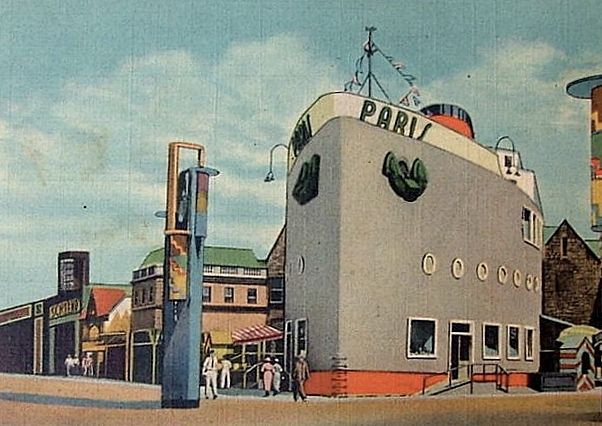
There were two areas along the Midway where crowds could find these saucy attraction: Streets of Paris (which Time magazine described as appealing to “lovers of the nude”) and Streets of All Nations (“for lovers of the semi-nude”). Lady Godiva was part of the Streets of Paris, and she rode, Godiva-esque, nightly. The gimmick (beyond the gimmick of a naked woman riding a horse in Fair Park) was that she was supposed to  be a Dallas debutante who rode masked in order to conceal her identity. The text below is from the ad above.

MASKED…but unclothed in all her Glory…Riding a milk-white steed. […] Miss Debutante was introduced to Dallas society in 1930. She was later starred in Ziegfeld’s Follies, in “False Dreams, Farewell,” “Furnished Rooms,” and other Broadway successes. She appeared in motion pictures, being starred in “Gold Diggers of 1935,” “Redheads on Parade” (yes, she is a redhead) and other picture successes.

SHE WILL STARTLE DALLAS SOCIETY! JUST AS THE STREETS OF PARIS WILL BE THE SENSATION OF THE CENTENNIAL SEASON .. WHO IS SHE?

And, of course, none of that was true (including the fact that this “Lady Godiva” rode a white horse — apparently one could not always be found), but I’m sure it got local pulses racing. My guess is that there were several Ladies Godiva (none of whom were members of Dallas society). One woman was actually named as the Centennial’s exhibitionist horsewoman. I haven’t been able to find mention of a “Paulette Renet” anywhere other than the caption of this photo, but here she is:
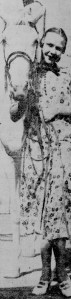
godiva_madera-tribune_082936

godiva_madera-tribune_082936-caption
Madera (California) Tribune, Aug. 29, 1936

Another photo featuring what appears to be the same woman, with this caption: “No white horse for Lady Godiva, at the Texas Centennial Exposition in Dallas. A feature of the ‘Streets of Paris,’ a midway show, Godiva rode a ‘paint pony,’ first week because no white one was available.”

godiva_altoona_penn-tribune_062336
Altoona (Pennsylvania) Tribune, June 23, 1936

I think this is still the same woman, but on a rare white steed:
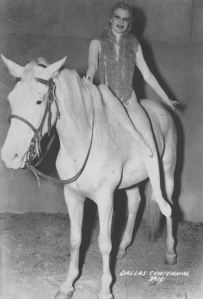
lady-godiva_cook-collection_smu

The Godiva who appeared in the March of Times newsreel “Battle of a Centennial” appears to be a different woman. (Watch a 45-second snippet of the newsreel which features both a glimpse of Lady Godiva and a head-shaking son of Sam Houston wondering what the deal is with the younger generation — here.)

godiva_march-of-time_1936

Imagine seeing performers and attractions like this along the Fair Park midway today!

*
godiva_dmn_070536-detJuly, 1936 (ad detail)

tx-centennial_lady-godiva_dmn_060436-det
June, 1936 (ad detail)

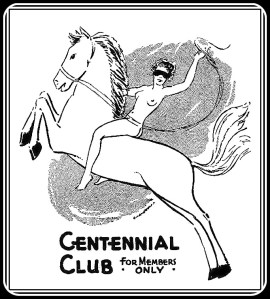
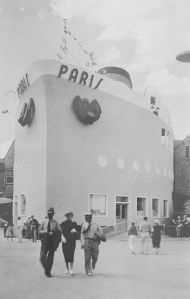
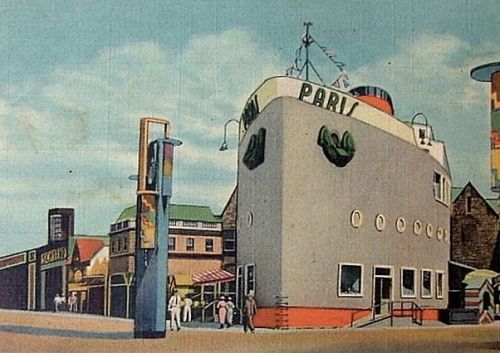
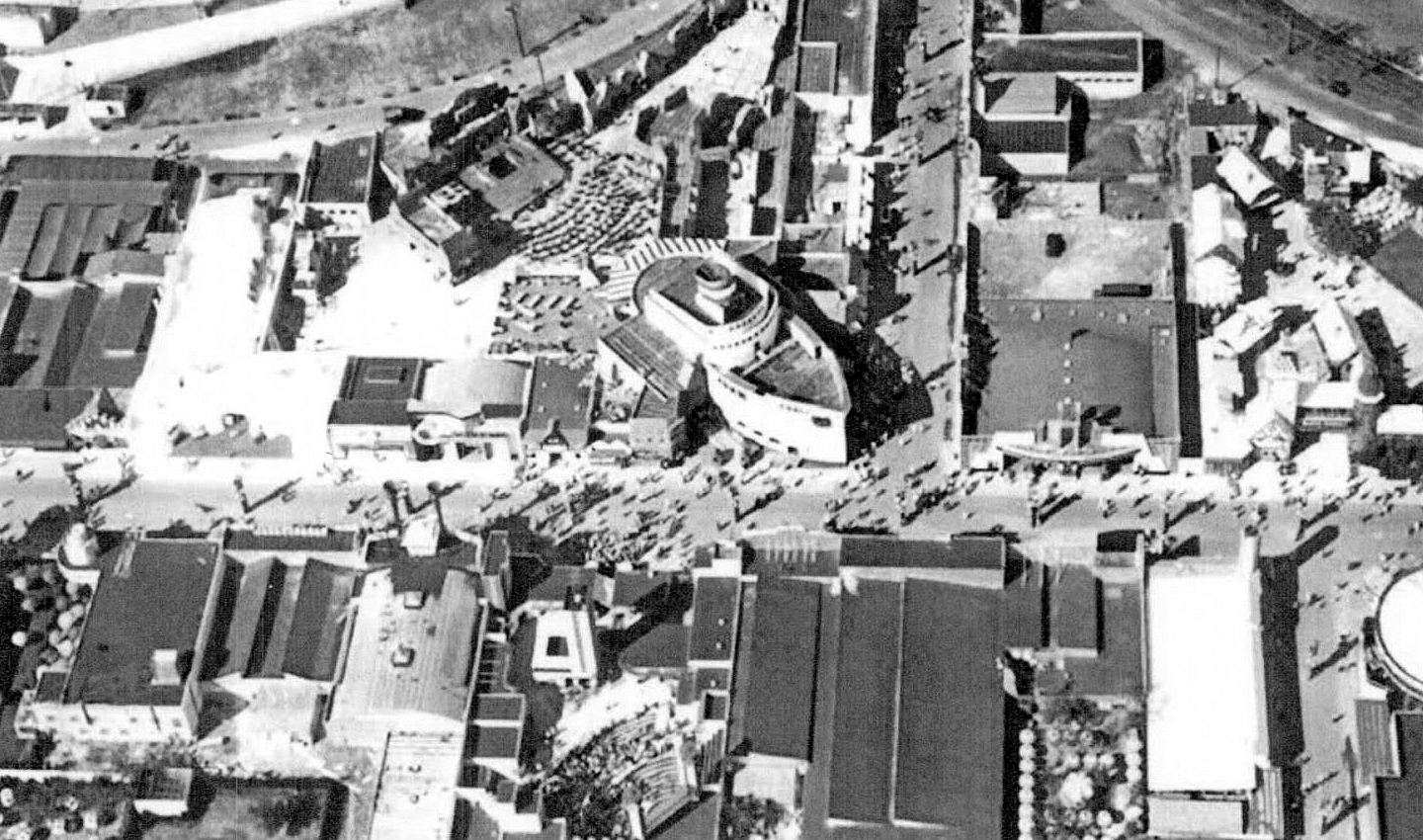
What was the Centennial Club? It was an exclusive, invitation-only private club located within the very large George Dahl-designed building which housed the Streets of Paris (and which was shaped like the famed S. S. Normandie ocean liner). It had three levels (“decks”) and housed a lounge, dining rooms, a main clubroom, and a “dance pavilion” — all air conditioned. From various decks, well-heeled patrons could look down at the action going on below: the milling throngs of the hoi polloi, the Streets of Paris shows, and the Midway.

centennial-club_dmn_061636
June, 1936

tx-centennial_streets-of-paris_art-institute-chicago

tx-centennial_streets-of-paris_ebay_rppc

tx-centennial_streets-of-paris

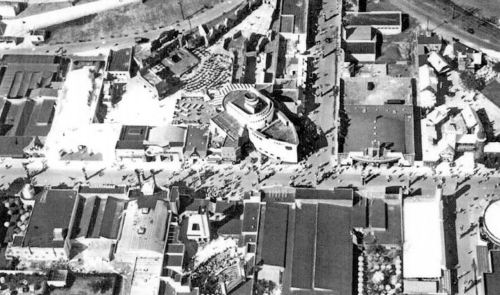
Can’t miss the ridiculously large land-locked ocean liner in the center of the photo below. Mais oui!
normandie_winters_dhs

**

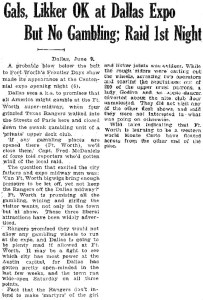
The articles below on “gals, likker, and gambling” are GREAT. They are from the show biz trade publication Variety, which really latched onto the rampant nudity on view at the Texas Centennial. Remember: 80 years ago! (The abbreviation of “S. A.” in the headline of the second article stands for “sex appeal.”) (As always, click to see larger images.)
sex_variety_061036
Variety, June 10, 1936

sex_variety_062436
Variety, June 24, 1936

nudity_variety_070136
Variety, July 1, 1936

***

Sources & Notes

Top photo shows an admission ticket to the Streets of Paris, from the George W. Cook Dallas/Texas Image Collection, Central University Libraries, Southern Methodist University; more information is here. Another interesting item from this collection is a brochure (here) which describes Streets of Paris as “the smartest, most sophisticated night club in America. Here you will find the gay night life of Paris in a setting of exotic splendor.”

Photo of “Mlle. Corrine” also from the Cook Collection at SMU; more info on that photo here.

Photo of Lady Godiva on a white horse (with the words “Dallas Centennial” near the bottom … um, bottom of the image … is also from the Cook Collection at SMU, here.

The photo showing the night-time crowd outside the Streets of Paris Normandie is from the Ryerson & Burnham Archives, Art Institute of Chicago; more info here.

The aerial photograph showing the S. S. Normandie is from Willis Cecil Winters’ book Fair Park (Arcadia Publishing, 2010); photo from the collection of the Dallas Historical Society.

All other sources noted, if known.

See quick shots of the Streets of Paris and the Streets of All Nations in the locally-made short film “Texas Centennial Highlights,” here (Streets of Paris is at about the 7:00 mark and the more risqué bits showing the parasol chorus girls followed by Mlle. Corinne and her apple dance (I mean, it’s not really shocking, but … it still kind of is…) at the 8:45 mark. (Incidentally, there appears to be a new book on Corinne and her husband — Two Lives, Many Dances — written by their daughter.)

A very entertaining history of the State Fair of Texas and the Texas Centennial Exposition can be found in the article “State Fair!” by Tom Peeler (D Magazine, October, 1982), here.

A Flashback Dallas post on the feuding Dallas and Fort Worth Centennial celebrations can be found here.

More Flashback Dallas posts on the Texas Centennial can be found here.

Click pictures and clippings to see larger images.

*

Copyright © 2016 Paula Bosse. All Rights Reserved.

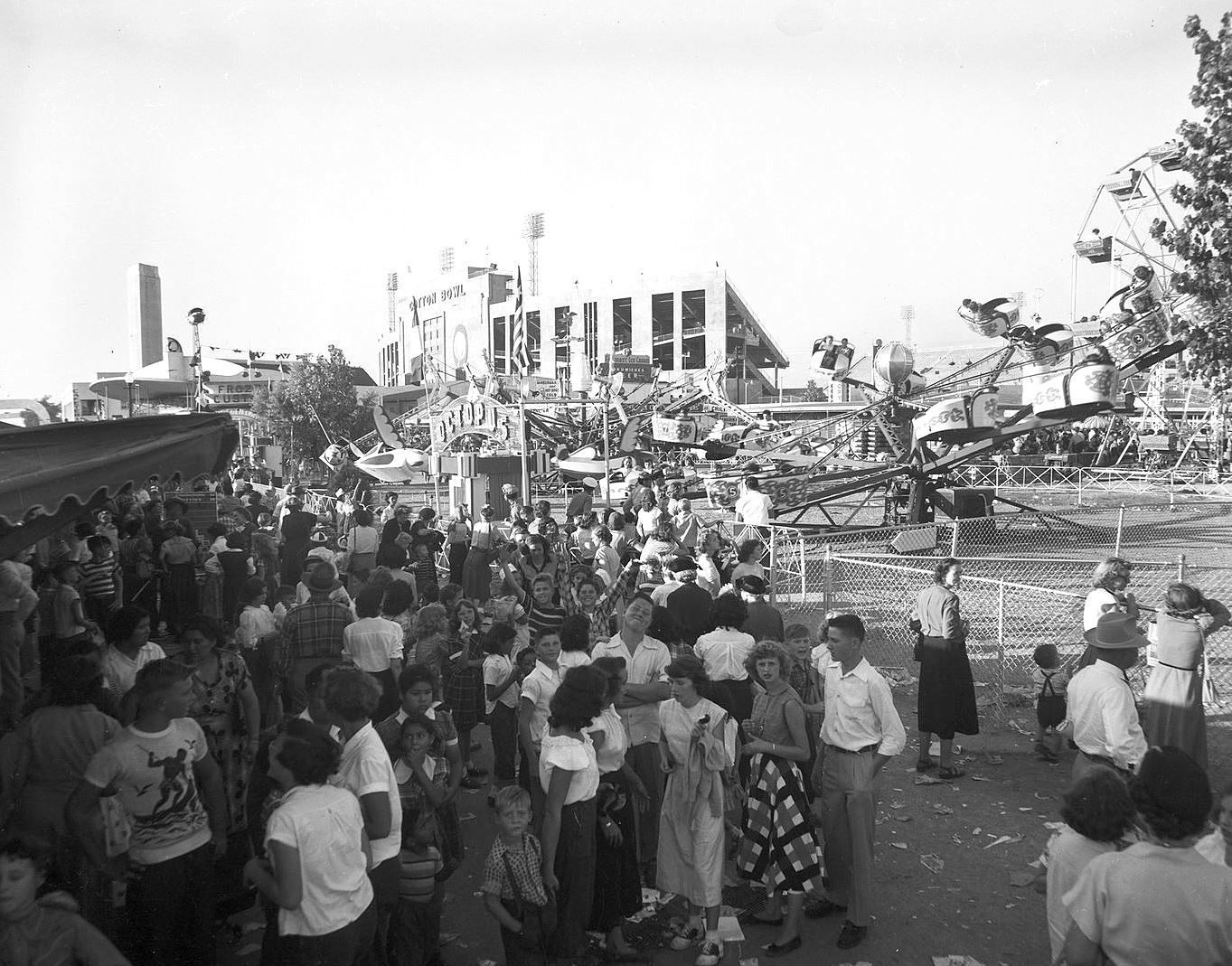
Zooming In on the State Fair: The Midway, the Cotton Bowl, and the Octopus — ca. 1950

state-fair_midway-cotton-bowl_squire-haskins_ca_1950_utaAnother visit to the fair… (click for larger image)

by Paula Bosse

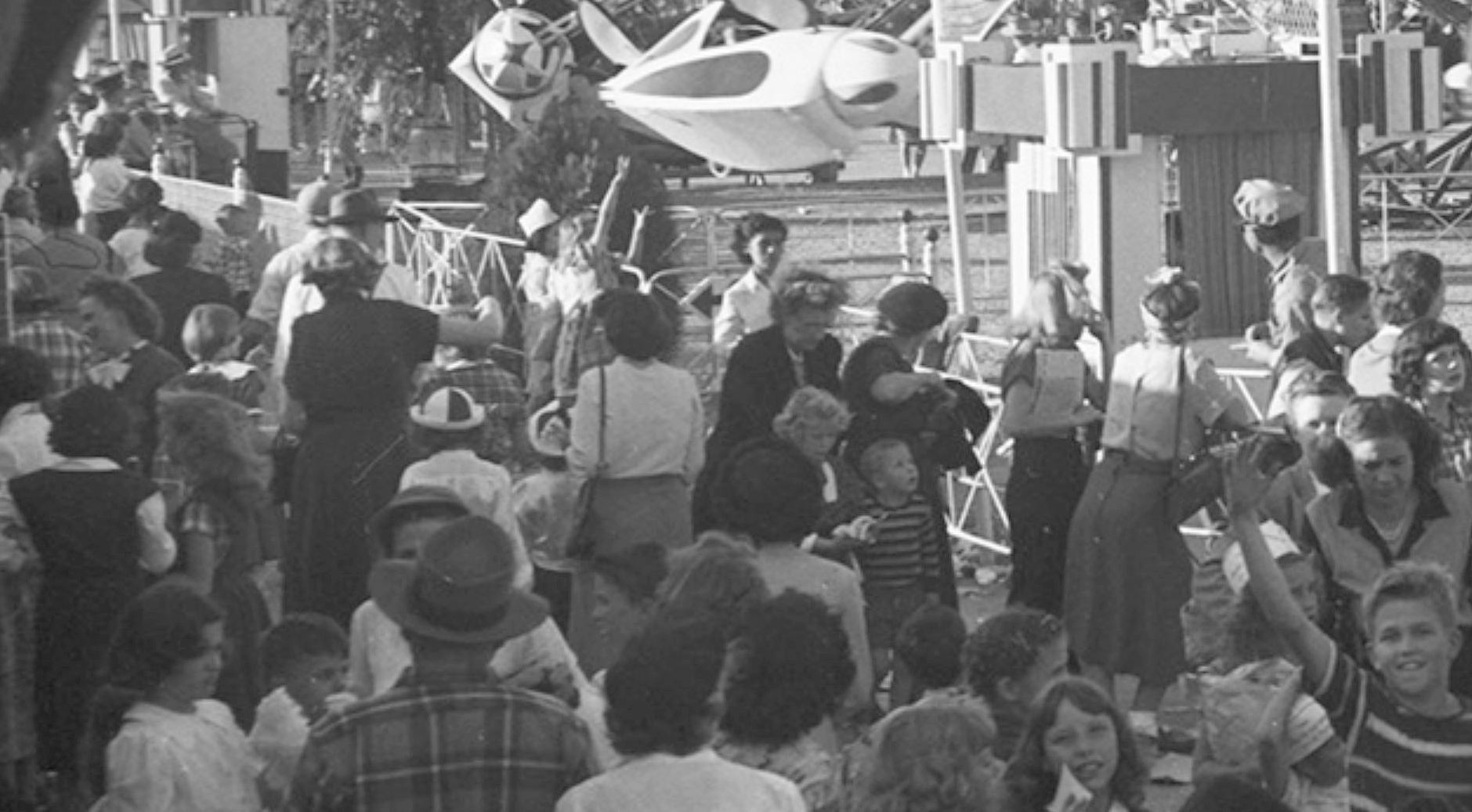
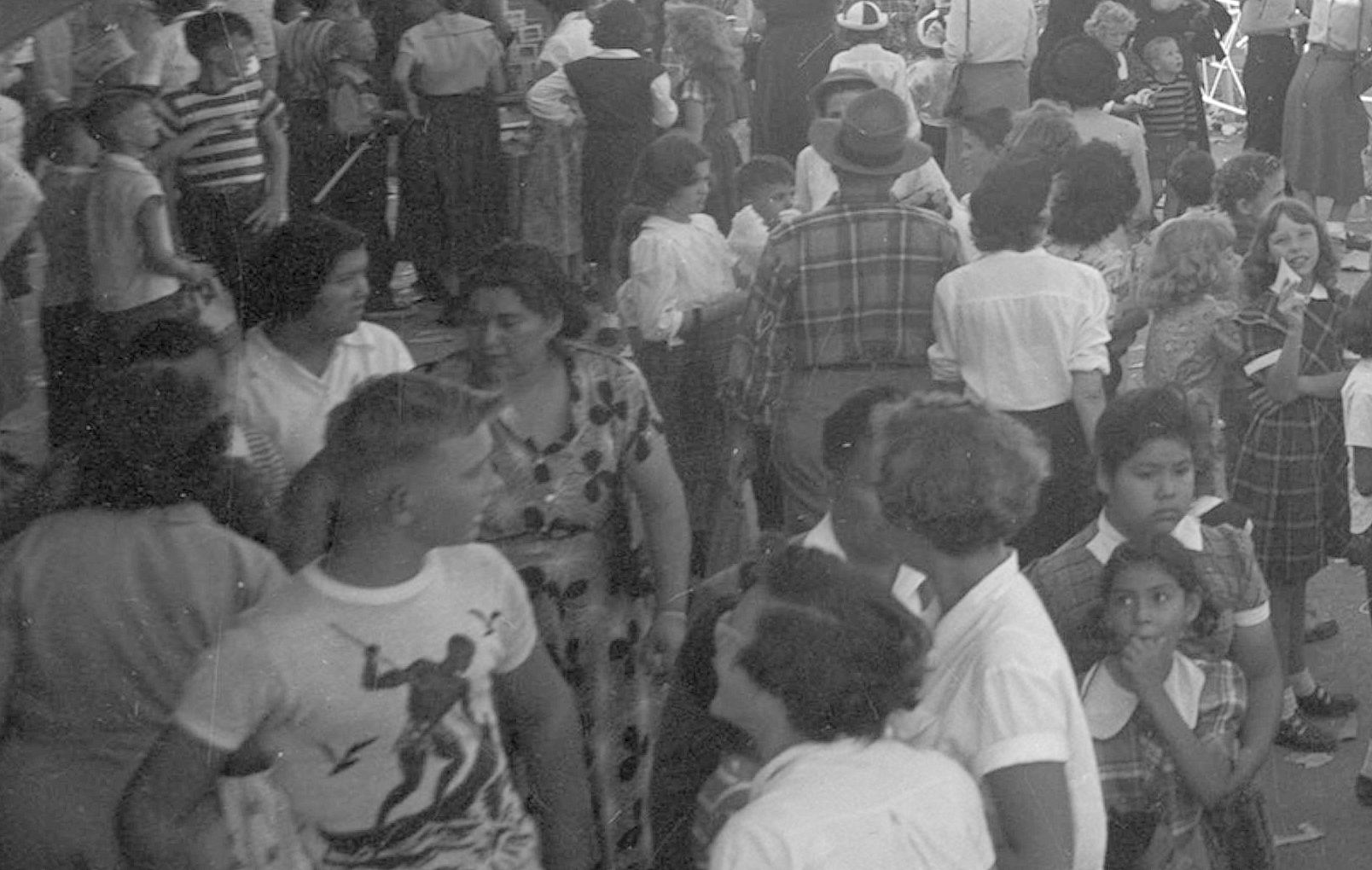
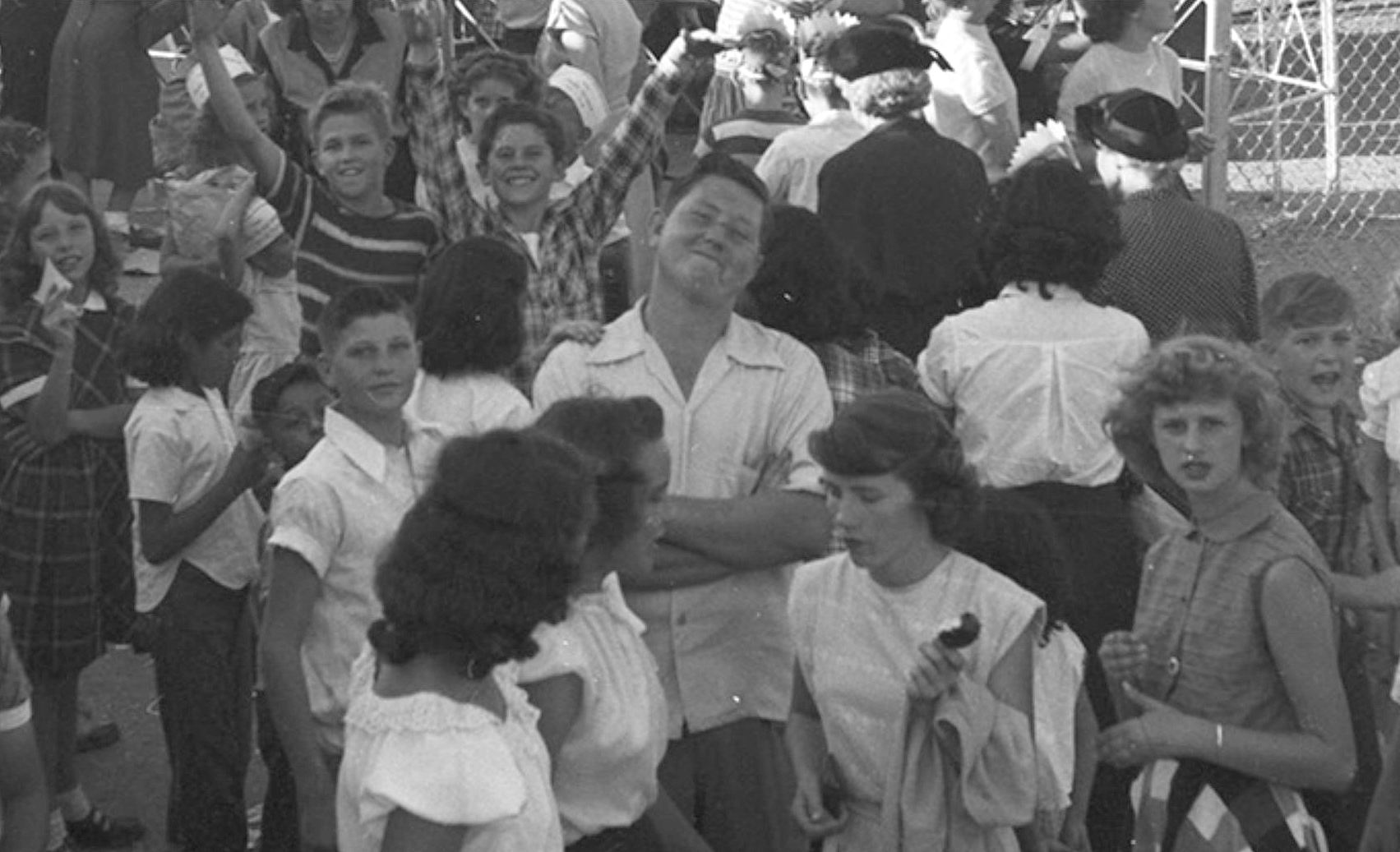
When I see old photos of the State Fair, I always look at the people. Let’s take a closer look at this great photo by Squire Haskins, taken around 1950. (See a BIG scan of this photo at the UTA website, here.)

Here are a few magnified details from Haskins’ photo (all are much larger when clicked):

midway-zoom_1

midway-zoom_2

midway-zoom_3

midway-zoom_5

midway-zoom-4

midway-zoom_6

***

Top photo by Squire Haskins, from the Squire Haskins Photography, Inc. Collection, Special Collections, University of Texas at Arlington Libraries; more information can be accessed here. (Other photos from this collection which were taken around the State Fair Midway at about this time were taken in October, 1950 — this one is not dated, but it seems likely it was taken at the same time.)

See other photos I’ve zoomed in on here.

Click pictures for larger images!

*

Copyright © 2016 Paula Bosse. All Rights Reserved.
NOW HEAR THIS: THE BELL TELEPHONE “LOUD SPEAKER” IS AT THE FAIR! — 1921

telephone_sw-bell_dmn_100821_photoYou might want to step back a few thousand feet… (click for larger image)
by Paula Bosse

When was the last time you wondered about the history of the public address system? If you’re like me, the answer to that is probably “never.”

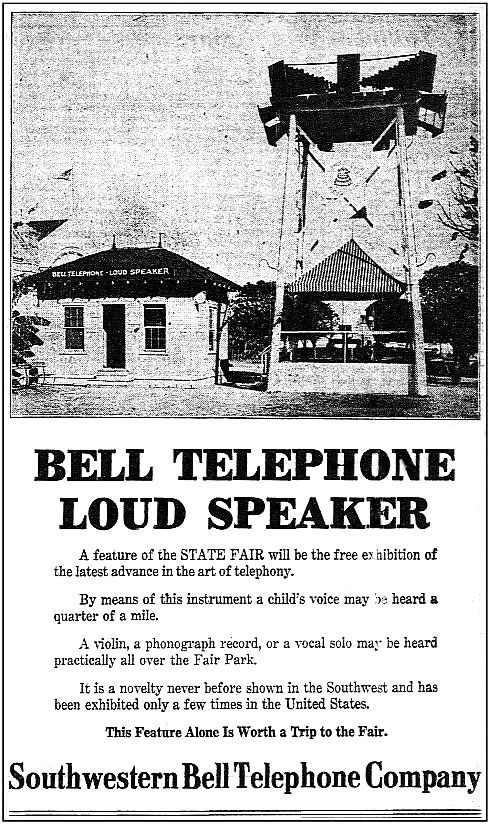
The photo above shows the new technical innovation from the army of Bell Systems engineers that was going to be demonstrated at the 1921 State Fair of Texas: the “Loud Speaker.” The ad (always click images and clippings for larger images):

telephone_sw-bell_dmn_100821
Dallas Morning News, Oct. 8, 1921

*

BELL TELEPHONE LOUD SPEAKER
A feature of the STATE FAIR will be the free exhibition of the latest advance in the art of telephony.
By means of this instrument a child’s voice may be heard a quarter of a mile.
A violin, a phonograph record, or a vocal solo may be heard practically all over the Fair Park.
It is a novelty never before shown in the Southwest and has been exhibited only a few times in the United States.
This Feature Alone Is Worth a Trip to the Fair.
Southwestern Bell Telephone Company

*

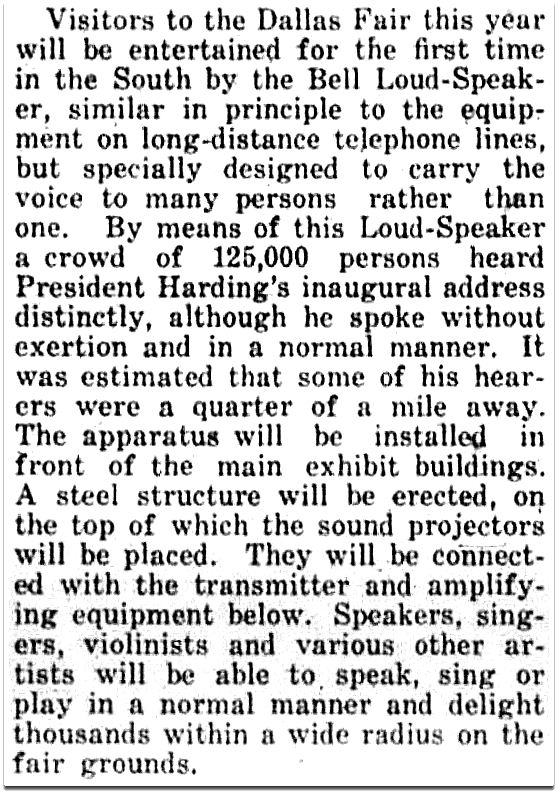
My technical expertise is pretty much non-existent, but, basically, this was the introduction of the public address system as developed by Bell Telephone, using their cutting-edge transmitters and amplifying equipment (the articles below contain more information).

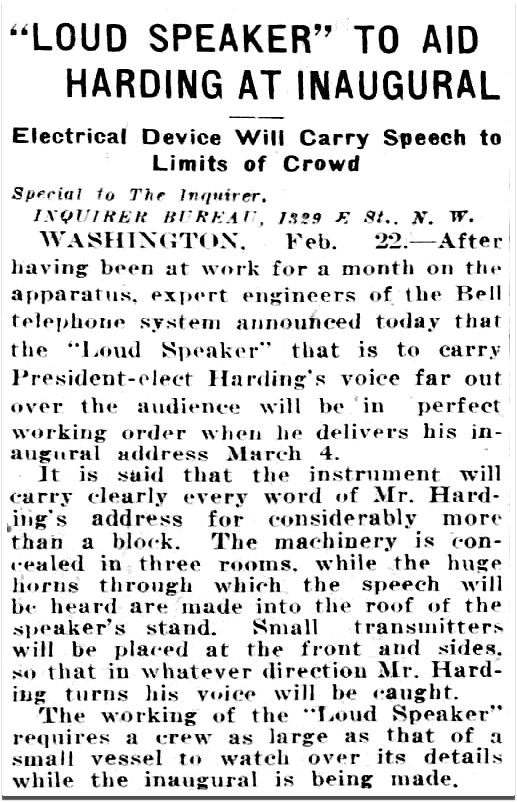
An earlier version of this particular set-up had debuted the previous year at the Republican National Convention in Chicago. (Imagine attending a large, noisy political convention with speakers whose voices weren’t amplified.) It had also been used for President Harding’s inauguration speech at the beginning of 1921, a first.
state-fair_loud-speaker_coleman-tx-democrat-voice_100721Coleman Democrat Voice, Oct. 7, 1921

This was before the days of mainstream radio — Dallas’ first commercial broadcasting station, WFAA, didn’t go on the air until June, 1922. The loudspeaker system used at the fair in 1921 allowed entertainment acts and World Series play-by-play to be played loudly overhead, for most of the fairgoers to hear (which sounds a little annoying to me, but it was newfangled novelty and people were quite taken with it).

state-fair_loud-speaker_dmn_101121
DMN, Oct. 11, 1921

state-fair_loud-speaker_dmn_101221
DMN, Oct. 12, 1921

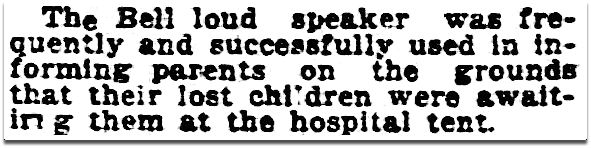
It also came in handy to make announcements and to page parents of lost children.

state-fair_loud-speaker_dmn_101521
DMN, Oct. 15, 1921

The amplification at public events was enthusiastically received and much appreciated, but the real end Bell was working toward was the ability to transmit and broadcast live events happening long distances away (and also to transmit recorded music without any substantial loss of sonic quality — radio, here we come!).

state-fair_loud-speaker_dmn_101621bDMN, Oct. 16, 1921

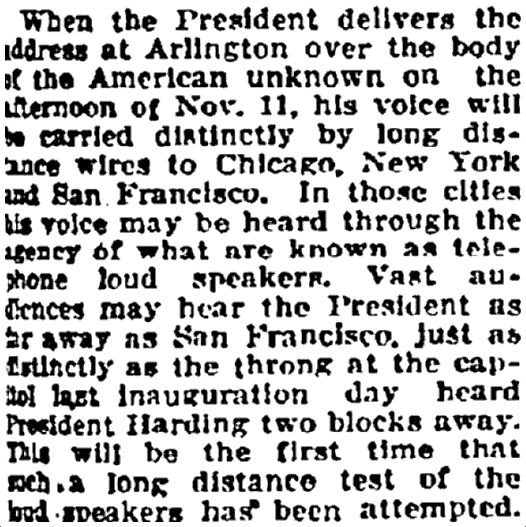
In fact, the equipment exhibited at the fair was the same equipment used less than a month later when President Harding presented his Armistice Day address to the nation. Not only was his voice amplified to the large crowd listening to him at Arlington National Cemetery, it was also transmitted and then broadcast through “loud speakers” to crowds in New York and San Francisco — another first.

state-fair_loud-speaker_harding_tulsa-daily-world_121121
Tulsa Daily World, Dec. 11, 1921

And Texas got to experience this new technology earlier than most others in the country. Little did those Bell engineers realize in 1921 that 30-some-odd years later the booming voice of a gigantic cowboy could be heard greeting visitors all over Fair Park.

**

A few clippings about the vaunted “loud speaker” before it made its way to the State Fair:

harding_loud-speaker_philadelphia-inquirer_022321
Philadelphia Inquirer, Feb. 23, 1921

harding_loud-speaker_winnipeg-tribune_030821
Winnipeg Tribune, March 8, 1921

harding_loud-speaker_dmn_100521_wire
DMN (from wire reports), Oct. 5, 1921

And an article on the exciting prospects of what lay ahead:

loud-speaker_tulsa-daily-world_121121
Tulsa Daily World, Dec. 11, 1921

***

Sources of clippings as noted.

Click for larger images!

*

Copyright © 2016 Paula Bosse. All Rights Reserved.