Flashback : Dallas

A Miscellany: History, Ads, Pop Culture

Category: Love Field

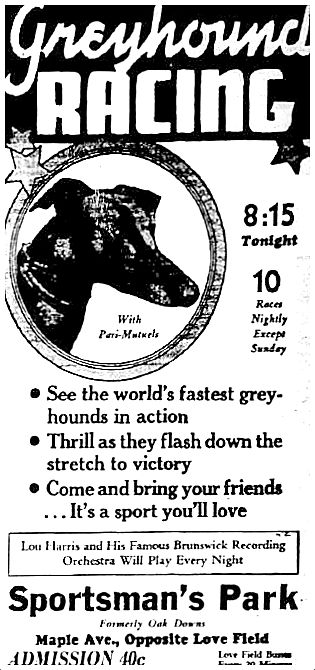
Oak Downs: Dallas’ Brief Flirtation with Greyhound Racing
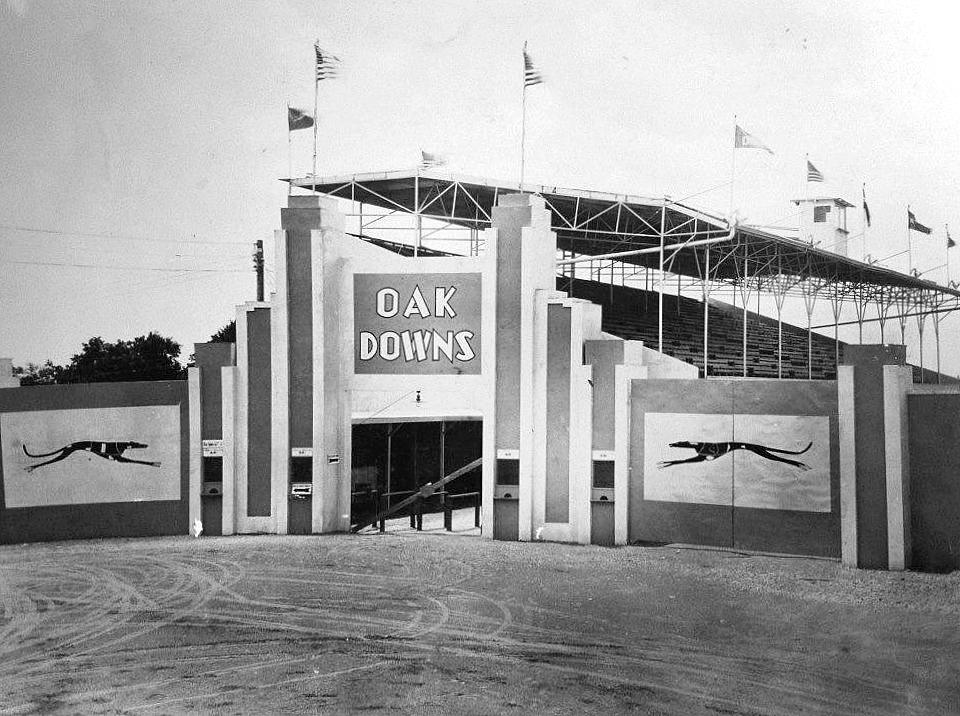
oak-downs_hurst_bwOak Downs greyhound track, ca. 1935 (photo courtesy Robert Hurst)

by Paula Bosse

Robert Hurst has shared three great photos with me: the one above, and the two below. They show Oak Downs, a greyhound racing track that he thought might have been in Oak Cliff. A dog track? In Dallas? That was news to me. Mr. Hurst came across the photos a few years ago when going through the belongings of his grandparents, Lt. Col. and Mrs. C. W. Newman. As far as he knew, they had no particular interest in dog racing, and he wasn’t sure why they would have been in possession of photos of a greyhound track. I was a little hesitant to delve into anything having to do with dog racing, but these wonderful photographs piqued my interest. (For the faint of heart, this post focuses almost exclusively on the somewhat vague and constantly changing laws on parimutuel betting in Texas, with very little on the troubling aspects of greyhound racing.)
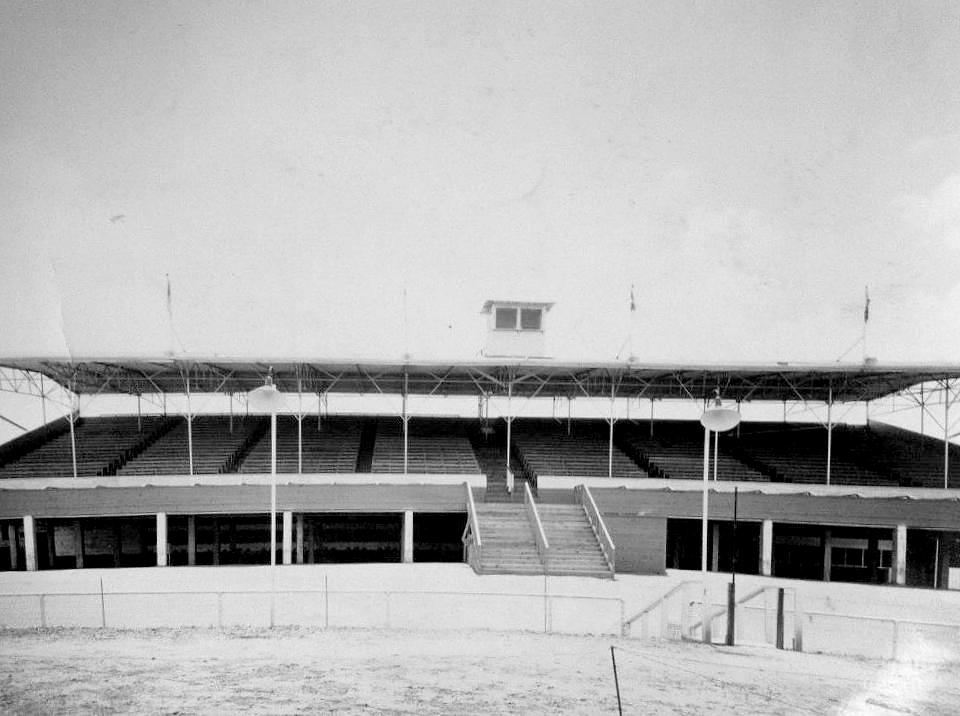
oak-downs_grandstand_day_hurst_bwGrandstand, daytime (click for larger image) (courtesy Robert Hurst)
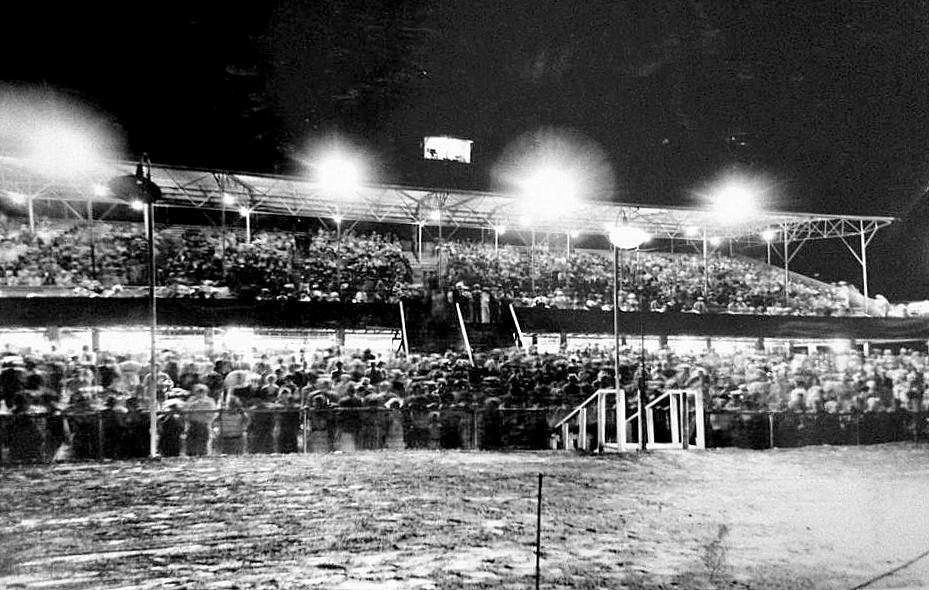
oak-downs_grandstand_night_hurst_bwGrandstand, nighttime (courtesy Robert Hurst)

The track was located not in Oak Cliff, but right across the street from Love Field — an area that was “north of the city” in the 1930s. It was to the west of the airfield, with the address listed, popularly, as Maple Avenue, but officially as Denton Drive (just north of Burbank Road).

aerial_oak-downs_smu-foscue_1930s1930s (Edwin J. Foscue Map Library, SMU)
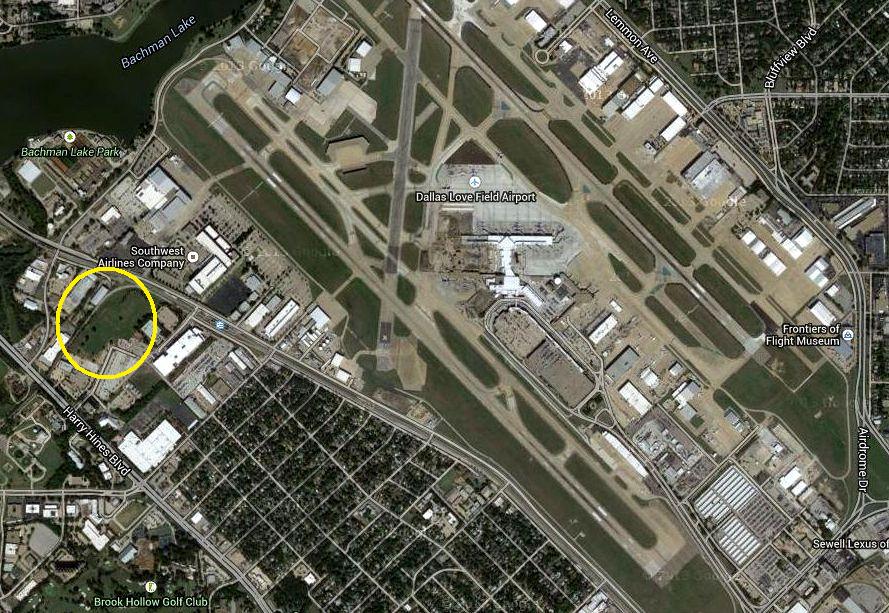
aerial_oak-downs_google2014 (Google Maps)

*

The first mention I can find of greyhound racing in Dallas was in 1898 at events held at the Fair Park horse racing track — the “sport” then was “coursing.” I don’t want to go into it, but live hares and jackrabbits were used, and it didn’t end well for them. (Competitive coursing is, I believe, now illegal in Texas, but open-field coursing is considered hunting and is legal.)

The first professional greyhound racing track to take the “blood” out of “blood sport” by utilizing an electric rabbit lure, was in California in 1919. The first track in the Dallas area to use an electric rabbit seems to have been one that opened near Grand Prairie in 1928; the news stories made sure to mention that there would be no wagering going on because, unlike other states where dog racing had been going on for some time and was quite popular as a gambling sport, parimutuel betting was not legal in Texas. Racing at that early track doesn’t seem to have lasted very long — probably because the spectators were not allowed to wager on the contests. Another track opened just outside Fort Worth at Deer Creek in 1934 (right after Texas had legalized betting on horse races in 1933), but, again, it doesn’t seem to have lasted long.

So, in the early ’30s, Texas was not really a hot-bed of dog racing enthusiasts. What was popular was horse racing — the two most popular tracks in the area were the Fair Park track in Dallas, and Arlington Downs in Arlington. The state legislature had voted in 1933 to allow parimutuel betting on horse races, hoping to raise revenue in the dark days of the Depression. People might not have been able to afford a new pair of shoes, but they managed to scrounge up money to bet with. Gambling on horse races was big business. But betting on dog races? Was it legal, too? It sounds like the law was surprisingly vague. Dog racing was not expressly written into law as being illegal — but people just seemed to understand it to be illegal. Proponents of greyhound racing — the so-called “Sport of Queens” — were adamant that they would force the state to address the issue and clarify the law — they would sue if they had to. A track in San Antonio had taken its case to a State Court of Appeals (after having been shut down by local authorities), and the court ruled that parimutuel wagering at dog tracks in Texas was not illegal. A precedent had bet set, and a few dog racing tracks began to open around the state, their owners and operators feeling they were relatively safe from prosecution.

In early 1935, 31-year old Winfield Morten, a “wealthy sportsman” who owned several businesses and a lot of Dallas real estate, decided he’d open a greyhound track on his 40 acres of land along Maple Ave./Denton Dr., just west of Love Field. He received his state business charter in May, 1935 (just days after the San Antonio ruling), and he made plans to open his dog racing “plant” — Oak Downs — in June. As they said back then, “pari-mutuel betting would be fully in vogue.”

Many people did not want a dog racing track in Dallas (or anywhere in Texas, really). Owners of horse tracks (and the powerful people who were in bed with them) feared that they’d lose some of that sweet gambling moolah to the upstart “dogmen.” Outside the racing world, there was the fear/expectation that with dog tracks would come the inevitable gambling and sleazy criminal element. (Dog racing was generally seen as somehow more unsavory and déclassé than horse racing, which is odd, because the horse racing industry has never been known as a squeaky-clean one.) Also, apart from the gambling-related issues, many people were probably aware of (and disturbed by) persistent accusations of animal mistreatment. Interestingly, at this same time — during the first few months of 1935 — none other than Mickey Mouse was involved in a comic strip story arc that lasted several weeks in which he was hanging out at a dog track training his dog Pluto for a race. It wasn’t long before the comic strip (which was usually full of typical comic strip silliness and gentle humor) turned surprisingly dark, and Mickey found himself involved in a world of doping, gambling, extortion, and threatened violence (!). If Walt and Mickey were against the evils of dog racing, shouldn’t everybody be? I wonder if the strip was reflecting public opinion or shaping public opinion?
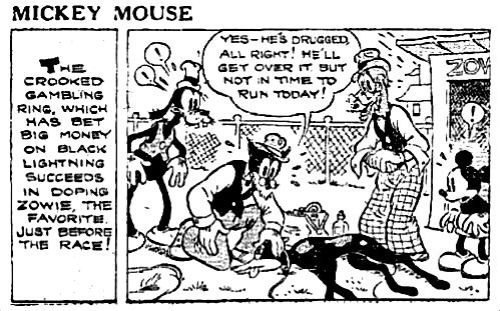
mickey_021935Poor Zowie! (Originally run Feb. 19, 1935)
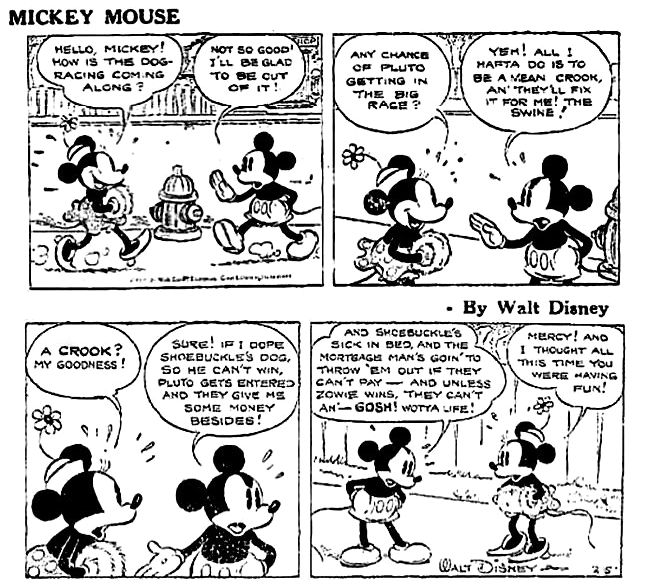
mickey_020535Mickey’s in a tough spot (click to enlarge) (Feb. 5, 1935)

Not only was the prospect of a “seedy” dog track unpalatable for many in an image-conscious city gearing up for its upcoming Centennial-Exposition-moment in the national spotlight, but there were those who were still convinced that gambling on anything but horse races in Texas was illegal — despite what the appeals court had ruled in the San Antonio case. Several interested district attorneys from around the state petitioned the State Supreme Court for a definite ruling. In the meantime, Dallas D.A. Robert L. Hurt and Dallas County Sheriff Smoot Schmid (greatest name in law enforcement EVER) threatened to shut down the not-yet-opened Oak Downs if it allowed wagering. Battle lines were drawn, and both sides believed they were in the right.

Track manager Jack Thurman said the city’s threats didn’t scare him. He’d open as scheduled, with plans for a full season of 48 days of racing (every day but Sunday), sleek hounds, an electric rabbit, and full-tilt betting. The day before Oak Downs was scheduled to open, its operators wisely obtained an injunction against Hurt (and, basically, the Sheriff’s Department and the Texas Rangers), which prevented the track from being shut down — they would open without fear of incident, under full legal protection of a court order. Not a happy guy, Hurt said he would file a motion to dissolve the injunction … immediately!

Oak Downs opened on June 18, 1935 to a large crowd of curious spectators, most of whom had never seen a dog race. The betting windows were open, but there was little betting. There were problems with the electricity in the stadium on opening day — the electric-powered rabbit that the greyhounds chased was not running on full power, and it moved so slowly that it was caught in two separate races by the probably confused dogs. (The second night there was too much juice, and the rabbit shot away from the pack so quickly that the dogs lost sight of it and just stopped running altogether. Hard to have a race if the dogs don’t actually run.) But the crowd seemed happy, and they weren’t overly concerned by the glitches happening there at the track or by the political and legal wranglings that were swirling downtown.

The crowds and the betting increased over the next few days, hinting at a rosy future for the track’s operators. But the races and the attendant wagering continued for only eleven days. The United States Fifth Circuit Court of Appeals refused to interfere with the wishes of State law enforcement — and State law enforcement wanted Oak Downs to cease with the gambling. So there was no more parimutuel betting at Oak Downs. After trying to struggle by without the sexy allure of betting — left with nothing but exhibition races and weird novelty events involving dog-riding monkeys — Oak Downs was forced to close its season prematurely on June 29.

Bye-bye, abbreviated inaugural season. No more betting on Doctor Snow, or Dixie Lad, or Rowdy Gloom, or Miss Cutlet, or Pampa Flash, or Billie Hobo, or Blond Hazard, or Mellow Man. Oh, Mellow Man, we hardly knew ye.

In February, 1936, Morten applied to the Texas Racing Commission for permission to race horses at his track, but the idea was quickly shot down by the Dallas City Council. The very profitable horse track at Fair Park was out of commission for 1936 as it was being used as part of the Centennial Exposition. Privately owned at the time, the track was leased to the Centennial Corporation, and the City Council — the members of which were no doubt on very friendly terms with the Fair Park track owner — felt it would be “unfair” to allow a competitor to horn in on the massive profits to be had. So … no dice (…as it were).

By September of 1936, Morten changed Oak Downs’ name to Sportsman’s Park and brought in new operators (including a former Texas Ranger). Oak Downs had joined other dog tracks in a new round of legal action which was slowly working its way through the courts. Without any ruling yet from the Supreme Court, they ignored an injunction that had been filed against them and defiantly opened up their betting windows again. Four of the men were fined and jailed briefly for contempt of court. But after months of mixed messages and conflicting rulings from various judges around the state, confused and fed-up lawmen were unsure of the actual legality of dog track betting, and, grudgingly, they allowed the wagering at Oak Downs to continue as they, too, awaited a high court decision.

As reported in Texas newspapers, on Oct. 28, 1936 the Texas Supreme Court finally ruled on the matter of whether or not dog racing could be wagered on legally in the state of Texas:

We do not find any provision in the penal code defining gaming which can be construed to include dog racing or betting on dog racing. It is not a game prohibited by law. […] This court is fully conscious of the pernicious and unwholesome effects upon society of betting on dog races and keeping premises for dog racing where betting is allowed, but the proper agency for the suppression of those wrongs is the Legislature, and until it sees proper to further legislate in the matter, the courts are without power to suppress these evils by injunction.

In other words, the Texas House and Senate were going to have to take up the issue if they really wanted to do away with legalized betting on dog races (which they did), because it was their fault that they hadn’t been specific enough when they wrote their original law.

So betting was back “in vogue” once again. And now with absolutely no threat of arrest. The remainder of the 1936 season continued without problems, and when the 1937 season opened in April, it was “the first greyhound meet in Dallas free of danger of being interfered with by law enforcement agencies” (DMN, April 22, 1937), but … as there were bills to outlaw betting on dog racing AND horse racing percolating through the current Texas legislature, it was thought that the 1937 season might also be the last season of racing in Texas.

In May, 1937, Governor James V. Allred addressed the Texas Congress, urging them to repeal the current law allowing parimutuel gambling on horse racing (with the knowledge that this would almost certainly also apply to the outlawing of dog racing, as that bill had just passed the House and was headed to the Senate). Here are a couple of passages from his speech, a transcription of which appeared in newspapers throughout the state on May 28, 1937:

I do not know how to state in words a stronger case for repeal of the race track gambling law than I have already given to this Legislature from time to time. I have quoted Washington, Franklin, Blackstone, Shakespeare, Brisbane, McIntyre and the Holy Bible. I have pointed out the living evidence of undesirables, of doping, of thuggery, of embezzlement, of bank failures, of suicides, and narcotic rings. Each month of the life of this law sees addition to the numbers of these human tragedies….

And, finally, a mention of the evils of racing with regard to the animals themselves:

There is no record of a horse ever being doped except to run a race. All the races ever run are not worth the agony and cruelty dealt even one of these poor, helpless beasts! I appeal to all who love good horses, I appeal to all who believe in preventing cruelty to animals to join with me in demanding that this law be repealed.

Allred’s lengthy and impassioned speech — which addressed every argument the pro-gambling forces were wont to … trot out … must have touched a few nerves (with both the public and the politicians), because in June, both bills passed with huge margins. (The bill outlawing the betting on dog racing passed in the Senate 22-1 and in the House 109-12. With passage of the new law, betting on dog races could now incur a fine of up to $500 and a jail term of up to ninety days; the penalty of “keeping a place of betting on dogs” was two to four years in the state penitentiary.)

So no more parimutuel betting in Texas. No more dog racing. No more horse racing.

And that was that for the state’s dog tracks. What was next for Oak Downs … er, Sportsman’s Park? Three words: “midget auto racing” (i.e. the racing of very small cars, not the racing of cars operated by very small drivers).

Besides the regular auto races, two added events give promise of furnishing fans with a few thrills as well as a laugh or two. Fast cowponies will be featured in a half-mile sprint with a race for roosters rounding out the show. Winner of the cowpony race will receive $15, while the winning rooster will be rewarded with $5. Entries are open to any and all owners of ponies or roosters. (Dallas Morning News, Aug. 27, 1937)

Somehow I don’t think five-buck-purse rooster races figured into Mr. Morten’s big dreams back at the beginning of 1935.
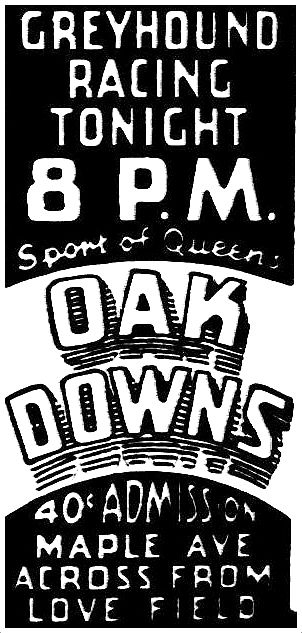
ad_oak-downs_0622351935

*

ad-dmn_0422371937

***

Sources & Notes

Top three photos of Oak Downs greyhound racing track used by kind permission of Robert Hurst. He came across them several years ago in the belongings of his grandparents, Lt. Col. Campbell Wallace (C. W. “Bub”) Newman and Martha Price Newman. Col. Newman was a cavalry officer who served in WWI, WWII, and Korea; between WWI and WWII, he worked in Dallas as a contractor and was employed for a time at Oak Downs where he worked in track operations. (That’s why he had these photos!) [And by no means do I mean to imply that this career military man was involved in any sort of shady goings-on. In fact, from what I can tell, Oak Downs seems to have been run by a fairly “clean” group of people. The perception/reputation of dog racing at the time wasn’t great, but nothing I’ve read about this track suggests that anything unscrupulous was going at the track, behind the scenes, or amongst the personnel who worked there.] He was also an avid polo player and was a good friend (and polo teammate) of Winfield Morten who owned the track. Many thanks, Mr. Hurst, for the use of these wonderful photos!

Black and white aerial view of the Love Field/Bachman Lake area was taken by Lloyd M. Long in the 1930s; photo is from the Edwin J. Foscue Map Library, Southern Methodist University. The unlabeled photo (a detail of which is used above) can be accessed here; a labeled version of this photo (with some streets and buildings identified) can be accessed here.

I highly encourage people to see out the transcript of Governor James V. Allred’s FANTASTIC impassioned speech before members of the Texas House and Senate, which appeared in newspapers around Texas on or around May 28, 1937. As far as politics is concerned, I’m the most cynical person in the world, but this is an incredible speech.

More on the history of parimutuel gambling in Texas from Wikipedia, here.

An explanation of just what parimutuel betting is, is here.

Parimutuel racing was legalized again in Texas in 1987. The current state of racing in Texas can be read about in the Dallas Morning News article “A Last Hurrah for Texas Horse Racing” (May 3, 2014) by Gary Jacobson, here.

I’m quite honestly shocked to learn that greyhound racing is legal in the state of Texas. There seems to be really only one active track with live racing in the state (in South Texas), and the only upside to this appalling fact is that attendance has been in steep decline for years.

*

Copyright © 2015 Paula Bosse. All Rights Reserved.

JFK’s “Last Hour In Dallas” — 1963

JFK_poster

by Paula Bosse

How is a city supposed to respond when it is suddenly plunged into the international spotlight? Does it grieve and try to forget, or does it grieve and capitalize? Dallas has had over 50 years to deal with/come to terms with the assassination of President Kennedy, but sometimes it seems as if the City of Dallas is still shell-shocked and isn’t quite sure how to acknowledge it on an official level. Let’s face it, Dallas is known to the rest of the world for one thing: the Kennedy assassination (and perhaps the TV show, and maybe the Cowboys). Yes, we have the justly-renowned Sixth Floor Museum, but it took 26 years to open it!

The cottage industry that sprang up in the wake of the Kennedy assassination has been big business for decades, some of it generated by people who live in Dallas, but most of it by people who have probably never even been to Texas. Since 1963, the “assassination literature” (…and, yes, it’s called that) has mushroomed, with local contributions coming from Dallasites whose brush with the President before, during, or after the events of November 22, 1963 have probably been pored over by numerous people either trying to understand why what happened happened or by people searching for hidden conspiracy clues to explain what really happened.

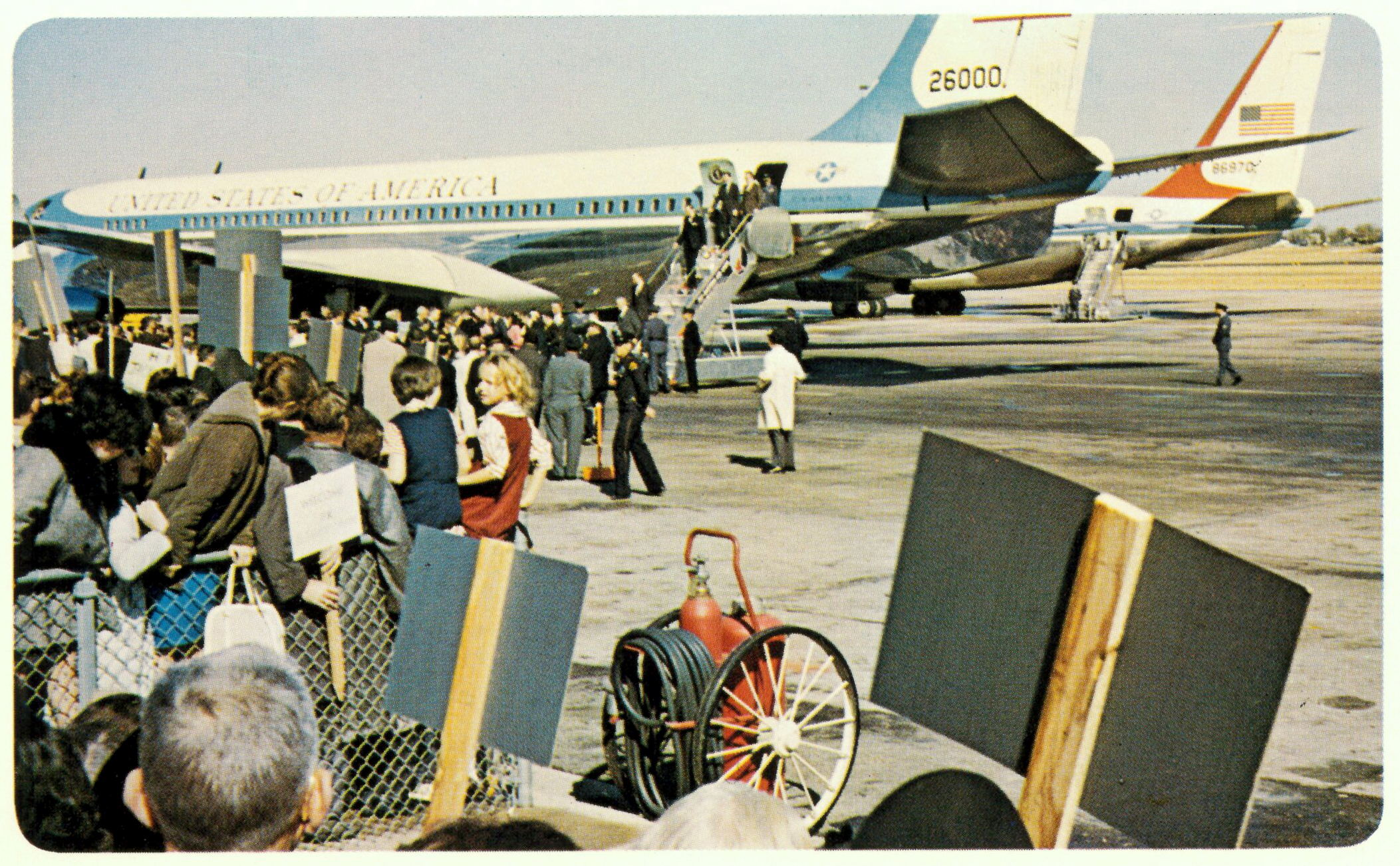
One local resident who added to the assassination literature was John E. Miller who took photos of the arrival of President and Mrs. Kennedy at Love Field and then apparently hot-footed it over to Parkland when the news of the shooting broke. These photos were issued as postcards in 1964 in a packet of 12. (Click pictures for larger images.)

JFK_envelope_frontAbove, the front of the envelope containing the cards; on the back: “A Real Picture Treat For Years To Come.”

JFK_card_01From the back of the card: “No. 1, Arrival of President’s Escort Plane at Love Field, Dallas, Texas.”

JFK_card_02“No. 2, Presidential and Escort Planes at Dallas’ Love Field landed shortly after this picture was taken.”

JFK_card_03“No. 3, President John F. Kennedy and party leaving airplane at Love Field. (Mrs. Kennedy — pink hat.)”

(UPDATE: The two little girls in the photos above and below are most likely Carolyn Jacquess, in blue, and Debby Massie, in red. Their little group arrived at the airport before the president’s plane arrived, walked through the terminal and out onto the tarmac, right to where the plane taxied up to the small crowd of about 100 people. Just like that. There was no special invitation, and, other than the chain-link fence, no real security.)

JFK_card_04“No. 4, President John F. Kennedy and Party in foreground at Dallas’ Love Field.”

JFK_card_05“No. 5, Vice-President Johnson, Governor Connally, Mrs. Kennedy (pink hat), other members of party at Dallas Love Field.”

JFK_card_06“No. 6, Vice-President Johnson, Governor Connally, Presidential Party and Newspaper Men, Love Field, Dallas.”

JFK_card_07“No. 7, Forming of Presidential Parade, Love Field, Dallas.”

JFK_card_08“No. 8, After Assassination, TV Unit arrives at Parkland Hospital in Dallas.”

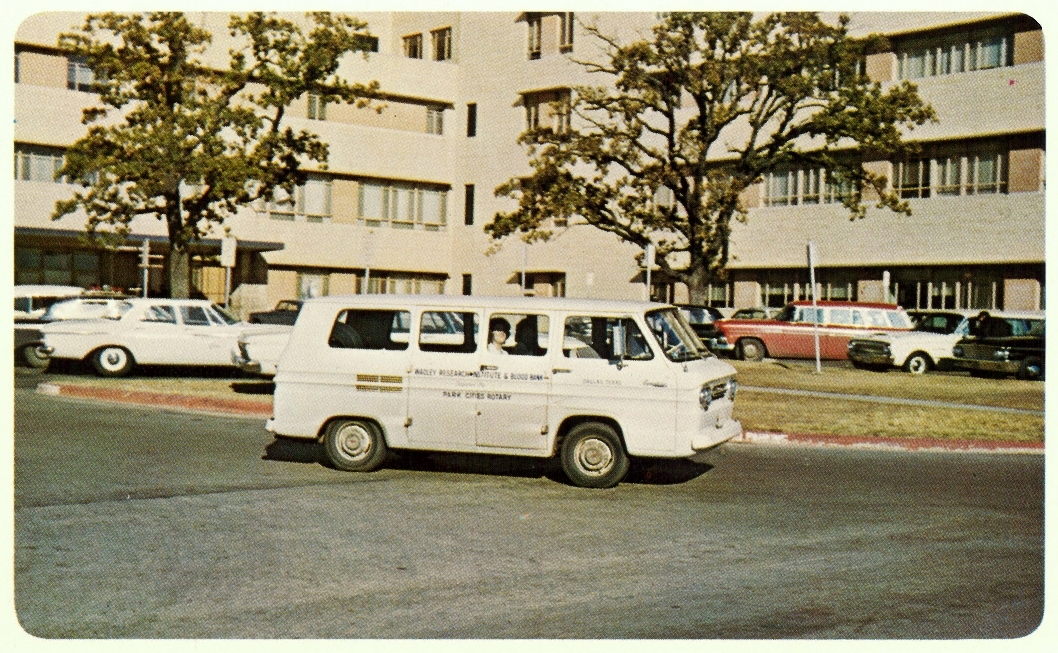
JFK_card_09“No. 9, Blood Bank Unit at Parkland Hospital on fatal day. Dallas, Texas.”

JFK_card_10“No. 10, Hearse carrying President John F. Kennedy’s body and Mrs. Kennedy from Parkland Hospital back to airplane at Love Field, Dallas.”

JFK_card_11“No. 11, Presidential plane awaiting President Kennedy’s body, Vice-President Johnson and Mrs. Kennedy, for return to Washington, D.C. (Note Presidential seal.)”

JFK_card_12“No. 12, Texas School Book Depository building from which authorities believe fatal shots were fired. (Note second window down on right corner of building.)”

***

Photos and captions © John E. Miller 1964, 3500 W. Davis, Dallas, Texas 75211. (Mr. Miller was a Dallas businessman who sold motor homes and trailers in Oak Cliff between 1945 and 1976. A photo of Mr. Miller is here).

Many thanks to “amyfromdallas” for scanning and contributing the images in this post. Thanks, Amy!

For other Flashback Dallas JFK-related posts, see here.

Click pictures for larger images.

*

Copyright © 2014 Paula Bosse. All Rights Reserved.

When the Spanish Influenza Hit Dallas — 1918

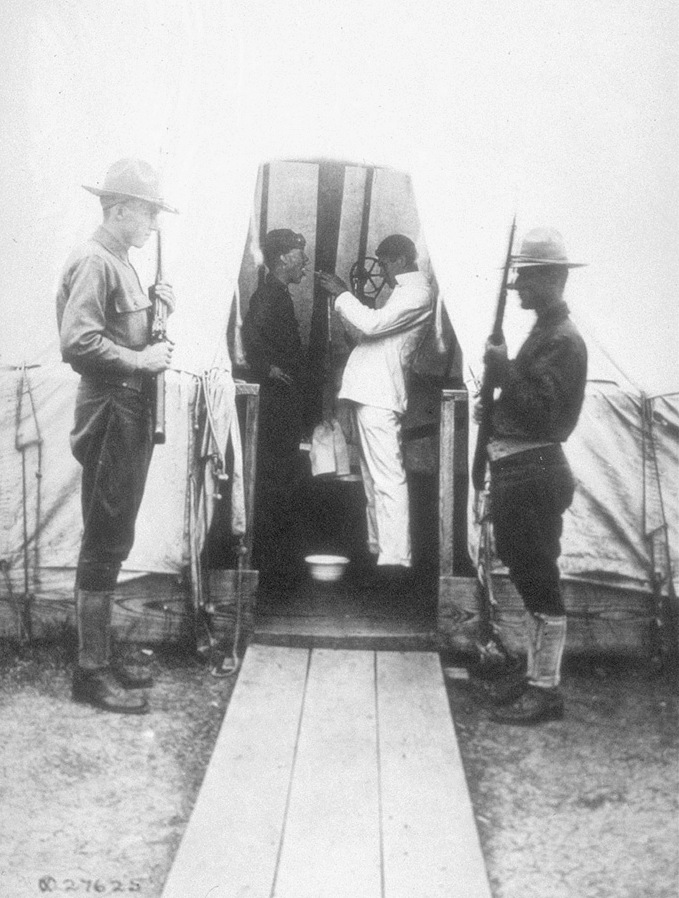
spanish-influenza_love-field_otis-historical-archives_nmhm_110618
American Red Cross at Love Field, spraying soldiers’ throats, Nov. 6, 1918

by Paula Bosse

The Spanish Influenza pandemic of 1918-1919 caused as many as 50 million deaths worldwide — about 600,000 of which were in the United States (11 times greater than the number of American casualties during World War I). Locally, the influenza first hit the soldiers at Camp Bowie in Fort Worth in September, 1918. The flu spread quickly, and on Sept. 27, it was reported that there were 81 cases in the camp. Well aware of the devastation the flu had wrought in other U.S. cities, most notably at military camps, Fort Worth was, understandably, taking the situation seriously. Dallas leaders, on the other hand, were all-but pooh-poohing the need for concern. On Sept. 29, The Dallas Morning News had a report titled “Influenza Scare is Rapidly Subsiding” — the upshot was that, yeah, 44 reported cases of “bad colds” had been reported in the city, but there’s nothing to worry about, people.

In the opinion of the military and civil doctors, the Spanish Influenza scare is unwarranted by local conditions. The few cases of grip, it is claimed, are to be expected as the result of the recent rainy weather.

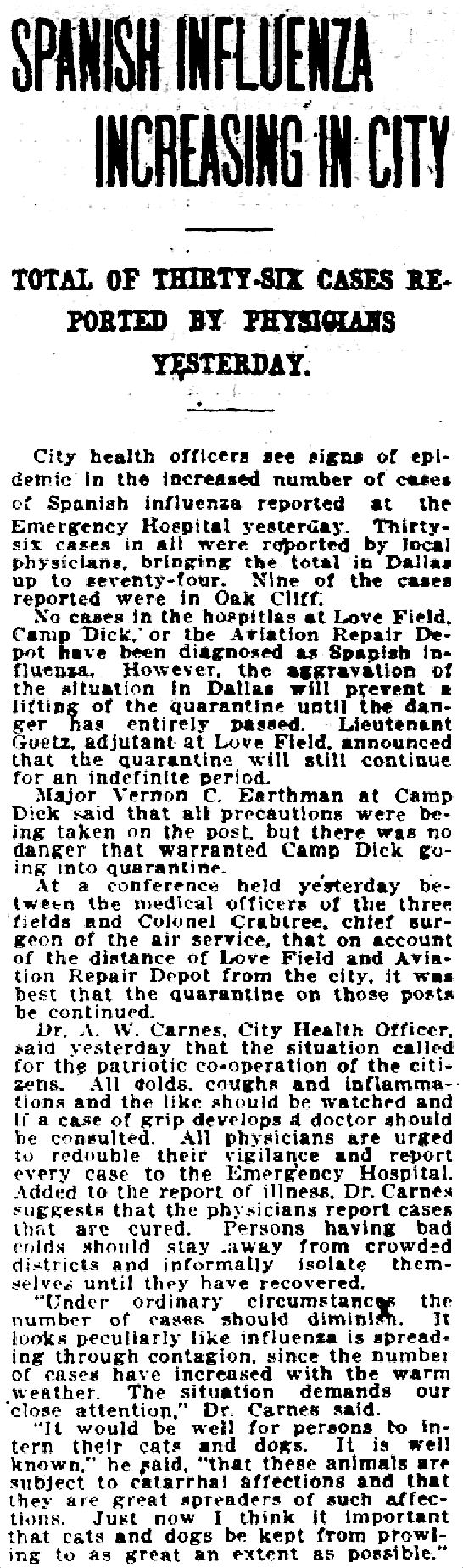
Just two days later, though, officials were jolted out of their complacency when the (reported) cases jumped to 74 (click for larger image):

spanish-influenza-dmn-100218DMN, Oct. 2, 1918 (click for larger image)

The months of October and November were just a blur: the city was plunged into an official epidemic. There was no known cure for the flu, so a somewhat ill-prepared health department preached prevention. People were encouraged to make sure their mouths were covered when they coughed or sneezed, and they were directed to not spit in the street, on streetcars (!), in movie theaters (!!), or, well, anywhere. (Handkerchief sales must have soared and spittoon sales must have plummeted.)

At one point or another, places where people gathered in large numbers — such as schools, churches, and theaters — were closed. Trains and streetcars were required to have a seat for every passenger (no standing, no crowding) (…no spitting). The number of mourners at funerals (of which there were many) was limited. And there was a major push for citizens to clean, clean, clean their surroundings in an attempt to make the city as sanitary as possible. Instructions appeared often in the newspapers.

spanish-influenza_dmn_101218_tipsDMN, Oct. 12, 1918

It was estimated that there were 9,000 cases of Spanish Influenza in Dallas in the first six weeks. By the middle of December, when the worst of the outbreak was over, it was reported that there had been over 400 deaths attributed to the Spanish Influenza and pneumonia in just two and a half months.

spanish-influenza_FWST_121118Fort Worth Star-Telegram, Dec. 11, 1918

As high as these numbers were, Dallas fared much, much better than many other parts of the United States.

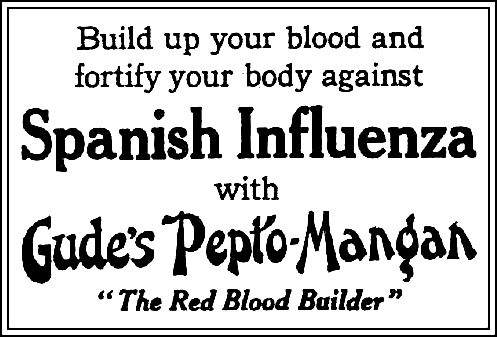
spanish-influenza_ad_dmn_101818_pepto-manganAd, DMN, Oct. 18, 1918

***

Sources & Notes

Photo at top was taken on November 6, 1918 and shows American Red Cross Workers spraying throats of military personnel based at Love Field in hopes of preventing the spread of the influenza. The photo is from the Otis Historical Archives, National Museum of Health and Medicine; I found it on the NMHM site, here. (Click photo for larger image.)

Ad for Pepto-Mangan (“The Red Blood Builder”) was one of a flood of medicines and tonics claiming to be effective in the fight against Spanish Influenza (none were).

For a detailed and remarkably well-researched, comprehensive history of the Spanish Influenza in Dallas, see the article prepared by the University of Michigan Center for the History of Medicine, here. It’s pretty amazing.

To read about the history of pandemics (including several good links regarding the Spanish flu), see the Flu.Gov site, here.

And, NO, Ebola is not transmitted like the flu. But it’s still good practice to cover your mouth when you cough or sneeze,wash your hands frequently, and never EVER spit in the street, because that’s just disgusting. ((This post was originally written in 2014 while Dallas was the center of the Ebola universe.))

More on the Spanish Influenza pandemic can be found in the Flashback Dallas post “Influenza Pandemic Arrives in Dallas — 1918.”

*

Copyright © 2014 Paula Bosse. All Rights Reserved.


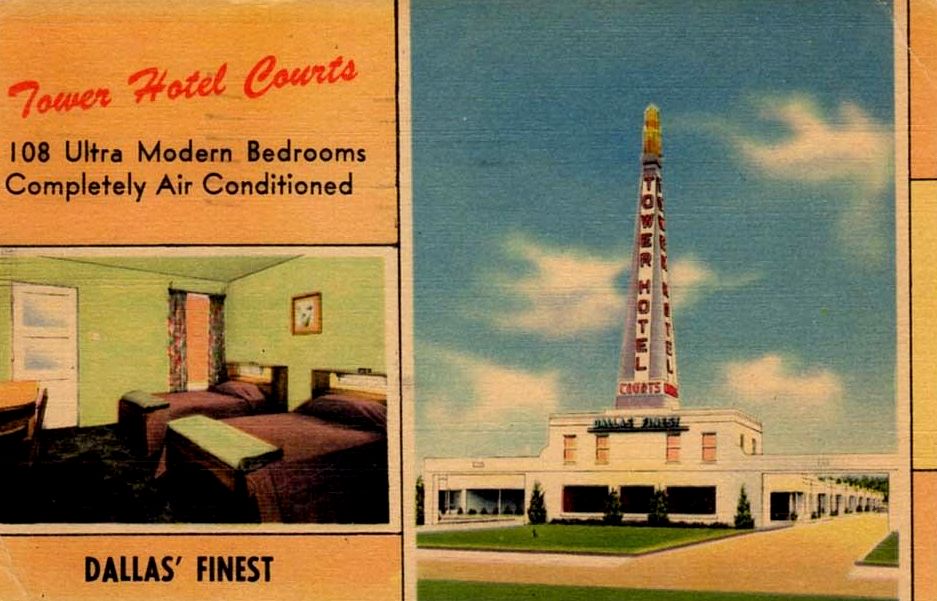
“The Riviera of the South” — On Harry Hines!

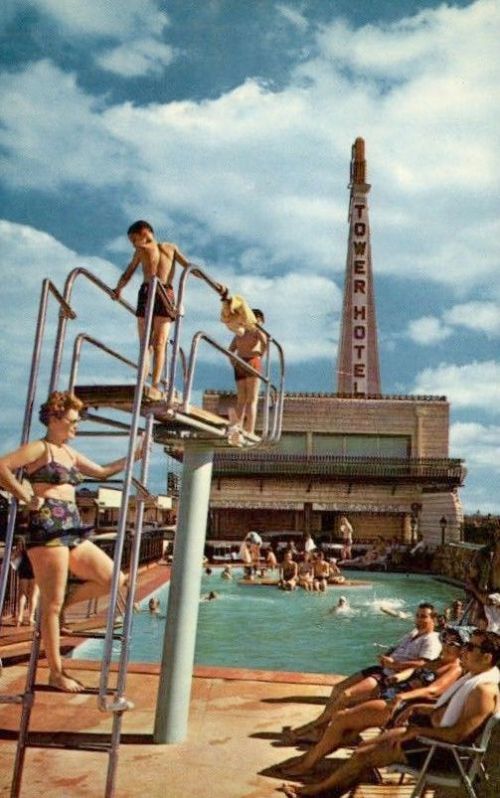
tower-hotel-courts_pool-match_flickr-smThe paradise of Harry Hines awaits…

by Paula Bosse

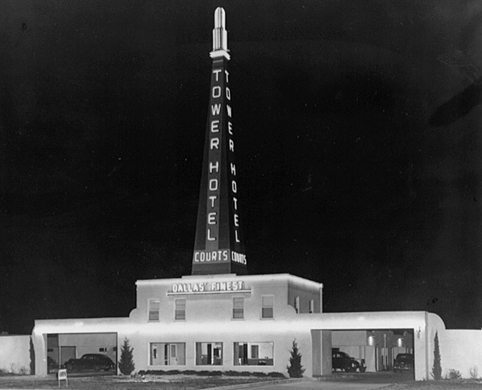
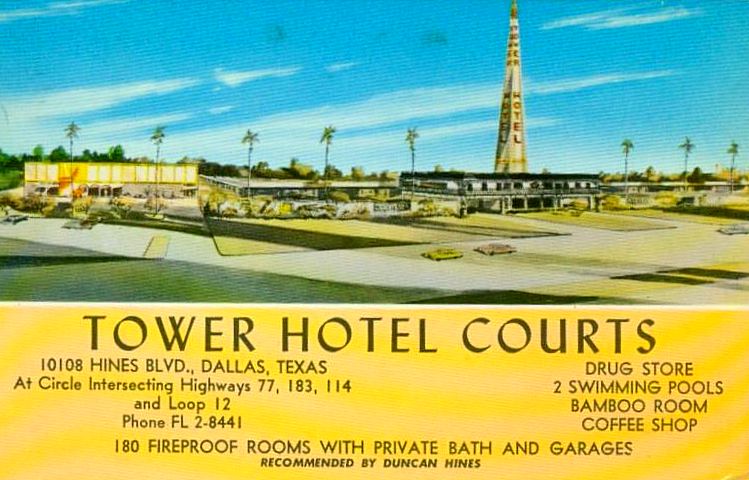
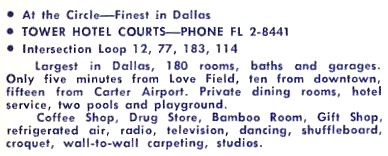
The Tower Hotel Courts opened in the fall of 1946. Their address makes my had spin: at “The Circle” where highways 77, 183, 114, and Loop 12 intersect. “10108 Harry Hines” would have been easier to fit on the stationery, but mention of all those highways just made everything more exciting. (It also gave some indication to prospective guests of what would be awaiting them, such as constant traffic noise and the ever-present whiff of exhaust in the air. “You can’t say we didn’t warn you, madam.”)

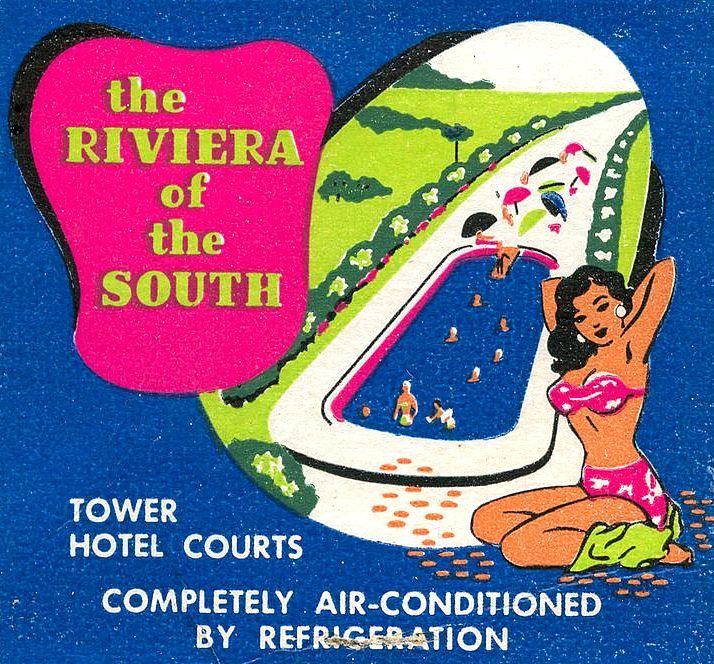
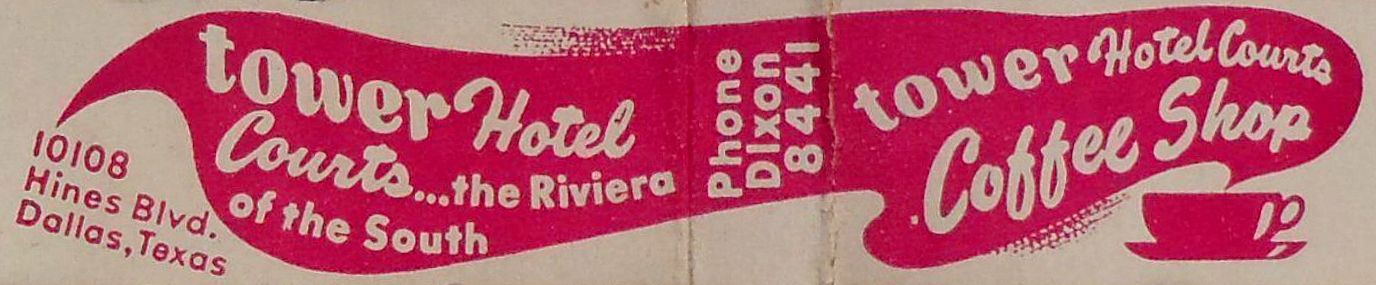
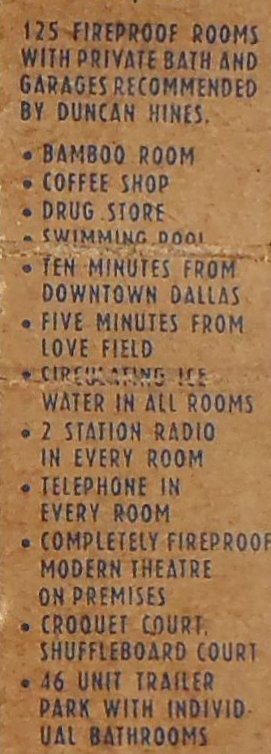
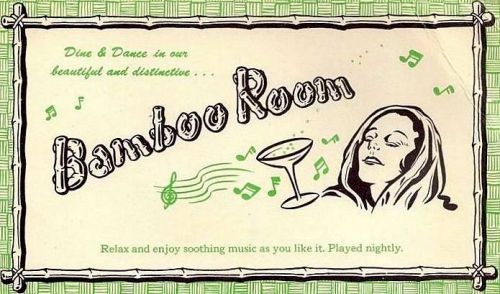
The fancy motel was five speedy minutes away from Love Field, which seems handy, because if you had an hour or seven to kill before your flight, wouldn’t you want to spend it there in the fabulous-looking Bamboo Room? I would! (Even though I’m pretty sure that matchbook cover is a little more glamorous than the actual Bamboo Room.)

If you were going to stay for a day or two and not just a few drinks, there were all sorts of things waiting for you: two pools (one a very large children’s wading pool), a theater, a croquet court AND a shuffleboard court, “circulating ice water,” and … stand back … a 2-station radio in every room. Somewhere in amongst all of this was a 46-unit trailer park (“with individual bathrooms”).

It’s not hard to see why they called the Tower Hotel Courts The Riviera of the South.”

tower-hotel_bw

tower-hotel-courts_postcard2

tower-hotel-courts_postcardUltra Modern!

tower-hotel-courts_pool-smOwner’s wife and kids?

tower-hotel-courts_pool_back

tower-hotel-courts_riviera

tower-hotel-courts_riviera_inside

tower-court-hotel_bamboo-room_flickr

tower-hotel-courts_pool-match_flickr-sm

***

First and last images from Flickr; Bamboo Room image also from Flickr.

Several of these pictures are larger when clicked.

*

Copyright © 2014 Paula Bosse. All Rights Reserved.

Swooning Over Love Field — 1940

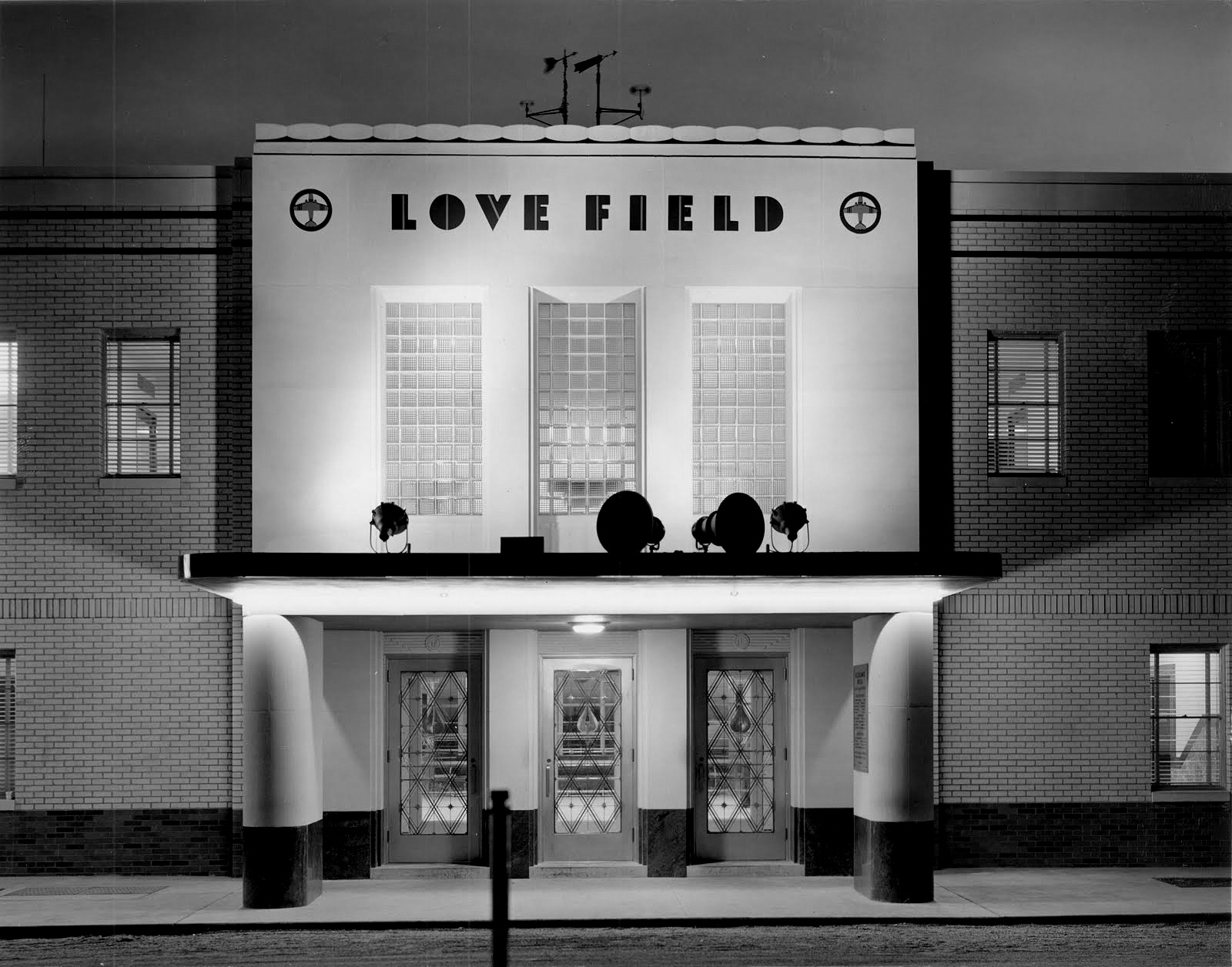
love-field_1940Art Deco Love Field!

by Paula Bosse

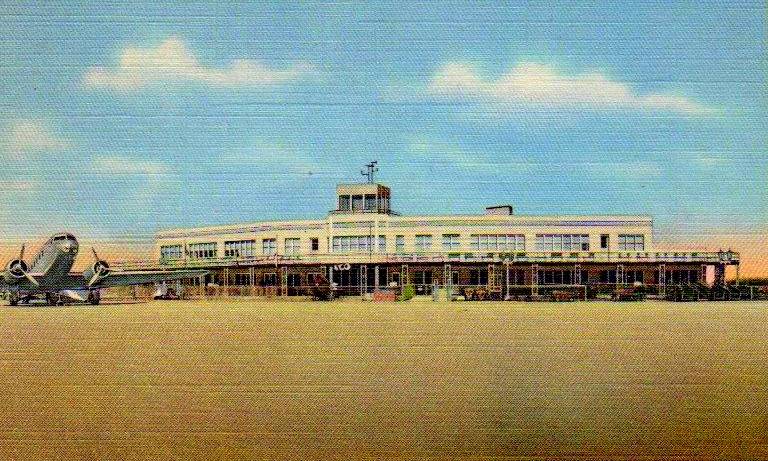
I’m a huge-fan of the modern 1950s-era Love Field (the one with the Mockingbird Lane entrance), but even that can’t trump this fantastic building! Designed by architect Thomas D. Broad, the new Love Field administration building and terminal — which faced Lemmon Avenue — was unveiled on October 6, 1940, to rapturous acclaim. The night view above is pretty breathtaking. Forget the airfield. For me, it’s all about this entrance. Those windows. And those doors. And that font! And those little airplane pictographs!

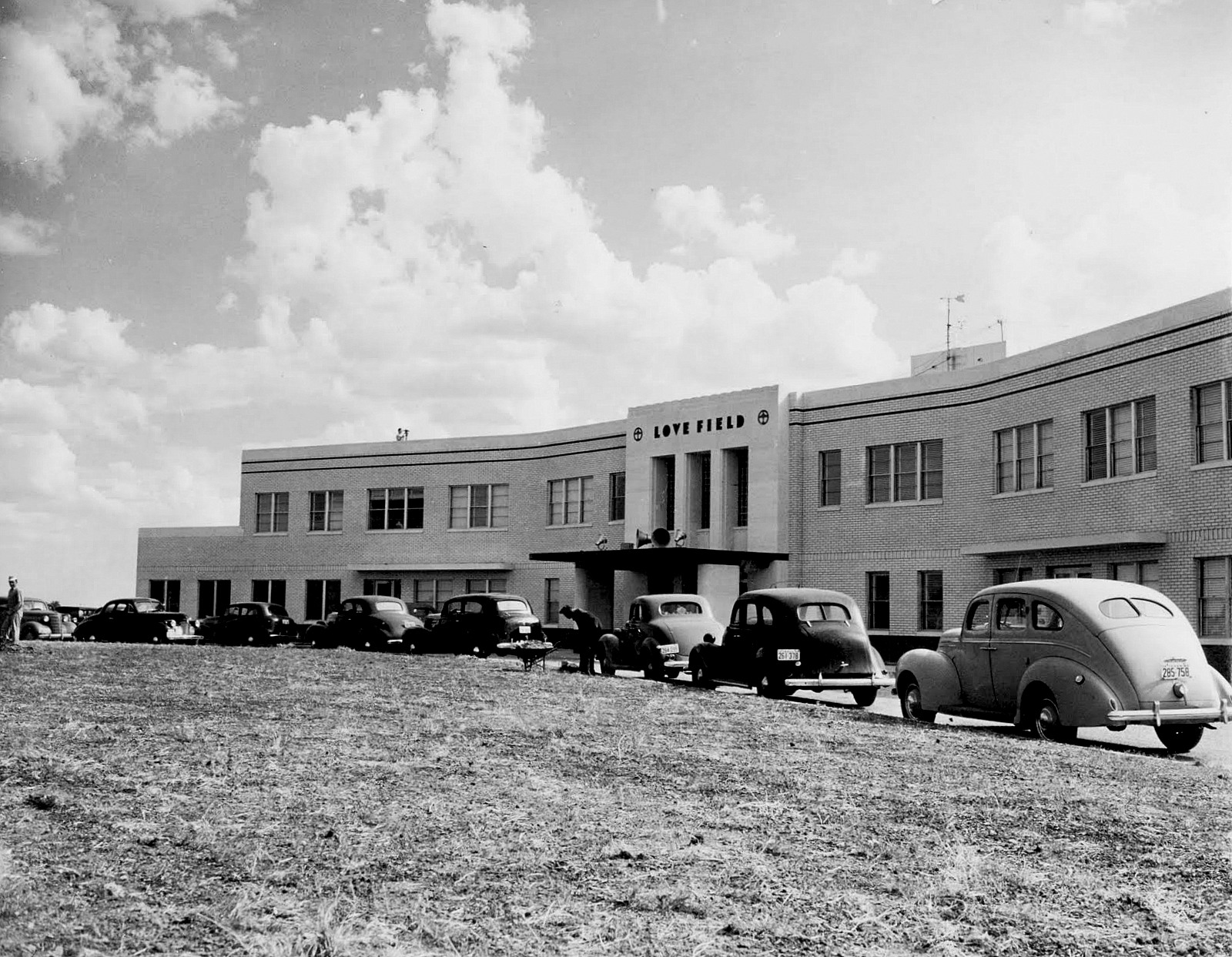
love-field_terminal_1940It wasn’t bad in the daytime, either — just nowhere near as dramatic. And in dire need of landscaping.

love-field_ca1940_frontAnd here it is from the field side. Still swoon-worthy. The back of this postcard reads:

LOVE FIELD — NEW $225,000 ADMINISTRATION BUILDING
One of America’s finest air terminals which takes care of more airline passengers, more air mail and more air express in ratio to population than any other airport in the country.

**

What happened to this beautiful building? I searched through the Dallas Morning News archives until I felt I had to throw in the towel, never finding a definitive answer. But here’s what I did find. When the brand-spanking-new terminal (the one we know today) opened in 1958, the 1940 terminal was vacated. A better word might be “abandoned.” Most assumed the building would be razed very soon after. But I got as far as September of 1964, and the old terminal was still standing. And it wasn’t pretty. This excerpt from a Dallas Morning News article is painful to read:

…The old terminal building cowers in desolation…. Virtually every window has been smashed, carpeting the deserted terminal with a dangerous floor of broken glass. Loose wires stick out here and there, and blinds hang in twisted postures from broken cords. The building’s big sign DALLLAS is missing its D. (DMN, July 2, 1961)

(And even more thoroughly painful is the article in the Dallas News archives by Kent Biffle, “Ghosts Wait by Runway” — DMN, Feb. 2, 1961.)

Apparently, the old building had to remain standing until a new “much-debated” new multi-million-dollar runway was agreed upon.

The point at which I threw in the towel in my quest to discover when the old terminal building had been demolished was a DMN photo from September 25, 1964, with the caption “$4,000,000-Plus Runway Progress. The 8,800-foot parallel runway at Dallas Love Field, left center, is two-thirds completed and should be ready for use next spring.” I am assured the photo has a hard-to-see old terminal still decaying in it. I assume they razed that sucker pretty soon afterward. …Possibly.

***

Sources & Notes

Top two photos are from the Love Field Collection, Dallas History and Archives, Dallas Public Library; accession numbers are PA83-13-8 for the swoony one at the top, and PA83-13-4 for the daylight exterior photo. I originally found these in the post “The New Love Field” by Jacob Haynes, here.

Click pictures for larger images — the first two are HUGE!

*

Copyright © 2014 Paula Bosse. All Rights Reserved.

“Mars Needs Women” — The Dallas Locations

1-mars-oak-lawnOak Lawn & Lemmon, 1966

by Paula Bosse

Chances are, if you’re a native Dallasite and you’re a cult movie buff, you’ve heard of Dallas filmmaker Larry Buchanan (1923-2004), the self-described “schlockmeister” who made a ton of low-budget movies in Dallas, almost all of which are considered to fall in the “so-bad-they’re-good” category. I’ve made it through only three of them, and while they’re definitely not great (or even good, really), there were moments I enjoyed.

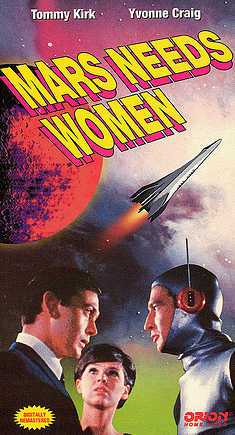
Buchanan’s most well-known movie — if only because the title has worked itself into the sci-fi vernacular — is Mars Needs Women, shot in Dallas in a couple of weeks in late 1966, starring former Disney child star Tommy Kirk and future star of “Batgirl,” Yvonne Craig. For me, the worst thing about the movie is its incredibly slow, molasses-like editing (courtesy of writer-director-editor Buchanan who was working on contract to churn out movies that had to be cut to a very specific running time, and he’s obviously padding here with interminably long scenes that drag and drag). And then there’s the dull stock footage and weird background music that I swear I’ve heard in every cheap Western ever made. Still … it has its charm.

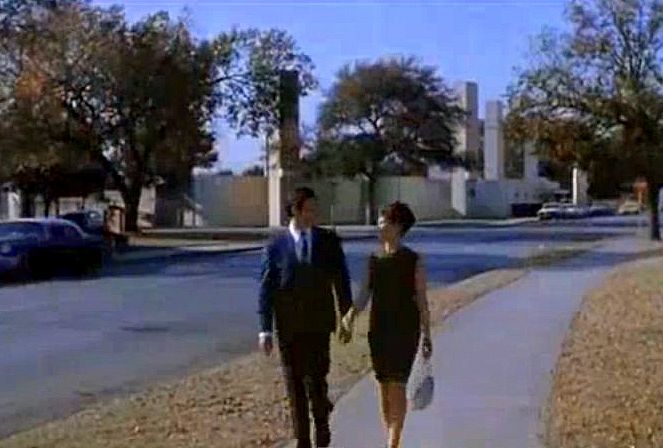
But the BEST thing about this movie (and, presumably, his others) is that it was shot entirely in Dallas, using a lot of instantly recognizable locations. (Every time I saw a place I knew, I perked up — it reminded me a bit of seeing Bottle Rocket for the first time — almost shocked to see common every-day places in an honest-to-god MOVIE!) So, if you don’t feel you can sit through the whole thing (available, by the way, in its entirety online — see link at bottom), I’ve watched it for you, with a whole bunch of screen shots. So feast your eyes on what Dallas looked like in November of 1966. (By the way, because the movie revolves around …. Mars needing women, the movie is actually set in Houston, home of the Johnson Space Center. Even though you see the very distinctive Dallas skyline — repeatedly. Houston! You wish, Houston!)

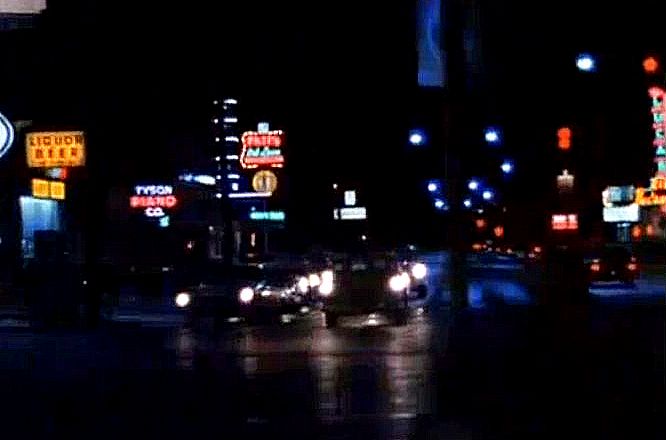
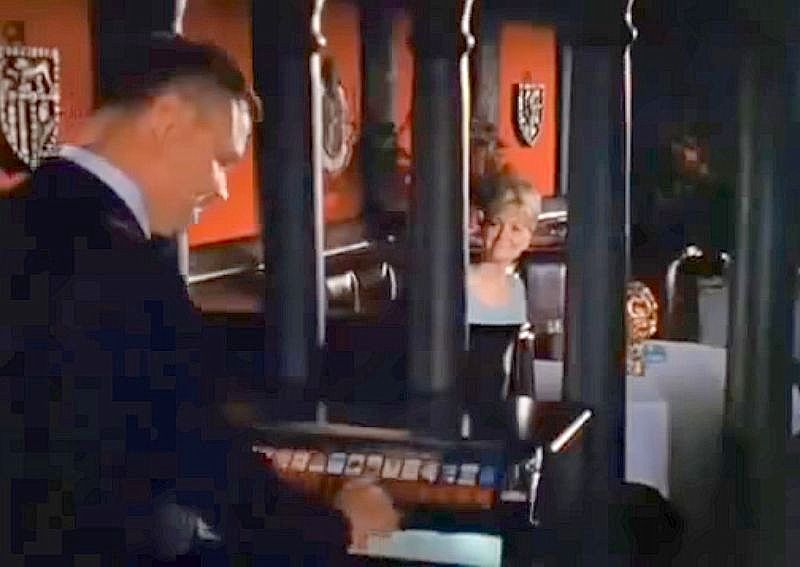
My favorite shot is the one at the top of this page and is seen in the first 90 seconds of the movie: Oak Lawn at Lemmon, with the familiar Lucas B & B sign at the right. This area was used a few more times. One character goes into the old Esquire theater, but, sadly, there was no establishing shot showing that great old neon sign. I think the first interior — showing a couple at a lounge — was shot in the swanky private club, Club Village, at 3211 Oak Lawn (at Hall), just a short hop from Oak Lawn and Lemmon.

1966_club-village_mars-needs-women

Next, we’re off to White Rock Lake.

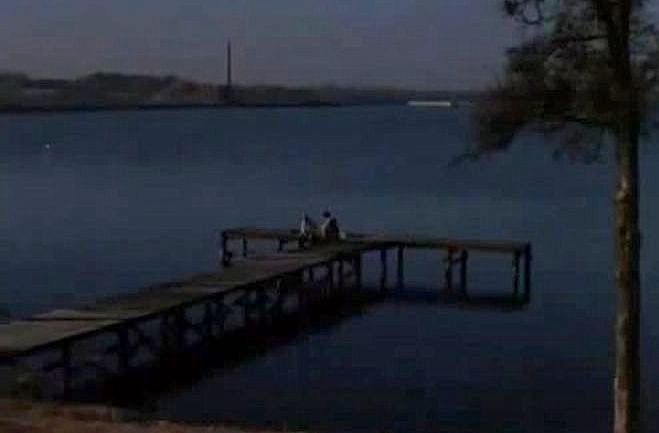
2-mars_pump1White Rock Lake. Shot day-for-night, with the pump station in the distance.

3-mars-pump2White Rock Lake pump station, where the Martians are headquartered as they search for healthy, single women to take back to Mars to help re-populate the planet.

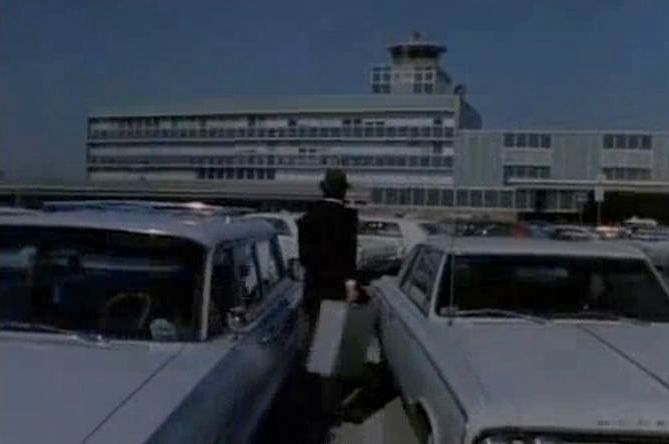
4-mars_love-field-extLove Field parking lot. Still shooting day-for-night. Badly.

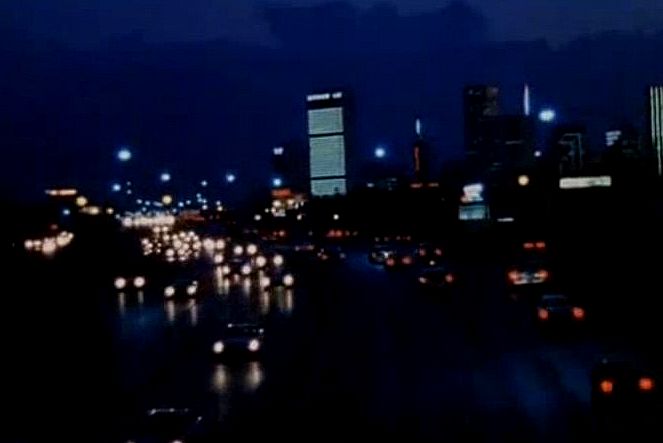
5- mars-southland-lifeThe Southland Life Building, etc., magically transported to Houston.

7-mars-athens-stripAthens Strip — a strip joint on Lower Greenville, one block north of the old Arcadia Theater. I’ve never heard of this place, but I came across the story of a guy who had visited the place back around this time and remembered one of the VERY unhappy dancers who hurled handfuls of the coins (!) that had been tossed onstage back into the audience, with such force that his face and chin sustained minor lacerations.

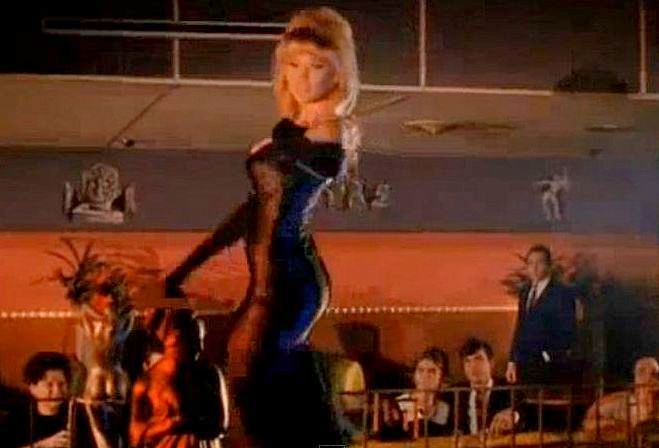
8-mars-needs-women_athens-strip_bubbles-cashLocal celebrity-stripper “Bubbles” Cash, inside Athens Strip. Plainclothes Martian (standing) ponders whether she has what it takes to birth a nation. (She does.)

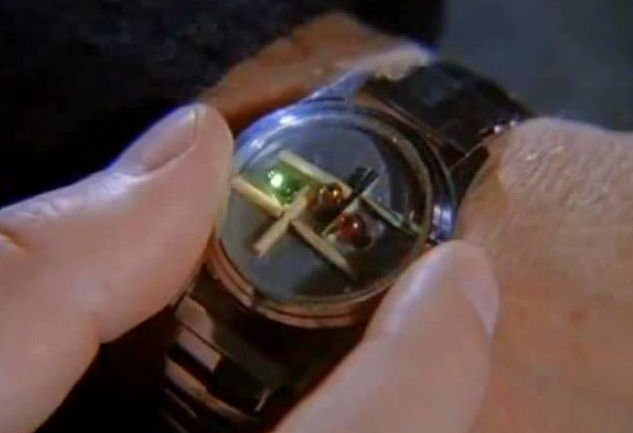
9-mars-watchMy favorite example of what a director is forced to resort to when there is no budget. This is some sort of sophisticated communication device. I think those are matchsticks.

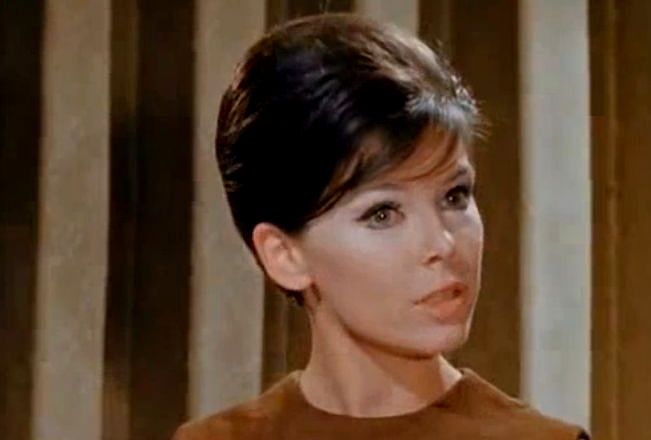
10-mars-yvonne-craigYvonne Craig, without a doubt the best actor in the movie. In fact, she’s really good. She had already made a few movies in Hollywood at this point, but the lure of a starring role brought her back to her hometown (where the newspapers reported she was happily staying with her parents during the two-week shoot).

11- mars-band-shellMartian #1 and sexy space geneticist strolling through Fair Park — band shell behind them, to the left.

12-mars-planetariumThe Fair Park planetarium.

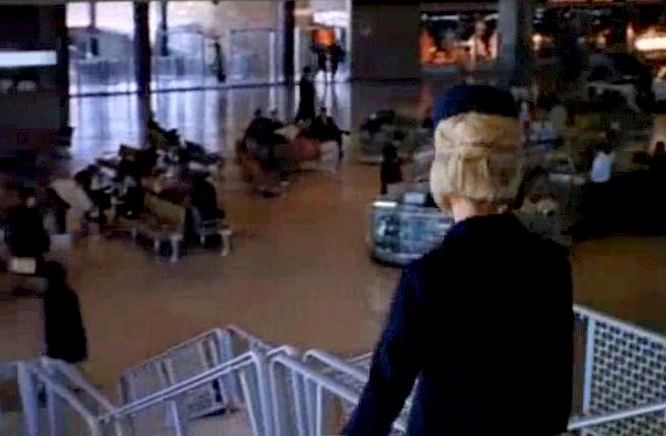
13-mars_love-fieldLove Field. I love the interior shots of the airport in this movie. (The stewardess walking down the stairs? Destined for Mars.)

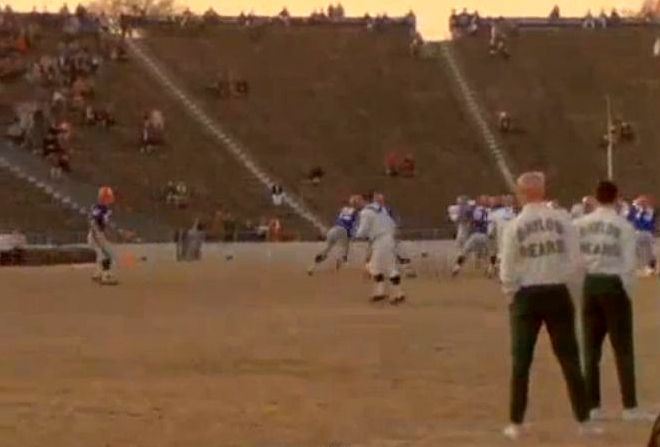
14-mars-cotton-bowlCotton Bowl, shot during a homecoming game between SMU and Baylor. Some shots show a packed stadium, some show this. Word of warning to the homecoming queen, Sherry Roberts: do NOT accept that flower delivery!

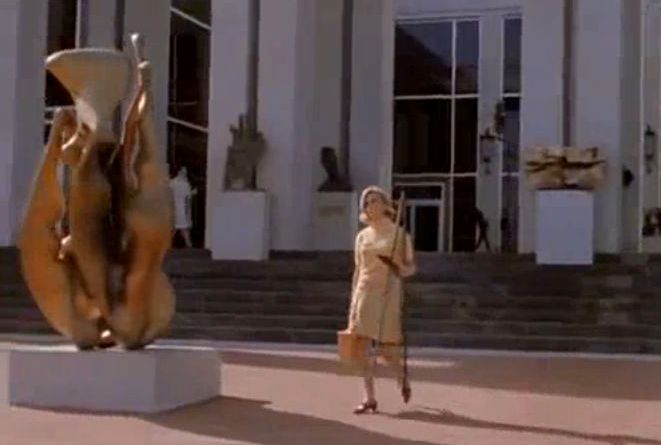
15-mars-meadowsSMU, Meadows School of the Arts. I love the pan across the front of the building. Mars Needs Co-Eds.

17-mars_BMOCSMU. BMOC (Big Martian On Campus).

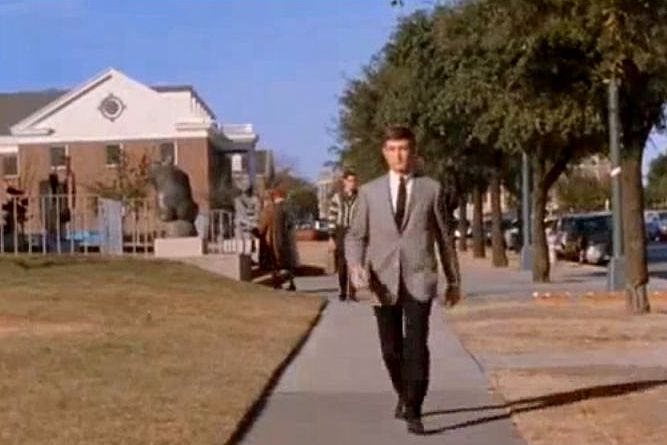
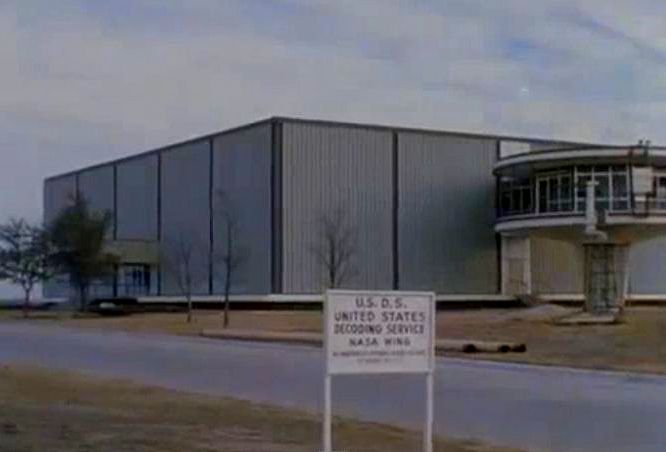
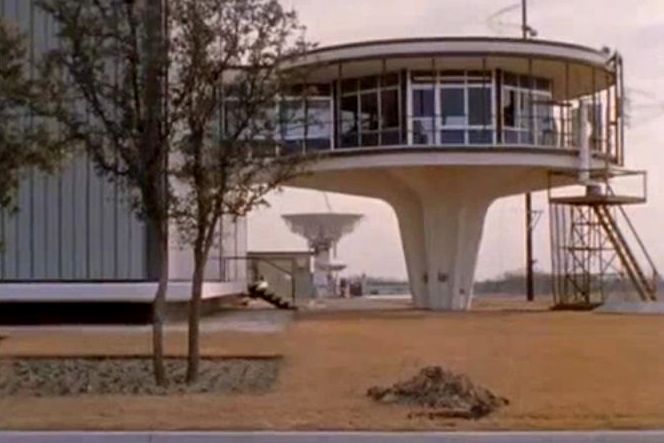
18-mars-collins-radioThe one location I couldn’t figure out. And it’s because it isn’t in Dallas. It’s the Collins Radio building in Richardson, a company that was absorbed by/bought out by/merged with Rockwell International. I think all the interior and exterior shots which are supposed to be NASA were shot here. How did a low-budget director like Larry Buchanan get into a place like that? According to a 1986 Texas Monthly article, Buchanan, in his day-job career as an ad-man, was hired by Collins Radio in 1961 to work in their “audio-visual” department” (the man who hired him was Harold Hoffman, whose later film work with Buchanan was done under the name Hal Dwain).

19-mars-collins-radioSo, yeah — COOL location.

20-mars_fair-parkMore Fair Park, more murky day-for-night.

21-mars_pump3White Rock Lake pump station, aka the Martian lair.

22-mars-saucerFANTASTIC flying saucer. Do the Martians get their five healthy, single women on board the ship and get them back home? You’ll have to watch it for yourself to find out.

23-mars-endYou tell ’em, Konnie.

mars-needs-women_VHS-box

Check back in a few days for more on Larry Buchanan (including a long-lost photo of him at work back in his advertising days in the 1950s).

UPDATE: Here it is — Larry Buchanan filming a Chrysler spot in the Katy railyard in 1955 for Dallas’ Jamieson Film Company, here.

***

Sources & Notes

The entire movie is on YouTube in a pretty good print. Watch it here.

Larry Buchanan Wikipedia page is here.

Mars Needs Women Wikipedia page is here.

Collins Radio/Rockwell Collins Wikipedia page is here.

Consult the Dallas Morning News archives to read a somewhat sarcastic Dallas Morning News article by Kent Biffle on the shooting of the Cotton Bowl sequence (I miss his Texana columns!): “That UFO Was a Field Goal” (Nov. 20, 1966).

*

Copyright © 2014 Paula Bosse. All Rights Reserved.

Braniff Hangar, Love Field — 1940s

by Paula Bosse

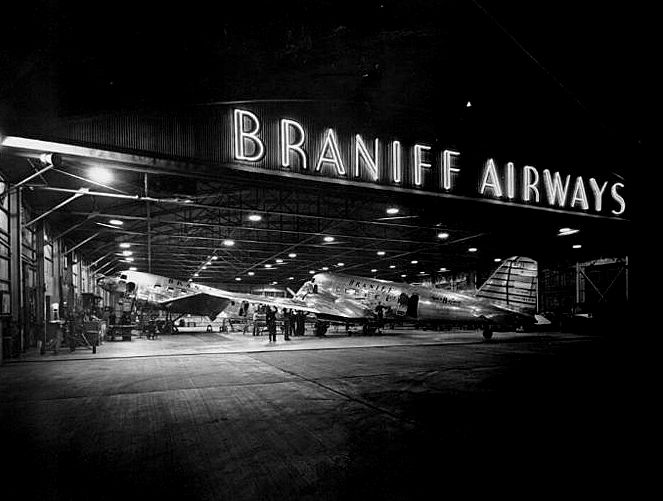
Overnight maintenance. Beautiful sign.

Photo caption:

Night maintenance at the Braniff hangar, main entrance on Roanoke Drive at Dallas Love Field, early 1940s.

Planes being serviced include a DC-2 and DC-3.

*

Copyright © 2014 Paula Bosse. All Rights Reserved.
From Deep in the Heart of Texas, I Give You Love Field — 1919

Love is in the air

by Paula Bosse

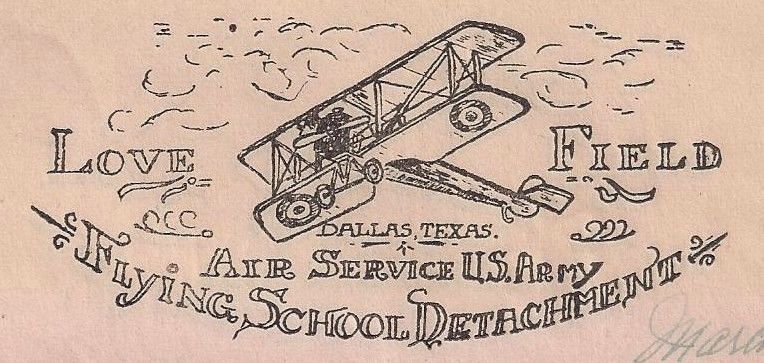
It’s Valentine’s Day — a perfect time to turn to Love Field (…which, like “Lovers Lane,” must sound a little cutesy to outsiders). The above image shows the letterhead of the U.S. Army Air Service Flying School Detachment, a consolidation of World War I squadrons based at Love Field from November 1918 to November 1919.
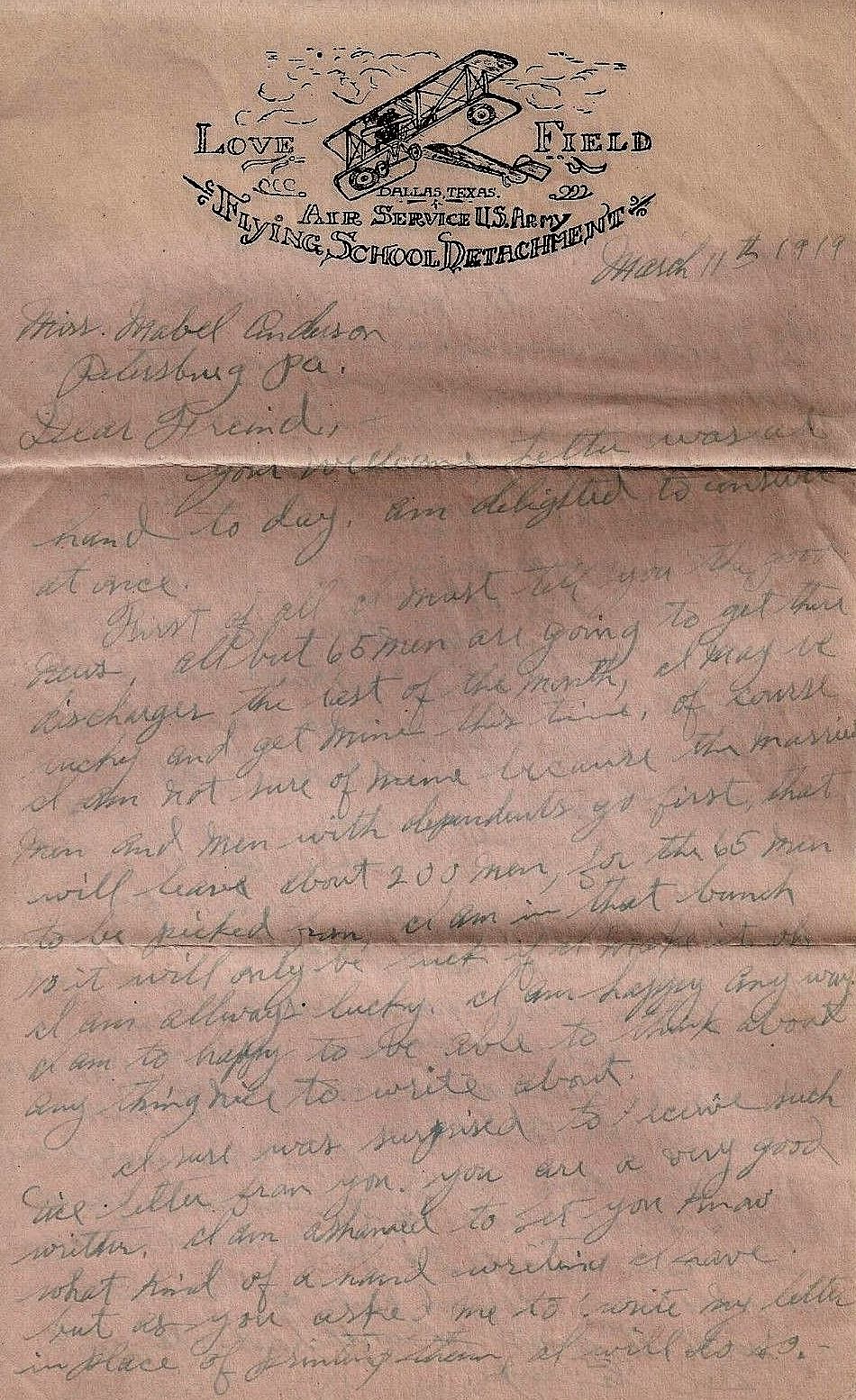
One of the young pilots stationed there wrote a four-page letter on this stationery. The letter, dated March 11, 1919, was addressed to Miss Mabel Anderson in Petersburg, Pennsylvania. They seem to have begun a sort of pen-pal correspondence, and he is certainly very happy to have received a letter from her. (“Your wellcome [sic] letter was at hand today. Am delighted to answer at once.”) He asks if she would send him a photograph and tells her he’d like to meet her. He says that he is hopeful that, the war finally over, he will be discharged at the end of the month — he thinks he will be because, “I am allways [sic] lucky.”

This is an item for sale on eBay, and only the first page is scanned, so the identity of the author of the letter will remain unknown to those of us merely browsing an auction listing, interested but unwilling to cough up the cash to buy it and read any further. I wonder what happened? If he wanted to meet her, then perhaps he, too, was from Pennsylvania — they might have met when he arrived back home. He certainly sounds excited and hopeful and flirtatious, and he should, because not only was he “allways lucky,” but the long war had finally ended and he was headed home with his whole life ahead of him. Where’s Paul Harvey to tell us the rest of the story?

Happy Valentine’s Day!

***

This four-page letter on Love Field letterhead was recently up for auction on eBay, with the following description: “Letter from airman to a young girl asking for her picture and wanting to meet her. Very early US Army Air Service stationery from Love Field in Dallas Texas. Just after the end of WWI. Scarce Item.”

Here is the first page, with a transcription (spelling corrected) below (click to see a larger image).

love-field_letter_1919

Miss Mabel Anderson
Petersburg, Pa.

Dear friend,

Your welcome letter was at hand today. Am delighted to answer at once.

First of all I must tell you the good news. All but 65 men are going to get their discharges the last of the month. I may be lucky and get mine this time. Of course I am not sure of mine because the married men and men with dependents go first. That will leave about 200 men, for the 65 men to be picked from. I am in that bunch, so it will only be luck if I make it ok. I am always lucky. I am happy anyway. I am too happy to be able to think about anything nice to write about.

I sure was surprised to receive such a nice letter from you. You are a very good writer. I am ashamed to let you know what kind of a handwriting I have, but as you asked me to write my letter in place of printing [it], I will do so.

*

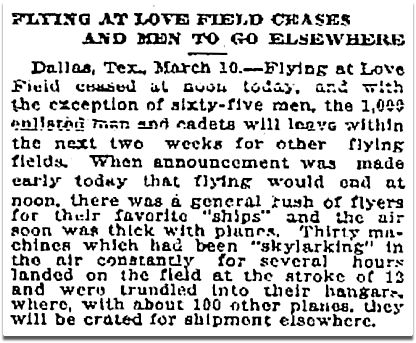
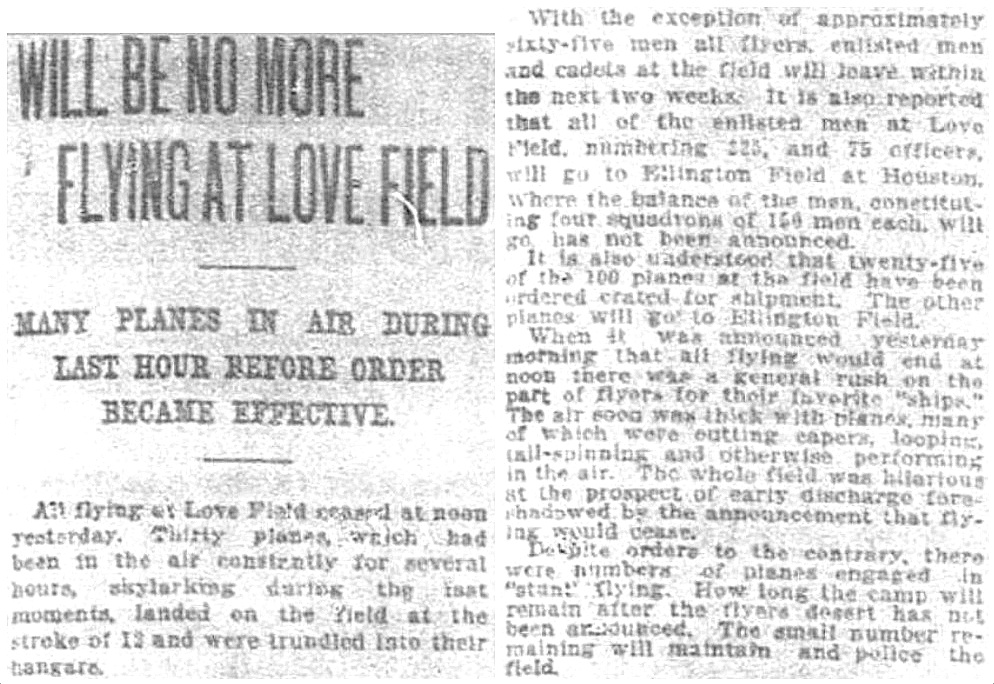
Here are two stories about how the airmen stationed at Love Field responded to the announcement that all flying would cease at noon on March 10, 1919 before demobilization began. It sounds like something from a movie: a sky full of something like 30 airplanes looping and “skylarking,” their pilots celebrating their fast-approaching military discharge by flying their favorite “machines” for the last time.

love-field_galveston-news_031119Galveston News, March 11, 1919

love-field_dmn_031119Dallas Morning News, March 11, 1919 (click for larger image)

*

Copyright © 2014 Paula Bosse. All Rights Reserved.