Flashback : Dallas

A Miscellany: History, Ads, Pop Culture

Category: Neighborhoods

Dome, No Dome, Dome

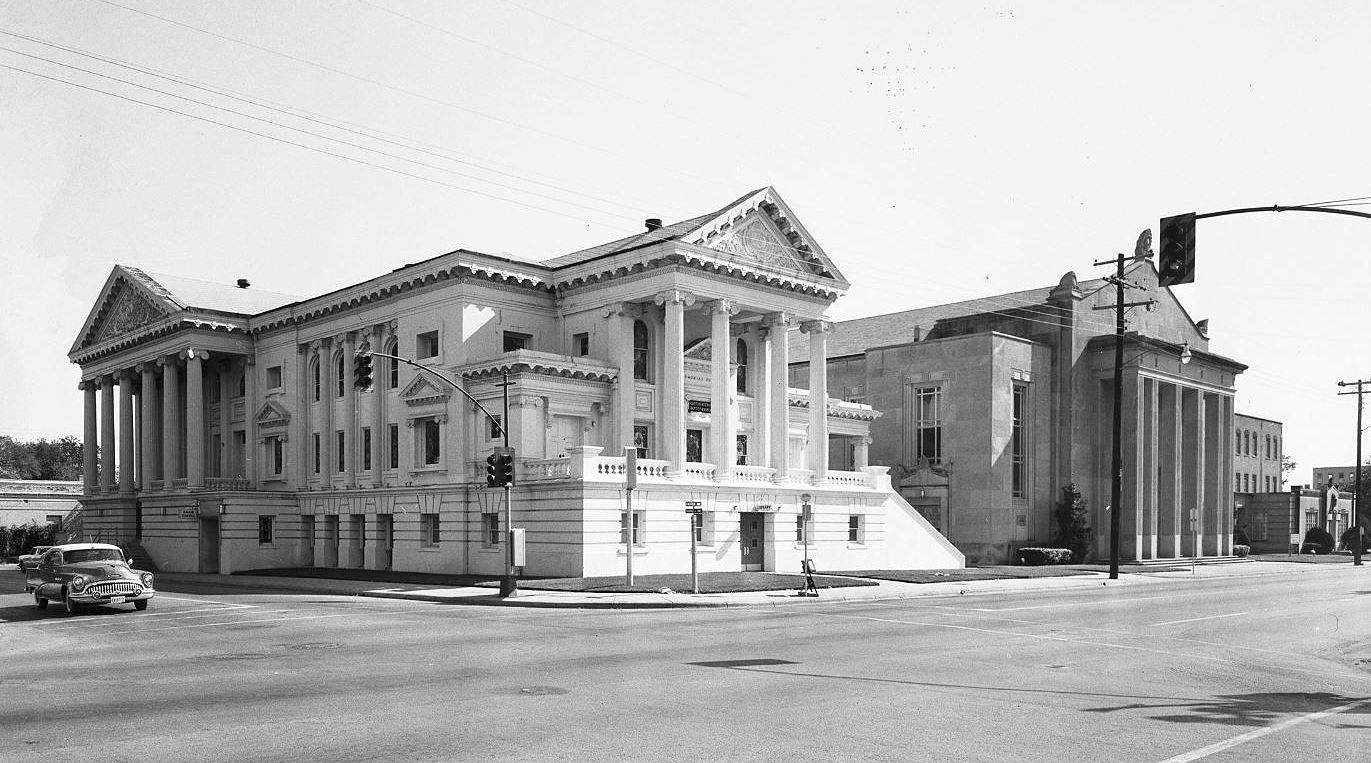
Gaston Ave. Baptist Church, ca. 1961, domeless

by Paula Bosse

Gaston Avenue Baptist Church, at Gaston and Haskell, opened to its congregation in 1904. (The photo above is from about 1961.) The church was designed by architect C. W. Bulger, whose most important Dallas building was almost certainly the Praetorian Building downtown. Bulger was a prominent architect and a prominent Baptist — he designed several Baptist churches, and, conveniently, he lived on Junius Street, not far from the Gaston Avenue church.

This building is imposing and impressive, but every time I drive past it, something just feels “off.” (See it on Google Street View here.) It’s that canary-yellow “gold” dome. Otherwise, it’s a beautiful building.

Here’s what it looked like in its earliest days:
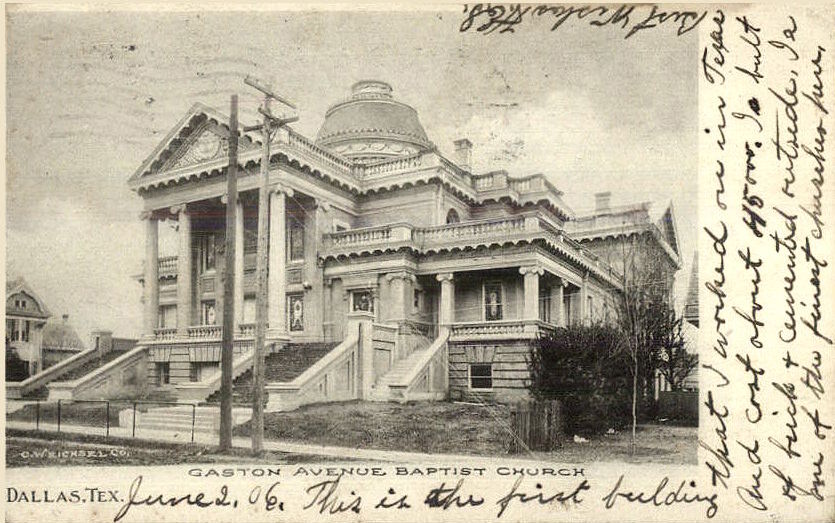
This postcard was postmarked June 2, 1906 — the message reads:

June 2, 06. This is the first building that I worked on in Texas and cost about 45,000. Is built of brick and cemented outside. Is one of the finest churches here. Best wishes, H.E.S.

And another:
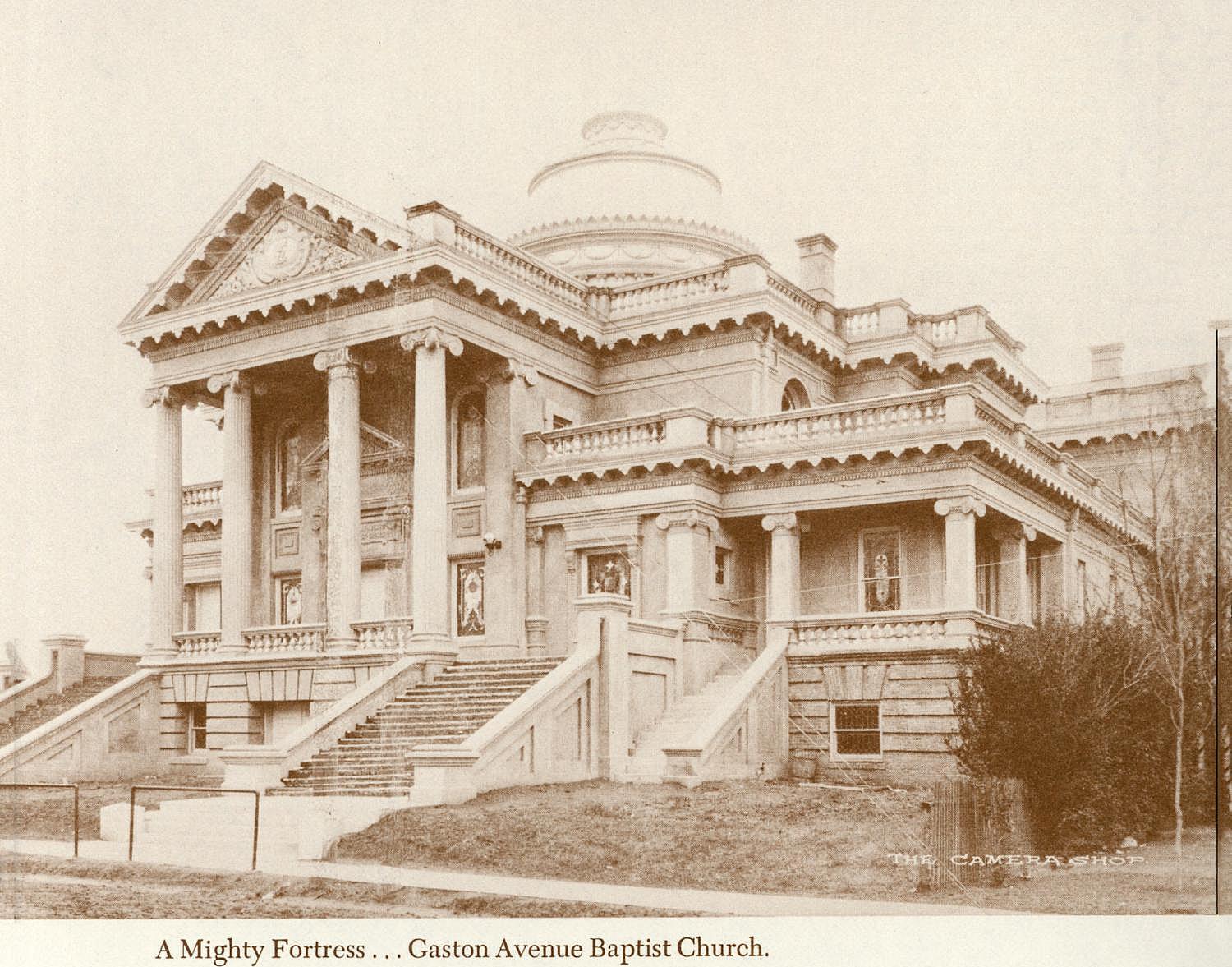
When you compare the early photos with the one from 1961, there are a few differences. Namely… the dome (…or lack thereof). It was built with a dome. But by 1961, the dome was gone. Why?

Here is what the building looks like these days (it is now the home of Criswell College):
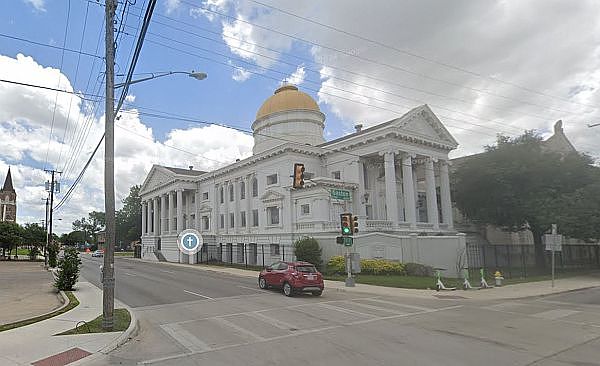
Google Street View, June 2024

Dome.

What’s the deal here? I hate to be a negative Nellie, but every time I drive past that dome (which is often), I wince. It looks like sun-faded matte gold paint. It’s a beautiful building. It deserves a better dome!

After searching a bit, here’s what I found. In response to a reader’s question in 1991 asking what the “golden dome” was made of, The News responded:

MFG Molded Fiberglass in Union City, Pa. fabricated it of 1/2-inch molded fiberglass impregnated with gold-flecked paint… Both the dome and the bay section — the white collar that protrudes from the roof line — are composed of 12 separate pieces… The dome’s cap is composed of four pieces… and the spire that tops the structure is a single unit… [T]he structure stands approximately 35 feet above the roof of the library and weighs about 6,000 lbs. (Dallas Morning News, June 6, 1991)

Fiberglass, impregnated with gold-flecked paint. I don’t know when this happened, but more than 33 years ago. The gold-flecked paint has seen better days, beaten into submission by the relentless Texas sun. I’m sure it would probably cost a small fortune to spruce it up, but it would be nice to see it gold and shiny.

***

Sources & Notes

Top photo by Squire Haskins, from the Squire Haskins Photography, Inc. Collection, University of Texas at Arlington Libraries, Special Collections; more info on this photo is here (see interior photos taken by Haskins at the same time here and here).

Postcard was found on eBay.

The photo captioned “A Mighty Fortress” is from a TSHA Annual Meeting 1977 publication, via the Portal to Texas History.

*

Copyright © 2024 Paula Bosse. All Rights Reserved.
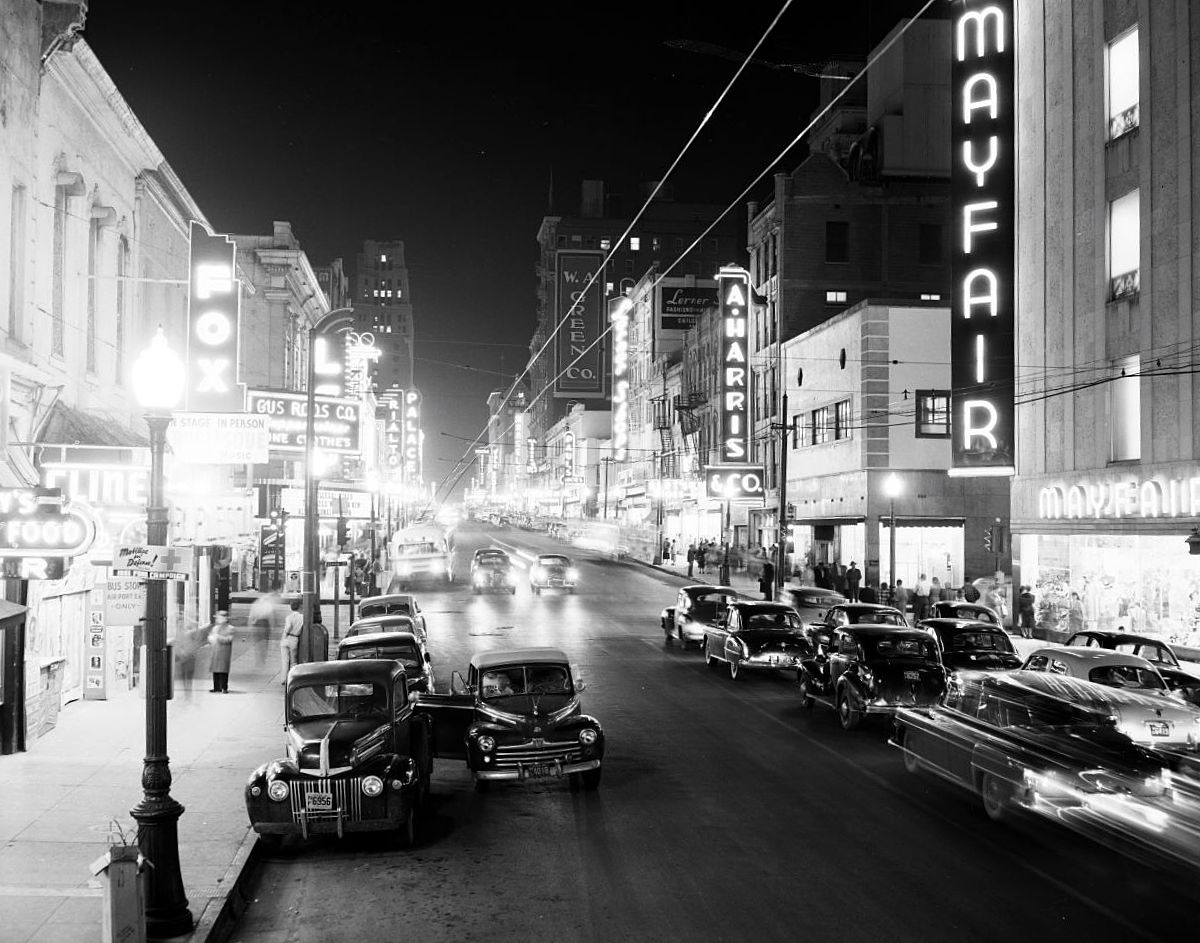
The Bright Lights of Big D — 1951

…Forget all your worries, forget all your cares…

by Paula Bosse

This is the downtown Dallas I’ve always wished I had seen.

Check out a clipping from the 1953 city directory for a list of the businesses in this immediate block, from about Akard to Ervay, here.

Then click over to the 2015 post “Dazzling Neon, Theater Row — 1929” to see how drastically Elm Street — and Movie Row — changed in just 22 years.

***

Sources & Notes

Photo by Denny Hayes, Hayes Collection, Dallas History and Archives, Dallas Public Library; Call Number PA76-1-576-2.

*

Copyright © 2024 Paula Bosse. All Rights Reserved.
Flashback Newsflash: Working at the Library

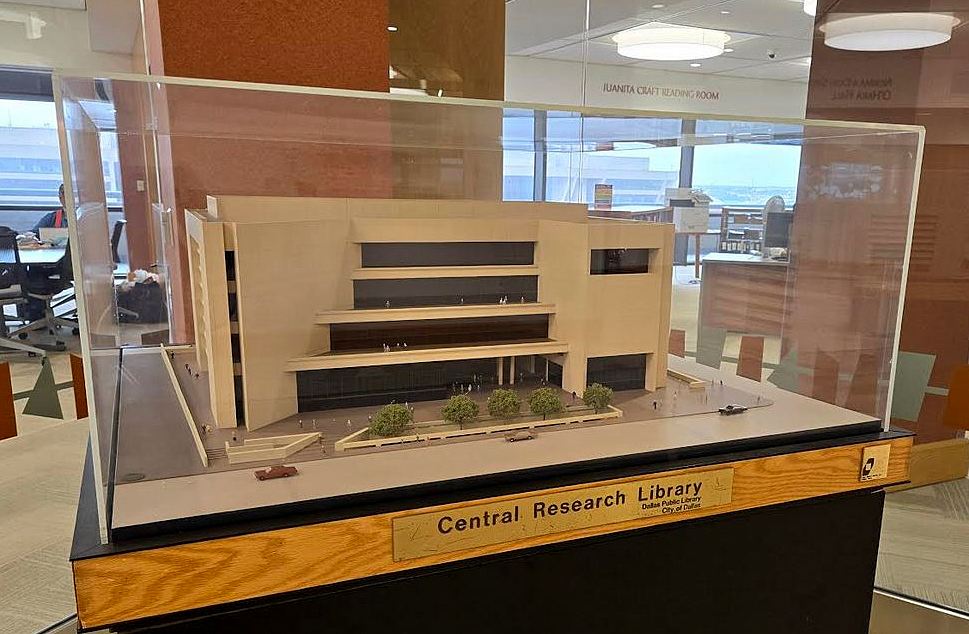
“Central Research Library”

by Paula Bosse

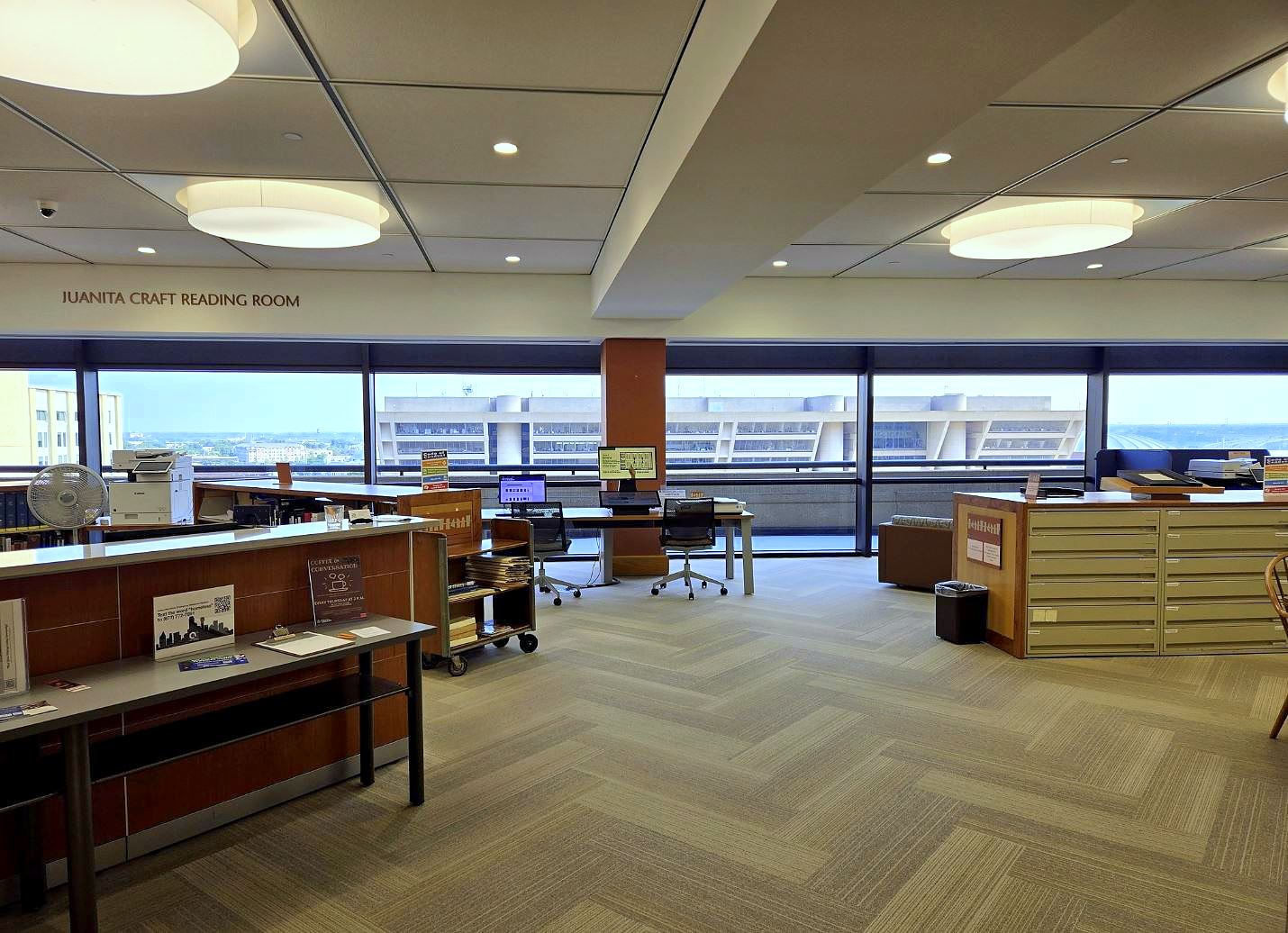
I have news: I am now working on the Dallas History and Archives floor at the downtown Dallas Public Library! I am surrounded by so many interesting things every day that it’s hard not to be distracted by all the photos, maps, books, manuscript collections, etc. Cool stuff everywhere. And great co-workers!

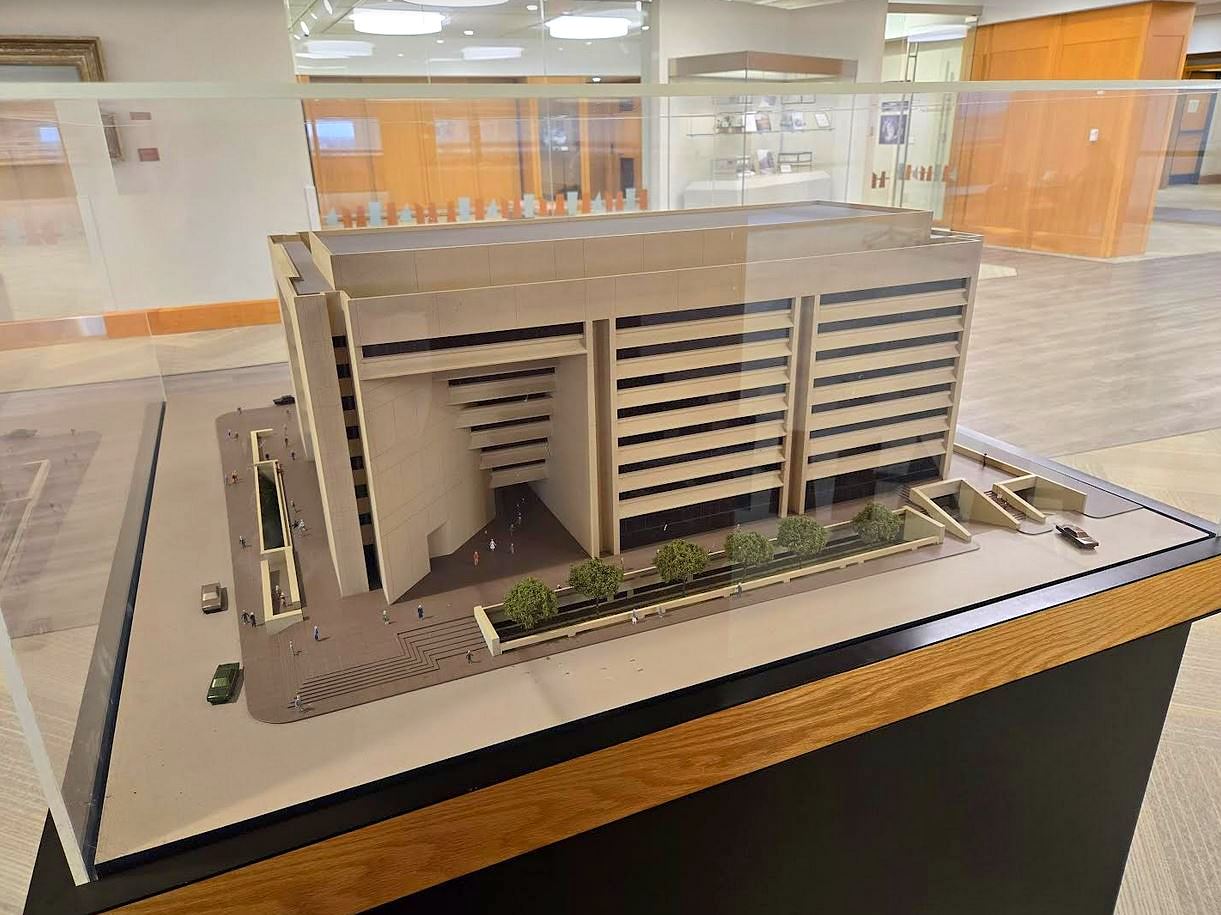
I might as well take this opportunity to share a few tidbits about the building (at 1515 Young Street, facing City Hall).

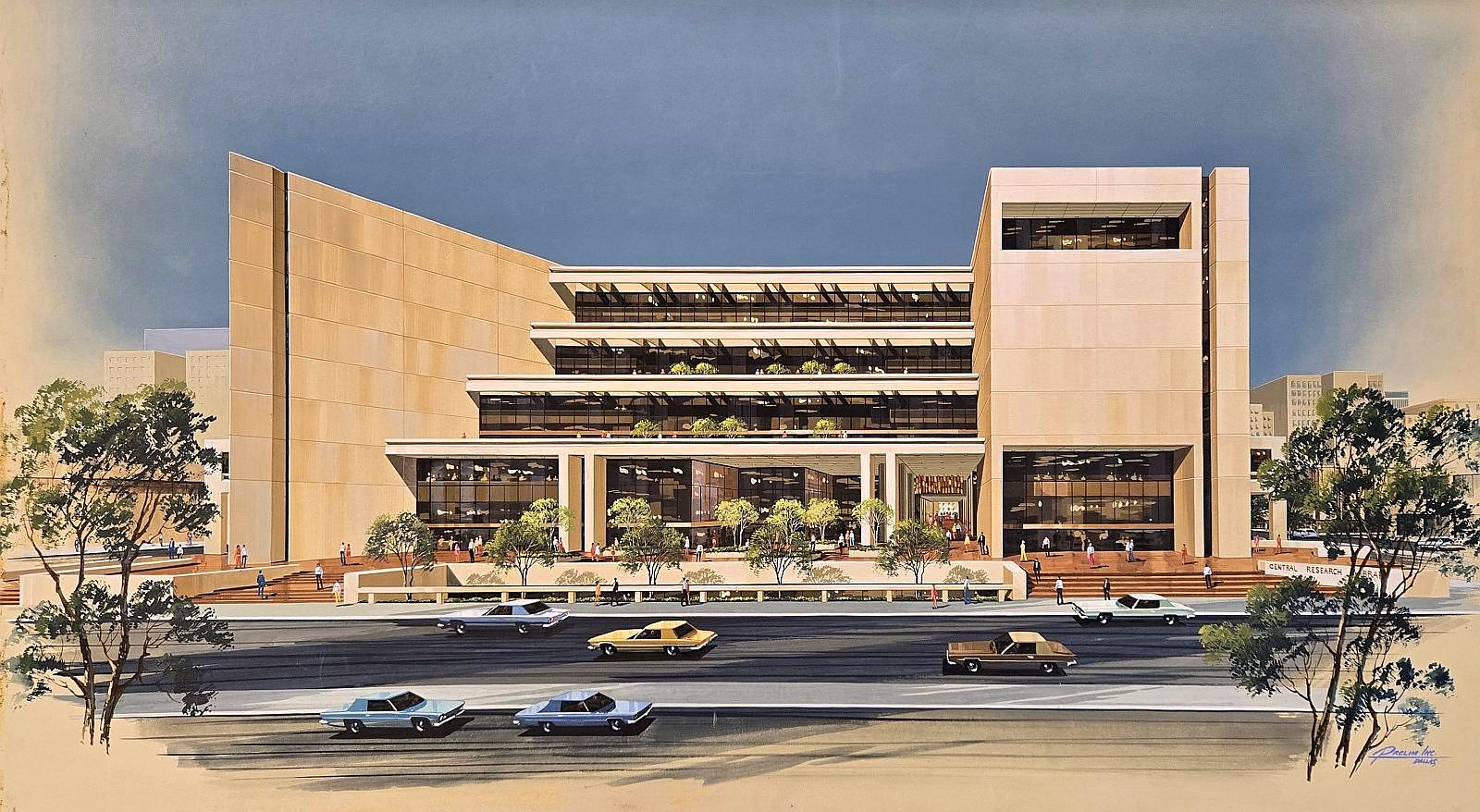
As you can see from the 3-D architectural model above (the model is on permanent display on the 7th floor), the library was originally referred to as “Central Research Library” when it opened in April 1982 (it was later renamed the J. Erik Jonsson Central Library, in honor of the former mayor). I’m not sure I knew that. Here’s another photo, showing the Wood Street side of the model:

When this library opened, it was the only major library (in the world, I think) that had its entire collection cataloged electronically. Bye-bye to card catalog files and their cute little drawers and hello to desktop computers, 50 of which were donated by Texas Instruments (Erik Jonsson was a founder of T.I.). These were for use by patrons, and, for many of them, these computers were their first experience with a personal computer.

Here is another interesting factoid from a Dallas Morning News article touting the new library’s innovations:

Special exhibits are housed in rooms protected by halon gas, an oxygen-consuming gas that will be released if a fire breaks out, removing all the oxygen and starving the fire. (DMN, April 18, 1982)

The architects were Fisher & Spillman, and they designed the building to be something of a stylistically sympathetic companion to I. M. Pei’s City Hall right across the street. This is the view of it I see every day (and, yes, I think of RoboCop every day):

I can’t believe this building — which I still think of being fairly “new” — is 42 years old. Time flies. Read about the journey of this library, from bond proposal to dedication, in a D Magazine article by my co-worker Brandon Murray, here (check out the slideshow).

*

I’m very excited about my new job, surrounded by Dallas and Texas history. Much of my childhood was spent in my local library (the Lakewood Branch), and the occasional trip to the downtown library on Commerce Street, which predated the one I now work in, was always something of a magical experience. And now I’m back, just on the other side of the desk.

If you’re ever in the neighborhood, stop by and say hi!

***

Sources & Notes

All photos by me, taken in the summer of 2024.

The architectural rendering by Fisher & Spillman is from the Dallas Public Library Archives.

A version of this post appeared on the Flashback Dallas Patreon page.

*

Copyright © 2024 Paula Bosse. All Rights Reserved.
Labor Day Weekend, 1952 (Redux)

labor-day_083152_denny-hayes_PA76-1-11420-002_webWaiting for the fun to start… (photo: Dallas Public Library)

by Paula Bosse

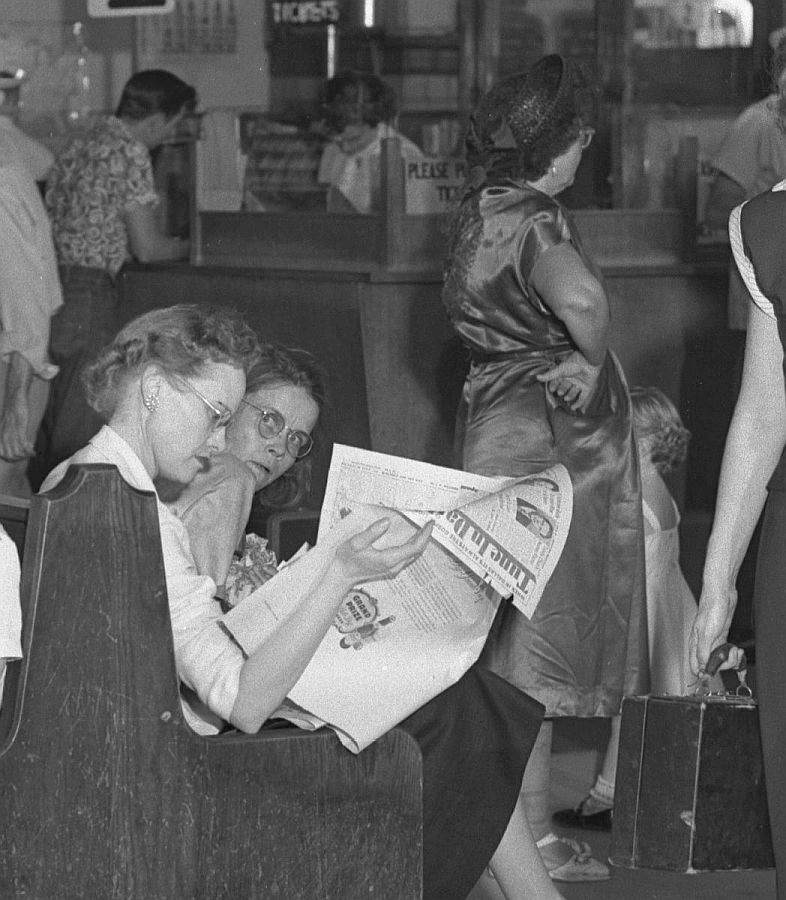
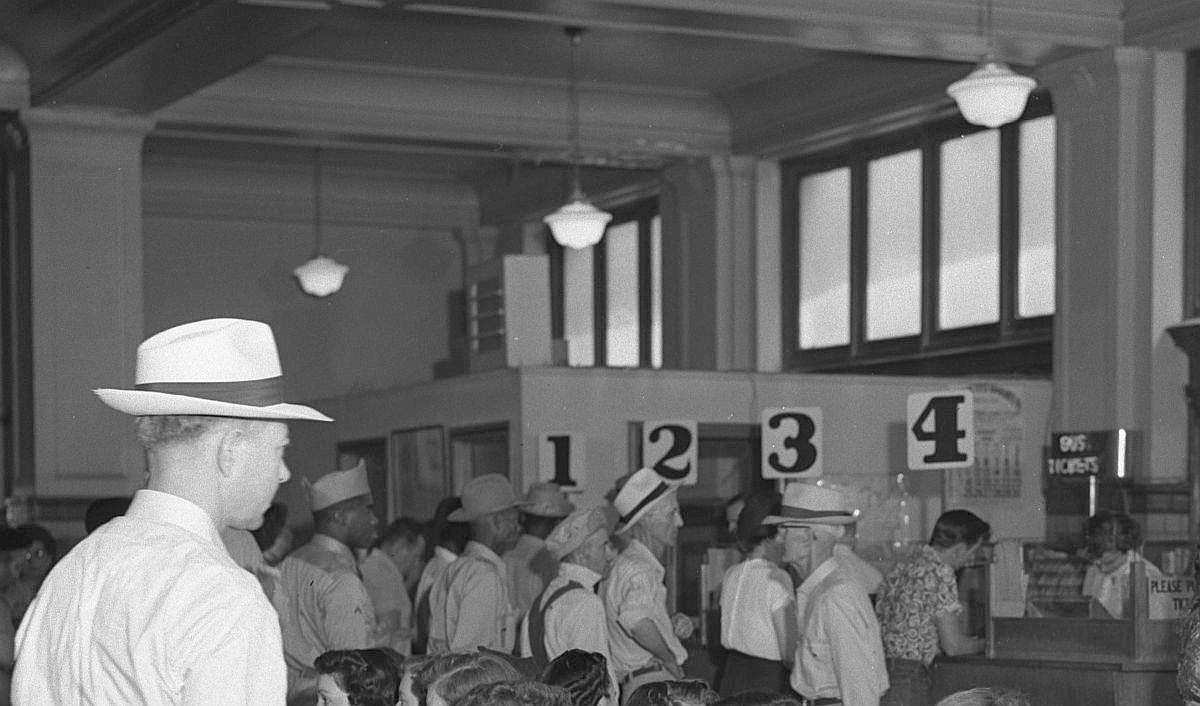
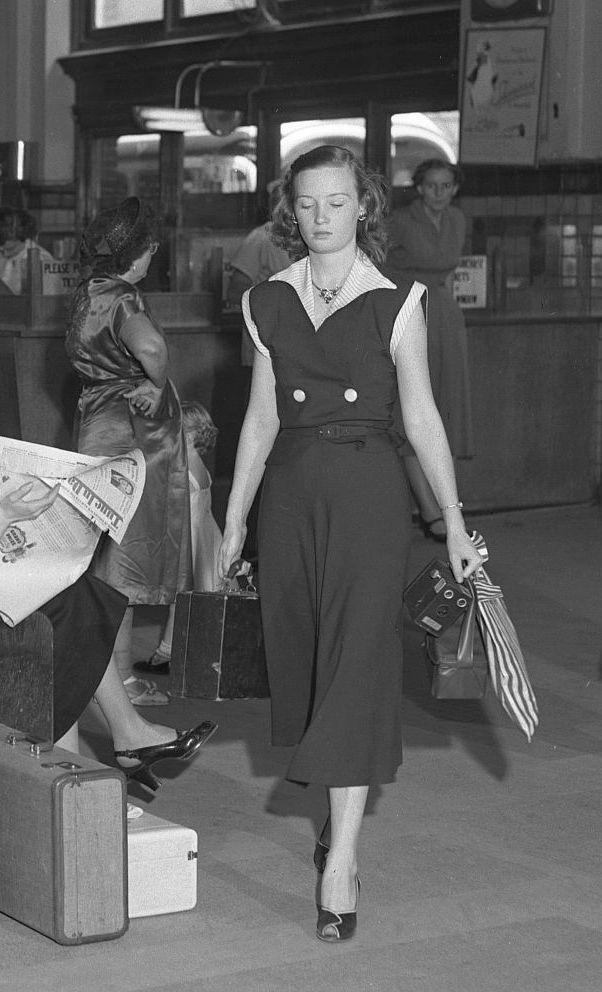
Happy Labor Day! Back in 2020 I wrote a post called “Labor Day Weekend, Union Bus Depot — 1952.” I really enjoyed writing that one, and I loved the main photo in it. It turns out that the photo I’m using in this post was taken only a couple of minutes before the one I used four years ago. I discovered this photo a few weeks ago and have been waiting for Labor Day to roll around. Which it has now done.

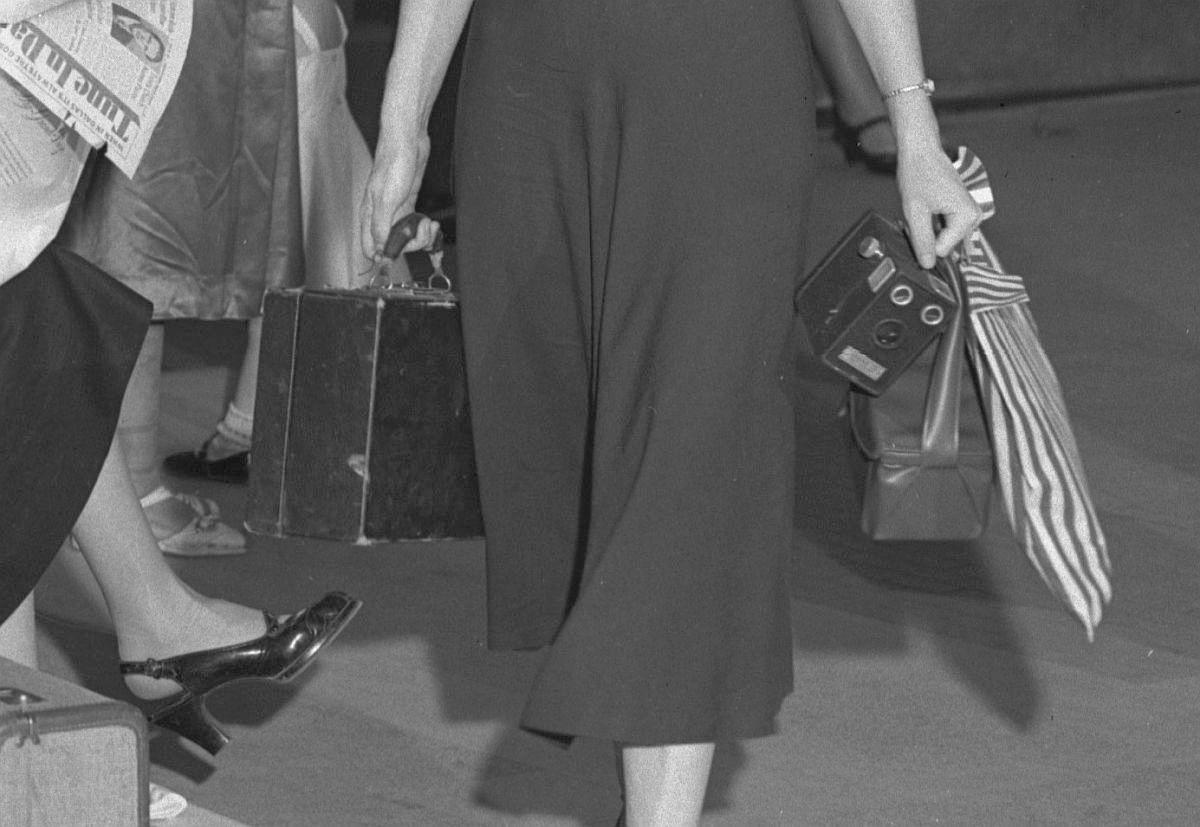
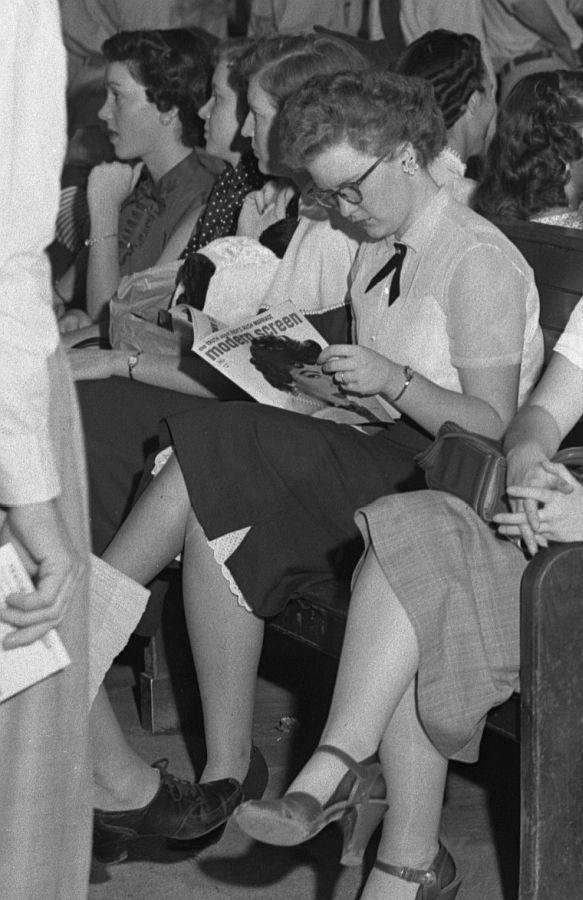
On August 31, 1952, Dallas photographer Denny Hayes took several photos of travelers waiting to be whisked away to someplace else. (With luck, someplace cooler.) These photos were taken at the Union Bus Depot in the Interurban Building. Let’s zoom in on this great people-packed photo.

Everyone and everything pales in comparison to the young woman walking toward the camera. In her left hand she holds a box camera. She’s ready to take fun photos, if she ever gets out of that station.

labor-day_083152_denny-hayes_PA76-1-11420-002_woman

labor-day_083152_denny-hayes_PA76-1-11420-002_woman_camera

labor-day_083152_denny-hayes_PA76-1-11420-002_modern-screen

labor-day_083152_denny-hayes_PA76-1-11420-002_waiting

labor-day_083152_denny-hayes_PA76-1-11420-002_queue

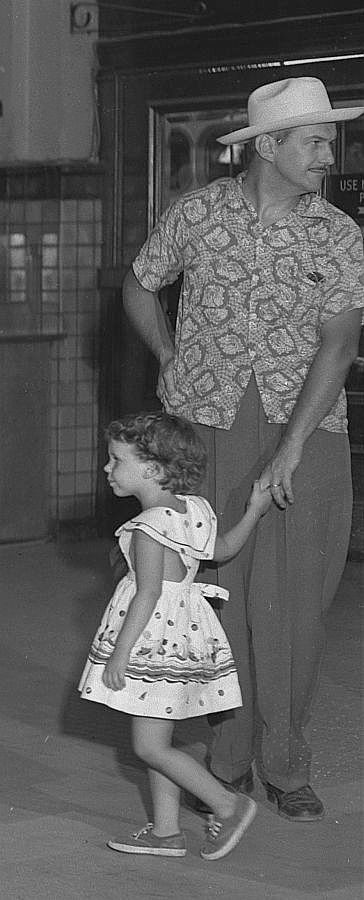
labor-day_083152_denny-hayes_PA76-1-11420-002_father-daughter

(If the man above looked any more like Harvey Korman, he’d be Harvey Korman.)

*

If you have the day off, I hope you enjoy it. And if you’re traveling somewhere, I hope you get there quickly!

***

Sources & Notes

Photo by Denny Hayes, from the Hayes Collection, Dallas Public Library, Dallas History and Archives; Call Number: PA76-1/11420-002.

See the companion post, “Labor Day Weekend, Union Bus Depot — 1952,” and see how many people made it into both photos.

labor-day_083152_denny-hayes_PA76-1-11420-002_web

*

Copyright © 2024 Paula Bosse. All Rights Reserved.
Telesign: Flashing News to Downtown Dallas — 1951

telesign_trusts-and-estates-mag_march-1953_photoAll the news that fits… on a moving sign

by Paula Bosse

Well, this is pretty interesting.

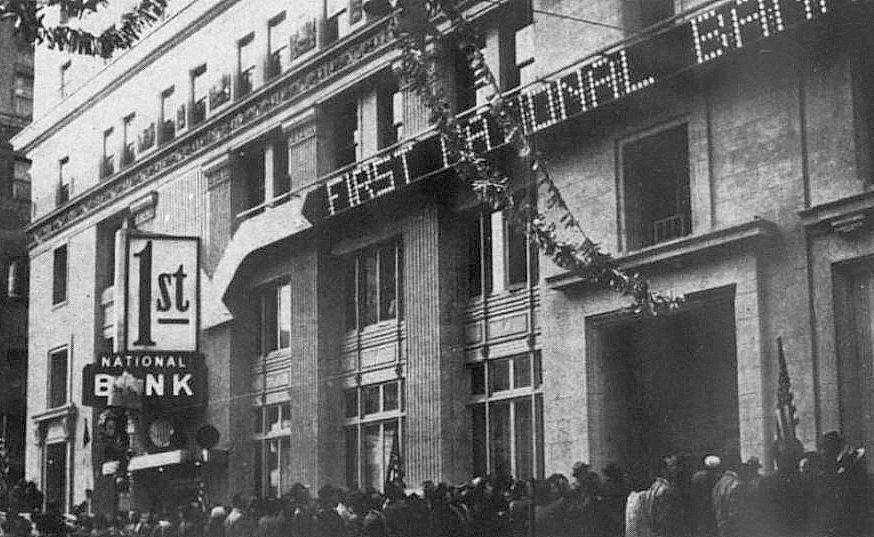
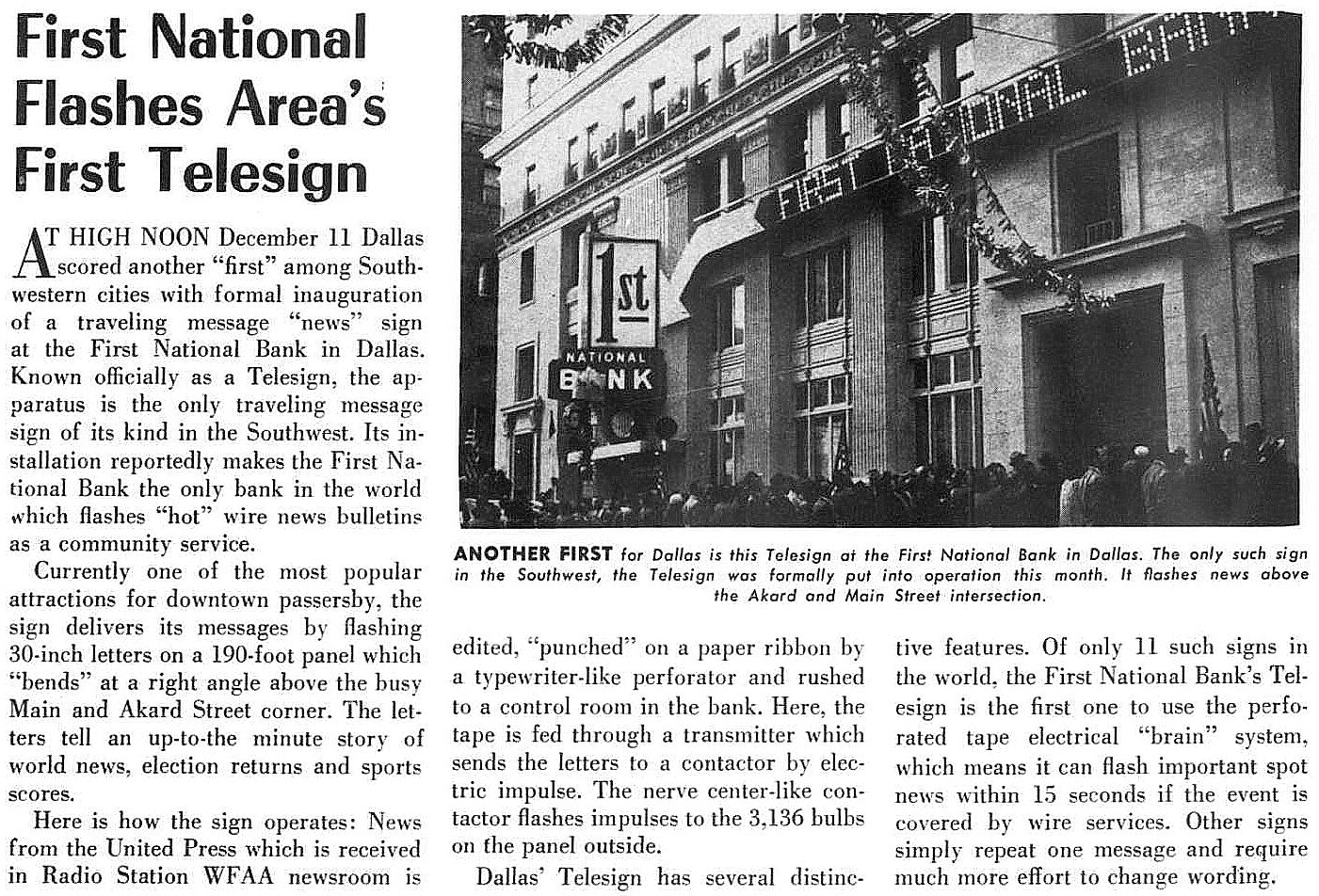
Once upon a time, downtown Dallas had one of those moving “tickertape” electronic news message signs. It debuted on the exterior of the First National Bank (and part of an adjacent building) at Main and Akard on December 11, 1951. It was Dallas’ version of the famous New York Times news-ticker-bulletin sign (“the Zipper”) in Times Square. The sign was comprised of 3,136 light bulbs; the crawling, flashing letters were 30 inches high, and the sign stretched 190 feet, with the moving message bending around the bank building. The “hot news” could be really “hot” — like only minutes old, unlike the NYT sign, which could take hours to get a constantly repeating message up and running. The sign flashed the news to downtown passersby from 7:30 AM until 10:30 PM.

This “traveling-message” sign was the creation of Irving Naxon, of the Naxon Telesign Corporation of Chicago. (Naxon, a prolific inventor, is perhaps best known as the man who introduced the Crock Pot slow cooker to the world.) See the 1929 patent application for his “traveling-message sign” here.

How did it work? Briefly, United Press wire copy received in the WFAA newsroom was punched onto a paper ribbon and then fed into a transmitter. Theoretically, a hot-off-the-wire newsflash could be racing across the Main Street sign in the amount of time it would take to type the message — seconds. (Read more about it the article at the bottom of this post.)

There is silent footage from December 1951 of the Telesign in action, with shots of inventor Irving Naxon demonstrating how his system works: see the WBAP-TV footage on the Portal to Texas History website here. (The accompanying news script is here.)

I don’t know how long this sign was operational, but I have a feeling it wasn’t very long — but at least through 1953. Imagine how frequently those 3,000 light bulbs burned out and had to be replaced! I had never heard of this sign — or seen photos of it — so this was a very interesting little discovery.

**

news-scroll_dallas-mag-dec-1951_photo-detDallas magazine, Dec. 1951

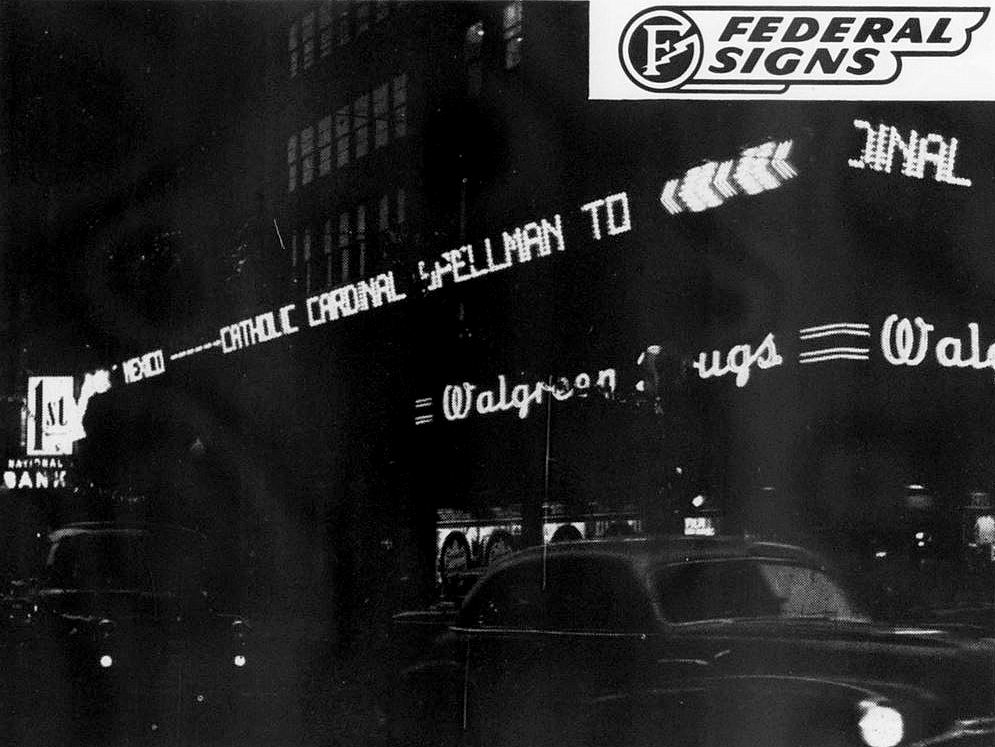
A 1953 ad for Federal Signs:

telesign_dallas-mag_jan-1953_advertDallas magazine, Jan. 1953

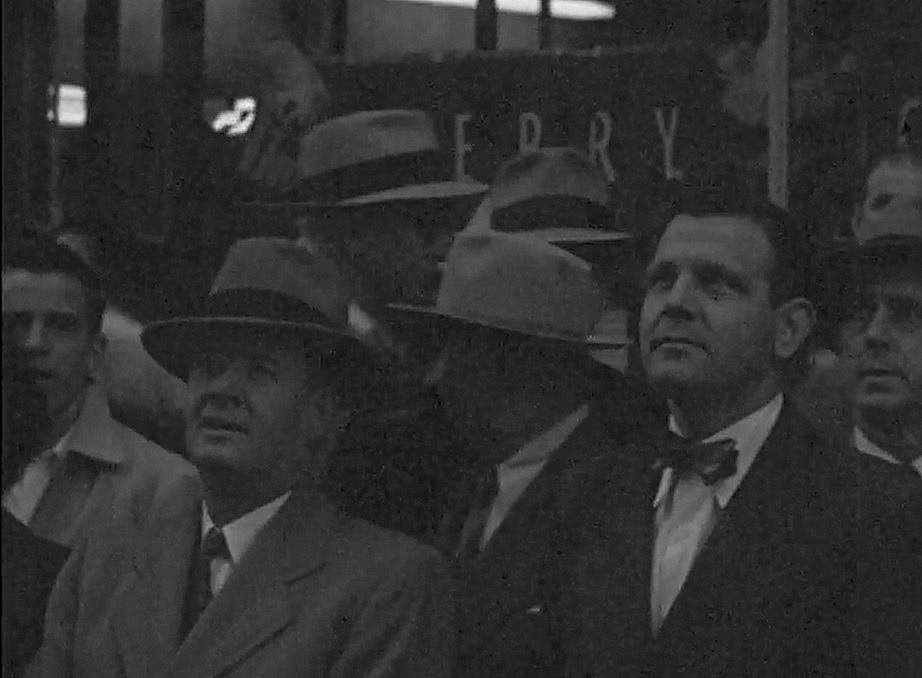
A couple of screenshots of the sign in action from a Channel 5 news clip (Dec. 12, 1951, Portal to Texas History). The first shows men in hats checking out the new sign as darkness falls:

telesign_screenshot_UNT_dec-12-1951-b

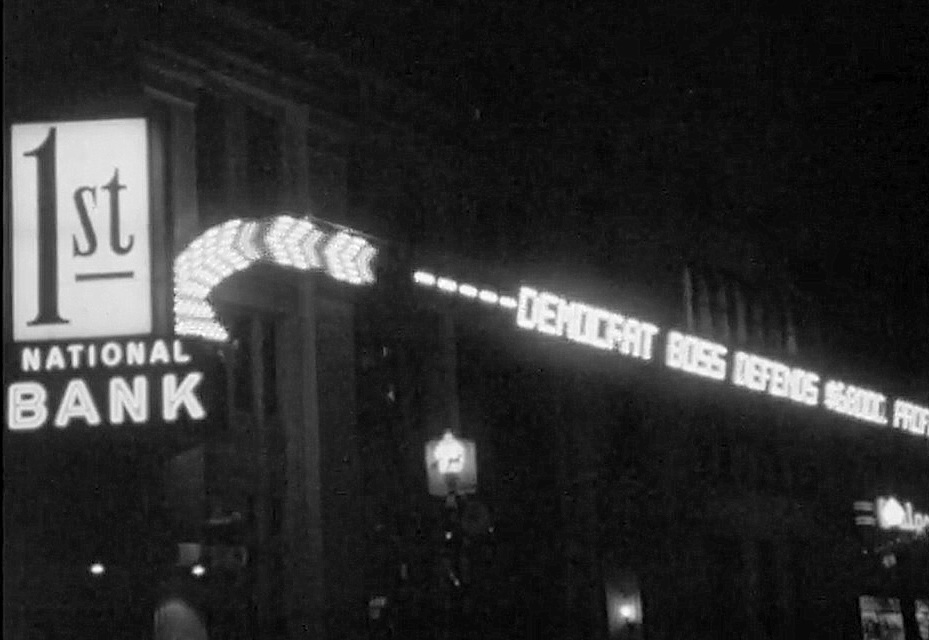
And here’s what they were looking at:

telesign_screenshot_UNT_dec-12-1951UNT Libraries Special Collections

How it worked (click for larger image):

news-scroll_dallas-mag_dec-1951_photoDallas magazine, Dec. 1951

**

Excerpts from a couple of trade magazine articles:

The First National Bank in Dallas, Dallas, Texas has recently installed this telesign containing 3,136 individually controlled bulbs which form letters corresponding to those punched on tape as it is fed through a cigar-box size transmitter. Following formal dedication ceremonies, the sign flashed its first message: “UNCENSORED NEWS IS THE BASIS OF FREEDOM.”

The Telesign is operated continuously from 7:30 A.M. to 10:30 P.M., bringing to the people of Dallas, as a public service, news bulletins highlighting the latest developments in the big stories of the day, local, national and international. (Bankers Monthly, Feb. 1952)

*

Bank Installs Telesign: The first fast-moving line of words — “UNCENSORED NEWS IS THE BASIS OF FREEDOM: — chasing each other across First National Bank of Dallas’ new sign, echoed the dedicatory statement of President Ben H. Wooten. The telesign is operated as a community service to give downtown crowds a constant flow of news reports. Second in length only to that of the New York Times, it is believed to be the first ever installed by a bank. (Trusts and Estates, March 1953)

***

Sources & Notes

Top photo is from Bankers Monthly, Feb. 1952.

More about this can be found in the following article from the Dallas Morning News archives: “Bank Unveils Its New Telesign, Latest Word in News-Flashing” (DMN, Dec. 12, 1951).

In a related vein — as far as giant outdoor news signs downtown — check out the 2016 Flashback Dallas post “How Dallas Used to Get Election Returns.”

telesign_trusts-and-estates-mag_march-1953_photo

*

Copyright © 2024 Paula Bosse. All Rights Reserved.
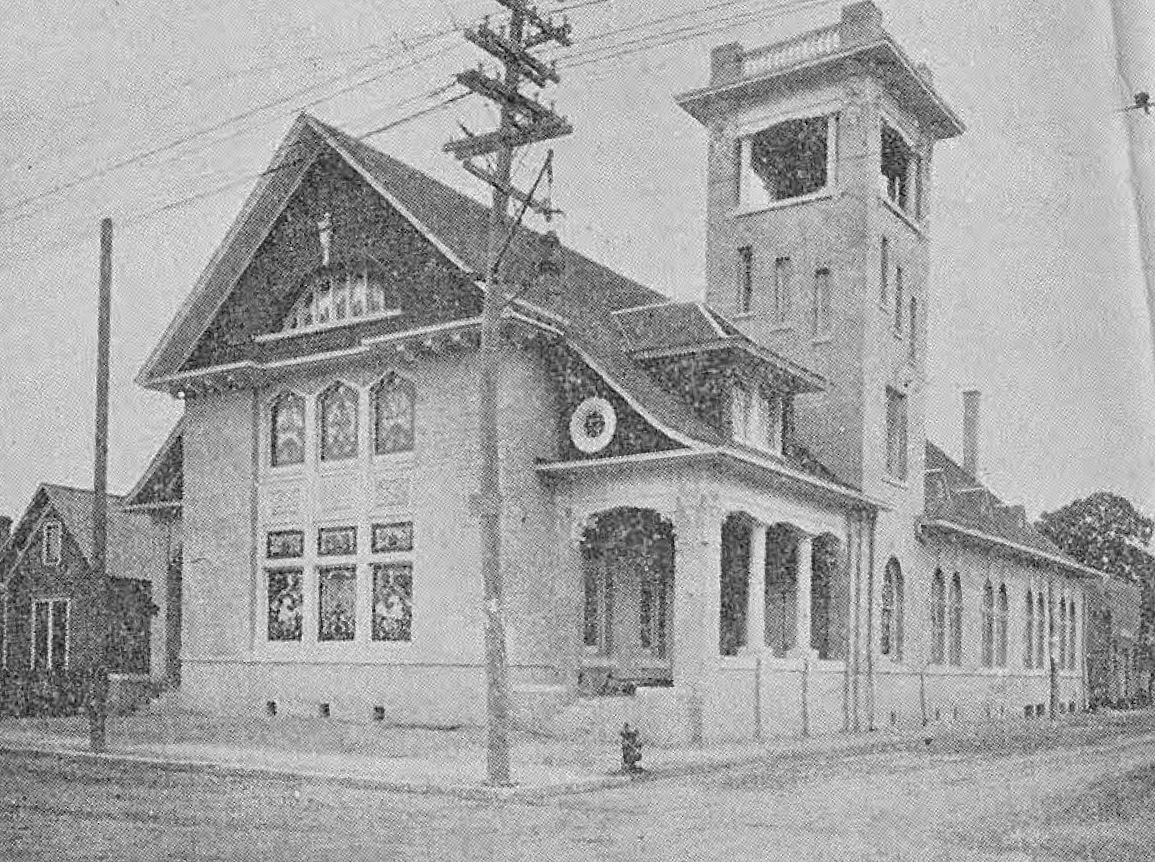
Second Presbyterian Church — 1905

Live Oak & Germania (Liberty)

by Paula Bosse

Hello! I’ve been gone for a while — the longest period of not posting here since I started 10 years ago! Life has been chaotic for the past month or two, but things have settled down a bit, and it’s good to be back.

I’m cheating a bit with this post, as it’s basically a reworking of something I put up on the Flashback Dallas Patreon page a few weeks ago, but I’m a big fan of this church building and thought I’d go ahead and share it here.

*

I love this building. The design is so interesting — I don’t think I’ve seen another church that looks quite like this one. It was built in 1904 (the first service was in March 1905), and the architects were Sanguinet & Staats of Fort Worth, who had designed the beautiful Wilson Building downtown a couple of years earlier.

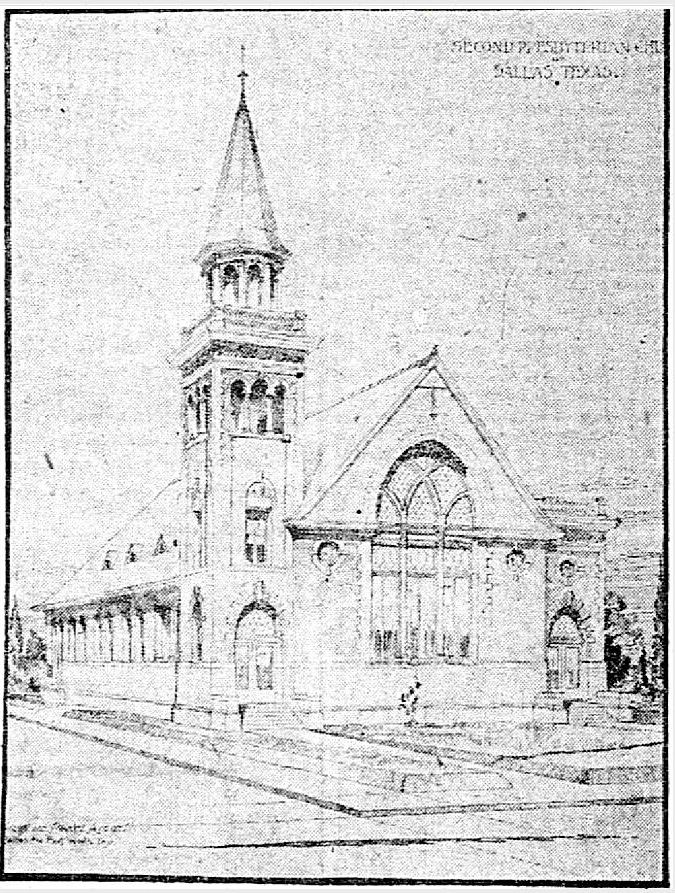
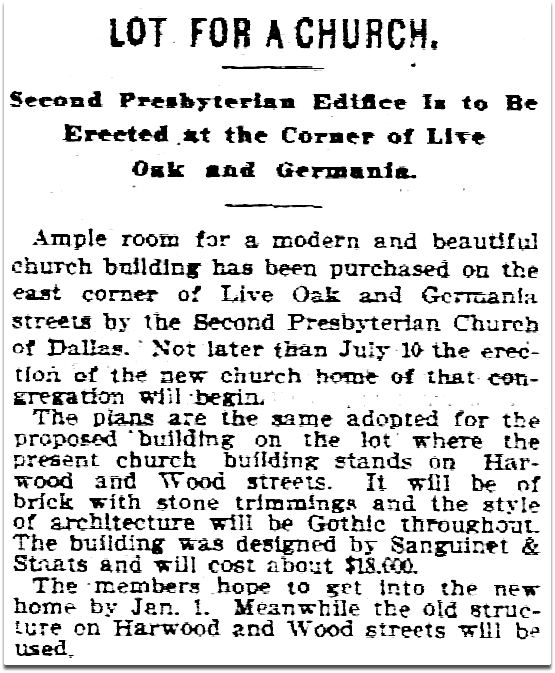
The Second Presbyterian Church sat on the southeast corner of Live Oak and Germania (the latter street name was changed to “Liberty” during WWI, for patriotic reasons). Below is the original design, when a new building was to have been built on the church’s then-current property at the northwest corner of Wood and South Harwood — the Presbyterians sold the corner property to the Methodists not long after this drawing was published in The Dallas Morning News on Feb. 16, 1904 and decided to relocate to Old East Dallas. It’s interesting to see what changes were made to the design for the Live Oak church. (I prefer it without a steeple.) See it brand-new on a 1905 Sanborn map, here (top left).

Feb. 16, 1904 (DMN)

The article below is from June 21, 1904 (DMN):

June 21, 1904 (DMN)

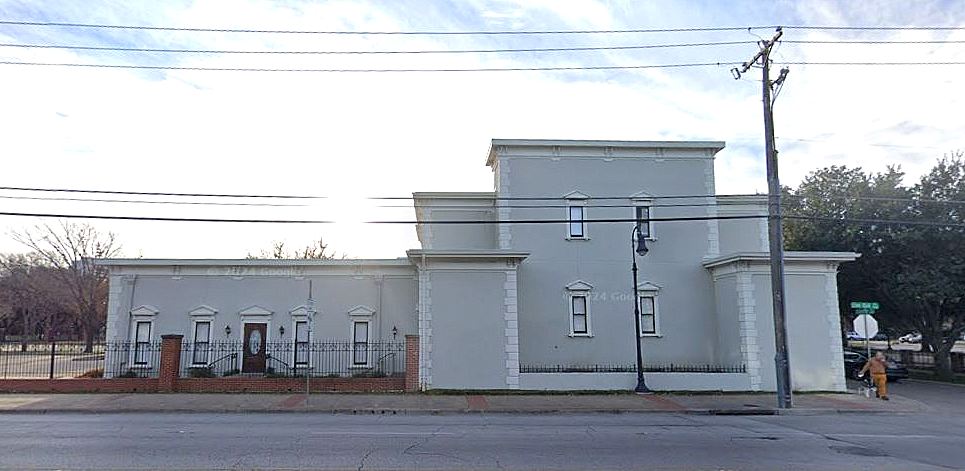
See what this corner looks like now, on Google Street View, here. The building on the corner (at 2900 Live Oak) is a really, really strange-looking one. The Dallas Central Appraisal District (DCAD) says it was built in 1950. DCAD is almost always wrong with construction dates of older buildings. …But it’s so strange. Is it possible that the heart of the old Sanguinet & Staats church is still beating under all that weirdness? If so, it’s one of the oldest non-residential buildings in the neighborhood.

Google Street View, Jan. 2024

And to wrap this all up, this photo of the 1957 tornado was taken at this corner.

***

Sources & Notes

Top photo is from the booklet “Come to Dallas” (ca. 1905), DeGolyer Library, SMU Libraries — it is accessible here.

Drawing and article from The Dallas Morning News.

*

Copyright © 2024 Paula Bosse. All Rights Reserved.

Zephyr, Meet Ox Cart — 1936

zephyr_sam-houston-zephyr_oxcart_ebay_front…Ox cart, meet Zephyr

by Paula Bosse

On Oct. 4, 1936, the Sam Houston Zephyr — the very first streamlined passenger train in Texas — made one of it very first public appearances, at the Texas Centennial in Dallas. This beautiful train (check out a photo of its interior here) was operated by the Burlington-Rock Island railroad between Fort Worth and Houston, with stops in Dallas, Waxahachie, Corsicana, and Teague. (See footage of it arriving it what might be Dallas in what might be 1936 in cool home movie footage here — then go to the beginning to see great Centennial footage — some of it in color! — and other footage shot in Kidd Springs.)

Back to the Zephyr. At its Centennial stop, a photo-op presented itself: the super-new (Zephyr) alongside the super-old (an ox cart). This photo ran in newspapers around the world, accompanied by variations of the following captions:

PROGRESS! Just a zephyr in the breeze is the Burlington Zephyr, particularly when compared to an ancient ox cart. The two were shown together at the Texas centennial fair at Dallas. The speedy streamliner runs from Dallas to Houston, Texas.

*

MARCH OF PROGRESS. An excellent contrast in the modes of transportation of today and yesterday is presented here as the Sam Houston Zephyr, streamlined train running between Dallas, Tex., and Houston, enters the grounds of the Texas Centennial exposition with an ox cart plodding along beside it. The presentation is part of the Cavalcade of Texas given at the exposition in Dallas. The girls are LaNeyl Brown and Peggy Humphreys.

*

From a Dallas Morning News article on the Centennial exhibit at Fair Park:

The streamlined Sam Houston Zephyr, operated between Dallas, Fort Worth and Houston by the Burlington-Rock Island, will be displayed on the siding in the grounds east of the Hall of Transportation. One of the powerful Opp Mogul freight engines of the Texas & Pacific also will be shown. To furnish a contrast with modern and ancient transportation the ox cart and stagecoach used in Cavalcade will be rolled out. (DMN, Oct. 4, 1936)

zephyr_sam-houston-zephyr_oxcart_DMN_100436_events

*

An interesting sidelight regarding the older modes of transportation is this blurb about the difficulty Centennial personnel had in finding authentic stagecoaches, covered wagons, and ox carts to use in various Fair Park productions celebrating the history of Texas, forcing them to resort to building reproductions (seems hard to believe that there were only two authentic stagecoaches to be found in the entire state!):

zephyr_centennial_AP-wire-story_may-1936
AP wire story, May 1936

The article is referring to props needed for the giant Cavalcade of Texas historical pageant, but check out the nice little novelty “prairie schooner” below, which served as a quirky, casual Centennial restaurant (“Smacking of the old West is the Chuck Wagon, a dining place for 250, with an overgrown chuck wagon serving as the kitchen and service counter” — Dallas Morning News, June 7, 1936):

patreon_tx-centennial_chuckwagon-restaurantDallas Historical Society

patreon_tx-centennial_chuck-wagon-restaurant_worthpointvia Worthpoint

***

Sources & Notes

Top photo was found on eBay (German wire photo).

Photo of the Chuck Wagon restaurant is from the Texas Centennial Exposition Collection, Dallas Historical Society, Object ID V.38.3.245 — more info on this photo is here.

Consider becoming a member of my Flashback Dallas Patreon page for as little as $5 a month — I post there daily. No strings attached. Cancel at any time!

zephyr_sam-houston-zephyr_oxcart_ebay_front

*

Copyright © 2024 Paula Bosse. All Rights Reserved.
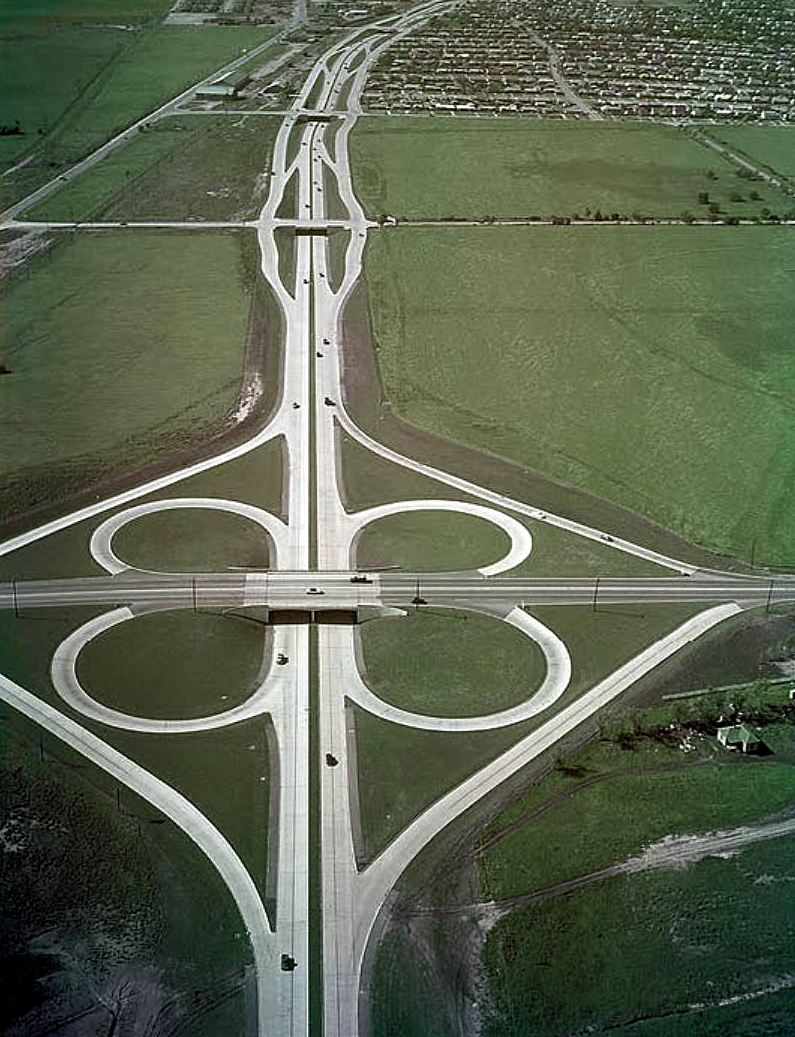
The Cloverleaf

patreon_cloverleaf_south_txdot_slotboom_ca-mid-1950s_colorBehold... (via TxDOT)

by Paula Bosse

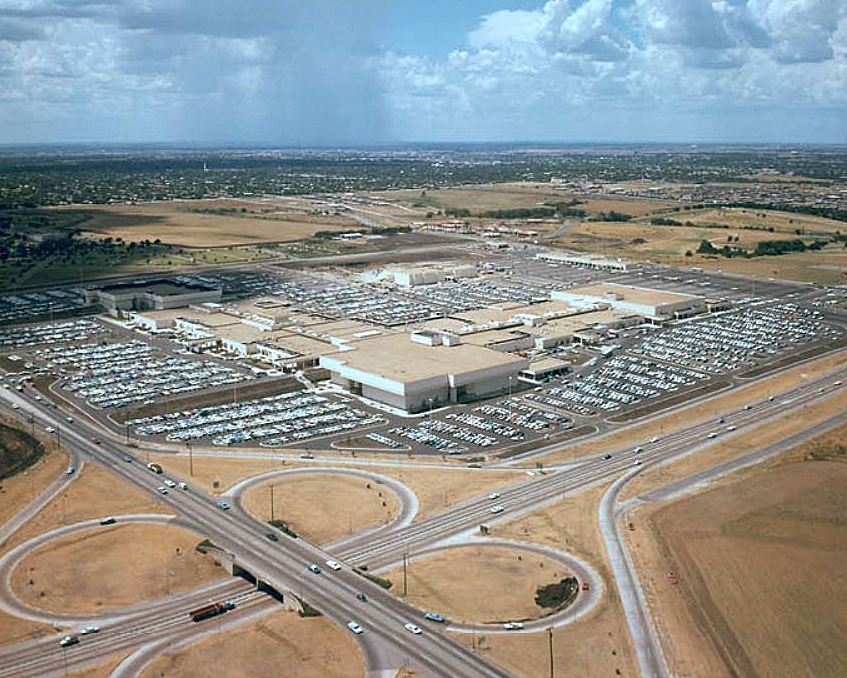
I have such a weird fondness for the old Central Expressway/Northwest Highway cloverleaf interchange, at NorthPark. In fact, I kind of forget it’s not there anymore. I have fairly scary memories of my mother driving like a bat out of hell on it. I’m pretty sure the car was tipped at an angle on two tires as we rounded those curves. And I remember being behind the wheel myself when I was a new driver, white-knuckling it until I hit the straight-away. Strange that I have such fond memories of it, because a lot of those memories were kind of terrifying! I guess it has to be the design. It was cool. COOL! The photo above is just great. The view is to the south from Northwest Highway, across open Caruth farmland. Mid-’50s. Pre-NorthPark. Pre-people. Pre-traffic.

Below, after NorthPark’s arrival (photo from Oct. 1967):

patreon_cloverleaf_northpark_oct-1967_UTA_slotboom_color

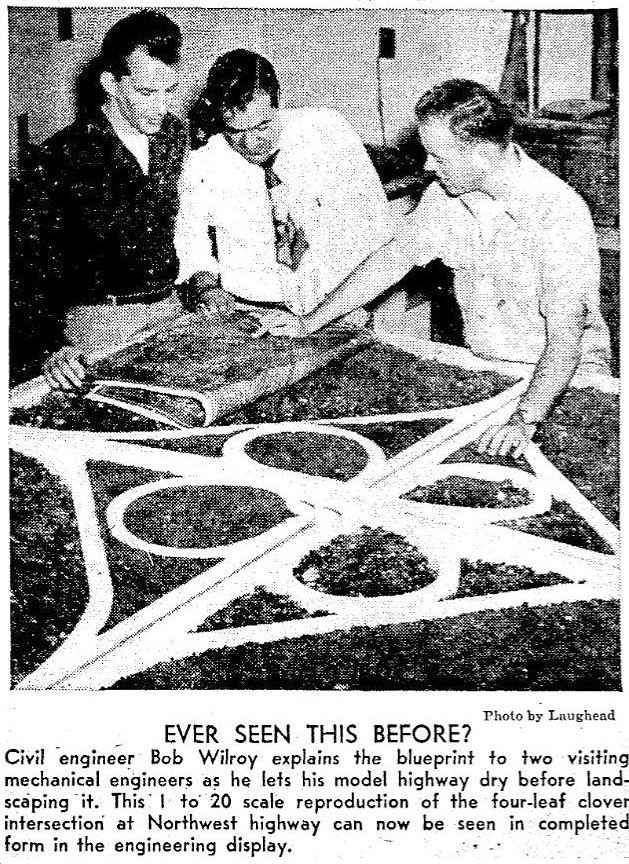
Here’s an interesting photo I stumbled across in an issue of SMU’s Daily Campus newspaper from 1951 — a personal-size cloverleaf:

patreon_cloverleaf_SMU-daily-campus_050551SMU Daily Campus, May 5, 1951

I really miss the Northwest Highway cloverleaf. I think about it almost every time I drive past NorthPark on Central. Shoulda kept it, Dallas.

***

Sources & Notes

The top two photos are from the book Dallas-Fort Worth Freeways by Oscar Slotboom (top photo from TxDOT, second photo from UTA Libraries, Special Collections).

This post appeared in a slightly different form on the Flashback Dallas Patreon page.

patreon_cloverleaf_south_txdot_slotboom_ca-mid-1950s_color

*

Copyright © 2024 Paula Bosse. All Rights Reserved.
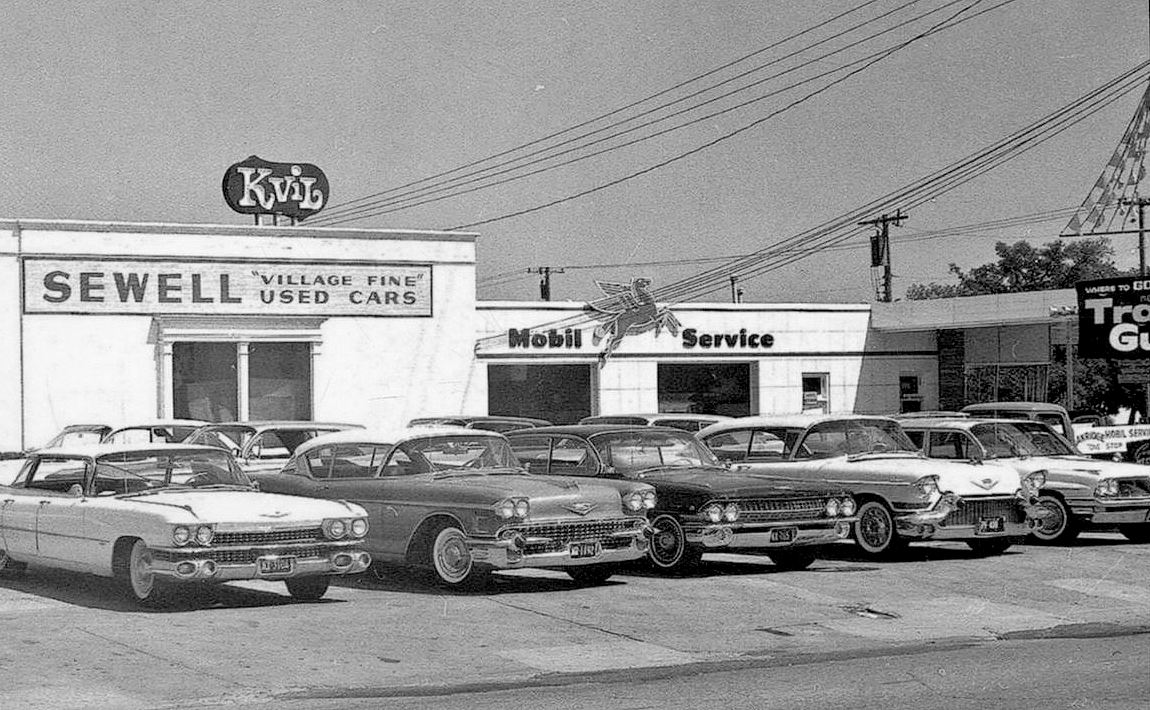
KVIL: The “VIL” Stands for Village

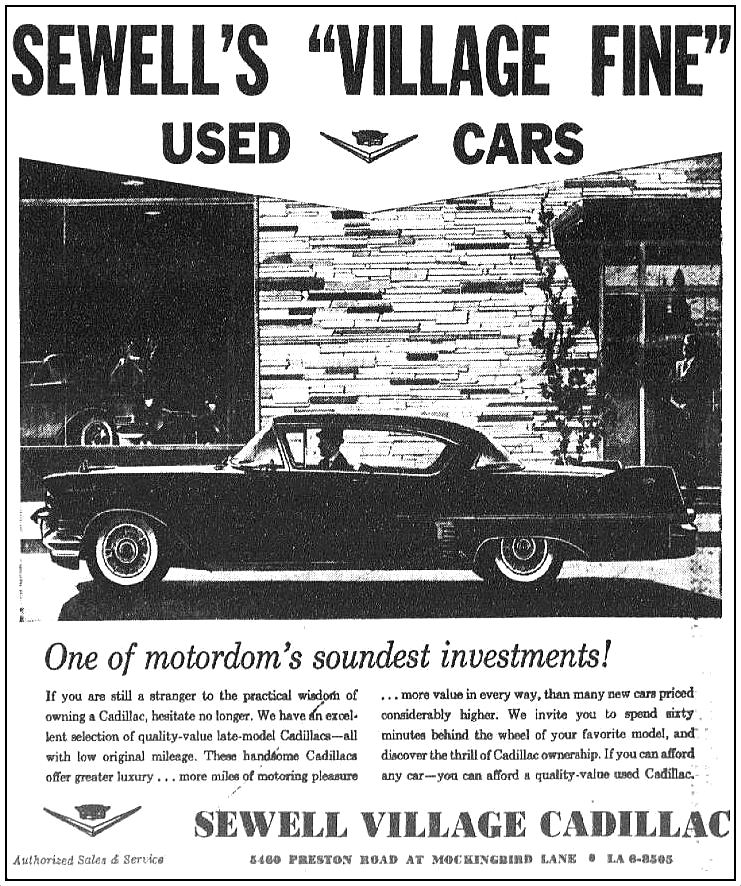
sewell-auto_KVIL_ebayNortheast corner of Preston & Mockingbird…

by Paula Bosse

Sewell Village Used Cars and a Mobil station were at the northeast corner of Preston and Mockingbird (Sewell was at 5460 Preston Road), catty-corner from Highland Park Village. The KVIL studios were right around the corner, at 4152 Mockingbird Lane, across the street from the Dallas Country Club — you can see the jauntily-lettered sign in the background of this undated.photo. I am really bad at determining car-model years, but let’s say this is about 1960. What does this corner look like these days? It looks like this.

I just learned (from the KVIL Wikipedia page) that the “VIL” in the station’s call letters stood for “Village,” as in Highland Park Village. Who knew? The AM station began broadcasting on March 1, 1960, and the FM station hit the airwaves on Aug. 25, 1961. I believe both stations had a strict “no-rock-and-roll” policy. In the early days, a block of programming was aimed directly at housewives:

The program policy followed by the station is designed to fit the various hours of the day. For the driving hours when listeners drive to work (5:45 to 9 a.m.) and return (4:30 to 6:55 p.m.) the music is livelier. “Sing Along” is the order of the day from 9 a.m. to noon for the housewife’s work hours. (“KVIL Mark’s First Birthday Wednesday,” Dallas Morning News, March 1, 1961)

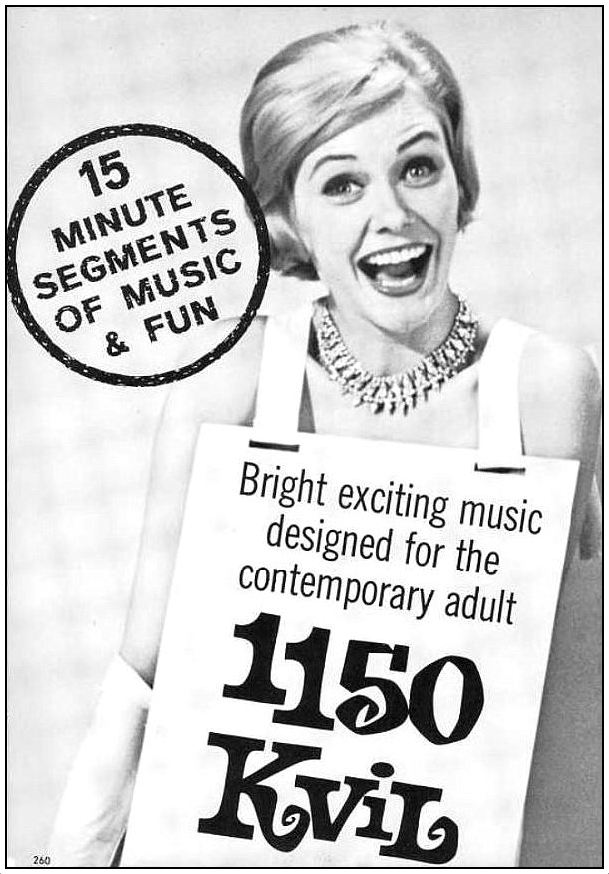
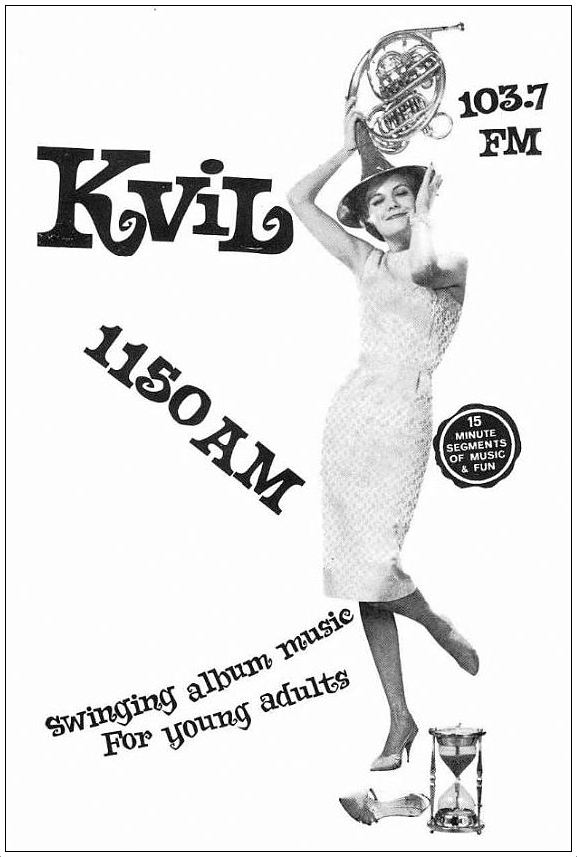
Here are a couple of hep, caffeinated KVIL ads from those early days:

patreon_KVIL_HPHS_1961-yrbk1961 ad

patreon_KVIL_HPHS_1962-yrbk1962 ad

kvil-logo_broadcasting-mag_122462_ad-det1962 logo

Most of my sort of generally vague awareness of KVIL was in the 1980s, when it was an absolute powerhouse in the ratings. But even its most stalwart fans would probably not describe its playlist as “bright,” “exciting,” or “swinging.” But look how much fun the promotions department imagined the effect on “young adults” was!

*

And what about Sewell Village Cadillac and its selection of “Village Fine” used cars? If circa-1960 Highland Park is going to have a used car lot, you better believe it’s going to be populated with Cadillacs. (UPDATE: Thanks to Peter K’s link in the comments, check out what appears to be the original photo by Squire Haskins, with a wider view, at the UTA Libraries website, here.)

sewell-village-cadillac_032158March 1958

***

Sources & Notes

Photo from eBay.

KVIL ads from the 1961 and 1962 Highland Park High School yearbooks.

KVIL logo is a detail from an ad that appeared in the Dec. 24, 1962 issue of Broadcasting magazine.

This post appeared in an abbreviated form on the Flashback Dallas Patreon page.

sewell-auto_KVIL_ebay

*

Copyright © 2024 Paula Bosse. All Rights Reserved.
Rudolph Gunner: Dallas Bookseller and Emperor Maximilian’s “Best Friend”

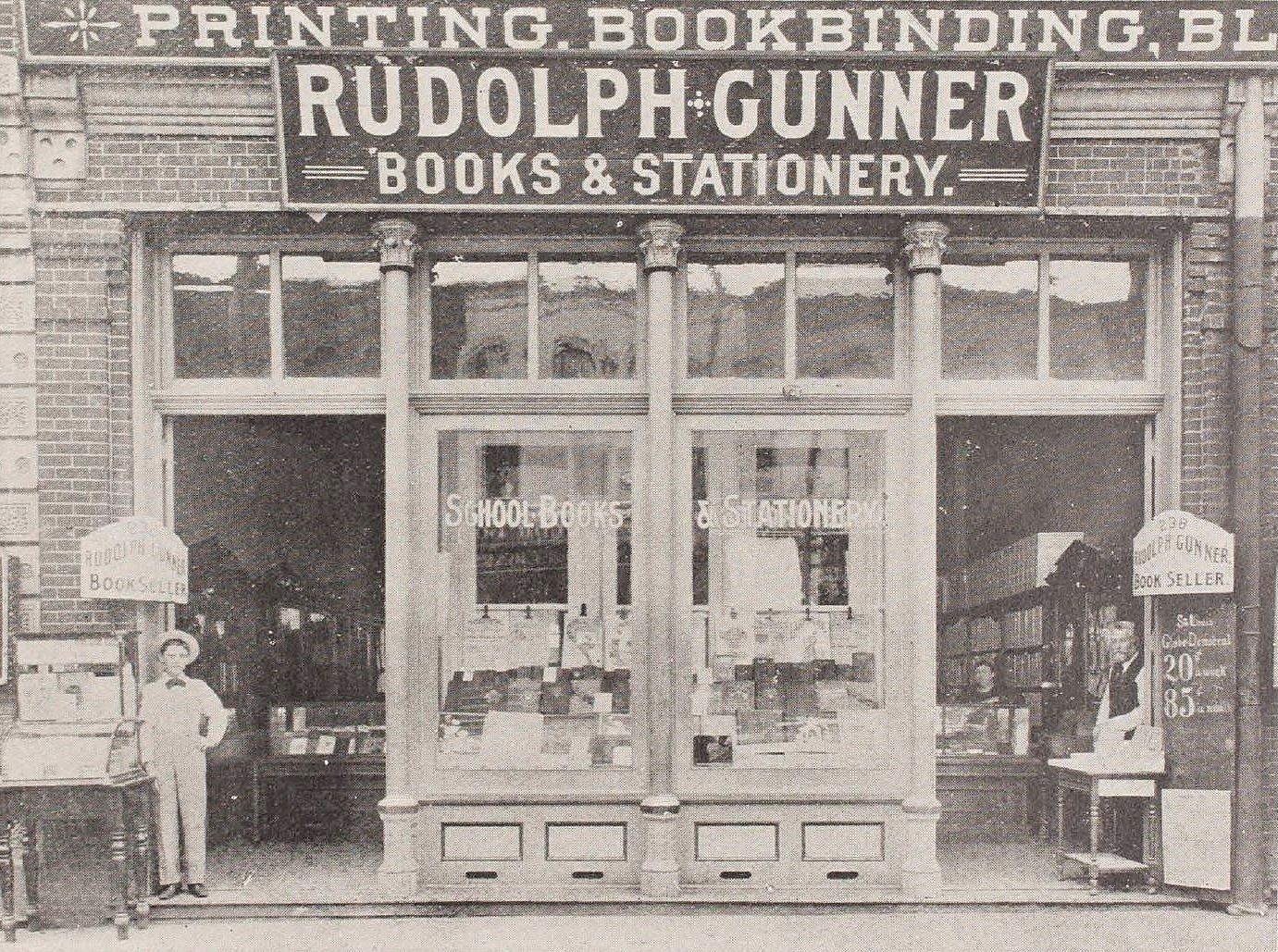
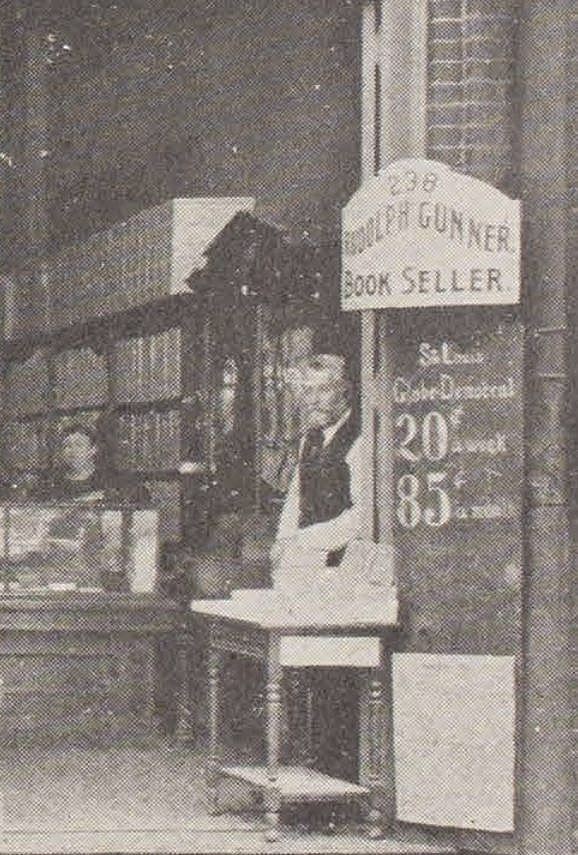
books_rudolph-gunner_dallas-through-a-camera_1894_degolyer-lib_SMU238 Main, circa 1894

by Paula Bosse

For the past several years, I’ve been posting bookstore-related posts on the birthday of my late father, Dick Bosse, an antiquarian bookseller who began his career straight out of SMU at The Aldredge Book Store, a literary landmark to many, which he eventually ended up owning. This year’s offering goes back to 19th-century Dallas.
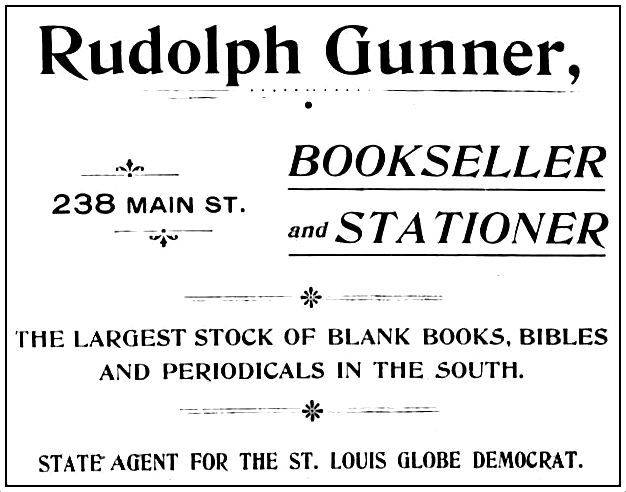
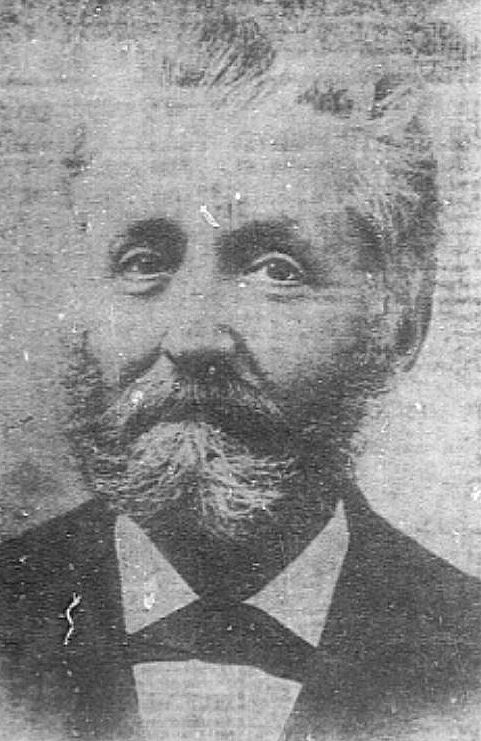
Above is a photo of the bookstore owned by Austrian immigrant Rudolph Gunner, located at 238 Main (later 1006 Main), between Poydras and Martin. Gunner (1833-1911) had, perhaps, one of the most impressive and colorful historical pedigrees of any Dallas resident. He served in the Austrian navy all over the world, but his most important service was as confidante and aide-de-camp to Emperor Maximilian and Empress Carlota of Mexico in the 1860s. That story is too big to tell here (Wikipedia is here to help), but it’s interesting that a man who was often referred to as “Maximilian’s best friend” eventually wound up in Dallas in 1885 and opened a bookstore, first on Elm Street, later on Main.

My father had a fascination with Mexico and used to talk about Maximilian quite a bit. I wonder if he knew Maximilian’s right-hand man lived out his days in Dallas, having spent several years as a bookseller?

books_rudolph-gunner_dallas-through-a-camera_1894_degolyer-lib_SMU_det_gunner

gunner-rudolph_photo

rudolph-gunner_1896-directory_adDallas city directory, 1896

*

In a sidenote, Gunner mentioned in several interviews that he had a LOT of historical documents and souvenirs from his military career serving in the Crimea, Egypt, Africa, and, especially, Mexico. I winced when I read this passage from an article by A. C. Greene in The Dallas Morning News (“Bookstore Owner Once Was Colorful General — He Headed Maximilian’s Mexico Palace Guard.” DMN, Apr. 18, 1993):

[A]t the time of his death in 1911 [his] home was at 1506 Fitzhugh. [His wife] was still living there, with a considerable collection of historic memorabilia, books, medals and military items, when the home burned, destroying everything but Gen. Gunner’s sword with the emperor’s crest.

Wow. All of that, gone. (And to answer my question above, I’m pretty sure my father would have known this, if only because he read A. C. Greene’s columns and probably even discussed this with him on a visit to the store.)

***

Sources & Notes

Top photo by Clifton Church, from his book Dallas, Texas, through a camera: a collection of half-tone engravings from original photographs (1894) — from the DeGolyer Library, SMU, here.

Read a first-hand account of Gunner’s time in Mexico in a Dallas Morning News article from Jan. 14, 1886 here; his DMN obituary (Aug. 25, 1911) is here.

Read previous Flashback Dallas articles on Dallas bookstores here.

I would love you to join me over on Patreon, where I upload Dallas history posts daily for subscribing members (as little as $5 a month!). If you would like to support what I do, check out Flashback Dallas on Patreon.

books_rudolph-gunner_dallas-through-a-camera_1894_degolyer-lib_SMU

*

Copyright © 2024 Paula Bosse. All Rights Reserved.