Flashback : Dallas

A Miscellany: History, Ads, Pop Culture

Category: Night Scenes

Elm Street at Night, Coming & Going — 1950s
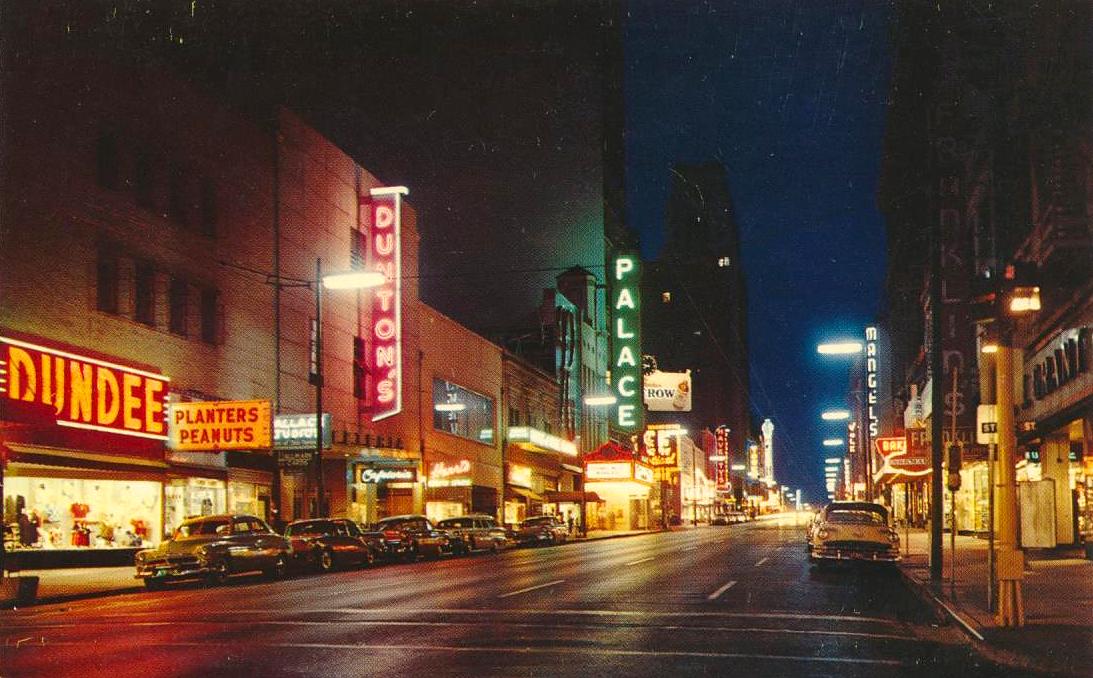
elm-st-night_ebayHave a sudden hankering for a fistful of roasted peanuts?

by Paula Bosse

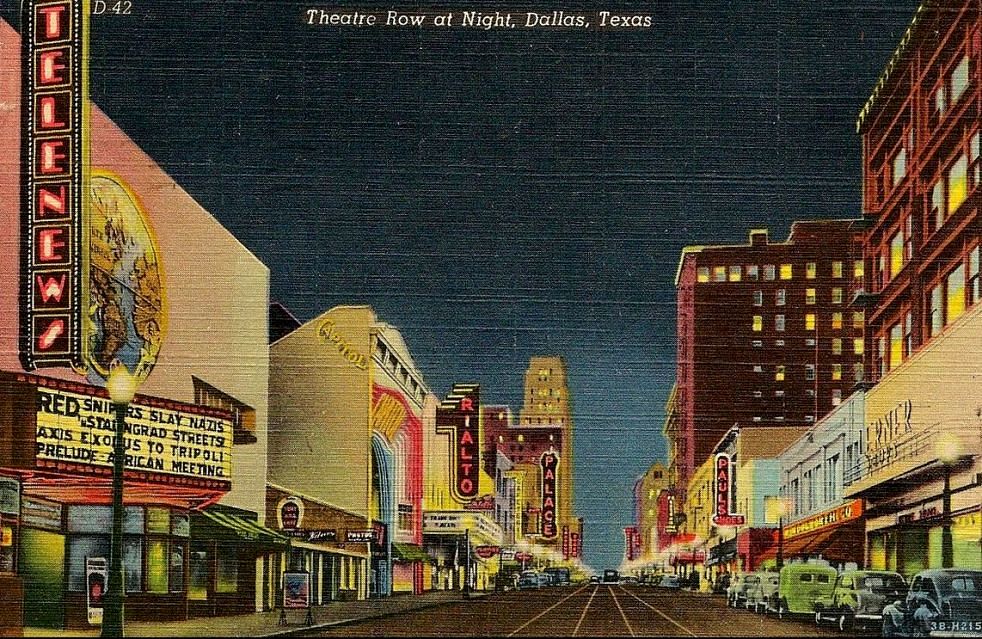
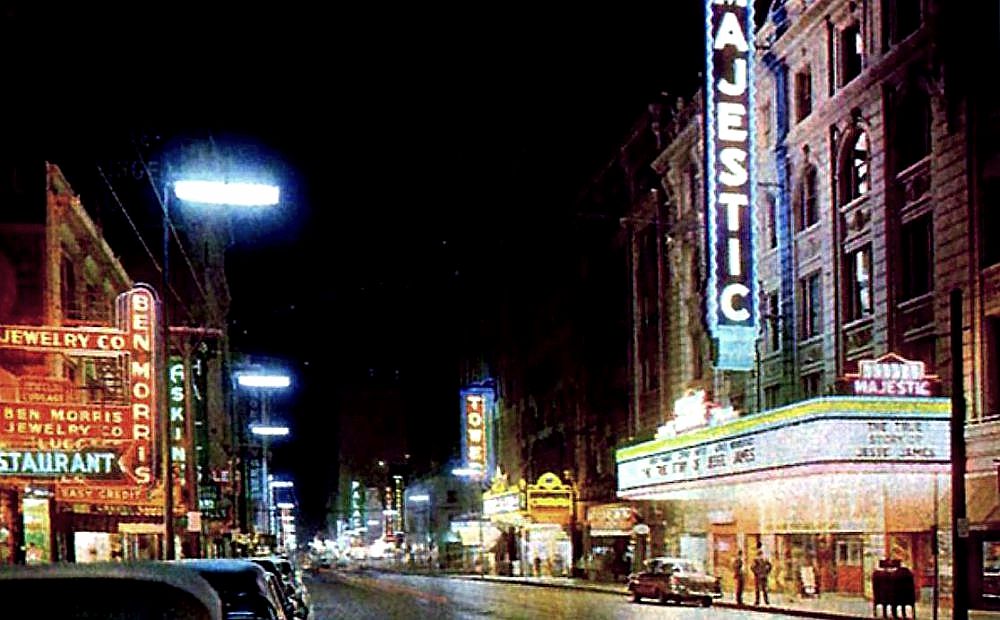
Two postcards from the Fabulous Fifties showing Dallas’ Theater Row, lit up at night — one looking east (above), and one looking west (below).

The top view — taken from about Stone — was probably taken in the early- to mid-’50s. (See the same view today, here.) The following Elm Street businesses — all of which can be seen in this postcard — were listed in the 1953 city directory:

1602 Elm — W. T. Grant (dept. store)
1605 — Dundee Smart Clothes
1607 — Planters Peanuts (This place fascinates me!)
1607a — Wallace Studios (photography studio)
1609 — Dunton’s Cafeteria
1610 — Franklin’s (women’s clothing)
1613 — Henri’s Hollywood Beauty Studio
1614 — Baker’s Shoes
1623 — Palace Theatre

ERVAY crosses
1700 — Mangel’s (women’s clothing)
1705 — Lee Optical
1713 — Haverty’s (furniture)
1806 — Volk Bros. (dept. store)

ST. PAUL crosses
1907 — Tower Theatre
1911 — Melba Theatre (barely visible)
1921 — Majestic Theatre

Here’s Elm looking west, taken at about North Harwood. (See the same view today, here.) The movie playing at the Majestic, “The True Story of Jesse James,” was released in February, 1957.
elm-street-night_ca1957

The businesses seen here, on the south side of the street:

1918 Elm — Hall’s Credit Clothiers
1922 — Askin’s Credit Clothing Store
1924 — Ben Morris Jewelry
1926 — Majestic Cafe (*possibly* — I’m not sure if it was there in 1958)

In all my wanderings through photos of old Dallas, my biggest regret is that I never experienced downtown-Dallas movie-going in the 1930s, 1940s, and 1950s. Mr. Peanut, we hardly knew ye (or in my case, I never knew ye).

***

Sources & Notes

Top postcard from eBay.

Second postcard from the Billy Holcomb Collection, found on Cinema Treasures here. (If anyone has a better image of this, let me know!)

The thought of buying warm, just-roasted nuts on the sidewalk of a busy downtown street makes me feel all nostalgic for something I’ve never actually experienced. It looks like the Planters Peanut shop was in a couple of different locations before it moved to the one seen above at 1607 Elm — first at 1519 Main (in about 1929), and then the 1500 block of Elm, next to Cullum & Boren (from 1931). Read a few memories of this Elm Street shop here; and see photos of a shop still operating in Memphis, here.

*

Copyright © 2015 Paula Bosse. All Rights Reserved.
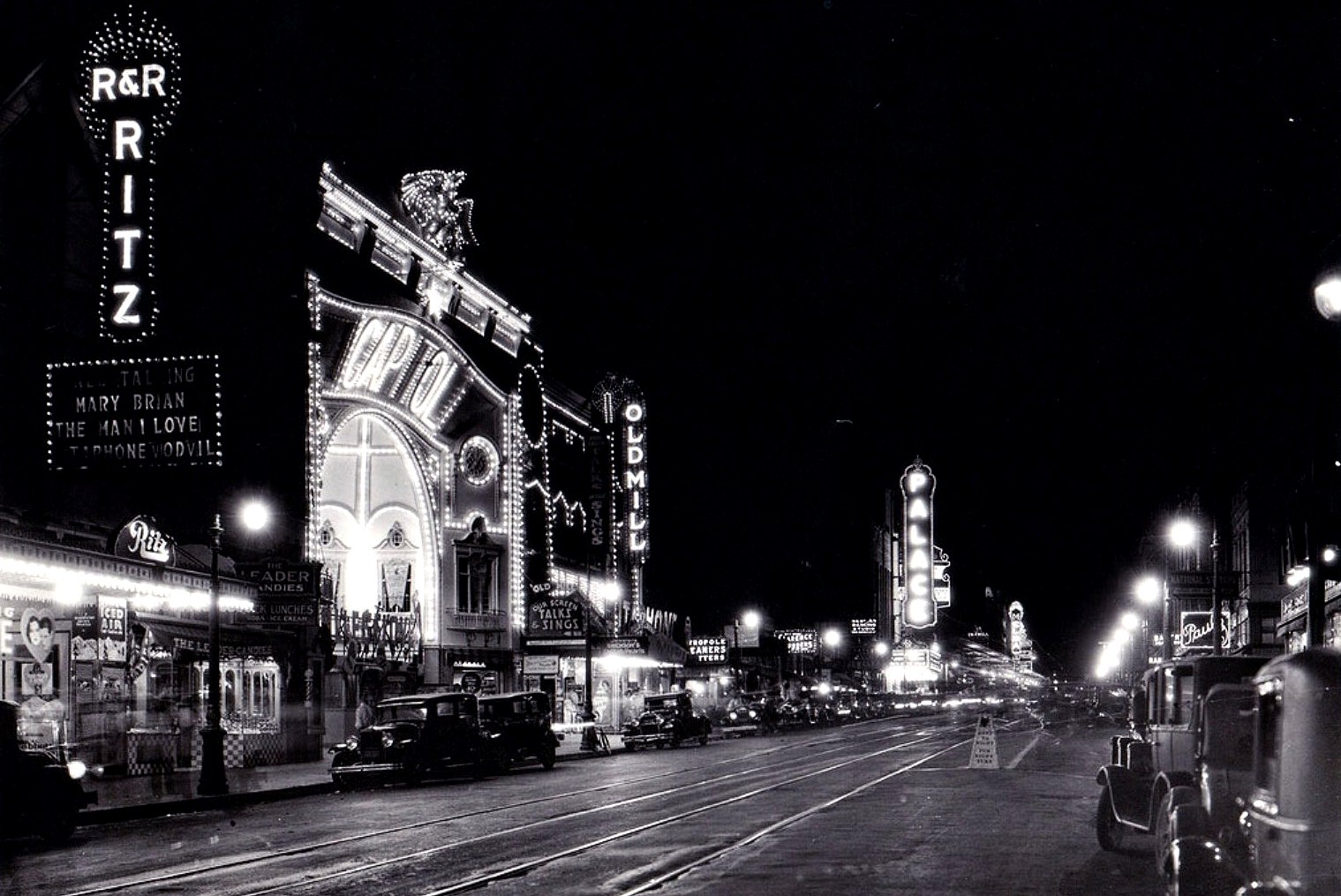
Dazzling Neon, Theater Row — 1929

elm-st-night_capitol-old-mill_1929_shorpy“The lights are much brighter there…”

by Paula Bosse

Whoa. Elm Street in the ’20s.

The Ritz. The Capitol. The Old Mill. The Palace. The Melba. Iced air. Paul’s Shoes. What I wouldn’t give to have walked down Elm when it looked like this.

***

Sources & Notes

Photo from Shorpy.com, here.

Highlights from the 1929 and 1930 street directory (from about Akard, heading east):

  • 1517 Elm: Ritz Theatre
  • 1519: Leader Candy Co.
  • 1521: Fooshee’s Barber Shop
  • 1521-23: Capitol Theatre
  • 1525-27: Old Mill Theatre
  • 1600: Paul’s Shoes
  • 1601: Metropole Cleaners
  • 1603: Elm Pacific Arcade
  • 1605: Lontos Cafe
  • 1623-25: Palace Theatre
  • 1911-15: Melba Theatre
  • 1912-29: Majestic Theatre

 *

Copyright © 2015 Paula Bosse. All Rights Reserved.
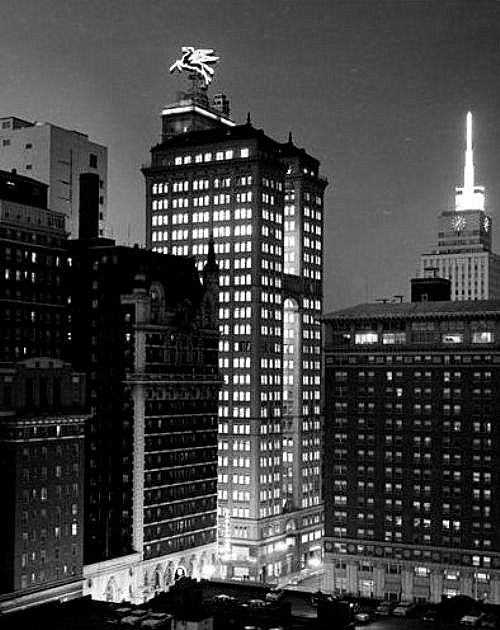
The Magnolia Building at Night

magnolia-bldg_night_briscoe-ctr©ExxonMobil

by Paula Bosse

Dallas noir.

***

Undated photo, from the ExxonMobil Historical Collection, Dolph Briscoe Center for American History; viewable here.

*

Copyright © 2015 Paula Bosse. All Rights Reserved.


Theater Row Block Party! — 1948

theater-row-block-party_082648_preservation-dallasDallas premiere, “Red River” — Aug. 26, 1948 (click for larger image)

by Paula Bosse

On a rainy night in August, 1948, United Artists premiered the movie “Red River” in Dallas at the Majestic Theatre. The now-classic Western about a Chisholm Trail cattle drive, directed by Howard Hawks and starring John Wayne and newcomer Montgomery Clift, was actually “premiered” simultaneously on August 26, 1948 in 250 theaters in Texas, Oklahoma, Kansas, and New Mexico, the four southwestern states most closely associated with the Chisholm Trail.

red-river_ad_dmn_082648(Aug. 26, 1948)

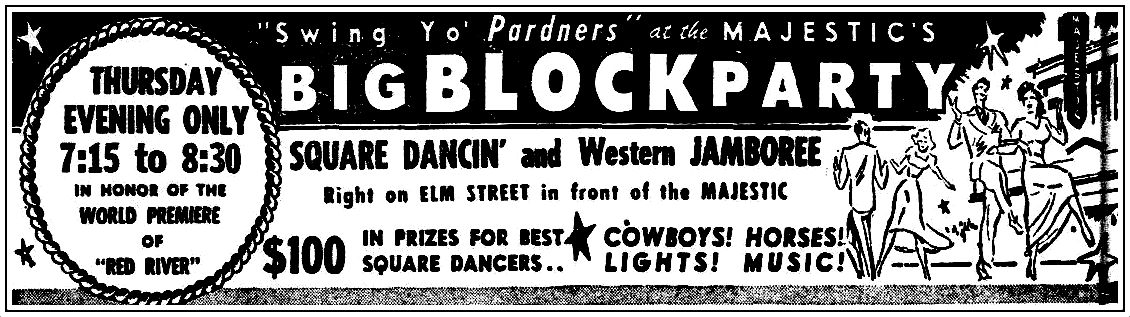
In Dallas, the publicity machine was seriously cranked up. The main attraction was a free-to-the-public street party in which the 1900 block of Elm Street was closed to traffic for a slate of western-themed festivities. The “jamboree” included square dancing, a musical set by cowboy singer Jim Boyd and his band, “cowboys and cowgirls from the Pleasant Mound Rodeo,” the Dallas Mounted Quadrille, and the Sheriff’s Posse. Or, as the ad said more succinctly, “Cowboys! Horses! Lights! Music!”

red-river_block-party_dmn_082648Great ad! Click to see it bigger! (Aug. 26, 1948)

No Hollywood celebrities were there, but the big Western Jamboree was apparently well-attended, even in the rain and despite rain, people gathered for square dancing.

(Wow. Square dancing in the rain. That’s dedication.)

The movie was a huge hit, so much so that the Majestic added showings, including one at 9:30 in the morning (!). It had a record week in Dallas, and, nationally, by the end of that first week it was reported to be the biggest-grossing picture in the history of United Artists.

The “world premiere” is interesting and all, but that photo of a brightly lit-up Theater Row is even better!

***

Sources & Notes

The original source of the photograph is not known, but I stumbled across it on a Preservation Dallas page, here.

“Red River” is a great movie. If you haven’t seen it, you need to. Even if you think you don’t like Westerns. Roger Ebert’s review/analysis is here.

*

Copyright © 2014 Paula Bosse. All Rights Reserved.


Snapshots of the Fair, 1936-1940

tx-centennial_strolling_fwplCentennial Exposition, 1936 — photo by Lewis D. Fox (click for larger image)

by Paula Bosse

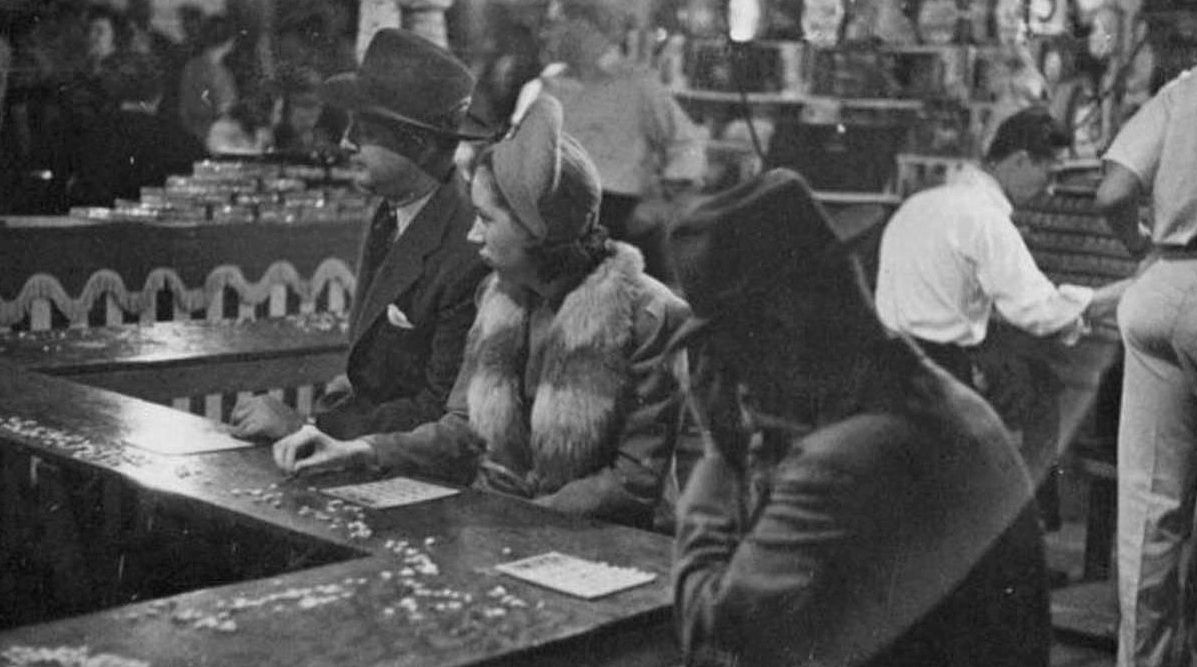
An amateur photographer named Lewis D. Fox took a lot of photos at the State Fair of Texas — from the Texas Centennial in 1936 through 1940. The Centennial photos are particularly interesting, because they show what the “Exposition” was like to the average visitor — there was more going on than just the spectacular extravaganza we usually see — there are also shots of people doing un-spectacular things like just walking around or enjoying a quiet, late-afternoon cup of coffee. There are also photos of the people who do the heavy-lifting at a state fair — the men and women who work the Midway shows and the concession stands (a link to a larger collection of Mr. Fox’s State Fair photos — almost a hundred snapshots — is below).

Enjoy this look at a time when going to the fair meant dressing up and, apparently, often leaving the children at home! (Click photos to see larger images.)

tx-centennial_spirit-of-centennial_fwpl

state-fair_texas-state-bldg_fwpl

state-fair_circus_c1939_fwpl

state-fair_grandstand_fwpl

tx-centennial_swing-revue_fwpl

state-fair_beanery_fwpl

state-fair-midway_fwpl

tx-centennial_cashier_fwpl

tx-centennial_side-view_fwpl

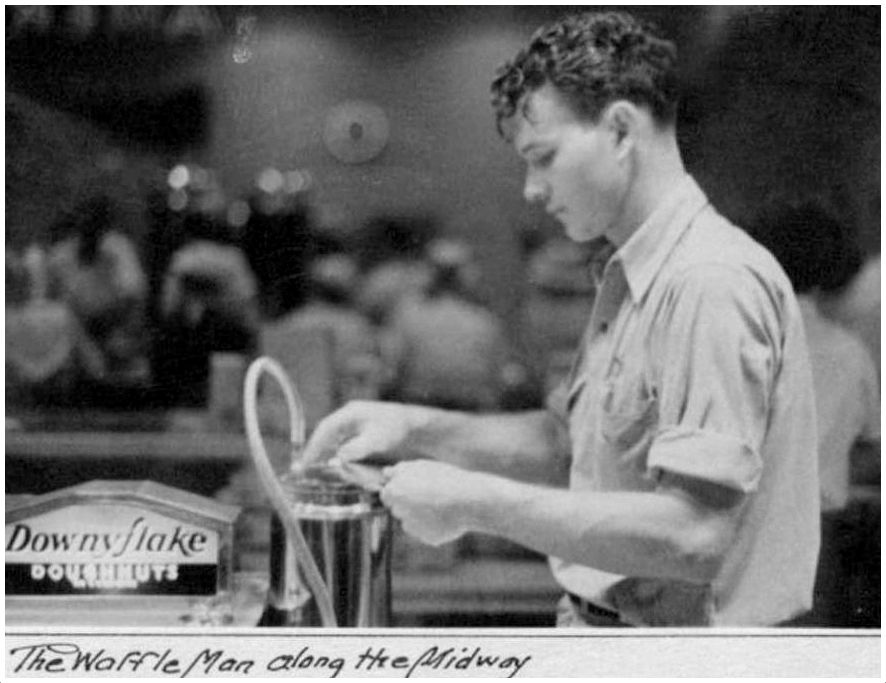
tx-centennial-midway_waffle-man_fwpl

***

Sources & Notes

All photos taken by Lewis D. Fox, from the Fox Photograph Collection in the Fort Worth Public Library Archives, courtesy of the Genealogy, History and Archives Unit, Fort Worth Public Library. Mr. Fox took a lot of snapshots at the fair — see  more here.

On a personal note, I’m mesmerized by “The Waffle Man.” He looks just like a young Lefty Frizzell! Lefty was from nearby Corsicana and he spent a lot of time in Dallas, but he wasn’t born until 1928, so it can’t be him — but check out this photo of Lefty as a teenager and see the remarkable resemblance! Not only did the (no doubt syrup-scented) young man above look like one of my favorite singers, but he also had ready access to waffles. What’s not to love? Oh, Waffle Man….

All images larger when clicked.

*

Copyright © 2014 Paula Bosse. All Rights Reserved.


From Dull to Spectacular — How a Picture Postcard Evolves

theater-row_before_tsha

by Paula Bosse

You know how you look at some of those fantastic postcards from the ’40s that don’t look real and you wonder, “Is that from a photograph, or is that just an artistic interpretation?” Well, it’s both.

In the above “before” and the below “after,” it’s interesting to note what’s been kept in and what’s been taken out. And how a fairly ho-hum daytime view becomes a dazzling night-time scene. Either way, it’s an Elm Street I’ll — sadly — never experience.

theater-row_after

***

Sources & Notes

Black-and-white photograph of Elm Street’s “Theater Row” from the Texas State Historical Association.

Click pictures for larger images.

*

Copyright © 2014 Paula Bosse. All Rights Reserved.


A Decade of Spectacular Growth for the Dallas Skyline: 1929-1939

downtown_night_lloyd-long_smu_foscueA stunning view of the city at night… (click for larger image)

by Paula Bosse

Two photographs showing the same view: the top from about 1939, the bottom from 1928. This city has always been a show-stopper at night, but Dallas went from looking like a typical big, prosperous city to a glamorous and elegant, fantastically illuminated metropolis in the span of only ten years. The 1930s was a good time to be an architect in Dallas.

rotarian-magazine_jan-1929

***

Sources & Notes

Top photo by Lloyd M. Long, from the Edwin J. Foscue Map Library, Central University Libraries, Southern Methodist University; it is accessible here. To see this photo with major buildings identified, the labeled version is here. The view is from the Medical Arts Building. Elm and Ervay is the intersection at the lower left, and Pacific runs along the right.

Bottom photo from the January, 1929 issue of The Rotarian, showing its readers what was in store for them at their annual convention to be held in Dallas in May. The night-time skywriting is a nice touch. (It’s weird seeing the Magnolia Building before Pegasus was installed on top of it in 1934.)

Click photos for larger images.

*

Copyright © 2014 Paula Bosse. All Rights Reserved.


When the Flying Red Horse Could Be Seen From Miles Away

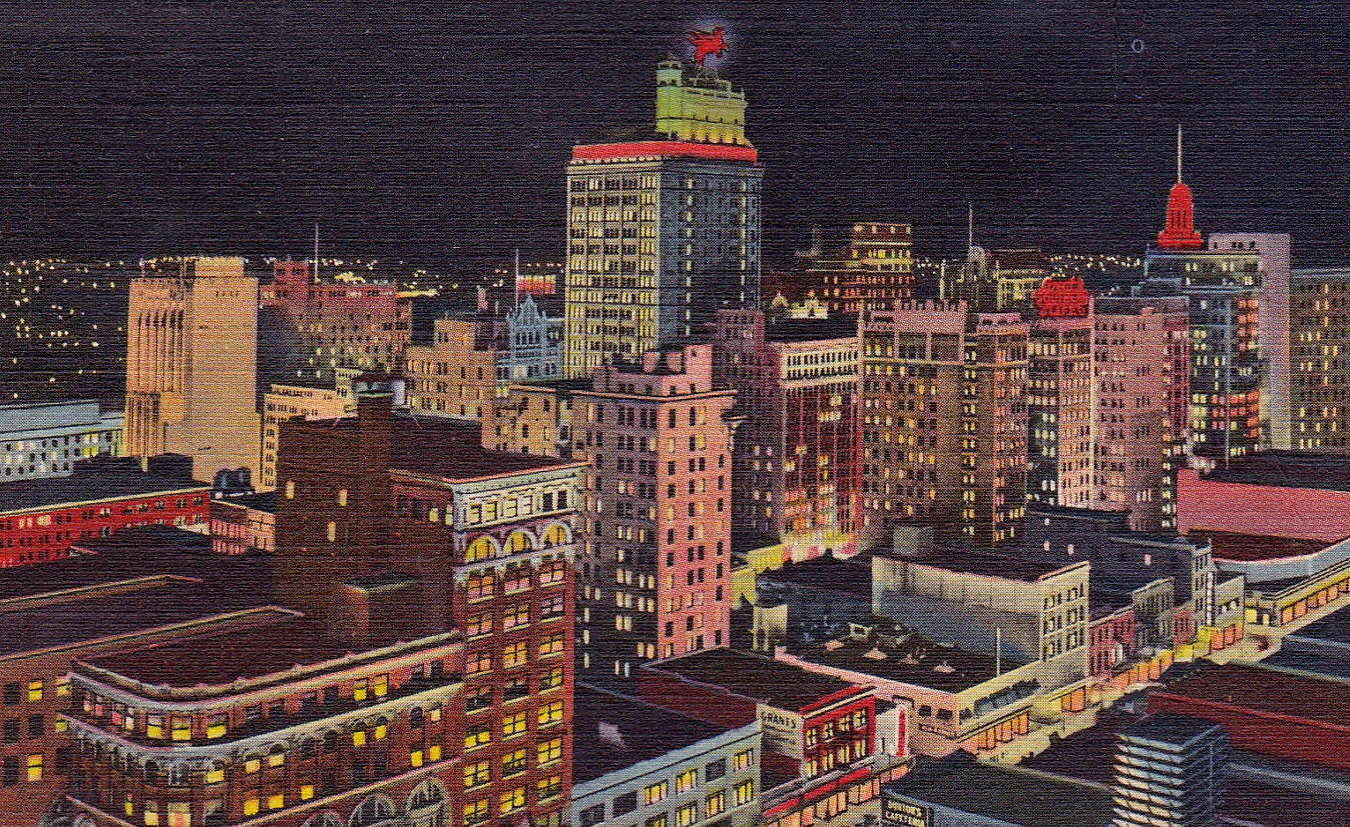
birdseye_night_early1940sThe symbol of Dallas…

by Paula Bosse

One of my favorite views of the skyline — back when Pegasus had no competition.

***

Sources & Notes

Original photograph by Lloyd M. Long, from postcard “Night Scene, Heart of Dallas, Texas” (D-43).

*

Copyright © 2014 Paula Bosse. All Rights Reserved.

Night Life Along the Centennial Midway — 1936

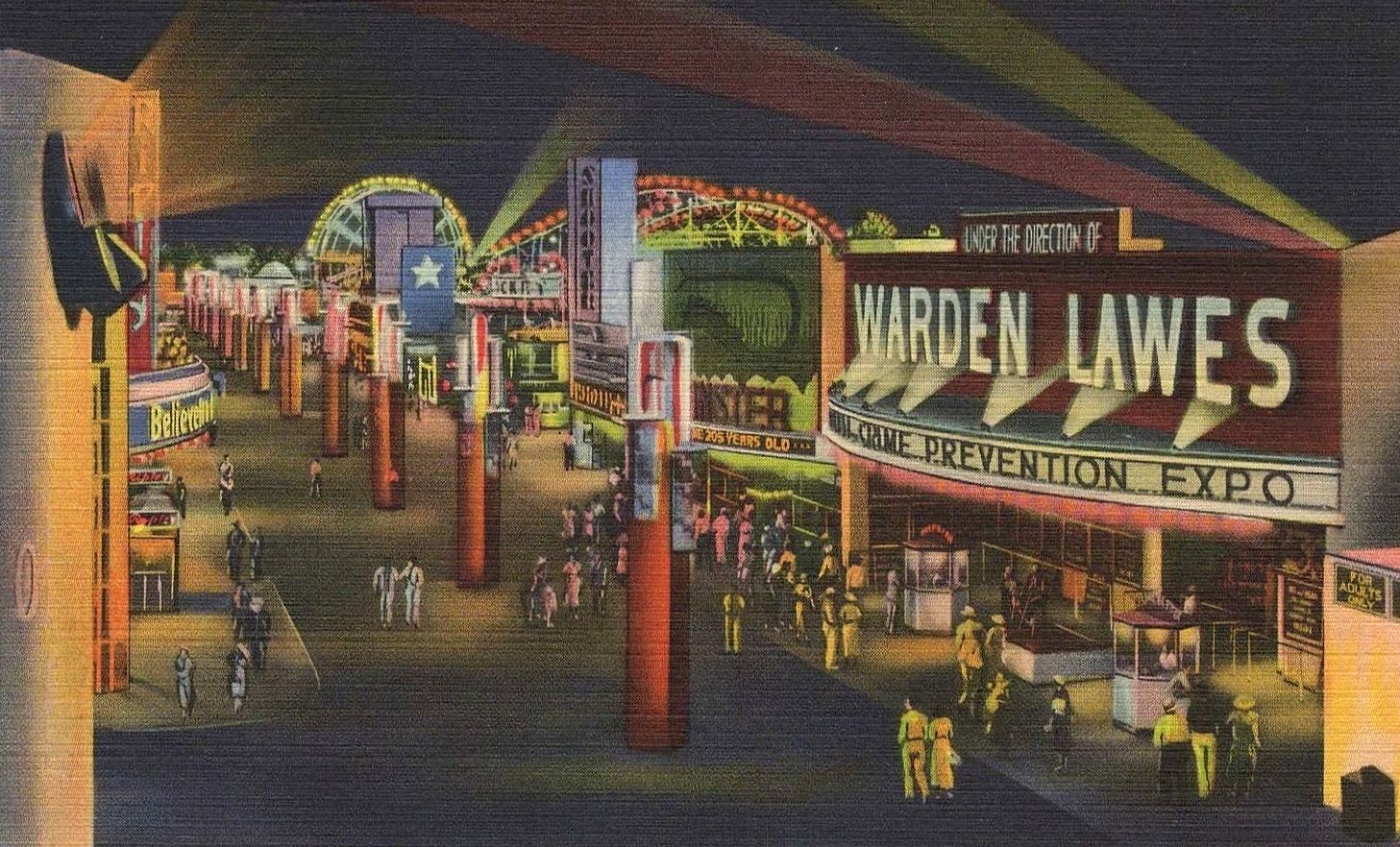
tx-centennial_night-midwayThe magical midway at night (click for larger image)

by Paula Bosse

Glamorous night shots as seen in not-quite-real-looking postcards from the 1930s and ’40s are among my favorites. And this shot, of the Texas Centennial Exposition Midway at night-time is so, so GREAT!

The text on the back of the card:

Night life in all its glory and glamour. Oddities, Animal Shows and Girl Shows to charm the most fastidious, along the Midway.

***

Compare to the shots of this stretch of the Midway from the other direction, in my previous post here.

Click picture for MUCH larger image!

*

Copyright © 2014 Paula Bosse. All Rights Reserved.

Swooning Over Love Field — 1940

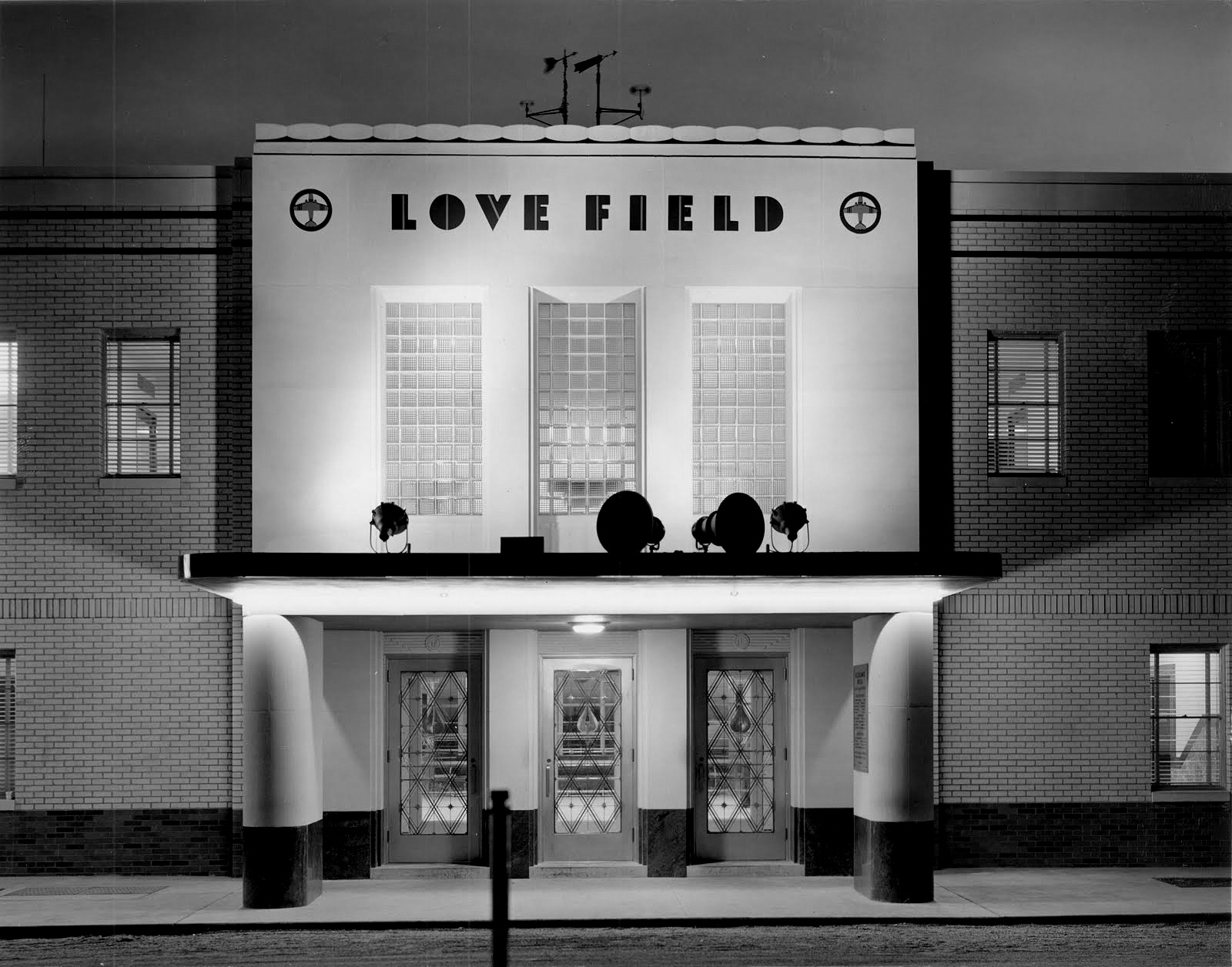
love-field_1940Art Deco Love Field!

by Paula Bosse

I’m a huge-fan of the modern 1950s-era Love Field (the one with the Mockingbird Lane entrance), but even that can’t trump this fantastic building! Designed by architect Thomas D. Broad, the new Love Field administration building and terminal — which faced Lemmon Avenue — was unveiled on October 6, 1940, to rapturous acclaim. The night view above is pretty breathtaking. Forget the airfield. For me, it’s all about this entrance. Those windows. And those doors. And that font! And those little airplane pictographs!

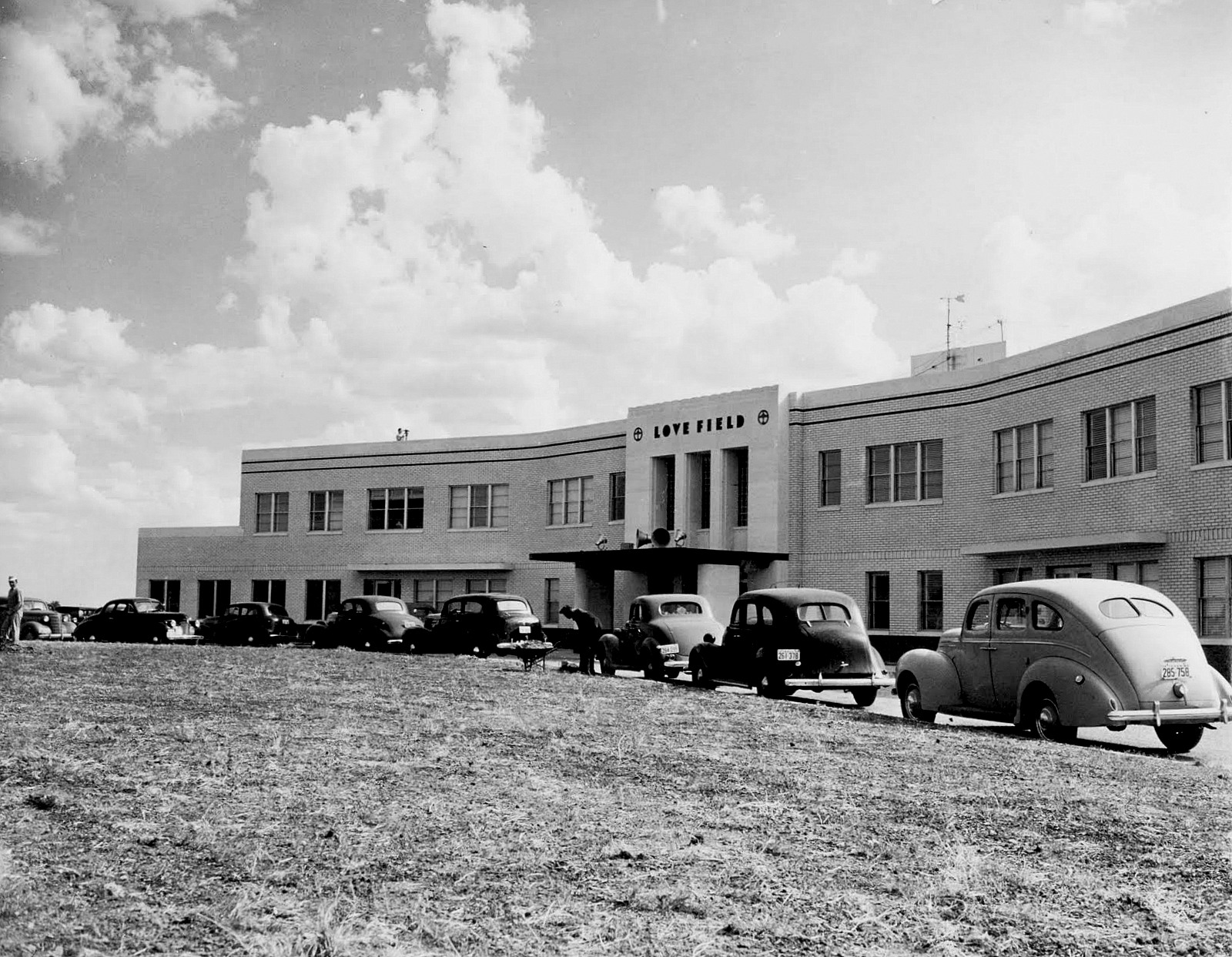
love-field_terminal_1940It wasn’t bad in the daytime, either — just nowhere near as dramatic. And in dire need of landscaping.

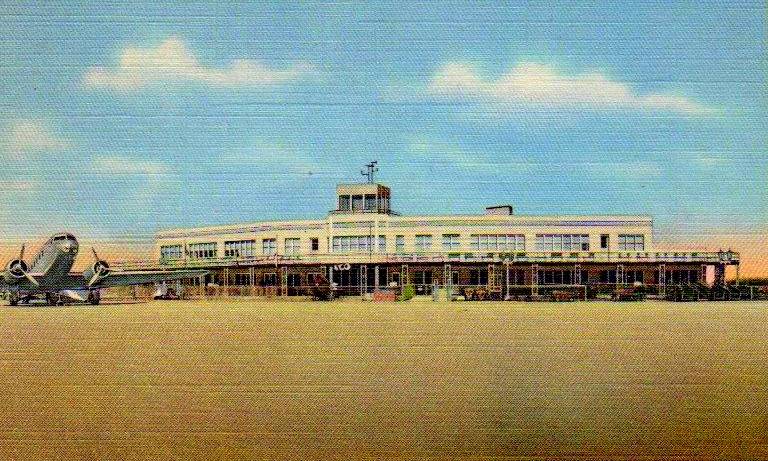
love-field_ca1940_frontAnd here it is from the field side. Still swoon-worthy. The back of this postcard reads:

LOVE FIELD — NEW $225,000 ADMINISTRATION BUILDING
One of America’s finest air terminals which takes care of more airline passengers, more air mail and more air express in ratio to population than any other airport in the country.

**

What happened to this beautiful building? I searched through the Dallas Morning News archives until I felt I had to throw in the towel, never finding a definitive answer. But here’s what I did find. When the brand-spanking-new terminal (the one we know today) opened in 1958, the 1940 terminal was vacated. A better word might be “abandoned.” Most assumed the building would be razed very soon after. But I got as far as September of 1964, and the old terminal was still standing. And it wasn’t pretty. This excerpt from a Dallas Morning News article is painful to read:

…The old terminal building cowers in desolation…. Virtually every window has been smashed, carpeting the deserted terminal with a dangerous floor of broken glass. Loose wires stick out here and there, and blinds hang in twisted postures from broken cords. The building’s big sign DALLLAS is missing its D. (DMN, July 2, 1961)

(And even more thoroughly painful is the article in the Dallas News archives by Kent Biffle, “Ghosts Wait by Runway” — DMN, Feb. 2, 1961.)

Apparently, the old building had to remain standing until a “much-debated” new multi-million-dollar runway was agreed upon.

The point at which I threw in the towel in my quest to discover when the old terminal building had been demolished was a DMN photo from September 25, 1964, with the caption “$4,000,000-Plus Runway Progress. The 8,800-foot parallel runway at Dallas Love Field, left center, is two-thirds completed and should be ready for use next spring.” I am assured the photo has a hard-to-see old terminal still decaying in it. I assume they razed that sucker pretty soon afterward. …Possibly.

***

Sources & Notes

Top two photos are from the Love Field Collection, Dallas History and Archives, Dallas Public Library; accession numbers are PA83-13-8 for the swoony one at the top, and PA83-13-4 for the daylight exterior photo. I originally found these in the post “The New Love Field” by Jacob Haynes, here.

Click pictures for larger images — the first two are HUGE!

*

Copyright © 2014 Paula Bosse. All Rights Reserved.