Flashback : Dallas

A Miscellany: History, Ads, Pop Culture

Category: Photographs

The Ladies’ Reading Circle: An Influential Women’s Club Organized by Black Teachers in 1892

ladies-reading-circle_negro-leg-brewer_1935The Ladies (click for larger image)

by Paula Bosse

When one thinks of “ladies’ clubs” of the past, one probably tends to think of groups of largely well-to-do women in fashionable dresses, gloves, and smart hats who gathered for quaint meetings in one another’s homes to discuss vaguely literary or cultural topics, sip tea, chit-chat, and gossip. Often they would plan projects and events which would aid pet community or charitable causes. There were clubs of varying degrees of serious-mindedness, but, for the most part, club meetings were mostly an excuse for women to socialize. 100 years ago, these women rarely worked outside the home, and these groups offered an important social and cultural outlet for well-educated women of means. White women. Women of color were not part of that particular club world. They had to create clubs for themselves. And they did.

In 1892, eight African-American teachers in Dallas organized their own club, the Ladies’ Reading Circle, and while it, too, was an important social outlet for the women, the focus of the group tended to be more serious, with reading lists comprised primarily of political, historical, and critical texts.

The members of the Ladies’ Reading Circle (a group that lasted at least until the 1950s) were, for the most part, middle-class black women who set an agenda for the club of education, self-improvement, and social responsibility. Like most women’s clubs of the time, each meeting of the LRC was held in a different member’s home and usually ended with a “dainty” luncheon and light musical fare, courtesy of the Victrola or player piano; but what set the LRC apart from most of the other women’s clubs of the day was the choice of reading material — from books on world history and international politics, to texts on current affairs and social criticism. (Several surprising examples appear below.)

Not only did the women gather weekly to discuss current and cultural affairs, they also worked to improve their community by tackling important social issues and by inspiring and encouraging young women (and men) who looked to them as civic leaders. Noted black historian J. Mason Brewer dedicated his 1935 book Negro Legislators of Texas to the women of the Ladies’ Reading Circle. The photograph above is from Brewer’s book, as is the following dedication:

lrc_negro-leg-brewer_1935-dedication

Included were the names of the members, several of whom had organized the club in 1892:

lrc_members_brewer

One of the LRC’s concerns was establishing a home which, like the white community’s YWCA, offered housing and career training for young women. The charming frame house the club bought for this purpose in 1938 (and which is described in the Jan. 10, 1952 News article “Ladies Reading Circle Seeks $7,500 for Expanding Home”) still stands at 2616 Hibernia in the State-Thomas area

lrc-home_2616-hibernia_google2616 Hibernia (Google Street view, 2014)

But the group was organized primarily as a “reading circle,” and the minutes of three randomly chosen meetings show the sort of topics they were interested in exploring. The following three articles are from the post-WWI-era, and all appeared in The Dallas Express, a newspaper for the city’s black community.

lrc_dallas-express_040320April 3, 1920

lrc_dallas-express_041020April 10, 1920

lrc_dallas-express_102023October 20, 1923

My favorite juxtaposition of content on the pages of The Dallas Express was the article below which reported on a white politician’s promise that he would fight to keep “illiterate Negro women” from voting — just a column or two away was one of those eye-popping summaries of the latest meeting of the Ladies’ Reading Circle. My guess is that the black educators who comprised the Ladies’ Reading Circle were probably far more knowledgeable about world events than he was.

negro-womans-suffrage_dallas-express_052220May 22, 1920

In reading the limited amount of information I could find on the LRC, I repeatedly came across the name of one of the earliest members, Callie Hicks (she is in the 1935 photo at the top, seated, second from the right). She was a dedicated teacher as well as a respected civic leader who worked for several causes and was an executive of the Dallas branch of the NAACP. A Dallas News article about Miss Hicks appeared in Feb., 1950 when she was named “Woman of the Year” by one of the largest African American women’s organizations in Dallas County (“Honor Caps 40 Years of Helpful Teaching,” DMN, Feb. 10, 1950). Miss Hicks died in May, 1965.
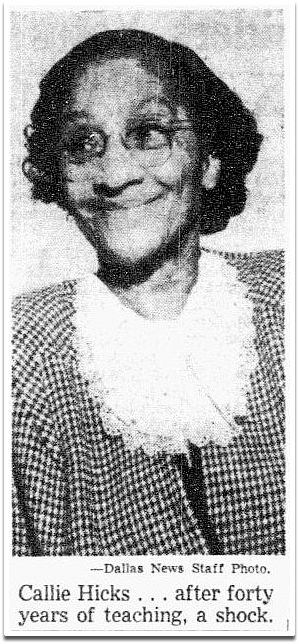
callie-hicks_dmn-021950-photo1950

It’s a shame that the Ladies’ Reading Circle is not better known in Dallas today. I have to admit that I had never heard of the group until I stumbled across that 1935 club photo. Their tireless work to improve the intellectual lives of themselves and others no doubt influenced the generations that followed.

***

Sources & Notes

Top photograph, dedication, and member list, from Negro Legislators of Texas and Their Descendants; A History of the Negro in Texas Politics from Reconstruction to Disenfranchisement by J. Mason Brewer (Dallas: Mathis Publishing Co., 1935).

Minutes from the Ladies’ Reading Circle meetings all printed in The Dallas Express.

Relevant material on the LRC and other historic African-American women’s clubs can be read in Women and the Creation of Urban Life, Dallas, Texas, 1843-1920 by Elizabeth York Enstam (College Station: Texas A & M University Press, 1998), here.

The Handbook of Texas entry for one of the founding members of the Ladies’ Reading Circle, Julia Caldwell Frazier, can be found here.

*

Copyright © 2014 Paula Bosse. All Rights Reserved
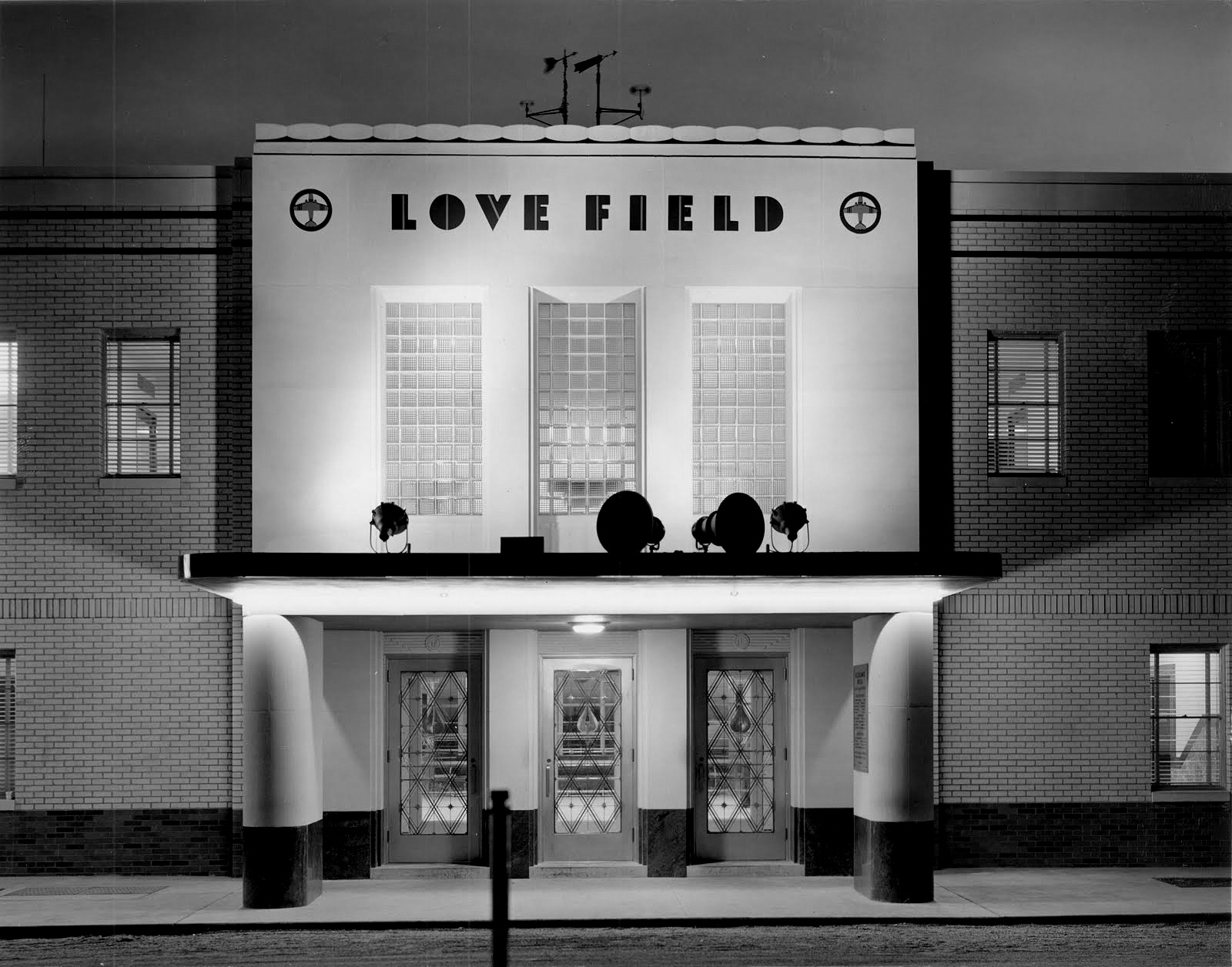
Swooning Over Love Field — 1940

love-field_1940Art Deco Love Field!

by Paula Bosse

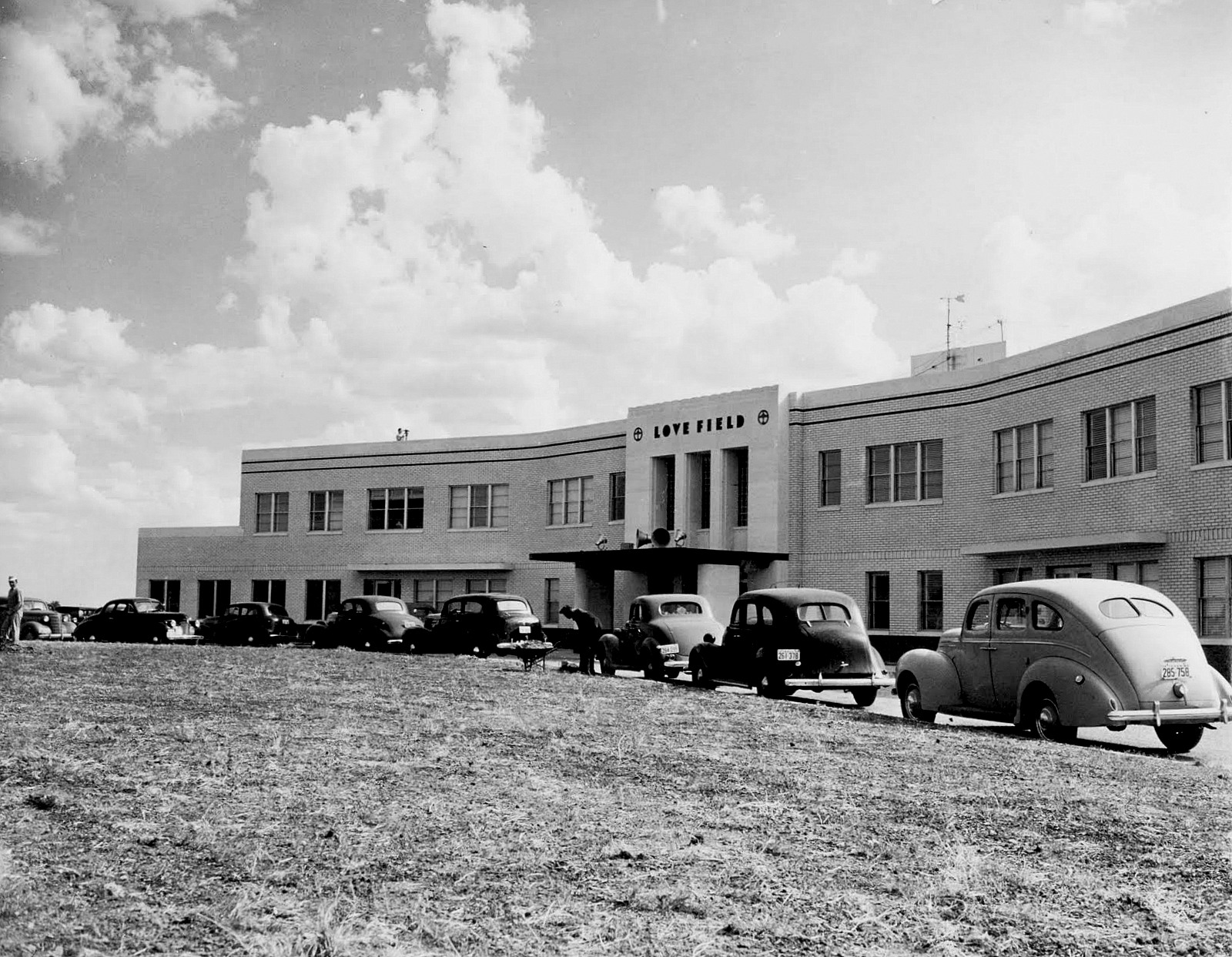
I’m a huge-fan of the modern 1950s-era Love Field (the one with the Mockingbird Lane entrance), but even that can’t trump this fantastic building! Designed by architect Thomas D. Broad, the new Love Field administration building and terminal — which faced Lemmon Avenue — was unveiled on October 6, 1940, to rapturous acclaim. The night view above is pretty breathtaking. Forget the airfield. For me, it’s all about this entrance. Those windows. And those doors. And that font! And those little airplane pictographs!

love-field_terminal_1940It wasn’t bad in the daytime, either — just nowhere near as dramatic. And in dire need of landscaping.

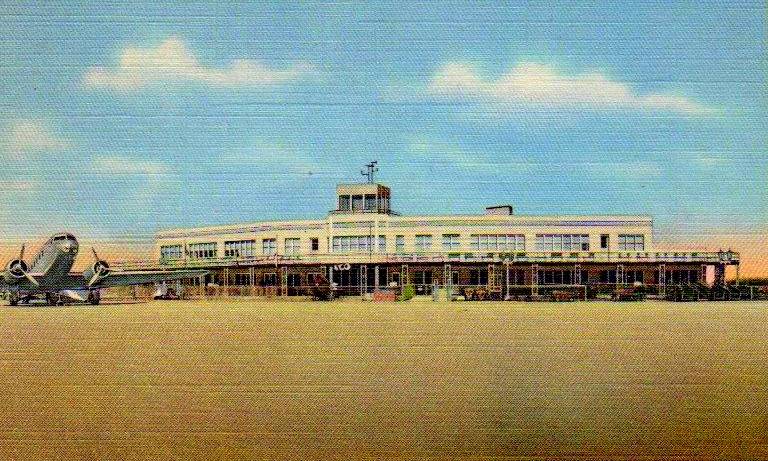
love-field_ca1940_frontAnd here it is from the field side. Still swoon-worthy. The back of this postcard reads:

LOVE FIELD — NEW $225,000 ADMINISTRATION BUILDING
One of America’s finest air terminals which takes care of more airline passengers, more air mail and more air express in ratio to population than any other airport in the country.

**

What happened to this beautiful building? I searched through the Dallas Morning News archives until I felt I had to throw in the towel, never finding a definitive answer. But here’s what I did find. When the brand-spanking-new terminal (the one we know today) opened in 1958, the 1940 terminal was vacated. A better word might be “abandoned.” Most assumed the building would be razed very soon after. But I got as far as September of 1964, and the old terminal was still standing. And it wasn’t pretty. This excerpt from a Dallas Morning News article is painful to read:

…The old terminal building cowers in desolation…. Virtually every window has been smashed, carpeting the deserted terminal with a dangerous floor of broken glass. Loose wires stick out here and there, and blinds hang in twisted postures from broken cords. The building’s big sign DALLLAS is missing its D. (DMN, July 2, 1961)

(And even more thoroughly painful is the article in the Dallas News archives by Kent Biffle, “Ghosts Wait by Runway” — DMN, Feb. 2, 1961.)

Apparently, the old building had to remain standing until a “much-debated” new multi-million-dollar runway was agreed upon.

The point at which I threw in the towel in my quest to discover when the old terminal building had been demolished was a DMN photo from September 25, 1964, with the caption “$4,000,000-Plus Runway Progress. The 8,800-foot parallel runway at Dallas Love Field, left center, is two-thirds completed and should be ready for use next spring.” I am assured the photo has a hard-to-see old terminal still decaying in it. I assume they razed that sucker pretty soon afterward. …Possibly.

***

Sources & Notes

Top two photos are from the Love Field Collection, Dallas History and Archives, Dallas Public Library; accession numbers are PA83-13-8 for the swoony one at the top, and PA83-13-4 for the daylight exterior photo. I originally found these in the post “The New Love Field” by Jacob Haynes, here.

Click pictures for larger images — the first two are HUGE!

*

Copyright © 2014 Paula Bosse. All Rights Reserved.

The DFW Turnpike, Unsullied by Traffic, Billboards, or Urban Sprawl — 1957

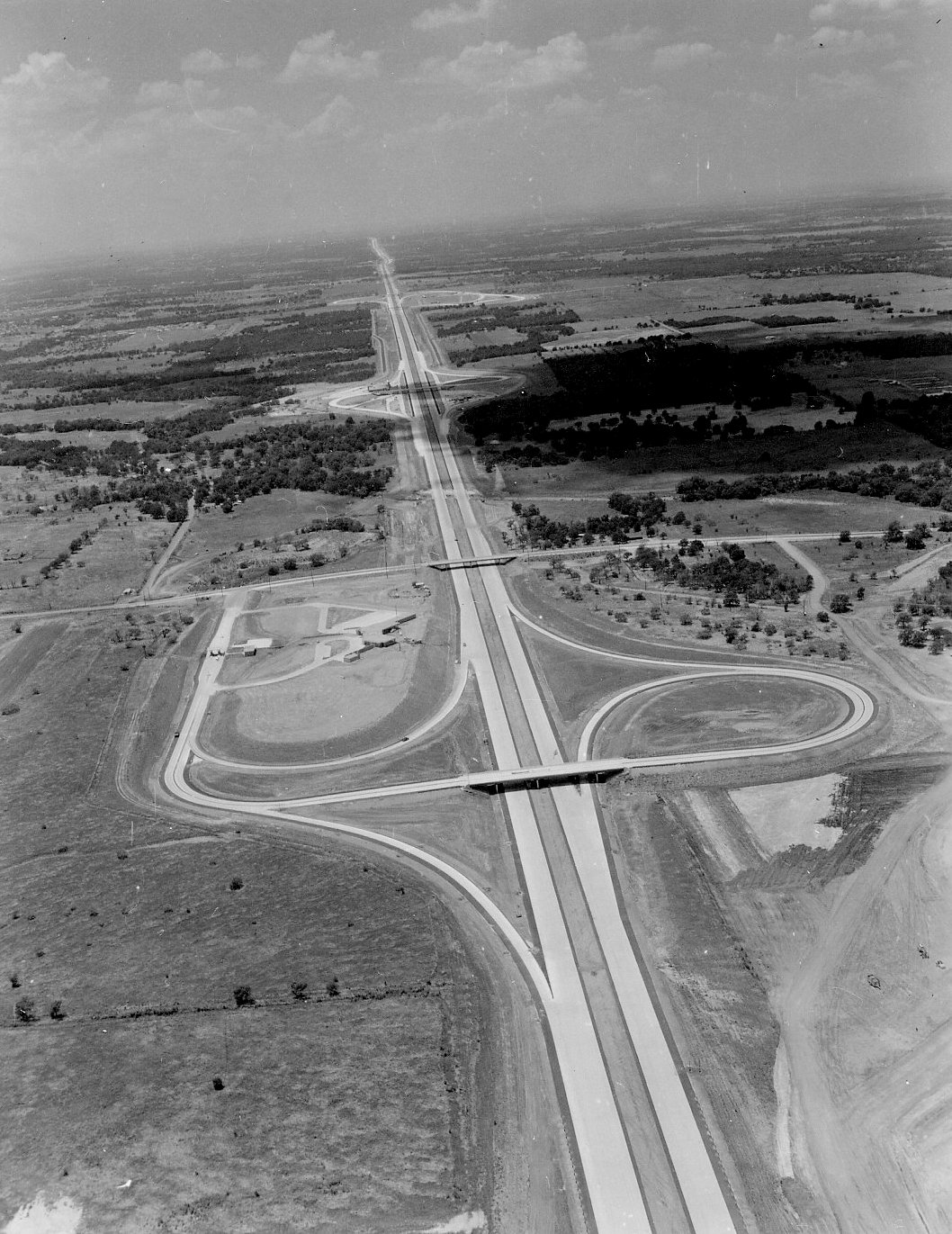
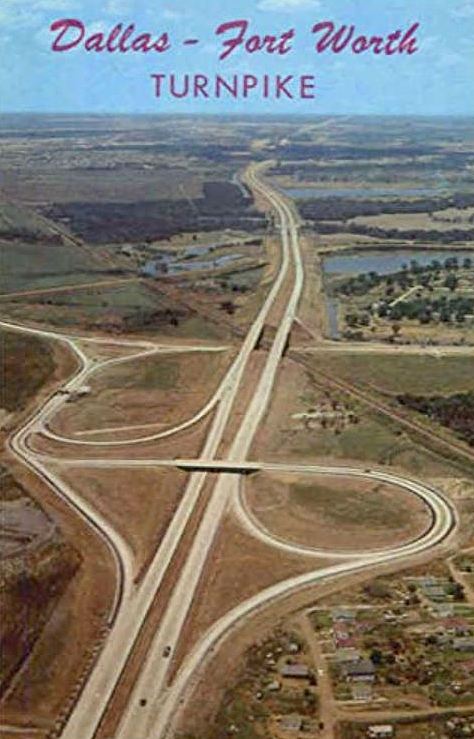
turnpike_west-from-360_1957The DFW Turnpike, 1957… (click for very large image!)

by Paula Bosse

Above, the Dallas-Fort Worth turnpike in 1957, before it opened for business. When this toll road was paid off in 1977, the toll booths were removed and it became I-30, a “free” highway. (This “toll-road-becoming-a-free-road” thing has happened only once in the history of Texas; I can’t imagine it will ever happen again.) This photo shows the turnpike heading west through Arlington, with Hwy. 360 crossing over it in the middle. Six Flags over Texas would be built in this wide open expanse four years later. And then … an explosion of development.

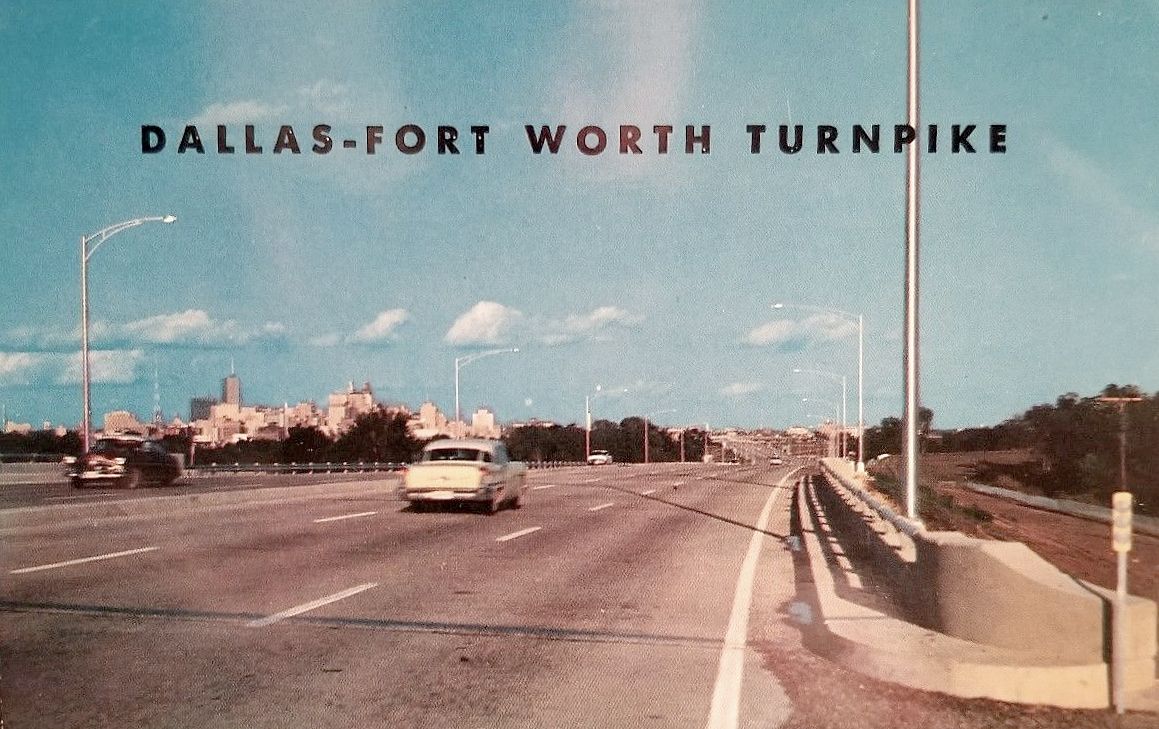
A Texas Highways article described the 30-mile stretch (“30 miles — 30 minutes!”) as being a blissful drive through “a landscape devoid of advertising signboards and commercial establishments” (!). In fact, the only businesses along the turnpike were two restaurants and two service stations. All the way from Dallas to Fort Worth … that was IT! You know, I’d gladly pay an obscenely exorbitant toll today if it meant I could drive that stretch of highway the way it was in this photo. A world without urban sprawl would be heaven.

I love this photo. The road ahead just disappears into the ether. And, Arlington, you’ve never looked better.

dfw_turnpike

dfw-turnpike_postcard

dfw-turnpike_flickr_coltera

dfw-turnpike_postcard_skyline

dallas-fw-turnpike_postcard

***

Sources & Notes

Top photo from Oscar Slotboom’s book Dallas-Fort Worth Freeways, credited to TxDOT Travel Information Division, 1957. His caption: “The view looks west along the turnpike just before it opened in  1957 with the  SH 360 intersection in the foreground…. Land on the left side of the turnpike just past SH 360 would soon be developed into Six Flags Over Texas…. The building alongside the turnpike was a Texas Turnpike Authority administrative office which was demolished in 2011.”

Postcards from around the internet.

For an informative read and LOTS of photos, I highly recommend Oscar Slotboom’s chapter on the DFW Turnpike, which you can access here (there are tons of historical photos). This chapter is from Slotboom’s exhaustive work Dallas-Fort Worth Freeways: Texas-Sized Ambition. The entire book has been made available online — for free (the home-page is here). You can read about Mr. Slotboom’s work in a Dallas Morning News interview by Robert Wilonsky here.

A fun read about the turnpike (yes, fun!) is an article from Texas Highways (Dec. 1957), here. (The article is spread over three web pages — don’t miss the links for all of the pages at the top of each page.)

By the way, when the turnpike opened, the toll was 50 cents. According to the Inflation Calculator, that would be equivalent in today’s money to just over $4.00. To drive from Dallas to Fort Worth quickly, through not-yet-developed green spaces and along a new highway uncluttered with billboards. A BARGAIN!

Click photo for larger image.

*

Copyright © 2014 Paula Bosse. All Rights Reserved.


Elm Street — 1909

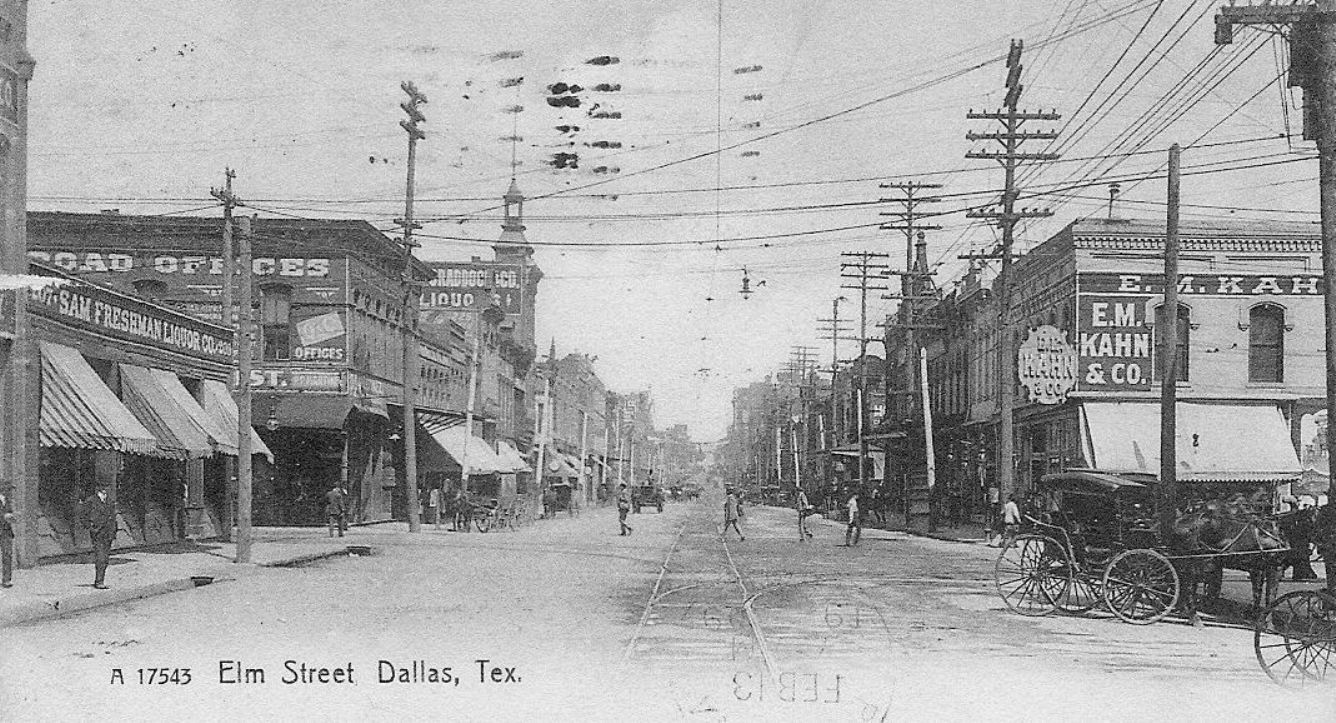
elm-street_postcard-1909-lgElm St. at N. Lamar, looking east (click for much larger image)

by Paula Bosse

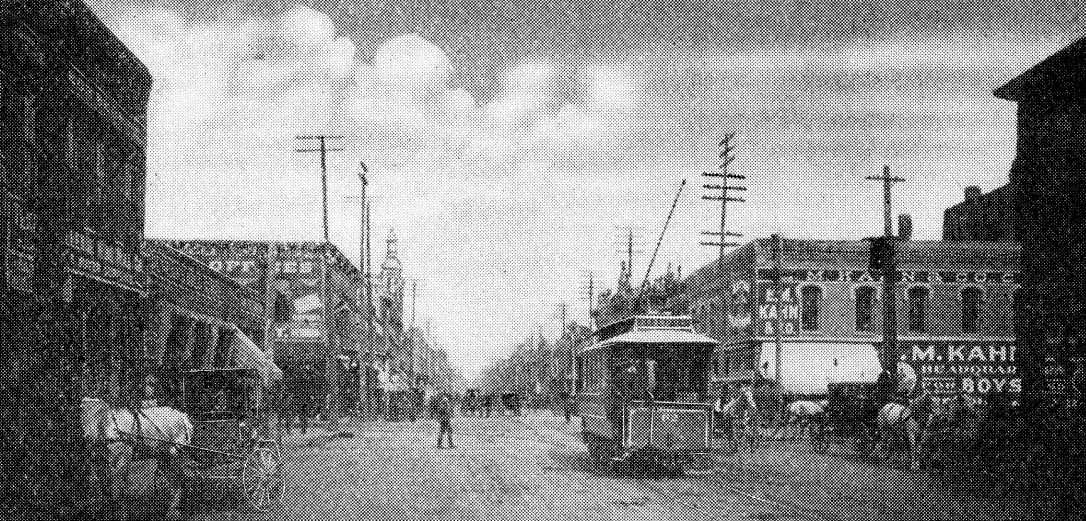
In a sort of unfocused wandering around the internet yesterday, I happened across two photos of Elm Street in 1909 that were virtually the same shot, and I came across them on completely unrelated websites. Just a weird coincidence. And they’re pretty cool.

(Ever since I wrote about L. Craddock & Co. Liquors a few months ago, I swear I see that building everywhere now! It’s become a kind of landmark I use to get my bearings. It’s the building on the left with the little cupola on top — it was at Elm and Poydras, between N. Lamar and Griffin.)

elm-street_1909

***

The first photo is a postcard, from Ebay.

Second photo is from Texas: A Southwest Empire (Chicago/St. Louis: Passenger Traffic Dept. Rock Island-Frisco Lines and Chicago & Eastern Illinois Railroad, 1909).

To check out the businesses along this stretch of Elm, see the Worley’s 1909 city directory here. This page shows all the businesses in this photo, moving west to east. It will start with Sam Freshman Liquors right before you cross N. Lamar. On the east side of Lamar, on the right, E.M. Kahn’s. L. Craddock, on the left, is at the corner of Elm and Poydras.

The Worley’s and other criss-cross directories are invaluable in determining locations, especially at the time of this photo, because Dallas street numbers changed in 1911 and do not correspond to today’s street numbers (a surprisingly interesting topic, which I researched here). Besides, those directories are a lot of fun to play around with! (Then again, I was one of those kids who enjoyed reading the dictionary.)

Click photos for larger images.

*

Copyright © 2014 Paula Bosse. All Rights Reserved.

A Lost Photo of Director Larry Buchanan, Celebrated “Schlockmeister” — 1955

buchanan-katy-camera_1955_bwLarry Buchanan (in bowtie) in his ad-man days, 1955

by Paula Bosse

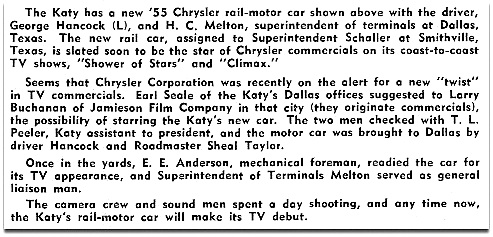
I got all excited when I saw the above photo posted in the Lone Star Library Annex Facebook group. It accompanied an article and another photo from the Katy Employes’ Magazine (August, 1955) (seen below) — the poster was interested in the railroad-angle of the article and photos, but the name “Larry Buchanan” was what grabbed my attention.

buchanan_katy-chrysler

buchanan_katy-text

The photo was posted because it was a wonderful piece of M-K-T Railroad-related ephemera. Before reading the accompanying text, I thought that the idea of a 1955 Chrysler tricked-out to ride along Katy railroad tracks (so that M-K-T officials could, presumably, ride the rails in comfortable air-conditioned splendor as they moved from one inspection site to the next) was the cool thing about the article. Then I got to the name “Larry Buchanan.” And it became much, MUCH more interesting.

So who is Larry Buchanan? Briefly, Larry Buchanan is one of the greatest exponents of grade-Z, low-low-low-LOW-budget filmmaking, a director with a cult following amongst those who enjoy movies in the “so-bad-they’re-good” genre. He shot most of his movies in the 1960s in Dallas, taking advantage of lots of locations around the city, even if the movies he was shooting weren’t actually set in Dallas (one movie had Highland Park Village standing in for Italy, and “Mars Needs Women” was set in Houston, even though the movie is crammed full of easily recognizable Dallas locations such as the downtown skyline and the Cotton Bowl). The movies that have earned him his place in the pantheon of cult figures are primarily his sci-fi movies, like “Mars Needs Women,” “Attack of the Eye People,” “Curse of the Swamp Creature,” and “Zontar: The Thing from Venus.” Many were re-makes of earlier low-budget sci-fi movies commissioned by American International Pictures, and Buchanan was usually the producer, director, writer, and editor — “auteur” seems like the wrong word to use here, but that’s what he was, a filmmaker intensely involved with every phase of the production.

Buchanan was born in 1923 and grew up in Buckner Orphans Home. After a fleeting thought of becoming a minister, Buchanan — long-fascinated by movies — left for Hollywood and New York where he worked as an actor in small roles or on the crew (during this time there were professional brushes with, of all people, George Cukor and Stanley Kubrick). By the early 1950s, Buchanan was back in Dallas, employed by the Jamieson Film Company (3825 Bryan St.), working on industrial films, training films, television programs, and commercials. It was at Jamieson that he learned all aspects of film production, including how to get things done quickly and how to bring projects in under budget. It’s also where he met co-workers Brownie Brownrigg, Robert B. Alcott, Bob Jessup, and Bill Stokes, all of whom went on to have film careers of their own and most of whom Buchanan used as crew members when shooting in and around the city.

It was during this period that the photo above was taken. There are countless websites out there devoted to Larry Buchanan’s film oeuvre, but there are very, very few photos of him online. I found exactly three:

larry-buchanan_bob-jessup_texas-monthly_lgLarry (left) with cinematographer Bob Jessup

larry-buchanan_tx-monthly_may-1986-photo_detIn 1986 (Tim Boole/Texas Monthly)

larry-buchananDate unknown

The photo at the top of this post is from 1955, before Buchanan had really begun cranking out his own movies. I can’t say for sure that this IS a photograph of Larry Buchanan, but it seems likely that it is. In that striped shirt, he looks like the kind of hip, energetic, ever-enthusiastic director I imagine him being. I can only hope that it IS him, straddling railroad ties, behind a camera pointed at a retrofitted Chrysler, in Dallas’ Katy railyard. One wonders if that Chrysler spot had a higher budget than some of the movies he was making ten years later. UPDATE: In the comments, below, Larry’s son Barry identifies his father in the top photo, but not as the man behind the camera, but as the man behind the car, wearing the bowtie. Thanks for the correction, Barry1)

From all reports, Larry was a tireless, driven, upbeat guy who loved making movies, and I think it would have been a lot of fun hanging out with him. If I ever have enough disposable income, I’ll fork it over and buy a copy of his entertaining-but-pricey autobiography, the well-received It Came From Hunger: Tales of a Cinema Schlockmeister (McFarland & Co., 1996).

It’s been fun researching Larry Buchanan. There’s a lot more to tackle later. I mean, I haven’t even touched on the legendary “Naughty Dallas” yet!

***

Tons of links here….

First two photos and text from the Katy Employes’ Magazine (Aug. 1955).

buchanan-cover_sm

Katy magazine scans made with permission of the Facebook page Lone Star Library Annex.

Other examples of automobiles equipped with “railroad wheels” can be found here.

Black and white photo of Buchanan with Bob Jessup (photographer and date unknown) and the great color photo (a detail of which is shown above) by Tim Boole, both from the article, “How Bad Were They?” by Douglass St. Clair Smith (Texas Monthly, May 1986), which you can read here.

That last photo of Buchanan is all over the internet — the only one you ever really see. I don’t know who took it, when it was taken, or where it originally appeared. But it’s a great photo!

Larry Buchanan died in December, 2004, at the age of 81. His obituary from The New York Times is here.

A fond look back at Buchanan’s career by Eric Celeste appeared in the April 2005 issue of D Magazine and can be read here.

The best piece on Buchanan is “A Tribute to Larry Buchanan” by his good friend Greg Goodsell, here.

My recent post on “Mars Needs Women” — with screen caps of movie scenes shot at recognizable Dallas locations — is here.

I never did find that Chrysler spot that had been slated to appear on network TV. I have a feeling it may be in a lengthy collection of Chrysler commercials and films from 1955 which you can watch here. I couldn’t slog all the way through it, but there are a couple of “Shower of Stars” episodes, which are mentioned in the Katy article (they’re odd “entertainment” shows which seem to be nothing more than infomercials for Chrysler starring famous people in bad sketches). If anyone actually finds footage that was filmed that day in Dallas, please let me know!

And, lastly, Larry Buchanan’s movies are fun, but some are more fun than others, “if you know what I mean, and I think you do” (as Joe Bob Briggs — surely one of Larry’s biggest admirers — might say). Many of them are available to watch in their entirety online. Check YouTube and Google.

Click photos for larger images!

*

Copyright © 2014 Paula Bosse. All Rights Reserved.

The Marsalis House: One of Oak Cliff’s “Most Conspicuous Architectural Landmarks”

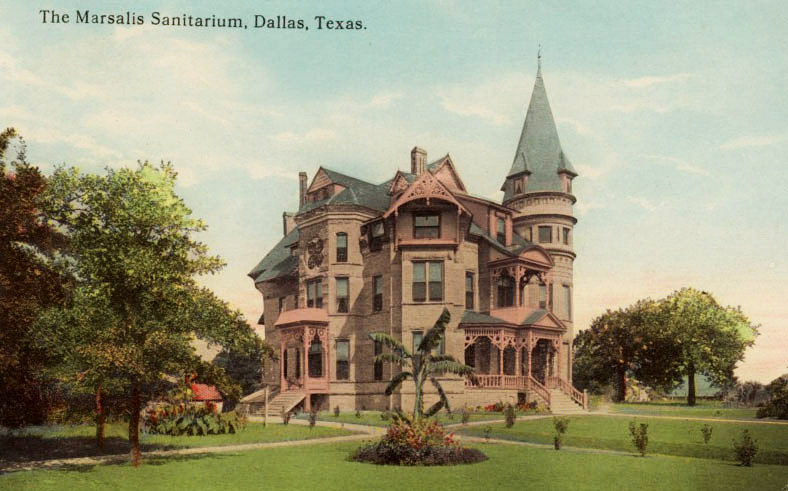
marsalis_sanitarium_oak-cliffThe fabulous Marsalis house in Oak Cliff (click for larger image)

by Paula Bosse

The Marsalis Sanitarium was a 15-bed private surgical and convalescent hospital in Oak Cliff, established in 1905 by Dr. J. H. Reuss and his partner, Dr. James H. Smart. Whether or not that building was actually pink (and I certainly hope that it was!), it was most definitely a show-stopper — one of those stunning structures that one doesn’t expect to see in and around Dallas because almost none of them still stand.

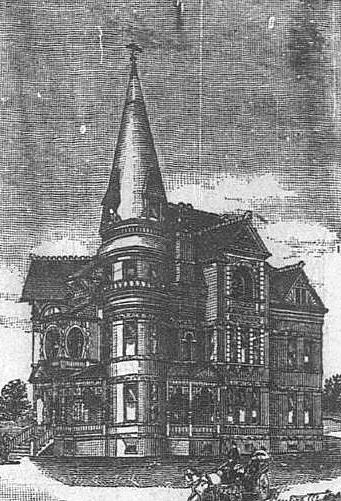
This grand home was built by Oak Cliff promoter and developer Thomas L. Marsalis in about 1889 as his personal residence at a reported cost of $65,000 (the equivalent of more than $1,750,000 in today’s money). It was located at what is now the southwest corner of Marsalis Avenue and Colorado Boulevard. The house was apparently never occupied. Supposedly, Marsalis’ wife did not want to live there because it was “too far from town” (!), but Marsalis’ financial distress throughout this time was probably more to blame.

marsalis-house_drawing
Dallas Morning News

Marsalis’ insolvency resulted in the foreclosure of the house in the early 1890s and its ultimate sale at public auction in 1903. The winning bidder at that auction was Dr. Reuss, and the house became the Marsalis Sanitarium soon after.

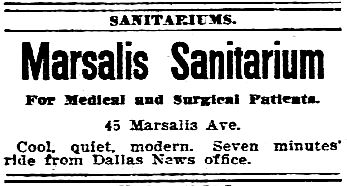
marsalis-sanitarium_tx-state-journal-medical-advertiser_dec-1905_portal
1905 ad (click for larger image)

marsalis_sanitarium_dmn_010109DMN, Jan. 1, 1909

marsalis-sanitarium_worleys-1909
Worley’s City Directory, 1909

Sometime after 1909 it became a girls’ seminary, and then in 1913 it fell into private hands. On August 10, 1914 the poor house burned to the ground. The headlines the next day read:

“Oil Starts Oak Cliff Early Morning Fire; Fisher Asserts Some One Set Old Building Ablaze; Firemen Find Structure Completely Enveloped in Flames and Interior Roaring Furnace.”

marsalis-house-fire_dmn_081114DMN, Aug. 11, 1914
Such a sad ending for such a beautiful house!

marsalis-home

***

Sources & Notes

1905 ad for the Marsalis Sanitarium from the December 1905 issue of the Texas State Journal of Medicine, found on the Portal to Texas History, here.

Black and white photograph of the Marsalis home in 1895 from the article in Legacies magazine, “Where Did Thomas L. Marsalis Go?” by James Barnes and Sharon Marsalis (which can be read here); photo from the collection of the Dallas Public Library.

For a biography of the family of Dr. Joseph H. Reuss, proprietor of the Marsalis Sanitarium, see here.

Click pictures for larger images.

*

Copyright © 2014 Paula Bosse. All Rights Reserved.


Back When the Kessler Couldn’t Catch a Break — 1957

kessler-theater-after-tornado_1957

by Paula Bosse

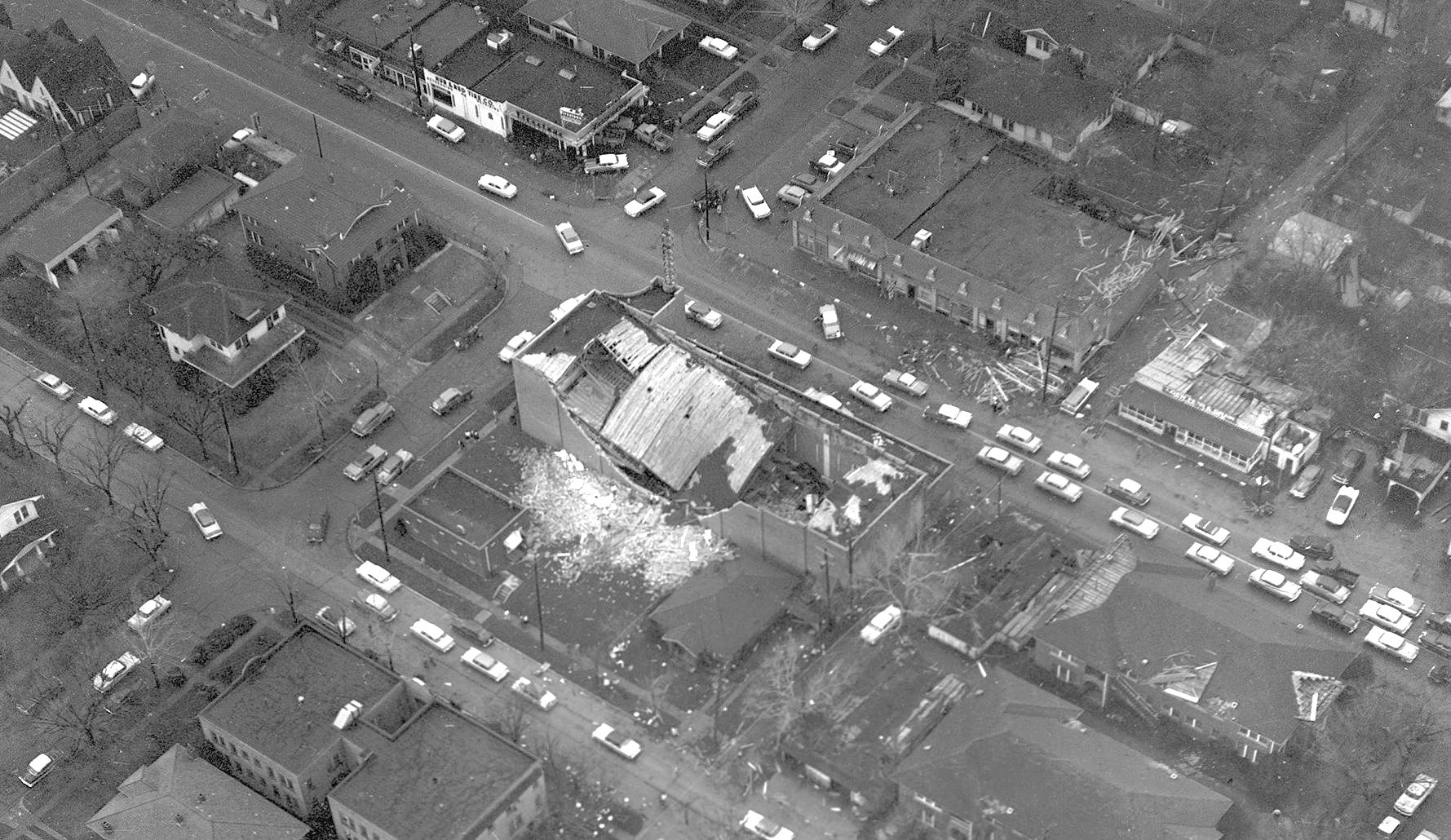
One of the casualties of the famous tornado that hit Dallas and Oak Cliff in 1957 was the Kessler Theater. In 1957, the Kessler — then only 15 years old — had hit hard times and was being used to house an evangelical church. It was rebuilt after the tornado, but soon after it was hit by a three-alarm fire. Conclusion? Do not disturb the entertainment gods — that place was meant to be a theater!

kessler_tornado_sherrod

From the post-tornado reports in The Dallas Morning News:

At the West Davis and Clinton business district, an evangelical church in a converted theater building at the intersection was caved in, leaving little more than two walls standing. The church’s cross from atop its more than 50-foot tower was crumpled in the gutter. (DMN, April 3, 1957)

And in a survey of the clean-up:

At Davis and Clinton, where the old Kessler Theater was being used as a revival center before the tornado, workmen were busy wrecking the building, completing what the tornado had started. […] J. T. Hooten, foreman for Winston A. Caldwell, explained that the damaged sections of the theater which might give way under a slight strain and cause further damage had to be torn out. His crew carefully but hurriedly dismantled the old Davis Street landmark. Hooten said the owner may rebuild the theater as a 1-story office building. (DMN, April 10, 1957)

Here is a detail of an aerial photo by photographer Squire Haskins, showing the damaged Kessler in the center (see the full, very large photo here):

kessler_tornado_squire-haskins_UTA_det

***

Sources & Notes

Top photo from an incredibly detailed website devoted to the 1957 Dallas tornado, the home page of which can be seen here.

Second photo from D. Troy Sherrod’s Historic Dallas Theatres (Charleston: Arcadia Publishing, 2014); photo from the collection of the Dallas Public Library.

Aerial photograph by Squire Haskins from the Squire Haskins Photography, Inc. Collection, UTA Libraries, Special Collections; more information is here (click the thumbnail to see a larger image).

Website of the recently (and beautifully) restored Kessler is here.

*

Copyright © 2014 Paula Bosse. All Rights Reserved.


“There Are Eight Million Stories in the Naked City…” — ca. 1920

1-ervay

by Paula Bosse

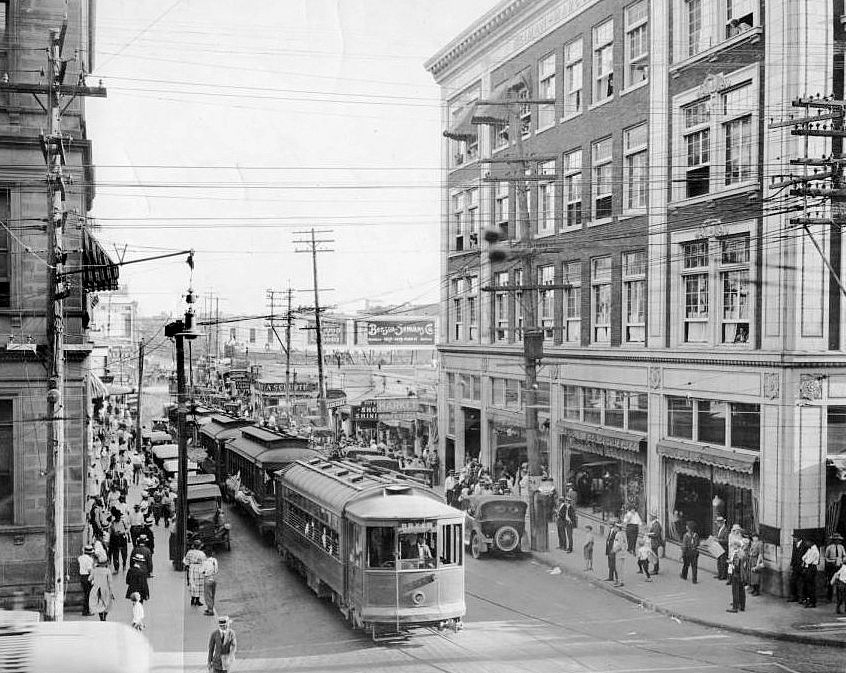
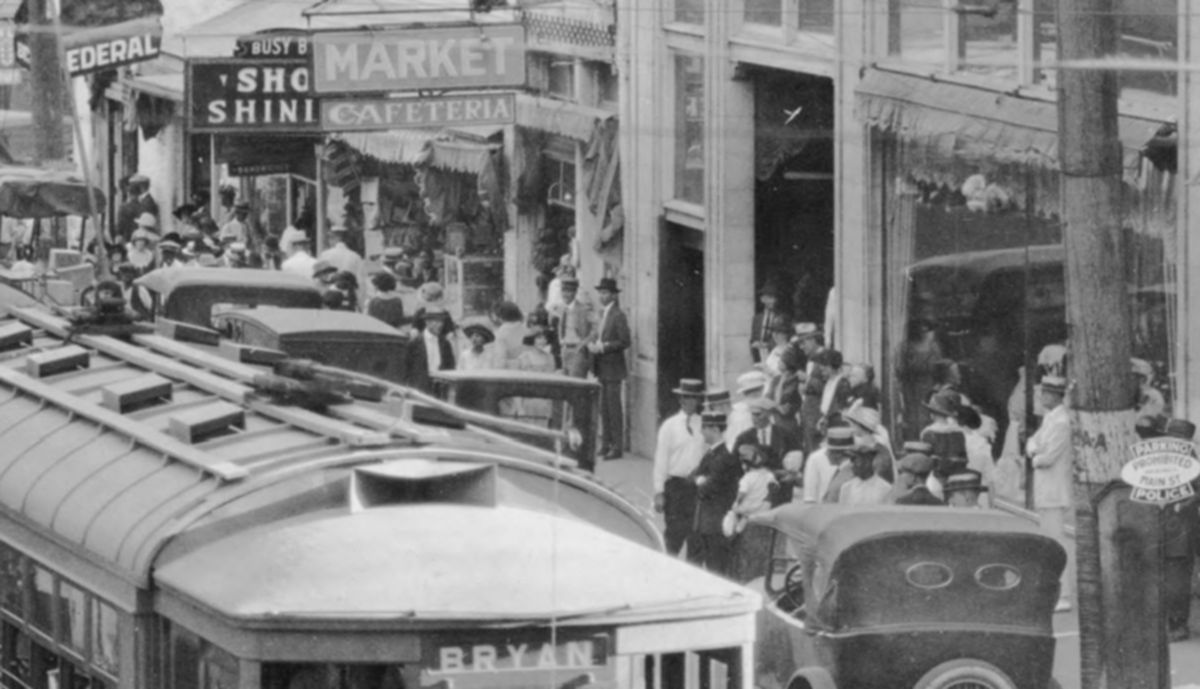
The photograph above, by George A. McAfee, shows Ervay Street, looking south from Main, in about 1920. Neiman’s is on the right. I’m not sure what the occasion was (I see special-event bunting….), but the two things that jump out right away are the number of people on the sidewalks and the amount of  congestion on the streets. In addition to private automobiles (driven by “automobilists” or “autoists,” as the papers of the day referred to them), the street is also packed with cars standing in the taxi rank (cab stand) at the left, and a long line of hulking streetcars. This busy intersection is jammed to capacity.

The city of Dallas was desperately trying to relieve its traffic problems around this time, and there were numerous articles in the papers addressing the concerns of how to manage the congestion of streets not originally designed to handle motor vehicle traffic. Dallas and Fort Worth were working on similar plans of re-routing traffic patterns and instituting something called “skip stop” wherein streetcars would stop every other block rather than every block. Streetcars, in fact, though convenient and necessary, seemed to cause the most headaches as far as backing up and slowing down traffic, as they were constantly stopping to take on and let off passengers. There was something called a “safety zone” that was being tried at the time. I’m not sure I completely understand it, but it allowed cars to pass streetcars in certain areas while they were stopped.

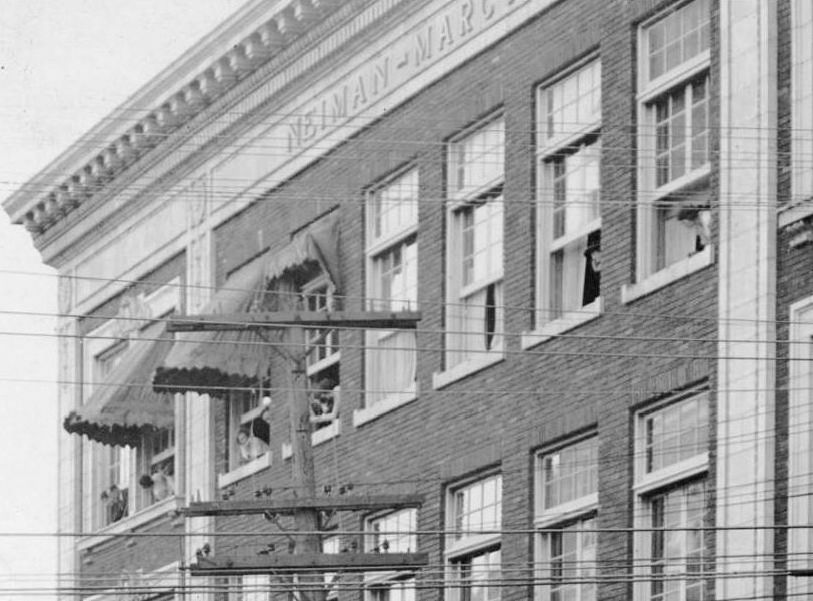
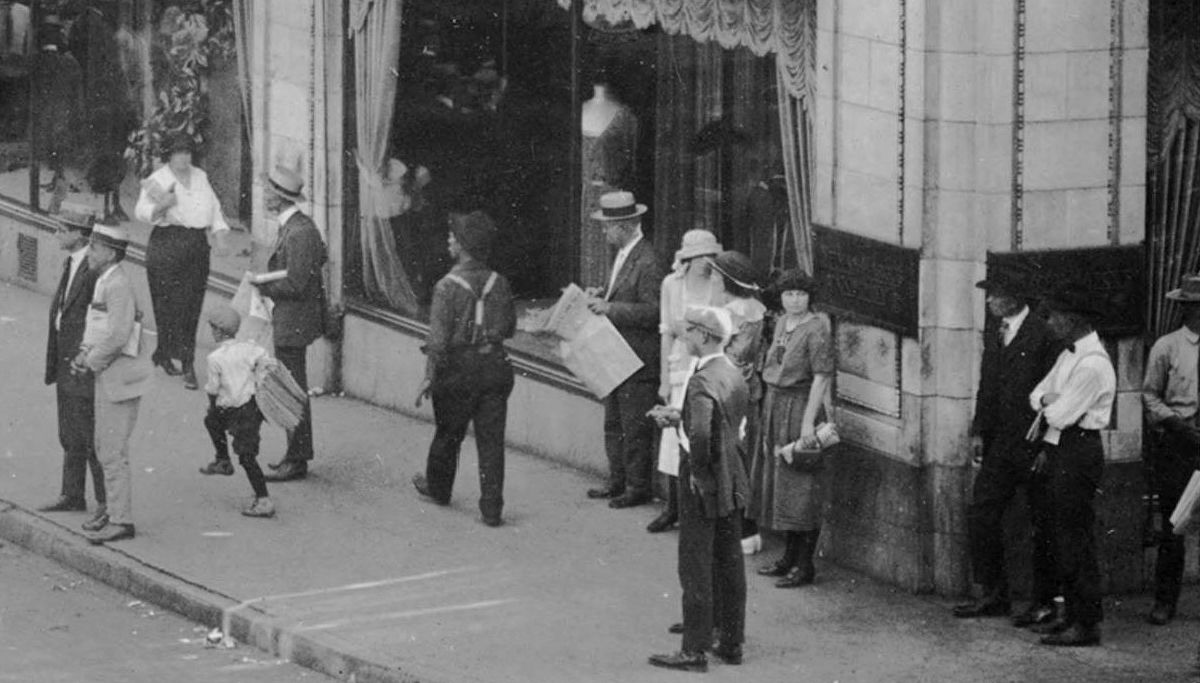
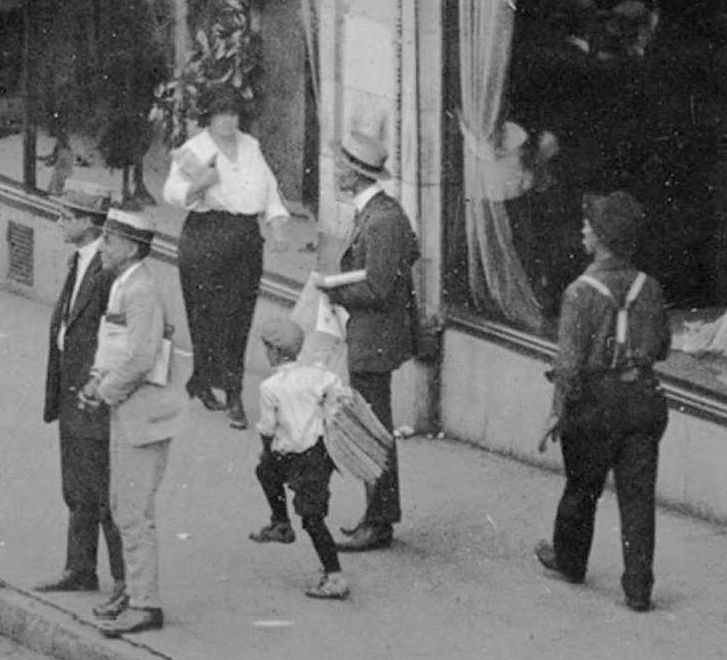
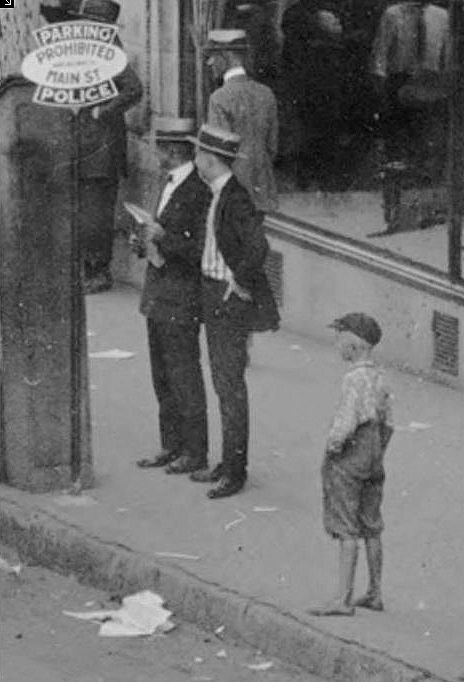
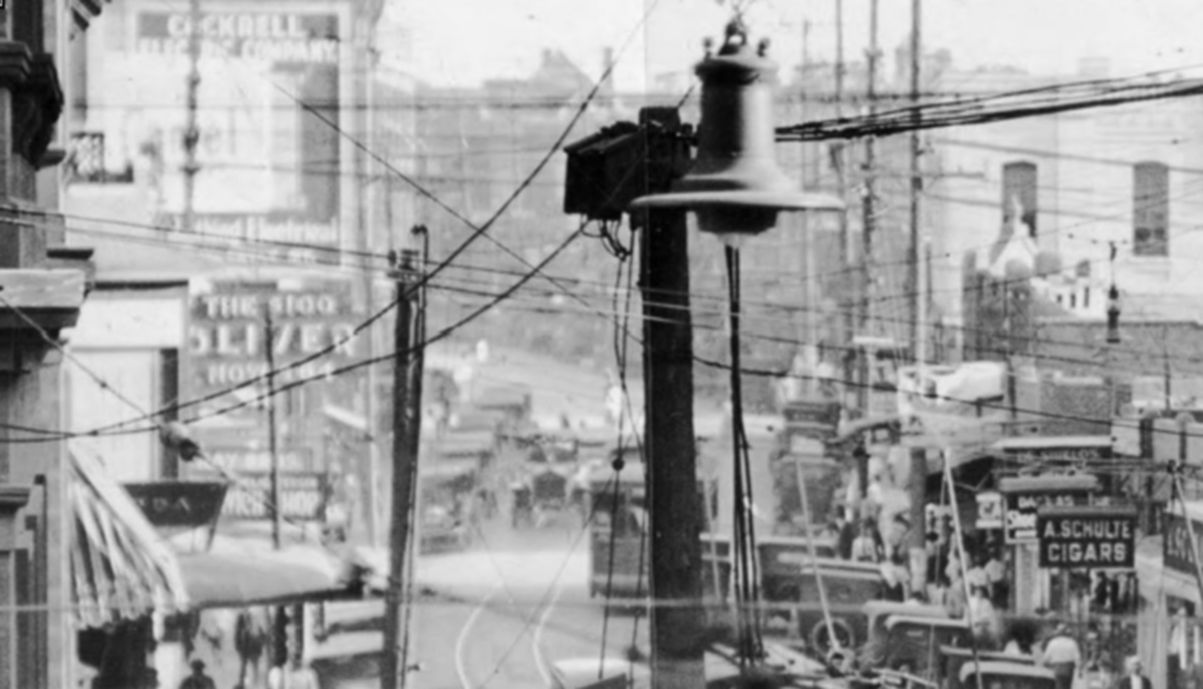
That traffic is crazy. But, to be perfectly honest, it’s far less interesting than all that human activity — hundreds of people just going about their daily business. It’s always fun to zoom in on these photos, and, below, I’ve broken the original photograph into several little vignettes. I love the people hanging out the Neiman-Marcus windows. And all those newsboys! Not quite as charming was all that overhead clutter of power lines and telephone lines; combined with the street traffic, it makes for a very claustrophobic — if vibrant — downtown street scene. (Click photos for larger images.)

2-ervay

3-ervay

4-ervay

5-ervayMy favorite “hidden” image in the larger photograph. The only moment of calm.

6-ervayI love this. The woman in front of the Neiman-Marcus plaque looking off into the distance, the display in the store window, the newsboy running down the street, the man in suspenders, the women’s fashions, and all those hats!

7-ervay

8-ervayA barefoot boy and litter everywhere.

9-ervay

10-ervay

11-ervayThe congestion is pretty bad above the streets, too.

12-ervay

13-ervayCabbies, newsboys, and working stiffs.

14-ervay

15-ervayI swear there was only one streetcar driver in Dallas, and he looked like this! Those motormen had a definite “look.”

***

Sources & Notes

Original photograph attributed to George A. McAfee, from the DeGolyer Library, Central University Libraries, Southern Methodist University, accessible here.

For other photos I’ve zoomed in on the details, see here.

*

Copyright © 2014 Paula Bosse. All Rights Reserved.

Black Troops from Dallas, Off to the Great War

WWI_black-soldiers_dallasRecruits in Dallas

by Paula Bosse

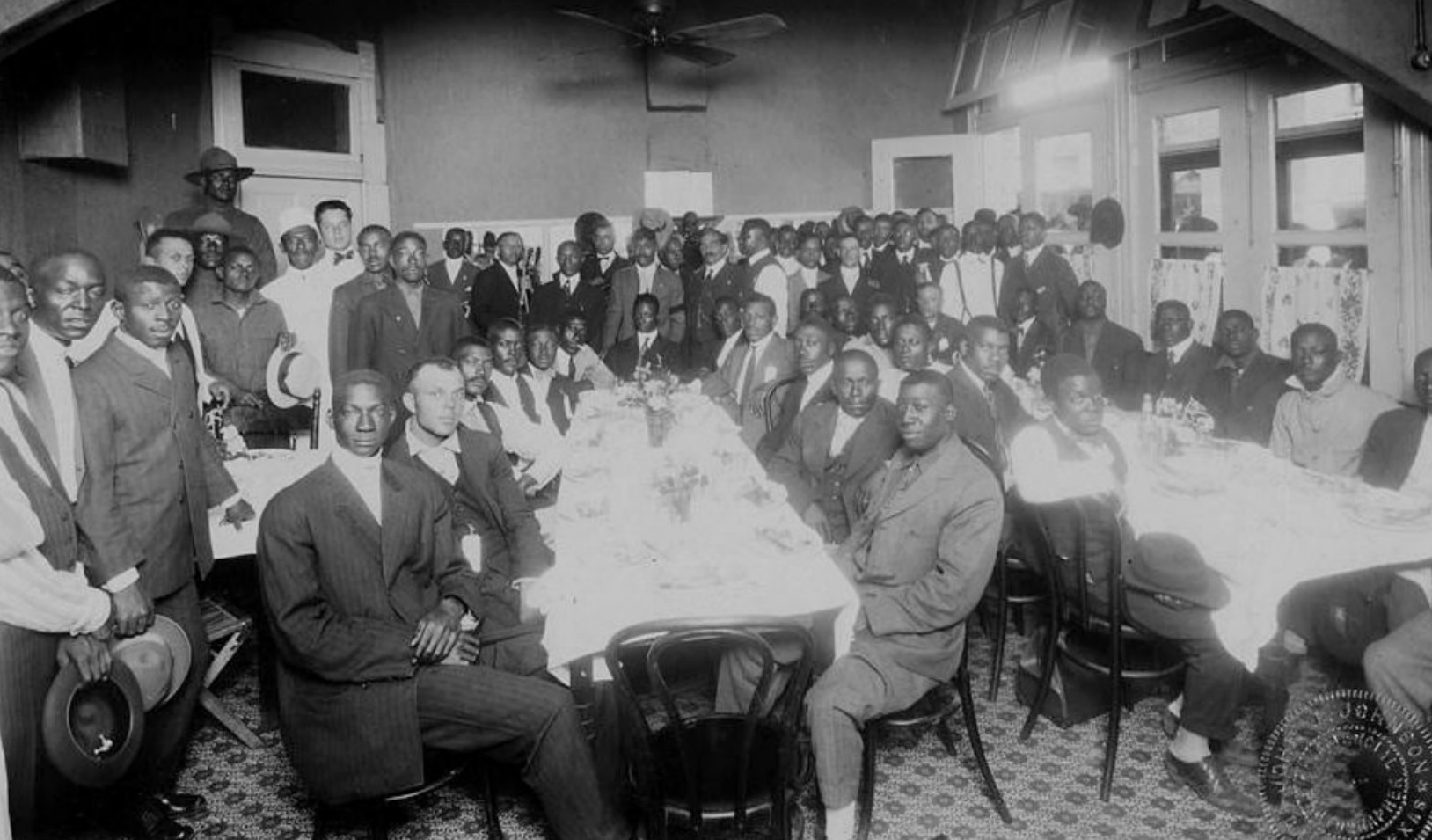
Above is a photo from the National Archives, described only as “Negro recruits having a turkey dinner just before leaving for a training camp. Dallas, Texas.” At the bottom right is the seal of Dallas photographer John J. Johnson who had worked for The Dallas Morning News as a photographer before World War I but was apparently working in a commissioned or freelance capacity here. The photo was taken on June 11, 1918, but the location is not known.

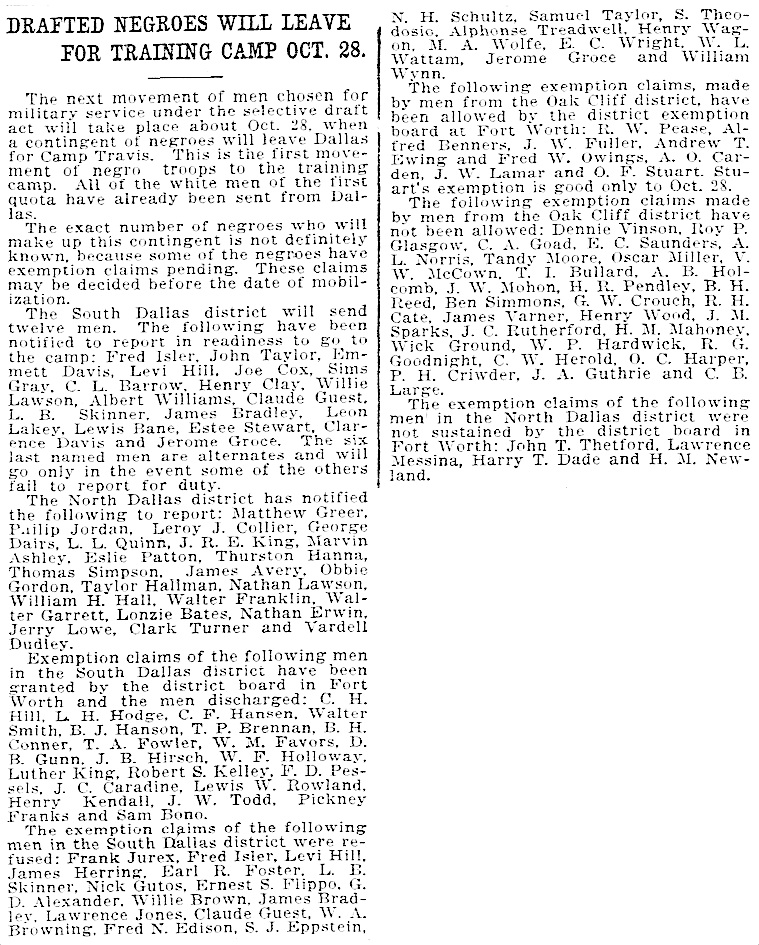
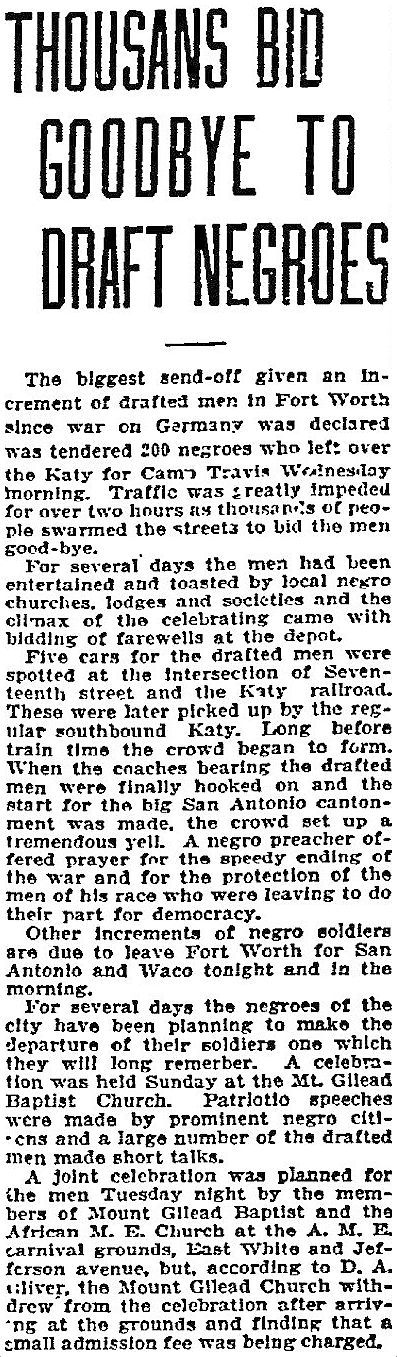
Eight months earlier, Black draftees left Dallas for the first time — they were headed to Camp Travis in San Antonio. (Click articles for larger images.)

WWI_black-draftees_dmn_101817Dallas Morning News, Oct. 18, 1917

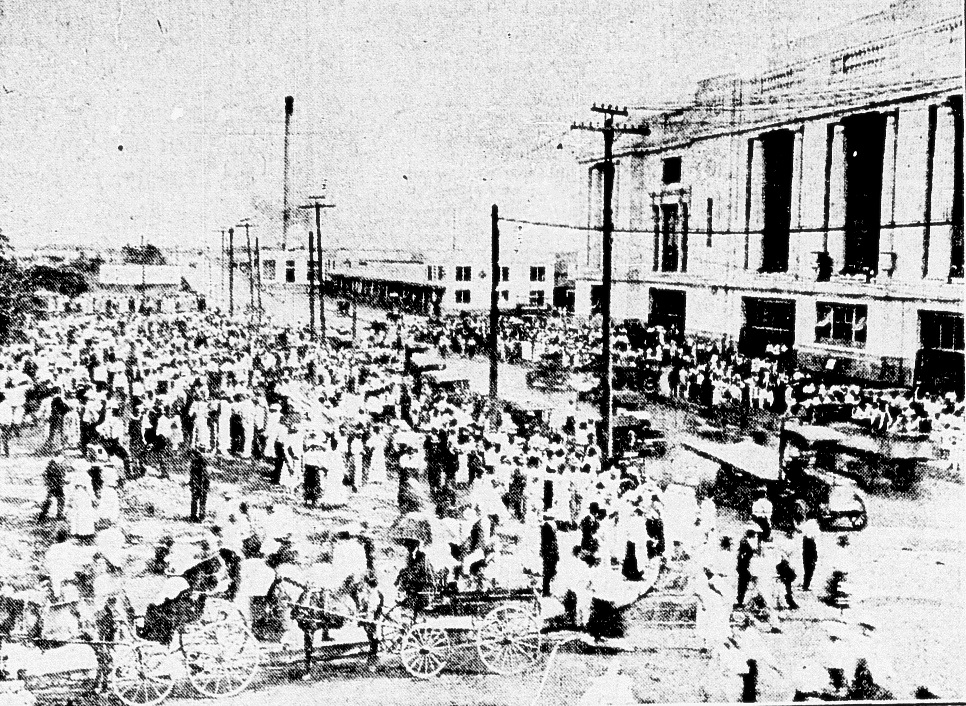
Much larger contingents of Black men left for training camp in the summer of 1918: more than 500 men left from Dallas and more than 200 from Fort Worth at the end of July. The photo below appeared in The Dallas Morning News under the headline “Scene at Union Station Last Night, When 500 Negroes Left for Camp.” (This photo was taken by John J. Johnson, the same photographer who took the photo at the top of this post.)

black-recruits_dmn_073118-photo

black-recruits_dmn_073118_captionPhoto and caption from the DMN, July 31, 1918

black-draftees_FWST_073118
Fort Worth Star-Telegram, July 31, 1918

There was a sizable number of Black soldiers at Camp Bowie in Fort Worth, and many of the reports from Fort Worth on the training of the “negro troops” are hard to read. I don’t think of myself as naive, but the blatant racism that was absolutely everywhere in the mainstream press at the time is stunning. Even when attempting to be complimentary, you see things like this:

If you imagine that the fact that these recruits are negroes made any difference to the white soldiers in camp you are mistaken, for the white soldiers cheered and threw up their hats as truck after truck of negroes passed by, and the darkies shouted back lustily. […]

“I’se glad I got heah at last,” said a big negro as he lined up for classification. “I won’t have to pick no mo’ cotton, no sah; all I’se have to do is to parade in a nice new uniform an’ get three meals an’ a nice new gun….” (Fort Worth Star-Telegram, Sept. 25, 1918)

I’m sure the white soldiers were happy to see fellow recruits showing up, but the journalists — in story after story — treated the “negroes” (they were rarely called “men”) as bumbling caricatures, inevitably quoted in dialect. The United States armed forces were not integrated until 1948, and Black troops were segregated from white troops, both in camp and on the battlefield (when they were allowed to fight — they were largely kept in service positions such as stevedores).

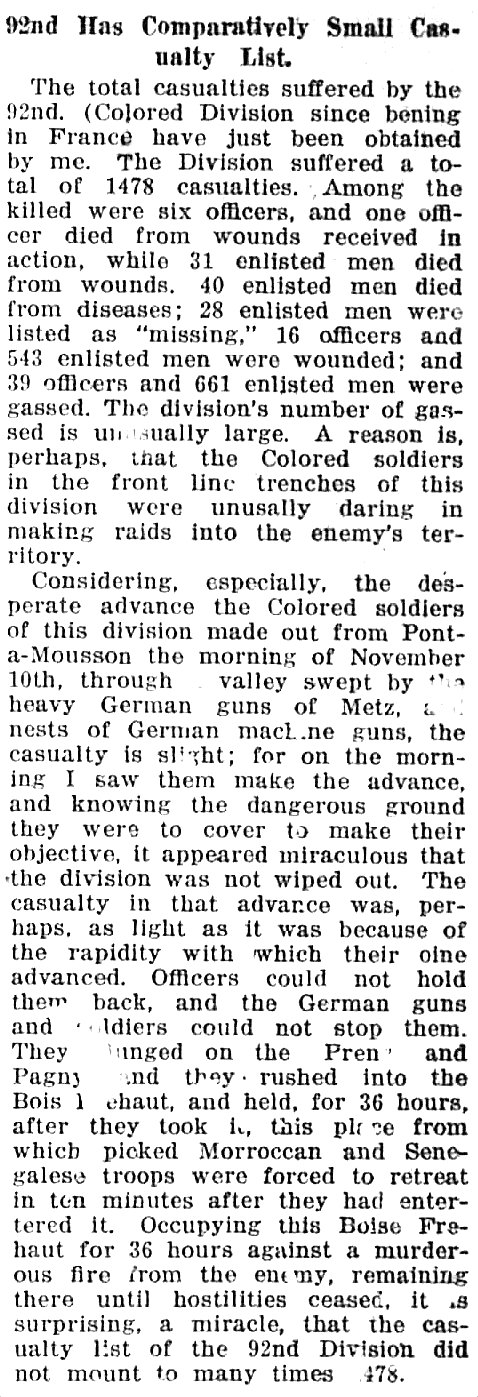
On this Memorial Day, I share a report from Ralph W. Tyler, a Black journalist who had reported throughout the war from the front lines, on the casualties of African American soldiers who died during World War I in the service of the U.S. Army:

casualties_black-troops_dallas-express_011119Dallas Express, Jan. 11, 1919

***

Sources & Notes

Top photo by John J. Johnson, from the National Archives is titled “Negro recuits [sic] having a turkey dinner just before leaving for a training camp. Dallas, Texas”; it can be accessed on the National Archives site here. An annotated version of this same photo appears under the title “Colored Troops — Negro recruits having a turkey dinner just before leaving for a training camp. Dallas, Texas” is here. (If anyone has additional info on the details of this photo, I’d love to know.)

“92nd Has Comparatively Small Casualty List” is an excerpt from Ralph W. Tyler’s article “General Order Commends Colored Officers” which appeared in The Dallas Express, Jan. 11, 1919. The full article can be read here.

For more info on the history of Black American soldiers, see the Wikipedia entry here; for info on the all-Black 92nd Infantry Division, see here.

Also, check out the blurb for the book Unjustly Dishonored: An African American Division in World War I by Robert H. Ferrell, here.

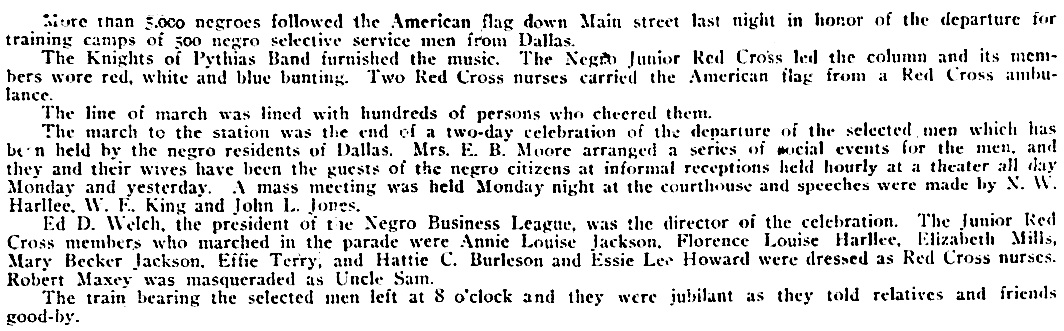
I’ve put a few articles on African American soldiers in WWI (including those cited above) in a PDF. A few of the articles appeared in the major Dallas and Fort Worth newspapers, and a couple appeared in The Dallas Express, the city’s newspaper published for a Black readership (including a rousing article by N. W. Harllee on the parade and celebration thrown by the city to honor the returning Black troops — WELL worth reading). Also included are a couple of unbelievable articles from the national press (including a lengthy one by a noted Stars and Bars reporter titled “Negro Soldiers Stationed at French Ports Sing and Dance While Unloading Ships”). The PDF can be accessed here (with articles in varying degrees of legibility).

The stirring and exhortative article “Dallas Gives Soldiers Befitting Celebration” by N. W. Harllee is in the PDF just mentioned, but it can also be found in a scan of The Dallas Express, here. UPDATE: Every scan of this article is hard to read, so I’ve tweaked the contrast to make it easier to read. You’ll have to magnify this sucker to read it, but it’s in a PDF here.

*

Copyright © 2014 Paula Bosse. All Rights Reserved.

The Oak Cliff Viaduct & The Weird Composite Photo — 1912

oak-cliff-viaduct-panorama_c1912_LOC

First you take a photo of the beautiful new Oak Cliff Viaduct, above.

Then you take a photo of the Dallas skyline, below.

dallas-panorama-skyline_1912_LOC

Then you put them together and get this bizarro Franken-photo!

oak-cliff-viaduct-panorama_skyline_c1912_LOC

It doesn’t look like any view of Dallas you’ve ever seen, but it still looks pretty damn cool.

***

Sources & Notes

All these panoramic photos are in the collection of the Library of Congress, all from the studio of Johnson & Rogers. The top photo has a copyright date of March, 1912, and the bottom two have copyright dates of August, 1912. See these panoramic photos (as well as one of the Buckner Orphan’s Home in 1911) on the Library of Congress site here.

Would this unusual composite have been done for a fanciful postcard or some other kind of promotional material (for the city or for the photographers)? Was it just done for fun? Tellingly, it’s the only one of the three without the studio’s imprint. If anyone has further info on this, please let me know!

These photos are HUGE. Click to see larger images — and use that horizontal scrollbar!

*

Copyright © 2014 Paula Bosse. All Rights Reserved.