Flashback : Dallas

A Miscellany: History, Ads, Pop Culture

Category: Postcards

Fisher’s Addition, West Dallas

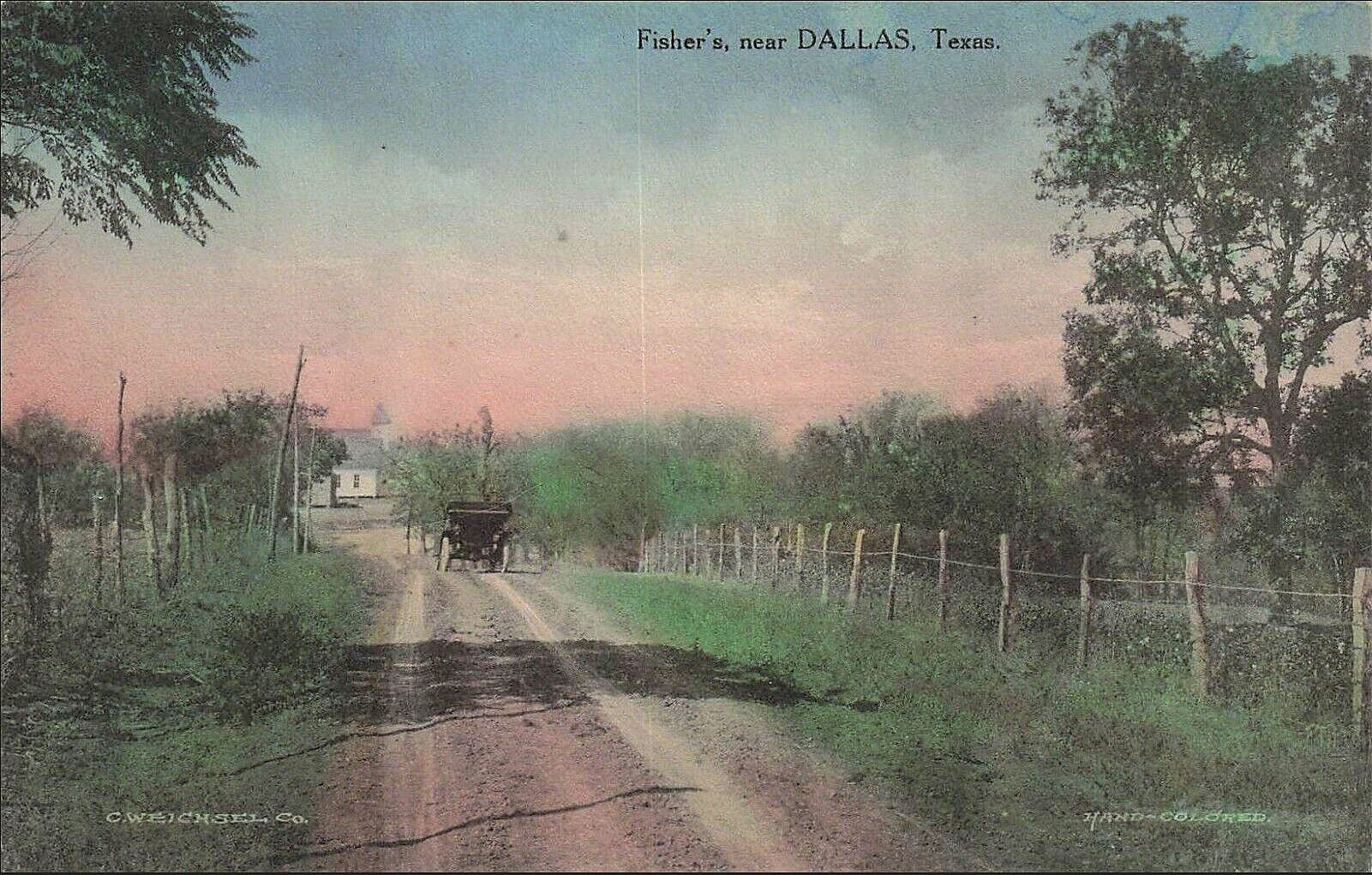
Fisher’s, Near Dallas, Texas

by Paula Bosse

I’ve never seen this postcard before, and I’d never heard of Fisher’s (“near Dallas”).

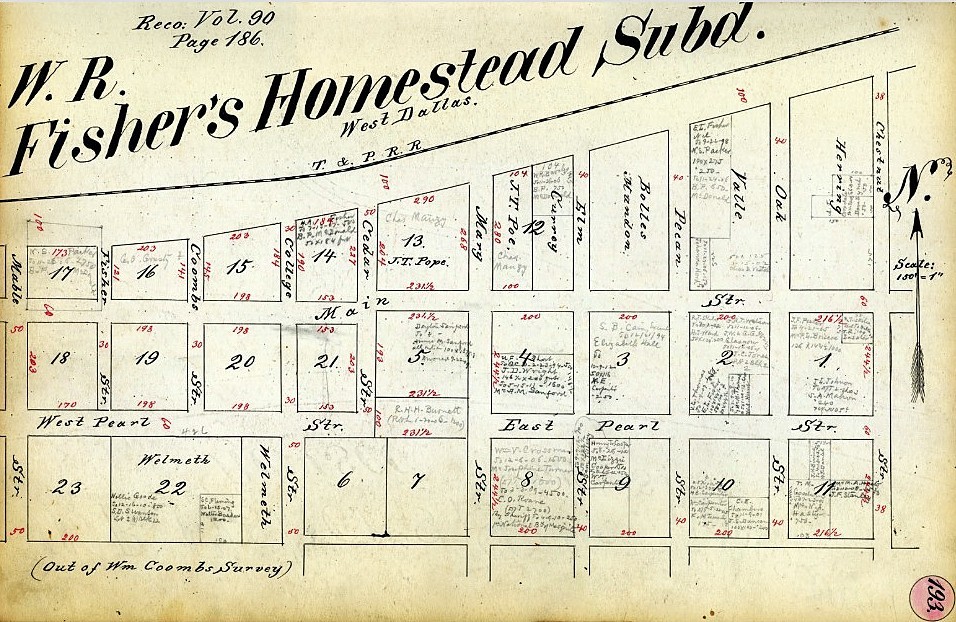
W. R. Fisher’s Addition was in West Dallas, possibly bordered by what is now N. Edgefield, Fort Worth Avenue, Sylvan, and West Commerce (just below the old T & P railroad tracks). …I think. Lots of real estate transactions were going on in “Fisher’s” in the 1880s and ’90s, when West Dallas was its own community and before the area became part of Dallas.

*

This is a very pretty postcard. I just picked a random intersection on Google to see what the general area looks like now. It’s mostly built-up, of course, but here’s a very attractive view, at Seale and Obenchain here (Jan. 2024).

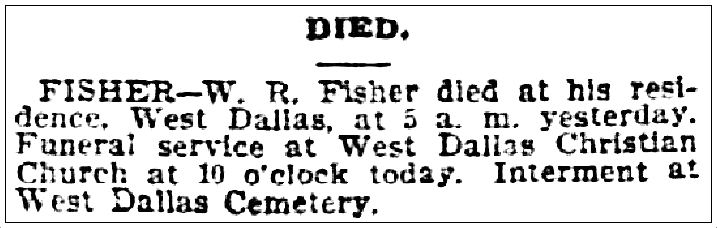
As far as what looks like a church in the distance — it might be the West Dallas Christian Church (later the Western Heights Church of Christ), which was affiliated with West Dallas Cemetery (later Western Heights Cemetery), where William R. Fisher is buried, along with many members of the family of his first wife, Mary Coombes/Coombs, a familiar name in the settlement of the area.

Dallas Morning News, Oct. 19, 1900

*

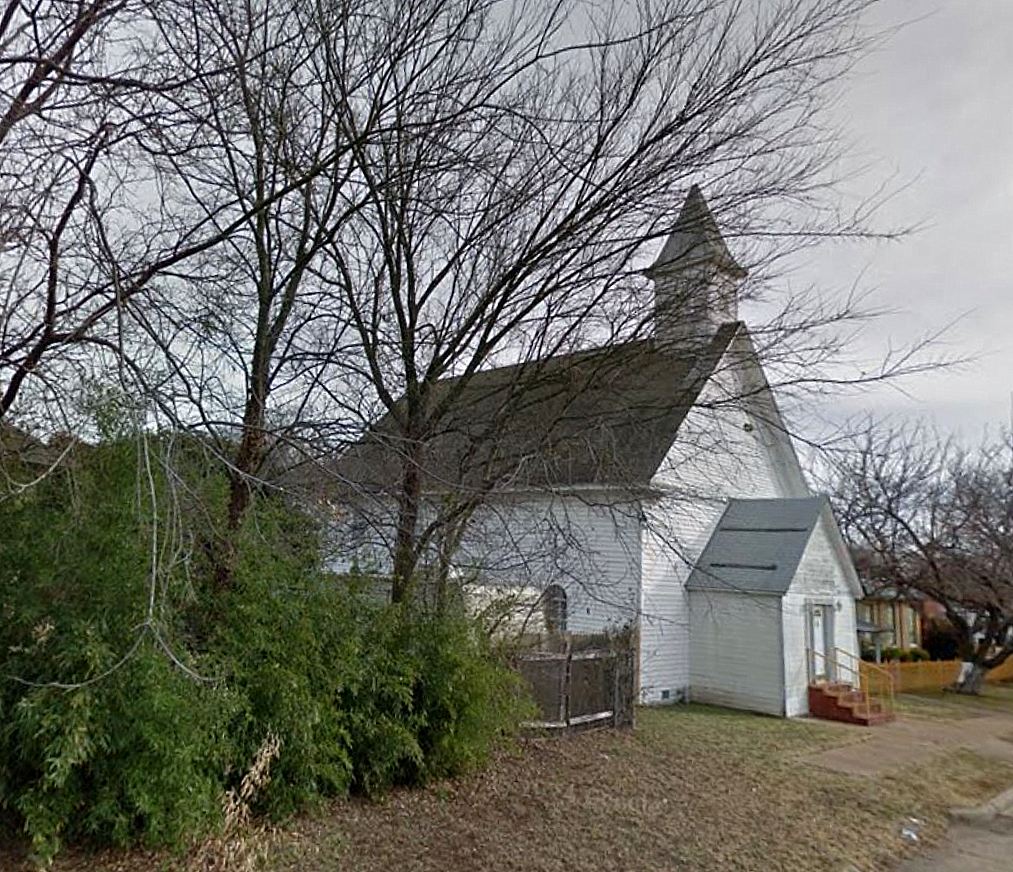
UPDATE: Thanks to reader Linda Donnelly for sending a link that shows this same view these days — with the same church in it! See the Google Street View here. Here’s the church up close (see it on Google Street View here). (1900 block of N. Winnetka, just off Stafford.)

The former West Dallas Christian Church was built around 1890 and has a historical marker, which was placed at the site in 1972, when it was the Western Heights Church of Christ.

***

Sources & Notes

Early-20th-century postcard by Weichsel found on eBay.

Image showing William R. Fisher’s Homestead Subd. (out of the Wm. Coombs’ Survey) is from the Murphy and Bolanz block book scanned by the Dallas Public Library and available online, here.

Read about W. R. Fisher in the History of Dallas County, here.

This post appeared in an earlier version on the Flashback Dallas Patreon page.

*

Copyright © 2025 Paula Bosse. All Rights Reserved.

McKell Street’s Golden Age

Veranda-life, Old East Dallas

by Paula Bosse

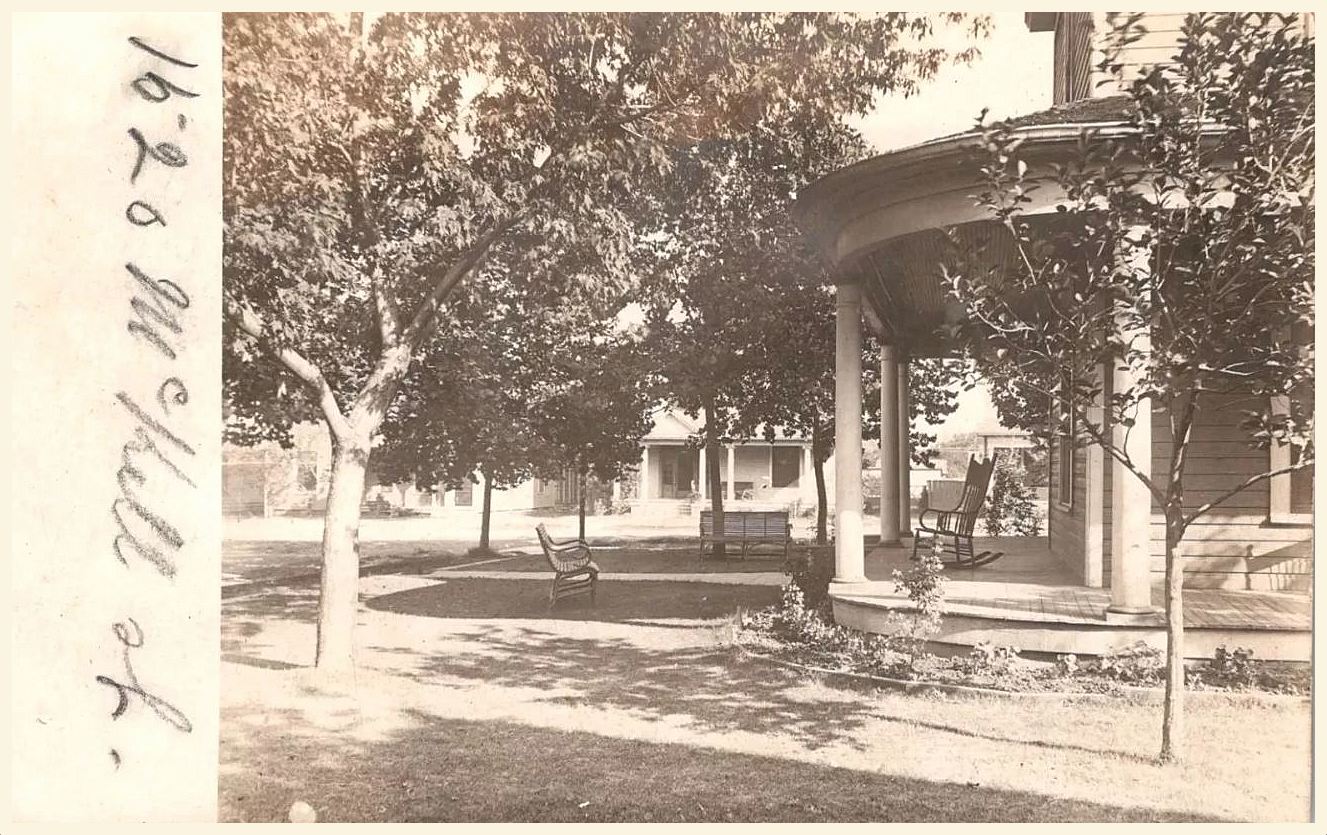
This does not look like Dallas. But it is. I had never heard of McKell Street, but it’s in Old East Dallas and is only two blocks long (it’s actually one long block), between Bryan and San Jacinto. This house stood until 2021 or 2022 at the corner of McKell and San Jacinto (see it in a 2021 Google Street View image here, when it was the very last remaining house on the street).

The address was 1520 McKell (the address written on the card looks like “1620,” but there was never a 1600 block of the street). When the house was built, sometime before 1903, its address was 136 McKell — you can see it and its curved wraparound porch on a 1905 Sanborn map here and on a 1922 Sanborn map here. And the sad empty lot in 2022 is here.

I love stumbling across unexpected photos like this. This was such a lovely little street. I can absolutely imagine Andy and Barney and Aunt Bee on that porch, rocking and chatting on a hot Sunday afternoon, enjoying a bowl of homemade peach ice cream and waving to neighbors as they walk by.

And now it’s nothing but an ugly stretch of parking lots and the powerfully unattractive AT&T building.

***

Sources and Notes

Real photo postcard found on eBay in 2024.

This post appeared in a slightly different version on the Flashback Dallas Patreon page (subscribe for as little as $5 a month!).

*

Copyright © 2025 Paula Bosse. All Rights Reserved.

Whimsy on Main Street — ca. 1906

by Paula Bosse

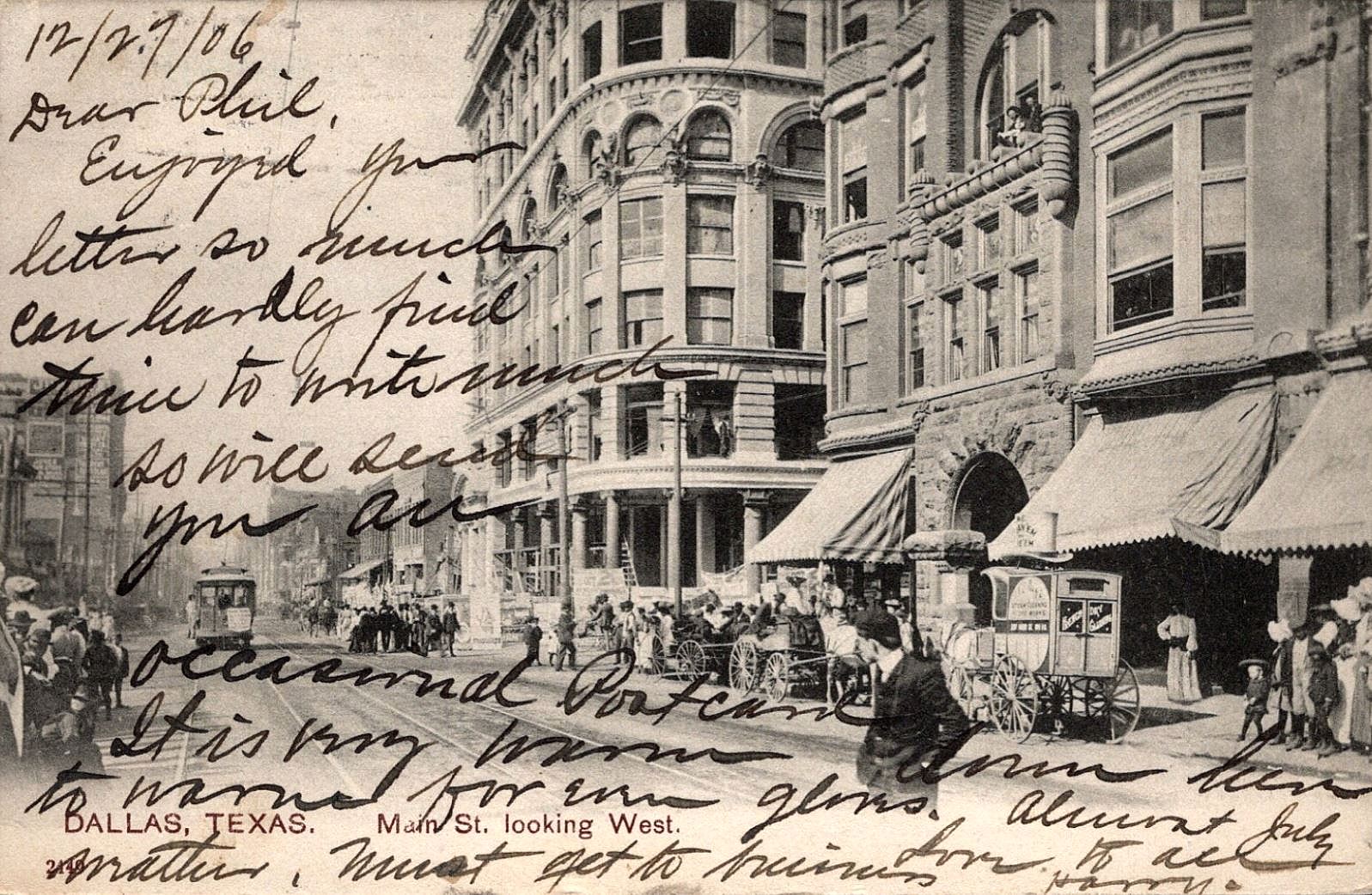
I’ve seen a lot of postcards with views of “Main St. looking West,” usually taken from about Ervay, with the Wilson Building as the architecturally impressive centerpiece. But I don’t think I’ve seen this one. I don’t know when the photo was taken, but it was mailed at the very end of 1906. It looks like the new Wilson Building (which opened in 1904) may still have construction work going on, at least on the ground floor.

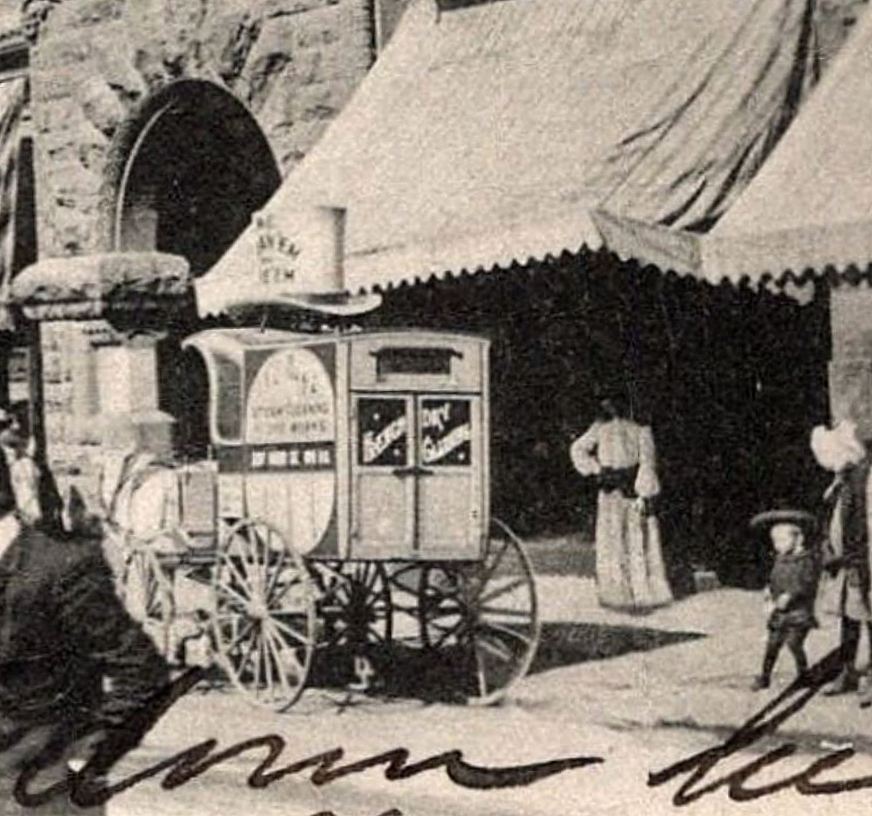
But “whimsical”? Take a look at the horse-drawn dry-cleaning-company delivery wagon on the lower right side of the card. It’s got a GREAT BIG TOP HAT on it! Maybe this sort of thing was popular in the early years of the 20th century, but I’ve never seen anything like this on the streets of Dallas in photographs or postcards of this period. Until now. I love it!

*

The postcard — written and mailed on December 27, 1906 — was addressed to “Master Phillip Wyman” in Yonkers, New York. The sender — identified only as “Harry” — sent this message to Phil, probably a young family member:

Dear Phil, Enjoyed your letter so much. Can hardly find time to write much so will send you an occasional postcard. It is very warm down here, to[o] warm for even gloves. About July weather. Must get to business. Love to all, Harry

Too warm for gloves — in December! Imagine! I bet Master Wyman — who was no doubt shivering up in Yonkers — had his young mind blown. (I wonder if he noticed the big top hat?)

***

Sources & Notes

Postcard from eBay.

*

Copyright © 2025 Paula Bosse. All Rights Reserved.

Hotel Rodessia

patreon_rodessia_hotel-rodessia_postcard_ebay“First-class style…”

by Paula Bosse

I’ve seen SO MANY postcards of Dallas through the years that when I come across one that is completely new to me, it’s pretty exciting. Especially turn-of-the-century-ish cards, like the one above. This is the first I’ve ever heard of the Rodessia Hotel, which opened in Oct. 1904 at 361-363 Elm (the address later became 1601½ Elm). The hotel proprietor (as well as the proprietor of the street-level saloon underneath it) was German immigrant Joseph F. Rode (1858-1911).

patreon_rodessia_hotel-rodessia_dmn_oct-1904Dallas Morning News, Oct. 2, 1904

And, because it’s so unusual to be able to note something like this, I must mention that Rode’s wife, Victoria Virginia “Nannie” Rode, was also a business owner.

rode-j-f_mrs_dmn+100794
DMN, Oct. 7, 1894

Even though I hadn’t heard of the hotel, I did know about the building. In fact, I wrote a whole post about it: “S. Mayer’s Summer Garden, Est. 1881.” It would have been a building everyone knew at the turn of the century. Here’s what it looked like when it was a young whippersnapper:

mayers-garden_DPL_1885

It was built in 1881 by Simon Mayer and was the site for many years of his very popular beer garden. Around 1902 it became the Clifton Hotel, and in Oct. 1904, J. F. Rode opened his interestingly named Rodessia Hotel, which remained in business until about 1920 (it was run after his death by the Widow Nannie and her second husband). Around 1920, another hotel — the La France — opened. See the building at various times in the post mentioned above, here.

So. The Rodessia was in business for at least 15 years. I still can’t believe I haven’t seen it pop up in at least one Elm Street postcard or photograph until now. Better late than never!

(Note: In the postcard at the top, just to the right of the hotel, is the David Hardie Seed Co., which I believe continues today as Nicholson-Hardie stores.)

***

Sources & Notes

Postcard from eBay.

Photo of Mayer’s Garden from the Dallas Public Library: “[Mayer’s Beer Garden, Dallas, Texas”], Call Number PA87-1/19-27-1.

This post originally appeared in a shorter version on the Flashback Dallas Patreon page, which I enthusiastically invite you to subscribe to!

patreon_rodessia_hotel-rodessia_postcard_ebay

*

Copyright © 2024 Paula Bosse. All Rights Reserved.

The Stagecoach Ride at Six Flags: 1961-1967

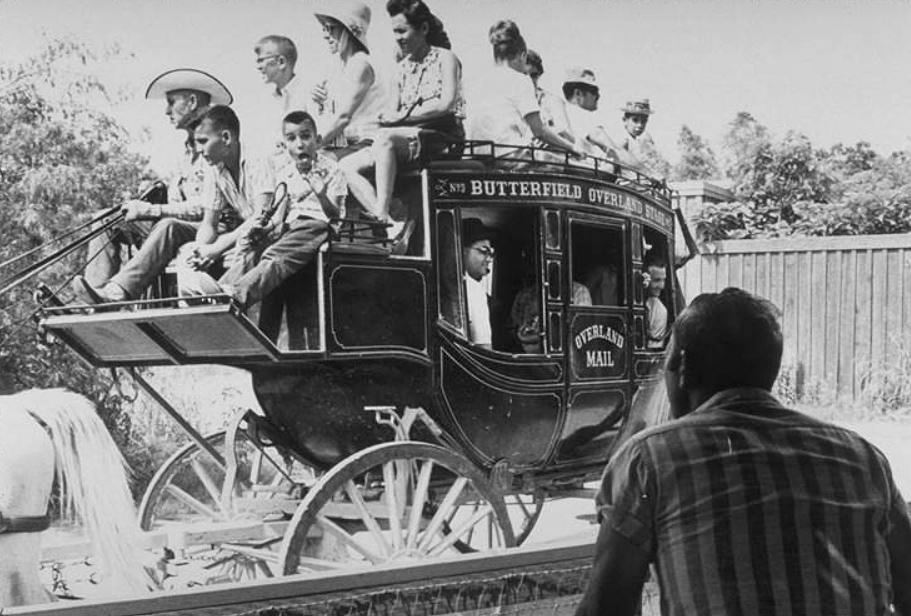
six-flags_stagecoach_fort-worth-magazineWhat could possibly go wrong?

by Paula Bosse

Did you ride the stagecoach at Six Flags?

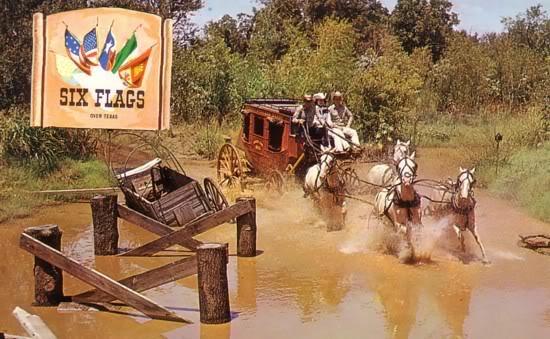
The stagecoach at Six Flags? What? This:

six-flags_stagecoach

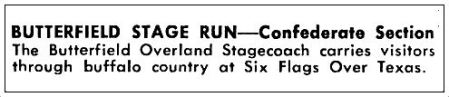
And this (with grazing buffalo for added Old West atmosphere):

six-flags_stagecoach_buffalo_ebay_front

When I first saw Six Flags postcards touting stagecoach rides, my first thought was, “How did they ever manage to get insurance for that?”

six-flags_stagecoach_buffalo_ebay_reverse

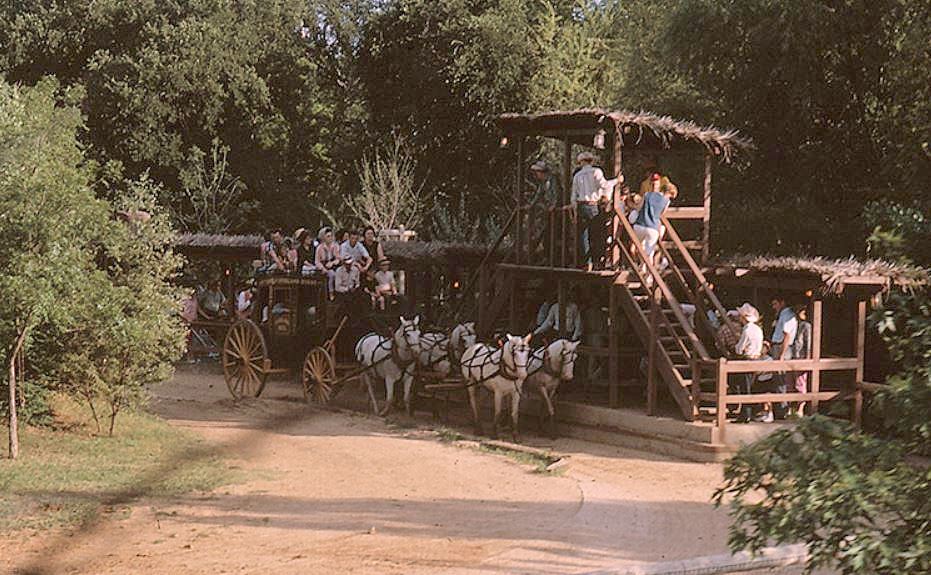
The “Butterfield Overland” ride debuted in the “Confederate” section when the park opened in 1961 and lasted until about 1967. It was very, very popular.

six-flags_stagecoach_1965_UTA_det1965, via UTA Libraries Special Collections (det)

Why did I never know about this when I was a kid? I never saw a stagecoach. I would have LOVED to ride a stagecoach. What happened? Well, here’s what happened: in May 1967, one of the stage’s wheels came off mid-ride, and the stage overturned, injuring 11 of the 14 people on board, most of them children. A 4-year-old Haltom City girl — who was riding on the top — was pinned beneath the overturned stagecoach. When she was freed, she was rushed to the hospital and underwent emergency surgery on both feet. One of the news stories about this unfortunate incident ended with, “Saturday’s accident was the first involving the stagecoach since the park opened in 1961,” adding that more than 4 million persons had ridden this ride between 1961 and 1967. (Four million!) (Granted, I think there were four stagecoaches and four teams of horses, but… four million!!)

One month after the accident, it was reported that the girl’s father had sued Six Flags for $531,000, contending that park officials were guilty of 30 counts of negligence. ($531,000 would be the equivalent in today’s money of about $5 million.) I can’t find anything about what happened with this lawsuit, but I assume there was probably a quiet settlement. Coincidentally or not, that spelled the end of the Butterfield Overland stagecoach ride at Six Flags Over Texas.

And that’s why I never heard of — or got to experience — a stagecoach ride at Six Flags.

(I don’t know what happened to the buffalo.)

***

Sources & Notes

Top photo of a Six Flags stagecoach jam-packed with kids from Fort Worth magazine.

The 1965 image is a detail of a larger photo from the Jack White Photograph Collection, UTA Libraries Special Collections — see the full photo and more details here.

Read more about this Butterfield Overland stagecoach ride at Parktimes.com.

The whole “Confederate” and “Texas” sections of SFOT were kind of weird, including a several-times-a-day lynching (!), as can be seen in one of the postcards in the 2014 Flashback Dallas post “Angus Wynne Jr.’s ‘Texas Disneyland’ — 1961.”

For real, non-amusement-park stagecoach tidbits, check out the post (also from 2014) “Dallas to Austin by Stagecoach: Only Three Days! (1854).”

A slightly different version of this post originally appeared on the Flashback Dallas Patreon page in August 2023. If you’d like to see daily Flashback Dallas posts, please consider supporting me on Patreon, for as little as $5 a month.

six-flags_stagecoach_fort-worth-magazine_sm

*

Copyright © 2023 Paula Bosse. All Rights Reserved.

The Sumpter Building — 1912

sumpter-bldg_postcard_ebay

by Paula Bosse

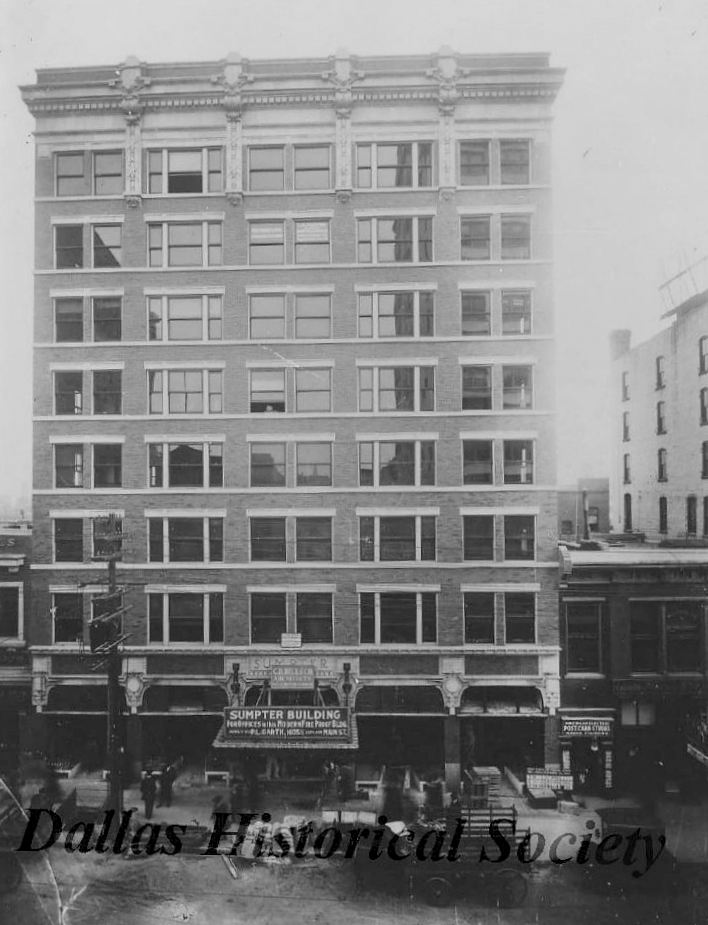
Behold, the Sumpter Building and a partial view of its little buddy, the Edwards & Phillips Building, which were built simultaneously. (See them on a 1921 Sanborn map here.) Both were designed by Dallas architect C. D. Hill, whose spectacular Municipal Building would be built a couple of years later, two and a half blocks away.

Guess what? Both are still standing — part of the Joule empire. See what they look like today — at 1604-1608 Main Street — on Google Street View here. (The shorter building has been through a multitude of renovations over the years, but at some point, by at least 2007, someone had restored it — however briefly — to its original design, as you can see in a 2007 Google Street View here — look how tired and dirty the Sumpter Building looked back then, before its recent scrubbed and rejuvenated revitalization.)

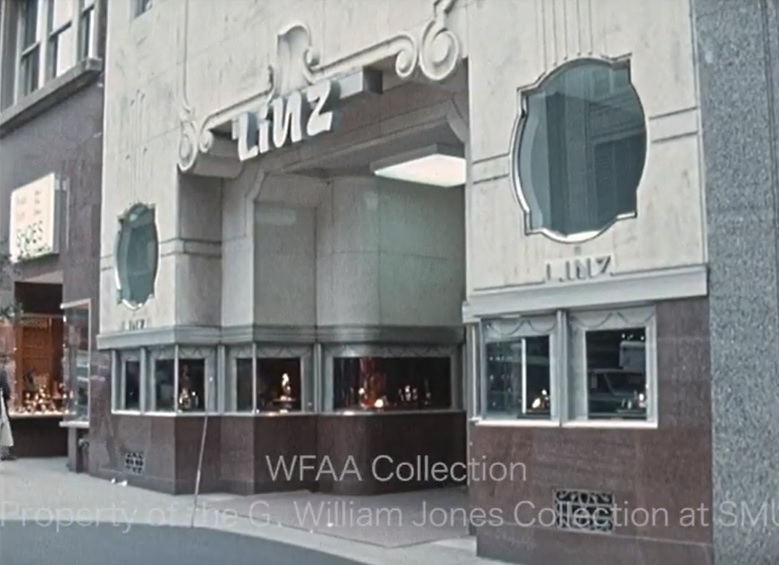
The Sumpter Building served primarily as office space over the years — architect C. D. Hill had a “penthouse” office on the top floor (I wonder if he knew that when he was drawing up the plans?) — and the smaller building was retail space on the ground floor and office space above. It might be remembered as the home of Linz Jewelers for several decades.

**

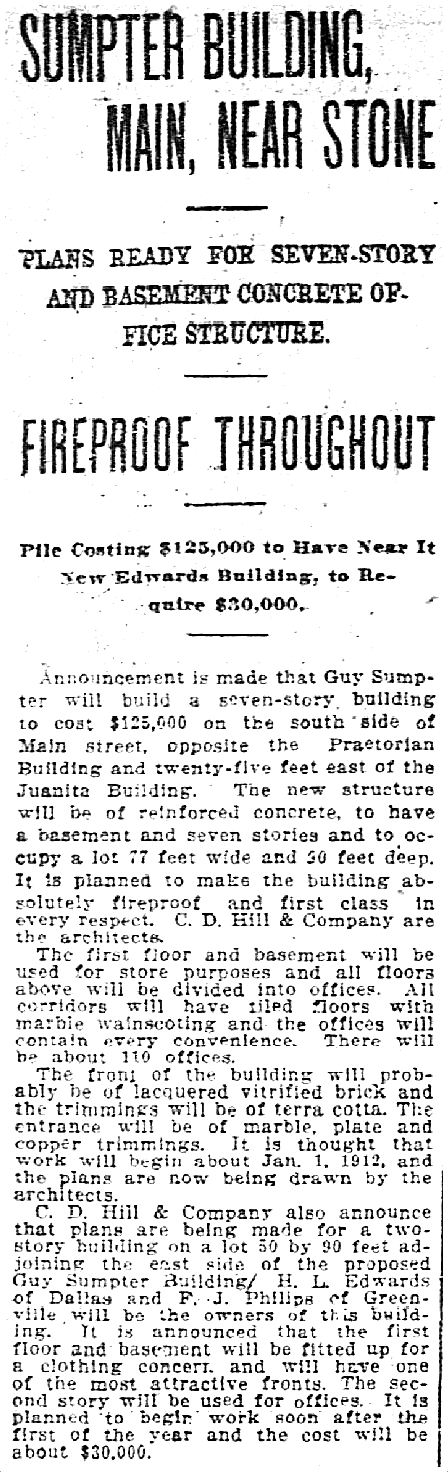
sumpter-bldg_edwards-and-phillips-bldg_c-d-hill_DMN_121711Dallas Morning News, Dec. 17, 1911 (click to read)

*

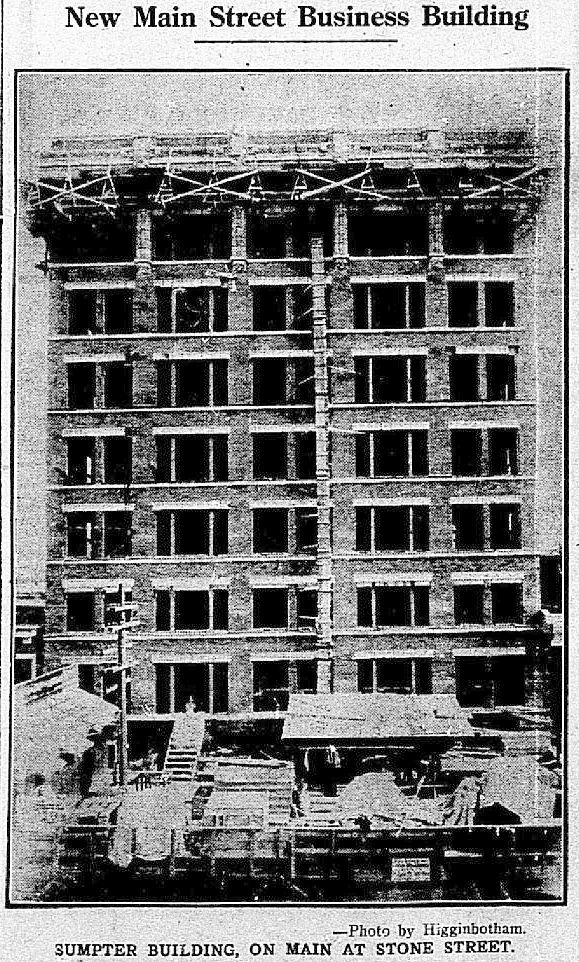
sumpter-bldg_drawing_DMN_030712DMN, Mar. 7, 1912

*

sumpter-bldg_DMN_082512DMN, Aug. 25, 1912

*

sumpter_construction_DHS_watermarkDallas Historical Society, 1912

*

The smaller building debuted as home to retail tenant Matthews Brothers. (It is presently the home of another fashion mecca, Traffic Los Angeles (1608 Main).

matthews-brothers_dmn_040712April 1912

matthews-brothers_dmn_041412April 1912

*

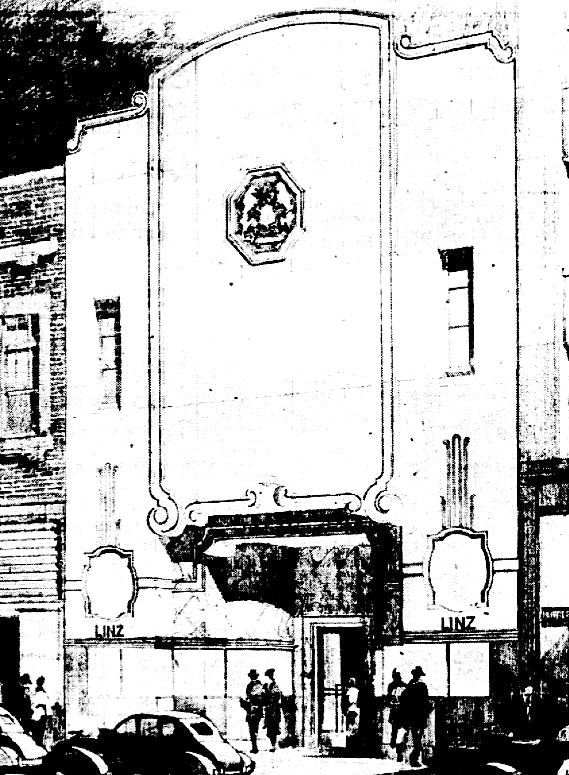
In 1940, Linz took over the shorter building. Articles in The Dallas Morning News described “construction” and a new design by Lang & Witchell, but I think the building was just gutted and (weirdly) refaced.

linz-bldg_1608-main_1940_drawingLinz Bros. Jewelers (Lang & Witchell, 1940)

*

Here it is in living color, in 1970.

linz-bldg_1608-main_WFAA_SMU_jan-1970WFAA-Channel 8 News, Jan. 1970 (Jones Film Collection, SMU)

*

By the end of 1970, the building had undergone another (weird) “facelift” (and an expansion).

linz-bldg_1608-main_WFAA_SMU_jan-1971_remodeledWFAA-Channel 8 News, Jan. 1971 (Jones Film Collection, SMU)

(The two screenshots above are from Channel 8 news reports about a fantastically successful jewelry heist in January 1970. Linz would never reveal the value of jewels stolen in the massive theft, but it was estimated at the time to be between $1.6 million and $3.5 million (the equivalent in today’s dollars of $12.5 million to $27 million!). It was the biggest burglary in Dallas history, and it was estimated to have been the biggest in the South. As far as I can tell, the crime was never solved. A great report on how it happened — with interesting little tidbits such as the fact that the robbers emptied a safe and took everything except for a few pieces of costume jewelry and that the burglars stopped for a break to brew a cup of coffee in the adjacent shoe store — can be found in the Dallas Morning News archives in the story “Gem Loss $3 Million?” by Robert Finklea (DMN, Jan. 13, 1970). It reads like a movie!

**

I’m always surprised to find these century-old buildings still standing downtown. Poor things have been through a lot.

*

Thank you to Chad K. for asking on Patreon if I knew anything about the history of these buildings. As it turned out, I knew NOTHING about the history of these buildings. I do now! Thanks for asking, Chad!

***

Sources & Notes

Top postcard from eBay.

1912 photo of the “Sumpter Building under construction” is from the Johnson Photographic Collection, Dallas Historical Society (A.77.87.967), here.

This post was inspired by a question from a supporter on Patreon. If you would like to join me on Patreon, where I post something every day, pop over here. (Thanks again, Chad!)

sumpter-bldg_postcard_ebay_sm

*

Copyright © 2023 Paula Bosse. All Rights Reserved.

Fair Park at Night — ca. 1912

fair-park_fountain_luminous_night_postcard_ebay_postmarked-1913

by Paula Bosse

The postcard above — “Luminous Fountain by Night at Fair Park, Dallas” — is one I’ve never seen. And it’s beautiful!

This ornamental fountain was commissioned by the City of Dallas Park Board in 1912 and debuted at that year’s State Fair.

On July 18, 1912, it was reported that the mayor and members of the Park Board were touring Fair Park to see how progress was coming on the new women’s and children’s “comfort station” (restroom and lounge) — during the inspection they decided a fountain would be nice in front of the main exhibition building. Five days later (!), the Park Board voted on it and appropriated $2,500 for the project (approximately $80,000 in today’s money). That afternoon committee members went out to Fair Park and decided it would go “in the middle walk, half way between [the] Exposition Building and the street” (Dallas Morning News, July 23, 1912). And less than a month after that, a design had been made and published. It was to be 30 feet in diameter at the base and 24 feet high. When the State Fair of Texas opened on Oct. 12, 1912, the fountain was completed. It took less than 3 months. From “You know what? A fountain would look real good here…” to DONE!

fair-park_fountain_DMN_081812_drawingDallas Morning News, Aug. 18, 1912

Here’s a photo of it, sans water, from a book published in 1915:

park-board-bk_fair-park-fountain_1914

The weirdest little tidbit about this fountain’s debut at the 1912 State Fair is that there was a display of fish swimming around in it, courtesy of the Government Fish Hatchery at San Marcos.

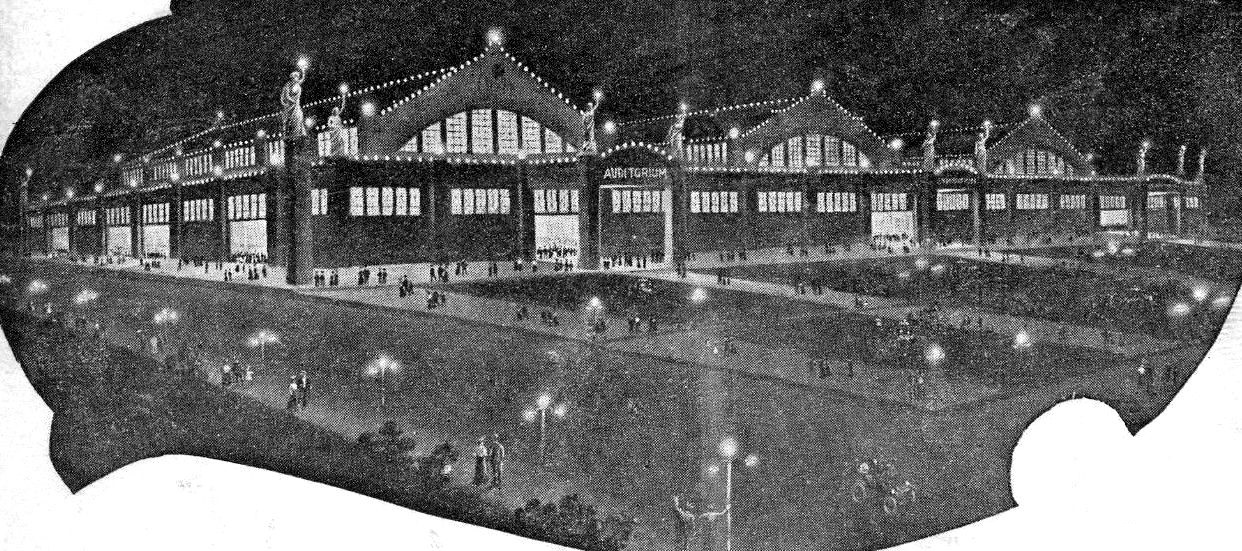
The fountain was in front of the huge Exposition Building. Here’s a circa-1908 depiction of people milling about at night outside the building (a building which really does need a fountain in front of it!).

fair-park_exposition-bldg_night_det_ebay_postmarked-1908

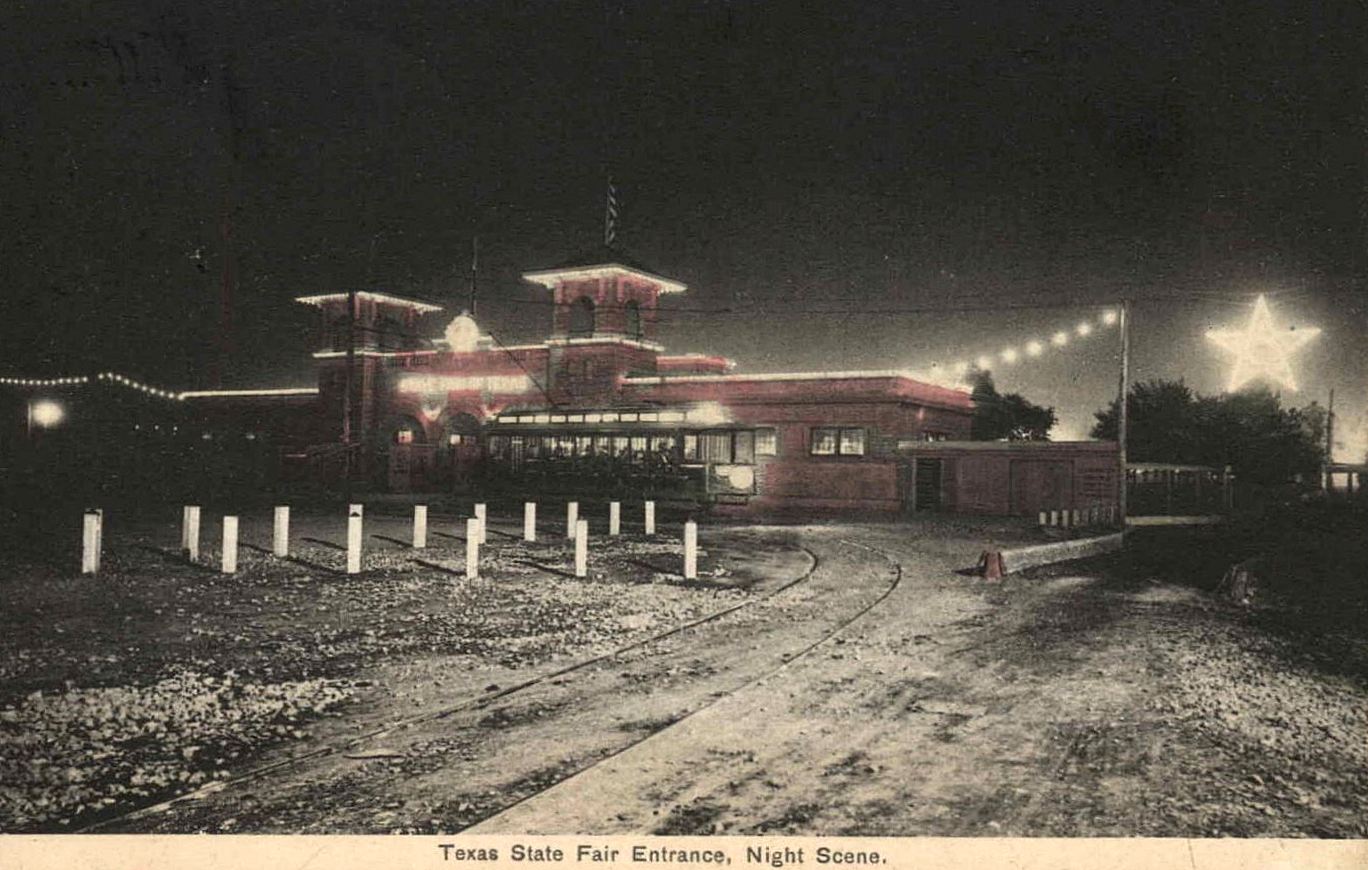
Back to that top image — I love it. “Illumination” was really big at the time (see “The Grand Elm Street Illumination — 1911”) — I’m surprised I don’t see more postcards like this — even if they’re just fake day-for-night images. A similar “nighttime in Fair Park” postcard is the one below, showing the entrance (this postcard has a 1909 postmark).

fair-park_entrance_night_postcard_ebay_postmarked-1909

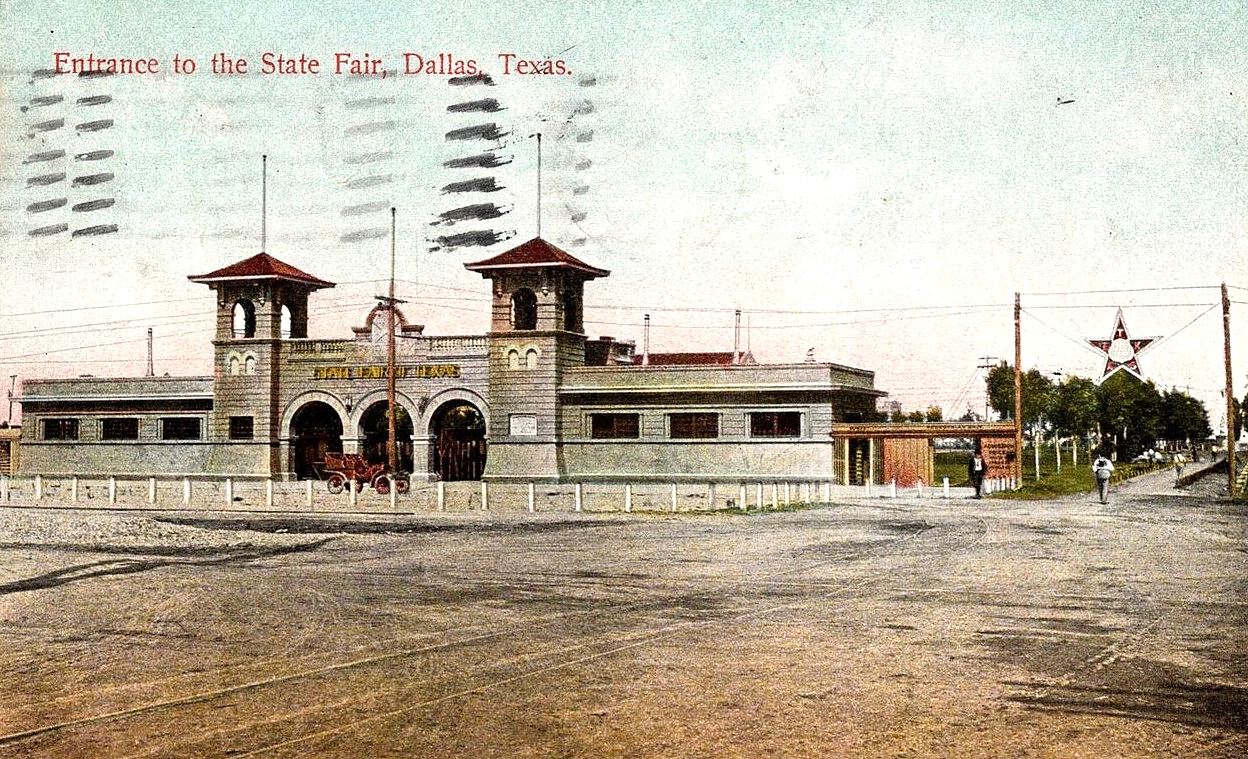
Since I have a postcard of the entrance from this same period showing what it looked like during the day (postmarked 1910)….

fair-park_entrance_day_postcard_ebay_postmarked-1910

That star is pretty cool, especially at night.

I’m pretty sure that fountain bit the dust a long, long time ago. Maybe when everything was being revamped for the 1936 Texas Centennial Exposition. It’s a shame. I don’t think there can ever be too many fountains.

***

Sources & Notes

Top postcard — “Luminous Fountain by Night at Fair Park, Dallas” (postmarked 1913) — is available now on eBay, here; one is also currently available on Card Cow here. I’m pretty sure this is going to be a strong contender for my favorite image of the year.

Photo of “Fountain, Fair Park” is from the book “Park System, Dallas, Texas, 1915,” here — from the Dallas Municipal Archives via the Portal to Texas History.

The postcards have pretty much all come from eBay over the years.

If you want even more of this sort of thing, perhaps you’d like to support me on Patreon for as little as $5 a month. I’m somehow managing to post daily there with “exclusive” content! I’m not sure how long I can keep this up, but if you’d like to see more Flashbacky stuff, hie thee to Patreon.com!

fair-park_fountain_luminous_night_postcard_ebay_postmarked-1913_sm

*

Copyright © 2023 Paula Bosse. All Rights Reserved.

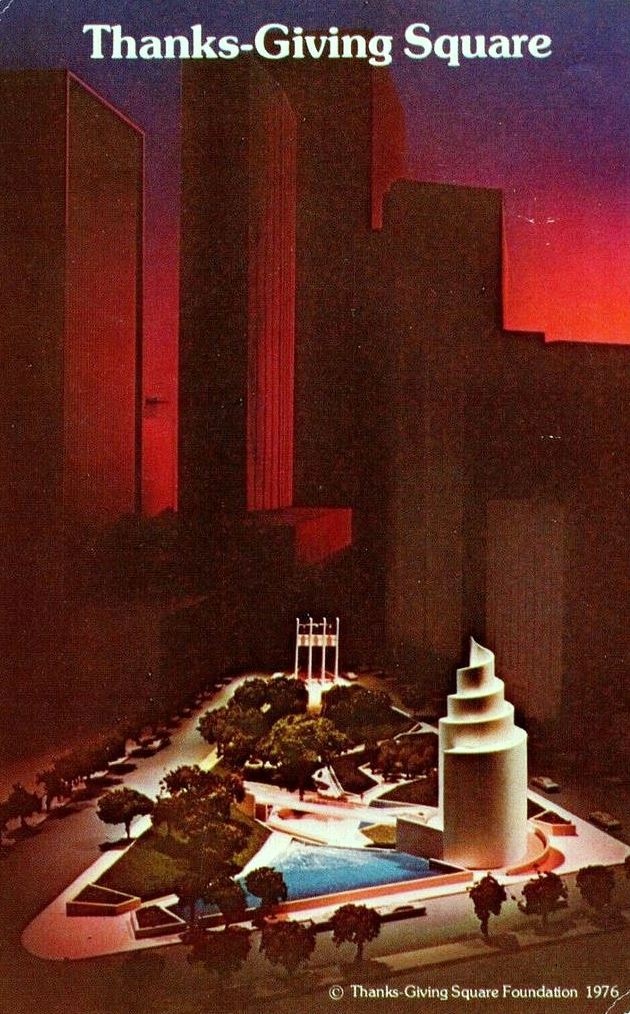
Thanks-Giving Square — 1976

thanks-giving-square_thanksgiving-square_1976_postcard_ebay

by Paula Bosse

Happy Thanksgiving! It seems like a good day to look back at Thanks-Giving Square, the triangular one-acre park in downtown Dallas bounded by Pacific, Bryan, and Ervay. It was originally envisioned in 1961 by Dallas businessman Peter Stewart as a needed quiet refuge and chapel in the middle of a busy city — a calm space set aside for “spiritual gratitude.” It took several years before architect Philip Johnson was brought on to the project in 1971. After more than 15 years from its original conception, its official public dedication was on Nov. 28, 1976, three days after Thanksgiving.

Check out some of the progress reports on the project which appeared over the years on WFAA-Channel 8 News:

Architect Philip Johnson (whose other Dallas projects include the Kennedy Memorial, The Crescent, and the Cathedral of Hope, etc.) talks briefly about Thanks-Giving Square and its underground component, and also shows off a 3-D model (from July 1971):

*

Business owners whose shops were in buildings on the land which was about to be leveled were forced to move out, and many were not happy (from April 1972):

*

Construction is underway (November 1976):

*

And, lastly, Channel 8 weatherman Troy Dungan checks out the progress as the dedication day approaches (November 1976):

*

For a bit of street-level context, here’s a photo showing some of the buildings that were razed (at the right, directly across from the Republic Bank Building) in order to make way for Thanks-Giving Square:

kodachrome_bryan-n-ervay_1954_shorpyvia Shorpy.com

*

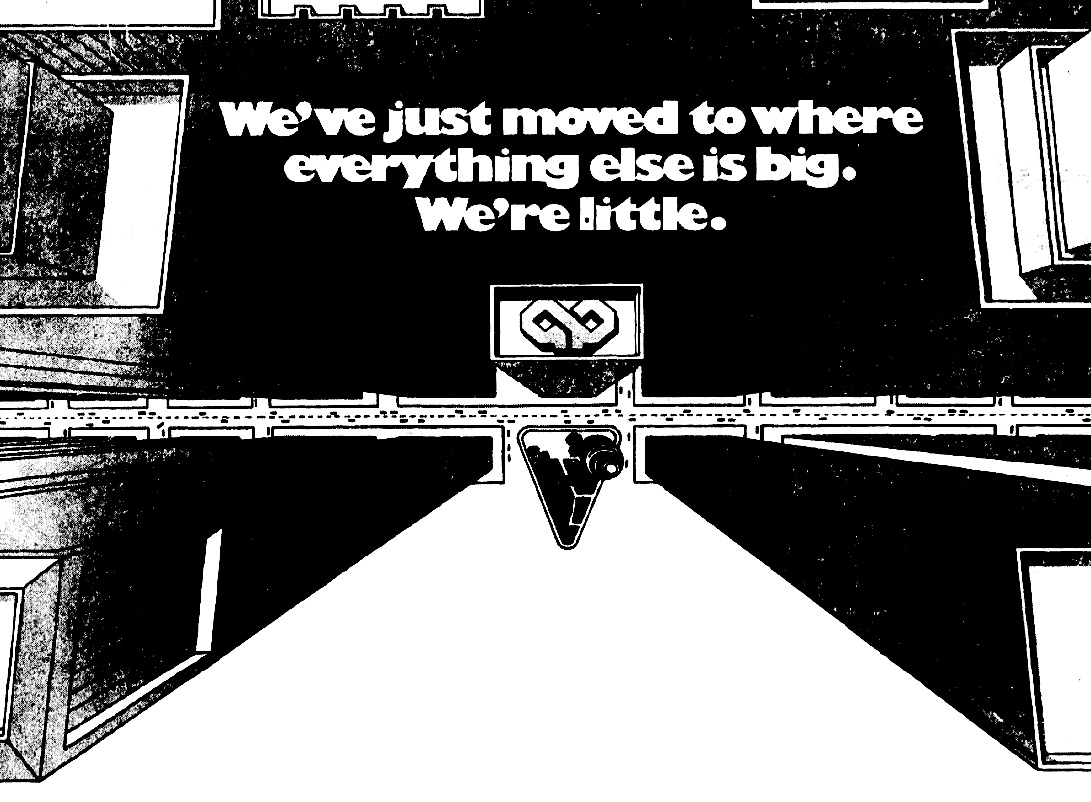
Below is a detail from a newspaper ad for MetroBank which appeared in August, 1976, with a nice little stylized illustration of the triangular TGS and its swirly chapel (click for larger image).

thanks-giving-square_metrobank-ad_det_080276

*

Speaking of the “swirly” design, in a 1982 article about TGS, Dallas Morning News architect deity David Dillon described this structure as “Philip Johnson’s Dairy Queen chapel,” which, presumably, might not have been met with amusement by internationally acclaimed architect Johnson, who probably wouldn’t have appreciated the comparison of his work to an ice cream cone. Interestingly, that description appeared in a 1982 article about Stewart’s dismay that the tall buildings which loomed over TGS (including Thanksgiving Tower) were, basically, blotting out the sun — little TGS was more often in shadow than in sunlight:

Stewart urged the city to pass a sun and shadow ordinance that would preserve the remaining downtown view corridors from high-rise development […] but the [preliminary] ordinance got such a cool reception from downtown developers that it was dropped quickly. (“Computer Study Sheds Light On Thanks-Giving Square Problem” by David Dillon, Dallas Morning News, July 4, 1982)

I bet it got a cool reception!

***

Sources & Notes

Postcard found on eBay.

Videos from SMU’s WFAA News Film Collection, which can be found on the SMU Jones Film Collection YouTube channel.

Thanks to Noah Jeppson for passing along a link to the huge Thanks-Giving Foundation Collection of photos and documents, viewable on the University of North Texas’ Portal to Texas History, here.

Read about the history of Thanks-Giving Square (or as it’s often written, Thanksgiving Square) on Wikipedia, here.

Read the D Magazine article “The Park That Peter Built” (which seems to end abruptly) about the history of Thanks-Giving Square by Jane Sumner from Nov. 1, 1977 here.

thanks-giving-square_thanksgiving-square_1976_postcard_ebay_sm

*

Copyright © 2022 Paula Bosse. All Rights Reserved.

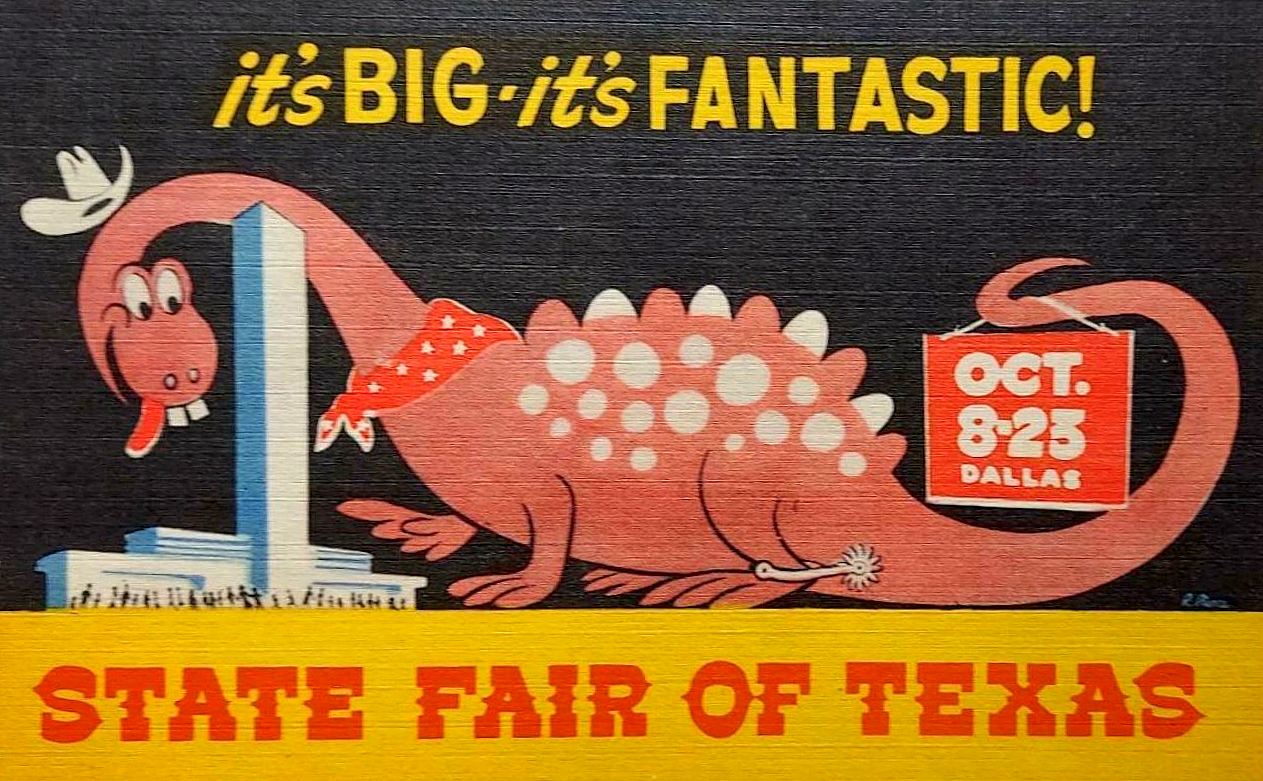
“It’s Big, It’s Fantastic!” — State Fair of Texas, 1949

sfot_1949_ebay_aWhen dinosaurs roamed Fair Park…

by Paula Bosse

Uh, hmm. Let’s see….

Dinosaur? Check.

Wearing a cowboy hat? Check.

Wearing a bandana? Check.

Wearing spurs? (!) Check.

With buck teeth? Check.

Looming over an art deco building? Check.

It must be time for the fair!

***

Sources & Notes

Postcard found on eBay.

sfot_1949_ebay_a_sm

*

Copyright © 2022 Paula Bosse. All Rights Reserved.

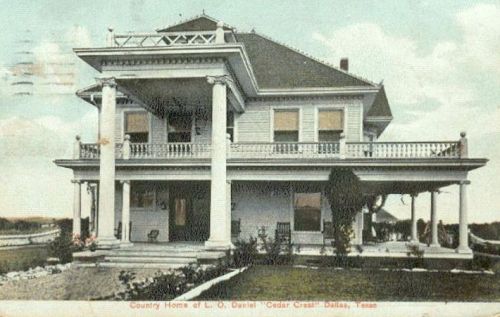
Cedar Crest, L. O. Daniel’s Country Home

daniel-l-o_cedar-crest_flickr_coltera
Still standing on West Jefferson Blvd. in Oak Cliff

by Paula Bosse

While looking for something on W. Lee “Pappy” O’Daniel (former governor and U.S. senator), I came across the image above, which I had mistakenly labeled “O’Daniel” rather than “Daniel.” It had nothing at all to do with W. Lee O’Daniel but, instead, showed a house belonging to L. O. Daniel. Who was L. O. Daniel? I’d never heard of him.

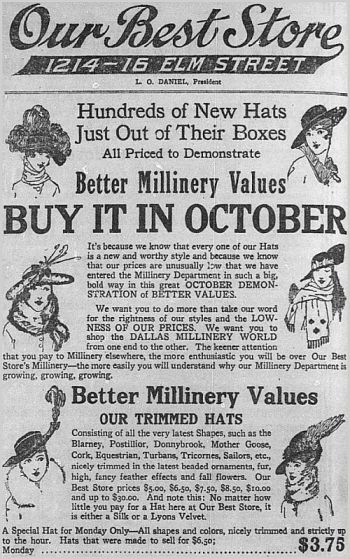
Lark Owen Daniel Sr. (1866-1927) was a wealthy businessman who made big money from… hats! He sold a lot of hats through his wholesale millinery company, and he was also involved in some spectacular real estate dealings (a newspaper article in 1907 mentioned he had just sold a couple of lots on Elm Street for $30,000 — if you believe online inflation calculators, that would be the equivalent of almost a million dollars in today’s money!). As a proven earner of big bucks, he was also the first president of the Dallas Chamber of Commerce.

Even before that huge real estate sale, Daniel was swimming in hat-cash. In 1901 he bought 27 acres near the Fort Worth Interurban rail line and built a 5,000-square-foot, 3-story, 15-room Victorian mansion. He named the house “Cedar Crest.” I don’t know if it was technically in Oak Cliff at that point, but it was definitely outside the Dallas city limits. This is the way Daniel’s address appeared in the 1910 city directory:

daniel-l-o_directory_19101910 Dallas directory

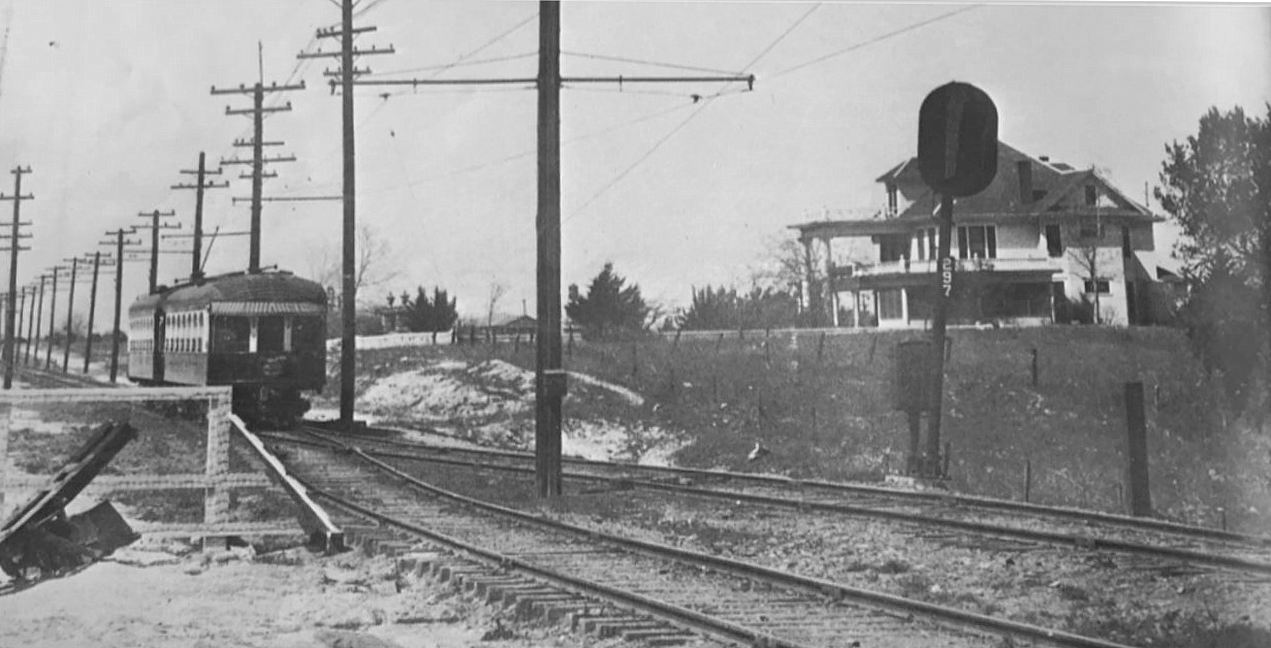
And here’s a photo of an interurban trundling along, uncomfortably close to the house:
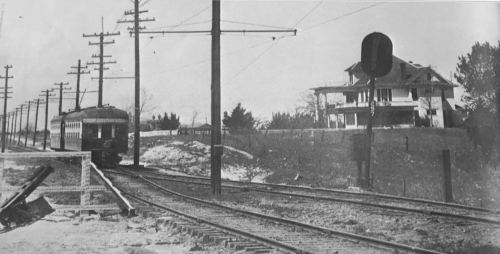
cedar-crest_interurban_oak-cliff-advocate

The luxurious splendor of the somewhat isolated Cedar Crest apparently emitted a high-pitched siren-call which was frequently heard by area bandits: it was burgled quite a few times (at least 3 times in one 12-month period). After one incident in which a burglar wandered through the house in the dead of night and woke Mrs. Daniel as he stood over her as she lay in bed, Oak Cliff police said that they found no trace of the trespasser but saw where he had hitched his horse and get-away buggy, out back in the orchard. In another incident a few months later, Mrs. Daniel — who had been alerted by an employee that the family car was about to be stolen from the “automobile house” — ran out to the garage armed with a revolver and fired three shots at the thieves, scaring them away (I don’t think she was attempting to fire warning shots — I think she fired AT them). This may seem extreme, but the newspaper noted that the value of the car (in 1915) was an eye-watering $4,000 (more than $110,000 in today’s money!). I don’t know where Mr. Daniel was during all this, but Mrs. Daniel was not about to let that car go anywhere!

One summer, the Daniels rented out Cedar Crest while they vacationed elsewhere. The ad in the paper specified that only “responsible parties without small children” were welcome. I hate to keep harping on about the money, but a two-month stay at L. O.’s “beautiful country home” would set some responsible childless person/s back a cool $300 (almost $9,000 in today’s money). (Who would pay such an exorbitant amount of money to stay in an un-airconditioned house in North Texas during the height of the summer?)

daniel_house-for-rent_summer-1912
Summer 1912

L. O. Daniel died in Feb. 1927. His business empire was closed down, and the large Cedar Crest swath of land he owned was put up for sale in 1929.
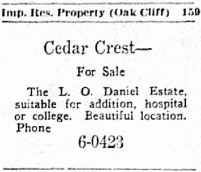
daniel_cedar-crest_april-1929April 1929

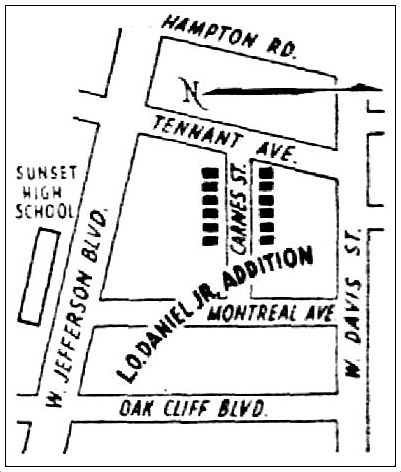
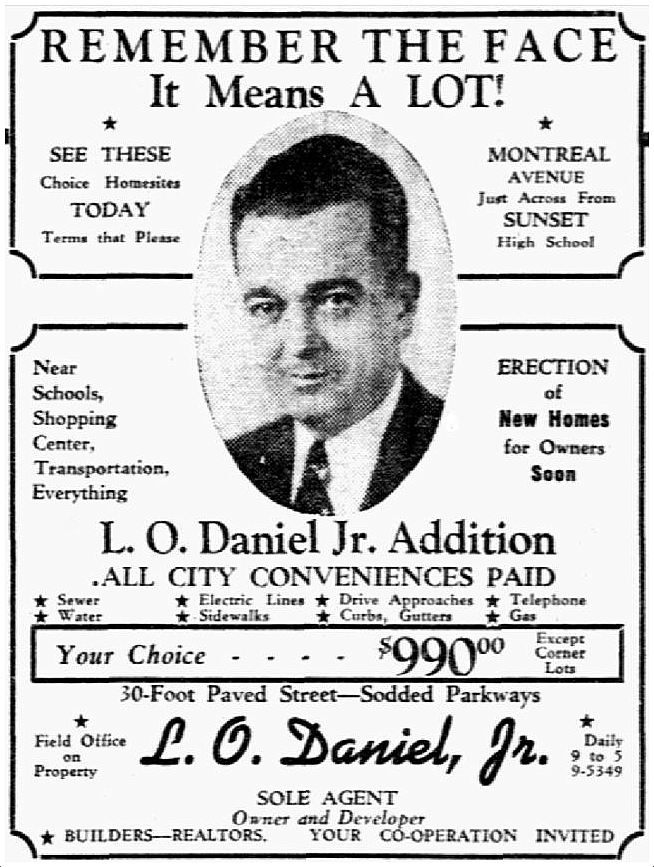
I’m not sure what happened with that specific transaction, but his son, L. O. Daniel Jr., ended up breaking that land up into parcels and selling residential lots as part of the “L. O. Daniel Jr. Addition,” beginning in about 1940.
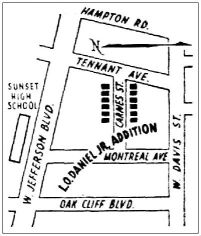
daniel-addition_june-1940_mapJune 1940

daniel-addition_nov-1940November 1940

*

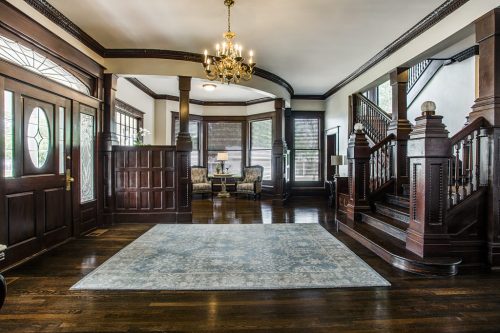
This beautiful house is — somehow — still standing. It is located at 2223 West Jefferson in Oak Cliff, facing Sunset High School (see it on Google Street View here). Over the years the mansion fell into disrepair, but in the early ’80s the house was restored by two men — Martin Rubin and Earl Remmel — and it received historical landmark status in 1984. Cedar Crest was purchased a few years ago and has gone through additional restoration/renovation — it currently serves as the impressive law offices for the firm of Durham, Pittard & Spalding.

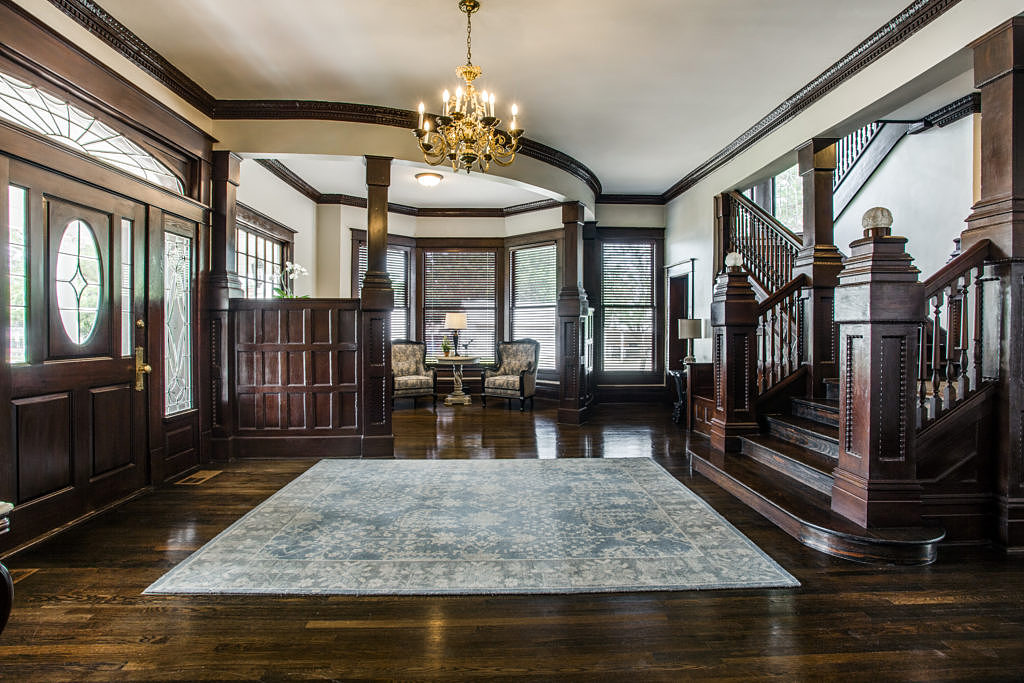
There are lots of photos online. View some on the Zillow site — which show what it looked like before it was recently updated — here. See some really beautiful photos on CedarCrestOakCliff.com, here. I particularly love this one:
cedar-crest_entry_cedar-crest-oak-cliff-dot-com

**

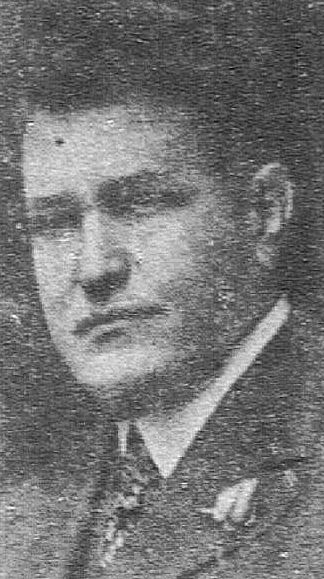
It shouldn’t have been so hard to find a photo of L. O. — but this is about all I could find. Followed by a hats-hats-hats! ad.

daniel_l-o_photo

daniel_oct-1915_adOct. 1915

***

Sources & Notes

Postcard at top (circa 1909) found a few years ago on the Flickr stream of Coltera (not sure if he’s still posting there — if not, that’s a shame, because he had amazing things!).

Photo of the interurban from the 2017 Oak Cliff Advocate article “Law Firm Renovates Historic Mansion on Jefferson” by Rachel Stone (click the link at the bottom of the article to read a piece published in Texas Lawyer which includes information on specific restoration/renovation work done on the house).

There are so many great homes in the L. O. Daniel area — look at a whole bunch on the L. O. Daniel Neighborhood Association website here.

Also recommended is the 2019 Candy’s Dirt article “What’s in a Name For L. O. Daniel?” by Deb R. Brimer.

daniel-l-o_cedar-crest_flickr_coltera_sm

*

Copyright © 2022 Paula Bosse. All Rights Reserved.