Flashback : Dallas

A Miscellany: History, Ads, Pop Culture

Category: Roads & Bridges

Maple North of Wycliff: The Hinterlands — 1900

Looks a little different these days… (click for larger image)

by Paula Bosse

Here we see Maple Avenue, somewhere north of the Katy Railroad crossing, circa 1900. A. C. Greene, in his book Dallas, The Deciding Years, estimated it shows Maple “just north of where Wycliff now crosses” (see note at bottom of post wondering if this might instead show Maple just north of the railroad crossing). I have to say, the present-day view of that area has nothing going for it over the one depicted above, except maybe asphalt. …If you like asphalt.

Here’s a detail that shows the little horse and buggy, heading out to the hinterlands. (Click to see a larger image.)

greene_maple-wycliff-ca1900-det

Personally, I’d take the “hinterlands” view to the one we’re subjected to today.

An interesting book about early Dallas history that I would highly recommend is Diaper Days of Dallas, Ted Dealey’s entertaining memories of growing up in Dallas. His family had a house on Maple Avenue at about the turn of the century (his father was George Bannerman Dealey, early founder of The Dallas Morning News), and the Maple-McKinney area was his playground. Here is his description of the city limits at the time this photo was taken:

Dallas, in those early days, consisted of about eight square miles of territory. To the south the city limits ended roughly at Grand Avenue; to the east the city limits ended roughly where Fitzhugh Avenue now runs; to the north it went out Cedar Springs across Maple Avenue to a point where Melrose Hotel stands now. North of this there was practically nothing. On the west the city extended to the Trinity River.

So, at the turn on the century, this wonderful vista was the hinterlands — out in the country and well beyond the city limits.

***

Photo from Dallas, The Deciding Years by A. C. Greene (Austin: Encino Press, 1973), with the caption: “In 1900 Maple Avenue was mainly a rural lane. This photograph was taken just north of where Wycliff now crosses Maple. Courtesy Dallas Public Library.”

Text quoted is from Diaper Days of Dallas by Ted Dealey (Nashville: Abingdon Press, 1966), p. 23.

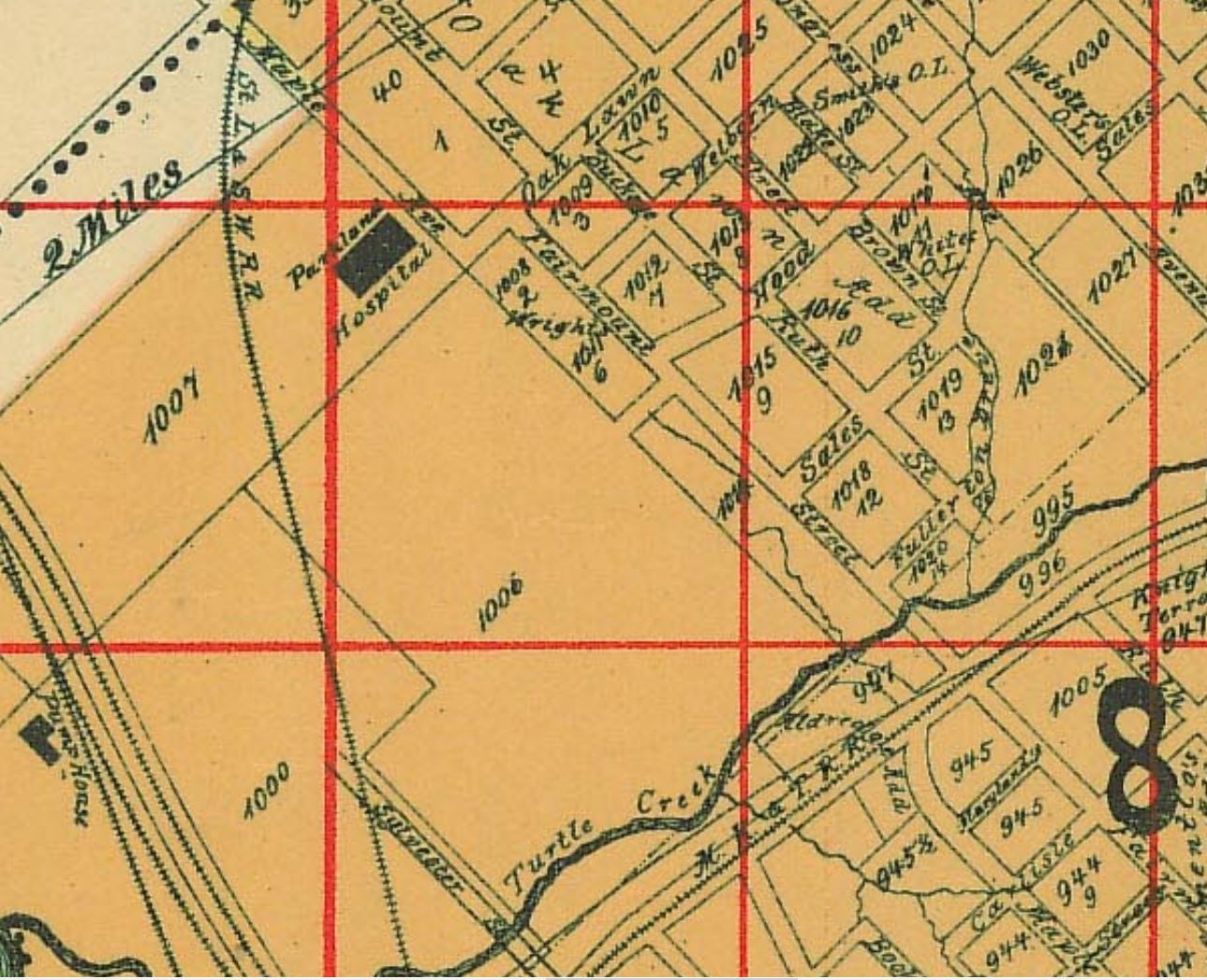
EDIT: I don’t know if this photo does show Maple around what is now Wycliff. The curve is very similar to the one Maple used to make before it was straightened in 1918 or 1919 — right around the railroad crossing, which also included a bridge across Turtle Creek, as seen in this detail from a 1905 map. Just a thought.

maple-ave_1905-map_portal_det

Click photos for larger images.

*

Copyright © 2014 Paula Bosse. All Rights Reserved.

That Commute Would Have Been a Whole Lot Less Traumatizing 60 Years Ago

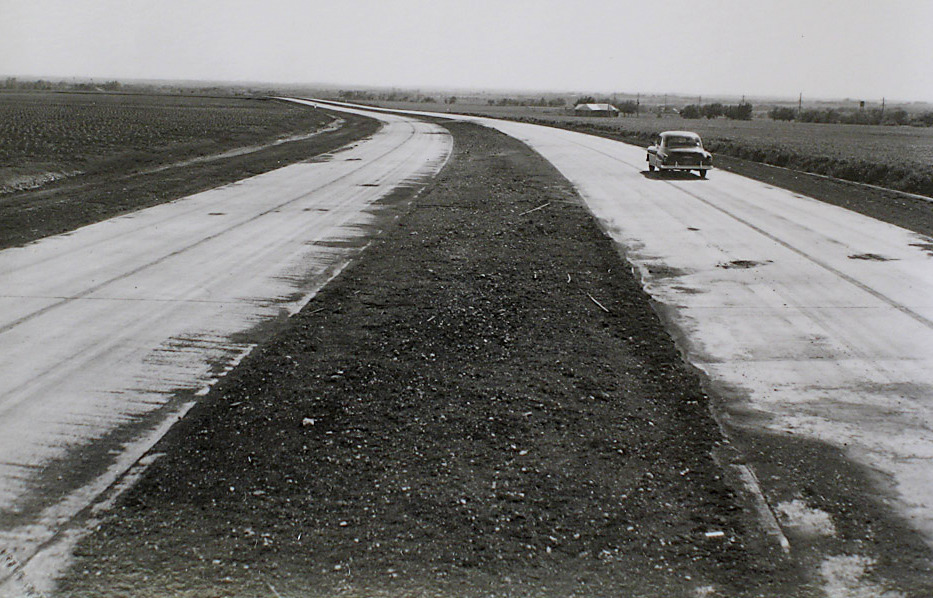
central-expressway_n-of-nwhwyA lonely stretch of Central Expressway…

by Paula Bosse

Above, we see a new section of US 75/Central Expressway, north of Loop 12/Northwest Highway, 1955.

Just let that sink in a moment.

***

Sources & Notes

From an incredibly informative blog on Dallas-area freeways. The photographs documenting the construction of Central are great — check ’em out here.

*

Copyright © 2014 Paula Bosse. All Rights Reserved.

The Hyperbolic Paraboloids of the Prairie

hyperbolic_paraboloidThe future is NOW! (click for larger image)

by Paula Bosse

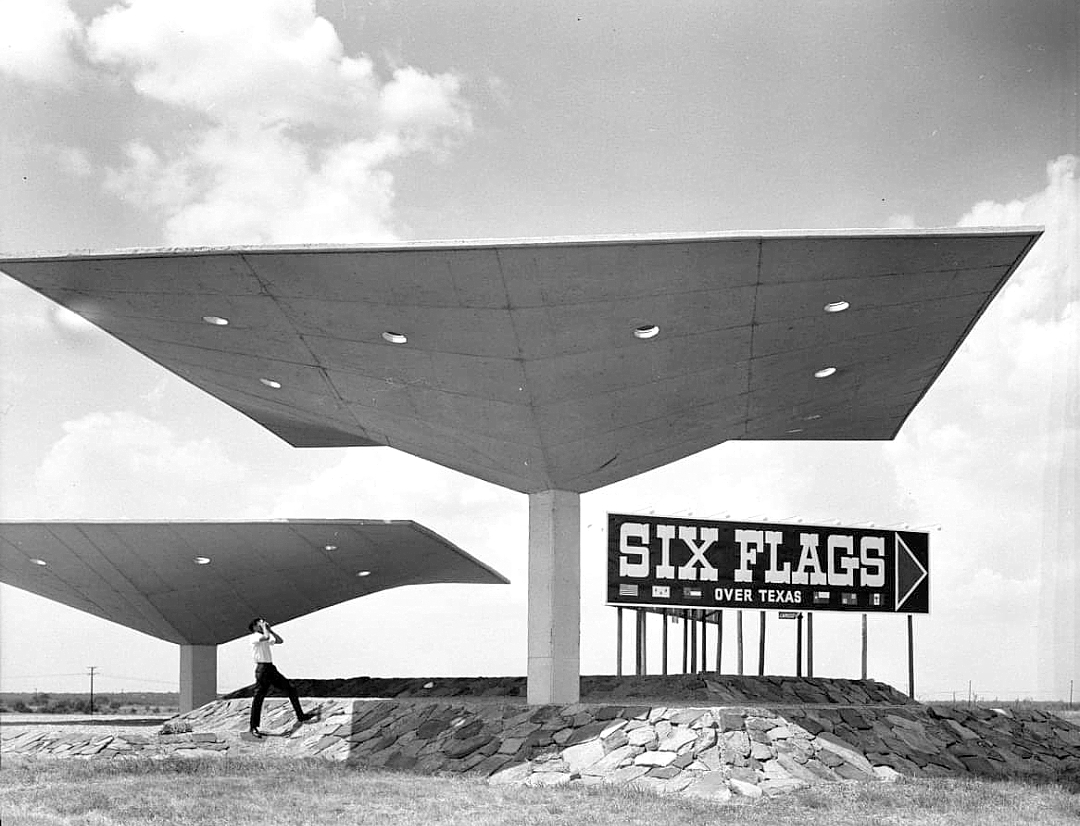
In amongst things the things I’ve haphazardly collected (and I use the term loosely) over the years is this postcard. The image looks familiar to me, as if I remember actually seeing it — but I think that might just be because I’ve looked at this postcard so long. The first thing that popped into my head when I saw it was “turnpike,” but until I read up on the history of local highways (my days are fun-filled!), I wasn’t entirely sure where the turnpike had been other than “the other side of downtown, toward Fort Worth.” Did I ever see this sign and attendant weird looming structures when I was a child? Unless it was still up in the ’70s, I probably didn’t. So what is it?

Here’s the text from the back:

  • Concrete wings
  • THREE HYPERBOLIC PARABOLOIDS
  • GREAT SOUTHWEST INDUSTRIAL DISTRICT
  • Midway between Dallas and Fort Worth
  • “Located on U.S. 80, these hyperbolic paraboloids stand as insignia of the vast Great Southwest Industrial District in the center of the Dallas-Fort Worth metropolitan area. This thin shell ‘concrete umbrella’ construction form was pioneered in the Untied States by Great Southwest Corporation, developer of a 5500-acre planned industrial district.”

It was somewhere around Arlington and Grand Prairie, back when it was still a vast, undeveloped area being planned in the mid-1950s by Angus Wynne who would, a few years later, bring us Six Flags Over Texas. (US Hwy 80 no longer runs west of Dallas — that stretch is now, I think, Hwy 180 — it was shoved off its Great American Interstate Highway pedestal by the DFW Turnpike and the arrival of what is now Interstate 30.)

hyperbolic-parabola_six-flags_1961_tx-highways-mag_FB
1961 (Texas Highways photo by Willis Albarado)

But … “hyperbolic paraboloids”? Those things are so cool. The “hyperbolic paraboloid” was developed by Mexico-based Spanish engineer-architect Felix Candela who worked in the Dallas area with the great architect O’Neil Ford (on, specifically, the Great Southwest Industrial District and the Texas Instruments Semiconductor Building). Candela is pretty interesting — look him up. Without Candela’s paraboloids and his contributions to engineering and architecture, Santiago Calatrava probably wouldn’t be doing the sort of thing that he’s doing.

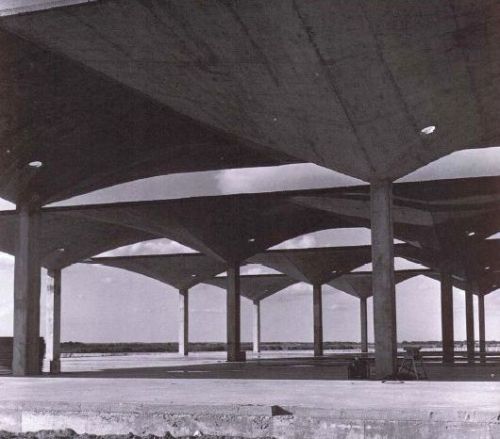
Here’s another view of (other) paraboloids out on the Texas prairie. They’re like elegant, curved, inverted parasols. Kind of. Made from thin shells of concrete. (One source identified these paraboloids as being part of the Great Southwestern Industrial District and another source as being from the Texas Instruments campus. (See 1958 TI ad below.) Either way, it’s Felix Candela, all the way.)

paraboloid_texas-instruments

I’m still trying to figure out if I ever saw that fantastic sign and those three silent, looming paraboloids. It’s all pretty cool-looking, and it must have been an unexpected sight in the middle of what was, then, basically nothing.

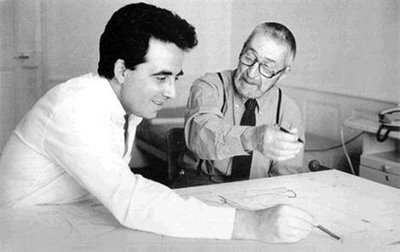
Speaking of Candela and Calatrava, here’s a photo of the two together:

calatrava-candela

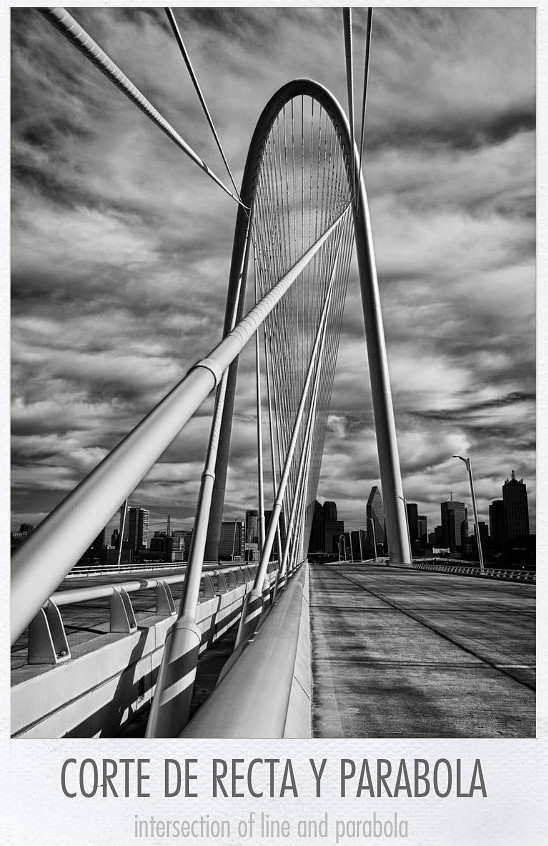
And here’s another paraboloid-y structure that stands out in the DFW area — you might have seen it:

calatrava_parabola

***

Sources & Notes

Photo of Calatrava and Candela from the blog An Engineer’s Aspect, here.

Photo of the Calatrava bridge from Pinterest, here.

A good overview of Felix Candela’s work, with photos and a video, is on the Columbia University website, here.

The Great Southwest Industrial District (Arlington and Grand Prairie) still exists, and their website has a history page which explains its creation and development by Angus Wynne, here.

Lastly, who could resist reading up on just what the heck a “hyperbolic paraboloid” is (warning: math) — Wikipedia’s on it, here.

A 1958 Texas Instruments ad wants you to know that “hyperbolic paraboloids form roof-ceiling” (click to see larger image):

texas-instruments_hyperbolic-paraboloid_1958_ebay1958

UPDATE: Thanks to comments below, I’m happy to present another photo of the paraboloids, this one from the cover of the 1960 Arlington High School yearbook, complete with Shetland pony! Click the image below to see a larger image of the photo inset. (Thanks to Brad McCorkle for alerting me to the photo — it was taken by his father, Lynn McCorkle, intrepid student photographer!)

paraboloid_arlington-high-school-yrbk_1960

ANOTHER UPDATE, from the comments: this still-standing building at 10830 Preston Road (Preston Royal Shopping Center) was one of many that utilized hyperbolic paraboloids in its design. The American Savings Association building (designed by Brock & Mabrey of Corpus Christi, with Braden & Jones of Dallas as associated architects) opened in March, 1966.

american-savings-association_hyperbolic-paraboloid_030166

*

Copyright © 2014 Paula Bosse. All Rights Reserved.

That Time When Dallas Changed the Numbers of Every Single Street in Town — 1911

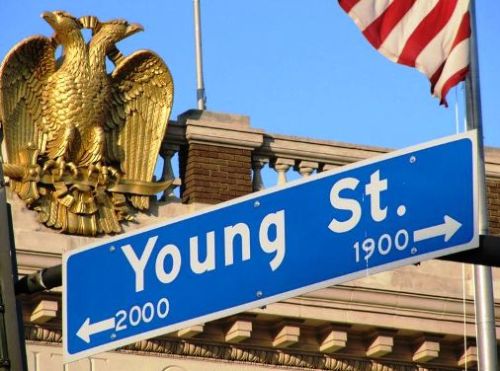
young-street-sign_flickrPhoto by Silver Lighthouse/Flickr

by Paula Bosse

Here’s a topic that isn’t very sexy, but it’s one of those mammoth-scale city-wide operations that had to be done, but no one wanted to tackle it because it was a huge undertaking and it was going to be a big hassle: re-numbering the streets. All of them. Throughout the entire city. I wasn’t aware that something like this had ever happened until I started using old criss-cross directories to try to pinpoint the location of old buildings that were originally built on streets that no longer exist (such as Poydras and Masten).

Why, for instance, is the current address of the Majestic Theatre 1925 Elm St., but in 1909 that same parcel of land on Elm had an address of 463 (-ish)? Weird, huh? Obviously street numbers changed at some point, but when? And why? Eventually I zeroed in on 1910 or 1911 as the year when addresses seemed to have changed, but I was having a hard time finding any information about what prompted the change in the first place. Until I hit on the key phrase “century system.” After that, my search became much easier.

As far back as the 1880s, the city seemed poised to address the haphazard street numbering situation, as it was causing “endless confusion” — the powers-that-be had even seemed to settled on the “century system” (so called because each block is numbered up to 100, with a new hundred starting in the next block). But progress moves at a snail’s pace in city government, and the plan didn’t start picking up steam until fifteen or twenty years later.

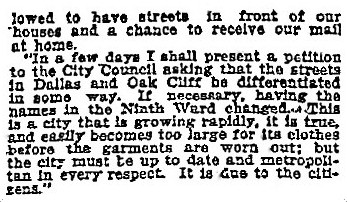
In the early days of the 20th century, the numbering of Dallas streets was, as one mail carrier described it, “freakish.” Numbers weren’t always consecutive. Sometimes odd and even numbers were on the same side of the street. Sometimes a run of numbers would suddenly start all over again. Houses sometimes had TWO numbers. People would move and expect to take their number with them. Buildings and houses often had NO numbers. Street signs were few and far between, and it wasn’t uncommon for street names to be duplicated in different parts of town. As you can imagine, unless you were intimately familiar with the area or neighborhood, chances were that you weren’t going to  be able to find anything. Unsurprisingly, the real pressure to come up with some sort of logical, uniform street numbering system came from the city’s postmasters and postal employees (that they managed to regularly deliver mail to the proper recipients is just short of miraculous).

Postmaster Albert G. Joyce (one in a line of several postmasters who tried to effect change over the years) wrote an impassioned/frustrated plea for action in 1904:
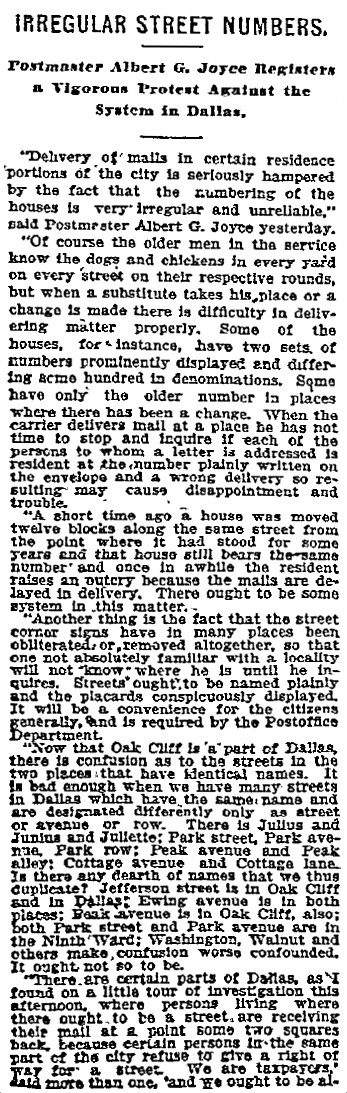
1904_street-numbering_dmn_051804a

1904_street-numbering_dmn_051804b(DMN, May, 18, 1904)

Everyone agreed that something needed to be done — especially as the city’s population was growing at an astronomical rate, but … nothing got done. Here, at the end of 1907, another exasperated postal employee shared examples of the problem:
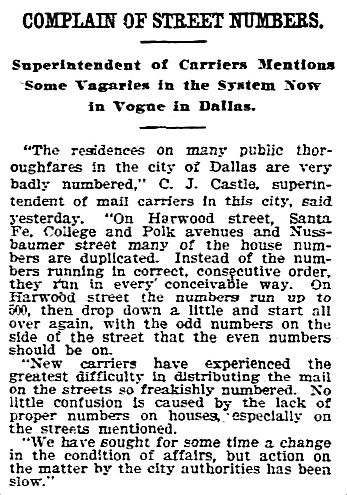
1907_street-numbering_dmn_120707(DMN, Dec. 7, 1907)

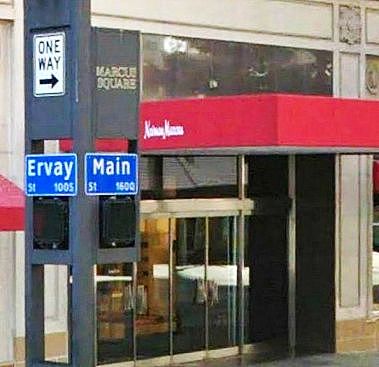
 By 1909, a plan was finally starting to come together. This article describes how the numbering system would be implemented downtown, starting from the Trinity River, with Main and Ervay being the east-west and north-south anchors:
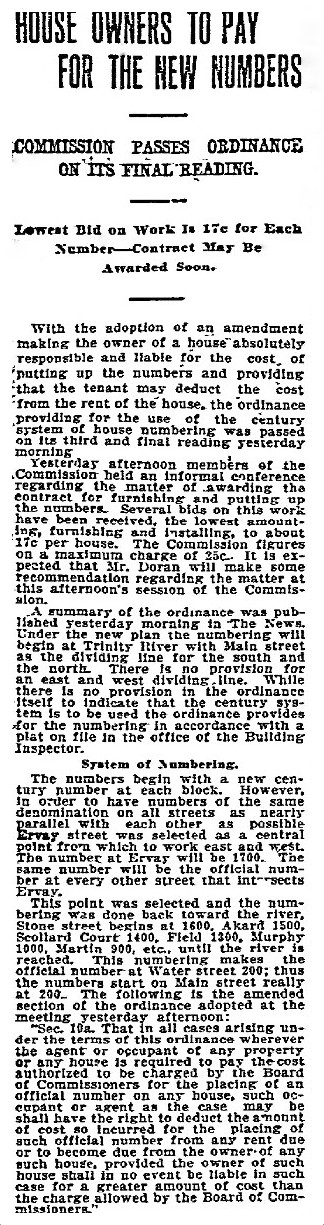
1909-street-numbering_dmn_121709-ervay(DMN, Dec. 17, 1909)

Even though the plan had basically been decided on, it wasn’t put into action for at least a year. There were three main reasons to delay the implementation: city directories had already been compiled and were to be issued soon, the 1910 census survey was about to begin, and the post office (which would bear the brunt of the impact of the drastic change) asked that the changeover take place before or after the busy holiday season.

By the end of 1910, the final details had been hammered out. The main change to the previous version of the plan was that the city, rather than the property owners, would pay for the re-numbering. Also, I don’t know if this was a new detail or not, but there is mention here that numbering east of Greenville Ave. would “begin anew.” The re-numbering was expected to be completed in January, 1911.
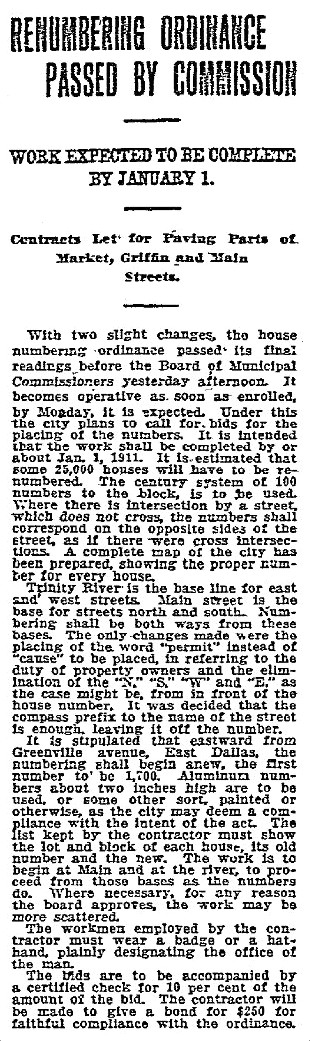
1910-street-numbering_dmn_100110(DMN, Oct. 1, 1910)

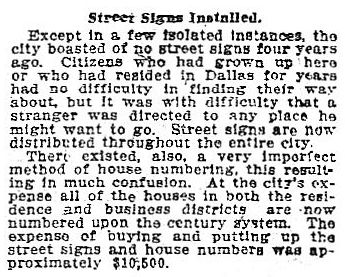
By the middle of January, 1911 the long-put-off task was completed, ending in Oak Cliff. The cost to the city of the “number placement” and the new street signs was $10,500.
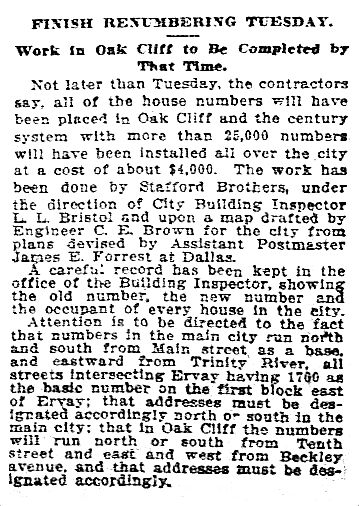
1911_street-numbering_dmn_011511(DMN, Jan. 15, 1911)

The problem that had been moaned about for decades had been fixed, and a uniform system of street numbering had finally been put in place.
 1911_street-numbering_dmn_043011(DMN, Apr., 30, 1911)

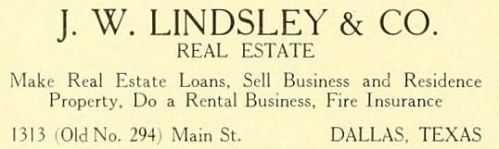
 I can’t imagine how much of a headache and how unbelievably confusing the whole process and aftermath must have been. Several businesses, concerned that their clientele might have a difficult time “finding” them, hedged their bets by including BOTH address — the old and the new — on their letterhead and in their ads. This two-address thing went on for quite a while with some businesses — in fact, leading real estate man J. W. Lindsley was so annoyed by this practice that he complained about it to the Morning News in 1916 (a full five years after the switch!). Even though, ahem, Lindsley was one of the few advertisers in the Blue Book Directory for 1912-14 who did that very thing:
lindsley-ad-blue-bk_1912

Unlike his competitor, Murphy & Bolanz, who had just the one (but still felt compelled to add the “new” to the address):

murphy-bolanz-ad_blue-bk_1912

And that is today’s lesson on how Dallas finally bit the bullet and gave the entire city new addresses.

(And now I know that Neiman Marcus apparently IS the center of Dallas.)
main-ervay_NM

**

UPDATE: HOW TO FIND THE OLD OR NEW ADDRESS. When I first wrote this, I’m not sure if I knew about the very handy resource Jim Wheat provided on his website: the 1911 Worley’s Dallas street directory, here. This is one way you can determine what the post-address-changeover was if you know the pre-1911 address (or vice-versa): find the street name and click on it. You’ll find two columns: one showing the “new” address, and the other the “old” address. (These aren’t always exact, but it at least gets you in the right block number to investigate further.) If you don’t know a specific address, you can make an educated guess according to the cross-streets. Thank you, Jim Wheat!

***

Photo of Young St. sign from Flickr, here. It’s great.

All newspaper articles from The Dallas Morning News.

The two real estate ads from The Standard Blue Book of Texas, 1912-14, Dallas Edition (Dallas: A. J. Peeler and Company, n.d.).

 Slightly fuzzy Ervay-Main sign from Google Street View.

An early article about this issue, “Street Numbering, A Neglected Matter to Receive Attention Soon” (Dallas Daily Times-Herald, Nov. 22, 1889) can be found here.

And if you’re interested in just what goes into tackling a problem like this in modern times, hie yourself over to “Street-Naming and Property-Numbering Systems” by Margaret A. Corwin (American Planning Assn., ca. 1976). Read the entire report here, in a PDF. I’m nothing if not thorough.

dallas-st_sign_nyt_120713

*

Copyright © 2014 Paula Bosse. All Rights Reserved.

“How to Use Central Expressway” — 1949

by Paula Bosse

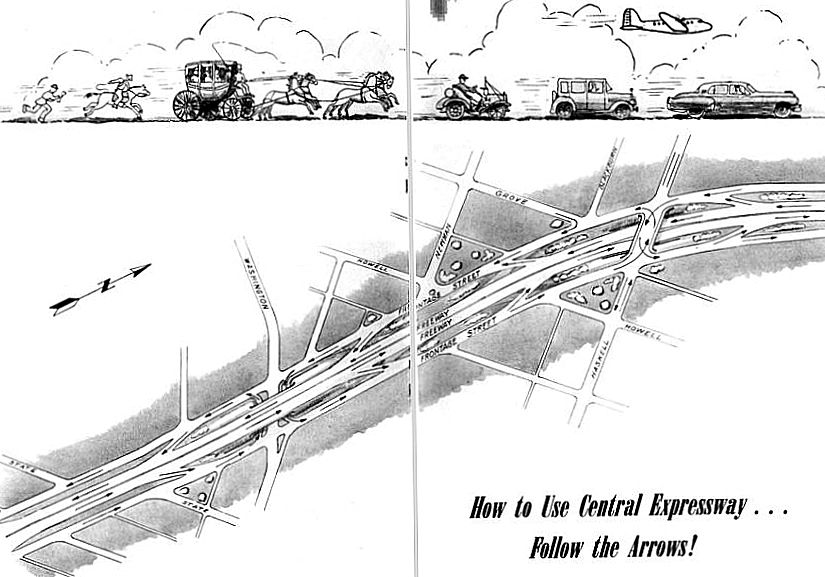
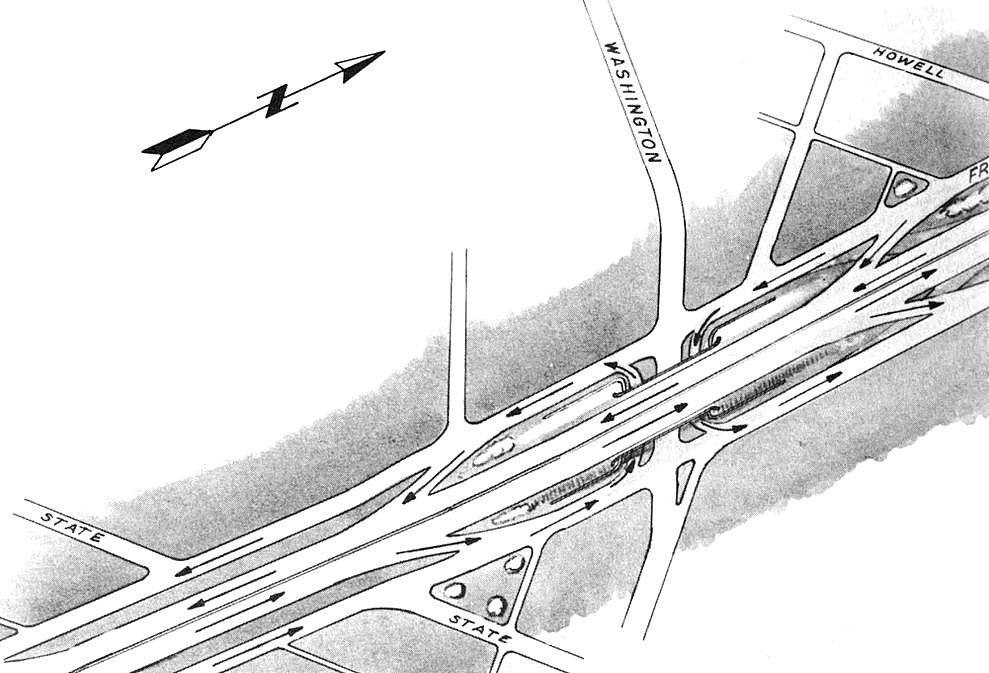
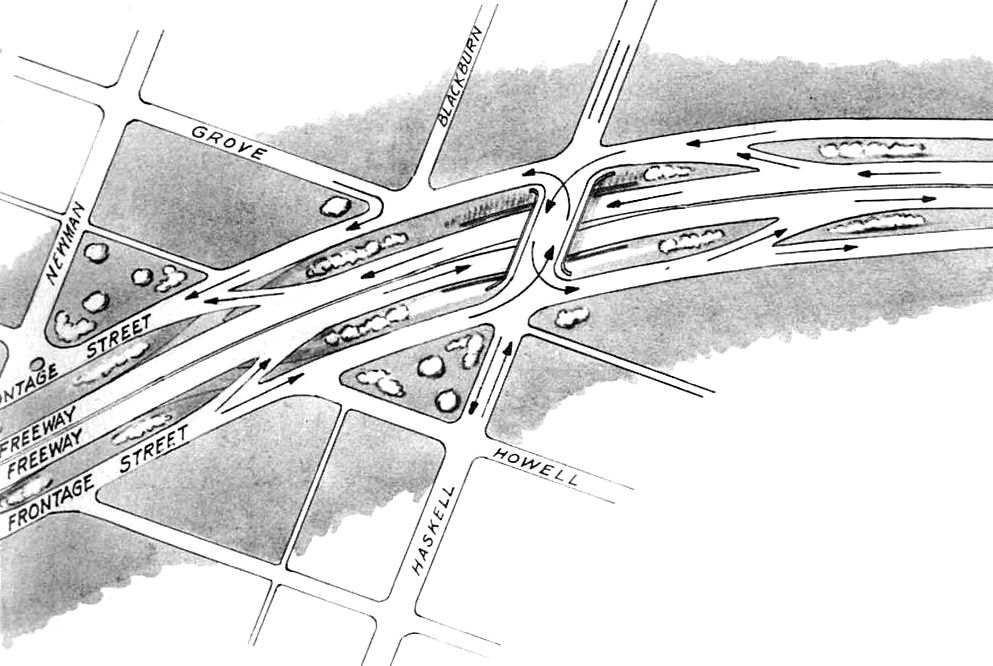
It got only to Fitzhugh from downtown at this point, but the freeway concept was new enough that Dallas drivers needed some instruction on how to use Central Expressway. Cute.

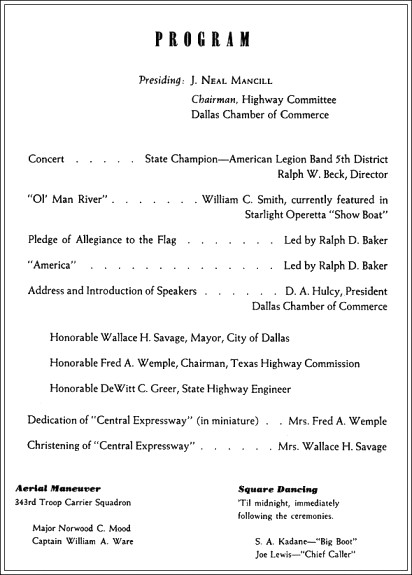
Cuter still, the dedication ceremony. It included the singing of — what else? — “Old Man River,” the Pledge of Allegiance, some sort of aerial fly-over, and, of course, square dancing (two square dances, one for white dancers, one for black). Oh, and the mayor’s wife christened the expressway with a bottle of cologne. (How much more Dallas can you get?) (Many of the images and articles below are larger when clicked.)

The opening ceremonies were covered extensively by the local papers. My favorite tidbit from the coverage was a quote by Mayor Wallace Savage on how the new highway will psychologically benefit the city’s drivers. His hope and expectation is that driving along Central Expressway will make drivers “more relaxed when they get home from the office, and in a better mood when they get to the office from home.” Again, cute.

*

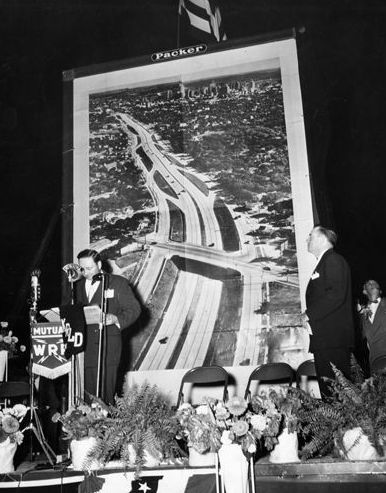
central_opening_haskins_briscoe-ctr1

Above, Neal Mancill, Chairman of the Highway Committee of the Dallas Chamber of Commerce. Photo by Squire Haskins.

central_opening_haskins_briscoe-ctr2

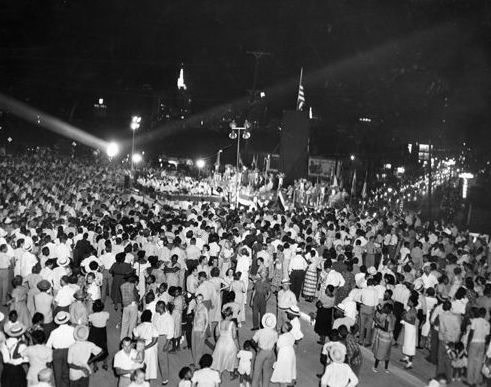
The segregated celebration had black celebrants in one area and white celebrants in another. Photo by Squire Haskins.

central_opening_haskins_briscoe-ctr3

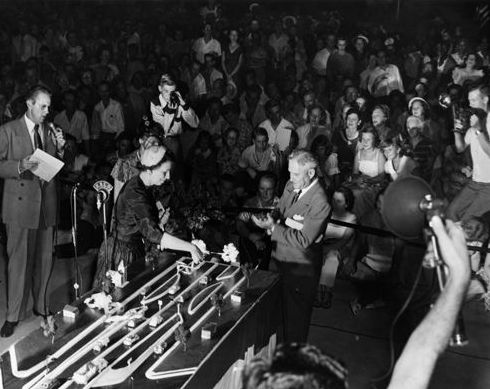
Mrs. Fred Wemple, wife of the Chairman of the Texas Highway Commission, cutting the ribbon on a miniature replica of Central Expressway. Photo by Squire Haskins.

*

But back to the lesson. THIS is how you use Central Expressway — just follow the arrows! The two halves of the larger map above are here magnified (click!) to more easily facilitate wistful inspection of an artifact from a simpler time when the city looked forward to experiencing a calm, restful, non-stop drive along the Central Expressway.

ht-use-central-1

ht-use-central-2

central-expressway

***

To peruse the entire pamphlet titled Central Expressway… San Jacinto to Fitzhugh, Dedication August 19, 1949 (Dallas: Dallas Chamber of Commerce, 1949), click here.

Photos by Squire Haskins from the Dolph Briscoe Center for American History.

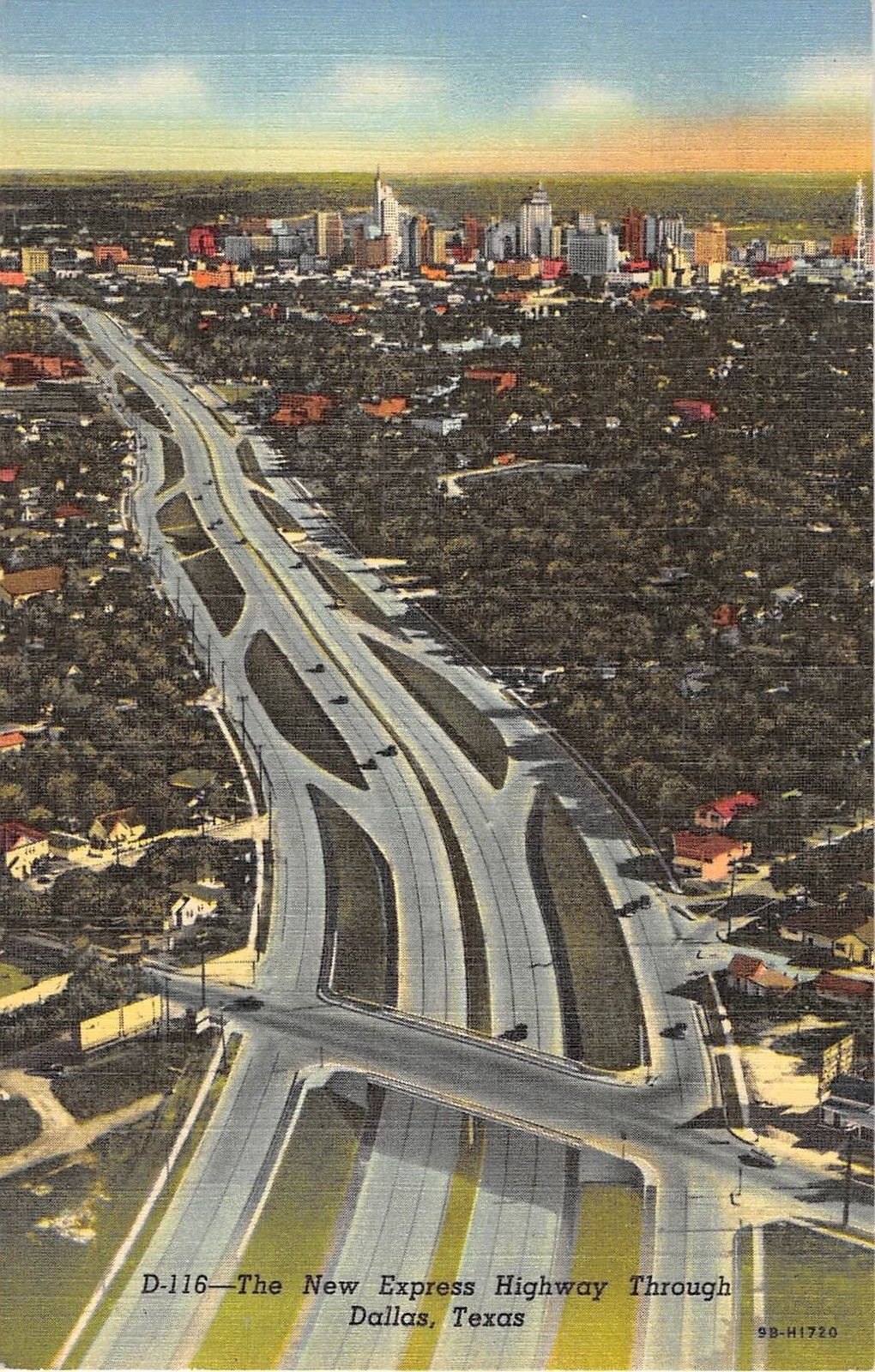
Postcard from a photo by Squire Haskins (click to see GIGANTIC image).

When in doubt, click pictures to see if images are larger.

*

Copyright © 2014 Paula Bosse. All Rights Reserved.
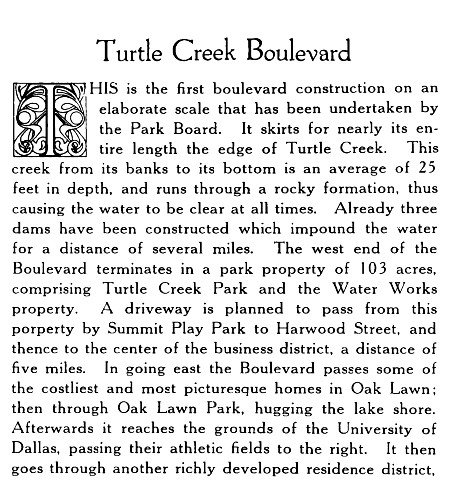
The Construction of Turtle Creek Boulevard: “Ascending & Descending Cliffs and Ravines” — 1915

turtle-creek-blvd-1

by Paula Bosse

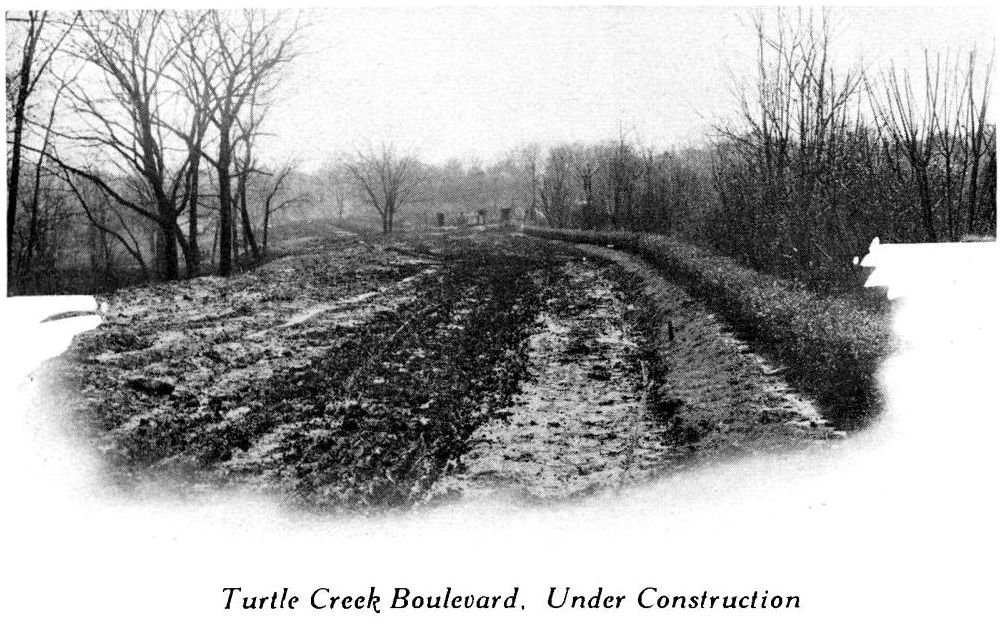
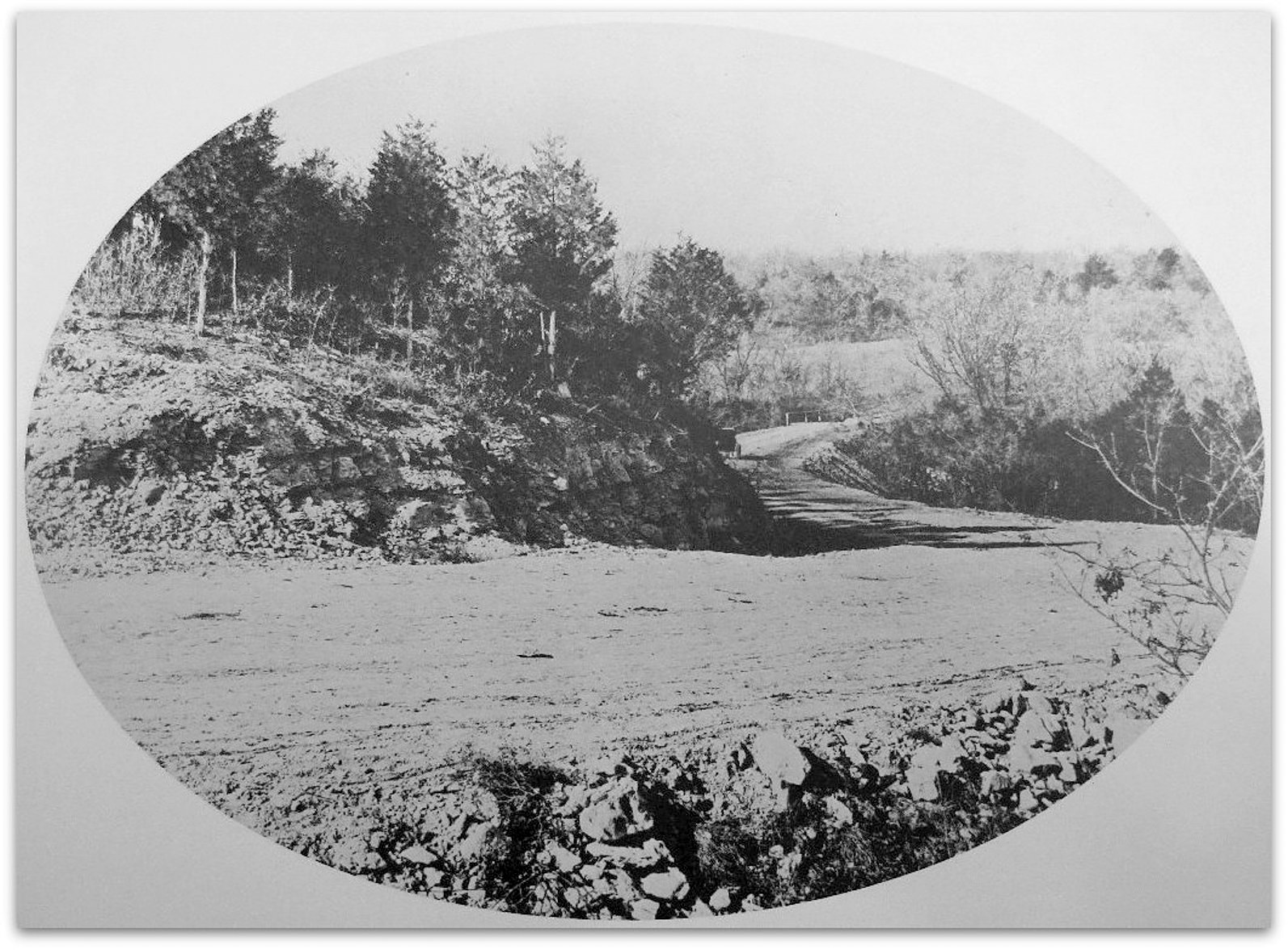
What was going on a hundred years ago in Oak Lawn? Turtle Creek Boulevard was being constructed! Construction was overseen by the Park Board, which probably explains why it is one of the most beautifully landscaped roadways in Dallas.

turtle-creek-blvd-2

turtle-creek-blvd-3

turtle-creek-blvd_text-1turtle-creek-blvd_text-2

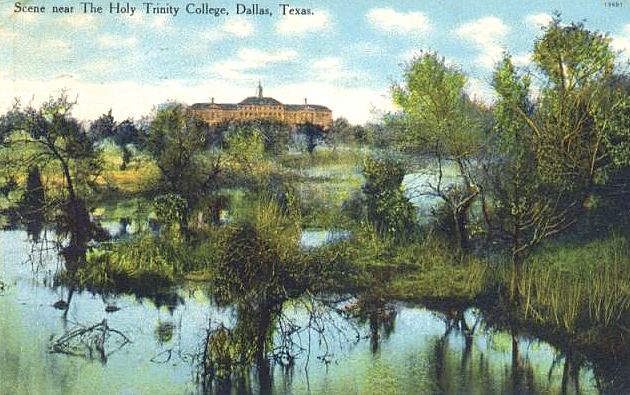
Incidentally, the “University of Dallas” mentioned above refers to the original location of the University of Dallas, first called Holy Trinity College. It moved northward in the 1940s, and Jesuit High School took over the building. I’m really surprised to learn that this huge building was located near Turtle Creek and Blackburn until Jesuit moved north to ITS new home in the early 1960s.

And here it is, snug on the banks of the turtle-infested creek, around 1909 (in a photograph that does not do the lushly beautiful area justice).

***

Sources & Notes

Photos and text from the Report for the Year 1914-15 of the Park Board of the City of Dallas (Dallas, 1915), pp. 63-64.

*

Copyright © 2014 Paula Bosse. All Rights Reserved.

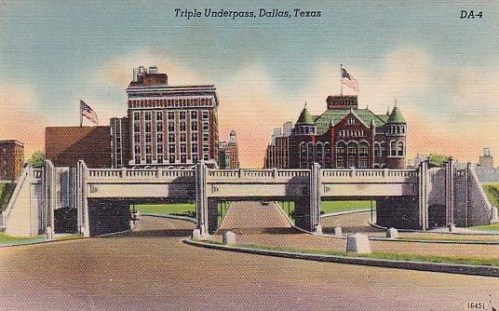
The Triple Underpass — Elm, Main, and Commerce Never Looked Better

triple_underpass_1936

by Paula Bosse

Sometimes a noisy, bustling metropolis really hits the spot, but there are times I long to have completely empty streets all to myself. Which is one reason I love this serene and peaceful (or perhaps “post-apocalyptic,” depending on your half-full/half-empty world-view) scene of Dallas, totally deserted save for a partial view of a single car in the distance. The brand new “triple underpass” was unveiled in 1936, the year Dallas was obsessed with showing off what a fantastically modern city it was to the throngs of visitors flooding in for the Texas Centennial celebrations. G.B. Dealey himself rode the first car through the underpass. Perhaps that’s his little car heading up Main Street.

triple-underpasss_wo-dealey_1930s
Above, the “Business District, from the West.” Note the absence of Dealey Plaza, which wouldn’t be completed until 1941 and not officially named “Dealey Plaza” until 1946. …After that, the place wasn’t thought about in any especially significant way until 1963.

triple-underpass_gateway-to-dallas_1940s

“The Gateway to Dallas, Texas,” with beautiful Dealey Plaza now set in place, one day to become the most-visited historic site in the city. Despite its grim connection to the assassination, every time I drive through that underpass I always get a little thrill. Almost 80 years after it became a landmark, the triple underpass is still a remarkably cool piece of Dallas architecture and engineering.

*

Copyright © 2014 Paula Bosse. All Rights Reserved.

Goodyear Tire Ad Starring Stemmons Freeway — 1960

goodyear_dallas_stemmons_1960
“Texas’ 16 lane (3-5-5-3) Stemmons Freeway, looking toward downtown Dallas.”

Oh, for “traffic” like that on Stemmons these days….

*

Copyright © 2014 Paula Bosse. All Rights Reserved.

Beware the Narrow Oak Cliff Viaduct!

oak_cliff_viaduct_car_accident_1920s

by Paula Bosse

“Sometimes the Oak Cliff Viaduct seems a trifle too narrow. From a snapshot made just after it happened.”

I came across this photograph while flipping through  the book Our City — Dallas, A Community Civics by Justin F. Kimball (1927). I love that viaduct, but … yikes. Look at all those calm and/or petrified passengers. (We were always warned about going across the river…)

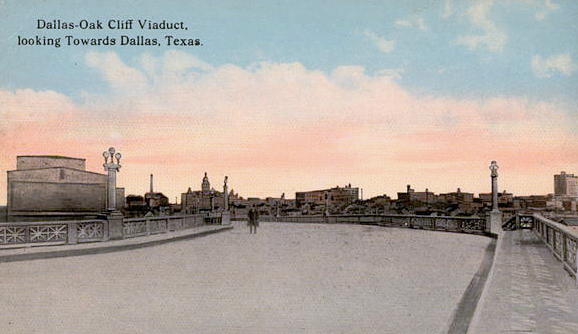
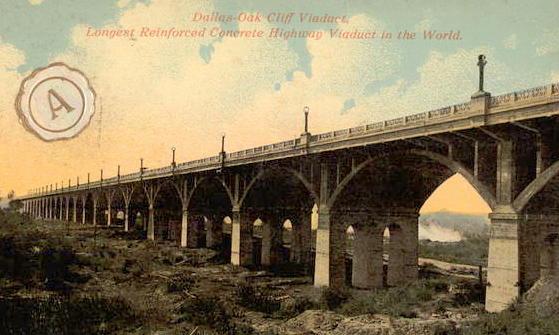
Here are a few contemporaneous images of the not-actually-so-narrow viaduct.


oak-cliff-viaduct_old_postcard

oak-cliff-viaduct_1924

oak-cliff-viaduct_fast_slow

Dallas-Oak Cliff Viaduct, looking Towards Dallas, TX

Dallas-Oak Cliff Viaduct

*

Copyright © 2014 Paula Bosse. All Rights Reserved.