Flashback : Dallas

A Miscellany: History, Ads, Pop Culture

Category: Theaters

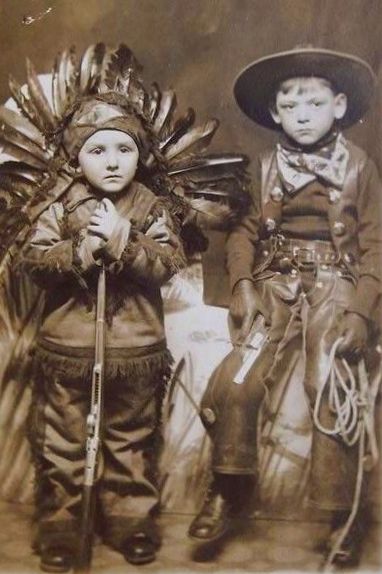
Cowboys and Indians on Elm Street — 1915

lawrence_kiddie-photoPhoto by Joe Lawrence, circa 1915

by Paula Bosse

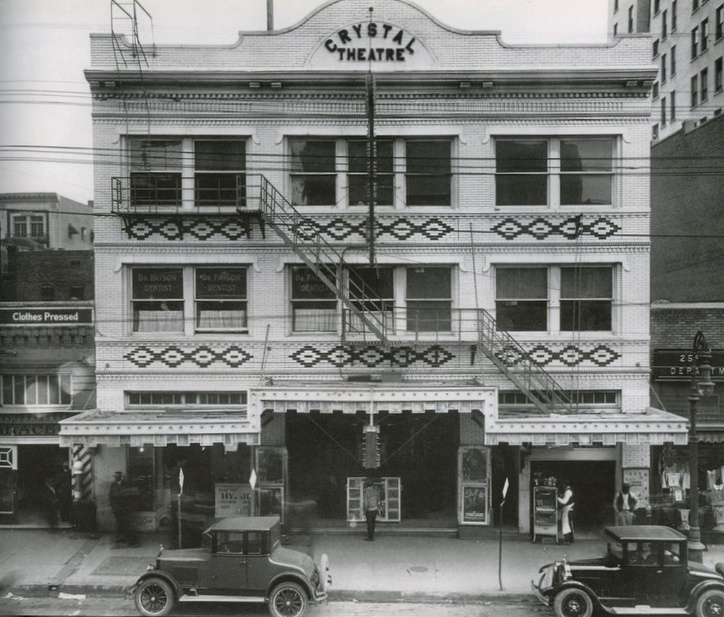
The photo above, showing two not-terribly-thrilled children dressed up in Old West costumes, was taken by Joe Lawrence in his “Crystal Electric Studio” at 1608 Elm Street, one of many small businesses located above the Crystal Theater.

crystal-theaterThe Crystal Theatre — with office space above (click for larger image)

Joseph Z. Lawrence (1884-1943) was born in Romania and settled in Dallas in 1909. In 1915 he was doing business as a photographer at 1608 Elm Street. Lawrence later owned the Lawrence Art Galleries on Pacific Avenue, and, along with his son Harry, was an early supporter of the Dallas Nine artists.

***

Sources & Notes

Top studio photo by Joe Lawrence, found on eBay.

Photo of the Crystal Theater found on Pinterest, here. A photo of the 101-year old building taken during the recent spate of downtown demolition — with the wrecking ball literally INCHES away from it — is here. The Dallas Morning News article it comes from is here.

At some point the address of the building (originally 1608-10) became 1610 Elm, perhaps when it was extensively remodeled in the late 1920s and became a retail store.

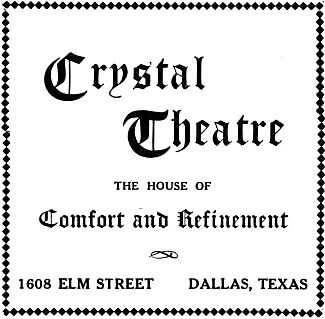
crystal-theater_building-code-bk_19141914 — “Comfort & Refinement”!

*

Copyright © 2014 Paula Bosse. All Rights Reserved.

Theater Row Block Party! — 1948

theater-row-block-party_082648_preservation-dallasDallas premiere, “Red River” — Aug. 26, 1948 (click for larger image)

by Paula Bosse

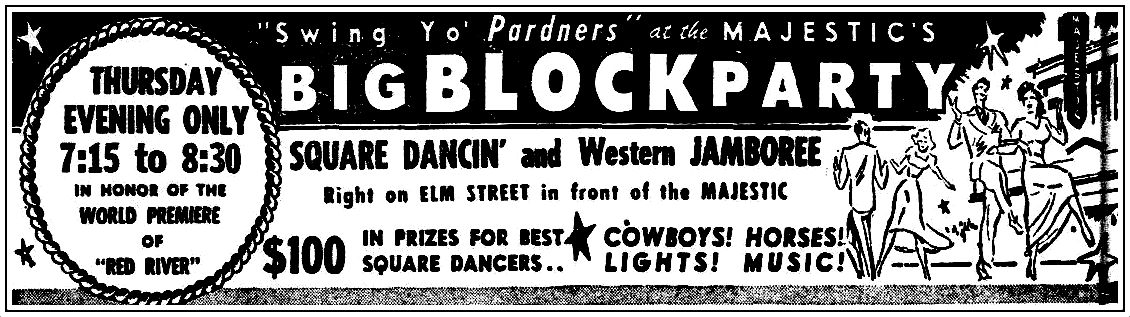
On a rainy night in August, 1948, United Artists premiered the movie “Red River” in Dallas at the Majestic Theatre. The now-classic Western about a Chisholm Trail cattle drive, directed by Howard Hawks and starring John Wayne and newcomer Montgomery Clift, was actually “premiered” simultaneously on August 26, 1948 in 250 theaters in Texas, Oklahoma, Kansas, and New Mexico, the four southwestern states most closely associated with the Chisholm Trail.

red-river_ad_dmn_082648(Aug. 26, 1948)

In Dallas, the publicity machine was seriously cranked up. The main attraction was a free-to-the-public street party in which the 1900 block of Elm Street was closed to traffic for a slate of western-themed festivities. The “jamboree” included square dancing, a musical set by cowboy singer Jim Boyd and his band, “cowboys and cowgirls from the Pleasant Mound Rodeo,” the Dallas Mounted Quadrille, and the Sheriff’s Posse. Or, as the ad said more succinctly, “Cowboys! Horses! Lights! Music!”

red-river_block-party_dmn_082648Great ad! Click to see it bigger! (Aug. 26, 1948)

No Hollywood celebrities were there, but the big Western Jamboree was apparently well-attended, even in the rain and despite rain, people gathered for square dancing.

(Wow. Square dancing in the rain. That’s dedication.)

The movie was a huge hit, so much so that the Majestic added showings, including one at 9:30 in the morning (!). It had a record week in Dallas, and, nationally, by the end of that first week it was reported to be the biggest-grossing picture in the history of United Artists.

The “world premiere” is interesting and all, but that photo of a brightly lit-up Theater Row is even better!

***

Sources & Notes

The original source of the photograph is not known, but I stumbled across it on a Preservation Dallas page, here.

“Red River” is a great movie. If you haven’t seen it, you need to. Even if you think you don’t like Westerns. Roger Ebert’s review/analysis is here.

*

Copyright © 2014 Paula Bosse. All Rights Reserved.


Simulcasting the World Series In Dallas In the Days Before Radio, Via Telegraph

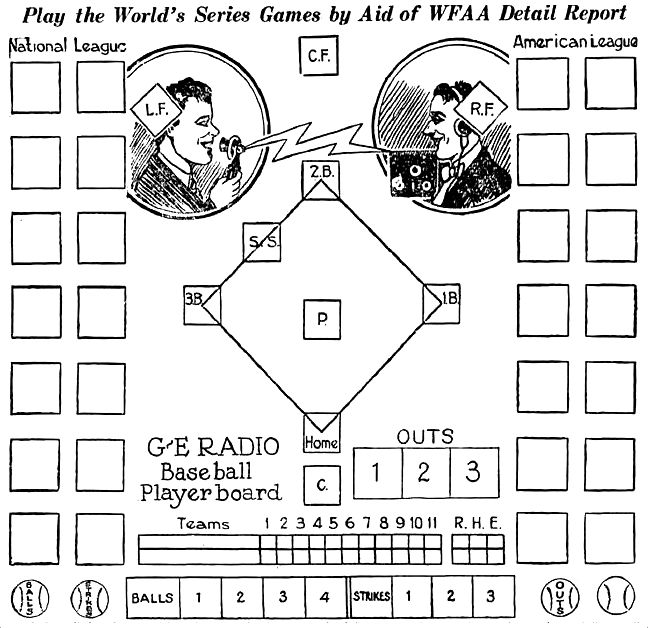
world-series_dmn_100422-smThe later version, for radio listeners, 1922…

by Paula Bosse

It’s 1912. You’re a huge baseball fan, and the World Series is about to begin — New York vs. Boston! But you live in Dallas, a million miles away from the action. You can’t wait for the results in the paper the next day because you’re an impatient S.O.B., and radio won’t be introduced for another ten years. Do you panic? No! Because you live in a big city with a taste for new technology, and the Dallas Opera House is going to present a sort of early simulcast of the games on a “mammoth automatic score board.” Your sports prayers have been answered!

1912_world-series_dmn_100612DMN, Oct. 6, 1912

You lean back in your comfy theater seat and smoke your smokes in plush and civilized surroundings as each play is sent by telegraph to Dallas from the ballpark back East where the game is being played RIGHT NOW, hundreds of miles away. The telegraph operator in Dallas will relay the play-by-play information to personnel in the theater who will somehow do something to some sort of “automatic electric board.” And, according to promoters of these “reproductions” of baseball games, you’ll feel like you’re right there in the thick of the action. You’ll “see” the game played before your eyes!

I’ve read several articles about these boards and these reproductions, but I can’t for the life of me figure out how it worked. I assume there was a large traditional scoreboard on stage that lit up, keeping track of the score, runs, outs, etc. But apparently there’s more, and I just can’t picture it. Here’s a somewhat confusing description of what happened during these productions:

WORLD SERIES WILL BE SHOWN AT THE OLD MILL

Manager Buddy Stewart of the Old Mill Theater announced that he secured the New Wonder Marvel Baseball Player Board to reproduce the World Series baseball games. This board is declared the greatest board ever invented for reproducing baseball games. It is not a mechanical board and no mechanical devices are used, and very little electrical appliances are necessary. The games are reproduced by a crew of six experienced baseball players who are carefully rehearsed and each has a part or position to play. No other board is so complete as this. The board does not require sign cards to denote players as in other boards. You see the ball going and do not have to look in any other direction to see what it means.

Spectators will see each play reproduced in less than two minutes after it is made on the playing fields of the World Series as the board is connected with a direct wire to the baseball field, and as fast as the telegraph operator receives the play it is reproduced with as much realism as on the field. The players are seen to run bases, the ball is seen bouncing or soaring to the infield or outfield, and anyone who is familiar with baseball will know just exactly what is happening on the field by the plays made on the board with very little left for imagination.

Every hit, run, error, strike or ball, the number of strikeouts, or balls made by pitchers, or the number of hits, runs or errors made by the players is always prominently shown on the board which makes it [un]necessary for individual scoring during the progress of the game. (DMN, Oct. 3, 1920)

Doesn’t really help much. It sounds as if people are on the stage acting out each play. That would be weird. These “reproductions” of World Series games were quite popular in Texas (and probably elsewhere) for at least 15 years. If anyone reading this has a photo or diagram of one of these vaunted Marvel scoreboards, I’d love to see it!

*

An earlier description of the 1912 Opera House reproduction sounds more like an audience watching a baseball game on a giant Lite-Brite “score board.”

1912_world-series_dmn_100812DMN, Oct. 8, 1912

The trick to keeping the telegraph operators calm and on-their-toes during a lengthy baseball game? Make sure they have no interest in the game.
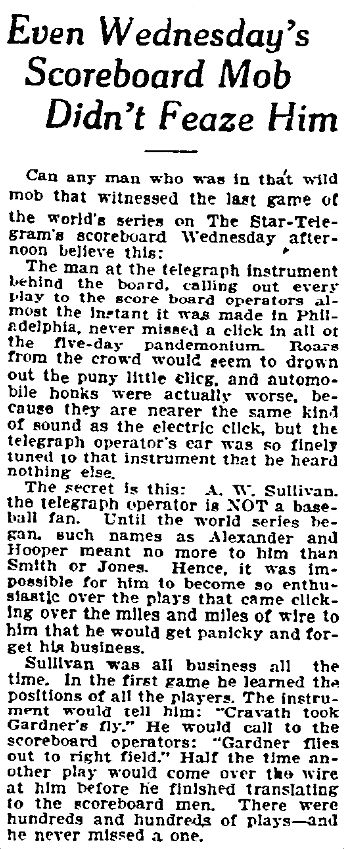
1915_world-series_FWST_101415Fort Worth Star-Telegram, Oct. 14, 1915

Fort Worth was also getting in on the action. And they had celebrities — people like Clarence (Big Boy) Kraft and Ziggy Sears (who I’m going to assume have something to do with baseball). I’m not sure what these celebrities were doing exactly, but whatever it was, they were there doing it.

1921_marvel-score-board_FWST_100221FWST, Oct. 2, 1921

These theater programs weren’t for everyone, though. If you couldn’t take the time out of a busy work day to swan over to a theater to leisurely witness one of the early “reproductions” (or if the admission price was too steep for your budget), you could always ring up the operator to have her tell you the current score:

automatic_dmn_101112-world-series
DMN, Oct. 11, 1912

These things seemed to be a popular annual event, but in 1922, something more technologically advanced than the Marvel board appeared on the scene: radio! WFAA and WBAP began broadcasting in 1922, and, suddenly, following sports became a whole lot easier. In something of a transitional technology, there was the outdoor board as described below. The games were not only broadcast live on WFAA, but The Dallas Morning News (WFAA’s parent company) also erected one of those old-fangled “electric boards” out on the street so that passersby could keep up with the scores. (Portable transistor radios were decades and decades away.)
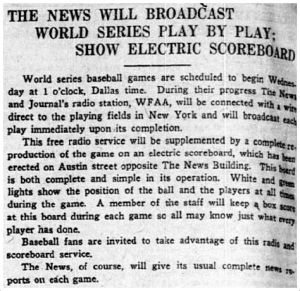
1923_world-series_dmn_101023DMN, Oct. 10, 1923

It was surprising to see that the “Marvel score boards” were still being used as late as 1926 (Yankees vs. Cardinals, at the Capitol Theater). Every baseball fan worth his salt should have had his own radio by then so he could listen to the World Series in the comfort of his own home and curse and cheer as loudly as the vicissitudes of the game demanded. Eat my dust, Marvel board! Radio changed everything, and radio was here to stay.

*

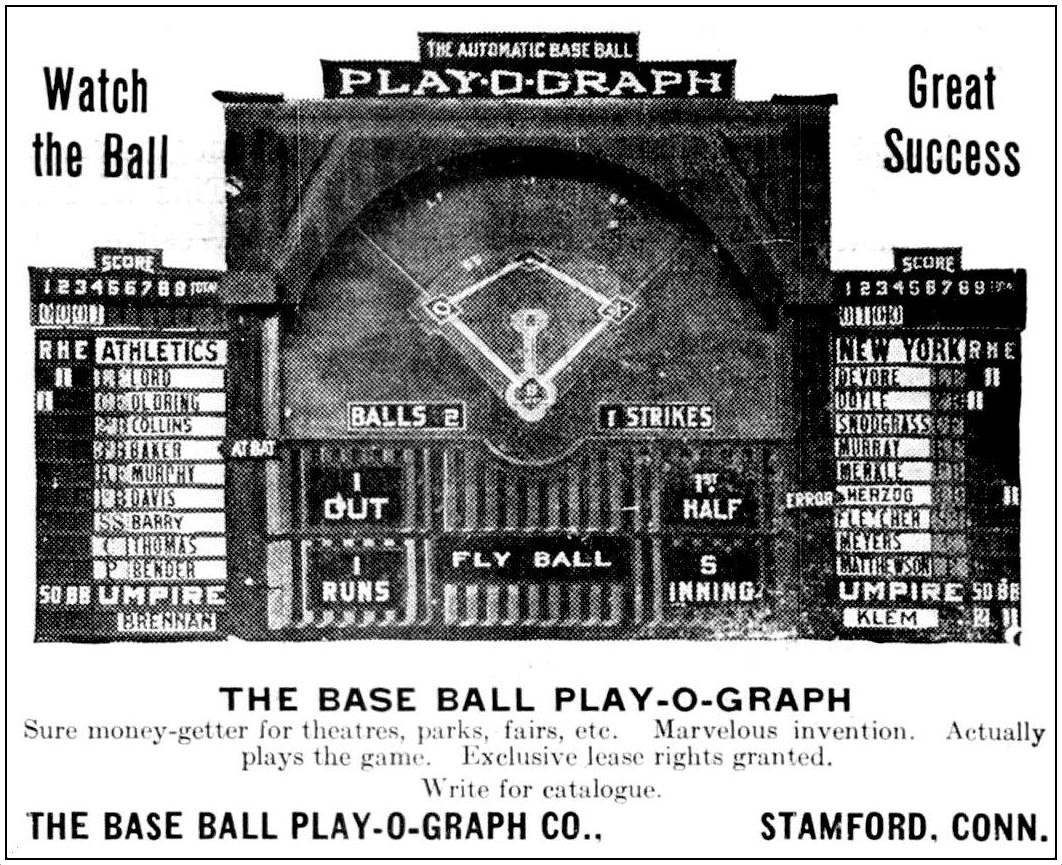
UPDATE: Thanks to Kevin’s link in the comments below, I can share this GREAT article from Uni-Watch.com about another of these boards called the Play-o-Graph: “Photography of Playography by Paul Lukas — it answers all my questions, and it even has photos (and links to photos) of crowds watching the boards. He also links to a 1912 article, “The Automatic Baseball Playograph”  by J. Hunt, in the Yale Scientific Monthly which describes how the board works and has this photo:

play-o-graph_yale-scientific-monthly_1912The “Play-o-Graph,” 1912 (click for larger image)

And, for completists, here’s an ad for the Play-O-Graph, from 1913:

baseball-simulation_play-o-graph_billboard_032213Billboard, Mar. 22, 1913

Makes a bit more sense now! Thanks, Kevin!

***

Sources & Notes

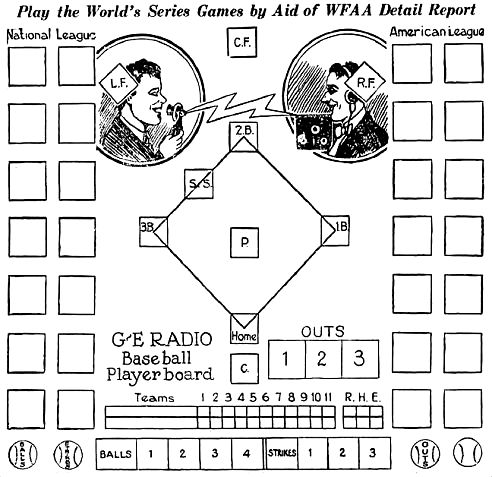
The top image is the “G.E. Radio Baseball Player Board” — a sort of home version of the big scoreboards used in theaters, printed for WFAA listeners in The Dallas Morning News on Oct. 4, 1922. The instructions are in a PDF, here. And feel free to print one out and use it while you watch the Series this year. Still works in the 21st century!

For an article on listener response to the successful first broadcast of the World Series by WFAA radio (listeners picked up the signal in England!), see the DMN article from Oct. 6, 1922 in a PDF, here.

And because they have such great names, you might want to know who Clarence “Big Boy” Kraft and Ziggy Sears were. If you’ve read this far, you owe it to yourself. “Big Boy,” here; Ziggy, here.

*

Copyright © 2014 Paula Bosse. All Rights Reserved.

“A Cavalcade of Texas” — Dallas, Filmed in Technicolor, 1938

“A Cavalcade of Texas”

by Paula Bosse

(SCROLL DOWN TO WATCH THE FILM CLIPS.)

Brought to my attention last night in a Dallas history group was the heretofore unknown-to-me full-length, Hollywood-slick travelogue called “A Cavalcade of Texas,” shot around the state in 1938 under the auspices of Karl Hoblitzelle in his capacity as chairman of the Texas World’s Fair Commission. (Hoblitzelle also built the Majestic Theater and founded the Interstate Theatre chain.)

“A Cavalcade of Texas” — a 49-minute full-color travelogue touting the beauty, history, natural resources, and industries of the state — was made to be shown at the New York World’s Fair, but because of a variety of production and logistical problems, the film was, instead released theatrically. John Rosenfield, the legendary “amusements” critic for The Dallas Morning News, was suitably impressed. After an early preview of the film, he wrote:

The picture should be a revelation to the outlanders who still think of Texas as the backwoods with a hillbilly civilization. (DMN, June 27, 1939)

Ha.

The film opened in Dallas in October of 1939 at, unsurprisingly, The Majestic, second on a bill with a Ginger Rogers film (which was fitting, as Ginger had begun her professional career at The Majestic as a teenager). The pertinent paragraph from Rosenfield’s official review is amusingly snippy:

“Cavalcade” shoots the Houston skyline as a bristling metropolitan acreage but hides the Dallas buildings behind the towering Magnolia Building. Maybe we are sensitive about it but we don’t feel that architectural justice has been done. The Fort Worth aspect is glorified more than it deserves. (DMN, Oct. 15, 1939)

(Sorry, Fort Worth!)

The Dallas scenes are only about 4 minutes’ worth of the whole film, but to see Dallas at this time in color — and moving — is kind of thrilling. The entire film is on YouTube, but I’ve bookmarked the two Dallas bits. First, after an interminable sequence on how fantastic things will be when we finally make that darn Trinity navigable, is a Dealey Plaza-less Triple Underpass, shots of Main Street (including the now partially obliterated 1600 block at the 17:52 mark, on the right), Fair Park (including a description of the Hall of State as “the Westminster Abbey of the New World” (!)), and a neon-lit Elm Street at night. (If you let it keep going, you’ll see “the Fort Worth aspect.”)

(I am having problems embedding this clip to begin at the 17:30 mark. If the above does not begin at the Dallas sequence, see it at YouTube, here.)

*

Twenty minutes later, the viewer is, for some reason, shown the Dallas Country Club with what I’m guessing are Neiman-Marcus models pretending to play golf.

(If the above does not begin at the Dallas Country Club sequence at 40:09, see it at YouTube, here.)

*

Those are just the Dallas bits — the whole film is an impressive undertaking, and it’s great to see documentary footage of this period in rich color, presented with incredibly high production values, in full Hollywood style.

cavalcade_101439_ad
Ad, Oct. 14, 1939 (click to see larger image)

***

Sources & Notes

“A Cavalcade of Texas” was directed, edited, and narrated by James A. Fitzpatrick and can be seen in full on YouTube, here.

Background on Karl Hoblitzelle can be read in information provided by the Handbook of Texas, here, and by the Dallas Public Library, here.

The wonderful and vibrant 1939 footage of downtown Dallas that was discovered on eBay a few months ago and “saved” by a group of preservation-minded Dallasites, which included Robert Wilonsky and Mark Doty, is one of my favorite Dallas-history-related stories of 2014. Watch that footage here.

*

Copyright © 2014 Paula Bosse. All Rights Reserved.
From Dull to Spectacular — How a Picture Postcard Evolves

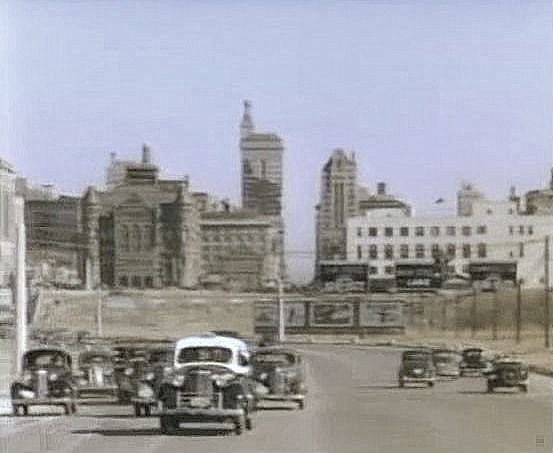
theater-row_before_tsha

by Paula Bosse

You know how you look at some of those fantastic postcards from the ’40s that don’t look real and you wonder, “Is that from a photograph, or is that just an artistic interpretation?” Well, it’s both.

In the above “before” and the below “after,” it’s interesting to note what’s been kept in and what’s been taken out. And how a fairly ho-hum daytime view becomes a dazzling night-time scene. Either way, it’s an Elm Street I’ll — sadly — never experience.

theater-row_after

***

Sources & Notes

Black-and-white photograph of Elm Street’s “Theater Row” from the Texas State Historical Association.

Click pictures for larger images.

*

Copyright © 2014 Paula Bosse. All Rights Reserved.


William Lescaze’s Ultramodern Magnolia Lounge — 1936

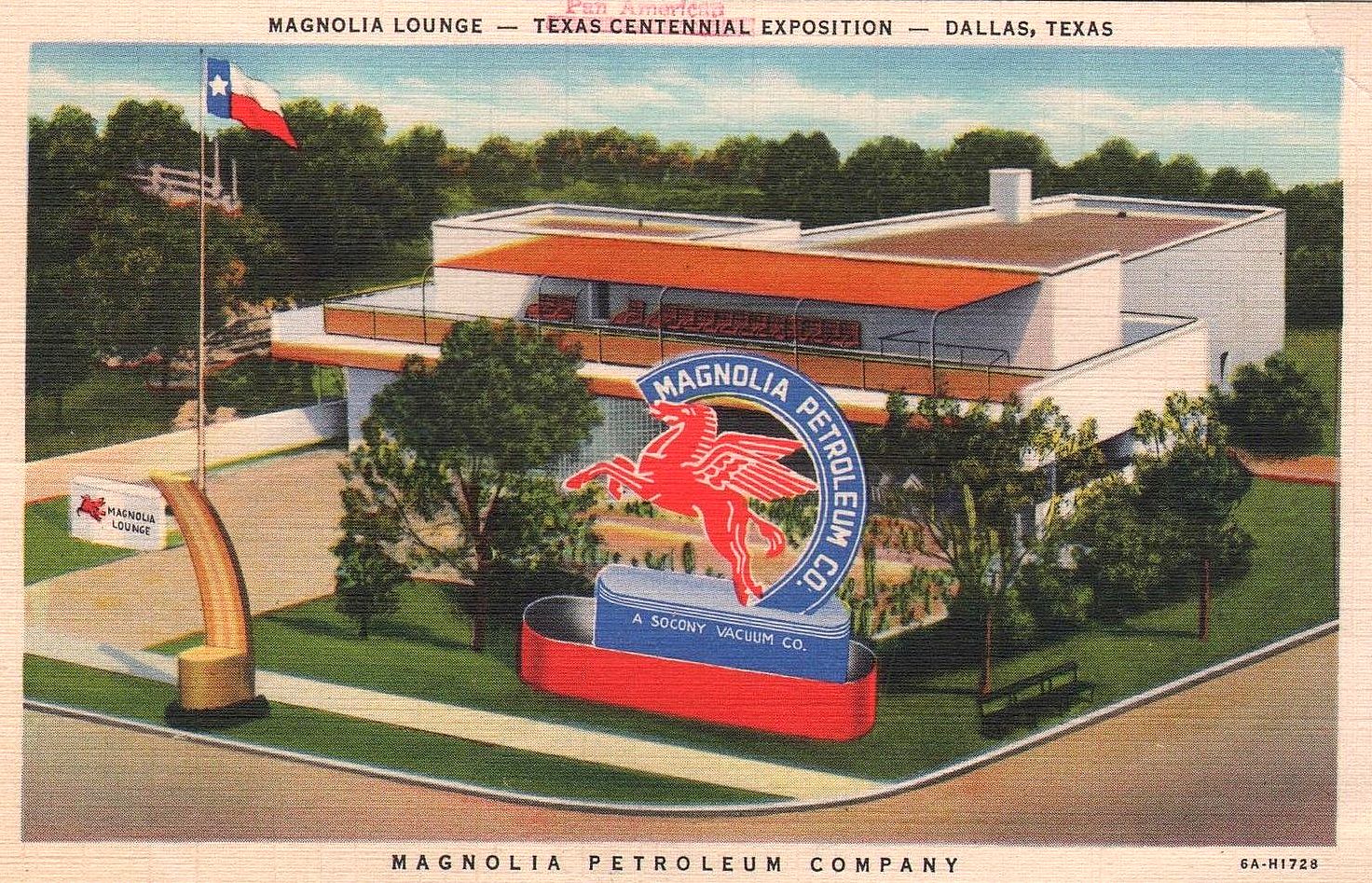
magnolia-lounge_tx-centennial

by Paula Bosse

The sleekly cool Magnolia Lounge, designed by Swiss-born American architect William Lescaze for the Texas Centennial, is considered the first International-style building built in Texas, and though it feels perfectly at home in Art Deco Fair Park, it looks completely different and much more modern that the buildings around it. It was built by the Magnolia Petroleum Company as a place for visitors to the Centennial Exposition to relax and cool off (it boasted a 20-ton refrigeration plant). The Magnolia Company’s slogan for their building was “Be Our Guest and Rest at the Magnolia Lounge.” In other words, this was the most insistently fabulous rest stop ever built!

How did we GET this cool building? Two words: Stanley Marcus.

“Young retailer Stanley Marcus was dispatched to New York City by Dallas-based Magnolia Petroleum to find the most up-to-date architect of the United States for their Centennial pavilion. Marcus chose William Lescaze, who had just designed the first International-style skyscraper in the United States [the PSFS Building in Philadelphia, which opened in 1932].” (– Virginia Savage McAlester)

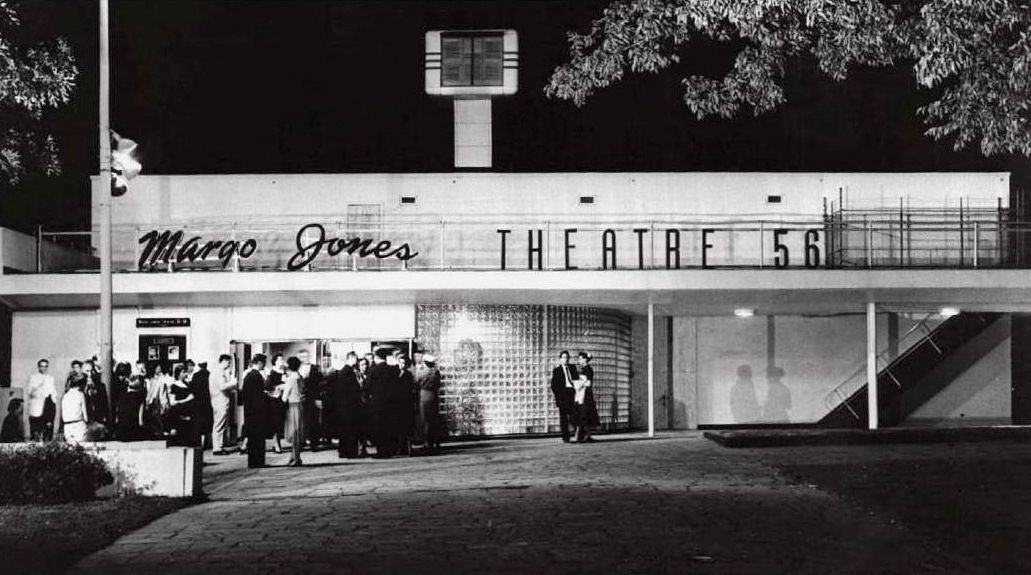
It was a popular oil company-branded “comfort station” for fair visitors until 1942 when the Magnolia Petroleum Co. (who had owned the building), gave title of the Magnolia Lounge to the State Fair, which used it for many years to house its general offices. In 1947, the space became Theatre ’47, Margo Jones’ legendary regional theater where, among other achievements, she produced plays of a young Tennessee Williams and introduced the innovation of theater-in-the-round. After Jones’ death in 1955, the theater carried on for a few years but eventually closed in 1959. After some difficult lean years for the building (during which demolition was considered!), it has been home to organizations such as the Friends of Fair Park, and it is now an active performance space again. And all is well with the world.

margo-jones_theatre-56_dpl

***

Sources & Notes

Postcard of the Magnolia Lounge from the vast wilds of the internet. Click it. It’s huge.

The Virginia McAlester quote is from a Friends of Fair Park advertising section in the Oct. 1989 issue of Texas Monthly.

Photograph of Theatre ’56 from Historic Dallas Theatres by D. Troy Sherrod, from the collection of the Dallas Public Library. (The theater struggled to continue after the sudden death of Margo Jones in 1955, which I wrote about here.)

For more on the history of the Magnolia Lounge, see the official Fair Park home page here; also, check out the the City of Dallas page devoted to this building, here.

And for more on this cool building, particularly in connection with Margo Jones, see the page on the always informative Watermelon Kid site, here.

A lengthy description of the building can be found in the article “Daylight Movies of Texas Scenes To Reward Visitors to Magnolia’s Cool Lounge” (The Dallas Morning News, April 26, 1936).

The Wikipedia page on architect William Lescaze is here.

*

Copyright © 2014 Paula Bosse. All Rights Reserved.


Building Collapse on Elm Street — 1955

elm-st-collapse_1955
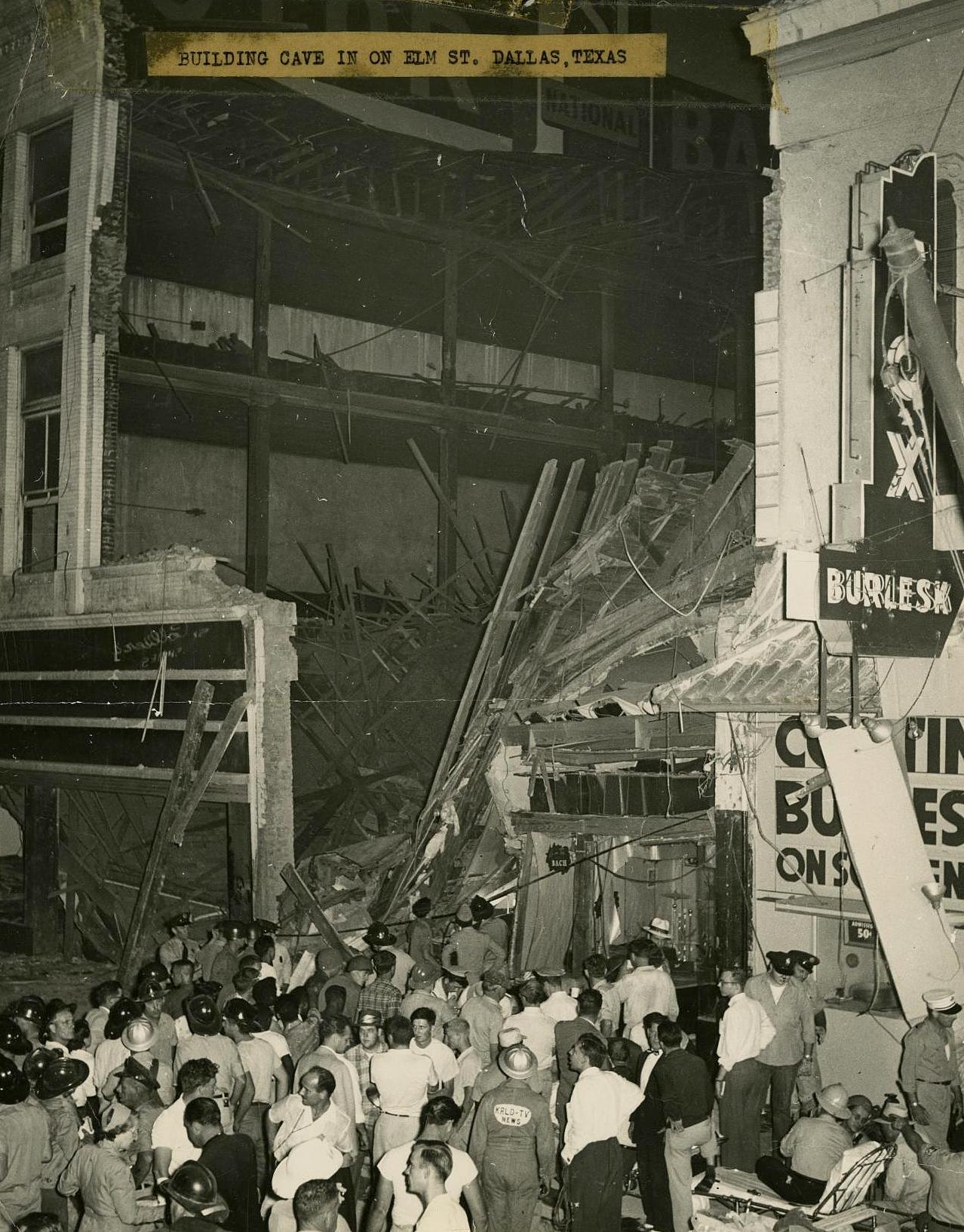
Aftermath… June 1, 1955 (photo by Gene Gauss)

by Paula Bosse

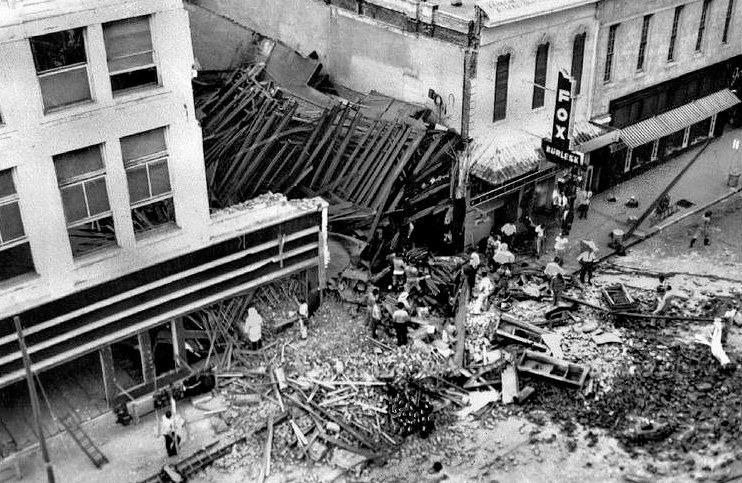
At 6:40 p.m. on June 1, 1955, a 3-story building in the process of being razed collapsed onto the smaller building next door at 1409 Elm St. The “story-and-a-half” building contained the Cline Music Company and Harry’s Fine Food, a bar and cafe. Four people were killed, and several people sustained major injuries; many were trapped for hours in the rubble.

The rousing report in The Dallas Morning News the next day described the scene as pandemonium. As emergency personnel arrived and rescue operations began, the street was roped off — there were fears a partially standing wall would topple at any moment. The Fox Burlesk house next door was quickly emptied of its 50-or-so patrons for safety concerns.

Witnesses said the building fell with a gigantic whoosh and spewed rubble about four feet deep across the sidewalk and into the street. Trolley wires were snapped and lay crackling sparks in the street for a while before the power was cut. A late-model station wagon parked at the curb was flattened under the rubble to a height of only about three feet. It belonged to [the owner of the music store]. (DMN, June 2, 1955)

Nine companies of firemen and several doctors — one of whom just happened to be passing by the scene — worked to rescue and treat the victims. A passing clergyman administered conditional last rites for those still trapped. A troop of Boy Scouts who had been nearby practicing civil defense drills, ran to help in the real-life emergency. And most cinematic of all, a Houston truck driver named Larry Ford — who just happened to be visiting Dallas and was standing in the crowd of spectators — was called in to help when someone noticed that he was wearing a truck drivers’ union insignia — authorities had obtained a winch truck to clear the heavy rubble but had been unable to find anyone to operate it. Ford sprang to action and worked through the night for 16 grueling hours. He was later hailed as a hero. Just like in the movies.

So what caused the collapse? The city manager was quick to say that the city was not to blame and, basically, had no responsibility to determine who WAS to blame.

City Mgr. Elgin Crull told The News an investigation by Chief Building Engineer Cecil A. Farrell has not been completed. “There won’t be anything on it for a long, long time — if ever at all,” Crull declared. “It’s not our responsibility to say why it fell or who was at fault. We’ll just seek to determine whether or not all the proper safety precautions were followed.” (DMN, June 3, 1955)

Well, all right, then.

As several people noted, had the collapse happened an hour earlier — in the midst of rush hour — many, many more people would have been killed and injured. I’m not sure if the cause was ever determined. The block (between Field and Akard) now contains the old First National Bank Building, built a decade later.

elm-st-collapse_060155

UPDATE: Just stumbled across this UPI photo, posted a few years ago by Robert Wilonsky on the Dallas Observer’s Unfair Park blog:

building-collapse_observer-090511

And below, a photo showing the 1400 block of Elm in the 1920s (looking west from Akard), with the “cafeteria” sign in front of the doomed building, to the left of the Fox Theater. The wall with what looks like the beginning of the word “Steinway” is the one that crushed its neighbor. (From Troy Sherrod’s Historic Dallas Theatres; photo from the Dallas Public Library.)

fox-theater_sherrod_dpl

***

Sources & Notes

The first two photos are from the collection of the Dallas Firefighters Museum, via the Portal to Texas History; they can be seen here and here.

The reports of the collapse that appeared in The Dallas Morning News are pretty exciting to read. You can find them in the newspaper’s archives.

  • “Three Killed, 10 Injured As Elm St. Building Falls” (DMN, June 2, 1955)
  • “Building Ruins Termed Clear Of All Victims” (DMN, June 3, 1955)
  • “Debris Yields Another Body” (DMN, June 4, 1955)

Click pictures for larger images (especially the first two, which are HUGE).

*

Copyright © 2014 Paula Bosse. All Rights Reserved.

Back When the Kessler Couldn’t Catch a Break — 1957

kessler-theater-after-tornado_1957

by Paula Bosse

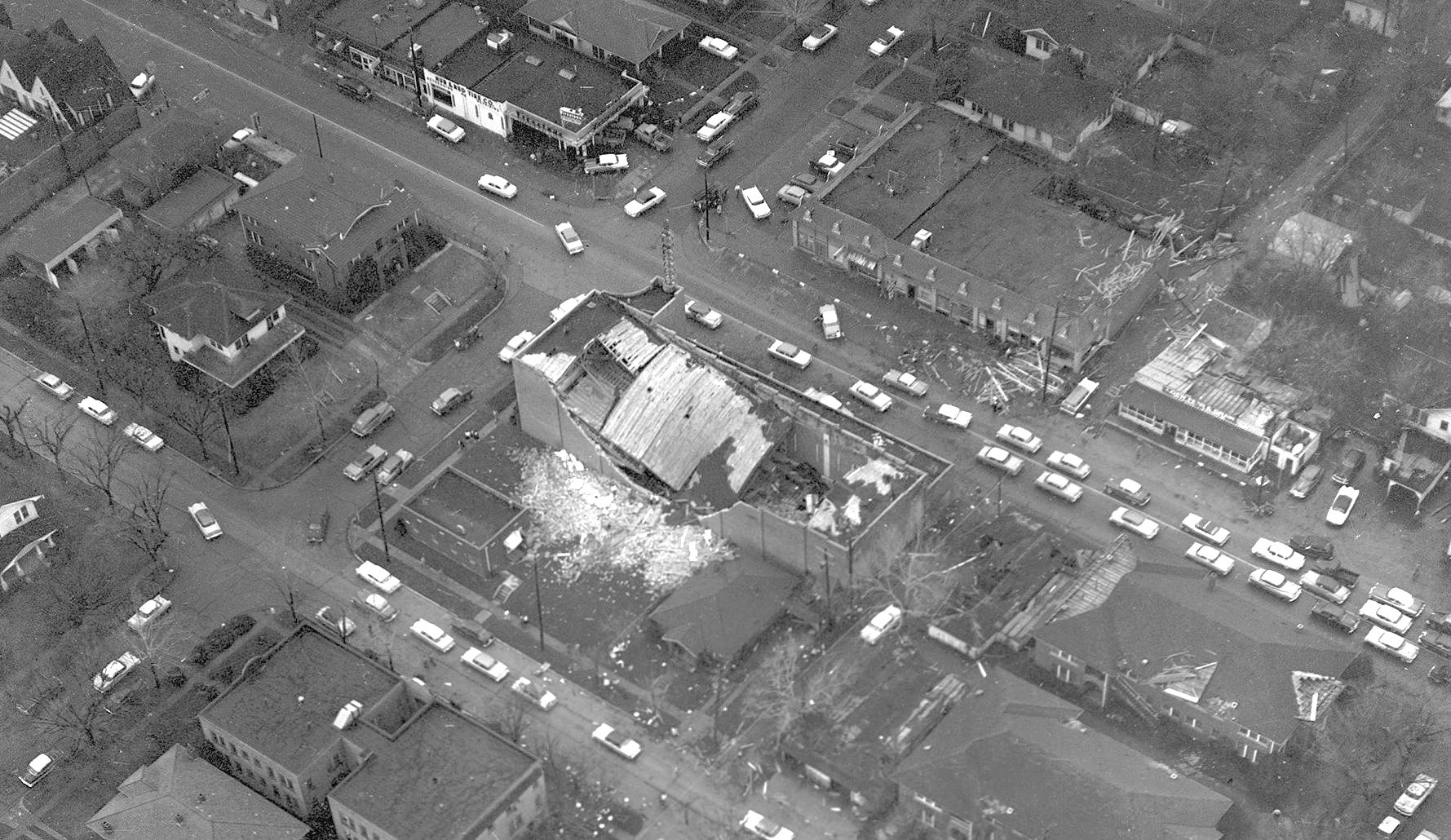
One of the casualties of the famous tornado that hit Dallas and Oak Cliff in 1957 was the Kessler Theater. In 1957, the Kessler — then only 15 years old — had hit hard times and was being used to house an evangelical church. It was rebuilt after the tornado, but soon after it was hit by a three-alarm fire. Conclusion? Do not disturb the entertainment gods — that place was meant to be a theater!

kessler_tornado_sherrod

From the post-tornado reports in The Dallas Morning News:

At the West Davis and Clinton business district, an evangelical church in a converted theater building at the intersection was caved in, leaving little more than two walls standing. The church’s cross from atop its more than 50-foot tower was crumpled in the gutter. (DMN, April 3, 1957)

And in a survey of the clean-up:

At Davis and Clinton, where the old Kessler Theater was being used as a revival center before the tornado, workmen were busy wrecking the building, completing what the tornado had started. […] J. T. Hooten, foreman for Winston A. Caldwell, explained that the damaged sections of the theater which might give way under a slight strain and cause further damage had to be torn out. His crew carefully but hurriedly dismantled the old Davis Street landmark. Hooten said the owner may rebuild the theater as a 1-story office building. (DMN, April 10, 1957)

Here is a detail of an aerial photo by photographer Squire Haskins, showing the damaged Kessler in the center (see the full, very large photo here):

kessler_tornado_squire-haskins_UTA_det

***

Sources & Notes

Top photo from an incredibly detailed website devoted to the 1957 Dallas tornado, the home page of which can be seen here.

Second photo from D. Troy Sherrod’s Historic Dallas Theatres (Charleston: Arcadia Publishing, 2014); photo from the collection of the Dallas Public Library.

Aerial photograph by Squire Haskins from the Squire Haskins Photography, Inc. Collection, UTA Libraries, Special Collections; more information is here (click the thumbnail to see a larger image).

Website of the recently (and beautifully) restored Kessler is here.

*

Copyright © 2014 Paula Bosse. All Rights Reserved.


Theatre Row — A Stunning Elm Street at Night

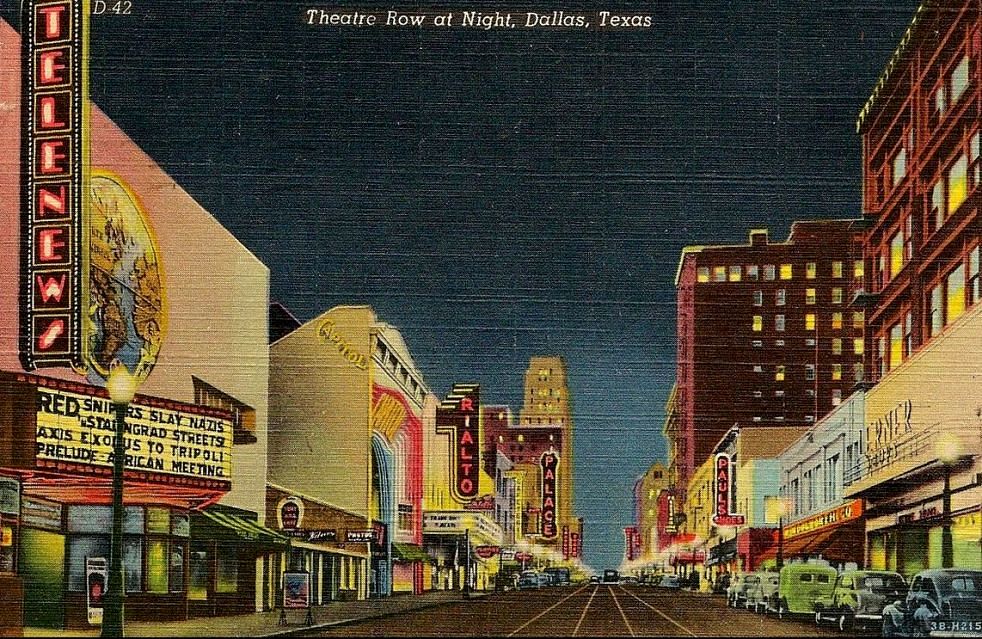
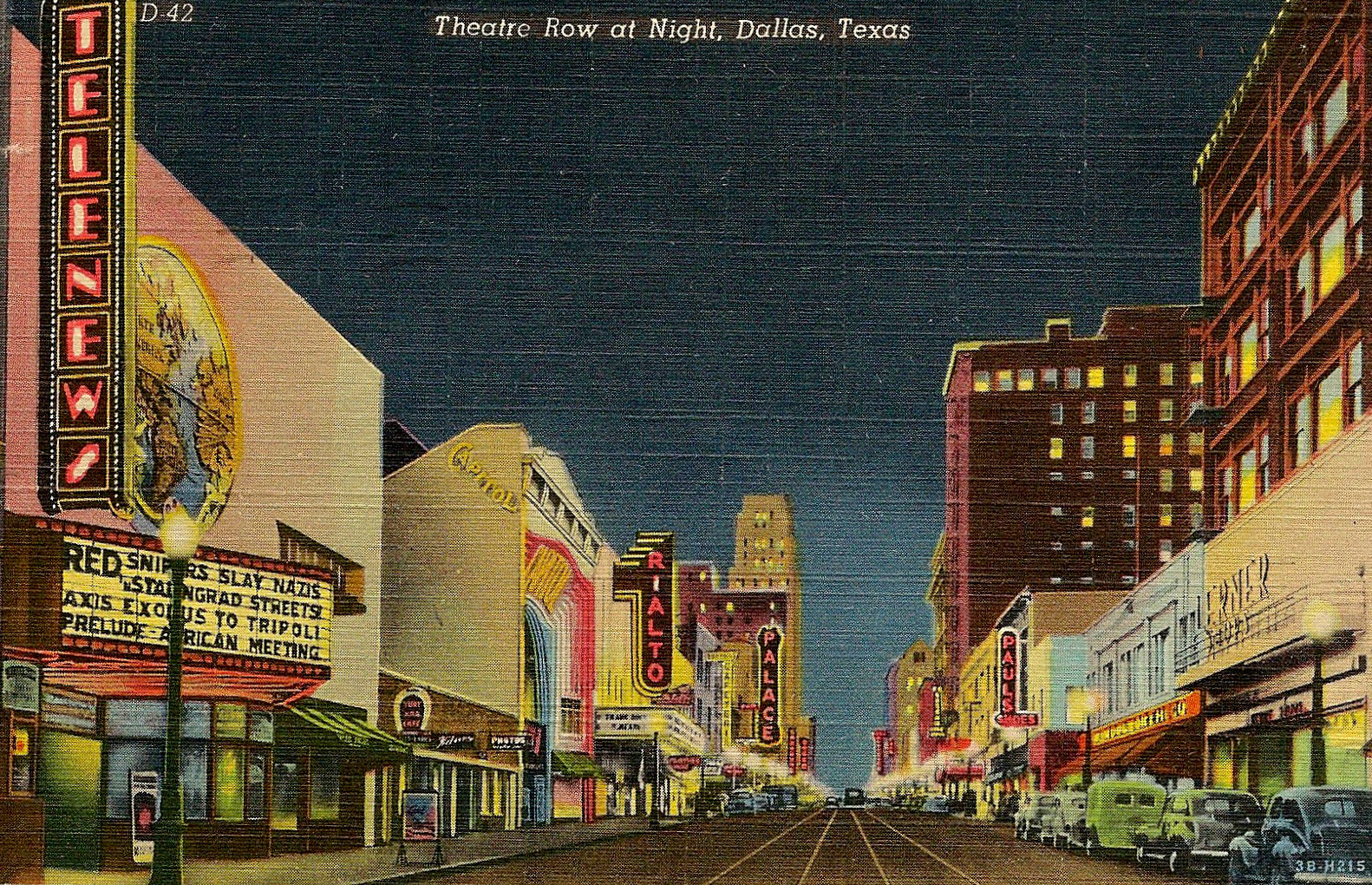
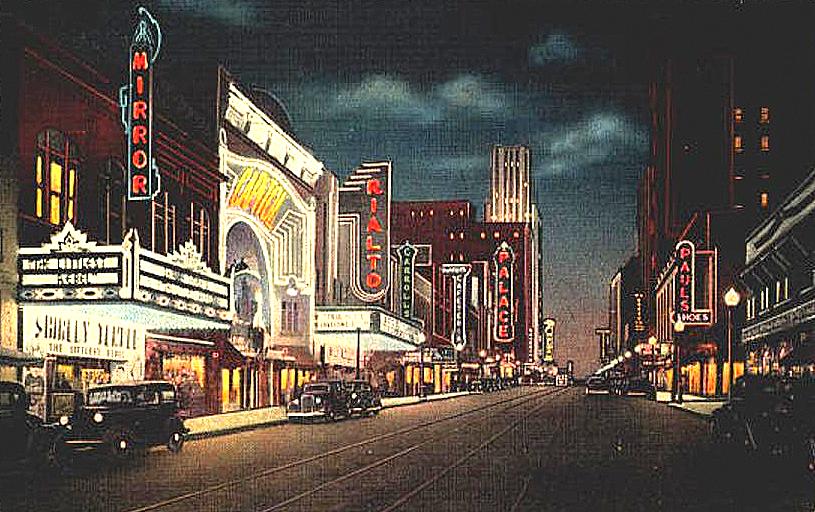
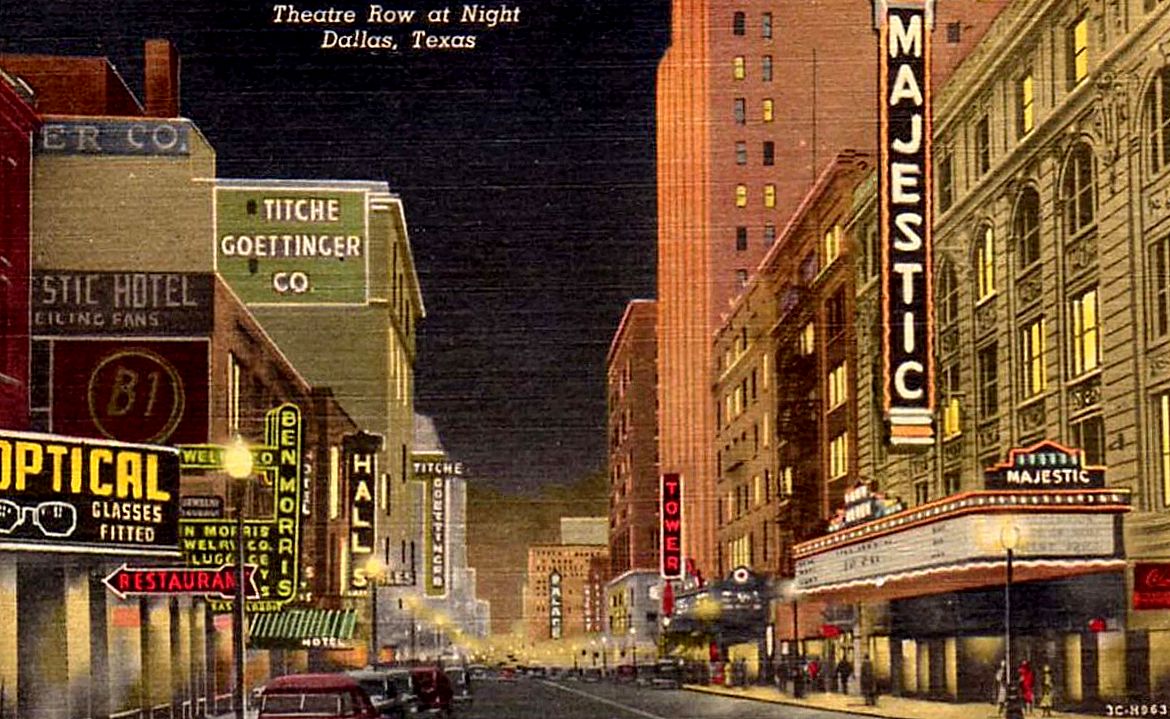
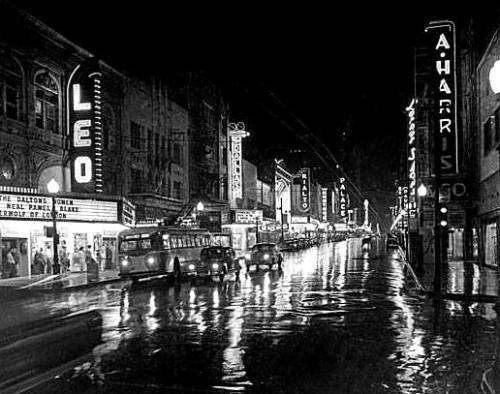
theater-row_night_telenewsElm Street, looking east… (click for larger image)

by Paula Bosse

Damn you, suburban theaters and television, for killing this! (Hang in there, Majestic!)

Favorite thing gleaned from the postcard above? That Dallas had a newsreel-only theater — the Telenews. (See the original, somewhat pedestrian, daytime photograph which was transformed by all sorts of dazzling magic in order to turn it into that striking postcard, here.)

theater_row_night_BIG

theater-row-night_c1935

theater-row_night_majestic

***

All images are larger when clicked — some MUCH larger!

*

Copyright © 2014 Paula Bosse. All Rights Reserved.


The Stretch of “Theater Row” They Never Talk About

leo-theater
The “other end” of Film Row

by Paula Bosse

It’s April, 1952, and you’ve got a hot date Friday. Movies are good for date night. What to see? Why not catch a bold, frank, and true “adult” double-bill at the Leo? In the early-’50s, the Leo Theater, at 1501 Elm Street, was at the other end of “Theater Row” — on the metaphorical “other side of the tracks” from the classy Majestic and Palace — and it was one of those places that your mother probably wouldn’t approve of.

leo-theater_dmn-0405521952

The ad above shows a typical Leo double-feature: “Pin-Down Girl” (aka “Racket Girls”) from 1951, a searing look at lady wrestlers and prostitution (the trailer below has a moment that’s actually pretty shocking, and you’ll laugh at yourself immediately afterward for having been shocked), and “Honky Tonk Girl” (aka “Hitchhike to Hell”) from 1941 about teenagers and, well, prostitution. There were at least two exploitation movies titled “Honky Tonk Girl,” so I’m not sure which is the correct poster for the particular cinematic treasure on the Leo bill, but I really love the artwork of this one, so in it goes.

honky-tonk-girl_poster

Here’s the trailer for “Pin-Down Girl” (which is handy, because it gives you about all you really need to satisfy a piqued curiosity without wasting a lot of your time):

**∙*

***

Sources & Notes

I don’t have a source for the top photo, but I believe I have seen it attributed to the Dallas Public Library. If this is incorrect, please let me know.

A little background on the Leo Theater (1948-1953), originally the Queen (1913-1948), can be found in the comments section here.

But if you want to know just what was going on in these not-quite-but-fast-approaching seedy Dallas theaters, you owe it to yourself to read a great passage from Troy Sherrod’s Historic Dallas Theatres (Arcadia Press, 2014), here (scroll down to the caption).

*

Copyright © 2014 Paula Bosse. All Rights Reserved.