Flashback : Dallas

A Miscellany: History, Ads, Pop Culture

Category: Transportation

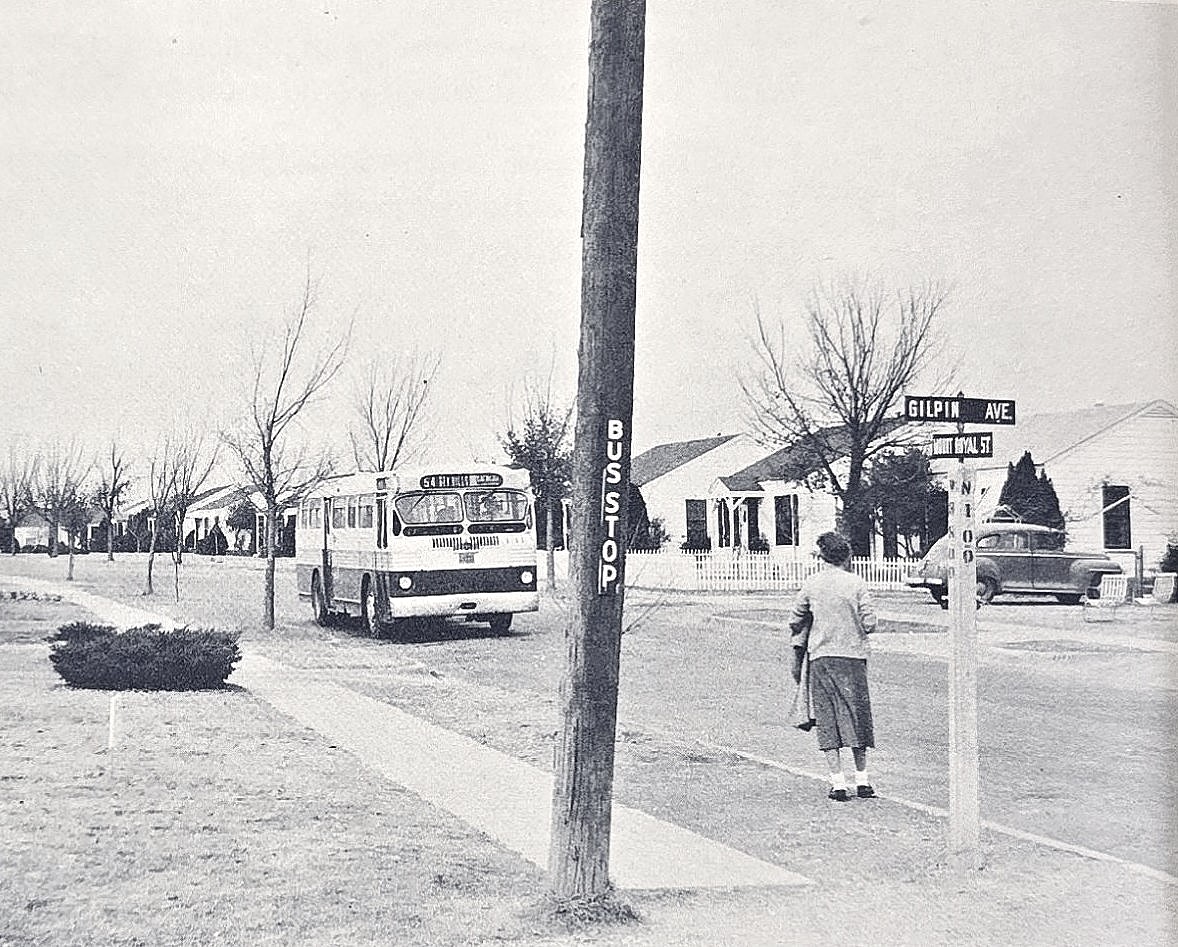
Waiting for the Bus at Gilpin and Mt. Royal — 1955

Waiting for the #54…

by Paula Bosse

I saw this photo in a 1955 booklet called Public Transportation in Dallas and loved the neat-as-a-pin Oak Cliff street, its manicured, chilly starkness accentuated by the leafless trees. It’s also a needed reminder — as we’re dragged into August — that someday we’ll (probably) have autumn and winter again.

See what this view looks like today, on Google Street View, here.

***

Sources & Notes

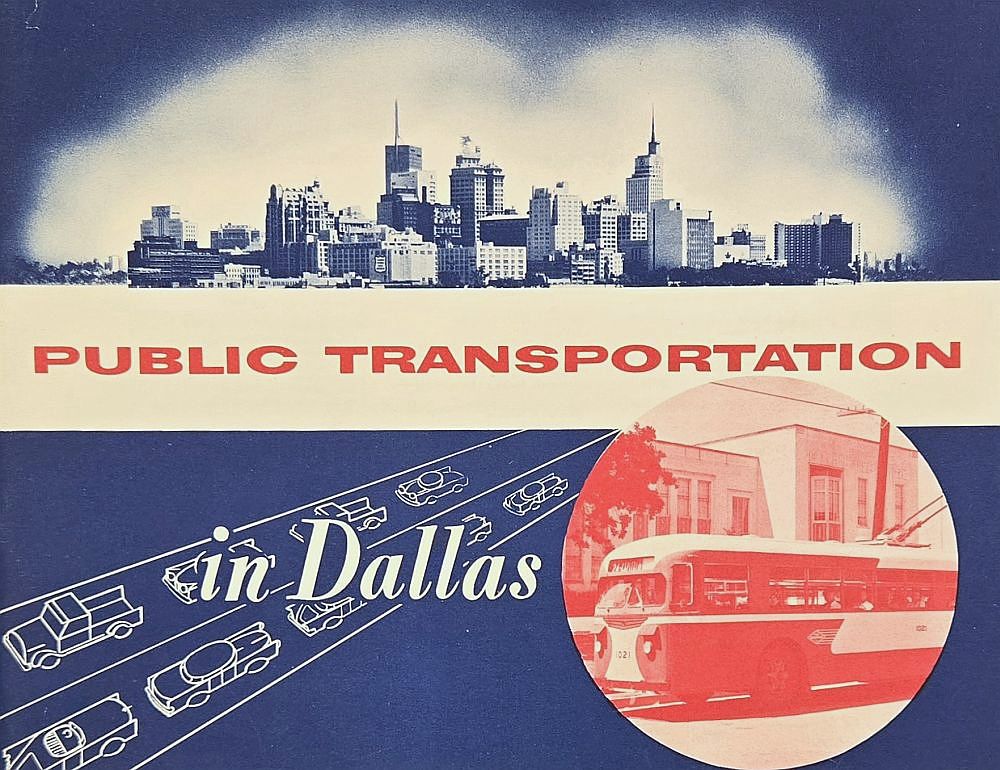
Photo from and cover of the slim booklet Public Transportation in Dallas (1955), Dallas History and Archives, Dallas Public Library.

*

Copyright © 2025 Paula Bosse. All Rights Reserved.
Whimsy on Main Street — ca. 1906

by Paula Bosse

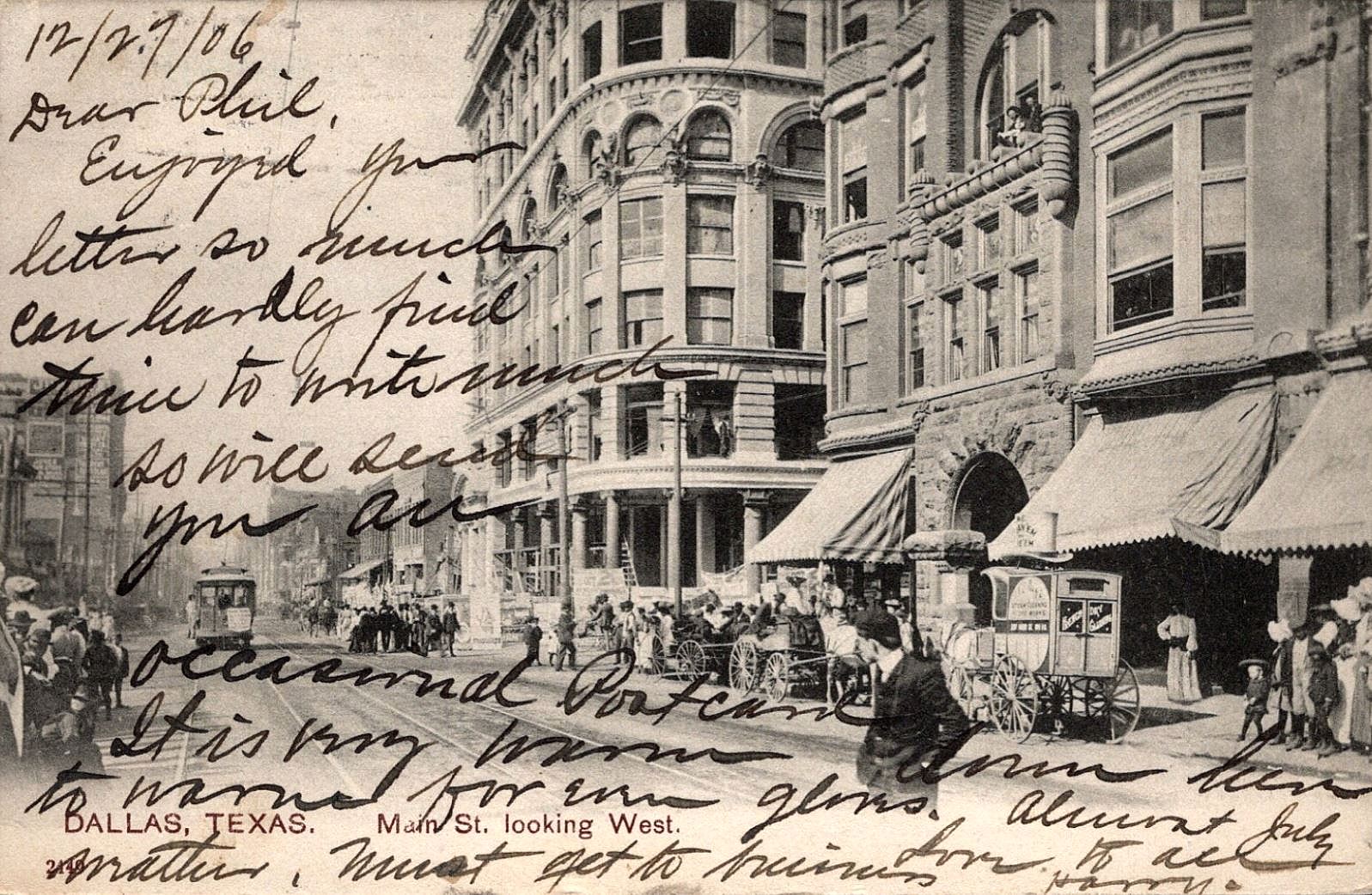
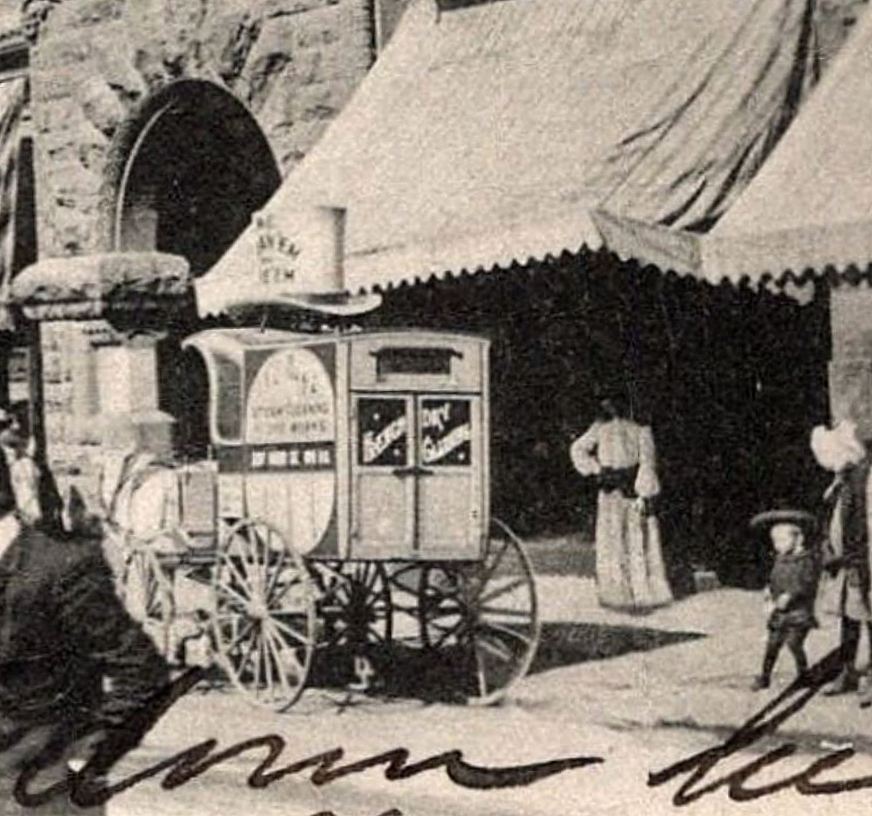
I’ve seen a lot of postcards with views of “Main St. looking West,” usually taken from about Ervay, with the Wilson Building as the architecturally impressive centerpiece. But I don’t think I’ve seen this one. I don’t know when the photo was taken, but it was mailed at the very end of 1906. It looks like the new Wilson Building (which opened in 1904) may still have construction work going on, at least on the ground floor.

But “whimsical”? Take a look at the horse-drawn dry-cleaning-company delivery wagon on the lower right side of the card. It’s got a GREAT BIG TOP HAT on it! Maybe this sort of thing was popular in the early years of the 20th century, but I’ve never seen anything like this on the streets of Dallas in photographs or postcards of this period. Until now. I love it!

*

The postcard — written and mailed on December 27, 1906 — was addressed to “Master Phillip Wyman” in Yonkers, New York. The sender — identified only as “Harry” — sent this message to Phil, probably a young family member:

Dear Phil, Enjoyed your letter so much. Can hardly find time to write much so will send you an occasional postcard. It is very warm down here, to[o] warm for even gloves. About July weather. Must get to business. Love to all, Harry

Too warm for gloves — in December! Imagine! I bet Master Wyman — who was no doubt shivering up in Yonkers — had his young mind blown. (I wonder if he noticed the big top hat?)

***

Sources & Notes

Postcard from eBay.

*

Copyright © 2025 Paula Bosse. All Rights Reserved.
A Unique Profession: The Curve Greaser — 1935

by Paula Bosse

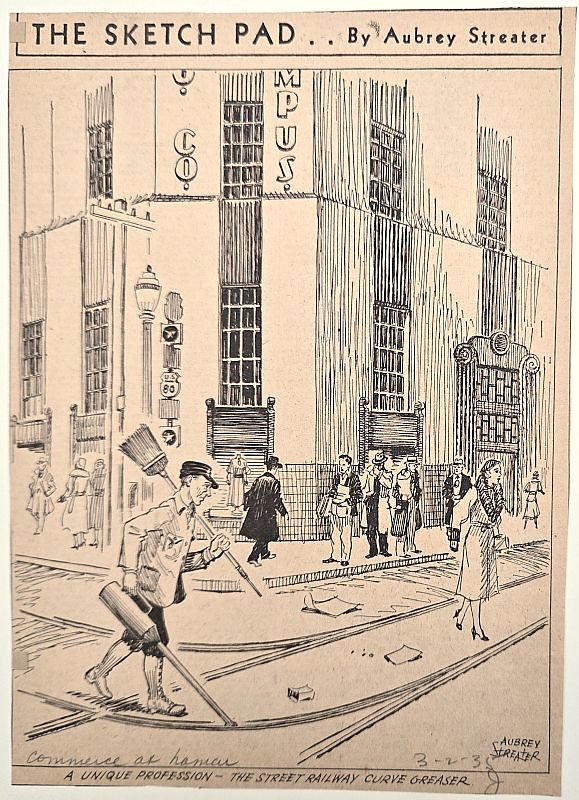
The caption reads: “A unique profession — the street railway curve greaser.”

I have to admit, this is a “profession” I never knew existed. Lubricating the rails would have helped with the constant wear and tear of steel-on-steel friction and would have, presumably, cut down on the incessant squealing of streetcar wheels. This was an essential job at the time, one I’ve only just learned of!

Handwritten notations identify the intersection as “Commerce at Lamar” and the date as “3-2-35.”

***

Sources & Notes

Clipping is from the Dallas History and Archives, Dallas Public Library.

“The Sketch Pad” cartoon panel by Aubrey Streater was a regular feature that appeared in the pages of The Dallas Journal. Streater was a commercial artist and headed the art department of The Dallas Morning News (publisher of The Dallas Journal).

This post appeared in a slightly different version on the Flashback Dallas Patreon page.

*

Copyright © 2024 Paula Bosse. All Rights Reserved.
Tooling Around Munger Place — ca. 1913

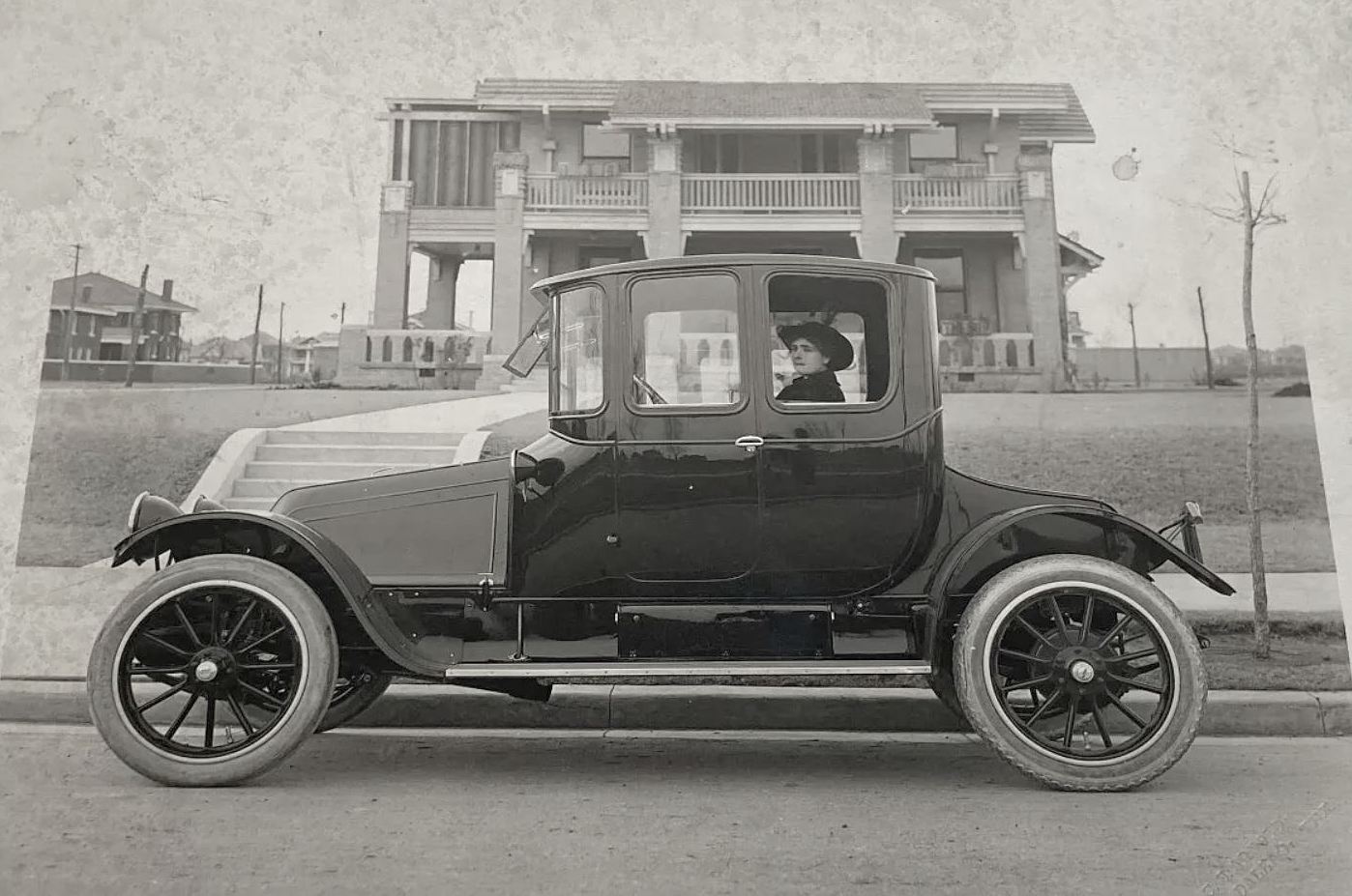
Snazzy motor car parked in front of 5109 Swiss Avenue

by Paula Bosse

This arresting photo shows a woman in the driver’s seat of what appears to be a “ladies'” electric car (possibly a Detroit Electric, although I can find no models that look like this one…), parked in front of an unusual-looking Swiss Avenue home, complete with a second-story sleeping porch and virtually no landscaping. The photo — taken by notable Dallas photographer Charles Erwin Arnold — is currently offered on eBay.

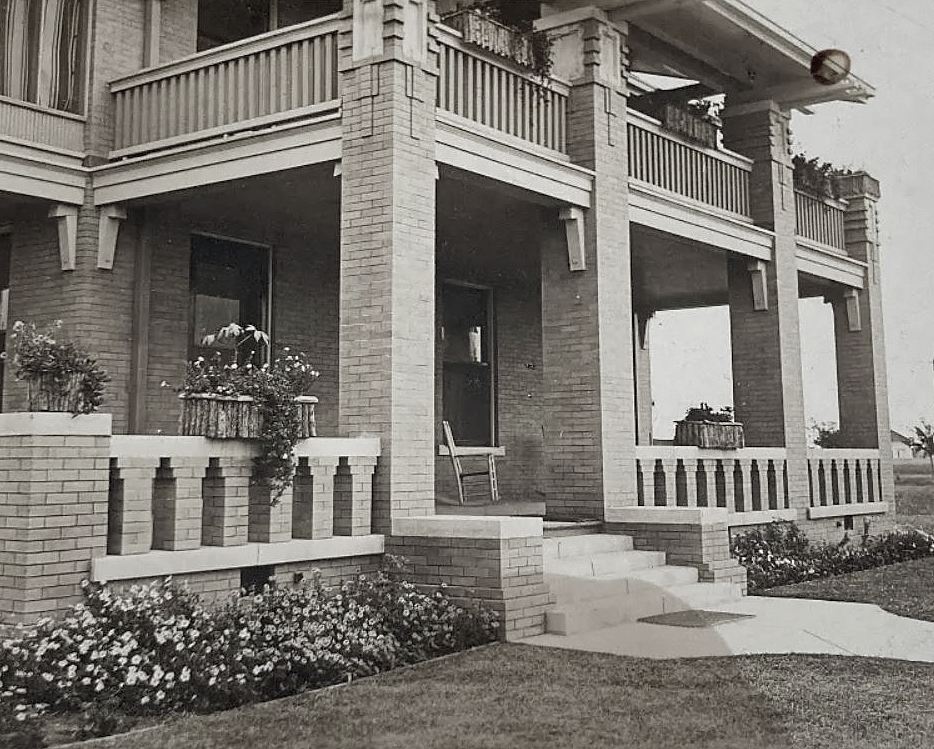
Here’s a view of the entrance to the house which, as noted on the reverse, is at 5109 Swiss Avenue.

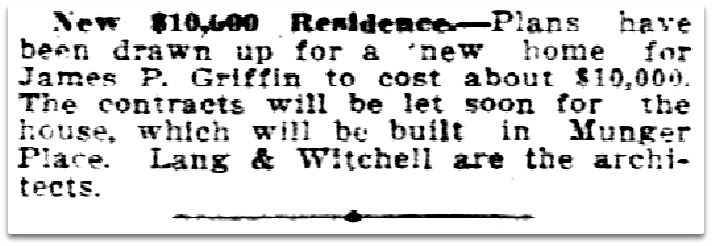
The house was built in 1911/12 and was designed by Lang & Witchell (architects to the rich and richer), who were busy drawing up house plans for people up and down Swiss (they were so prolific that it seems like most of the buildings built in Dallas at the time came from their drafting tables!). This house was commissioned by James P. Griffin (president of the Texas Electric Railway Co.) and his new wife, May Burford Griffin (daughter of Dallas pioneer Judge Nat Burford).

Dallas Morning News, Sept. 13, 1911

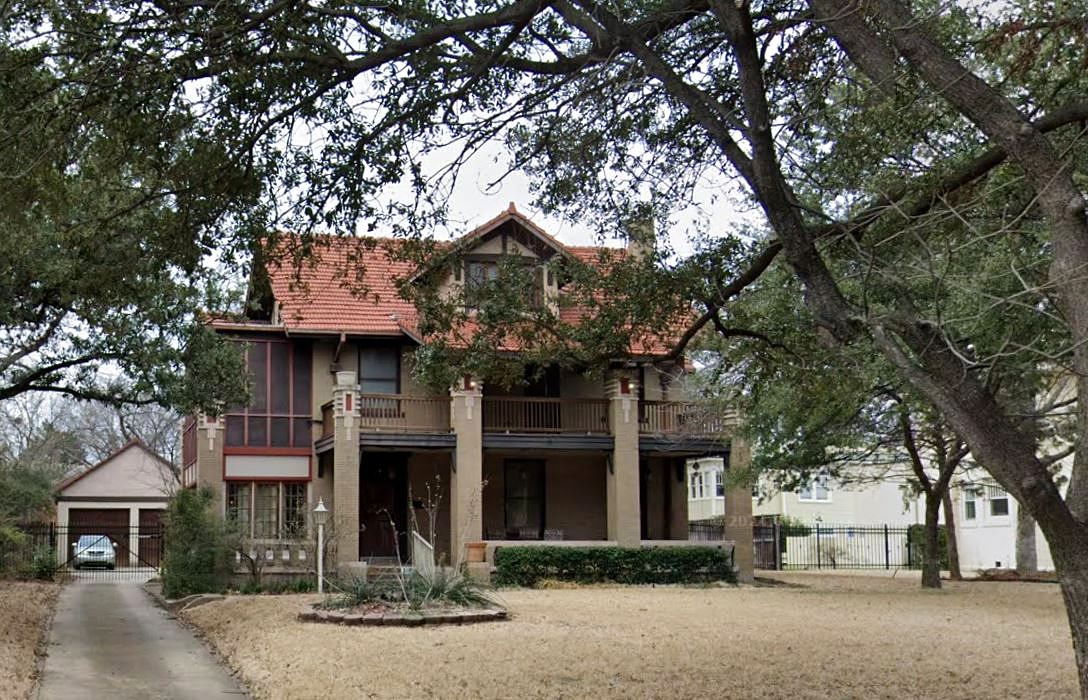
The house is still standing but has been remodeled, as is mentioned in various real estate ads over the years. (At one point, there was a reference to a kitchen with marble floors, which… I’m not sure I’ve ever seen marble floors in a kitchen. I don’t know if they were original to the house — or are still there — but, whatever the case, that is très élégant.)

The house can be seen in recent years in an Ebby Halliday listing from 1982, in an undated photo on Douglas Newby’s Architecturally Significant Homes website, and on the Swiss Avenue Historic District website. The image below is a Google Street View from Feb. 2023.

I assume that the woman in the car is Mrs. Griffin, seen below in later years. In the photo, she would have been about 32.

I love that car. And I love that house, which looked very modern 112 years ago!

***

Sources & Notes

The circa-1913 photos are from a current listing on eBay. I posted the top photo on my Patreon page less than a week ago, and reader Tom R. identified the house. I think the second photo has been added in the past couple of days, because I’m pretty sure it wasn’t there when I wrote that post! Someone might have contacted the seller to ask if it might be a house on Swiss Avenue, and they realized they had another photo of the house, which they added to the listing. …And increased the price significantly! These are such cool photos. If I were the current owners of this Swiss Ave. house, I would be all over this!

Thanks to Tom and William for their helpful comments on my original Patreon post (“Super-Cool Car, Super-Cool House”).

*

Copyright © 2024 Paula Bosse. All Rights Reserved.
Labor Day Weekend, 1952 (Redux)

labor-day_083152_denny-hayes_PA76-1-11420-002_webWaiting for the fun to start… (photo: Dallas Public Library)

by Paula Bosse

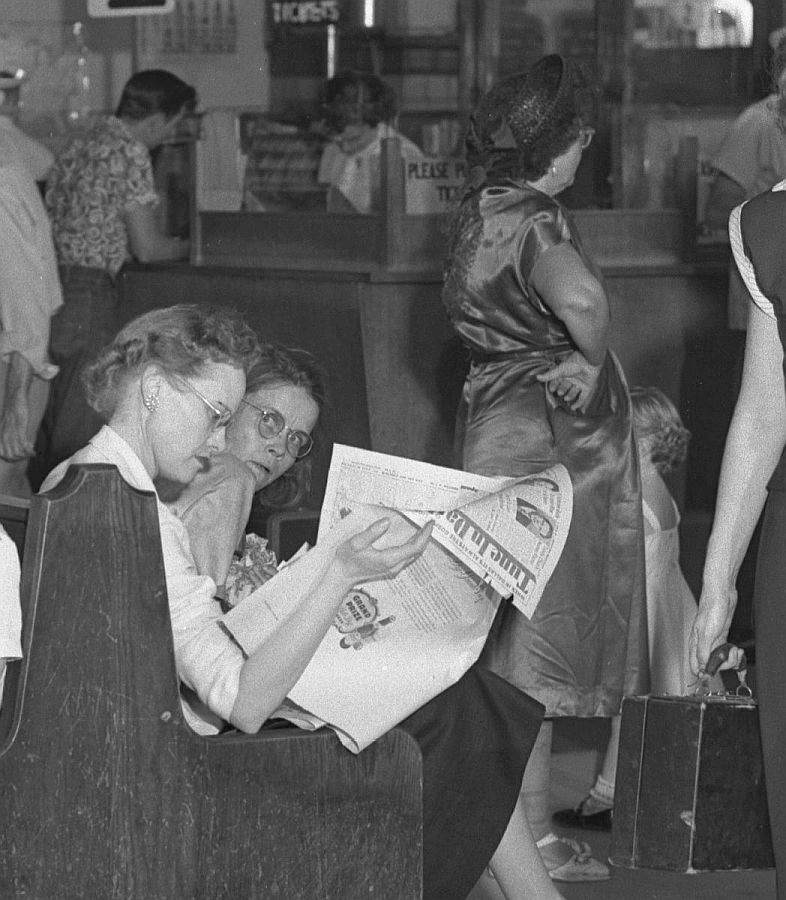
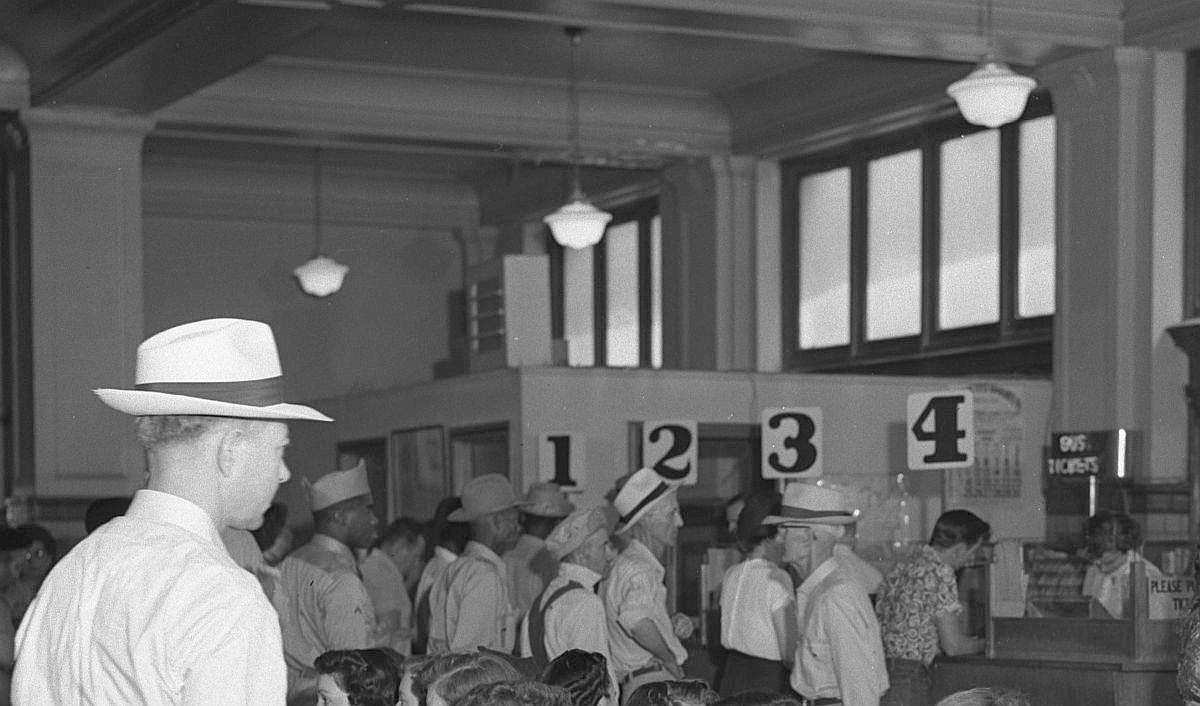
Happy Labor Day! Back in 2020 I wrote a post called “Labor Day Weekend, Union Bus Depot — 1952.” I really enjoyed writing that one, and I loved the main photo in it. It turns out that the photo I’m using in this post was taken only a couple of minutes before the one I used four years ago. I discovered this photo a few weeks ago and have been waiting for Labor Day to roll around. Which it has now done.

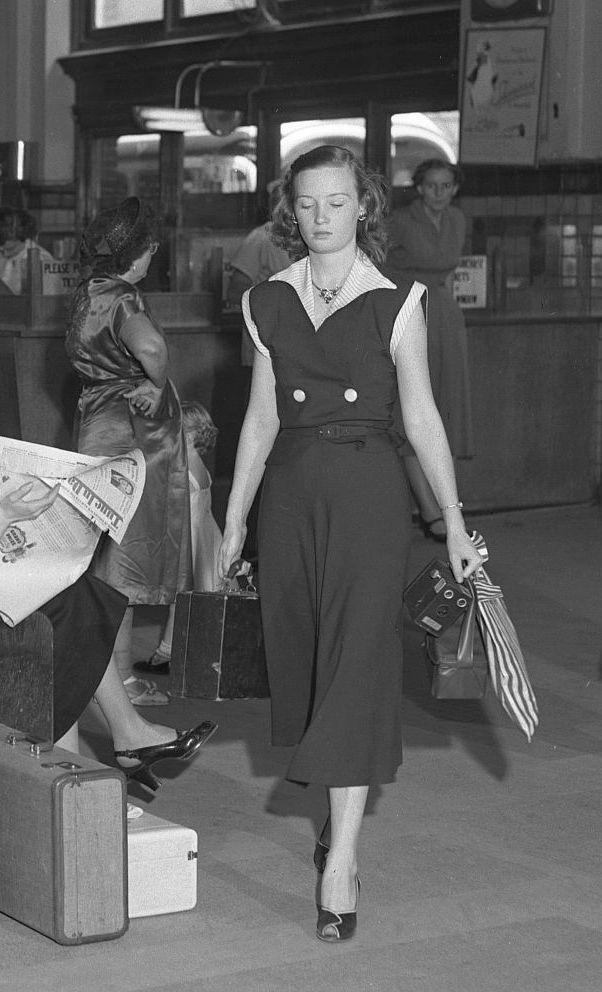
On August 31, 1952, Dallas photographer Denny Hayes took several photos of travelers waiting to be whisked away to someplace else. (With luck, someplace cooler.) These photos were taken at the Union Bus Depot in the Interurban Building. Let’s zoom in on this great people-packed photo.

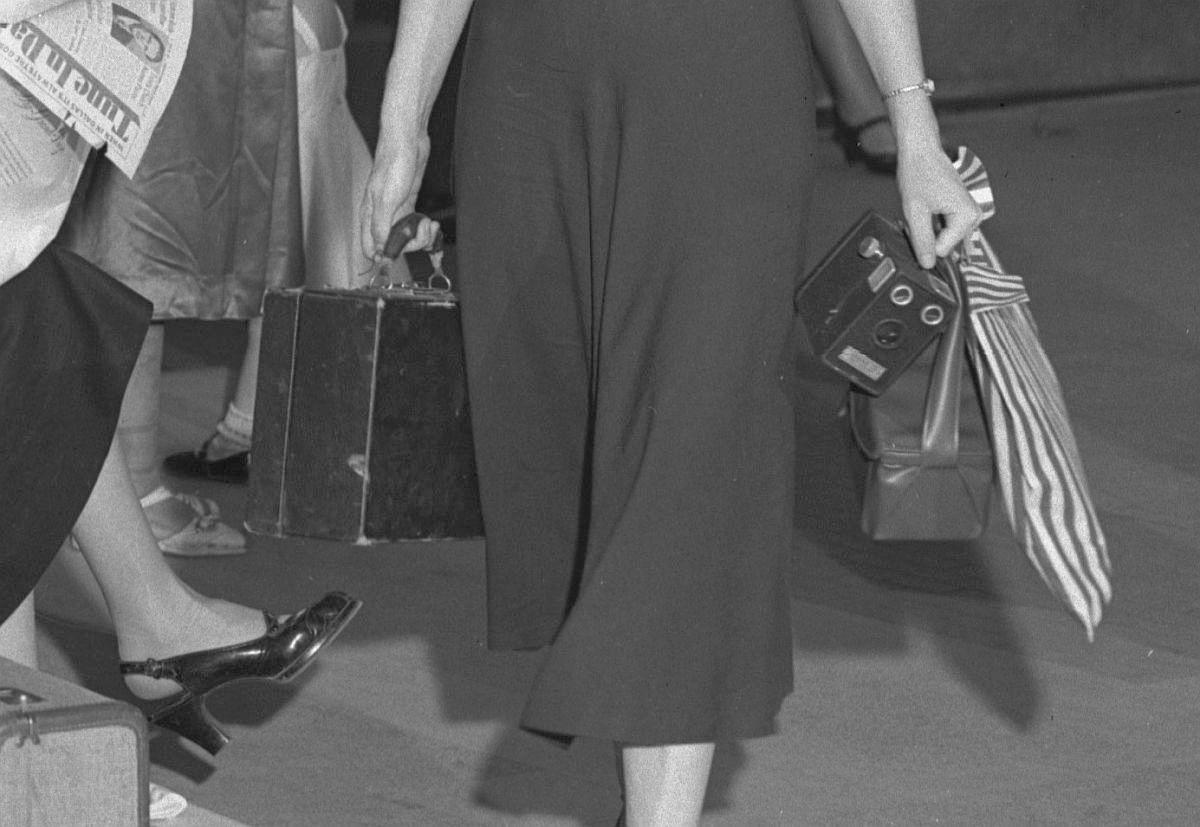
Everyone and everything pales in comparison to the young woman walking toward the camera. In her left hand she holds a box camera. She’s ready to take fun photos, if she ever gets out of that station.

labor-day_083152_denny-hayes_PA76-1-11420-002_woman

labor-day_083152_denny-hayes_PA76-1-11420-002_woman_camera

labor-day_083152_denny-hayes_PA76-1-11420-002_modern-screen

labor-day_083152_denny-hayes_PA76-1-11420-002_waiting

labor-day_083152_denny-hayes_PA76-1-11420-002_queue

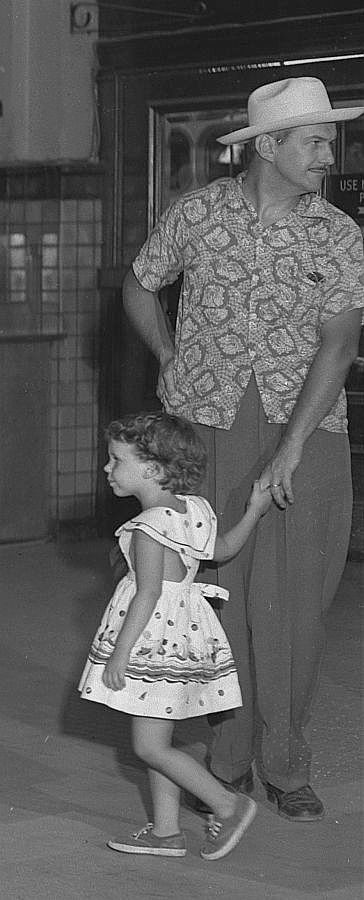
labor-day_083152_denny-hayes_PA76-1-11420-002_father-daughter

(If the man above looked any more like Harvey Korman, he’d be Harvey Korman.)

*

If you have the day off, I hope you enjoy it. And if you’re traveling somewhere, I hope you get there quickly!

***

Sources & Notes

Photo by Denny Hayes, from the Hayes Collection, Dallas Public Library, Dallas History and Archives; Call Number: PA76-1/11420-002.

See the companion post, “Labor Day Weekend, Union Bus Depot — 1952,” and see how many people made it into both photos.

labor-day_083152_denny-hayes_PA76-1-11420-002_web

*

Copyright © 2024 Paula Bosse. All Rights Reserved.
Zephyr, Meet Ox Cart — 1936

zephyr_sam-houston-zephyr_oxcart_ebay_front…Ox cart, meet Zephyr

by Paula Bosse

On Oct. 4, 1936, the Sam Houston Zephyr — the very first streamlined passenger train in Texas — made one of it very first public appearances, at the Texas Centennial in Dallas. This beautiful train (check out a photo of its interior here) was operated by the Burlington-Rock Island railroad between Fort Worth and Houston, with stops in Dallas, Waxahachie, Corsicana, and Teague. (See footage of it arriving it what might be Dallas in what might be 1936 in cool home movie footage here — then go to the beginning to see great Centennial footage — some of it in color! — and other footage shot in Kidd Springs.)

Back to the Zephyr. At its Centennial stop, a photo-op presented itself: the super-new (Zephyr) alongside the super-old (an ox cart). This photo ran in newspapers around the world, accompanied by variations of the following captions:

PROGRESS! Just a zephyr in the breeze is the Burlington Zephyr, particularly when compared to an ancient ox cart. The two were shown together at the Texas centennial fair at Dallas. The speedy streamliner runs from Dallas to Houston, Texas.

*

MARCH OF PROGRESS. An excellent contrast in the modes of transportation of today and yesterday is presented here as the Sam Houston Zephyr, streamlined train running between Dallas, Tex., and Houston, enters the grounds of the Texas Centennial exposition with an ox cart plodding along beside it. The presentation is part of the Cavalcade of Texas given at the exposition in Dallas. The girls are LaNeyl Brown and Peggy Humphreys.

*

From a Dallas Morning News article on the Centennial exhibit at Fair Park:

The streamlined Sam Houston Zephyr, operated between Dallas, Fort Worth and Houston by the Burlington-Rock Island, will be displayed on the siding in the grounds east of the Hall of Transportation. One of the powerful Opp Mogul freight engines of the Texas & Pacific also will be shown. To furnish a contrast with modern and ancient transportation the ox cart and stagecoach used in Cavalcade will be rolled out. (DMN, Oct. 4, 1936)

zephyr_sam-houston-zephyr_oxcart_DMN_100436_events

*

An interesting sidelight regarding the older modes of transportation is this blurb about the difficulty Centennial personnel had in finding authentic stagecoaches, covered wagons, and ox carts to use in various Fair Park productions celebrating the history of Texas, forcing them to resort to building reproductions (seems hard to believe that there were only two authentic stagecoaches to be found in the entire state!):

zephyr_centennial_AP-wire-story_may-1936
AP wire story, May 1936

The article is referring to props needed for the giant Cavalcade of Texas historical pageant, but check out the nice little novelty “prairie schooner” below, which served as a quirky, casual Centennial restaurant (“Smacking of the old West is the Chuck Wagon, a dining place for 250, with an overgrown chuck wagon serving as the kitchen and service counter” — Dallas Morning News, June 7, 1936):

patreon_tx-centennial_chuckwagon-restaurantDallas Historical Society

patreon_tx-centennial_chuck-wagon-restaurant_worthpointvia Worthpoint

***

Sources & Notes

Top photo was found on eBay (German wire photo).

Photo of the Chuck Wagon restaurant is from the Texas Centennial Exposition Collection, Dallas Historical Society, Object ID V.38.3.245 — more info on this photo is here.

Consider becoming a member of my Flashback Dallas Patreon page for as little as $5 a month — I post there daily. No strings attached. Cancel at any time!

zephyr_sam-houston-zephyr_oxcart_ebay_front

*

Copyright © 2024 Paula Bosse. All Rights Reserved.
KVIL: The “VIL” Stands for Village

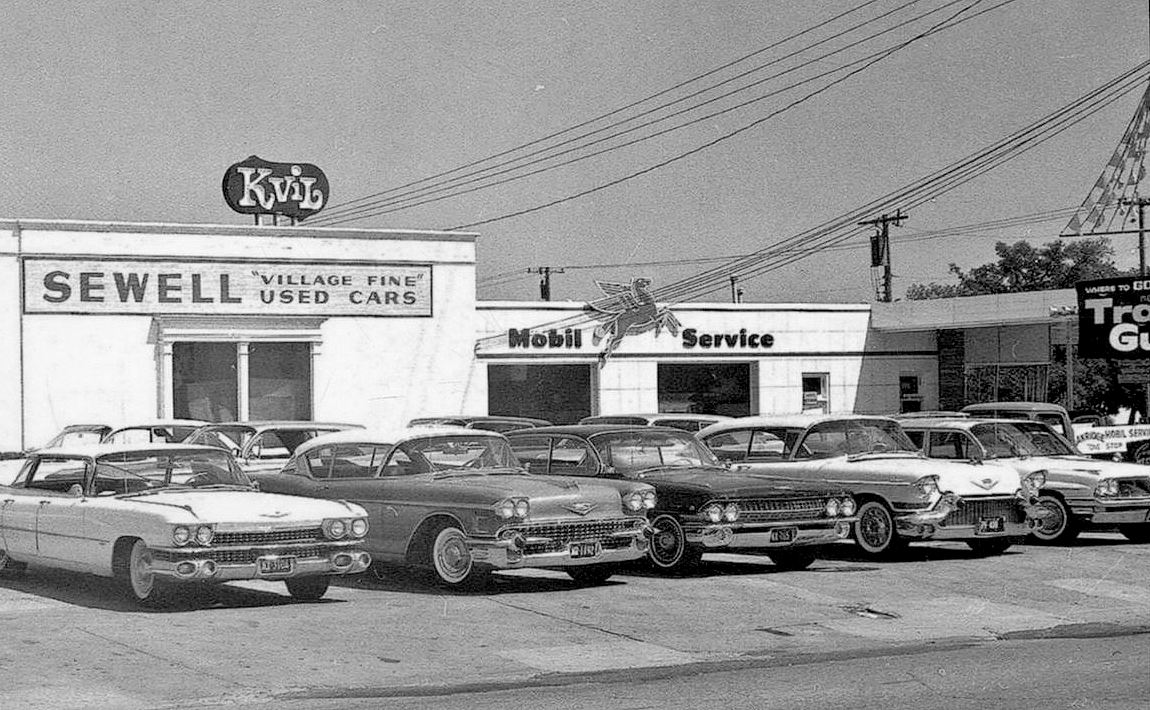
sewell-auto_KVIL_ebayNortheast corner of Preston & Mockingbird…

by Paula Bosse

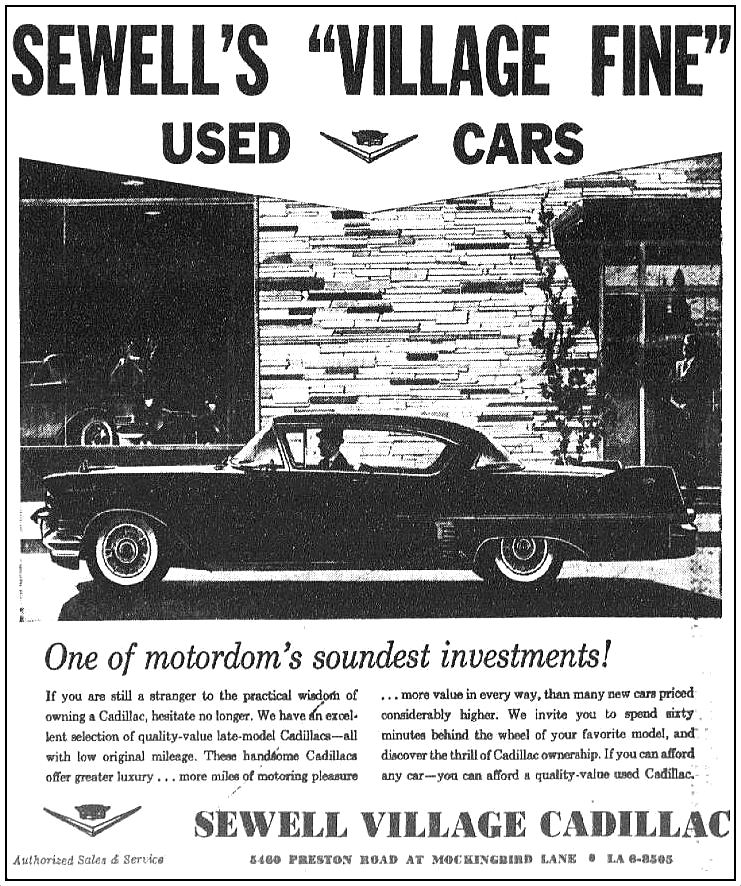
Sewell Village Used Cars and a Mobil station were at the northeast corner of Preston and Mockingbird (Sewell was at 5460 Preston Road), catty-corner from Highland Park Village. The KVIL studios were right around the corner, at 4152 Mockingbird Lane, across the street from the Dallas Country Club — you can see the jauntily-lettered sign in the background of this undated.photo. I am really bad at determining car-model years, but let’s say this is about 1960. What does this corner look like these days? It looks like this.

I just learned (from the KVIL Wikipedia page) that the “VIL” in the station’s call letters stood for “Village,” as in Highland Park Village. Who knew? The AM station began broadcasting on March 1, 1960, and the FM station hit the airwaves on Aug. 25, 1961. I believe both stations had a strict “no-rock-and-roll” policy. In the early days, a block of programming was aimed directly at housewives:

The program policy followed by the station is designed to fit the various hours of the day. For the driving hours when listeners drive to work (5:45 to 9 a.m.) and return (4:30 to 6:55 p.m.) the music is livelier. “Sing Along” is the order of the day from 9 a.m. to noon for the housewife’s work hours. (“KVIL Mark’s First Birthday Wednesday,” Dallas Morning News, March 1, 1961)

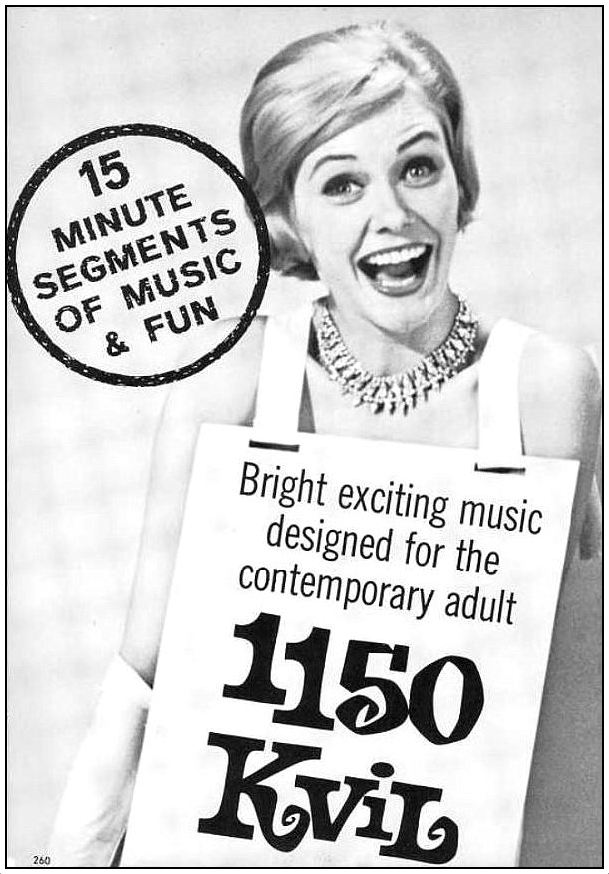
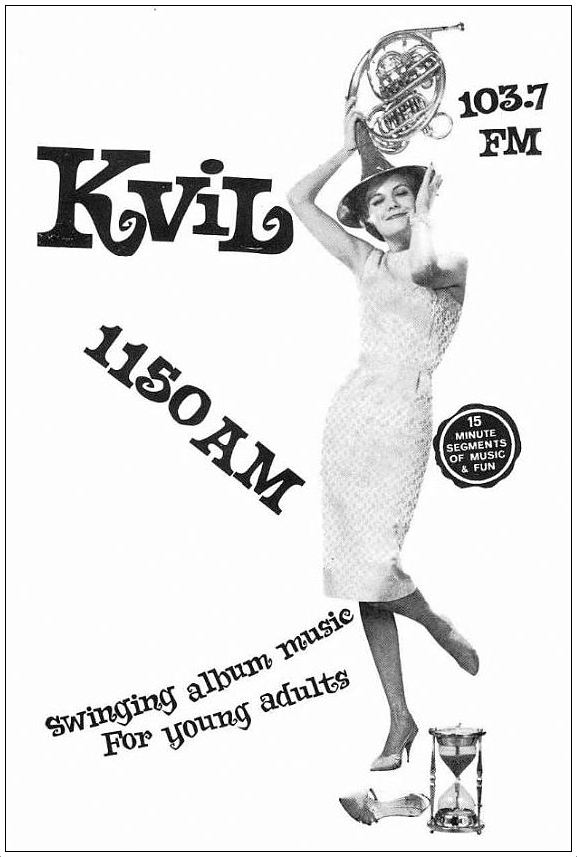
Here are a couple of hep, caffeinated KVIL ads from those early days:

patreon_KVIL_HPHS_1961-yrbk1961 ad

patreon_KVIL_HPHS_1962-yrbk1962 ad

kvil-logo_broadcasting-mag_122462_ad-det1962 logo

Most of my sort of generally vague awareness of KVIL was in the 1980s, when it was an absolute powerhouse in the ratings. But even its most stalwart fans would probably not describe its playlist as “bright,” “exciting,” or “swinging.” But look how much fun the promotions department imagined the effect on “young adults” was!

*

And what about Sewell Village Cadillac and its selection of “Village Fine” used cars? If circa-1960 Highland Park is going to have a used car lot, you better believe it’s going to be populated with Cadillacs. (UPDATE: Thanks to Peter K’s link in the comments, check out what appears to be the original photo by Squire Haskins, with a wider view, at the UTA Libraries website, here.)

sewell-village-cadillac_032158March 1958

***

Sources & Notes

Photo from eBay.

KVIL ads from the 1961 and 1962 Highland Park High School yearbooks.

KVIL logo is a detail from an ad that appeared in the Dec. 24, 1962 issue of Broadcasting magazine.

This post appeared in an abbreviated form on the Flashback Dallas Patreon page.

sewell-auto_KVIL_ebay

*

Copyright © 2024 Paula Bosse. All Rights Reserved.
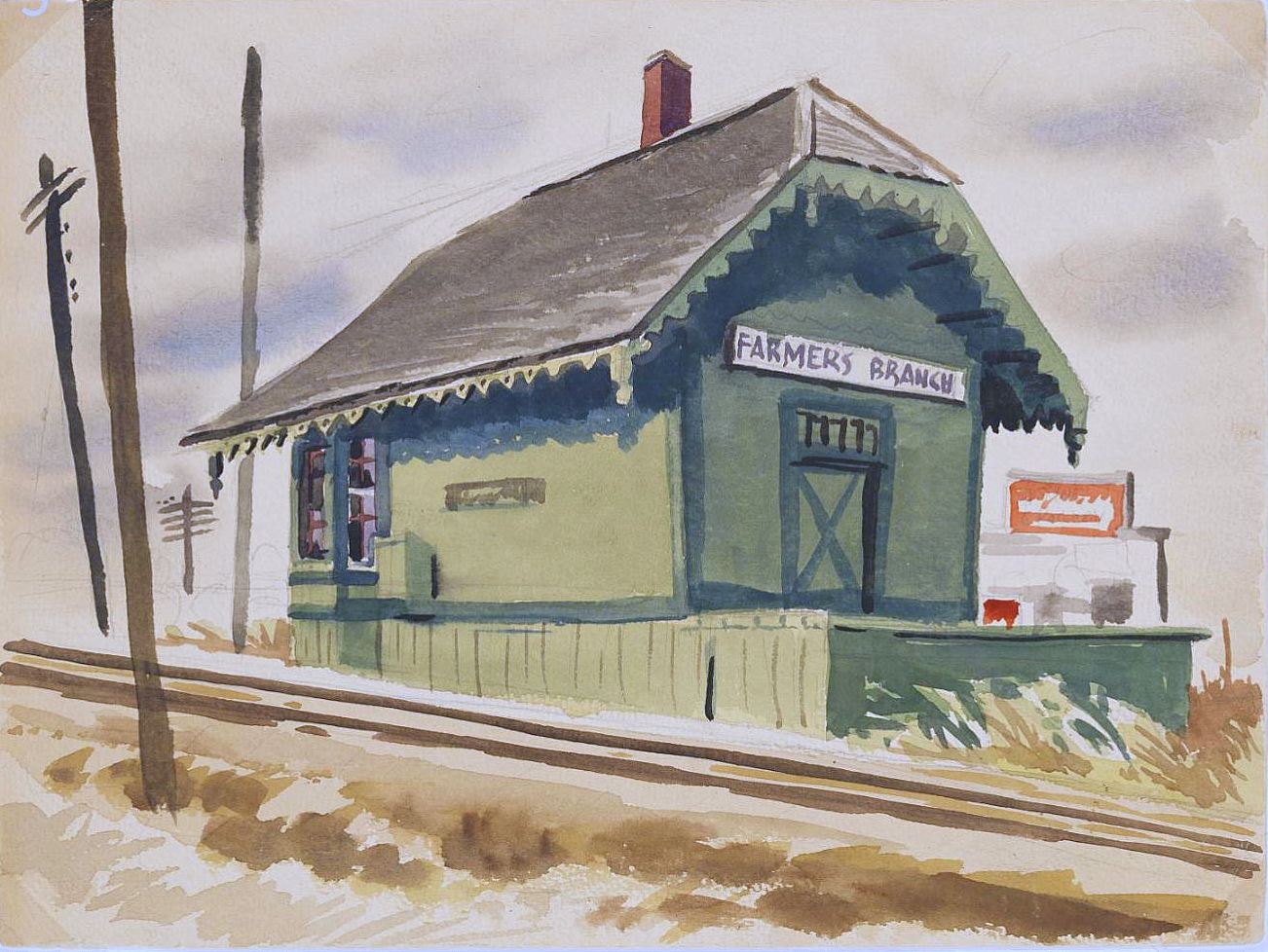
Jerry Bywaters: A Quick Trip to Farmers Branch

bywaters-jerry_untitled_farmers-branch-depot_bywaters-collection_smu_ndBywaters Special Collections, Hamon Arts Library, SMU

by Paula Bosse

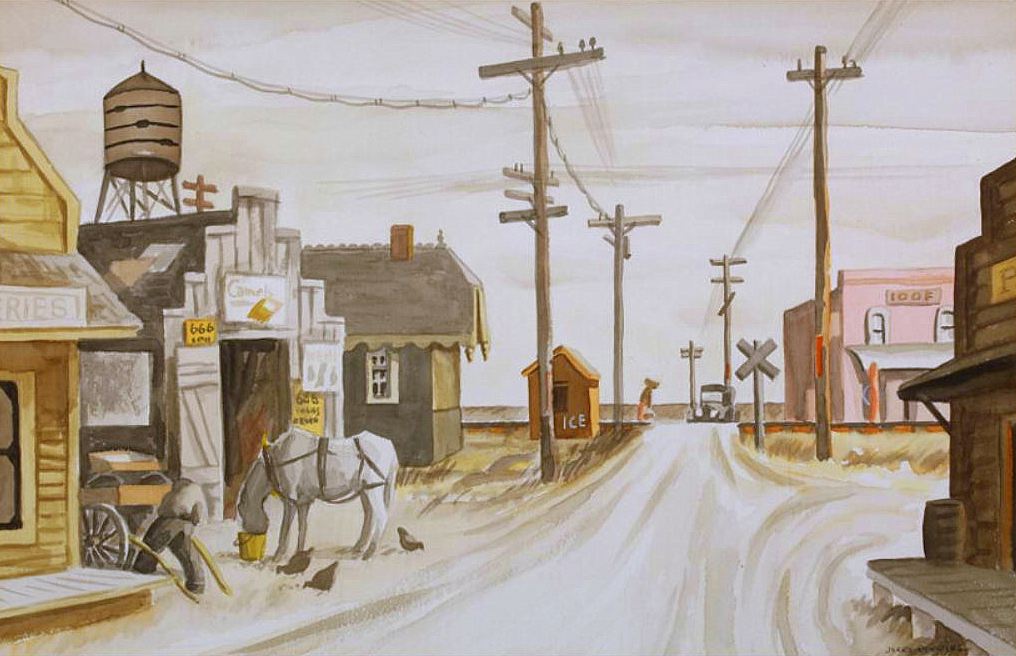
One of the joys of being a fan of an artist is discovering works you’ve never seen before. And here are two, both by a favorite of mine, Dallas artist Jerry Bywaters — and both are watercolors of the very nearby Farmers Branch. Bywaters must have been quite taken with the picturesque little depot there, because it snuck into at least two of his paintings. The one above is untitled, and the one below is “Farmers Branch In the Early Days.”

bywaters-jerry_farmers-branch-in-the-early-days_watercolor_ha-dot-com_sold-2010

I can’t find dates for either of these, but the top work appears to have debuted at an exhibition at the Lawrence Art Galleries in November 1937 (it is mentioned in a review of the show by Frances Folsom in The Dallas Morning News — “Exhibition of Art Works by Jerry Bywaters Opening,” DMN, Oct. 31, 1937).

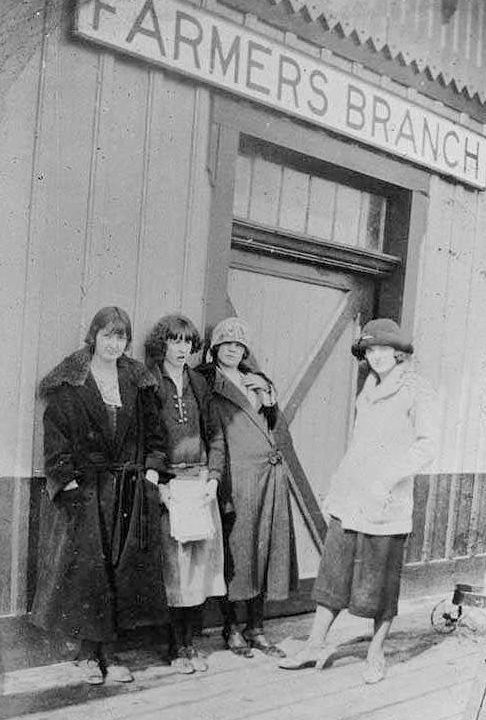
The depot is still standing — it was restored and relocated to the Farmers Branch Historical Park in 1985. Read a great history of the depot here.

The photo below is from the City of Farmers Branch site. Who wouldn’t want to spend a day with those girls?

farmers-branch-depot_photo_fb-city-website

I think I need to explore Farmers Branch.

***

Sources & Notes

Top painting (“Untitled [Farmers Branch Train Depot]”) is an undated watercolor by Jerry Bywaters, from the Bywaters Special Collections, Hamon Arts Library, SMU Libraries — more info on this can be found at the SMU site here.

The second painting, “Farmers Branch In the Early Days,” is an undated watercolor by Jerry Bywaters; it was sold by Heritage Auctions in 2010. (A notation on the back of this framed piece indicates that it once belonged to the legendary Judge Sarah T. Hughes, or it was purchased by her to give to a very lucky friend.)

The photo of bobbed flappers loitering around the depot is from the City of Farmers Branch website, here.

Other Flashback Dallas posts with (very different) examples of Jerry Bywaters’ art:

A version of this post originally appeared on my Patreon page.

bywaters-jerry_untitled_farmers-branch-depot_bywaters-collection_smu_nd_sm

*

Copyright © 2023 Paula Bosse. All Rights Reserved.
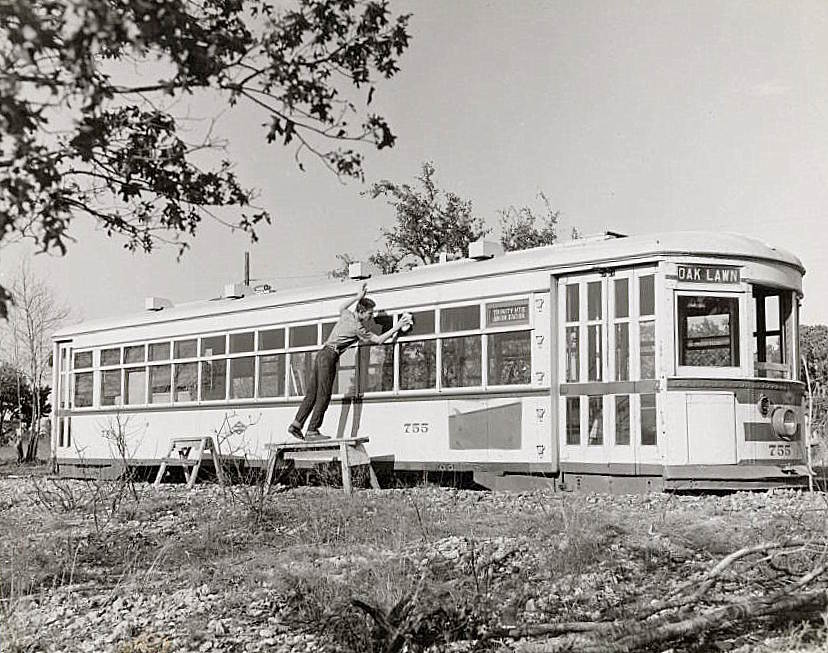
Home Sweet Home: Oak Lawn Car No. 755

In retirement…

by Paula Bosse

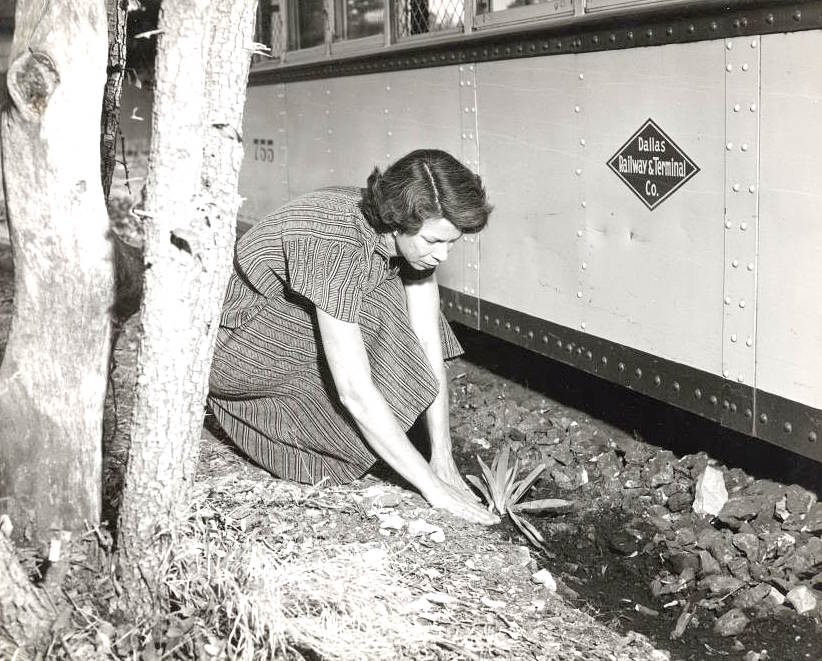
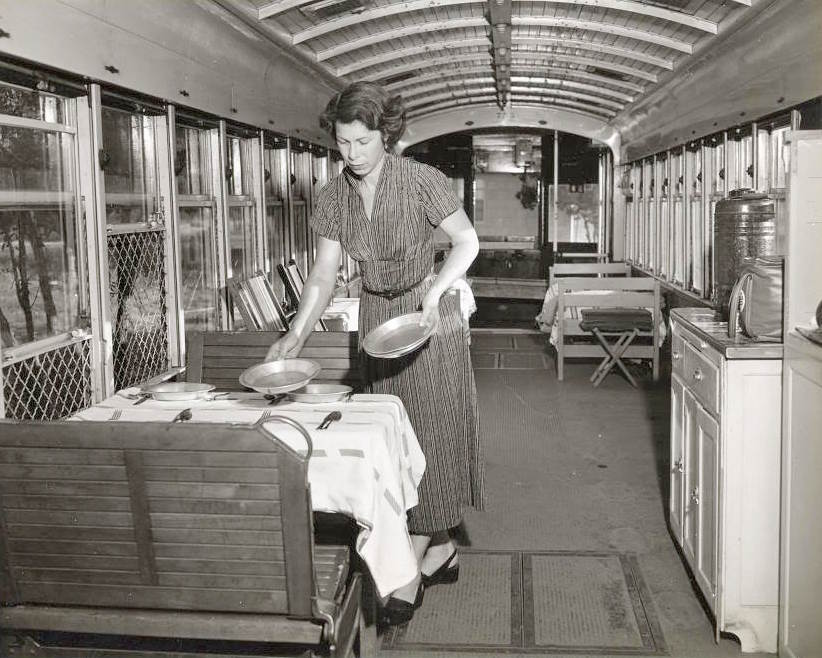
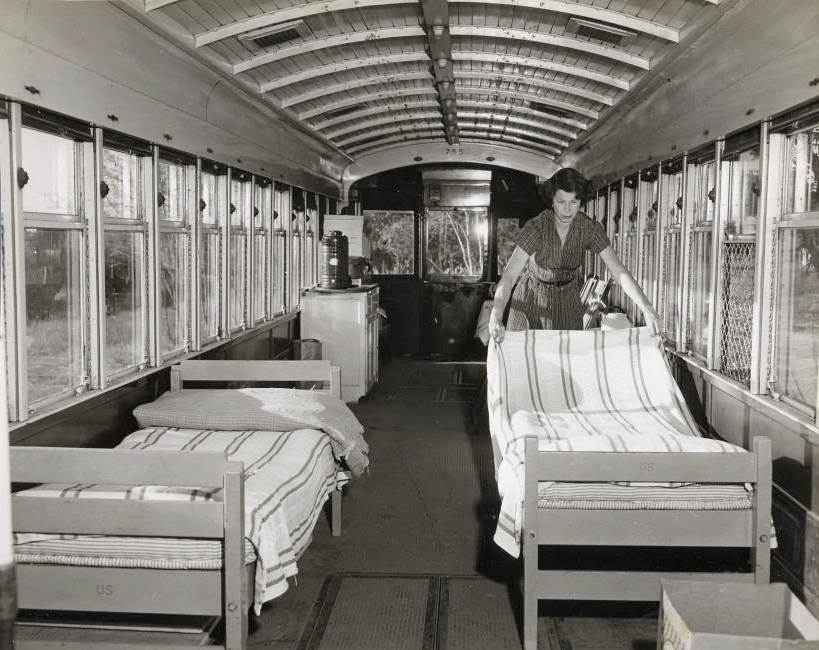
I came across these photos several years ago, but I don’t really know anything about them. They show a decommissioned Oak Lawn streetcar (car #755), which was manufactured in the 1920s for the Dallas Railway & Terminal Co. The photos, which look to be from the 1950s, show the car remodeled into a home (or, as the text below suggests, a sort of weekend “lake house”). When I clipped these photos (they were on some obscure railroad forum I stumbled onto), the only info was that someone had placed a for-sale ad for this on Craigslist in 2009. Below is the seller’s ad:

Antique 1920s or 1930s Dallas interurban trolley car. Trolley was retired from service in the 50s. Has a porch built on the back. Has a separate room with bath. There’s a kitchen and a 1930s refrigerator that works very well. On about a half acre wooded lot at Lake Whitney. Not far from boat ramp. Walking distance to water. Used to be on the “Oak Lawn” run in Dallas. Unusual, neat place to spend summers at the lake. Call Carol or Ron (214) xxx-xxxx. No owner financing.

I don’t know where the photos came from (they look like photos that would have accompanied a story in a magazine like Life), but they are great.

**

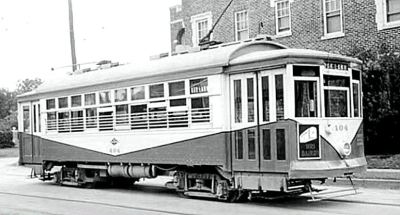
I don’t think that’s an interurban car, but it’s really long for a streetcar. (How would it turn corners?) Has it been extended? Below is a typical Oak Lawn streetcar:

This photo was actually in the video below (“Dallas Oak Lawn Streetcar Line No. 8”). It’s a pretty uneventful video — a man in a car retraces the Oak Lawn streetcar route. My mother grew up in Oak Lawn and talks about riding the streetcar to and from downtown, but I had no idea how far into Oak Lawn it traveled. 

*

While looking to see if I could find anything more about the renovated Dallas streetcar, I came across a story which showed something similar (but more elegant) in this article about a renovated interurban car in New Jersey: “One-of-a-Kind Point Pleasant Home Built Around Century-Old Trolley Car.”

*

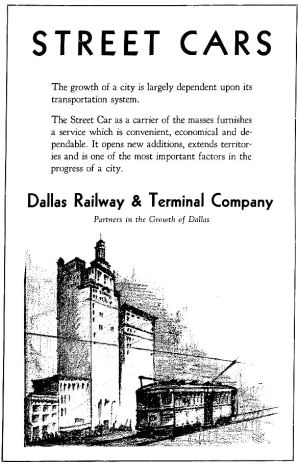
An ad from 1930, not long after the Oak Lawn car was manufactured:

streetcars_dallas-railway_dallas-mag_april-1930

*

If you know more about Oak Lawn car #755 — where it’s been, where it is now — please comment below!

***

Sources & Notes

First four photos are from a Dallas Craigslist ad placed in or before 2009 — I believe the photos were posted with the ad. The ad was then reposted on a railroad forum.

Ad from the April 1930 issue of Dallas magazine.

*

Copyright © 2023 Paula Bosse. All Rights Reserved.

The Stagecoach Ride at Six Flags: 1961-1967

six-flags_stagecoach_fort-worth-magazineWhat could possibly go wrong?

by Paula Bosse

Did you ride the stagecoach at Six Flags?

The stagecoach at Six Flags? What? This:

six-flags_stagecoach

And this (with grazing buffalo for added Old West atmosphere):

six-flags_stagecoach_buffalo_ebay_front

When I first saw Six Flags postcards touting stagecoach rides, my first thought was, “How did they ever manage to get insurance for that?”

six-flags_stagecoach_buffalo_ebay_reverse

The “Butterfield Overland” ride debuted in the “Confederate” section when the park opened in 1961 and lasted until about 1967. It was very, very popular.

six-flags_stagecoach_1965_UTA_det1965, via UTA Libraries Special Collections (det)

Why did I never know about this when I was a kid? I never saw a stagecoach. I would have LOVED to ride a stagecoach. What happened? Well, here’s what happened: in May 1967, one of the stage’s wheels came off mid-ride, and the stage overturned, injuring 11 of the 14 people on board, most of them children. A 4-year-old Haltom City girl — who was riding on the top — was pinned beneath the overturned stagecoach. When she was freed, she was rushed to the hospital and underwent emergency surgery on both feet. One of the news stories about this unfortunate incident ended with, “Saturday’s accident was the first involving the stagecoach since the park opened in 1961,” adding that more than 4 million persons had ridden this ride between 1961 and 1967. (Four million!) (Granted, I think there were four stagecoaches and four teams of horses, but… four million!!)

One month after the accident, it was reported that the girl’s father had sued Six Flags for $531,000, contending that park officials were guilty of 30 counts of negligence. ($531,000 would be the equivalent in today’s money of about $5 million.) I can’t find anything about what happened with this lawsuit, but I assume there was probably a quiet settlement. Coincidentally or not, that spelled the end of the Butterfield Overland stagecoach ride at Six Flags Over Texas.

And that’s why I never heard of — or got to experience — a stagecoach ride at Six Flags.

(I don’t know what happened to the buffalo.)

***

Sources & Notes

Top photo of a Six Flags stagecoach jam-packed with kids from Fort Worth magazine.

The 1965 image is a detail of a larger photo from the Jack White Photograph Collection, UTA Libraries Special Collections — see the full photo and more details here.

Read more about this Butterfield Overland stagecoach ride at Parktimes.com.

The whole “Confederate” and “Texas” sections of SFOT were kind of weird, including a several-times-a-day lynching (!), as can be seen in one of the postcards in the 2014 Flashback Dallas post “Angus Wynne Jr.’s ‘Texas Disneyland’ — 1961.”

For real, non-amusement-park stagecoach tidbits, check out the post (also from 2014) “Dallas to Austin by Stagecoach: Only Three Days! (1854).”

A slightly different version of this post originally appeared on the Flashback Dallas Patreon page in August 2023. If you’d like to see daily Flashback Dallas posts, please consider supporting me on Patreon, for as little as $5 a month.

six-flags_stagecoach_fort-worth-magazine_sm

*

Copyright © 2023 Paula Bosse. All Rights Reserved.