Flashback : Dallas

A Miscellany: History, Ads, Pop Culture

Category: Transportation

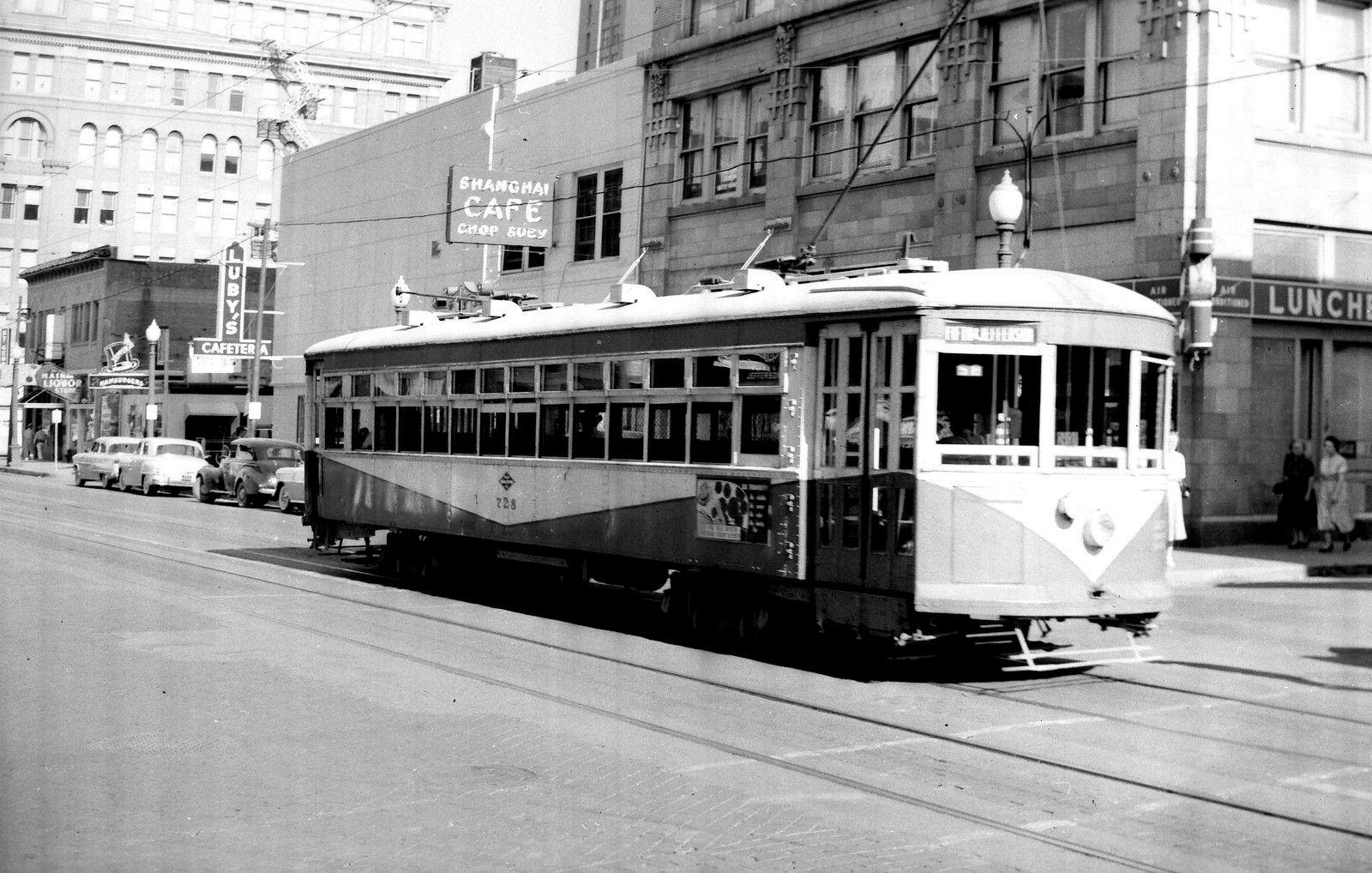
Streetcar #728, Main Street — 1954

streetcar_1000-block-main_090254_ebay1000 block of Main Street, Sept. 2, 1954

By Paula Bosse

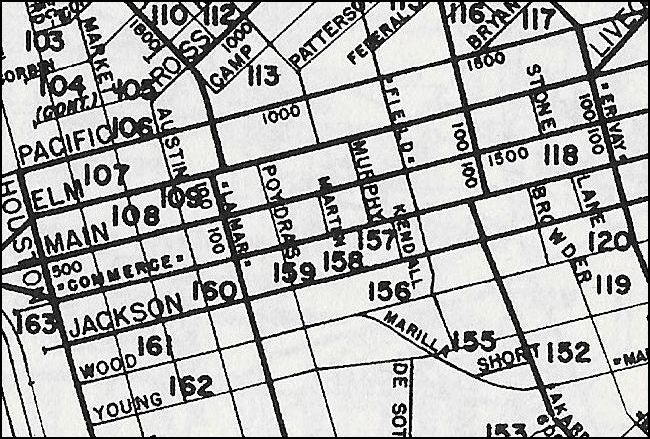
Oh, streetcars. In the photo above, we see car #728 heading east on Main Street on September 2, 1954, having come from, I believe, Oak Cliff (the placard reads “Jefferson”). This photo shows Main Street looking east from, I think, Poydras.

The Shanghai Cafe was at 1004 Main, Luby’s Cafeteria (the second one in Dallas) was at 1006 Main, the Topper restaurant was at 1012 Main, the Main & Martin Liquor Store was at 1016 Main (at Martin Street), and the St. George Hotel was at 1018 Main, all of which can be seen in this photo.

main-st_mapsco-1952-det1952 Mapsco

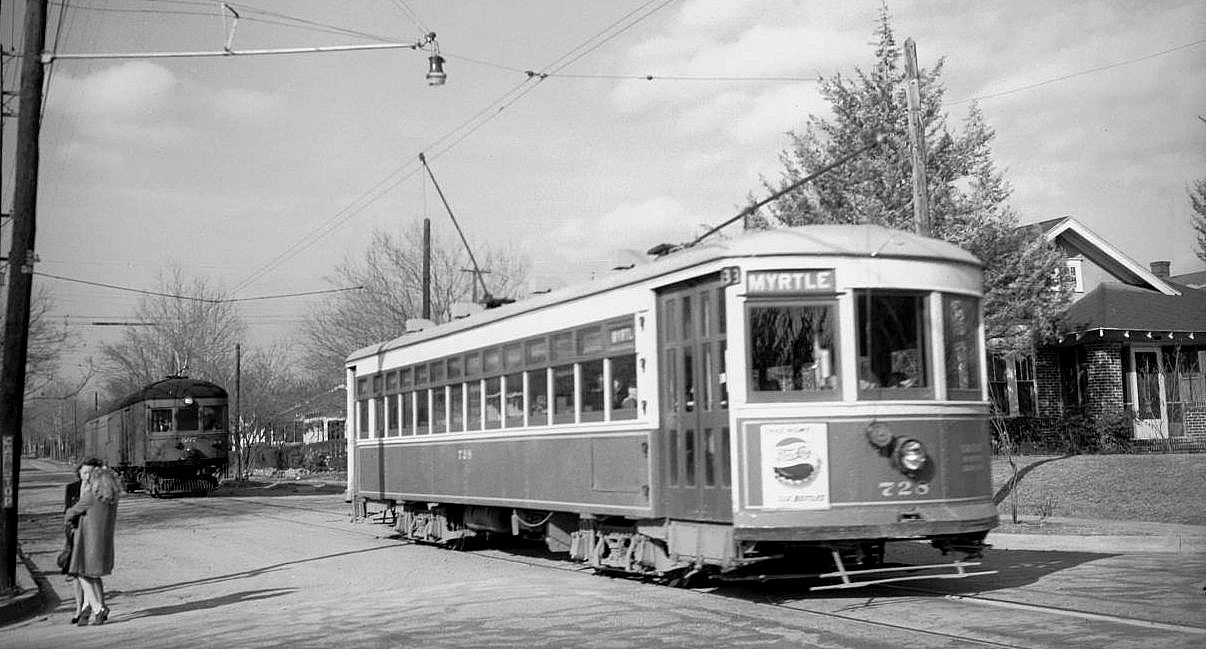
Car 728 wasn’t always “Jefferson,” whiling away its days crossing back and forth across the Trinity. Back in 1945 it was “Myrtle” and was spending a large part of its time in South Dallas.

myrtle_728_1945_denver-pub-lib

I’m not sure where Myrtle/Jefferson ended up, but, sadly, the Golden Age of streetcars ended in Dallas in 1956.

***

Sources & Notes

Top photo from an old eBay listing.

Bottom photo by Robert W. Richardson; from the Western History/Genealogy Dept., Denver Public Library.

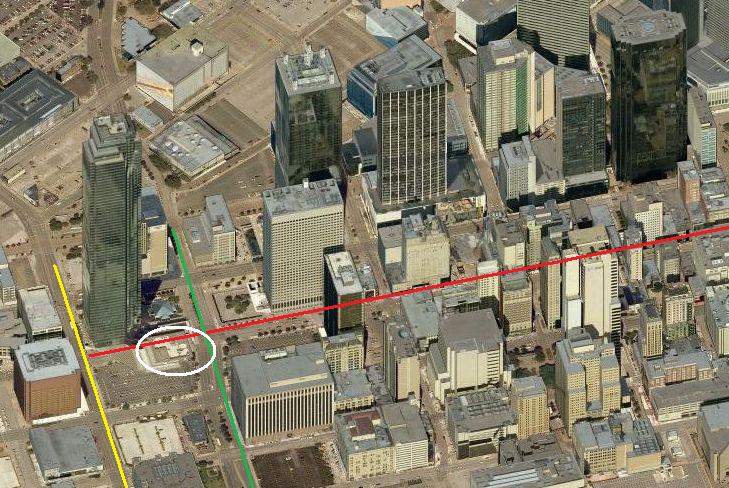
Today, the block seen in the top photo looks completely different. Across the street is where the Bank of America Plaza is now. In the map below, the red line is Main, the yellow is Lamar, and the green is Griffin. The 1000 block of Main Street is circled in white. (Click for larger image.)

1000-block-main_bingBing Maps

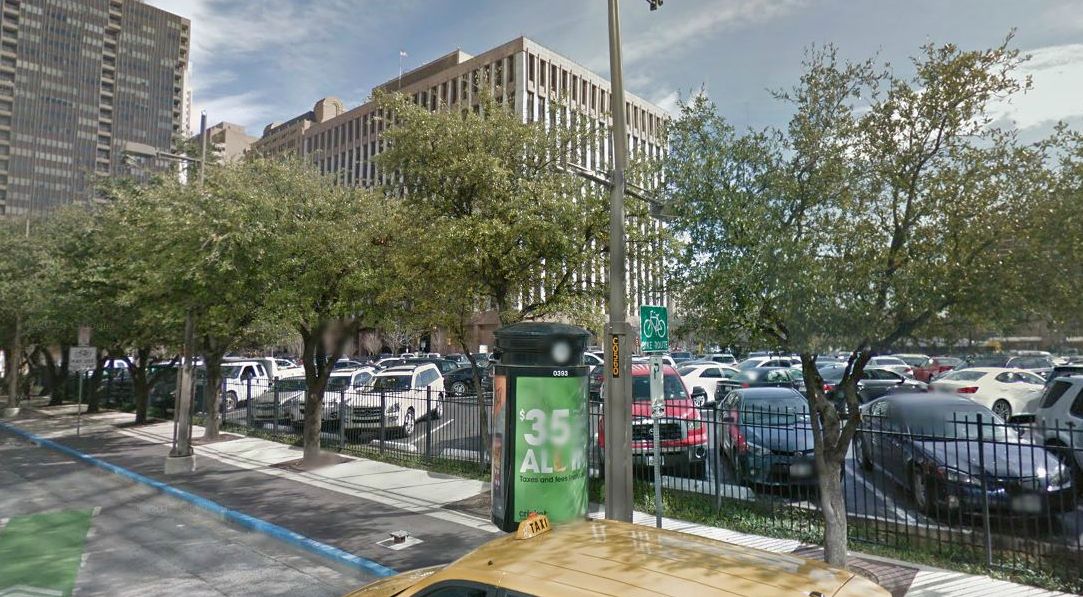
So what’s there now? A parking lot!

1000-block-main_googleGoogle Street View

To read “The Last Day the Streetcars Ran in Oak Cliff” by Ron Cawthon, click here.

*

Copyright © 2015 Paula Bosse. All Rights Reserved.

One of the Victims of the Great Trinity Flood: The T & P Railroad Trestle — 1908

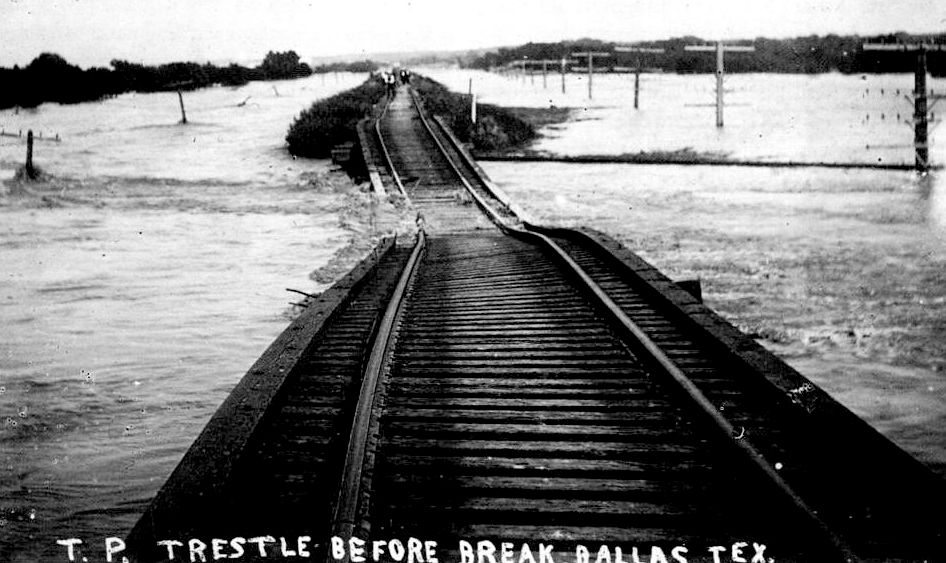
flood_t-p-trestle_1908_legacies“T. P. Trestle Before Break, Dallas, Tex.” (click for larger image)

by Paula Bosse

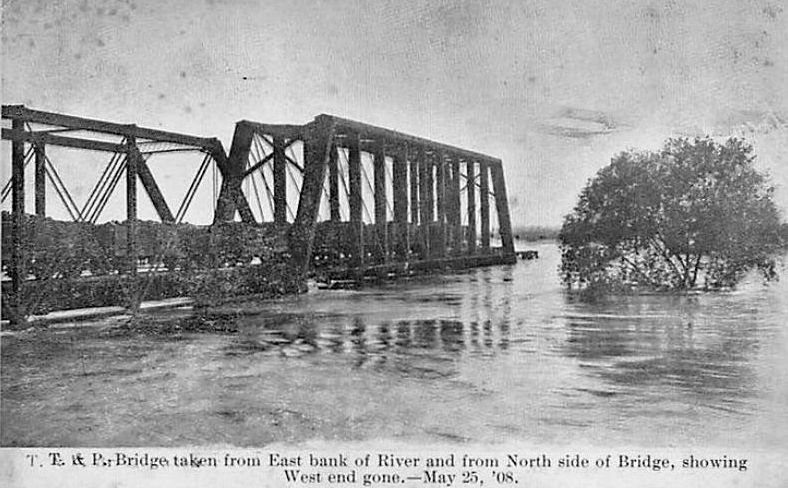
Above and below, photos of the Texas & Pacific railroad trestle spanning the Trinity River, destroyed during the great flood of May, 1908. Five people died in the flooding — in which the Trinity crested at an incredible 52.6 feet — and damage to property was unbelievable. The railroad trestle was just one of numerous victims of the worst flood Dallas has ever known.

flood_t-p-trestle_1908-postcard

***

Photo from the article “After the Deluge: The Impact of the Trinity River Flood of 1908” by Jackie McElhaney (Legacies, Fall, 1999), which you can read here.

Postcard from Flickr, here.

The May 25, 1908 Trinity River flood on Wikipedia, here.

Click pictures for larger images.

*

Copyright © 2015 Paula Bosse. All Rights Reserved.

Teenagers, Hot-Rods — 1960s

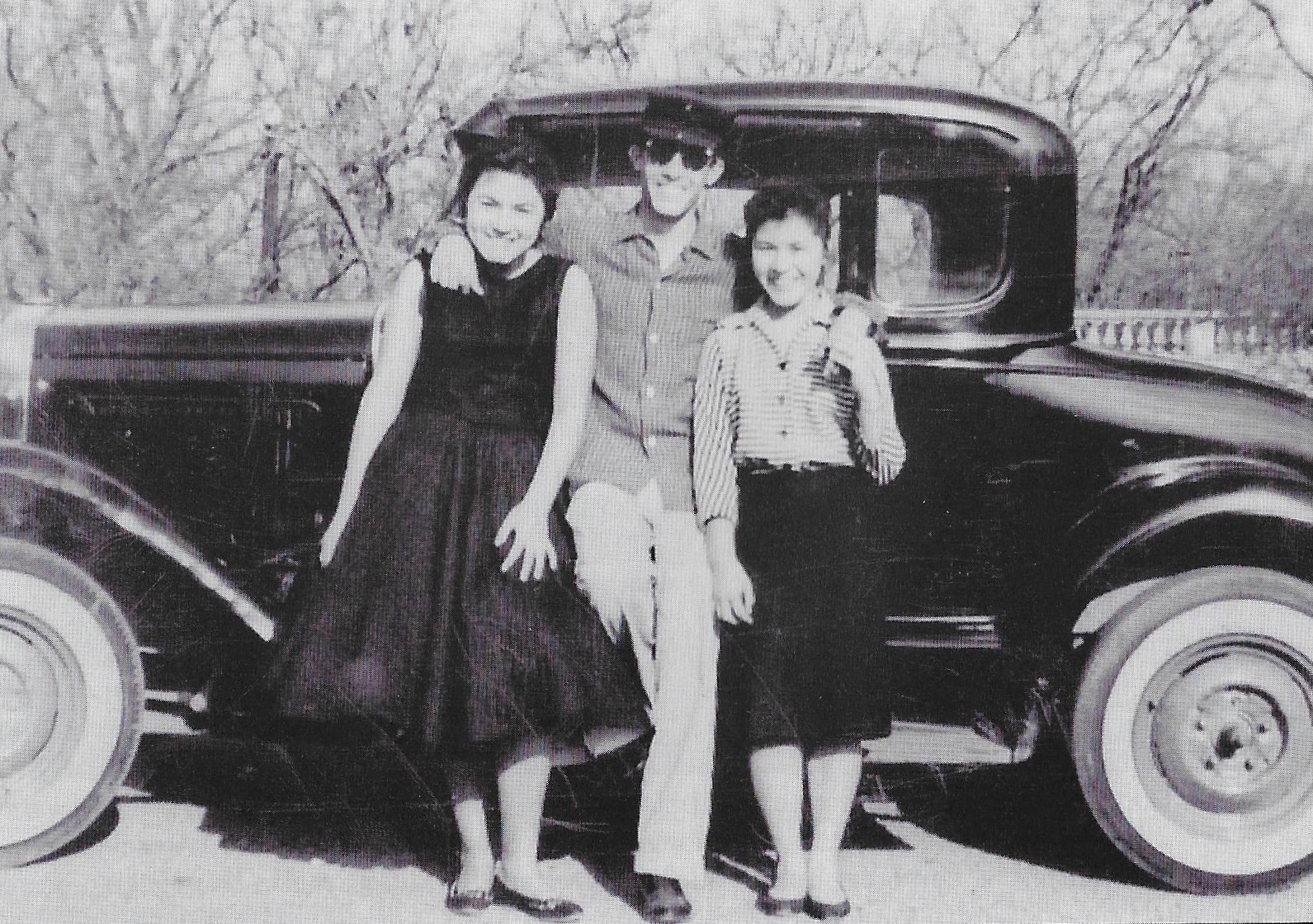
little-mexico_hot-rod_villasana A cool cat and his kittens… (via DMAHL)

by Paula Bosse

Teenagers and hot-rods, man. These kids are cool.

***

Sources & Notes

Photo from the book Dallas’s Little Mexico by Sol Villasana (Charleston, SC: Arcadia Publishing, 2011); photo is credited to Dallas Mexican American Historical League (DMAHL). Caption reads: “These Little Mexico teenagers show off their hot-rod in this 1960s picture. Shown are, from left to right, ? Santos, Rudy Trevino, and Maria Rodriguez.”

*

Copyright © 2015 Paula Bosse. All Rights Reserved.

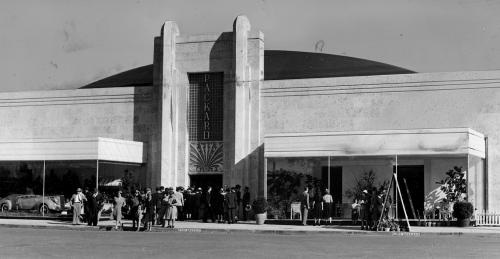
2222 Ross Avenue: From Packard Dealership to “War School” to Landmark Skyscraper

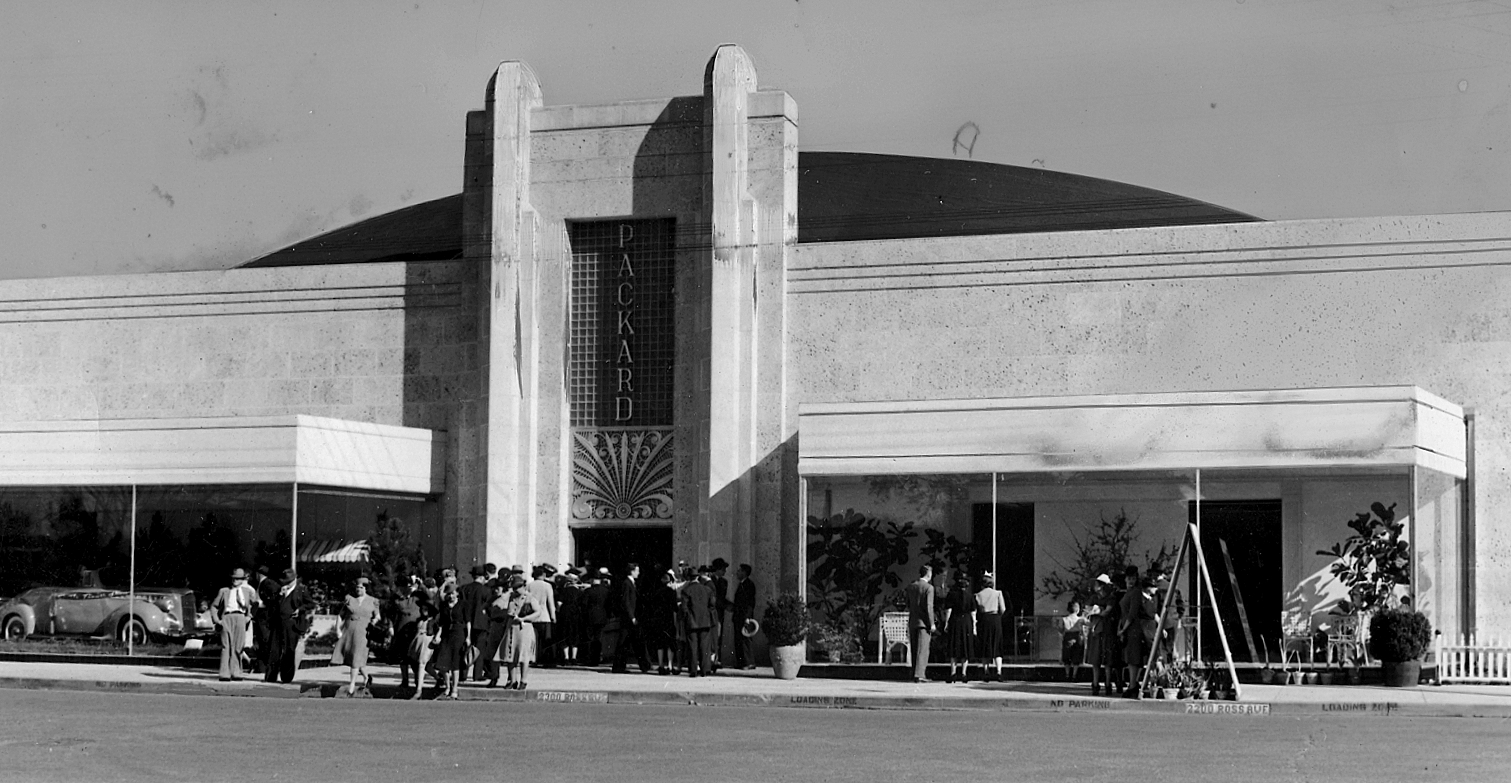
packard-dealership_2222-ross_detroit-pub-lib_1940Packard automobile showplace, 1940

by Paula Bosse

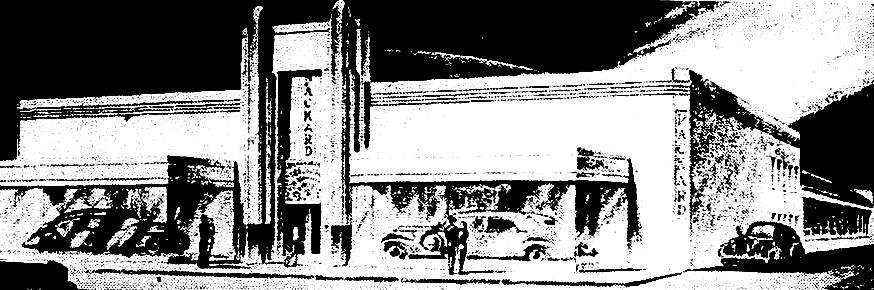
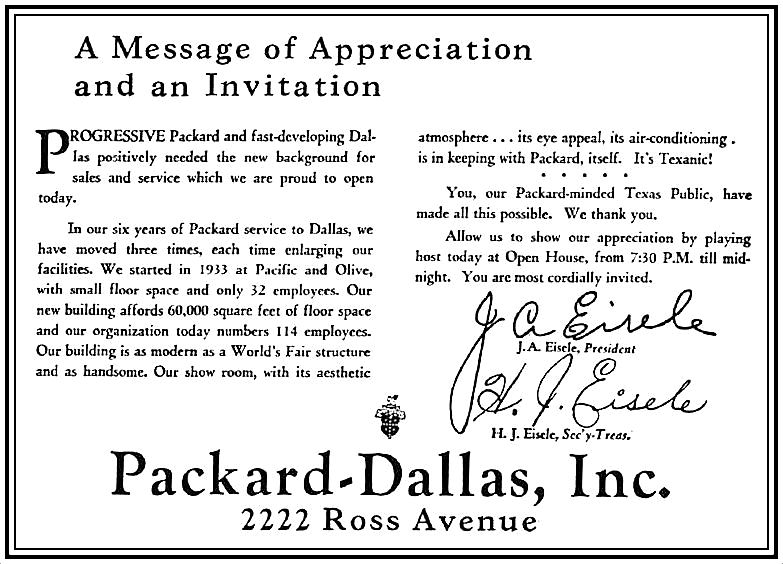
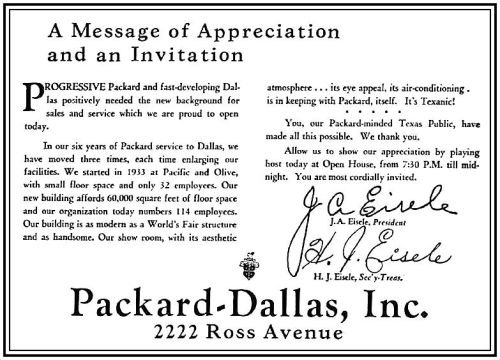
In late summer of 1939, a new 60,000-square-foot. $250,000 home for Packard-Dallas, Inc. featuring a “luxurious showroom” was announced. The first Packard automobile dealership had opened in 1933 at Pacific and Olive, and in the intervening six years, their growth had been tremendous, necessitating several moves and expansions.
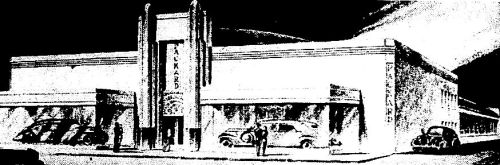
packard_ross_rendering_1939

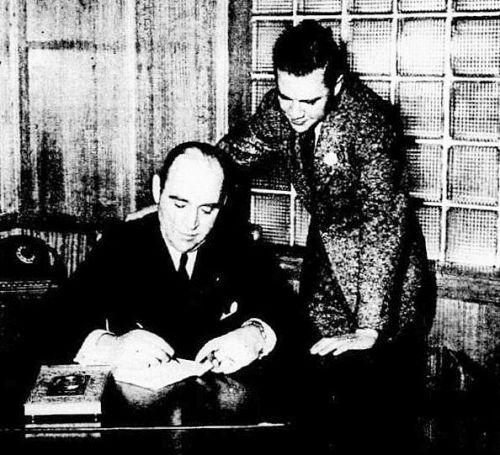
The attractive art deco building, faced with Cordova limestone and decorated with glass bricks, cast aluminum letters, and neon, was designed by J. A. Pitzinger and Roy E. Lane Associates, and was constructed at 2222 Ross Avenue in a mere three months. The large building was right across the street from the Cathedral of the Sacred Heart, in the block bounded by Ross, Crockett, San Jacinto, and N. Pearl. The president of Packard-Dallas was J. A. Eisele and the secretary-treasurer was his son, Horace. The grand opening on Dec. 16, 1939 was a big enough deal that the home-office Detroit honchos flew in, and there was even a 15-minute radio program devoted to it on KRLD.

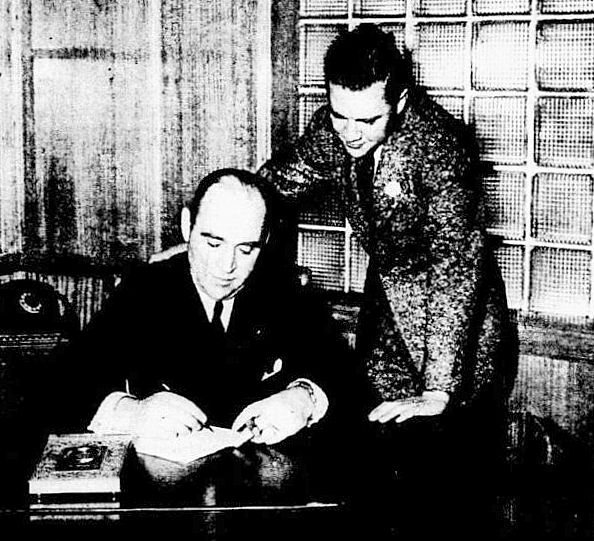
Under the headline “Growing With Dallas,” the opening-day ad featured a photograph of Joe and Horace Eisele and “A Message of Appreciation and an Invitation”:
packard_dmn_121639_ad1

packard_dmn_121639_ad2Ad, Dec. 16, 1939 (click for larger image)

“It’s Texanic!”

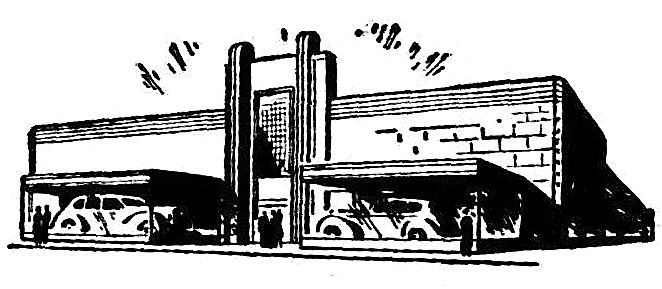
And another ad featured this nifty little line drawing of the cool building:
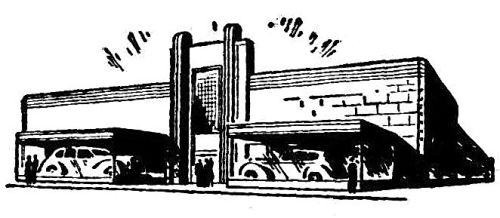
packard_dmn_121639-drawing-detDec. 16, 1939 (ad detail)

One of the stories about the opening of Dallas’ new auto showroom palace boasted that this big, beautiful, brash building was here to stay — Packard-Dallas had a 15-year lease on the place. …Which is why it was surprising to read that the building was sold less than two years later.

The U.S. was on the inevitable brink of involvement in the European war, and the National Defense School had begun operation in Dallas in July 1940. After a year of classes in which young men were taught “to do the technical and mechanical work necessary to warfare” (DMN, March 20, 1941), classrooms at the Technical high school and at Fair Park were bursting at the seams, and a larger facility was necessary. The Dallas Board of Education (which oversaw the program, often called “the War School”), was given the go-ahead to purchase the building (and, presumably, the property) for $125,000 in August 1941.

I’m not sure why J. A. Eisele sold the building (his name was listed as owner, rather than the Packard Company) — it wasn’t even two years old, and he got only half of what it cost to build. Patriotism? His son Horace had been drafted in April, so … maybe. Eisele seems to have left the auto sales business, which he had been in for decades, and had moved out of Texas by 1945.

After the U.S. officially entered the war and it became obvious that “defense schools” around the country would have to admit women in order to maintain manufacturing quotas, women began to work beside men at the Ross Avenue school in January 1942.

Eighty women Saturday pulled their fingers against the triggers of aircraft rivet guns as the Dallas National Defense School, 2222 Ross Avenue, started the state’s first major training course designed to place women side by side with men in Texas war materials plants. (DMN, Jan. 4, 1942)
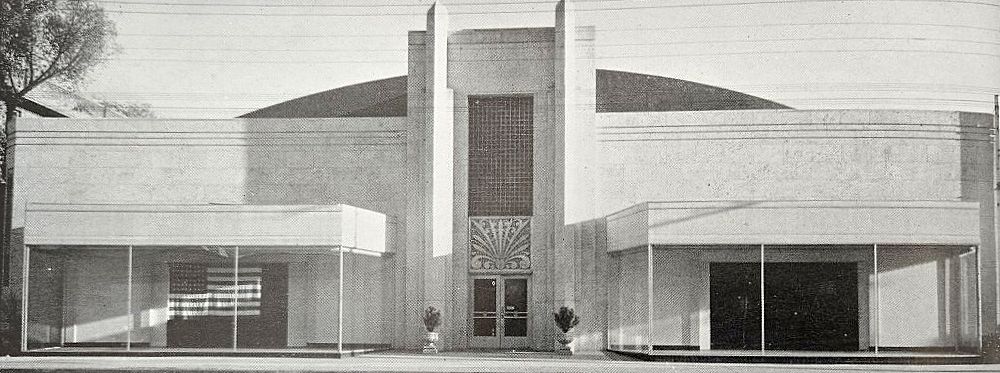
packard_ross-avenue_war-school_young-america-in-dallas_1942_DPL
1942

This “War School” was a training school for war-time jobs at places like North American Aviation.
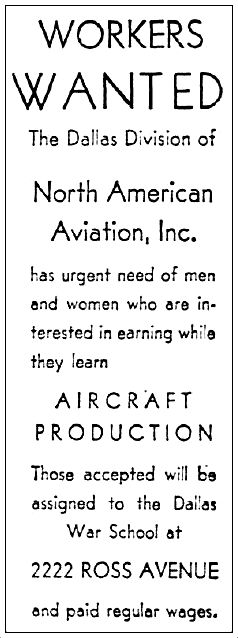
defense-school_dmn_090643Sept. 1943

Thousands of men and women trained at the Ross Avenue facility until the war ended in 1945. The school continued, but no longer as a Defense School — it became Dallas Vocational School, and its first students were veterans.

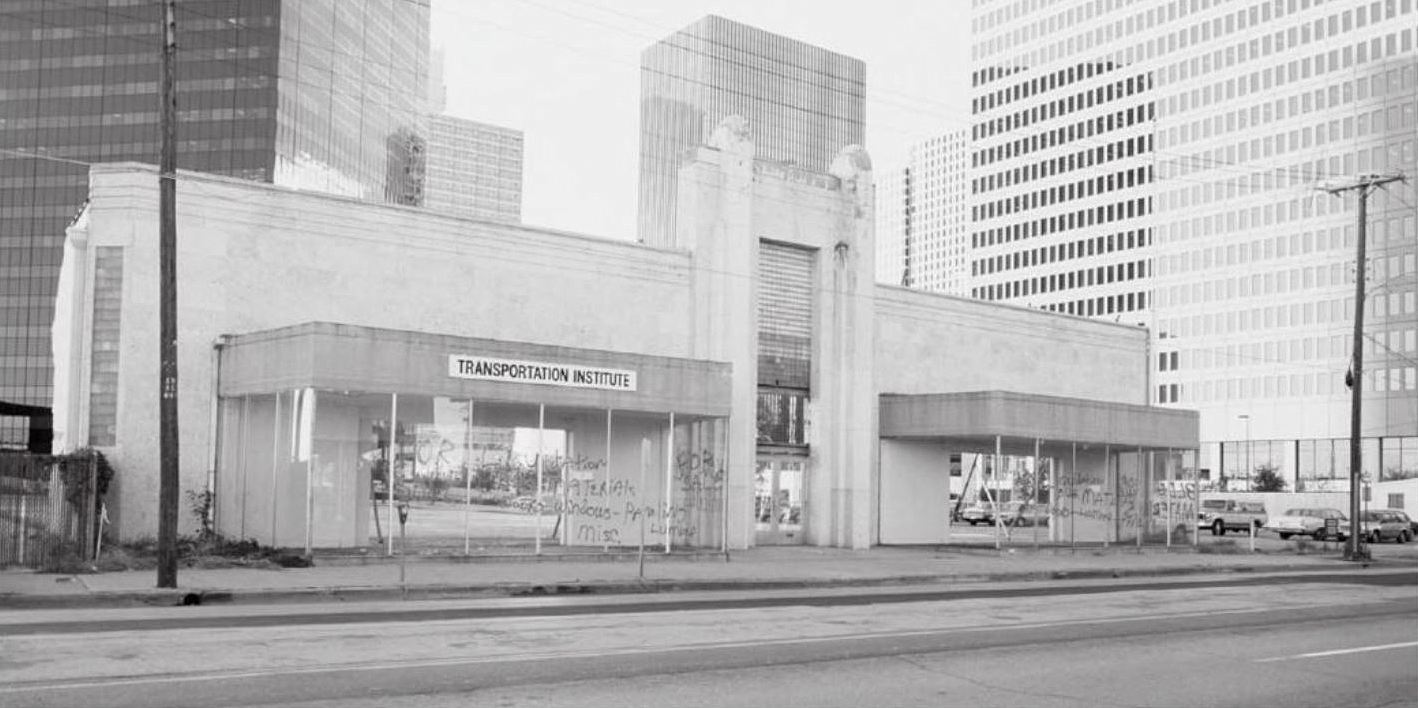
In 1976, the school was designated as one of the Dallas Independent School District’s magnet schools — it became the Transportation Institute, where “students interested in owning their own dealership, becoming a technician-mechanic or an auto body specialist will receive on the spot training in a laboratory consisting of a new car showroom, a modernly equipped repair center and a complete auto rebuilding facility” (DMN, Aug. 22, 1976). Back to its roots! And it only took 37 years.

The school continued for a while but, inevitably, the property became more and more attractive to developers. In 1981, as the developers were circling, a City Landmark Designation Eligibility List was issued. It contained buildings which had “particular architectural, historical, cultural and/or other significance to the City of Dallas,” and, if approved, were eligible to receive historic landmark designation. I’m guessing 2222 Ross Avenue didn’t make the cut, because Trammell Crow bought the building in 1983 and tore it down the next year.
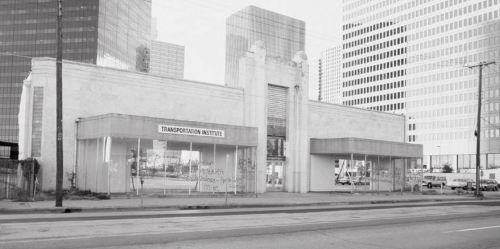
transportation-institute_lost-dallas_dotyvia Lost Dallas by Mark Doty

But … Crow sold the facade to real estate developer and investor Lou Reese, who said that he would reassemble the limestone facade and incorporate it into a restaurant he planned to build in Deep Ellum. That was an interesting plan. (Incidentally, in the same city council meeting in which the demolition/disassembling of the building’s facade was discussed, the council also considered “a request for more than $7 million in federal funds for a project to renovate the Adams Hat Co building into apartments” (DMN, Aug. 8, 1984). …Lou Reese owned the Adams Hat building. What a coincidence!)

The city council’s decision?

The council authorized developer Trammell Crow to disassemble the art deco facade of the former Transportation Institute Magnet High School on the condition that the facade be reconstructed in Deep Ellum…. The company [has] demolished all but the building’s limestone facade, which was determined to be eligible for designation as an historic landmark. (DMN, Aug. 9, 1984)

So? Where’s that facade? There was no mention of it for three years, until an article in the Morning News about another developer who had big plans for a major Deep Ellum complex called “Near Ellum,” which would be bounded by Commerce, Crowdus, Taylor, and Henry streets.

Highlighting Near Ellum will be a 40-foot art deco facade, formerly on the front of the Transportation Institute on Ross Avenue, in the main parking plaza. The plaza will also include an outdoor stage for concerts and special events. (“Developer Plans Deep Ellum Project,” DMN, June 25, 1987)

Aaaaaaaaaaaaaaaand … that never happened. I wonder if that 76-year-old disassembled limestone facade is still crated up somewhere around town. Somehow I doubt it.

So, 2222 Ross Avenue. What’s there now? None other than the 55-story skyscraper, Chase Tower, also known as “The Keyhole Building.”

You could get a lotta Packards in there.

***

Sources & Notes

Top photo from the Detroit Public Library’s Packard Collection in the National Automotive History Collection, viewable here; I’ve straightened and cropped it. The reverse has this notation: “Packard Motor Car Co., branches/dealerships/agencies, 2300 [sic] Ross Avenue Dallas, Texas, exterior, show windows left to right; 1940 Packard 110 or 120, eighteenth series, model 1800 or 1801, 6/8-cylinder, 100-120-horsepower, 122/127-inch wheelbase, convertible coupe (body type #1389/1399), special furniture display.”

1942 photo of the building is from a publication called “Young America in Dallas,” Dallas History and Archives, Dallas Public Library.

The developer who apparently came into possession of the facade after Lou Reese was Ed Sherrill. Perhaps someone associated with the Near Ellum project might know what became of the “saved” facade.

Chase Tower info on Wikipedia here; photo of it here. Imagine a teeny-tiny car dealership at its base.

Packard automobiles? Some of them were pretty cool. Check ’em out here.

A lengthy article on the notorious developer Lou Reese — “Hide and Seek” by Thomas Korosec (Dallas Observer, June 8, 2000) — is here.

*

Copyright © 2015 Paula Bosse. All Rights Reserved.

The Allen Street Taxi Company

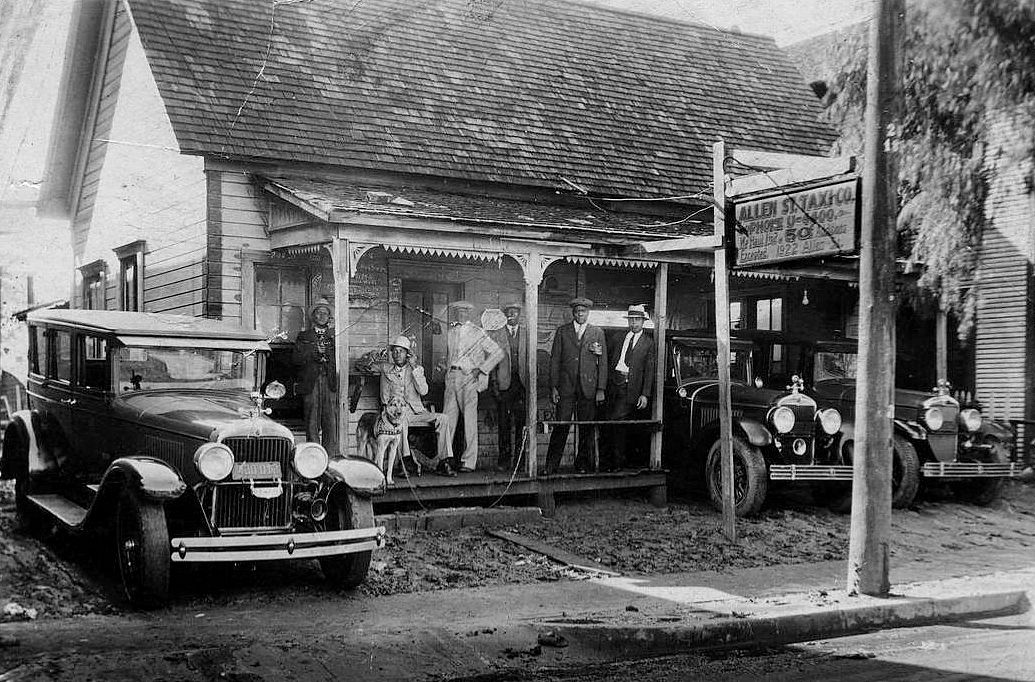
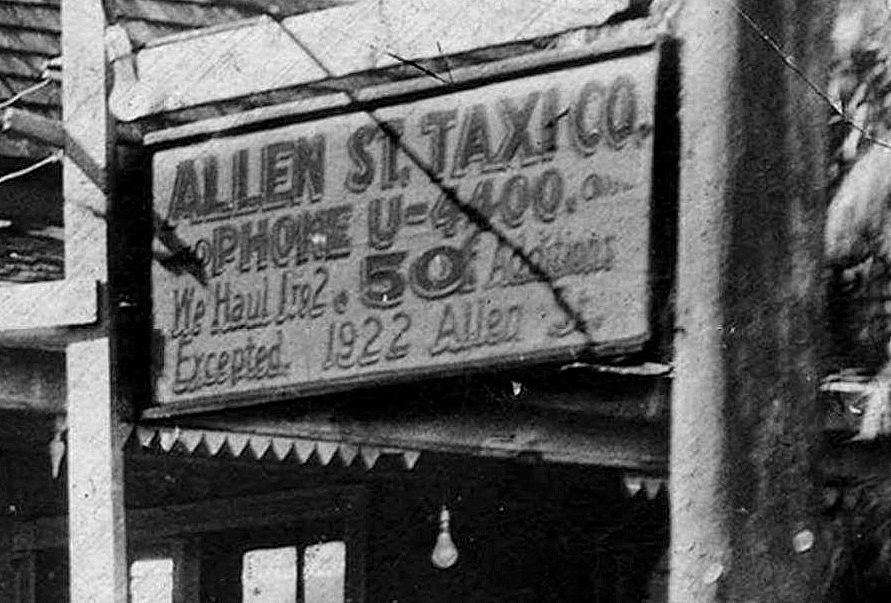
allen-st-taxi-co_cook-degolyerAllen St. Taxi Co. / George W. Cook Collection, SMU

by Paula Bosse

This has to be one of my favorite “unknown Dallas” photographs that I’ve come across. It shows the Allen St. Taxi Co. — in the State-Thomas area — at 1922 Allen Street (now pretty much vacant land under the Woodall Rodgers freeway). My ability to date cars is not good, but from city directory information, it seems that this photo might date from somewhere between the mid-1920s to around 1930. The owners/proprietors of the company were listed as John Leonard and Andrew Short in the 1929 telephone book. I wonder if they are in this fantastic photo? Let’s look a little more closely at some of the details. (All pictures larger when clicked.)

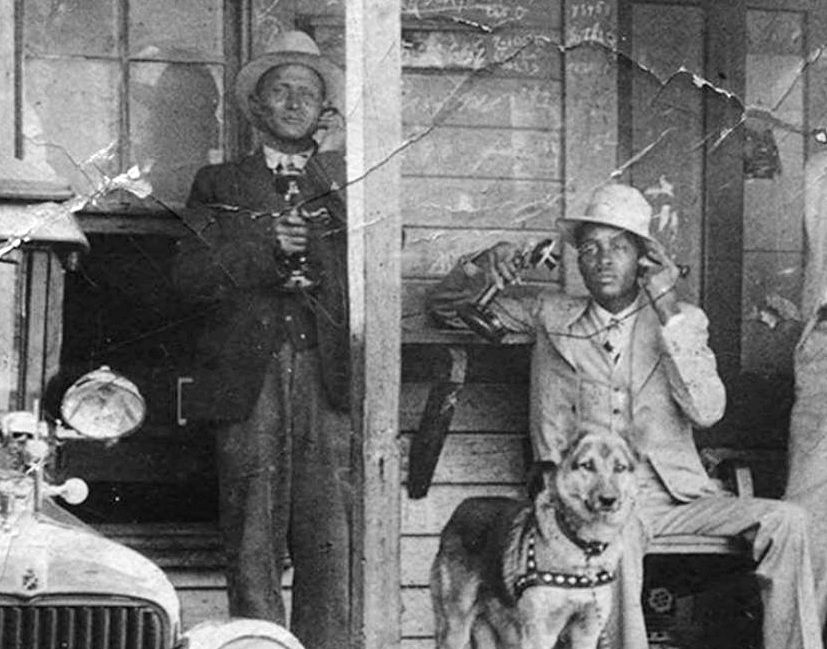
allen-st-taxi-co_cook-degolyer_det2Those phones!

allen-st-taxi-co_cook-degolyer-det4I love these guys. All business.

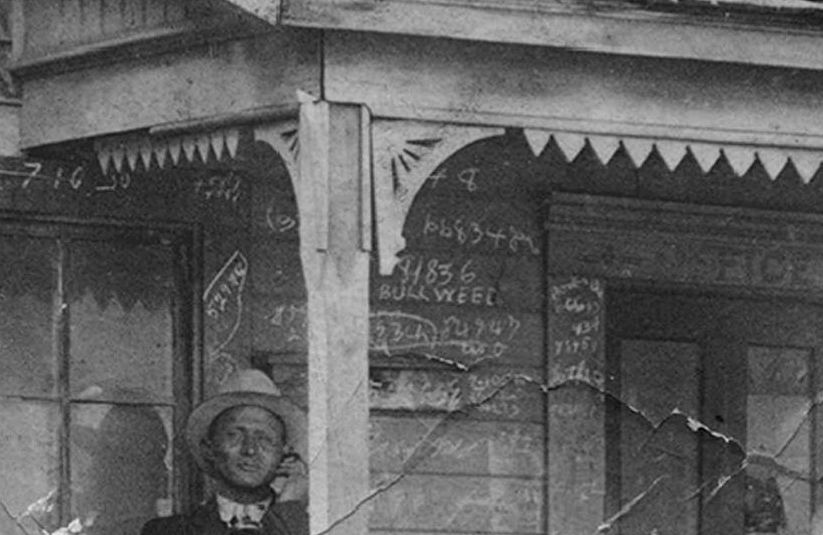
allen-st-taxi-co_cook-degolyer_det5“Bullweed.” What is all this writing? I love the guy’s face looking out of the window.

allen-st-taxi-co_cook-degolyer_det1“Dallas.” Car-people know exactly what make and model this vehicle is. …I am not one of these people.

allen-st-taxi-co_cook-degolyer_det3

***

Sources & Notes

Top photo, titled “Allen Street Taxi Co.,” is from the George W. Cook Dallas/Texas Image Collection, DeGolyer Library, Central University Libraries, Southern Methodist University; it can be viewed here.

The first “official” listing of the Allen St. Taxi Co. was in the 1929 city directory. The address at that time (which usually reflected information supplied the previous year) was 1907 Allen St. It didn’t appear again in the directory until 1932 when it was listed at 2816 Juliette St. In 1933 and 1934 it was listed at 2114 Hall St. In 1936 and 1937 it had moved to 2217 Hugo. And in 1938, the taxi part of the business seems to have fallen by the wayside, and it became Allen St. Transfer.

In 1925 there were only three official cab companies listed in the city directory. But the rough-and-tumble world of taxi cab service in the unregulated ’20s and ’30s was pretty intense. There were a lot of unlicensed jitneys rolling around town, especially, one would assume, in the segregated black neighborhoods of the city unlikely to be served by white-owned companies. My guess is that this might have been how the Allen St. Taxi Co. began.

For more on the go-go-go competitive world of taxi service at this time, see my previous post, “Washington Taxi Company: ‘Call George!'” here.

*

Copyright © 2015 Paula Bosse. All Rights Reserved.
The Interurban Parlor Car: Perusing the News in Comfy Chairs

interurban-interior_tx-historian_jan81(Click for larger image)

by Paula Bosse

The height of comfort!

You know this photo was taken for promotional purposes, because none of the men has a reeking cigar clenched between his teeth.

***

Texas Electric Railway Interurban ad reprinted in Texas Historian, Jan. 1981.

Interurbans were great. I wish we still had them. Read about what they were, here.

*

Copyright © 2015 Paula Bosse. All Rights Reserved.

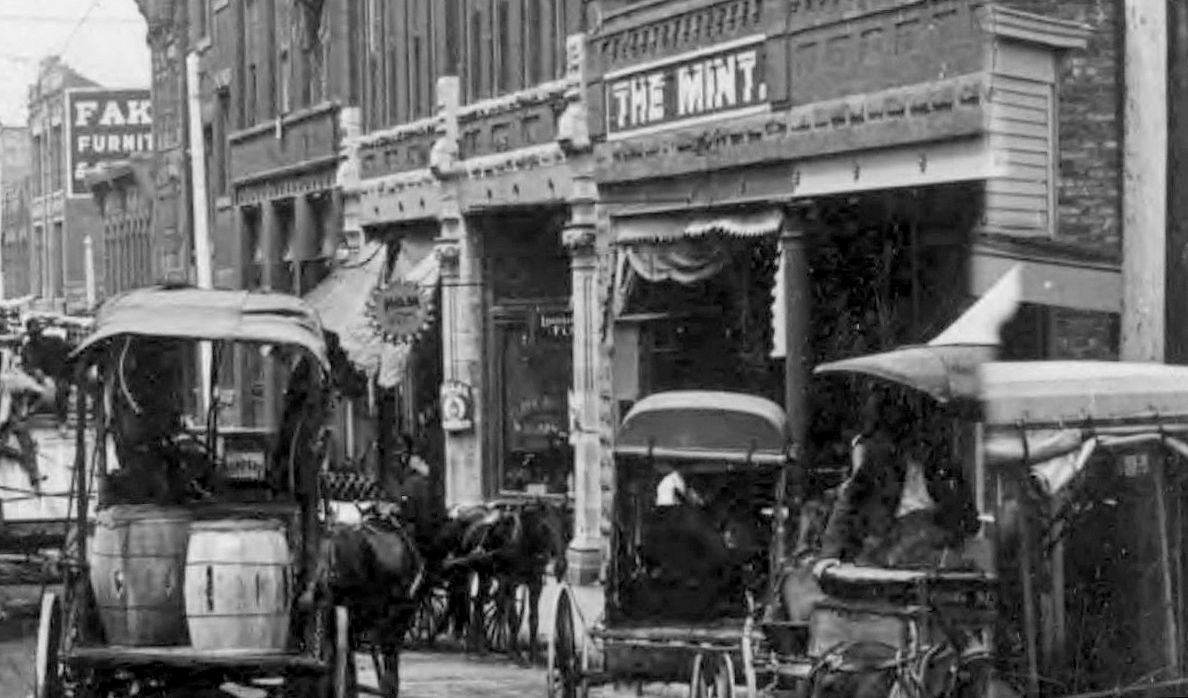
“Everyday Life” on Elm Street — ca. 1905

elm-street_everyday-life_UCR-smallElm Street rush hour

by Paula Bosse

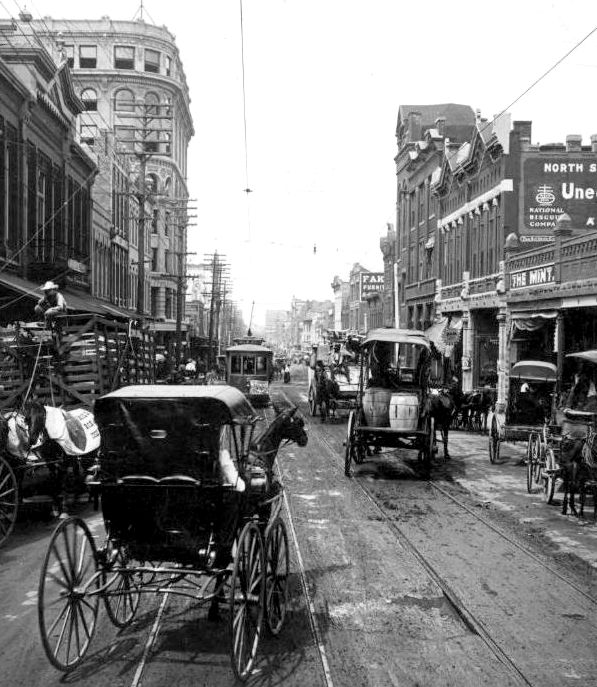
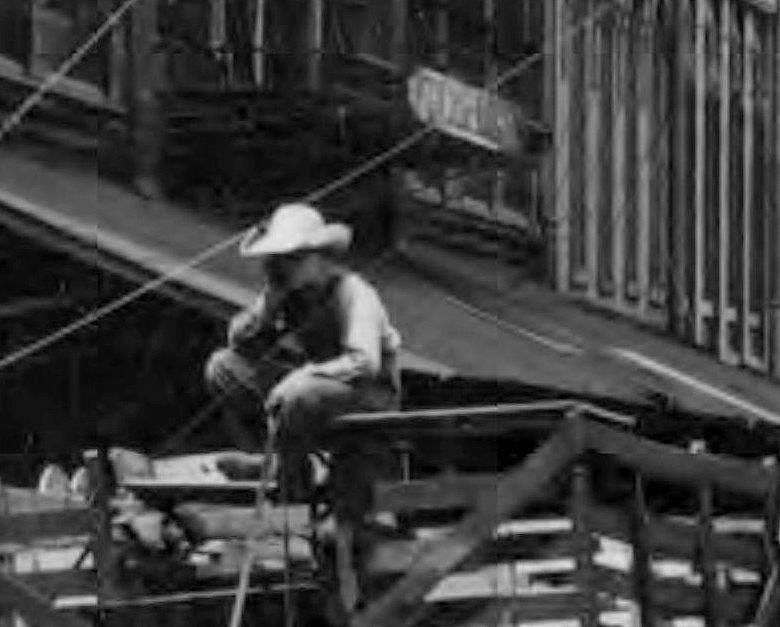
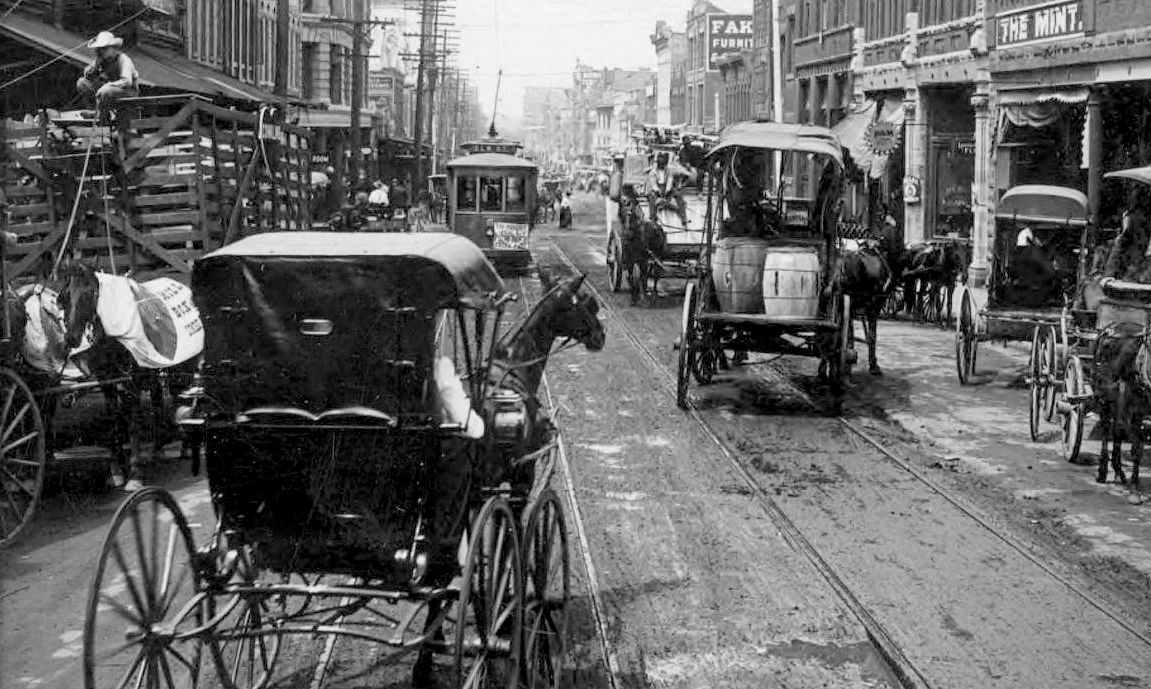
Automobiles would be rolling down Elm Street very soon, but even when the traffic was still mostly horse-related, there’s a lot going on here: horses, buggies, barrels, saloons, a bored kid on a wagon, a street car, and the Wilson Building.

elm-st_everyday-life_UCR-det

elm-st_everyday-life_UCR-zoom(click for larger images)

And what was The Mint? The Mint was a saloon. I’m not sure when it first set up shop in Dallas, but it was listed in an 1877 directory, one of the city’s earliest.

elm-st_everyday-life_mint_UCR

Speaking of 1877, read about a typical frontier day at The Mint in two accounts of a stabbing, from The Dallas Herald in April, 1877, here, and the follow-up, here.

***

Sources & Notes

Photo is from a stereograph titled “Everyday Life, Elm Street, Dallas, Tex.” from the Keystone-Mast Collection, UCR/California Museum of Photography, University of California at Riverside; it can be accessed here.

Images larger when clicked.

*

Copyright © 2015 Paula Bosse. All Rights Reserved.

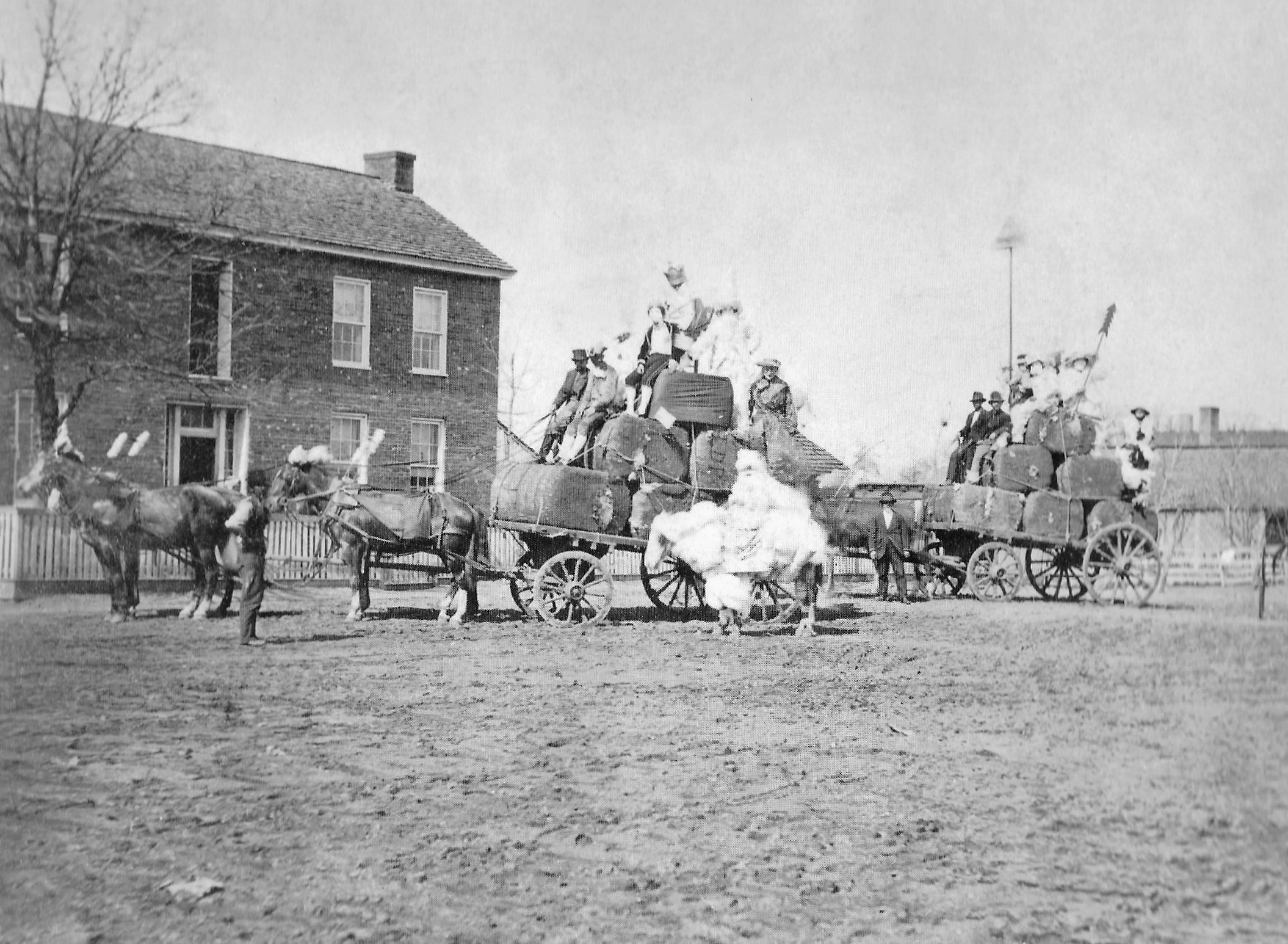
Mardi Gras: “Our First Attempt at a Carnival Fete” — 1876

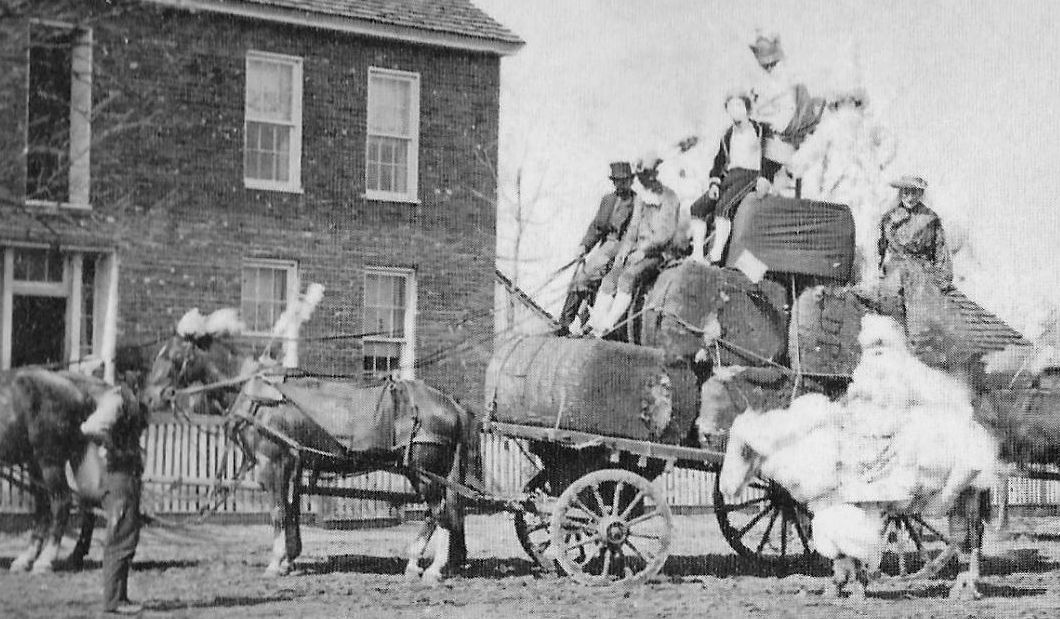
mardi-gras_dhs_1876When cotton was Rex (click for much larger image)

by Paula Bosse

In the 1870s, if a Dallas resident wanted to celebrate the glitzy revelry of Mardi Gras with a parade and balls and didn’t want to travel all the way to New Orleans, the place to go was Galveston. Galveston had a lock on Texas Mardi Gras galas. But Dallas being Dallas, there were soon plans to stage a massive Carnival right here. The day-long celebration debuted on February 24, 1876, which, oddly, was on a Thursday. (Mardi Gras that year was actually on Tuesday, Feb. 29, and it was probably celebrated early in Dallas so as not to interfere with the hey-we-got-here-first celebrations in New Orleans and Galveston.)

It was estimated that the festivities cost the city more than $20,000 (which, if the Inflation Calculator is to be believed, would be the equivalent of almost $450,000 in today’s money). The city was cleaned up in preparation for the anticipated onslaught of visitors and was decorated with flags and bunting along the lengthy parade route of Main, Elm, and Commerce streets. Revelers had elaborate costumes made for the processions and the grand masked balls, some with fabric imported for the occasion from France

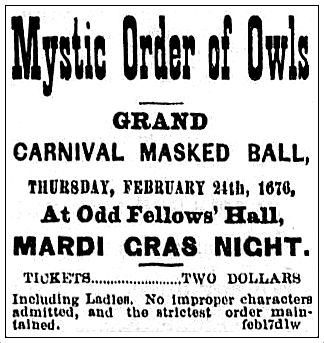
mardi-gras_dal-herald_021876Dallas Herald, Feb. 18, 1876 (not 1676!)
The Dallas Herald and The Dallas Commercial were incessant in their whipping up of excitement for the big day. And it worked. People streamed into town from all over Texas. Hotels were packed, and it was estimated that over 20,000 spectators watched one or both of the day’s parades.

The following day, The Dallas Herald apparently devoted their entire front page to coverage of the event, under this wordy headline:

A Day in Dallas, Our First Attempt at a Carnival Fete. The City Aglow with Enthusiasm and Wild with Rollicking Revelry. Visit of King Momus — His Cordial Reception by the People — The Procession in His Honor. The Season of Merry-Making Brought to a Happy Close with Balls and Bouts — Well Done, Dallas!

(Sadly, this issue is not available online, perhaps because there were none found to scan as it sold out more than five editions and was probably the paper’s best-selling edition to-date.)

Dallas’ first Mardi Gras had been an unqualified triumph, and newspaper editors and city leaders were beside themselves with joy. The parade — and the city — had been covered enthusiastically and favorably by newspapers around the country, and the success of the huge celebration was seen as having been better advertising for the exuberant and growing city than could ever have been hoped.

Galveston? Pffft!

**

A few tidbits from that first Mardi Gras.

There were very few “incidents” reported surrounding the festivities. That’s not to say there weren’t a lot of incidents that occurred that day, just that not a lot of them found their way into the newspapers (apparently whiskey was free-flowing all day long, and one suspects there were “incidents” aplenty connected with that). Among the very few non-“jolly” things that happened on Carnival Day and the day following included the following:

  • A small boy had been run over by a carriage (“but not dangerously hurt”)
  • A child and a horse had been burned severely when a can of gasoline was thrown into a bonfire “to increase the flame”
  • A member of the Stonewall Greys who had participated in the noontime parade had fallen whilst “foolishly scuffling” and had “received a slight but painful wound from a bayonet”

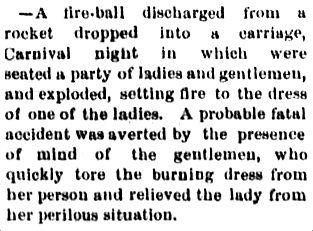
Also, there was some sort of “fireball discharged from a rocket” which caused some consternation:

fireball_dal-herald_022676Dallas Herald, Feb. 26, 1876

*

All residences and businesses along the parade route during the evening procession were “commanded” to be illuminated. Even if gasoline-fueled bonfires were raging along the parade route, the elaborate procession was probably poorly lit.

*

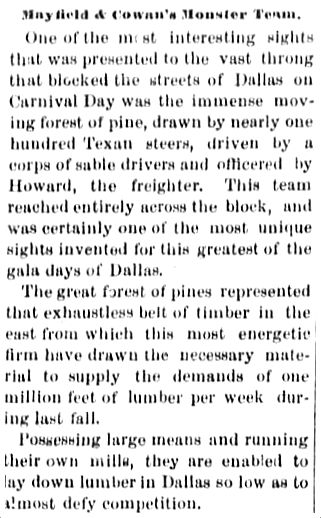
My favorite “float” was the huge wagon of lumber meant to draw attention to East Texas timber and the thriving lumber industry in Dallas. One report said “the immense moving forest of pine” was drawn by “32 yoke of oxen” — another said “nearly 100 Texan steers.” Whatever it was, that must have been spectacular to see.

oxen-team_dal-herald_022676Dallas Herald, Feb. 26, 1876

*

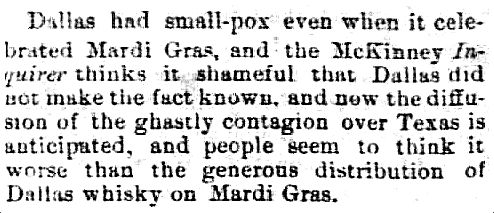
The massive amount of publicity and praise that Dallas received quite clearly irked other cities. Austin seemed especially perturbed. There had been a small outbreak of smallpox in McKinney preceding the big day, and several digs at Dallas (like the one below) appeared in newspapers around Texas, accusing the city’s leaders of knowingly endangering the welfare of the entire state just so they could put on their little parade. The exaggerated furor passed fairly quickly, and the het-up schadenfreude expressed by rival cities was amusing.

small-pox_austin-weekly-standard_031676Austin Weekly Standard, Mar. 16, 1876
*

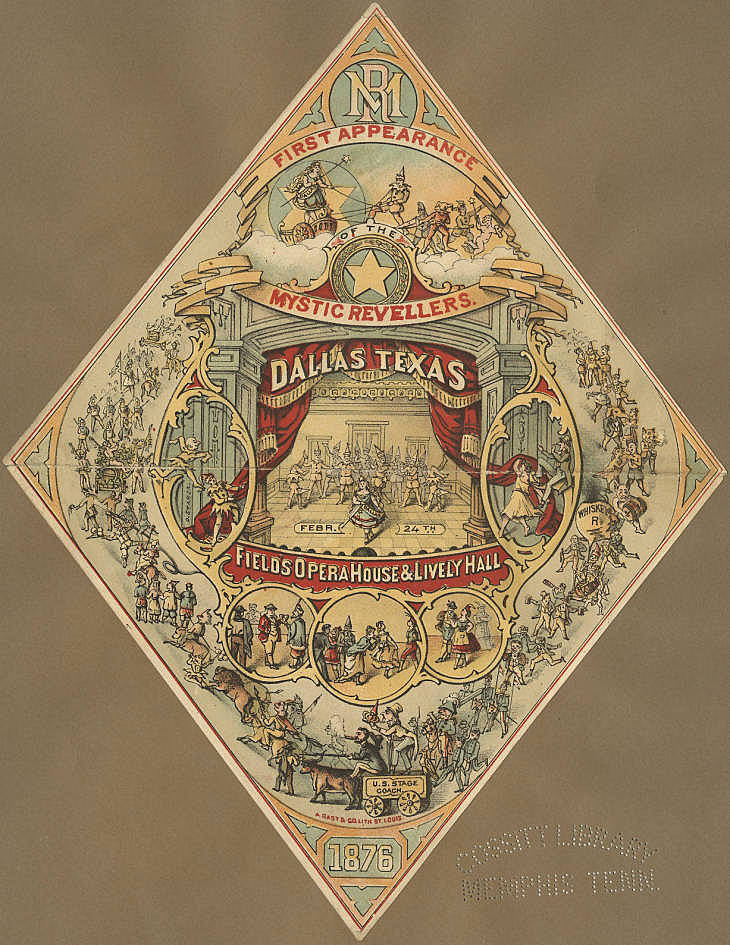
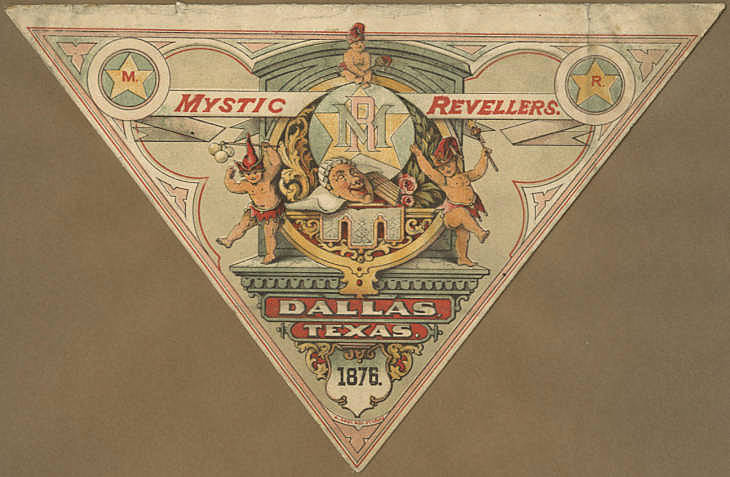
An invitation issued by the Mystic Revellers:

mardi-gras_mystic-revellers_invitation_1876_memphis-public-library

mardi-gras_mystic-revellers_1876_envelope_memphis-public-libraryColton Greene Collection, Memphis Public Libraries

*

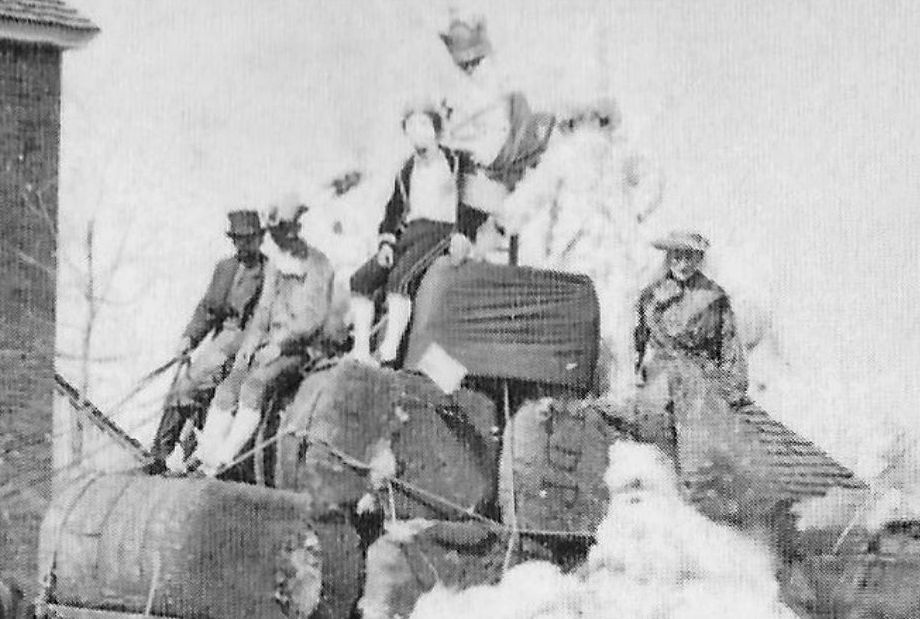
The photo at the top shows the parade wagons representing the brand new Dallas Cotton Exchange (which seems to have been organized the previous month). As described in The Galveston Daily News, the Cotton Exchange’s offering “represent[ed] King Cotton enthroned on six bales of cotton, with numerous subjects appropriately costumed, and occupying two cars” (Feb. 25, 1876). Below are a couple of magnified details of the photo. I’m not sure, but it looks as if the horse and rider in the foreground are covered with cotton. Like tarring and feathering … but fun … and with cotton. The King of Cotton is surrounded by what look like henchmen. The masked man on the right in the elaborate costume is both cool and kind of creepy. (Click both photos for larger images.)

mardi-gras_1876-det1

mardi-gras_1876-det2

***

Sources & Notes

Top photo appeared in the book Historic Photos of Dallas by Michael V. Hazel (Nashville: Turner Publishing Co., 2006); photo from the Dallas Historical Society.

Newspaper clippings as noted.

To read the coverage of Dallas’ Mardi Gras parades and balls —  “a grand pageant and general jollification” — see the front page of The Galveston Daily News (Feb. 25, 1876), here (third column, top of page — zoom controls are on the left side of page).

I wrote a previous post called “Mardi  Gras Parade in Dallas — ca. 1876” which features a photograph which might be from this first Mardi Gras. That post and photo can be seen here.

Happy Mardi Gras!

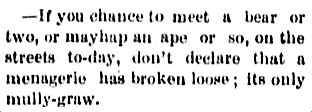
mully-graw_dal-herald_022476Dallas Herald, Feb. 24, 1876

Photos larger when clicked.

*

Copyright © 2015 Paula Bosse. All Rights Reserved.

Views From a Passing Train — 1902

edmunds_pacific-bryan_free-lib-phil_1902Pacific, looking west toward Bryan, 1902 (click for larger image)

by Paula Bosse

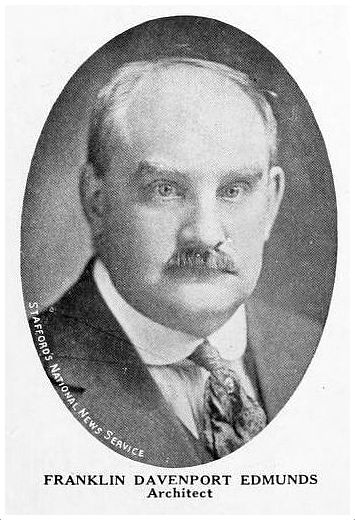
Franklin Davenport Edmunds (1874-1948) was a Philadelphia architect whose hobbies were travel and photography. A 1902 train trip to Mexico took him through Texas, during which there as a blink-and-you’ll-miss-it stop in Dallas.

edmunds_whos-who-philadelphia_1920Who’s Who in Philadelphia, 1920

On the way to Mexico, he stopped in St. Louis for a while (where he took several photos on Feb. 12), passed through Arkansas (on Feb. 13), apparently saw very little of Dallas as he rolled through, and then took a lot of photos when he reached San Antonio (by Feb. 14). He then continued on to a vacation of at least two or three weeks in Mexico, where his camera was never far from his side.

The two photos that were taken as he passed through Dallas (which I’m assuming were snapped from the train) were probably taken on Feb. 13 or 14, 1902.

The location of the photo above is not noted, but it appears to be Pacific Avenue looking west. Peter S. Borich’s sign-painting business was on the northeast “corner” of Bryan and Pacific (at the point of the diagonal intersection). The photo shows the back and side of his building. It’s hard to see them, but there is a wagon with a team of horses at the Bryan St. intersection. Behind Borich’s is a blacksmith shop, and across the street, there are several furniture stores. Straight ahead is an almost mirage-like smoke-spewing locomotive heading toward the camera. (Unless Edmunds was standing in the middle of Pacific, I’m guessing he was taking the photo from the rear of the train.)

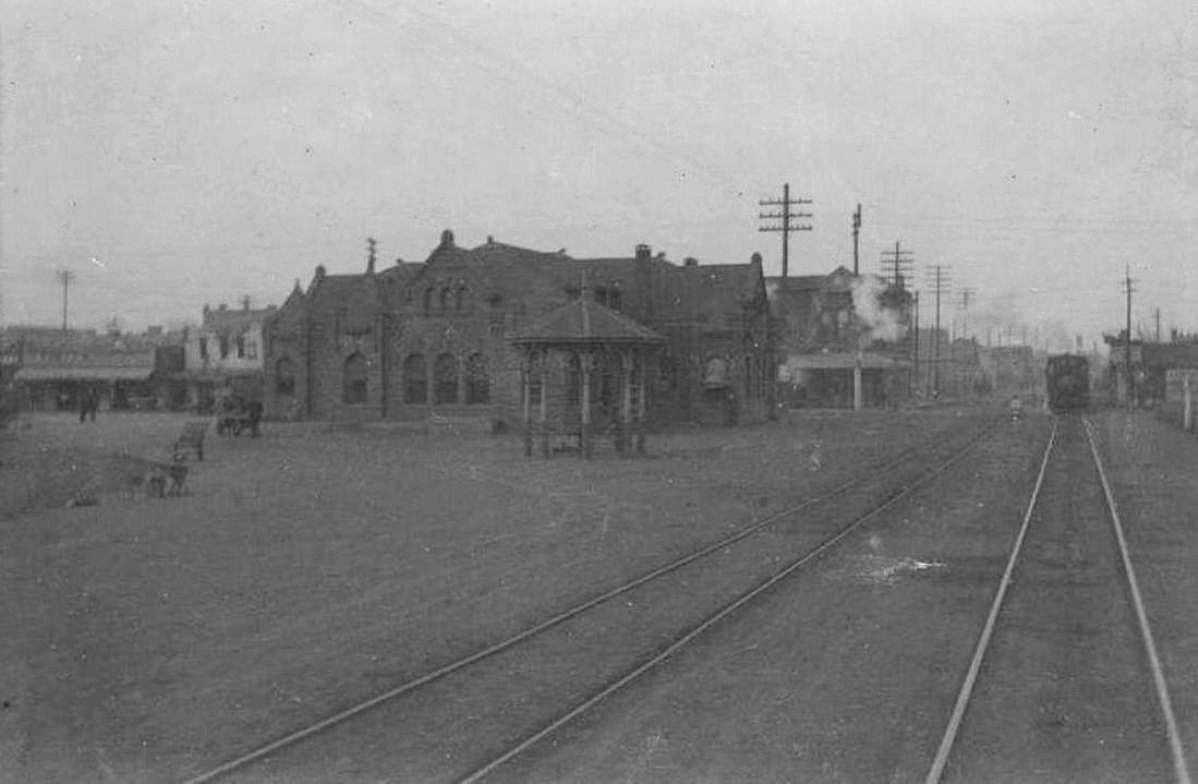
Seconds later, the train would have pulled into the old Union Depot (located about where Pacific would cross present-day Central Expressway).

edmunds_old-union-stn_free-lib-phil_1902(click for larger image)

Even though not identified in the photo description, the distinctive old Union Depot is instantly recognizable (an unrelated photo taken from about the same spot can be seen in this one from the George W. Cook collection at SMU’s DeGolyer Library). Again, the photo appears to have been taken from the train.

Edmunds took a ton of photos on this trip, but, sadly, he seems to have merely passed through Dallas without wandering around to explore its streets (which I would think would be interesting — if not downright exotic — to a Philadelphia architect) — I’m not sure he even got off the train to stretch his legs! But I’ve never seen these two photos, and they’re pretty cool. So, thanks, Frank — you should have hung around a little longer.

***

Both photos by Franklin Davenport Edmunds are from the Free Library of Philadelphia. The Pacific Avenue photo can be accessed here; the Union Depot photo, here. Other photos he took in Texas during the 1902 trip (and a few from a previous 1899 trip) can be viewed here.

A biography of Edmunds can be read at PhiladelphiaBuildings.org here.

A detail from the 1905 Sanborn map showing the businesses located at Pacific and Bryan, with Borich’s business circled in red and the camera’s vantage point in blue, can be seen here.

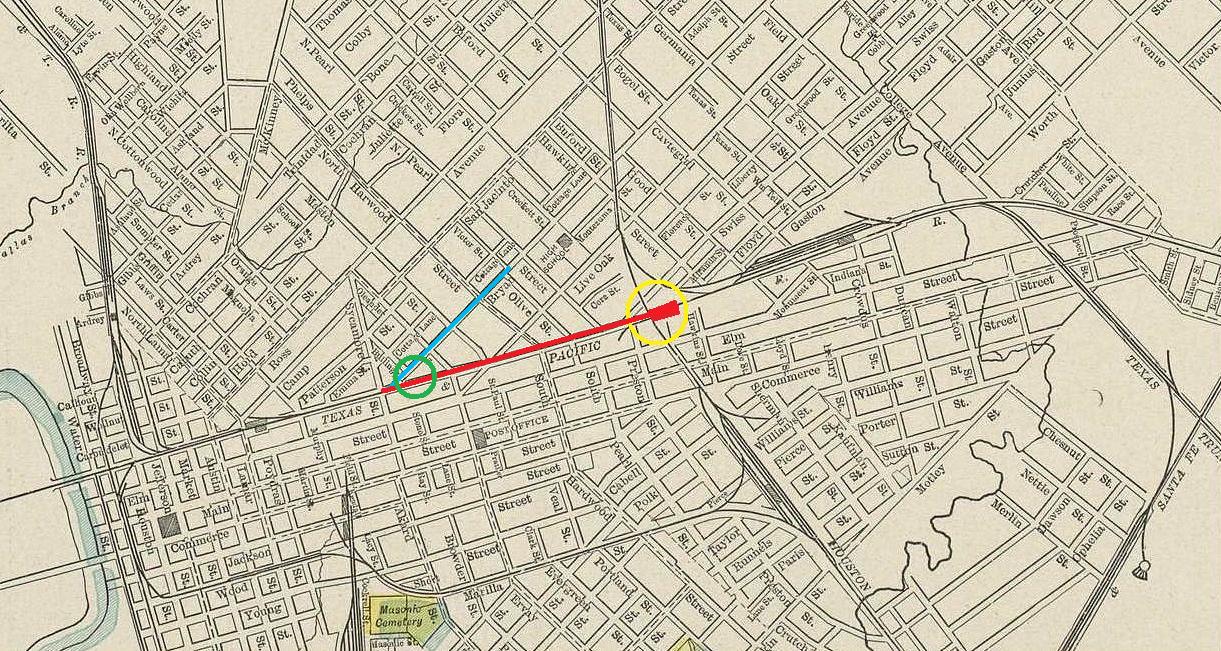
Below, a detail from a map (circa 1890-1900), showing the locations of the two photos, with the Pacific Ave. location circled in green and the Union Depot location in yellow.

dallas-map_ca1900(click for larger image)

And, lastly, a present-day image showing the same view as the top photo (from Google Street View).

pacific-bryan_google

My previous post, “The Old Union Depot in East Dallas: 1897-1935” — a history of the station with several photos — can be found here.

Images larger when clicked.

*

Copyright © 2015 Paula Bosse. All Rights Reserved.

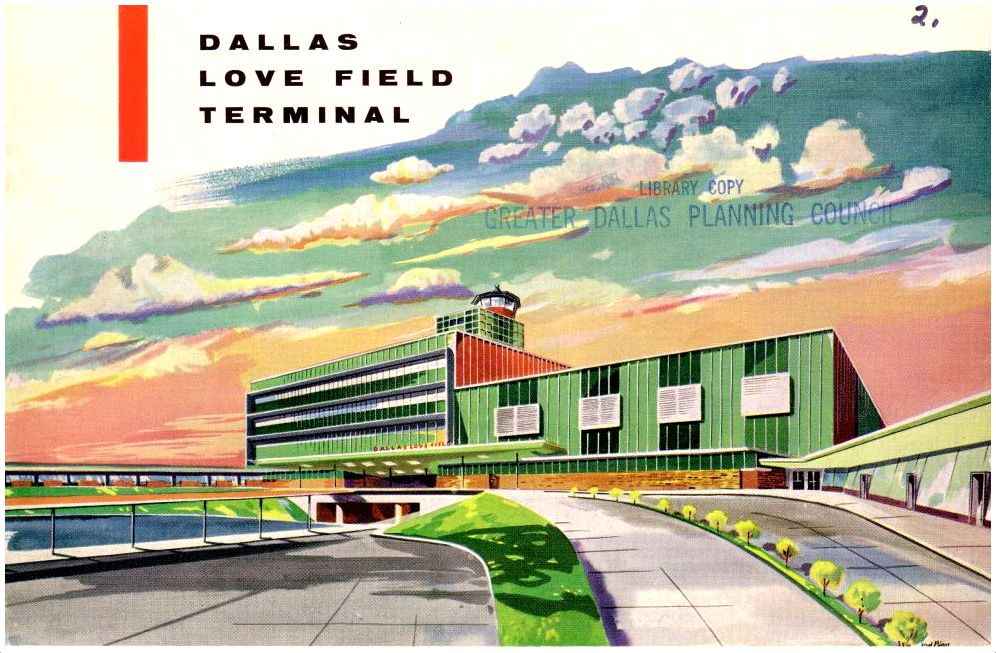
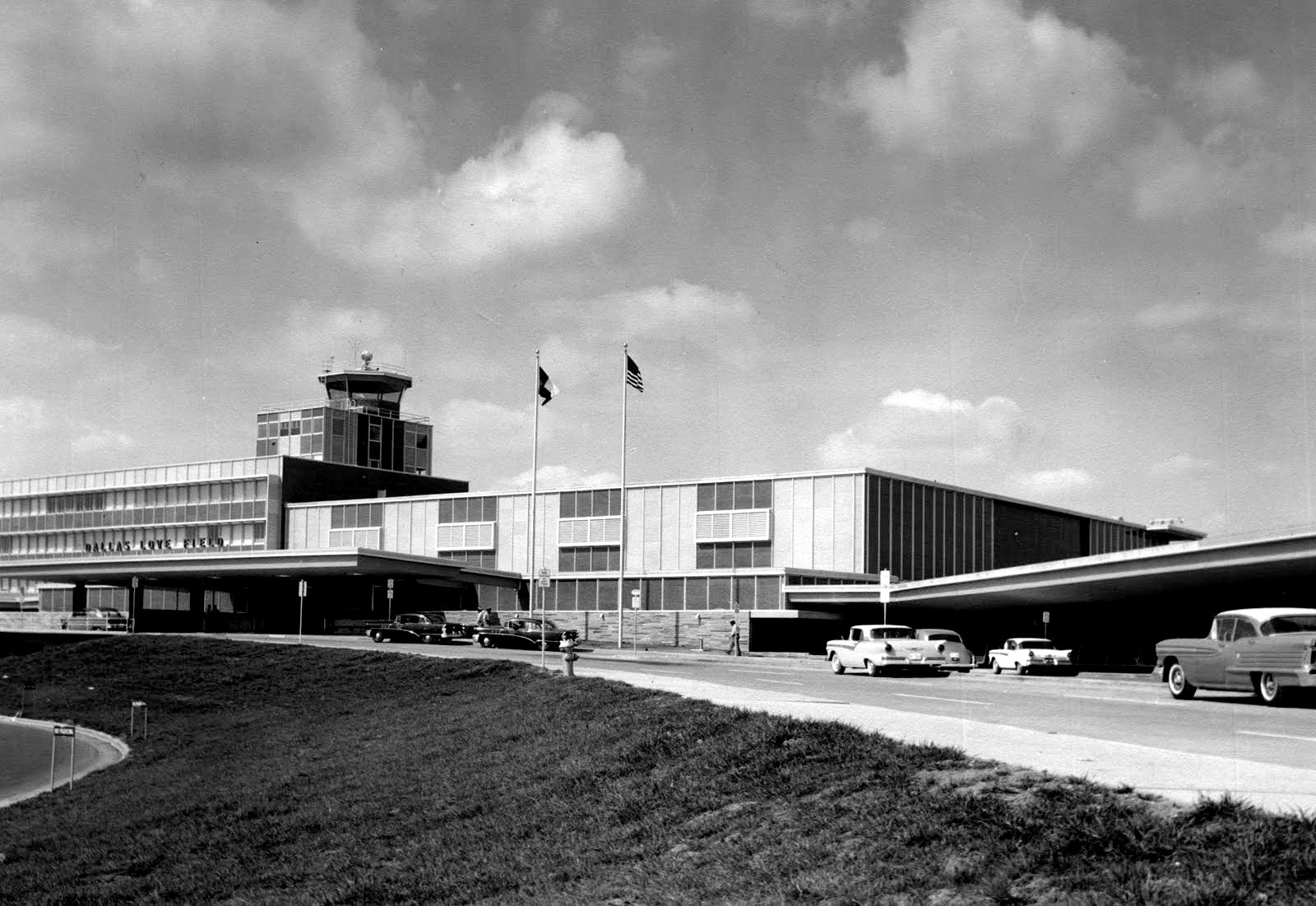
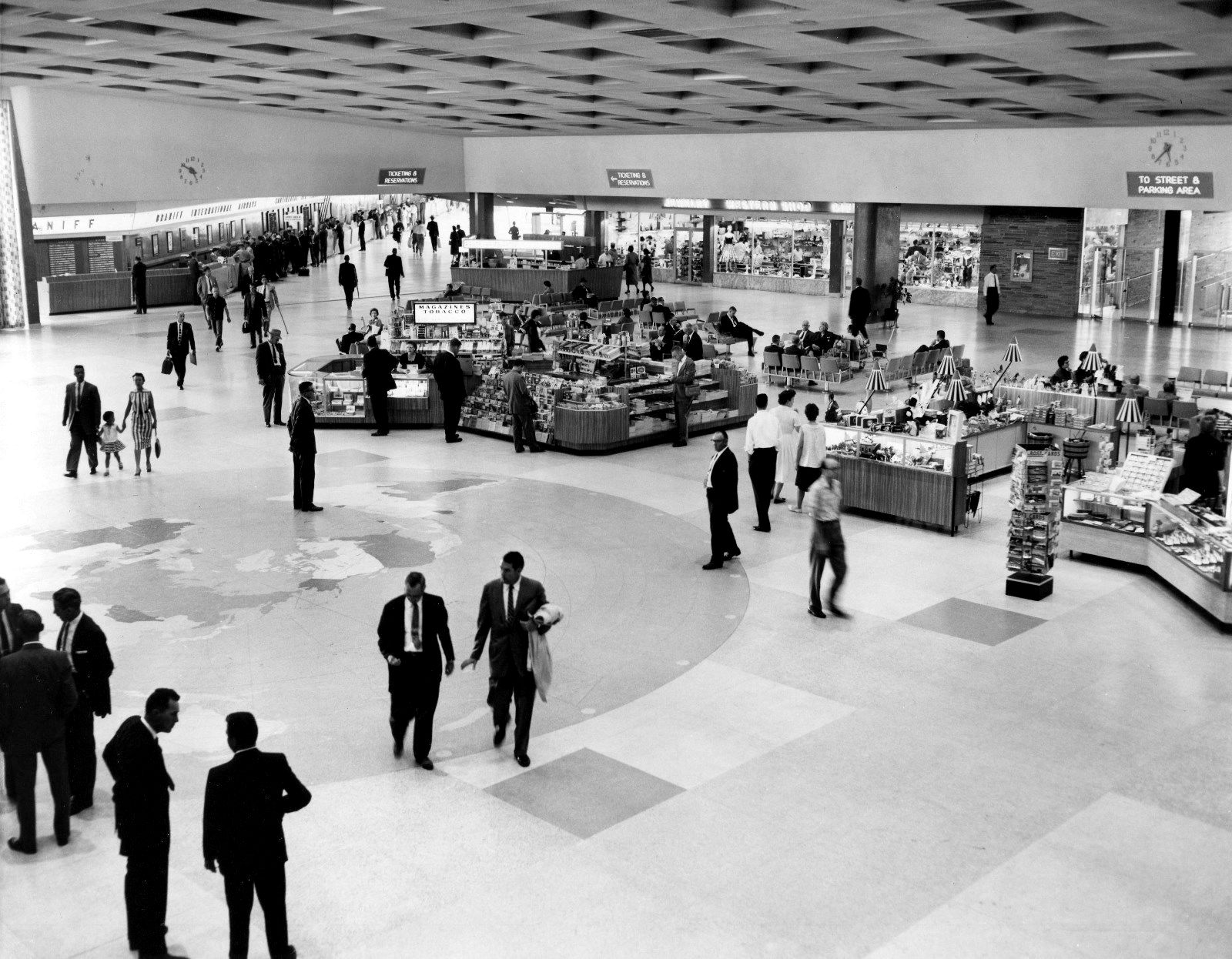
Love Field, The Super-Cool 1950s Era

love-field_1957Welcome to Dallas Love Field!

by Paula Bosse

Above, fantastic drawing, 1957.

Below, fantastic photo, 1957.

love-field_terminal_1957

And, below, fantastic-er photo. 1959. Just too cool.

love-field_1959_LARGE

***

Sources & Notes

Top two images completely lifted from a blog post by architect Jacob Haynes, here.

Bottom image from … somewhere else, long forgotten.

*

Copyright © 2015 Paula Bosse. All Rights Reserved.