Flashback : Dallas

A Miscellany: History, Ads, Pop Culture

Category: Railroads

The Interurban Parlor Car: Perusing the News in Comfy Chairs

interurban-interior_tx-historian_jan81(Click for larger image)

by Paula Bosse

The height of comfort!

You know this photo was taken for promotional purposes, because none of the men has a reeking cigar clenched between his teeth.

***

Texas Electric Railway Interurban ad reprinted in Texas Historian, Jan. 1981.

Interurbans were great. I wish we still had them. Read about what they were, here.

*

Copyright © 2015 Paula Bosse. All Rights Reserved.

Views From a Passing Train — 1902

edmunds_pacific-bryan_free-lib-phil_1902Pacific, looking west toward Bryan, 1902 (click for larger image)

by Paula Bosse

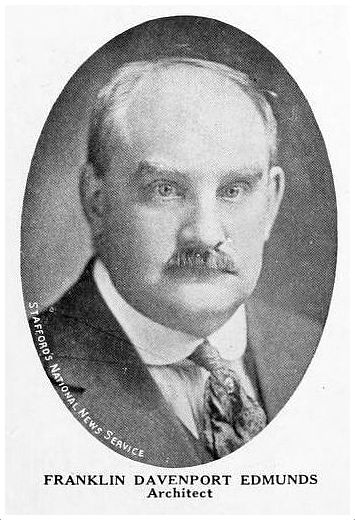
Franklin Davenport Edmunds (1874-1948) was a Philadelphia architect whose hobbies were travel and photography. A 1902 train trip to Mexico took him through Texas, during which there as a blink-and-you’ll-miss-it stop in Dallas.

edmunds_whos-who-philadelphia_1920Who’s Who in Philadelphia, 1920

On the way to Mexico, he stopped in St. Louis for a while (where he took several photos on Feb. 12), passed through Arkansas (on Feb. 13), apparently saw very little of Dallas as he rolled through, and then took a lot of photos when he reached San Antonio (by Feb. 14). He then continued on to a vacation of at least two or three weeks in Mexico, where his camera was never far from his side.

The two photos that were taken as he passed through Dallas (which I’m assuming were snapped from the train) were probably taken on Feb. 13 or 14, 1902.

The location of the photo above is not noted, but it appears to be Pacific Avenue looking west. Peter S. Borich’s sign-painting business was on the northeast “corner” of Bryan and Pacific (at the point of the diagonal intersection). The photo shows the back and side of his building. It’s hard to see them, but there is a wagon with a team of horses at the Bryan St. intersection. Behind Borich’s is a blacksmith shop, and across the street, there are several furniture stores. Straight ahead is an almost mirage-like smoke-spewing locomotive heading toward the camera. (Unless Edmunds was standing in the middle of Pacific, I’m guessing he was taking the photo from the rear of the train.)

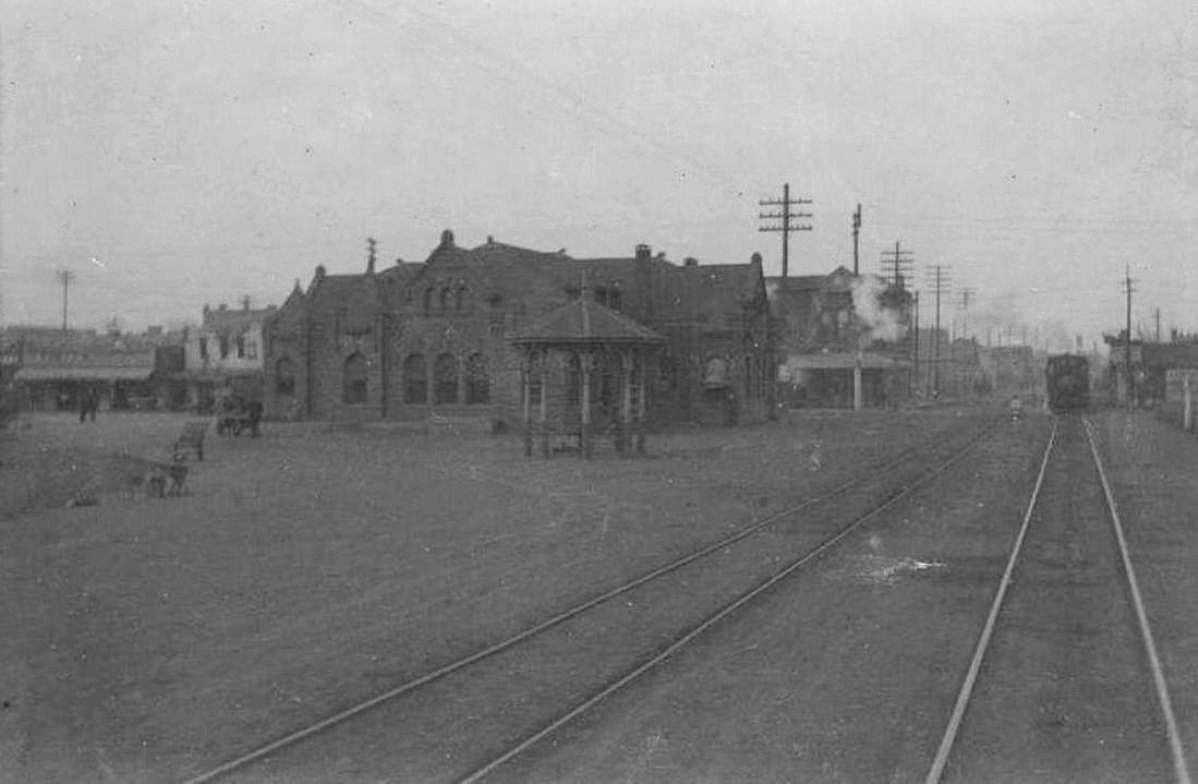
Seconds later, the train would have pulled into the old Union Depot (located about where Pacific would cross present-day Central Expressway).

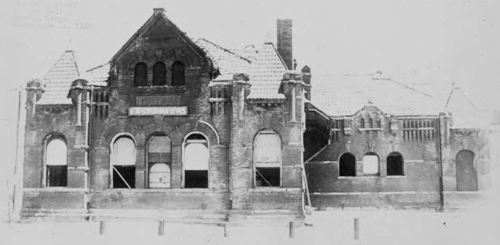
edmunds_old-union-stn_free-lib-phil_1902(click for larger image)

Even though not identified in the photo description, the distinctive old Union Depot is instantly recognizable (an unrelated photo taken from about the same spot can be seen in this one from the George W. Cook collection at SMU’s DeGolyer Library). Again, the photo appears to have been taken from the train.

Edmunds took a ton of photos on this trip, but, sadly, he seems to have merely passed through Dallas without wandering around to explore its streets (which I would think would be interesting — if not downright exotic — to a Philadelphia architect) — I’m not sure he even got off the train to stretch his legs! But I’ve never seen these two photos, and they’re pretty cool. So, thanks, Frank — you should have hung around a little longer.

***

Both photos by Franklin Davenport Edmunds are from the Free Library of Philadelphia. The Pacific Avenue photo can be accessed here; the Union Depot photo, here. Other photos he took in Texas during the 1902 trip (and a few from a previous 1899 trip) can be viewed here.

A biography of Edmunds can be read at PhiladelphiaBuildings.org here.

A detail from the 1905 Sanborn map showing the businesses located at Pacific and Bryan, with Borich’s business circled in red and the camera’s vantage point in blue, can be seen here.

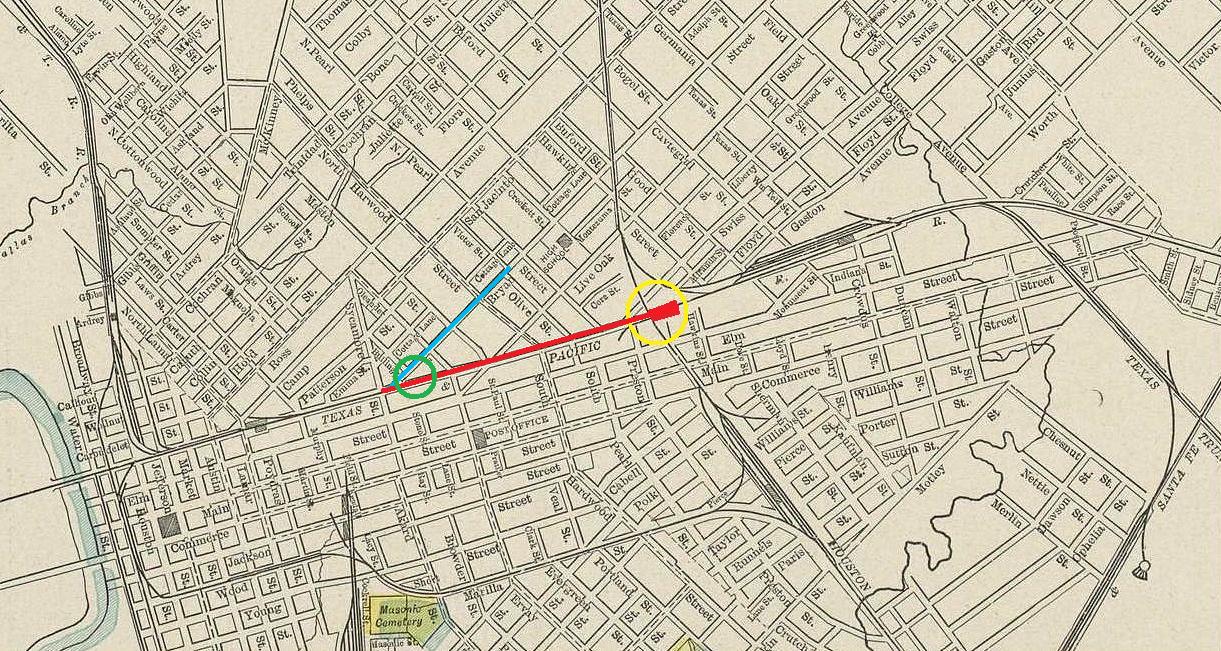
Below, a detail from a map (circa 1890-1900), showing the locations of the two photos, with the Pacific Ave. location circled in green and the Union Depot location in yellow.

dallas-map_ca1900(click for larger image)

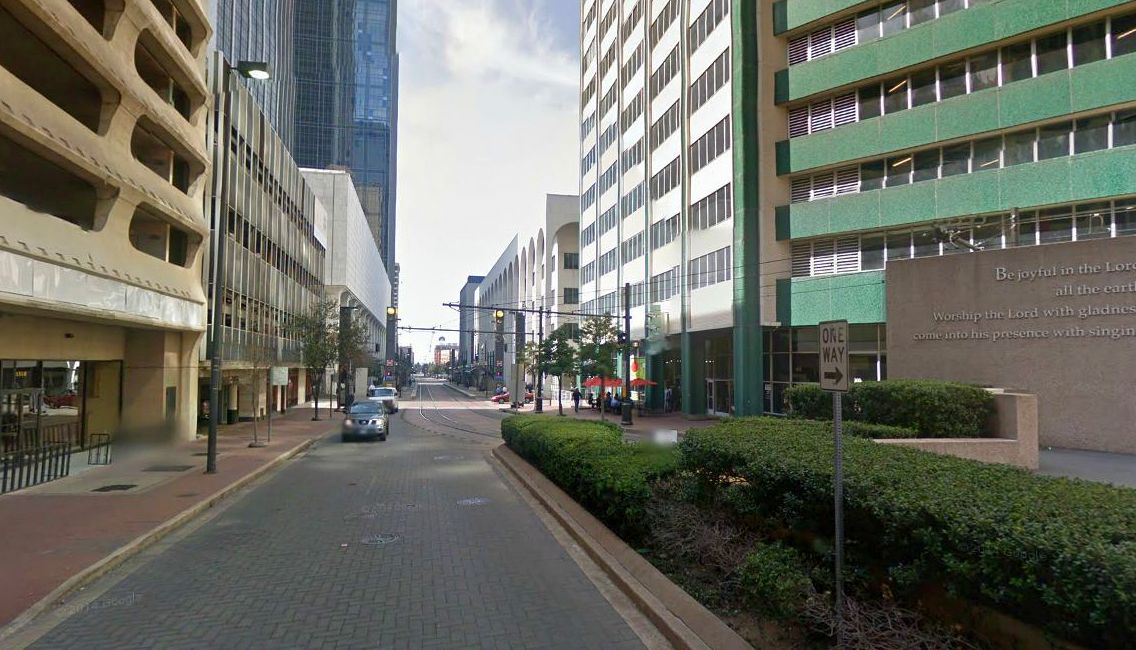
And, lastly, a present-day image showing the same view as the top photo (from Google Street View).

pacific-bryan_google

My previous post, “The Old Union Depot in East Dallas: 1897-1935” — a history of the station with several photos — can be found here.

Images larger when clicked.

*

Copyright © 2015 Paula Bosse. All Rights Reserved.

The Old Union Depot in East Dallas: 1897-1935

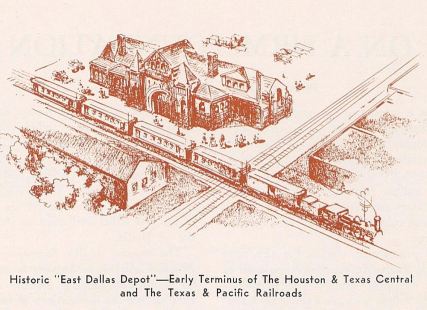
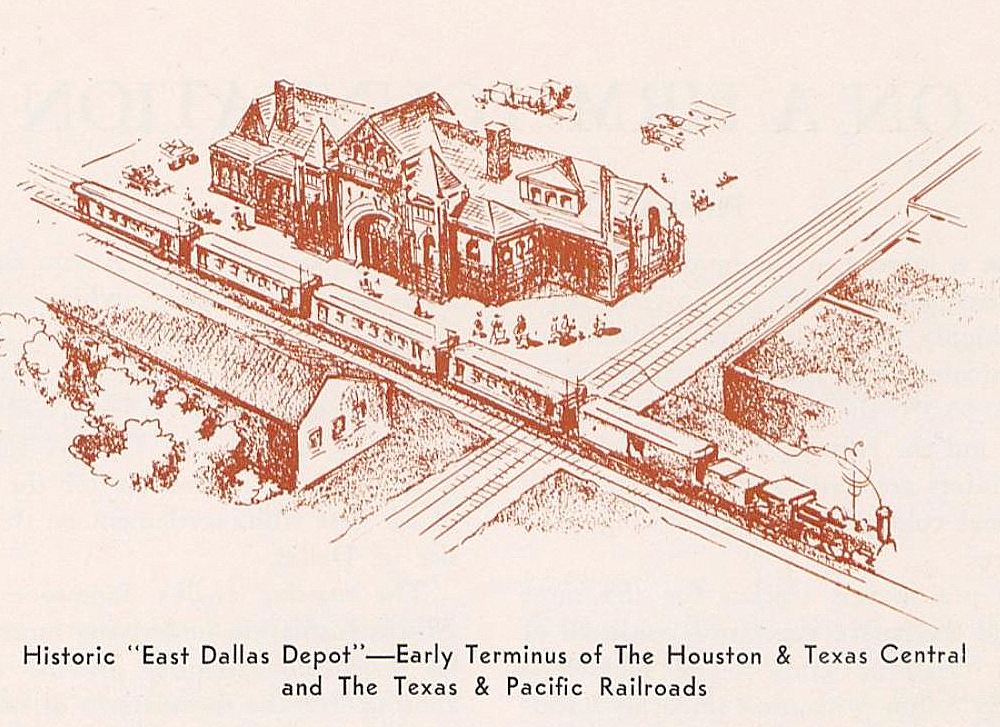
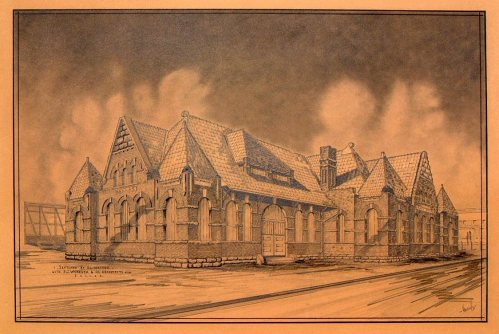
east-dallas-depot_rendering_art-hoffmanFrom the collection of Art Hoffman (click for larger image)

by Paula Bosse

I saw the above rendering of the old East Dallas rail depot posted recently in a Dallas history group. It was bought several years ago by Art Hoffman who was told it had belonged to a former employee of the Houston & Texas Central Railroad (which, along with the Texas & Pacific, served this station). It’s an odd thing for an architect to sketch — a boarded-up railroad depot. I couldn’t find anything on E. L. Watson, the architect who did the rendering (perhaps a member of the Watson family who were prominent Dallas contractors?), and I couldn’t find any connection between the depot and the F. J. Woerner & Co. architectural firm. The drawing might have been done in 1931, with what looks like “31” next to the artist’s signature. Could the drawing have been done merely as a study for E. L. Watson’s portfolio?

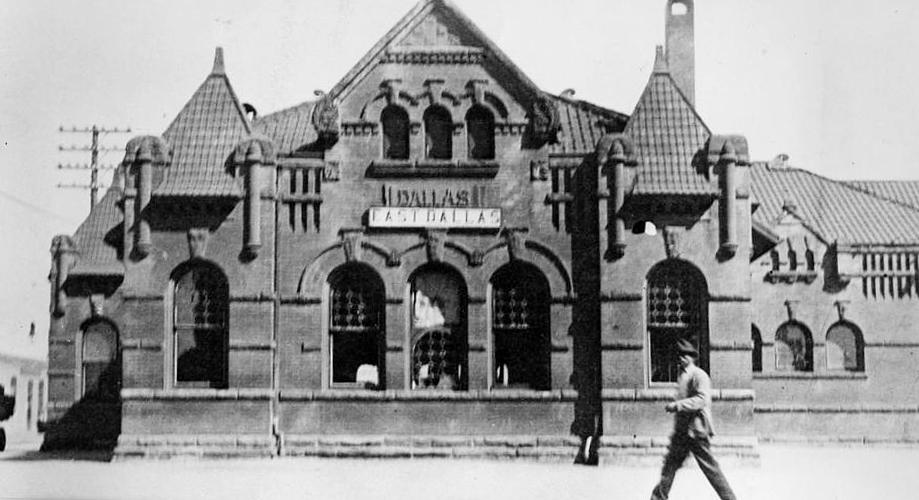
But back to the building itself. It was referred to by all sorts of names: Union Station, Union Depot, East Dallas Depot, Old Union Station, etc. With all these permutations, it took considerable digging to determine exactly when it had been built and when it had been demolished.

A couple of stations had previously occupied this site (about where Pacific Avenue and Central Expressway would cross), the first being built in 1872 at the behest of William H. Gaston who was developing the area, well east of the Dallas city limits. Due to the presence of the railroad, the area grew quickly, and in 1882, it was incorporated as the city of East Dallas. It thrived and continued to grow and on January 1, 1890 it was annexed and became part of the city of Dallas.
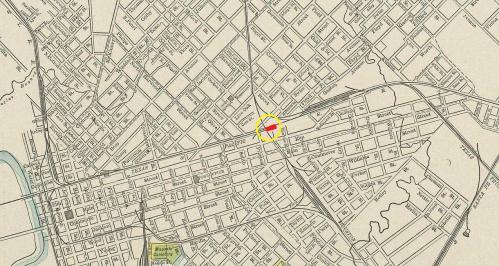
dallas-map-ca1900Location of depot in red — map circa 1890-1900 (click to enlarge)

The depot pictured in the drawing above was built in 1897. The previous station, a woefully inadequate and outdated “shanty,” was, by early 1897, being nudged toward demolition in order to remain competitive with the new Santa Fe depot then under construction. In the Feb. 10, 1897 edition of The Dallas Morning News, it was referred to as “the present eye-sore in East Dallas” which would be better off “abandoned and used for kindling wood.”

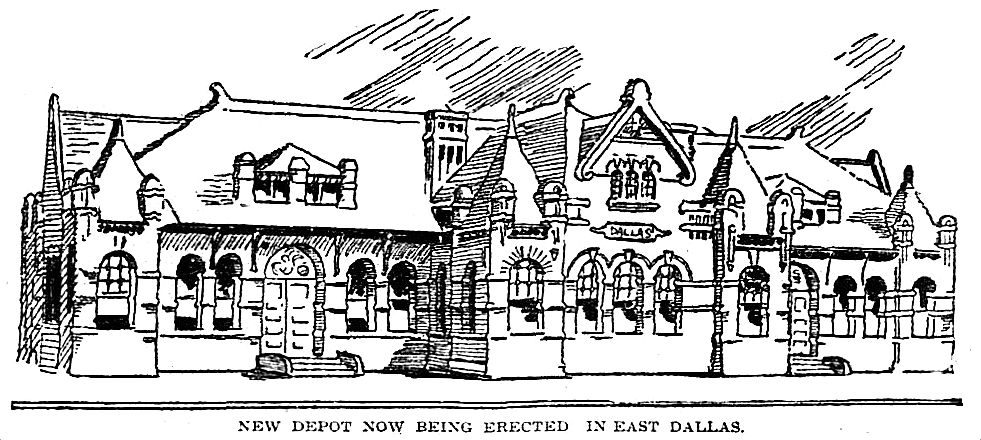
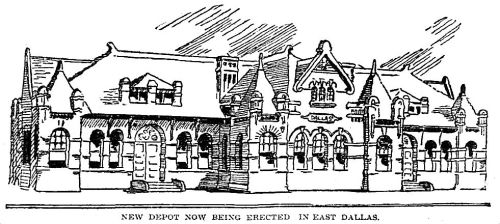
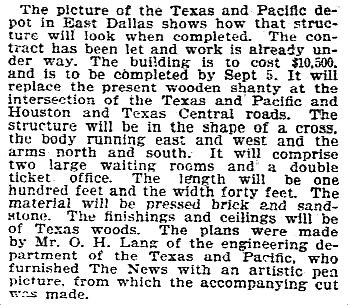
On April 4, 1897, it was reported that plans for a new Texas & Pacific passenger depot were nearly completed. By the beginning of June, the shanty had been torn down, and on June 6, 1897, the drawing below appeared in the pages of the Morning News, giving the people of Dallas a first look at what the much grander station would look like when completed. (It’s unfortunate that the actual architectural rendering was not used, but, instead, a more rudimentary staff artist’s version was printed.) The accompanying information revealed that the new depot had been designed by Mr. O. H. Lang, an architect who worked in the engineering department of the Texas & Pacific Railroad. This was an exciting tidbit to find, because I had wondered who had designed the structure but had been unable to find this elusive piece of information. And it was Otto Lang! Eight years after designing this railroad depot, Lang and fellow architect Frank Witchell would form the legendary firm of Lang & Witchell, and they would go on to design some of Dallas’ most impressive buildings.
east-dallas-depot_dmn_060697-DRAWING

east-dallas-depot_dmn_060697-TEXTDallas Morning News, June 6, 1897

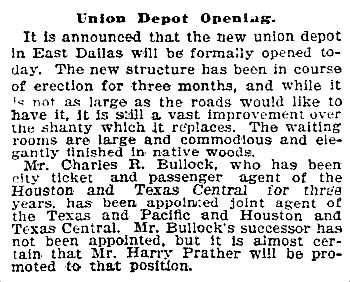
The building was completed fairly quickly, and its official opening was announced on Oct. 12, 1897.
east-dallas-depot_GRAND-OPENING_dmn_101297DMN, Oct. 12, 1897

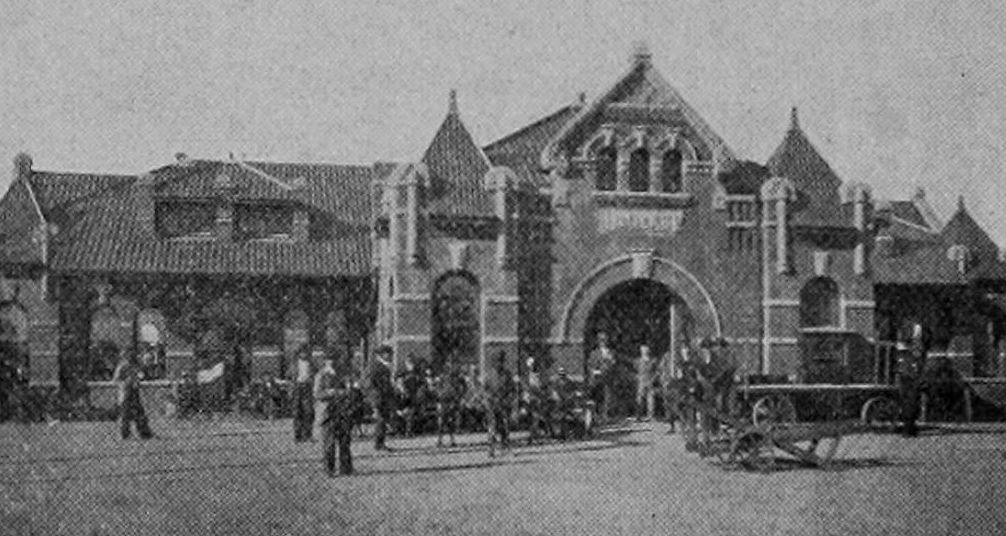
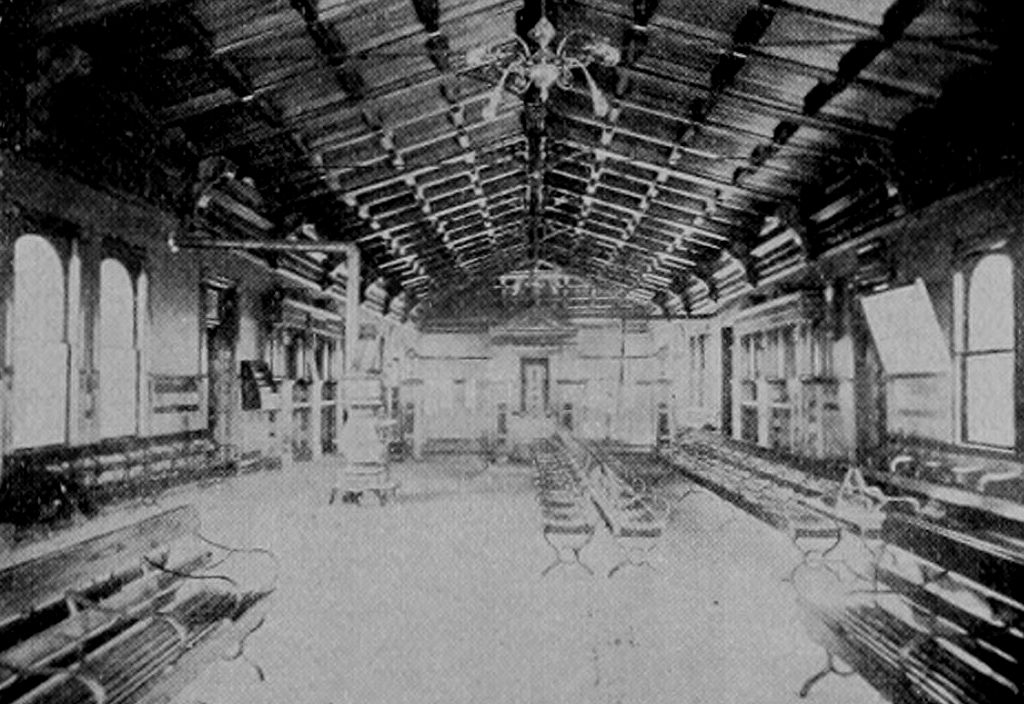
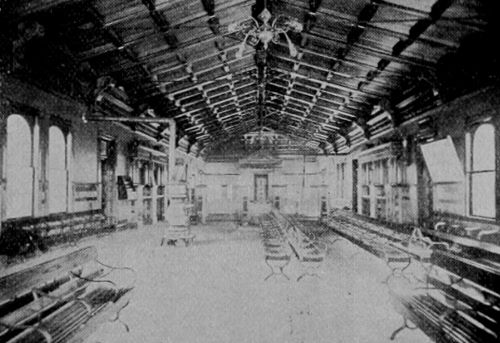
Here’s what the station looked like soon after it opened for business, from an 1898 Texas & Pacific publication (click for larger images):
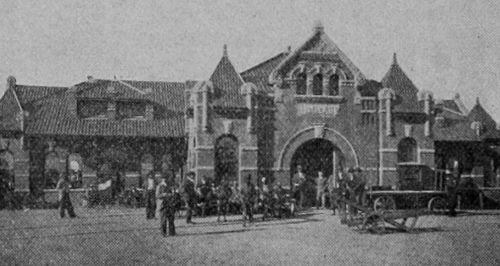
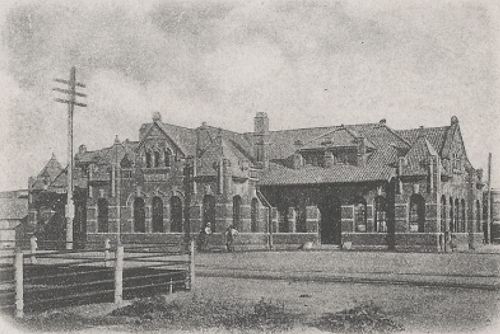
east-dallas-depot_ext_tx-pac-rr_1898

east-dallas-depot_int_tx-pac-rr_1898

Much better than a shanty!

union-depot_flickr_coltera

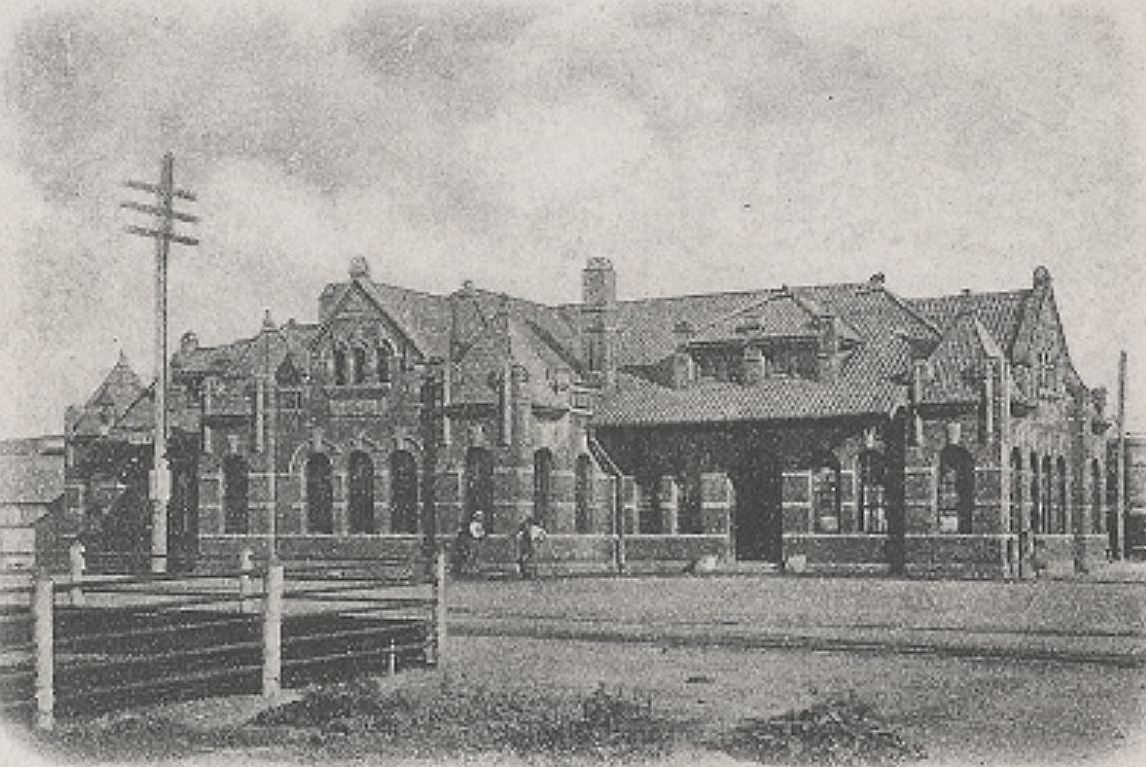
Below in another early photo of the depot:
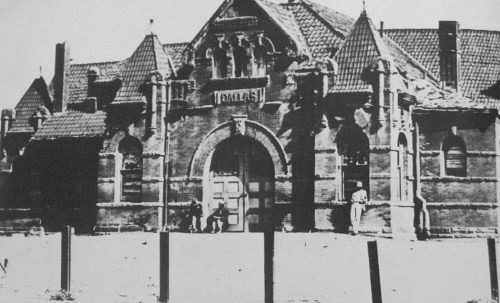
east-dallas-depot_c1890_dallas-redisc_DHS

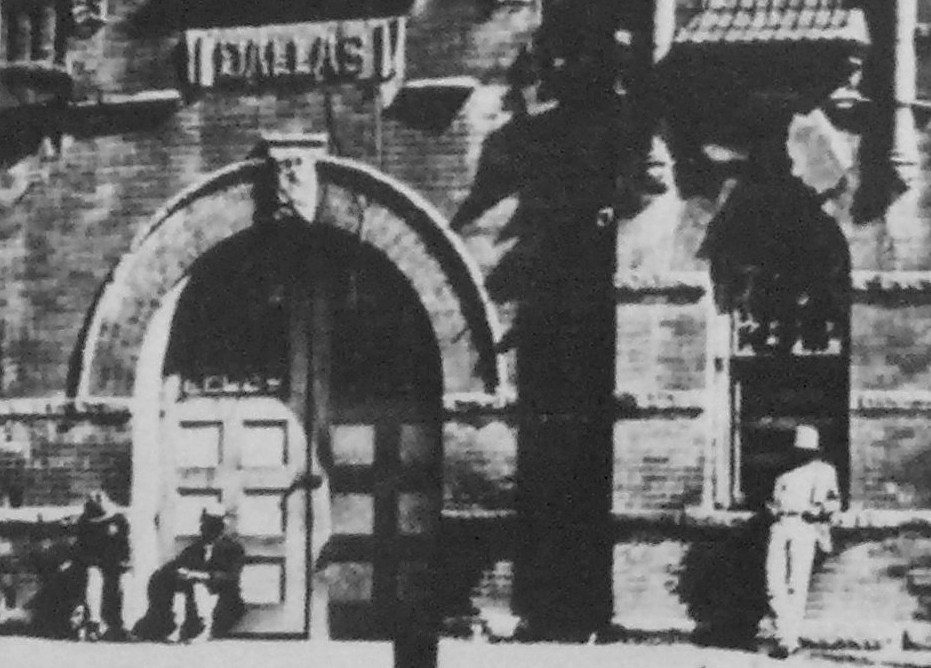
Can’t pass up an opportunity of zooming in on a detail:
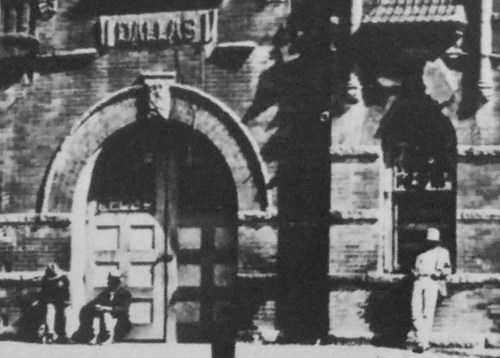
east-dallas_c1890_dallas-redisc_DHS-det

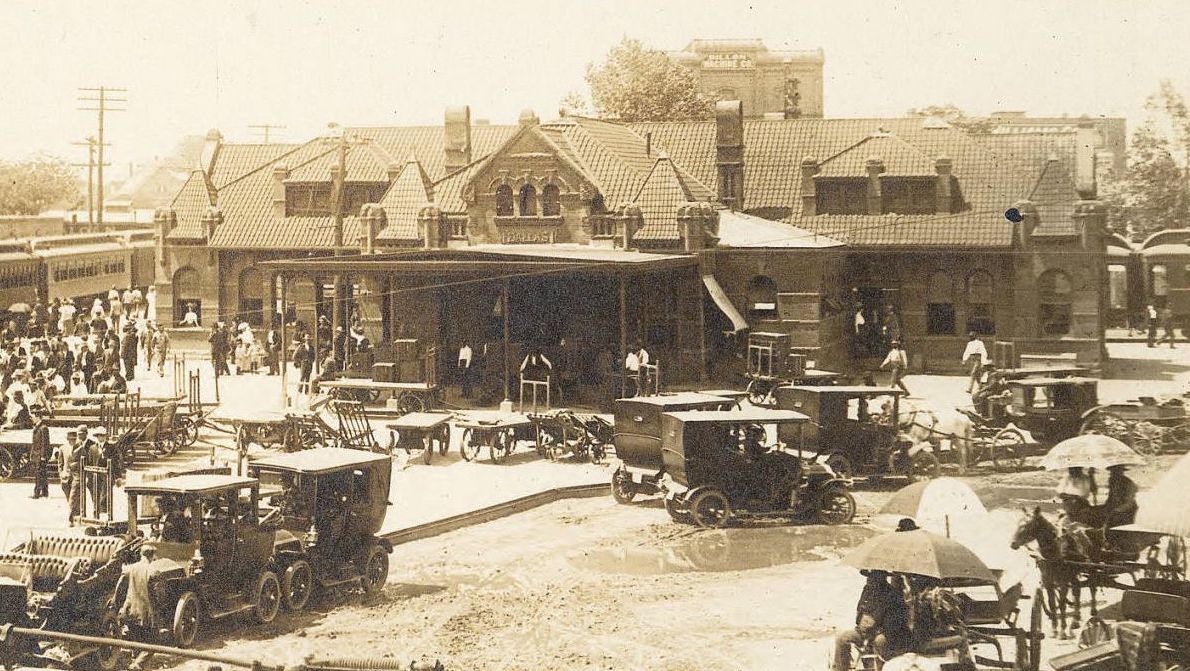
Here it is around 1910, a hotbed of activity, now with the addition of automobiles:
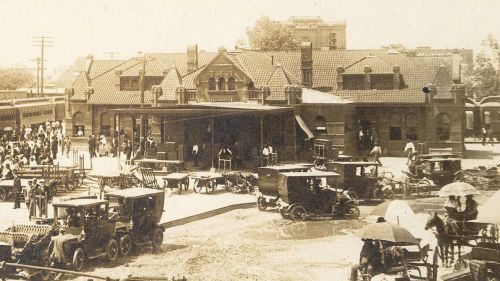
old-union-depot_degolyer_ca1910-det

The station served an important role in the growth of (East) Dallas and in the everyday lives of its residents for almost twenty years, but in 1916 the many “independent” passenger and freight depots that had been spread out all over town were shuttered, per the Kessler Plan’s directive to consolidate and run all the rail lines in and out of the new Dallas Union Terminal. (This was when the word “old” began appearing ahead the East Dallas station whenever it was mentioned.)
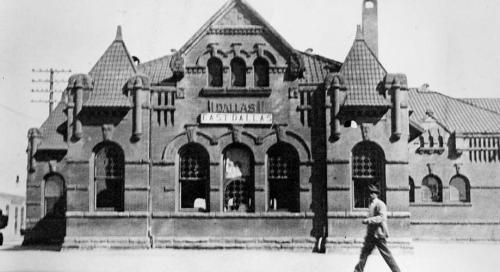
east-dallas-depot_1916-portal(circa 1916)

So what became of the East Dallas depot? From “Relic of City of East Dallas Being Demolished,” a Dallas Morning News article from Jan. 20, 1935:

Last use of the depot for railroad purposes came in 1933 when it was abandoned as a freight station in August of that year. After that it was used as a station for interviewing destitute clients for the relief board but for several months has been boarded up.

So that original rendering may not have been done in 1931 after all (unless it was a high-concept architect’s vision of what the depot would look like one day all boarded up…).

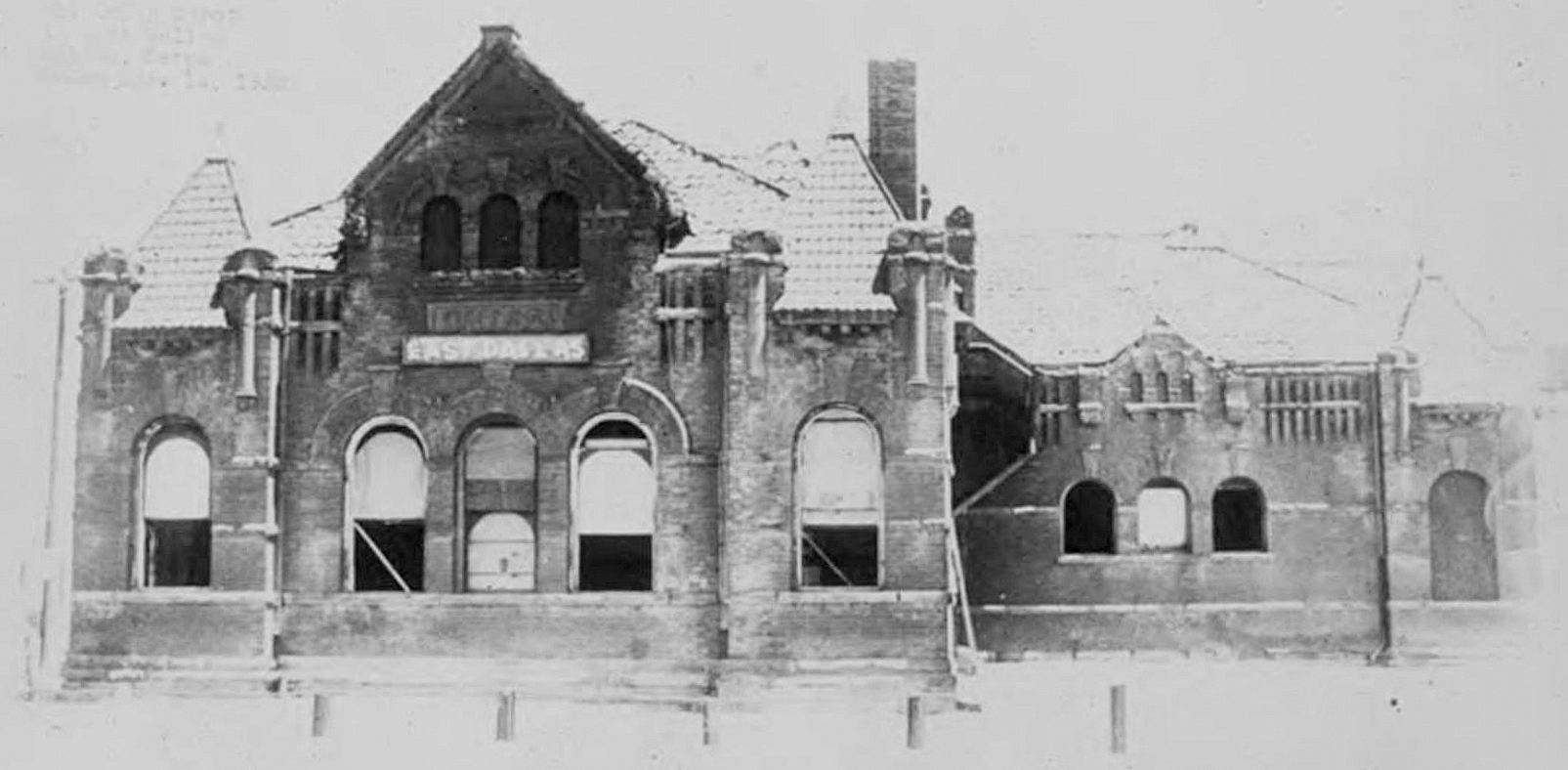
At some point it was determined that the station would be torn down. It may have been one of those beautify-the-city projects done in preparation for the Texas Centennial Exposition the next year, but it was probably time for the building to come down. It was January of 1935, at the height of the Great Depression, and  not only did the city make it a point to hire laborers on relief to assist in the demolition, but it also approved the use of salvaged materials from the site to be used in building homes for “destitute families.”

Relief Administrator E. J. Stephany received approval Saturday of a project to get men to tear down the old structure and use the materials in building homes for destitute families and work is expected to start immediately. (“East Dallas Station To Be Torn Down and Converted Into Homes,” DMN, Jan. 13, 1935)

Demolition of the depot — which The News called “The Pride of the Gay Nineties” — began on January 18, 1935. The first solemn paragraph of an article reporting on the razing of the landmark is below.

Shorn of all the dignity it possessed for years as the East Dallas Union Depot, the old red structure near the intersection of Central and Pacific avenues began crumbling beneath the blows of wrecking tools wielded by laborers from the Dallas County relief board Friday.” (“Relic of City of East Dallas Being Demolished,” DMN, Jan. 20, 1935)

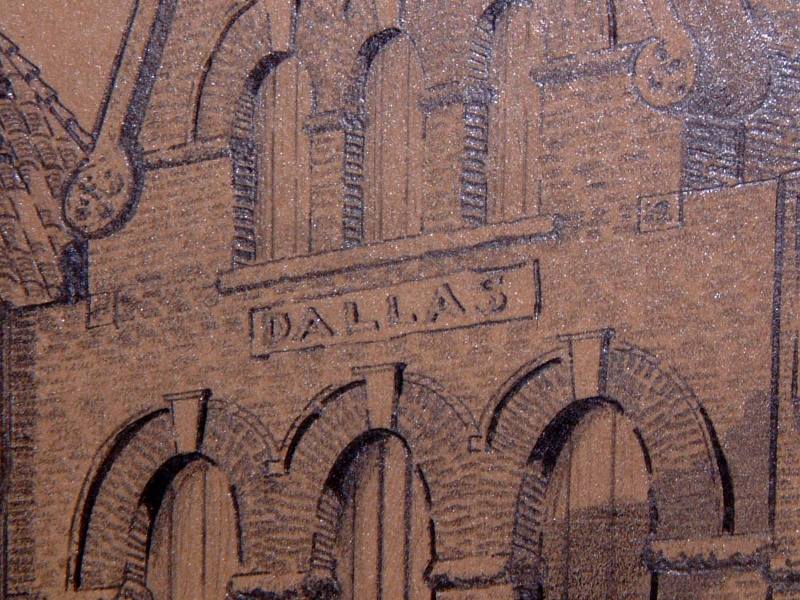
The red stone slabs bearing the word “Dallas” (3 feet long, 18 inches thick) were offered to the Dallas Historical Society “for safekeeping.”
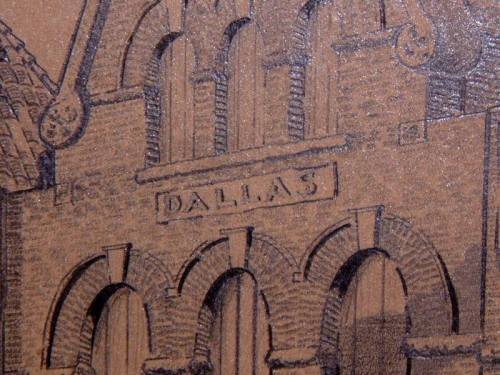
east-dallas-depot_rendering_dallas_Art-Hoffman_sm

So did that relief housing get built? Sort of. All I could find was an article from June, 1935, which states that one little building was constructed with some of the brick and stone from the razed depot. It wasn’t a house for the needy but was, instead, headquarters for relief caseworkers in donated park land in Urbandale. Presumably there was housing built somewhere, but all that brick and stone salvaged from the old depot may not have been used for its intended purpose. BUT, there is this tantalizing little tidbit:

As a reminder of the historic antecedent, the new structure [in Urbandale Park] has as a headpiece for its fireplace the large carved stone bearing the name Dallas. (“Relief Structure Made of Materials From Razed Depot,” DMN, June 20, 1935)

Does this mean that the Dallas Historical Society might still have the second slab? If not, what happened to it?

I checked Google Maps and looked at tiny Urbandale Park at Military Parkway and Lomax Drive, just east of S. Buckner, but I didn’t see anything, so I assume the building came down at some point. (UPDATE, 3/20/16: Finally got around to driving to this attractive park. Sadly, the little building is no longer there.)

It would have been nice if that little bit of the old depot had survived — a souvenir of an important hub of activity which sprang to life when memories were still fresh of East Dallas being its own separate entity — the “David” Dallas to its neighboring “Goliath” Dallas. I would love to learn more about what might have happened to that “Dallas” sign which, for a while, hung over the fireplace of an odd little building in an obscure park in southeast Dallas where it lived out its days in retirement.

**

Since I keep adding photos of the depot to this post, I’m going to just start putting new additions (with captioned and linked sources) here:
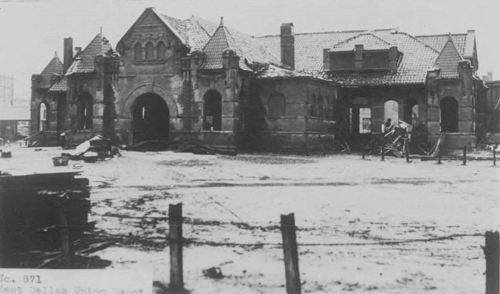
east-dallas-union-depot_degolyer-lib_SMUDeGolyer Library, SMU

union-depot_east-dallas_1933_degolyer-lib_SMUDeGolyer Library, SMU

union-depot_your-dallas-of-tomorrow_1943_portal
“Your Dallas of Tomorrow” (1943), Portal to Texas History

***

Sources &  Notes

Original rendering of the old Union Depot at East Dallas by E. L. Watson is from the collection of Art Hoffman, used with his permission.

More on architect Frank J. Woerner (who designed, among other things, the Stoneleigh Hotel), here (see p. 10 of  this PDF).

History of Old East Dallas (and the city of East Dallas), here and  here.

More on architects Lang & Witchell here, with an incredible list of some of the buildings designed by their firm here.

1898 photos of the depot’s exterior and interior from Texas, Along the Line of the Texas & Pacific Ry. (Dallas: Passenger Department of the Texas & Pacific Railway, [1898]).

Photo immediately following the photos from the T & P book is from a postcard, found on Flickr, here.

Photo (and accompanying detail) immediately following that is from Dallas Rediscovered by William L. McDonald (Dallas: Dallas Historical Society, 1978). (McDonald identifies the photo as being “c. 1890” — well before the station was built in 1897.) From the collection of the Dallas Historical Society.

Photo of the depot with automobiles is a detail of a larger photograph from the collection of George A. McAfee photographs in the DeGolyer Library, Central University Libraries, Southern Methodist University. The original can be seen here.

Photograph dated 1916 from The Museum of the American Railroad, via the Portal to Texas History site, here.

More information in these Dallas Morning News articles:

  • “East Dallas Station To Be Torn Down and Converted Into Homes” (DMN, Jan. 13, 1935)
  • “Relic of City of East Dallas Being Demolished” (DMN, Jan. 20, 1935) — very informative
  • “Historical Society Will Be Given Slabs of Former Station” (DMN, Jan. 31, 1935)
  • “County Gets Land To Install Relief Depot; Later Park” (DMN, Feb. 27, 1935
  • “Relief Structure Made of Materials From Razed Depot; Station Occupies Land in Urbandale Donated to County For Park” (DMN, June 20, 1935)
  • “Salvaged Materials Go Artistic” (DMN, June 20, 1935) — photo of “relief structure” which accompanied above article

More photos of this immediate area can be found in these posts:

  • “The Union Depot Hotel Building, Deep Ellum — 1898-1968,” here
  • “The Gypsy Tea Room, Central Avenue, and the Darensbourg Brothers,” here

Many of the pictures and articles can be clicked for larger images.

*

Copyright © 2014 Paula Bosse. All Rights Reserved.


A Lost Photo of Director Larry Buchanan, Celebrated “Schlockmeister” — 1955

buchanan-katy-camera_1955_bwLarry Buchanan (in bowtie) in his ad-man days, 1955

by Paula Bosse

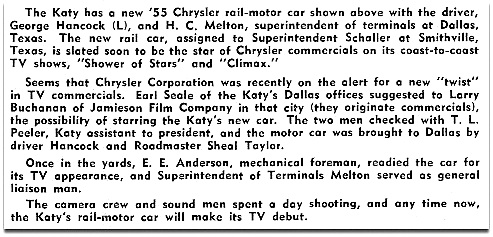
I got all excited when I saw the above photo posted in the Lone Star Library Annex Facebook group. It accompanied an article and another photo from the Katy Employes’ Magazine (August, 1955) (seen below) — the poster was interested in the railroad-angle of the article and photos, but the name “Larry Buchanan” was what grabbed my attention.

buchanan_katy-chrysler

buchanan_katy-text

The photo was posted because it was a wonderful piece of M-K-T Railroad-related ephemera. Before reading the accompanying text, I thought that the idea of a 1955 Chrysler tricked-out to ride along Katy railroad tracks (so that M-K-T officials could, presumably, ride the rails in comfortable air-conditioned splendor as they moved from one inspection site to the next) was the cool thing about the article. Then I got to the name “Larry Buchanan.” And it became much, MUCH more interesting.

So who is Larry Buchanan? Briefly, Larry Buchanan is one of the greatest exponents of grade-Z, low-low-low-LOW-budget filmmaking, a director with a cult following amongst those who enjoy movies in the “so-bad-they’re-good” genre. He shot most of his movies in the 1960s in Dallas, taking advantage of lots of locations around the city, even if the movies he was shooting weren’t actually set in Dallas (one movie had Highland Park Village standing in for Italy, and “Mars Needs Women” was set in Houston, even though the movie is crammed full of easily recognizable Dallas locations such as the downtown skyline and the Cotton Bowl). The movies that have earned him his place in the pantheon of cult figures are primarily his sci-fi movies, like “Mars Needs Women,” “Attack of the Eye People,” “Curse of the Swamp Creature,” and “Zontar: The Thing from Venus.” Many were re-makes of earlier low-budget sci-fi movies commissioned by American International Pictures, and Buchanan was usually the producer, director, writer, and editor — “auteur” seems like the wrong word to use here, but that’s what he was, a filmmaker intensely involved with every phase of the production.

Buchanan was born in 1923 and grew up in Buckner Orphans Home. After a fleeting thought of becoming a minister, Buchanan — long-fascinated by movies — left for Hollywood and New York where he worked as an actor in small roles or on the crew (during this time there were professional brushes with, of all people, George Cukor and Stanley Kubrick). By the early 1950s, Buchanan was back in Dallas, employed by the Jamieson Film Company (3825 Bryan St.), working on industrial films, training films, television programs, and commercials. It was at Jamieson that he learned all aspects of film production, including how to get things done quickly and how to bring projects in under budget. It’s also where he met co-workers Brownie Brownrigg, Robert B. Alcott, Bob Jessup, and Bill Stokes, all of whom went on to have film careers of their own and most of whom Buchanan used as crew members when shooting in and around the city.

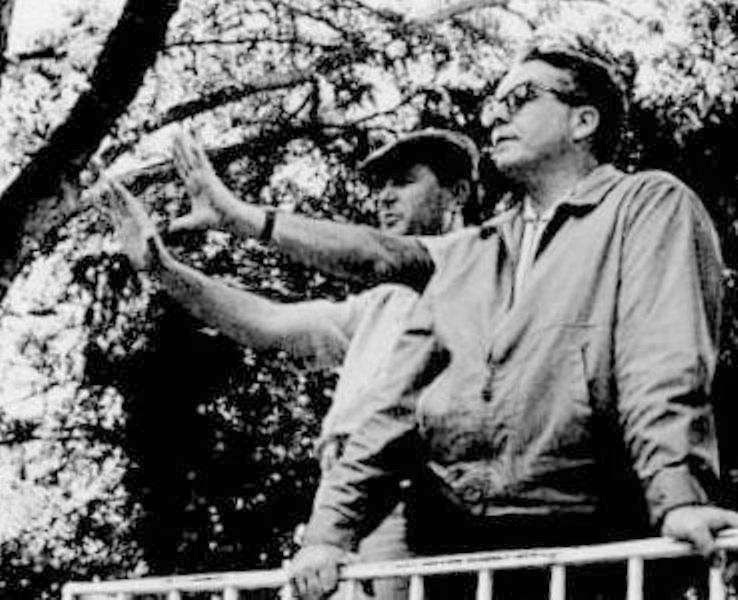
It was during this period that the photo above was taken. There are countless websites out there devoted to Larry Buchanan’s film oeuvre, but there are very, very few photos of him online. I found exactly three:

larry-buchanan_bob-jessup_texas-monthly_lgLarry (left) with cinematographer Bob Jessup

larry-buchanan_tx-monthly_may-1986-photo_detIn 1986 (Tim Boole/Texas Monthly)

larry-buchananDate unknown

The photo at the top of this post is from 1955, before Buchanan had really begun cranking out his own movies. I can’t say for sure that this IS a photograph of Larry Buchanan, but it seems likely that it is. In that striped shirt, he looks like the kind of hip, energetic, ever-enthusiastic director I imagine him being. I can only hope that it IS him, straddling railroad ties, behind a camera pointed at a retrofitted Chrysler, in Dallas’ Katy railyard. One wonders if that Chrysler spot had a higher budget than some of the movies he was making ten years later. UPDATE: In the comments, below, Larry’s son Barry identifies his father in the top photo, but not as the man behind the camera, but as the man behind the car, wearing the bowtie. Thanks for the correction, Barry1)

From all reports, Larry was a tireless, driven, upbeat guy who loved making movies, and I think it would have been a lot of fun hanging out with him. If I ever have enough disposable income, I’ll fork it over and buy a copy of his entertaining-but-pricey autobiography, the well-received It Came From Hunger: Tales of a Cinema Schlockmeister (McFarland & Co., 1996).

It’s been fun researching Larry Buchanan. There’s a lot more to tackle later. I mean, I haven’t even touched on the legendary “Naughty Dallas” yet!

***

Tons of links here….

First two photos and text from the Katy Employes’ Magazine (Aug. 1955).

buchanan-cover_sm

Katy magazine scans made with permission of the Facebook page Lone Star Library Annex.

Other examples of automobiles equipped with “railroad wheels” can be found here.

Black and white photo of Buchanan with Bob Jessup (photographer and date unknown) and the great color photo (a detail of which is shown above) by Tim Boole, both from the article, “How Bad Were They?” by Douglass St. Clair Smith (Texas Monthly, May 1986), which you can read here.

That last photo of Buchanan is all over the internet — the only one you ever really see. I don’t know who took it, when it was taken, or where it originally appeared. But it’s a great photo!

Larry Buchanan died in December, 2004, at the age of 81. His obituary from The New York Times is here.

A fond look back at Buchanan’s career by Eric Celeste appeared in the April 2005 issue of D Magazine and can be read here.

The best piece on Buchanan is “A Tribute to Larry Buchanan” by his good friend Greg Goodsell, here.

My recent post on “Mars Needs Women” — with screen caps of movie scenes shot at recognizable Dallas locations — is here.

I never did find that Chrysler spot that had been slated to appear on network TV. I have a feeling it may be in a lengthy collection of Chrysler commercials and films from 1955 which you can watch here. I couldn’t slog all the way through it, but there are a couple of “Shower of Stars” episodes, which are mentioned in the Katy article (they’re odd “entertainment” shows which seem to be nothing more than infomercials for Chrysler starring famous people in bad sketches). If anyone actually finds footage that was filmed that day in Dallas, please let me know!

And, lastly, Larry Buchanan’s movies are fun, but some are more fun than others, “if you know what I mean, and I think you do” (as Joe Bob Briggs — surely one of Larry’s biggest admirers — might say). Many of them are available to watch in their entirety online. Check YouTube and Google.

Click photos for larger images!

*

Copyright © 2014 Paula Bosse. All Rights Reserved.

SMU’s First Year: The Dinkey, Campus Hijinx, and the Basket Ball — 1915-16

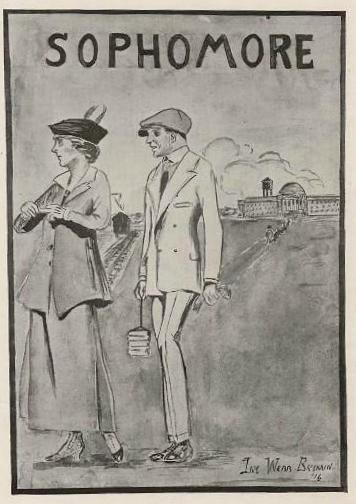
1smu-rotunda-1916_soph-drawing

by Paula Bosse

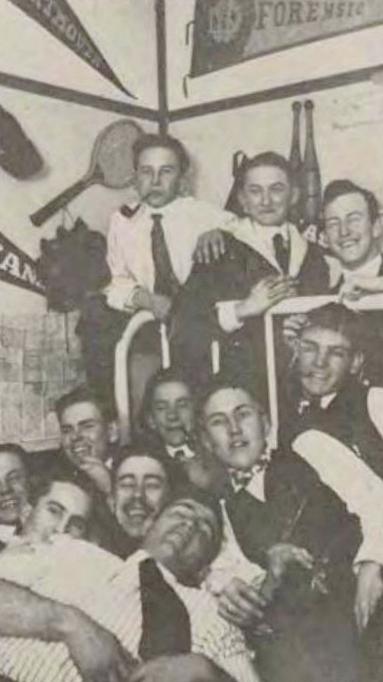
As a companion to my previous post on the first year of classes at SMU, here are a few more photos from the yearbook, these documenting the less studious side of campus life.

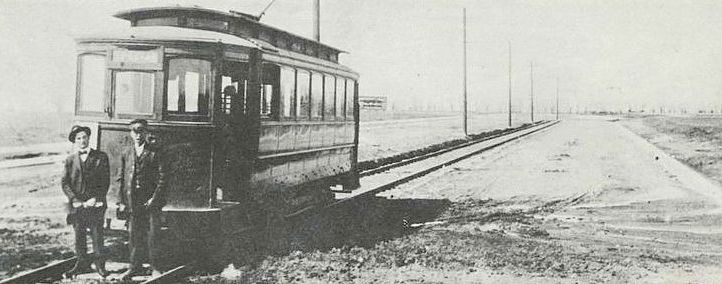
The most interesting thing about these photos, for me, is the SMU trolley, nick-named “The Dinkey” (or “The Dinky”). When SMU opened in 1915, it was waaaaaaaaaay outside the city limits, and the rail line extended only as far north as Knox. In order to get to and from downtown (and points beyond), one had to board the Dinkey near Hillcrest and McFarlin and ride to Knox, then change to an official city streetcar and head into civilization.

This reminiscence appeared in a 1984 issue of Park Cities People:

The first time Manning saw the campus was from the wooden seat of the Dinkey, an electric streetcar built for SMU in 1915.

“I told Dad Johnson, the conductor, as I boarded in Highland Park, I wanted to get off at SMU,” Manning said. “He said, ‘That’s as far as it goes.'”

“‘When we got there, I said, ‘Where’s the campus?’ He said, ‘There’s only two buildings. Dallas Hall is the one with the columns.'”

Manning couldn’t see the building from the Dinkey for the four-foot-tall Johnson grass and had to follow a travel-worn path to Dallas Hall.

2dinkey-hpcentennial“The Dinkey ran from Dallas Hall to Knox Street on tracks in the middle of Hillcrest. This photo taken at McFarlin.”

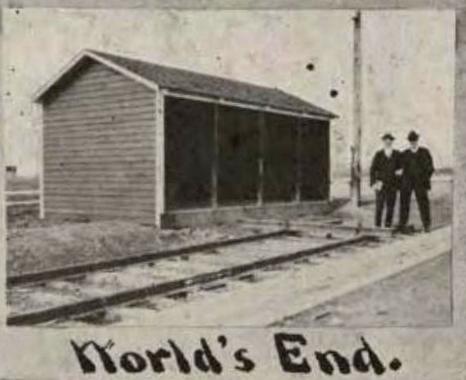
3smu-rotunda-1916_dinkey-stopThe “depot” where the Dinkey picked up and dropped off SMU students, faculty, and visitors.
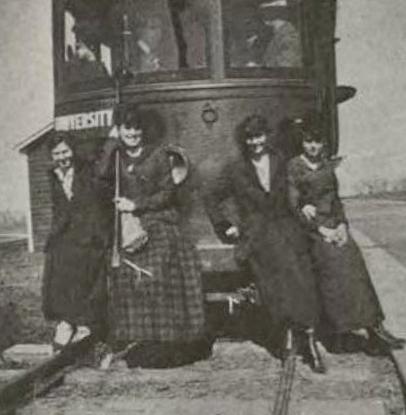
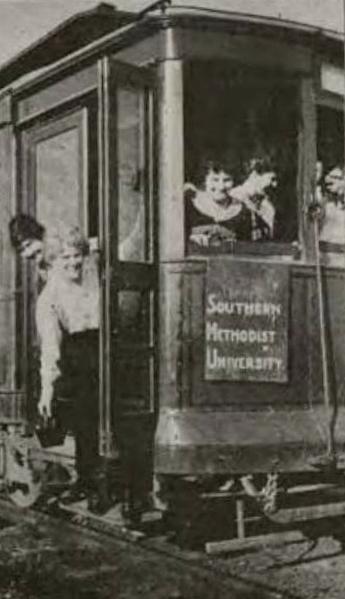
4smu-rotunda-1916_dinkeyThe Dinkey, garnished with co-eds.

5smu-rotunda-1916_dinkey

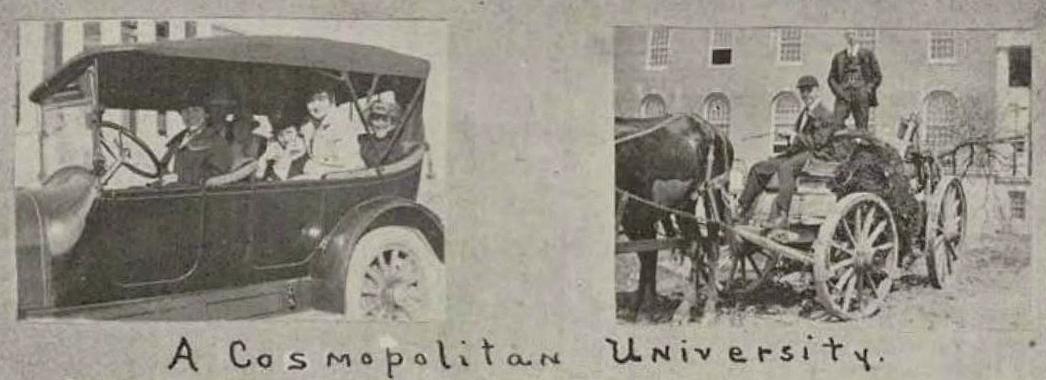
6smu-rotunda-1916_cosmopolitan-univ“Cosmopolitan University” horsepower.

7smu-rotunda-1916_frat

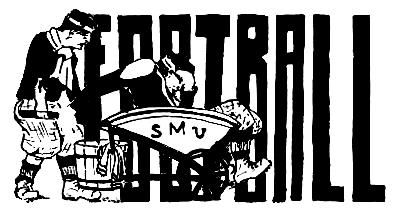
8smu-rotunda-1916_footballBad season?

The inaugural football season started tentatively. The 1915 schedule:

  • Oct. 9th: SMU vs. TCU at Fort Worth
  • Oct. 14th: SMU vs. Hendrick College at Dallas
  • Oct. 27th: SMU vs. Austin College at Dallas Fair
  • Nov. 4th: SMU vs. Dallas University
  • Nov. 12th: SMU vs. Daniel Baker at Brownwood
  • Nov. 19th: SMU vs. Southwestern University at Dallas
  • Nov. 25th: SMU vs. Trinity University at Waxahachie

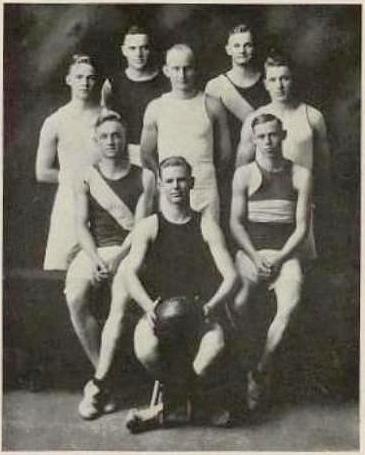
9smu-rotunda-1916_basketballThe men’s “Basket Ball” team.

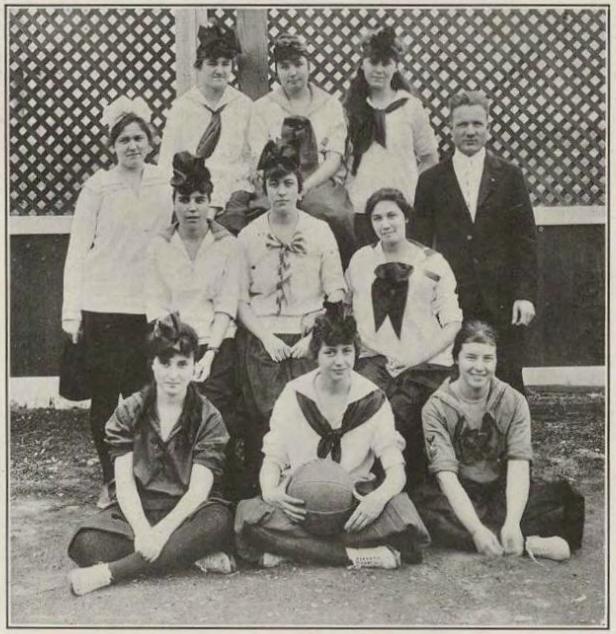
10smu-rotunda-1916_girls-basketballThe girl’s “Basket Ball” team.

16smu-rotunda-1916_cover

***

Sources & Notes

All images (except the second) from the 1915-1916 edition of SMU’s “Rotunda” yearbook.

Photo (and caption) of the “Dinkey” trolley at Hillcrest and McFarlin from Highland Park Centennial Celebration site, here.

Quote about traveling to the campus from Park Cities People (March 15, 1984).

“Dallas Hall and the Hilltop” by Tom Peeler, an entertaining  1998 D Magazine article on the first days of SMU, is here.

My previous post containing more photos from this first yearbook, is here.

*

Copyright © 2014 Paula Bosse. All Rights Reserved.

Katy Comin’ ‘Round the Bend — 1908

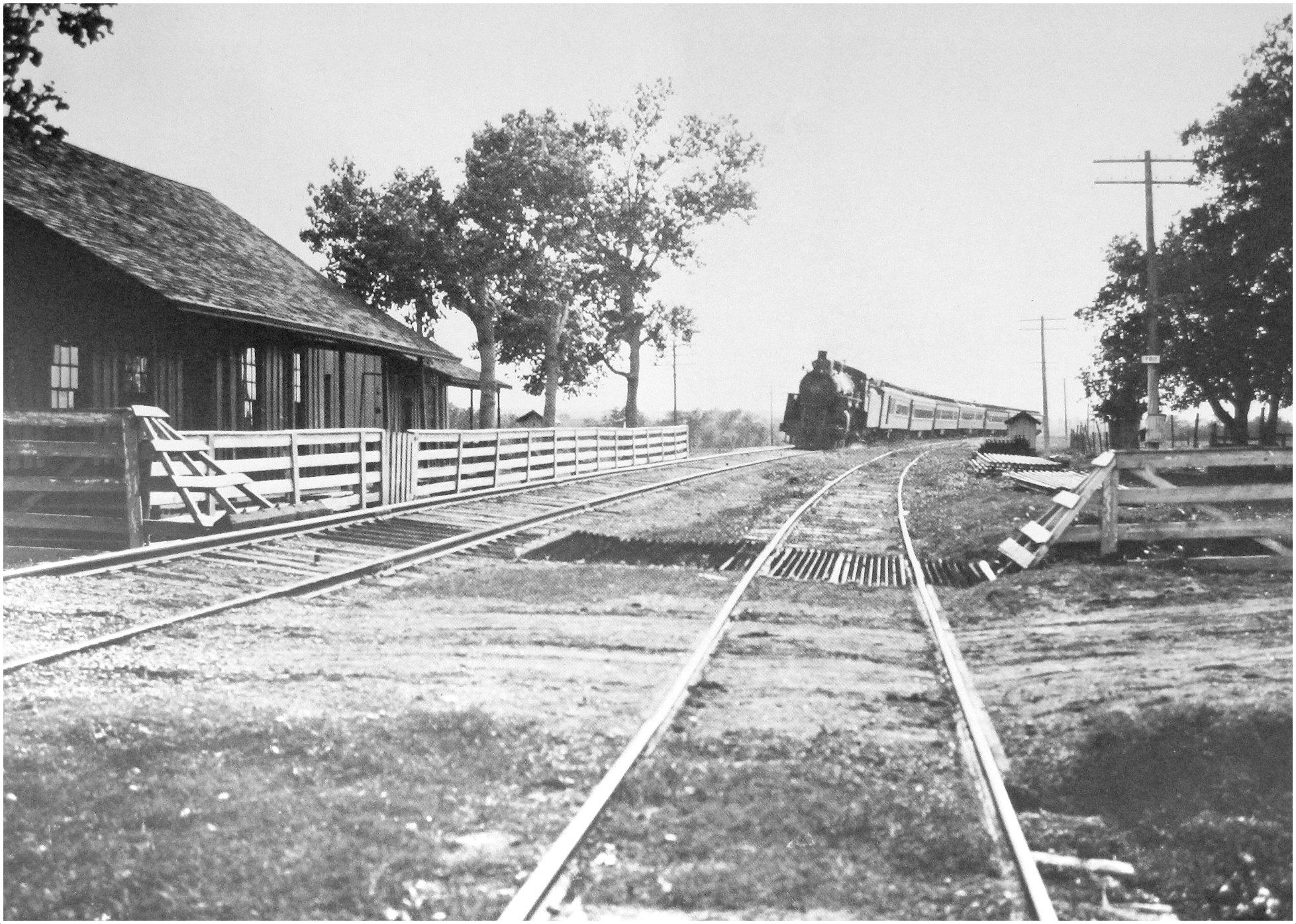
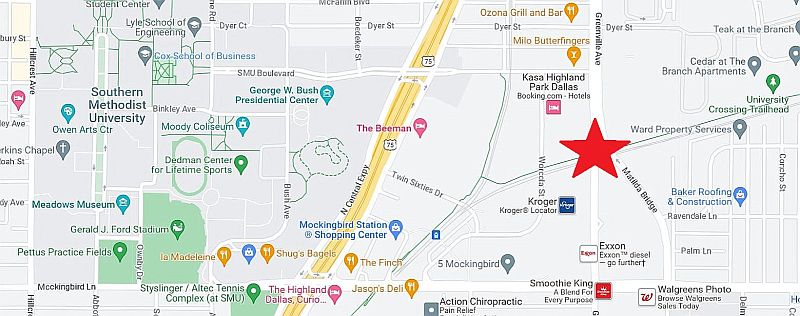
katy-train_mockingbird-greenville_c1908M-K-T approaching…

by Paula Bosse

I love this photo — taken not far from where I grew up — showing an MKT train waaaaaaaaaaaaaaay out in the country. A. C. Greene’s caption, from his book Dallas, The Deciding Years:

The Katy approaches Dallas. This spot would be near Mockingbird Lane and Greenville today. It was taken about 1908.

*

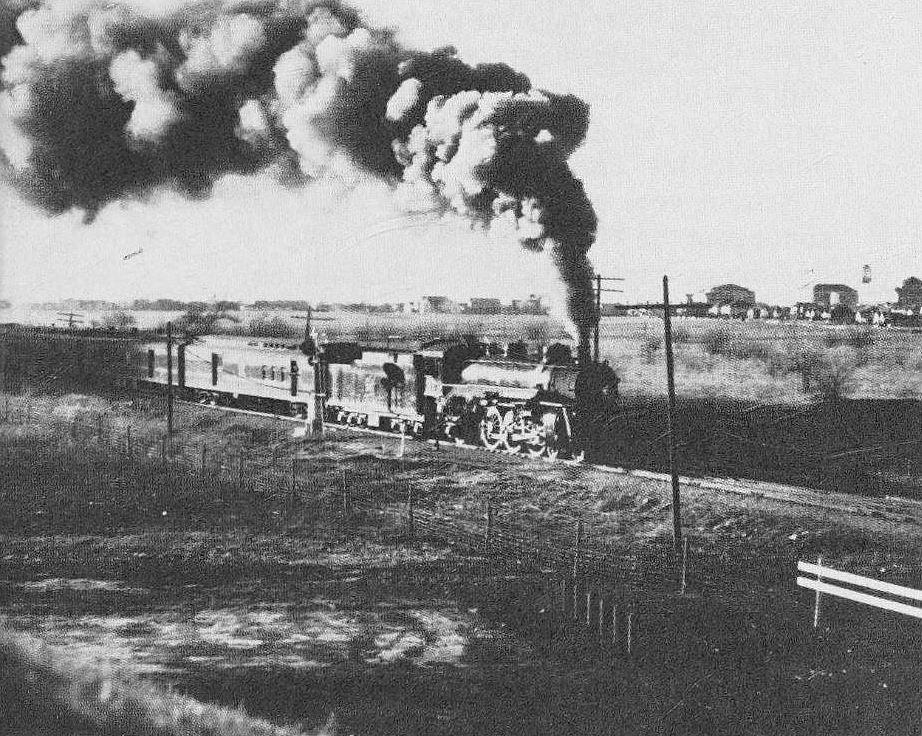
Here’s another photo, circa 1940s — SMU buildings can be seen in the distance.

smu_katy-train_park-cities-walkers-gd_diane-galloway_photo

And the caption to this photo, from the book The Park Cities: A Walker’s Guide and History by Diane Galloway and Kathy Matthews:

SMU as it was in the early forties can be seen in the distance as the Missouri-Kansas-Texas #379 Train No. 2 “Texas Special” speeds by northbound, approaching Greenville Avenue overpass. This particular day the train has a “pusher” because it was over ten cars long.

*

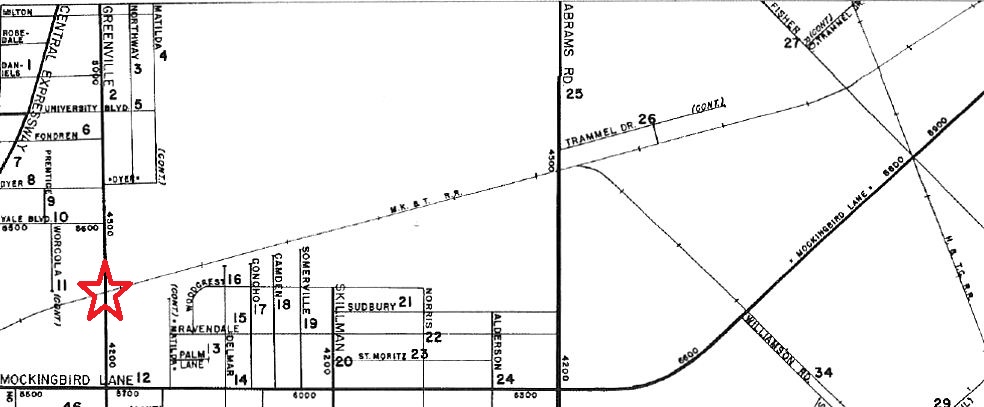
Below, a couple of helpful maps showing the general area (click to see larger images).

katy_greenville_mapsco-19521952 Mapsco

katy-crossing_greenville-ave_googleGoogle Maps

**

I’m just going to imagine the dearly departed Dr Pepper plant in the background. I grew up very close to here, and I would lie awake in bed as a child and hear train whistles a few blocks away. Even though the railroad tracks across Mockingbird, just east of Central, were removed several years ago, I automatically slow down when I drive across where they had been, still expecting to drive over the raised rails.

I sound old. (Am I old?) No, I’m not old! (…Am I?) Hmm. Maybe it’s time to start handing out ribbon candy to the neighborhood children who fetch my hat pins, lye soap, and a bolt of gingham from the sundries counter of the dry goods store in town.

***

Sources & Notes

First photo and caption from Dallas, The Deciding Years by A. C. Greene (Austin: Encino Press, 1973).

Second photo (from the DeGolyer Library, SMU) and caption appeared in the book The Park Cities: A Walker’s Guide and History by Diane Galloway and Kathy Matthews.

*

Copyright © 2014 Paula Bosse. All Rights Reserved.

The Romance of the Soot-Spewing Locomotive — 1909

t-and-p-flier_1909_LOC

by Paula Bosse

That parasol was white when she left the house.

*

Stereograph card titled “Texas and Pacific Railroad ‘Flier,’ Dallas, Tex.” (1909), from the Library of Congress.

*

Copyright © 2014 Paula Bosse. All Rights Reserved.

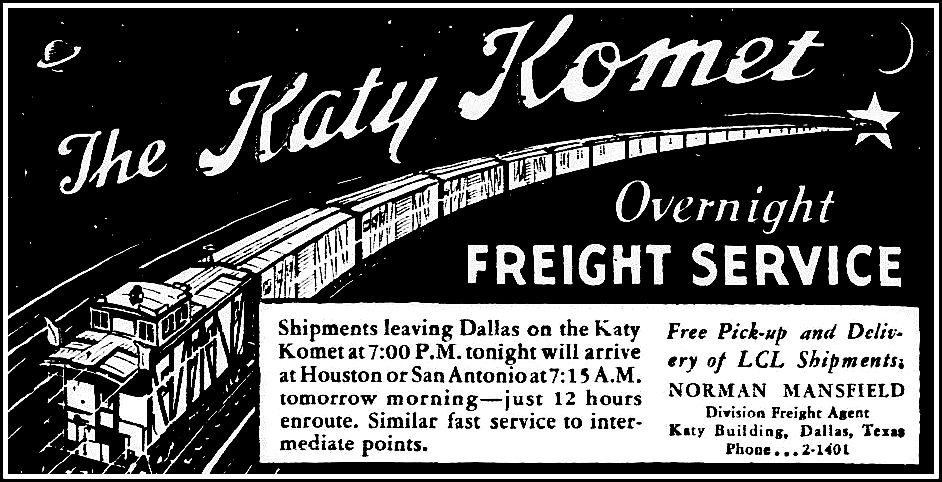
The Katy Komet — 1933

ad-katy-komet_dmn_031733

by Paula Bosse

What a great ad! Next stop, Venus!

***

This Katy Komet overnight freight service ad appeared in the The Dallas Morning News on March 17, 1933.

Click for bigger, BETTER image!

*

Copyright © 2014 Paula Bosse. All Rights Reserved.

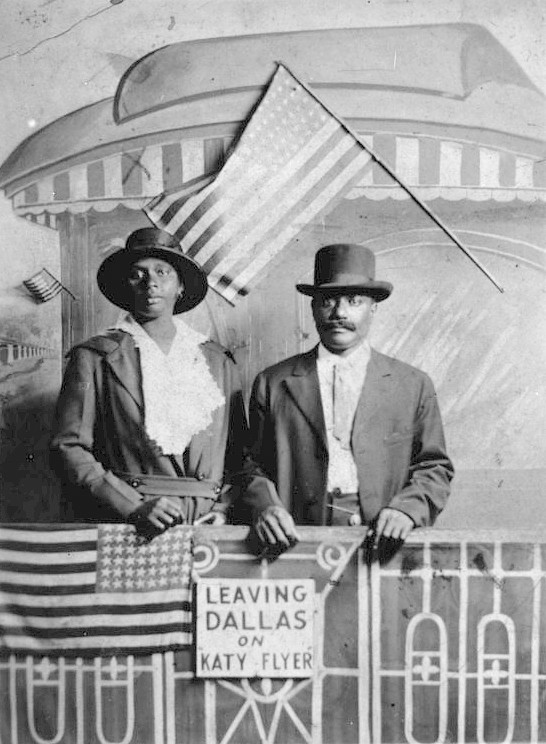
Leaving Dallas on the Katy Flyer — ca. 1914

leaving-dallas-katy-flyer1

by Paula Bosse

Who doesn’t love kitschy novelty photos? These “Leaving Dallas on the Katy Flyer” snapshots don’t disappoint with their cartoony backdrops — like something you’d see along a seaside boardwalk.

katy-flyer_three-men_1915_ebay
The people above are not identified, but, below, it’s a bunch of Order of Railroad Telegraphers union bigwigs. They probably had a wild time in Dallas. One or two of them look like they might be nursing a hangover.

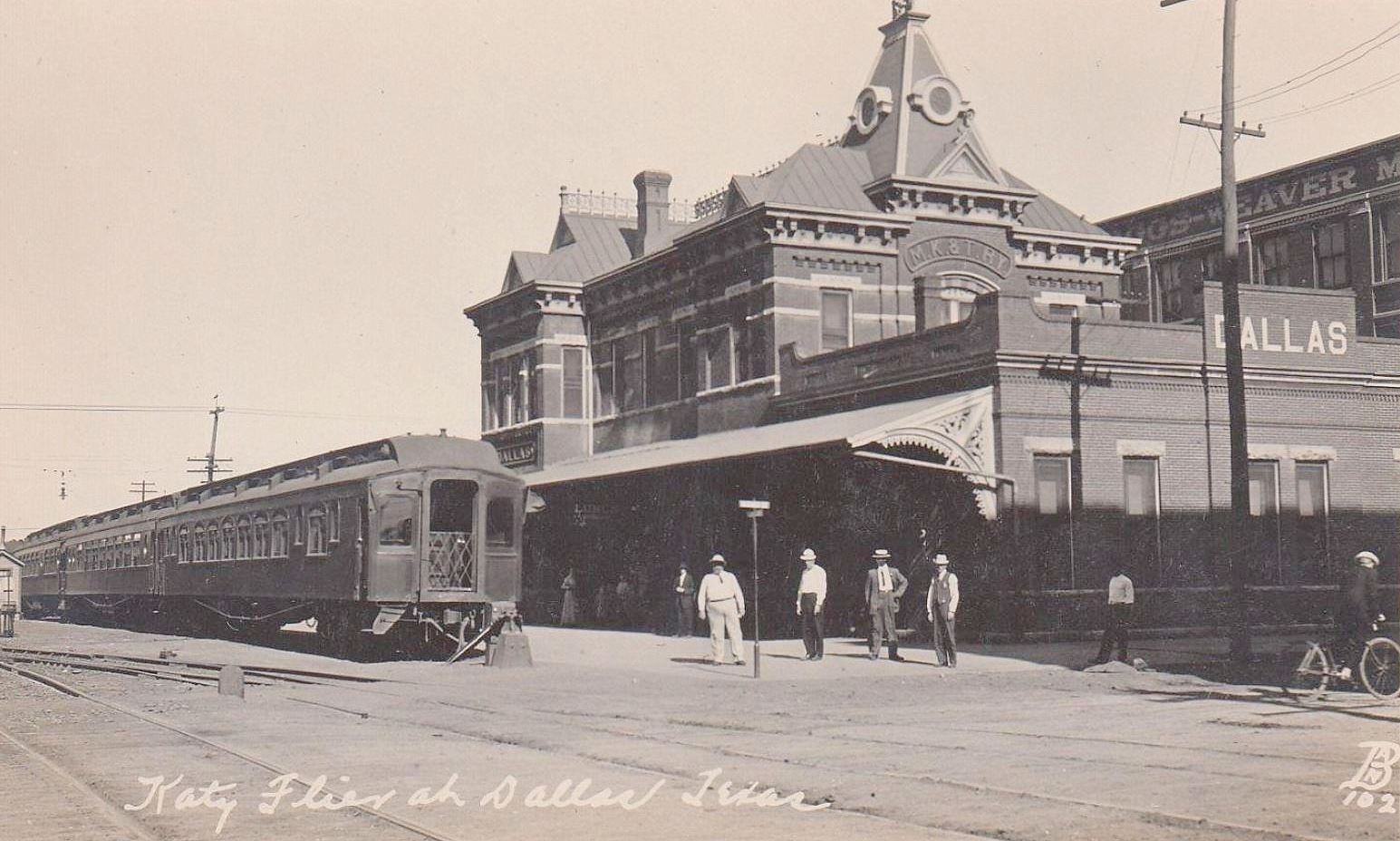
And just where was the point of departure from Big D for these Katy Flyer travelers? From the beautiful MKT passenger depot, formerly holding down the rails at Ross and Market.

katy-flyer_MKT_ebay_rppc

***

Sources & Notes

Top “real photo postcard” is from the J. L. Patton Collection, Dallas Historical Society.

Second photo was found on a postcard website.

Third photo is from eBay.

“O.R.T. General Committee” photo from — what else? — an issue of The Railroad Telegrapher (Feb. 1914).

Photo of the Missouri, Kansas & Texas depot is another real photo postcard, found on eBay.

See another Katy Flyer post — “M-K-T Railroad’s ‘Katy Flyer Route’ — 1902” — here.

*

Copyright © 2014 Paula Bosse. All Rights Reserved.


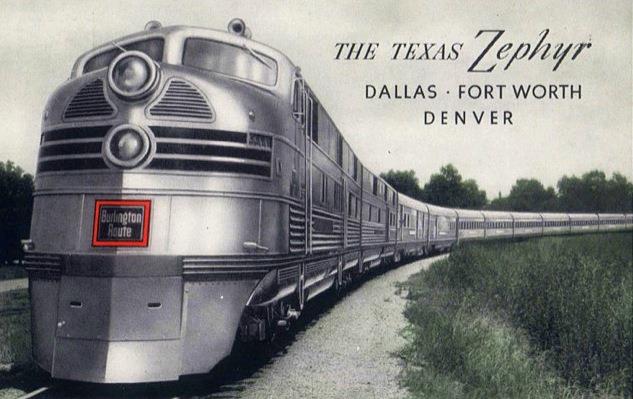
The Texas Zephyr — Streamlined Luxury Train Travel

Dallas — Fort Worth — Denver

by Paula Bosse

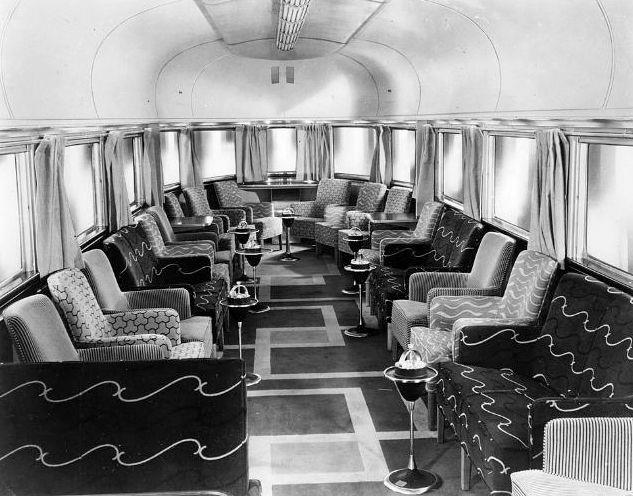
From the golden age of train travel. …I was born in the wrong era.

***

Sources & Notes

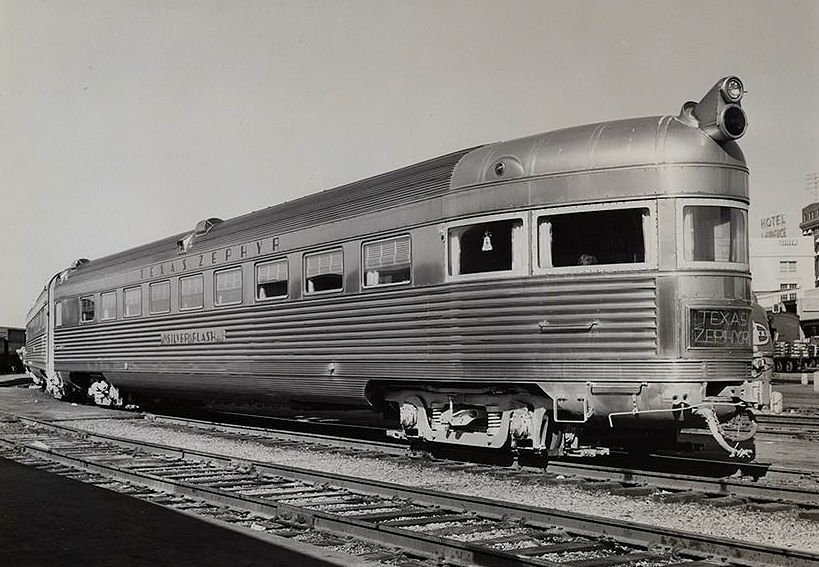
Second photo showing the exterior of the “Silver Flash” passenger car on the tracks at Union Station in Dallas is from the DeGolyer Library, Central University Libraries, Southern Methodist University; it was taken by Everett L. DeGolyer Jr. in 1960; more information on this photo is here.

Top and bottom images are from the wilds of the internet.

More on the Texas Zephyr here.

*

Copyright © 2014 Paula Bosse. All Rights Reserved.