Flashback : Dallas

A Miscellany: History, Ads, Pop Culture

Category: Vault

Jim Conner, Not-So-Mild-Mannered RFD Mail Carrier
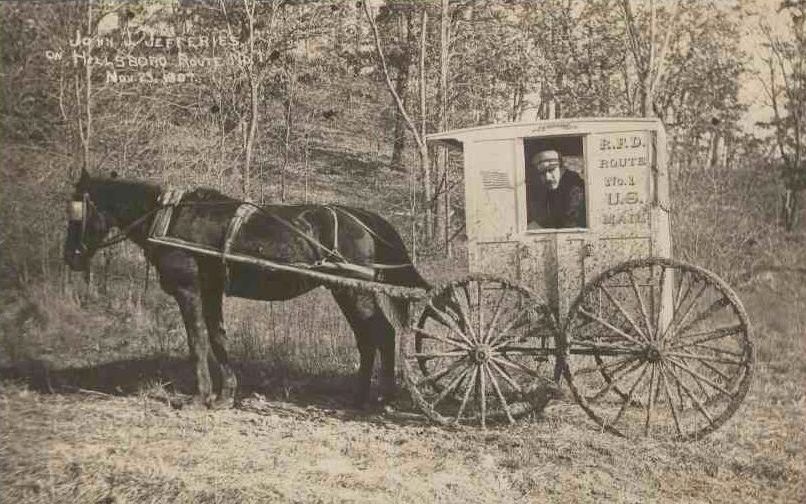
rfd_real-photo_1907-ebayAn RFD mail carrier… (click for larger image)

by Paula Bosse

The man in the photo below looks like every character actor working in Hollywood in the 1930s and ’40s.

conner-james-norton_mail-carrier_1940s

But he wasn’t an actor — he was a retired Dallas postal worker who began his career in 1901 as a rural mail carrier when the Rural Free Delivery (RFD) system was implemented in Dallas. (Before this, those who lived beyond the city limits — generally farmers — had to trek to a sometimes distant outpost — such as a general store — to pick up their mail.) RFD service began locally on October 1, 1901, and an 18-year old Jim Conner was one of six men hired to work the new mail routes beyond the city.

conner_FWregister_090101Fort Worth Register, Sept. 1, 1901

When Rural Free Delivery service began in Dallas, four rural post offices were closed: Lisbon, Wheatland, Five Mile, and Rawlins (the office at Bachman’s Branch, which Jim Conner’s route replaced).

In a 1940 interview with The Dallas Morning News, Conner talked about his early postal route (Route 5), which was 32 miles long; before the arrival of automobiles, he traveled on horseback, by horse cart, by buggy and cart, or by bicycle. The photo at the top shows what early RFD mail wagons looked like.

Jim’s route took him well beyond the city limits: out Cedar Springs to Cochran’s Chapel, to within a mile of Farmers Branch, and over to Webb’s Chapel by way of the “famous” Midway Church and School corner (which became Glad Acres Farm); he returned on Lemmon Avenue. It took him 8 hours if the weather was nice; if the weather was particularly bad, it could take 12 to 15 hours to complete his appointed rounds. He was paid $500 a year and was required to keep two horses, a cart, a buggy, and saddles. He retired in 1935.

**

So. A delightfully nostalgic walk down memory lane with an avuncular-looking guy we all kind of feel we know. I thought I’d do a quick search to see if there was an obituary for Jim — there was: he died in 1956 at the age of 73, survived by his wife, 11 children (!), 22 grandchildren, and 3 great-grandchildren. But in addition to the obit, I found something else: a report of a shooting, an arrest, and a charge with “assault to murder.”
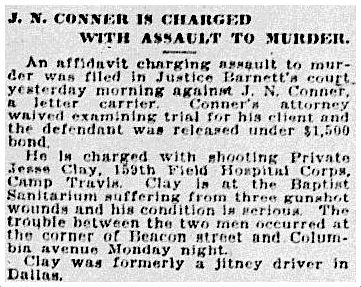
conner-charged_dmn_010218DMN, Jan. 2, 1918

What?!!

Though the account of the incident is described as being “somewhat vague,” on New Year’s Eve, 1918, Jim Conner shot a soldier named Jesse Clay after “words” were exchanged at the corner of Beacon and Columbia in Old East Dallas. There had been bad blood between the two in the past, and the New Year’s Eve situation apparently escalated quickly. Clay had been walking down the street with a lady-friend when Conner’s car came to a stop next to them. Clay (described as being drunk at the time) forced his way into the car, and Conner, fearful of being attacked, reached for a gun in the back seat. The two tussled and, after they were both out of the car, Conner saw that Clay also had a gun. This was when Conner shot him three times, intending, he said, to merely wound him. Clay shot back but missed. (The entire account, as it appeared in The Dallas Morning News on Jan. 1, 1918 can be read in a PDF here.)

The soldier was badly injured, with two of the three shots hitting his chest. He was not expected to live. Conner had surrendered to police at the scene and was charged with “assault to murder.” The last report on this incident that I could find was on Jan. 3, in which Clay was described as being in “very critical condition.”

So what happened? As Conner spent a full career as a postal employee, it seems unlikely he was tried for murder. I used every possible combination of search words I could think of but found nothing more on this case. The story just disappeared. I did find a 1943 obituary for a Jesse P. Clay (killed while working on an Army Air Force Instructors School runway when he was struck by the wing of an airplane coming in for a landing), and it seems likely that it was the same guy — he was about the right age, he was a career military man, he lived in Dallas most of his life, and he was born in Kentucky. I assume the soldier in question (who would have been 37 at the time of the shooting) survived his gunshot wounds and that charges against Conner were either dismissed (with Conner pleading self-defense?) or settled (perhaps the military intervened to keep the story out of the press — this was during the height of WWI). Whatever actually happened, it seems that both men were able to move on from that really, really bad New Year’s Eve, a night I’m sure neither forgot.

My favorite little detail in the story of this sordid shooting was the line in the initial newspaper report in which it was revealed that one of the (potentially deadly) bullets was “deflected by a packet of letters and a steel comb.” How appropriate that the thing that probably saved mailman Jim Conner from a murder rap was “a packet of letters.” (…And a steel comb, but that doesn’t fit in with my narrative quite so well. Although Mr. Conner does look quite well-groomed.)
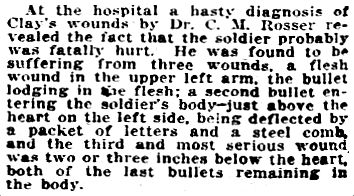
packet-of-letters_dmn_010118DMN, Jan. 1, 1918

***

Sources & Notes

Real-photo postcard of Hillsboro, Wisconsin RFD mail wagon is from eBay.

The full DMN account of the bizarre 1918 shooting can be read in a PDF, here.

An informative site on history of Rural Free Delivery — with lots of photos — can be found here.

“RFD”? Wiki’s on it, here.

*

Copyright © 2014 Paula Bosse. All Rights Reserved.


From Dull to Spectacular — How a Picture Postcard Evolves

theater-row_before_tsha

by Paula Bosse

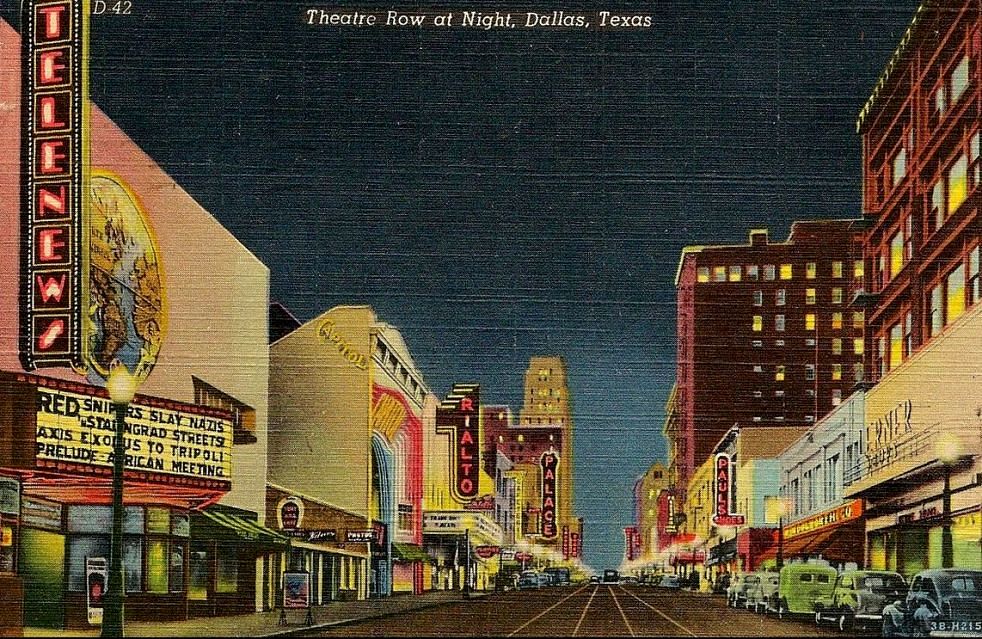
You know how you look at some of those fantastic postcards from the ’40s that don’t look real and you wonder, “Is that from a photograph, or is that just an artistic interpretation?” Well, it’s both.

In the above “before” and the below “after,” it’s interesting to note what’s been kept in and what’s been taken out. And how a fairly ho-hum daytime view becomes a dazzling night-time scene. Either way, it’s an Elm Street I’ll — sadly — never experience.

theater-row_after

***

Sources & Notes

Black-and-white photograph of Elm Street’s “Theater Row” from the Texas State Historical Association.

Click pictures for larger images.

*

Copyright © 2014 Paula Bosse. All Rights Reserved.
 

“Jim Nasium” Can Teach You a Thing Or Two About Baseball Heckling — 1908

baseball-hecklers_dmn_050308Cartoon by “Jim Nasium” — 1908 (click for larger image, you sap-head)

by Paula Bosse

If you were a die-hard baseball fan in 1908, you were no doubt familiar with many of the jeers featured in the cartoon above by one Mr. “Jim Nasium,” a sportswriter and cartoonist who was given almost half a page of primo newsprint each Sunday in many newspapers around the country. Feel free to incorporate some of these exhortations into your next enthusiastic visit to the ballpark. ANY ballpark. Those kids can take it….

**

Below, a few images of the Dallas baseball scene from around the time that Mr. Nasium’s column on “roasting” appeared in the pages of The Dallas Morning News. (As always, click for large images.)

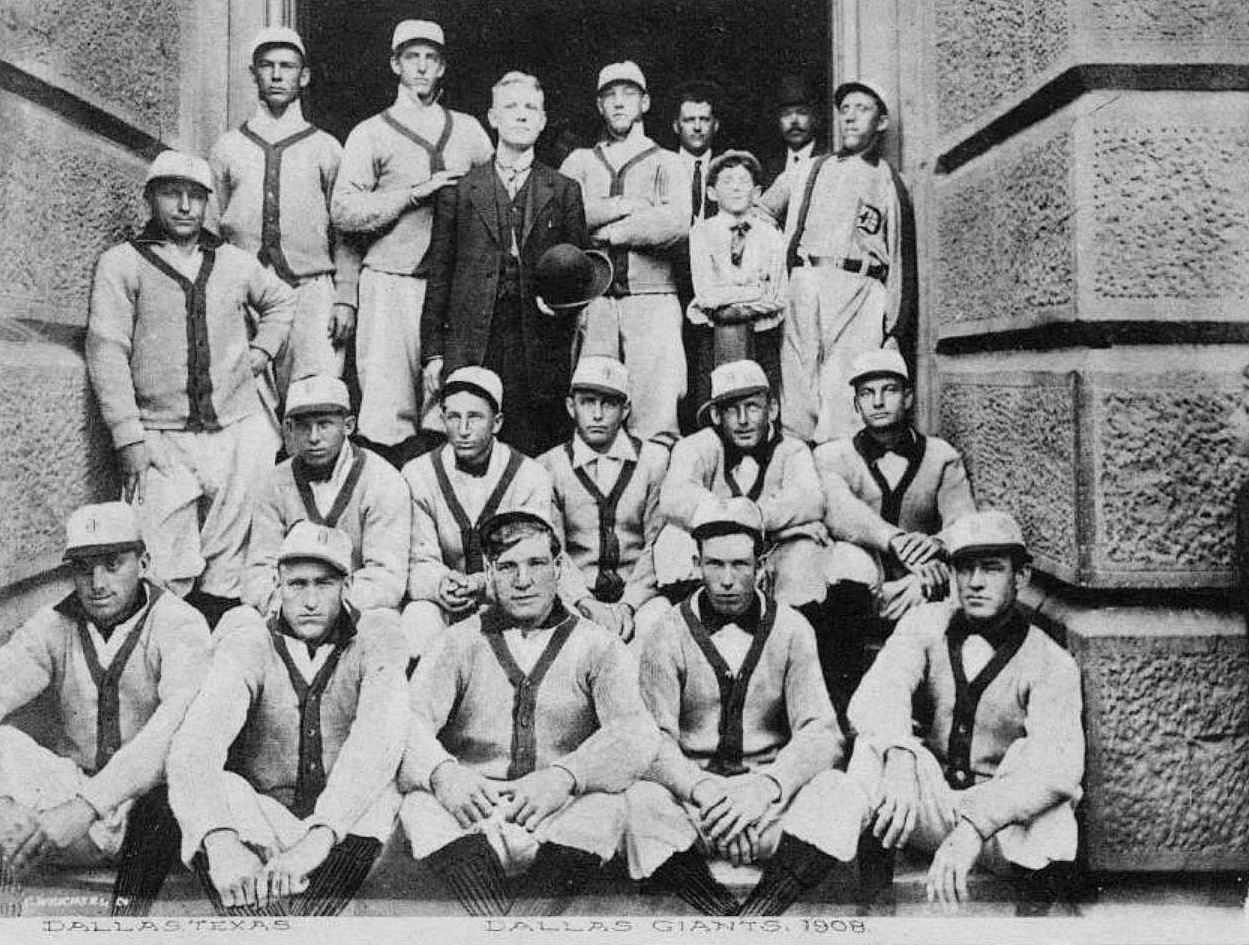
dallas-giants_cook-colln_degolyer_smu
The Dallas Giants, 1908

Above, the 1908 Dallas Giants team. Bottom row–Slattery, Fletcher, Kerns, Tullos, Maloney. Middle row–Maag, Hole, Moore, Whittaker, Cooper, Loudell. Top row–Burnett, Peters, Hay, Storch, Miller.

*

baseball_gaston-park_dmn_050508

Here’s where they played that week, Gaston Park. Mayor Hay threw out the first ball. Below, where the cat-calls would come from. “What’re you tryin’ to bunt for, you sap-head!”

baseball_gaston-park_grandstand_dmn_050508DMN, May 5, 1908

*

baseball-ad_dmn_050608DMN, May 6, 1908

***

Sources & Notes

The cartoons of “Jim Nasium” appeared in The Dallas Morning News alongside his weekly column, “Conversations With an Old Sport,” a humorous syndicated series by Edgar F. Wolfe, who would later go on to edit Sporting Life. Here is an excerpt from that week’s column about the bad sportsmanlike conduct of jeering spectators in grandstands, complete with wonderful slang you’ve probably never encountered before (click to read):

jim-nasium_dmn_050308-excerptDMN, May 3, 1908

This full “Conversations With an Old Sport” column can be read in a PDF here. (You’re going to have to click that “plus” symbol at the top many, many times in order to magnify the text enough to read it!)

Photo of the Dallas Giants from the George W. Cook Dallas/Texas Image Collection, DeGolyer Library, Southern Methodist University; it can be accessed here. It appeared in the pages of The Dallas Morning News on May 6, 1908, crediting photo to Clogenson.

A few more (grainy) photos of Gaston Park — site of the first Texas-OU game held in Dallas in 1912 — can be seen in another Flashback Dallas post, here.

*

Copyright © 2014 Paula Bosse. All Rights Reserved.

Telephone Operators Sweating at the Switchboard — 1951

summer_telephone-operators_1951Low-tech A/C: ice, buckets, fans

by Paula Bosse

The summer of 1951 in Texas was brutally hot. One heat-related incident that August made national headlines: more than 1,500 Southwestern Bell telephone operators (and supportive coworkers) who were working in unairconditioned conditions (!!) at the Haskell Exchange on Bryan and at the Akard Street headquarters downtown staged what news reports called a “wildcat walkout” and refused to continue working in the sweltering buildings. Management’s attempt to cool things down with electric fans blowing over buckets of ice had not worked. Operators returned the next day, having made their point, hopefully to the imminent installation of air-conditioned switchboard rooms.

The caption for the photo above:

Dallas, Tex. Aug. 10 [1951] — BEATING THE HEAT — Both ice and fans are brought into play by telephone operators at an exchange here today as the city continued to swelter under 100-degree or over temperatures. The thermometer reached a high of 102-degrees to run the consecutive days of 100-degree readings to ten. It is the longest period of such reading since 1925 when a record 11 straight days was set. High mark for the present heat wave was 107 on August 6.

Three days later, the sweat hit the fan, and the women walked out.

operators_heat_st-joseph-MO-news-press_081451
St. Joseph [MO] News Press, Aug. 14, 1951 (click to read)

Let’s hope your work conditions are a bit better this summer!

***

Sources & Notes

Wire service photograph from the Southern Labor Archives of the Georgia State University Library Special Collections.

See ads from 1911 and 1925 encouraging women to become telephone operators in the Flashback Dallas post “Work and Play in Telephone Land,” here.

*

Copyright © 2014 Paula Bosse. All Rights Reserved.
Metzger’s Milkmen in Bermuda Shorts — 1955


metzgers_bermuda_life_052355-full
Metzger’s milkmen on parade in Life magazine

by Paula Bosse

Something BIG happened in Dallas in 1955 — it was such an earth-shattering event that it made headlines around the country: Metzger’s milkmen in Dallas announced that Bermuda shorts would become part of their summer uniform. It must have been a slow news month, because this story was picked up by the wire services and absolutely caught fire, running in newspapers all over the country. It even climbed to the pinnacle of mass media newsworthiness and found itself in the pages of Life magazine where the above photo was accompanied by the following caption:

MILKMEN’S CALVES
Drivers for a Dallas dairy produced a new morning look by setting out in Bermuda shorts. The boss thought they would be cooler in them. The shorts were fine, but one driver was nipped by a dog of long acquaintance who didn’t recognize him. (Life, May 23, 1955)

It was also the subject of newsreel footage. Watch the 1-minute silent clip here. Below, a screenshot:

metzgers_bermuda-shorts-footage_1955_getty

*

In 1955, Bermuda-shorts-fever had somehow gripped the nation. Some sort of marketing sadist was pushing the jacket-and-tie-and-Bermuda-shorts-and-knee-socks combo as appropriate and stylish summertime apparel for men in the boardroom — an unfortunate early version of “business casual.” Mercifully, the fad died fairly quickly.

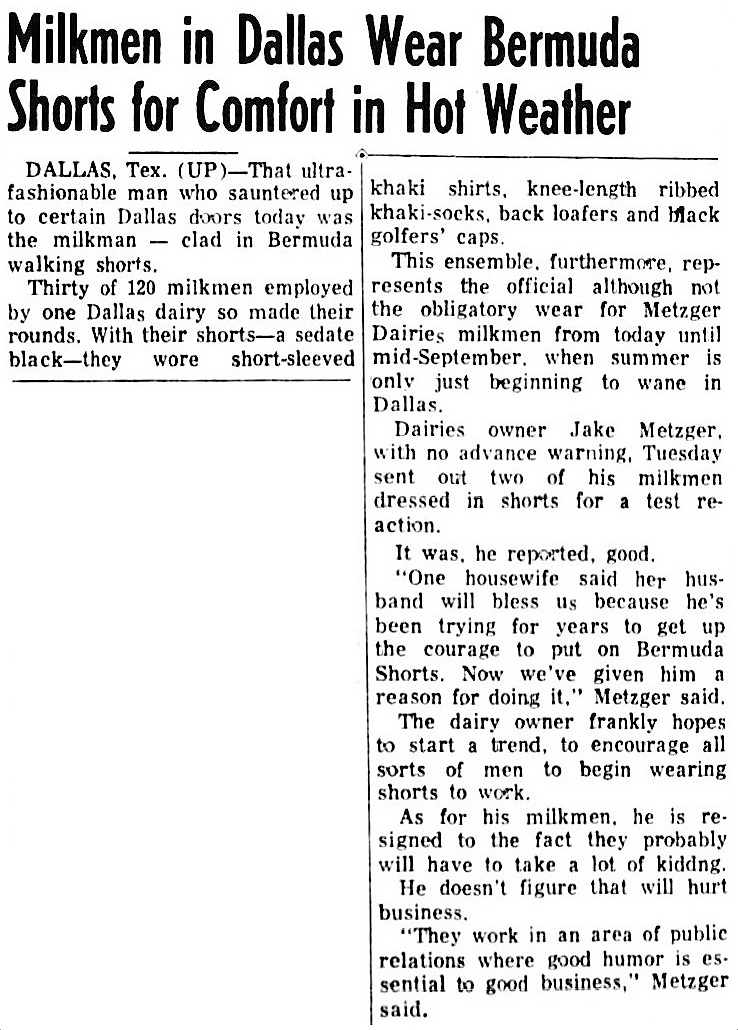
But another more utilitarian idea for the new cool and comfortable shorts emerged here in Dallas. Jake Metzger, owner of the dairy that produced Metzger’s milk, decided to adopt the shorts as part of a new summer uniform for his milk delivery men. The Dallas Morning News suggested that this might be the first such uniform in the United States. Shorts were just not widely seen outside the gym in those days, and certainly not in the workplace. But it gets hot in Texas in the summer. Real hot. REAL hot. Metzger’s idea was a brilliant one, and I’m sure his drivers appreciated it. According to an AP article, the new uniform would consist of the following:

The shorts are the black Bermuda type, often called walking shorts, with an elasticized maroon belt. They’re matched with a short-sleeve khaki shirt, over-the-calf cotton ribbed khaki socks and low black loafers. The outfit is topped with a black cotton golfers’ cap. (AP, May 10, 1955)

If a milkman believed that the new uniform went against his “moral scruples” — or if he just didn’t like the way he looked in it — he could opt out and wear the regular uniform. But a lot of the men jumped at the chance — reports said 30 of 120 milkmen went bare-kneed. And their photos were splashed across newspapers all over the place. A publicity bonanza! Here are just a few of the photos.

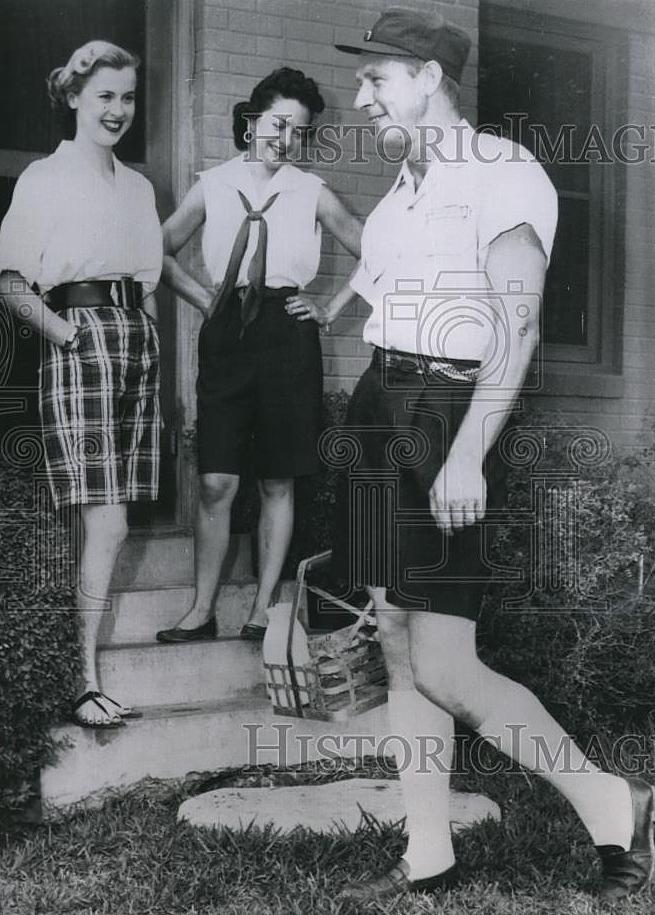
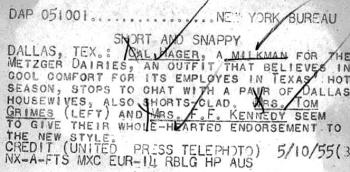
Milkman Cal Hager, ogled by Mrs. Tom Grimes and Mrs. F. F. Kennedy:

metzgers_ebay_front

metzgers_ebay_rearUPI wire photo, May 10, 1955

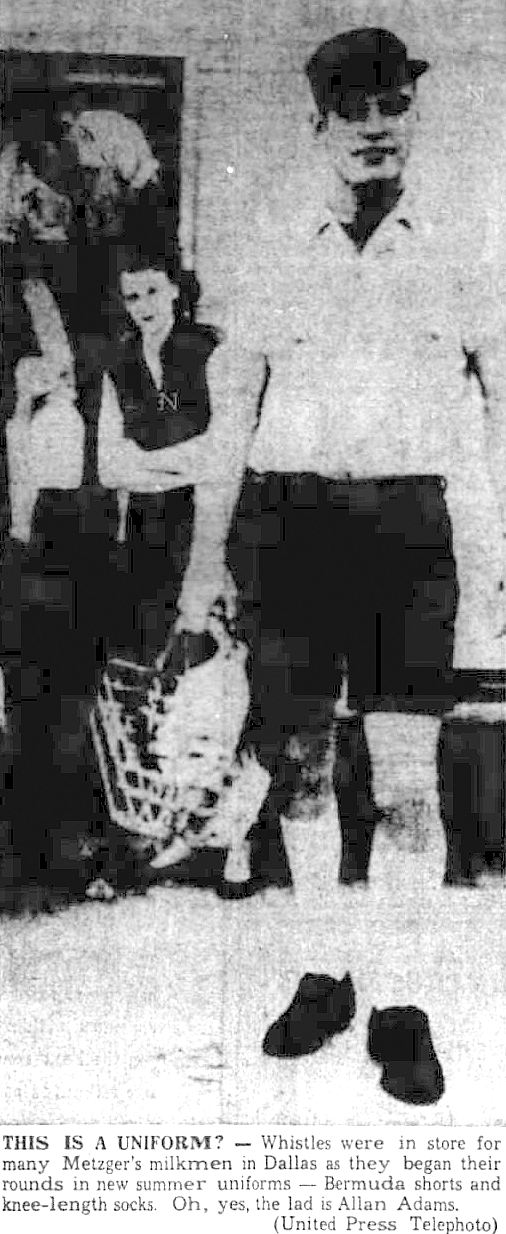
Allan Adams gets the once-over by his customers:

bermuda-shorts_victoria-TX-advocate_051355Victoria (TX) Advocate, May 13, 1955

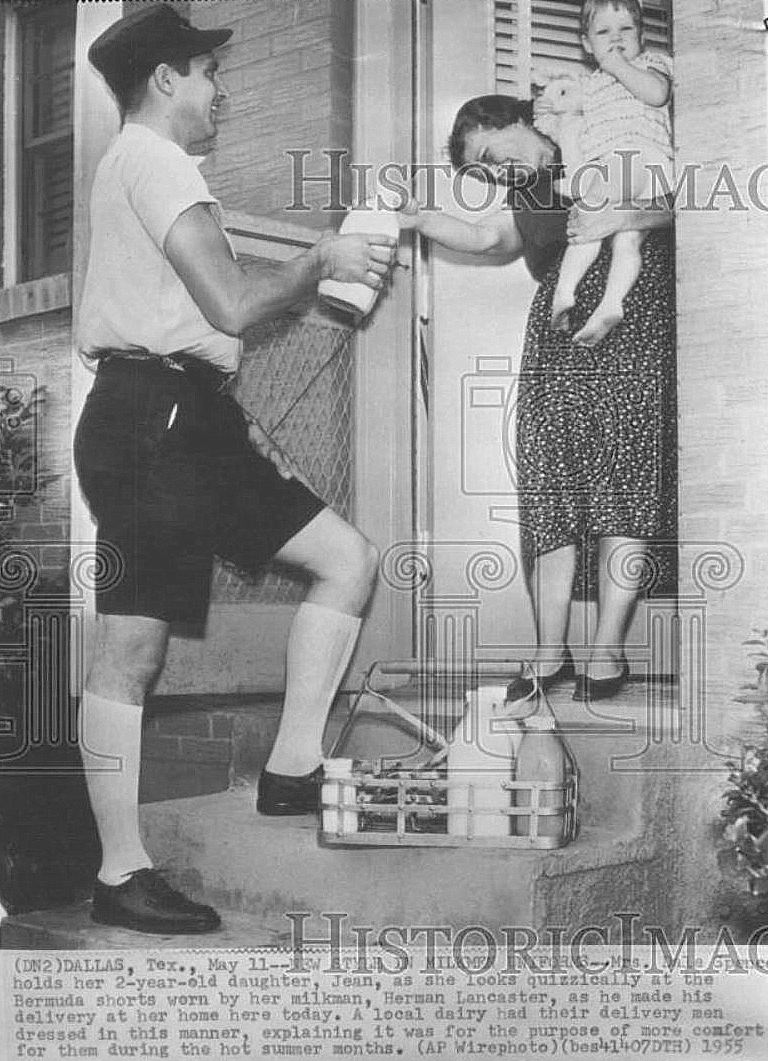
Herman Lancaster and a confused Mrs. Dale Spence (holding daughter Jean):

metzger_bermuda-shorts_historic-imagesAP wire photo, May 11, 1955

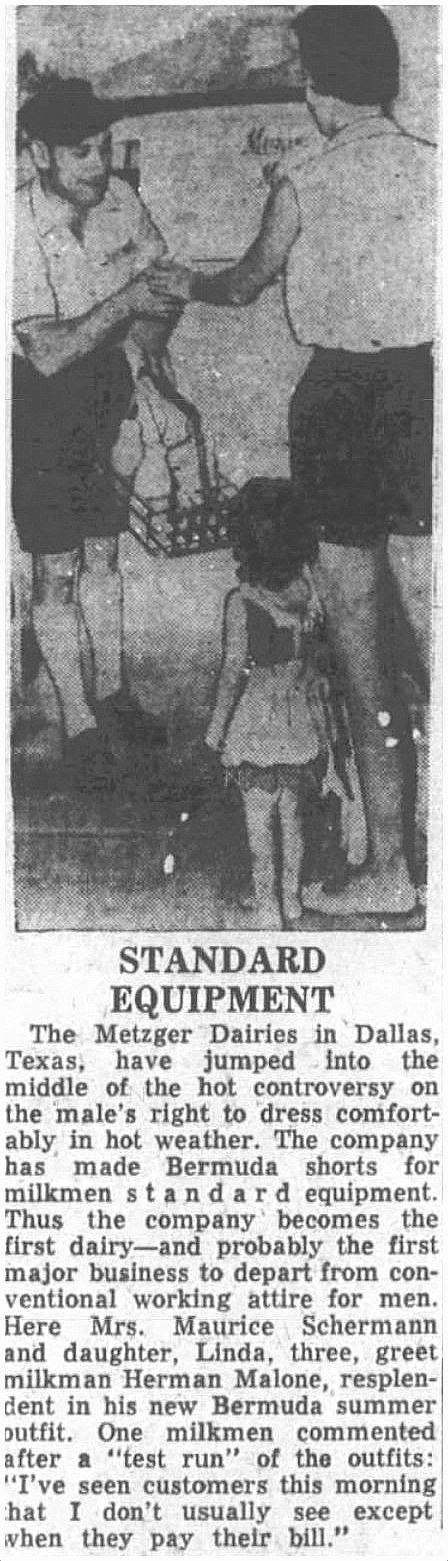
Metzgers’ man Herman Malone proffers a bottle to Mrs. Maurice Schermann and her daughter Linda:

metzger_bermuda-shorts_nanaimo-brit-columbia-daily-news_061055Nanaimo Daily News, British Columbia, Canada, June 10, 1955

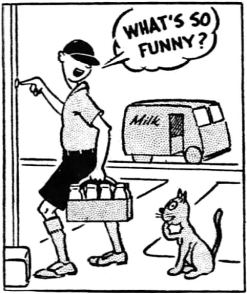
metzger_bermuda-shorts_philadelphia-inquirer_051255_cartoonPhiladelphia Inquirer, May 12, 1955

*

The headlines were often better than the photos, in all their reverse sexist glory. Here are a few from every corner of the United States:

  • “DALLAS MILMEN REAL CREAMY IN SHORTS, SOX”
  • “HOUSEWIFE DELIGHTED: MILKMEN MAKE ROUNDS IN BERMUDA WALKING SHORTS”
  • “YOO-HOO, MILKMAN!”
  • “MILMAN COMETH IN SHORTS NOW”
  • “THE MILKMAN COMETH, AND LOOK AT HIS CLOTHES!”
  • “HE’S IN SHORTS: WHISTLES, CATCALLS GREET THE MILKMAN”
  • “DALLAS MILKMEN GO TO WORK DUDED UP”
  • “SPORTY SHORTS FOR MILKMEN”
  • “WHISTLE-BAIT MILKMEN DON BLACK SHORTS”
  • “QUARTS WITH SHORTS — 30 MILKMEN GO NATTY”
  • “DON’T WHISTLE, MOTHERS, IT’S ONLY THE MILKMAN”
  • “CATCALLS, WHISTLES, POETRY GREET SHORTS-CLAD MILKMEN”
  • “ULTRAFASHIONABLE MILKMEN ARE CLAD IN BERMUDA SHORTS”

**

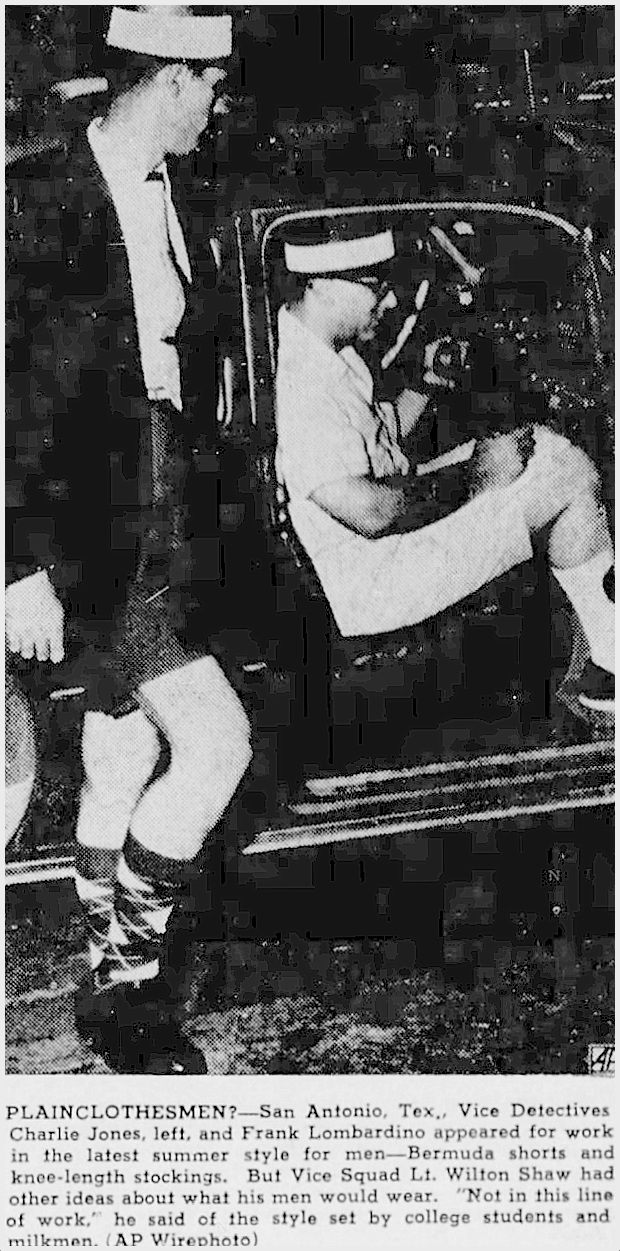
You know a fashion craze has gotten out of hand when you see San Antonio vice squad detectives looking like this:

bermuda-shorts_bryan-TX-eagle_052755_copsBryan (TX) Eagle, May 27, 1955

If Messrs. Jones and Lombardino are still amongst the living, I’m pretty sure they still haven’t lived that photo down. (The partner of Wilton Shaw is misidentified in this photo — he is Chesley Jones.)

**

metzger_bermuda-shorts_coshocton-OH-tribune_051155Coshocton (OH) Tribune, May 11, 1955

*

Copyright © 2014 Paula Bosse. All Rights Reserved.

Gusher at Old Red! — 1890

artesian_bywaters-hogue_color-smu“Artesian Well Gushes on the Courthouse Grounds”
Partial view of the mural by Jerry Bywaters & Alexandre Hogue (1934)

by Paula Bosse

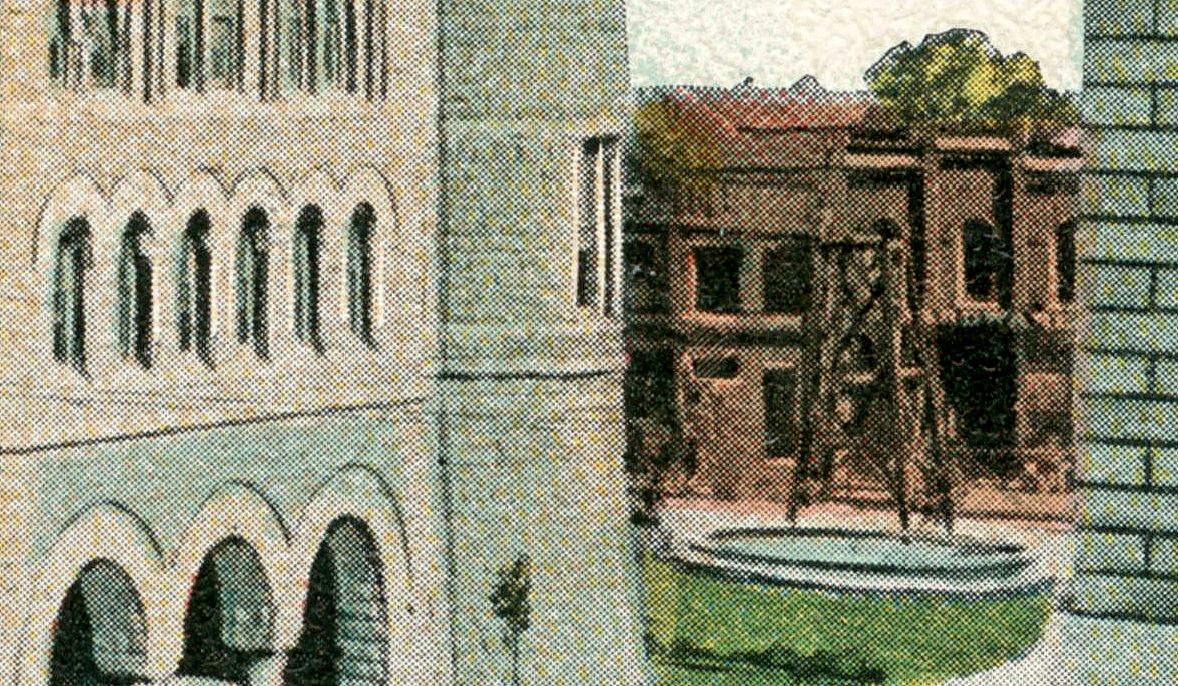
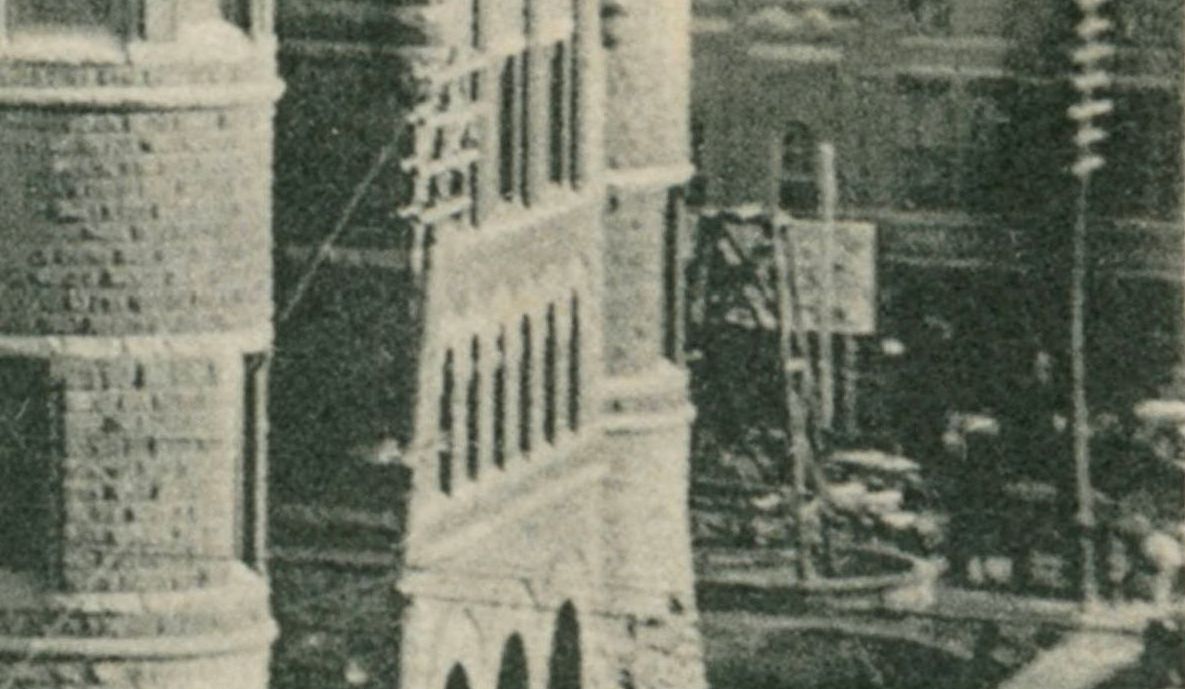
Several months ago, I was looking at the postcard of the Old Red Courthouse shown below. I thought it was interesting because I hadn’t seen that view before. And then I noticed what looked like a derrick just to the right of the courthouse. What was that? It  looked like it was standing over a tank of water, kind of like a windmill. And then I got distracted and didn’t come back to it until I read of an (unrelated) old well having been uncovered in present-day Dealey Plaza a year or two ago, and I remembered this postcard. Was that a well? On the courthouse property? And now I know: it was, in fact, an artesian well that had been sunk on the courthouse lawn in the fall of 1890, and its success was an INCREDIBLY important factor in Dallas’ growth as a city.

artesian_old-red_postcard-color_degolyer

artesian_old-red_postcard-color_degolyer-det

artesian_old-red_postcard-bw_degolyer

artesian_old-red_postcard-bw_degolyer-det

In 1890, Dallas was growing at a remarkable rate, and like any large city, it needed a reliable source of water. In Dallas, that was a problem. Wells were dotted around town — many on private property — but a large supply of water for the ever-increasing community was needed, and needed fast. I gather things were reaching a critical point when The Dallas Morning News printed a letter from a reader named S. T. Stratton in January of 1890. Stratton, a long-time resident of Dallas, suggested digging an artesian well on courthouse property. (And while they were down there, they could check for the possibility of oil and gas.)

artesian-old-red_STRATTON-dmn_010890DMN, Jan. 8, 1890

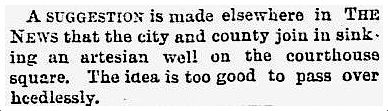
It seems that this might not have been an idea many people would have taken seriously at the time, because several pages away in the same issue of the paper was this little tidbit encouraging readers to seriously consider this as a viable option. (This was unsigned, but it seems likely it was written by DMN publisher G. B. Dealey.)

artesian-old-red_dmn_010890DMN, Jan. 8, 1890

The idea gained popularity, and a “special committee on artesian water” convened in February, deciding to go forward with the plan; the city and the county would divide the cost.

artesian-old-red_dmn_020690DMN, Feb. 6, 1890

Later in the year, drilling began, and on Oct. 9, 1890, water was hit. The flow at first was slow, but then, just like in the movies … a gusher! A Dallas News reporter had been writing a story on the initial success when, before he was able to file his report, the well suddenly became the biggest story in the city, in the state, and even around the country. When the drill hit 1,000 feet, the water began to shoot up with such force that it was estimated the well would produce in excess of one million gallons a day. There must have been incredible excitement in the wee hours of that morning, and the reporter’s story of the gusher is pretty thrilling to read — that last sentence is wonderful: “The water at 1 o’clock this morning was clear and it sparkled beautifully in the rays of electric lights.”

gusher_dmn_101090_updateDMN, Oct. 10, 1990

Below is the headline of the in-depth coverage of the successful well (full story linked at bottom of this page). Throngs of people crowded around the well, jubilant politicians patted themselves on the back, and men from the surrounding area wanted one for their towns (Marsalis declared he would get one for Oak Cliff, post haste!). What a scene it must have been. Finally, with that massive reservoir of water underneath the city, Dallas was assured of its continued growth.

gusher_dmn_101190-headlineDMN, Oct. 11, 1890

A story that ran in the national business journal Manufacturer’s Record underlines the importance of the well’s discovery to business investors around the country:

This successful experiment effectively settles the water supply problem of Dallas, and it removes the last obstacle possible to be urged against the rapid building up of Dallas. It insures an unlimited supply of the finest water not only for domestic use, but for manufacturing purposes, which, taken in connection with cheap fuel and ample distributing facilities in a land where various lines of raw material abound, leaves no question as to the success of manufactures. (Quoted in the DMN, Oct. 21, 1890)

Not only was the well’s success being discussed in the national press, but it was also popping up in local ads, like this one from a real estate company which appeared in the pages of the DMN on Oct. 12, 1890:

THE ARTESIAN WELL
Is ‘a Thing of Beauty and a Joy Forever.’
And the hour the drill pierced the water-bearing strata and the precious fluid gushed forth at the rate of 1,000,000 gallons a day forms a new era in the history of the metropolis of the southwest. Every foot of ground in Dallas has increased in value by no inconsiderable amount, but the few lots left on the market in Hall’s second addition will still be sold at $100 each, easy terms.

So I’ve learned something new. I probably should have known about this, at least in connection with the series of PWAP murals produced in 1934 by Jerry Bywaters and Alexandre Hogue, two of my favorite Dallas artists. They painted ten murals throughout the old City Hall (later known as the Municipal Building), each illustrating a high point in the city’s history. The decade 1890-1900 was commemorated by a depiction of the artesian well and all that water discovered flowing beneath the grounds of the then-under-construction Dallas County Courthouse. Unbelievably, the murals were destroyed (!) when the building underwent renovation in 1956. Had they still  been around, I probably would have seen them, and I would have learned about this whole artesian well thing many, many years ago!

artesian_bywaters-hogue_bw-smuWho is the sinister-looking man in the dark coat?

*

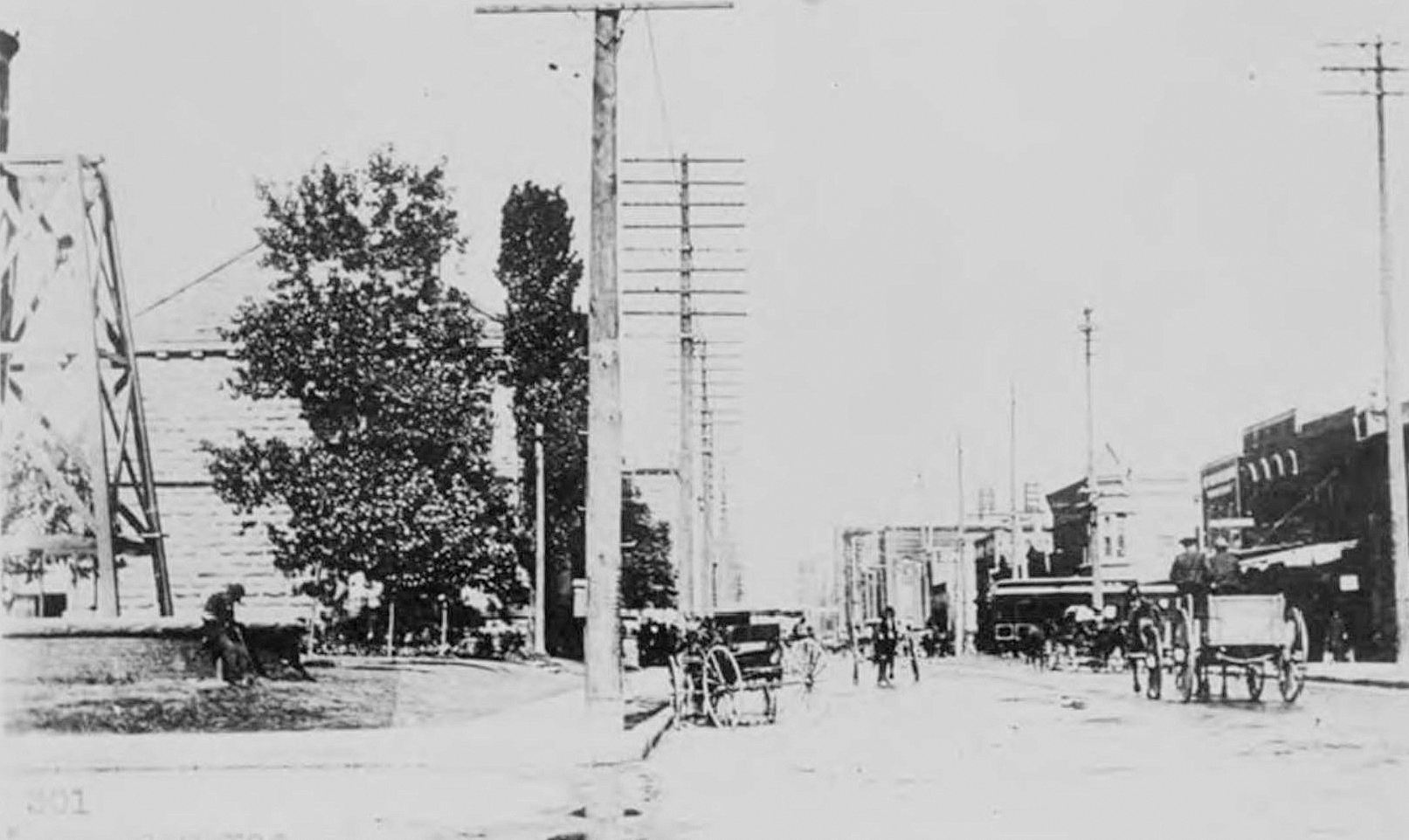
A street-level view from about 1900, showing Commerce Street east from Houston Street showing the artesian well at the left — I believe this served as a public watering trough for horses.

gusher_east-on-commerce-from-houston_degolyer-lib_SMU_1900via DeGolyer Library, SMU

*

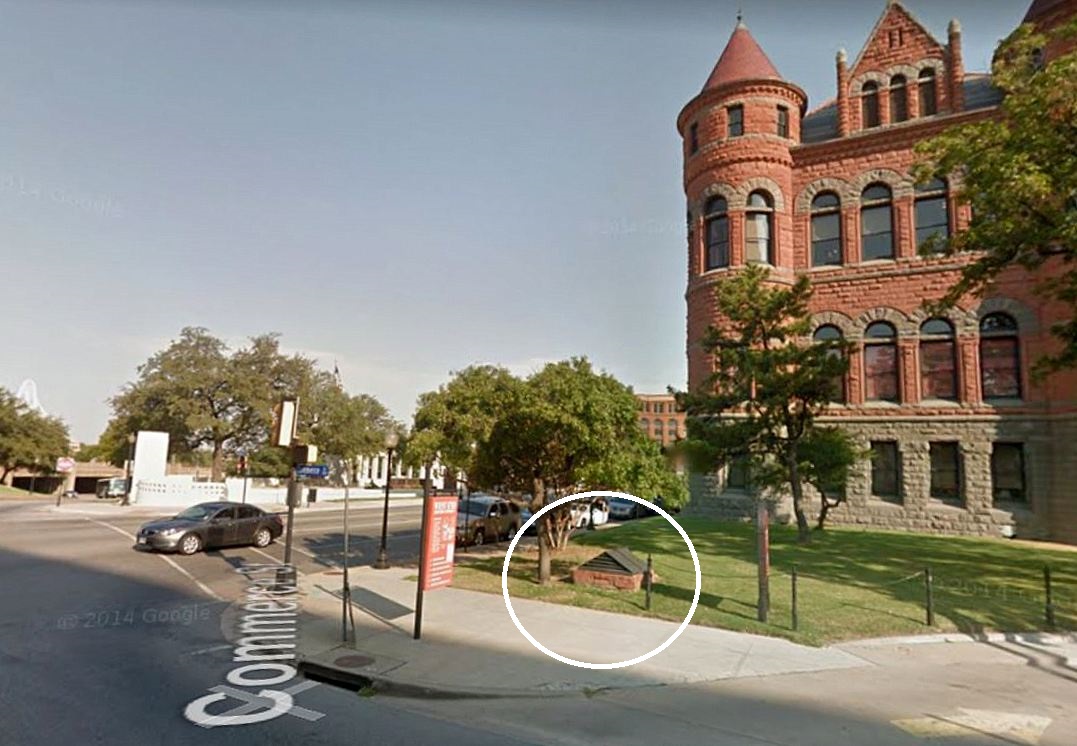
UPDATE: I went to see the capped well today (July 20, 2014). It’s under a shady tree at the southwest corner of the Old Red Courthouse, at Commerce & Houston streets. It isn’t marked at all and is fairly inconspicuous. Even though I’ve known about the existence of this well for only a couple of days, I was so happy to see it — still there, where it’s been for almost 125 years. It was like seeing an old friend.

Photo by Paula Bosse

The view below (looking across Houston Street toward Dealey Plaza from Commerce) shows where this capped well is.

gusher_commerce-and-houston_google-street-view_2011Google Street View (2011)

*

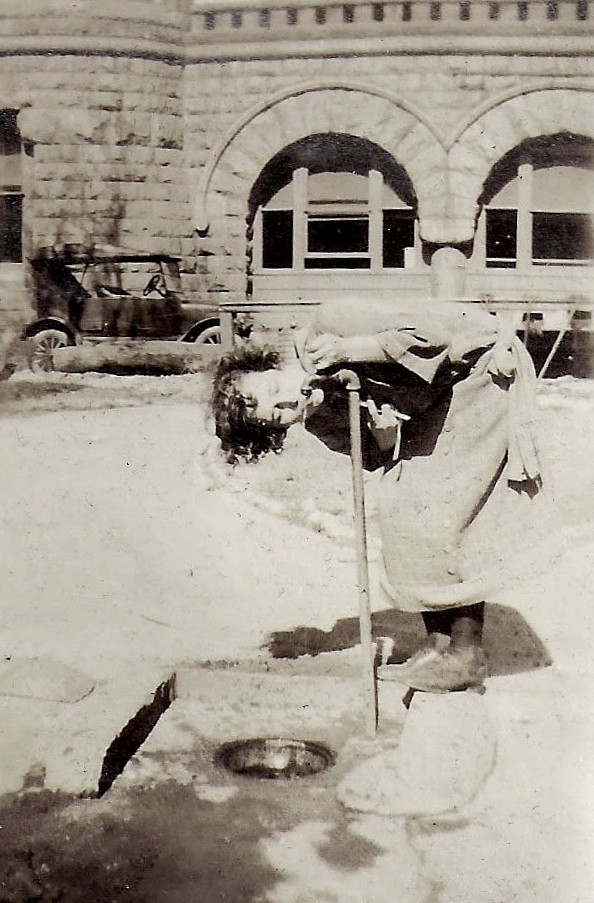
The wonderful photo below is from the 1920s and shows a young woman stopping for a drink on the courthouse lawn.

gusher_old red_ann-hoffman-collection_1920sFrom the collection of Ann Hoffman

***

Sources & Notes

The color image of the Bywaters and Hogue mural is a photograph taken by Jerry Bywaters in 1956 before the murals were destroyed; the black and white photo is by Harry Bennett. Both are from The Bywaters Special Collections, Hamon Arts Library, Central University Libraries, Southern Methodist University. See more information on the color image here, and the black and white image here.

Both postcards are from the DeGolyer Library at SMU: the color postcard can be accessed here; the black and white one here. The black and white image has been cropped — missing is the amusing note on the front of the card, dated 1-4-07: “Dear Faye, can you imagine me a long-haired Texan, brandishing a bowie knife? Ross.”

The circa-1900 photograph showing the well at the left side of the photo is titled “East on Commerce, Commerce and Houston streets, 1900” and is from the Collection of Dallas Morning News negatives and copy photographs, DeGolyer Library, SMU — more info is here.

The photo of the young woman on the courthouse lawn is from the collection of Ann Hoffman and is used with permission; taken in the 1920s, it shows a friend of her Great Aunt Nora stopping for a drink of water. Thank you for sharing, Ann!

All news clippings from The Dallas Morning News.

To read the report of the initial, somewhat tentative early-in-the-day well success, the DMN article from Oct. 10, 1890 is in a PDF here. For the crazy, jubilant, people-beside-themselves-with-joy report of the gusher, the entire article from Oct. 11, 1890 is here.

Not exactly sure what an artesian well is? Wikipedia to the rescue, here.

*

Copyright © 2014 Paula Bosse. All Rights Reserved.

J. M. Howell’s Dallas Nurseries — 1880s

howell_rose-garden-etc_1888The Cedar Springs-Fairmount-Howell triangle

by Paula Bosse

Dallas fruit grower and nurseryman J. M. Howell (1849-1925) was something of a “fruit visionary.” He gave us the “Dallas Blackberry” — something he was quite proud of. He also had dreams of giving Texans more shade.

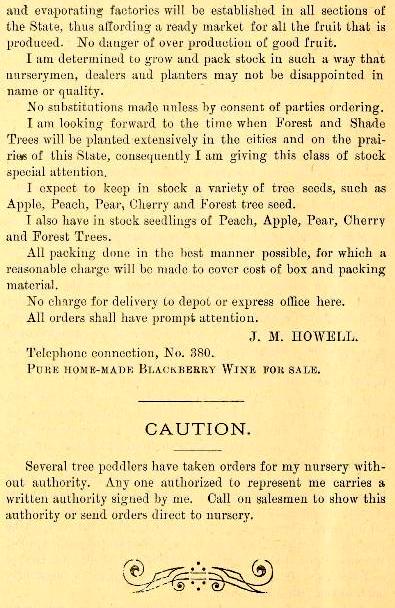
I am looking forward to the time when Forest and Shade Trees will be planted extensively in the cities and on the prairies of this State, consequently I am giving this class of stock special attention.

Fruit and shade. I can get on board with that. He also issued some very pretty catalogs.

howell_catalog-cover_1888

howell-catalog_1888-title-page

howell_catalog_back-cover_1887

howell-catalog_intro1_1888

howell-catalog_intro2_1888

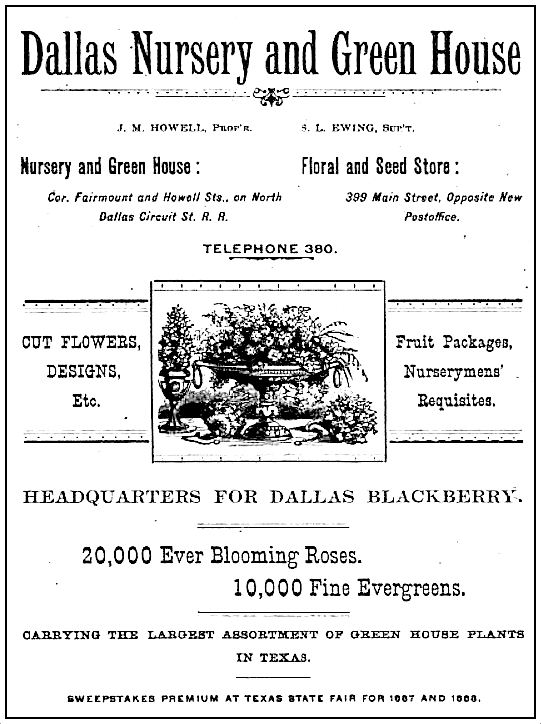
howell-nursery_1888-directory1888 Dallas directory

howell_dallas-nursery_1891-directory1891 Dallas directory

***

Sources & Notes

Above images are from scans of Howell’s catalogs on the Internet Archive: the entire 1887-88 catalog is here; the 1888-89 catalog is here. Included in these catalogs are descriptions of Howell’s inventory and his planting instructions to get the best yields from Dallas’ soil and climate.

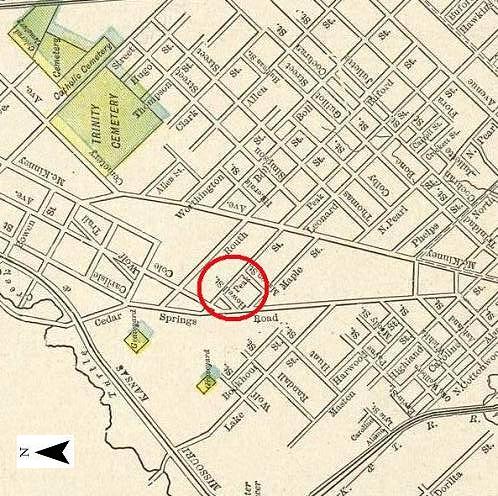
I LOVE the top image. This area — called “Howell’s Addition” — was at the northern edge of the city limits at the time. In March of 1891 the street name “Peak” was changed to “Fairmount” at Howell’s behest. In fact, Howell named the following streets: Fairmount, Maple, Routh (after his in-laws), and Howell. (His uncle was the namesake of nearby Thomas Avenue.) Below is a map showing the area around 1890 — there seems to be a lot of development around him. The rose gardens and orchards may be gone, but at least he got a street named after him.

howell-map-1898Map ca. 1891, confusingly rotated to show same view as top image.

That triangular plot of land is still there (it was the location of the old Casa Dominguez restaurant for many years). Sadly, it’s not much of a scenic vista these days. Uptown could do with a few more orchards and a lot less of everything else.

Howell was a guy who got around. Among other things, he is credited with introducing the magnolia tree to Dallas. Also, he was particular to peaches, and he planted acres and acres and acres of peach trees in Parker County, hoping they’d be a big cash-crop one day — and he was right! For more on Howell, see the Dallas Morning News article “Nurseryman Named Routh Street,” a great “Dallas Yesterday” profile by the always informative Sam Acheson (DMN, Dec. 14, 1970).

*

Copyright © 2014 Paula Bosse. All Rights Reserved.


Building Collapse on Elm Street — 1955

elm-st-collapse_1955
Aftermath… June 1, 1955 (photo by Gene Gauss)

by Paula Bosse

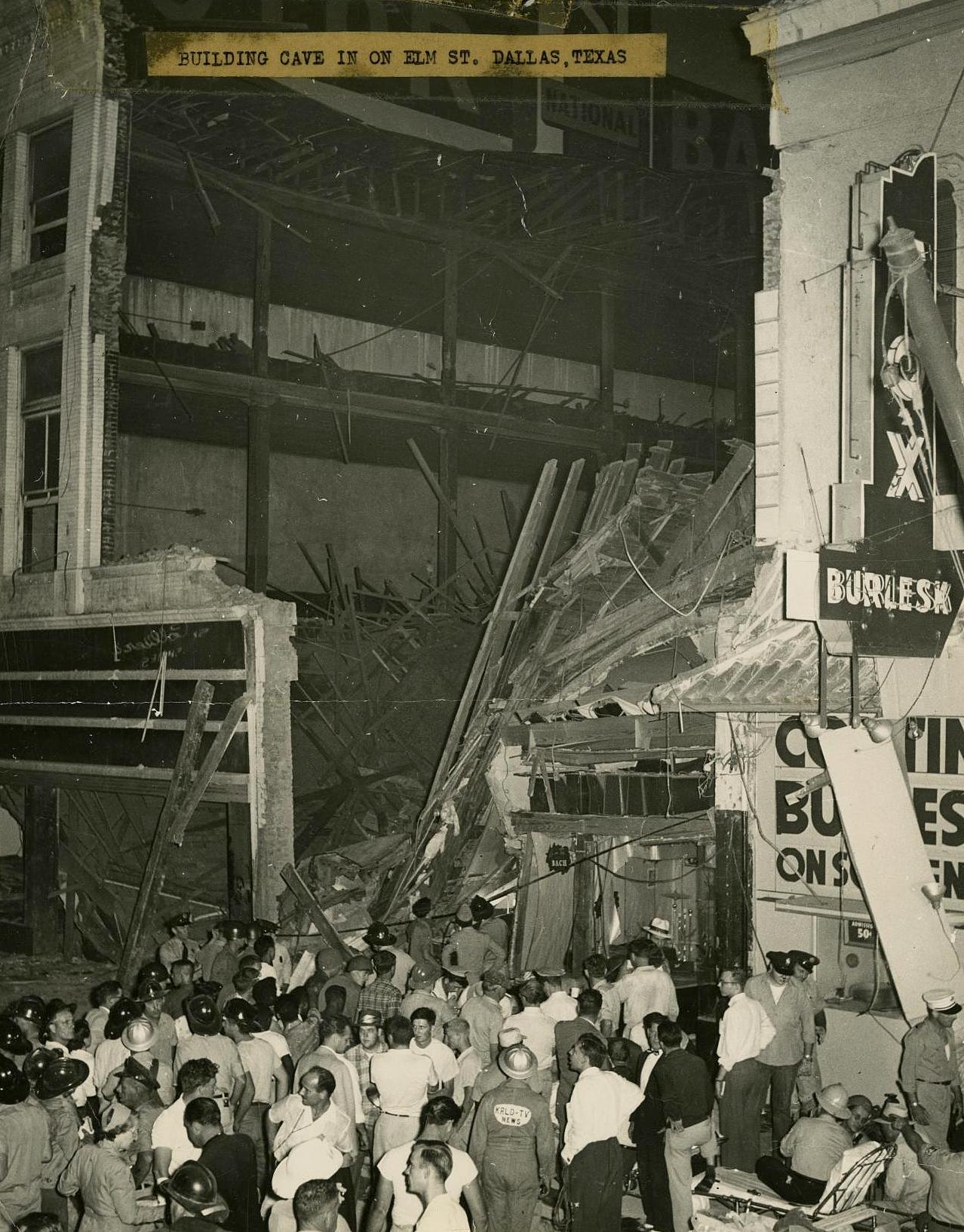
At 6:40 p.m. on June 1, 1955, a 3-story building in the process of being razed collapsed onto the smaller building next door at 1409 Elm St. The “story-and-a-half” building contained the Cline Music Company and Harry’s Fine Food, a bar and cafe. Four people were killed, and several people sustained major injuries; many were trapped for hours in the rubble.

The rousing report in The Dallas Morning News the next day described the scene as pandemonium. As emergency personnel arrived and rescue operations began, the street was roped off — there were fears a partially standing wall would topple at any moment. The Fox Burlesk house next door was quickly emptied of its 50-or-so patrons for safety concerns.

Witnesses said the building fell with a gigantic whoosh and spewed rubble about four feet deep across the sidewalk and into the street. Trolley wires were snapped and lay crackling sparks in the street for a while before the power was cut. A late-model station wagon parked at the curb was flattened under the rubble to a height of only about three feet. It belonged to [the owner of the music store]. (DMN, June 2, 1955)

Nine companies of firemen and several doctors — one of whom just happened to be passing by the scene — worked to rescue and treat the victims. A passing clergyman administered conditional last rites for those still trapped. A troop of Boy Scouts who had been nearby practicing civil defense drills, ran to help in the real-life emergency. And most cinematic of all, a Houston truck driver named Larry Ford — who just happened to be visiting Dallas and was standing in the crowd of spectators — was called in to help when someone noticed that he was wearing a truck drivers’ union insignia — authorities had obtained a winch truck to clear the heavy rubble but had been unable to find anyone to operate it. Ford sprang to action and worked through the night for 16 grueling hours. He was later hailed as a hero. Just like in the movies.

So what caused the collapse? The city manager was quick to say that the city was not to blame and, basically, had no responsibility to determine who WAS to blame.

City Mgr. Elgin Crull told The News an investigation by Chief Building Engineer Cecil A. Farrell has not been completed. “There won’t be anything on it for a long, long time — if ever at all,” Crull declared. “It’s not our responsibility to say why it fell or who was at fault. We’ll just seek to determine whether or not all the proper safety precautions were followed.” (DMN, June 3, 1955)

Well, all right, then.

As several people noted, had the collapse happened an hour earlier — in the midst of rush hour — many, many more people would have been killed and injured. I’m not sure if the cause was ever determined. The block (between Field and Akard) now contains the old First National Bank Building, built a decade later.

elm-st-collapse_060155

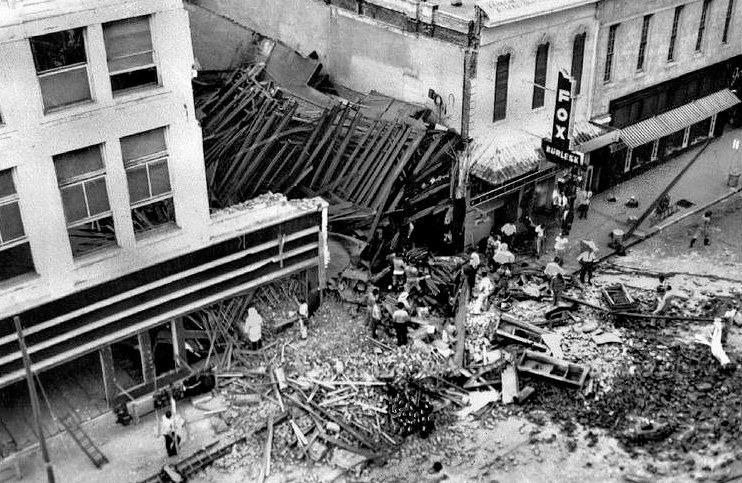
UPDATE: Just stumbled across this UPI photo, posted a few years ago by Robert Wilonsky on the Dallas Observer’s Unfair Park blog:

building-collapse_observer-090511

And below, a photo showing the 1400 block of Elm in the 1920s (looking west from Akard), with the “cafeteria” sign in front of the doomed building, to the left of the Fox Theater. The wall with what looks like the beginning of the word “Steinway” is the one that crushed its neighbor. (From Troy Sherrod’s Historic Dallas Theatres; photo from the Dallas Public Library.)

fox-theater_sherrod_dpl

***

Sources & Notes

The first two photos are from the collection of the Dallas Firefighters Museum, via the Portal to Texas History; they can be seen here and here.

The reports of the collapse that appeared in The Dallas Morning News are pretty exciting to read. You can find them in the newspaper’s archives.

  • “Three Killed, 10 Injured As Elm St. Building Falls” (DMN, June 2, 1955)
  • “Building Ruins Termed Clear Of All Victims” (DMN, June 3, 1955)
  • “Debris Yields Another Body” (DMN, June 4, 1955)

Click pictures for larger images (especially the first two, which are HUGE).

*

Copyright © 2014 Paula Bosse. All Rights Reserved.

A Decade of Spectacular Growth for the Dallas Skyline: 1929-1939

downtown_night_lloyd-long_smu_foscueA stunning view of the city at night… (click for larger image)

by Paula Bosse

Two photographs showing the same view: the top from about 1939, the bottom from 1928. This city has always been a show-stopper at night, but Dallas went from looking like a typical big, prosperous city to a glamorous and elegant, fantastically illuminated metropolis in the span of only ten years. The 1930s was a good time to be an architect in Dallas.

rotarian-magazine_jan-1929

***

Sources & Notes

Top photo by Lloyd M. Long, from the Edwin J. Foscue Map Library, Central University Libraries, Southern Methodist University; it is accessible here. To see this photo with major buildings identified, the labeled version is here. The view is from the Medical Arts Building. Elm and Ervay is the intersection at the lower left, and Pacific runs along the right.

Bottom photo from the January, 1929 issue of The Rotarian, showing its readers what was in store for them at their annual convention to be held in Dallas in May. The night-time skywriting is a nice touch. (It’s weird seeing the Magnolia Building before Pegasus was installed on top of it in 1934.)

Click photos for larger images.

*

Copyright © 2014 Paula Bosse. All Rights Reserved.


The Smith Brothers Can Set You Up With a Hearse … Or a Cab — 1888

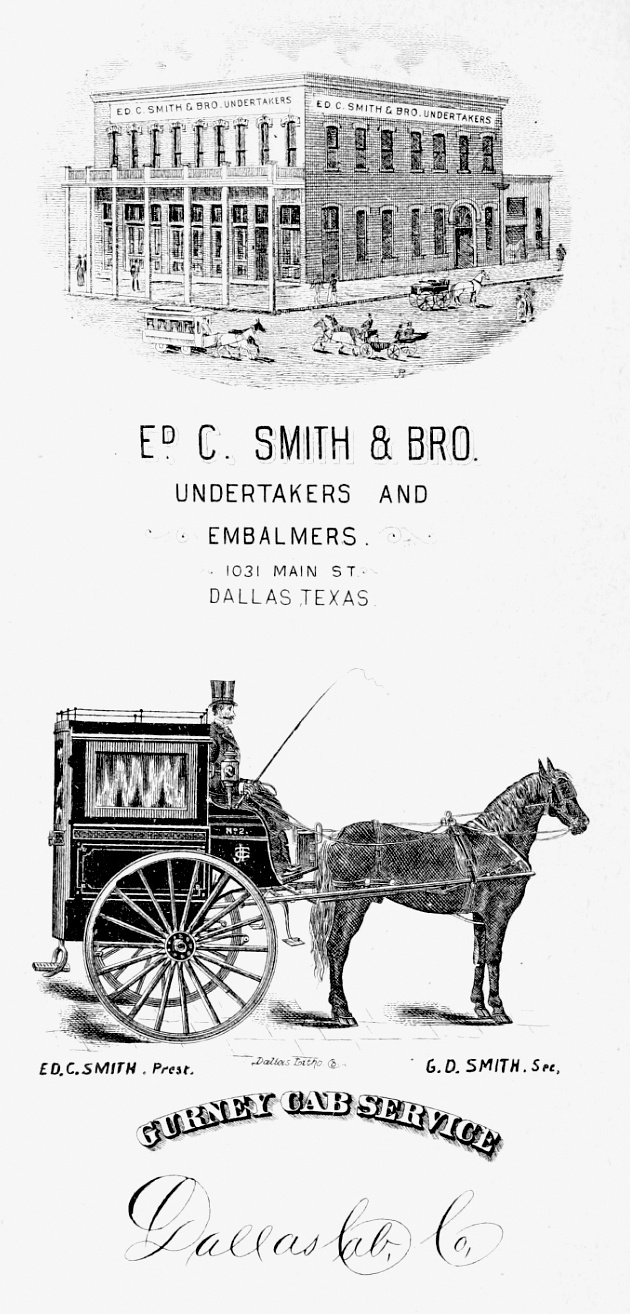
ad-dallas-cab-undertaker_imm-gd-1889Need a ride? (click for larger image)

by Paula Bosse

Need a hearse? No? Then how ’bout a cab?

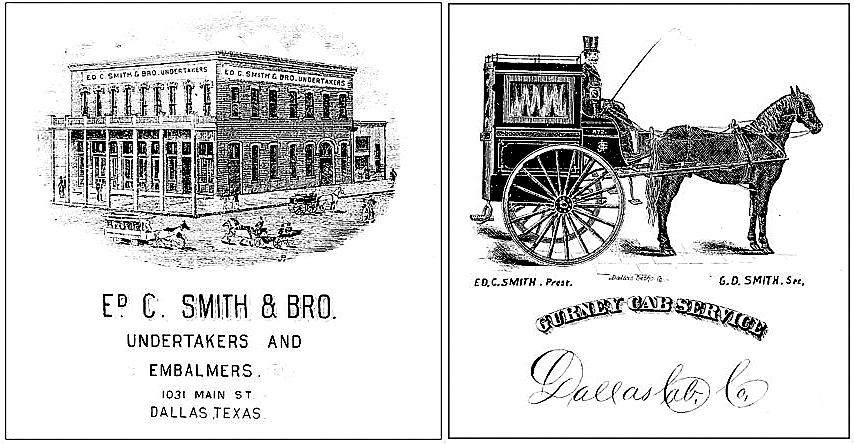
Diversification is the key to success! Ed. C. and G. D. Smith — of the Ed. C. & Bro. Undertakers and Embalmers — branched out from the hum-drum world of mortuary science and entered the exciting world of transportation-for-hire (it really IS only a short jump from hearse to cab). Their Dallas Cab Co. provided the city with something brand new: Gurney cab service.

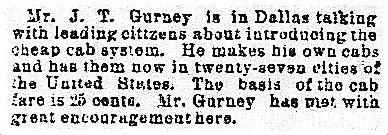
The “Gurney cab” was the invention of Bostonian J. Theodore Gurney — it was a two-wheeled, horse-drawn cab into which passengers entered through the back and, for a quarter, rode in sleek, well-appointed comfort. This new form of conveyance was an alternative to the larger, clunkier, slower “hacks.” Gurney patented his cab in 1883 and traveled around the country promoting his vehicle to large cities. He visited Dallas in March, 1888:

gurney_dmn_031888Dallas Morning News, March 18, 1888

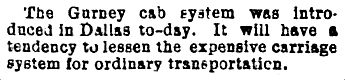
He must have been pretty persuasive, because the “Gurney cabs” went on the streets less than three weeks later:

gurney_fwdailygazette_040588Fort Worth Daily Gazette, April 5, 1888

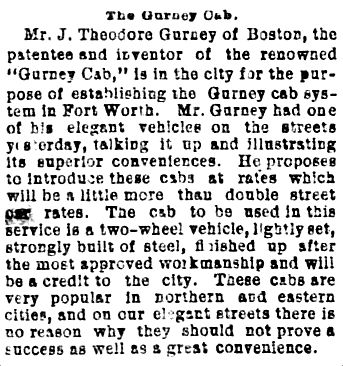
Gurney worked his way around Texas. Next stop was Fort Worth:

gurney_fwdailygazette_041488FWDG, April 14, 1888

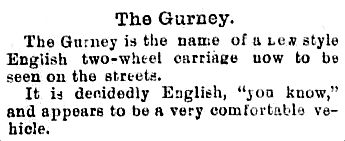
Then Austin:

gurney_austin-weekly-statesman_042688Austin Weekly Statesman, April 26, 1888

As to whether the more familiar hospital “gurney” (a wheeled stretcher) has any connections, some say yes and some say no (both arguments can be read here). Wouldn’t it be great if those Smith boys went into stretcher manufacturing a few years later? Cabs — stretchers — hearses: they’ve got you covered … coming and going.

***

Ads from The Immigrant’s Guide to Texas — City of Dallas, 1888. They did, in fact, appear on the same page.

ad-dallas-cab-undertaker_imm-gd_1889

An interesting article — “The Short, Contentious, History of the Gurney Cab Company in San Francisco” by Donald Anderson — can be read here.

The fare for hiring a Gurney cab was 25 cents, which according to the Inflation Calculator, was about $6.00 in today’s money.

Click top ad for larger image.

*

Copyright © 2014 Paula Bosse. All Rights Reserved.