Flashback : Dallas

A Miscellany: History, Ads, Pop Culture

Category: Vault

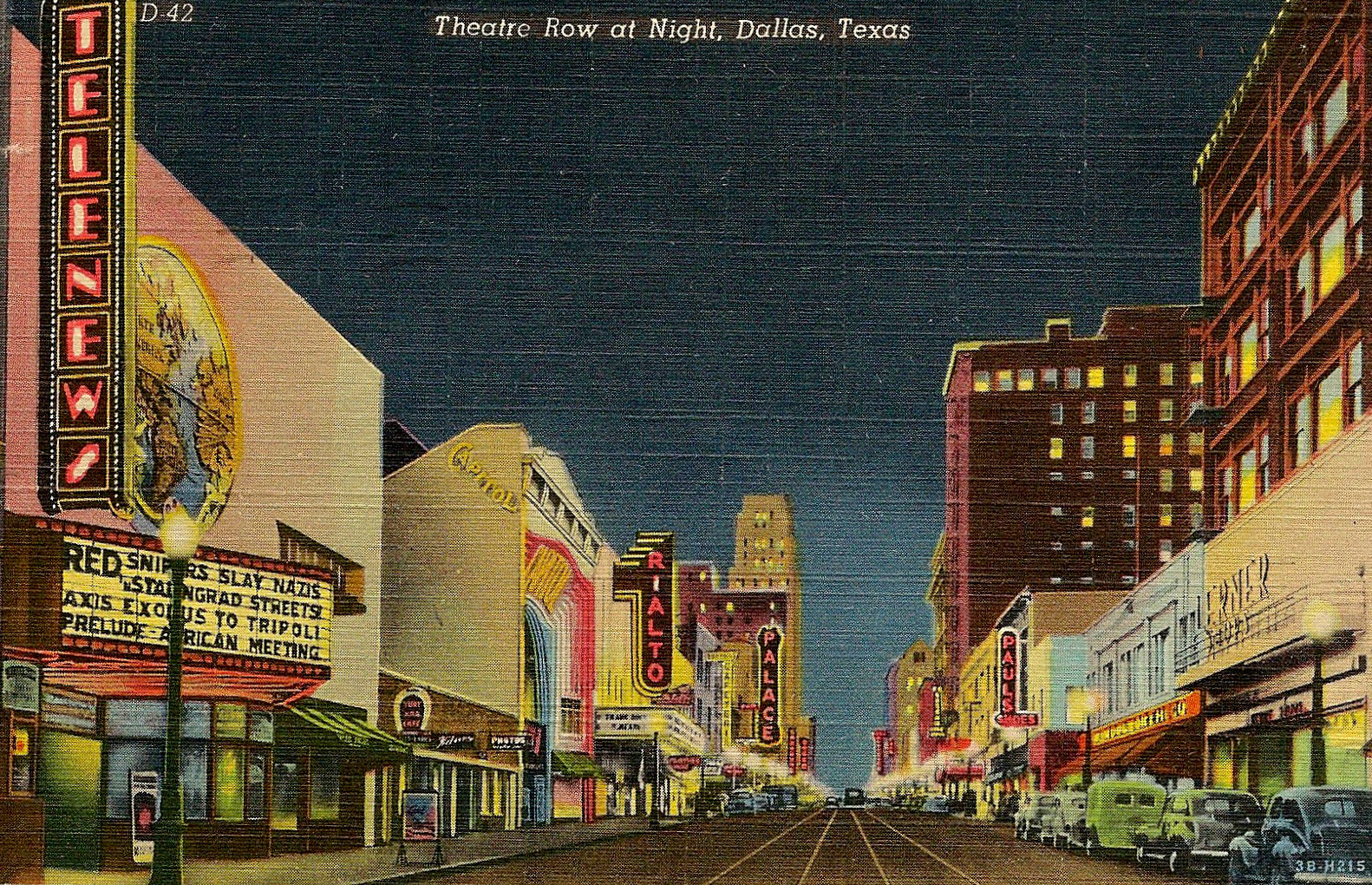
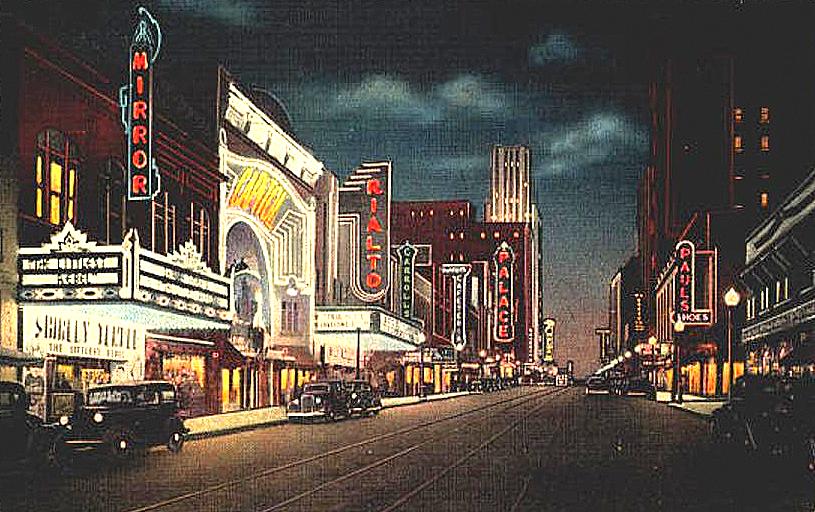
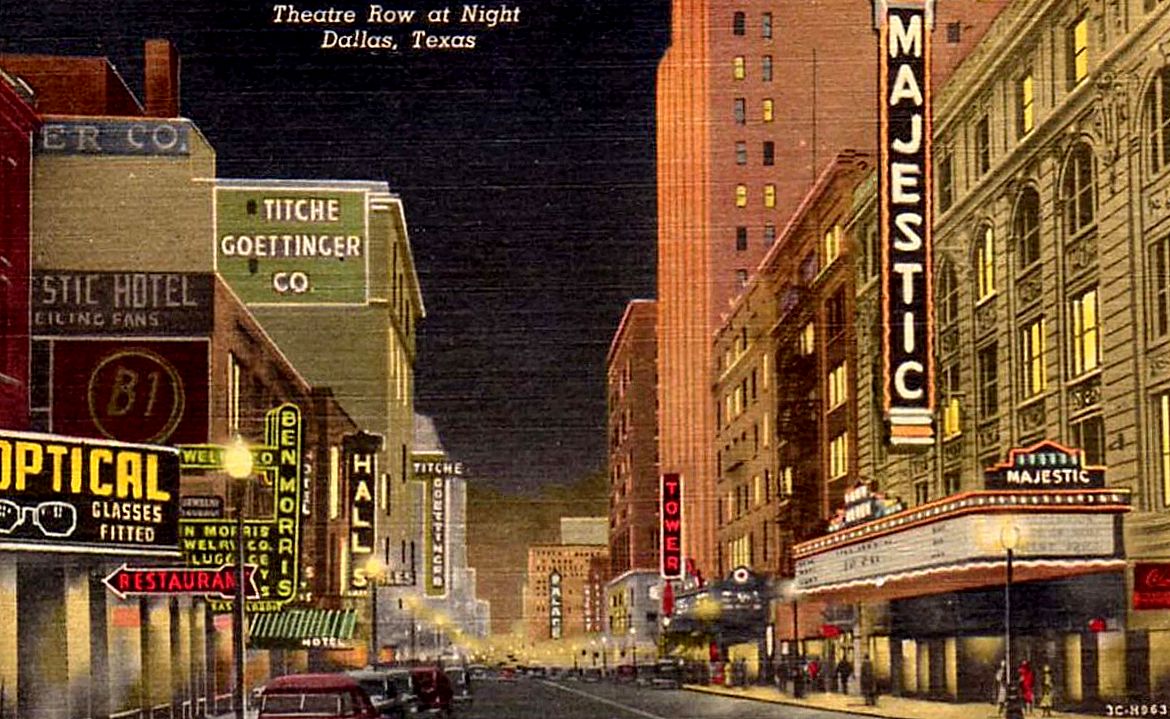
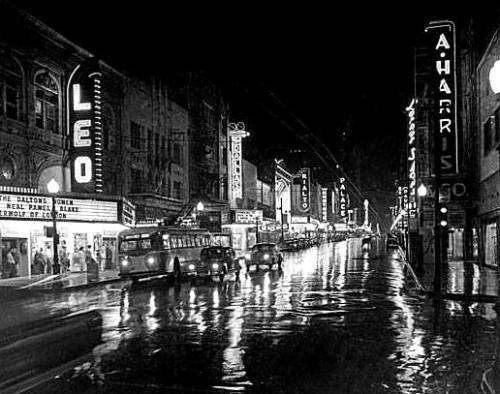
Theatre Row — A Stunning Elm Street at Night

theater-row_night_telenewsElm Street, looking east… (click for larger image)

by Paula Bosse

Damn you, suburban theaters and television, for killing this! (Hang in there, Majestic!)

Favorite thing gleaned from the postcard above? That Dallas had a newsreel-only theater — the Telenews. (See the original, somewhat pedestrian, daytime photograph which was transformed by all sorts of dazzling magic in order to turn it into that striking postcard, here.)

theater_row_night_BIG

theater-row-night_c1935

theater-row_night_majestic

***

All images are larger when clicked — some MUCH larger!

*

Copyright © 2014 Paula Bosse. All Rights Reserved.


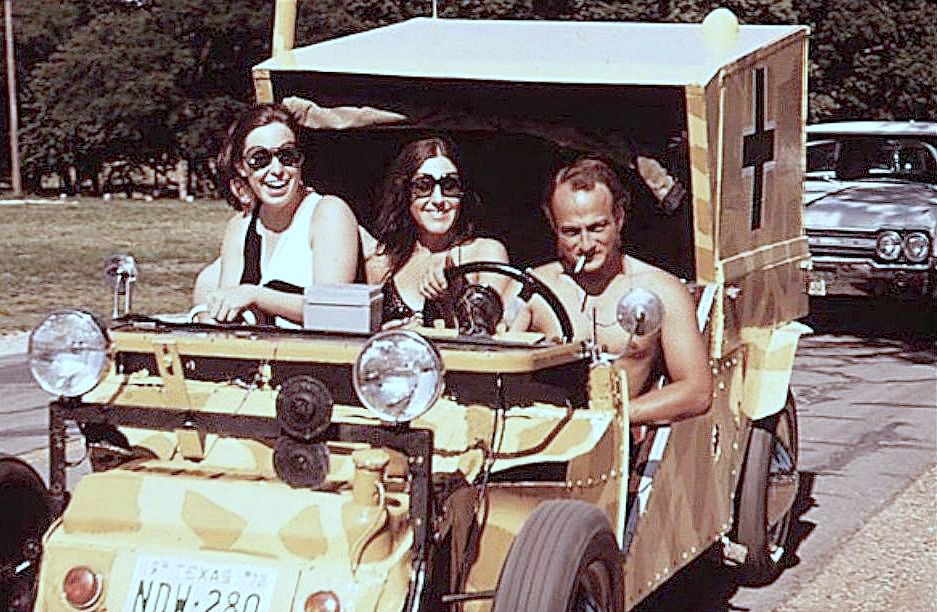
Lazy Weekends, Cruising White Rock Lake — 1972

white-rock_city-folk_1972_EPACruisin’ ’70s-style…

by Paula Bosse

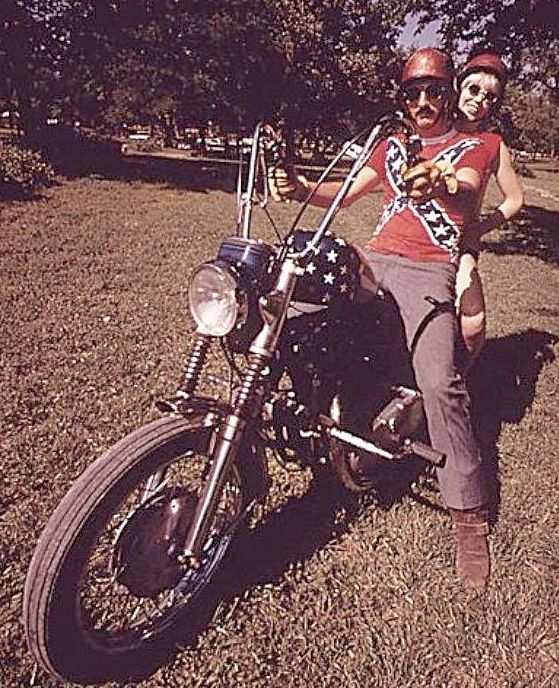
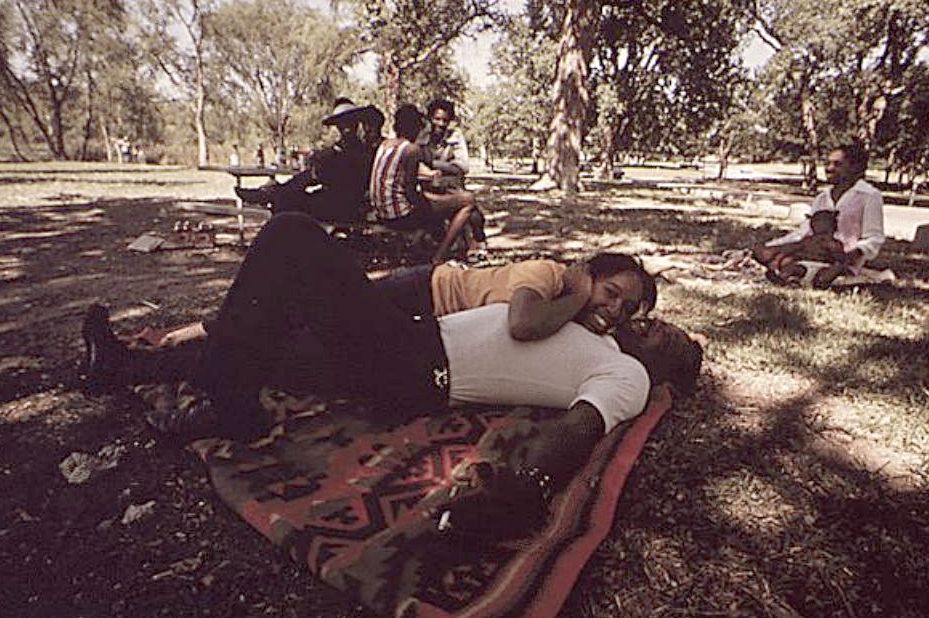
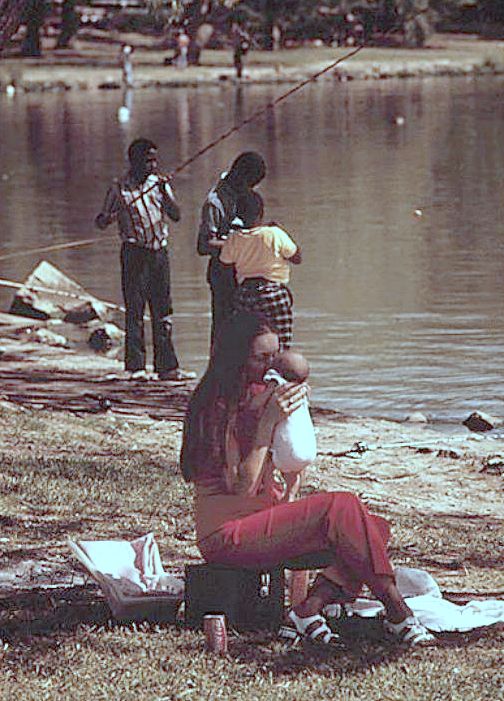
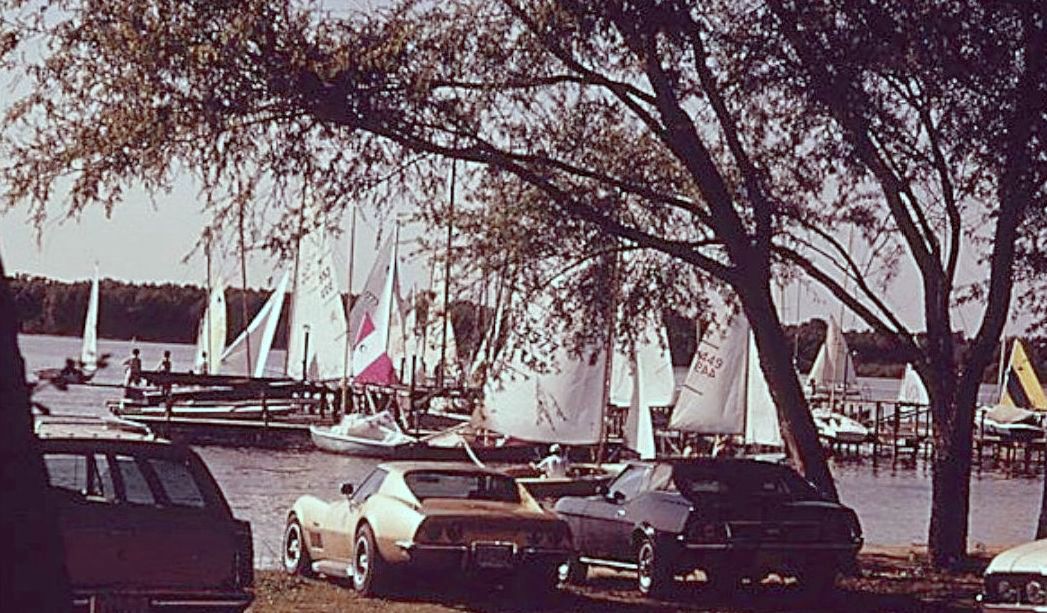
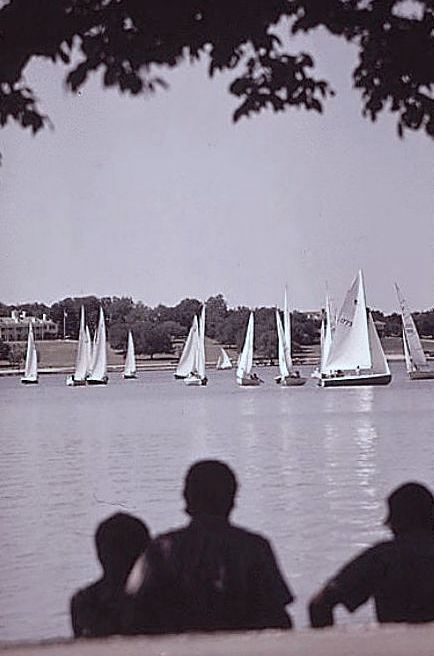
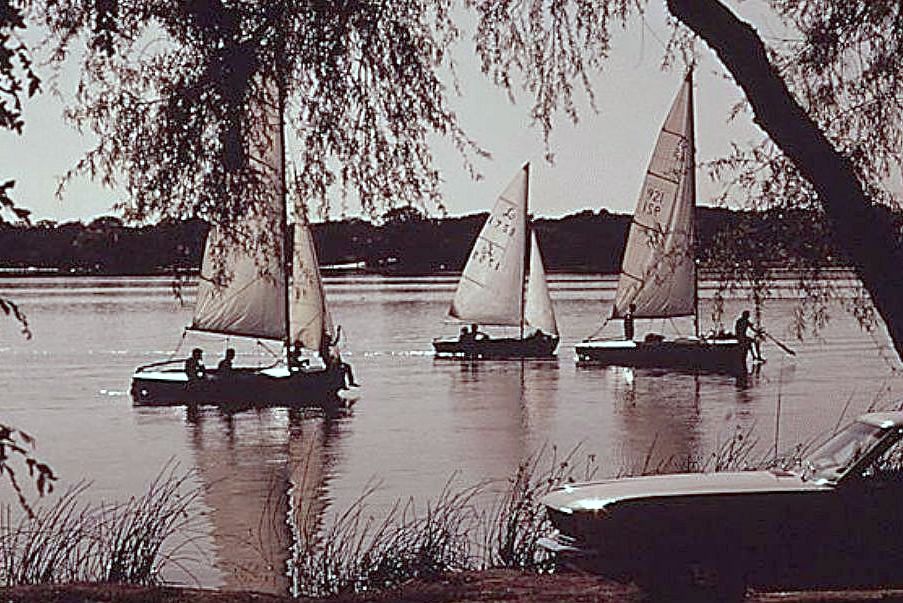
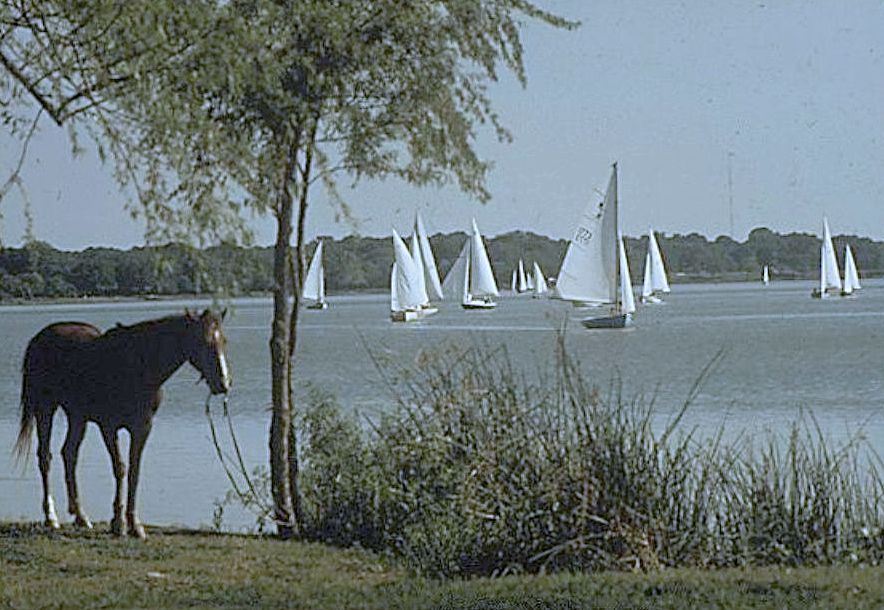
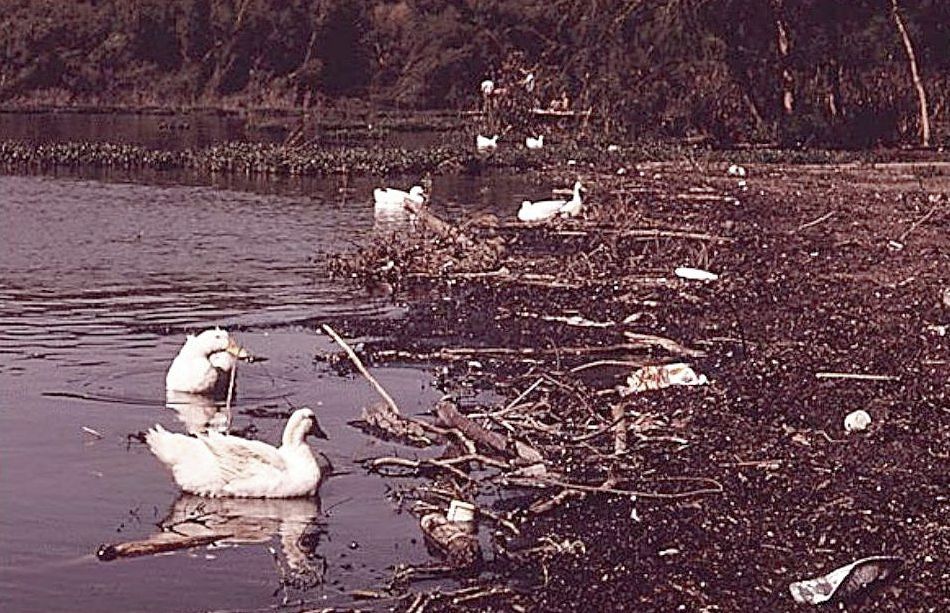
Back before the days of joggers and bikers, one used to be able to drive around White Rock Lake. All the way around. No dead ends, no detours. People used to cruise it on the weekends — the road would be packed solid. I assume the homeowners grew weary of this and put an end to things by having the road chopped up to prevent continuous cruising. Figures. Here’s a look at one weekend in April of 1972, from a series of photos taken by the Environmental Protection Agency as part of their Documerica project which documented areas of environmental concern. Things all look pretty good here, except for the final photo showing ducks paddling alongside trash at the water’s edge — a scene that might make the Keep America Beautiful Indian shed another tear.

A description of these photos (provided, I think, by the EPA):

City folk come in droves each weekend to once-isolated White Rock Lake. Some come to picnic, sail or fish. Some just want to be where the action is [man].

Another caption:

Once-unspoiled and rather isolated, White Rock has become a city dweller’s weekend mecca, attracting people looking for ‘action’ as much as those seeking relief from urban pressures.

*

white-rock_motorcycle_1972_EPA

white-rock_sunday_1972_EPA

white-rock_weekend_1972_EPA

white-rock_boats-cars_epa_1972

white-rock_sailing_1_1972_EPA

white-rock_sailing_2-1972_EPA

white-rock-lake_1972_EPA

white-rock_ducks_1972_EPA

***

Sources & Notes

These photos — from the EPA’s Documerica project (“to photographically document subjects of environmental concern”) — can be found at the National Archives site, here.

Like outtakes from Dazed and Confused, man…. You can practically hear “Brandy, You’re a Fine Girl” wafting through the air.

Copyright © 2014 Paula Bosse. All Rights Reserved.

Maple North of Wycliff: The Hinterlands — 1900

Looks a little different these days… (click for larger image)

by Paula Bosse

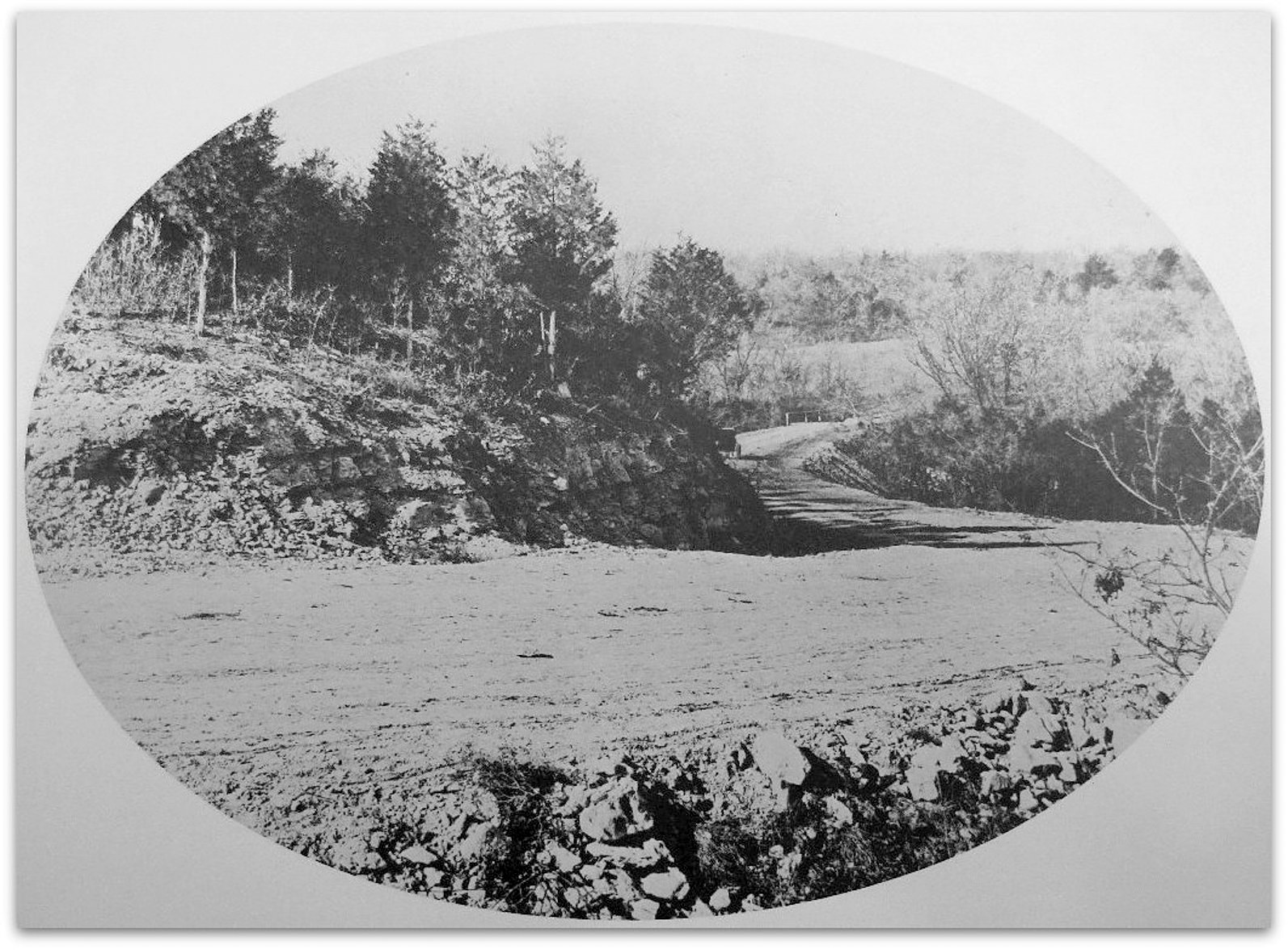
Here we see Maple Avenue, somewhere north of the Katy Railroad crossing, circa 1900. A. C. Greene, in his book Dallas, The Deciding Years, estimated it shows Maple “just north of where Wycliff now crosses” (see note at bottom of post wondering if this might instead show Maple just north of the railroad crossing). I have to say, the present-day view of that area has nothing going for it over the one depicted above, except maybe asphalt. …If you like asphalt.

Here’s a detail that shows the little horse and buggy, heading out to the hinterlands. (Click to see a larger image.)

greene_maple-wycliff-ca1900-det

Personally, I’d take the “hinterlands” view to the one we’re subjected to today.

An interesting book about early Dallas history that I would highly recommend is Diaper Days of Dallas, Ted Dealey’s entertaining memories of growing up in Dallas. His family had a house on Maple Avenue at about the turn of the century (his father was George Bannerman Dealey, early founder of The Dallas Morning News), and the Maple-McKinney area was his playground. Here is his description of the city limits at the time this photo was taken:

Dallas, in those early days, consisted of about eight square miles of territory. To the south the city limits ended roughly at Grand Avenue; to the east the city limits ended roughly where Fitzhugh Avenue now runs; to the north it went out Cedar Springs across Maple Avenue to a point where Melrose Hotel stands now. North of this there was practically nothing. On the west the city extended to the Trinity River.

So, at the turn on the century, this wonderful vista was the hinterlands — out in the country and well beyond the city limits.

***

Photo from Dallas, The Deciding Years by A. C. Greene (Austin: Encino Press, 1973), with the caption: “In 1900 Maple Avenue was mainly a rural lane. This photograph was taken just north of where Wycliff now crosses Maple. Courtesy Dallas Public Library.”

Text quoted is from Diaper Days of Dallas by Ted Dealey (Nashville: Abingdon Press, 1966), p. 23.

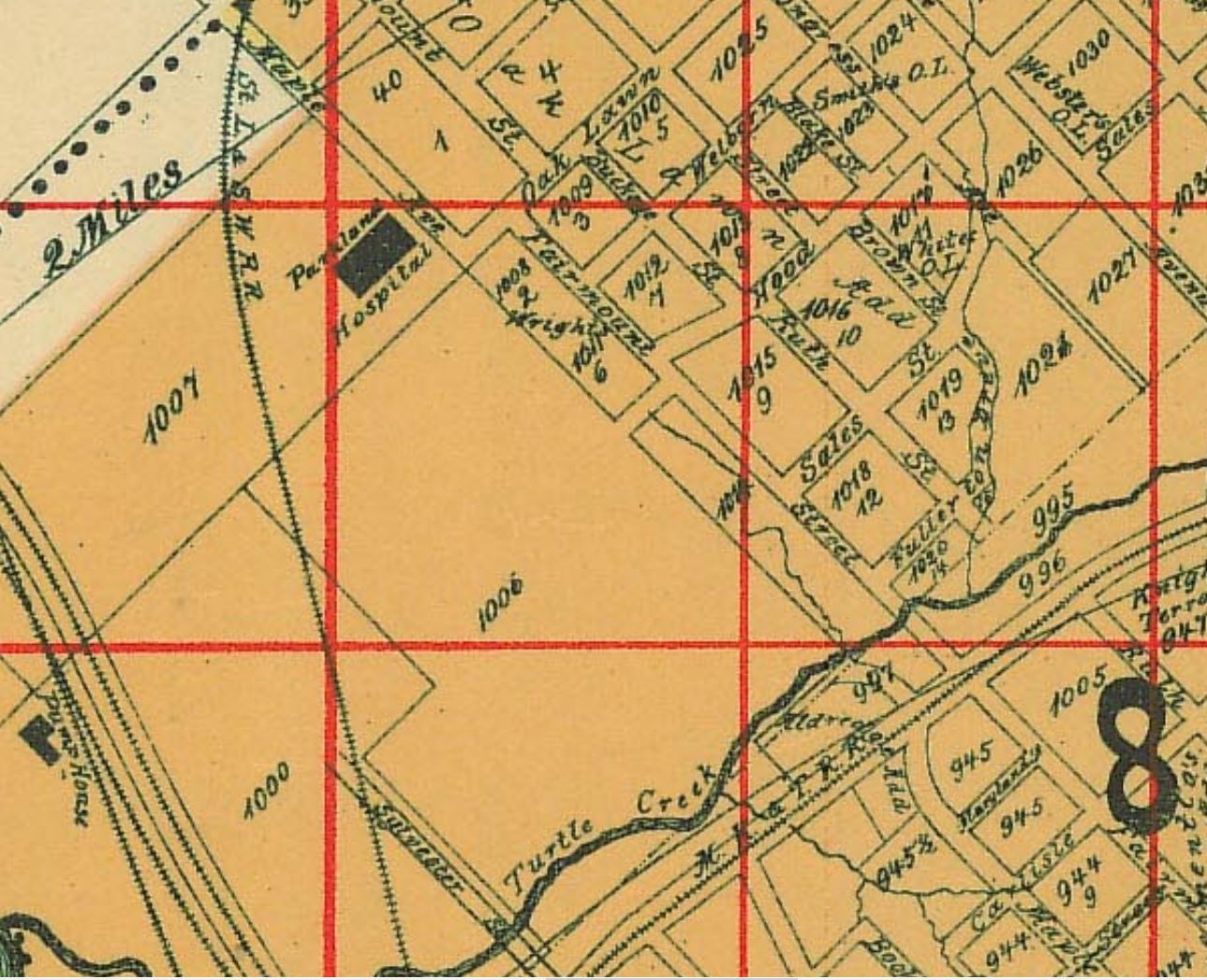
EDIT: I don’t know if this photo does show Maple around what is now Wycliff. The curve is very similar to the one Maple used to make before it was straightened in 1918 or 1919 — right around the railroad crossing, which also included a bridge across Turtle Creek, as seen in this detail from a 1905 map. Just a thought.

maple-ave_1905-map_portal_det

Click photos for larger images.

*

Copyright © 2014 Paula Bosse. All Rights Reserved.

The Lighthouse Church That Warned of Sin’s Penalty with a Beam of Blue Mercury Vapor Shot Into the Skies Above Oak Cliff — 1941

gospel-lighthouse-churchStill standing in Oak Cliff… (click for larger image)

by Paula Bosse

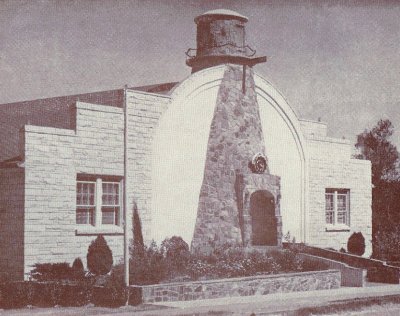
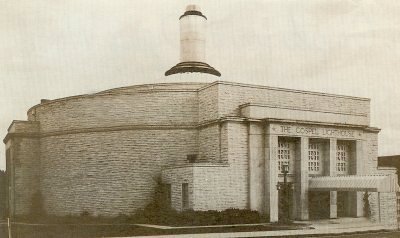
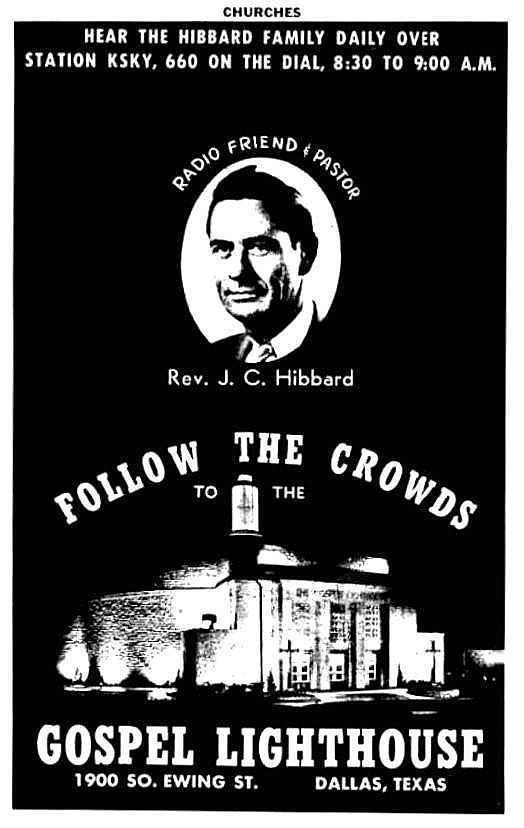
Sometimes an image just grips you. That’s what happened when I saw this postcard featuring The Gospel Lighthouse Church. The building was so odd-looking and cool. Who designed it? Where had it been? And what was that thing on top of it? I did a bit of research on the church and found out that it was organized in Dallas in 1940 by Pentecostal preacher J.C. Hibbard and his wife Nell, who was also a preacher. The two had been preaching at the Oak Cliff Assembly of God Church until J.C.’s divorce from his first wife (and subsequent second marriage to Nell) became such a point of controversy that the two felt compelled to leave (or were asked to leave) the Assemblies of God, and they formed their own church.

And that was the Gospel Lighthouse Church, located in the 1900 block of S. Ewing (at Georgia) in Oak Cliff. While their first church was being built, they held services in a large circus tent in the parking lot. The congregation helped with the physical labor of the construction, and progress on the building continued non-stop, 24 hours a day. In January of 1941, the church was completed, and an article appeared in The Dallas Morning News soon after with the grabber of a headline, “Lighthouse Church Warns Oak Cliff of Sin’s Penalty.” Sadly, the article has no byline, which is a shame, because I’d love to know who wrote the piece, because he or she pulled out all the purple-prose stops. The introduction is fantastically over-the-top:

A towering forty-foot lighthouse 300 miles from the sea was blinking out its warning signals across the dry land of South Ewing Sunday. At the front of a neat new white stone church house at 1914 South Ewing, near Louisiana, the white stone lighthouse reared far above the other buildings. Eventually, its big circular light tower will shoot a bluish mercury-vapor beam through the night to guide shaken mariners adrift on the sea of sin. Its semi-fog horns will broadcast a soft carillon of sacred music. This is the Gospel Lighthouse, built by a preacher with a new idea of church architecture and a dream of a denomination all his own. (DMN, Feb. 10, 1949)

gospel-lighthouse_first

Wow. A “bluish mercury-vapor beam” shooting through the Oak Cliff skies! (The full article is linked below.)

By 1948, J.C. Hibbard had become so popular (largely as a result of his daily radio sermons) that ground was broken on a larger church, designed by J.C. himself. It was right next to the first church. And it was pretty elaborate.

gospel_lighthouse_bw

Yeah, the lighthouse part of it looks a little cheesy, but with a name like “Gospel Lighthouse Church” you kind of have to have it.

*

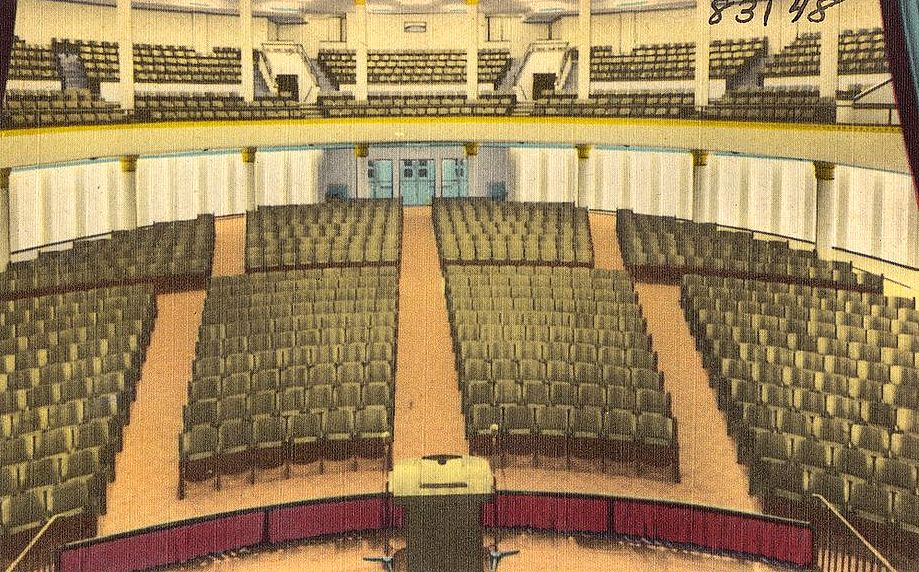
gospel-lighthouse-church_interior

The auditorium and its mezzanine.

*

gospel-lighthouse-nursery

The nursery, with elaborate murals.

*

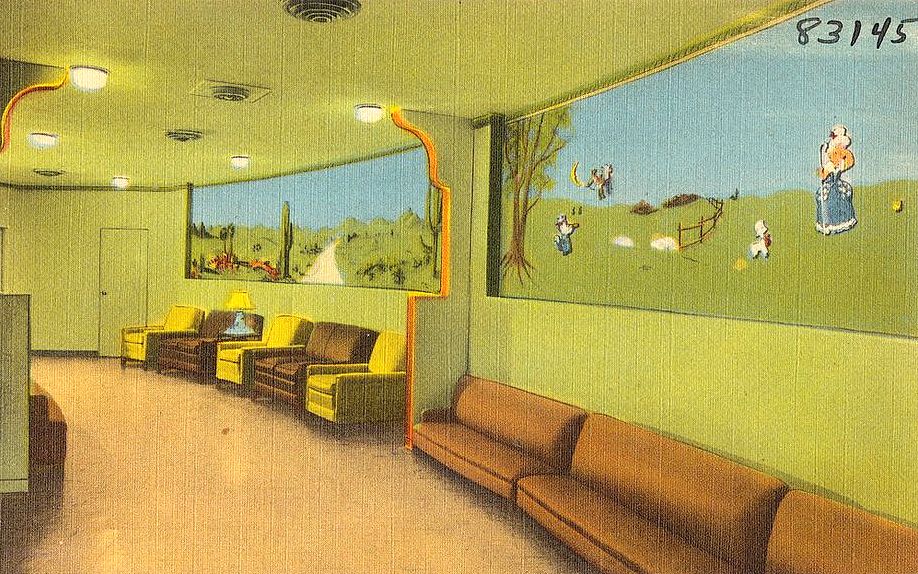
gospel-lighthouse-lounge

The lounge. Like the first church, this one had a nursery with a lounge — a “crying room” for mothers to tend to crying children without having to miss a single moment of the service. The crying was contained behind sound-proof glass while the sermon was piped in through speakers. The church had a lot of other amenities, but these were the only ones I’ve found deemed worthy enough to put on postcards.

*

I wondered if the church still stood, so I drove over to Oak Cliff yesterday and, amazingly, both churches are still there, and they are beautiful! (The original caretaker’s house is still there, too.) I’m not sure what religious group has possession of the buildings at the moment, but they are to be commended for maintaining the structures and the grounds — the 1900 block of S. Ewing really stands out from its fairly ragged surrounding neighborhood. Below are photos I took on April 19, 2014. (Click pictures for larger images.)

gospel-lighthouse_first-church_041914

Above, the first church — “a modern concrete and steel building, overlaid with white Austin stone” — which was built with help from the congregation in 1941. The beam of “bluish mercury-vapor” emanated (somehow) from the squat lighthouse above the foyer.

And, below, the later church, next door. I think the “mercury-vapor” was replaced by neon. But I could be wrong. Does either beacon light up anymore?

gospel-lighthouse_041914_sm

Aside from the “lighthouse,” the most distinctive feature of this building is those rounded walls. So beautiful!

gospel-lighthouse_side_041914-sm

The  building is actually pretty impressive to see up close. Next time you’re in the neighborhood, check it out!

***

Sources & Notes

Postcards from the Boston Public Library Tichnor Brothers Postcard Collection on Flickr, here.

Period black-and-white photos are from a page detailing the history of the Gospel Lighthouse Church, here. A biography of Rev. Hibbard from the same site can be found here.

Wander around the block on Google Street View, here.

Stumbled across this ad in the 1957 Dallas directory:

gospel-lighthouse_1957-directory

And I found this ad in, of all places, the 1967 Carter High School yearbook:

gospel-lighthouse_carter-high-school_1967-yrbk

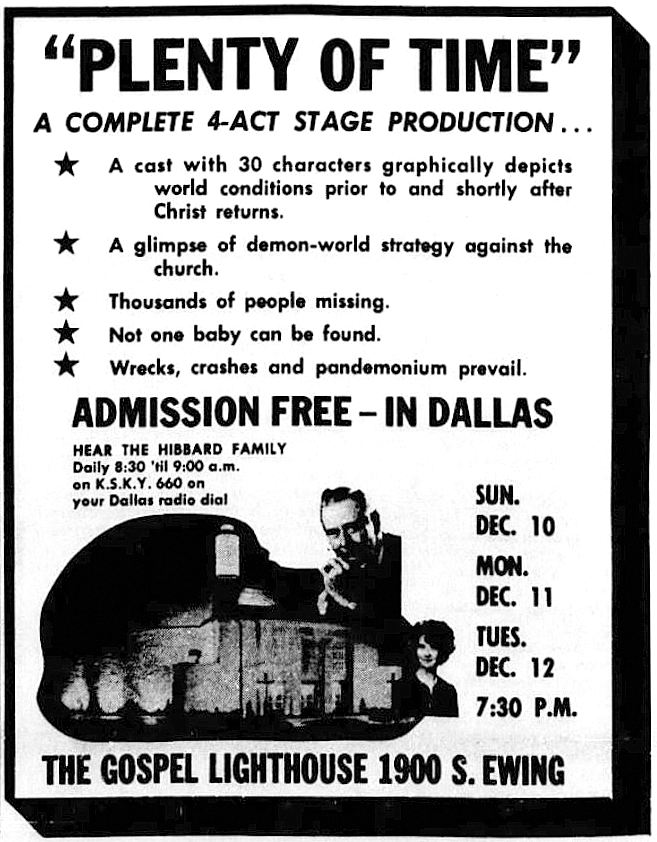
I also found this rather hair-raising ad for a 1967 Christmas-season production — an ad which somehow contains no exclamation marks:

gospel-lighthouse_mckinney-courier-gazette_120867Dec. 8, 1967

*

Copyright © 2014 Paula Bosse. All Rights Reserved.

The Stretch of “Theater Row” They Never Talk About

leo-theater
The “other end” of Film Row

by Paula Bosse

It’s April, 1952, and you’ve got a hot date Friday. Movies are good for date night. What to see? Why not catch a bold, frank, and true “adult” double-bill at the Leo? In the early-’50s, the Leo Theater, at 1501 Elm Street, was at the other end of “Theater Row” — on the metaphorical “other side of the tracks” from the classy Majestic and Palace — and it was one of those places that your mother probably wouldn’t approve of.

leo-theater_dmn-0405521952

The ad above shows a typical Leo double-feature: “Pin-Down Girl” (aka “Racket Girls”) from 1951, a searing look at lady wrestlers and prostitution (the trailer below has a moment that’s actually pretty shocking, and you’ll laugh at yourself immediately afterward for having been shocked), and “Honky Tonk Girl” (aka “Hitchhike to Hell”) from 1941 about teenagers and, well, prostitution. There were at least two exploitation movies titled “Honky Tonk Girl,” so I’m not sure which is the correct poster for the particular cinematic treasure on the Leo bill, but I really love the artwork of this one, so in it goes.

honky-tonk-girl_poster

Here’s the trailer for “Pin-Down Girl” (which is handy, because it gives you about all you really need to satisfy a piqued curiosity without wasting a lot of your time):

**∙*

***

Sources & Notes

I don’t have a source for the top photo, but I believe I have seen it attributed to the Dallas Public Library. If this is incorrect, please let me know.

A little background on the Leo Theater (1948-1953), originally the Queen (1913-1948), can be found in the comments section here.

But if you want to know just what was going on in these not-quite-but-fast-approaching seedy Dallas theaters, you owe it to yourself to read a great passage from Troy Sherrod’s Historic Dallas Theatres (Arcadia Press, 2014), here (scroll down to the caption).

*

Copyright © 2014 Paula Bosse. All Rights Reserved.

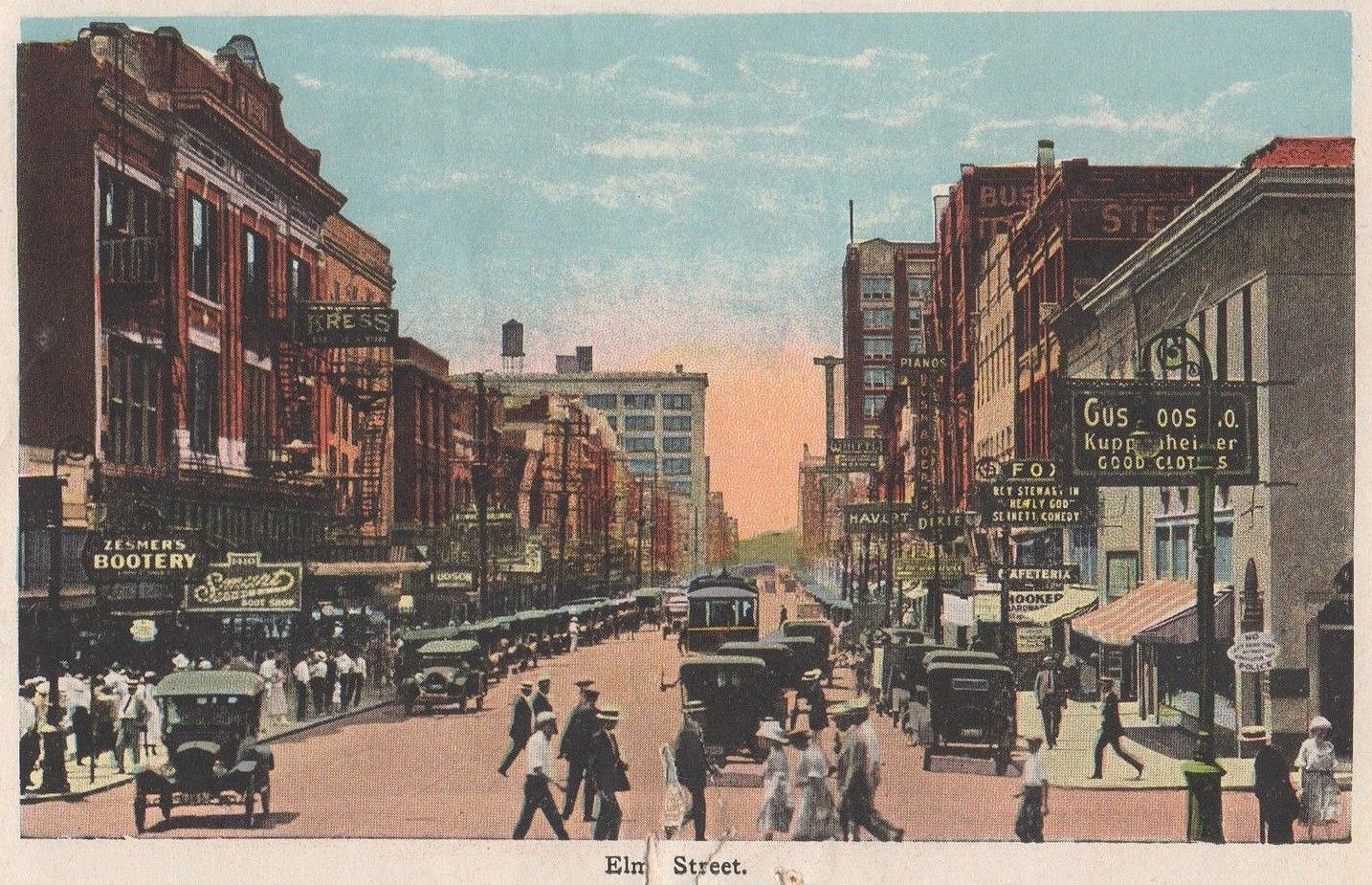
A Colorful Elm Street — 1920s

elm-st-color_1920s

by Paula Bosse

A bustling Elm St. — looking west from Akard — in “color,” in the early ’20s. I love this. You can practically walk down the street and window-shop.

Click for very large image.

*

Copyright © 2014 Paula Bosse. All Rights Reserved.

How Lincoln’s Assassination Was Reported in Dallas — 1865

lincoln_harpers-engraving

by Paula Bosse

Abraham Lincoln was shot by John Wilkes Booth on April 14, 1865; he died the next morning. I wondered how the news had been reported in Dallas. I couldn’t find the first mention of the assassination in The Dallas Herald, but it seems there may have been a special “extra” edition published on or just after April 29th — a full two weeks after the fact! The one thing I kept encountering in general Google searches were mentions of the vicious, celebratory editorial that appeared in the pages of the Herald — these reports always quote the line “God Almighty ordered this event or it could never have taken place.” I found that editorial. It appeared in the two-page Dallas Herald on May 4, 1865, along with detailed reports of the assassination.

lincoln_dallas-herald_masthead_050465

lincoln_dallas-herald_houston-tel-050465

The image resolution here is pretty bad (it is transcribed below), but, yes, this eye-poppingly vitriolic editorial did appear in the pages of The Dallas Herald — but it did not originate with the Herald (which is not to say that the Dallas editor wasn’t in agreement with the sentiments expressed). The editorial was reprinted from the Houston Tri-Weekly Telegraph (which had run it ten days previously, on April 24); its appearance in the Dallas paper is even clearly prefaced with the following: “The Houston Telegraph, in speaking of the killing of Mr. Lincoln and Mr. Seward, says…” — so it’s unclear why so many historians and authors mention this editorial as being the product of The Dallas Herald.

The editorial was unsigned, but it was probably written by William Pitt Ballinger, whose previous flame-fanning tirades against the president in the pages of the Telegraph must have caused even hard-core Confederate-leaning brows to raise. I’ve transcribed the full editorial below. For whatever reasons, the Dallas Herald omitted the first and last paragraphs — probably because of space limitations, but one would like to think that even a pro-Confederacy newspaper would think it best to leave out a phrase such as “The killing of Mr. Lincoln and Mr. Seward may be more wonderful than the capitulation of armies.” Yikes. Imagine a mainstream newspaper printing something like that following the assassination of President Kennedy.

Below is the full astonishing text of the editorial that originally appeared in the Houston Tri-Weekly Telegraph on April 24, 1865. The stark reality of historical events and the contemporaneous tenor of the times can look a lot different when seen from a distance of 150 years.

*

We publish to-day the most astounding intelligence it has ever been our lot to place before our readers — intelligence of events which may decide the fate of empires, and change the complexion of an age. The killing of Mr. Lincoln and Mr. Seward may be more wonderful than the capitulation of armies.

With the perpetration of these deeds we can have no sympathy, nor for them can the Southern people be held any way responsible. While Mr. Lincoln and Mr. Seward had by their malignity created only feelings of detestation and horror for them in the minds of our people, and while in their death the finger of God’s providence is manifest, it is still impossible to look upon an assassin with complacency, even though he frees us from the threatened yoke of a tyrant. We look upon his as God’s instrument, and as such leave him with his maker, praying for infinite mercy to succor him in his hour of need.

God Almighty ordered this event or it could never have taken place. His purpose in it as His purpose in the surrender of Lee’s army, remains to be seen. The careful observer of the history of this war is struck with nothing more than with the fact that no great event has been foreseen by the actors, and that an Almighty hand has shaped the entire course of events. What this event will lead to no man can foresee. We are all instruments in His hands for the accomplishment of His purposes. The ways of Providence are inscrutable, utterly past finding out. It behooves us His creatures to look on in wonder and to act the part of duty according to the lights before us. That duty leads us to be true to our faith, true to our cause, and while it forbids our sanction to unlawful violence — to assassination — it commands us to accept all things as ordered by a Supreme Power, to bow to the exhibitions of that power, and to obey the manifest teachings of His will.

What will [be] the result of these tremendous events, no man can foresee. Theories will present themselves to every man’s mind. We have a dozen all equally probable, and all equally uncertain. Let us wait in patience for the next scene in this terrible drama.

***

Top image is an engraving of the assassination in Ford’s Theatre from Harper’s Weekly, April 29, 1865.

Editorial is from The Houston Tri-Weekly Telegraph, published April 24, 1865 (Vol. 31, No. 13). You can view a scan of the original newspaper via the indispensable Portal to Texas History, here (it is at the top right of the page, last column). Reprinted without the first and last paragraph by The Dallas Herald ten days later on May 4, 1865 (Vol. 12, No. 36).

Editorial is probably by William Pitt Ballinger, a Galveston attorney. His editorial screeds for the Telegraph are mentioned in the just-published Loathing Lincoln: An American Tradition from the Civil War to the Present, by John McKee Barr (LSU Press, 2014), p. 53 — read an excerpt here. Read more about Ballinger — the “brilliant attorney and political insider” — here.

An interesting article titled “The Last Newspaper to Report the Lincoln Assassination” is here. The article is about The Houston Tri-Weekly Telegraph, but it looks like The Dallas Herald was even SLOWER to report the news.

lincoln_dallas-herald_extra_050465

“We received on Saturday last [April 29] the dispatches containing the assassination of Mr. Lincoln and Mr. Seward, by a letter from Maj. Stackpole to his family at this place, and published them in an extra. There was some little discrtepancy and an omission in them as published then, which we find corrected in the Houston Telegraph’s dispatches which we publish to-day.” (Dallas Herald, May 5, 1865)

*

Copyright © 2014 Paula Bosse. All Rights Reserved.

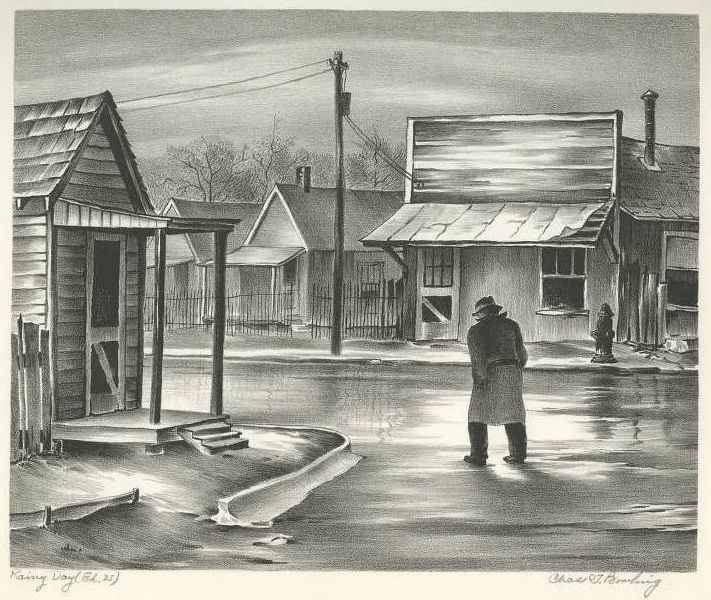
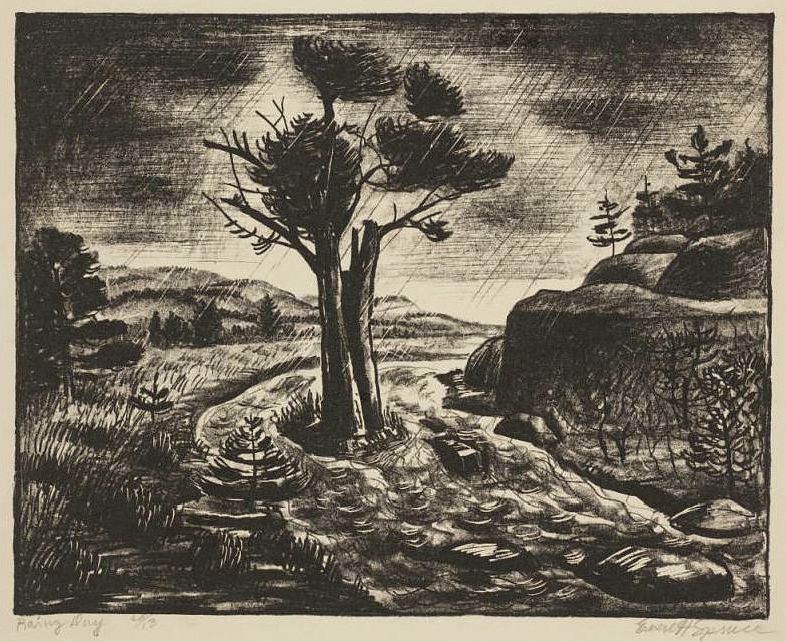
“Rainy Day” and “Rainy Day” on a Rainy Day

bowling_rainy-day_smu

spruce-everett_rainy-day_1944

by Paula Bosse

Two works by local artists closely connected with (if not actually IN) the influential Dallas Nine group of painters and printmakers. Both works are titled “Rainy Day.”

The top print is a lithograph by Charles T. Bowling (1891-1985) and is undated. (From the Bywaters Special Collections, Hamon Arts Library, Southern Methodist University.)

The second print, also a lithograph, is by Everett F. Spruce (1908-2002), dated 1944. (From the collection of the Dallas Museum of Art, a gift of A. H. Belo Corporation and The Dallas Morning News, via the Central University Libraries of SMU.)

Stay dry!

Click pictures for larger images.

*

Copyright © 2014 Paula Bosse. All Rights Reserved.

Oriental Oil Company: Fill ‘er Up Right There at the Curb

gas-pump_commerce_c1912An Oriental Oil Co. competitor, at 1805 Commerce

by Paula Bosse

I cropped this detail from a much larger view of Commerce Street because this incidental, everyday moment caught my attention. Was that man filling his automobile with gasoline? Was that square, boxy, hip-high thing full of gas, right there at the curb of one of the city’s busiest streets? The sign above the pump reads “PENNSYLVANIA AUTO OIL GASOLINE SUPPLY STATION.” I looked into it, and now I know more about early gas pumps and stations than I ever thought I would.

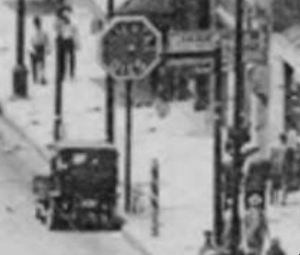
In the very early days of automobiles, one would have to seek out a supplier of gasoline (such as a hardware store or even a drugstore) where you would buy a gallon or two and carry it home with you in a bucket or something and then carefully pour it into your car’s gas tank using a trusty funnel. After a few years of this inconvenient way to gas up, these curbside pumps began to pop up in larger cities. The pump seen above was at 1805 Commerce St. and belonged to the Pennsylvania Oil Company. It opened in early 1912. That got me to wondering about other such fueling stations, and it seems the first in Dallas may have belonged to the Oriental Oil Company, just down the street from the one seen above, at 1611 Commerce. Here is a fuzzy image of it, from the same, larger photo the detail above was taken from. (Click for larger image.)
oriental-oil_1611-commerce_skyline-det

Could this photo have been taken there? It was listed on eBay merely as “Oriental Oil Company, Dallas, 1910-1920.”

oriental-oil-co_ebay

Oriental Oil’s first “auto station” opened in February, 1911, where “facilities have been arranged so as to fill the cars along the sidewalk.”

oriental-oil_dmn_022611(Dallas Morning News, Feb. 26, 1911)

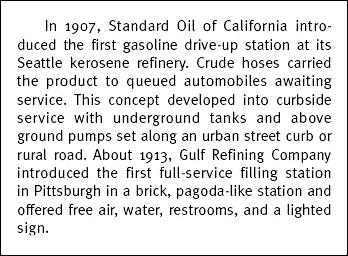
Drive-up “stations” had begun to appear a few years before, on the West Coast.
gas-stations_dot-pdf_p33(Texas Dept. of Transportation, 2003)

In a 1924 Dallas Morning News article (see below), the pump seen in the above photos was described thusly:

Dallas’ first gas filling station had a one-gallon blind pump on the curb which was then thought to be the last word in equipment. Now if a filling station is not equipped with a visible five-gallon pump it is thought to be behind the times and the gas now sold must be water white, when in the old days it was most any color.

This, I think, is what the Oriental and Pennsylvania rolling tanks looked like — the make and model may be different, but I think the general design is the same:

gas-pump-1913

When it was empty, it would be rolled away to be re-filled. I’m not sure about the payment system. Coupon books are mentioned in one of the ads, but I don’t know how (or with whom) one would redeem them as these pumps appear to be self-serve. Perhaps there was a slot for coins/coupons, and everyone worked on the honor system.

It seems that its placement would cause a lot of congestion on a major street like Commerce (which at the time was still shared with skittish horses), but Commerce was also a hotbed of automobile dealerships (Studebaker, Stutz, and Pierce-Arrow dealerships, for example, were within a couple of blocks of the Oriental and Pennsylvania filling stations).

The Oriental Oil Company — a forgotten, early oil company — had an interesting history. The Dallas-based company began business in 1903, starting their company “in a barn in the rear of the Loudermilk undertaking establishment.”

oriental-oil_mercury_123103(Southern-Mercury, Dec. 31, 1903)

They were a fast-growing oil company (“an independent concern which in spite of the strong opposition of the oil trust is now enjoying permanent and growing prosperity”Greater Dallas Illustrated, 1908), and they were one of the first to open a refinery in Texas (they eventually had two refineries in West Dallas). The company’s primary concern in its early years was the manufacture of various oils and greases for industrial use.
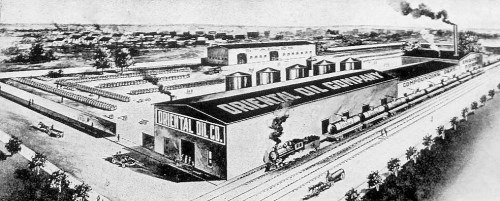
oriental-oil-factory-c1908Oriental Oil Company Factory, corner of Corinth St. and Santa Fe tracks, circa 1908

In 1911, understanding just how profitable the new world of retail gasoline sales could be, they installed their first pump at the curb of 1611 Commerce St., near Ervay (“right behind the Owl Drug Store”). A 1924 Dallas Morning News account of the company (see below) states that this was the first gas pump … not only in Dallas … but in the entire state of Texas. I’m not sure if that’s true, but the Smith Brothers who ran Oriental Oil were certainly go-getters — the Smiths were grandsons of Col. B. F. Terry, organizer of the famed Terry’s Texas Rangers, and one of the brothers, Frank, was an early mayor of Highland Park and a three-term president of the Dallas Chamber of Commerce.

ad-1911_oriental-oil_dmn_100811(DMN, Oct. 8, 1911)

ad-1912_oriental-oil_dmn_012812(DMN, Jan. 28, 1912)

Shortly after opening their first pump on Commerce, demand was such that a second pump was soon opened at 211 Lane St. (a mere half a block away!). The DMN reported on Oct. 19, 1911 that a competitor — Consumers’ Oil and Auto Company — was going to be right across the street: “Permission was given to the Consumers’ Oil and Auto Company to place a gasoline tank under the sidewalk at 214 Lane street.” And in March 1912 the Pennsylvania Oil Company was installing ITS underground tank for the pump seen in the photo at the top — again, less than a block away. And in 1916 Oriental opened its splashy new “‘Hurry Back’ Auto Station” right across the street from where that Pennsylvania tank had been. (That Commerce-Ervay area was certainly an early gas station hotbed!)

ad-1916_oriental-oil_dmn_082916(DMN, Aug. 29, 1916)

Newspaper reports also cite claims made by the company that the station mentioned in the ad above — at Commerce and Prather — was the first drive-in gas station in the United States. I’m sure this was good truth-stretching PR for Oriental more than anything, because this claim was not true (Seattle and Pittsburgh seem to be battling each other for that honor). It might not have been the first, but when this “auto station” opened in 1916 (assuming it was “new” as this ad states), it was still pretty early in the history of the drive-in filling station. Also, by 1916, “Hurry Back” had become the company’s slogan as well as the name of its gasoline.

ad-1918_oriental-oil_dmn_102218(DMN, Oct. 22, 1918)

ad-1920_oriental-oil_jewish-monitor_1920(Jewish Monitor, 1920; detail)

ad-oriental-oil_dmn_041121(DMN, Apr. 11, 1921)

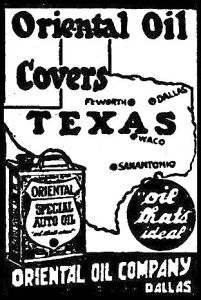
oriental-oil_ad_dmn_030522(DMN, Mar. 5, 1922)

I love these ads!

By 1927, the company boasted at least 18 filling stations, two refineries, and branches in Fort Worth and San Antonio. In 1927 they had moved into new offices in the “Oriental Building” at the nexus of Live Oak, St. Paul, and Pacific. A newspaper report described the building as being “finished in Oriental colors with Oriental decorations and is marked at night by very attractive lighting” (DMN, May 1, 1927).
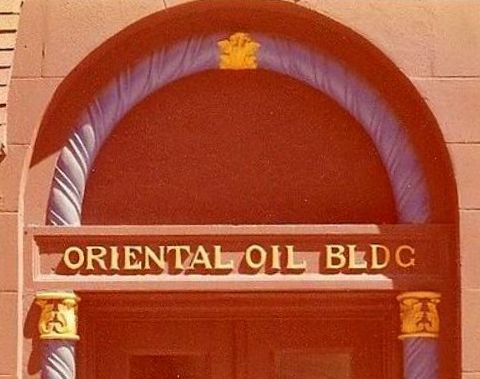
oriental-oil_bldg_1977_flickr

The Oriental Oil Company declared bankruptcy in 1934, selling off their property, refineries, and their name. No more Oroco gas. A lot of companies went bust during the Great Depression, but I’m not sure what precipitated Oriental Oil’s bankruptcy. Actually, I’m surprised by how little information about the Oriental Oil Company I’ve been able to find. Afterall, it and its “Hurry Back” gasoline played a major role in getting the residents of Dallas off their horses and behind the wheel, a major cultural and economic shift that changed the city forever. And it all started at that weird little curbside gas pump on Commerce Street.

***

Sources & Notes

The first two images are details of a photograph by Jno. J. Johnson (“New Skyline from YMCA”), 1912/1913, from the DeGolyer Library, Central University Libraries, Southern Methodist University, viewable here.

Snippet of text from A Field Guide to Gas Stations of Texas by Dwayne Jones (Texas Department of Transportation, 2003).

Illustration of the two 1913 Tokheim portable gas pumps from An Illustrated Guide to Gas Pumps, Identification and Price Guide, 2nd Edition by John H. Sim (Iola, WI: Krause Publications, 2008).

Drawing of the Oriental Oil Company Factory from Greater Dallas Illustrated (Dallas: American Illustrating Co., 1908 — reprinted by Friends of the Dallas Public Library in 1992).

All ads and articles, unless otherwise noted, from The Dallas Morning News.

Color photo of the pink, purple, and gold Oriental Oil Bldg. is a detail from a photo taken around 1977, on Flickr, here.

For an interesting (and mostly accurate) mini-history of the Oriental Oil Company, then in its 20th year of operation, see the Dallas Morning News article “First Dallas Filling Station on Commerce Had One-Gallon Pump” (June 22, 1924).

Some nifty info on early gas stations (yes, really) here.

More info with some really great illustrations and photos here.

Another surprisingly fun and informative article is here.

*

Copyright © 2014 Paula Bosse. All Rights Reserved.

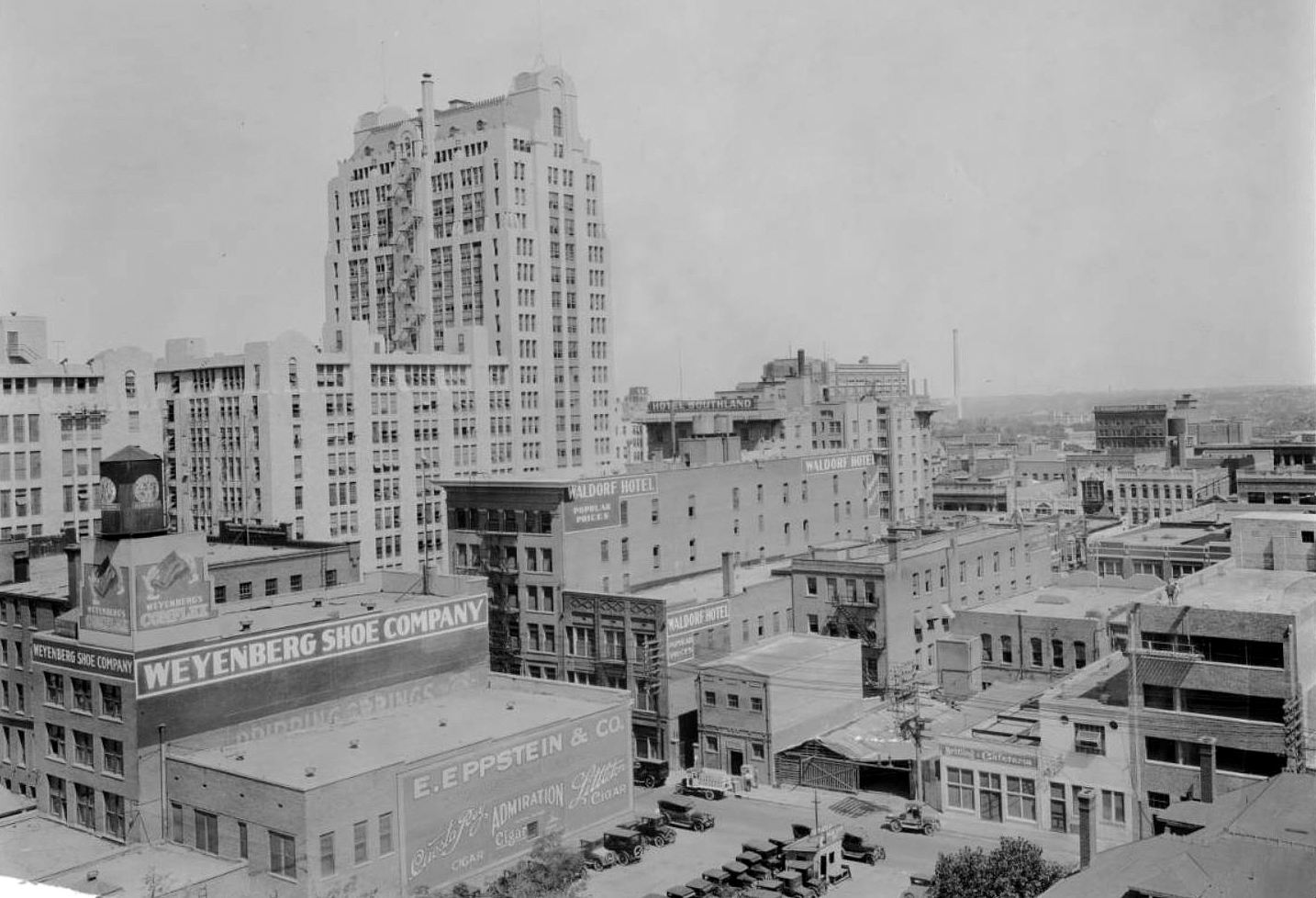
Downtown Dallas, ca. 1923 — Zooming in on the Details

downtown-dallas_degolyer_smuThere’s a lot going on here (click for larger image) / Photo: SMU

by Paula Bosse

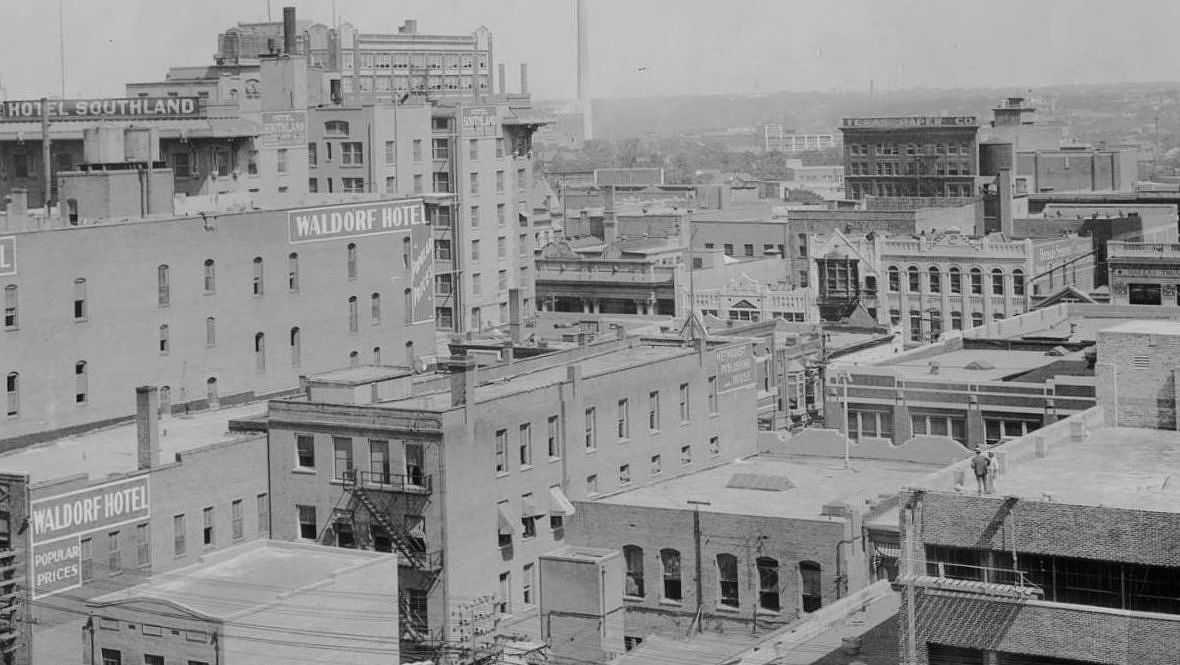
When I see photos like this I always want to zoom in as far as I can, to see the tiny details and everyday moments that might have been captured unwittingly by the photographer. Luckily, this photo has been scanned at such a high resolution (thank you, DeGolyer Library!) that it’s easy to zoom in and wander around it. (Click all of these pictures for much larger images.)

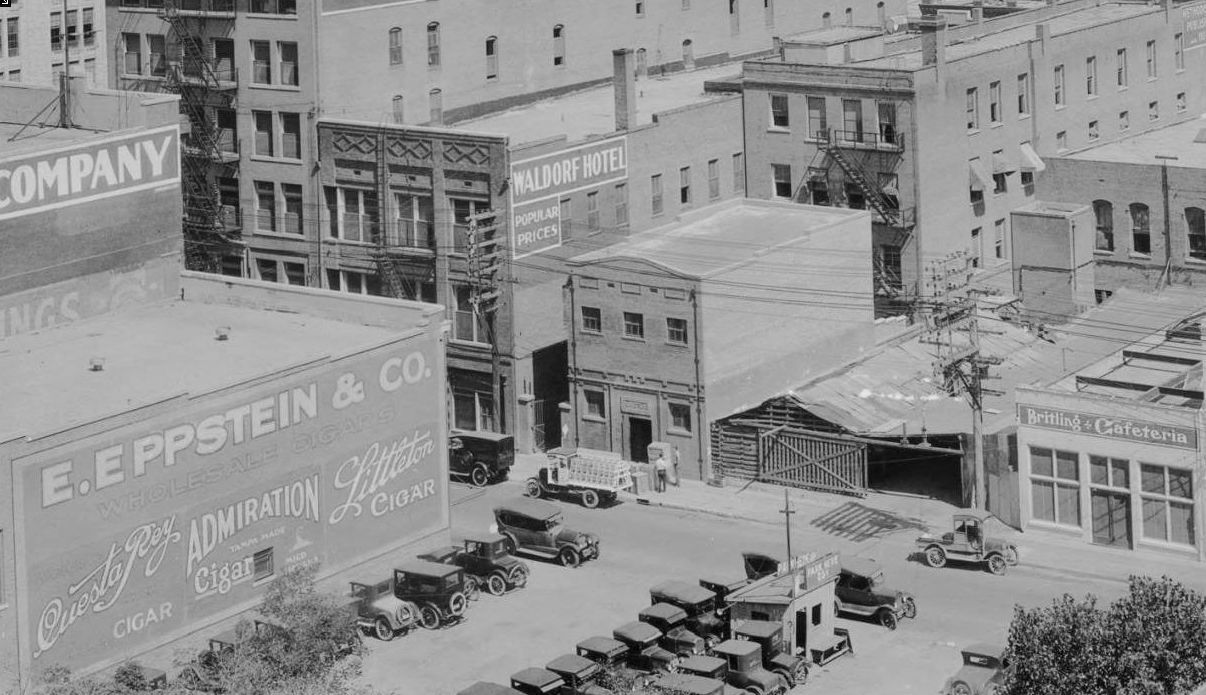
This particular photograph, from the DeGolyer Library at SMU, is attributed to Charles A. McAfee. The DeGolyer caption reads: “Downtown Dallas looking northwest at Santa Fe building complex (center left); Weyenberg Shoe Company at 1300-1302 Jackson; Waldorf Hotel, 1302 Commerce, and the Southland Hotel.” The Britling Cafeteria was at 1316 Commerce — its rear entrance on Jackson is visible in the photo. Here are a few more of the businesses in that 1300 block of Jackson Street, bounded by S. Field and S. Akard (from the 1923 city directory):

1923-directory_jackson-st

And it ALSO shows lots of signs and ads painted on the sides of buildings (some of which might still exist), two men standing on a roof surveying the skyline, a couple of guys talking on the sidewalk, a cafe next door to something that might be a crude garage, cars in a lot where it costs 25 cents to park, and a cool water tower on top of a shoe company. All of which add up to make this a much more interesting and lively photograph than originally presumed.

downtown_degolyer-b

downtown_degolyer-c

downtown_degolyer-d

downtown_degolyer-e

downtown_degolyer-f

***

Photograph of downtown Dallas attributed to Charles A. McAfee; from the DeGolyer Library, Central University Libraries, Southern Methodist University; access it here. I’ve corrected the color.

Trying to pin a date down (SMU has it as “circa 1920”), I’m guessing the photograph might have been taken around 1923, as the Britling Cafeteria opened for business on November 28, 1922. (I was so interested in that cafeteria that I wrote about it: read the Flashback Dallas post “The Britling Cafeteria Serves Those Who Serve Themselves,” here.)

For other photos I’ve zoomed in on to see the details, see here.

Click photos for much larger images.

*

Copyright © 2014 Paula Bosse. All Rights Reserved.