Flashback : Dallas

A Miscellany: History, Ads, Pop Culture

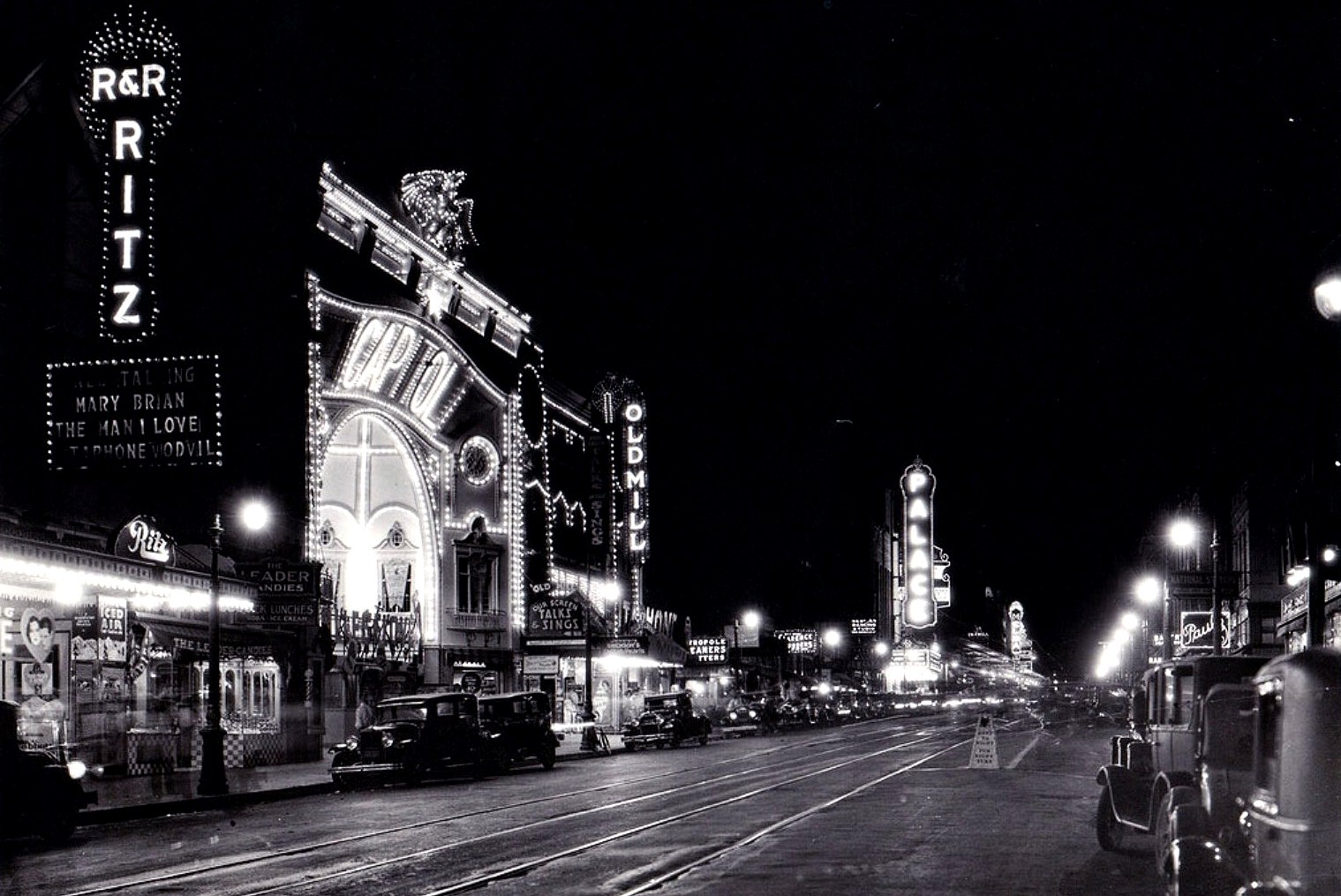
Dazzling Neon, Theater Row — 1929

elm-st-night_capitol-old-mill_1929_shorpy“The lights are much brighter there…”

by Paula Bosse

Whoa. Elm Street in the ’20s.

The Ritz. The Capitol. The Old Mill. The Palace. The Melba. Iced air. Paul’s Shoes. What I wouldn’t give to have walked down Elm when it looked like this.

***

Sources & Notes

Photo from Shorpy.com, here.

Highlights from the 1929 and 1930 street directory (from about Akard, heading east):

  • 1517 Elm: Ritz Theatre
  • 1519: Leader Candy Co.
  • 1521: Fooshee’s Barber Shop
  • 1521-23: Capitol Theatre
  • 1525-27: Old Mill Theatre
  • 1600: Paul’s Shoes
  • 1601: Metropole Cleaners
  • 1603: Elm Pacific Arcade
  • 1605: Lontos Cafe
  • 1623-25: Palace Theatre
  • 1911-15: Melba Theatre
  • 1912-29: Majestic Theatre

 *

Copyright © 2015 Paula Bosse. All Rights Reserved.

Dallas’ First Two Drive-In Theaters — 1941

nwhwy-drive-in_july-1941Northwest Hi-Way Drive-In, July 1941

by Paula Bosse

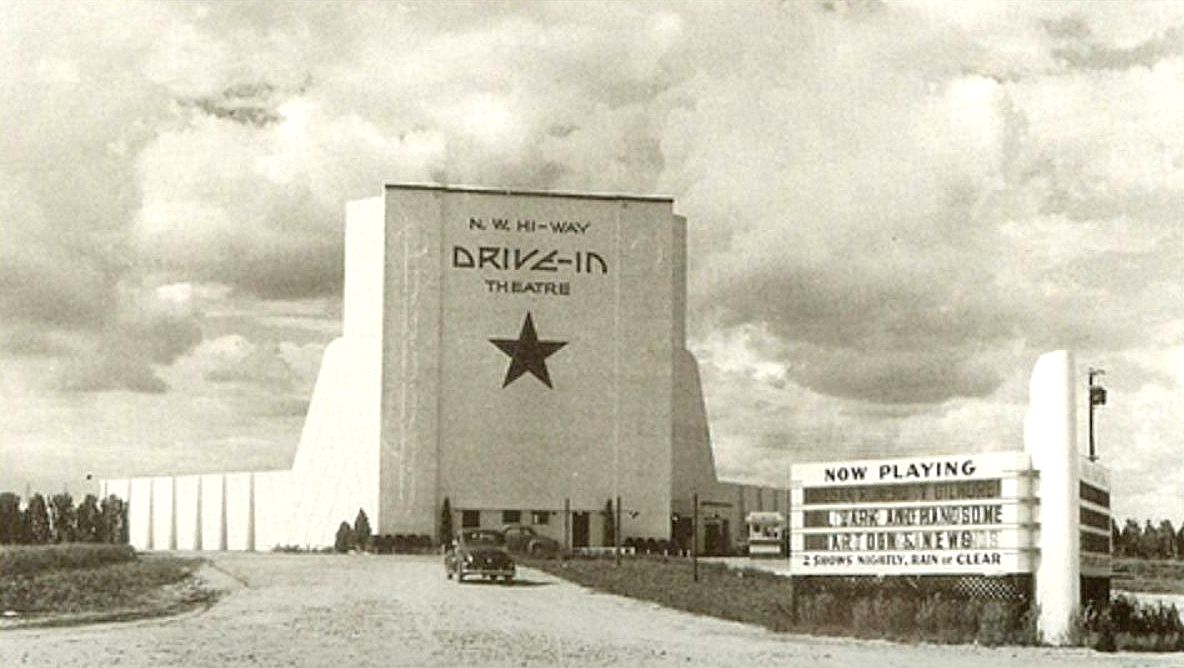
The drive-in theater arrived in Dallas on June 20, 1941, the night that “Give Us Wings,” starring the Dead End Kids, played as the first feature of the Northwest Hi-Way Drive-In, located at the northwest corner of Northwest Highway and Hillcrest. It stood on twelve-and-a-half acres and had a 450-car capacity. The drive-in was opened by W. G. Underwood and Claude Ezell, who had opened similar outdoor movie theaters in San Antonio and Houston.

The Hi-Way (which appears to have usually been spelled “Highway”) featured something I had never seen in drive-in design: cars parked on terraced ramps, where the car behind was always slightly higher than the one in front of it so as to offer an unobstructed view, and speakers were on stands embedded in cement and were placed between cars (no in-car speakers).

Rain was apparently not a problem in this brave new world of outdoor entertainment — if it rained the show would go on (even though the opening was delayed by a few days because of rainy weather) — but fog was a problem, and in case of such weather, movie-goers would be issued a “fog-check” to come back another (fog-free) night.

A newspaper article appeared a few days before the theater’s opening, explaining what a drive-in was and how it worked. Here is the last paragraph:

According to Mr. Underwood 80 per cent of the people who attend drive-in theaters are non-theatergoers. These include people with children and no one to leave them with, semi-invalids, cripples and corpulent individuals who find it embarrassing to attend the regulation theaters. At the Drive-In there is no necessity for getting out of the car, an attendant meets you at the gate, takes your money and buys your tickets, while another wipes your windshield. A third pilots the car to a space on one of the ramps. These are widely spaced enough that any car may leave at any time. (Dallas Morning News, “Northwest Highway Drive-In To Open Tuesday, Rain Or Stars,” by Fairfax Nisbet, June 14, 1941)

Okay then.

The the weather eventually behaved, and the opening on June 20, 1941 was a success, with an almost-capacity audience. The drive-in had arrived in Big D.

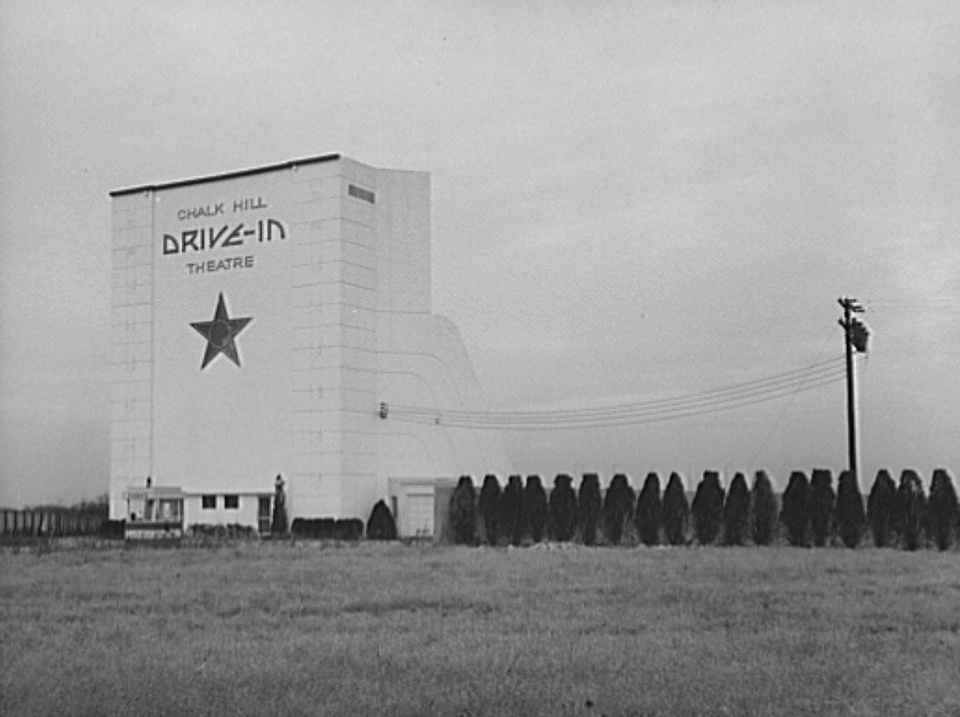
Two weeks later — on July 4, 1941 — Underwood and Ezell opened the Chalk Hill Drive-In in Oak Cliff, at about West Davis and Cockrell Hill Road. It looked almost exactly like the Northwest Highway drive-in, down to the great big star on the outside of it (to be replaced with a clown mural years later). The very first feature was “The Invisible Woman” with Virginia Bruce and John Barrymore.

chalk-hill-drive-in_1942_LOC1942, out on the Fort Worth pike (Library of Congress)

Both theaters had successful and relatively long lives. The Northwest Highway drive-in closed in 1963 when the land was purchased for development (the most notable occupant of the new businesses that occupied that corner was probably the fondly remembered Kip’s restaurant).

The Chalk Hill Drive-In closed in the late 1970s, and from what I can tell, it spent a couple of decades abandoned and decaying.

*

A few random tidbits.

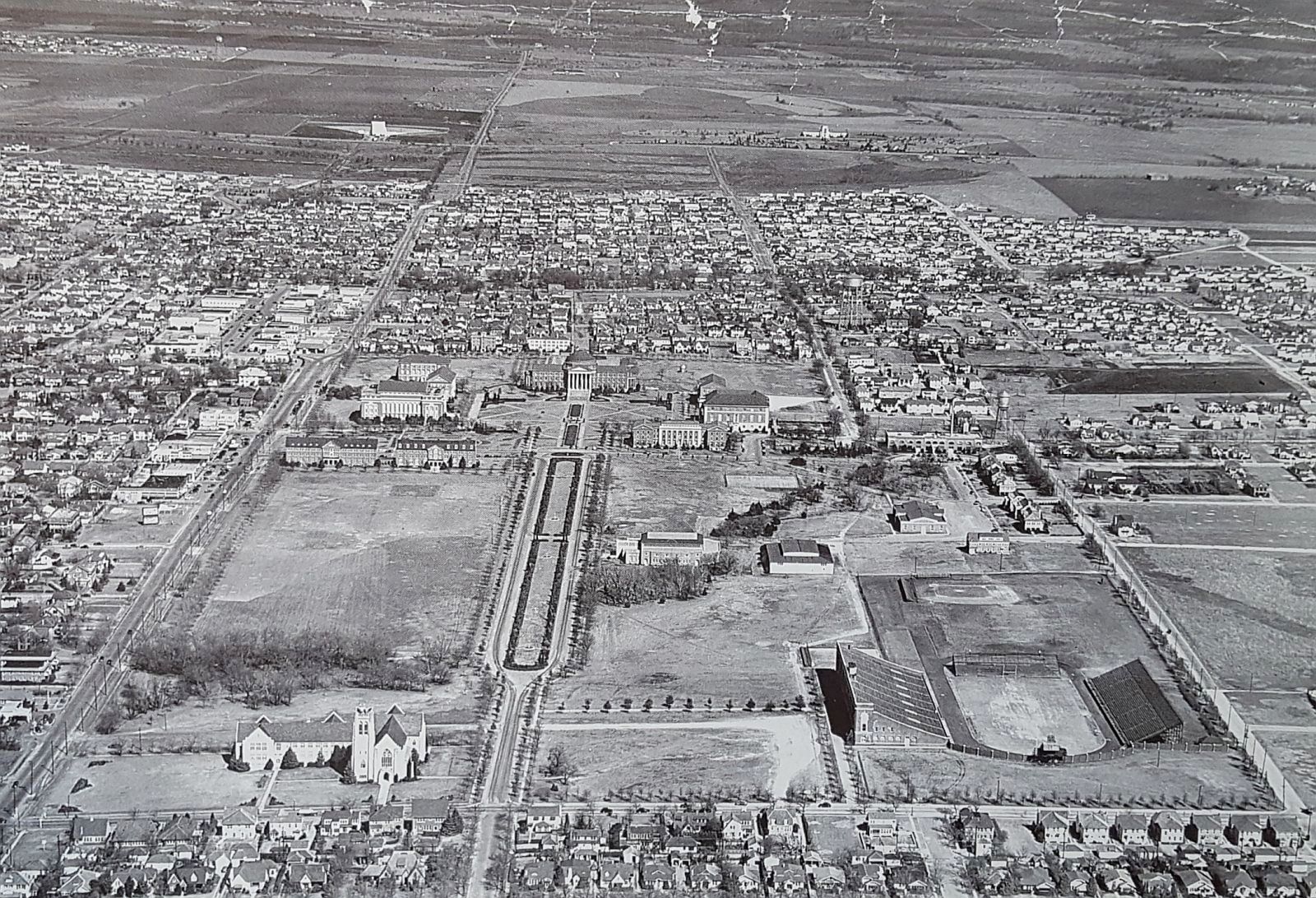
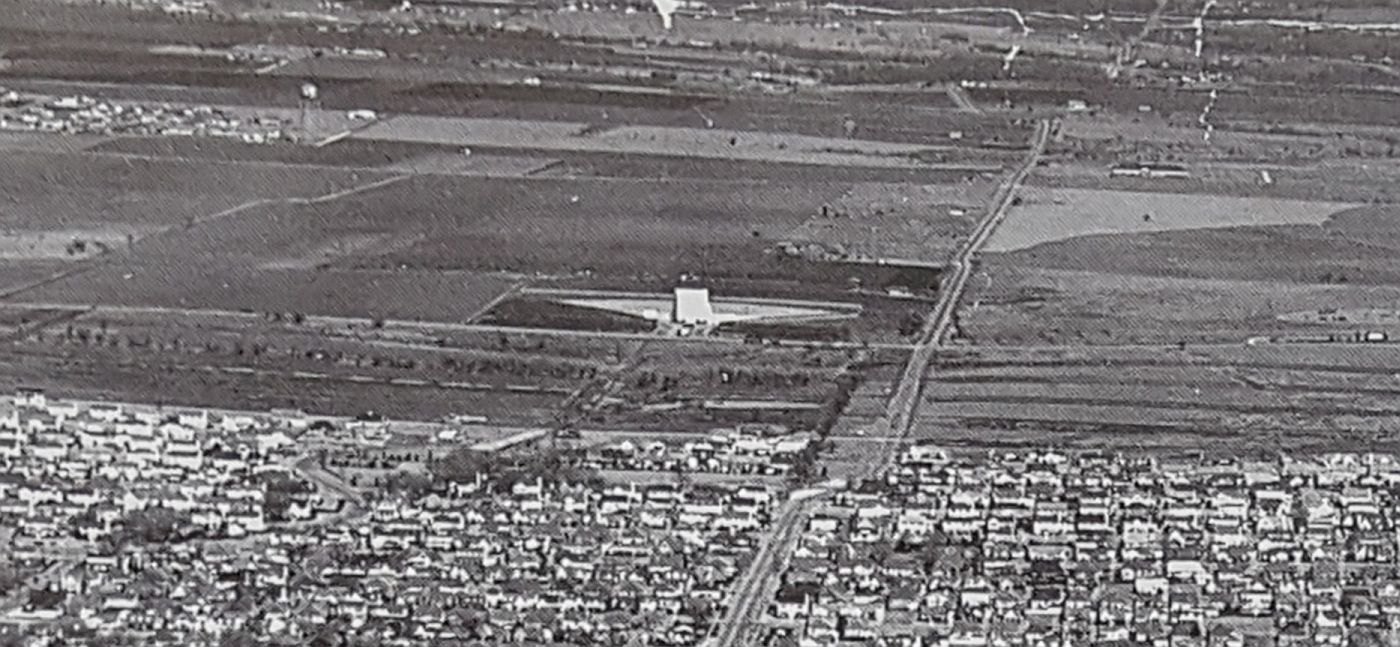
Here’s a 1945 aerial shot over SMU looking north — the drive-in is in the middle of all that wide-open Caruth farmland, seen just left of Hillcrest (the Hillcrest Mausoleum, built in 1936, can be seen to the right of Hillcrest; the Caruth Homestead is at the far right edge of the photo).

nw-hway-drive-in_1945_galloway_park-cities-photohistory

Here’s a detail, showing it up-close:

nw-hway-drive-in_1945_galloway_park-cities-photohistory_det

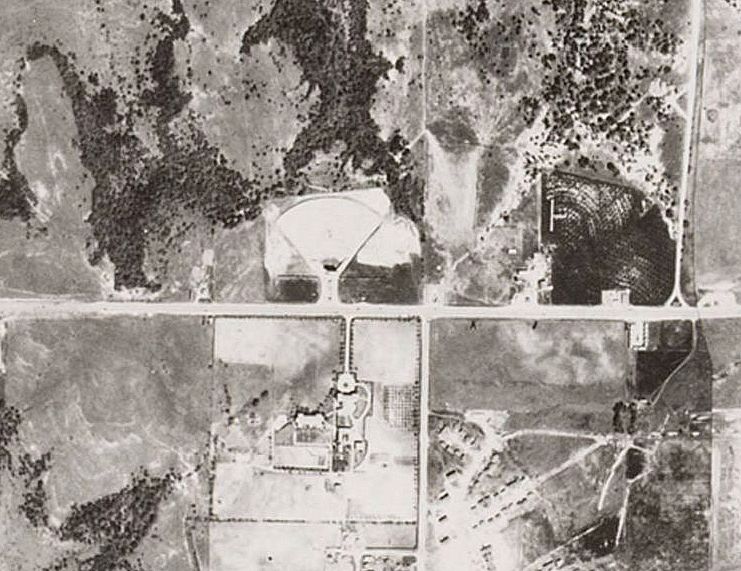
Two aerial shots by the United States Army Air Forces, taken for a USDA survey in 1945. First, the Northwest Highway Drive-In, with Northwest Highway running horizontally in the photo and Hillcrest running vertically.

nwhwy-hillcrest_usaaf_fosucue_smu_1945SMU

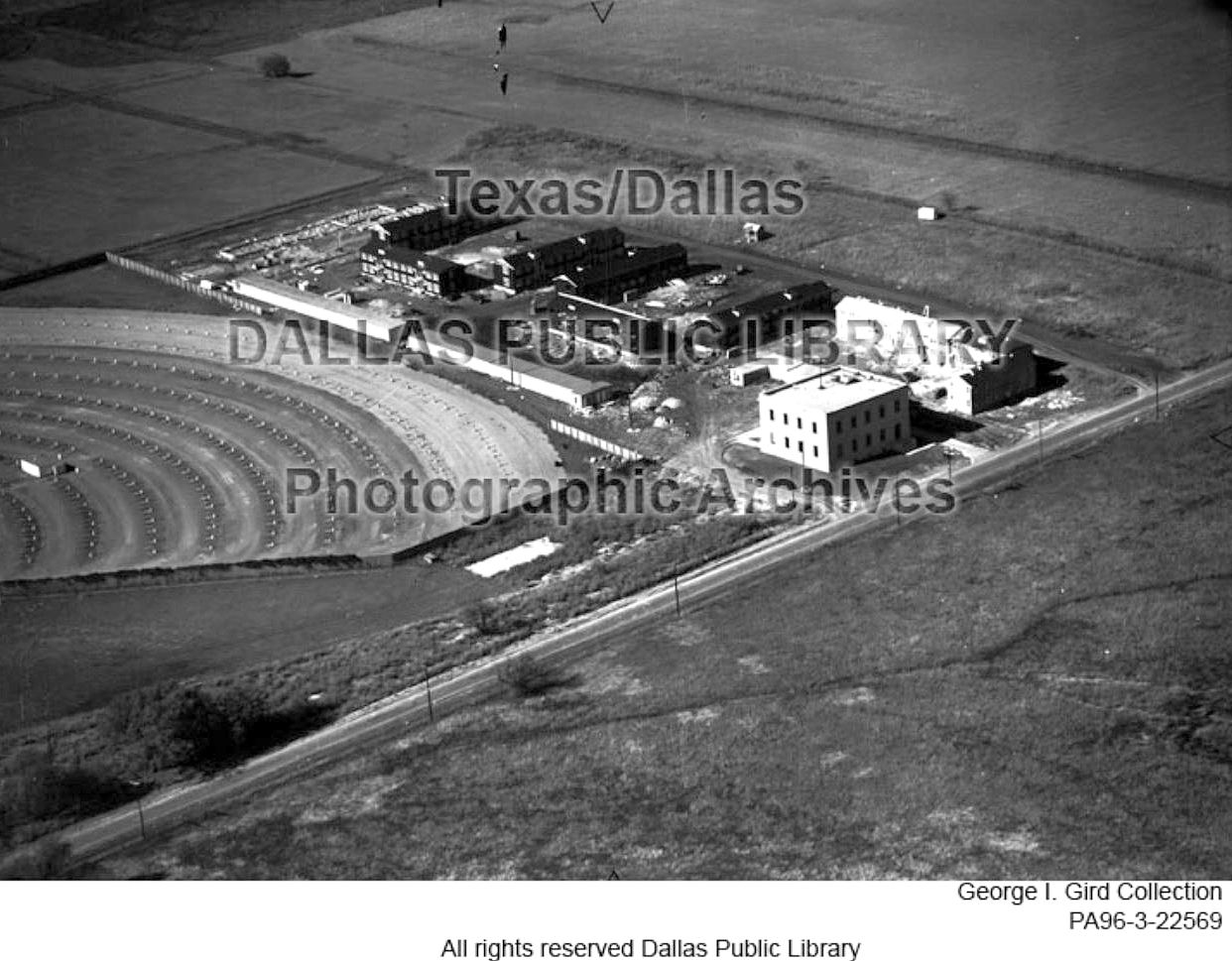
This aerial photo from 1947 shows a view to the northwest, with Hillcrest running from lower left corner to top right — it appears the photo was taken to show the new apartment complex just north of the parking area of the drive-in.

northwest-hi-way_drive-in_DPL_1947
Dallas Public Library

And Chalk Hill, with Highway 80 running horizontally:

chalk-hill_usaaf_smu_1945SMU

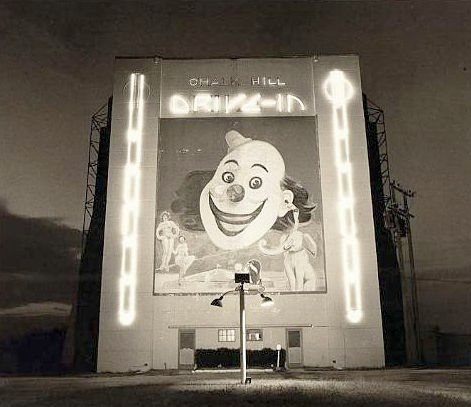
Chalk Hill again, this photo from 1973, with the clown face and circus theme that many remember:

chalk-hill-drive-in_1973_smithsonian
Photo by Steve Fitch, Smithsonian American Art Museum

A couple of amusing livestock-oriented drive-in-related human-interest blurbs appeared in the pages of The Dallas Morning News:

Some cattle going from Waco to Wisconsin stampeded through University Park when their truck caught fire on Greenville. Police herded most of the steers into a Northwest Highway drive-in theater. Five were found nuzzling zinnias at a home on Southwestern. (Lorrie Brooks, DMN, Sept. 18, 1952)

Cattle in 1952, donkeys in 1955:

University Park police early Wednesday captured two pet donkeys who escaped their pen at the Northwest Highway Drive-In Theater during the night. A startled passerby spotted the two donkeys grazing contentedly on a lawn at Centenary and Hillcrest, about four blocks from the theater…. Bill Duckett, manager of the theater, reported the loss of the two pets, which he keeps for the entertainment of the theater’s small-fry patrons. (DMN, May 26, 1955)

***

Sources & Notes

I’m not sure of the source of the top photo, but I’m pretty sure of when it was taken: the marquee shows that the movie “Tall, Dark and Handsome,” starring Cesar Romero, was playing; that movie ran at the Northwest Hi-Way Drive-In July 12-14, 1941.

The aerial photo (by Capt. Lloyd N. Young) showing SMU and the land that lay north of it is from the Highland Park United Methodist Church Archives; I found it in Diane Galloway’s fantastic book The Park Cities, A Photohistory.

The two aerial photos are details of larger photographs from the collection of Dallas Aerial Photographs, 1945 USDA Survey, Edwin J. Foscue Map Library, Central University Libraries, Southern Methodist University. The full (labeled) Northwest Highway photo is here; the Chalk Hill photo is here.

Two other aerial photos (from 1958) are interesting because they are a bit closer and because you can see the terraced ramps — they can be seen here (apologies for the watermarks — photos from HistoricAerials.com).

The Wikipedia entry for the Drive-In Theater is here.

The patent (with illustrations) for the drive-in theater, filed by Richard M. Hollingshead, Jr. in 1932 is here (it’s a very interesting read). I had no idea a drive-in movie theater could be patented. This cool drawing is part of it (click it to see it larger):

drive-in-patent_1

A great history of drive-ins in the Dallas-Fort Worth area can be found in the article “Starlit Skies and Memories” by Susan and Don Sanders; it appeared in the Spring, 1999 issue of Legacies, and can be read here. Great photos! (Who knew there was a drive-in on South Lamar — the Starlite — which catered exclusively to the black community?)

*

Copyright © 2015 Paula Bosse. All Rights Reserved.

“A Perfect Auto Tent” — 1921

ad-dallas-tent-awning_dmn_061221-smRemember to turn off engine before retiring for the night…

by Paula Bosse

Personally, I don’t understand why anyone would want to be outside when it’s 157 degrees, but for those of you who are insistent campers who might be heading out for a sweaty and bug-filled weekend in the wilderness, might I direct your attention to the “automobile tent,” ready for purchase in 1921 at the Dallas Tent and Awning Co. at 2620 Main Street, in the heart of Deep Ellum. Adjusted for inflation, the cost of this admittedly charming-looking “car tent” would be the equivalent of about $200.

My weekend? I will be camped out in a blissfully air-conditioned house — shades drawn, blinds closed — with an iced tea in hand, moving slowly, and not smelling like insect repellent.

*

Copyright © 2015 Paula Bosse. All Rights Reserved.

How To Access the Historical Dallas Morning News Archive

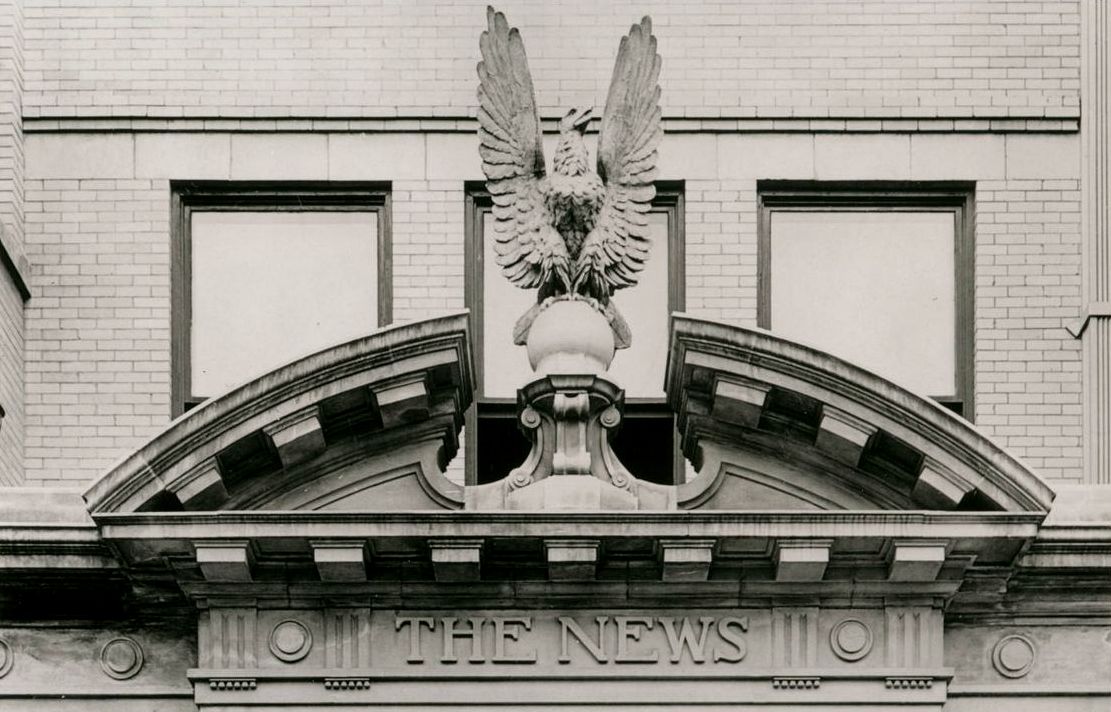
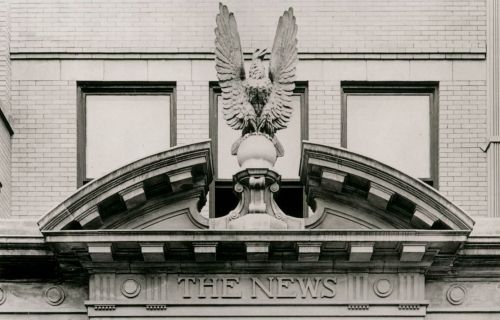
lintel-pediment_dmn-bldg_belo_smu_1930sThe old Dallas Morning News building

by Paula Bosse

(UPDATED August 1, 2025 — I have not updated this post, but, instead, I’ve written a whole new one. It’s shorter and — as of today! — it’s up to date. Find that post, which reflects the new Dallas Public Library website, here. The post on this page below still has some good tips, but as far as being able to use it to figure out how to actually get anywhere on the DPL website, check out the link above instead. I will update this post, if I ever have the time to do it!)

*

Yesterday I wrote about how I tracked down the location of a photograph with very little information to go on. I hesitated to include the step-by-step process I used to discover the location, because I was afraid that it would be a little too tediously arcane for most people. But, apparently I was wrong. I’ve been surprised by how popular the post has become. It’s gotten many more hits than most Flashback Dallas posts usually do. I’ve seen it shared all over Facebook, and it’s generated more comments and emails than I expected. It’s gratifying that people seem to be interested in the actual process of historical research. Even though I don’t necessarily consider myself a historian (I studied Art History in college, and my background is in bookselling), I’m happy to be able to share historical events and forgotten local tidbits with an audience that finds them as interesting as I do. I consider myself a writer and researcher, and sometimes all the fun is in the researching.

Since I began this blog in February of 2014, I’ve been asked several times how I access the Dallas Morning News archive. Without question, the DMN is the single most valuable resource in the study of Dallas history. Years ago, one would have had to trudge to a library and crank up a microfilm or microfiche reader. Luckily, we are in the digital age, and every edition of the DMN from 1885 to the end of 1984 has been scanned and digitized and can be viewed from the comfort of one’s own home. (Also available in this database are various Fort Worth newspapers — from The Fort Worth Register to The Fort Worth Star-Telegram — from at least 1897 to 1990, which is, of course, very handy!) You can view the paper page by page, article by article, photo by photo, comic strip by comic strip, ad by ad. It’s incredible. You’ll get lost in it for hours. Want to know what was going on 100 years ago today? Easy! Here’s the front page of the DMN from July 30, 1915:
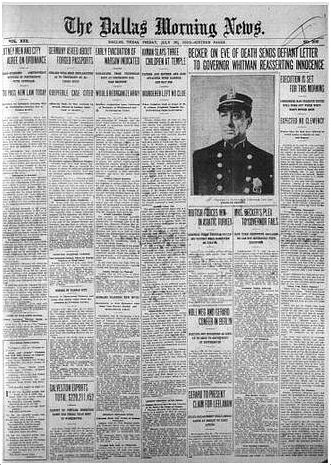
front-page_dmn_073015DMN, July 30, 1915

So how do you do it? First off, you have to live in the city of Dallas — bad news for those of you living outside the city limits, I’m afraid. (UPDATE: THERE IS A WAY FOR NON-RESIDENTS TO ACCESS THE ARCHIVE — FOR A MONTHLY FEE. SEE UPDATE AT BOTTOM OF THIS POST.) For those of us who do live inside the city limits, not only can we access the database whenever we want, but it’s also FREE. All you need is a Dallas Public Library card (information on how to get a free card is here; the DPL’s FAQ is here). UPDATE Nov. 9, 2021: The Dallas Public Library will now offer free library cards (and with it access to their website, including the newspaper archives) to STUDENTS AND TEACHERS AT DALLAS PUBLIC AND PRIVATE SCHOOLS, CHARTER SCHOOLS, COMMUNITY COLLEGES, AND UNIVERSITIES, regardless of whether they actually live in the city of Dallas — see the DPL’s FAQ on that here, and read a news story about it on the KERA site here.

So your first step is to get a library card. Once you have a card, go to the Dallas Public Library site’s “My Account” page, here, to sign up for the free account. You’re now ready to plunge in. 

*

HOW TO ACCESS THE “DALLAS MORNING NEWS ARCHIVES”

Use this to search for content published ONLY in The Dallas Morning News, between 1885 and 2016 (articles post-2016 are available on DallasNews.com). (Scroll down for instructions to access Fort Worth papers.) This BY FAR the easiest option for most people and should give you more than you need!

  • Log in to your Dallas Public Library account
  • Click on “DATABASES”
  • Scroll down, click on “MAGAZINES, NEWSPAPERS & JOURNALS”
  • Scroll down, click on “DALLAS MORNING NEWS ARCHIVE”
  • This gets you to a default page with 4 DMN-related sources: 1) the “historical” edition, for the years 1885-1984 (results will show scanned images/articles as they appeared in the newspaper when originally published), 2) the “modern” edition, for the years 1984-2016 (these results will be text-only — no images), 3) DMN Blogs (2006-2016), and 4) the DMN old free paper Quick (2003-2011). Enter your search terms in the search box, and wave goodbye to big chunks of time as you sit in front of your computer searching and reading and searching and reading.

I use the ADVANCED SEARCH option — click “Advanced Search” underneath the main keyword search box. A new page opens and you can filter what you’re searching for by choosing any specific fields you want to use. Click the down-arrows next to the search boxes to show a drop-down menu of options. 

*

ACCESS FORT WORTH PAPERS ONLY:

  • Follow the instructions above to log in — the main page opens — click through as above to “DALLAS MORNING NEWS ARCHIVE”
  • At the very top of the page, click the down arrow next to “Change Databases” — click on “ALL DATABASES” — a new page will load
  • Under “Access World News — Historical and Current” click on “Fort Worth Star Collection with Historical Archive” (they’ve left out the “Telegram” in several places with the recent update) — this brings up archives of the Fort Worth Star-Telegram (“historical” editions published 1902-1990 and “modern” editions published 1990-present day) as well as an archive of The Fort Worth Register (1897-1902) — and other stuff. Full scans are available for the editions published between 1897 and 1990; after that, it’s text-only.

*

ACCESS THE FULLY SCANNED “HISTORICAL” DALLAS AND FORT WORTH PAPERS *SIMULTANEOUSLY*: 

This is the option I find most useful in doing daily historical research — I exclude “modern” editions, because I get too many extraneous results. If I do need more recent info, it’s easy to add modern editions, but I find excluding papers published after 1984 is best for my work. 

There are two ways to do this — this way is fastest (you won’t see results published after 1984 for the DMN or after 1990 for FWST):

  • Log in — follow all the steps listed above — the main page opens
  • Hover over “Change Databases” at the very top of the page – a dropdown menu appears — click on “All Databases” — a new window opens
  • Scroll down and click on “America’s Historical Newspapers” a new page opens — this will search the “historical” databases of the Dallas Morning News and Fort Worth Star-Telegram as well as the Fort Worth Register (Jan. 2023 update: even though you don’t see them until you look at search results, there are now several other fully scanned “historical” newspapers which will show up from other cities and states — up to 1922, which I gather is when copyright kicks in — you can filter these out and just stick with the DMN and FWST, but they are very interesting to peruse)
  • Filter your search options by date, specific newspaper, etc., on the left side of the page or — my preference — use the “Advanced Search” option by clicking that link below the main search box and add however many rows you need to refine your search (I always add a “Date” row and leave it for the duration of my research period)

This is a way to add and exclude various newspapers (don’t confine yourself to Dallas and Fort Worth!), and it also allows you to see search results from historical and modern papers at the same time:

  • Follow the steps above to log in — the main search page opens
  • Near the top of the page (to the right of the “NewsBank” logo) click on “A-Z Source List” — a new page opens
  • In the search box next to “All Keywords” type in “Dallas” — as of this writing, a LOT of options pop up, mostly modern rather than “historical” — click the checkboxes of all sources you wish to access
  • After you’ve selected all the sources you want, click on the blue box at the bottom of the page reading “Search Within These Selections” — a new page will open — begin your searches from the newspapers you’ve selected.

*

ACCESS ALL AVAILABLE METROPLEX-AREA NEWSPAPERS SIMULTANEOUSLY:

There are tons of DFW metropolitan-area papers and neighborhood publications to search through on the Newsbank/DPL website — from Alvarado to Weatherford; only the pre-1984 Dallas Morning News and pre-1990 Fort Worth papers are “historical” and fully scanned) — all other papers are text-only and, generally, don’t have content available from before the early 2000s. But those papers have lots of great info. I know this is getting tedious (!), but here’s how to search those non-historical DFW papers simultaneously:

  • Log in — main page opens
  • Click on “Access World News Historical and Current” at the very top of the page — a new page opens
  • Click on the blue box on the right side of the page reading “Dallas Metropolitan Collection” — this brings up archives for (as of this writing) 90 area publications (Jan. 2023 update: I see issues of The Dallas Herald (1855-1887) are, weirdly, kind of hidden in this list — they appear to be the exact same scans available on the Portal to Texas History, where navigation is a lot easier!)

*

Note: At the risk of beating a dead horse, one more time: the difference between the “historical” and “modern” post-1984 Dallas Morning News archives is that the “historical” (1885-1984) search results include images of fully scanned editions of the newspaper — you see everything the way it looked in the actual newspaper: you can see entire pages as well as individual articles, photos, illustrations, comic strips, ads, classifieds, etc. You do not see any of this in the post-1984 results — the information is still useful, but it’s not as interesting and, maddeningly, not as comprehensive. I tend to use one or the other, otherwise, too many non-applicable results are returned.

**

It takes a good bit of time to figure out how to use the search engine quickly and effectively — it has a lot of weird little idiosyncrasies that can cause you to miss out on lots of things you’re searching for (apostrophes, initials, and numbers can be extremely problematic) — but once you start to wander around, you’ll be amazed at what an incredible treasure trove is at your fingertips. It’s always confusing after a major re-do of a site, so you just have to play around with it until you figure out how everything works. …Then have everything change again when you finally get comfortable with it.

This is such a wonderful resource — thank you, Dallas Public Library and thank you, Dallas Morning News!

***

Sources & Notes

Photo at top: “Lintel and pediment above doorway, Commerce St. entrance,” ca. 1930s, from the Belo Records collection, DeGolyer Library, Central University Libraries, Southern Methodist University; photo and details are here.

The best newspaper database for those interested in Texas history is UNT’s Portal to Texas History Texas Digital Newspaper database, here. They have tons of scanned and digitized historical Texas newspapers (excluding The Dallas News), AND it’s free and available to everyone. Below are a few of their offerings of particular interest to Dallasites:

  • The Dallas Herald — absolutely ESSENTIAL for Dallas goings-on between 1855 and 1887, here
  • The Southern Mercury, the agricultural-leaning paper published in Dallas, 1888-1907, here
  • The Dallas Express — a newspaper printed by and for the city’s African American community — ALSO essential — sadly, only the years 1919-1924 have been scanned, here
  • The Jewish Monitor — published in Fort Worth, serving the DFW (and Texas) Jewish community, 1919-1921, here
  • The Texas Jewish Post, 1950-2011, here

Check out all the Texas newspapers UNT has scanned: go to the Advanced Search page and scroll down the “Collections” menu bar to see the full list.

And, of course, there are the subscription sites Newspapers.com (which I use) and NewpaperArchive.com. I’m not familiar with the offerings of the latter, but Newspapers.com has a lot of DFW papers, all of which are fully scanned (and many of which are available for free at the Portal to Texas History). My favorite DFW newspaper on Newspapers.com is a fairly recent addition — the evening edition of the Fort Worth Star-Telegram, which is often very different from the morning edition (morning editions are the ones found on the Newsbank/Dallas Public Library database — Newspapers.com has both morning and evening FWST editions).

**If you need some research done, I might be able to help. I have access to several resources and am pretty thorough. Let me know what you’re looking for and inquire on hourly rates by clicking the “Contact” tab at the top of the page.**

Enjoy!

*

7/31/15 — UPDATE: GENEALOGYBANK.COM — HOW TO ACCESS THE HISTORICAL DALLAS MORNING NEWS ARCHIVE IF YOU ARE NOT A DALLAS RESIDENT: While looking for something completely unrelated, I came across a comment by someone who said he accessed the Dallas Morning News archives — historical and modern — through a site called GenealogyBank.com. It sounds like something similar to Ancestry.com where you are given access to several different types of resources used in genealogical research. The website indicates the cost is $19.95/month or $69.95/year. There is a free 30-day trial (but if you don’t cancel it and explicitly tell them you are canceling, they will automatically charge you and you will NOT get your money back). This is the first I’ve ever heard of this site, so I have no idea whether it’s good or bad. (The parent company of GenealogyBank is NewsBank, the company that manages the DMN archive accessible through the Dallas Public Library.) I did ask on a Dallas history group tonight, and a trusted member said that he uses it all the time. He posted a few screenshots, and it’s very similar to the archive accessed through the library’s website. For those interested, you might want to try the free trial to see if it’s something you’d be interested in subscribing to. This is pretty cool, because it offers people who live outside the city limits the ability to access the DMN archives for a relatively small fee each month. I am not promoting or endorsing this site because I had never even heard of it until an hour or two ago. I’d love to hear feedback from people who try it out. The Genealogy Bank website is here. A review of the site from About.com is here. I encourage you to check other consumer sites for pros and cons. I hope this is helpful for those of you who, for some reason, choose to live away from Dallas!

*

Copyright © 2015-2023 Paula Bosse. All Rights Reserved.

Tracking Down a Photo Location & Discovering a City Pioneer: D. M. Clower, The Man Who Brought the Telephone to Dallas

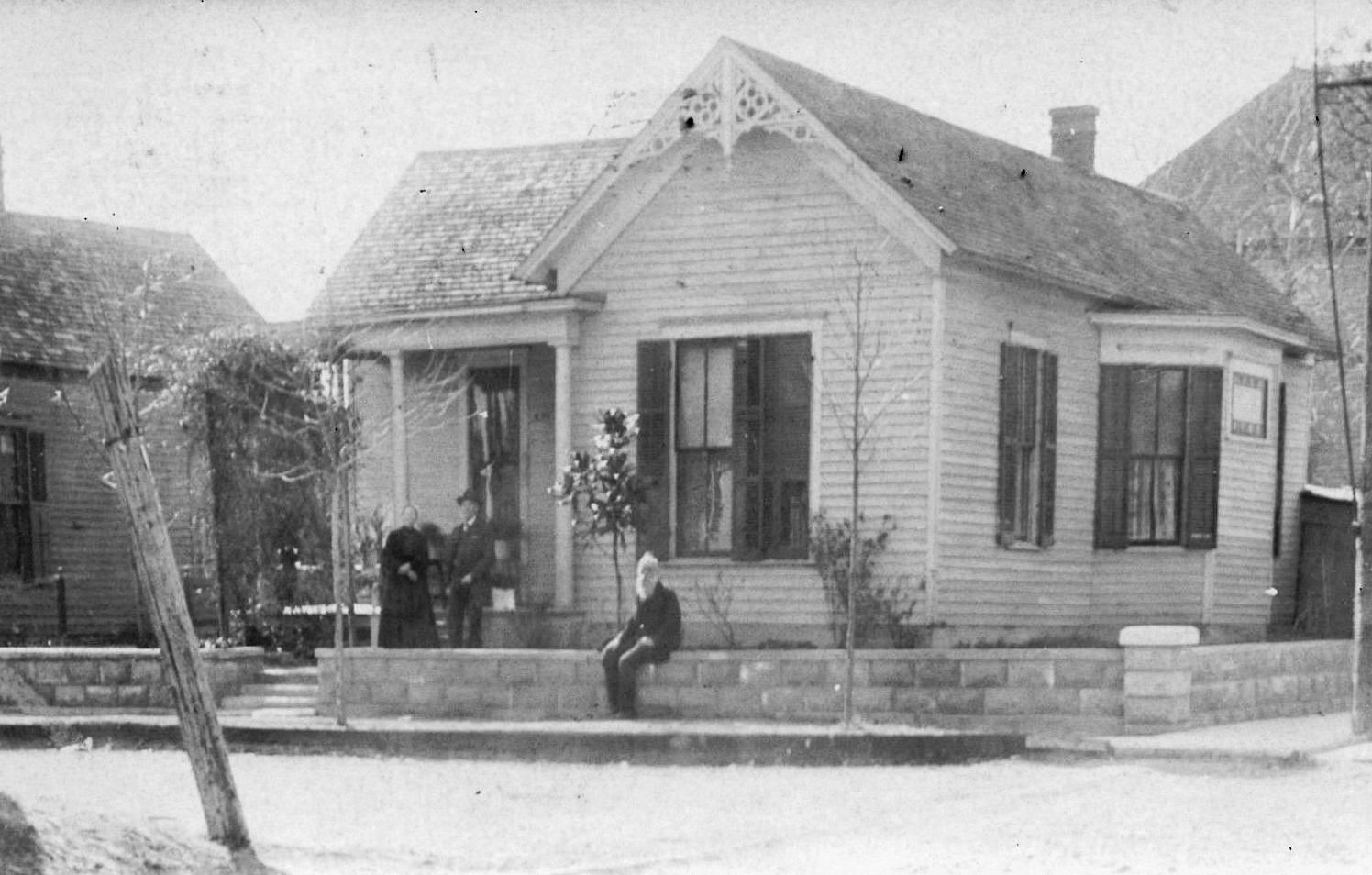
house_RPPC_1909_ebayMystery house, Dallas, ca. 1908 (click for larger image)

by Paula Bosse

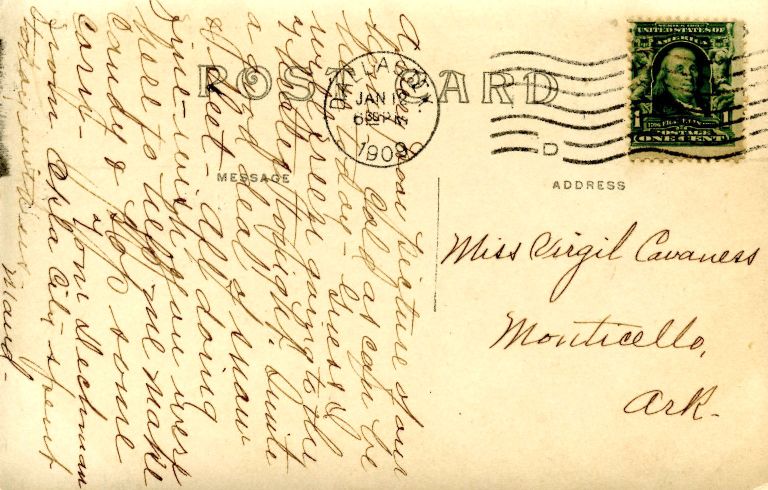
Not too long ago I came across the above photo which had been made into a real photo postcard.” It was postmarked January 12, 1909, and it contained a chatty message.

“A very good picture of our house. Cold as can be here today – guess I will freeze going to the theater tonight. Quite a good deal of snow and sleet. All doing fine – wish you were here to help me make candy & pop some corn. Tom Dechman from Okla. City spent today with us. Maud.”

house_RPPC_1909_ebay_back

Such a nice photo of a modest little house in Dallas, probably taken in 1908. When I saw it, I thought it would be cool if I could figure out where it was. There wasn’t much to go on from the postcard, though. But, as it turns out, there was just enough information to put the pieces together and figure it out. Someone asked me recently how I track down things like this. Basically, I look for a long time in a lot of different places. Here’s how I found out where this mystery house was.

Using Ancestry.com, I found Virginia (“Virgil” — sometimes “Virgie”) Cavaness in Monticello, Arkansas. She was born in 1871 and would have just turned 37 years old when she received this card. The familiar tone of the postcard message indicated to me that Virgil was probably a close friend or family member.

I found Thomas Dechman in Oklahoma City — he would have been 23 when he visited Maud. He probably wasn’t a close friend or immediate family member because she writes his full name out. According to the 1909 Oklahoma City directory (accessible on Ancestry.com), he worked alongside his father, A. F. Dechman, at a wholesale produce company.

Then I checked the Dallas Morning News archives and found this from Dec. 30,1909.

clower_dmn_123009DMN, Dec. 30, 1909

Tom Dechman was Mrs. A. F. Dechman’s son. So I searched on “Maud Clower.” Maud, born in 1877, was also D. M. Clower’s daughter. Mrs. A. F. Dechman was Maud’s sister Annie, and Tom was her nephew.

I continued searching the DMN archives for mentions of the Clower family and found that in 1906 Maud Clower had married Jesse (J. D.) Patterson — and, hey, Virgil had attended the wedding.

virgie_dmn_090206DMN, Sept. 2, 1906

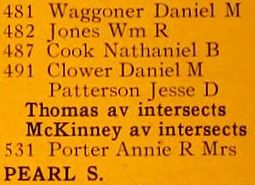
I checked to see where Maud and J. D. Patterson were living in 1908/1909. Most directories are available on Ancestry (a subscription site), but, as it happens, the 1909 directory is one of the few historical Dallas city directories that is available online (for free) — you can access it here (a few other directories are here). I found a Jesse D. Patterson listed as living at 491 N. Pearl, but no spouse’s name was listed, so I cross-referenced the address with the street directory section to determine whether this was the right J. D. Patterson. (Street directories are very helpful — not only do they list the occupants for each address, they also help to pinpoint where specific addresses were as they show which cross-streets those addresses were between; this is extremely helpful when trying to figure out where things were when streets had different names and/or when trying to figure out where things were before all of Dallas’ street numbers were changed in 1911. Another useful resource is a page on Jim Wheat’s site, which has links to every page of the 1911 street directory — click on a street name and find your address: the “new” address is on the left, and the “old” address is next to it, in bold.)

clower-patterson_1909-directory1909 city directory, residents of N. Pearl Street
Even though this didn’t have Maud’s name listed alongside her husband’s, it DID show that her father, D. M. Clower, was living at the same address. Success!

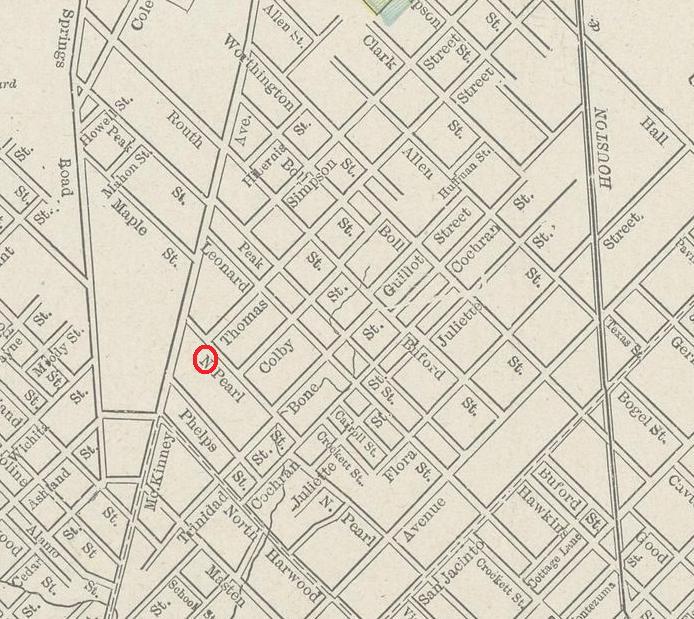
So there it is. When Maud sent that postcard to Virgil, she and her husband were living with her parents at 491 N. Pearl Street. The house in the photo was at the southwest corner of N. Pearl and Thomas. It’s always helpful to check a street map from about the same period for context and to make sure you’re looking at the right location — many street names have changed over the years — if a street named “Forest” is being referenced in the 1940s, for instance, you need to know that the old Forest Avenue and the current Forest Lane are absolutely nowhere near each other. Below is a map drawn about 1900, with the location of the Clower house circled in red (this is one of many maps found on the Portal to Texas History site; the one below is a detail of the map found here).

clower-home_map-ca1898

I also checked out Sanborn maps to see if the house in the photo matched the house that was actually on the lot at N. Pearl and Thomas. It does. To see what the general footprint of the house looked like in 1905 (the Clowers lived at 491 N. Pearl from about 1905 to 1910), see here. In the 1921 map (by which time the address had been changed to 2221 N. Pearl), you can see that additions had been made to the house since 1905 and that it looks more like the house in the photo (a room now juts out at the right and there is an out-building behind the house); see the 1921 Sanborn map here. To see what that Uptown block looks like now, see here (N. Pearl is on the left, looking south). Quite a change! It took me a long time to realize just how essential Sanborn maps can be — they are incredibly useful, and I try to use them whenever I can.

**

I really didn’t expect to track down the actual address of an unidentified house found on a picture postcard, but persistence pays off. A bonus of this persistence was that I ended up learning about the very interesting man who owned the house — a man who played a pivotal role in the development of Dallas: Daniel Morgan (D. M.) Clower. Clower was an electrical engineer who, in 1881, installed the very first telephone in Dallas (for Judge John Bookhout) and ran the city’s first telephone exchange; he also set up phone systems in other cities. In addition to his work for Bell Telephone, he also ran Dallas’ electric company for many years and was responsible for setting up the city’s first electric street lights and helped in developing electrified rail systems in the region.

clower_electrician_1889-directory1889 Dallas directory (click for larger image)

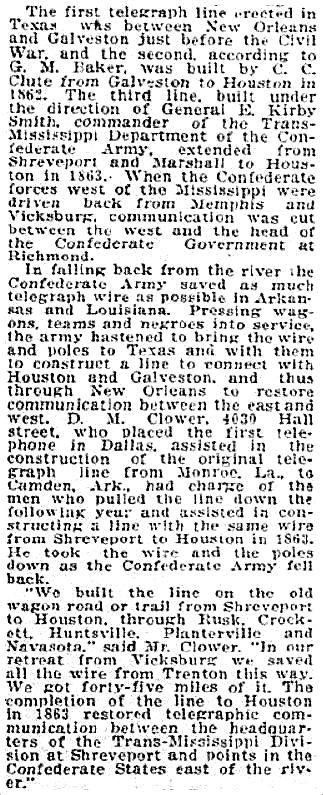
During the Civil War, Clower was a Confederate telegraph operator in the 1st Louisiana Regiment (see Clower’s fascinating obituary below). When the Union army was advancing after the fall of Vicksburg, Clower directed (and helped in) the destruction of the Confederate telegraph system he had helped set up, in order to prevent its being commandeered by Yankee forces — he and his men raced to pull up over 40 miles of wire and equipment, loaded everything on wagons, bugged out, and then used the same wire and poles to string a new Confederate line into and across Texas.

clower-telegrapher_dmn_010822DMN, Jan. 8, 1922

The war ended before Clower had completed his line northward from Houston, but his efforts had helped lay the telegraph infrastructure that the state of Texas relied on for decades afterward.

*

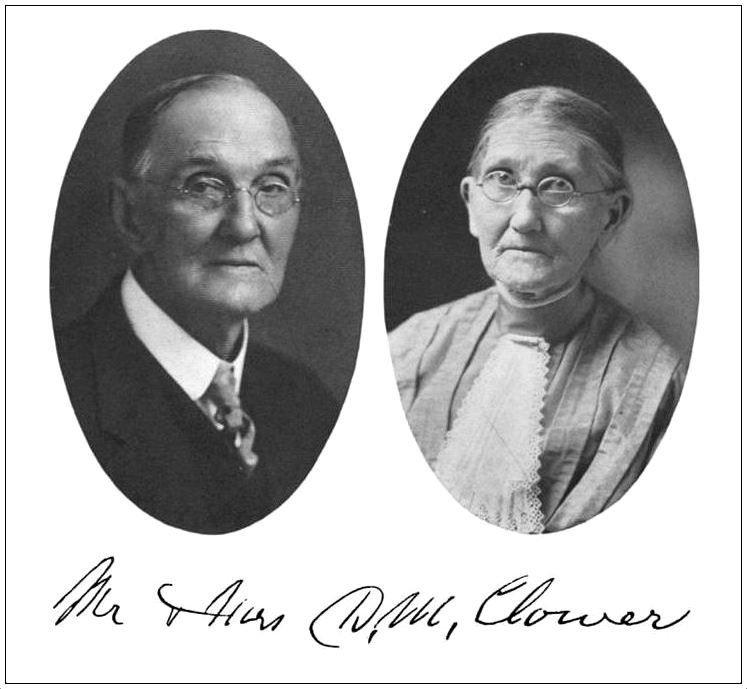
The people in the top photo are not identified. When that photo was taken, D. M. Clower and his wife, Ellender, would have been about 73; their daughter Maud and her husband Jesse would have been in their early 30s. I assume it’s the elder Clowers, with a mystery bearded man in the foreground.

clowers_d-m-and-ellender_hist-of-tx-and-texans_1914_portal
Mr. and Mrs. D. M. Clower, ca. 1914

You never know what you’re going to discover when you read a 106-year-old postcard and wonder where an old house used to be.

***

Sources & Notes

Postcard found on eBay.

Daniel Morgan Clower was born in Alabama in 1835; he arrived in Dallas in 1879, coming from Comanche, where Maud was born in 1877. Clower died in 1927 at the age of 92; Maud died in 1948. His wife, Ellender Paralee Clower, died in 1917 (at which time the couple had been married for more than sixty years).

More on Clower can be found in the pages of The Dallas Morning News:

  • “Telegrapher Tells Civil War Episode” (DMN, Feb. 1, 1924) — a fantastically cinematic account of Clower’s past, in his own words
  • A photo of Clower and Eli Sanger, (DMN, May 1, 1927) — what might well be the last photo of Clower ran in the News just a few months before his death at the age of 92; also in the photo is Eli Sanger, of Sanger Bros. (Clower once had a business in Millican, TX when Sanger’s opened there at the close of the Civil War, and he proudly boasted that he was one of their very first customers)
  • “Daniel Clower Funeral Held” (DMN, Aug. 19, 1927) — Clower’s obituary, with photo

Photo of Mr. Clower with text from a Dallas Times Herald story published on the occasion of his 89th birthday can be found here (scroll down to 1924, about halfway down the page), via Jim Wheat’s site.

The photo of Mr. Clower and his wife Ellender is from the book A History of Texas and Texans, published in 1914; the accompanying entry about Clower’s very interesting life can be found here, via the Portal to Texas History.

*

Copyright © 2015 Paula Bosse. All Rights Reserved.

Neon Refreshment: The Giant Dr Pepper Sign

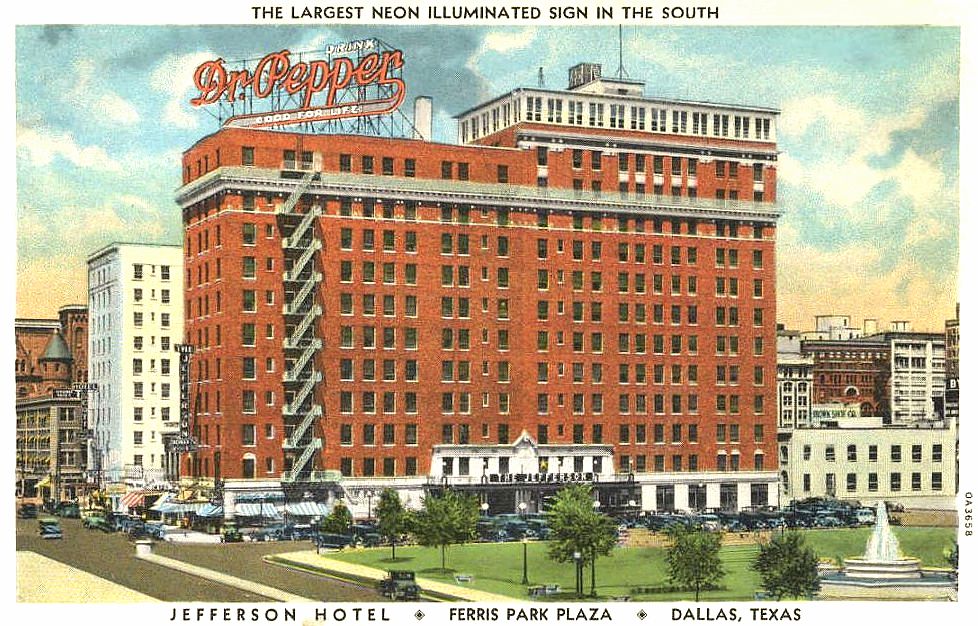
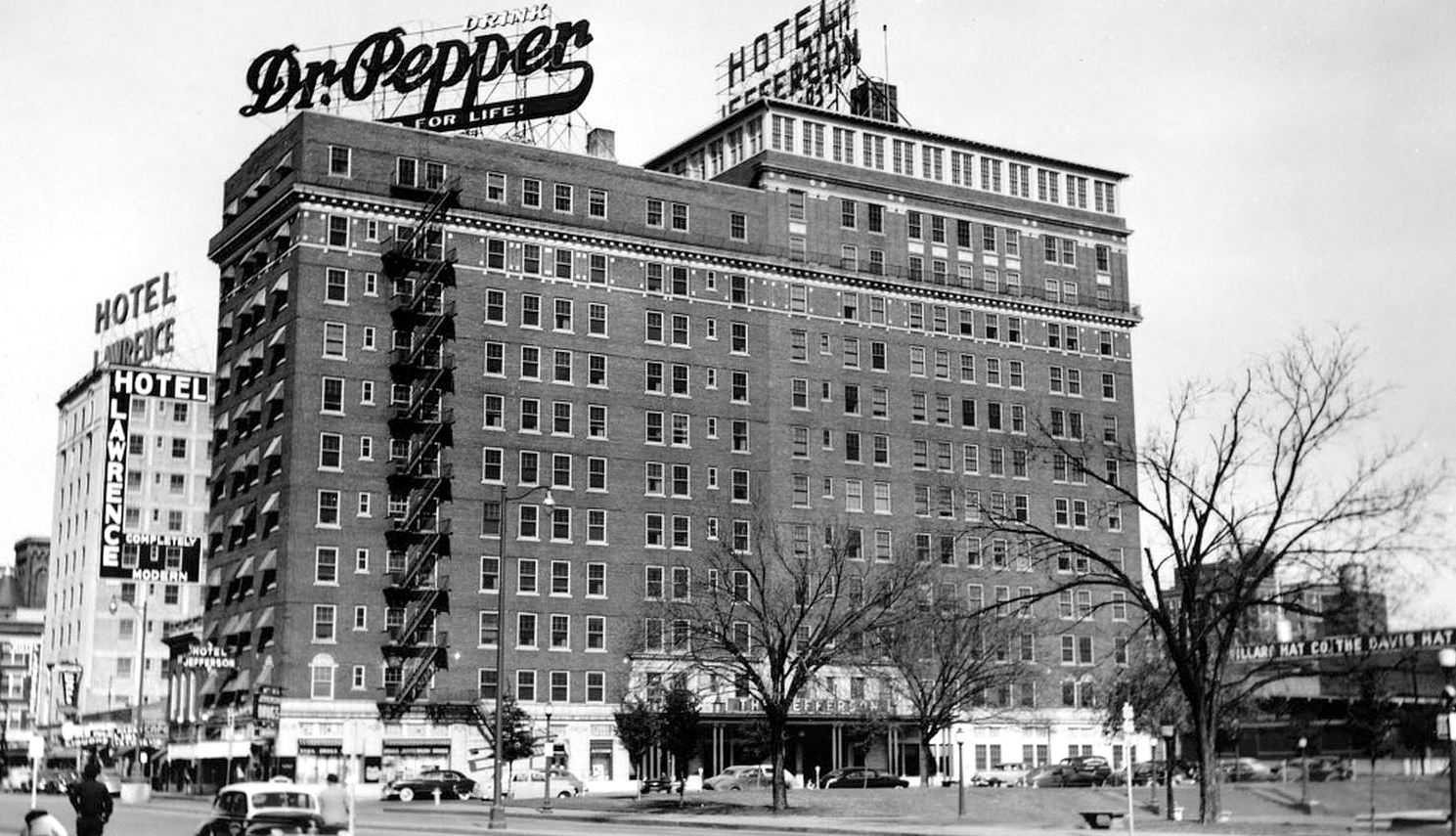
hotel-jefferson_neon-dr-pepper_cook_degolyer_SMU_ca1945

by Paula Bosse

The Jefferson Hotel probably made some serious money leasing out rooftop acreage to the Dr Pepper people who erected a huge neon sign there. The hotel was located across from Union Station and a couple of blocks from the Old Red Courthouse. For people approaching the city from the southwest, there was absolutely nothing between them and that refreshing beacon rising tantalizingly above S. Houston and Wood streets.

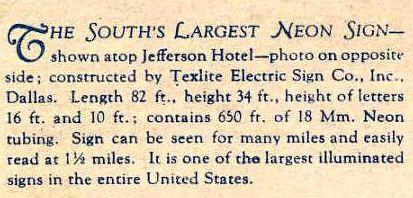
hotel-jefferson_neon-dr-pepper_cook_degolyer_ca1945-verso

jefferson-hotel_hotel-lawrence_dr-pepper-sign_dmn-tumblr

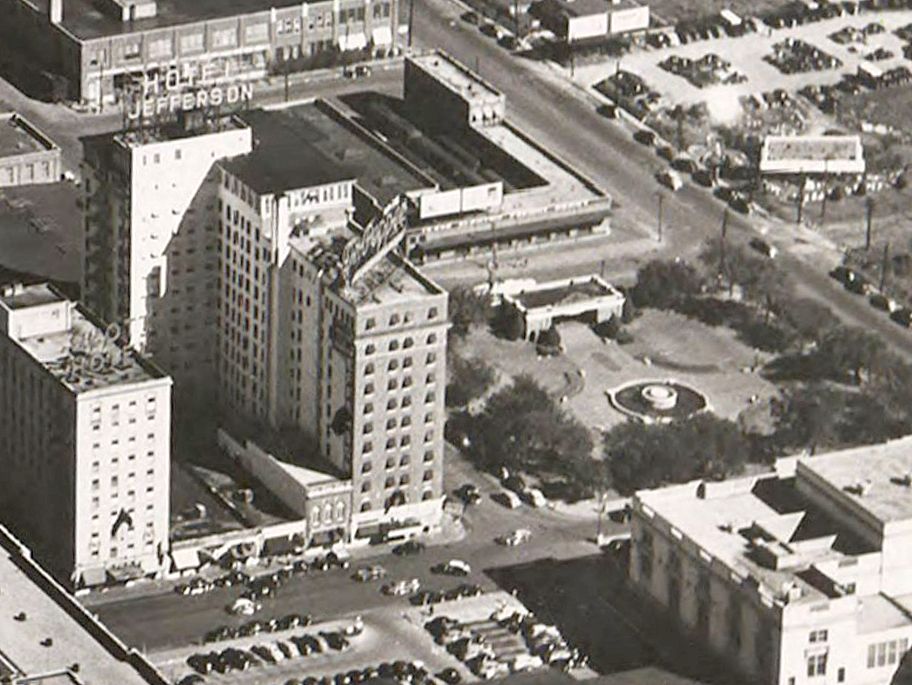
Texlite — the Dallas company that made the sign — was the first company in the Southwest to build and sell neon signs. Their first neon in Dallas advertised a shoe store in 1926 or 1927. (Texlite is best known as the company that built the red neon Pegasus and installed him on top of the Magnolia Petroleum Building in 1934.) My guess is that this Dr Pepper sign went up sometime between 1927 and 1934. It was up there for quite some time. Below is a detail from a photo taken sometime after 1943, and that DP sign was still there, continuing to make people subliminally thirsty

hotel-jefferson_dp_foscue-det(click for larger image)

It’s surprising Dallas didn’t have more neon back then. With a pioneering hometown neon company, the Dallas skyline should have been lit up like a Christmas tree 24 hours a day!

***

Sources & Notes

Postcard is from the George W. Cook Dallas/Texas Image Collection, Central University Libraries, Southern Methodist University; it can be viewed here.

First black-and-white photo was purchased at an antique mall or flea market, origin unknown; found here.

The 1940s-era aerial photo is a detail of a larger photo, “Downtown Dallas looking east (unlabeled)” by Lloyd M. Long, from the Edwin J. Foscue Map Library, Central University Libraries, SMU; the full photo can be viewed here.

A great photo of the hotel and sign can be seen in Sam Childers’ Historic Dallas Hotels, here. Childers writes that the Dr Pepper sign came down when the Jefferson was sold and became the Hotel Dallas in 1953. 20-some-odd years for a sign like that to remain in one place is a pretty good run.

The Jefferson Hotel (or as it’s sometimes identified, “Hotel Jefferson”) was at 312 S. Houston St. The building was demolished in 1975. It is now a hotel-shaped parking lot.

See what other clever thing once occupied the roof of the Jefferson Hotel in the Flashback Dallas post “The Jefferson Hotel and Its ‘Wireless Telegraph’ Rooftop Tower — 1921.”

*

Copyright © 2015 Paula Bosse. All Rights Reserved.


James Surls & David McCullough: Art in Exposition Park — 1973

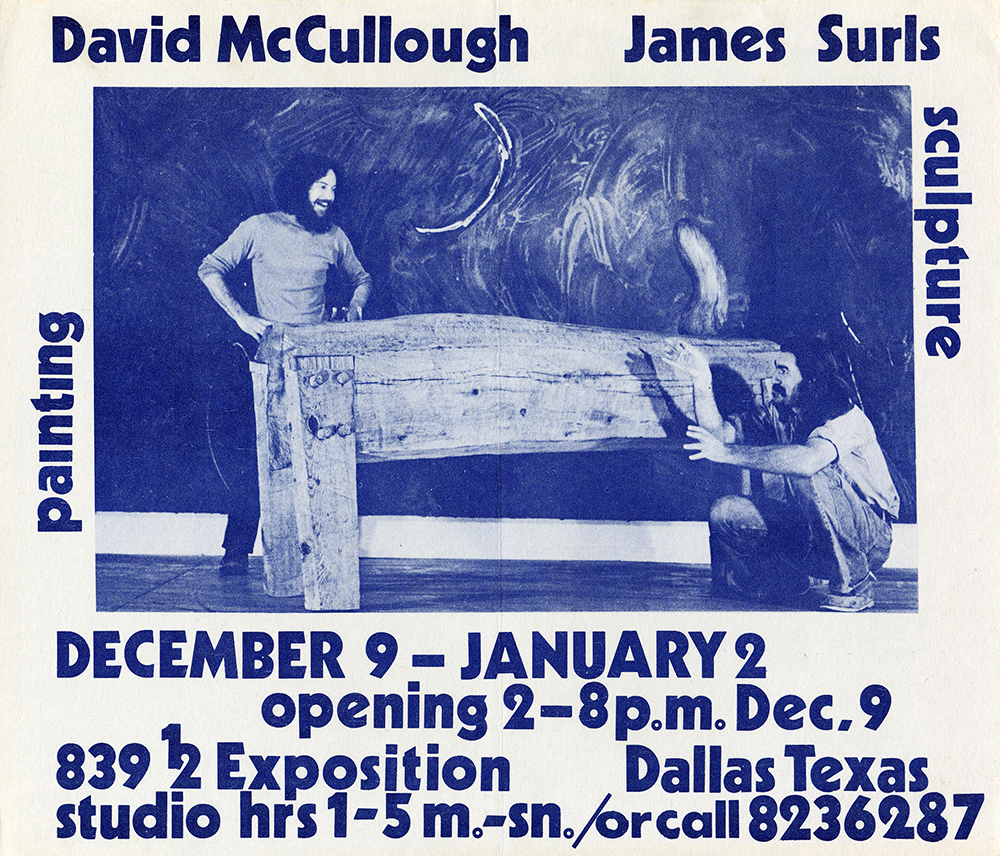
surls-mccullough_dec-1973From the DMA archives (click for larger image)

by Paula Bosse

Above, a postcard advertising a 1973 art show at 839 1/2 Exposition (Parry & Exposition, across from Fair Park), featuring the work of James Surls (right, next to one of his sculptures) and David McCullough (left, in front of one of his paintings).

James Surls (b.1943), originally from East Texas, came to Dallas in the late-’60s to teach sculpture at SMU’s Meadows School of the Arts, from 1969 to 1976. His first mention in The Dallas Morning News, though, was on Sept. 12, 1967, when a 23-year-old Surls was mentioned as a participant in a group sculpture show at Atelier Chapman Kelley (on Fairmount Street) alongside major artists such as Georges Braque, Henry Moore, Louise Nevelson, and Henry Bertoia. Surls made his first professional impact on the art world while he was living in Dallas, and for years he was known as a “Dallas artist.” Surls eventually left Dallas for Spendora, Texas, and he now lives and works in Colorado and is an important internationally admired and collected sculptor.

After studying in Boston and Kansas City, and after a stint in California working on “happenings” with Allan Kaprow and Dick Higgins, David McCullough (b. 1945) moved to Dallas in 1970 where he quickly became part of the local art scene. After only seven months as a resident of the city, McCullough was commissioned by the Dallas Museum of Fine Arts to execute “Baggie Mantra Sanctorum March,” an art and performance piece which was Dallas’ first outdoor environment “happening.” A respected artist, McCullough continues to create and continues to call Dallas his home.

The McCullough/Surls show touted in the above postcard paired the two local artists and was well-received by local publications. The exhibition space at 839 1/2 Exposition was McCullough’s studio at the time, and the show presented sculptures by Surls and “relief wall paintings” by McCullough.

*

For a FANTASTIC look at this period in Dallas’ contemporary art scene, Ken Harrison’s 1975 documentary “Jackelope” (which aired on KERA, Ch. 13 in January, 1976) is absolutely essential. (Watch it here.)

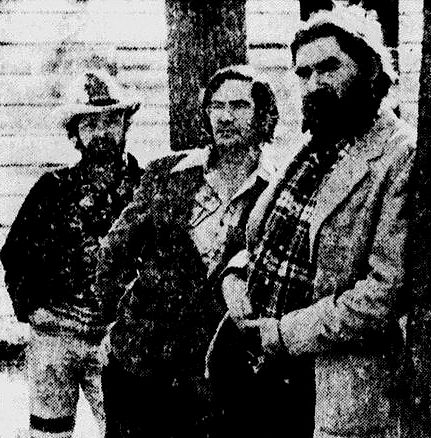
jackelop_dmn_012576-photo“Jackelope” subjects Wade, Green, and Surls
It profiles Surls, George Green, and Bob “Daddy-O” Wade (who will forever be known in Dallas as the creator of Tango’s dancing frogs), and the Surls and Wade portions are extremely entertaining. I watched this documentary earlier this year, and I’ve found myself thinking about it frequently. I highly recommend this deliberately slow-moving documentary for anyone interested in Texas art (…or just art). Or for anyone who’s a fan of incredible Texas accents (why don’t we hear accents like these anymore?).

*

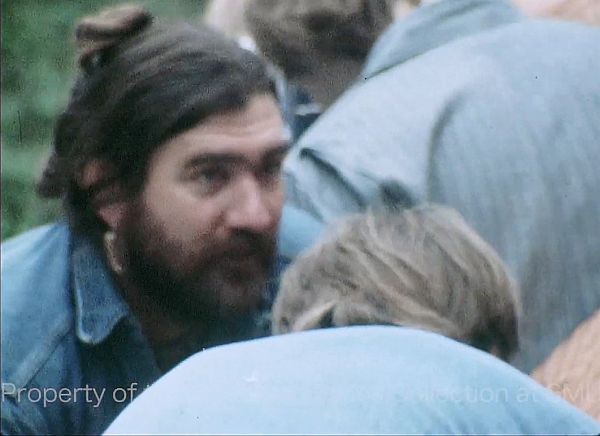
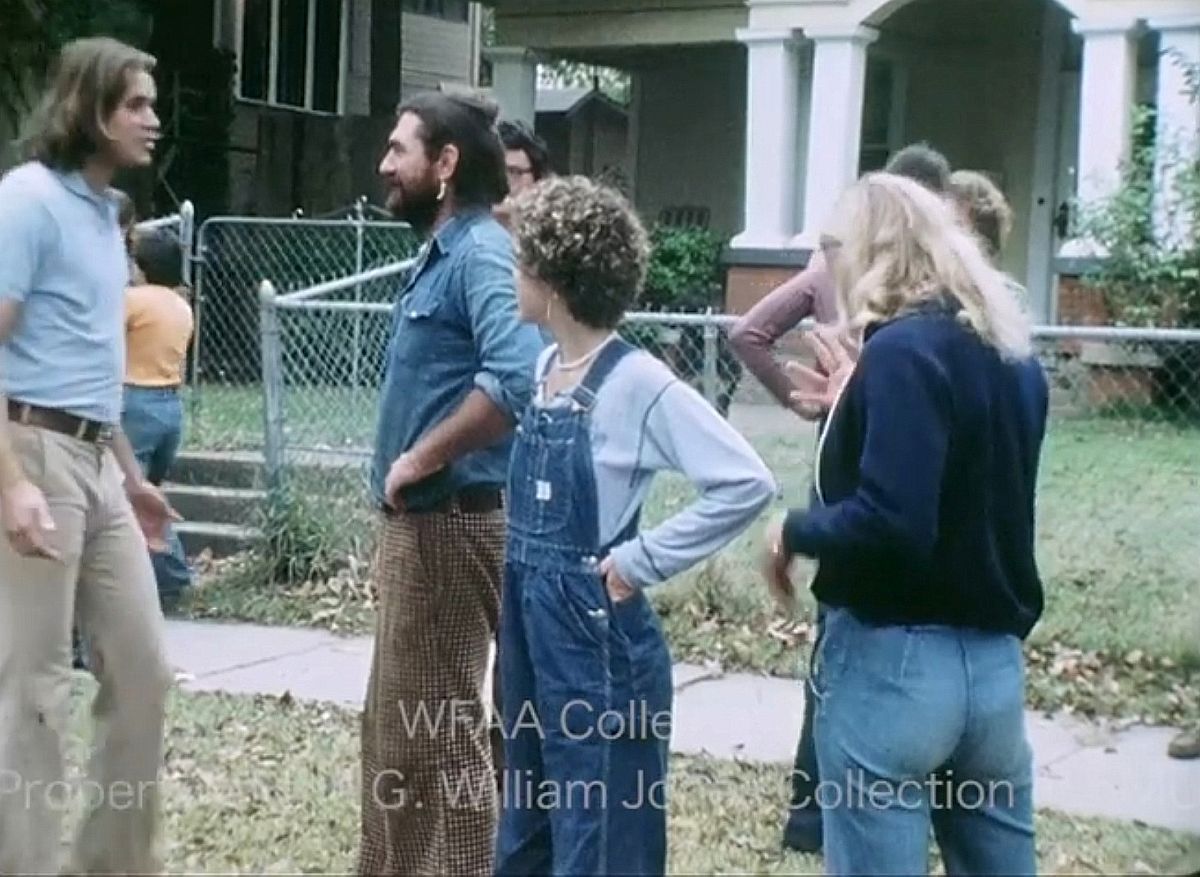
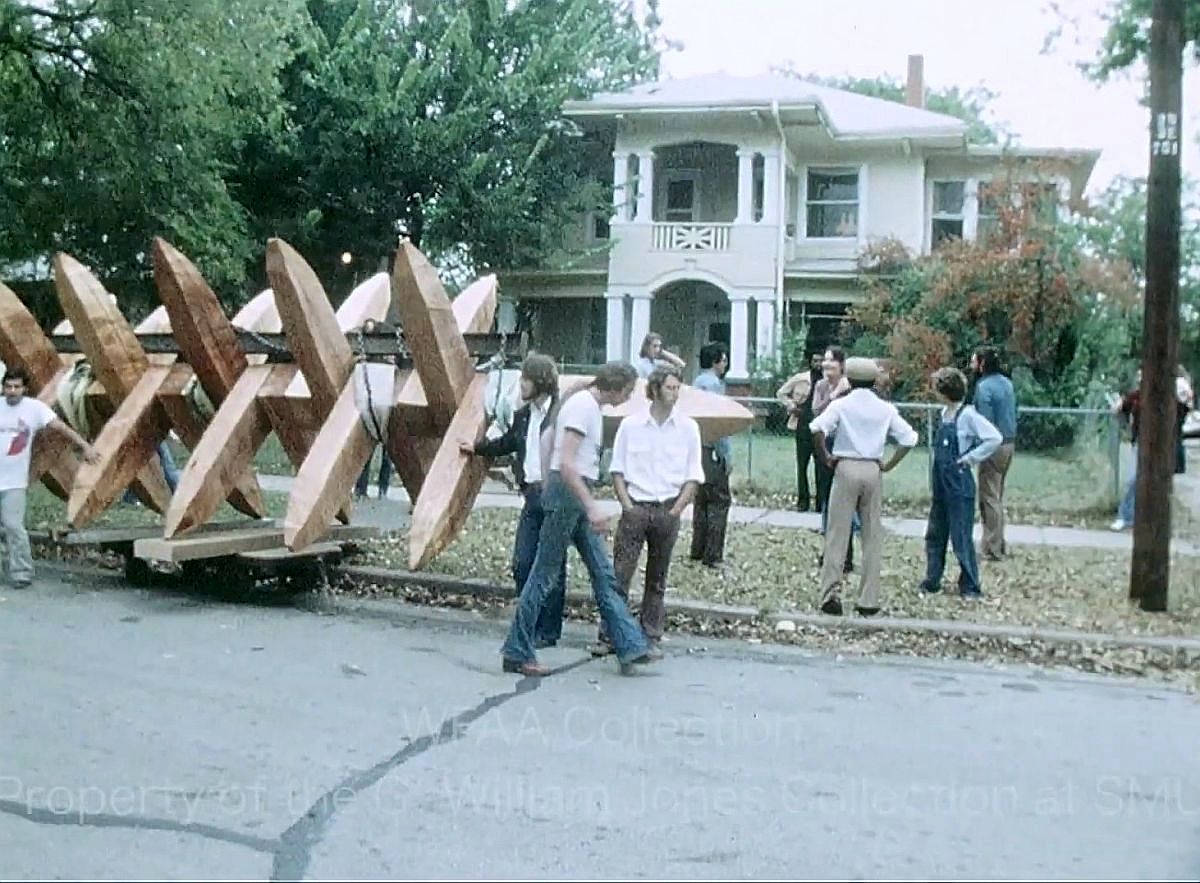
Here’s a great clip showing Surls with friends and students laboriously transporting one of his pieces, the name of which is given as “Point to Point,” through the streets of Old East Dallas before it is taken to Houston. In 1975, Surls was teaching at SMU and living at 5019 Tremont, in a house which is still standing. (WFAA News Film Collection, Jones Film Archive, Hamon Arts Library, SMU, Oct. 1975)

surls_wfaa_oct-1975_tremont_SMU_2

surls_wfaa_oct-1975-tremont_SMU

surls_wfaa_oct-1975_tremont_SMU_3

***

Sources & Notes

Postcard is from the Paul Rogers Harris Gallery Mailings Collection, Dallas Museum of Art Archives; found as part of the interesting article “Fair Park-South Dallas: The City’s First Arts District” by Leigh Arnold, here.

To see just a few of James Surls’ wonderful pieces, click here. To view a slideshow of the DMA retrospective, “Visions: James Surls, 1974-1984,” click here. His official website is here.

Articles of interest from the Dallas Morning News archives:

  • “Kelley to Unveil Sculpture Show” by John Neville (DMN, Sept. 12, 1967) — first mention of Surls in the pages of The News, this announcement of an upcoming sculpture show at Atelier Chapman Kelley has Surls alongside big-hitters such as Georges Braque, Henry Moore, and Louise Nevelson
  • “Loft Offers ‘Big Art’ Space” by Janet Kutner (DMN, Feb. 16, 1974) — review of the show advertised on the postcard at the top of this post
  • “Surls Casts ‘Sams’ for Movie Awards” by Janet Kutner (DMN, March 11, 1972) — about the bronze movie awards — the “Sams” — which Surls created for the 1972 USA Film Festival
  • “Art for Dog’s Sake” by Janet Kutner (DMN, Dec. 7, 1975) — about a 1975 group show at SMU consisting of over 50 artists (!), which Surls organized (and created a sculpture for) on a $50 budget; contains a thoroughly delightful interview about “The Dog Show” (“It’s both serious and non-serious, maybe ‘arf ‘n ‘arf…”)
  • “Texas Artists in TV Special” by Janet Kutner (DMN, Jan. 25, 1976) — review of the film “Jackelope”

For a profile on David McCullough that appeared in The Lakewood Advocate, click here. To watch an entertaining video in which he paints before a crowd at the Dallas Arboretum as the Dallas Wind Ensemble plays, followed by an interview, see the YouTube video here. McCullough’s website is here.

Read the background of McCullough’s 1971 “Baggie sculpture” — the outdoor “happening” at the lagoon at Fair Park in these Dallas Morning News articles:

  • “Baggie Sculpture in Park Lagoon” (DMN, June 12, 1971)
  • “McCullough Creates ‘Baggie Happening'” by Janet Kutner (…that lady was busy!) (DMN, June 20, 1971)

*

Copyright © 2015 Paula Bosse. All Rights Reserved.


Thank You, Weird Hollywood!

weird_hollywood

by Paula Bosse

Thank you, Joe Oesterle, for the very flattering post on your (great) Weird Hollywood Facebook page! His mystery photo of the Gunther Castle was a lot of fun to research (the “castle” was at 2308 Pacific Avenue in Long Beach, California), and, yes, as a matter of fact, I’d love to help you research a building or person or old news story or mystery photo. I CAN be bought! If you have inquiries, please click the “Contact” tab at the top of the page and send me an email. If there’s something I can help you with, we’ll talk turkey.

As this is a blog devoted to Dallas history, the Hollywood stories are a bit scarce (even though classic Hollywood and entertainment history is a passion of mine), but there are a few. These Flashback Dallas posts might appeal to those new visitors more interested in Hollywood than Dallas: (click title to see post):

Thanks again for the kind words, Joe! And keep Hollywood weird!

*

Copyright © 2015 Paula Bosse. All Rights Reserved.

The Magnolia Building, Pre-Pegasus — 1920s

magnolia-bldg_pre-pegasus_RPPC_smBeautiful!

by Paula Bosse

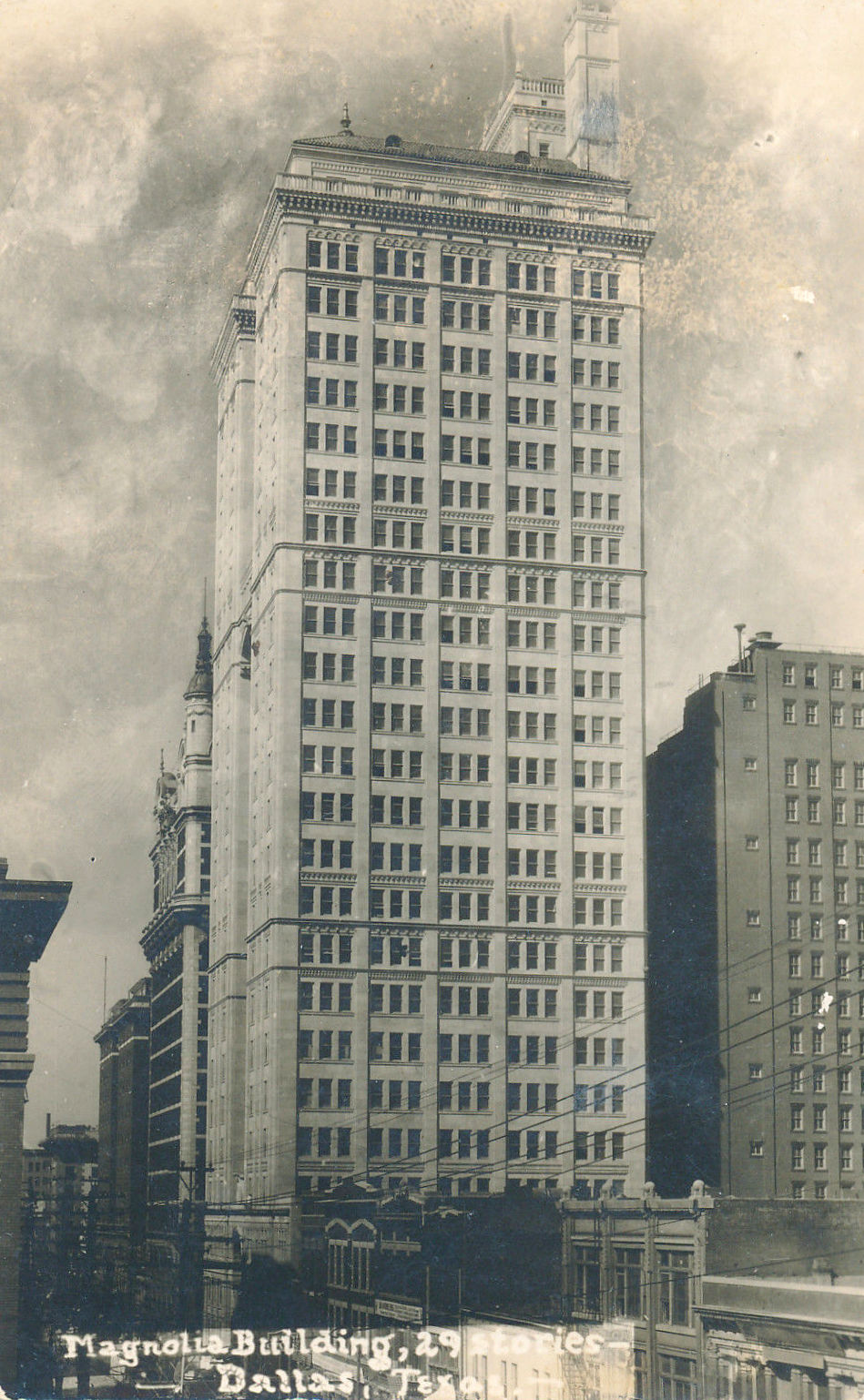
This is such a wonderful photo of the Magnolia Petroleum Building — even without Pegasus on top of it! When it opened in 1922, it was the tallest building in the state — all 29 stories of it. (It was so tall, apparently, that the photographer couldn’t get the whole building in the shot!) It certainly looks impressive — and impressively ominous — in this photograph. An added bonus is the beer-stein-shaped turret of the Adolphus Hotel peeking around at the left. Fantastic photo!

***

Sources & Notes

Photograph from a postcard found on eBay; written on the back is this message to folks back home in Oklahoma City: “Arrived at 11:30 PM. in this burg. It’s some big place, believe me.”

Brief history of what is now the Magnolia Hotel, is here. (Pegasus was not placed on top of the building until 1934.)

Some more Flashback Dallas posts featuring my favorite views of the Magnolia Building (with and without Pegasus):

  • here — photos showing the major change in the skyline between 1929 and 1939
  • here — incredible photo of the skyline taken from The Cedars, by Alfred Eisenstaedt
  • here — the Magnolia Bldg. lit up at night, with the Mercantile Bank Bldg. in the background
  • here — one of my favorite postcards of Dallas, showing the city at night, with Pegasus the highest point on the horizon

*

Copyright © 2015 Paula Bosse. All Rights Reserved.

Nardis Sign-Painters: “Everything In Sportswear” — 1948

nardis_sign-painters_ebay_1948You don’t see this much anymore (click for larger image)

by Paula Bosse

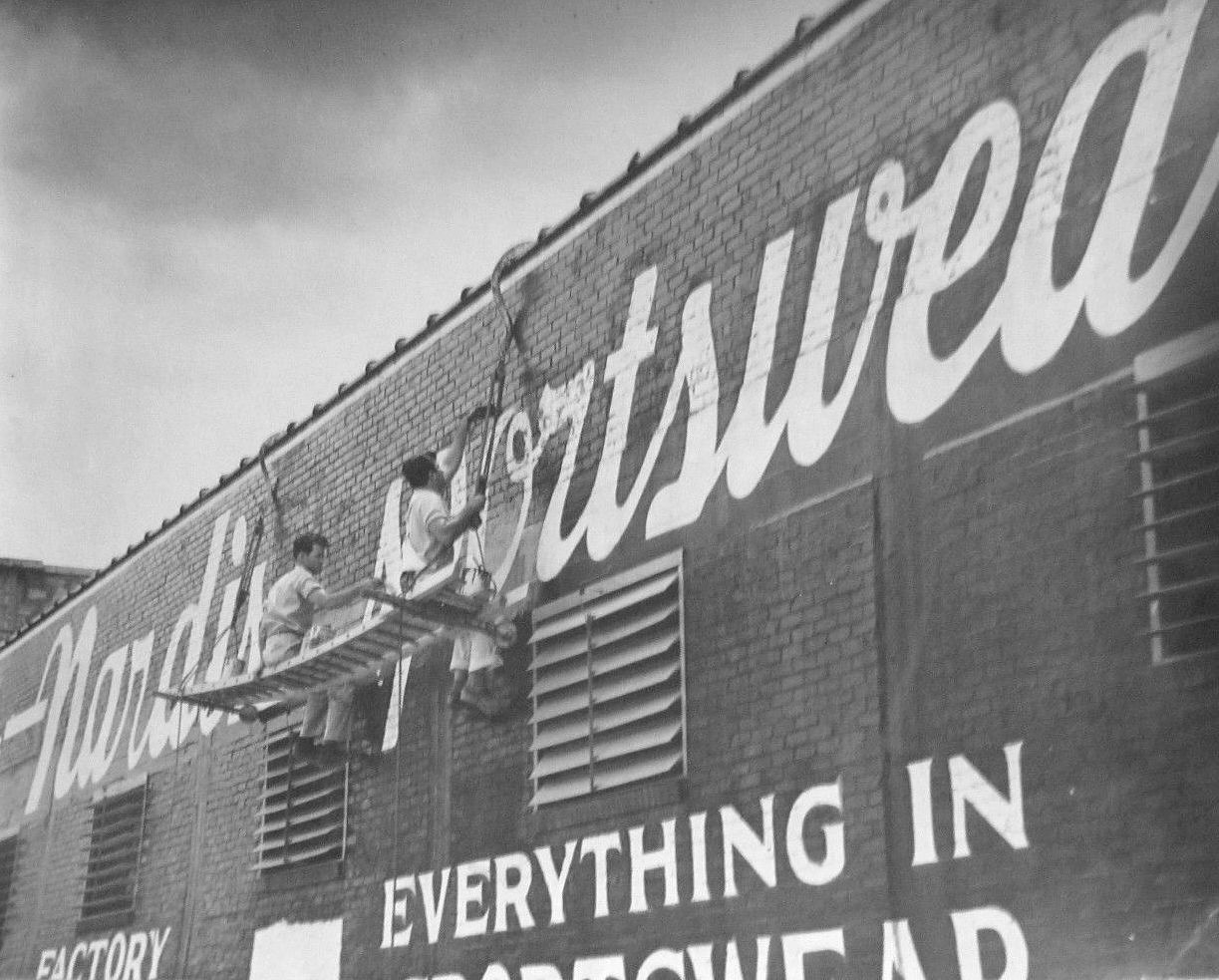
I’m sure there were people in the past who thought that advertising painted directly onto buildings was as tacky as billboards are today, but I love it, and, sadly this type of sign-painting has become something of a lost art. Here we see men painting a sign for the successful apparel manufacturer Nardis Sportswear (later, Nardis of Dallas). The company’s corporate headquarters appears to have been on Browder street, with manufacturing factories on N. Austin and S. Poydras streets. The sign in the photo would seem to have been painted on the side of one of the factory buildings.

nardis_1948-directory1948 city directory

nardis_1952-mapsco1952 Mapsco

I think all these Nardis buildings are gone, so we don’t even get any faded ghost signs to remind us that Dallas was once a large-ish garment manufacturing center.

***

Sources & Notes

Photo — dated 1948 on reverse, with stamp of the Hank Tenny Studio at 1420 Wood Street — found on eBay.

My previous post on the Nardis company — “Nardis of Dallas: The Fashion Connection Between ‘The Dick Van Dyke Show’ and the Kennedy Assassination” — can be found here.

*

Copyright © 2015 Paula Bosse. All Rights Reserved.