Flashback : Dallas

A Miscellany: History, Ads, Pop Culture

Tracking Down a Photo Location & Discovering a City Pioneer: D. M. Clower, The Man Who Brought the Telephone to Dallas
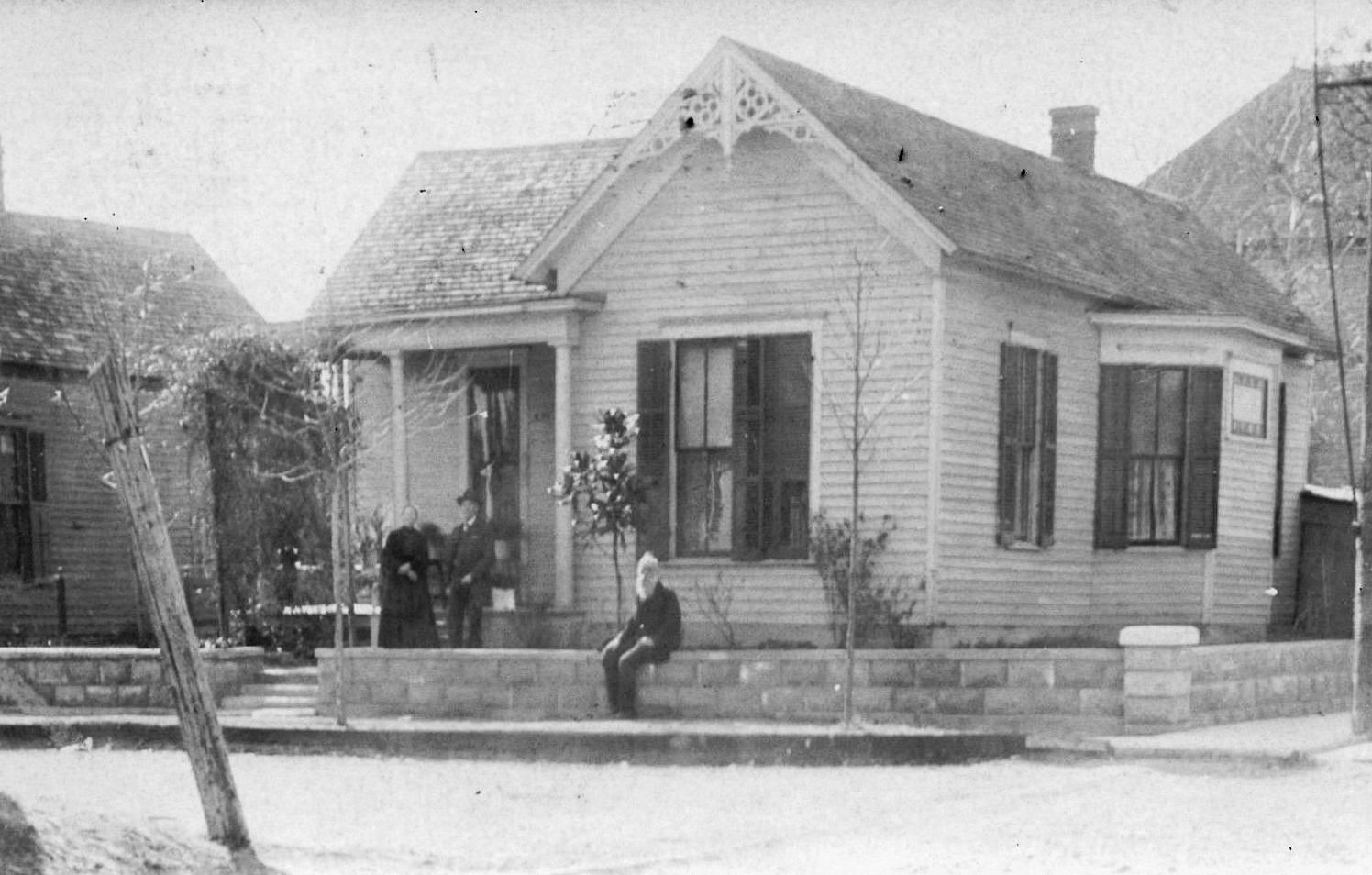
house_RPPC_1909_ebayMystery house, Dallas, ca. 1908 (click for larger image)

by Paula Bosse

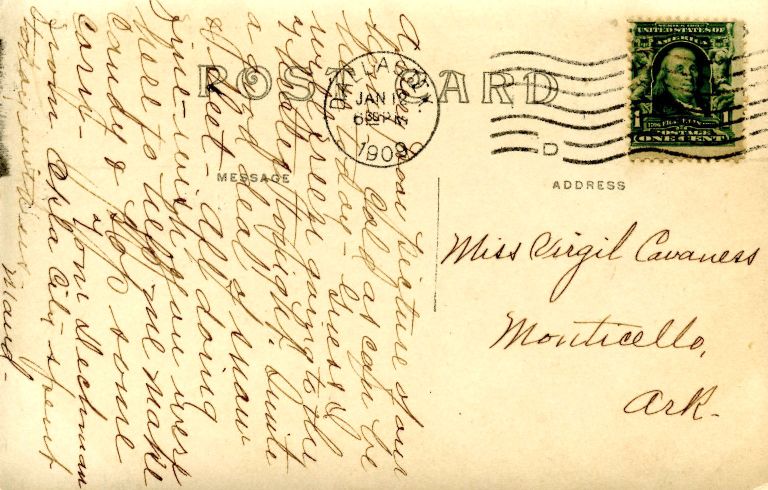
Not too long ago I came across the above photo which had been made into a real photo postcard.” It was postmarked January 12, 1909, and it contained a chatty message.

“A very good picture of our house. Cold as can be here today – guess I will freeze going to the theater tonight. Quite a good deal of snow and sleet. All doing fine – wish you were here to help me make candy & pop some corn. Tom Dechman from Okla. City spent today with us. Maud.”
house_RPPC_1909_ebay_back

Such a nice photo of a modest little house in Dallas, probably taken in 1908. When I saw it, I thought it would be cool if I could figure out where it was. There wasn’t much to go on from the postcard, though. But, as it turns out, there was just enough information to put the pieces together and figure it out. Someone asked me recently how I track down things like this. Basically, I look for a long time in a lot of different places. Here’s how I found out where this mystery house was.

Using Ancestry.com, I found Virginia (“Virgil” — sometimes “Virgie”) Cavaness in Monticello, Arkansas. She was born in 1871 and would have just turned 37 years old when she received this card. The familiar tone of the postcard message indicated to me that Virgil was probably a close friend or family member.

I found Thomas Dechman in Oklahoma City — he would have been 23 when he visited Maud. He probably wasn’t a close friend or immediate family member because she writes his full name out. According to the 1909 Oklahoma City directory (accessible on Ancestry.com), he worked alongside his father, A. F. Dechman, at a wholesale produce company.

Then I checked the Dallas Morning News archives and found this from Dec. 30,1909.

clower_dmn_123009DMN, Dec. 30, 1909

Tom Dechman was Mrs. A. F. Dechman’s son. So I searched on “Maud Clower.” Maud, born in 1877, was also D. M. Clower’s daughter. Mrs. A. F. Dechman was Maud’s sister Annie, and Tom was her nephew.

I continued searching the DMN archives for mentions of the Clower family and found that in 1906 Maud Clower had married Jesse (J. D.) Patterson — and, hey, Virgil had attended the wedding.

virgie_dmn_090206DMN, Sept. 2, 1906

I checked to see where Maud and J. D. Patterson were living in 1908/1909. Most directories are available on Ancestry (a subscription site), but, as it happens, the 1909 directory is one of the few historical Dallas city directories that is available online (for free) — you can access it here (a few other directories are here). I found a Jesse D. Patterson listed as living at 491 N. Pearl, but no spouse’s name was listed, so I cross-referenced the address with the street directory section to determine whether this was the right J. D. Patterson. (Street directories are very helpful — not only do they list the occupants for each address, they also help to pinpoint where specific addresses were as they show which cross-streets those addresses were between; this is extremely helpful when trying to figure out where things were when streets had different names and/or when trying to figure out where things were before all of Dallas’ street numbers were changed in 1911. Another useful resource is a page on Jim Wheat’s site, which has links to every page of the 1911 street directory — click on a street name and find your address: the “new” address is on the left, and the “old” address is next to it, in bold.)
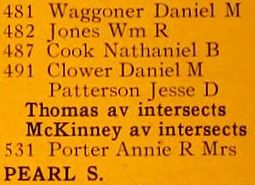
clower-patterson_1909-directory1909 city directory, residents of N. Pearl Street

Even though this didn’t have Maud’s name listed alongside her husband’s, it DID show that her father, D. M. Clower, was living at the same address. Success!

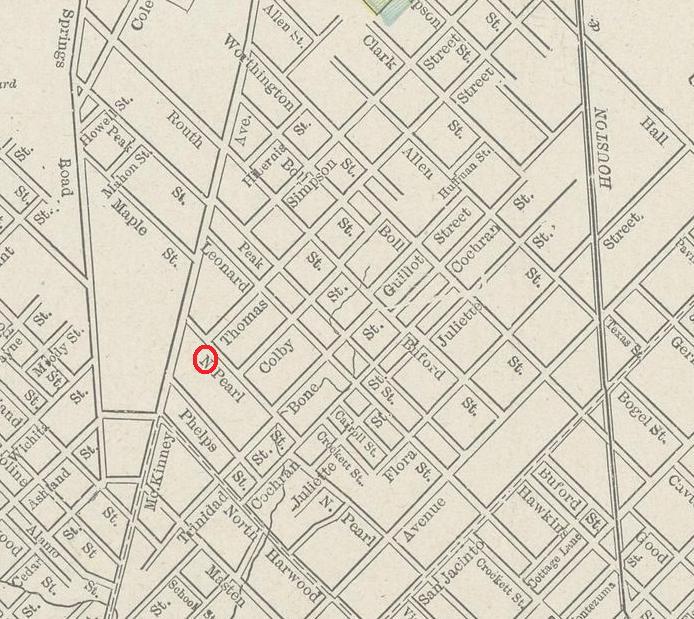
So there it is. When Maud sent that postcard to Virgil, she and her husband were living with her parents at 491 N. Pearl Street. The house in the photo was at the southwest corner of N. Pearl and Thomas. It’s always helpful to check a street map from about the same period for context and to make sure you’re looking at the right location — many street names have changed over the years — if a street named “Forest” is being referenced in the 1940s, for instance, you need to know that the old Forest Avenue and the current Forest Lane are absolutely nowhere near each other. Below is a map drawn about 1900, with the location of the Clower house circled in red (this is one of many maps found on the Portal to Texas History site; the one below is a detail of the map found here).
clower-home_map-ca1898

I also checked out Sanborn maps to see if the house in the photo matched the house that was actually on the lot at N. Pearl and Thomas. It does. To see what the general footprint of the house looked like in 1905 (the Clowers lived at 491 N. Pearl from about 1905 to 1910), see here. In the 1921 map (by which time the address had been changed to 2221 N. Pearl), you can see that additions had been made to the house since 1905 and that it looks more like the house in the photo (a room now juts out at the right and there is an out-building behind the house); see the 1921 Sanborn map here. To see what that Uptown block looks like now, see here (N. Pearl is on the left, looking south). Quite a change! It took me a long time to realize just how essential Sanborn maps can be — they are incredibly useful, and I try to use them whenever I can.

**

I really didn’t expect to track down the actual address of an unidentified house found on a picture postcard, but persistence pays off. A bonus of this persistence was that I ended up learning about the very interesting man who owned the house — a man who played a pivotal role in the development of Dallas: Daniel Morgan (D. M.) Clower. Clower was an electrical engineer who, in 1881, installed the very first telephone in Dallas (for Judge John Bookhout) and ran the city’s first telephone exchange; he also set up phone systems in other cities. In addition to his work for Bell Telephone, he also ran Dallas’ electric company for many years and was responsible for setting up the city’s first electric street lights and helped in developing electrified rail systems in the region.

clower_electrician_1889-directory1889 Dallas directory (click for larger image)

During the Civil War, Clower was a Confederate telegraph operator in the 1st Louisiana Regiment (see Clower’s fascinating obituary below). When the Union army was advancing after the fall of Vicksburg, Clower directed (and helped in) the destruction of the Confederate telegraph system he had helped set up, in order to prevent its being commandeered by Yankee forces — he and his men raced to pull up over 40 miles of wire and equipment, loaded everything on wagons, bugged out, and then used the same wire and poles to string a new Confederate line into and across Texas.
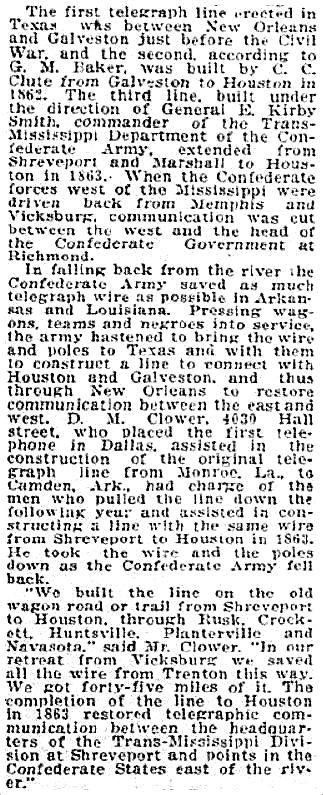
clower-telegrapher_dmn_010822DMN, Jan. 8, 1922

The war ended before Clower had completed his line northward from Houston, but his efforts had helped lay the telegraph infrastructure that the state of Texas relied on for decades afterward.

*

The people in the top photo are not identified. When that photo was taken, D. M. Clower and his wife, Ellender, would have been about 73; their daughter Maud and her husband Jesse would have been in their early 30s. I assume it’s the elder Clowers, with a mystery bearded man in the foreground.
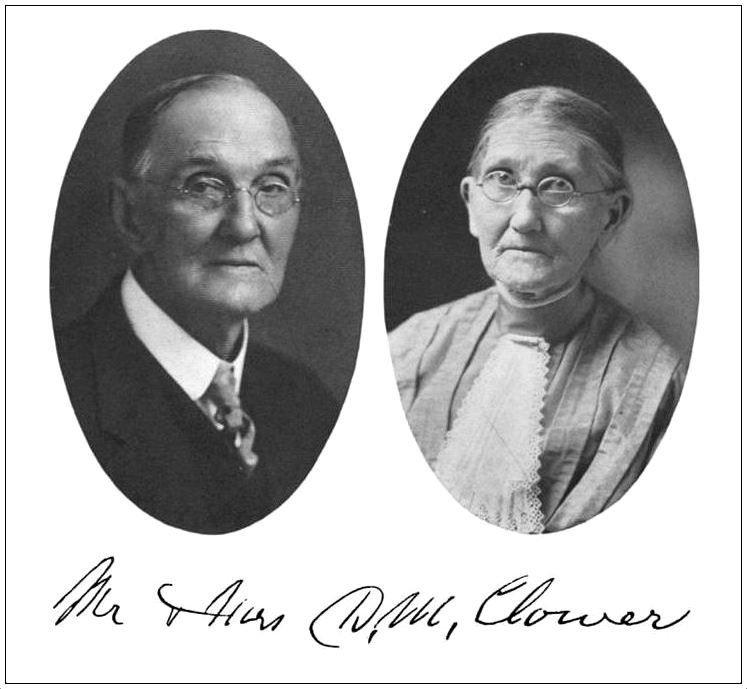
clowers_d-m-and-ellender_hist-of-tx-and-texans_1914_portal
Mr. and Mrs. D. M. Clower, ca. 1914

You never know what you’re going to discover when you read a 106-year-old postcard and wonder where an old house used to be.

***

Sources & Notes

Postcard found on eBay.

Daniel Morgan Clower was born in Alabama in 1835; he arrived in Dallas in 1879, coming from Comanche, where Maud was born in 1877. Clower died in 1927 at the age of 92; Maud died in 1948. His wife, Ellender Paralee Clower, died in 1917 (at which time the couple had been married for more than sixty years).

More on Clower can be found in the pages of The Dallas Morning News:

  • “Telegrapher Tells Civil War Episode” (DMN, Feb. 1, 1924) — a fantastically cinematic account of Clower’s past, in his own words
  • A photo of Clower and Eli Sanger, (DMN, May 1, 1927) — what might well be the last photo of Clower ran in the News just a few months before his death at the age of 92; also in the photo is Eli Sanger, of Sanger Bros. (Clower once had a business in Millican, TX when Sanger’s opened there at the close of the Civil War, and he proudly boasted that he was one of their very first customers)
  • “Daniel Clower Funeral Held” (DMN, Aug. 19, 1927) — Clower’s obituary, with photo

Photo of Mr. Clower with text from a Dallas Times Herald story published on the occasion of his 89th birthday can be found here (scroll down to 1924, about halfway down the page), via Jim Wheat’s site.

The photo of Mr. Clower and his wife Ellender is from the book A History of Texas and Texans, published in 1914; the accompanying entry about Clower’s very interesting life can be found here, via the Portal to Texas History.

*

Copyright © 2015 Paula Bosse. All Rights Reserved.
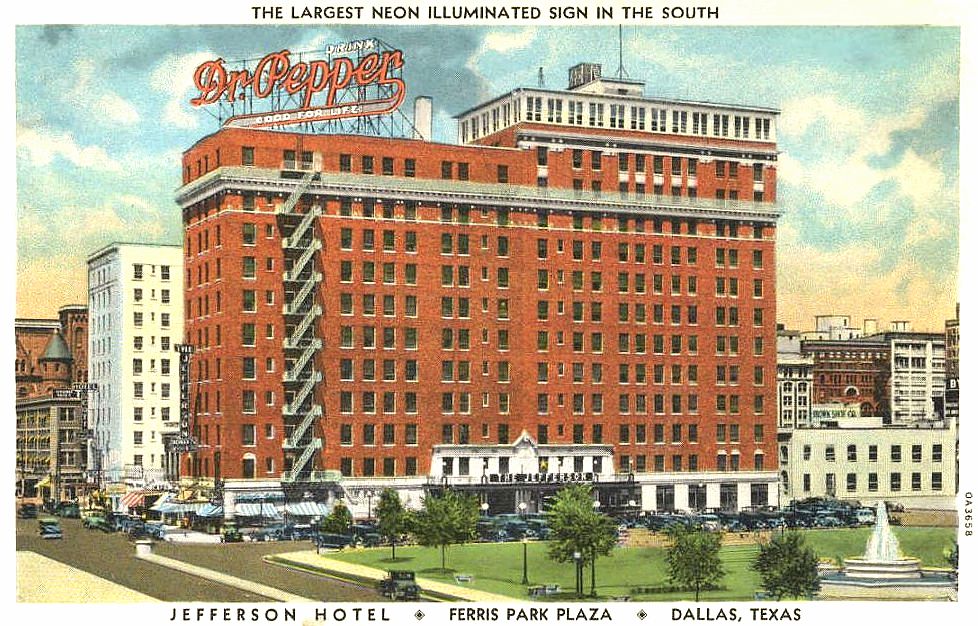
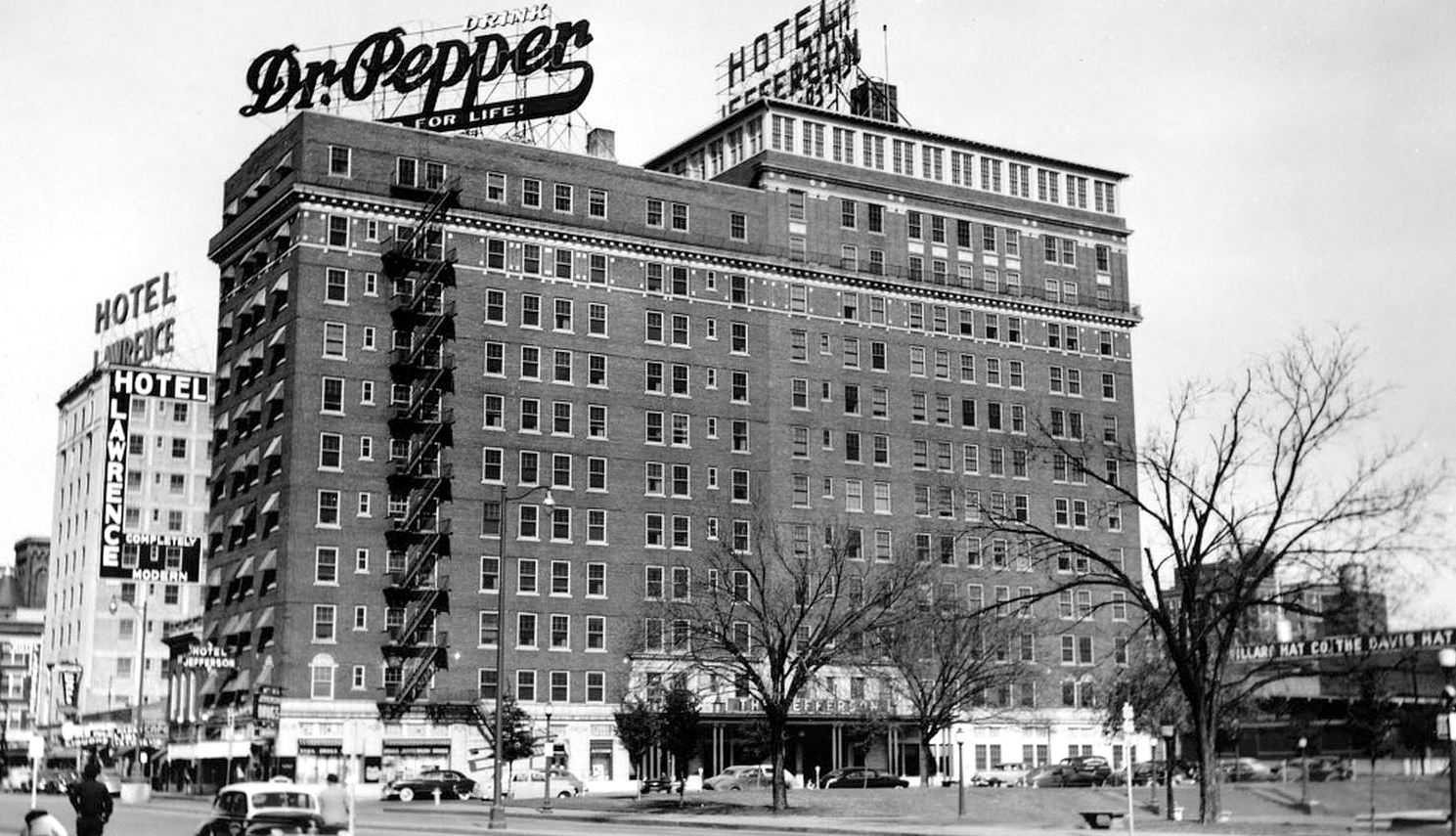
Neon Refreshment: The Giant Dr Pepper Sign

hotel-jefferson_neon-dr-pepper_cook_degolyer_SMU_ca1945

by Paula Bosse

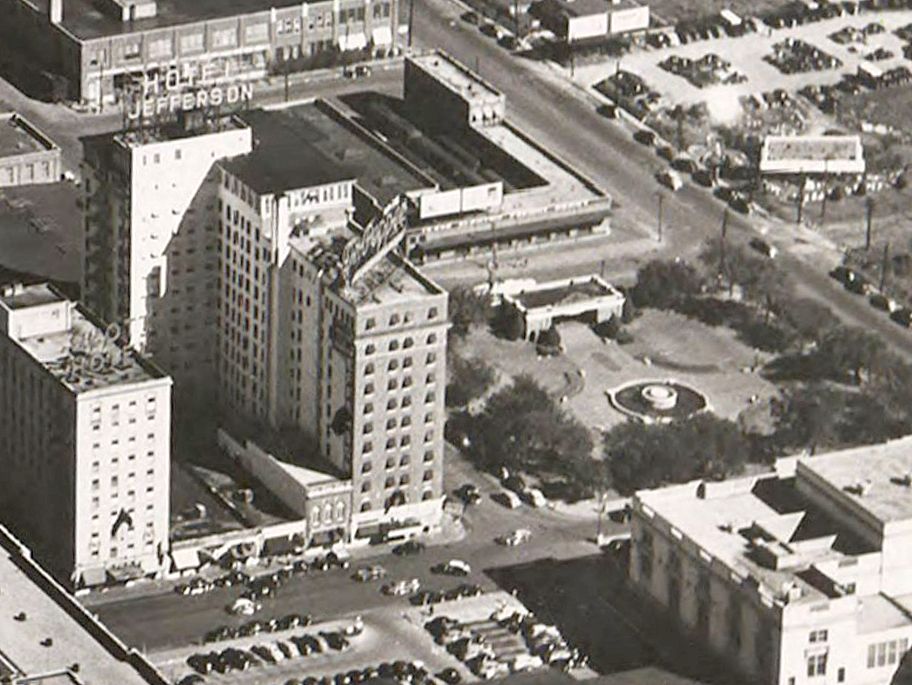
The Jefferson Hotel probably made some serious money leasing out rooftop acreage to the Dr Pepper people who erected a huge neon sign there. The hotel was located across from Union Station and a couple of blocks from the Old Red Courthouse. For people approaching the city from the southwest, there was absolutely nothing between them and that refreshing beacon rising tantalizingly above S. Houston and Wood streets.

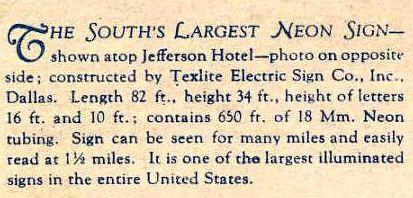
hotel-jefferson_neon-dr-pepper_cook_degolyer_ca1945-verso

jefferson-hotel_hotel-lawrence_dr-pepper-sign_dmn-tumblr

Texlite — the Dallas company that made the sign — was the first company in the Southwest to build and sell neon signs. Their first neon in Dallas advertised a shoe store in 1926 or 1927. (Texlite is best known as the company that built the red neon Pegasus and installed him on top of the Magnolia Petroleum Building in 1934.) My guess is that this Dr Pepper sign went up sometime between 1927 and 1934. It was up there for quite some time. Below is a detail from a photo taken sometime after 1943, and that DP sign was still there, continuing to make people subliminally thirsty

hotel-jefferson_dp_foscue-det(click for larger image)

It’s surprising Dallas didn’t have more neon back then. With a pioneering hometown neon company, the Dallas skyline should have been lit up like a Christmas tree 24 hours a day!

***

Sources & Notes

Postcard is from the George W. Cook Dallas/Texas Image Collection, Central University Libraries, Southern Methodist University; it can be viewed here.

First black-and-white photo was purchased at an antique mall or flea market, origin unknown; found here.

The 1940s-era aerial photo is a detail of a larger photo, “Downtown Dallas looking east (unlabeled)” by Lloyd M. Long, from the Edwin J. Foscue Map Library, Central University Libraries, SMU; the full photo can be viewed here.

A great photo of the hotel and sign can be seen in Sam Childers’ Historic Dallas Hotels, here. Childers writes that the Dr Pepper sign came down when the Jefferson was sold and became the Hotel Dallas in 1953. 20-some-odd years for a sign like that to remain in one place is a pretty good run.

The Jefferson Hotel (or as it’s sometimes identified, “Hotel Jefferson”) was at 312 S. Houston St. The building was demolished in 1975. It is now a hotel-shaped parking lot.

See what other clever thing once occupied the roof of the Jefferson Hotel in the Flashback Dallas post “The Jefferson Hotel and Its ‘Wireless Telegraph’ Rooftop Tower — 1921.”

*

Copyright © 2015 Paula Bosse. All Rights Reserved.
 

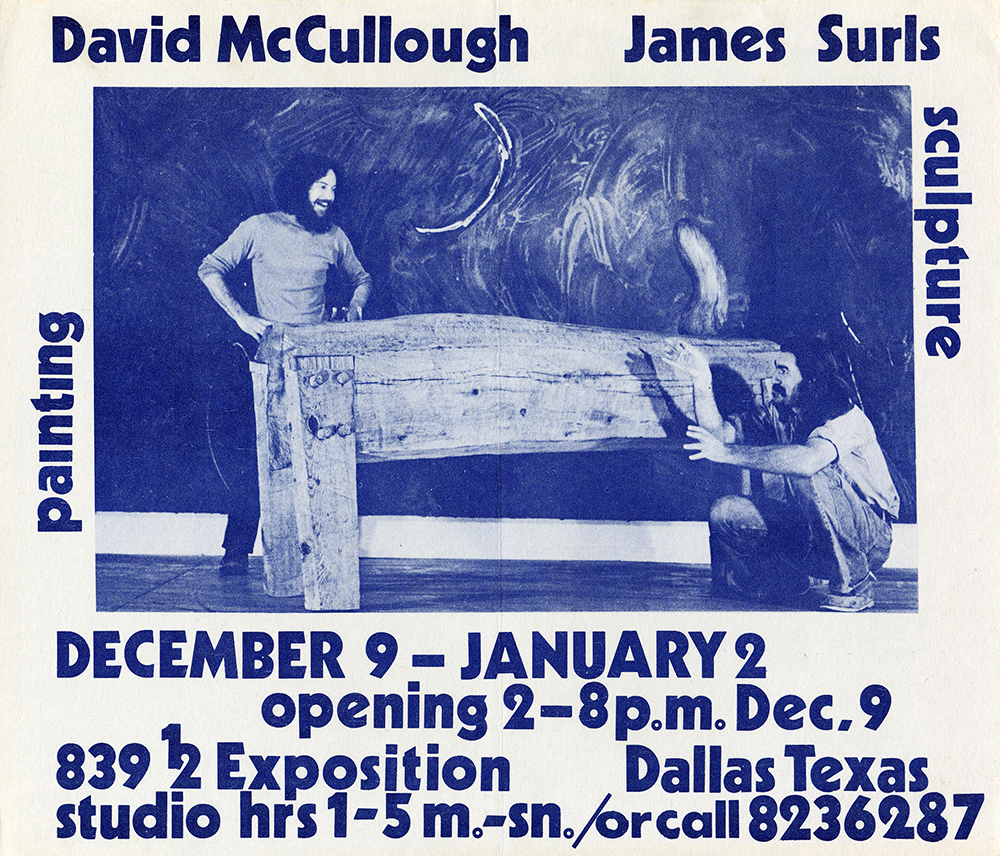
James Surls & David McCullough: Art in Exposition Park — 1973

surls-mccullough_dec-1973From the DMA archives (click for larger image)

by Paula Bosse

Above, a postcard advertising a 1973 art show at 839 1/2 Exposition (Parry & Exposition, across from Fair Park), featuring the work of James Surls (right, next to one of his sculptures) and David McCullough (left, in front of one of his paintings).

James Surls (b.1943), originally from East Texas, came to Dallas in the late-’60s to teach sculpture at SMU’s Meadows School of the Arts, from 1969 to 1976. His first mention in The Dallas Morning News, though, was on Sept. 12, 1967, when a 23-year-old Surls was mentioned as a participant in a group sculpture show at Atelier Chapman Kelley (on Fairmount Street) alongside major artists such as Georges Braque, Henry Moore, Louise Nevelson, and Henry Bertoia. Surls made his first professional impact on the art world while he was living in Dallas, and for years he was known as a “Dallas artist.” Surls eventually left Dallas for Spendora, Texas, and he now lives and works in Colorado and is an important internationally admired and collected sculptor.

After studying in Boston and Kansas City, and after a stint in California working on “happenings” with Allan Kaprow and Dick Higgins, David McCullough (b. 1945) moved to Dallas in 1970 where he quickly became part of the local art scene. After only seven months as a resident of the city, McCullough was commissioned by the Dallas Museum of Fine Arts to execute “Baggie Mantra Sanctorum March,” an art and performance piece which was Dallas’ first outdoor environment “happening.” A respected artist, McCullough continues to create and continues to call Dallas his home.

The McCullough/Surls show touted in the above postcard paired the two local artists and was well-received by local publications. The exhibition space at 839 1/2 Exposition was McCullough’s studio at the time, and the show presented sculptures by Surls and “relief wall paintings” by McCullough.

*

For a FANTASTIC look at this period in Dallas’ contemporary art scene, Ken Harrison’s 1975 documentary “Jackelope” (which aired on KERA, Ch. 13 in January, 1976) is absolutely essential. (Watch it here.)

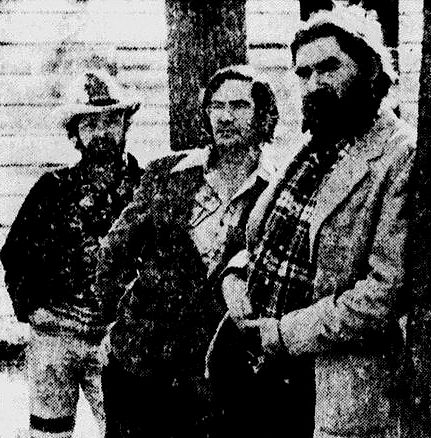
jackelop_dmn_012576-photo“Jackelope” subjects Wade, Green, and Surls

It profiles Surls, George Green, and Bob “Daddy-O” Wade (who will forever be known in Dallas as the creator of Tango’s dancing frogs), and the Surls and Wade portions are extremely entertaining. I watched this documentary earlier this year, and I’ve found myself thinking about it frequently. I highly recommend this deliberately slow-moving documentary for anyone interested in Texas art (…or just art). Or for anyone who’s a fan of incredible Texas accents (why don’t we hear accents like these anymore?).

*

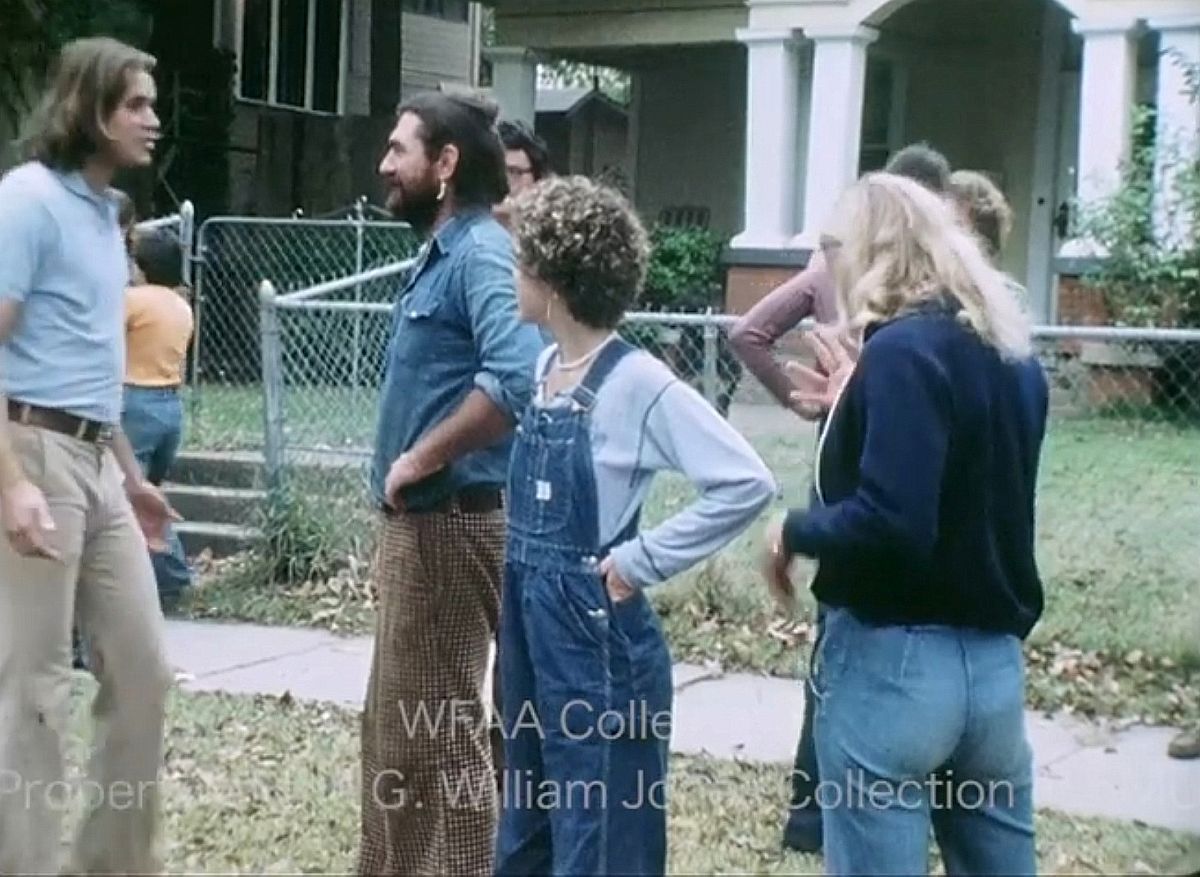
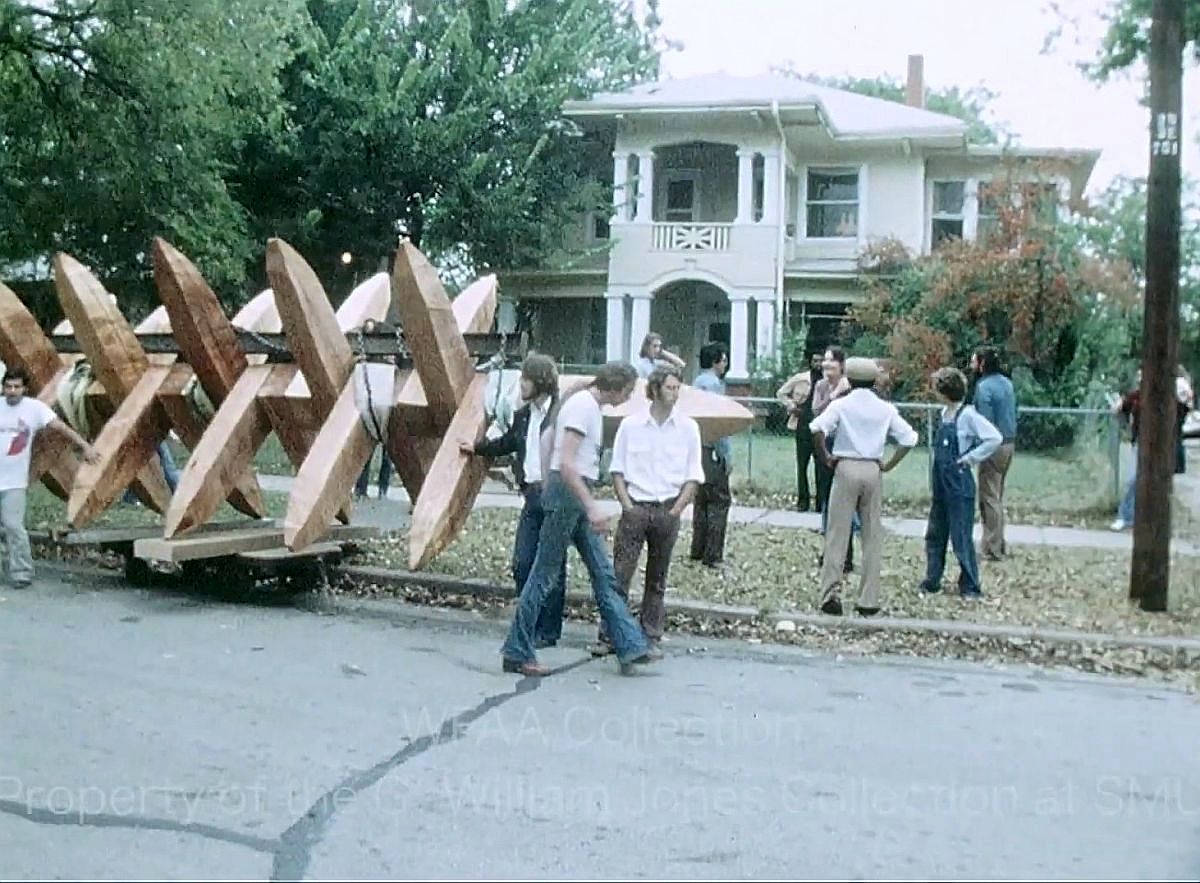
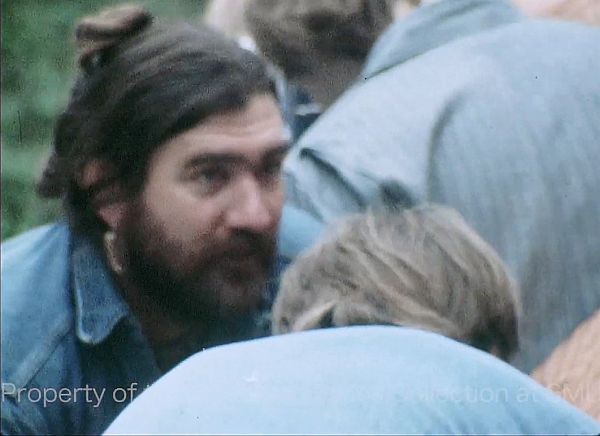
Here’s a great clip showing Surls with friends and students laboriously transporting one of his pieces, the name of which is given as “Point to Point,” through the streets of Old East Dallas before it is taken to Houston. In 1975, Surls was teaching at SMU and living at 5019 Tremont, in a house which is still standing. (WFAA News Film Collection, Jones Film Archive, Hamon Arts Library, SMU, Oct. 1975)

surls_wfaa_oct-1975_tremont_SMU_2

surls_wfaa_oct-1975-tremont_SMU

surls_wfaa_oct-1975_tremont_SMU_3

***

Sources & Notes

Postcard is from the Paul Rogers Harris Gallery Mailings Collection, Dallas Museum of Art Archives; found as part of the interesting article “Fair Park-South Dallas: The City’s First Arts District” by Leigh Arnold, here.

To see just a few of James Surls’ wonderful pieces, click here. To view a slideshow of the DMA retrospective, “Visions: James Surls, 1974-1984,” click here. His official website is here.

Articles of interest from the Dallas Morning News archives:

  • “Kelley to Unveil Sculpture Show” by John Neville (DMN, Sept. 12, 1967) — first mention of Surls in the pages of The News, this announcement of an upcoming sculpture show at Atelier Chapman Kelley has Surls alongside big-hitters such as Georges Braque, Henry Moore, and Louise Nevelson
  • “Loft Offers ‘Big Art’ Space” by Janet Kutner (DMN, Feb. 16, 1974) — review of the show advertised on the postcard at the top of this post
  • “Surls Casts ‘Sams’ for Movie Awards” by Janet Kutner (DMN, March 11, 1972) — about the bronze movie awards — the “Sams” — which Surls created for the 1972 USA Film Festival
  • “Art for Dog’s Sake” by Janet Kutner (DMN, Dec. 7, 1975) — about a 1975 group show at SMU consisting of over 50 artists (!), which Surls organized (and created a sculpture for) on a $50 budget; contains a thoroughly delightful interview about “The Dog Show” (“It’s both serious and non-serious, maybe ‘arf ‘n ‘arf…”)
  • “Texas Artists in TV Special” by Janet Kutner (DMN, Jan. 25, 1976) — review of the film “Jackelope”

For a profile on David McCullough that appeared in The Lakewood Advocate, click here. To watch an entertaining video in which he paints before a crowd at the Dallas Arboretum as the Dallas Wind Ensemble plays, followed by an interview, see the YouTube video here. McCullough’s website is here.

Read the background of McCullough’s 1971 “Baggie sculpture” — the outdoor “happening” at the lagoon at Fair Park in these Dallas Morning News articles:

  • “Baggie Sculpture in Park Lagoon” (DMN, June 12, 1971)
  • “McCullough Creates ‘Baggie Happening'” by Janet Kutner (…that lady was busy!) (DMN, June 20, 1971)

*

Copyright © 2015 Paula Bosse. All Rights Reserved.
 

Thank You, Weird Hollywood!

weird_hollywood

by Paula Bosse

Thank you, Joe Oesterle, for the very flattering post on your (great) Weird Hollywood Facebook page! His mystery photo of the Gunther Castle was a lot of fun to research (the “castle” was at 2308 Pacific Avenue in Long Beach, California), and, yes, as a matter of fact, I’d love to help you research a building or person or old news story or mystery photo. I CAN be bought! If you have inquiries, please click the “Contact” tab at the top of the page and send me an email. If there’s something I can help you with, we’ll talk turkey.

As this is a blog devoted to Dallas history, the Hollywood stories are a bit scarce (even though classic Hollywood and entertainment history is a passion of mine), but there are a few. These Flashback Dallas posts might appeal to those new visitors more interested in Hollywood than Dallas: (click title to see post):

Thanks again for the kind words, Joe! And keep Hollywood weird!

*

Copyright © 2015 Paula Bosse. All Rights Reserved.
The Magnolia Building, Pre-Pegasus — 1920s

magnolia-bldg_pre-pegasus_RPPC_smBeautiful!

by Paula Bosse

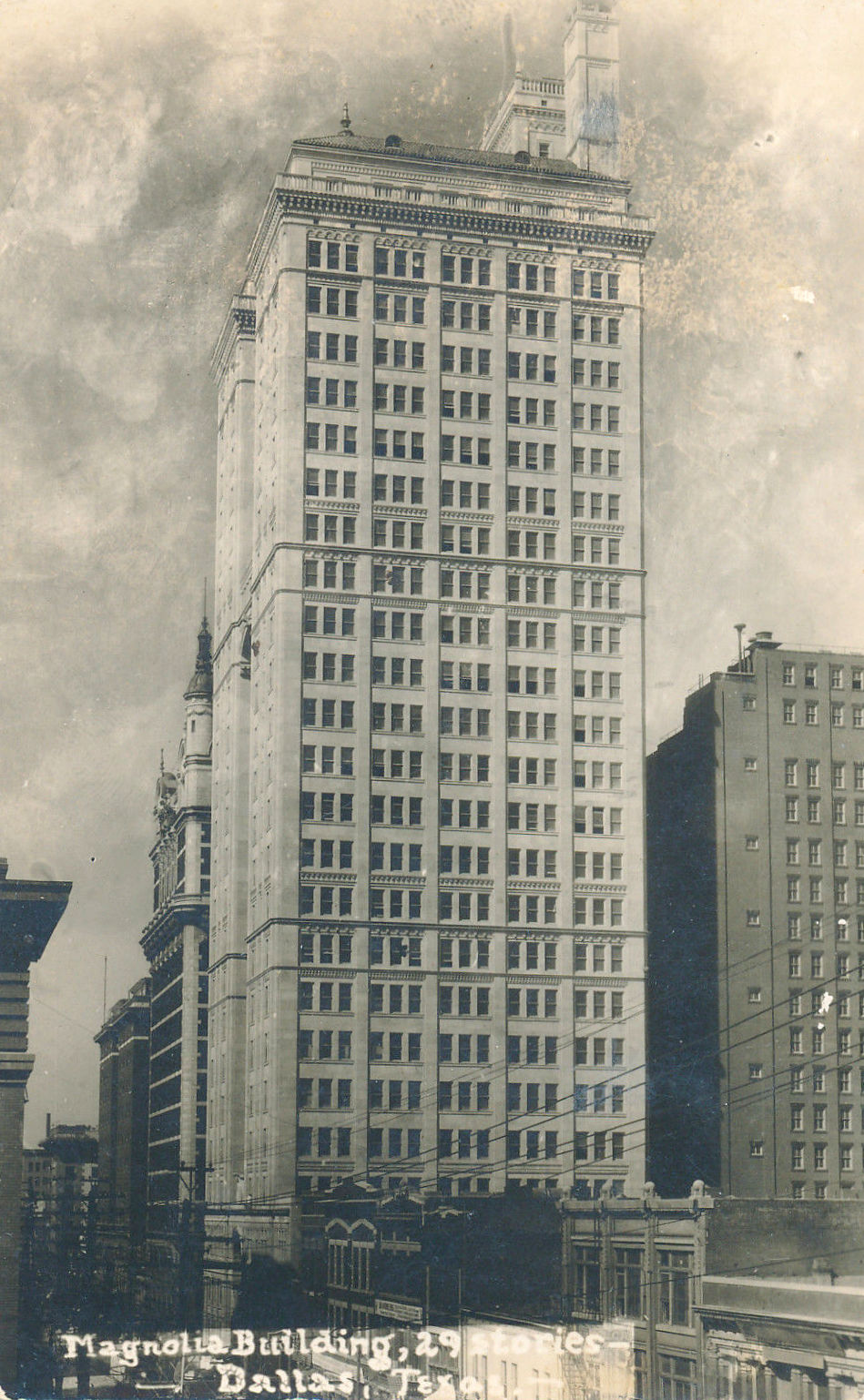
This is such a wonderful photo of the Magnolia Petroleum Building — even without Pegasus on top of it! When it opened in 1922, it was the tallest building in the state — all 29 stories of it. (It was so tall, apparently, that the photographer couldn’t get the whole building in the shot!) It certainly looks impressive — and impressively ominous — in this photograph. An added bonus is the beer-stein-shaped turret of the Adolphus Hotel peeking around at the left. Fantastic photo!

***

Sources & Notes

Photograph from a postcard found on eBay; written on the back is this message to folks back home in Oklahoma City: “Arrived at 11:30 PM. in this burg. It’s some big place, believe me.”

Brief history of what is now the Magnolia Hotel, is here. (Pegasus was not placed on top of the building until 1934.)

Some more Flashback Dallas posts featuring my favorite views of the Magnolia Building (with and without Pegasus):

  • here — photos showing the major change in the skyline between 1929 and 1939
  • here — incredible photo of the skyline taken from The Cedars, by Alfred Eisenstaedt
  • here — the Magnolia Bldg. lit up at night, with the Mercantile Bank Bldg. in the background
  • here — one of my favorite postcards of Dallas, showing the city at night, with Pegasus the highest point on the horizon

*

Copyright © 2015 Paula Bosse. All Rights Reserved.
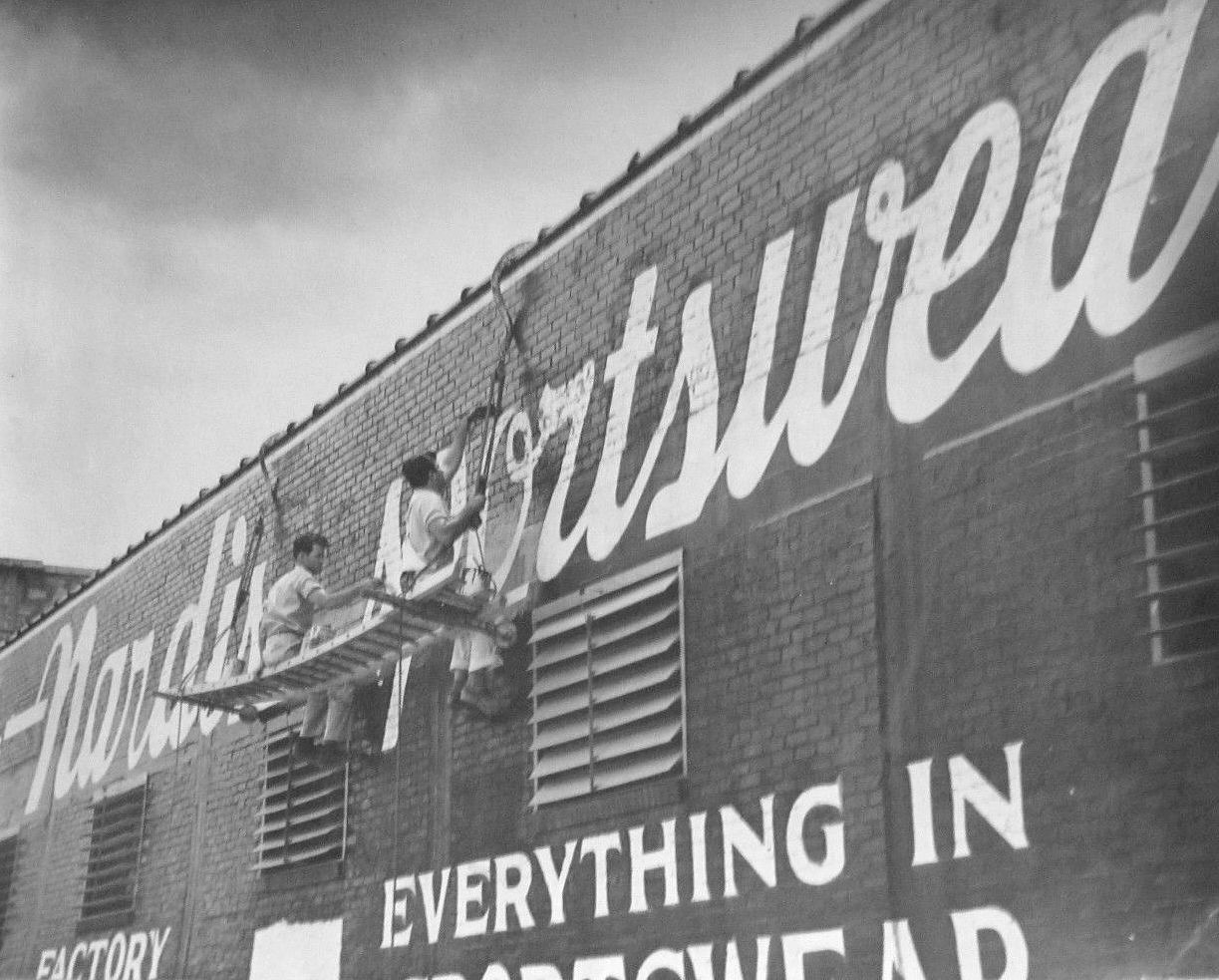
Nardis Sign-Painters: “Everything In Sportswear” — 1948

nardis_sign-painters_ebay_1948You don’t see this much anymore (click for larger image)

by Paula Bosse

I’m sure there were people in the past who thought that advertising painted directly onto buildings was as tacky as billboards are today, but I love it, and, sadly this type of sign-painting has become something of a lost art. Here we see men painting a sign for the successful apparel manufacturer Nardis Sportswear (later, Nardis of Dallas). The company’s corporate headquarters appears to have been on Browder street, with manufacturing factories on N. Austin and S. Poydras streets. The sign in the photo would seem to have been painted on the side of one of the factory buildings.

nardis_1948-directory1948 city directory

nardis_1952-mapsco1952 Mapsco

I think all these Nardis buildings are gone, so we don’t even get any faded ghost signs to remind us that Dallas was once a large-ish garment manufacturing center.

***

Sources & Notes

Photo — dated 1948 on reverse, with stamp of the Hank Tenny Studio at 1420 Wood Street — found on eBay.

My previous post on the Nardis company — “Nardis of Dallas: The Fashion Connection Between ‘The Dick Van Dyke Show’ and the Kennedy Assassination” — can be found here.

*

Copyright © 2015 Paula Bosse. All Rights Reserved.
 

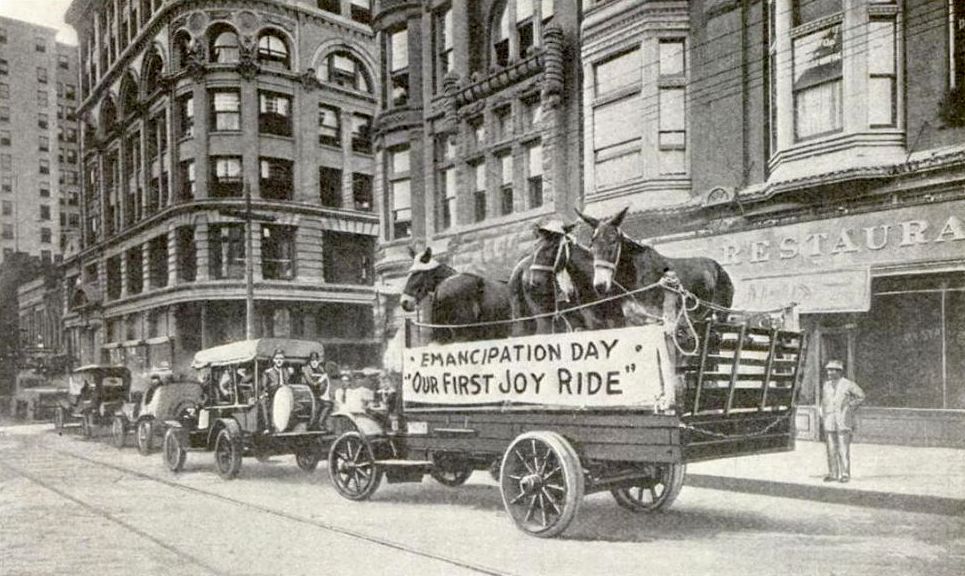
“Our First Joy Ride” — 1911

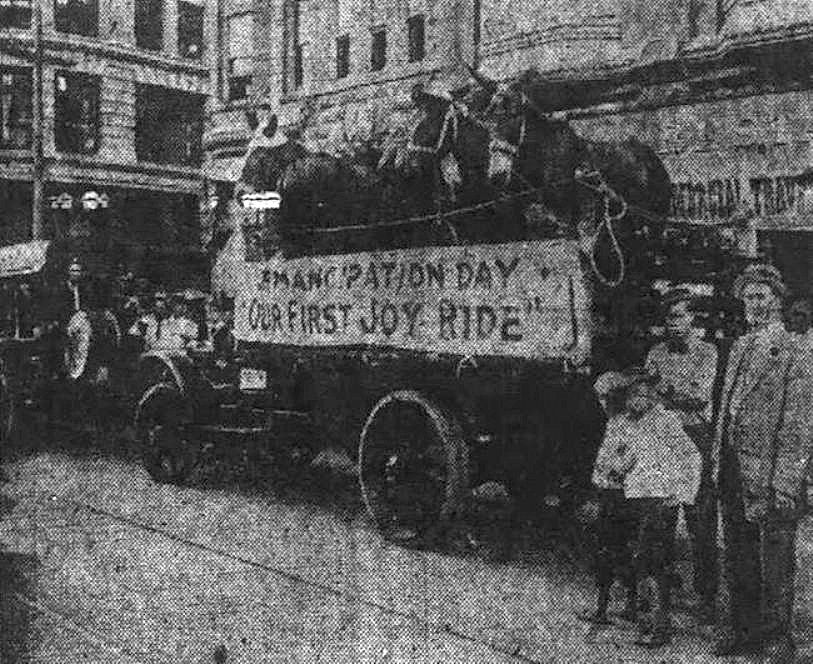
mule-joyride_pop-mechanics_jan-1912Mules taking a load off, Main & Ervay, 1911

by Paula Bosse

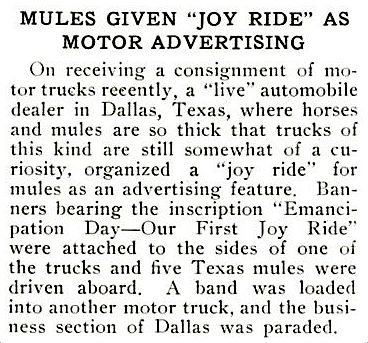
Flipping through the pages of a Jan. 1912 issue of Popular Mechanics — as one does — I came across a photo of a truckload of joyriding mules which was accompanied by this explanatory text:

mule-joyride_pop-mechanics_jan-1912-text

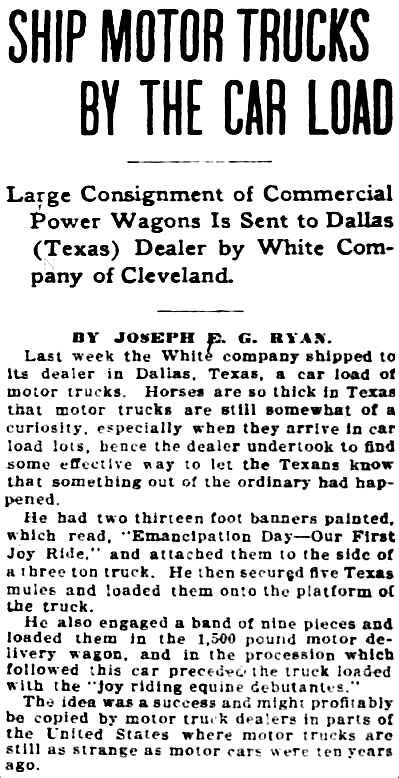
Ah, a publicity stunt. A Chicago newspaper offered a bit more background, and gave us the delightful phrase “joy-riding equine debutantes.”

mules_chicago-inter-ocean_102311Chicago Inter Ocean, Oct. 23, 1911

Another report added that the mules were “adorned with a collection of discarded women’s hats and bonnets elaborated with all the old ribbons, feathers and similar gee-gaws […] securely tied on with pink and red mosquito netting…. The procession was headed by Dallas’ most prominent business men in a brand new White 1912 ’30.'” (Automobile Topics magazine, Oct. 28, 1911)

Despite the fact that this, let’s face it, pretty unusual “parade” happened on Main St., with apparent participation by “prominent businessmen,” I can find no mention of it in local newspapers. Maybe because it was a publicity stunt and there was no advertising fee collected by the papers. The story ran in a handful of newspapers (Chicago, San Francisco, Washington, DC), and the Washington Post ran the photo below under the headline “New Way to Advertise Motor Trucks.”

mules_washington-post_102211Washington Post, Oct. 22, 1911

The White Motor Company (makers of the mule-laden truck) must have been quite taken with the unnamed entrepreneur’s banner, because they used the exact same wording on a banner draped on one of their trucks which was a featured attraction on Transportation Day at the 1915 Panama-Pacific International Exposition in San Francisco.

Let’s hope the original Dallas guy got a little something out of all this.

*

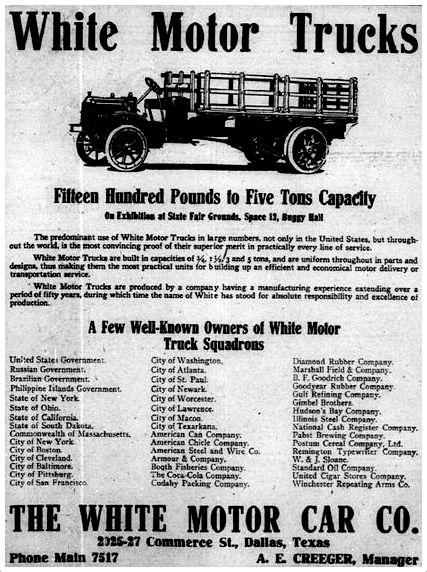
On further investigation into The Case of the Joyriding Mules, it appears that this was the brainchild of the General Manager of the White Motor Co., A. E. Creeger (or perhaps that of one of his gung-ho underlings). In a 1912 article in The Dallas Morning News, Creeger talks about the relatively soft truck market in Texas (!), and it’s easy to see why he was doing all he could to draw attention to his company’s line of trucks — even if it meant loading them up with “emancipated” livestock.

And here’s one of his ads from almost exactly one year after the mule stunt:

white-motor-co_dmn_101312Oct. 13, 1912

***

Sources & Notes

Top photo appeared in the January, 1912 issue of Popular Mechanics.

The “parade” (which took place sometime in the middle of October, 1911) is seen heading west on Main Street, just about to pass Ervay. The inescapable Wilson Building dominates the photo, with the tall, white Praetorian Building in the background. The restaurant at the right — at 1705 Main — was the California Restaurant, a Dallas eatery specializing in Chinese food since at least the 1890s.

*

Copyright © 2015 Paula Bosse. All Rights Reserved.

Radio Broadcasting, 1922-Style

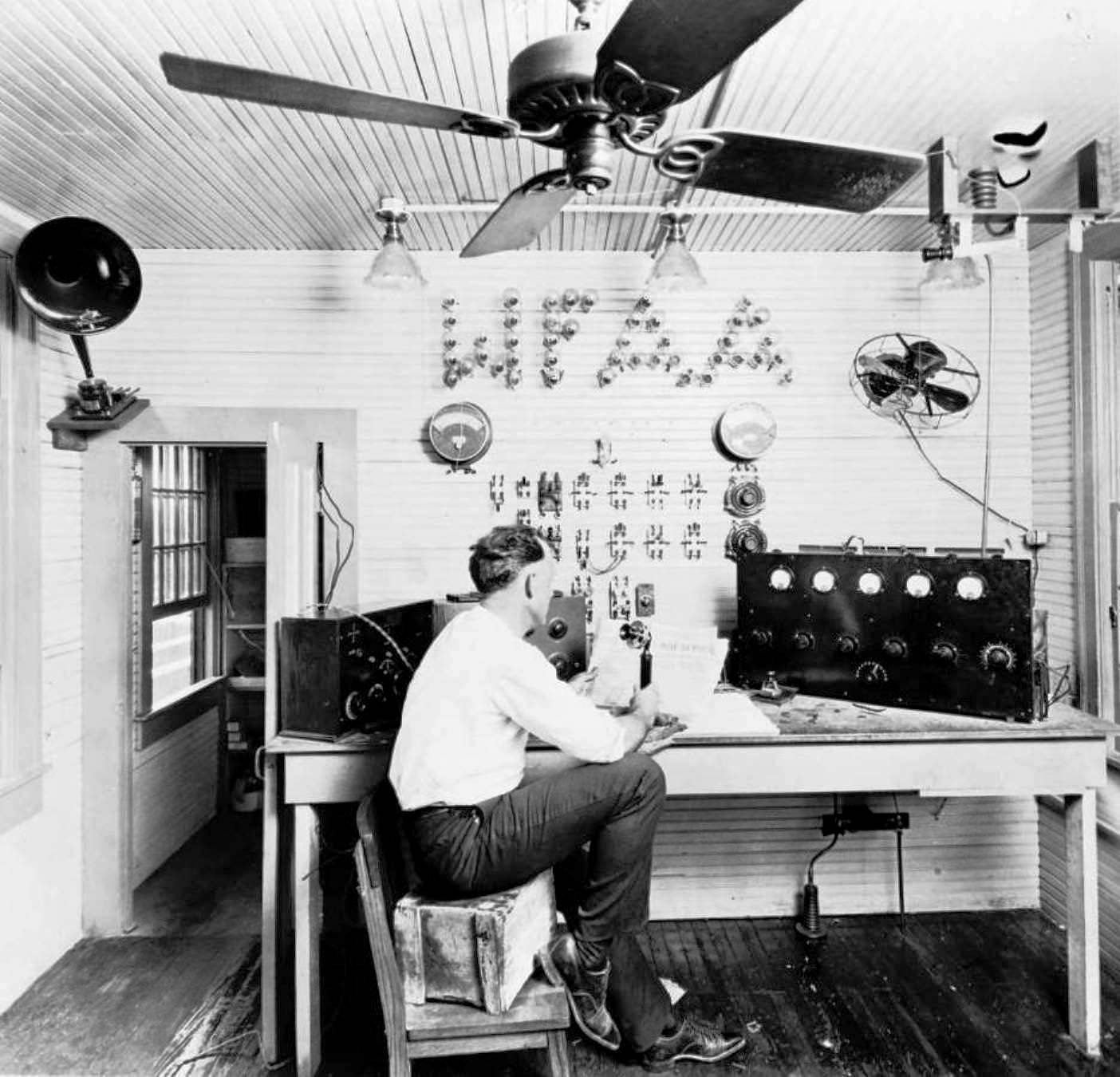
wfaa-control-room_belo_smu_1922WFAA “newsreader,” 1922 (click for larger image) Belo Collection, SMU

by Paula Bosse

This fantastic photo shows the interior of a little shack-like building on top of the old Dallas Morning News building at Commerce & Lamar, soon after WFAA radio had begun broadcasting in the summer of 1922. There are so many things I love about this photo. Let’s explore the details. (All pictures are larger when clicked.)

*

The Magnavox speaker/monitor.

wfaa-control-room_belo_smu_det1

*

The booster seat and the shoes that need a shine.

wfaa-control-room_belo_smu_det2

*

The announcer at work. (I’m assuming this telephone was being used as an early microphone?) The newspaper is The Dallas Journal, sister publication of The Dallas Morning News which owned WFAA radio. The headlines appear to be about the nationwide railroad and coalminers’ strikes, both of which had been getting more and more violent throughout July of 1922 (violence surrounding the railroad strike led to Texas Governor Pat Neff declaring martial law in Denison that month).

wfaa-control-room_belo_smu_det3

*

The control panel (which has its own fan).

wfaa-control-room_belo_smu_det4

*

And an open window around the corner, in the supervisor’s office. Cross-ventilation and oscillating fans might not have been hugely effective in keeping operators and machinery cool in the summertime.

wfaa-control-room_belo_smu_det5

*

Here’s another view of the “Operating Room,” as published in the DMN on June 25, 1922, the day before WFAA began broadcasting.

wfaa_operating-room_dmn_062522DMN, June 25, 1922

***

Photo titled “WFAA Radio Original Control Panel” from the Belo Papers collection, DeGolyer Library, Central University Libraries, Southern Methodist University; it can be viewed here.

A companion post to this, “WFAA’s ‘Altitudinous Antenna System'” — which contains a background of WFAA’s debut and several photographs — is here.

Other Flashback Dallas posts on Dallas Radio and TV are here.

Click pictures for larger images.

*

Copyright © 2015 Paula Bosse. All Rights Reserved.

WFAA Radio’s “Altitudinous Antenna System”

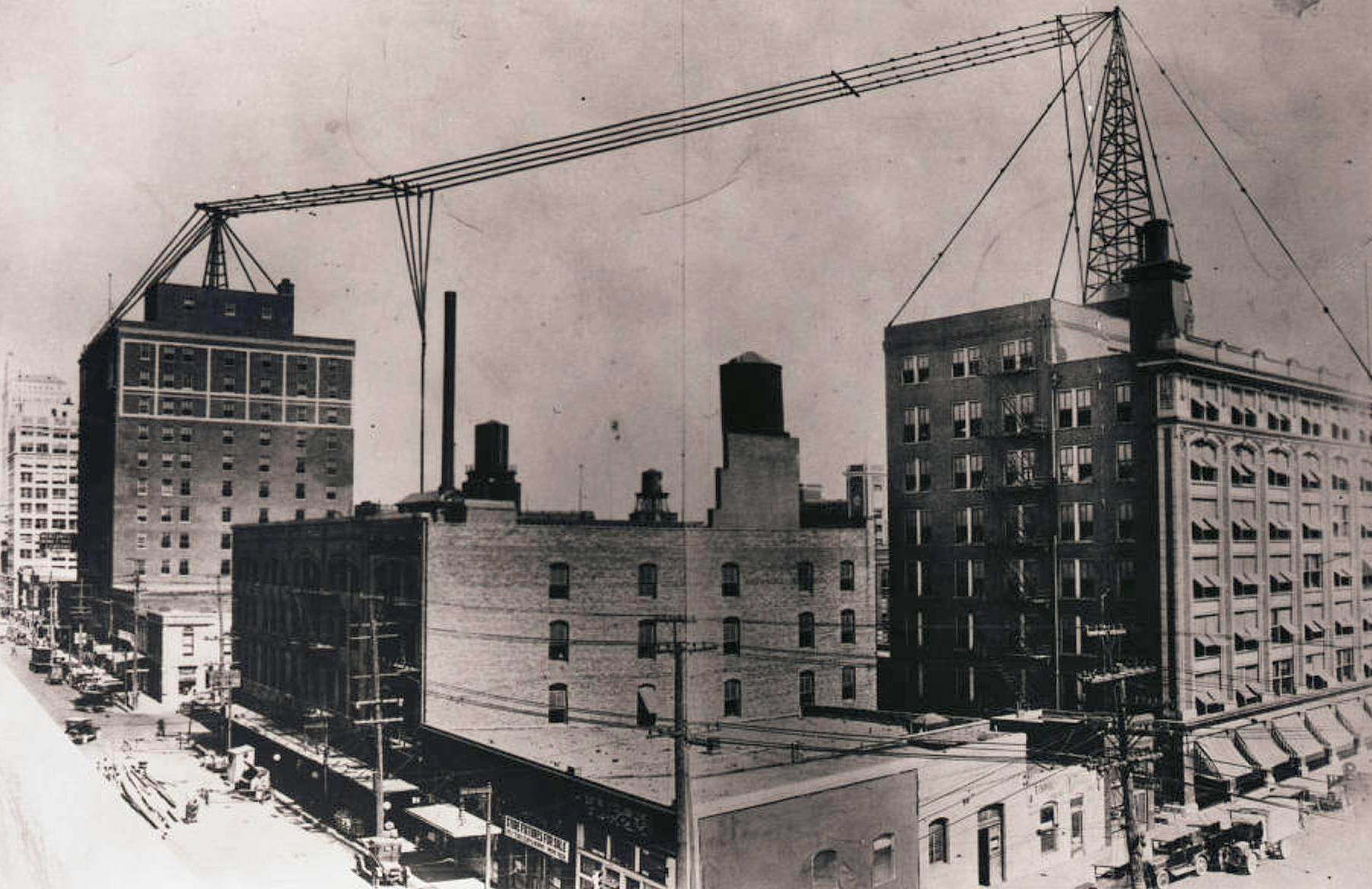
wfaa_towers_1920s_belo-coll_degolyerSeems … “busy” … (click for larger image) Belo Collection, SMU

by Paula Bosse

Broadcast radio was very, very, very new when WFAA radio went on the air in June, 1922; it was Dallas’ second radio station, but it was the city’s first commercial station, and its debut was a BIG deal. (WRR had preceded WFAA, but it was mainly used for city business.) Figuring out where to place towers and aerials and antennae (which may all be the same thing, for all I know) was a major problem, with not a lot of precedents. So why not just do what they did in the photo above?

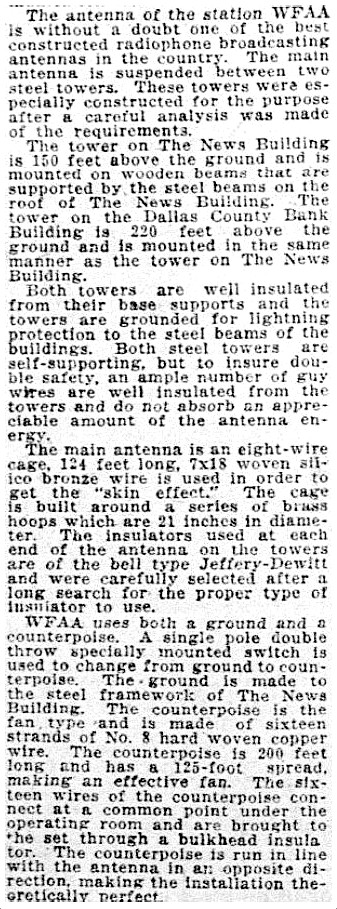
WFAA began broadcasting at 12:30 p.m. on June 26, 1922, and the day before that, a giddy and surprisingly technical article appeared in The Dallas Morning News (which owned WFAA). The full article is linked below, but this is the specific passage devoted to those towers/aerials/antennae:

wfaa-towers_dmn_062522DMN, June 25, 1922

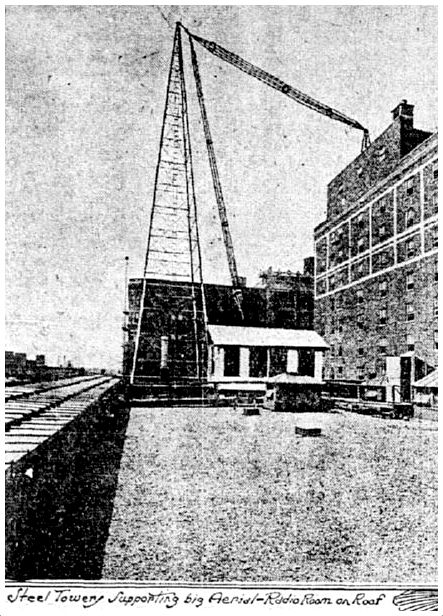
I’m not sure if the photo at the top was from these first days (it appeared, undated, in the DMN in 1927), but here is a photo that accompanied the above article from 1922:

wfaa_tower_dmn_062522

Is that a little building? Why, yes it is.

WFAA. It began as a 50-watt station. Its studios occupied all of a 9×9-foot shack on top of the old Dallas Morning News Building. Its antennae were strung from a water tank on the The New building to a 20-foot mast on top of the Texas Bank Building. (DMN, May 21, 1950)

When WFAA began, it broadcast from inside of and on top of the old Dallas Morning News building, which was located at Commerce and Lamar. By 1927, it had moved its studios to swankier digs in the Baker Hotel. Below, another description of how the rooftop aerial situation — the “altitudinous antenna system” seen at the photo at the top of this post — functioned at this time.

One of the big towers is on top of the lofty Dallas Mercantile Bank Building, while the other is atop the high Missouri-Kansas-Texas Railway Building. The wires are connected with the WFAA operating room on the roof of the Dallas Morning News Building between the two other structures. (DMN, Feb. 20, 1927)

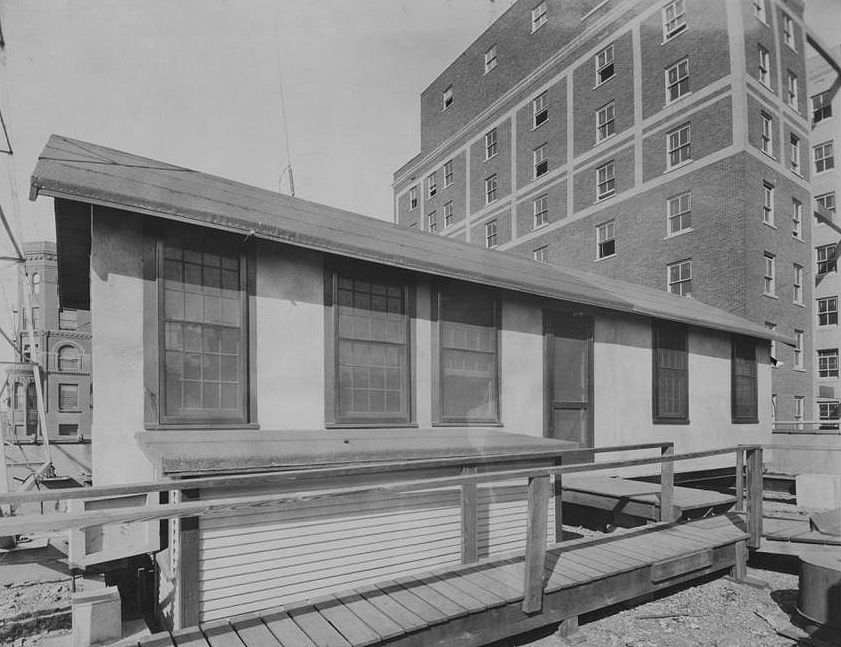
But back to that little shack. Let’s see it a bit closer. Here’s the exterior.

wfaa_rooftop-broadcasting-room_belo-degolyerBelo Collection, SMU

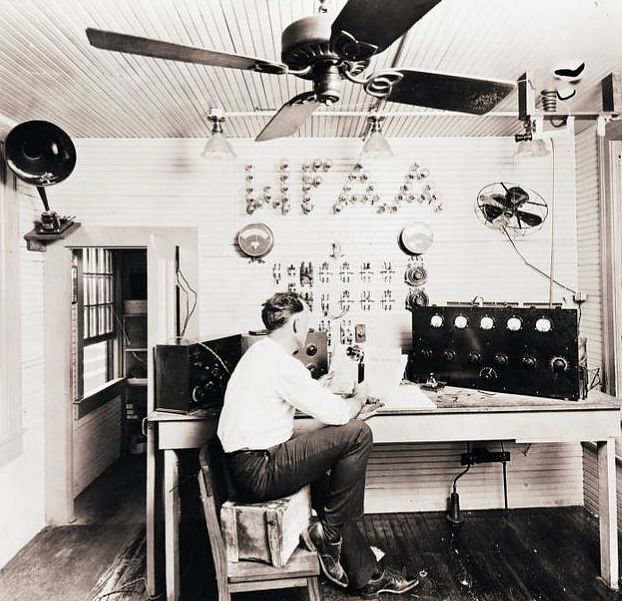
And here’s the interior.

wfaa-studio_ca1922_belo-degolyerBelo Collection, SMU

The generator and battery room.

wfaa_generator-battery_dmn_062522DMN, June 25, 1922

And the supervisor’s office.

wfaa_supervisors-office_dmn_062522DMN, June 25, 1922

And Dallas broadcasting never looked back from its humble beginnings.

*

ad-white-electric-co-detail_dmn_062522Advertising detail, June 25, 1922

*

wfaa-logo_dmn_062522

***

Sources & Notes

Photographs from the Belo Records Collection, DeGolyer Library, Central University Libraries, Southern Methodist University. Top photo can be accessed here; rooftop “broadcasting room” (exterior) is here; “broadcasting room” (interior) is here. More photos here. (The interior and exterior shots of the studio seem to be from 1922. The announcer is reading from the DMN’s sister publication, The Dallas Journal, which contains an article about a subject hot in the news in July, 1922 — a strike by Kentucky coal miners.)

A Belo photo identified as showing the room containing the “Transmitter on top of The Dallas Morning News building, 1924” is here.

To read the article describing how WFAA (which, by the way, at some point stood for “Working For All Alike”) was put together — how it was literally put together — see the Dallas Morning News article “Most Complete Radio Station in the Southwest to Begin Broadcasting” (June 25, 1922), written by R. M. Lane, here, and the accompanying photos here.

See the companion Flashback Dallas post, “Radio Broadcasting, 1922-Style,” here.

Other Flashback Dallas posts on WFAA radio can be found here.

Other Flashback Dallas posts on Dallas Radio & TV can be found here.

*

Copyright © 2015 Paula Bosse. All Rights Reserved.

Neiman-Marcus / France-Texas / A-Z — 1957

n-m_french_ad_cover-smMais oui!

by Paula Bosse

Bastille Day again already? It seems to come earlier every year. Last year I wrote about the 1957 Neiman-Marcus French Fortnight — the very first fortnight celebration. This year I thought I would present a few of the pages from the lavish advertising supplement Neiman’s placed in the October, 1957 issues of American and French Vogue. The mini-catalog was titled “Neiman-Marcus Brings France to Texas, Everything From A to Z.” (Link to the entire ad insert is below.) Here we have “C,” “R,” “V,” and “Z.” Enjoy a flashback to fabulous ’50s fashion photography. And Happy Bastille Day!

n-m_french-ad_cn-m_french_ad_rn-m_french_ad_vn-m_french-ad_zClick to read a list of events and exhibits happening around the store.

***

These pages are from a reprint of a 30-plus-page 1957 Neiman-Marcus advertising spread; from the collection of Stanley Marcus’ papers at the DeGolyer Library, Central University Libraries, Southern Methodist University. This is the very epitome of high-fashion advertising of the 1950s, and the sophisticated-but-fun-and-frothy art direction is wonderful. The entire mini-catalog has been scanned by SMU, and it can be viewed in a PDF, here.

My previous post “Neiman-Marcus Brings France to Big D — 1957” — which gives some background on this first N-M fortnight celebration and contains a great photo of the exterior of the downtown store elaborately decorated to resemble the Rue du Faubourg Saint-Honoré — can be found here.

All images larger when clicked.

*

Copyright © 2015 Paula Bosse. All Rights Reserved.