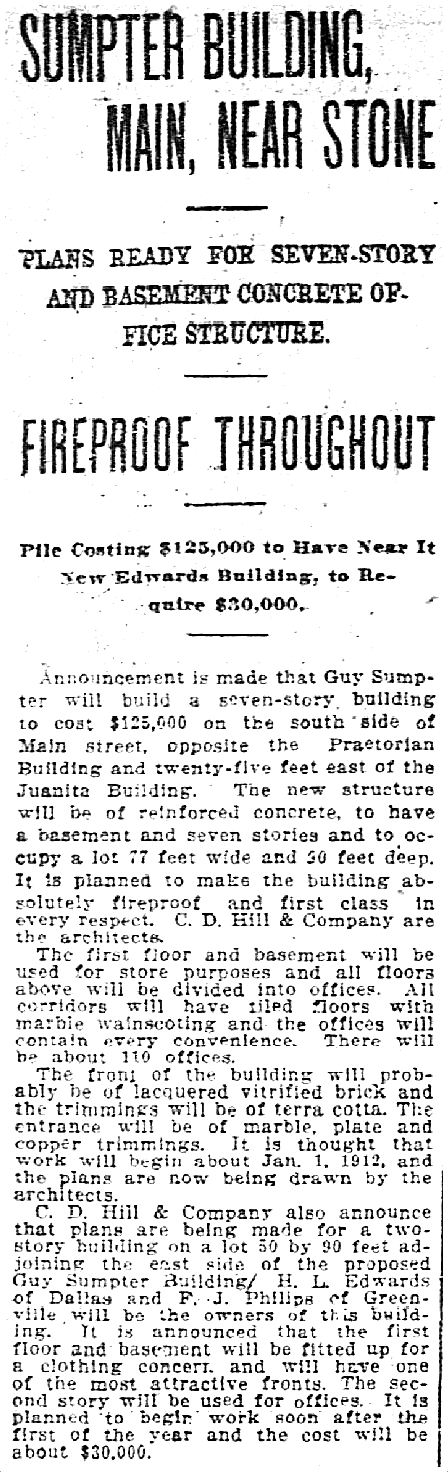
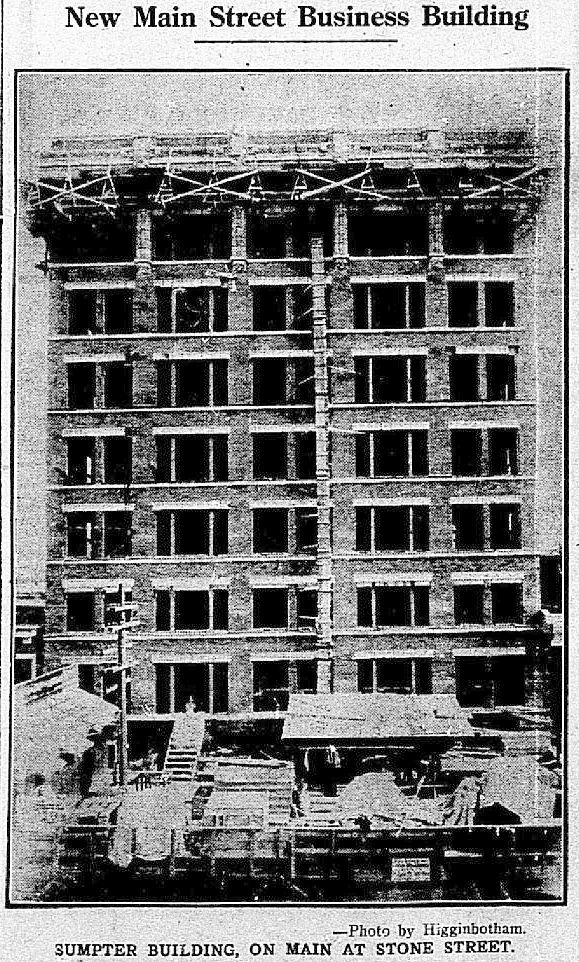
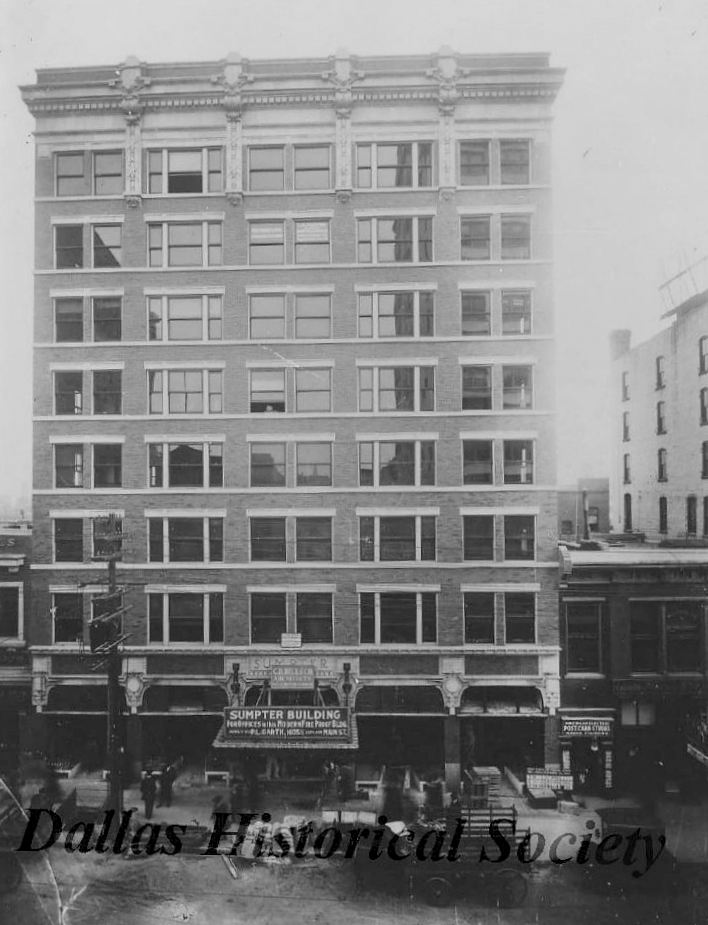
Behold, the Sumpter Building and a partial view of its little buddy, the Edwards & Phillips Building, which were built simultaneously. (See them on a 1921 Sanborn map here.) Both were designed by Dallas architect C. D. Hill, whose spectacular Municipal Building would be built a couple of years later, two and a half blocks away.
Guess what? Both are still standing — part of the Joule empire. See what they look like today — at 1604-1608 Main Street — on Google Street View here. (The shorter building has been through a multitude of renovations over the years, but at some point, by at least 2007, someone had restored it — however briefly — to its original design, as you can see in a 2007 Google Street View here — look how tired and dirty the Sumpter Building looked back then, before its recent scrubbed and rejuvenated revitalization.)
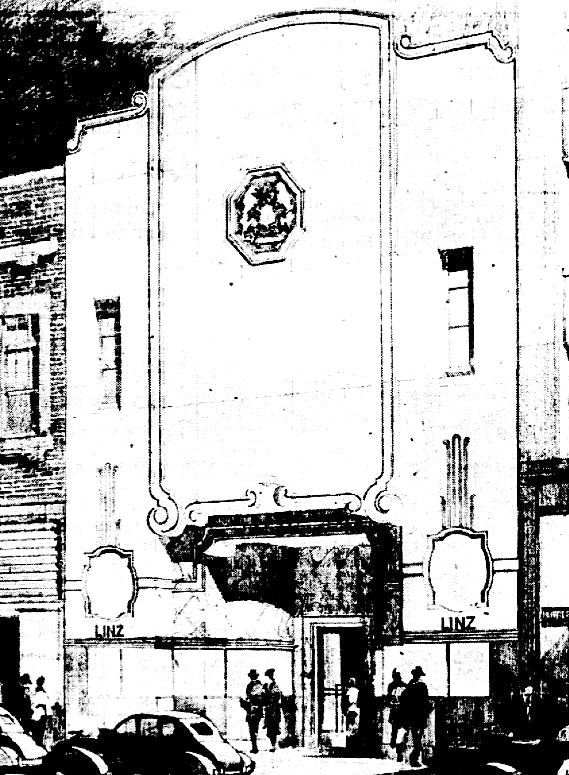
The Sumpter Building served primarily as office space over the years — architect C. D. Hill had a “penthouse” office on the top floor (I wonder if he knew that when he was drawing up the plans?) — and the smaller building was retail space on the ground floor and office space above. It might be remembered as the home of Linz Jewelers for several decades.
**
Dallas Morning News, Dec. 17, 1911 (click to read)
*
DMN, Mar. 7, 1912
*
DMN, Aug. 25, 1912
*
Dallas Historical Society, 1912
*
The smaller building debuted as home to retail tenant Matthews Brothers. (It is presently the home of another fashion mecca, Traffic Los Angeles (1608 Main).
April 1912
April 1912
*
In 1940, Linz took over the shorter building. Articles in The Dallas Morning News described “construction” and a new design by Lang & Witchell, but I think the building was just gutted and (weirdly) refaced.
Linz Bros. Jewelers (Lang & Witchell, 1940)
*
Here it is in living color, in 1970.
WFAA-Channel 8 News, Jan. 1970 (Jones Film Collection, SMU)
*
By the end of 1970, the building had undergone another (weird) “facelift” (and an expansion).
WFAA-Channel 8 News, Jan. 1971 (Jones Film Collection, SMU)
(The two screenshots above are from Channel 8 news reports about a fantastically successful jewelry heist in January 1970. Linz would never reveal the value of jewels stolen in the massive theft, but it was estimated at the time to be between $1.6 million and $3.5 million (the equivalent in today’s dollars of $12.5 million to $27 million!). It was the biggest burglary in Dallas history, and it was estimated to have been the biggest in the South. As far as I can tell, the crime was never solved. A great report on how it happened — with interesting little tidbits such as the fact that the robbers emptied a safe and took everything except for a few pieces of costume jewelry and that the burglars stopped for a break to brew a cup of coffee in the adjacent shoe store — can be found in the Dallas Morning News archives in the story “Gem Loss $3 Million?” by Robert Finklea (DMN, Jan. 13, 1970). It reads like a movie!
**
I’m always surprised to find these century-old buildings still standing downtown. Poor things have been through a lot.
*
Thank you to Chad K. for asking on Patreon if I knew anything about the history of these buildings. As it turned out, I knew NOTHING about the history of these buildings. I do now! Thanks for asking, Chad!
***
Sources & Notes
Top postcard from eBay.
1912 photo of the “Sumpter Building under construction” is from the Johnson Photographic Collection, Dallas Historical Society (A.77.87.967), here.
This post was inspired by a question from a supporter on Patreon. If you would like to join me on Patreon, where I post something every day, pop over here. (Thanks again, Chad!)
I am looking for a job, and since I have this blog as a platform which attracts like-minded people, I will just post this here, hoping it’s not too obnoxious.
It would be wonderful if I could find something in the world of Dallas history – especially in the area of writing and/or researching – but I know those jobs are somewhat limited.
I started this Flashback Dallas blog in Feb. 2014 – I’m 6 months away from my 10th anniversary! Unbelievably, I’ve written more than 1,300 posts. I know that many of you have been reading for several years (thank you!), and I hope you’ve been able to get a feel for my personality through my writing and can tell that I possess many traits a Boy Scout would be proud to have.
If you know of a job opportunity requiring someone who is intelligent, diligent, responsible, courteous, amusing, and detail-oriented – and who can write/edit/proofread/research – please think of me.
If you are looking to hire someone like me – or if you know of someone who is – please let me know! If you would like me to send you a resume, please contact me at FlashbackDallas214@gmail.com.
I had a LinkedIn page years ago, but I never reaped any benefits from it, so I closed it. I’ve started another one, but there’s a lot to navigate, and I’m not sure it’s worth it. But if you want to check out what I’ve managed to get up there, check me out here: https://www.linkedin.com/in/paula-bosse-214-dallas/.
(I’ve had mixed results getting that direct link to work for people who don’t have LinkedIn accounts. You may land on a page that looks like you have to enter a username and password — try clicking the “X” in the top corner and see if that works to bypass entering anything. If the link above doesn’t work, try putting “paula bosse” and “linkedin” in Google, and you should be able to see my public page.)
Thank you for reading. Any leads would be welcome.
–Paula
***
Sources & Notes
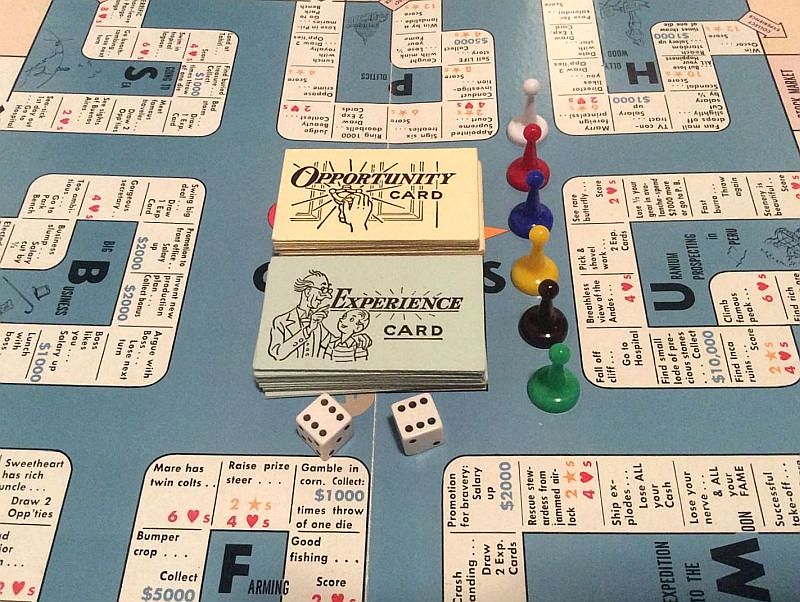
Image of the “Careers” board game is from Etsy. I kind of want to play this game. One of the occupations is Uranium Prospecting in Peru. I’m down for that.
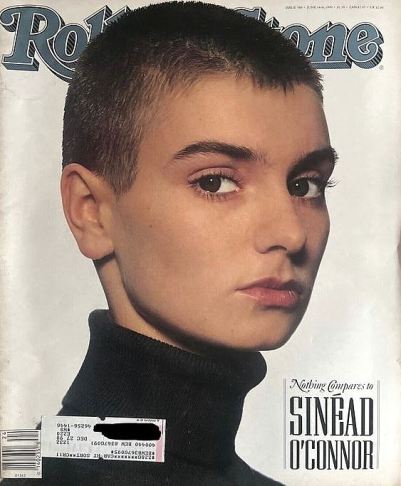
Sinead O’Connor died today. I loved her. When she came to Dallas to play the Bronco Bowl on May 25, 1990, I was there. She sang “Nothing Compares 2 U” a capella. The audience was so quiet while she sang you could hear a pin drop. It was one of the most memorable live music moments I’ve ever experienced.
In the early days of alternative radio station KDGE, I spent a lot of time at the Edge studios and provided a surprising amount of (uncredited, unheralded, and uncompensated) “comedy” writing for one of the on-air personalities. I even did a few on-air bits.
One night, out of the blue, I got a phone call at home, and was told to call the station’s answering machine and give ridiculous directions to a secret Sinead O’Connor party which was supposedly being given in her honor while she was in town for her show at the Bronco Bowl. So I did. The sound quality is atrocious, but I had to scramble to find a tape recorder before the bit aired a few minutes later. I’m still waiting for my Peabody.
So here’s one of the improvised stealth comedy bits I did on The Edge (and, yes, I really do give directions like this). It is followed by a commercial for Sinead’s appearance at the Bronco Bowl, produced by 462 (pure ’90s nostalgia). I’ve been told by a friend that he could access this link on his laptop but not his phone, but I’m going for it anyway.
Today marks the 50th anniversary of the murder of 12-year-old Santos Rodriguez by a Dallas policeman, a tragedy which outraged Dallasites and which was a turning point for Dallas’ Mexican American community.
Several years ago, I maintained a long-running personal blog (back in the days when everyone had a blog — now everyone has a podcast). A recent comment on my Patreon page reminded me of an old blog post I wrote in 2010, several years before I began Flashback Dallas. I thought I would share it here (slightly rewritten). It’s a different sort of thing than I normally write on *this* blog — it’s pretty long and only tangentially connected with Dallas history — but it made me laugh to reread this 13 years later. (I have to add that since I wrote this back in 2010, the Municipal Building has been lovingly, *dazzlingly* restored by the University of North Texas and is no longer the hellhole I describe below! I haven’t seen the restored interior in person yet, but photos show some unbelievably amazing work! Thank you, UNT!)
**
October 27, 2010
I’m one of those people who receives a lot of jury summonses. I swear one year I got at least 3. Maybe 4. Do they keep sending them to me because I always report for jury duty like a responsible citizen is supposed to do? Is this good behavior working against me? So when I got a jury summons last month — a mere 4 months after my most recent jury duty on Cinco de Mayo — several unladylike words spilled out of me as I stood at the mailbox. I scanned the list of acceptable exemptions — there was a little empty checkbox next to the statement “I have been convicted of a felony.” Instant exemption! My first thought was, “Hmm. I’ve got six weeks….” It was tempting.
But I was still felony-free by the time I had to report yesterday (Oct. 26, 2010), so I somehow got myself up at the crack of dawn after only 4 or 5 hours of sleep and pointed my car in the direction of downtown. Most of my jury duty has been at the criminal courts building, which is easy to get to, and the chairs in the central jury room are plush and fairly comfy. This time, though — for the first time — I was summoned to a municipal court, where I guess they try people for non-death-penalty offenses like traffic tickets and zoning violations. If this day had any upside, it was that it would be my first visit to the beautiful Municipal Building. I couldn’t wait to see what that building — arguably the grandest building in Dallas — looked like inside.
But first I had to get there. I had to travel what felt like the entire length of downtown before I was able to turn left on Main and loop back to Harwood. I was sleep-deprived, caffeine-deprived, and just generally cranky, knowing that this whole thing was unnecessary, as I would no doubt be let go by noon, after having sat around for hours doing nothing but thinking unladylike things and wondering the whole time how this inefficient system keeps going.
Convenient parking? Ha! Fend for yourselves, suckers. At least Frank Crowley has a parking garage. Somehow, I found an unattended, cash-only lot along Commerce for the surprisingly affordable price of $2.00. My luck continued when I found that I actually had two one-dollar bills, which I stuffed through the narrow slot.
Despite my lengthy detour, I had arrived a little early and enjoyed a leisurely walk down Commerce. As I passed the building’s parking garage entrance/exit, I wondered if that was where Lee Harvey Oswald was shot. (It was.) I took my time, taking in the lovely, stately Municipal Building, which opened to rapturous acclaim in 1914 — it’s one of those cool old buildings that Dallas loves to tear down. I was really looking forward to stepping inside that grand palace, imagining an interior of marble, brass, etched glass, and ornate, highly polished, hand-carved wooden banisters.
I headed up the elegant, wide steps, walked in, and… oh… my… god. It was awful. AWFUL! But before I was treated to the full force of its awfulness, I was first greeted with the de rigueur metal detector. Which I set off. I stepped back and the officer asked me to raise each pant leg so he could see the tops of my shoes. I must have looked confused because he said, “We just want to make sure you’re not wearing an ankle holster.” Without thinking, I stupidly replied, “Pfft — I WISH,” and I instantly regretted it. But he laughed, and I continued on my way.
The Beaux-Arts-style Municipal Building, designed by architect C. D. Hill, is beautiful and stately. …On the outside. Here’s what it looked like almost 100 years ago:
Inside? Dear god. Depressingly institutional. Last “updated” circa the ’70s/’80s? Cramped and claustrophobic, bad paint, fluorescent lights, drop ceiling tiles, and absolutely no signage. I had to ask three people how to get to the central jury room! It’s a shame I found it, because I am going to have nightmares about that horrible place for a long time. There were about a hundred of us sitting on folding chairs in a room with dingy cream-colored walls trimmed with flat-turquoise paint. It reeked of the thousands of cigarettes which had no doubt been smoked over the past century by thousands of long-dead civil servants. The smell of stale smoke was embedded in every nook and cranny of that room. I think I would have preferred to serve my civic duty by picking up Miller Lite cartons from the side of the highway.
The worst thing about the room? The blaring TV. I don’t know why this has become acceptable, but it’s everywhere: in every waiting room there’s always a TV now — always on, stuck on a program you would never choose to watch. My fellow captive good citizens and I were subjected to a chirpy morning show (“Sweaters: to tuck or not?”) and lurid Hollywood gossip. I wondered if I could leave the room to get a breath of fresh air — it would be sheer relief to stand out in the hallway with the slumlords and the red-light-runners waiting their turn to go before the judge and take on City Hall. But I didn’t see anyone else doing that, so I sat, defeated, involuntarily learning about the finer points of sweater-tucking.
After an hour and a half or so, the marshal — who had a shaved head and wore taps on his shoes — announced that we were allowed a half-hour break. I hot-footed it out of there and left the building (I had to ask how to get out). I walked around the building admiring it, then walked across the street to a new park that’s sprung up since I was last downtown — a whole block of a park, lined with trees and terraced walkways — in downtown Dallas — with grass and everything! It’s cool. Here’s a photo I took of the municipal building from across the park (Main Street Garden):
Oct. 26, 2010 / photo: Paula Bosse
I saw several young hipsters walking their dogs. I bounced across a small playground, built on some sort of weird, springy, spongey surface. I thought how unusual and how nice this whole “open space” thing was. My half hour was up too soon. As I walked back, a possibly homeless man joined me and chatted with giddy enthusiasm about the Rangers being in the World Series, insisting to me that they were Going. To. Win. I laughed and said I believed him. It was such a beautiful day. How sad that I was heading back to the dark dungeon of the central jury room. I waited to cross the street with a couple of women I recognized as fellow potential jurors. They decided to blithely cross against a red light. There were six police cars parked in front of us, but not one cop to bust these scofflaws! I crossed on green, because I’d used up my luck finding a convenient parking spot, and as sure as the Rangers are Going To Win the World Series, I knew I would be instantly cited for pedestrian incivility the second I stepped off the curb to a flashing red light.
Back inside, I set off the metal detector a second time and showed my holster-free ankles to a different officer and followed the trail of breadcrumbs I’d left earlier. In the jury room — where women outnumbered men 4-1, and the median age was 60 — the two women who’d crossed on red were talking about the Laura Bush autobiography one of them was reading. Two other women were talking in excruciating detail about deaths of beloved pets. The guy next to me was nodding off, somehow oblivious to Wendy Williams chattering excitedly about Charlie Sheen and a hooker. A guy behind me had a laptop which kept making clanging sounds and which he’d plugged into an extension cord that snaked its way into the bowels of a mystery room behind an intimidating door marked “Private.”
There was no coffee in the building. (“There is NO coffee in the building,” the marshal had informed us earlier. “If you want a cup of coffee, you’re going to have to exit the building.”) HAD there been coffee, it would have been thin and stale and cold, and the powdered artificial creamer would not have dissolved, no matter how much you stabbed at the globules with a plastic stir stick. Like in the movie “Joe Versus the Volcano.” I kept thinking of that movie, because that godforsaken central jury room I was trapped in could have been the inspiration for the scene in that movie which my brother and I often reference:
*
I was so miserable. I contemplated committing some sort of petty property crime to relieve the tedium but reconsidered when I realized I’d only find myself back in the same building when my trial date came up. I was going to have to tough it out like an adult.
A middle-aged woman who looked like she was probably a hardcore, high-powered North Dallas realtor sat a couple of rows in front of me and seemed to be able to read only a sentence or two from her book (Famous Soviet Spies) before she grew bored and slipped her “We the People” bookmark back in and closed it, only to stare off into space, gathering the energy to raise the book again and read from it for 20 or 30 more aggressively-anti-Communist seconds.
The youngest person in the room sighed frequently and played a game on her phone.
An older Black man in a gimme cap and an older white man who had probably left his gimme cap in his truck talked together absolutely without pause for the entire time we were there. I couldn’t hear what they were talking about, but I have a feeling they’ll be spending Thanksgiving together this year.
Throughout my ordeal, I had longed to hear the snappy taps on the shoes of the marshal. He would be our savior — the one who could let us go. Finally, he returned. He called maybe 10 people and sent the rest of us on our way. It was 11:00 AM. I had been there only two and a half hours. It felt like a lifetime.
I got in my car, stopped for a burrito, headed home, and fell asleep on the couch. Civic duty done. I only hope I’m never called back to that depressing, confusing building. Pray you’re never called for jury duty there.
***
Sources & Notes
Blog post by Paula Bosse, originally published on Oct. 27, 2010 (revised July 2023).
Photo of the sad, dark Municipal Building at top is from Google Street View, Aug. 2007; photo from 2013 by Paula Bosse.
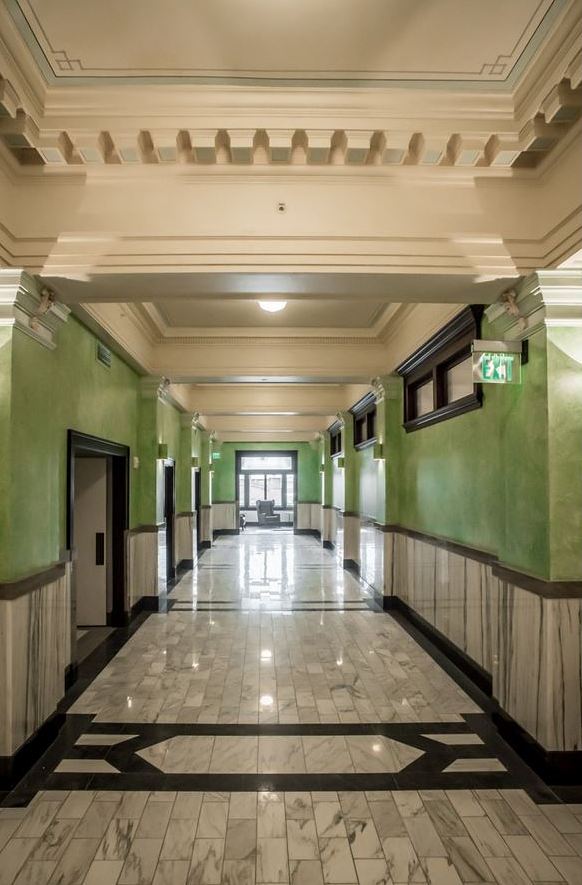
The City of Dallas and all of us who live here, should fall to our knees to thank the University of North Texas Law School and the team of incredible people who restored and renovated the former Municipal Building. Thankfully, all of my sarcastic descriptions above are no longer accurate. I mean, look at this photo of what a hallway looks like now:
That photo is one of several showing the restoration in the article “Bringing Historic Dallas Back to Life” by Preston Pressley, on LinkedIn, here (possibly behind a subscription wall).
See more photos — as well as the film “Restore” by Mark Birnbaum — on the Phoenix I Restoration and Construction site,here.
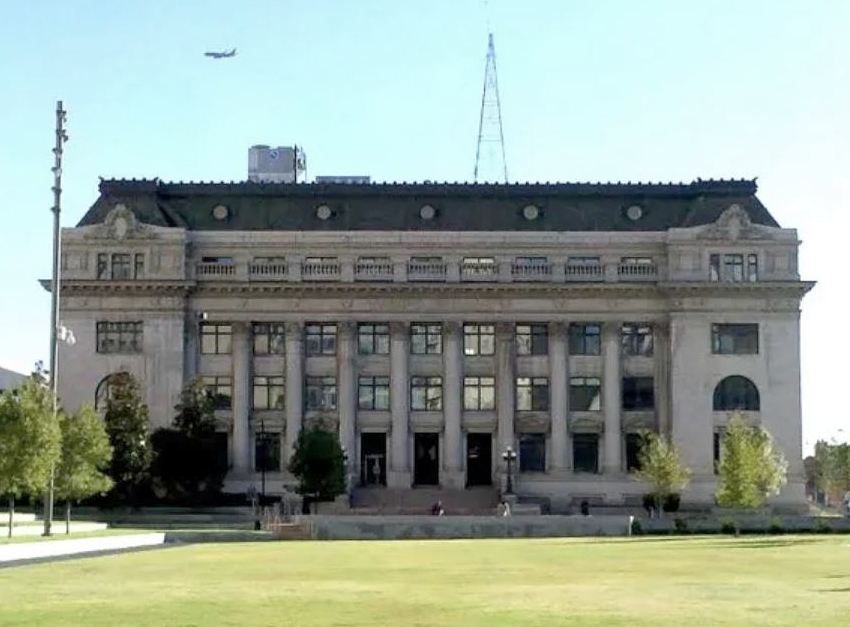
Look at this photo of the revitalized building today — more beautiful than I’ve ever seen it. Every inch of its exterior has been cleaned, spruced up, and restored. I kind of wish I could be called to jury duty there now!
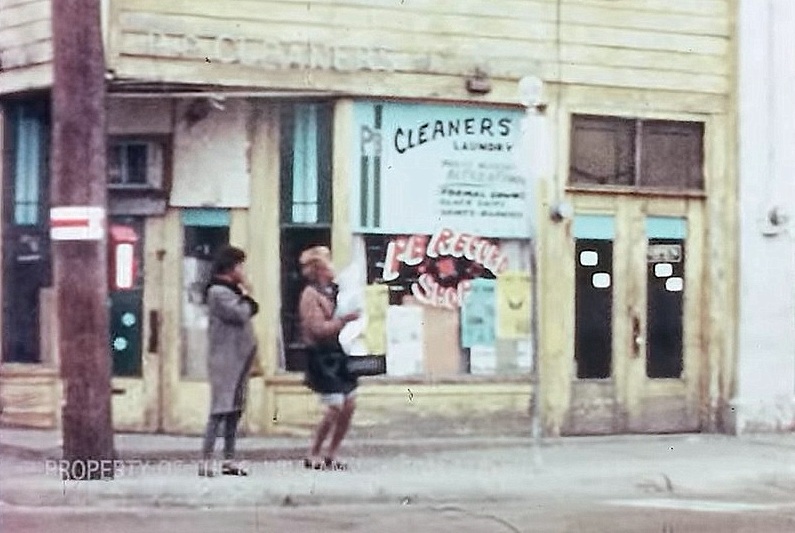
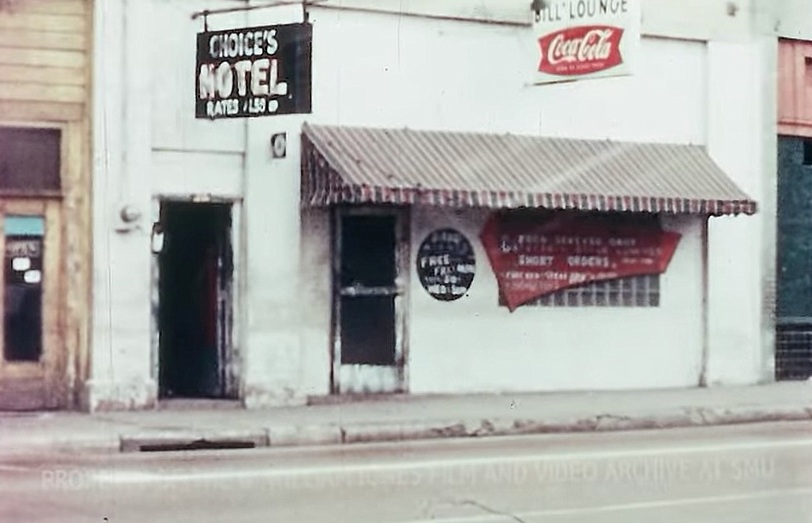
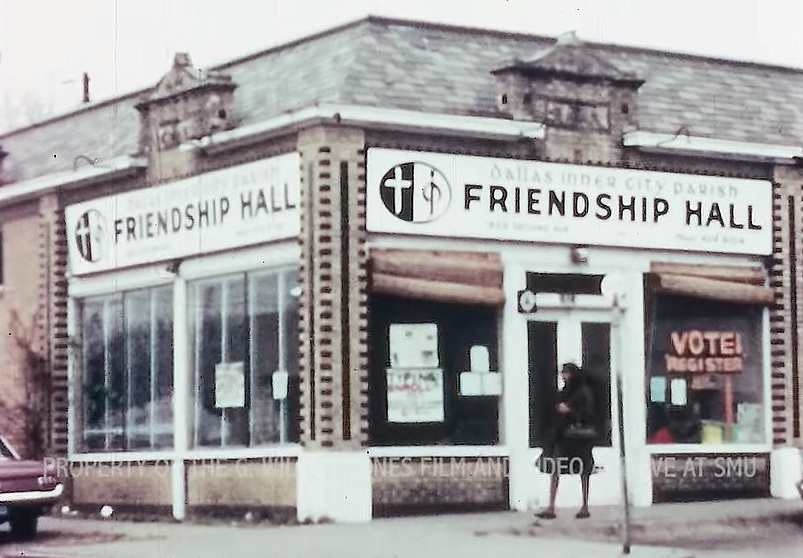
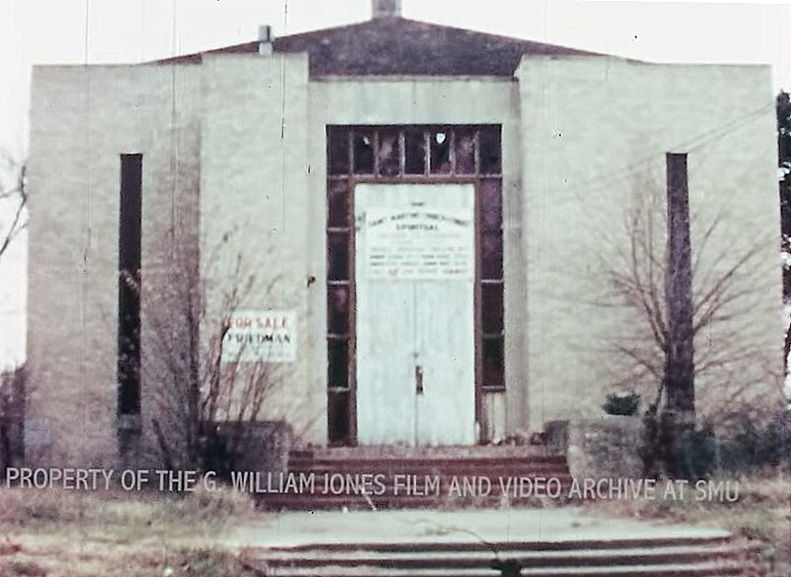
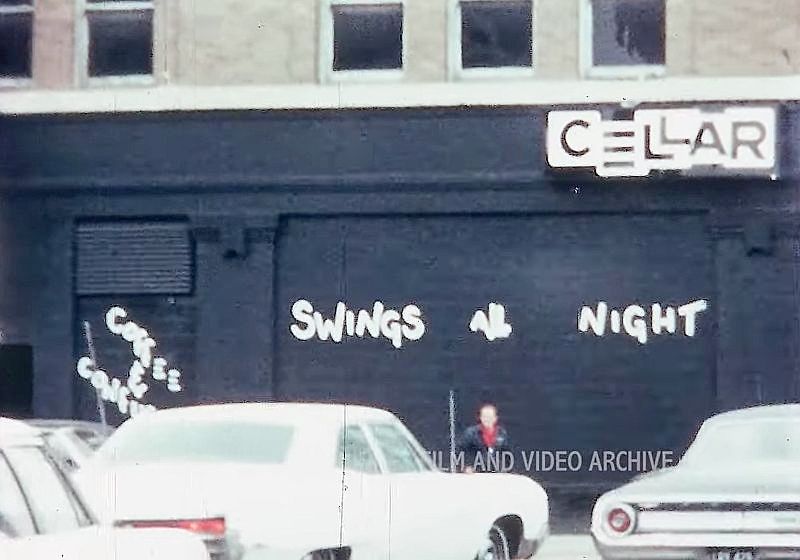
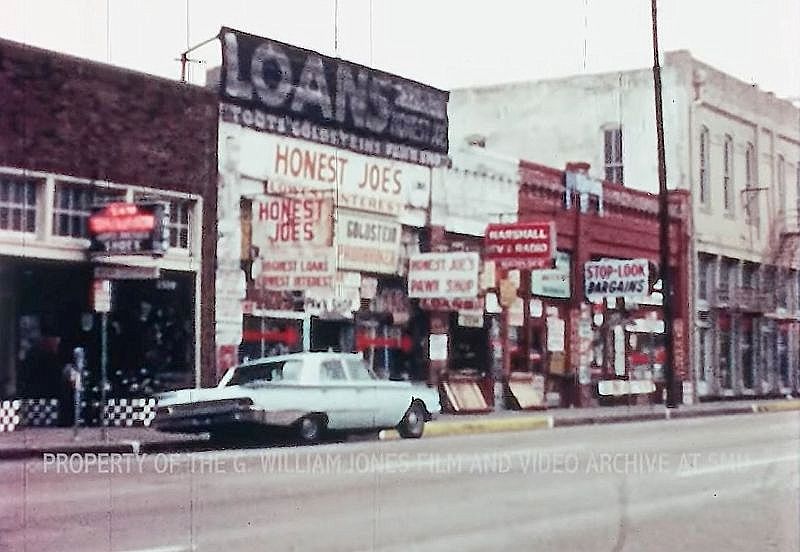
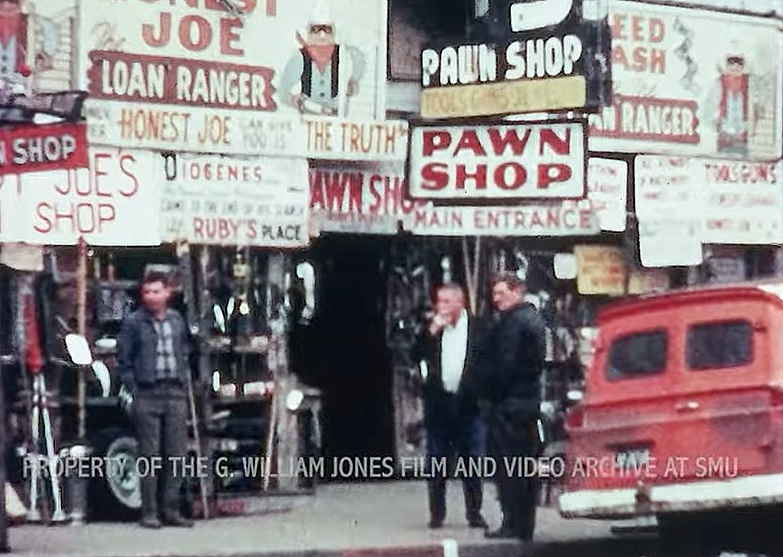
Here are a few things I found when I clicked on something I normally wouldn’t have, but I’m glad I did. These are screenshots from a 20-minute film made in 1969 by SMU’s Perkins School of Theology. (I certainly hope SMU has the original somewhere — or at least a crisper copy — because the quality of this 54-year-old film is, as you can see in these screenshots, pretty low-resolution.) The title of this offering on YouTube is the supremely un-sexy “Perkins School of Theology (SMU) Orientation and Recruiting Film — 1969.”Which is all well and good, but, let’s face it, how many of us would click on that? I wouldn’t! But it was the thumbnail that drew me in — a shot of the Colony Club, the famous burlesque club on Commerce Street. What did that have to do with theology school? I clicked and started fast-forwarding until I found the Colony Club — and it paid off, because I found a bunch of cool shots of places that, for the most part, don’t exist anymore.
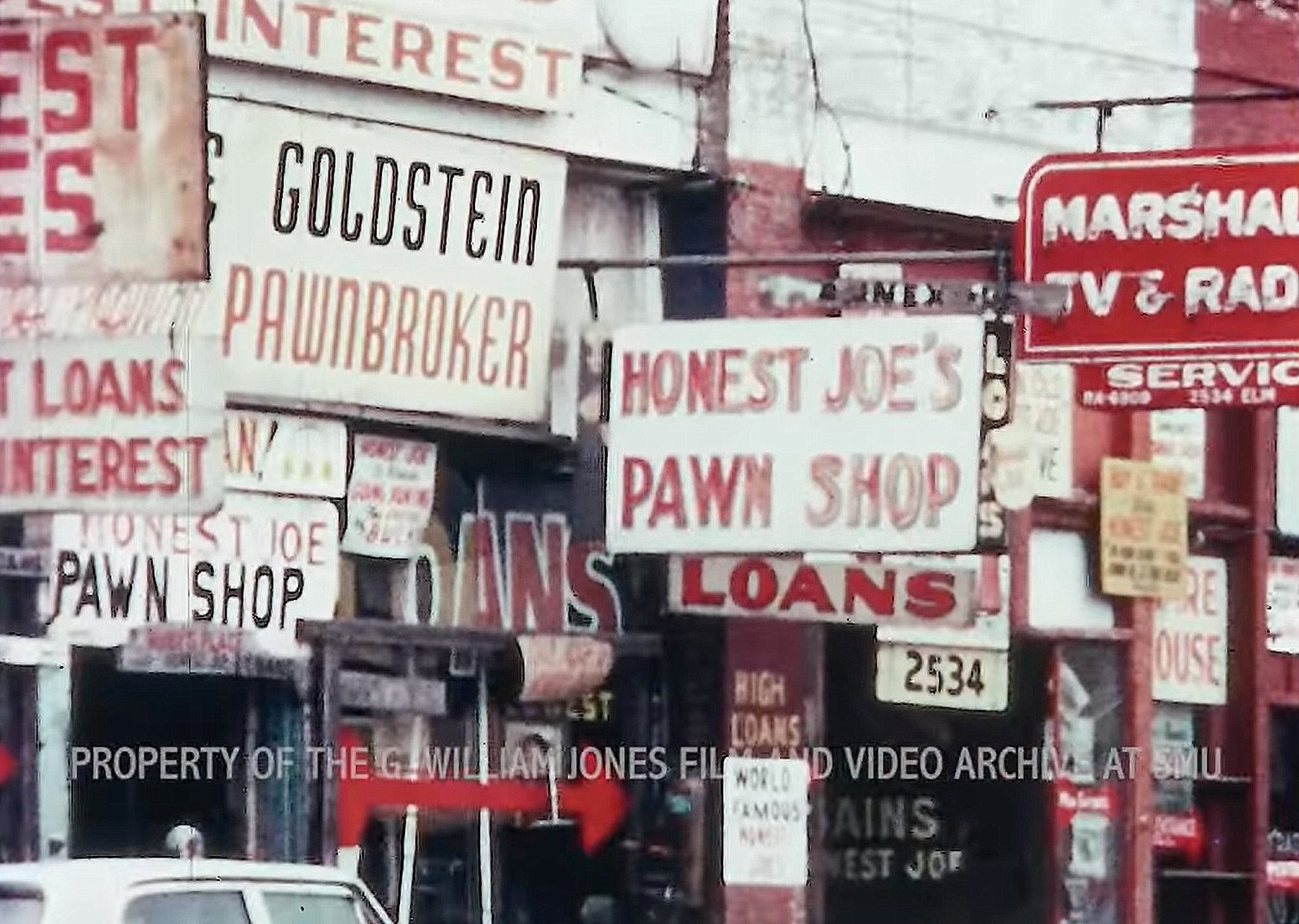
The image above shows one of dozens of pawn shops in Deep Ellum, Honest Joe’s Pawn Shop, owned by Joe Goldstein. (Various Goldstein family members ran a dizzying number of pawn shops in Deep Ellum. I mean a LOT.) In 1969, Honest Joe’s and its adjacent office and warehouse spread from 2516 Elm to 2526 Elm — most of these buildings still stand (see them today, here), but others were torn down to make way for the highway-palooza. (Two more photos of Honest Joe’s are at the end of this post.)
*
The two shots below were in the same block — keep panning right from the P B Cleaners (2700 S. Ervay, at Grand Avenue — now Al Lipscomb Way), and you’ll see Choice’s Hotel and Bill’s Lounge next door. What’s there now? Nothing.
*
This is Friendship Hall (Dallas Inner City Parish), at 1823 Second Avenue. It was one of many businesses and homes condemned by the city and torn down to expand Fair Park and build new parking lots. See where this used to be, here.
*
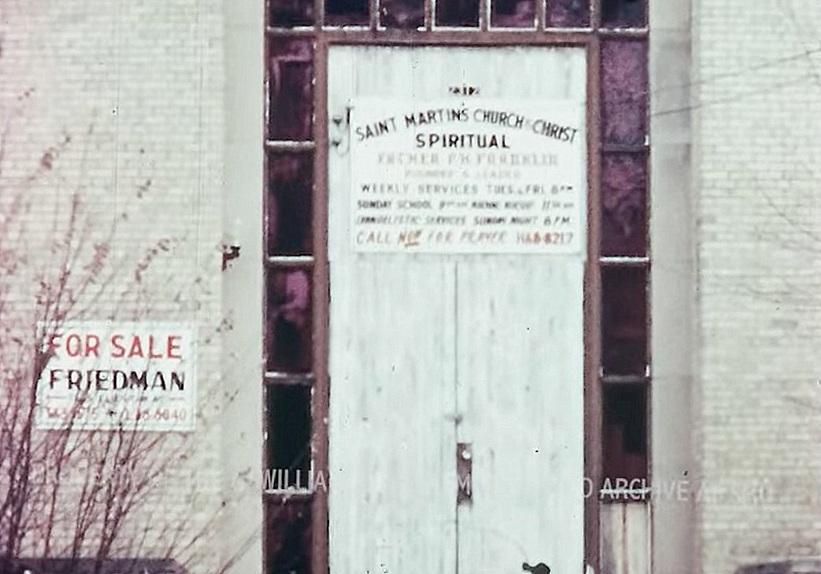
St. Martin’s Spiritual Church of Christ, 2828 Carpenter. This is such an unusual-looking building. It’s gone, but there’s a new church in its place, here.
*
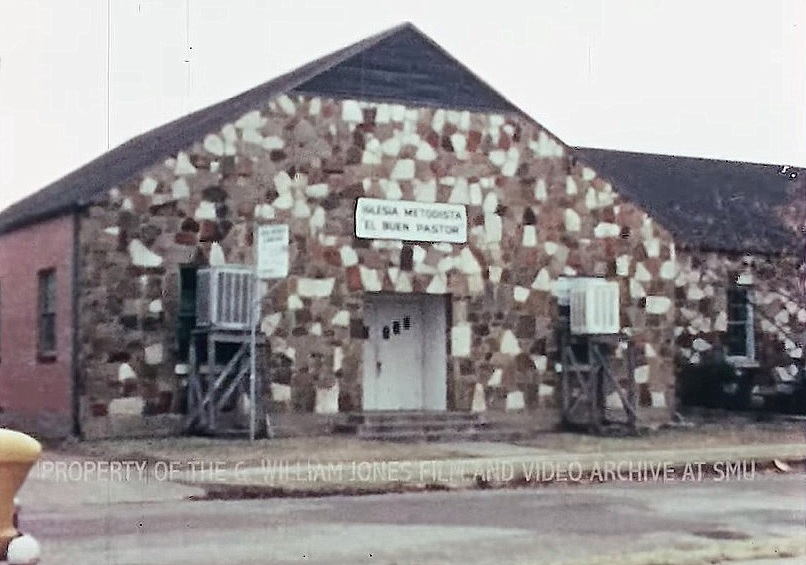
Iglesia Metodista, 1800 Park Avenue (at Beaumont), not too far from Old City Park. Wow, this area (a couple of blocks’ worth, anyway) has been developed way beyond what I would have guessed. The church once stood, I think, in this grassy area.
*
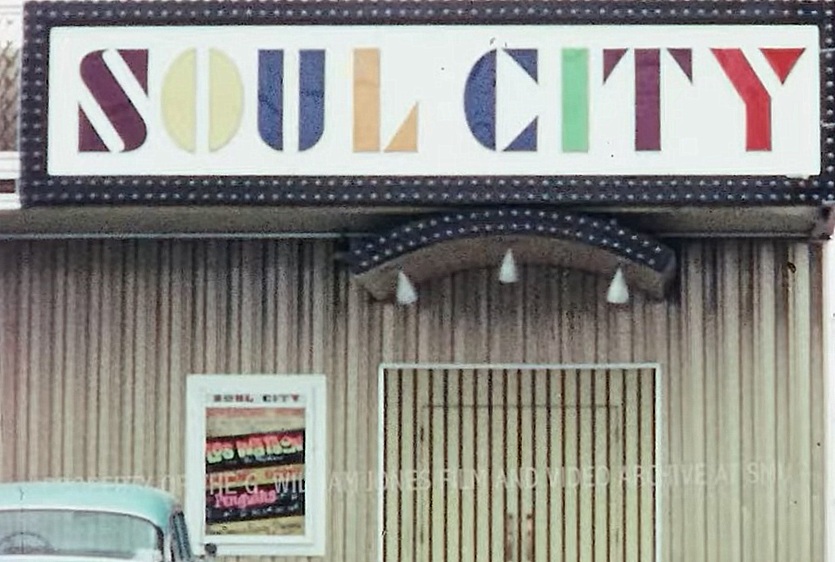
Soul City, 4714 Greenville Avenue, near University Blvd. (you might know it from its recent incarnation as a Vespa dealership). This wasn’t in a “gritty” neighborhood, but it was close to the filmmakers’ home, the SMU campus, and, surely, there were reprobates cavorting inside who could have benefited from a good Methodist sermon. From what I gather, this was a cool place for cool people to see cool bands. The building still stands, here. I don’t think it’s occupied at the moment.
*
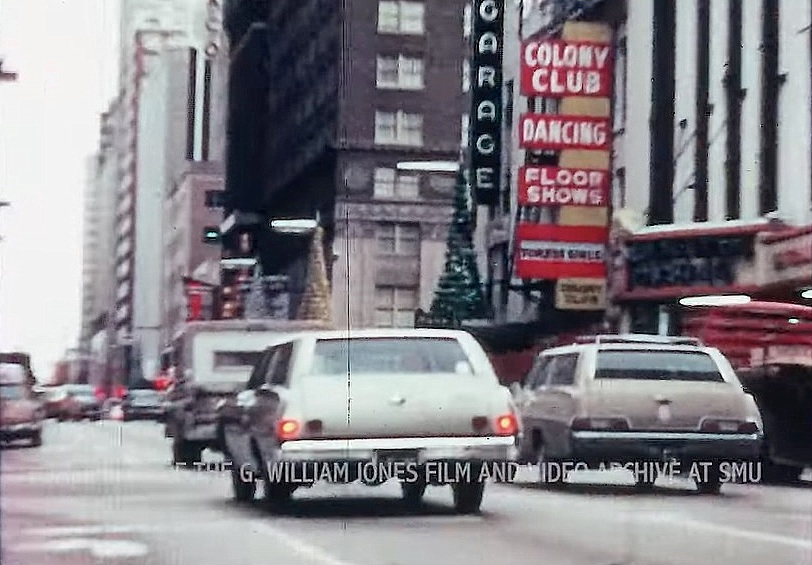
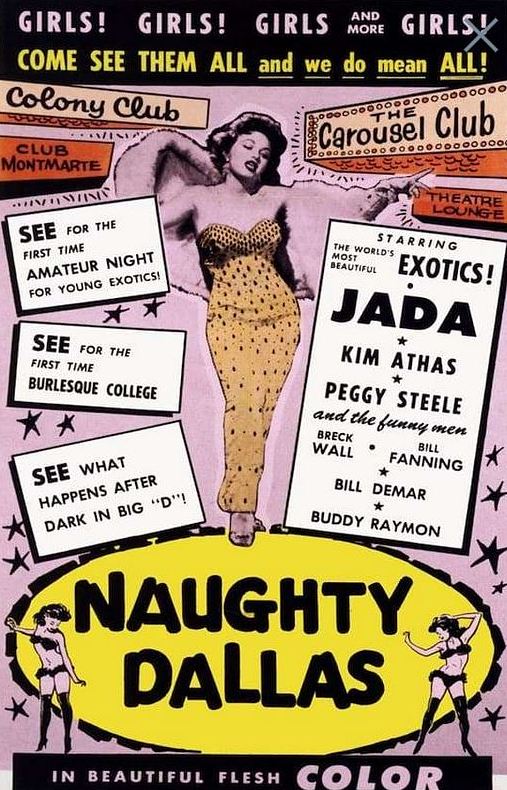
Speaking of reprobates, their Big D mecca for many years was Commerce and Akard, home to all sorts of places you probably wouldn’t book for a Mother’s Day brunch. Clogging up this area at various times were strip joints and dive bars, including the Colony Club, the Theatre Lounge, and the Carousel Club. The Colony Club was at 1322½ Commerce.That whole block (and the one just beyond it — across Akard — home to the Baker Hotel) went bye-bye a long time ago.
*
And, like Soul City, the legendary Cellar was cool, but I’ll bet there were more illicit substances in this downtown “coffeehouse” than in the Greenville Ave. club. “Swings all night.” It stood at 2125 Commerce (at what is now Cesar Chavez). This building appears to be gone.
*
More shots of Honest Joe’s Pawn Shop, which took up a good chunk of the 2500 block of Elm. See what this view looks like today, here (I warn you: do not rotate 180 degrees). I assume the tall white building bit the dust for highway construction. I would have loved to have wandered around that place and chatted with Joe. I bet that guy saw some stuff. Deep Ellum has lost most of its grittiness. It used to be so cool. Thank you, seminary students from 1969, for preserving this for future generations, ’cause in a few years, the place won’t be recognizable.
***
Sources & Notes
All images are screenshots from the film “Perkins School of Theology (SMU) Orientation And Recruiting Film – 1969” — see it on YouTube here. It’s odd. It is from the keeps-on-giving G. William Jones Film and Video Archive, Hamon Arts Library, Southern Methodist University.
If you like this kind of thing, perhaps you will consider supporting me on Patreon. I post something there every day. More info is here.
Occasionally on the Flashback Dallas Facebook page I ask questions, hoping to crowdsource answers — and people on that page know a lot of obscure stuff! I attempted to post the question(s) below on F*cebook, but I apparently crossed some sort of line. I think I used too many “forbidden” words. When I tried to post, the screen froze and ultimately ate my (lengthy) question. *Poof*! So I shall bypass F*cebook and just post it here.
I am looking for anyone who might have first-hand knowledge about the illicit side of downtown Dallas nightlife in the early 1960s. I am particularly interested in the seedier activities which might have been going on in the Baker Hotel. Namely, gambling and prostitution. Please contact me if you worked at the Baker (or the Adolphus) between, say, 1960 and 1964.
I know these activities were going on all around Dallas, but was it common to find illegal card games and prostitution going on inside the swanky hotels? If so, managers – and cops – must have known. Would they have turned a blind eye? Would they have been aware and on the take? Would they have just accepted it as part of the hotel business? I mean, Dallas was/is a huge convention city – this sort of thing must have been everywhere!
Would dancers who performed at the Colony Club have stayed at the Baker or Adolphus? They seem kind of ritzy for people in that line of work. Would management have cared if strippers stayed in their hotels? Would there have been a higher tolerance for more discreet “call girls” than your average run-of-the-mill prostitute? (I don’t mean to suggest that dancers were prostitutes, but, since I’m typing this, was it known that prostitution connected with the Colony Club or Carousel Club was going on?)
There is an amusing Dallas Morning News article titled “Officer Says Syndicated Crime Doubtful in Dallas” (DMN, Oct. 8, 1963) in which a vice cop proudly proclaims organized crime just doesn’t really exist in Big D. That seems highly unlikely, but I’m not even talking about big-time crime – more like high-stakes poker games with local high-rollers and pimping done by small-time operators. How common would it have been for this sort of thing to be going on in Dallas’ two most upscale hotels?
If you worked at the Baker Hotel in the early ’60s — or if you were employed by the Dallas Police Department at that time – or if you, yourself, were a participant in the seedier side of Dallas nightlife and spent significant time hanging around Commerce & Akard doing naughty things! – please comment below or send me an email at FlashbackDallas214@gmail.com.
This has nothing to do with the assassination, even though it’s the same time-period and there is undoubtedly a lot of overlap. But, seriously: NOTHING TO DO WITH YOU-KNOW-WHAT.
Thanks!
–Paula
***
Sources & Notes
Poster of “Naughty Dallas” (directed by cult Dallas director Larry Buchanan) found somewhere on the internet.
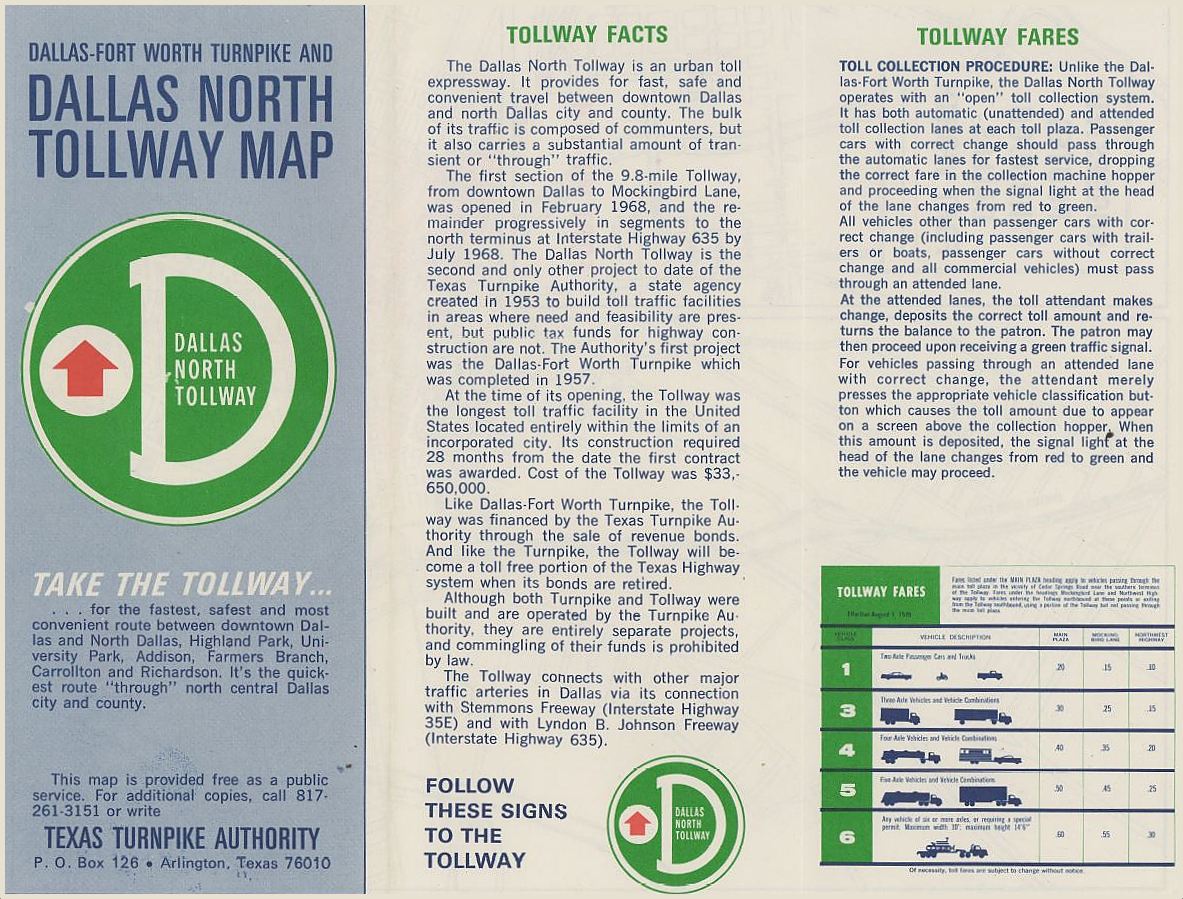
The Dallas North Tollway opened in stages, as stretches were completed. The first bit of its 9.8 miles opened in February 1968, and it was fully open by June 1968. From downtown to LBJ. Am I crazy, or does that seem incredibly fast?
On its opening day, an ecstatic Texas Turnpike Authority official told reporters, “People love it to death.” Which is something you don’t hear said everyday about a toll road.
When one speaks of the tollway, one often muses to oneself, “Shouldn’t this thing be paid off by now?”
Here’s what the Texas Turnpike Authority assured taxpayers back then in that Summer of Love:
Like Dallas-Fort Worth Turnpike, the Tollway was financed by the Texas Turnpike Authority through the sale of revenue bonds. And like the Turnpike, the Tollway will become a toll-free portion of the Texas Highway System when its bonds are retired.
Unbelievably, the DFW Turnpike DID become a “free” highway, but I think we all know that will never happen again. But, just for an amusing tidbit to toss around at your next smart cocktail party, here’s when that was supposed to happen (from the final paragraph of a very comprehensive Dallas Morning News overview of the history of the tollway):
If the traffic keeps going up and coincides with projections, the tollway may become part yours — as a Texas citizen — on Jan. 1, 2005. That’s when the last bond payment is due. (DMN, June 2, 1968)
I guess the important word there was “may.”
I don’t really have any nostalgia connected with the tollway, but I do kind of miss hurling a fistful of change at that basket.
***
Sources & Notes
Dallas North Tollway brochure (1972) is from the Southwest Collection Maps, Special Collections Library, Texas Tech University — it can be downloaded here.
The very informative article referenced above is “Dallas North Tollway: A Long Road is Ending” by Jimmie Payne (Dallas Morning News, June 2, 1968).
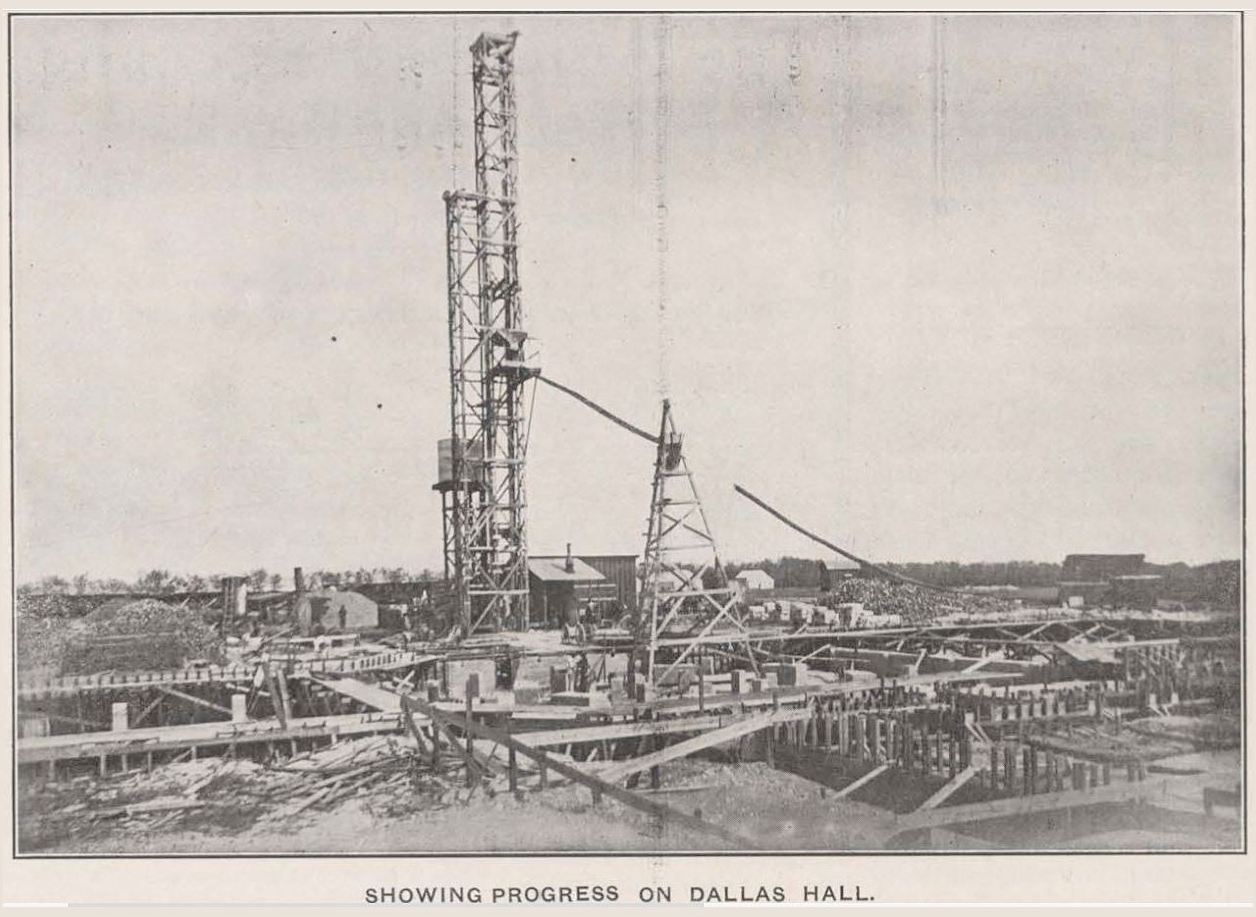
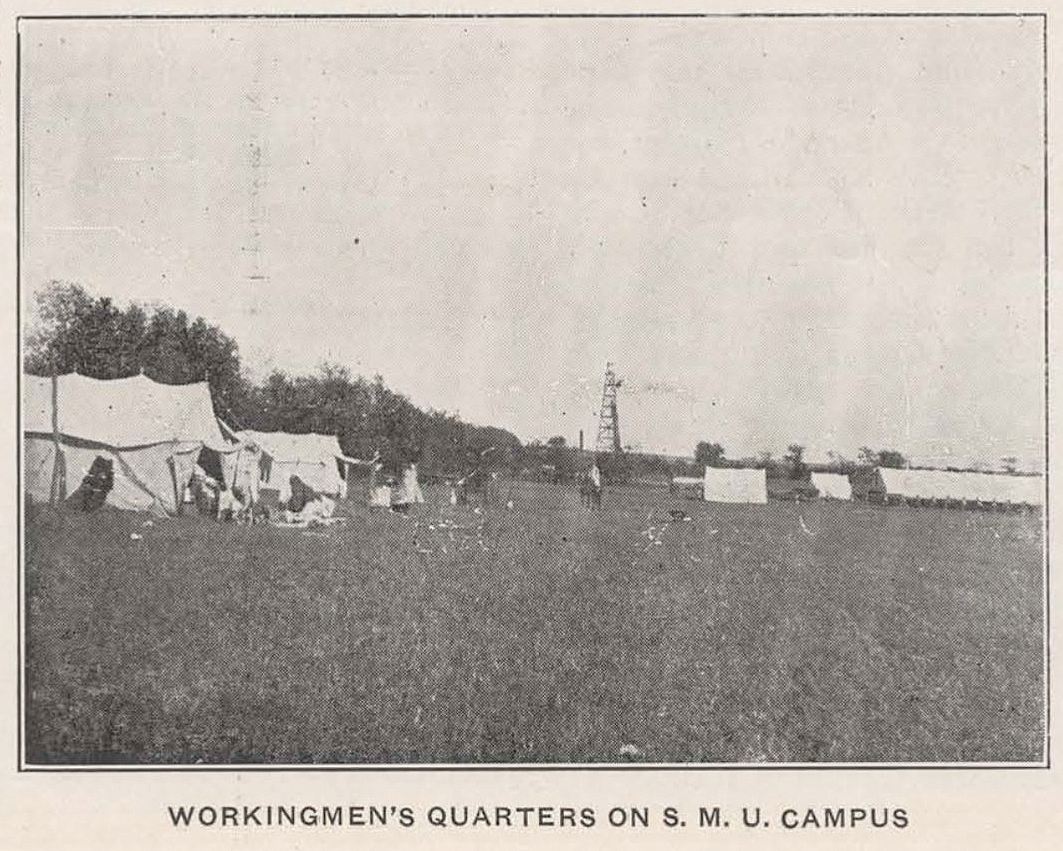
I can’t even remember what I was looking for in the SMU Libraries database when I stumbled across a collection of magazines/newsletters called The Campus, from 1912-1914. It’s pretty dry reading, but they appear to be updates sent out to moneyed Methodists who were actively working on raising funds for construction of the new Southern Methodist University in Dallas. There are the occasional interesting ads (especially for the Methodist-owned real estate which surrounded the campus and would soon generate substantial moolah) and progress reports on the construction of the first building, the magnificent Dallas Hall. Here are a few of the photos.
“Showing progress on Dallas Hall” (1912) — this is great:
“Workingmen’s quarters on S.M.U. campus” (1912) — this is greater (tents! — is that a horse in there?):
“Dallas Hall — as it appears today” (1913):
And finally, all shiny and ready to open for business (1915):
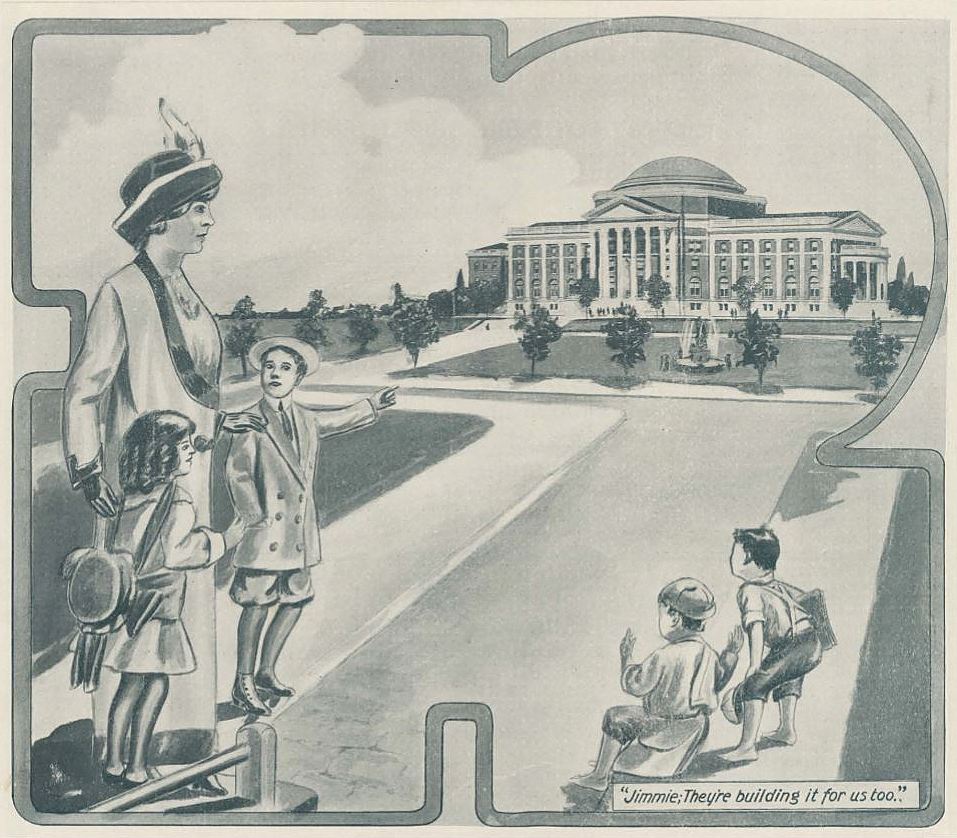
Lastly, an architectural drawing, which I’d like to think construction workers might have glanced at occasionally to make sure everything was going in the right place — like dissectologists using the lid of a jigsaw puzzle box. (Incidentally, $300,000 in 1912 was equivalent to about $9.5 million in today’s dollars. I think it might have ended up costing more by the time it was finished.)
***
Sources & Notes
All images are from various issues of The Campus, all of which may be accessed on the SMU Libraries site here; (DeGolyer Library, SMU Libraries, SMU Archives, Southern Methodist University).
See a couple of great photos of Dallas Hall under construction: domeless, and mid-dome (DeGolyer Library).
Other Flashback Dallas posts on the very early years of SMU:
This post originated in a post I made last week on my Patreon page, which I update daily. If you would like to subscribe to that page for as little as $5 a month, please hie yourself over there!
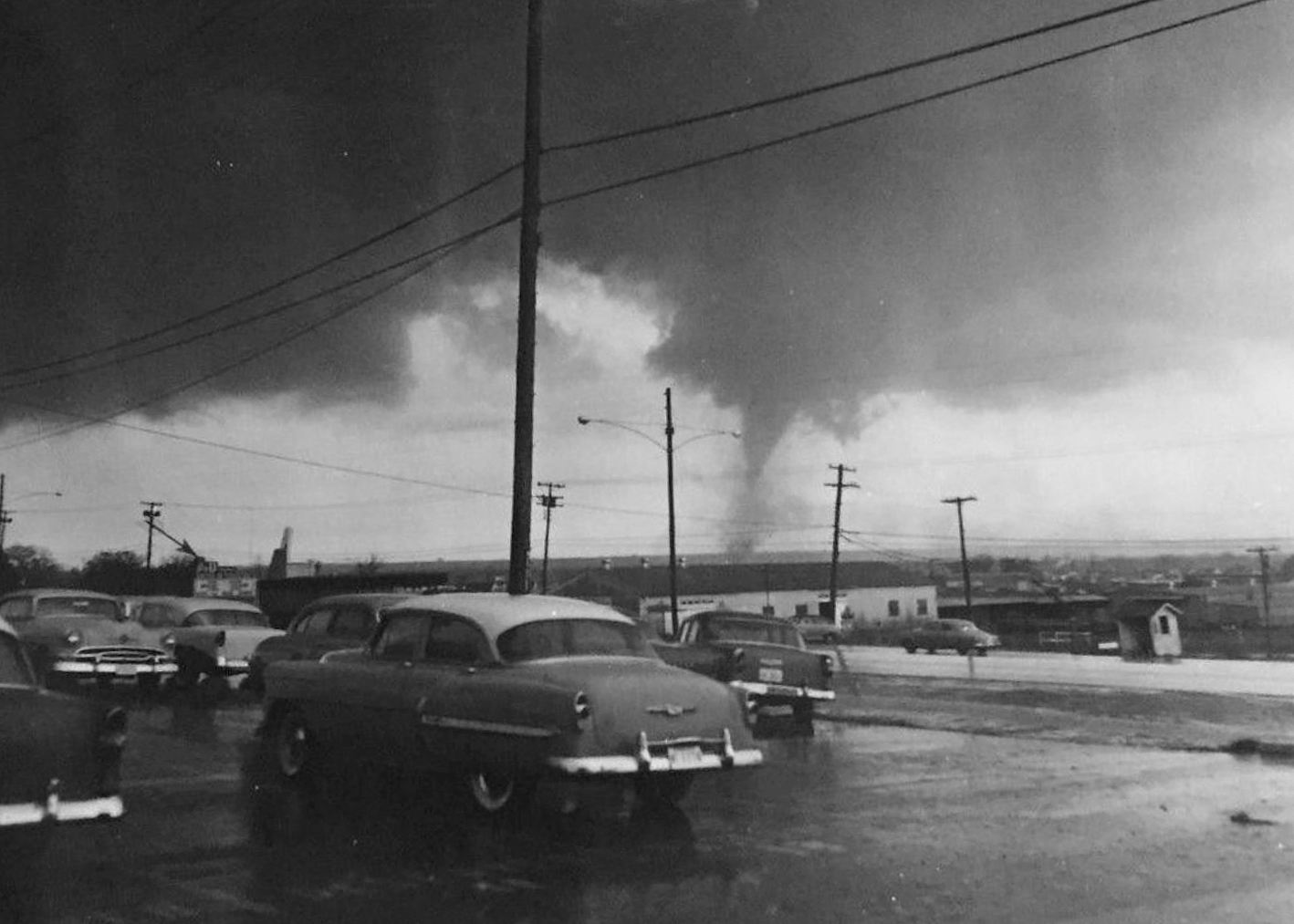
A few photos of the infamous April 2, 1957 tornado which hit Dallas and was, at the time, the most photographed tornado in history. See more photos (and film footage) in the 2014 Flashback Dallas post “Tornado as Learning Tool — 1957.”
***
Sources & Notes
All four photos were sold as one lot on eBay several years ago.
In addition to the post linked above, here are a few other tornado-related posts:


 Dallas Morning News, Dec. 17, 1911 (click to read)
 DMN, Mar. 7, 1912
 DMN, Aug. 25, 1912
 Dallas Historical Society, 1912
 April 1912
 April 1912
 Linz Bros. Jewelers (Lang & Witchell, 1940)
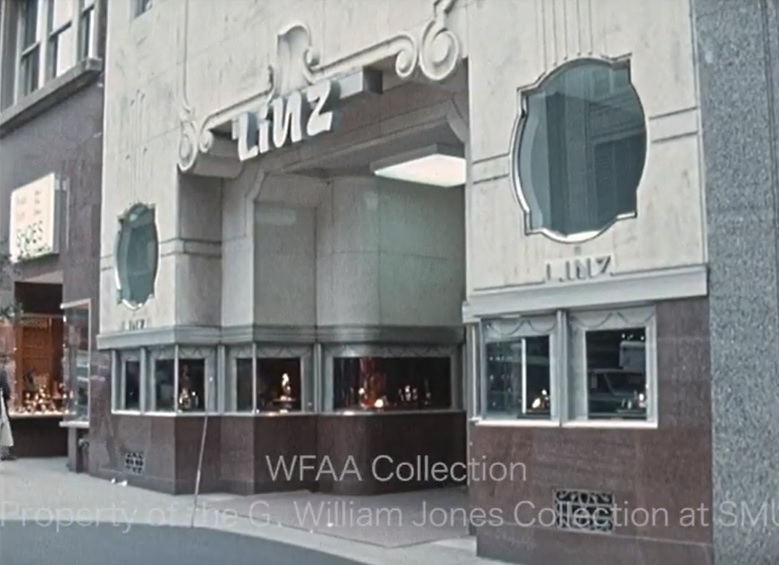 WFAA-Channel 8 News, Jan. 1970 (Jones Film Collection, SMU)
 WFAA-Channel 8 News, Jan. 1971 (Jones Film Collection, SMU)


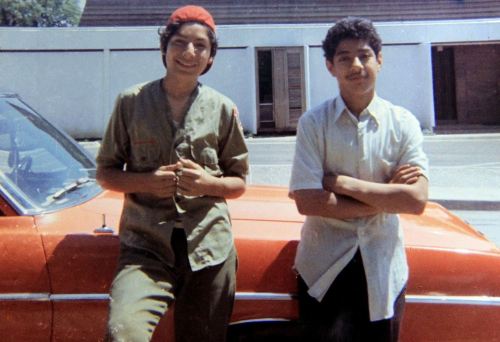 Brothers David and Santos Rodriguez
 Sad and gloomy, yearning for restoration (2007)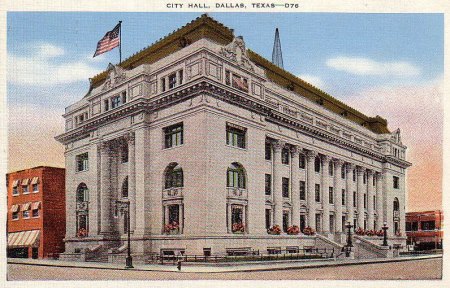




 Head north, young man…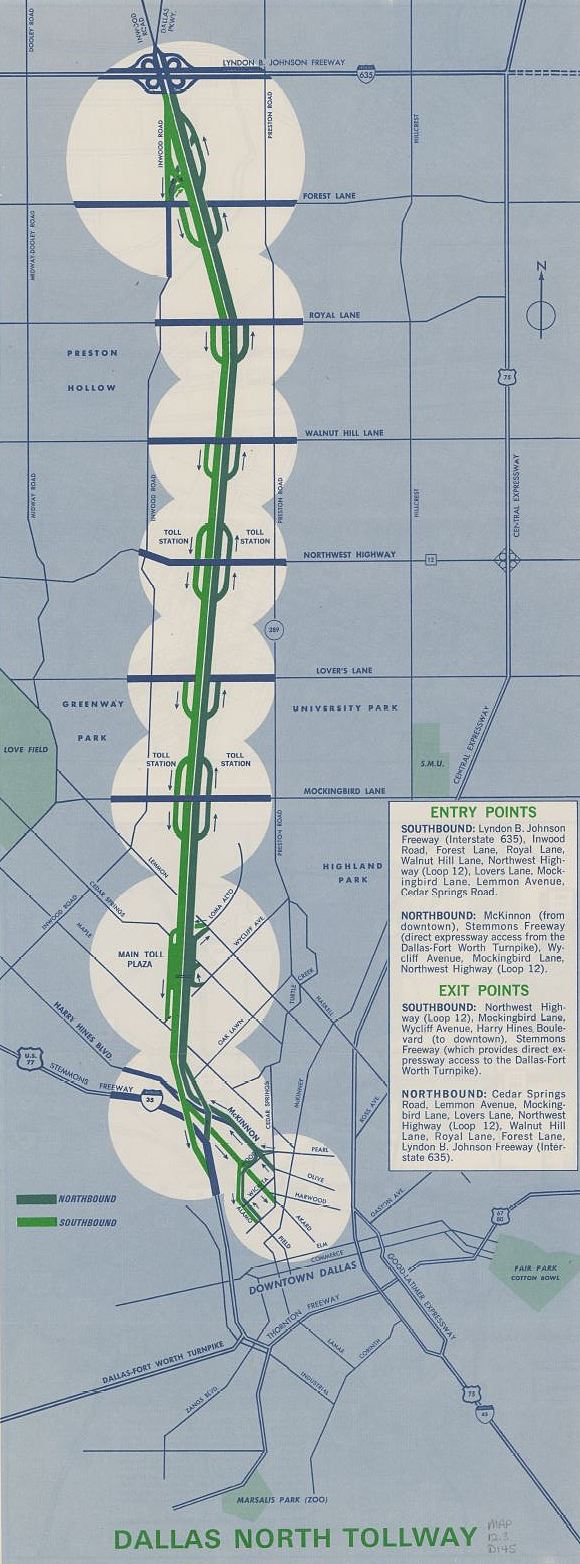




 Flashback : Dallas