The bright lights of Christmas in downtown Dallas…
by Paula Bosse
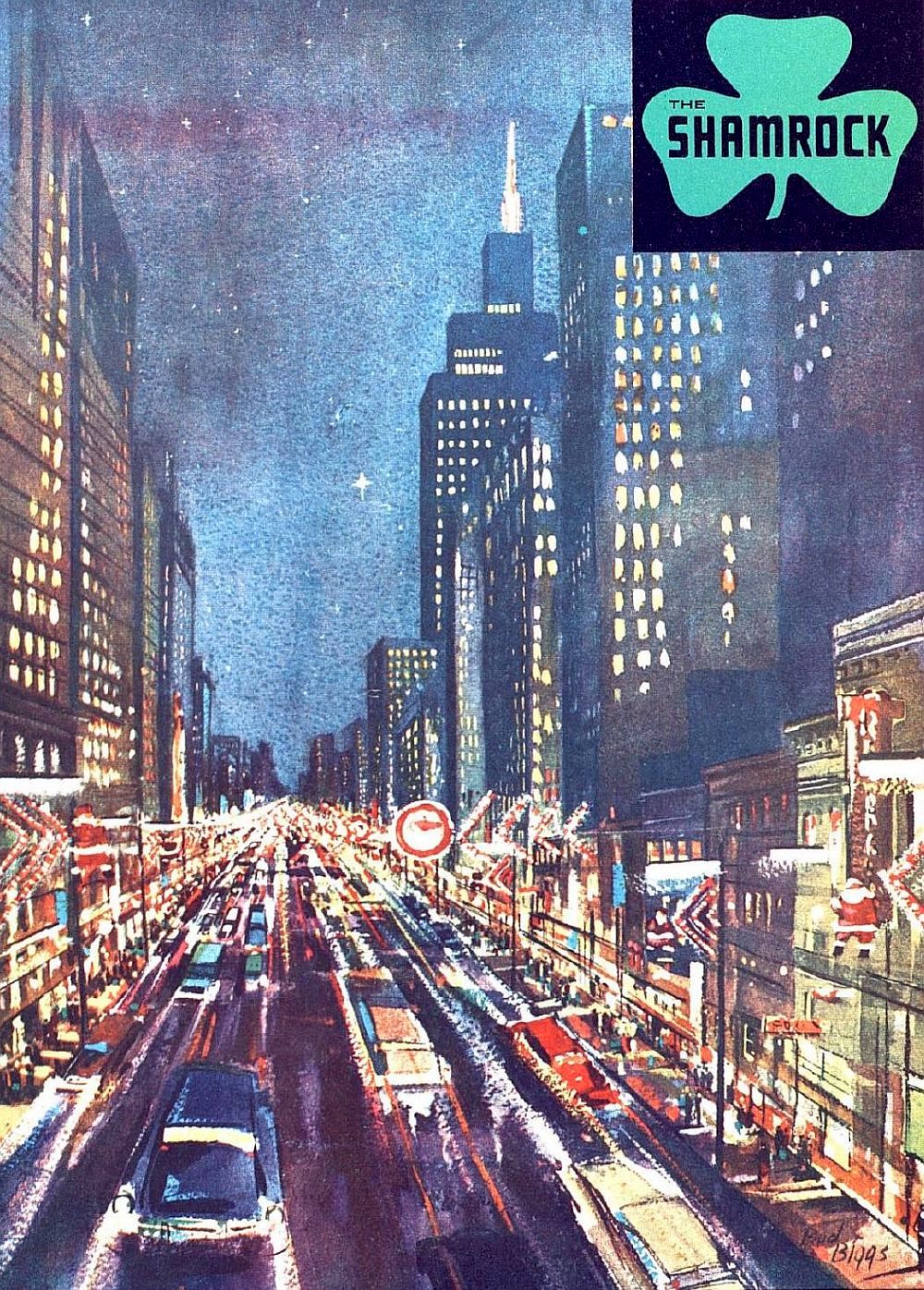
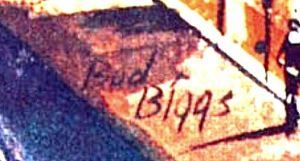
An evening in downtown Dallas at Christmastime — alive with traffic and lights and energy — by Dallas artist Bud Biggs.
The painting appeared on the cover of the Christmas, 1959 issue of The Shamrock, a magazine published by the Shamrock Oil and Gas Corporation. The magazine’s description:
On the sidewalks, shoppers dart to and fro. On the street, autos dash by, leaving streaks of light in their haste. Gay lights and laughing Santas swing gayly overhead, festooning the area in a holiday glow. Above all this man-made madness, stars twinkle in contrast, reflecting a serenity reminiscent of a night nineteen hundred years ago. This is what The Shamrock staff sees in this vivid water color of Downtown Dallas at Christmastime by Artist Bud Biggs.
Merry Christmas and Happy Holidays to all!
***
Sources & Notes
This work by artist Bud Biggs appeared on the cover of the Christmas, 1959 edition of The Shamrock; this magazine is part of the Southwest Collection, Special Collections Library, Texas Tech University — the entire issue has been scanned and may be viewed as a PDF here.
My guess is that the title of the original painting is “Main Street, Christmas Night” and that it was one of the 12 paintings produced by Biggs in the mid 1950s as cover art for Dallas Magazine, a Dallas Chamber of Commerce publication. These paintings of Dallas scenes appeared as cover art for the monthly issues of 1956, in honor of the city’s centennial. The series won the “Best Covers of 1956” award from the American Association of Commerce Publications, and in 1958 all 12 of the original watercolors were purchased by Southwest Airmotive Company to be displayed in their new Love Field terminal. The 12 covers featured Biggs’ depictions of the following Dallas scenes and landmarks:
More on this series of paintings can be found in the Dallas Morning News article “Art & Artists: Biggs Series Bought by Firm” by Rual Askew, Feb. 20, 1958.
Dallas native Bancroft Putnam “Bud” Biggs (1906-1985) attended Forest Ave. High School, SMU, and the St. Louis School of Fine Arts. He was primarily a commercial artist, working first for Dallas artist Guy Cahoon before opening his own advertising studio. He produced fine art as well, specializing in watercolors, and was a respected art instructor.
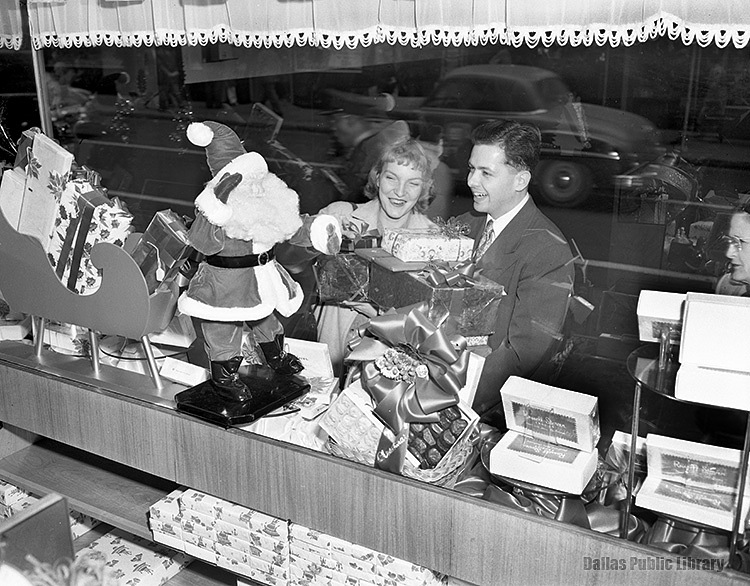
Here are a couple enjoying a Christmas display. Haven’t finished your shopping? There’s still time!
***
Sources & Notes
Taken on Dec. 16, 1950, this photo is from the Hayes Collection, Dallas Public Library Dallas History & Archives Division, Dallas Public Library (“[Christmas storefront shoppers],” PA76-1/43.3).
More Flashback Dallas posts on Christmas can be found here.
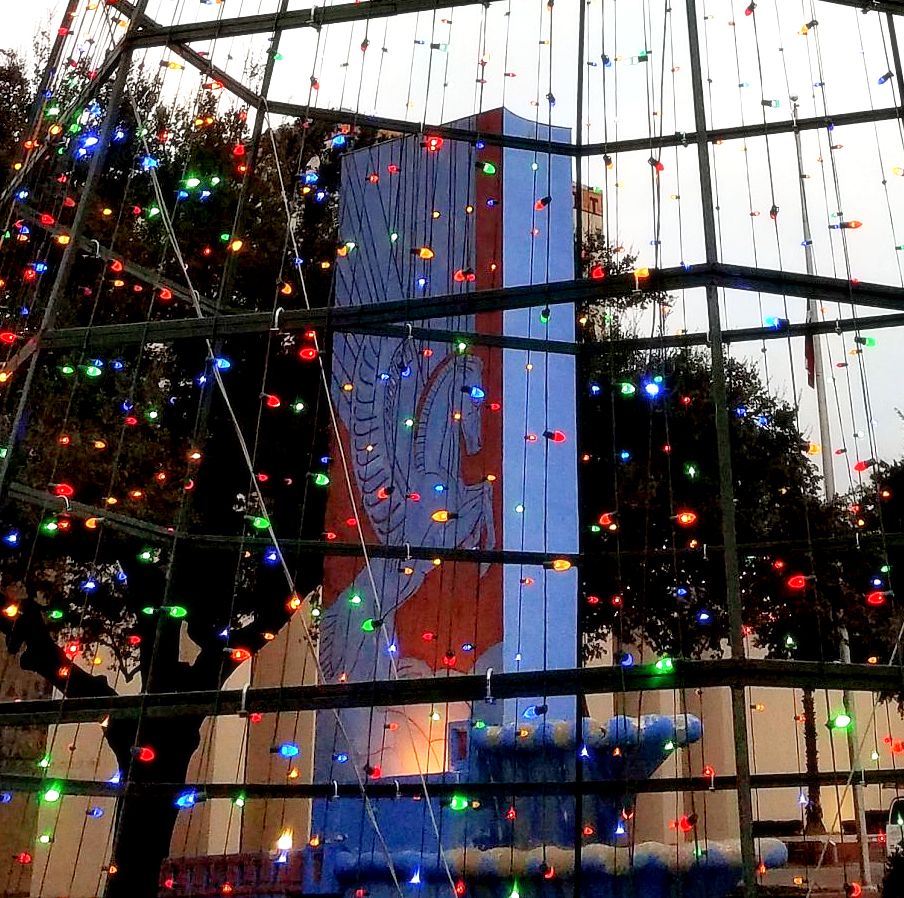
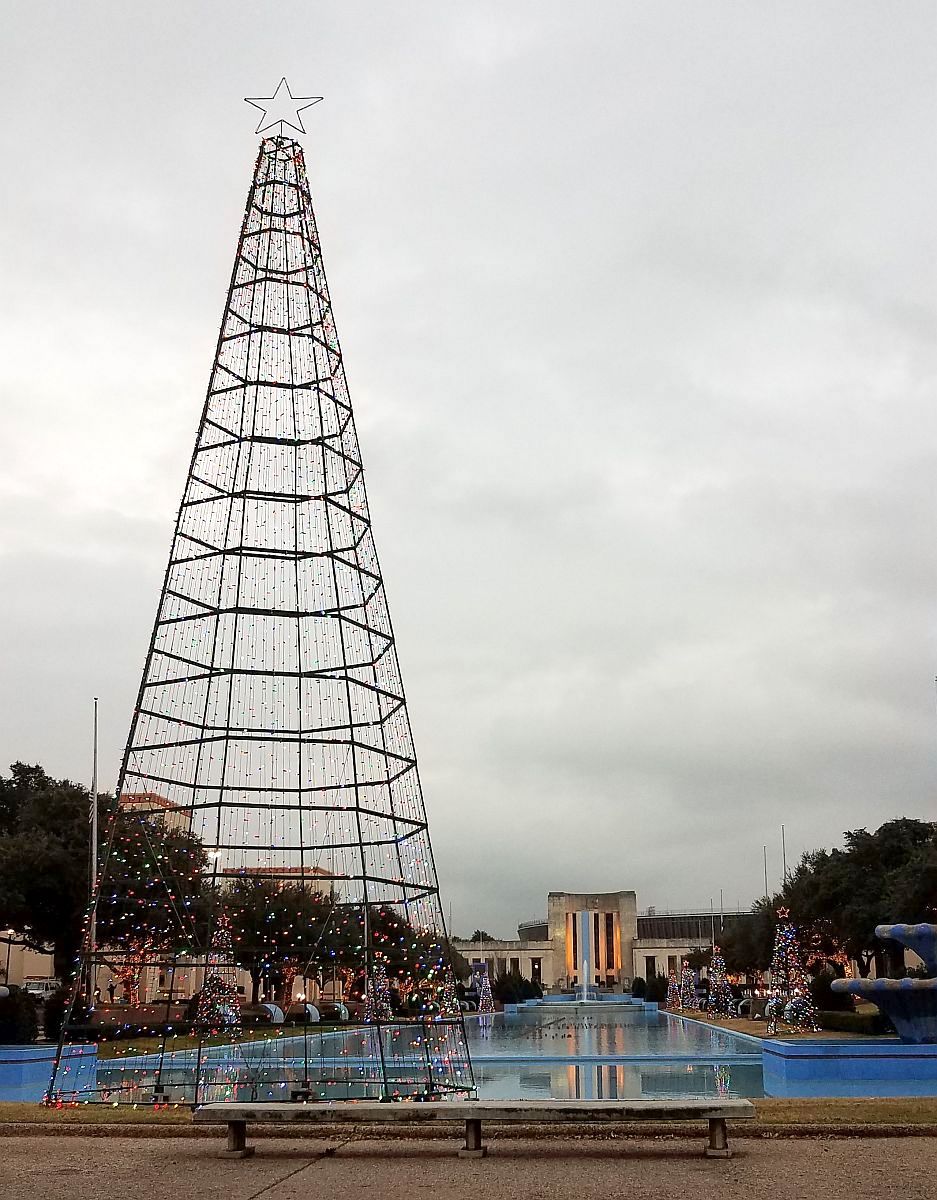
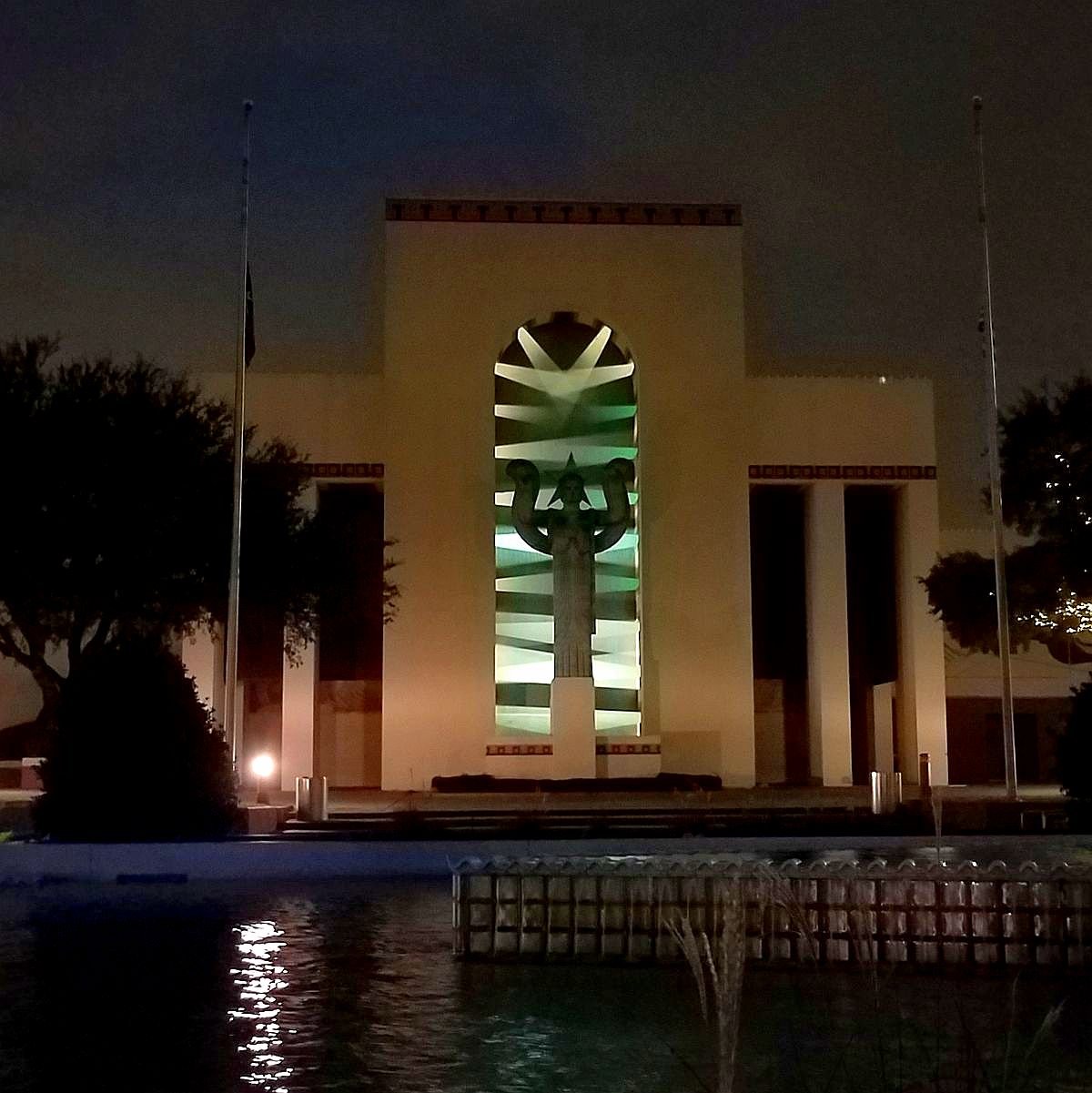
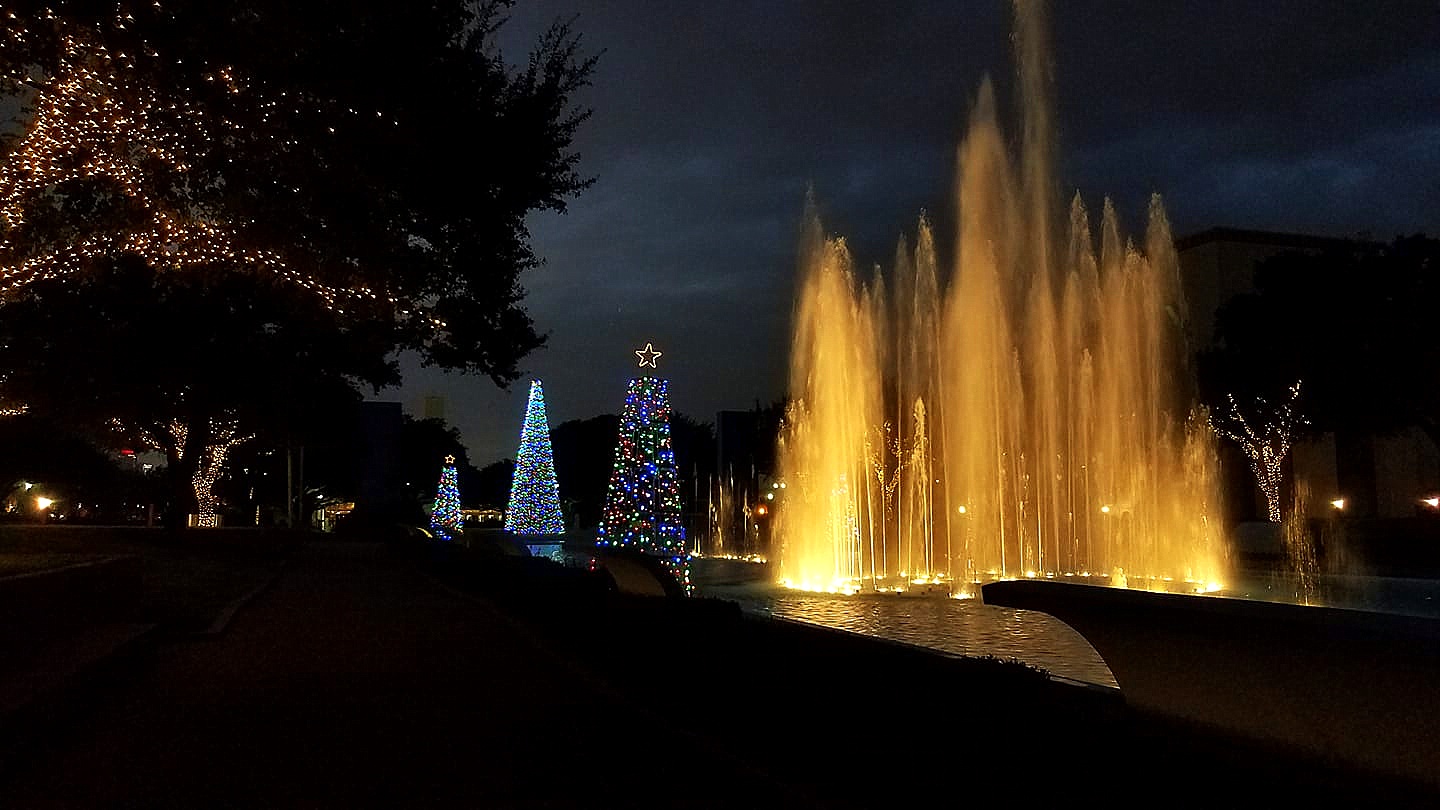
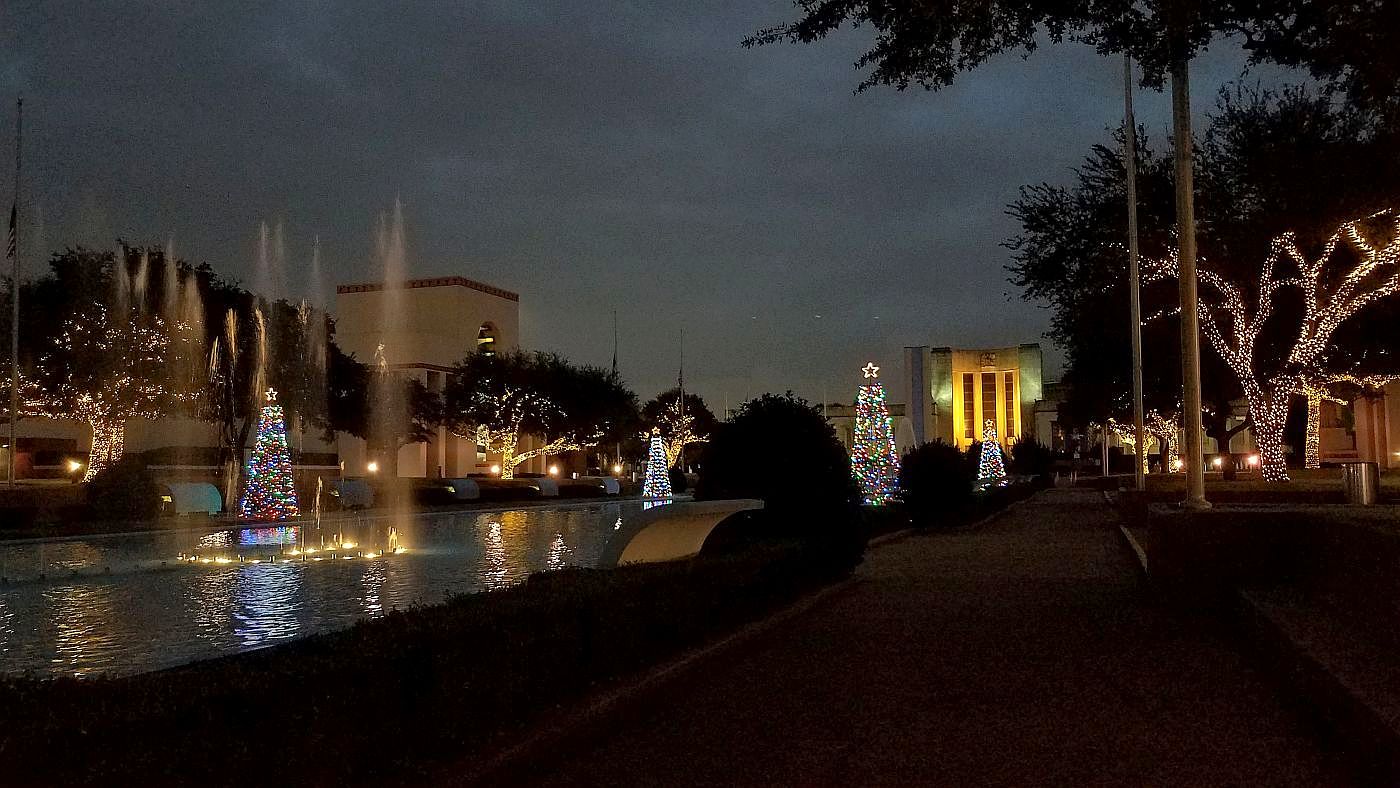
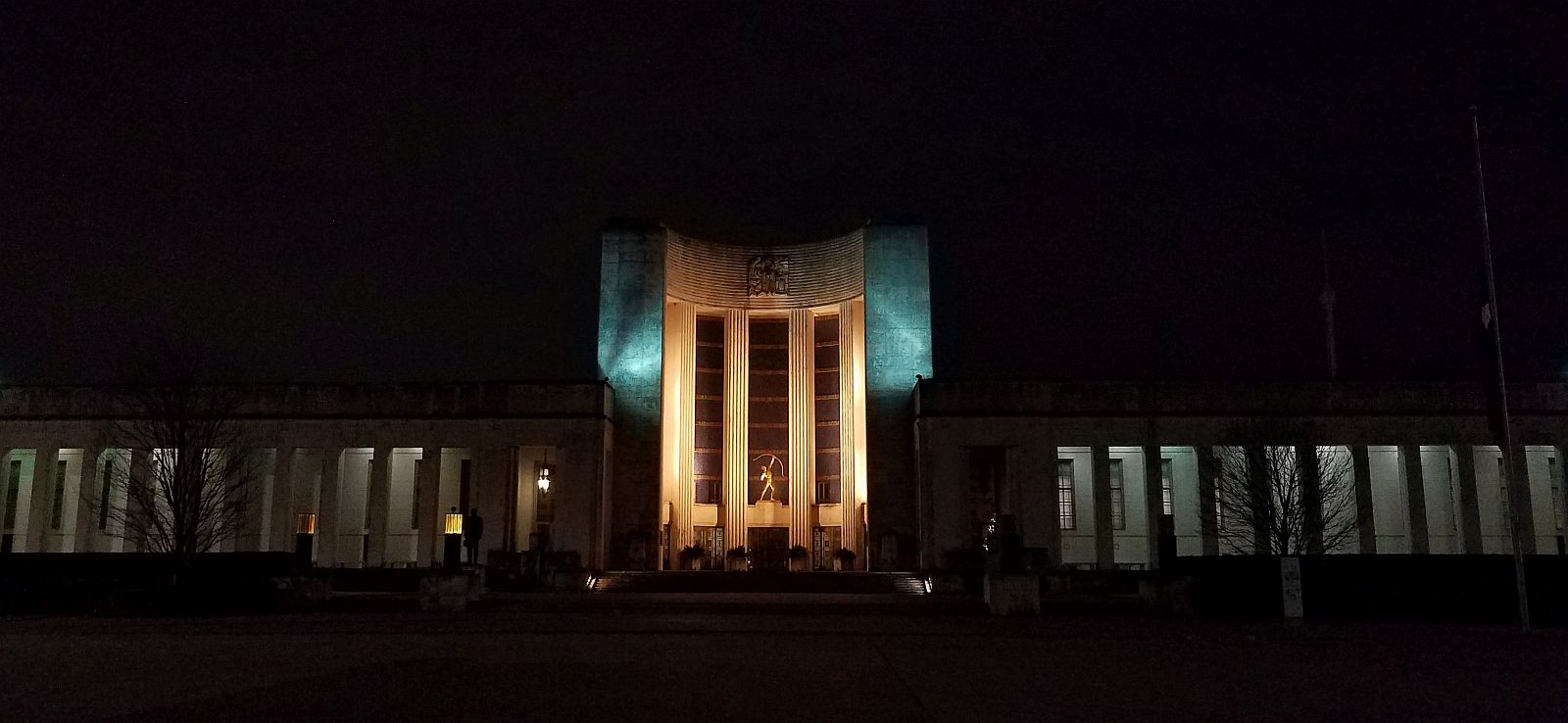
The holiday lights and “dancing waters” of the Esplanade in Fair Park are always worth a visit. I took these photos the other day after doing some volunteer research at the Dallas Historical Society, based in the beautiful Hall of State. I’m particularly fond of dusk, but nighttime is the really the time to see the lights and fountains at their best.
Above, the Pegasus pylon, by French artist Pierre Bourdelle, one of the many artists who worked on the Centennial Exposition in 1936, the year the Esplanade and many of the buildings in Fair Park were built. (All photos are larger when clicked.)
Below, a look toward the Hall of State from the end of the Esplanade.
One of the six sculptures along the Esplanade, this one represents Texas, by artist Lawrence Tenney Stevens:
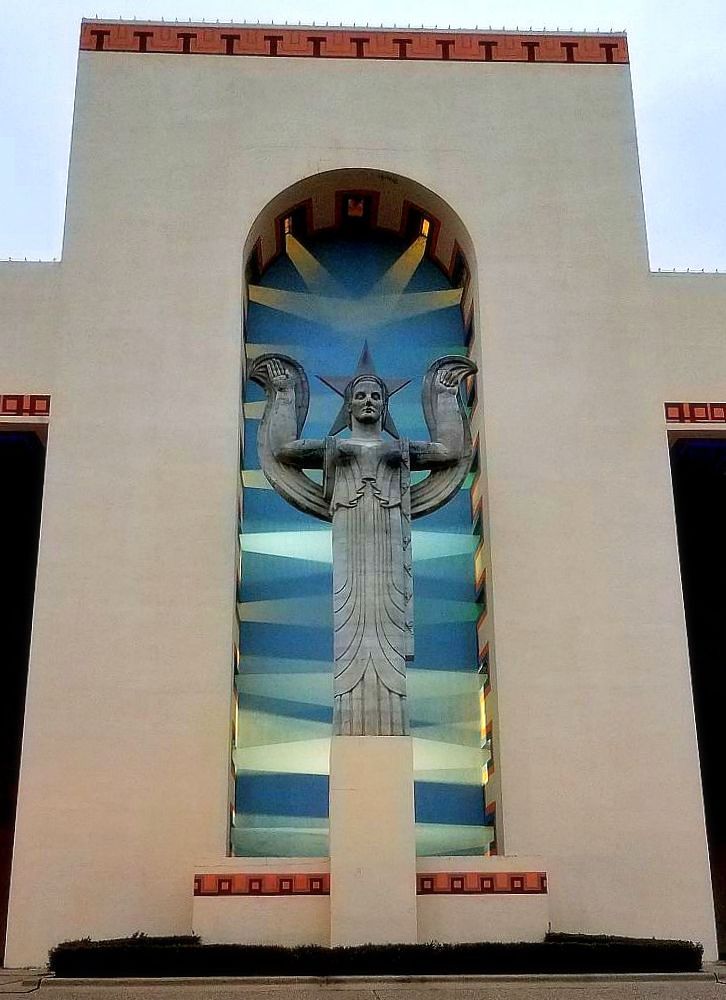
The Automobile Building with the statue representing France, by French sculptor Raoul Josset:
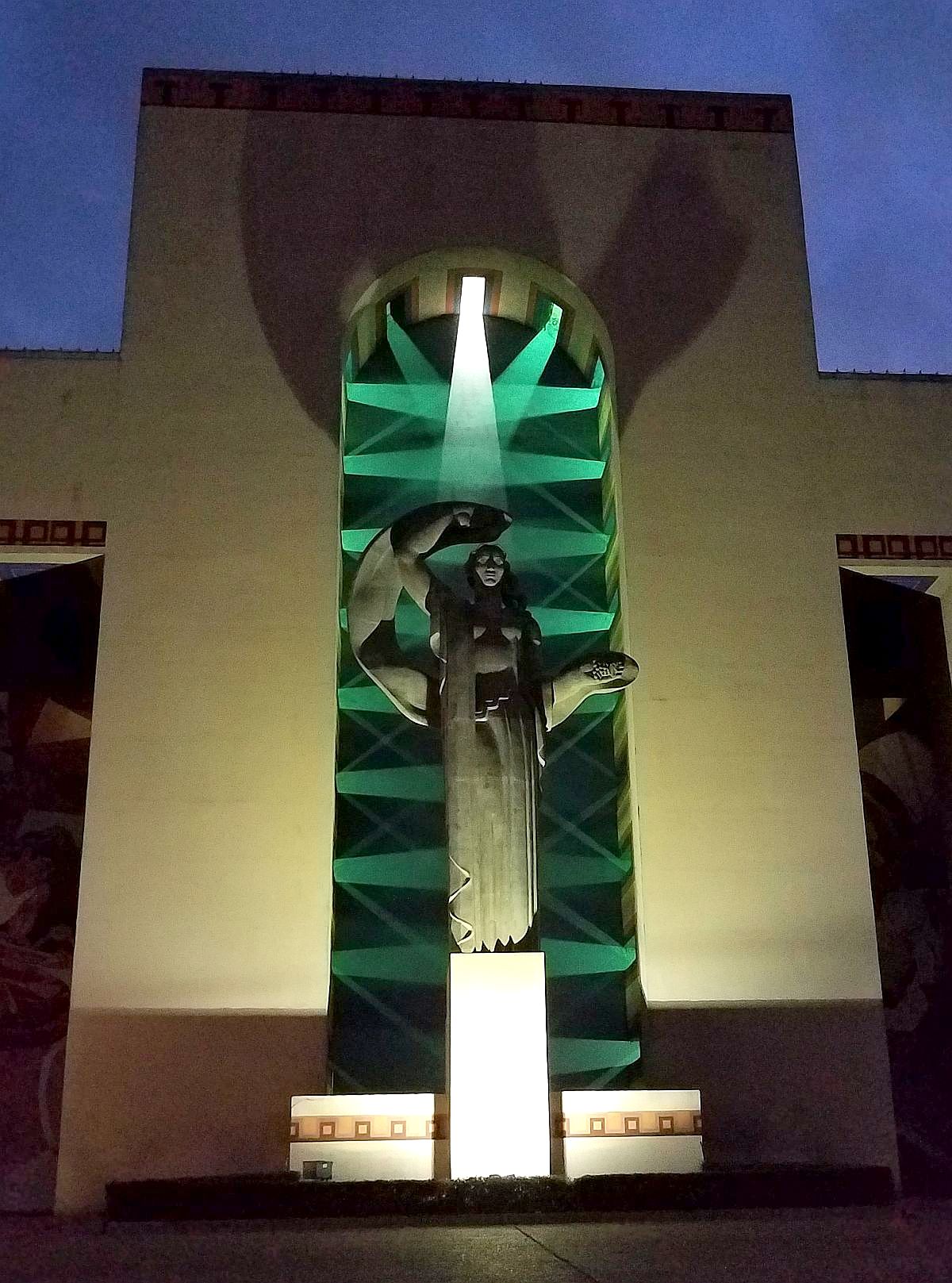
A closer look, after the sun has gone down, showing the impressive lighting design:
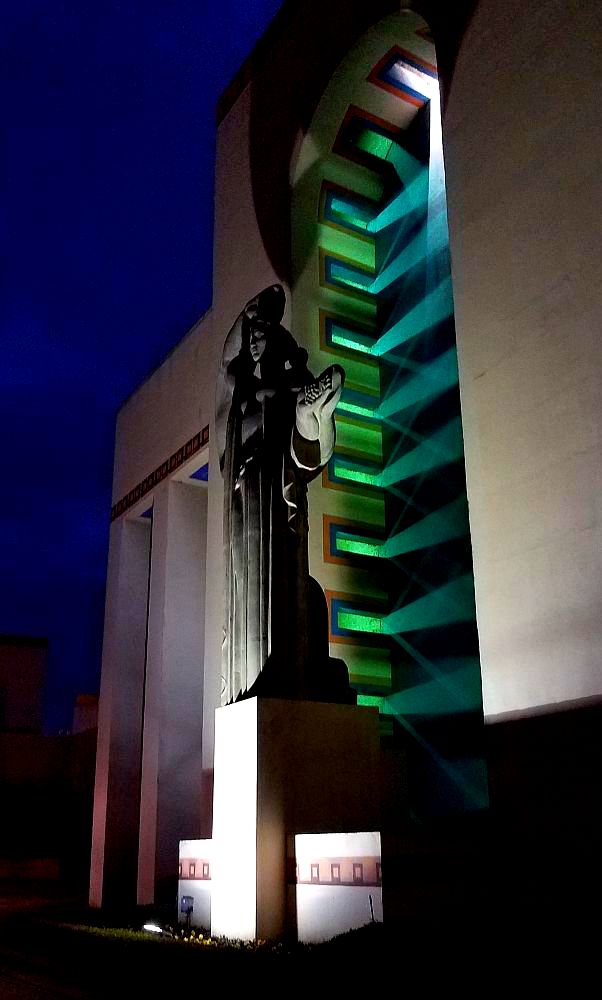
Impressive even from the side:
“Texas” again, lit up and in silhouette:
The illuminated “dancing waters”:
Another view toward the Hall of State:
The jewel of Fair Park, the Hall of State:
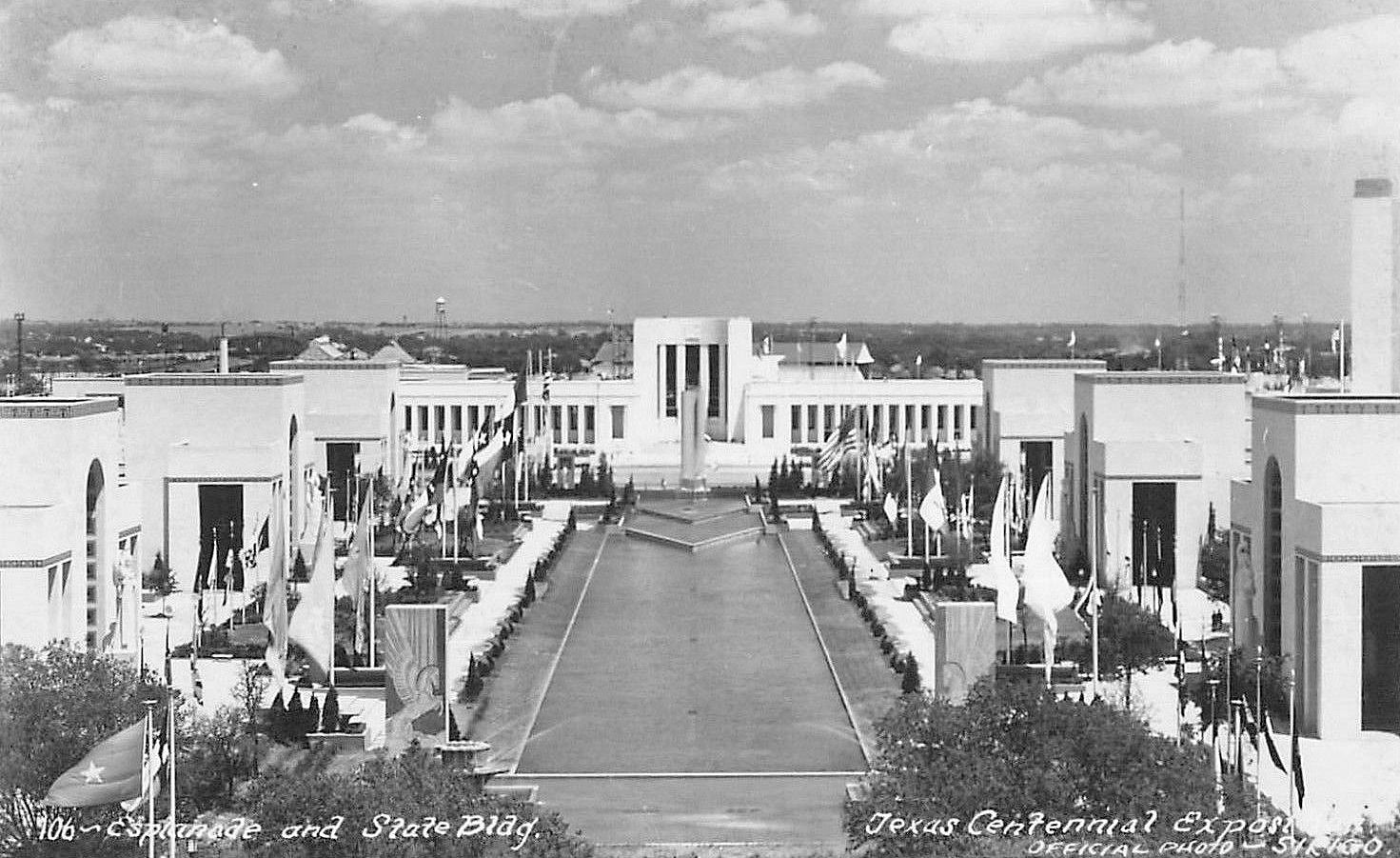
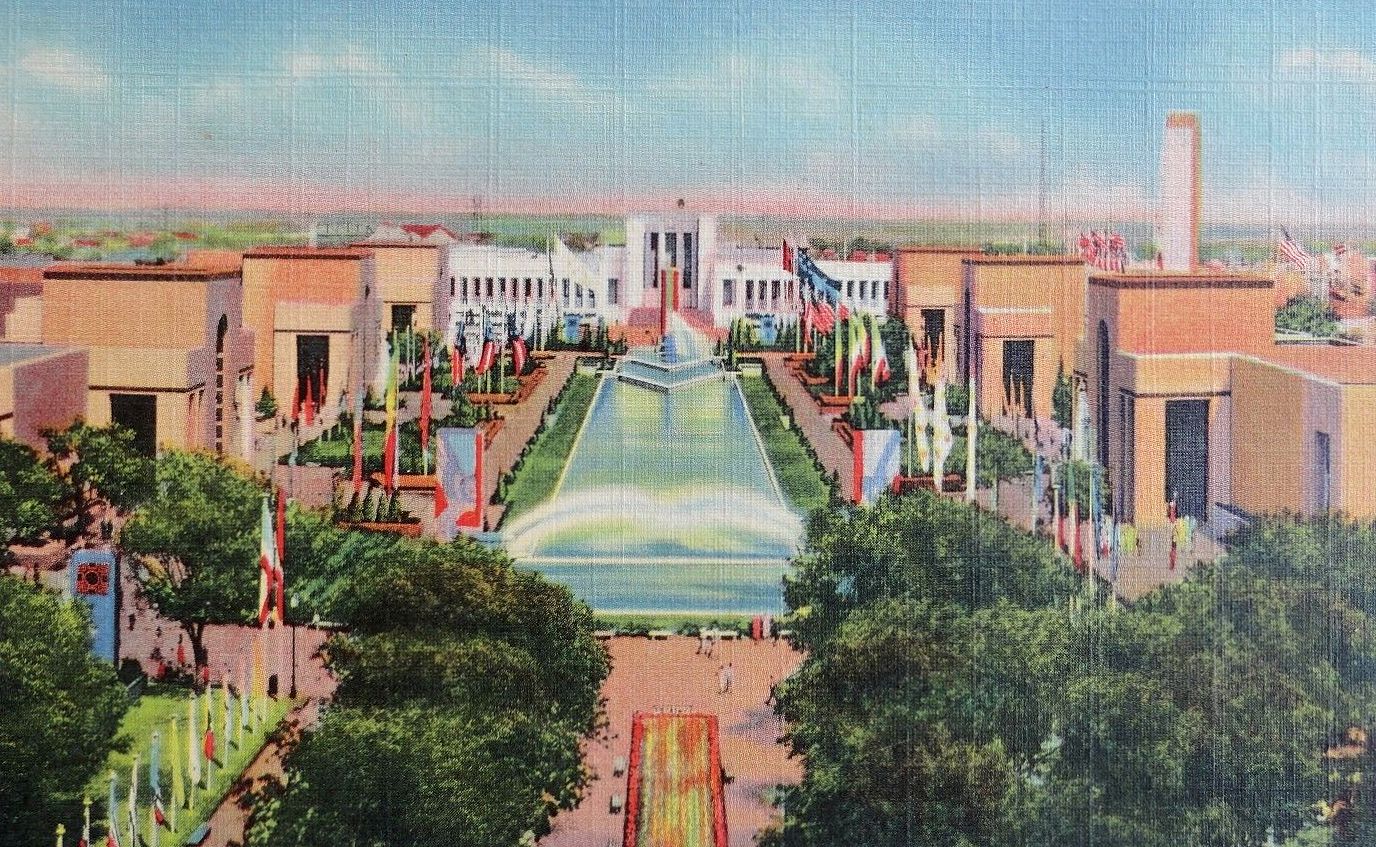
Below are two images of the Esplanade from 1936, when all of this was brand new:
***
Sources & Notes
All photos by Paula Bosse.
More information on the statues along the Esplanade can be found at the French Sculpture Census page highlighting “Fair Park, 1936” here, and “The Six Ladies of Fair Park” page from the Texas Escapes site, here.
A very large aerial photo of Fair Park from 1936 can be seen here. Zoom in on the Esplanade.
More Flashback Dallas posts about Christmas can be found here.
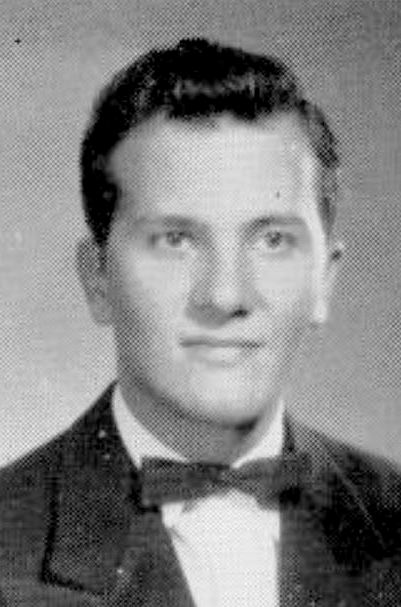
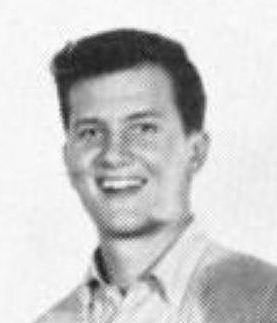
“Handsome teen-ager” Pat Boone, host of WBAP’s “Teen Times”
by Paula Bosse
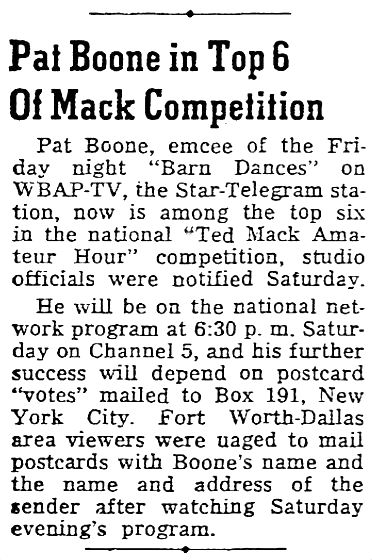
In January, 1954, soon-to-be pop-star Pat Boone transferred from a college in Nashville to North Texas State College (now the University of North Texas) in Denton — he was 19 years old and recently married with a baby on the way. An entertainer since childhood, he had recently appeared on (and won) Ted Mack’s nationally televised “Amateur Hour” and had a few minor recordings under his belt. He entered the Denton college in the middle of the school year, majoring in speech and minoring in music.
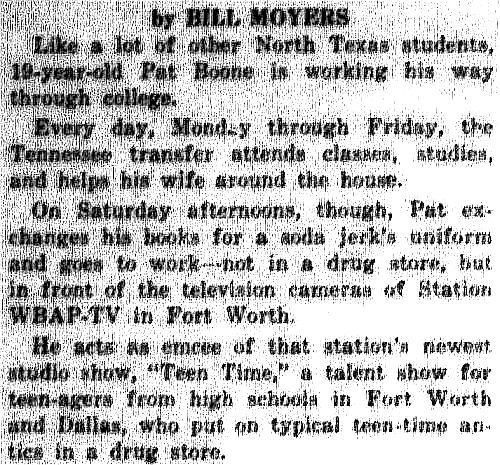
In an interview with the college newspaper, The Campus Chat, student reporter Bill Moyers (yes, that Bill Moyers) asked the scrupulously clean-cut Boone what career he saw for himself. His answer: “I want to preach on Sundays at churches that can’t afford pastors, and perhaps I’ll even become a full-time pastor.” He said that even though he had devoted years to being an entertainer and his father-in-law was a bona fide star, he did not envision a career as a professional singer because, for one reason, he did not approve of night clubs, on moral grounds: “I don’t want to sing at night clubs, and that’s where most of the singers do much of their work” (Campus Chat, Feb. 24, 1954).
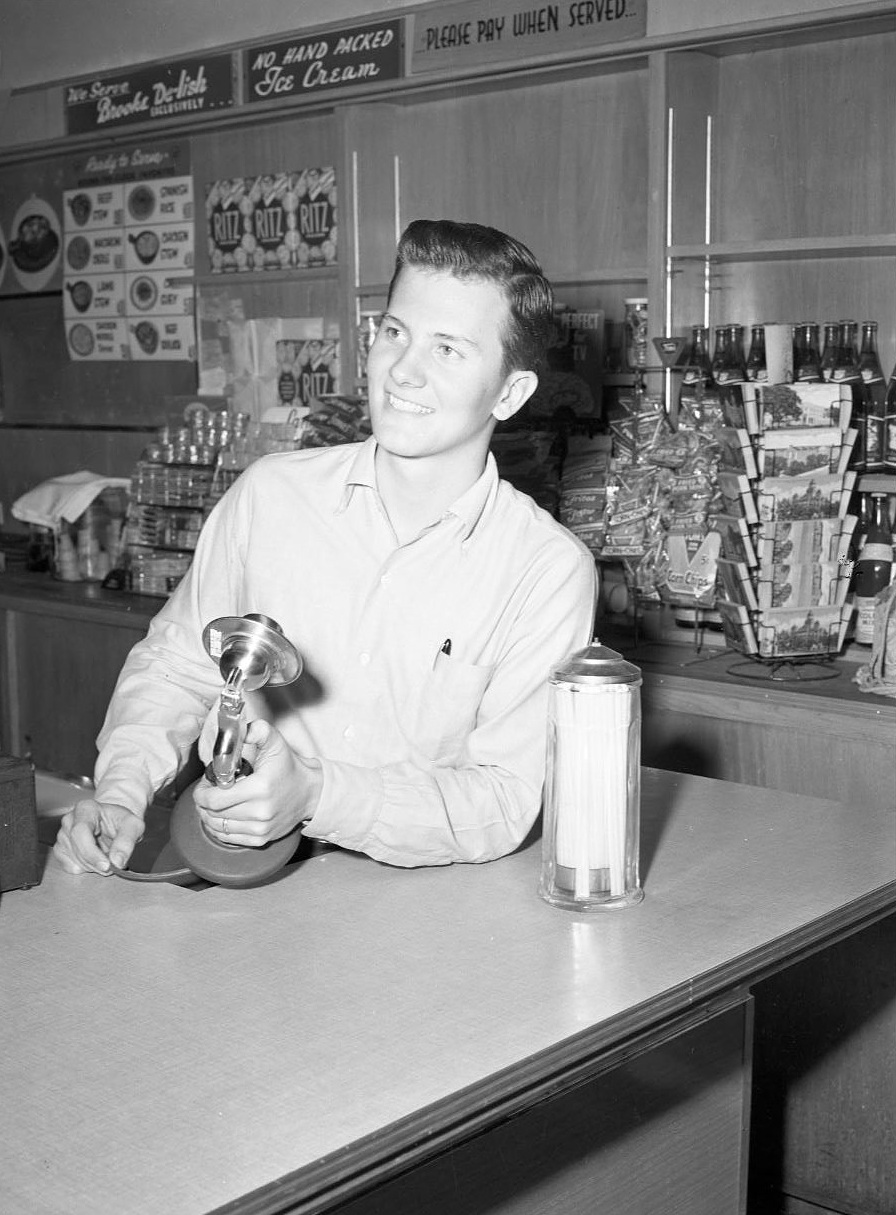
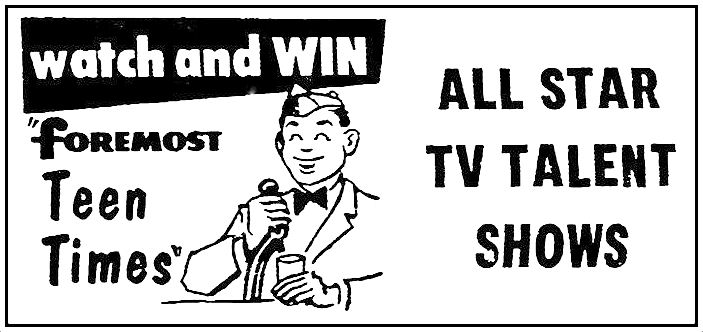
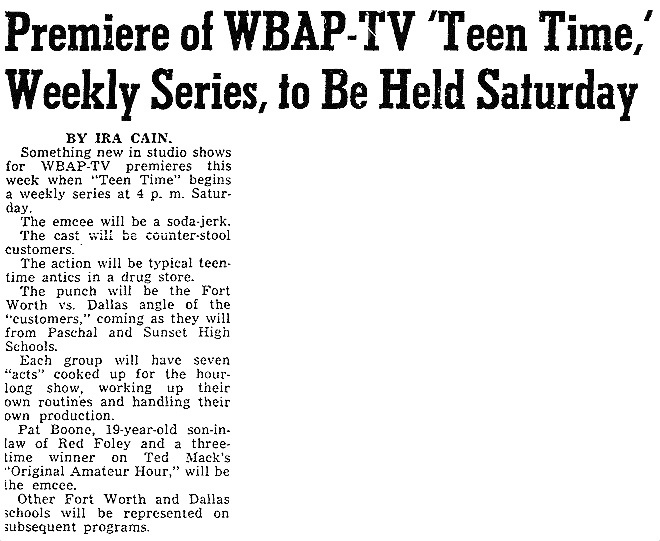
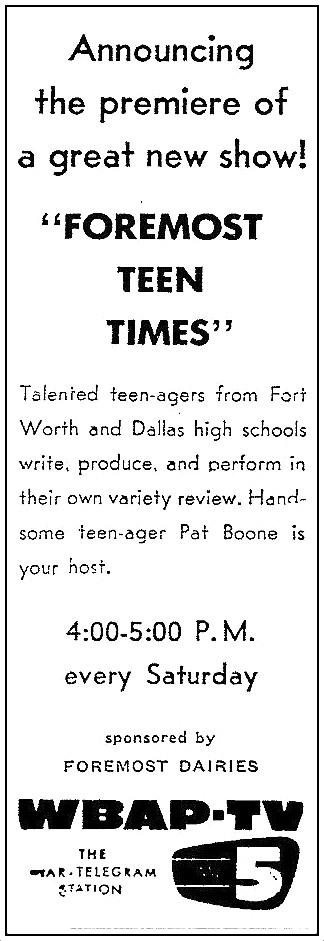
The reason he was being interviewed in the first place — after only a couple of months in town — was because he had been named as the host of a Dallas-Fort Worth television show called “Teen Times,” sponsored by Foremost Dairies and broadcast on Saturday afternoons on WBAP-Ch. 5; the show premiered in February, 1954. Boone acted as host, dressed as a soda jerk behind a drugstore soda fountain, with teenaged guests who represented one Dallas school and one Fort Worth school (the schools changed each week), competing in a sort of talent show. Boone kept things moving, performed a few songs, and, in between, sang the praises of Foremost milk and ice cream.
Boone hosted the show through the spring of 1955. During the run of this local show, his popularity grew quickly on a national level, the result of several national TV appearances and ever-increasing record sales. After his year-and-a-half time in Denton, he moved to New York in the summer of 1955 and enrolled at Columbia University; before the end of the year, Pat Boone’s fame exploded: he had a huge hit with a cover of Fats Domino’s “Ain’t That a Shame” and was appearing regularly on national TV. By the late ’50s his record sales were reportedly second only to Elvis Presley’s, even though Boone’s squeaky-clean and sincere wholesomeness was the polar opposite of the suggestive, hep-cat abandon of Elvis’ earthier style.
Even though Pat Boone was a North Texas student for only a short time, whenever he has returned to Denton over the years he has always received something of a hero’s welcome. With formative years spent here, and with his star-turn in the 1962 filmed-at-Fair-Park movie State Fair, Pat Boone has every right to be considered an honorary Texan.
*
During his time in Denton, Pat Boone hosted two television shows for WBAP-Channel 5: the Foremost Dairies-sponsored “Teen Times” (often referred to as “Teen Time”) on Saturday afternoons, and the Bewley Mills-sponsored “Barn Dance” on Friday nights. (It looks like “Teen Times” was revamped a few years later and returned to Channel 5 in a somewhat similar format as “Teen-Age Downbeat” in January, 1958.)
1954
Fort Worth Star-Telegram, Feb. 7, 1954 (click to read)
Feb. 13, 1954
FWST, Feb. 12, 1954
Below, a super-blurry excerpt from Bill Moyers’ article in The Campus Chat (read the full interview here):
Campus Chat (North Texas State College newspaper), Feb. 24, 1954
FWST, June 20, 1954
In June, 1955, Les Handy — a voice teacher at Texas Wesleyan College — took over as emcee at “Teen Times.”
1955
And in September, 1955, Pat and Shirley and their new baby moved from Denton to New York City.
Student Religious Council (detail from group photo)
***
Sources & Notes
Top photo of Pat Boone behind a soda fountain holding a microphone appeared in the Feb. 24, 1954 edition of Campus Chat, the college paper of what was then North Texas State College; it is from the UNT Libraries Special Collections, and may be accessed on UNT’s Portal to Texas History, here.
Pat Boone’s wife, Shirley, was the daughter of the legendary Nashville “hillbilly” singer, Red Foley. Here’s a video of a nervous Boone and his father-in-law on Foley’s “Ozark Jubilee” TV show, two weeks after Pat and Shirley had left Denton for New York. They are singing “Tennessee Saturday Night,” Red Foley’s big hit from 1949 (hear his great original hillbilly boogie version here).
Because it involves Pat Boone and UNT, check out the 20-minute informational film all about the college, made for students by students in 1963, available to watch on the Portal to Texas History, here — Pat Boone offers a few enthusiastic bits of narration.
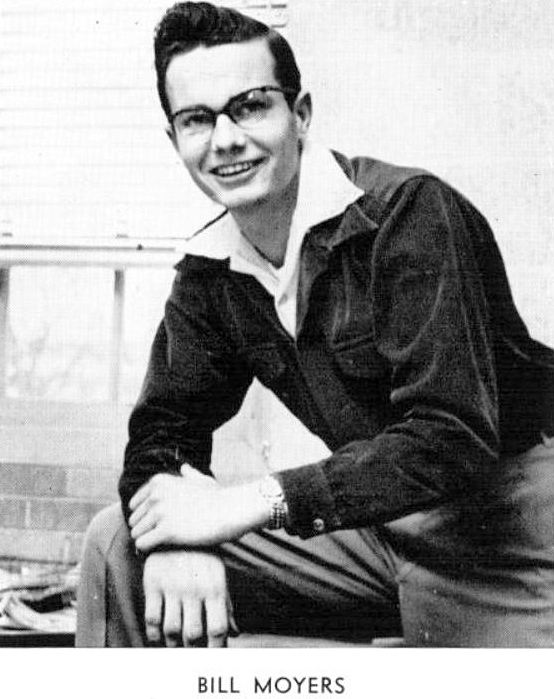
And, why not, here’s a photo of journalist Bill Moyers from the 1953 North Texas yearbook.
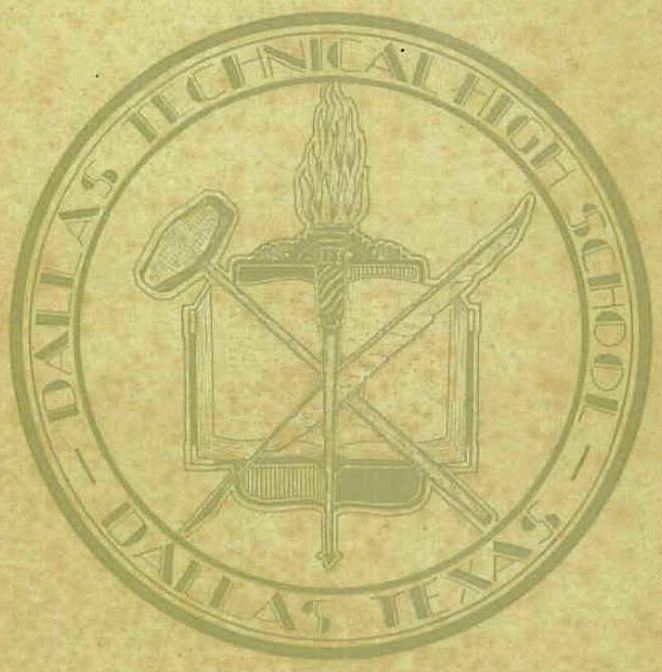
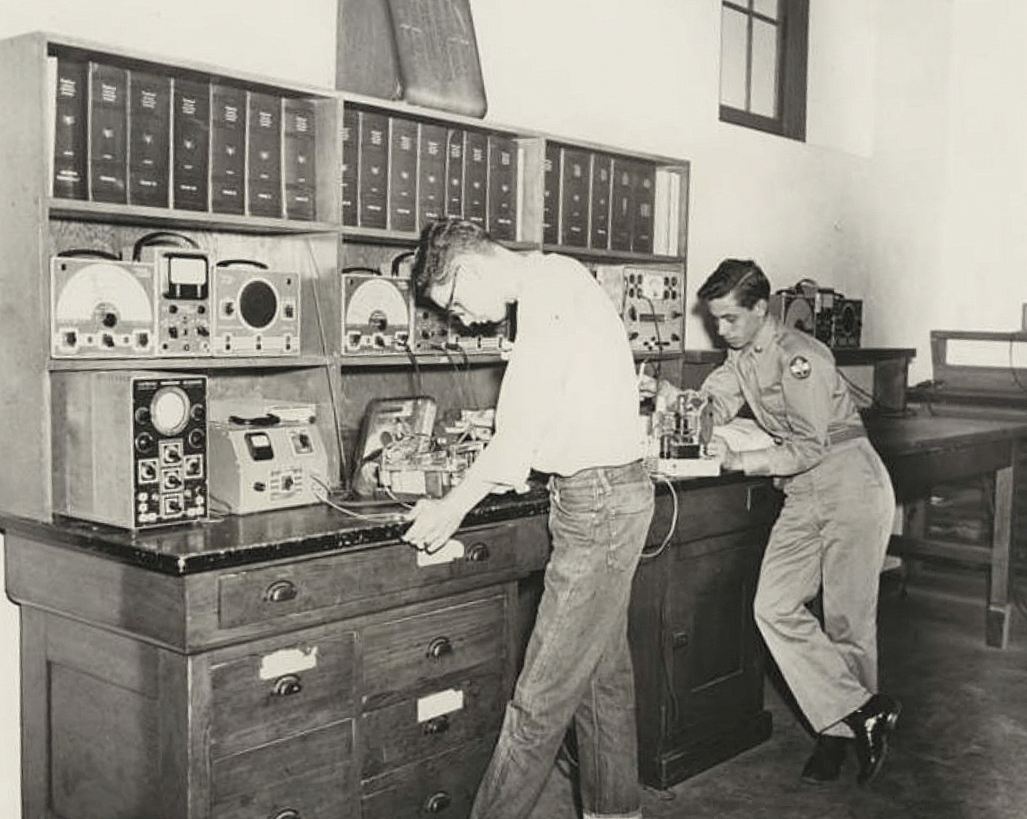
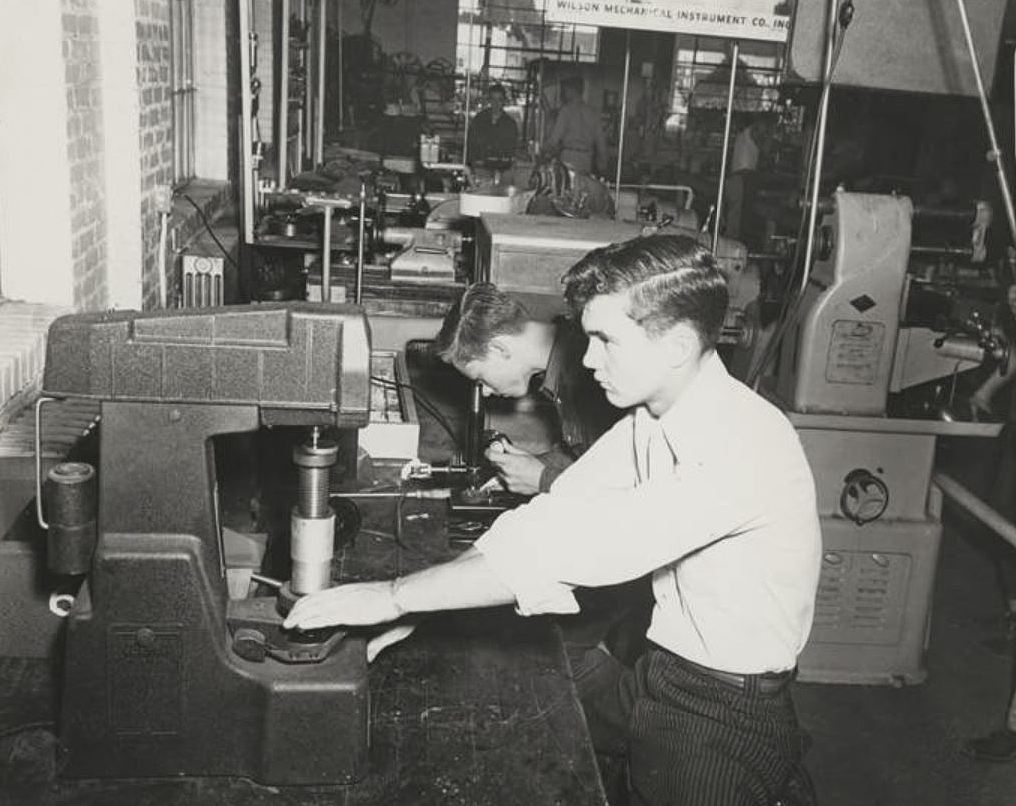
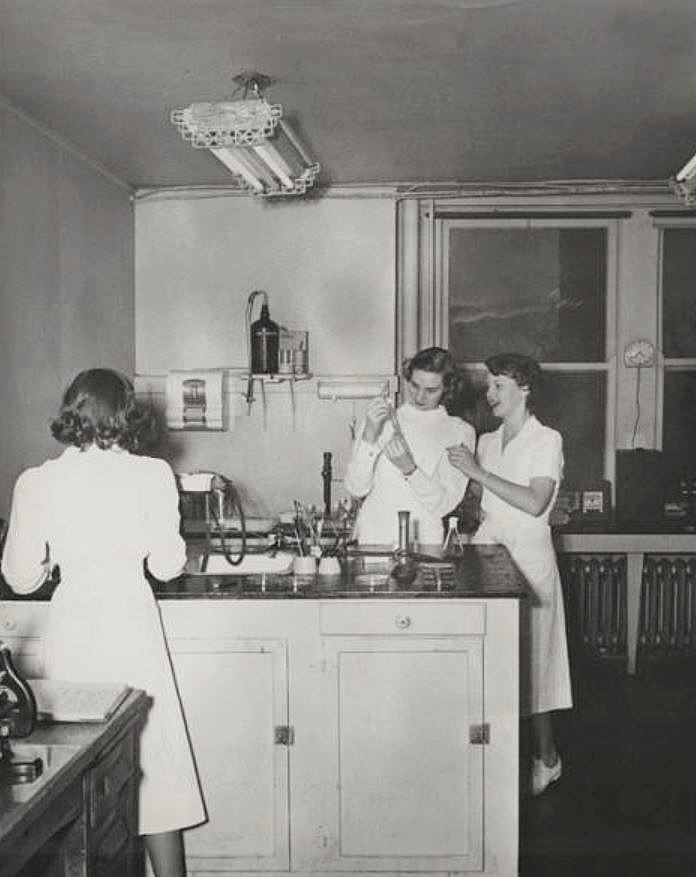
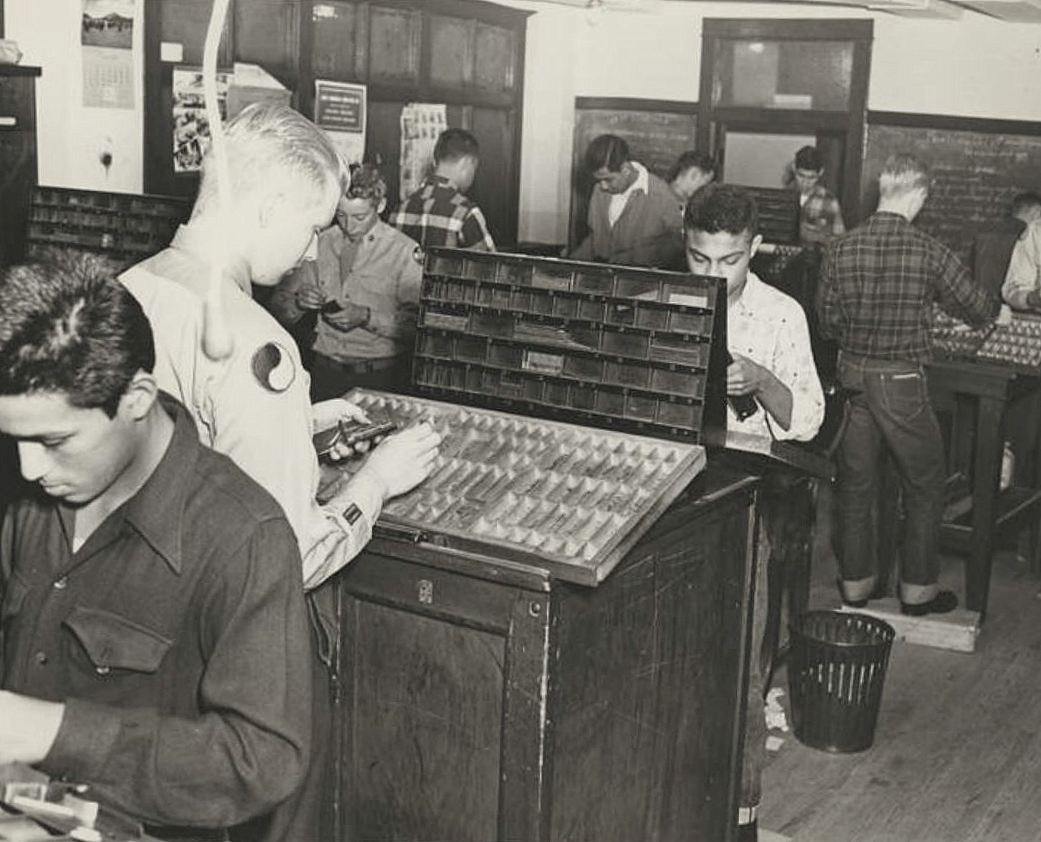
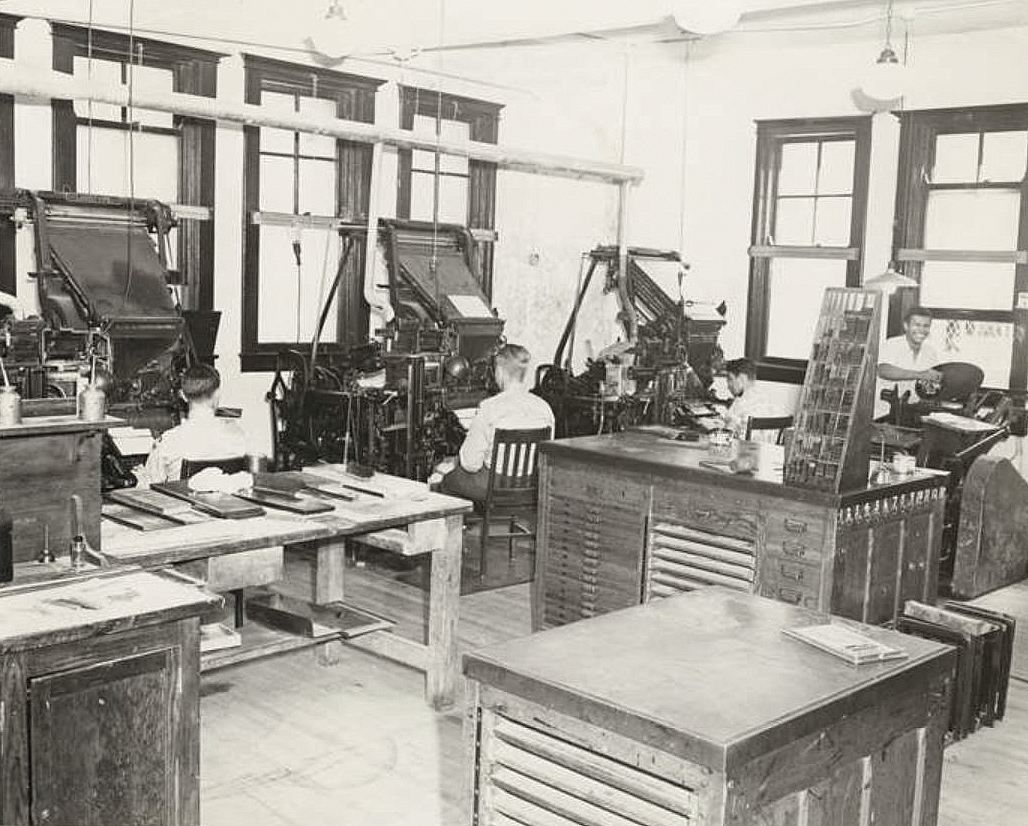
It’s always seemed strange to me that Dallas had a technical high school where students were able to learn all sorts of various trades: auto mechanics, metal-working, industrial machine operation, commercial art, introductory science and engineering courses, and much more. Students — while still in high school — could develop skills and acquire practical knowledge in areas they wanted to pursue as careers; they could also discover (while still in high school) that what they thought they wanted to do as a career was absolutely NOT something they wanted to pursue. I imagine that many graduates were ready to step to into jobs immediately after graduation.
In 1929, Bryan High School (the old “Central High School”) became Dallas Technical High School. In Denman Kelley’s “Principal’s Message” in the 1929 yearbook, he noted that this new idea in education “offers a wonderful opportunity to build up a school for those pupils whose educational needs are not met in the traditional schools…. As the volume of students grows, as the offerings increase with increasing needs, this school must truly become ‘A Greater School for All Dallas.'”
Dallas Technical High School, 1929 yearbook
It offered four “general divisions of study” (each arranged in four-year courses): an industrial course, a commercial course, a home-economics course, and the regular literary course. Among the specialized classes offered were automotive repair, woodworking, architectural drawing, stenography, painting, and elementary business training. These courses at Dallas Tech were available to all high school students in the city, and many students jumped at the opportunity to transfer to the downtown campus. (In 1942 the school’s name was changed to N. R. Crozier Technical High School in honor of the late Dallas school superintendent.)
I’m still amazed by this — shouldn’t we still be doing this? I guess this is what magnet schools do, but is magnet-school participation among DISD students anywhere near as widespread as it once was when vocational classes were concentrated at the huge campus of Tech?
*
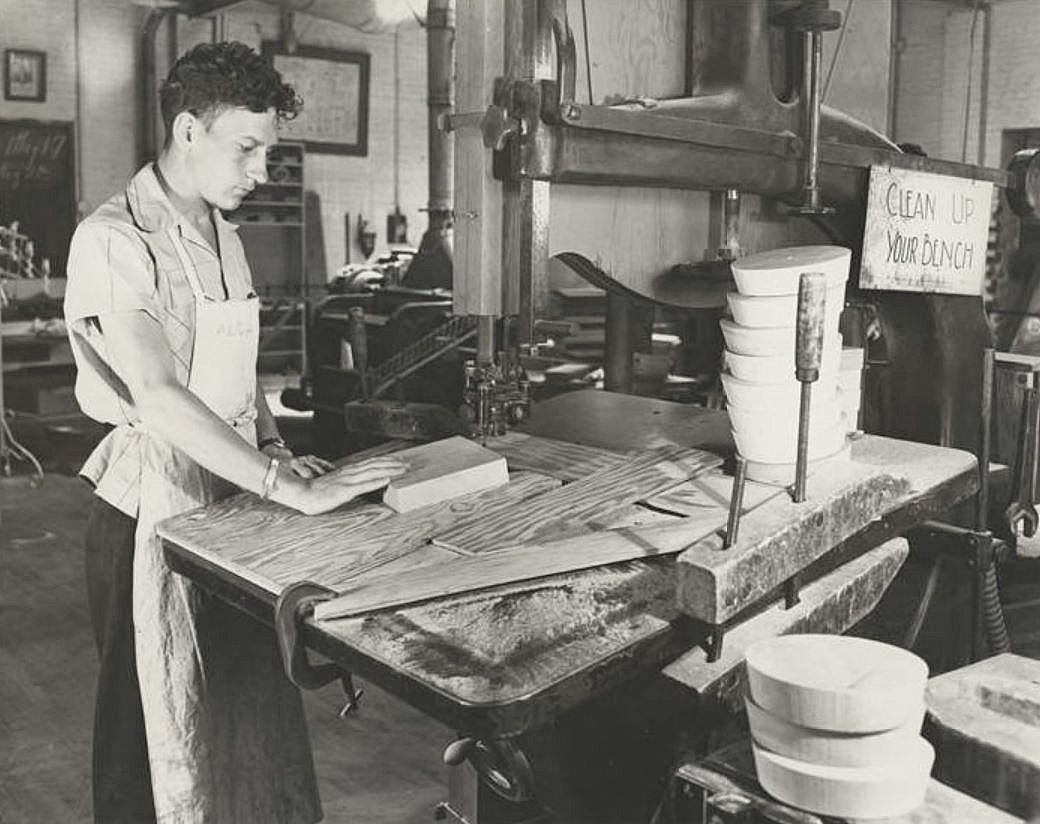
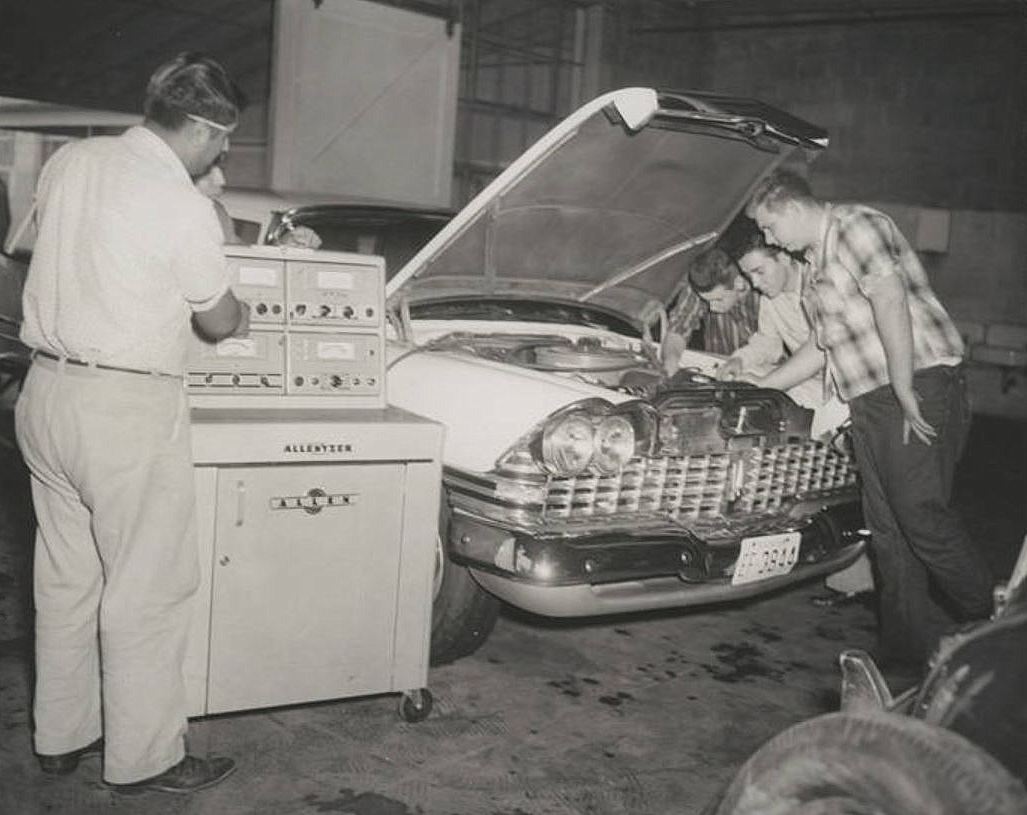
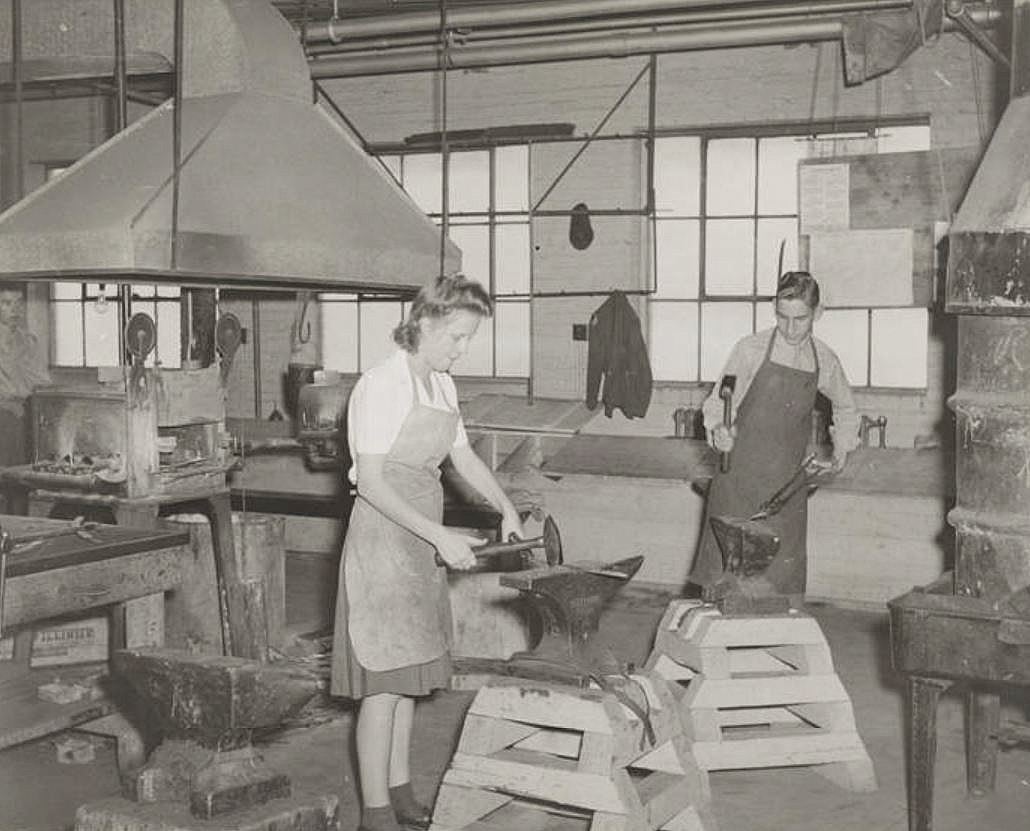
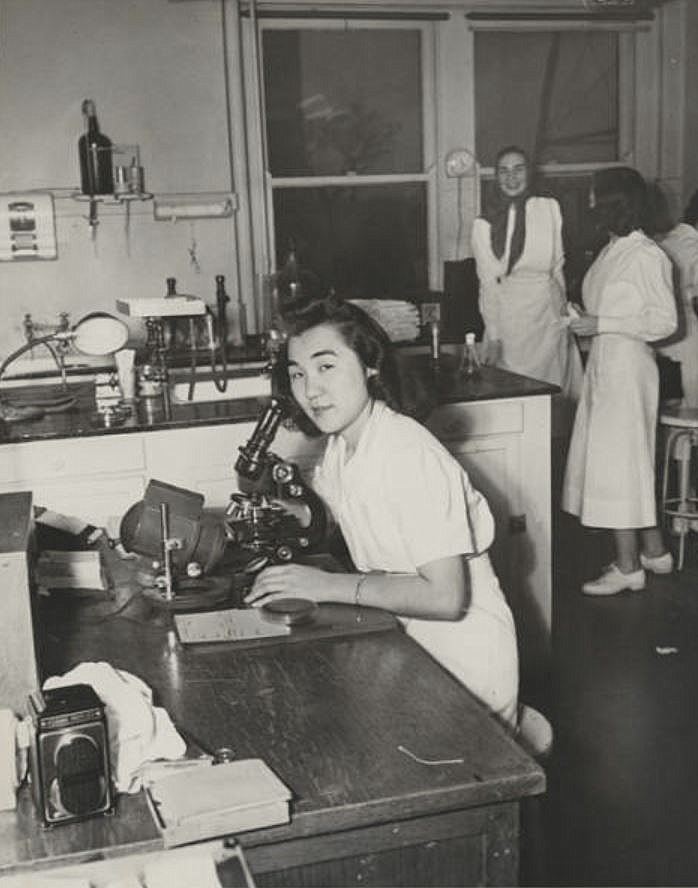
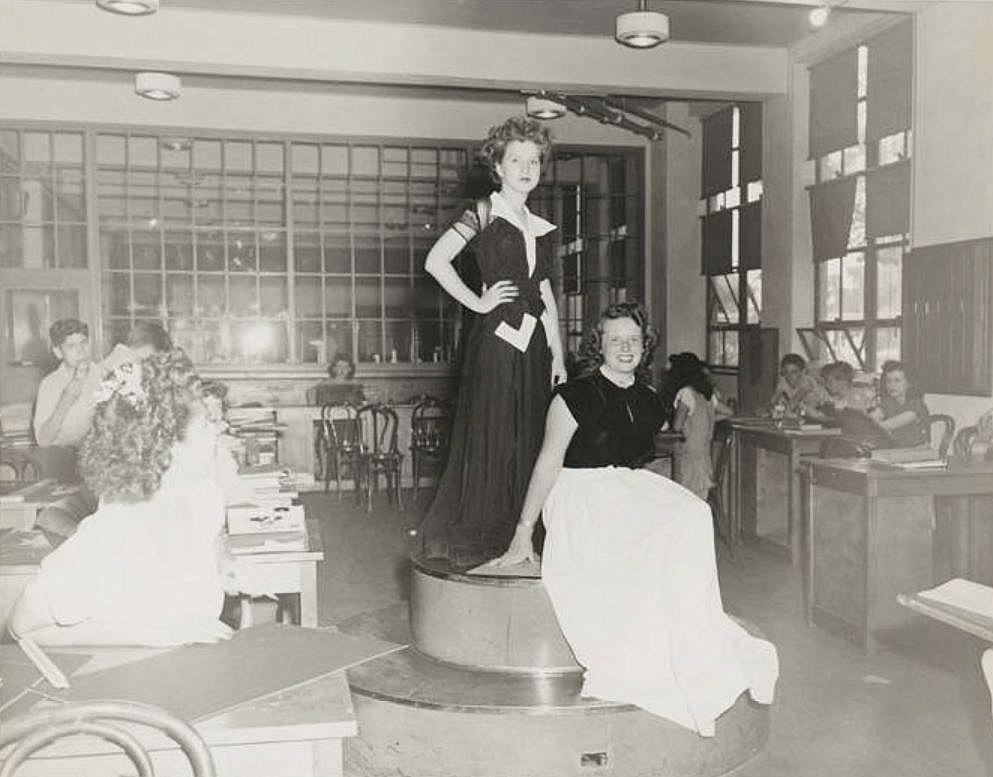
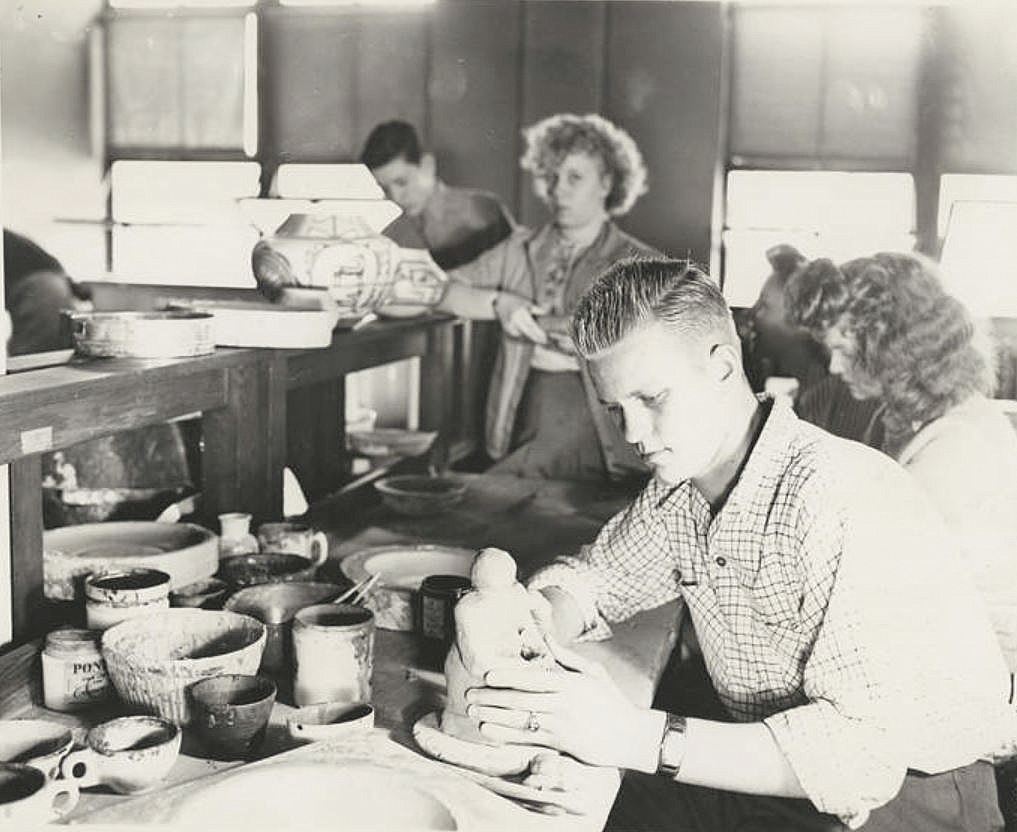
Below are photos showing students in some of the classes available at Crozier Tech in the 1940s. (All photos are larger when clicked.)
There were also studio and commercial art courses. (I have to add this one because I’m pretty sure I now have evidence that in a previous life I was in a Crozier Tech sculpture class in 1946 — my doppelganger is the blurry girl in the center of the photo, looking with suspicion at the camera.)
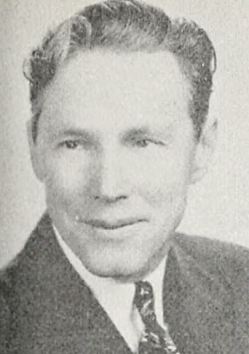
Lastly, a photo of the handsome photography teacher, Orbette A. Homer, who taught at Tech from 1937 until his retirement in 1962. He and his students were responsible for these photos, some of which appeared in the 1946 Crozier Tech yearbook, The Wolf Pack.
O. A. Homer, 1960
***
Sources & Notes
All classroom photos are from the George W. Cook Dallas/Texas Image Collection, DeGolyer Library, SMU Libraries, Southern Methodist University; these images (and more from this Crozier Tech collection) can be foundhere.
The photo of Orbette Anderson Homer (1901-1968) is from the 1960 Crozier Tech yearbook.
A few years ago I came across this photo, showing the 3200 block of Gaston Avenue, just west of Hall. At the time I was more concerned with whether the deco-esque building still stood (it does not) that, somehow, I don’t think I even noticed the windmill (!). I know I didn’t notice that absolutely fantastic sign at the right, which I only hope was an animated neon sign with water whooshing from a faucet and then bubbling up at the bottom.
The business seen here is a plumbing supply business referred to over the years as both Consumers Supply & Plumbing Co. and as Consumers Plumbing Supply Co. It began in Dallas in 1924 when Sam Glickman opened a location on Main Street; two years later, the company incorporated, with two locations — one in Dallas and one in Fort Worth: the incorporators were Glickman and his wife, Minnie, and Morris Strauss and his wife, Josephine.
July, 1924 (click for larger image)
In these early years, an incident in July, 1927 involving partner Morris Strauss (who ran the Fort Worth store) led to a highly publicized trial which garnered front-page coverage. Morris was abducted from his house late one night by several men, some of whom may have been wearing masks (which, on its own, was illegal, per the anti-mask law), had a hood placed over his head, and was driven to a deserted country road where he was beaten and flogged with a whip or rope and a tree limb. He was left bloodied, in his robe and pajamas, with a warning that the same fate awaited his partner, Glickman, in Dallas.
Newspaper reports suggested that the masked “floggers” were affiliated with a plumbers’ organization whose members were reportedly unhappy with what they thought was shoddy work and low-ball bidding on city projects by Consumers Plumbing. There was huge interest in the ensuing trial of one of the men implicated in the beating, a former FW police detective with ties to the Ku Klux Klan, but the trial ended anti-climactically in a hung jury. In 1990, a Fort Worth Star-Telegram article (“KKK Links Lurk In Tarrant Past” by Hollace Wiener, FWST, Feb. 25, 1990) noted that this incident was precipitated not so much by the fact that Strauss was outselling the competition, but, more importantly, it was because he was Jewish (both Strauss and Glickman were Russian-Jewish immigrants). Not only did the defendant have Klan connections, so did the judge (and probably several members of the jury). Strauss had been granted permission by the city manager to carry a firearm for his protection, and as far as I can tell, there were no further attacks. But the Fort Worth branch of Consumers Plumbing did not make it into the 1930s, and Mr. Strauss appears to have left town.
Detroit Free Press, Oct. 1, 1927
*
Samuel G. Glickman (1898-1967) was born in Russia and, as a boy, immigrated with his family to the United States, settling in New Orleans. He initially trained as a telegraph operator but eventually became a plumber and moved to Dallas to set up his own retail/wholesale plumbing company, offering plumbing services and selling supplies and fixtures.
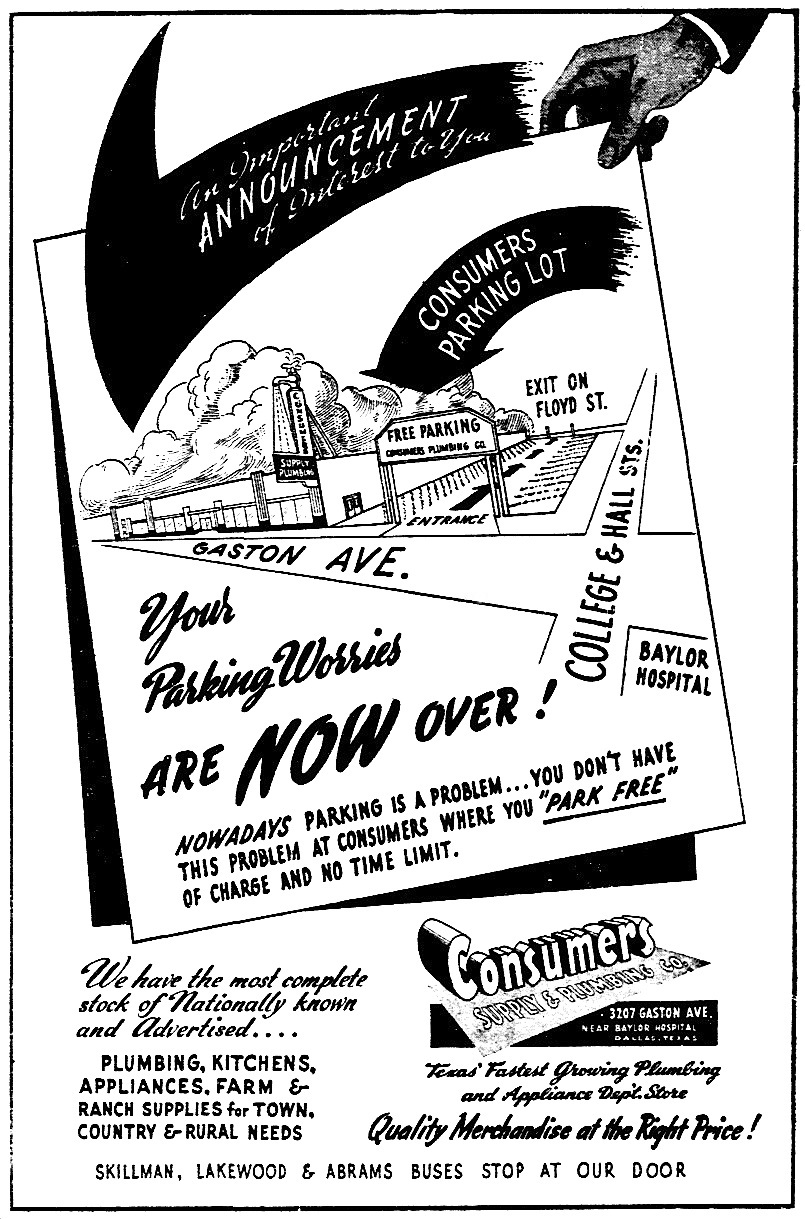
In 1934 or 1935, he moved into a large building in Old East Dallas at 3207-3211 Gaston, next to the 1890s-era Engine Co. No. 3 firehouse (which stood immediately east of Consumers Plumbing, at the corner of Hall, until about 1963). The building had a second floor, where Glickman lived for a time. In fact, he was sleeping there when a huge early-morning 4-alarm fire broke out in the half-block-long building in January, 1949. Despite being right next door to a fire station, the building was gutted. Glickman rebuilt. And the new building (seen at the top) and THAT SIGN were pretty cool. (All images are larger when clicked.)
Jan., 1949
Oct., 1949
Oct., 1949
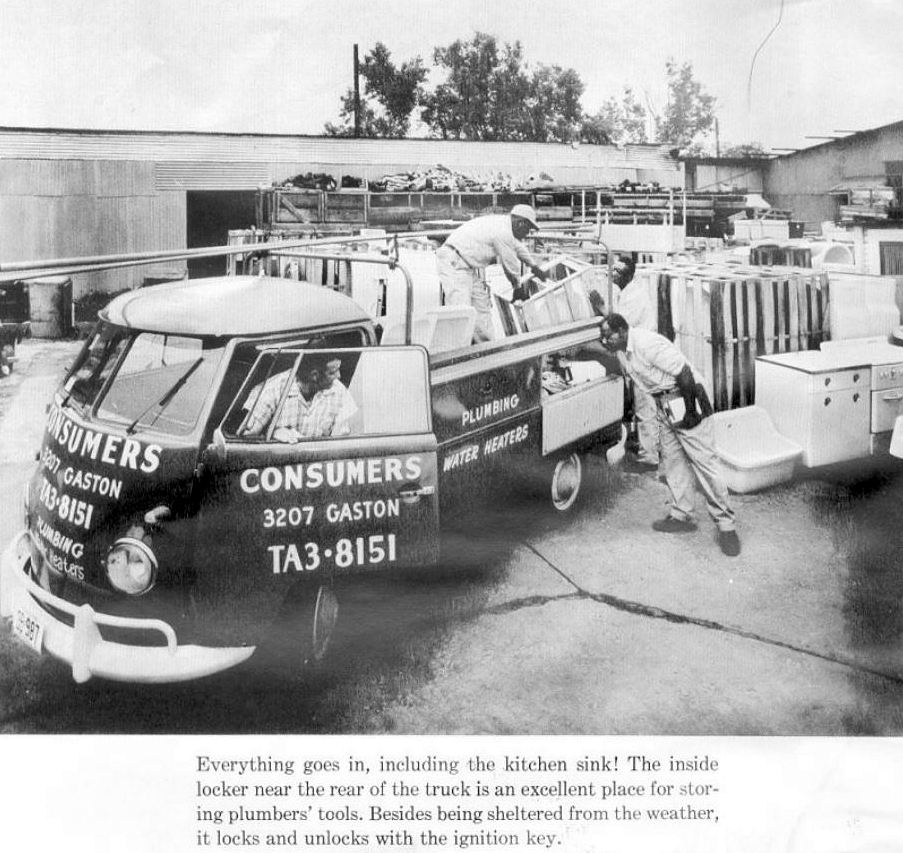
And because everything — no matter how obscure — seems to end up on the internet — here are a couple of random photos from a 1959 Volkswagen trade publication, showing Consumers workers loading plumbing-related things onto the back of a VW pick-up — some copywriter was no doubt ecstatic to have the opportunity to use “Everything goes in, including the kitchen sink!”
At some point the Eveready Supply Co. (another of Glickman’s businesses) joined Consumers in the same block. Glickman died in 1967, and the businesses either moved or closed in the 1970s. The building is, unfortunately, long gone, and that block of Gaston is just one of … EVERY SINGLE BLOCK IN THAT AREA which seems to have been swallowed up by the gargantuan, ravenous, real-estate-gobbling machine known as Baylor Hospital (or whatever it’s called these days).
God, I wish I’d seen that neon faucet sign.
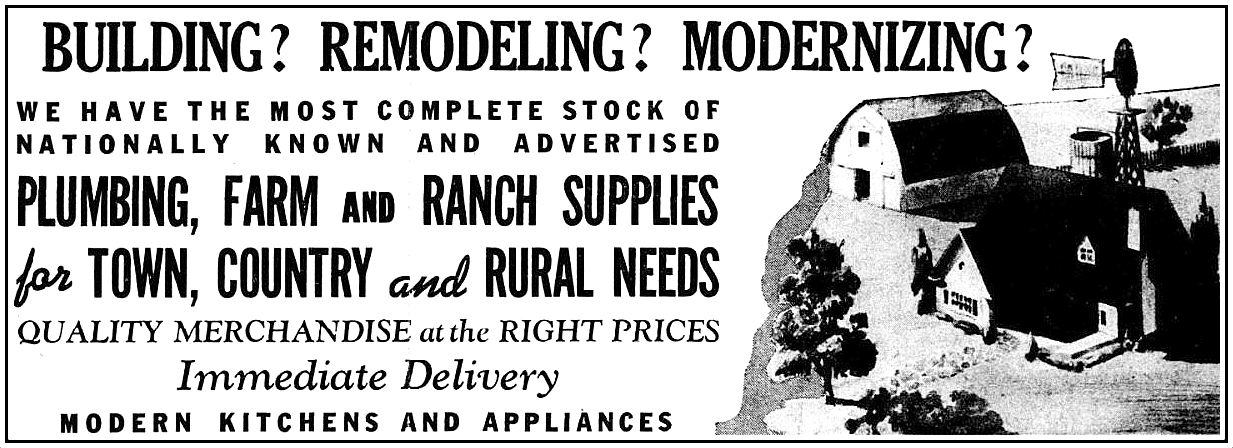
Oh, and the windmill? Aside from being an attention-grabber to passersby, Consumers also sold farm and ranch supplies.
Oct., 1947
***
Sources & Notes
Top color photo is from a postcard found several years ago on a Flickr page of superstar user “Coltera,” here.
I love neon signs, and Dallas used to have them everywhere. I haven’t seen another sign with quite this same water-whooshing-out-of-a-faucet design, but the one seen in this video is similar (but not as good!). Dripping faucets are popular — like this one. A great page featuring eccentric vintage neon signs of plumbing establishments is here.
And only because one of those Volkswagen trucks is featured prominently in a previous Flashback Dallas post, check out the floating VW pick-up bobbing along a flooded 4600-block of Gaston (mere blocks from Consumers Plumbing), here. And — why not? — a Clarence Talley Volkswagen ad from 1961 can be found here.
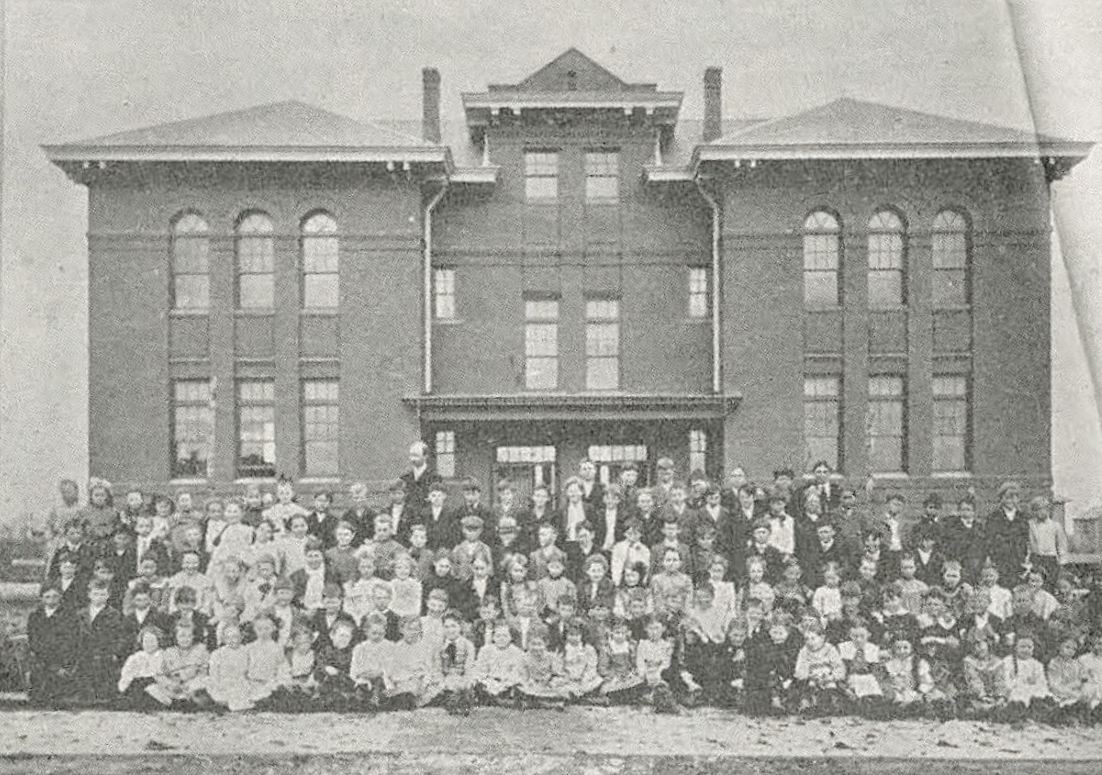
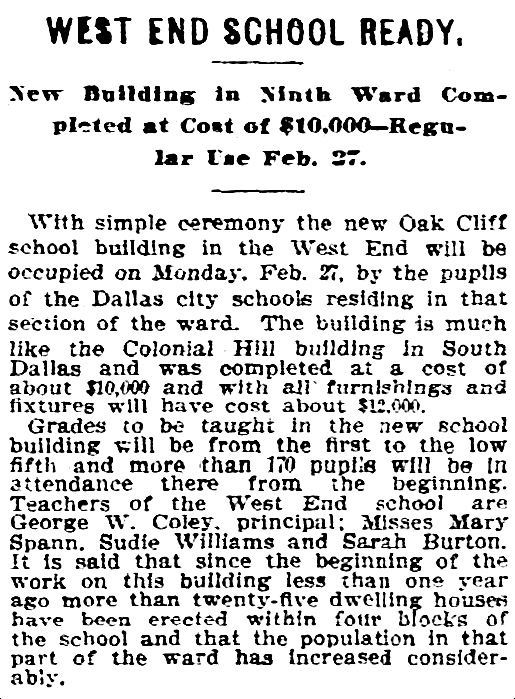
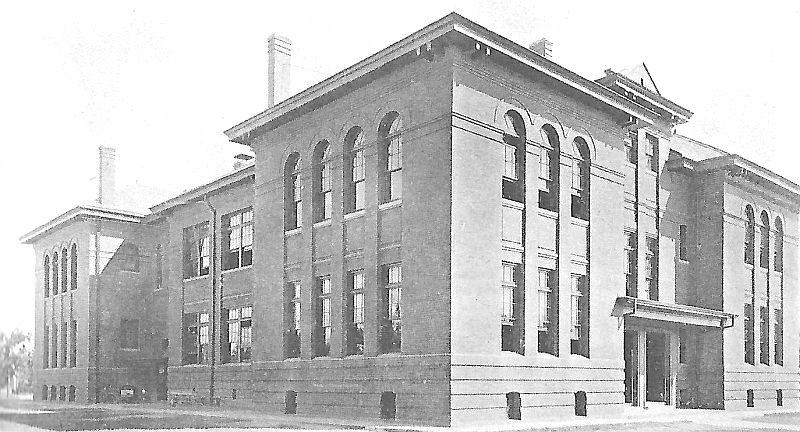
In 1904 things were getting really crowded in schools in recently-annexed Oak Cliff. The school board agreed that Dallas’ new Ninth Ward needed at least one new school, and they voted to build a four-room primary school — initially referred to as the “West End school” — at 9th and Llewellyn. After a delay in construction because of a shortage of bricks, the two-story schoolhouse opened in February, 1905. (Click photos and clippings to see larger images.)
Dallas Morning News, Feb. 18, 1905
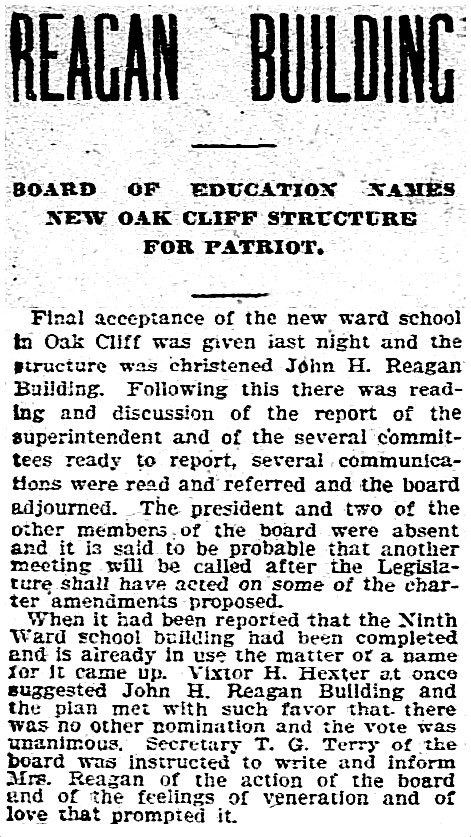
The following month the school was named for a Confederate hero of the Civil War, John H. Reagan.
DMN, March 14, 1905
As the population of Oak Cliff grew over the years, so did the school, which expanded with additions beyond those original four rooms in order to accommodate the continual growth of the neighborhood. The building had a good run and stood for 76 years — until it was demolished at the end of 1981 (or the beginning of 1982) to make room for a new building at the same location. The new school retained the Reagan name, which has become a point of controversy in recent years.
***
Sources & Notes
Top photo is from the promotional booklet “Come To Dallas,” from the collection of the DeGolyer Library, SMU Libraries, Southern Methodist University; more here.
Bottom photo is from the book Education In Dallas, 1874-1966, Ninety-Two Years of History by Walter J. E Schiebel.
For more on the then-impending demolition of the original school building, check out the Dallas Morning News archives for the story “Graduates Come to Visit School On Its Deathbed” by Keith Anderson (DMN, Sept. 14, 1981).
As much as I dislike what the unfortunate over-development of “Uptown” has done to the quirky, funky style of the McKinney Avenue of my childhood, it’s always a shock to realize that, somehow, a few surprisingly old buildings still stand. One of them is this once-fabulous building at McKinney and Routh — it was built in 1927 as a funeral home but has been the site of a succession of restaurants for the past couple of decades. Who knew? Read about it in my post from 2015, “Not Dead Yet at McKinney & Routh,” here.
The assassination of President John F. Kennedy was not only one of the most sobering moments in American history, it was also a turning point for broadcast journalism, particularly in the way television covers breaking news.
The Kennedy assassination and the later captured-live-on-television shooting of Lee Harvey Oswald by Jack Ruby put broadcast journalists to the test as never before. News coverage was a solid days-long block — with NBC devoting almost 72 straight hours to the assassination and its aftermath. The immediacy of live television and the ability to learn of breaking-at-this-minute news was something that had never been experienced by Americans before — and something which pushed radio and television news reporting to new heights. It was reported that CBS alone used 80 newsmen to cover the story. The Nielsen ratings estimated that an unbelievable 93% of American households with televisions were tuned in to watch live coverage of the President’s funeral procession.
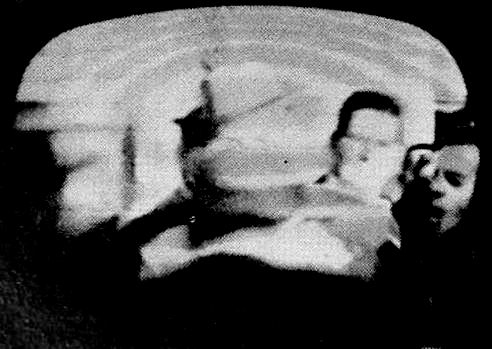
Perhaps the grisliest “first” of this new era of TV news was that millions of Americans watched a murder happen live as they watched from their living rooms: when Jack Ruby lunged from the phalanx of reporters gathered in the parking lot beneath the Municipal Building to shoot Lee Harvey Oswald as he was walking to an armored vehicle to be transported to the county jail, millions witnessed the shooting as it happened, stunned. NBC was the lone network to have broadcast live coverage of this unforgettable moment of 20th-century American history. The other networks followed soon after with recorded footage, but NBC got the scoop.
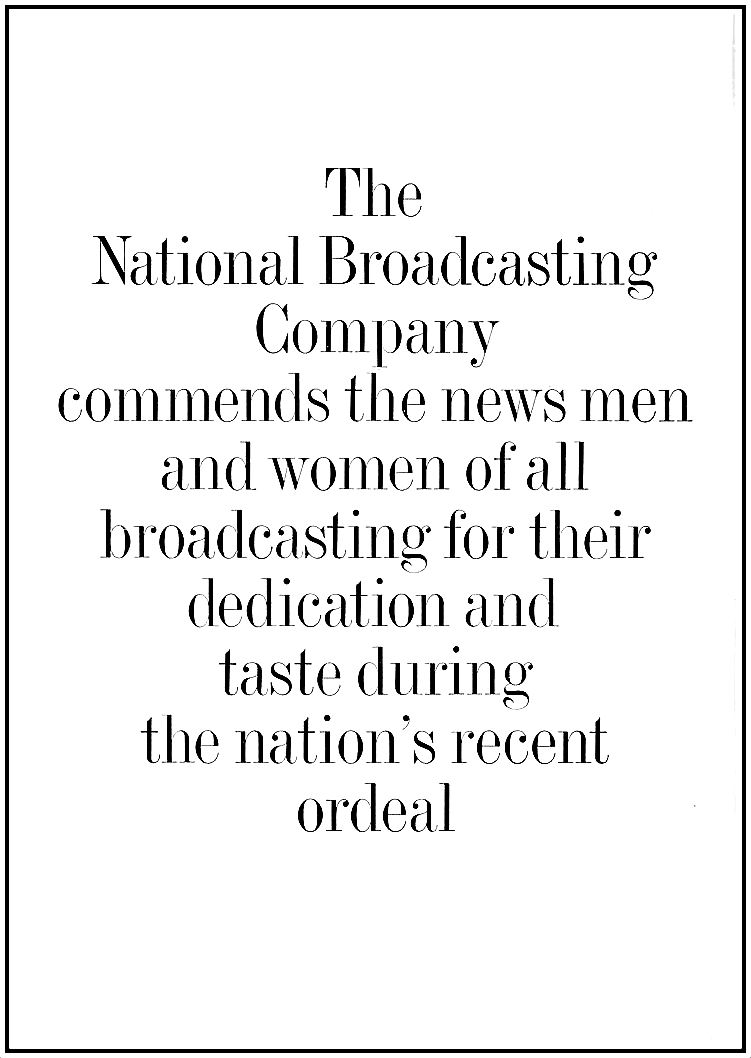
NBC ad in Broadcasting magazine, Dec. 2, 1963
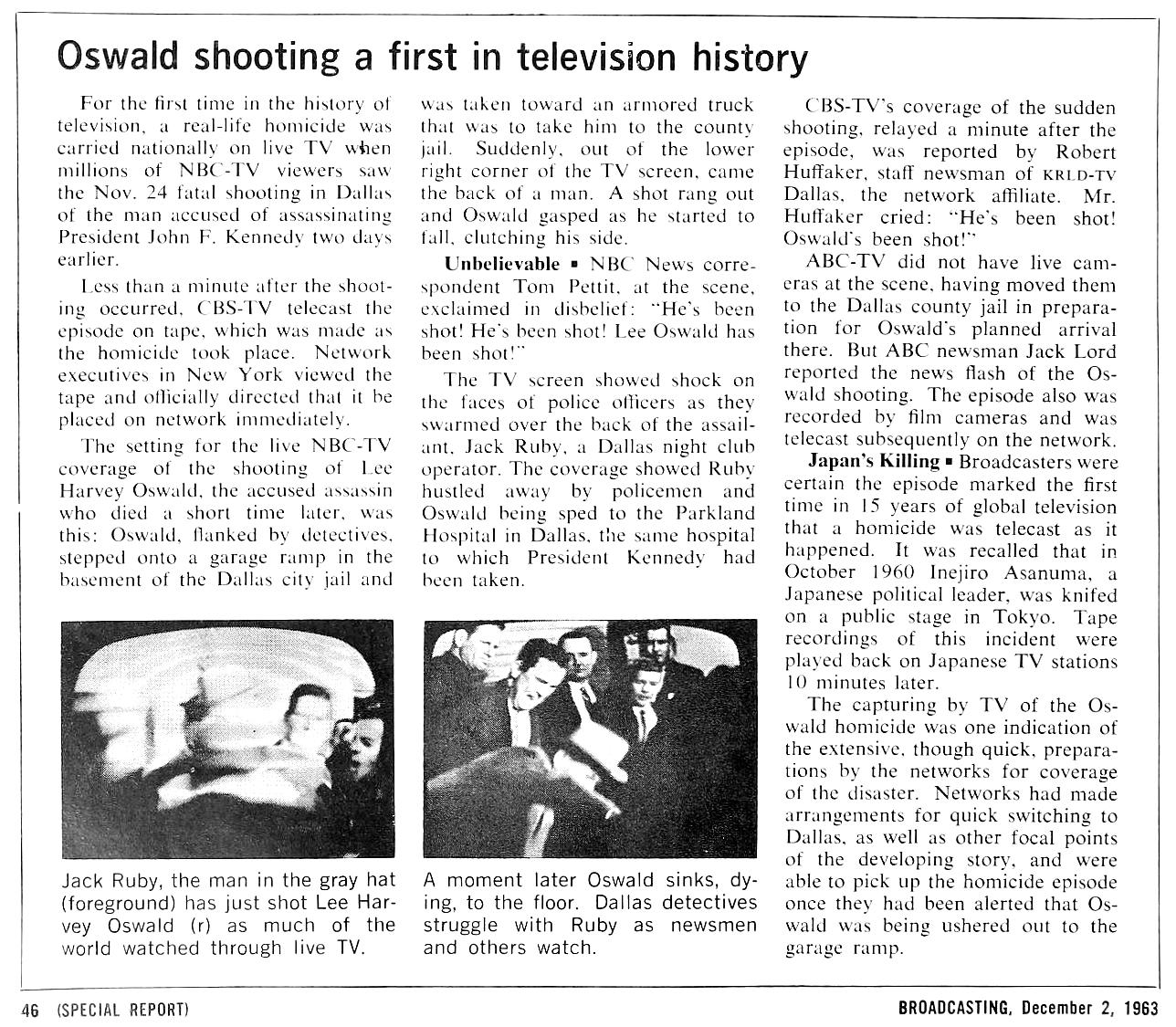
Broadcasting — an industry trade magazine — devoted an entire 25-page “Special Report” on how television had covered — and shaped — JFK’s presidency and his assassination. Below is the article which specifically focused on the wall-to-wall broadcast news coverage, post-Nov. 22.
OSWALD SHOOTING A FIRST IN TELEVISION HISTORY
For the first time in the history of television, a real-life homicide was carried nationally on live TV when millions of NBC-TV viewers saw the Nov. 24 fatal shooting in Dallas of the man accused of assassinating President John F. Kennedy two days earlier.
Less than a minute after the shooting occurred, CBS-TV telecast the episode on tape, which was made as the homicide took place. Network executives in New York viewed the tape and officially directed that it be placed on network immediately.
The setting for the live NBC-TV coverage of the shooting of Lee Harvey Oswald, the accused assassin who died a short time later, was this: Oswald, flanked by detectives, stepped onto a garage ramp in the basement of the Dallas city jail and was taken toward an armored truck that was to take him to the county jail. Suddenly, out of the lower right corner of the TV screen, came the back of a man. A shot rang out and Oswald gasped as he started to fall, clutching his side.
UNBELIEVABLE
NBC News correspondent Tom Pettit, at the scene, exclaimed in disbelief: “He’s been shot! He’s been shot! Lee Oswald has been shot!”
The TV screen showed shock on the faces of police officers as they swarmed over the back of the assailant, Jack Ruby, a Dallas night club operator. The coverage showed Ruby hustled away by policemen and Oswald being sped to the Parkland Hospital in Dallas, the same hospital to which President Kennedy had been taken.
CBS-TV’s coverage of the sudden shooting, relayed a minute after the episode, was reported by Robert Huffaker, staff newsman of KRLD-TV Dallas, the network affiliate. Mr. Huffaker cried: “He’s been shot! Oswald’s been shot!”
ABC-TV did not have live cameras at the scene, having moved them to the Dallas county jail in preparation for Oswald’s planned arrival there. But ABC newsman Jack Lord reported the news flash of the Oswald shooting. The episode also was recorded by film cameras and was telecast subsequently on the network.
JAPAN’S KILLING
Broadcasters were certain the episode marked the first time in 15 years of global television that a homicide was telecast as it happened. It was recalled that in October 1960 Inejiro Asanuma, a Japanese political leader, was knifed on a public stage in Tokyo. Tape recordings of this incident were played back on Japanese TV stations 10 minutes later.
The capturing by TV of the Oswald homicide was one indication of the extensive, though quick, preparations by the networks for coverage of the disaster. Networks had made arrangements for quick switching to Dallas, as well as other focal points of the developing story, and were able to pick up the homicide episode once they had been alerted that Oswald was being ushered out to the garage ramp. (Broadcasting magazine, Dec 2, 1963)
Broadcasting, Dec. 2, 1963 (click to see larger image)
*
NBC was the only network to carry Ruby’s shooting of Oswald on live TV. The footage — as it was aired — can be watched in the video below (the Dallas footage begins at about the 5:00 mark).
*
KRLD, the local CBS affiliate, captured the shooting live, but it was not broadcast live. Here is the KRLD footage, helmed by Bob Huffaker (the shooting takes place near the 13:00 mark).
*
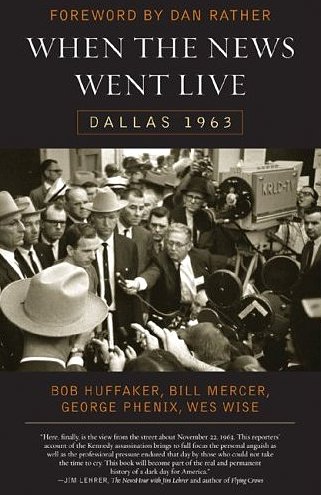
In 2007, Bob Huffaker, Bill Mercer, Wes Wise, and George Phenix — reporters for CBS-affiliate KRLD-TV news — recalled the blur of days on the beat following the assassination in their book When the News Went Live: Dallas 1963. Watch a panel discussion on those days, below, recorded at the Sixth Floor Museum in 2008. (I found Wise’s recollections, beginning at the 39:00 mark to be most interesting.) (RIP, Bob Huffaker, who died June 25, 2018.)
*
ABC came in late, with reports from affiliate WFAA-Ch. 8 (about the 7:20 mark), but their coverage was certainly no less exciting — in fact, this might be my favorite reporting by local broadcast journalists that day.
*
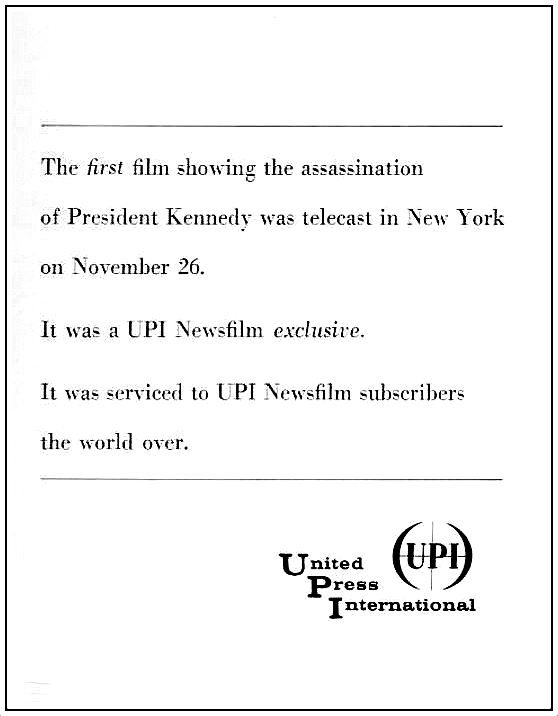
Another “first” in these days immediately following that awful day in Dallas was the very first showing of 8mm home-movie footage showing the assassination of the president. The film was shot by Dallasite Marie Muchmore, who reportedly sold the footage — sight unseen (it hadn’t even been developed) — to UPI for $1,000 (roughly about $8,000 in today’s money); the film was then shown on WNEW-TV in New York on Nov. 26. (The short footage, restored in recent years, can be watched on the Associated Press Archive site, here.)
Broadcasting, Dec. 2, 1963
***
Sources & Notes
A “Special Report” on the broadcast coverage of the Kennedy assassination and the shooting of Oswald by Ruby appeared in the Dec. 2, 1963 trade magazine Broadcasting; the issue may be read in its entirety here (pp. 36-61); the photo at the top of this post (showing Jack Ruby shooting Lee Harvey Oswald) is from that issue.
More Flashback Dallas posts on the Kennedy assassination can be found here.
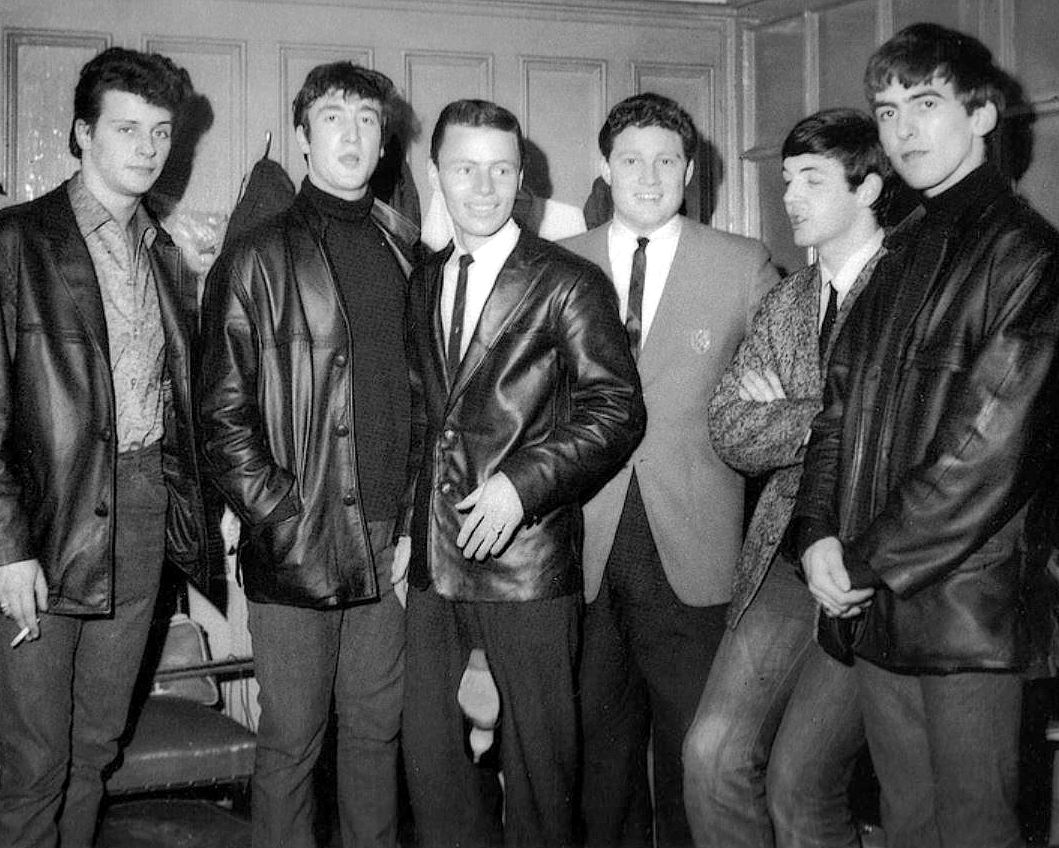
The Ringo-less Beatles with Delbert and Bruce, June 21, 1962
*
(CLICK HERE TO WATCH THE FILM DISCUSSED IN THIS POST)
*
by Paula Bosse
You know how you’re all excited about one thing only to discover something even more exciting sitting all alone over off to the side? That’s what happened when I took a look at the “Light Crust Doughboys collection” which has recently been uploaded to the Portal to Texas History site as part of the Spotlight on North Texas project via the UNT Media Library. I’m a huge fan of Western Swing and classic country music, and I spent an enjoyable hour or two watching home movies of the Light Crust Doughboys as they toured around Texas. When I looked to see what else comprised this collection, I saw the words “England Tour,” “Bruce Channel,” and “Delbert McClinton,” and a jolt went through me: oh my god, could there be film footage of the legendary meeting between the Beatles and North Texas musicians Bruce Channel and Delbert McClinton? Every Beatles fan worth his/her salt knows about the June 21, 1962 meeting when John Lennon eagerly chatted with Delbert McClinton about his harmonica prowess.
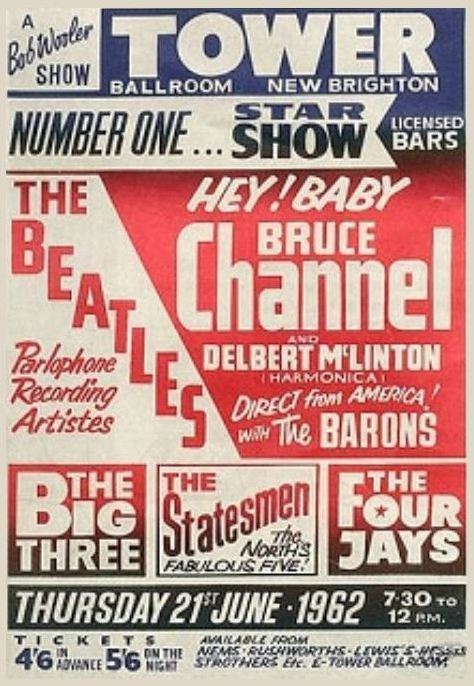
I watched the 27-minute home movie (shot by Marvin “Smokey” Montgomery, member of the Light Crust Doughboys and, from what I gather, Bruce Channel’s musical collaborator and, possibly, acting manager), and it does, in fact, capture glimpses of the famed tour in which Grapevine’s Channel, riding high on his #1 hit Hey! Baby, toured England with Fort Worth musician Delbert McClinton, who played harmonica on the record. One of their dates was the English town of Wallasey, just across the Mersey from Liverpool. On June 21, 1962 Bruce and Delbert played the New Brighton Tower Ballroom — their opening act was a popular local band on the brink of superstardom, The Beatles. Backstage, John Lennon asked for a few harmonica tips from Delbert whose Hey! Baby sound John really liked, and Delbert was happy to share. The photo above was taken at that meeting by Paul’s brother, Mike McCartney: from left to right, Pete Best (who would soon be replaced by Ringo Starr), John Lennon, Delbert McClinton (is he wearing Paul’s jacket?), Bruce Channel, Paul McCartney, and George Harrison. Another one, with Bruce and Paul, is below (I’m not sure who the girl is).
The home movie shot by Smokey Montgomery shows Bruce and Delbert (both only 21 years old at the time), their Fort Worth record producer “Major Bill” Smith, as well as several members of the package show of British performers that toured with Bruce, including Frank Ifield, Jay and Tommy Scott, and Beryl Bryden. …But, argh, no Beatles! So close! Still, this is great film footage of a famous tour — footage which may never have been seen by the public — and it is now available online for all to see, courtesy of the University of North Texas!
The 27-minute (silent) film can be viewed here(the good stuff is really only in the first 11 minutes or so — the rest is mostly tourist footage of the changing of the guards at Buckingham Palace).
This may be thrilling to only a handful of people, but I am definitely one of those people!
A few screen captures from Smokey Montgomery’s 1962 “England Tour” film (all images are larger when clicked):
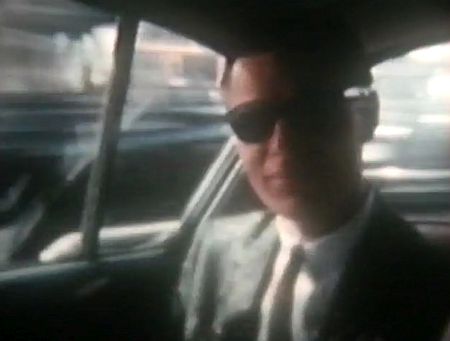
Bruce on the bus
Delbert in a taxi
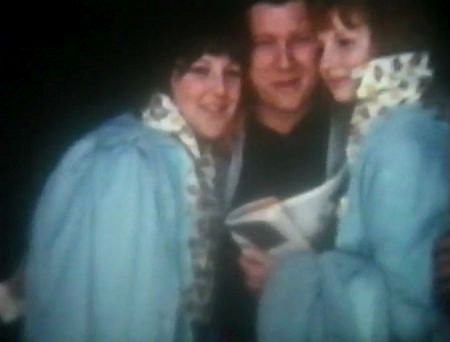
Bruce with fans
Perks of the trade
More perks
Delbert
Bruce and Delbert, London
You just never know what you’re going to stumble across…. Below is Bruce Channel’s monster 1962 hit, recorded in 1961 at the Clifford Herring Studios in Fort Worth, Hey! Baby, kicked off by Delbert McClinton’s distinctive harmonica.
**
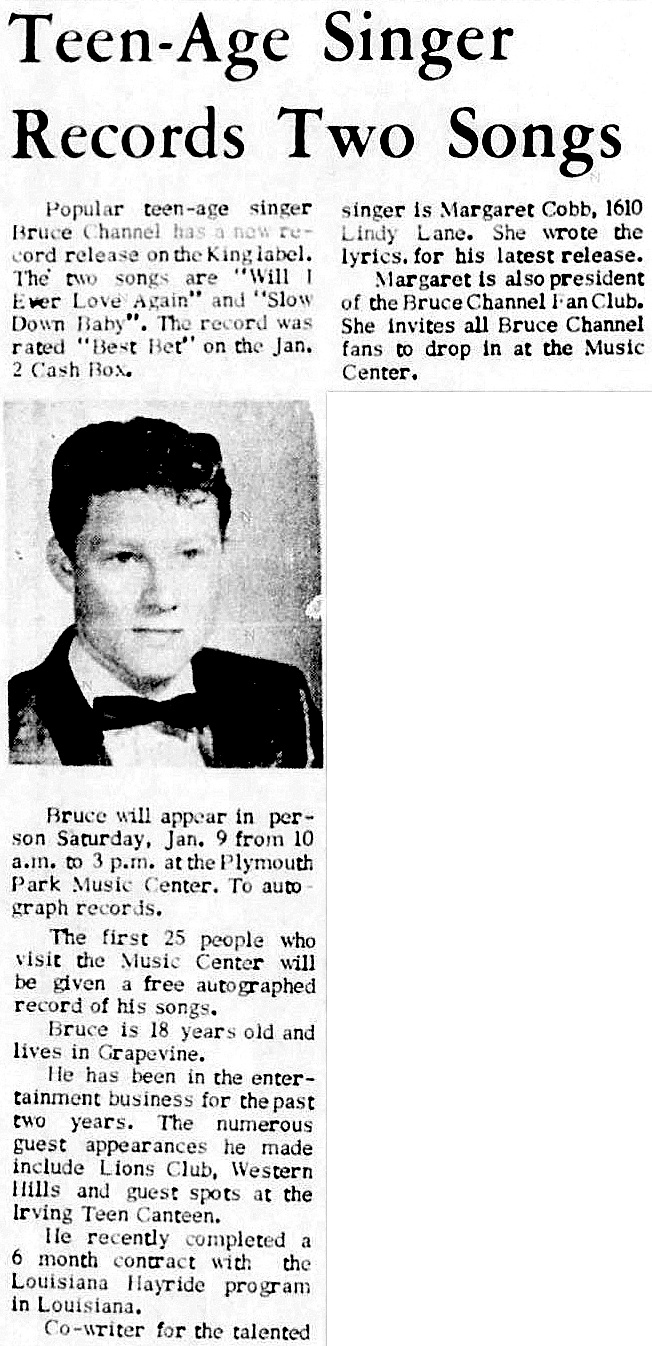
Bruce Channel (born Bruce McMeans — the “Channel” was his mother’s maiden name), was born at the end of 1940 and attended Grapevine High School. During his high school days he gained popularity as a performer, complete with lengthy commutes between Dallas and Shreveport, where he was a regular performer on the star-making Louisiana Hayride. Around this time he began writing songs with Margaret Cobb, an Irving woman who was 10-15 years older and the sister of a musician acquaintance. Dallas-Fort Worth-area musician Smokey Montgomery (known for decades as the banjo player in the Light Crust Doughboys) not only helped arrange those songs, but he also produced and played on some of Channel’s early singles, such as the cool (and fast!) rockabilly number, Slow Down, Baby (hear it here) and a song I like even more, Come On, Baby (hear it here).
The Cobb-Channel-penned Hey! Baby was recorded in 1961 and soon became a local radio hit, most notably on KLIF in Dallas, then worked its way up charts around Texas. The song finally reached #1 in the country in March, 1962. Channel had a few other lesser hits, but none ever reached the heights of Hey! Baby. He moved to Nashville in the ’70s and embarked on a successful songwriting career.
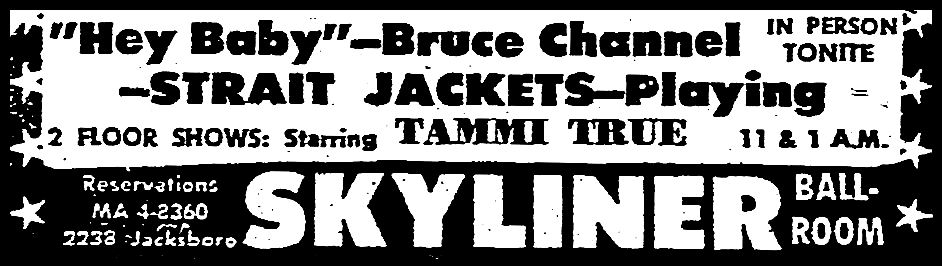
Delbert McClinton was born in Lubbock, also at the end of 1940, but grew up in Fort Worth where he, too, was a teenage musician, first gaining attention with his band The Straitjackets/Straightjackets and later the Rondels. He’s a bona fide Texas blues legend and continues to perform.
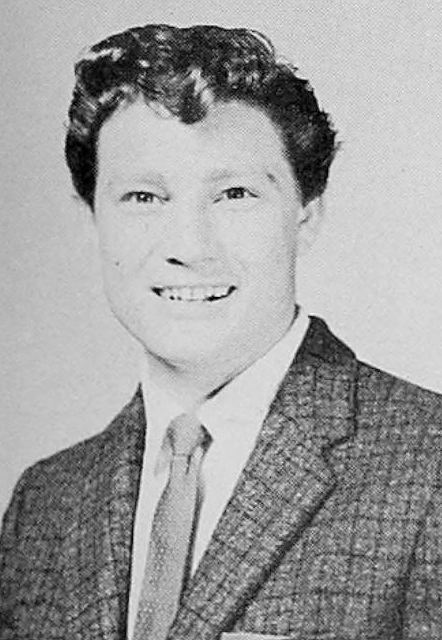
Bruce McMeans, Grapevine High School, 1960
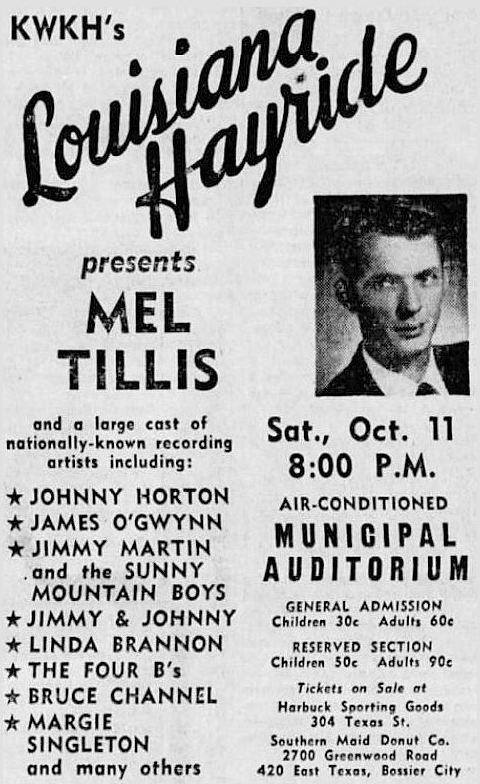
Shreveport Times, Oct. 10, 1958
Irving (TX) News-Texan, Jan. 7, 1960 (click for larger image)
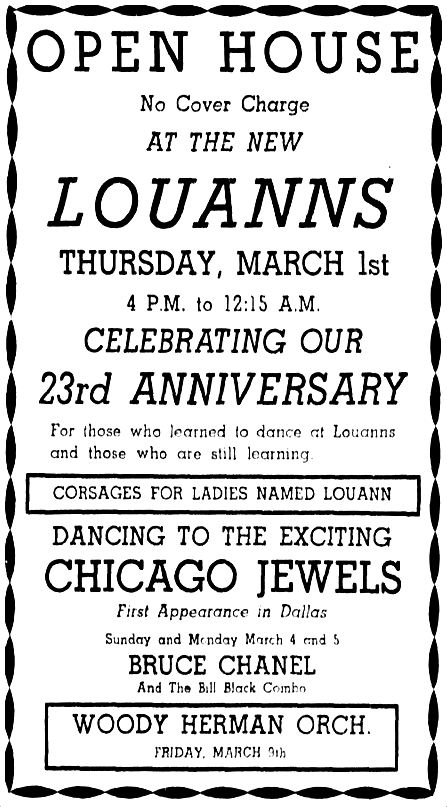
Louann’s, Dallas, March, 1962
British tour program photo, June, 1962, via Flickr
Delbert McClinton, Arlington Heights High School, 1959
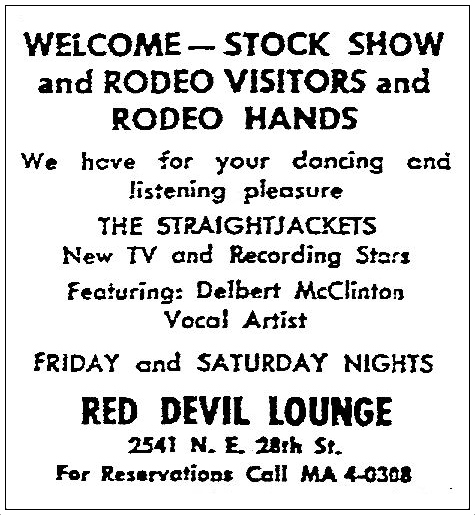
Red Devil Lounge, Fort Worth, Jan., 1958
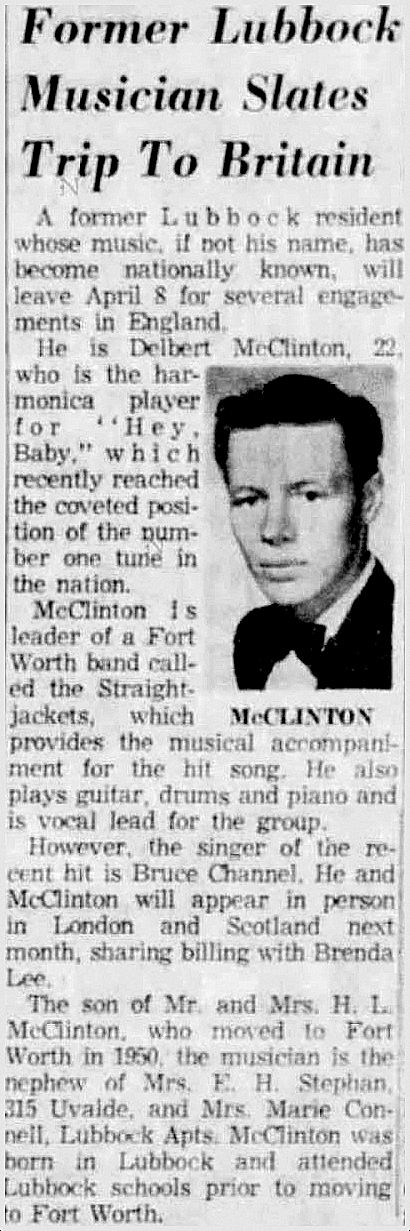
Lubbock Avalanche-Journal, March 21, 1962 (click to read)
Bruce with Delbert (and stripper Tammi True), FW, Jan. 1962
***
Sources & Notes
The film featuring Bruce Channel and Delbert McClinton is titled “[The Light Crust Doughboys, No. 16 — England Tour]” and is part of the Spotlight on North Texas collection; it was provided by UNT Media Library to The Portal to Texas History and may be viewed here. It was filmed by Marvin “Smokey” Montgomery (who can be seen near the very end, sitting almost in silhouette in front of an airplane window). The film is part of a collection of Light Crust Doughboys and LCD-related materials donated by Art Greenhaw. (Special thanks to Laura Treat!)
Speaking of UNT, there may also be a film clip somewhere in the Denton vaults in which Bruce Channel, the “Grapevine farmboy,” was the subject of a WBAP-Ch. 5 news story (the April 18, 1962 script is here).
See the full printed program for Bruce Channel’s June, 1962 British package tour here.
Bruce Channel’s website is here. Read an interesting interview with him here. More Bruce on Wikipedia, here.
Delbert McClinton’s website is here. He’s constantly touring. Go see him!
The producer of (among other recordings) Hey! Baby and Hey, Paula (the song which has followed me around my whole life) was “Major Bill” Smith who was quite a polarizing character and was often described as a “hustler” (Delbert was not a fan). Read about him here. (Also, rockabilly god Ronnie Dawson might be one of the musicians on Hey! Baby — I’ve always heard he played drums on Hey, Paula.)
Marvin “Smokey” Montgomery is listed, along with Major Bill Smith, as a co-producer of Hey! Baby, which sold well over a million copies, but it rankled him that he did not get a songwriting credit (and, perhaps more importantly, did not earn royalties), which he contended he deserved: in a 1973 Dallas Morning News profile he said somewhat bitterly, “[*Now*] if I have anything to do with making the music or writing the words… you can bet your sweet life my name will be on that record.” (“The Man Who’ll ‘Listen To Your Song'” by David Hawkins, DMN, Oct. 18, 1973). More on Smokey’s long career can be found at the Handbook of Texas, here.
Read about the Beatles’ use of a perhaps Delbert-inspired harmonica sound on several of their early recordings, most notably Love Me Do, here.
Side note: Hey! Baby broke first locally on Dallas radio station KLIF and then on Houston’s KILT — both stations were owned by Gordon McLendon, which might explain why Bruce Channel was appearing at an April, 1964 political rally at Reverchon Park in support of McLendon’s race for U.S. Senate (?!) — see the ad here. (McLendon lost his Democratic primary challenge against Sen. Ralph Yarborough, who ultimately went on to defeat Republican contender, the elder George Bush.)
Bruce and Delbert weren’t the only DFW musicians with whom pre-Beatlemania Beatles hobnobbed: they also shared a bill in Paris with Dallas son Trini Lopez in 1963 — the Flashback Dallas post “Trini Lopez: Little Mexico’s Greatest Export” is here.





 O. A. Homer, 1960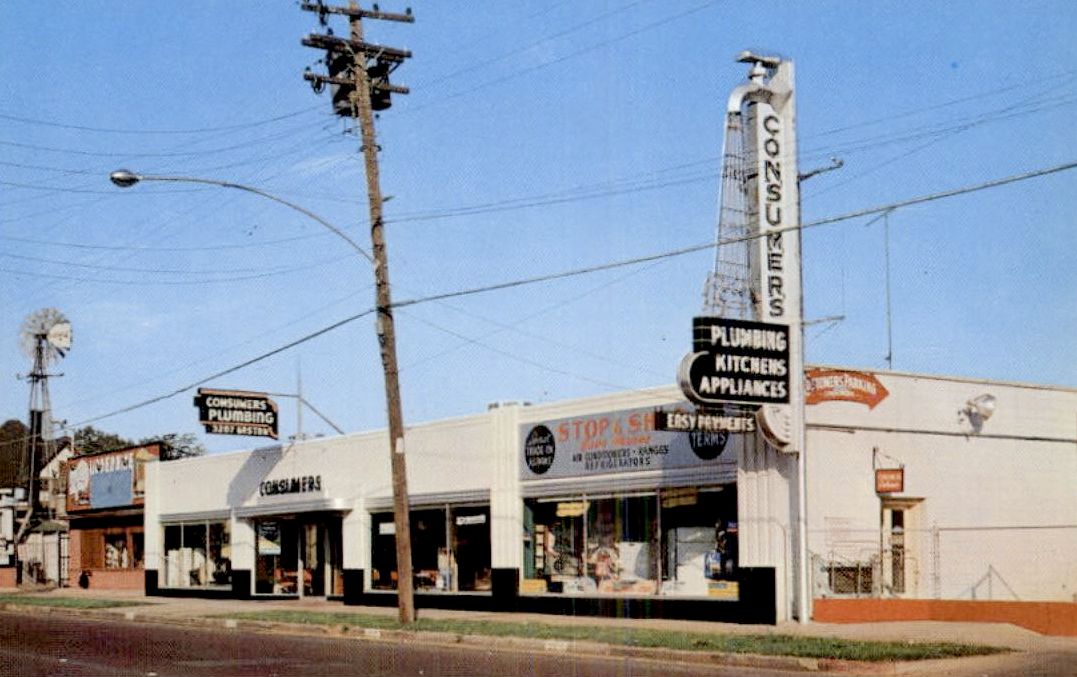










 Flashback : Dallas