Flashback : Dallas

A Miscellany: History, Ads, Pop Culture

Home Sweet Home at Commerce & Harwood

municipal-bldg_houses_jeppson_flickr“Main Street Garden?”

by Paula Bosse

Quaint homes, mere steps from City Hall. Not sure of the exact date of this photo, but these homes and this service station were at the above location in 1920. Wonder when those homeowners finally decided to sell? Talk about your primo real estate!

Below is a similar photo, but this one shows more of Commerce looking east — I don’t come across a lot of photos of this era showing downtown past what was unofficially thought of as its eastern boundary.

municipal-bldg_cook-coll_degolyer_SMU

***

Sources & Notes

Photo from Noah Jeppson’s Flickr page, here.

Second photo, titled “Dallas City Hall,” is from the George W. Cook Dallas/Texas Image Collection, DeGolyer Library, Central University Libraries, Southern Methodist University; more info on this photo can be found here.

More on the building of the City Hall/Municipal Building in the Flashback Dallas post “The Elegant Municipal Building — 1914,” here.

*

Copyright © 2016 Paula Bosse. All Rights Reserved.

Signage Overload on Main Street — ca. 1925

main-street_east_hilton_ebayI hope the photographer has a red light behind him…

by Paula Bosse

This photo makes me feel anxious. There’s just too much going on here: too many signs, too many overhead wires, too garish a light.

This is the 1800 block of Main Street, looking east. The photographer’s shadow can be seen at the bottom of the photo. A large hotel of some sort (the name of which escapes me at the moment) can be seen in the distance (in the 1900 block) at Harwood.

The businesses in this block, from the 1925 city directory (click for larger image):

1800-block_main_1925-directory

I have no 1926 directory to reference, but the 1927 directory has the building at 1811 Main (occupied in the photo by the Rund-Humphrey Water Heater Co. and the Stevenson Printing Co.) listed as being vacant. And the Hilton opened in 1925, so the photo seems to have been taken in 1925 or 1926.

***

Sources & Notes

Photo from eBay.

See the Hilton (the first one, not the later Statler-Hilton on Commerce) from a different angle in the post “The Hilton Hotel, Main & Harwood,” here.

*

Copyright © 2016 Paula Bosse. All Rights Reserved.

La Reunion: Utopia on the Trinity

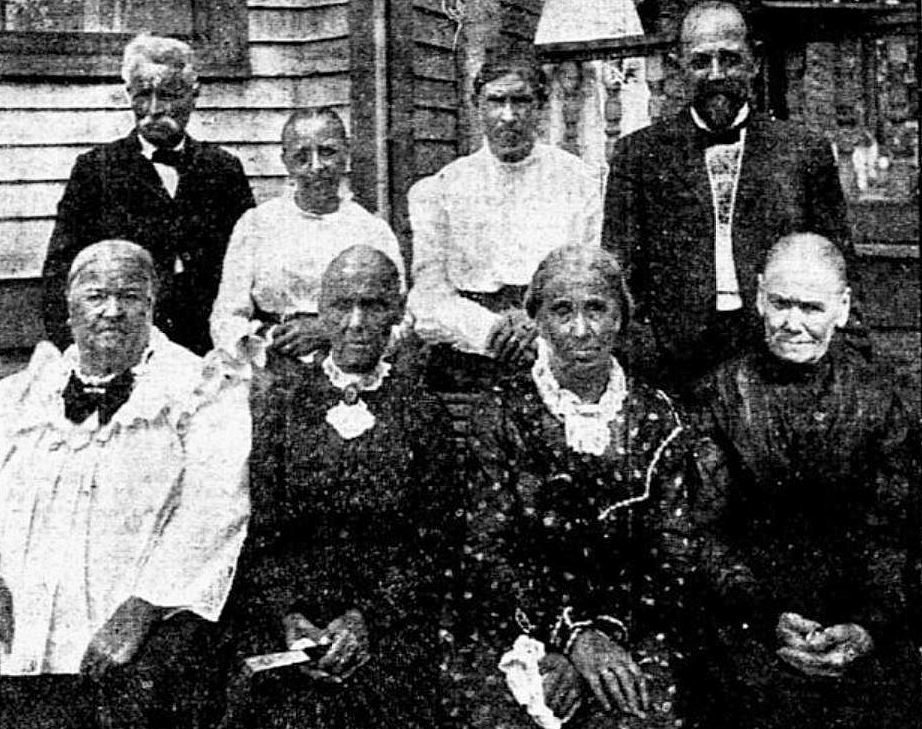
la-reunion_dmn_053106Eight of the original settlers, 1906

by Paula Bosse

I’ve put off writing about the socialist utopian settlement of La Reunion, which sprang up just across the Trinity from Dallas in the mid 1850s, because it’s such a big topic. Luckily, though, the fabulous Julia Barton has put together an entertaining and informative radio presentation on this very topic (see below for details). So I’ll just present a couple of interesting tidbits and leave the heavy lifting to Julia.

But for a totally inadequate one-paragraph summary of La Reunion, it was a colony of generally well-educated (and adventurous) French, Swiss, and Belgian immigrants, some of whom were political refugees from the unrest then spreading across Europe. They were led by Frenchman Victor Prosper Considerant (a follower of the democratic socialist Charles Fourier) — who began his settlement in 1854/1855 on land he had purchased just west of the Trinity River. A socialist commune … in Texas! But it was rough going for the European immigrants, and by 1859 the community had been deemed a failure: too many scholars, not enough farmers, as one colonist put it. Many of the colonists left the area, but several of these immigrants stayed, many becoming successful businessmen and community leaders (one of them, Swiss-born Benjamin Long, even became a two-term mayor of Dallas in the years following the Civil War). They are also credited with bringing a cultural sophistication and world-view to a dusty little town on the Texas frontier which had precious little of either before their arrival. Without the influence of these failed utopians, Dallas would be a much different city than the one we know today.

So here are a few random La Reunion bits and pieces.

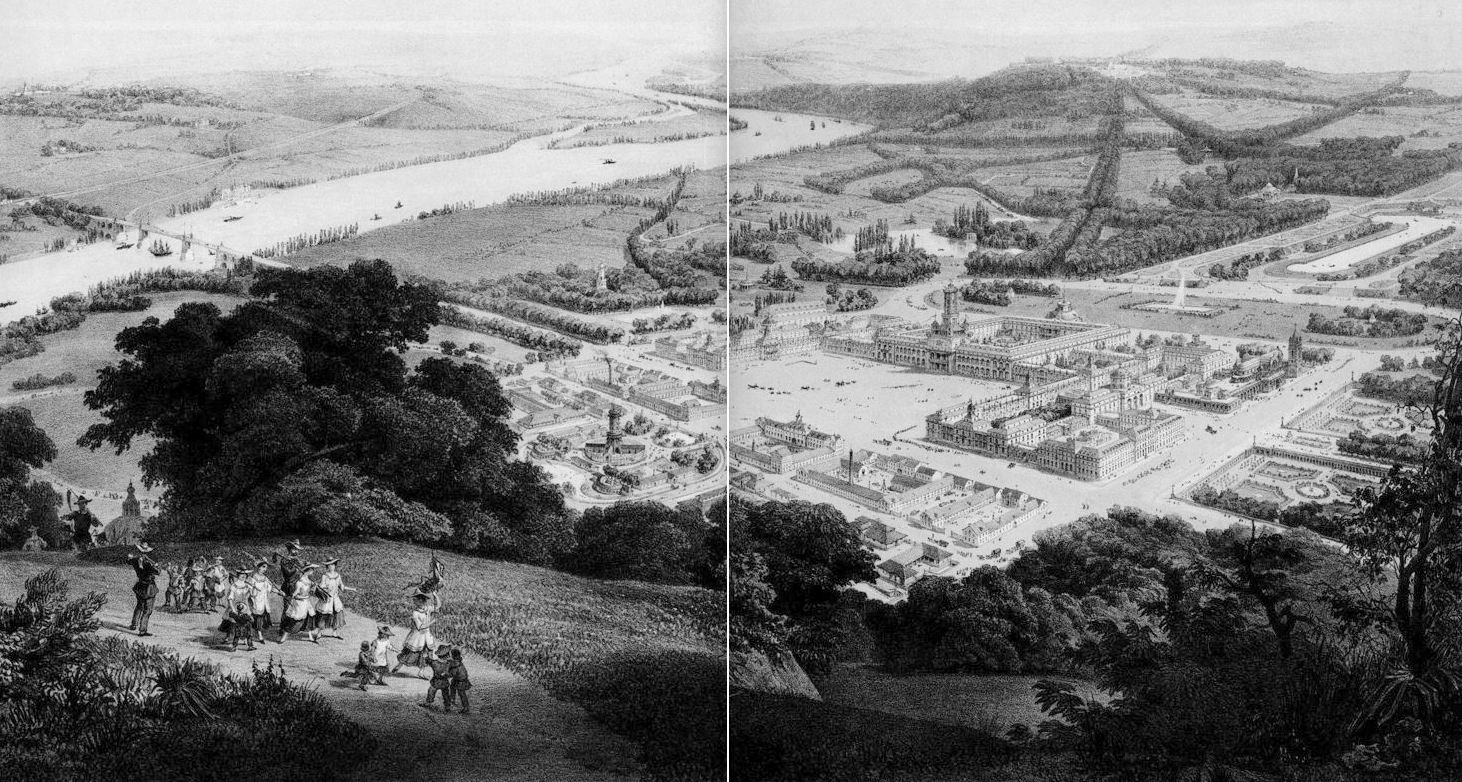
According to an interesting Legacies article by James Pratt, those settlers — while still back in their homelands — might have gotten the idea that this is what their new home in Texas might look like:

idealized_la-reunion_legacies_fall-1989_DHSSee left side REALLY big here; right side here (Dallas Historical Society)

Um, yes.

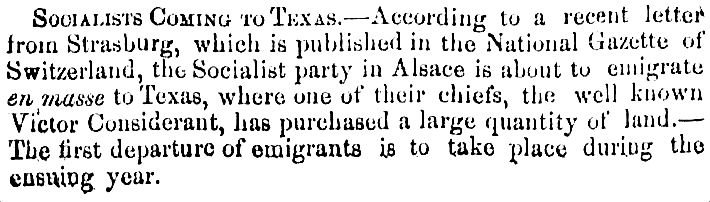
Here’s one of the first mentions of the impending arrival of Considerant’s group (the size of which was almost always exaggerated in early reports). (Click for larger image.)

la-reunion_texas-state-times_austin_021055Texas State Times (Austin), Feb. 10, 1855

*

 It was news even in Virginia:

la-reunion_richomond-dispatch_virginia_050555Richmond Dispatch, May 5, 1855

*

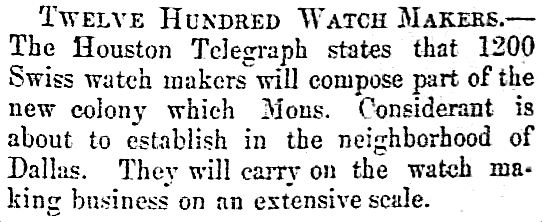
1,200 Swiss watchmakers?!!

la-reunion_texas-state-times_austin_060255Texas State Times (Austin), June 2, 1855

*

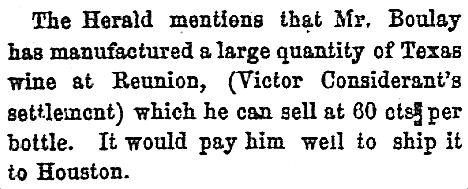
One of the things I learned from Julia Barton’s piece of La Reunion was that some of the settlers brought plants native to their European homes with them — this included grapevines, for making wine.

wine_houston-weekly-telegraph_101259Houston Weekly Telegraph, Oct. 12, 1859

(Read about the surprise M. Boulay left his widow when he died in 1875, here, in an article from The Dallas Weekly Herald, July 24, 1875)

*

On May 30, 1906, a 50th anniversary party was held by a group of the original La Reunion colonists. In the Dallas Morning News story about this event (which you can read here), these men and women were interviewed. My favorite factoid was that these fresh-off-the boat immigrants traveled to Dallas from Galveston or Houston ON FOOT. One woman said she and her fellow group of travelers walked from Houston to Dallas, leaving in late May and arriving on July 4th. Imagine their disappointment after having walked for weeks and weeks in heat they had never before experienced, only to find that their new home was nothing like what they had expected. Several stuck around for the rest of their lives, though. The eight colonists pictured in the photograph above are identified in the caption below it:

SWISS – FRENCH – BELGIAN PIONEERS OF DALLAS

  • Front row, from left to right: Mrs. Barbara Frick, Swiss, 79 years old, in Dallas 51 years
  • Mrs. D. Nussbaumer, Swiss, 73 years old, in Dallas 50 years
  • Mrs. Lucy Vorrin, French, 61 years old, in Dallas 50 years
  • Mrs. C. Remond, French, 67 years old, in Dallas 50 years
  • Second row, from left to right: Charles Capy, French, 75 years old, in Dallas 51 years
  • Mrs. Charles Capy, French, 61 years old, in Dallas 50 years
  • Mrs. C. Vongrinderbeek, Belgian, 60 years old, in Dallas 51 years
  • Adolf Frick, Swiss, 62 years old, in Dallas 51 years (DMN, May 31, 1906 — Photo by Clogenson)

*

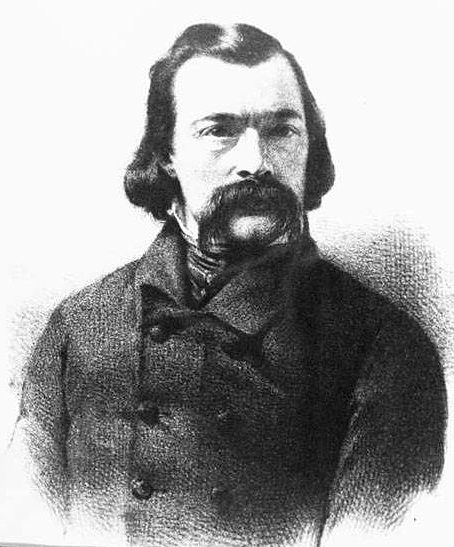
Finally, a photo of Victor Considerant, who left La Reunion when the going got tough, lived in a nice place in San Antonio for a while, then returned to France, where he lived as a teacher and “socialist sage” until his death in 1893 at the age of 85.

victor-considerant_utsaUTSA Libraries, Digital Collections

***

Sources & Notes

I HIGHLY encourage you to listen to the aforementioned radio essay Julia Barton did for Public Radio International: “The Failed Socialist Utopian Dream That Helped Dallas Become a Major City” is here. It is a segment of the PRI podcast The World in Words — it begins at about the 5:30 mark and runs about twenty minutes. I learned stuff!

The highly idealized rendering of a Fourier-inspired phalanstère is from the collection of the Dallas Historical Society and appeared on the front and back covers of the Fall, 1989 issue of Legacies. No other information on the drawing was given. I’m not sure if prospective La Reunion colonists were led to believe this was a depiction of the heaven-on-earth that awaited them in Texas. If so, I bet they were very, very disappointed.

La Reunion links:

  • Handbook of Texas (with details about the philosophical, political, and social aims of the colony)
  • Wikipedia
  • “La Reunion: Adventure in Utopia” from the WPA Guide to Dallas, here
  • “La Reunion” by Ernestine Porcher Sewell, from The Folklore of Texan Cultures (1974), here

Watch Julia Barton’s presentation of “Port of Dallas” — about the misguided hopes to turn the Trinity River into a navigable waterway from Galveston to Dallas — here.

Other Flashback Dallas posts on La Reunion can be found here.

reunion-tower_twitter@ReunionTower on Twitter

*

Copyright © 2016 Paula Bosse. All Rights Reserved.

Tennessee Williams in Dallas

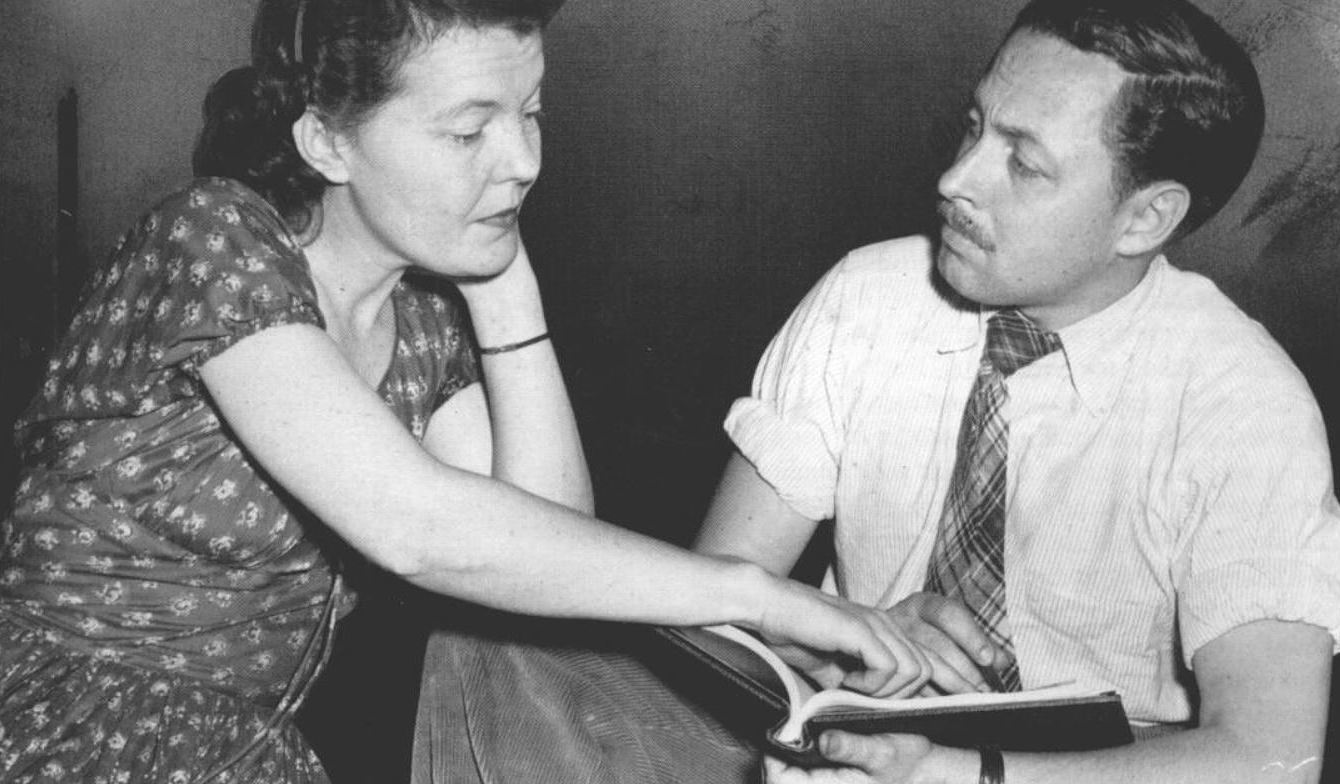
tennessee-williams_margo-jones_legacies_spring-2007Tennessee Williams with Margo Jones, 1948

by Paula Bosse

Today is Tennessee Williams’ birthday — he was born March 26, 1911. Thanks to his personal friendship and professional relationship with energetic Dallas theater pioneer Margo Jones (to whom he gave the nickname “The Texas Tornado”), playwright Tennessee Williams was a fairly frequent visitor to Dallas in the 1940s in the early years of his celebrity. Margo was a very early supporter of Williams, and their friendship led to her co-directing The Glass Menagerie on Broadway and her directing and producing the world premiere of his play Summer and Smoke at her Theater ’47 in Fair Park (a production which she took to Broadway the following year).

Dallas historian Darwin Payne wrote an interesting profile of Williams’ time in Dallas in the Spring 2007 issue of Legacies (read it here — it  begins at the bottom of the page). My favorite quote in the article is about Dallas women, from a letter Tennessee wrote to New York theater director and producer Guthrie McClintic on June 1, 1945:

tennessee-williams_legacies_spring-2007_darwin-payne_1945-quote

***

Sources & Notes

A comprehensive chronology of the friendship and professional partnership of Tennessee Williams and Margo Jones can be found in the article “An Alignment of Stars: Tennessee Williams, William Inge, and Margo Jones’s ‘Theatre ’47′” by Ralph F. Voss, here.

My previous post concerning Margo Jones’ early demise — “Margo Jones & Jim Beck: Both Legends in Their Fields, Both Victims of Carbon Tetrachloride” — is here.

*

Copyright © 2016 Paula Bosse. All Rights Reserved.


Main & Akard, Looking East

main_east-from-akard_WPA-GD_DPLWatch your step, girls…

by Paula Bosse

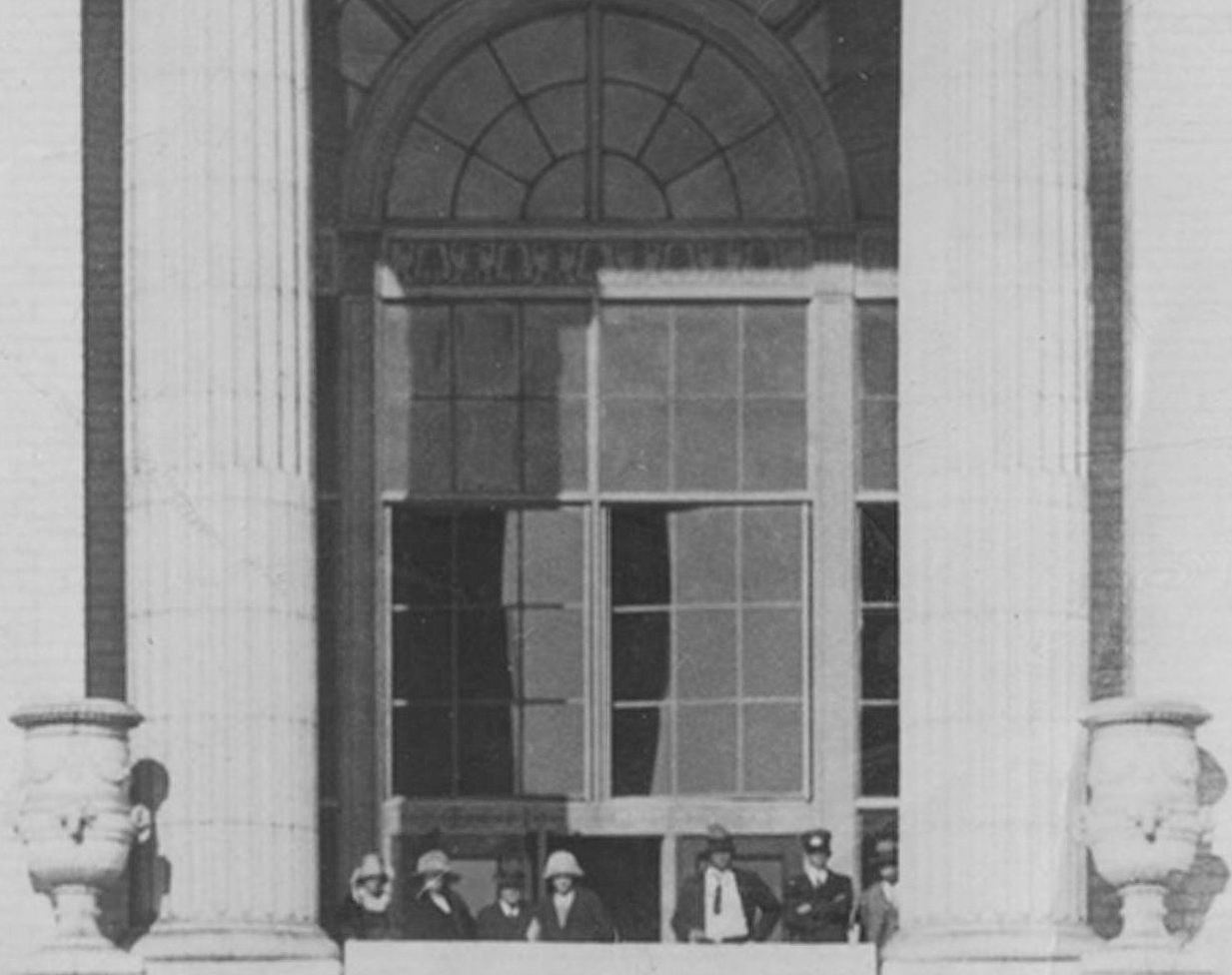
Ah, Main Street. It’s so sad that the Praetorian Building — the tall white building in the distance on the left — has been demolished to be replaced by a giant eyeball, but it’s great to see that the Kirby Building — at the left — is still hanging in there and still looking great.

Check out the height of those curbs!

main_east-from-akard_WPA-GD_DPL-det

***

Sources & Notes

Photo from the WPA Dallas Guide and History ([Denton]: University of North Texas Press, 1992); photo from the collection of the Dallas Public Library. Two sources of this photo cite different dates: one 1935, the other 1930. My guess would be late ’20s — or, certainly closer to 1930 than 1935.

See what this view looks like today on Google Street View, here.

*

Copyright © 2016 Paula Bosse. All Rights Reserved.

The Dallas Chapter of “The Women of the Ku Klux Klan” — 1920s

kkk-women_1920s_cook-degolyer

by Paula Bosse

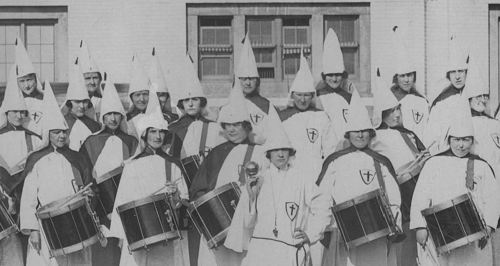
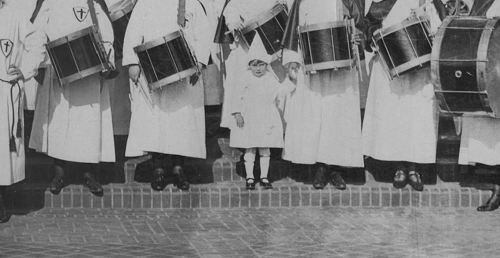
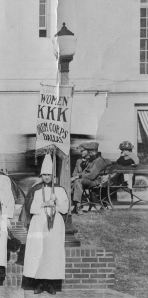
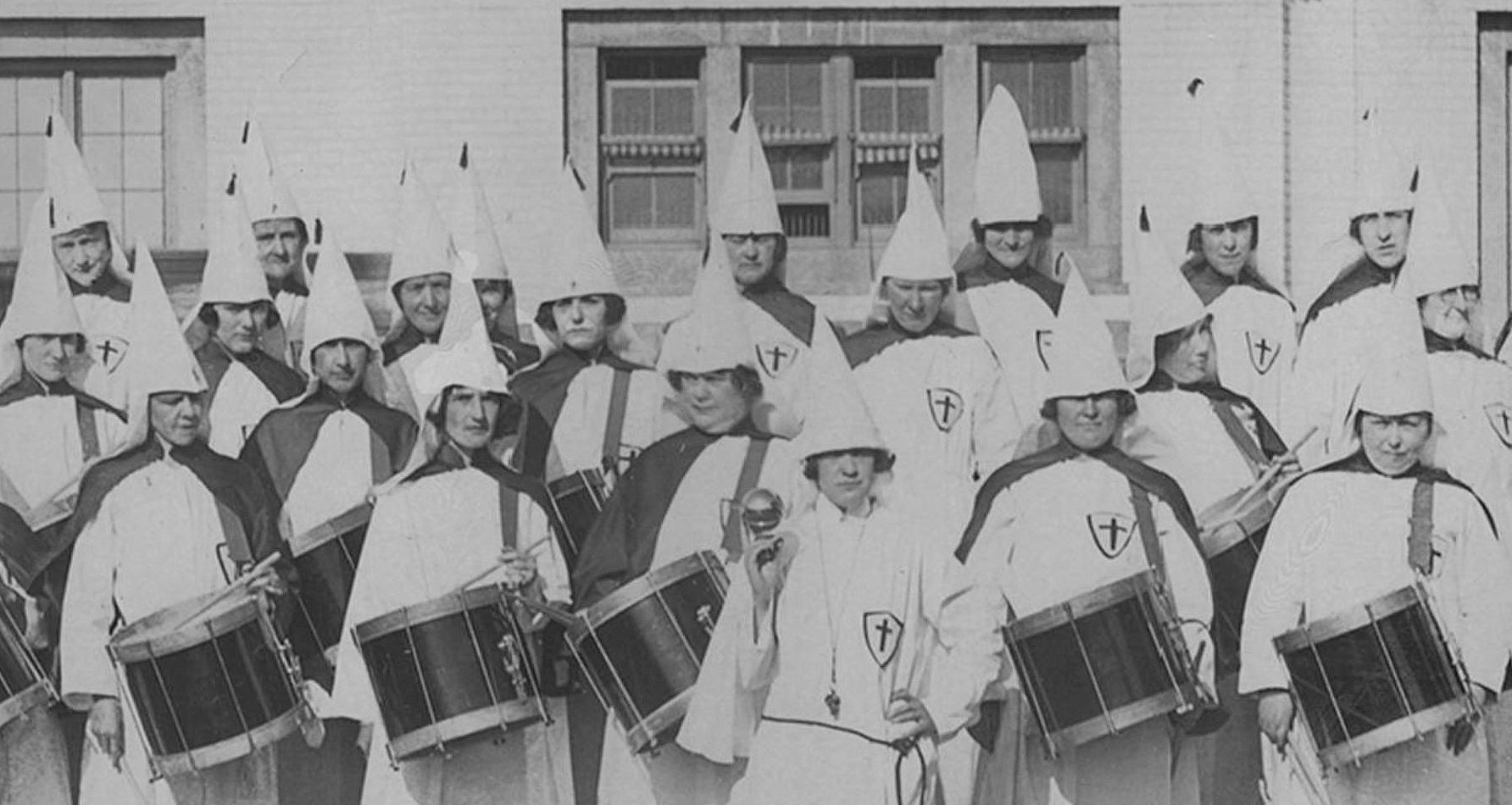
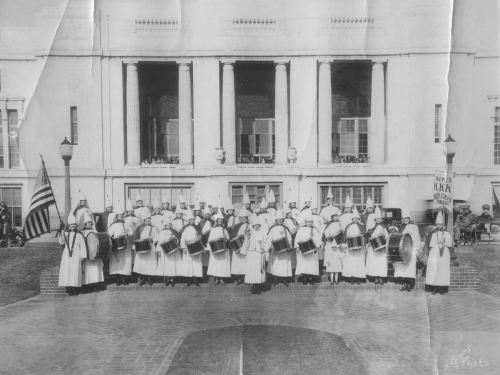
I’ve managed to avoid mention of the Ku Klux Klan since starting this blog a couple of years ago, which is saying something, because the KKK pretty much ruled this city for a good chunk of the 1920s. The Dallas chapter — Klan No. 66 — had more than 13,000 men as members; it was one of the largest chapters in the nation (by some accounts, THE largest chapter). Members included politicians, judges, and law enforcement officials. But what of the Klan-leaning ladies who were not allowed to join? Before I plunge into that, let’s look at what’s going on in this weird, be-robed group shot, a photo taken around 1924 in Ferris Plaza with poor Union Station as a backdrop. (Click these for much larger images.)
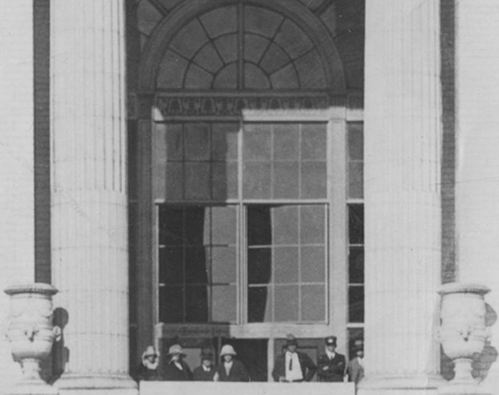
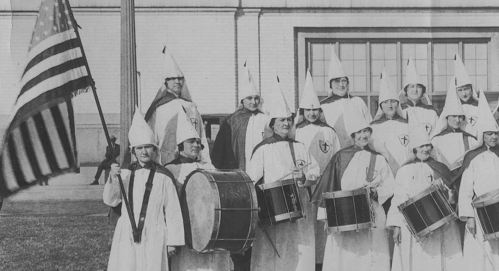
wkkk_det1

wkkk_det2

wkkk_det3

wkkk_det4

wkkk_det5

**

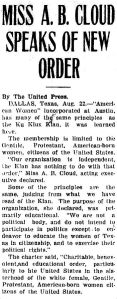
In the early 1920s, women — who had led the temperance movement and whom had recently been given the right to vote — began to form groups that tackled social issues. Some of these groups espoused the same general rhetoric as the KKK. One of these groups was formed in Dallas in 1922 — the “American Women” group was the brainchild of three women, including Alma B. Cloud, who appears to have been only 21 years old. One of the other founders was her partner in a short-lived ladies’ clothing boutique. Cloud immediately hit the lecture circuit, giving free lectures on “Americanism” to (white Protestant) women around Texas.
cloud_taylor-tx-daily-press-08222Taylor Daily Press, Aug. 22, 1922

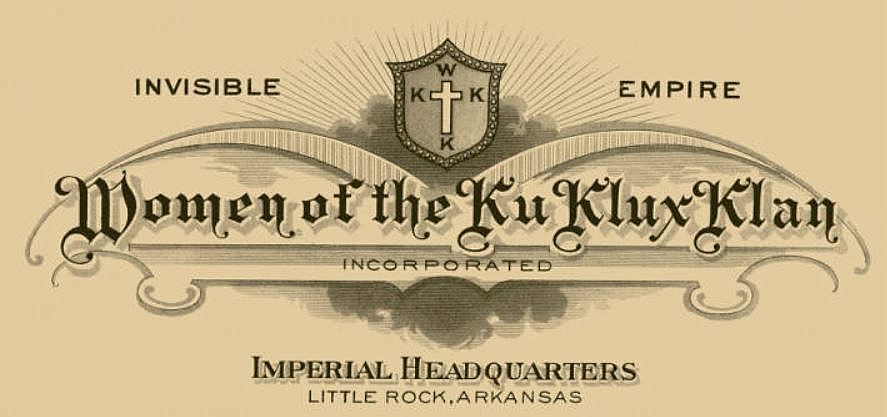
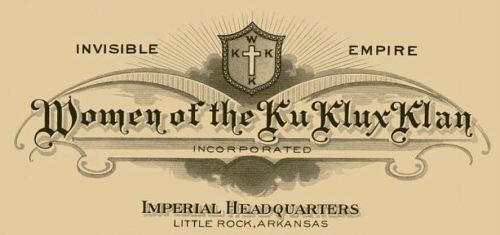
By the following summer, the male leadership of the Klan allowed a “Women of the Ku Klux Klan” to be created; its national headquarters was in Little Rock.
wkkk_letterhead_olemiss

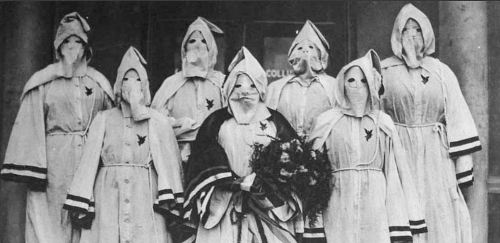
They were not officially part of the KKK but were, in theory, a separate entity. While not, perhaps, as outwardly extreme as their male counterparts, they were certainly as virulently racist and intolerant. They might not have been lynching people and threatening violence, but they were busy pushing their exclusionary, white supremacy agenda. And both the men and the women liked to dress up in white robes and hoods. Here’s what the women looked like when they added masks to the ensemble (not Dallas — location of photo unknown).
wkkk

Several of the independent women’s groups founded previously were happily absorbed by the WKKK — including Miss A. B. Cloud’s group. In fact, Miss Cloud became the leader of the Dallas chapter. The “Klaliff.” The headquarters for this group — which campaigned for “progressive morality”– was in a little space on North Harwood.

WKKK_1924-directory1924 Dallas directory

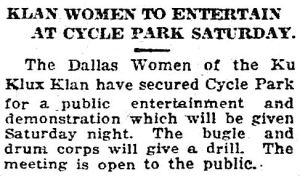
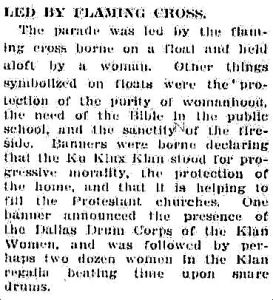
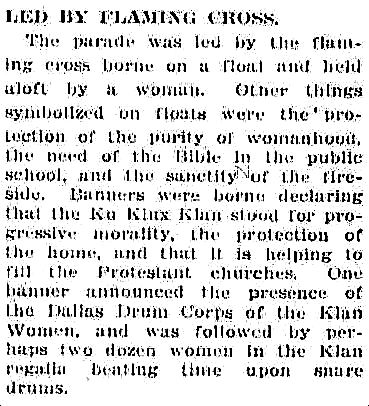
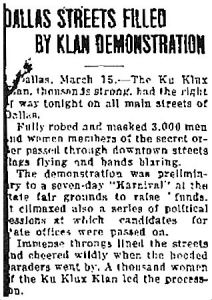
1924 seems to have been the big year for both the KKK and the WKKK. The women found themselves at lots of parades with burning crosses and other … “functions” — so why not form a drum corps? A few clippings. (Click for larger images.)
kkk-women_amarillo-globe-times_031624Amarillo Globe-Times, March 16, 1924

klan-women_dmn_073124Dallas News, July 31, 1924

kkk-women_mckinney-courier-gazette_111224McKinney Courier-Gazette, Nov. 12,1924

By 1926, the KKK was starting to lose its power, and the fear and intimidation they had instilled in much of the public began to wane. The (men’s) KKK had had to downsize and move into the women’s headquarters, and their candidates began losing elections. Even worse, you know things were getting bad if someone was suing the KKK for delinquent robe-payment!

KU KLUX KLAN WOMEN SUED FOR ROBES BILL: Suit for $4,463.80 was filed in the Forty-Fourth District Court on Friday afternoon by John F. Pruitt against the Women of the Ku Klux Klan, Inc. The petition alleges that the plaintiff sold the defendant, a corporation, 6,000 robes at $2.50 each during the two years preceding the filing of the suit, for which the defendant agreed to pay $15,000 to the plaintiff. It is alleged that $4,463.80 remains unpaid. (DMN, Nov. 28, 1925)

The power once exerted by the Ku Klux Klan had diminished greatly by the end of the 1920s, and while the Klan has never disappeared completely, it will never again reach the heights it had attained in the 1920s.

Whatever happened to Miss A. B. Cloud? After having been ousted from her “imperial” position (for reasons I don’t really care enough about to investigate), she had a few sales jobs and eventually began to present motivational sales talks. There was an Alma B. Cloud in California who was mentioned in several news stories from the 1930s — she presented motivational lectures to students on how best to plan their future adult lives. Um, yes. I’m not 100% sure this was the same A. B. Cloud who was the former WKKK gal from Big D, but it seems likely. I wonder what those students would have thought had they known of her pointy-hooded past?

***

Sources & Notes

Links-a-plenty.

Top photo is titled “Ku Klux Klan Women’s Drum Corps Dallas in Front of Union Station,” taken by Frank Rogers; it is from the George W. Cook Dallas/Texas Image Collection, DeGolyer Library, Central University Libraries, Southern Methodist University — it can be accessed here. I have manipulated the color.

Women of the Ku Klux Klan letterhead comes from the Women of the Ku Klux Klan Collection, Archives and Special Collections, University of Mississippi Libraries; the collection can be accessed here.

The photo of the masked WKKK women is all over the internet — I don’t know its original source or any details behind it, but it’s creepy.

“Women of the Ku Klux Klan” on Wikipedia, is here.

“Women of the Klan: Racism and Gender in the 1920s” by Kathleen M. Blee, is here.

“Charity by Day, Punishment by Night: The Ku Klux Klan in Fort Worth” — from the great FW history blog Hometown by Handlebar — is here.

And, probably best of all, the Dallas Morning News article “At Its Peak, Ku Klux Klan Gripped Dallas,” by the wonderful and much-missed Bryan Woolley, can be read here. This article contains facts and figures, describes the sort of “madness of crowds” atmosphere in the city at the time, and details some of the horrible atrocities committed by the KKK in Dallas. Woolley cites historian Darwin Payne’s assertion that if one considered every adult man in Dallas who would have been eligible to have joined the Klan (this excludes, of course, those of African-American, Hispanic, Asian, Catholic, or Jewish descent), one in three of them was a member of the Dallas chapter of the Ku Klux Klan. ONE IN THREE.

A few short mentions of the Dallas WKKK have been compiled here.

UPDATE: For a look at racism in modern Dallas, watch the half-hour film “Hate Mail,” made in 1992 by Mark Birnbaum and Bart Weiss, here. It includes interviews with several prominent Dallasites, as well as interviews with a couple of Klan leaders.

Click pictures and clippings to see larger images.

*

Copyright © 2016 Paula Bosse. All Rights Reserved.

Spring, According to Otis Dozier — 1937

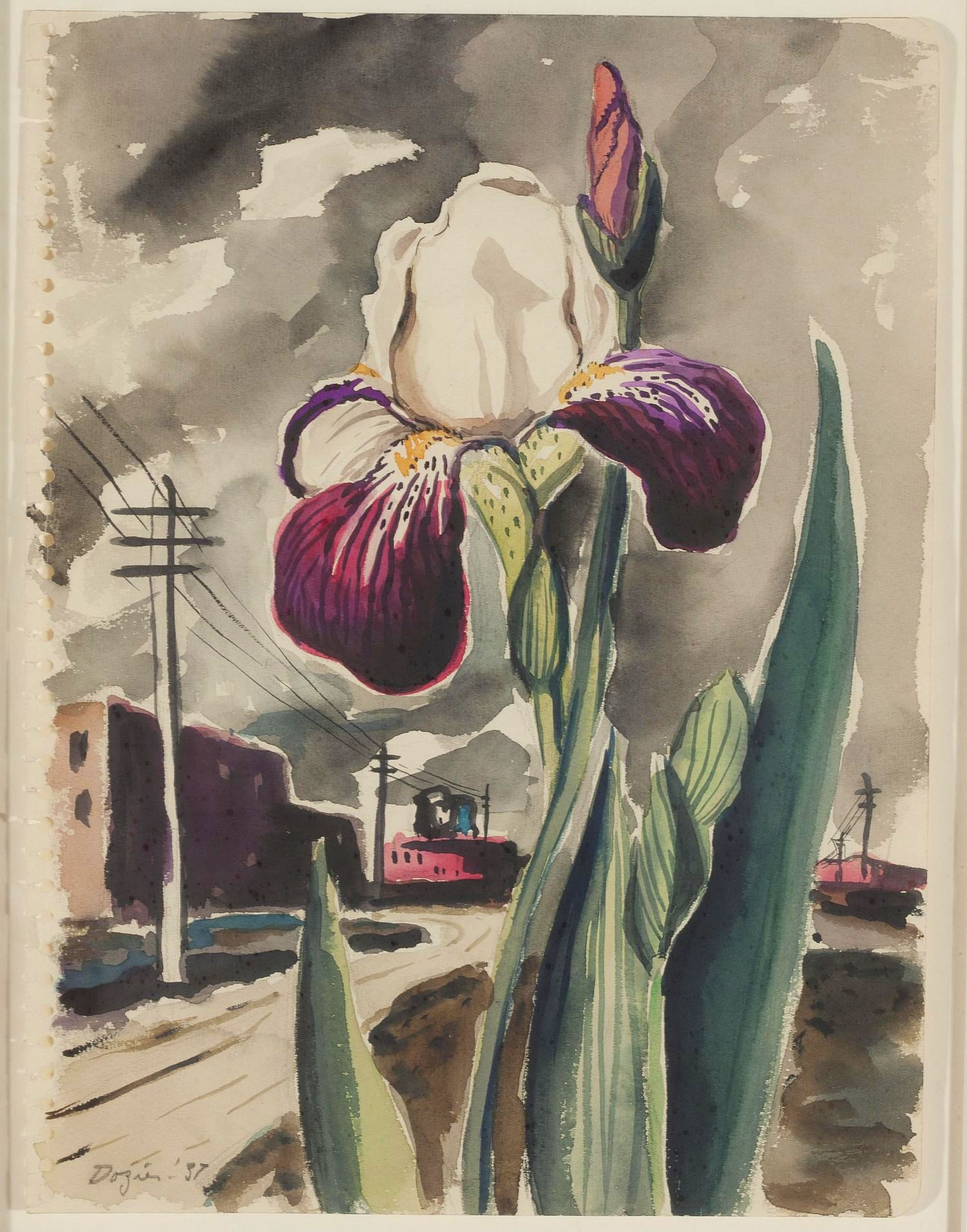
dozier_iris-purple_1937_dmaOtis Dozier’s purple iris (click for much larger image)

by Paula Bosse

My birthday is in March, and I always associate this time of year with irises, because the irises around our house would start to bloom in time for my birthday. There’s no better way to celebrate a (belated) start to Spring than by sharing this beautiful watercolor from Otis Dozier: “Iris (purple) April,” 1937.

***

This watercolor is in the collection of the Dallas Museum of Art, a gift of The Dozier Foundation; ©Denni Davis Washburn, William Robert Miegel, Jr., and Elizabeth Marie Miegel. More information is here.

More on the Forney-born Dallas Nine artist Otis Dozier (1904-1987), here.

Did you know there is an Iris Society of Dallas? There is!

Click picture for very large image.

*

Copyright © 2016 Paula Bosse. All Rights Reserved.
Highland Park Village — The Original Model

hp-village_model_gallowayDallas’ most exclusive shopping destination

by Paula Bosse

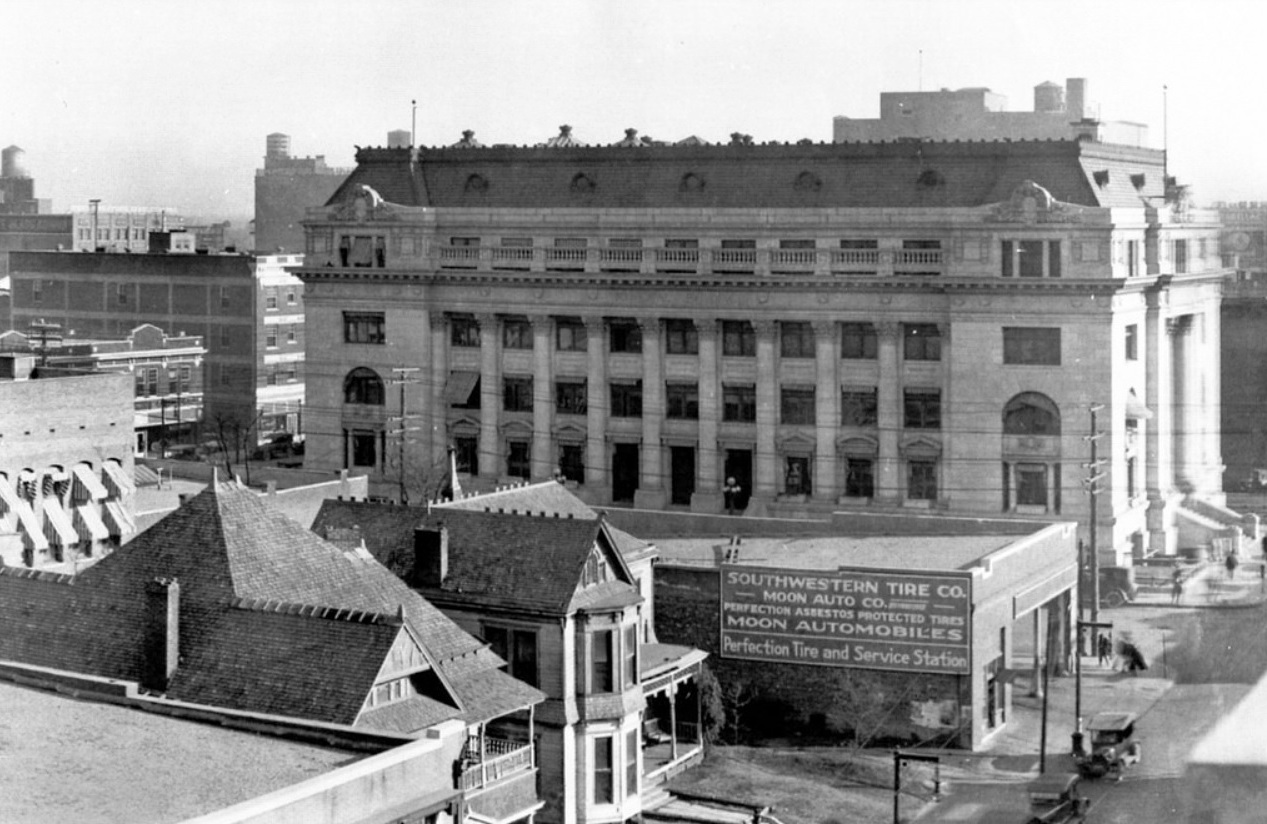
The model of the Highland Park Shopping Village (“9 Acres of Property”) was, for many years, on display in the sales office of the Flippen-Prather Realty Co., the company that developed Highland Park and this beautiful shopping “village.” (I’m not sure where this photo was taken — it looks like a Flippen-Prather promotional table set up in an exhibition space of some sort.) Construction began on the shopping area in early 1930 and took several years to complete. The architects were Dallas’ Fooshee & Cheek.
Below, a slightly closer look at this cool model, complete with little cars (but no little people…).

hp-village-model_galloway-det

***

Sources & Notes

The photo (credited to the collection of Hugh Prather, Jr.) is from the really wonderful book The Park Cities, A Photohistory by Diane Galloway (Dallas: Diane Galloway, 1989). (This is an essential book for anyone interested in historic photos of Dallas and the Park Cities. If you come across a copy priced under $30.00, snap it up!)

More on the Highland Park Village of today can be found here.

*

Copyright © 2016 Paula Bosse. All Rights Reserved.

From the Vault: The Waiting Station at Ferris Plaza

railway-info-bldg_1926

by Paula Bosse

This forgotten building on the east side of Ferris Plaza used to face Union Station. It was the first thing travelers saw as they emerged from the terminal: an attractive information bureau and a covered place to wait for streetcars and interurbans, which many of these travelers took as they continued their journeys. One could also buy snacks inside and avail oneself of its public “comfort stations.” Almost no one remembers this little brick building, and, I have to say, I really enjoyed researching it! Read the post from 2014 — “Ferris Plaza Waiting Station: 1925-1950” — and see some interesting photos, here.

*

Copyright © 2016 Paula Bosse. All Rights Reserved.

The Official Government Reenactment of the Kennedy Assassination — Nov. 27, 1963

reenactment_agent-at-windowAgent Howlett at window with “rifle”

by Paula Bosse

Yesterday I received a comment on a previous post I wrote about the first official reenactment of the Kennedy assassination, and that got me to wondering if that film was online anywhere. The film was made as part of the Secret Service investigation and was filmed in Dealey Plaza and in the Texas School Book Depository; the motorcade sequence was filmed on November 27, 1963, just five days after the assassination. Even though my knowledge of the events of November 22 is fairly limited (and what I do know is mostly due to osmosis), just growing up here you kind of feel you’ve seen everything connected with the assassination. But I’d never seen this film or the one made a few months later with the production assistance of local TV station KRLD, which included much of the same footage. Apparently, the original film had not been made public until fairly recently.

It’s very interesting to watch, and the fact that there is no sound makes it appropriately eerie. I have to admit that I was most interested in seeing the footage of downtown streets. And the interior of the Texas School Book Depository beyond just the “sniper’s nest” we always see. (I can now say I’ve sneaked a peek inside the depository’s employee lunchroom.)

So here are the two films. The first one was made by the Secret Service, with the Dealey Plaza reenactment filmed on Nov. 27, 1963. It has no sound. I thought it was interesting, but a lot of people might find it a little dull and repetitive. Below this video is one which uses this footage to lay out the government’s findings, with lots of details and no-nonsense narration by KRLD’s Jim Underwood. (I’m not sure why — or for whom — this educational film was made. It doesn’t seem to have been screened for the public.) The silent film has more footage, but the narrated film is easier to follow. And below that are screenshots from the government’s “reconstruction.” (UPDATE, Jan. 2024: The two videos I had originally linked have been removed from YouTube. I’m linking a video I found recently below.)

*

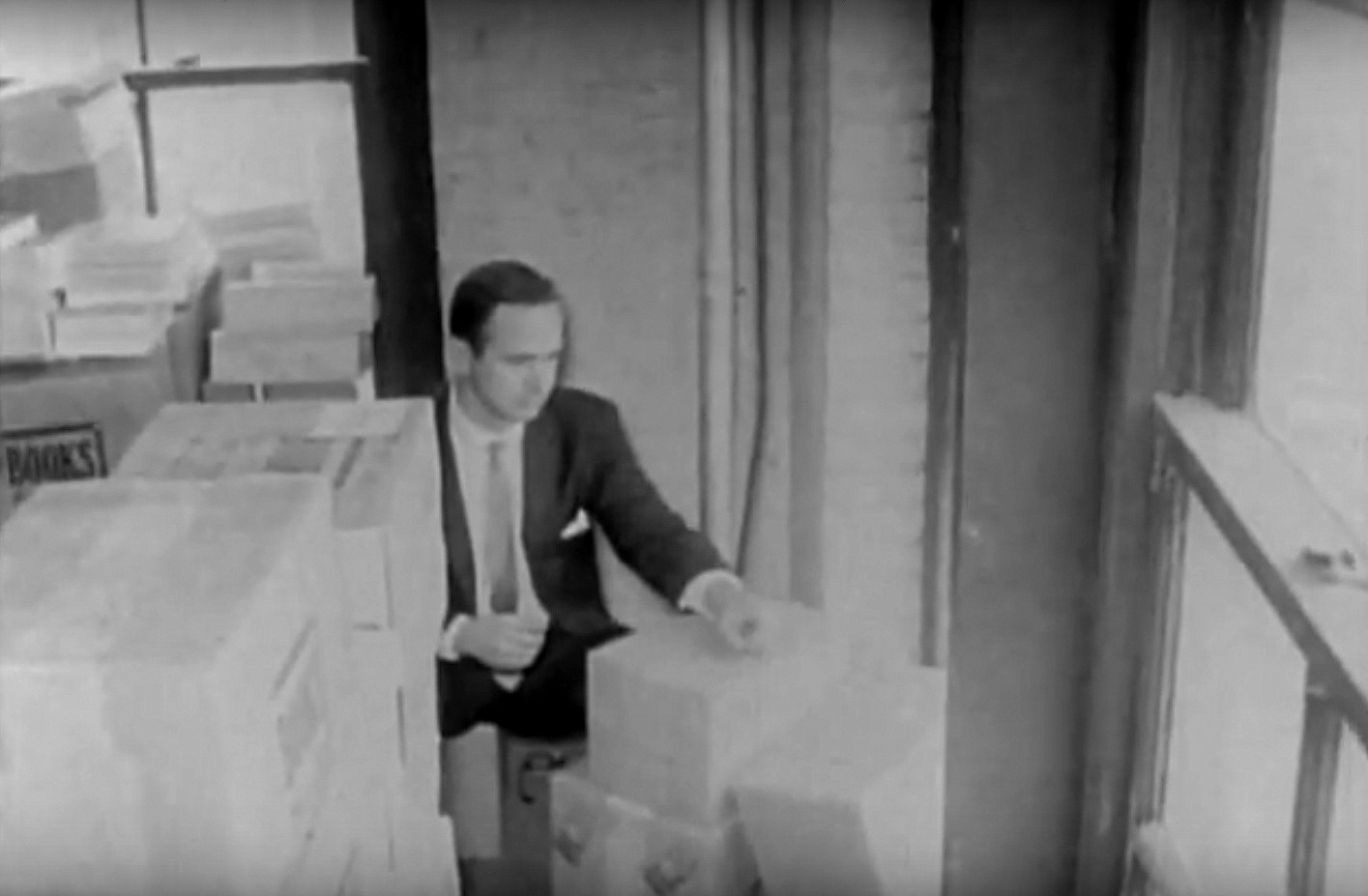
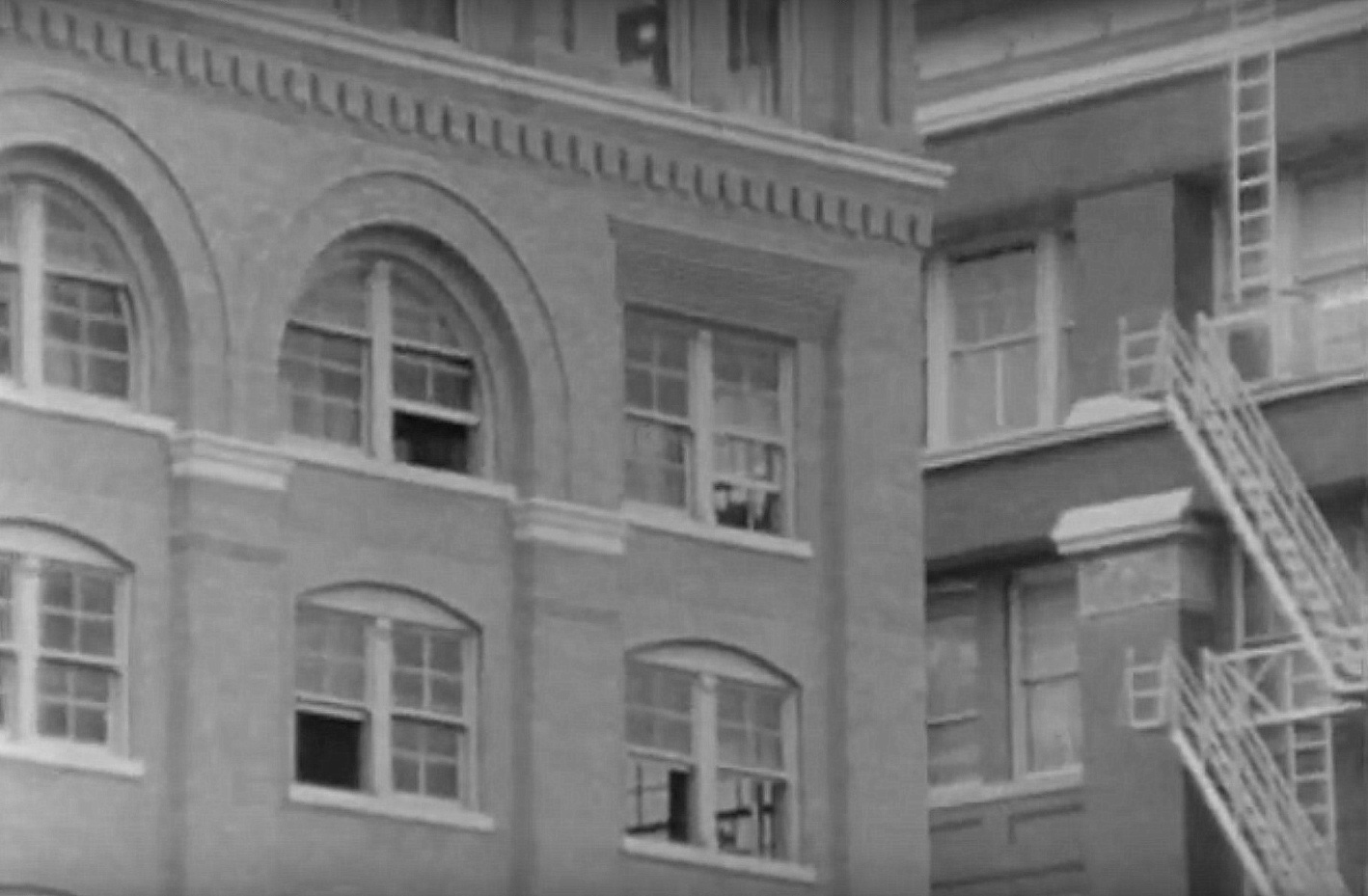
Below, a few screenshots from the government footage. The one at the top of this post shows Special Agent John Joe Howlett sitting at the sixth-floor window, as if holding a rifle.

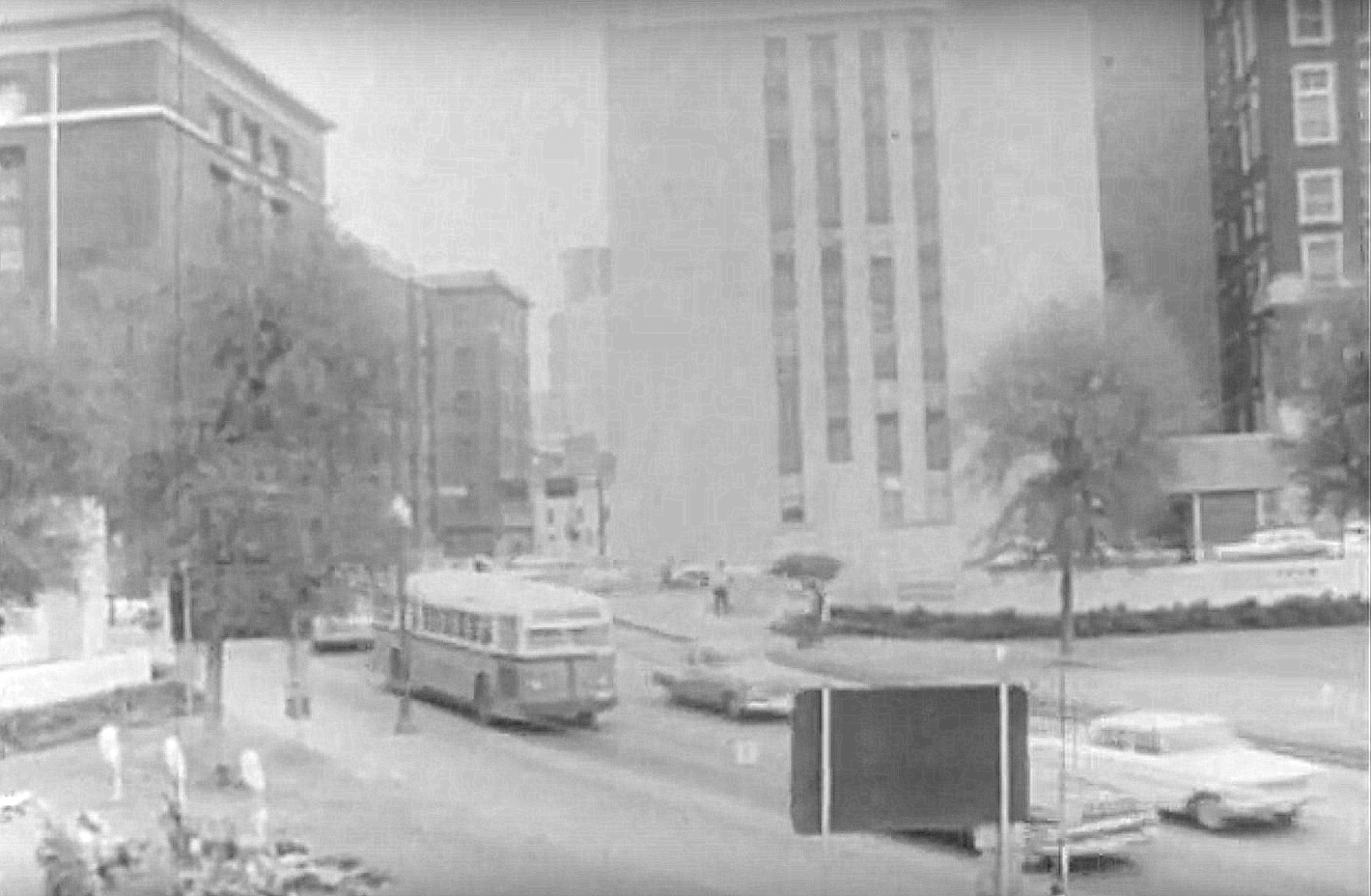
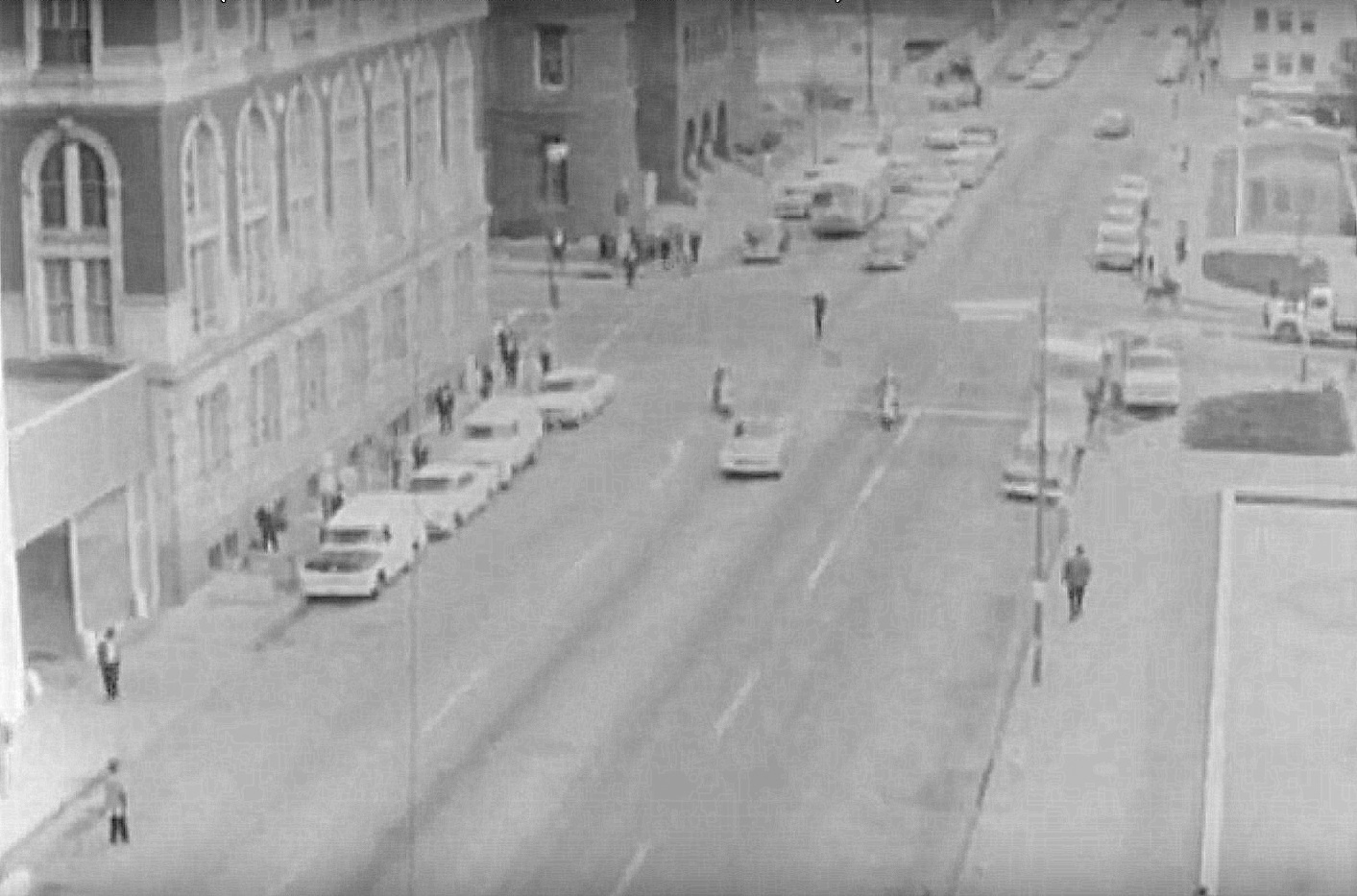
Below, Elm St. looking east from Dealey Plaza, with the white Records Building at center right.

reenactment_elm*

The one-car-two-motorcycle motorcade turning from Main onto Houston St. Looking south from … you know where.

reenactment_houston-st*

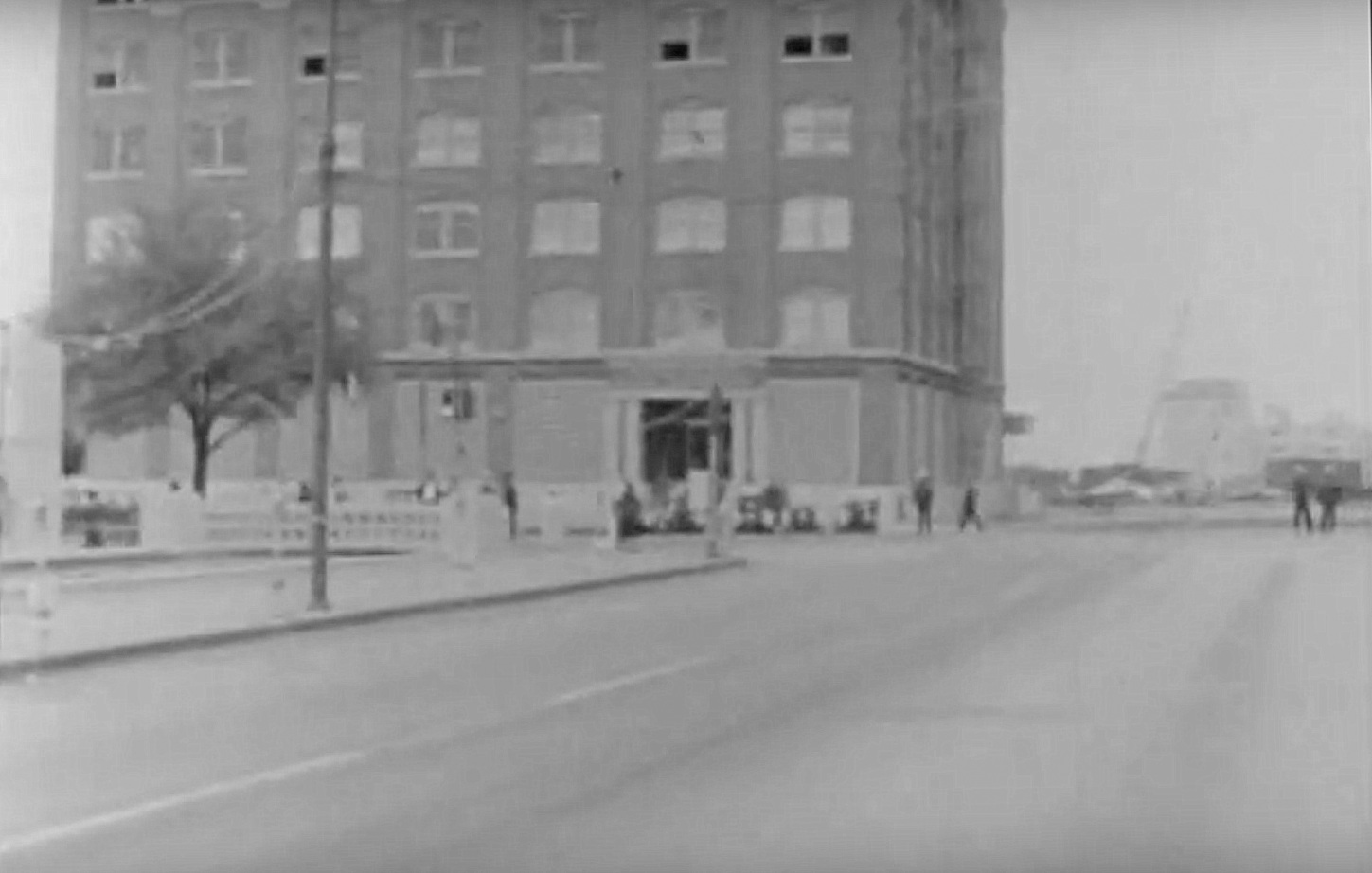
Houston St. looking north, with the School Book Depository on the left and a disconcertingly empty space straight ahead.

reenactment_houston-st-north*

A nice artsy shot of the book depository and the old John Deere Building.

reenactment_tsbd-ext*

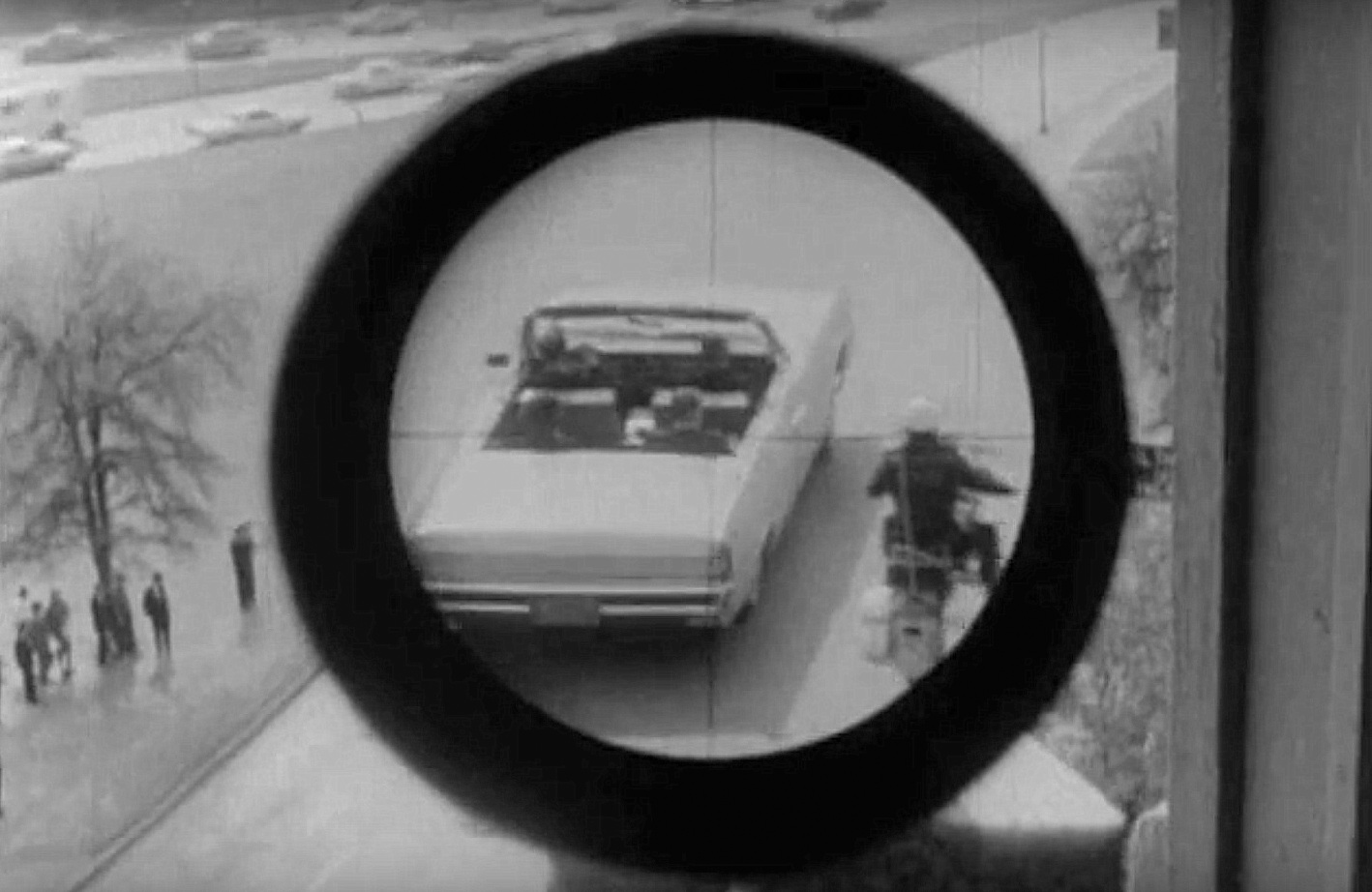
Camera with “scope” attachment.

reenactment_scope*

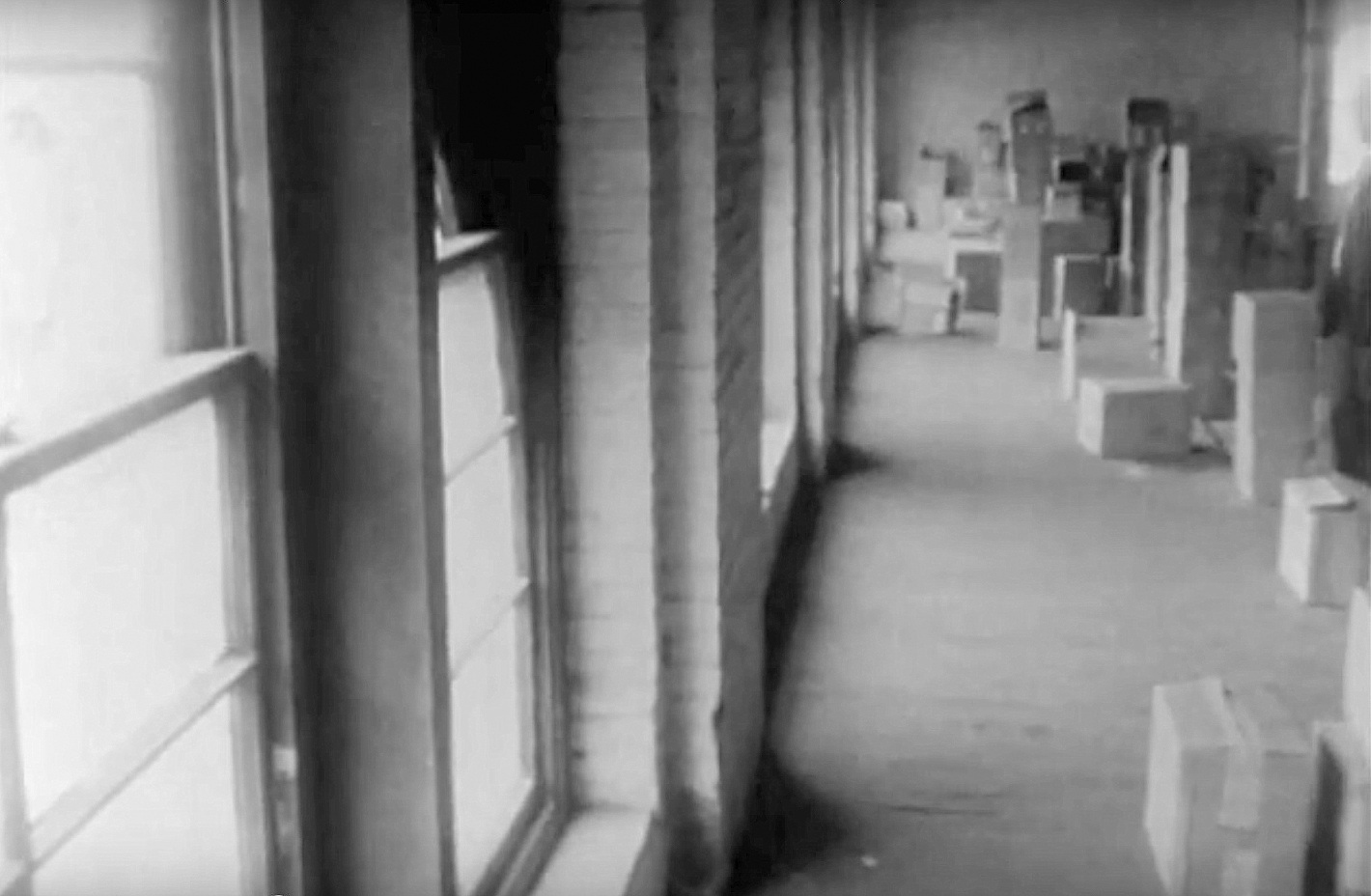
Windows, boxes, looking toward the west end of the building from the “nest” end of the sixth floor.

reenactment_tsbd-int*

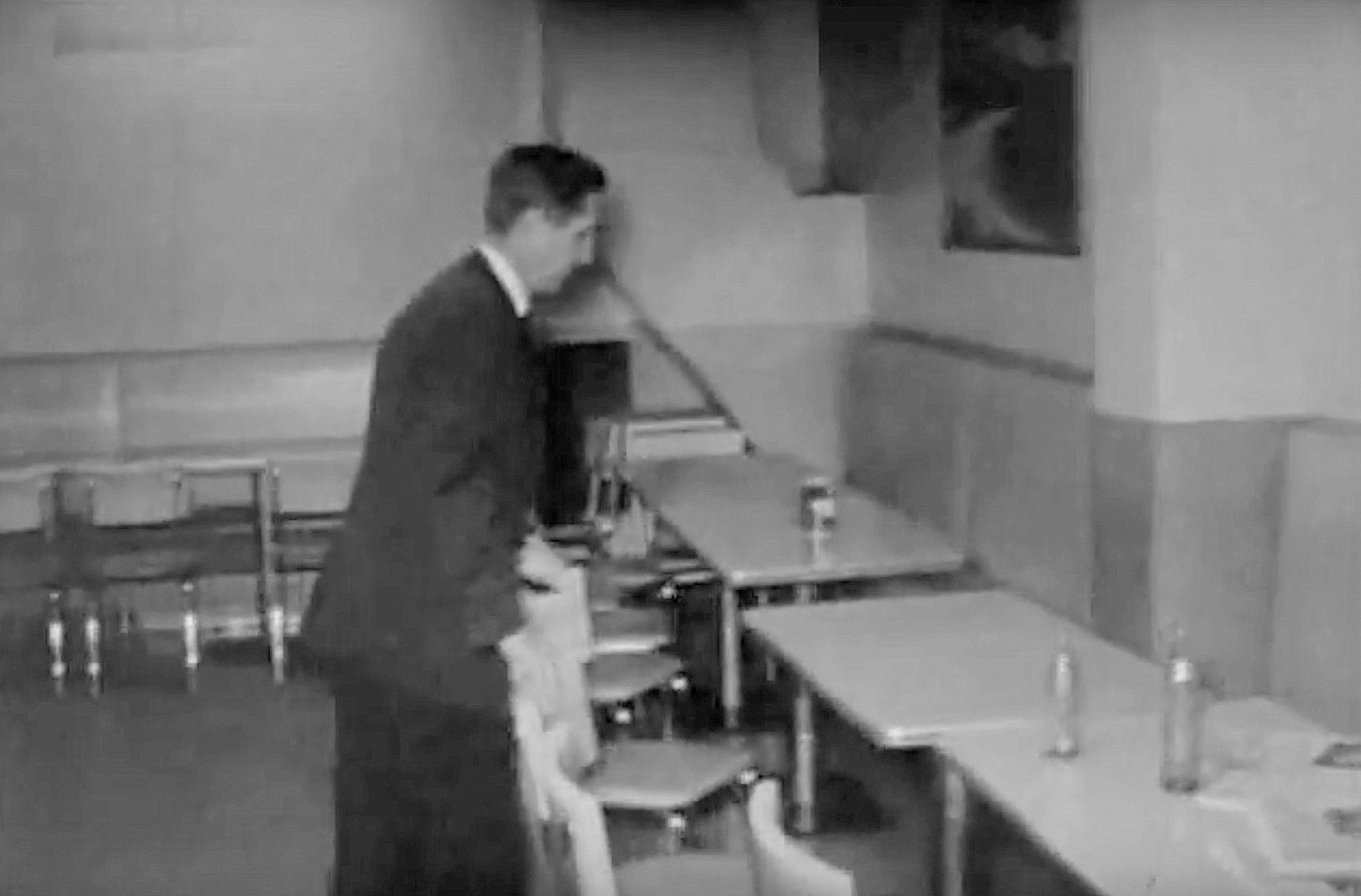
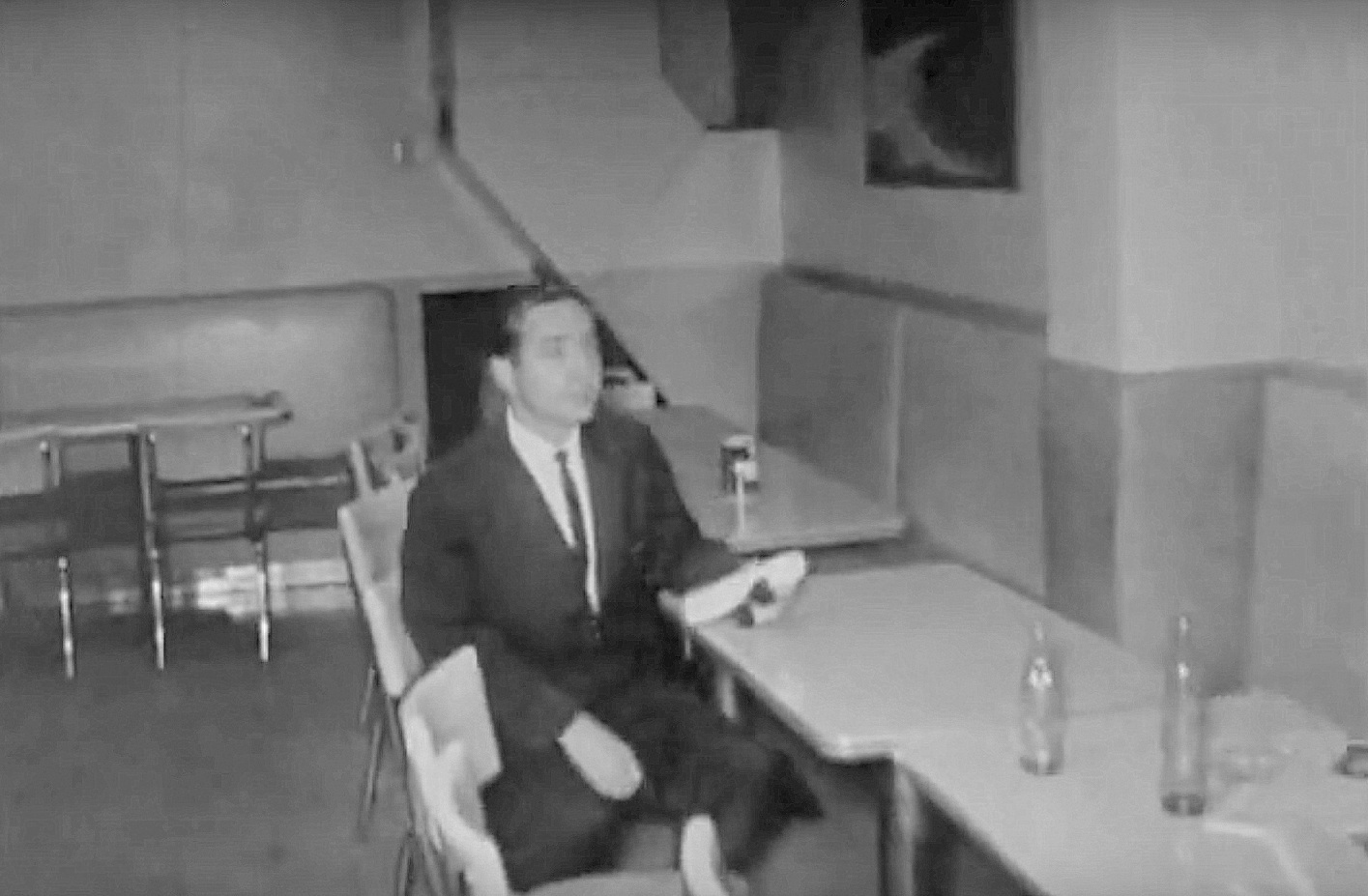
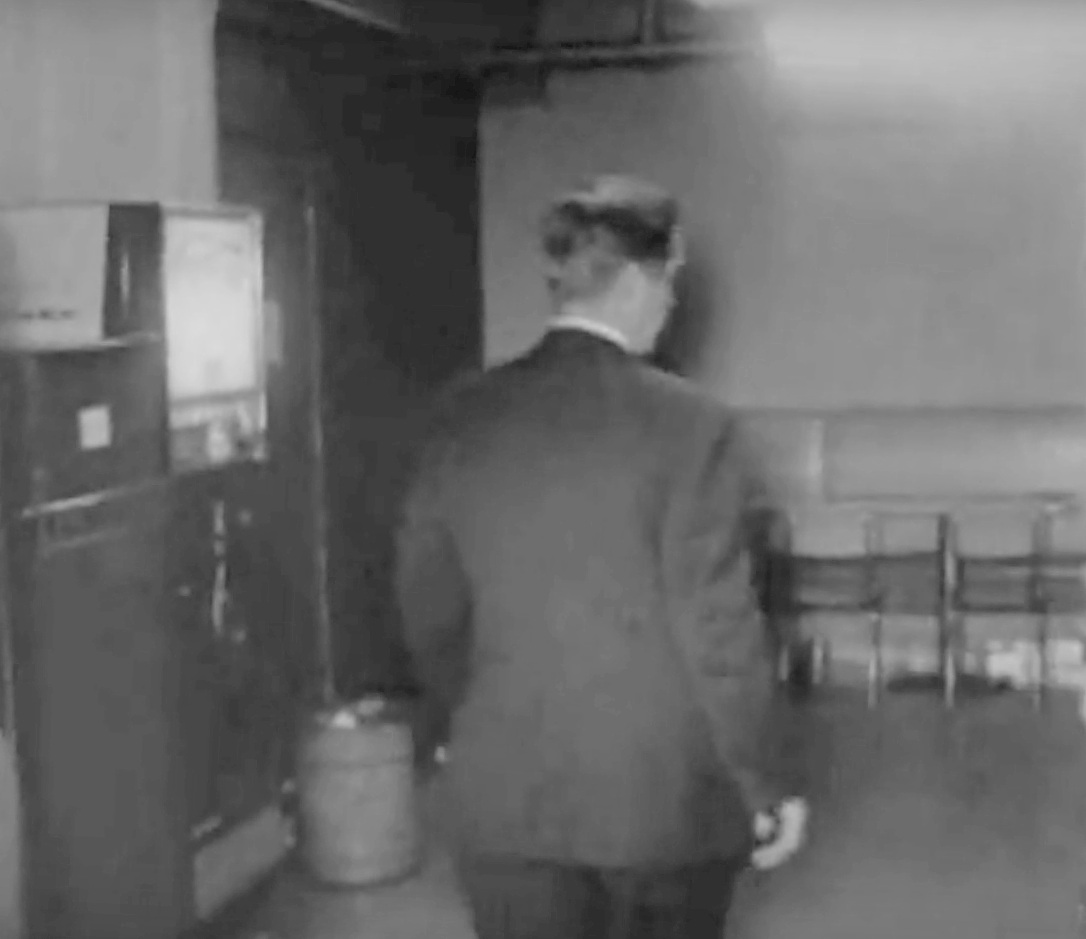
A trip to the second-floor lunchroom, with its vending machines which are, apparently, important in Lee Harvey Oswald’s alibi. These images show Special Agent Talmadge Bailey walking past the vending machines and sitting at a table.

reenactment_tsbd-bldg-lunchroom1

reenactment_tsbd-bldg-lunchroom2

reenactment_tsbd-bldg-lunchroom3

***

Sources & Notes

See Dallas Times Herald photographs that were shot while the Dealey Plaza “reenacting” was going on in my previous post, “The First JFK Assassination Reenactment — 1963,” here. (As for the comment that started me off on this, I’m still not sure whether the cameramen in the car are KRLD employees or not.)

*

Copyright © 2016 Paula Bosse. All Rights Reserved.