Flashback : Dallas

A Miscellany: History, Ads, Pop Culture

Tag: Historic Dallas

Collision on the Streetcar Viaduct — 1929
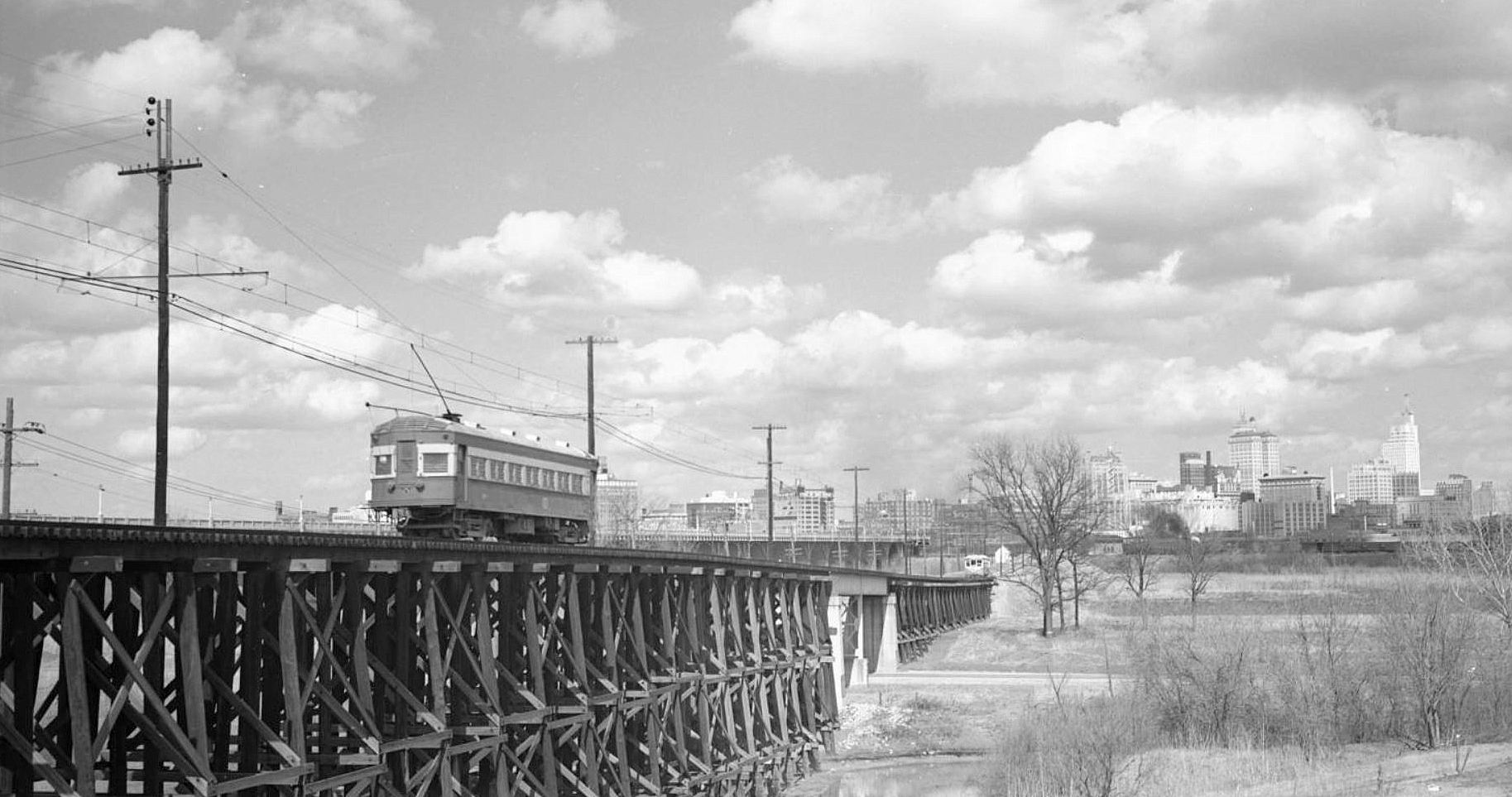
interurban_trestle_1946_denver-pub-lib_lgThe new streetcar viaduct, 1946

by Paula Bosse

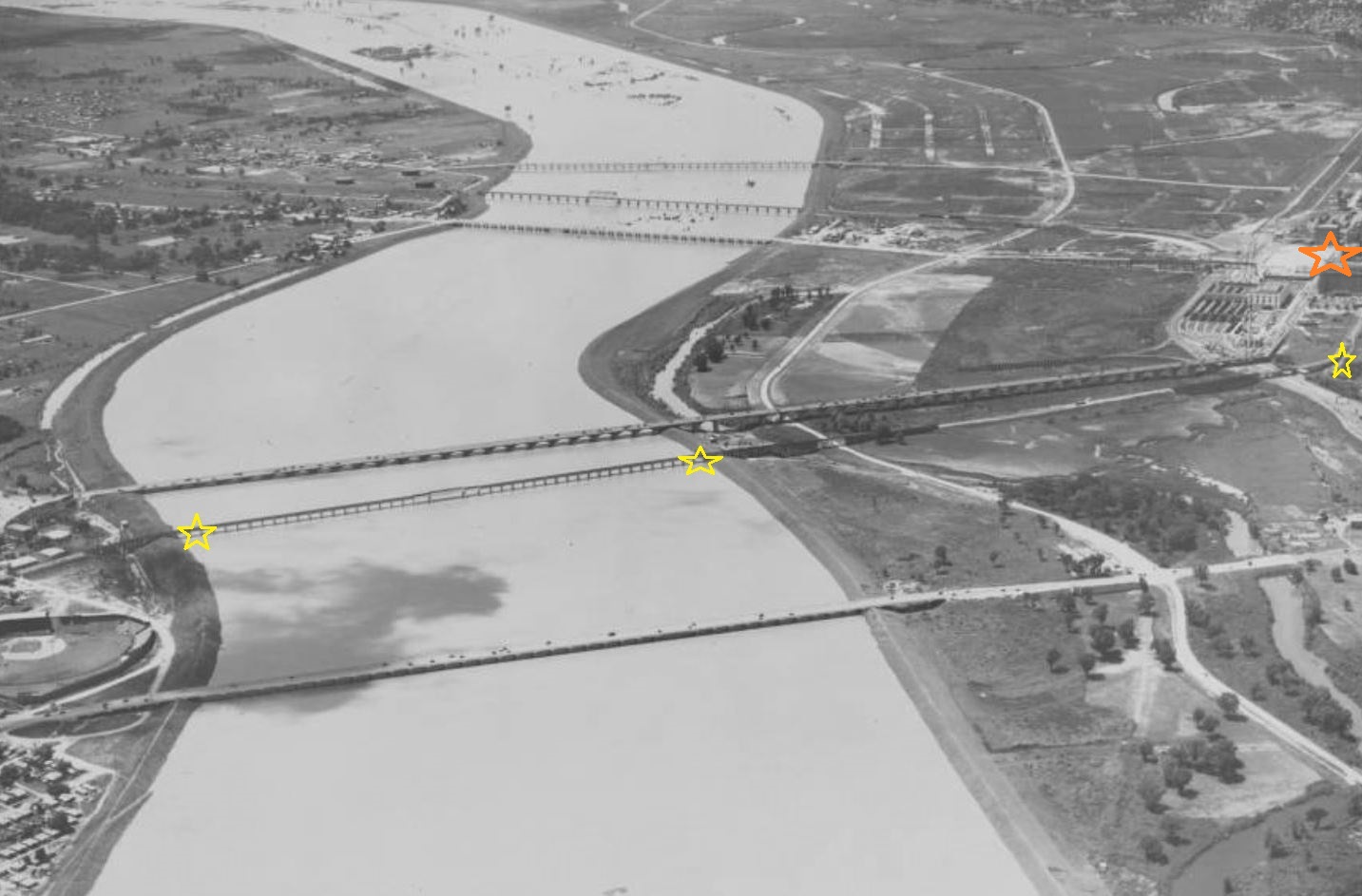
For many, many years there was a special trestle that spanned the Trinity River which was for the exclusive use of streetcars and Interurbans. There were also trestles and viaducts for the exclusive use of trains and automobiles. Below is a photo showing the  viaductal activity in 1935, with the streetcar trestle — sometimes called the “Street Car Viaduct” or the “Trinity River Viaduct” marked in yellow and the Old Red Courthouse and Dealey Plaza (then under construction) marked in orange.
viaducts_1935_foscue_smu

The viaduct immediately above it was the Houston Street viaduct, for automobiles.

For many, a streetcar ride across the viaduct seems to have been a little on the harrowing side. There were no guardrails to prevent a car from going over the side, and even when the original wooden trestle had been bolstered with stronger materials, it was still described by commuters as being rickety. I like this quote of a man remembering a typical ride in the 1950s:

I always enjoyed the slight tingle of fear I experienced on the trestle over the river, as one could not see the trestle itself from the car window. One had the feeling of being suspended with no support when looking out the window.

And these two memories:

The streetcar trestle ran parallel to the Houston St. Viaduct where the current newer bridge is to downtown. No railings and just depended on gravity to hold the cars on the rails. The cars would buck and sway as they crossed the river bottoms as the motormen made up time on their schedules. Seemed like they were really going fast to me at the time, but probably not in today’s terms.

*

The [newer streetcars] used to scare me to death rocketing across the Trinity River high in the air with no sidewalls except just over the river itself! You were able to look straight down from high above ground… those newer cars had softer springs and the faster they went, the more they rocked side to side over the less than flat tracks!

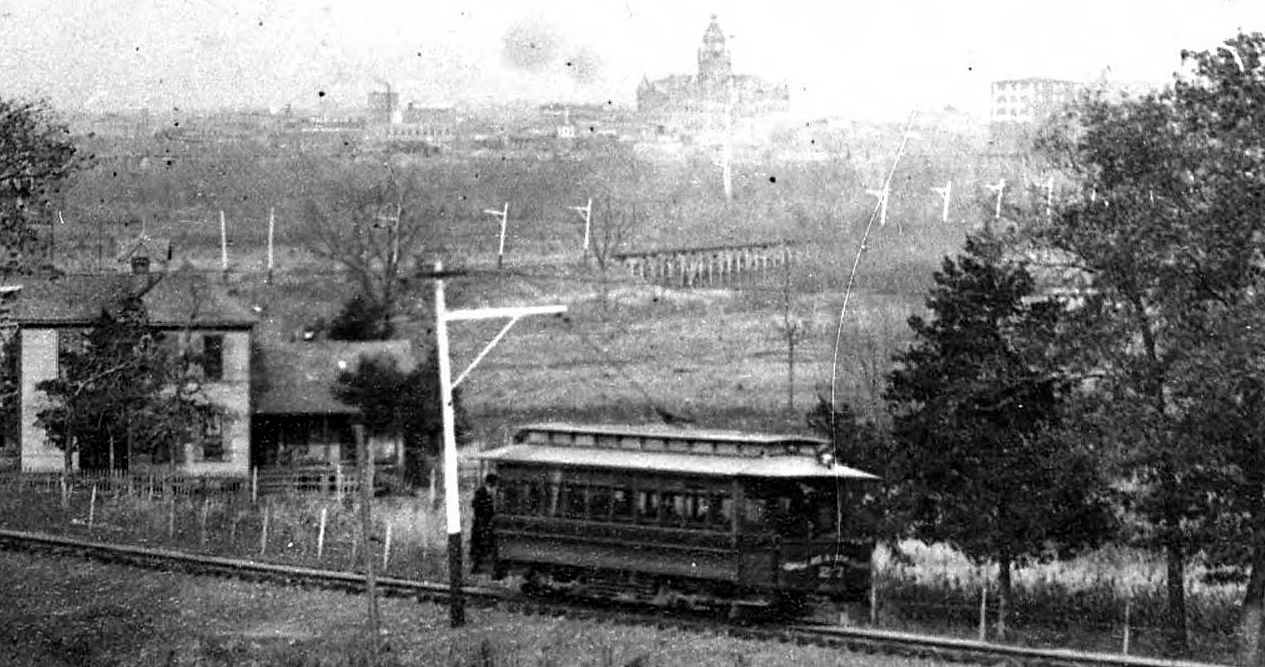
Here’s a photo when it was in its original rickety state, back in 1895 (this is a detail of a larger photo, taken on the Oak Cliff side of the river, with the trestle — and the not-yet-old Old Red Courthouse — visible in the background).
trolley_oak-cliff_det1

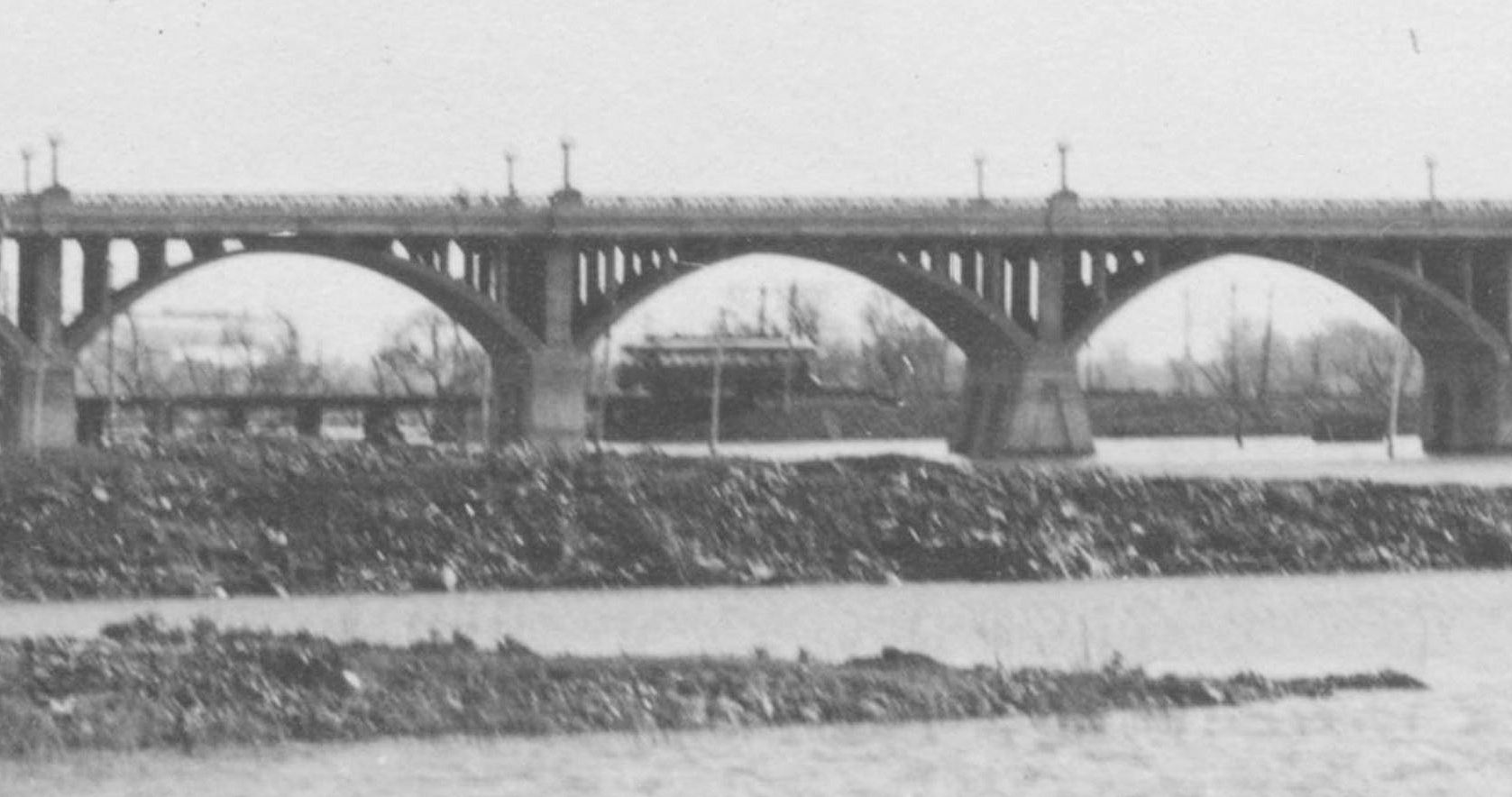
Here it is in 1914 at river-bottom level, with a happy little trolley chugging along with the Oak Cliff/Houston Street viaduct looming over and in front of it. (This is a detail of a larger photo in the George W. Cook Collection, DeGolyer Library, SMU — here).
streetcar-trestle-cook-coll_smu_det_1914

And here’s a sturdier version of the viaduct, in 1946.

streetcar-crossing-trinity_1946-denverpublib

But now to the collision on the viaduct, which happened on the morning of November 23, 1929. Back then — at that iteration of the viaduct — the trestle had only a single track. While one streetcar or Interurban car crossed the bridge toward Oak Cliff, a car wanting to cross over from Oak Cliff had to wait until the westbound car had made its mile-long trip. That must have made for a lot of impatient riders. Even though the so-called “block signal” system worked well for the most part, there were the occasional accidents, including the one involving three cars on Nov. 23, 1929. Below, a front-page report of the collision(s) from The Waxahachie Daily Light (click for larger image).
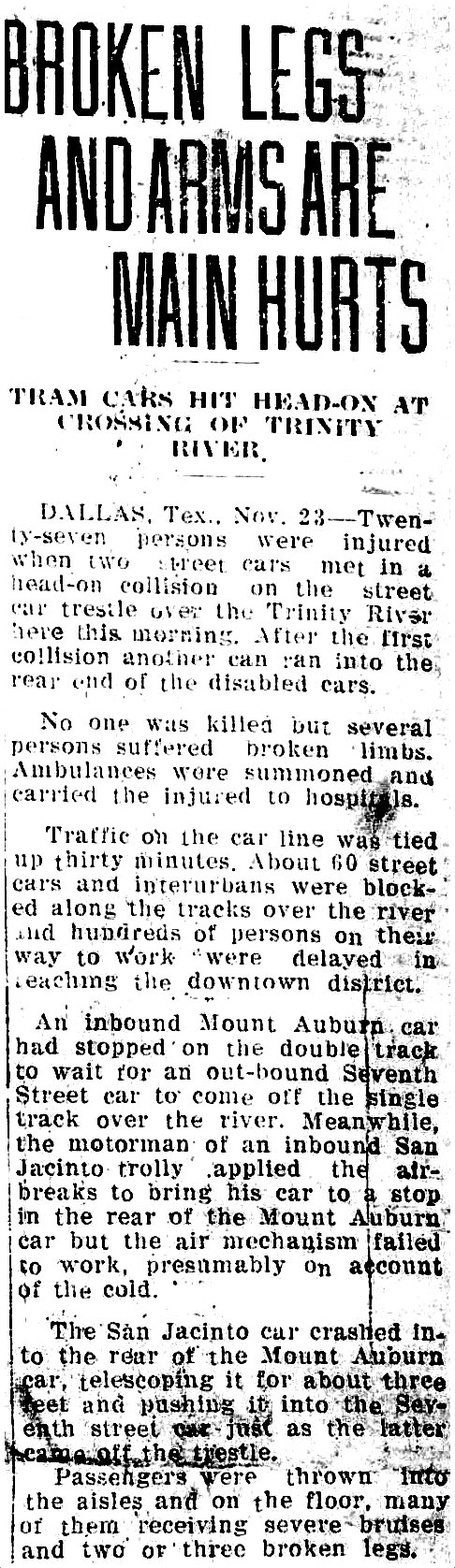
streetcar-trestle-collision_waxahachie-daily-light_112329Waxahachie Daily Light, Nov. 23, 1929

The Waxahachie paper even had a local angle (although it’s unclear just how this man “nearly lost all of the clothes he was wearing”).
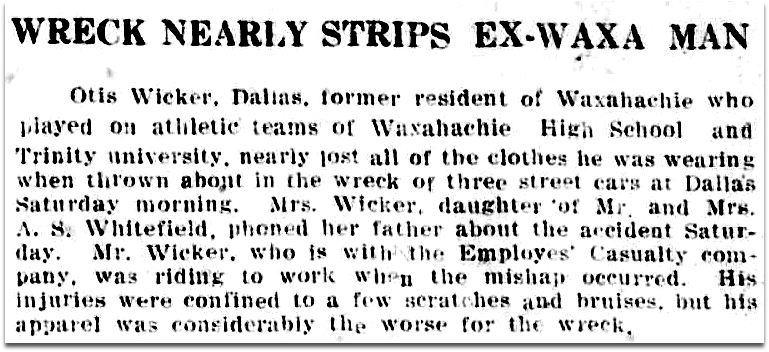
streetcar-trestle-collision_waxahachie-daily-light_112329-sidebarWaxahachie Daily Light, Nov. 23, 1929

Since it happened during the morning rush hour, just about every other newspaper in Texas scooped The Dallas Morning News, which wasn’t able to run its story until the next day (and its report was surprisingly dull).

The UP wire story that ran in the Joplin, Missouri paper was far more exciting.
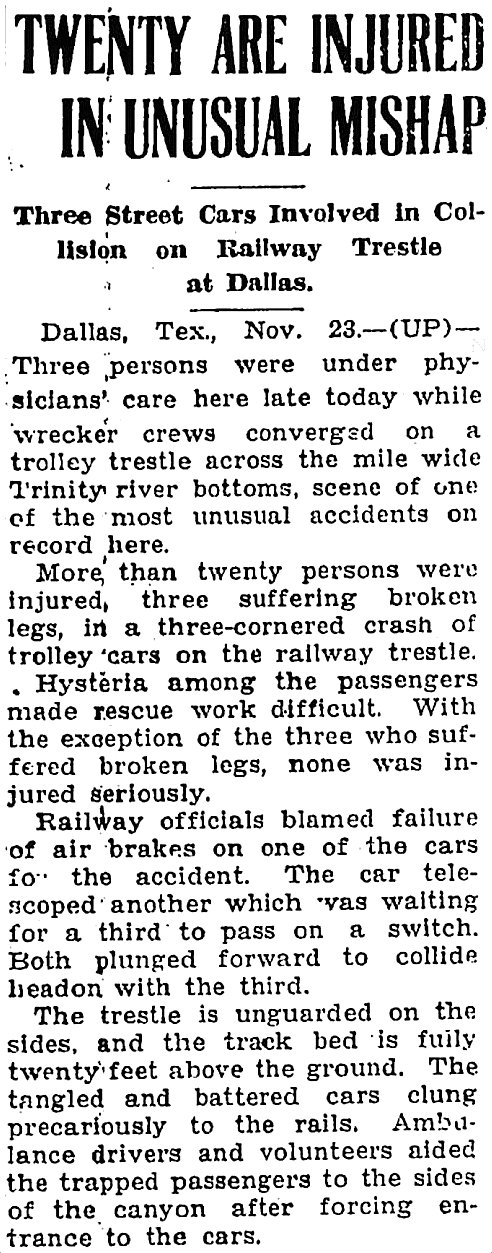
streetcar-trestle-collision_joplin-MO-globe_112429Joplin Globe, Nov. 24, 1929

Thankfully none of the streetcars fell off the trestle, but I’m sure that possibility was probably the daily fear/resigned expectation of generations of nervous travelers.

**

The most interesting thing in the DMN article is the last paragraph:

Plans in the making for the new street car crossing of the Trinity River call for a double track over the channel, eliminating the necessity of waiting on block signals.

In February 1931, that new double-track streetcar viaduct opened for business, and I’m sure there was a citywide sigh of relief.

 **

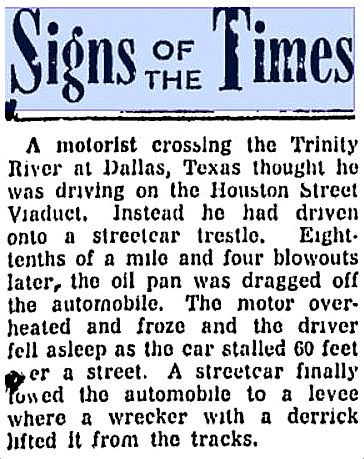
One last little amusing tidbit about this viaduct: it was not unheard of for those having indulged in excessive amounts of alcohol to try to drive their automobiles (either on purpose or by accident) over this already-kind-of-scary trestle intended for electric-powered railway use only.
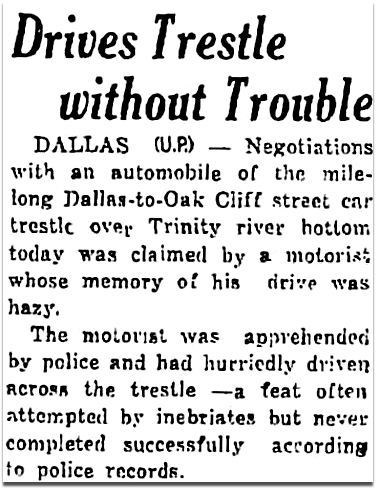
streetcar-trestle-mexia-weekly-herald_011333_drunk-motoristMexia Weekly Herald, Jan. 13, 1933

trestle_beaver-valley-PA-times_120852
Beaver Valley (Pennsylvania) Times, Dec. 8, 1952

***

Sources & Notes

Top photo titled “T. E. clouds, sky, city, from east levee close to wooden trestle 320 just passed, at rear, car 320 on Trinity River Bridge, Dallas, Tex.,” taken on Feb. 16, 1946 by Robert W. Richardson, is from the Western History/Genealogy Dept., Denver Public Library.

Photo showing the viaducts across the Trinity is titled “Central Levee District,” taken on May 20, 1935 by Lloyd M. Long, from the Edwin J. Foscue Map Library, Southern Methodist University; the labeled photo is here, the unlabeled photo is here.

Don’t know what “block signaling” is? Wikipedia to the recue.

 Lastly, just because I like it, a magnified detail from the top 1946 photo, showing a streetcar at the downtown end of the viaduct.
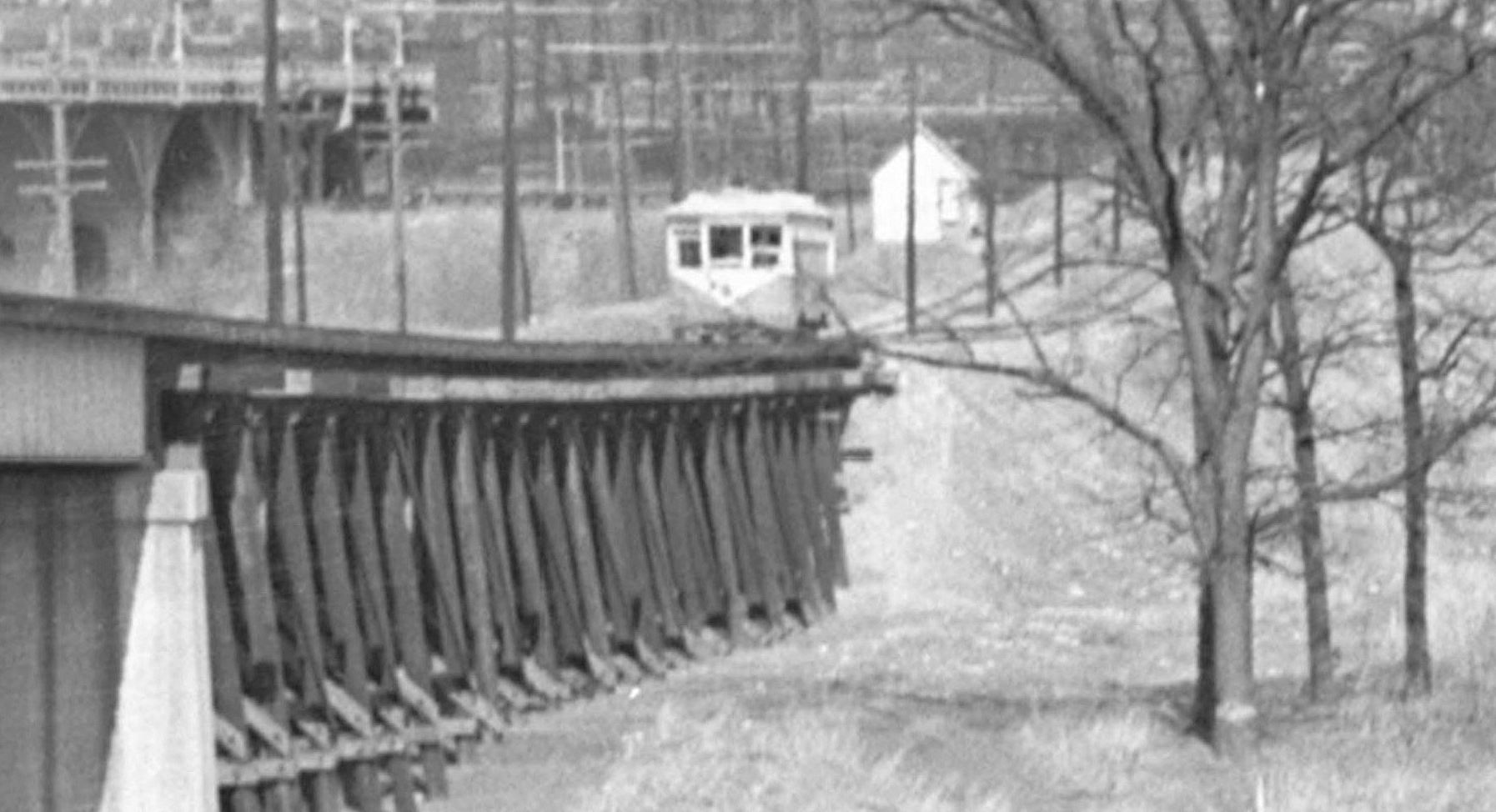
interurban_trestle_1946_det-streetcar

*

Copyright © 2016 Paula Bosse. All Rights Reserved.
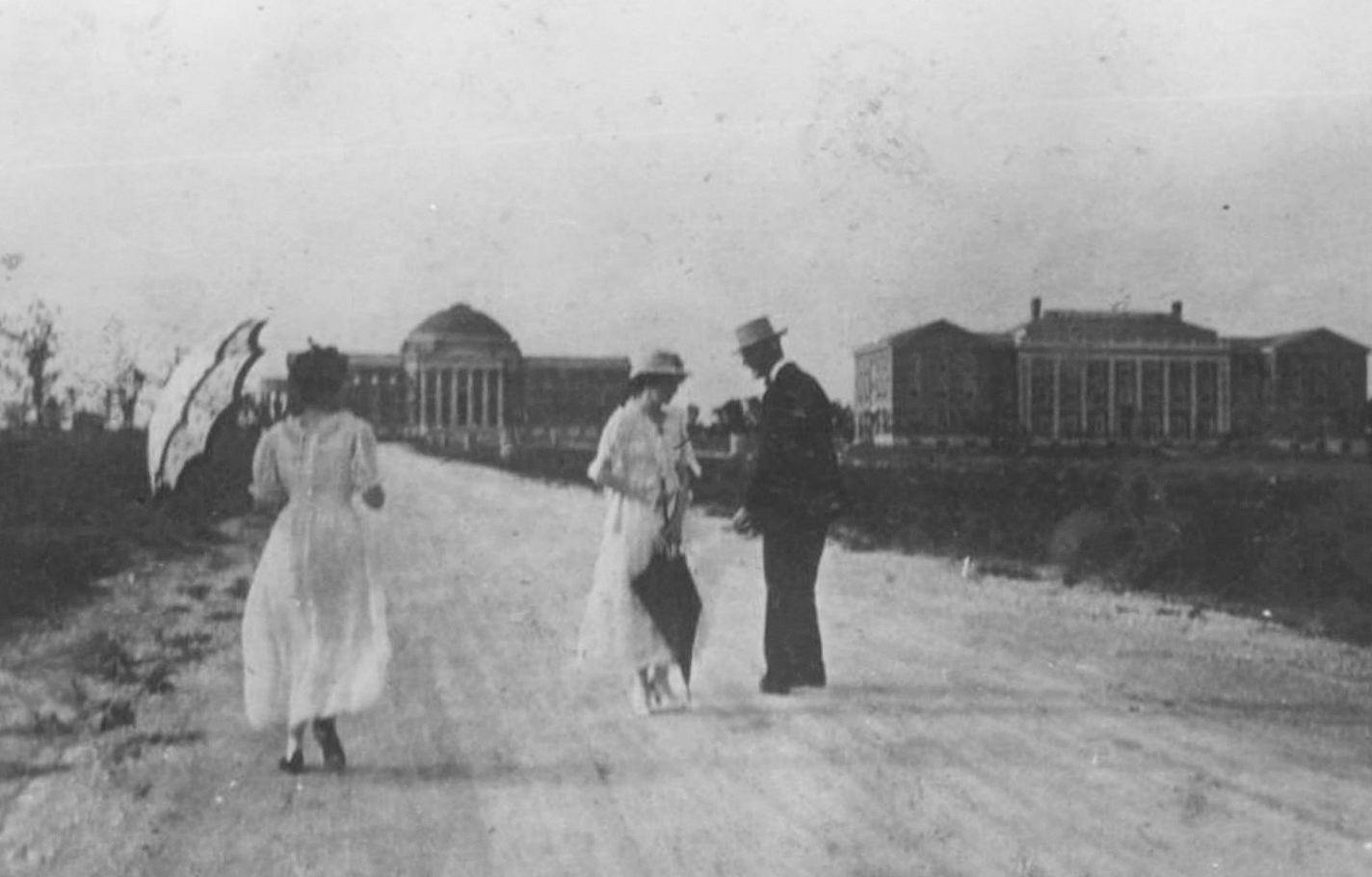
Parasols on the SMU Campus — 1917

smu_parasols_1917_degolyerSMU, sparsely populated

by Paula Bosse

I love this photo showing a man and two women with parasols walking up an unpaved Bishop Blvd. toward Dallas Hall. The women’s dormitory, Atkins Hall, is on the right. …And that’s it.

***

Sources & Notes

Photo titled “Dallas Hall and women’s dormitory in 1917” is from the DeGolyer Library, Central University Libraries, Southern Methodist University; more information is here. (I have straightened the image, and corrected the color somewhat.)

*

Copyright © 2016 Paula Bosse. All Rights Reserved.
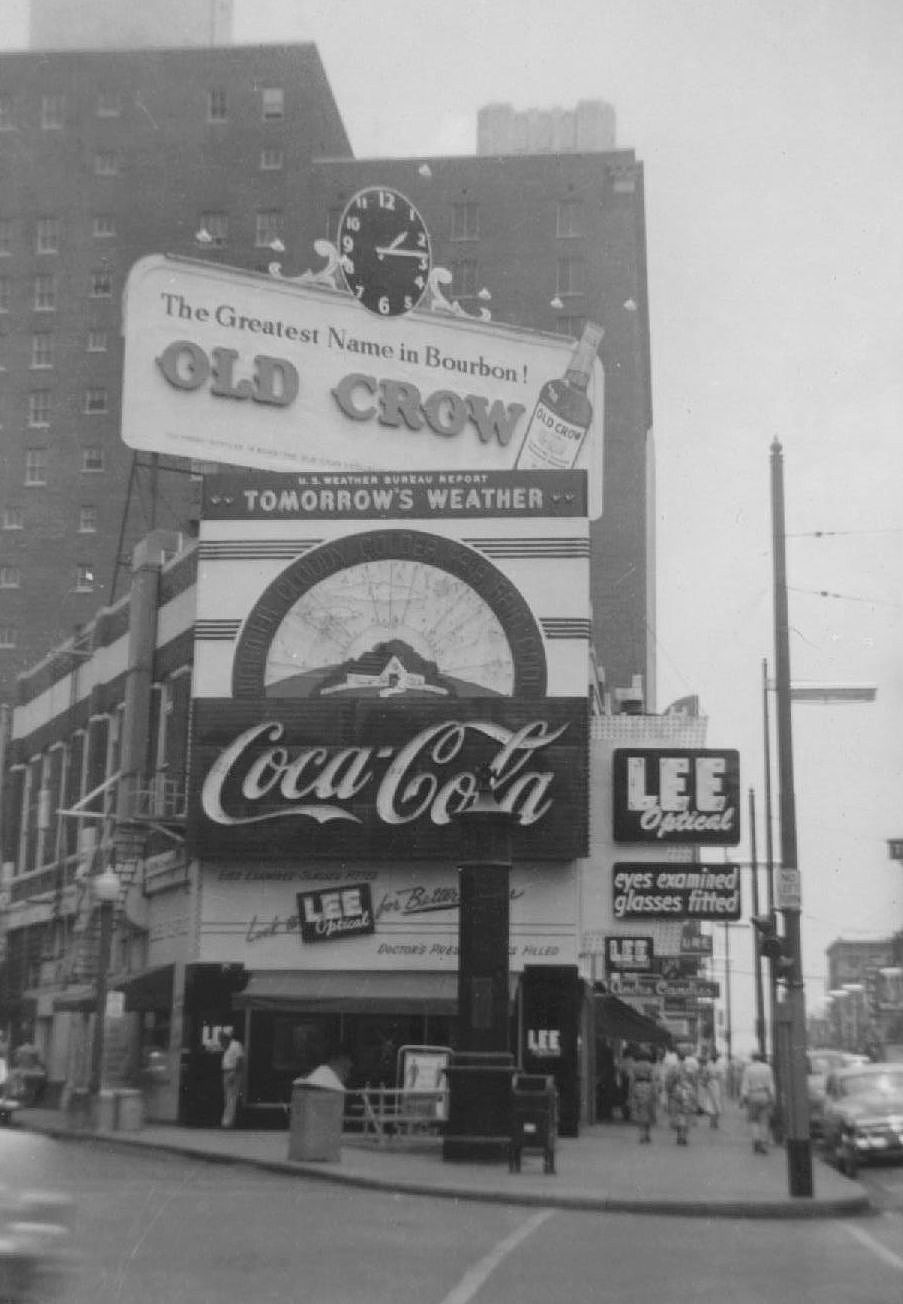
Tomorrow’s Weather at Live Oak & Elm — 1955-ish

weather-forecast_elm-live-oak_printed-feb-1956_ebayThe weather, brought to you by Coke…

by Paula Bosse

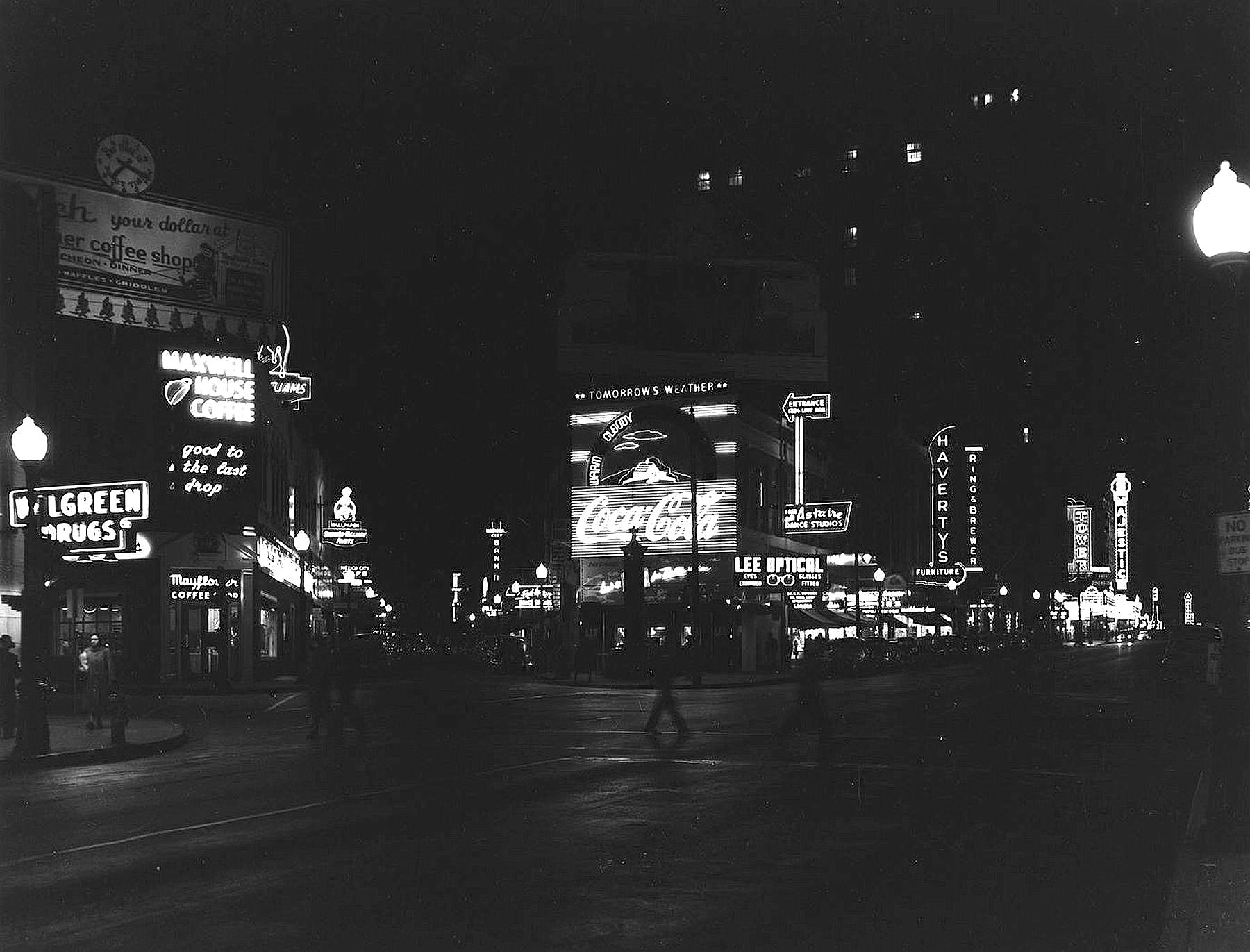
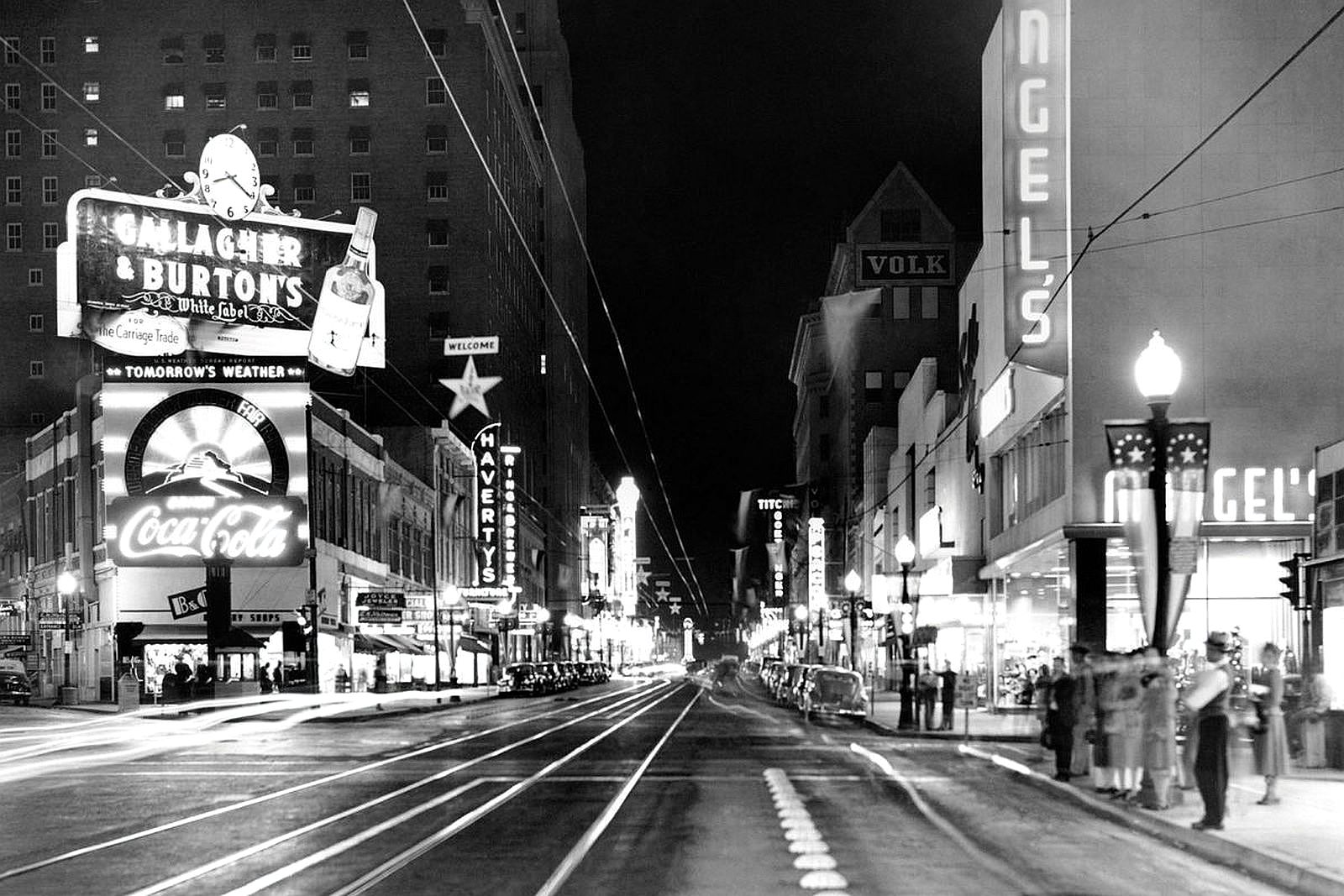
This photo (which is a little blurry, but the blurriness gives it a kind of dreamy softness) shows the one-time five-point intersection of Ervay, Live Oak (seen above at the left), and Elm (on the right, looking east). On the corner of this busy and confusing intersection, a large sign provided a public service by showing tomorrow’s weather forecast (…whilst subtly encouraging onlookers to hie themselves to the closest Coca-Cola-dispensary). During the day, the sign looked mildly interesting, but at NIGHT…! At night, this sign transformed downtown’s entertainment district into our very own mini Times Square. Here’s what it looked like at night (it’s a giant image — click it!).

ervay-live-oak-elm_haskins_uta_0107531953, Squire Haskins, UTA

And here it is from another angle, about 1948:

elm-ervay-live-oak_weather-sign_ca-1948

And, hold on to yourself: from 1939, in color! (Screenshot of a 1939 film, shot in Dallas, in color. Watch the sign’s flashing, dancing neon in action on YouTube here.)

coca-cola-sign_downtown_1939-film_youtube_screenshot
1939

***

Sources & Notes

I found the top photo on eBay a few months ago. The amateur photo was stamped “Feb. 1956” when the photo was developed, but looking at the clothes people are wearing, one would assume it was taken earlier — probably the previous year.

The first nighttime photo is by Squire Haskins, taken in January, 1953. See my original post — “Ervay, Live Oak, and Elm: Just Another Wednesday Night — 1953” — here. This post includes a map showing Live Oak when it used to intersect with Elm and Ervay.

The second nighttime photo is ca. 1948, probably from the Dallas Public Library. See the notes in this post.

All pictures larger when clicked.

*

Copyright © 2016 Paula Bosse. All Rights Reserved.
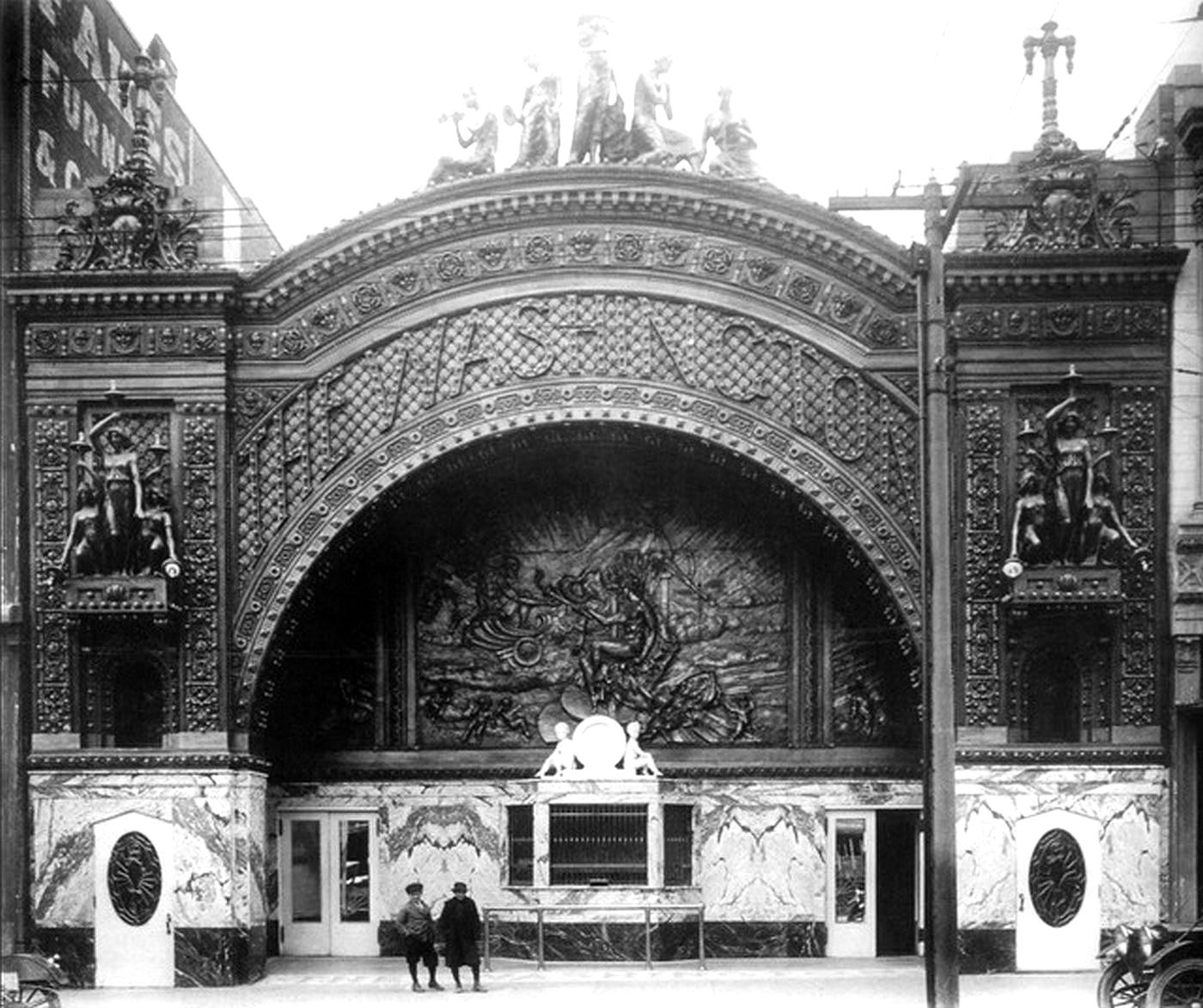
The Washington Theater — Dallas’ First Movie Palace

washington-theatre_cinema-treasures_lgThe Washington, 1615 Elm

by Paula Bosse

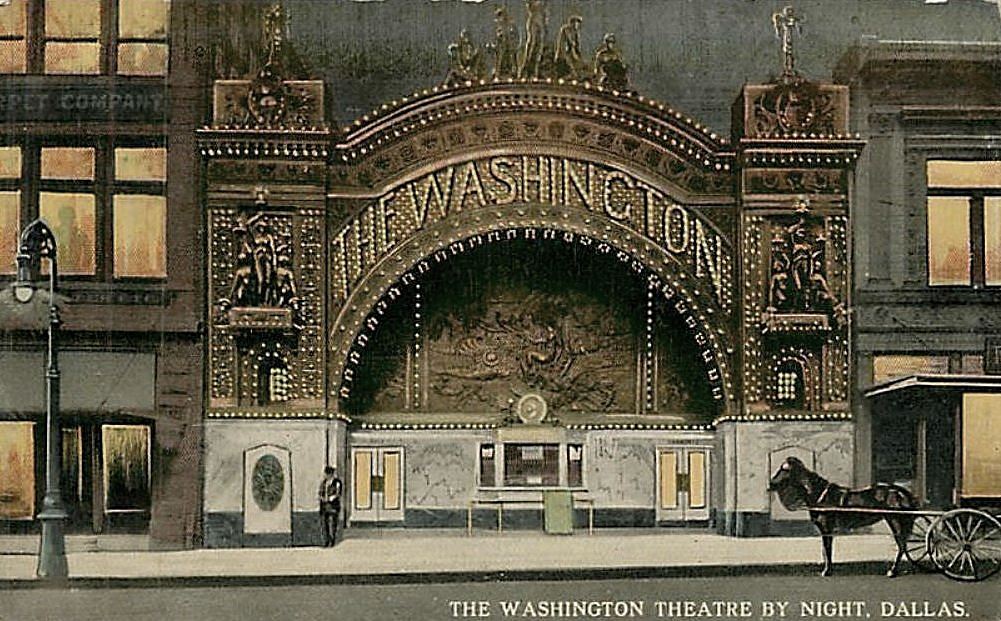
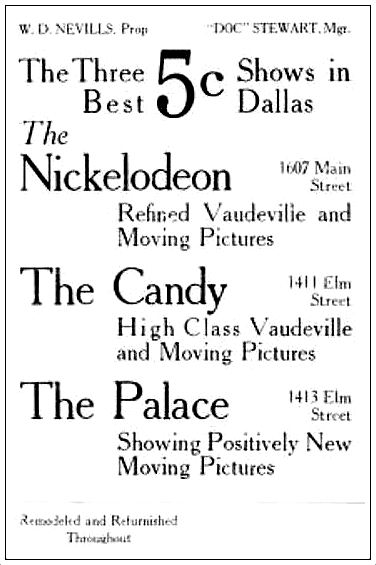
The outrageously ornate Washington Theater was built in 1912 by W. D. Nevills (1872-1945), a man who had been running cheap little store-front nickelodeons in Dallas for several years. Three of his most popular were The Nickelodeon, The Candy, and The Palace (not to be confused with any later theaters in Dallas called the “Palace”).

nevills_standard-blue-book-of-tx_1912-14Standard Blue Book of Texas, 1912-1914

His Nickelodeon on Main Street can be seen in the lower center of this detail from a larger 1909 parade photo.

parade-day_1909_det41

Nevills must have raked in a lot of nickels, because when his Washington Theater opened at 1615 Elm Street, it was the most spectacular motion picture “photoplay house” in Dallas. Nevills spared no expense for the theater’s furnishings and facade.

washington-theater_dmn_111712Dallas Morning News, Nov. 17, 1912 (click to read)

What might seem a little gaudy now, was probably still gaudy back then, but it was a fresh, NEW gaudy! And 600 Dallasites could all watch a movie at the same time. 600! Unheard of!

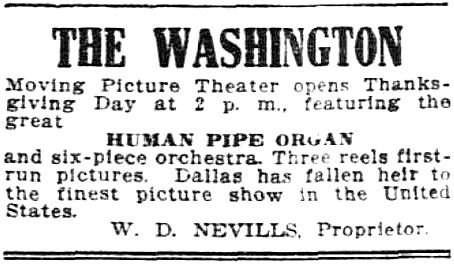
The Washington opened on Thanksgiving Day, 1912. Complete with “Human Pipe Organ.”

washington-theater_dmn_112712DMN, Nov. 27, 1912

The Washington was the king of the roost for only a short while, though — until young whippersnappers like the Queen began to steal its thunder. 600 seats? Pfft! It was a thousand or nothing now. The theater began to lose its luster and look more old and hulking than young and exciting, and after riding out its very long lease, the Washington Theater closed on July 1, 1927.

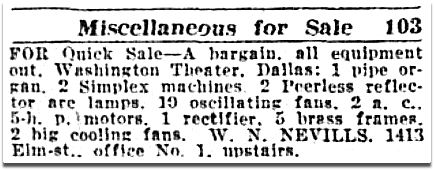
This little classified showed up a couple of weeks later, and it must have been a melancholy Nevills who had to write it up.

washington-theater_dmn_071327DMN, July 13, 1927

The theater continued to be used for a while — mostly for evangelical meetings or events. I’m not sure exactly when the building was demolished, but a report of the building’s being sold and plans for its razing appeared in The Dallas Morning News in October, 1927.

*

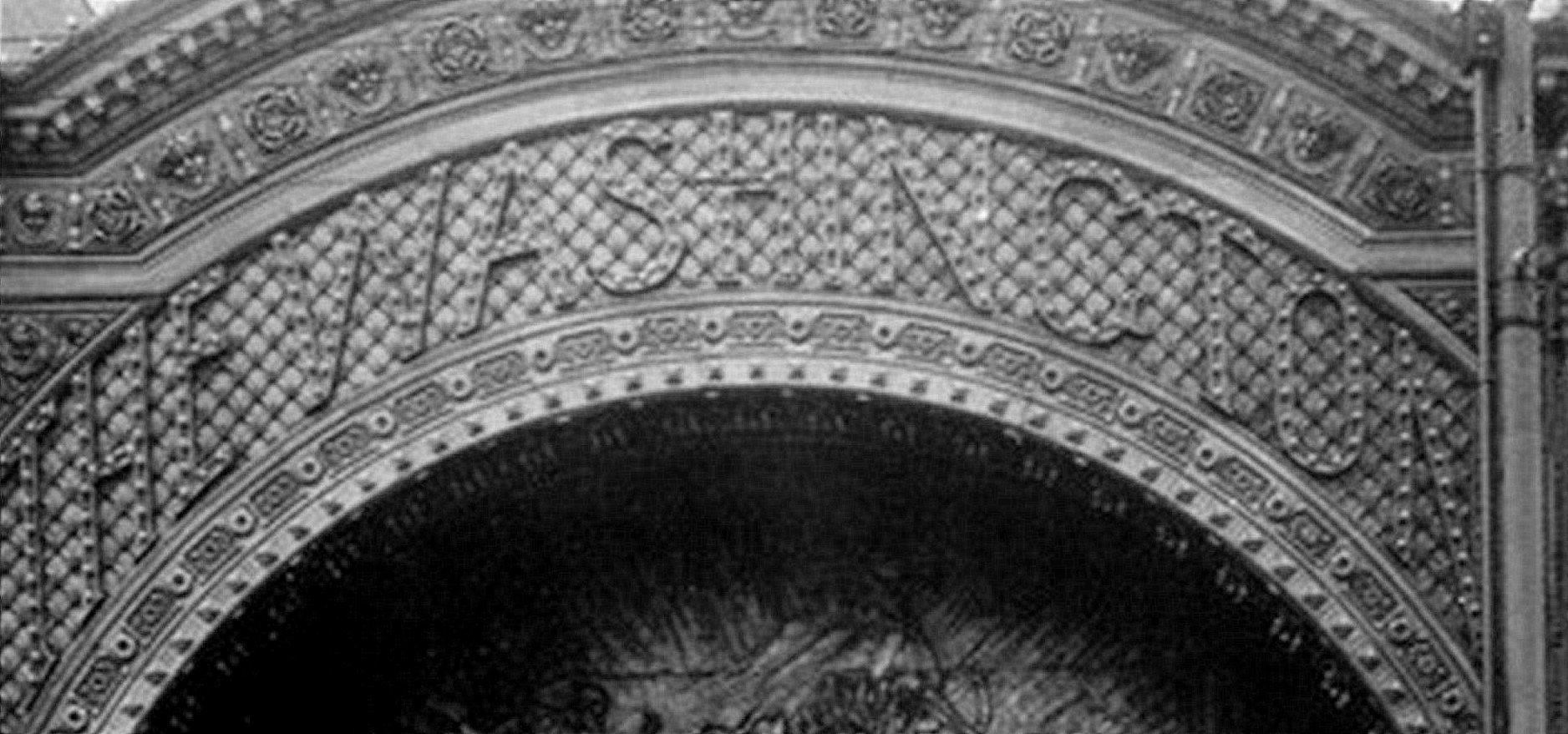
Let’s look at a couple of details from that top photo. The Washington was built without a marquee, but the outside of the building was studded with an eyeball-popping TWO THOUSAND LIGHTS! Imagine what that must have looked like — in 1912! Here’s an extreme close-up of the theater’s facade — look at all those bulbs!

washington-theatre_cinema-treasures_det1

And, below (was one of these men W. D. Nevills?):

washington-theatre_cinema-treasures_det2

Another shot, this one showing how one worked without a typical illuminated marquee — you just string a banner up (the needle is hitting a solid “8.5” on the visual clutter scale here):

washington-theatre_corbis_19141914 via CorbisImages

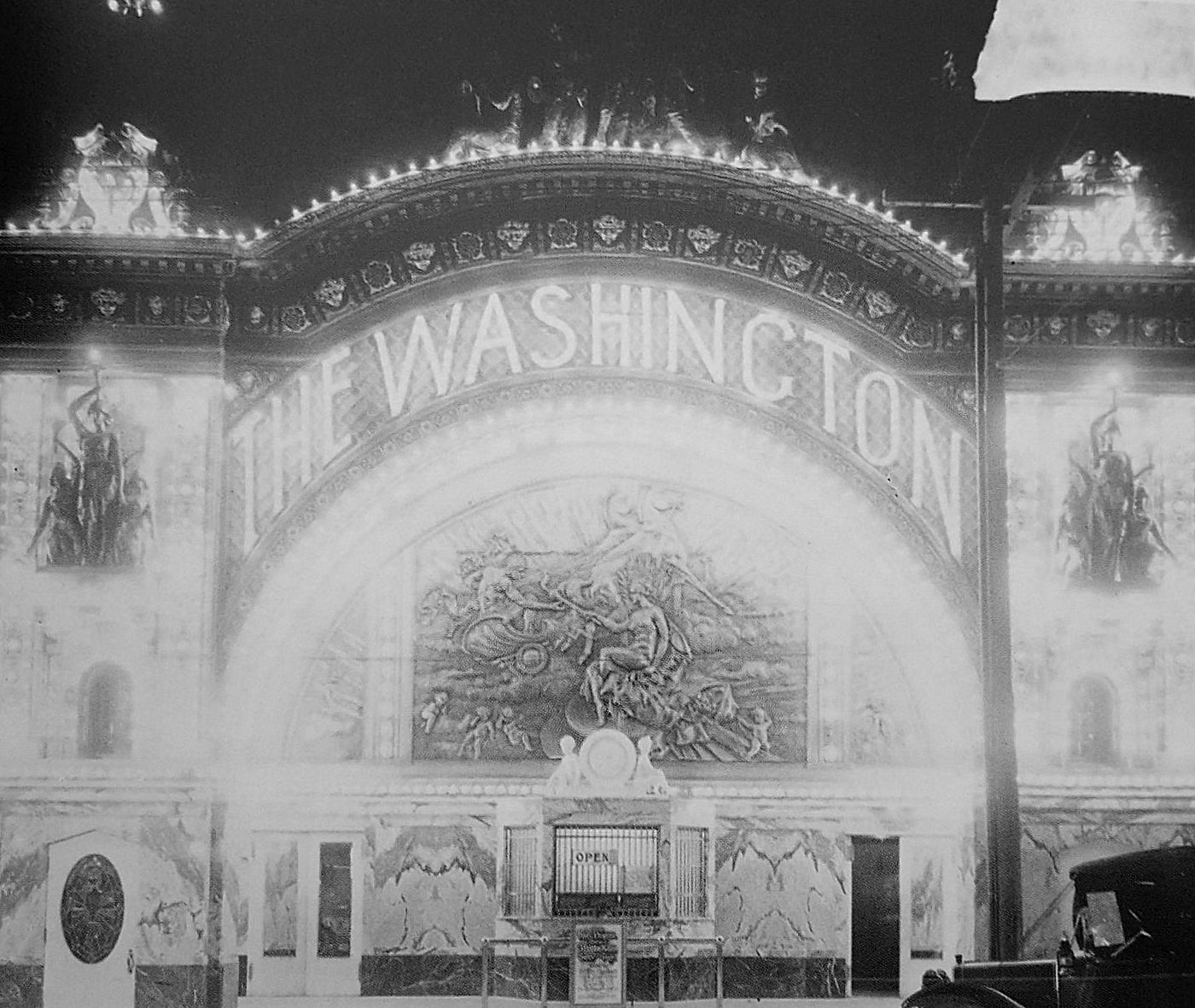
Here it is, ablaze at night:

washington-theater_night_dallas-rediscovered_DHS

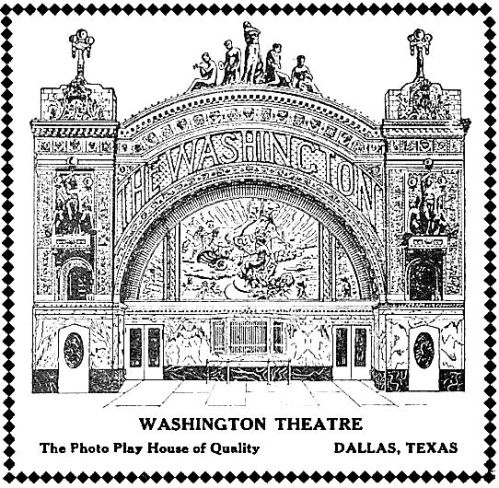
In an ad from 1914:

theater_washington_bldg-code_1914

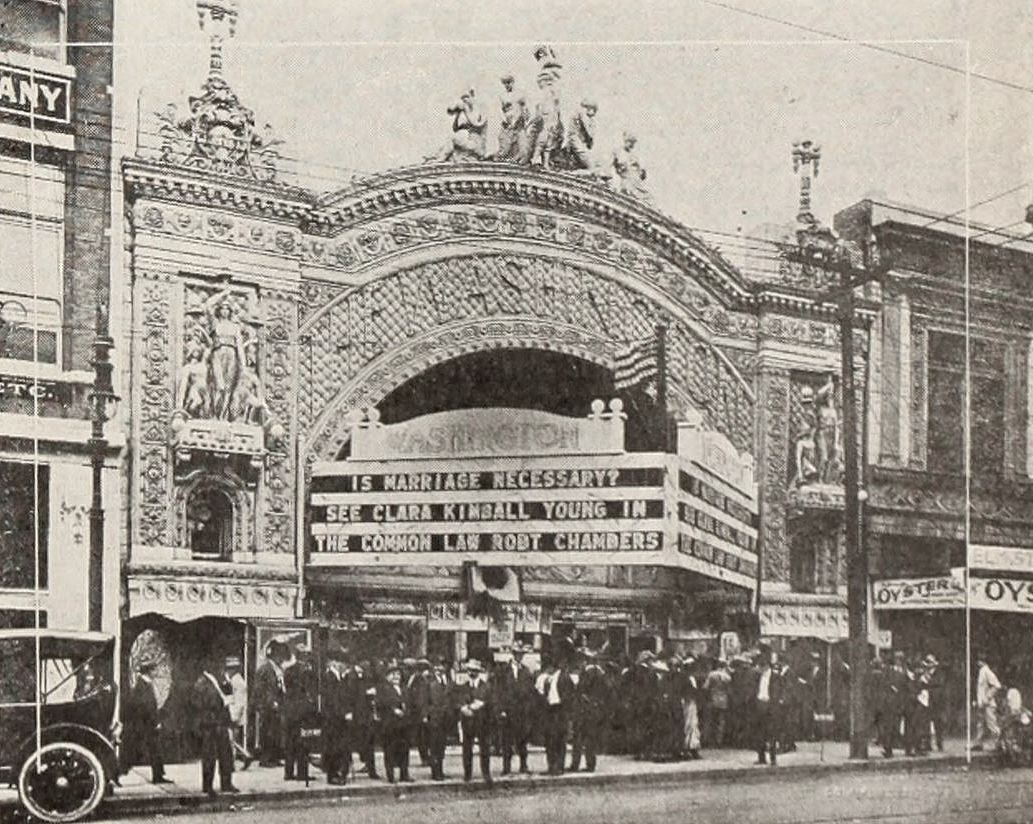
Photo from October 1916:

theaters_washington-theatre_exhibitors-herald-and-motography_june-1919_photo-from-oct-1916

And in “color” from a picture postcard:

washington-theatre_ebay

***

Sources & Notes

Top photo from Cinema Treasures; to read a history of the Washington Theater from Cinema Treasures (and to see another photo), see here. (Photo’s original source appears to be the Dallas Historical Society.)

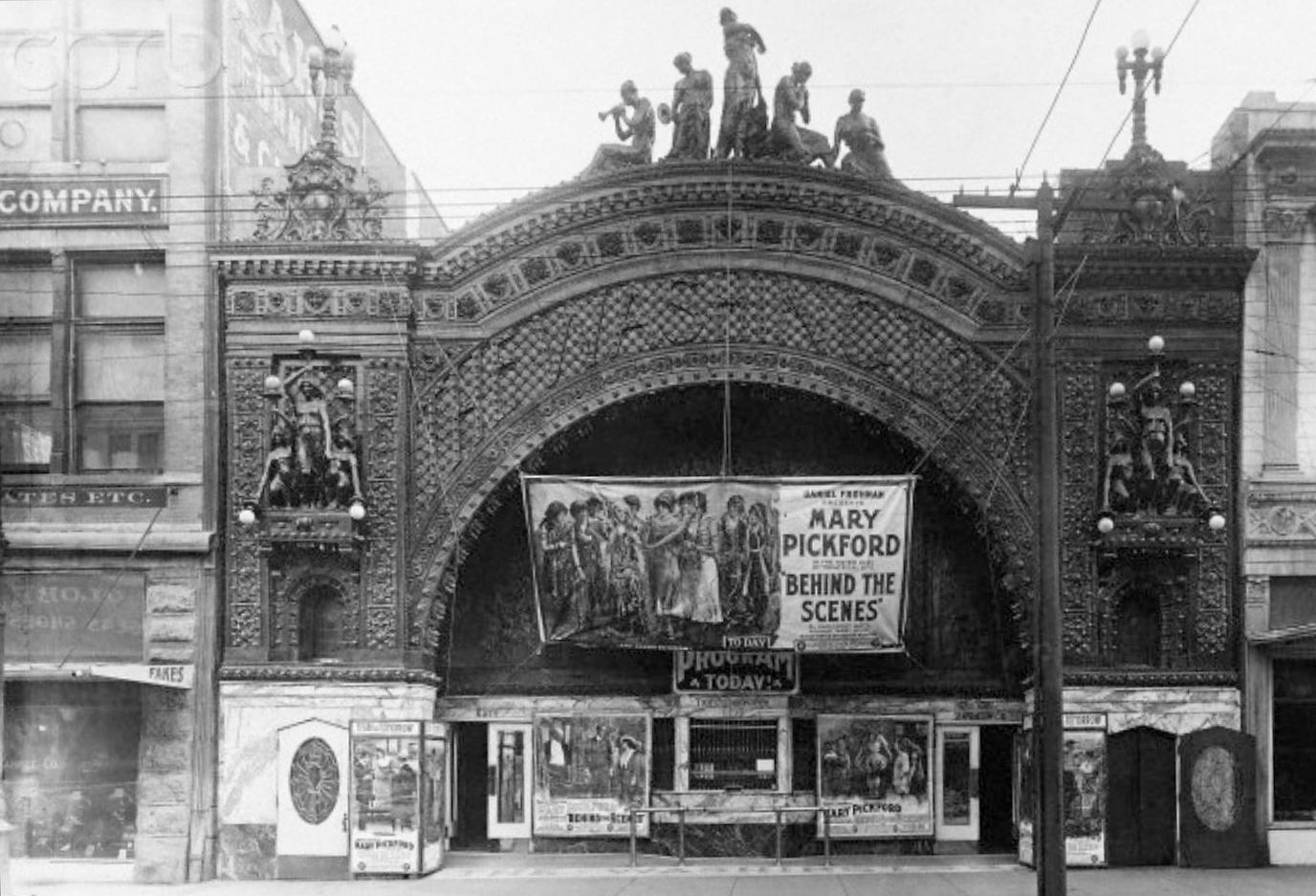
The photo of the theater with the Mary Pickford banner is ©Schenectady Museum; Hall of Electrical History Foundation/CORBIS; more info is here. (The movie “Behind the Scenes” was released in 1914.)

Photo of the theater at night is from Dallas Rediscovered by William L. McDonald — source: Dallas Historical Society archives.

The ad is from the 1914 Dallas Building Code.

Photo with the marquee showing “The Common Law” is from Oct. 1916, but the photo didn’t appear in the trade magazine Theatre Exhibitors Herald and Motography until June 1919.

The color postcard is from eBay.

Read about the closing of the Washington in an article available in the Dallas Morning News archives: “Washington Theater, Earliest Dallas ‘Movie Palace,’ Shows Last Close-Up After 15 Years” (DMN, July 4, 1927).

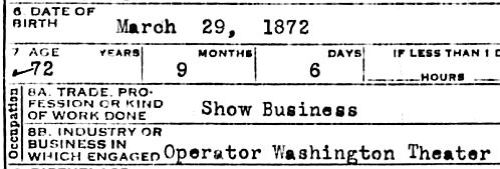
The Washington Theater must have been W. D. Nevills greatest achievement. It’s interesting to note that “Operator Washington Theater” appears on his death certificate. Nevills died in 1945, eighteen years after the theater closed.

nevills_death-certificate_010545_det

For other Flashback Dallas posts on this era of movie theaters, see the following:

  • “Three of Dallas’ Earliest ‘Photoplay Houses’ — 1906-1913,” here
  • “Movie Houses Serving Black Dallas — 1919-1922,” here

*

Copyright © 2016 Paula Bosse. All Rights Reserved.
A Bird’s-Eye View Over the Washington Theater

washington-theater_aerial_dmn_lost-dallas_dotyAs the crow flies…

by Paula Bosse

This wonderful photo shows an aerial view looking northeasterly over the top of the Washington Theater, Dallas’ first ornate movie palace. It was located between N. Akard and N. Ervay, at 1615 Elm Street — now the site of Thanksgiving Tower. I think the street at the top right edge of the photo is Live Oak, which used to come all the way through to Elm. I love this photo.

***

Sources & Notes

Photo from Lost Dallas by Mark Doty (Charleston: Arcadia Publishing, 2012).

Bird’s-eye view today-ish (with 1615 Elm marked):

1615-elm-street_bingBing Maps

The Washington Theater was in business at 1615 Elm from 1912 to 1927. More on the Washington in the Flashback Dallas post “The Washington Theater — Dallas’ First Movie Palace,” here.

*

Copyright © 2016 Paula Bosse. All Rights Reserved.

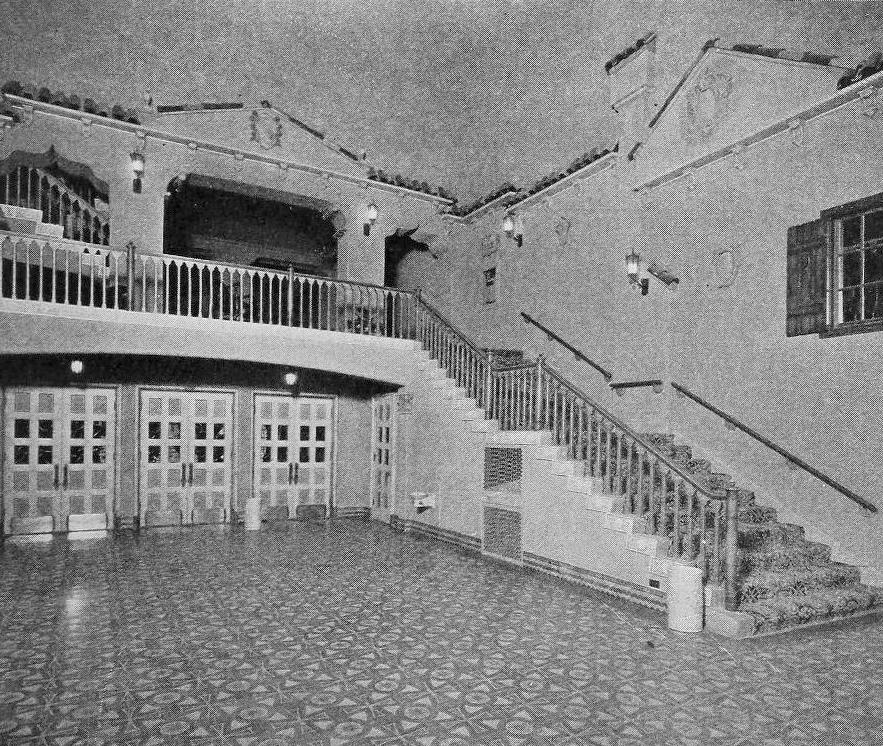
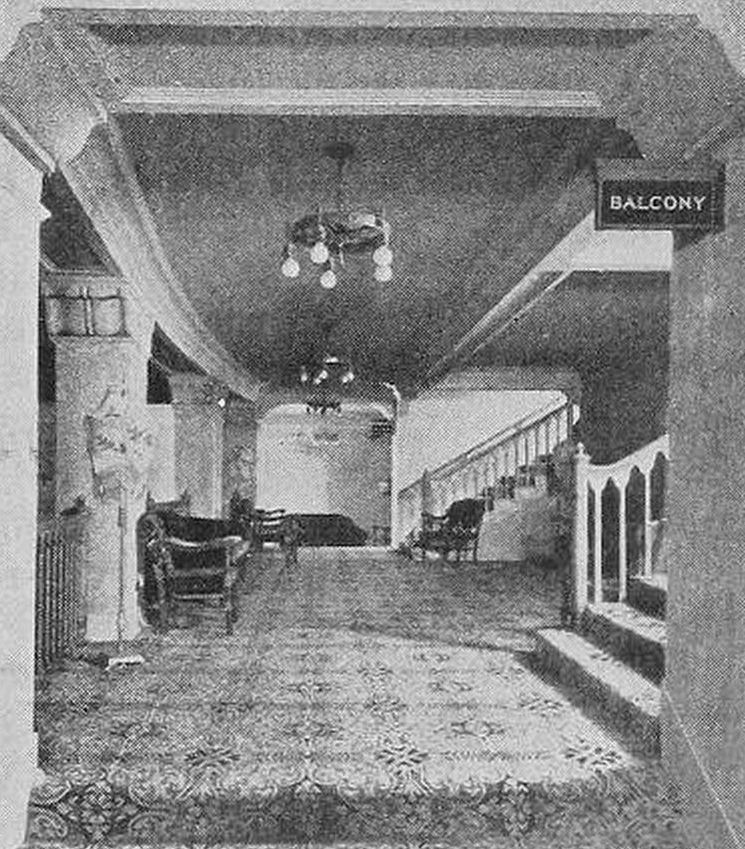
The Texas Theatre and Its Venetian-Inspired Decor

texas-theatre_motion-picture-herald_070232_det1A little bit of Venice in the O.C. (note organ at edge of stage)

by Paula Bosse

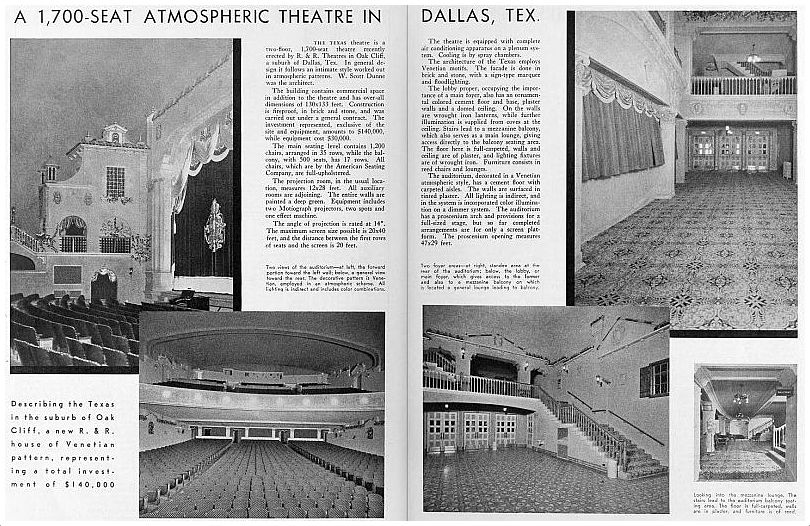
The Texas Theatre in Oak Cliff  — which opened in April, 1931 — was the first movie theater in Dallas built expressly to show movies with sound. It was also the largest “suburban” theater in the Dallas area — only downtown’s first-run Majestic and Palace theaters were larger. Below are photos of the theater’s “Venetian-style” interior, from the trade journal Motion Picture Herald.

texas-theatre_motion-picture-herald_070232_det2

texas-theatre_motion-picture-herald_070232_det3

texas-theatre_motion-picture-herald_070232_det4

texas-theatre_motion-picture-herald_070232_det5

***

Sources & Notes

Photos from Motion Picture Herald, July 2, 1932. For the full article, see the very large scan of page 1 here, and page 2 here.

texas-theatre_motion-picture-herald_070232

The Texas Theatre is still alive — its website’s history page is here.

My previous post, “The Texas Theatre — 1932” (which shows the theater’s exterior at the time this article was published), is here.

*

Copyright © 2016 Paula Bosse. All Rights Reserved.
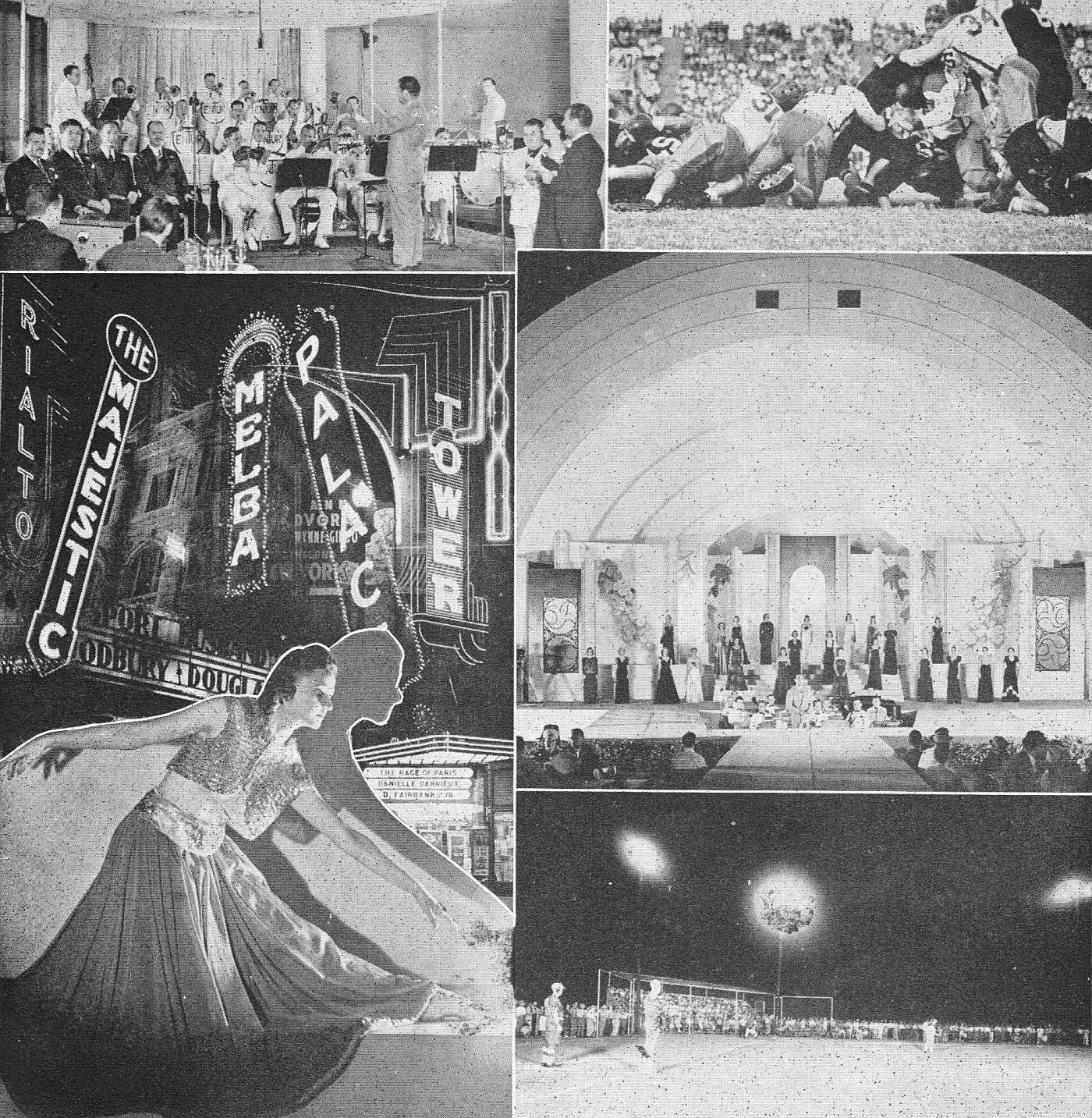
Dallas: “Amusement Capital of the Southwest” — 1946

entertainment_so-this-is-dallas_ca-1946-photos_smSomething for everybody! (click for larger image)

by Paula Bosse

Post-war Dallas had it all, man: our unparalleled night life included swanky hotel nightclubs where the beautiful people sipped champagne and danced to the music of tuxedoed big bands, “quieter but none-the-less entertaining taverns on the outskirts of the city” where the less beautiful people drank beer and danced to the non-stop music coming from jukeboxes, “unusual” restaurants (“where there is no music to dull the solid enjoyment of well-seasoned viands served with sparkling wines of appropriate vintage”), theatrical presentations, movies, movies, movies, and outdoor sports and recreation, including baseball at Rebel Stadium. Something for everybody!

entertainment_so-this-is-dallas_ca-1946-text(click for larger image)

***

Photo collage and text from “So This Is Dallas,” edited by Mrs. E. F. Anderson (Dallas: The Welcome Wagon, ca. 1946); photographs by Parker-Griffith.

*

Copyright © 2016 Paula Bosse. All Rights Reserved.
From the Vault: Dr. King in DFW

mlk_love-field_calvin-littlejohn_1959Dr. King and friends at Love Field, 1959

by Paula Bosse

Martin Luther King, Jr. made a quick stop in Dallas and Fort Worth on October 22, 1959. See the post “MLK in DFW — 1959” from last year, here.

*

Copyright © 2016 Paula Bosse. All Rights Reserved.
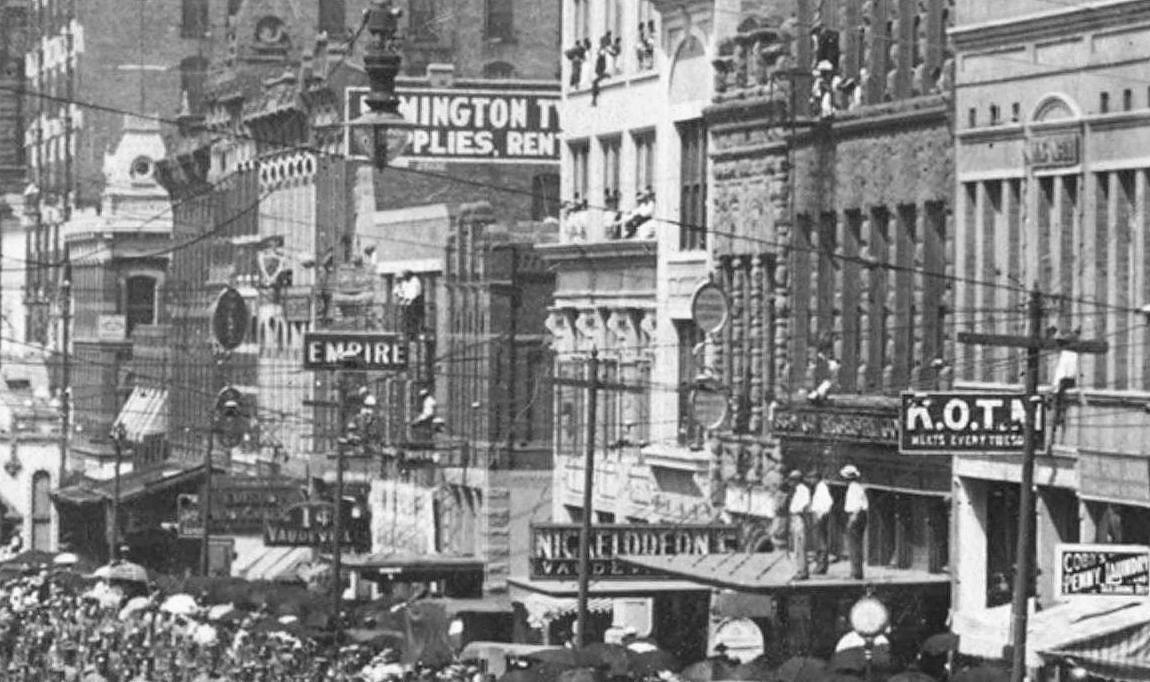
The Volunteer Fire Department’s Early Days

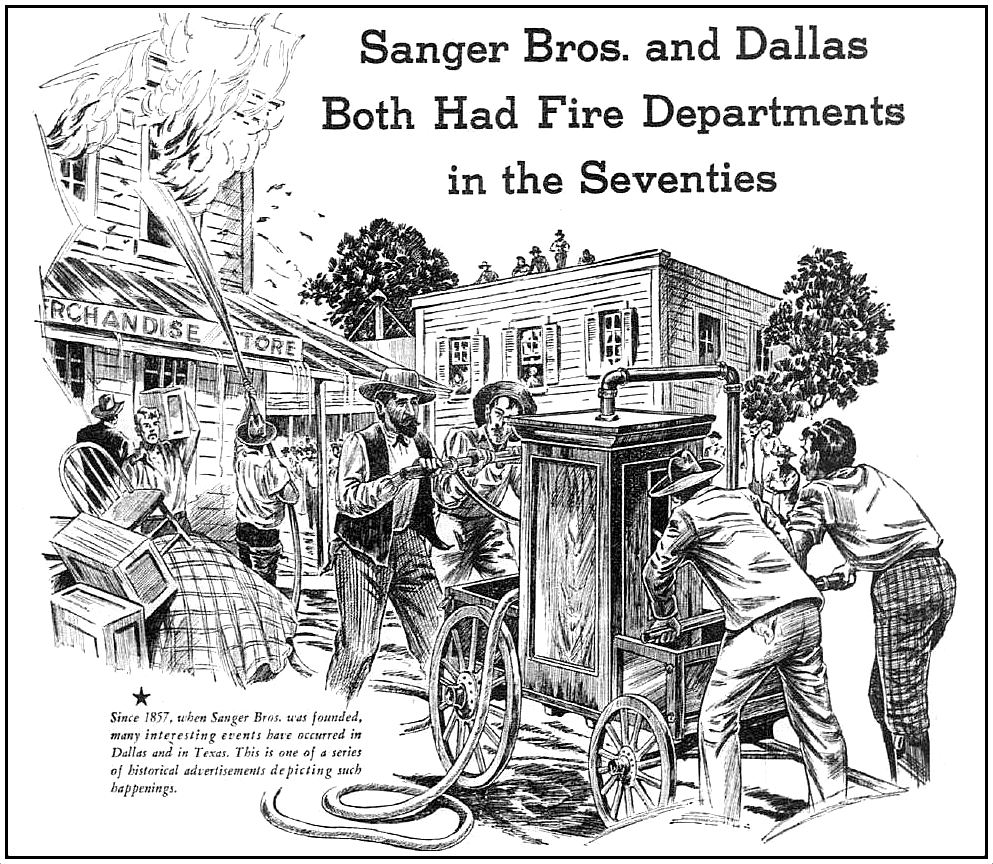
sanger-bros_fire-department_dmn_030836aPumping water from an underground cistern (click for larger image)

by Paula Bosse

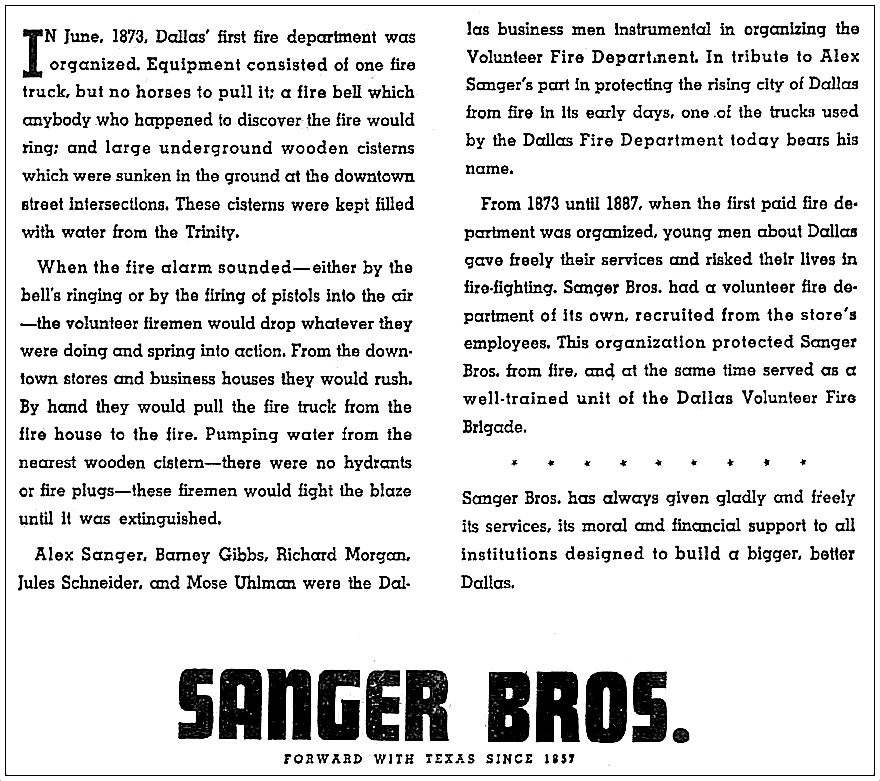
Dallas was constantly catching on fire in its early days. According to this very informative advertisement, Alex Sanger was one of the Dallas businessmen responsible for organizing the city’s first volunteer fire department. Interestingly, the Sanger Bros. department store also had a volunteer fire department which not only protected the store, but also served as a special unit of the Dallas Volunteer Fire Brigade.

The drawing above and the text below are from a 1936 Sanger Bros. advertisement. (Click to see larger images.)

sanger-bros_fire-department_dmn_030836b1936

*

Copyright © 2016 Paula Bosse. All Rights Reserved.
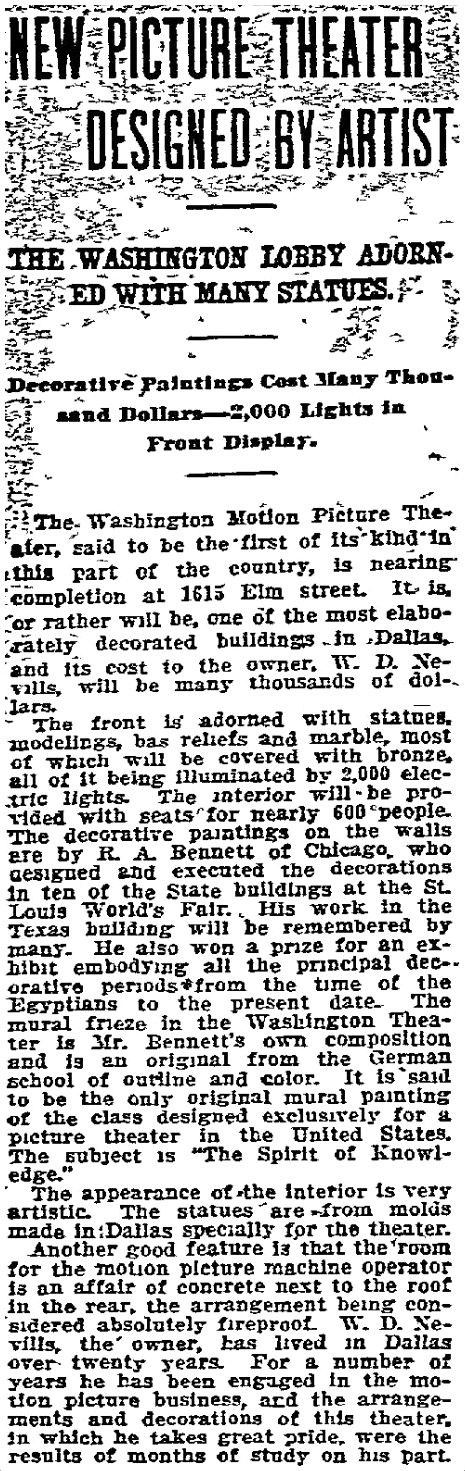
 

The Hilton Hotel, Main & Harwood

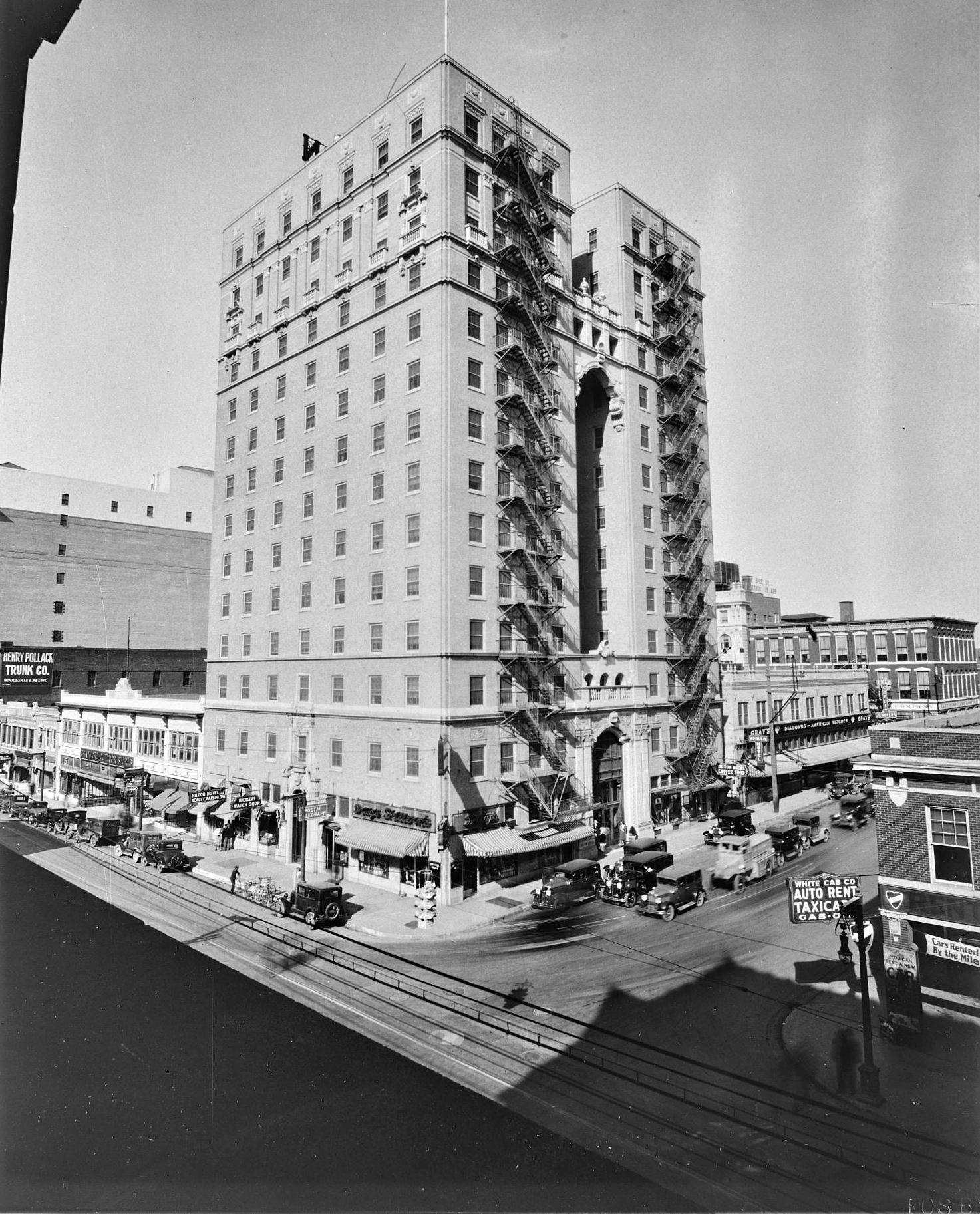
hilton-hotel_1930_portal_smThe Hilton, Main & Harwood, 1930 (click for much larger image)

by Paula Bosse

When Conrad Hilton built the Lang and Witchell-designed Hilton Hotel in Dallas in 1925, it was the first hotel he had built from the ground up. It’s been through several name changes over the years (its White Plaza Hotel incarnation was its longest), and, remarkably (for Dallas), the building still stands — it is now Hotel Indigo

Above, a photo from 1930, with so much going on, it’s worth zooming in to see some of the details. All images are pretty big when clicked.

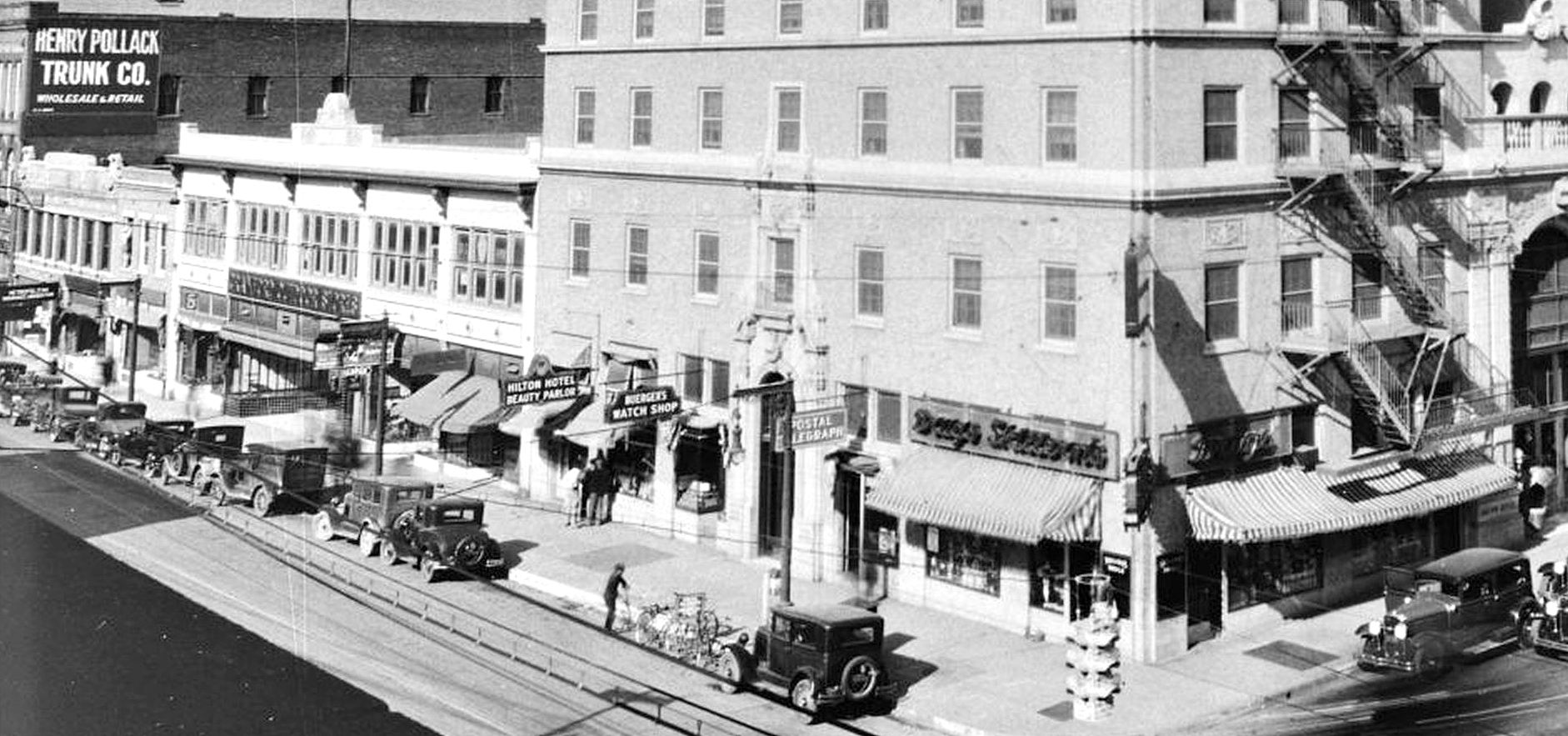
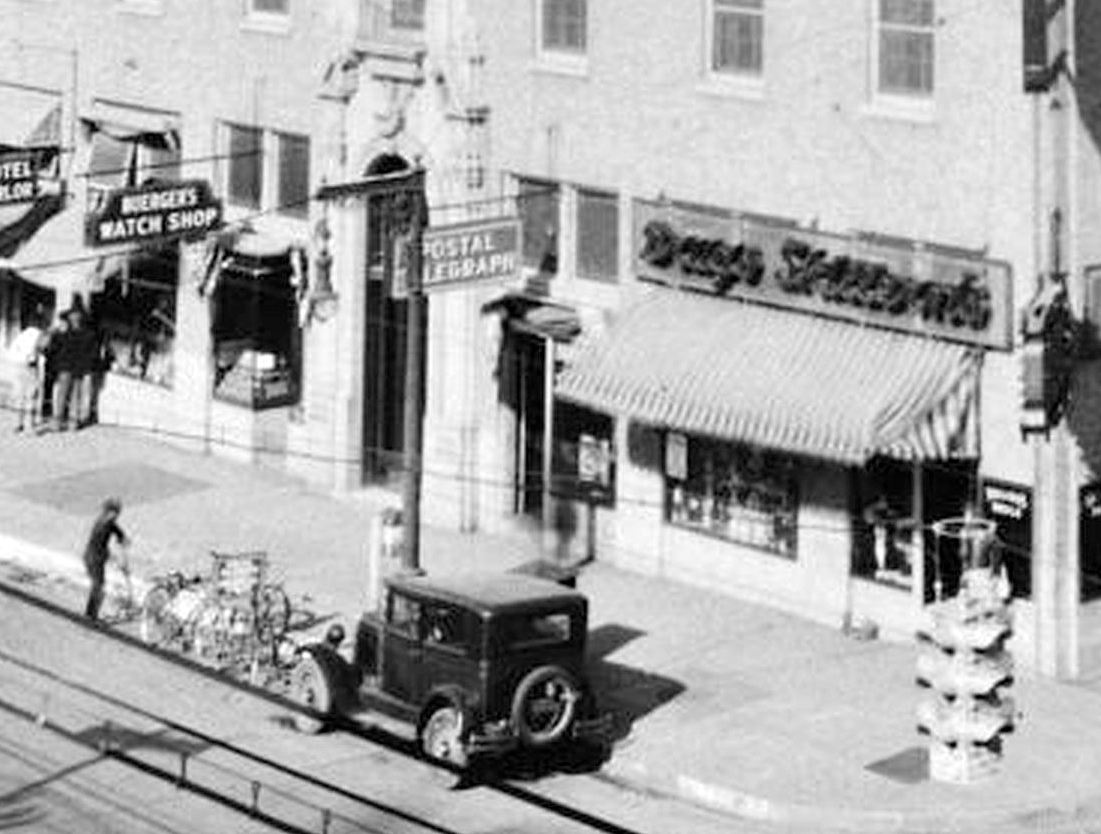
The left side of the photo shows Main Street looking west.

hilton_1930_det-1

I’m not sure what’s going on with the man at the curb — construction? Street cleaning? And I’ve looked and looked at that small tower-like thing on the corner but can’t figure out what it is. (UPDATE: Ha! Thanks to a helpful comment below, I now see that this “tower” which was confusing me so much is, not, in fact, an odd structure set on the sidewalk but is — of course! — a traffic light suspended above the street!) (UPDATE #2: I think another commenter was right when he said it is a uniformed telegram boy at a bicycle stand. I’ve never considered that telegram offices would have had bike stands — but of course they would!)

hilton_1930_det1a

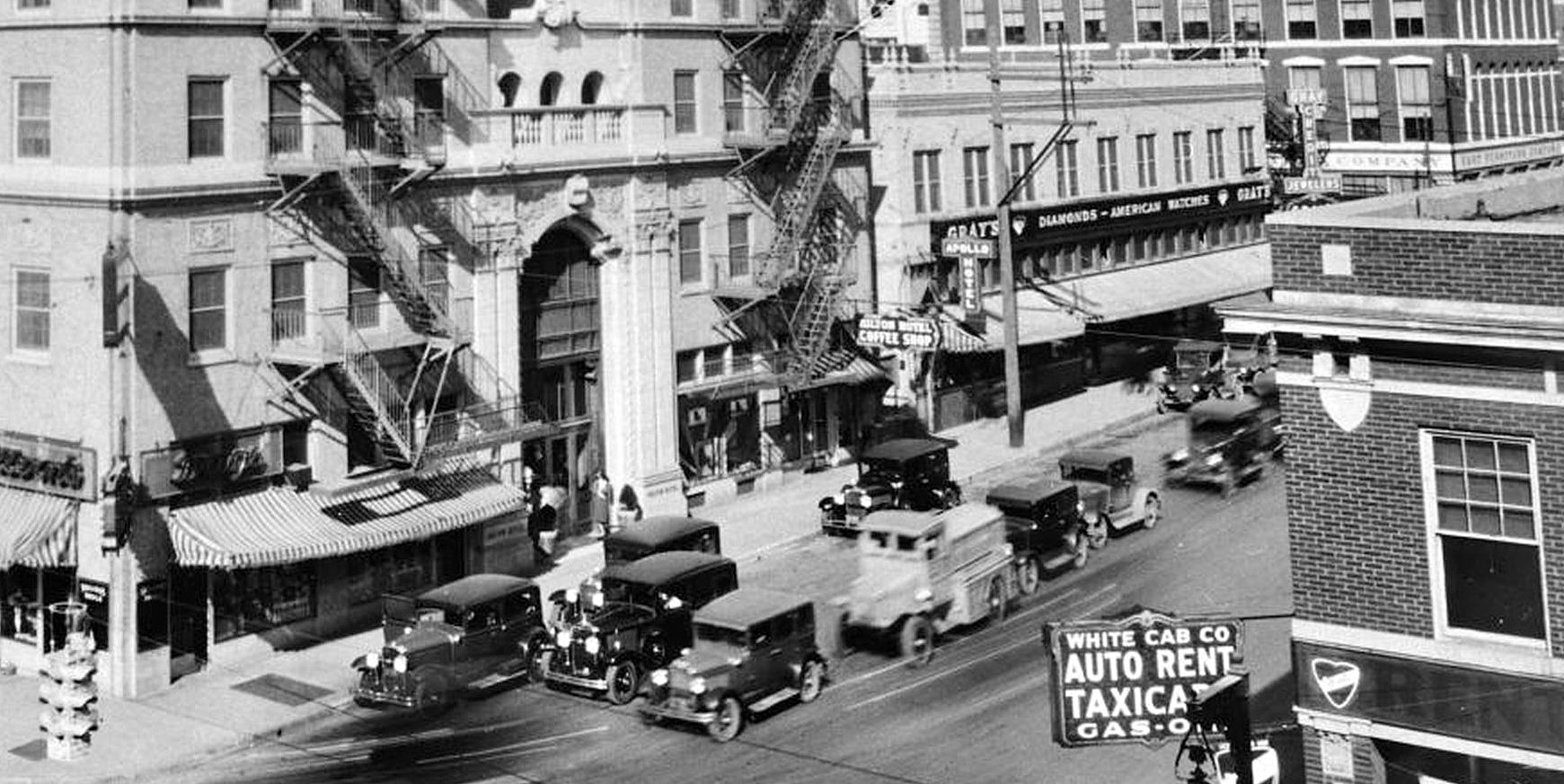
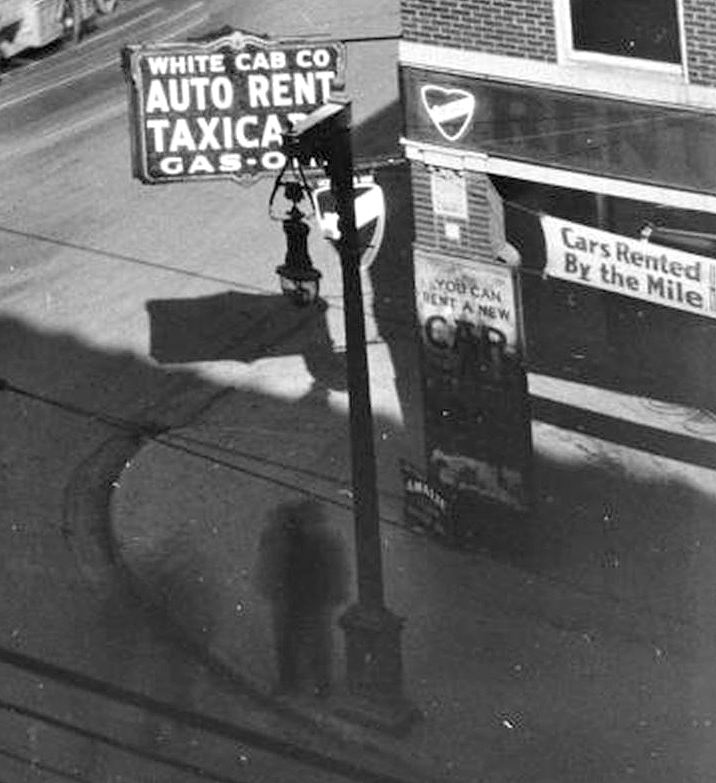
The right side shows Harwood looking north.

hilton_1930_det-2

hilton_1930_det3

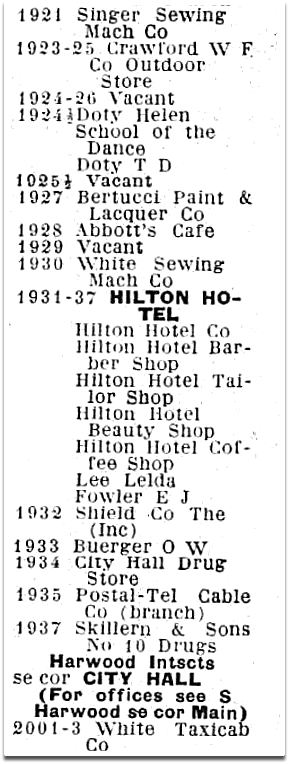
Here are the businesses listed in these blocks in 1930:

hilton_main_1930-directory1930 Dallas directory

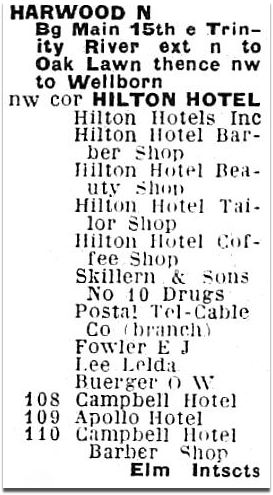
hilton_harwood_1930-directory1930 Dallas directory

As a bonus, here’s a detail of another photo, showing the same intersection, around the same time, taken from the steps of the Municipal Building (then the city hall). The Drake’s Drug Store would be replaced by a Skillern’s in later years.

hilton_from-municipal_1927_det

***

Sources & Notes

Top photo from the Texas Historical Commission Historic Resources Survey Collection, via the Portal to Texas History, here.

The Wikipedia entry for Dallas’ first Hilton Hotel (not to be confused with the Statler-Hilton of the ’50s) is here.

The Hotel Indigo website is here.

All images larger when clicked.

*

Copyright © 2016 Paula Bosse. All Rights Reserved.