Flashback : Dallas

A Miscellany: History, Ads, Pop Culture

Category: 1900s

Fisher’s Addition, West Dallas

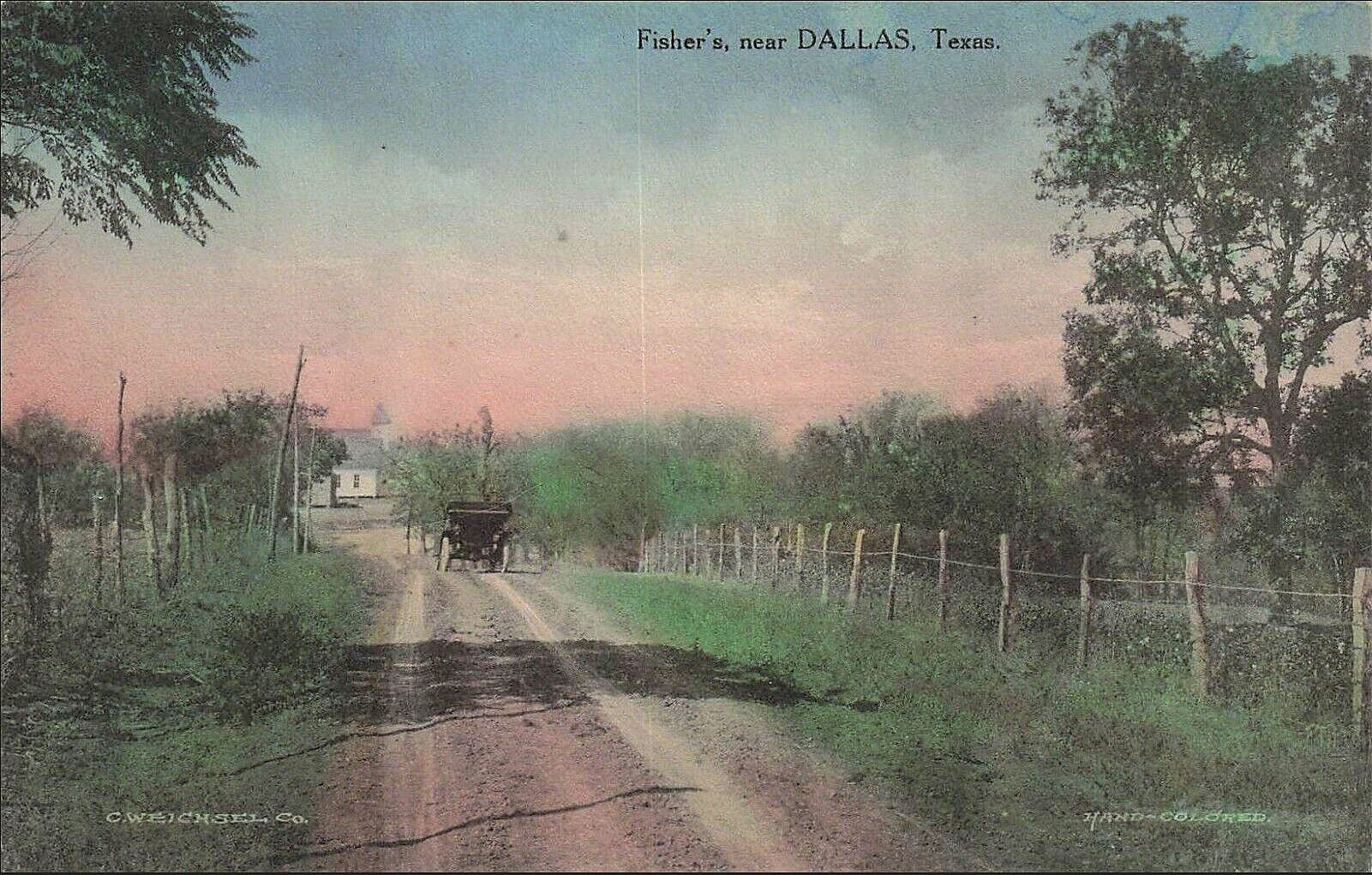
Fisher’s, Near Dallas, Texas

by Paula Bosse

I’ve never seen this postcard before, and I’d never heard of Fisher’s (“near Dallas”).

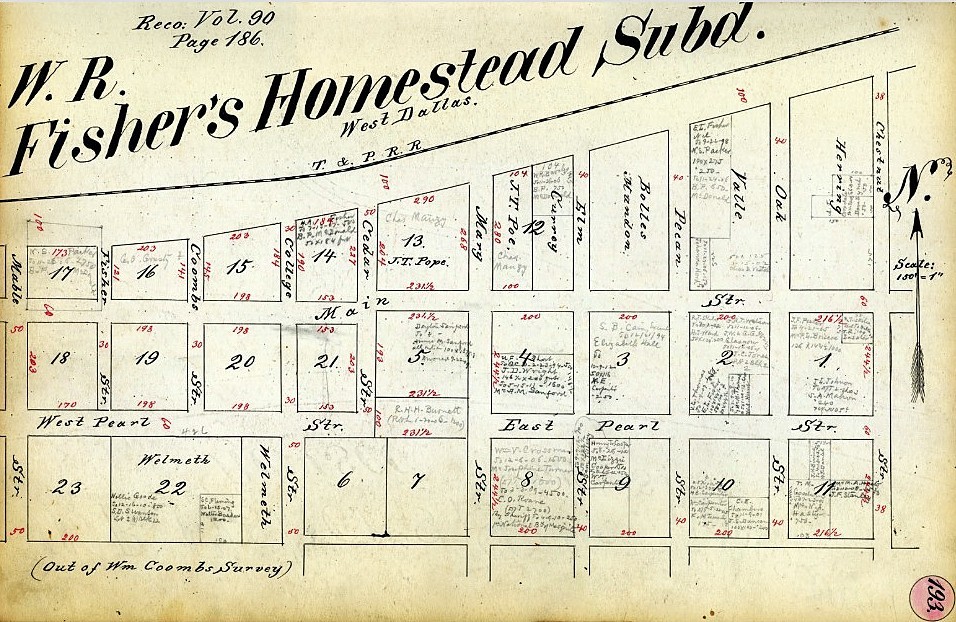
W. R. Fisher’s Addition was in West Dallas, possibly bordered by what is now N. Edgefield, Fort Worth Avenue, Sylvan, and West Commerce (just below the old T & P railroad tracks). …I think. Lots of real estate transactions were going on in “Fisher’s” in the 1880s and ’90s, when West Dallas was its own community and before the area became part of Dallas.

*

This is a very pretty postcard. I just picked a random intersection on Google to see what the general area looks like now. It’s mostly built-up, of course, but here’s a very attractive view, at Seale and Obenchain here (Jan. 2024).

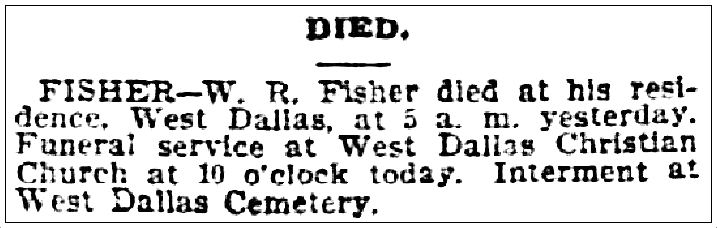
As far as what looks like a church in the distance — it might be the West Dallas Christian Church (later the Western Heights Church of Christ), which was affiliated with West Dallas Cemetery (later Western Heights Cemetery), where William R. Fisher is buried, along with many members of the family of his first wife, Mary Coombes/Coombs, a familiar name in the settlement of the area.

Dallas Morning News, Oct. 19, 1900

*

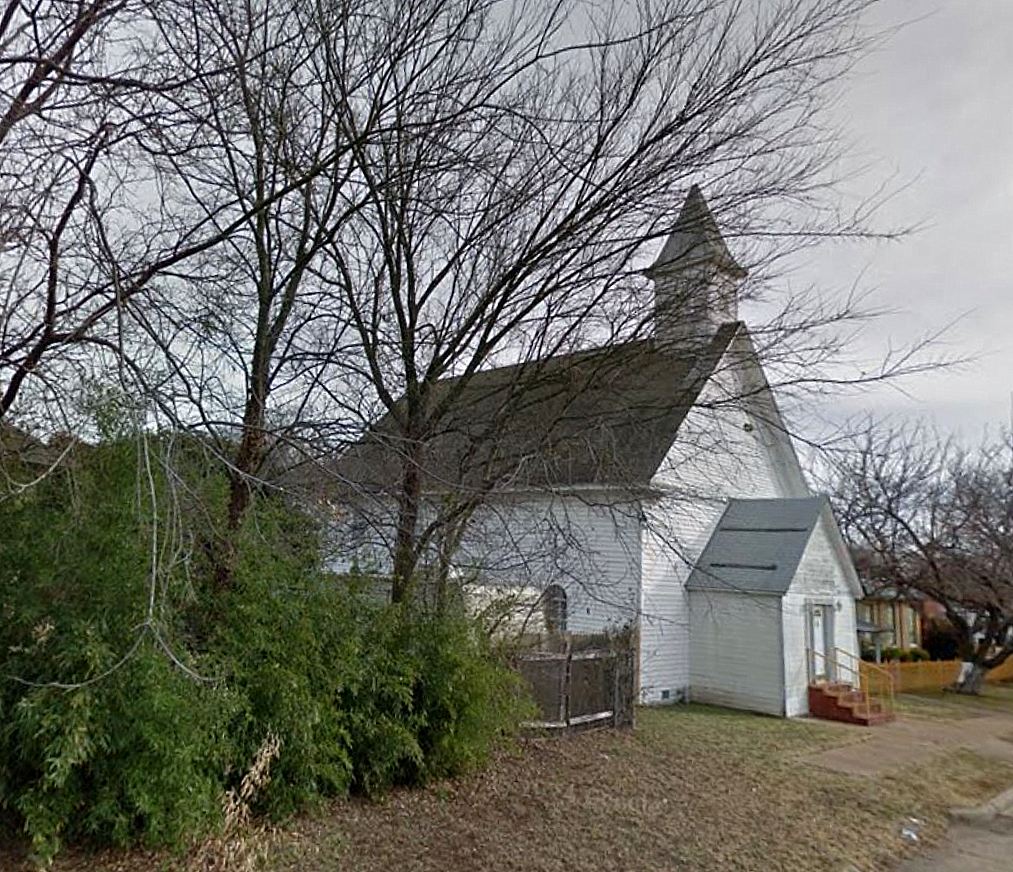
UPDATE: Thanks to reader Linda Donnelly for sending a link that shows this same view these days — with the same church in it! See the Google Street View here. Here’s the church up close (see it on Google Street View here). (1900 block of N. Winnetka, just off Stafford.)

The former West Dallas Christian Church was built around 1890 and has a historical marker, which was placed at the site in 1972, when it was the Western Heights Church of Christ.

***

Sources & Notes

Early-20th-century postcard by Weichsel found on eBay.

Image showing William R. Fisher’s Homestead Subd. (out of the Wm. Coombs’ Survey) is from the Murphy and Bolanz block book scanned by the Dallas Public Library and available online, here.

Read about W. R. Fisher in the History of Dallas County, here.

This post appeared in an earlier version on the Flashback Dallas Patreon page.

*

Copyright © 2025 Paula Bosse. All Rights Reserved.

Whimsy on Main Street — ca. 1906

by Paula Bosse

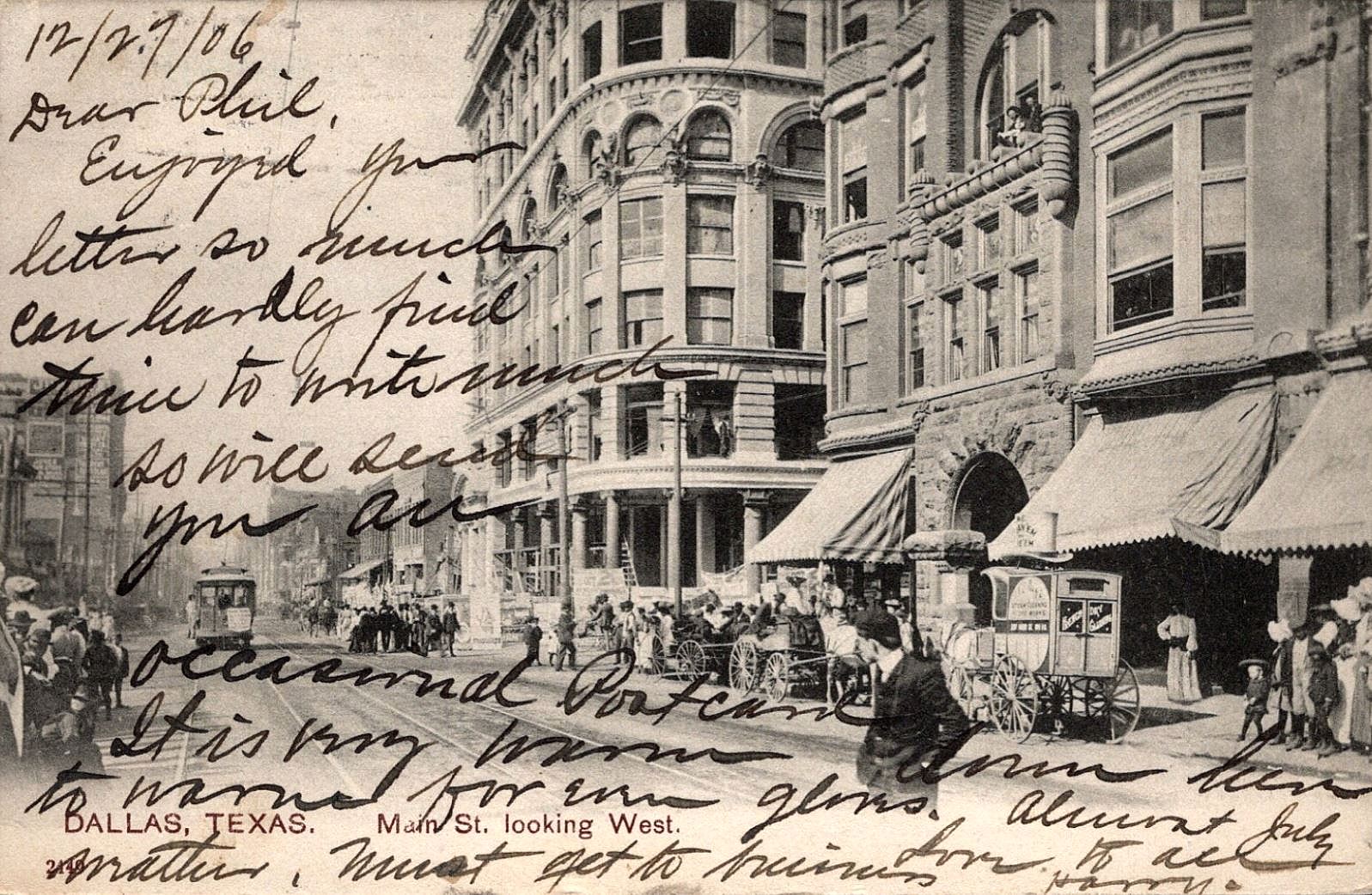
I’ve seen a lot of postcards with views of “Main St. looking West,” usually taken from about Ervay, with the Wilson Building as the architecturally impressive centerpiece. But I don’t think I’ve seen this one. I don’t know when the photo was taken, but it was mailed at the very end of 1906. It looks like the new Wilson Building (which opened in 1904) may still have construction work going on, at least on the ground floor.

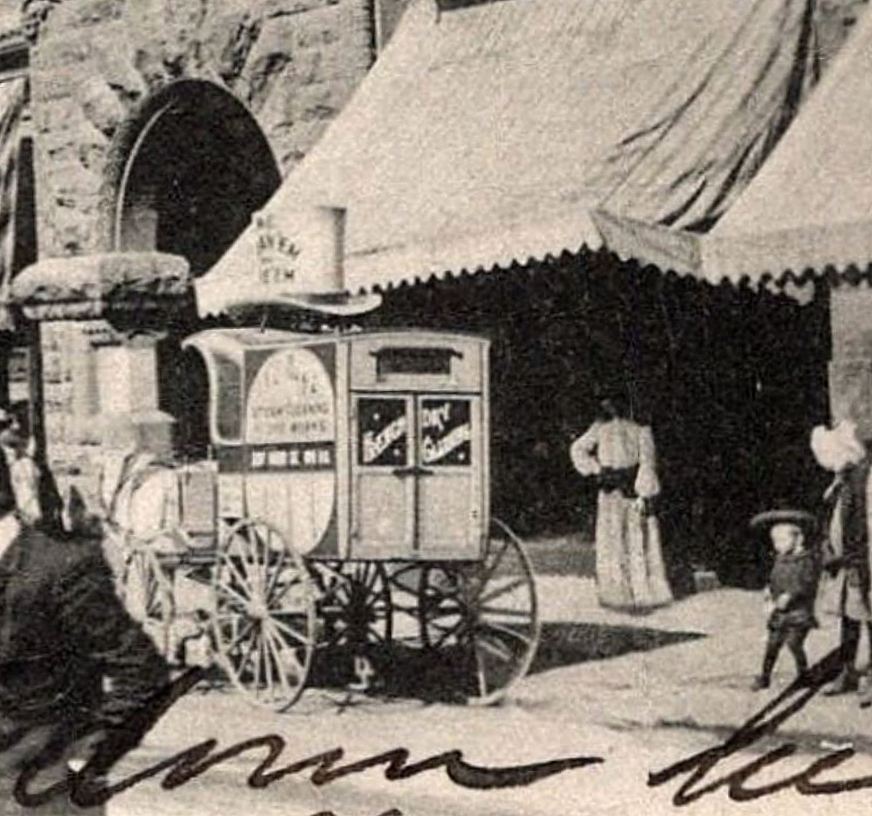
But “whimsical”? Take a look at the horse-drawn dry-cleaning-company delivery wagon on the lower right side of the card. It’s got a GREAT BIG TOP HAT on it! Maybe this sort of thing was popular in the early years of the 20th century, but I’ve never seen anything like this on the streets of Dallas in photographs or postcards of this period. Until now. I love it!

*

The postcard — written and mailed on December 27, 1906 — was addressed to “Master Phillip Wyman” in Yonkers, New York. The sender — identified only as “Harry” — sent this message to Phil, probably a young family member:

Dear Phil, Enjoyed your letter so much. Can hardly find time to write much so will send you an occasional postcard. It is very warm down here, to[o] warm for even gloves. About July weather. Must get to business. Love to all, Harry

Too warm for gloves — in December! Imagine! I bet Master Wyman — who was no doubt shivering up in Yonkers — had his young mind blown. (I wonder if he noticed the big top hat?)

***

Sources & Notes

Postcard from eBay.

*

Copyright © 2025 Paula Bosse. All Rights Reserved.

Dome, No Dome, Dome

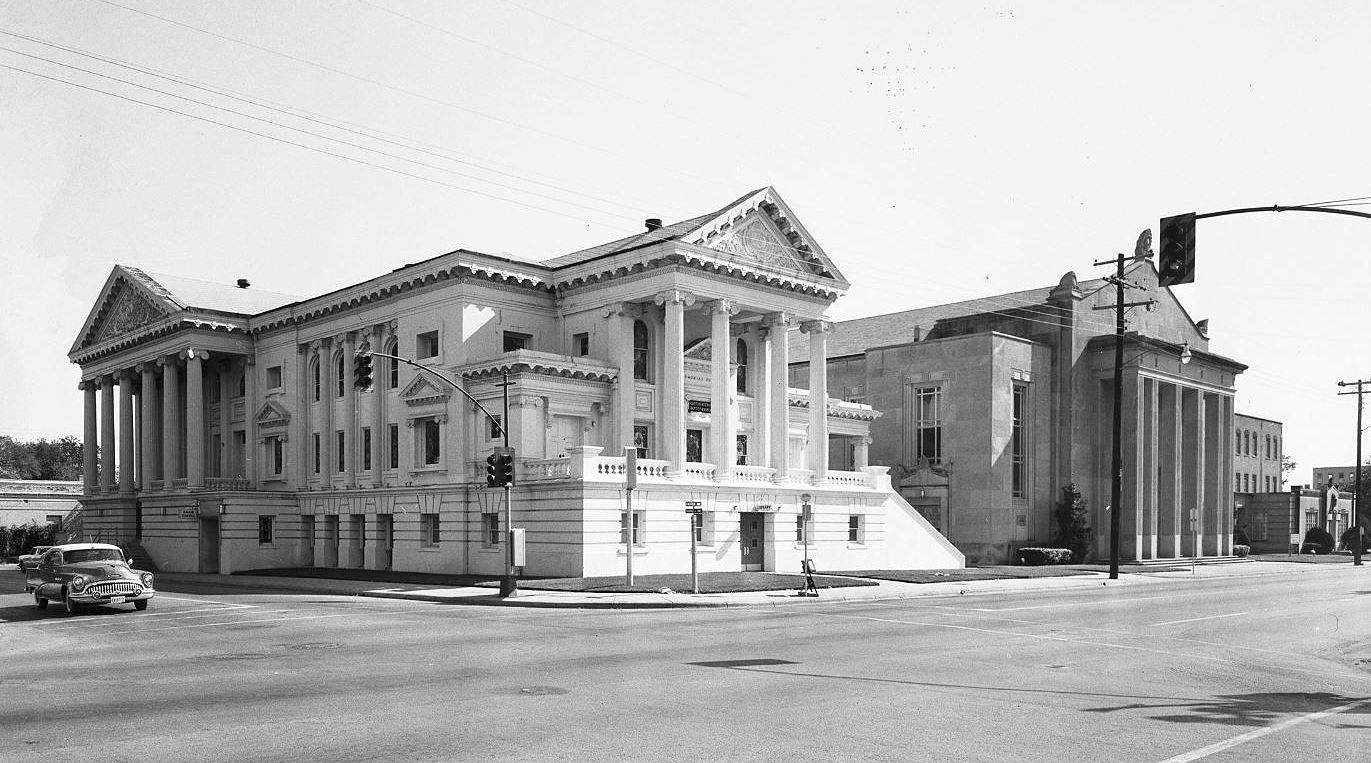
Gaston Ave. Baptist Church, ca. 1961, domeless

by Paula Bosse

Gaston Avenue Baptist Church, at Gaston and Haskell, opened to its congregation in 1904. (The photo above is from about 1961.) The church was designed by architect C. W. Bulger, whose most important Dallas building was almost certainly the Praetorian Building downtown. Bulger was a prominent architect and a prominent Baptist — he designed several Baptist churches, and, conveniently, he lived on Junius Street, not far from the Gaston Avenue church.

This building is imposing and impressive, but every time I drive past it, something just feels “off.” (See it on Google Street View here.) It’s that canary-yellow “gold” dome. Otherwise, it’s a beautiful building.

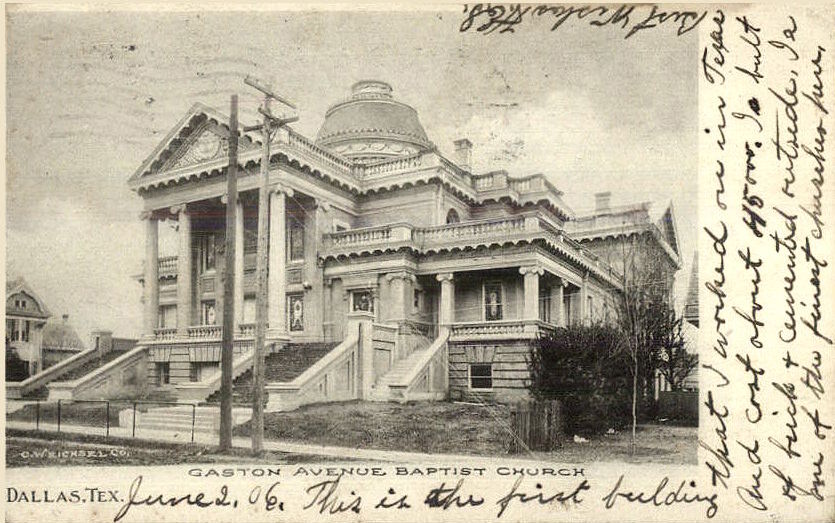
Here’s what it looked like in its earliest days:

This postcard was postmarked June 2, 1906 — the message reads:

June 2, 06. This is the first building that I worked on in Texas and cost about 45,000. Is built of brick and cemented outside. Is one of the finest churches here. Best wishes, H.E.S.

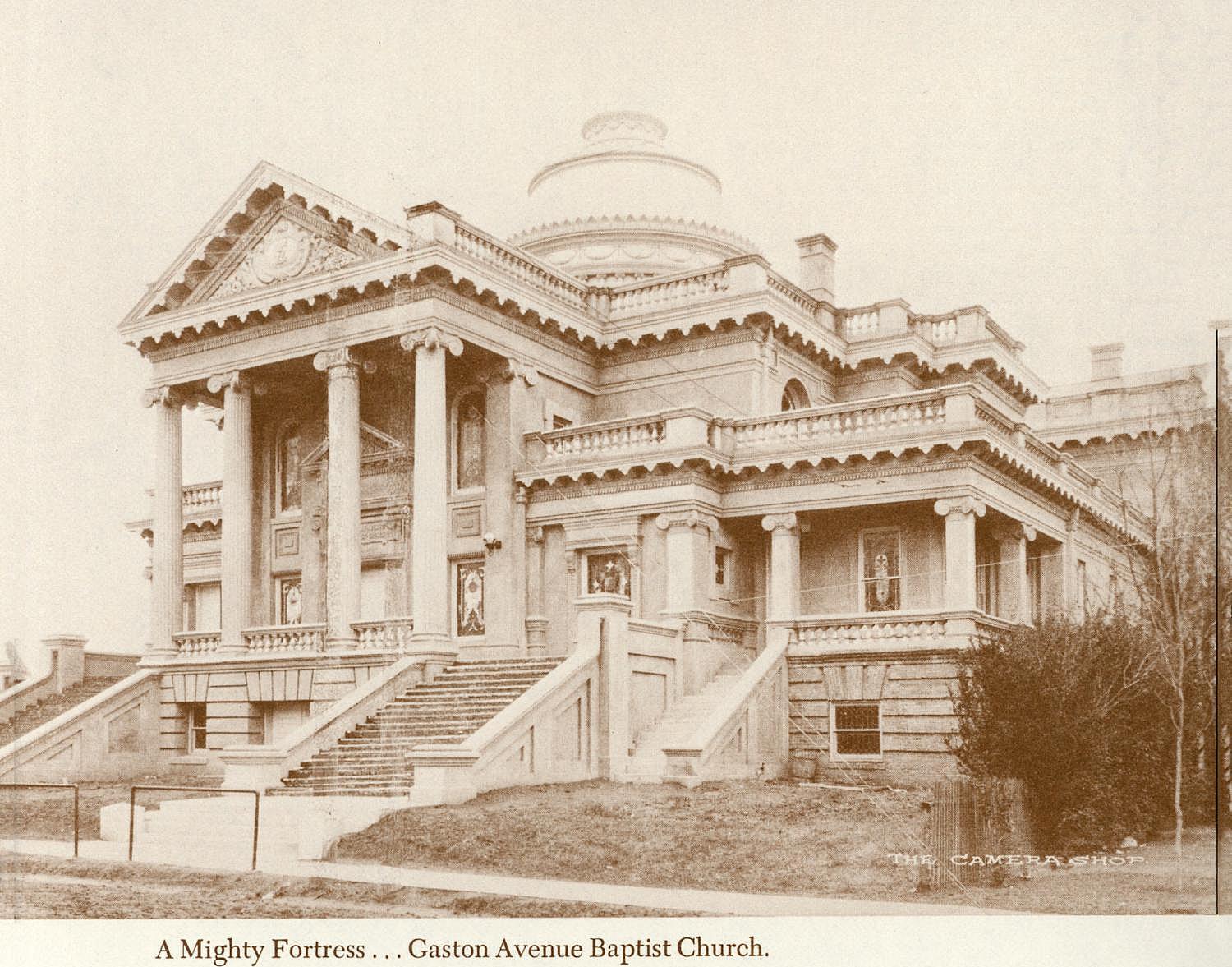
And another:

When you compare the early photos with the one from 1961, there are a few differences. Namely… the dome (…or lack thereof). It was built with a dome. But by 1961, the dome was gone. Why?

Here is what the building looks like these days (it is now the home of Criswell College):

Google Street View, June 2024

Dome.

What’s the deal here? I hate to be a negative Nellie, but every time I drive past that dome (which is often), I wince. It looks like sun-faded matte gold paint. It’s a beautiful building. It deserves a better dome!

After searching a bit, here’s what I found. In response to a reader’s question in 1991 asking what the “golden dome” was made of, The News responded:

MFG Molded Fiberglass in Union City, Pa. fabricated it of 1/2-inch molded fiberglass impregnated with gold-flecked paint… Both the dome and the bay section — the white collar that protrudes from the roof line — are composed of 12 separate pieces… The dome’s cap is composed of four pieces… and the spire that tops the structure is a single unit… [T]he structure stands approximately 35 feet above the roof of the library and weighs about 6,000 lbs. (Dallas Morning News, June 6, 1991)

Fiberglass, impregnated with gold-flecked paint. I don’t know when this happened, but more than 33 years ago. The gold-flecked paint has seen better days, beaten into submission by the relentless Texas sun. I’m sure it would probably cost a small fortune to spruce it up, but it would be nice to see it gold and shiny.

***

Sources & Notes

Top photo by Squire Haskins, from the Squire Haskins Photography, Inc. Collection, University of Texas at Arlington Libraries, Special Collections; more info on this photo is here (see interior photos taken by Haskins at the same time here and here).

Postcard was found on eBay.

The photo captioned “A Mighty Fortress” is from a TSHA Annual Meeting 1977 publication, via the Portal to Texas History.

*

Copyright © 2024 Paula Bosse. All Rights Reserved.

Second Presbyterian Church — 1905

Live Oak & Germania (Liberty)

by Paula Bosse

Hello! I’ve been gone for a while — the longest period of not posting here since I started 10 years ago! Life has been chaotic for the past month or two, but things have settled down a bit, and it’s good to be back.

I’m cheating a bit with this post, as it’s basically a reworking of something I put up on the Flashback Dallas Patreon page a few weeks ago, but I’m a big fan of this church building and thought I’d go ahead and share it here.

*

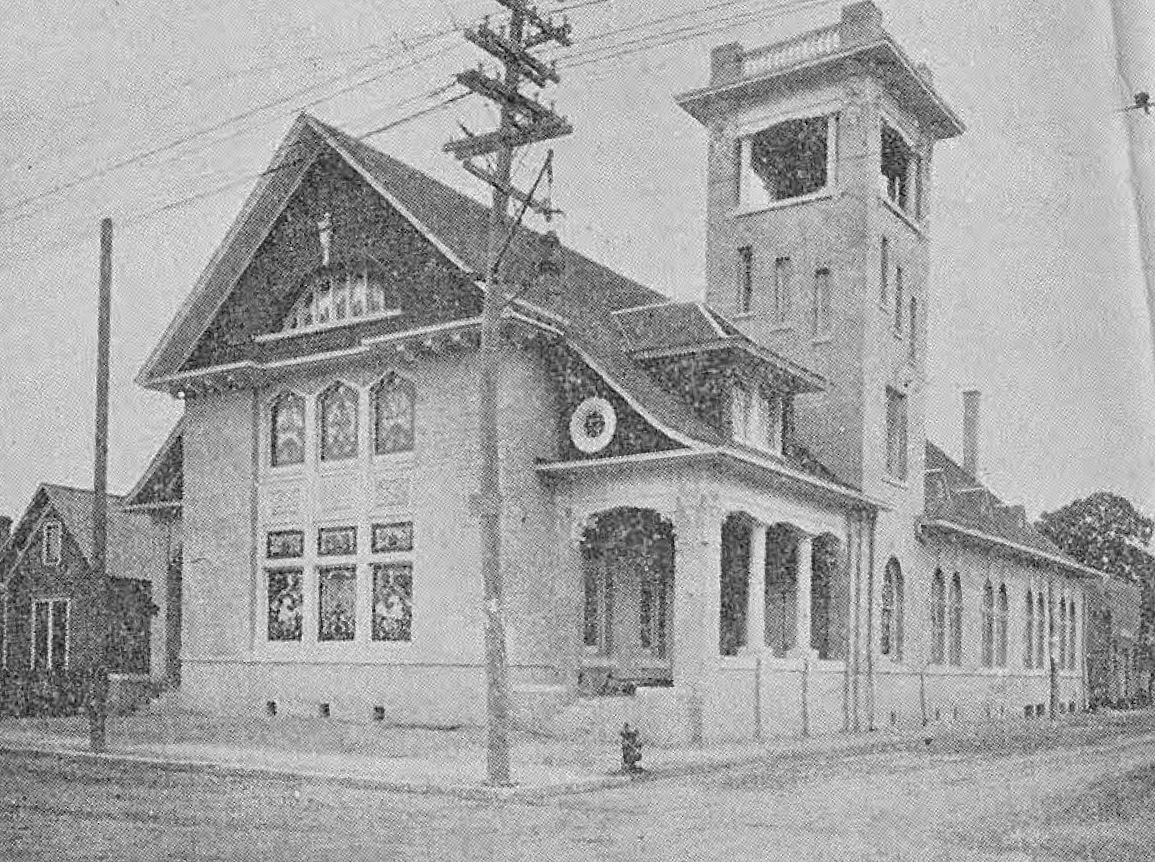
I love this building. The design is so interesting — I don’t think I’ve seen another church that looks quite like this one. It was built in 1904 (the first service was in March 1905), and the architects were Sanguinet & Staats of Fort Worth, who had designed the beautiful Wilson Building downtown a couple of years earlier.

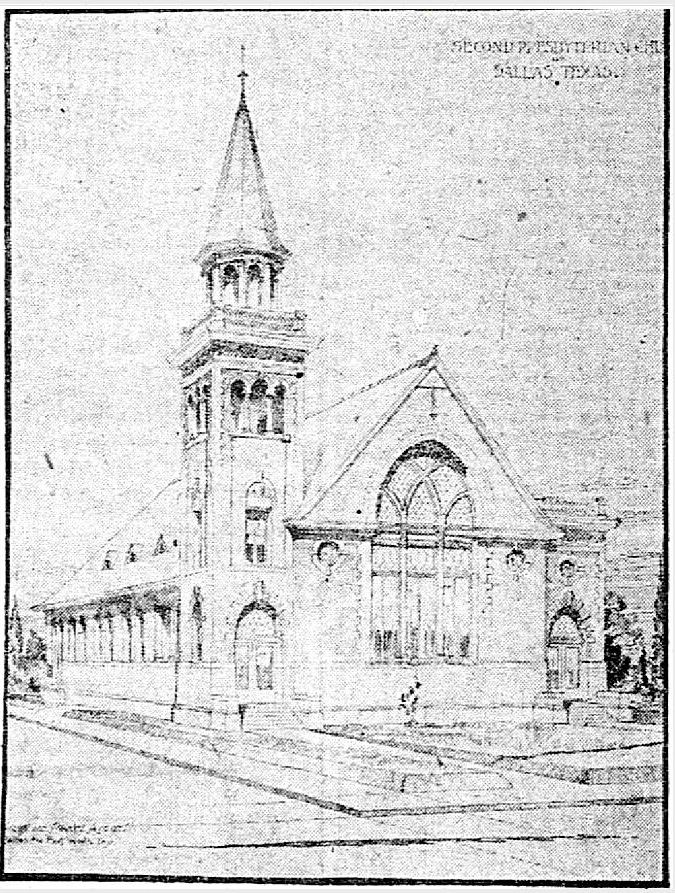
The Second Presbyterian Church sat on the southeast corner of Live Oak and Germania (the latter street name was changed to “Liberty” during WWI, for patriotic reasons). Below is the original design, when a new building was to have been built on the church’s then-current property at the northwest corner of Wood and South Harwood — the Presbyterians sold the corner property to the Methodists not long after this drawing was published in The Dallas Morning News on Feb. 16, 1904 and decided to relocate to Old East Dallas. It’s interesting to see what changes were made to the design for the Live Oak church. (I prefer it without a steeple.) See it brand-new on a 1905 Sanborn map, here (top left).

Feb. 16, 1904 (DMN)

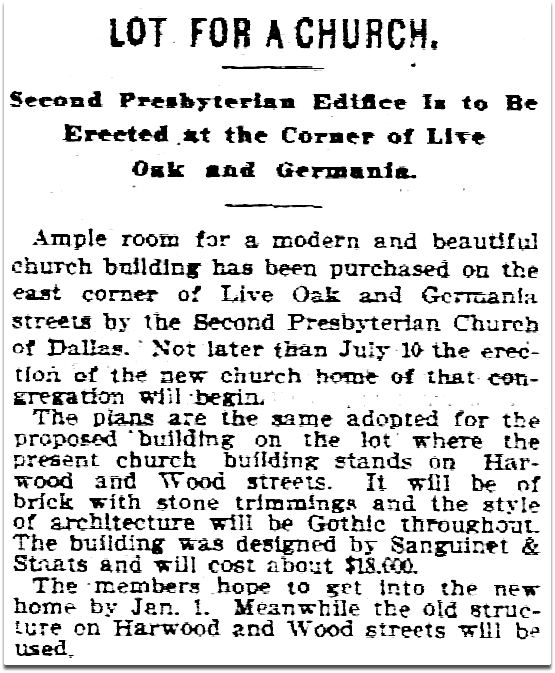
The article below is from June 21, 1904 (DMN):

June 21, 1904 (DMN)

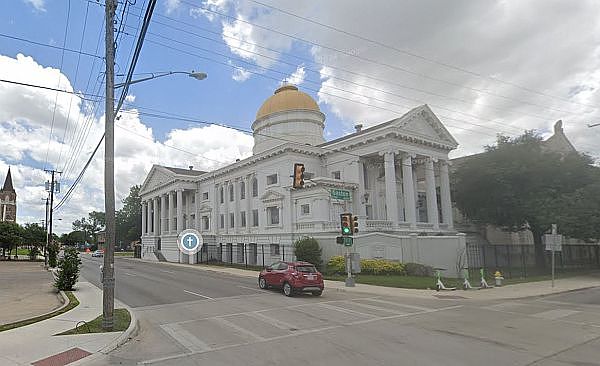
See what this corner looks like now, on Google Street View, here. The building on the corner (at 2900 Live Oak) is a really, really strange-looking one. The Dallas Central Appraisal District (DCAD) says it was built in 1950. DCAD is almost always wrong with construction dates of older buildings. …But it’s so strange. Is it possible that the heart of the old Sanguinet & Staats church is still beating under all that weirdness? If so, it’s one of the oldest non-residential buildings in the neighborhood.

Google Street View, Jan. 2024

And to wrap this all up, this photo of the 1957 tornado was taken at this corner.

***

Sources & Notes

Top photo is from the booklet “Come to Dallas” (ca. 1905), DeGolyer Library, SMU Libraries — it is accessible here.

Drawing and article from The Dallas Morning News.

*

Copyright © 2024 Paula Bosse. All Rights Reserved.

Hotel Rodessia

patreon_rodessia_hotel-rodessia_postcard_ebay“First-class style…”

by Paula Bosse

I’ve seen SO MANY postcards of Dallas through the years that when I come across one that is completely new to me, it’s pretty exciting. Especially turn-of-the-century-ish cards, like the one above. This is the first I’ve ever heard of the Rodessia Hotel, which opened in Oct. 1904 at 361-363 Elm (the address later became 1601½ Elm). The hotel proprietor (as well as the proprietor of the street-level saloon underneath it) was German immigrant Joseph F. Rode (1858-1911).

patreon_rodessia_hotel-rodessia_dmn_oct-1904Dallas Morning News, Oct. 2, 1904

And, because it’s so unusual to be able to note something like this, I must mention that Rode’s wife, Victoria Virginia “Nannie” Rode, was also a business owner.

rode-j-f_mrs_dmn+100794
DMN, Oct. 7, 1894

Even though I hadn’t heard of the hotel, I did know about the building. In fact, I wrote a whole post about it: “S. Mayer’s Summer Garden, Est. 1881.” It would have been a building everyone knew at the turn of the century. Here’s what it looked like when it was a young whippersnapper:

mayers-garden_DPL_1885

It was built in 1881 by Simon Mayer and was the site for many years of his very popular beer garden. Around 1902 it became the Clifton Hotel, and in Oct. 1904, J. F. Rode opened his interestingly named Rodessia Hotel, which remained in business until about 1920 (it was run after his death by the Widow Nannie and her second husband). Around 1920, another hotel — the La France — opened. See the building at various times in the post mentioned above, here.

So. The Rodessia was in business for at least 15 years. I still can’t believe I haven’t seen it pop up in at least one Elm Street postcard or photograph until now. Better late than never!

(Note: In the postcard at the top, just to the right of the hotel, is the David Hardie Seed Co., which I believe continues today as Nicholson-Hardie stores.)

***

Sources & Notes

Postcard from eBay.

Photo of Mayer’s Garden from the Dallas Public Library: “[Mayer’s Beer Garden, Dallas, Texas”], Call Number PA87-1/19-27-1.

This post originally appeared in a shorter version on the Flashback Dallas Patreon page, which I enthusiastically invite you to subscribe to!

patreon_rodessia_hotel-rodessia_postcard_ebay

*

Copyright © 2024 Paula Bosse. All Rights Reserved.

Oak Cliff: No Germs, No Mosquitoes, No Malaria — 1907

patreon_oak-cliff_dmn_111007_adNov. 1907

by Paula Bosse

It’s 1907. How is it you’re not scooping up real estate in Oak Cliff?!

Aside from that “no saloons EVER” thing, it sounds positively idyllic.

*

On the Hills of Oak Cliff
When Thinking of a Home for Your Wife and Children You Need

      • First — Altitude 
        Where the air is clear and free from mosquitoes and malaria. 
      • Second — Water 
        Clear and Pure and Free From Germs 

In Oak Cliff these things predominate, you are on the hills, higher than Dallas, south of the river, and where your breezes come direct from the country, and, as for water, the water running in the Oak Cliff mains is from the great Nelms Well, illustrated on this page, and is the purest and clearest water in Dallas County. 

Ask City Chemist Chisholm, or Water Commissioner Sullivan, or Water Superintendent Nelms, they are the three men most competent to pass on this question, and will verify these facts. 

The water does not come from Bachman’s Dam or any branch of the river, but deep down in the earth, hundreds of feet, from God’s reservoir, gushing out like a great spring and sparkling like diamonds. 

People living in Oak Cliff are healthy and live long. They cannot help it when breathing pure air and drinking clear water. 

In spite of the present financial stringency Oak Cliff is building on, and her citizens have great faith in the future of Dallas. 

As an evidence of this fact, Mr. J. F. Zang has this week let the contract for over $1,000.00 worth of cement walks to be laid on Zang’s Boulevard and other streets. 

Lake Cliff, the beautiful, with its thirty acres of park scenery, its lake and its many costly improvements, is situated in Oak Cliff, and is one of the popular attractions of Dallas.  

Oak Cliff has the combined advantages of city and country; it has gas, sewerage, water, electricity, streetcars, telephones, cement walks, and it is only ten minutes’ ride from its center to the center of Dallas; and it has the country scenery so much desired — hills and valleys, great oak and pecan trees, numerous springs and other rural scenes. 

Raise your children where there are no saloons. By special act of the Legislature saloons are forever debarred from the territory of Oak Cliff. 

Kidd Springs, one of the loveliest parks in Dallas, with the largest springs in the city, is in Oak Cliff, and is one of the leading resorts. 

**

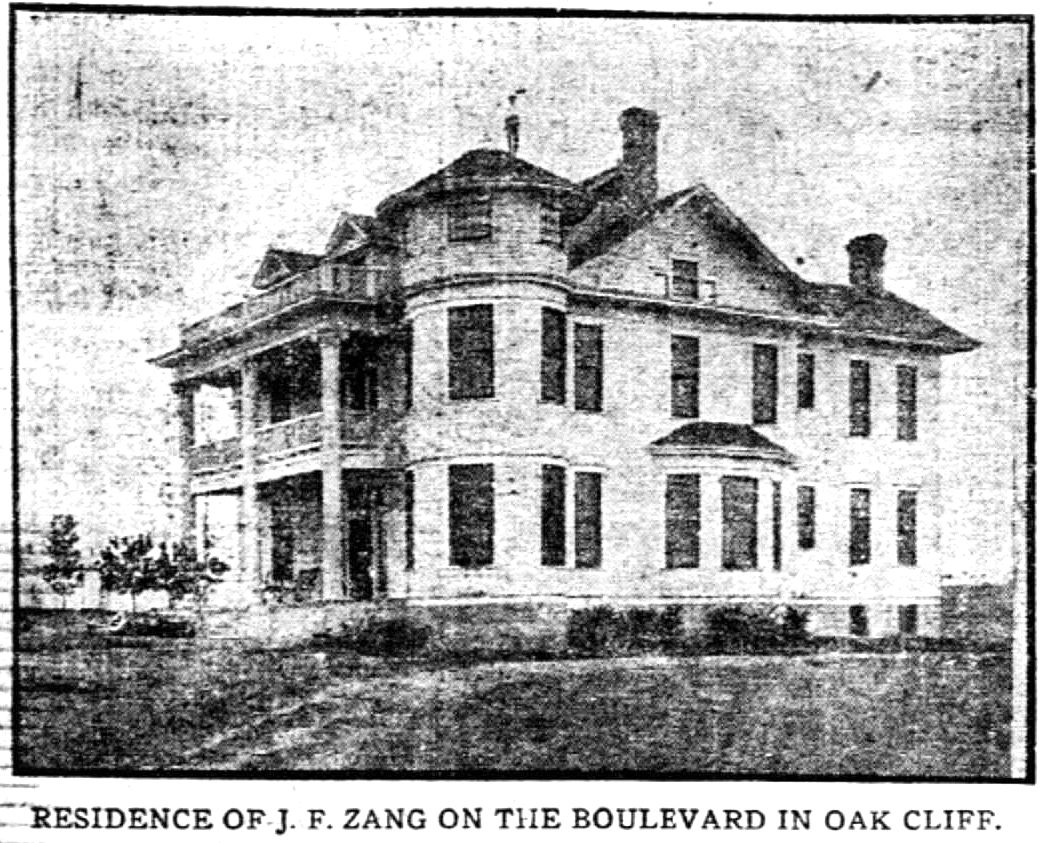
J. F. Zang’s home once stood at Zang and 6th and had what was probably the finest possible view of downtown Dallas, then or now.

oak-cliff_dmn_111007_zang-home-det

*

zangs-blvd_dmn_102600Dallas Morning News, Oct. 26, 1900

*

This might have been a house being built in Zang’s Crystal Hill Addition:

oak-cliff_dmn_111007_home-det

*

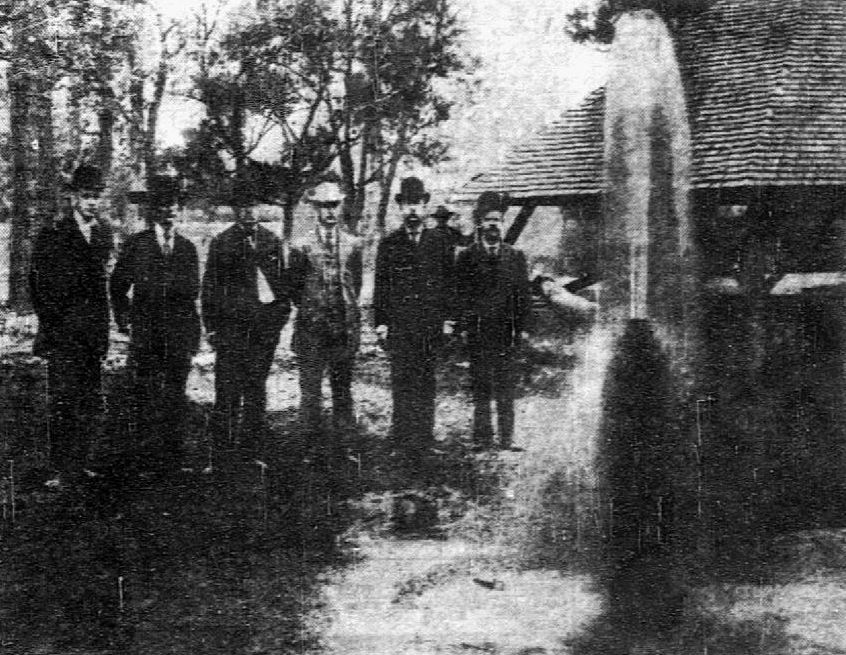
I have to admit, this just looks like a water sprinkler, but here’s the “Nelms Well” in action:

oak-cliff_dmn_111007_nelms-well_det

I had never heard of the “Nelms Well.” It was the first deep artesian well in Oak Cliff (1907), and it tapped into a million gallons of spring water, which was, at the time, enough to satisfy the needs of Oak Cliff residents and to slake their thirst for the pure, clear water that put all other Dallas County water to shame.

Richard Nelms, the City Water Superintendent, is seen at the far right in the photo below. The well was named in his honor. And, again, the water? Let me just repeat the rhapsodic ad copy: “the purest and clearest water in Dallas County… [from] deep down in the earth, hundreds of feet, from God’s reservoir, gushing out like a great spring and sparkling like diamonds.” In other words, Oak Cliff had some damn fine water.

nelms-well_photo

***

Sources & Notes

Ad printed in Dallas newspapers in November 1907.

A couple of water-related Flashback Dallas posts that might be of interest:

This post originally appeared in a different version in a Flashback Dallas post on Patreon.

patreon_oak-cliff_dmn_111007_ad

*

Copyright © 2024 Paula Bosse. All Rights Reserved.

The Girls of St. Mary’s

st-marys-college_girl-athletes_frank-rogers_post-1911_ebay“Juxta Dallas Texas”

by Paula Bosse

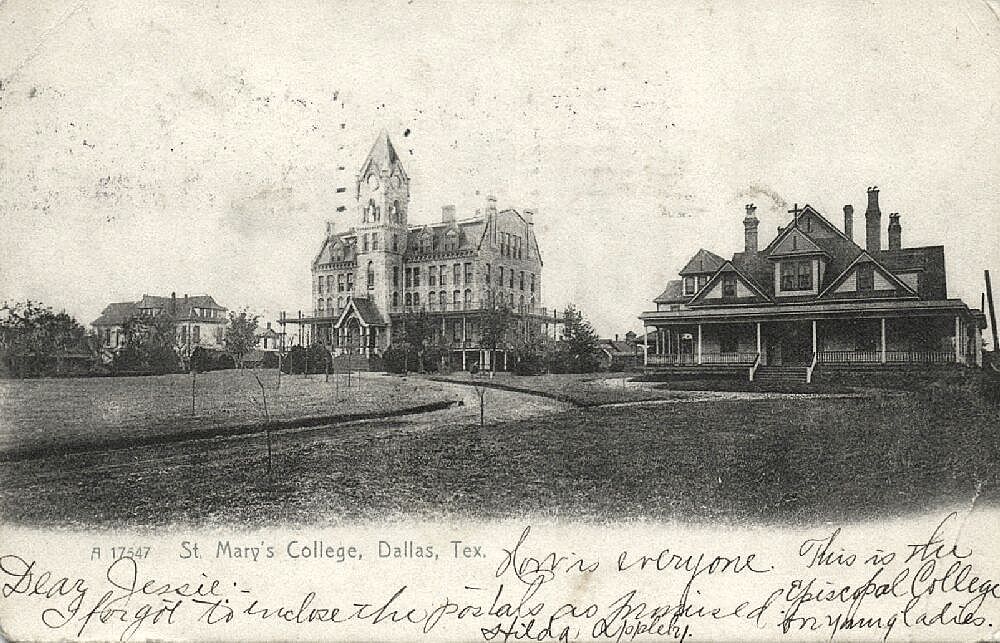
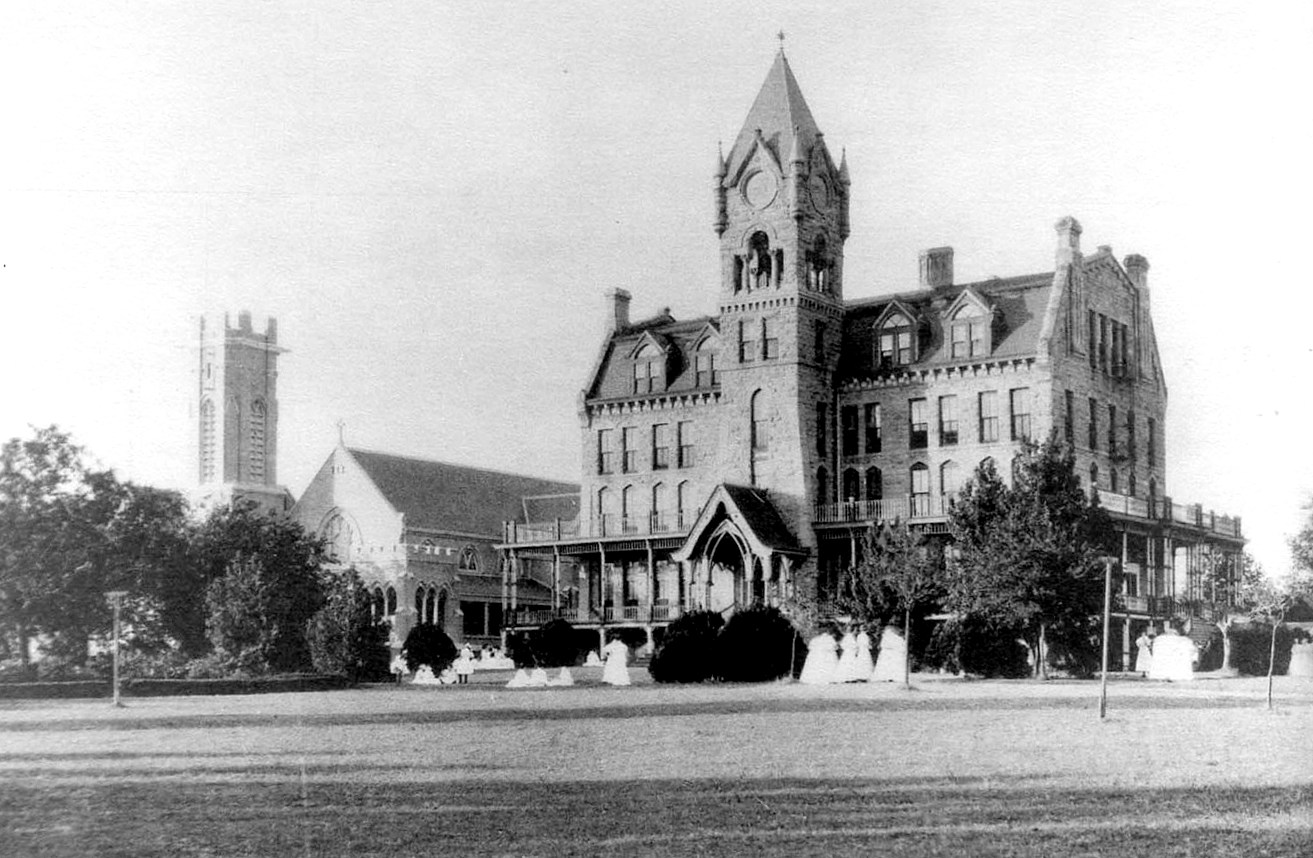
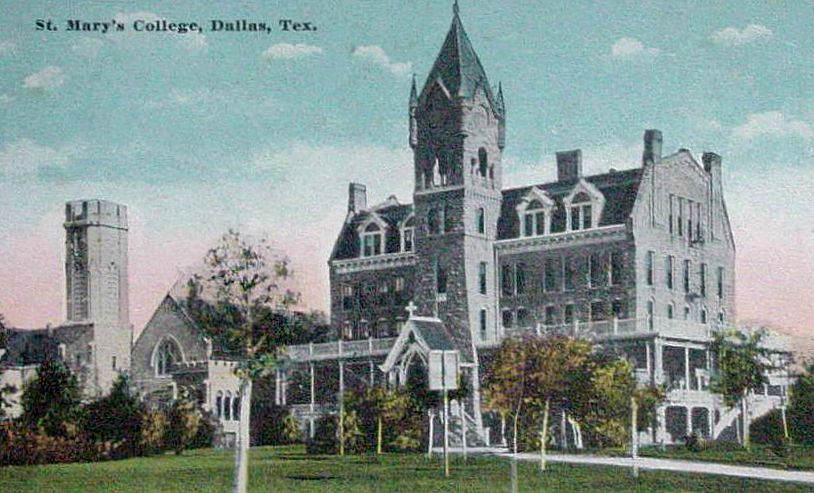
St. Mary’s College, founded in 1889 in East Dallas (at Ross and Garrett avenues), was a prestigious school for girls, affiliated with the Episcopal Church. It had a statewide reputation, and many girls attended as boarding students — Lady Bird Johnson was a proud alumna. Around 1930 it became home to a relocated Terrill School for Boys.

The once sprawling “College Hill” campus covered 20 acres (see it on a 1922 Sanborn map here). I can find no news reports of its demolition, but one source says 1948. Read more about the school’s history in the Handbook of Texas entry here. and see other photos and a short history in the Flashback Dallas post “Private Education in Dallas — 1916.”

The site of the former school has recently been filled with apartments. The old chapel tower still stands, but the large, open school campus is long gone. See the most recent Google Street View of St. Matthew’s Cathedral here. — the main school building would have been directly to the right.

*

As far as the photo at the top of this post, I really love this image of smiling girl athletes (the basketball team?) posing in their gym togs in front of the school.

“Juxta Dallas Texas” (“near Dallas Texas”).

st-marys-college_girl-athletes_frank-rogers_post-1911_ebay_det

*

The ad below touts the school’s offerings in 1911 (including a school dairy):

ST. MARY’S COLLEGE AND SCHOOL OF MUSIC

Founded by the Right Rev. A. C. Garrett [Alexander Garrett], D.D., LL. D.
Twenty-third Year Opens Sept. 13, 1911

A College for Christian education of women — college, scientific and literary courses. Bishop A. C. Garrett, instructor in mental science and logic. Advanced classes in charge of graduates of universities of recognized standing. European instructors of modern languages. School of Music under direction of instructors trained in Germany, Paris, France and New England Conservatory of Music. Pianoforte pupils examined annually. Art and China Painting taught according to the best methods. Health, diet and physical culture in charge of two trained nurses and teachers of physical culture. 

The group of buildings comprise:
1. St. Mary’s Hall (stone).
2. Graff Hall, which is devoted to the Schools of Music and Art.
3. Hartshorne Memorial Recitation Hall.
4. The Mary Adams Bulkley Memorial Dormitory.
5. Sarah Nielson Memorial for the care of the sick.

Houses heated by steam and lighted by electricity. A very attractive College Chapel and large Gymnasium built last year. A very attractive home. Artesian well. Milk supplied from college dairy. Homemade bread and sweetmeats. Night watchman. School opens Sept. 13. For catalogue address:

Bishop Garrett, President St. Mary’s College, Dallas, Texas

st-marys_standard-blue-bk_1912-1914

*

st-marys-college_postcard

*

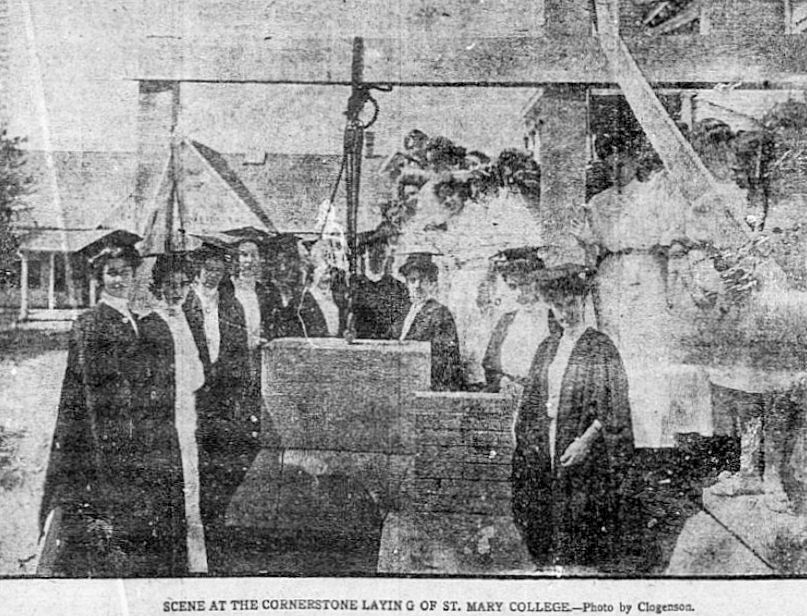
st-marys_cornerstone_dmn_092907-clogensonLaying the cornerstone for the chapel, Dallas Morning News, Sept. 29, 1907

*

st-marys-college_ebay

*

st-marys-college_postmarked-1909

*

Below, the chapel tower can be seen at the left. It still stands, as part of St. Matthew’s Cathedral (5100 Ross Avenue).

patreon_st-marys-college_c1908

*

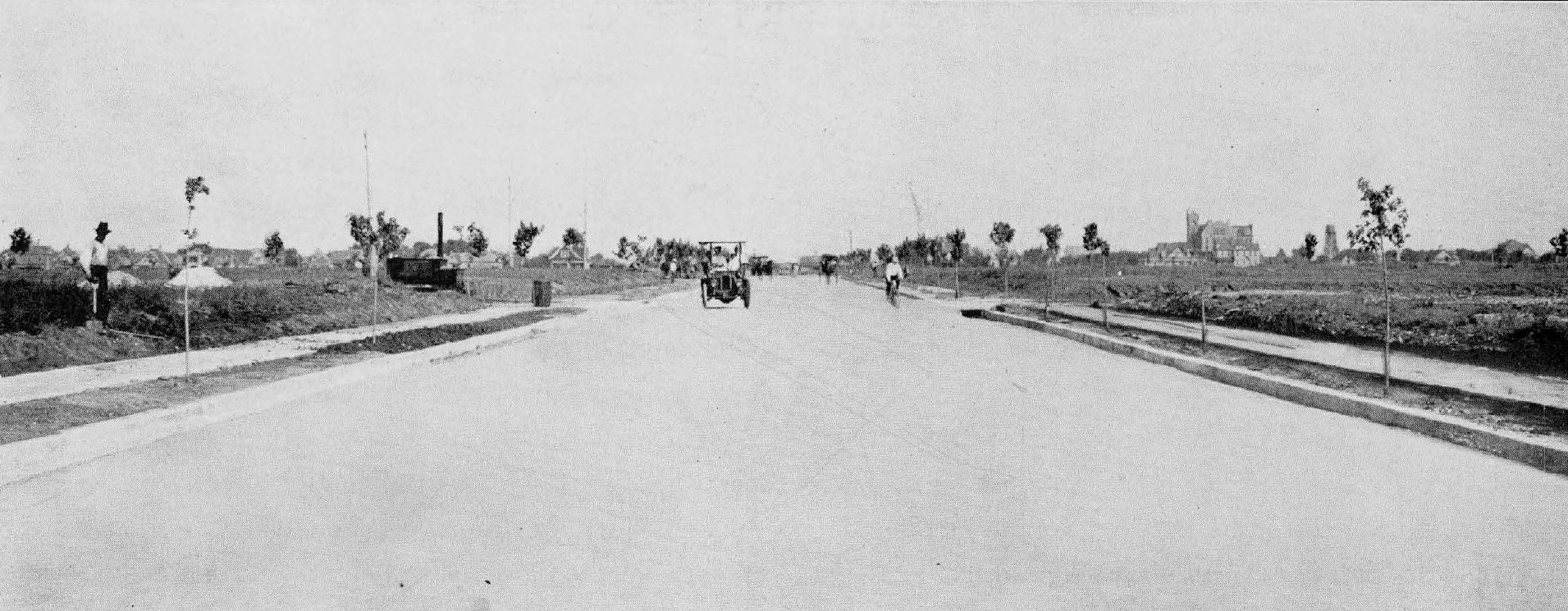
As seen from a distance — on the right, from Collett and Junius (more info on this photo from the Flashback Dallas post it originally appeared in, “Munger Place, The Early Days: 1905-1909”):

munger-place-bk_ca-1905_degolyer-lib_SMU_collett-and-junius_2

*

st-marys-college-ebay

*

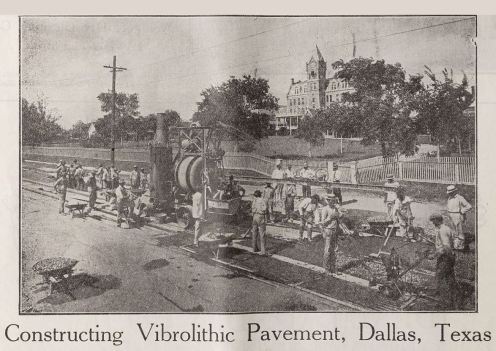
St. Mary’s appeared in an ad for a street-paving company in 1916 (from the original post here):

street-construction_vibrolithic-pavement_SFOT-booklet_1916_SMU_st-marys

*

st-marys-college_dallas-rediscovered_DHSDallas Historical Society

***

Sources & Notes

Top photo by Frank Rogers, taken some time after 1911. Found on eBay. Originally used in a Patreon post, “The Girls of St. Mary’s.”

Last photo from the Dallas Historical Society, found in the book Dallas Rediscovered by William L. McDonald.

Unless otherwise noted, most other images/postcards found on eBay.

Please consider supporting me on Patreon, where for as little as $5 a month, you can get daily Flashback Dallas posts! (You can follow for free, but only a small handful of posts are “public.”)

st-marys-college_girl-athletes_frank-rogers_post-1911_ebay_det

*

Copyright © 2024 Paula Bosse. All Rights Reserved.

The South End “Reservation” Red-Light District — ca. 1907

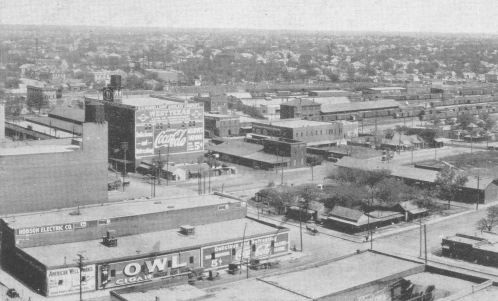
south-end_hobson-electric_southeast-from-courthouse_ca-1907_cook-collection_degolyer_SMUThere’s a lot going on here that you can’t see… (DeGolyer Library, SMU)

by Paula Bosse

I am reminded how much fun it is to just dive into something with no idea where you’re heading and end up learning interesting things you might have been unaware of had you not wondered, “What am I looking at?”

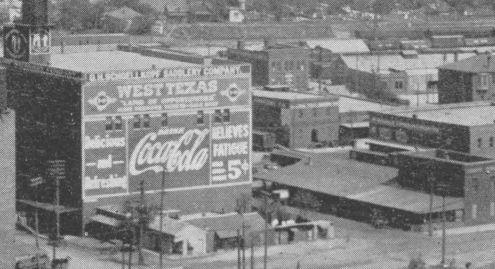
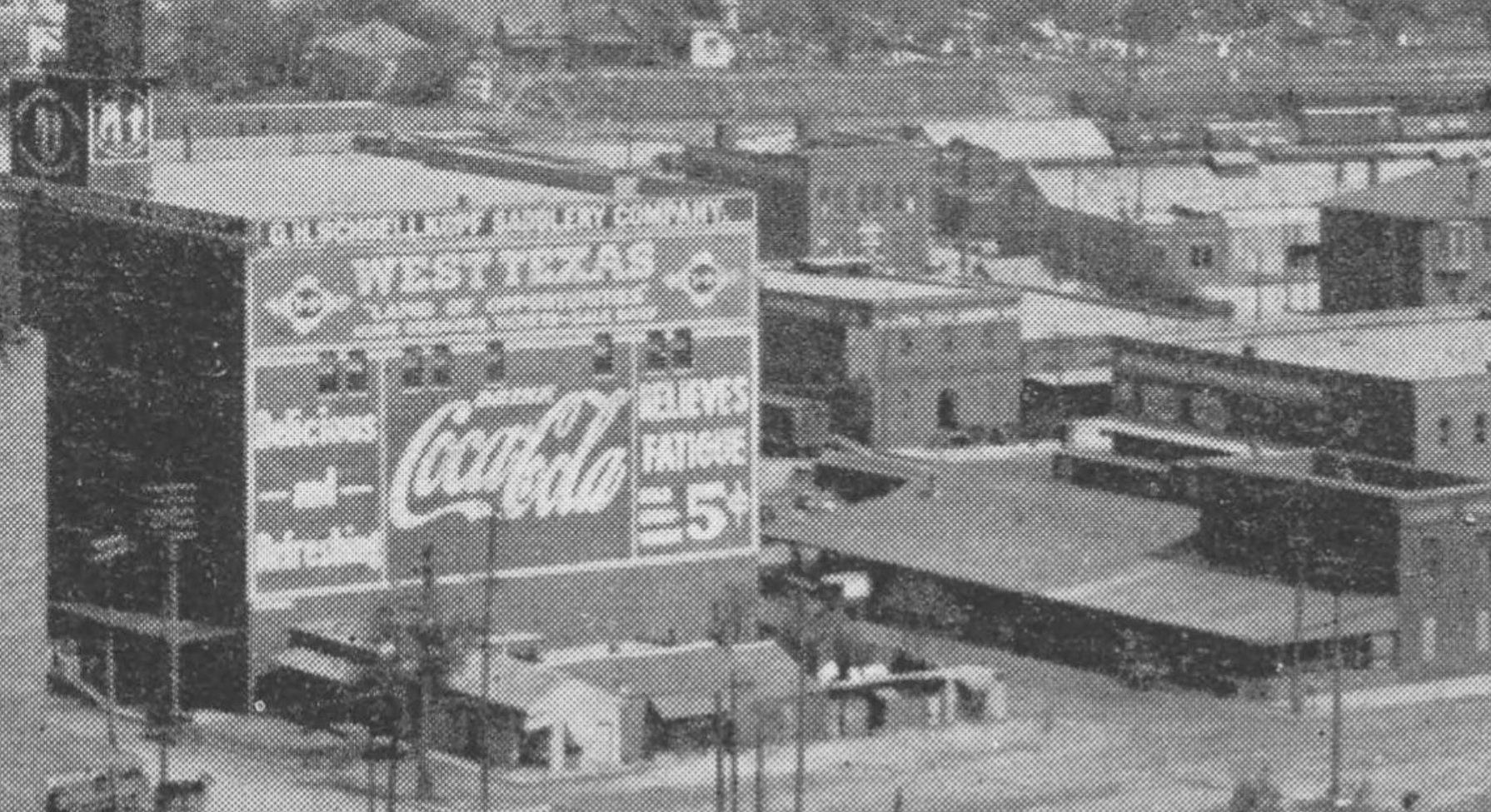
Yesterday I was working on a future post that involves the Hobson Electric Co., and I was looking for photos. The one above popped up in one of my favorite collections of historical Dallas photos, the George W. Cook Collection at SMU’s DeGolyer Library. I was looking for a post-1910 West End photo — this photo is identified as just that [the title has now been updated by the SMU Libraries], but the presence of the Schoellkopf Saddlery Co. building (center left, with the Coca-Cola ad on it) puts this location on the other side of the central business district — Schoellkopf was at S. Lamar and Jackson. Even knowing that, this scene didn’t look familiar at all.

I checked a 1907 city directory to find out the address of the Hobson Electric Co. before it moved to the West End in 1910 — it was located at 172-74 Commerce Street (in what is now the 700 block), between S. Market and S. Austin. The view here is to the southeast, probably taken from the courthouse.

I don’t think I’ve seen this particular view before — it shows hardly any of the downtown area but shows instead the area to the south. I was really intrigued by the block of houses facing Jackson (between Market and Austin) — the block the horse-and-buggy is moving past, at the center right. The trees. The low buildings. That block really stood out. It was kind of quaint. Did people live there? While I had the 1907 directory open, I checked to see who the occupants were. (I just picked 1907 because the Hobson Co. changed its name from “Duncan-Hobson” around 1906, and it had moved away from Commerce by mid 1910.) Here were the occupants of those houses in 1907:
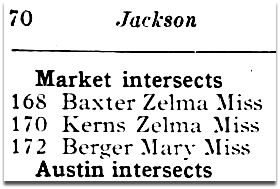
jackson-between-market-and-austin_1907-directory1907 Dallas directory

That seemed odd. Three single women occupying three separate houses, all next door to one other. There weren’t a lot of single women living in houses alone in 1907. Hmm. I checked all the directories between 1905 and 1910 to see who was living in that block. Every year, each of those houses showed a new occupant, and, with one exception, all were single woman (the exception was a man who owned a saloon across the street and who had faced charges at one point for “keeping a disorderly house”). …Okay. I got the picture.

I checked the Sanborn map from 1905 for this block and saw something I’d never seen before: the designation of a building with the letters “F.B.” What did that mean? Turns out, it means “Female Boarding House.” Or, less euphemistically… a brothel. Look at the map here (more maps are linked at the bottom of this post) to see the frankly ASTRONOMICAL number of “F.B.” buildings in this one small area. (There weren’t as many saloons — designated with “Sal.” — as I expected, but I’m pretty sure a lot of saloons in this area were operating illegally.)

You might have noticed that all of those F.B.s are south of Jackson. Not one of them is north of Jackson. This area — the southwestern part of downtown — was referred to at the time as the “South End” or “The Reservation” (some called this general area “Boggy Bayou,” but I think that was technically farther south). Its boundaries were, basically, S. Jefferson Street (now Record Street) on the west, Jackson on the north, S. Lamar(-ish) on the east, and beyond Young Street on the south. If you wanted to avail yourself of illicit things and engage in naughty behavior, this was the place for you: Ground Zero for a sort of wide-open, lawless Wild West. There were other red-light districts in Dallas (most notably “Frogtown,” which was north of downtown in the general area formerly known as Little Mexico) (does anyone still call this now-over-developed area “Little Mexico”?), but if you wanted the primo experience of one-stop-shopping for drinking, gambling, drugging, and “consorting with fallen women,” you were probably familiar with the South End, where all of these activities were tolerated and, for the most part, ignored by the police (they might mosey by if there were an especially egregious shooting or stabbing or robbery). In fact, this vice-filled area had been created by a helpful city ordinance in the 1890s. So, enjoy!

Prostitutes were allowed to ply their trade in this specified chunk of blocks because the city fathers felt that it would be best to keep all that sort of thing in one somewhat controllable area, away from the more reputable neighborhoods. But once a prostitute stepped outside the Reservation to sell something she shouldn’t have been selling… laws suddenly applied, and she’d be thrown in jail and/or fined. Do not step north of Jackson, Zelma!

So, at one time, Dallas had legal brothels. Depending on whose account you read, these houses of ill repute ranged from godawful “White Slavery” operations and bubbling cauldrons of sin and sleaze to, as Ted Dealey remembers in his book Diaper Days of Dallas (p. 74), “ultra-fashionable houses of prostitution” which attracted Big D’s moneyed movers and shakers. Something for everyone.

Eventually, people started to get really bent out of shape about this, and there was a big push to get these houses shut down — or at least moved out of the area. The Chief of Police reported to the City Council in 1906 that, among the many Reservation-related problems, the area was getting cramped because the railroads were buying up real estate in the area and kicking people out. The city-sanctioned no-man’s land was getting too small, so city officials needed to find a bigger place to move the red-light district to. The Chief thought that North Dallas (i.e. Frogtown) was “the most logical place” — except that residents of nearby swanky neighborhoods there were not at all keen on this. But that idea seemed to stick. It took several years to actually happen, but a relocation of sorts occurred, and the South End brothel-hotspot was pretty much scrubbed of all offending “disorderly houses” by 1910. (Frogtown bit the dust around 1913, after those unhappy well-to-do North Dallas neighbors complained bitterly, loudly, and effectively.)

So, anyway, I never expected to find such an exciting photograph! I wonder if the photographer took this photo as a way of documenting the very controversial, in-the-news, not-long-for-this-world Reservation, or whether it was just a nice scenic view. I have to think it was the former, because the Reservation was well-known to everyone, near and far, and this shot would have been an unusual vista to, say, reproduce for postcards (or at least postcards sold to the general public!). Whatever the case, I’ve never seen this view, and it’s really great — and it comes with an interesting slice of Dallas history. I had heard of the Frogtown reservation to the north, but I’d never heard of the South End reservation. And now I have. And here’s a photo of it!

Let’s bring back the neighborhood designation of “South End.” It was good enough for 1900, it’s good enough for today.

*

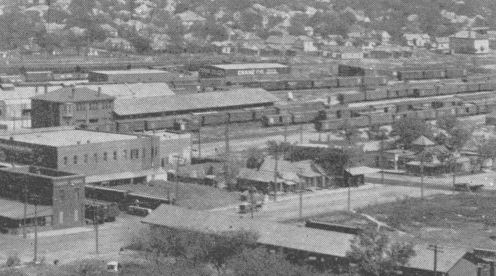
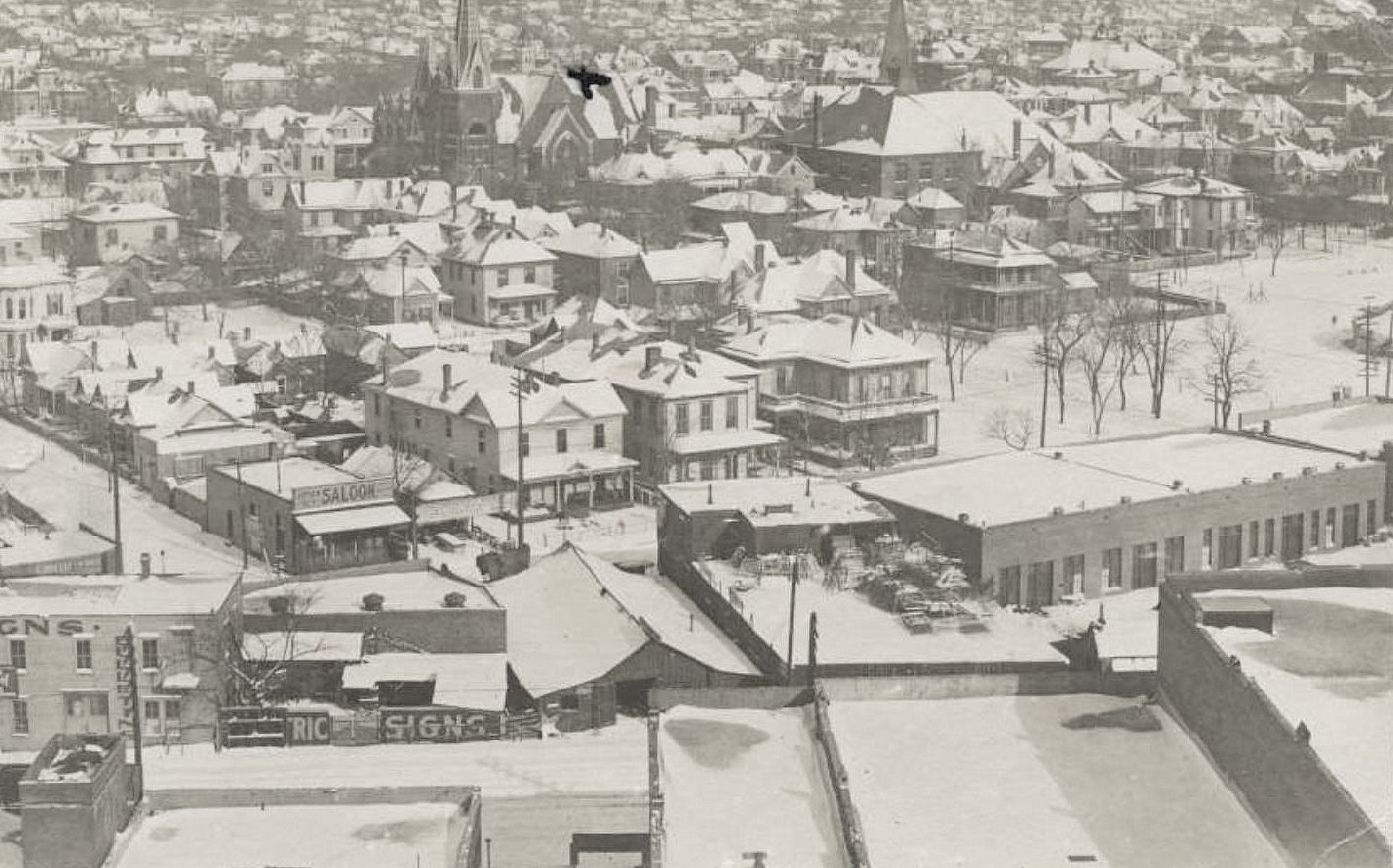
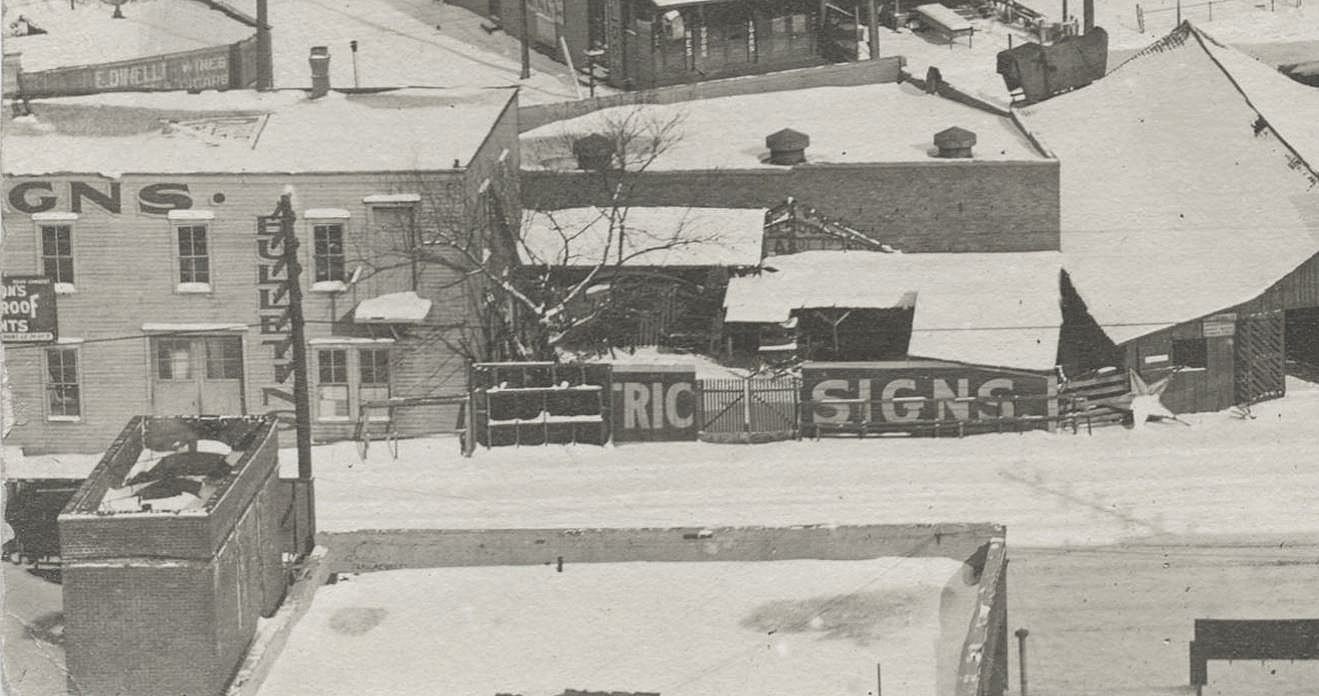
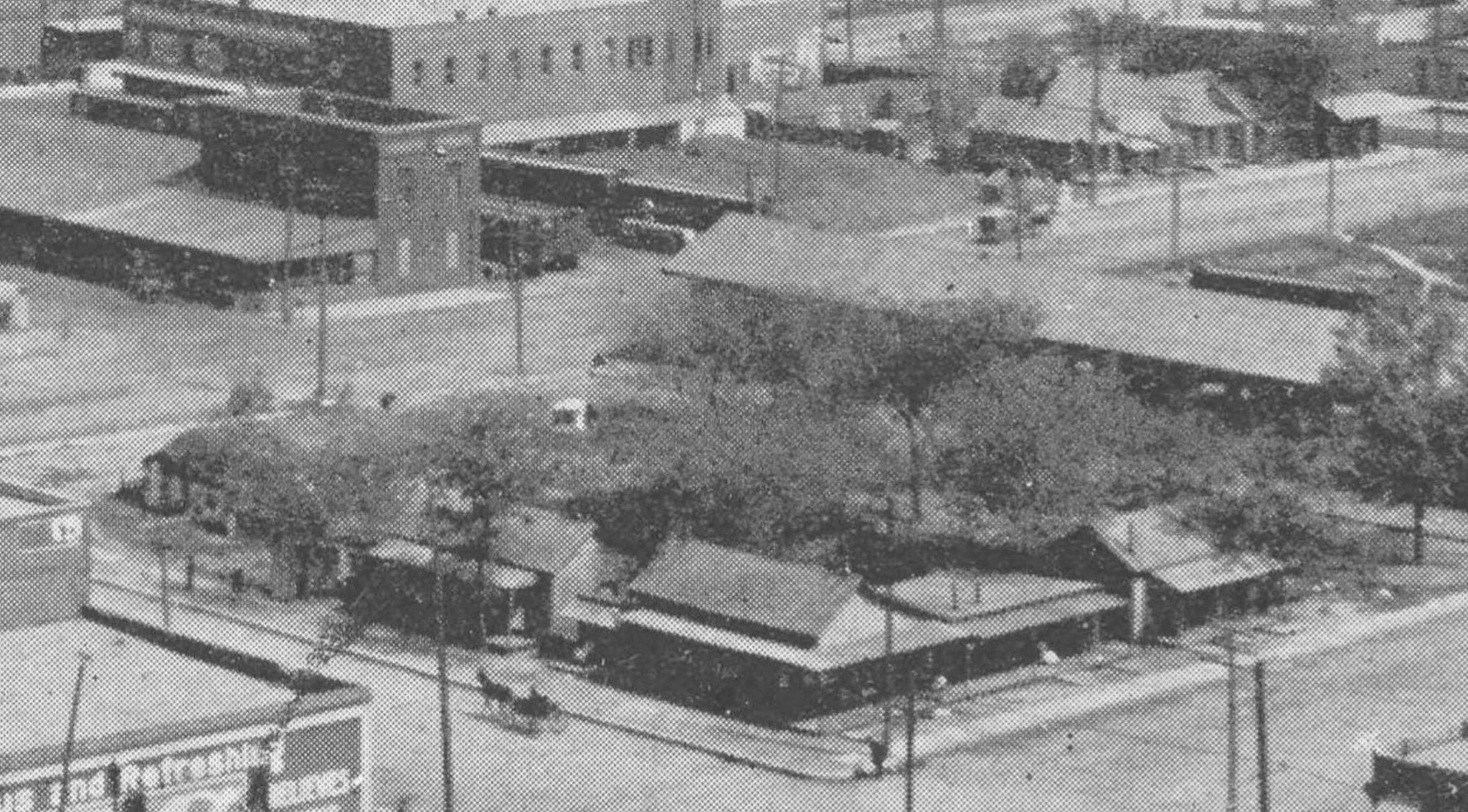
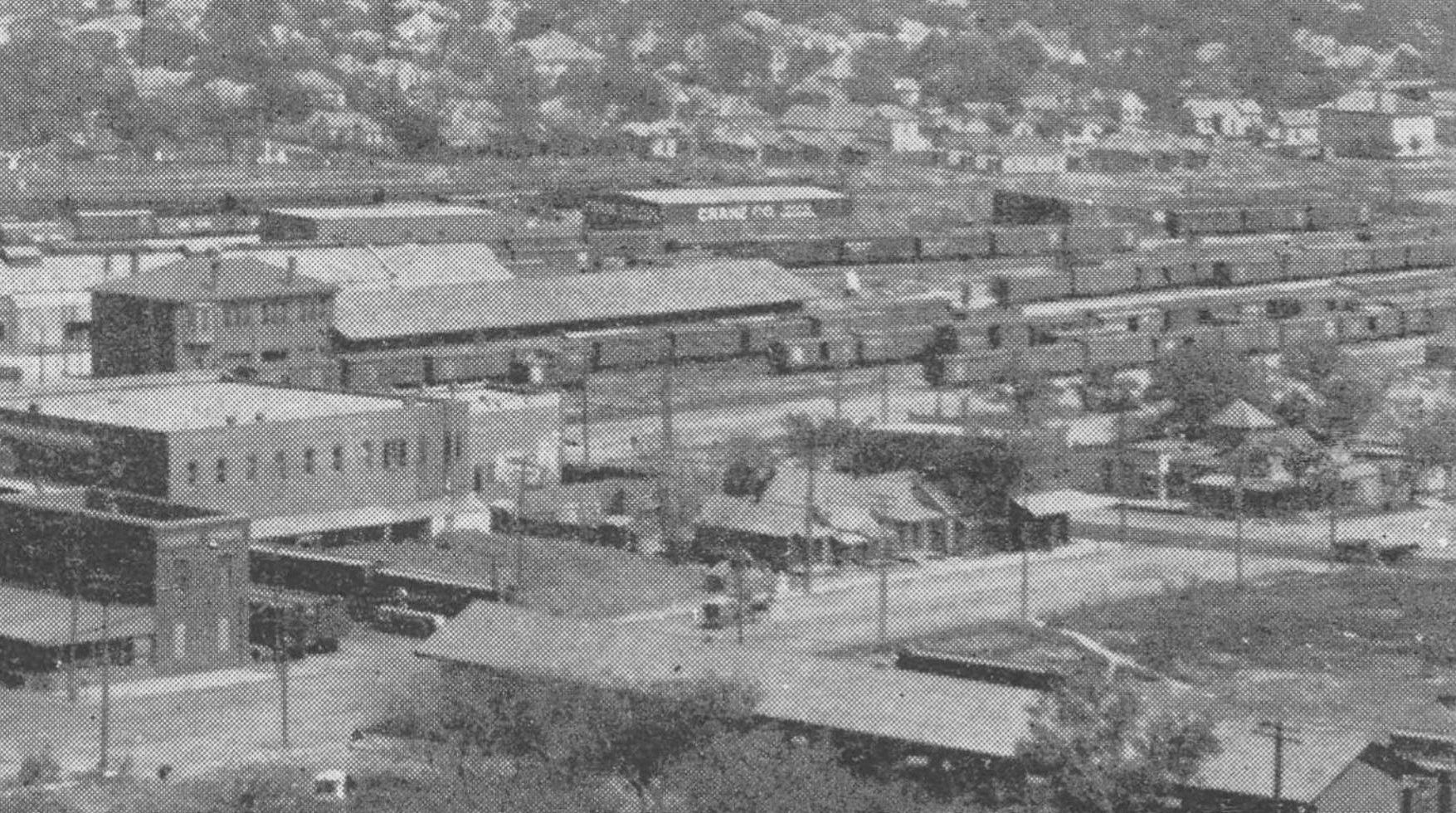
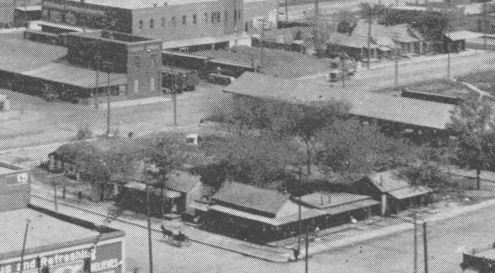
Here are a few zoomed-in details of the photo. Unless I’m imagining things, I think I can see women sitting on their porches, advertising their wares, as was the custom. (All images are larger when clicked.)
south-end_cook-collection_degolyer_SMU_det-1

*

south-end_cook-collection_degolyer_SMU_det-2

*

south-end_cook-collection_degolyer_SMU_det-3

*

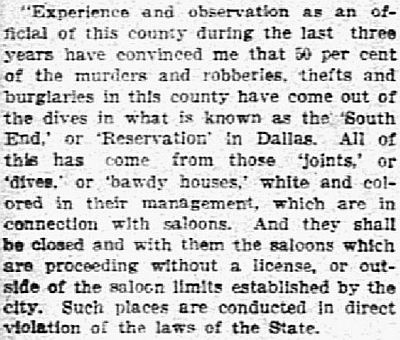
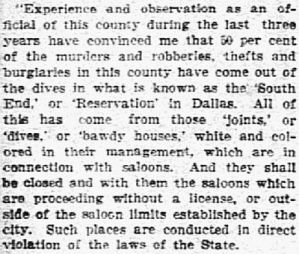
Below is an excerpt from a blistering directive to city lawmakers by W. W. Nelms, Judge of the Criminal District Court (from an article with the endless headline “Calls For Action; Judge Nelms Charges Police Chief, Sheriff and Grand Jurors; Warfare on Crime; Says Lawbreakers Shall Not Construe Statutes of State to Suit Themselves; Stop Murder and Robbery; Declares Harboring Places for Thugs, Thieves and the Like Must Be Destroyed,” Dallas Morning News, Oct. 15, 1907).
reservation_judge-w-w-nelms_DMN_101507DMN, Oct. 15, 1907

*

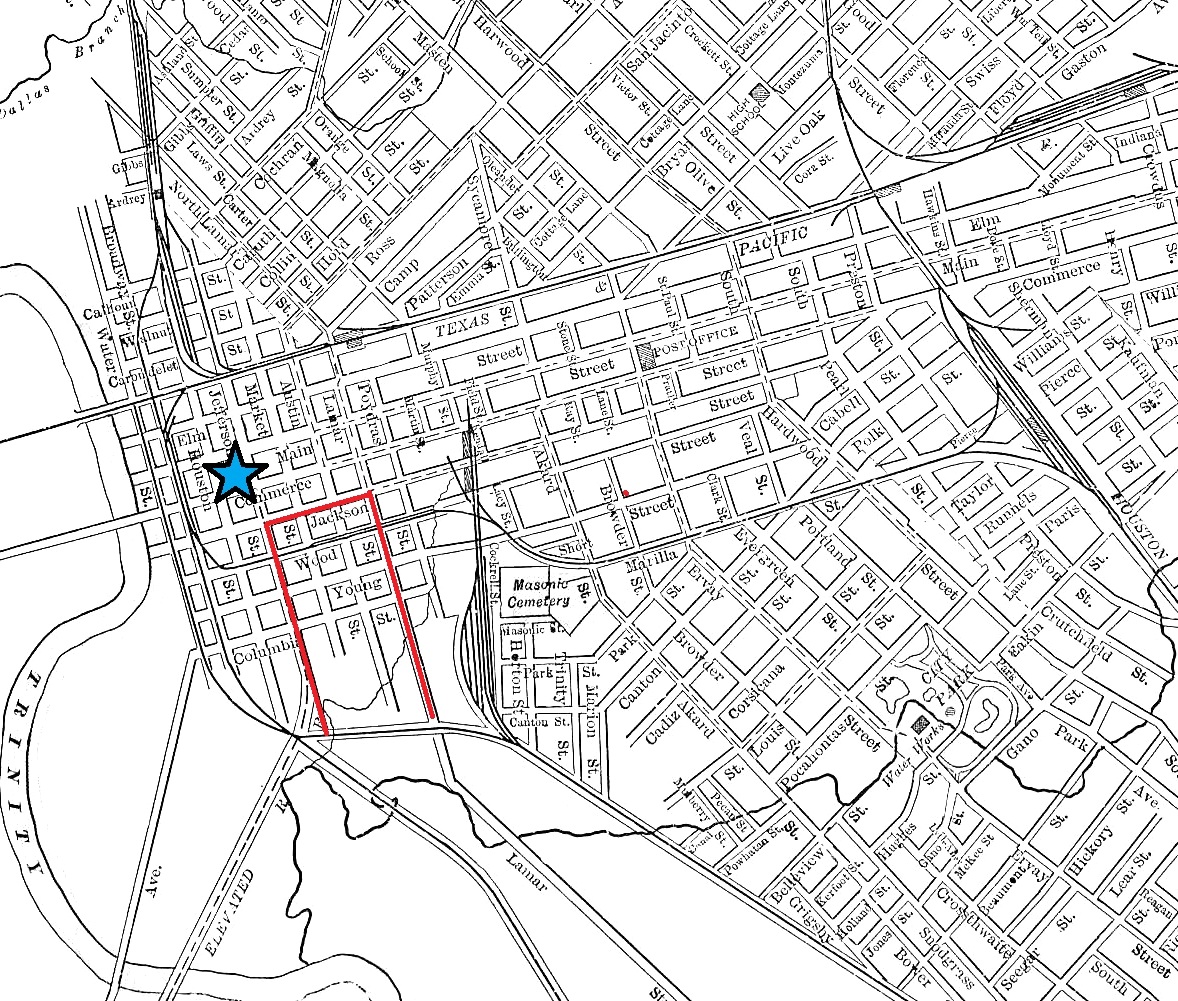
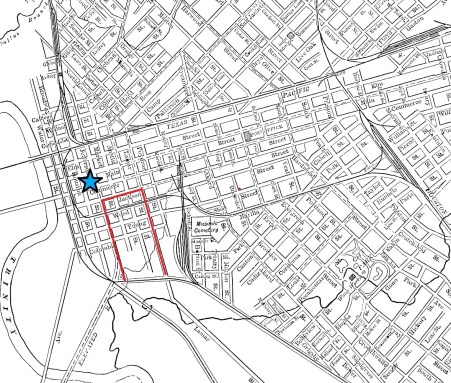
Below, the general area of the South End Reservation around 1907 (this map is from about 1898). The blue star is the Old Red Courthouse; the Reservation is bordered in red. In 1893, the original area was loosely designated as the area bounded by Jackson Street, Mill Creek, the Trinity River, and the Santa Fe railroad tracks, in which “women of doubtful character […] were not to be molested by police” (from “Passing of Reservation,” DMN, Dec. 11, 1904). As noted above, the area shrank over time, and the red lines show the general Reservation area about 1907, the time of the photo at the top.
south-end_reservation_1898-map_portalDallas map, ca. 1898 (det), via Portal to Texas History

***

Sources & Notes

Top photo — “[Jackson Street, Looking Southeast from the Courthouse, Including a Partial View of the South End ‘Reservation’]” (previously incorrectly titled “[Dallas West End District with View of Railroad Yards]”) — is from the George W. Cook Dallas/Texas Collection, DeGolyer Library, SMU Libraries and can be accessed here. (I appreciate SMU for responding to my request to re-title and re-date this photograph — it’s always worth notifying archival collections with corrections!) (And, as always, I WELCOME corrections. I make mistakes all the time!)

The 1905 Sanborn map I linked to above (Sheet 104) is here and seems to be the epicenter of the booming brothel trade; more evidence of this can be seen just south of that in Sheet 102; and it continues just east of that in Sheet 105 (it’s interesting to note the specially designated “Negro F.B.” bawdy houses). (Sanborn maps do not open well on cell phones — or at least on my cell phone. You may have to access these from a desktop to see the full maps. …It’s worth it.)

Read more about this whole “Reservation” thing in the lengthy and informative article “Not in My Backyard: ‘Legalizing’ Prostitution in Dallas from 1910-1913” by Gwinnetta Malone Crowell (Legacies, Fall 2010).

Also, there’s a good section on this (“Fallen Women”) in the essential book Big D by Darwin Payne (pp. 48-56 in the revised edition).

If you enjoy these posts, perhaps you would be interested in supporting me on Patreon for as little as $5 a month — in return, you have access to (mostly!) exclusive daily Dallas history posts. More info is here.

south-end_hobson-electric_southeast-from-courthouse_ca-1907_cook-collection_degolyer_SMU_sm

*

Copyright © 2024 Paula Bosse. All Rights Reserved.

Herbert A. Kline’s “Miniature Coney Island” at the State Fair of Texas — 1909

sfot_1909_entrance_ebay_a

by Paula Bosse

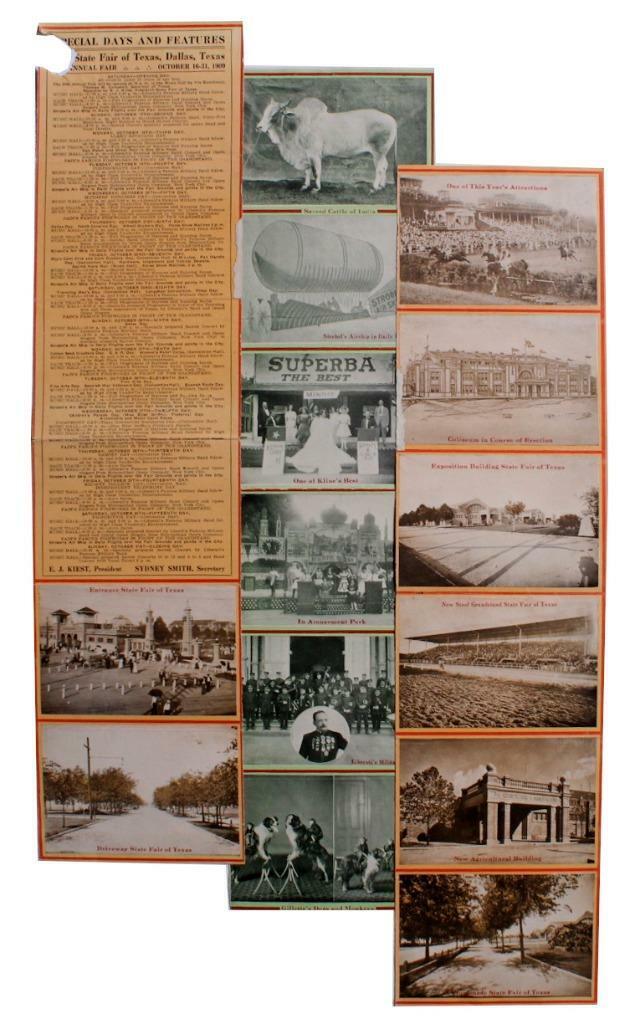
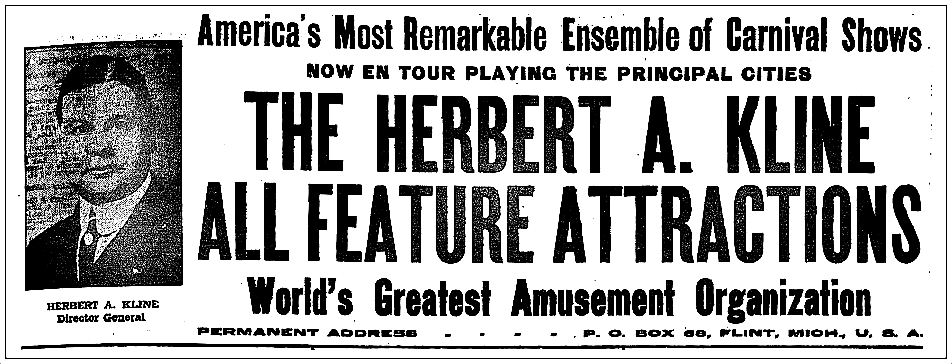
Herbert A. Kline (1873-1934) was a showman and promoter from Michigan who provided acts to several state fairs and large carnivals in the U.S. — his heyday appears to have been the 1910s. In 1909, he brought his troupe of performers and sideshow features to the State Fair of Texas. Most of the photos in this post are from promotional material for that 1909 season, with most of the photos showing Kline’s traveling “amusements.”

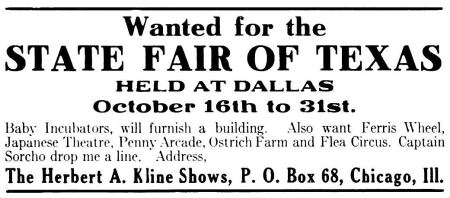
Two weeks before he got to Texas, he posted this ad in the entertainment trade magazine Billboard — I hope Capt. Sorcho (“the great deep-sea diver”) dropped him a line.

sfot_kline_billboard_100209 Billboard, Oct. 2, 1909

*

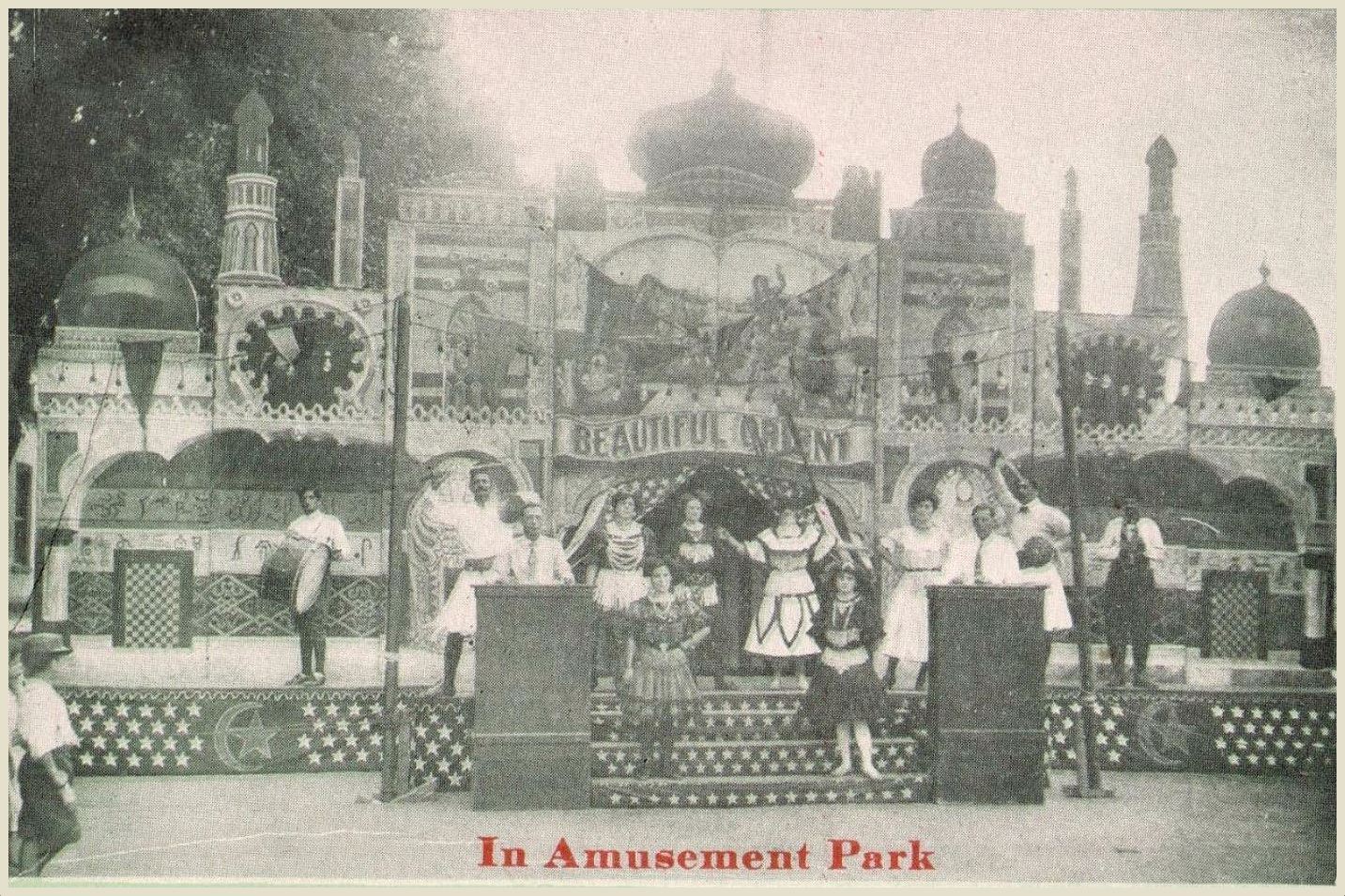
“THE BEAUTIFUL ORIENT” — included were dancers, gun-spinners, magicians, acrobats, and — somehow — wedding ceremonies. It also boasted “the cleanest and most refined dancing-girl show in America.”

sfot_1909_amusement-park_ebay_a

*

“SUPERBA, THE BEST” — a collection of vaudeville-type performers, including one woman whose “talent” appears to be that she was attractive.

sfot_1909_superba_ebay_a

*

“MRS. D. H. KINCHELOE, WARBLER” (a whistler/reader/vocalist/pianist from Kentucky — her name is misspelled below) and “THE GREAT McGARVEY, FEMALE IMPERSONATOR” (Bert McGarvey was known for a nicely turned-out ankle, charisma, magnetism, and a specialty number called “The Sacred Cobra Dance”). They — along with Galetti’s Musical Monkeys — would appear after the more high-brow operatic singers.

sfot_1909_warbler_female-impersonator_ebay_a

*

“THE IGORROTE VILLAGE” — native peoples of the Philippines gave a sort of presentation on how they lived, employing what might be seen as primitive customs in daily life. (A description of a “performance” in New York’s Central Park noted that there were demonstrations on how to shrink heads, which might have been too “exotic” for Dallas.)

sfot_1909_igorrote-village_ebay_a

*

John T. Backman’s Troupe of Glass Blowers — this was absolutely fascinating (the sign alone!). Check out this entertaining article about the sorts of things these people did.

sfot_1909_glass-blowers_ebay_a

*

Also in Kline’s family of traveling show-folk:

  • A creature half-reptile and half-human
  • Russian Prince Midget, who speaks three languages, weighs less than 16 pounds, and whose crib was a cigar box
  • Alice, The Wonder, “who is acknowledged by the press and the public to be the strangest girl in all the world”
  • Schlitzie, the Aztec Wild Girl, “whose head is no larger than an orange” (this is most likely the sideshow performer best known for appearing in Tod Browning’s cult movie “Freaks”)

*

Here is an image from an eBay item, showing where these photos came from.

sfot_1909_collection_ebay

*

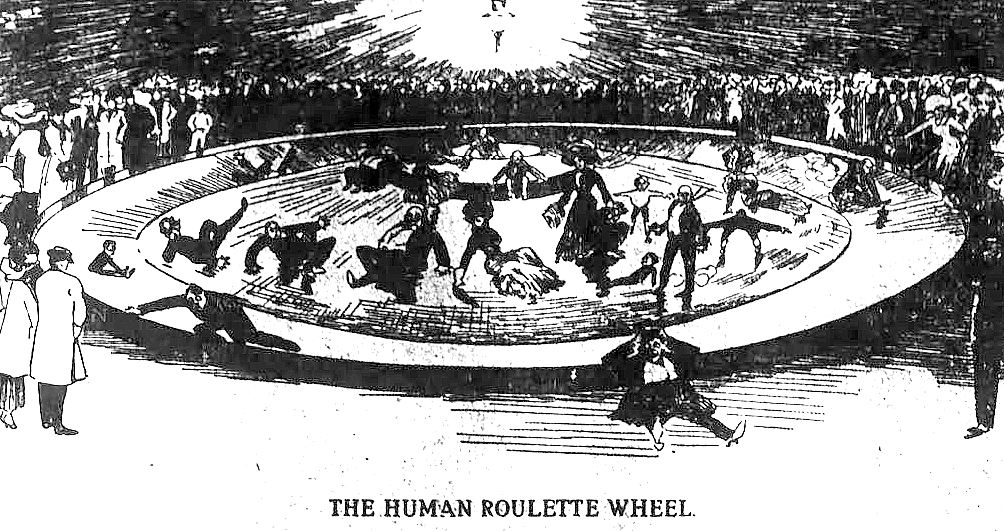
There was also a “ride” called “THE HUMAN ROULETTE WHEEL.” It was probably more fun for the spectators than for the participants.

sfot_1909_human-roulette-wheel_houston-post_110709Houston Post, Nov. 7, 1909

*

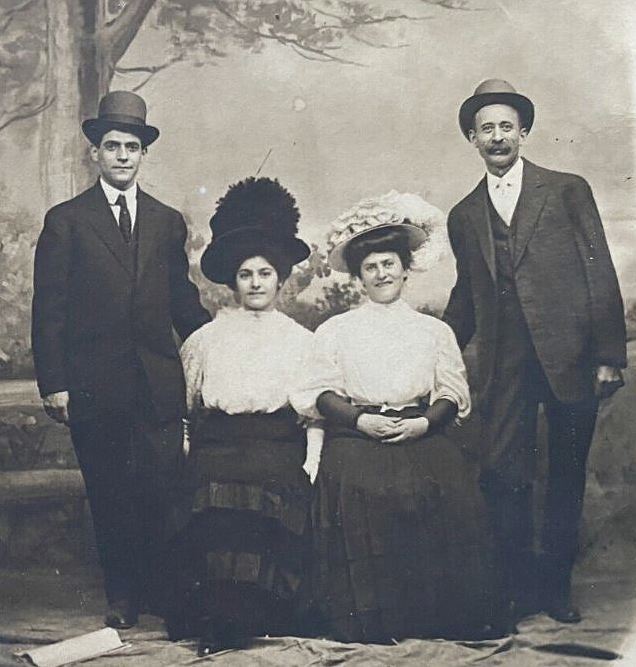
The prospect of being flung off a human roulette wheel might have been daunting to women of the period, who wore heels, corsets, long skirts, and big hats. Below are some typical fairgoers of the time, in a souvenir photo taken at the 1907 State Fair of Texas (Louis Block of Fort Worth, Miss Ray Goldsmith of Dallas, her sister Grace Goldsmith Rosenblatt, and Grace’s husband, David Rosenblatt). Imagine these people wandering around Fair Park and stopping in to see “the strangest girl in all the world” and watching people being hurled off a spinning disk.

sfot_RPPC_ebay_1907_photovia eBay

*

kline-herbert-a_new-york-clipper_oct-1912New York Clipper, Oct. 1912

*

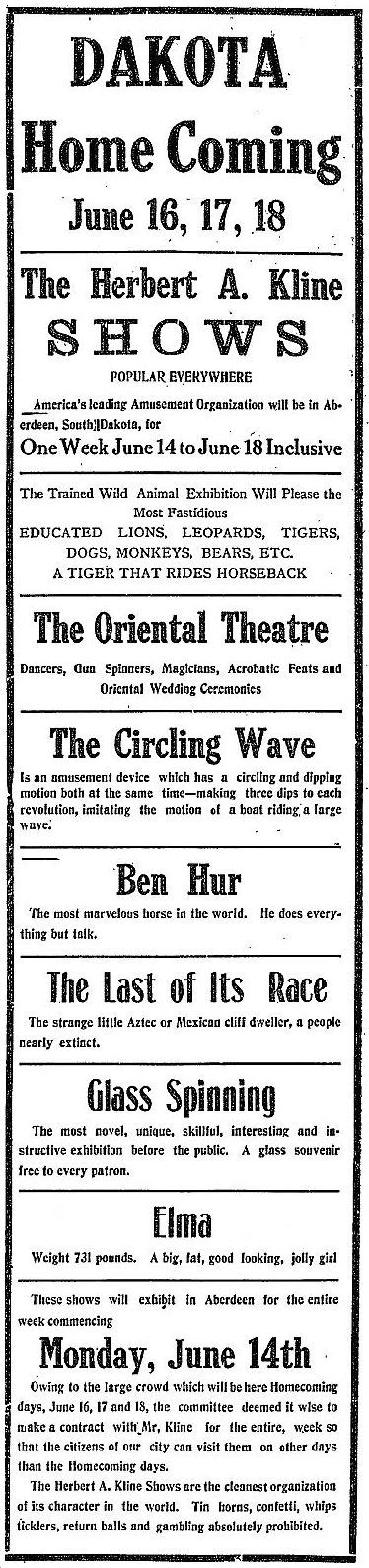
This ad for a South Dakota fair — a few months before Kline’s stop in Dallas — shows descriptions of several of the acts. (“A tiger that rides horseback.”)

kline-herbert-a_dakota-home-coming_aberdeen-american_SD_060909Aberdeen (South Dakota) American, June 9, 1909

*

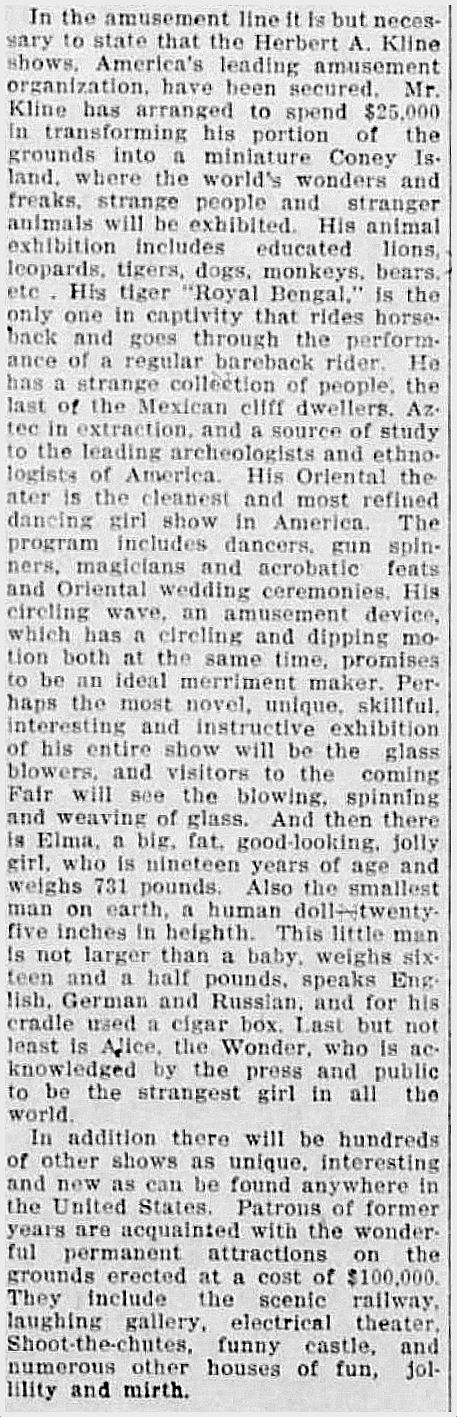
And a promotional article sent to local papers ahead of Kline’s arrival.

sfot_kline_mckinney-weekly-democrat-gazette_101409_detMcKinney (TX) Weekly Democrat Gazette, Oct. 14, 1909

***

Sources & Notes

All photos from a brochure/handbills listed earlier this year on eBay; sources of ads and other images as noted.

So many Flashback Dallas posts about the State Fair of Texas — here.

I’m on Patreon, where I post daily. Check it out!

sfot_1909_entrance_ebay_a_sm

*

Copyright © 2023 Paula Bosse. All Rights Reserved.

Fair Park at Night — ca. 1912

fair-park_fountain_luminous_night_postcard_ebay_postmarked-1913

by Paula Bosse

The postcard above — “Luminous Fountain by Night at Fair Park, Dallas” — is one I’ve never seen. And it’s beautiful!

This ornamental fountain was commissioned by the City of Dallas Park Board in 1912 and debuted at that year’s State Fair.

On July 18, 1912, it was reported that the mayor and members of the Park Board were touring Fair Park to see how progress was coming on the new women’s and children’s “comfort station” (restroom and lounge) — during the inspection they decided a fountain would be nice in front of the main exhibition building. Five days later (!), the Park Board voted on it and appropriated $2,500 for the project (approximately $80,000 in today’s money). That afternoon committee members went out to Fair Park and decided it would go “in the middle walk, half way between [the] Exposition Building and the street” (Dallas Morning News, July 23, 1912). And less than a month after that, a design had been made and published. It was to be 30 feet in diameter at the base and 24 feet high. When the State Fair of Texas opened on Oct. 12, 1912, the fountain was completed. It took less than 3 months. From “You know what? A fountain would look real good here…” to DONE!

fair-park_fountain_DMN_081812_drawingDallas Morning News, Aug. 18, 1912

Here’s a photo of it, sans water, from a book published in 1915:

park-board-bk_fair-park-fountain_1914

The weirdest little tidbit about this fountain’s debut at the 1912 State Fair is that there was a display of fish swimming around in it, courtesy of the Government Fish Hatchery at San Marcos.

The fountain was in front of the huge Exposition Building. Here’s a circa-1908 depiction of people milling about at night outside the building (a building which really does need a fountain in front of it!).

fair-park_exposition-bldg_night_det_ebay_postmarked-1908

Back to that top image — I love it. “Illumination” was really big at the time (see “The Grand Elm Street Illumination — 1911”) — I’m surprised I don’t see more postcards like this — even if they’re just fake day-for-night images. A similar “nighttime in Fair Park” postcard is the one below, showing the entrance (this postcard has a 1909 postmark).

fair-park_entrance_night_postcard_ebay_postmarked-1909

Since I have a postcard of the entrance from this same period showing what it looked like during the day (postmarked 1910)….

fair-park_entrance_day_postcard_ebay_postmarked-1910

That star is pretty cool, especially at night.

I’m pretty sure that fountain bit the dust a long, long time ago. Maybe when everything was being revamped for the 1936 Texas Centennial Exposition. It’s a shame. I don’t think there can ever be too many fountains.

***

Sources & Notes

Top postcard — “Luminous Fountain by Night at Fair Park, Dallas” (postmarked 1913) — is available now on eBay, here; one is also currently available on Card Cow here. I’m pretty sure this is going to be a strong contender for my favorite image of the year.

Photo of “Fountain, Fair Park” is from the book “Park System, Dallas, Texas, 1915,” here — from the Dallas Municipal Archives via the Portal to Texas History.

The postcards have pretty much all come from eBay over the years.

If you want even more of this sort of thing, perhaps you’d like to support me on Patreon for as little as $5 a month. I’m somehow managing to post daily there with “exclusive” content! I’m not sure how long I can keep this up, but if you’d like to see more Flashbacky stuff, hie thee to Patreon.com!

fair-park_fountain_luminous_night_postcard_ebay_postmarked-1913_sm

*

Copyright © 2023 Paula Bosse. All Rights Reserved.