Flashback : Dallas

A Miscellany: History, Ads, Pop Culture

Category: 1900s

Atkins’ Rattlesnake Oil — Beware of Fraudulent Imitations!

by Paula Bosse

“From the Aboriginal Indians of this country — the early trappers — and pioneers learned that Rattle Snake Oil was the best remedy for rheumatism, pains, sprains, bruises, etc. Every cabin had its bottle hanging ready, from the rafters. The day will come when every house will have it again.”

That little tidbit appeared under the heading “Folk-Lore” in the October 9, 1888 issue of the Dallas-based Southern Mercury newspaper. As there was no company name or product attached, it appeared to be a mere space-filling “factoid” rather than an advertisement. Conveniently, though, it was just a hop, skip, and a jump across three ink-smeared pages from a large ad for Atkins’ Rattlesnake Oil, an ad that warned the reader to “Beware of Fraudulent Imitations!” before it launched into a long list of testimonials from the once-weak and infirm. The ad ended with “Geo. T. Atkins, Dallas, Texas — For Sale by All Druggists.”
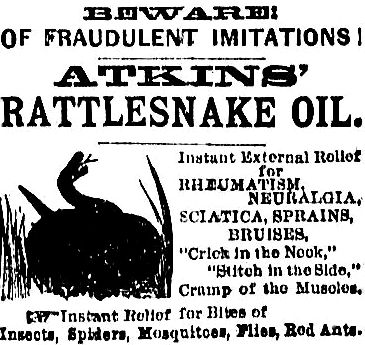
Southern Mercury, Oct. 9, 1888 (detail)

*

George T. Atkins was born in New York in 1837. Educated and having the bearing of a “trained businessman,” he drifted south and for some reason decided to join the Confederate army.

He was described by a fellow brigade member as a dark and handsome “compactly built” snappy dresser who “talked in a louder tone than the others, and [had] a peculiarly non-chalant, devil-may-care manner [that] emphasized his presence.” Atkins became a captain and quartermaster in the Fourth Kentucky Cavalry and though his position did not require participation on the battlefield, he was painted as something of a hot-dogging thrill-seeker: “[T]he gallant captain was frequently found in the ‘thickest of the fray,’ notably in the desperate battle at Saltville, where he recklessly and conspicuously rode up and down the lines, seeming determined to get himself killed.”

After the war, he eventually made his way to Texas with his family, arriving in Dallas in 1876 and settling into a large house at Ross Avenue and Masten Street (now St. Paul). At some point he opened a drugstore on Elm which seems to have been quite a successful enterprise. Perhaps it was his close proximity to drugs and medicinal compounds that prompted Atkins to launch his lengthy (and presumably lucrative) side-business as a snake oil manufacturer and salesman.

As far as I can tell, his “rattle snake oil” ads started around 1888. “Snake oil” has become a synonym for fraudulent wares sold by hucksters who know their products are ineffective but figure they can make a quick buck by grossly exaggerating — if not outright lying about — the magically curative properties of whatever it is they’re selling. As an actual “druggist,” Atkins probably had at least a little credibility compared to the other latter-day medicine-show men flogging their tonics and elixirs out of the back of a wagon before the law ran them out of town.

Southern Mercury, 1890 (det)

In fact, Atkins was, himself, such an expert flogger that his claim in ads that the United States Patent Office had officially ruled that his rattlesnake oil was “The Only True and Genuine Rattlesnake Oil” is automatically suspect, even though the editors of the Dallas Morning News (who, by the way, were no stranger to the popular and socially prominent Atkins, a man with, let’s not forget, a hefty newspaper advertising budget) published in its pages the following blurb (probably supplied by “the plaintiff”):

Dallas Morning News, Dec. 12, 1888

 1888 was a good year, and Atkins was riding a snake-oil wave of good publicity. There were even reports in the local papers that Dallas’ favorite herpetologically-inclined drugstore owner was hustling “live and uninjured rattlesnakes” to interested parties in Paris and London. I don’t know … maybe…. Probably just some more creative publicity.
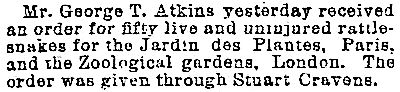
DMN, June 3, 1888

Atkins continued to run his drugstore and sell his snake oil until 1892 when, out-of-the-blue, he was assigned to dig the Texas Trunk Railroad out of receivership. The appointment seemed a little odd, but Atkins was a savvy businessman and a charming and persuasive speaker (he occasionally spoke in front of the Dallas City Council in a manner described as “felicitous and lucid”) — he could easily have back-slapped his way into the job. Despite the fact that he had no background in the railroad business, he seems to have spent several fairly productive years in the position. (His son, by the way, legitimately worked his way up through the ranks of the M-K-T, from lowly freight clerk to powerful executive VP.)

Eventually the railroad job ended and, in the waning years of the nineteenth century, Atkins seemed to be flailing a bit — he set the snake oil aside for a moment and placed an ad in the DMN classifieds soliciting investors to stake a claim in a Klondike gold scheme — at a mere $100 a share!
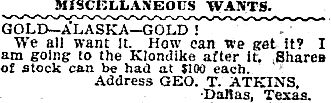
DMN, Aug. 8, 1897

 He continued in the rattlesnake oil biz until at least 1907, but at some point that began to fade away (or his inventory finally ran out), and he and his wife began running a boarding house. By 1918, though, he was tired of being a landlord and, at the age of 80, Atkins was finally ready to retire.

DMN, Oct. 20, 1918

The large 12-room house at Ross and Masten sold after spending a lengthy time on the market, and Atkins and his wife moved to Lemmon Avenue, where, ultimately, he died on August 8, 1920.

DMN, Aug. 9, 1920

 George T. Atkins placed COUNTLESS snake oil ads in newspapers for something like twenty years. Each ad had his name on it. Boldly. Proudly. And there’s nary a mention of the famous Atkins’ Rattle Snake Oil in his obit! That’s a shame, because, to me, that’s the single most interesting thing about the man. He was a career snake oil salesman! He was also one of Dallas’ very first advertising empresarios — an entrepreneur who had a natural flair for the creative hard-sell and knew how to wield it.

“TAKE NO SUBSTITUTE!”

*

Southern Mercury, Dec. 20, 1900 (click to enlarge)

***

Quotes about Atkins’ time in the Confederate army from Kentucky Cavaliers in Dixie, Reminiscences of a Confederate Cavalryman by George Dallas Mosgrove (Madison: University of Wisconsin Press/Bison Books, 1999 — originally published in 1895); pp. 116-117.

Atkins’ physical examination of his snake oil, published in Chemist and Druggist (1890) can be seen here.

More on the Texas Trunk Railroad here.

*

Copyright © 2014 Paula Bosse. All Rights Reserved.
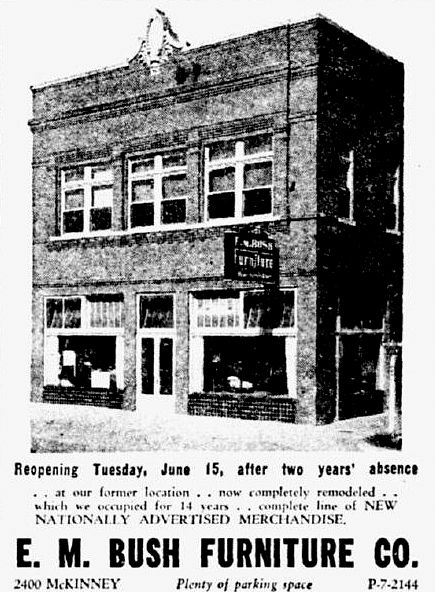
2400 McKinney Avenue — 100+ Years and Counting

by Paula Bosse

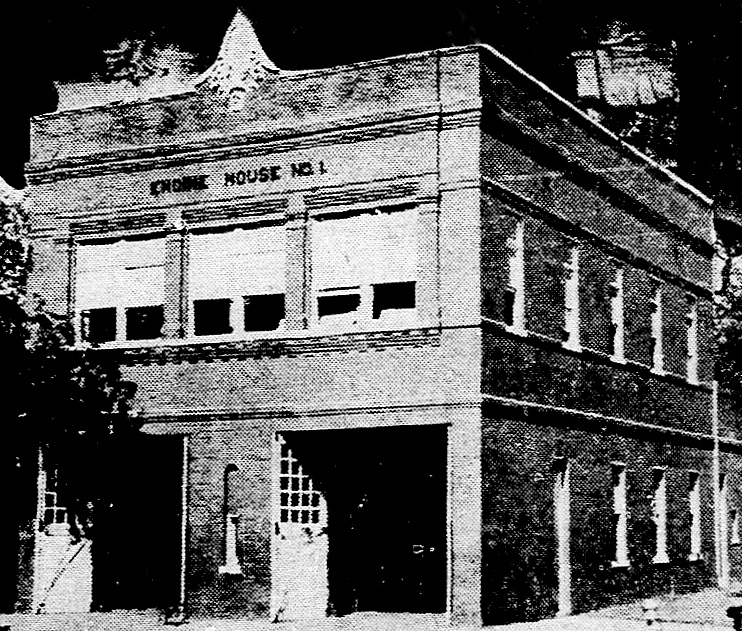
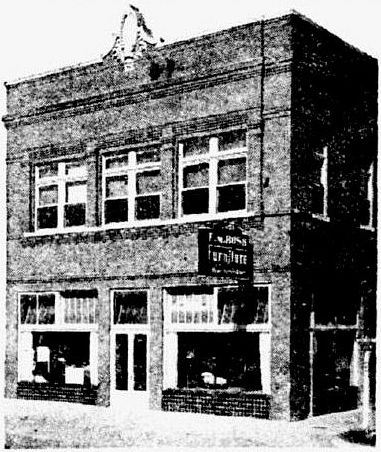
I came across this ad and wondered just where on McKinney Avenue this building had been. The ad was from 1948, but the building certainly looked older than that. I’m not sure when the building was built (update: it was built in 1909), but by at least 1929 the Hughes Auction Market was conducting furniture auctions there. An ad from 1929 invites the public to attend the regular auctions in which their two floors were packed to the gills with furniture and household goods that “positively must sell.” Prospective buyers were promised a large parking lot and a “comfortable, cool building.”

In the summer of 1933, a longtime Dallas furniture salesman, E. M. Bush, opened his retail business in the building and remained there for many years, perhaps until 1958 when he moved to Snider Plaza.

I wondered what’s at 2400 McKinney these days, and, I have to say … I’m shocked to find that the building is actually still there! On McKinney Avenue! And it looks very much the same as it does in the photo above (and, presumably, since it was built) — a little more elegant, perhaps, as it’s now part of the fabulous Hotel ZaZa — but the building looks pretty much the same. The building has survived! I feel like crying.

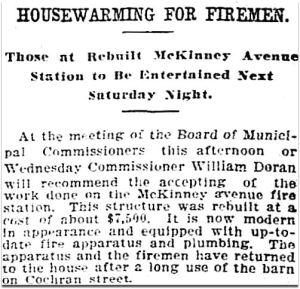
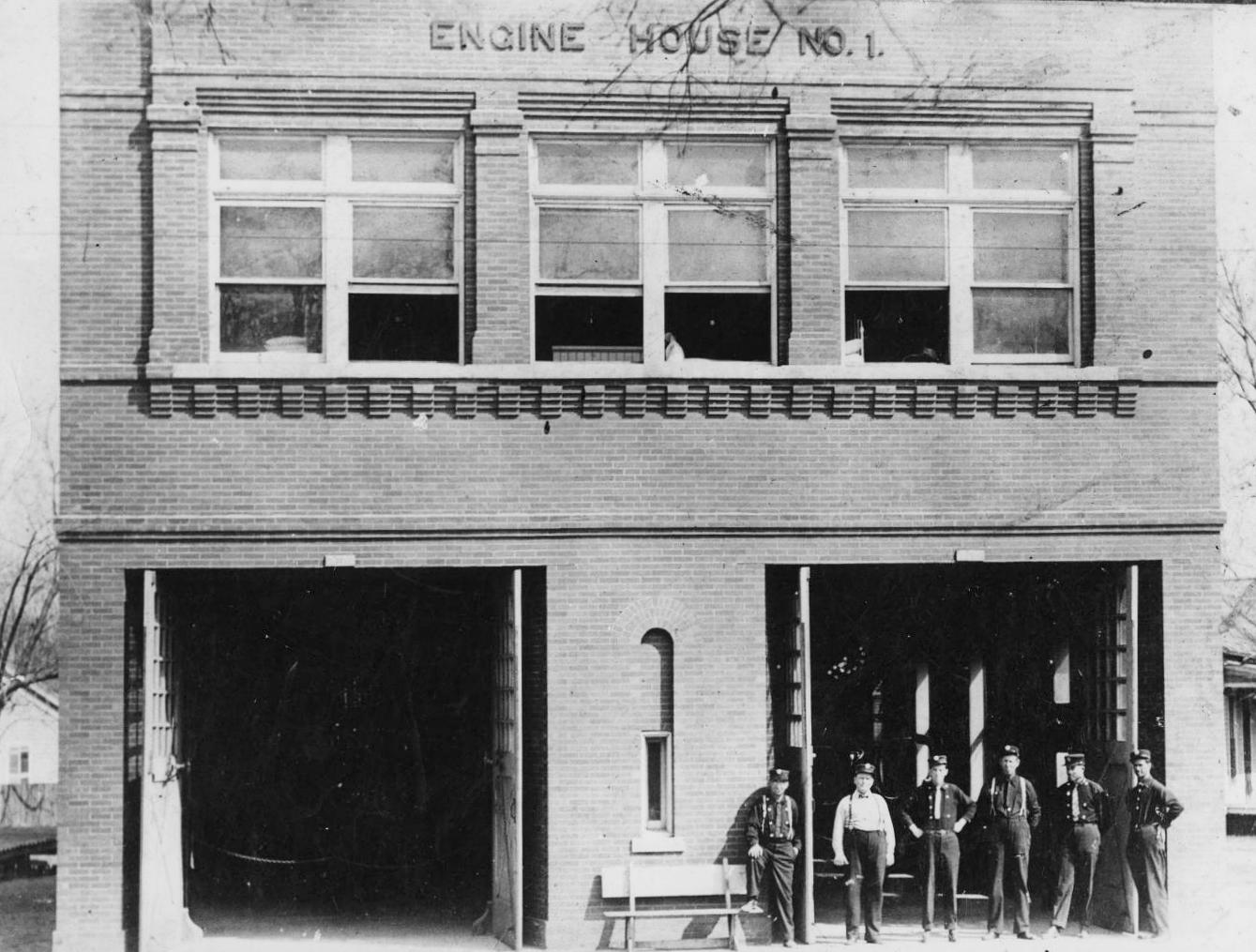
But wait, there’s more. What was this building originally? It was a firehouse! More specifically, it was Engine House No. 1, in use until 1928. The fire station that originally occupied this location was built in 1894 (see what it looked like in 1901 here, third photo down). By 1909, automobiles were placing horse-drawn fire engines, one of many reasons the station house needed to be modernized. Newspaper articles from 1909/1910 used the words “rebuilt” and “remodeled” almost interchangeably, so it’s unclear whether the original building was completely, or only partially demolished and then rebuilt, using materials from the original structure. The “new” engine house re-opened in January, 1910.

rebuilt_dmn_012510
Dallas Morning News, Jan. 25, 1910

Here’s a photo from its early days:

engine-house-no-1_mckinney

And from the 1920s:

fire-dept_mckinney-leonard-photo_1920s

The city ordered the building sold in 1928 when plans had been made to move personnel and equipment from McKinney and Leonard to a new station at Ross and Leonard.

To have a 100-plus-year-old building still standing in “newer-is-better” Dallas — and in Uptown — is quite a feat!

***

Sources & Notes

E. M. Bush Furniture Co. ad from 1948.

Photo of Stay ZaZa Art House and Social Gallery from the Hotel ZaZa website.

Firehouse photo from The Dallas Firefighters Museum. More on this station here.

Most images are larger when clicked.

*

Copyright © 2014 Paula Bosse. All Rights Reserved.
 

L. Craddock & Co. — Pioneer Whiskey Purveyors

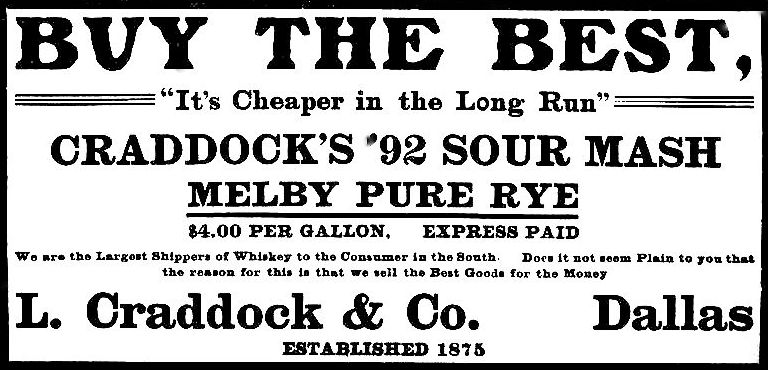
L. Craddock ad, 1912

by Paula Bosse

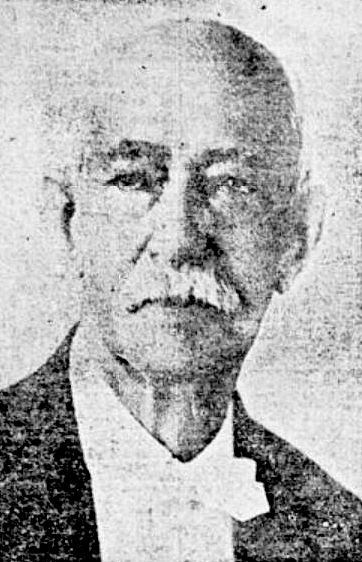
L. Craddock, an Alabama native born in 1847, arrived in Dallas in 1875 and opened a liquor business at Main and Austin streets in a building built by the Odd Fellows. It was a success, becoming one of the largest such businesses in a young, thirsty city.

Feeling a flush of civic pride, Mr. Craddock branched out beyond the retail world of alcohol sales, and in the late 1870s he opened the city’s second theatrical “opera house,” conveniently housed on the second floor of his liquor emporium, above his saloon and retail business. The theater was immensely popular and hosted the important performers and lecturers of the day, until the much larger Dallas Opera House arrived on the scene and siphoned off Craddock’s audiences. He closed the second-floor theater in the mid-1880s (a space which, presumably, continued to be used as an IOOF meeting hall) but kept the business on the ground floor.

The first location, at Main & Austin, with theater on second floor (1880s)The first location, at Main & Austin, with theater on second floor (1880s)

In 1887 Craddock decided to change careers. He sold his company to Messrs. Swope and Mangold (more on them later) and retired from the liquor trade — if only temporarily. I’m not sure what prompted this somewhat unexpected decision (I’d like to think there was some juicy, illicit reason), but, for whatever reason, he decided to give real estate a whirl. Craddock was certainly a savvy wheeler-dealer and he probably did well buying and selling properties in booming Dallas, but (again, for whatever reason) he seems to have tired of real estate, and, by at least 1894 (if not sooner), he had returned to the whiskey trade and had built up an even more massive wholesale liquor business than before.

ad_craddock-liquors-19061907 (click for much larger image)

He had a new, larger building, this time on Elm, between N. Lamar and Griffin. In the company’s incessant barrage of advertising, he touted the company’s unequaled, unstoppable success as purveyors of the finest alcohol available. One ad even took on something of a hectoring, lecturing tone as it admonished the reader with this snappy tagline:

“We are the Largest Shippers of Whiskey to the Consumer in the South. Does it not seem Plain to you that the reason for this is that we sell the Best Goods for the Money.”

1906

Arrogant or just supremely confident, Craddock was rolling in the dough for many, many years. Until … disaster struck. Prohibition. With the inevitable apocalypse about to hit the alcoholic beverage industry, L. Craddock threw in the towel and retired. For good this time. I’m sure many a faithful L. Craddock & Co. customer stocked up on as much as they could hoard in the final weeks of the prices-way-WAY-higher-than-normal going-out-of-business sale.

Craddock retired to Colorado, but in 1922, he returned to present to the city a valuable ten-acre tract of land in the old Cedar Springs area — land he asked be used as a park. Craddock Park remains a part of the Dallas Parks system today.

craddock_dmn_120322Dallas Morning News, Dec. 3, 1922

It’s interesting to note that in every article about Mr. Craddock that appeared during and after Prohibition — such as the articles reporting his generous gift to the city — there was never any mention of what kind of business he had been in or how he had made his great fortune. Even in his obituary. He was always vaguely described as a “pioneer businessman.”

Speaking of his obituary (which, by the way, was the place I actually saw his first name finally revealed — it was Lemuel), L. Craddock — Dallas’ great retailer of beer, wine, and spirits — died on December 2, 1933. Three days before the repeal of Prohibition. THREE DAYS. O, cruel fate.

**

ADDED: Interesting tidbit about a legal matter brought by Federal prosecutors. In 1914, Craddock was found guilty of “illicit liquor dealing” — shipping barrels of whiskey (labeled “floor sweep”) into the former Indian Territory of Oklahoma. Craddock wrote a check for the fine of $5,000 right there in the courtroom. The three men who actually did the deed were sentenced to a year and a day at Leavenworth. (I’m never sure how much faith to put in the Inflation Calculator, but according to said calculator, $5,000 in today’s money would be approaching $115,000. I think ol’ Lemuel was doing all right, money-wise. I’m guessing this “floor sweep” thing was not an isolated incident.)

craddock_FWST_061914Fort Worth Star-Telegram, June 19, 1914

***

Sources & Notes

Top L. Craddock & Co. ad from 1912.

Photograph of first location, with theater, from Historic Dallas Theaters by Troy Sherrod (Charleston: Arcadia Publishing, 2014).

Ad featuring rendering of second Craddock location at Elm & Poydras, signed Fishburn Co. Dallas, from 1906.

Photograph of L. Craddock from a Dallas Morning News interview in which he reminisces about the Craddock Opera House, published December 3, 1925. It’s an informative interview about early Dallas (like REALLY early Dallas) — the article can be read here.

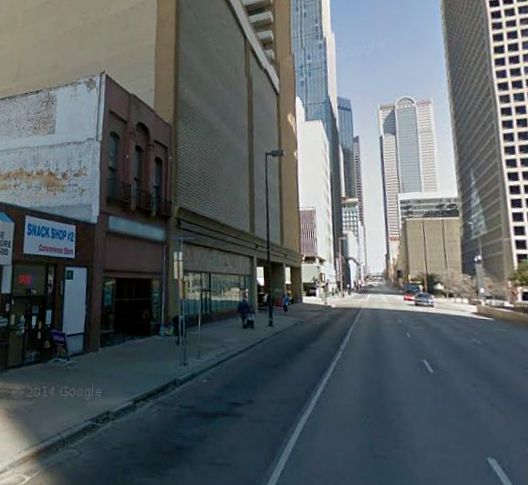
Update: I’ve wondered if this building downtown is the Craddock building, cut down and uglified. The current address is 911 Elm (I assume that the addresses for that stretch of Elm changed when the cross-street configuration changed). The Dallas Central Appraisal District gives the construction date of that building as 1937, but the DCAD dates are frequently not accurate. I don’t know. It’s very similar (missing the third floor…) and in about the exact same spot. Looks like it to me. That poor 100-plus-year-old building needs some loving attention. Here is a Google street view from early 2014:

craddock_google_feb-2014

Most images in this post are larger when clicked.

*

Copyright © 2014 Paula Bosse. All Rights Reserved.

Start Your Brilliant Career at Dallas Telegraph College — c. 1900

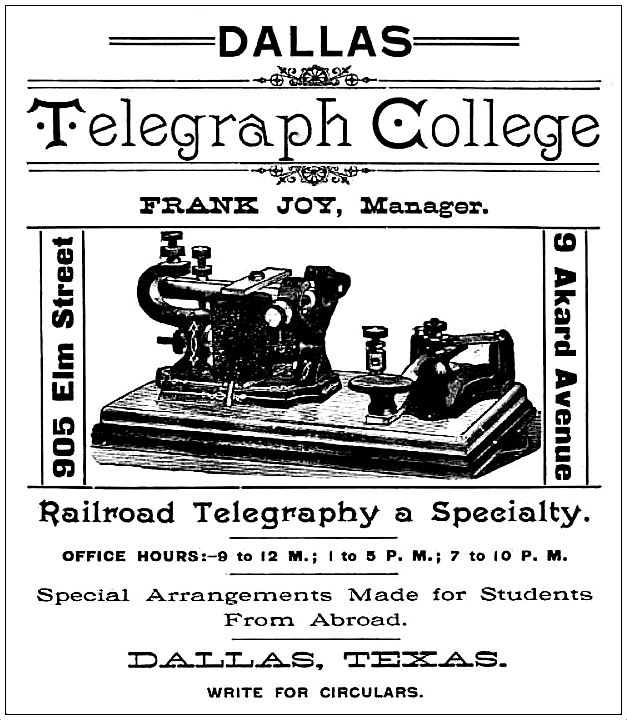
dallas_telegraph_college_ad_1904

by Paula Bosse

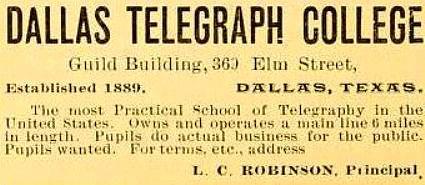
The Dallas Telegraph College opened in 1889 and admitted both men and women as students (if not from the beginning, certainly by the early years of the new century).

dallas-telegraph-college_1889-directory1889 ad (click to see larger image)

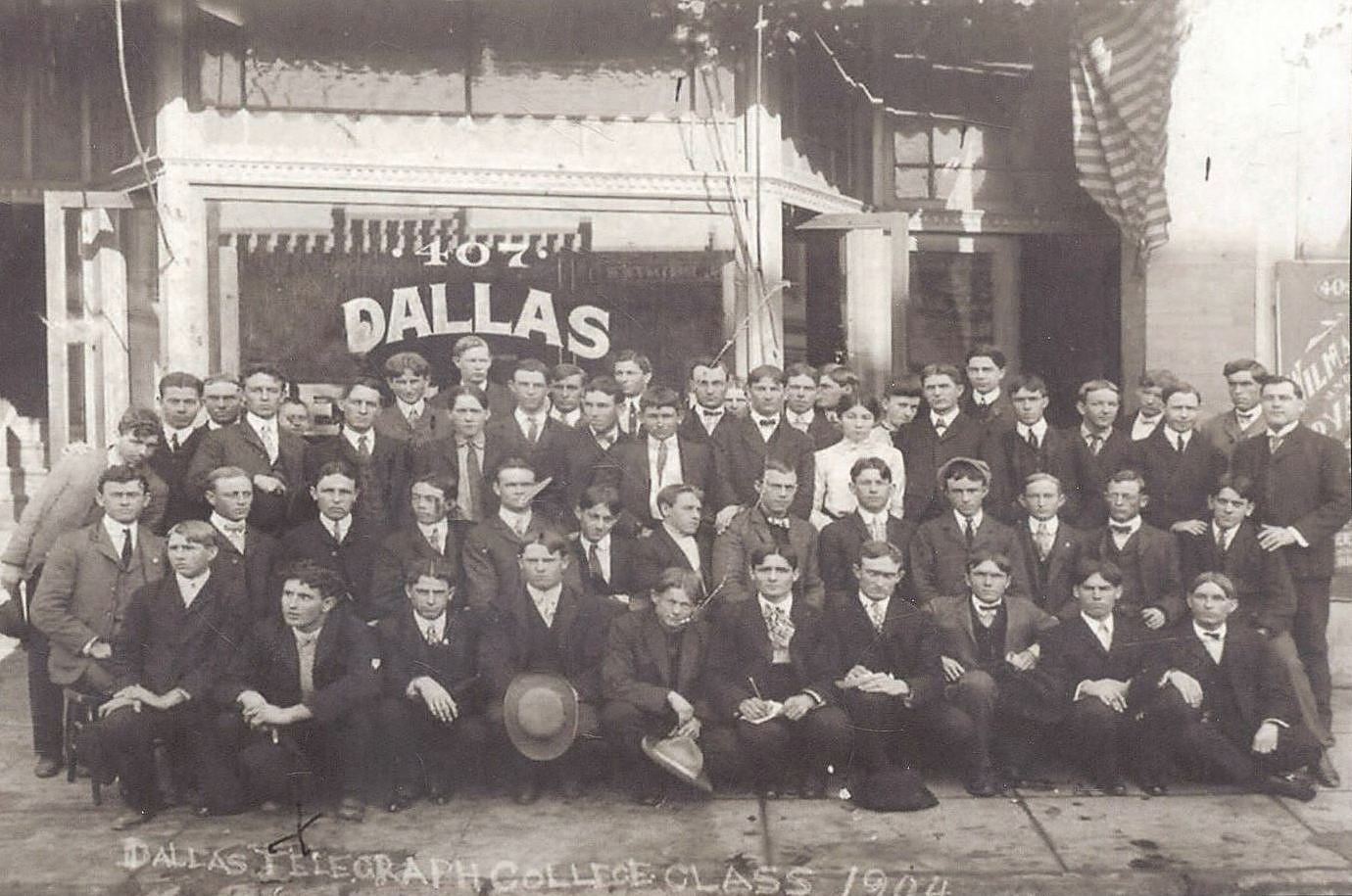
In the 1904 photo below, you’ll see one lone woman in the group.

dallas-telegraph-college_1904_ebay1904

Below, the text of a 1908 ad — published in a San Antonio newspaper in hopes of drawing students to Dallas from around the state — rather optimistically promised hard-working students the possibility of earning an “enormous” salary and maybe even becoming the head of a railroad!

The Dallas Telegraph College is a school of more than state reputation. Prof. L. C. Robinson is president, with J. E. Hyle as superintendent. As is well known, telegraphy is not only one of the pleasantest of studies, but offers a brilliant career to the man who ‘makes good.’ A great many railroad presidents started as operators. The men who have made good now head railroad systems at enormous salaries. What one man has done, another may do. The Dallas Telegraph College has been a chartered institution for fifty [sic — this should be “twenty”] years. Why not send for one of their beautiful catalogues?

dallas_telegraph_college1908 ad

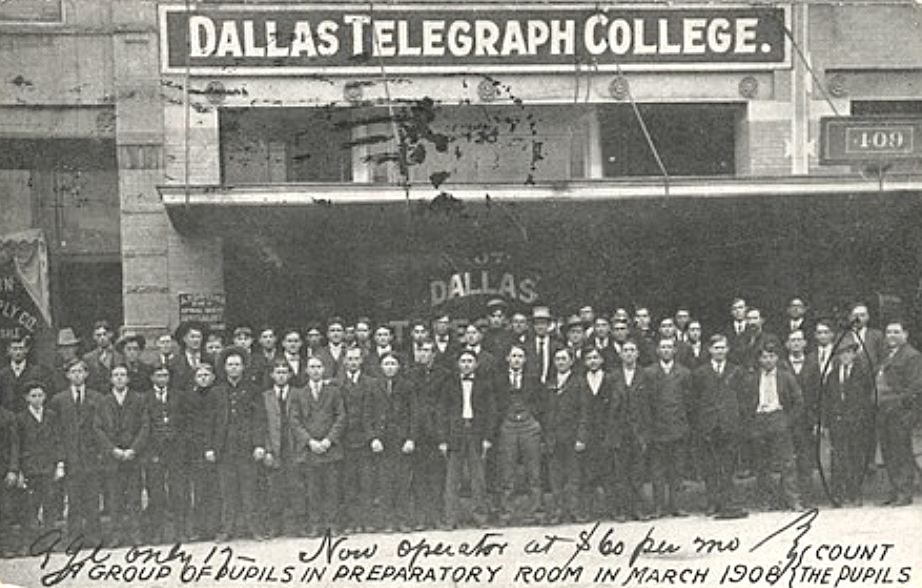
dallas-telegraph-college_1908_cook-coll_degolyer-lib_SMU
1908, via DeGolyer Library, SMU

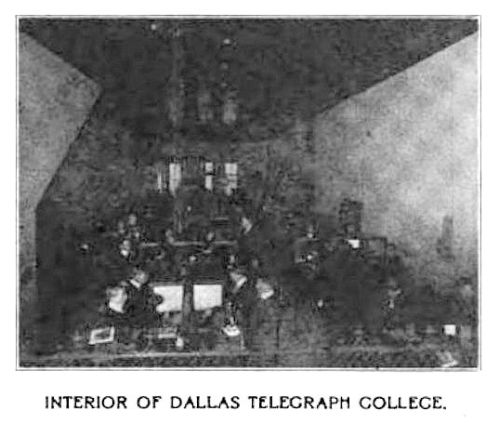
According to a 1912 article by Lewis N. Hale on Texas schools and colleges in Texas Magazine, the students learned to ply their trade by tapping (…as it were) into the actual railroad telegraph lines which, rather conveniently, ran right through their classrooms. A very murky photo from that Texas Magazine article is below.

dallas-telegraph-college_tx-mag_1912_photo

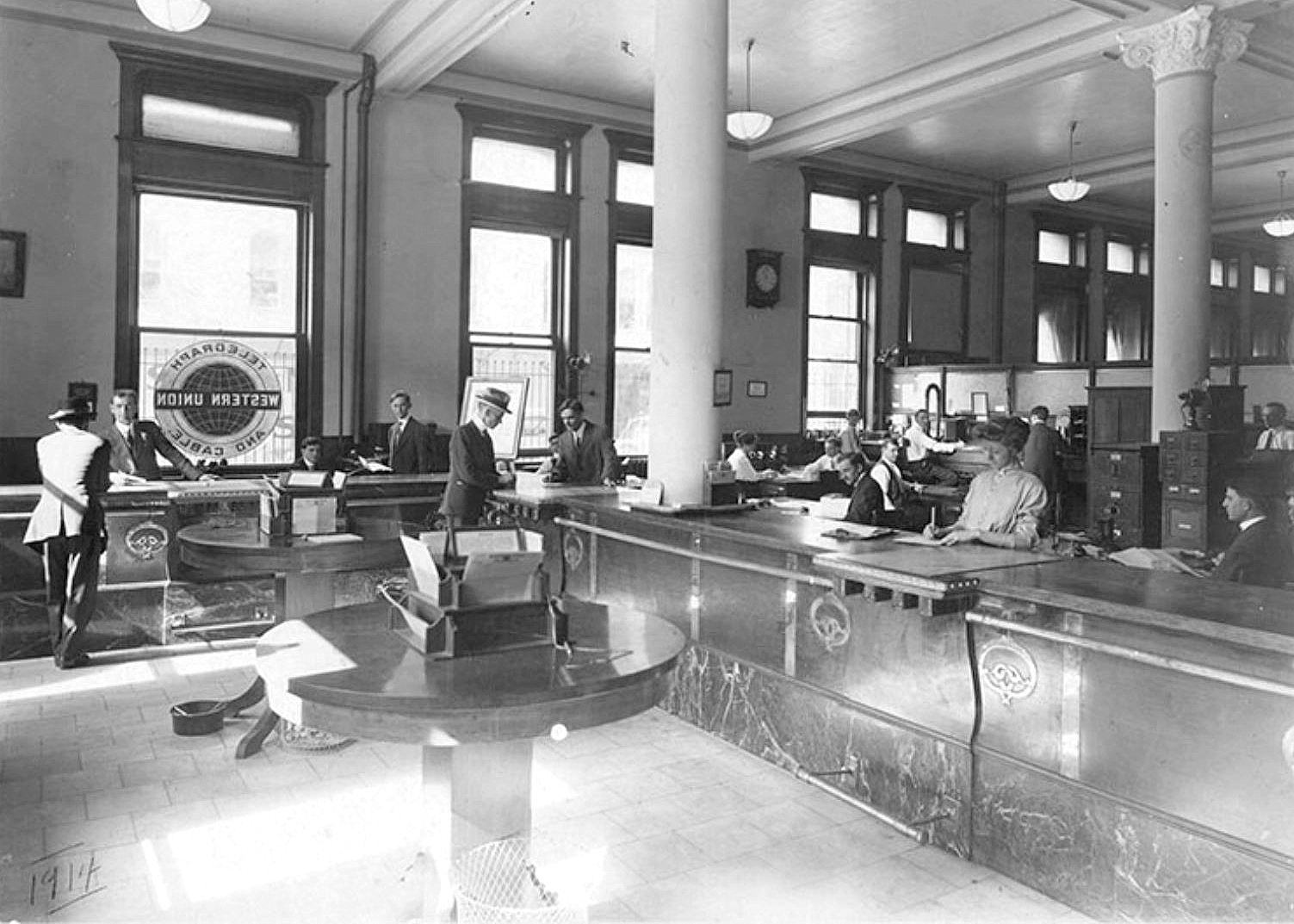
The goal of students was to secure employment in a nice, well-appointed office, such as Dallas’ Western Union headquarters, shown below in 1914.

western-union_trust-bldg_1914_DPLvia Dallas Public Library

Next stop: an enormous salary!

***

Sources & Notes

Top ad (“Learn Telegraphy”) from 1904. Second ad from 1889 (from the pages of the Dallas city directory). Third ad (with Guild Building address) from 1894.

Photo showing 1904 class from eBay.

1908 photo showing students standing in front of the building from the George W. Cook Dallas/Texas Image Collection, DeGolyer Library, Southern Methodist University; more info on this card is here.

Western Union office photograph — “[Western Union Telegraph Company interior main office – Trust building at 801 Main Street]” (1914) — is from the DPL Van Orden Western Union Telegraph collection of the Dallas Public Library Dallas History and Archives Division (Call Number PA2007-2/2).

An entertaining read on the history of telegraph service in Texas by Mike Cox can be found here.

The Handbook of Texas entry on telegraph service in Texas can be found here.

Absolutely EVERYTHING that you (and Ed McMahon) would ever want to know about the telegraph and telegraphy is here.

*

Copyright © 2014 Paula Bosse. All Rights Reserved.
Bird’s Eye View of Dallas — circa 1900

birdseye_view_dallas_postcard
by Paula Bosse

Wonderful old postcard, looking east, probably from the courthouse. Main Street is on the left, Commerce on the right. I’m not sure of the date, but I’m guessing somewhere around the turn of the century. Click the picture for a very large image, and just wander around the place.

*

Copyright © 2014 Paula Bosse. All Rights Reserved.
M-K-T Railroad’s “Katy Flyer Route” — 1902

mkt_rail_1902_mercury

by Paula Bosse

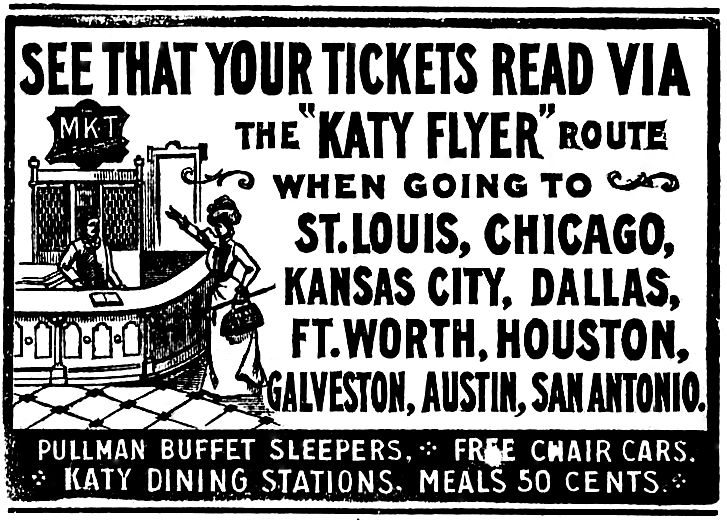
Ah, Texas rail travel in the corset-and-carpet-bag days, from a 1902 issue of Dallas’ Southern Mercury newspaper. Sign me up.

katy-flyer_timetable_1900_a

katy-flyer_timetable_1900_b

***

Sources & Notes

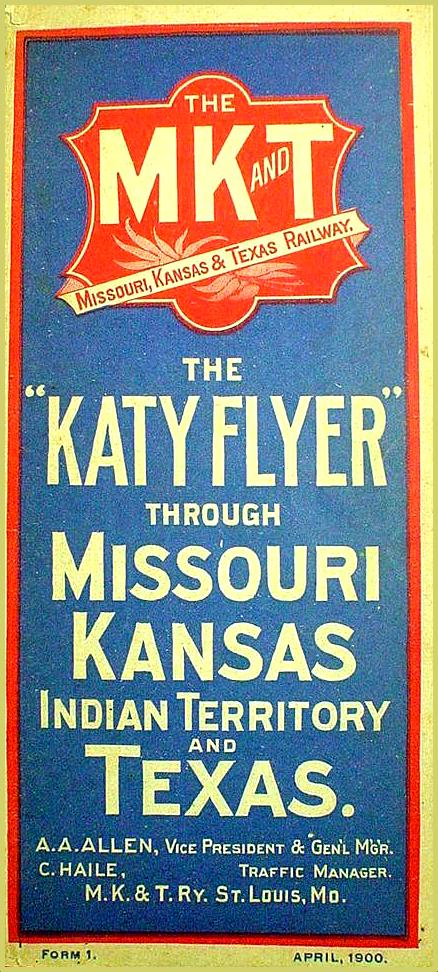
Color images from a 1900 MKT timetable, offered a while  back on eBay, here.

An entertaining history of the Missouri-Kansas-Texas Railroad (with lots of wonderful photos) can be found here.

A history of the railroads in Dallas can be found here.

And the Handbook of Texas entry for the M-K-T (known familiarly as the “Katy” railroad) can be found here.

See another post featuring the Katy Flyer — “Leaving Dallas on the Katy Flyer — ca. 1914” — here.

Click pictures to see larger images.

*

Copyright © 2014 Paula Bosse. All Rights Reserved.