Flashback : Dallas

A Miscellany: History, Ads, Pop Culture

Category: 1910s

The Gateway to Junius Heights

junius-streetcar_junius-gates_DPL_sm
Welcome to Junius Heights!

by Paula Bosse

If you’ve driven along Abrams Road, between, say, Beacon and the Lakewood Country Club, you’ve probably passed two tall stone pillars which stand across Abrams from one another, and you’ve probably asked yourself, “What are those things?”

These things:

junius-heights-pillars_google-street-viewGoogle Street View here

They were built as gateway markers to the Junius Heights neighborhood in about 1909 — they’re just not in their original location anymore. They were originally on either side of Tremont Street, half a block east of Ridgeway. They’ve been moved, but they’re only a stone’s throw from their original site.

In 1973, when the city was in the midst of widening and connecting Abrams with Columbia, the 30-foot pillars were situated on a roadway which was going to be demolished. The pillars would have been destroyed were it not for the efforts of a small group of preservation-minded neighborhood residents who managed to raise enough money to have the historic East Dallas structures dismantled and moved. It took a while for the money to be fully raised, but the pillars were placed on their new sites in 1975.

The thing that is most interesting about the saving of these columns is that this took place at a time when this part of East Dallas — Swiss Avenue included — was on something of a downslide. Many of the houses were in disrepair and many residents had moved out, seeking newer homes and better (i.e. newer) neighborhoods. Thankfully, in the early 1970s people began to focus on historic preservation, and the area began to make a slow comeback. Thanks to the preservation efforts of these people, their persistence in gaining “historic district” status for Junius Heights and Munger Place, and their successful fights on zoning issues, the areas surrounding these stone pillars are once again highly desirable neighborhoods, full of homeowners who are good caretakers and thoughtful preservationists.

**

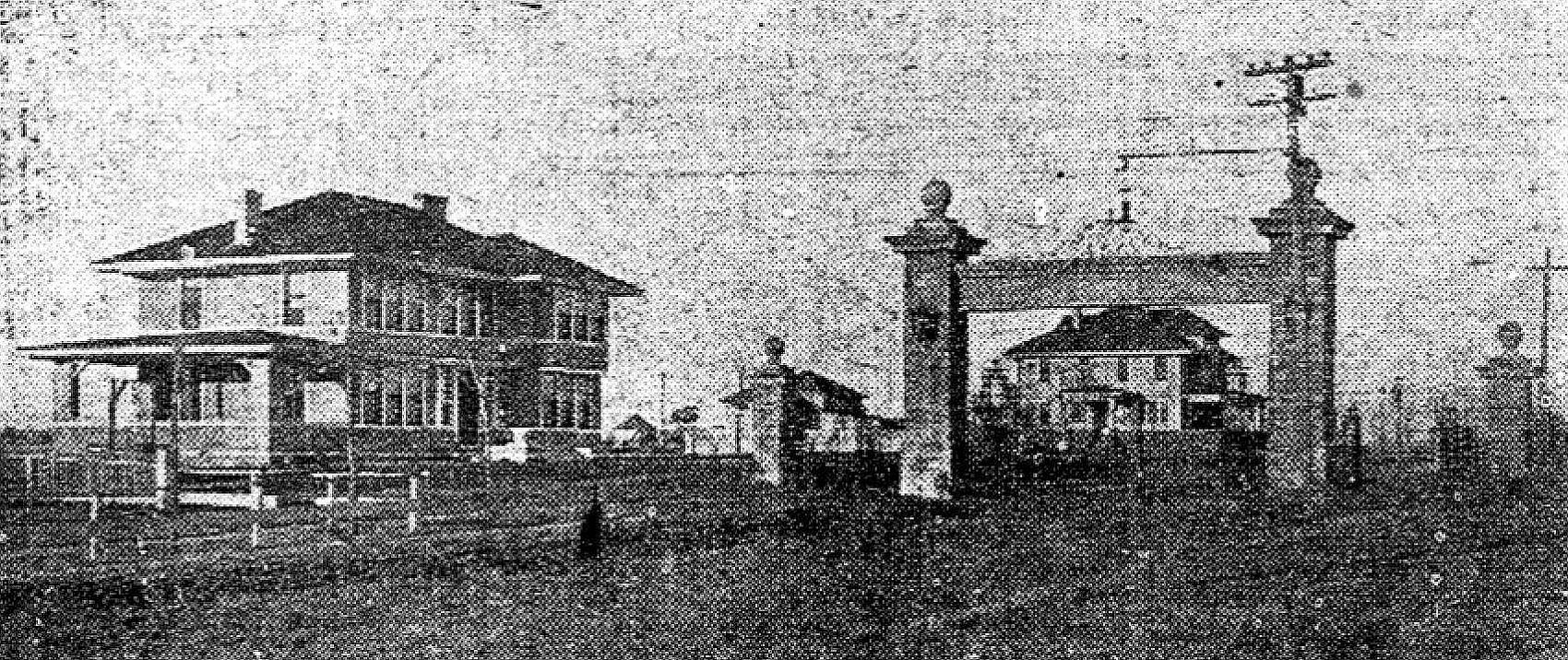
When researching this post, it was very difficult to determine when the pillars had been built. For some reason 1917 seemed to be a popular guess, and it was repeated in several articles I came across. But it was actually earlier. The earliest photo I’ve found (and I was pretty excited to have stumbled across it!) was one that first appeared in a November, 25, 1909 ad for a new development called “Top o’ Junius Heights.” (All photos and clippings are larger when clicked.)
ad-junius-heights_dmn_112509-det

Here’s the full ad:

junius-heights_dmn_112509Dallas Morning News, Nov. 25, 1909

Note how similar this entrance looks to the entrance to Fair Park from the same time:
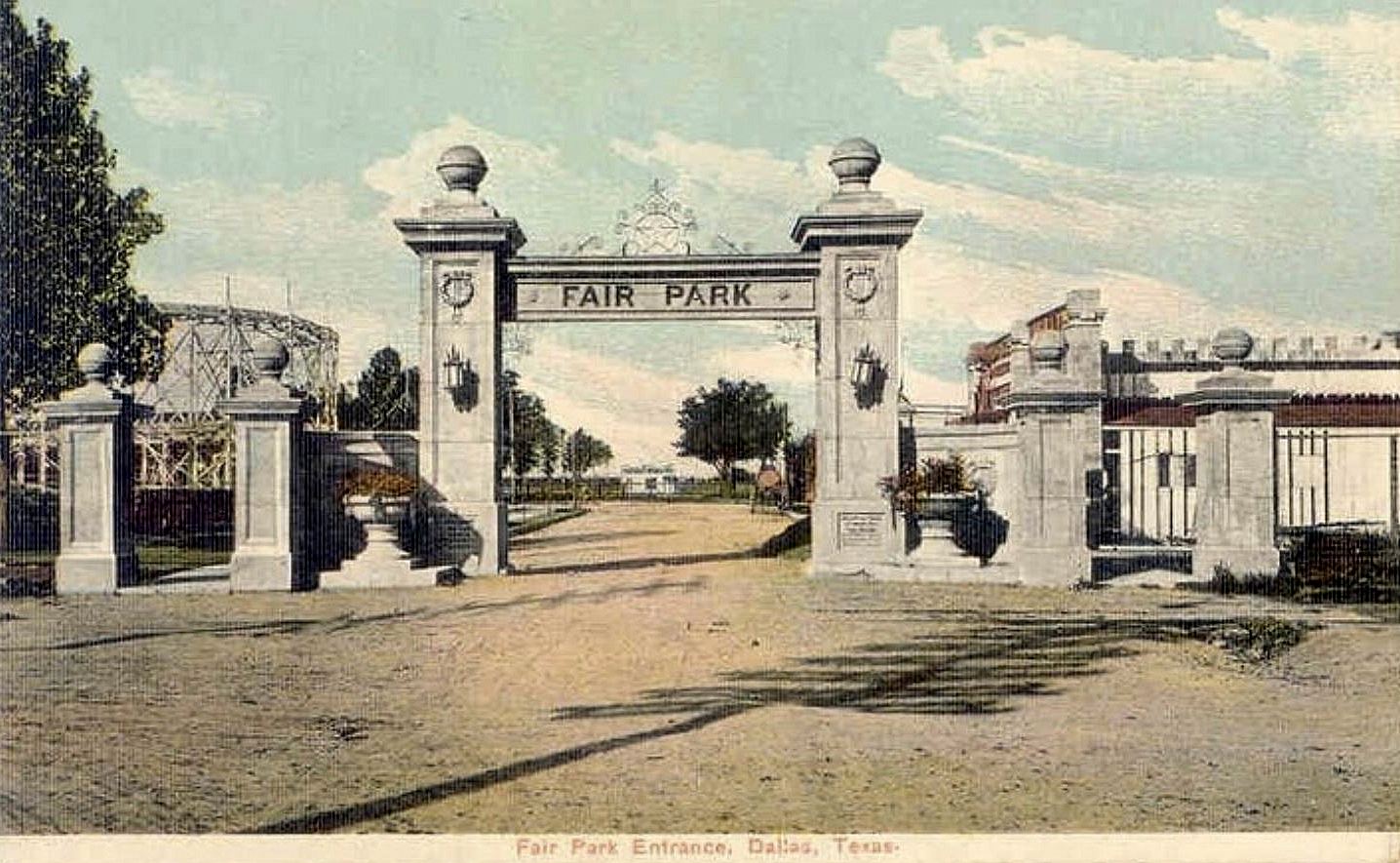
fair-park-entrance_1910_flickr_coltera

The same photo was used in another ad a few months later. If you live in Junius Heights, perhaps you can find your house in the diagram:
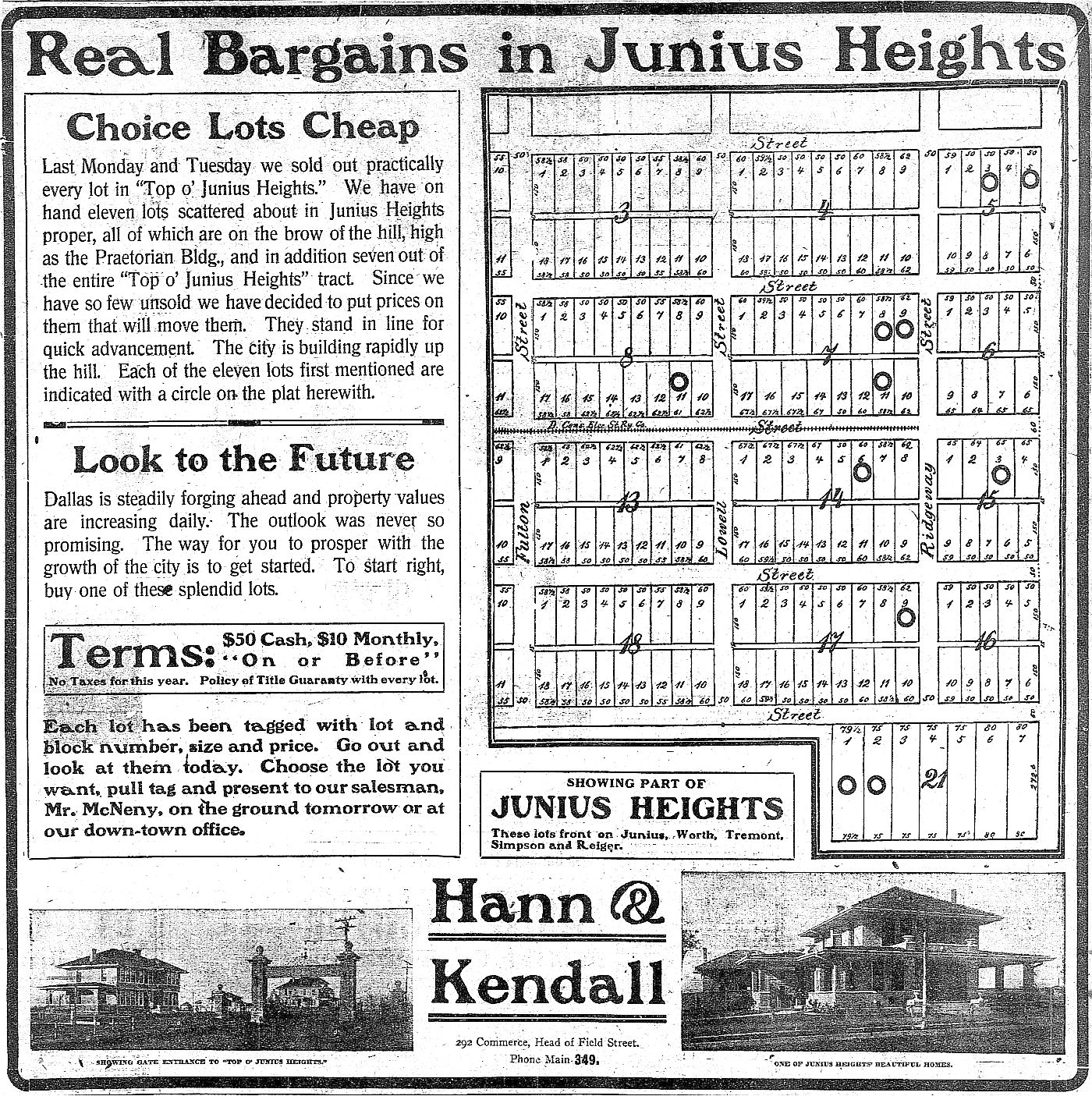
ad-junius-heights_dmn_050810DMN, May 8, 1910

The pillars were actually built as a gateway — the columns connected at the top, spanning Tremont. Lots in Junius Heights first began to be sold in 1906; in 1909, the second addition — called “Top o’ Junius Heights” — began to be offered for sale. The opening of the second addition appears to be when the gateway might have been built. Not only did this gate serve as an entrance to Junius Heights, it actually separated the two additions (see clippings below). It was also a handy landmark, and for many years it stood at the end of the Junius Heights streetcar line (which ended at Tremont and Ridgeway).

Below, part of an ad for Top o’ Junius Heights that appeared in The Dallas Morning News on Nov. 28, 1909, in which the “big stone gate entrance” is mentioned:

junius-heights-ad_dmn_112809_det

Part of another ad for Top o’ Junius Heights:

junius-heights-gates_dmn_050110_ad-det
DMN, May 1, 1910

And part of an ad for just plain ol’ Junius Heights, mentioning that the gate can be seen as a boundary:

junius-heights-gates_dmn_090410_ad-detDMN, Sept. 4, 1910

Here’s a detail from a 1922 Sanborn map which might make the location of the gate a little easier to visualize (and, again, these streets no longer look like this): the blue line represents the streetcar line (which ran all the way to Oak Cliff — the photo at the top of this post shows the Hampton streetcar), and the red circles are about where the pillars were originally planted. (The full map is here.)

junius-heights-gate_1922-sanborn_sheet-394

It was pretty exciting finding that photograph from 1909, but it was also pretty exciting seeing a photograph posted in the Dallas History Facebook group by Jerry Guyer which shows a dreamy-looking view of the gate as seen from the yard of the home owned by his great-uncle, A. P. Davis, who lived at 5831 Tremont between 1911/12 and 1921/22 (see what the house looked like back then, here).  The house was on the northwest corner lot of Tremont and Ridgeway (it is still standing), only half a block away from the gate. This detail of that photo is fantastic!

junius-gates_ca-1920s_guyer_dallas-history-fb

*

Another very early photo of the pillars/columns/gateway can be seen in this photo. (I’m afraid it’s a little odd-looking as I took a photo of it on the wall of The Heights restaurant in Lakewood and lights are reflecting off the picture. Please check this large photo out in person. Not only are there other great historical photos on the walls, but the coffee is great.)

junius-heights-gateway_the-heights-restaurant

Here is the same photo as the one at the top. Note that this “gateway” has actual iron gates and that there are smaller secondary pillars on the opposite side of the sidewalks. Also note that the pillar on the right actually extends into the narrow street.

junius-streetcar_junius-gates_DPL

And here’s another view I just came across (I’ve added so much since I originally wrote this post!), from a DVD called Dallas Railway & Terminal — this from 1951 or 1952, showing the Junius streetcar coming through the “gates” (sorry for the low-res):

junius-gates__early-1950s_streetcar-video

***

Sources & Notes

Top photo is from the Texas/Dallas History & Archives Division, Dallas Public Library (with special thanks to M C Toyer); DPL’s call number for this photograph is PA87-1/19-59-193.

Photo of the view of the gate from the home of Andrew P. Davis is from the collection of Jerry Guyer, used with permission.

More info on Junius Heights and the saving of the pillars can be found on the Preservation Dallas site, here. Here is a poster from the Dallas Public Library Poster Collection (with an incorrect date on it….).
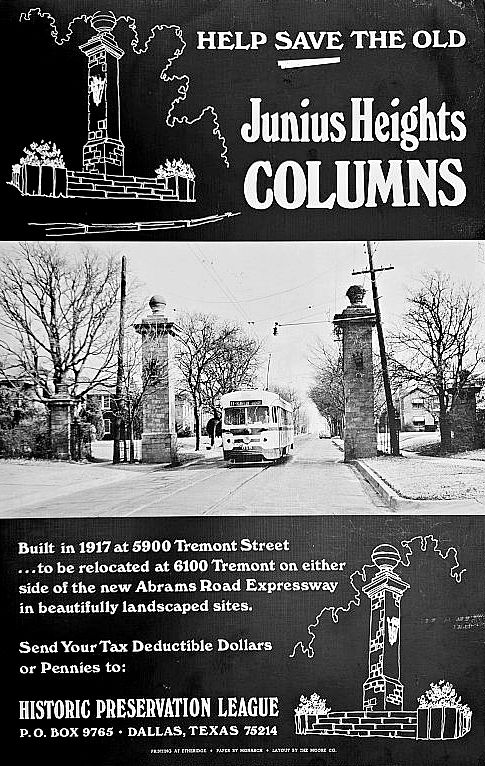
junius-heights-columns_1973_DPL_poster

A few Dallas Morning News articles on the fight to save the pillars:

  • “Residents Try Saving Pillars From the Past” by Lyke Thompson (DMN, May 30, 1973, with photo of pillar)
  • “Columns Come Down” (DMN, June 2, 1973, with photo)
  • “Cash Raised for Pillars” (DMN, June 7, 1973)
  • “Cornerstone Placed In East Dallas Area” by Michael Fresques (DMN, July 29, 1973, no photo, but description of pillars lying in pieces, awaiting funds to reconstruct them)
  • “Junius Dedicates Columns” by Doug Domeier (DMN, June 16, 1975, pillars finally relocated, with photo of preservationist Dorothy Savage standing beneath one of the pillars)

East Dallas and Old East Dallas are fiercely proud of their history and fight for preservation issues.

old-east-dallas_dmn_072775
July, 1975

*

It’s a bit difficult for me to visualize where these pillars were originally. Here’s a 1952 map showing Tremont with the approximate location of the columns before they were moved.

junius-heights-columns_1952-mapsco
1952 Mapsco

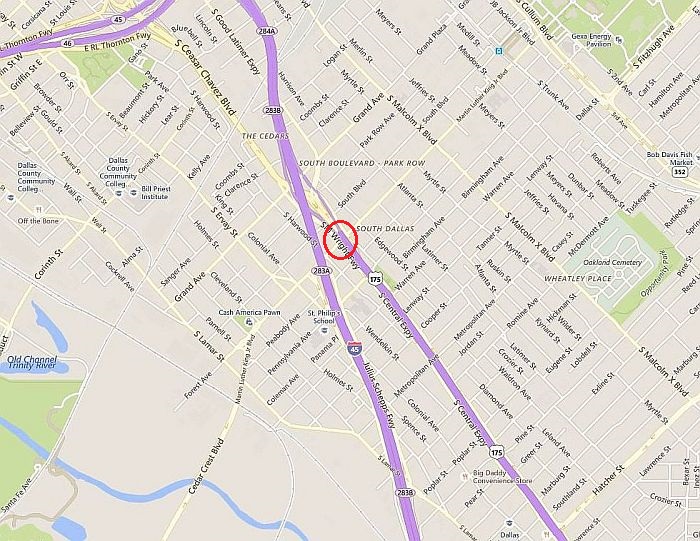
And here’s a present-day map, showing the post-Abrams extension. I’m not sure exactly where those pillars originally stood, but it was near the intersection of Tremont and Slaughter seems to have been between Ridgeway and Glasgow (location edited, thanks to Terri Raith’s helpful comments below) — this location is circled in red on the map below; the locations of the pillars today are in blue.
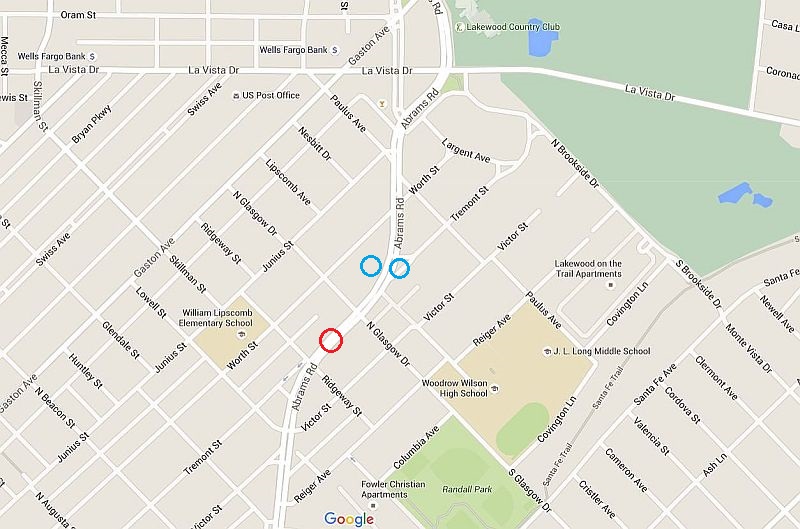
junius-heights-columns_google

*

Copyright © 2016 Paula Bosse. All Rights Reserved.
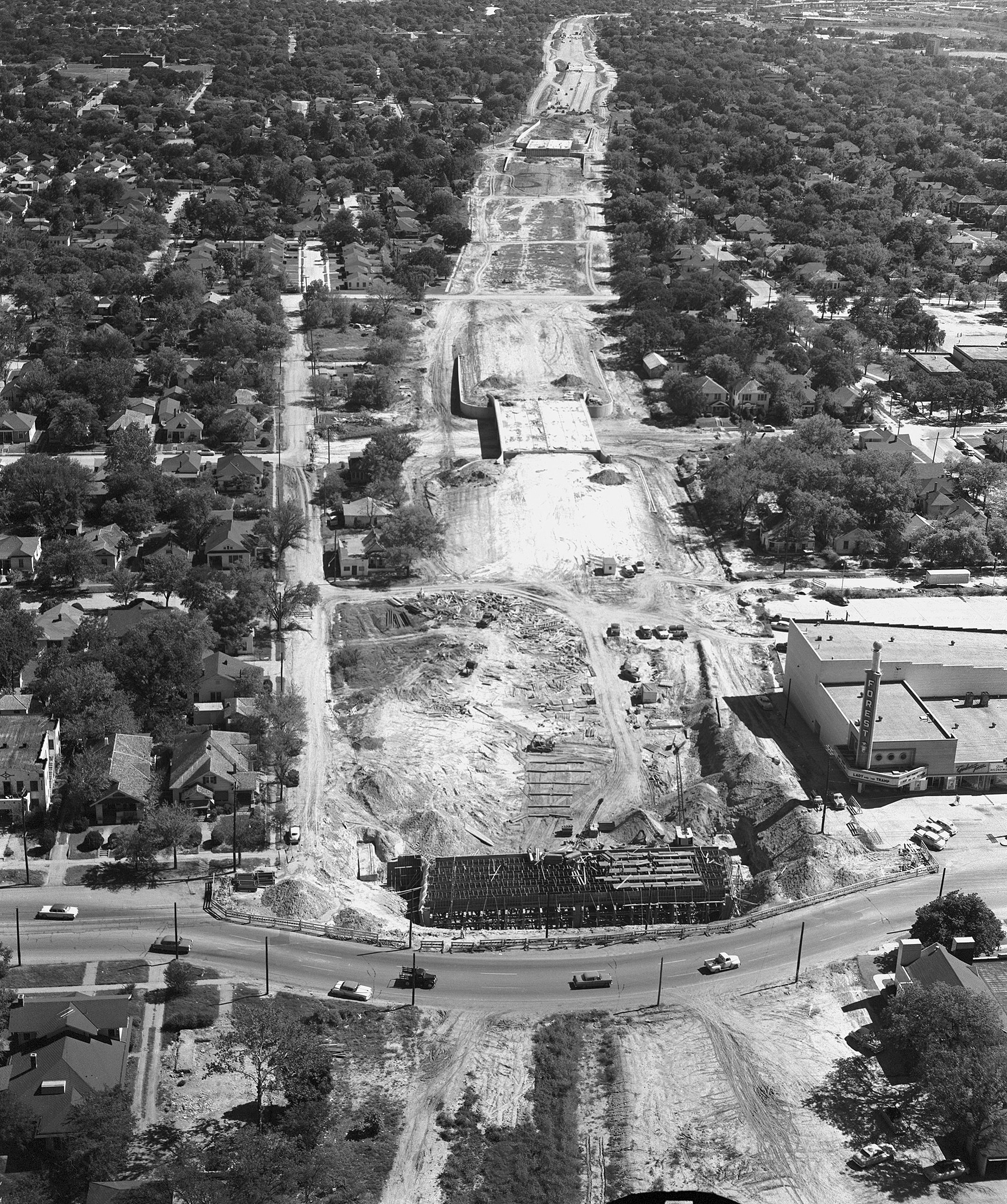
South Central Expressway Under Construction — 1955

central-expwy_forest-ave_092955_squire-haskins_UTAComing soon to a neighborhood near you… (UTA Special Collections)

by Paula Bosse

Behold, a photo of South Dallas on Sept. 29, 1955, showing a lengthy stretch of bulldozed land cleared for the imminent construction of South Central Expressway. We’re looking south, with Forest Avenue (now Martin Luther King Blvd.) running horizontally in the foreground. To the right is the Forest Theater (now playing: “Lady and the Tramp”). And if you zoom in, you can just see the post-Ross Avenue location of the famed Jim Beck recording studio to the right of the theater.

This great swath of land cut through an established tree-filled residential area — it ran alongside the once-swanky Colonial Hill neighborhood. Zoom in and take a last look at some of those straggler houses that haven’t yet met their maker. …But they will. …And they did.

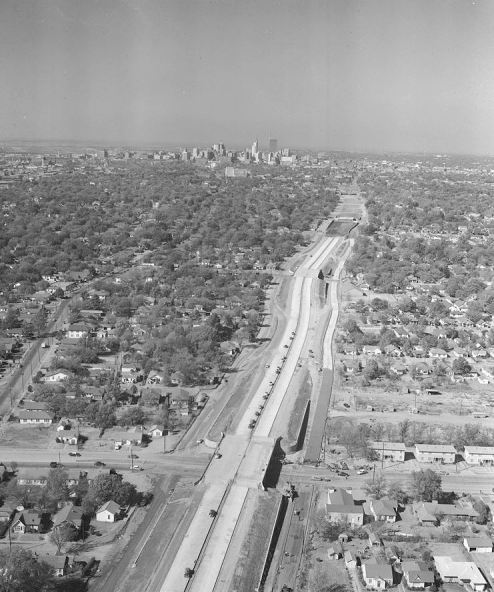
Below is another Squire Haskins aerial photo looking north, toward downtown, taken a few weeks later, on Nov. 11, 1955 (see a very large image of this photo on the UTA website here).

south-central-expwy_squire-haskins_nov-1955_UTASquire Haskins, Nov. 1955, UTA Special Collections

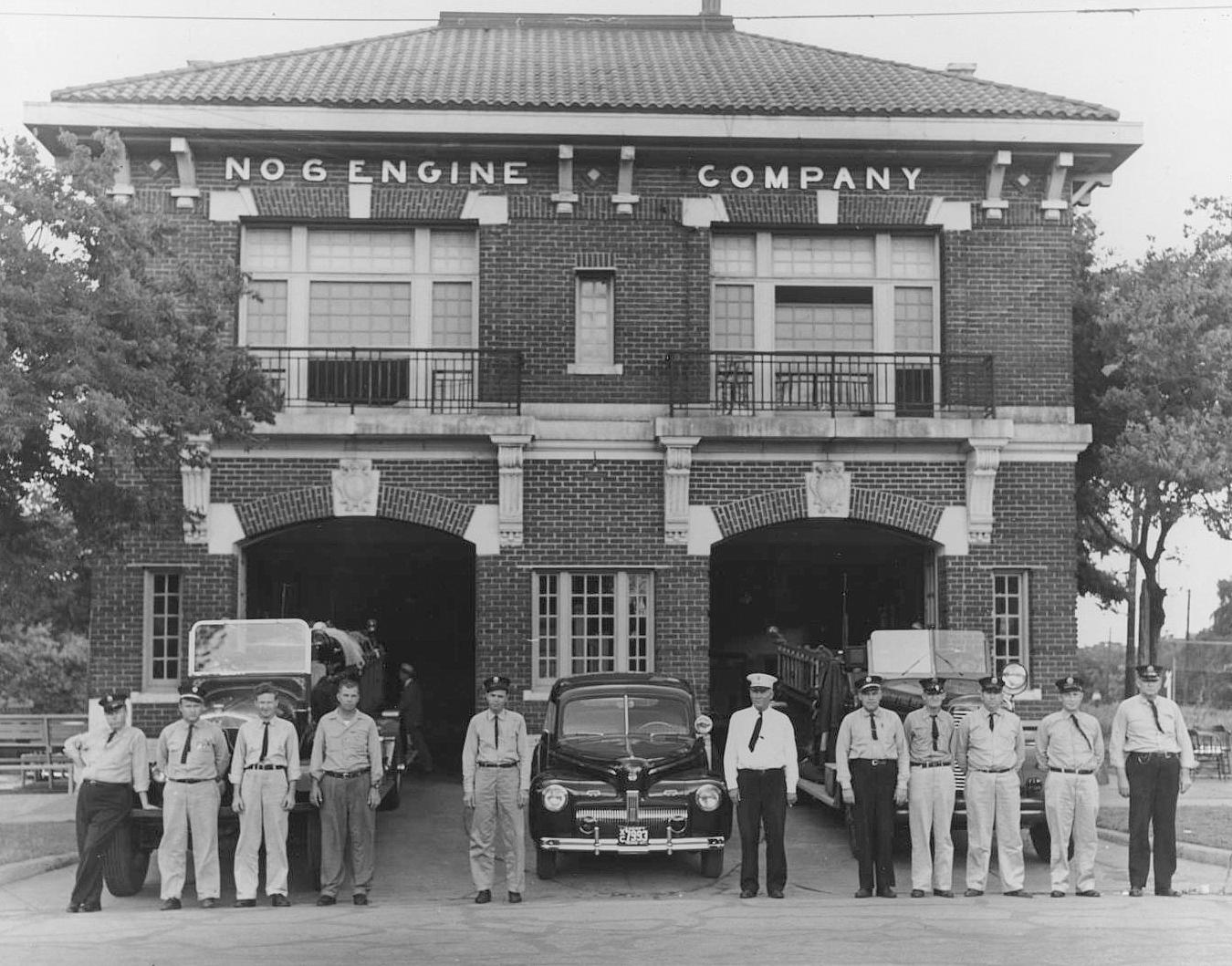
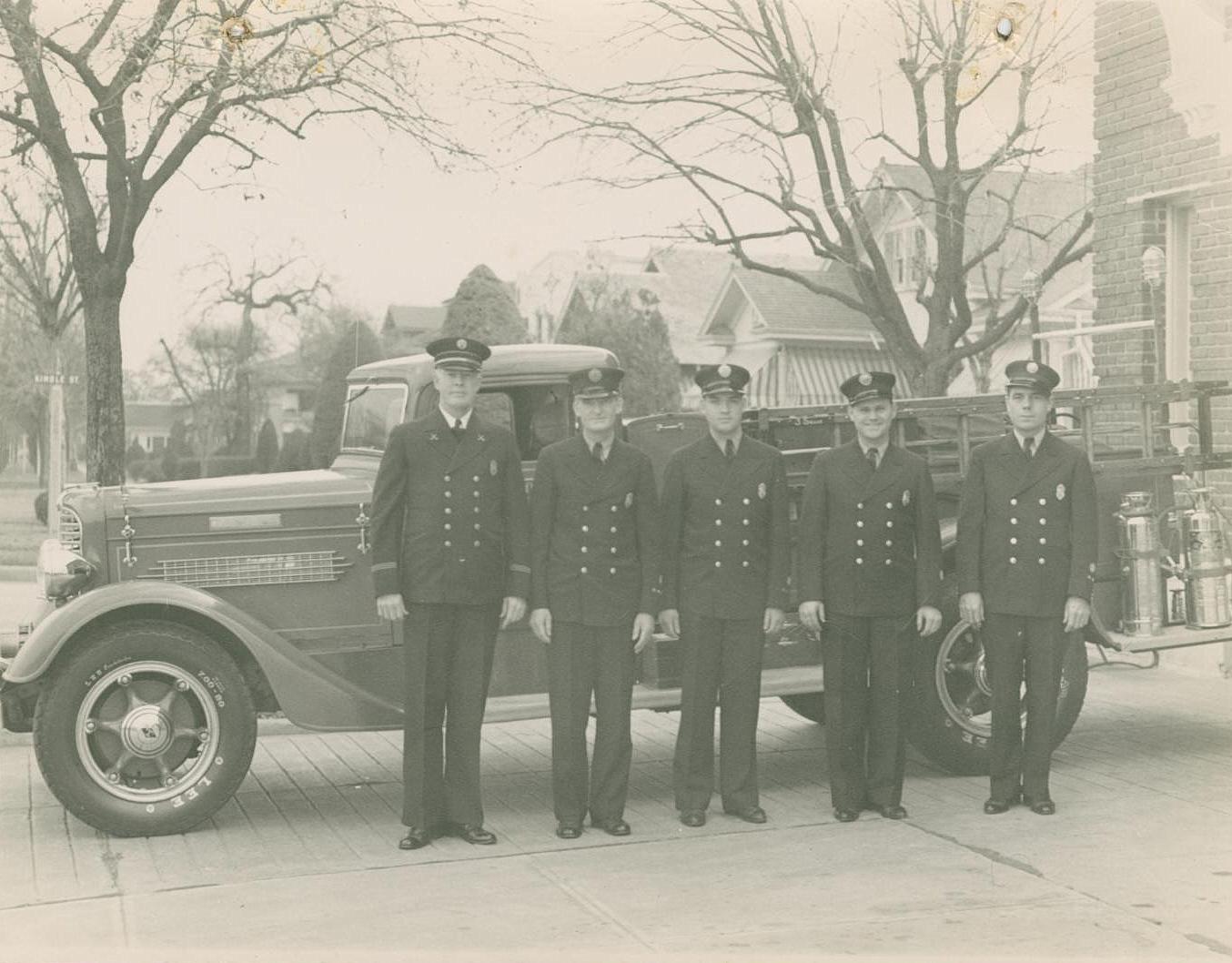
I wondered what had been demolished on Forest between the houses to the left and the theater to the right. It was Fire Station No. 6, at 2202 Forest Avenue. I looked in my bulging file of miscellaneous photos and was surprised to actually find a couple of photos of that No. 6 Engine Company, which was built in 1913.

fire-department_no. 6_forest-ave-mlk

The station was on the south side of Forest Avenue, alone in a very short block. As we look at the station in the photo above, the H&TC railroad runs just to the right of the station, and Kimble Street runs along the left. See a Sanborn map of this area in 1922, here.

The photo  below shows what Forest Avenue once looked like, from the front of the firehouse looking east (the intersection with Kimble is on the other side of the firetruck — you can see the street sign). These houses are still standing in the 1955 photo at the top.

forest-central_fire-station_portal

When you know what this intersection looks like today (see this same view today, here), it’s hard to believe it ever looked like a cozy neighborhood. Progress is a helluva thing, man.

**

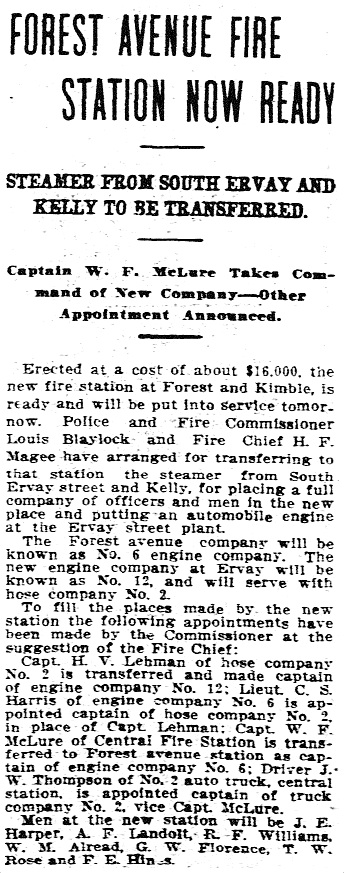
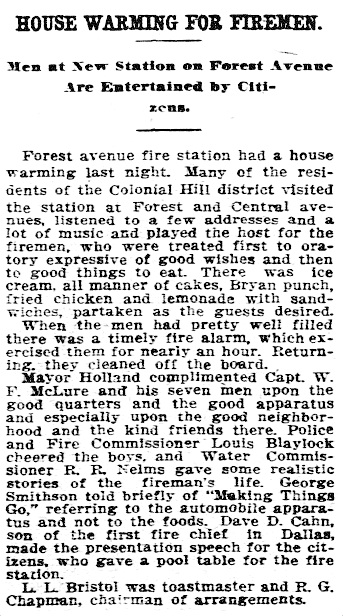
A couple of short articles for those who might want a little more info about the fire station, which was demolished sometime between April and September of 1955. (Click articles for larger images.)

forest-central_fire-station_dmn_070613
Dallas Morning News, July 6, 1913

forest-central_fire-station_dmn_072213
DMN, July 22, 1913

*

forest-ave-central_today_bing
Bing Maps

***

Sources & Notes

Top photo by Squire Haskins, from the Squire Haskins Photography, Inc. Collection, UTA Libraries, Special Collections, University of Texas at Arlington; it is accessible here.

Second photo by Squire Haskins, from the Squire Haskins Photography, Inc. Collection, UTA Libraries, Special Collections, University of Texas at Arlington; it is accessible here.

The two fire station photos are from the collection of the Dallas Firefighters Museum, via the Portal to Texas History, University of North Texas. The first photo can be viewed here, the second photo here.

*

Copyright © 2016 Paula Bosse. All Rights Reserved.
On the Grounds of the Ursuline Academy and Convent

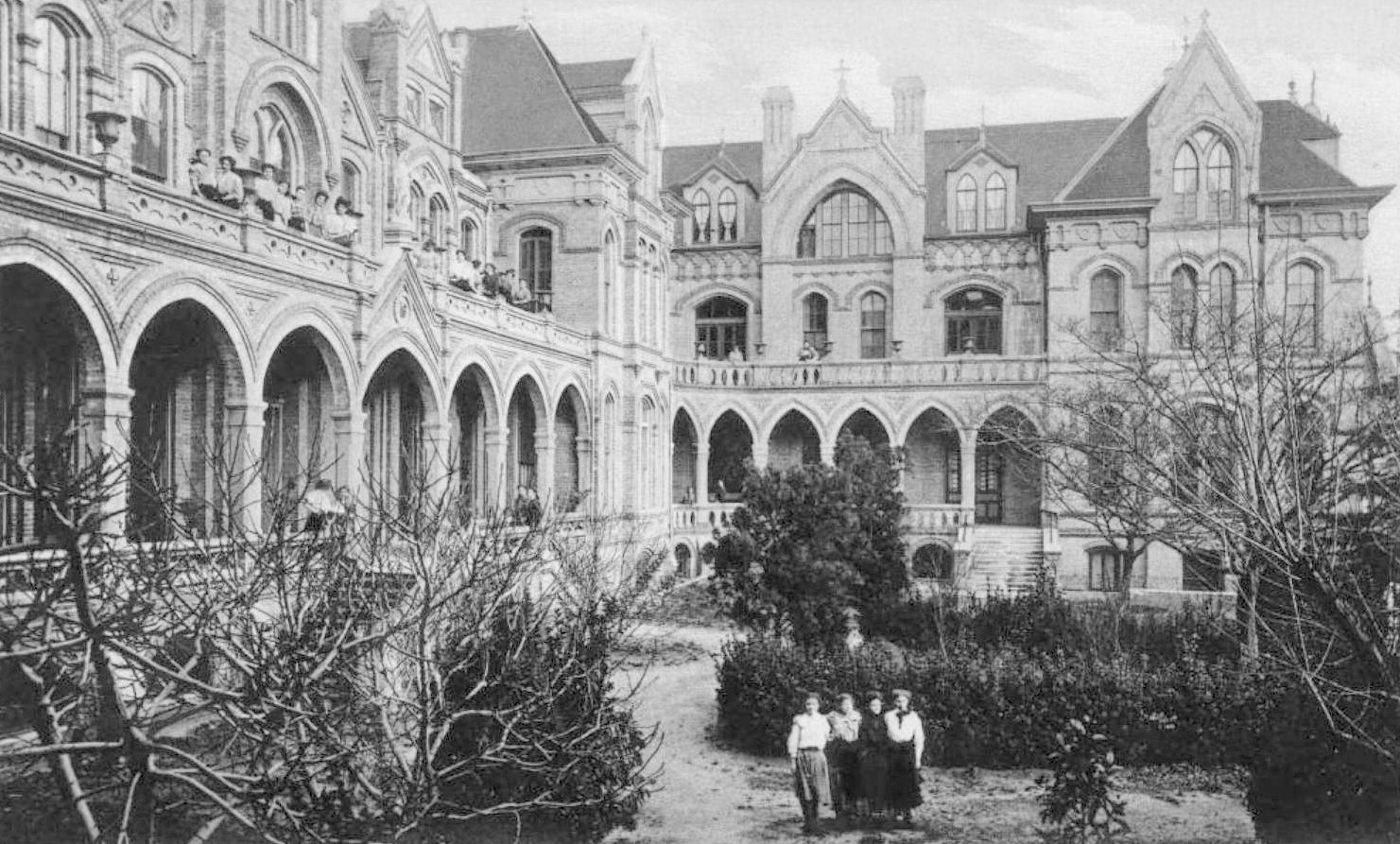
ursuline-convent_cook-colln_degolyer_smuBetween classes… (click for much larger image)

by Paula Bosse

I love this photo of Ursuline girls at the fantastically ornate school and convent in Old East Dallas. See more photos of the school, convent, and grounds in my post “Nicholas J. Clayton’s Neo-Gothic Ursuline Academy,” here.

***

Sources & Notes

Photo by Clogenson, from a postcard in the George W. Cook Dallas/Texas Image Collection, DeGolyer Library, Central University Libraries, Southern Methodist University; it is accessible here. I have un-colorized it.

See the scale of the Ursuline property on a 1922 Sanborn map, here. It is now mostly a parking lot, across from the Dallas Theological Seminary; a sad 21st-century view of what the former campus property looks like is here.

*

Copyright © 2016 Paula Bosse. All Rights Reserved.


The House at Crescent & Byron, Highland Park

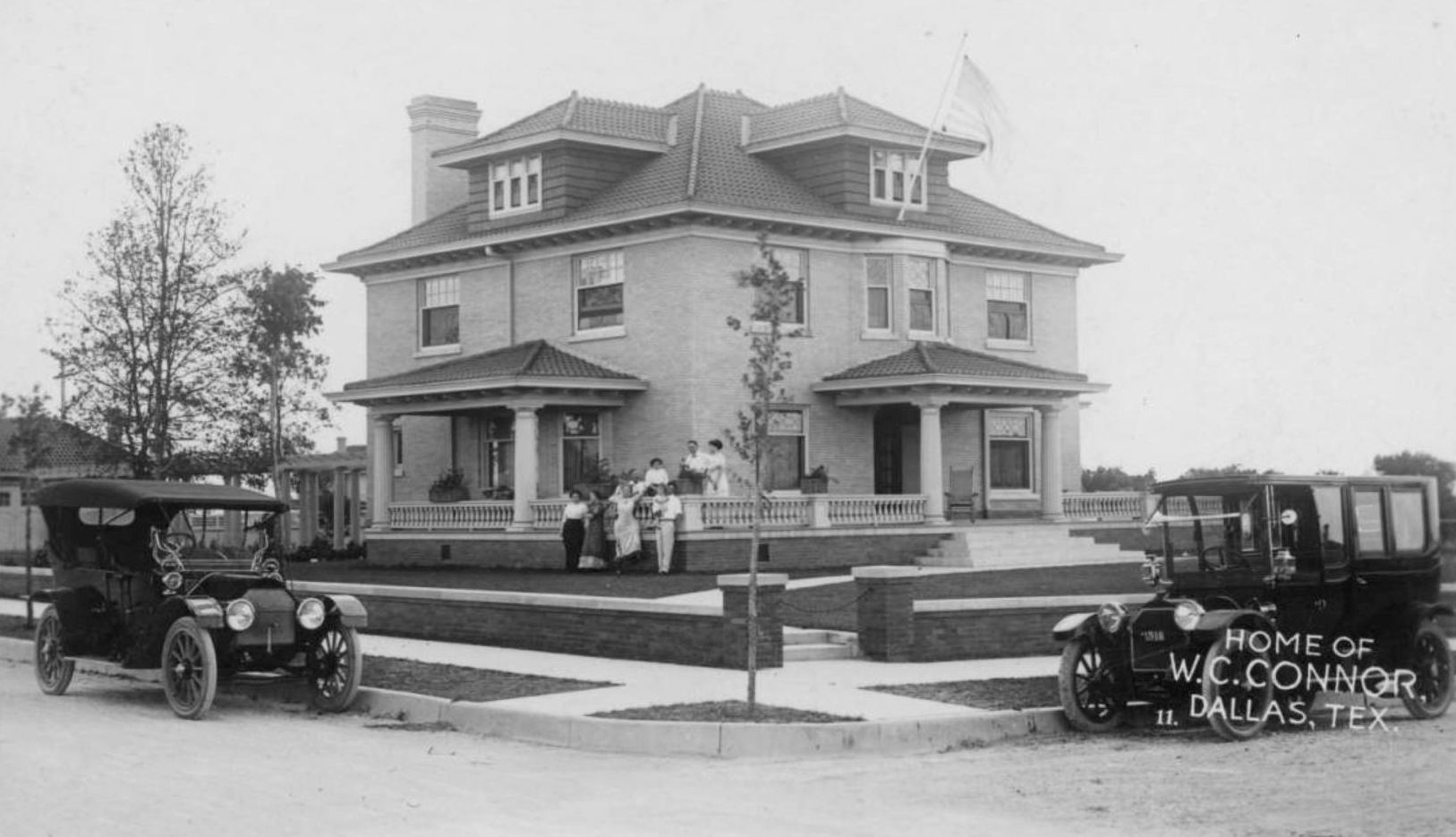
connor-home_cook-colln_degolyerWelcome…

by Paula Bosse

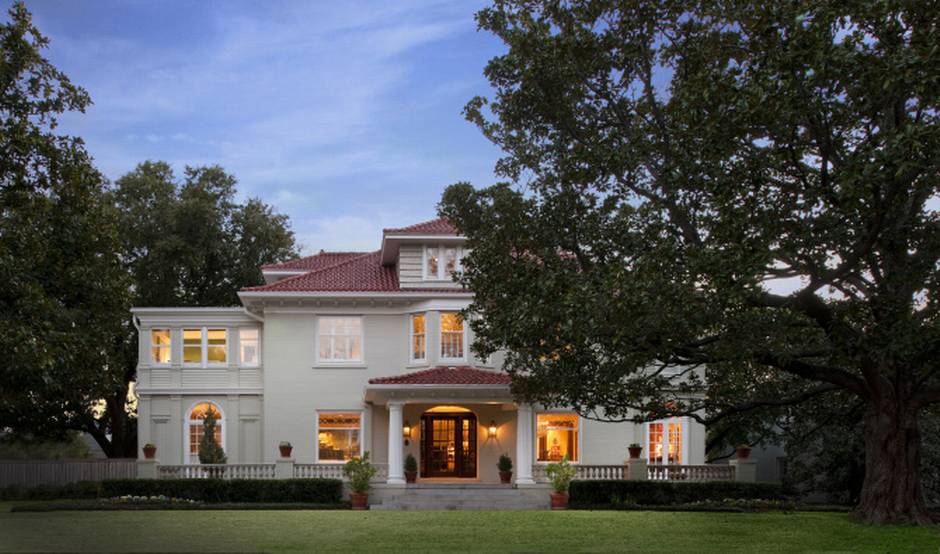
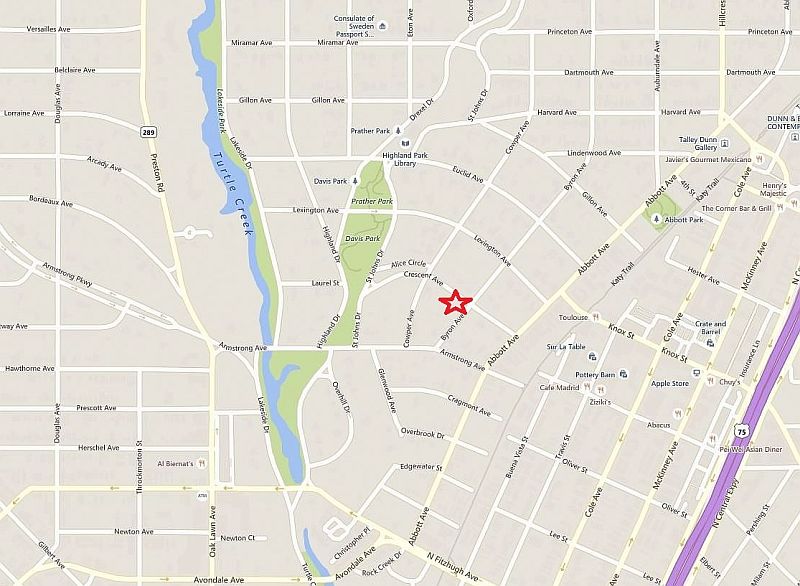
The photo of the house above caught my attention the other day. It’s exactly the sort of house I love, but I couldn’t get a good feel for the part of town it had been in. It took a while to track down, but when I did, I found that it was in Highland Park, at the southwest corner of Crescent and Byron, built about 1910. I had actually been leaning more in the direction of Old East Dallas, because when I think of Highland Park, I tend to imagine that it sprang fully landscaped and jam-packed with trees, even in its earliest days. But more surprising than learning that the house in this photograph was in Highland Park was discovering that it is STILL in Highland Park! It is still standing, and, more exciting, it is still recognizable and largely un-tampered-with! Take a look at it today, here.

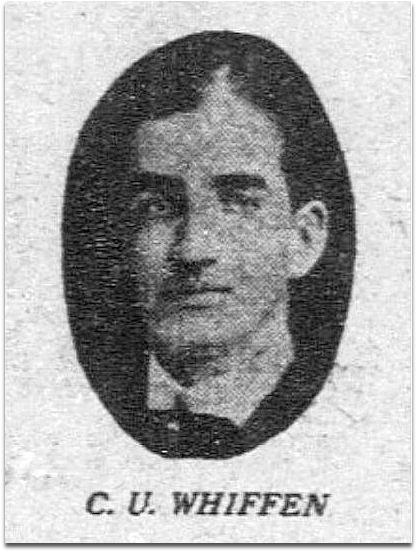
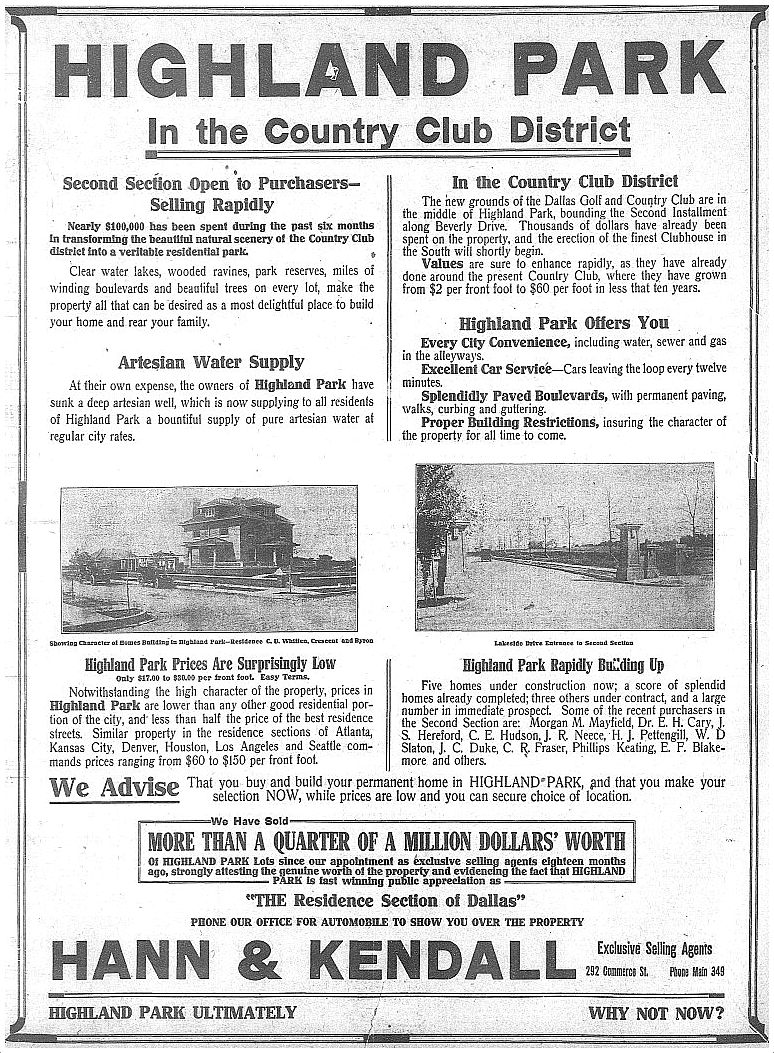
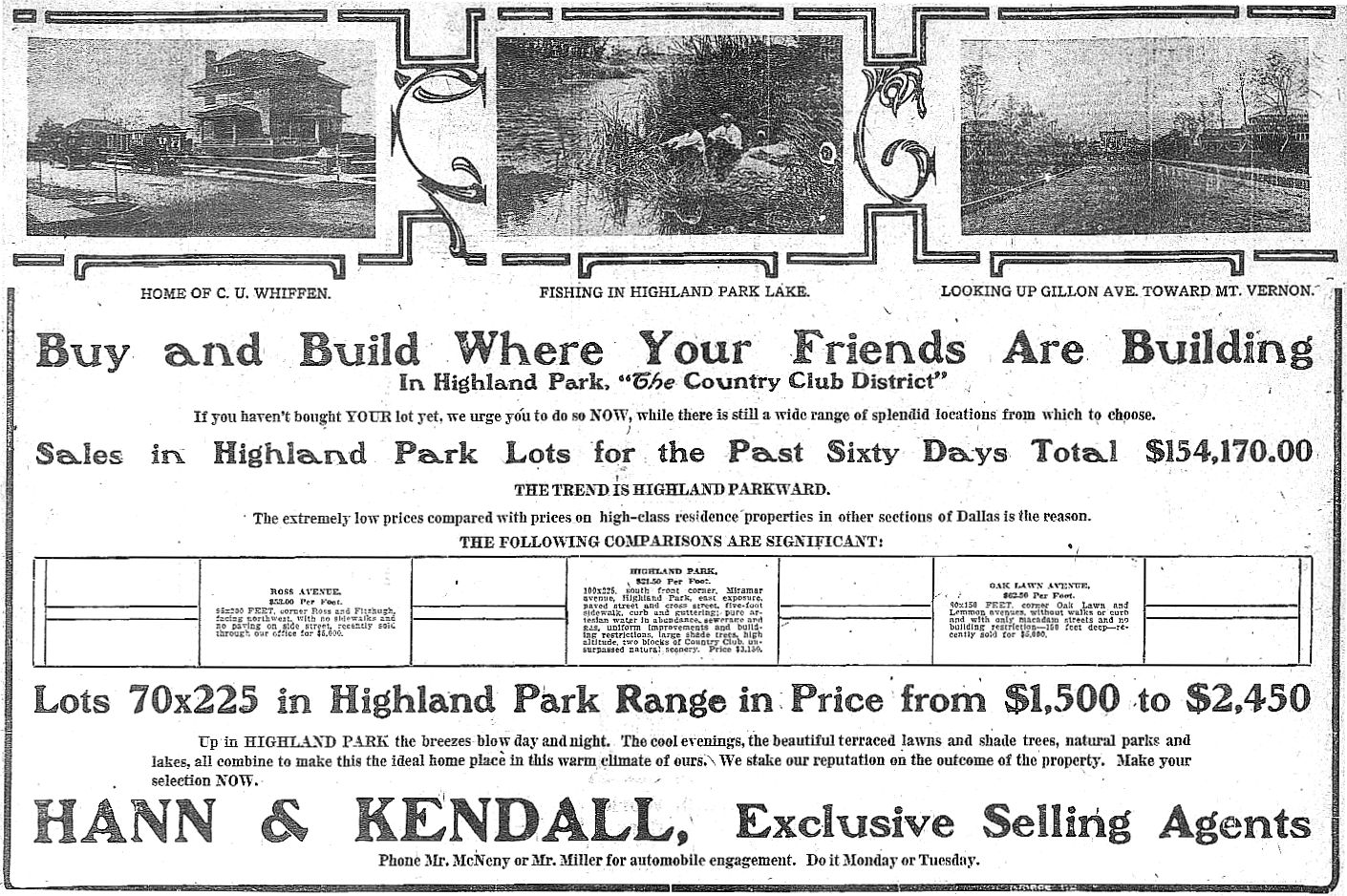
After rummaging around various online databases, I determined that this lovely house was built sometime in 1910 for its first occupants, the C. U. Whiffen family, whose name appeared under a picture of their photogenic house in ads placed by Hann & Kendall, the real estate agents in charge of selling lots for the developers of Highland Park. A photo of the house first showed up in an ad from September, 1910 and was used again in May, 1911. (See the full ads here.)

whiffen_dmn_051411-ad-det

The Whiffen family moved into the house in 1910 from their previous home on McKinney Avenue.

whiffen_dmn_010811-NCR-ad-detCalvin U. Whiffen, seen in an NCR ad, DMN, Jan. 8, 1911

whiffen_1911-directory1911 city directory

Whiffen had interests in a couple of different businesses but was primarily associated with NCR, the National Cash Register company. When Whiffen was transferred to Los Angeles by NCR, he sold the house to former Dallas mayor W. C. Connor for $18,000 (a little under $500,000 in today’s  money).

connor_whiffen_dmn_122211DMN, Dec. 21, 1911

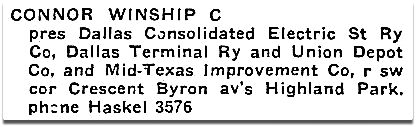
connor_1912-directory
1912 city directory

Winship C. Connor (also widely known as “Bud” Connor) was an interesting man whose contributions to the city were extremely important in its becoming a major metropolitan area. Not only did he serve multiple terms as mayor of Dallas (from 1887 to 1894), but, among other accomplishments, he also built the first waterworks system, the first streetcar line, and the first electric light plant. In later years, he presided over several companies, including the Consolidated Electric Street Railway Co.
connor_fuel-oil-journal_oct-1915Connor, pictured in the Fuel Oil journal, Oct. 1915

Connor moved from the house on Crescent Avenue to a house on Miramar in 1918 or 1919, and, in 1921, he died, at the age of 73. The top photo of the house was taken sometime between 1912 and 1919. He can be seen with his family, sitting on the porch, in this detail.

connor-home_cook-colln_degolyer-det1

The house has had very few owners throughout its 106 years. In one of those odd, happy coincidences, I’ve just discovered that one of those owners was Edward L. Wilson, Jr. (1920-2011). Ed Wilson was an engineer who had his office in a small building (now razed) on Maple Avenue, next door to the Stoneleigh Hotel. He leased out the ground floor to my father who ran The Aldredge Book Store there for over 20 years. Mr. Wilson was a man of few words, but very, very nice and an understanding landlord. I’m happy to learn that he and his family lived in this beautiful house for several years.

Here it is today.

crescent_dmn_032913DMN, Mar. 29, 2013

***

Sources & Notes

Top photo, titled “Home of W. C. Connor, Dallas, Tex.,” is from the George W. Cook Dallas/Texas Image Collection, DeGolyer Library, Central University Libraries, Southern Methodist University; it can be viewed here.

See inside this house in a Dallas Morning News video, here (for some reason, I am unable to view this video on my computer, but I can watch it on my phone). The house was a featured stop on a Highland Park Centennial celebration tour of homes in 2013. More photos of the house today can be seen on Douglas Newby’s Architecturally Significant Homes page, here.

Where is it?

crescent-byron_bing
Bing Maps

W. C. Connor was a man of great accomplishment — his Dallas Morning News obituary (Aug. 6, 1921) is here; his citation in A History of Greater Dallas and Vicinity is here; his Wikipedia page, here.

*

Copyright © 2016 Paula Bosse. All Rights Reserved.

“The Trend is Highland Parkward”– 1909-1911

lakeside_dmn_092510Lakeside Drive, 1910 (click for larger image)

by Paula Bosse

Three early Hann & Kimball Highland Park real estate ads urging people to “Buy and Build Where Your Friends Are Building, In Highland Park, ‘THE Country Club District’!” (Click to see larger images.)

highland-park_second-installment_dmn_070409Dallas Morning News, July 4, 1909

*

“Highland Park Ultimately. Why Not Now?”

ad-highland-park_dmn_092510
DMN, Sept. 25, 1910

*

“Up in Highland Park the breezes blow day and night. The cool evenings, the beautiful terraced lawns and shade trees, natural parks and lakes, all combine to make this the ideal home place in this warm climate of ours. We stake our reputation on the outcome of the property. Make your selection NOW.”

highland-park_dmn_051411_ad
DMN, May 14, 1911

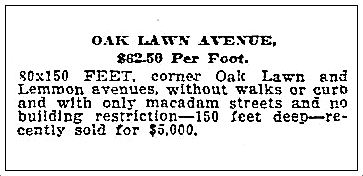
The hard-to-read “significant comparison” text from the middle of the ad above:

ad-highland-park_dmn_051411-det1

ad-highland-park_dmn_051411-det

ad-highland-park_dmn_051411-det3

*

Is this the same view as seen in the top photo showing “Lakeside Drive Entrance to Second Section” (off Armstrong)?

lakeside_armstrong-google
Google Street View

Hope your forebears didn’t miss out! (Mine did!)

***

Sources & Notes

Read more about the C. U. Whiffen house featured in both the 1910 and 1911 ads here. I’m happy to report the lovely house at Crescent and Byron is still standing.

Click pictures for larger images!

*

Copyright © 2016 Paula Bosse. All Rights Reserved.


The 101 Bar: Patrick Hannon, Prop. — ca. 1917

101-bar_ca-1917
Pat Hannon’s dreams are about to be dashed…

by Paula Bosse

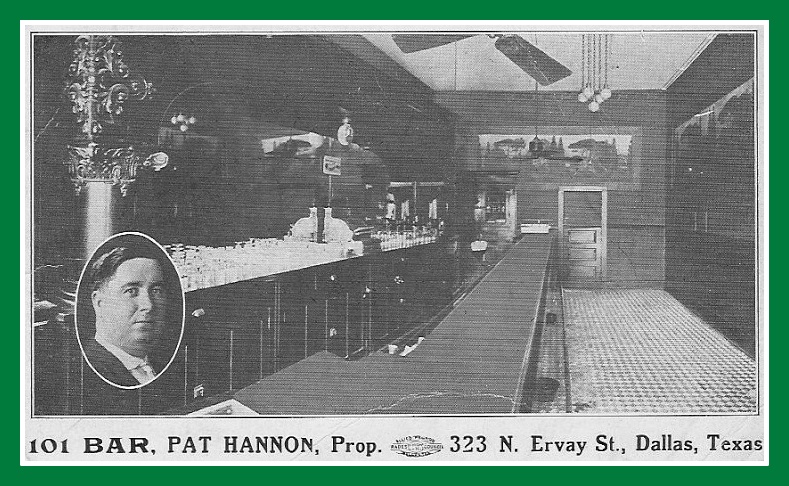
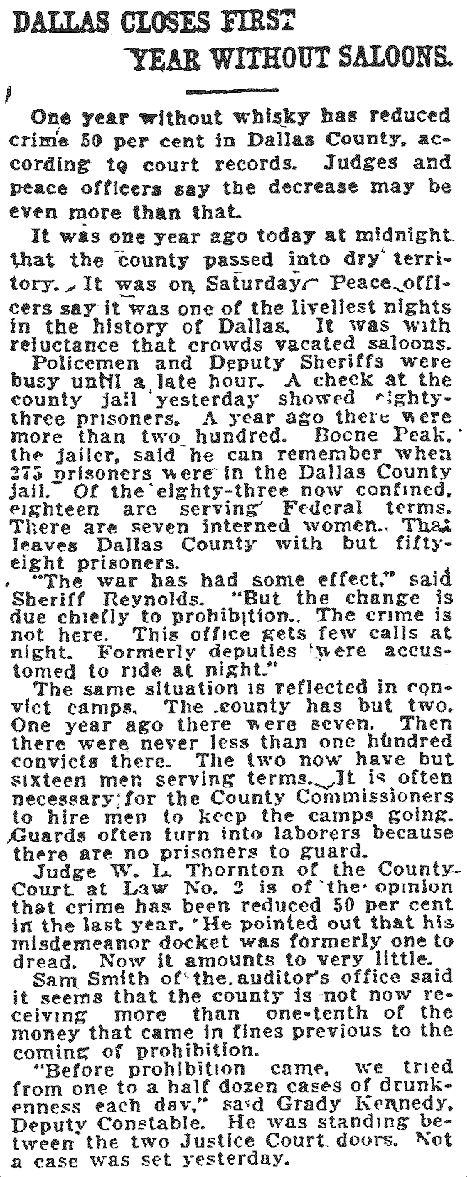
The 101 Bar was located at 323 North Ervay, on the southwest corner of Ervay and Bryan — it is now the site of Thanksgiving Square. The owner was Patrick Hannon who had worked in saloons in Dallas from at least 1908. The bar pictured above opened around 1917 but lasted only a few months — by the time the 1918 directories were printed, 323 N. Ervay was listed as “vacant.” Pat had worked his way up the competitive saloon trade in Dallas, from bartender to owner, only to be cut down by Prohibition. Had Prohibition not gone into effect in 1918 (with Dallas County voting to start even earlier, in October, 1917), this fine-looking  bar might have had a long, boozy life. Pat disappeared from the directory completely in 1918, but he was back in 1919, with a new occupation: butcher. Meat-cutting is all well and good and certainly pays the bills, but I bet in his idle moments, Pat’s thoughts turned to daydreams of his old Ervay St. bar.

The 1917 Dallas directory showed 183 bars operating in Dallas; the next year, zero.

Bad timing, Pat.

***

Sources & Notes

I’m not sure where the photo came from — some random web page, I think.

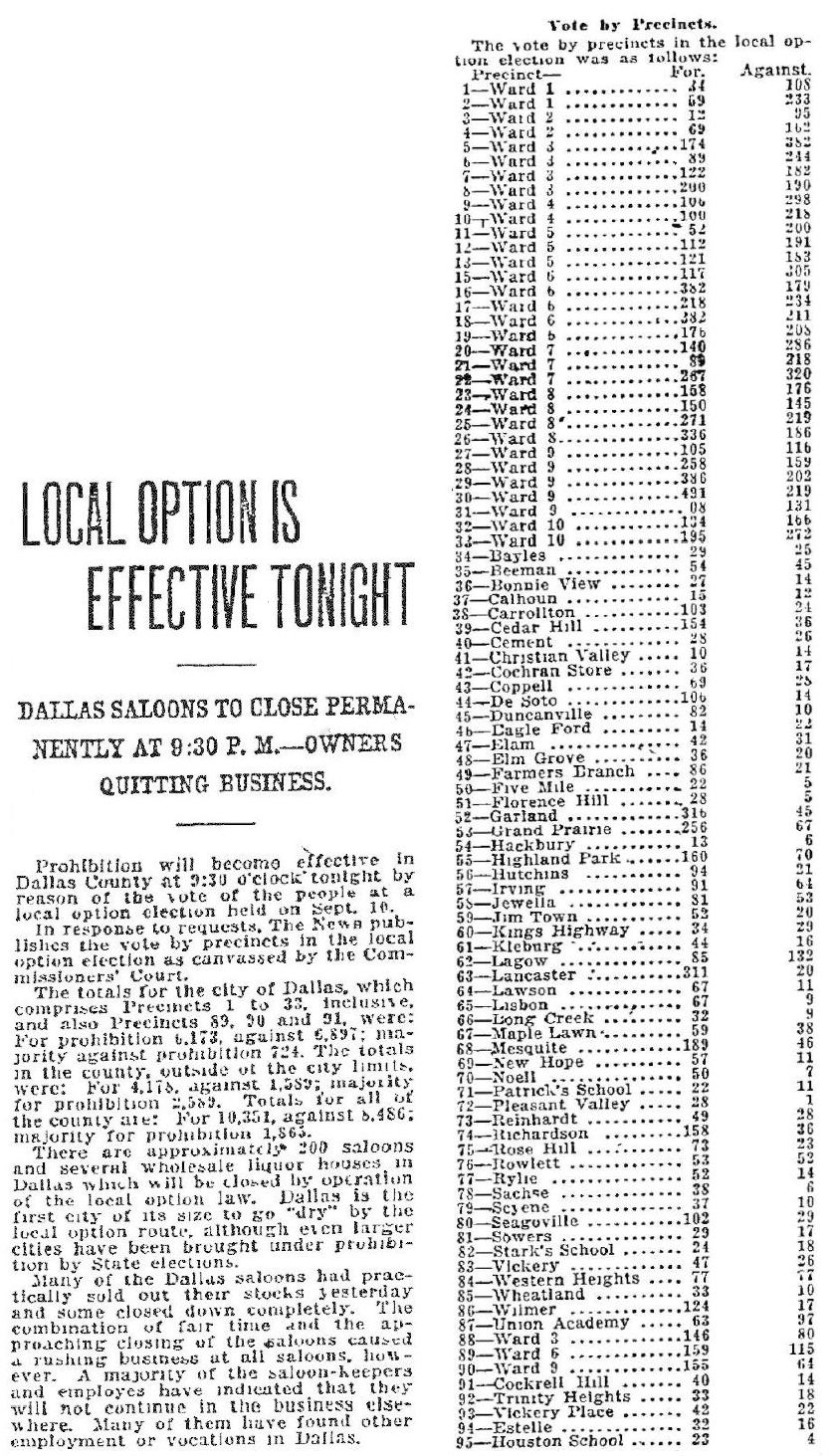
Why did Dallas County go dry so early? Because of a “local option” vote in September 1917. The city of Dallas voted against it, but the surrounding communities voted overwhelmingly FOR it. (You could still drive over to Fort Worth for legal beer and hooch, though.) Election results below (click for larger image). 

prohibition_local-option_dmn_102017Dallas Morning News, Oct. 20, 1917

How were things faring a year later?

probibition_dallas-co_dmn_102018DMN, Oct. 20, 1918

This has been a rather tenuously-associated St. Patrick’s Day post (Irish name, bar, green border), but … Happy St. Patrick’s Day!

*

Copyright © 2016 Paula Bosse. All Rights Reserved.

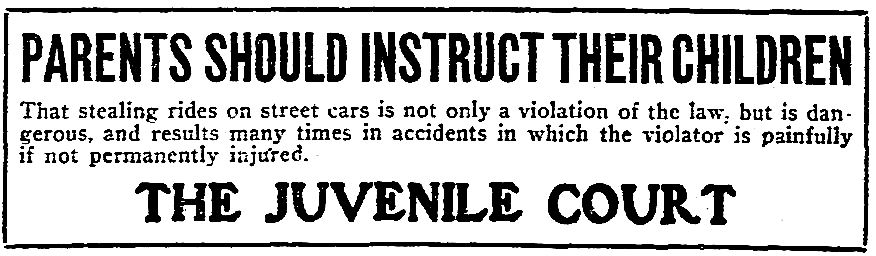
A Word From the Juvenile Court on Stealing Rides on Streetcars…

akard-car_cook-coll_degolyerThe Akard St. trolley, car #249 (click for larger image)

by Paula Bosse

…DON’T DO IT!

streetcar-ride-stealing_dmn_071309Dallas Morning News, July 13, 1909

***

Photo titled “Two Streetcar Employees with Dallas Streetcar No. 249,” is from the George W. Cook Dallas/Texas Image Collection, DeGolyer Library, Central University Libraries, Southern Methodist University; is can be accessed here.

Both images larger when clicked.

*

Copyright © 2016 Paula Bosse. All Rights Reserved.

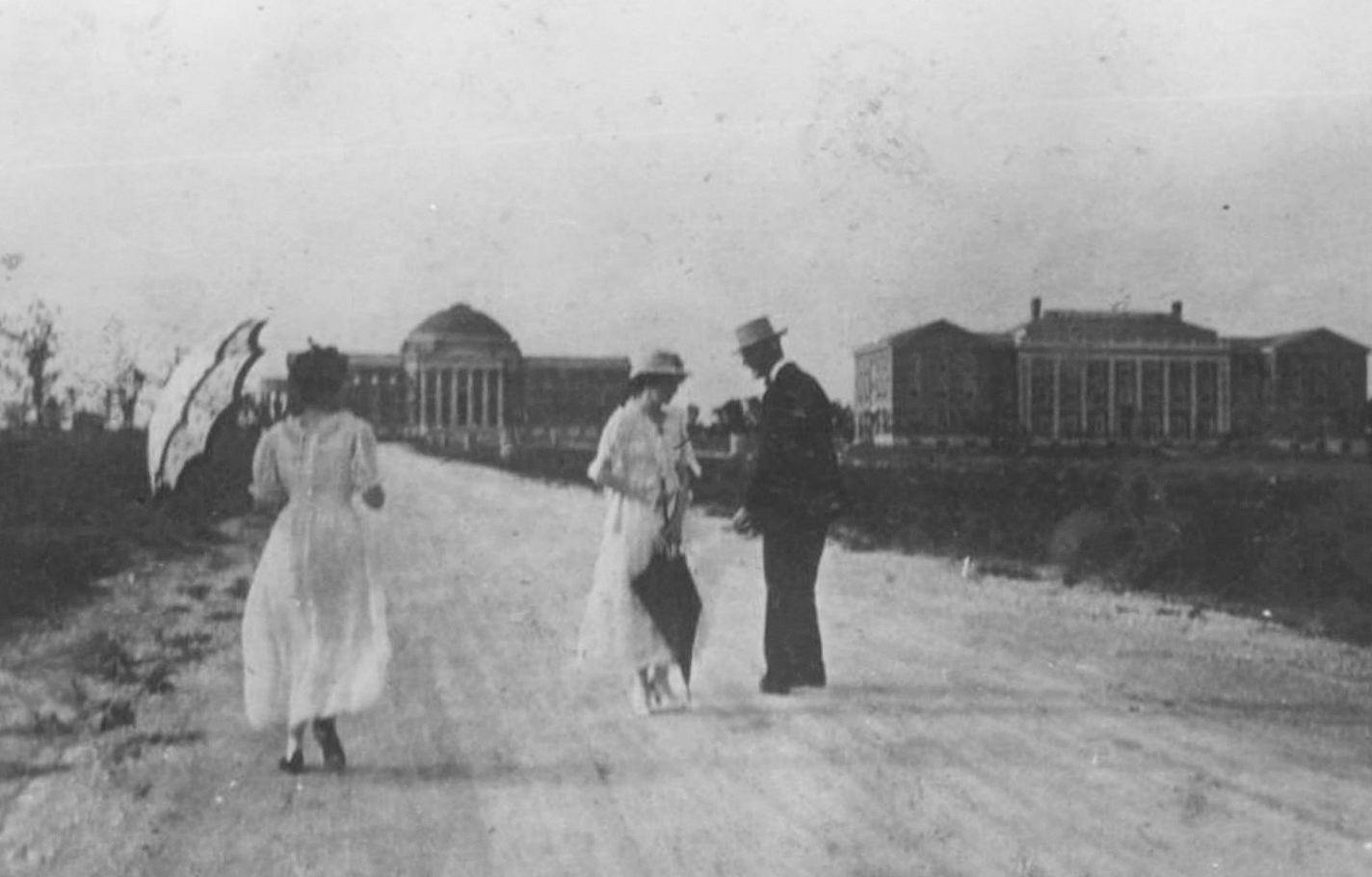
Parasols on the SMU Campus — 1917

smu_parasols_1917_degolyerSMU, sparsely populated

by Paula Bosse

I love this photo showing a man and two women with parasols walking up an unpaved Bishop Blvd. toward Dallas Hall. The women’s dormitory, Atkins Hall, is on the right. …And that’s it.

***

Sources & Notes

Photo titled “Dallas Hall and women’s dormitory in 1917” is from the DeGolyer Library, Central University Libraries, Southern Methodist University; more information is here. (I have straightened the image, and corrected the color somewhat.)

*

Copyright © 2016 Paula Bosse. All Rights Reserved.

The Washington Theater — Dallas’ First Movie Palace

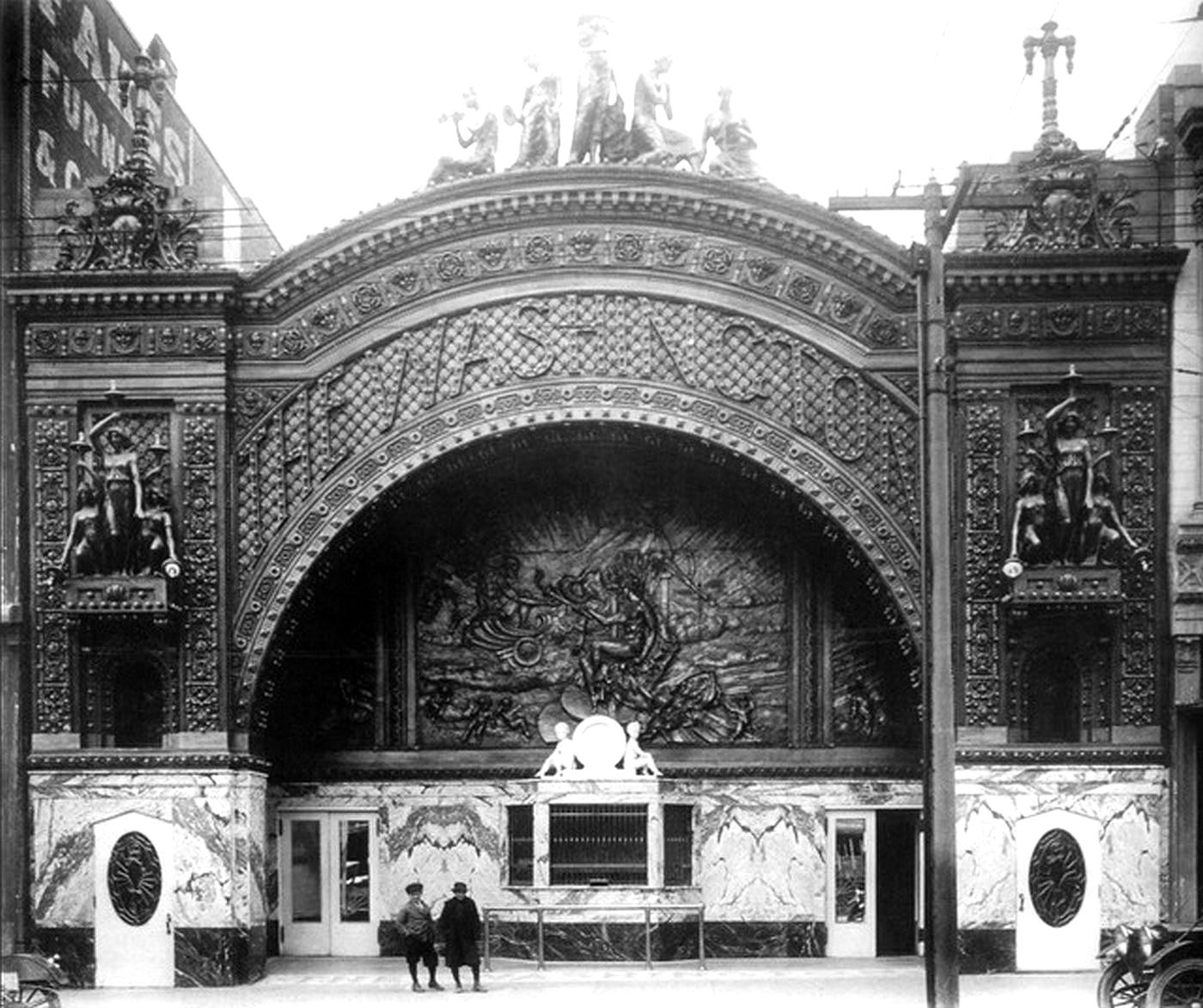
washington-theatre_cinema-treasures_lgThe Washington, 1615 Elm

by Paula Bosse

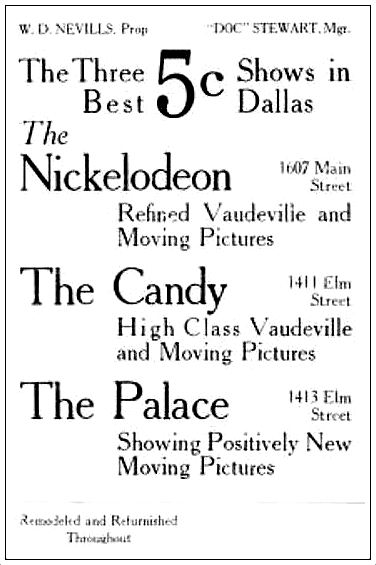
The outrageously ornate Washington Theater was built in 1912 by W. D. Nevills (1872-1945), a man who had been running cheap little store-front nickelodeons in Dallas for several years. Three of his most popular were The Nickelodeon, The Candy, and The Palace (not to be confused with any later theaters in Dallas called the “Palace”).

nevills_standard-blue-book-of-tx_1912-14Standard Blue Book of Texas, 1912-1914

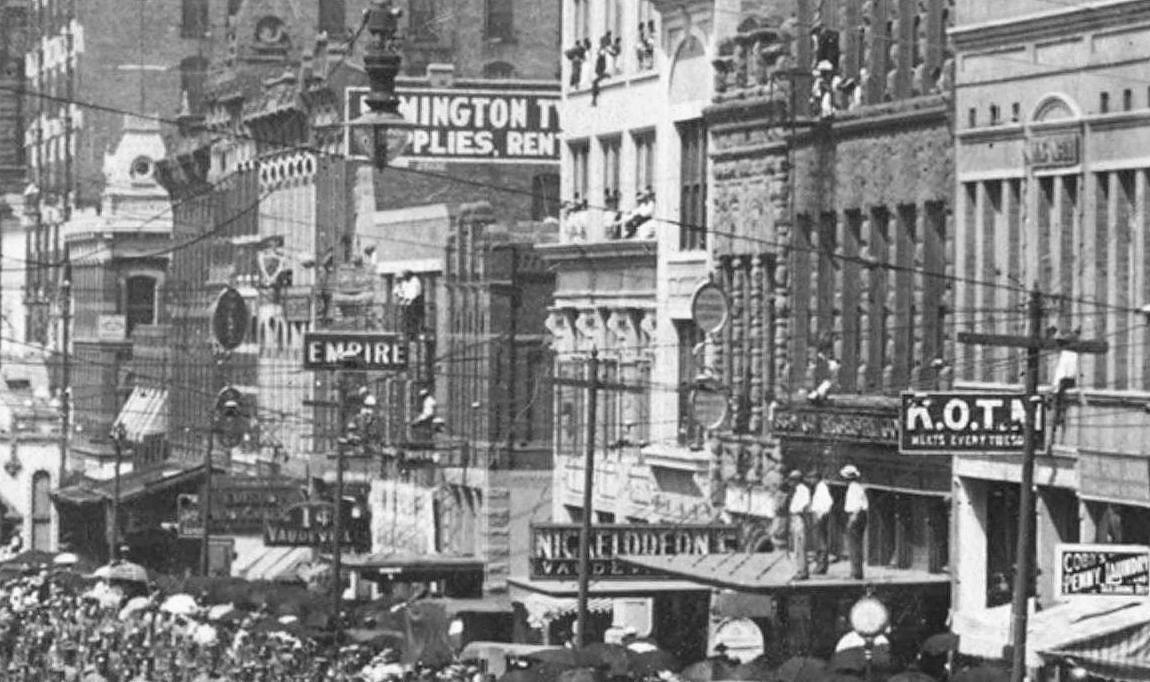
His Nickelodeon on Main Street can be seen in the lower center of this detail from a larger 1909 parade photo.

parade-day_1909_det41

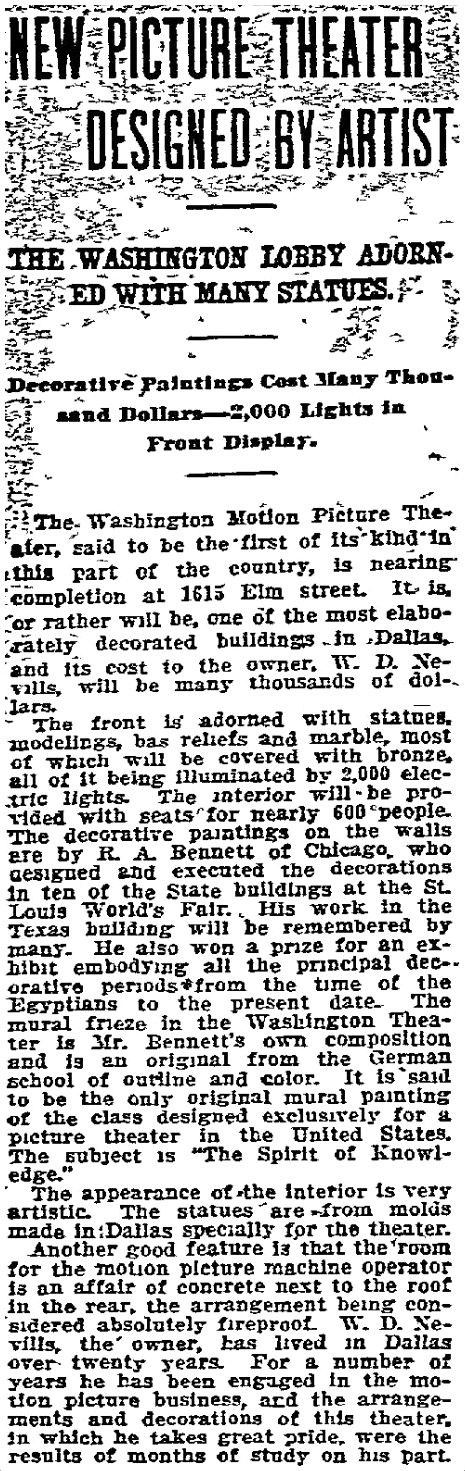
Nevills must have raked in a lot of nickels, because when his Washington Theater opened at 1615 Elm Street, it was the most spectacular motion picture “photoplay house” in Dallas. Nevills spared no expense for the theater’s furnishings and facade.

washington-theater_dmn_111712Dallas Morning News, Nov. 17, 1912 (click to read)

What might seem a little gaudy now, was probably still gaudy back then, but it was a fresh, NEW gaudy! And 600 Dallasites could all watch a movie at the same time. 600! Unheard of!

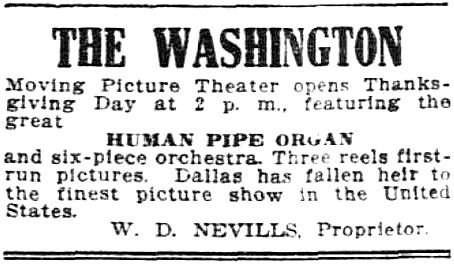
The Washington opened on Thanksgiving Day, 1912. Complete with “Human Pipe Organ.”

washington-theater_dmn_112712DMN, Nov. 27, 1912

The Washington was the king of the roost for only a short while, though — until young whippersnappers like the Queen began to steal its thunder. 600 seats? Pfft! It was a thousand or nothing now. The theater began to lose its luster and look more old and hulking than young and exciting, and after riding out its very long lease, the Washington Theater closed on July 1, 1927.

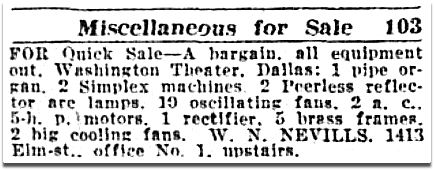
This little classified showed up a couple of weeks later, and it must have been a melancholy Nevills who had to write it up.

washington-theater_dmn_071327DMN, July 13, 1927

The theater continued to be used for a while — mostly for evangelical meetings or events. I’m not sure exactly when the building was demolished, but a report of the building’s being sold and plans for its razing appeared in The Dallas Morning News in October, 1927.

*

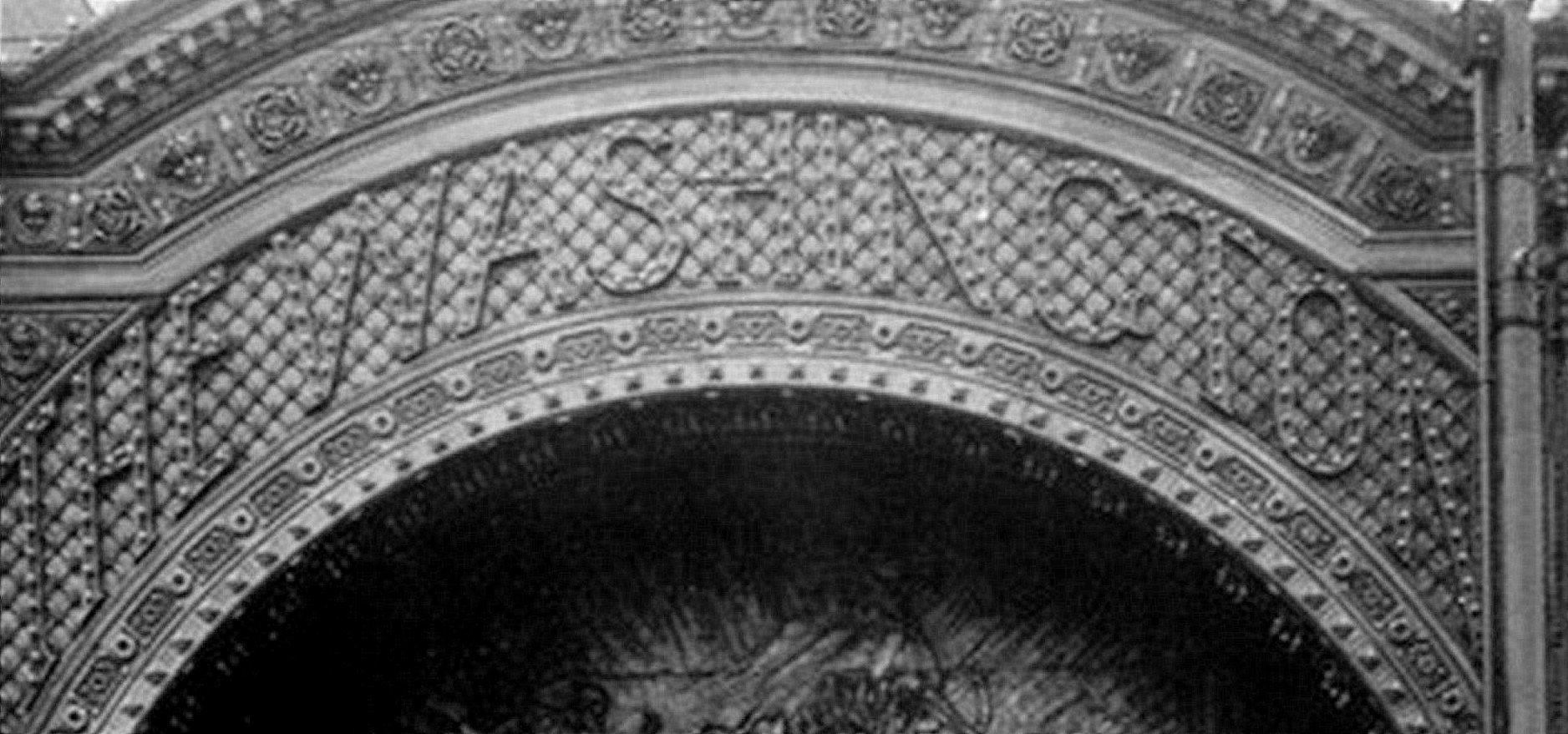
Let’s look at a couple of details from that top photo. The Washington was built without a marquee, but the outside of the building was studded with an eyeball-popping TWO THOUSAND LIGHTS! Imagine what that must have looked like — in 1912! Here’s an extreme close-up of the theater’s facade — look at all those bulbs!

washington-theatre_cinema-treasures_det1

And, below (was one of these men W. D. Nevills?):

washington-theatre_cinema-treasures_det2

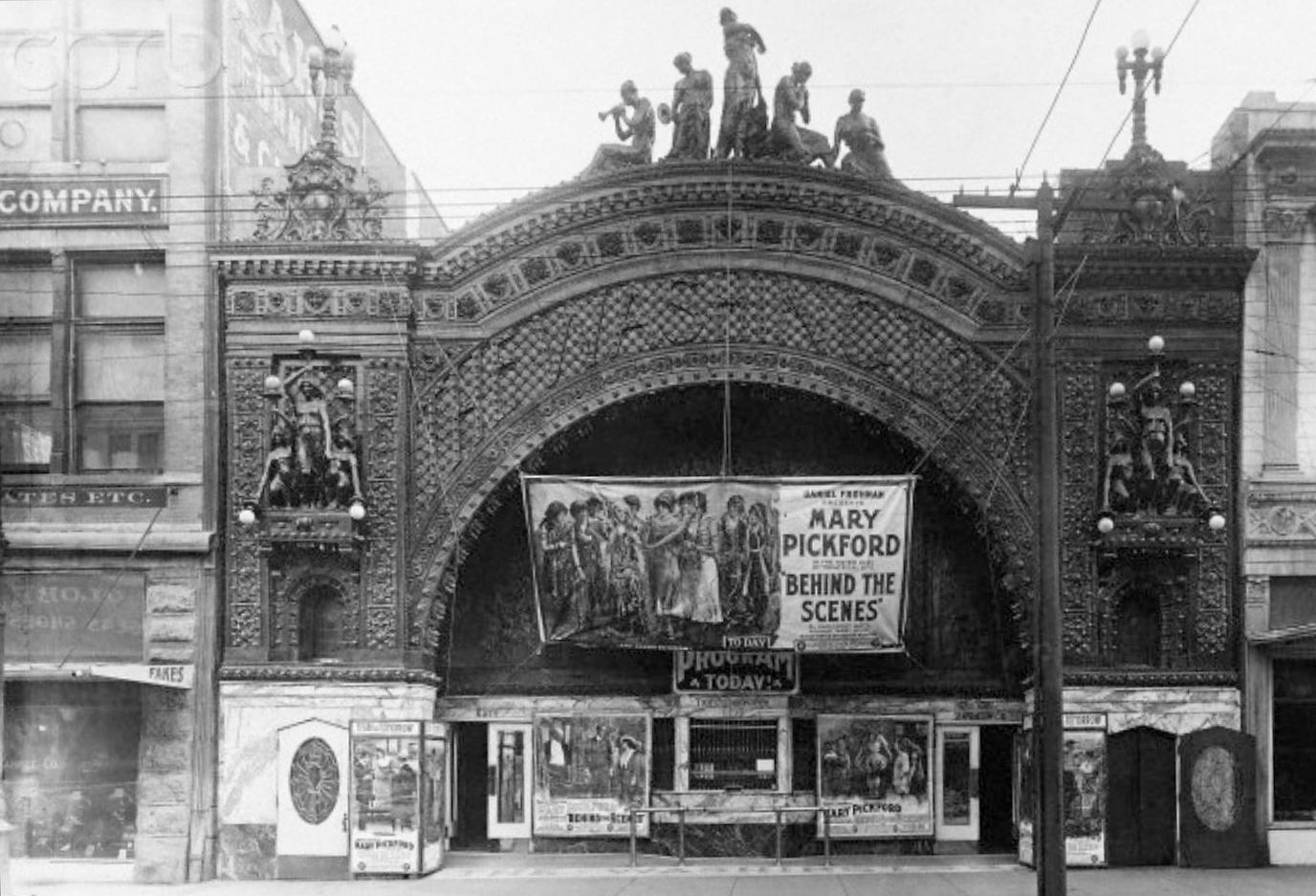
Another shot, this one showing how one worked without a typical illuminated marquee — you just string a banner up (the needle is hitting a solid “8.5” on the visual clutter scale here):

washington-theatre_corbis_19141914 via CorbisImages

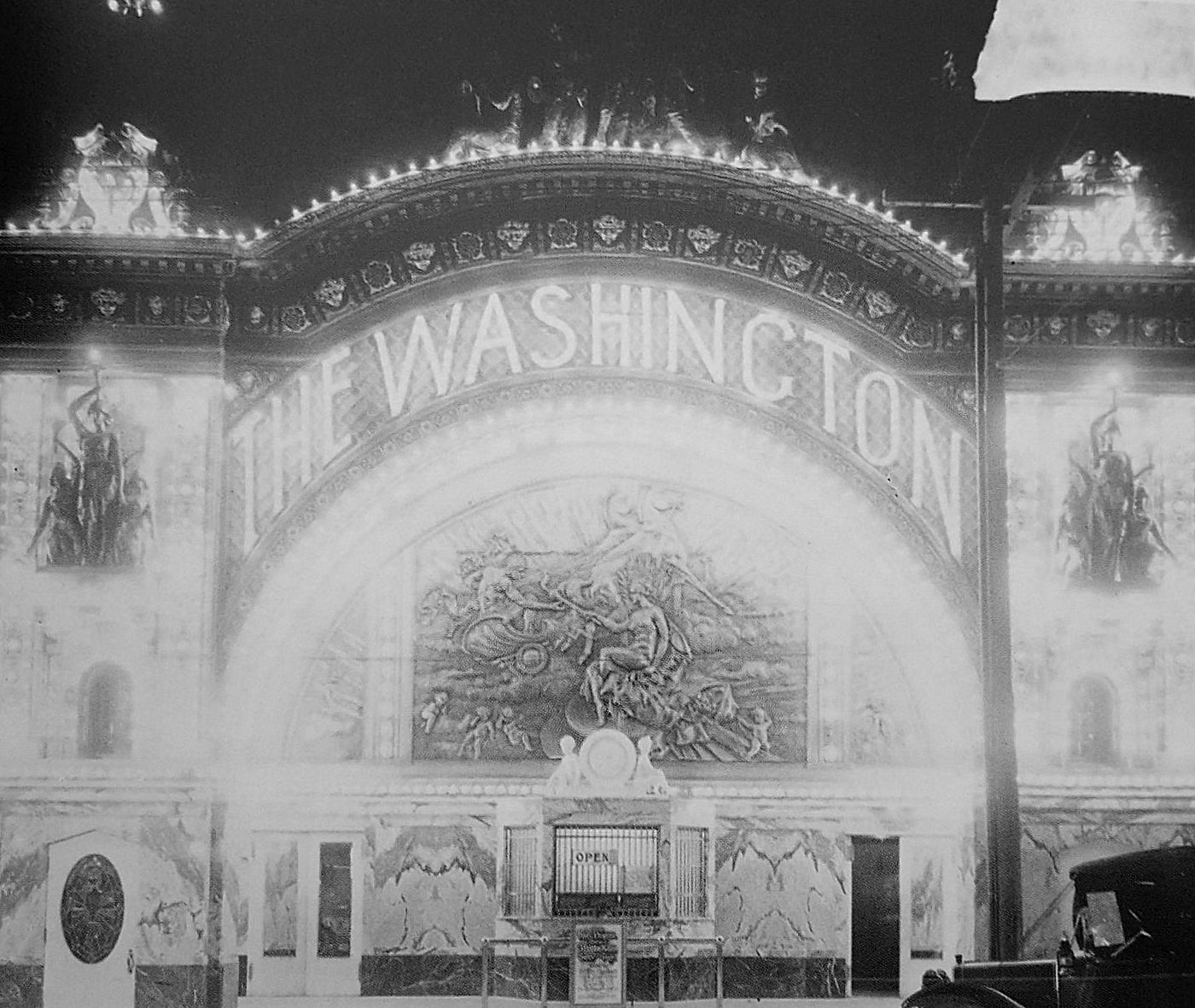
Here it is, ablaze at night:

washington-theater_night_dallas-rediscovered_DHS

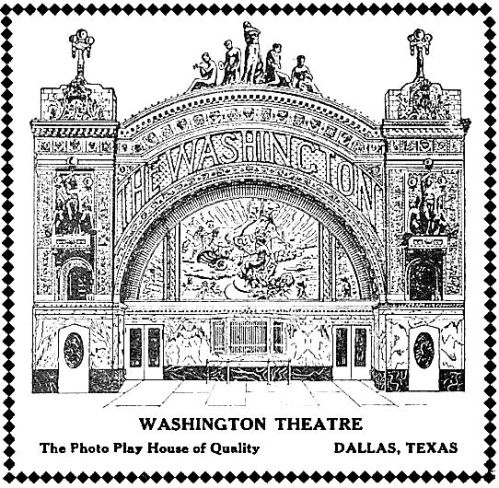
In an ad from 1914:

theater_washington_bldg-code_1914

Photo from October 1916:

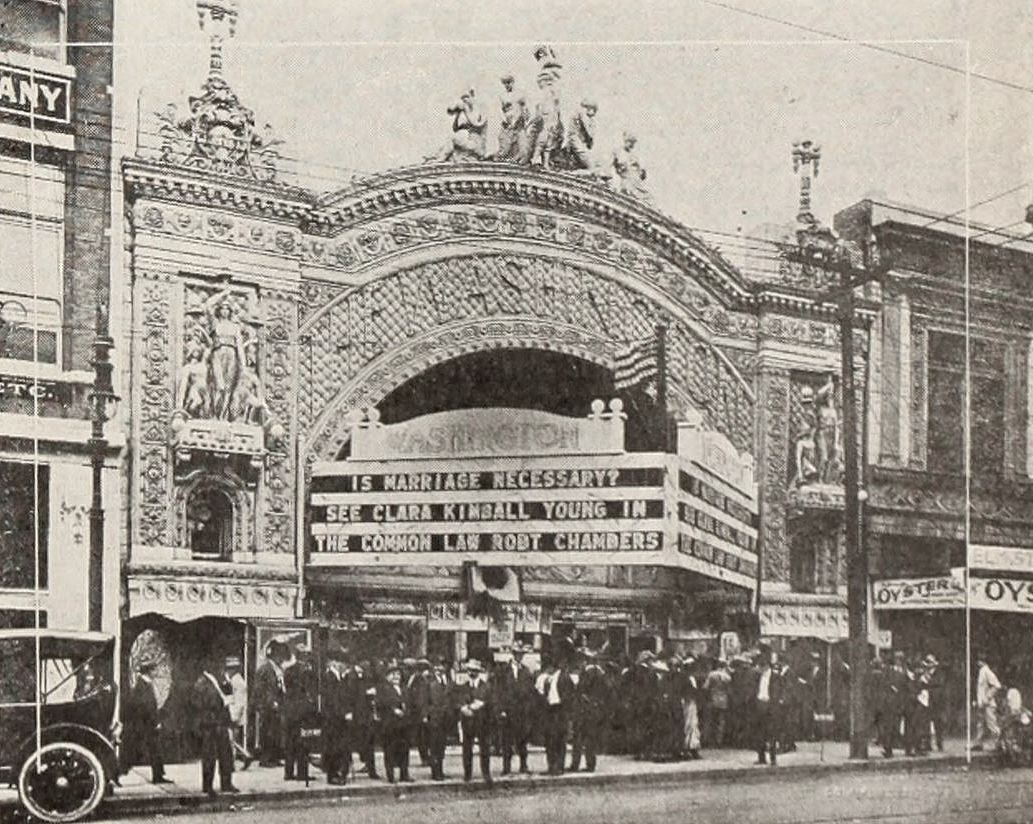
theaters_washington-theatre_exhibitors-herald-and-motography_june-1919_photo-from-oct-1916

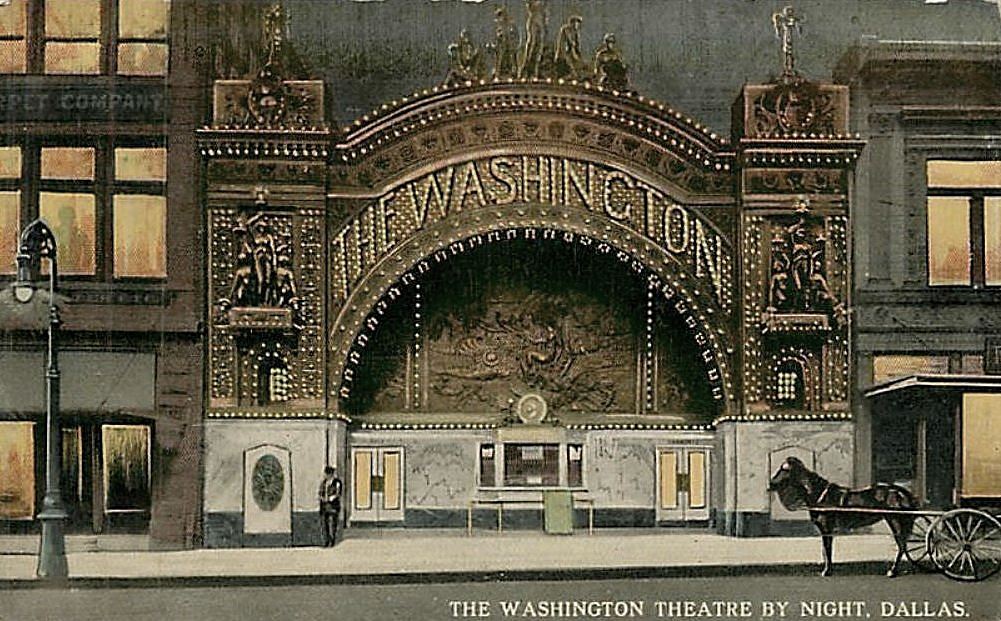
And in “color” from a picture postcard:

washington-theatre_ebay

***

Sources & Notes

Top photo from Cinema Treasures; to read a history of the Washington Theater from Cinema Treasures (and to see another photo), see here. (Photo’s original source appears to be the Dallas Historical Society.)

The photo of the theater with the Mary Pickford banner is ©Schenectady Museum; Hall of Electrical History Foundation/CORBIS; more info is here. (The movie “Behind the Scenes” was released in 1914.)

Photo of the theater at night is from Dallas Rediscovered by William L. McDonald — source: Dallas Historical Society archives.

The ad is from the 1914 Dallas Building Code.

Photo with the marquee showing “The Common Law” is from Oct. 1916, but the photo didn’t appear in the trade magazine Theatre Exhibitors Herald and Motography until June 1919.

The color postcard is from eBay.

Read about the closing of the Washington in an article available in the Dallas Morning News archives: “Washington Theater, Earliest Dallas ‘Movie Palace,’ Shows Last Close-Up After 15 Years” (DMN, July 4, 1927).

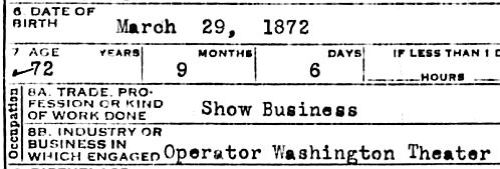
The Washington Theater must have been W. D. Nevills greatest achievement. It’s interesting to note that “Operator Washington Theater” appears on his death certificate. Nevills died in 1945, eighteen years after the theater closed.

nevills_death-certificate_010545_det

For other Flashback Dallas posts on this era of movie theaters, see the following:

  • “Three of Dallas’ Earliest ‘Photoplay Houses’ — 1906-1913,” here
  • “Movie Houses Serving Black Dallas — 1919-1922,” here

*

Copyright © 2016 Paula Bosse. All Rights Reserved.

A Bird’s-Eye View Over the Washington Theater

washington-theater_aerial_dmn_lost-dallas_dotyAs the crow flies…

by Paula Bosse

This wonderful photo shows an aerial view looking northeasterly over the top of the Washington Theater, Dallas’ first ornate movie palace. It was located between N. Akard and N. Ervay, at 1615 Elm Street — now the site of Thanksgiving Tower. I think the street at the top right edge of the photo is Live Oak, which used to come all the way through to Elm. I love this photo.

***

Sources & Notes

Photo from Lost Dallas by Mark Doty (Charleston: Arcadia Publishing, 2012).

Bird’s-eye view today-ish (with 1615 Elm marked):

1615-elm-street_bingBing Maps

The Washington Theater was in business at 1615 Elm from 1912 to 1927. More on the Washington in the Flashback Dallas post “The Washington Theater — Dallas’ First Movie Palace,” here.

*

Copyright © 2016 Paula Bosse. All Rights Reserved.