Flashback : Dallas

A Miscellany: History, Ads, Pop Culture

Category: 1920s

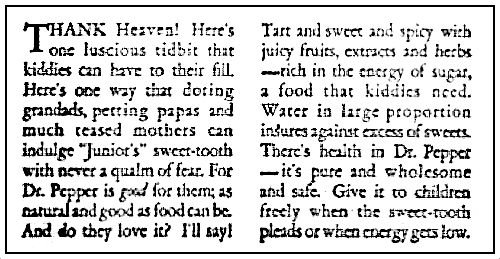
Dr Pepper Ad: “I’ll Have Another Myself” — 1929

dr-pepper_dmn_052729

by Paula Bosse

Drink up, kids — Gramps is buying! “It’s pure and wholesome and safe.”

ad-dr-pepper_dmn_052729-text

And the tag line: “It’s A Good Habit To Get — It’s One That Won’t Get You.”

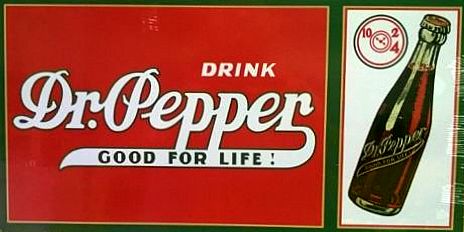
dp-sign

***

Ad from 1929.

Reproduction of period sign found on eBay.

*

Copyright © 2015 Paula Bosse. All Rights Reserved.


MORE Random Still-Standing Buildings Featured in Ads From 1929

ad-southern-fountain-fixture_directory_1929-detSoda fountains came from here…

by Paula Bosse

A few more photos of buildings that are still standing, from the ad-pages of the 1929 city directory.

First up is the Southern Fountain & Fixture Mfg. Co. at 1900 Cedar Springs.

ad-southern-fountain-fixture_directory_1929

The Southern Fountain & Fixture plant was built in 1925 at the corner of Cedar Springs and N. Akard. They manufactured and sold soda fountains, showcases, and fixtures.

A major new residential high-rise is going up in the 1900 block of Cedar Springs (or has gone up — it’s been a while since I’ve been over there), but I think it’s going up at the other end of the block. (But somehow its address is 1900 Cedar Springs….) So, I’m not absolutely sure this building IS still there. Here’s a 2014 image from Google Street View. It’s a cool building — hope you’re still there, cool building!

southern-fountain-fixture-now_googleGoogle Street View

*

Next, the Loudermilk-Sparkman Funeral Home at 2115 Ross Avenue.

ad-loudermilk-sparkman_belo_directory_1929(click for larger image of house)

The “home-like” Loudermilk-Sparkman funeral home moved into the former home of Col. A. H. Belo in June 1926 and settled in for a 50-year lease. (An article titled “Morticians In New Quarters” appeared on June 27, 1926 in The Dallas Morning News, complete with descriptions of interior decoration and architectural details.)

That place was a funeral home for 50 years — longer than it’s been anything else. That’s a lot of dearly departeds. (Clyde Barrow is probably the most famous cadaver to be wheeled through its portals.) In the ’70s, the granddaughter of Col. A. H. Belo sold the house — which was built in 1899/1900 — to the Dallas Bar Association, and today it is a swanky place to get married or eat canapés. And, thankfully, it’s still beautiful.

belo-today_googleGoogle Street View

*

 The Evangelical Theological College, 3909 Swiss Avenue, in Old East Dallas.

ad-evangelical-theological-college_directory_1929sm(click for larger image)

This “denominationally unrelated” seminary — where tuition and rooms were free, and board was at cost — was built in 1927 for $65,000. When the three-story-plus-basement building was finished, the college was in its fourth year, having moved from its previous location in The Cedars. “The college now has forty-five students representing fifteen states of the United States, three Canadian provinces and Ireland…. The faculty is composed of thirteen men…” (DMN, Dec. 25, 1927).

ad-evangelical-theological-college_directory_1929-det

The college has grown by leaps and bounds and is now the Dallas Theological Seminary, and the original building is still there.

dallas-theological-seminary_now_googleGoogle Street View

*

Lastly, the Melrose Court Apartments and Hotel, 3015 Oak Lawn.

ad-melrose_directory_1929

The Melrose, designed by architect C. D. Hill, was built in 1924, and as it was about to throw open the doors of its bachelor apartments to eager Dallas bachelors (and whomever), it advertised itself thusly: “Of palatial splendor, rivaling in dimensions the best appointed apartment hotel buildings of this modern day, it is equal to the best of any of America’s cities of a million.” (DMN, Aug. 31, 1924) Well, of course it is!

ad-melrose_directory_1929-det

It’s been a landmark in Oak Lawn for over 90 years. I know it’s officially now the Warwick Melrose Hotel, but I’ve never heard anyone call it anything but The Melrose.

melrose-today

***

Sources & Notes

All ads from the 1929 city directory.

My previous post “Random Still-Standing Buildings Featured in Ads From 1927” is here.

*

Copyright © 2015 Paula Bosse. All Rights Reserved.

Random Still-Standing Buildings Featured in Ads From 1929

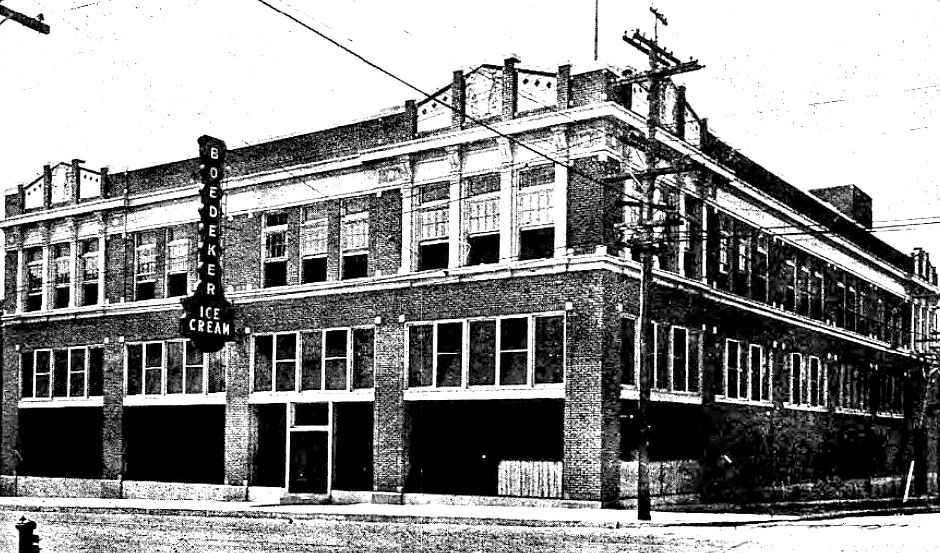
ad-boedeker-ice-cream_1929-directoryS. Ervay & Griffin — still there! (click to see larger image of building)

by Paula Bosse

I’ve always had a fascination for old advertisements. Ads for local products and businesses are particularly interesting and can be quite informative — especially those that feature photographs of the businesses being advertised. I always get an exciting little jolt when I see a still-standing building that I recognize in a 50-, 60-, or 70-year-old ad. Below are a few ads from 1929 — 86 years ago! — featuring buildings that have somehow survived the wrecking ball. Not all of them are architecturally interesting, but they’ve all seen a lot more than you and I have. Click the ads below to see larger images of the buildings.

*

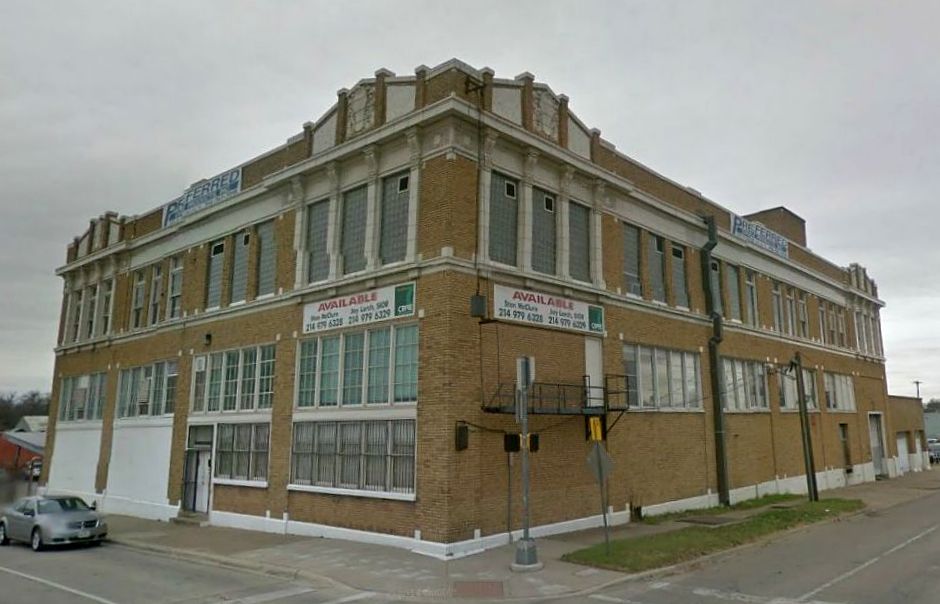
Above, the Boedeker Ice Cream plant — the “finest in the South,” located at S. Ervay & Griffin (1201 S. Ervay). The company was founded in 1887 by German Frederick Boedeker, the first ice cream manufacturer in Dallas. This building was built, I believe, around 1921. I’m not sure what’s in there these days (if anything), but here  is it today, via Google Street View:

ad-boedeker-ice-cream_now_google

UPDATE: Apparently there are plans afoot — read about them here.

*

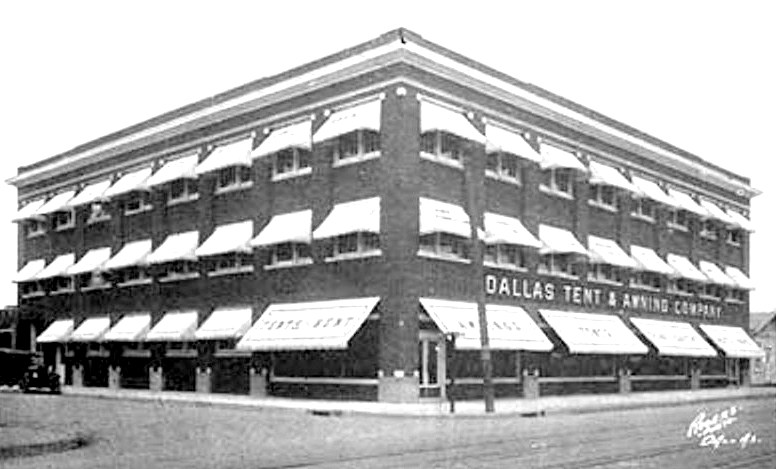
Next, the Dallas Tent & Awning Company at 3401 Commerce.

ad-dallas-tent-awning_directory_1929(click to see larger image of building)

This very successful company moved several times to larger and larger spaces, until they decided to build their own showroom and manufacturing plant in 1921. A 1922 Chamber of Commerce ad described the building as “a three-story modern building, 100 feet square with a warehouse in the rear which covers 40,000 square feet, Commerce and Race streets.” They manufactured tents, awnings, automobile tops, tire covers, and seat covers.

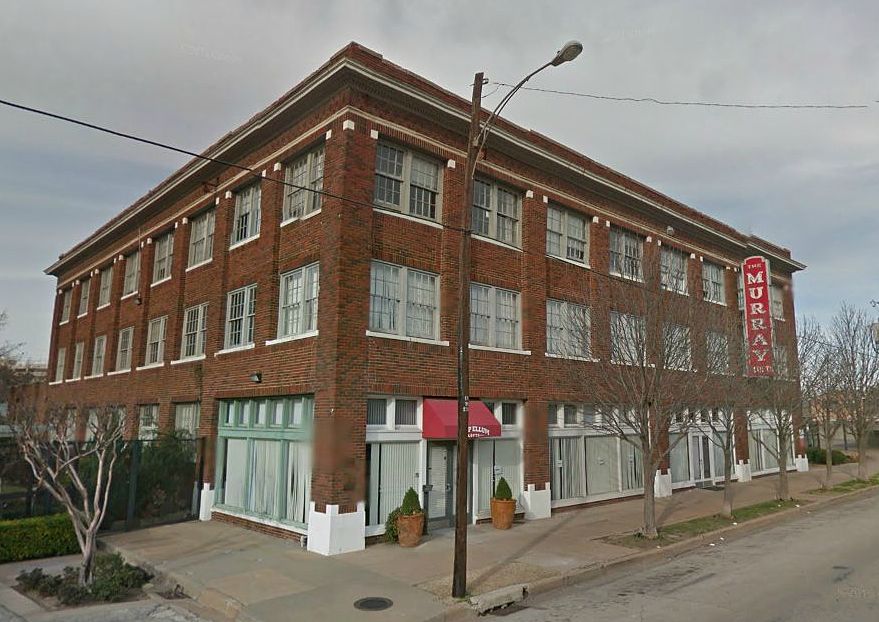
Here it is today, the cool-looking Murray Lofts, between Deep Ellum and Exposition Park:

murraylofts

(I’m not sure if the house in this ad was in Dallas, but I hope so! What a beautiful house! A larger image is here.)

*

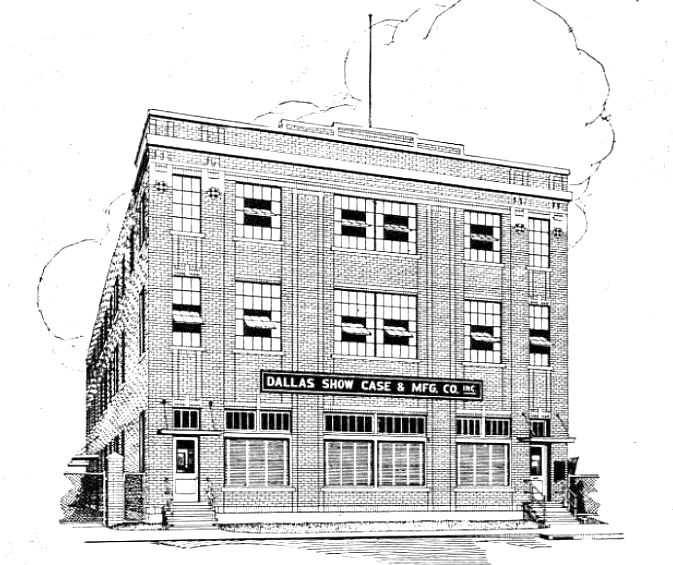
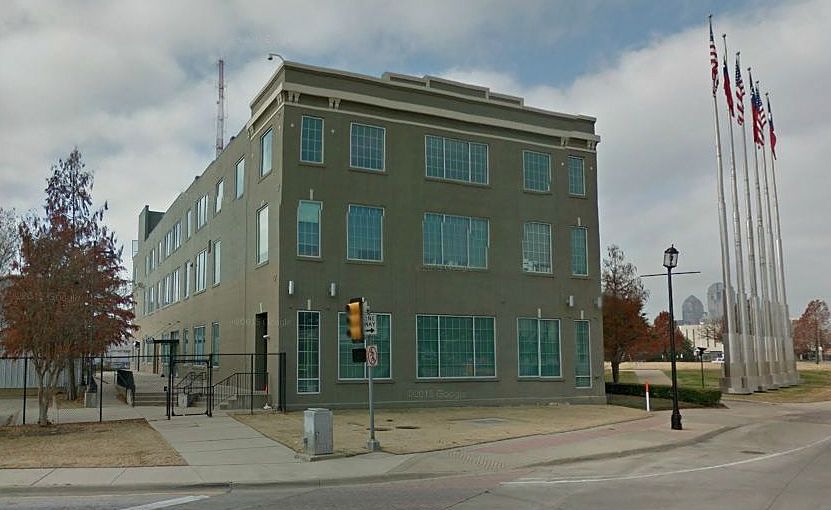
Next, the Dallas Show Case & Mfg. Co. at 329-337 Exposition.

ad-dallas-show-case_directory_1929(click to see larger image of building)

According to a 1962 interview with Otto Coerver — the son of the company’s founder — the factory was built in 1920 just blocks from Fair Park — a location so far “out in the country” that there was no city electric service. Since its founding in 1880, the company had manufactured “bank, office and store fixtures, showcases, hardwood floors and special household and church furniture.” The building still stands, but I’m not sure who occupies it these days.

ad-dallas-show-case_now_google

*

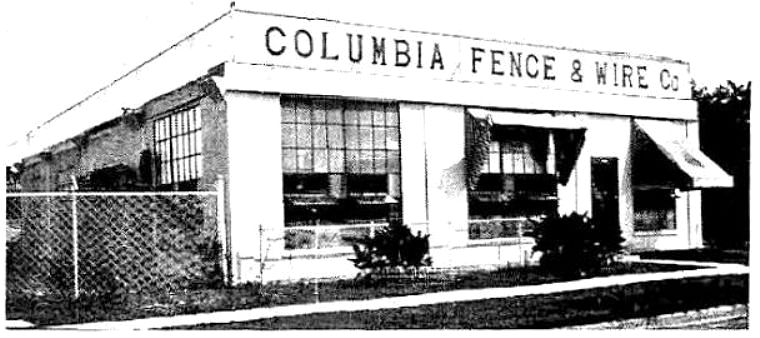
And, lastly, the Columbia Fence & Wire Co. at 3120 Grand Avenue.

ad-columbia-fence-wire_directory-1929sm(click to see larger image of building)

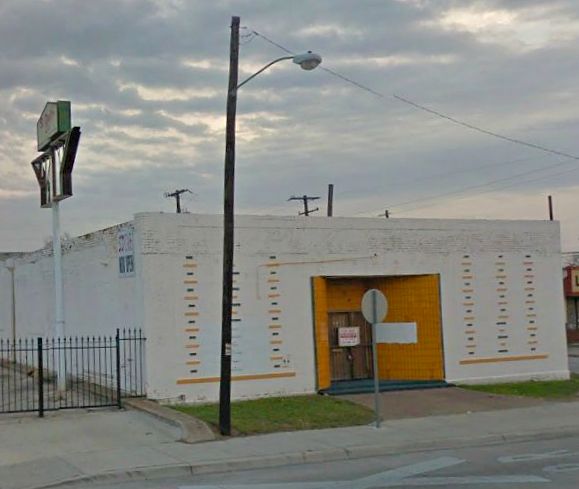
Though it’s been there since at least 1922, this building is one that I have to admit I probably wouldn’t shed a tear over were it to be demolished. Still, it’s been around a lot longer than I have, and I have to admire the fact that it’s managed to hang on for so many years.  After the Columbia Fence & Wire Co. moved on, the building was occupied by a succession of light industrial businesses. In the 1970s it must have gone through quite a renovation, because it became home to a string of discos, including the short-lived Lucifer’s (owned by Dallas Cowboy Harvey Martin), the Plush Pup, and Papa Do Run Run. Below, the current Google street view (the sign above the vacant building says “S. Dallas Cafe”):

ad-columbia-fence-wire_now_google

 ***

Sources & Notes

All ads from the 1929 city directory. (Apologies for the muddy images. Whenever I post these directory ads, they look great before they’re posted, then something happens during the uploading process, and … argh.)

Present-day images from Google Street View.

A continuation — “MORE Random Still-Standing Buildings Featured in Ads From 1929” — can be found here.

*

Copyright © 2015 Paula Bosse. All Rights Reserved.

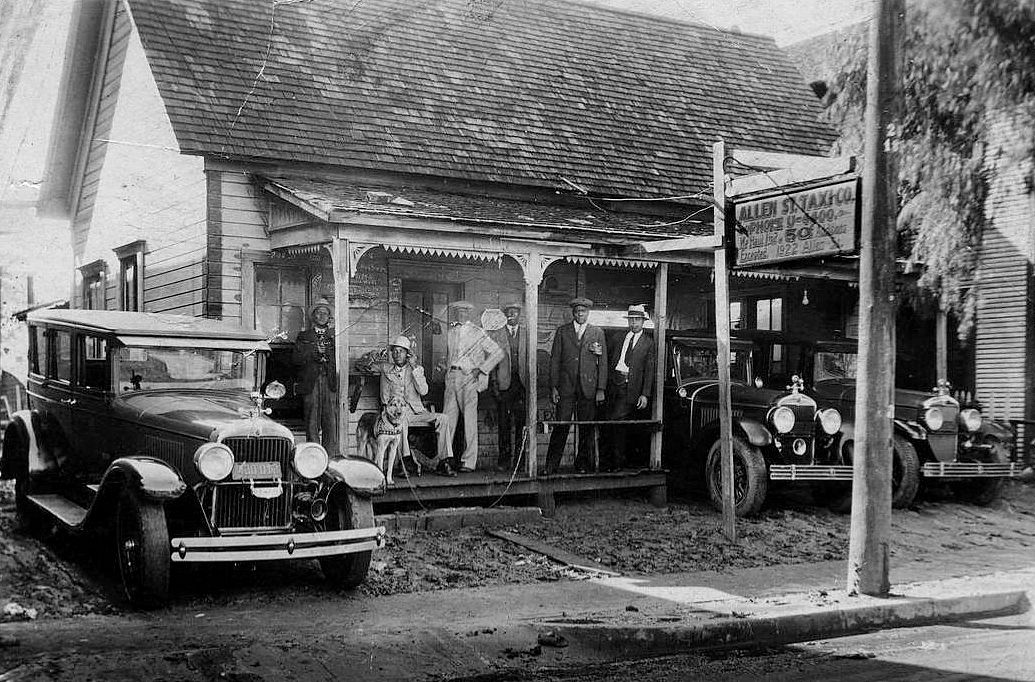
The Allen Street Taxi Company

allen-st-taxi-co_cook-degolyerAllen St. Taxi Co. / George W. Cook Collection, SMU

by Paula Bosse

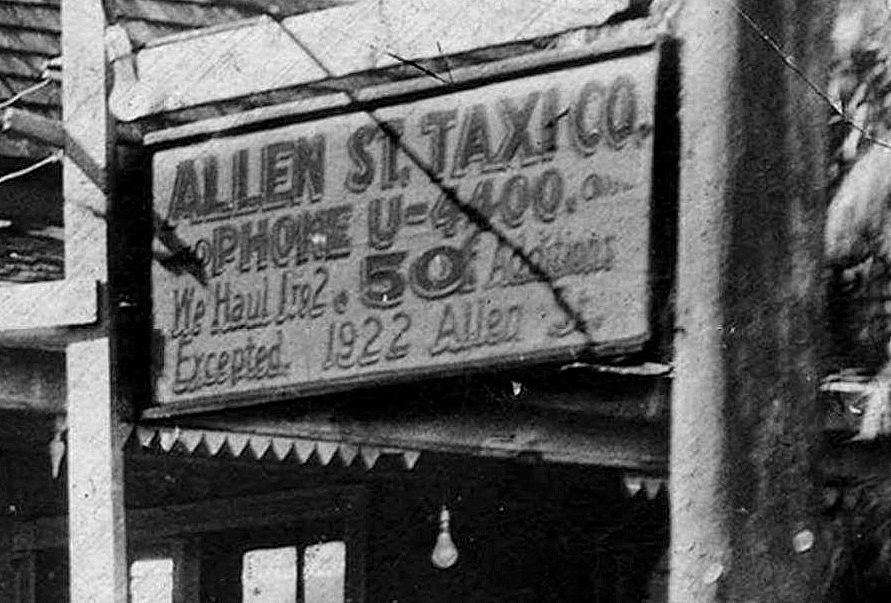
This has to be one of my favorite “unknown Dallas” photographs that I’ve come across. It shows the Allen St. Taxi Co. — in the State-Thomas area — at 1922 Allen Street (now pretty much vacant land under the Woodall Rodgers freeway). My ability to date cars is not good, but from city directory information, it seems that this photo might date from somewhere between the mid-1920s to around 1930. The owners/proprietors of the company were listed as John Leonard and Andrew Short in the 1929 telephone book. I wonder if they are in this fantastic photo? Let’s look a little more closely at some of the details. (All pictures larger when clicked.)

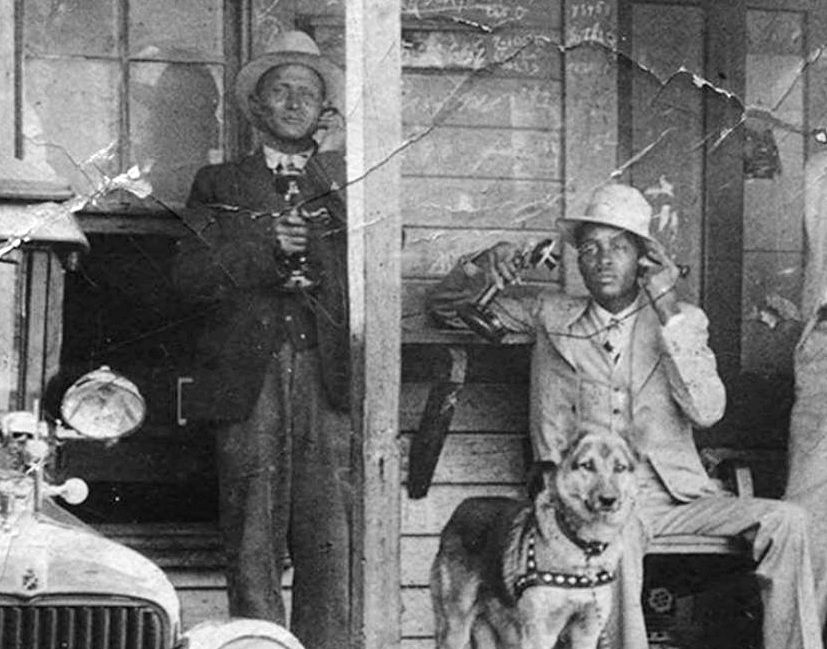
allen-st-taxi-co_cook-degolyer_det2Those phones!

allen-st-taxi-co_cook-degolyer-det4I love these guys. All business.

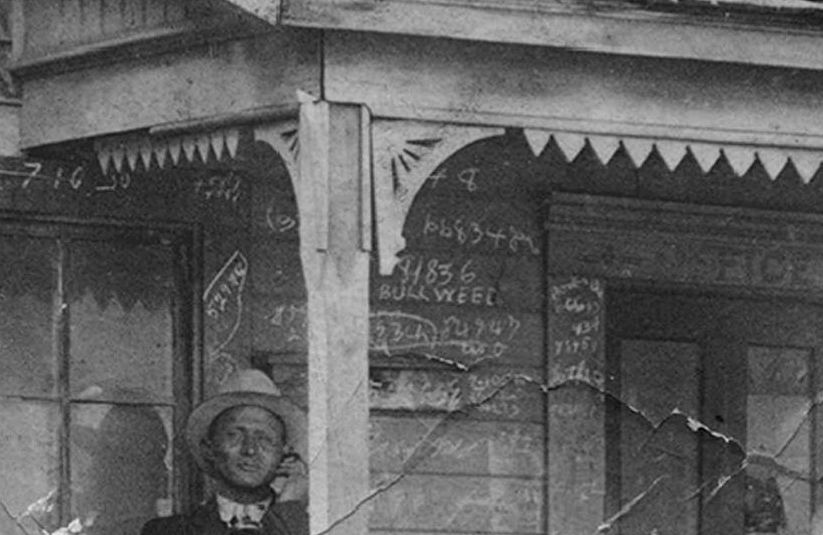
allen-st-taxi-co_cook-degolyer_det5“Bullweed.” What is all this writing? I love the guy’s face looking out of the window.

allen-st-taxi-co_cook-degolyer_det1“Dallas.” Car-people know exactly what make and model this vehicle is. …I am not one of these people.

allen-st-taxi-co_cook-degolyer_det3

***

Sources & Notes

Top photo, titled “Allen Street Taxi Co.,” is from the George W. Cook Dallas/Texas Image Collection, DeGolyer Library, Central University Libraries, Southern Methodist University; it can be viewed here.

The first “official” listing of the Allen St. Taxi Co. was in the 1929 city directory. The address at that time (which usually reflected information supplied the previous year) was 1907 Allen St. It didn’t appear again in the directory until 1932 when it was listed at 2816 Juliette St. In 1933 and 1934 it was listed at 2114 Hall St. In 1936 and 1937 it had moved to 2217 Hugo. And in 1938, the taxi part of the business seems to have fallen by the wayside, and it became Allen St. Transfer.

In 1925 there were only three official cab companies listed in the city directory. But the rough-and-tumble world of taxi cab service in the unregulated ’20s and ’30s was pretty intense. There were a lot of unlicensed jitneys rolling around town, especially, one would assume, in the segregated black neighborhoods of the city unlikely to be served by white-owned companies. My guess is that this might have been how the Allen St. Taxi Co. began.

For more on the go-go-go competitive world of taxi service at this time, see my previous post, “Washington Taxi Company: ‘Call George!'” here.

*

Copyright © 2015 Paula Bosse. All Rights Reserved.

Not Dead Yet at McKinney & Routh

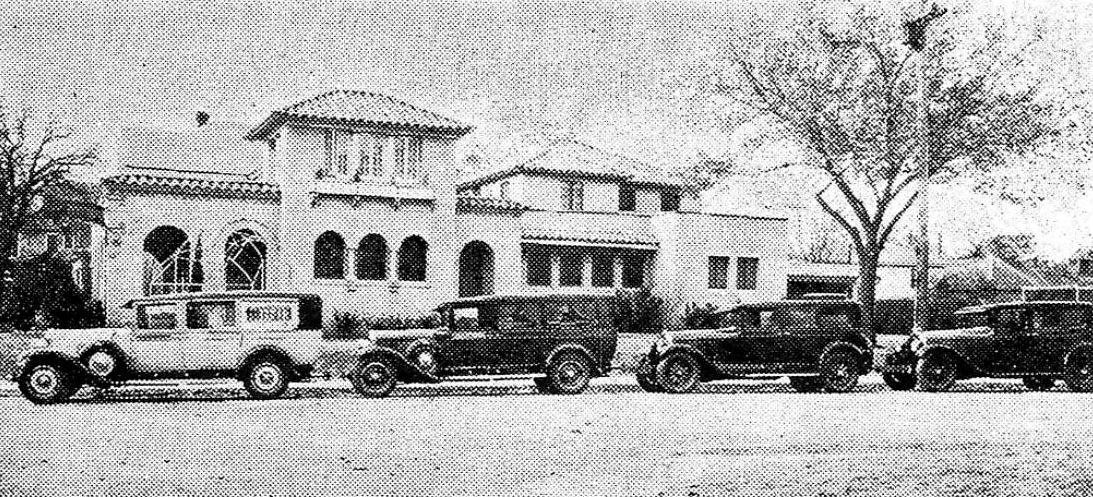
ad-funeral-home_mckinney-routh_directory-1929-detA fleet of Cadillacs in front of 2533 McKinney Ave.

by Paula Bosse

The photo above shows a truly beautiful, Spanish-style building that was built in 1927 at the northwest corner of McKinney Avenue and Routh Street. The view shows the Routh Street side. The person who took this photograph would have been standing across the street on the property of the dearly-departed McKinney Avenue Baptist Church (most recently transformed into the Hard Rock Cafe). You might be surprised to learn that the building in this photo still stands, and it’s mostly recognizable almost 90 years later.

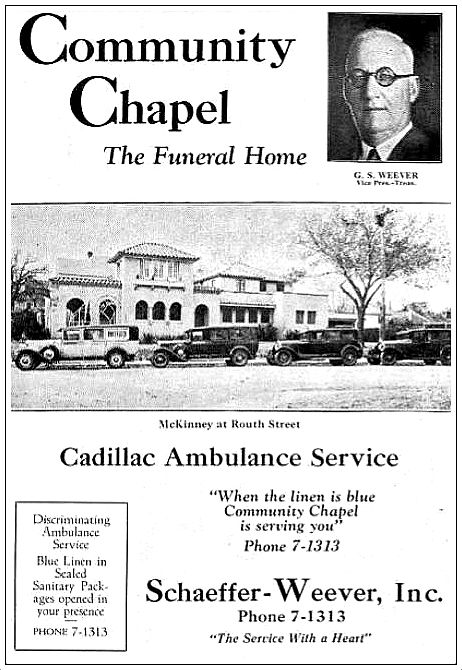
The Community Chapel Funeral Home (yes, a funeral home!) was designed by noted architect Clarence C. Bulger (whose father, C. W. Bulger, designed, among other things, the Praetorian Building downtown AND the just-mentioned McKinney Avenue Baptist Church which was right across the street).

ad-funeral-home_mckinney-routh_directory-1929City directory, 1929

In addition to the funeral home portion (reception area, business office, show rooms, “operating room” (!), chapel with seating for 100, and the euphemistically named “slumber room”), the building also contained a residence for the chief mortician and his embalmer wife, an apartment for the ambulance/hearse drivers, and a “pavilion for recreation of employees.” The building and its beautifully-appointed interior cost in excess of $100,000 (which the Inflation Calculator estimates is the equivalent of more than $13 million today!).

Also, an “oxygen plant” was somewhere on the grounds. I’ve never heard of an oxygen plant, but they seem to be a mortuary thing. Let’s hope recently-bereaved smokers were kept at a safe distance from all that highly flammable oxygen, because the company had a bunch of promotional matchbooks printed up, and I can only imagine they were readily available in tastefully-arranged candy dishes of every room of the establishment. And in those days, one didn’t necessarily step outside to smoke one’s anxiety away.

weever-funeral-home_fkickr1

weever-funeral-home_fkickr2

weever-funeral-home_1937-city-directory_ad1937 Dallas directory

The funeral home at 2533 McKinney Avenue lasted almost thirty years. Sometime in the mid-’50s it was renovated into office and retail space (classified ads mentioned 2-, 3-, and 4-office suites). That lovely interior must have been hacked up pretty bad. An early tenant was the Bankers Securities Corporation, shown below in a newspaper ad from 1956 (someone made some poor choices on that renovation of the exterior). (This view shows an entrance from McKinney rather than Routh.)

bankers-securities_dmn_012256-photoAd detail, Jan., 1956

For the next 40-odd years, 2533 McKinney Avenue was home to a variety of insurance agents, a fur salon, several companies that advertised in the classifieds for vague “salesmen” positions (one company did specify that it was looking for encyclopedia salesmen in 1963), art galleries, architect/design businesses, offices of “El Sol de Texas” (“the only Spanish-language newspaper in North Texas”), and antique shops.

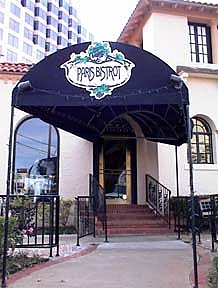
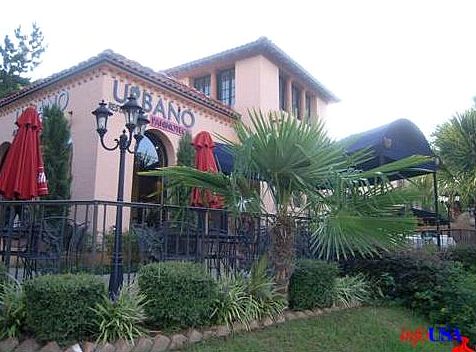
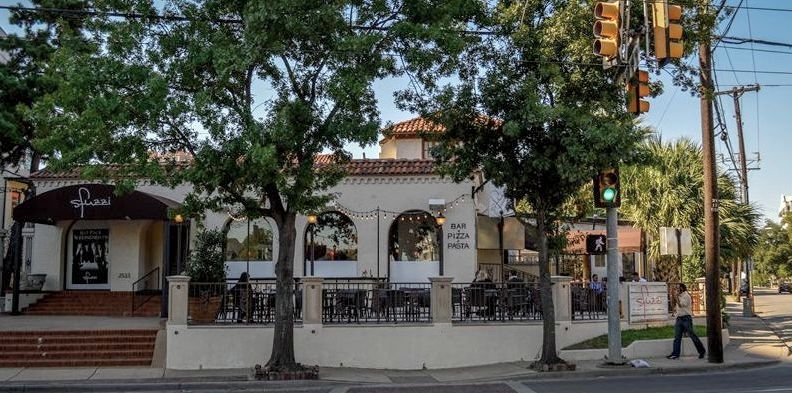
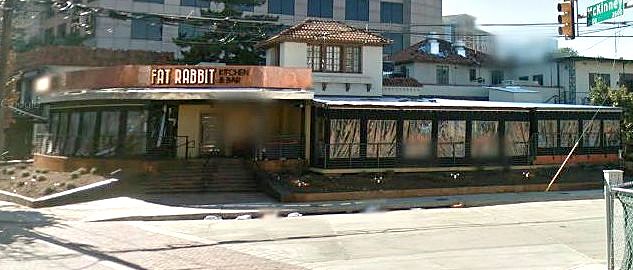
It all turned around, though, when the long-suffering building was re-renovated and became a restaurant space. Since at least 1999 when Uptown began to explode, it’s been home to bistros, cafes, and upscale eateries. The photos below show some of the restaurants that have set up shop there, and if you know what you’re looking at, the place really does look very similar to C. C. Bulger’s design from almost 90 years ago.

*

paris-bistrot_2001Le Paris Bistrot opened in 1999. The owner changed the name to Figaro Cafe in 2004 when the U.S. was going through an anti-French phase.

urbano_city-dataUrbano Paninoteca opened in 2007. Something called Split Peas Soup Cafe opened in 2009.

sfuzzi_scrumpliciousfood_sm

sfuzzi_yelpThen Sfuzzi opened with a big splash in 2010. (It had been a McKinney Avenue staple in the 1980s and ’90s, closed, and came back in 2010.) The first photo shows the Routh Street entrance, the second photo shows the McKinney entrance.

fat-rabbit_googleAnd now it’s the Fat Rabbit, which opened earlier this year. Let’s hope they get some landscaping in there STAT! (UPDATE: Fat Rabbit is now an ex-rabbit, and after spending some time of his own in the “slumber room,” he has joined the choir invisible. Next!)

And let’s hope that those tiled roofs and stuccoed walls remain a distinctive part of its future. I love the fact that it still looks a lot like it once did. And I actually like the fact that restaurants have been operating out of an old funeral home for over 15 years. Restaurateurs might be hesitant to publicize the building’s past (although I’m pretty sure most of them have been completely unaware of what the place used to be), but modern-day Harolds and Maudes might be giddy at the prospect of an unusual dining option and move this place right to the top of their date-night list. 

***

Sources & Notes

Top photo is a detail of the ad that appeared in the 1929 Dallas city directory. It shows four Cadillacs — a hearse, 5- and 7- passenger sedans, and an ambulance (“purchased from the Prather Cadillac Company”).

Matchbook artwork from Flickr, here.

The first Sfuzzi photo is from the food blog Scrumplicious Food, here. A GIGANTIC version of the photo can be seen here — you can look at all the details. Second photo of Sfuzzi from Yelp.

Fat Rabbit image from Google street view.

Sources of all other clippings and photos as noted.

Some images larger when clicked.

*

Copyright © 2015 Paula Bosse. All Rights Reserved.

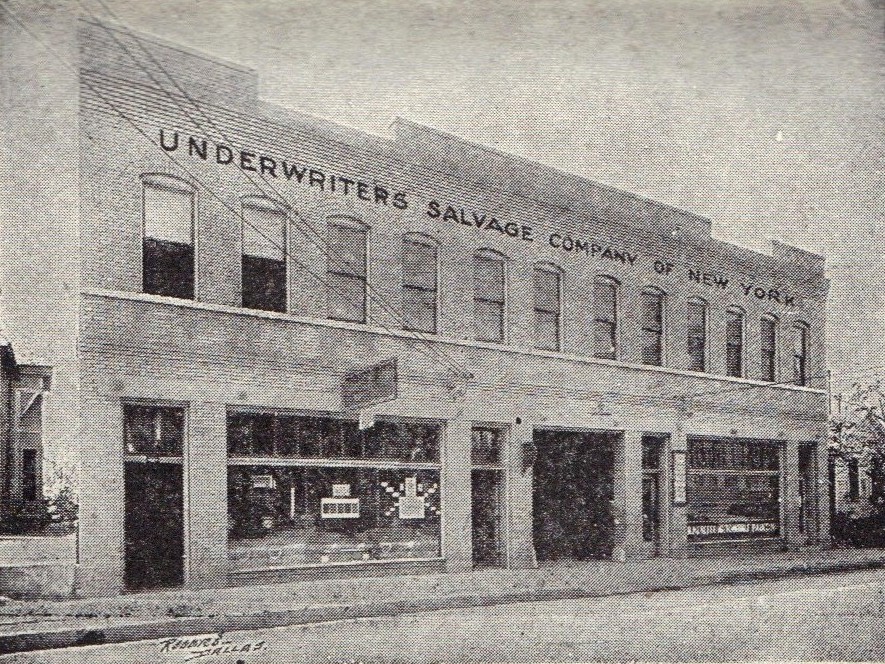
Underwriters Salvage Co., Dallas Warehouse — 1920

underwriters-salvage_1920The company’s Dallas warehouse on N. Lamar (click for larger image)

by Paula Bosse

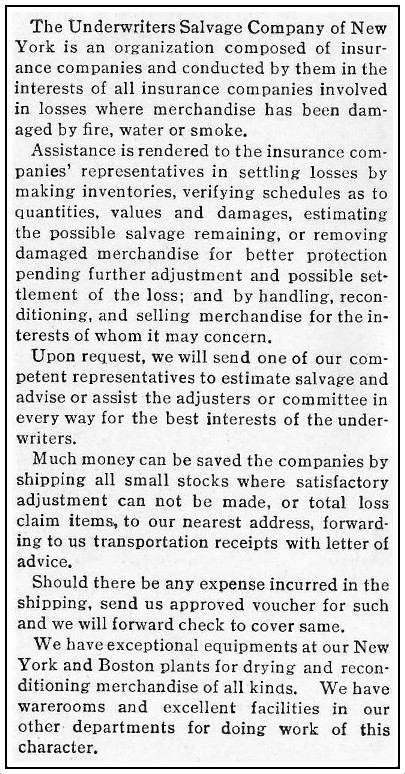
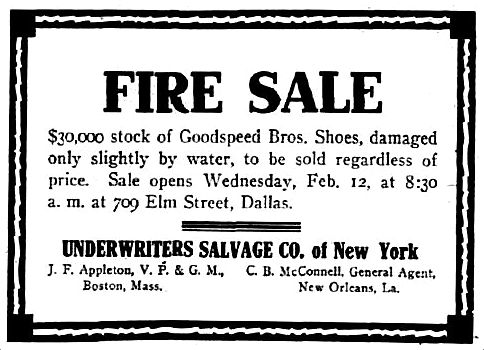
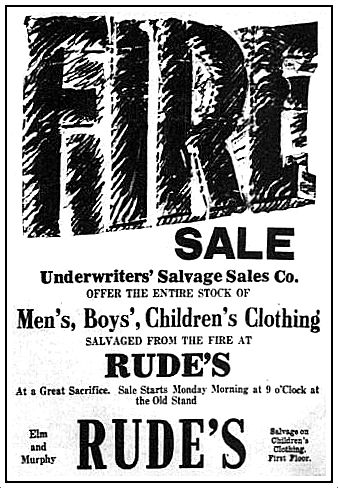
The Underwriters Salvage Company of New York (founded in 1893) was a business that worked with insurance companies and merchants in settling losses due to merchandise damaged by fire, water, etc. In their words:

underwriters-salvage-co_1920Underwriters Salvage Co., 1920

There were branch offices in cities around the country, including Dallas, which was the location of the company’s Southwestern offices, or, their “Gulf Department,” located in the American Exchange National Bank Bldg. on Main St. The warehouse pictured above was at 2014-16 North Lamar (in the West End warehouse district, between McKinney Ave. and Munger). Not only would merchandise being readied for processing be stored there, there would probably also be large fans going full-blast to dry out and remove the smell of smoke from items that would soon be sold for bargain prices, either to the public or to wholesalers via “fire sales” or public auctions.

The company’s most famous fire sale (which they were quick to mention in later national advertising) was the huge dispersal of merchandise from the big fire at Neiman-Marcus in 1964. Instead of the usual, somewhat dull, inventories of shoes or boys’ coats or rope (“all sizes”), that sale included Neiman’s eye-poppingly expensive fur coats and other luxury goods (and, I think, every single piece of merchandise in the store that survived), all marked down to bargain basement prices. Now THAT is a fire sale.

*

underwriters-salvage_dmn_0210131913

underwriters-salvage_dmn_0622241924

underwriters-salvage_dmn_0613241924

***

Top photo and text excerpt from a tiny pocket-sized booklet/calendar issued by the Underwriters Salvage Company of New York in 1920, featuring photos of the company’s branches around the United States.

*

Copyright © 2015 Paula Bosse. All Rights Reserved.

Texas Independence Day: The Most Patriotic Bank Ad EVER — 1921

tx-flag

by Paula Bosse

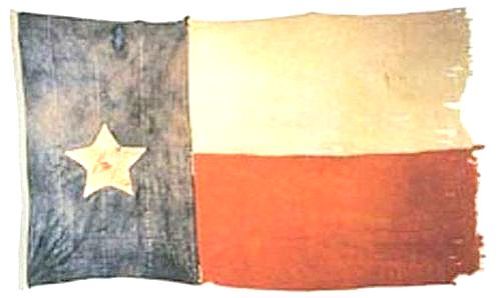
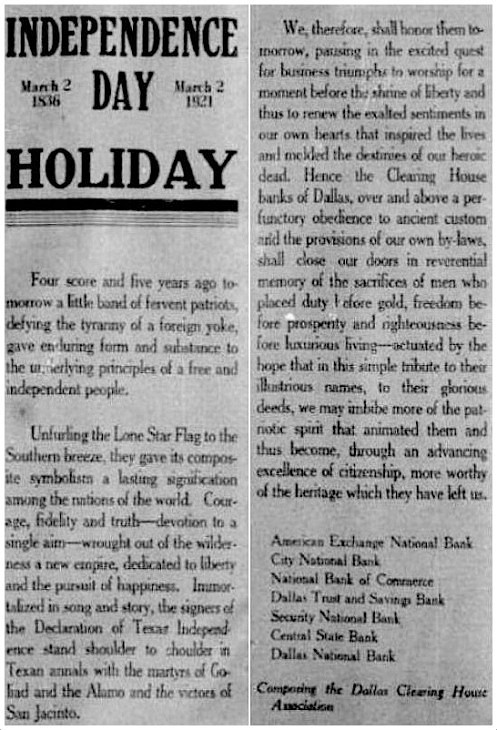
Today is the anniversary of Texas Independence. Below, you will find the most heart-swellingly patriotic bank ad ever penned. Before you plunge in, you might want to get a hanky. (Transcription below.)

tx-independence_ad_dmn_030121Dallas Morning News, March 1, 1921

Four score and five years ago tomorrow a little band of fervent patriots, defying the tyranny of a foreign yoke, gave enduring form and substance to the underlying principles of a free and independent people.

Unfurling the Lone Star Flag to the Southern breeze, they gave its composite symbolism a lasting signification among the nations of the world. Courage, fidelity and truth — devotion to a single aim — wrought out of the wilderness a new empire, dedicated to liberty and the pursuit of happiness. Immortalized in song and story, the signers of the Declaration of Texas Independence stand shoulder to shoulder in Texan annals with the martyrs of Goliad and the Alamo and the victors of San Jacinto.

We, therefore, shall honor them tomorrow, pausing in the excited quest for business triumphs to worship for a moment before the shrine of liberty and thus to renew the exalted sentiments in our own hearts that inspired the lives and melded the destinies of our heroic dead. Hence the Clearing House banks of Dallas, over and above a perfunctory obedience to ancient custom and the provisions of our own by-laws, shall close our doors in reverential memory of the sacrifices of men who placed duty before gold, freedom before prosperity and righteousness before luxurious living — actuated by the hope that in this simple tribute to their illustrious names, to their glorious deeds, we may imbibe more of the patriotic spirit that animated them and thus become, through an advancing excellence of citizenship, more worthy of the heritage which they have left us.

American Exchange National Bank
City National Bank
National Bank of Commerce
Dallas Trust and Savings Bank
Security National Bank
Central State Bank
Dallas National Bank

Composing the Dallas Clearing House Association

*

Remember the Alamo! And remember the men who placed “righteousness before luxurious living”! (Even though that last part’s not exactly a sentiment that Dallas is typically known for….)

*

Copyright © 2015 Paula Bosse. All Rights Reserved.

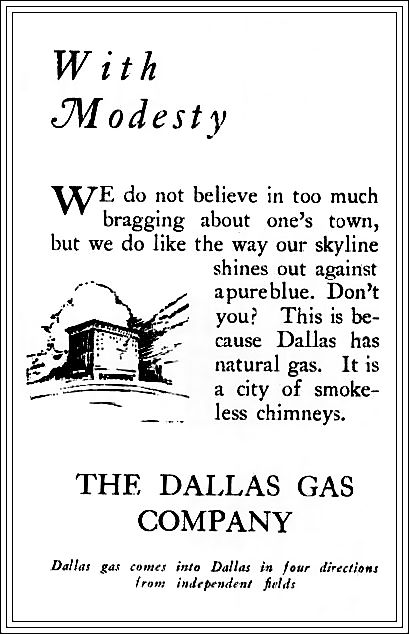
“With Modesty” — The Dallas Gas Company, 1927

ad-dallas-gas_terrill-yrbk_1927

by Paula Bosse

Speaking of Dallas and natural gas….

With Modesty

We do not believe in too much bragging about one’s own town, but we do like the way our skyline shines out against a pure blue. Don’t you? This is because Dallas has natural gas. It is a city of smokeless chimneys.

THE DALLAS GAS COMPANY

Dallas gas comes into Dallas in four directions from independent fields.

…At least four directions.

***

Ad appeared in the 1927 Terrill School for Boys yearbook.

*

Copyright © 2015 Paula Bosse. All Rights Reserved.


The Dallas Athletic Club Building, 1925-1981

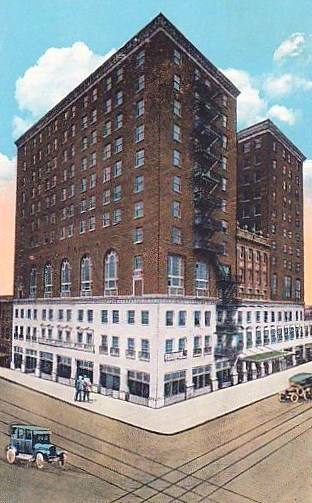
dallas-athletic-clubThe Dallas Athletic Club, 1920s

by Paula Bosse

Dallas’s premier architects Lang & Witchell designed the Dallas Athletic Club building. It was built between 1923 and 1925 on a triangular piece of land located at St. Paul, Elm, and Live Oak, its entrance facing St. Paul. It was one of the city’s top private clubs, catering to Dallas’ businessmen. Aside from sports and recreational facilities — swimming pools (for men and women), gymnasiums, games courts, billiard rooms, etc. — the club also offered meeting rooms, a dining room, a ballroom, and lounges. It also offered use of hotel-like “rooms” to members and their guests. (If it was anything like old movies from this period, I assume it was a handy place to stay if a DAC member was in the doghouse with his wife — or in the midst of divorce proceedings. “If the VP from the home-office calls, Miss Klondike, I can be reached at my room at the club.”) The building also housed a variety of non-DAC-related businesses and offices — my great aunt had a hat shop there in the late 1930s and early 1940s.

The Athletic Club was a major social and recreational spot for years and was something of a landmark in the east end of downtown. In the 1950s the membership opened a country club and golf course near Mesquite but kept the downtown facility open as well. But with suburbia’s surge and downtown’s decline, it was only a matter of time until the club closed the downtown facility. The DAC finally sold the building in 1978, and it was demolished in 1981 to make way for the 50-story 1700 Pacific tower. It had a good run.

*

Before construction began, an artesian well was dug on the property.

dac_artesian-well_dmn_031722DMN, March 17, 1922

When it was finished five months later, “water sufficient to produce 300,000 gallons of water every twenty-four hours was reached” (Dallas Morning News, Aug. 20, 1922).

*

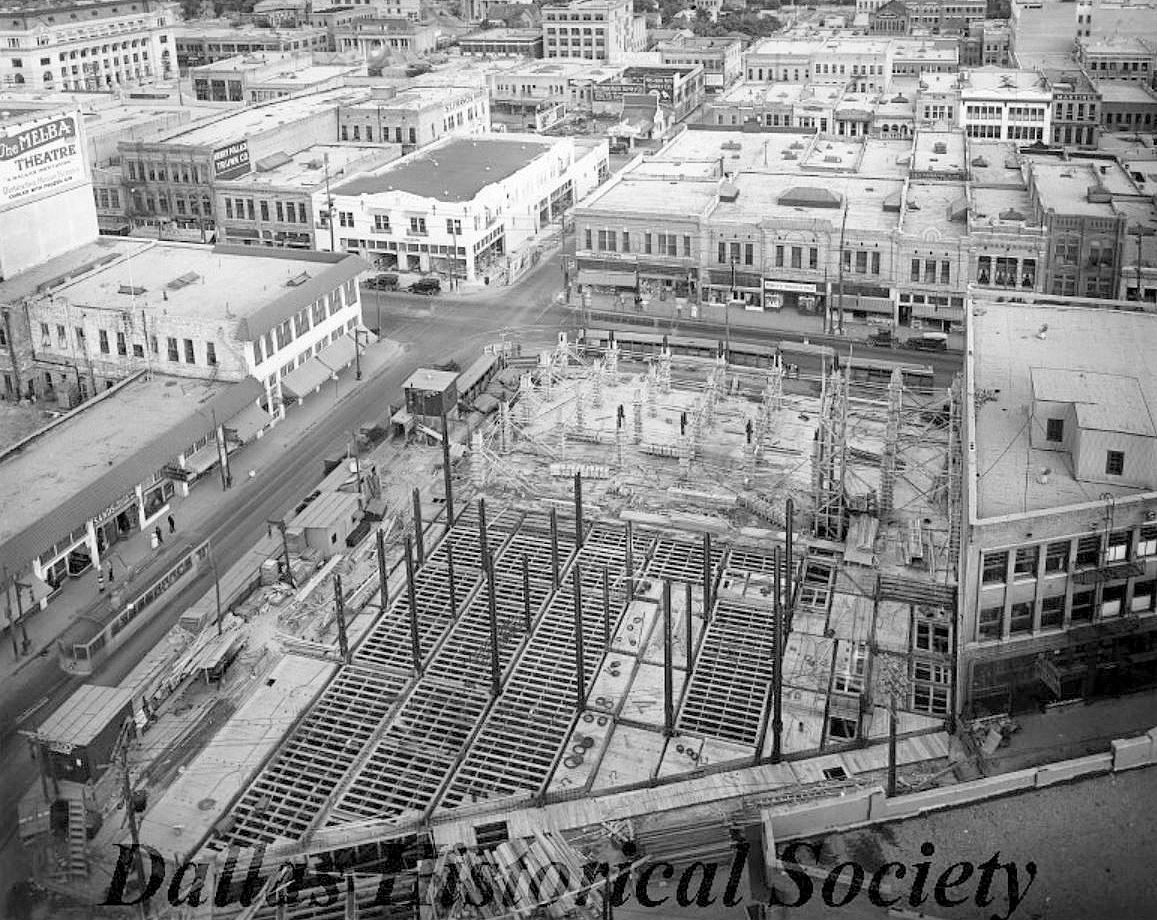
Photo by Charles Erwin Arnold showing construction in progress:

dallas-athletic-club_construction_DHSvia Dallas Historical Society

*

dac_construction_dmn_112523

The progress made to date on the new home of the Dallas Athletic Club Building, which is under construction. […] The picture was snapped from an upper floor of the Medical Arts Building. […] The facing for the three lower floors is of gray Bedford stone. The exterior walls for the upper floors will be of dark red brick. The large openings extending from the fourth to sixth floors will contain the massive windows over the men’s swimming pool. The men’s gymnasium will be on the south side of the fourth floor. When completed, the building will cost approximately $2,000,000, and it will be the most modern athletic club in the United State, according to club officials. (DMN, Nov. 25, 1923)

*

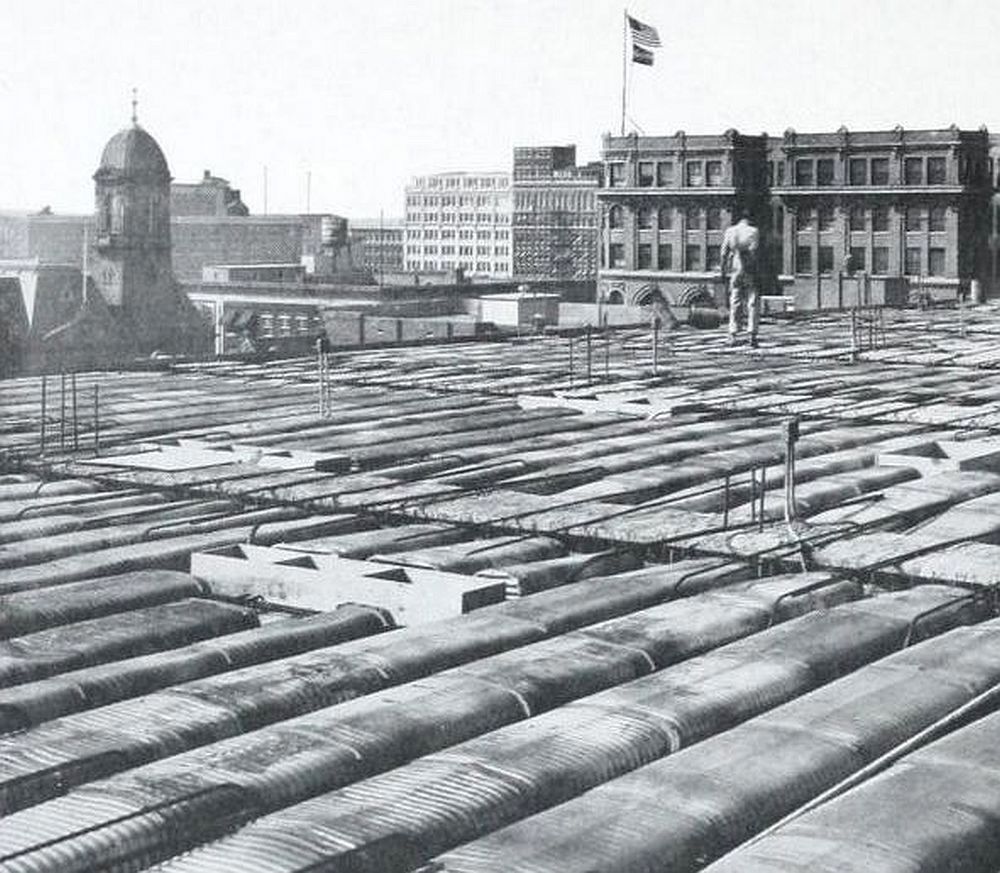
dac_berloy-ad_1924_cropAd for “Berloy Floor Cores” from 1924. Great photo!

*
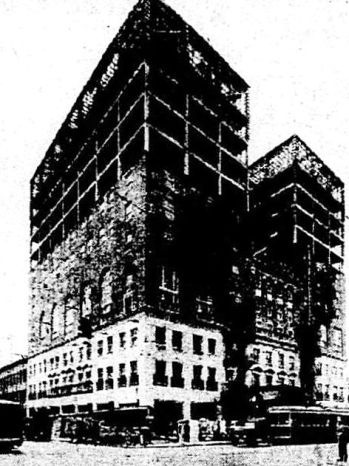
dac_construction_dmn_111624

Work is nearing completion on the concrete framing for the five upper floors of the thirteen-story Dallas Athletic Club building at Elm and St. Paul street, and bricklaying will be started probably this week. The five upper floors will be used for office purposes, with the club quarters on the eight lower floors, except for some storerooms facing the two streets. (DMN, Nov. 16, 1924)

*
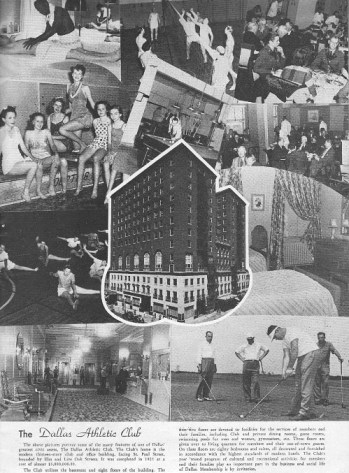
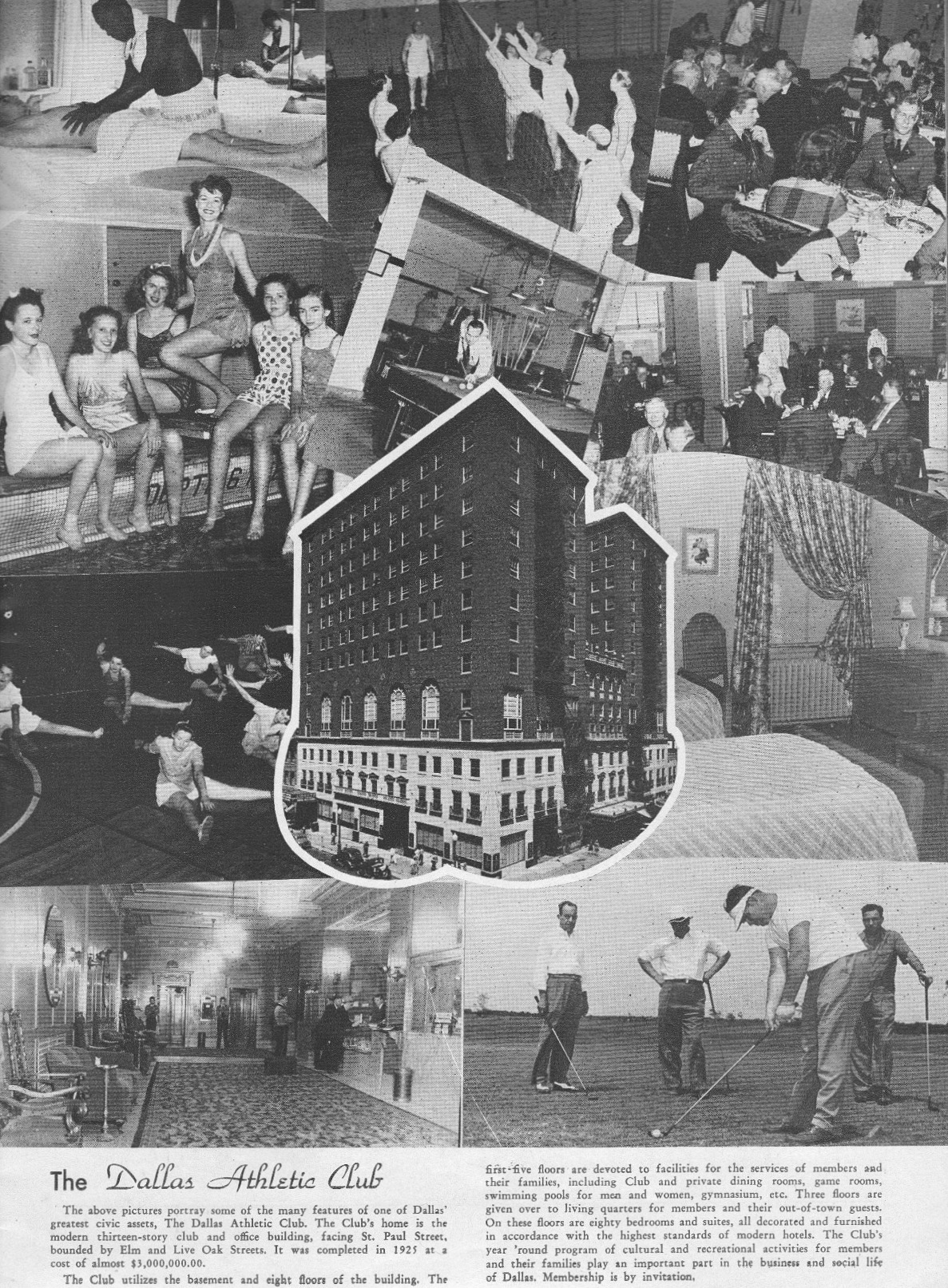
dallas-athletic-club_so-this-is-dallas_c1946_sm1946-ish (click for much larger image)

The above pictures portray some of the many features of one of Dallas’ greatest civic assets, the Dallas Athletic Club. The club’s home is the modern thirteen-story club and office building, facing St. Paul Street, bounded by Elm and Live Oak streets. It was completed in 1925 at a cost of almost $3,000,000.

The Club utilizes the basement and eight floors of the building. The first five floors are devoted to facilities for the services of members and their families, including clubs and private dining rooms, game rooms, swimming pools for men and women, gymnasium, etc. Three floors are given over to living quarters for members and their out-of-town guests. On these floors are eighty bedrooms and suites, all decorated and furnished in accordance with the highest standards of modern hotels. The Club’s year ’round program of cultural and recreational activities for members and their families play an important part in the business and social life of Dallas. Membership is by invitation.  (“So This Is Dallas,” a guide for newcomers to the city, circa 1946)

*
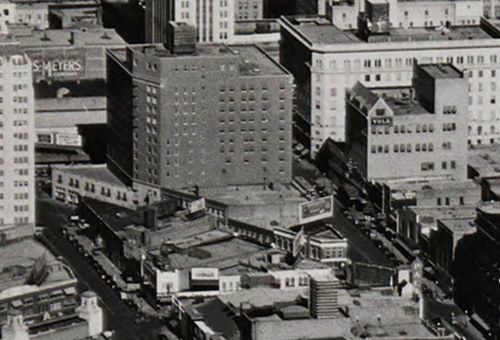
dac_smu_1938-crop

Aerial view from 1938, looking east; the DAC is in the center, with Elm Street to the right. (SMU)

*

dallas-athletic-club_matchbook_cook-collection_degolyer_smu_a     dallas-athletic-club_matchbook_cook-collection_degolyer_smu_b
1950s matchbook, via SMU

*

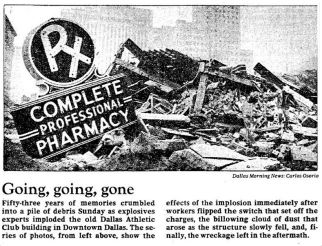
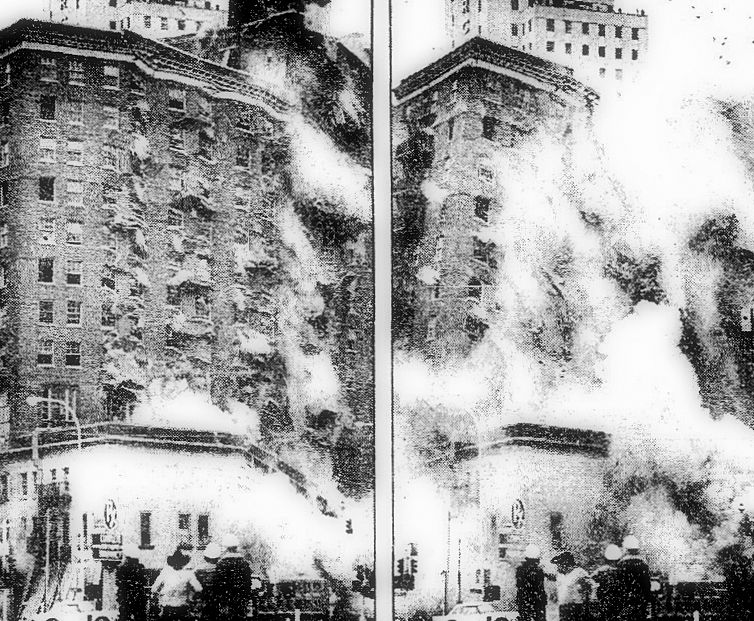
In March, 1981 it was announced that the building would be imploded.

The former Dallas Athletic Club building, which for 53 years served as a health club and meeting place for Dallas businessmen, will be imploded. […] A 50-story office building will be constructed on the site. The 57-year-old building has been empty since the club moved from the building in 1978. (Dallas Morning News, March 22, 1981)

And on March 22, 1981…

dallas-athletic-club_demo_dmn_032381a

dallas-athletic-club_demo_dmn_032381bDMN, March 23, 1981

The end of an era.

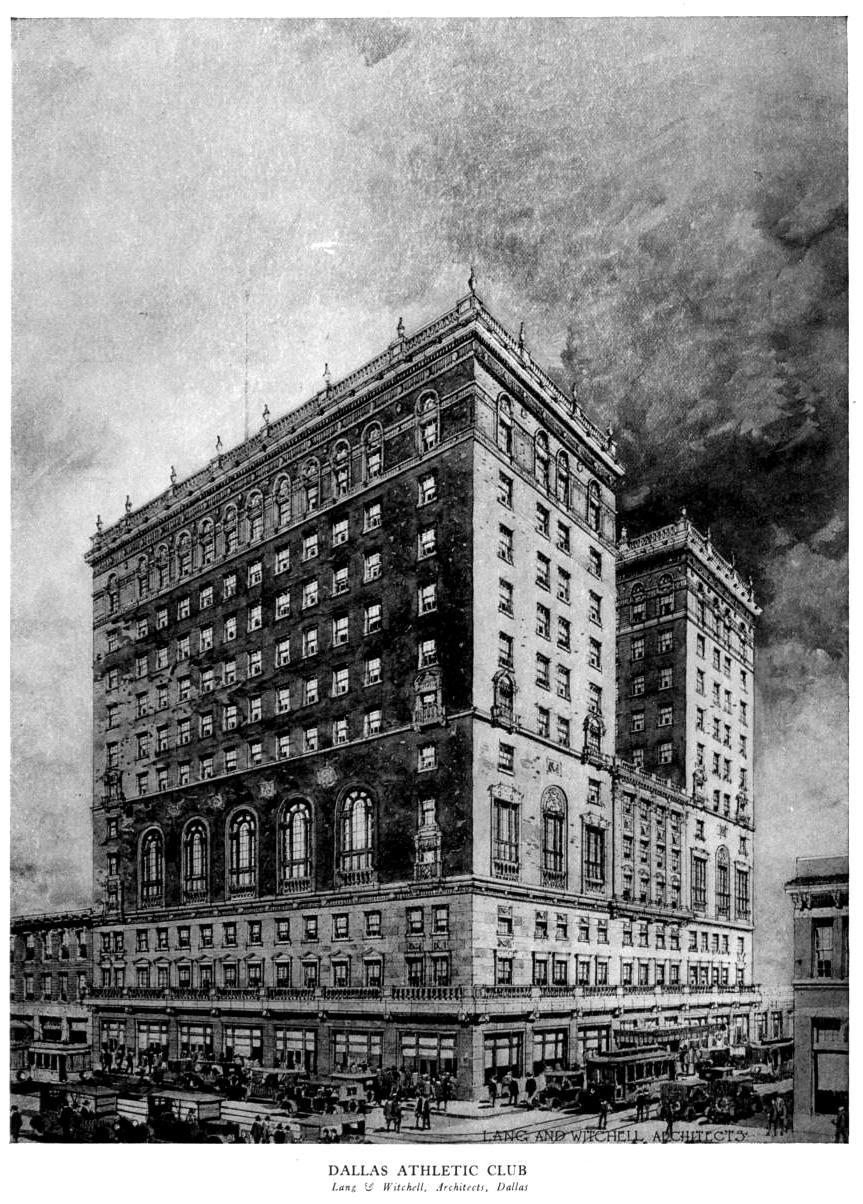
But let’s remember happier times for the Dallas Athletic Club building and gaze at this idealized version from Lang & Witchell’s original drawing (circa 1922).

dallas-athletic-club_drawing_arch-yrbk_1922

***

Sources & Notes

Bird’s-eye view of the construction site is by Charles Erwin Arnold and is from the Arnold Photographic Collection, Dallas Historical Society; its ID number is A.68.28.17.

Aerial view is a detail from a photograph taken by Lloyd M. Long in 1938; it is from the Edwin J. Foscue Map Library, Southern Methodist University. The full photo can be seen here; the same photo, with buildings labeled, is here.

Lang & Witchell drawing from The Yearbook of the Dallas Architectural Club, 1922.

Dallas Morning News clippings and photos are as noted.

Live Oak used to cut through the block bounded by St. Paul, Elm, Ervay, and Pacific. To get an idea of where the building was, here is a 1962 map of the area (the full map can be seen here).

map_1962

The Dallas Athletic Club is still around. Their website is here.

*

Copyright © 2015 Paula Bosse. All Rights Reserved.

Earthquake! — 1925

earthquake_dmn_0731_25

by Paula Bosse

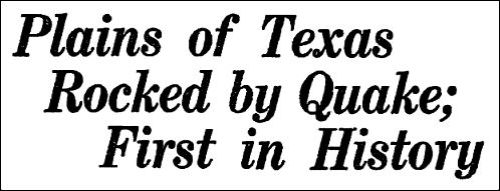
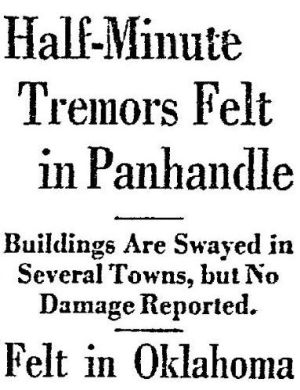
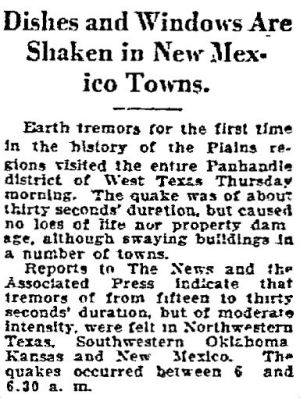
I think, perhaps, the reporter was incorrect on the earthquake of July 30, 1925 being the “first in history” to hit the Texas Panhandle, but it makes a great Page One headline.

earthquake_dmn_073125-a

earthquake_dmn_073125-b

Okay, so it’s not Dallas (…but only because I couldn’t find any historic articles about earthquakes in Dallas!), but it seems applicable, as today I experienced my first-ever earthquake — and it was in Dallas! Actually, the official tally for the day so far is four. FOUR! Eight. EIGHT! (Actually, we’re all losing count at this point.)

A 1983 article in The Dallas Morning News (“Quake Never Struck City, but SMU Prof Studies Them Anyway,” by Jane Wolfe, July 10, 1983) reported on earthquake-study being done at SMU. The very idea of this was amusing back then, because anyone who grew up here knows (and has boasted) “there are no earthquakes in Dallas.” My, how things change.

***

Sources & Notes

Top headline and snippet of first article from The Dallas Morning News, July 31, 1925. The full report of broken crockery from around the Panhandle and Oklahoma can be read in a PDF, here

An interesting Handbook of Texas article, “Notable Earthquakes Shake Texas on Occasion,” can be read here.

In case you’re preparing for a Jeopardy try-out, here are a couple of handy factoids on historic seismic activity in the Lone Star State (from another Handbook of Texas entry, “Earthquakes”): “The first known earthquake in Texas occurred in Seguin and New Braunfels on February 13, 1847. The largest earthquake in Texas occurred on August 16, 1931, near Valentine in Jeff Davis County; it measured about 6.0 on the Richter Scale.” And earthquakes never happen in Dallas. And it don’t rain in Indianapolis in the summertime.

*

Copyright © 2015 Paula Bosse. All Rights Reserved.