Does anyone else fear the SMU campus is getting a little crowded these days? Here’s what it looked like back when there was still plenty of room to stretch out.
This photo is in the SMU archives, accompanied by this description:
Pictured is an aerial view of campus from the southeast. At the bottom is Mockingbird Lane; on the right is Airline Road; at the top is Daniel Avenue; and on the left is Hillcrest Avenue. Situated in the middle of fields is a water tower, Dallas Hall, Atkins Hall, Rankin Hall, North Hall, South Hall, the Women’s Gymnasium, Armstrong Field, and the Morrison-Bell Track.
What is the huge hacienda at Hillcrest and Daniel (below)? Is that the Daniel family home?
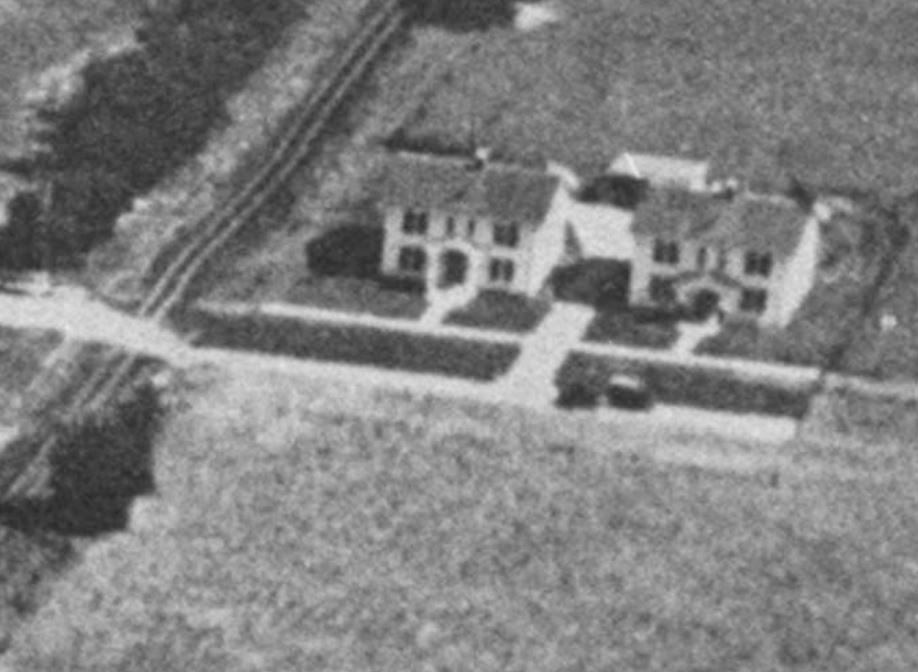
And what are the little houses next to the under-construction stadium? Faculty housing? Fraternity houses? Houses not even connected with the university?
I kinda wish the campus still looked like this.
***
Photo titled “Early aerial view of campus,” ca. 1920s, from the DeGolyer Library, Central University Libraries, Southern Methodist University; it is accessible here.
Zoom in on this photo as much as you can and wander around it — it’s pretty cool. Go here, then slide the magnification bar at the top all the way to the right.
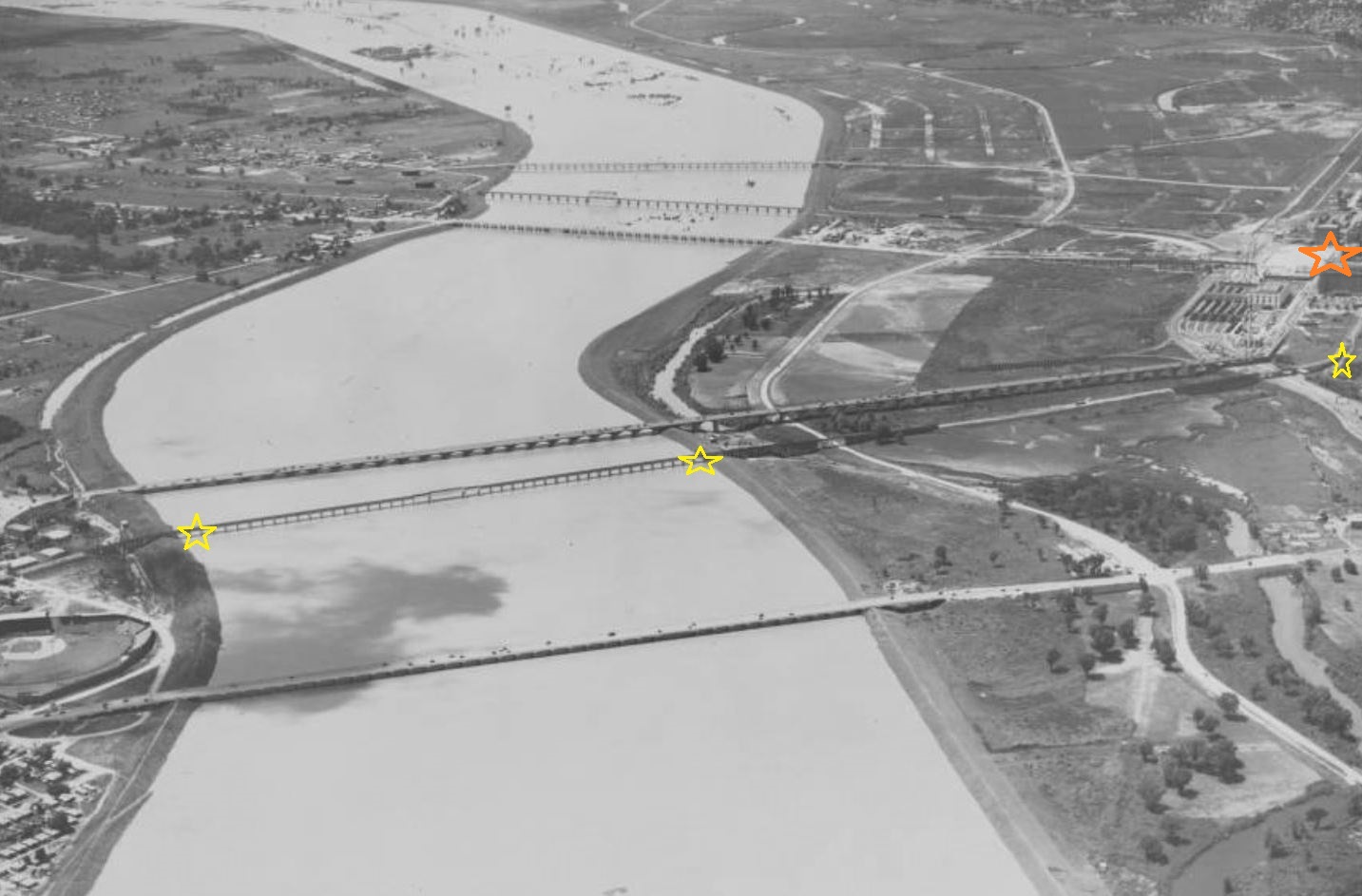
For many, many years there was a special trestle that spanned the Trinity River which was for the exclusive use of streetcars and Interurbans. There were also trestles and viaducts for the exclusive use of trains and automobiles. Below is a photo showing the viaductal activity in 1935, with the streetcar trestle — sometimes called the “Street Car Viaduct” or the “Trinity River Viaduct” marked in yellow and the Old Red Courthouse and Dealey Plaza (then under construction) marked in orange.
The viaduct immediately above it was the Houston Street viaduct, for automobiles.
For many, a streetcar ride across the viaduct seems to have been a little on the harrowing side. There were no guardrails to prevent a car from going over the side, and even when the original wooden trestle had been bolstered with stronger materials, it was still described by commuters as being rickety. I like this quote of a man remembering a typical ride in the 1950s:
I always enjoyed the slight tingle of fear I experienced on the trestle over the river, as one could not see the trestle itself from the car window. One had the feeling of being suspended with no support when looking out the window.
The streetcar trestle ran parallel to the Houston St. Viaduct where the current newer bridge is to downtown. No railings and just depended on gravity to hold the cars on the rails. The cars would buck and sway as they crossed the river bottoms as the motormen made up time on their schedules. Seemed like they were really going fast to me at the time, but probably not in today’s terms.
*
The [newer streetcars] used to scare me to death rocketing across the Trinity River high in the air with no sidewalls except just over the river itself! You were able to look straight down from high above ground… those newer cars had softer springs and the faster they went, the more they rocked side to side over the less than flat tracks!
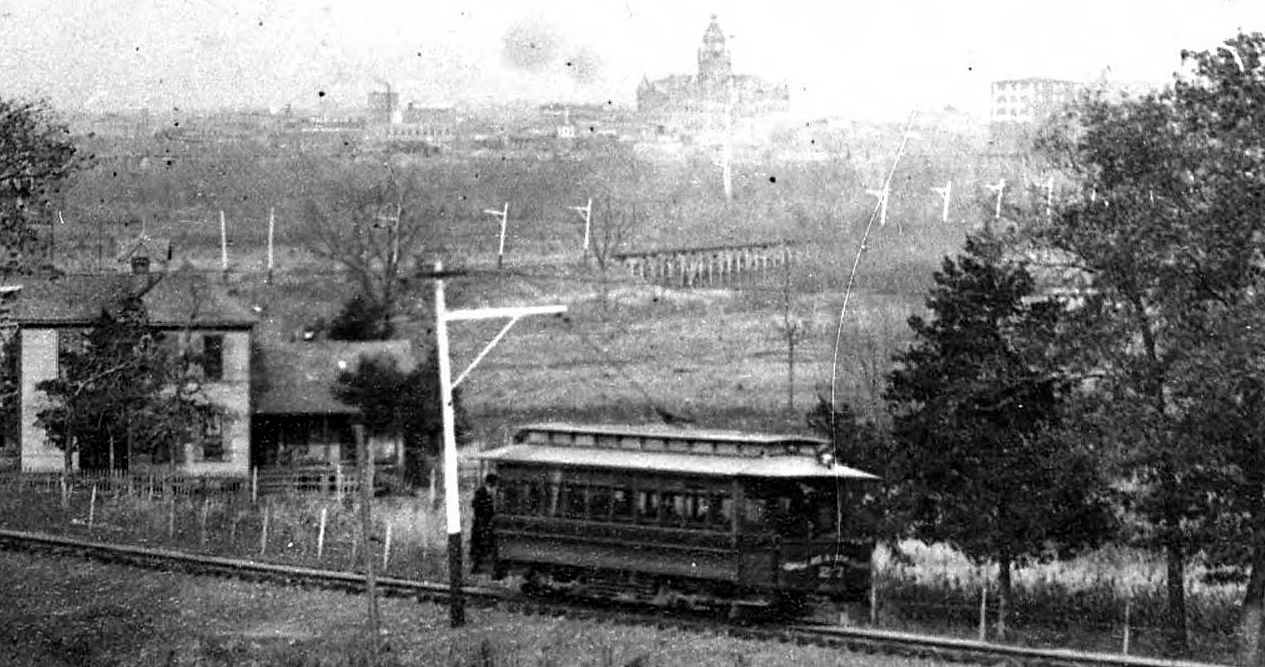
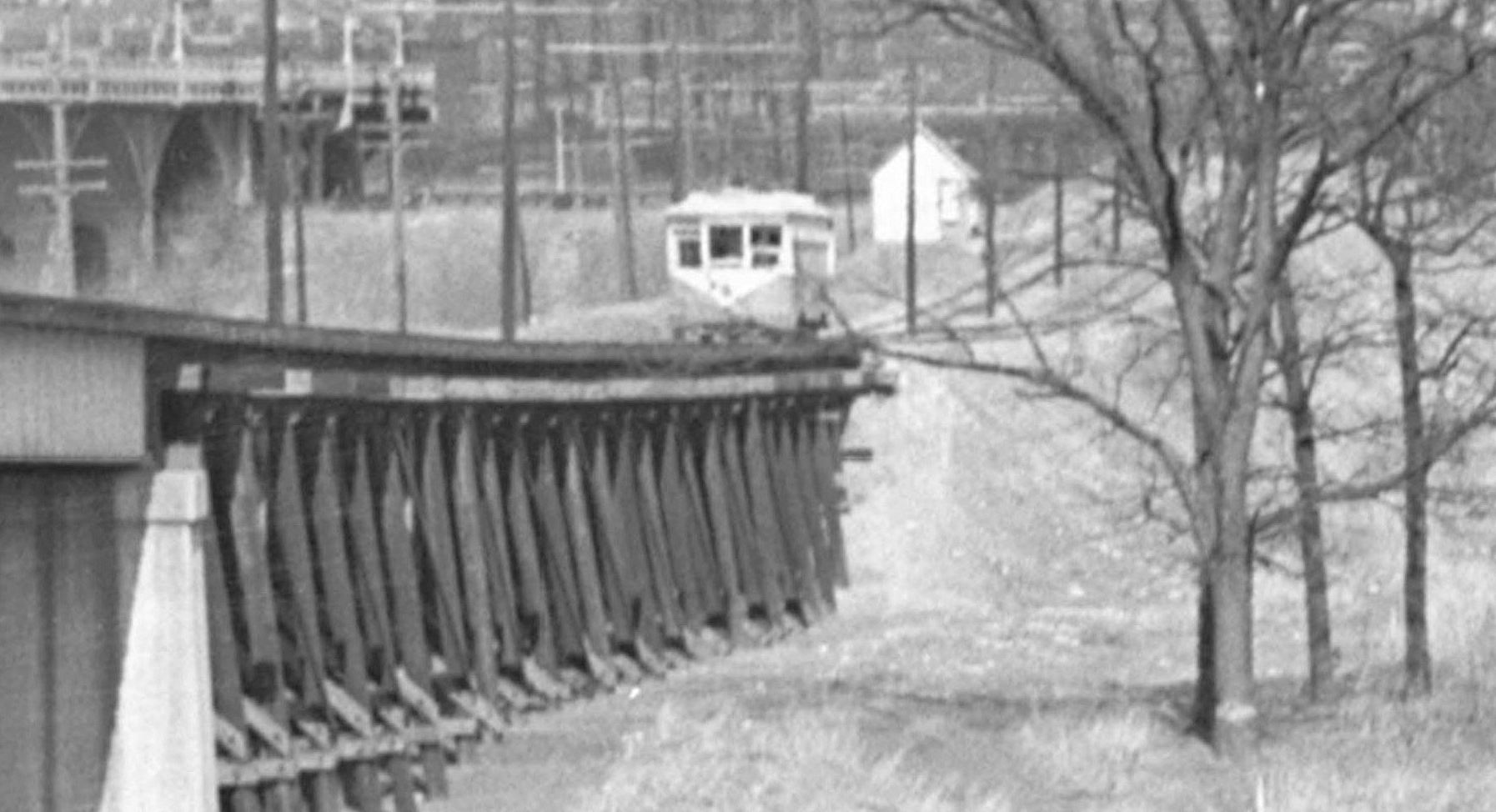
Here’s a photo when it was in its original rickety state, back in 1895 (this is a detail of a larger photo, taken on the Oak Cliff side of the river, with the trestle — and the not-yet-old Old Red Courthouse — visible in the background).
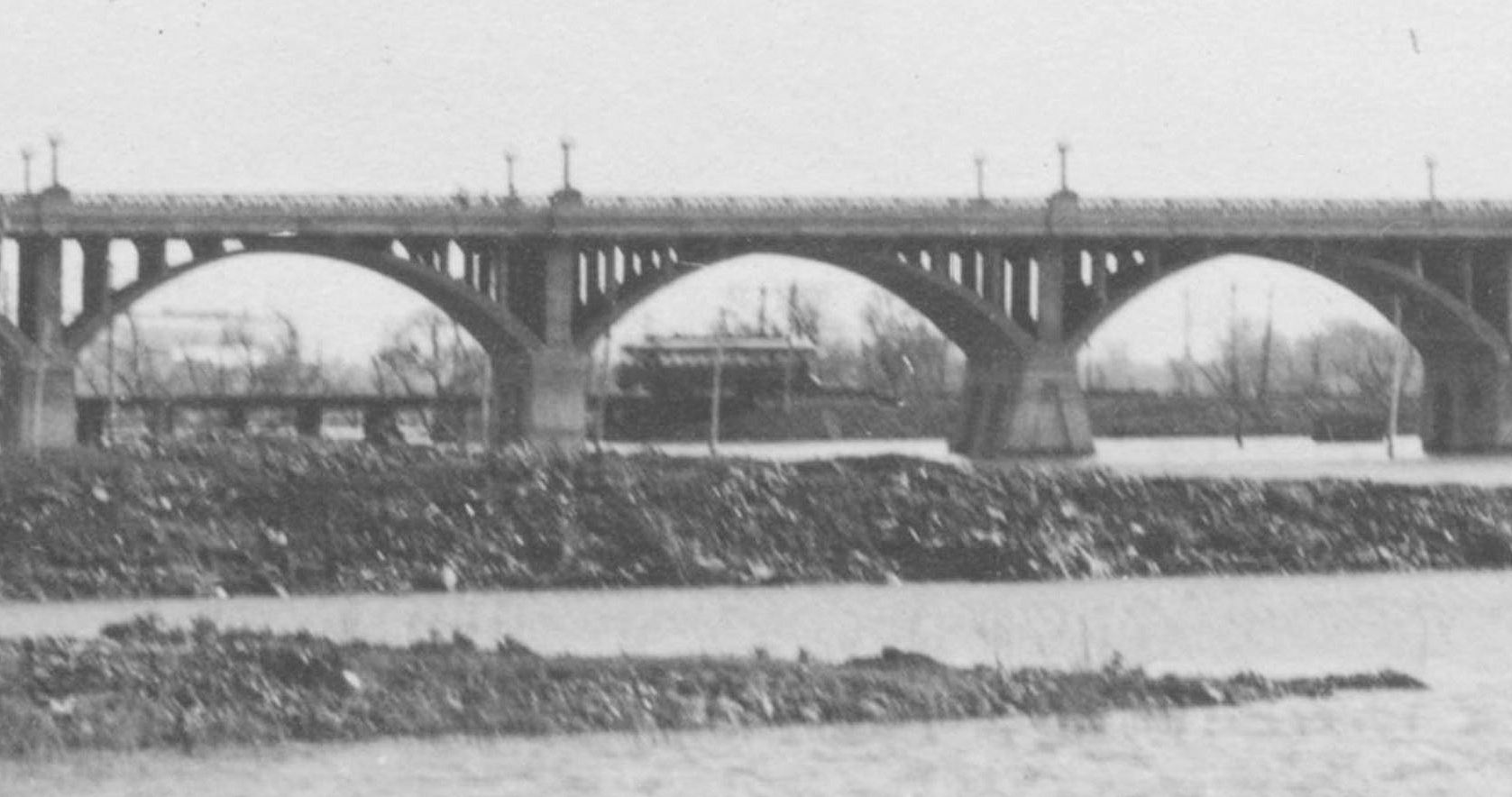
Here it is in 1914 at river-bottom level, with a happy little trolley chugging along with the Oak Cliff/Houston Street viaduct looming over and in front of it. (This is a detail of a larger photo in the George W. Cook Collection, DeGolyer Library, SMU — here).
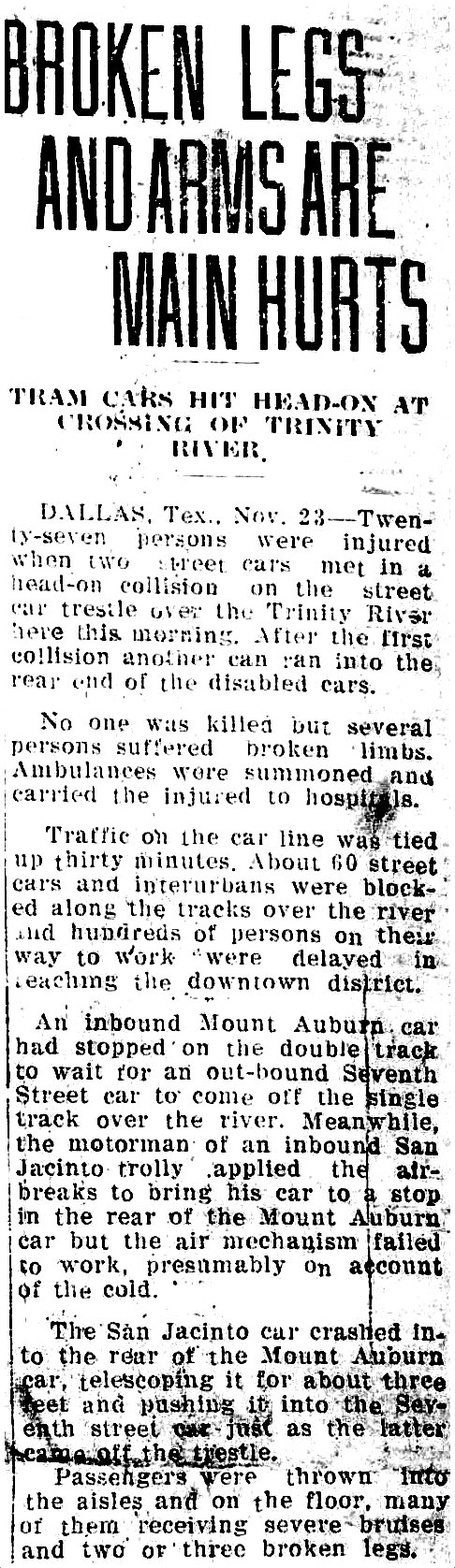
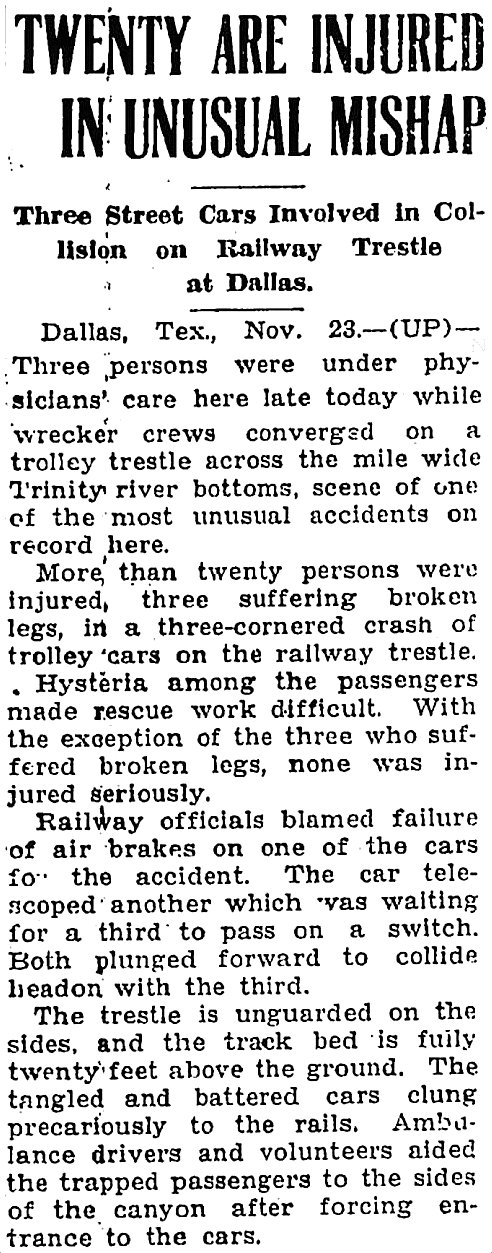
But now to the collision on the viaduct, which happened on the morning of November 23, 1929. Back then — at that iteration of the viaduct — the trestle had only a single track. While one streetcar or Interurban car crossed the bridge toward Oak Cliff, a car wanting to cross over from Oak Cliff had to wait until the westbound car had made its mile-long trip. That must have made for a lot of impatient riders. Even though the so-called “block signal” system worked well for the most part, there were the occasional accidents, including the one involving three cars on Nov. 23, 1929. Below, a front-page report of the collision(s) from The Waxahachie Daily Light (click for larger image).
Waxahachie Daily Light, Nov. 23, 1929
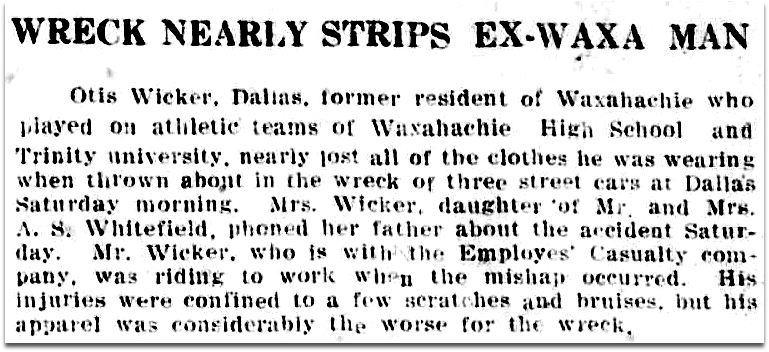
The Waxahachie paper even had a local angle (although it’s unclear just how this man “nearly lost all of the clothes he was wearing”).
Waxahachie Daily Light, Nov. 23, 1929
Since it happened during the morning rush hour, just about every other newspaper in Texas scooped The Dallas Morning News, which wasn’t able to run its story until the next day (and its report was surprisingly dull).
The UP wire story that ran in the Joplin, Missouri paper was far more exciting.
Joplin Globe, Nov. 24, 1929
Thankfully none of the streetcars fell off the trestle, but I’m sure that possibility was probably the daily fear/resigned expectation of generations of nervous travelers.
**
The most interesting thing in the DMN article is the last paragraph:
Plans in the making for the new street car crossing of the Trinity River call for a double track over the channel, eliminating the necessity of waiting on block signals.
In February 1931, that new double-track streetcar viaduct opened for business, and I’m sure there was a citywide sigh of relief.
**
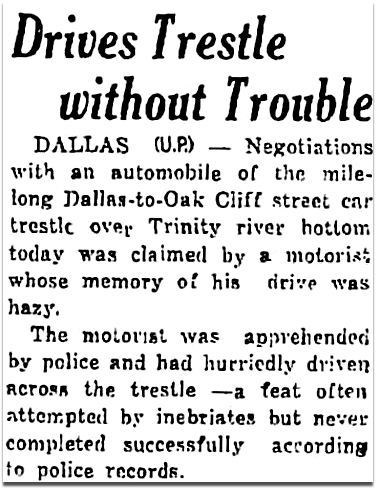
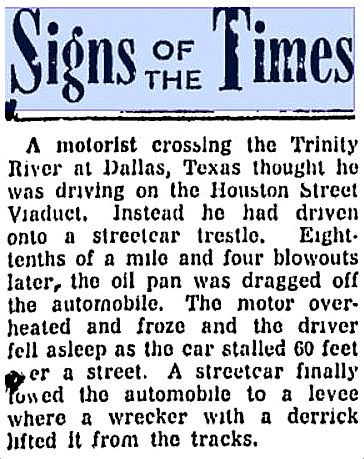
One last little amusing tidbit about this viaduct: it was not unheard of for those having indulged in excessive amounts of alcohol to try to drive their automobiles (either on purpose or by accident) over this already-kind-of-scary trestle intended for electric-powered railway use only.
Mexia Weekly Herald, Jan. 13, 1933
Beaver Valley (Pennsylvania) Times, Dec. 8, 1952
***
Sources & Notes
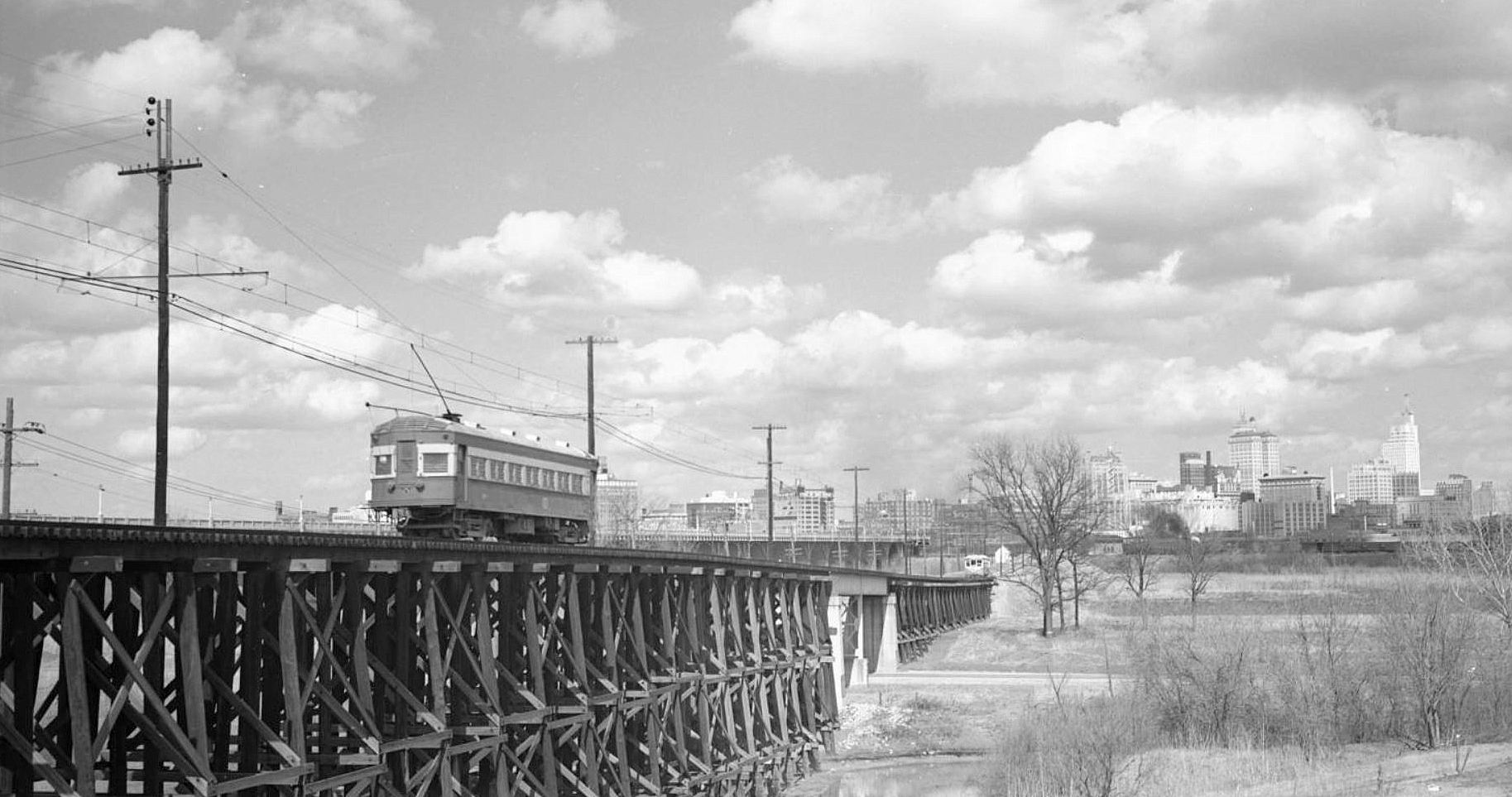
Top photo titled “T. E. clouds, sky, city, from east levee close to wooden trestle 320 just passed, at rear, car 320 on Trinity River Bridge, Dallas, Tex.,” taken on Feb. 16, 1946 by Robert W. Richardson, is from the Western History/Genealogy Dept., Denver Public Library.
Photo showing the viaducts across the Trinity is titled “Central Levee District,” taken on May 20, 1935 by Lloyd M. Long, from the Edwin J. Foscue Map Library, Southern Methodist University; the labeled photo is here, the unlabeled photo is here.
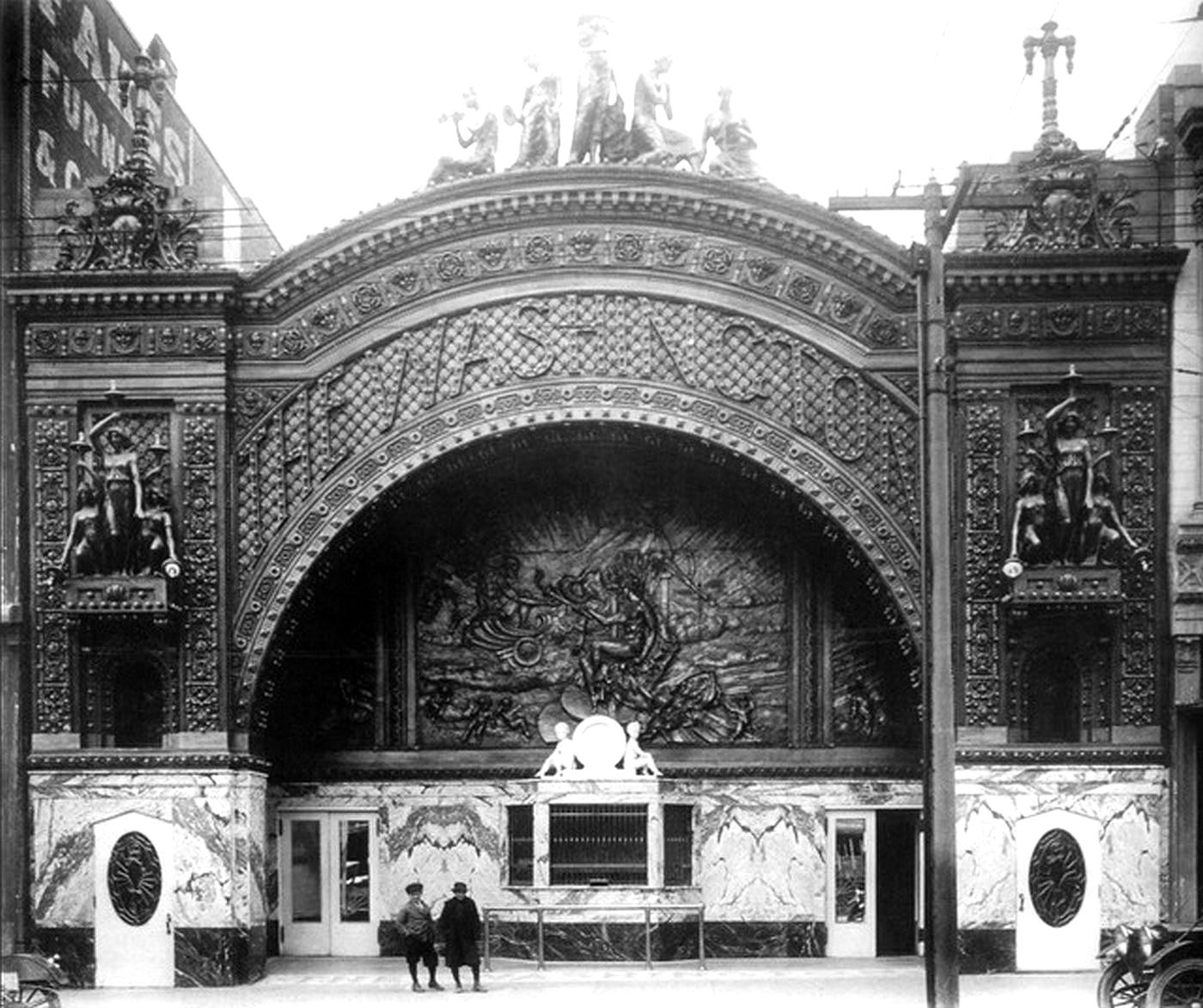
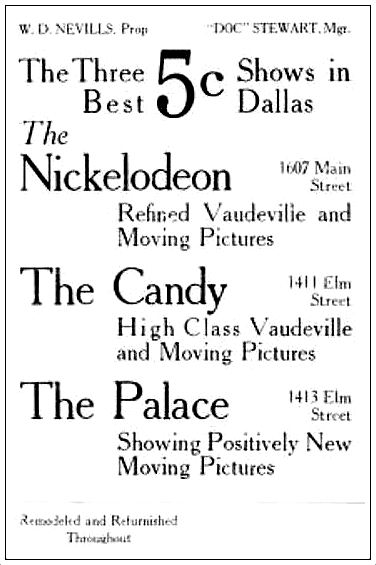
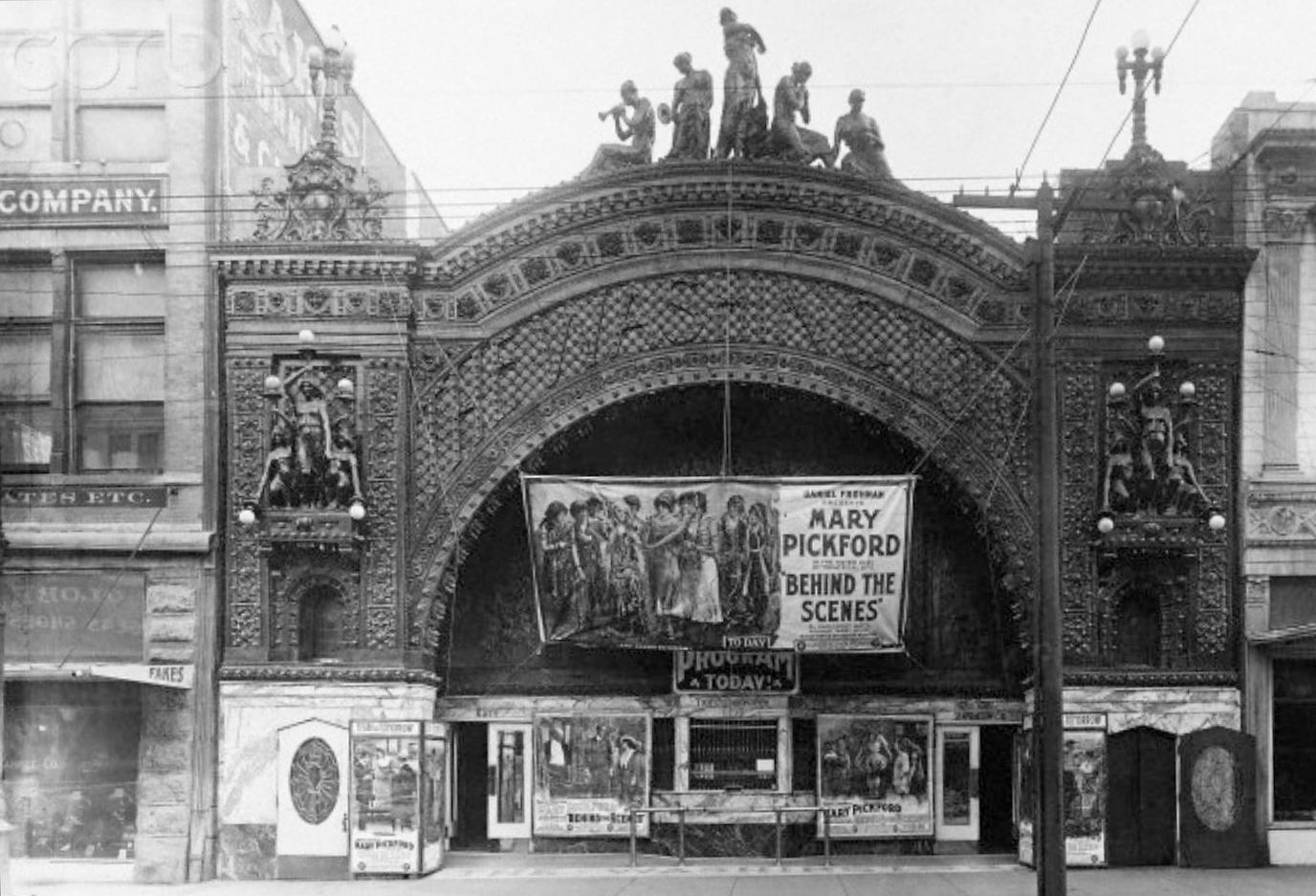
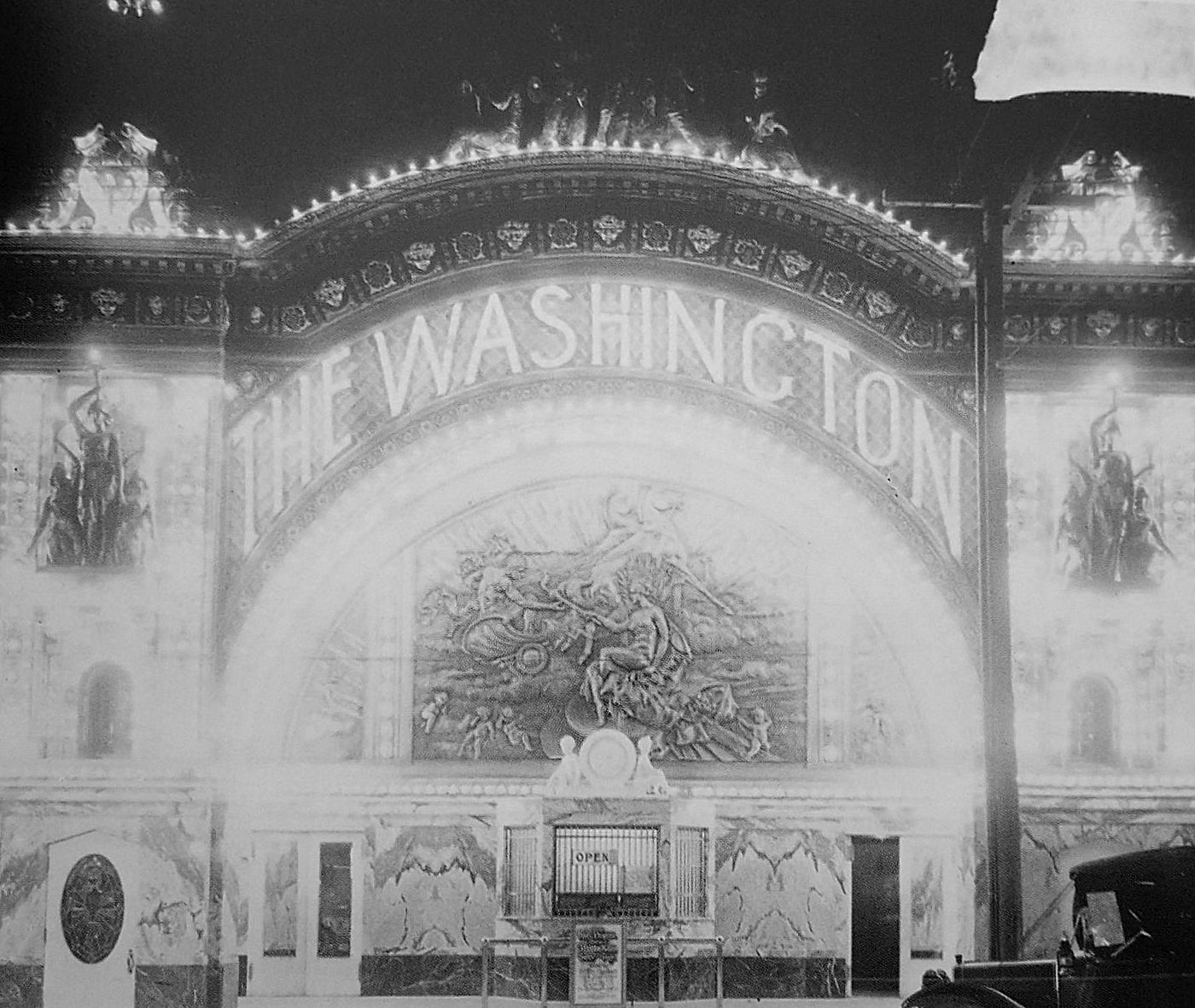
The outrageously ornate Washington Theater was built in 1912 by W. D. Nevills (1872-1945), a man who had been running cheap little store-front nickelodeons in Dallas for several years. Three of his most popular were The Nickelodeon, The Candy, and The Palace (not to be confused with any later theaters in Dallas called the “Palace”).
Standard Blue Book of Texas, 1912-1914
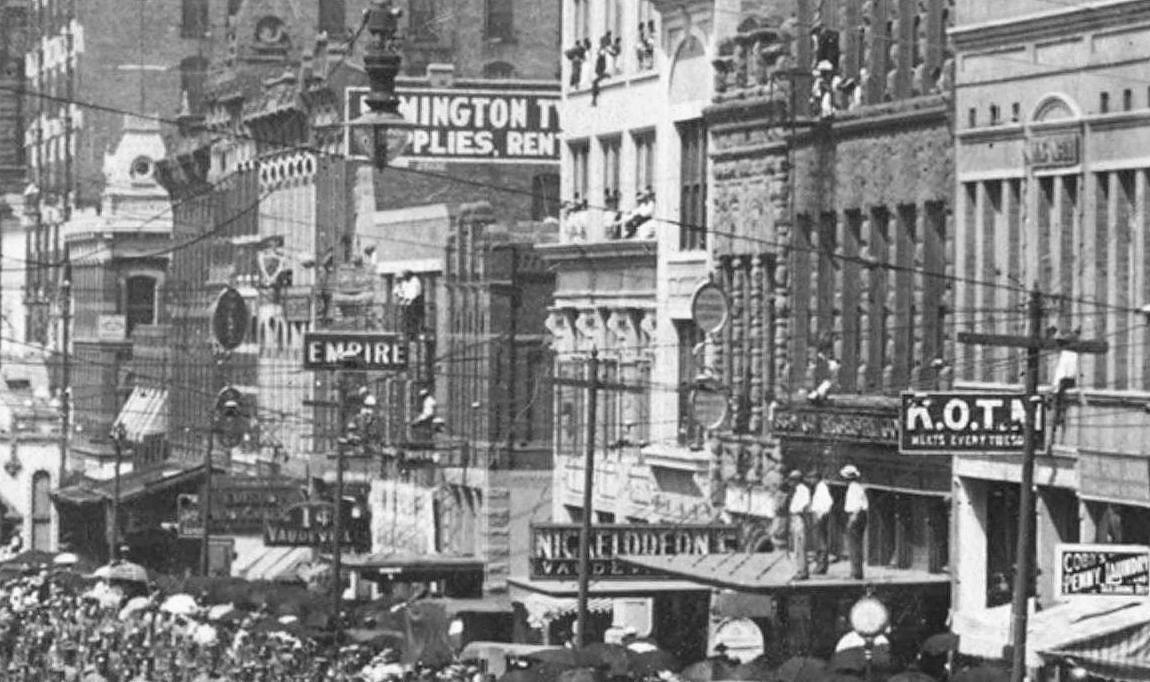
His Nickelodeon on Main Street can be seen in the lower center of this detail from a larger1909 parade photo.
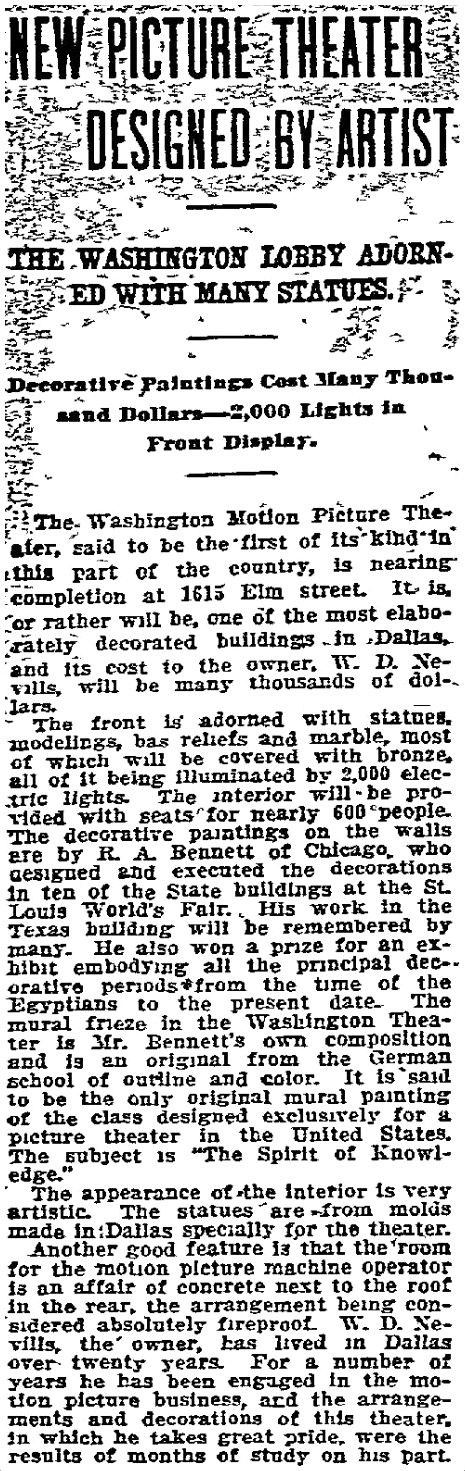
Nevills must have raked in a lot of nickels, because when his Washington Theater opened at 1615 Elm Street, it was the most spectacular motion picture “photoplay house” in Dallas. Nevills spared no expense for the theater’s furnishings and facade.
Dallas Morning News, Nov. 17, 1912 (click to read)
What might seem a little gaudy now, was probably still gaudy back then, but it was a fresh, NEW gaudy! And 600 Dallasites could all watch a movie at the same time. 600! Unheard of!
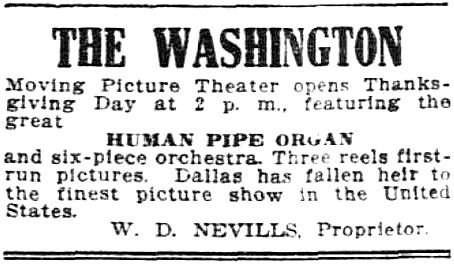
The Washington opened on Thanksgiving Day, 1912. Complete with “Human Pipe Organ.”
DMN, Nov. 27, 1912
The Washington was the king of the roost for only a short while, though — until young whippersnappers like the Queen began to steal its thunder. 600 seats? Pfft! It was a thousand or nothing now. The theater began to lose its luster and look more old and hulking than young and exciting, and after riding out its very long lease, the Washington Theater closed on July 1, 1927.
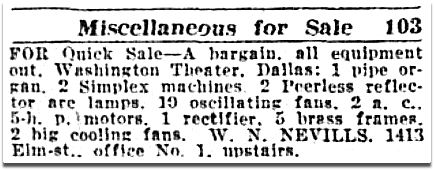
This little classified showed up a couple of weeks later, and it must have been a melancholy Nevills who had to write it up.
DMN, July 13, 1927
The theater continued to be used for a while — mostly for evangelical meetings or events. I’m not sure exactly when the building was demolished, but a report of the building’s being sold and plans for its razing appeared in The Dallas Morning News in October, 1927.
*
Let’s look at a couple of details from that top photo. The Washington was built without a marquee, but the outside of the building was studded with an eyeball-popping TWO THOUSAND LIGHTS! Imagine what that must have looked like — in 1912! Here’s an extreme close-up of the theater’s facade — look at all those bulbs!
And, below (was one of these men W. D. Nevills?):
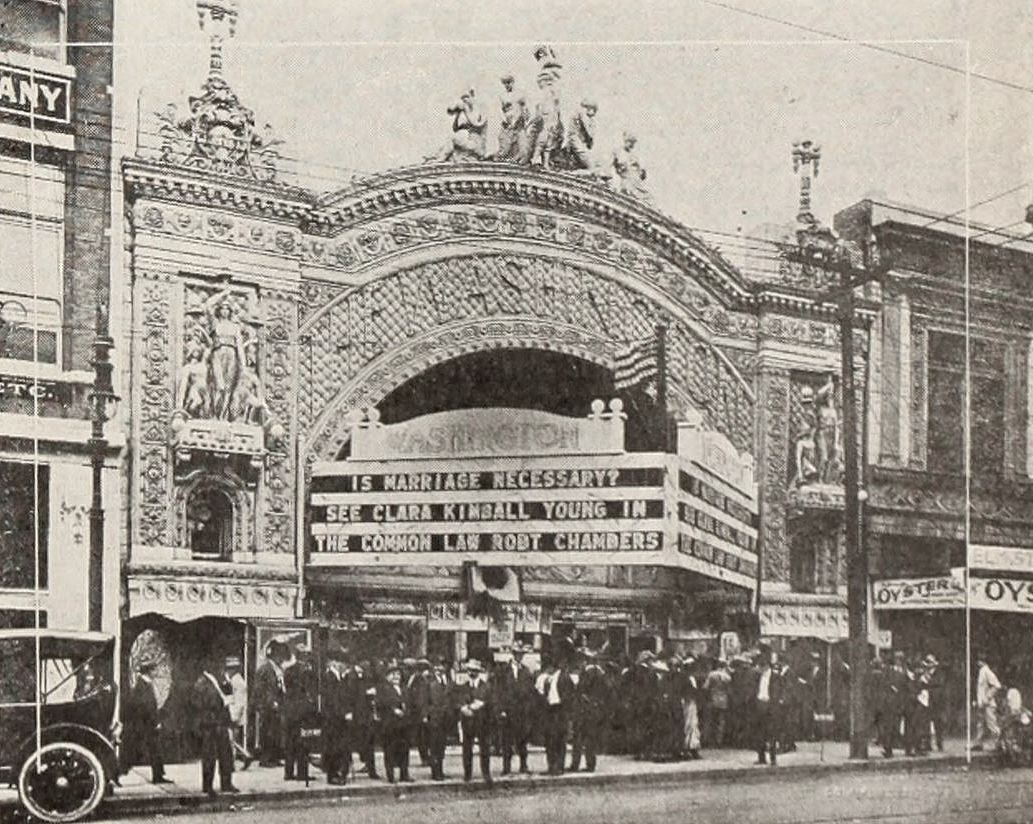
Another shot, this one showing how one worked without a typical illuminated marquee — you just string a banner up (the needle is hitting a solid “8.5” on the visual clutter scale here):
Top photo from Cinema Treasures; to read a history of the Washington Theater from Cinema Treasures (and to see another photo), see here. (Photo’s original source appears to be the Dallas Historical Society.)
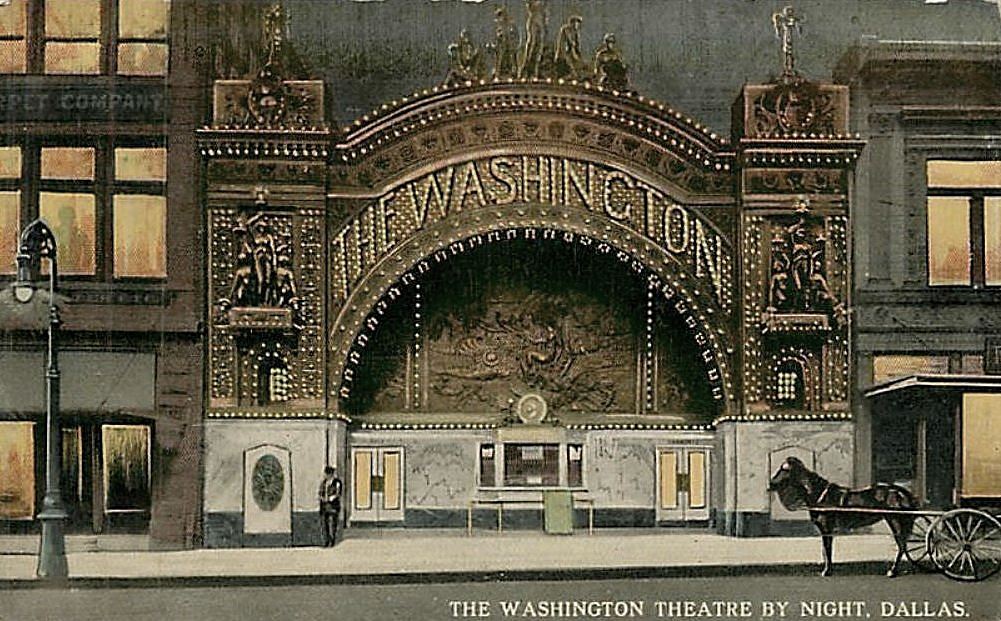
Photo of the theater at night is from Dallas Rediscovered by William L. McDonald — source: Dallas Historical Society archives.
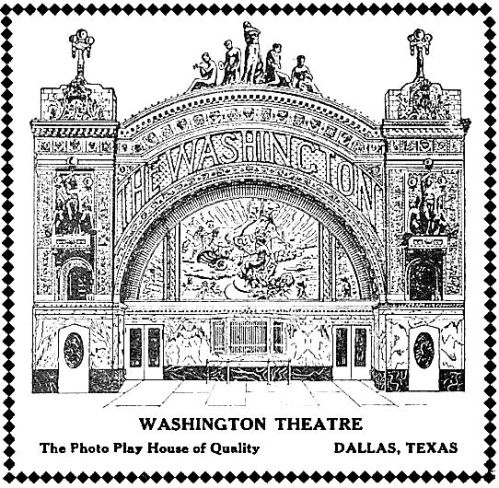
The ad is from the 1914 Dallas Building Code.
Photo with the marquee showing “The Common Law” is from Oct. 1916, but the photo didn’t appear in the trade magazine Theatre Exhibitors Herald and Motography until June 1919.
The color postcard is from eBay.
Read about the closing of the Washington in an article available in the Dallas Morning News archives: “Washington Theater, Earliest Dallas ‘Movie Palace,’ Shows Last Close-Up After 15 Years” (DMN, July 4, 1927).
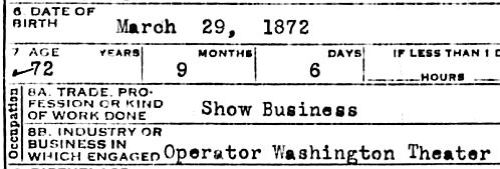
The Washington Theater must have been W. D. Nevills greatest achievement. It’s interesting to note that “Operator Washington Theater” appears on his death certificate. Nevills died in 1945, eighteen years after the theater closed.
For other Flashback Dallas posts on this era of movie theaters, see the following:
“Three of Dallas’ Earliest ‘Photoplay Houses’ — 1906-1913,” here
“Movie Houses Serving Black Dallas — 1919-1922,” here
This wonderful photo shows an aerial view looking northeasterly over the top of the Washington Theater, Dallas’ first ornate movie palace. It was located between N. Akard and N. Ervay, at 1615 Elm Street — now the site of Thanksgiving Tower. I think the street at the top right edge of the photo is Live Oak, which used to come all the way through to Elm. I love this photo.
***
Sources & Notes
Photo from Lost Dallas by Mark Doty (Charleston: Arcadia Publishing, 2012).
Bird’s-eye view today-ish (with 1615 Elm marked):
Bing Maps
The Washington Theater was in business at 1615 Elm from 1912 to 1927. More on the Washington in the Flashback Dallas post “The Washington Theater — Dallas’ First Movie Palace,” here.
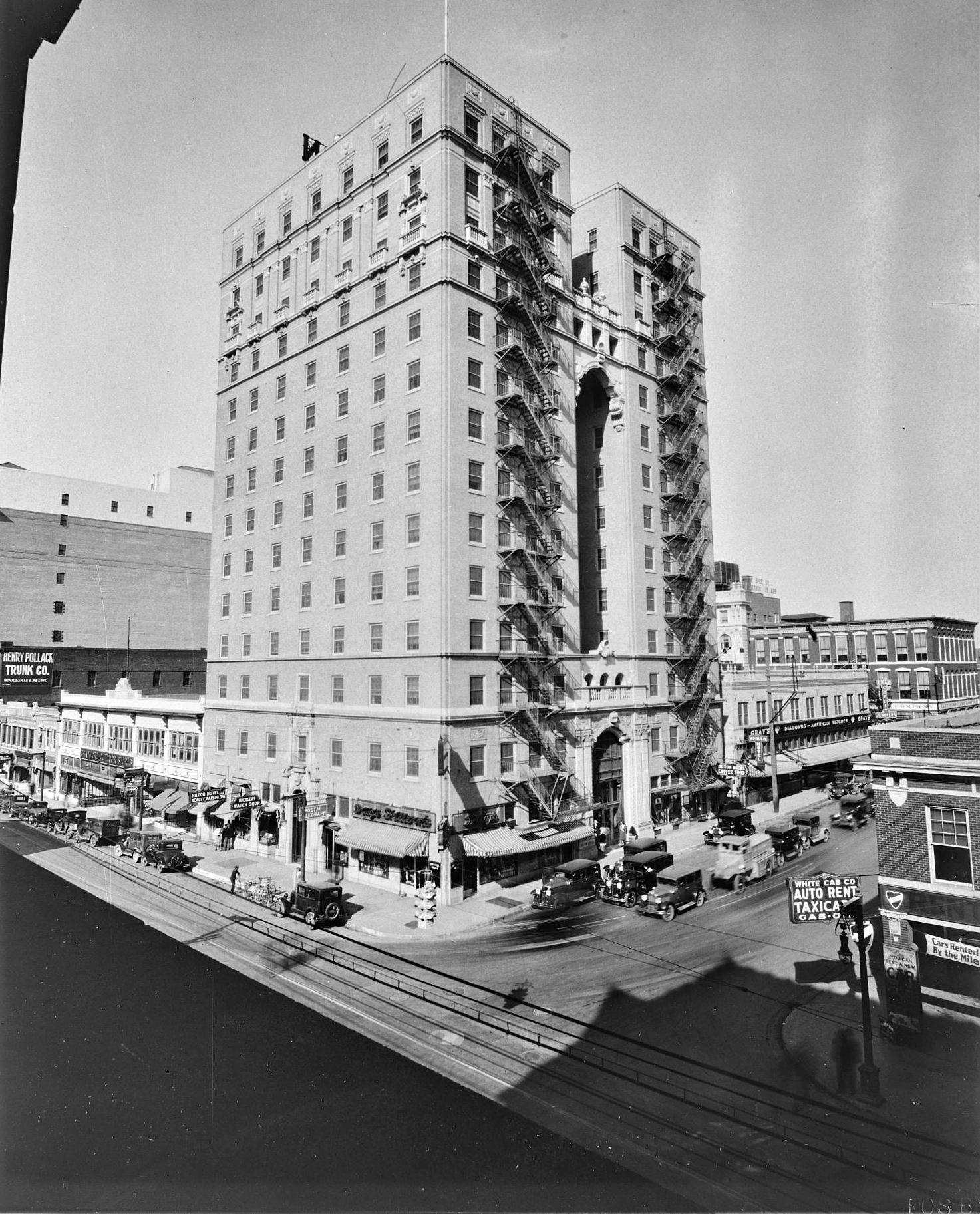
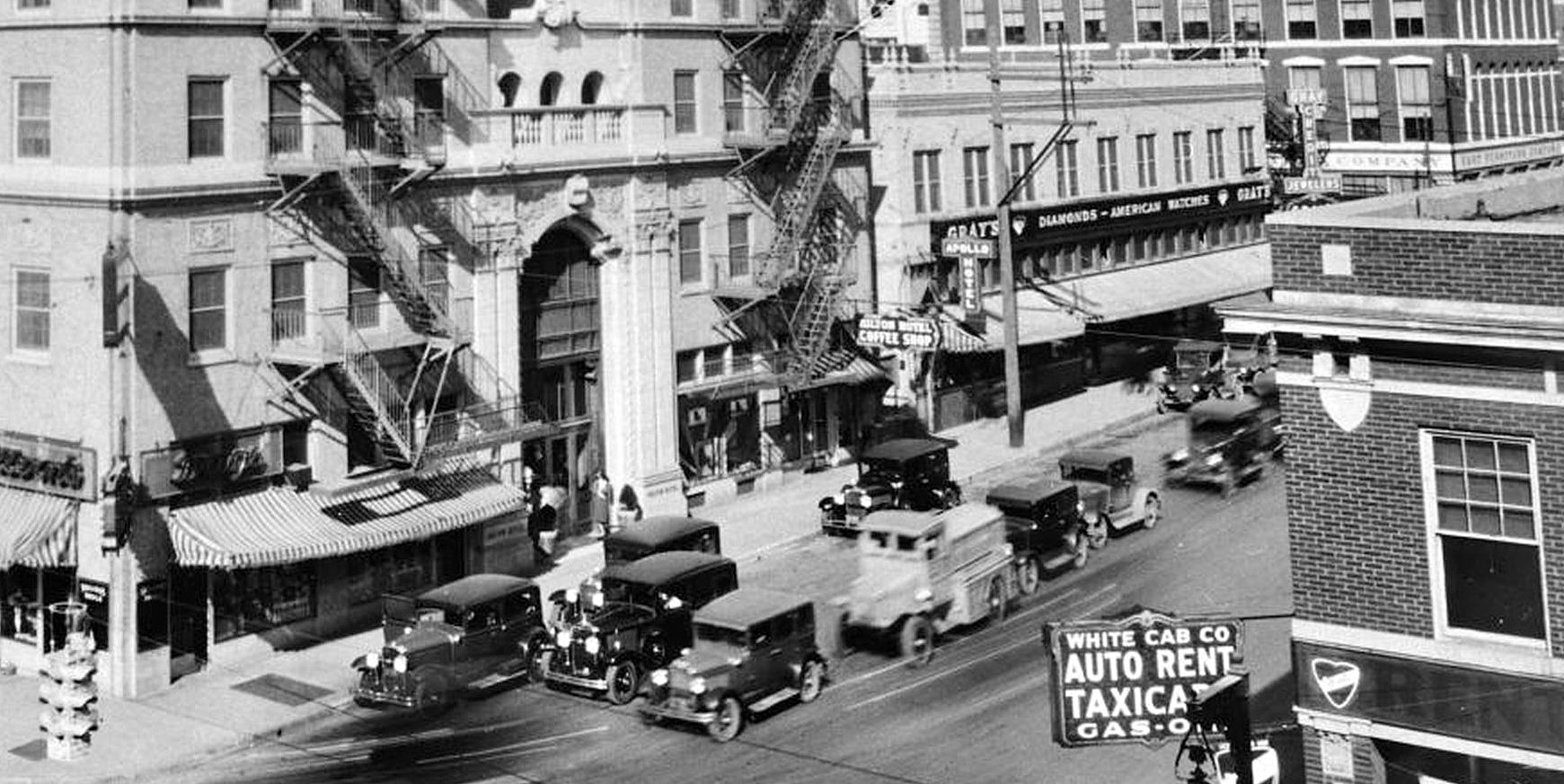
The Hilton, Main & Harwood, 1930 (click for much larger image)
by Paula Bosse
When Conrad Hilton built the Lang and Witchell-designed Hilton Hotel in Dallas in 1925, it was the first hotel he had built from the ground up. It’s been through several name changes over the years (its White Plaza Hotel incarnation was its longest), and, remarkably (for Dallas), the building still stands — it is now Hotel Indigo
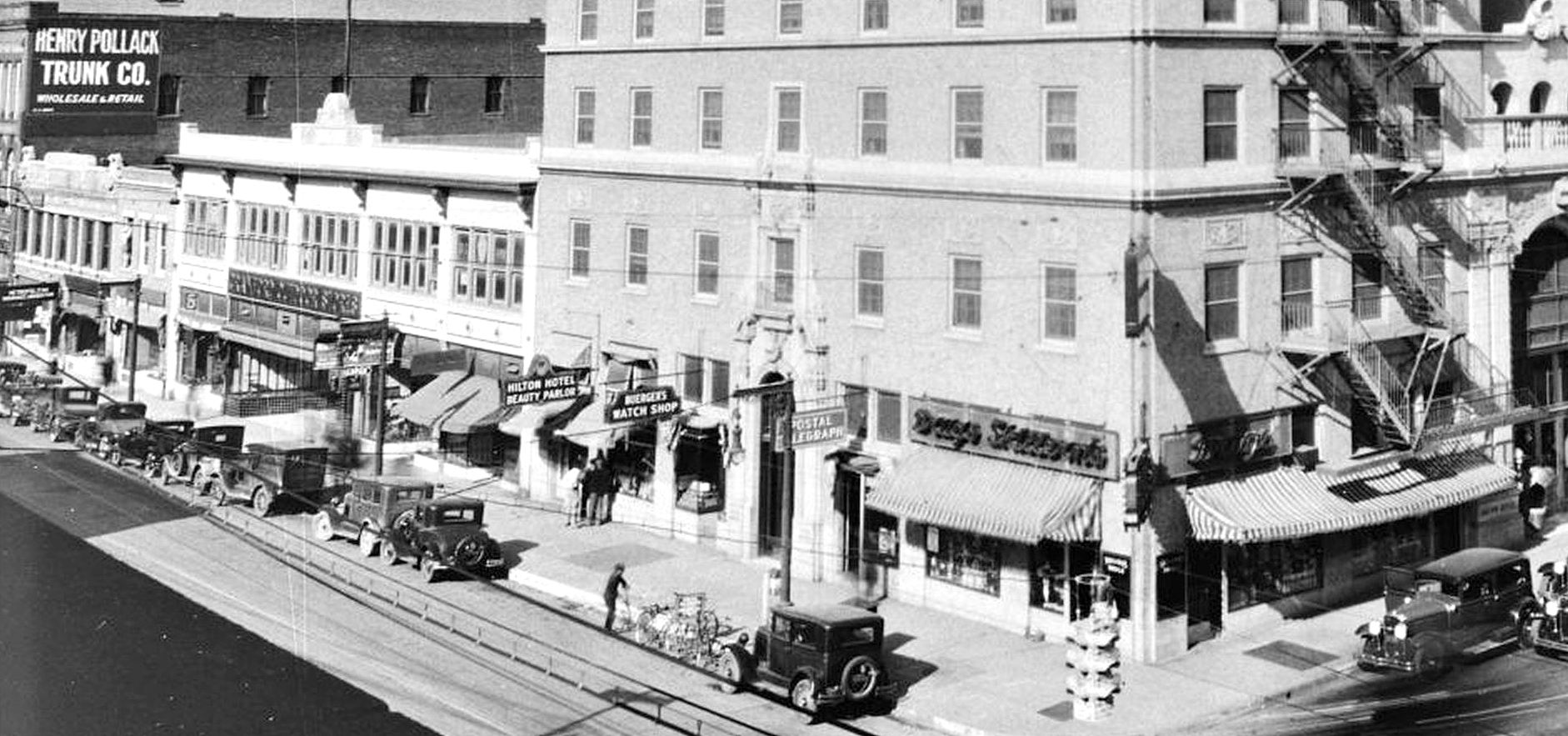
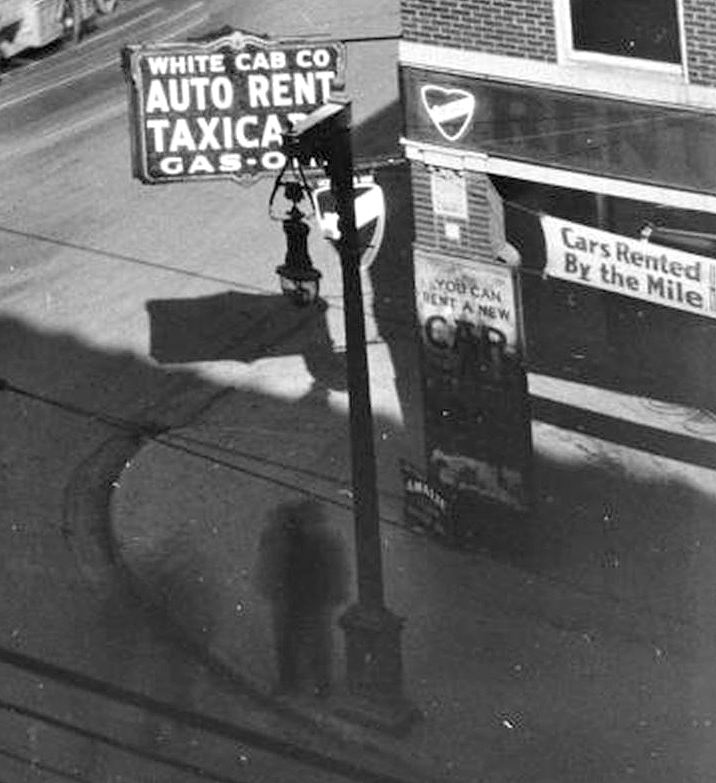
Above, a photo from 1930, with so much going on, it’s worth zooming in to see some of the details. All images are pretty big when clicked.
The left side of the photo shows Main Street looking west.
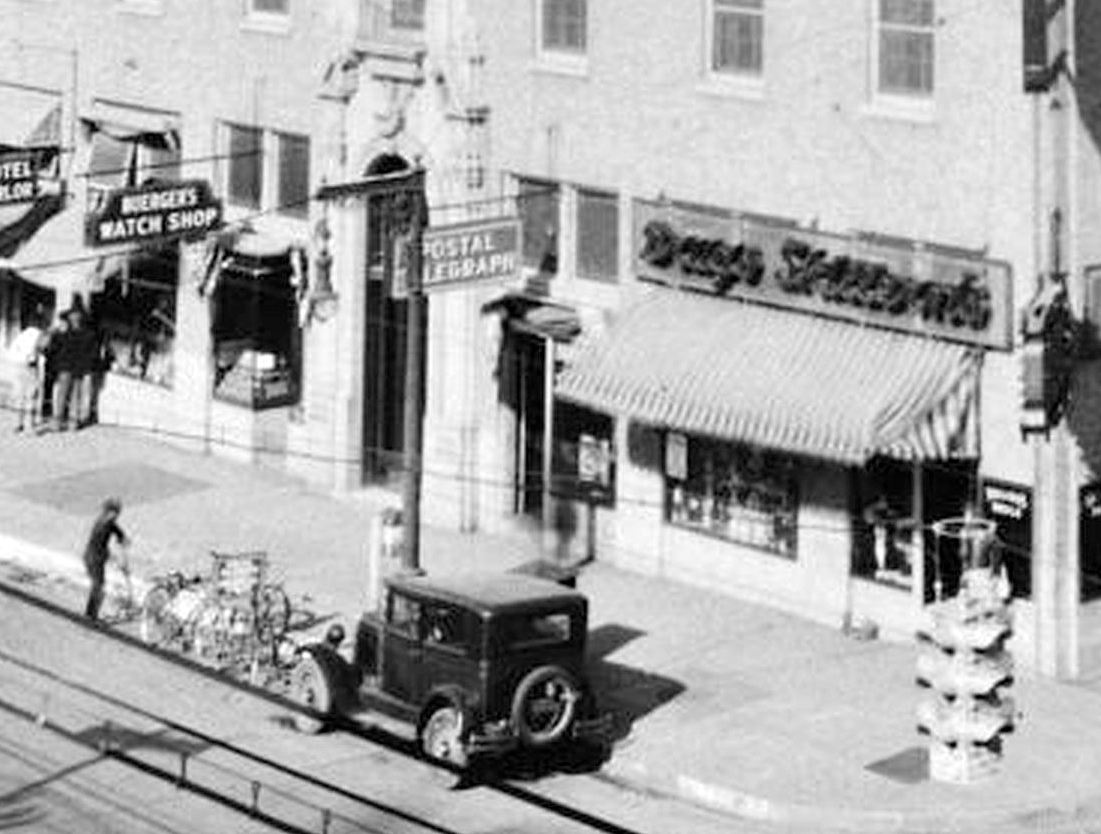
I’m not sure what’s going on with the man at the curb — construction? Street cleaning? And I’ve looked and looked at that small tower-like thing on the corner but can’t figure out what it is. (UPDATE: Ha! Thanks to a helpful comment below, I now see that this “tower” which was confusing me so much is, not, in fact, an odd structure set on the sidewalk but is — of course! — a traffic light suspended above the street!) (UPDATE #2: I think another commenter was right when he said it is a uniformed telegram boy at a bicycle stand. I’ve never considered that telegram offices would have had bike stands — but of course they would!)
The right side shows Harwood looking north.
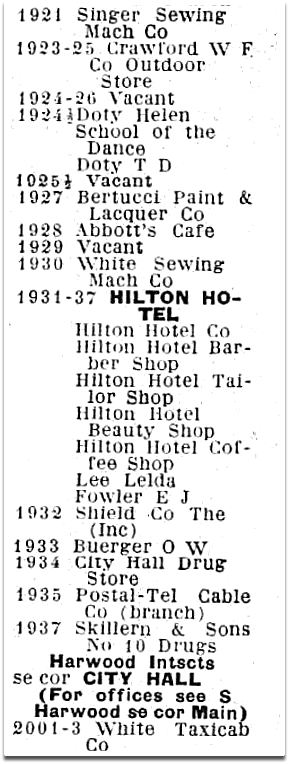
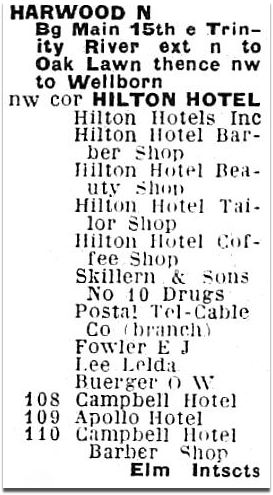
Here are the businesses listed in these blocks in 1930:
1930 Dallas directory
1930 Dallas directory
As a bonus, here’s a detail of another photo, showing the same intersection, around the same time, taken from the steps of the Municipal Building (then the city hall). The Drake’s Drug Store would be replaced by a Skillern’s in later years.
***
Sources & Notes
Top photo from the Texas Historical Commission Historic Resources Survey Collection, via the Portal to Texas History, here.
The Wikipedia entry for Dallas’ first Hilton Hotel (not to be confused with the Statler-Hilton of the ’50s) is here.
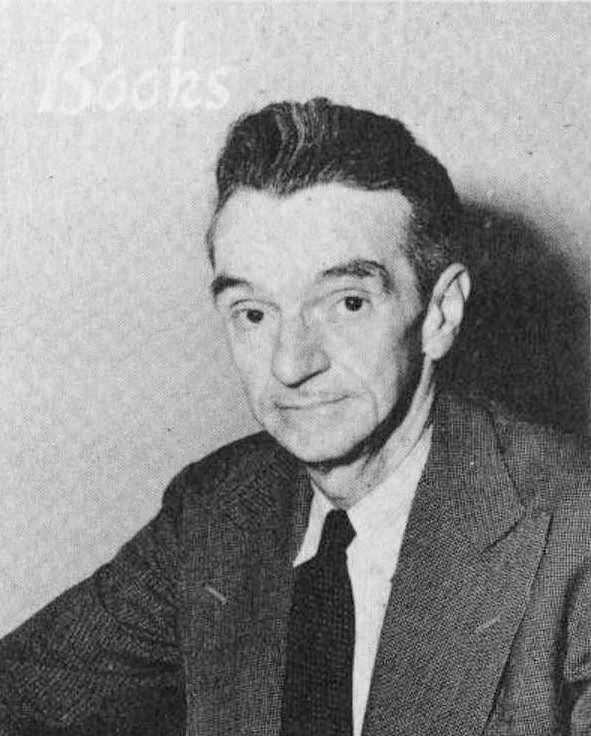
I’ve spent a fair amount of my adult life cataloging Texana books and ending descriptions with the bibliographic citations “Adams, HERD” or “Adams, SIX-GUNS.”* “Adams” was Ramon F. Adams, a respected and prolific writer and bibliographer specializing in the Old West and cowboy life. If you collect books on Texas and The West — or on cowboys and the cattle industry — you have Ramon Adams’ books on your shelves. And he lived in Dallas.
Ramon Adams was born in Moscow, Texas in 1889, near Houston, but left there as a young man to study and teach music. He was a professional violinist who played not only an occasional symphony gig, but after his years of teaching, he made a steady living playing in movie theater orchestras, accompanying silent films. While playing in the orchestra at the Rialto in Fort Worth, he even wore white tie and tails. When the Rialto musicians went on strike in 1923, he and his wife, Allie, moved to Dallas, and he played in the orchestras up and down theater row until the fateful day when he was cranking a stalled Model T Ford in an attempt to start it and broke his wrist. It never healed properly, and his days as a professional violinist came to an abrupt end.
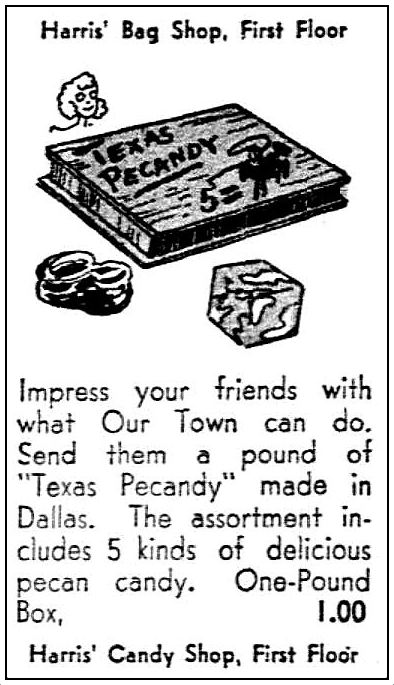
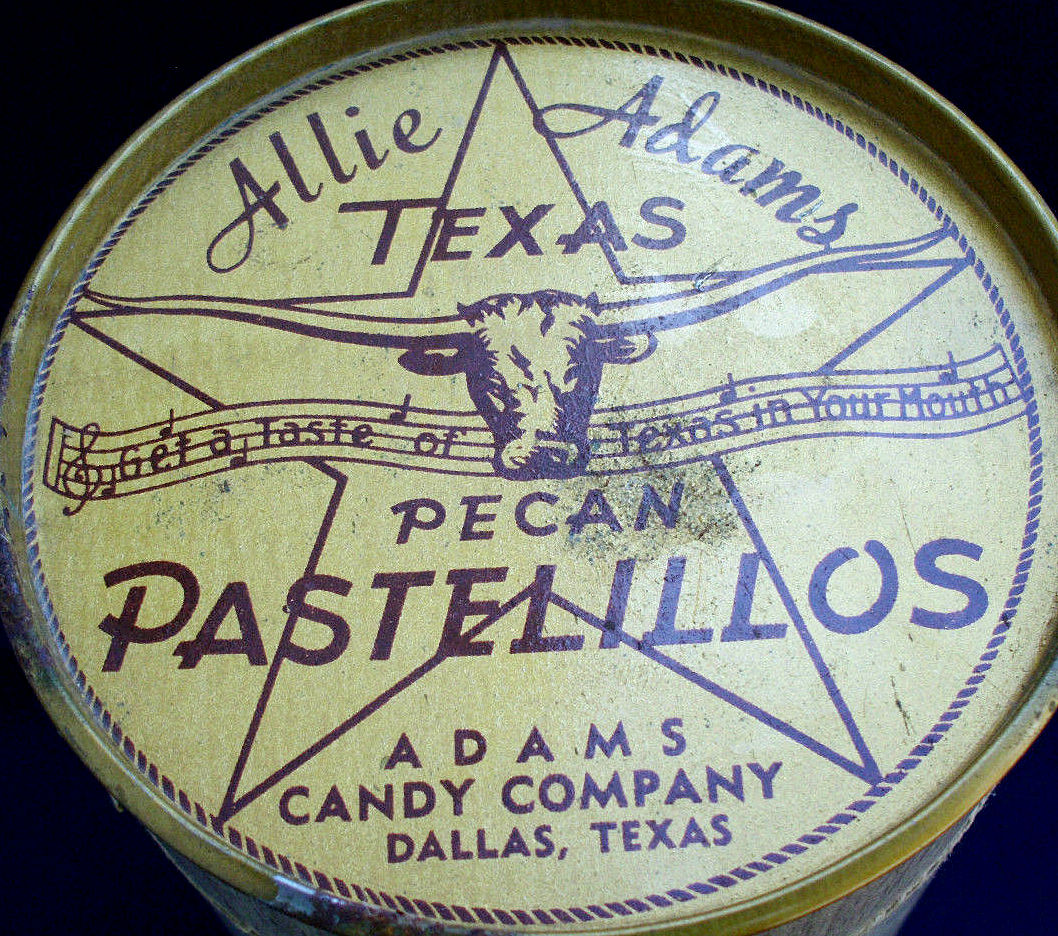
I never knew about his first career as a musician, and I never knew about his second career as a candy merchant! The Candy Years began when he and his wife bought a little candy store on Elm Street between the Melba and the Majestic, and it did such good business that, a few years later, he went into manufacturing and wholesaling candy. The Adams Candy Co. began its successful life in the 1930s, known for its widely available candies such as “Texas Pecandy” and for its “Burnt Offering” (“burnt almonds in chewy caramel and rich chocolate”), which was made specially for Neiman-Marcus.
Sept. 1940
The runaway success of his candy business meant that when the Adamses sold the business in the mid-’50s (making, one assumes, a hefty profit) Ramon was able to devote his full attention to researching and writing about cowboy life and culture. He had been writing all along, in his spare time, but only in short bursts, usually at night, at the kitchen table. He had written several very long pieces for The Dallas Morning News in 1927 and 1928, but his first book, Cowboy Lingo, wasn’t published until 1936 — when he was 46 years old. And then the floodgates opened. When he died in 1976, his obituary noted that he had written 24 books — in addition to numerous articles for magazines and journals. He was the expert other experts consulted. And he lived in Dallas. And he made “Pecandy.”
**
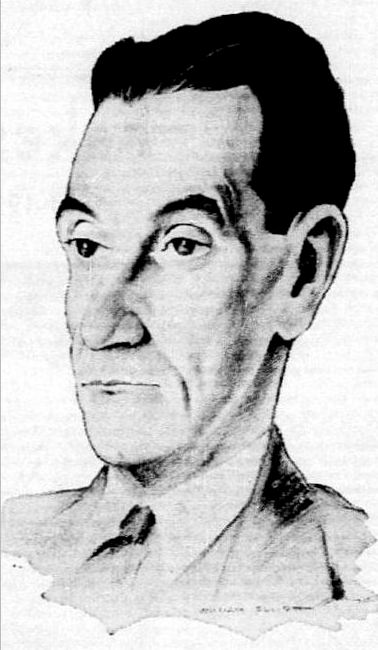
I love this 1936 caricature of Adams. (He looks an awful lot like Dr. Smith of Lost In Space here….)
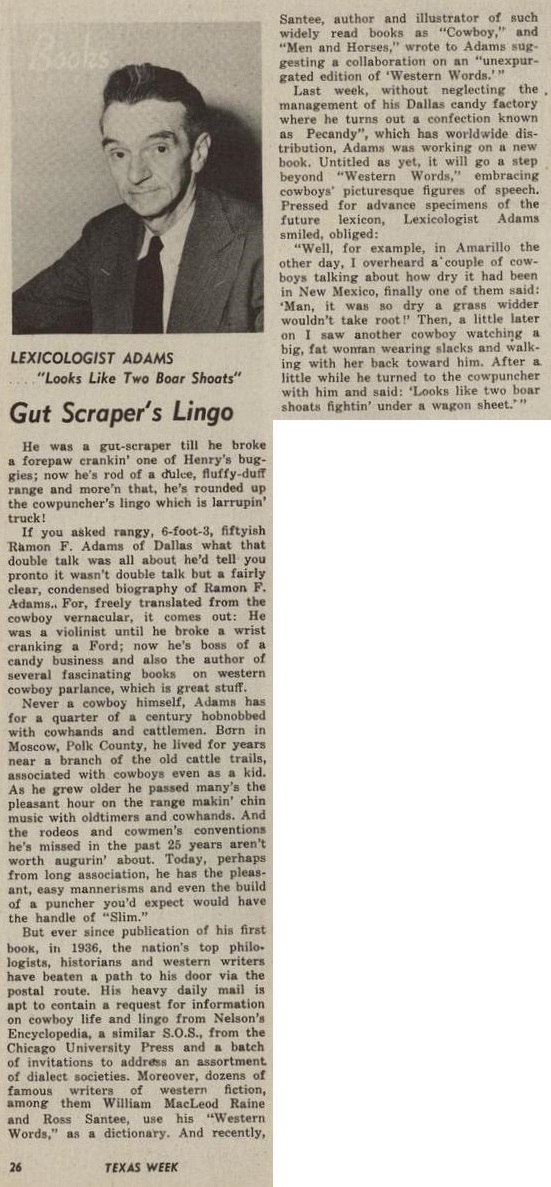
A pleasant little article on Adams, no doubt written by one of his many journalist friends, from 1946 (click for larger image):
Texas Week magazine, Sept. 7, 1946
And…
“Get a taste of Texas in your mouth!”
***
Sources & Notes
The Handbook of Texas entry on Ramon F. Adams is here.
A more comprehensive Biographical Note is on the page devoted to the Ramon Adams Collection, Texas/Dallas History & Archives, Dallas Public Library, here.
* “Adams, HERD” and “Adams, SIX-GUNS” is short-hand used by catalogers of books on Western Americana when noting that the book being cataloged is referenced in Ramon F. Adams’ book The Rampaging Herd: A Bibliography of Books and Pamphlets on Men and Events in the Cattle Industry (Norman: Univ. Oklahoma, 1959) or his book Six-Guns and Saddle Leather, A Bibliography of Books and Pamphlets on Western Outlaws and Gunmen (Norman: Univ. of Oklahoma, 1954).
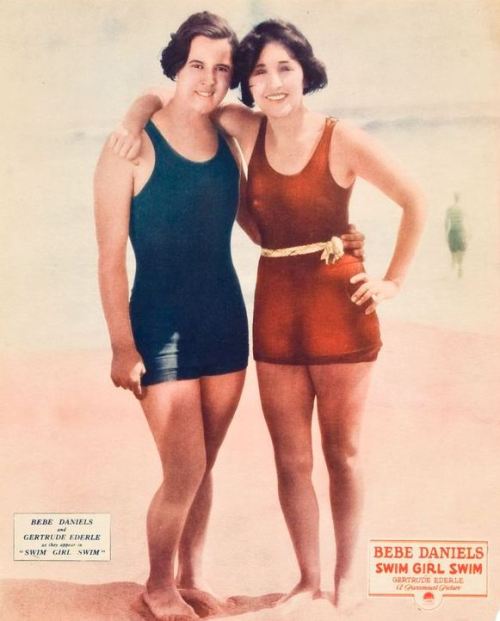
Gertrude Ederle (l) with co-star, Dallas native Bebe Daniels / via HA.com
by Paula Bosse
In 1926, Gertrude Ederle, a 19-year-old American, became the first woman to swim the English Channel — her time of 14 hours and 39 minutes was the fastest time ever. She became an instant international celebrity. When she returned to New York, she was given the very first ticker-tape parade, and over two million people turned out to see her.
After this momentous achievement, Ederle turned for a while to entertainment. She made a cameo appearance in a (now lost) silent film called Swim, Girl, Swim (which, incidentally, starred two Dallas natives, Bebe Daniels andJames Hall), and she also toured for a while with a vaudeville company.
It was during one of these tours in April, 1927 that she arrived in Dallas, just as torrential rains began to fall. There was severe flooding along the West Fork of the Trinity, especially in the area of Record Crossing. The boat in which two young men were riding had capsized and they had been caught in the undertow and drowned. There had been an unsuccessful search for their bodies, and I’m not sure who came up with the idea of contacting Miss Ederle, but someone did. Why NOT call in the world’s most famous swimmer to see if she could lend a hand while authorities dragged the river? Miss Ederle did, in fact, join in the underwater search, but the bodies were not found. I bet she never forgot that Dallas stop!
The news was reported in Time magazine:
Time, April 18, 1927
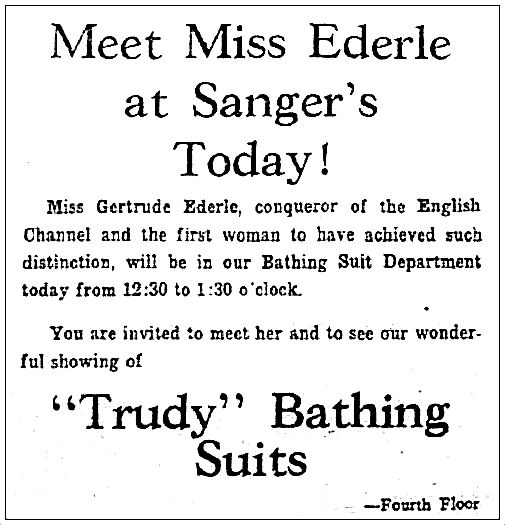
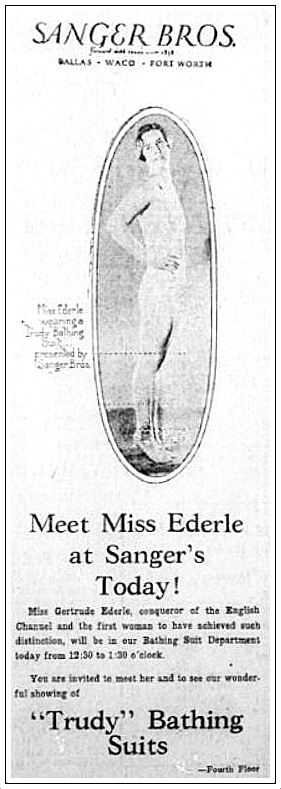
While in town, Trudy also squeezed in a personal appearance at Sanger Bros., hawking what looks to be her own line of swimsuits.
Apr. 14, 1927
***
Sources & Notes
More on the Trinity River search can be found in The Dallas Morning News article “River Claims Two Victims; Gertrude Ederle Makes Vain Attempt to Recover Bodies” (DMN, April 5, 1927).
Newsreel footage of Gertrude Ederle can be seen here.
The 200 block of Central Ave., about 1937… (Dallas Public Library photo)
by Paula Bosse
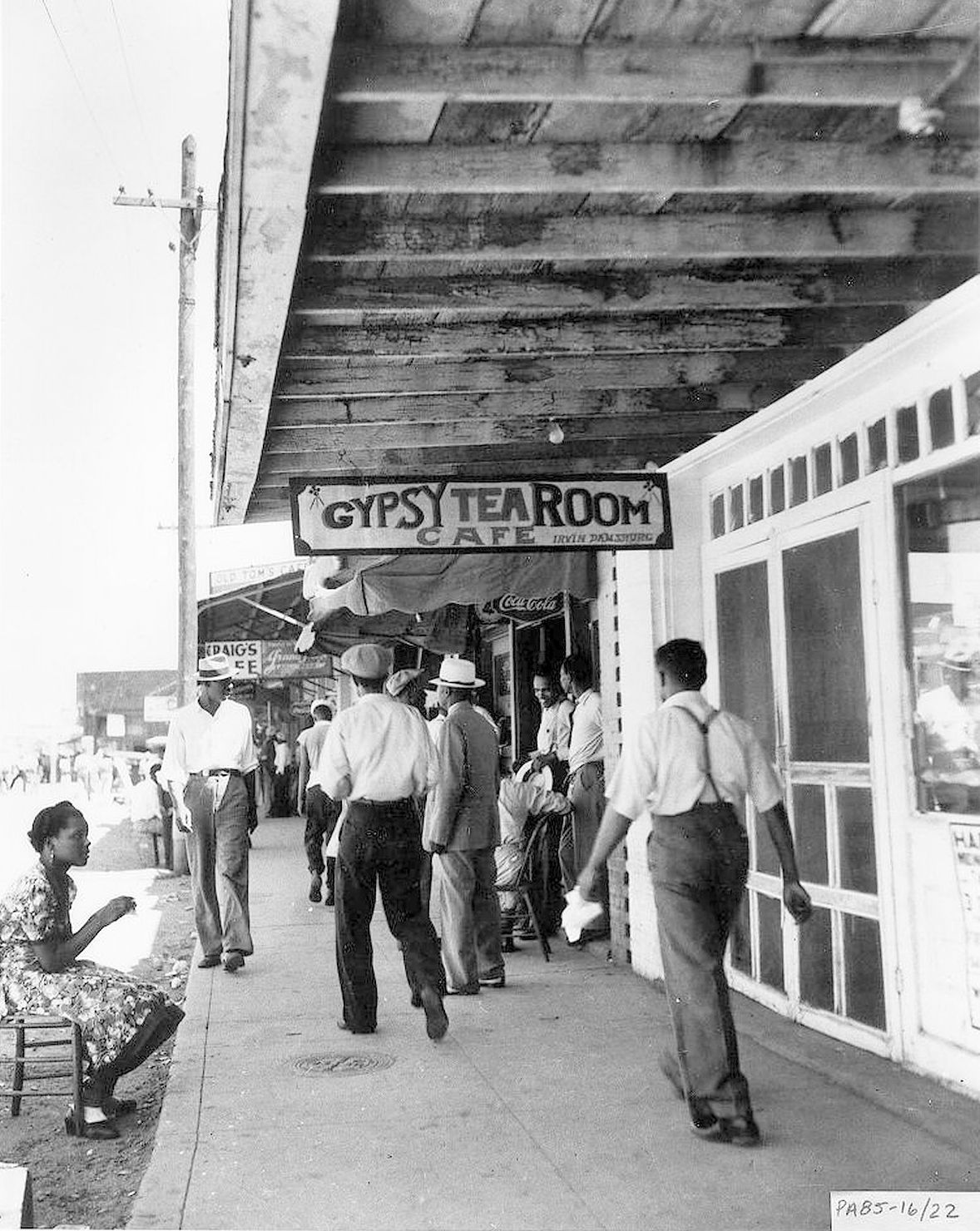
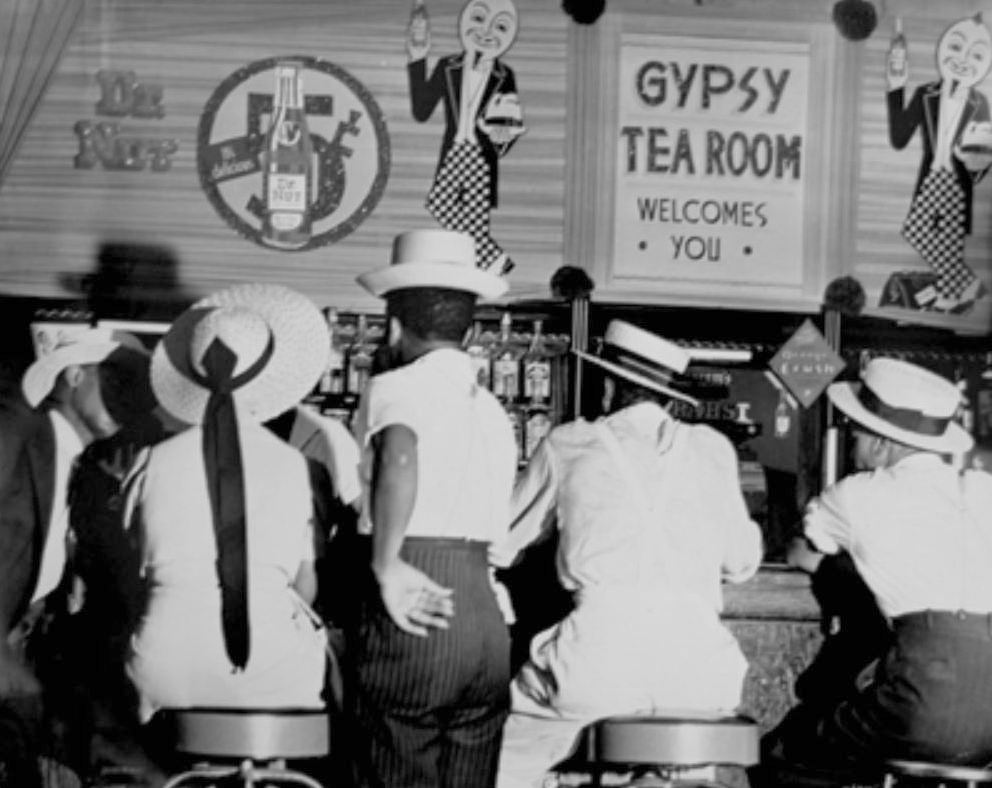
I’ve seen this photograph of Deep Ellum for years, and I’ve always loved it. But for some reason, I always thought this showed Elm Street — across from the Knights of Pythias Temple, just west of Good-Latimer (probably because that’s where a recent club with the same name was located). In fact, this scene was captured a couple of blocks west, just north of Elm, on Central Avenue, sometimes referred to as Central Track, along the Houston & Texas Central railroad tracks — a part of Deep Ellum that’s been gone for more than 60 years.
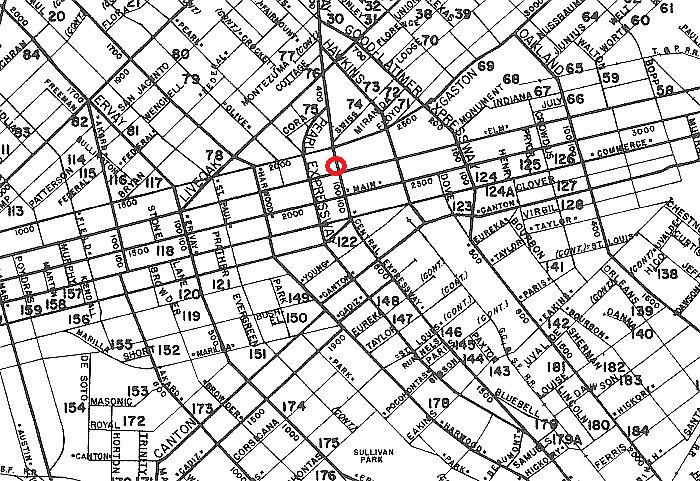
After Central Expwy. replaced Central Ave. (1952 Mapsco)
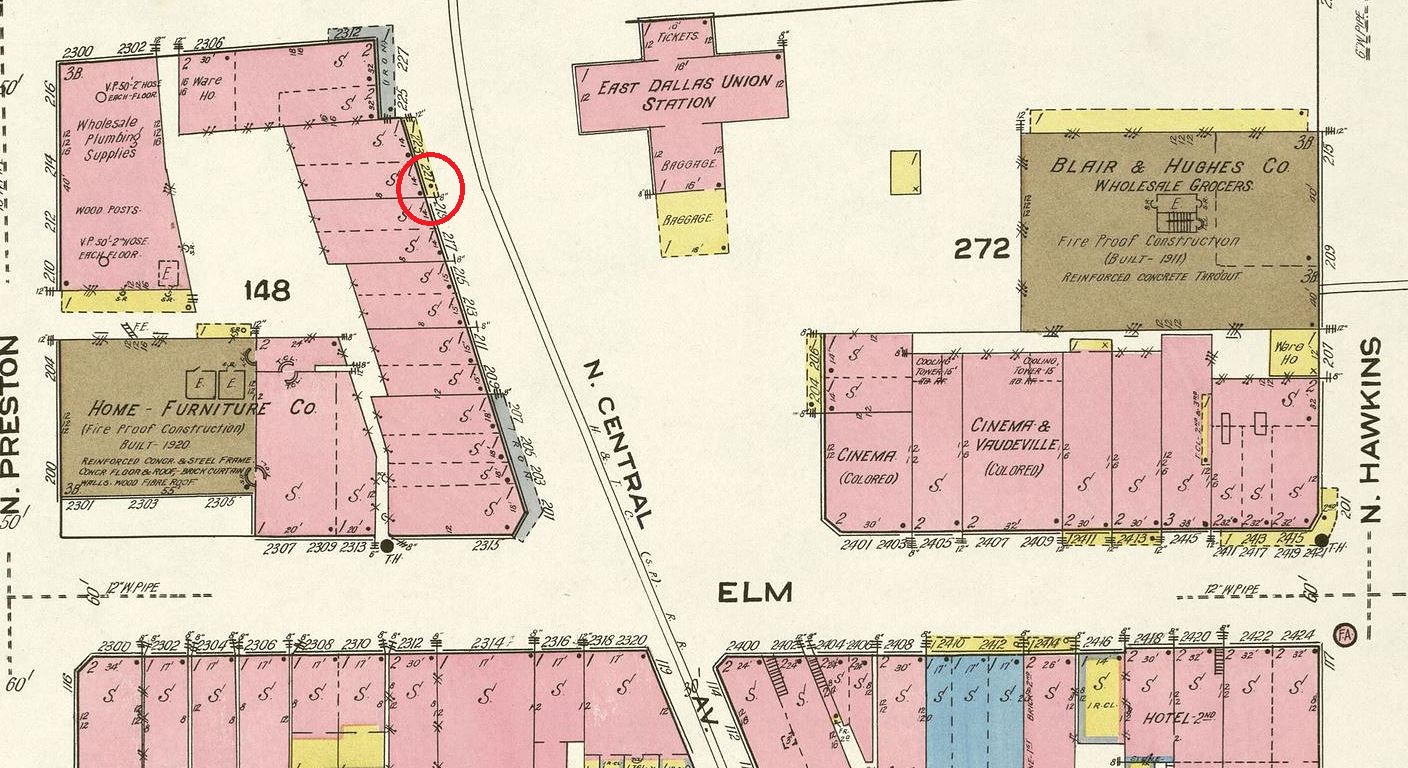
This area — which many have described as being the very heart of Deep Ellum in the 1920s through the 1940s (and which was somewhat ironically referred to as “the gay white way of the Negro in Dallas” by an uncredited WPA writer) — was demolished to make way for the construction of North Central Expressway (which closely followed the H&TC Railway tracks). This photo was taken in the 200 block of North Central Avenue, looking south toward Elm (the building farthest in the background, jutting out to the left, is across Elm, on the south side of the street). To the immediate left of this photo (out of frame) was the old union depot (read about it here).
You can see that the Sanborn map from 1921 shows that same building jutting out. (See the full Sanborn map here; it might be more helpful to see this detail rotated to show the same view as the photo, here.)
1921 Sanborn map, detail (click for larger image)
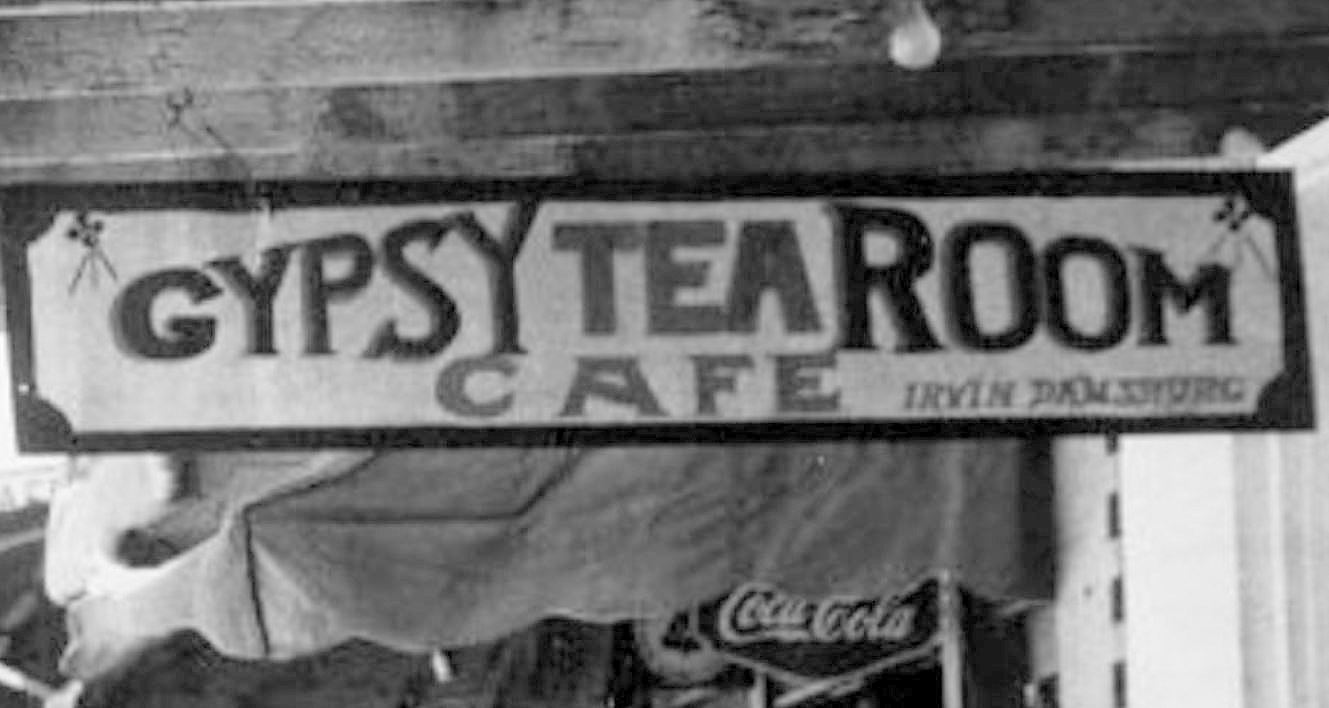
Information about The Gypsy Tea Room is scant. The proprietor was a man named Irvin Darensbourg, whose family was from the black community of Killona, Louisiana in St. Charles Parish; they appear to have been of French Creole extraction, and the family’s last name was probably correctly spelled as D’Arensbourg.
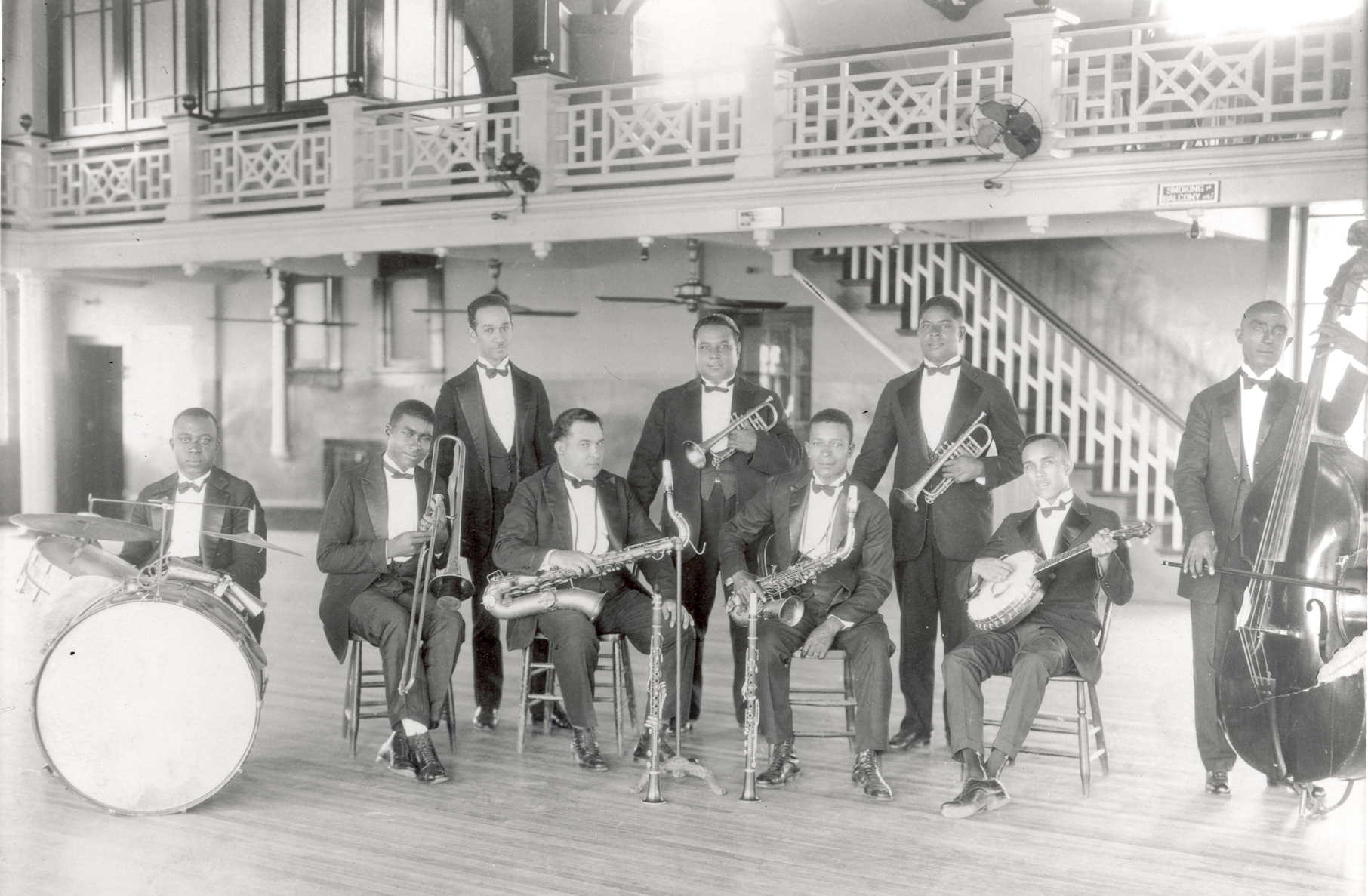
The Darensbourgs were an interesting family (and not just because their mother’s maiden name was Louise Jupiter!). There were several children, and at least two of them were professional musicians: Percy Darensbourg (1899-1950) and Caffery (often spelled “Caffrey”) Darensbourg (1901-1940). Both played with several jazz bands, and Percy even made a few recordings, playing banjo. Below are a couple of promotional photos showing them at work in the 1920s, when they were still based in New Orleans, before they settled in Dallas. (These are cropped details — click pictures to see the full photos.)
Percy Darensbourg, with Lee Collins‘ band, 1925 or 1926:
Listen to Percy on banjo, here:
And, below, Caffery Darensbourg, with Manuel Perez’s Garden of Joy Orchestra (click photo to see full band — the other band members are identified here):
The first of the brothers to arrive in Dallas from New Orleans was Percy, in about 1929, and for the next few years he continued to make his living as a professional musician. Caffery followed in 1932 and opened the short-lived Frenchie’s Creole Inn on Boll Street. Their non-musician brother Irvin was here by 1935 and promptly opened the Green Tavern at 217 Central Avenue, just a few doors down from Percy’s drinking establishment, the Central Tavern Inn, at 223 Central. At about this same time, Percy was also running a club at 3120 Thomas called The Gay Paree — which The Dallas Morning News described as a “swanky negro night club” (April 12, 1938) in a short mention of Percy’s being fined for selling alcohol to an already-inebriated customer.
But back to that 200 block of Central Avenue — the one pictured in the photo at the top. Between 1937 and 1939, Irvin also owned/ran a small restaurant or cafe — and later a pool hall — out of 219½ Central. The Darensbourgs had that block locked up.
*
In 1935, a song called “In a Little Gypsy Tea Room” by Bob Crosby swept the country. It was a huge hit. Suddenly there were scads of places popping up all over calling themselves The Gypsy Tea Room or The Little Gypsy Tea Room. Some might have been actual tearooms, but there were also a lot of clubs and bars with the “tea room” name — the most famous of these was The Gypsy Tea Room in the Tremé district of New Orleans, at Villere & St. Ann, which opened the same year the song was being played incessantly by every dance band in the nation. This famous New Orleans nightclub booked the biggest jazz bands around and was a legendary musician’s hangout.
The Darensbourgs most likely knew the club, its owner, its patrons, and the musicians who played there. Perhaps Irvin Darensbourg decided to name his own little Gypsy Tea Room in Dallas in honor of the New Orleans landmark. Whatever the case, Deep Ellum’s Gypsy Tea Room appears to have come and gone fairly quickly (and one assumes there was more than tea being sipped inside).
*
The life of a tavern and club operator could be a hard one, especially in those days, especially in the black neighborhoods of Deep Ellum and North Dallas. Irvin seemed to be forever sleeping on a relative’s couch and had a different address every few months. By 1940 he had moved to Fort Worth to open another bar, and after that … I’m not sure what became of him — but one hopes that he met a less violent end than his brothers did here in Dallas. According to Caffery’s death certificate, he died in 1940 after having been shot in the abdomen while “in a public place.” His death was ruled a homicide. Percy, who by all indications was the most stable and successful of the brothers, was also killed — in 1950 he was stabbed in the neck (!) while out on the street at 4:20 AM.
**
As for the original photograph, I’ve pored over it and looked through directories, but I can’t pinpoint the exact year this photo was taken or determine what the actual address of the Gypsy Tea Room was. Since it was mentioned in the WPA Dallas Guide and History, which was written and compiled between 1936 and 1940 and contains the only contemporary mention of the Tea Room, my guess is that this photograph was taken about 1937, as this was the last year that Old Tom’s Tavern (209 ½ Central) seems to have been in business (although the bar that replaced it was owned by the same person, and the sign seen in this photograph could well have remained up for a while).
Craig’s Cafe, at 213 Central, was in business between 1929 and at least 1946 when property began to be demolished in order to begin construction on the expressway. The Gypsy Tea Room looks to be either two or three doors down from Craig’s place. My guess is that it’s 219 Central. The 1937 street directory has Irvin Darensbourg (whose name is constantly mangled and misspelled everywhere) listed as being the proprietor of both the Green Tavern (at 217 Central) as well as an unnamed restaurant at 219-A (sometimes written as 219 ½) Central. The 1938 and 1939 directories specify Darensbourg’s business at this address in those years is a pool hall, not a restaurant. So I’m going to venture that Irvin Darensbourg ran the Gypsy Tea Room at 219 Central Avenue in 1937.
1937 Dallas directory
That was exhausting!
***
Sources & Notes
Photo of the Gypsy Tea Room at the top of this post is from the Texas/Dallas History & Archives Division of the Dallas Public Library: “Gypsy Tea Room Cafe located in Deep Ellum” is from the WPA Dallas Guide & History Collection of the Dallas Public Library — its call number is PA85-16/22.
Thanks to Bob Dunn of the Lone Star Library Annex for deciphering “Darensbourg” from this badly garbled printed name on the Gypsy Tea Room sign.
Here are a few of the numerous ways this Darensbourg’s family’s name is misspelled across the internet:
And I’m still not actually sure whether it’s “Irvin” or “Irving,” or “Caffery” or “Caffrey.”
When clicked, the photo of Percy Darensbourg above opens up to show the full band — the personnel is identified in a caption from the book Oh, Didn’t He Ramble: The Life Story of Lee Collins: “Lee’s band in Dallas, 1925 or 1926. From the left: Coke Eye Bob (Arthur Joseph?), Mary Brown, Freddie ‘Boo-Boo’ Miller, Octave Crosby, Henry Julien, ‘Professor’ Sherman Cook, Lee, and Percy Darensburg [sic].”
A couple of other versions of “In a Little Gypsy Tea Room,” if you must:
The version by The Light Crust Doughboys (no strangers to Deep Ellum), recorded in 1935 in Dallas at 508 Park, is here.
The at-least-peppier version by Louis Prima and His New Orleans Gang, also recorded in 1935, is here.
See what the area once occupied by the vibrant street life of Central Track looks like now, here. The expressway overpass is now planted about where the photo was taken. It’s a shame this important part of town — in a way it was Dallas’ second downtown — was bulldozed into oblivion.
Above, Dallas lunch ladies shelling what looks like black-eyed peas for an unidentified school’s midday meal. I can’t say I’ve ever imagined lunchroom employees ever doing something like this. In the 1920s and ’30s, schools used fresh foods when they could, but they were definitely using a lot of canned fruits and vegetables, too. All this effort — and all these women — for peas.
In a quick search for what school lunch menus were like in the late ’20s and early ’30s, here were a few delicacies that would never be found in a school cafeteria these days:
Roast veal
Sardine sandwiches
Creamed onions
“Italian hash”
Banana and peanut salad
Salmon loaf
Tongue salad
Stuffed dates
Prune whip/prune salad/prune pudding
Yummy!
***
Sources & Notes
Photo from the Texas/Dallas History & Archives Division, Dallas Public Library.
Dallas women at work, 1925 (click for larger image)
by Paula Bosse
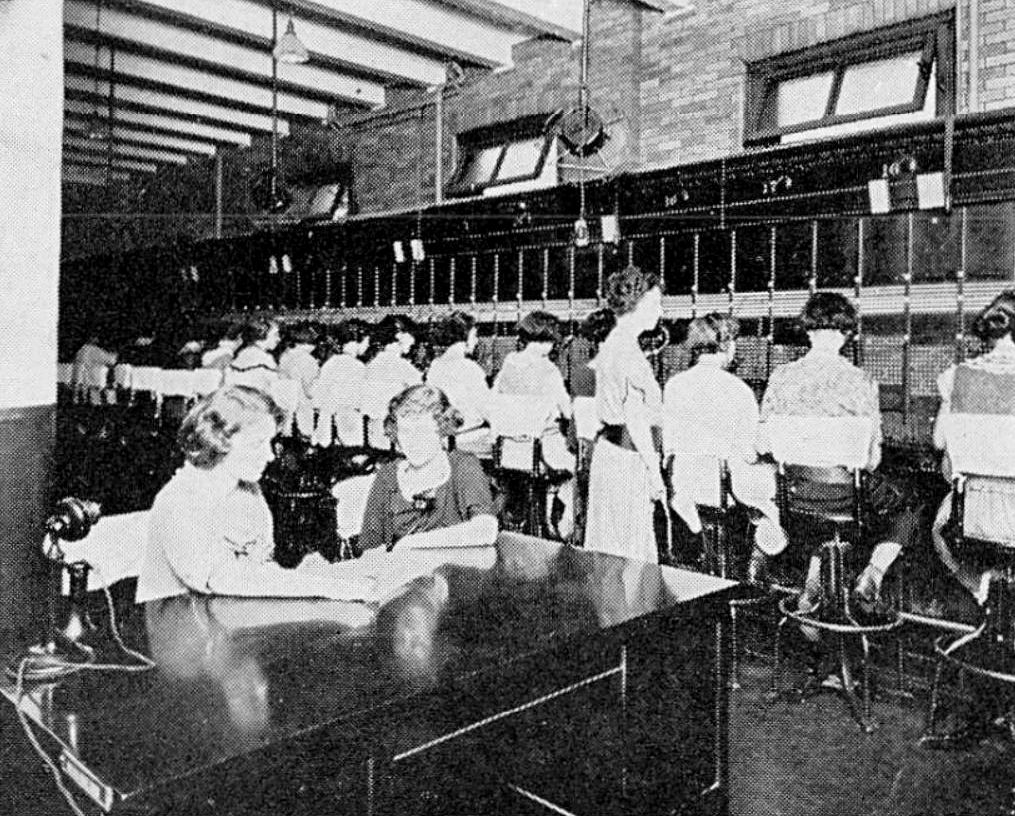
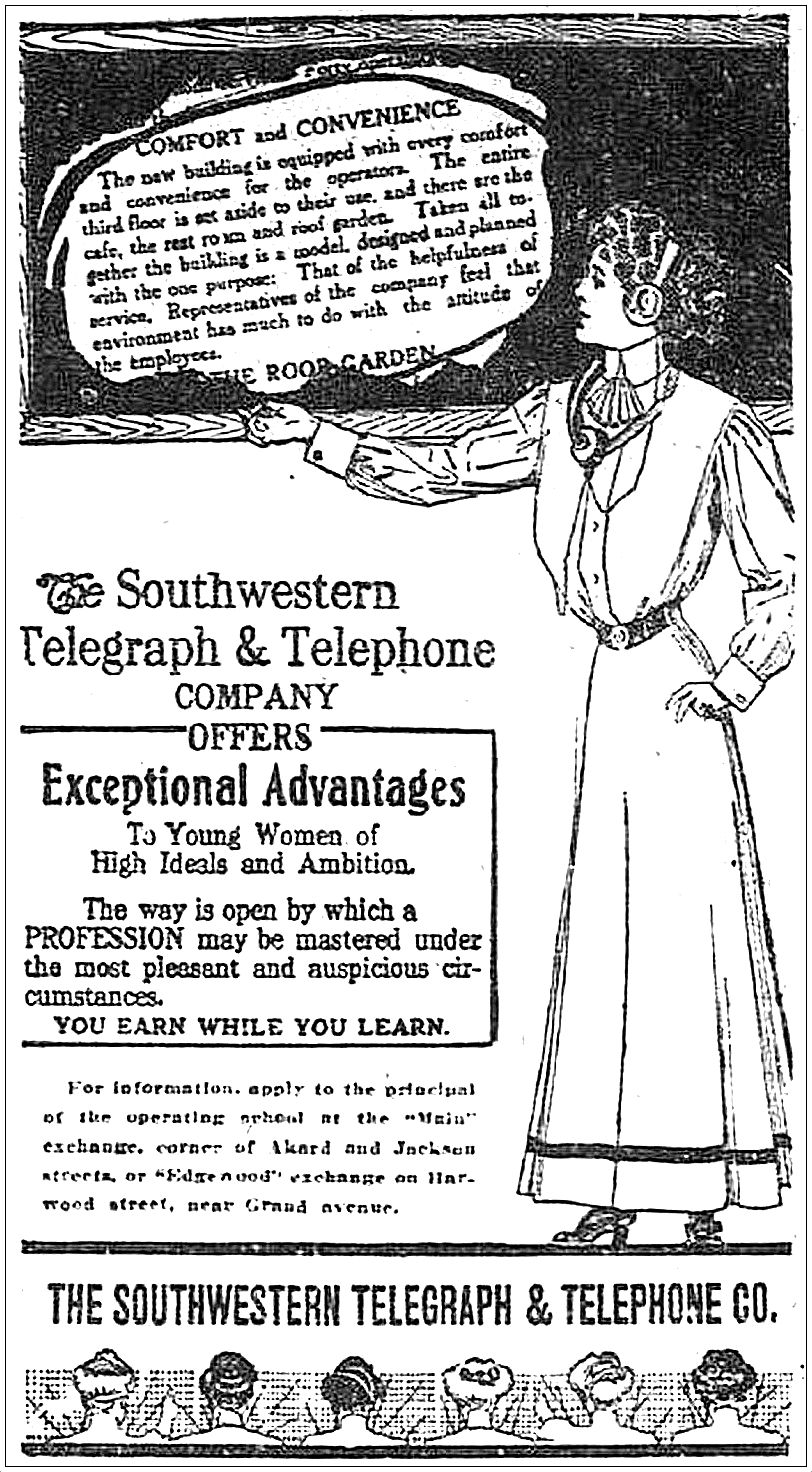
Today at look at two ads seeking “young women of high ideals and ambition” to become telephone operators, one of the few careers open to women exclusively.
First, an ad from 1911 for the Southwestern Telegraph & Telephone Company (click for larger image — transcription below).
1911
COMFORT and CONVENIENCE
The new building is equipped with every comfort and convenience for the operators. The entire third floor is set aside to their use, and there are the cafe, the rest room and roof garden. Taken all together the building is a model, designed and planned with the one purpose: That of the helpfulness of service. Representatives of the company feel that environment has much to do with the attitude of the employees.
The Southwestern Telegraph & Telephone Company offers exceptional advantages to young women of high ideals and ambition. The way is open by which a PROFESSION may be mastered under the most pleasant and auspicious circumstances. You earn while you learn.
For information, apply to the principal of the operating school at the “Main” exchange, corner of Akard and Jackson streets, or “Edgewood” exchange on Harwood street, near Grand avenue.
*
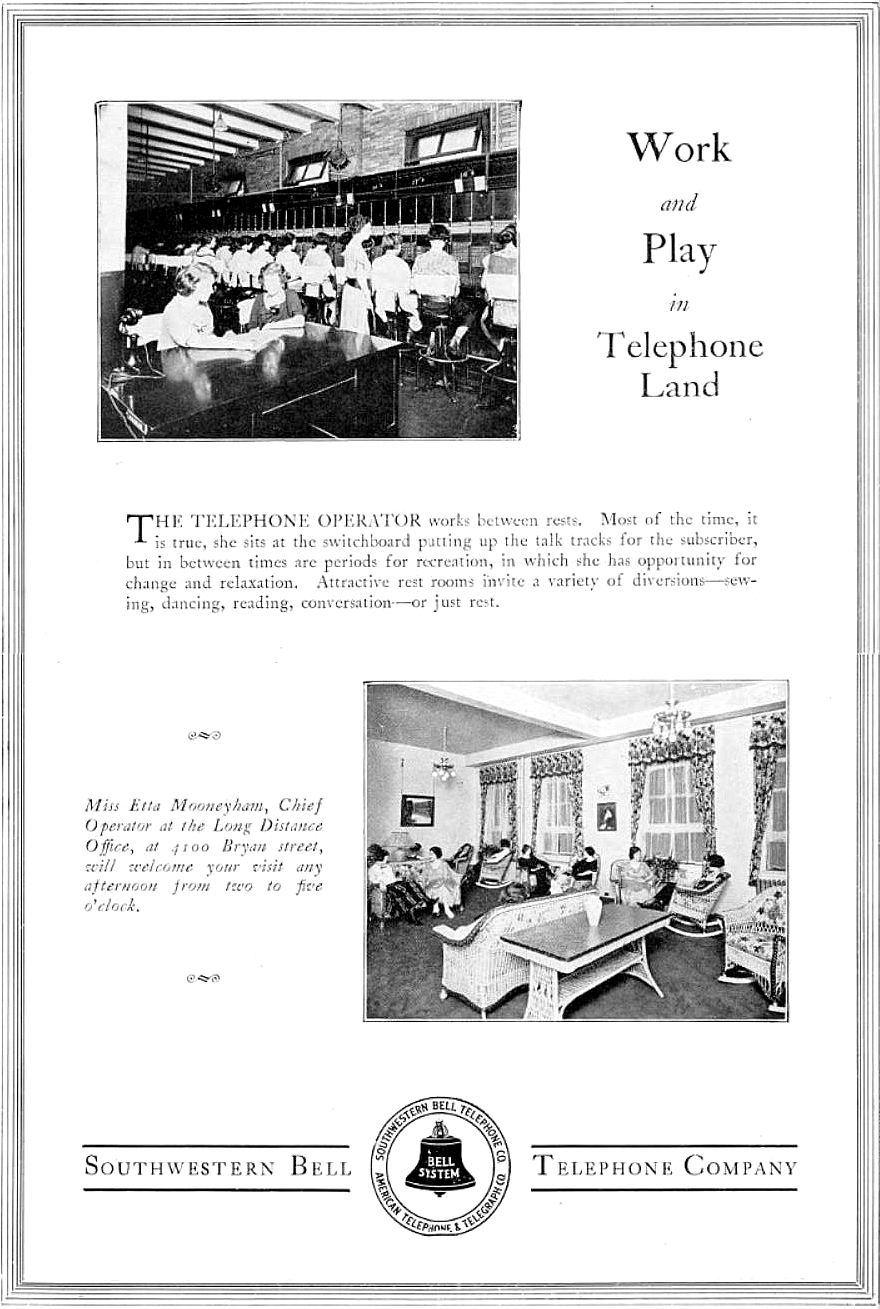
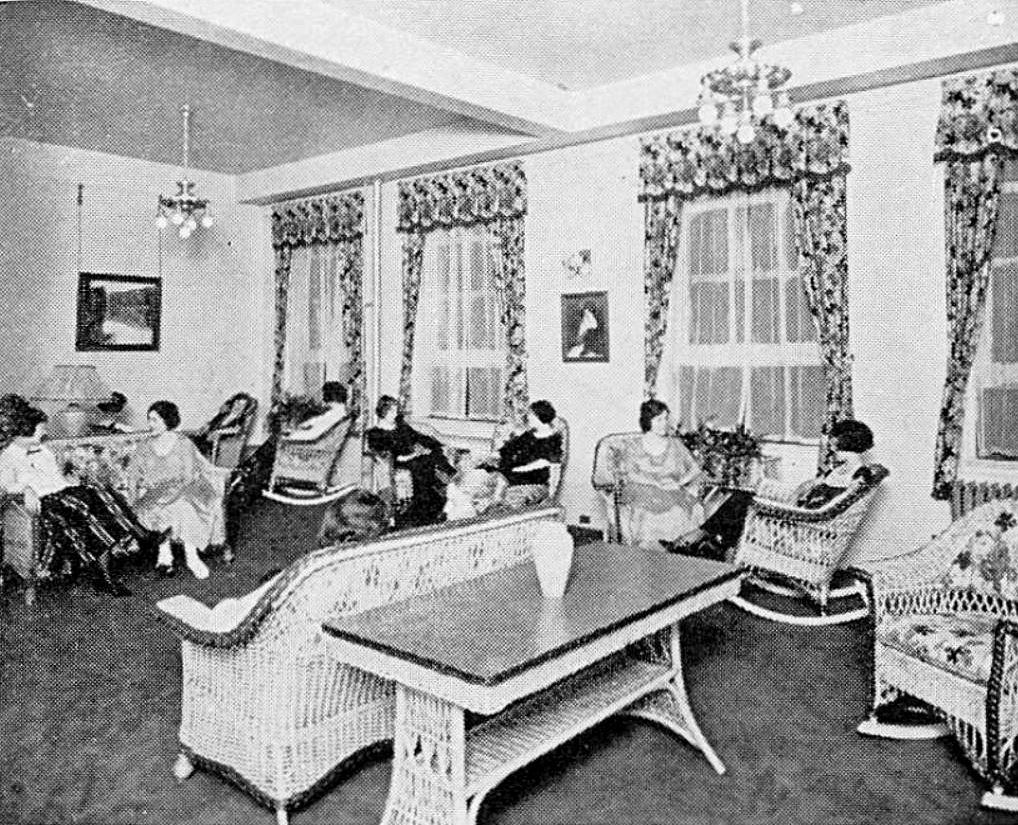
Here’s an ad from 1925 for Southwestern Bell Telephone Company, really pushing the idea that working as a switchboard operator is mostly rest and “a variety of diversions — sewing, dancing [!], reading, conversation”... more play than work, really!
1925
WORK AND PLAY IN TELEPHONE LAND
The telephone operator works between rests. Most of the time, it is true, she sits at the switchboard putting up the talk tracks for the subscriber, but in-between-times are periods for recreation, in which she has opportunity for change and relaxation. Attractive rest rooms invite a variety of diversions — sewing, dancing, reading, conversation — or just rest.
Miss Etta Mooneyham, Chief Operator at the Long Distance Office, at 4100 Bryan street, will welcome your visit any afternoon from two to five o’clock.
If you’re lucky, maybe Miss Mooneyham will ask you to dance.
Relaxing in one of the “attractive rest rooms” (1925)
***
Sources & Notes
1911 ad appeared in the Dallas Morning News on May 29, 1911; 1925 ad (containing the photos at the top and bottom) appeared in the 1925 edition of “The Oak,” the yearbook of Oak Cliff High School (later renamed Adamson High School).
I’ve been fascinated by telephone operators my whole life. Ever wonder why operators have historically always been women? Watch an entertaining 5-minute video about why women took over the profession, here.
Also, read an interesting New York Times article about “telephone girls” (June 11, 1899), here.
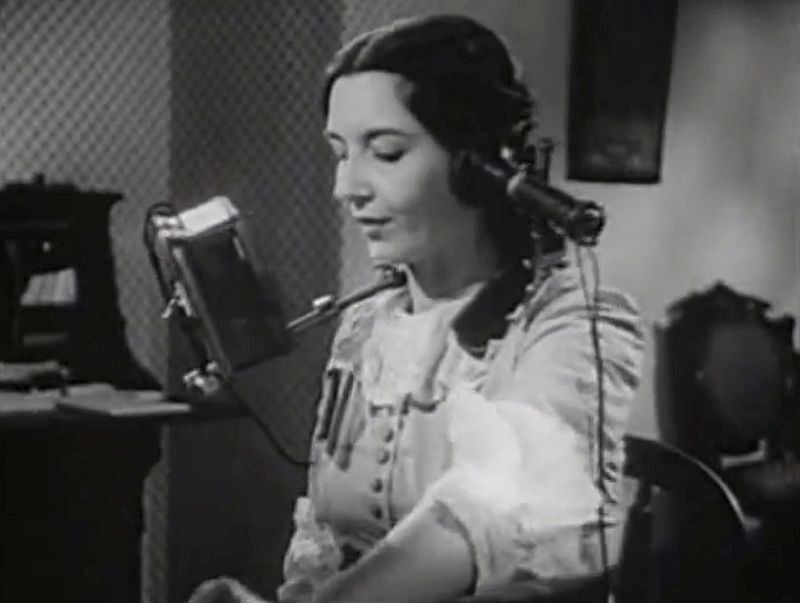
Lastly, because I really want to post this ridiculous screenshot of what 19th-century operators apparently wore at some point, an AT&T industrial film called “The Nation at Your Fingertips”can be viewed here. (The few seconds showing this operator who surely would have experienced crippling next pain for the rest of her life begins at the 3:43 mark.)
See an earlier, related post — “Telephone Operators Sweating at the Switchboard — 1951” — here.

 Wide open… (click for much larger view)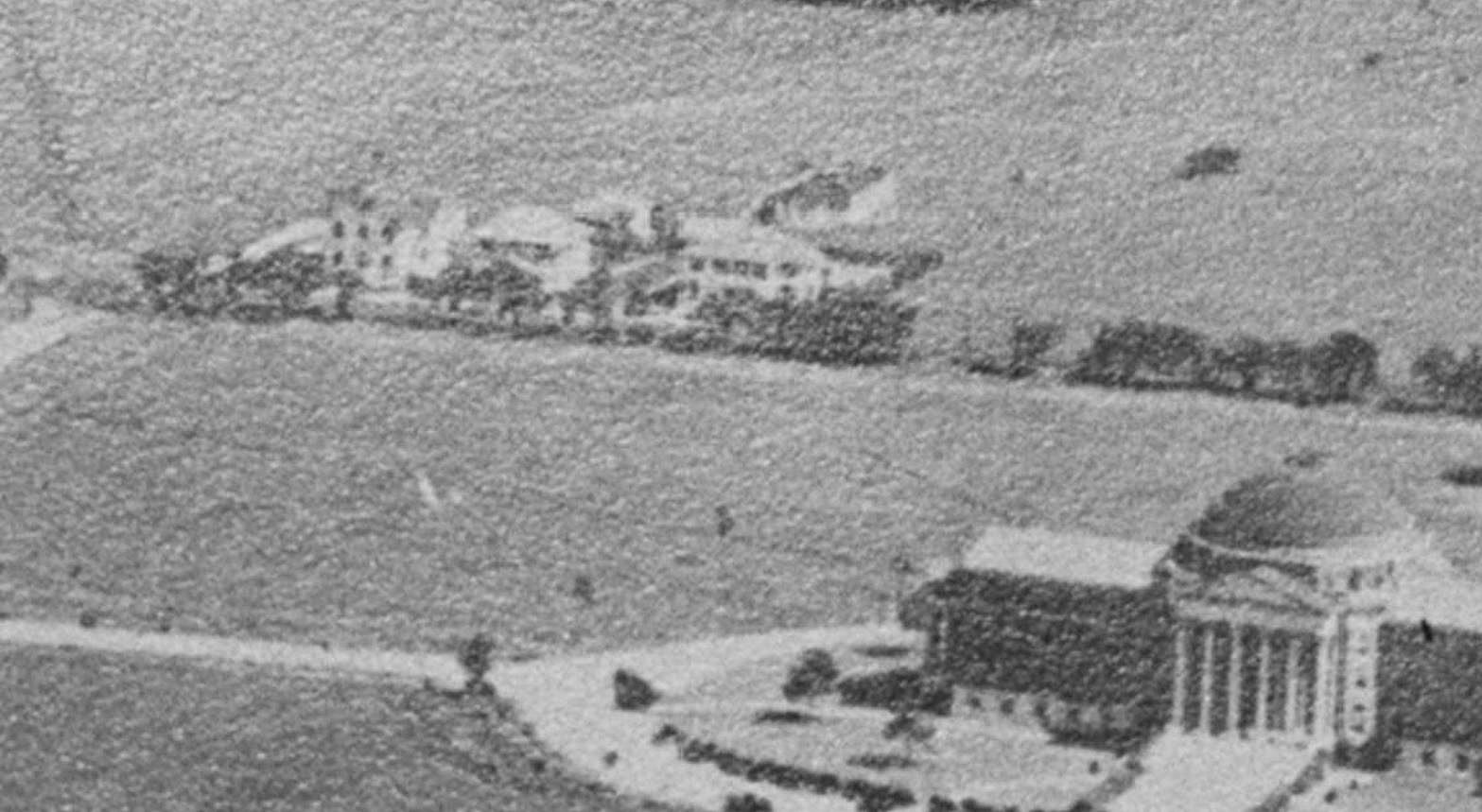

 DMN, July 13, 1927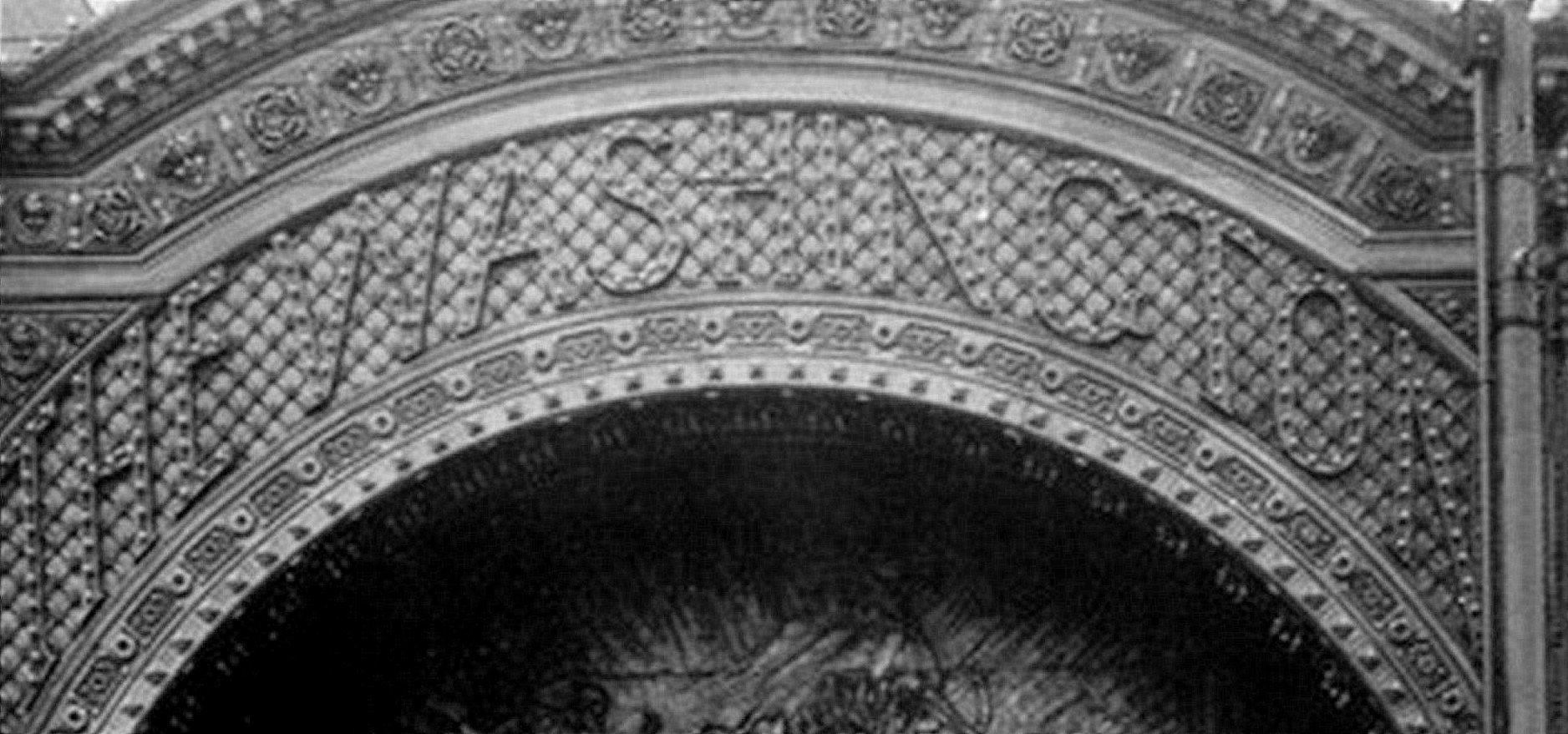




 Gertrude Ederle (l) with co-star, Dallas native Bebe Daniels / via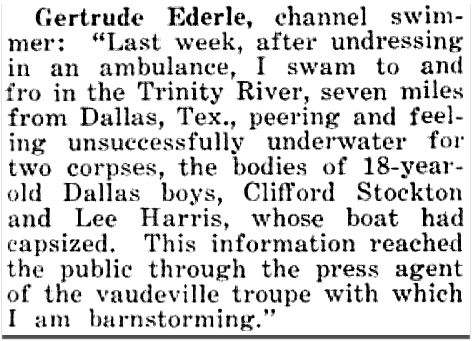




 Flashback : Dallas