Flashback : Dallas

A Miscellany: History, Ads, Pop Culture

Category: 1930s

Dallas Fire Department Training Tower, Fair Park — 1936

by Paula Bosse

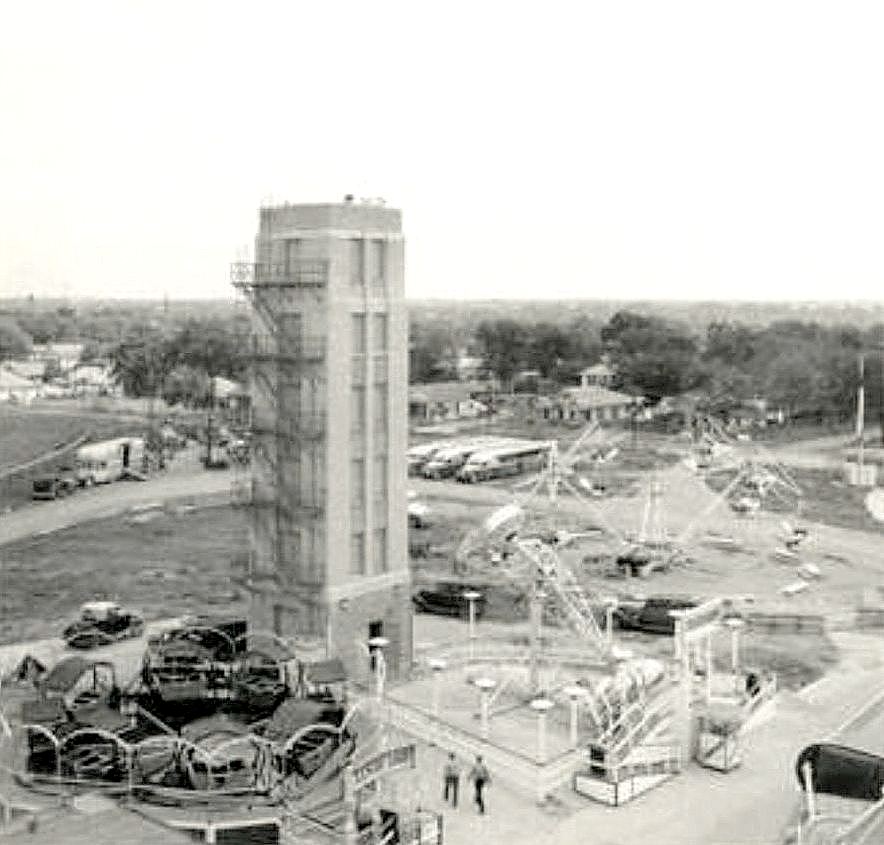
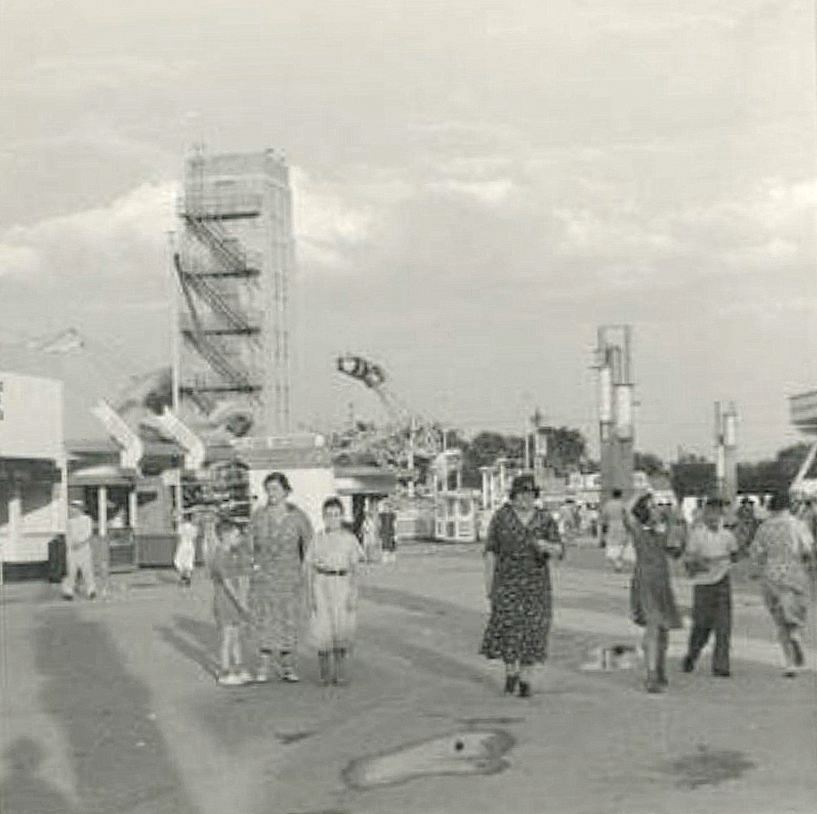
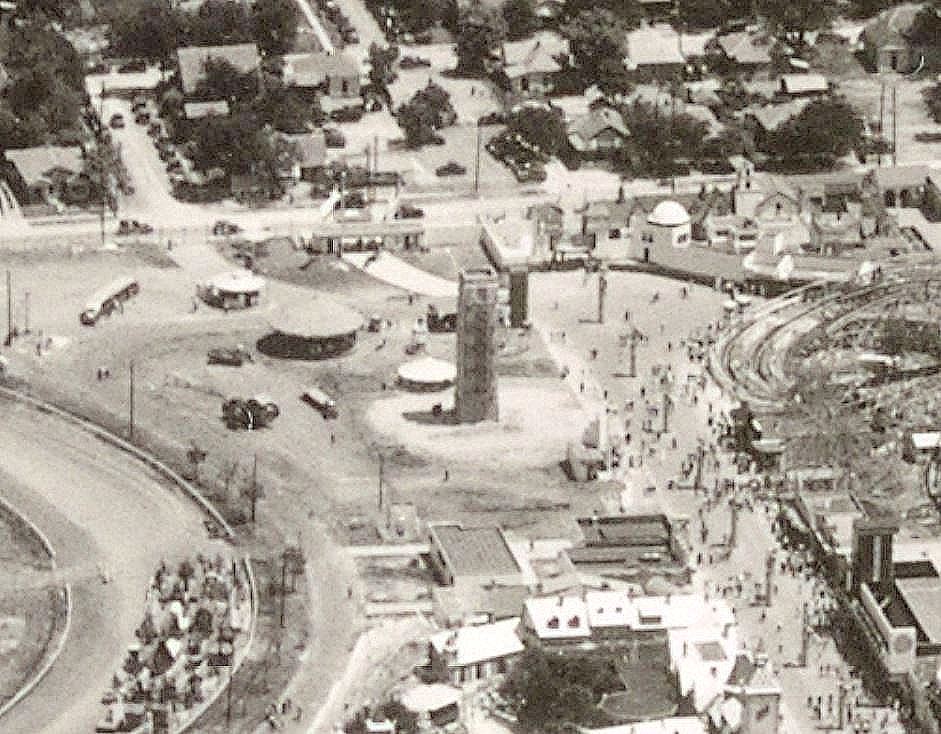
A few months ago, I came across the photos directly above and directly below on the SMU Digital Libraries site. They were both stereographs, and they were both identified as having been taken at Fair Park in 1936 during the Texas Centennial. These two photos didn’t look like Fair Park (except for the long tour buses parked at the upper right of the top photo). If they had not been accompanied by other photos that were unquestionably taken at Fair Park, I might not have been so sure.

Because… what was that odd tower? No sleek, modern art deco architecture there! More like a looming hunk of something ugly and industrial. And it looked like it was relegated to the outer edge of the midway. What was it?

I posted the top photo to the Flashback Dallas Facebook page and asked about this tower thing, and I was informed that it was a drill tower, used by the fire department for training purposes. It was also used to demonstrate rescue practices during the fair. I was directed to this truly spectacular photo, which shows the tower on the far edge of Fair Park (slightly right of center, near the top of the photo — which, by the way, is HUGE). A detail is below.

When — and why — was it built?

In 1930, Dallas was apparently running afoul of the law, because it did not have one of these towers. The State notified that City that that needed to be rectified pronto, or there would be a price to pay:

Unless Dallas provides its fire department with a drill tower, in accordance with the State law, the local key rate of 13 cents will be increased by a 5-cent penalty — the State Fire Insurance commission has served notice. (Dallas Morning News, July 19, 1930)

The city dragged its feet. It was announced almost a year and a half later that things were finally moving toward compliance:

Contract for the new six-story fire drill tower for the Dallas fire department, to be located in Fair Park, has been let to S. J. Buckalew, contractor, by the city department of public works. It will cost $6,328 and will rise 60 feet in height, being built of steel frame with concrete foundation and concrete floors. (DMN, Nov. 18, 1931)

The tower was completed in January 1932 (at a cost closer to $8,000). A few months later, the inaugural exhibition for the public was held at the tower. Firemen demonstrated firefighting techniques and performed drills on how to rescue victims from a tall building. This was the first time that many in the crowd had ever seen such a display. There was, however, a hiccup in one of these performances (or maybe it was planned, as a bit of shocking showmanship):

The demonstration of fire fighting methods included one unexpected thrill when, during the rope-sliding exhibition, a dummy was released from the six-story drill tower, falling to the ground. The crowd, hardly prepared for this feature of the show, was horrified to see what seemed to be a fireman fall out of the tower. Several women were particularly affected, having to be revived by first-aid methods. (DMN, July 1, 1932)

These public demonstrations were very popular and were held for decades. (The tower was, of course, also used regularly by the Dallas Fire Department as its official training tower.) I’m not sure when it was eventually demolished (EDIT: thanks to the comment below, it was demolished on Feb.1, 1947), but the “shows” continued, with towers erected especially for the fair every year, as can be seen in this silent footage from the 1961 State Fair of Texas (the steam pumper “Old Tige” makes an appearance at the 1:13 mark):

***

Sources & Notes

First two stereograph photos were taken in 1936 at the Texas Centennial Exposition and are from the DeGolyer Library, Southern Methodist University: “[Amusement Rides at Fair Park]” is here, and “[View of the Fairgrounds at Fair Park]” is here.

Third photo is a detail from a U.S. National Archives and Records Administration aerial, on Wikipedia.

Video — “Firefighter Demonstration At The State Fair Of Texas – October 1961 (Silent)” — is from the WFAA Collection, G. William Jones Collection, Hamon Arts Library, SMU, on YouTube.

Thanks to the person commenting below, the tower was demolished on Feb. 1, 1947, “to make way for new structures” (DMN, “Landmark Bites Dust,” Feb. 2, 1947).

People may be more familiar with the DFD training tower at Record Crossing — see a photo of that at the Portal to Texas History, here.

Thanks, as always, for the crowdsourcing help!

*

Copyright © 2025 Paula Bosse. All Rights Reserved.
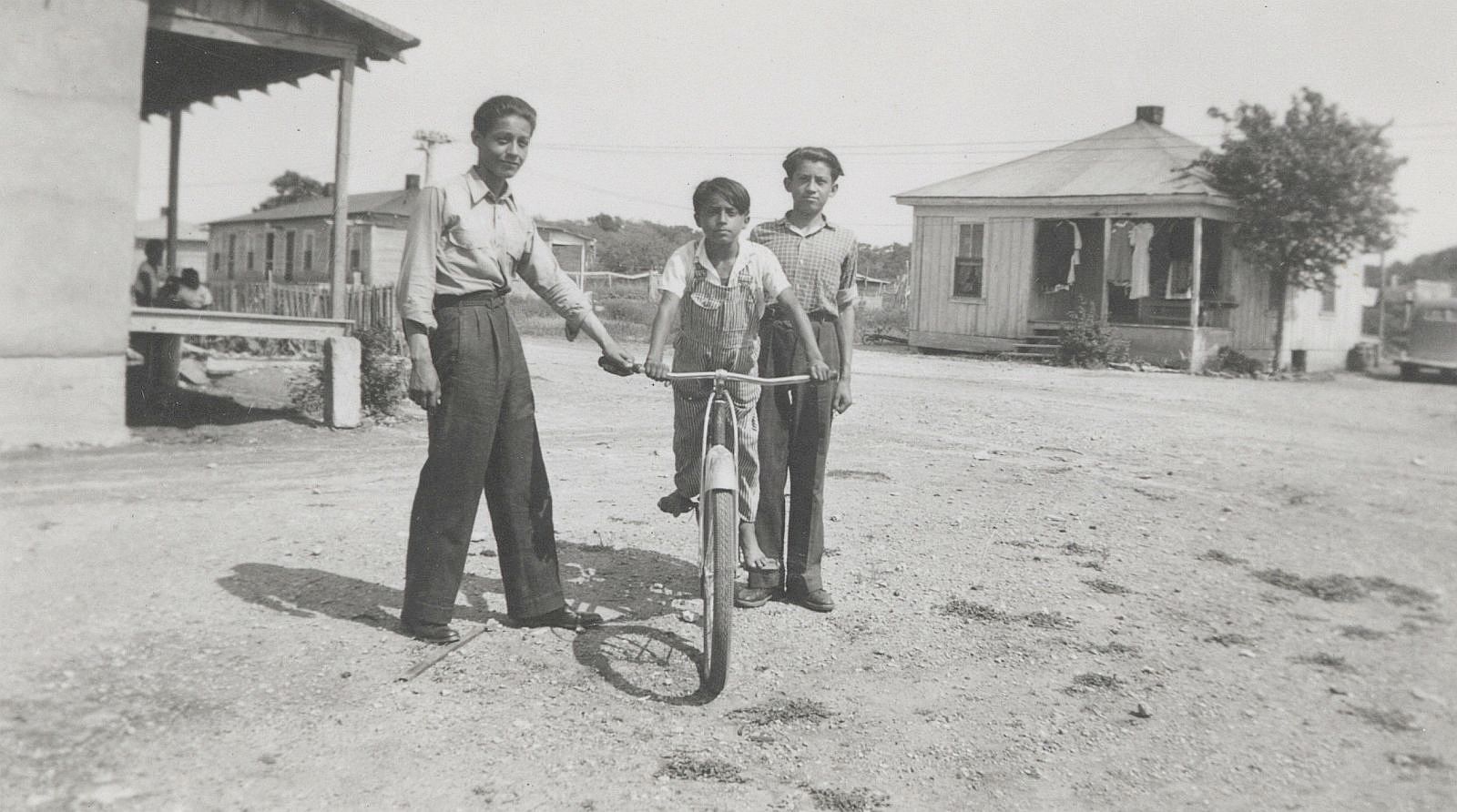
Martinez Brothers, Eagle Ford — 1939

Eladio, Henry, and Feliberto

by Paula Bosse

There are pictures I come across sometimes that affect me in a way I can’t really explain. Like this one. This shows three brothers posing for a photo in West Dallas in 1939. The boys are, left to right, Eladio Martinez, Henry Martinez, and Feliberto Martinez. Their father worked for the nearby Trinity Portland Cement Company. During the Depression, the boys helped support the family by cleaning railroad boxcars for a nickel each.

Eladio was killed in action during World War II — the Eladio R. Martinez Learning Center in West Dallas is named after him. His brothers Henry (Enrique) and Feliberto were active in the community and in preserving the history of Ledbetter/Eagle Ford.

Read more about Eladio Martinez here.

***

Sources & Notes

Photo — “Eladio Martinez, Henry Martinez on a bicycle, and Feliberto Martinez” — is from the Dallas Neighborhood Stories Grant Collection, Dallas History and Archives, Dallas Public Library; the accession number of this photograph is MA19.4/BDW-Martinez-H.6. More info on this is on the DPL Digital Collections page, here.

*

Copyright © 2025 Paula Bosse. All Rights Reserved.
Vaudeville at the Sportatorium? — 1936

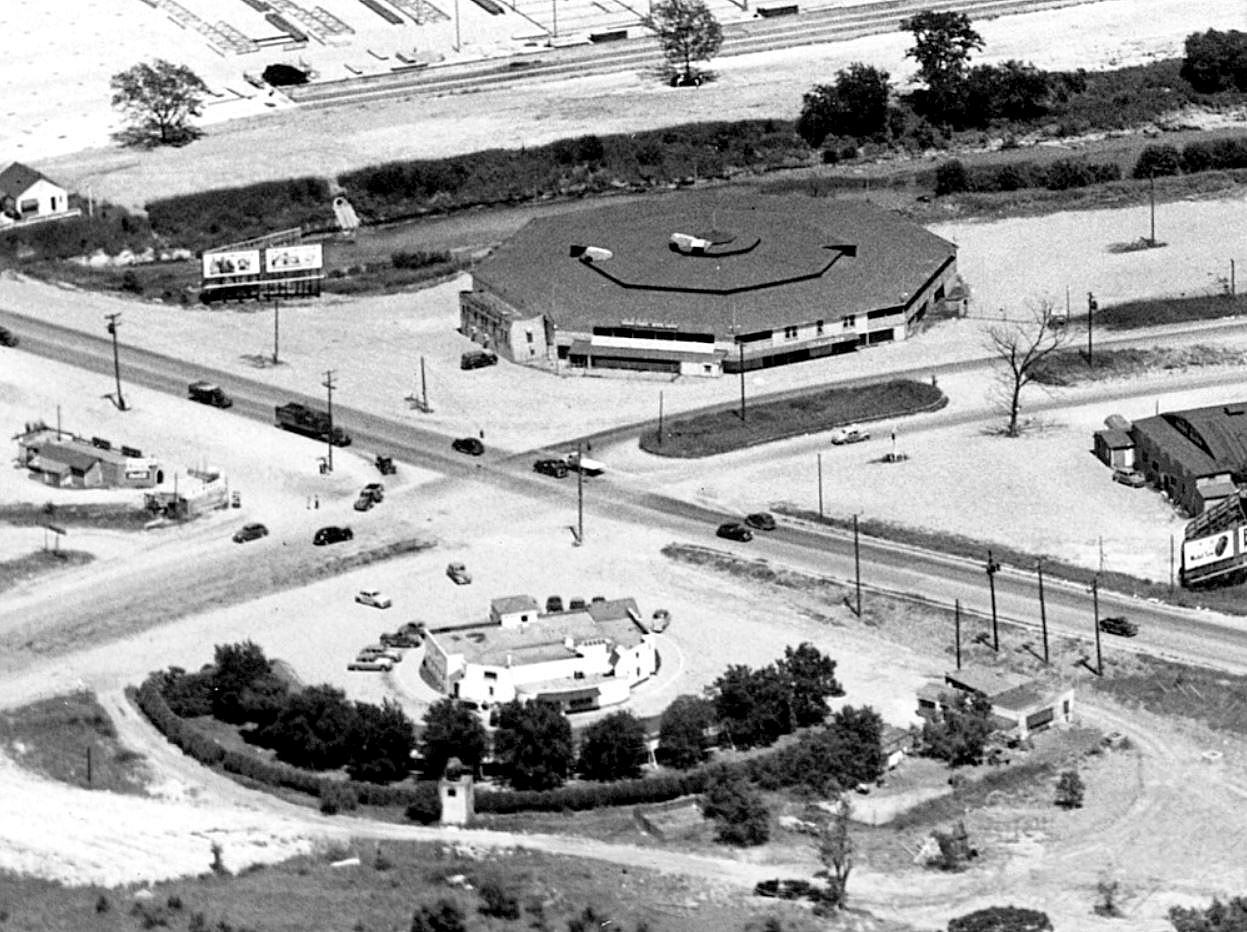
Original Sportatorium, in all its octagonal glory

by Paula Bosse

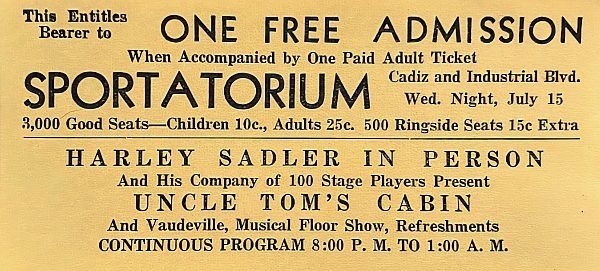
I saw this ticket recently on eBay:

SPORTATORIUM, Cadiz and Industrial Blvd.
Harley Sadler In Person
And His Company of 100 Stage Players Present
UNCLE TOM’S CABIN
And Vaudeville, Musical Floor Show, Refreshments

…What?!

The ticket is undated, but “vaudeville” had mostly faded by the 1930s. The original (octagonal!) Sportatorium was built in 1935 and opened as a premiere sporting venue for wrestling (and boxing) in December 1935.

The new sports bowl, under construction at Cadiz and Industrial, will have its official opening Monday night, December 9, when Promoter Bert Willoughby will offer the biggest wrestling program ever staged in Texas, if present plans go through as outlined. This 10,000-seating capacity structure, built as the home of wrestling, will also entertain many other events, such as boxing, basketball, indoor circuses, style shows [!], conventions and gatherings of all kinds. (Dallas Morning News, Dec. 1, 1935)

Sounds huge. But it’s really hard to keep those seats full — especially on nights when wrestling is not scheduled. By the end of April, there were already plans to do something about one of their biggest problems.

“We feel,” declared [manager W. T.] Cox, “that this concern is too big and that there is too much money already invested to have five or six dark nights a week, so we are going to make it possible for everyone, with anything to show, to bring it to our place, whether it be a political gathering, religious services or merchants’ and manufacturers’ exhibits. The policy of the house will be to encourage and promote sports, but it will be available to all.” (DMN, Apr. 20, 1936)

Sportatorium management came up with the idea of presenting a massive show on non-wrestling nights. They gave Harley Sadler — a longtime traveling Texas showman (and later a politician) — a long-term engagement in which he basically crammed as much “show” into one evening as was humanly possible. A stage was built, and many of those 10,000 seats were removed in order that patrons could sit at tables to enjoy the relentless, non-stop entertainment. Sadler’s company consisted of 100 players. 100!

So what could a Sportatorium visitor expect on one of these Harley Sadler nights? Brace yourself:

The Sadler players will offer two complete plays each evening — an original four-act [play], “The Siege of the Alamo” — and a three-act modern comedy farce, “This Thing Called Love.” In addition to those two complete plays, he will offer vaudeville acts, a band, novelty numbers, and 32 singing waitresses […]. The show will start at 8:30 and run for 8 hours, for those who care to stay that long. (DMN, July 8, 1936)

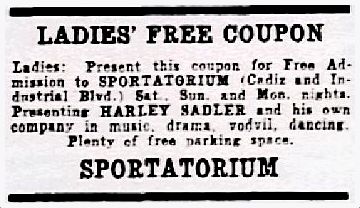
EIGHT HOURS! And, there were 3 different shows produced weekly. That’s a lot of entertainment. Perhaps too much entertainment. But ladies got in free.

July 12, 1936

I’m not sure how long this “residency” lasted, but however long it was, I assume all involved — performers and spectators alike — were exhausted afterward.

***

Sources & Notes

Source of the top photo of the Sportatorium is unknown, but I came across it on the wrestling website World Class Memories. (this Sportatorium page is a great read). (If you know the source of this photo, please let me know.)

Sportatorium ticket was found on eBay (still there, as I write this).

More on the history of the Sportatorium here.

More on empresario Harley Sadler can be found at the Handbook of Texas, here.

Previous Flashback Dallas posts on the Sportatorium can be found here.

*

Copyright © 2025 Paula Bosse. All Rights Reserved.
An Artist’s Conception of a Future Dallas

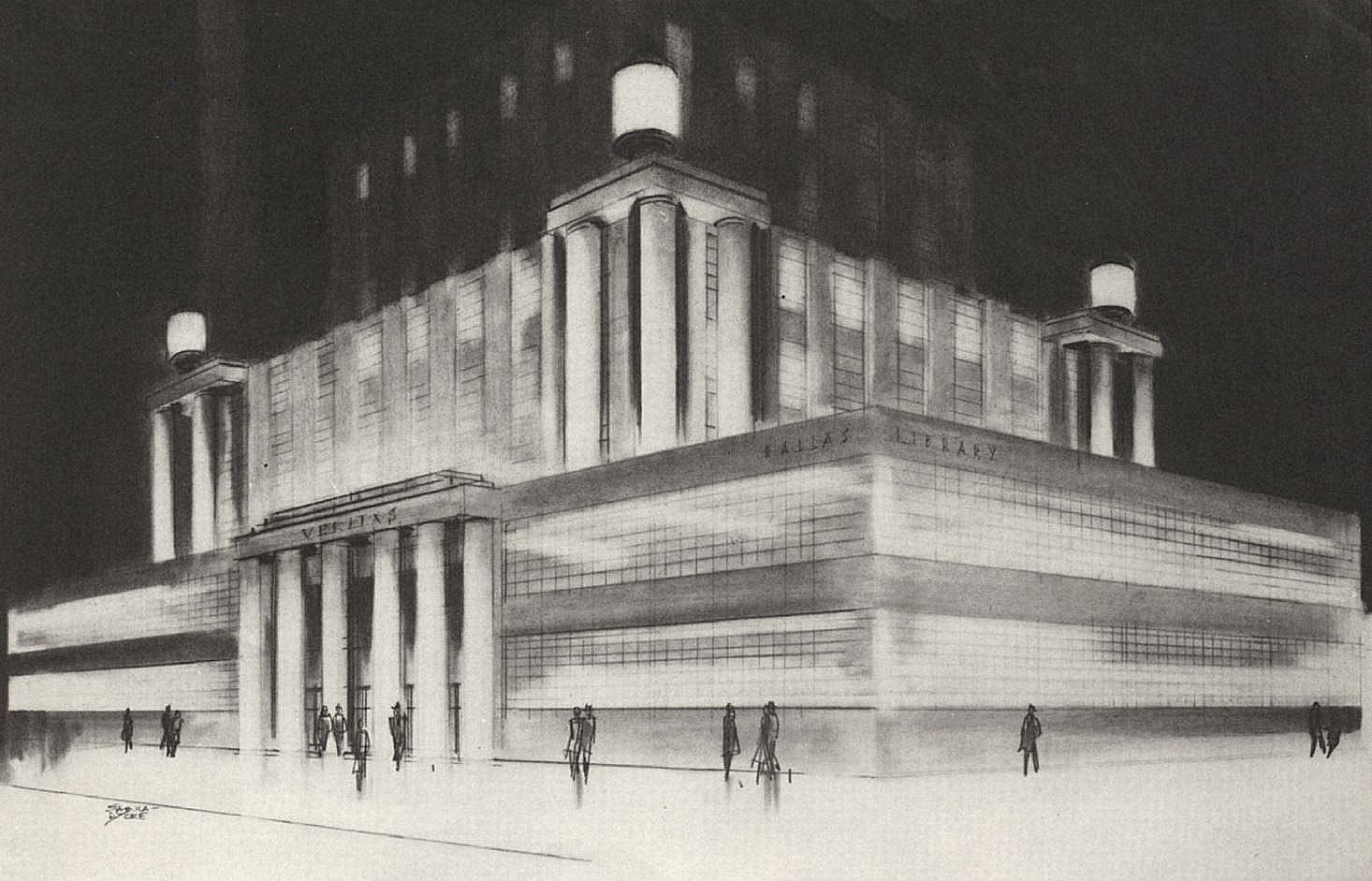
Vision of a new downtown library…

by Paula Bosse

I came across a collection of drawings recently that I think are just fantastic. They show what Dallas could be if we all just want it enough. The captions are giddy and exuberant, with the exhortation “Let’s build for the future.” It’s the sort of Chamber of Commerce boosterism which is a Dallas mainstay. Dallas dreams big and bold.

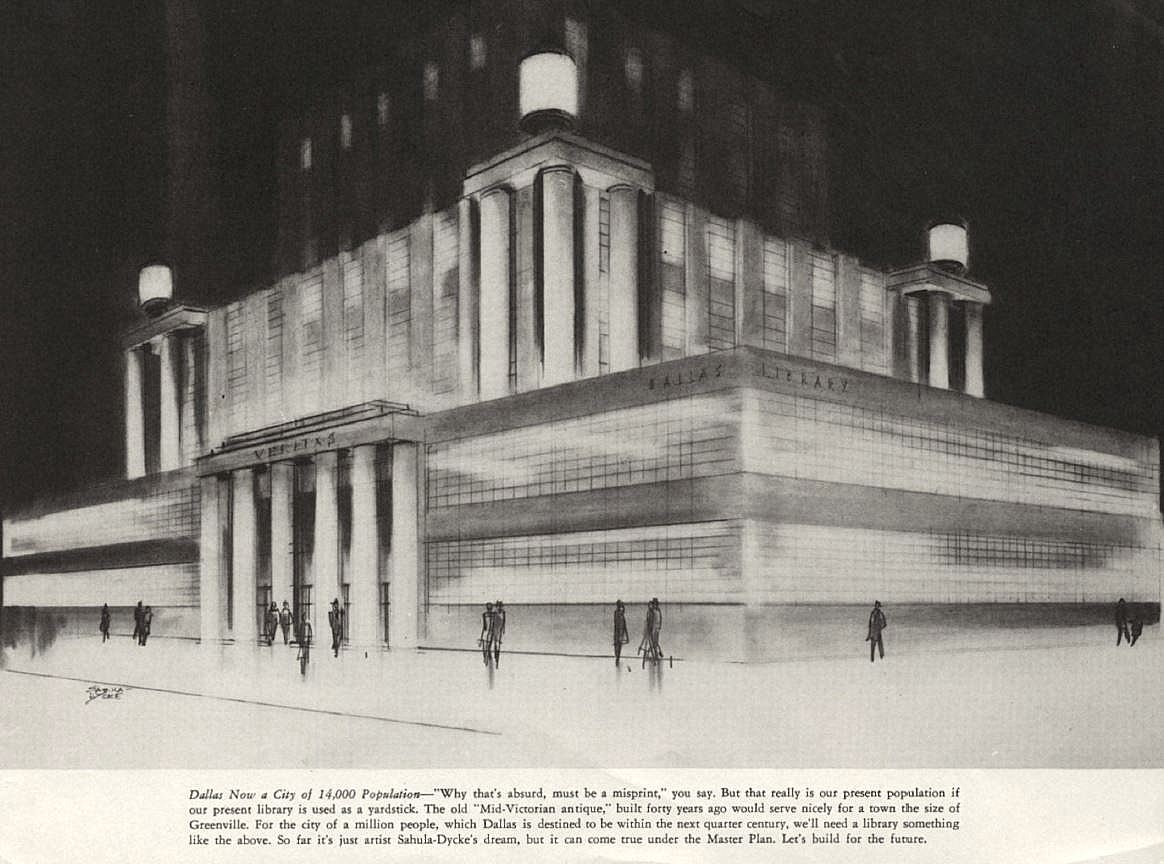
It’s not the ideas that I find so intriguing (although, they’re interesting), it’s the artwork. These drawings are great. The monumental, Deco-ish buildings exude a quiet power. Most of them are set against a dark sky, which adds extra awe-inspiring heft. I really, really love these drawings. It’s a shame most of these conceptions remained just that. I would have loved that library (above)! The artist is Ignatz Sahula-Dycke — more about him at the end of this post.

The drawings are not dated, but my guess is late 1930s or very early 1940s. Promotional captions accompany each picture. Click to see full-screen images. Enjoy!

**

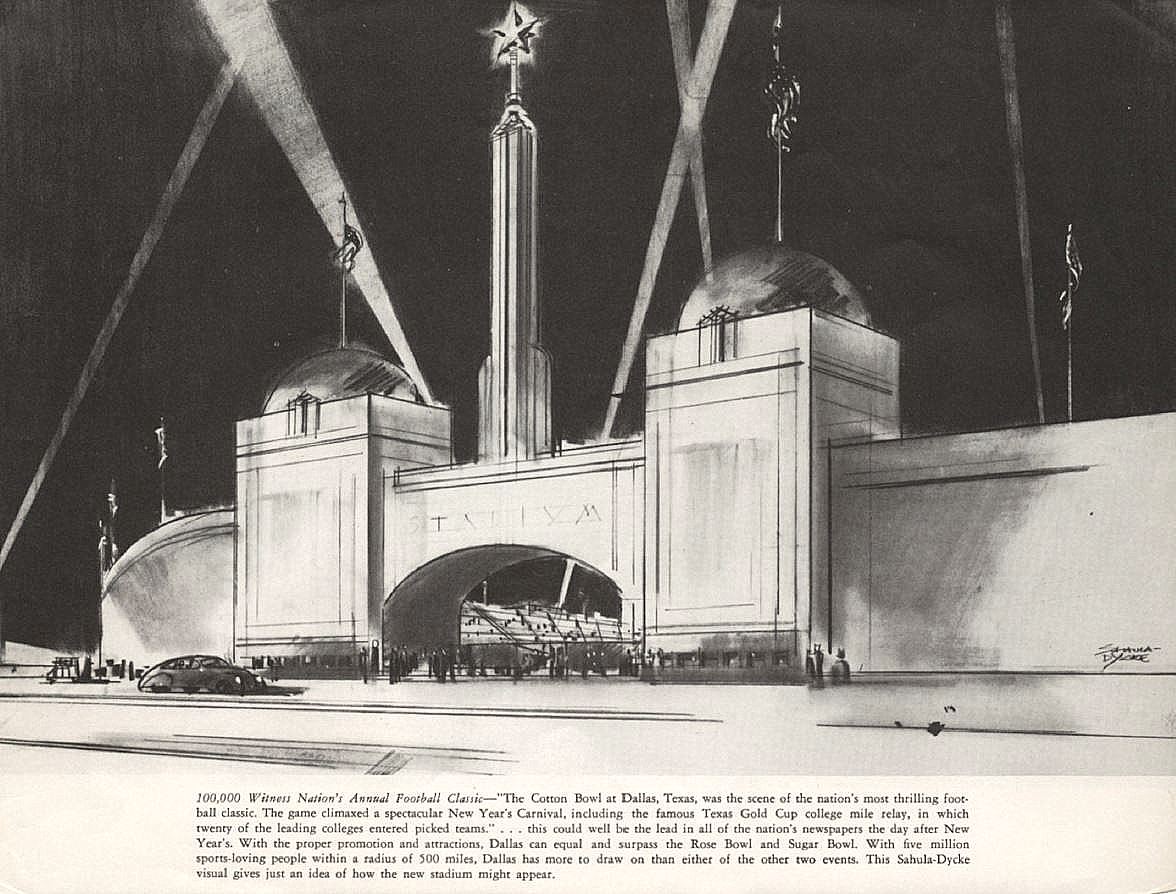
A NEW SPORTS STADIUM AT FAIR PARK

100,000 Witness Nation’s Annual Football Classic — “The Cotton Bowl at Dallas, Texas, was the scene of the nation’s most thrilling football classic. The game climaxed a spectacular New Year’s Carnival, including the famous Texas Gold Cup college mile relay, in which twenty of the leading colleges entered picked teams.” … This could well be the lead in all of the nation’s newspapers the day after New Year’s. With the proper promotion and attractions, Dallas can equal and surpass the Rose Bowl and Sugar Bowl. With five million sports-loving people within a radius of 500 miles, Dallas has more to draw on than either of the other two events. This Sahula-Dycke visual gives just an idea of how the new stadium might appear.

*

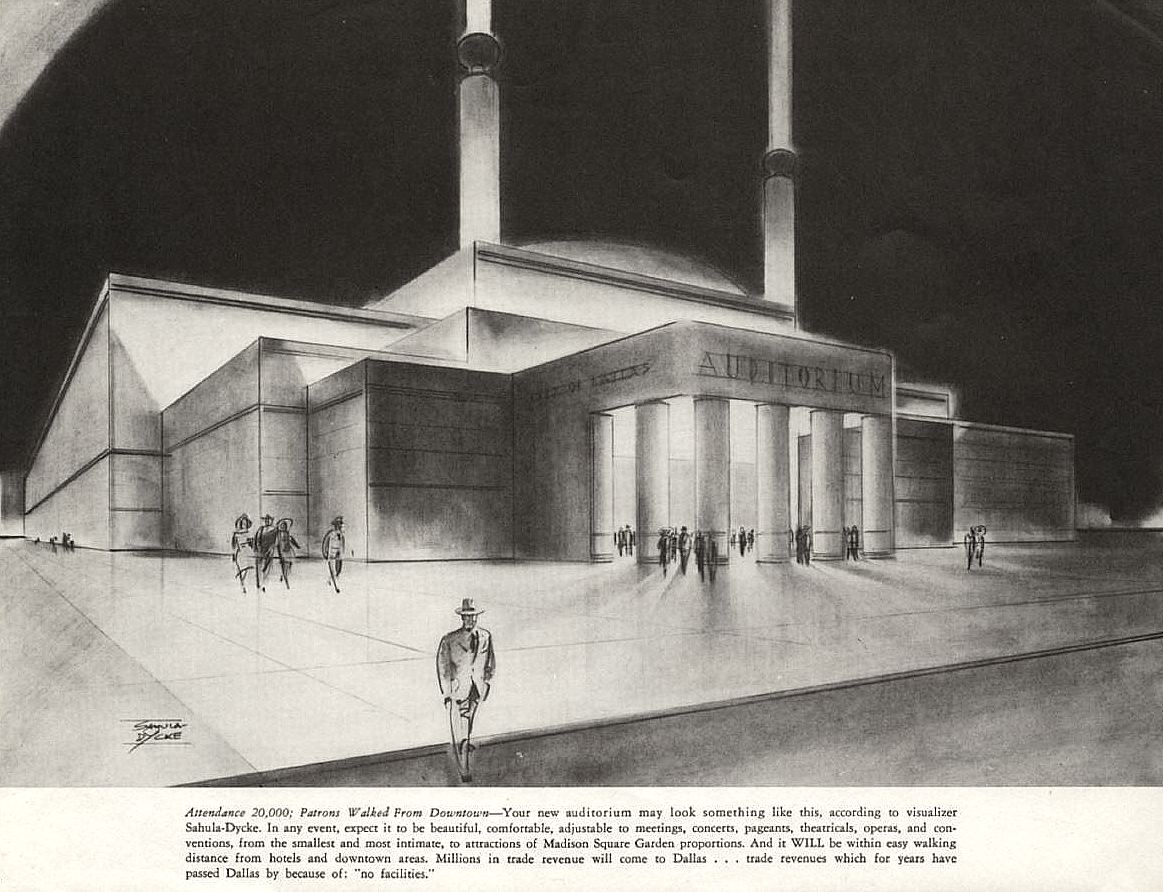
A CITY AUDITORIUM / CONVENTION CENTER

Attendance 20,000; Patrons Walked From Downton – Your new auditorium may look something like this, according to visualizer Sahula-Dycke. In any event, it’s expected to be beautiful, comfortable, adjustable to meetings, concerts, pageants, theatricals, operas, and conventions, from the smallest and most intimate, to attractions of Madison Square Garden proportions. And it WILL be within easy walking distance from hotels in downtown areas. Millions in trade revenue will come to Dallas… trade revenues which for years have passed Dallas by because of: “no facilities.”

*

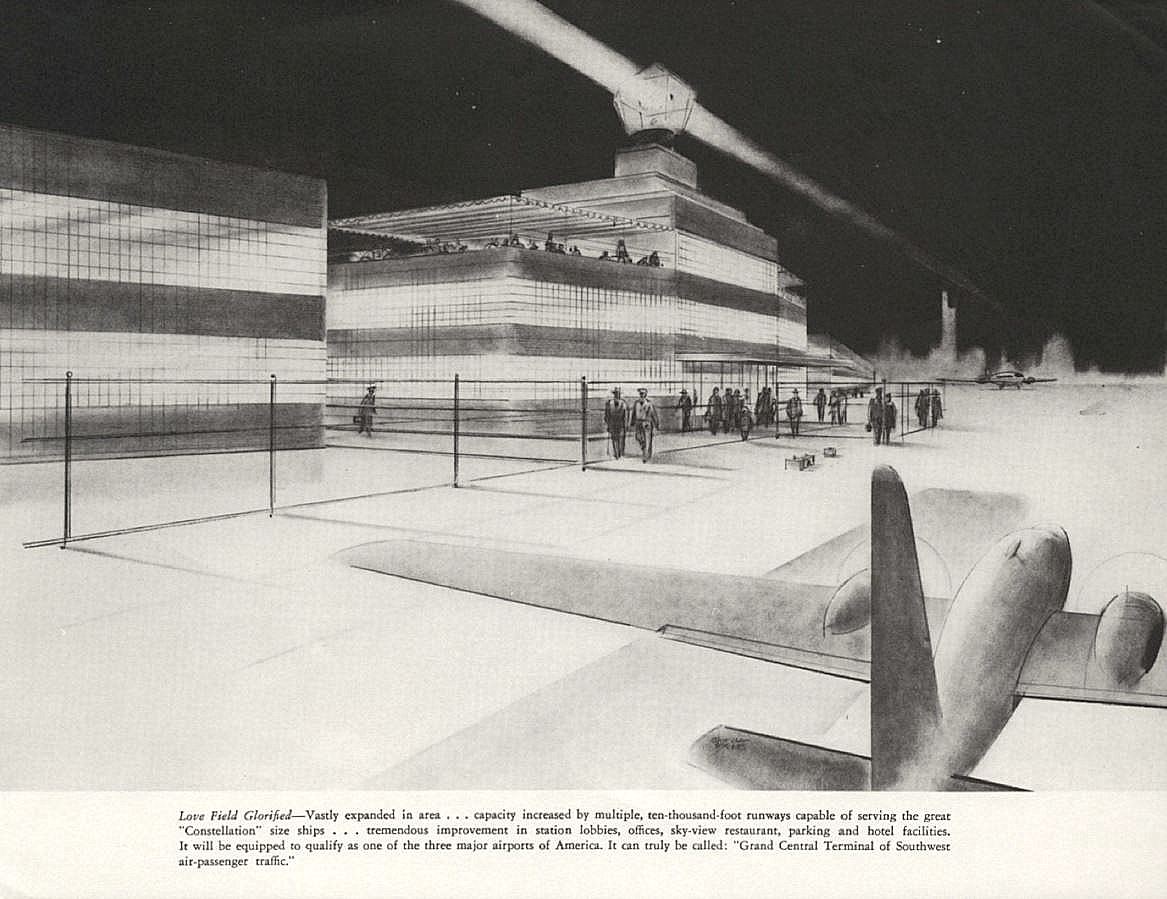
AN EXPANDED LOVE FIELD

Love Field Glorified — Vastly expanded in area… capacity increased by multiple, ten-thousand-foot runways capable of serving the great “Constellation” size ships… tremendous improvement in station lobbies, offices, sky-view restaurant, parking and hotel facilities. It will be equipped to qualify as one of the three major airports of America. It can truly be called: “Grand Central Terminal of Southwest air-passenger traffic.”

*

HIGHWAYS

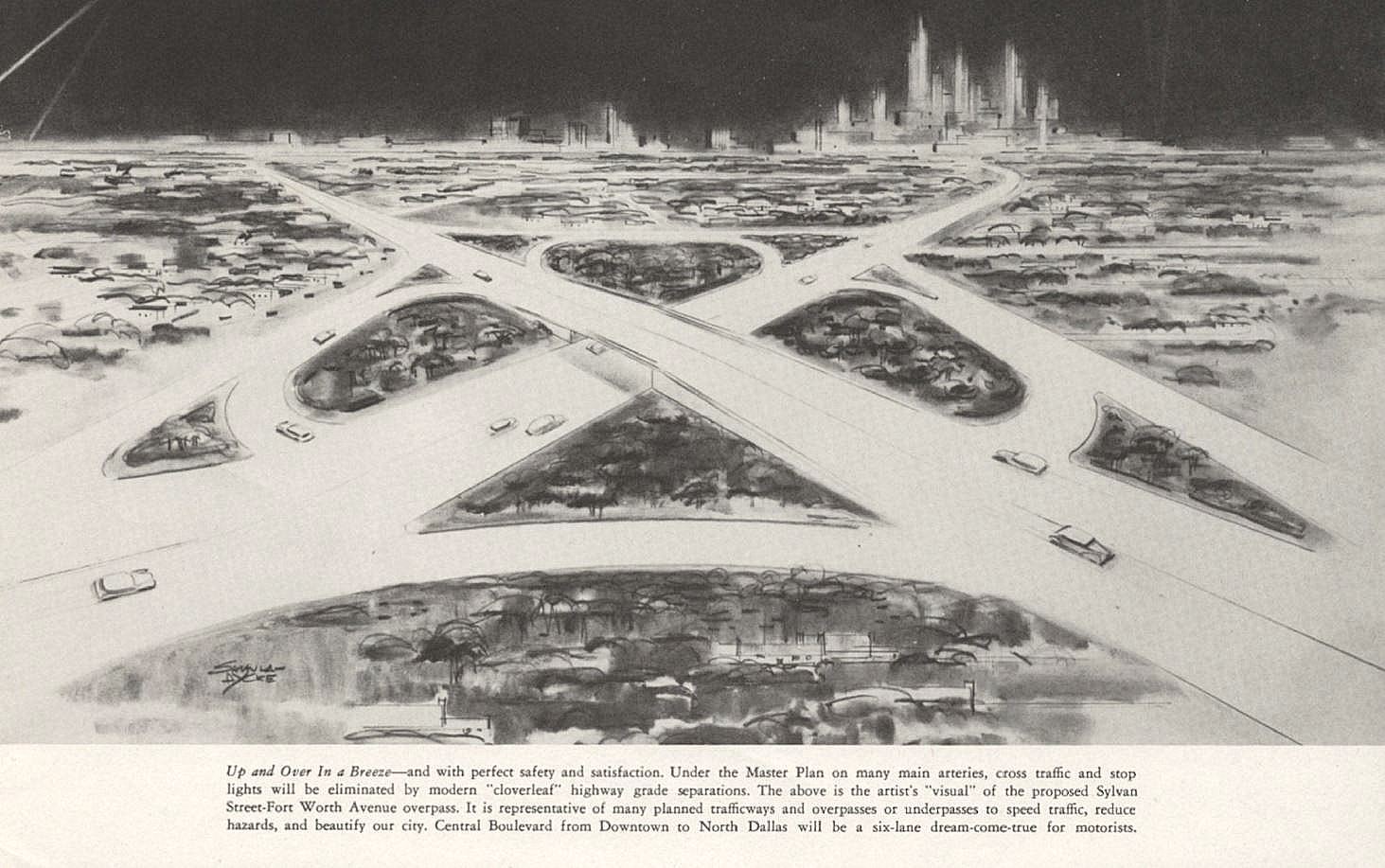
Up and Over In a Breeze — and with perfect safety and satisfaction. Under the Master Plan on many main arteries, cross traffic and stop lights will be eliminated by modern “cloverleaf” highway grade separations. The above is the artist’s “visual” of the proposed Sylvan Street-Fort Worth Avenue overpass. It is representative of many planned trafficways and overpasses or underpasses to speed traffic, reduce hazards, and beautify our city. Central Boulevard from Downtown to North Dallas will be a six-lane dream-come-true for motorists.

*

A NEW UNION STATION (…no steps!!!)

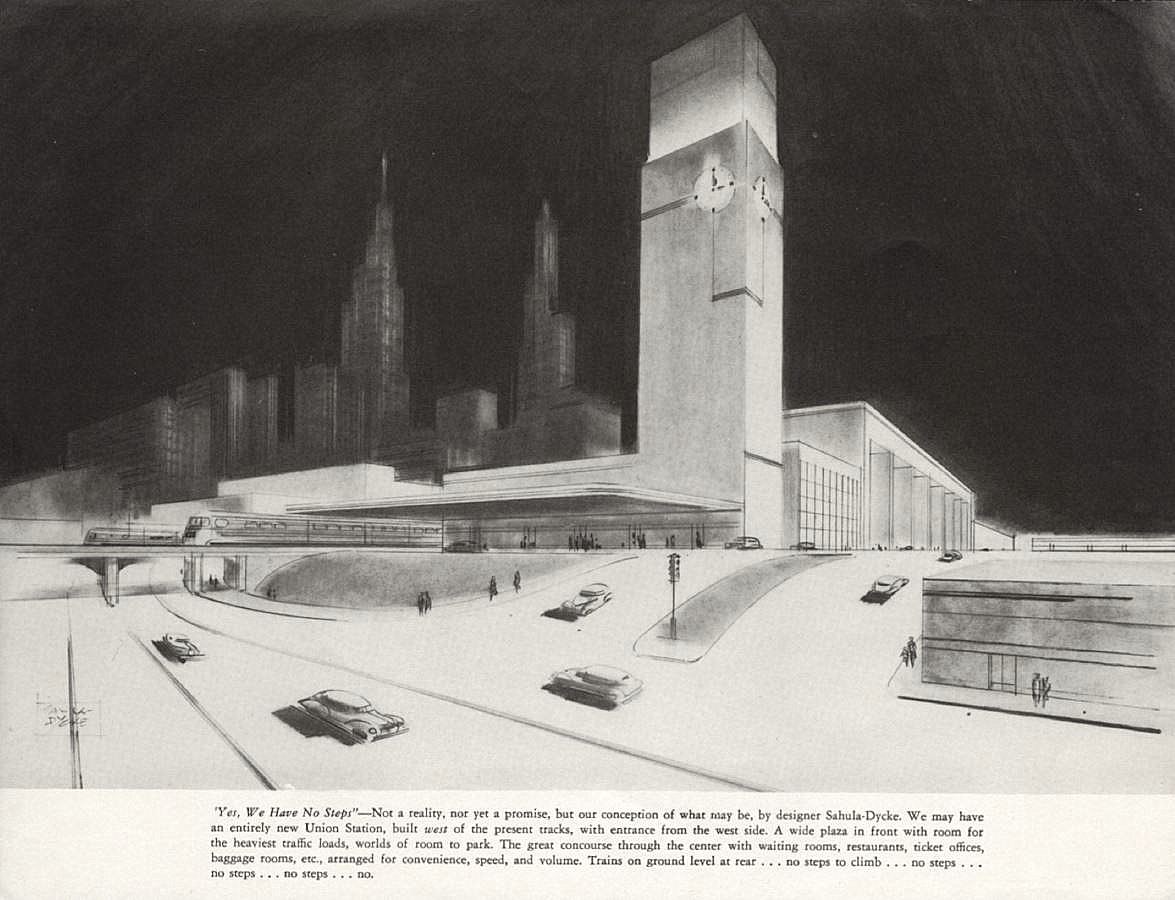
“Yes, We Have No Steps” — Not a reality, not yet a promise, but our conception of what may be, by designer Sahula-Dycke. We may have an entirely new Union Station, built WEST of the present tracks, with entrance from the west side. A wide plaza in front with room for the heaviest traffic loads, worlds of room to park. The great concourse through the center with waiting rooms, restaurants, ticket offices, baggage rooms, etc, arranged for convenience, speed, and volume. Trains on ground level at rear… No steps to climb… no steps… no steps… no steps… no.

*

UNION STATION INTERIOR (…seriously, we mean it: NO STEPS!)

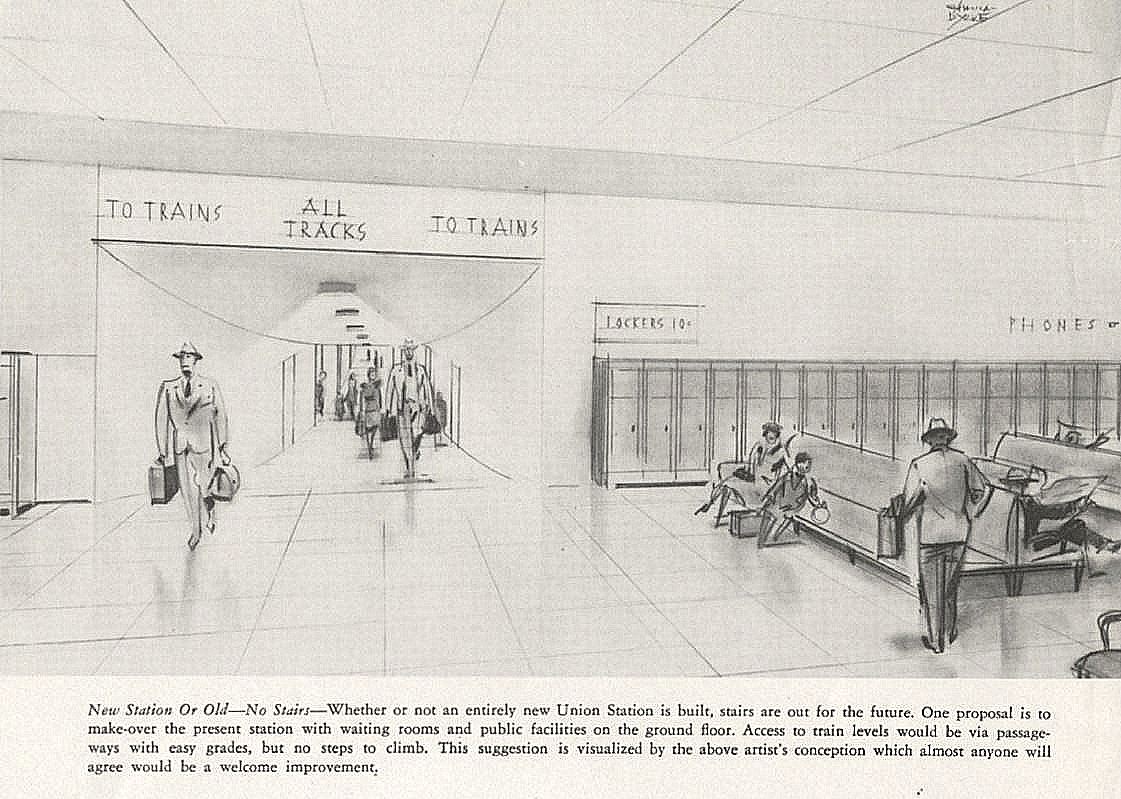
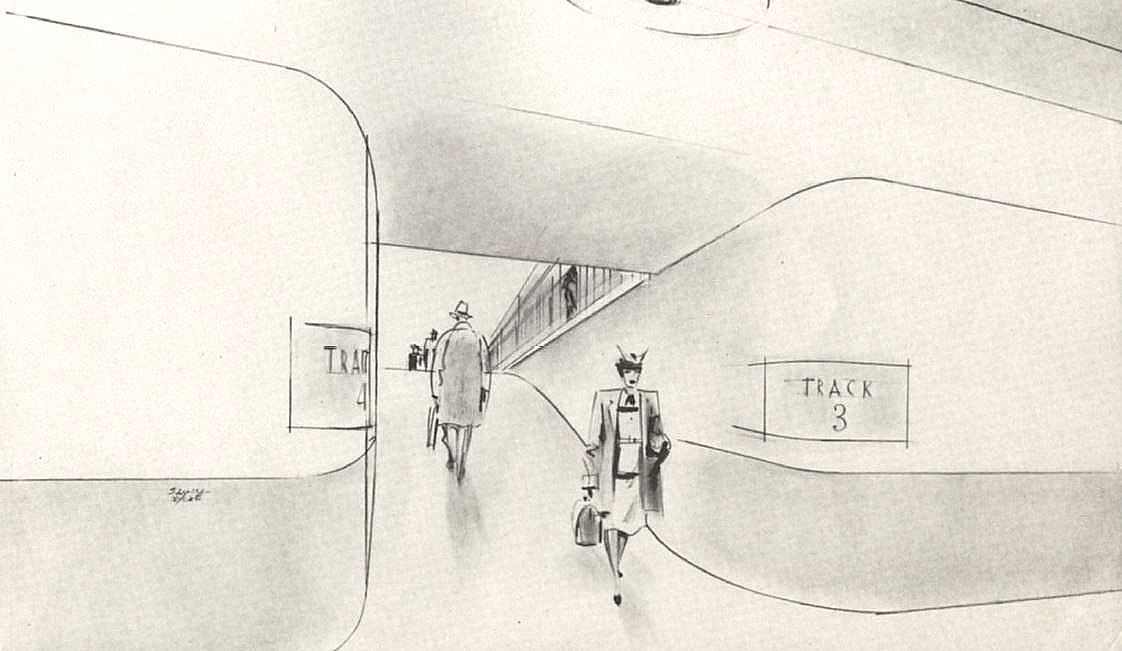
New Station Or Old — No Stairs — Whether or not an entirely new Union Station is built, stairs are out for the future. One proposal is to make over the present station with waiting rooms and public facilities on the ground floor. Access to train levels would be via passageways with easy grades, but no steps to climb. This suggestion is visualized by the above artist’s conception which almost anyone will agree would be a welcome improvement.

*

MEDICAL CENTER

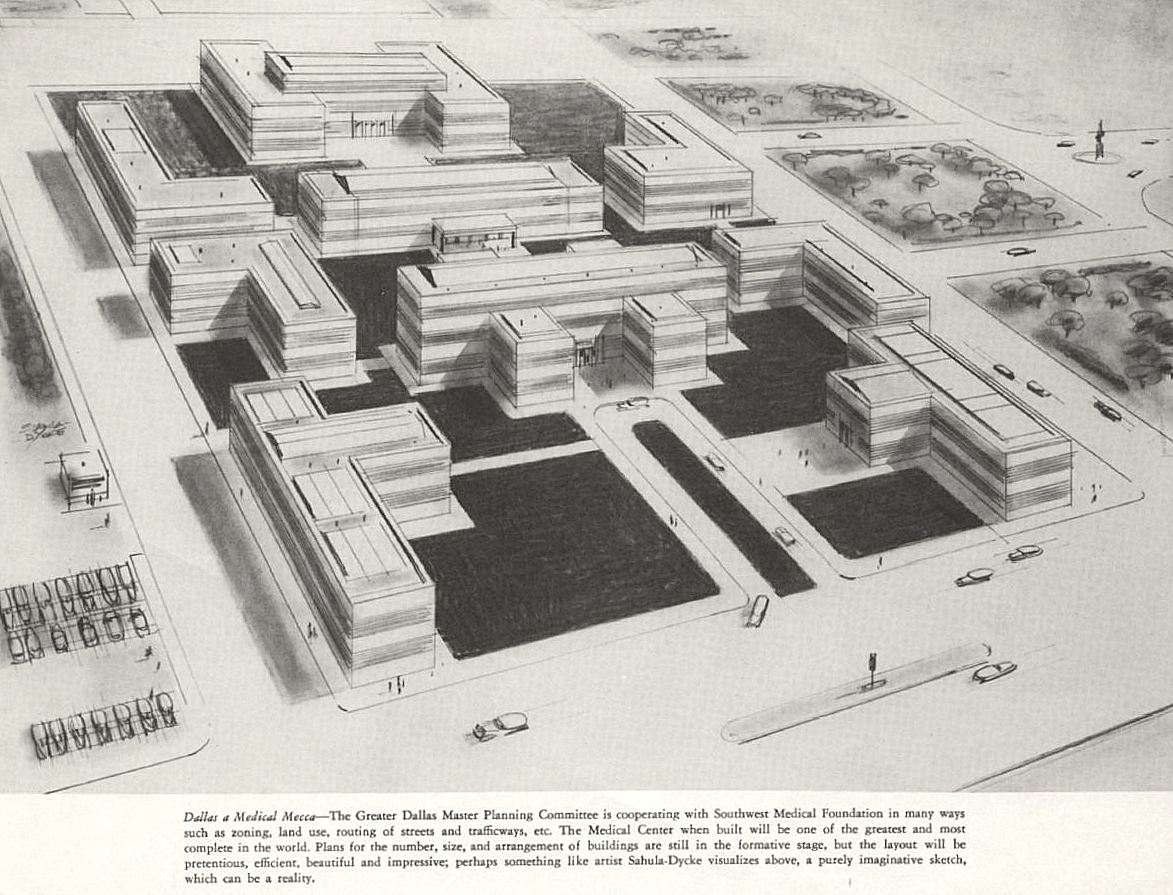
Dallas a Medical Mecca — The Greater Dallas Master Planning Committee is cooperating with Southwest Medical Foundation in many ways such as zoning, land use, routing of streets and trafficways, etc. The Medical Center when built will be one of the greatest and most complete in the world. Plans for the number, size, and arrangement of buildings are still in the formative stage, but the layout will be pretentious, efficient, beautiful and impressive; perhaps something like artist Sahula-Dycke visualizes above, a purely imaginative sketch, which can be a reality.

*

CENTRAL LIBRARY

Dallas Now a City of 14,000 Population — “Why that’s absurd, must be a misprint,” you say. But that really is our present population if our present library is used as a yardstick. The old “Mid-Victorian antique,” built 40 years ago would serve nicely for a town the size of Greenville. For the city of a million people, which Dallas is destined to be within the next quarter century, we’ll need a library something like the above. So far it’s just artist Sahula-Dycke’s dream, but it can come true under the Master Plan. Let’s build for the future.

**

I don’t know the date of these drawings. My guess would be the late ’30s or very early ’40s. (The Union Station drawing shows a building that looks like the Mercantile Bank Building. Plans for the Mercantile were announced to the public in 1940.) In a Dallas Morning News article (“‘Greater Dallas’ Appeals Stir Chamber to Renewed Action,” DMN, Dec. 8, 1937), many of the things covered in the captions above were hot topics at the annual meeting of the Dallas Chamber of Commerce. A “Master Plan” was later developed by Harland Bartholomew in the early ’40s. After a break for the war, the plan was finally put before the voters in April 1945.

The plans changed some between 1937 and 1945, but the visions touted in the drawings above were similar to the plans accepted favorably by Dallas voters. (The one part of this Master Plan that failed — and which is not mentioned in the drawings — is the vote on whether to “unify” the City of Dallas by annexing the Park Cities and Preston Hollow. Everyone was all for it… except for Highland Park and University Park, who chose to remain unannexed.) See an ad that appeared in March 1945, a week before the election, listing all the things Big D was hoping to build and develop here

**

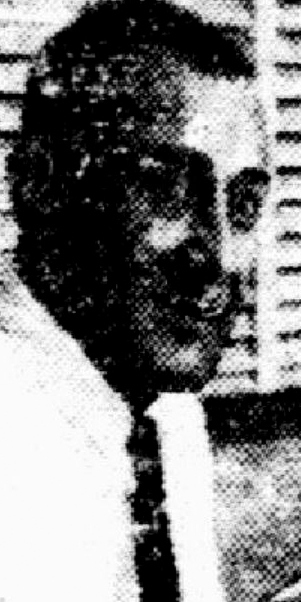
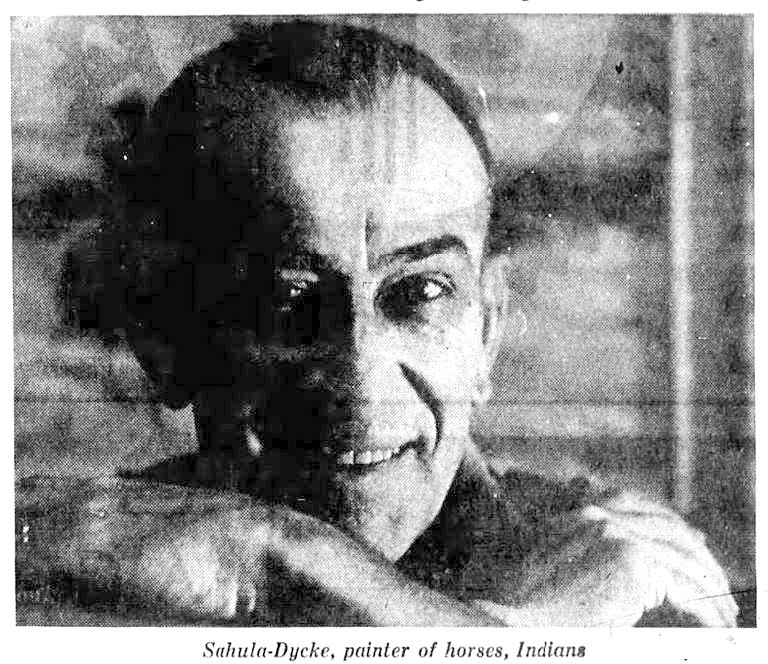
The artist of these conceptions was Ignatz Sahula-Dycke (1900-1982). Ignatz Sahula (known as “Iggie” to his friends) was born in Bohemia (Austria), near Prague, and immigrated with his family to the United States when he was a child. At some point he added his mother’s maiden name “Dycke” to his name — his mother was an artist and a descendant of 17th-century Flemish painter Anthony van Dyck. He studied art in Chicago and, after a stint in the U.S. Navy during World War I, worked for a variety of businesses as a commercial artist. He came to Dallas around 1937 and worked for many years at the Tracy-Locke advertising agency, eventually becoming Creative Art Director of the Dallas office. He actually left Dallas for a while to focus on his art but came back to Dallas a few years later and ended up working for Tracy-Locke for 14 years. His paintings and illustrations center around horses and Southwestern subjects such as desert landscapes and western themes. A good biography and photo of him can be found here, in an article from Western Art & Architecture.

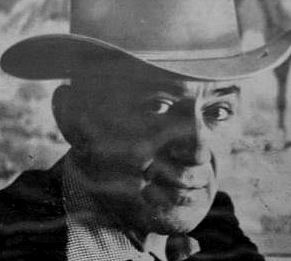
Sahula-Dycke, 1950s

Santa Fe New Mexican, July 28, 1968

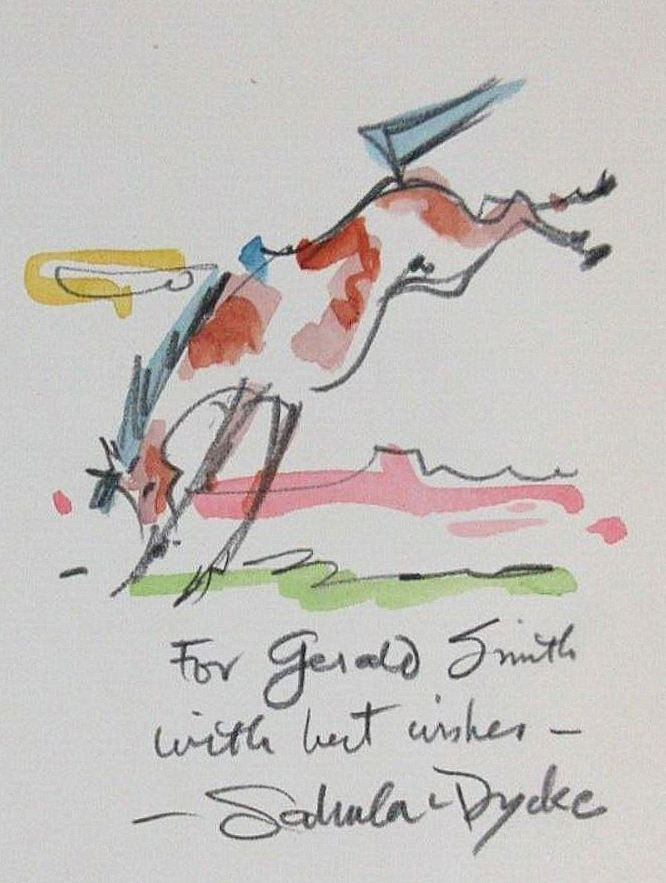
Iggie’s favorite subject was horses. Below is a little sketch he did when inscribing Alias Kinson, or The Ghost of Billy the Kid, a 1963 novel he wrote and illustrated, along with his author’s photo. (The back cover is here, complete with what may be a self-penned biography for this self-published book.)

***

Sources & Notes

All Dallas Master Plan images drawn by Ignatz Sahula-Dycke are from the Master Plan Vertical Files of the Dallas History and Archives, Dallas Public Library.

Inscription with watercolor-highlighted sketch and author photo are from an inscribed copy of Sahula-Dycke’s novel, Alias Kinson, currently listed on eBay.

A related Flashback Dallas post regarding Bartholomew’s Master Plan: “‘Your Dallas of Tomorrow’ — 1943.”

*

Copyright © 2025 Paula Bosse. All Rights Reserved.

A Unique Profession: The Curve Greaser — 1935

by Paula Bosse

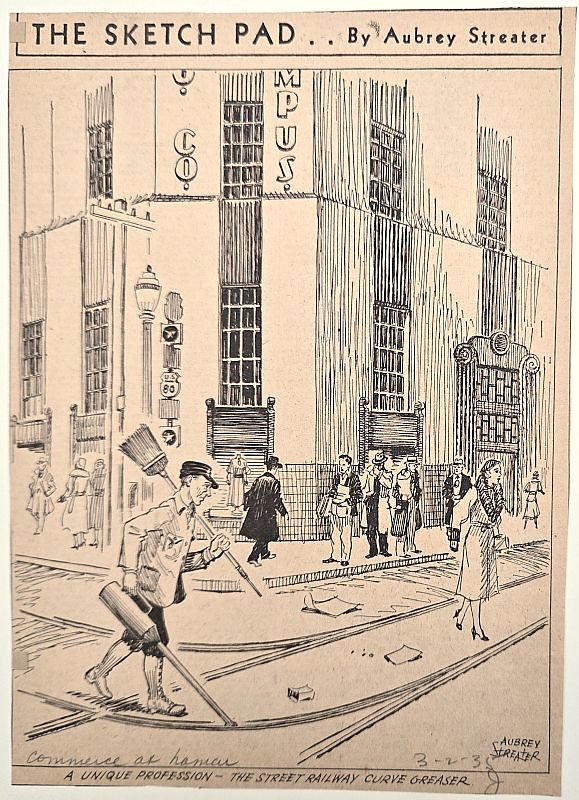
The caption reads: “A unique profession — the street railway curve greaser.”

I have to admit, this is a “profession” I never knew existed. Lubricating the rails would have helped with the constant wear and tear of steel-on-steel friction and would have, presumably, cut down on the incessant squealing of streetcar wheels. This was an essential job at the time, one I’ve only just learned of!

Handwritten notations identify the intersection as “Commerce at Lamar” and the date as “3-2-35.”

***

Sources & Notes

Clipping is from the Dallas History and Archives, Dallas Public Library.

“The Sketch Pad” cartoon panel by Aubrey Streater was a regular feature that appeared in the pages of The Dallas Journal. Streater was a commercial artist and headed the art department of The Dallas Morning News (publisher of The Dallas Journal).

This post appeared in a slightly different version on the Flashback Dallas Patreon page.

*

Copyright © 2024 Paula Bosse. All Rights Reserved.

Zephyr, Meet Ox Cart — 1936

zephyr_sam-houston-zephyr_oxcart_ebay_front…Ox cart, meet Zephyr

by Paula Bosse

On Oct. 4, 1936, the Sam Houston Zephyr — the very first streamlined passenger train in Texas — made one of it very first public appearances, at the Texas Centennial in Dallas. This beautiful train (check out a photo of its interior here) was operated by the Burlington-Rock Island railroad between Fort Worth and Houston, with stops in Dallas, Waxahachie, Corsicana, and Teague. (See footage of it arriving it what might be Dallas in what might be 1936 in cool home movie footage here — then go to the beginning to see great Centennial footage — some of it in color! — and other footage shot in Kidd Springs.)

Back to the Zephyr. At its Centennial stop, a photo-op presented itself: the super-new (Zephyr) alongside the super-old (an ox cart). This photo ran in newspapers around the world, accompanied by variations of the following captions:

PROGRESS! Just a zephyr in the breeze is the Burlington Zephyr, particularly when compared to an ancient ox cart. The two were shown together at the Texas centennial fair at Dallas. The speedy streamliner runs from Dallas to Houston, Texas.

*

MARCH OF PROGRESS. An excellent contrast in the modes of transportation of today and yesterday is presented here as the Sam Houston Zephyr, streamlined train running between Dallas, Tex., and Houston, enters the grounds of the Texas Centennial exposition with an ox cart plodding along beside it. The presentation is part of the Cavalcade of Texas given at the exposition in Dallas. The girls are LaNeyl Brown and Peggy Humphreys.

*

From a Dallas Morning News article on the Centennial exhibit at Fair Park:

The streamlined Sam Houston Zephyr, operated between Dallas, Fort Worth and Houston by the Burlington-Rock Island, will be displayed on the siding in the grounds east of the Hall of Transportation. One of the powerful Opp Mogul freight engines of the Texas & Pacific also will be shown. To furnish a contrast with modern and ancient transportation the ox cart and stagecoach used in Cavalcade will be rolled out. (DMN, Oct. 4, 1936)

zephyr_sam-houston-zephyr_oxcart_DMN_100436_events

*

An interesting sidelight regarding the older modes of transportation is this blurb about the difficulty Centennial personnel had in finding authentic stagecoaches, covered wagons, and ox carts to use in various Fair Park productions celebrating the history of Texas, forcing them to resort to building reproductions (seems hard to believe that there were only two authentic stagecoaches to be found in the entire state!):

zephyr_centennial_AP-wire-story_may-1936
AP wire story, May 1936

The article is referring to props needed for the giant Cavalcade of Texas historical pageant, but check out the nice little novelty “prairie schooner” below, which served as a quirky, casual Centennial restaurant (“Smacking of the old West is the Chuck Wagon, a dining place for 250, with an overgrown chuck wagon serving as the kitchen and service counter” — Dallas Morning News, June 7, 1936):

patreon_tx-centennial_chuckwagon-restaurantDallas Historical Society

patreon_tx-centennial_chuck-wagon-restaurant_worthpointvia Worthpoint

***

Sources & Notes

Top photo was found on eBay (German wire photo).

Photo of the Chuck Wagon restaurant is from the Texas Centennial Exposition Collection, Dallas Historical Society, Object ID V.38.3.245 — more info on this photo is here.

Consider becoming a member of my Flashback Dallas Patreon page for as little as $5 a month — I post there daily. No strings attached. Cancel at any time!

zephyr_sam-houston-zephyr_oxcart_ebay_front

*

Copyright © 2024 Paula Bosse. All Rights Reserved.
Deep Ellum: Life Along Central Track

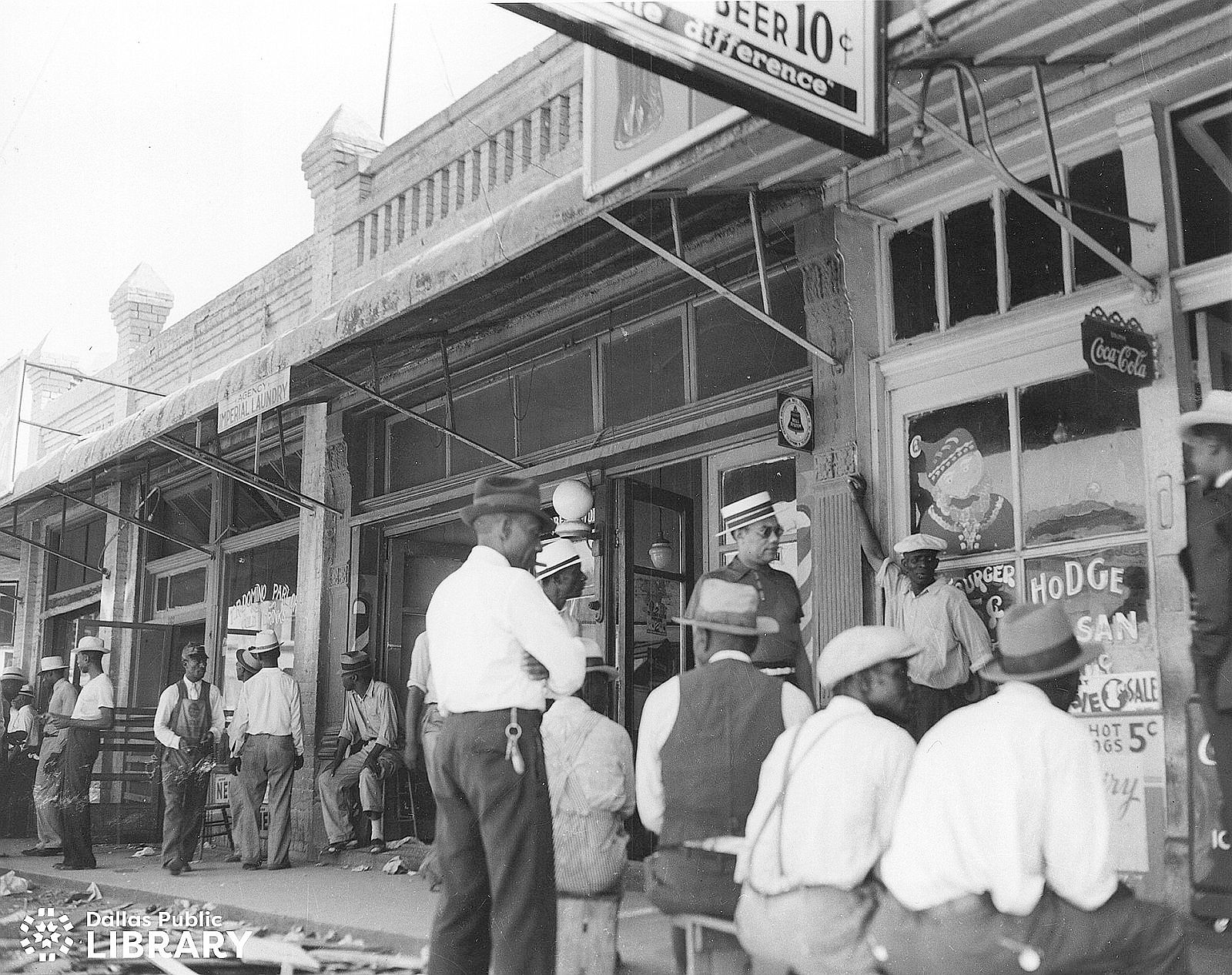
The heart of Deep Ellum… (Dallas Public Library photo)

by Paula Bosse

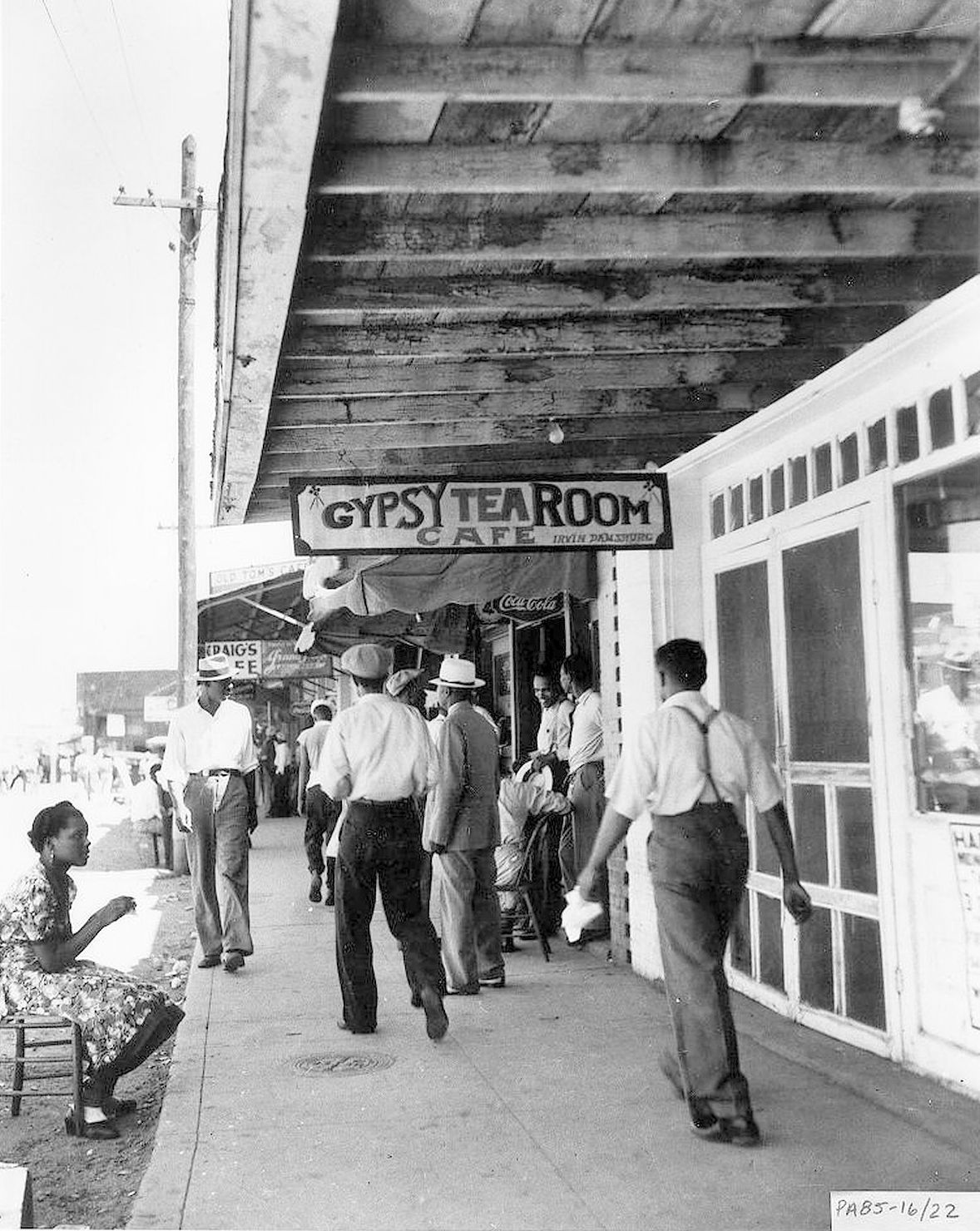
One of my happiest Flashback Dallas research deep-dives resulted in the post “The Gypsy Tea Room, Central Avenue, and The Darensbourg Brothers.” It was prompted by a photo I had seen for years but had never really known what it showed. I loved writing that, and I’m so happy that it is a perennially popular post. Here is that original photo, below, which shows people walking along the row of barber shops, cafes, pool rooms, domino parlors, taverns, and other businesses:

gypsy-tea-room_dallas-public-libraryDallas Public Library photo

The view is to the south — Elm Street is in the distance, where that building juts out to the left. The street about the same distance away to the north (behind the photographer) was Pacific. Someone walking out of the Gypsy Tea Room would have been facing the old train depot. Between the depot and the block of businesses were railroad tracks (not in frequent use in the 1930s, the time of these photos) — the unpaved road that ran alongside the tracks was Central Avenue (when North Central Expressway was built years later, it closely followed the path of these railroad tracks). This general area was considered the heart of Deep Ellum and was filled with Black-owned retail establishments and was a gathering place for social activities and entertainment.

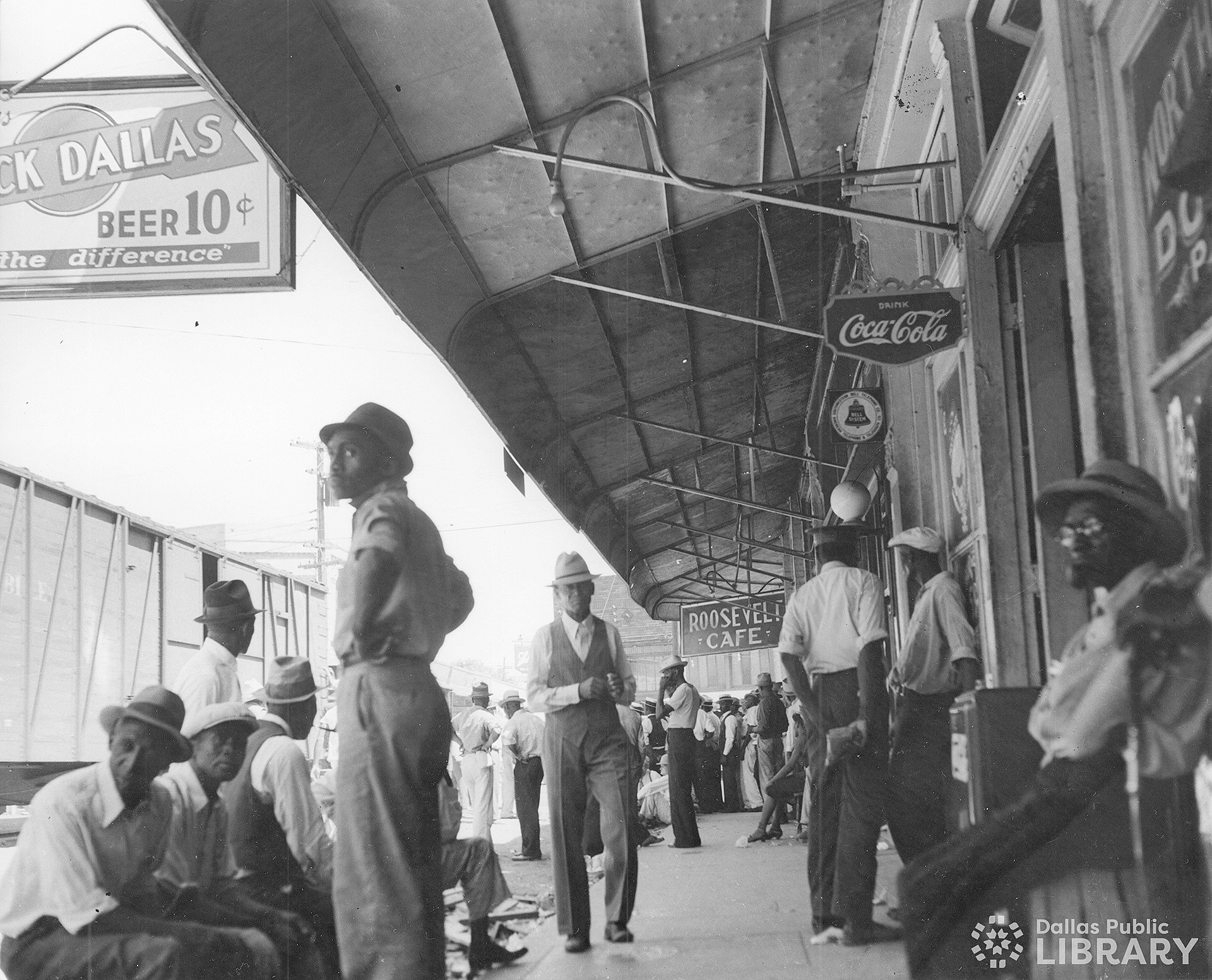
A while back, I came across two other photos, which I recognized as being “companion” photos to the “Gypsy Tea Room” one — the one at the very top of this post, and the one below.

Dallas Public Library photo

The photo immediately above shows the Roosevelt Cafe, which was at 201 N. Central, and the North Pole Domino Parlor (a partial window sign is seen at the right), at 207 Central. A train is passing. This photo and the photo at the very top both show partial signs for Black Dallas beer. (All images are larger when clicked.)

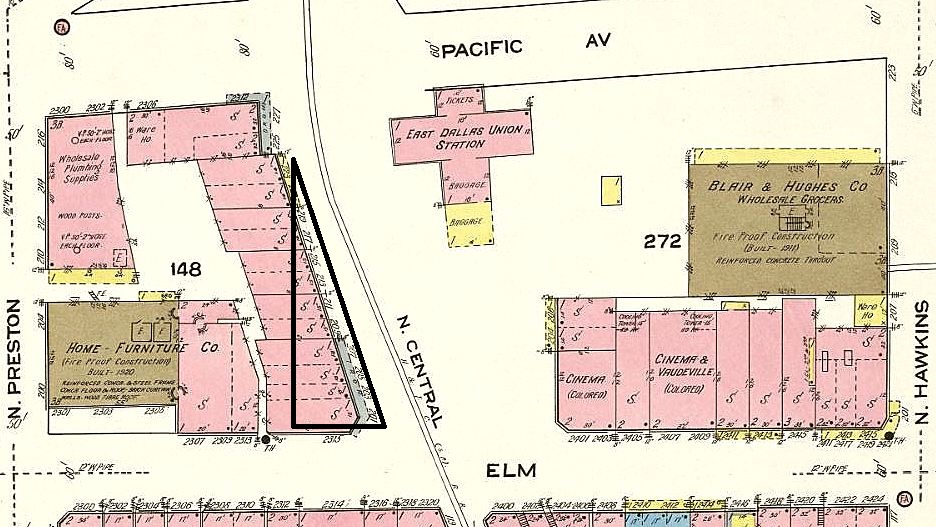
For a better idea of where these photos were taken, see the map below (it shows a detail from a 1921 map — about 15 years before these photos were taken). (See the larger, full Sanborn map here.)

central-ave_1921-sanborn_sheet-17_det1921 Sanborn map (det) showing where photos were taken

*

These are just great, great photos. There aren’t enough photographs like this which capture everyday life in Dallas’ minority communities. Deep Ellum was a thriving Black area at the time. Read a contemporary description of the good things and the bad things going on in this vibrant neighborhood in a (mostly uncondescending) chapter in the WPA Guide to Dallas, “Deep Ellum: Harlem in Miniature.”

**

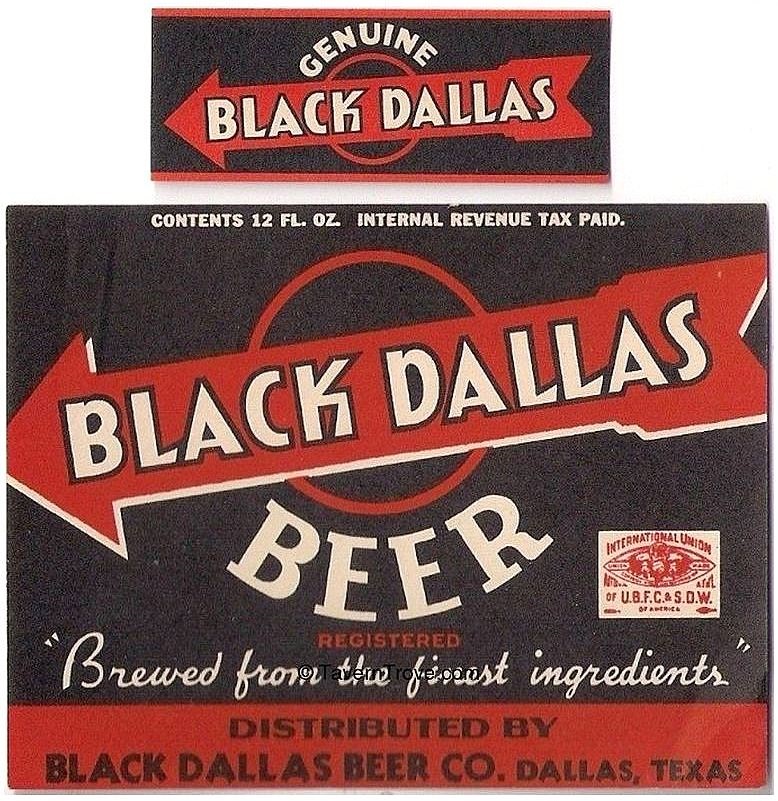
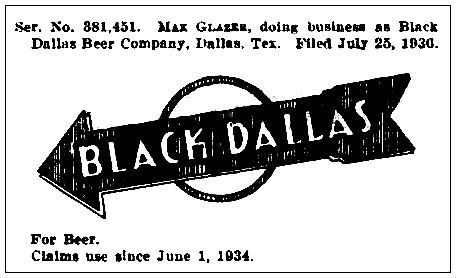
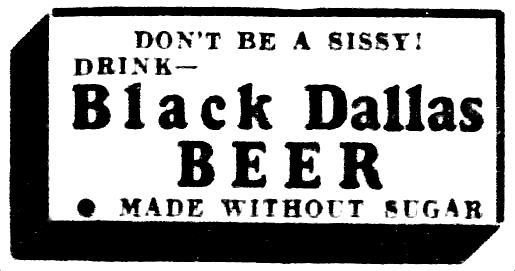
What about “Black Dallas Beer”? I haven’t found a lot about it, but it apparently began as a Dallas-brewed beer in the 1930s but was later brewed elsewhere. (A mention of its Schepps Beer affiliation is here.)

black-dallas-beer_taverntrove_label1937, via Taverntrove.com

black-dallas_beer_u-s-patent-office_090836U.S. Patent Office bulletin, Sept. 8, 1936

“Don’t be a sissy! Drink Black Dallas Beer — Made Without Sugar.”

black-dallas_beer_ad_waco-times-herald_052237Waco Times-Herald, May 22, 1937

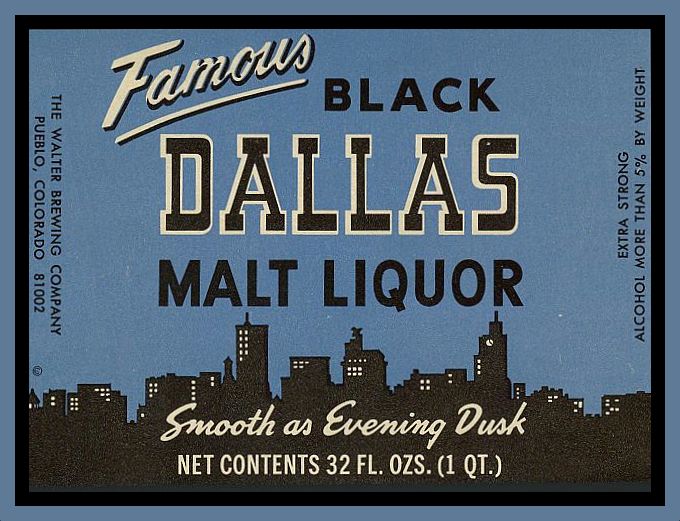
A “Famous Black Dallas Malt Liquor” popped up a few decades later — at that point, there was no connection to Dallas, except for the name and the fantastic label boasting the Dallas skyline. “Smooth as Evening Dusk.”

fbd_beer_black-dallas-malt-liquor_ebayeBay

***

Sources & Notes

The top Dallas Public Library photo — “[African American men walking and sitting along North Central Avenue in downtown Dallas in the early 1930’s]” — is from the Saxon Collection, Texas/Dallas History & Archives Division of the Dallas Public Library; its call number is PA85-16/4.

The second photo — “Gypsy Tea Room Cafe located in Deep Ellum” — is from the WPA Dallas Guide & History Collection of the Dallas Public Library — its call number is PA85-16/22.

The third photo — “[African American men seated on benches and standing outside of the Roosevelt Cafe in downtown Dallas in the 1930’s]” — is from the Saxon Collection, Texas/Dallas History & Archives Division of the Dallas Public Library; its call number is PA85-16/5.

Much more info on this Deep Ellum block can be found in the previously linked post from 2015, “The Gypsy Tea Room, Central Avenue, and The Darensbourg Brothers.”

See my other Flashback Dallas posts on Deep Ellum here.

*

Copyright © 2024 Paula Bosse. All Rights Reserved.
Jerry Bywaters: A Quick Trip to Farmers Branch

bywaters-jerry_untitled_farmers-branch-depot_bywaters-collection_smu_ndBywaters Special Collections, Hamon Arts Library, SMU

by Paula Bosse

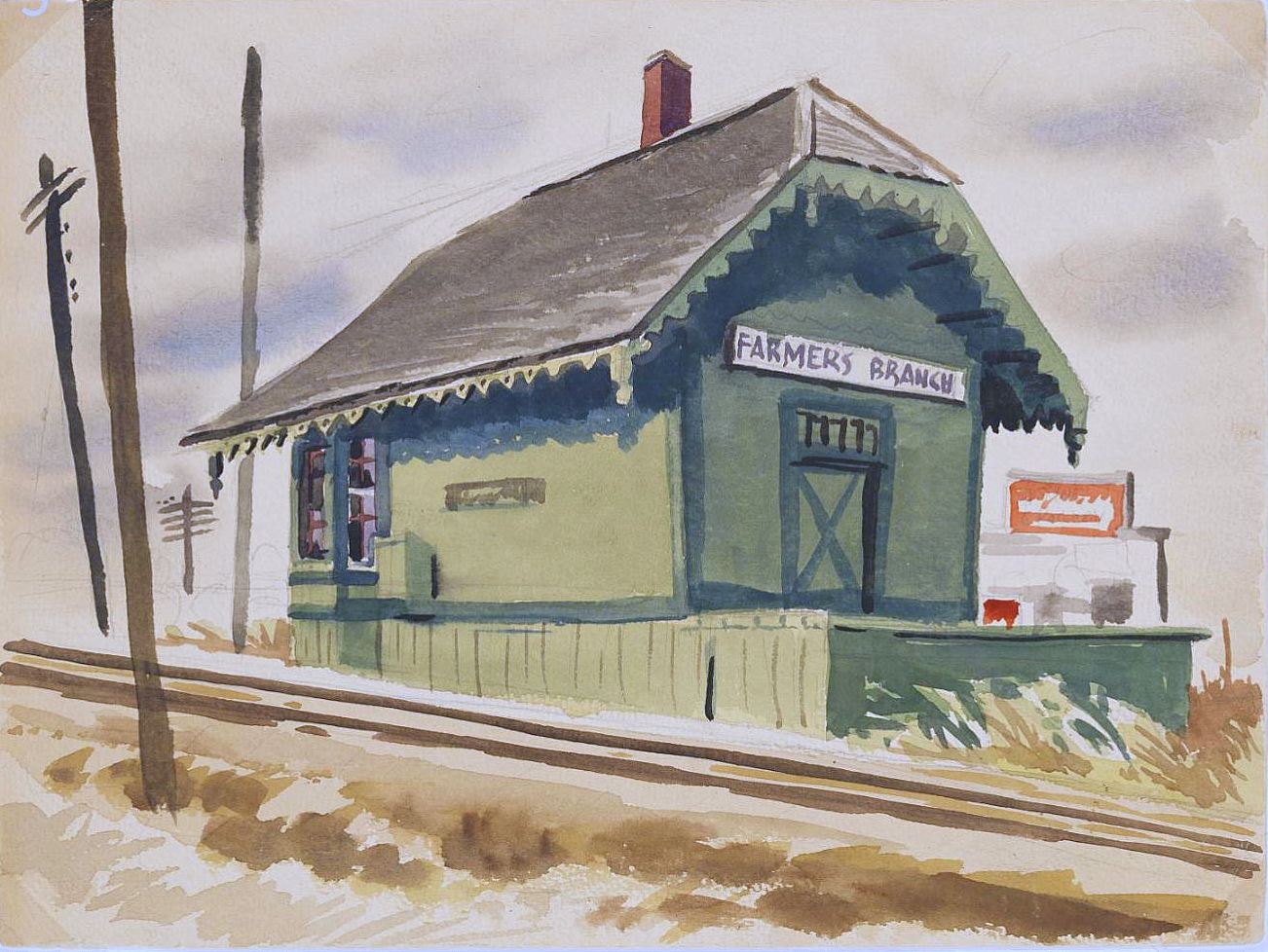
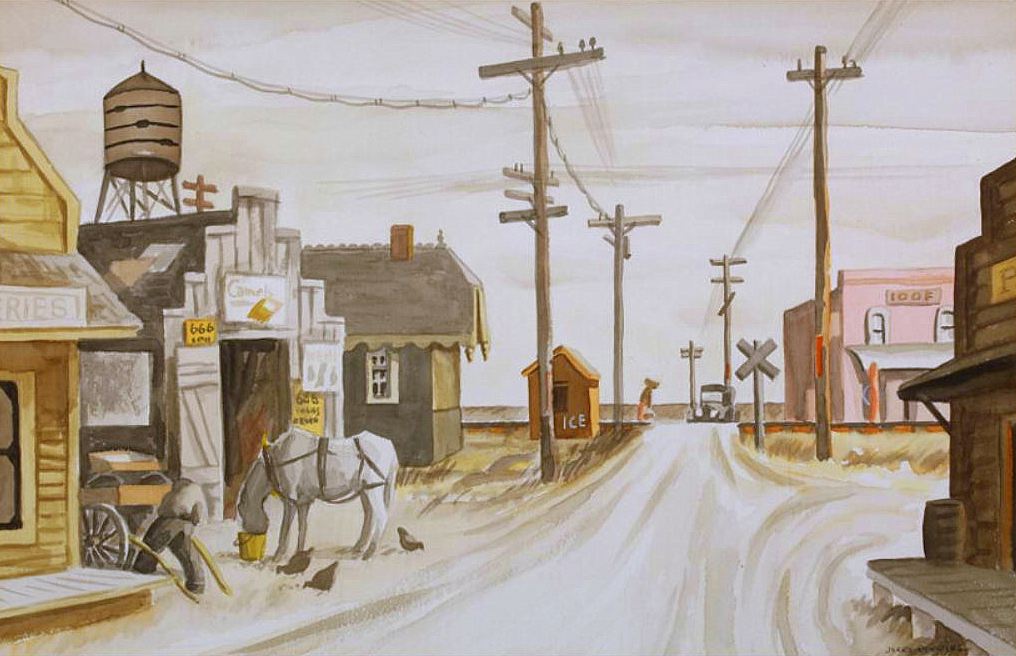
One of the joys of being a fan of an artist is discovering works you’ve never seen before. And here are two, both by a favorite of mine, Dallas artist Jerry Bywaters — and both are watercolors of the very nearby Farmers Branch. Bywaters must have been quite taken with the picturesque little depot there, because it snuck into at least two of his paintings. The one above is untitled, and the one below is “Farmers Branch In the Early Days.”

bywaters-jerry_farmers-branch-in-the-early-days_watercolor_ha-dot-com_sold-2010

I can’t find dates for either of these, but the top work appears to have debuted at an exhibition at the Lawrence Art Galleries in November 1937 (it is mentioned in a review of the show by Frances Folsom in The Dallas Morning News — “Exhibition of Art Works by Jerry Bywaters Opening,” DMN, Oct. 31, 1937).

The depot is still standing — it was restored and relocated to the Farmers Branch Historical Park in 1985. Read a great history of the depot here.

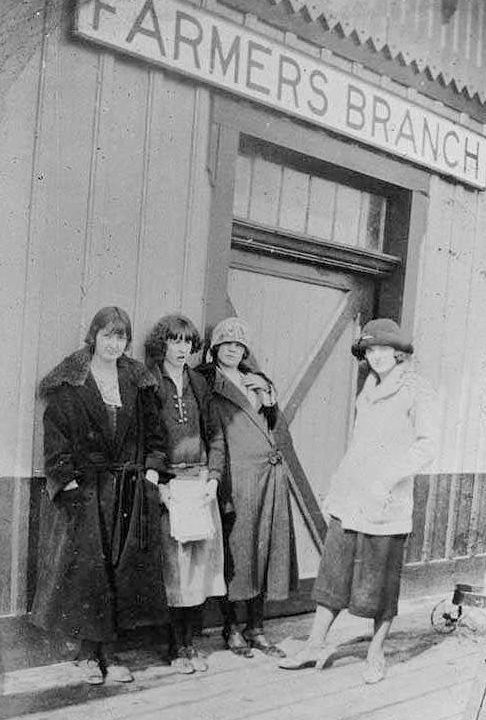
The photo below is from the City of Farmers Branch site. Who wouldn’t want to spend a day with those girls?

farmers-branch-depot_photo_fb-city-website

I think I need to explore Farmers Branch.

***

Sources & Notes

Top painting (“Untitled [Farmers Branch Train Depot]”) is an undated watercolor by Jerry Bywaters, from the Bywaters Special Collections, Hamon Arts Library, SMU Libraries — more info on this can be found at the SMU site here.

The second painting, “Farmers Branch In the Early Days,” is an undated watercolor by Jerry Bywaters; it was sold by Heritage Auctions in 2010. (A notation on the back of this framed piece indicates that it once belonged to the legendary Judge Sarah T. Hughes, or it was purchased by her to give to a very lucky friend.)

The photo of bobbed flappers loitering around the depot is from the City of Farmers Branch website, here.

Other Flashback Dallas posts with (very different) examples of Jerry Bywaters’ art:

A version of this post originally appeared on my Patreon page.

bywaters-jerry_untitled_farmers-branch-depot_bywaters-collection_smu_nd_sm

*

Copyright © 2023 Paula Bosse. All Rights Reserved.
“Thrilling! Inspiring! Gorgeous!” — 1936

tx-centennial-brochure_ebay_4_patreon

by Paula Bosse

I don’t think the 1936 Texas Exposition at Fair Park could have oversold itself. It was everything it promised. The sensory overload must have been almost debilitating!

The night beauty of the Texas Centennial Exposition at Dallas is breath-taking! Rainbow-hued fountains, rippling flags, colorful buildings, thousands of constantly changing lights blending into a symphony of thrilling, inspiring, gorgeous effects… A glamorous fairyland of scintillating light, color and cool water that alone will repay your trip. SEE this marvel of beauty!

*

“Have the time of your life in Dallas! […] Joyous days and nights of holiday-making await you … in one of the most magnificent settings ever conceived! […] The Texas Centennial Exposition at Dallas is being enthusiastically applauded as the most magnificent spectacle ever attempted on the American continent.”

tx-centennial-brochure_ebay_5

*

“World’s Greatest Show for 50¢… Ample Tourist Accommodations… Come to Dallas!”

(According to the Inflation Calculator, 50¢ admission in 1936 would be equivalent to about $10 in today’s money. 10¢ hamburgers would be about $2, and 5¢ cold drinks would be about $1.)

tx-centennial-brochure_ebay_3

*

“Dallas: Night Spot of the World! / Dallas: Day Spot of the World!”

brochure

***

Sources & Notes

Images from a promotional brochure offered recently on eBay.

Check out many previous Flashback Dallas posts on the Texas Centennial here.

tx-centennial-brochure_ebay_4_patreon_sm

*

Copyright © 2023 Paula Bosse. All Rights Reserved.

Dr Pepper Bottling Plant, Second Ave. & Hickory — ca. 1938

dr-pepper-manual_bottling-plant_int_cropTransfixed by Dr Pepper-laden conveyor belts

by Paula Bosse

Before Dr Pepper moved into its fabulous art deco HQ at Mockingbird & Greenville (RIP…), the company’s Dallas bottling works was located at Second Avenue & Hickory Street, from about 1927 to 1948. The building (seen below) still stands.

The images in this post are from a DP manual for bottlers, with numerous photos taken in the Dallas plant. All photos in this post are from that manual (more info is at the end of this post), which every true Dr Pepper superfan (or the dogged collector of obscure soft-drink ephemera) should probably have! All captions are from the booklet.

Above, “Interior of Dallas bottling plant in operation.”

Below, “Model syrup factory, bottling plant and general home office of Dr. Pepper Company, Dallas, Texas.”

dr-pepper-manual_dallas-bottling-plant_ext_crop

*

“Water stills, Dallas plant, supplying water for syrup making.”

dr-pepper-manual_water-stills_crop

*

“General view chemical laboratory, Dallas.”

dr-pepper-manual_chemical-laboratory_crop

*

“Chief chemist, Mr. H. Buttler, Dallas, Texas” (Howland Buttler is also seen in the photo above).

dr-pepper-manual_chief-chemist_buttler_crop

*

“Water cooler and carbonating equipment, bottling plant, Dallas.”

dr-pepper-manual_water-cooler_carbonating-equipment_crop

*

This is my favorite photo: “One section of sugar storage, Dallas — you see a supply sufficient for about a week. Interior view of sugar storage floor, Dr Pepper factory building, Dallas. Only the finest, pure cane sugar is used, a grade and quality superior even to the finest table sugar. Exacting standards must be maintained by refiners to meet our specifications, lest the slightest taste or odor from impurities creep into the Dr. Pepper syrup.”  (A few years ago, I stumbled across a crazy story about Dr. Pepper — and other soft drink manufacturers — involved in buying black-market sugar, which was a violation of war-time food rationing, as WWII came to a close. Read about this case in the post “Halloween Party? Don’t Forget the Dr Pepper! — 1947” — scroll to the bottom.) Shout out to Sugar Land!

dr-pepper-manual_sugar-storage_crop

*

“Syrup compounding and manufacturing unit at Dallas, Texas. Interior view of syrup room, Dr. Pepper factory, Dallas. Note flood of sunshine through modern factory-glass windows; floors, walls, ceilings, as well as equipment, immaculately clean. Glass-lined mixing tanks in center and at right are of 300-gallon capacity, and behind these are 500-gallon steam-jacketed, glass-lined kettles, where hot process simple syrup is made. Entire syrup manufacturing process is modern, efficient and sanitary.”

dr-pepper-manual_syrup-unit_crop

*

“Modern soaker and washer — one of two units used in Dallas plant.”

dr-pepper-manual_soaker_washer_crop

*

“Modern crown sifting equipment, Dallas.” (More on crown cork bottle caps here.) (And, weirdly, I wrote about a Dallas company that manufactured those caps in the post “The Crown Cork & Seal Co., Dallas Branch — ca. 1910.”)

dr-pepper-manual_crown-sifting_crop

*

“Low pressure unit — bottler and crowner.”

dr-pepper-manual_low-pressure-unit_bottler_crowner-crop

*

“Final inspection, Dallas bottling plant — ‘candling’ filled bottles.”

dr-pepper-manual_inspection_candling_crop

*

“Automatic case stenciling machine.” This is an important part of the manufacturing process I hadn’t thought about….

dr-pepper-manual_case-stenciling_crop

*

“Bottle storage, Dallas plant.”

dr-pepper-manual_bottle-storage_crop

*

Battered front cover and title page:

dr-pepper-manual_front-cover_nov-1938_crop

dr-pepper-manual_title-page_crop

***

Sources & Notes

Photos from “Dr. Pepper Bottler’s Manual: A Manual of Proved Principles and Practices Governing Successful Operation of Dr. Pepper Plants” (Dr. Pepper Company, Dallas, Texas, Nov. 1938); this booklet was found on eBay — for sale for $499.99.

More Flashback Dallas posts featuring Dr Pepper can be found here.

Please consider following me on Patreon, where I post new content daily — for as little as $5 a month!

dr-pepper-manual_bottling-plant_int_crop_sm

*

Copyright © 2023 Paula Bosse. All Rights Reserved.