Flashback : Dallas

A Miscellany: History, Ads, Pop Culture

Category: 1930s

The Fair Park Bond Issue — 1934
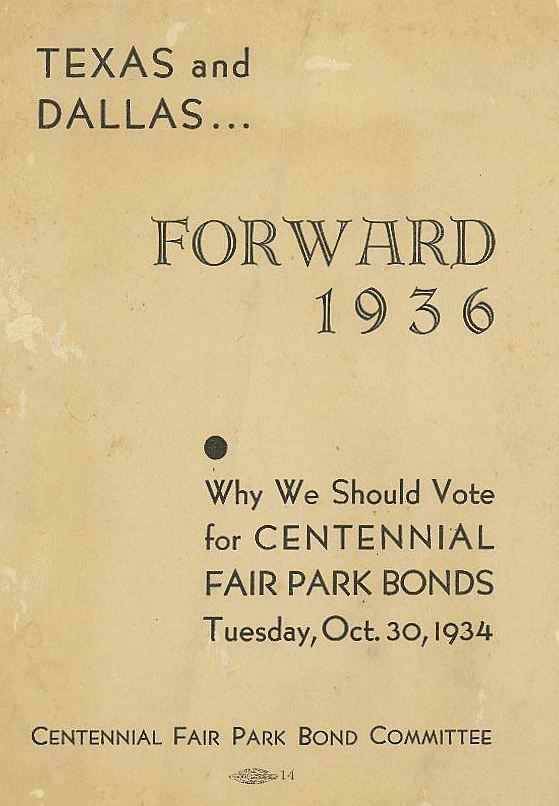
centennial-bond-issue_front-cover_cook-collection_degolyer_SMU_sm“Forward 1936…”  (DeGolyer Library, SMU)

by Paula Bosse

With all the heated discussion currently going on about what the city is going to do with Fair Park, I thought this little pamphlet from 1934 seemed timely. Published by the “Centennial Fair Park Bond Committee” (comprised of all the Dallas movers and shakers one would expect), the get-out-the-vote brochure was issued to explain the $3,000,000 (about $54,000,000 in today’s money, adjusted for inflation) bond issue, the approval of which was essential in order to clinch the honor of hosting the Texas Centennial Exposition in 1936. The entire pamphlet — part of the George W. Cook Collection in the DeGolyer Library — may be read on SMU’s website, here.
centennial-bond-issue_back-cover_cook-collection_degolyer_SMU

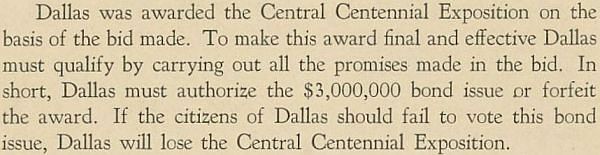
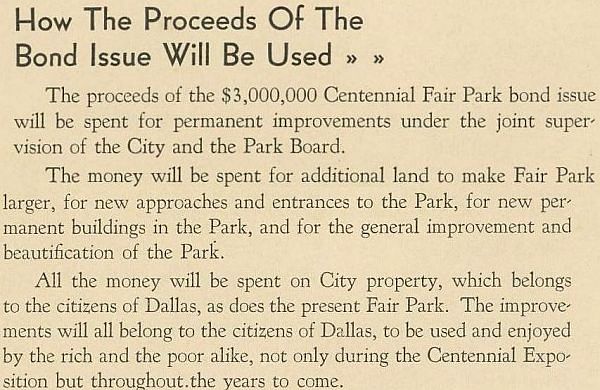
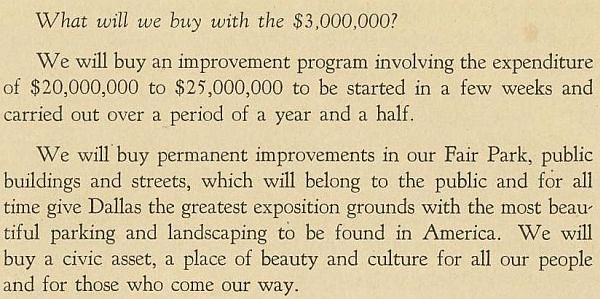
A couple of excerpts:

centennial-bond-issue

centennial-bond-issue_2

centennial-bond-issue_3

*

The issue passed, overwhelmingly, by a 5-1 margin. It’s interesting to note that the voting restrictions on this referendum were … pretty restrictive. Not only was payment of a poll tax required to vote (…one had to pay for the “privilege” of voting…), but one also had to be a property owner — and that property owner was not allowed to vote until a “rendition” was signed downtown in the tax assessor’s office. Many property owners who had signed the necessary paperwork were still unable to vote as they had not paid (or could not afford) the poll tax. It’s pretty obvious here that a substantial number of lower income residents (i.e. non-property owners or property owners unable to afford the poll tax) — including many who lived in the area immediately surrounding Fair Park — were legally prohibited from casting a vote.

6,550 ballots were cast (5462-1088), which represented “little more than one-third of the 18,000 supposed qualified to decide this important issue” (Dallas  Morning News, Nov. 1, 1934). It was declared to be “the largest majority ever cast for a bond issue in [the] history of Dallas” (DMN, Oct. 31, 1934).

The passage of the October, 1934 bond issue assured that Dallas would host the Texas Centennial Exposition, a statewide celebration which proved to be a huge success and was a tremendous economic boon to the city.

***

Sources & Notes

The pamphlet “Texas and Dallas … Forward 1936: Why We Should Vote For Centennial Fair Park Bonds, Tuesday, October 30, 1934” is part of the George W. Cook Dallas/Texas Image Collection, DeGolyer Library, Central University Libraries, Southern Methodist University; the entire pamphlet is contained in a PDF which may be read and/or downloaded here.

More on this vote can be found in these two Dallas Morning News articles:

  • “OK on Bonds For Huge Fair Up to Voters” (DMN, Oct. 30, 1934) — published on voting day, this article includes the particulars of the voting restrictions
  • “Five-to-One Majority Scored As City Favors Centennial Bonds to Assure Huge Fair” (DMN, Oct. 31, 1934) — the results

Payment of a poll tax was still required to vote in Texas elections until 1966, when the U. S. Supreme Court ruled such taxes were unconstitutional. More about that from the Dallas Public Library, here.

*

Copyright © 2016 Paula Bosse. All Rights Reserved.
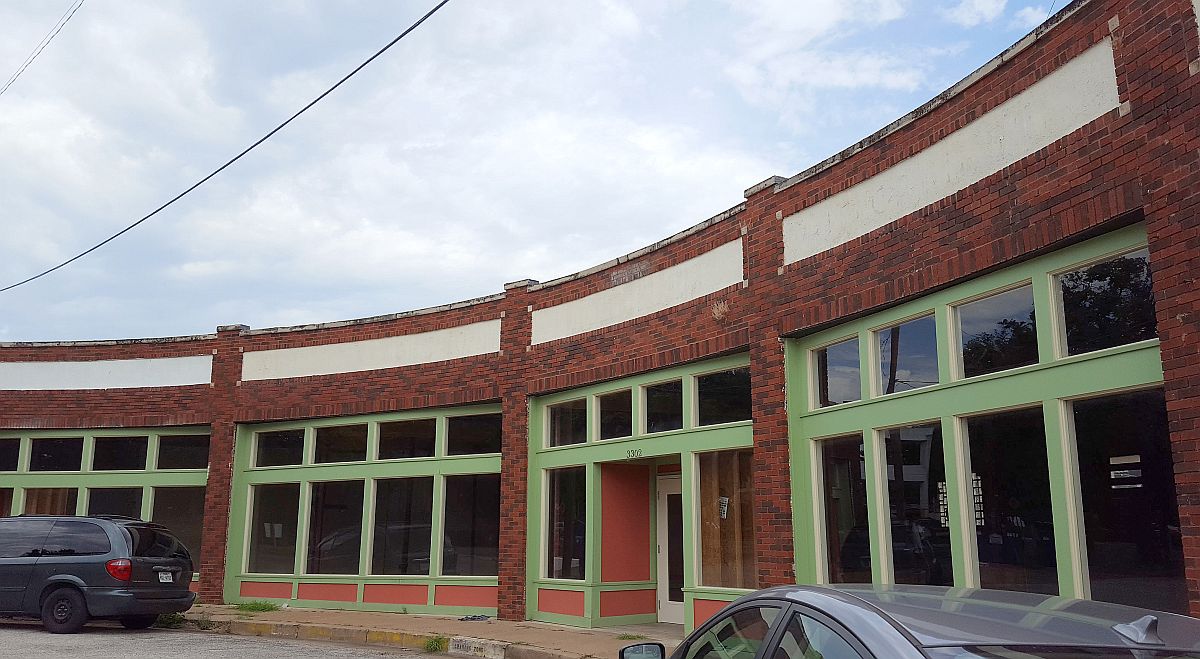
 

Mrs. Hartgraves’ Cafe, and Bonnie & Clyde Earning Paychecks on Swiss Avenue

swiss-circle-front_070516The Swiss Circle building, 2016 (click for larger image) / Photo: Paula Bosse

by Paula Bosse

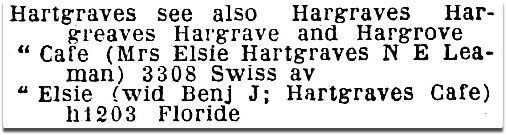
Bonne and Clyde were famous for being from West Dallas, but each actually spent a good amount of time in East Dallas. Working. Earning an honest living. Bonnie worked as a waitress, and Clyde worked in a mirror and glass company. Both worked in establishments on Swiss Avenue, though probably at different times. They hadn’t met yet, but it’s interesting to know they worked at businesses only a few blocks apart: Hartgraves Cafe was at 3308 Swiss, and United Mirror and Glass was at 2614 Swiss. Both buildings are still standing.

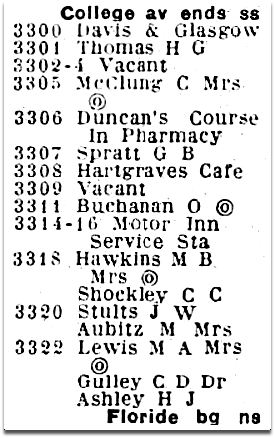
The Hartgraves Cafe (the name of which is always misspelled in historical accounts as Hargrave’s Cafe — even by Bonnie and Clyde enthusiasts) was in a curved building at the corner of Swiss and College (it is now at the corner of Swiss and Hall). 50-something-year-old Mrs. Alcie Hartgraves (her first name usually appeared in directories as “Elsie,” sometimes as “Alice”) opened the restaurant a few months after her husband, Ben, had died in 1923. It lasted until late 1930 or early 1931. (All clippings and photos are larger when clicked.)

1928-directory_hartgraves1928 Dallas directory

1929-directorySwiss Avenue between College Avenue and Floride, 1928 directory

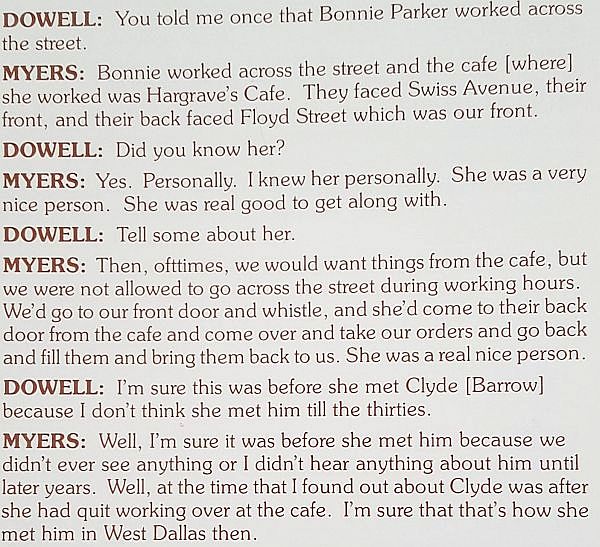
According to Bonnie and Clyde histories, Bonnie worked there as a teenaged waitress with an absent husband, from 1928 to early 1929. According to one woman who worked at the Yates Laundry, just across from the cafe’s back door, Bonnie was a very nice person. Here, in a 1972 oral history, Rose Myers — who worked at the Yates Laundry for 25 years — remembers Bonnie from those days at Mrs. Hartgraves’ cafe:

hartgraves-yates_reminiscences
From the book Reminiscences

The laundry is long gone, but here’s what the back side of the building Bonnie worked in looks like today.

swiss-circle_back_070516Photo: Paula Bosse

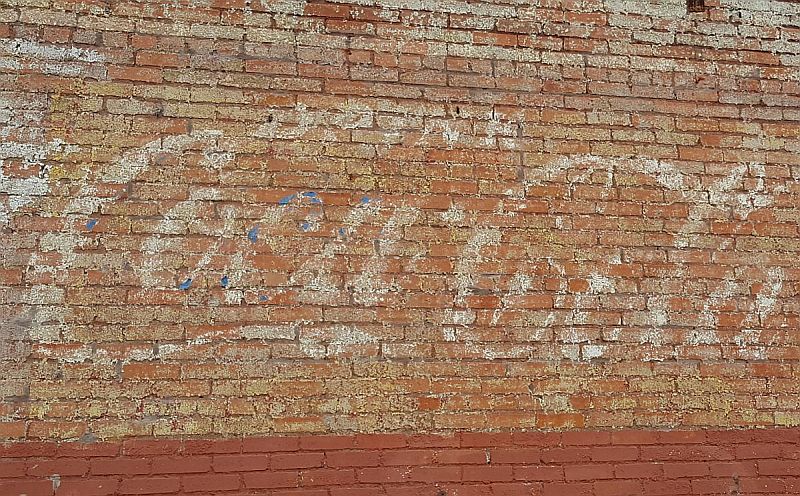
And here’s a Coca-Cola ghost sign, painted on the end of the building that faces Hall.

swiss-circle_coke-ghost-sign_070516Photo: Paula Bosse

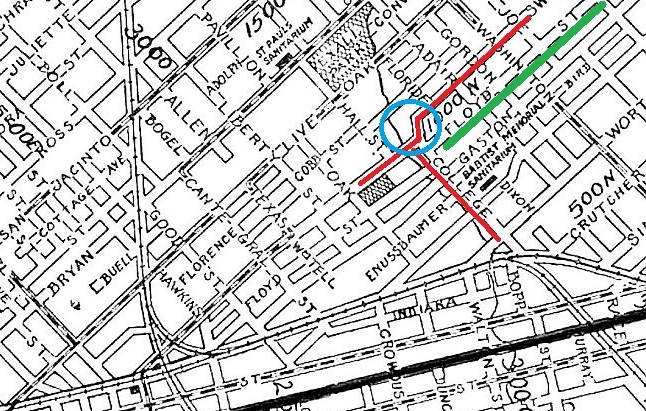
The Bonnie Parker connection is about the only reason people know about this odd little building in Old East Dallas. From looking through Dallas street directories, it appears that this building was built in 1915 or 1916 as a retail strip which, until Mrs. Hartgraves left, usually contained three or four businesses. The question is: why was it shaped like that? Many people think it was a streetcar stop, the cars using the circle as a place to turn around, but old maps showing streetcar routes from this period don’t show cars going down this part of Swiss. Below, a detail from a 1919 map, with Swiss and College streets in red. Streetcar tracks on Swiss turn left at Texas and then right on Live Oak, completely bypassing the circle area. (Another handy map of old streetcar routes laid over a present-day Google map can be found here.)

swiss-circle_1919-map
1919 map detail, via UNT

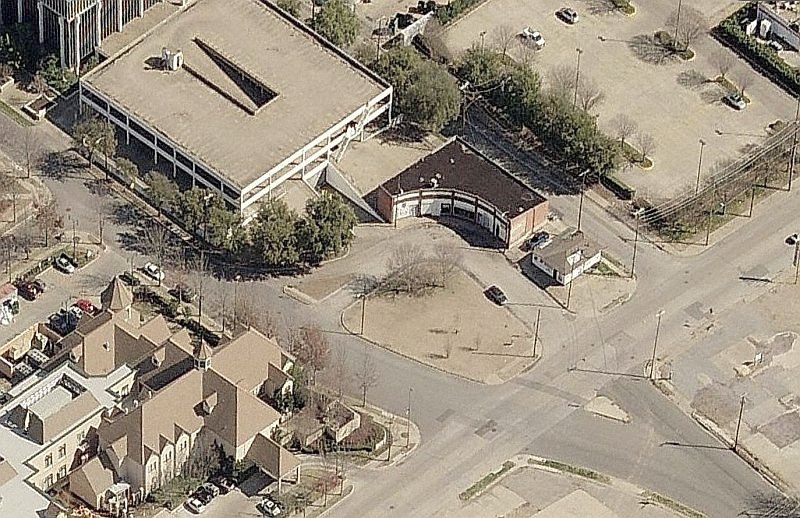
There’s a great view of the area in the 1921 Sanborn map here (with a different angle here). It may just be that the building was built to take advantage of/conform to the odd jog that Swiss Avenue takes in front of it. Here’s an aerial view from the recent past.

swiss-circle_bing-birdseye
Bing Maps

Our own teensy and unspectacular Royal Crescent! (You know what they say — “Everything’s bigger in Bath….”)

**

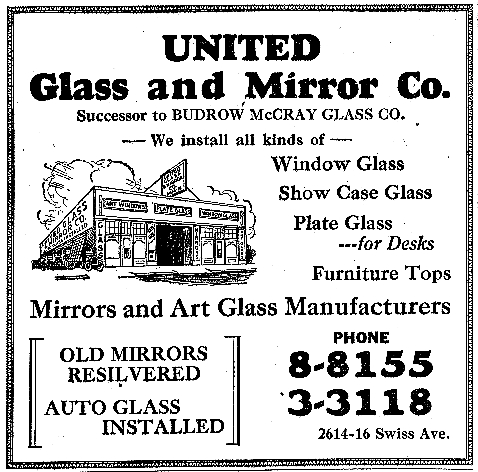
But what about Clyde? Clyde worked at a mirror and glass company four-tenths of a mile west. Here’s an ad from 1928 (the same year Bonnie was working at Hartgraves).

united-mirror-glass_1928-diectory-ad_texashideout
via Bonnie & Clyde’s Hideout

Charles “Chili” Blatney worked with Clyde at United Glass and Mirror. In the Dallas Morning News article “He Helps Dallas to See Itself” by David Hawkins (DMN, March 17, 1970), Hawkins wrote: “Blatney remembers him as the friend he was: The little guy who always wore a hat and who would jerk it off and beat the floor with it in merriment when a good joke was told. […] ‘I guess I was surprised to see him turn real bad,’ [said Blatney].”

The building still stands, almost unrecognizable.

So, yeah, East Dallas was the stomping grounds of Bonnie and Clyde, back when they were living paycheck-to-paycheck and before they had begun their short-lived life of crime.

***

Sources & Notes

Photos of the Swiss Circle building taken by me when I stumbled across it yesterday. I knew what it was when I saw it, but I didn’t really know much about it, other than the Bonnie connection. The building is currently vacant, currently for lease, and currently a weird shade of green. It’s a great space and a cool building. The back side is FANTASTIC!

The surname of the property owner (or property manager) is rather unbelievably … Dunaway.

The passage quoting Rose Myers, who worked at the Yates Laundry, is from the book Reminiscences: A Glimpse of Old East Dallas.

A discussion of this building can be found on the Phorum discussion board, here.

Other Flashback Dallas  posts on Bonnie and Clyde can be found here.

Click everything. See bigger images!

*

Copyright © 2016 Paula Bosse. All Rights Reserved.
 

Dallas’ Texas Centennial Exposition vs. Fort Worth’s Frontier Exposition — 1936

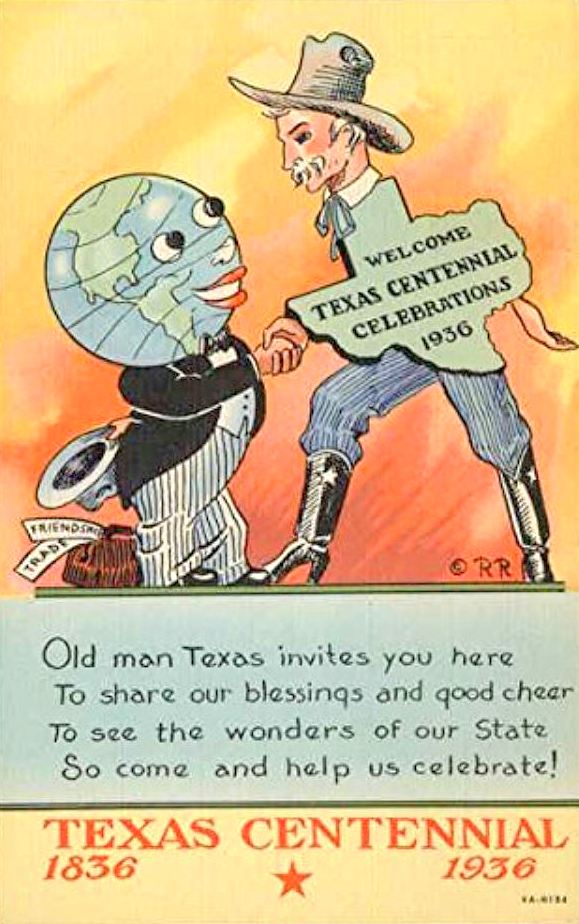
tx-centennial-postcard_old-man-texas_smWelcome to Dallas (and/or Fort Worth)!

by Paula Bosse

The Texas Centennial Exposition opened in Dallas at Fair Park in June, 1936 — 80 years ago this week. It was described in newsreels as “A New City, A Great City, A City of a Thousand Sights and a Thousand Wonders.” Which I guess it kind of was. I’ve written about the Centennial before, but I don’t think I’ve mentioned that my favorite part of the Centennial’s taking place in Dallas is that it seriously rubbed “Mr. Fort Worth,” Amon Carter, the wrong way. Carter’s distaste of Dallas was well-known, so it was no surprise, really, that this caused him to blow his top and, damn it, he created his OWN competing celebration: the Fort Worth Frontier Centennial Exposition. The Dallas-Fort Worth rivalry had already been going strong for years, but the Centennial pushed it into Hatfield-and-McCoy feud territory (although one gets the feeling that most of it was an act that generated a lot of great publicity for both sides).

Watch film footage of ol’ Amon’s blood pressure spike into the danger zone here, in a moment from a March of Time newsreel as he proclaims that Fort Worth will teach “those dudes over there” (in Dallas) a thing or two by outdoing Big D in sheer gigantic spectacle. …And sex. Or, “whoopee.” Nudity was on display absolutely everywhere at both Centennial expositions. Dallas had always planned on having the titillation before Amon Carter got into the act, but the involvement of Billy Rose on the Fort Worth side probably encouraged Dallas to, um … augment the fleshy offerings on display in Fair Park.

Broadway impresario Billy Rose was hired by Amon Carter to sex-up the Fort Worth expo and to do everything he could to draw more visitors to Fort Worth than to Dallas. Rose went so far as to have a HUGE electric sign (supposedly the second largest electric sign in the world) placed on top of a building on Parry directly opposite the entrance to Fair Park which read:

“Fort Worth Frontier — Wild & Whoo-pee — 45 Minutes West.”

Which is pretty hilarious. (Same view today?)

tx-centennial_FW-sign_billy-rose-presents_book_1936

(See a giant image of this photo in the UTA digital collection, here.)

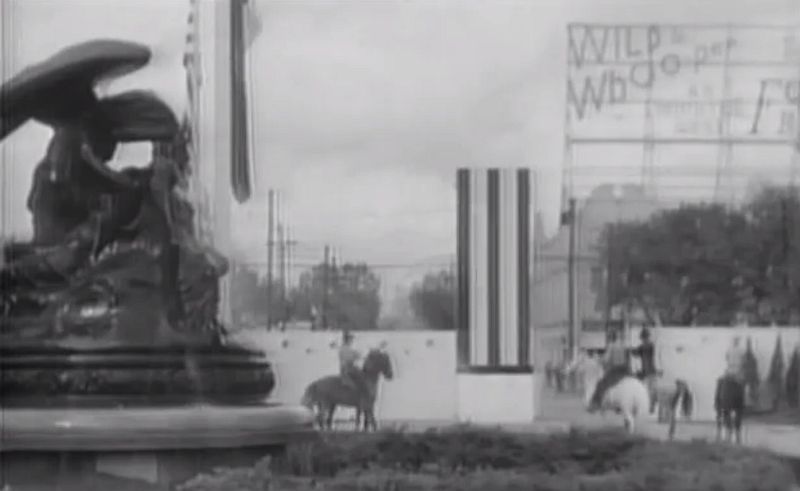
I’m not sure whether the Dallas Centennial organizers were miffed or amused, but one can only imagine that Amon Carter was thrilled to bits when he saw his sign appear (fleetingly) in the Gene Autry movie The Big Show which had been shot in Fair Park during the Centennial.

billy-rose-billboard_big-show-movie_gene-autry

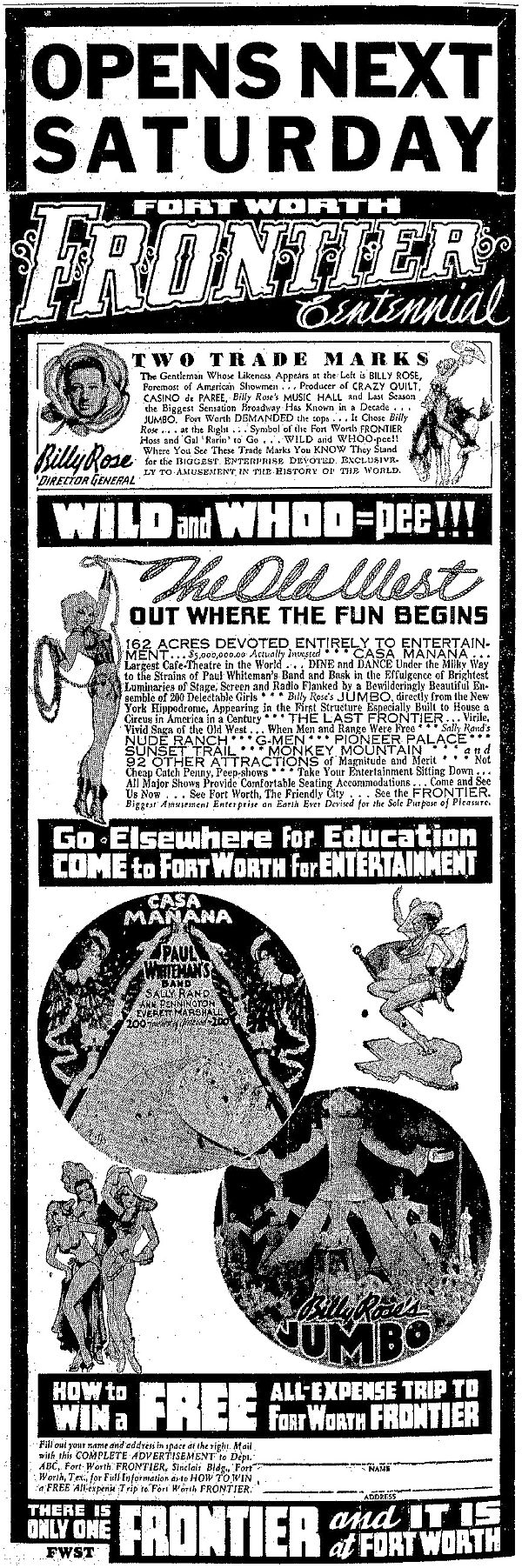
Fort Worth was all about the “whoo-pee,” and the tag-line to their show was “Come to Fort Worth for Entertainment, Go Elsewhere for Education.”

frontier_FWST_071436-detFort Worth Star-Telegram, July 14, 1936

The “feud” (i.e. the publicity machine) really cranked up when the producers of the March of Time newsreel sent their people to film in Dallas and Fort Worth. The result — a splashy look at the inter-city rivalry titled “Battle of a Centennial” — was shown in DFW-area theaters, and boisterous audiences either applauded for Dallas and hissed at Fort Worth (or vice-versa), depending on their allegiance.  (Click ad below for larger image.)

march-of-time_dmn_061736
June, 1936

In the end, the celebrations in both Dallas and Fort Worth were successful (although Dallas was the clear winner!), but the rivalry and competitive showmanship from the two cities probably made the shows much more entertaining than they might otherwise have been. So, thanks, Amon!

frontier_pinterest
via Pinterest

frontier_dmn_073036
July, 1936

frontier-centennial_FWST_071236
July, 1936

tx-centennial_variety-via-decatur-illinois-herald_060336
Variety article reprinted in Decatur (Illinois) Herald, June 3, 1936

billy-rose_casa-manana
via oldimprints.com

 ***

Sources & Notes

Source of postcard at top unknown.

Photo of the “whoo-pee” billboard is from the book Billy Rose Presents … Casa Mañana (Fort Worth: TCU Press, 1999) by Jan Jones. Jones writes that the billboard was on top of the building at Parry and First.

The shot of the billboard hovering over cowboys is a screengrab from the interesting-but-dull Gene Autry movie, The Big Show, shot mostly on the grounds of Fair Park during the Centennial. You can watch the full movie here.

The clip of Amon Carter shaking his fist at “those dudes” in Dallas is from the 1936 March of Times newsreel, “Battle of a Centennial.” I have been unable to find the entire film streaming online, but you can watch a whole bunch of clips (about 13) from Getty Images, here. The full thing appears to be available for purchase here, but only if you are affiliated with a school or institution. (If anyone has access to the full newsreel, let me know!)

Watch a different newsreel/film on the Centennial Exposition — the 11-minute Texas Centennial Highlights, shot and produced by Dallas’ Jamieson Film Co. — at the Texas Archive of the Moving Image site, here.

For more on Fort Worth’s horning-in-on Dallas’ Centennial, read the entertaining article “Makin’ Whoopee — Amon Carter Couldn’t Make Either the Depression or Dallas Go Away, But He Sure Tried” by Jerry Flemmons (D Magazine, April, 1978), here.

Unfortunately, I’m unable to embed the video I linked to above of Amon Carter sputtering about Dallas hosting the state’s Centennial, but I encourage everyone who’s ever been amused by the Dallas-Fort Worth “feud” to watch it here — it’s well worth 17 seconds of your time! As John Rosenfield wrote in the Dallas Morning News review of this March of Time newsreel, “The best actor from across the river is Amon Carter, long a leading man among Texas political Thespians” (DMN, “Centennial Fight in ‘Time’ Release,” June 21, 1936). Newspaperman Carter knew how to parlay outrageous remarks about exaggerated competition into sweet, sweet publicity for himself and his newspaper. Check out the photo of a smiling Carter with his arm around “bitter rival,” G. B. Dealey of The Dallas Morning News, here. Amon knew a thing or two about a thing or two….

Pictures and clippings are larger when clicked.

*

Copyright © 2016 Paula Bosse. All Rights Reserved.
Consolidated Candy Co., 826-830 Exposition — ca. 1936

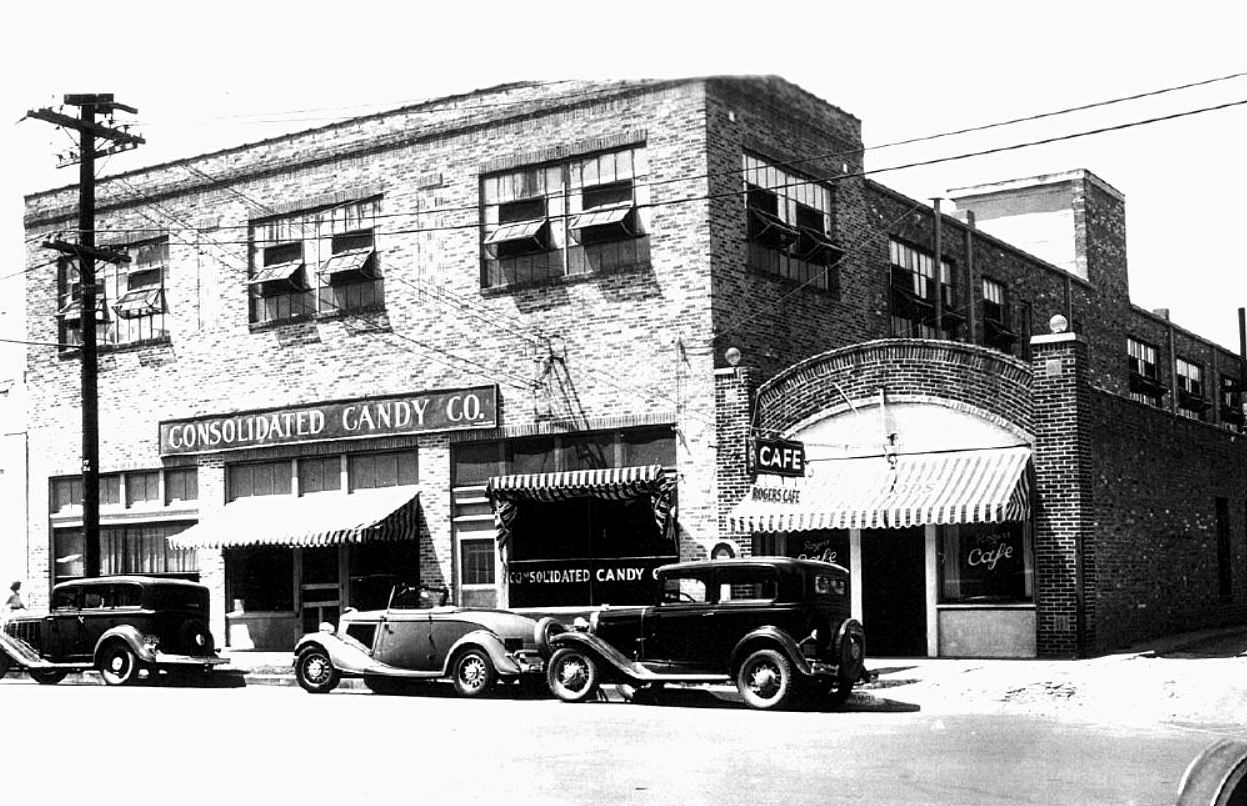
consolidated-candy-co_826-830-exposition-st_jim-wheatCandy manufacturing in Expo Park (click for larger image)

by Paula Bosse

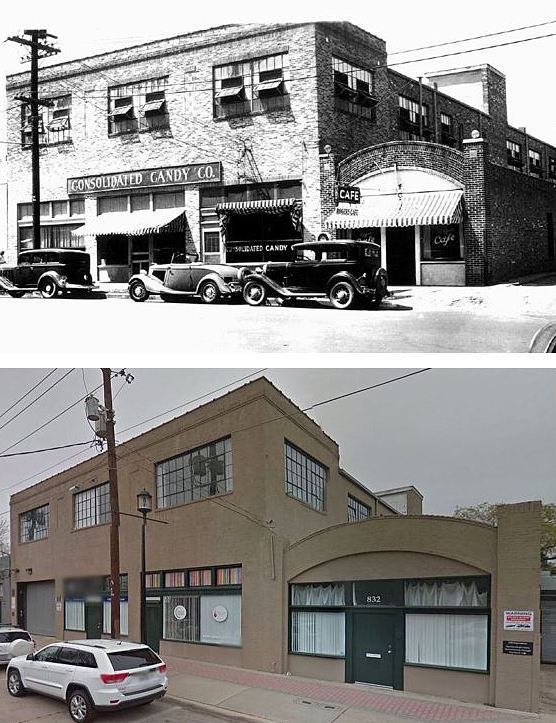
A photo of Exposition Park about the time of the huge Texas Centennial celebration held in 1936 at Fair Park, one block away. The Consolidated Candy Co. at 826-830 Exposition Avenue was liquidated in 1939, and the Rogers Cafe next door at 832 Exposition was around only a couple of years, about 1935 to 1937, so 1936 seems a good guess.

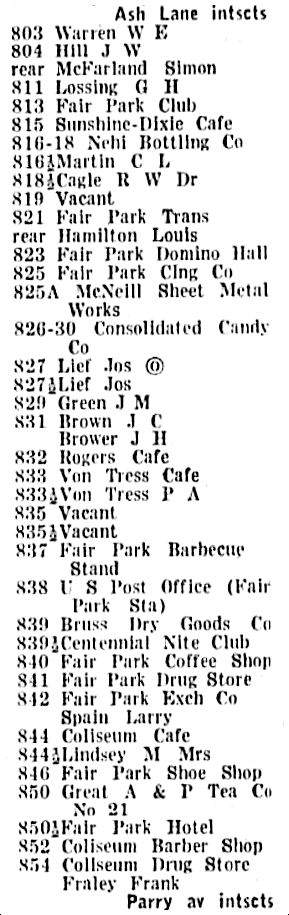
Here’s a list of businesses that were operating along hopping Exposition Avenue in 1936, between Ash and Parry (click for larger image):

expostion_1936-directory
1936 Dallas directory

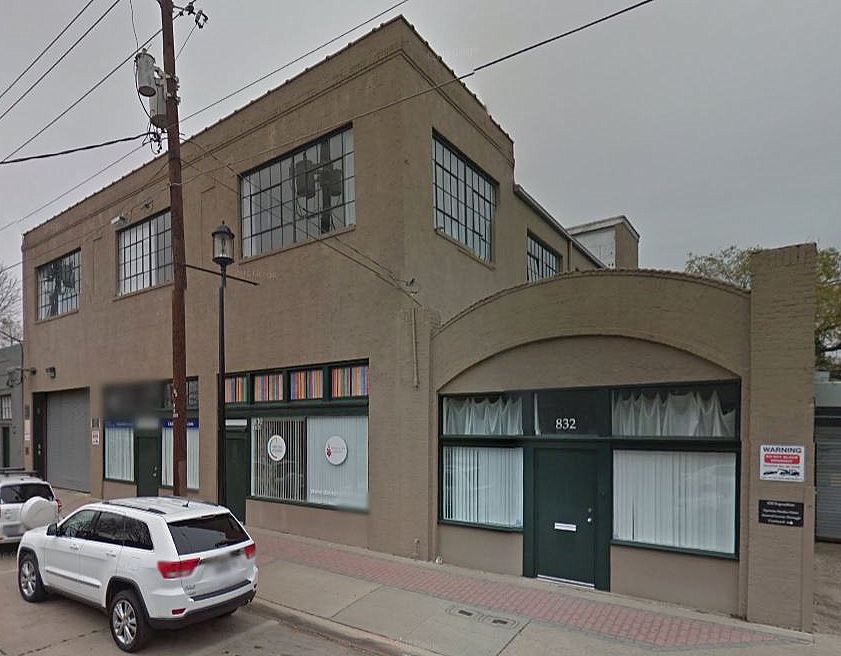
Most of the buildings from that period along Parry and Exposition are still standing, including the buildings seen in the photo above. Here is a current view.

826-830-exposition_google_jan-2016
Google Street View, Jan. 2016

I’m happy to see these two buildings still holding down that spot after all this time, but they both appear to have lost some character in the intervening 80 years. It’s like someone’s sanded all the interesting bits off and made it as bland-looking as possible. You know what I think needs to make a comeback? Awnings.

***

Top photo from Jim Wheat’s Dallas County Texas Archives site.

A Google Street View showing this block looking toward Fair Park, with these buildings on the left, is here.

exposition_google-maps
Google Maps

expo-then-now

Images larger when clicked.

*

Copyright © 2016 Paula Bosse. All Rights Reserved.
Girls’ Softball in Dallas, Hugely Popular

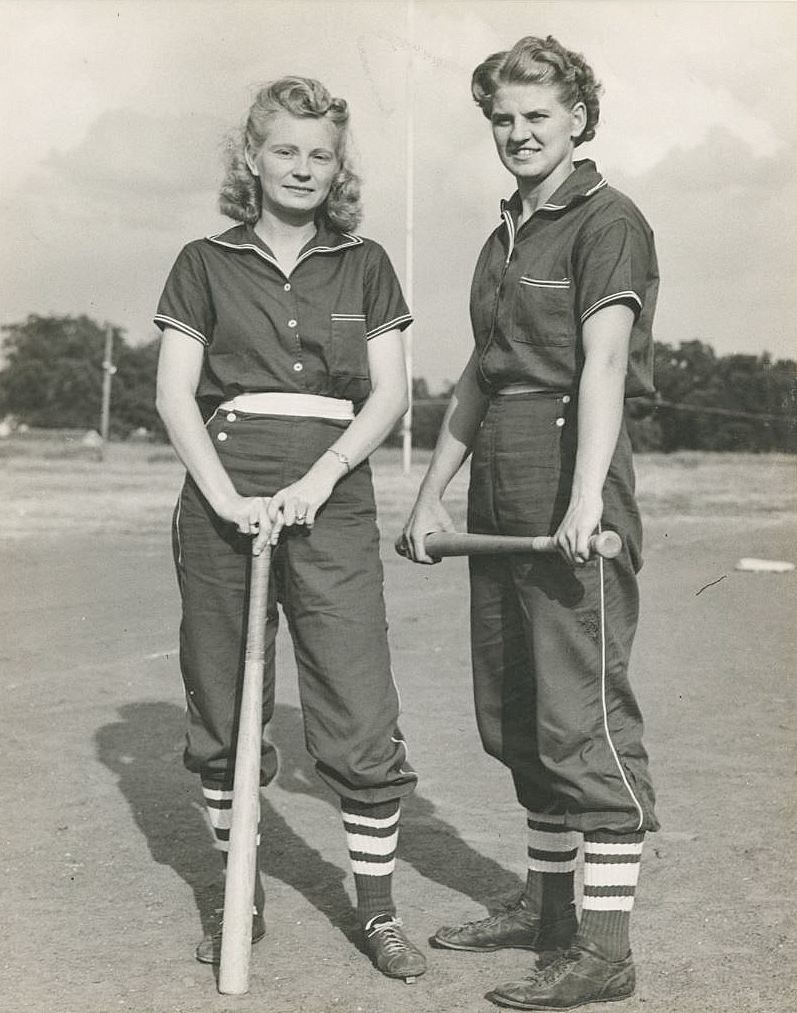
girls-softball_WPA-GD_dallas-park-rec-deptSoftball in the park… 

by Paula Bosse

Around 1938, softball suddenly became very, very popular in Dallas. Absolutely everyone seemed to be playing it: boys, girls, moms, dads, kids, businessmen, college students, and senior citizens. By 1939, The Dallas Morning News was calling the sport “the newest Dallas crazy custom.” There were more than 18,000 players playing on more than 300 organized teams, which meant that most of the roughly 100 softball diamonds in the city were constantly in use. It was estimated that more than 700,000 spectators had filled softball bleachers in 1938. These were all, of course, non-professional teams and players,  but there was some concern that this new-found softball enthusiasm might be cutting into attendance for the professional baseball games.

…[B]ut the fact remains that softball is cutting into the gate receipts of professional baseball. When more than 100 softball teams play almost every night in Dallas and hundreds of fans watch the games there certainly must be vacant seats at the stadium where professionals are doing their stuff for the Texas League. (Dallas Morning News, June 16, 1939)

Most interesting about this “fad” is that girls’ softball league games became extremely popular. These teams were often affiliated with local companies (Metzger’s Milk, Dunlap-Swain, etc.), and their sponsored games drew very large crowds, usually more than the men’s games did. The Dallas Morning News reported that attendance at the regular Friday night games in 1939 was something like five or six thousand. Some of the girls even became minor local celebrities.

baseball_teammates-of-fort-worth-cats_william-langley_nd_portal
Fort Wort at bat (via Portal to Texas History)

Coverage of the women’s games by the local press was solid, but coverage of the women themselves seemed more like a good excuse to run photos of the “girls” in skimpy uniforms rather than focus on their athletic ability. But I’m sure the girls shrugged it off and were just happy to be playing a sport they loved.

girls-softball_1940

**

Below, the 1943 Dallas Girls’ Softball League champions, the Metzer Dairy Maids. I love their names so much I want to type them out:

Tinker Tarker
Mutt McFanning
Aubrey Ray
Thelma Lowe
Pat Bell
Faustine Riley
Beatrice Draper
Flo Dyer
Opal Ritter
Annie Jo Floyd
Alma Floyd
Genevieve Dobbins
Pud Adams

girls-softball_dmn_071843
DMN, July 18, 1943

***

Sources & Notes

Top photo from the WPA Dallas Guide and History.

Second photo by Dallas photographer William Langley, from the collection of the Birdville Historical Society, via the Portal to Texas History.

Even though these company-sponsored teams were often in city- and state-wide leagues, they were all comprised of amateur players. That’s not to say money wasn’t being made. A lot of tickets were being sold, and companies got a lot of publicity for their winning teams. In fact, companies often scouted for players and hired them solely based on their athletic prowess — this is exactly how Babe Didrikson, generally considered one of the greatest all-round athletes in history, ended up working for an insurance company in the Interurban Building in downtown Dallas. (Read all about that in my previous post, “Babe Didrikson, Oak Cliff Typist.”)

*

Copyright © 2016 Paula Bosse. All Rights Reserved.

“Delusions of Affability” — Marijuana in 1930s Dallas

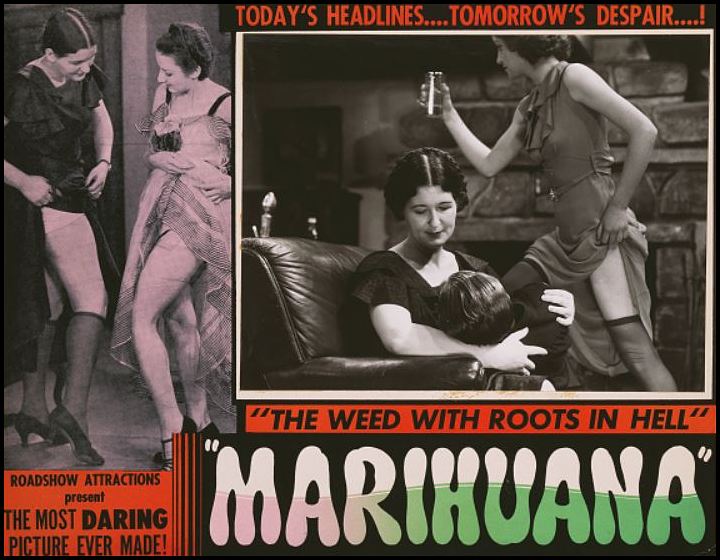
marihuana-film_poster
“The weed with roots in hell…”

by Paula Bosse

Today is April 20, also known as the cannabis-friendly “4/20 Day.” So why not take a look at the early days of marijuana awareness in Big D?

The “marijuana problem” in Dallas didn’t really start to be reported regularly in the pages of The Dallas Morning News until the 1930s, but there were a few stories that showed up in the early 1920s, such as this one about a raid on an opium-den-style house in Little Mexico in 1921 (click for larger image).

marijuana_dmn_041321DMN, April 13, 1921

Heading into the 1930s, the legality of the possessing and selling marijuana was fairly vague. After reading a bit about what was happening in Dallas in regard to “Mexican cigarettes,” I’m still not sure when the possession and selling of marijuana became illegal. The federal, state, and local laws all seemed to be different, and all were constantly in flux. There might even have been conflicting laws on the city and county books. Like I said, confusing. Nevertheless, here are a couple of interesting tidbits from the opening months of 1931 concerning the first charge in Dallas County against a person selling marijuana and the first conviction in Dallas County for a person selling marijuana. (According to the Inflation Calculator, today’s equivalent to the $25-to-$500 fine of 1931 would be, approximately, a $395-to-$7,900 fine.)

A Mexican was placed in the county jail Wednesday after a charge of selling marijuana had been filed against him in County Criminal Court, the first time in history of that body such a charge has been brought against a defendant. […] The Mexican was still ‘smoked up’ when arrested. (DMN, Jan. 29, 1931)

The penalty for selling “Mexican dope weed” was a fine of $25-$500 or a jail sentence of one month to one year.

The first conviction on record in County Criminal Court for selling marijuana, Mexican ‘loco weed,’ was given Thursday when Judge Noland G. Williams sent Manuel Garino to the county jail for thirty days. (DMN, Feb. 6, 1931)

Still, marijuana was considered only a minor annoyance locally — the Asst. D.A. even went so far as to say that there was “little use of the drug in Dallas.”

Actually, throughout the ’30s, a lot of policemen didn’t even know what marijuana plants looked like — one wonders how much marijuana-related activity was going on all around them in plain view? In these early days, when the police did stumble onto large quantities of “loco weed,” it was sometimes merely by accident while investigating something else.

And then, suddenly — around the mid ’30s — marijuana was everywhere. Just in time for the Texas Centennial, when thousands and thousands of potential new customers would be flooding into the city! Enterprising individuals were growing it all over the place — in their yards, in their fields with other crops, and even on a little island called Bois d’Arc Island in the middle of the Trinity River bottoms, a few miles south of Dallas (where 3,000 pounds was seized in July, 1938).

Even though the purchasing, the selling, the use, and the growing of marijuana was going on all over the city — in white, black, and Hispanic neighborhoods — the main areas of enforcement were, unsurprisingly, in Little Mexico and Deep Ellum, areas populated by minority citizens.

Police Sergt. O. P. Wright stopped a 22-year-old Negro languidly puffing a cigarette as he walked in the 400 block of North Central Tuesday.

“What kind of a cigarette is that, boy” inquired the Sergeant.

“Rough cut,” replied the languid one. (“Policeman Sniffs Air, Catches Marijuana Smoker,” DMN, June 22, 1938)

The federal government was attempting to deal with the marijuana problem — by taxing it so highly that it would discourage those participating in the loco weed trade: $100 tax on every ounce! At a time when you could buy a joint for anywhere from a dime to a quarter. Talk about your “sin tax”!

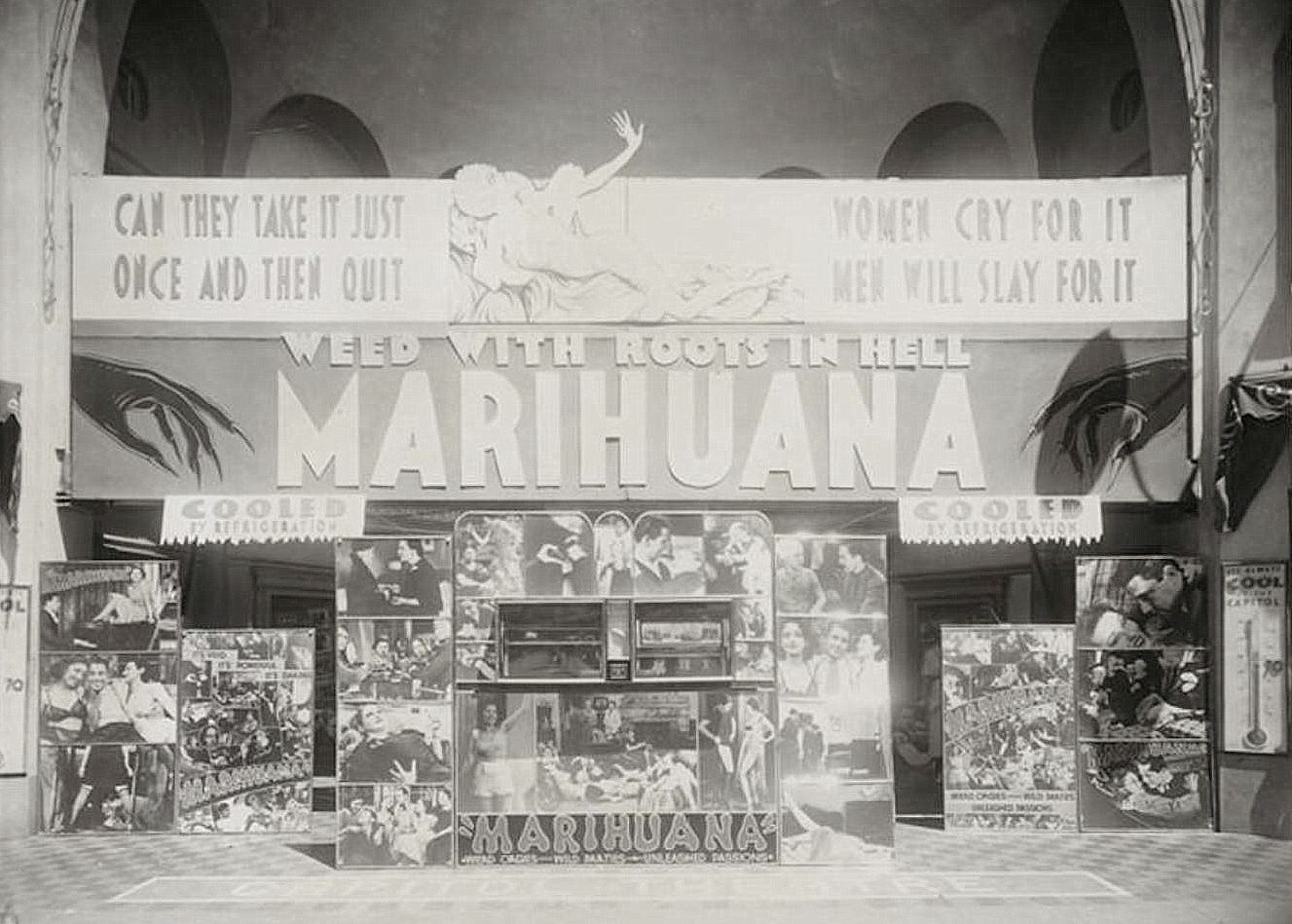
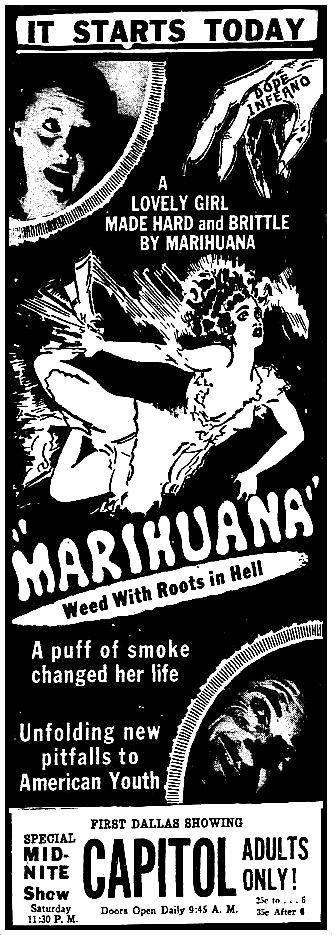
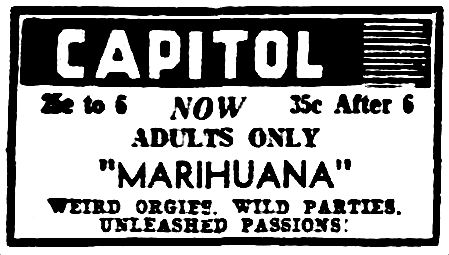
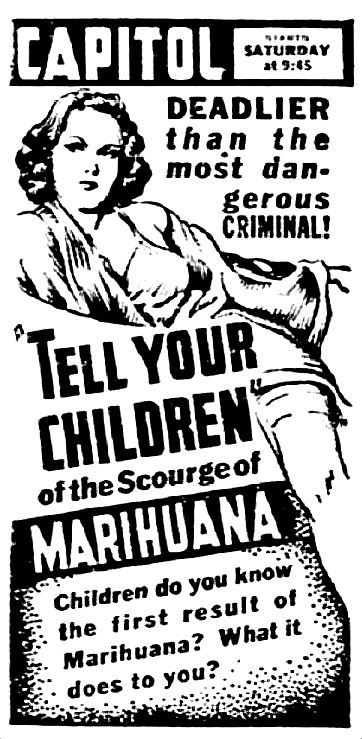
Marijuana/marihuana was generally demonized as a highly addictive drug which caused psychosis and led, inevitably, to all sorts of heinous acts and/or lewd behavior. …Or death. A lot of helpful, cautionary exploitation movies began to appear on Dallas screens, such as Marihuana from 1936 (which, incidentally, had an Oak Cliff child actor — Gloria Brown — in the cast). Below, the pomp and bug-eyed bally-hoo adorning the entrance to the lovely Capitol Theater, beckoning the Elm Street passerby to check out the film. …In order to be well-informed.

marihuana_capitol_1936_cook-collection_degolyer-library_SMU
George W. Cook Collection, DeGolyer Library, SMU

marihuana-film_dmn_080136
Aug., 1936

marihuana-film_dmn_080536
Aug. 1936

marihuana-film_dmn_061639June, 1939 (back by popular demand!)

(The full Marihuana film can be viewed free here, although it’s surprisingly dull.)

Even though most marijuana warnings were dire and filled with exclamation marks, I kind of like this more subdued one: “Smoking of the weed gives the subject delusions of riches, success and affability” (DMN, Dec. 21, 1936).

And there you have it, a little slice of unexpected Dallas historical trivia.

***

Sources & Notes

A few pertinent articles from the archives of The Dallas Morning News:

  • “Marijuana Smallest Worry of Dallas in Narcotic Violations” (DMN, March 6, 1931)
  • “Uncover Cache of Loco Weed, Lock Up Seven; Police Led to Mexican Dope Trailing Bogus Coin Milling” (DMN, March 30, 1932) — great story about cops who stumbled across marijuana when tracking down counterfeit half-dollar coins (counterfeit 50-cent pieces?!). My favorite part of this story is at the very end: “One of the Mexicans carried twenty-seven of the coins in one of his shoes.” Wow.
  • “Stalk of Marijuana Seven Feet Tall Is Found in Oak Cliff” (DMN, Aug. 7, 1934)
  • “3,000 Pounds of Marijuana Seized By Raiders on River Bottom Farm; Haul Valued at $25,000” (DMN, July 30, 1938)
  • “Marijuana Den With Open Air Resort Raided; 6 Arrested; $100 Worth of Cigarettes Found; Plants in Back Yard Destroyed by Officers” (DMN, June 25, 1936) — “This is the first open-air marijuana den I have ever encountered in all my years of service.”
  • “Policeman Sniffs Air, Catches Marijuana Smoker, Three Others” (DMN, June 22, 1938)

Related Flashback Dallas post: “3800 Main: Fritos Central — 1947,” here

*

Copyright © 2016 Paula Bosse. All Rights Reserved.
Bonnie Parker: “Buried In an Ice-Blue Negligee” — 1934

bonnie-parker_mortician-account_cook-colln_degolyer(George W. Cook Collection, DeGolyer Library, SMU)

by Paula Bosse

This amazing (and amazingly gruesome) first-hand account of an unnamed McKamy-Campbell Funeral Home undertaker details the incredible amount of work required to prepare the bullet-ridden body of celebrity outlaw Bonnie Parker for burial. This odd little historical document comes from the absolutely fantastic George W. Cook Dallas/Texas Image Collection housed in SMU’s DeGolyer Library. The four-page handwritten document can be viewed in its entirety on SMU’s Central University Libraries’ website here. Below is the full account, transcribed by SMU, with a few corrections/additions made by me.

*

Tear this up please? Tear this up please?

Heres [sic] first hand on Bonnie & Clyde as we had Bonnie. She was about the size of Rose Grace, weighing a 100 pounds. (a thousand pounds of dynamite though) She was very pretty of course her skin was somewhat tan. Her nails were beautiful. Likewise her toe nails. Her toes looked like fingers. The cuticles pushed back, the nails filed to a point, and a deep coral shade polish on them, the most beautiful toes I ever saw, just perfect. Her permanent just a month old we had it waved. Her face, right side was blown off. We fixed this and you could hardly tell it. Just one bullet went through her brain, however and number grazed her head as there were 3 big holes in her scalp, but not through skull. Her left eye terribly black, however I used eye shadow on other eye to match, so that was covered up. Now, her body was just mutilated and torn to pieces from shots. Her right hand nearly blown off (known as her trigger hand) her body besides being full of bullet holes was full of buckshot, pellets all over her

[Page 2] body. We received body ten minutes of nine. Joe and I sewed on her until three that afternoon. At that time they say 25,000 people were lined up outside. It took 2 hours picking dirt, rocks etc. from her hair then to wash it and have waved. A tattoo on right leg two hearts one read Roy, the other Bonnie. Roy you know was her Husband (Roy Thornton now in Pen) All fluid the undertaker in Arcadia La. used leaked out she was torn up so she was a a [sic] mass of blood, caked & dried. Several hours in bathing her. Had to scrape some of it off, and used gold dust to remove most of it. Had skin slip that night account Fluid leaking from it, began to smell the next morning, turning dark, smelling worse. The last day was rotten so to speak The odor was awful. Her Mother thought [sic] sat in room alone with her head over casket. How she stood it Lord knows. The other children couldn’t. Mother fainted 2:30 that night I asked if she wouldn’t like to go home, she went. By then the entire house smelt. We had to keep her so Sister Billy that was in jail in Ft Worth could get out & come to Funeral. She was buried in an all steel metal casket. Paper said $1000.00 wrong about $600 maybe less. Paper said $1000.00 vault Wrong there was no vault Page 2

[Page 3] Buried in an ice Blue Neglegee [sic] (is this spelled right) She was dressed in expensive clothes when killed. About 40,000 people came to view her. Paper said $1,500.00 damages done to Funeral Home. Wrong about the extent of $2.50. They did not tear windows etc as stated. The woman next door though turned Hose on Them to keep her flowers from being walked on. We had 38 officers stationed (3 shifts) all over house and front & back yard keeping crowd in order and all of us as well. 4 operators on the 4 phones. They rang every minute for two days & nights. More people came to see Bonnie then [sic] to see Clyde. Our new Porch Furniture was damaged. We had a Rubber mat about ½ inch in thickness all over Funeral House. Officers

[Page 4] stationed to keep people on it so as not to wear rug out (Big movie Star) my picture was shown in Movies. The paper stretched their stories. She was not to become a Mother as stated. She was diseased slightly though as stated. Now you have it first hand as I worked on her. Joes [sic] & My work was praised very highly in every other line in papers. And if I do say it, It was good. And she looked swell no trace of disfigures showing. The crowd did not steal anything to take home. All paper talk. Example crowd lined up as Far as Fair Park, now judge how it looked. They brought their Lunches. Such Fools.

*

Below, two photographs of the McKamy-Campbell Funeral Home, located at 1921 Forest Avenue in South Dallas, besieged by curious spectators.

mckamy-campbell

mckamy-campbell_dallas-municipal-archives

**

I’m unsure who the “Rose Grace” was who was mentioned on the first page.

The “gold dust” mentioned in the account as being used to remove caked blood from Bonnie’s body was actually Gold Dust Washing Powder or Gold Dust Scouring Soap, a popular, commercially-available “all-purpose cleaning agents” — Wikipedia article is here.

***

Sources & Notes

Top image of the handwritten account on Adolphus Hotel stationery is from the aforementioned George W. Cook Dallas/Texas Image Collection, DeGolyer Library, Central University Libraries, Southern Methodist University, viewable here.

First photo of the McKamy-Campbell Funeral Home is reproduced all over the internet; the second photo is from the files of the Dallas Police Dept., Dallas Municipal Archives, via the University of North Texas’ Portal to Texas History database, here.

Even though the identity of the person who wrote this account is not known, he (…it was probably a man) mentions that he was seen in newsreel footage of the funeral of Bonnie Parker. My wild guess is that he can be seen in this clip from a longer newsreel on the funerals and burials of Bonnie and Clyde at the 2:34 mark. I could never find who his co-worker “Joe” was.

*

Is this our man laying flowers on Bonnies casket?

bonnie-burial_newsreel-screengrab

If you really want to see the state of the bodies of Bonnie (and Clyde) — before and after their time with their undertakers — they’re easy to find via your favorite search engine.

More Flashback Dallas posts on Bonnie & Clyde here.

If you like what you’ve seen on Flashback Dallas, please consider supporting me on Patreon, where for as little as $5 a month, you can receive all-new updates several times a week (if not daily!). More information can be found at Patreon, here.

*

Copyright © 2016 Paula Bosse. All Rights Reserved.
The Moskovitz Cafe

moskovitz-cafe_winegarten-schechterA stool is waiting for you… (click for larger image)

by Paula Bosse

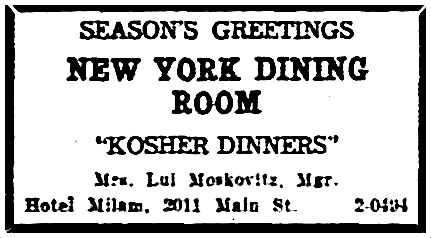
The Moskovitz Cafe was located at 2216 Elm Street, between S. Pearl and what is now Cesar Chavez Blvd., in an area of predominantly Jewish businesses. The restaurant served “Kosher and American cooking” and was owned and run by Lui Moskovitz, a Romanian immigrant, and his Polish-born wife, Eva. Eva, recently widowed, had arrived in Dallas in about 1928 with her three children and seems to have married Lui that same year. They had run another restaurant before the Moskovitz Cafe: the New York Kosher Dining Room on Commerce had been located across from the Adolphus Hotel for several years before it moved to 2011 Main, around the corner from City Hall. After that closed, they ran the Moskovitz Cafe between about 1937 and about 1944.

In 1945 there was no Lui or Eva Moskovitz in the Dallas directory. There was, however, an Eva Haberman — it appears that the Moskovitzes had split, Lui had left town, and Lui’s ex-wife had taken back the name of her late first husband. At this time she must have been about 60 years old, but she worked for the next few years as a department store seamstress and lived with one or more of her three sons from her marriage to Nathan Haberman. She died in April, 1961. Not only is there no trace of Lui after his time in Dallas, there is also no trace of 2216 Elm.

moskovitz_dmn_0101361936 ad

moskovitz-cafe_elm-st_1943-directory
Elm St. businesses, 1943 Dallas directory (click for larger image)

moskovitz_map
Location of Moskovitz Cafe (det. of a 1919 map)

***

Sources & Notes

Photo appeared in the book Deep in the Heart: The Lives & Legends of Texas Jews, A Photographic History by Ruthe Winegarten and Cathy Schechter (Austin: Eakin Press, 1990); from the collection of the Dallas Jewish Historical Society.

I’m not sure who the people in the photo are. When the Moskovitz Cafe opened, Lui would have been in his mid-40s and Eva would have been in her early 50s. UPDATE: Per the comment below (from Eva’s grandson), the woman in the white apron is the proprietress, Eva Moskovitz, and the man at the cash register is her son, Jack Haberman.

More information about Mrs. Eva Haberman can be found in her obituary, published in The News on April 19, 1961.

All images larger when clicked.

*

Copyright © 2016 Paula Bosse. All Rights Reserved.
 

Main & Akard, Looking East

main_east-from-akard_WPA-GD_DPLWatch your step, girls…

by Paula Bosse

Ah, Main Street. It’s so sad that the Praetorian Building — the tall white building in the distance on the left — has been demolished to be replaced by a giant eyeball, but it’s great to see that the Kirby Building — at the left — is still hanging in there and still looking great.

Check out the height of those curbs!

main_east-from-akard_WPA-GD_DPL-det

***

Sources & Notes

Photo from the WPA Dallas Guide and History ([Denton]: University of North Texas Press, 1992); photo from the collection of the Dallas Public Library. Two sources of this photo cite different dates: one 1935, the other 1930. My guess would be late ’20s — or, certainly closer to 1930 than 1935.

See what this view looks like today on Google Street View, here.

*

Copyright © 2016 Paula Bosse. All Rights Reserved.
Spring, According to Otis Dozier — 1937

dozier_iris-purple_1937_dmaOtis Dozier’s purple iris (click for much larger image)

by Paula Bosse

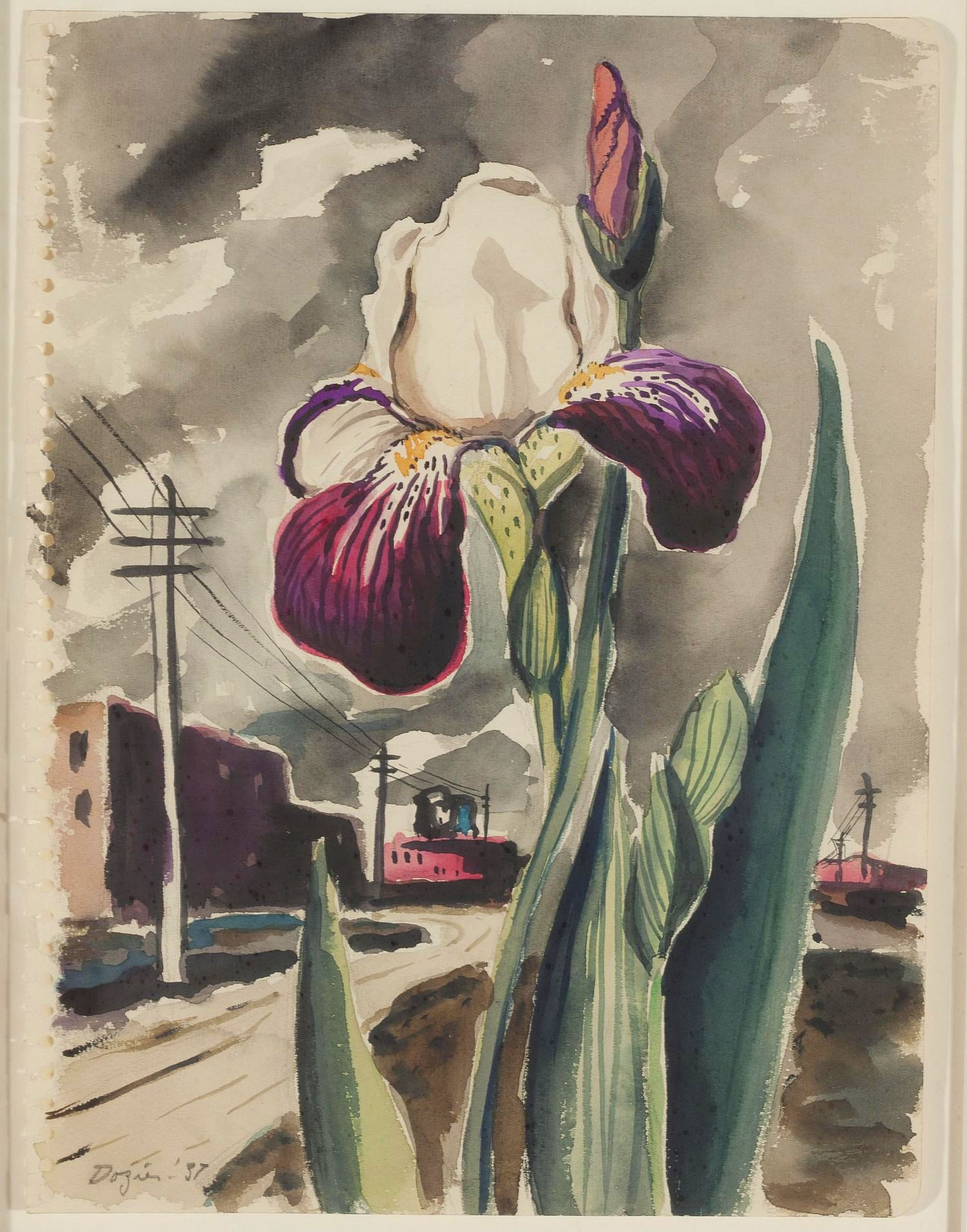
My birthday is in March, and I always associate this time of year with irises, because the irises around our house would start to bloom in time for my birthday. There’s no better way to celebrate a (belated) start to Spring than by sharing this beautiful watercolor from Otis Dozier: “Iris (purple) April,” 1937.

***

This watercolor is in the collection of the Dallas Museum of Art, a gift of The Dozier Foundation; ©Denni Davis Washburn, William Robert Miegel, Jr., and Elizabeth Marie Miegel. More information is here.

More on the Forney-born Dallas Nine artist Otis Dozier (1904-1987), here.

Did you know there is an Iris Society of Dallas? There is!

Click picture for very large image.

*

Copyright © 2016 Paula Bosse. All Rights Reserved.