The Business District at Night

by Paula Bosse
If you squint, the Mercantile Building looks a little Statue-of-Liberty here.
***
Postcard from Flickr.
Click for larger view.
*
Copyright © 2016 Paula Bosse. All Rights Reserved.

by Paula Bosse
If you squint, the Mercantile Building looks a little Statue-of-Liberty here.
***
Postcard from Flickr.
Click for larger view.
*
Copyright © 2016 Paula Bosse. All Rights Reserved.
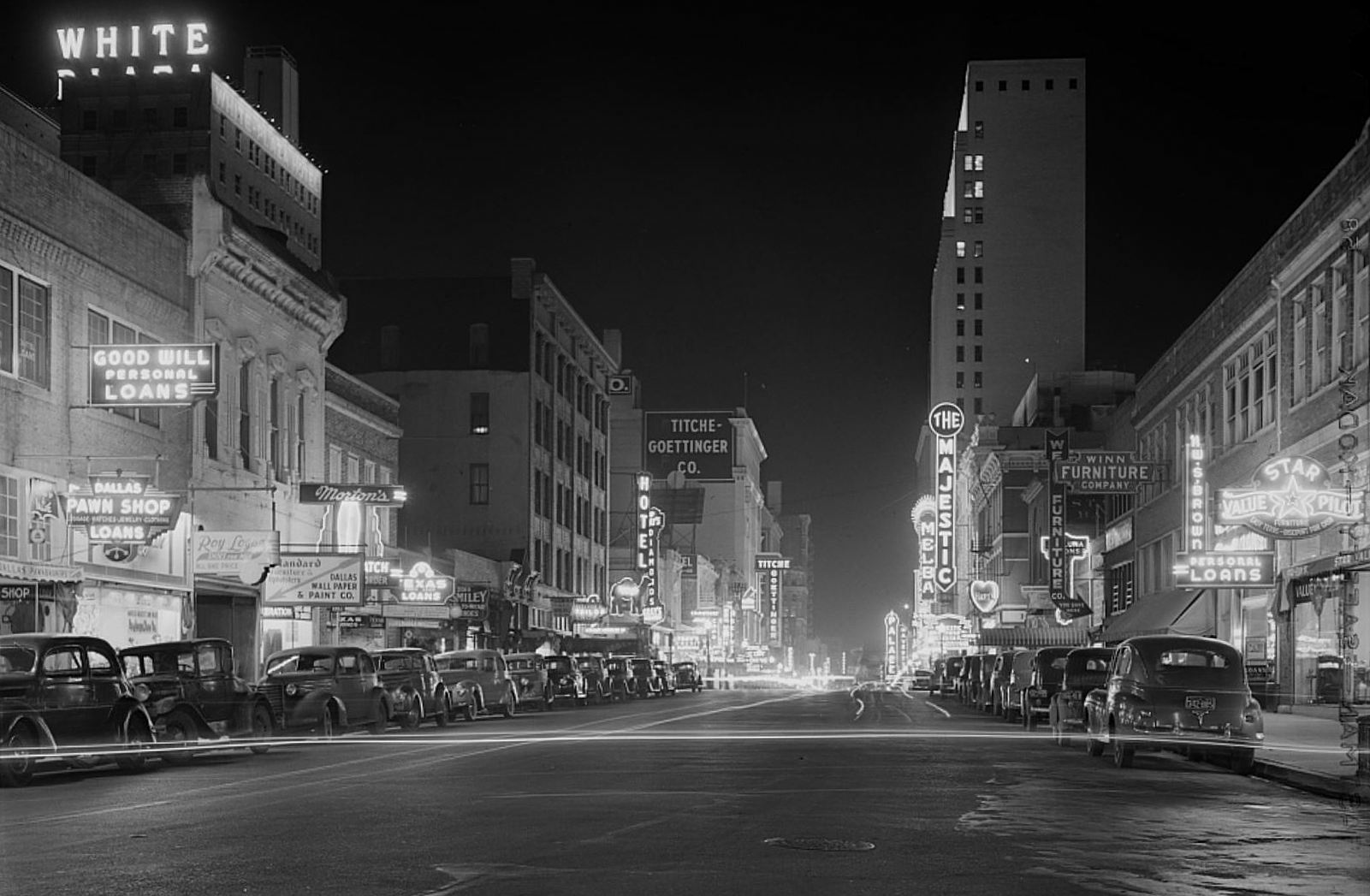 “Linger on the sidewalk where the neon signs are pretty…”
by Paula Bosse
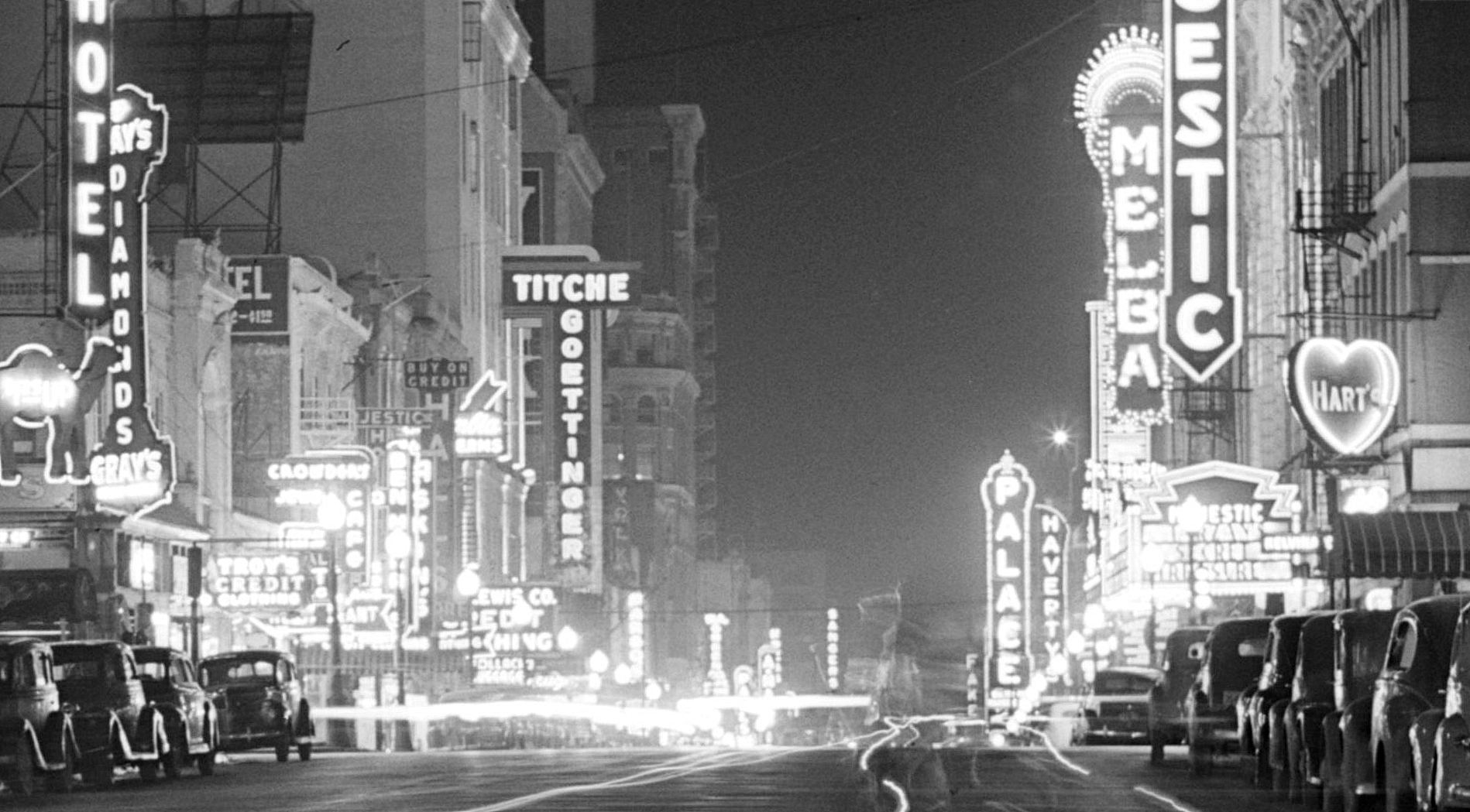
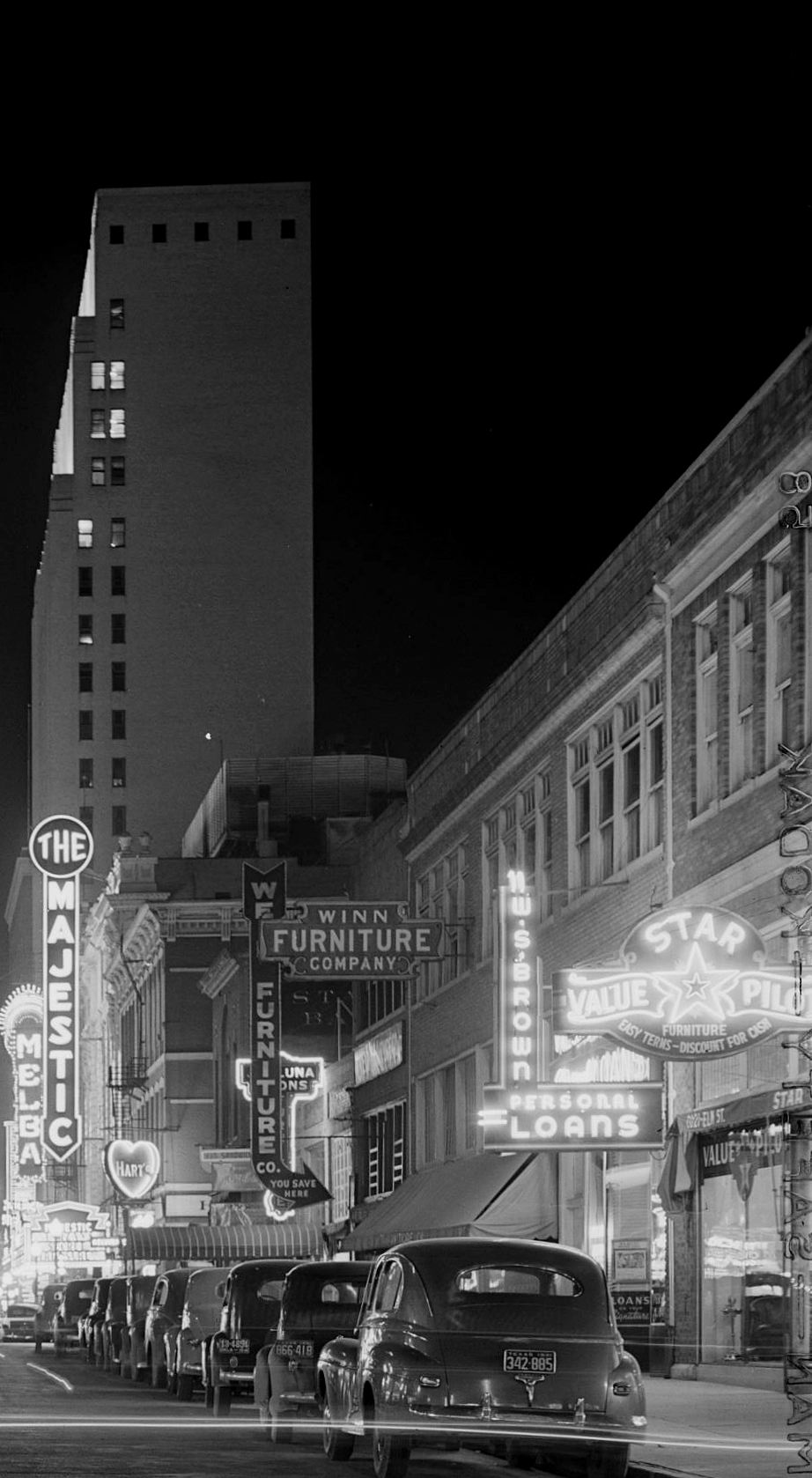
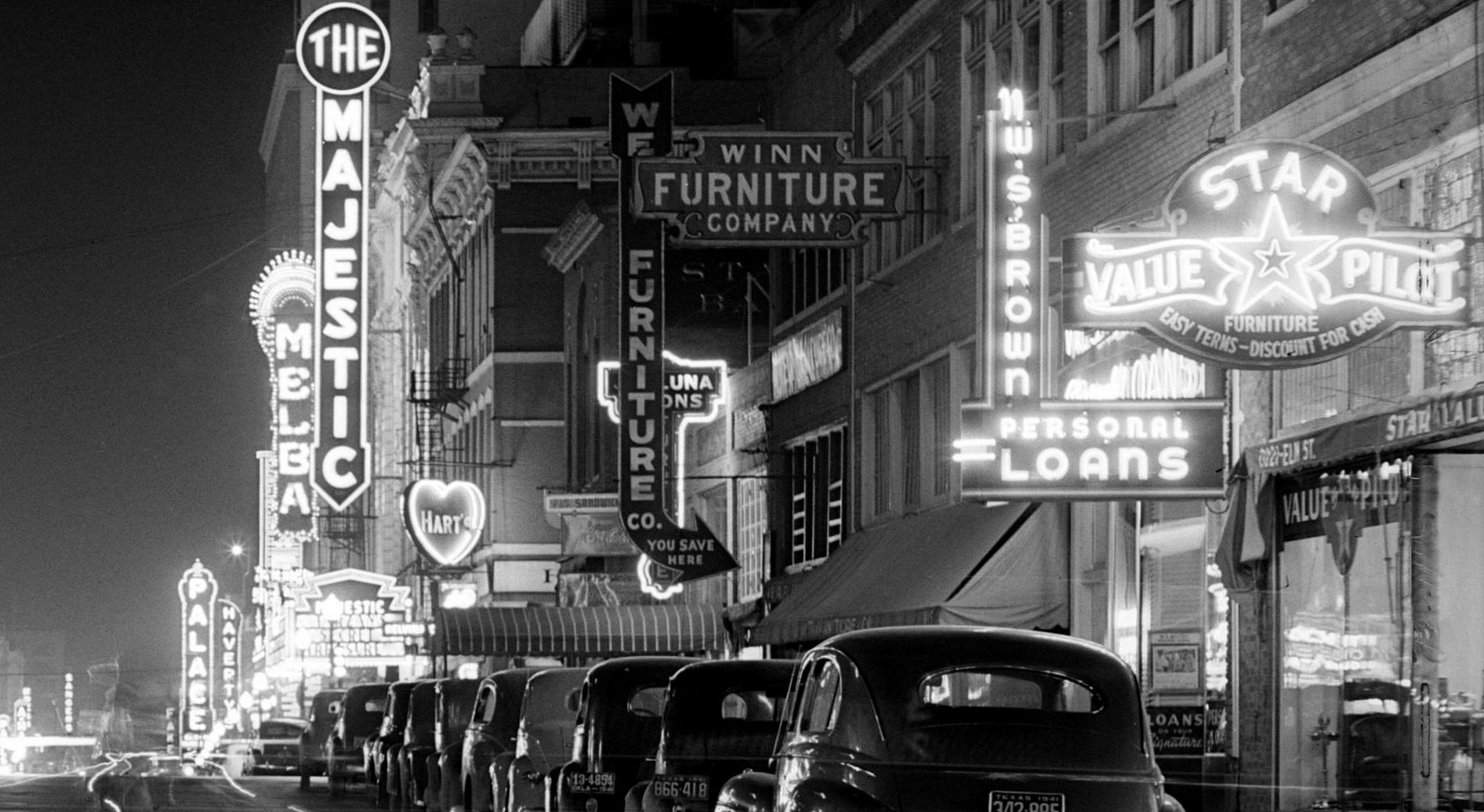
If you’re interested in Dallas history, chances are pretty good that you’ve seen this photograph by Arthur Rothstein, which was taken in 1942 — sometime between January 9th and 16th — taken for the Farm Security Administration (FSA). It shows Elm Street — “Theater Row” — looking west from the block east of Harwood. This photograph is from the Library of Congress (here) a larger image can be explored here.
Below are a few magnified details (click pictures to see much larger images).
*
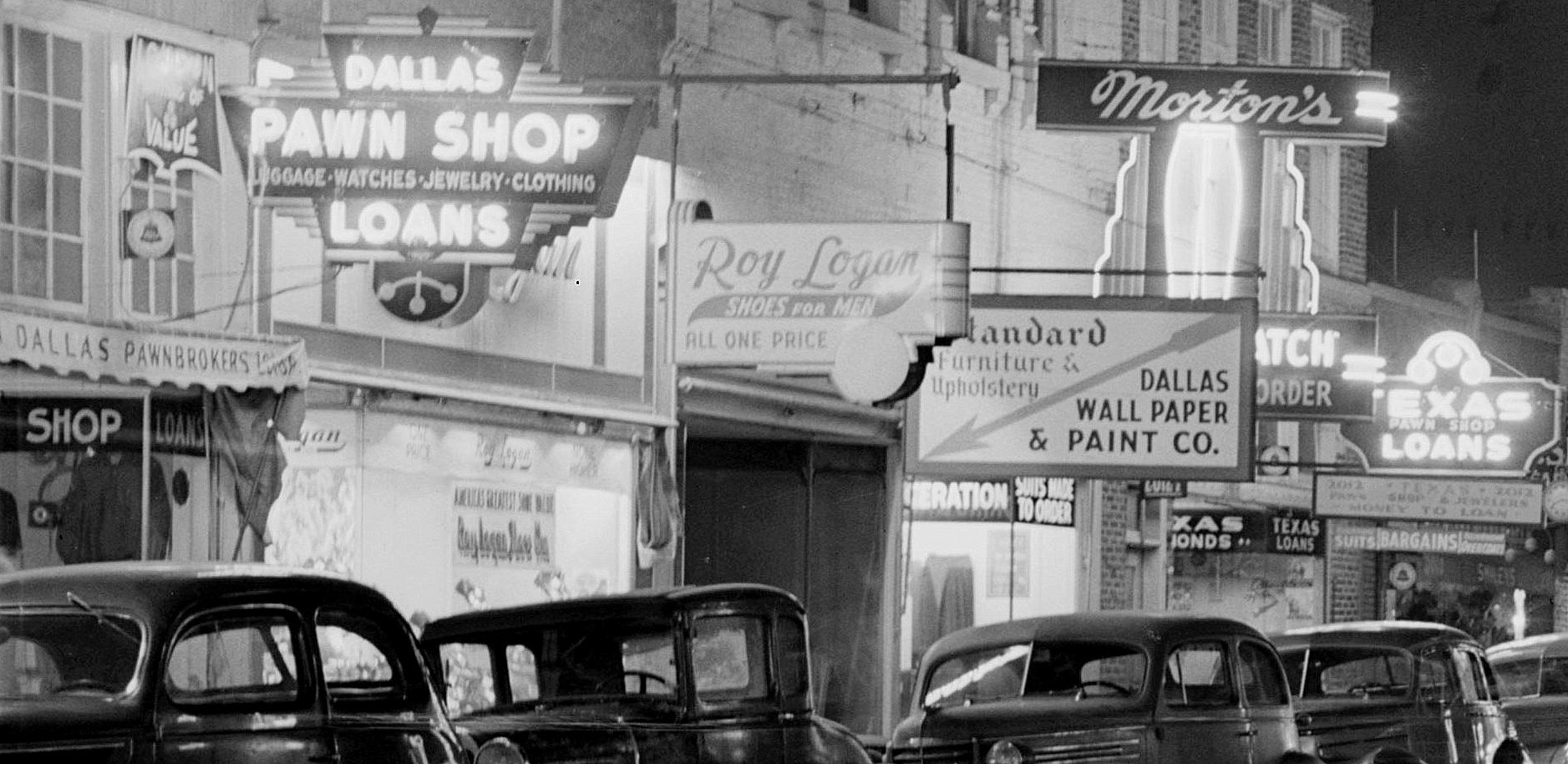
Chattel loans and good will:

*
Morton’s Pants Shop (2014 Elm) has a neon sign in the shape of a pair of pants!
*
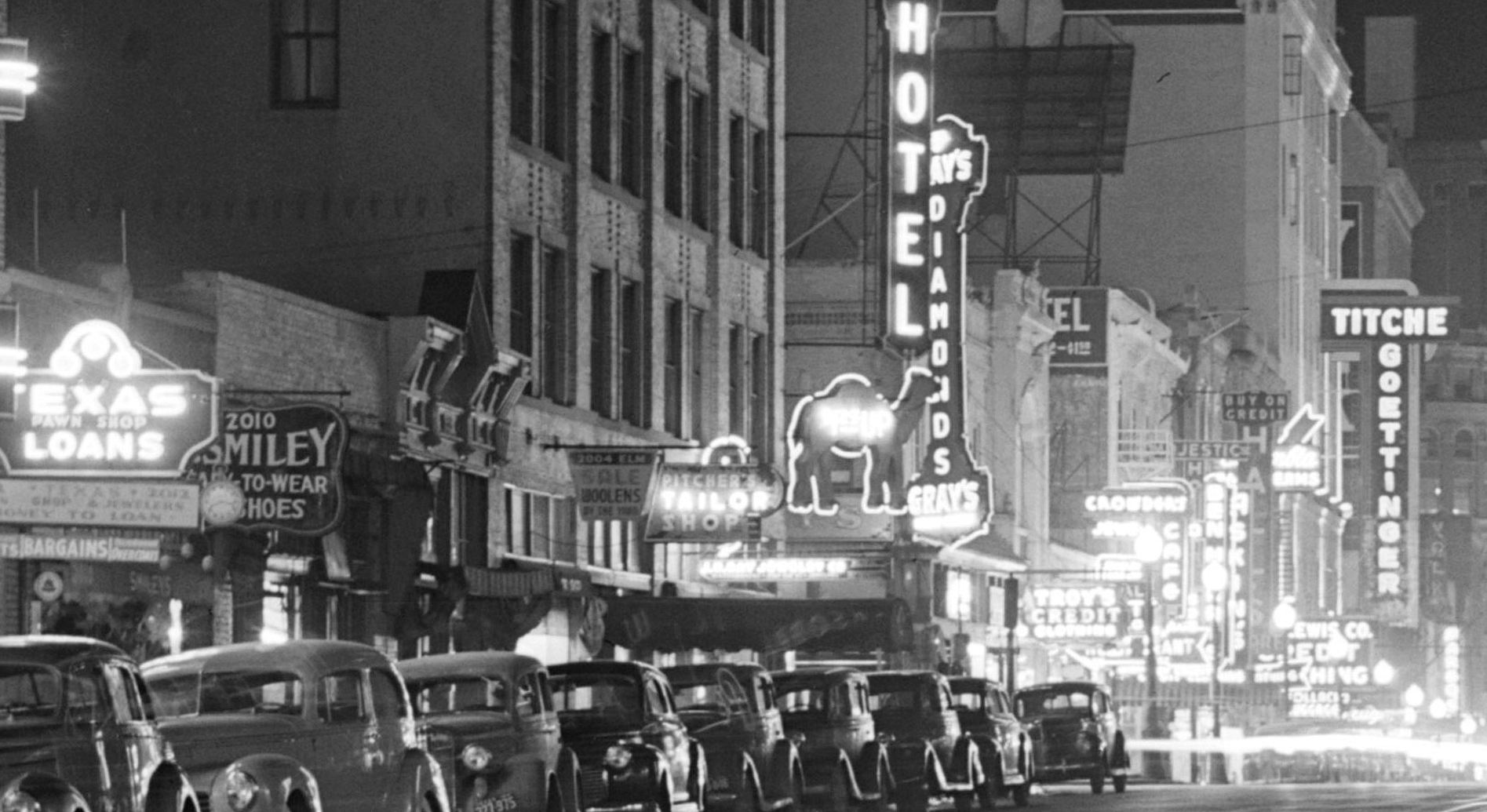
More interesting neon: the Texas Pawn Shop (2012 Elm) has the traditional three balls, and, better, the Campbell Hotel (Elm and Harwood) has a camel!
*
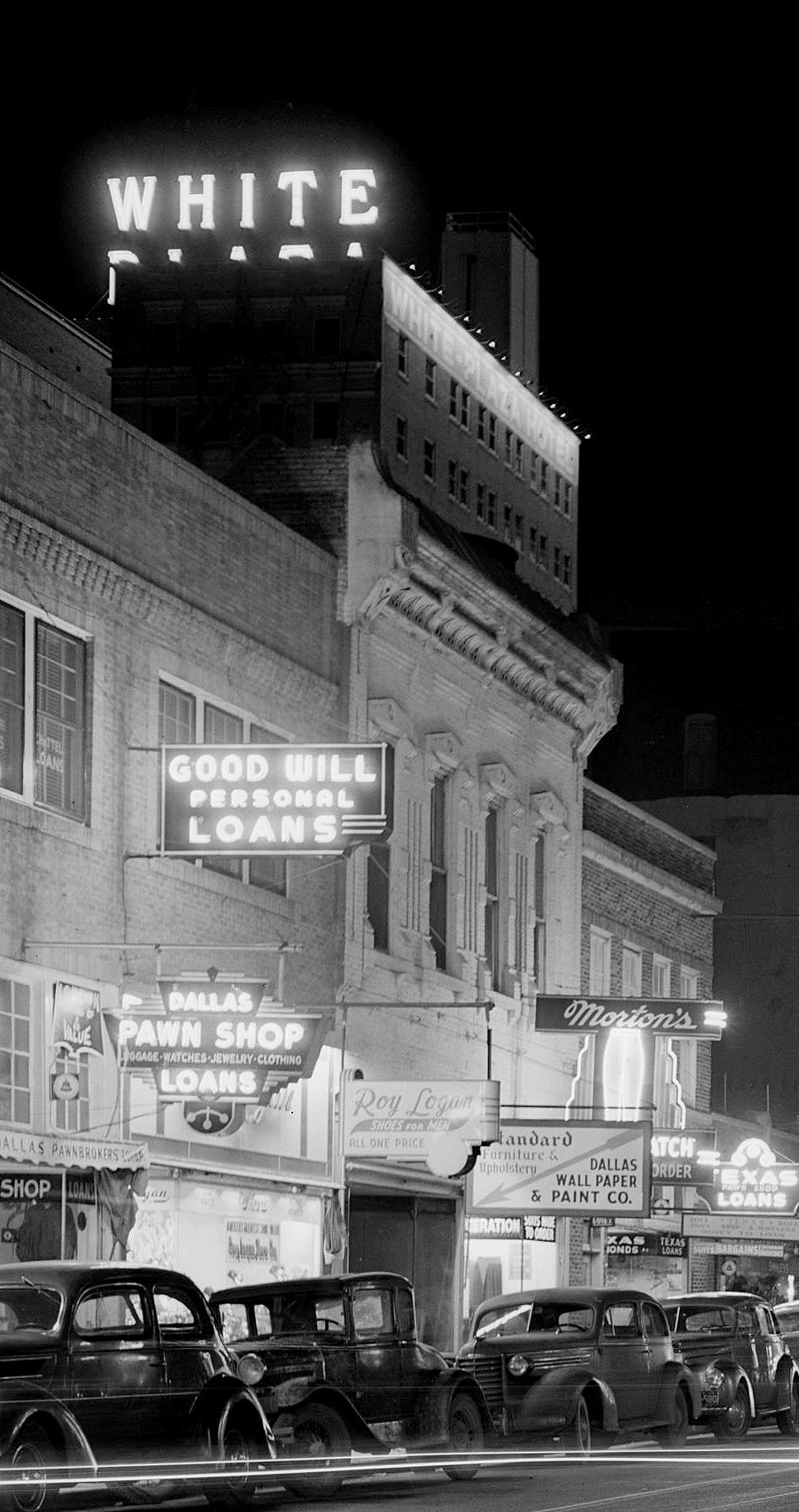
The White Plaza on Main St. (at Harwood) was originally the Hilton Hotel and is now Hotel Indigo. There were some great buildings in this block.
*
That light is blinding.
*
The towering Tower Petroleum Building (Elm and St. Paul) is pretty cool-looking here.
*
The 2000 block of Elm (seen in the foreground, just east of the Majestic block) was full of furniture stores, pawn shops, and tailors. This is my favorite detail from this photograph. Sadly, the entire block — which was once filled with businesses and activity — was completely demolished; the “camel” side of the street is now occupied by an ugly parking garage, and this side of the street is a wasteland of ugly asphalt parking lots. Yep.
*
1941 plates.

*
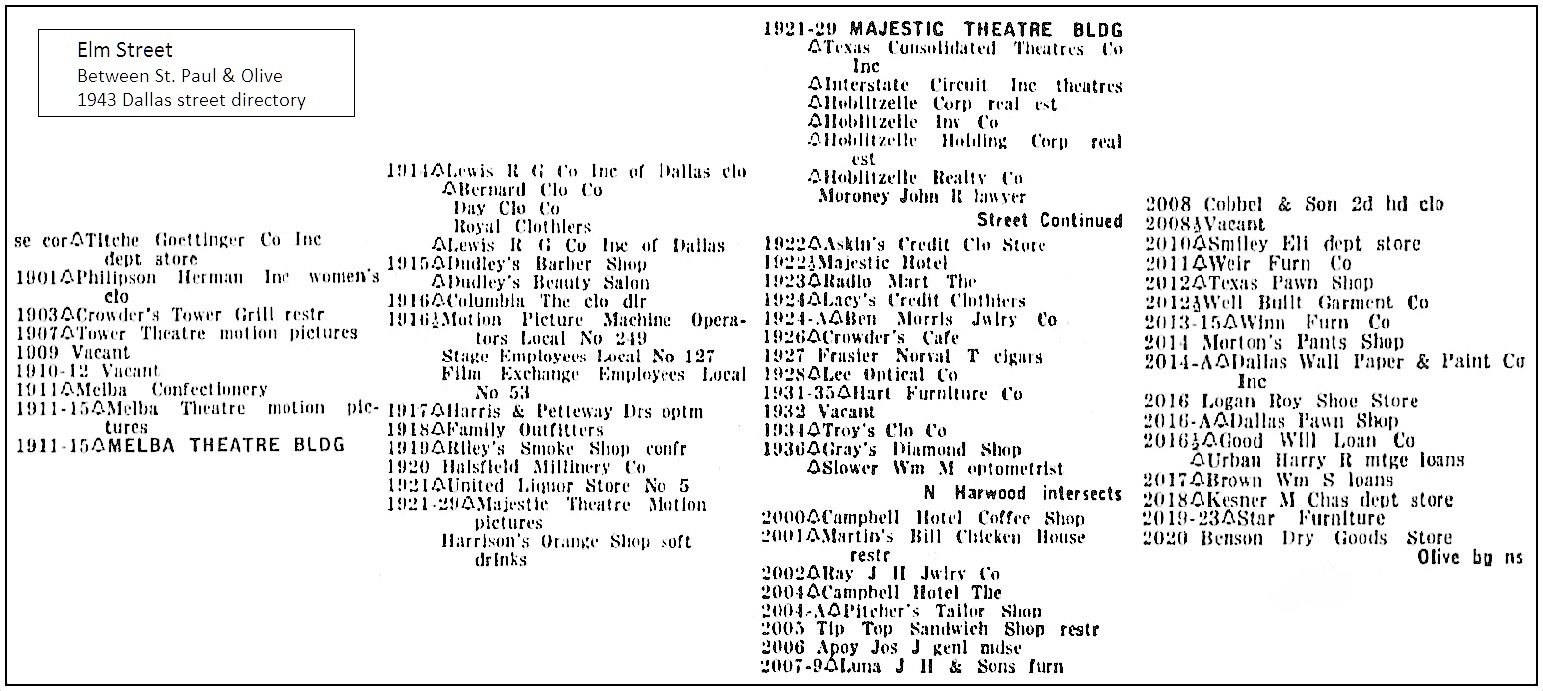
Below, Elm Street businesses from the 1943 city directory, beginning at N. St. Paul and ending at N. Olive. Next stop: Deep Elm.
*
The view today? Here. Hope you weren’t too attached. Kiss most of it bye-bye.
***
Photo from the Library of Commerce, here. This photo is all over the place, including the great Shorpy website, here (click the “supersize wallpaper” link under the photo to see it BIG). If you want a super-gigantic 26.3 MB file (5978 x 4619) (!), download the TIFF file in the dropdown beneath the photo.
The movie playing at the Majestic Theatre is “Tarzan’s Secret Treasure.” Newspaper ads show that the movie opened on January 9, 1942 and played just one week, closing on January 16.
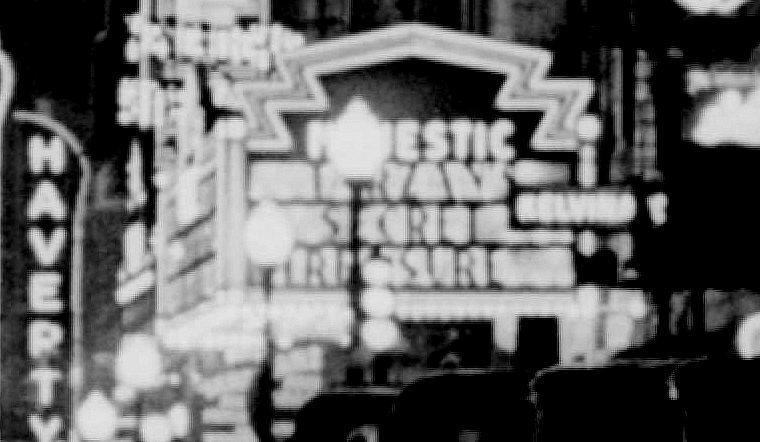
Thanks, Cody and Chris for asking about this photo!
Everything’s bigger in Texas, and everything’s bigger when it’s clicked.
*
Copyright © 2016 Paula Bosse. All Rights Reserved.
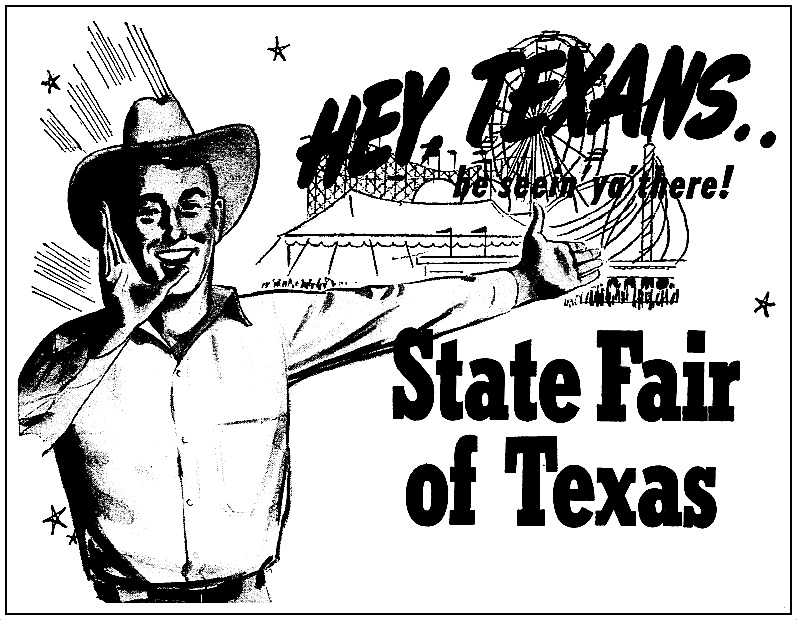 1948 State Fair ad: “Hey, Texans!”
by Paula Bosse
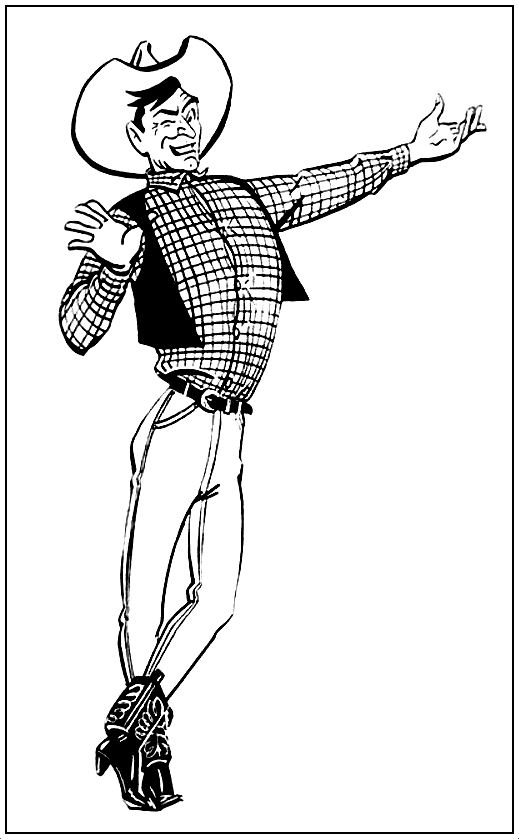
I stumbled across a State Fair of Texas ad a couple of days ago — a detail of which is above — and it made me wonder if it contained the precursor to our beloved Big Tex (whose annual hoisting-up occurred today). The ad is from 1948, four years before Big Tex’s debut at the 1952 State Fair. When I saw it I was immediately reminded of Big Tex and exclaimed to myself, “THAT’S what he should have been doing with his hands!”
I’ve always wondered exactly what Big Tex is supposed to be doing with his hands. It’s a sort of vague “welcoming” gesture, I guess, but I can remember when I had to draw Big Tex in school that I was confused by that right hand. Was he waving? Was it an Indian “How!” greeting sign? It didn’t really look like either of those, and it really irked me (I was an easily-irked child). And, actually, it has continued to bother me all these years! (I am an easily-irked adult.)
From early sketches, it seems that the right hand was intended to have the thumb hooked through a vest. Jack Bridges, Big Tex’s creator, wanted Tex to symbolize the larger-than-life Texan who wasn’t above indulging in good-humored bragging and tall-tale-telling, and that personality comes through in the sketch and the Big Tex illustration used in the 1952 ads, below.
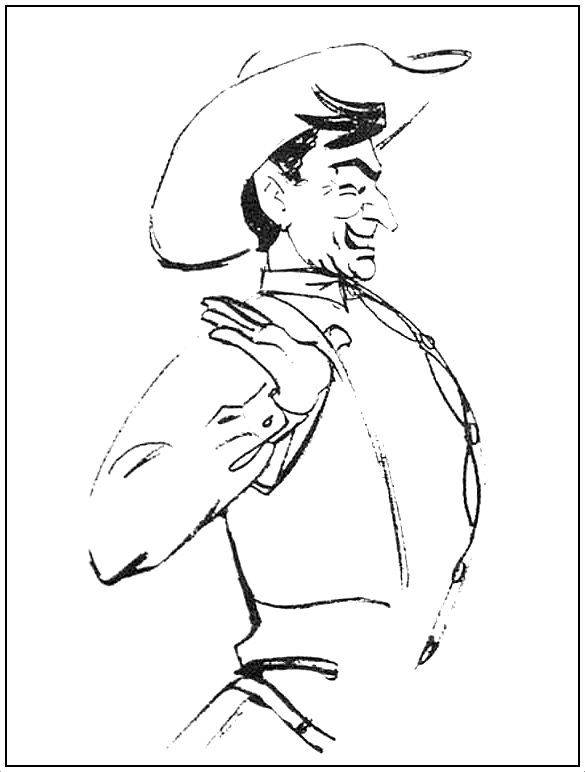
By the time Tex debuted, however, the vest seemed to have been discarded (as best I can tell from old photos), but the position of the right hand remained in that weird position (probably just to torment me as a child having to draw him in school).
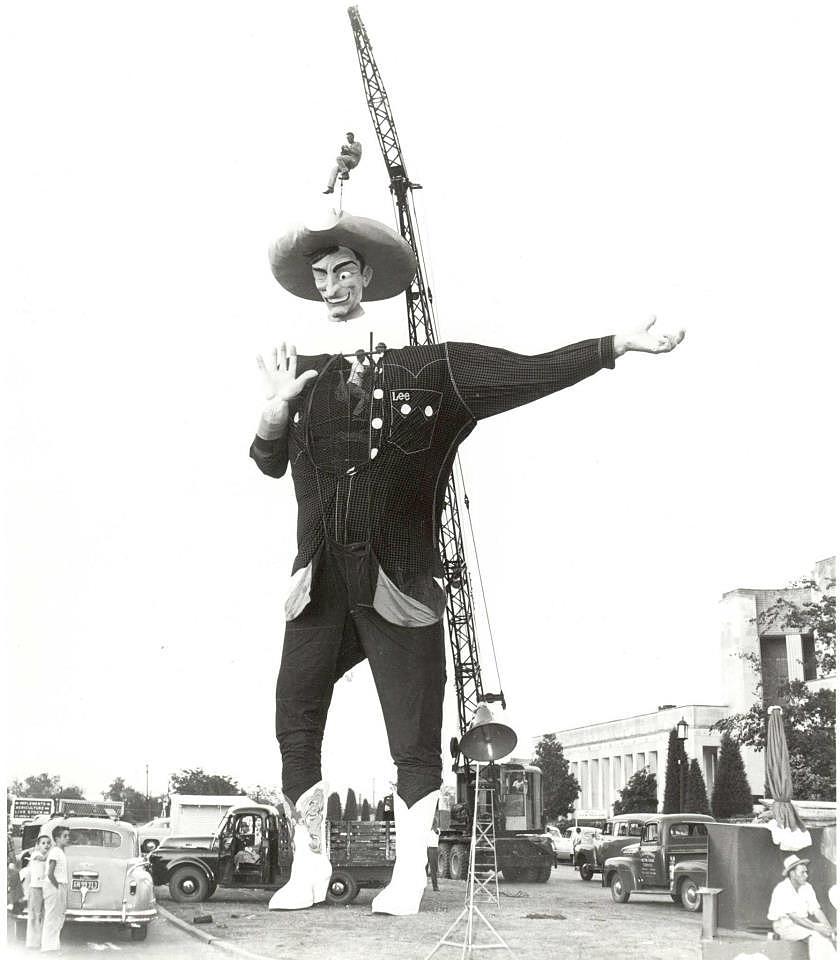
A hovering, winking head, via KERA
Speaking of that very first version of Big Tex, in 1952 he had one eye shut, in the middle of a wink. He also had a long nose and wore a huge hat referred to in newspaper articles as a “sombrero.” In a 1983 interview, Jack Bridges said that in later years SFOT officials “made us open his eyes to make a ‘pretty boy’ outta him.” The wink was gone, the brim of the hat was made smaller, and his ears were moved forward. Even though Tex began to “talk” the next year, Bridges said, “I liked him better myself like he was — rugged and more or less caricature.”
The drawing of the man in the ad at the top probably has nothing to do with Big Tex, but dang if it ain’t pretty close! And the position of both hands makes sense!
Here’s the full 1948 ad from the top:
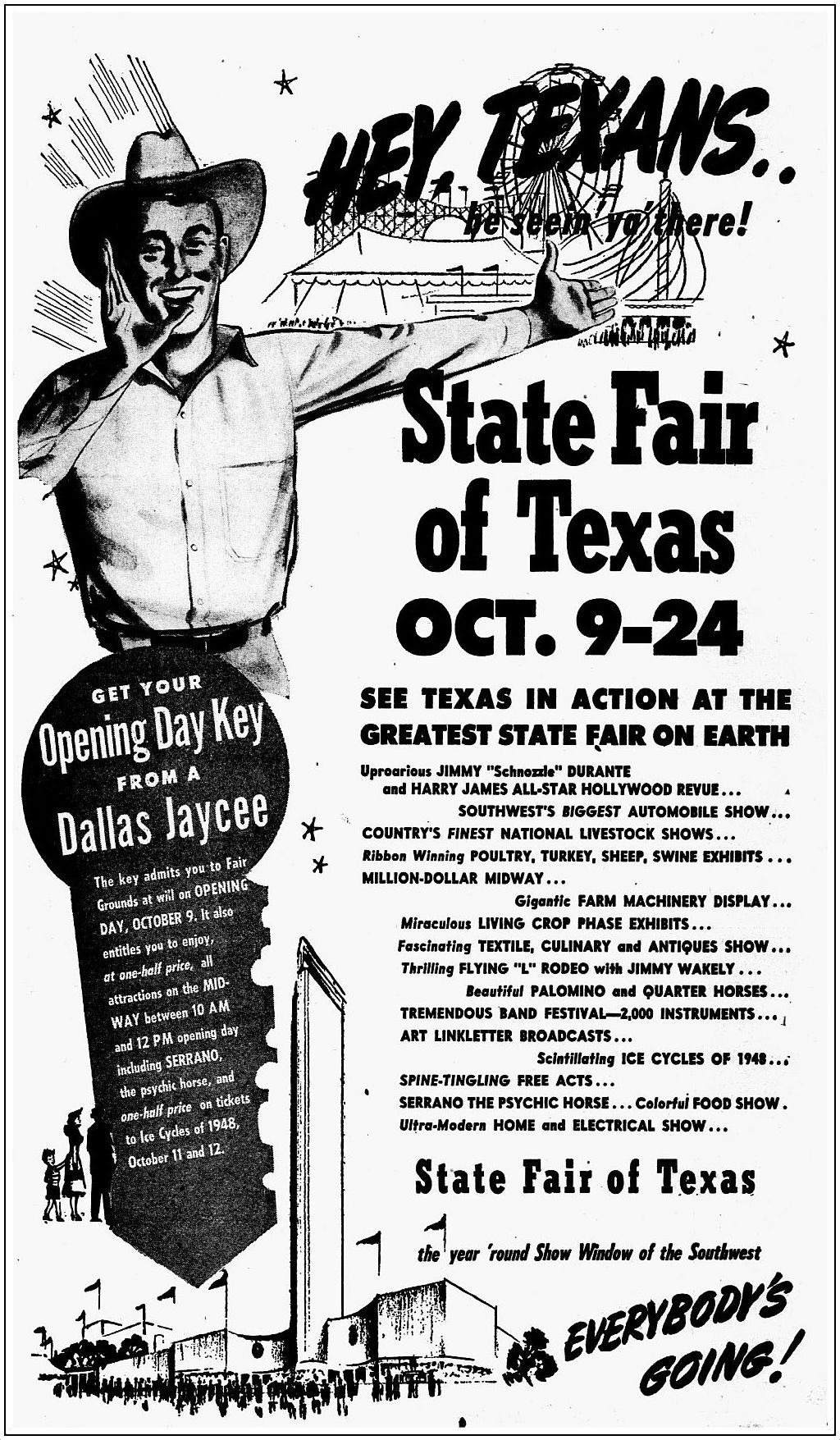
1948
***
You can listen to a short (13-minute) interview done with Jack Bridges in 1983 as part of a Dallas Public Library oral history project, here. One of my favorite tidbits is Bridges remembering that vandals once painted a “big brown moustache” on the resting, disembodied head of Tex one year. He said that the head and the hat were kept in the Centennial Building when the fair wasn’t in progress, and the rest of Tex was kept in storage in various places around Fair Park. He said it was like making sure the president and vice-president never traveled together — if something happened to part of Big Tex, at least the whole of Big Tex wasn’t affected. (91-year-old Jack Bridges died in 2001; thankfully he didn’t have to witness the fiery … “incident” … of 2012.)
*
Copyright © 2016 Paula Bosse. All Rights Reserved.
 In 1988, the building had seen better days… (click for larger image)
by Paula Bosse
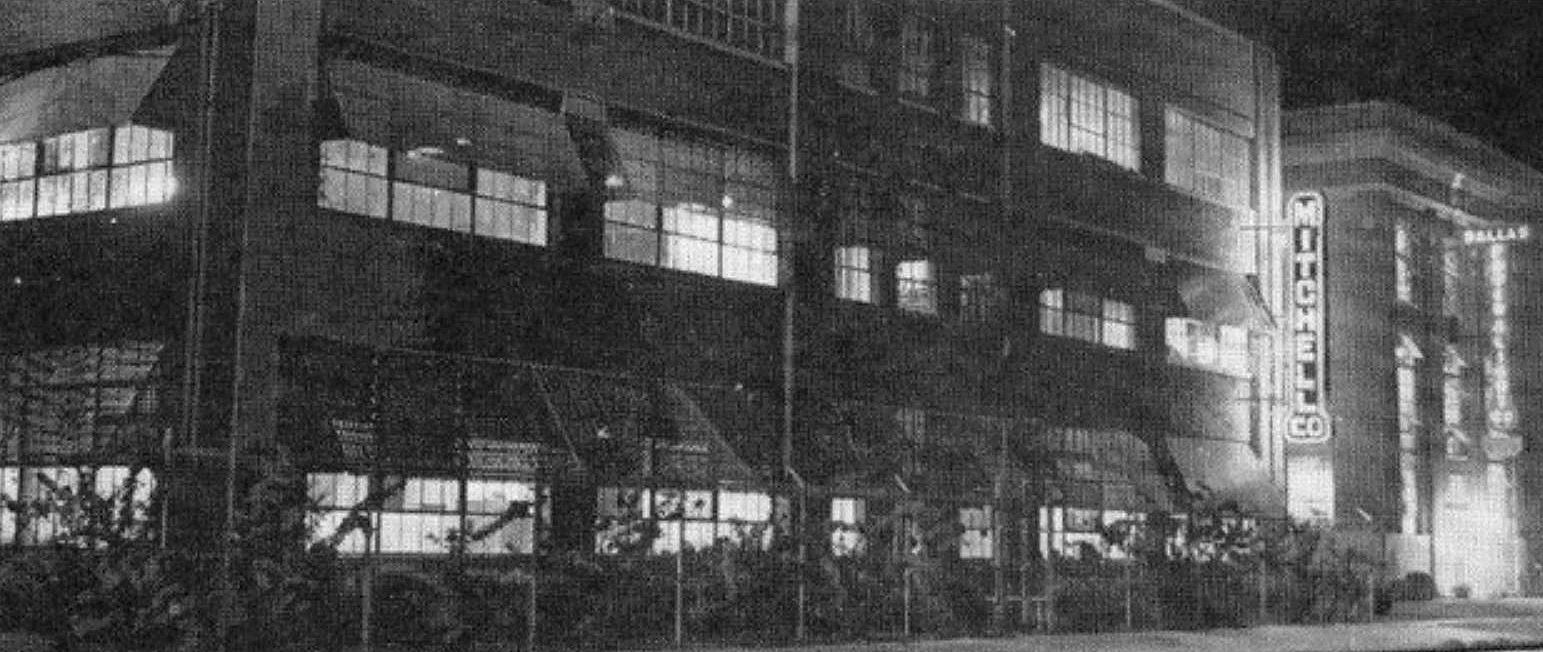
In 1928, the John E. Mitchell Company (discussed previously here, here, and here) arrived in Dallas from St. Louis and built their J. A. Pitzinger-designed 2-story factory at 3800 Commerce Street (a wing was added the next year, and a third story was added the year after that). It produced cotton gins and farm implements. As strange as it seems today, Dallas was once the largest producer of cotton gin machinery in the United States. The Mitchell Company was located in a mostly industrial area very close to several other cotton gin manufacturers (such as the nearby Continental Gin Company and Murray Company). At the height of their production, these Dallas factories were responsible for half of the world’s cotton gins.
When World War II hit, the company became an important defense contractor and produced munitions for the U.S. Navy and U.S. Army, making things such as “anti-submarine projectiles,” anti-aircraft shells, rocket nozzles, and “adapters for incendiary bomb clusters.”
After the war, the Mitchell Company continued to manufacture agricultural implements but diversified by turning out other types of machinery, like automobile air conditioners and and cleaning systems. As the 1960s dawned, they developed the machine that made ICEE frozen slushy drinks (forever immortalized by 7-Eleven as The Slurpee).
After the death of company president John E. Mitchell, Jr. in 1972, the business began a slow slide downward. The company appears to have gone out of business in the early 1980s. In the fall of 1982, the company’s equipment was sold at public auction, and, in 1984, the building became the temporary home of the Junior Black Academy of Arts and Letters.
In the 1980s, Deep Ellum and Exposition Park began to explode with new bars, clubs, and galleries. If it was cool, it was in Deep Ellum and Expo Park; if it was in Deep Ellum and Expo Park, it was cool. Artists and musicians began to move into many of the neighborhood’s old warehouses. These usually run-down buildings — in which bohemian types lived (not always legally) and used as studio spaces — were huge and (in the beginning) cheap. The Mitchell Building became something of a ground zero for wild parties and was described in a fantastic 1995 newspaper article by Shermakaye Bass (linked below) as both a “flophouse” and “an artists commune and downtown slacker den.” The building was closed and boarded up by its owners in early 1995 in order to avoid code-violation citations, but by 1999 the building had been purchased, cleaned up, modernized, and converted into 79 loft apartments. Today, the Mitchell Lofts have been a part of the Expo Park scene for almost 20 years.
*
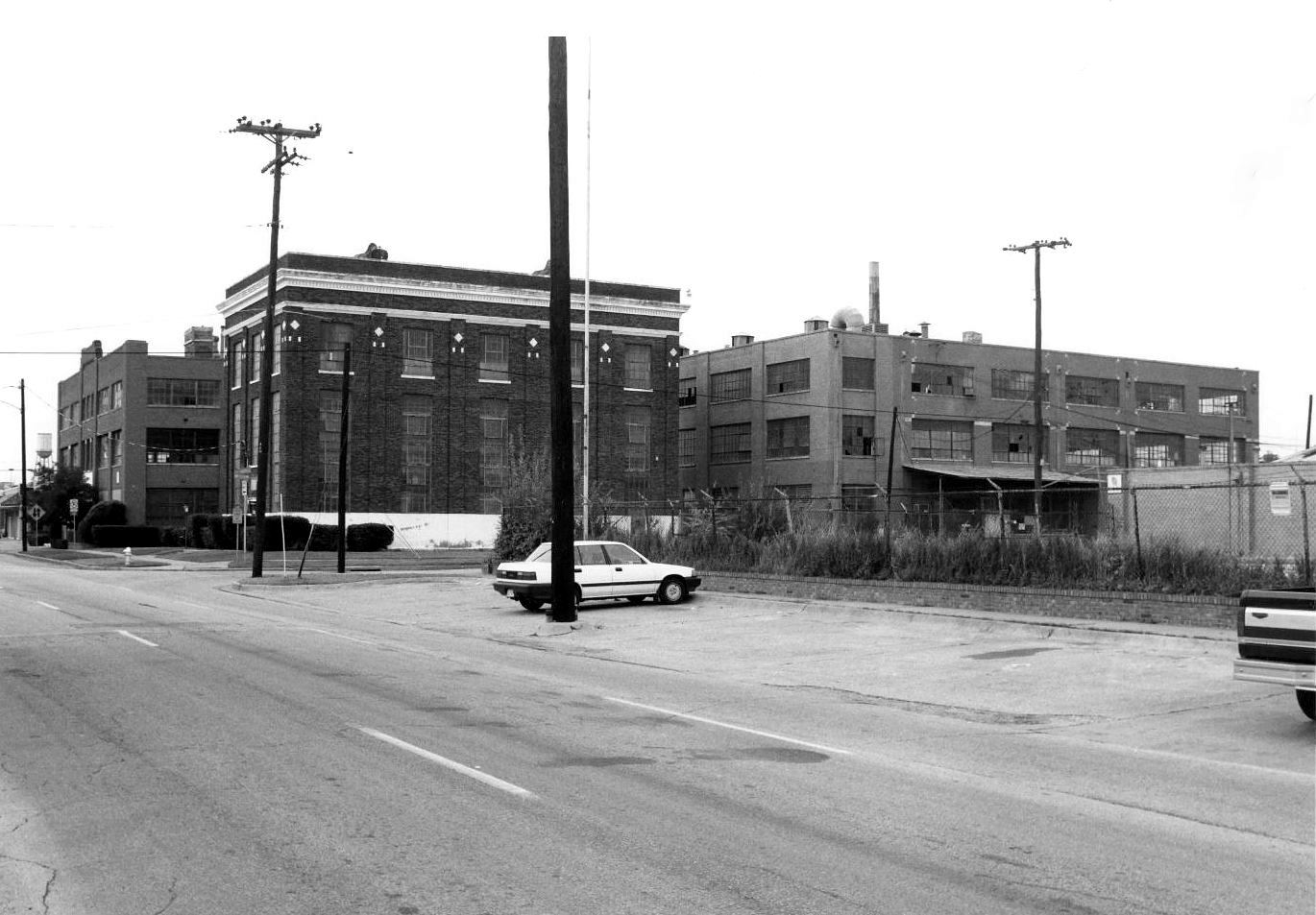
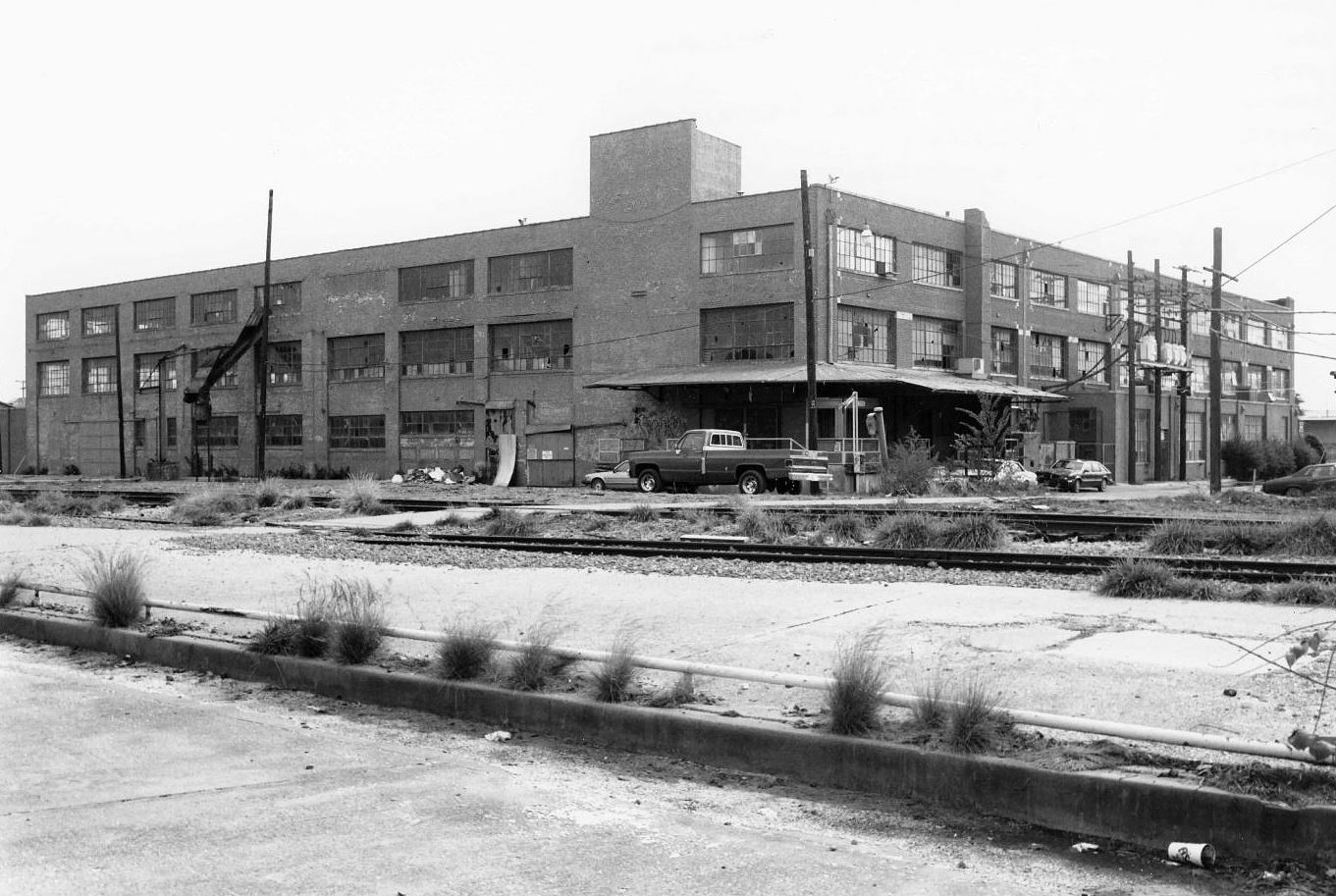
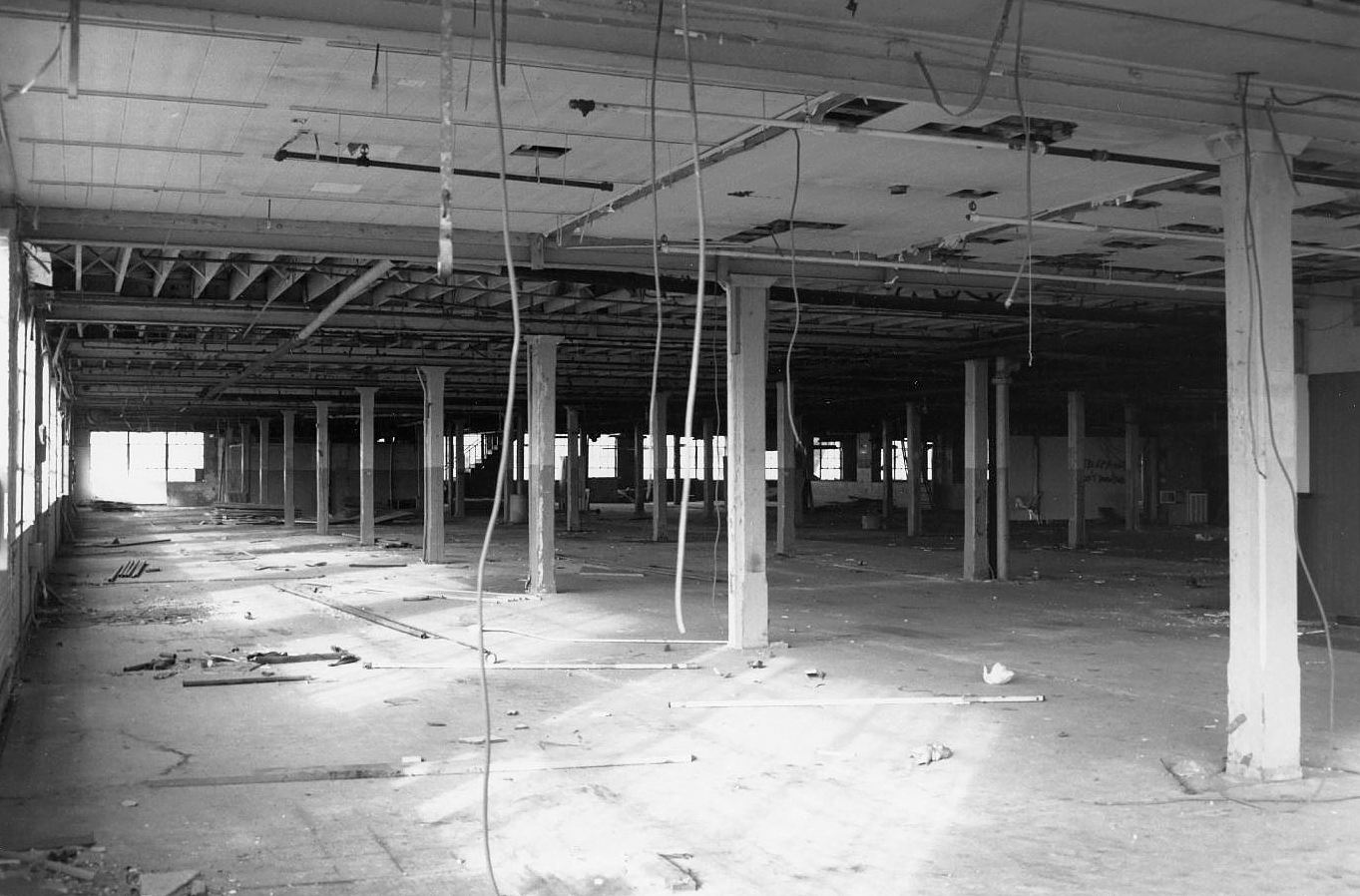
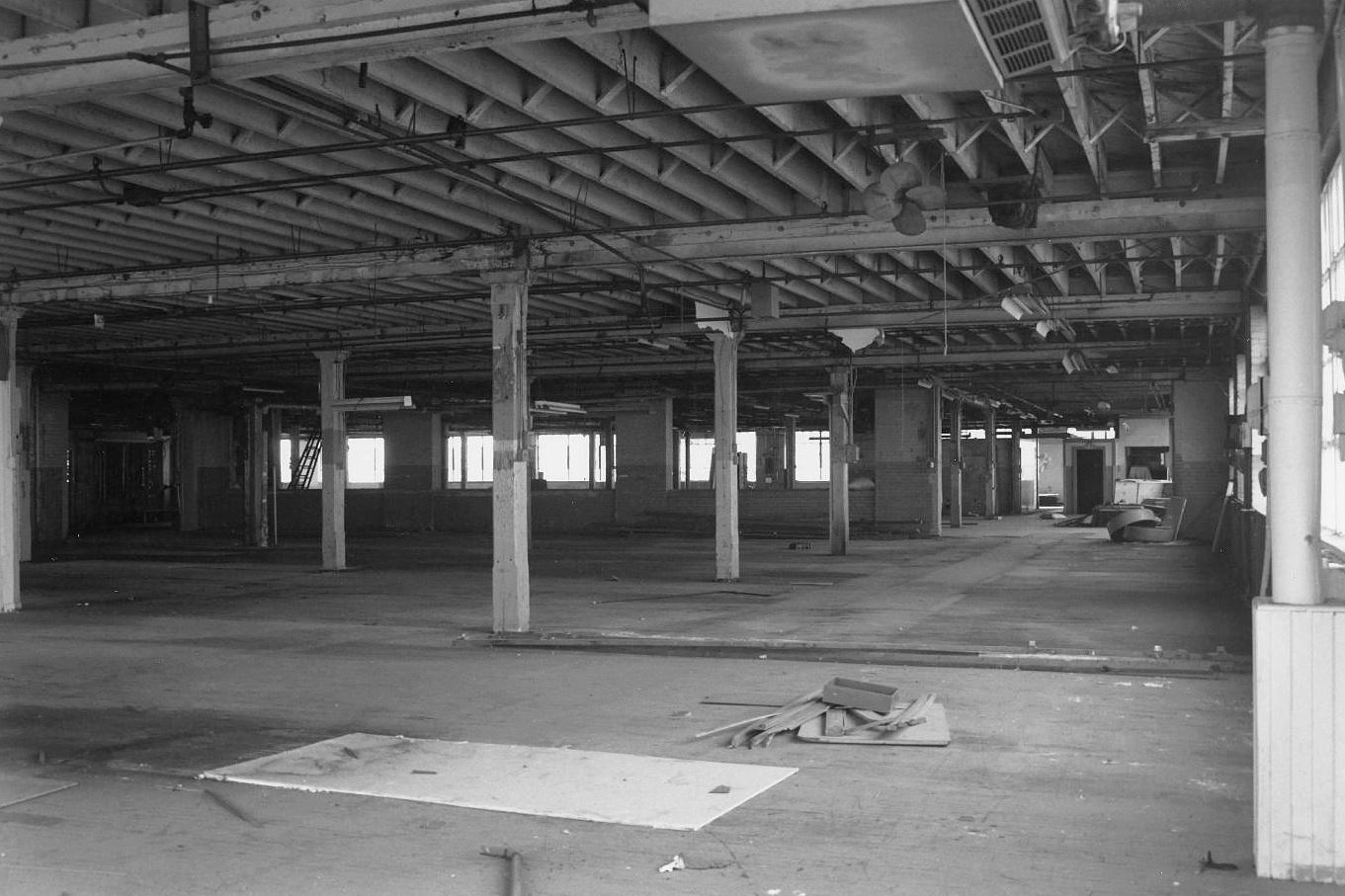
In 1991, the Mitchell Building was listed on the National Register of Historic Places. The photographs below (and the one at the top) were included in the application form. They were taken by Daniel Hardy of Hardy-Heck-Moore in October, 1988. Things weren’t looking great for the building in 1988. It must have been quite an undertaking to convert this large L-shaped building (which had certainly seen better days) into hip, sleek lofts.
Below, looking northwest on Commerce. The Mitchell Building is in an L-shape — the smaller building in the foreground is an old Dallas Power and Light substation, built around 1925. (Click photos to see larger images.)
*
The back, from the old T&P/Missouri-Pacific railroad tracks.
*
And two interior views of the second floor.
*
Here’s what the exterior looks like today, spiffified. (Explore it on Google Street view here.)
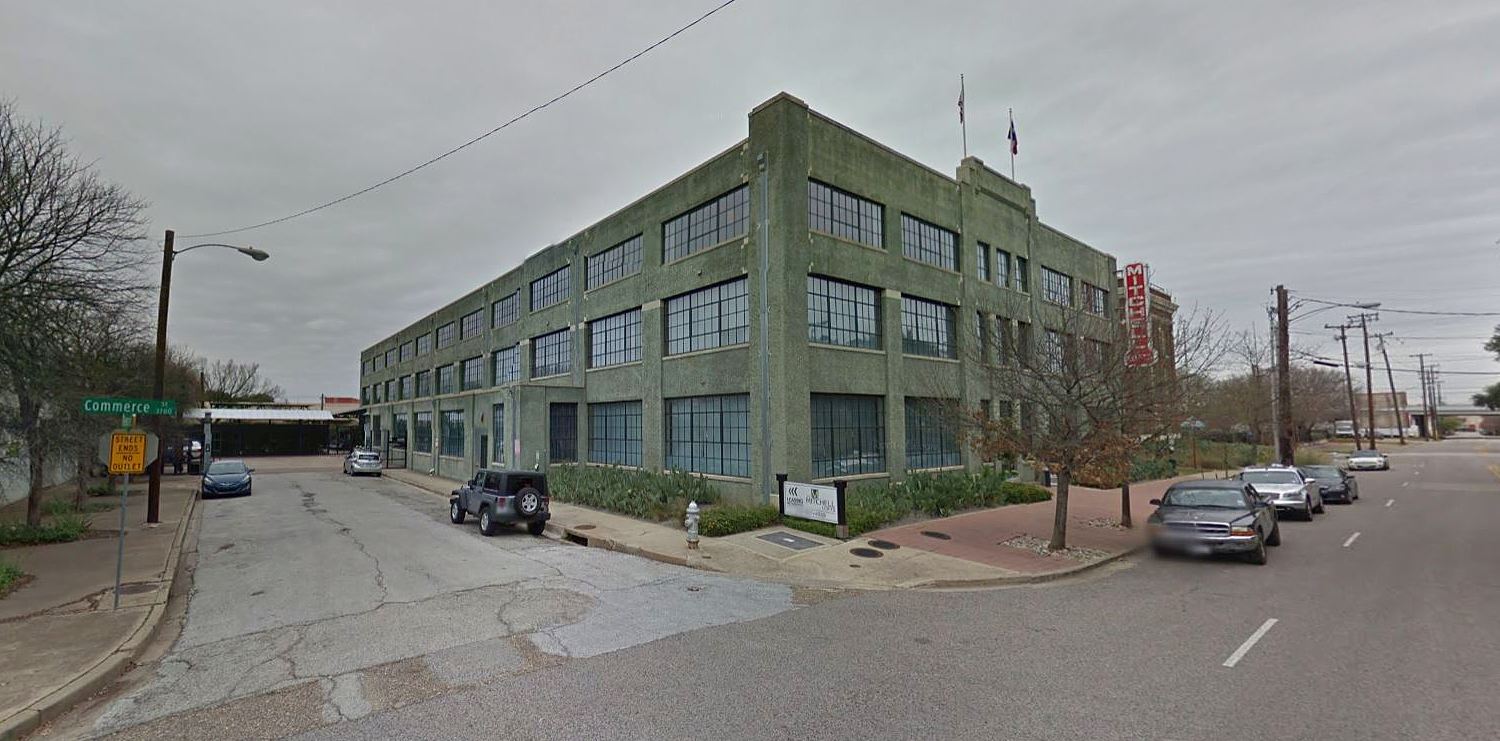 Google Street View (Jan. 2016)

Google Maps
**

Mitchell War Book, ca. 1945
 Flickr
***
Photos are from the application to the National Register of Historic Places; in addition to the photos, there is a thorough history of both the building and the John E. Mitchell Company, written by David Moore of Hardy-Heck-Moore. The 28-page form can be found in a PDF, here. (3/14/17 UPDATE: The link no longer works for me, and I am unable to find the document. Here’s the full URL: ftp://ftp.dallascityhall.com/Historic/National%20Register/John_E_Mitchell_Plant.pdf.)
More info on the Mitchell Company and its building through the years can be found in the following Dallas Morning News articles:
See what the Mitchell Lofts look like now in this Candy’s Dirt article from 2014; more photos are here. Pretty hard to believe people used to manufacture things like cotton gins and anti-aircraft missiles there.
The Mitchell Lofts website is here.
Click pictures and clipping to see larger images.
*
Copyright © 2016 Paula Bosse. All Rights Reserved.
The Mitchell War Book
by Paula Bosse
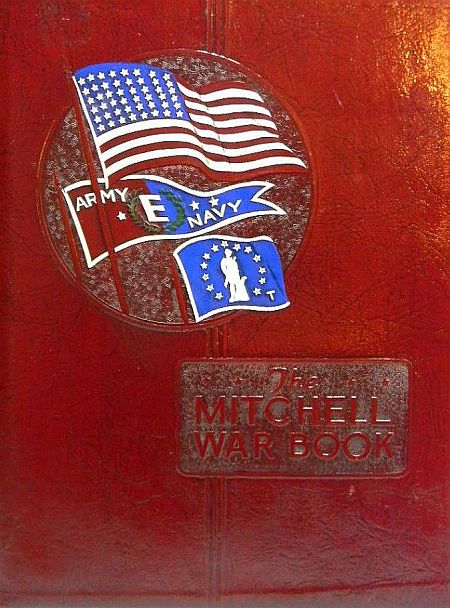
My previous two posts have been on the John E. Mitchell Company’s period as a full-time contract manufacturer of munitions and materiel for the Navy and Army. I had planned for my third Mitchell post to be about the building itself, but I just happened across this book — The Mitchell War Book — and I thought I would go ahead and slip this in now. I’ll write about the building next.
The book appears to be similar to a high school yearbook, with tons of photographs of Mitchell personnel at work on the factory floor and hanging out with their fellow war-workers in lighter off-duty moments. I’ve never seen this book (though I’d love to!), but it appears to be packed with pages and pages of photos.
Hundreds (if not thousands) of Dallasites worked in this factory while the Mitchell Company owned it — who knows? A relative of yours might be in here if he or she worked in it during the war. Below are photographs from a current eBay listing (click photos for larger images):
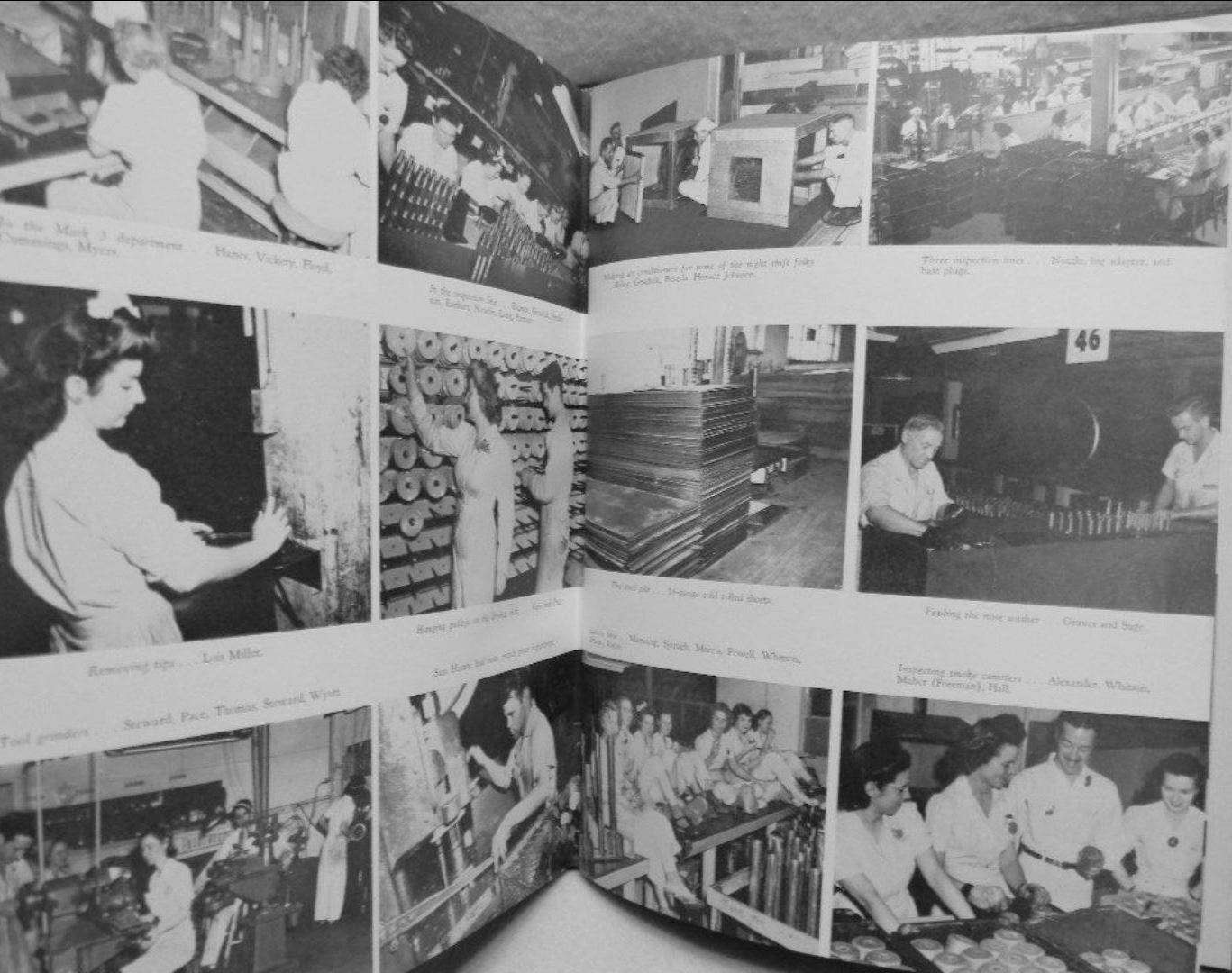
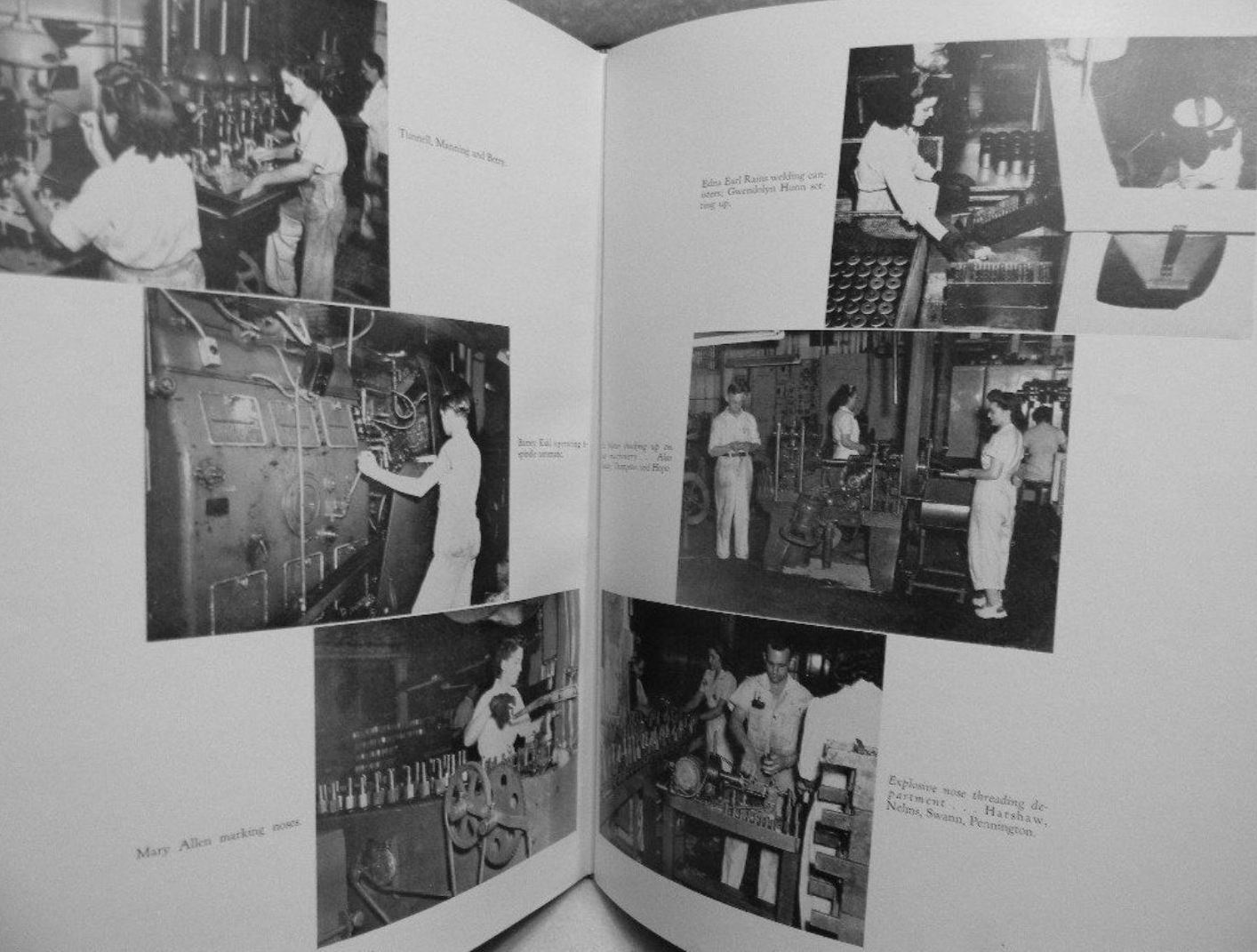
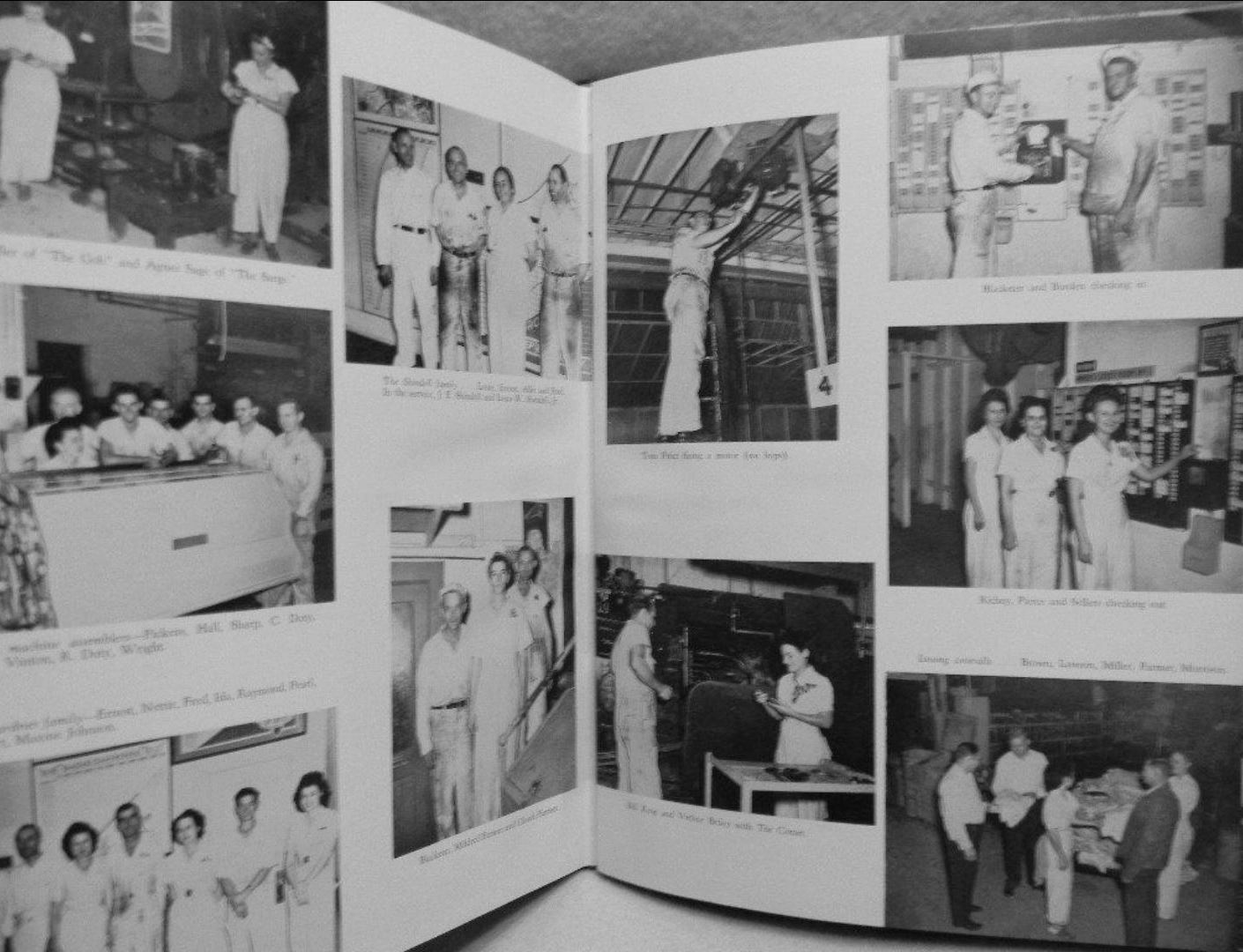
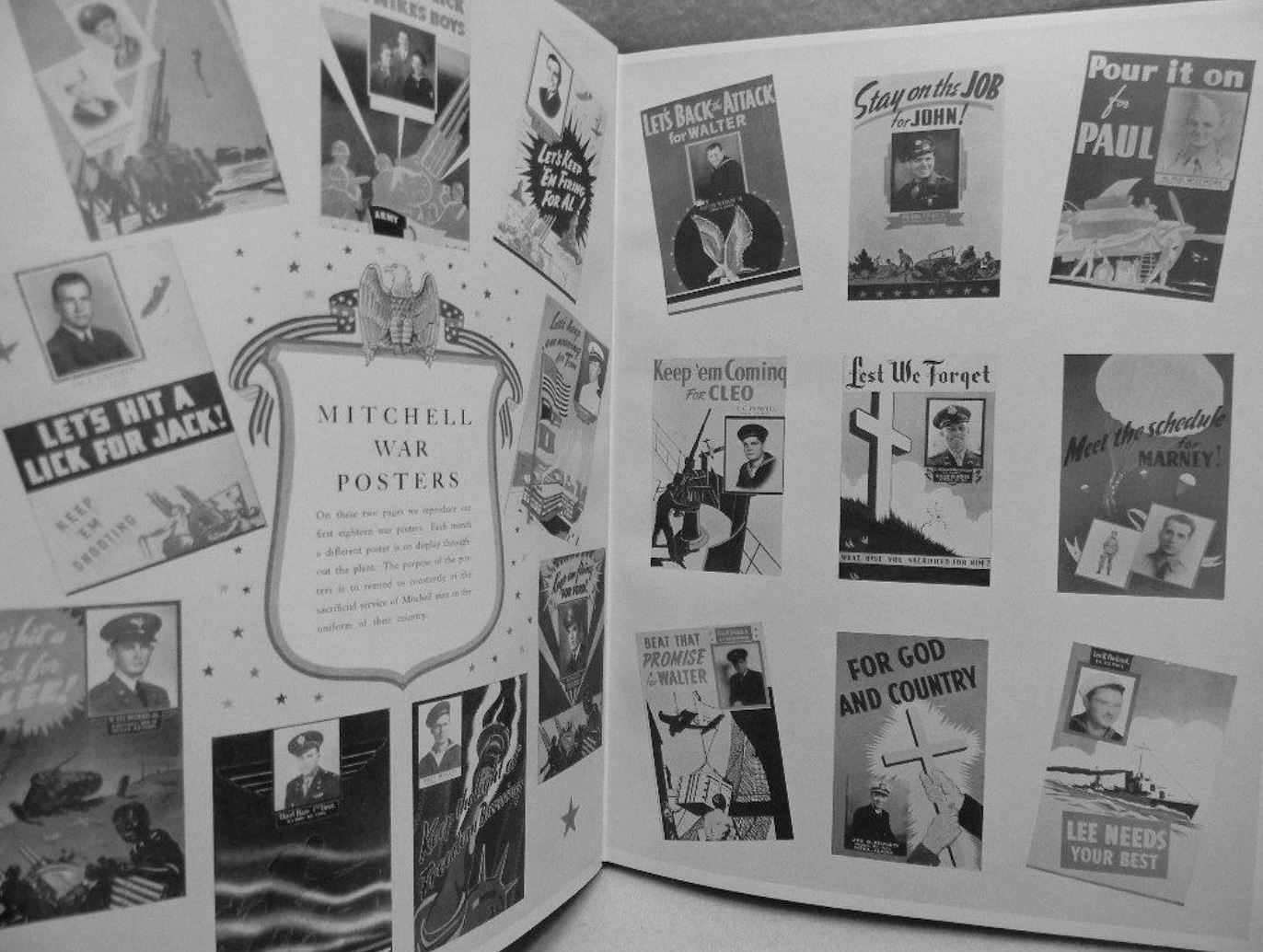
The posters above are interesting. When I posted a card the other day describing what this was all about (see it here), I didn’t fully understand. The company made these posters as reminders to the workers who they were working for: their fellow employees who were serving overseas.
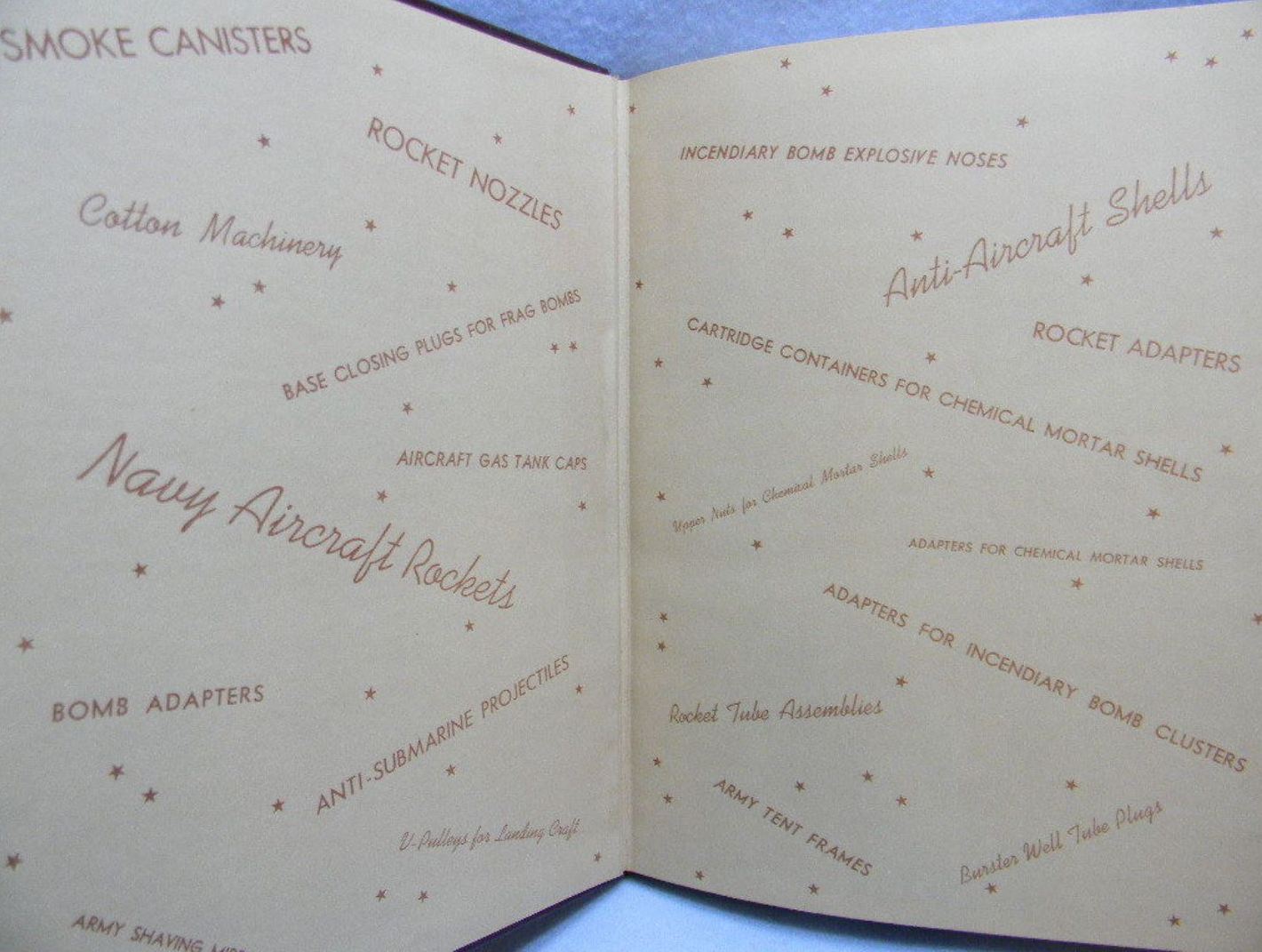
Above, the book’s endpapers show the various items the Mitchell Company was manufacturing for the U.S. Navy and U.S. Army.
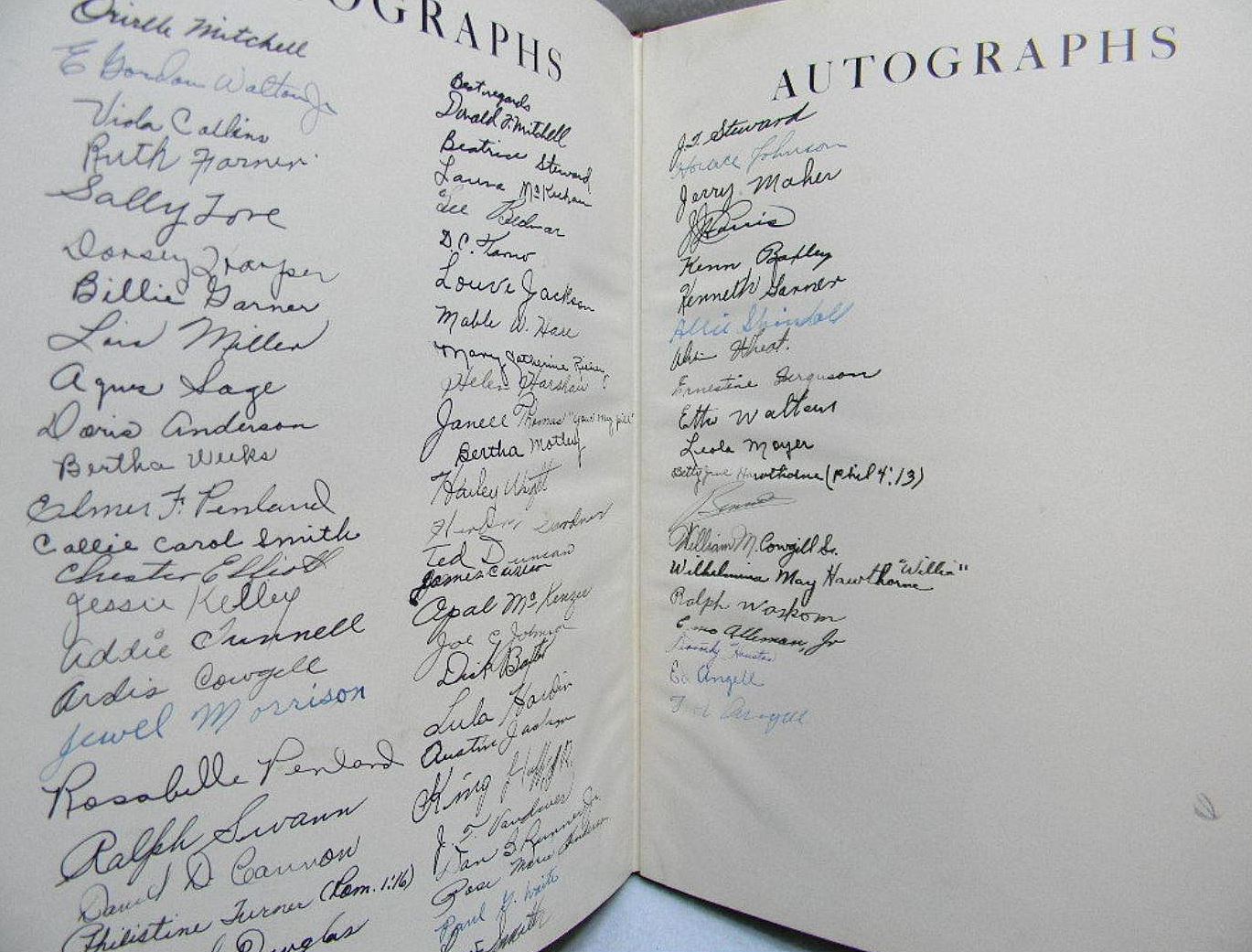
A few “autographs” of the John E. Mitchell Company’s wartime workers. Anyone you recognize?
***
As mentioned above, these photographs are from a current eBay listing, here.
Seems this book is pretty hard to find. I see only one other copy for sale — at about the same price — from a bookseller in Austin, here.
If you’re unwilling to fork over a fistful of cash but still want to look through the book, then hie yourself to the downtown Dallas Public Library to browse through the 127 pages of their only (non-circulating) copy; bibliographic details on the book from the DPL site, here (or if you don’t have a DPL account, here).
The two previous Flashback Dallas posts on the John E. Mitchell Company’s time as a munitions factory can be found here and here.
*
Copyright © 2016 Paula Bosse. All Rights Reserved.
by Paula Bosse
This is the second part of a post containing a series of postcards issued by the John E. Mitchell Company, which, before World War II was primarily a manufacturer of cotton and agricultural implements. It was located at 3800 Commerce in Exposition Park, a few blocks from Fair Park. During the war, the company ceased producing agricultural machinery and began producing munitions and materiel for the Navy and Army. (Part 1 can be found here.) The cards in a landscape format are larger when clicked.
*
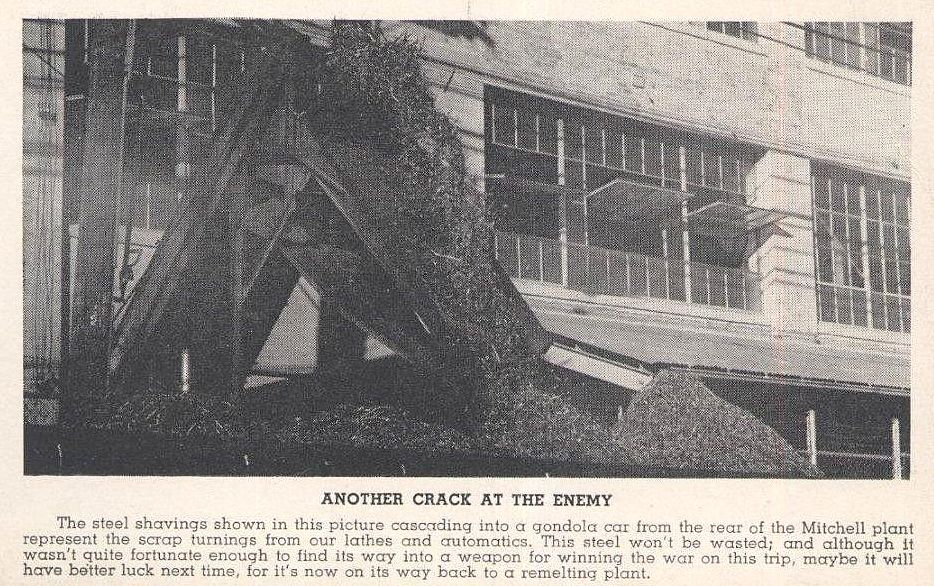
The card at the top shows the back of the (still-standing) building, behind which ran railroad tracks of the Missouri-Pacific railway. The card’s text:
The steel shavings shown in this picture cascading into a gondola car from the rear of the Mitchell plant represent the scrapped turnings from our lathes and automatics. This steel won’t be wasted; and although it wasn’t quite fortunate enough to find its way into a weapon for winning the war on this trip, maybe it will have better luck next time, for it’s now on its way back to a remelting plant.
*

This card will introduce you to Mr. and Mrs. Lewis J. Smith, the John E. Mitchell Company’s star tapping machine operators, shown here tapping base closing plugs for parafrag bombs.
It wasn’t so long ago that the Smiths’ sons, Dudley and Raleigh Smith, held the company production record on this machine. Then Dudley joined the Army and Raleigh joined the Navy. Mr. and Mrs. Smith decided the record should be kept in the family. So far it has.
*
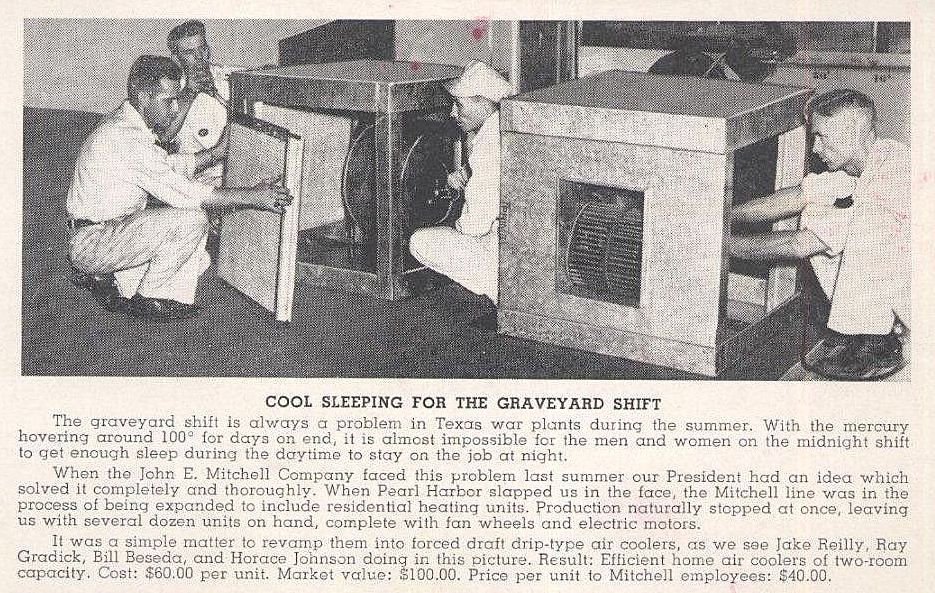
This is one of the most interesting cards in this collection. After the war, the Mitchell Company began to manufacture a wide variety of things, including heaters and air conditioners for cars. This problem of graveyard shift workers being unable to sleep during the summer months because of the oppressive heat must have been a big problem during the war, when factories such as this had to be running 24 hours a day. This was a brilliant solution.
The graveyard shift is always a problem in Texas war plants during the summer. With the mercury hovering around 100° for days on end, it is almost impossible for the men and women on the midnight shift to get enough sleep during the daytime to stay on the job at night.
When the John E Mitchell Company faced this problem last summer our President had an idea which solved it completely and thoroughly. When Pearl Harbor slapped us in the face, the Mitchell line was in the process of being expanded to include residential heating units. Production naturally stopped at once, leaving us with several dozen units on hand, complete with fan wheels and electric motors.
It was a simple matter to revamp them into forced draft drip-type air coolers, as we see Jake Reilly, Ray Gradick, Bill Beseda, and Horace Johnson doing in this picture. Result: Efficient home air coolers of two-room capacity. Cost: $60.00 per unit. Market value: $100.00. Price per unit to Mitchell employees: $40.00.
*
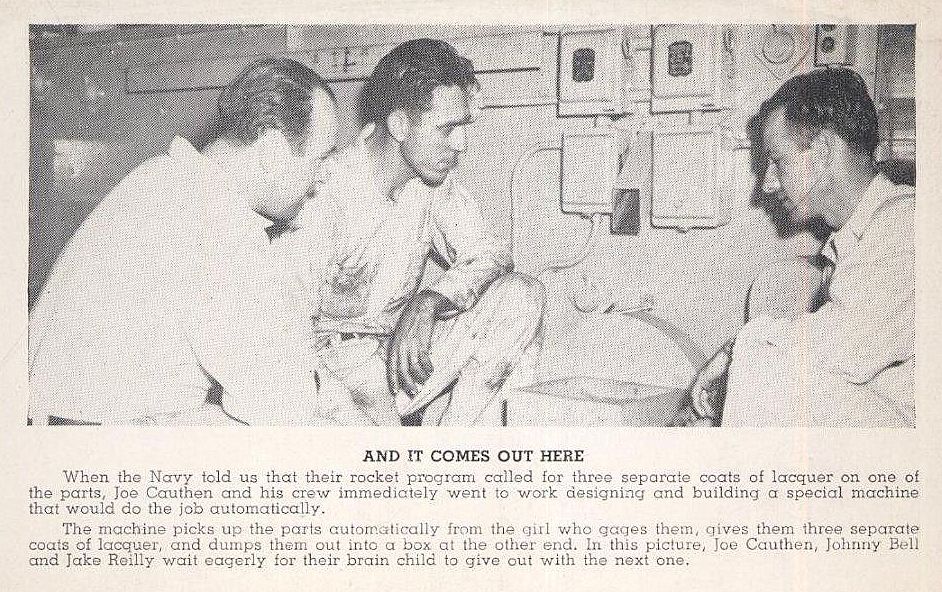
When the Navy told us that their rocket program called for three separate coats of lacquer on one of the parts, Joe Cauthen and his crew immediately went to work designing and building a special machine that would do the job automatically.
The machine picks up the parts automatically from the girl who gages them, gives them three separate coats of lacquer, and dumps them out into a box at the other end. In this picture, Joe Cauthen, Johnny Bell and Jake Reilly wait eagerly for their brain child to give out with the next one.
*
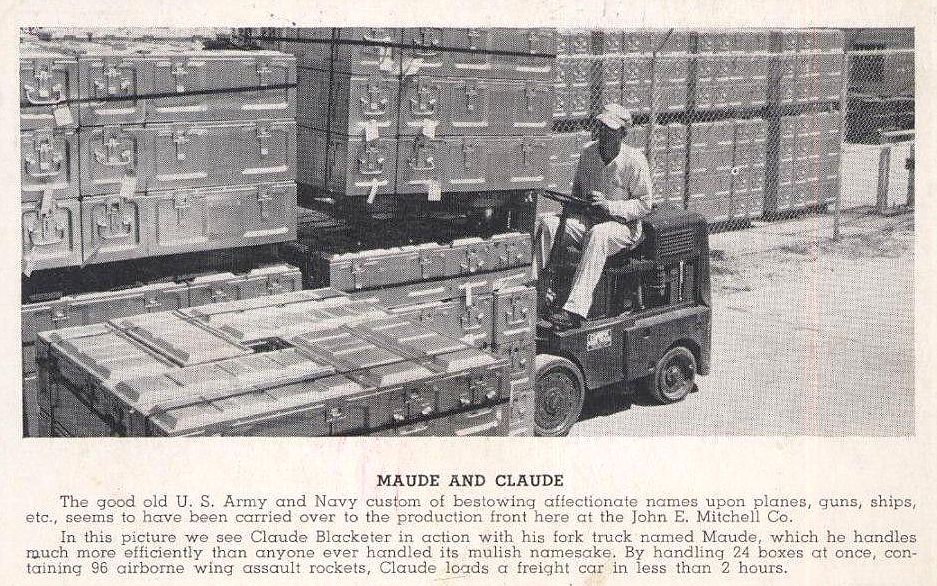
The good old U. S. Army and Navy custom of bestowing affectionate names upon planes, guns, ships, etc., seems to have been carried over to the production front here at the John E. Mitchell Co.
In this picture we see Claude Blacketer in action with his fork truck named Maude, which he handles much more efficiently than anyone else ever handled its mulish namesake. By handling 24 boxes at once, containing 96 airborne wing assault rockets, Claude loads a freight car in less than 2 hours.
*
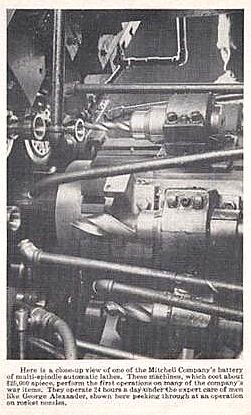
Here is a close-up view of one of the Mitchell Company’s battery of multi-spindle automatic lathes. These machines, which cost about $25,000 apiece, perform the first operations on many of the company’s war items. They operate 24 hours a day under the expert care of men like George Alexander, shown here peeking through at an operation on rocket nozzles.
*

Here’s one of the many presses with which the Mitchell factory is equipped, each operatable with a series of interchangeable blanking, stamping, forming, and drawing dies. This particular press has a capacity of 300 tons and forms the end frame for a Mitchell cotton machine in one lick.
*
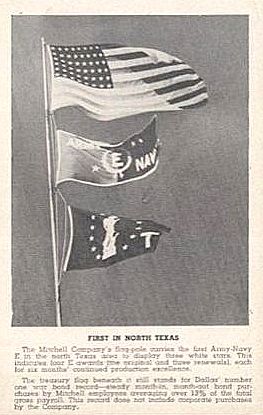
The Mitchell Company’s flag-pole carries the first Army-Navy E in the north Texas area to display three white stars. This indicates four E awards (the original and three renewals), each for six months’ continued production excellence.
The treasury flag beneath it still stands for Dallas’ number one war bond record – steady month-in, month-out bond purchases by Mitchell employees averaging over 13% of the total gross payroll. This record does not include corporate purchases by the Company.
***
Postcards found on eBay. Many of these are currently for sale, here.
Part 1, containing more of these postcards, is here.
Coming next: a look at the building built by the Mitchell Company in 1928, which is still standing in Expo Park, now repurposed as residential loft space.
Google Maps (click for larger image)
*
Copyright © 2016 Paula Bosse. All Rights Reserved.
by Paula Bosse
The John E. Mitchell Company arrived in Dallas in 1928 to join the other nearby manufacturers of cotton gins and other agricultural equipment. They built their factory at 3800 Commerce, between Benson and Willow Streets, in the area now commonly referred to as Exposition Park, a few blocks from Fair Park. (The building still stands and has been converted into lofts. More on the building itself in Part 3.)
In 1942, during World War II, the large cotton machinery factory gradually transformed itself into one wholly concerned with war production, primarily manufacturing munitions for the Navy, but also producing ordnance parts for the Army.
Below are a series of postcards, produced by the Mitchell Company, touting their contribution to the war effort and acknowledging their workers. The second half of these cards will be contained in the next post. (Most of the cards are larger when clicked.)
*
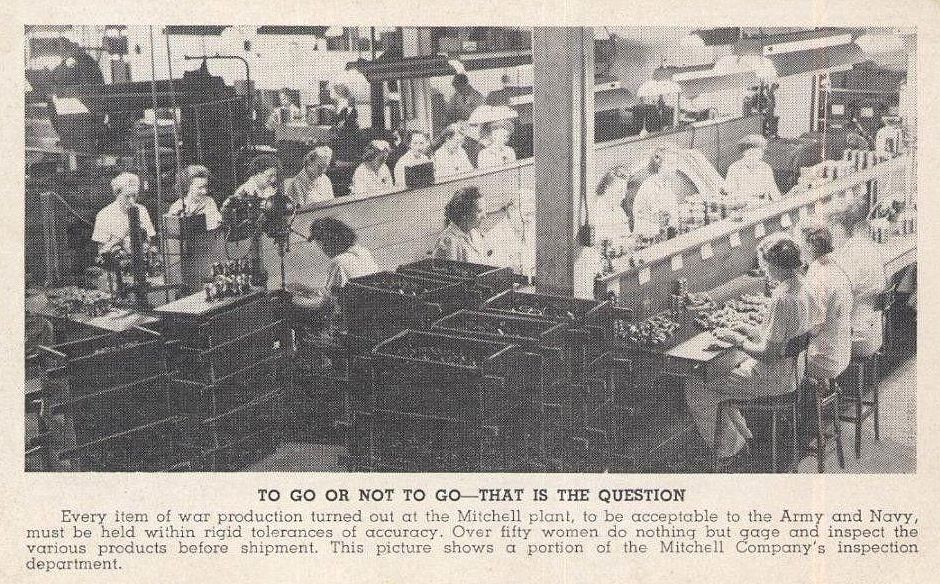
The top card shows part of the plant’s inspection department:
Every item of war production turned out at the Mitchell plant, to be acceptable to the Army and Navy, must be held within rigid tolerance of accuracy. Over fifty women do nothing but gage and inspect the various products before shipment. This picture shows a portion of the Mitchell Company’s inspection department.
*
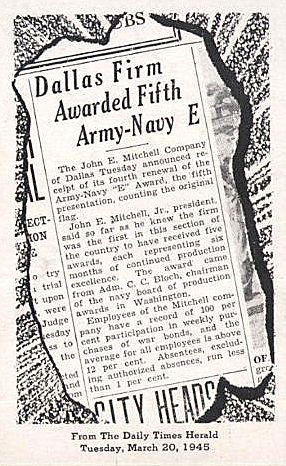
The John E Mitchell Company of Dallas Texas announced receipt of its fourth renewal of the Army-Navy E award, the fifth presentation, counting the original flag.
John E Mitchell, Jr., president, said so far as he knew the firm was the first in this section of the country to have received five awards, each representing six months of continued production excellence. The award came from Adm. C. C. Bloch, chairman of the navy board of production awards in Washington.
Employees of the Mitchell company have a record of 100 per cent participation in weekly purchases of war bonds, and the average for all employees is above 12 per cent. Absentees, excluding authorized absences, run less than 1 per cent.
From the Daily Times Herald, Tuesday, March 20, 1945
*
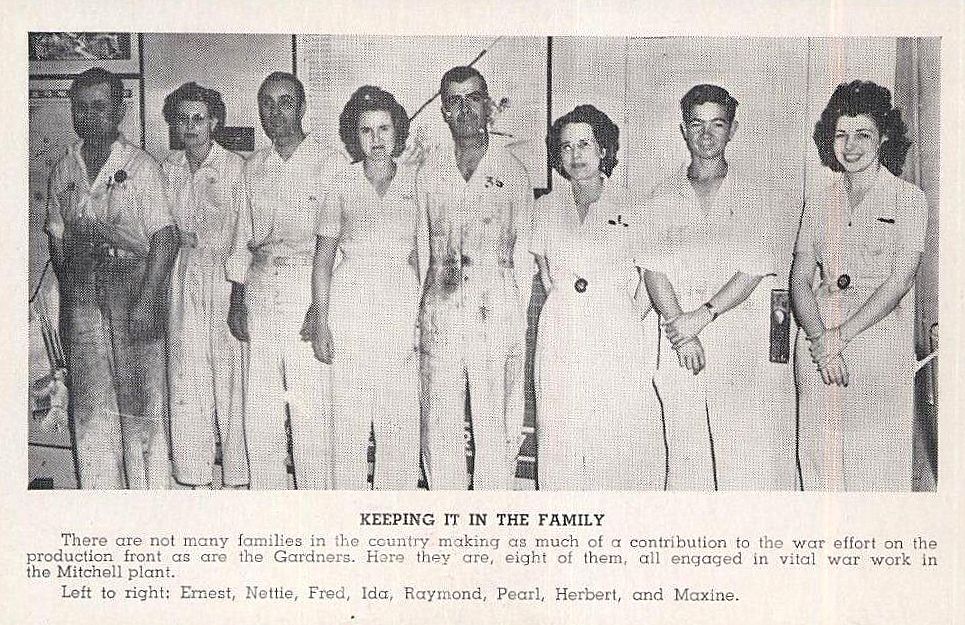
There are not many families in the country making as much of a contribution to the war effort on the production front as are the Gardners. Here they are, eight of them, all engaged in vital war work in the Mitchell plant.
Left to right: Ernest, Nettie, Fred, Ida, Raymond, Pearl, Herbert, and Maxine.
*
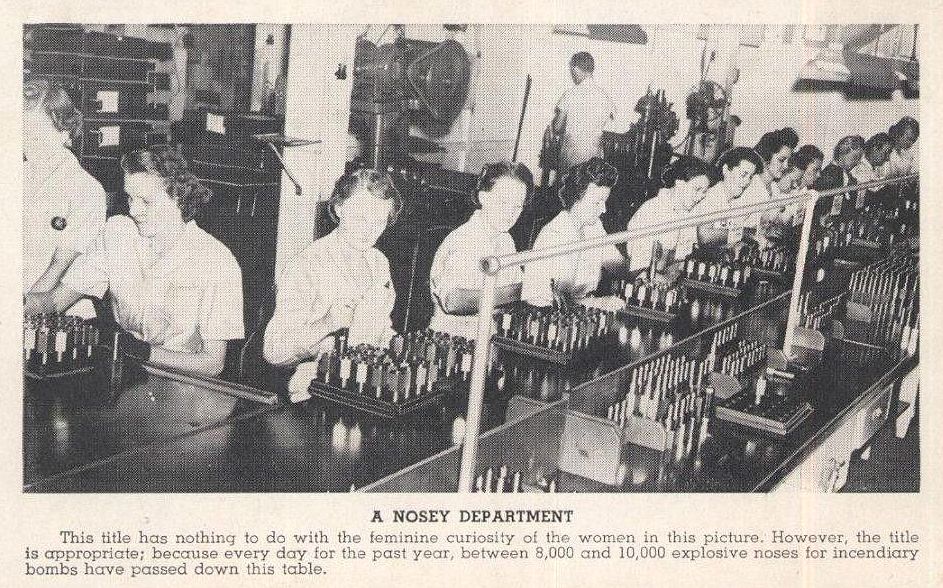
This title has nothing to do with the feminine curiosity of the women in this picture. However, the title is appropriate; because every day for the past year, between 8,000 and 10,000 explosive noses for incendiary bombs have passed down this table.
*
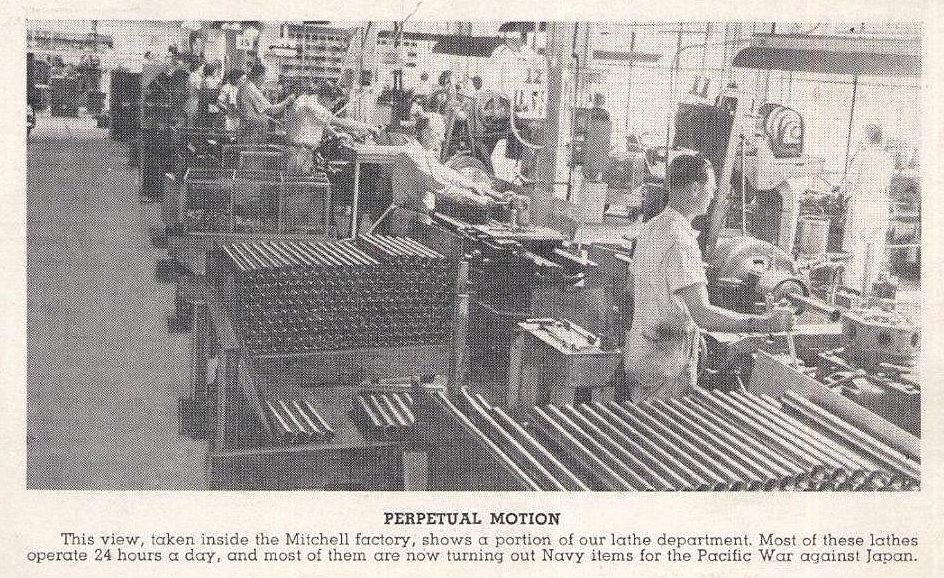
This view, taken inside the Mitchell factory, shows a portion of our lathe department. Most of these lathes operate 24 hours a day, and most of them are now turning out Navy items for the Pacific War against Japan.
*

When this picture was taken, our president, John Mitchell, had evidently pulled off some sort of wisecrack which everyone seemed to enjoy, especially Mr. Mitchell himself.
The scene: one of the Mitchell Company’s regular Monday assembly meetings. The honored guests: Barney Kidd and Raleigh Smith, former Mitchell employees, now representing their company in both branches of the armed services.
*

Let us introduce you to Art Isbell, the Mitchell Company’s industrial chaplain, shown here consulting with receptionist Doris Aday.
One of the first concerns in the nation to retain a full time industrial chaplain, the Mitchell Company has already discovered how important his services can be. Handling funeral arrangements, visiting the sick, helping with personnel problems, rendering spiritual guidance, Art Isbell has made himself invaluable to Mitchell men and women and has already endeared himself to the hearts of many through his patient understanding and never-failing cooperation.
*
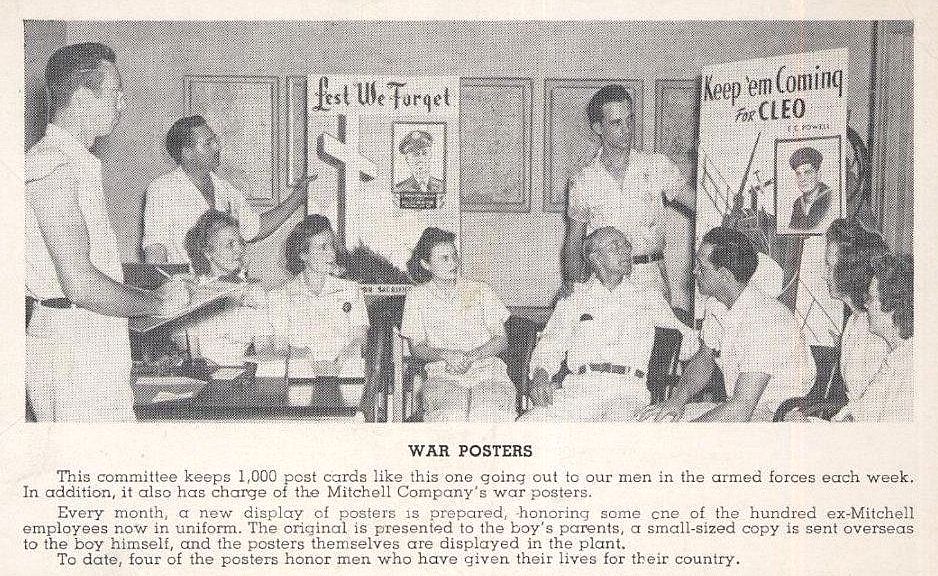
This committee keeps 1,000 post cards like this one going out to our men in the armed forces each week. In addition, it also has charge of the Mitchell Company’s war posters.
Every month, a new display of posters is prepared, honoring some one of the hundred ex-Mitchell employees now in uniform. The original is presented to the boy’s parents, a small-sized copy is sent overseas to the boy himself, and the posters themselves are displayed in the plant.
To date, four of the posters honor men who have given their lives for their country.
***
Postcards found on eBay last year. I was a little surprised to find that most of them are still available for purchase, here.
For more on the Mitchell Company’s early days as a munitions plant, see the Dallas Morning News article “E Award Given Plant Doing Munitions Job” (DMN, Dec. 29, 1942).
The Mitchell Lofts building is a long way from being war-time production plant. Here is what it looks like today.
Google Maps (click for larger image)
Another Flashback Dallas post on a local munitions plant (this one downtown) — “2222 Ross Avenue: From Packard Dealership to ‘War School’ to Landmark Skyscraper” — is here.
Part 2 features more of these postcards of the Mitchell Company’s war work, here.
Part 3 will focus on the building itself.
Check back!
*
Copyright © 2016 Paula Bosse. All Rights Reserved.

Geez, Picasso, get a grip… “YUM!”
by Paula Bosse
There’s nothing like cartoon swearing. The reader is likely to translate those random symbols into words that are probably a lot filthier than was intended by the cartoonist. …Probably.
Here are a few examples of this, found, surprisingly, in cartoon ads for wholesome Mrs. Baird’s Bread. This ad campaign — which, as far as I can tell, lasted from 1945 to 1953 — consisted of a one-panel comic called “Freshie,” illustrated for most of its lifespan by Harry Walsh. There were close to a hundred of these panels produced. (That’s a lot of bread-based humor some poor advertising copywriter had to come up with.) They were often placed directly on the comics page, alongside Pogo, Li’l Abner, and Rex Morgan M.D. “Freshie” was the name of the child with the unwavering/disturbing obsession with Mrs. Baird’s Bread. (UPDATE: I now see that the “Freshie” cartoon ad concept was used all across the country, for various brands of bread. Oh, Freshie, your love for Mrs. Baird’s bread was just for show, wasn’t it?)
Not all of them had cursing — in fact I think it might be just these four. Still, it’s a little unexpected. What would Mrs. Baird think? (Click to see larger images.)

Dec. 28, 1945

June 7, 1948

Nov. 30, 1949
*
Copyright © 2016 Paula Bosse. All Rights Reserved.
 From the collection of Mark and Geralyn Kever
by Paula Bosse
Florence McClung (1894-1992) — a painter, printmaker, and pastelist in the circle of Regionalist artists known as The Dallas Nine — lived in Dallas and often painted nearby rural scenes as well as more rugged Western landscapes. I haven’t seen many urban scenes by McClung, but there were two oil paintings that appeared in a one-woman show at the Dallas Museum of Fine Arts in the spring of 1945 which I’d love to find images of: “Triple Underpass” and “Big D,” the latter of which sounds very similar to the one seen above, “Dallas Cityscape,” from the collection of Mark and Geralyn Kever (whose impressive collection of Texas art can be seen in the Jan./Feb. issue of American Fine Art Magazine — jump to page 53 in the PDF to find the story, “Cream of the Crop”). (UPDATE: “Triple Underpass” has surfaced! More here.)
Here’s another urban scene, “Industrial Dallas,” with what looks like the Medical Arts Building in the background.
 David Dike Fine Art
I always love to see artistic renderings of the Dallas skyline, and I really like these two city scenes which are so different from McClung’s usual subject matter.
Florence McClung (née White) was born in St. Louis in 1894. Her family moved to Dallas, and she eventually studied art under several of Dallas’ finest instructor-artists (including Frank Reaugh). After several years as a college art instructor in Waxahachie, she began to participate in numerous group shows, juried shows, and one-man shows, reaching the peak of her career in the 1930s and 1940s. She died in 1992 at the age of 97. Art-wise, that spans the years from Toulouse-Lautrec to Banksy!
I had a hard time finding photos of her, but I managed to find two, including her senior photo which appeared in the 1912 yearbook of Dallas High School (more commonly known today as Crozier Tech) (where, incidentally, she was in the Art Club with Allie Tennant who went on to become a noted sculptor, best known for her Tejas Warrior at the Hall of State in Fair Park).
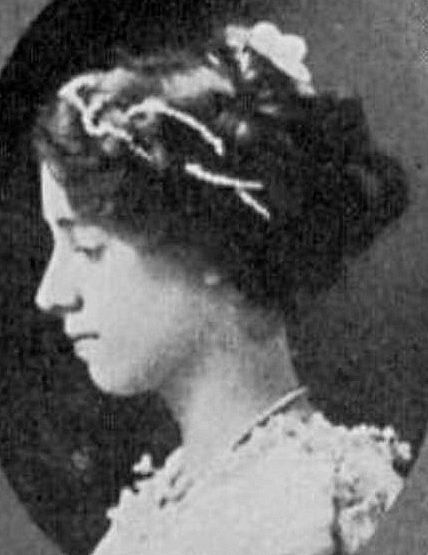
Florence White, Dallas High School yearbook, 1912

Florence McClung, circa late 1930s
***
I ran across the “Dallas Cityscape” painting on the CASETA (Center for the Advancement and Study of Early Texas Art) site.
The top painting has the title “Dallas Cityscape” and media mentions of it carry the date 1941. I couldn’t find a painting by McClung with that title (admittedly, my sources are limited!). Also, 1941 seems off because construction of the Mercantile Bank Building (seen in the painting) wasn’t completed until 1942. I wonder if it’s possible that this painting actually was the painting McClung titled “Big D” (which was most likely painted in 1944) and was included in her 1945 show at the DMFA? Might those planes have something to do with World War II? Because the Portal to Texas History has been so nice to scan them, McClung’s application for a show at the DMFA can be seen here, and her list of works to be shown is here.
“Industrial Dallas” is from a January, 2016 auction catalogue from David Dike Fine Art.
The Handbook of Texas entry for Florence Elliott White McClung can be found here.
A selection of works by Florence McClung from the Dallas Museum of Art can be found on the SMU Central University Libraries Digital Collections site, here.
UPDATE, Oct., 2018: “Triple Underpass,” from the same period as the two paintings above, has surfaced — more about it can be found in the post “‘Triple Underpass’ by Florence McClung — 1945,” here.
All images larger when clicked.
*
Copyright © 2016 Paula Bosse. All Rights Reserved.
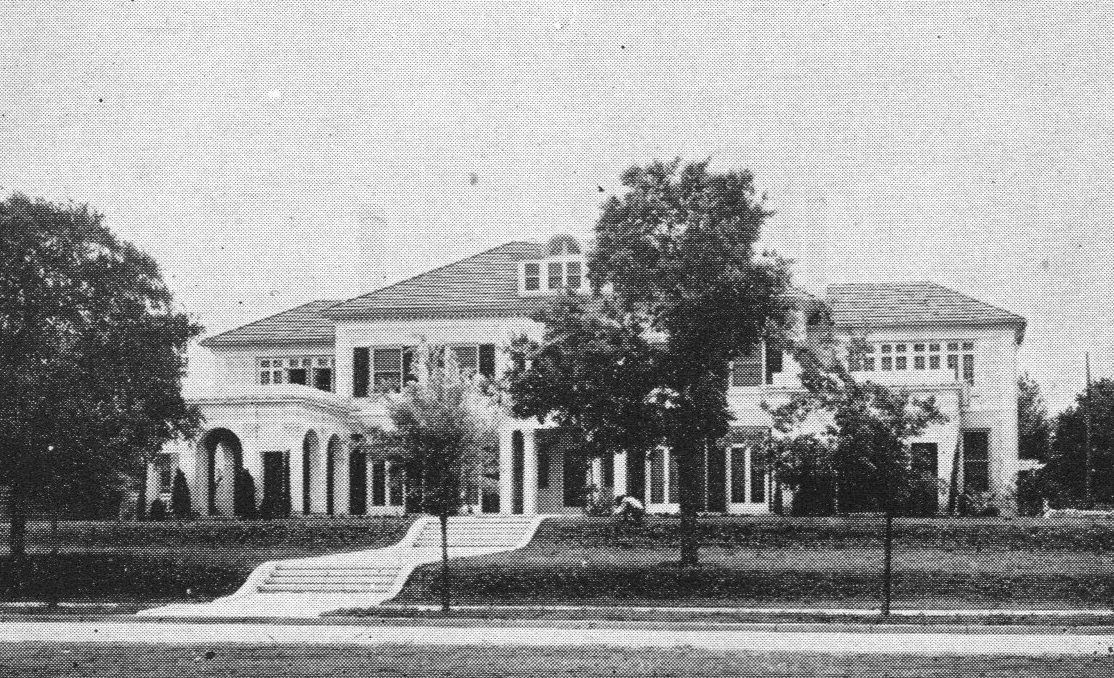 You and your gardener will *love* Dallas! (click for larger image)
by Paula Bosse
It’s 1943. You’re considering relocating your business and your family to Dallas. You’ll probably be owning a mansion like the one pictured above. Should you and your large bank account settle in Dallas? I mean, is it really the best place … tax-wise?
Below is a page from a pamphlet called So This Is Dallas, a publication which was intended to sway decisions such as this. It was issued for several years by a group called “The Welcome Wagon,” and this edition came out sometime during World War II. Here’s what Big D had to offer in those days. (Click to see much larger image.)

*
Taxation…
Dallas offers a favorable tax situation that can be found in but few communities. There is no State income tax in Texas and no general sales tax.
Corporations operating in the State are subject to three forms of taxation. If they are foreign corporations, they must qualify legally in the State and pay a permit fee, an annual franchise tax and ad valorem taxes. If they are domestic corporations, they pay a fee to secure a Texas charter, an annual franchise tax and ad valoreum [sic?] taxes.
Texas laws do not discriminate against foreign corporations. The permit fee for a foreign corporation and the charter fee of a Texas corporation are arrived at in the same way, the proportionate amount of capital used in Texas by the foreign corporation and the capital stock of the domestic corporation. Franchise taxes for both foreign and domestic corporations are also assessed on the same basis.
Ad Valorem Taxes
All corporations, whether domestic or foreign, and all others owning property within the State of Texas, must render their property as of January 1 each year for city, State and county taxes. The property is rendered at its inventory value. The basis of assessment varies in different counties.
Current ad valorem taxes in Dallas are: City of Dallas, $2.45 per $100 valuation, basis of assessment 53 per cent of value; Dallas County, 74 cents per $100 valuation, basis of assessment 50 per cent of value; State, 69 cents per $100 valuation, basis of assessment 50 per cent of value.
Dallas has the lowest tax rate of any large city in the Southwest. Each city has a different basis of assessment. Reducing their rates to a basis of assessment on 100 per cent of value, net tax rates for the four leading cities in Texas are:
Dallas ….. $20.56 net per $1,000
Houston ….. $22.03 net per $1,000
San Antonio ….. $26.89 net per $1,000
Fort Worth ….. $29.25 net per $1,000
*
I don’t know what ANY of that means, but it looks like Dallas wins. Welcome to your new mansion!
***
Page from So This Is Dallas, published around 1943 by The Welcome Wagon; courtesy of the Lone Star Library Annex Facebook page.
If you recognize any of these homes, let me know and I’ll add the info here. I’m seeing what looks like Lakewood and Swiss Avenue, and maybe Highland Park and Oak Cliff.
Click pictures for larger images.
*
Copyright © 2016 Paula Bosse. All Rights Reserved.
 Flashback : Dallas