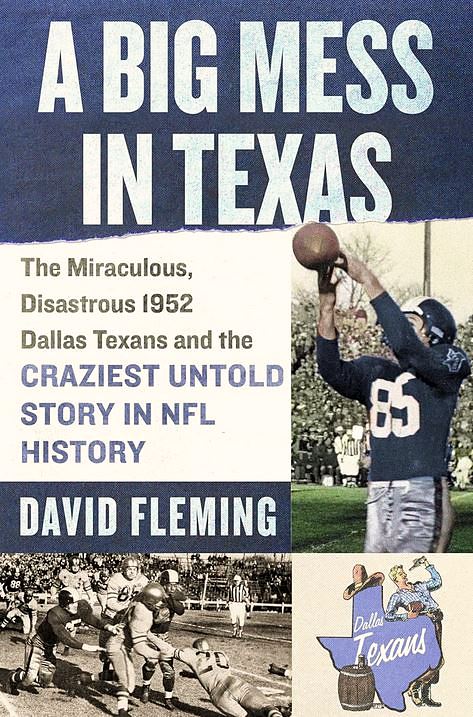
Now that the book is out, Fleming has participated in a Dallas Public Library video interview, conducted by the person who helped him through his pre-publication research process, Caitlyn Jones. I’m not really a sports person, but I have to say, I really enjoyed this interview. It’s always entertaining to listen to someone who is really, really enthusiastic about a topic. Caitlyn did a great job for her first interview, and Fleming tells her how much one particular piece of information — which she stumbled across weeks after their initial email communication — helped shape part of the story he was wanting to tell about what is, quite frankly, a pretty weird story about what must be Dallas’ least successful professional sports team ever (as Wikipedia has it: “…the Texans are officially recognized as the last NFL team to permanently cease operations and not be included in the lineage of any current franchise”).
So as you’re waiting for the turkey to finish or waiting for the Cowboy game to start, check out this 55-minute interview on YouTube. And if you missed my 2016 post on the Texans, mosey on over to “The 1952 Dallas Texans: Definitely NOT America’s Team.”
*
**
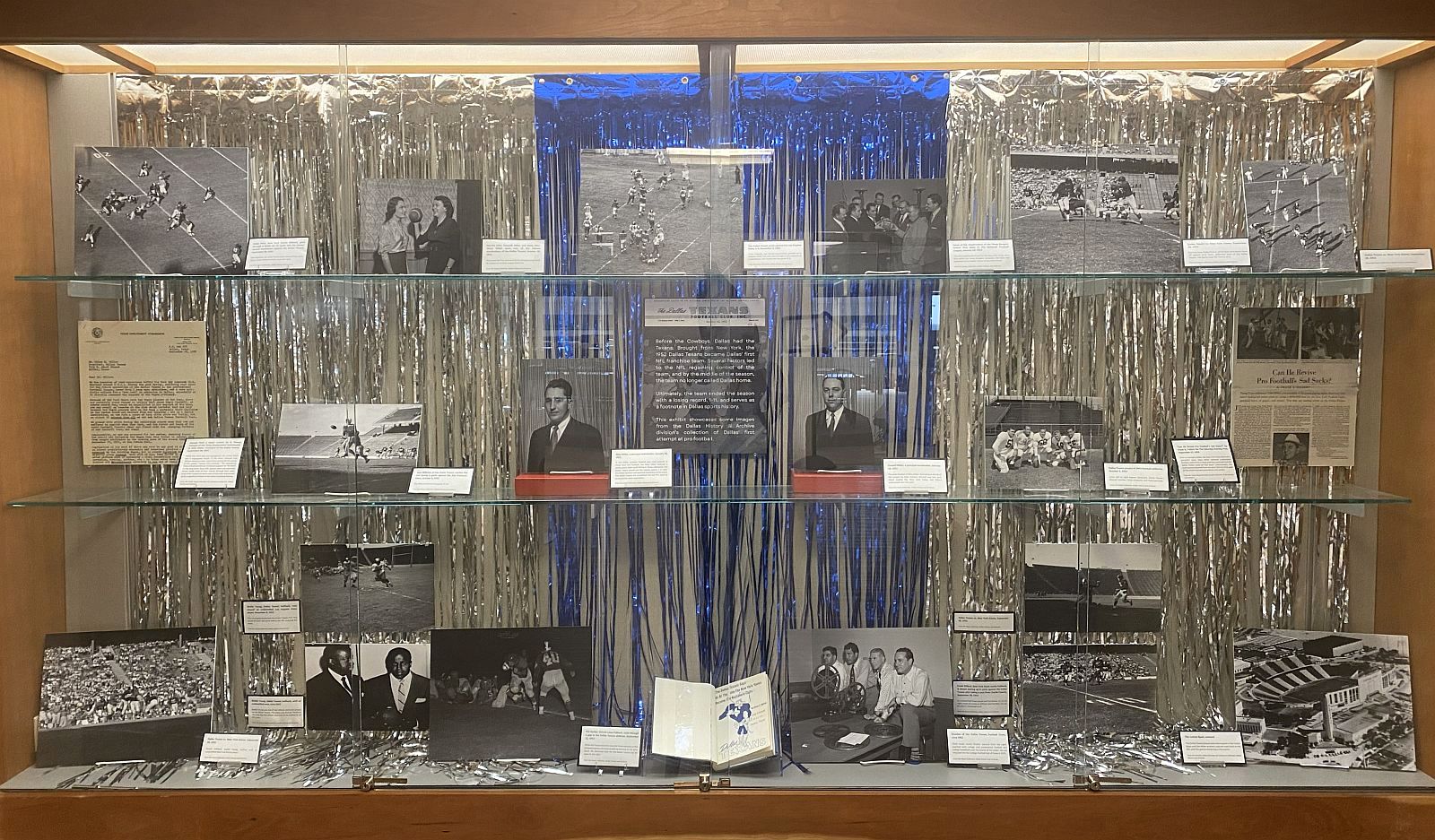
Because of all the research Caitlyn did looking for photos of and information about the Dallas Texans, she became our “staff expert” on the team and even put together this great display, which was exhibited for several weeks on the 7th floor of the downtown Central Library. Thank you, Caitlyn!
*
I’m posting this on Thanksgiving. It turns out the only game the Texans ever won was an upset victory over the Chicago Bears in 1952 on Thanksgiving Day. A miracle! I hope you have as good a Thanksgiving today as the Texans players, coaches, and owners had in 1952!
A few days ago, the Dallas Public Library posted a version of the mural below on its social media accounts. The title of the mural is “Gathering Pecans” by Dallas artist Otis Dozier. It was painted in 1941 as a New Deal federally commissioned work to hang in the Arlington Post Office (it now hangs in the Amon Carter Museum in Fort Worth). I love this mural — not only because I’m a fan of Dozier’s work, but also because it captures something that was once a common practice for families: going to a public place like a park (or as seen in the mural, somewhere along the side of the road) and picking up pecans.
Amon Carter Museum of American Art
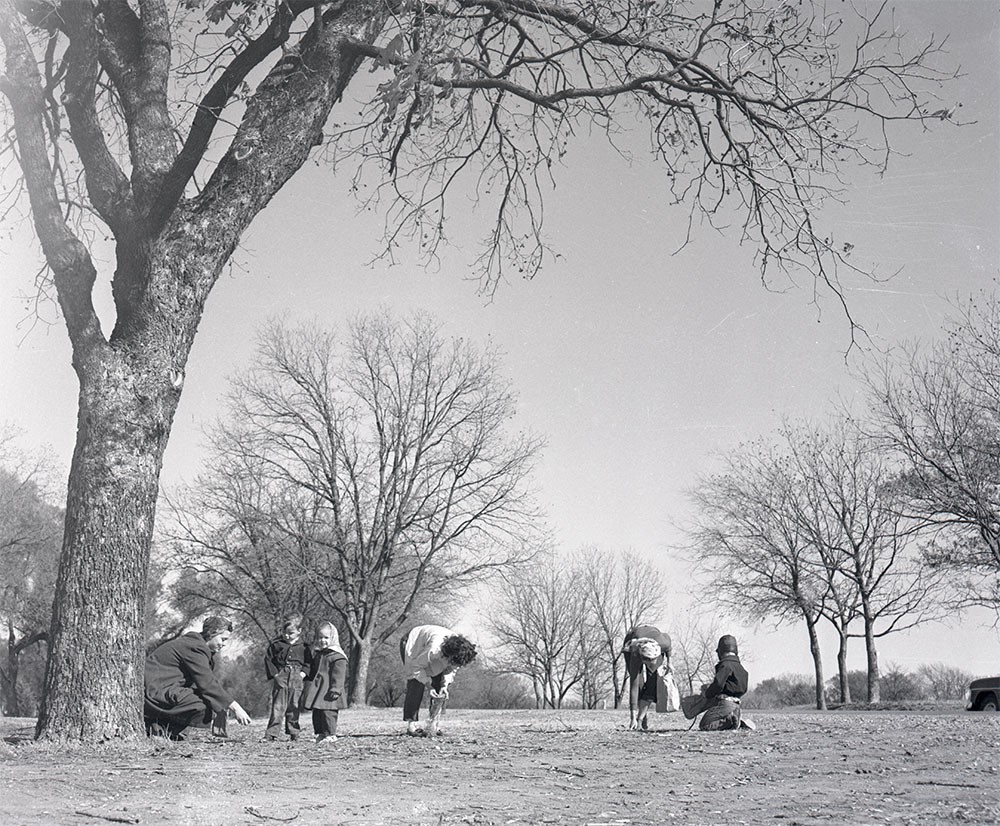
When I was a child, my mother used to take me and my brother to White Rock Lake Park (or occasionally to Reverchon Park) to gather pecans. It was fun. Like a really easy Easter egg hunt with really small eggs. The 1952 photo at the top predates my own time hunting for fallen pecans, but I swear, that could be me, bundled up in a coat and scarf, having fun with my family on a crisp, sunny day.
We’d pick up the nuts (so. many. pecans…) and drop them into a paper sack. Then we’d take them home and lay sheets of newspaper on the dining room table, and the whole family — including my father and aunt — would spend an afternoon cracking pecans and picking out the “meat” with special nutcracking instruments. Next stop: a delicious dessert. I absolutely loved all of this.
I asked my (much younger) co-workers if they ever did this — went to a park to gather pecans. There were a couple of vague “…maybe?…” responses, but most had never heard of such a thing. How sad!
If your family doesn’t do this, consider it. It’s one of my favorite fall memories. And you’ll get an almost-free pecan pie out of it!
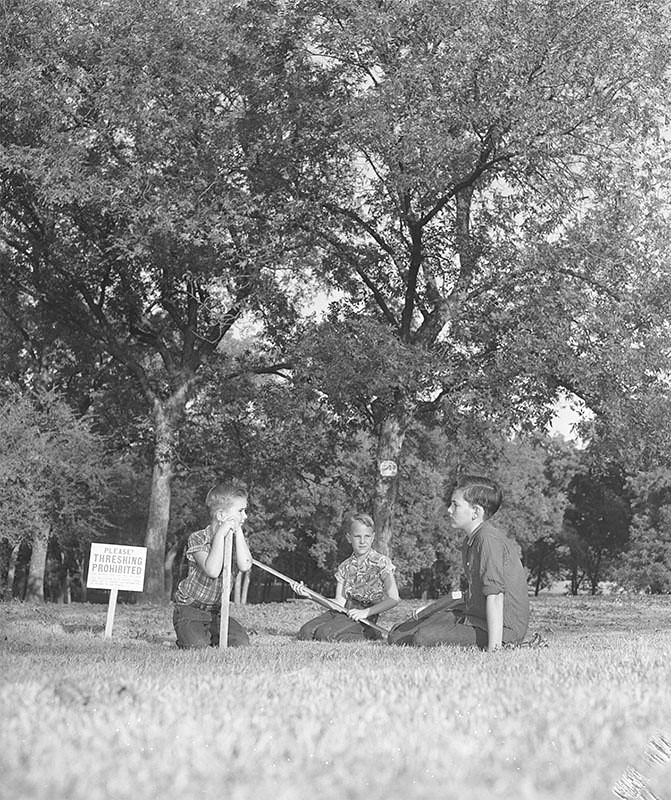
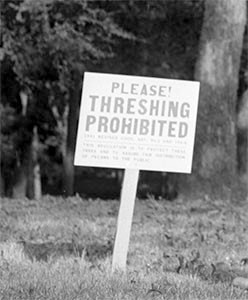
Just remember: picking up fallen pecans from the ground in a public park is okay (I think), but shaking branches or disturbing trees to make pecans fall is NOT allowed (and might also lead to a fine). Here are some boys sitting next to a sign that says “Please! Threshing Prohibited.” See those long sticks they’ve got? When that photographer leaves, they’re going to be “threshing.”
Don’t do it! Please! Hunt on the ground.
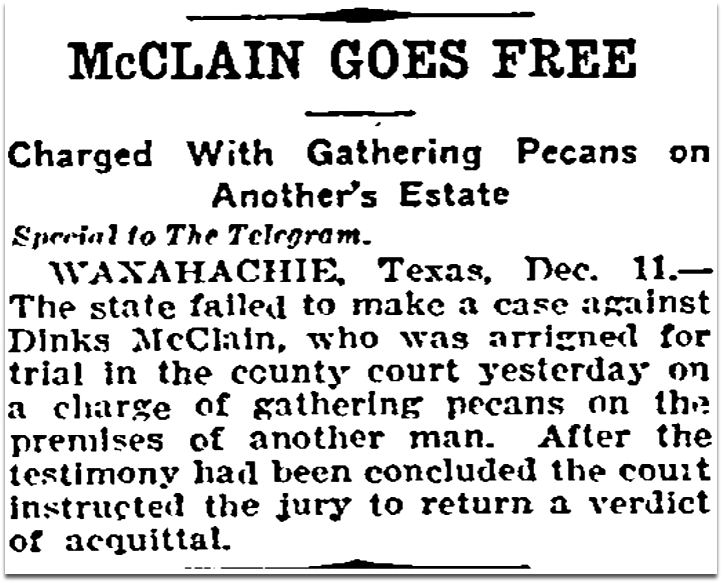
And don’t wander onto private property unless you have permission. Don’t be like Dinks McClain! He might have been acquitted, but he had to go through a lot of nut-based hassle to be a free man again!
Fort Worth Star-Telegram, Dec. 11, 1907
*
Poaching nuts from private property is not the only thing to beware of. If you browse through the Dallas Morning News and Fort Worth Star-Telegram online archives using the search term “pecan gatherers” or “gathering pecans” or “hunting pecans,” etc., you will see an absolutely eye-popping number of articles about severe injuries and death (!) suffered by people just innocently out looking for some pecans. Lots of people fell out of trees (STAY ON THE GROUND!!), lots of people were shot (in a variety of scenarios), someone drowned, I think (…interesting), and snakes were everywhere. Avoid all these things. And don’t trespass. Don’t be a Dinks McClain. Stay on the ground, stay on public land, and stay away from errant bullets and snakes.
**
Lastly, here’s a 1926 newspaper article (all sub-headlines included!) all about this vanishing tradition:
GYPSY CALL OF THE FALL WOODS HEARD BY DALLAS MOTORISTS
Autumn Leaves and Pecans on Dallas Roads Are Popular
Autumn Tang Brings Forth Many Drivers
Roads Near Dallas Are Crowded on Week-End Afternoons
Seek Fall Leaves
Decorations and Pecans Are Gathered to Take Home
Autumn has failed to chill the ardor of Dallas motorists. On the contrary, they are attracted by the briskness of a fall afternoon drive and by the flaming beauty of autumn leaves or the promise of pecans on and under wayside trees.
Now that the early nights prevent the after-dinner twilight rides of the late summer, Dallasites are saving their drives for week-end and holiday afternoons. On Saturday and especially on Sunday afternoons thousands of local motorists are driving on country roads near Dallas or through the more woodsy of the parks and city addresses to view the beauty of the changing autumn. Others go with the practical motive of finding pecans, and many of these are rewarded.
Roads Are Near
On Saturday afternoon the more popular roads leading from Dallas are crowded with automobiles. No matter in what part of Dallas the motorist lives, he can find a thoroughfare near his home, leading to woods colored by the approach of winter. White Rock Lake, South Beckley avenue, the Holmes street road, Stevens Park, Reverchon Park, Oak Lawn Park, Turtle Creek Boulevard, the Maple avenue road and the Lemmon avenue road are some of the favored drives. On them the motorist will find autumn beauty in profusion.
Many Dallas hostesses are using the gorgeously colored fall leaves as decorations. Even when the motorists are not planning to entertain at home, many take back bunches of the leaves to bring some of the fall color into living and dining-rooms.
Perhaps the most popular fall tree is the sumac, whose scarlet stands out against the darker red and the brown of other leaves. Seen from the roadside, the brilliant leaves have provided an irresistible attraction to stop and gather some to many automobilists. Ash, oak and darker leaves also make their gypsy calls from the woods.
Find Pecans
Pecans as well as decorative leaves are found in many directions from Dallas. Those motorists fortunate enough to have friends with a farm or estate along a water course are making the most of their friendships, while others are forced to rely upon finding trees on unposted land or by the roadside. Most of the pecan hunters are rewarded with enough of the nuts to crack and pick out on the ride back, though fee are able to get a supply sufficient to last through the late fall evenings by the fire.
The brisk coolness of the autumn week-end afternoon, made golden by a pleasant ineffectual sun, not only has not discouraged Dallas automobilists, but the tang of the fall has brought out many who took only short drives during the summer. (Dallas Morning News, Nov. 7, 1926)
***
Sources & Notes
The top photo was taken in November 1952 and is from the Hayes Collection, Dallas History & Archives, Dallas Public Library (PA76-1/11502.2). The description accompanying the photograph: “Hunting pecans at the north end of White Rock Lake are B. B. Rakestraw of Tyler, left, and J. T. White of 7322 Benning. The crisp Fall weather was bringing pecan meat lovers out throughout the city. High winds helped solve the problem of getting nuts.”
The second photograph was taken October 16, 1953 and is also from the Hayes Collection (PA76-1/16051.1). The description of this photo: “Tommy and Danny Wheeler waiting for pecans to fall.”
“Gathering Pecans” is a post-office mural by Otis Dozier (1941); the image reproduced here is from the collection of the Amon Carter Museum of American Art, Fort Worth, Texas — more info is here.
Watch this short film from the Amon Carter Museum on the mural’s relocation and restoration:
*
Pecan tree trivia: in an Oct. 15, 1950 DMN article (“Plenty of Pecans Await Searchers at Dallas Parks”), it is noted that, in 1950, there were approximately 20,000 pecan trees in Dallas parks — half of them were in White Rock Lake Park.
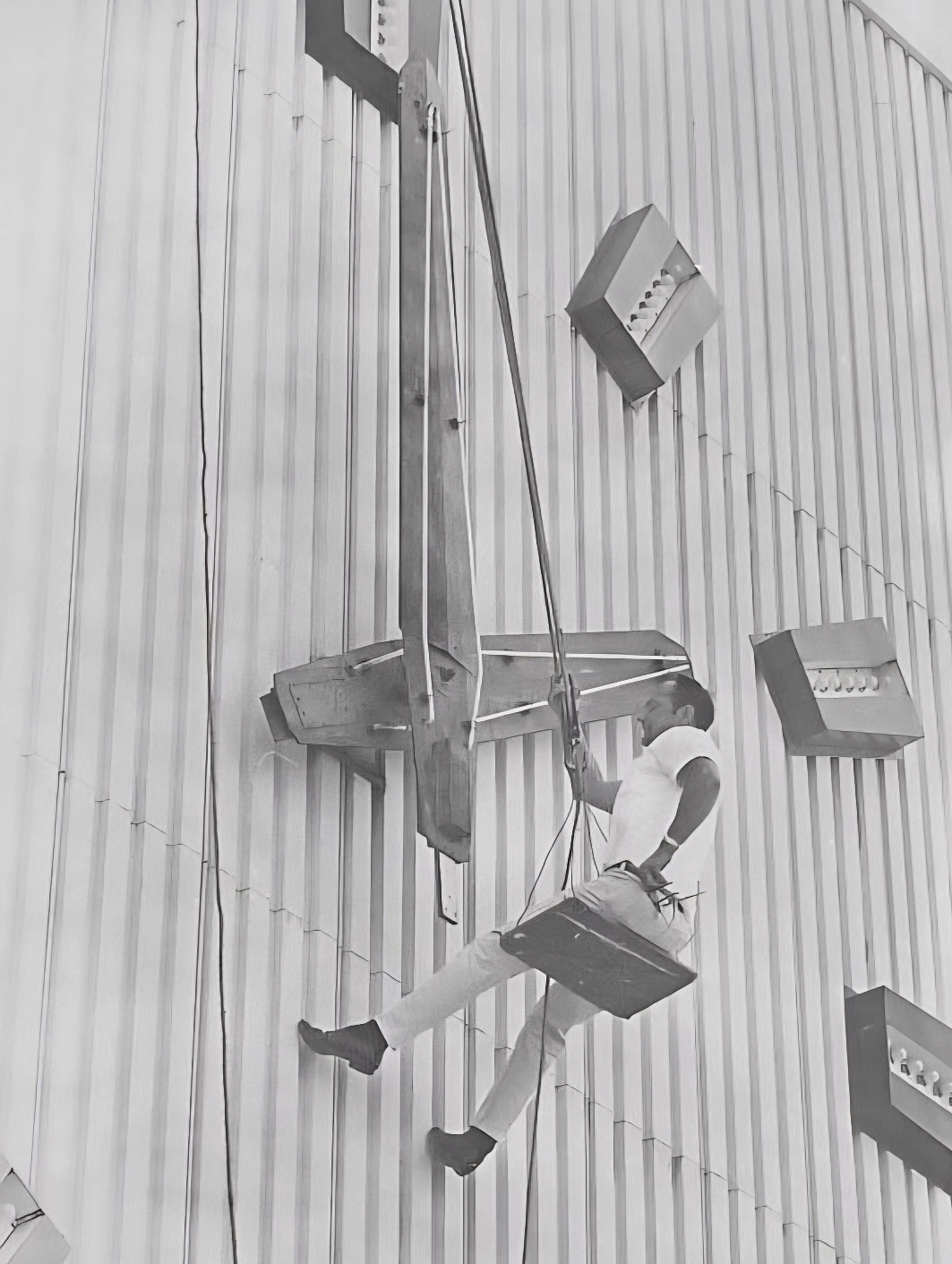
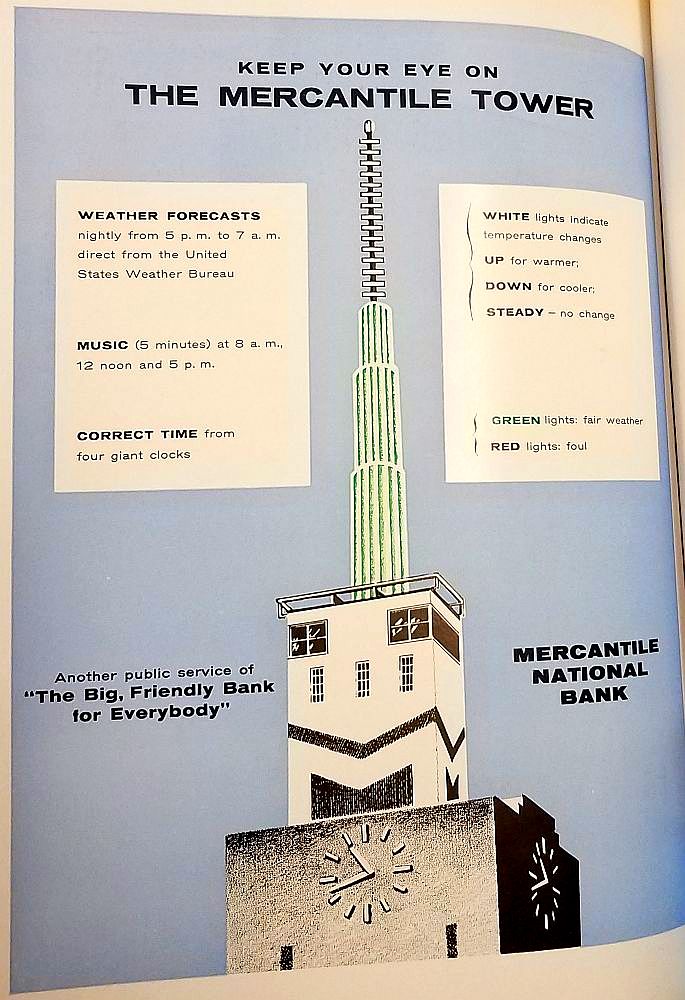
The poor Merc is having a rough time of it at the moment. Here’s a photo from happier days, when it was the Mercantile Bank Building, getting some sort of touch-up to one of its clock faces. Which, by the way, should remind you to turn your clocks back in the wee hours of Nov. 2!
That tower used to do a lot. And all four clock faces had the correct time — all at the same time!
***
Sources & Notes
Photo from the Richards Group Collection, Dallas History & Archives, Dallas Public Library (accession number PA83-3/40).
Mercantile National Bank ad from Dallas magazine, sometime in 1956:
See the Merc in all its early-days glory in these posts:
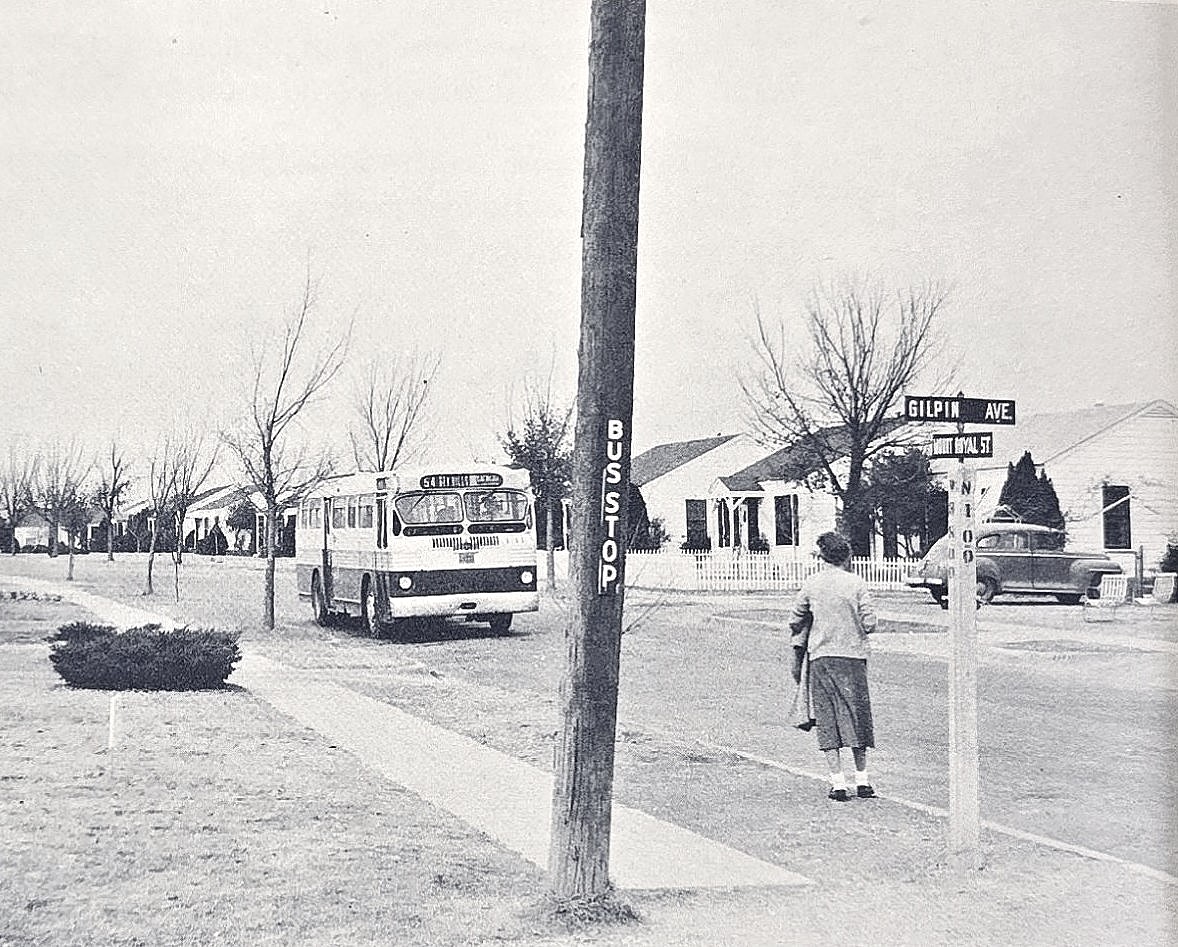
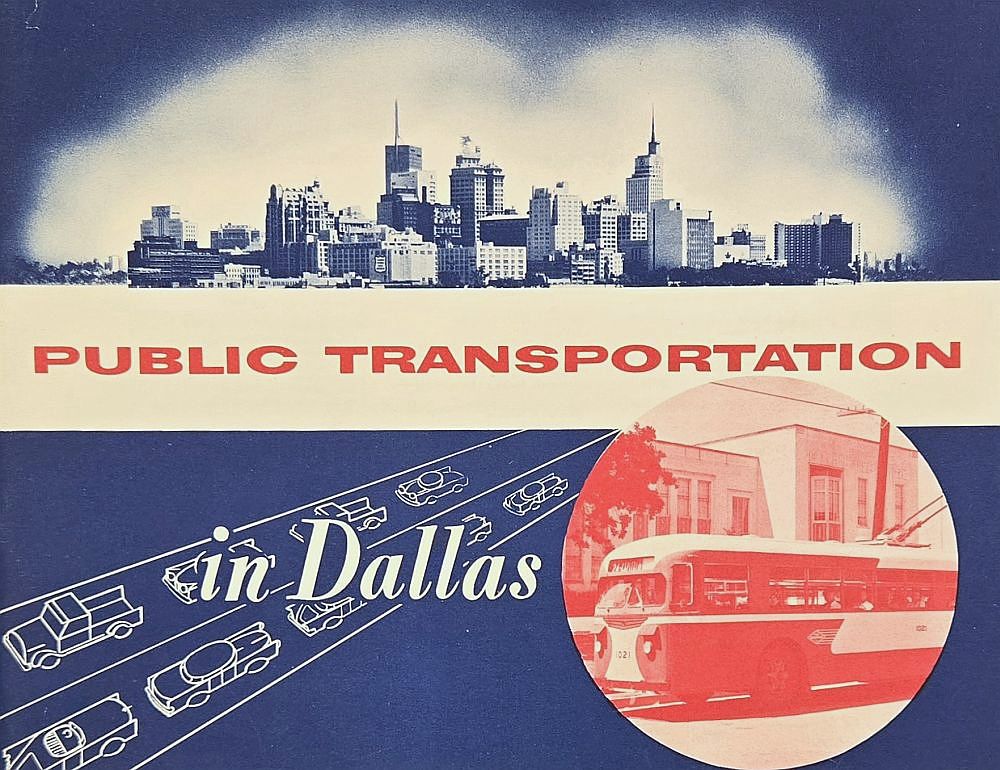
I saw this photo in a 1955 booklet called Public Transportation in Dallas and loved the neat-as-a-pin Oak Cliff street, its manicured, chilly starkness accentuated by the leafless trees. It’s also a needed reminder — as we’re dragged into August — that someday we’ll (probably) have autumn and winter again.
See what this view looks like today, on Google Street View, here.
***
Sources & Notes
Photo from and cover of the slim booklet Public Transportation in Dallas (1955), Dallas History and Archives, Dallas Public Library.
4500 block and/or 5800 block of Lovers and/or W. Lovers Lane
by Paula Bosse
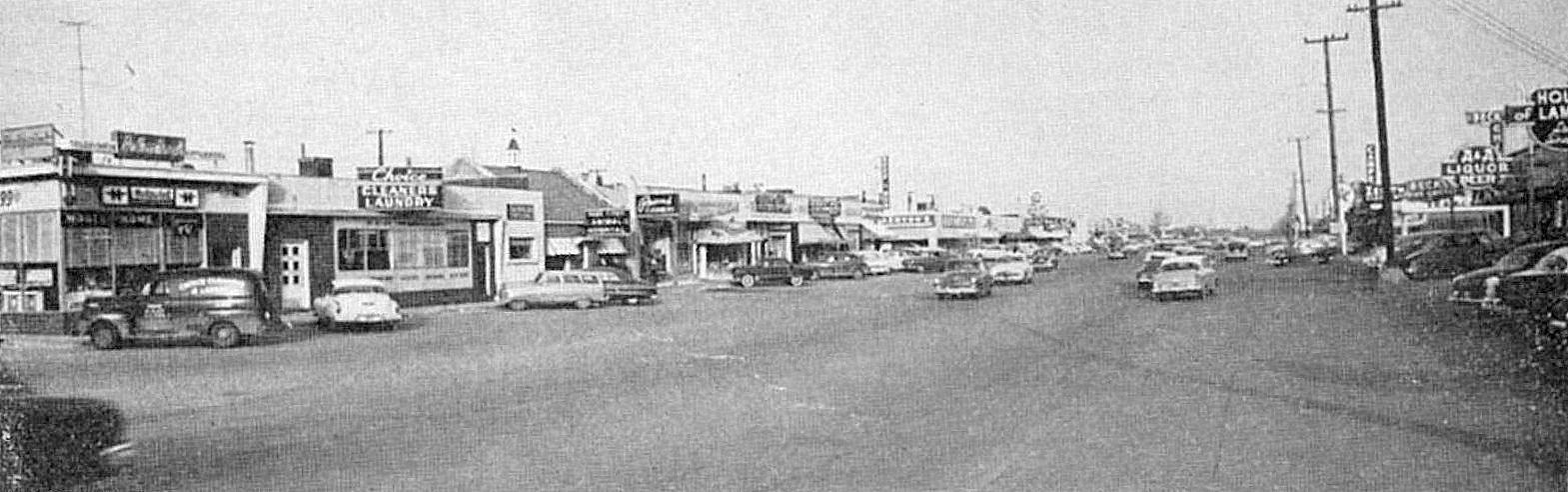
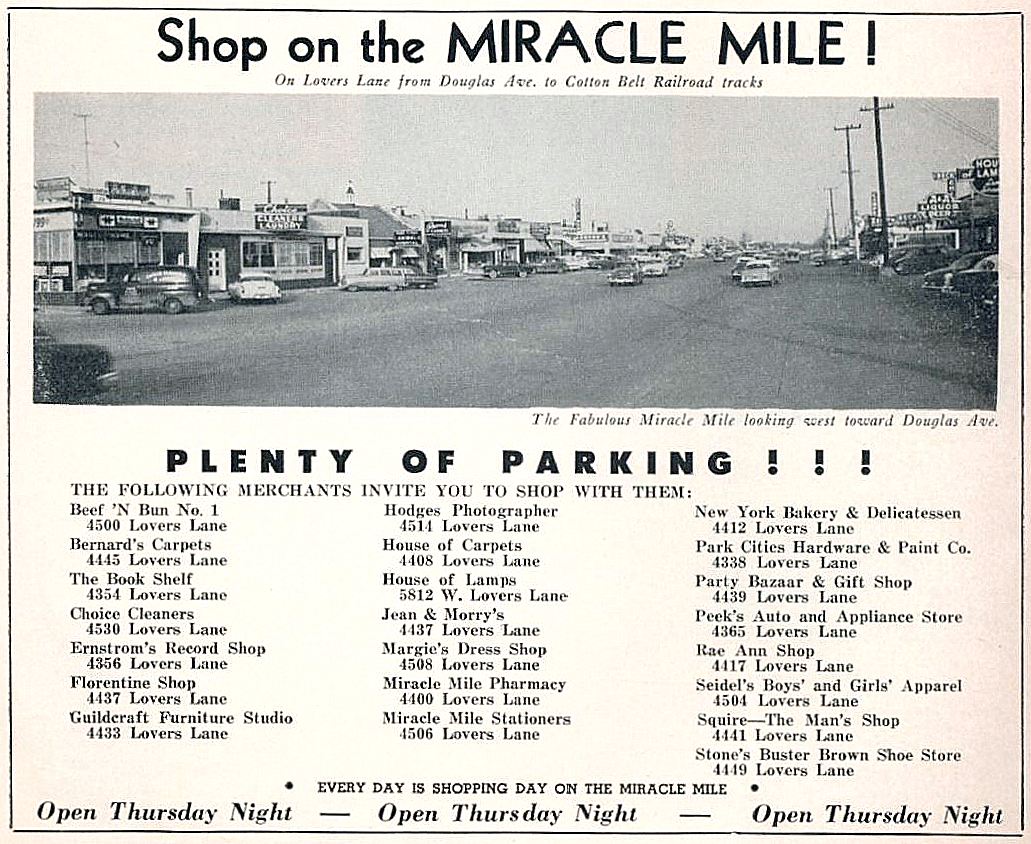
The photo above is a detail from an ad for some of the businesses along the Miracle Mile (Lovers Lane, between about Douglas and what is now the toll road). The caption is: “The fabulous Miracle Mile looking west toward Douglas Ave.” (Surely this is a view to the east?) The same view today can be seen on Google Street View here. The ad appeared in a March 1954 magazine. At that time, the photographer would have been standing in front of Roscoe White’s Easy Way restaurant (5806 W. Lovers Lane). Here’s the ad (click to see a larger image):
*
Shop on the MIRACLE MILE! On Lovers Lane from Douglas Ave. to Cotton Belt Railroad tracks PLENTY OF PARKING!!! The following merchants invite you to shop with them:
Beef ‘N Bun No. 1, 4500 Lovers Lane Bernard’s Carpets, 4445 Lovers Lane The Book Shelf, 4354 Lovers Lane Choice Cleaners, 4530 Lovers Lane Ernstrom’s Record Shop, 4356 Lovers Lane Florentine Shop, 4437 Lovers Lane Guildcraft Furniture Studio, 4433 Lovers Lane Hodges Photographer, 4514 Lovers Lane House of Carpets, 4408 Lovers Lane House of Lamps, 5812 W. Lovers Lane Jean & Morry’s, 4437 Lovers Lane Margie’s Dress Shop, 4508 Lovers Lane Miracle Mile Pharmacy, 4400 Lovers Lane Miracle Mile Stationers, 4506 Lovers Lane New York Bakery & Delicatessen, 4412 Lovers Lane Park Cities Hardware & Paint Co., 4338 Lovers Lane Party Bazaar & Gift Shop, 4439 Lovers Lane Peek’s Auto and Appliance Store, 4365 Lovers Lane Rae Ann Shop, 4417 Lovers Lane Seidel’s Boys’ and Girls’ Apparel, 4504 Lovers Lane Squire — The Man’s Shop, 4441 Lovers Lane Stone’s Buster Brown Shoe Store, 4449 Lovers Lane
Every day is shopping day on the Miracle Mile Open Thursday night — open Thursday night — open Thursday night
**
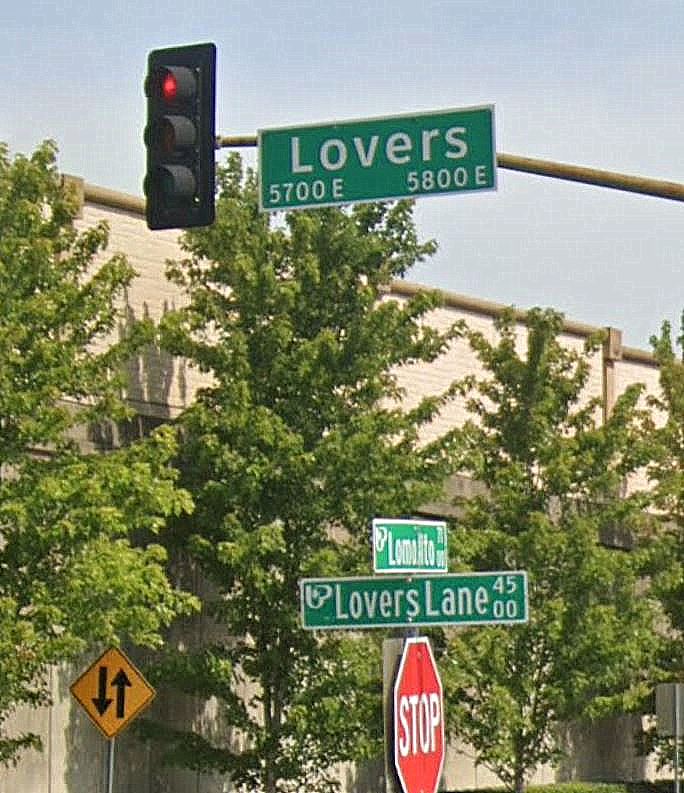
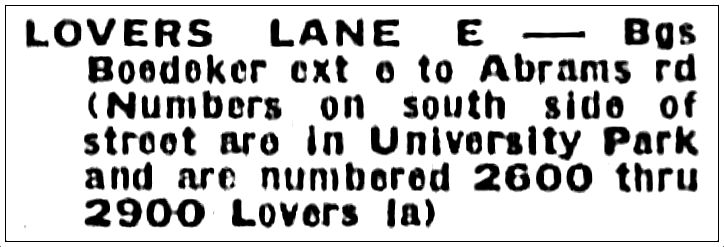
So. Lovers Lane. What’s the deal, Lovers? Your numbering system is insane. For instance, in the photo above, Choice Cleaners (second business on the left) is at 4530 Lovers Lane. It is directly opposite House of Lamps, which is, inexplicably, at 5812 West Lovers Lane. Not only are the block numbers nowhere near the same, the numbers of addresses on both sides of the street are even. There are businesses on both sides of the street, but that block has no odd-numbered addresses. …But only until you pass Beck’s Fried Chicken at 5820 West Lovers (you can see it on the photo at the far right, next door to AAA Liquor at 5814 W. Lovers Lane). Once you cross Lomo Alto, heading east, the numbering suddenly starts at 4455 Lovers Lane (Brady’s Texaco Service Station). West Lovers Lane is no more. You’ve just lost West Lovers Lane and 14 blocks. You might be in the Twilight Zone. I’m pretty sure the whole University Park-thing is the reason, but, oh my god. My brain melts down every time I try to make sense of this! Imagine not knowing your way around this part of town and seeing this confusing collection of signs after getting off the toll road:
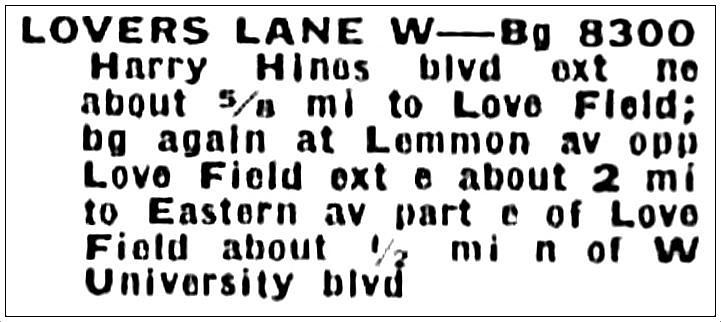
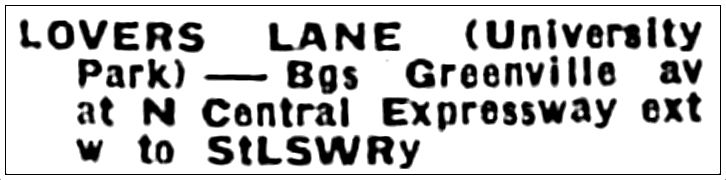
For future reference, here is some even more confusing guidance, from the 1953 city directory. “WEST LOVERS LANE”:
PLAIN OL’ “LOVERS LANE”:
“EAST LOVERS LANE”:
Good luck keeping track of that. There will be a quiz. You might need a slide rule, a compass, and a bottle of aspirin.
***
Sources & Notes
Ad is from the March 1954 issue of Town North magazine, a publication by and for super-boosters of the Park-Cities-and-Preston-Hollow area, which they were trying to get people to call “Town North.” It makes about as much sense as Lovers Lane’s numbering system, but it’s a cool magazine that lasted a few years and can be found in the Periodicals Collection of the Dallas History and Archives at the Dallas Public Library.
More on The Miracle Mile (with a handy map, if you’ve ever wondered what its “official” boundaries are) can be found in this Flashback Dallas post: “Stacy’s Lounge on The Miracle Mile — 1950.”
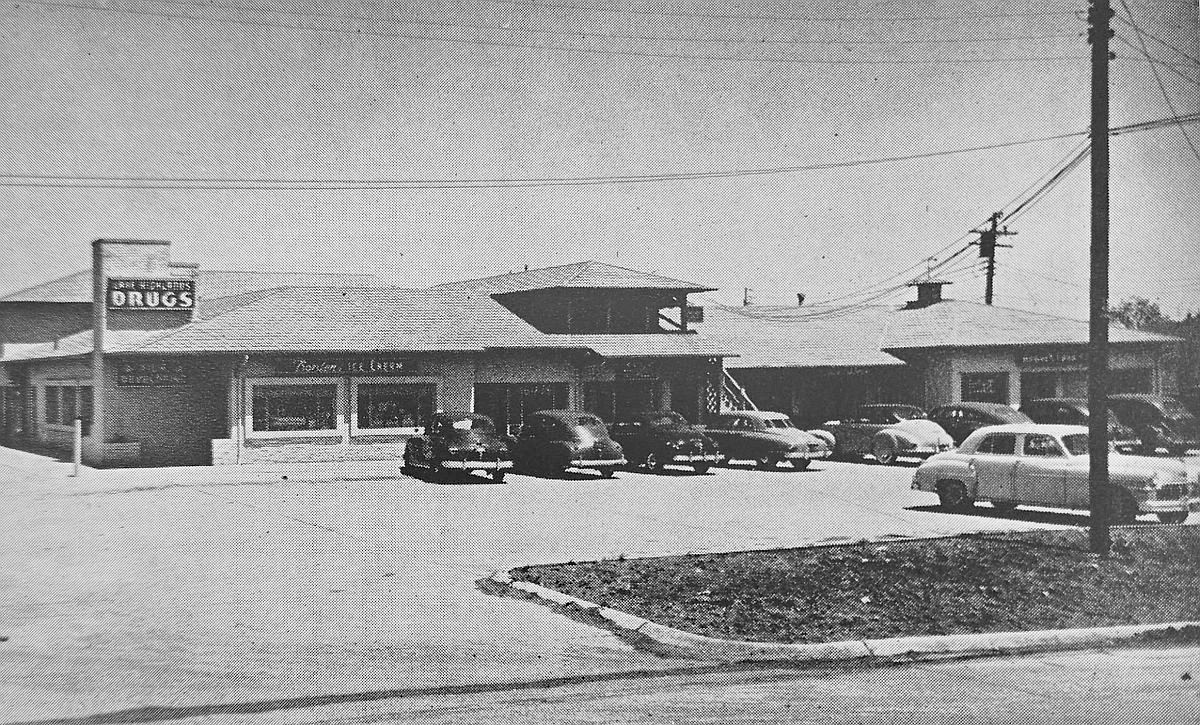
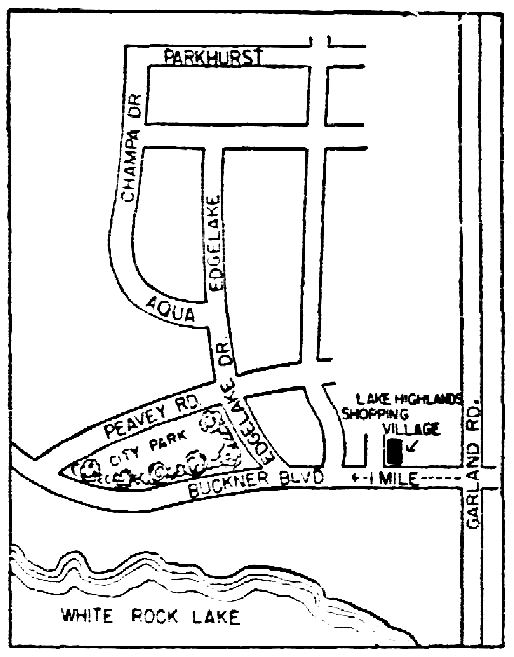
This is an interesting photo from an ad for J. M. Tuttle Jr. Real Estate/Tuttle Development Company. Jack Tuttle was one of the most prominent developers of Lake Highlands, near White Rock Lake, east of Buckner Blvd. Tuttle began buying land in this far-flung, undeveloped area around 1939 and eventually owned pretty much everything in the area, including Lake Highlands Village, a shopping area a mere stone’s throw from White Rock Lake and not far from Casa Linda. The map below (from another Tuttle ad) shows where much of Tuttle’s property was at the time, including LHV, which was (and still is) at 720 N. Buckner Blvd. It looks a lot different now, but it’s interesting to see how it started out.
Here is the text that accompanied the photo in the ad from 1951:
Lake Highlands Village
Distinctively individual design plus surrounding natural beauty makes the Lake Highlands Estates an ideal homesite for the discriminating home-owner. And you will like the convenience of your own shopping center in the Lake Highlands Village, just minutes from downtown Dallas and seconds from cool White Rock Lake.
1952
***
Sources & Notes
Photo and map are from ads that appeared in Dallas magazine in Feb. 1951 and Feb. 1952.
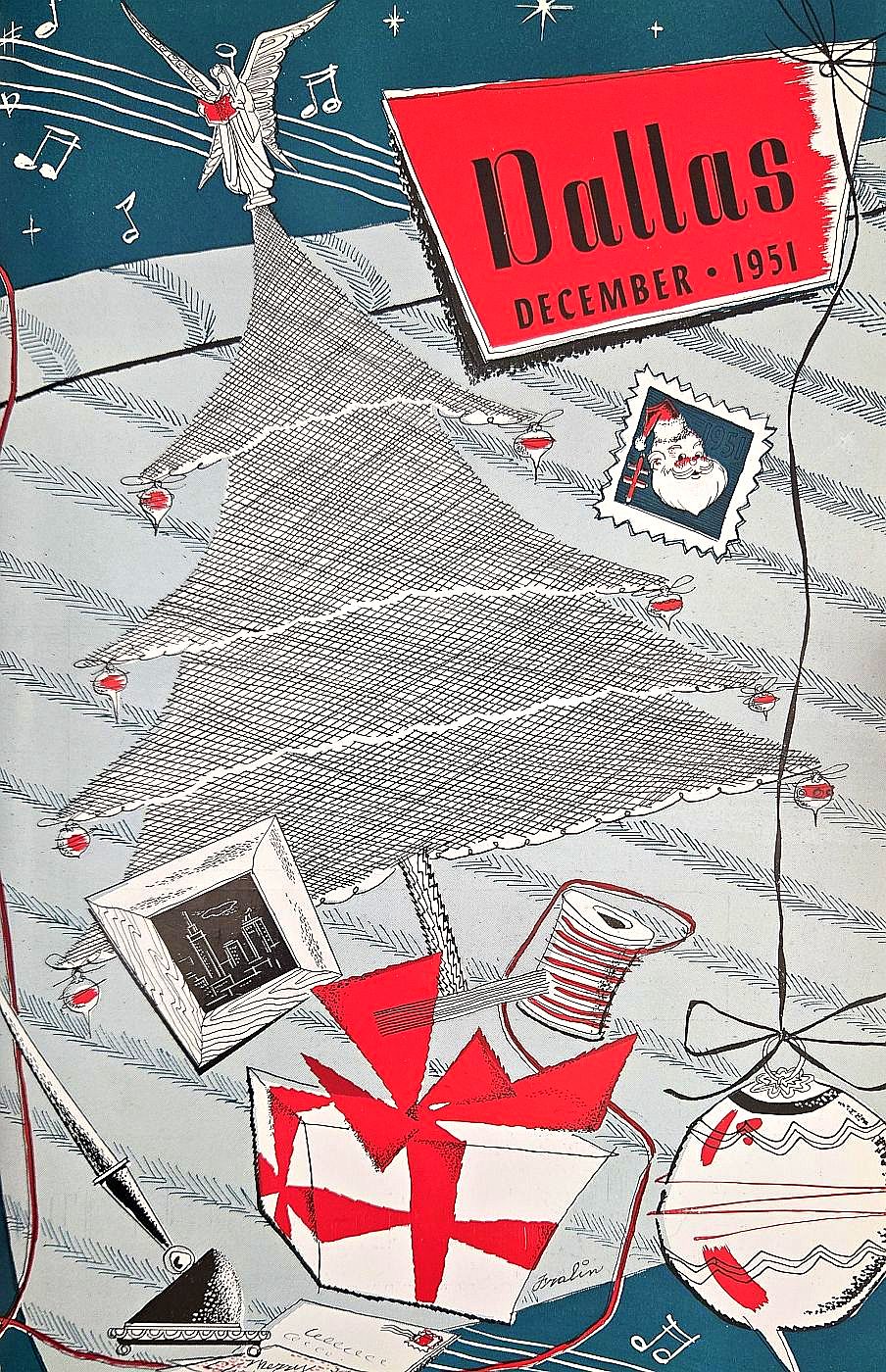
The holidays are here again. Thank you so much for sticking with me this year — it’s been a rough one, and my posting schedule has suffered, but I want to wish all of you who continue to check in here regularly a very Merry Christmas, a Happy Hanukkah, and/or just a lovely day to spend with your favorite people, pets, and pies.
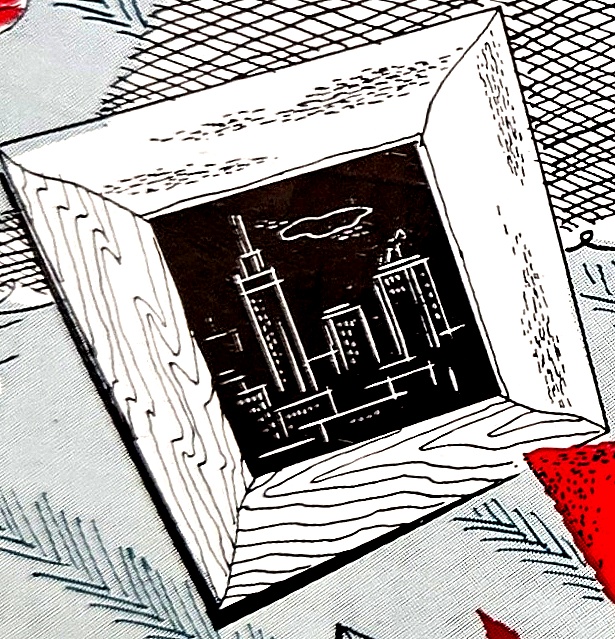
I really like this cover for the Christmas edition of Dallas magazine, a publication of the Dallas Chamber of Commerce. The cover is by Dallas commercial artist Virgil Fralin. He’s even included a little portrait of the skyline (with a rather gigantic Pegasus perched atop the Magnolia Building!).
***
Sources & Notes
Cover of the December 1951 issue of Dallas magazine by Virgil Fralin, from the Periodicals Collection, Dallas History and Archives, Dallas Public Library.
See previous Flashback Dallas Christmas posts here (there’s some good stuff there, if I do say so myself!).
Waiting for the fun to start… (photo: Dallas Public Library)
by Paula Bosse
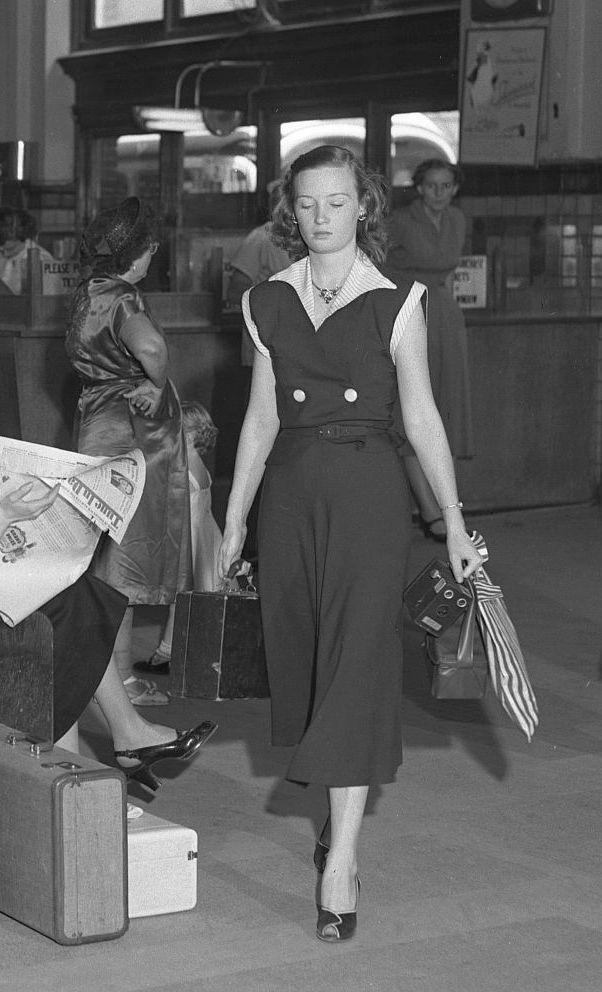
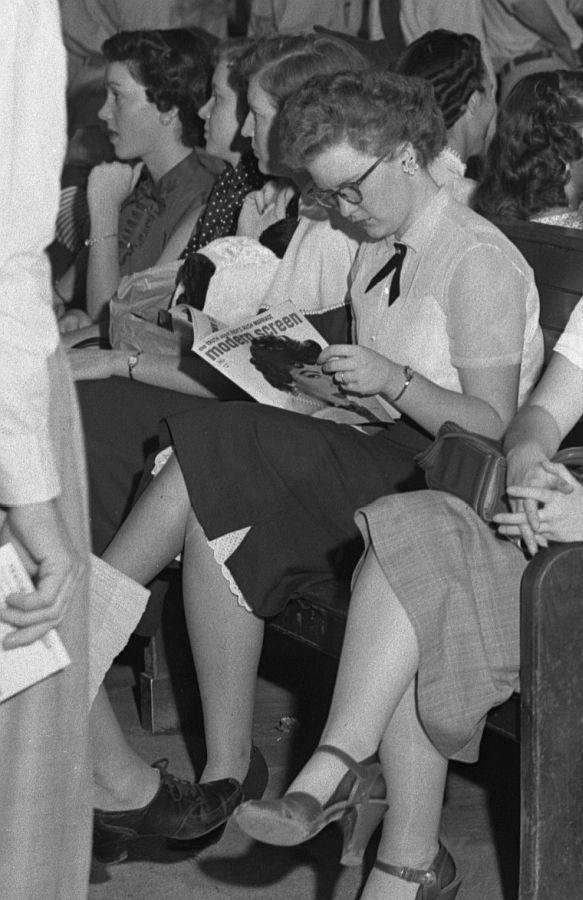
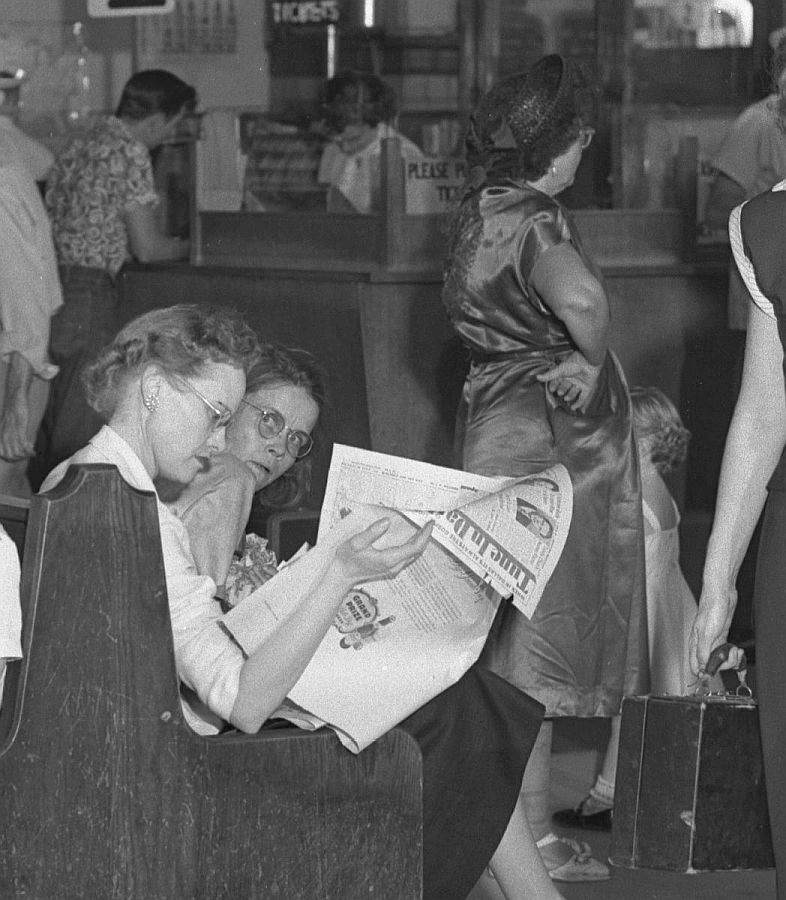
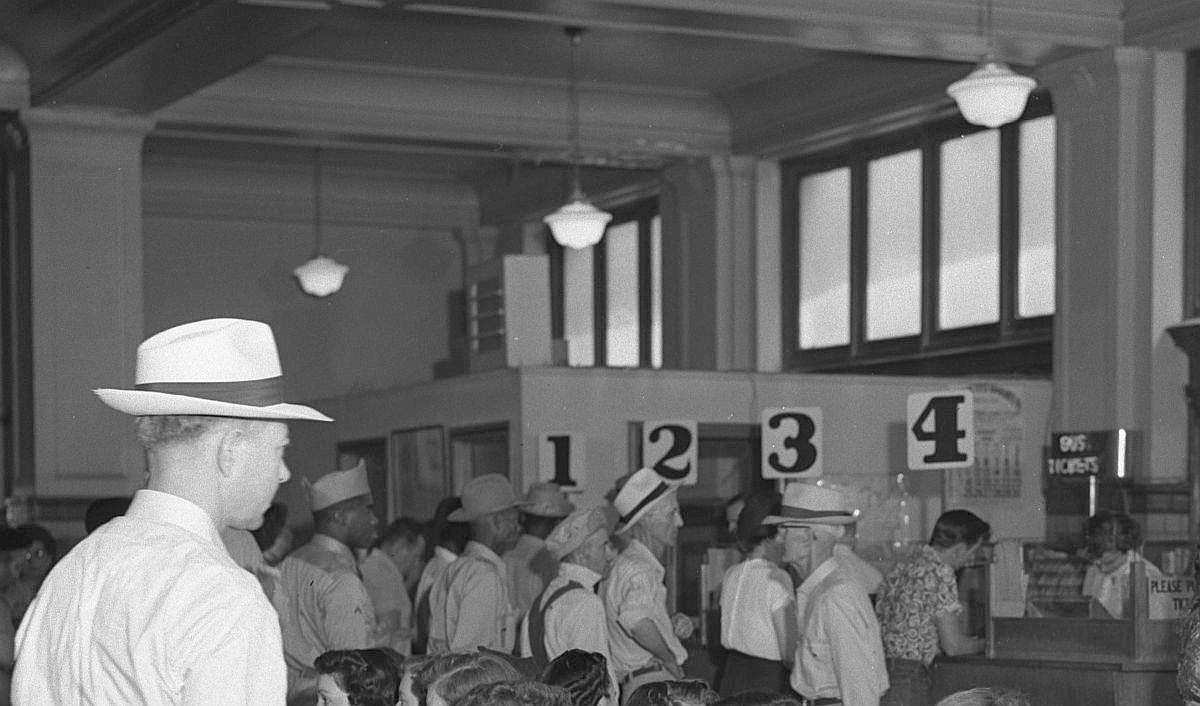
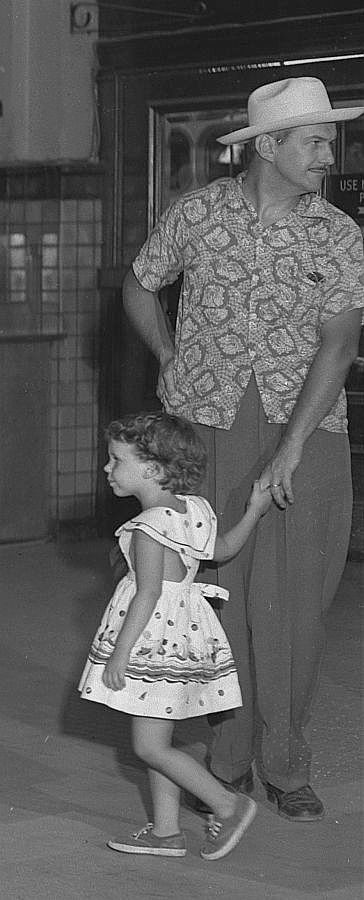
Happy Labor Day! Back in 2020 I wrote a post called “Labor Day Weekend, Union Bus Depot — 1952.” I really enjoyed writing that one, and I loved the main photo in it. It turns out that the photo I’m using in this post was taken only a couple of minutes before the one I used four years ago. I discovered this photo a few weeks ago and have been waiting for Labor Day to roll around. Which it has now done.
On August 31, 1952, Dallas photographer Denny Hayes took several photos of travelers waiting to be whisked away to someplace else. (With luck, someplace cooler.) These photos were taken at the Union Bus Depot in the Interurban Building. Let’s zoom in on this great people-packed photo.
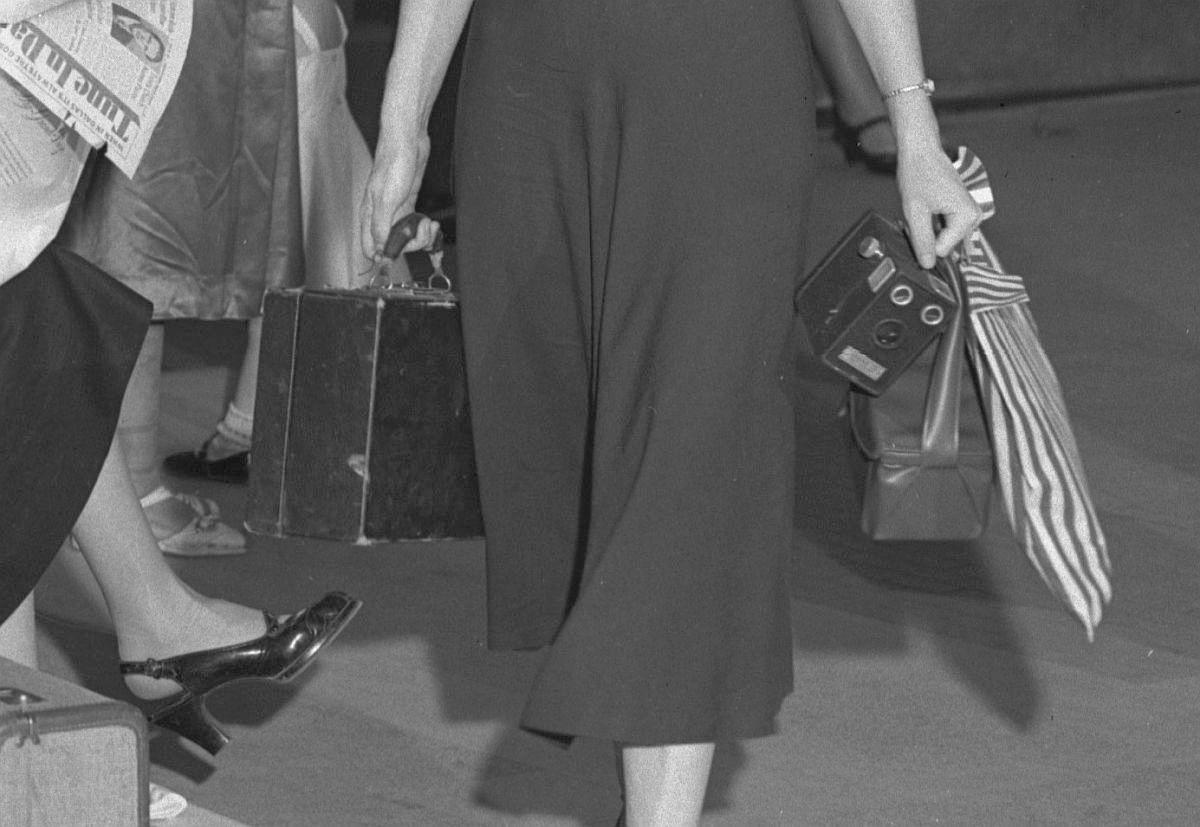
Everyone and everything pales in comparison to the young woman walking toward the camera. In her left hand she holds a box camera. She’s ready to take fun photos, if she ever gets out of that station.
(If the man above looked any more like Harvey Korman, he’d be Harvey Korman.)
*
If you have the day off, I hope you enjoy it. And if you’re traveling somewhere, I hope you get there quickly!
***
Sources & Notes
Photo by Denny Hayes, from the Hayes Collection, Dallas Public Library, Dallas History and Archives; Call Number: PA76-1/11420-002.
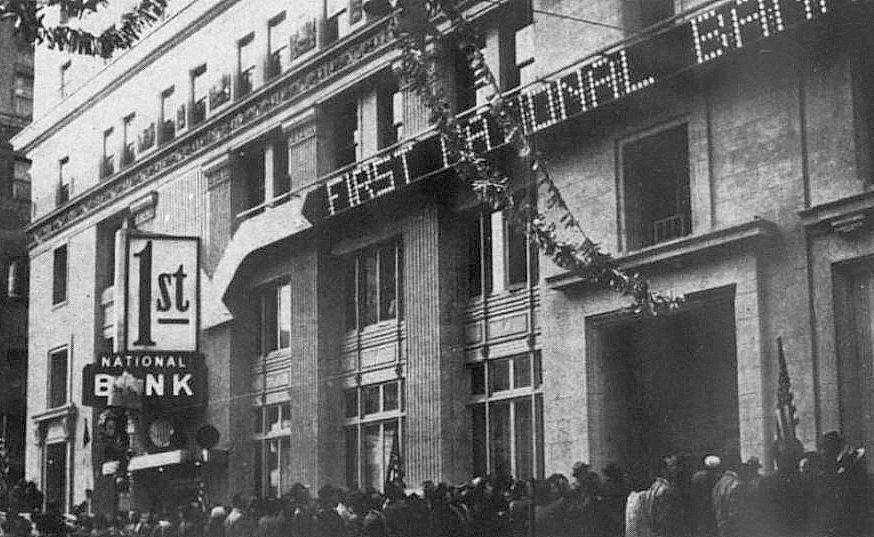
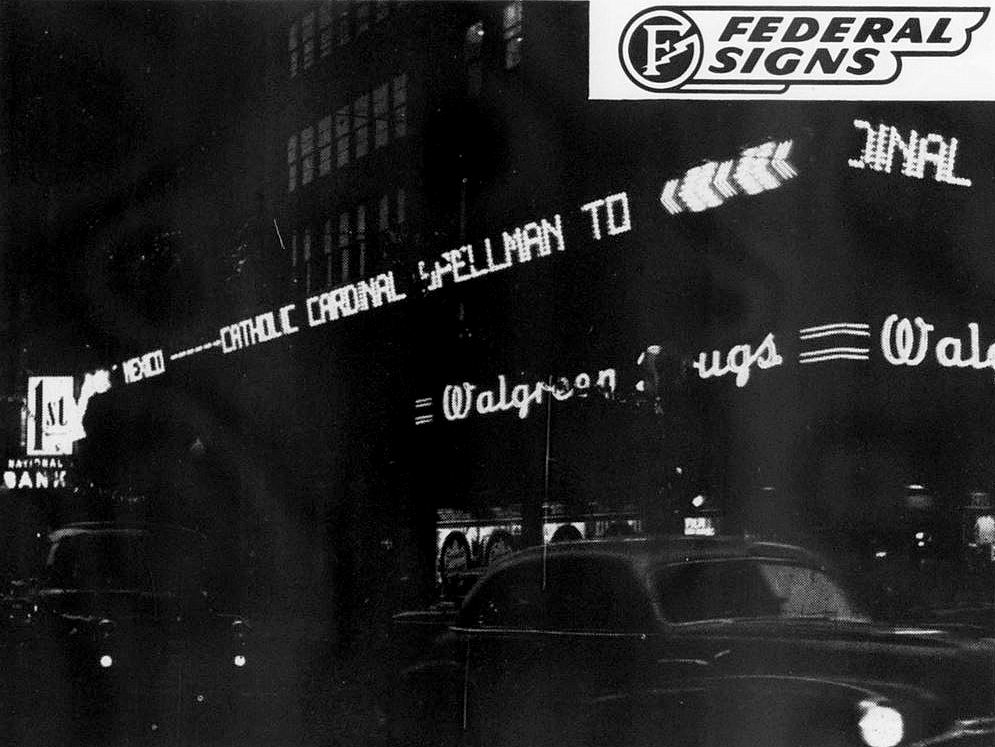
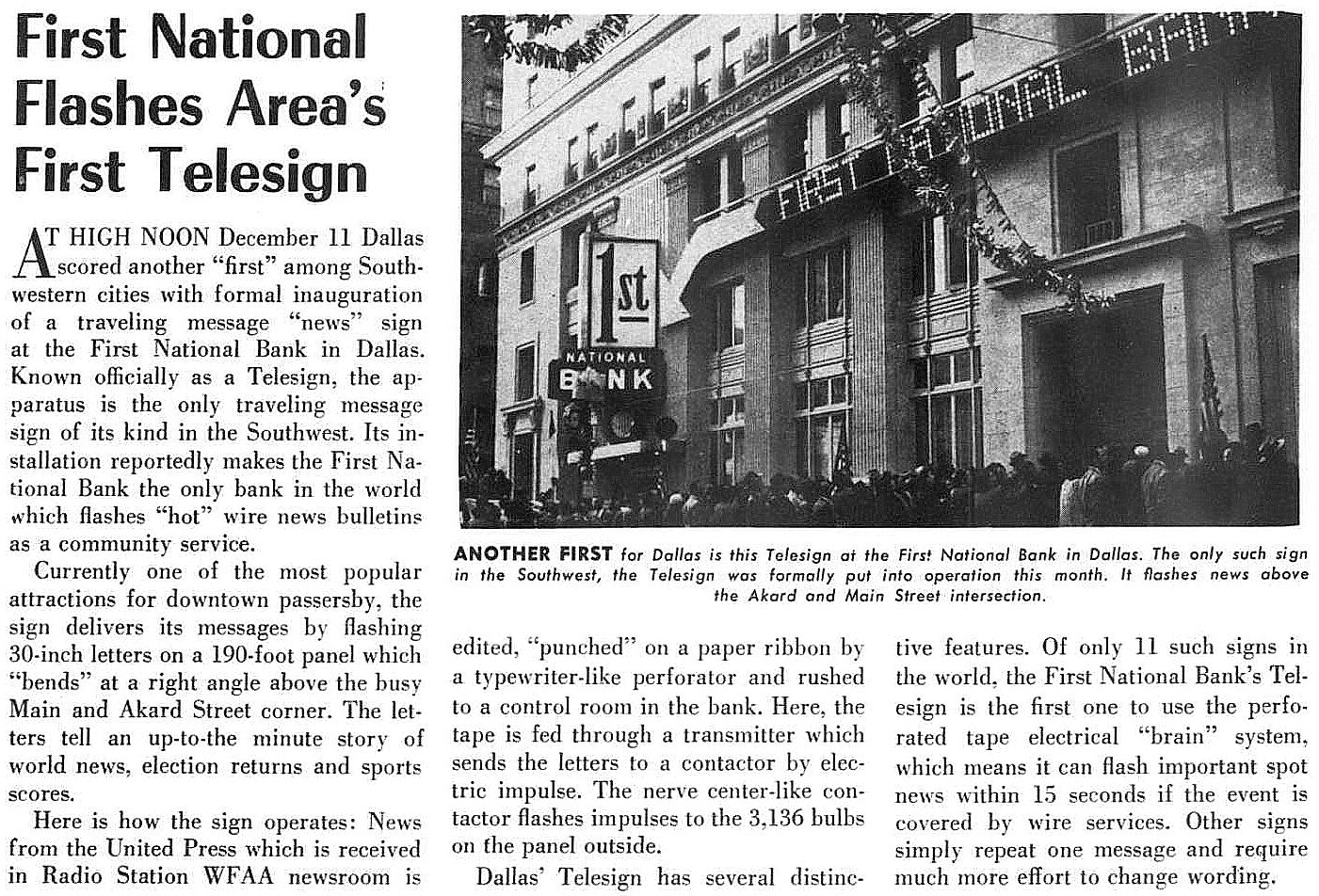
Once upon a time, downtown Dallas had one of those moving “tickertape” electronic news message signs. It debuted on the exterior of the First National Bank (and part of an adjacent building) at Main and Akard on December 11, 1951. It was Dallas’ version of the famous New York Timesnews-ticker-bulletin sign (“the Zipper”) in Times Square. The sign was comprised of 3,136 light bulbs; the crawling, flashing letters were 30 inches high, and the sign stretched 190 feet, with the moving message bending around the bank building. The “hot news” could be really “hot” — like only minutes old, unlike the NYT sign, which could take hours to get a constantly repeating message up and running. The sign flashed the news to downtown passersby from 7:30 AM until 10:30 PM.
This “traveling-message” sign was the creation of Irving Naxon, of the Naxon Telesign Corporation of Chicago. (Naxon, a prolific inventor, is perhaps best known as the man who introduced the Crock Pot slow cooker to the world.) See the 1929 patent application for his “traveling-message sign” here.
How did it work? Briefly, United Press wire copy received in the WFAA newsroom was punched onto a paper ribbon and then fed into a transmitter. Theoretically, a hot-off-the-wire newsflash could be racing across the Main Street sign in the amount of time it would take to type the message — seconds. (Read more about it the article at the bottom of this post.)
There is silent footage from December 1951 of the Telesign in action, with shots of inventor Irving Naxon demonstrating how his system works: see the WBAP-TV footage on the Portal to Texas History website here. (The accompanying news script is here.)
I don’t know how long this sign was operational, but I have a feeling it wasn’t very long — but at least through 1953. Imagine how frequently those 3,000 light bulbs burned out and had to be replaced! I had never heard of this sign — or seen photos of it — so this was a very interesting little discovery.
**
Dallas magazine, Dec. 1951
A 1953 ad for Federal Signs:
Dallas magazine, Jan. 1953
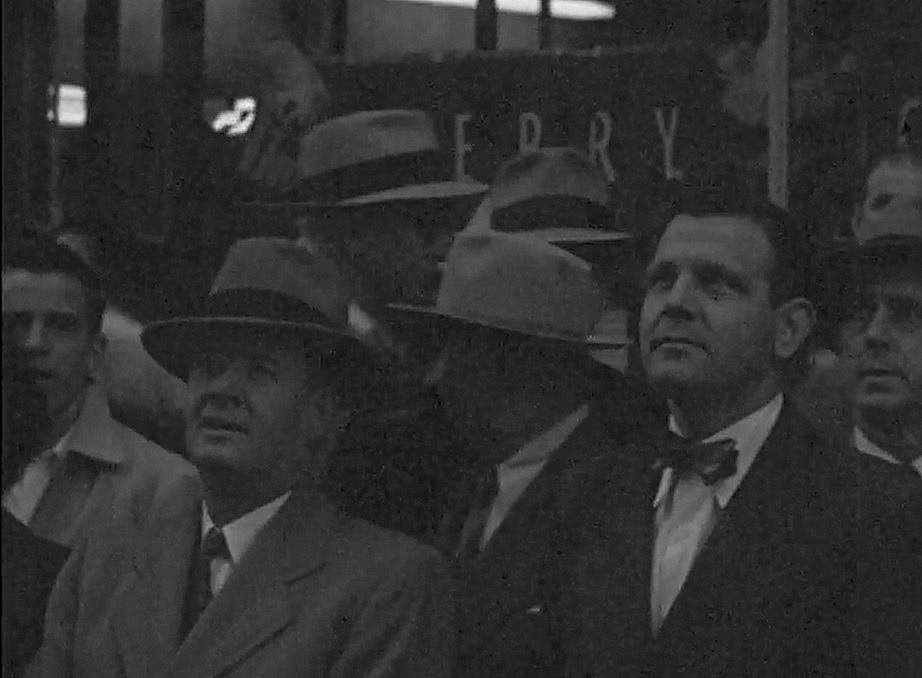
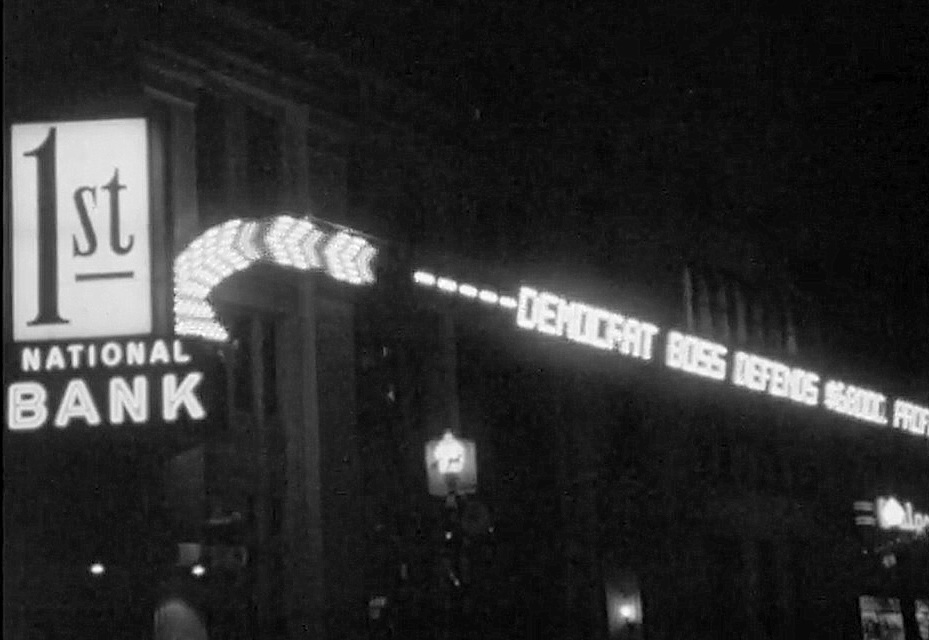
A couple of screenshots of the sign in action from a Channel 5 news clip (Dec. 12, 1951, Portal to Texas History). The first shows men in hats checking out the new sign as darkness falls:
And here’s what they were looking at:
UNT Libraries Special Collections
How it worked (click for larger image):
Dallas magazine, Dec. 1951
**
Excerpts from a couple of trade magazine articles:
The First National Bank in Dallas, Dallas, Texas has recently installed this telesign containing 3,136 individually controlled bulbs which form letters corresponding to those punched on tape as it is fed through a cigar-box size transmitter. Following formal dedication ceremonies, the sign flashed its first message: “UNCENSORED NEWS IS THE BASIS OF FREEDOM.”
The Telesign is operated continuously from 7:30 A.M. to 10:30 P.M., bringing to the people of Dallas, as a public service, news bulletins highlighting the latest developments in the big stories of the day, local, national and international. (Bankers Monthly, Feb. 1952)
*
Bank Installs Telesign: The first fast-moving line of words — “UNCENSORED NEWS IS THE BASIS OF FREEDOM: — chasing each other across First National Bank of Dallas’ new sign, echoed the dedicatory statement of President Ben H. Wooten. The telesign is operated as a community service to give downtown crowds a constant flow of news reports. Second in length only to that of the New York Times, it is believed to be the first ever installed by a bank. (Trusts and Estates, March 1953)
***
Sources & Notes
Top photo is from Bankers Monthly, Feb. 1952.
More about this can be found in the following article from the Dallas Morning News archives: “Bank Unveils Its New Telesign, Latest Word in News-Flashing” (DMN, Dec. 12, 1951).









 Flashback : Dallas