Flashback : Dallas

A Miscellany: History, Ads, Pop Culture

Category: 1950s

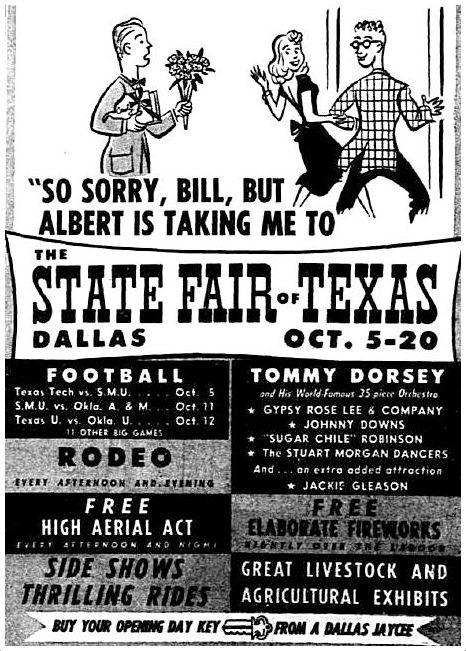
“So Sorry, Bill, But Albert is Taking Me to The State Fair of Texas”

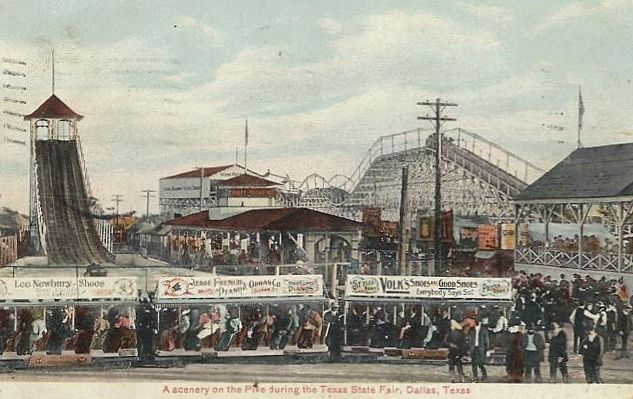
state-fair_1909_flickr“The Pike” — 1909

by Paula Bosse

Hey, y’all — guess what ends this weekend? Hurry!

One doesn’t really need an excuse to post a bunch of photos of the Great State Fair of Texas, but it IS the closing weekend, so why not enjoy a few images from the past few decades.

Above, a view of the Midway in 1909 (then called “The Pike”), with the Log Ride-like “Chute” and its ramp, a roller coaster, and a loaded tram festooned with shoe ads (including one for Volk’s).

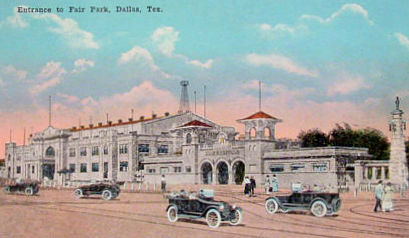
Below, the Fair Park entrance in 1919:

fair-park-entrance_1919

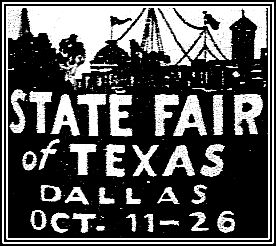
A nice little newspaper ad from 1924:

state-fair_092724

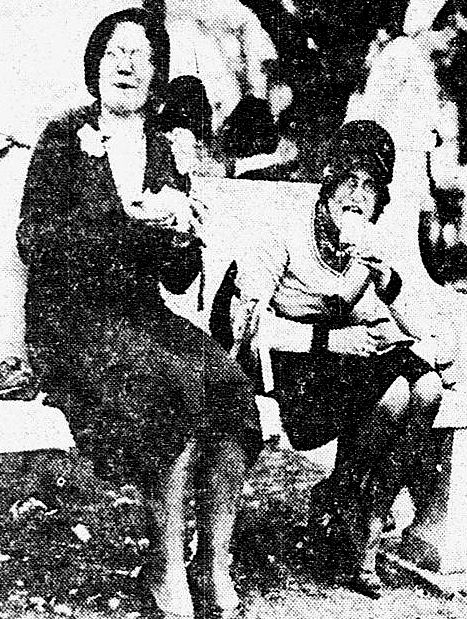
Two women enjoying ice cream in 1930 — State Fair food has always been one of the main joys of visiting the fair.

state-fair_dmn_101530

Ad from 1946: “So sorry, Bill, but Albert is taking me to the State Fair of Texas.” The grown-up entertainment that year was provided by Tommy Dorsey, Gypsy Rose Lee, and Jackie Gleason.

state-fair_dmn_092446

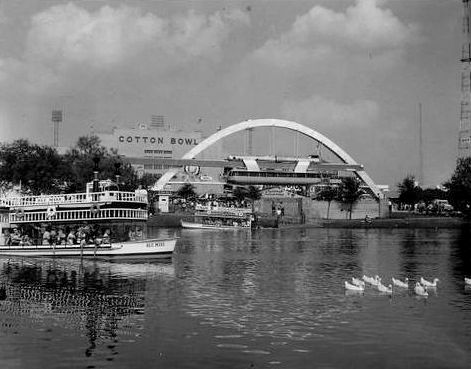
In 1958, Fair Park had a monorail (the only one then operating in the United States) and a paddle-wheeler in the lagoon:

state-fair_lagoon_squire-haskins_dmn-1958

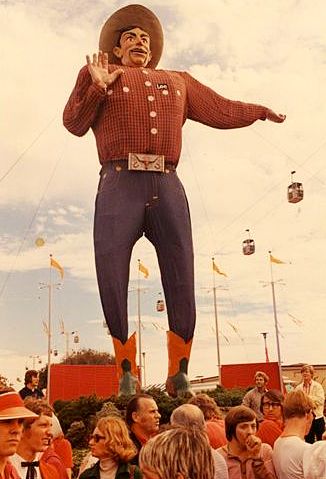
And then there’s this guy, who spans the decades:

big-tex_briscoe-center

***

Sources & Notes

1958 photo featuring the monorail by Squire Haskins, from a Dallas Morning News online article featuring TONS of cool photos of the fair over the years, here.

Big Tex photo (undated) from the Dolph Briscoe Center for American History.

Another post of random images of the SFOT through the decades — “The Fair Is In the Air — Let’s Go!” — is here.

*

Copyright © 2014 Paula Bosse. All Rights Reserved.


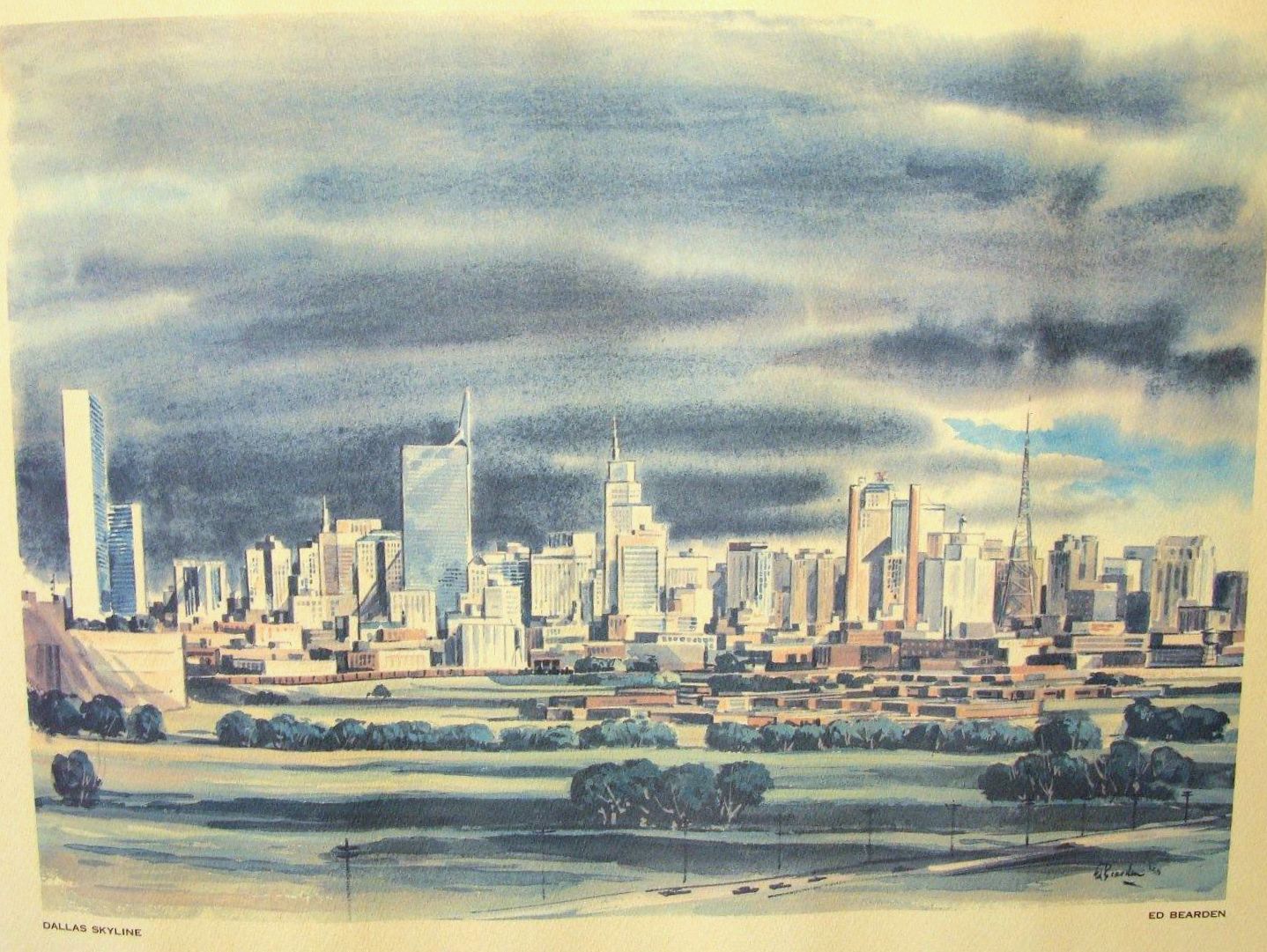
“Dallas Skyline” by Ed Bearden — 1958

dallas-skyline_ed-bearden“Dallas Skyline” by Ed Bearden (click for much larger image)

by Paula Bosse

Ed Bearden (1919-1980) was a Dallas painter who studied under Jerry Bywaters and Otis Dozier and was loosely affiliated with the Dallas Nine group of artists. He worked with Bywaters at the Dallas Museum of Fine Art as Assistant Director, and he helped found the Dallas Museum for Contemporary Arts. He also spent several years at SMU — both as a student and as a member of the faculty — until he decided to leave to focus on his own art career. In addition to working as a fine artist, he also owned a commercial art business.

The constantly changing Dallas skyline was a particular favorite subject of his, and he returned to it again and again. The one above is a personal favorite. I’m not sure why I feel so nostalgic when I look at it, except that I swear that I saw this print as a child at my father’s bookstore. It’s a Dallas I’ve never known, but one I wish I had.

***

Apologies for the wonky image, but I can’t find a better scan of it. I’m assuming this was first a watercolor, then issued as a lithograph, then maybe printed as a broadside or a loose plate in a book? The date in the lower right corner is very difficult to make out — it looks like either 1958 or 1959. I’m going with 1958. ‘Cause I’m like that.

A brief biography of Ed Bearden can be found here.

An unlikely gig came Bearden’s way when director George Stevens asked him to draw the storyboards for the film Giant, hoping that having a Texas artist do them would lend an air of authenticity to the look and feel of the movie (and, in fact, Bearden’s sketches were used as reference by makeup and wardrobe personnel). Read more about this interesting assignment on SMU’s Hamon Arts Library site, and see some of Bearden’s sketches from the set in Marfa, here.

*

Copyright © 2014 Paula Bosse. All Rights Reserved.

Whither Water? — 1956

drought_caterpillar-ad_1962_det“Dallas — The City That Decided Not To Die of Thirst”

by Paula Bosse

Between 1950 and 1957, Texas suffered the worst drought on record. By 1957, 244 of Texas’ 254 counties had been declared disaster areas. In 1952, Lubbock recorded not even a trace of rain. Elmer Kelton captured the period perfectly in his classic novel, The Time It Never Rained. It might not have achieved the epic catastrophic proportions of the Dust Bowl days, but that doesn’t mean it wasn’t devastating.

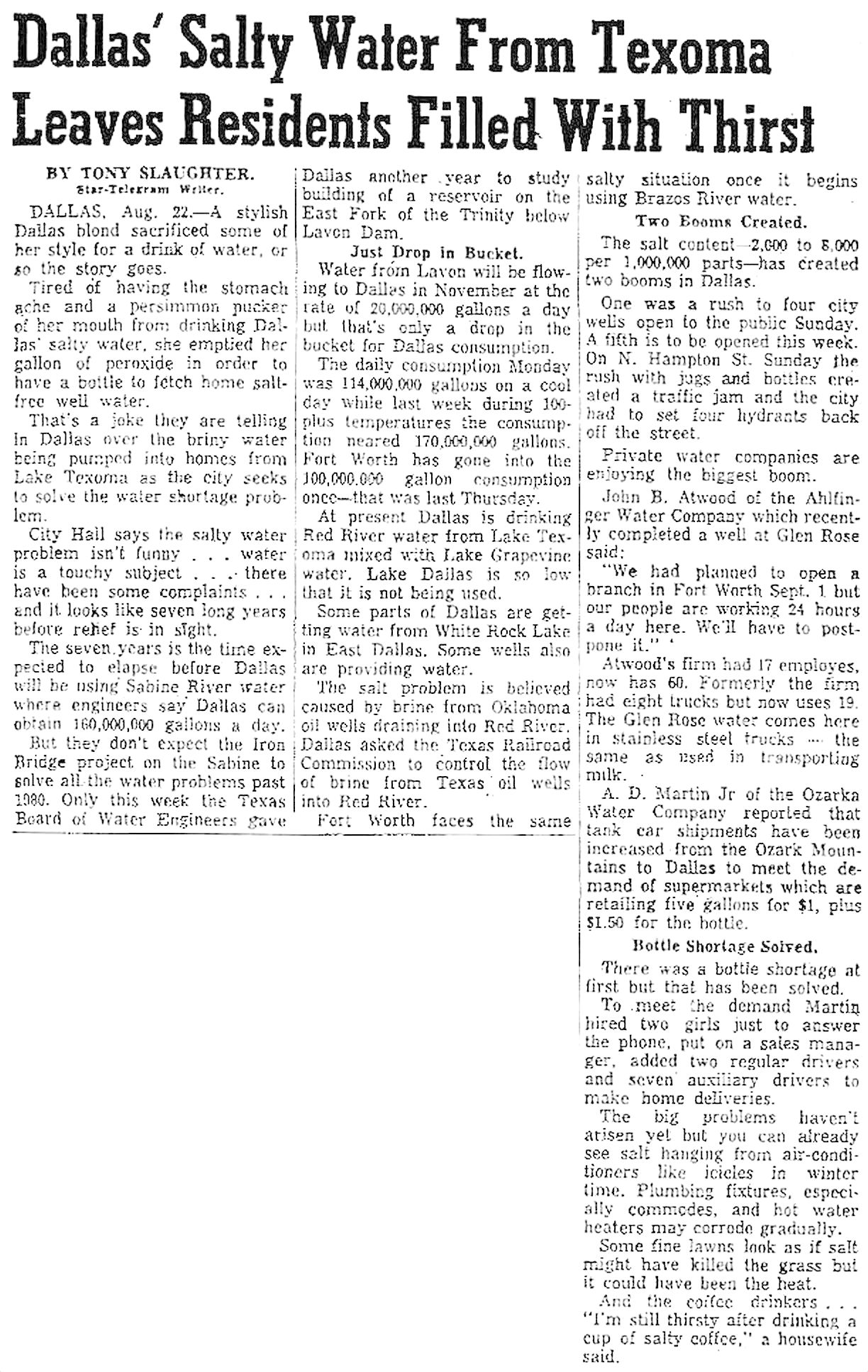
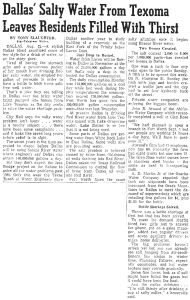
In Dallas, the lakes and reservoirs were hit hard. White Rock Lake dried up — one was able to walk across the parched lake bed without a drop of water in sight. Lake Dallas (now Lake Lewisville) fell to 11% of capacity. Dallas was desperate for water, and in 1956, it began “importing” water from Oklahoma. Red River water was appreciated, but it was considered by many far too salty to drink. In addition to the unpleasant taste, residents were concerned that there would be permanent damage to pipes and plumbing, and, to a lesser extent (since watering restrictions were being strictly enforced) to their lawns.

According to one report, salt content in the water supply had gone from the normal 39 parts per million gallons to over 800 parts (at the height of the problem, some news outlets reported it to be well over 2,000 parts per million). While the water was generally considered perfectly safe for the average person to drink, many looked for cleaner, more palatable drinking water.
drought_FWST_082356Fort Worth Star-Telegram, Aug. 23, 1956 (click for larger image)

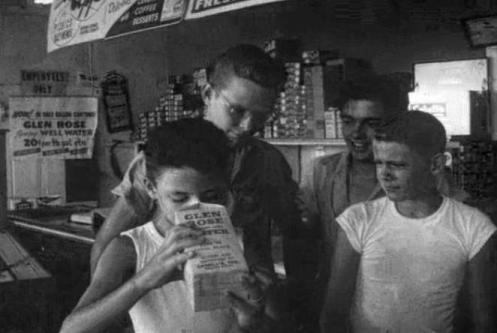
Suddenly bottled water became a boom business. Spring water was being trucked to Dallas from Glen Rose and Arkansas. Water was being sold in bottles and cartons — from 20 cents per half-gallon cartons to $2.50 for five-gallon bottles ($1.50 of which was for a deposit on the glass bottle). WBAP-TV news even sent a cameraman out to a Cabell’s convenience store to capture some boys testing out the Glen Rose water (watch it here, without sound).
water_portal_screencap

The other source of acceptable drinking water that summer was from city wells dotted around Dallas. Long dormant, the city opened the wells and offered free water to residents. From The Dallas Morning News:

If you don’t like that hard, salty water coming from your taps, you can get soft, unsalty water at four city wells beginning Sunday. City manager Elgin E. Crull Saturday said that the city has installed faucets at the four wells where people may take their buckets or bottles and obtain drinking water. No trucks will be permitted to fill up. (DMN, Aug. 19, 1956)

The four wells mentioned above — and two more opened within a few weeks — were located at the following locations:

  • 1325 Holcomb, near Lake June Road
  • Opera and 13th, near the Marsalis Zoo
  • 875 North Hampton, near Lauraette Street
  • 2825 Bethurum, in South Dallas, near the public housing project
  • Northwest Highway and Buckner
  • Matilda and Anita, on the grounds of Stonewall Jackson Elementary School, in East Dallas

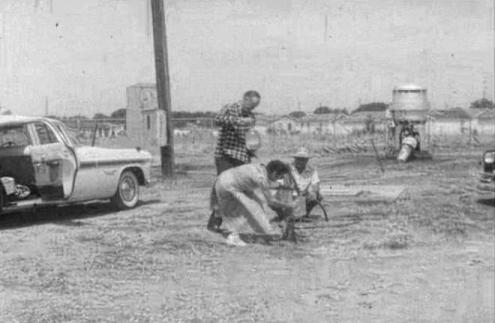
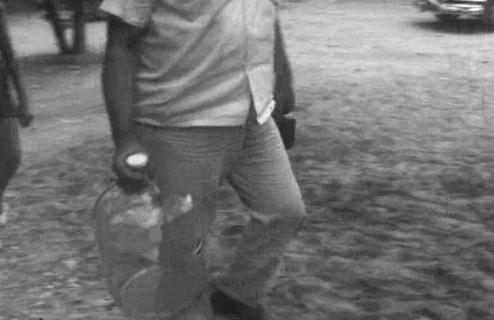
These wells were hugely popular, with thousands of people showing up with jugs, jars, kettles, canteens, and bottles of every conceivable size. (More WBAP news footage of people filling up at these wells can be seen here, without sound; details below).
well-1

well-2

The popularity of the city wells led to private citizens having wells dug on their own property. Not only were bottled water suppliers making a killing during the summer of ’56, so were the owners of drilling businesses. From The Dallas Morning News:

As salty water from city mains reportedly discourages shrubbery and affronts the taste, drillers of shallow residential water wells ride the crest of a boom. […] Luckiest of the water-seekers are residents of the southern section of the city in the Fruitdale, Pleasant Grove and Home Gardens area, and in the neighborhoods that border Loop 12. That is where drillers are finding pay dirt — water-bearing gravel — at shallow depths. (DMN, Oct. 7, 1956)

It wasn’t just professional drillers who were busy — it wasn’t uncommon for the DIY-ers to be out in the backyard on weekends, digging away, hoping for their own personal source of fresh water. And there were probably even some dowsers out and about, water witching their little hearts out.

The drought ended the next year, and personal wells were a thing of the past, but that mania for bottled water really dug its heels in.

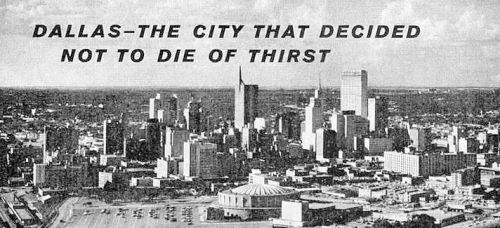
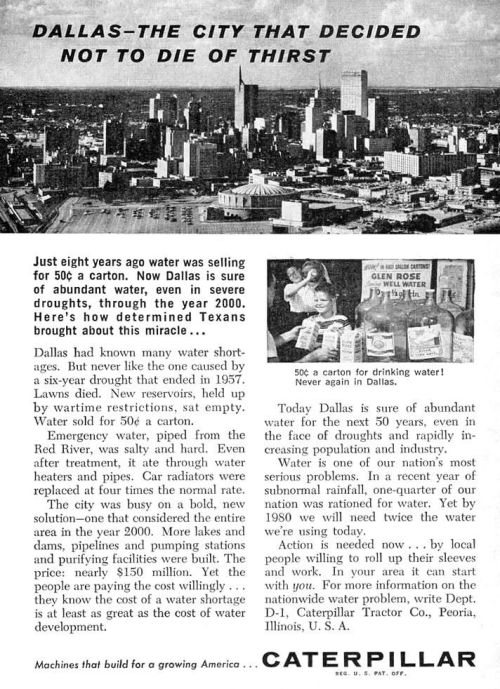
Texas developed the Water Planning Act of 1957, and in 1962, this new mandate and what had happened in Dallas during the drought was used as the basis for a Caterpillar ad which had a bit of a hyperbolic headline, “Dallas — The City That Decided Not To Die Of Thirst”:
drought_caterpillar-ad_19621962 ad (click for larger image)

***

Sources & Notes

Picture of the four boys tasting the Glen Rose water is taken from the WBAP-TV news story that aired on Aug. 12, 1956. The silent, edited footage was shown as the news anchor read the script, seen here. Film footage (linked above) and script from the Portal to Texas History.

The two pictures of people availing themselves of water from the city’s wells are taken from the WBAP-TV news story that aired on  Aug. 19, 1956. The silent footage ran as the anchor read the script seen here and here. Film footage (linked above) and script from the Portal to Texas History.

1962 Caterpillar ad from eBay.

More on affect of the drought on Dallas can be found in these Dallas Morning News articles:

  • “Sparked by Salt: Business Booming For Bottled Water” (DMN, Aug. 5, 1956)
  • “Citizens Stock Up On Saltless Water” by Sue Connally (DMN, Aug. 20, 1956)
  • “Thirsty City Witnesses Revival of Well Drilling” by William K. Stuckey (DMN, Oct. 7, 1956)
  • “Resourceful Citizens Tap City Water Well” (DMN, Oct. 16, 1956)
  • “Continuing Drouth Produces Top Local News Story in ’56” by Patsy Jo Faught (DMN, Dec. 30, 1956)

Read about how the drought affected Texas water management here; read about the Texas Water Rights Commission here.

Read “The City of Dallas Water Utilities Drought Management Update” in a PDF, here.

Finally, I encourage everyone to grab a tall glass of ice water and settle down to read Elmer Kelton’s classic Texas novel, The Time It Never Rained. Or if you’re pressed for time, read Mike Cox’s article about the book in Texas Parks & Wildlife magazine, here.

*

Copyright © 2014 Paula Bosse. All Rights Reserved.


The Dallas Police Department & Their Fleet of Harleys — 1951

ad-harley-davidson_dpd_19511951 ad

by Paula Bosse

Group photo day!

Like so many cities all over the country — whether large or small — the motorcycle division of the Dallas Police Department is equipped with Harley-Davidsons exclusively. Effective traffic regulation is assured through the use of 35 solo Harley-Davidsons and 29 Servi-Cars. Traffic experts recognize that no other method matches motorcycles for efficiently handling so many phases of traffic control work and accident prevention.

***

Sources & Notes

1951 Harley-Davidson ad from… somewhere — probably eBay.

Back in 1910, the DPD was perfectly happy with Indian motorcycles, as can be seen in a previous post, “Dallas Motor Cycle Cops — 1910.”

*

Copyright © 2014 Paula Bosse. All Rights Reserved.
“Life” at the State Fair of Texas — 1951

fair-park-midway_life_1951On top of the world, 1951

by Paula Bosse

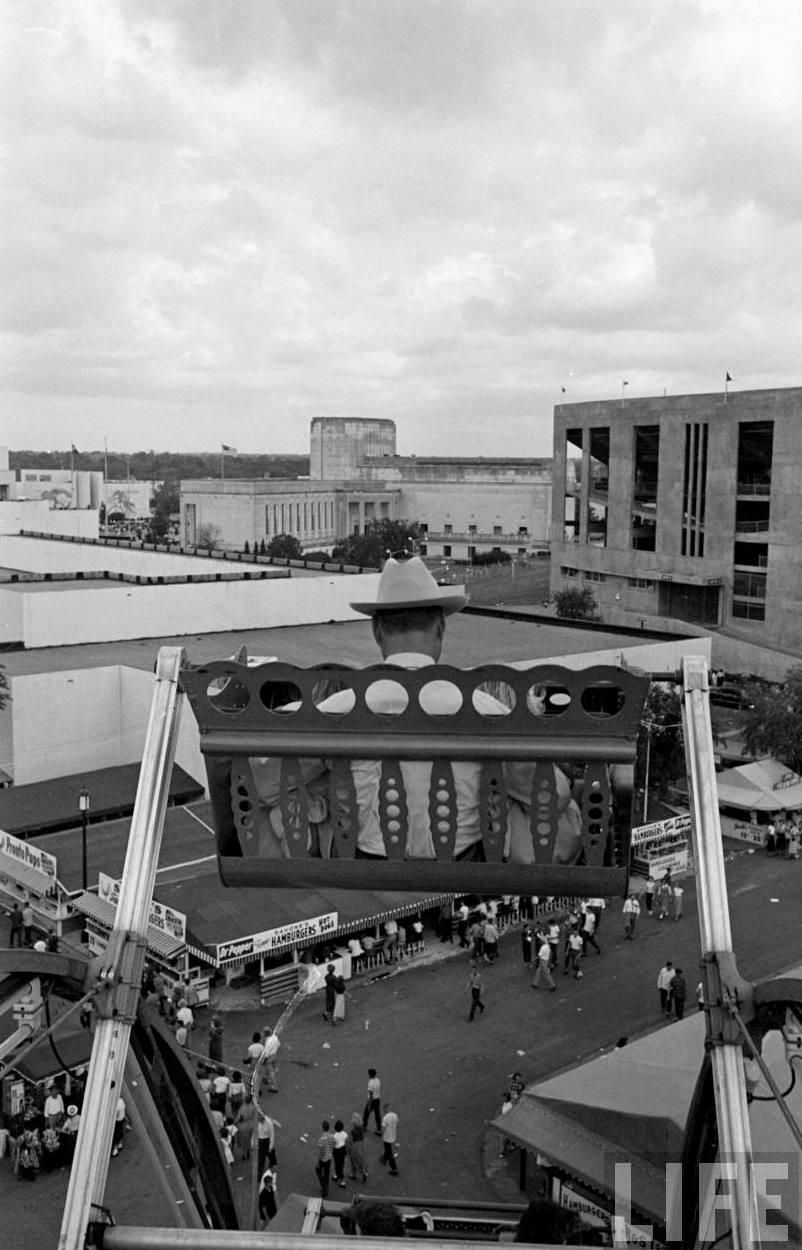
A Life magazine photographer moseyed down to Dallas in 1951 and captured a couple of cool shots of the State Fair. The photo above (so sweet, and one of my favorite Midway shots ever) was captioned:

In Dallas a rancher takes the kids for a ride in a 92-foot-high double Ferris wheel.

The photo below shows a tractor-pulled tram (fare: 15 cents) as it wheels past the Hall of State, full of well-dressed men and women. (That kid in the boots, cowboy hat, and letterman jacket … had I been around in 1951, I would have had a big ol’ crush on him.)

Click both of these wonderful photos to see larger images. You can practically smell the Brylcreem and cotton candy.

fair-park_tour_life_1951Life magazine, 1951

***

Sources & Notes

Both photos taken at the 1951 State Fair of Texas for Life magazine by an uncredited photographer. The top photo (cropped differently) ran in the Oct. 22, 1951 issue of Life as part of a feature titled “It’s a Bumper Year For Fairs” — it was the only photo that appeared in the magazine shot at the Texas fair. The bottom photo did not run in the magazine.

*

Copyright © 2014 Paula Bosse. All Rights Reserved.

Mary Sloan’s Stylized Dallas Skyline

mary-sloan_jacket-art_front_1957-smArt by Mary Sloan, 1957

by Paula Bosse

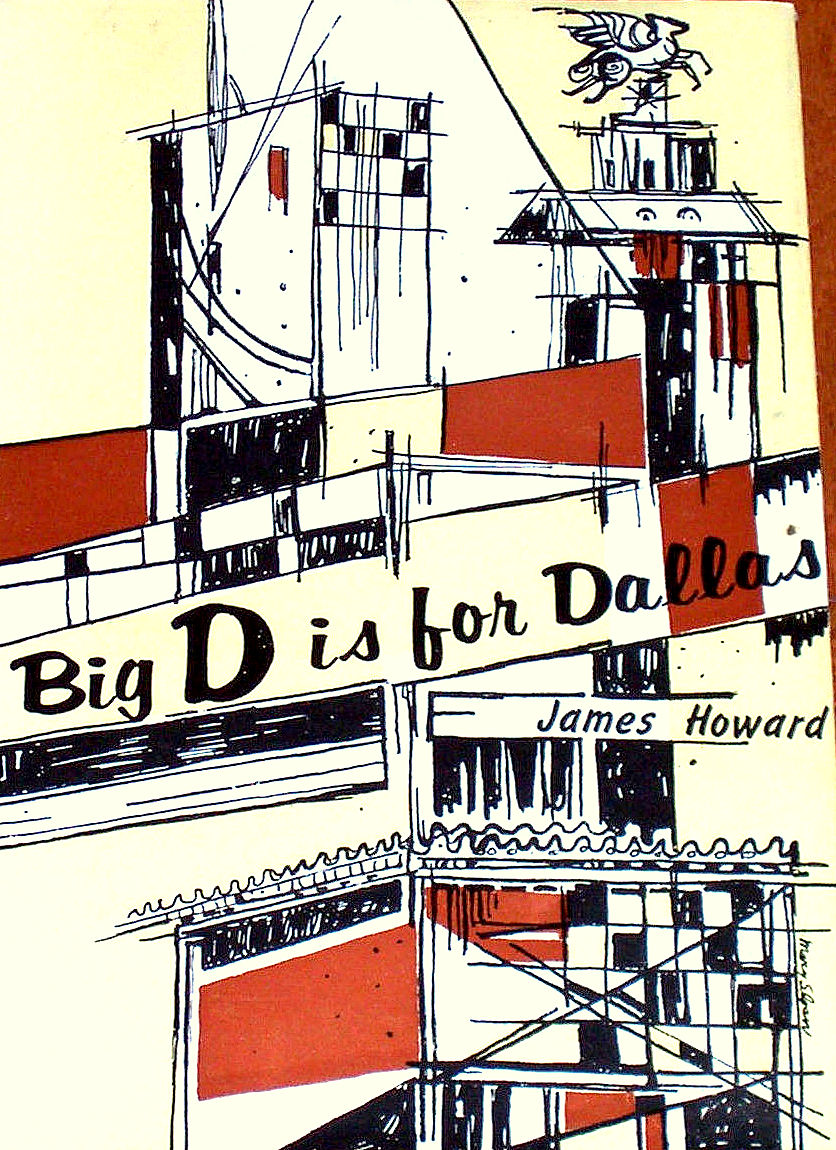
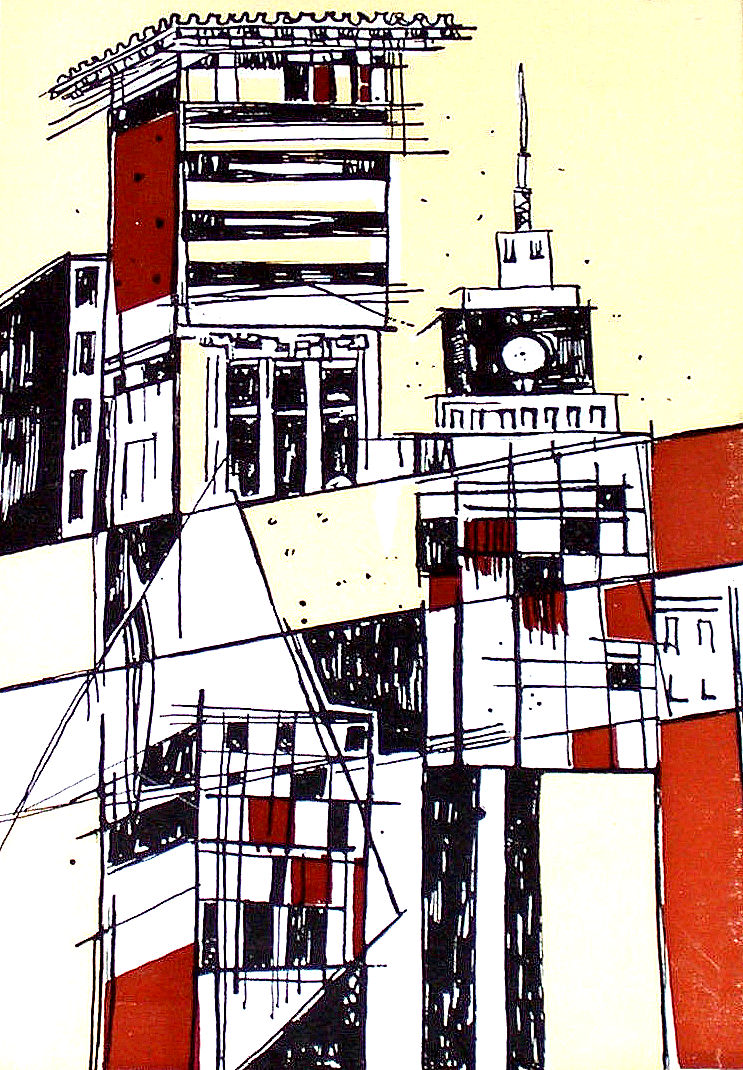
Dust jacket artwork and design are often taken for granted, which makes no sense because the cover of a book does actually tend to drive book sales. Things have improved in recent years, but in the past, these artists were frequently not credited at all. Here’s an example, though, of jacket art that actually gives full credit to the artist, Mary Sloan. This fantastic, stylized depiction of the Dallas skyline positively reeks (in a good way) of mid-century illustration. I don’t think I’ve seen this before, which is a bit of a surprise, because I was a bookseller for many years, specializing in Texana titles. I’m not sure how this one escaped me, but I’m pretty sure I’d remember this cover art.

Mary Sloan was born Mary Key in about 1925 and grew up in Denton. She studied art in Denton and Austin, working under noted Texas artists such as William Lester, Everett Spruce, and Charles Umlauf. She won numerous art competitions and is represented in several Texas museums. She settled with her husband and family in Corpus Christi where she taught art for many years at Del Mar College. In addition to painting and drawing, she was also a proficient mosaic artist and designed glass and stone mosaic murals. I don’t know if she did any other book jacket art — it would be a shame if this is all she did, because I think it’s really great.

mary-sloan_jacket-art_back_1957_smRear panel of dust jacket

mary-sloan_ad_swhq_1957-det

mary-sloan_swhq_1957_ad-text

***

Sources & Notes

Dust jacket for Big D is for Dallas by James Howard (Austin: self-published, 1957), a collection of biographical profiles of Dallas business luminaries.

Black-and-white image of the cover art and accompanying text are from an ad that appeared in the Southwestern Historical Quarterly in 1957.

*

Copyright © 2014 Paula Bosse. All Rights Reserved.

Exline Park Swimming Pool — 1950s

exline-pool_hickman_1957_briscoe-ctr

by Paula Bosse

Summer’s running out, kids.

Plan your waning pool-time opportunities accordingly.

exline_hickman_1955

***

Photos by R. C. Hickman, taken at Exline Park swimming pool; top photo taken on Aug. 6, 1957, bottom photo on July 27, 1955. Both photos © R. C. Hickman/Dolph Briscoe Center for American History.

*

Copyright © 2014 Paula Bosse. All Rights Reserved.

Big Tex, Old Tex, Big Ol’ Tex — Whatever You Call Him, Otis Dozier Wins (1954)

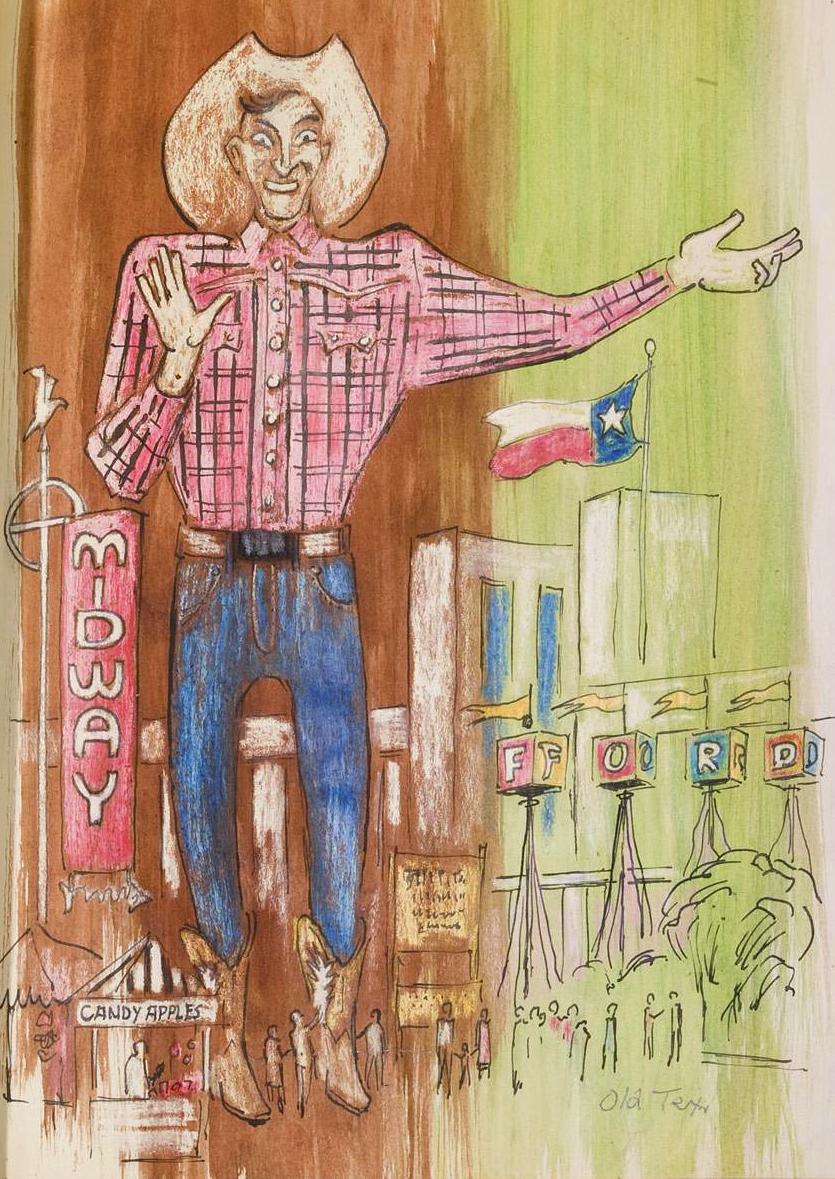
dozier_big-tex_sketchbook_1954_dma“Old Tex” sketch by Otis Dozier, 1954 — Dallas Museum of Art

© Marie Scott Miegel and Denni Davis Washburn

by Paula Bosse

Hey, y’all, guess what’s just around the corner. Whenever you start seeing pictures of Big Tex, you know that the State Fair of Texas can’t be too far away.

There have been a lot of artistic depictions of Big Tex over the years, but I think this sketch by Dallas artist Otis Dozier (1904-1987) may be my all-time favorite. And I’ve only just discovered it! (Thank you, DMA!)

***

This wonderful ink, watercolor, and crayon sketch of “Old Tex” is contained in one of Otis Dozier’s sketchbooks, now in the collection of the Dallas Museum of Art, a gift of the Dozier Foundation (© Marie Scott Miegel and Denni Davis Washburn). To see details on this work, see the page on the DMA’s website, here.

The Otis Dozier sketchbooks have been digitized in a joint project between the Dallas Museum of Art, SMU’s Bywaters Special Collections at the Hamon Arts Library, and SMU’s Norwick Center for Digital Services. To read about this fantastic collection, see the SMU Central University Libraries page, here.

*

This week, the Dallas Museum of Art launched a new digital database in which its entire collection is now accessible online! This is great news for many reasons, not least being that it allows the public to see works that are rarely — if ever — displayed in the museum. Such as this one. To read more about assembling this incredible database, read the DMA’s announcement, here.

To look up your favorite artist, check to see what the DMA has, here.

For the biography of the Forney-born Dozier (who was one of the members of the famed Dallas Nine group), see the Handbook of Texas entry here.

Click picture for larger image.

*

Copyright © 2014 Paula Bosse. All Rights Reserved.


Telephone Operators Sweating at the Switchboard — 1951

summer_telephone-operators_1951Low-tech A/C: ice, buckets, fans

by Paula Bosse

The summer of 1951 in Texas was brutally hot. One heat-related incident that August made national headlines: more than 1,500 Southwestern Bell telephone operators (and supportive coworkers) who were working in unairconditioned conditions (!!) at the Haskell Exchange on Bryan and at the Akard Street headquarters downtown staged what news reports called a “wildcat walkout” and refused to continue working in the sweltering buildings. Management’s attempt to cool things down with electric fans blowing over buckets of ice had not worked. Operators returned the next day, having made their point, hopefully to the imminent installation of air-conditioned switchboard rooms.

The caption for the photo above:

Dallas, Tex. Aug. 10 [1951] — BEATING THE HEAT — Both ice and fans are brought into play by telephone operators at an exchange here today as the city continued to swelter under 100-degree or over temperatures. The thermometer reached a high of 102-degrees to run the consecutive days of 100-degree readings to ten. It is the longest period of such reading since 1925 when a record 11 straight days was set. High mark for the present heat wave was 107 on August 6.

Three days later, the sweat hit the fan, and the women walked out.

operators_heat_st-joseph-MO-news-press_081451
St. Joseph [MO] News Press, Aug. 14, 1951 (click to read)

Let’s hope your work conditions are a bit better this summer!

***

Sources & Notes

Wire service photograph from the Southern Labor Archives of the Georgia State University Library Special Collections.

See ads from 1911 and 1925 encouraging women to become telephone operators in the Flashback Dallas post “Work and Play in Telephone Land,” here.

*

Copyright © 2014 Paula Bosse. All Rights Reserved.

Metzger’s Milkmen in Bermuda Shorts — 1955


metzgers_bermuda_life_052355-full
Metzger’s milkmen on parade in Life magazine

by Paula Bosse

Something BIG happened in Dallas in 1955 — it was such an earth-shattering event that it made headlines around the country: Metzger’s milkmen in Dallas announced that Bermuda shorts would become part of their summer uniform. It must have been a slow news month, because this story was picked up by the wire services and absolutely caught fire, running in newspapers all over the country. It even climbed to the pinnacle of mass media newsworthiness and found itself in the pages of Life magazine where the above photo was accompanied by the following caption:

MILKMEN’S CALVES
Drivers for a Dallas dairy produced a new morning look by setting out in Bermuda shorts. The boss thought they would be cooler in them. The shorts were fine, but one driver was nipped by a dog of long acquaintance who didn’t recognize him. (Life, May 23, 1955)

It was also the subject of newsreel footage. Watch the 1-minute silent clip here. Below, a screenshot:

metzgers_bermuda-shorts-footage_1955_getty

*

In 1955, Bermuda-shorts-fever had somehow gripped the nation. Some sort of marketing sadist was pushing the jacket-and-tie-and-Bermuda-shorts-and-knee-socks combo as appropriate and stylish summertime apparel for men in the boardroom — an unfortunate early version of “business casual.” Mercifully, the fad died fairly quickly.

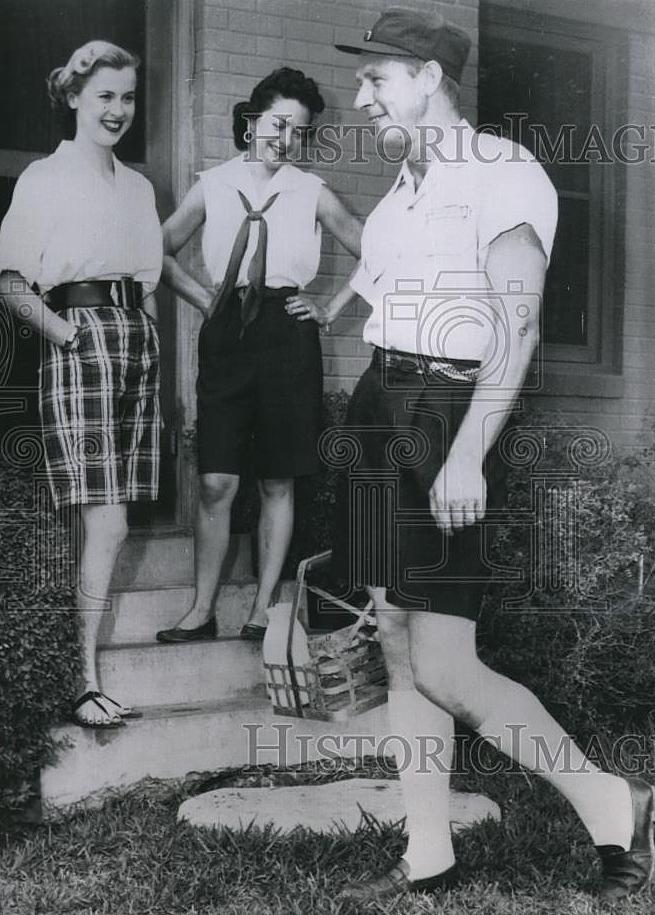
But another more utilitarian idea for the new cool and comfortable shorts emerged here in Dallas. Jake Metzger, owner of the dairy that produced Metzger’s milk, decided to adopt the shorts as part of a new summer uniform for his milk delivery men. The Dallas Morning News suggested that this might be the first such uniform in the United States. Shorts were just not widely seen outside the gym in those days, and certainly not in the workplace. But it gets hot in Texas in the summer. Real hot. REAL hot. Metzger’s idea was a brilliant one, and I’m sure his drivers appreciated it. According to an AP article, the new uniform would consist of the following:

The shorts are the black Bermuda type, often called walking shorts, with an elasticized maroon belt. They’re matched with a short-sleeve khaki shirt, over-the-calf cotton ribbed khaki socks and low black loafers. The outfit is topped with a black cotton golfers’ cap. (AP, May 10, 1955)

If a milkman believed that the new uniform went against his “moral scruples” — or if he just didn’t like the way he looked in it — he could opt out and wear the regular uniform. But a lot of the men jumped at the chance — reports said 30 of 120 milkmen went bare-kneed. And their photos were splashed across newspapers all over the place. A publicity bonanza! Here are just a few of the photos.

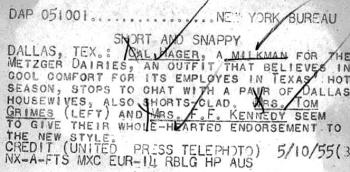
Milkman Cal Hager, ogled by Mrs. Tom Grimes and Mrs. F. F. Kennedy:

metzgers_ebay_front

metzgers_ebay_rearUPI wire photo, May 10, 1955

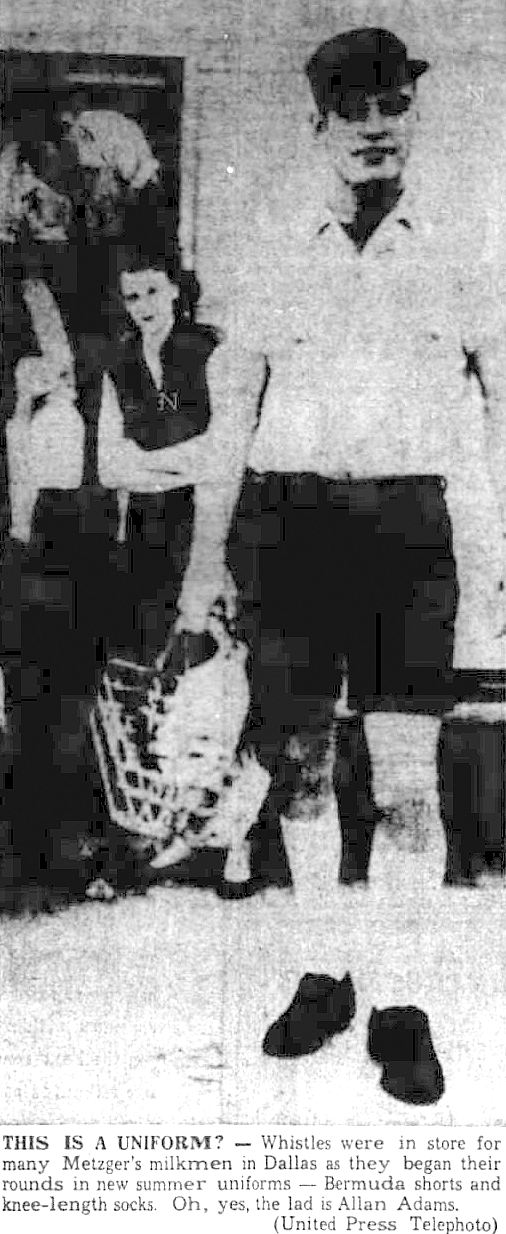
Allan Adams gets the once-over by his customers:

bermuda-shorts_victoria-TX-advocate_051355Victoria (TX) Advocate, May 13, 1955

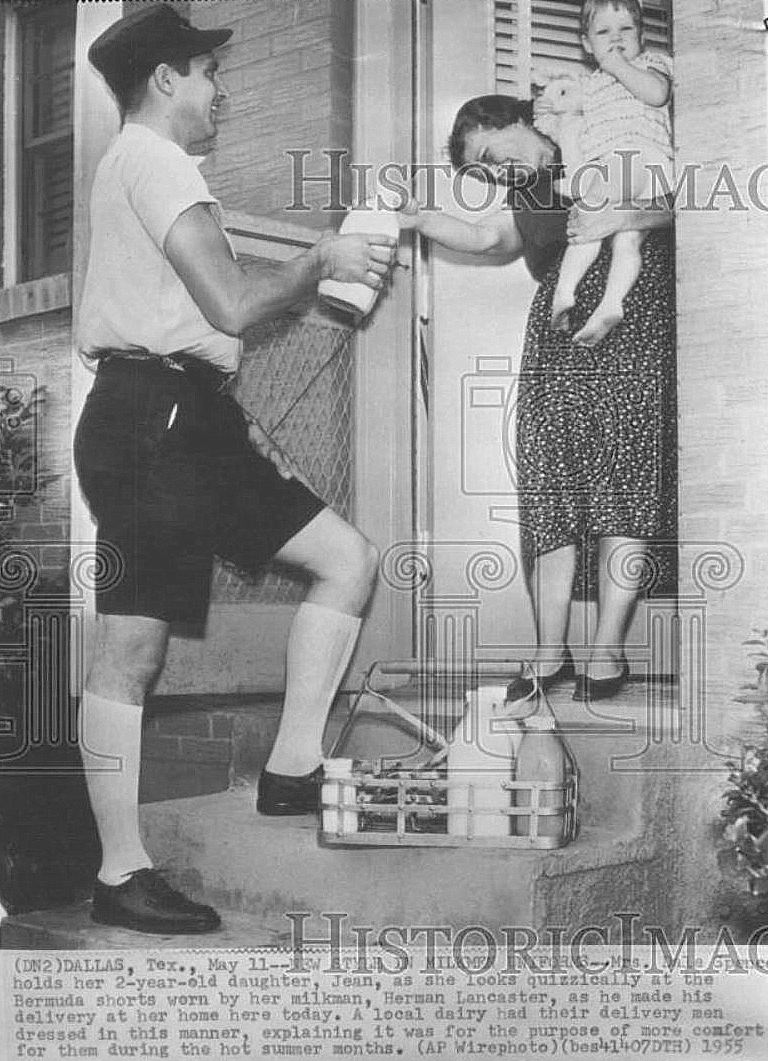
Herman Lancaster and a confused Mrs. Dale Spence (holding daughter Jean):

metzger_bermuda-shorts_historic-imagesAP wire photo, May 11, 1955

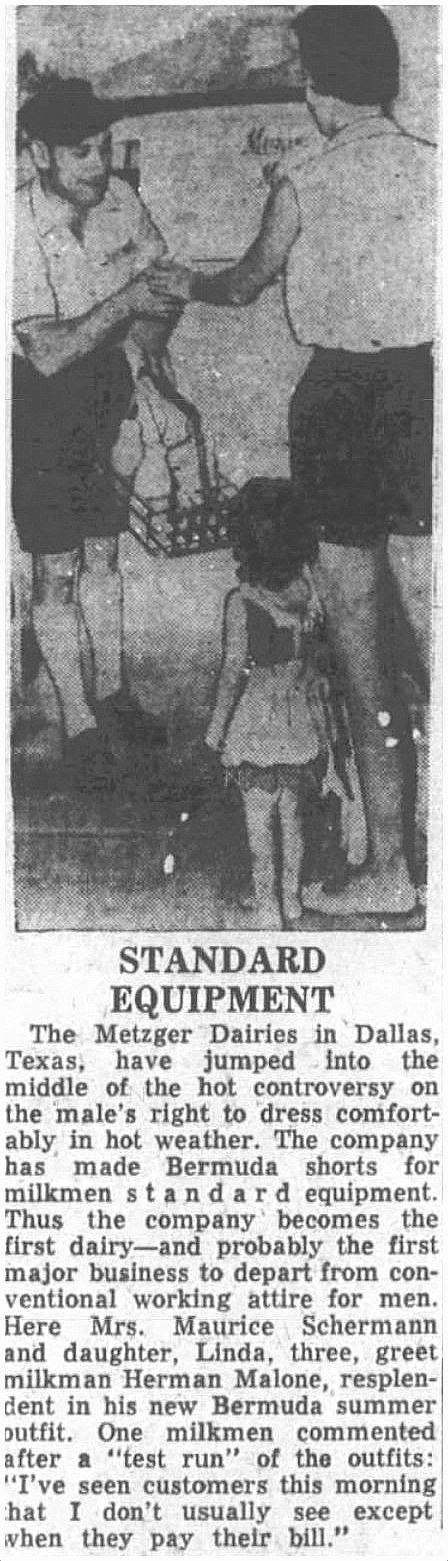
Metzgers’ man Herman Malone proffers a bottle to Mrs. Maurice Schermann and her daughter Linda:

metzger_bermuda-shorts_nanaimo-brit-columbia-daily-news_061055Nanaimo Daily News, British Columbia, Canada, June 10, 1955

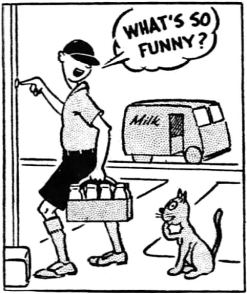
metzger_bermuda-shorts_philadelphia-inquirer_051255_cartoonPhiladelphia Inquirer, May 12, 1955

*

The headlines were often better than the photos, in all their reverse sexist glory. Here are a few from every corner of the United States:

  • “DALLAS MILMEN REAL CREAMY IN SHORTS, SOX”
  • “HOUSEWIFE DELIGHTED: MILKMEN MAKE ROUNDS IN BERMUDA WALKING SHORTS”
  • “YOO-HOO, MILKMAN!”
  • “MILMAN COMETH IN SHORTS NOW”
  • “THE MILKMAN COMETH, AND LOOK AT HIS CLOTHES!”
  • “HE’S IN SHORTS: WHISTLES, CATCALLS GREET THE MILKMAN”
  • “DALLAS MILKMEN GO TO WORK DUDED UP”
  • “SPORTY SHORTS FOR MILKMEN”
  • “WHISTLE-BAIT MILKMEN DON BLACK SHORTS”
  • “QUARTS WITH SHORTS — 30 MILKMEN GO NATTY”
  • “DON’T WHISTLE, MOTHERS, IT’S ONLY THE MILKMAN”
  • “CATCALLS, WHISTLES, POETRY GREET SHORTS-CLAD MILKMEN”
  • “ULTRAFASHIONABLE MILKMEN ARE CLAD IN BERMUDA SHORTS”

**

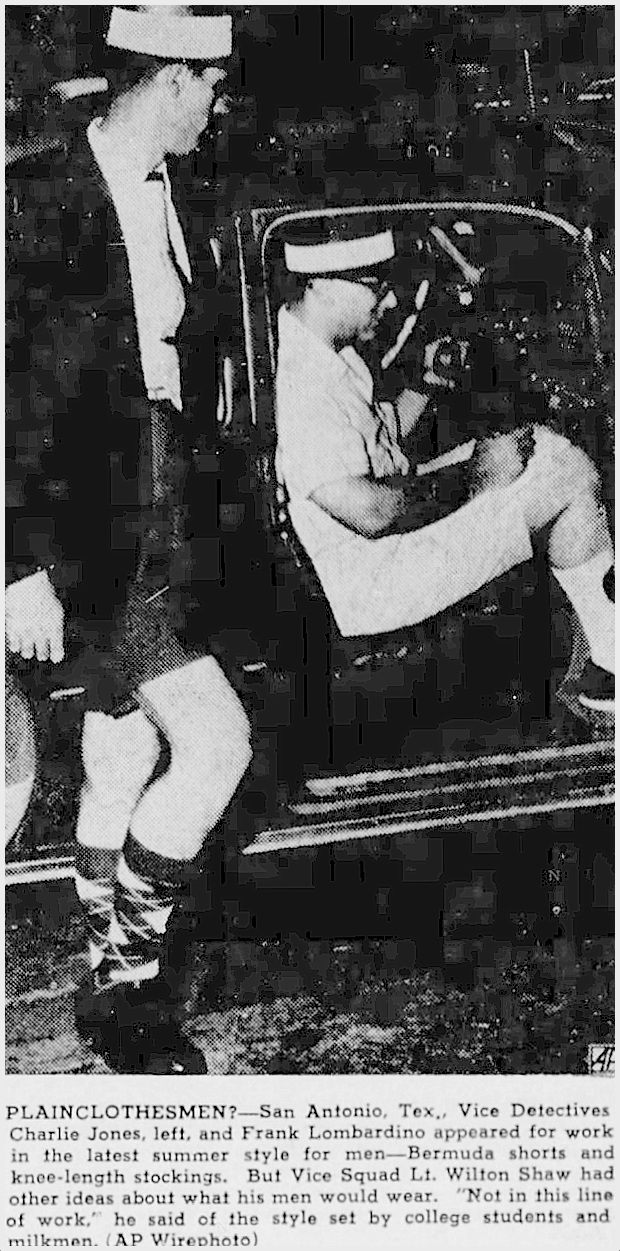
You know a fashion craze has gotten out of hand when you see San Antonio vice squad detectives looking like this:

bermuda-shorts_bryan-TX-eagle_052755_copsBryan (TX) Eagle, May 27, 1955

If Messrs. Jones and Lombardino are still amongst the living, I’m pretty sure they still haven’t lived that photo down. (The partner of Wilton Shaw is misidentified in this photo — he is Chesley Jones.)

**

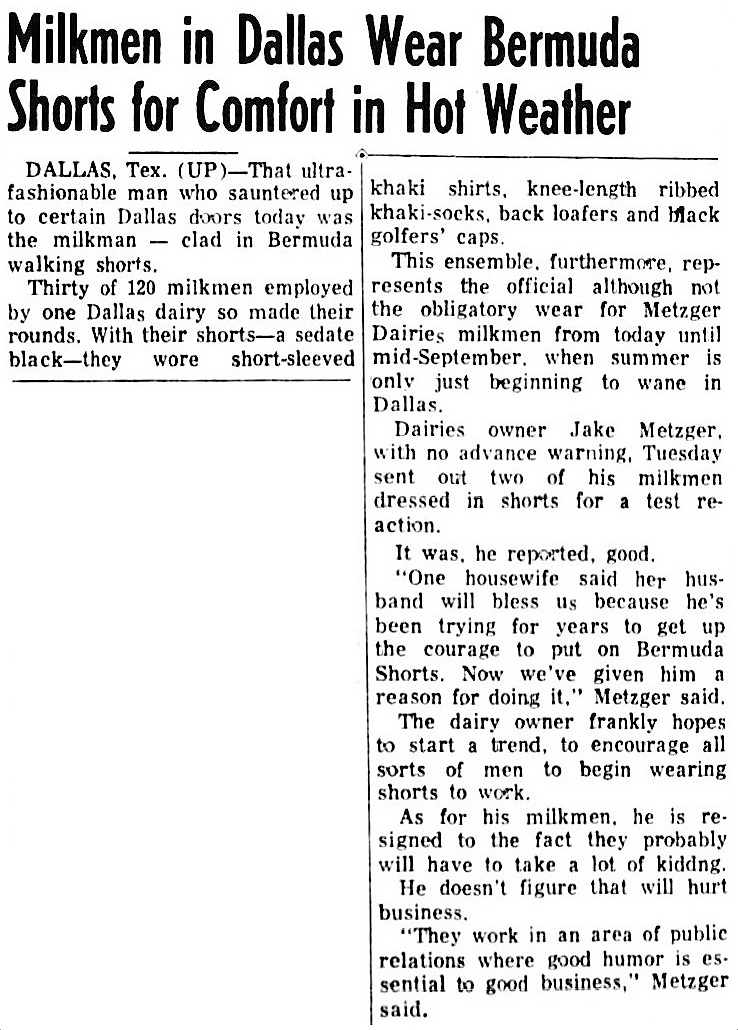
metzger_bermuda-shorts_coshocton-OH-tribune_051155Coshocton (OH) Tribune, May 11, 1955

*

Copyright © 2014 Paula Bosse. All Rights Reserved.