Flashback : Dallas

A Miscellany: History, Ads, Pop Culture

Category: 1950s

Back When the Kessler Couldn’t Catch a Break — 1957

kessler-theater-after-tornado_1957

by Paula Bosse

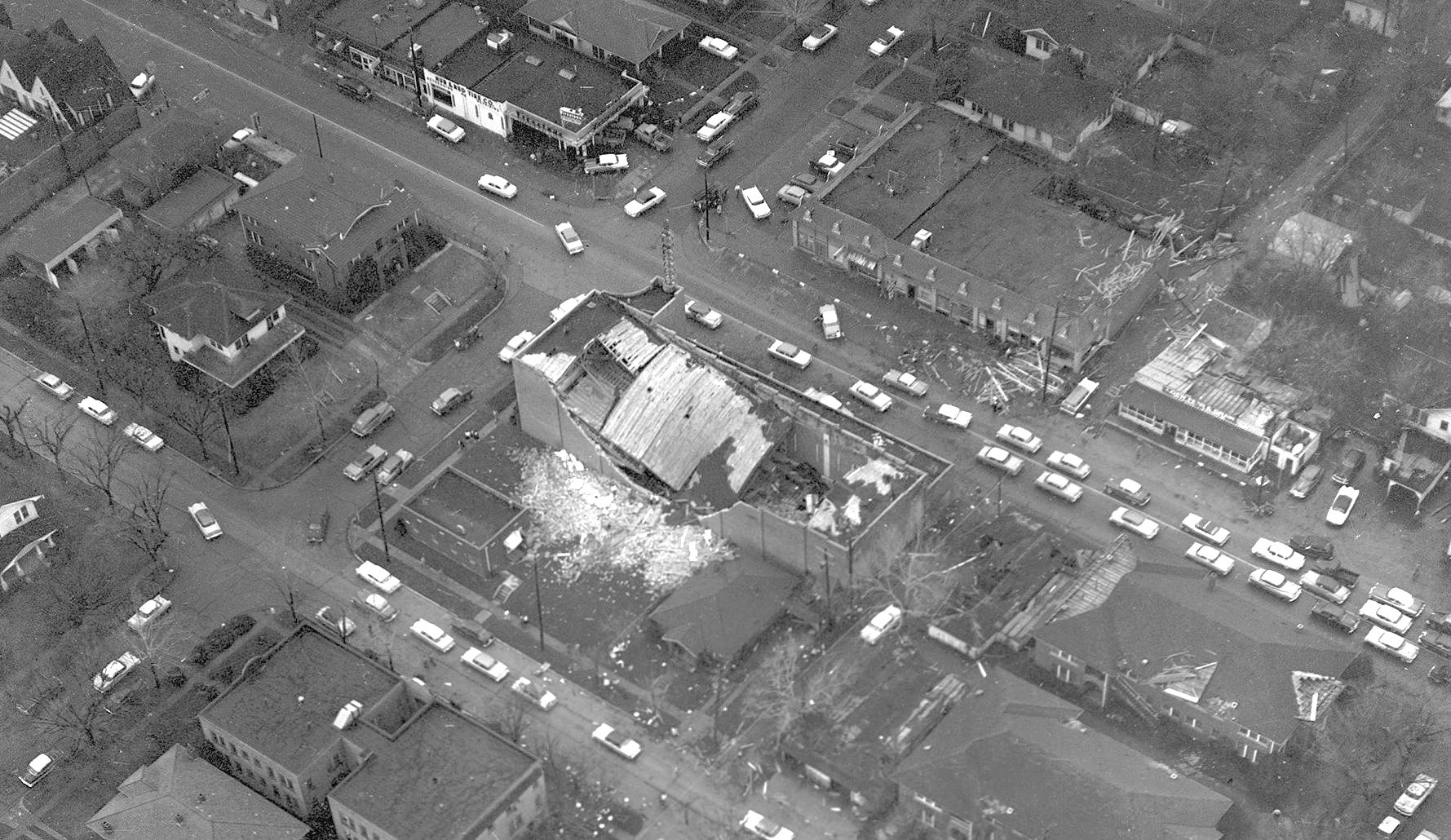
One of the casualties of the famous tornado that hit Dallas and Oak Cliff in 1957 was the Kessler Theater. In 1957, the Kessler — then only 15 years old — had hit hard times and was being used to house an evangelical church. It was rebuilt after the tornado, but soon after it was hit by a three-alarm fire. Conclusion? Do not disturb the entertainment gods — that place was meant to be a theater!

kessler_tornado_sherrod

From the post-tornado reports in The Dallas Morning News:

At the West Davis and Clinton business district, an evangelical church in a converted theater building at the intersection was caved in, leaving little more than two walls standing. The church’s cross from atop its more than 50-foot tower was crumpled in the gutter. (DMN, April 3, 1957)

And in a survey of the clean-up:

At Davis and Clinton, where the old Kessler Theater was being used as a revival center before the tornado, workmen were busy wrecking the building, completing what the tornado had started. […] J. T. Hooten, foreman for Winston A. Caldwell, explained that the damaged sections of the theater which might give way under a slight strain and cause further damage had to be torn out. His crew carefully but hurriedly dismantled the old Davis Street landmark. Hooten said the owner may rebuild the theater as a 1-story office building. (DMN, April 10, 1957)

Here is a detail of an aerial photo by photographer Squire Haskins, showing the damaged Kessler in the center (see the full, very large photo here):
kessler_tornado_squire-haskins_UTA_det

***

Sources & Notes

Top photo from an incredibly detailed website devoted to the 1957 Dallas tornado, the home page of which can be seen here.

Second photo from D. Troy Sherrod’s Historic Dallas Theatres (Charleston: Arcadia Publishing, 2014); photo from the collection of the Dallas Public Library.

Aerial photograph by Squire Haskins from the Squire Haskins Photography, Inc. Collection, UTA Libraries, Special Collections; more information is here (click the thumbnail to see a larger image).

Website of the recently (and beautifully) restored Kessler is here.

*

Copyright © 2014 Paula Bosse. All Rights Reserved.
 

The Statler Hilton: Dallas Has It All … Again

statler-hotel

by Paula Bosse

It’s alive!

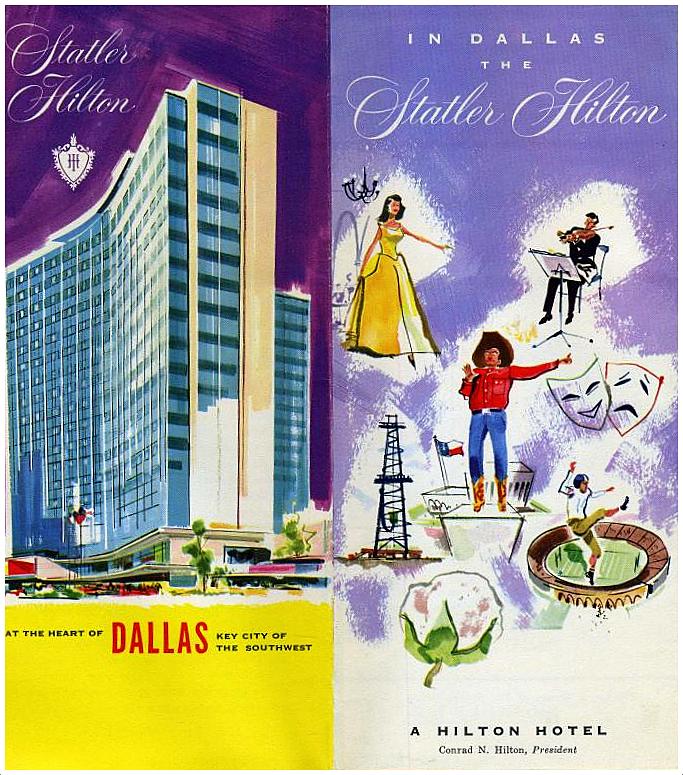
The old Statler Hilton looks like it might finally be renovated! Read about the exciting plans here.

Click picture for larger image.

*

Copyright © 2014 Paula Bosse. All Rights Reserved.

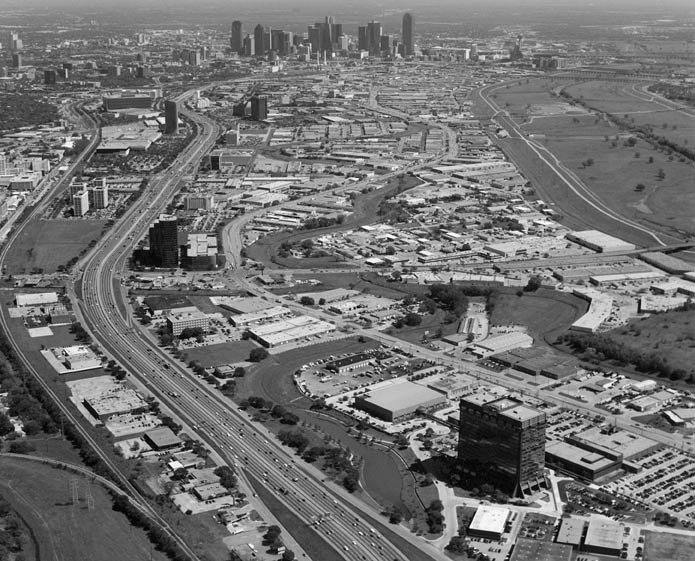
Stemmons and Inwood, Before and After

stemmons-inwood_haskins_1954

Stemmons and Inwood, looking southeasterly toward town, 1954. Below, pretty much the same shot, 1994.

stemmons-inwood_haskins-jr_1994

***

Top photo by the great Squire Haskins; bottom photo by the firm bearing his name that carried on after his death in 1984. Both from the Squire Haskins Photography Collection, Special Collections, University of Texas at Arlington Libraries.

For more on the life and career of Dallas photographer Squire Haskins, see the article “Squire Haskins: High Flying Images” by Brenda S. McClurkin, here.

Need a visual aid? See a Google Map view of the same area today, here.

Click photos for larger images.

*

Copyright © 2014 Paula Bosse. All Rights Reserved.
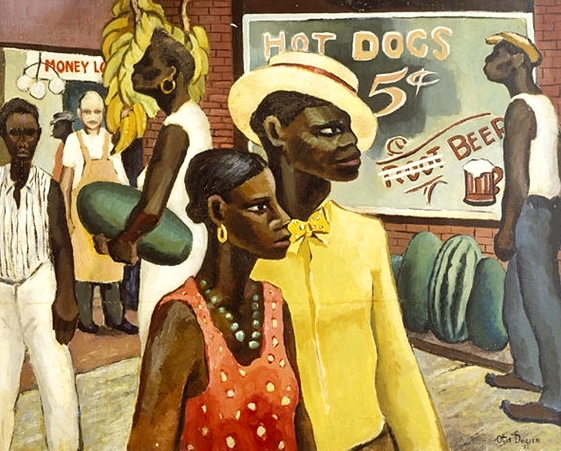
Deep Ellum / Deep Elm / Deep Elem Blues

deep-elm-otis-dozier_1932“Deep Elm” – Otis Dozier, 1932

by Paula Bosse

“Deep Ellum Blues” has become a standard blues song, warning of/extolling the vices found in the once-thriving, predominantly black area of town, where a lot of people — black and white — enjoyed themselves (after dark) in clubs and bars, immersed in the sometimes shady goings-on that one tends to find on the other side of the tracks. The song (sometimes irritatingly called “Deep Elem Blues”) was first recorded in 1935 by the Lone Star Cowboys (popular performers in the Dallas area, better known as the Shelton Brothers). And now it’s become a blues standard, sung around the world by people who have no idea what a “Deep Ellum” is.

Below are four versions of the song that I like. (I searched for early performances by black musicians, but, according to Deep Ellum experts Alan Govenar and Jay Brakefield, there is only one that anyone seems to know about — by Booker Pittman, grandson of Booker T. Washington, and I couldn’t find it.)

But first, if you haven’t seen this wonderful short documentary by Alan Govenar about Deep Ellum in its original prime, it’s a must-see. (Bill Neely sings “Deep Ellum Blues” in this — it’s great. Listen for the extra verses.)

Below, the original version by the Lone Star Cowboys, who later changed their name to The Shelton Brothers and were well-known to Dallas audiences through their regular appearances at the Big D Jamboree and on local radio. (Listen to their follow-up, “What’s the Matter with Deep Elem?”)

My personal favorite, this hopping western-swing-big-band-rock-n-roll version by the always fabulous one-time Dallas resident Hank Thompson.

I can’t leave off this turbo-charged rockabilly version by Dallas’ own “Groovey” Joe Poovey!

And, finally, for good measure, one weird version, by the always reliable Charlie Feathers.

Remember y’all: KEEP YOUR MONEY IN YOUR SHOE!

***

Sources & Notes

“Deep Elm” painting by Otis Dozier (1932) — one of the Dallas Nine group — from the collection of the Dallas Museum of Art.

“Deep Ellum” film by Alan Govenar, one of Dallas’ leading blues and cultural historians and archivists. For more on the 1985 short film, see the FolkStreams site here. For Alan Govenar’s Documentary Arts website, see here.

For more on the history of Deep Ellum, I highly recommend Deep Ellum and Central Track, Where the Black and White Worlds of Dallas Converged by Alan B. Govenar and Jay F. Brakefield (Denton: UNT Press, 1998), as well as their recent revised/expanded book Deep Ellum, The Other Side of Dallas (College Station: Texas A & M University Press, 2013). Govenar and Brakefield have written the definitive history of Deep Ellum in these two volumes. You can read a bit about the song from the latter book here.

I wrote about another interesting song, “Dallas Blues” — considered by many to be the first blues song ever published — in the post “I’ve Got the Dallas Blues and Main Street Heart Disease,” here.

*

Copyright © 2014 Paula Bosse. All Rights Reserved.
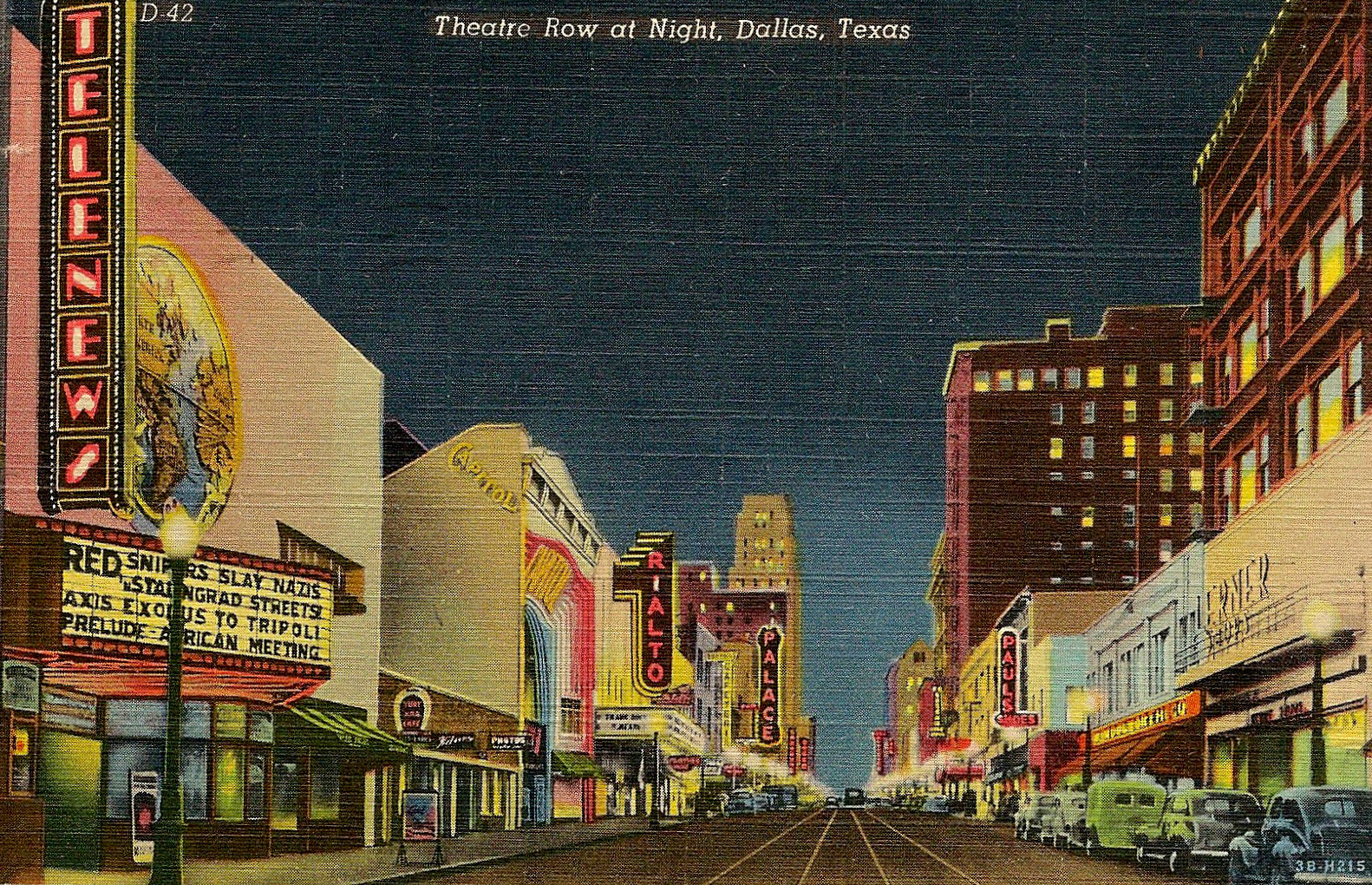
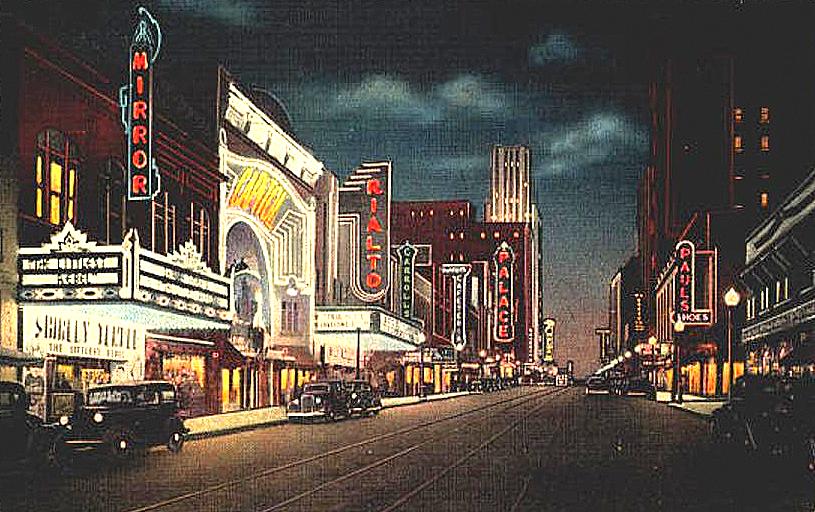
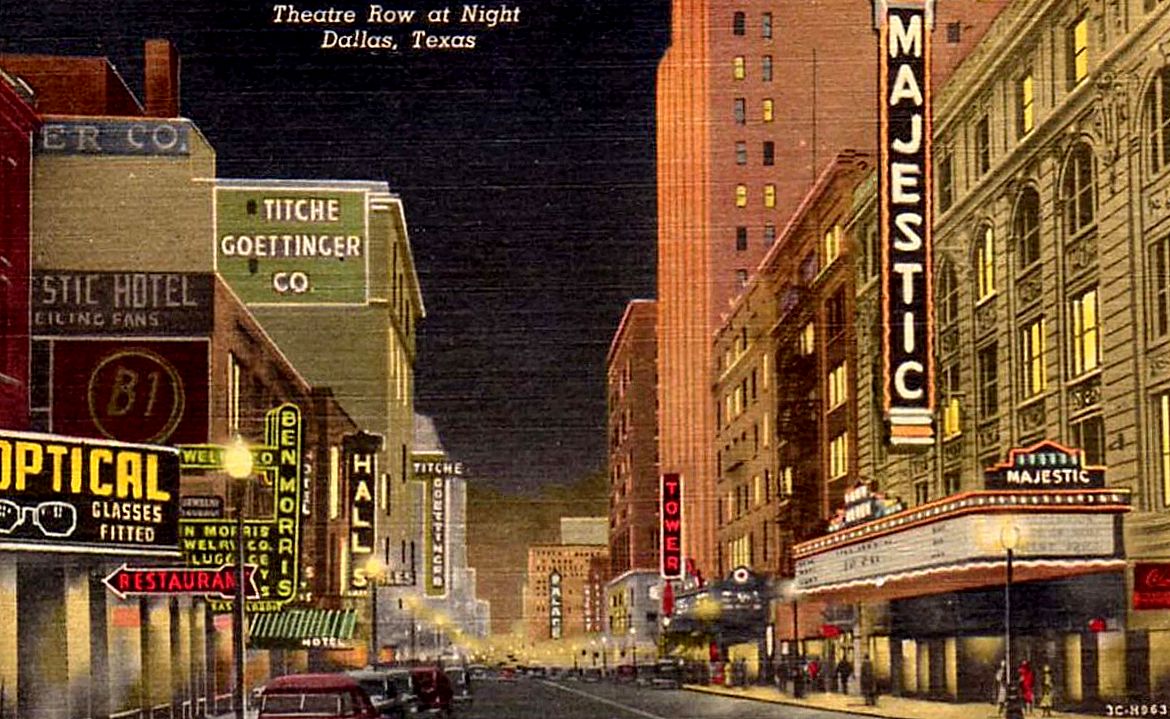
Theatre Row — A Stunning Elm Street at Night

theater-row_night_telenewsElm Street, looking east… (click for larger image)

by Paula Bosse

Damn you, suburban theaters and television, for killing this! (Hang in there, Majestic!)

Favorite thing gleaned from the postcard above? That Dallas had a newsreel-only theater — the Telenews. (See the original, somewhat pedestrian, daytime photograph which was transformed by all sorts of dazzling magic in order to turn it into that striking postcard, here.)

theater_row_night_BIG

theater-row-night_c1935

theater-row_night_majestic

***

All images are larger when clicked — some MUCH larger!

*

Copyright © 2014 Paula Bosse. All Rights Reserved.
 

Minor League Ball: The Dallas Rangers — 1958-1964

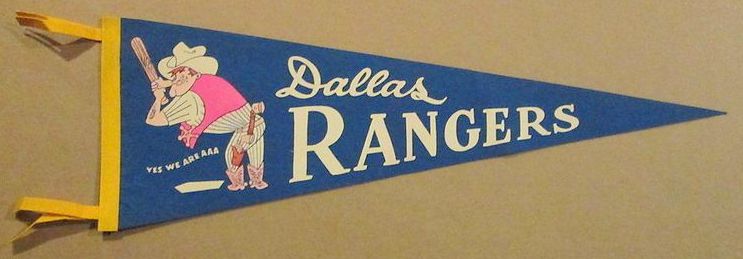
dallas-rangers_1959_ebay

by Paula Bosse

Now there’s a baseball pennant.

“YES WE ARE AAA.” (Apparently triple-A ball had different cleat allowances back in 1959.)

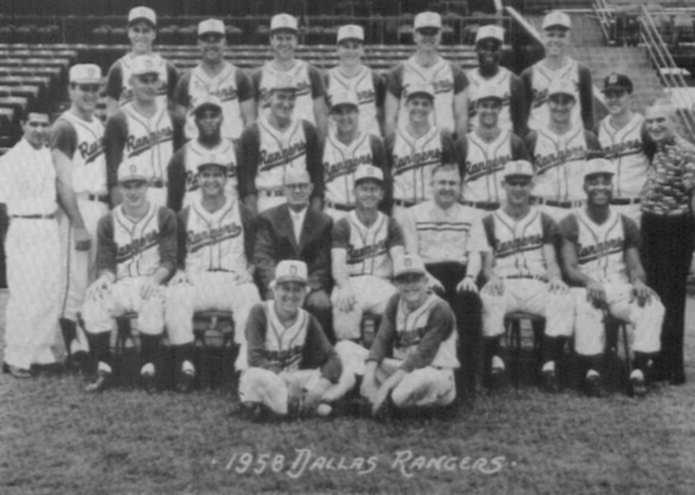
My knowledge of baseball? Pretty limited. I knew that Dallas had professional teams leading up to the Texas Rangers, but that’s about it. Here is a 1958 team photo of the Dallas Rangers, a minor league team that lasted from 1958-1964, known for a couple of those years as the Dallas-Fort Worth Rangers. (This team, by the way, has no historical connection with the present-day Texas Rangers.) They played at Burnett Field. Again, I know precious little about this sort of thing, but, from what I can gather after a hasty skimming, they weren’t very good. The faltering franchise moved to Vancouver in 1965. To Canada! I like this photo. From a purely Americana perspective, the best sports team photos are always, for me, those of  baseball teams.

baseball-dallas-rangers_burnett-field_1958(Click for larger image. Won’t be any sharper, but it’ll be slightly bigger.)

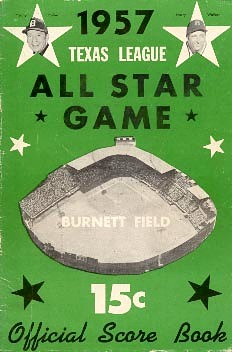
baseball-texas-league_burnett-field_1957

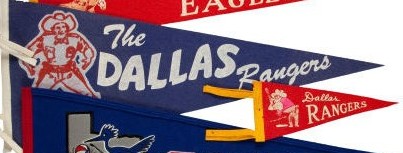
dallas-rangers_dmn-blog-det_102512

***

Sources & Notes

Since I don’t know what I’m talking about, there will be a lot of links.

Top photo of 1959 pennant is from Ebay — which, as of THIS MINUTE, is currently available for purcha$e, here.

The 1958 team photo and 1959 program — I’m not sure where I found them months ago, but I think it might have been here. (As I’m looking at the page right now, all the photos are inactive — but the site may just have exceeded its monthly bandwidth. Lots of good info on the teams that played at Burnett Field, though.)

Bottom image of pennants from a Dallas Morning News blog post by Robert Wilonsky.

Dallas Rangers Wikipedia page here.

Info on Burnett Field here.

And, for those who are really into this sort of thing, the team stats for that 1958 team pictured above can be pored over here.

*

Copyright © 2014 Paula Bosse. All Rights Reserved.

Industrial Blvd. Congestion — 1952

industrial-blvd_kimball-1954

by Paula Bosse

This photo of Industrial Boulevard is from Our City — Dallas by Justin F. Kimball. Below, a few of his paragraphs on Leslie Stemmons’ vision of what we now know as Industrial Boulevard. (Mr. Stemmons most likely did not foresee the tackiness and bail bonds emporia which now line this “boulevard.”)

Starting at the south end of the levee district, running north the whole length of the district with branches opening to Irving, to Wichita Falls, and to Denton and Gainesville, Industrial Boulevard, 130 feet wide, was dedicated for future traffic use at a time when there was no traffic at all.

One of those present at this stage of the district tells this story: “While the levees were being built and plans being made for the development of the properties, Mr. Stemmons took a group of railroad officials, including Mr. Upthegrove of St. Louis — a Dallas boy, then president of the Cotton Belt Lines — on an inspection tour through the area. There was then no such thing as Industrial Boulevard; Commerce Street west of the river was a narrow road which overflowed whenever the river reached flood stage. The surrounding land was covered with cockleburs, blood weeds and willows. On reaching the site of the present intersection of the Triple Underpass and Industrial Boulevard, Mr. Stemmons remarked, ‘Gentlemen, in twenty years this will be the busiest intersection in Dallas.’ Mr. Upthegrove, an old friend, looked up and said, “Les, you don’t mean that?’ ‘I was never more serious in my life,’ was the reply. Mr. Upthegrove looked around him and shook his head, ‘Gosh,’ he remarked, ‘from cockleburs to congestion.'”

Such is progress! In less than twenty years this intersection was reported to be the busiest intersection of vehicle traffic in the state. Planning, hard work, and faith bring wonders to pass.

***

Photo and text from Justin A. Kimball’s Our City –Dallas; Yesterday and Tomorrow (Dallas: Dallas Independent School District, 1954 — 2nd edition).

More on Leslie A. Stemmons here.

And an article from the months preceding the name-change from Industrial to Riverfront, here.

And if you, like I, wondered if “Mr. Upthegrove” was some sort of contrived Pythonesque name a la “Mr. Smoketoomuch,” it is, apparently, an actual surname. Good to know.

Click photo for larger image.

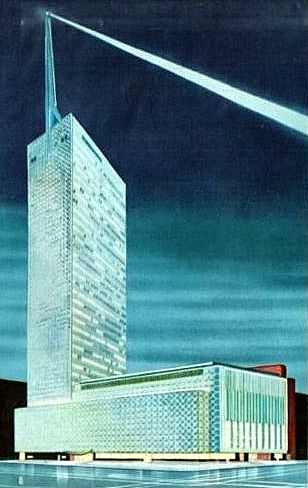
The Republic National Bank Building: Miles of Aluminum, Gold Leaf, and a Rocket

republic-national-bank_beacon_front

by Paula Bosse

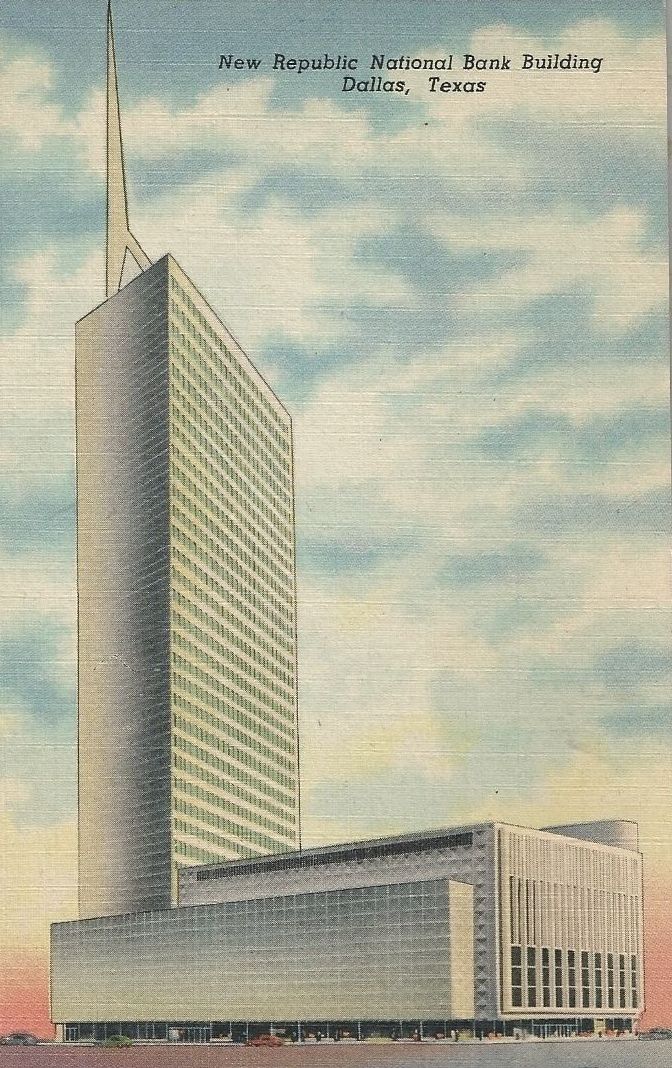
THIS is another great idealized image of a great building, The Republic National Bank Building, built in 1954. The blurb on the back of this postcard reads:

40 stories, cost 25 million dollars, the world’s tallest building faced in aluminum and glass.The mighty half-billion candle-power beacon atop the 150-foot spire is visible up to 120 miles.

This building was built to be the tallest building in Dallas — to dwarf the rival Mercantile (by a whole 53 feet!). Which it did for a while — it boasted of being the tallest building west of the Mississippi. Until … the Southland Life building came along a few short years later and knocked it off its pedestal (although, dammit, it was the “WORLD’S TALLEST BUILDING FACED IN ALUMINUM AND GLASS”!). For years, the powers-that-be seemed overly concerned with the “tallest” building thing and engaged in architectural pissing contests for years.

But forget the exterior. INSIDE. Lordy. Legendary bank president Fred Florence went all out, with Life magazine saying the lavish interior reflected Florence’s belief that a bank’s design and appointments should be “an outward showing of solvency.” This included generous helpings of gold leaf, inlaid teak, and endless marble imported from Italy and Peru (“nearly as long as a football field”). One wonders if Florence muttered something about “Rosebud” on his deathbed. Of its forty-one teller’s cages, two were — for some reason — reserved exclusively for women. There was a full-time gardener on staff. And, of course, there were “gold curtains in the executive washrooms.” There was “all-season air-conditioning.” There was a motor bank in the basement. And, if they couldn’t have the tallest building in town, they were damn sure going to have the fastest elevators in the elevator-using world. And they did.

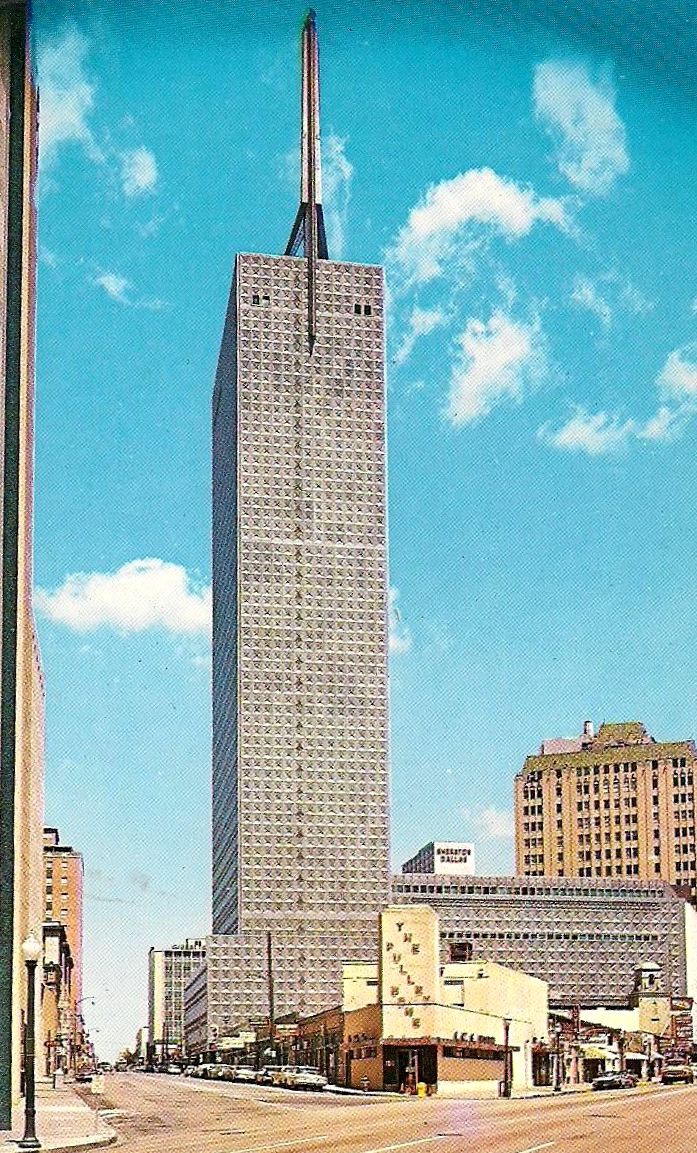
And then there was that rocket. I love that rocket. Sixty years later, it’s still one of the most recognizable buildings on the skyline.

republic-national-bank_S

republic-national-bank_postcard-sm

The missed-by-my-mother’s-generation Pulley Bone diner is in the foreground (click for larger image).

republic-national-bank_photo-post-sm

***

An absolutely fantastic collection of photographs apparently shot by Life magazine to accompany the article from their Feb. 28, 1955 article (linked below) but not used (and, seriously, check them out) are on an unassuming message board. Scroll down a little ways and you’ll see 13 large images of the interior and exterior — see them here. (UPDATE: These photos seem to have disappeared. I’ll keep the link in hopes that user “Dallas boi” will repost!)

Scroll through the 4-page spread “Dazzler for Dallas: Its New Bank is Huge, Handsome and Full of Gold” in Life magazine (Feb. 28, 1955) here.

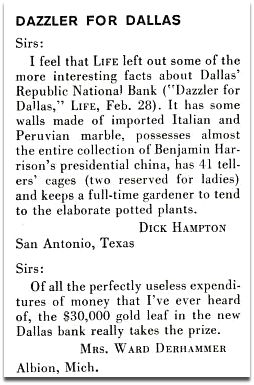
And here are a couple of readers’ responses to the story, which appeared in a later issue (Mrs. Ward Derhammer is not amused):

republic-national-bank_life_032155

Republic National Bank Building info from the Republic Center website can be found here, from Wikipedia here, and from the Dallas Public Library here.

All postcard images (except the first one) are larger when clicked.

*

Copyright © 2014 Paula Bosse. All Rights Reserved.
Back When Preston Royal Was “Exotic” and Had Its Very Own Elephant

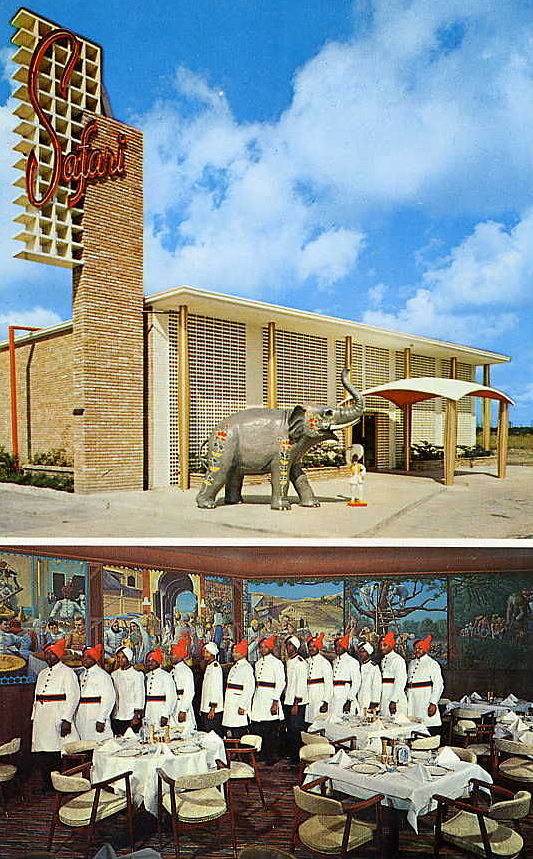
safari-preston-royal

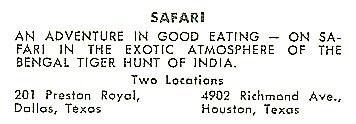
safari-preston-royal-back

by Paula Bosse

Dallas had a restaurant like this?! Yes, it did. (EDIT: It has been brought to my attention in the comments that the image above shows the *Houston* location. But I have been assured that the Dallas location had its very own elephant standing guard outside — so I will not have to ignominiously change the title of this post!)

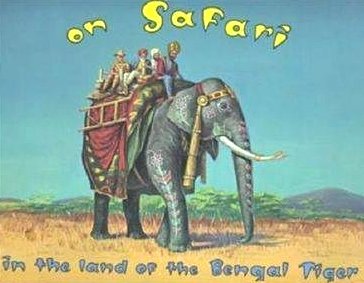
The Safari Steak House was in the Preston Royal Shopping Center at the northeast corner of Preston & Royal (in the space now occupied by the venerable Royal China restaurant). The decor shown in the postcard above is something else — someone put their whole heart and soul into that, from the elephant and, um, elephant wrangler (“mahout“?) out front, to the ornate wood carving and the somewhat… busy murals inside. And the uniformed staff is pretty impressive, too.

Here are photos of the DALLAS Safari, taken in 1961 by Squire Haskins (photos from the UTA Libraries, Special Collections — click the links below the photos for full descriptions and large images). (Thanks, Tom Bowen, for sharing these links in the comments.)

safari_squire-haskins_1961_UTA_1via UTA Libraries, Special Collections

safari_squire-haskins_1961_UTA_2via UTA Libraries, Special Collections

Guy T. Jones opened the Safari in mid 1956 (I think the Houston location was opened later — it was open by at least 1959). I could find almost no early advertising for the place — perhaps Jones blew his advertising budget on elephants and murals. At this point, the shopping center was basically still under construction — the eastern-edge building (home of the Safari) opened about a year after the larger northern-edge building. There used to be a gap between the two buildings, which can be seen in the photo immediately above and can (sort of) be seen in the 1955 ad below, which shows a model of what the finished shopping center would look like.

preston-royal-shopping-center_032755-adAd detail, March 1955

In 1974, Royal China (which is a fantastic place, by the way) took over the space.

I really wish I’d seen that elephant, which — according to the comment below — “was highly visible and well lit at night.” I certainly hope so!

*

From the cover of the menu:

safari-matchbook-a

safari-matchbook

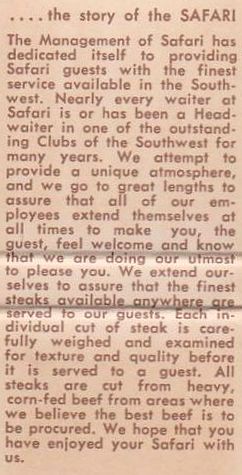
safari-matchbook_story

safari-preston-royal_menu-1969

*

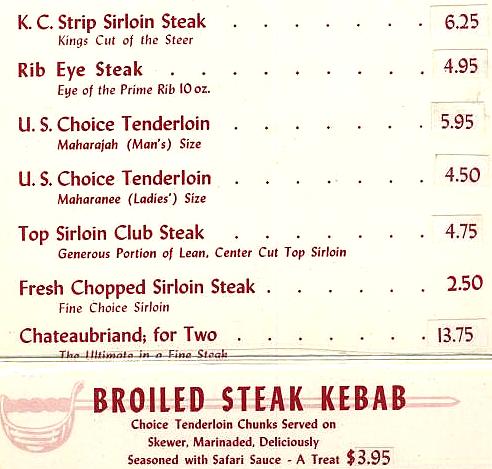
Below, the steak menu. One could choose between the “Maharajah (Man’s) Size” and the “Maharanee (Ladies’) Size.” Or get the kebabs of skewered beef “deliciously seasoned with Safari Sauce — A Treat.”

safari-menu

*

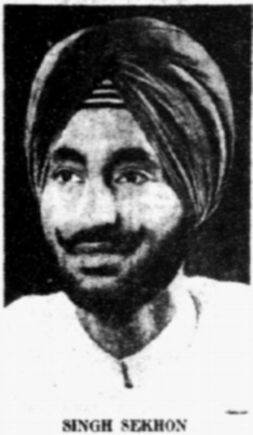
One of the stars of the restaurant was Iqbal “Ike” Singh Sekhon, who started working as the restaurant’s host while studying for his Master’s degree at SMU. He left a few years later to run the fabulous La Tunisia.

safari_dmn_062756-photo

safari-menu-logo

***

Sources & Notes

Edit (Sept. 2022): Wow. This post had a bunch of problems! All I can say is that this was one of my very earliest posts. I was so enamored of that elephant that I made a couple of very glaring errors.

First off, the original title of this post was “Back When Preston Royal Village Was ‘Exotic’ and Had Its Very Own Elephant.” The Safari Steak House was in the Preston Royal Shopping Center, located on the northeast corner of Preston and Royal; the Preston Royal Village shopping center, is on the northwest corner. I’ve (ignominiously) changed the title, but… yikes.

And, as mentioned in the first paragraph, the postcard at the top shows the Houston location, not the Dallas location. Incidentally, the Houston building is still there — it can be seen in a 2011 Google Street View capture here.

The two photos by Squire Haskins (linked below the images) are from the Squire Haskins Photography Inc. Collection, University of Texas at Arlington Libraries, Special Collections (thanks, Tom!). They are dated 1961, one year before a major fire at the restaurant. They reopened the following month, with what sounds like quite an update in decor. I’m not sure when the “gap” between the two shopping center buildings was filled in, but that would have been a good time to expand.

*

Copyright © 2014 Paula Bosse. All Rights Reserved.
The Stretch of “Theater Row” They Never Talk About

leo-theater
The “other end” of Film Row

by Paula Bosse

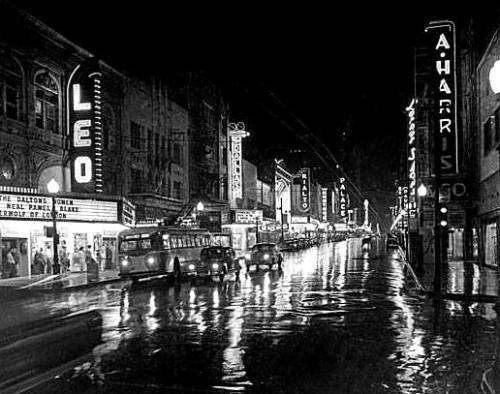
It’s April, 1952, and you’ve got a hot date Friday. Movies are good for date night. What to see? Why not catch a bold, frank, and true “adult” double-bill at the Leo? In the early-’50s, the Leo Theater, at 1501 Elm Street, was at the other end of “Theater Row” — on the metaphorical “other side of the tracks” from the classy Majestic and Palace — and it was one of those places that your mother probably wouldn’t approve of.

leo-theater_dmn-0405521952

The ad above shows a typical Leo double-feature: “Pin-Down Girl” (aka “Racket Girls”) from 1951, a searing look at lady wrestlers and prostitution (the trailer below has a moment that’s actually pretty shocking, and you’ll laugh at yourself immediately afterward for having been shocked), and “Honky Tonk Girl” (aka “Hitchhike to Hell”) from 1941 about teenagers and, well, prostitution. There were at least two exploitation movies titled “Honky Tonk Girl,” so I’m not sure which is the correct poster for the particular cinematic treasure on the Leo bill, but I really love the artwork of this one, so in it goes.

honky-tonk-girl_poster

Here’s the trailer for “Pin-Down Girl” (which is handy, because it gives you about all you really need to satisfy a piqued curiosity without wasting a lot of your time):

**∙*

***

Sources & Notes

I don’t have a source for the top photo, but I believe I have seen it attributed to the Dallas Public Library. If this is incorrect, please let me know.

A little background on the Leo Theater (1948-1953), originally the Queen (1913-1948), can be found in the comments section here.

But if you want to know just what was going on in these not-quite-but-fast-approaching seedy Dallas theaters, you owe it to yourself to read a great passage from Troy Sherrod’s Historic Dallas Theatres (Arcadia Press, 2014), here (scroll down to the caption).

*

Copyright © 2014 Paula Bosse. All Rights Reserved.