Gus Roos Men’s Clothing — 1951
 Elm and Akard and familiar skyline…
by Paula Bosse
One of the top men’s clothiers, right there at Roos Corner. (Pegasus!)
*
Copyright © 2014 Paula Bosse. All Rights Reserved.

Elm and Akard and familiar skyline…
by Paula Bosse
One of the top men’s clothiers, right there at Roos Corner. (Pegasus!)
*
Copyright © 2014 Paula Bosse. All Rights Reserved.
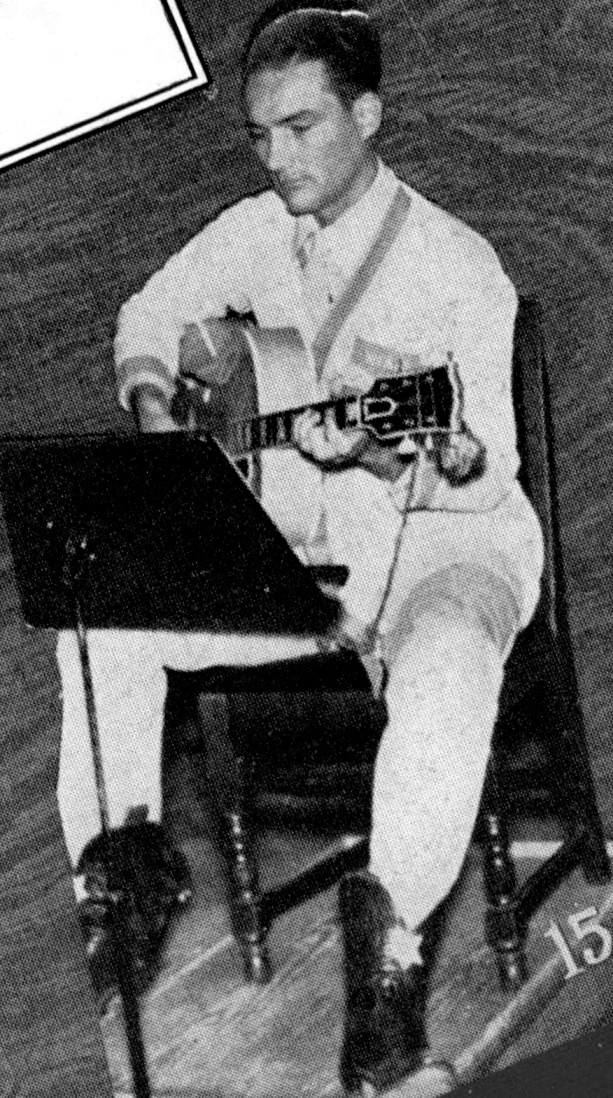
Jerry Scoggins in the WFAA studios, 1941
by Paula Bosse
You know Jerry Scoggins. You DO. You can sing along with his most famous recording. But you might not know his name — even if you do know it, you’re not sure why you know it. And you’ve almost certainly never seen a picture of him. But there he is in the photo above, in 1941, at the studios of WFAA radio where he was a staff musician and occasional on-air personality. The caption reads: “Guitarist Jerry Scoggins arrives for a rehearsal in shiny cowboy boots.”
During his time at WFAA (he was there almost a decade — he started when the station still had studios in the Baker Hotel), Jerry was in countless bands — in fact, he often had several going at the same time. Some of his bands were: The Bumblebees, the Tune Tumblers (with a then-unknown Dale Evans as the group’s “girl singer”), Three Cats & a Canary, The Baboleers, and The Cowhands.
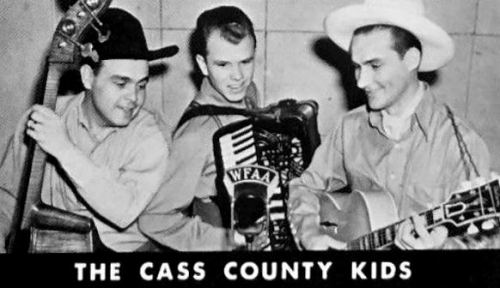
His main group, though, was the Cass County Kids, a popular trio that performed western music and who claimed to have a repertoire of over 500 songs (!).
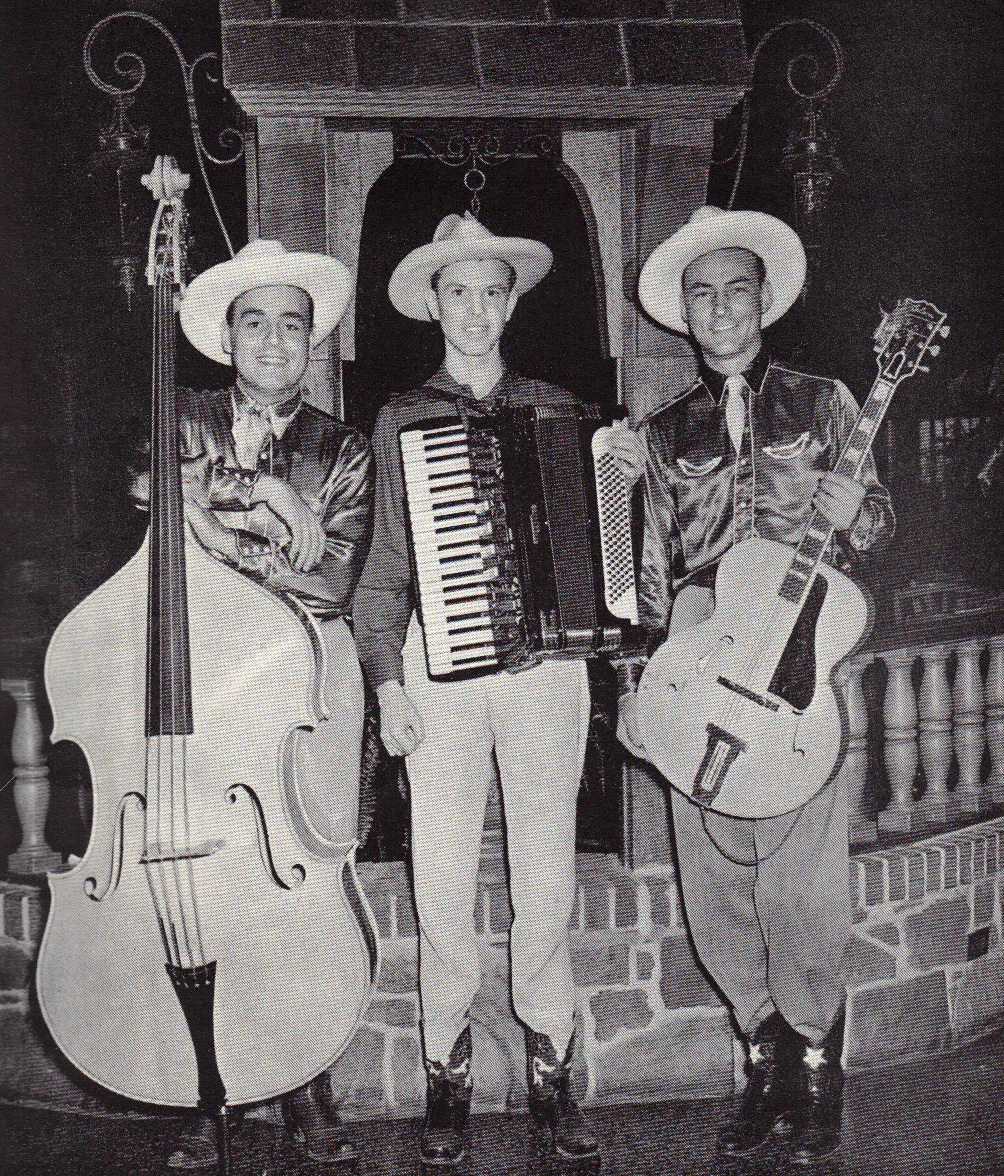

In 1945, after years of working as mostly anonymous radio musicians, the Kids finally hit the big time. Gene Autry asked them to join him, and they left Dallas for Hollywood, changing their name in the process — at Autry’s request — to the (slightly) more age-appropriate Cass County Boys. They appeared in movies, on television, and on record with Autry for several years, and from all accounts, the Cass County Boys had a long and happy career.
By 1962, Jerry was still in California, but at that point he was working as a stockbroker, singing only on weekends. I’m not exactly sure how it happened, but — seemingly out of the blue — he was asked by TV producers to sing the theme song for a new CBS television show called The Beverly Hillbillies. Backed by the great Flatt & Scruggs, Jerry sang “The Ballad of Jed Clampett,” and his voice became known to millions of people, overnight. And here it is more than fifty years later, and I bet you know all the words to the song. It has become a permanent fixture in American pop culture.
And that’s why you know Jerry Scoggins.
*

*
ADDED, Sept. 2023: A reader just sent me this clip showing Scoggins (with Earl Scruggs, Roy Clark, and others) performing the song in 1993 as Buddy Ebsen dances along. This is so great!!
 Jerry Scoggins, 1993 (from YouTube video)
*
And here’s Jerry with the Cass County Boys, singing a novelty song called “Which Way’d They Go?” (Jerry’s the good-looking one on the right):
***
The top photo of Jerry Scoggins and the large photo of the Cass County Kids are from the WFAA-KGKO-WBAP Combined Family Album (Dallas, 1941). The small photo of the Cass County Kids is from eBay.
Jerry Scoggins was born in 1911 in Mount Pleasant, Texas (in Titus County, right next door to Cass County). He died in 2004 at the age of 93. His obituary in the Los Angeles Times is here. More on Jerry from Wikipedia, here.
A nice overview of the Cass County Kids/Boys is here.
*
Copyright © 2014 Paula Bosse. All Rights Reserved.

by Paula Bosse
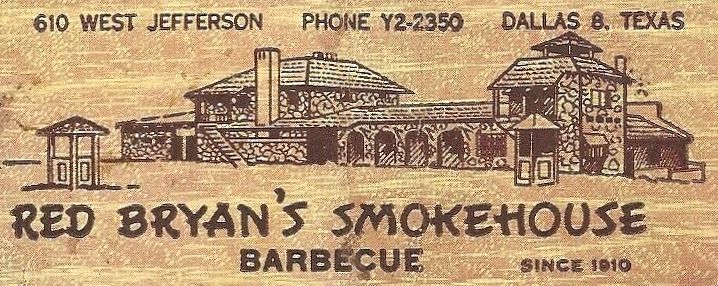
Everybody in Dallas knows about Sonny Bryan, and some remember Red Bryan, but I didn’t know there was another Bryan forebear, who started the family barbecue dynasty: Elias Bryan. Elias and his wife, Sadie, arrived in Oak Cliff from Cincinnati in 1910 and opened a barbecue stand. Elias begat Red, and Red begat Sonny. And there was much trans-generational smoking of meat. The Bryans have been a BBQ fixture in Dallas for over 100 years.
Fun facts about William Jennings “Red” Bryan:
And the rest is, as they say, barbecue — and Oak Cliff — history.

*

*
 Red, 1951
*
***
Postcard (circa 1950) at top from eBay. This is printed on the back:

Ad from 1956.
Much more on Red Bryan’s Smokehouse, with lots of photos of its construction, can be found in the Oak Cliff Advocate article “The King of Oak Cliff Barbecue” by Gayla Brooks, here.
Even more cool stuff, including early photos of the family business, can be found in the Texas Monthly article “Bryan Family Artifacts and Mementos” by Daniel Vaughn, here.
Sonny Bryan’s website is here.
*
Copyright © 2014 Paula Bosse. All Rights Reserved.
 An apple a day… (click for larger image)
by Paula Bosse
Cleaning the streets around the Farmers Market.
All in a day’s work for the City of Dallas Public Works Department.
***
Photo taken July 23, 1958. From the Dallas Farmers Market – Henry Forschmidt Collection 1938-1986, Dallas Municipal Archives, via the Portal to Texas History; more info on this photo is here.
Click picture for larger image.
*
Copyright © 2014 Paula Bosse. All Rights Reserved.
by Paula Bosse
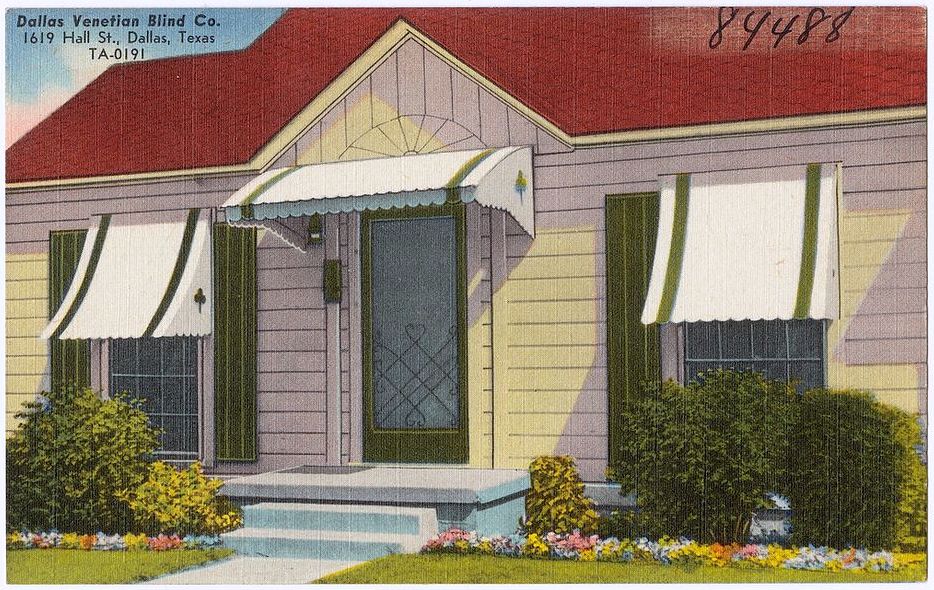
This is the sort of old postcard I love. It shows an impossibly idealized version of the past. This lovely house, with its impeccably manicured lawn and bright, shiny awnings is not a home, but the location of a business. It’s the Dallas Venetian Blind Company, at 1619 Hall Street, a few steps from Ross Avenue. When I see old postcards and photographs of places like this, I always wonder about the people who lived and worked there. So who went to work every day in that cute little house, living and breathing all-things Venetian blinds?
The owner of the Dallas Venetian Blind Company was J.S. “Joe” Herold. He was born in Austin in 1905 and moved to Dallas when he was a teenager. He started out in the floor finishing business and didn’t open his “Venetian blind concern” until many years later, in 1942. He was married, had a daughter, lived on Reiger near Fitzhugh, and enjoyed hunting and fishing. He was a “Square Deal” candidate for an East Dallas seat on the City Council in 1951, running against candidates representing the equally quaintly-named “Nonpartisan Association” and “Citizens’ Charter Association.” By 1960 he seems to have moved to Quitman, still fighting the good fight in the blinds game. But, sadly, far away from this wonderful little house which MUST have had Venetian blinds in those windows, even though I can’t see any! And now, Joe Herold — sit back — this is your life!
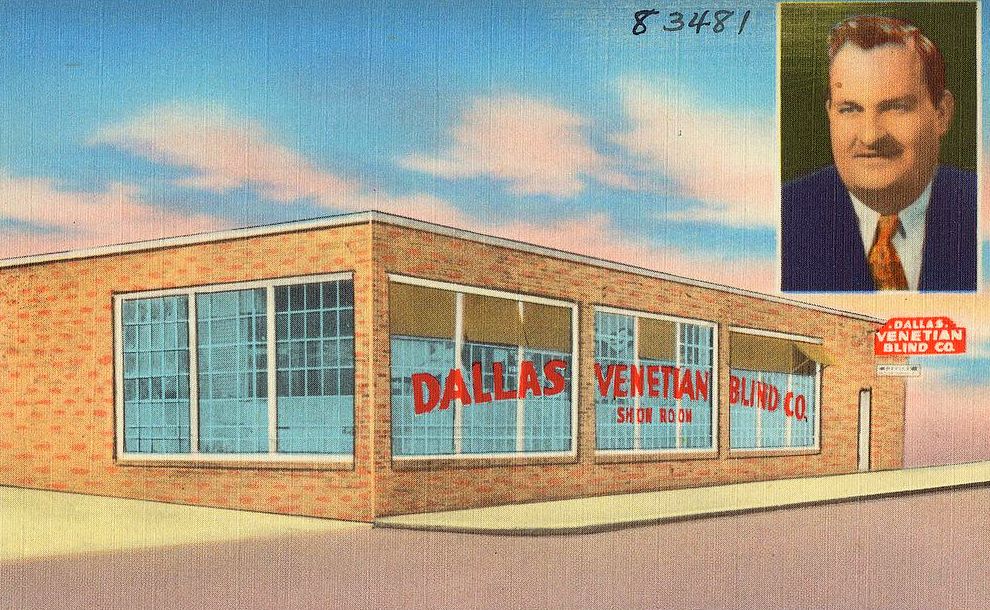
The showroom, at 3230 Ross Avenue, right around the corner from the cute little house. This expansion had happened by at least 1947.

Business must have been good in those post-war years, because Joe had ads in 1950 boasting three telephone numbers: the main shop, the showroom, and, yes, Joe’s own car phone (which seems very early for car phones)!

 1950 ad
***
Postcards from the absolutely fantastic Boston Public Library Tichnor Brothers Postcard Collection on Flickr, here.
Click postcards for larger images.
*
Copyright © 2014 Paula Bosse. All Rights Reserved.
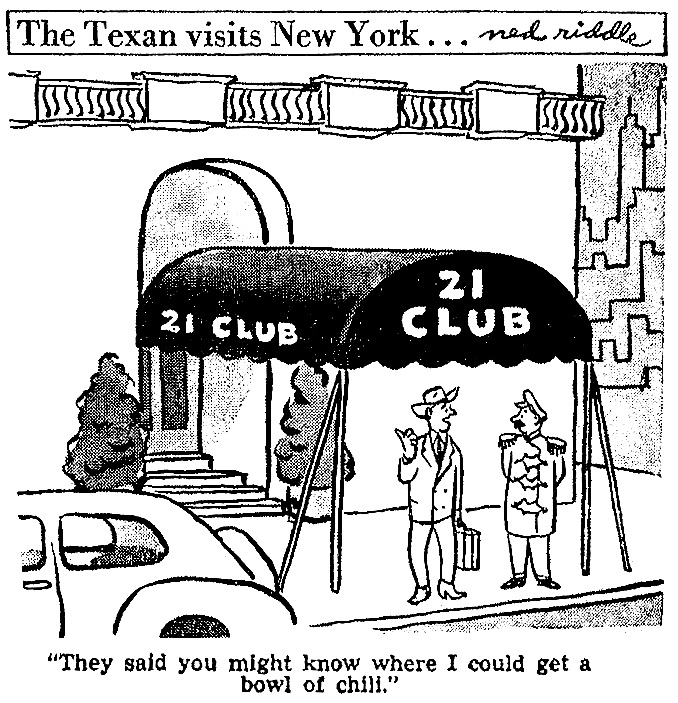
The Texan Visits New York City … “New York CITY?!”
by Paula Bosse
A few years ago, I came across the cartoon above in Joe E. Cooper’s chili bible, With or Without Beans, and I was delighted to see that the cartoonist was Ned Riddle, who, though having begun his career as a staff artist for the Dallas Morning News, is known primarily for his syndicated comic panel “Mr. Tweedy,” which I loved as a kid.
A couple of interesting tidbits about Mr. Riddle, who was a Dallas resident until his death in 2003: during WWII, he served on a submarine with the unspeakably perfect name, the USS Piranha, and — unlikely as it seems — while studying art at Washington University in St. Louis, he apparently studied under the great Expressionist artist Max Beckmann.
I loved “Mr. Tweedy” — the look of it, the simple one-panel jokes, and the fact that (as I recall) the somewhat optimistic-though-beleaguered Mr. Tweedy rarely actually spoke. Sort of Mr. Bean-like. I also knew that the cartoonist was from Dallas, and I was always trying to spot any sort of hidden homage to the city (as far as I know that never happened, but it SHOULD have!). “Mr. Tweedy” began in 1954 and ended in 1988. That’s a good run.
Here are a few Mr. Tweedy panels.
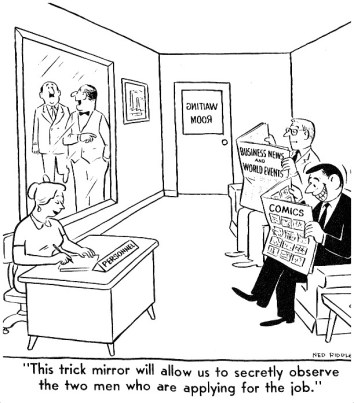 1959
1959
*
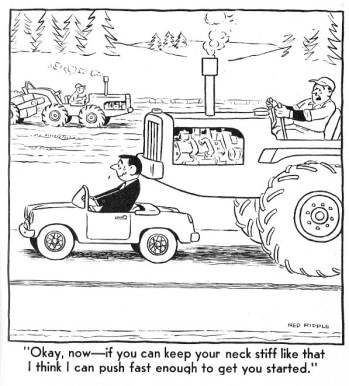 1959
1959
*
 1969
1969
**
And some photos of Ned Riddle at his drawing board over the years.

*
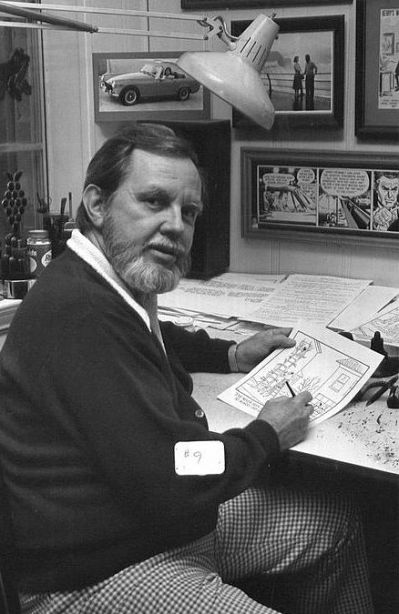
*
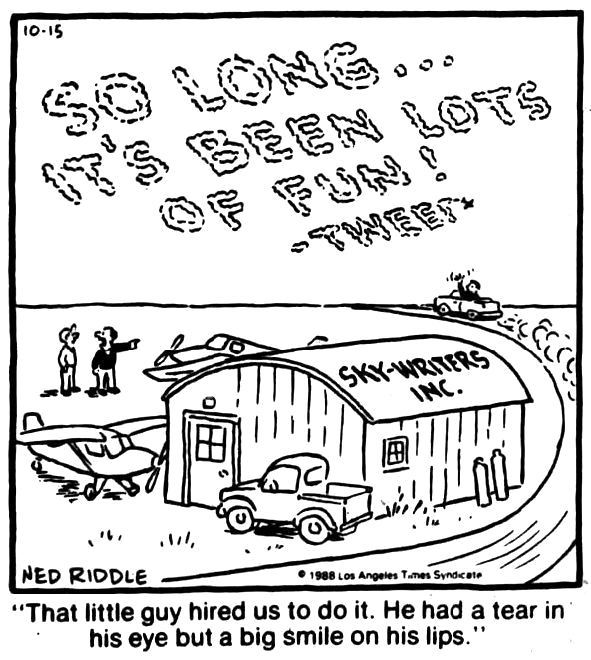 Oct. 15, 1988, the final panel….
***
“The Texan Visits New York” cartoon appeared in With or Without Beans, An Informal Biography of Chili by Joe E. Cooper (Dallas: William S. Henson, Inc., 1952). Find (pricey) out-of-print copies for sale here.
First two “Mr. Tweedy” panels from Mr. Tweedy by Ned Riddle (NY: Fleet Publishing Corporation, 1960; reprinted in 1977).
Later photo of Ned Riddle found on Flickr here.
*
Copyright © 2014 Paula Bosse. All Rights Reserved.
by Paula Bosse
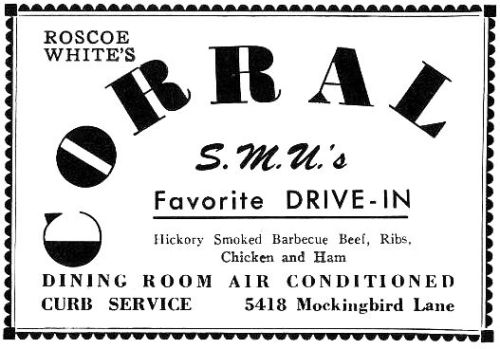
My family had two favorite neighborhood restaurants: Kirby’s Charcoal Steakhouse on Lower Greenville for birthdays and special occasions, and Roscoe White’s Corral on Mockingbird for every other occasion. Conveniently, both were only a short walk from our house. When I came across this ad, I was surprised to see that the Corral had started out as a drive-in, with car-hops. My memories of the place are from the 1970s after it had been rebuilt. in the same block, in a new-ish shopping strip (about where Premiere Video is now), facing the old Dr Pepper plant. It had a diner-like, fairly utilitarian decor, with a slightly fancier banquet room at the back. There was an attached (very dark) bar with a separate entrance. I remember the gleaming cigarette machine. Roscoe must have loved the place, because he was there all the time.
My mother and I always had the chicken-fried steak and a salad with blue cheese dressing. My father and brother tended to go for the still-bubbling cheese enchiladas on a hot metal dish, swimming in a healthy amount of grease (my father’s favorite part). I swear we always had the same waitress — I can’t remember her name, but it was one of those perfect names for a waitress. “Maxine” maybe? (I think my parents had both been customers since their days at SMU in the ’50s, and for all I know, she had been there back then and had been serving them for over twenty years.)
When the Corral closed in the late-’70s or early-’80s, my family was distraught. Loyal patrons that we were, we began making the trek through the Park Cities to Roscoe’s other restaurant, The Easy Way, over on Lovers Lane, by the toll road — the atmosphere was different (it was darker, for one thing), but the food was EXACTLY THE SAME! And, as I recall, even our regular waitress was there — she had also made the move across town. It was almost as if nothing had changed. …Almost.
I loved the Corral My family had so many nice times there. And I miss it. I especially miss that wonderful chicken-fried steak, the yardstick by which I continue to judge all others.
Roscoe White died in 1995 and was remembered in D Magazine:
He moved around, but Roscoe White always had a place for Dallas to eat. He opened his first restaurant in 1939, the Kings Way Grill on Knox and Travis streets. It had an upstairs casino, and the beer was stored in the icehouse next door. Later he opened the Corral on Mockingbird Lane, a drive-in that became a haven for SMU law students. White also owned the Easy Way Grill on Lovers Lane and then Roscoe’s Easy Way on Lemmon Avenue. He died of a stroke at 88.
Thanks for all the great meals, Roscoe!
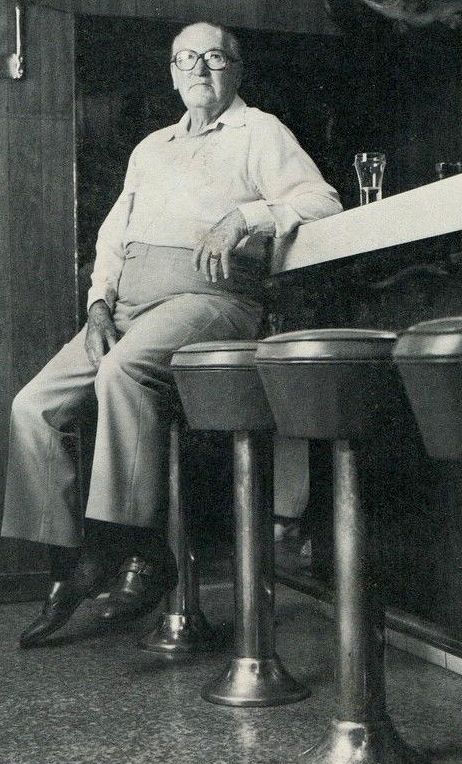 Roscoe White at the Easy Way (D Magazine, Oct. 1985)
*
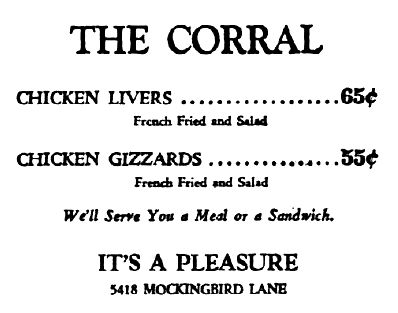
An early ad from 1947. Fried chicken gizzards, only 55 cents — “It’s a Pleasure”!
*
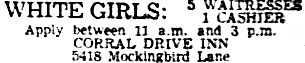
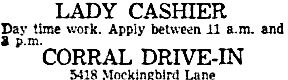
A couple of help-wanted ads for waitresses and a “lady cashier” (Dallas Morning News, 1948). I can only hope that Roscoe’s car-hops were referred to as “White Girls.”
*
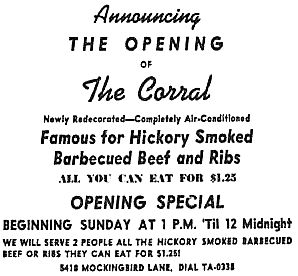
There had been a fire in the summer of 1950 that caused $4,500 worth of damage, the reason, I’m assuming, for the redecoration and re-opening. I’m not sure when the Corral moved into the location I was familiar with, but by mid-1969, ads were appearing with the new address of 5422 Mockingbird.
*
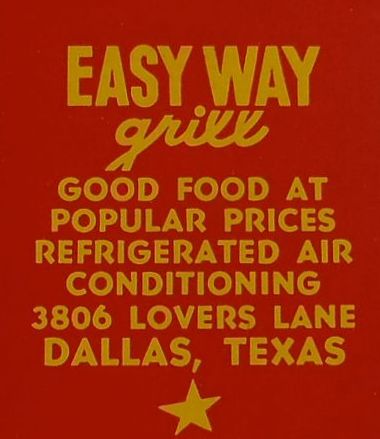
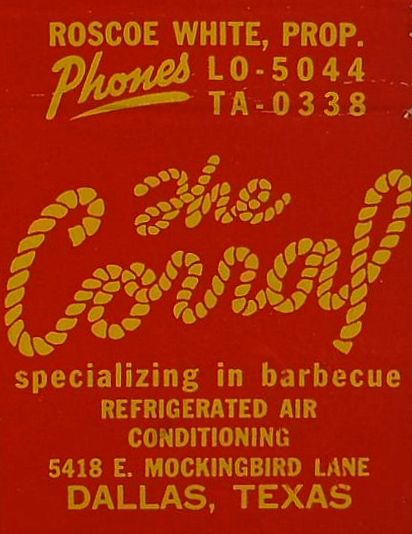
A matchbook from the Easy Way Grill, sadly, with the wrong address on it! The Easy Way was at 5806 Lovers Lane, part of the Miracle Mile, where Dr. Delphinium is now.
*
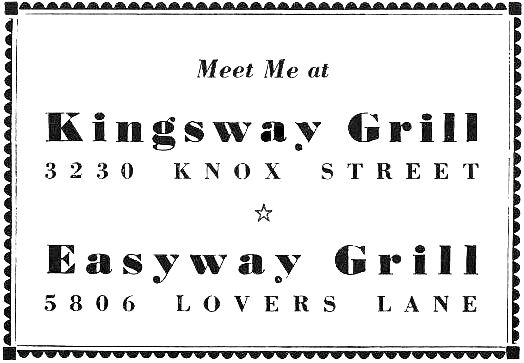
A 1951 ad for the Kings Way Grill and Easy Way Grill.
***
The top ad touting “SMU’s Favorite Drive-In” is from a 1951 SMU-Rice football game souvenir program.
A fond farewell to the Easy Way — “It’s Hard To Say Goodbye to The Easy Way Cafe” — from D Magazine is here. (Above photo of Roscoe accompanied the print article.)
Red matchbook covers from Flickr.
*
Copyright © 2014 Paula Bosse. All Rights Reserved.
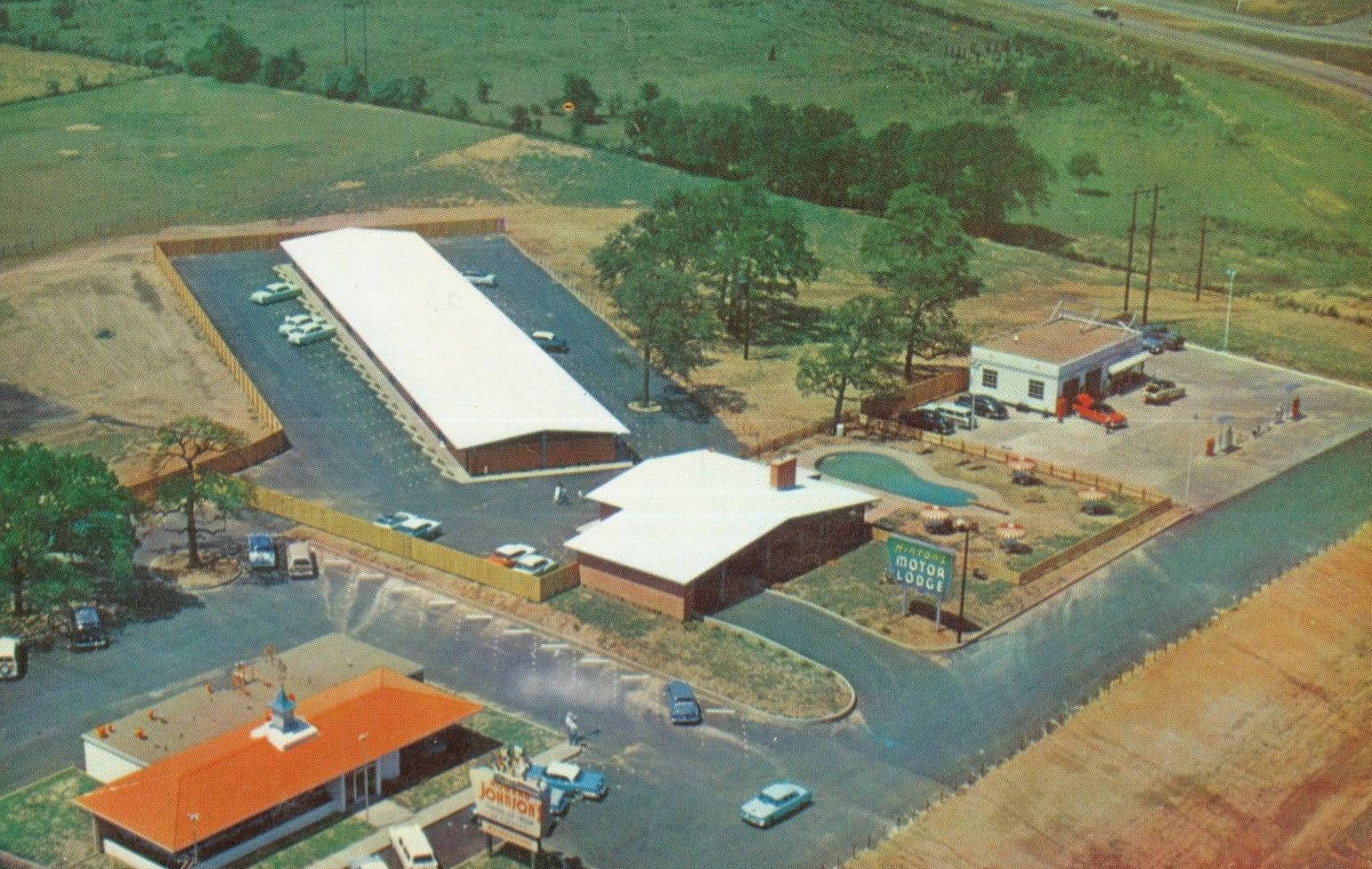 “7 miles from Downtown Dallas” — choppers welcome
by Paula Bosse
What does a man who ambushed and killed Bonnie and Clyde do once he’s retired from law enforcement? He opens a motor lodge, of course!
I was initially drawn to this image because of an unexplained lifelong fascination with Howard Johnson’s restaurants (I think I was only ever in one — the one on Mockingbird at Central, where my father introduced me to the inexplicable root beer float). But the interesting thing about this postcard is not the HoJo’s, it’s the motel next door, Hinton’s Motor Lodge, an establishment that was in business from 1955 to 1970, in Irving, very near to where Texas Stadium would be built in 1971 (Loop 12 at Hwy. 183). Why would a motor lodge be interesting? Because the owner was Ted Hinton (1904-1977), the former Dallas County Deputy Sheriff who was one of the six men who tracked down, ambushed, and killed Bonnie and Clyde in 1934. (Hinton was recruited for the posse because he would be able to identify both of them: he had known Clyde Barrow growing up, and he had apparently had a crush on Bonnie Parker in the days when she was working as a waitress and he was working for the post office.)
After killing two of the most notorious celebrity outlaws of all-time, it must have been hard to know where to turn next. He retired from the Dallas County Sheriff’s Department in 1941 and, as he was a pilot, he trained flyers for the US Army Air Corps during WWII. The fact that Hinton was a pilot MUST explain the inclusion of a “heliport” (!) in the list of motel amenities, alongside Beauty Rest mattresses, a swimming pool, and a playground for the kids.
I’m sure that, on occasion, Hinton ate next door at Howard Johnson’s. But I bet none of the other patrons had any idea that the guy sipping coffee in the next booth was one of the men who gunned down Bonnie and Clyde in a hail of gunfire that even Sam Peckinpah might have considered “a bit much.”
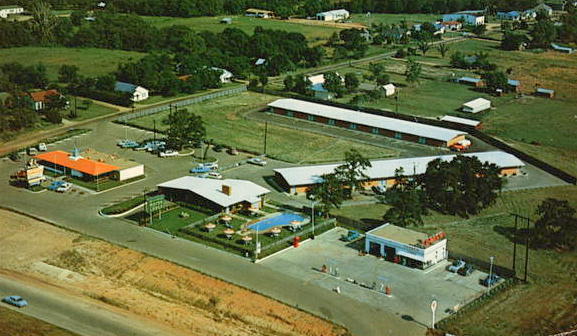
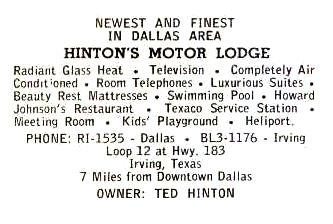
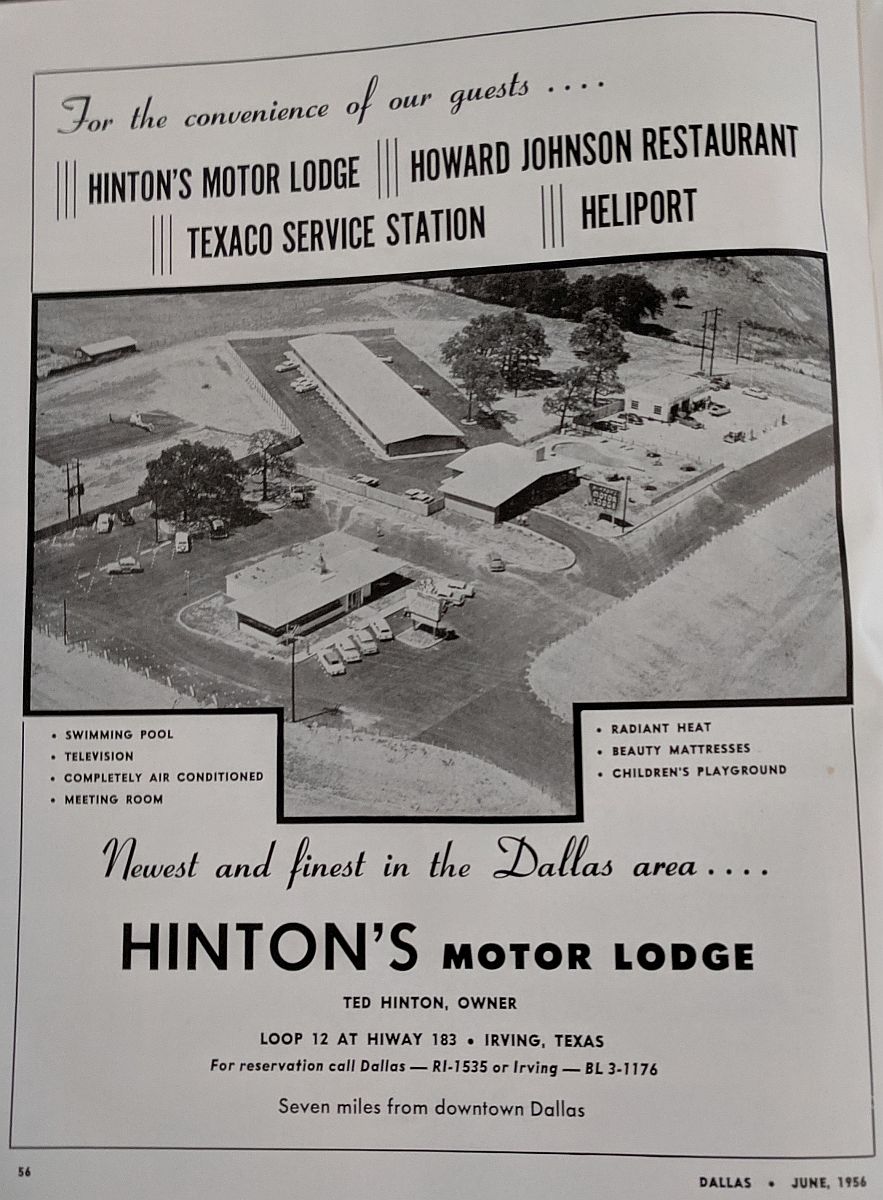 “Dallas” magazine, June 1954 (via Reddit)
***
An interesting short video about Ted Hinton’s connections to Bonnie and Clyde in his youth is recounted here by Hinton’s son “Boots.”
And a newsreel featuring film footage of the aftermath of the ambush — and apparently shot by Hinton himself with a 16mm movie camera loaned to him by a Dallas Times Herald photographer — can be seen here.
*
Copyright © 2014 Paula Bosse. All Rights Reserved.
by Paula Bosse
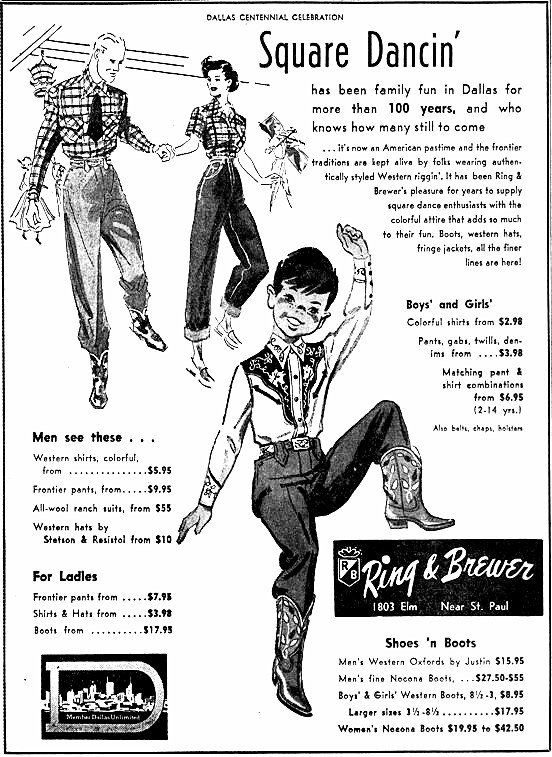
For all your square-dancin’ needs.
*
Copyright © 2014 Paula Bosse. All Rights Reserved.
 Flashback : Dallas