Flashback : Dallas

A Miscellany: History, Ads, Pop Culture

Category: 1960s

Country Music — Every Saturday Night on Channel 11

country-music_saturday-night_channel-11_ktvt_1969The warm-up for wrestling…

by Paula Bosse

I have a surprisingly deep knowledge of classic country music. And it can all be traced back to sitting with my father every Saturday night as he watched the jam-packed lineup of country music TV shows on KTVT-Channel 11.

Followed by wrestling.

Which I also have a surprisingly deep knowledge of. If only by osmosis.

Thank you, Channel 11, for providing this bonding time with my father, which I didn’t really appreciate as a child, but I do now.

(And, yes, I’m happy that my antiquarian bookseller father and Comparative Literature-degree-holding mother often took our family to the Sportatorium to see both country music package-shows and wrestling matches. You can’t say our family wasn’t well-rounded.)

***

Sources & Notes

1969 ad from an odd little local publication (which probably used to belong to my father) called Country and Western — The Sound That Goes Around the World, published in DFW by PegAnn Production.

*

Copyright © 2017 Paula Bosse. All Rights Reserved.

Mosaic Restoration at Downtown’s St. Jude Chapel

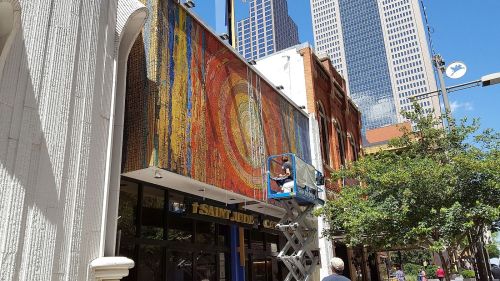
st-jude-chapel_scaffold_052417_bosse_bosseTile by tile by tile… (click for larger image)

by Paula Bosse

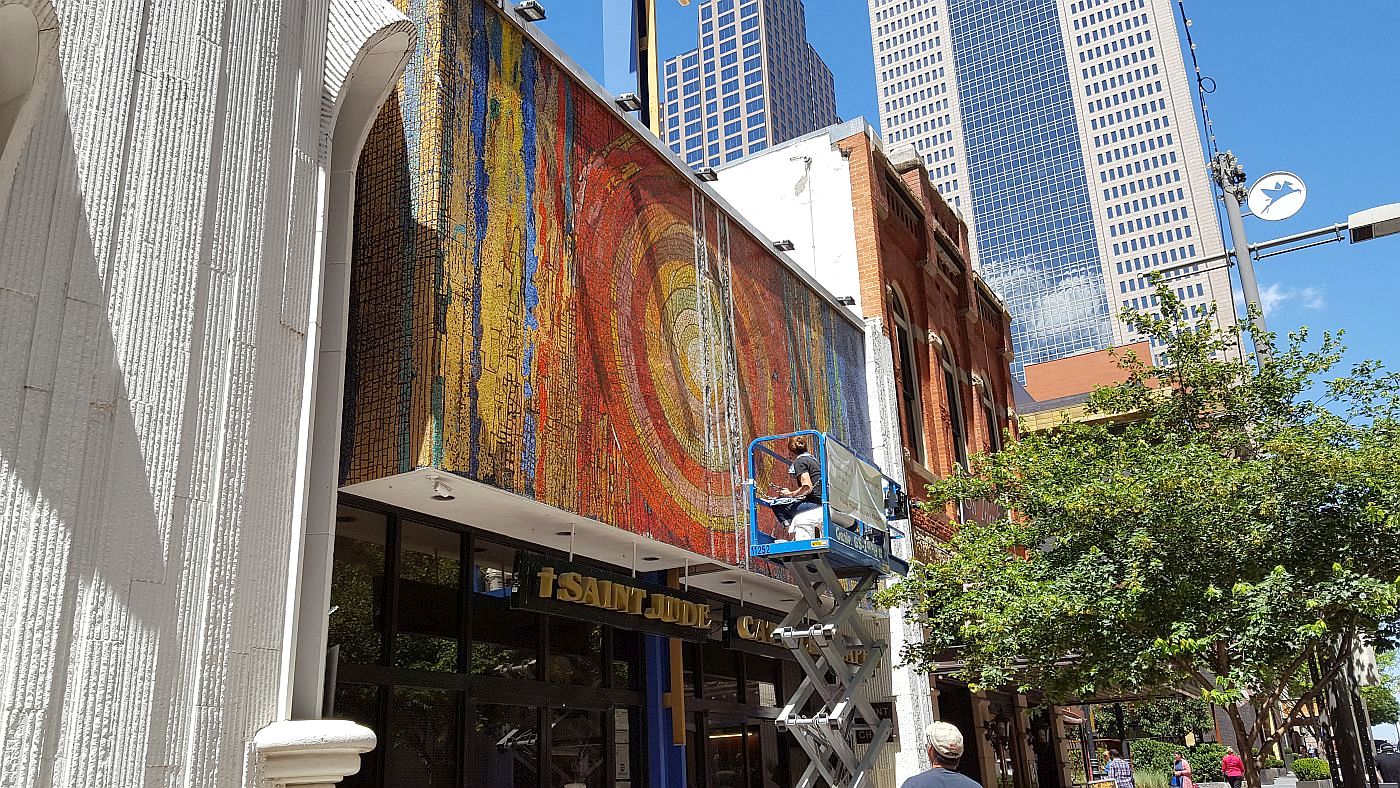
A couple of weeks ago I went downtown to check out the restoration of the large mosaic above the entrance to the St Jude Chapel on Main Street. The 1968 Gyorgy Kepes mosaic (which I wrote about here) is undergoing needed repair work, restoration, and cleaning, in preparation for next year’s 50th anniversary of the downtown chapel. The work on mosaics inside the chapel as well as the large one outside is being done by artist and preservationist Julie Richey of Julie Richey Mosaics in association with Art Restorations, Inc.

As you can imagine, the outdoor mosaic overlooking Main Street has, for 50 years, weathered everything from intense summer heat, freezing temperatures, automobile exhaust, slight shifting of the building’s structure, damage to individual tiles, mildew, grout decomposition, and a host of other factors, all of which led to the much-needed restoration work.

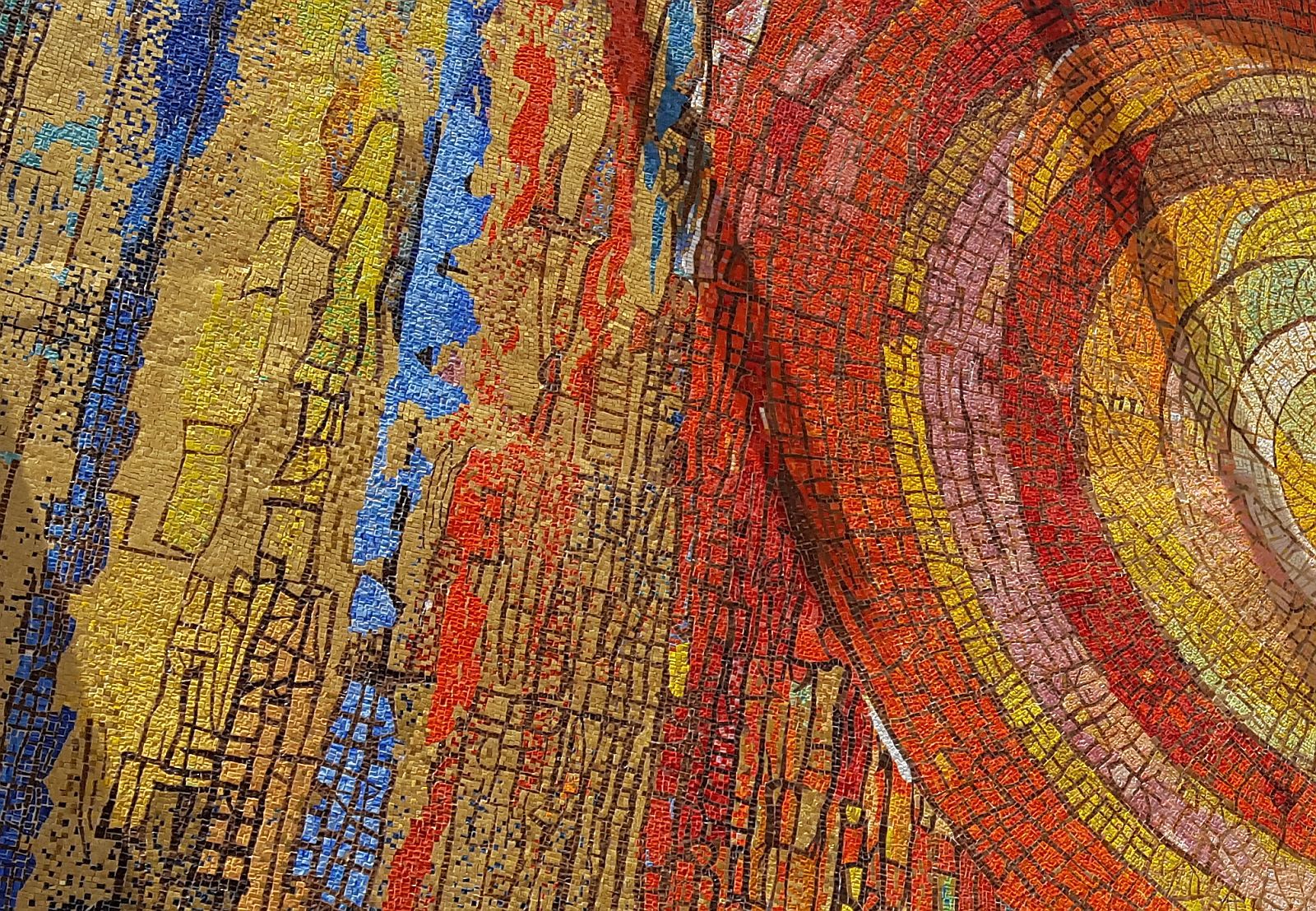
A couple of things that I found interesting, in talking with Julie Richey and Cher Goodson (of Art Restorations, Inc.) was that there are over 800,000 glass smalti tiles (or tesserae) forming the sunburst mosaic. 800,000! I had no idea it was so large until I was standing right below it. After missing or damaged tiles have been replaced, all 800,000-plus will be cleaned — by hand, I think — with, as Cher told me, Dawn dishwashing liquid (good for cleaning greasy dishes, oil-soaked waterfowl, and Venetian glass tiles). Speaking of those tiles, one of the most serendipitous moments in this project was when Julie was able to track down slabs of smalti in New York which were the very same smalti used in the original 1968 mosaic — they had been kept in storage for 50 years, and they look brand new. That means that the tesserae being used to replace the damaged or missing tiles are from the exact same batch as the originals, which means the vivid colors, the composition, the opacity, and the surface texture are the same. That is an incredible stroke of luck!

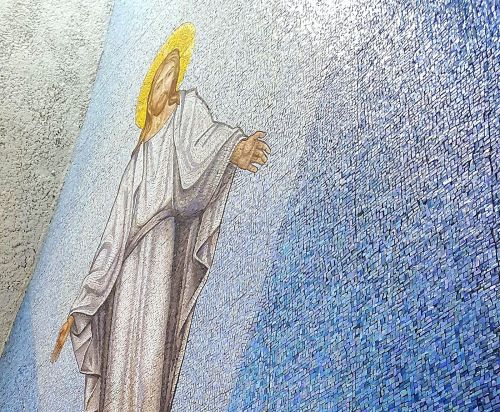
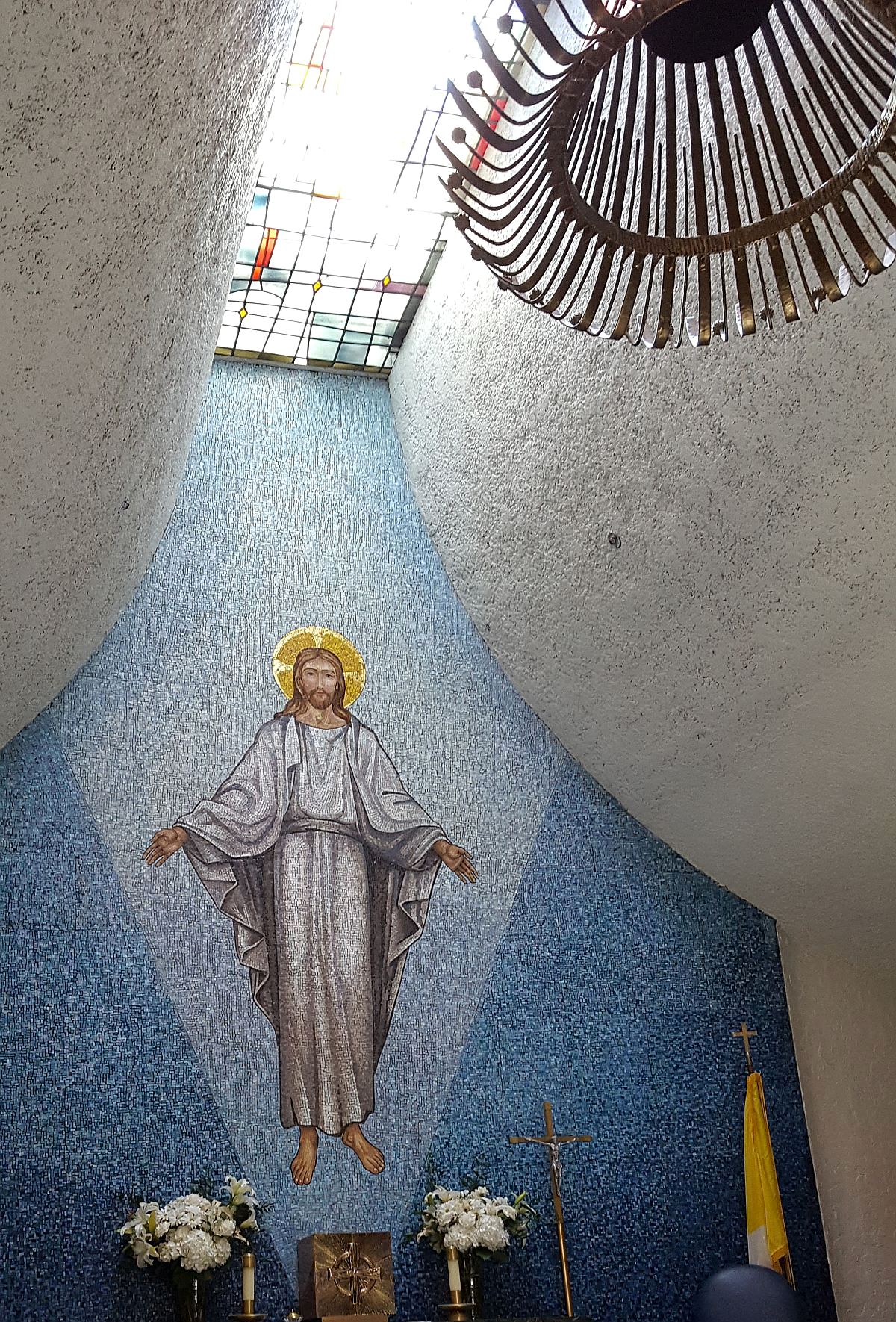
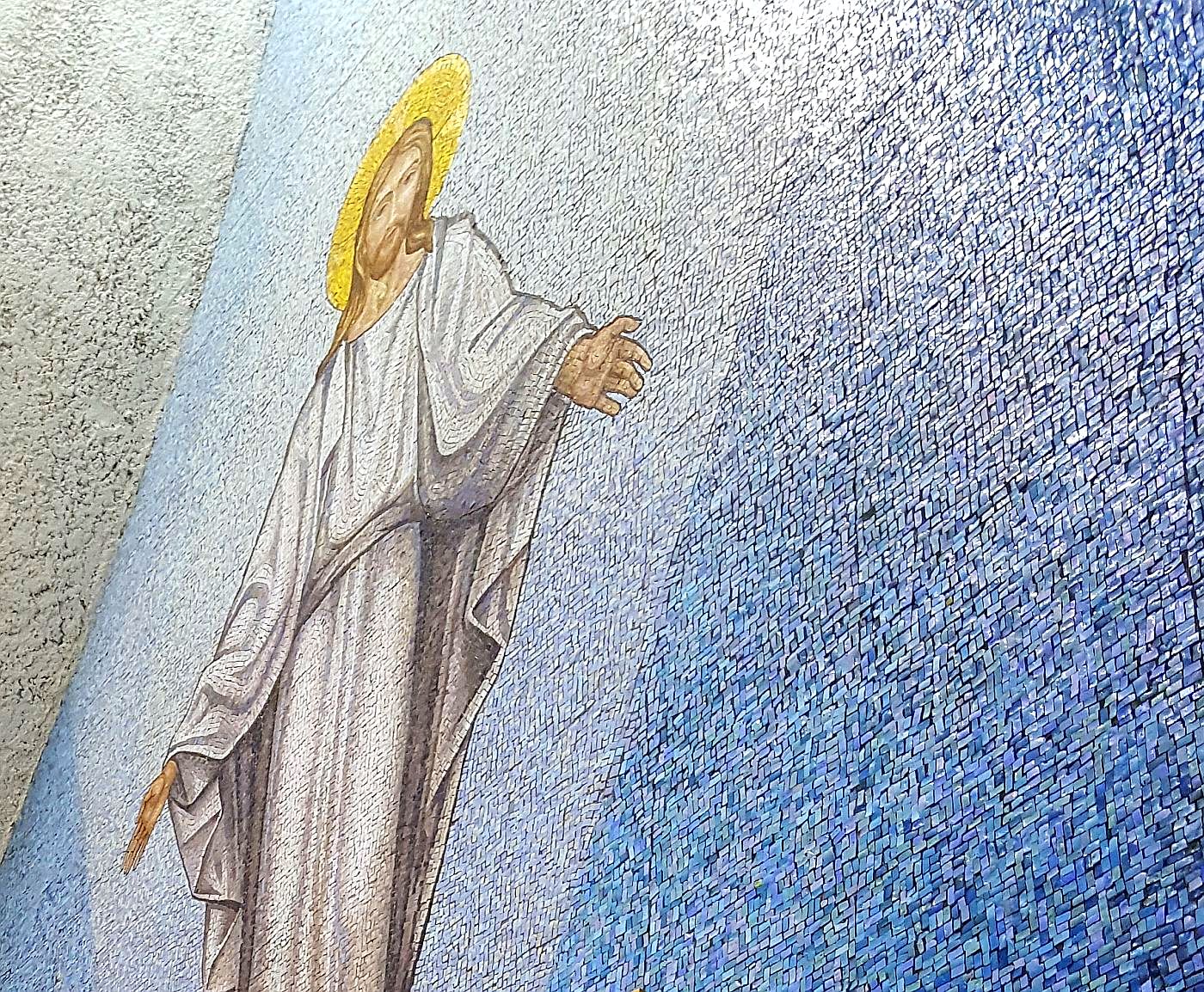
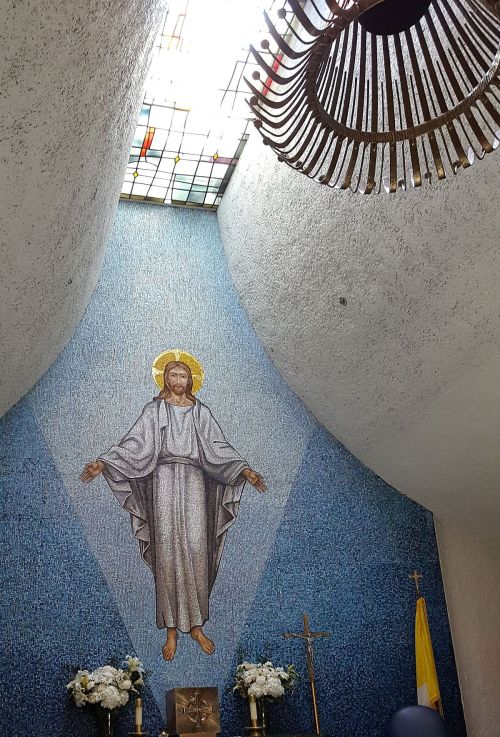
The work should be wrapping up soon — if you’d like to catch the last few days of this project, hop downtown and say hello to the women doing such great work! (UPDATE: The project actually ended Friday. But you should still go down and take a look at it!) While you’re there, you should step inside to see the little chapel, a calm and peaceful oasis in the heart of downtown. There are several other mosaics inside — Julie and company did work on some of those as well, most notably the very large, striking “Risen Christ” above the altar.

Below are some photos I took inside and outside the chapel on May 24, 2017 — most are larger when clicked.

**

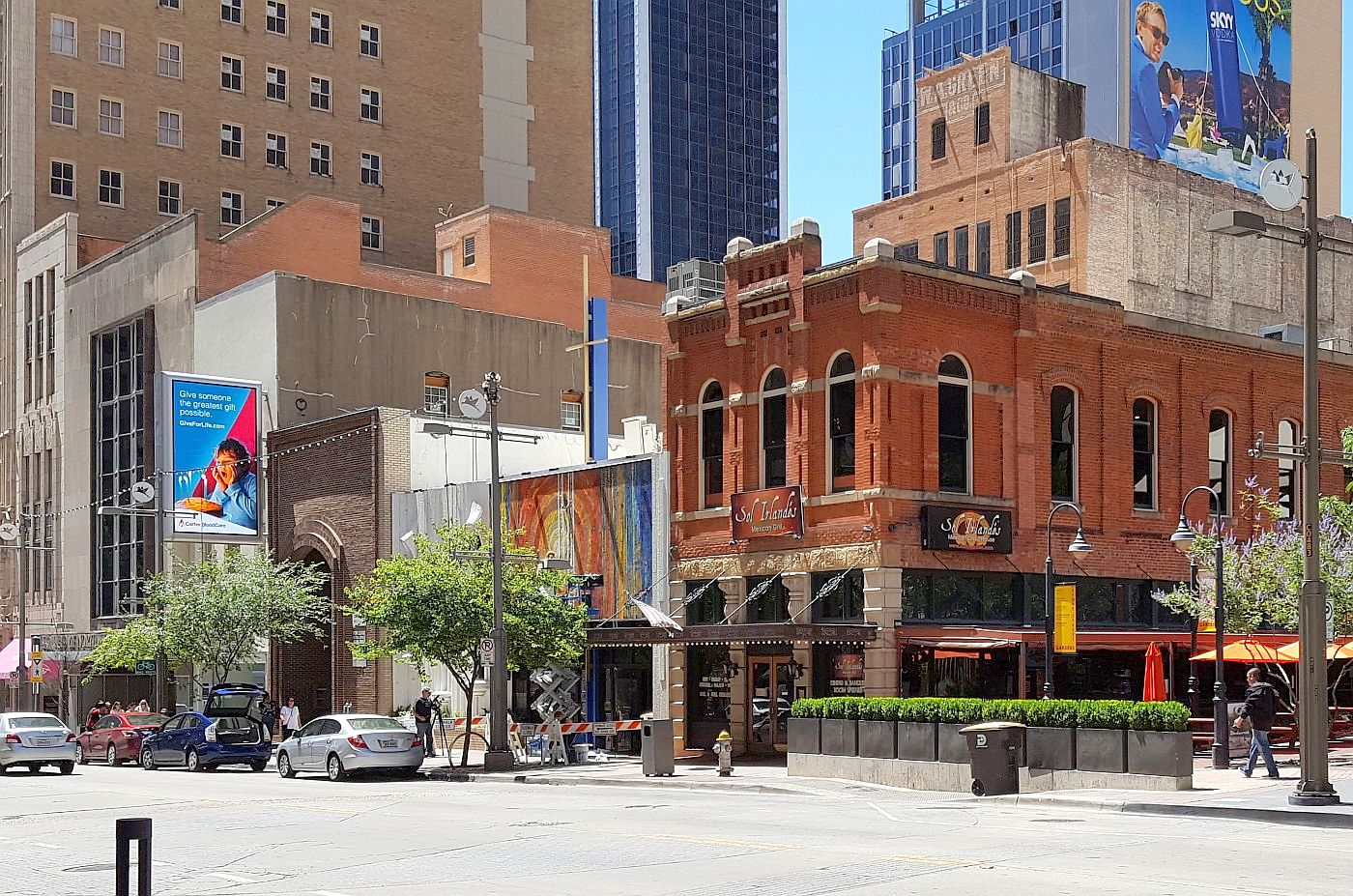
St. Jude Chapel is in the 1500 block of Main, between Ervay and Akard.

Here it is, seen from Neiman’s, across the street.
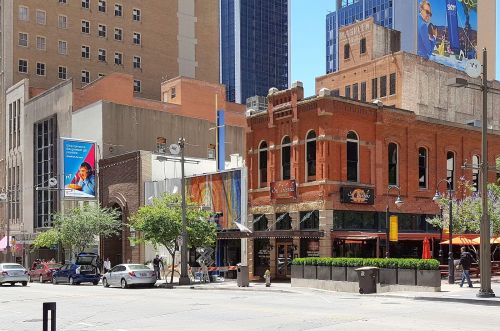
st-judes-chapel_sol-irlandes_052417_bosse

Below is part of the mosaic by Gyorgy Kepes — seeing it up close, you begin to realize that, yeah, there probably are more than 800,000 glass tiles up there. (Definitely click the photo to see a very large image.)

st-jude-chapel_mosaic_052417_det_bosse

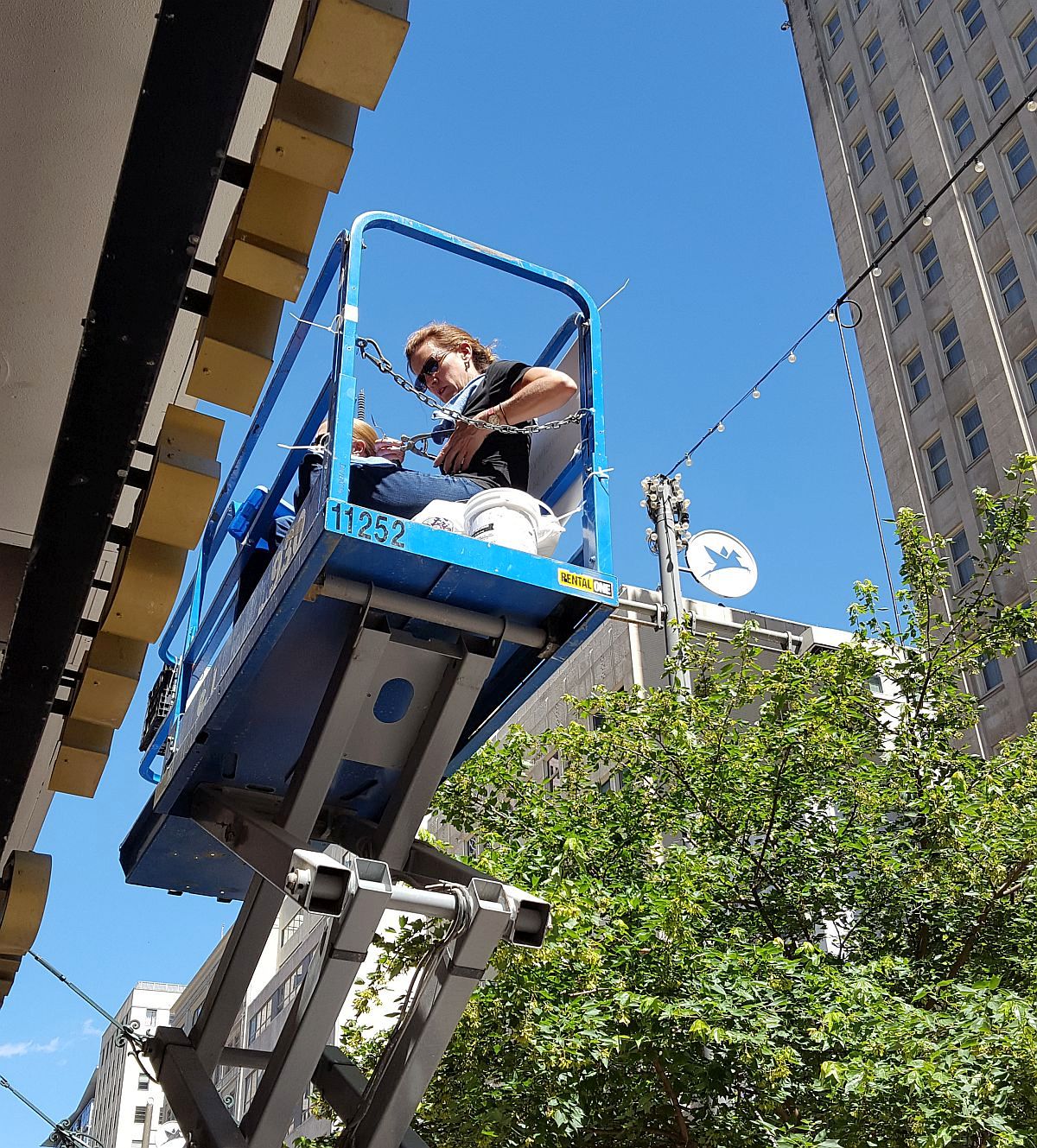
The photo at the top of the post shows the lift used to tackle the job; looking on is Dallas filmmaker Mark Birnbaum who is documenting the project. Below, Julie Richey and Lynne Chinn are raised up on the lift to do their torturously tedious and very, very detailed work (imagine working on this huge thing using tweezers!). Julie can be seen snipping “new” smalti to replace the damaged or missing tiles, working from photos, diagrams, grids, graphs, and guides to make sure the restoration is as close as possible to the original mosaic: the colors must match, the shapes must match, the placement must match.
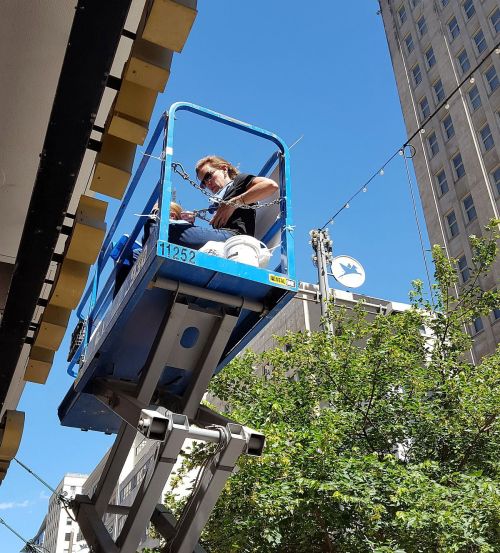
st-jude-chapel_julie-richey_snipping_052417_bosse

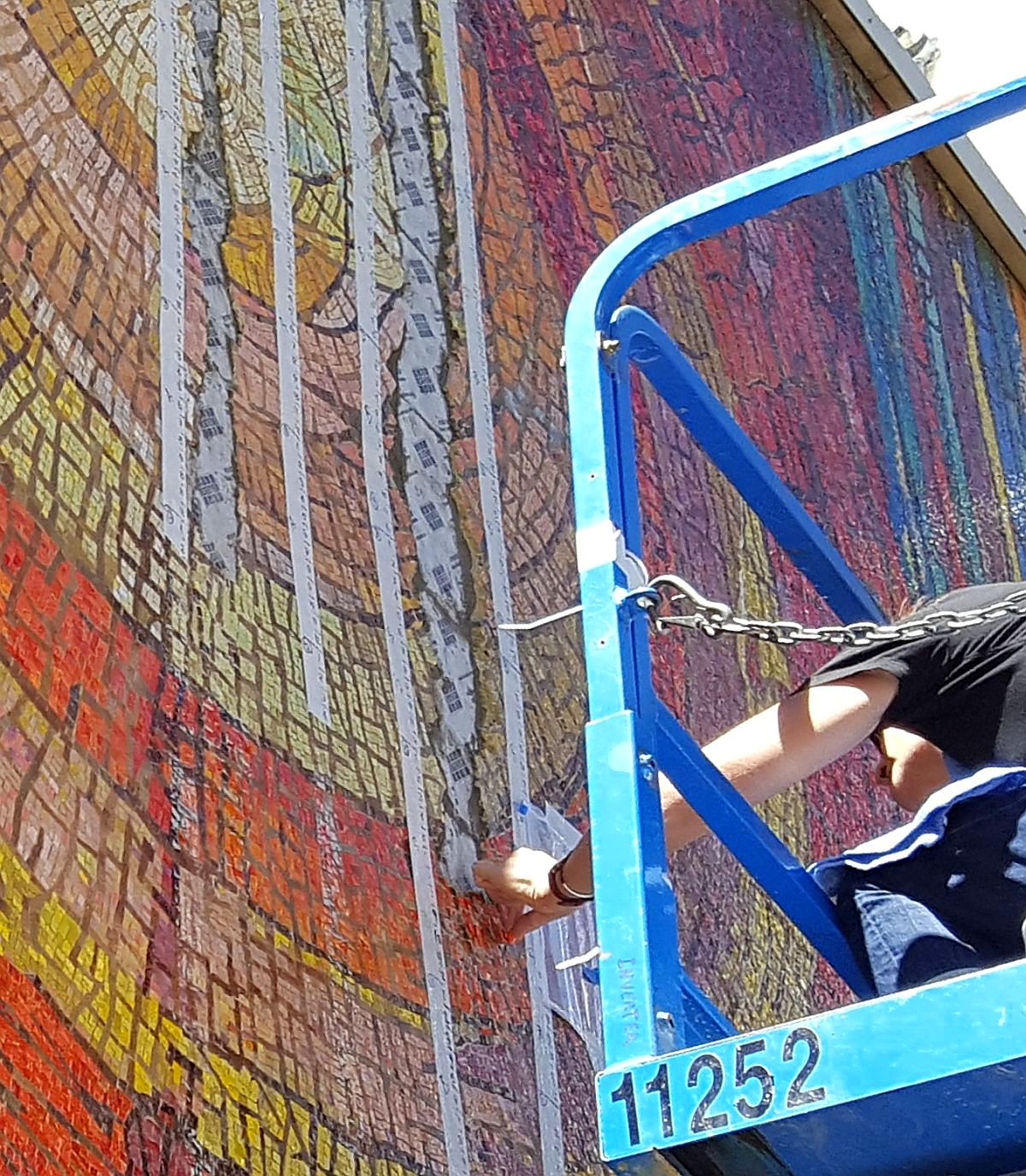
You really have to be focused to do work like this. Here, Julie is setting a tiny piece into that giant mosaic (the marked vertical strips of tape help map the mosaic and insure that everything goes back in exactly as it was originally placed in 1968.
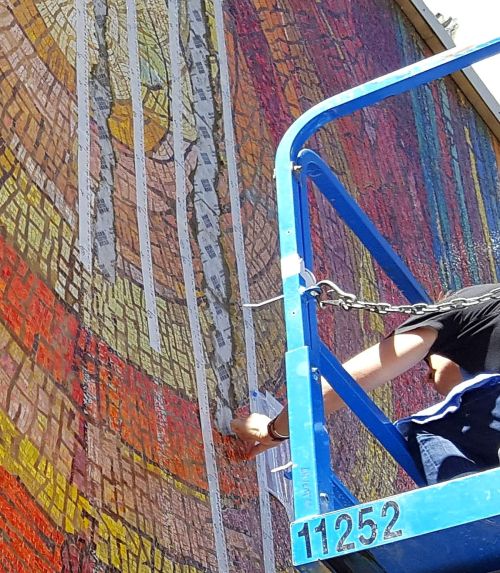
st-jude-chapel_julie-richey-at-work_052417_det_bosse

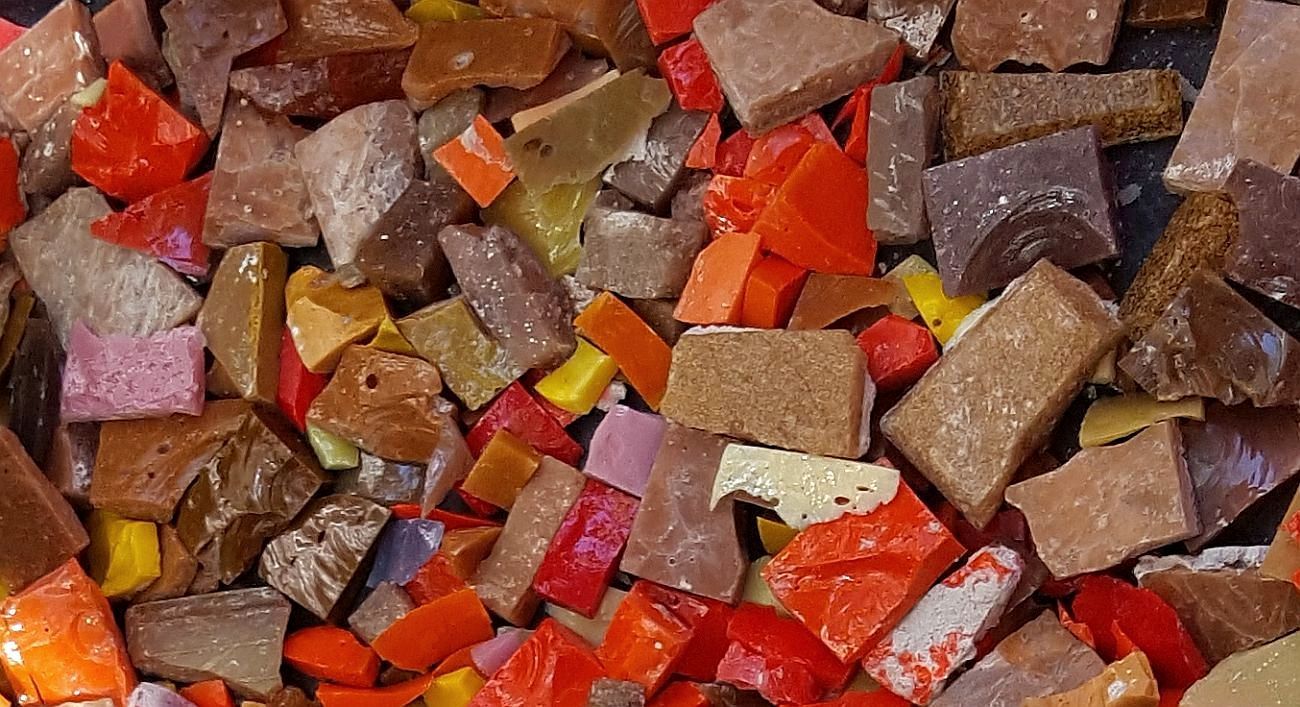
Speaking of snipping the smalti (which sounds like a naughty euphemism used amongst naughty mosaicists), here’s what’s left over, below. I talked to conservator Callie Heimburger, who gave me a lot of interesting information on how the whole intricate process worked — she was set up at a table on the sidewalk and had containers full of these beautiful discarded glass shards in front of her. I really wanted to scoop up a handful and sneak them into a pocket, but I managed to control myself.
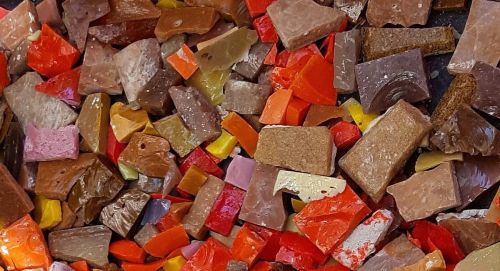
st-jude-chapel_smalti-snippings_052417_bosse

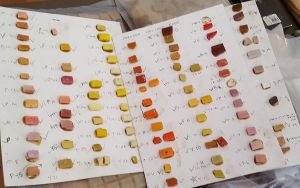
Everything is meticulously color-coded.
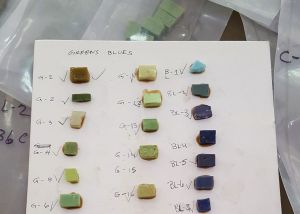
st-jude-chapel_greens-blues_052417_bossse

st-jude-chapel_oranges-yellows_052417_bosse

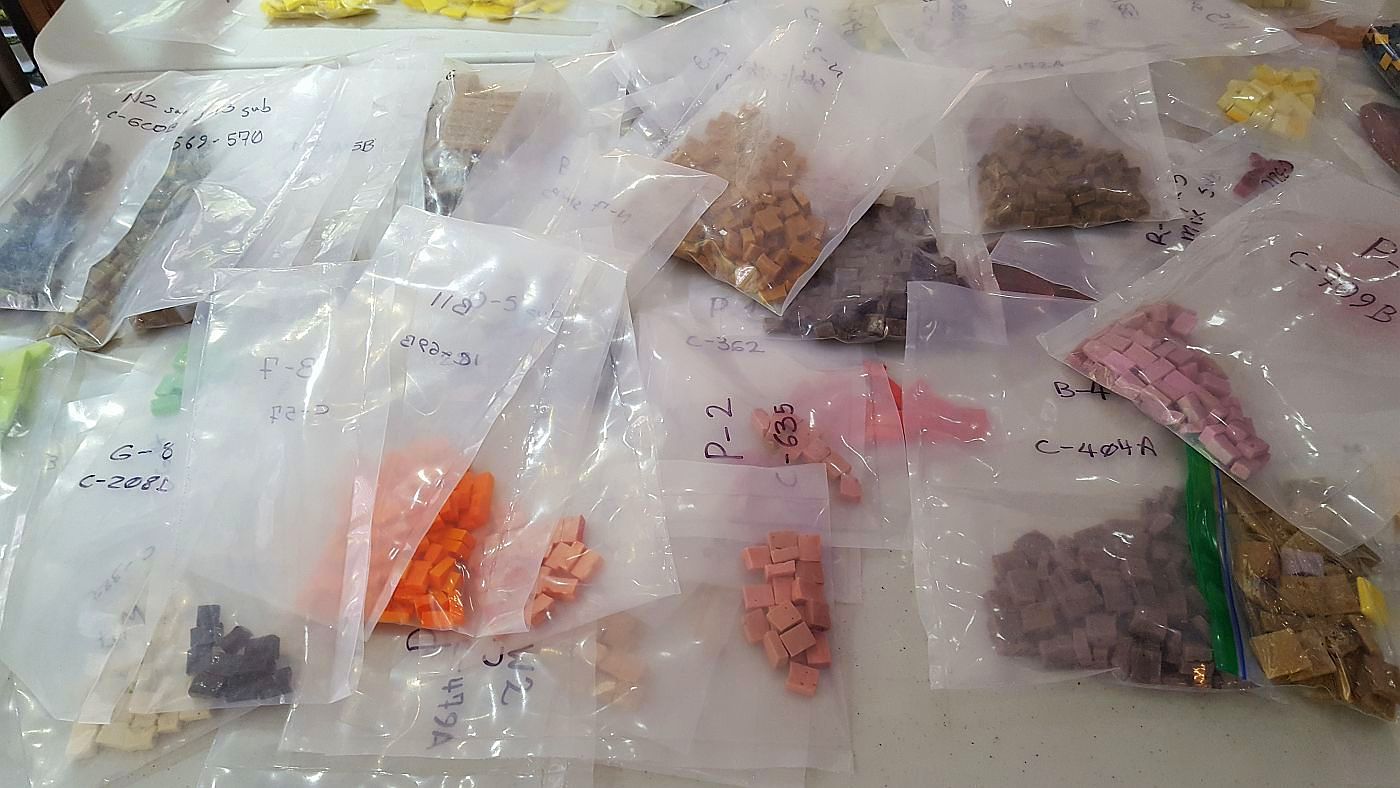
And smalti? Here are bags of “new” bagged tiles — not shown are the slabs or the larger pieces which look a little like brightly colored peanut brittle.

st-jude-chapel_bagged-tiles_052417_bosse

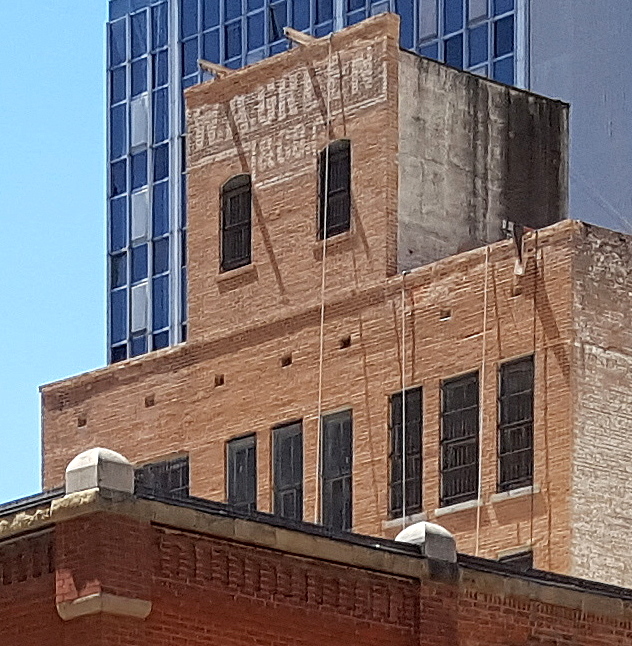
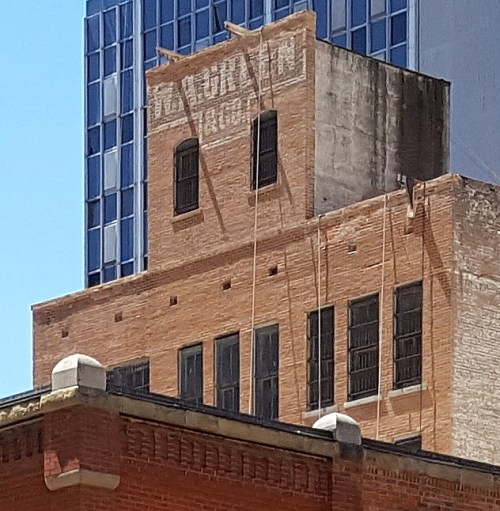
Julie asked if I wanted to go up on the lift and take a closer look. It was even more impressive (and a little overwhelming) to be right next to it. I also got to take a look over the top of the building. There Julie pointed out all that remains of one of downtown’s biggest and busiest retail stores, W. A. Green. I didn’t have the presence of mind to get a good photo up there, but here’s the “ghost sign,” seen from across the street.
w-a-green_ghost-sign_052417_bosse

**

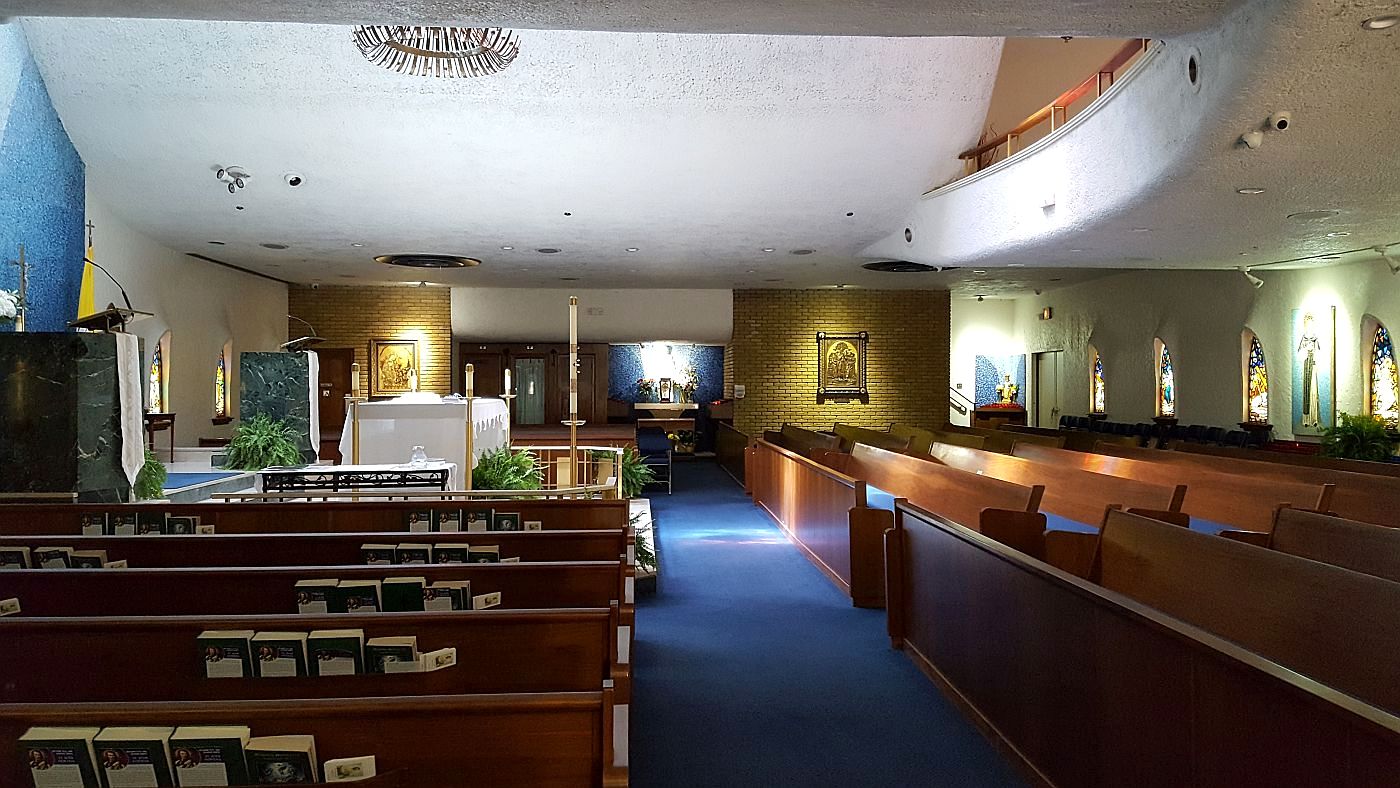
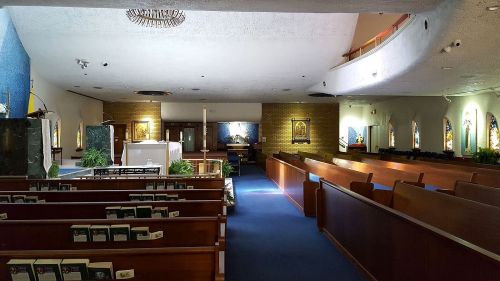
Since I was there, I had to step inside to see what the little chapel looked like. It’s very charming. And the mosaics inside are also impressive.

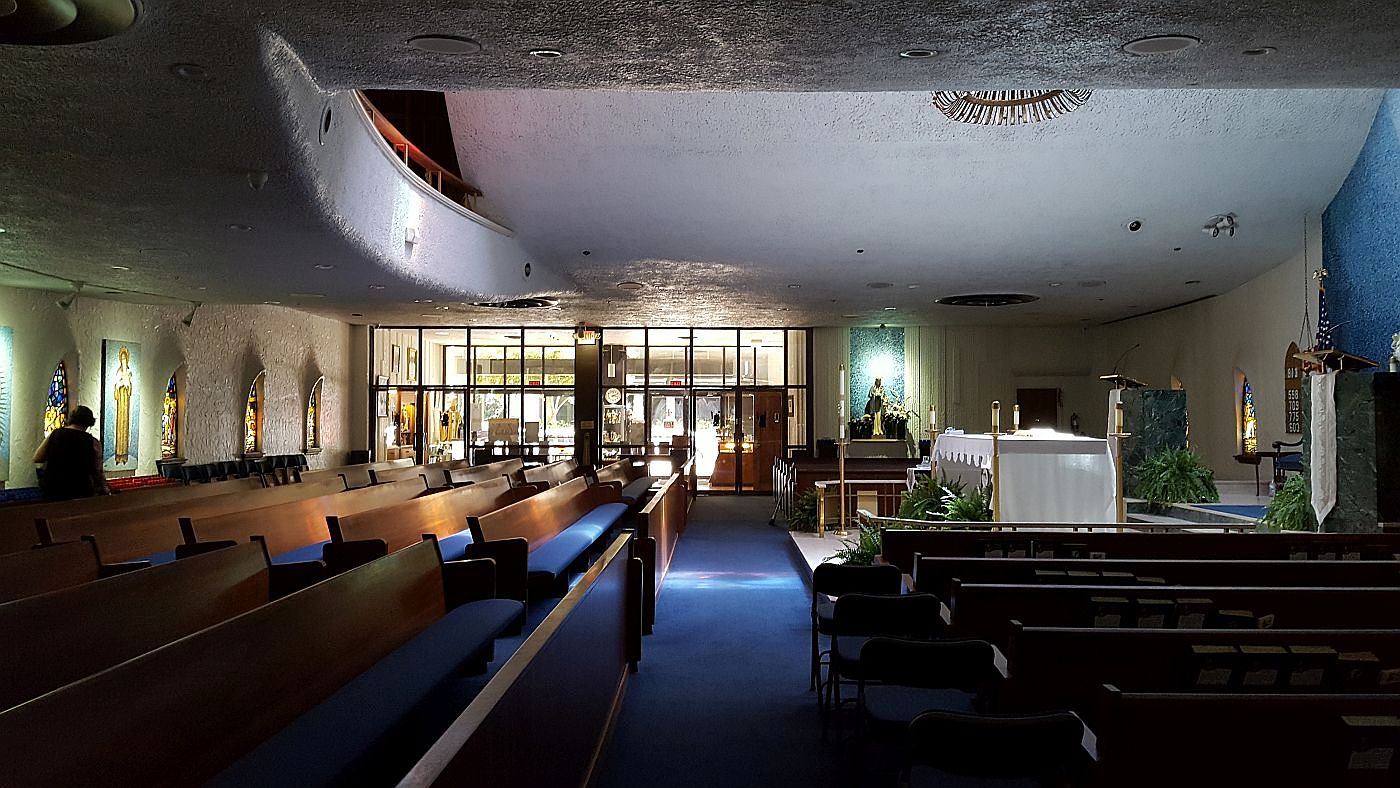
Here’s what you see as you step in.
st-jude-chapel_toward-back-of-chapel_052417_bosse

To your left is the altar. This lovely mosaic was also restored and cleaned. Also: curved walls, a stained glass skylight, and a light fixture that is one of my very favorite decorative elements of this chapel.
st-jude-chapel_altar_stained-glass-skylight_052417_bosse

A closer look at “Risen Christ.”

st-jude-chapel_altar_det_052417_bosse

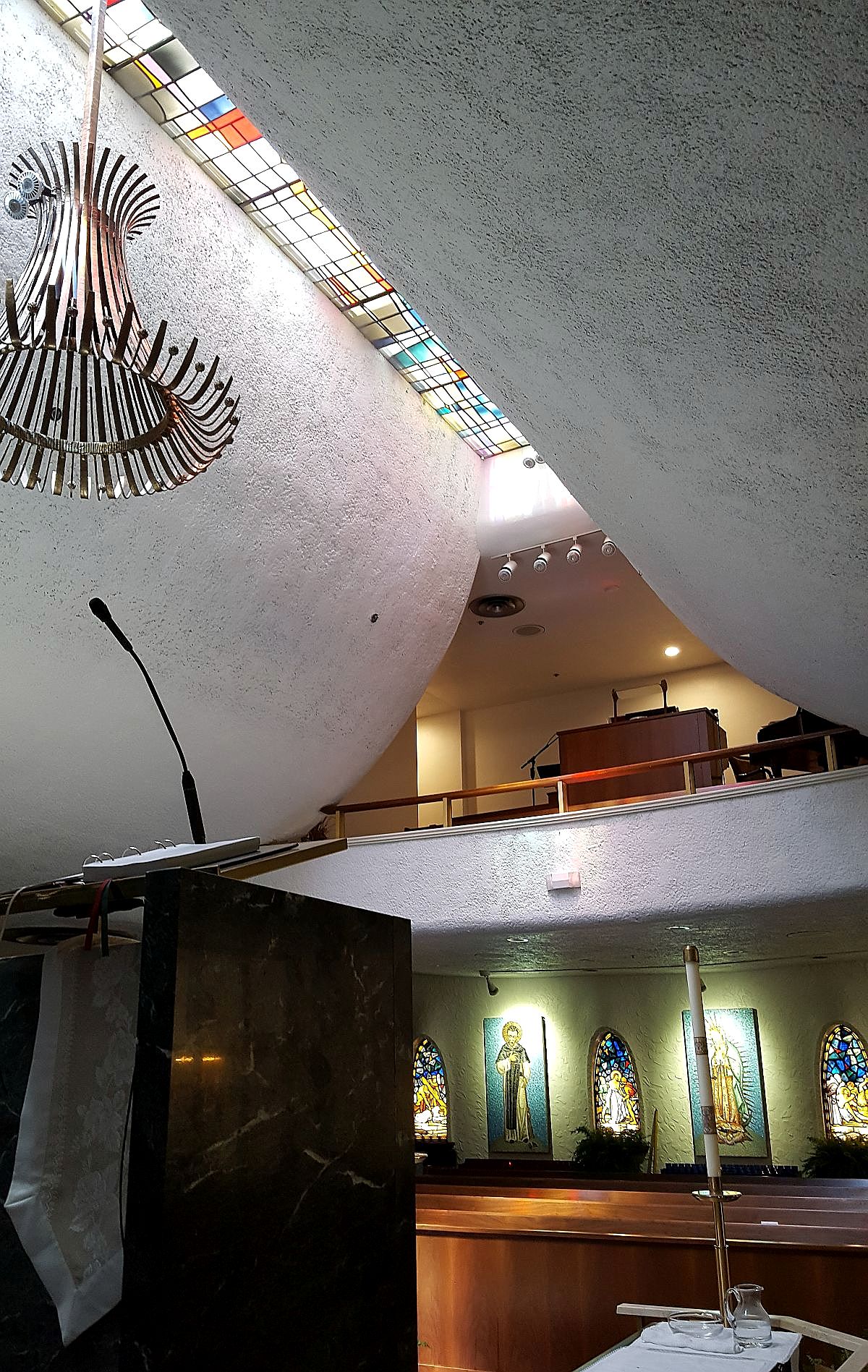
Turn around, and from the pulpit you can see the choir loft.

st-jude-chapel_choir-loft_052417_bosse

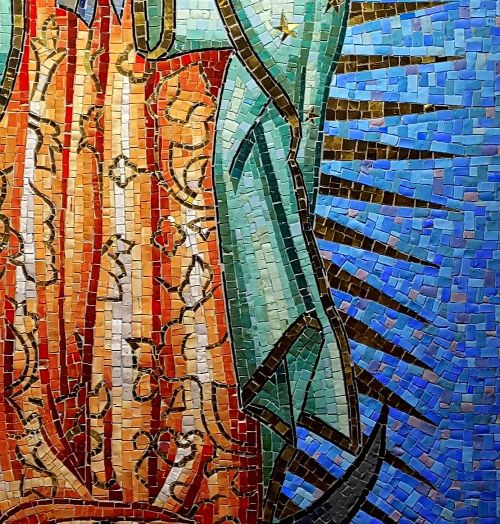
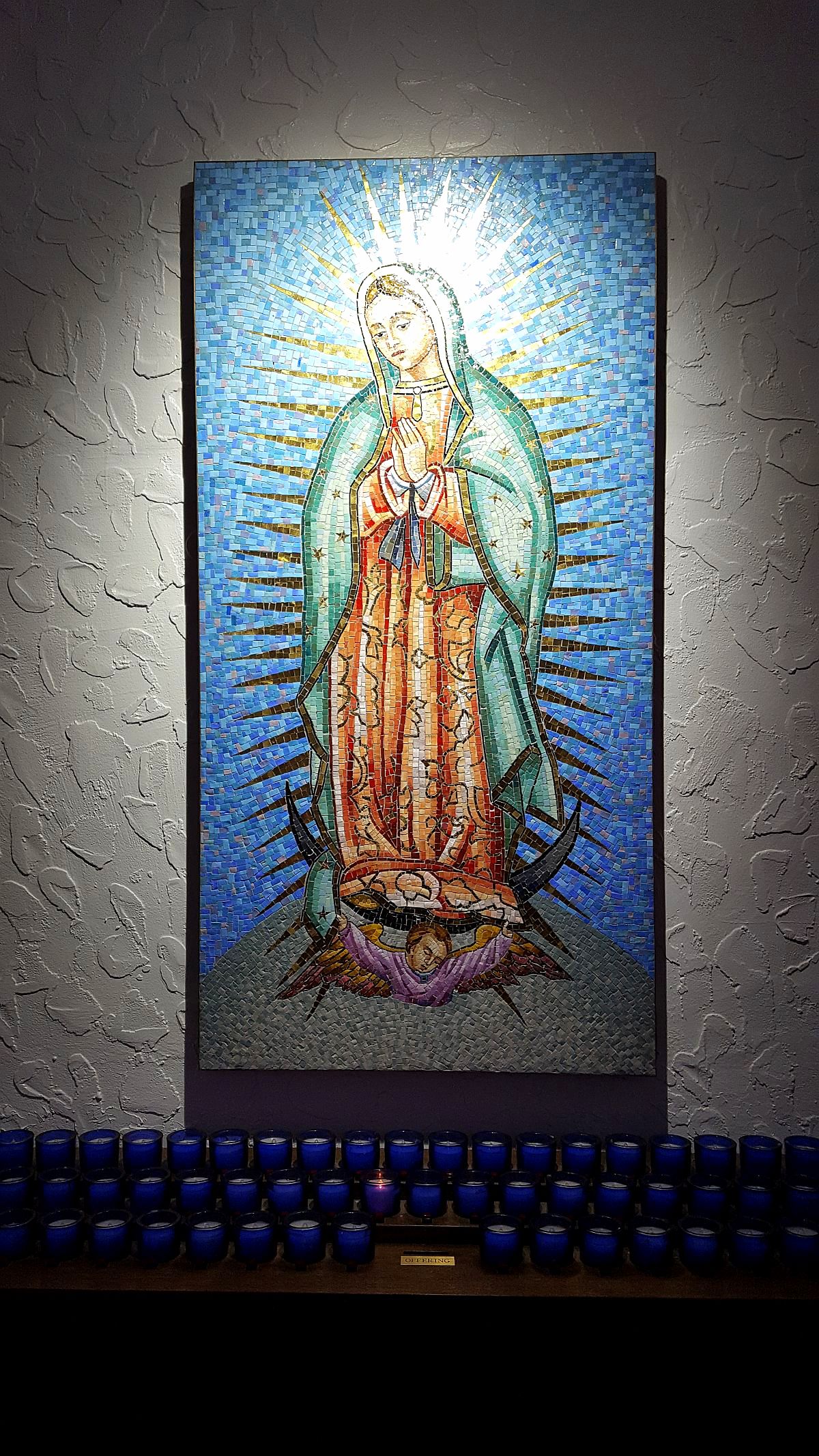
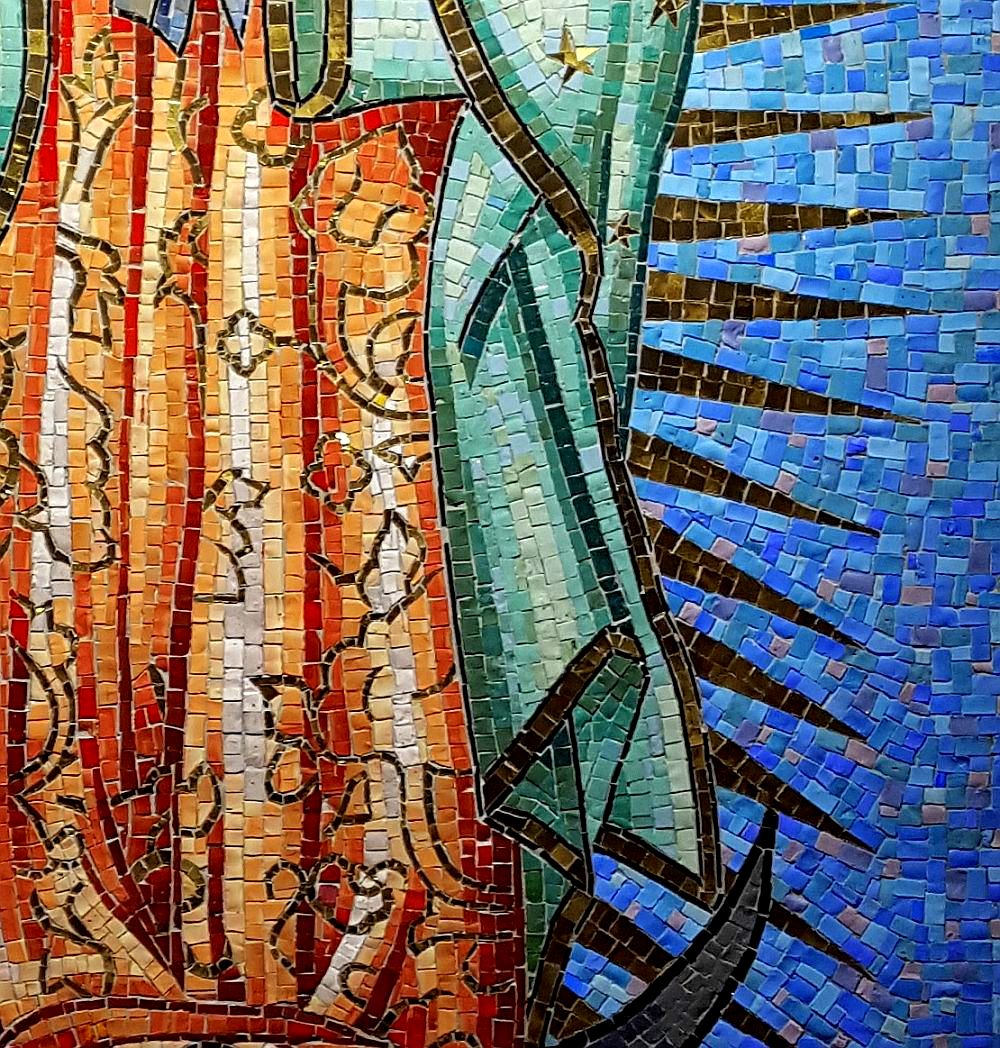
A wonderful depiction of Our Lady of Guadalupe.

st-jude-chapel_la-virgin_052417_bosse

A detail.

st-jude-chapel_la-virgin_det_052417_bosse

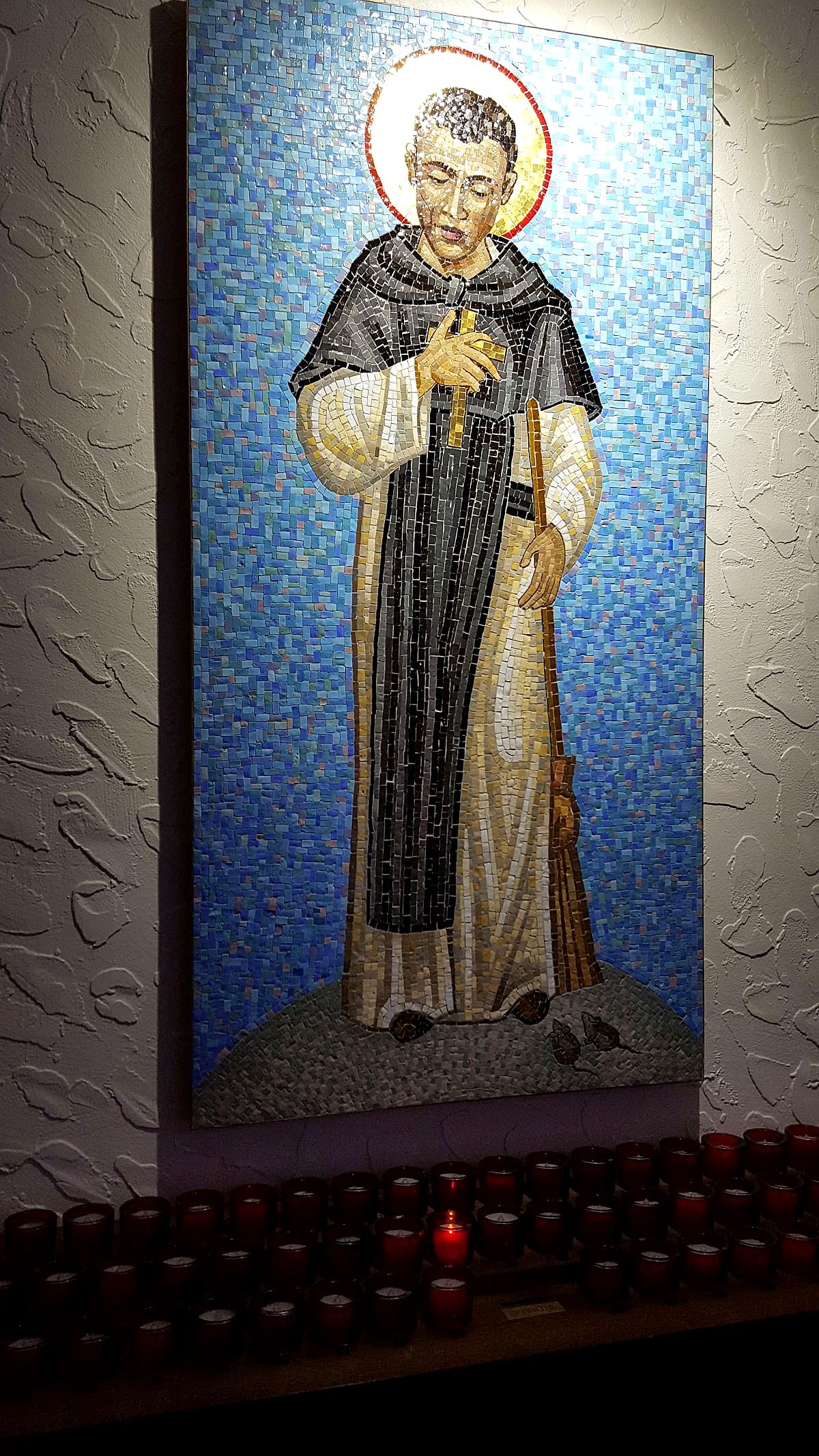
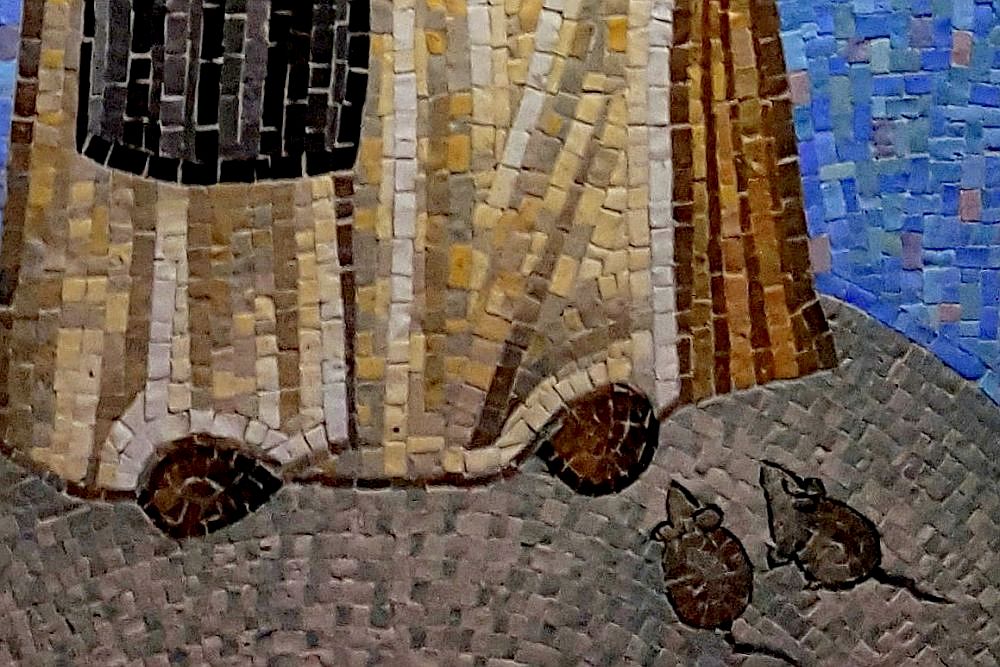
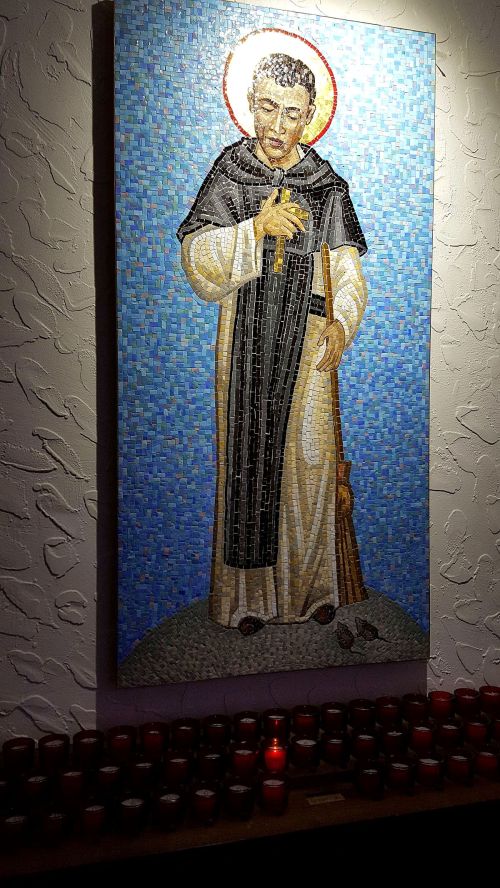
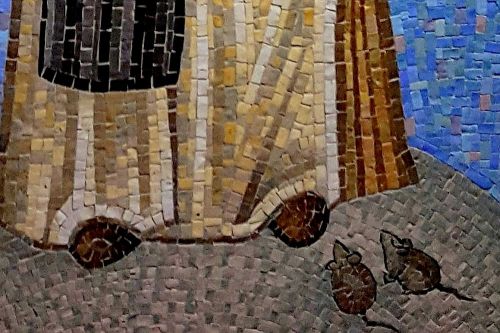
I’m afraid I’m not very well-versed on my saint iconography, but this might be St. Martin de Porres, with a broom, and mice at his feet.
st-jude-chapel_st-martin-de-porres_052417_bosse

Leave it to me to find these little mosaic mice, my favorite tiny discovery of the day.
st-jude-chapel_st-martin-de-porres_mice-det_052417_bosse

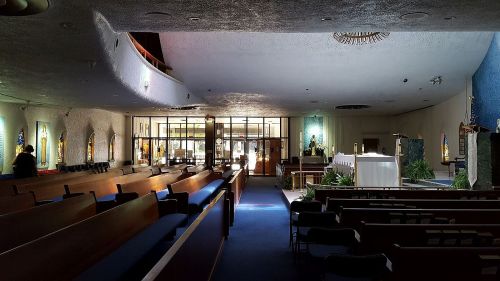
And here’s the view from the chapel toward Main Street.
st-jude-chapel_interior-with-view-to-street_053417_bosse

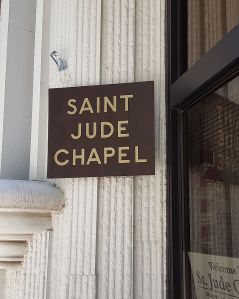
The St. Jude Chapel offers a nice, tranquil respite from a loud and busy downtown Dallas. You should visit sometime. All are welcome.
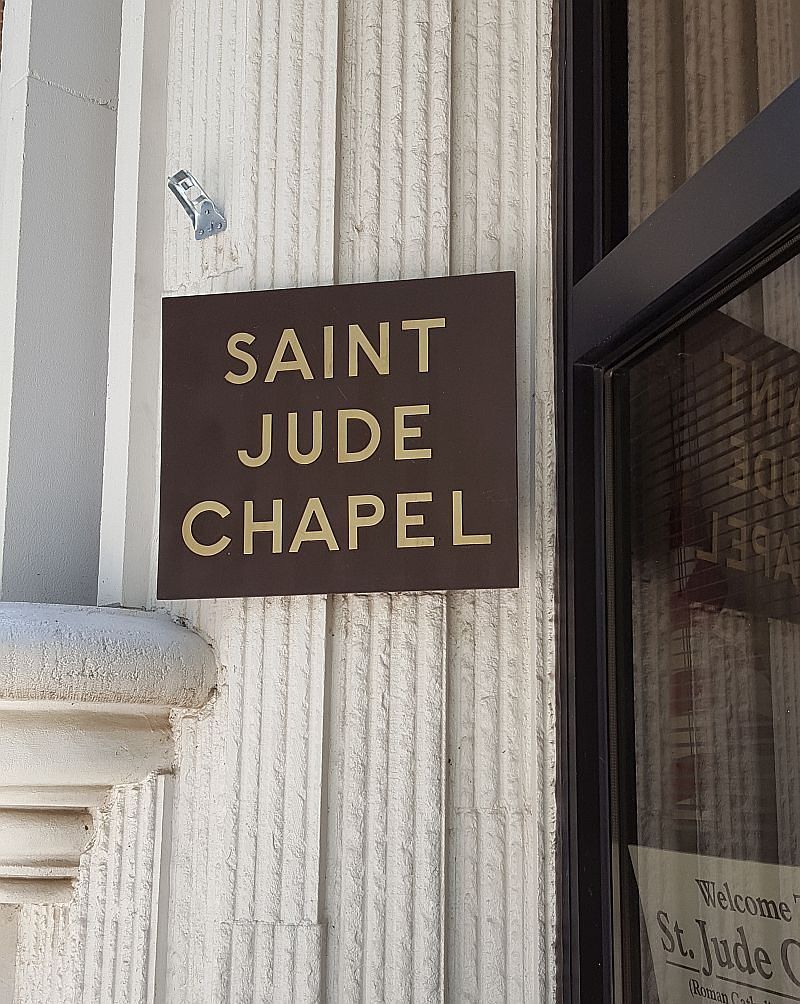
st-jude-chapel_sign_052417_bosse

**

UPDATE: Dallas filmmaker Mark Birnbaum was working on a short documentary of the project when I stopped by the site (you can see the back of his head in the top photo). His 10-minute film, “Genesis Mosaic,” can be viewed here.

***

Sources & Notes

Thanks so much to Julie Richey, Callie Heimburger, Cher Goodson, and Lynne Chinn for taking the time to chat with me. Julie Richey Mosaics website is here; Art Restorations, Inc. website is here.

You can see more on this project (including photos and video) on Julie’s Facebook page, here, and Art Restorations’ Facebook page, here; see photos from the Risen Christ restoration on Julie’s blog, here.

The St. Jude Chapel (Roman Catholic Diocese of Dallas) website is here; videos on the history of the downtown chapel are here.

All photos by Paula Bosse.

Images larger when clicked.

*

Copyright © 2017 Paula Bosse. All Rights Reserved.


The Neiman-Marcus Corporate Flag, Designed by Emilio Pucci — 1966

neiman-marcus-corporate-flag_emilio-pucci_1966_dallas-public-library“Emilio Pucci was our Betsy Ross…”

by Paula Bosse

While looking through the Neiman Marcus Collection at the downtown Dallas Public Library, I stumbled across this perhaps long-forgotten part of Neiman-Marcus history: the “corporate flag” designed by Italian fashion legend Emilio Pucci. The image was featured on a Neiman’s postcard; the text on the back of the card reads:

Flying high over the fashion land of Neiman-Marcus: our new corporate flag, the Lone-Star-and-Stripes. Emilio Pucci was our Betsy Ross.

Betsy Ross and Emilio Pucci mentioned in the same breath! An 18th-century American seamstress who became a patriotic icon, and an Italian fashion designer whose vividly colorful, boldly patterned designs came to symbolize the youth and energy of the 1960s… talk about your strange bedfellows!

The only thing I could find about this unusually colorful flag was a brief mention in a Dallas Morning News fashion article about Neiman’s 28th Neiman-Marcus Exposition Award in early February of 1966. Gay Simpson wrote in The News that the luncheon centerpieces “carried the colors of the new Neiman-Marcus house flag. The flag, designed by Emilio Pucci, Italian couturier, has the colors of a Texas sunset dramatized with the Lone Star and stripes” (DMN, Feb. 9, 1966).

Stanley Marcus wrote in his 1974 memoir Minding the Store that his business relationship with Pucci (“the most copied designer of our time, aside from Chanel”) began in Italy in 1948 when Marcus met with the struggling young designer and placed an order for several of his scarves. Though Neiman-Marcus had not yet expanded beyond their single department store in Dallas, the store’s reputation and influence were certainly known in fashionable circles around the world, and this N-M “stamp of approval” must have been immensely important to Pucci, whose name was not yet known. This friendship and business relationship blossomed into a mutually beneficial and very profitable partnership, and it seems perfectly reasonable that Pucci would design a flag for his friend and early supporter, Stanley Marcus. (Read more of Marcus’ thoughts on Pucci here.)

There you have it. Who knew?

**

As a postscript, any Dallas blog worth its salt cannot let a mention of Emilio Pucci go by without noting his main connection to the city: Pucci will forever be remembered as the man who brought outrageously colorful and super groovy mod designs to the stewardess uniforms of Dallas-based Braniff International Airways (designs so retinally exciting that they make that little Neiman’s flag look a little dowdy in comparison!).

***

Sources & Notes

The image of the corporate flag is from a Neiman’s postcard, which can be found in the extensive (!) Neiman Marcus Collection of the Dallas Public Library (the back of the card can be seen here); it is used with permission. Thanks to the incredibly helpful staff of the Dallas History & Archives division of the downtown Dallas Public Library. (Much thanks, particularly, to Digital Archivist Misty Maberry!)

*

Copyright © 2017 Paula Bosse. All Rights Reserved.


Roth’s, Fort Worth Avenue

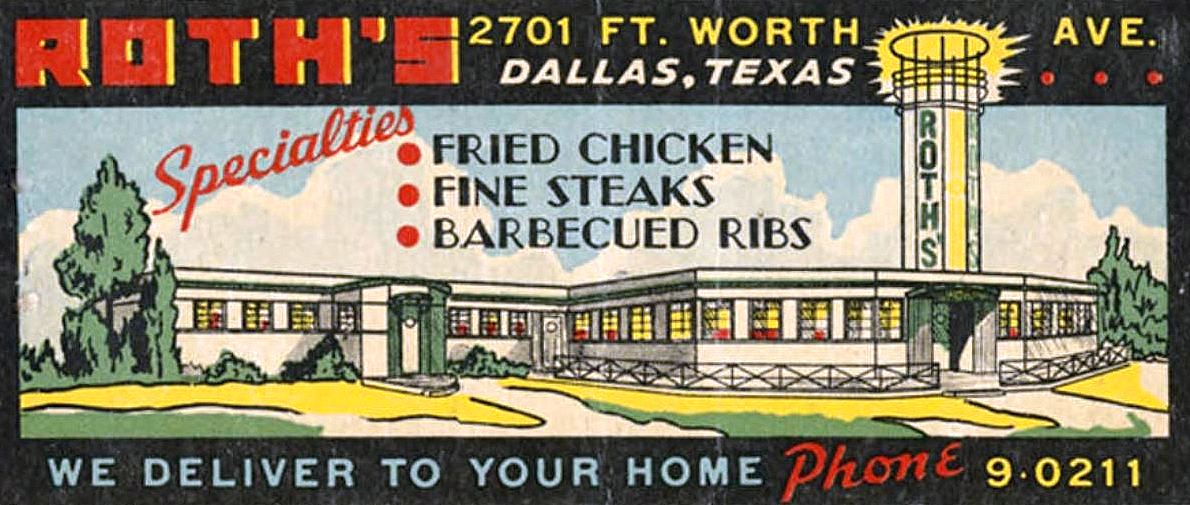
roths_cook-collection_smuSign me up, Mr. Roth…
by Paula Bosse

When I see a building like this, I always hope I can find a photo of it somewhere, but all I’ve been able to come up with is this energetic rendering from a 1940s matchbook cover. Roth’s (which was advertised variously as Roth’s Cafe, Roth’s Restaurant, and Roth’s Drive-In) was in Oak Cliff, on Fort Worth Avenue. It opened in about 1940 or ’41 and operated a surprisingly long time — until about 1967. When Roth’s opened, its address was 2701 Fort Worth Avenue, but around 1952 or ’53 the address became 2601. (I think the numbering might have changed rather than the business moving to a new location a block down the street.)

During World War II, Mustang Village — a large housing development originally built for wartime workers (and, later, for returning veterans and their families) — sprang up across Fort Worth Avenue from the restaurant. It was intended to be temporary housing only, but because Dallas suffered such a severe post-war housing shortage, Mustang Village (as well as its sister Oak Cliff “villages” La Reunion and Texan Courts) ended up being occupied into the ’50s. Suddenly there were a lot more people in that part of town, living, working, and, presumably, visiting restaurants.

As the 1960s dawned, Mustang Village was just a memory, and Roth’s new across-the-street neighbor was the enormous, brand new, headline-grabbing Bronco Bowl, which opened to much fanfare in September 1961. I don’t know whether such close proximity to that huge self-contained entertainment complex hurt or helped Roth’s business, but it certainly must have increased traffic along Fort Worth Avenue.

Roth’s continued operations until it closed in 1967, perhaps not so coincidentally, the same year that Oak Cliff’s beloved Sivils closed. Ernest Roth, like J. D. Sivils, most likely threw in the towel when a series of “wet” vs. “dry” votes in Oak Cliff continued to go against frustrated restaurant owners who insisted that their inability to sell beer and wine not only damaged their own businesses but also adversely affected the Oak Cliff economy. The last straw for Sivils and Roth may have been the unsuccessful petition drive in 1966/1967 to force a “beer election” (read about it here in a Morning News article from Aug. 17, 1966).

As far as that super-cool building seen at the top — I don’t know how long it remained standing, but when Roth’s closed, a mobile home dealer set up shop at 2601 Fort Worth Avenue, and mobile homes need a lot of parking space….

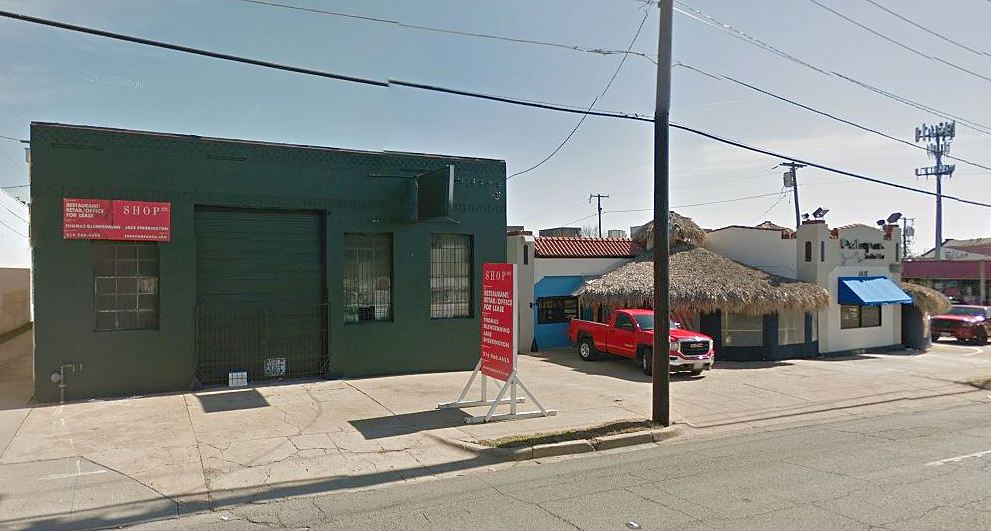
The building on the matchbook cover above is, unfortunately, long gone (as is the much-missed Bronco Bowl); the area today is occupied by asphalt, bland strip malls, and soulless corporate “architecture” (see what 2701 Fort Worth Avenue looks like today, here).

*

The man behind Roth’s was Ernest W. Roth, a Hungarian immigrant who had worked for many years as maître-d’ at the Adolphus Hotel’s tony Century Room. He decided to go out on his own, and around 1940, he and his business partner Joseph Weintraub (who was also his brother-in-law) opened the Oak Cliff restaurant which boasted two dining rooms (with a seating capacity of 350, suitable for parties and banquets), fine steaks, and, on the weekends, a live band and dancing. Ernest’s wife, Martha, and their son Milton were also part of the family business. When the restaurant opened, there wasn’t much more out there on the “Fort Worth cut-off,” but the place must have been doing something right, because Roth’s lasted for at least 27 years — an eternity in the restaurant business. It seems to have remained a popular Oak Cliff dining destination until it closed around 1967.

*

The real story, though, is the Roth family, especially Ernest’s mother, Johanna Roth, and even more especially, his older sister, Bertha Weintraub.

Johanna Rose Roth was born in 1863 in Budapest, where her father served as a member of the King’s Guard for Emperor Franz Josef. She and her husband and young children came to the United States about 1906 and, by 1913, eventually made their way to San Antonio. In the ’40s and ’50s she traveled by airplane back and forth between San Antonio and Dallas, visiting her five children and their families — she was known to the airlines as one of their most frequent customers (and one of their oldest). She died in Dallas in 1956 at the age of 92.

Johanna’s daughter Bertha Roth Weintraub had a very interesting life. She too was born in Hungary — in 1890. After her husband Joe’s death in the mid ’40s, a regular at her brother’s restaurant, Abe Weinstein — big-time entertainment promoter and burlesque club empresario — offered Bertha a job as cashier at the Colony Club, his “classy” burlesque nightclub located across from the Adolphus. She accepted and, amazingly, worked there for 28 years, retiring only when the club closed in 1972 — when she was 82 years old! It sounds like she led a full life, which took her from Budapest to New York to San Francisco to San Antonio to Austin and to Dallas; she bluffed her way into a job as a dress designer, ran a boarding house in a house once owned by former Texas governor James Hogg, hobnobbed with Zsa Zsa Gabor and Liberace, was a friend of Candy Barr, and, as a child, was consoled by the queen of Hungary. She died in Dallas in 1997, a week and a half before her 107th birthday. (The story Larry Powell wrote about her in The Dallas Morning News — “Aunt Bertha’s Book Filled With 97 Years of Memories” (DMN, Nov. 17, 1987) — is very entertaining and well worth tracking down in the News archives.)

weintraub-bertha-roth_texas-jewish-post_021590
Bertha Roth Weintraub

I feel certain that the extended Roth family found themselves entertained by quite a few unexpected stories around holiday dinner tables!

***

Sources & Notes

Matchbook cover (top image) is from the George W. Cook Dallas/Texas Image Collection, DeGolyer Library, Central University Libraries, Southern Methodist University; more info is here.

Photo of Bertha Weintraub is from The Texas Jewish Post (Feb. 15, 1990), via the Portal to Texas History, here.

*

Copyright © 2017 Paula Bosse. All Rights Reserved.

Even Lower Than Lowest Greenville

greenville-ave_lindell_bryan-pkwy_sears-parking-lot_squire-haskins_UTAWhere Greenville begins to peter out… (click for larger image)

by Paula Bosse

The photo above shows the lowest part of Greenville Avenue, between Lindell and Bryan Parkway, almost down to where Greenville turns into Munger. It was taken from the parking lot of the Sears store at Ross and Henderson (a shopping center now anchored by a Fiesta grocery store), a place where I spent many hours as a child. I have vivid memories of that store, especially the intense smell of popcorn that hit you like a buttery thunderclap as you entered from the parking lot.

I love that fact that a couple of the buildings seen in this photo (including the Munger Place Church, seen partially at the far right) are still standing.

That cool Fina station seen in the top photo — at the corner of Greenville and Bryan Parkway — has been “modified” somewhat under the thatched hut roof of the Palapas Seafood Bar, but it’s definitely still recognizable. And Fina’s next-door neighbor, the Minute Service Garage, is still alive, too, looking a little less garage-y these days, but still looking pretty good.

greenville_google-street-view_feb-2017Google Street View, Feb. 2017

Then and now:

greenville-ave_from-sears_then-now

Keep on keeping on, Greenville Avenue!

***

Top photo by Squire Haskins from the Squire Haskins Photography, Inc. collection, University of Texas at Arlington Libraries, Special Collections; more info on the photo is here — click the thumbnail on that page to see a very large image.

More Squire Haskins photographs taken around the perimeter of this Sears store (which opened in September, 1947) are here, here, here, and here.

Click pictures to see larger images.

*

Copyright © 2017 Paula Bosse. All Rights Reserved.

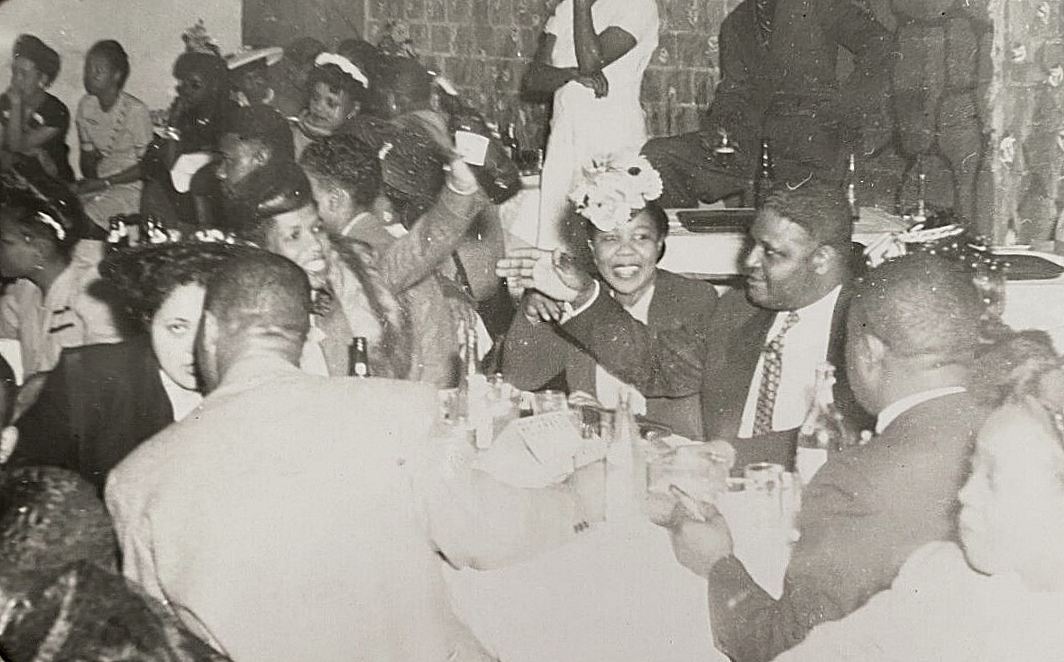
1710 Hall: The Rose Room/The Empire Room/The Ascot Room — 1942-1975

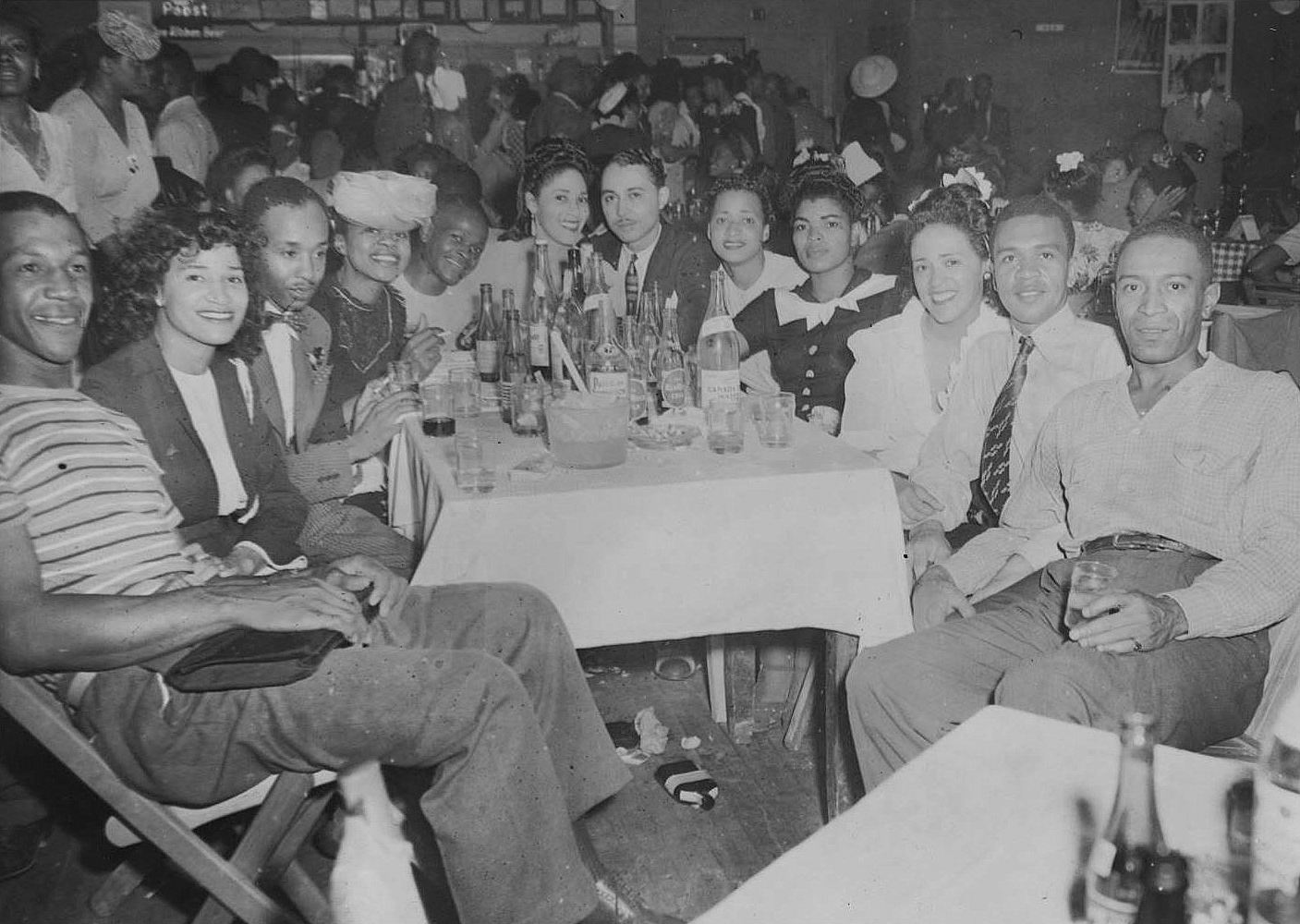
rose-ballroom_aug-1942_cook-collection_degolyer_smuThe Rose Ballroom, 1942

by Paula Bosse

The photo above was taken at the Rose Ballroom at 1710 Hall Street (a few steps off Ross Avenue) in August, 1942. 1710 Hall was the home to a string of very popular black nightclubs: the Rose Ballroom (1942-1943), the Rose Room (1943-1951), the Empire Room (1951-1969) (not to be confused with the nightclub of the same name in the Statler Hilton), and the Ascot Room (1969-1975). There seems to have been some overlap of owners and/or managers and/or booking agents, but they all appear to have been very popular “joints” (as described by Freddie King’s daughter), where both big-name touring musicians as well as popular local acts played. Icons T-Bone Walker and Ray Charles were regulars (there are stories of Ray Charles sleeping on the Empire Room’s stage during the time he was living in Dallas in the ’50s). Everybody seems to have played there. Below, a quote from Wanda King, talking about her father, blues legend Freddie King — from the book Texas Blues: The Rise of a Contemporary Sound by Alan Govenar (all clippings and photos are larger when clicked):

rose-room_freddie-king_wanda-king_texas-blues_govenar

Some of the acts scheduled to appear in early 1946 at the Rose Room were Erskine Hawkins, Louis Armstrong, Lionel Hampton, Buddy Johnson, and Andy Kirk. …Wow.

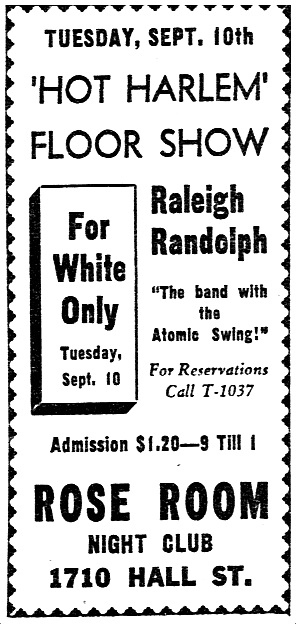
In the days of segregation, when Dallas police threatened to shut the club down if the owner allowed white patrons to mix with black patrons, the club scheduled “white only” nights where Caucasian audiences could see their favorite non-Caucasian performers. (Before these special club nights, which seem to have started in 1945, a revue would be taken “on the road” — over to the Majestic Theatre on Elm Street — to perform live onstage.)

rose-room_dmn_092945-ad
1945

rose-room_dmn_090846_ad
1946

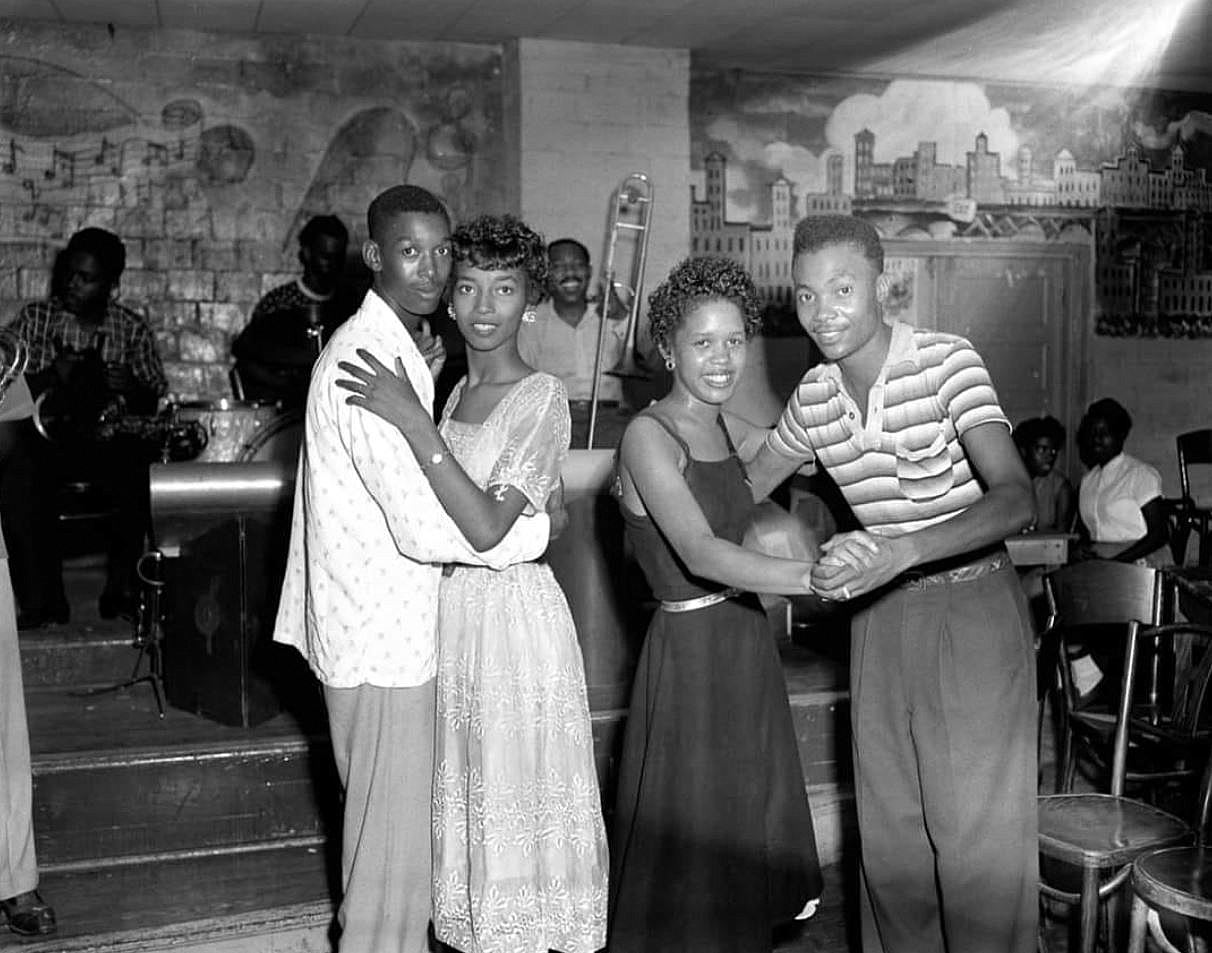
The photo up there at the top showed the audience — here’s the stage (1946 photo of the E F Band by Marion Butts, from the Marion Butts Collection, Dallas Public Library):

rose-room_the-e-f-band_marion-butts_dpl_1946

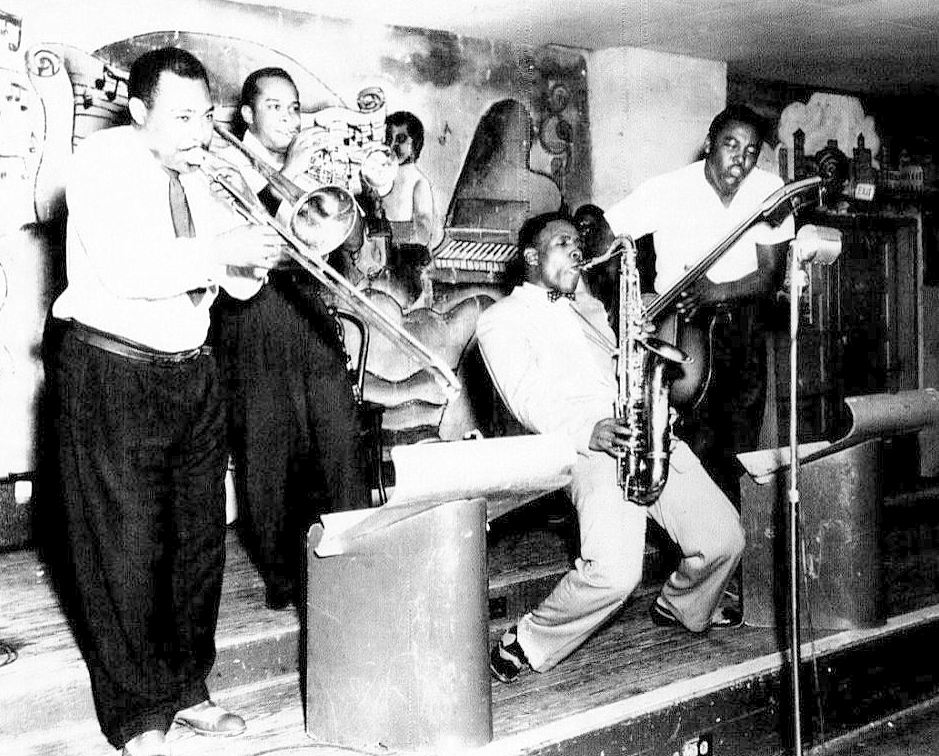
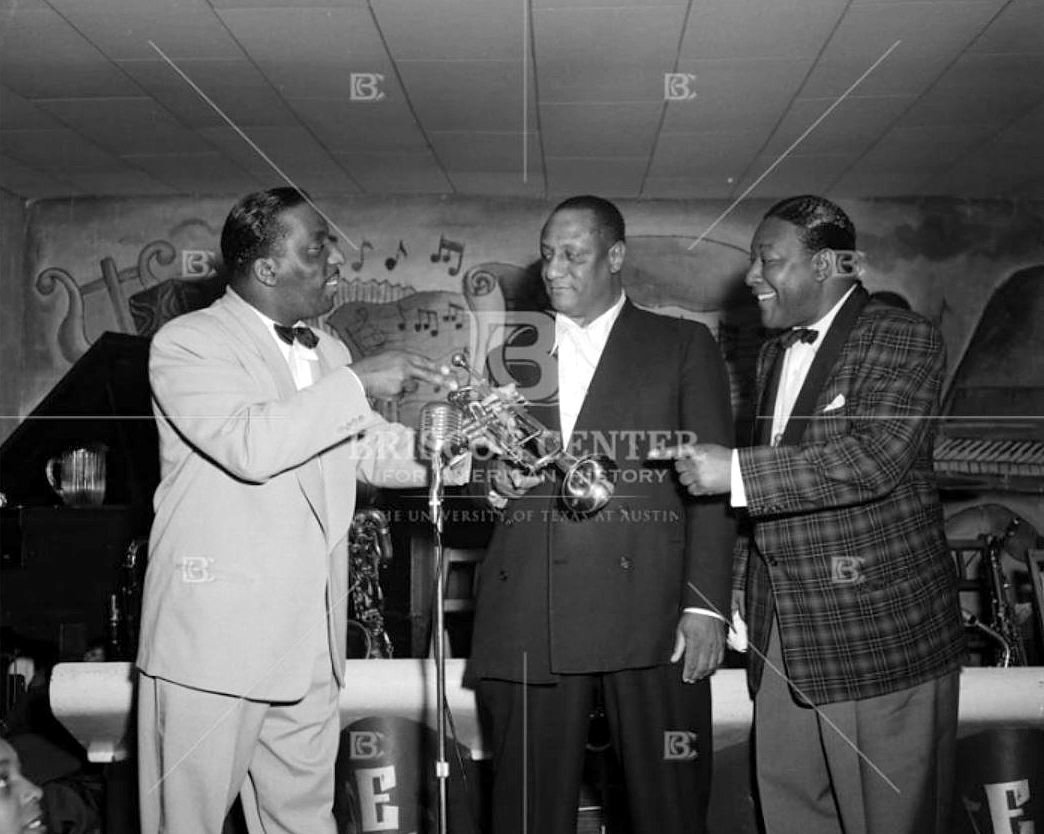
And here’s what the stage looked like when the club became the Empire Room (onstage is Joe Johnson in a 1954 photo by R. C. Hickman, taken from a great article about Hickman in Texas Highways, here):

empire-room_joe-johnson_1954_r-c-hickman_tx-highways_020299

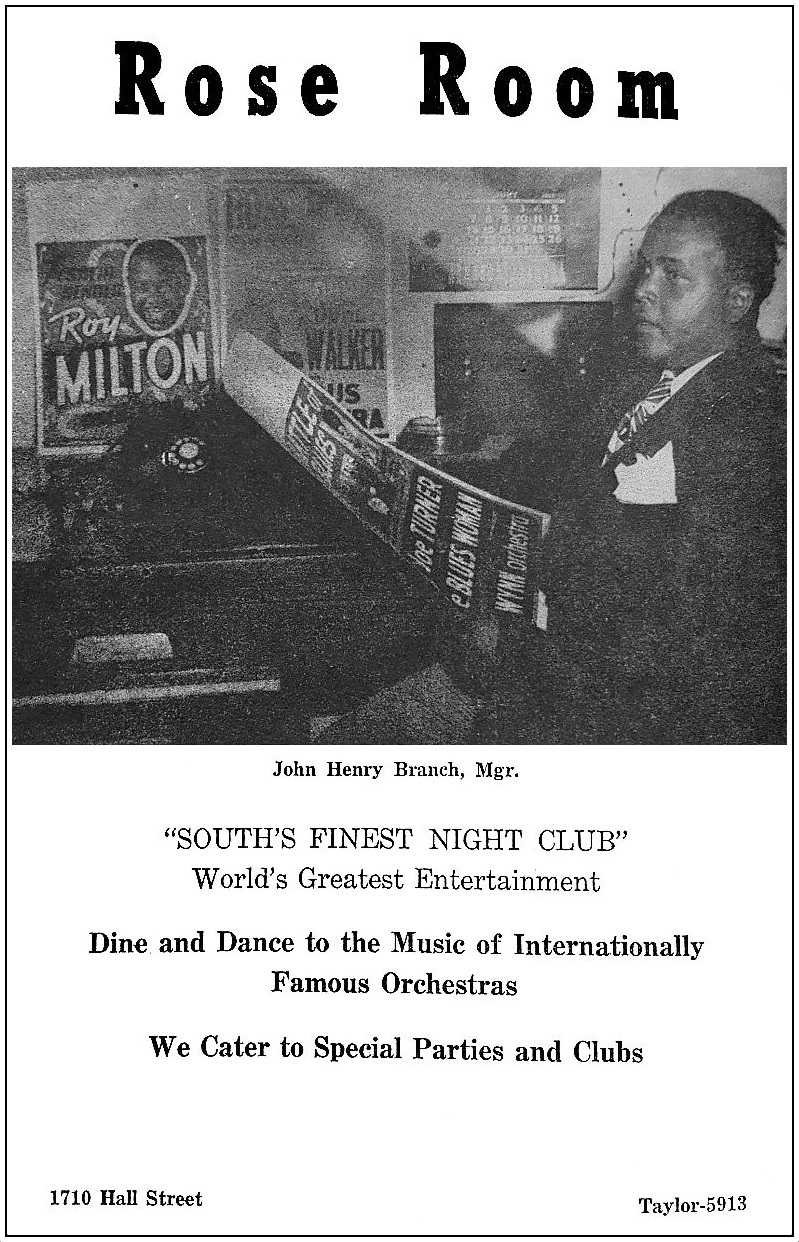
One thing that probably helped set the Rose Room/Empire Room apart from a lot of the other clubs in town at this time was the man who booked the shows — and who booked acts all over the area: John Henry Branch. The guy knew everyone. Here he is in an ad from 1947:

rose-room_1947-1948-negro-directory_dallas

Aside from booking acts and musicians for black clubs, he also booked acts for white clubs — including Jack Ruby’s Carousel and Vegas clubs. In fact, Branch chatted with Ruby at the Empire Room the night before Ruby shot Oswald — Ruby had come in to check on a piano player Branch was booking for a gig at the Vegas Club in Oak Lawn. Branch supplied testimony to the Warren Report, and while it’s not all that riveting (because there wasn’t that much to tell), it’s still interesting to hear how Branch describes his own club and Ruby’s personality (“You can’t never tell about him — he’s a weird person.”) — you can read his testimony here.

I have to admit, I’d never heard of the Rose Room or the Empire Room before I saw the photo at the top of this post. I really missed out. So much fantastic music! And I missed it. It’s just another reminder that Dallas has an incredible music history.

rose-room_texas-blues_govenar-brakefieldfrom the Texas African American Photography Archive

rose-room_1944-45-directory_hall-street
1700 block of Hall Street, 1944-45 city directory

What’s at 1710 Hall these days? A vacant lot — soon to be developed, no doubt. Ross Avenue ain’t what it used to be….

rose-room_photo_green-cover_ebayeBay

empire-room_teenage-dance_hickman_080656Teen dance, Aug. 6, 1956 (photo by R. C. Hickman)

empire-room_l-g-mccutcheon_hickman_042351_briscoe-center_watermarkApr. 23, 1951 (photo by R. C. Hickman, Briscoe Center, Univ. of TX)

**

UPDATE: After many fruitless attempts to find a photo of the exterior of this building, I stumbled across it in a 1973 filmed report from KERA, recently uploaded by the G. William Jones Film and Video Collection at SMU. Below is a screenshot showing the Ascot Room a couple of years before it finally closed, looking a little worse for wear. The 8-minute film (which you can watch here) shows tons of locations in the Black neighborhoods of South Dallas (along Forest Avenue/MLK Blvd.) and “North Dallas” (along Hall Street) — the Ascot Room can be seen briefly at the 1:46 mark. (More on this film can be found in the Flashback Dallas post “Black Dallas — 1973.”)

ascot-room_june-1973_kera-collection_jones-collection_SMUAscot Room, 1973 (screenshot, Jones Collection, SMU)

***

Sources & Notes

Top photo from the George W. Cook Dallas/Texas Image Collection, DeGolyer Library, Central University Libraries, Southern Methodist University; more info on this photo is here. Someone has written this on the photo: “Aug. 42, Dallas, Rose Room” — in August, 1942 the club was known as the Rose Ballroom; it changed its name to the Rose Room in early 1943.

1973 screenshot is from a 1973 film (my guess is that it was broadcast on Channel 13’s “Newsroom”) from the KERA Collection, G. William Jones Film and Video Collection, Hamon Arts Library, Southern Methodist University.

Wanda King quote is from the book Texas Blues: The Rise of a Contemporary Sound by Alan Govenar (College Station: Texas A & M University Press, 2008).

Rose Room ad featuring John Henry Branch is from the 1947-48 Dallas Negro City Directory (with thanks to Pat Lawrence!).

More about the hopping Hall Street area can be found in the Flashback Dallas post “Life on Hall Street — 1947,” here.

*

Copyright © 2017 Paula Bosse. All Rights Reserved.

Neiman-Marcus Toy Department — 1965

n-m_toys-northpark_1965_marcus-papers_degolyerThat kangaroo is fab… (click to see it bigger!)

by Paula Bosse

This photo shows the world’s least-cluttered toy department at the then-new Neiman’s store at the then-new NorthPark mall. What were the well-heeled tots of 1965 playing with? Model castles, stuffed tigers, dolls, robots, and kangaroo-shaped slides.

***

This photo — “Toy Department, Neiman Marcus, NorthPark”– is from the Stanley Marcus Papers, DeGolyer Library, Central University Libraries, Southern Methodist University; more info on the photo can be found here.

*

Copyright © 2017 Paula Bosse. All Rights Reserved.

Mimi Payne Aldredge McKnight

ABS_mimi_bookcaseMimi, with books… (click for larger image)

by Paula Bosse

Mimi Aldredge McKnight (née Mildred Payne) died this week. She was an important person in the story of my family — she and her then-husband, Sawnie Aldredge, Jr. owned The Aldredge Book Store on McKinney Avenue, where my parents met and worked for many years and which, for my brother and me, became pretty much a second home. When Sawnie died, Mimi continued to run the store and kept my father, Dick Bosse, on as manager. My father ended up owning the store, and when he died, he had worked at The Aldredge Book Store for almost 45 years. Even when Mimi’s involvement with the store was minimal, she still kept in touch, and she and my father were always on very friendly terms.

I knew Mimi mostly when I was a child, and my memories of her are happy ones. I remember her laugh and her voice most of all. She always seemed like a lovely, friendly woman, and my parents were both very fond of her.

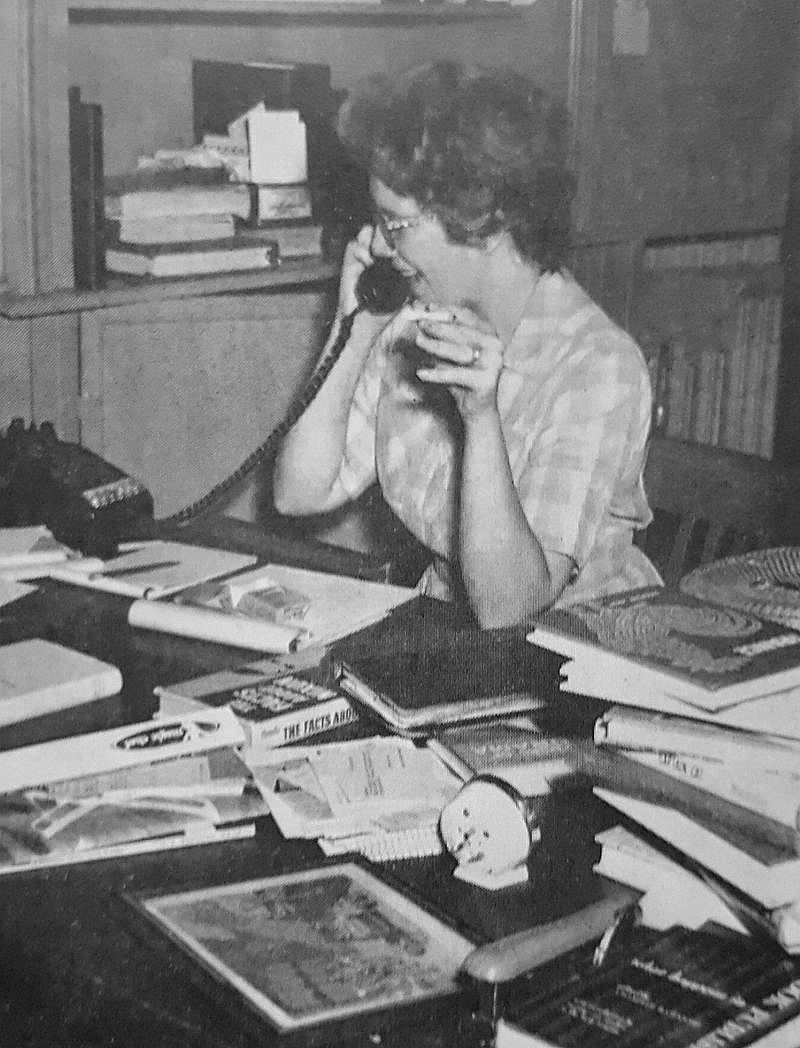
The photo below is how I remember her — talking animatedly on the phone (she and my mother, Margaret, were champion telephone talkers, and I remember them both working at that desk, and talking and talking and talking on that phone).

mimi_phone_texas-parade_feb-1961

I ran into Mimi a few times as an adult. We’d usually just exchange quick pleasantries and ask how various family members were — but I always hoped I’d have the chance to sit down and have a long conversation with her someday. Sadly, that didn’t happen, but I’m so happy that my brother, Erik, and I have reconnected with her children, Amy and Trip Aldredge, and that we’re all friends. The four of us share nostalgic childhood memories of each other’s parents and of that old creaking house on McKinney — a house so crammed with books that the medical section had to be shelved in the bathroom. I can’t imagine a better childhood that one spent growing up in a bookstore.

Goodbye, Mimi — I’m so glad you were a part of my family’s life.

**

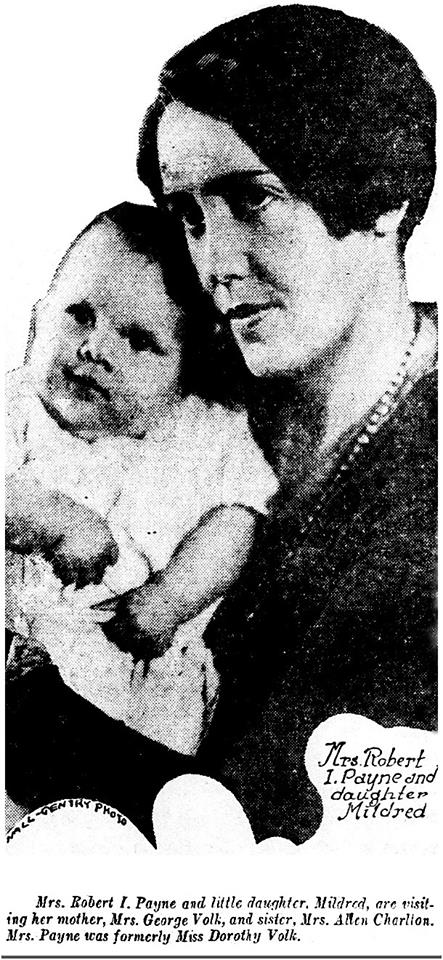
In one of those wonderful unexpected discoveries I’ve made while looking for something completely unrelated, I stumbled across this photo of little Mildred Payne as a baby and was happier about it than I might have expected. (Click photo to see a larger image.)

1929_mimi_dmn_061429
1929

It wasn’t until I was an adult that I realized Mimi had been a real-life, honest-to-god debutante (probably the only debutante I’ve ever met) and that her mother was a member of Dallas’ famed Volk retail family. She grew up in a very nice house, built by her father, Robert I. Payne, in the Perry Heights area of Oak Lawn. If you’re famiiar with Oak Lawn, you’ve probably seen the plantation-like house at 4524 Rawlins (at Hawthorne), designed by architect Ralph Bryan in 1936. (See the house today on Google Street View, here.)

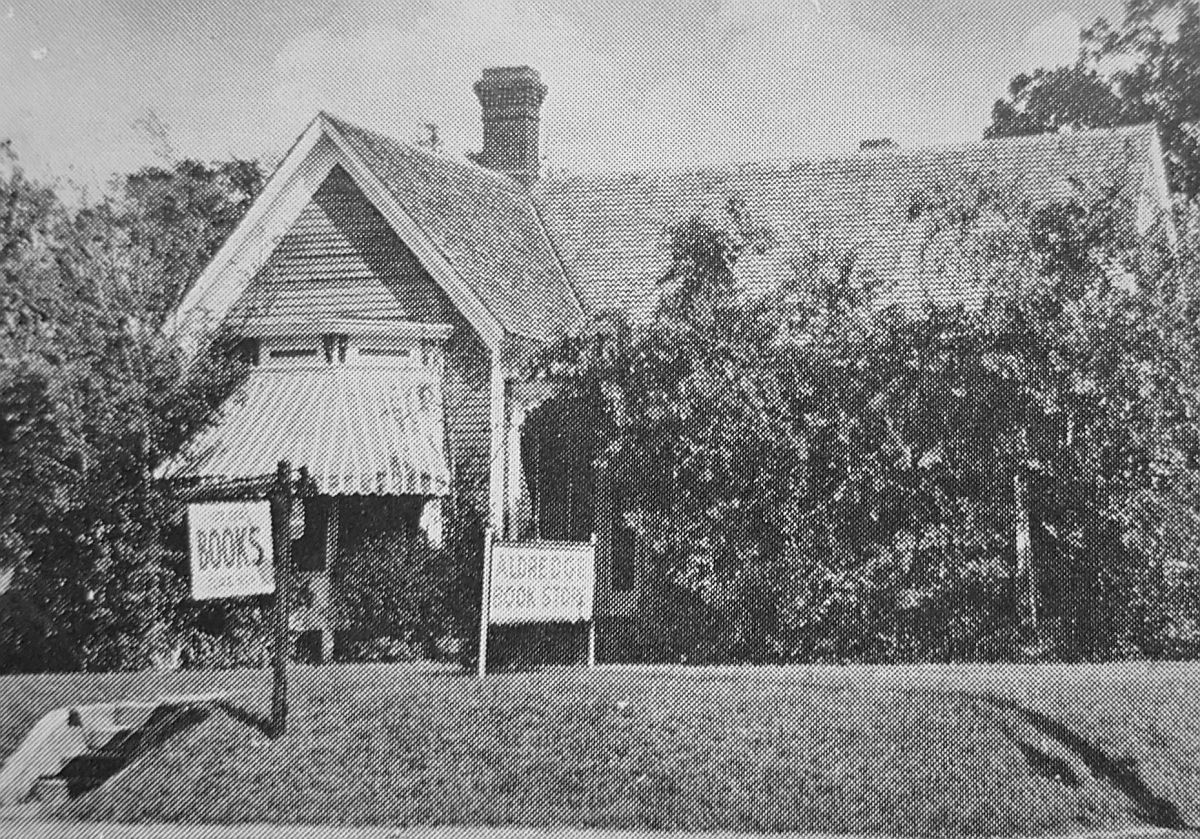
Sawnie Aldredge, Jr. (son of a Dallas mayor) opened The Aldredge Book Store in 1947 at 2800 McKinney Avenue (at Worthington) in an old house built in the 1880s or 1890s (this was several years before Sawnie and Mimi married). The picture below is from around 1960. This was before my time, but I seem to remember it looking less overgrown and less … shabby! It was much larger than it appears in this photo. Below the photo, the store’s early logo. (I’m not sure when the house was torn down — maybe in the ’80s? The lot was vacant for quite some time, as I reall. The block is painfully unrecognizable today. Today it looks like this.)

aldredge-book-store_texas-parade_feb-19611960-ish

ABS_logo_1947

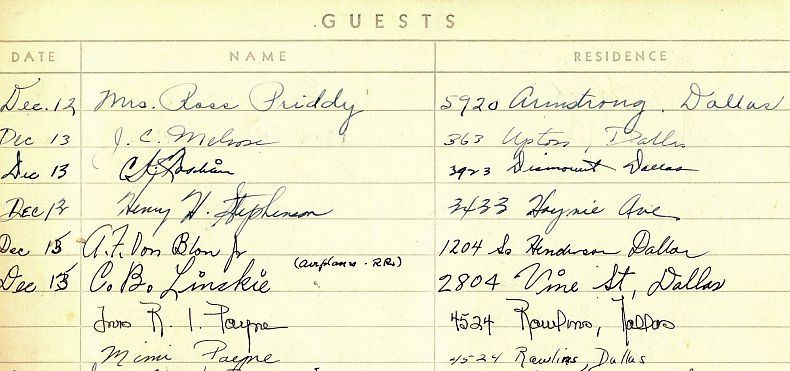
A few years ago, when my brother and I were closing the store, I came across a guestbook from the first year of business and was happy to see that on Dec. 15, 1947, a 19-year-old Mimi Payne visited the store with her mother, Mrs. R. I. Payne. Little did she know that seven years later she’d be married to the proprietor of the store and — for a while — living in that house, battling for personal space amongst all those damn books!

aldredge-book-store-guestbook_1215471947

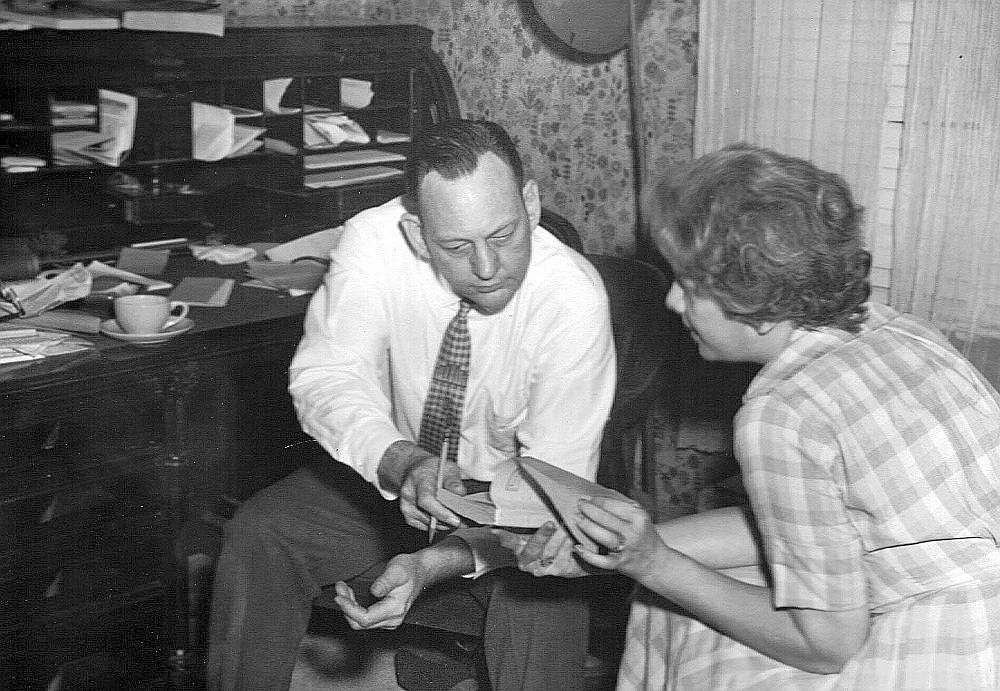
sawnie_mimi_desk_1961Sawnie and Mimi, 1961

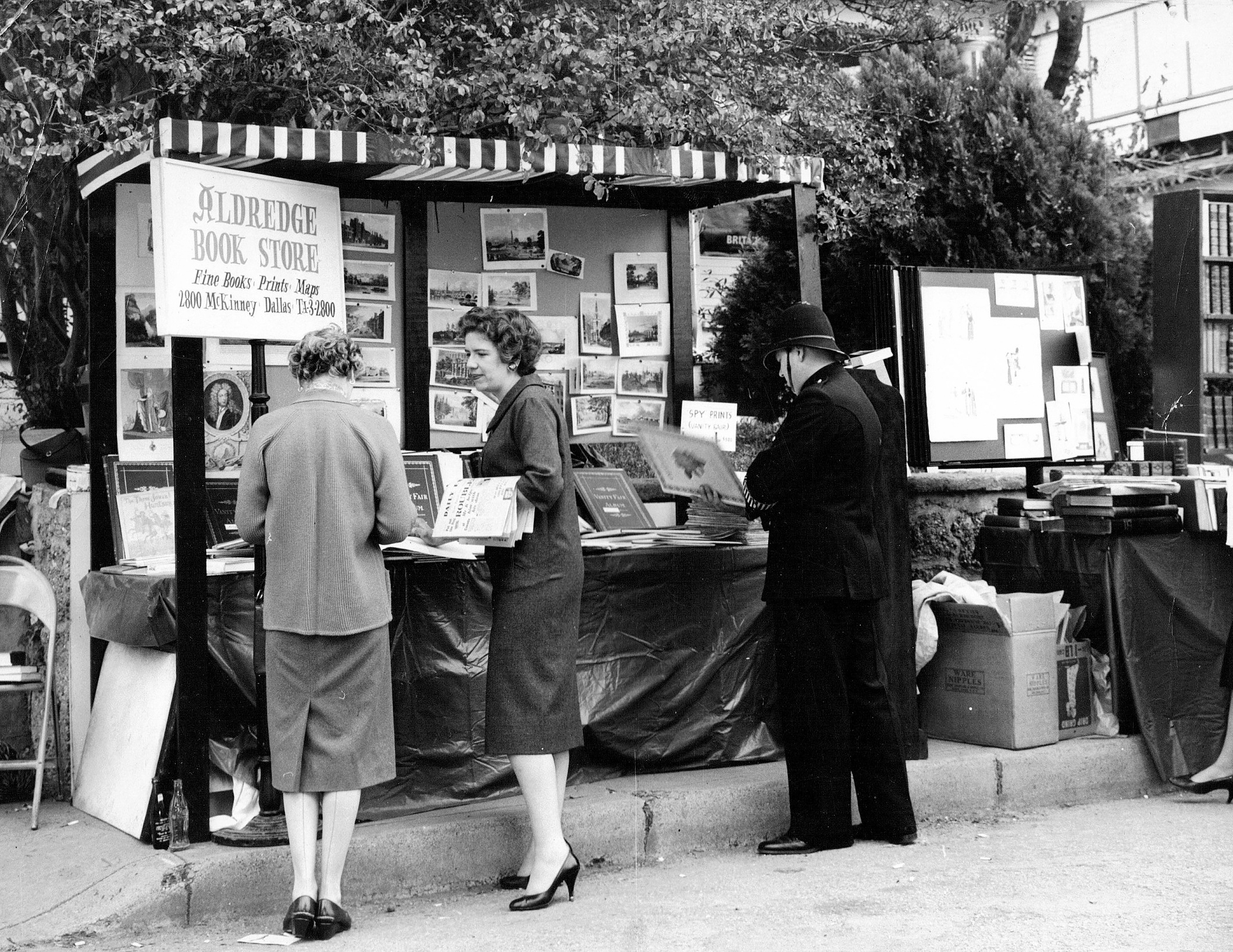
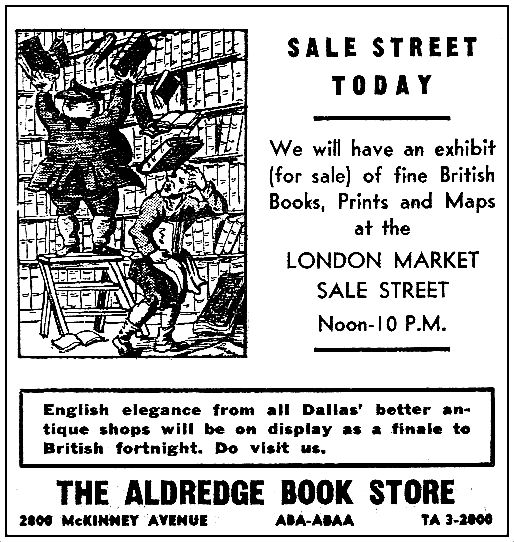
The photo below is one I really love — it was taken in 1958 at the Sale Street Fair, an annual antique street market which ran at the same time as the Neiman-Marcus Fortnight (in 1958 Neiman’s was celebrating Britain). This shows Mimi manning the bookstore booth. My mother told me that she and Mimi (and probably everyone else there) passed the time sitting on the curb, sipping cocktails supplied by friendly neighborhood antique dealers. Sounds great!

ABS_mimi_sale-street-fair_1958Sale Street Fair, Mimi and a browsing London bobby, 1958

ABS_sale-street-fair_1958
Oct., 1958

In 1975, another chapter of Mimi’s life opened when she married esteemed SMU law professor Joe McKnight, to whom she had been married for 40 years at the time of his death in 2015. One interesting highlight was that Joe and Mimi — through their friendship with international bestselling author Alexander McCall Smith (The No. 1 Ladies Detective Agency, etc.) — were featured as characters in his Sunday Philosophy Club/Isabel Dalhousie series. He talked about putting them in one of his novels in a 2006 interview:

Isabel’s mother was American, and she has a cousin of her mother in Dallas, [who is based on] a real person… I was a visiting professor at Southern Methodist University and I’ve got very good friends there, a wonderful couple called Joe and Mimi McKnight, who I’ve made the cousin of Isabel in this book. I have Joe and Mimi coming to Edinburgh, and Mimi plays a large part in the story. So, I’m writing a real person into the story, which is great fun.

A woman who spent a number of years in the early part of her life selling books certainly deserved to be transformed into an entertaining character in a bestselling book in the later part of her life!

***

Sources & Notes

Photos and clippings from the Aldredge Book Store archives and the Aldredge family, unless otherwise noted.

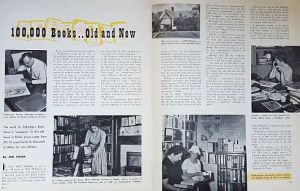
A couple of the photos above come from a profile of The Aldredge Book Store in a magazine called Texas Parade (Feb. 1961): “100,000 Books … Old and New” by Joe Swan. See the full article and photos in a PDF, here

aldredge-book-store_texas-parade_feb-1961_spread_sm

Mimi McKnight died April 3, 2017; her obituary is here.

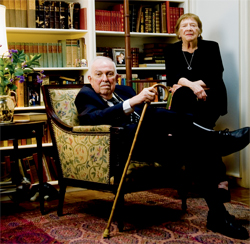
D Magazine wrote about Joe and Mimi McKnight and their connection to Scottish author Alexander McCall Smith in the June 2007 article “Muse, Thy Name is McKnight,” here. The photo below (by Elizabeth Lavin) is from that article.

mcknights_joe-and-mimi_d-mag_june-2007
2007 (D Magazine)

Other Flashback Dallas posts concerning The Aldredge Book Store can be found here.

*

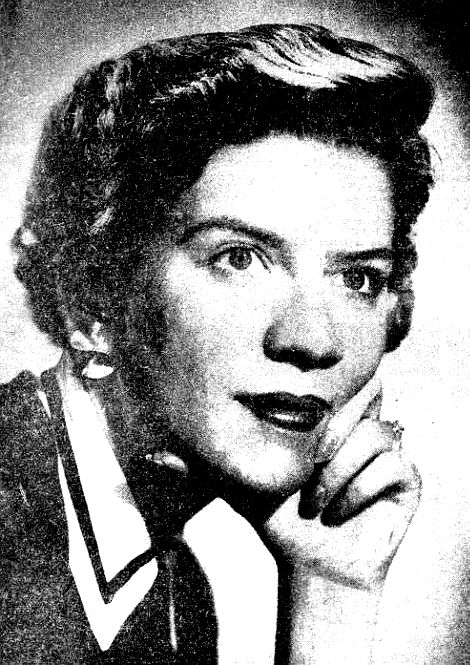
mimi_wedding_announcement_101054_det
1954

Most photos larger when clicked.

*

Copyright © 2017 Paula Bosse. All Rights Reserved.

The Saint Jude Chapel Mosaic by Gyorgy Kepes — 1968

gyorgy-kepes_mosaic_st-jude-chapel_websiteMain Street mosaic…

by Paula Bosse

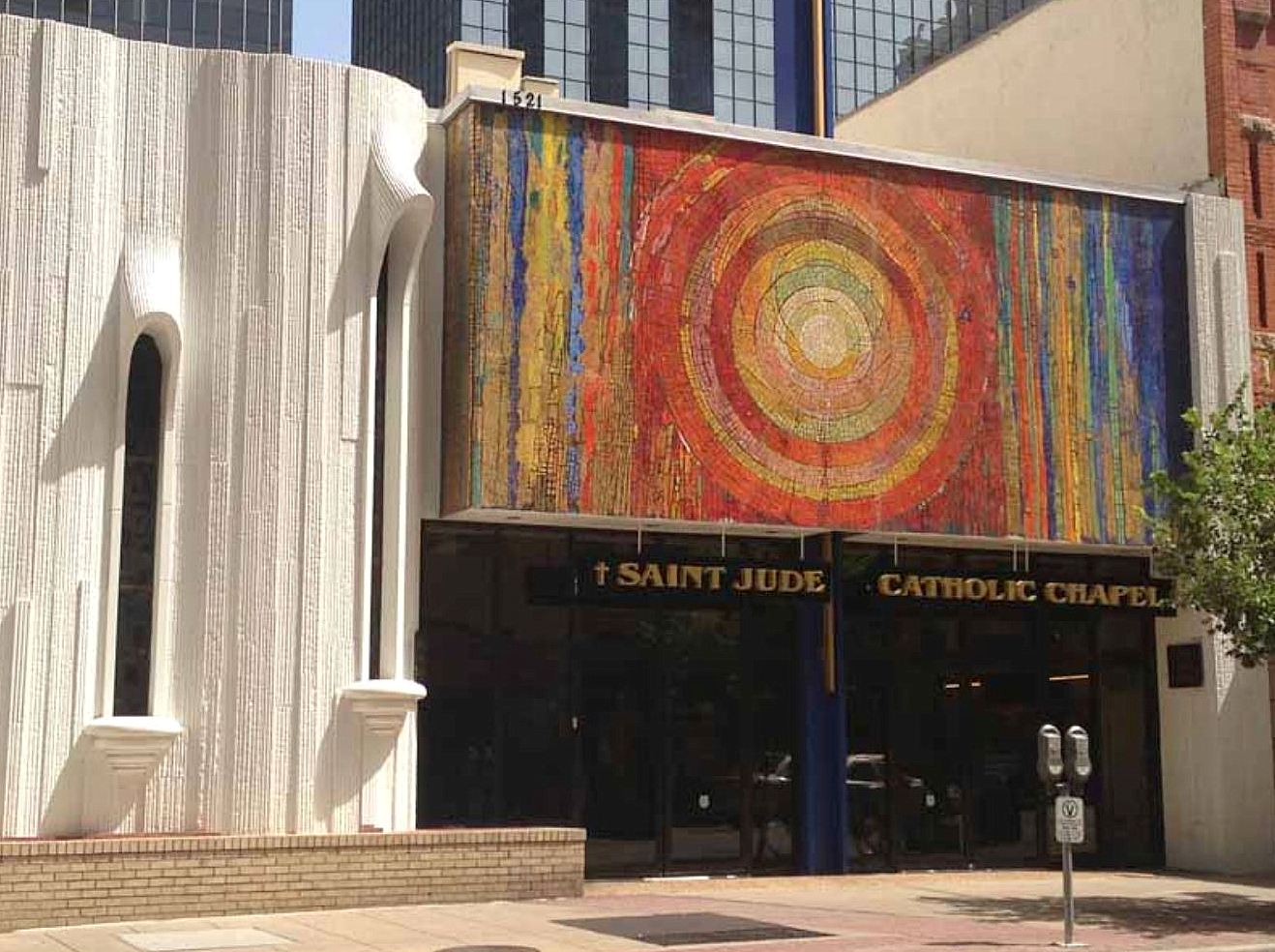
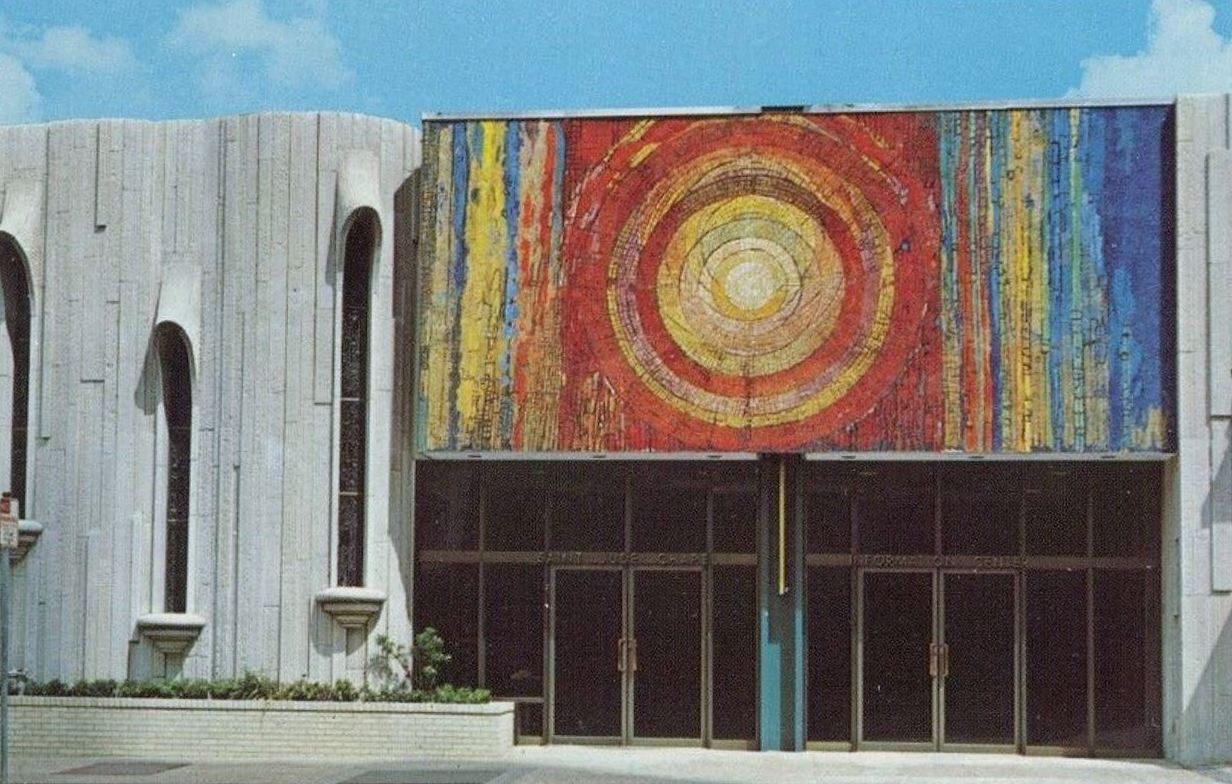
Perhaps you’ve noticed the intensely colorful sunburst-like mosaic that adorns the Saint Jude Catholic Chapel at 1521 Main Street, near Stone Place. It’s hard to miss. The artist is Gyorgy Kepes (1906-2001), an important Hungarian-born avant-garde painter, photographer, and educator who immigrated to the United States in 1937. He taught for a short time at North Texas State University (now the University of North Texas) in the mid 1940s, and may be known best in Dallas for his work as artistic director for Temple Emanu-El in the late 1950s, a project which artfully brought together contemporary art, architecture, and design into a sacred space.

At the time Kepes was commissioned to create the mosaic for the new Saint Jude Chapel (which opened in 1968), he was immersed in founding the Center for Advanced Visual Studies at the Massachusetts Institute of Technology (MIT). One wonders how he found the time!

This mosaic — which as far as I know is untitled — is probably a familiar sight to people who work and live downtown, but most who pass it are completely unaware of the name of the artist. I hope I’ve helped correct that a bit. Thank you, Gyorgy Kepes — and thank you, Saint Jude Chapel — for this nice little addition to Dallas’ public art.

gyorgy-kepes_mosaic_st-jude-chapel_website_video_closeup

gyorgy-kepes_mosaic_st-jude-chapel_website_video

gyorgy-kepes_mosaic_st-jude-chapel_website_video_bw

st-jude-chapel_kepes_postcard_ebay

st-jude-chapel_kepes_postcard_ebay-captionPostcard and info, eBay

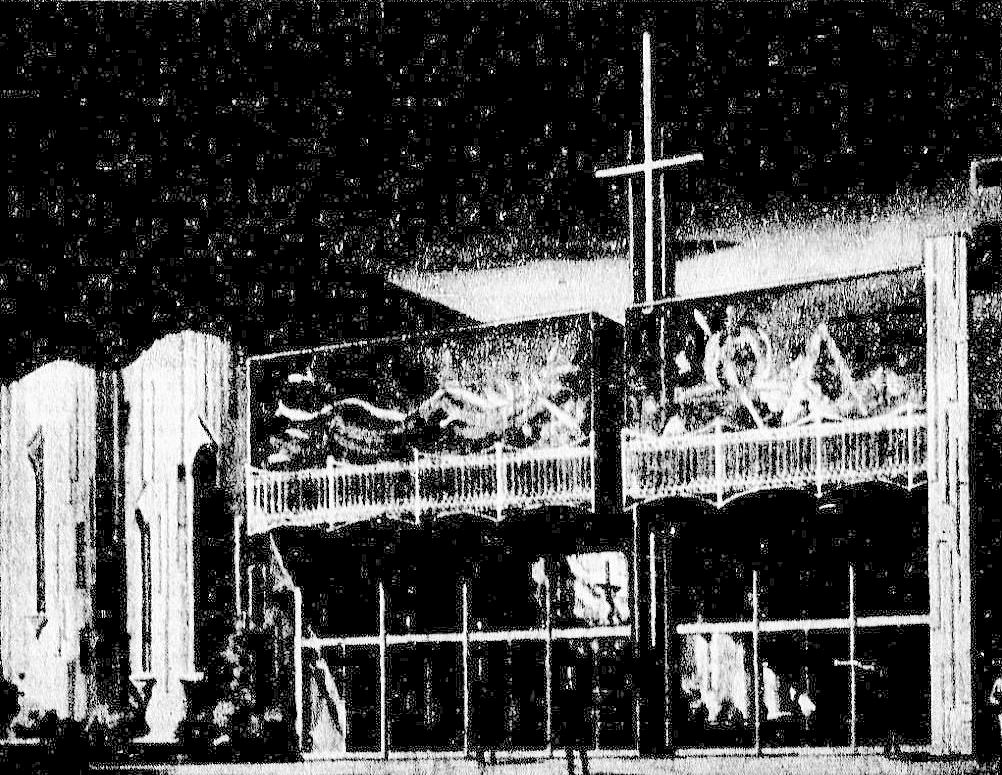
Below, an early rendering of the proposed building (1966), designed by architect Eugene F. Boerder. The vague mosaic design in this drawing suggests that Kepes might not have been attached to the project at this point, or that his design had not yet been determined.

st-jude_architects-rendering_1966_eugene-f-boerderArchitect’s rendering, Sept. 1966

***

Sources & Notes

Unless otherwise noted, photos from the Saint Jude Catholic Chapel website, here. The undated black-and-white photos are from a video history of the chapel, here.

Read about Gyorgy Kepes in overviews of his life and career from MIT, from the James Hyman Gallery, and from Wikipedia.

I have been unable to find any information about this mosaic. Had I not stumbled across Kepes’ name in a Sept. 14, 1968 Dallas Morning News article about the new chapel (which I was reading while researching the very interesting history of the building the St. Jude Chapel is in — and the building next to it) (that post is here), I’m not sure I’d be able to track down the identity of the artist. It’s surprising how little is out there about such a prominently displayed work of art!

UPDATE: Rather bizarrely, a few weeks after I wrote this, I learned that this mosaic was being restored — so I went downtown, met the restoration team, took some photos, and wrote the post “Mosaic Restoration at Downtown’s St. Jude Chapel.”

*

Copyright © 2017 Paula Bosse. All Rights Reserved.

Long and Woodrow From Above — 1965

woodrow_1965-yrbk_birdseyeSo much open green space! (click for larger image)

by Paula Bosse

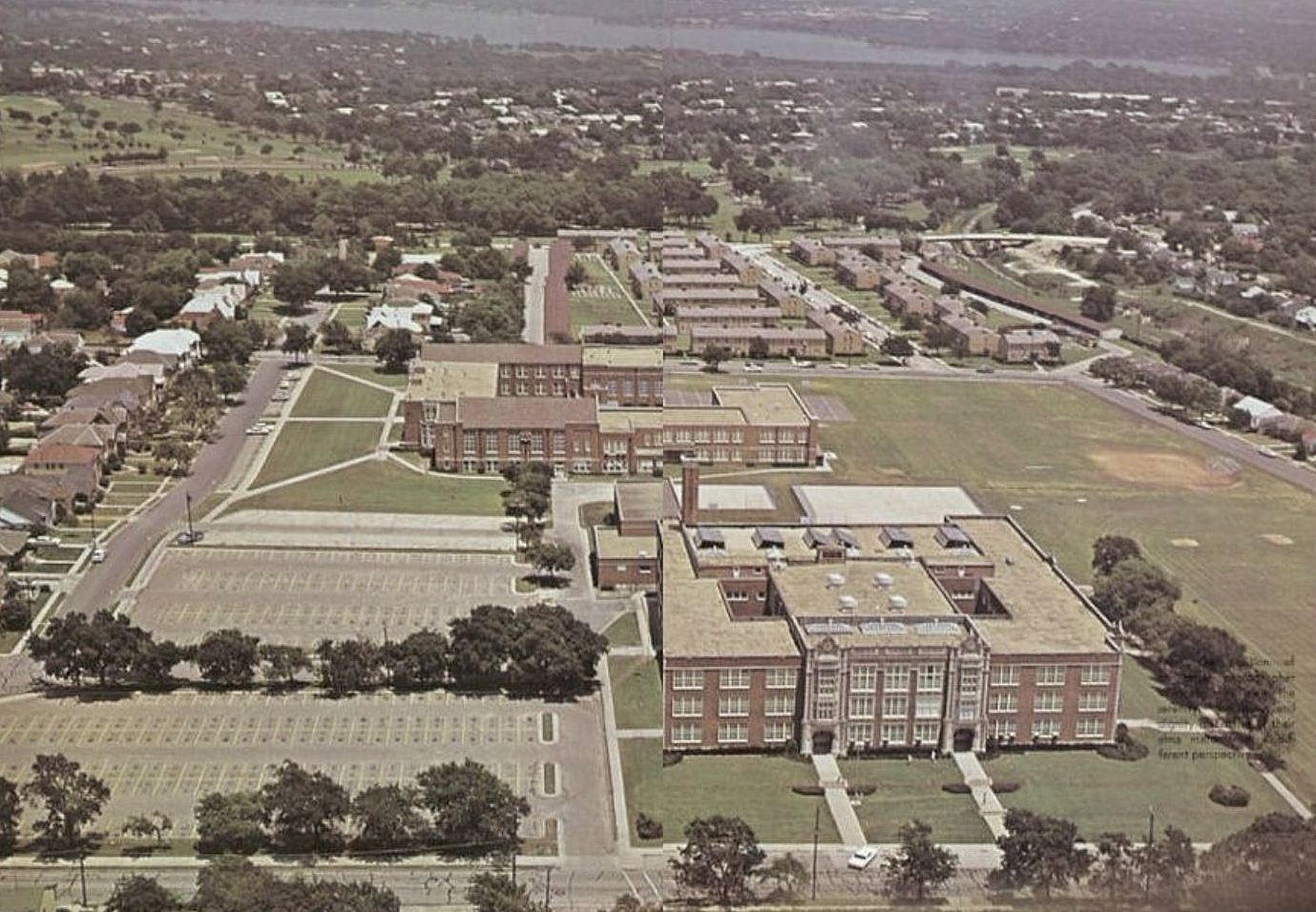
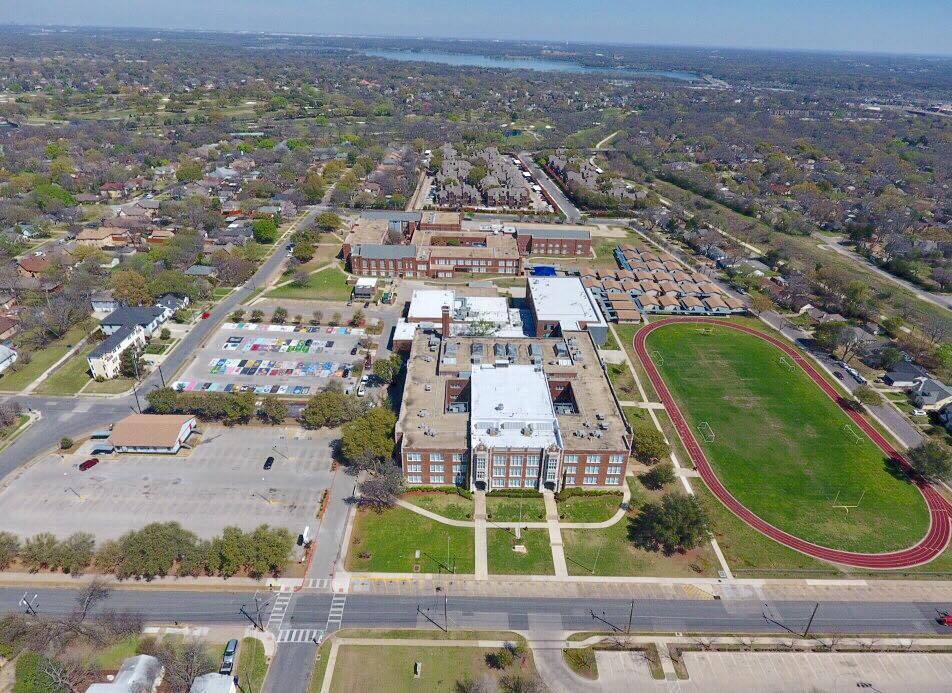
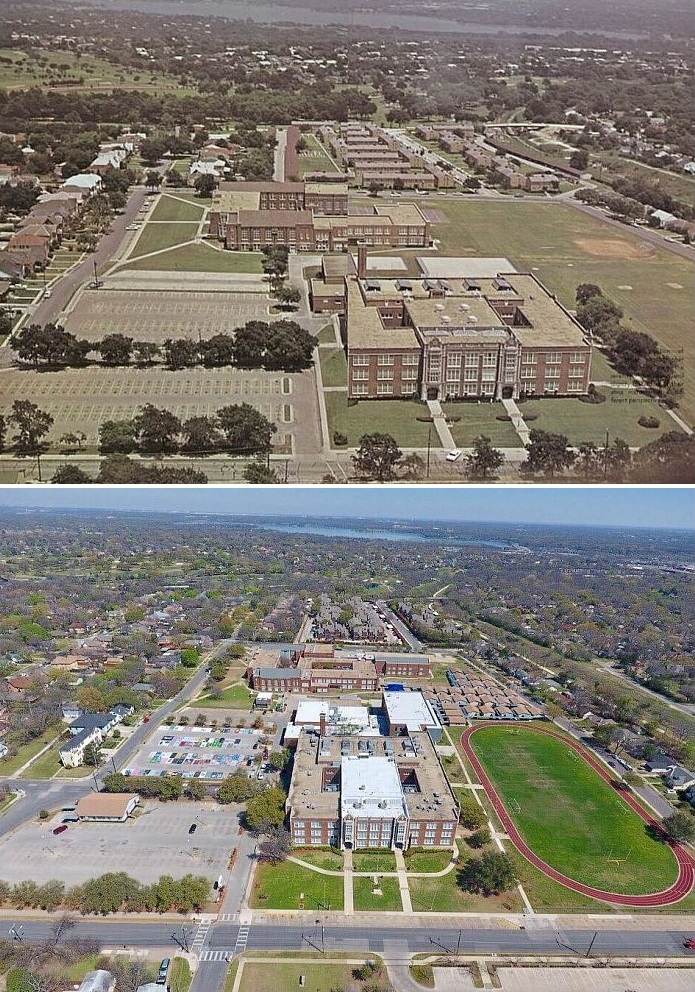
A few days ago, after having done too many recent posts on Dallas high schools, I decided to post this great 1965 photo of J. L. Long Jr. High School and Woodrow Wilson High School on Facebook and Twitter, rather than write another high school post. But then Facebook follower Chris Prestridge went out and took the same shot with his drone and sent it to me. And it’s cool! So now I kind of have to post both of these great then-and-now photos. (Thank you, Chris!)

In the photos we see Woodrow in the center foreground, Long behind it, the Lakewood Country Club at the upper left, and, in the background, White Rock Lake. Things haven’t changed hugely in the intervening 52 years — it’s still a pretty area, but things just seem more crowded. (How I long for the days of school campuses devoid of the clutter of what I used to call “temporary buildings” — but those buildings don’t seem to be “temporary,” because they never go away. And those displaced fields and playgrounds never come back.)

Here’s the same view today.

woodrow_drone_march-2017_chris-prestridge

Below, the two photos, cheek by jowl. Click to see them bigger.

woodrow-long_1965_2017

***

Sources & Notes

Top photo is from the 1965 Crusader, the yearbook of Woodrow Wilson High School; I found it on Flickr, here.

Many thanks to Chris Prestridge who “droned” the present-day photo yesterday, on March 14, 2017. Thank you, Chris! (And thank you, Chris’ drone!)

See another bird’s-eye view of both campuses — but one looking to the southwest rather than the northeast — in the Flashback Dallas post “J. L. Long, Woodrow Wilson — 1958,” here.

Click photos to see larger images.

*

Copyright © 2017 Paula Bosse. All Rights Reserved.