Flashback : Dallas

A Miscellany: History, Ads, Pop Culture

Category: 1960s

The Mitchell Building: Home to Cotton Gins, Rockets, Frozen Beverages, A/C Units, Slackers, Squatters, Hipsters, and Urban Loft-Dwellers

mitchell-bldg_oct-1988_appl-natl-register-hist-placesIn 1988, the building had seen better days… (click for larger image)

by Paula Bosse

In 1928, the John E. Mitchell Company (discussed previously here, here, and here) arrived in Dallas from St. Louis and built their J. A. Pitzinger-designed 2-story factory at 3800 Commerce Street (a wing was added the next year, and a third story was added the year after that). It produced cotton gins and farm implements. As strange as it seems today, Dallas was once the largest producer of cotton gin machinery in the United States. The Mitchell Company was located in a mostly industrial area very close to several other cotton gin manufacturers (such as the nearby  Continental Gin Company and Murray Company). At the height of their production, these Dallas factories were  responsible for half of the world’s cotton gins.

When World War II hit, the company became an important defense contractor and produced munitions for the U.S. Navy and U.S. Army, making things such as “anti-submarine projectiles,” anti-aircraft shells, rocket nozzles, and “adapters for incendiary bomb clusters.”

After the war, the Mitchell Company continued to manufacture agricultural implements but diversified by turning out other types of machinery, like automobile air conditioners and and cleaning systems. As the 1960s dawned, they developed the machine that made ICEE frozen slushy drinks (forever immortalized by 7-Eleven as The Slurpee).

After the death of company president John E. Mitchell, Jr. in 1972, the business began a slow slide downward. The company appears to have gone out of business in the early 1980s. In the fall of 1982, the company’s equipment was sold at public auction, and, in 1984, the building became the temporary home of the Junior Black Academy of Arts and Letters.

In the 1980s, Deep Ellum and Exposition Park began to explode with new bars, clubs, and galleries. If it was cool, it was in Deep Ellum and Expo Park; if it was in Deep Ellum and Expo Park, it was cool. Artists and musicians began to move into many of the neighborhood’s old warehouses. These usually run-down buildings — in which bohemian types lived (not always legally) and used as studio spaces — were huge and (in the beginning) cheap. The Mitchell Building became something of a ground zero for wild parties and was described in a fantastic 1995 newspaper article by Shermakaye Bass (linked below) as both a “flophouse” and “an artists commune and downtown slacker den.” The building was closed and boarded up by its owners in early 1995 in order to avoid code-violation citations, but by 1999 the building had been purchased, cleaned up, modernized, and converted into 79 loft apartments. Today, the Mitchell Lofts have been a part of the Expo Park scene for almost 20 years.

*

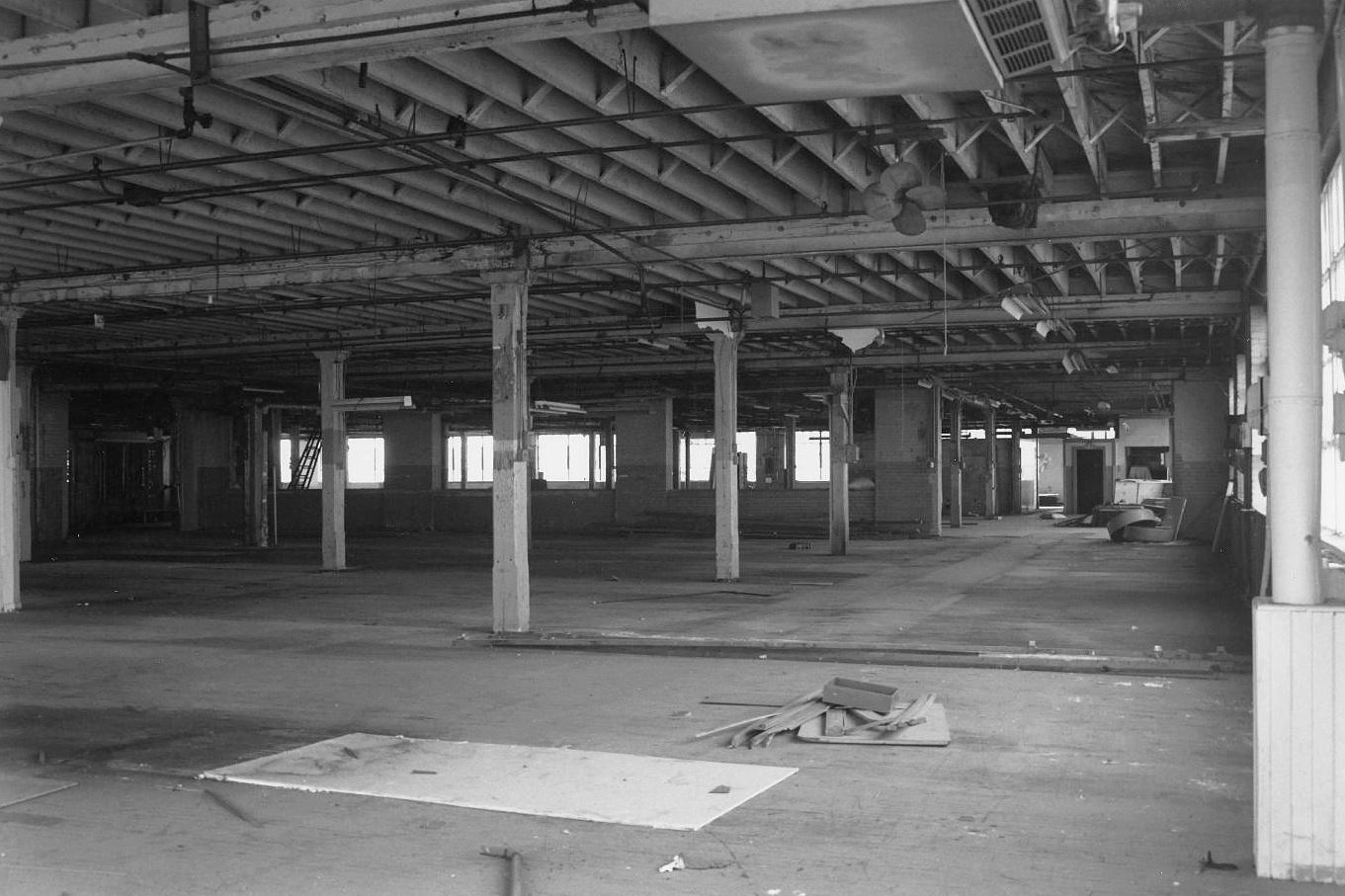
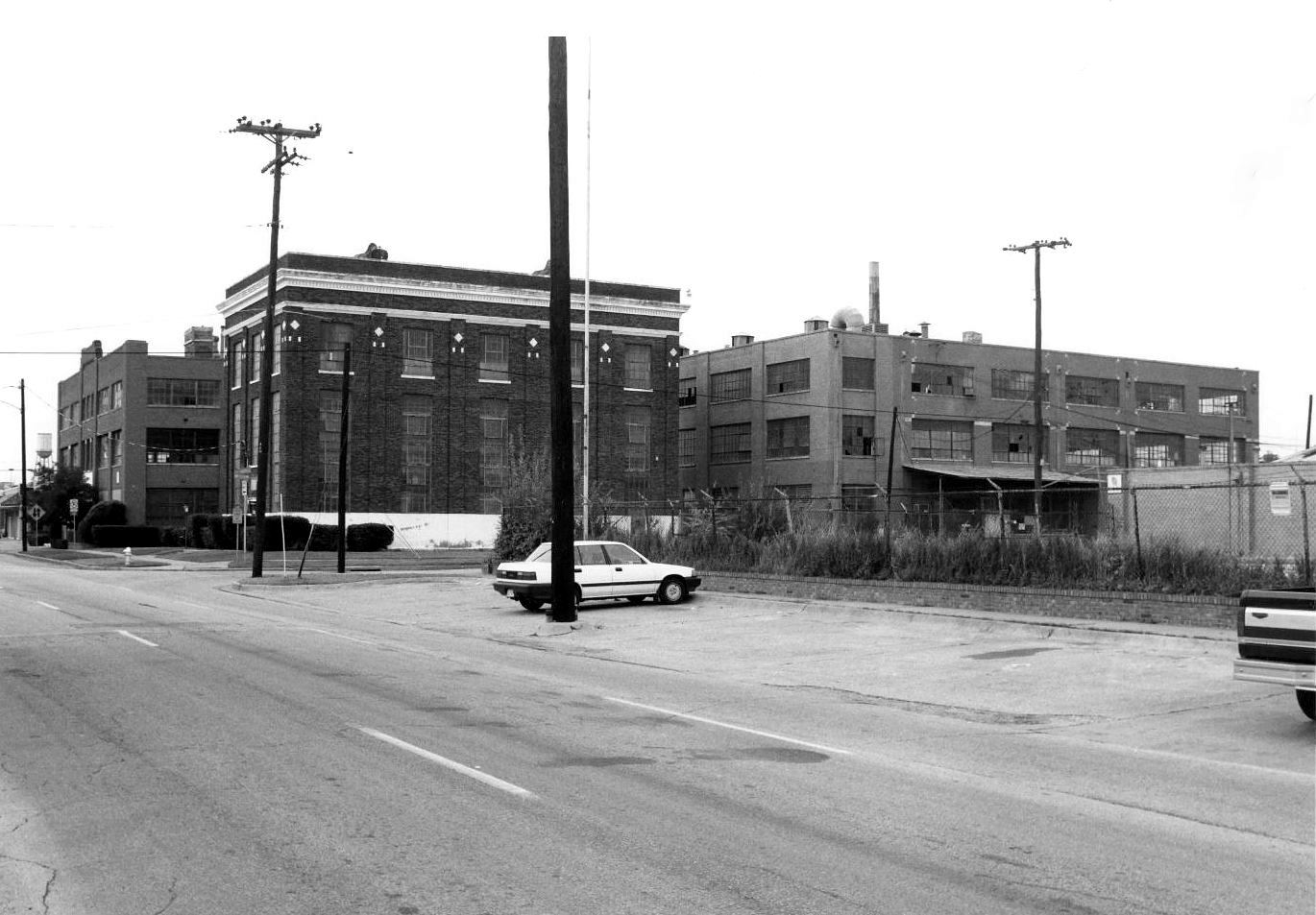
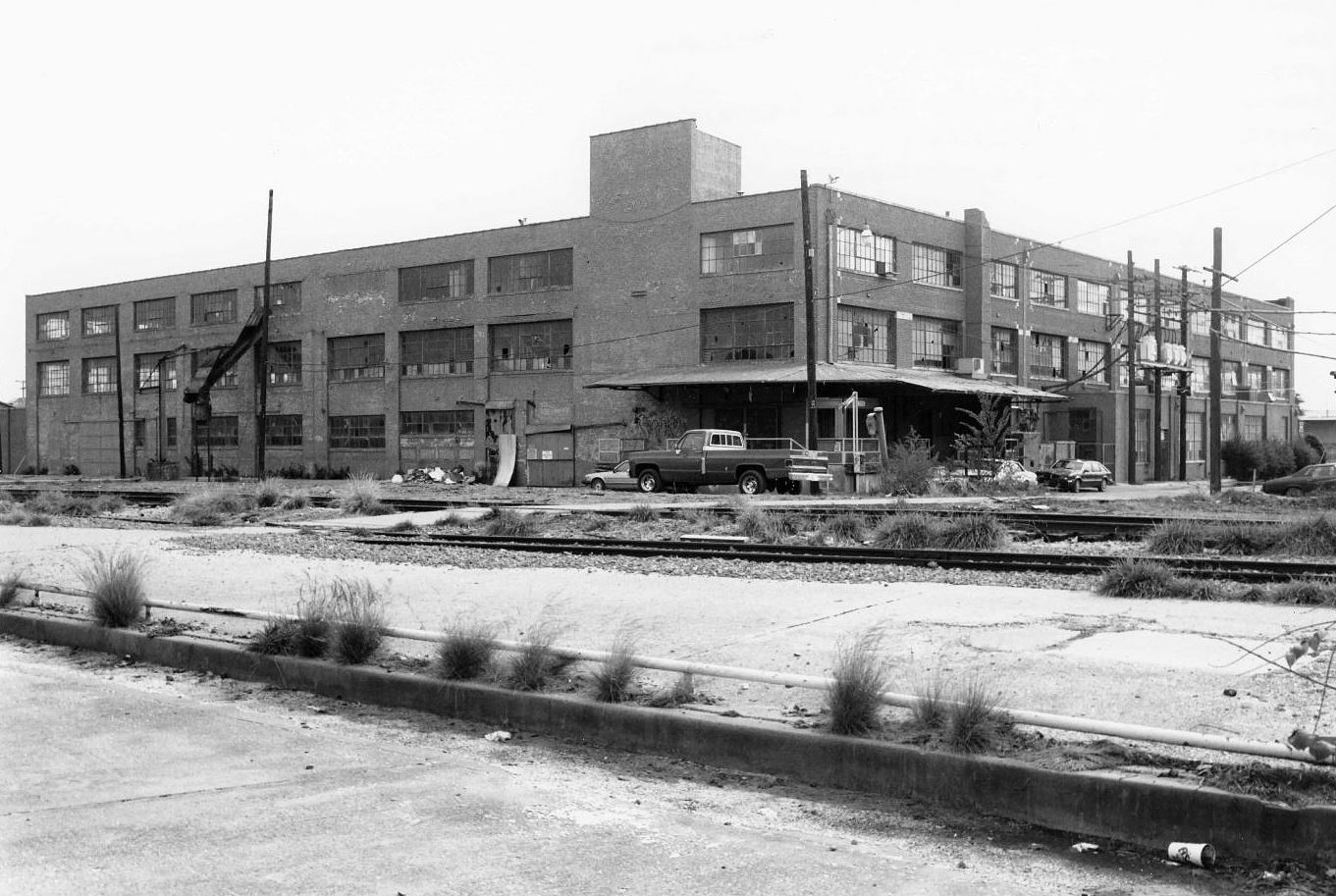
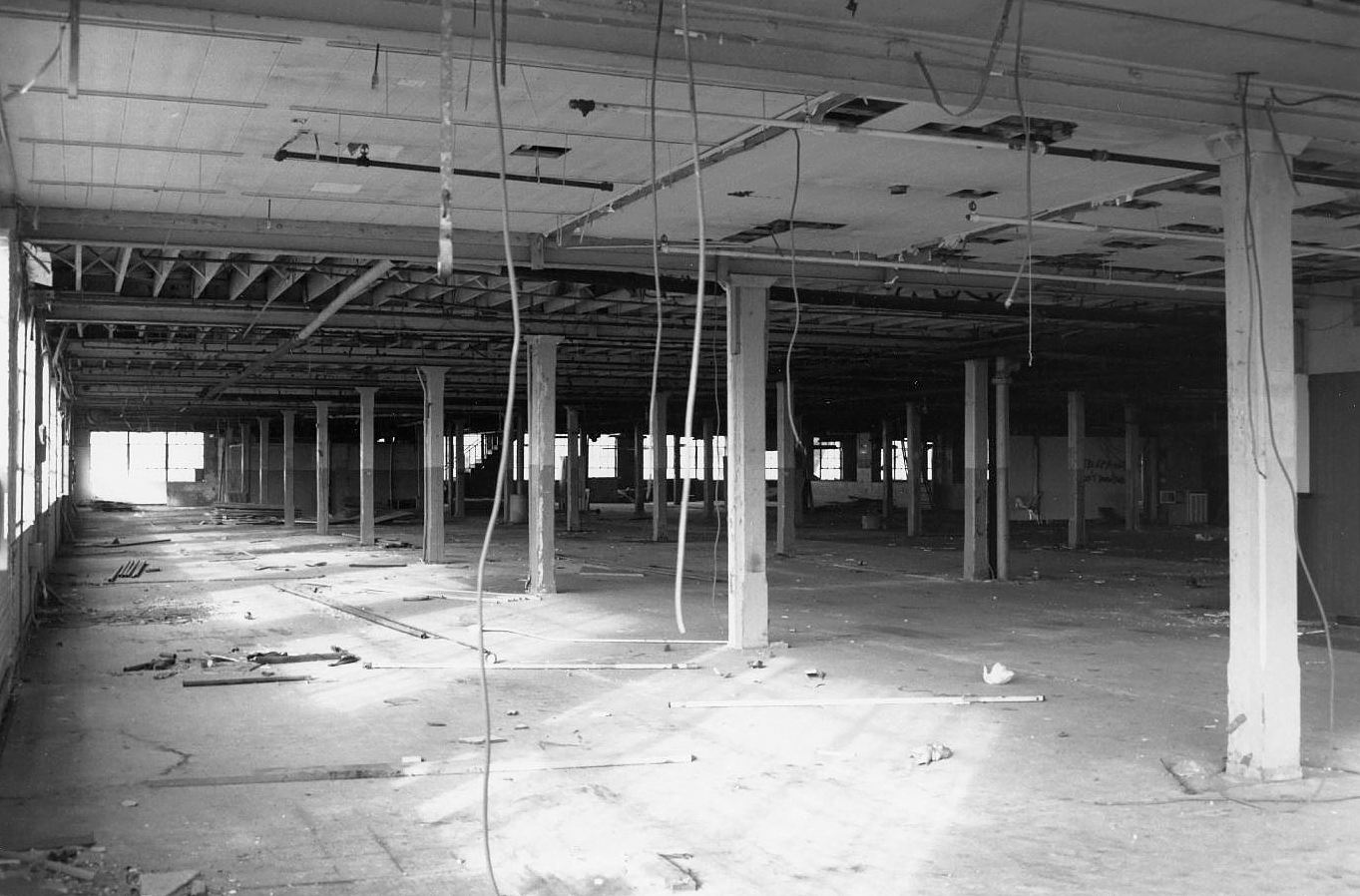
In 1991, the Mitchell Building was listed on the National Register of Historic Places. The photographs below (and the one at the top) were included in the application form. They were taken by Daniel Hardy of Hardy-Heck-Moore in October, 1988. Things weren’t looking great for the building in 1988. It must have been quite an undertaking to convert this large L-shaped building (which had certainly seen better days) into hip, sleek lofts.

Below, looking northwest on Commerce. The Mitchell Building is in an L-shape — the smaller building in the foreground is an old Dallas Power and Light substation, built around 1925. (Click photos to see larger images.)
mitchell-bldg_oct-1988_2

*

The back, from the old T&P/Missouri-Pacific railroad tracks.
mitchell-bldg_oct-1988_3

*

And two interior views of the second floor.
mitchell-bldg_oct-1988_4

mitchell-bldg_oct-1988_5

*

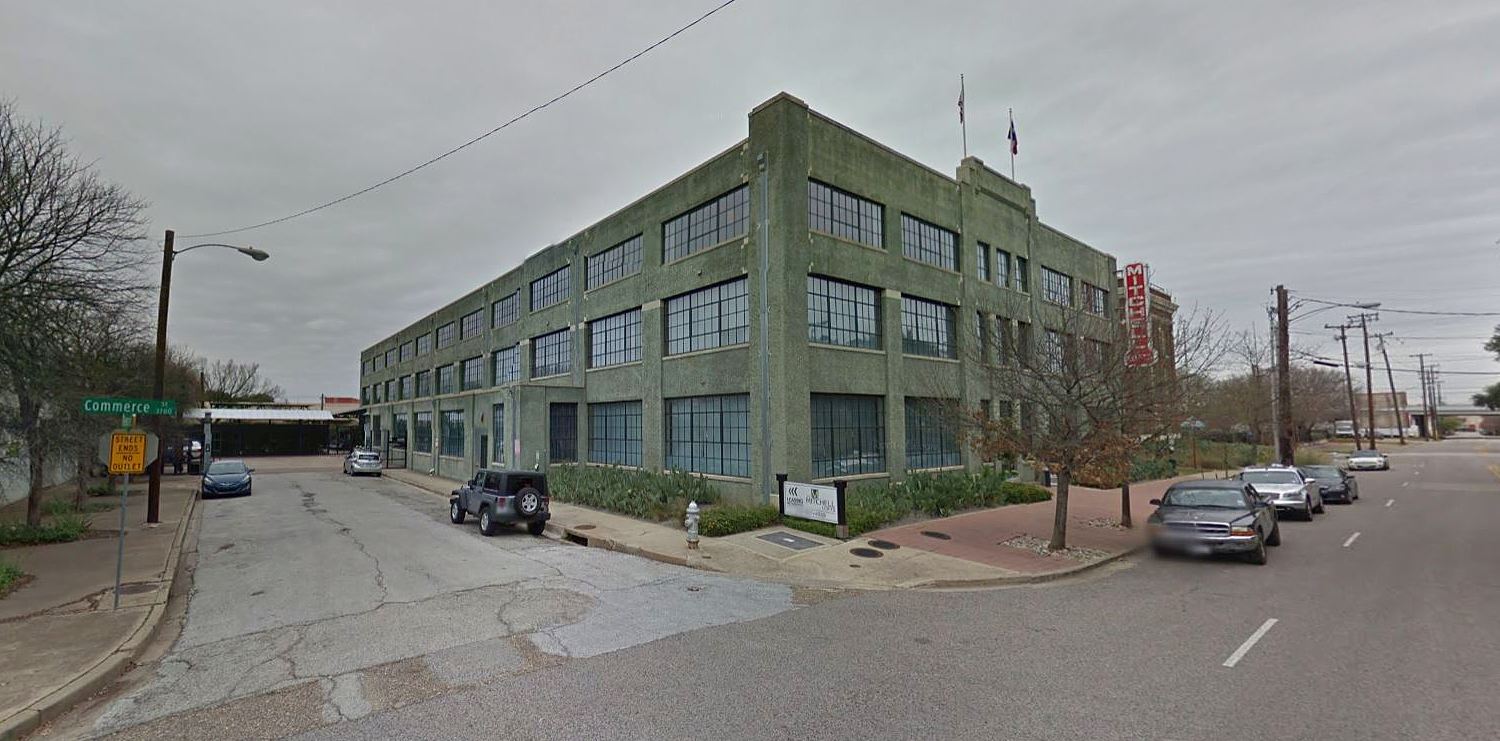
Here’s what the exterior looks like today, spiffified. (Explore it on Google Street view here.)
mitchell-lofts_google_jan-2016Google Street View (Jan. 2016)

mitchell-building_google
Google Maps

**

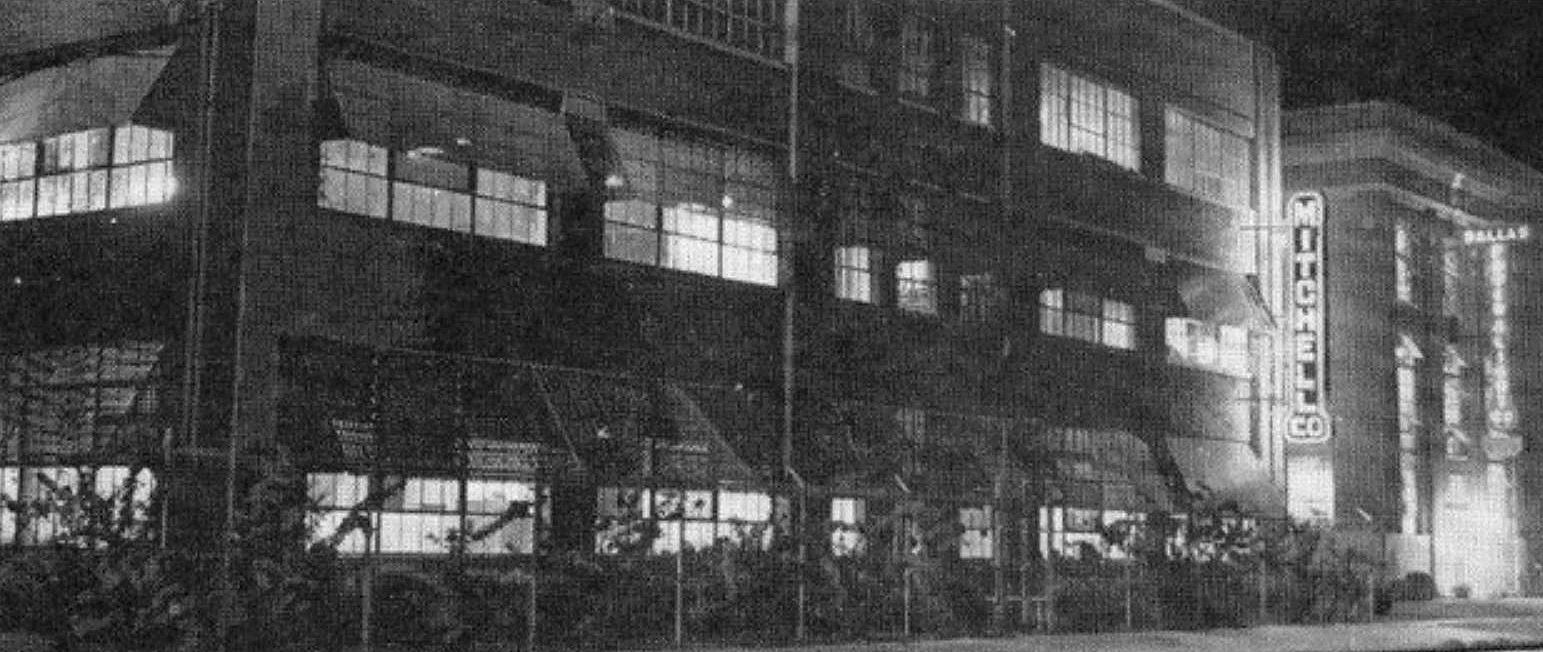
mitchell_sign_war-bk
Mitchell War Book, ca. 1945

mitchell-building_flickr_colteraFlickr

***

Sources & Notes

Photos are from the application to the National Register of Historic Places; in addition to the photos, there is a thorough history of both the building and the John E. Mitchell Company, written by David Moore of Hardy-Heck-Moore. The 28-page form can be found in a PDF, here. (3/14/17 UPDATE: The link no longer works for me, and I am unable to find the document. Here’s the full URL: ftp://ftp.dallascityhall.com/Historic/National%20Register/John_E_Mitchell_Plant.pdf.)

More info on the Mitchell Company and its building through the years can be found in the following Dallas Morning News articles:

  • “Dallas Gets Gin Factory” (DMN, March 17, 1928) — the announcement that a permit has been granted for the construction of a two-story brick factory and warehouse
  • “John E. Mitchell Exemplifies Faith as Secret to Success,” by Helen Bullock (DMN, July 17, 1949) — an entertaining profile of John E. Mitchell, Jr.
  • “Demise of a Dream Factory — Deep Ellum’s Historic Mitchell Building Leaves a Legacy of Artistic and Industrial Vision,” by Shermakaye Bass (DMN, Feb. 5, 1995) — for those who grew up when Deep Ellum was experiencing its (first) renaissance, the article is a great snapshot of what things were like in Deep Ellum and Exposition Park back in the ’80s and early ’90s

See what the Mitchell Lofts look like now in this Candy’s Dirt article from 2014; more photos are here. Pretty hard to believe people used to manufacture things like cotton gins and anti-aircraft missiles there.

The Mitchell Lofts website is here.

Click pictures and clipping to see larger images.

*

Copyright © 2016 Paula Bosse. All Rights Reserved.
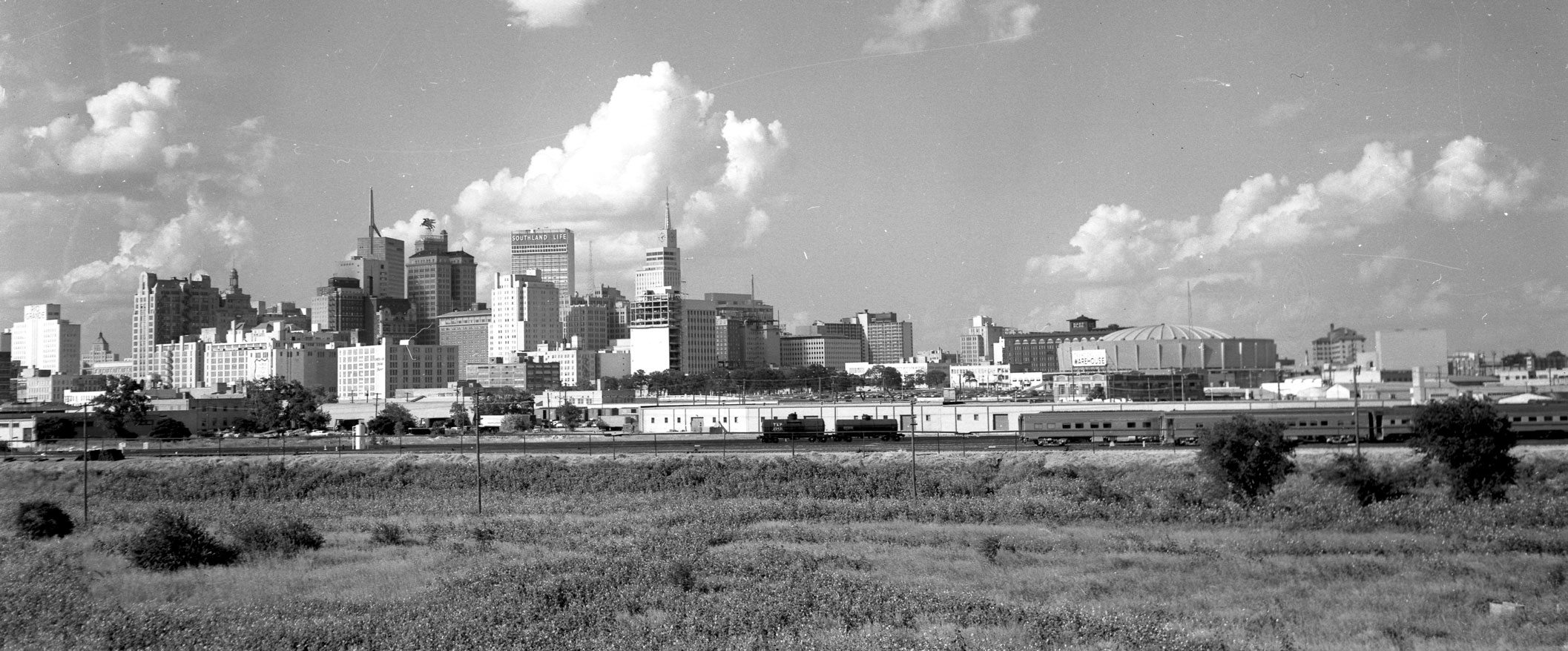
 

The Dallas Skyline: Spot the Landmarks

skyline_from-swMid-Century Big D… 

by Paula Bosse

The Dallas skyline is always changing, and it’s always been impressive. The late-’50s/early-’60s version above looks quaint by today’s standards, but it’s one of my favorite skyline periods. I’ve never been a huge fan of the Convention Center, but the rest of it? Pretty great.

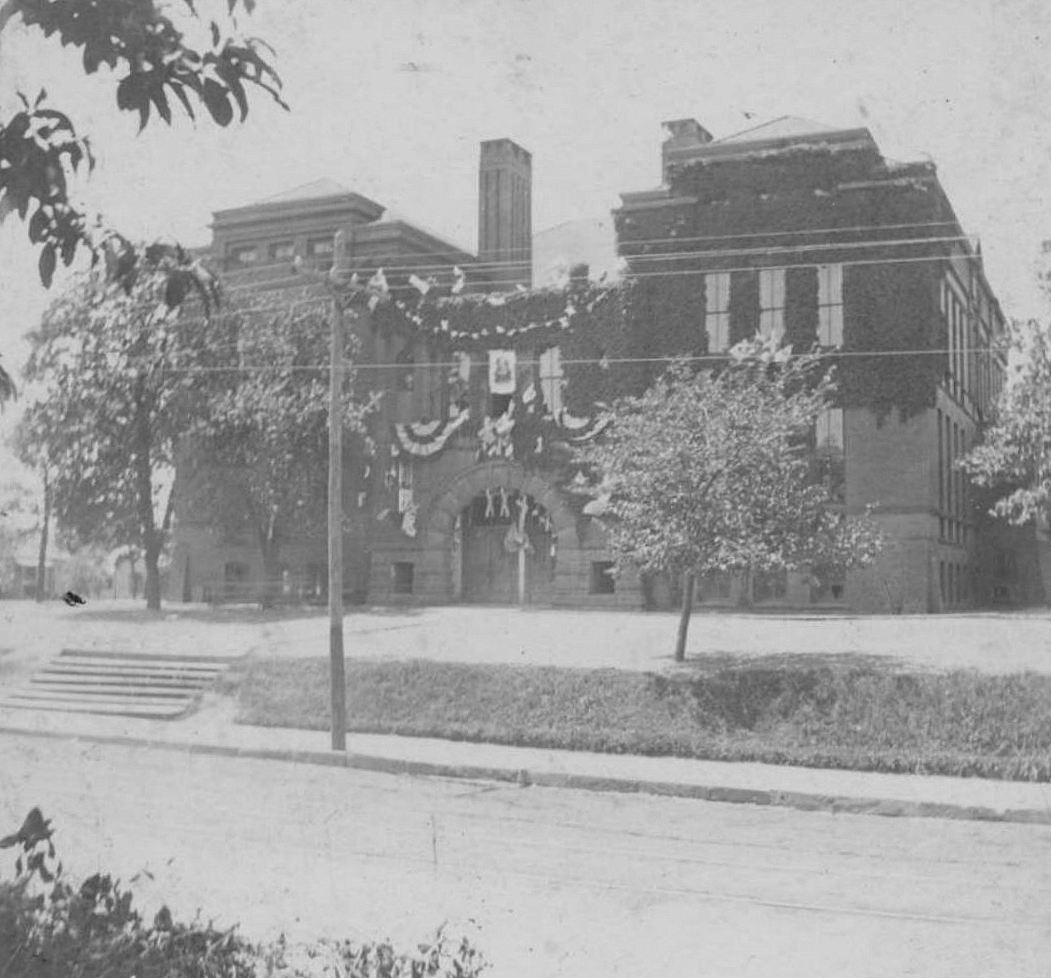
In order to make way for the George Dahl-designed Dallas Memorial Auditorium/Dallas Convention Center (which opened in 1957), the old Columbian School/Royal Street School (built in 1893) was demolished. At the time of its razing, it had most recently served as the city’s school administration building and as a book warehouse. Here are a couple of photos of the school, long before the bulldozers arrived.

columbian-school_flanders-site
via James Edwards Flanders site

columbian-school_cook-collection
Cook Collection, SMU

Also interesting was that this land — which the city had been buying up for many years (some as a result of condemnation/eminent domain) also included four pioneer cemeteries. Read more about what happened to those cemeteries here.

dallas-convention-center_flickr-coltera

***

Sources & Notes

Top photo is from a site containing several photos relating to early KRLD radio and TV, with the occasional shot of Dallas streets and buildings, here.

Other sources, if known, are noted.

*

Copyright © 2016 Paula Bosse. All Rights Reserved.

Gene’s Music Bar, The Lasso Bar, and The Zoo Bar

genes-music-bar_dallas-memorabiliaGene’s Music Bar, S. Akard Street (click for larger image)

by Paula Bosse

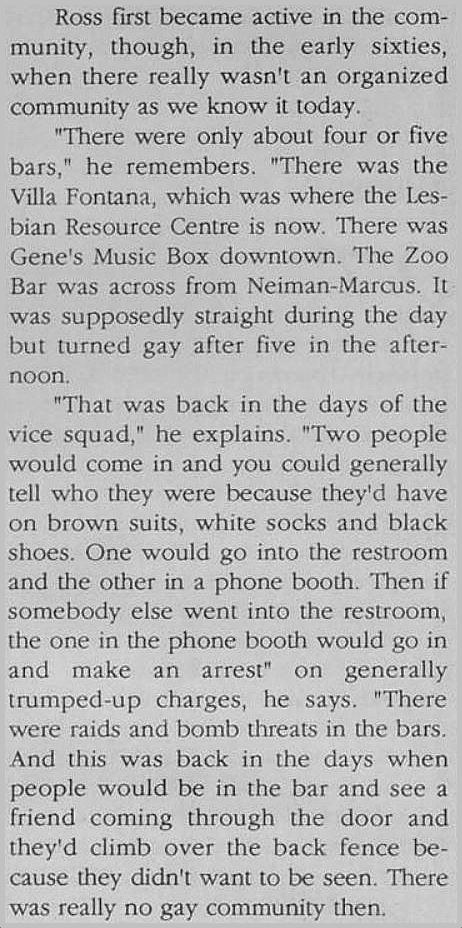
In Dallas’ pre-Stonewall days, there were only a handful of gay bars in the city, and they weren’t widely known beyond those who frequented them. Those were the days when “homosexual behavior” was illegal, and vice raids on gay bars and clubs were frequent occurrences. In an interview with the Dallas Voice Alan Ross remembered what the bar scene was like in Dallas in those days (click for larger image):

gay-dallas_dallas-voice_092190_alan-ross
Dallas Voice, Sept. 21, 1990

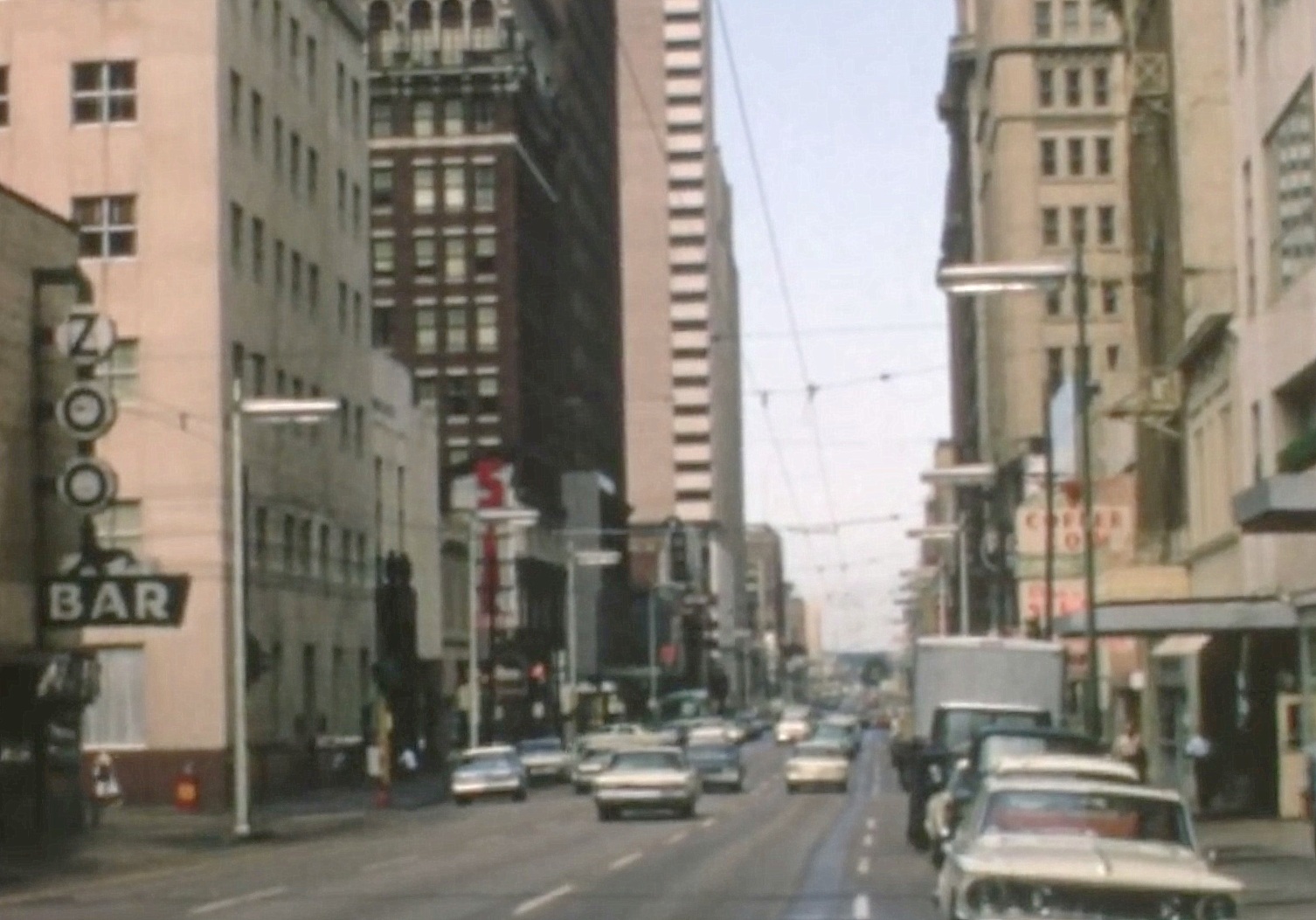
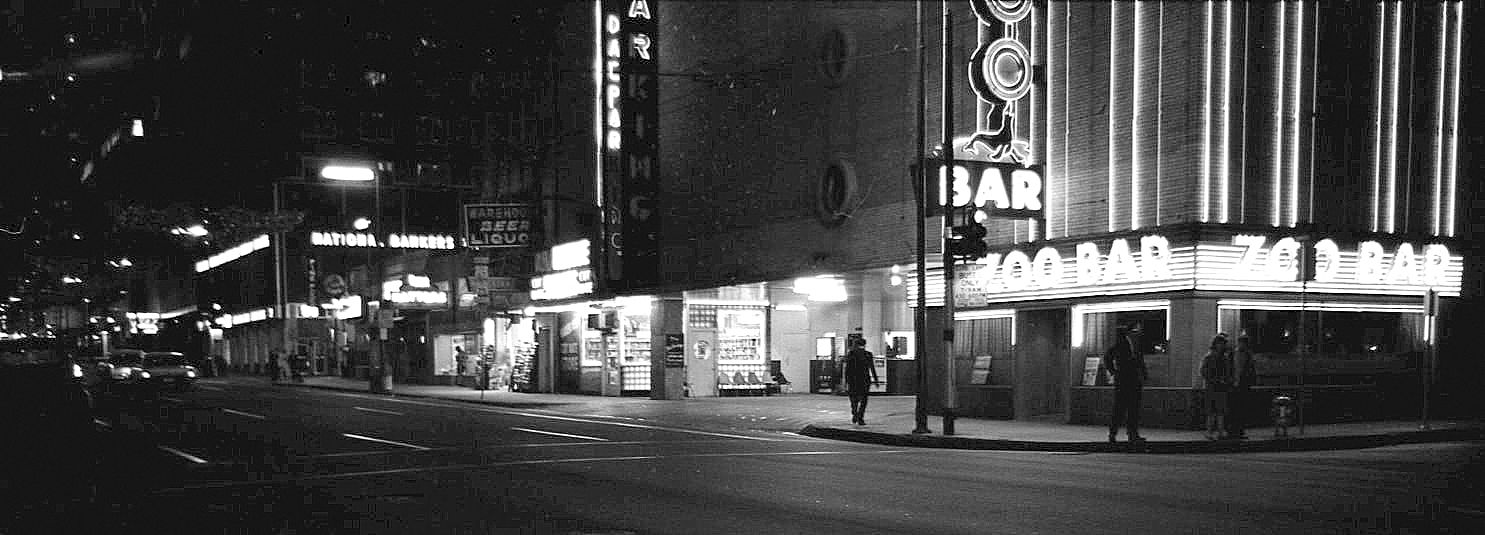
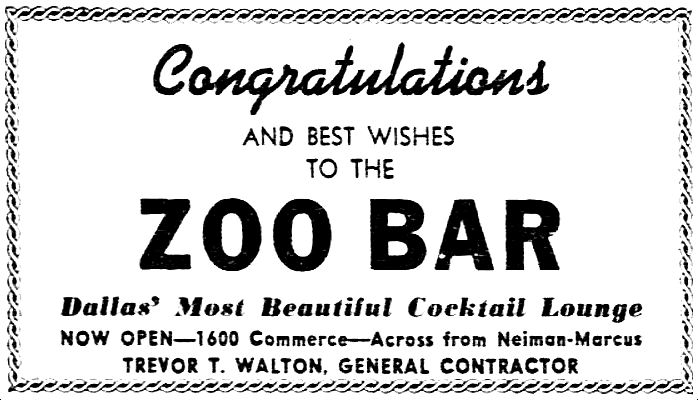
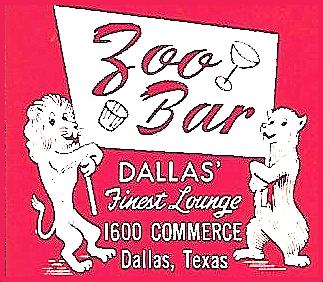
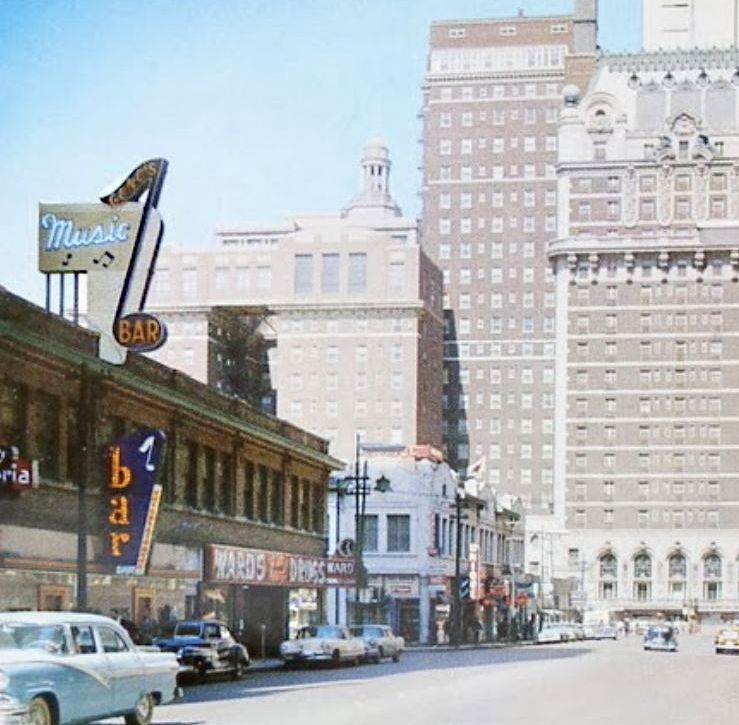
There was the well-appointed Le Boeuf Sur Le Toit (later renamed Villa Fontana), one of Dallas’ earliest gay bars, located on Skiles Street near Exall Park in the area now known as Bryan Place, and there were rougher, seedier places, generally downtown. Three of those downtown bars (which apparently catered to a “straight” clientele during the day and a gay clientele at night) were Gene’s Music Bar and The Lasso — both on S. Akard, in the shadow of the Adolphus Hotel — and The Zoo Bar, on Commerce, “across from Neiman-Marcus.”

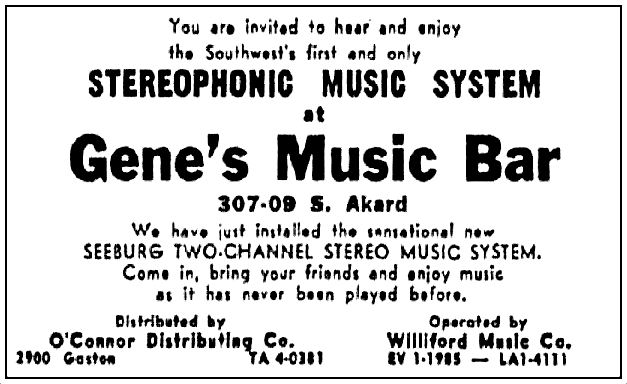
Gene’s Music Bar (pictured above) at 307-09 S. Akard began as a place where hi-fi bugs could sip martinis and listen to recorded music played on “the Southwest’s first and only stereophonic music system.” Not only did it have the sensational Seeburg two-channel stereo system, but it also boasted one of the best signs in town.

genes_dmn_110958
Nov. 1958

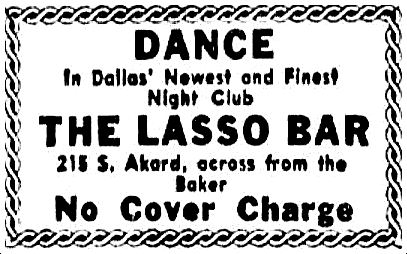
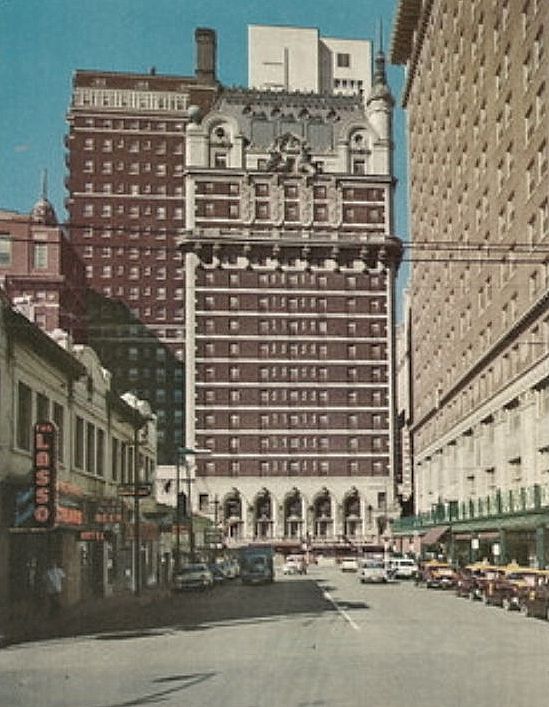
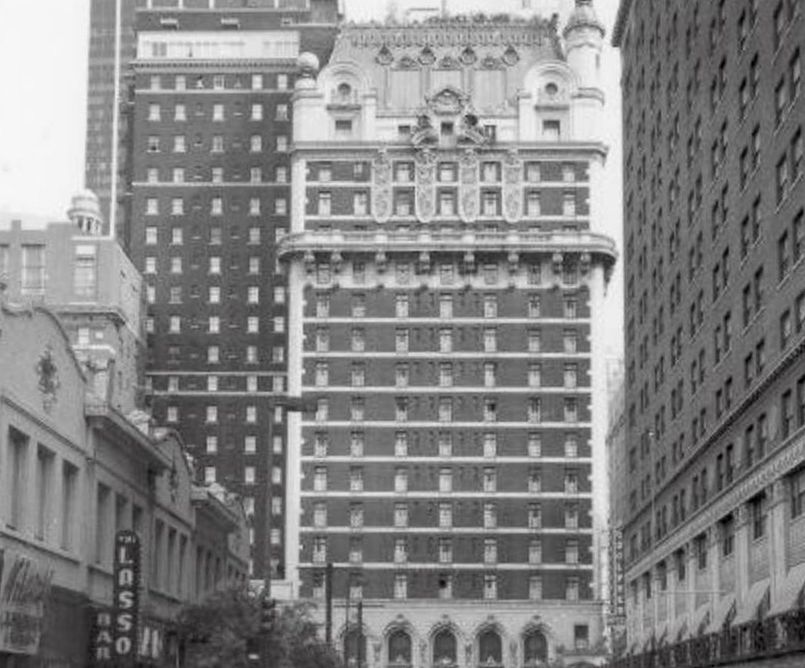
The Lasso Bar at 215 S. Akard was in the next block, across from the classy Baker Hotel, and a hop, skip, and a jump from the elegant Adolphus. Its proximity to the impressive Adolphus meant that the Lasso snuck its way into lots of souvenir picture postcards and Dallas Chamber of Commerce publicity photos. Its sign was pretty cool, too.

lasso-bar_postcard

adolphus_lasso-bar_tx-hist-comm

lasso-bar_dmn_031358
March, 1958

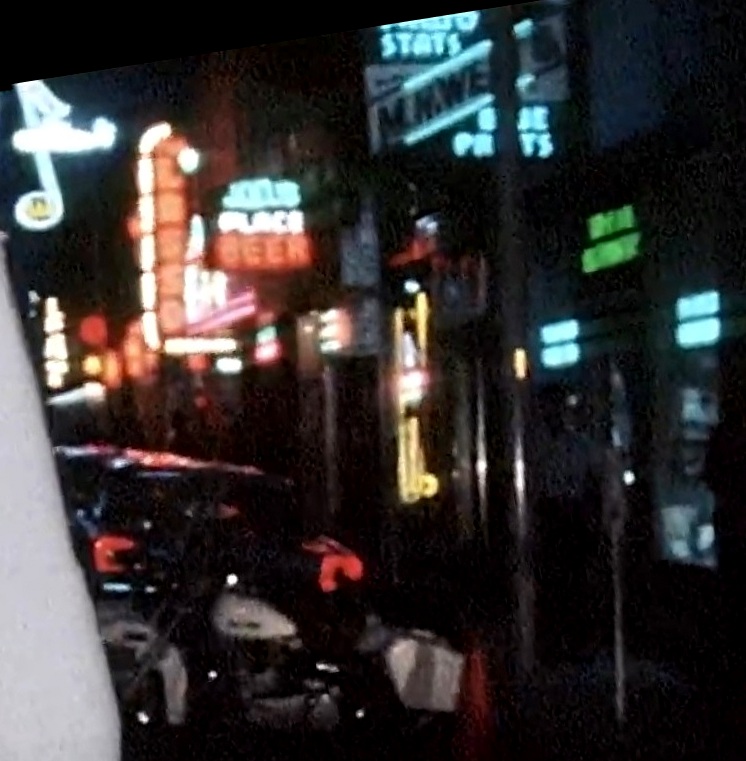
The image below gives you an idea of what that block looked like at night, neon blazing. (This super-blurry screenshot is from WFAA-Channel 8 coverage of 1969’s Texas-OU weekend, here — at 6:16 and 9:13.)

lasso-bar_jones-film_WFAA_101169

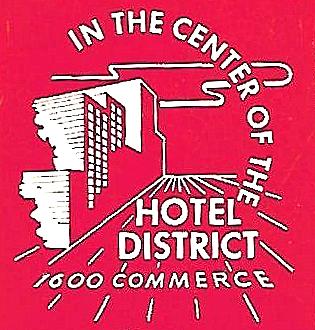
The Zoo Bar at 1600 Commerce began as a cocktail lounge and often had live piano music. It was across from Neiman’s and it was 3 blocks from Jack Ruby’s Carousel Club (downtown Dallas ain’t what it used to be). It also had a better-than-average sign.

zoo-bar_youtube_19661966

zoo-bar_dth-photo_112263_sixth-floor-museum_portal_croppedNov., 1963

zoo-bar_dmn_092752
Sept., 1952

zoo-bar_matchbook_ebay_2     zoo-bar_matchbook_ebay_1

These three downtown bars, popular as hangouts for gay men, had their heyday in the 1960s and ’70s. By the mid 1970s, the LGBT scene was shifting to Oak Lawn. An interesting article about the uneasy relationship between the “old” Oak Lawn and the “new” Oak Lawn can be found in a Dallas Morning News article by Steve Blow titled “Last Oak Lawn Settlers Brought Controversy” (Dec. 9, 1979).

***

Sources & Notes

Top photo of Gene’s Music Bar is from the blog Old Dallas Stuff.

Color photo of the Lasso and the Adolphus is from an old postcard. Black-and-white photo of the Lasso and the Adolphus is from the Texas Historical Commission site, here.

Blurry shot of Gene’s Music Bar and the Lasso Bar at night is a cropped screenshot from daily footage shot by WFAA-Channel 8 on Oct. 11, 1969 — the night before the Texas-OU game; from the WFAA Newsfilm Collection, G. William Jones Film and Video Archive, Hamon Arts Library, SMU.

Color image of the Zoo Bar and Commerce Street is a screenshot from home movie footage of the 1966 Memorial Day parade in downtown Dallas, shot by Lawrence W. Haas, viewable on YouTube. Black-and-white photo of the Zoo Bar from the Sixth Floor Museum Collection, via the  Portal to Texas History, here (I’ve cropped it). Zoo Bar matchbook from eBay.

Read more about Dallas’ gay bar scene in the article I wrote for Central Track, “Hidden in Plain Sight, A Photo History of Dallas’ Gay Bars of the 1970s,” here.

More on the the persistent arrests and police harassment that went on in gay clubs in Dallas for many, many years can be found in the Dallas Voice article by David Webb, “DPD Vice Unit Wages 50-Year War Against Gay Men” (Aug. 3, 2007), here.

*

Copyright © 2016 Paula Bosse. All Rights Reserved.
 

Views of Elm Street, With Cameo Appearances by the Fox Theater — 1920s-1960s

fox-theater_sherrod_dpl
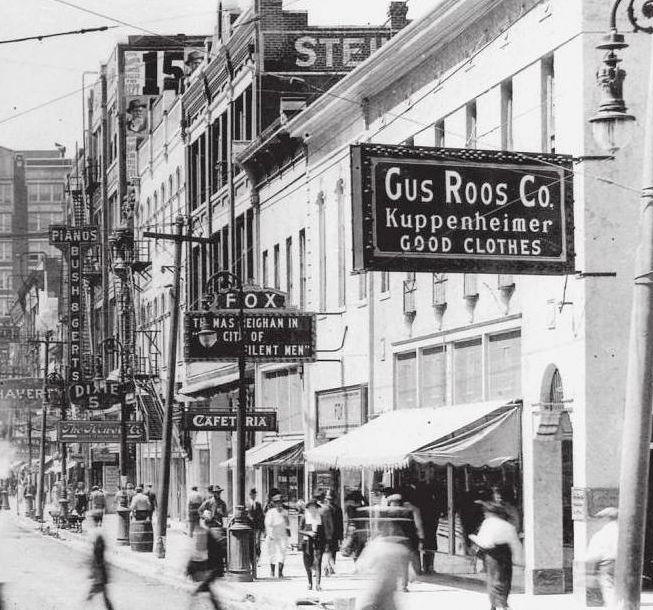
Elm looking west from Akard, ca. 1922

by Paula Bosse

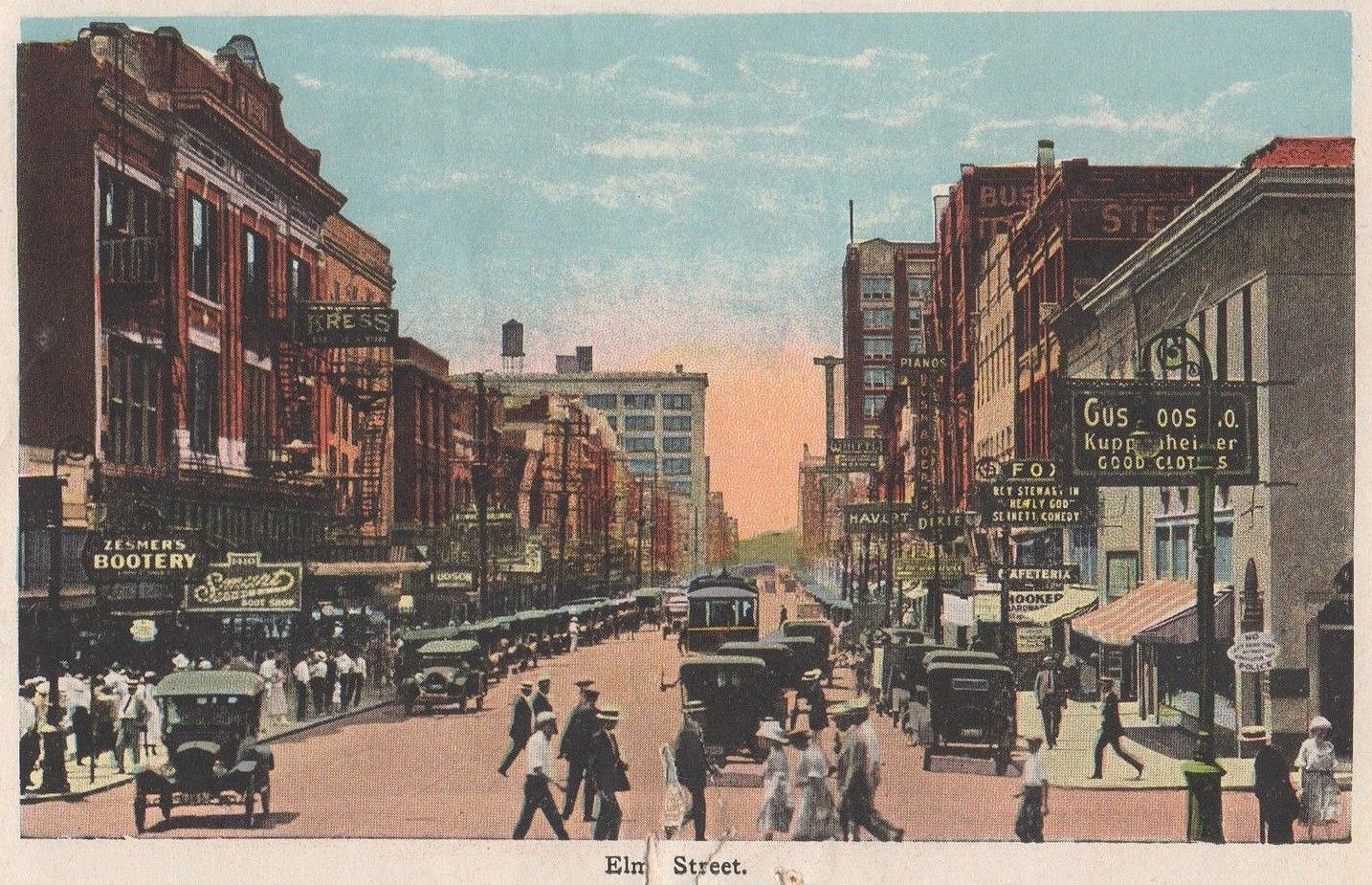
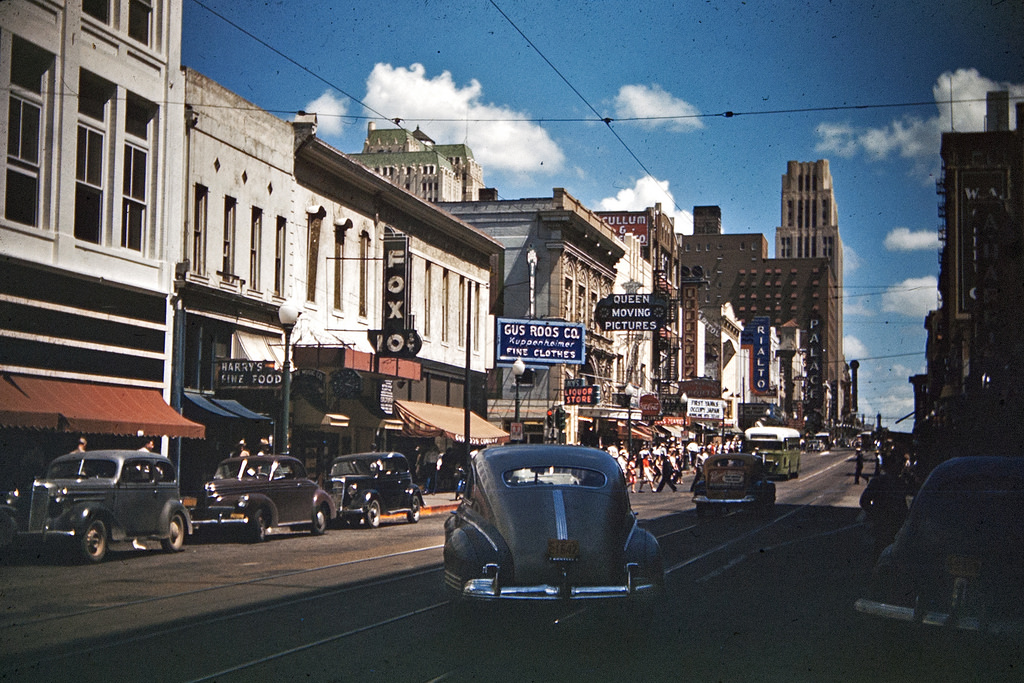
From the earliest days of moving pictures, most downtown movie houses called Elm Street home. Some were originally vaudeville houses which occasionally featured short films between acts of the live revues, and some were theaters built expressly as move theaters. Most of the downtown theaters could be found on Elm Street, and the stretch between, say, Field and Harwood became known as “film row” or “theater row.” Most theaters were located on the north side of Elm in the blocks east of Akard Street, but a few found a home west of Akard. One of these — which I’ve seen in several of the photos I’ve posted — was the Fox Theater, located next to the Gus Roos store, at 1411 Elm, just west of the Akard intersection.

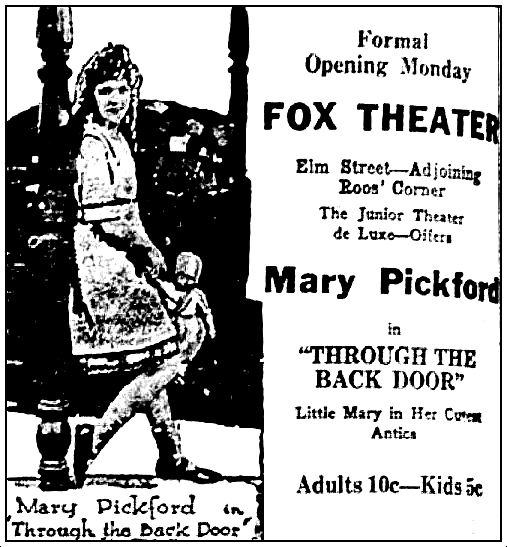
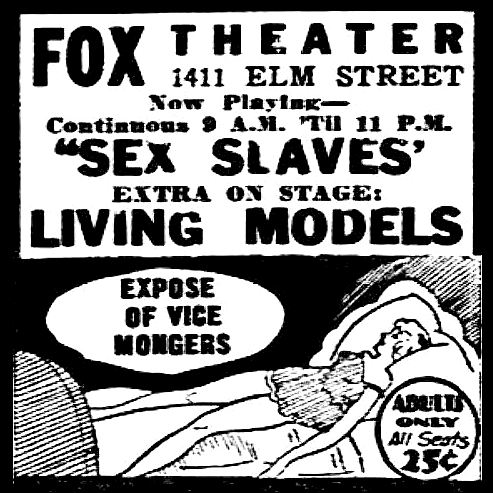
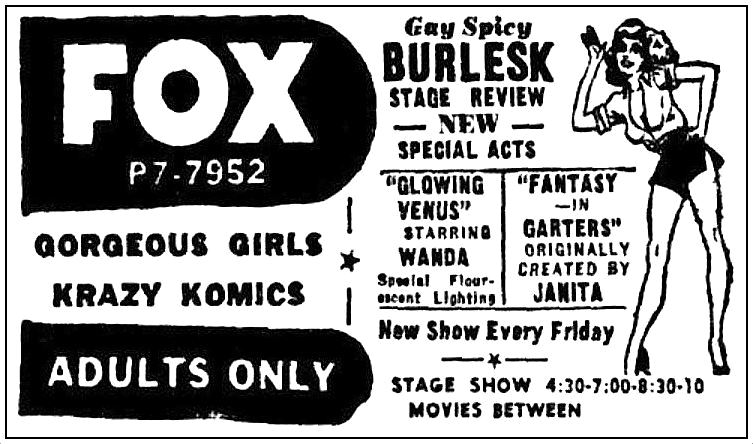
The Fox — which was named after owner Max Fox, a Polish immigrant who also owned the nearby Strand Theater — opened in the early months of 1922. During its 40-year history, it had something of a “colorful” life: despite opening with a sweet, family-friendly Mary Pickford movie and then showing mostly second-run features, it ultimately became one of Elm Street’s seedier theaters, showing cheap exploitation flicks and, later, becoming a “burlesk” house with on-stage strippers and “adult-only” fare playing continuously from 9 AM (!) to 11 PM. The Fox remained in business until the end of 1961 when property in the 1400 block began to be sold in order to build the First National Bank Building. (A comprehensive history of the theater can be found on Cinema Treasures.)

*

As I said, I’ve noticed the Fox Theater in a number of photos I’ve come across — some of which I’ve posted previously. Here are a few views of Elm Street in which the Fox pops up in a cameo appearance.

The top photo shows Elm looking west in about 1922. Down the street a bit you can see the Dixie Theater at 1315 Elm, one of the (if not THE) oldest permanent movie theater spaces in Dallas. The Dixie began life in 1909, the third theater in the location originally occupied by the Theatorium, which opened in 1906. (I wrote about the Dixie and other early “photoplay houses” in Dallas here.)

A similar view from about the same year is seen in this postcard (click to see a very large image):

elm-st-color_1920s

From the WWII-era, this fantastic color photo, looking east (the Queen, Telenews, Capitol, Rialto, and Palace theaters can be seen in this photo, with the silhouette of the Majestic Theatre’s sign seen way in the distance):

elm-street-color_1940s_jeppson-flickr

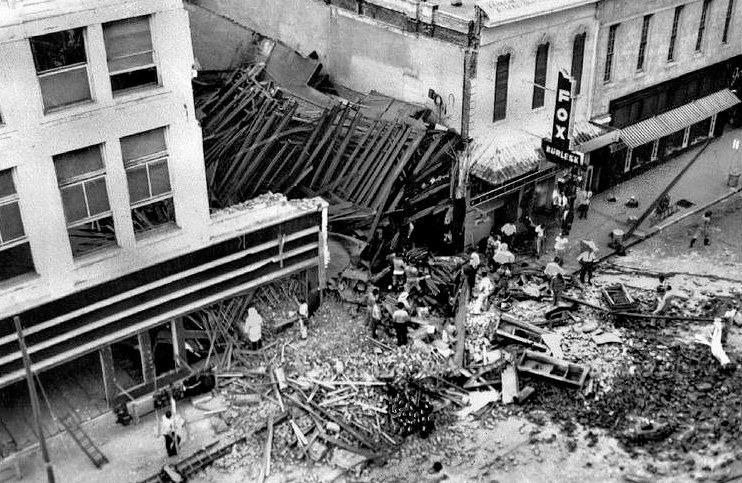
In 1955, the wall of the building next door to the theater collapsed, killing several people (I wrote about that building collapse, here):

building-collapse_observer-090511

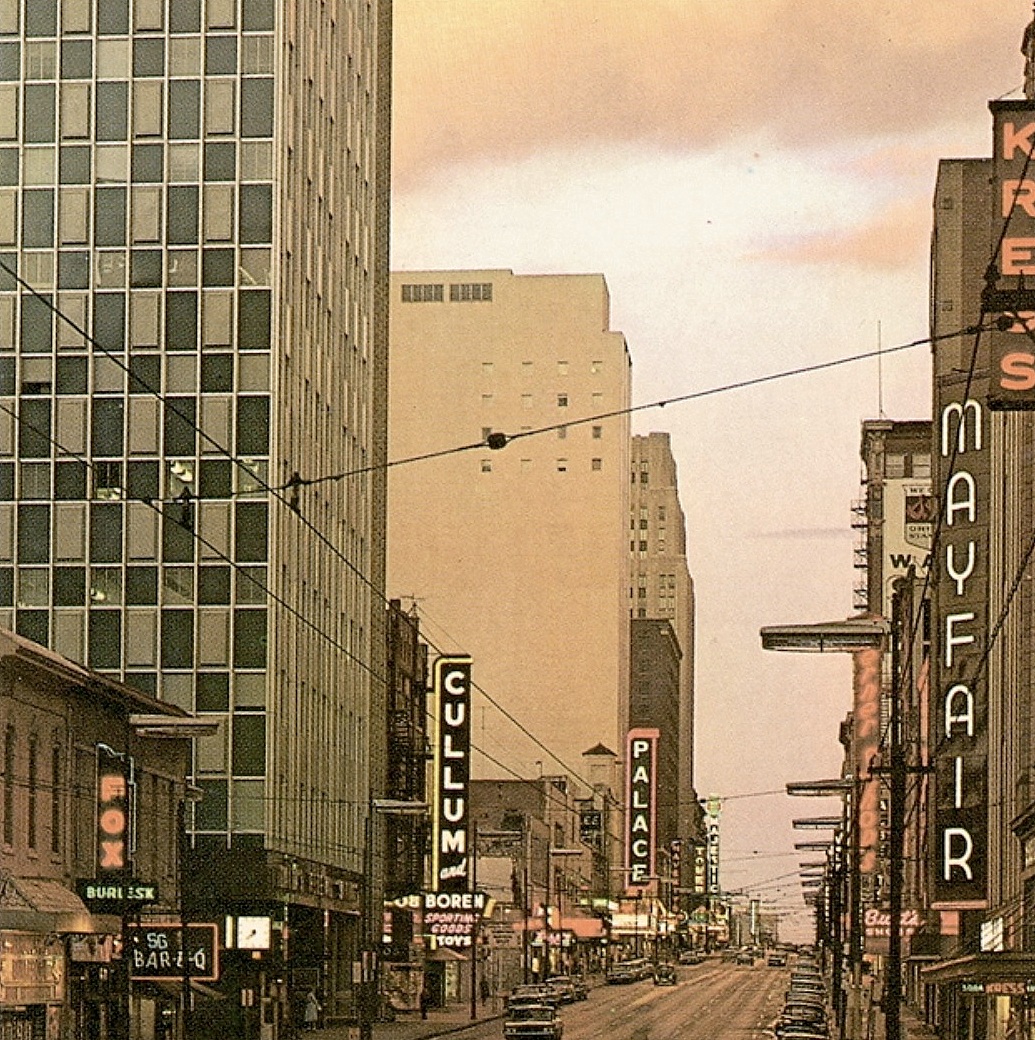
And, lastly, a photo of a decidedly less glamorous Elm Street, showing the “Fox Burlesk” in its final months, taken about 1961:

1400-block-elm_schaffershot54_flickr_ca-1961

**

fox-theater_032022
Dallas Morning News, March 20, 1922

fox-theater_pickford_dmn_031922
March 19, 1922

fox-theater_dmn_031940
1940

fox-burlesk_dmn_061850
1950

***

Sources & Notes

Top photo from Troy Sherrod’s book Historic Dallas Theatres; photo from the Dallas Public Library.

1940s color photo from Noah Jeppson’s Unvisited Dallas post, “Elm Street 1945,” here.

UPI photo showing the building collapse was posted a few years ago by Robert Wilonsky on the Dallas Observer’s Unfair Park blog, here.

Bottom color photo from Flickr user Schaffershot54, here.

Other Flashback Dallas posts on Dallas theaters can be found here.

*

Copyright © 2016 Paula Bosse. All Rights Reserved.

Bowling In the Sky — 1964

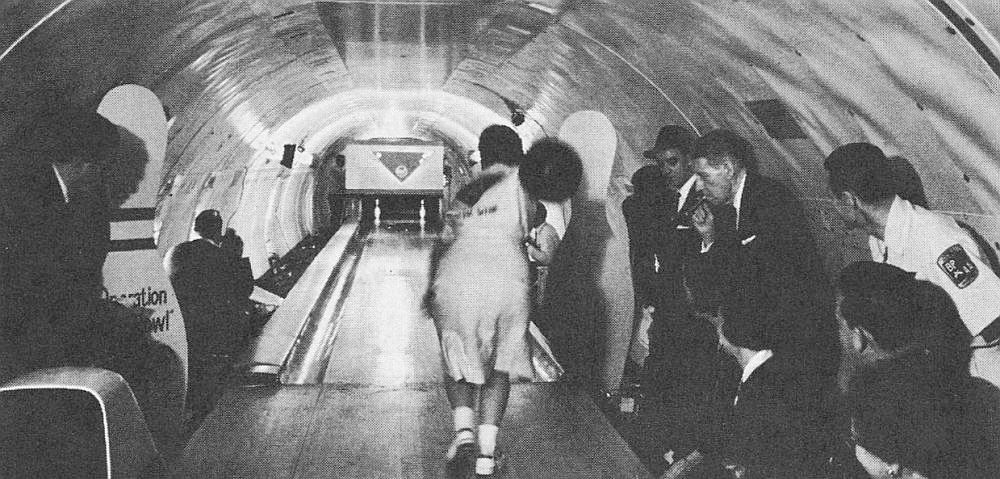
bowling_american-airlines_encylopedia-britannica-yrbk_jan-1964Sylvia Wene battles Dick Weber and turbulence…

by Paula Bosse

It’s a bowling alley. …In an airplane.

As publicity stunts go, this one was pretty good. It even had a cutesy name: Operation AstroBowl. American Airlines wanted to promote their great big Boeing 707 cargo planes, so someone came up with the idea of putting a bowling alley in one of them. Happily, a company that manufactured bowling alley equipment — American Machine and Foundry (AMF) — was keen to jump on the promotion bandwagon. They installed the regulation 79-foot lane — complete with automatic pin-setting equipment and gutters — in one of the American Airlines jet freighters. It took 4 days. Looking at the photos, it resembled a very large MRI tube.

Since they had the lane and the equipment in there, they pretty much had to get a couple of champion players on board to bowl a few mid-air frames. As luck would have it, the National All-Star Tournament (aka “The World Series of Bowling”) was — hey! — to be held in Dallas at Fair Park Coliseum a week after the stunt. Serendipity! Champions Dick Weber and Sylvia Wene were roped in to play a 5-mile-high game in the sky.

So much to promote!

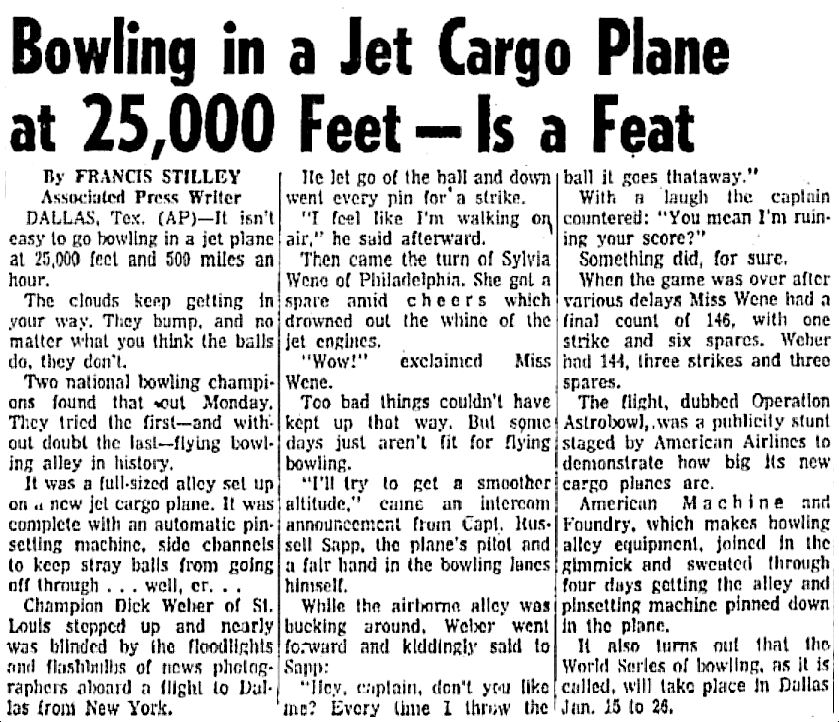
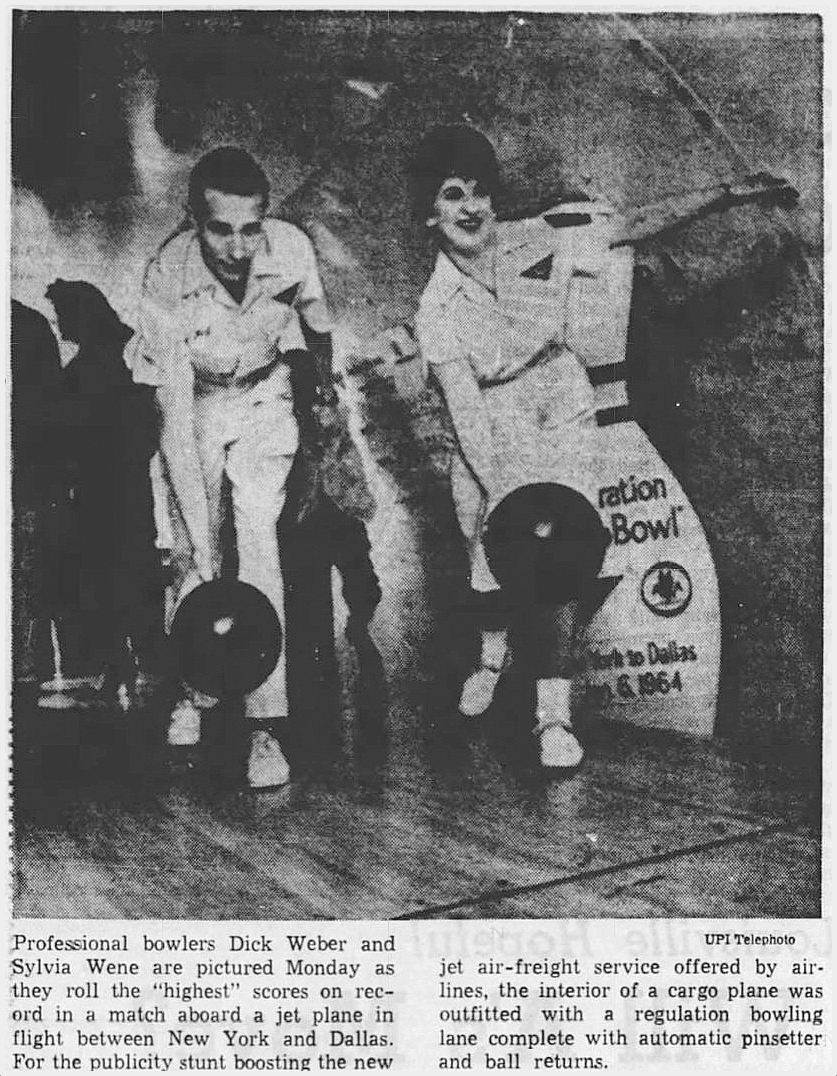
Operation AstroBowl took place on January 6, 1964 at cruising altitude between New York’s Kennedy International Airport and Love Field. Sylvia won. Barely. But this story made it into countless newspapers across the country the following day, so, really, it was the publicists who won. Drinks, I’m sure, were on them.

bowling_american-airlines_AP-story_010764-photo_dick-weberDick Weber bowling at 500 miles an hour


bowling_american-airlines_AP-story_010764
AP story which appeared all over the country, Jan. 7, 1964

bowling_american-airlines_weber_wene_ap-wire_010764

***

Sources & Notes

Top photo appeared in the Encyclopedia Britannica Yearbook and was brought to my attention by Steve Dirkx (thanks, Steve!).

Story and photos by the Associated Press.

If you’re on Facebook, a tiny bit of film footage can we watched here.

Hold the presses! I’ve been translated! Check out this bowling post in Portuguese (!), on a Brazilian bowling site, here.

*

Copyright © 2016 Paula Bosse. All Rights Reserved.
Belmont & Greenville: From Caruth Farmland to Hub of Lower Greenville

hockaday_aerial_squire-haskins_022750_UTA
Hockaday campus, 1950 (UTA Libraries)

by Paula Bosse

If you’ve driven down lower Greenville Avenue lately, you’re probably aware that the buildings that most recently housed a retirement home at the northwest corner of Belmont and Greenville were scheduled to be been torn down. When I drove past that intersection a few weeks ago and saw the entire block leveled, I was shocked. It’s weird suddenly not seeing buildings you’ve seen your entire life. It got me to wondering what had been on that block before. I’d heard that Hockaday had occupied that block for several years, but even though I’d grown up not too far away, I’d only learned of that within the past few years. When I looked into this block’s history, the most surprising thing about it is that it has passed through so few owners’ hands over the past 140 or so years.

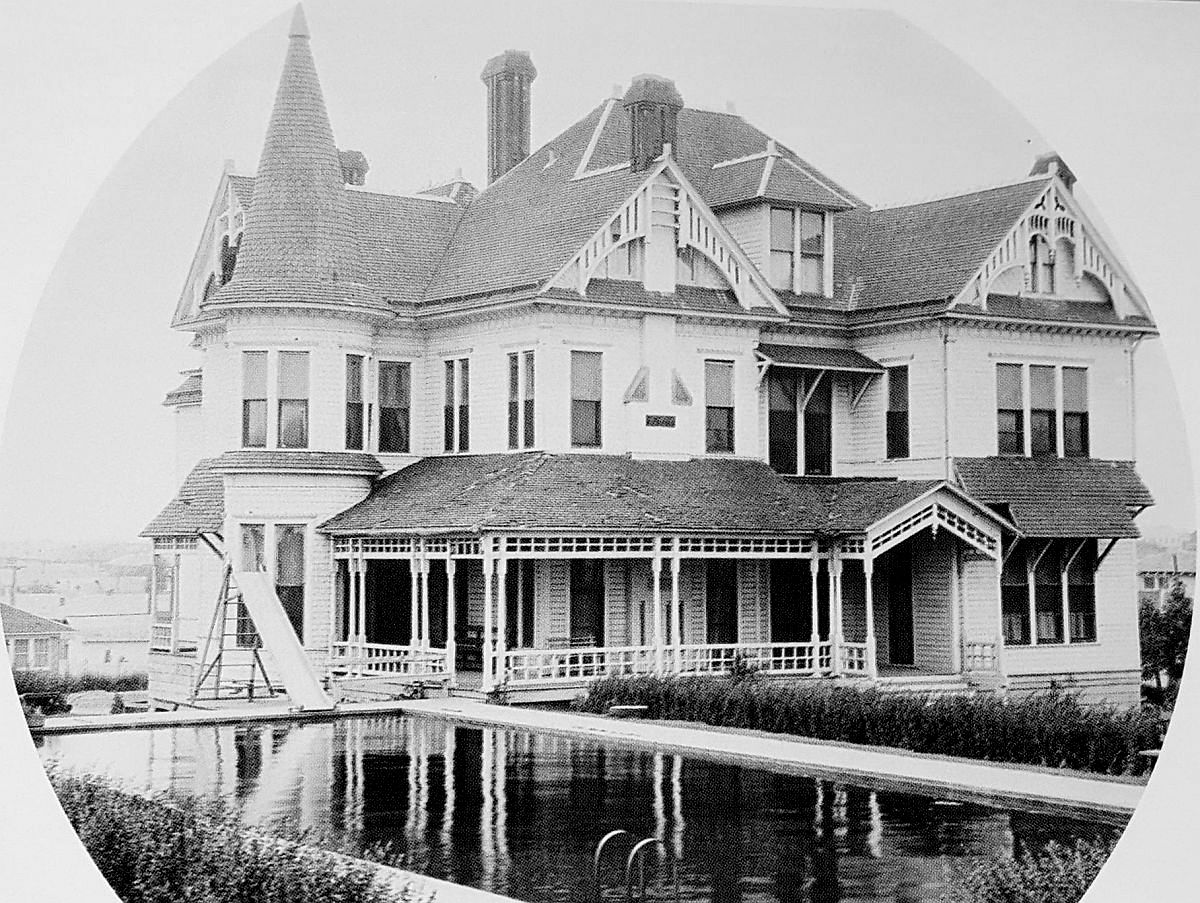
As far as I can tell, the first owner or this land was Walter Caruth (1826-1897), a pioneer merchant and farmer who arrived in this area in the 1840s (some sources say the 1850s), along with his brother, William. Over the years the brothers amassed an absolutely staggering amount of land — thousands and thousands of acres which stretched from about Inwood Road to White Rock Lake, and Ross Avenue up to Forest Lane. One of Walter Caruth’s tracts of land consisted of about 900 acres along the eastern edge of the city — this parcel of land included the 8 or 9 acres which is now the block bounded by Greenville, Belmont, Summit, and Richard, and it was where he built his country home (he also had a residence downtown). The magnificent Caruth house was called Bosque Bonita. Here is a picture of it, several years after the Caruths had moved out (the swimming pool was added later).

caruth_bosque-bonita_dallas-rediscovered

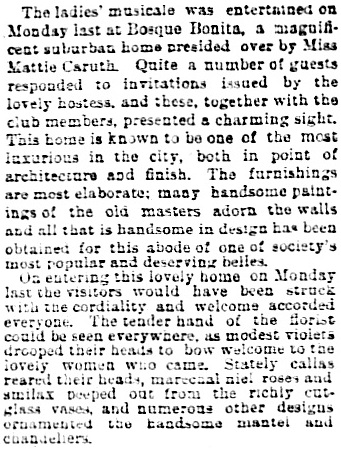
Most sources estimate that the house was built around 1885 (although a 1939 newspaper article stated that one of Walter’s children was born in this house in 1876…), but it wasn’t until 1890 that it began to be mentioned in the society pages, most often as the site of lavish parties. (Click pictures and  articles to see larger images.)

bosque-bonita_dmn_020390Dallas  Morning News, Feb. 3, 1890

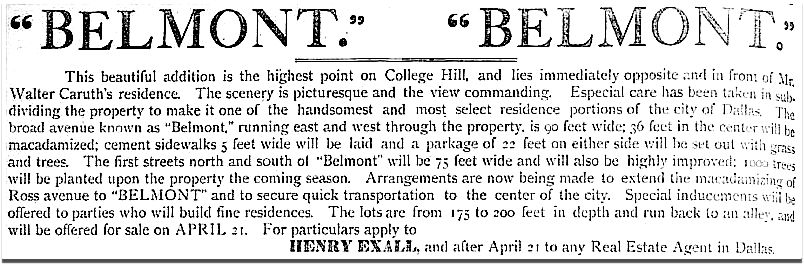
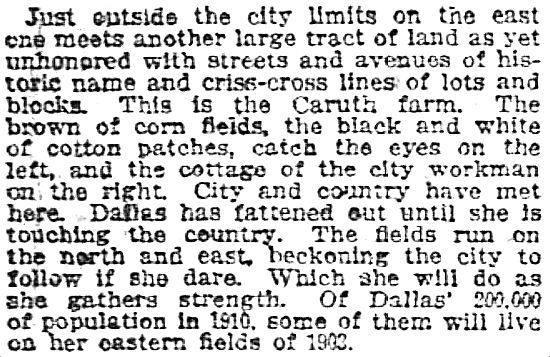
At the time, the Caruth house was one of the few buildings in this area — and it was surrounded by endless acres of corn and cotton crops. It wasn’t long, though, before Dallas development was on the march eastward and northward. This ad, for the new Belmont Addition, appeared in April of 1890, and it mentioned the Caruth place as a distinguished neighboring landmark.

belmont-addition_dmn_041690
DMN, April 16, 1890

By the turn of the century — after Caruth’s death in 1897 — it was inevitable that this part of town (which was not yet fully incorporated into the City of Dallas) would soon be dotted with homes and businesses.

caruth-farm_dmn_092703
DMN, Sept. 27, 1903

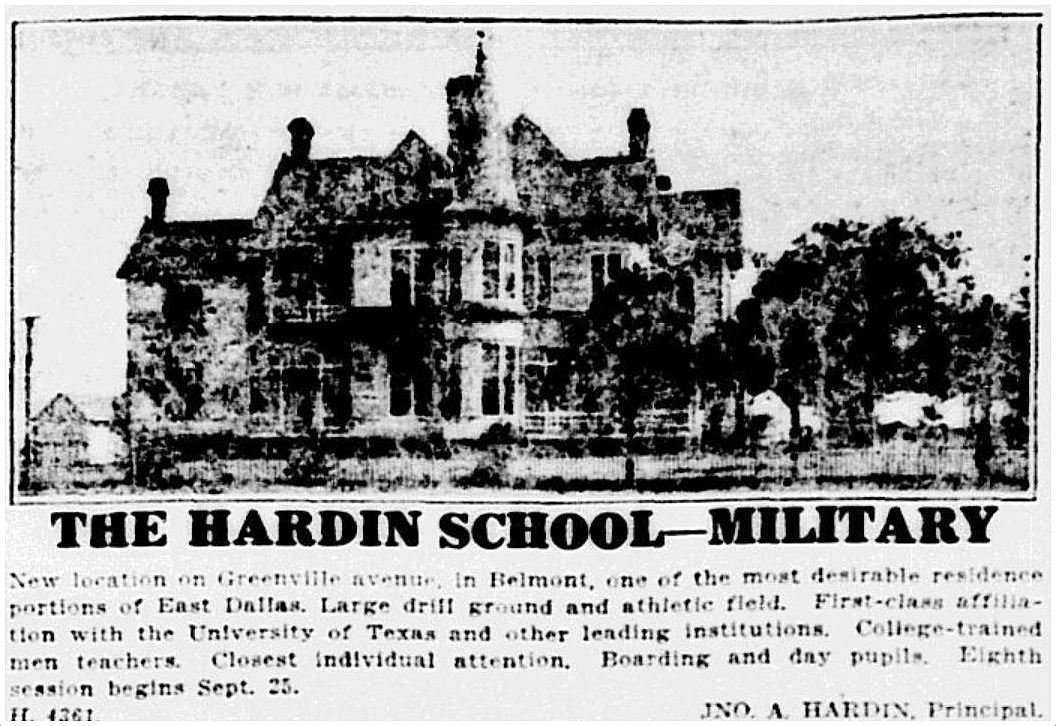
At one time the Caruth family owned land in and around Dallas which would be worth the equivalent of billions of dollars in today’s money. After Walter Caruth’s death, the Caruth family became embroiled in years of litigation, arguing over what land belonged to which part of the family. I‘m not sure when Walter Caruth’s land around his “farmhouse” began to be sold off, but by 1917, the Hardin School for Boys (established in 1910) moved into Bosque Bonita and set up shop. It operated at this location for two years. The Caruth house even appears in an ad.

hardin-school_dmn_071517_bosque-bonita_ad
DMN, July 15, 1917

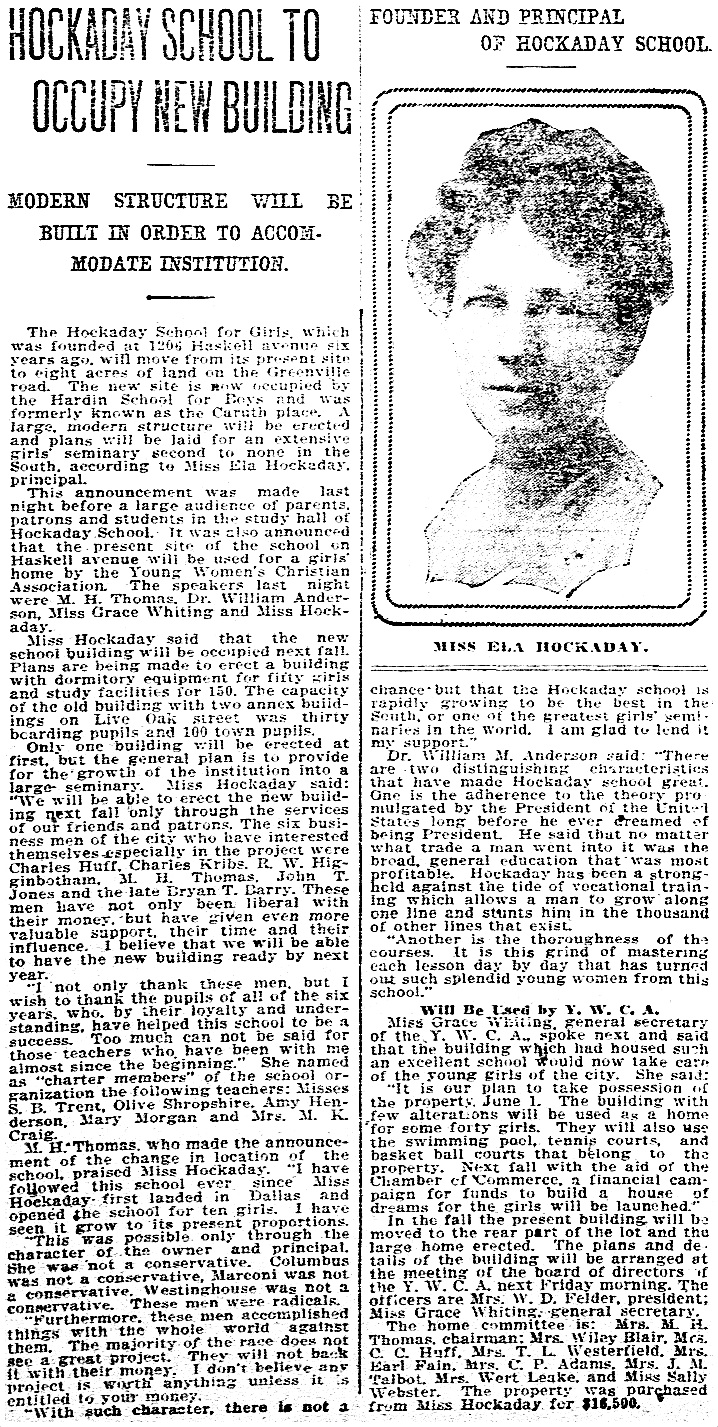
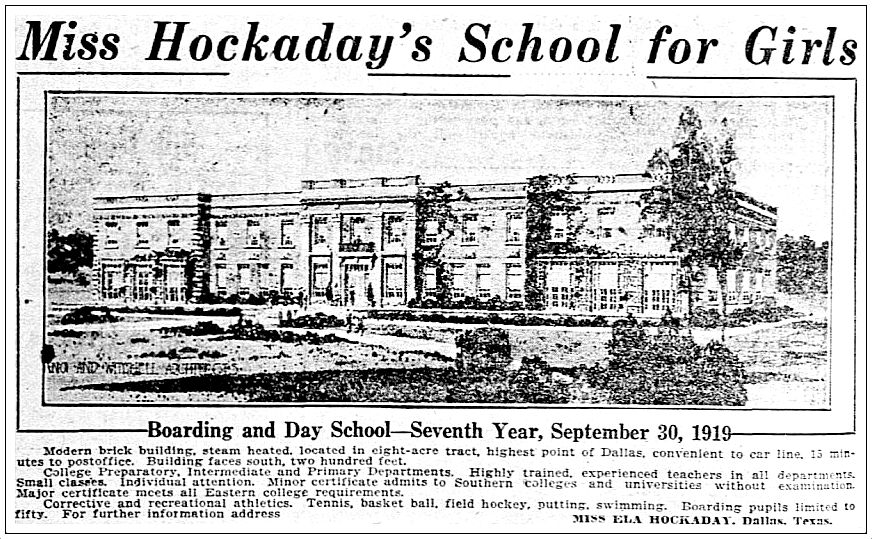
I’m not sure if the Hardin School owned the land or was merely leasing it and the house, but in 1919, Ela Hockaday announced that she had purchased the land and planned to move her school — Miss Hockaday’s School for Girls (est. 1913) — to this block and build on it a two-story brick school building, a swimming pool (seen in the photo above), tennis courts, basketball courts, hockey fields, and quarters for staff and girls from out of town who boarded.

hockaday_dmn_051119DMN, May 11, 1919

hockaday_dmn_070619
DMN, July 6, 1919

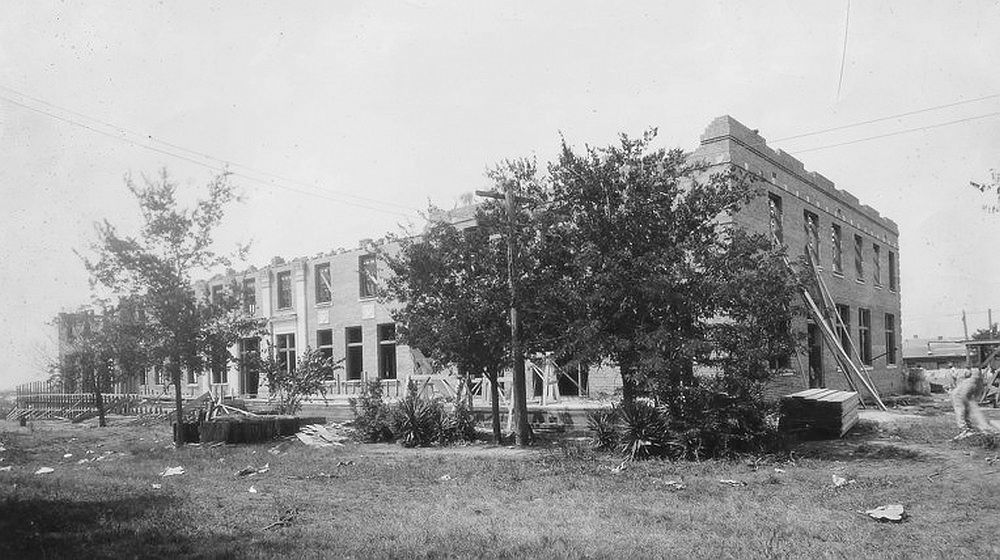
Ground was broken in July of 1919, and the first session at the new campus began on schedule in September. Below, the building under construction. Greenville Avenue is just out of frame to the right.

hockaday_greenville_construction_hockaday100Photo: Hockaday 100

hockaday_greenville-ave_1919_reminiscences

hockaday_greenville-belmont_1920s_horses

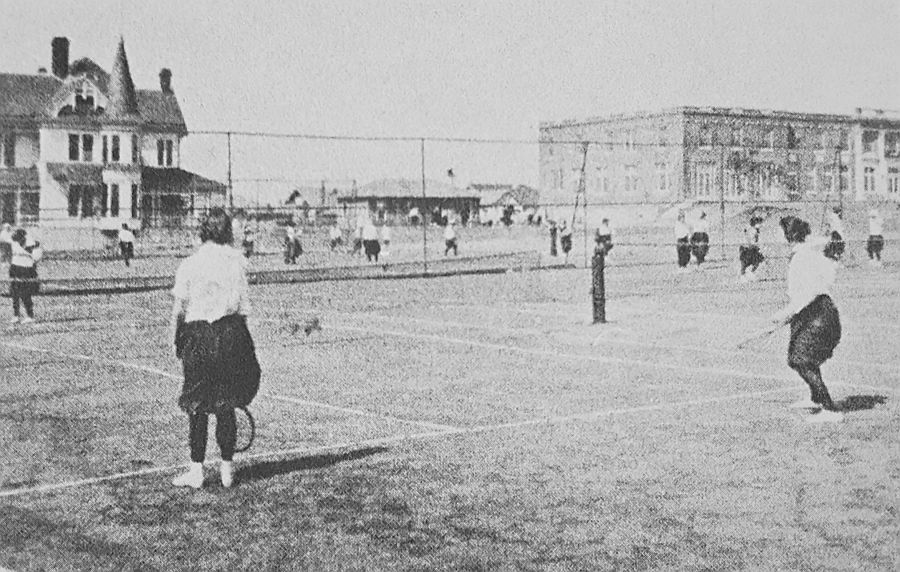
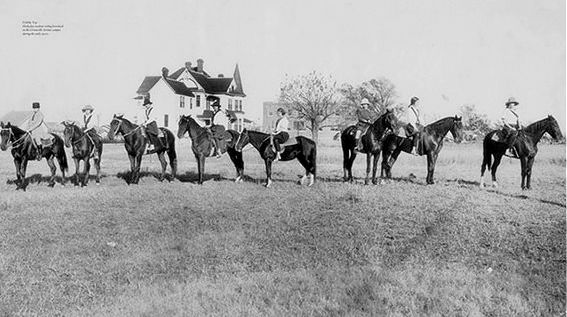
The most interesting thing I read about the Hockaday school occupying this block is that very soon after opening, the beautiful Caruth house was moved from its original location at the northwest corner of Belmont and Greenville. It was rolled on logs to the middle and back of the property. “Bosque Bonita” became “Trent House.” Former student (and later teacher) Genevieve Hudson remembered the moving of the house in an oral history contained in the book Reminiscences: A Glimpse of Old East Dallas:

caruth-house_hockaday_reminiscences-bk

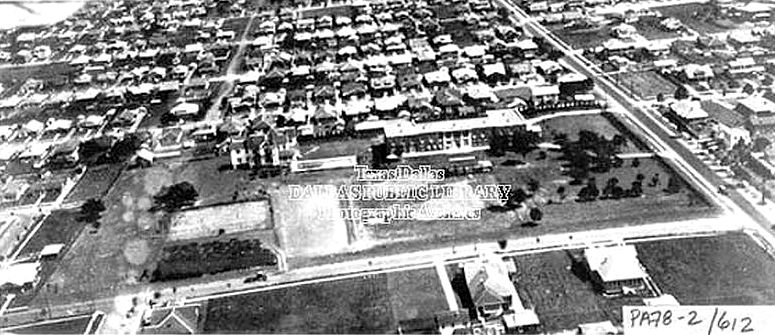
You can see the new location of the house in the top aerial photo, and in this one:

hockaday_aerial_dpl
Dallas Public Library

Another interesting little tidbit was mentioned in a 1947 Dallas Morning News article: Caruth’s old hitching post was still on the property — “on Greenville Avenue 100 feet north of the Belmont corner” (DMN, May 2, 1947). I’d love to have seen that.

After 42 years of sustained growth at the Greenville Avenue location (and five years after the passing of Miss Hockaday), the prestigious Hockaday School moved to its current location in North Dallas just after Thanksgiving, 1961. Suddenly, a large and very desirable tract of land between Vickery Place and the M Streets was available to be developed. Neighbors feared the worst: high-rise apartments.

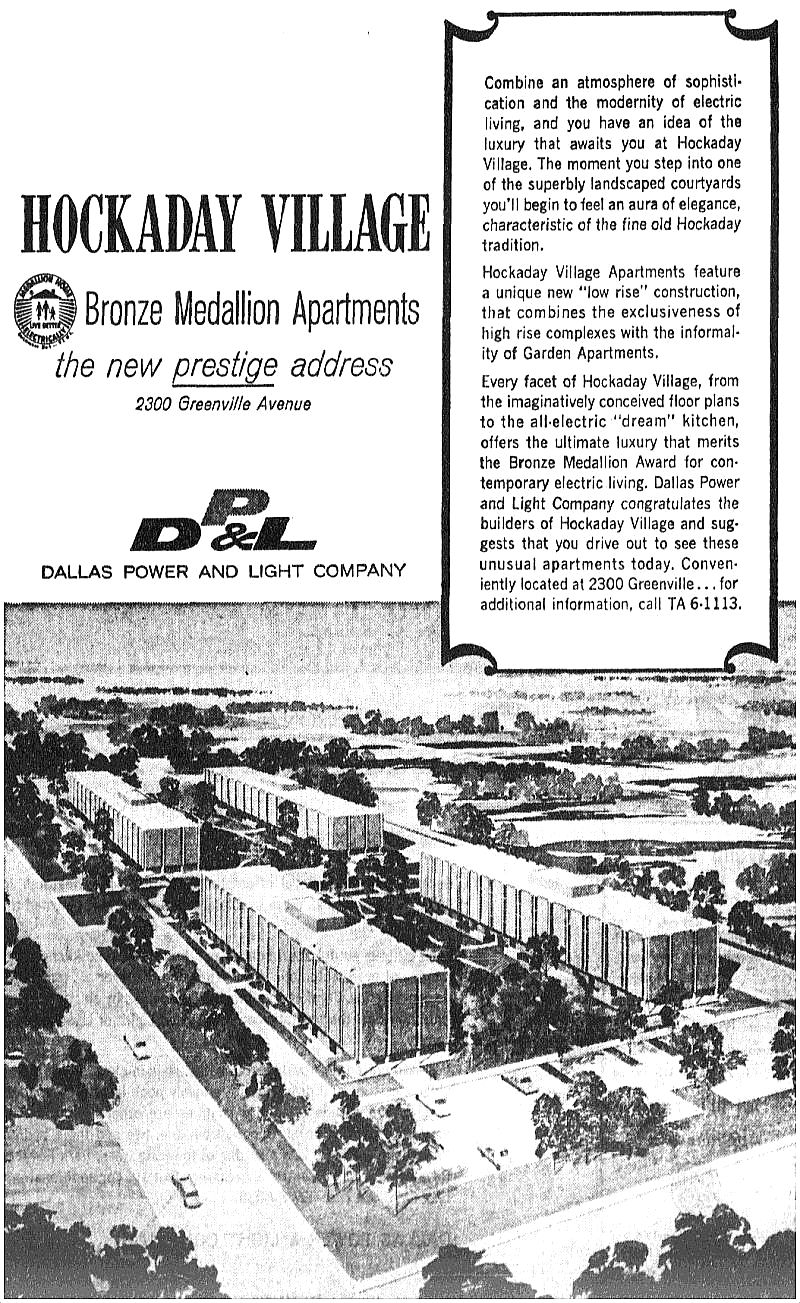
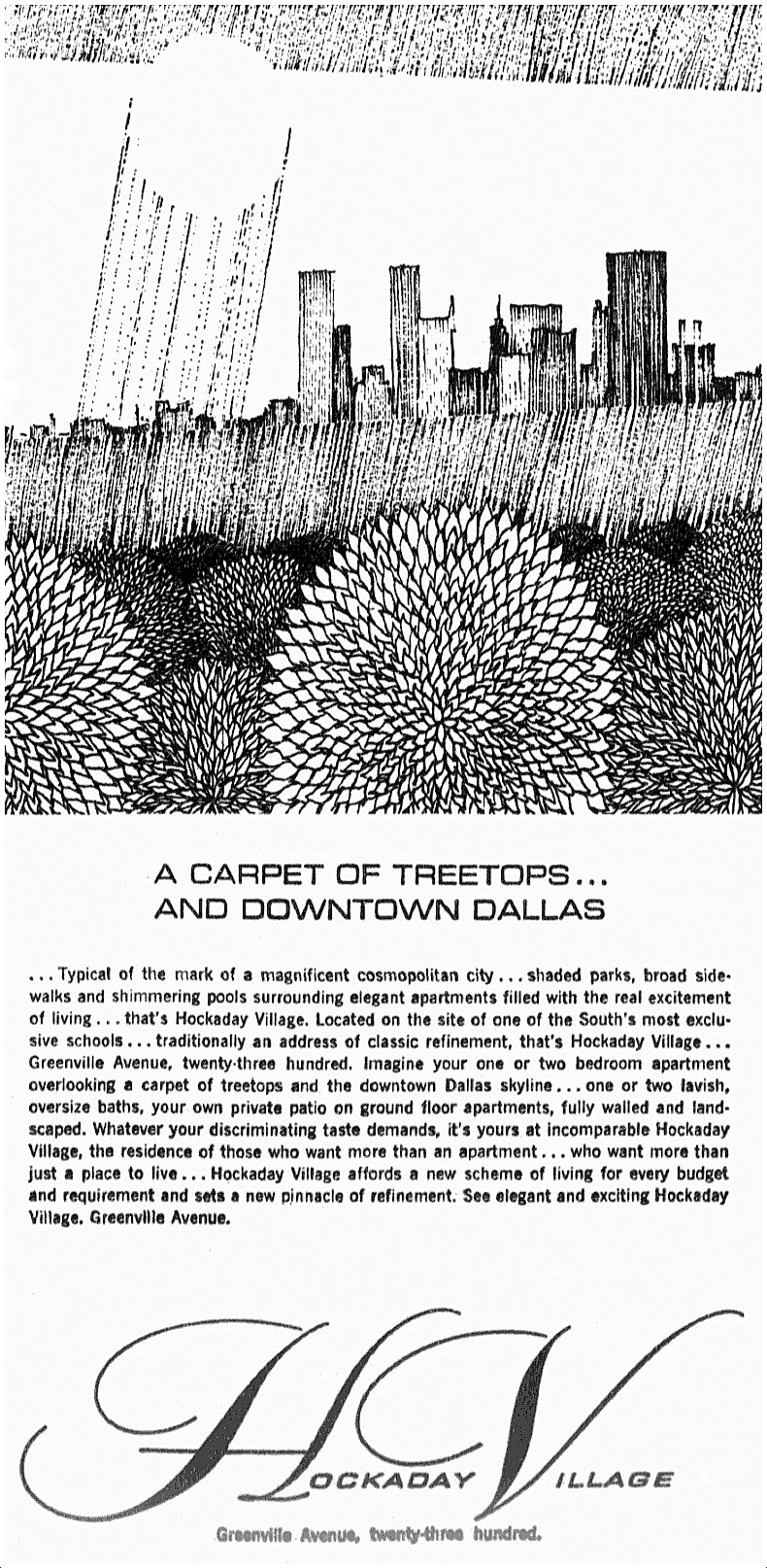
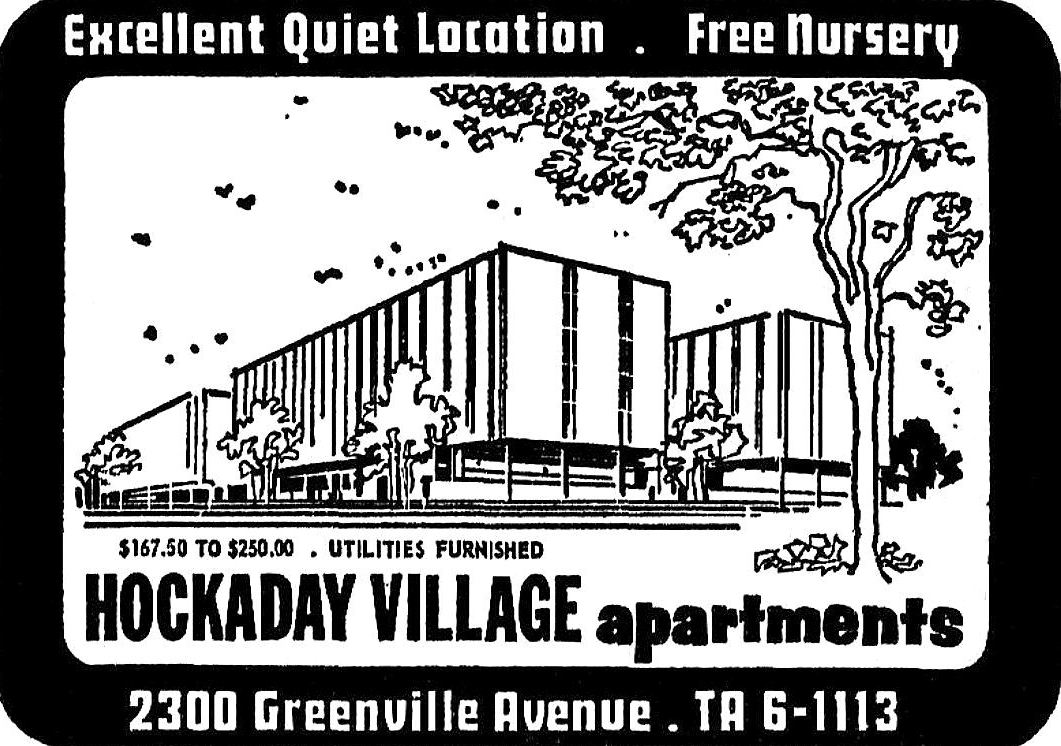
The developer proposed a “low-rise,” “semi-luxury” (?) group of four 5-story apartment buildings, each designed to accommodate specific tenants: one for swinging singles (“where the Patricia Stevens models live”), one for single or married adults, one for families with children, and one for “sedate and reserved adults.” It was to be called … “Hockaday Village.” The architect was A. Warren Morey, the man who went on to design the cool Holiday Inn on Central and, surprisingly, Texas Stadium.

Bosque Bonita — and all of the other school buildings — bit the dust in preparation for the apartment’s construction. Hockaday Village (…what would Miss Hockaday have thought of that name?) opened at the end of 1964.

hockaday-village_dmn_101864
Oct. 1964

hockaday-village_dmn_101864_carpet-of-treetops
Oct. 1964

hockaday-village_dmn_031365
March 1965

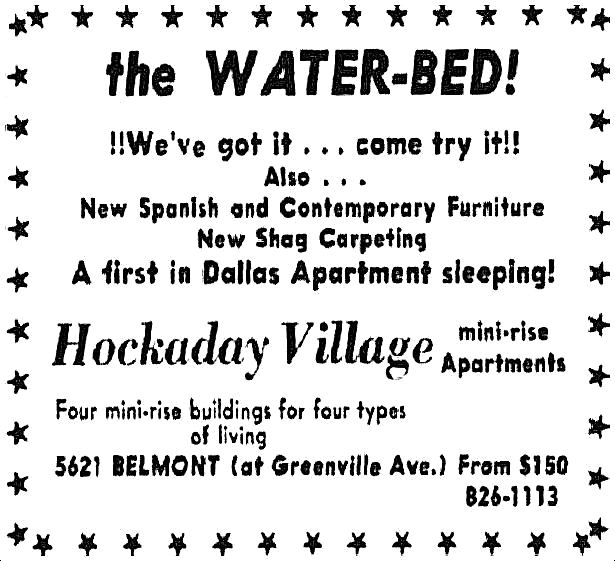
And then before you knew it, it was the ’70s, the era of waterbeds and shag carpeting. (Miss Hockaday would not have tolerated such tackiness, and I seriously doubt that Mr. Caruth would have ever understood why shag carpeting was something anyone would actually want.)

hockaday-village_dmn_052271_waterbeds
1971

Then, in 1973, the insistently hip ads stopped. In April, 1974 this appeared:

hockaday-village_FWST_042874
Fort Worth Star-Telegram, April 28, 1974

The apartments were being offered for public auction by the “Office of Property Disposition” of the Federal Housing Authority and HUD. Doesn’t sound good. So who bit and took the plunge? The First Baptist Church of Dallas, that’s who. The plan was to redevelop the existing apartments into a retirement community called The Criswell Towers, to be named after Dr. W. A. Criswell. But a mere three months later, the Baptists realized they had bitten off more than they could chew — the price to convert the property into a “home for the aged” would be “astronomical.” They let the building go and took a loss of $135,000. It went back on the auction block.

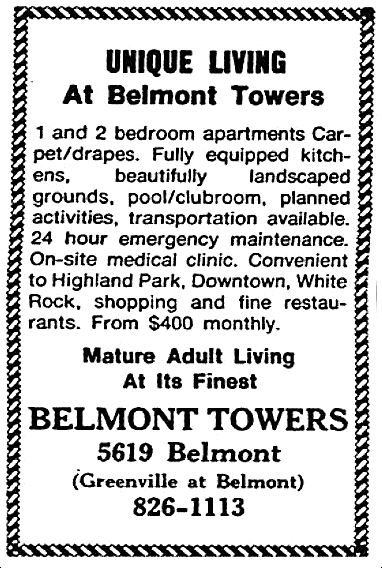
Two years later, in the summer of 1976 … the old Hockaday Village became Belmont Towers — and the new owners must have thought the Baptists’ idea was a good one, because Belmont Towers advertised itself as “mature adult living at its finest” — “perfect for retired or semi-retired individuals.”

hockaday-village_dmn_043083_belmont-towers
April 1983

It was Belmont Towers for 20-or-so years. In 1998, the buildings were renovated and updated, and it re-opened as Vickery Towers, still a retirement home and assisted living facility. A couple of years ago it was announced that the buildings would be demolished and a new development would be constructed in its place. It took forever for the 52-year-old complex to finally be put out of its misery since that announcement. Those buildings had been there my entire life and, like I said, it was a shock to see nothing at all in that block a few weeks ago.

vickery-towers_050516_danny-linn-photoPhoto: Danny Linn

In the 140-or-so years since Walter Caruth acquired this land in the 1870s or 1880s, it has been occupied by Caruth’s grand house, a boys school, the Hockaday School, and four buildings which have been apartments and a retirement community. And that’s it. That’s pretty unusual for development-crazy Dallas. I’ll miss those familiar old buildings. I hope that whatever is coming to replace them won’t be too bad.

greenville-belmont_bing_aerial
Bing Maps

***

Sources & Notes

The top aerial photograph is by Squire Haskins, taken on Feb. 27, 1950 — from the Squire Haskins Photography Inc. Collection, University of Texas at Arlington Libraries, Special Collections, accessible in a massive photo here (click the thumbnail). Greenville Avenue is the street running horizontally at the bottom. The Hockaday Junior College can be seen at the northwest corner of Belmont and Greenville — the original location of Bosque Bonita before it was rolled across the campus.

That fabulous photo of Bosque Bonita is from the book Dallas Rediscovered by William L. McDonald.

Photo of Hockaday girls playing tennis is from the book Reminiscences: A Glimpse of Old East Dallas.

Photo of girls on horseback … I’m not sure what the source of this photo is.

Photo of the block, post-razing is by Danny Linn who grew up in Vickery Place; used with permission. (Thanks, Danny!)

All other sources as noted.

In case you were confused, the Caruth Homeplace that most of us might know (which is just south of Northwest Highway and west of Central Expressway) was the home of Walter Caruth’s brother William — more on that Caruth house can be found here.

The Hockaday School can be seen on the 1922 Sanborn map here (that block is a trapezoid!).

More on the history of the Hockaday School can be found at the Hockaday 100 site; a page with many more photos is here. Read about the history of the school in the article “Miss Ela Builds a Home” by Patricia Conner Coggan in the Spring, 2002 issue of Legacies, here.

Additional information can be found in these Dallas Morning News articles:

  • “Proposal to Change Hockaday Site to Apartment Zoning Opposed” (DMN, Oct. 29, 1961)
  • “Retirement Home Plans Going Ahead” (regarding the purchase by the First Baptist Church of Dallas) (DMN, June 15, 1974)
  • “Church Takes $135,000 Loss on Property” (DMN, Sept. 10, 1974)

*

If you made it all the way through this, thank you! I owe you a W. C. Fields “hearty handclasp.”

*

Copyright © 2016 Paula Bosse. All Rights Reserved.
Dallas Skyline at Night — ca. 1965

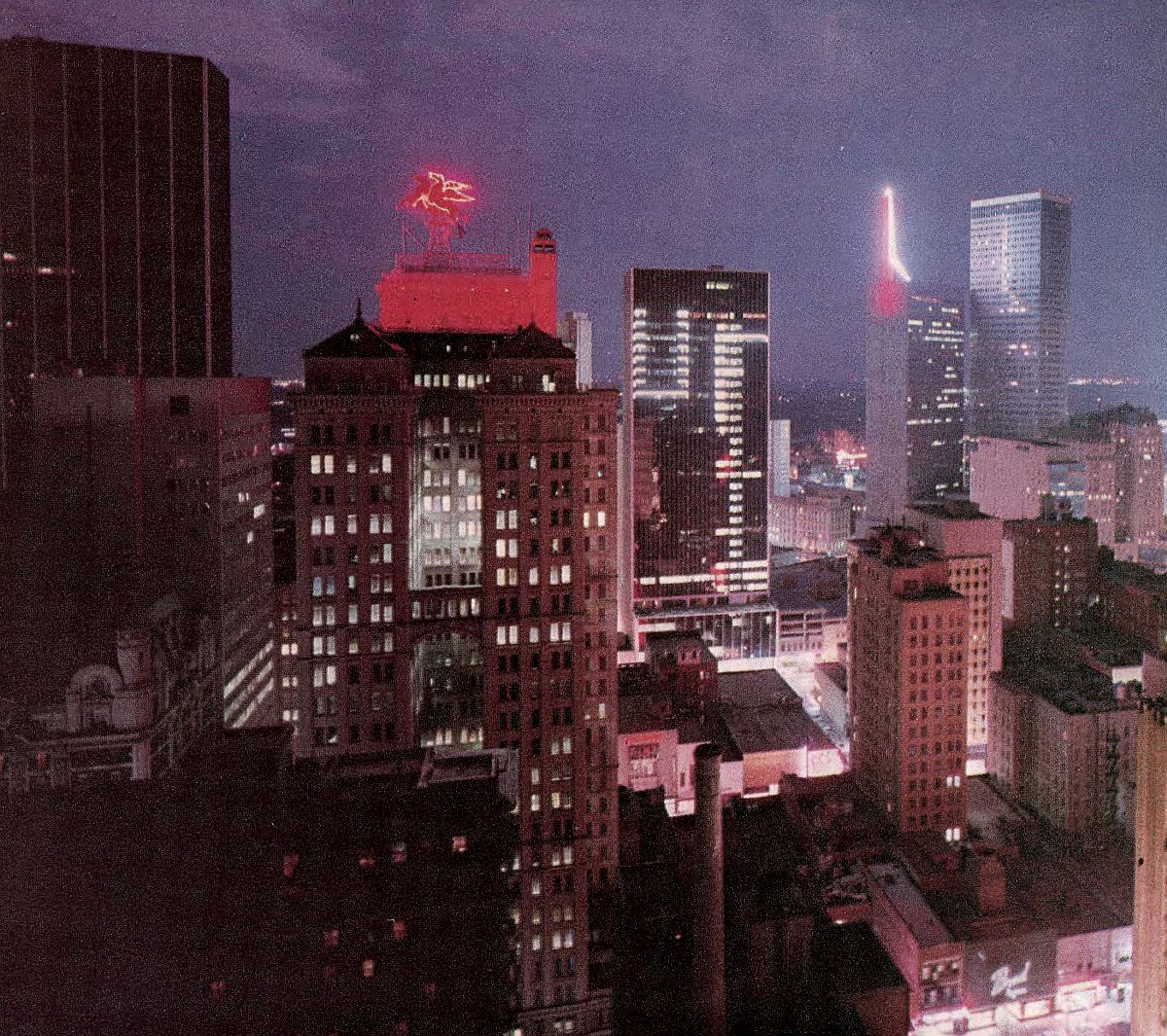
downtown_chamber-of-commerce_ca1965Goodnight, Pegasus…

by Paula Bosse

It might just be because this photo is so grainy, but it’s very dreamy-looking — a sort of soft-focus view of Dallas’ sophisticated nighttime skyline.

***

Sources & Notes

The photo is credited to the Dallas Chamber of Commerce. I’m pretty sure this came from a high school yearbook, but I’m afraid I neglected to note which one.

See another great photo from the same period in the Flashback Dallas post “Nighttime Skyline — 1965.”

*

Copyright © 2016 Paula Bosse. All Rights Reserved.
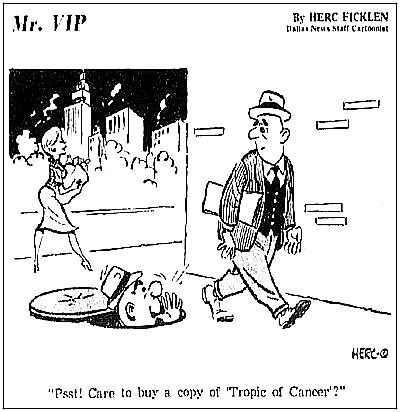
Cold Smut: Henry Miller’s “Tropic of Cancer” Banned in Dallas — 1961

cartoon_topic-of-cancer_dmn_083061_small

by Paula Bosse

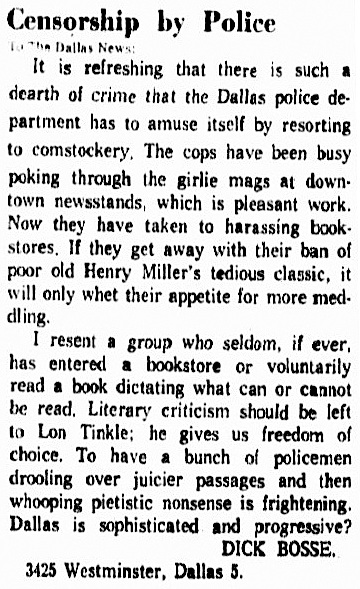
Today is my late father’s birthday. He was a Dallas bookseller, and when searching on his name in the Dallas Morning News archives, I found this pithy letter to the editor he had written in the summer of 1961 (click for larger image; transcribed below).

tropic-of-cancer_prb_dmn_082461
Aug. 24, 1961

*

It is refreshing that there is such a dearth of crime that the Dallas police department has to amuse itself by resorting to comstockery. The cops have been busy poking through the girlie mags at downtown newsstands, which is pleasant work. Now they have taken to harassing bookstores. If they get away with their ban of poor old Henry Miller’s tedious classic, it will only whet their appetite for more meddling.

I resent a group who seldom, if ever, has entered a bookstore or voluntarily read a book dictating what can or cannot be read. Literary criticism should be left to Lon Tinkle: he gives us freedom of choice. To have a bunch of policemen drooling over juicier passages and then whooping pietistic nonsense is frightening. Dallas is sophisticated and progressive?

Dick Bosse

*

After I looked up the word “Comstockery,” I was spurred to find out what he was writing about.

Henry Miller’s “tedious classic,” Tropic of Cancer, was originally published in Paris in 1934. It was considered too vulgar to be published in the United States. In fact, it was considered “obscene” by the U.S. Customs Department, and its very presence in one’s suitcase after returning home from a holiday in France was illegal. The only booksellers in the U.S. that sold the book did so at the risk of being jailed. That’s not to say there wasn’t a lot of piracy, bootlegging, and hush-hush selling of this much talked-about book going on, because there was — especially in New York.

In 1961, the book was finally published in the U.S. by Grove Press, and it was an immediate hit. (Grove priced it at an unbelievably steep $7.50, the equivalent today to about $60.00! The typical new hardcover fiction title in 1961 was around $3.95.) Unsurprisingly, the book was immediately banned in Boston, because Boston’s “thing” was banning stuff. But then … it was unexpectedly banned in Dallas, even though it was the #1 bestseller at the respected McMurray’s Bookshop downtown.

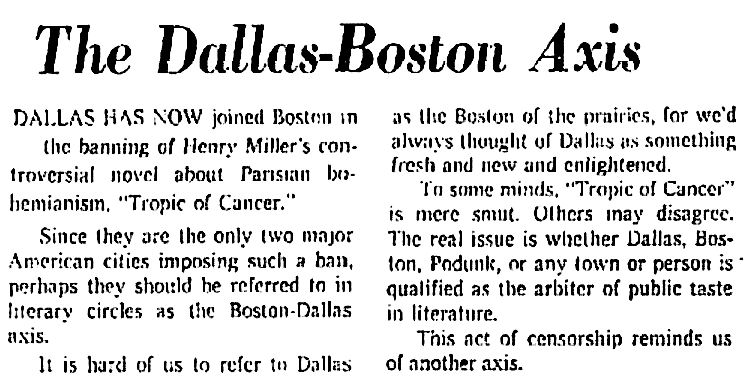
Dallas Police Department officials had decided the book violated a new Texas “anti-smut” law, and, on August 15th, policemen visited all the large bookstores in the city and informed them that if any copies of the book continued to be offered for sale, criminal charges would most likely be brought against the booksellers and the stores. (The state law called for fines up to $1,000 and one year in county jail for selling lewd and obscene material.) Dallas joined Boston as the only major American city banning the book. And then the whole thing became a cause célèbre — a “Dallas-Boston axis”!

tropic_long-beach-independent_081861The Long Beach (California) Independent, Aug. 18 1961

The move was roundly deplored by most of the Dallas public. The “Letters to the Editor” section of the historically very conservative Dallas Morning News contained many, many letters to the editor from outraged Dallasites, speaking out against the police department’s action. Sure, there were a few who were happy that objectionable material was being removed from Dallas bookstores, but they seemed to be in the minority. Even those who vehemently disliked the book were steadfastly opposed to its being banned, including the editors of The News.

As with many other non-issues like this that tend to cause near-obsession by the media, this story would not go away. The summer of ’61 was, for Dallas, the Summer of Smut. Best headline throughout all of this? One which appeared on a Morning News editorial: “COLD SMUT.”

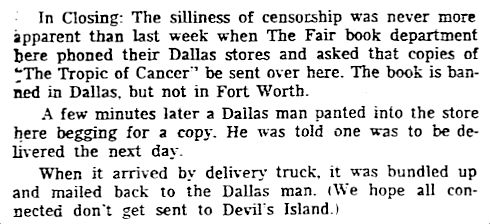
Booksellers pulled the book, but, as the editorial says above, there were almost certainly sales continuing to interested clientele. Also, it should be noted that only Dallas was banning the book at this point (by 1962 other cities around the country had become embroiled in threatened legal action, resulting in books being pulled from shelves). You couldn’t buy the book in Dallas, but you could buy it in Fort Worth.

tropic-of-cancer_elston-brooks_FWST_082261
Elston Brooks, Fort Worth Star-Telegram, Aug. 22, 1961

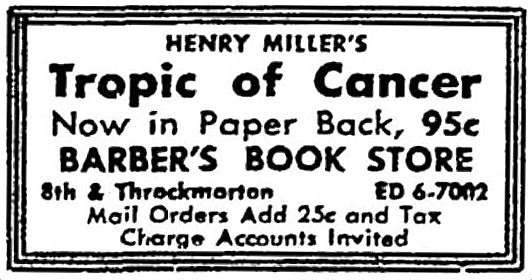
One assumes bookstores in Cowtown were cashing in on Tropic of Cancer sales — Barber’s Book Store must have been doing land-office mail order business.

tropic-of-cancer_FWST_110861_ad
FWST, Nov. 8, 1961

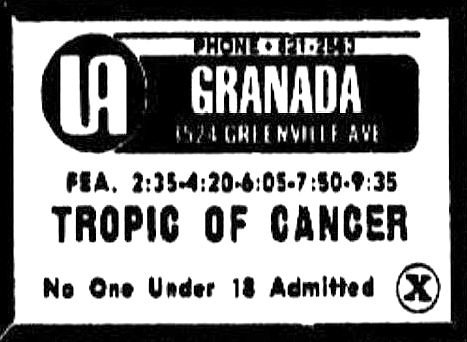
I thought this was a silly flare-up that lasted only a few weeks, but letters to the editor continued to show, at least through the winter of 1963, that it was still impossible to find the book in a Dallas bookstore. It probably wasn’t until 1964, when the United States Supreme Court ruled that the book was not obscene, that Dallas booksellers were finally free to openly sell a book which was published in 1934. No one seemed to care much when the X-rated film version (starring Texan Rip Torn) played at the Granada in 1970.

movie_dmn_090970
Sept., 1970

***

Sources & Notes

Cartoon by Herc Ficklen, from Aug. 30, 1961.

More on Tropic of Cancer at Wikipedia, here. This article contains my favorite line of any I read from the people who really, REALLY hated the book. It came from a Pennsylvania judge:

“[It is] not a book. It is a cesspool, an open sewer, a pit of putrefaction, a slimy gathering of all that is rotten in the debris of human depravity.”

Tons of articles on this appeared in The Dallas Morning News.in just ONE WEEK. Here are just a few (seriously, it’s the tip of the iceberg):

  • “Sales Banned: Police Label Book Obscene” by James Ewell (DMN, Aug. 16, 1961)
  • “Stores Stop Selling Book Called Obscene” by James Ewell (DMN, Aug. 17, 1961)
  • “Censorship of ‘Tropic’ Looses Opinion Barrage” by Scott Buchanan (Aug. 17, 1961)
  • “What Is Obscenity?” — editorial (DMN, Aug. 19, 1961)
  • “Book Fight Takes On Circus Air” (DMN, Aug. 19, 1961)
  • “Citizens Group Lauds Police Move On Book; Some Less Costly Smut Considered Main Problem” by Frank Hildebrand (Aug. 20, 1961)
  • “Cold Smut” — editorial (DMN, Aug. 20, 1961)
  • “Wade Orders Study On Smut Literature” by Carlos Conde (DMN, Aug. 21, 1961)
  • “Police Lectured On Book Action” by Jimmy Thornton (DMN, Aug. 22, 1961)
  • “Primer for Censors: A Few Basic Ideas”  by Lon Tinkle, Book Critic of The News (DMN, Sept. 3, 1961)

Every time I came across the word “smut” mentioned in connection with this topic — and it was mentioned a LOT — I couldn’t help but think of Vera Carp and the other Smut Snatchers of the New Order from Greater Tuna.

If it looks too dang small to read, click it!

*

Copyright © 2016 Paula Bosse. All Rights Reserved.
 

Dallas Police Moonlighting as “Bonnie and Clyde” Movie Extras — 1966

bonnie-and-clyde_movie_dallas-police-extras“Action!” (click for BIG image) Photo: Dallas Police Museum

by Paula Bosse

Need to hire a bunch of movie extras who look comfortable toting rifles? When Hollywood came to Dallas and environs in the fall of 1966 to shoot the movie “Bonnie and Clyde,” they found plenty of law enforcement officers happy to don a pair of overalls and add some local color to their production.

I came across this photo on the Dallas Police Department Museum Facebook page. One of the comments under the photo: “I remember when all the overtime slots were allowed (paid by the film company)…. I recognize Chief Curry and the other officers.” Another person commented that an ex-DPD cop told him that he was in the movie, dressed as a farmer, chasing a car across an open field.

Did you have an Uncle Earl who was on the DPD force in 1966? There’s a chance he might be in the movie. Hell, he might be in this photo!

***

Sources & Notes

Photo from the Dallas Police Department Museum Facebook page.

Read the Preston Hollow Advocate article “A Criminal Record: Dallas Police Department Museum,” here.

*

Copyright © 2016 Paula Bosse. All Rights Reserved.
Mouse and the Traps: ’60s Garage Rock, Texas-Style

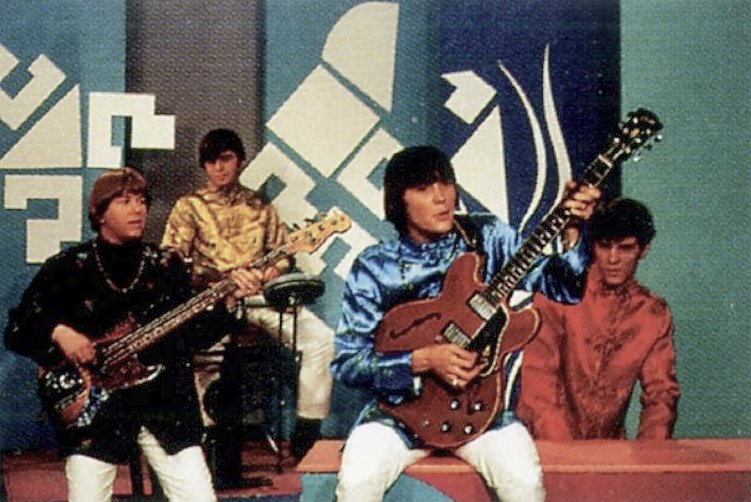
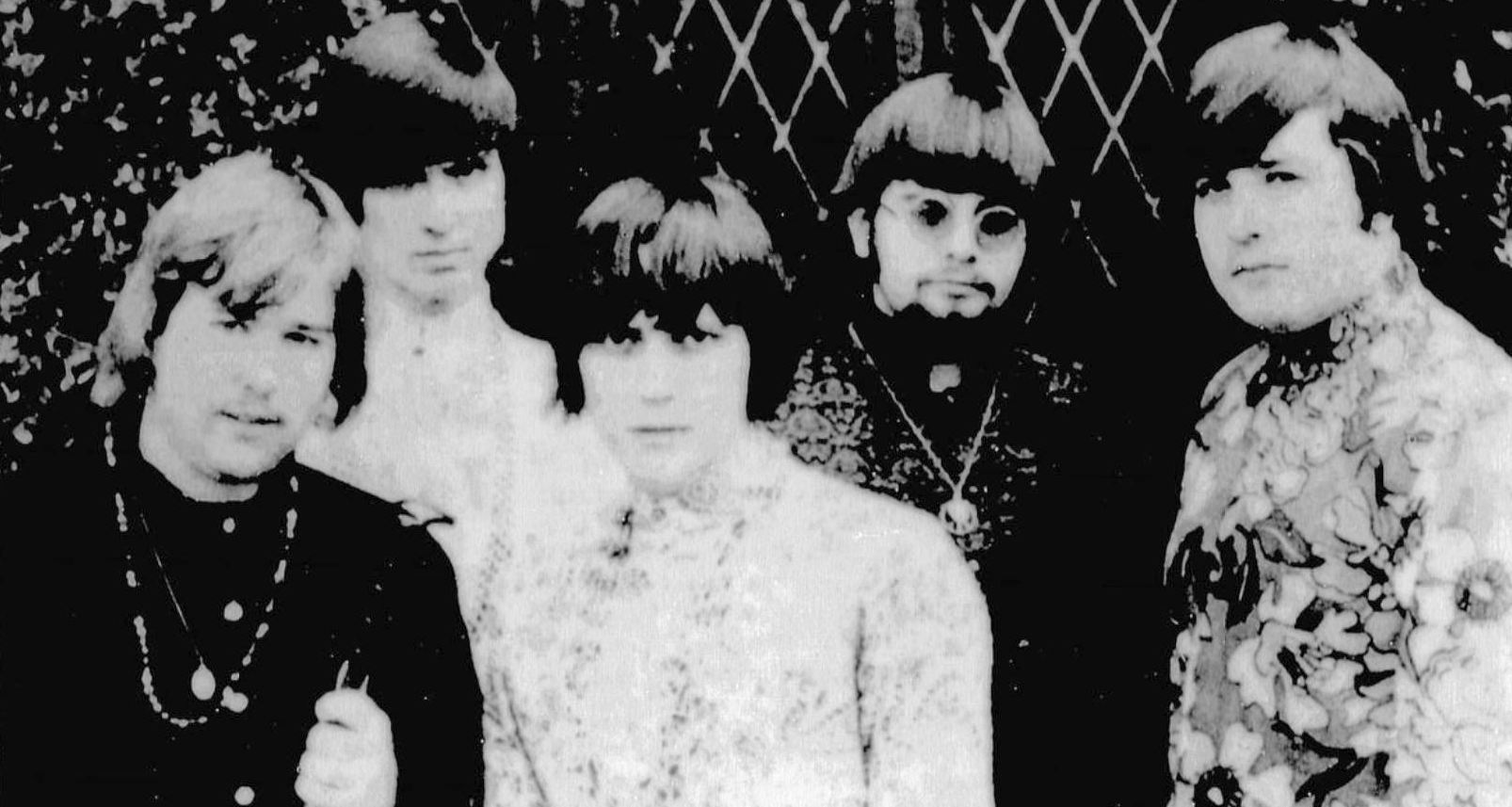
mouse_photo_5Mouse in the center, Bugs top right (click for even larger image)

by Paula Bosse

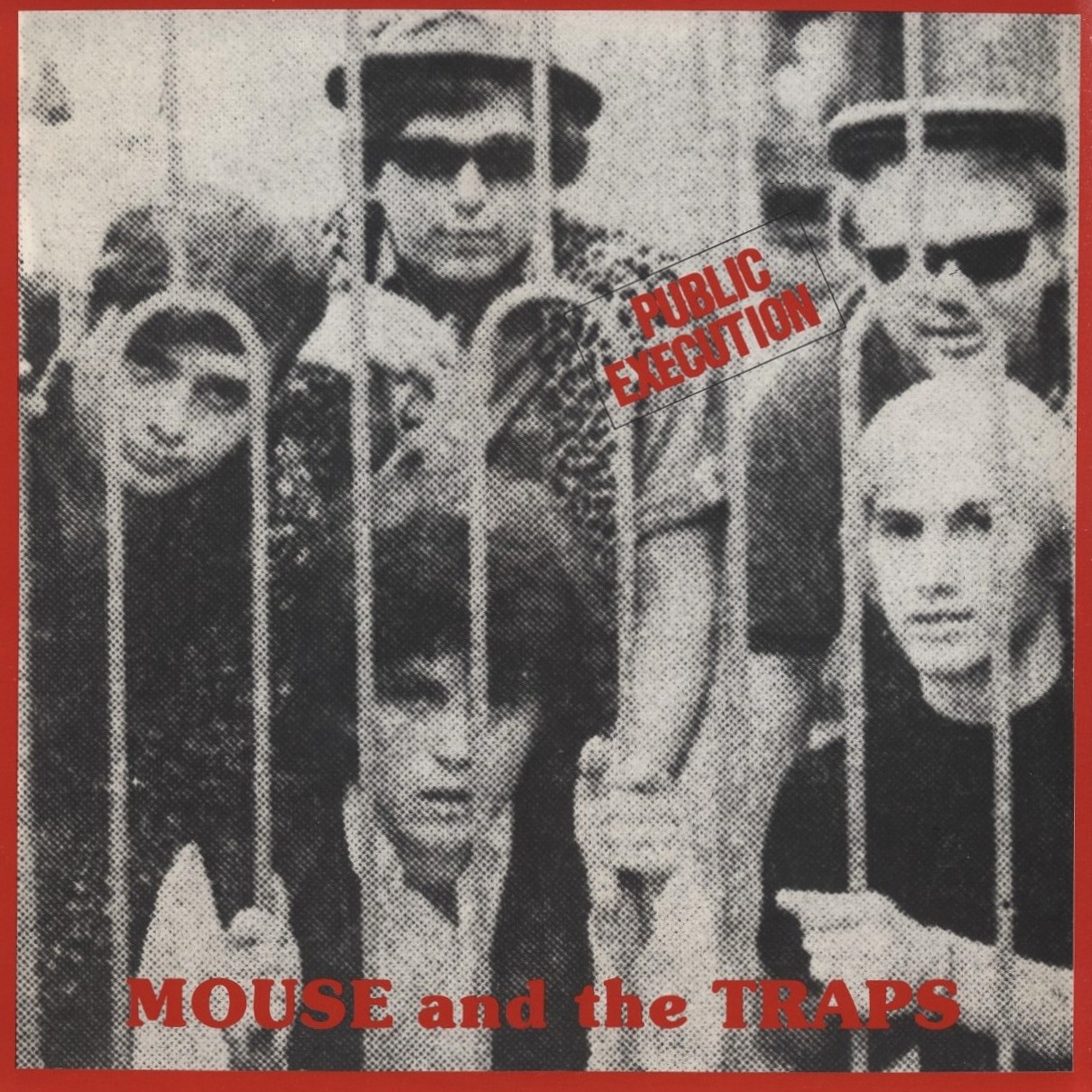
Last Tuesday, my friend Carlos Guajardo and I were each asked to present a favorite vinyl album at the Tuesday Night Record Club, a monthly event organized by Brian McKay and held at the historic Texas Theatre. My choice was a French import called Public Execution by Mouse and the Traps, a collection of the Texas band’s singles issued during their fairly short career (roughly 1965 to 1970). I bought this at a time when all of my disposable income was going to alternative record stores Metamorphosis and VVV, and I feel fairly certain that I bought this album at Metamorphosis. ’60s garage rock may be my favorite genre of music, and Texas garage rock is, for whatever reason, usually the best.

mouse_public-execution_lp_front

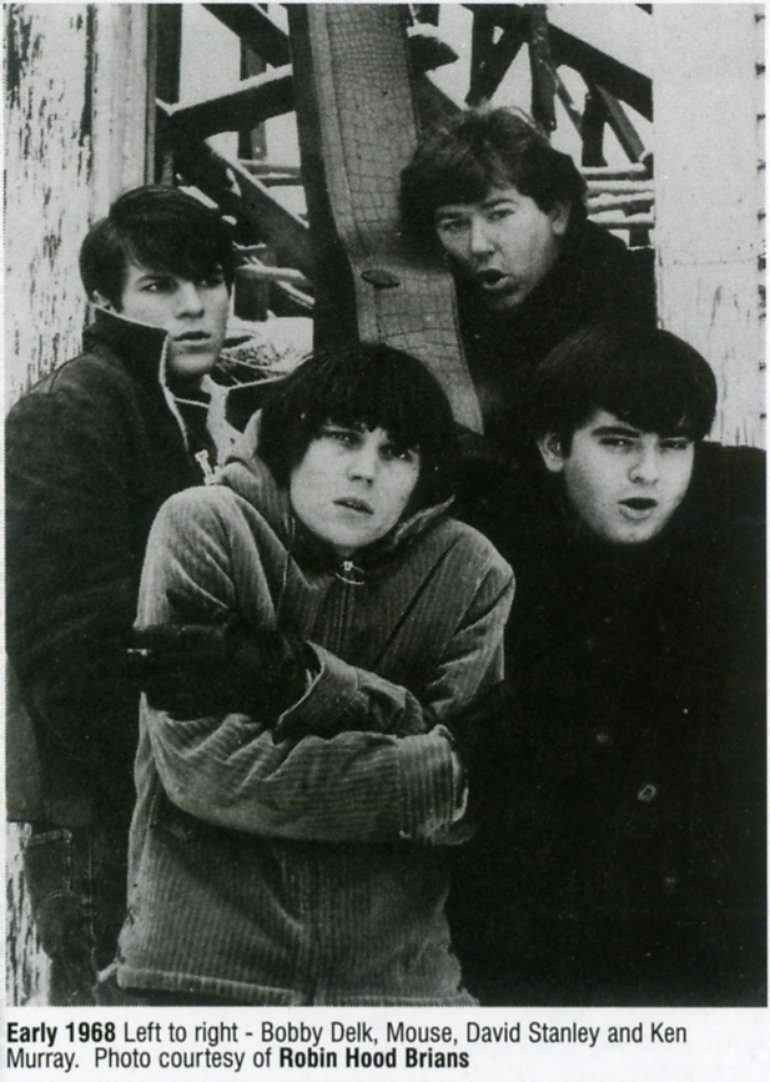
Mouse and the Traps was a band formed in Tyler, Texas in 1965, with Ronnie Weiss (whose nickname was “Mouse”) on vocals and  guitar, Bugs Henderson on lead guitar, David Stanley on bass, Ken “Nardo” Murray on drums, and Jerry Howell on keyboards. Even though most of the band members grew up in Tyler and almost all of their singles were recorded there (recordings produced by the great Robin Hood Brians, who was only a couple of years older than the band), the band pretty much moved to Dallas when they began to get a lot of airplay on local stations, notably KLIF. I actually always thought they were a Dallas band, and, damn it, I’m still considering them a Dallas band.

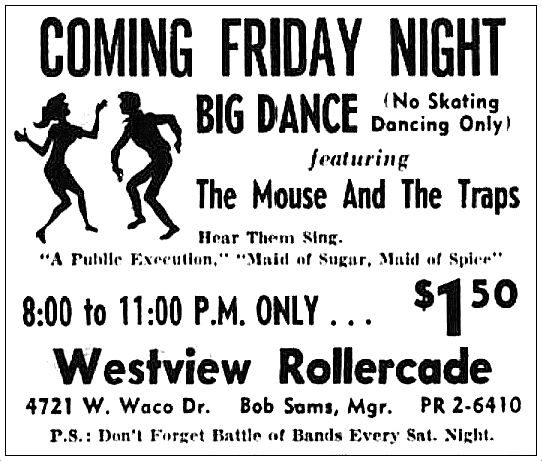
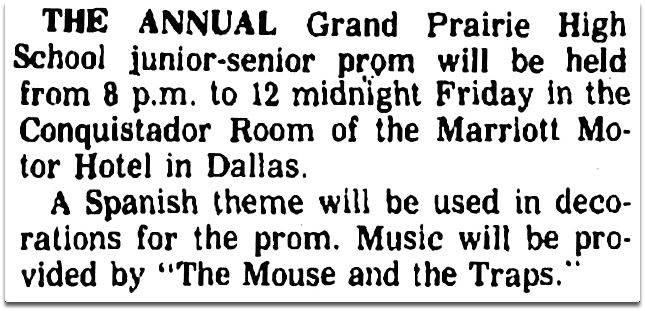
Mouse and the Traps toured around the state feverishly, playing clubs, colleges, parties, and even proms. There were occasional forays beyond Texas, but, for the most part, they remained a (very popular) regional band. Their first single — the unapologetically Dylan-esque “A Public Execution,” was released at the end of 1965 on the Fraternity label; it was their only record to show up on the Billboard charts, as a “bubbling under” track, not quite reaching the Top 100. After a couple of years, Bugs Henderson (who later became “guitar legend Bugs Henderson”) left the band and was replaced by Bobby Delk. Their personnel history is a little fuzzy, but I think Bugs re-joined the band briefly before the group finally disbanded sometime in 1970, after releasing a series of well-regarded singles and after almost five years of endless live dates. For most bands that had found little commercial success, that would have been the last most people would have heard of them. But most bands weren’t “Nugget” bands.

In 1972, Lenny Kaye included Mouse and the Traps on his revered (and influential) “Nuggets” compilation, propelling the band from “slowly-fading memory” to “newly-appreciated cult band” and introducing them to a whole new international audience. The band is now regarded as “proto-punk” and an important Texas garage band.

Their garage recordings are probably the most admired, but they dabbled in every ’60s style imaginable, including psychedelia, folk rock, breezy pop, and West Coast country, with hints of Dylan, The Beatles, The Yardbirds, Them, Donovan, and the Sir Douglas Quintet. There’s even a “Get Smart”-inspired novelty song in there. My favorite song of theirs, “Maid of Sugar, Maid of Spice,” is generally considered their finest single, assuring them a place in the pantheon of great garage songs. The stinging, electrifying guitar of Bugs Henderson is fantastic.

The band re-formed for several reunion shows over the years, but, sadly, Bugs Henderson died in 2012. No more reunion shows featuring the original line-up.

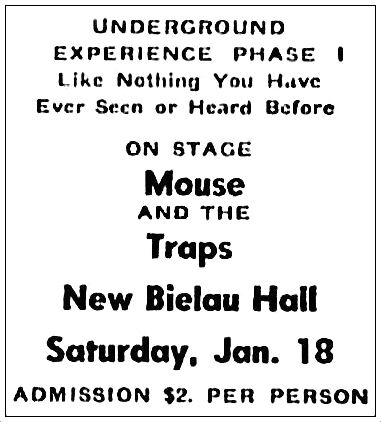
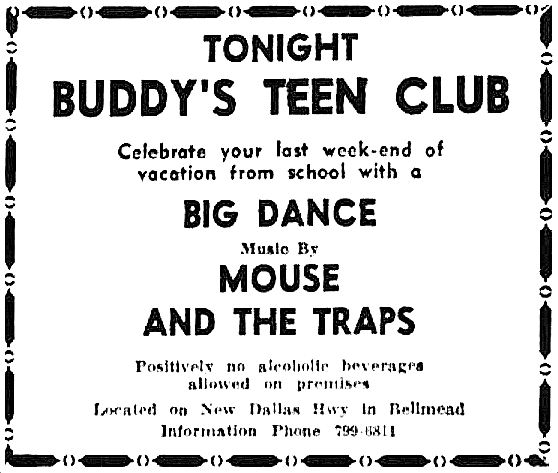
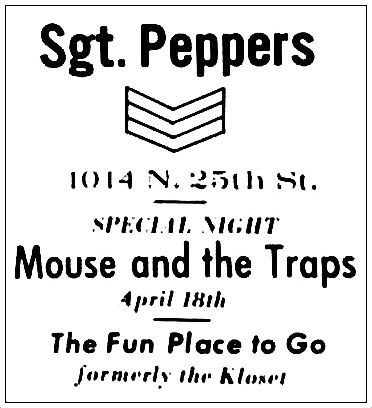
As far as the Dallas connection during the height of their career, there is precious little I’ve been able to find, as far as contemporary local photos, ads, or newspaper mentions. Despite the cultural revolution which began with the explosive arrival of the Beatles to the U.S. in 1964, “teenage” music in the ’60s was not taken seriously enough at the time to warrant much coverage in the major newspapers.

One of the few mentions of the band I found was as a support act on a Sonny and Cher show at the Fair Park Music Hall in early 1966. Also on the bill: The Outcasts from San Antonio, and Scotty McKay from Dallas (who can be seen performing two pretty good songs in a clip from one of Dallas director Larry Buchanan’s “schlock” movies, “Creature of Destruction,” here).

mouse_dmn_022466_sonny-cherFeb., 1966

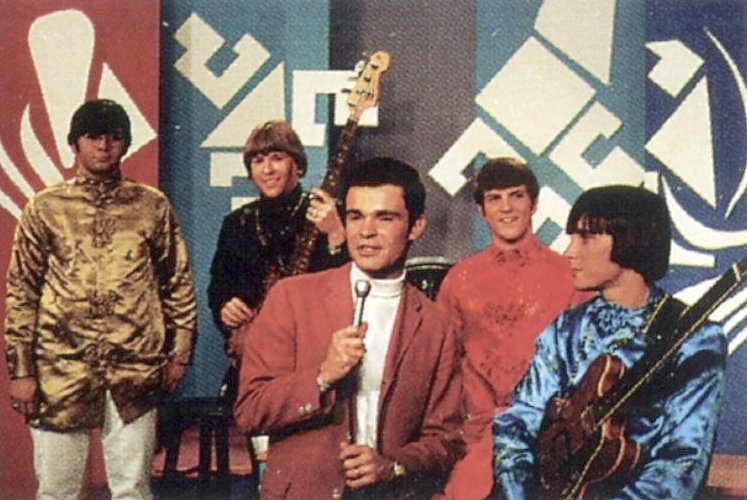
They also appeared on the TV music show “Sump’n Else” “Upbeat” (in 1968, post-Bugs). (Thanks to Jim for pointing out in the comments that these two color photos actually show the band on the Cleveland-based syndicated teen show “Upbeat,” hosted by Don Webster. TV listings show that the band appeared on the show in April, 1968, along with the Boxtops and several other performers.)

sumpn-else

sumpn-else_2Photos: Robin Hood Brians

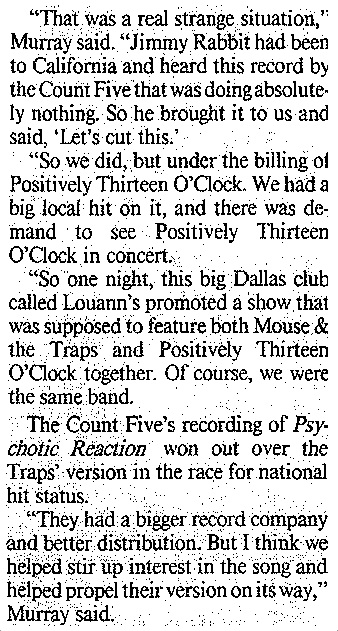
They also played a memorable show at Louanns in 1966 where they appeared on a double-bill as two separate bands. In 1966 Jimmy Rabbit, a popular DJ on KLIF who was a big supporter of the band, asked them to perform as his backing band on a (great!) recording of “Psychotic Reaction” — a very early cover (perhaps the first) of the song by the Count Five. The song was recorded in Tyler by Robin Hood Brians with Rabbit on vocals and was released under the name Positively Thirteen O’clock. Unsurprisingly, with Rabbit being a DJ on the top station in town, it became a huge local hit. Ken “Nardo” Murray talked about it in a 1988 interview (read the full interview here). Click for larger image.

mouse_FWST_051788-detFort Worth Star-Telegram, May 17, 1988 

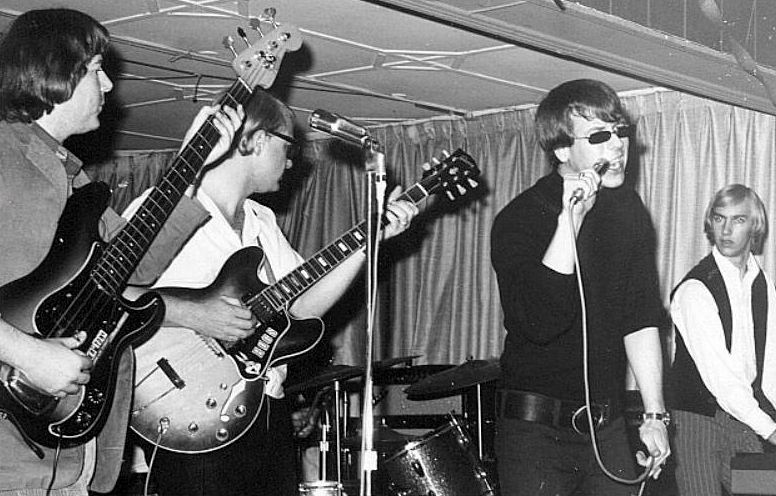
And here they are at Louanns, with Rabbit at the mic, backed up by Dave Stanley, Bugs Henderson (he has “Bugs” and a picture of Bugs Bunny on his guitar!), and Jerry Howell:

positively-13-oclock_garagehangover

If anyone has any Dallas-related photos or memorabilia of Mouse and the Traps, I’d love to see them! I’d also love to hear from people who saw them perform in the ’60s.

*

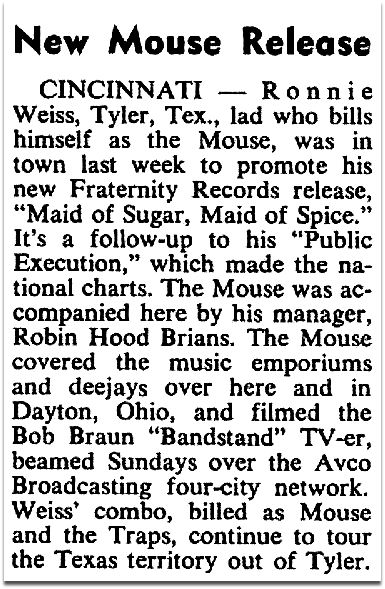
mouse_billboard_052166
Billboard, May 21, 1966

mouse_photo_3

mouse_waco-tribune-herald_081166
Waco Tribune Herald, Aug. 11, 1966

mouse_cold

mouse_grand-prairie-daily-news_050968
Grand Prairie Daily News, May 9, 1968

mouse_weimar-mercury_011669
Weimar Mercury, Jan. 16, 1969

mouse_campus-chat_NTSU_020769

mouse_campus-chat_NTSU_020769-captionNorth Texas State University newspaper, Feb. 7, 1969

mouse_waco-tribune-herald_083069
Waco Tribune Herald, Aug. 30, 1969

mouse_waco-citizen_041670
Waco Citizen, April 13, 1970

***

Sources & Notes

A few Mouse and the Traps tidbits:

The band was originally called “Mouse.” “The Traps” was added when the second single, “Maid of Sugar, Maid of Spice” came out in 1966.

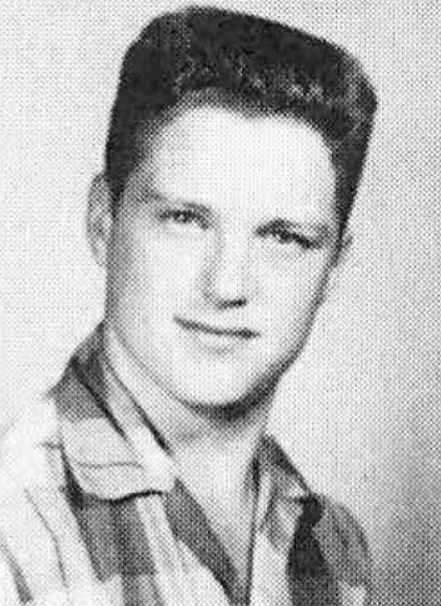
The “Henderson” listed as co-writer with Ronnie Weiss of a few of the early Mouse and the Traps songs (including the first two singles) was not Bugs Henderson (who was born Harry Fisher Henderson but was known as “Buddy” in the pre-“Bugs” days) — it was Knox Henderson, a high school pal from Tyler, seen below from a 1955 John Tyler High School (Tyler, TX) yearbook.

henderson-knox_tyler-high-school_1955

More on the band — including photos and newspaper articles — can be found here. Also included is additional information on Robin Hood Brians who has produced artists as diverse as ZZ Top, the Five Americans, James Brown, David Houston, and John Fred and His Playboy Band (whose “Judy In Disguise” knocked the Beatles out of the #1 spot on the national charts).

Mouse and the Traps on Wikipedia, here.

More on Dallas-area ’60s garage bands on GarageHangover.com, here.

Thanks again to Brian McKay for inviting me to play these great songs at the Tuesday Night Record Club!

Pictures and clippings are larger when clicked.
*

Copyright © 2016 Paula Bosse. All Rights Reserved.