Flashback : Dallas

A Miscellany: History, Ads, Pop Culture

Category: Advertisements

Mercantile National Bank Ad — 1960

merc_ad_1960-det

by Paula Bosse

I love you, Merc! Why aren’t you in EVERY Dallas ad?

ad-mercanitle_city-directory-1960(click for larger image)

***

Ad from the 1960 city directory. I don’t know who did the artwork for this ad, but I love it.

*

Copyright © 2014 Paula Bosse. All Rights Reserved.

Babe Didrikson, Oak Cliff Typist

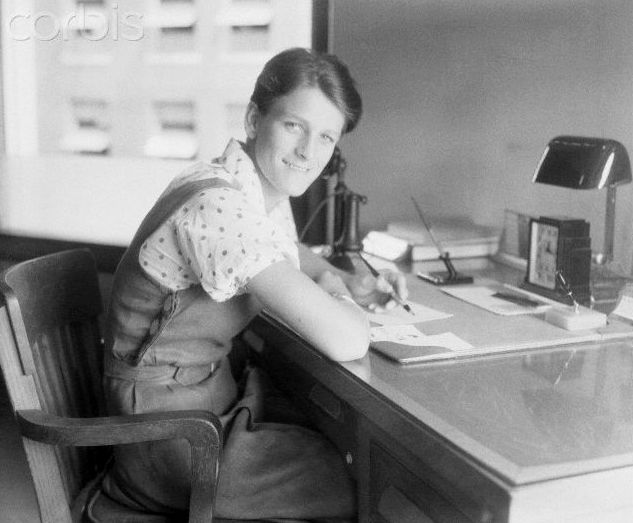
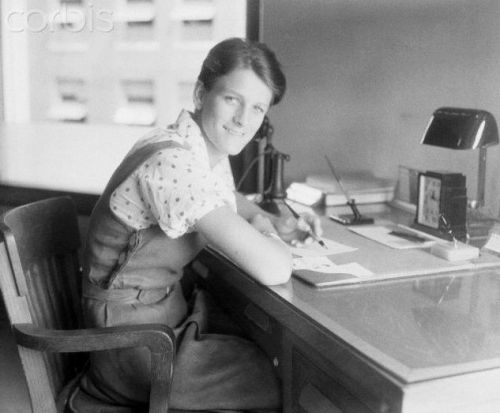
babe-corbis_102132Babe Didrikson at a desk she was probably pretty unfamiliar with, 1932

by Paula Bosse

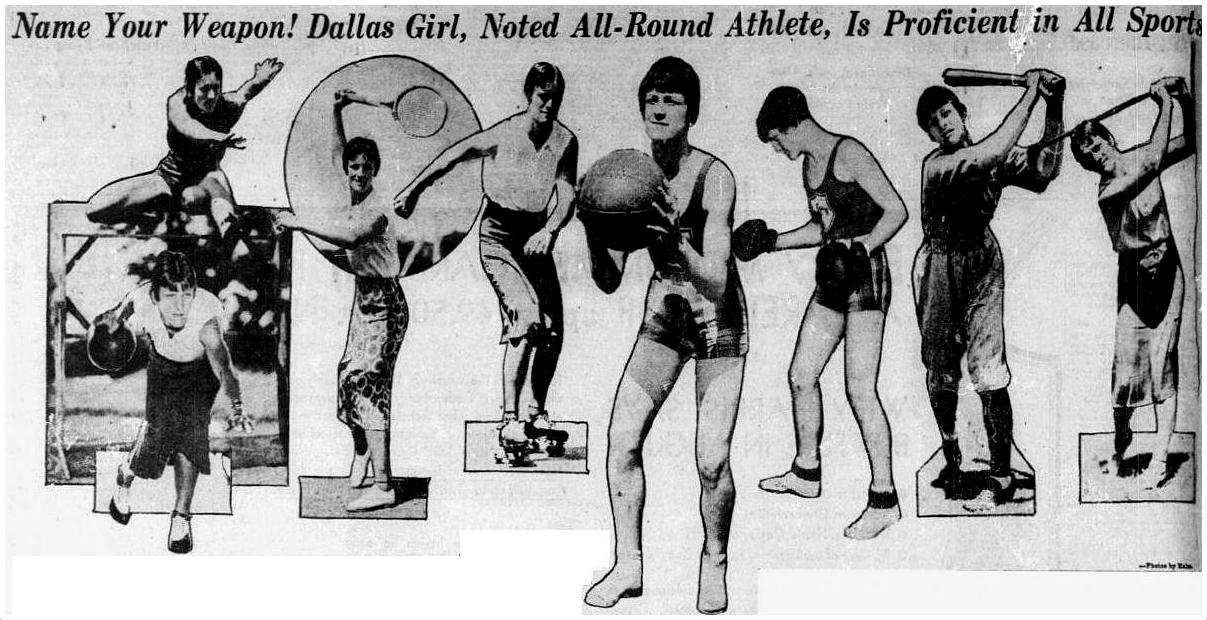
Mildred “Babe” Didrikson has been called the greatest athlete of the 20th century — male or female. She was an All-American basketball player, she set a number of world records in a wide variety of track and field events (she was so good at all of the individual sports that she was entered at least once as an entire TEAM — a team of one!), she won two gold medals and one silver (which should have been three gold medals…) at the 1932 Olympics, and she was, perhaps most famously, a champion golfer who was a founder of the LPGA. She was also highly proficient in softball, bowling, diving, swimming, roller skating, and tennis, and she dabbled in hockey, skeet-shooting, billiards, and even football. There was no sport she didn’t try — and even if she had never tried it before, she was probably pretty good at it. And she spent an important period of her life in Dallas.

babe_dmn_0802311931

Babe Didrikson was born in Port Arthur, Texas in 1911 and grew up in nearby Beaumont. She excelled in sports in school, especially basketball. In the late-’20s, a man named Col. M. J. McCombs, who was the head of the women’s athletic program for an insurance company, saw Babe in action and recruited her to play for his company’s basketball team in Dallas. She was offered a job to do vague secretarial work for the Employers’ Casualty Company (which had offices in the old Interurban Building downtown), with the understanding that she was really being taken on in order to play on the company team. With the blessing of her Norwegian immigrant parents, she interrupted her high school education in Beaumont to accept the $75-a-month job and was moved into a Haines Avenue rooming house in Oak Cliff.

Babe soon became the star of the Golden Cyclones, her company’s championship-winning team which participated in an “industrial” league governed by the national Amateur Athletic Union (the AAU). In the off-season she was introduced to track and field events by McCombs, and she quickly mastered them all.

babe_emp-cas-coFlying the company colors

She soon began breaking world records. Watch her compete at an AAU meet at SMU in July 1930, where one of the records she broke was for the javelin throw, here.

didrikson-babe_070730_track-meet_SMU_javelin_critical-past_screenshot-cropJuly 1930, Dallas

Before she knew it, it was the summer of 1932, and the Olympics were being held in Los Angeles — the 21-year old won three medals, emerged as the star of the games (she was frequently referred to as “the wonder girl from Dallas”) and began her climb up the ladder of celebrity.

After the Olympics, the city of Dallas gave her a victory homecoming, with a parade, a luncheon, and various presentations, all covered widely in the local press. The Dallas Morning News described it as “a demonstration the magnitude of which has never before been accorded a son or daughter of this city” (DMN, Aug. 12, 1932), bigger even, they said, than the reception that had greeted Charles Lindbergh on his Dallas visit.

U625776INPBabe’s post-Olympics parade through downtown Dallas — Aug. 11, 1932

After the celebrations had settled down, Babe Didrikson, sports superstar, was back at “work” — at least long enough to have photographs of her taken at the most uncluttered desk imaginable. (Though to be fair, Babe did claim to have been a typing champion in high school. Even if that were true — and she was known to be something of an exaggerator — it’s still almost impossible to imagine this world champion athlete typing up an afternoon’s dictation on insurance matters.)

babe_insuranceEmployers’ Casualty Co.’s casual employee — Oct. 21, 1932

Babe eventually turned pro, left Dallas, married wrestler George Zaharias, and became an incredibly successful golfer. She died from cancer in 1956 at the early age of 45, but her legacy lives on as one of the greatest and most versatile athletes of all time (…who, for a few short years, also happened to do a bit of light secretarial work for an insurance company in Dallas).

**

Below are a few of my favorite random Babe-related tidbits.

babe_hat_dmn_0712321932

Babe was often ridiculed by male sportswriters for her bearing and physique, which they thought were not feminine enough for their tastes. This criticism — ridiculous though it was — must have stung, because she occasionally made efforts to placate them, some of which seemed very awkward, such as this. The caption of the above photo: “Mildred (Babe) Didrikson (left) and her chaperon, Mrs. Henry Wood, are pictured above as they appeared Monday afternoon just before boarding a train for Chicago, Ill. for the national AAU track and field championships in which Babe […] hopes to carry off high honors and win a berth on the American Olympic team. This is the first picture ever taken of Babe with a hat on. She has never worn one before.”

*
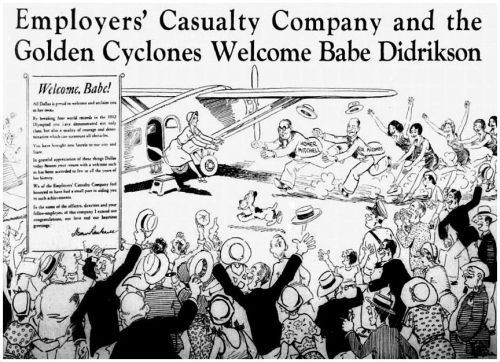
babe_insurance_ad_dmn_081132Aug. 11, 1932

babe_insurance_ad_dmn_081132-detAug. 11, 1932 — ad inset

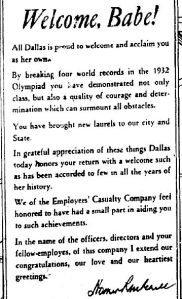
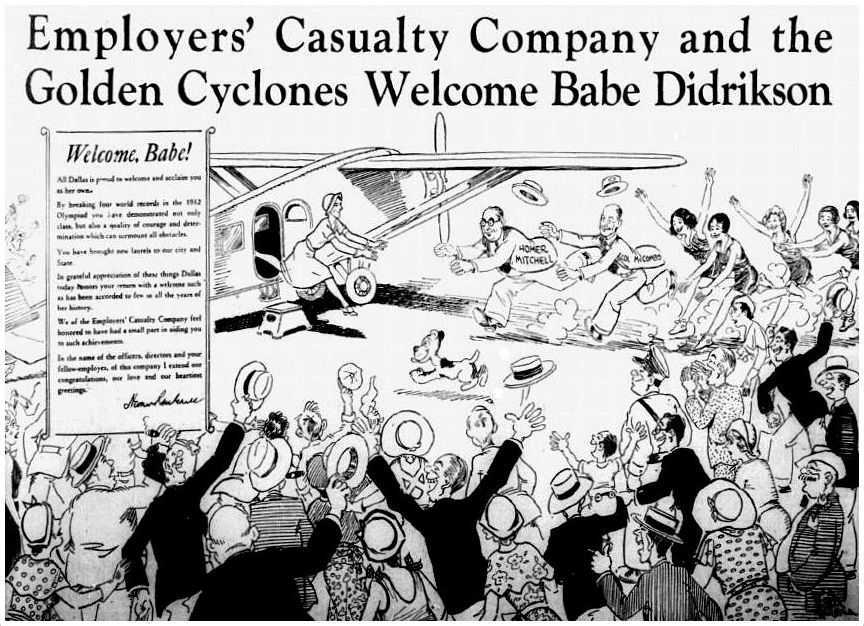
Above, an ad taken out by the Dallas company Babe worked for, welcoming her back home from her Olympic triumph. Drawing by Jack Patton. (Even though Babe had buckled to pressure with the whole hat thing, I can’t quite picture her wearing gloves.)

*

babe-and-babe_081247

Babe and the other Babe, August 12, 1947. I love this photo.

*

babe_vanity-fair_1933

Fantastic photo of Babe in her prime by Lusha Nelson, from the January, 1933 issue of Vanity Fair.

*

babe

***

Sources & Notes

The two photos of Babe Didrikson at her desk, the photo of the parade in Dallas, and the photo with Babe Ruth are from the huge selection of photographs of Babe at CorbisImages. See a lot of photos of her throughout her career, here. The photos of her training and in action are exhilarating, but it’s nice seeing her looking so happy and relaxed in her later golfing days. She definitely smiled a lot more after she started making more than the measly $75 a month she was making in Dallas.

An interesting article from 1975 about Babe in which former co-workers and teammates from Employers Casualty remembered their time with her can be found in the Dallas News archives: “Friends Recall Babe’s Prowess” by Temple Pouncey (DMN, Oct. 26, 1975).

For more on Babe’s time in Dallas and Oak Cliff, she writes about it in her autobiography, This Life I’ve Led (1955), here. (The entire book can be read for free at the link.) Also, check out this article by Gayla Brooks that appeared in the Oak Cliff Advocate.

A really well done, comprehensive overview of Babe Didrikson Zaharias’ career (with lots of great photos), can be found at Pop History Dig, here.

One of my favorite weird Babe things is the record she made with her “golf protege” Betty Dodd. Betty sings (not very well) and is accompanied by Babe on harmonica, an instrument she loved all of her life and which she taught herself to play as a child. The song — and a bit of backstory on Babe and Betty’s relationship — is here (click the arrow at the left of the strip beneath the record label to hear the song “I Felt a Little Teardrop”). Babe’s solo starts at about the 1:06 mark.

And, lastly, newsreel footage of Babe over the years, from the early track meets and the Olympics, to her later career as a golf superstar can be watched here and here.

*

Copyright © 2014 Paula Bosse. All Rights Reserved.

Theater Row Block Party! — 1948

theater-row-block-party_082648_preservation-dallasDallas premiere, “Red River” — Aug. 26, 1948 (click for larger image)

by Paula Bosse

On a rainy night in August, 1948, United Artists premiered the movie “Red River” in Dallas at the Majestic Theatre. The now-classic Western about a Chisholm Trail cattle drive, directed by Howard Hawks and starring John Wayne and newcomer Montgomery Clift, was actually “premiered” simultaneously on August 26, 1948 in 250 theaters in Texas, Oklahoma, Kansas, and New Mexico, the four southwestern states most closely associated with the Chisholm Trail.

red-river_ad_dmn_082648(Aug. 26, 1948)

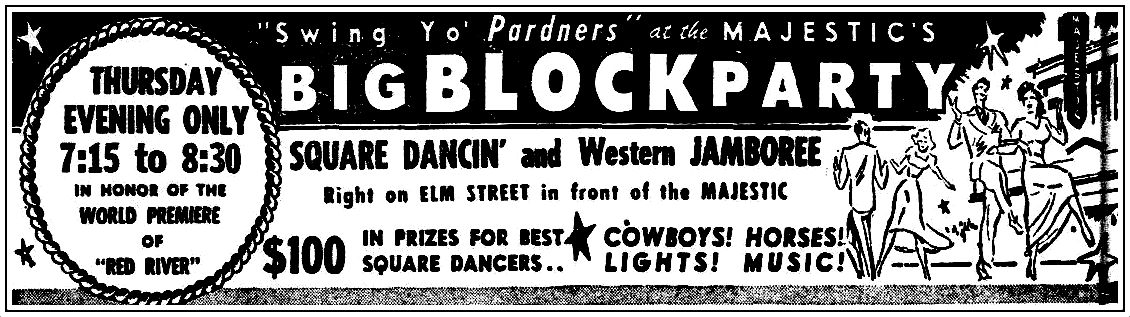
In Dallas, the publicity machine was seriously cranked up. The main attraction was a free-to-the-public street party in which the 1900 block of Elm Street was closed to traffic for a slate of western-themed festivities. The “jamboree” included square dancing, a musical set by cowboy singer Jim Boyd and his band, “cowboys and cowgirls from the Pleasant Mound Rodeo,” the Dallas Mounted Quadrille, and the Sheriff’s Posse. Or, as the ad said more succinctly, “Cowboys! Horses! Lights! Music!”

red-river_block-party_dmn_082648Great ad! Click to see it bigger! (Aug. 26, 1948)

No Hollywood celebrities were there, but the big Western Jamboree was apparently well-attended, even in the rain and despite rain, people gathered for square dancing.

(Wow. Square dancing in the rain. That’s dedication.)

The movie was a huge hit, so much so that the Majestic added showings, including one at 9:30 in the morning (!). It had a record week in Dallas, and, nationally, by the end of that first week it was reported to be the biggest-grossing picture in the history of United Artists.

The “world premiere” is interesting and all, but that photo of a brightly lit-up Theater Row is even better!

***

Sources & Notes

The original source of the photograph is not known, but I stumbled across it on a Preservation Dallas page, here.

“Red River” is a great movie. If you haven’t seen it, you need to. Even if you think you don’t like Westerns. Roger Ebert’s review/analysis is here.

*

Copyright © 2014 Paula Bosse. All Rights Reserved.


Armistice! — 1918

wwi_returning-troops-parade_1919_portalDowntown parade for returning troops — June, 1919 (click for larger image)

by Paula Bosse

Dallas found out that the Great War had finally ended at around 3:00 in the morning of November 11, 1918 when the siren atop the Adolphus Hotel sounded with “maniacal shrieks.” People poured into the streets to celebrate.

The crackle of revolver reports began to sound. Sleep was murdered, even had one been so disposed, and many residents from all parts of the city foregathered in the downtown district to jubilate and exult in various ways until daylight came. (Dallas Morning News, Nov. 12, 1918)

Giddy celebrations and impromptu parades were the order of the day, and the joyous spirit that erupted throughout the city is reflected in this Dallas Morning News report of “the first day of world peace since August, 1914” (click to see larger image):

wwi_armistice-in-dallas_dmn_111218
DMN, Nov. 12, 1918

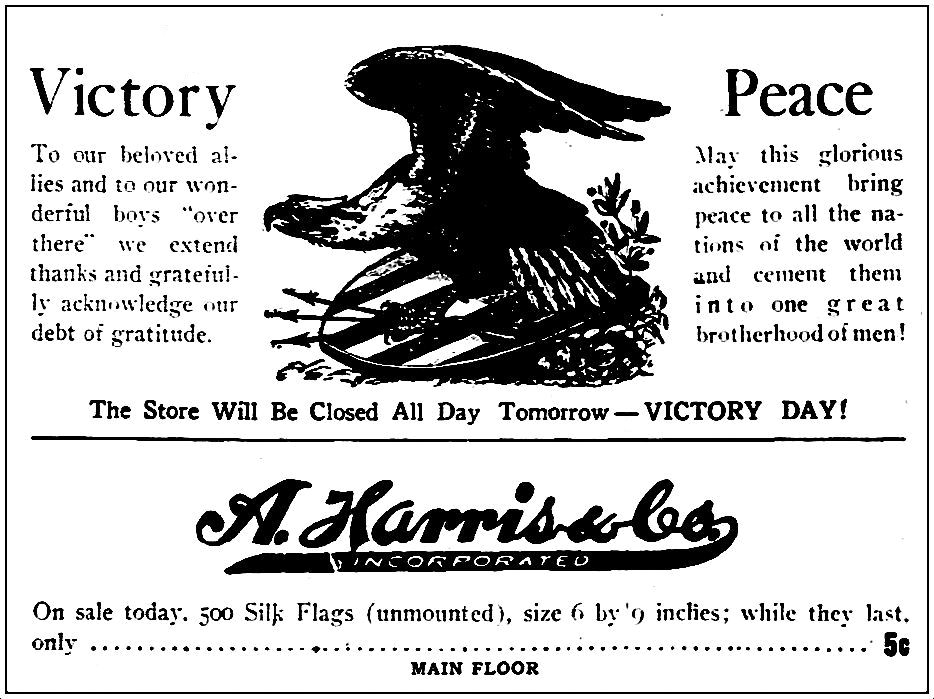
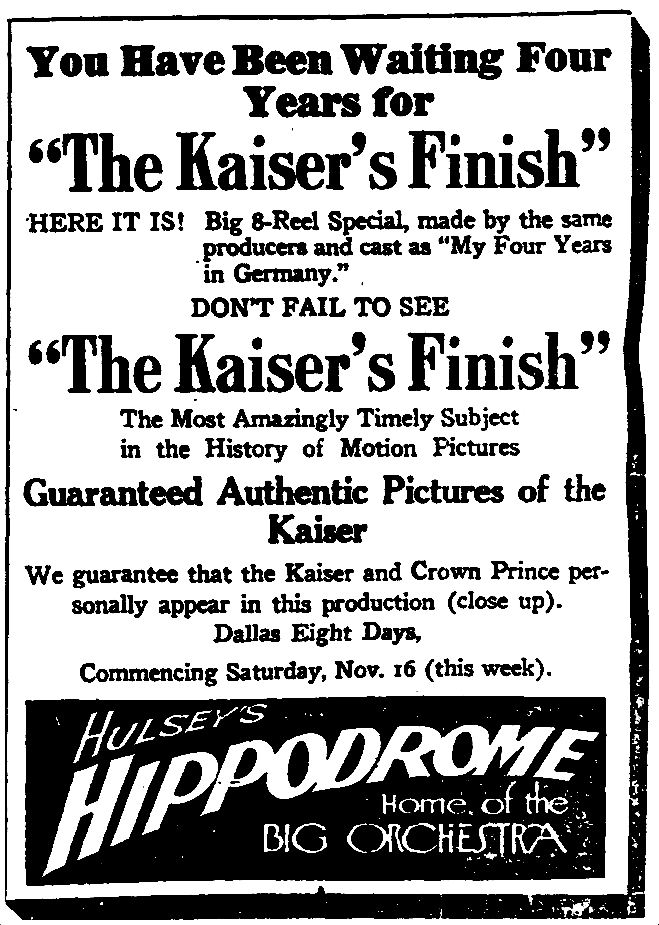
Local businesses got in on the action by placing heart-felt patriotic advertisements (some of which also quietly reminded readers that Christmas was just around the corner).

armistice_linz_dmn_111218

armistice_kahn_dmn_111218

ad-dreyfuss_dmn-111218

wwi_armistice_a-harris_dmn_111218

wwi_armistice_hippodrome_dmn_111318

wwi_armistice_hurst-bros_dmn_111318

When World War I officially ended on November 11, 1918, the military and civilian deaths and casualties totaled more than 37 million. All everyone wanted was for their loved ones to return home safely and for life to return to normal as quickly as possible. There was a lot to be thankful for that Thanksgiving.

***

Sources & Notes

Photo of the 111th Engineers from the Tarrant County College Northeast, Heritage Room, via the Portal to Texas History, here. It shows the 1500 block of Main Street, looking west toward Akard. See the same view today here (the short white  building at 1520 Main is currently occupied by the Iron Cactus; in the 1919 photo, that address is occupied by Thompson’s in what looks like the same building). (See another parade photo of the same block here. The detail is much, much better!)

1500-block_main_1919_2015

Ads from the Dallas Morning News, Nov. 12 and 13, 1918.

The Wikipedia entry for World War One casualties is here.

Click pictures for larger images.

*

Copyright © 2014 Paula Bosse. All Rights Reserved.


Dallas’ Ford Dealerships in the 1920s: Authorized for Your Protection

ford_dal-exp_091622-smAuthorized Ford dealers, 1922

by Paula Bosse

Dallas has always been a big car town, getting its first look at a “horseless carriage” way back in 1899 when E.H.R. Green sped into town at 15 m.p.h. and startled the citizenry. By 1903, The Dallas Morning News was bragging that Dallas had more privately owned cars than any other city its size in the South (“over 40”). By 1909, the Ford Motor Company had a Model T service center in the city, and in 1914, Ford opened an important regional assembly plant downtown (which later moved to more spacious digs on East Grand).

For many years, there were six — and only six — authorized Ford dealers in town. In several ads of the period, “automobilists” were stringently warned to avoid “bogus” agents offering counterfeit Ford parts. (Accept no knock-offs!) Below, the six authorized Ford dealers operating in Dallas in the 1920s. (All photos are larger when clicked.)

ford-dealer_fishburn_houston_dmn_101329Above, Fishburn Motor Company, 101 N. Houston St. Long gone, Dealey Plaza now occupies this site. Behind the building, at the right, is the Southern Rock Island Plow Company building, better known today as the School Book Depository.

ford-dealer_flippen_ross_dmn_101329The Flippen Auto Company, 1917 Ross Ave. The building took up part of the block now occupied by the Dallas Museum of Art.

ford-dealer_lamberth_dmn_101329Lamberth Motor Company, 3800 Main St. This building, not far from Fair Park, is at Main and S. Washington and later became part of the Fritos factory. With the building’s renovations over the years, it’s a little difficult to tell, but I think this building is still standing (and is the only one of these six buildings that has survived). To see what this building has looked like over the years, see my previous post, “3800 Main: Fritos Central,” here.

ford-dealer_morriss_lancaster_dmn_101329aThe John E. Morriss Company, 132 North Lancaster Ave., Oak Cliff. I’m not positive, but I think this may have been where Hector P. Garcia Middle School now stands.

ford-dealer_rose-wilson_ervay_dmn_101329Rose-Wilson Company, 1218 South Ervay St. In the Cedars, one block north of the Ambassador Hotel.

ford-dealer_shelton_main_dmn_101329J. H. Shelton & Company, 2311 Main St., at the very edge of Deep Ellum. The buildings seen here were right about where Central Expressway crosses over Main.

ford-logo_19221922

*

Copyright © 2014 Paula Bosse. All Rights Reserved.


Halloween Isn’t Only About the Candy

halloween_e-m-kahn_dmn_102525E. M. Kahn ad, 1925

by Paula Bosse

A few Halloween ads from the 1920s. The top ad for a snazzy “Halloween suit” is something of a whimsical departure for the legendary men’s clothing store, E. M. Kahn (est. 1872): it was an advertisement for children’s Halloween costumes — “printed in orange and black, the proper colors.” (I’d snap it up, kid — for two bucks, it’s the cheapest thing you’re ever going to find at E. M. Kahn.) “Suit includes pointed hat.”

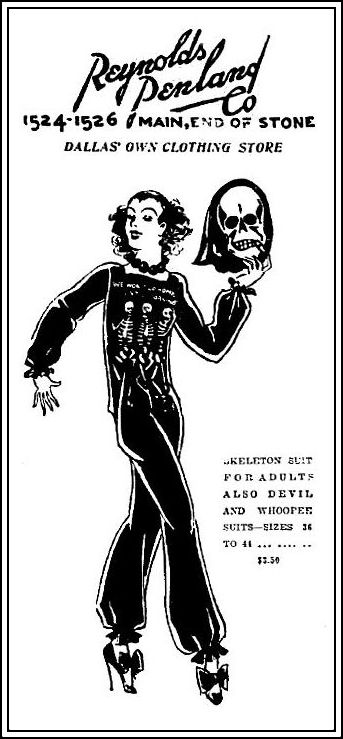
But Halloween isn’t just for kids. Below, a Reynolds Penland ad for adult costumes, which include skeleton, devil, and “whoopee” suits. No pointed hats, but there are accessories — just look at those shoes!

halloween_reynolds-penland_dmn_102729Reynolds Penland Co., 1929

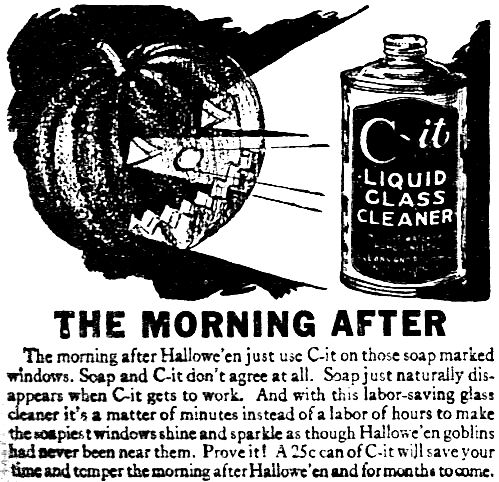
And lastly, an ad for glass cleaner. Dallas had a MAJOR problem with unruly “goblins” soaping windows — especially downtown — and this product probably came in pretty handy on “the morning after.” I bet this was the busiest time of the year for the C-It Liquid Glass Cleaner company — their make-it or break-it sales period. Halloween might well have been their Black Friday. …Or rather their Orange and Black Friday (because those are the “proper colors”).

halloween_glass-cleaner_dmn_1031251929

*

Copyright © 2014 Paula Bosse. All Rights Reserved.


Simulcasting the World Series In Dallas In the Days Before Radio, Via Telegraph

world-series_dmn_100422-smThe later version, for radio listeners, 1922…

by Paula Bosse

It’s 1912. You’re a huge baseball fan, and the World Series is about to begin — New York vs. Boston! But you live in Dallas, a million miles away from the action. You can’t wait for the results in the paper the next day because you’re an impatient S.O.B., and radio won’t be introduced for another ten years. Do you panic? No! Because you live in a big city with a taste for new technology, and the Dallas Opera House is going to present a sort of early simulcast of the games on a “mammoth automatic score board.” Your sports prayers have been answered!

1912_world-series_dmn_100612DMN, Oct. 6, 1912

You lean back in your comfy theater seat and smoke your smokes in plush and civilized surroundings as each play is sent by telegraph to Dallas from the ballpark back East where the game is being played RIGHT NOW, hundreds of miles away. The telegraph operator in Dallas will relay the play-by-play information to personnel in the theater who will somehow do something to some sort of “automatic electric board.” And, according to promoters of these “reproductions” of baseball games, you’ll feel like you’re right there in the thick of the action. You’ll “see” the game played before your eyes!

I’ve read several articles about these boards and these reproductions, but I can’t for the life of me figure out how it worked. I assume there was a large traditional scoreboard on stage that lit up, keeping track of the score, runs, outs, etc. But apparently there’s more, and I just can’t picture it. Here’s a somewhat confusing description of what happened during these productions:

WORLD SERIES WILL BE SHOWN AT THE OLD MILL

Manager Buddy Stewart of the Old Mill Theater announced that he secured the New Wonder Marvel Baseball Player Board to reproduce the World Series baseball games. This board is declared the greatest board ever invented for reproducing baseball games. It is not a mechanical board and no mechanical devices are used, and very little electrical appliances are necessary. The games are reproduced by a crew of six experienced baseball players who are carefully rehearsed and each has a part or position to play. No other board is so complete as this. The board does not require sign cards to denote players as in other boards. You see the ball going and do not have to look in any other direction to see what it means.

Spectators will see each play reproduced in less than two minutes after it is made on the playing fields of the World Series as the board is connected with a direct wire to the baseball field, and as fast as the telegraph operator receives the play it is reproduced with as much realism as on the field. The players are seen to run bases, the ball is seen bouncing or soaring to the infield or outfield, and anyone who is familiar with baseball will know just exactly what is happening on the field by the plays made on the board with very little left for imagination.

Every hit, run, error, strike or ball, the number of strikeouts, or balls made by pitchers, or the number of hits, runs or errors made by the players is always prominently shown on the board which makes it [un]necessary for individual scoring during the progress of the game. (DMN, Oct. 3, 1920)

Doesn’t really help much. It sounds as if people are on the stage acting out each play. That would be weird. These “reproductions” of World Series games were quite popular in Texas (and probably elsewhere) for at least 15 years. If anyone reading this has a photo or diagram of one of these vaunted Marvel scoreboards, I’d love to see it!

*

An earlier description of the 1912 Opera House reproduction sounds more like an audience watching a baseball game on a giant Lite-Brite “score board.”

1912_world-series_dmn_100812DMN, Oct. 8, 1912

The trick to keeping the telegraph operators calm and on-their-toes during a lengthy baseball game? Make sure they have no interest in the game.

1915_world-series_FWST_101415Fort Worth Star-Telegram, Oct. 14, 1915

Fort Worth was also getting in on the action. And they had celebrities — people like Clarence (Big Boy) Kraft and Ziggy Sears (who I’m going to assume have something to do with baseball). I’m not sure what these celebrities were doing exactly, but whatever it was, they were there doing it.

1921_marvel-score-board_FWST_100221FWST, Oct. 2, 1921

These theater programs weren’t for everyone, though. If you couldn’t take the time out of a busy work day to swan over to a theater to leisurely witness one of the early “reproductions” (or if the admission price was too steep for your budget), you could always ring up the operator to have her tell you the current score:

automatic_dmn_101112-world-series
DMN, Oct. 11, 1912

These things seemed to be a popular annual event, but in 1922, something more technologically advanced than the Marvel board appeared on the scene: radio! WFAA and WBAP began broadcasting in 1922, and, suddenly, following sports became a whole lot easier. In something of a transitional technology, there was the outdoor board as described below. The games were not only broadcast live on WFAA, but The Dallas Morning News (WFAA’s parent company) also erected one of those old-fangled “electric boards” out on the street so that passersby could keep up with the scores. (Portable transistor radios were decades and decades away.)

1923_world-series_dmn_101023DMN, Oct. 10, 1923

It was surprising to see that the “Marvel score boards” were still being used as late as 1926 (Yankees vs. Cardinals, at the Capitol Theater). Every baseball fan worth his salt should have had his own radio by then so he could listen to the World Series in the comfort of his own home and curse and cheer as loudly as the vicissitudes of the game demanded. Eat my dust, Marvel board! Radio changed everything, and radio was here to stay.

*

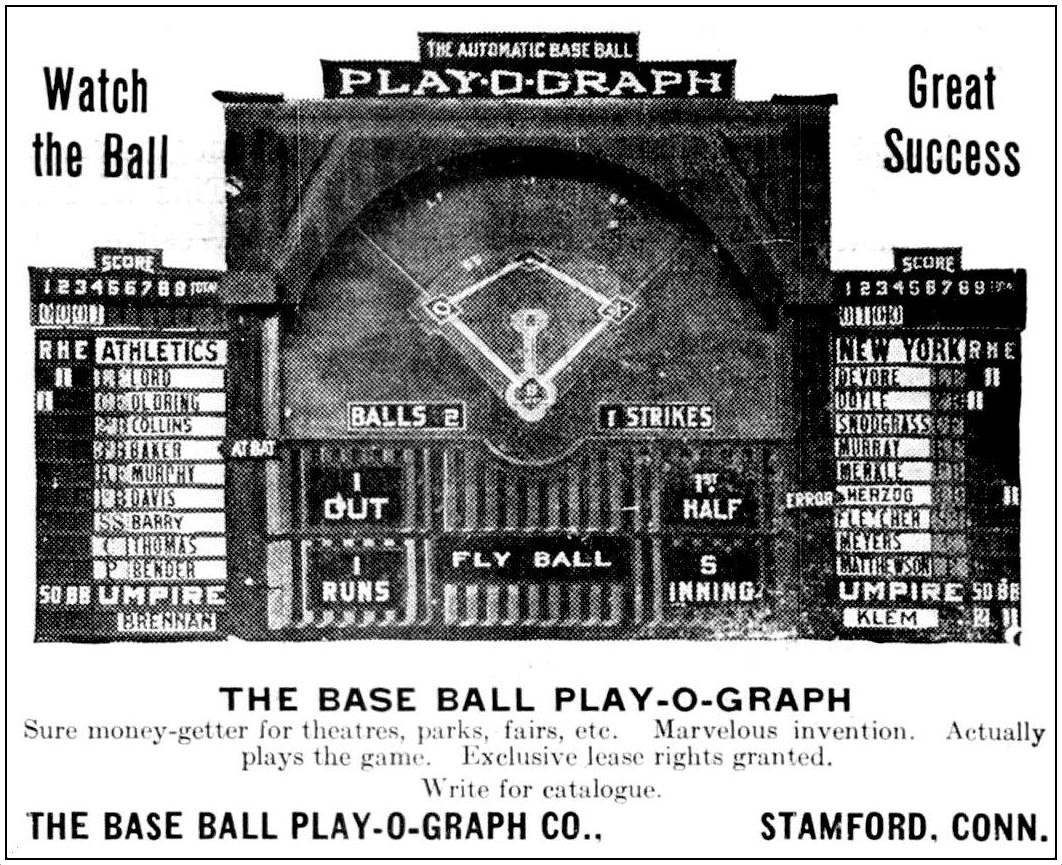
UPDATE: Thanks to Kevin’s link in the comments below, I can share this GREAT article from Uni-Watch.com about another of these boards called the Play-o-Graph: “Photography of Playography by Paul Lukas — it answers all my questions, and it even has photos (and links to photos) of crowds watching the boards. He also links to a 1912 article, “The Automatic Baseball Playograph”  by J. Hunt, in the Yale Scientific Monthly which describes how the board works and has this photo:

play-o-graph_yale-scientific-monthly_1912The “Play-o-Graph,” 1912 (click for larger image)
And, for completists, here’s an ad for the Play-O-Graph, from 1913:

baseball-simulation_play-o-graph_billboard_032213Billboard, Mar. 22, 1913

Makes a bit more sense now! Thanks, Kevin!

***

Sources & Notes

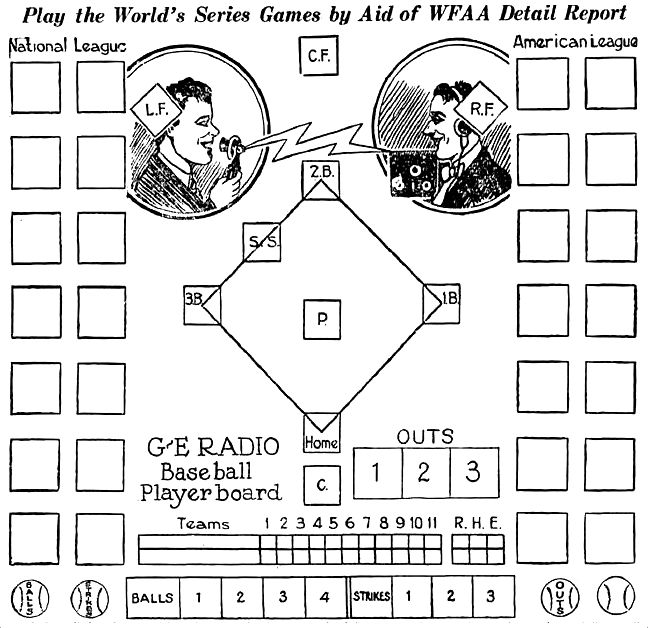
The top image is the “G.E. Radio Baseball Player Board” — a sort of home version of the big scoreboards used in theaters, printed for WFAA listeners in The Dallas Morning News on Oct. 4, 1922. The instructions are in a PDF, here. And feel free to print one out and use it while you watch the Series this year. Still works in the 21st century!

For an article on listener response to the successful first broadcast of the World Series by WFAA radio (listeners picked up the signal in England!), see the DMN article from Oct. 6, 1922 in a PDF, here.

And because they have such great names, you might want to know who Clarence “Big Boy” Kraft and Ziggy Sears were. If you’ve read this far, you owe it to yourself. “Big Boy,” here; Ziggy, here.

*

Copyright © 2014 Paula Bosse. All Rights Reserved.

The Century Room’s Retractable Dance Floor

ad-adolphus-hotel_century-room_sm(click for larger image)

by Paula Bosse

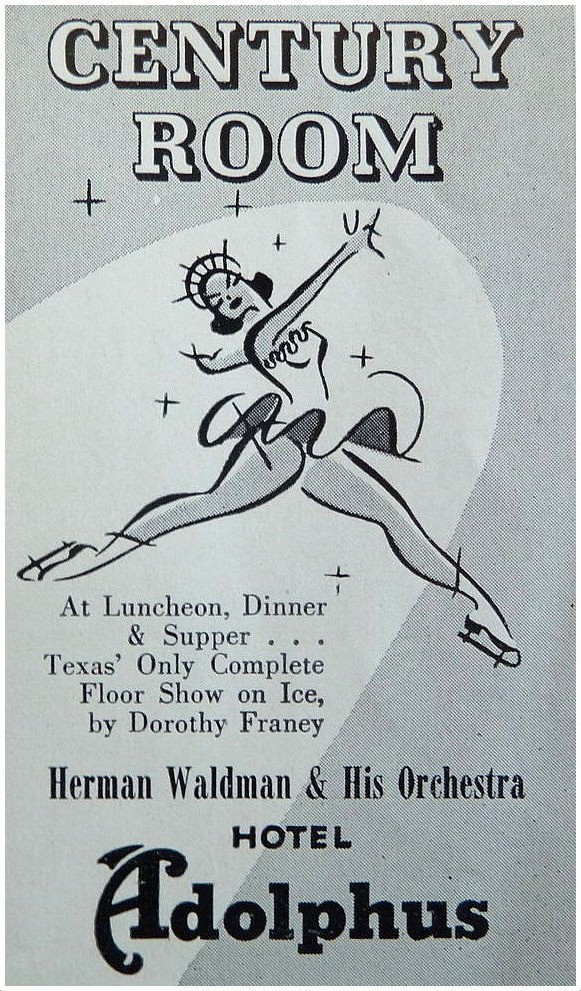
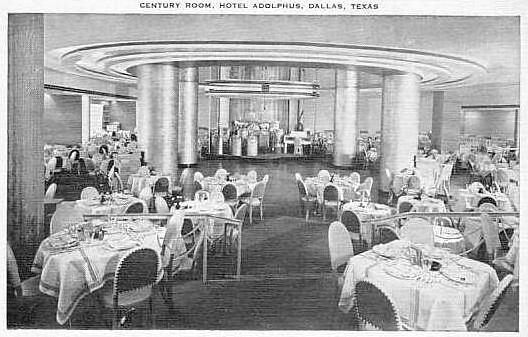
If you’re getting all dressed up for a night on the town, you want to make sure you get your money’s worth, entertainment-wise. That’s why you head to the tony Century Room at the swank Hotel Adolphus. Not only is there dining and dancing, there’s also an ice show. Yep, an ice show. When “Texas’ Only Complete Floor Show on Ice” has wrapped up, a dance floor magically covers the ice, and you and your honey can trip the light fantastic to the fabulous strains of Herman Waldman & His Orchestra. Skates optional.

adolphus_hotel_century-room

adolphus_century-room

*

Copyright © 2014 Paula Bosse. All Rights Reserved.

“So Sorry, Bill, But Albert is Taking Me to The State Fair of Texas”

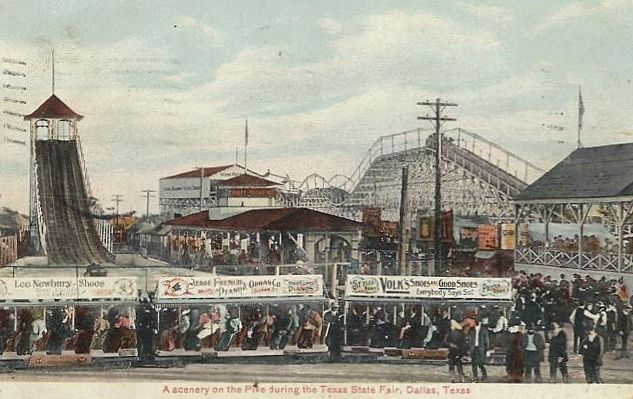
state-fair_1909_flickr“The Pike” — 1909

by Paula Bosse

Hey, y’all — guess what ends this weekend? Hurry!

One doesn’t really need an excuse to post a bunch of photos of the Great State Fair of Texas, but it IS the closing weekend, so why not enjoy a few images from the past few decades.

Above, a view of the Midway in 1909 (then called “The Pike”), with the Log Ride-like “Chute” and its ramp, a roller coaster, and a loaded tram festooned with shoe ads (including one for Volk’s).

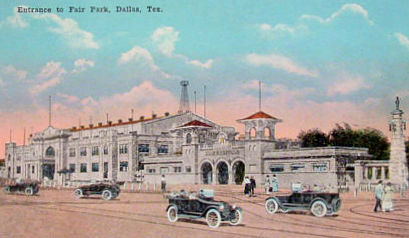
Below, the Fair Park entrance in 1919:

fair-park-entrance_1919

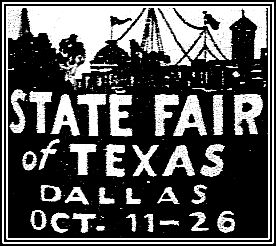
A nice little newspaper ad from 1924:

state-fair_092724

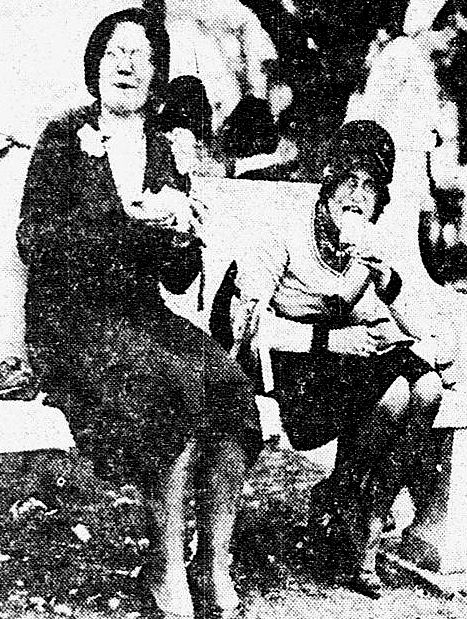
Two women enjoying ice cream in 1930 — State Fair food has always been one of the main joys of visiting the fair.

state-fair_dmn_101530

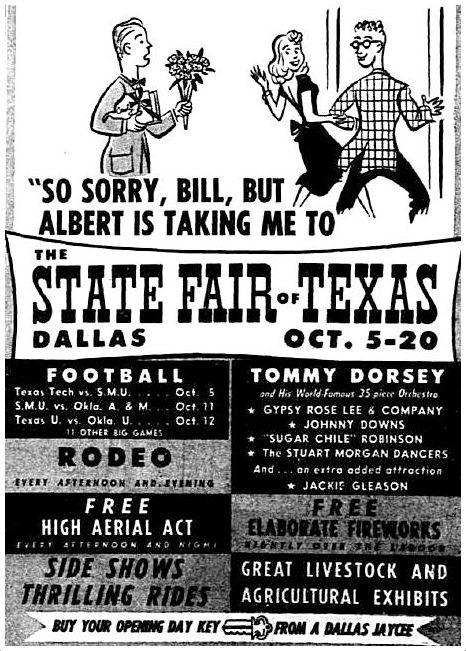
Ad from 1946: “So sorry, Bill, but Albert is taking me to the State Fair of Texas.” The grown-up entertainment that year was provided by Tommy Dorsey, Gypsy Rose Lee, and Jackie Gleason.

state-fair_dmn_092446

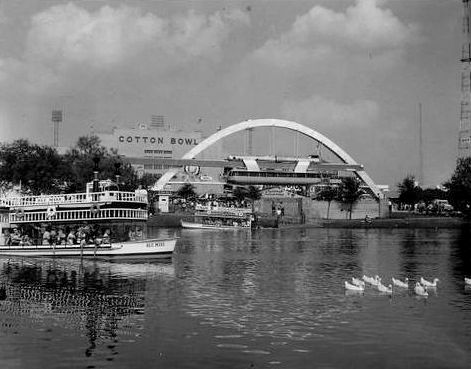
In 1958, Fair Park had a monorail (the only one then operating in the United States) and a paddle-wheeler in the lagoon:

state-fair_lagoon_squire-haskins_dmn-1958

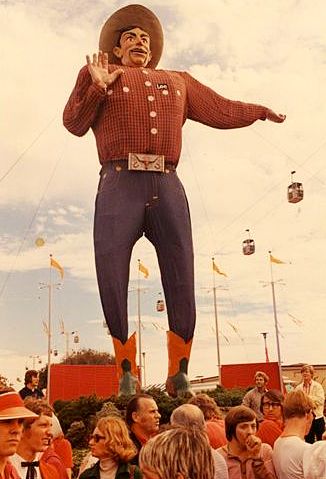
And then there’s this guy, who spans the decades:

big-tex_briscoe-center

***

Sources & Notes

1958 photo featuring the monorail by Squire Haskins, from a Dallas Morning News online article featuring TONS of cool photos of the fair over the years, here.

Big Tex photo (undated) from the Dolph Briscoe Center for American History.

Another post of random images of the SFOT through the decades — “The Fair Is In the Air — Let’s Go!” — is here.

*

Copyright © 2014 Paula Bosse. All Rights Reserved.


The Roller Coaster on the Prairie — 1894

state-fair-grounds_souv-dallas_1894Texas State Fair & Dallas Exposition Fair Grounds, circa 1888

by Paula Bosse

Above, a wonderful view of the “State Fair Grounds and Dallas Exposition” from an 1894 advertisement. The Little Roller Coaster on the Prairie!

If you want to see this very large (and, trust me, you DO), click here (and then click again). It’s like wandering through those old phone book covers, but without the jokes and the dinosaurs.

*

UPDATE: The artwork was used in a previous ad that appeared in The Dallas Morning News in 1888, with the following text:

The coming Fair and Exposition will, beyond a doubt, excel in point of attractiveness, numbers and variety of exhibits any heretofore held.

The County Exhibit Department promises to be the most attractive feature, one never before attempted by any State. Over forty counties up to date have secured space, and more still to enter. The exhibits these counties will present will be something that will astonish visitors.

Every variety of attractions has been provided for, and the musical treat we have in store for visitors will be presided over by the world renowned Cornetist , Prof. A. Liberati.

The purses offered in the Race Department cover $20,000, and will be competed for by the best racers in the land. The management of this department propose to give during the Fair and Exposition the finest races ever given in the South.

We desire to call the attention of counties to the fact that now is the time to get up their exhibits, when grain, fruits, etc. are ripening, and not wait until it is too late.

Space in the County Exhibit Department is free, and no county of our State can afford to be not represented. There will be more people here than ever before, and we want them all to see the varied resources of our great State.

To exhibitors in general we can promise them the finest opportunity ever offered to make displays from which will return good results, and to visitors we can assure them of the grandest entertainment ever given in the Southwest.

dallas-fair_dmn_090588

*

The scene above looks idyllic (to me, anyway), but here is a description of what the land was like before anything was built on it, from a Dallas Morning News history of the SFOT (Oct. 2, 1960):

An 80-acre tract approximately in the center of the present-day State Fair Park was chosen as the site for the Fair. The location was termed by some to be “the worst kind of hog wallow,” and the question most frequently asked was “How are you going to hold a fair in all that mud?”

*

The Dallas State Fair and Exposition (which became the State Fair of Texas) was chartered in 1886, and unless that artist’s rendering is highly romanticized (which it probably is), it looks like the hog wallow was but a faint memory by the time that roller coaster was plopped down on top it.

***

Sources & Notes

Artwork by the Dallas Engraving and Manufacturing Company. Top ad appeared in the Souvenir Guide of Dallas (1894); bottom ad appeared in The Dallas Morning News, Sept. 5, 1888.

*

Copyright © 2014 Paula Bosse. All Rights Reserved.