Flashback : Dallas

A Miscellany: History, Ads, Pop Culture

Category: Architecture/Significant Bldgs.

Dallas City Hall

by Paula Bosse

Our city hall has suddenly — and improbably — found itself in the headlines in recent weeks. As of this writing, its immediate fate is unknown. I don’t think I’ve written about this landmark building in the 12 years I’ve been writing about Dallas history. I guess I assumed I’d always have time.

Dallas City Hall is the work of architect I. M. Pei (1917-2019), who, in 1966, was commissioned to design a new city hall by then-mayor J. Erik Jonsson. The very modern design was both acclaimed and derided, and its bumpy road to completion was long and arduous — it was dedicated on March 12, 1978, 12 years after Pei accepted the commission. It is an instantly recognizable building by an internationally respected architect, and it has quietly held the fort on the southern edge of downtown for almost 48 years.

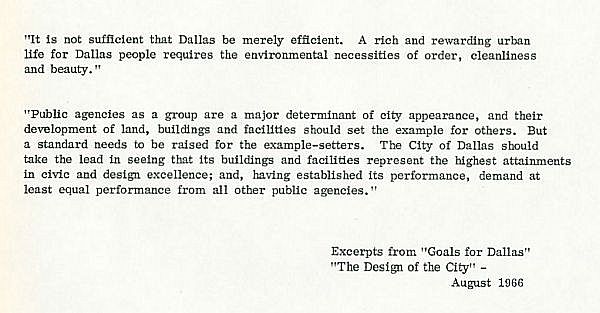
In the project plans presented to the City, I. M. Pei & Partners included these quotes from “Goals for Dallas,” the blueprint that Dallas leaders created for the city’s future:
In an oral history conducted by the Dallas Public Library in 2002, Pei discussed his City Hall project and was asked if he had visited the building in recent years (the link to the oral history and transcript are at the bottom of this post under “Sources & Notes”):

I’ve been back quite a few times. I always went up to the second floor to look at that public space. That public space — some people ask, “Why do you make that space so extravagant? People only come here and pay taxes or pay water bills.” I said, “Precisely. This is a People’s City Hall. You don’t build it for the mayor; you don’t build it for the Council; you build it for the people. They’re the ones who should enjoy it.” I remember that. I always go up to the second floor to look at that space. I think the public that comes to pay taxes should know that this is why. […] That was the original thought, and I still think it’s right — that this City Hall is designed for the people of Dallas. (I. M. Pei oral history, Aug. 1, 2002)

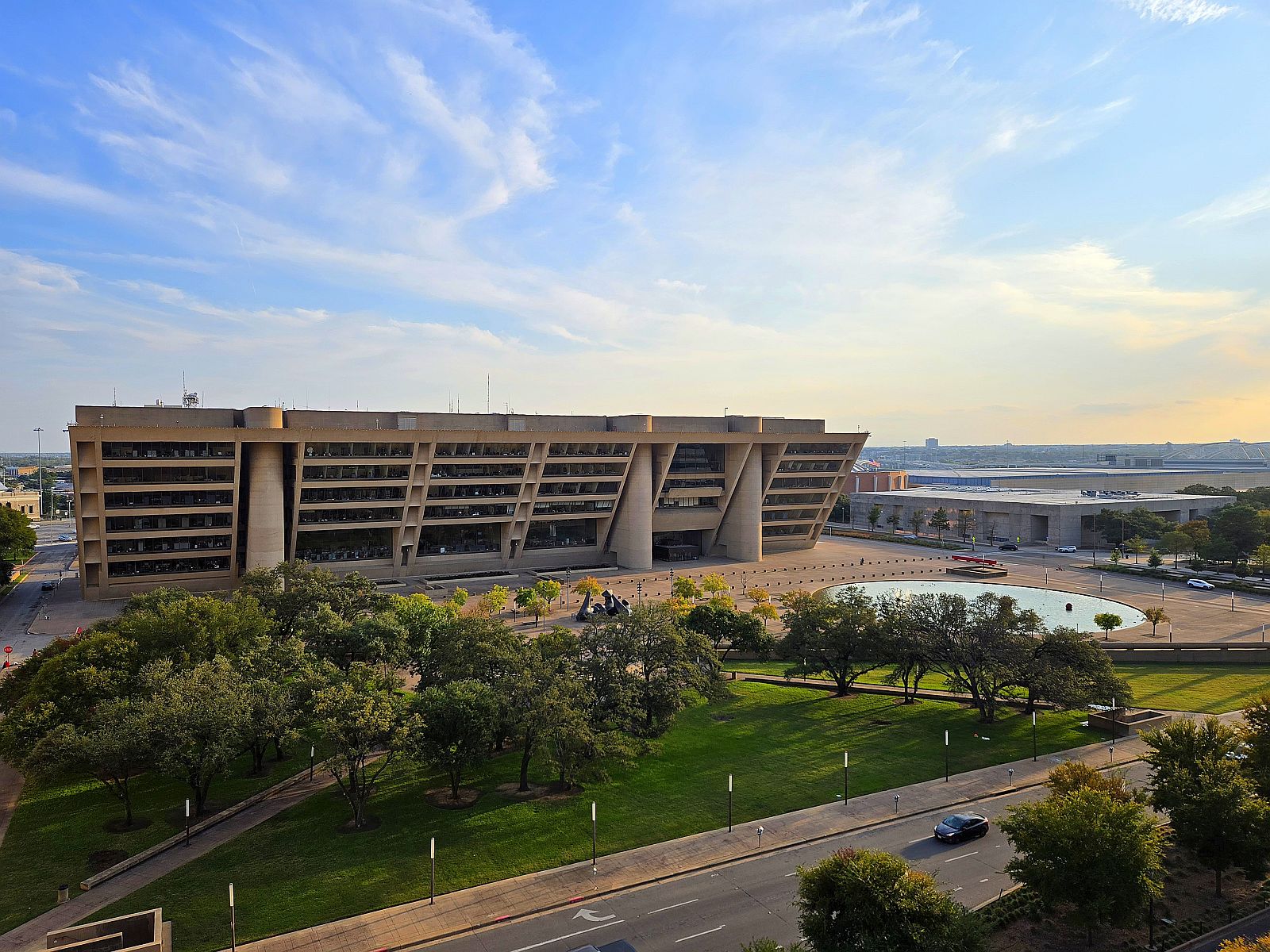
Below are a whole bunch of photos of I. M. Pei in Dallas, aerial views of the city before and during construction of the city hall, and two deceptively calm and quiet photos taken by me from the Central Library across the street only a couple of weeks ago, back when life seemed a little less precarious and before I thought it necessary to look up the dictionary definition of “beleaguered” to make sure I was using it appropriately. I was.

*

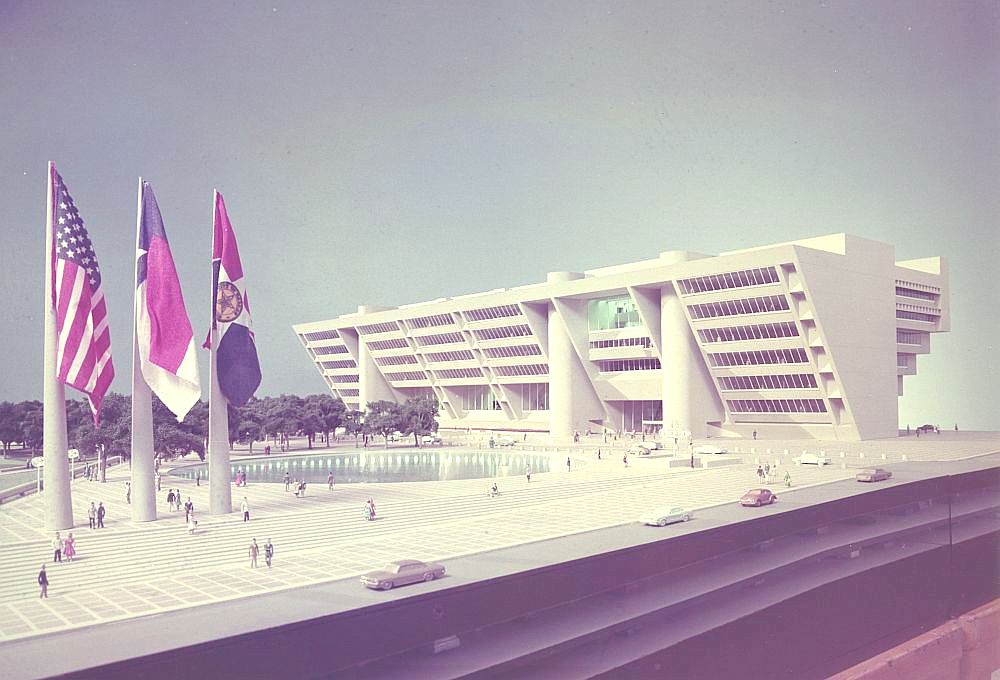
The model:
*

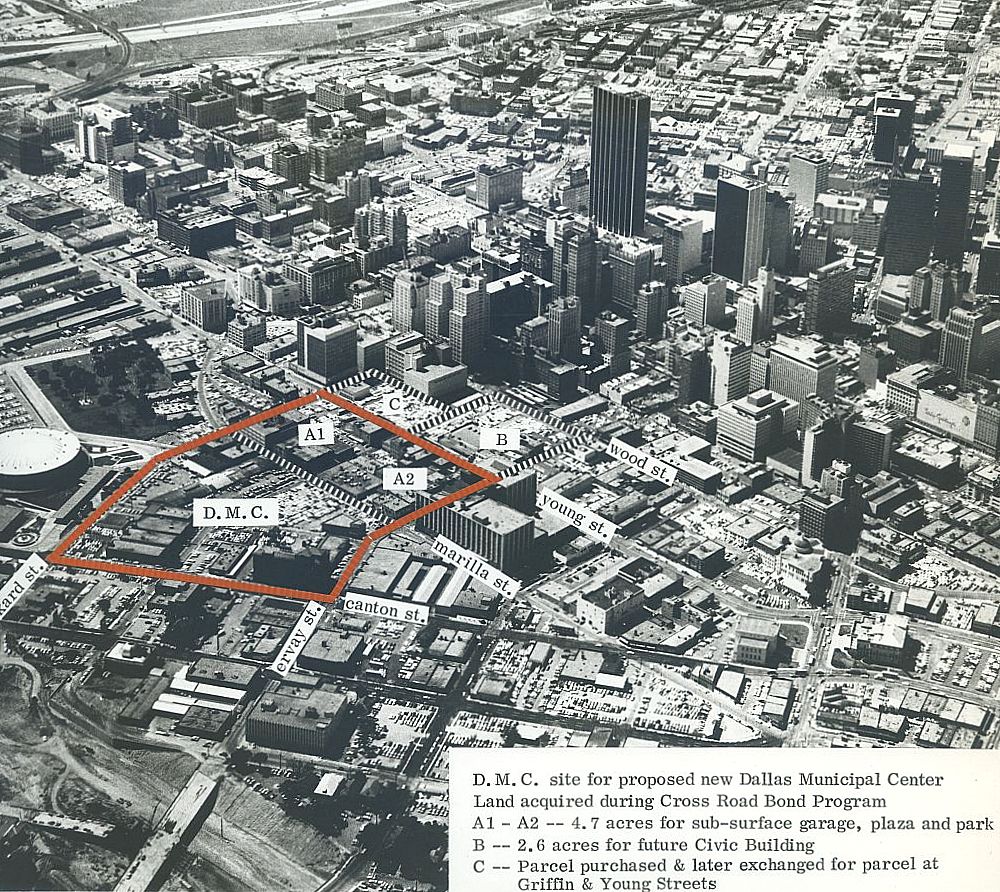
Aerial from 1967 (the original name of the project was the Dallas Municipal Center):
*

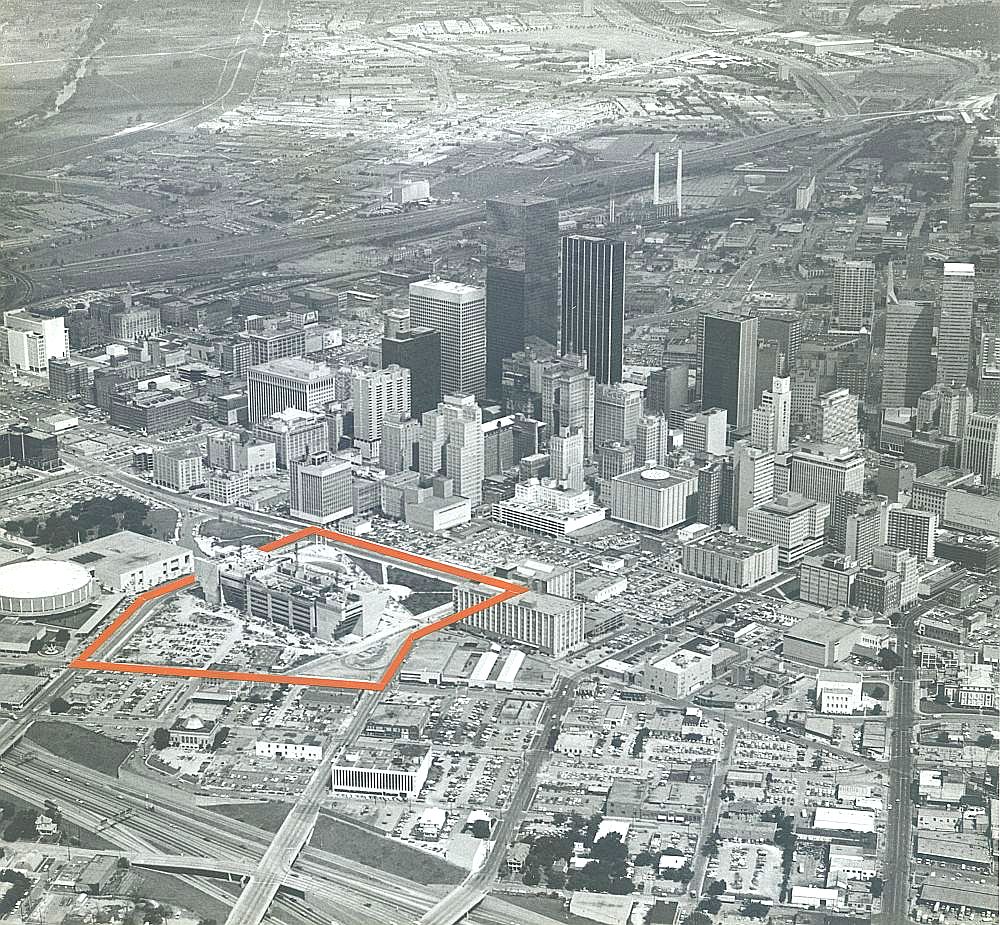
Aerial from 1976:
*

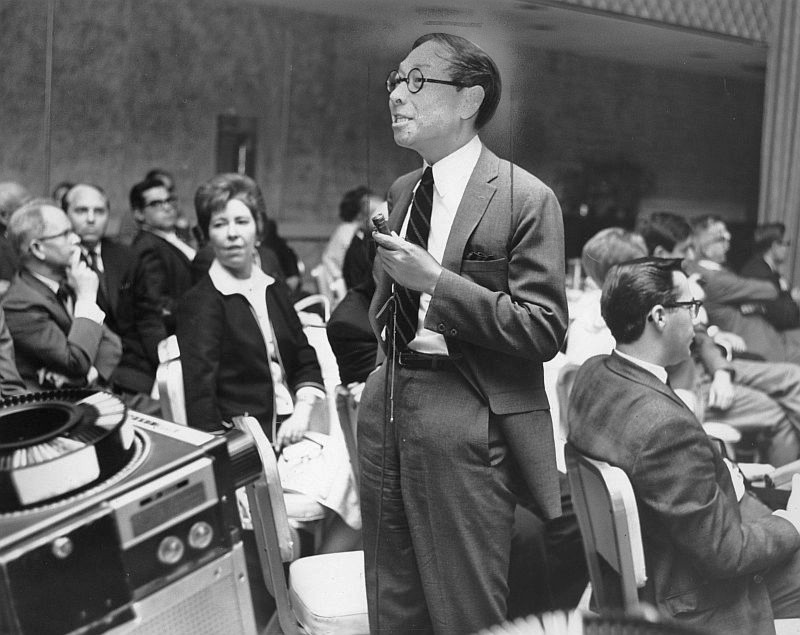
I. M. Pei giving a presentation in Dallas, in which he unveiled his vision for the new city hall (April 28, 1967, Dallas Times Herald photo by Ken Hardin):
*

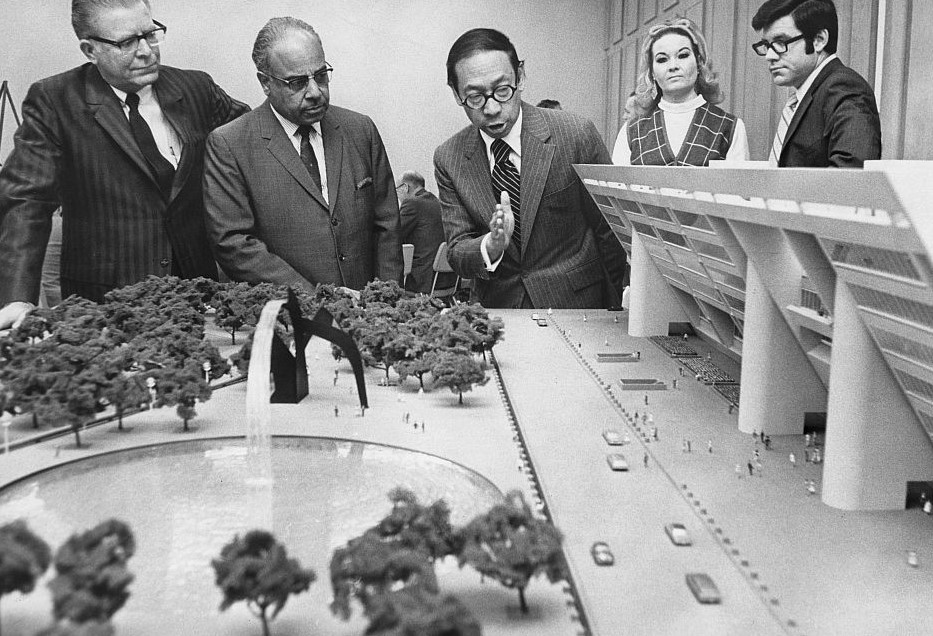
Showing off the futuristic-looking model to no doubt startled members of the Dallas City Council and city administration workers (October 5, 1970, DTH photo by Joe Gordon).
*

Construction, 1973:
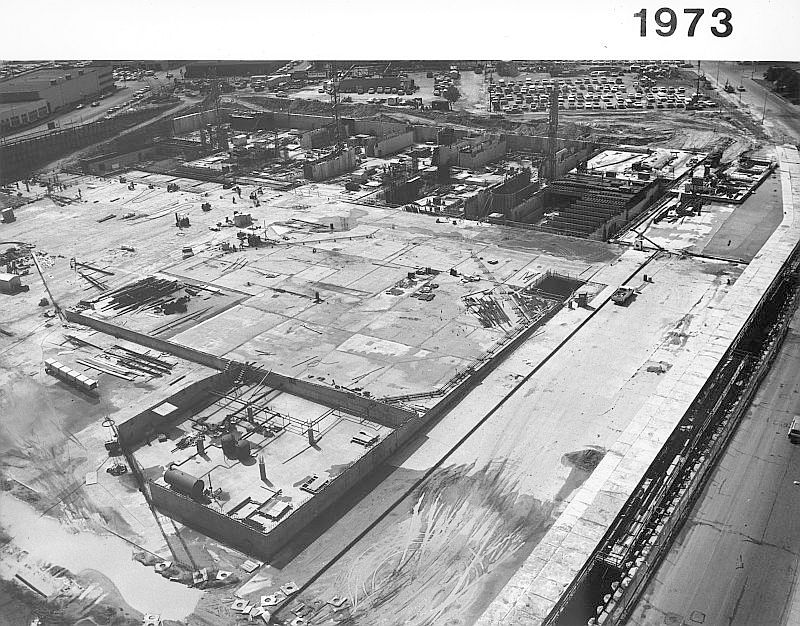
*

Construction, 1974:
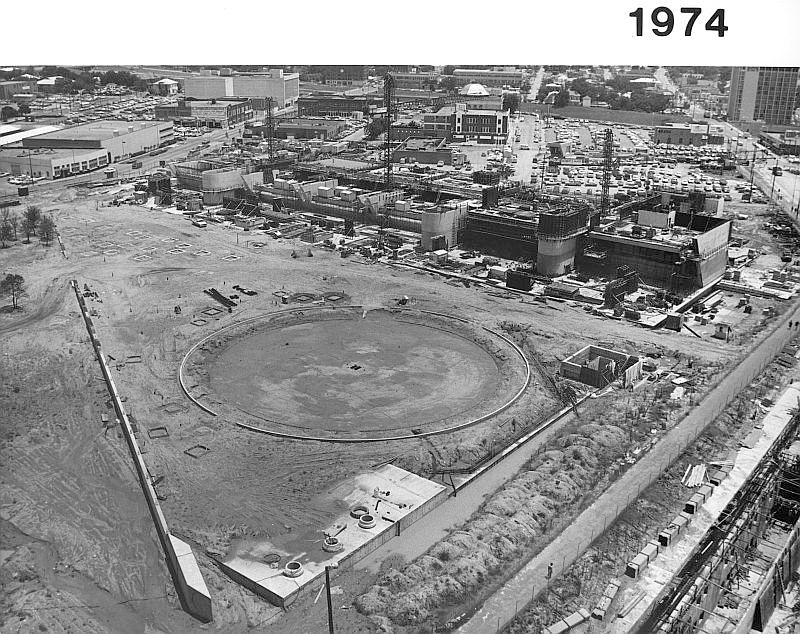
*

Construction, 1975:
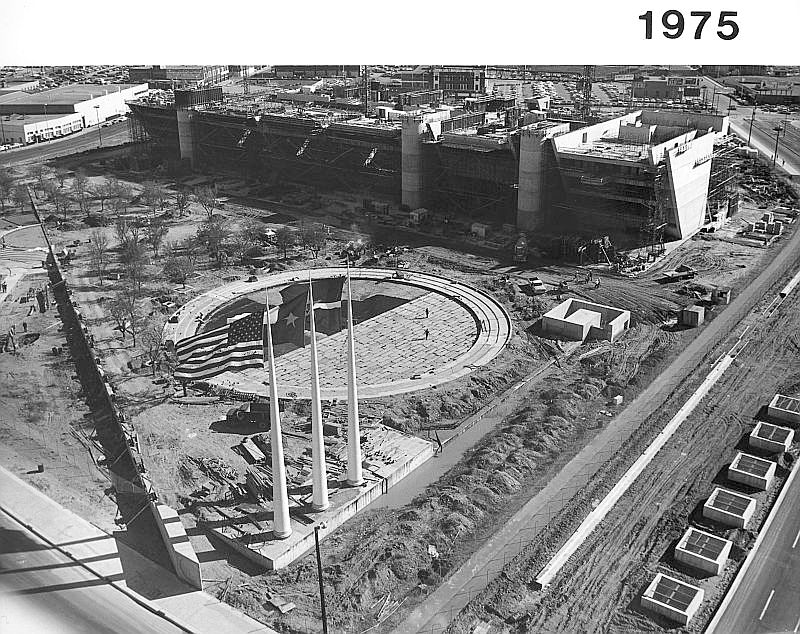
*

Construction, 1976:
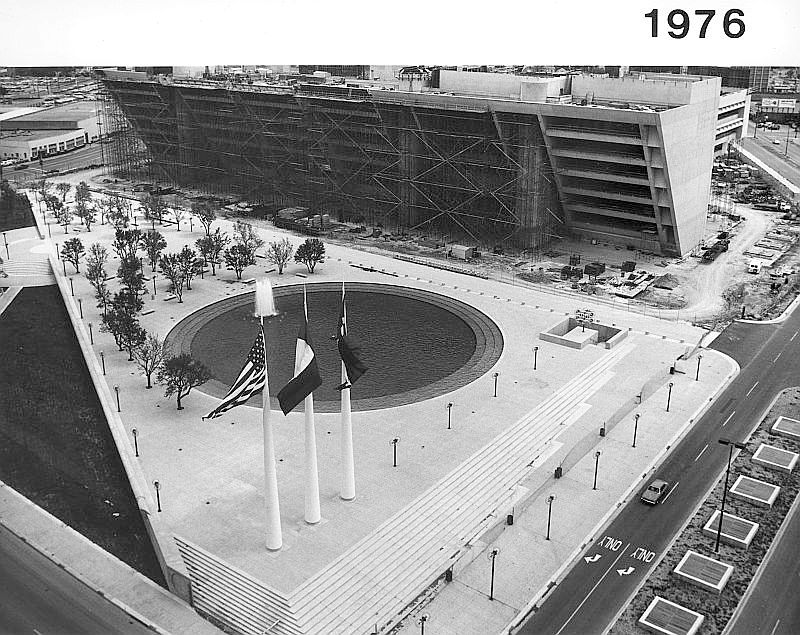
*

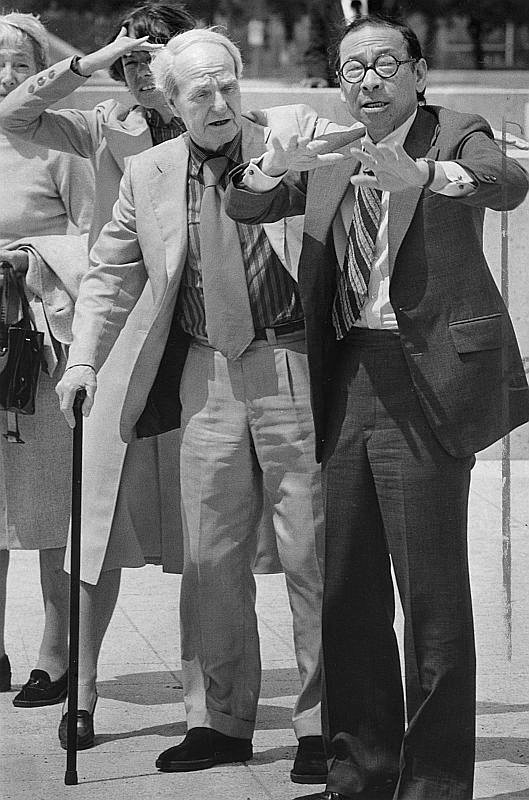
Pei shows British sculptor Henry Moore the site where his sculptural work The Dallas Piece will be placed on the City Hall plaza (April 14, 1976, DTH photo by Paul Iverson):
*

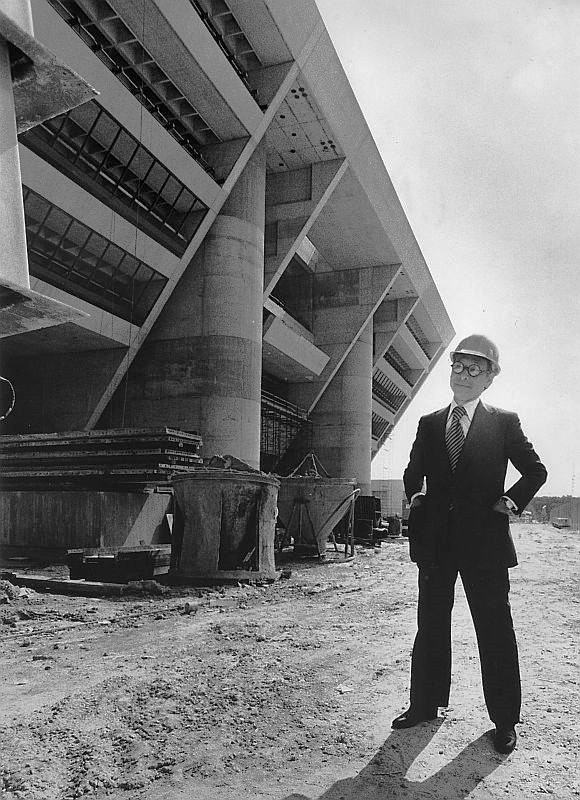
Pei in a hardhat, looking pleased (July 7, 1976, DTH photo by Jay Dickman):
*

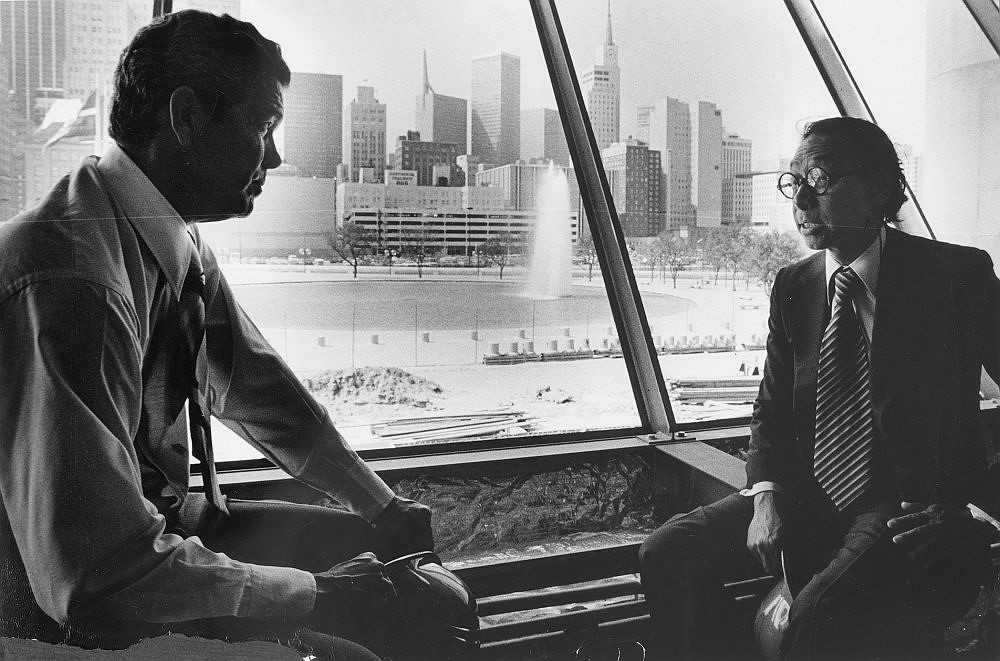
Pei with new mayor Robert Folsom, with a killer view of the Dallas skyline behind them (July 7, 1976, DTH photo by Jay Dickman):
*

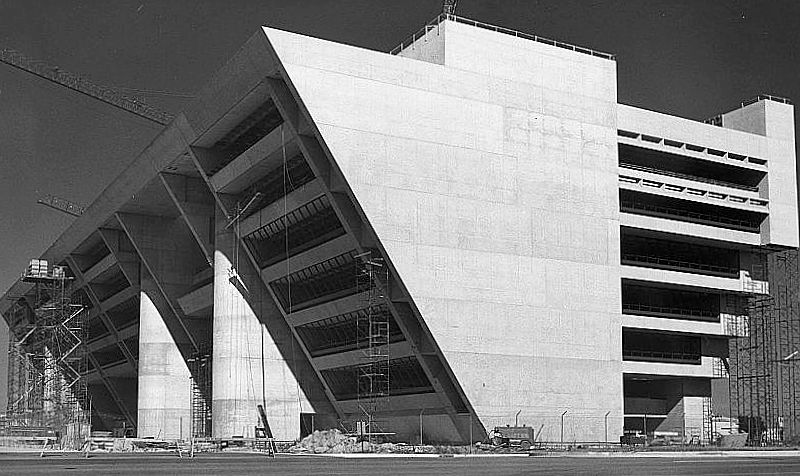
Side view, from Marilla:
*

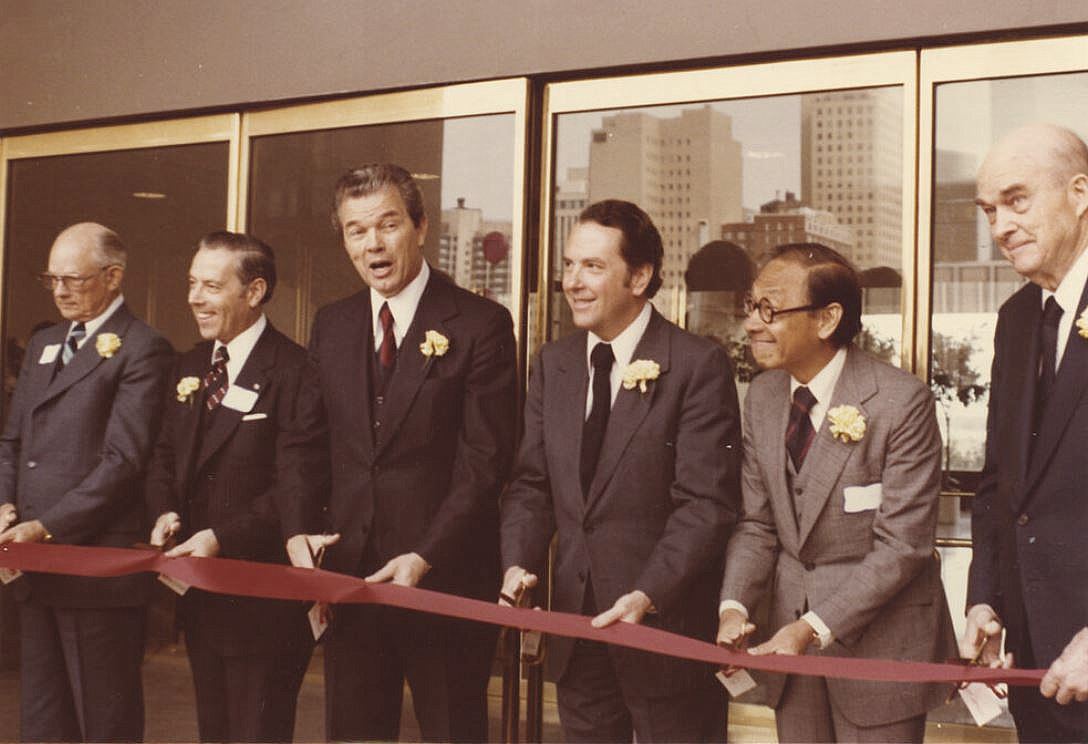
Finally, Dedication Day, March 12, 1978 — Pei is seen cutting the ribbon with (left to right) former City Manager Scott McDonald, current City Manager George Schrader, Mayor Robert Folsom, former mayor Wes Wise, and the man who started the whole thing rolling, former mayor J. Erik Jonsson (Pei said that his two greatest allies in the long slog to get the City Hall finished — and to continue with other projects in Dallas — were Schrader and Jonsson, both of whom he was quite fond of and considered friends):
*

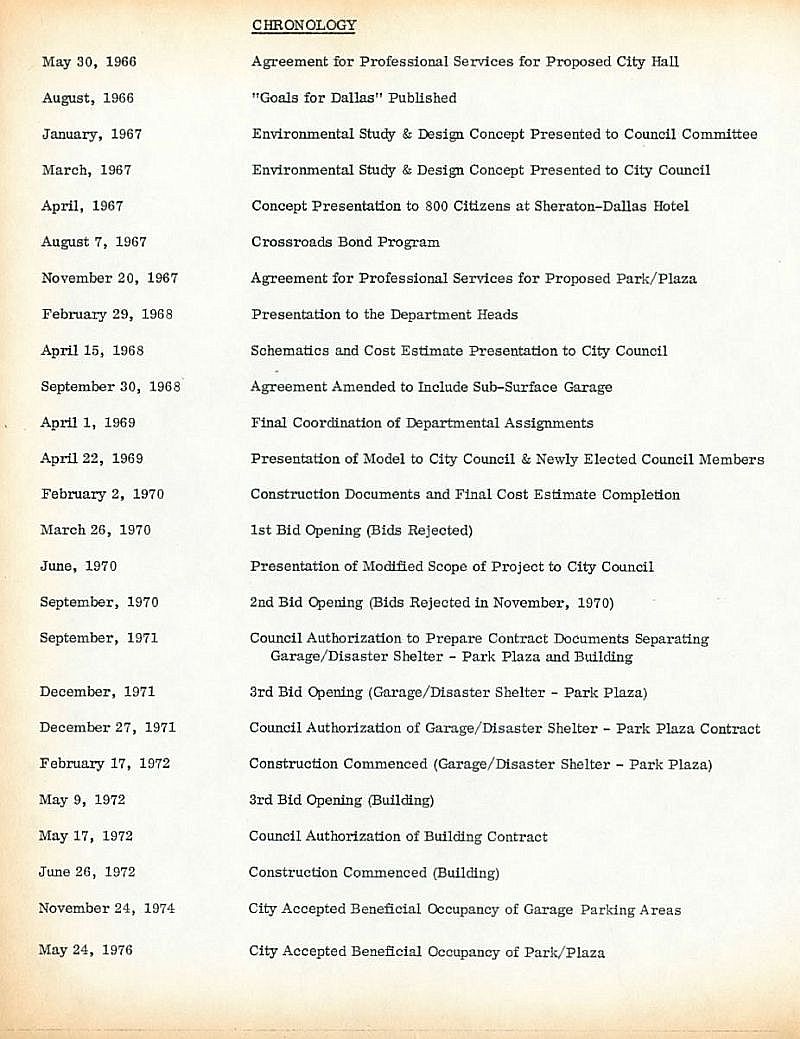
A chronology of the long, long trek to completion (at least up to 1976), prepared for the City by I. M. Pei & Partners:
*

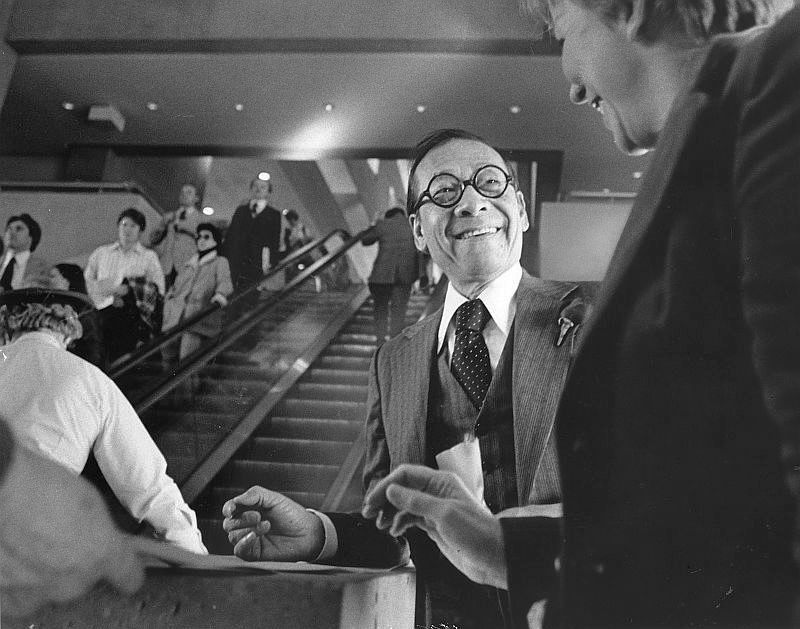
I. M. Pei in 1978, happy in Dallas (DTH photo by Phil Huber):
*

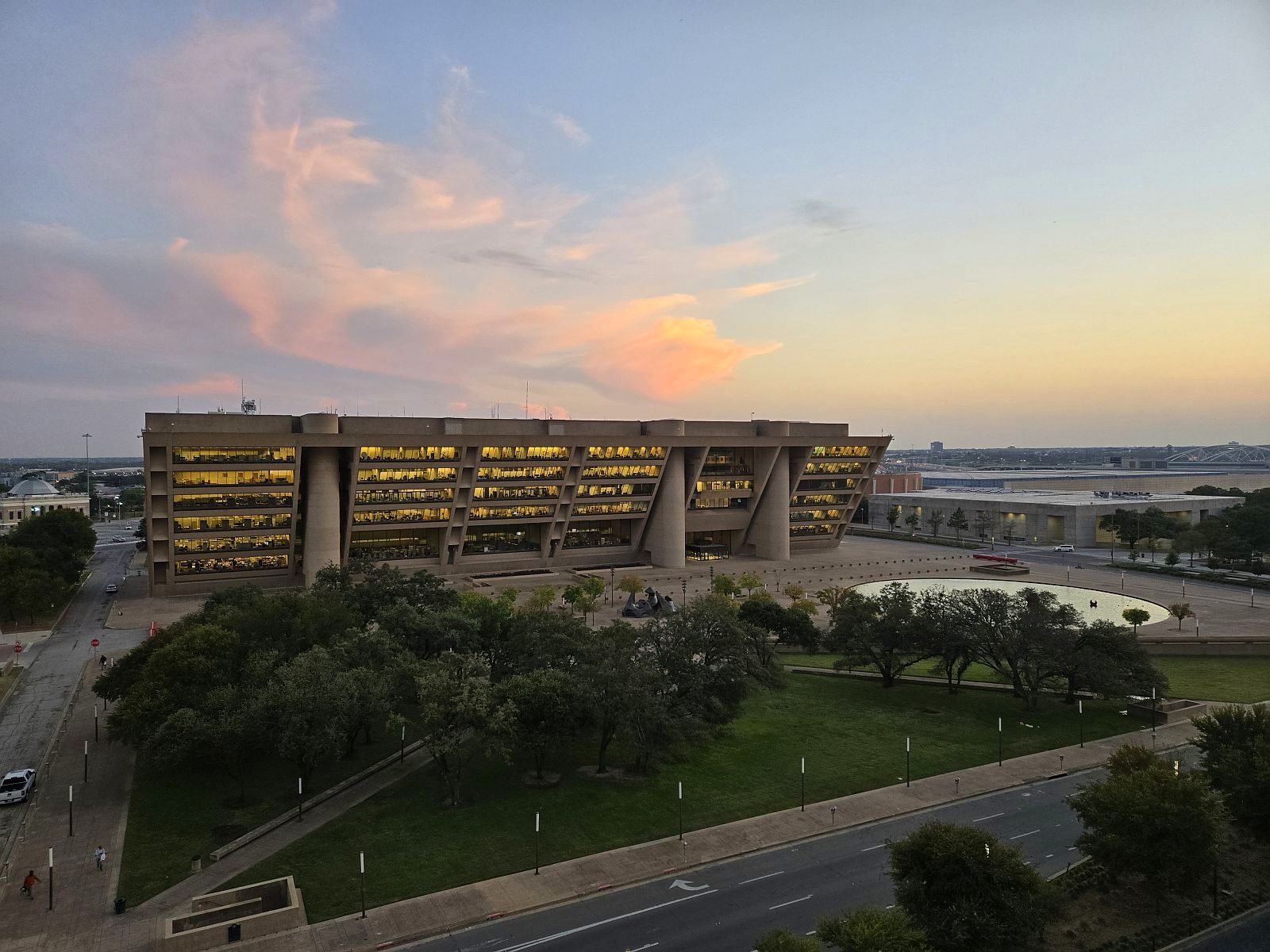
And in October 2025, our solemn City Hall at the end of another day, holding steady as downtown Dallas’ southern anchor.
***

Sources & Notes

Top and bottom color photos of City Hall taken by Paula Bosse on October 23, 2025 from the Central Library.

All other images are from various collections of the Dallas History & Archives division of the Dallas Public Library (including the Dallas Times Herald Collection and the Juanita Craft Collection). All images are used with permission.

Construction photos, “Goals for Dallas” quote, color model photo, and chronology are all from the presentation binder Dallas Municipal Center by associated architects I. M. Pei & Partners and Harper & Kemp (July 5, 1976) (Dallas History & Archives/Dallas Public Library call number R690.513 D145).

The 2002 quote from Pei about City Hall is from I. M. Pei: An Oral History Interview, conducted in New York City on August 1, 2002 by Bonnie A. Lovell for the Dallas Public Library. Ostensibly about Pei’s involvement in commissioning the Henry Moore sculpture, this is an entertaining read/listen, as Pei discusses the larger City Hall project and his affinity and admiration for the city of Dallas and its citizens (audio recording and 48-page transcript with index, Dallas History & Archives/Dallas Public Library call number 730.92 M822YP 2003) — you can listen to the recording and read the transcript on the Dallas Public Library Recollect Digital Collections page here.

*

Copyright © 2025 Paula Bosse. All Rights Reserved.
Time to Fall Back, Unless You’re Hanging from the Mercantile

“Fall back” at 2 AM…

by Paula Bosse

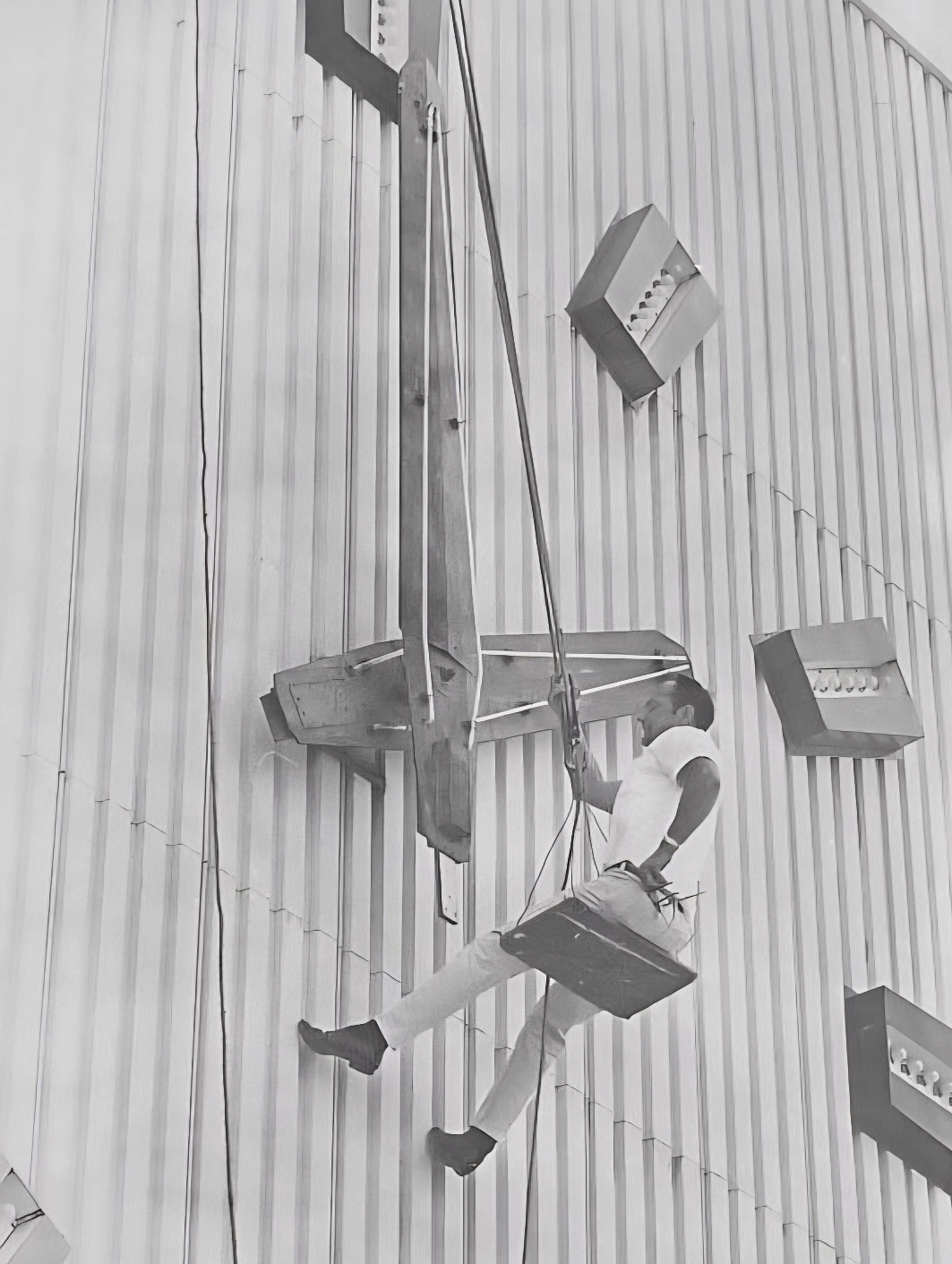
The poor Merc is having a rough time of it at the moment. Here’s a photo from happier days, when it was the Mercantile Bank Building, getting some sort of touch-up to one of its clock faces. Which, by the way, should remind you to turn your clocks back in the wee hours of Nov. 2!

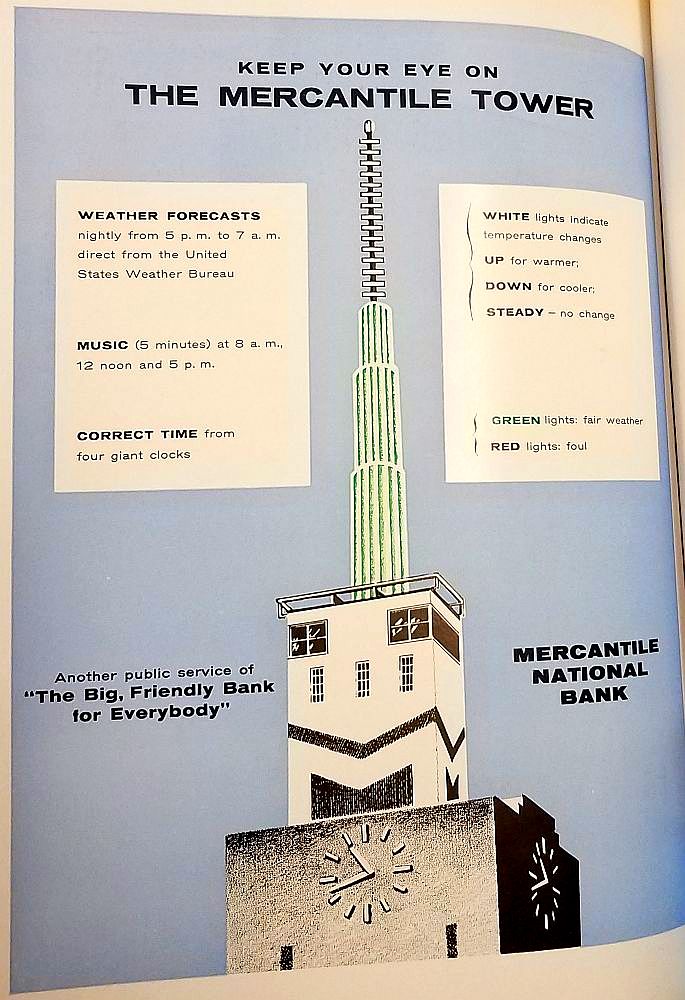
That tower used to do a lot. And all four clock faces had the correct time — all at the same time!

***

Sources & Notes

Photo from the Richards Group Collection, Dallas History & Archives, Dallas Public Library (accession number PA83-3/40).

Mercantile National Bank ad from Dallas magazine, sometime in 1956:

See the Merc in all its early-days glory in these posts:

*

Copyright © 2025 Paula Bosse. All Rights Reserved.
Whimsy on Main Street — ca. 1906

by Paula Bosse

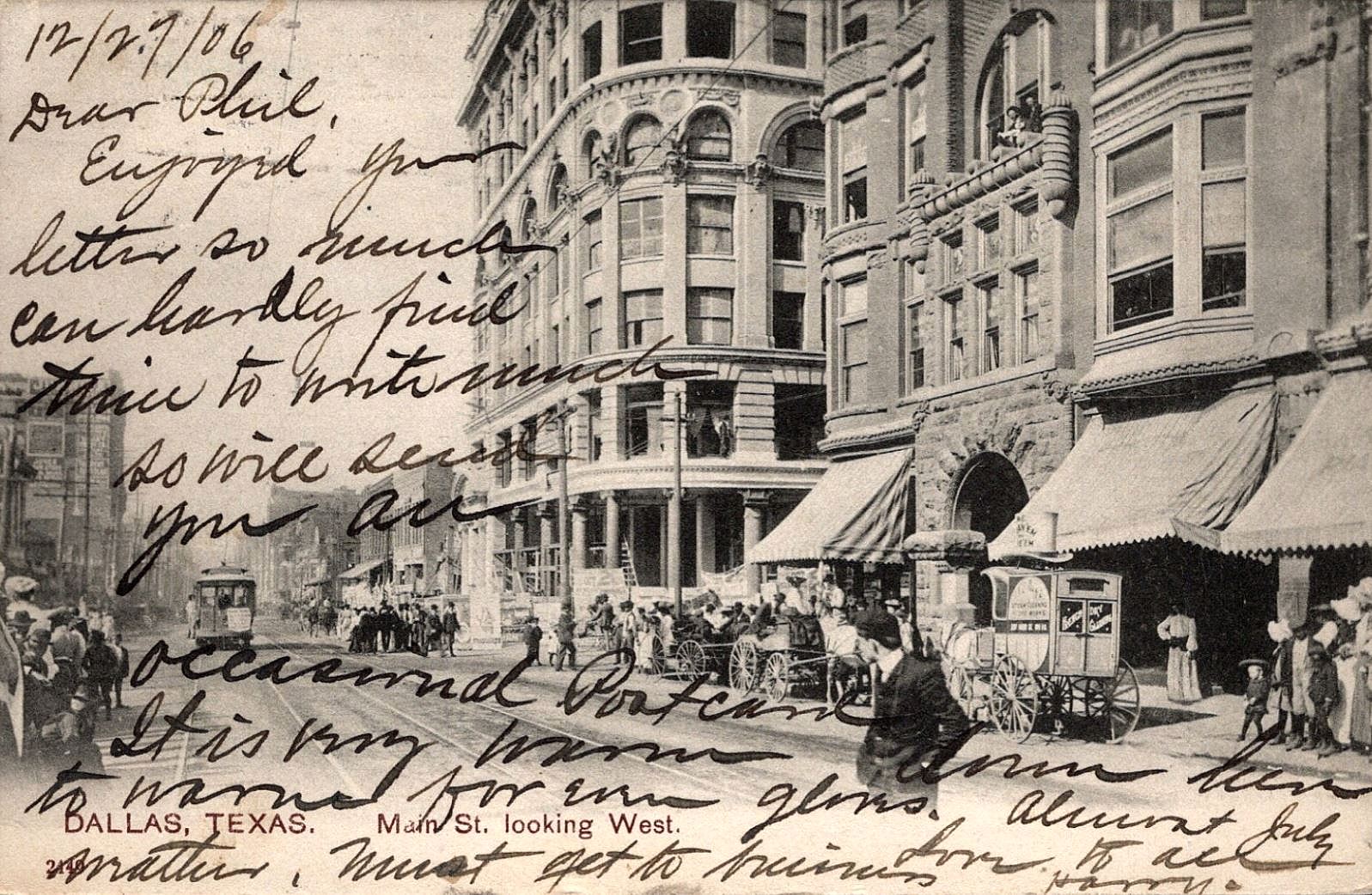
I’ve seen a lot of postcards with views of “Main St. looking West,” usually taken from about Ervay, with the Wilson Building as the architecturally impressive centerpiece. But I don’t think I’ve seen this one. I don’t know when the photo was taken, but it was mailed at the very end of 1906. It looks like the new Wilson Building (which opened in 1904) may still have construction work going on, at least on the ground floor.

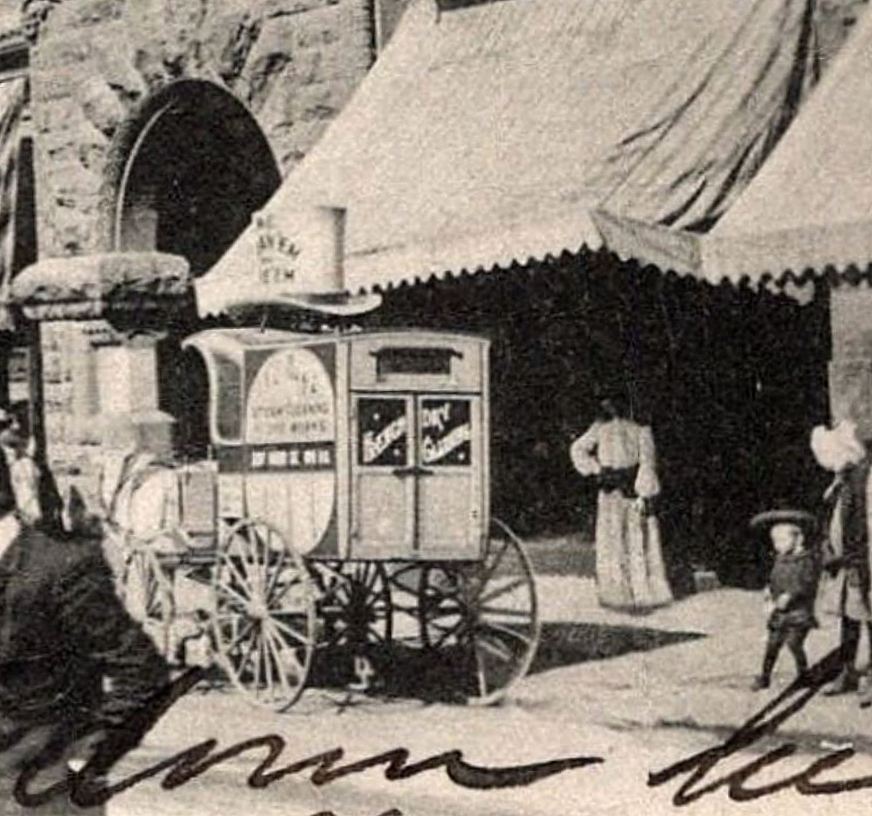
But “whimsical”? Take a look at the horse-drawn dry-cleaning-company delivery wagon on the lower right side of the card. It’s got a GREAT BIG TOP HAT on it! Maybe this sort of thing was popular in the early years of the 20th century, but I’ve never seen anything like this on the streets of Dallas in photographs or postcards of this period. Until now. I love it!

*

The postcard — written and mailed on December 27, 1906 — was addressed to “Master Phillip Wyman” in Yonkers, New York. The sender — identified only as “Harry” — sent this message to Phil, probably a young family member:

Dear Phil, Enjoyed your letter so much. Can hardly find time to write much so will send you an occasional postcard. It is very warm down here, to[o] warm for even gloves. About July weather. Must get to business. Love to all, Harry

Too warm for gloves — in December! Imagine! I bet Master Wyman — who was no doubt shivering up in Yonkers — had his young mind blown. (I wonder if he noticed the big top hat?)

***

Sources & Notes

Postcard from eBay.

*

Copyright © 2025 Paula Bosse. All Rights Reserved.

Tooling Around Munger Place — ca. 1913

Snazzy motor car parked in front of 5109 Swiss Avenue

by Paula Bosse

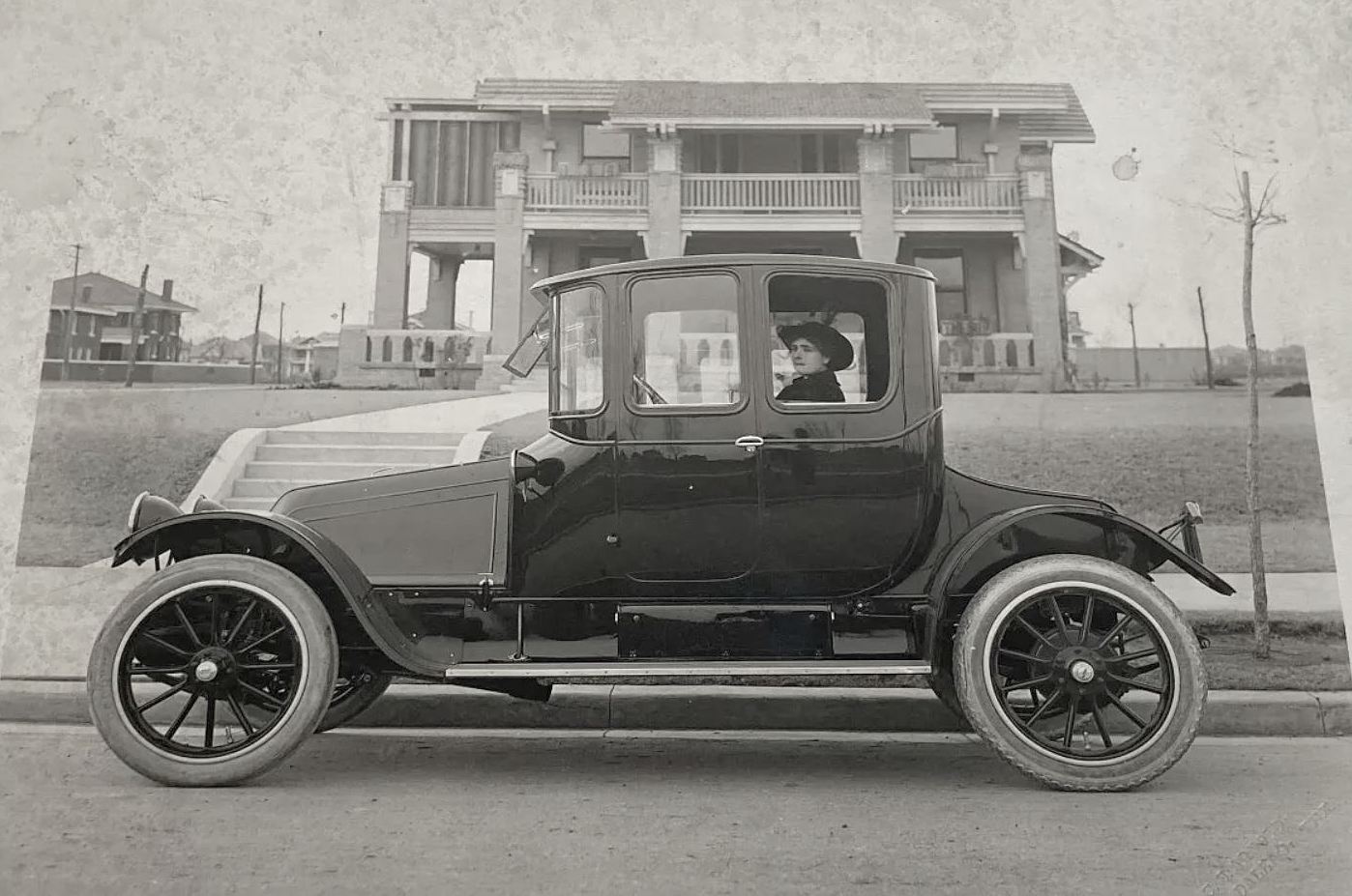
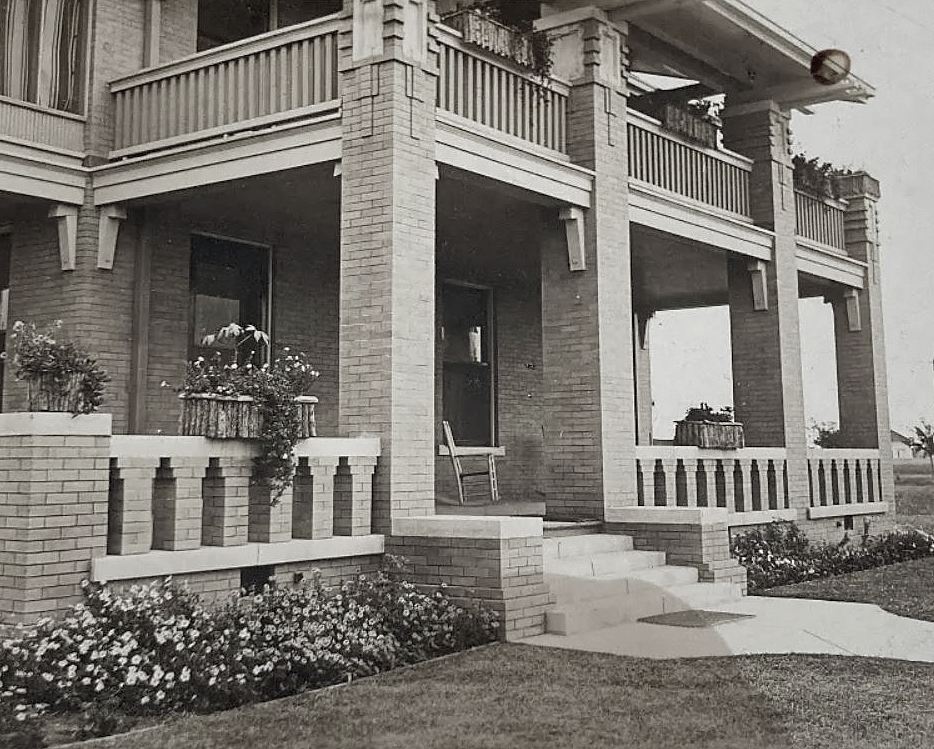
This arresting photo shows a woman in the driver’s seat of what appears to be a “ladies'” electric car (possibly a Detroit Electric, although I can find no models that look like this one…), parked in front of an unusual-looking Swiss Avenue home, complete with a second-story sleeping porch and virtually no landscaping. The photo — taken by notable Dallas photographer Charles Erwin Arnold — is currently offered on eBay.

Here’s a view of the entrance to the house which, as noted on the reverse, is at 5109 Swiss Avenue.

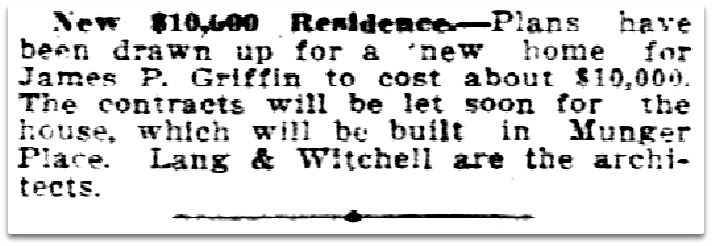
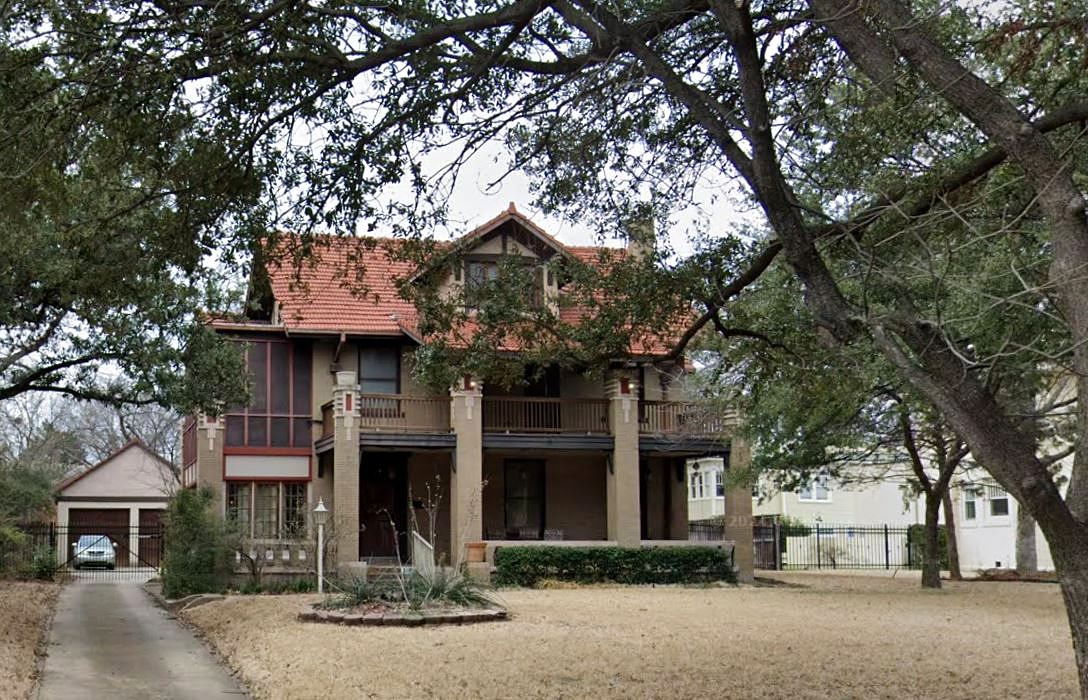
The house was built in 1911/12 and was designed by Lang & Witchell (architects to the rich and richer), who were busy drawing up house plans for people up and down Swiss (they were so prolific that it seems like most of the buildings built in Dallas at the time came from their drafting tables!). This house was commissioned by James P. Griffin (president of the Texas Electric Railway Co.) and his new wife, May Burford Griffin (daughter of Dallas pioneer Judge Nat Burford).

Dallas Morning News, Sept. 13, 1911

The house is still standing but has been remodeled, as is mentioned in various real estate ads over the years. (At one point, there was a reference to a kitchen with marble floors, which… I’m not sure I’ve ever seen marble floors in a kitchen. I don’t know if they were original to the house — or are still there — but, whatever the case, that is très élégant.)

The house can be seen in recent years in an Ebby Halliday listing from 1982, in an undated photo on Douglas Newby’s Architecturally Significant Homes website, and on the Swiss Avenue Historic District website. The image below is a Google Street View from Feb. 2023.

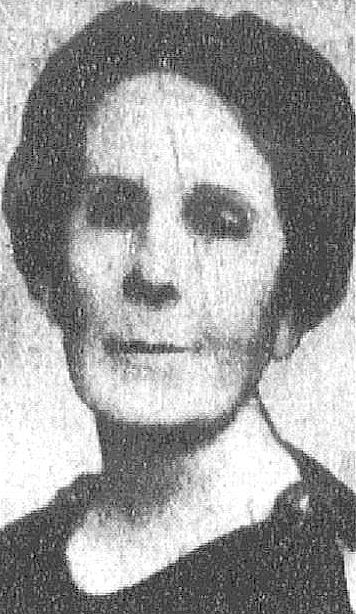
I assume that the woman in the car is Mrs. Griffin, seen below in later years. In the photo, she would have been about 32.

I love that car. And I love that house, which looked very modern 112 years ago!

***

Sources & Notes

The circa-1913 photos are from a current listing on eBay. I posted the top photo on my Patreon page less than a week ago, and reader Tom R. identified the house. I think the second photo has been added in the past couple of days, because I’m pretty sure it wasn’t there when I wrote that post! Someone might have contacted the seller to ask if it might be a house on Swiss Avenue, and they realized they had another photo of the house, which they added to the listing. …And increased the price significantly! These are such cool photos. If I were the current owners of this Swiss Ave. house, I would be all over this!

Thanks to Tom and William for their helpful comments on my original Patreon post (“Super-Cool Car, Super-Cool House”).

*

Copyright © 2024 Paula Bosse. All Rights Reserved.
Dome, No Dome, Dome

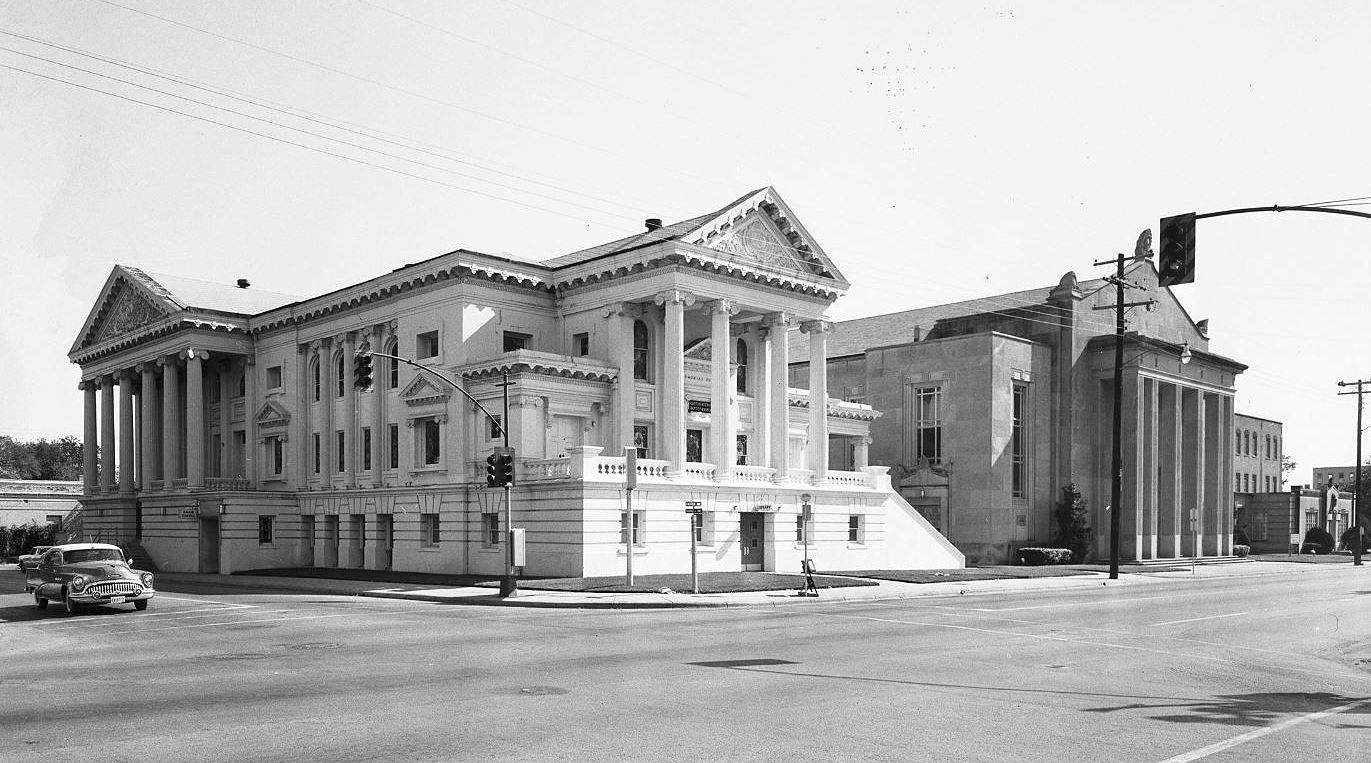
Gaston Ave. Baptist Church, ca. 1961, domeless

by Paula Bosse

Gaston Avenue Baptist Church, at Gaston and Haskell, opened to its congregation in 1904. (The photo above is from about 1961.) The church was designed by architect C. W. Bulger, whose most important Dallas building was almost certainly the Praetorian Building downtown. Bulger was a prominent architect and a prominent Baptist — he designed several Baptist churches, and, conveniently, he lived on Junius Street, not far from the Gaston Avenue church.

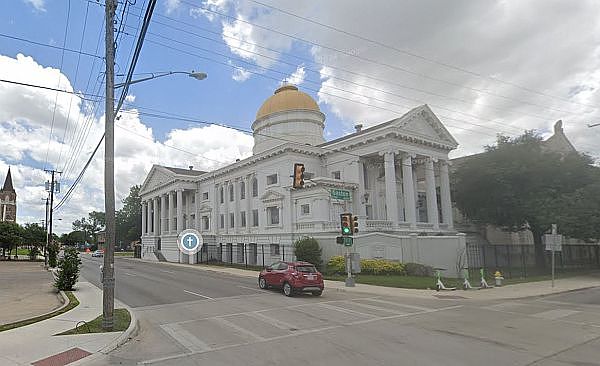
This building is imposing and impressive, but every time I drive past it, something just feels “off.” (See it on Google Street View here.) It’s that canary-yellow “gold” dome. Otherwise, it’s a beautiful building.

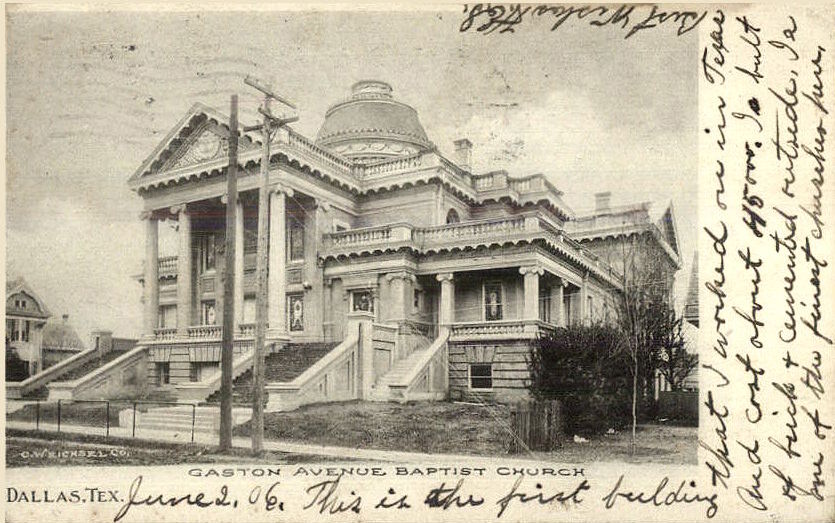
Here’s what it looked like in its earliest days:

This postcard was postmarked June 2, 1906 — the message reads:

June 2, 06. This is the first building that I worked on in Texas and cost about 45,000. Is built of brick and cemented outside. Is one of the finest churches here. Best wishes, H.E.S.

And another:

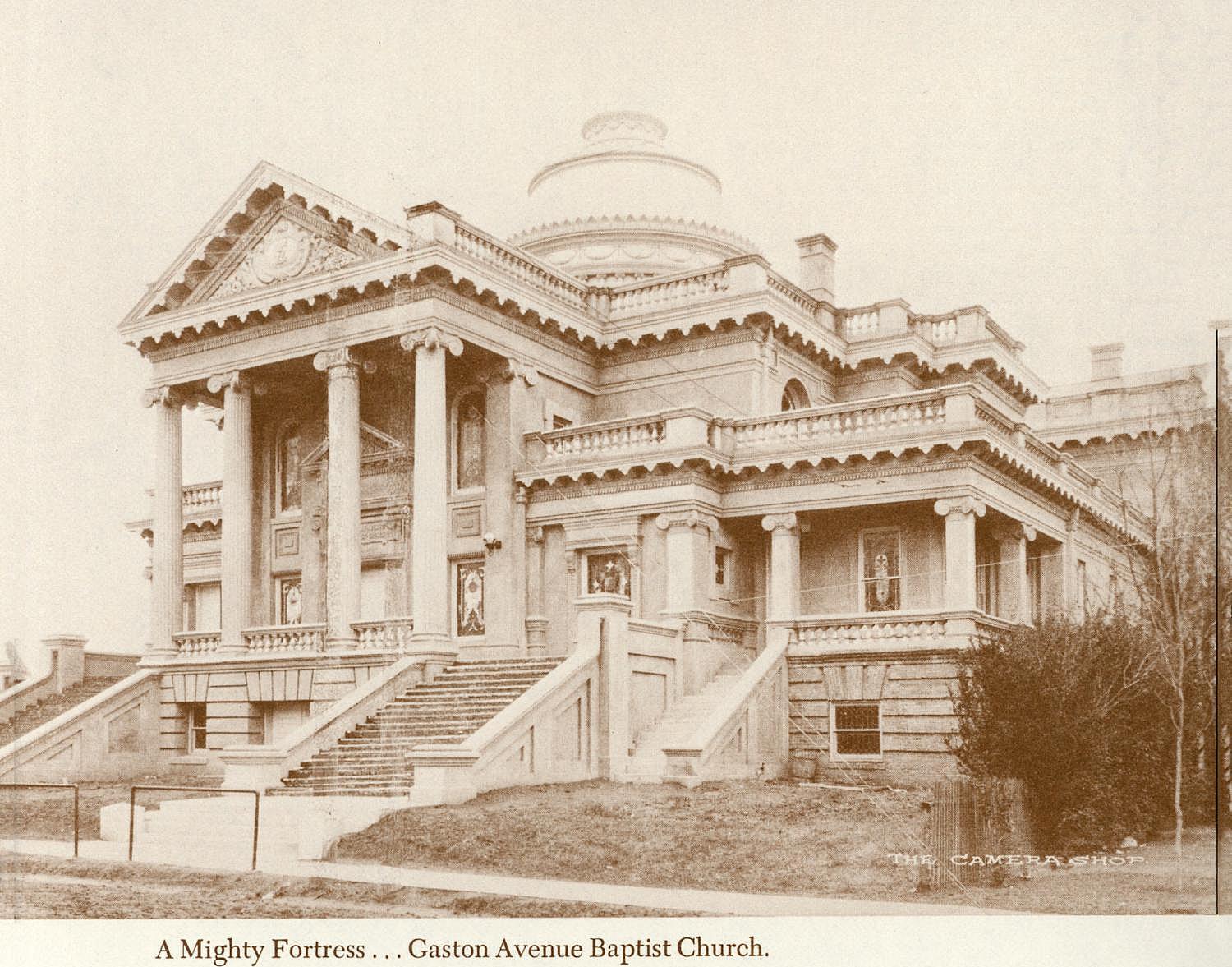
When you compare the early photos with the one from 1961, there are a few differences. Namely… the dome (…or lack thereof). It was built with a dome. But by 1961, the dome was gone. Why?

Here is what the building looks like these days (it is now the home of Criswell College):

Google Street View, June 2024

Dome.

What’s the deal here? I hate to be a negative Nellie, but every time I drive past that dome (which is often), I wince. It looks like sun-faded matte gold paint. It’s a beautiful building. It deserves a better dome!

After searching a bit, here’s what I found. In response to a reader’s question in 1991 asking what the “golden dome” was made of, The News responded:

MFG Molded Fiberglass in Union City, Pa. fabricated it of 1/2-inch molded fiberglass impregnated with gold-flecked paint… Both the dome and the bay section — the white collar that protrudes from the roof line — are composed of 12 separate pieces… The dome’s cap is composed of four pieces… and the spire that tops the structure is a single unit… [T]he structure stands approximately 35 feet above the roof of the library and weighs about 6,000 lbs. (Dallas Morning News, June 6, 1991)

Fiberglass, impregnated with gold-flecked paint. I don’t know when this happened, but more than 33 years ago. The gold-flecked paint has seen better days, beaten into submission by the relentless Texas sun. I’m sure it would probably cost a small fortune to spruce it up, but it would be nice to see it gold and shiny.

***

Sources & Notes

Top photo by Squire Haskins, from the Squire Haskins Photography, Inc. Collection, University of Texas at Arlington Libraries, Special Collections; more info on this photo is here (see interior photos taken by Haskins at the same time here and here).

Postcard was found on eBay.

The photo captioned “A Mighty Fortress” is from a TSHA Annual Meeting 1977 publication, via the Portal to Texas History.

*

Copyright © 2024 Paula Bosse. All Rights Reserved.
Flashback Newsflash: Working at the Library

“Central Research Library”

by Paula Bosse

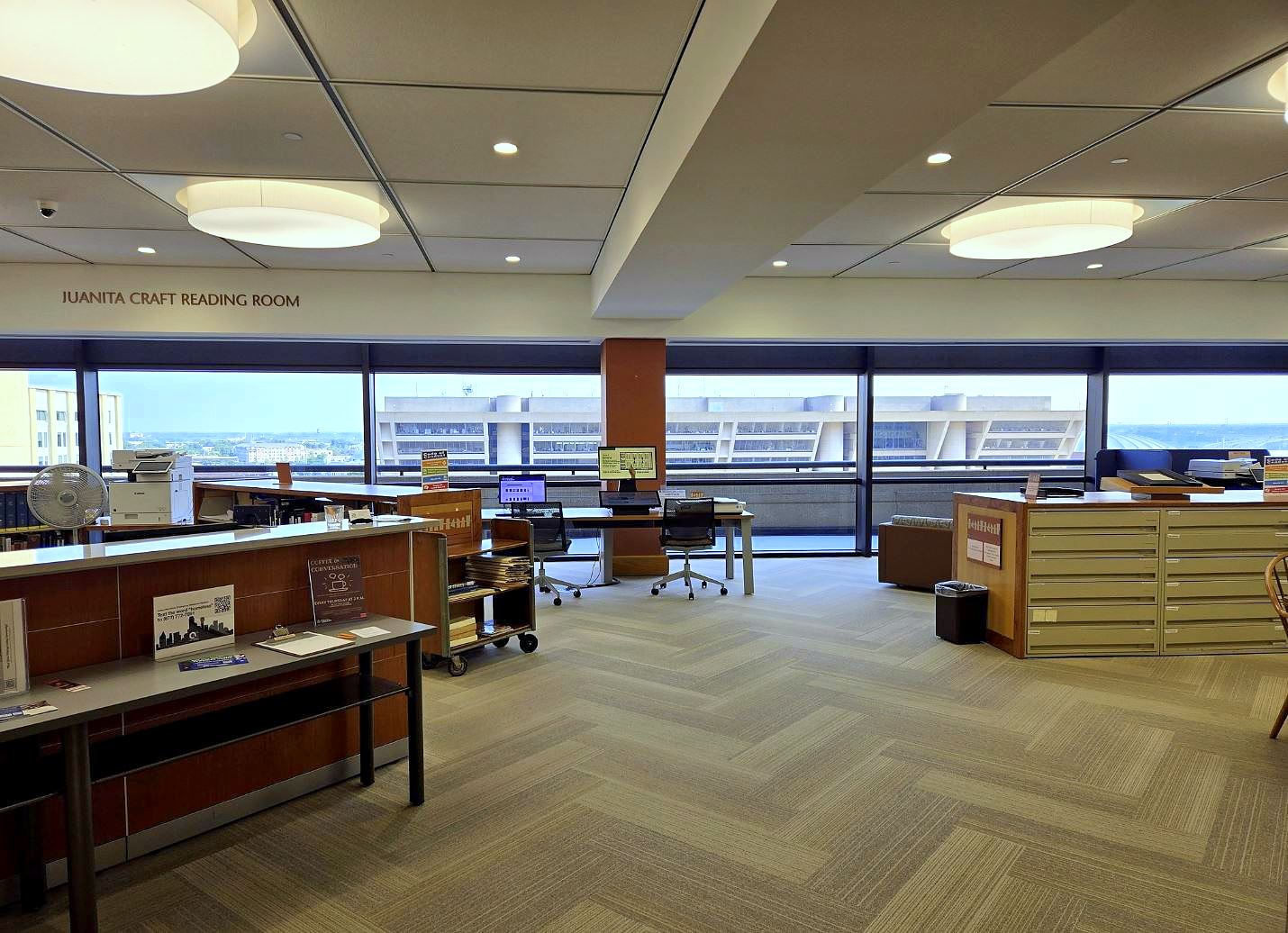
I have news: I am now working on the Dallas History and Archives floor at the downtown Dallas Public Library! I am surrounded by so many interesting things every day that it’s hard not to be distracted by all the photos, maps, books, manuscript collections, etc. Cool stuff everywhere. And great co-workers!

I might as well take this opportunity to share a few tidbits about the building (at 1515 Young Street, facing City Hall).

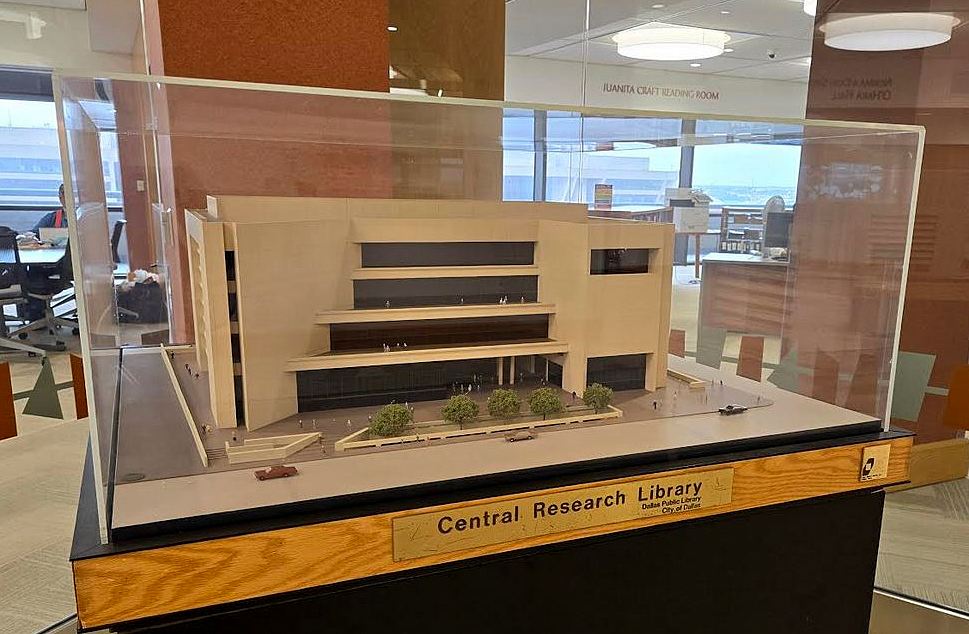
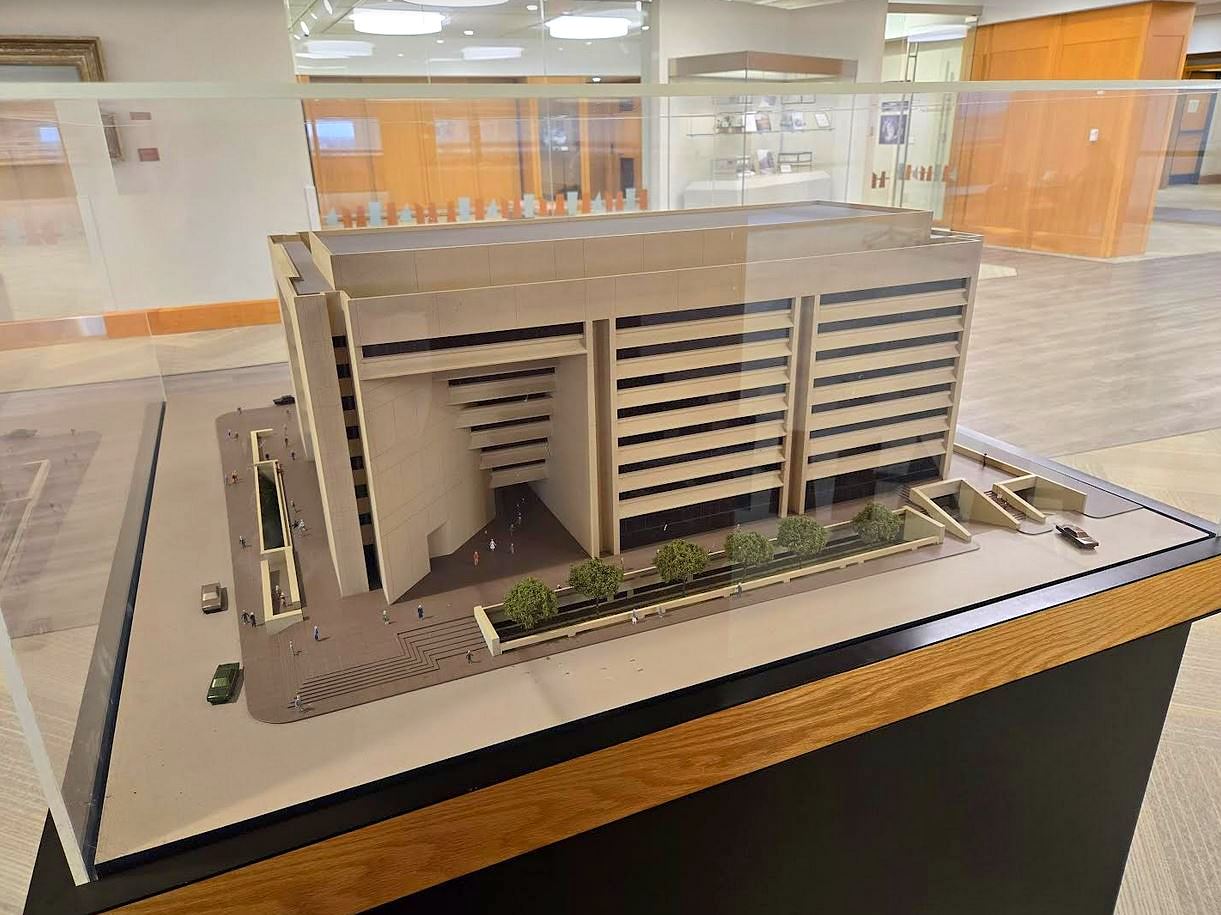
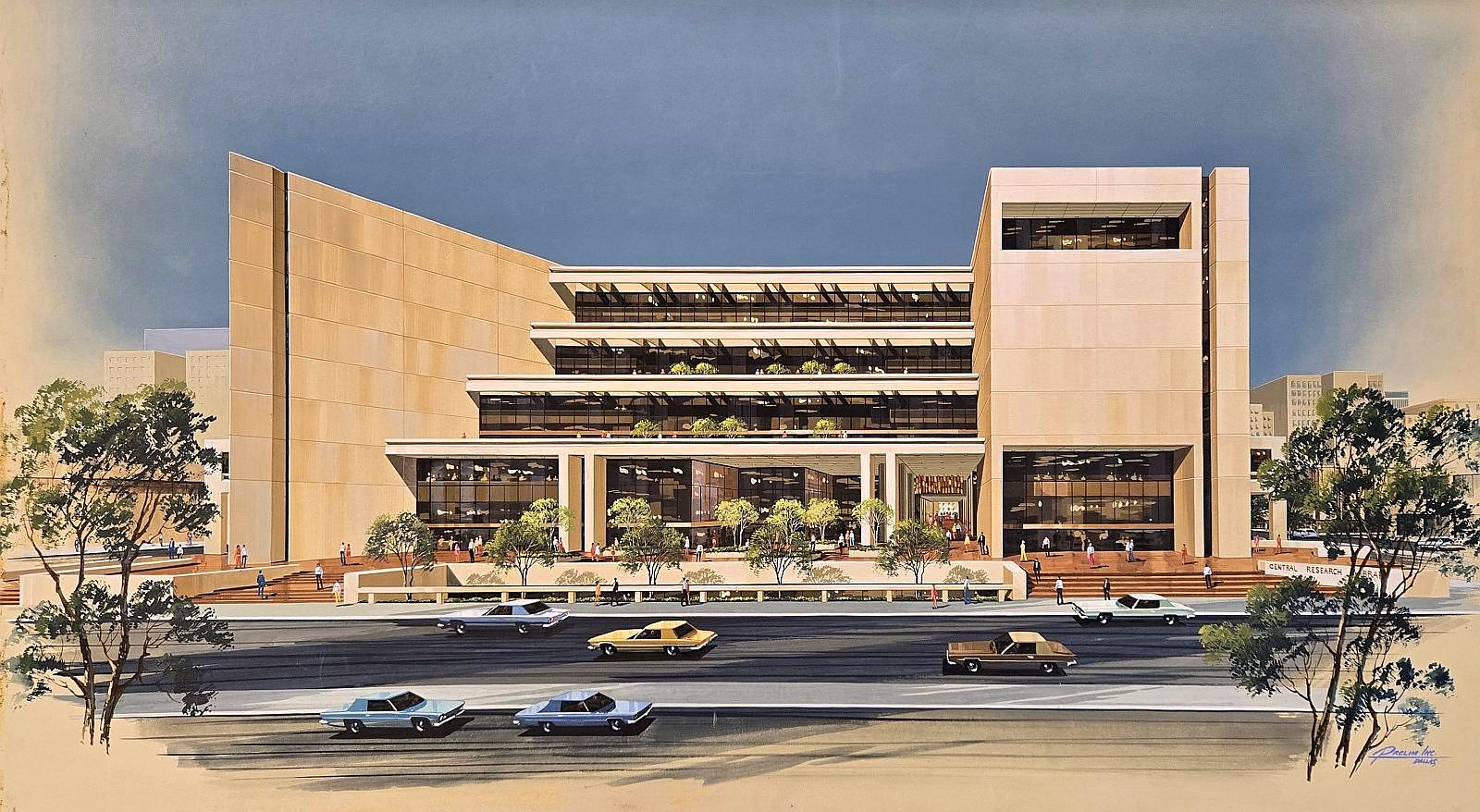
As you can see from the 3-D architectural model above (the model is on permanent display on the 7th floor), the library was originally referred to as “Central Research Library” when it opened in April 1982 (it was later renamed the J. Erik Jonsson Central Library, in honor of the former mayor). I’m not sure I knew that. Here’s another photo, showing the Wood Street side of the model:

When this library opened, it was the only major library (in the world, I think) that had its entire collection cataloged electronically. Bye-bye to card catalog files and their cute little drawers and hello to desktop computers, 50 of which were donated by Texas Instruments (Erik Jonsson was a founder of T.I.). These were for use by patrons, and, for many of them, these computers were their first experience with a personal computer.

Here is another interesting factoid from a Dallas Morning News article touting the new library’s innovations:

Special exhibits are housed in rooms protected by halon gas, an oxygen-consuming gas that will be released if a fire breaks out, removing all the oxygen and starving the fire. (DMN, April 18, 1982)

The architects were Fisher & Spillman, and they designed the building to be something of a stylistically sympathetic companion to I. M. Pei’s City Hall right across the street. This is the view of it I see every day (and, yes, I think of RoboCop every day):

I can’t believe this building — which I still think of being fairly “new” — is 42 years old. Time flies. Read about the journey of this library, from bond proposal to dedication, in a D Magazine article by my co-worker Brandon Murray, here (check out the slideshow).

DPL_architects-drawing_DPL-archives

*

I’m very excited about my new job, surrounded by Dallas and Texas history. Much of my childhood was spent in my local library (the Lakewood Branch), and the occasional trip to the downtown library on Commerce Street, which predated the one I now work in, was always something of a magical experience. And now I’m back, just on the other side of the desk.

If you’re ever in the neighborhood, stop by and say hi!

***

Sources & Notes

All photos by me, taken in the summer of 2024.

The architectural rendering by Fisher & Spillman is from the Dallas Public Library Archives.

A version of this post appeared on the Flashback Dallas Patreon page.

*

Copyright © 2024 Paula Bosse. All Rights Reserved.
Second Presbyterian Church — 1905

Live Oak & Germania (Liberty)

by Paula Bosse

Hello! I’ve been gone for a while — the longest period of not posting here since I started 10 years ago! Life has been chaotic for the past month or two, but things have settled down a bit, and it’s good to be back.

I’m cheating a bit with this post, as it’s basically a reworking of something I put up on the Flashback Dallas Patreon page a few weeks ago, but I’m a big fan of this church building and thought I’d go ahead and share it here.

*

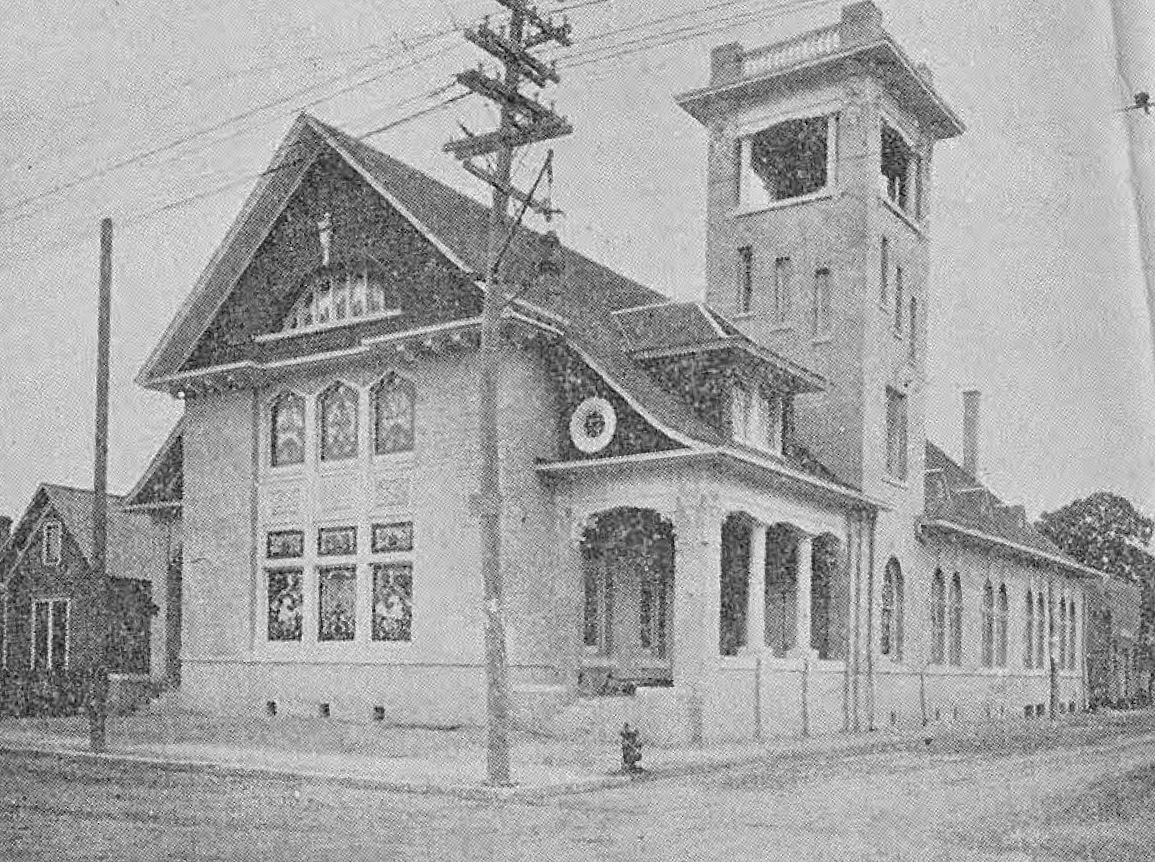
I love this building. The design is so interesting — I don’t think I’ve seen another church that looks quite like this one. It was built in 1904 (the first service was in March 1905), and the architects were Sanguinet & Staats of Fort Worth, who had designed the beautiful Wilson Building downtown a couple of years earlier.

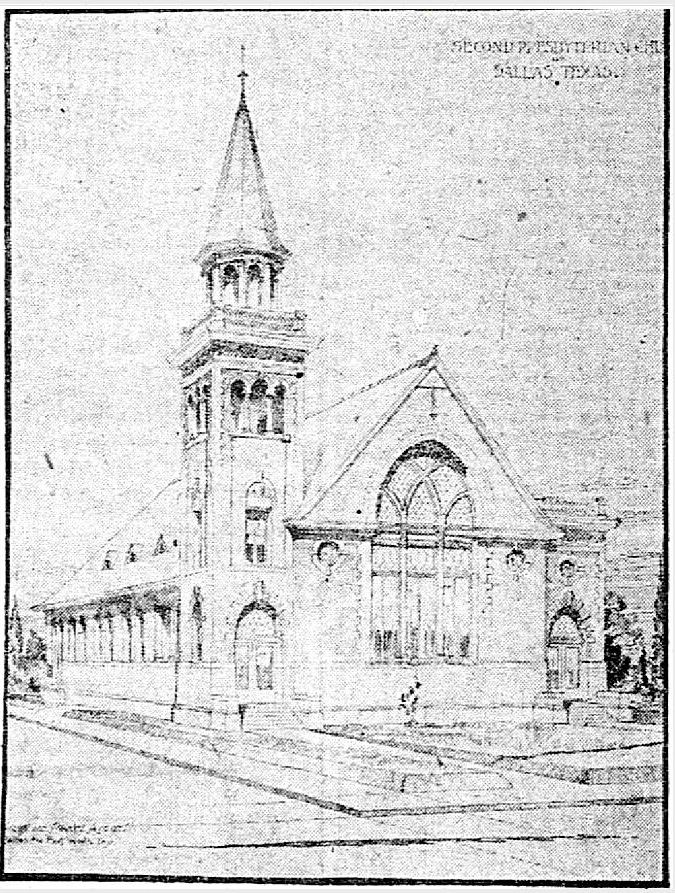
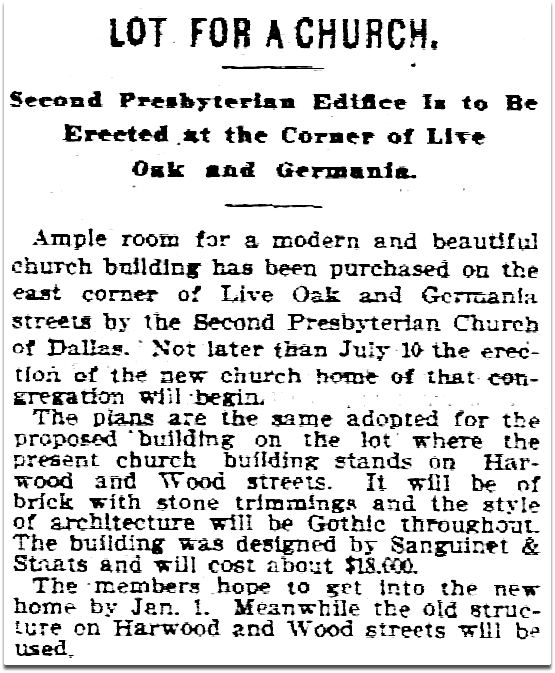
The Second Presbyterian Church sat on the southeast corner of Live Oak and Germania (the latter street name was changed to “Liberty” during WWI, for patriotic reasons). Below is the original design, when a new building was to have been built on the church’s then-current property at the northwest corner of Wood and South Harwood — the Presbyterians sold the corner property to the Methodists not long after this drawing was published in The Dallas Morning News on Feb. 16, 1904 and decided to relocate to Old East Dallas. It’s interesting to see what changes were made to the design for the Live Oak church. (I prefer it without a steeple.) See it brand-new on a 1905 Sanborn map, here (top left).

Feb. 16, 1904 (DMN)

The article below is from June 21, 1904 (DMN):

June 21, 1904 (DMN)

See what this corner looks like now, on Google Street View, here. The building on the corner (at 2900 Live Oak) is a really, really strange-looking one. The Dallas Central Appraisal District (DCAD) says it was built in 1950. DCAD is almost always wrong with construction dates of older buildings. …But it’s so strange. Is it possible that the heart of the old Sanguinet & Staats church is still beating under all that weirdness? If so, it’s one of the oldest non-residential buildings in the neighborhood.

Google Street View, Jan. 2024

And to wrap this all up, this photo of the 1957 tornado was taken at this corner.

***

Sources & Notes

Top photo is from the booklet “Come to Dallas” (ca. 1905), DeGolyer Library, SMU Libraries — it is accessible here.

Drawing and article from The Dallas Morning News.

*

Copyright © 2024 Paula Bosse. All Rights Reserved.
Col. McCoy’s Residence, Commerce & Lamar — 1879

mccoy-col-john-c_home_1879_southwest-business_june-1940_DHSMcCoy homestead… (photo: Dallas Historical Society)

by Paula Bosse

Imagine the “village” of Dallas in its very, very early days. 1852. That’s when pioneer Col. John C. McCoy (1819-1897) built the very pretty frame house seen in the photograph above. It had the honor of being the first frame house built in Dallas (and, in other firsts, McCoy had the distinction of being the first practicing lawyer in Dallas).

Commerce and Lamar streets, 1879. Col. John C. McCoy, one of Dallas’ first “leading citizens,” built this house at the corner of Commerce and Lamar in 1852, and it immediately became a landmark in the village — the one frame house in a colony of log cabins. The photograph, made in 1879, shows Mr. and Mrs. W. H. Taggart, Col. John C. McCoy and Miss Eliza McCoy on the porch. Standing at the gate are Capt. John M. McCoy (nephew of Col. McCoy and brother of Mrs. Taggart) and Cora and Laura Taggart, his nieces. (Southwest Business magazine, June 1940)

See what this view looks like now, here. Sadly, the Colonel’s white fence and grove of trees are gone.

When I was looking at this photo, I thought I should check to see what it looked like on the hand-drawn map of Herman Brosius from 1872. His maps were celebrated for their incredible attention to detail. I wrote about this map in a previous post (here), and… yes! The house seen in the photo has been realistically captured in Brosius’ map. As seen below — in the center of a detail from the map — it’s right there, at the southeast corner of Commerce and Lamar (facing Lamar), just south of the Methodist church. McCoy owned the entire block, and he did not skimp on the trees.

mccoy-house_brosius-map_1872_det

Read about the life of Col. John C. McCoy in Sixty Years in Texas by George Jackson at the Portal to Texas History, here, and in the Handbook of Texas entry on the Texas State Historical Society site, here. He is almost as important to the history of Dallas as his business partner, John Neely Bryan.

mccoy-col-john-c_portrait_find-a-graveCol. John C. McCoy

***

Sources & Notes

Photo from the Dallas Historical Society — it and the caption appeared in Southwest Business magazine, June 1940.

Detail of “A Bird’s Eye View of the City of Dallas, Texas” (1872) by H. Brosius is from the Dallas Historical Society and can be seen in a very, very high-resolution scan on Wikimedia Commons here (click map to really zoom in on the very precise details). I wrote about this map in the 2018 post “The Bird’s-Eye View of Dallas by Herman Brosius — 1872.”

Portrait of Col. John C. McCoy from Find-a-Grave. (McCoy and his family are buried in Oakland Cemetery. More on the family can be found in a video recorded at the grave site and posted on the Facebook group Friends of Oakland Cemetery Dallas, here.)

mccoy-col-john-c_home_1879_southwest-business_june-1940_DHS

*

Copyright © 2024 Paula Bosse. All Rights Reserved.
On the Line at Coca-Cola — 1964

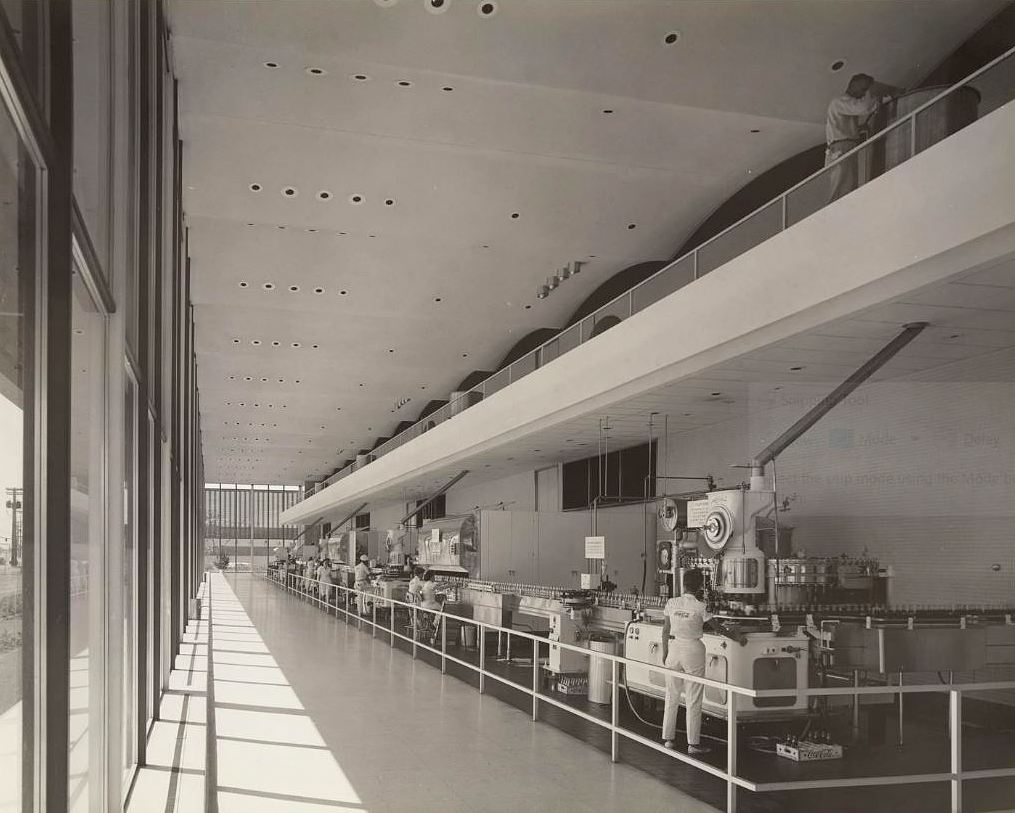
patreon_coca-cola-bottling-plant_john-rogers_portal_ca-circa-1964Gleaming!

by Paula Bosse

The photo above shows the sunniest factory floor I’ve ever seen. You don’t think of factories filled with sunlight, but this is what it looked like inside the new Coca-Cola bottling works at Lemmon and Mockingbird in 1964. It’s gone now (as is that UNBELIEVABLY FANTASTIC ANIMATED NEON SIGN that made me look forward to nighttime drives to Love Field). All that remains is the small syrup plant (from 1948?). (…I think it’s a syrup plant. Or a warehouse. Or something syrup-related.)

The new plant opened in June 1964. The building had floor-to-ceiling glass — I’ve read reminiscences of people who remember driving by and seeing the work going on through those huge windows. I don’t know if there was bottling work going on after dark, but here’s a grainy photo from a Dallas Power & Light ad that shows the building at night, lit up like a stage.

patreon_coca-cola_opening_060964_dpl_night_det-1Dallas Power & Light ad (det), June 1964

Speaking of which, The Dallas Morning News wrote this:

The bottling room, which fronts on Lemmon, has a glass front 254 feet long and 26 feet high to provide a view of the bottling process to the passing public. (DMN, June 9, 1964)

Free show!

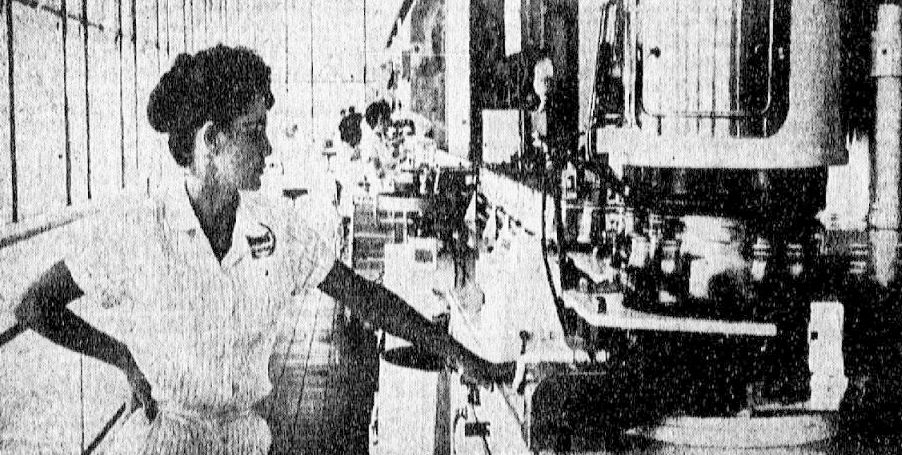
The woman featured in an Employers National Life Group Insurance Company ad (below), might be the same woman seen in the photo at the top. Manning her station.

patreon_coca-cola_opening_060964_ad-det_employers-natl-life-group-insuranceEmployers National Life ad (det), June 1964

And what was rolling off the automated line? Coke, Sprite, and Tab. And something called Mission (grape and orange drinks). 1,860 bottles a minute (!).

Back to the sign for a second. I haven’t invested a LOT of time in a search (but *kind of* a lot…), but I have been unable to find footage of that truly wonderful, mesmerizing neon Coca-Cola sign. Living in an age of Instagram and YouTube, we just expect to find this sort of thing quickly, without having to set aside large chunks of time to devote to searching. If YOU know where film/video of that sign might be hiding… SPEAK UP!

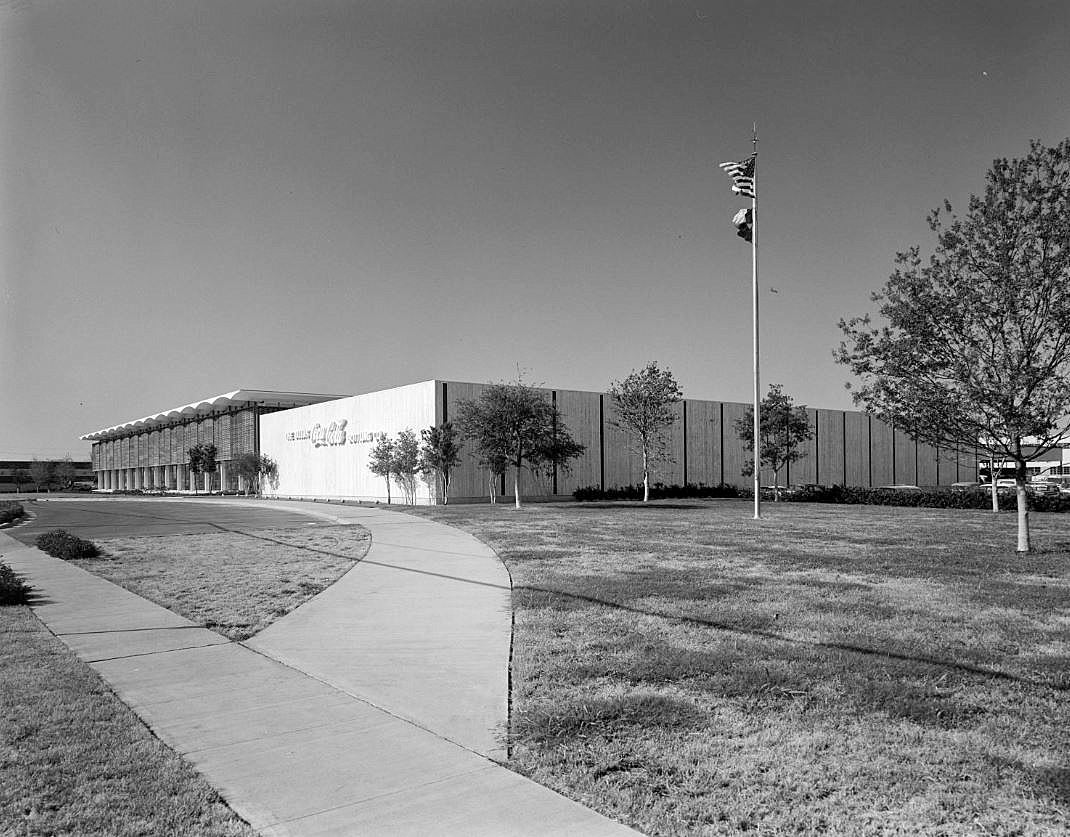
A couple of shots of the exterior:

patreon_coca-cola-bottling-plant_john-rogers_portal_ext_ca-circa-1964

patreon_coca-cola-bottling-plant_john-rogers_portal_exterior_ca-circa-1964

*

coca-cola-plant_mockingbird_dallas-power-light-ad_dallas-mag_april-1964_full
April 1964

***

Sources & Notes

Top photo and last two photos are all by John Rogers and were probably taken around the time the plant began operation in mid-1964; all are from the John Rogers and Georgette de Bruchard Collection, UNT Libraries Special Collections, via the Portal to Texas History, here, here, and here.

A shorter version of this post previously appeared on the Flashback Dallas Patreon page in November 2023.

patreon_coca-cola-bottling-plant_john-rogers_portal_ca-circa-1964

*

Copyright © 2024 Paula Bosse. All Rights Reserved.
Hotel Rodessia

patreon_rodessia_hotel-rodessia_postcard_ebay“First-class style…”

by Paula Bosse

I’ve seen SO MANY postcards of Dallas through the years that when I come across one that is completely new to me, it’s pretty exciting. Especially turn-of-the-century-ish cards, like the one above. This is the first I’ve ever heard of the Rodessia Hotel, which opened in Oct. 1904 at 361-363 Elm (the address later became 1601½ Elm). The hotel proprietor (as well as the proprietor of the street-level saloon underneath it) was German immigrant Joseph F. Rode (1858-1911).

patreon_rodessia_hotel-rodessia_dmn_oct-1904Dallas Morning News, Oct. 2, 1904

And, because it’s so unusual to be able to note something like this, I must mention that Rode’s wife, Victoria Virginia “Nannie” Rode, was also a business owner.

rode-j-f_mrs_dmn+100794
DMN, Oct. 7, 1894

Even though I hadn’t heard of the hotel, I did know about the building. In fact, I wrote a whole post about it: “S. Mayer’s Summer Garden, Est. 1881.” It would have been a building everyone knew at the turn of the century. Here’s what it looked like when it was a young whippersnapper:

mayers-garden_DPL_1885

It was built in 1881 by Simon Mayer and was the site for many years of his very popular beer garden. Around 1902 it became the Clifton Hotel, and in Oct. 1904, J. F. Rode opened his interestingly named Rodessia Hotel, which remained in business until about 1920 (it was run after his death by the Widow Nannie and her second husband). Around 1920, another hotel — the La France — opened. See the building at various times in the post mentioned above, here.

So. The Rodessia was in business for at least 15 years. I still can’t believe I haven’t seen it pop up in at least one Elm Street postcard or photograph until now. Better late than never!

(Note: In the postcard at the top, just to the right of the hotel, is the David Hardie Seed Co., which I believe continues today as Nicholson-Hardie stores.)

***

Sources & Notes

Postcard from eBay.

Photo of Mayer’s Garden from the Dallas Public Library: “[Mayer’s Beer Garden, Dallas, Texas”], Call Number PA87-1/19-27-1.

This post originally appeared in a shorter version on the Flashback Dallas Patreon page, which I enthusiastically invite you to subscribe to!

patreon_rodessia_hotel-rodessia_postcard_ebay

*

Copyright © 2024 Paula Bosse. All Rights Reserved.