Flashback : Dallas

A Miscellany: History, Ads, Pop Culture

Category: Art

Mosaic Restoration at Downtown’s St. Jude Chapel
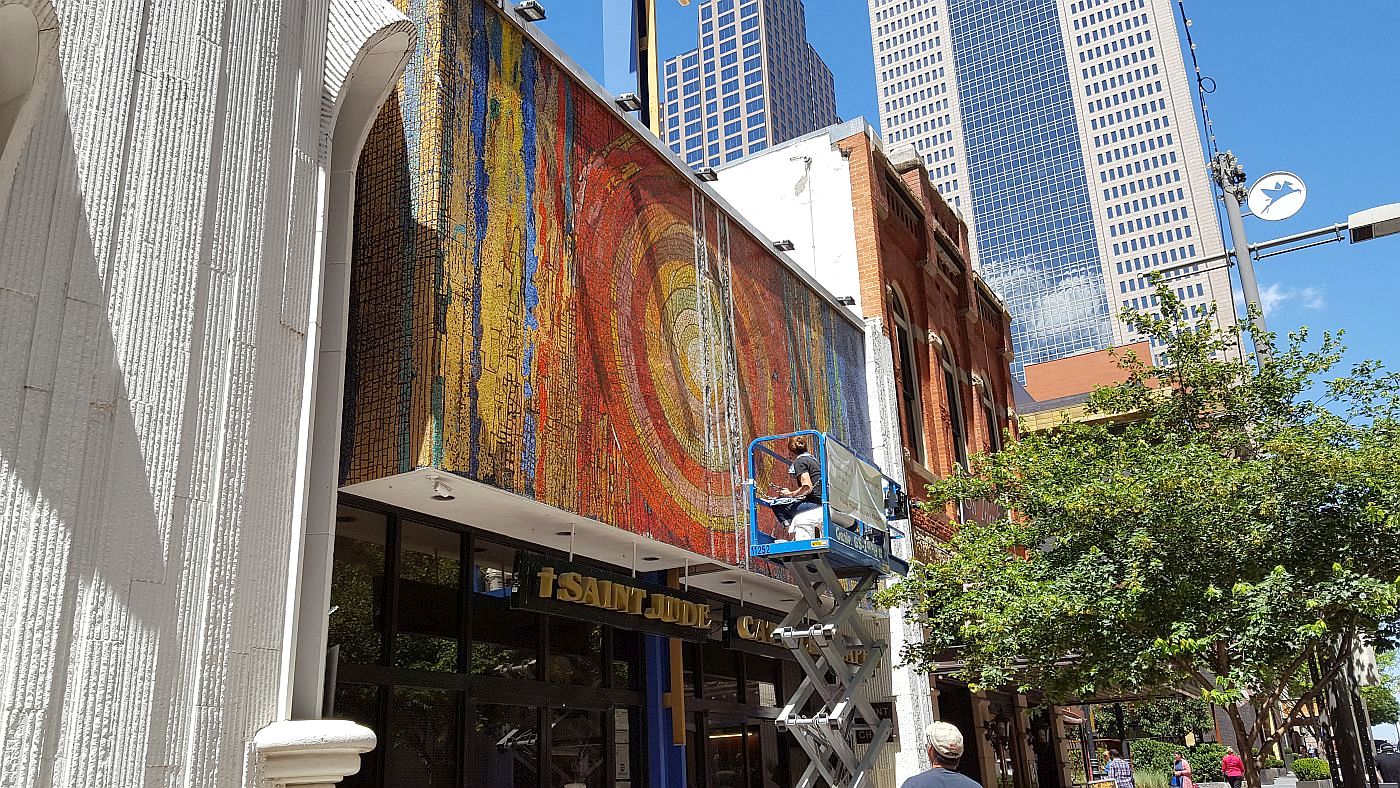
st-jude-chapel_scaffold_052417_bosse_bosseTile by tile by tile… (click for larger image)

by Paula Bosse

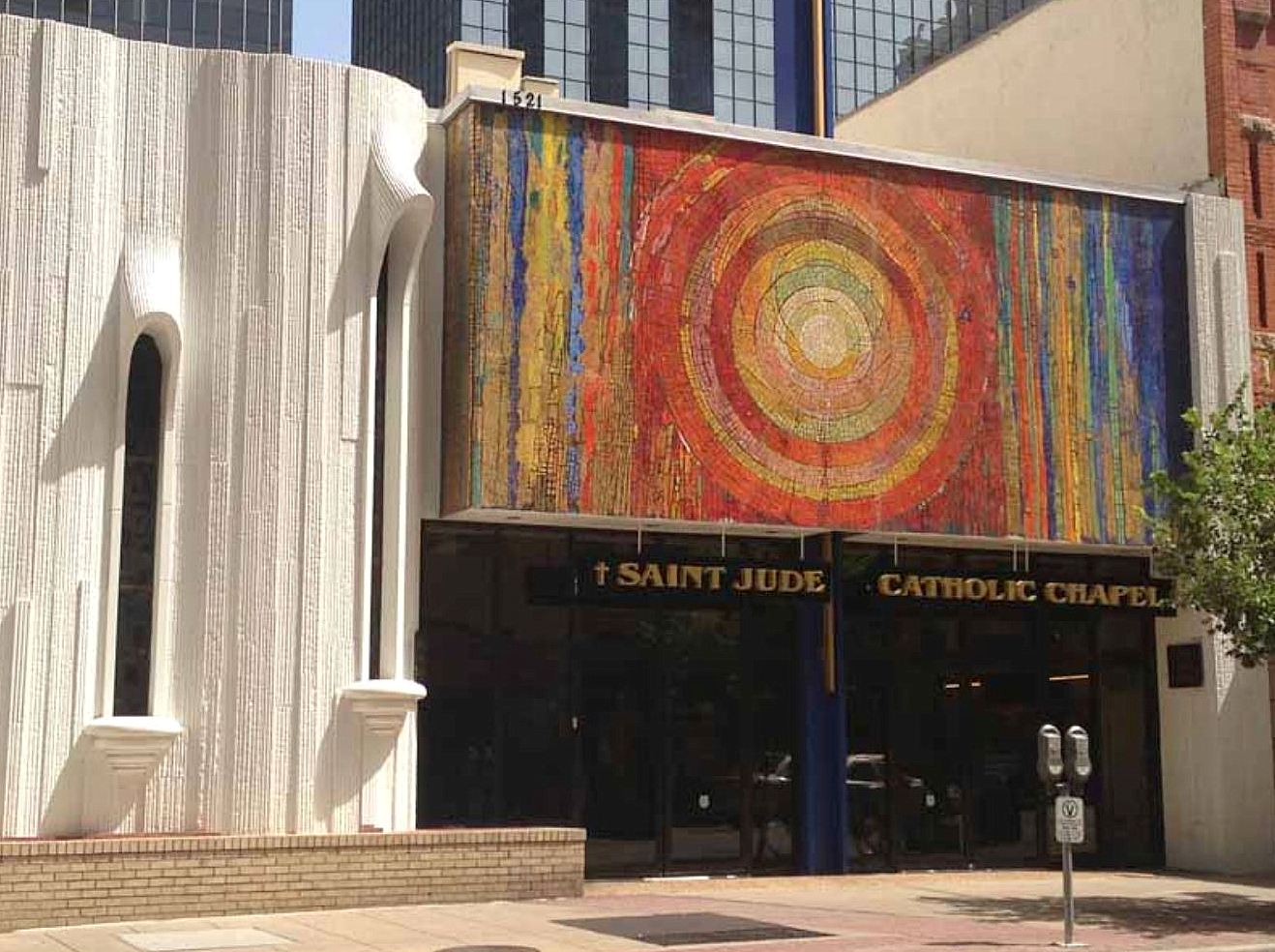
A couple of weeks ago I went downtown to check out the restoration of the large mosaic above the entrance to the St Jude Chapel on Main Street. The 1968 Gyorgy Kepes mosaic (which I wrote about here) is undergoing needed repair work, restoration, and cleaning, in preparation for next year’s 50th anniversary of the downtown chapel. The work on mosaics inside the chapel as well as the large one outside is being done by artist and preservationist Julie Richey of Julie Richey Mosaics in association with Art Restorations, Inc.

As you can imagine, the outdoor mosaic overlooking Main Street has, for 50 years, weathered everything from intense summer heat, freezing temperatures, automobile exhaust, slight shifting of the building’s structure, damage to individual tiles, mildew, grout decomposition, and a host of other factors, all of which led to the much-needed restoration work.

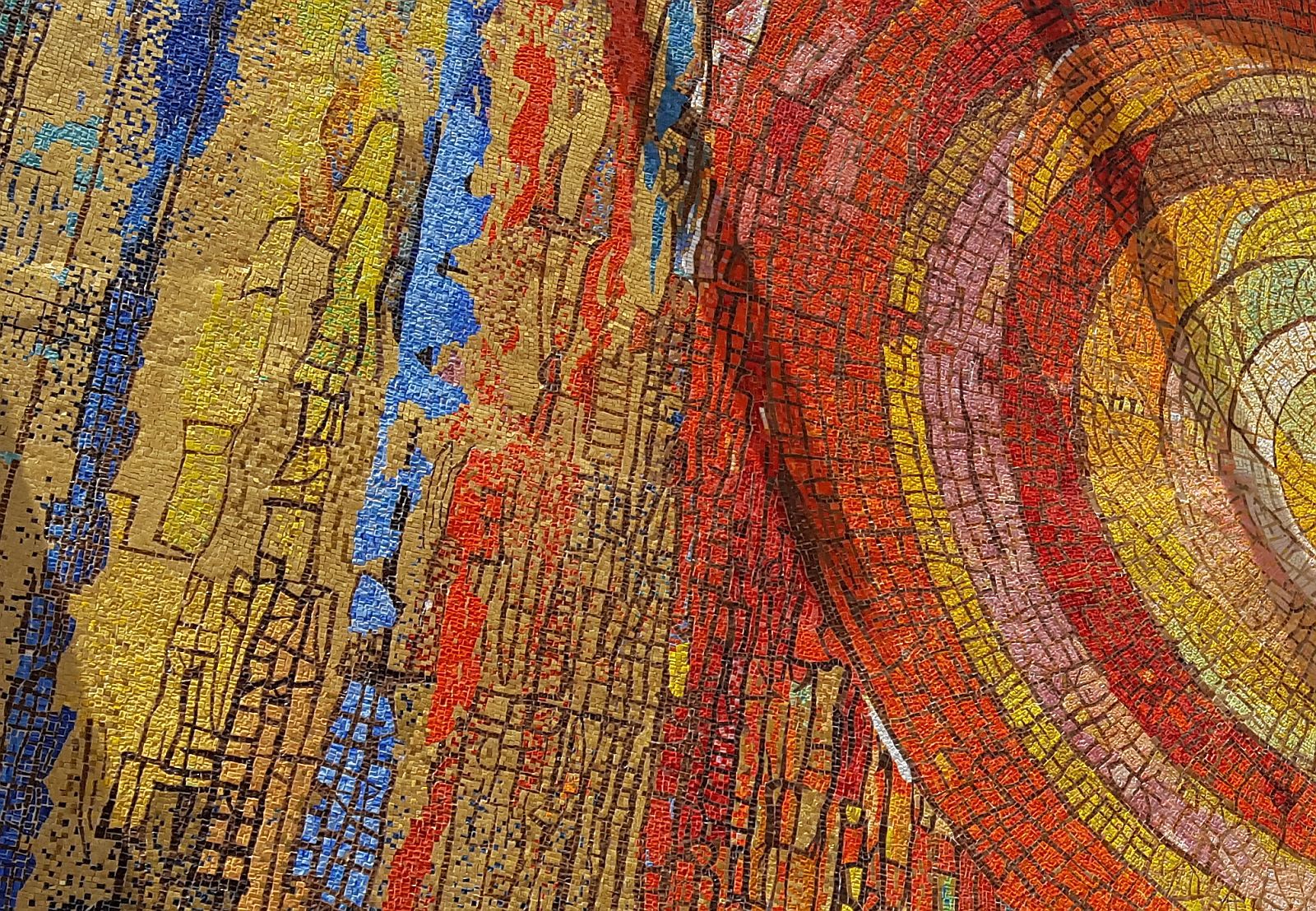
A couple of things that I found interesting, in talking with Julie Richey and Cher Goodson (of Art Restorations, Inc.) was that there are over 800,000 glass smalti tiles (or tesserae) forming the sunburst mosaic. 800,000! I had no idea it was so large until I was standing right below it. After missing or damaged tiles have been replaced, all 800,000-plus will be cleaned — by hand, I think — with, as Cher told me, Dawn dishwashing liquid (good for cleaning greasy dishes, oil-soaked waterfowl, and Venetian glass tiles). Speaking of those tiles, one of the most serendipitous moments in this project was when Julie was able to track down slabs of smalti in New York which were the very same smalti used in the original 1968 mosaic — they had been kept in storage for 50 years, and they look brand new. That means that the tesserae being used to replace the damaged or missing tiles are from the exact same batch as the originals, which means the vivid colors, the composition, the opacity, and the surface texture are the same. That is an incredible stroke of luck!

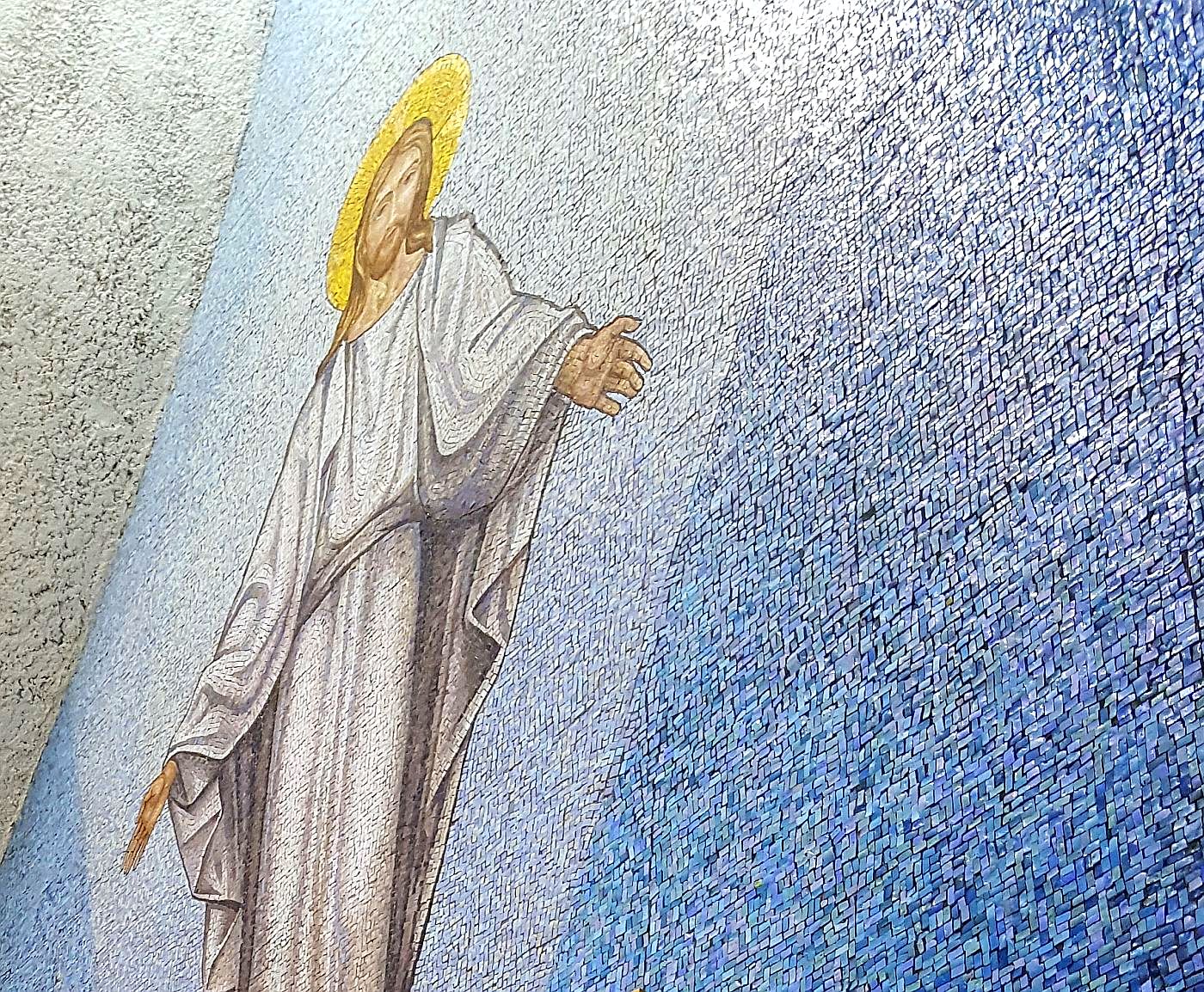
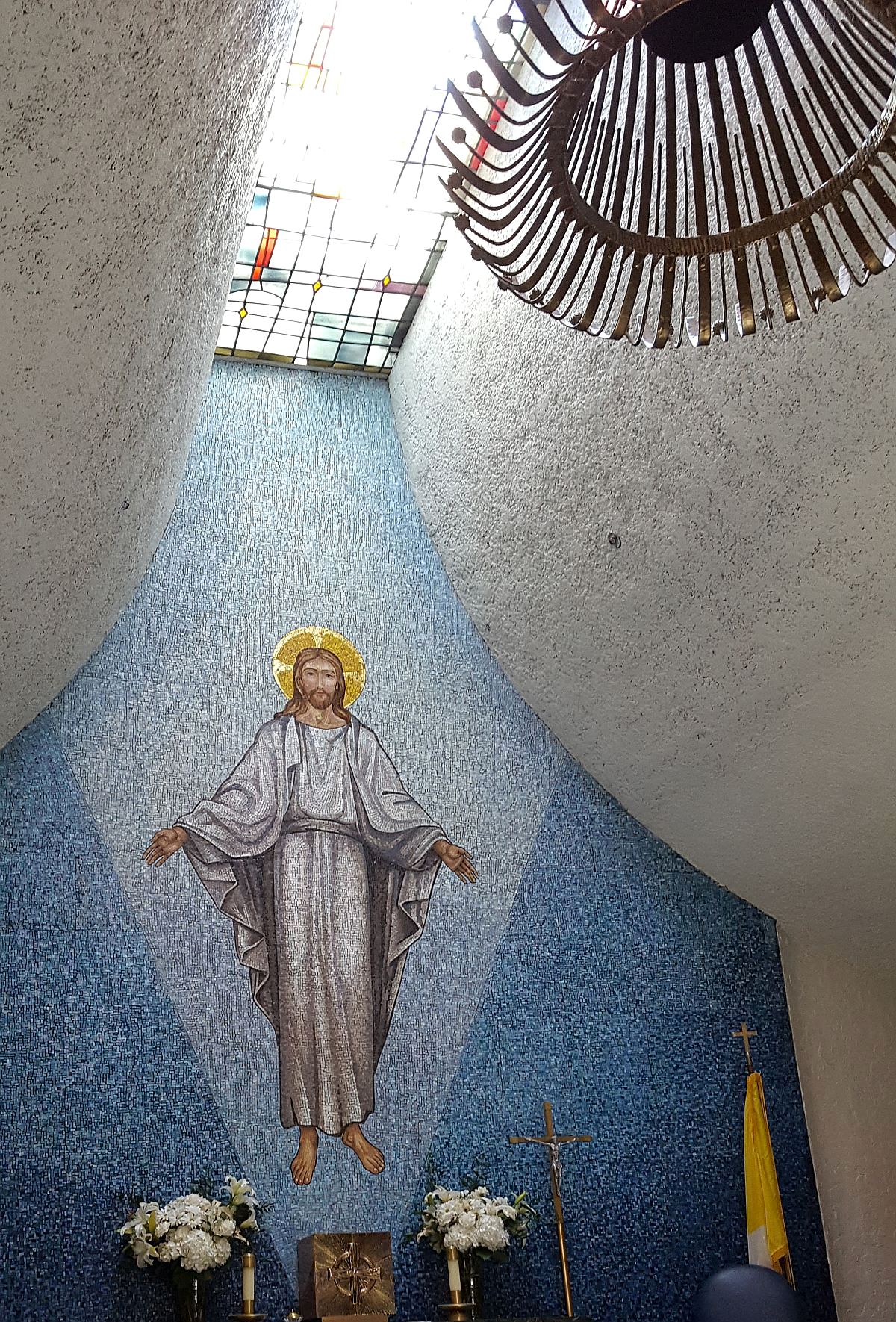
The work should be wrapping up soon — if you’d like to catch the last few days of this project, hop downtown and say hello to the women doing such great work! (UPDATE: The project actually ended Friday. But you should still go down and take a look at it!) While you’re there, you should step inside to see the little chapel, a calm and peaceful oasis in the heart of downtown. There are several other mosaics inside — Julie and company did work on some of those as well, most notably the very large, striking “Risen Christ” above the altar.

Below are some photos I took inside and outside the chapel on May 24, 2017 — most are larger when clicked.

**

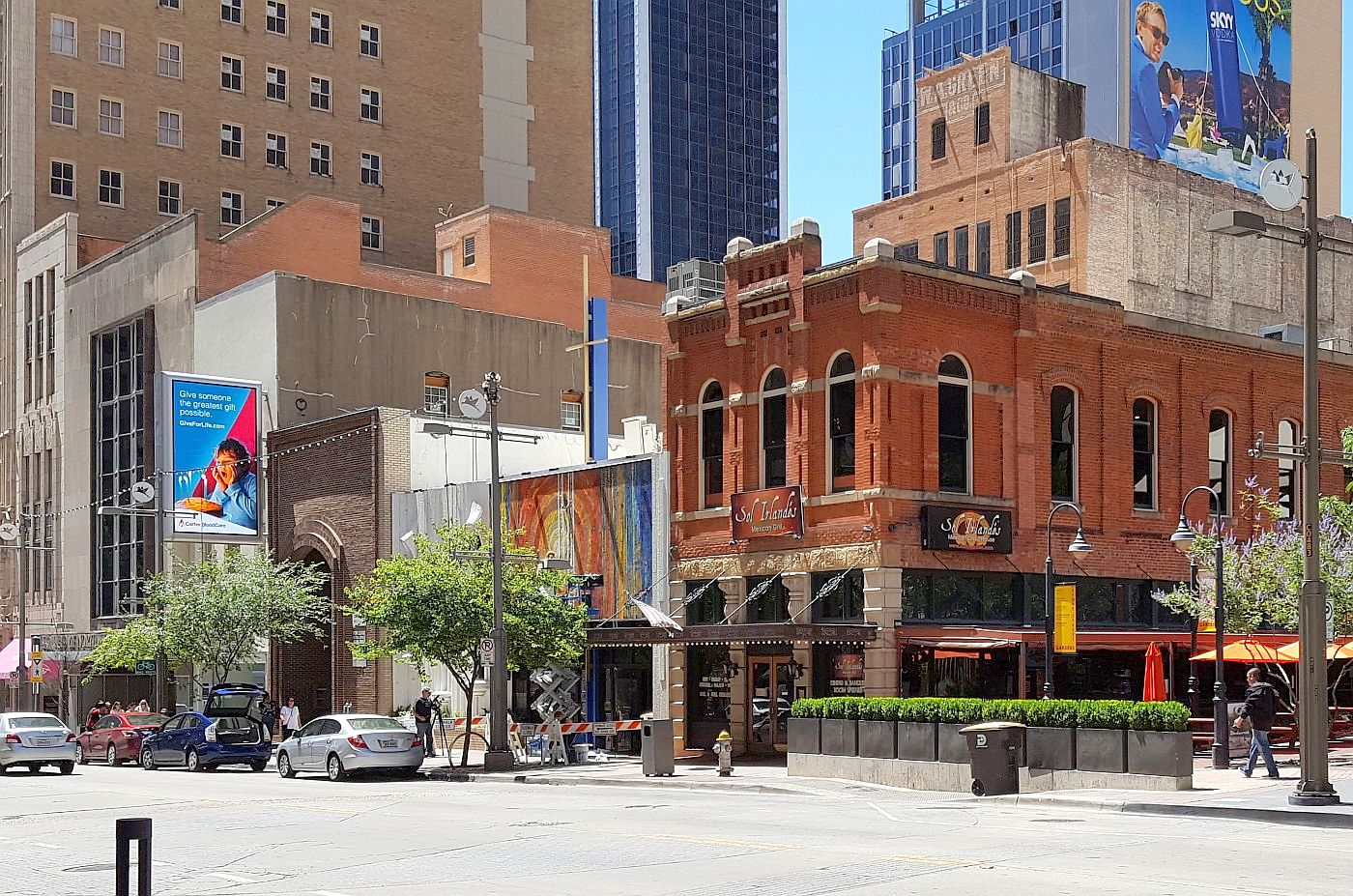
St. Jude Chapel is in the 1500 block of Main, between Ervay and Akard.

Here it is, seen from Neiman’s, across the street.
st-judes-chapel_sol-irlandes_052417_bosse

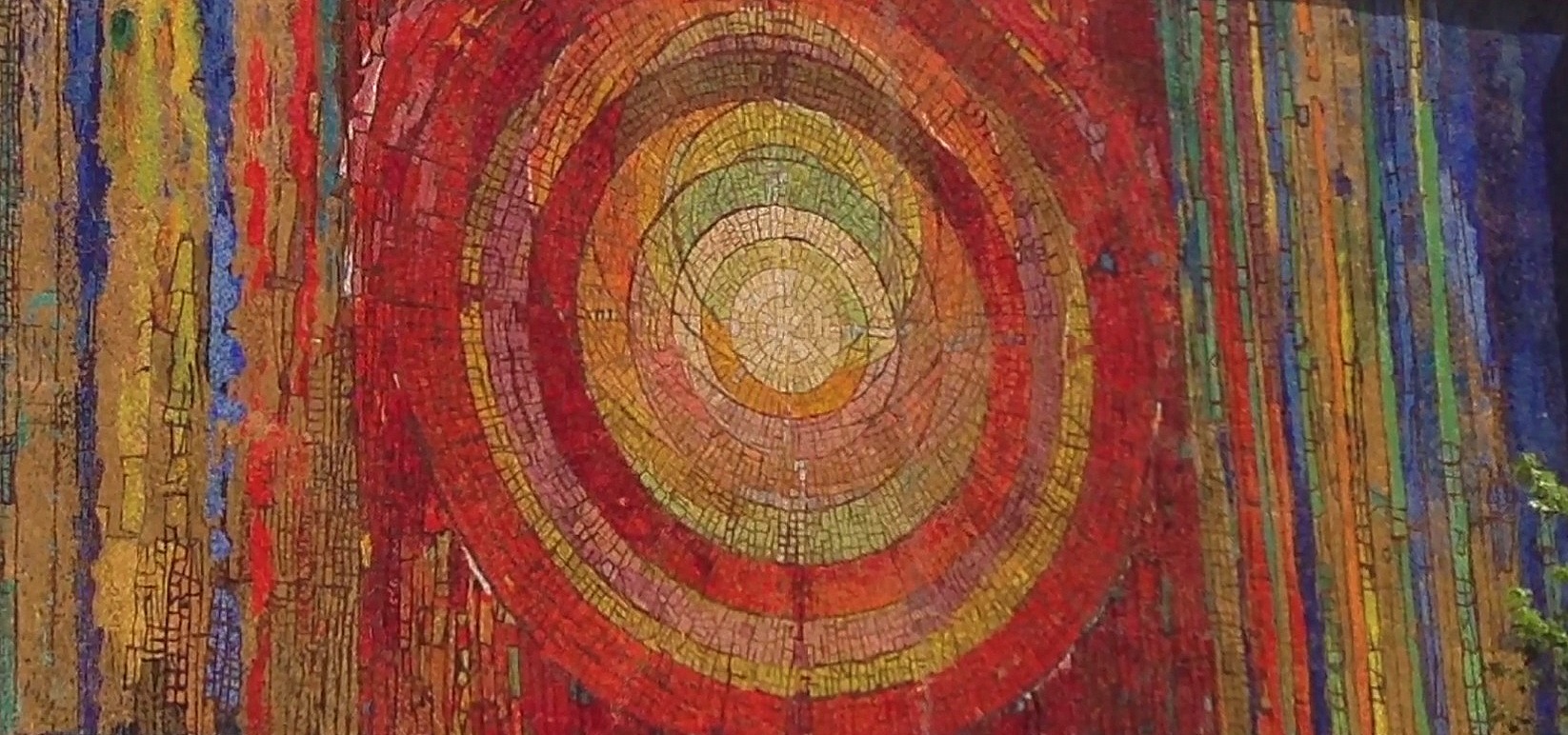
Below is part of the mosaic by Gyorgy Kepes — seeing it up close, you begin to realize that, yeah, there probably are more than 800,000 glass tiles up there. (Definitely click the photo to see a very large image.)
st-jude-chapel_mosaic_052417_det_bosse

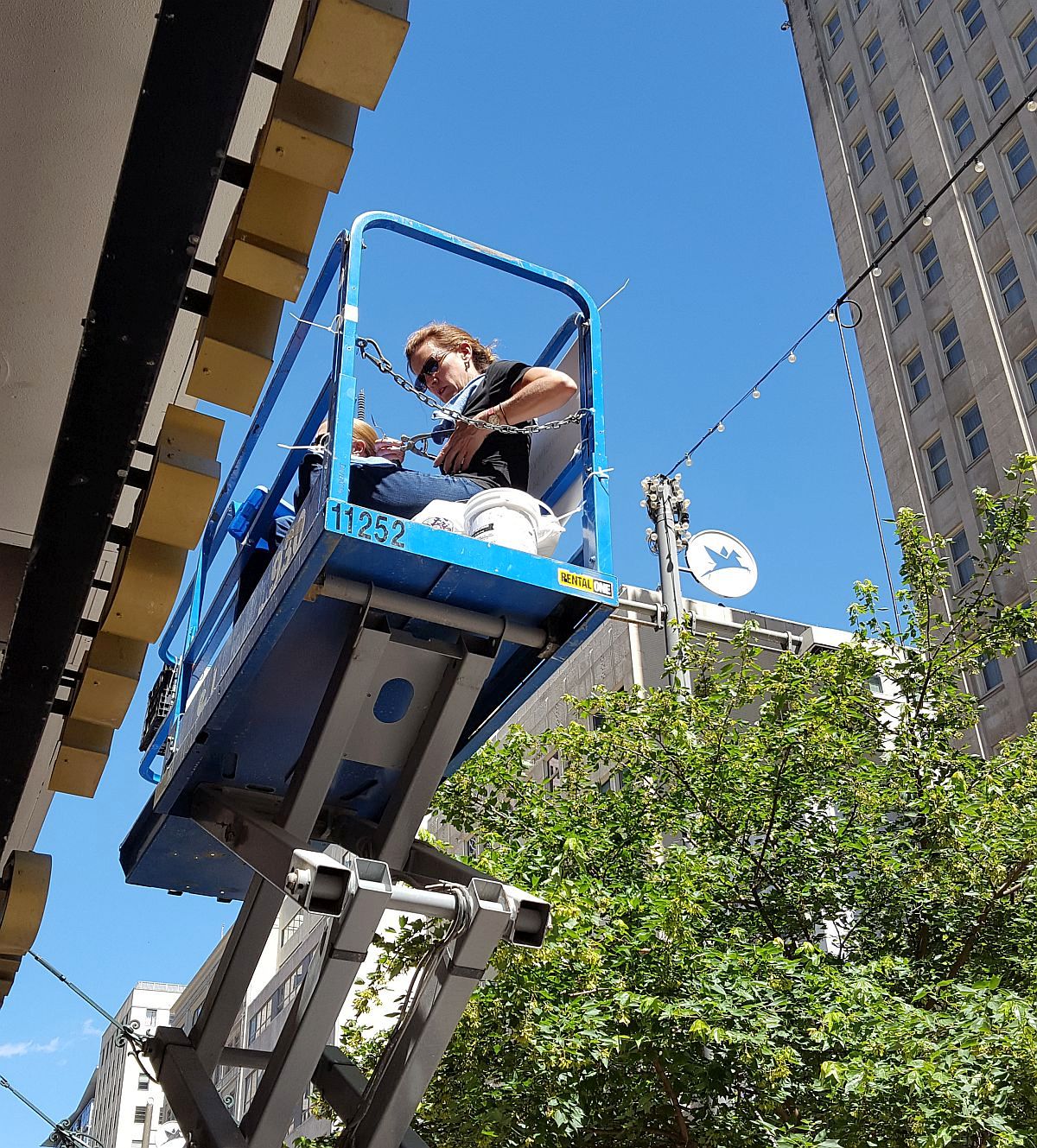
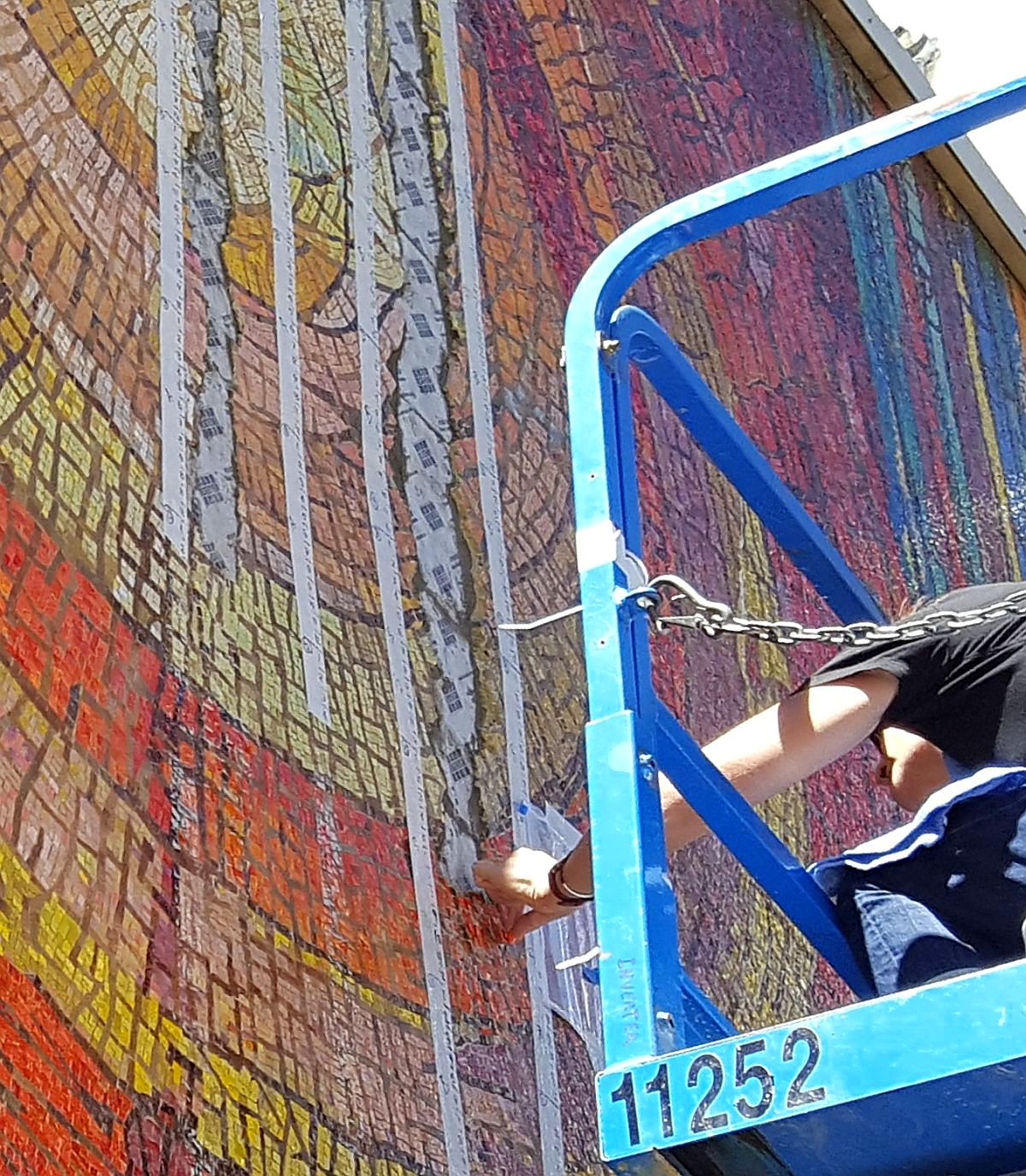
The photo at the top of the post shows the lift used to tackle the job; looking on is Dallas filmmaker Mark Birnbaum who is documenting the project. Below, Julie Richey and Lynne Chinn are raised up on the lift to do their torturously tedious and very, very detailed work (imagine working on this huge thing using tweezers!). Julie can be seen snipping “new” smalti to replace the damaged or missing tiles, working from photos, diagrams, grids, graphs, and guides to make sure the restoration is as close as possible to the original mosaic: the colors must match, the shapes must match, the placement must match.
st-jude-chapel_julie-richey_snipping_052417_bosse

You really have to be focused to do work like this. Here, Julie is setting a tiny piece into that giant mosaic (the marked vertical strips of tape help map the mosaic and insure that everything goes back in exactly as it was originally placed in 1968.
st-jude-chapel_julie-richey-at-work_052417_det_bosse

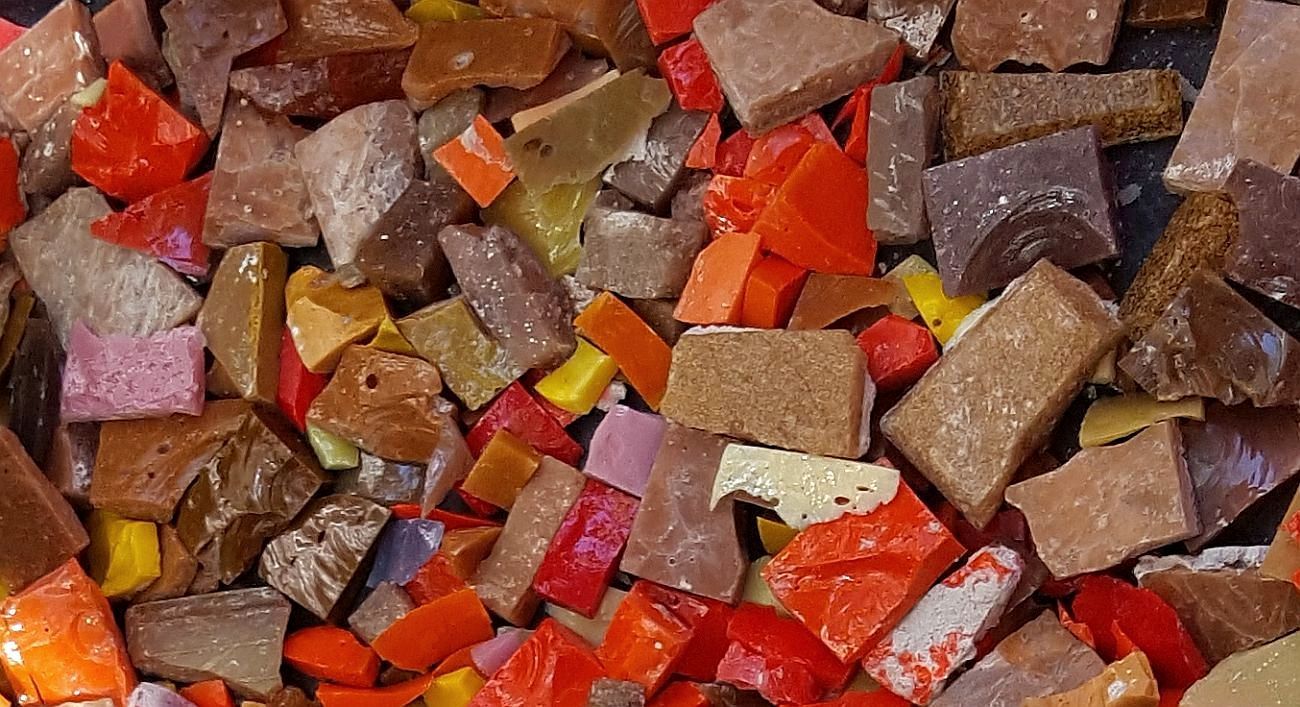
Speaking of snipping the smalti (which sounds like a naughty euphemism used amongst naughty mosaicists), here’s what’s left over, below. I talked to conservator Callie Heimburger, who gave me a lot of interesting information on how the whole intricate process worked — she was set up at a table on the sidewalk and had containers full of these beautiful discarded glass shards in front of her. I really wanted to scoop up a handful and sneak them into a pocket, but I managed to control myself.
st-jude-chapel_smalti-snippings_052417_bosse

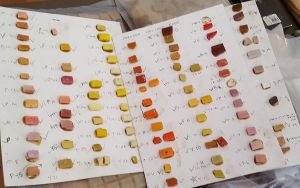
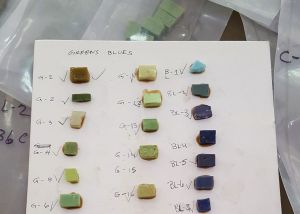
Everything is meticulously color-coded.
st-jude-chapel_greens-blues_052417_bossse

st-jude-chapel_oranges-yellows_052417_bosse

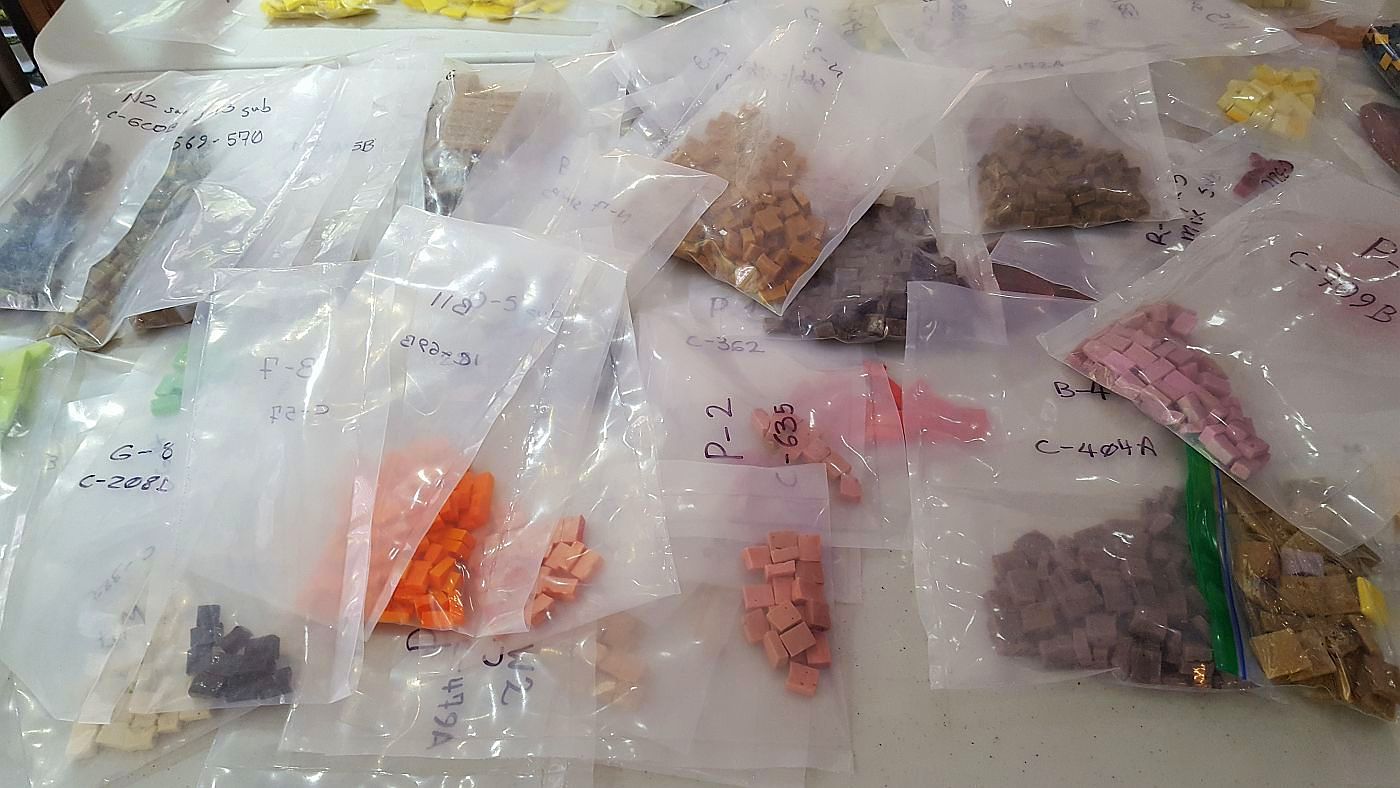
And smalti? Here are bags of “new” bagged tiles — not shown are the slabs or the larger pieces which look a little like brightly colored peanut brittle.
st-jude-chapel_bagged-tiles_052417_bosse

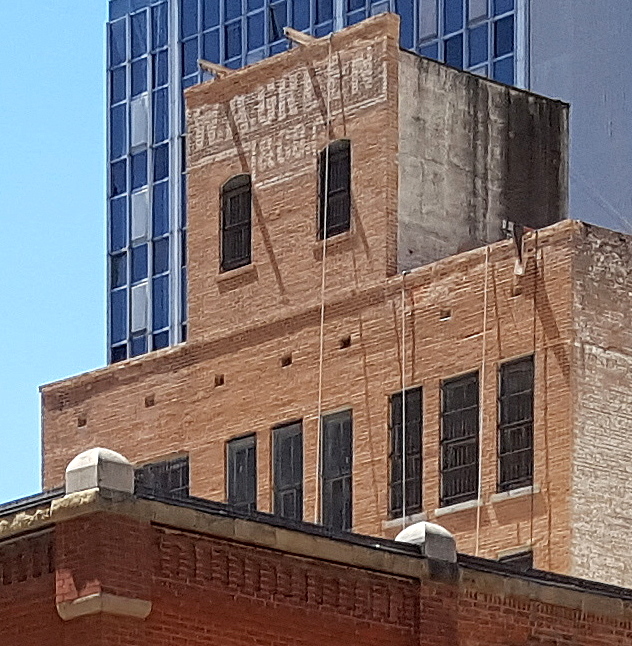
Julie asked if I wanted to go up on the lift and take a closer look. It was even more impressive (and a little overwhelming) to be right next to it. I also got to take a look over the top of the building. There Julie pointed out all that remains of one of downtown’s biggest and busiest retail stores, W. A. Green. I didn’t have the presence of mind to get a good photo up there, but here’s the “ghost sign,” seen from across the street.
w-a-green_ghost-sign_052417_bosse

**

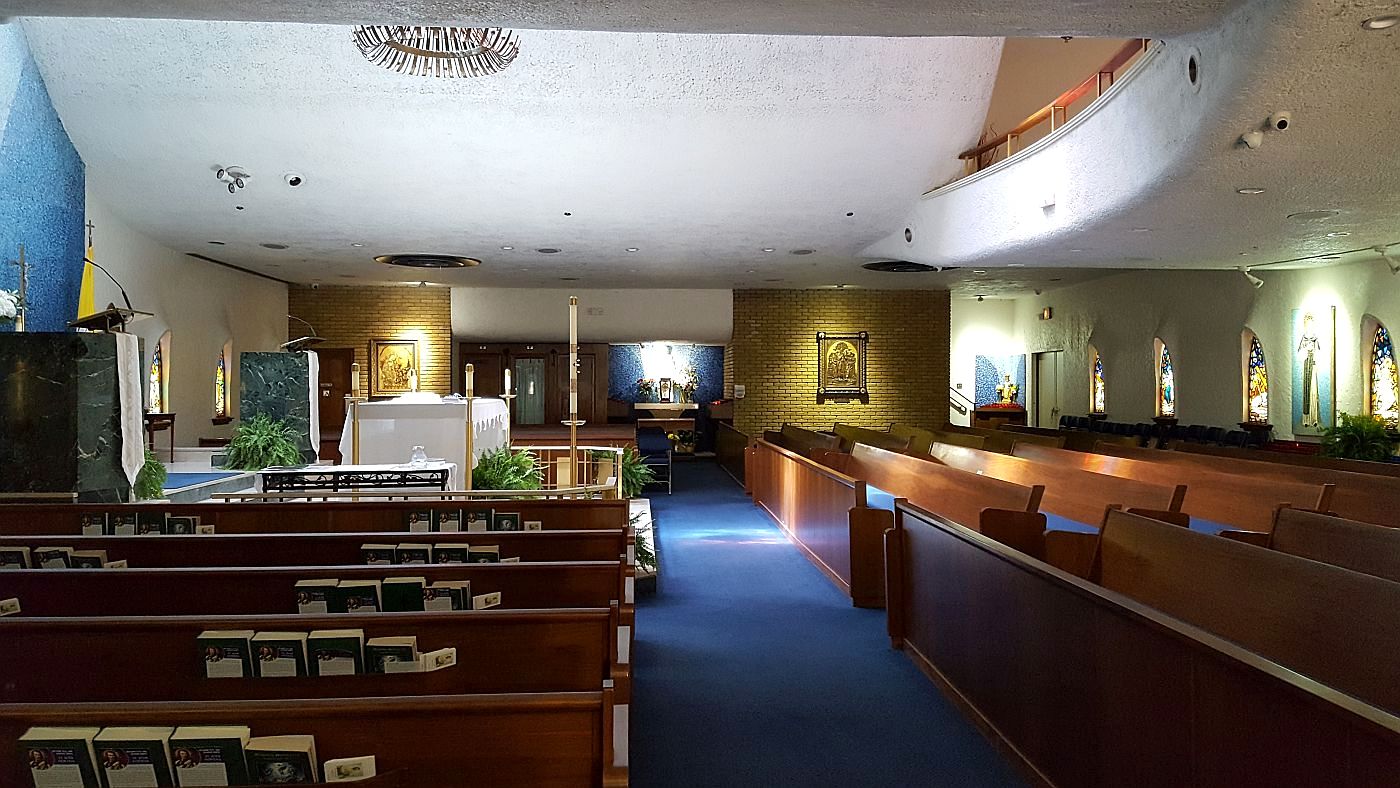
Since I was there, I had to step inside to see what the little chapel looked like. It’s very charming. And the mosaics inside are also impressive.

Here’s what you see as you step in.
st-jude-chapel_toward-back-of-chapel_052417_bosse

To your left is the altar. This lovely mosaic was also restored and cleaned. Also: curved walls, a stained glass skylight, and a light fixture that is one of my very favorite decorative elements of this chapel.
st-jude-chapel_altar_stained-glass-skylight_052417_bosse

A closer look at “Risen Christ.”

st-jude-chapel_altar_det_052417_bosse

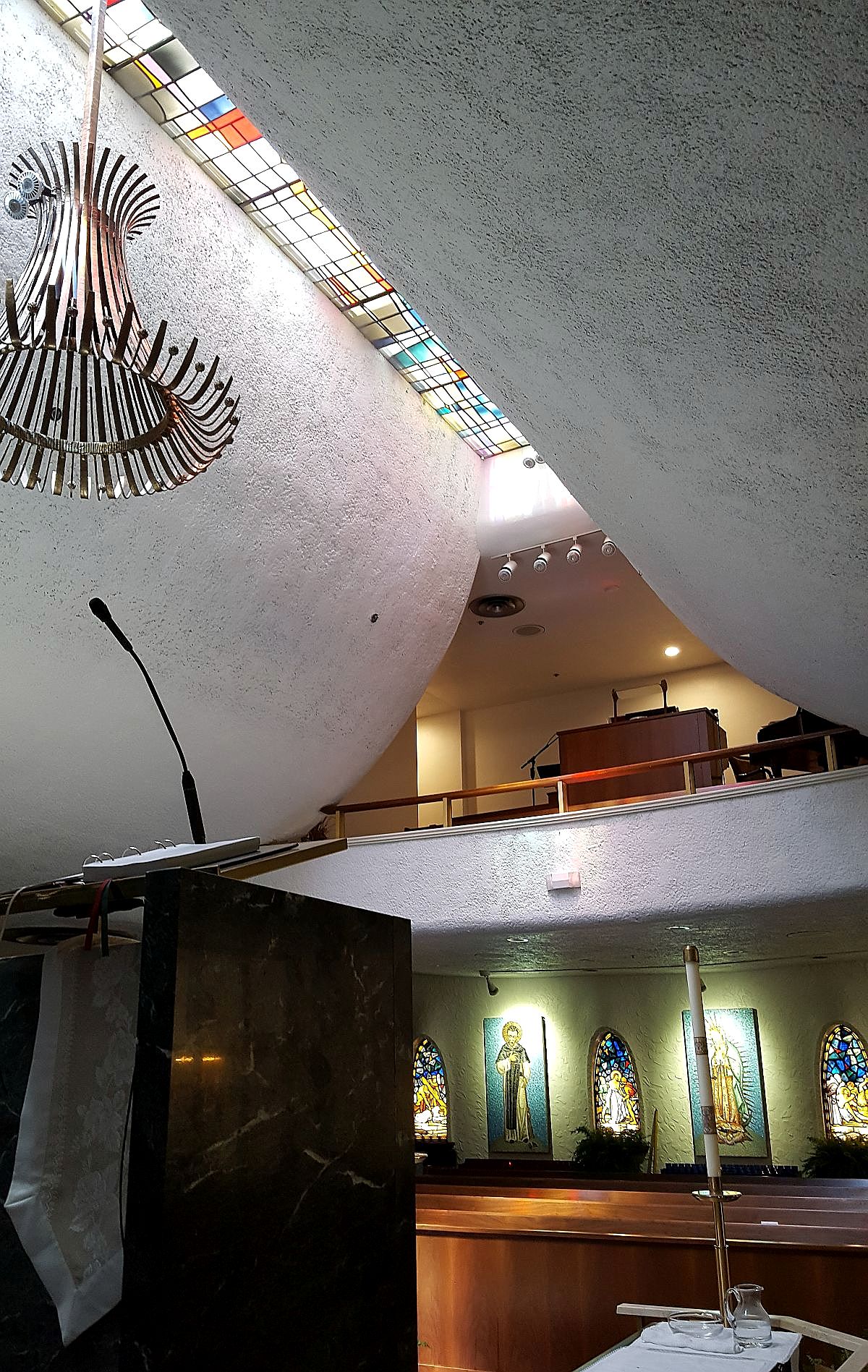
Turn around, and from the pulpit you can see the choir loft.
st-jude-chapel_choir-loft_052417_bosse

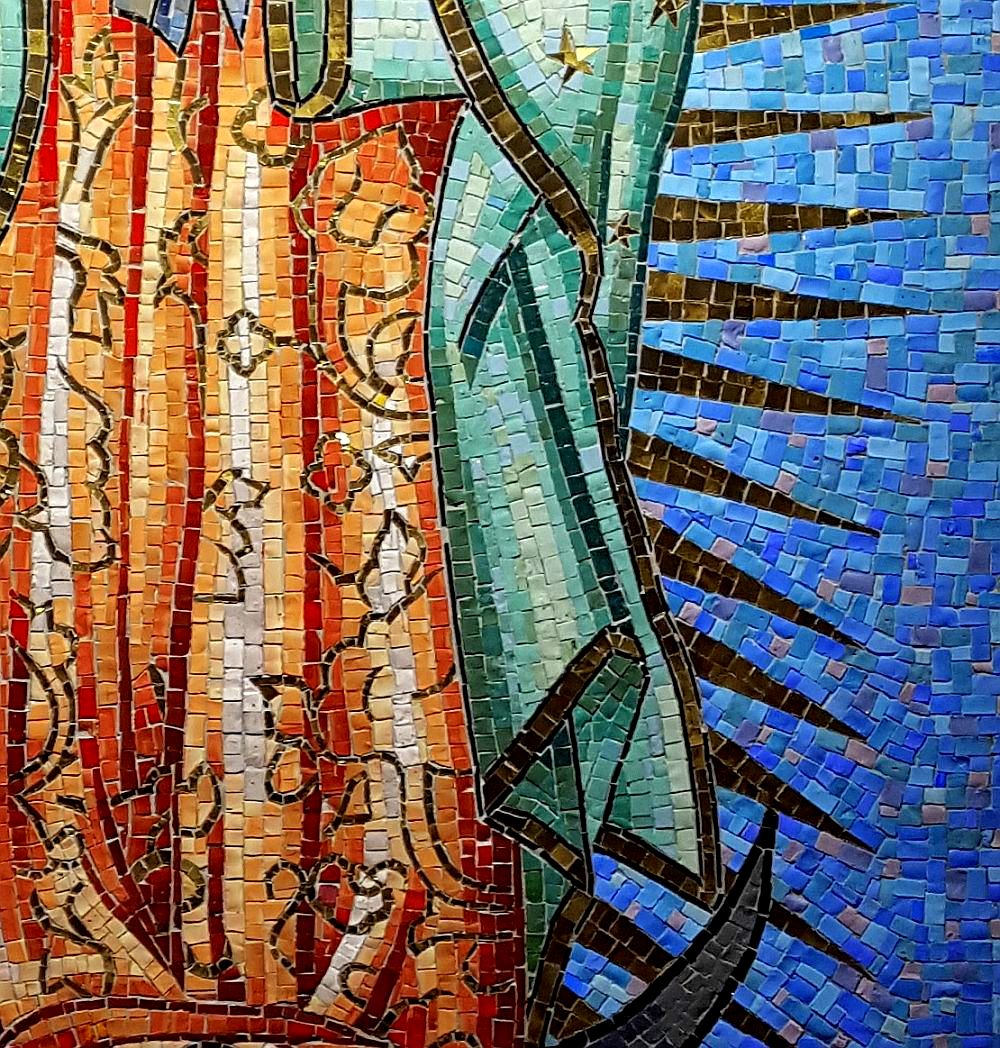
A wonderful depiction of Our Lady of Guadalupe.
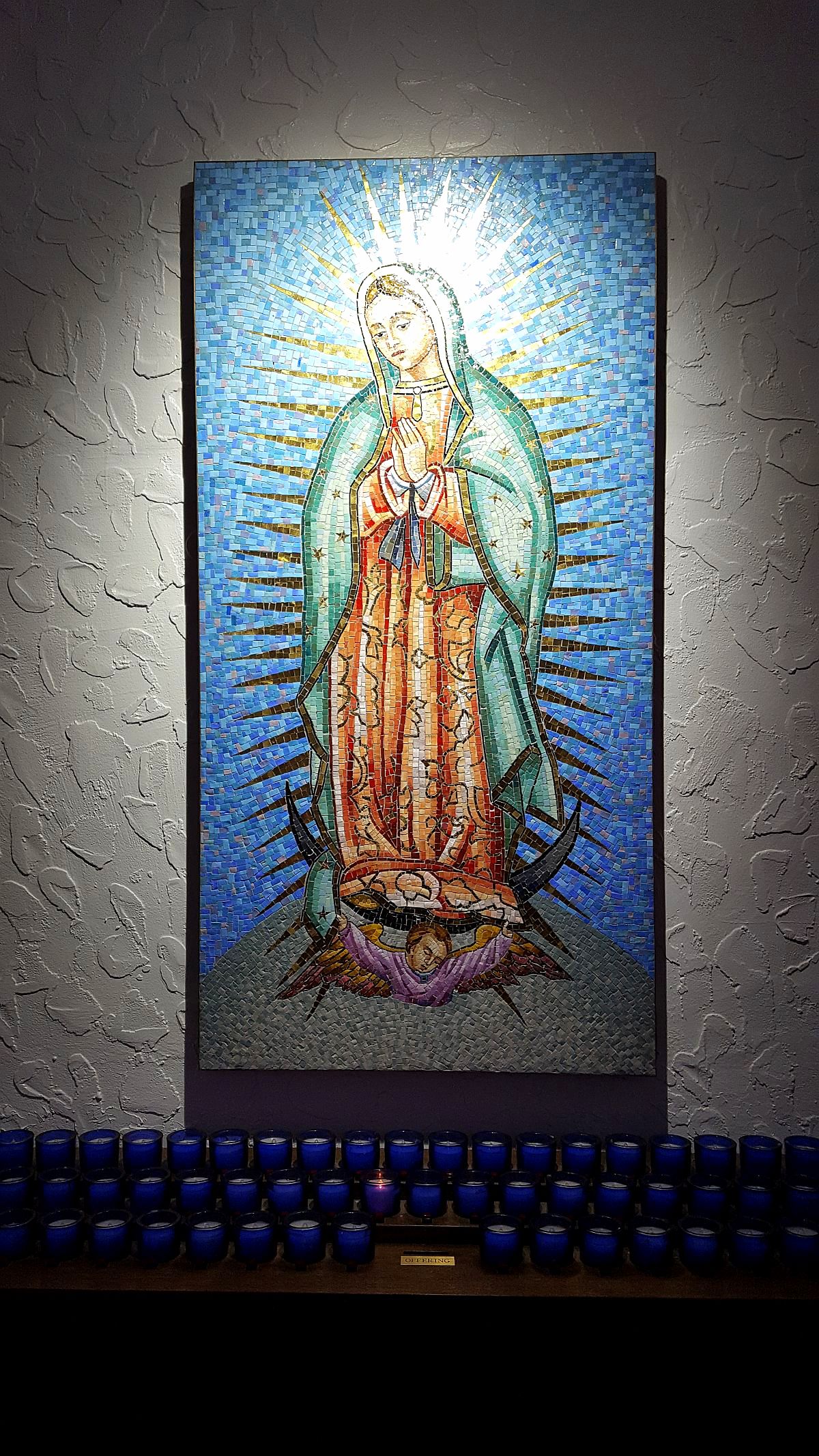
st-jude-chapel_la-virgin_052417_bosse

A detail.

st-jude-chapel_la-virgin_det_052417_bosse

I’m afraid I’m not very well-versed on my saint iconography, but this might be St. Martin de Porres, with a broom, and mice at his feet.
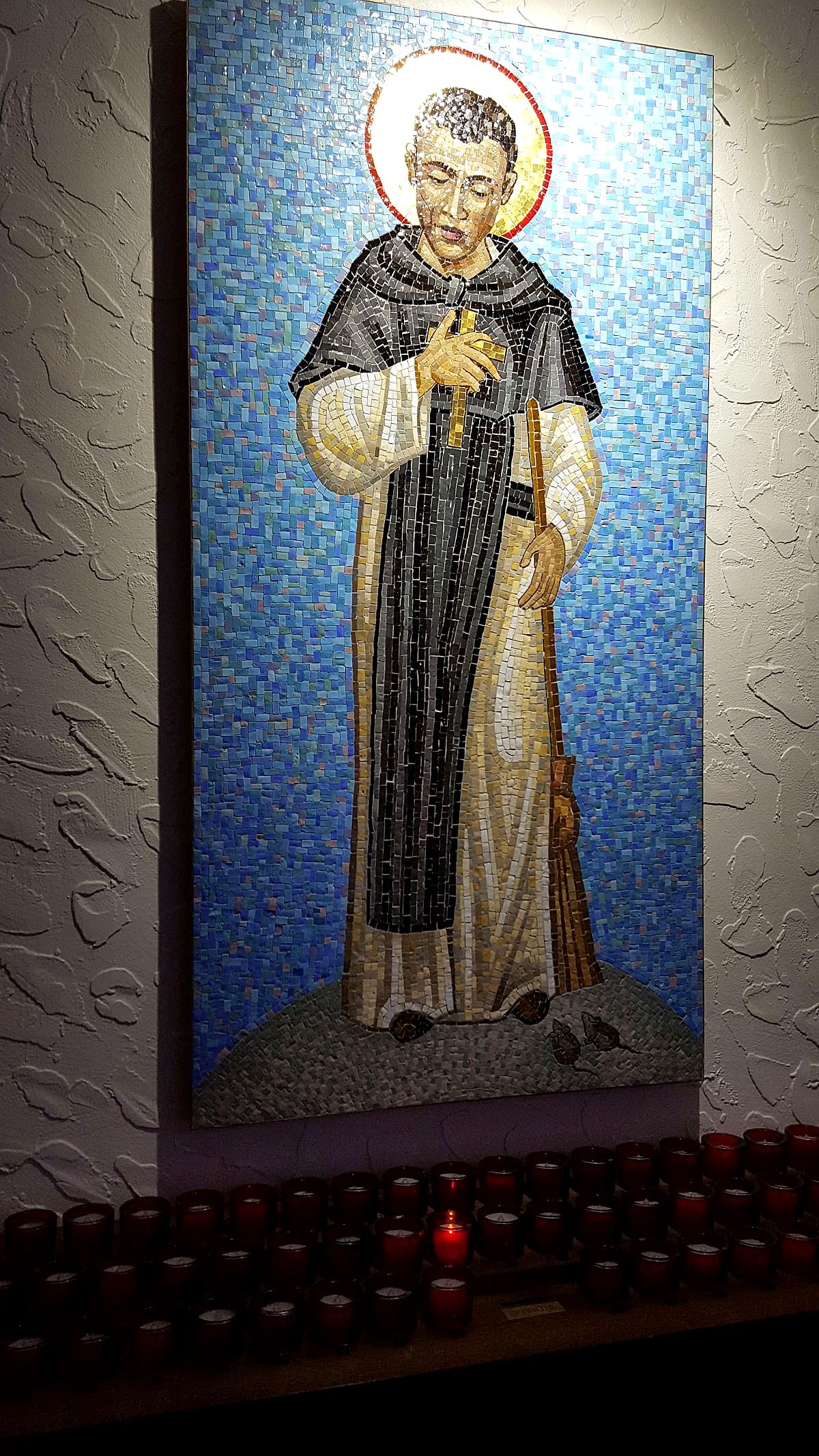
st-jude-chapel_st-martin-de-porres_052417_bosse

Leave it to me to find these little mosaic mice, my favorite tiny discovery of the day.
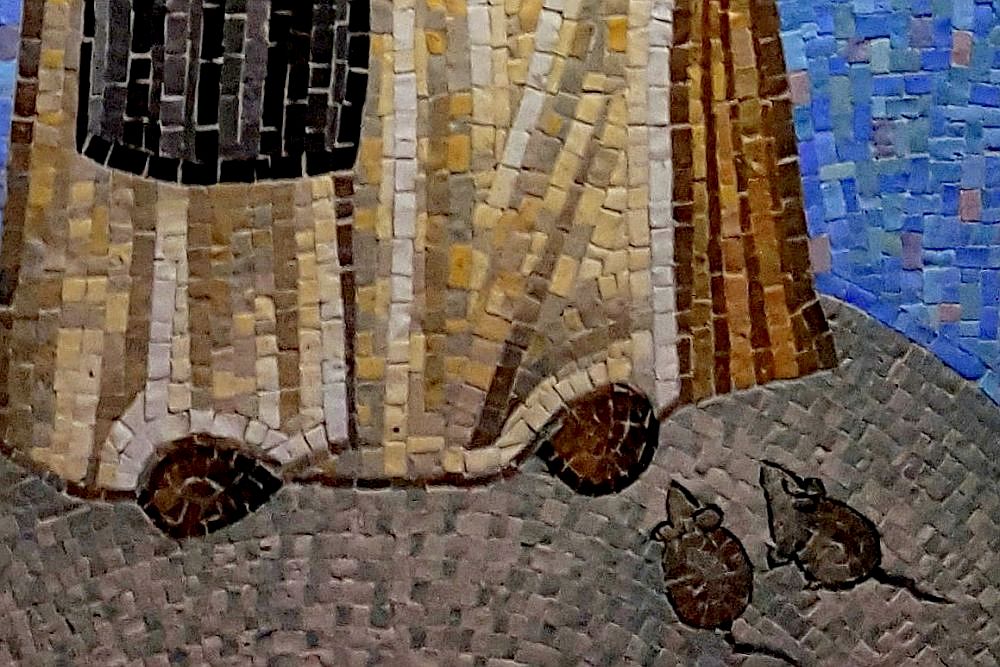
st-jude-chapel_st-martin-de-porres_mice-det_052417_bosse

And here’s the view from the chapel toward Main Street.
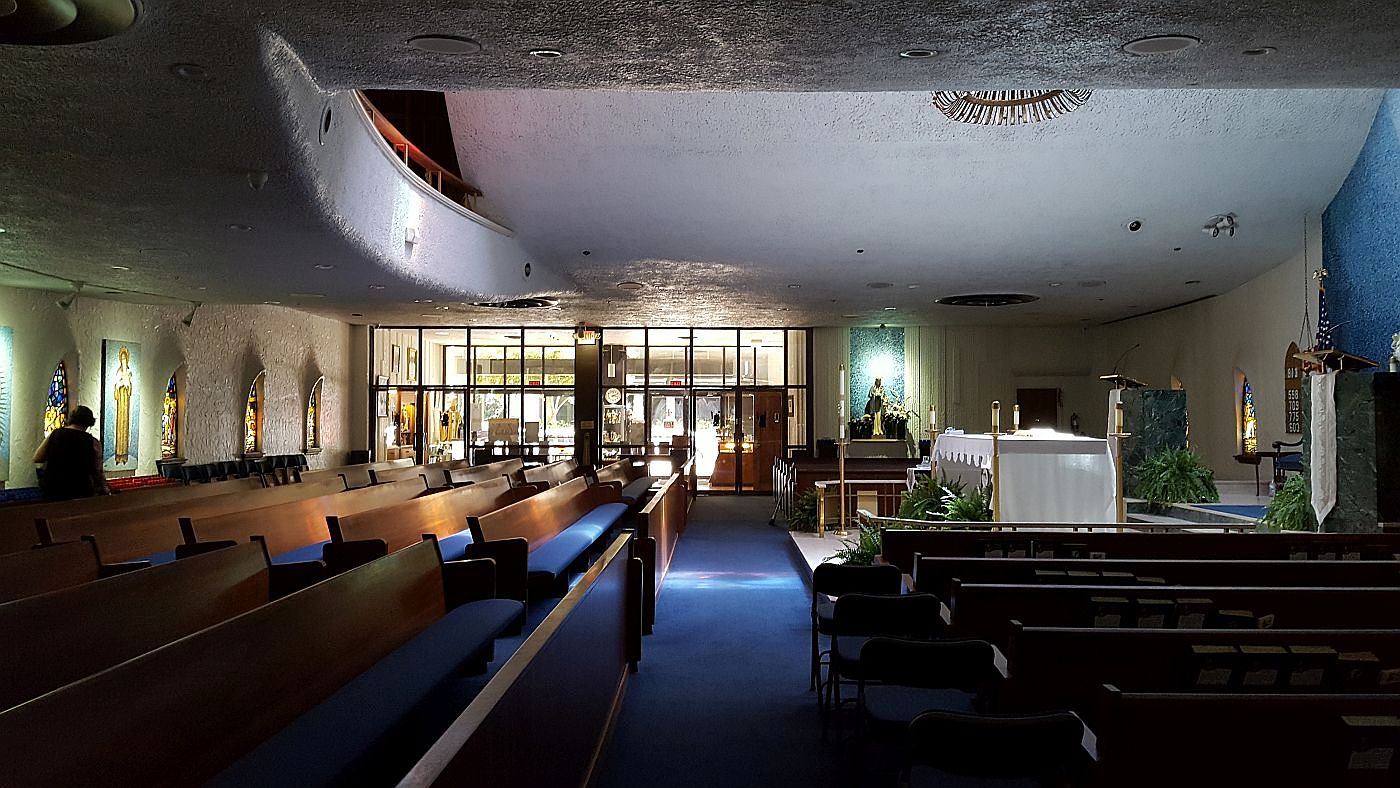
st-jude-chapel_interior-with-view-to-street_053417_bosse

The St. Jude Chapel offers a nice, tranquil respite from a loud and busy downtown Dallas. You should visit sometime. All are welcome.
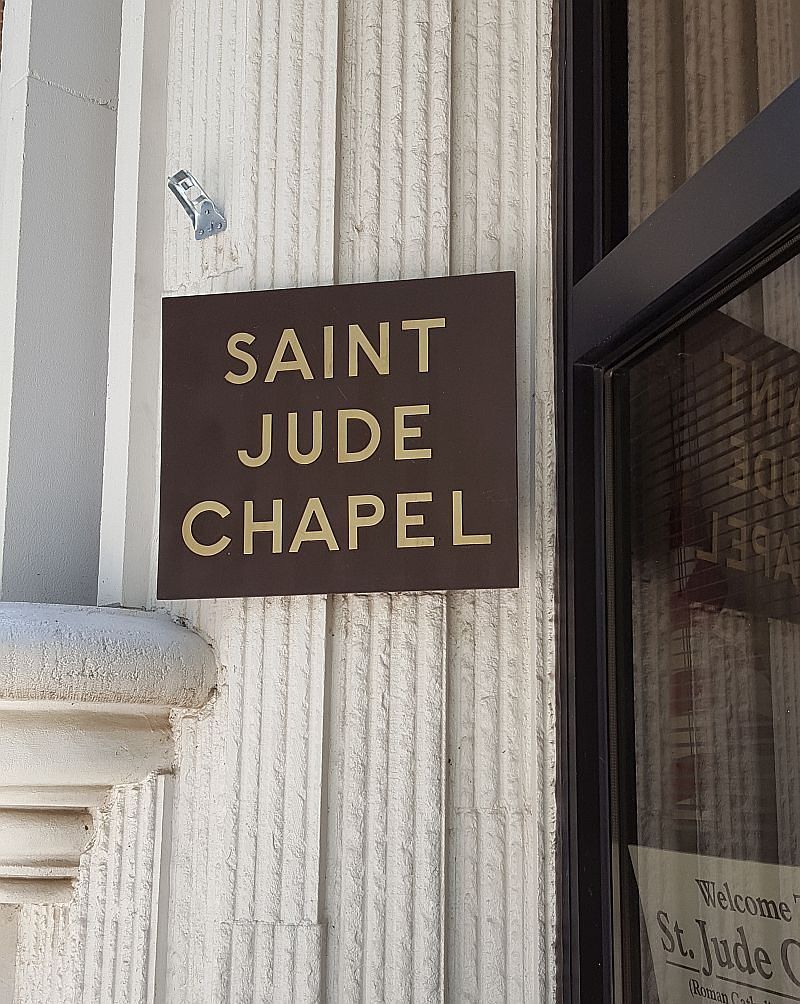
st-jude-chapel_sign_052417_bosse

**

UPDATE: Dallas filmmaker Mark Birnbaum was working on a short documentary of the project when I stopped by the site (you can see the back of his head in the top photo). His 10-minute film, “Genesis Mosaic,” can be viewed here.

***

Sources & Notes

Thanks so much to Julie Richey, Callie Heimburger, Cher Goodson, and Lynne Chinn for taking the time to chat with me. Julie Richey Mosaics website is here; Art Restorations, Inc. website is here.

You can see more on this project (including photos and video) on Julie’s Facebook page, here, and Art Restorations’ Facebook page, here; see photos from the Risen Christ restoration on Julie’s blog, here.

The St. Jude Chapel (Roman Catholic Diocese of Dallas) website is here; videos on the history of the downtown chapel are here.

All photos by Paula Bosse.

Images larger when clicked.

*

Copyright © 2017 Paula Bosse. All Rights Reserved.
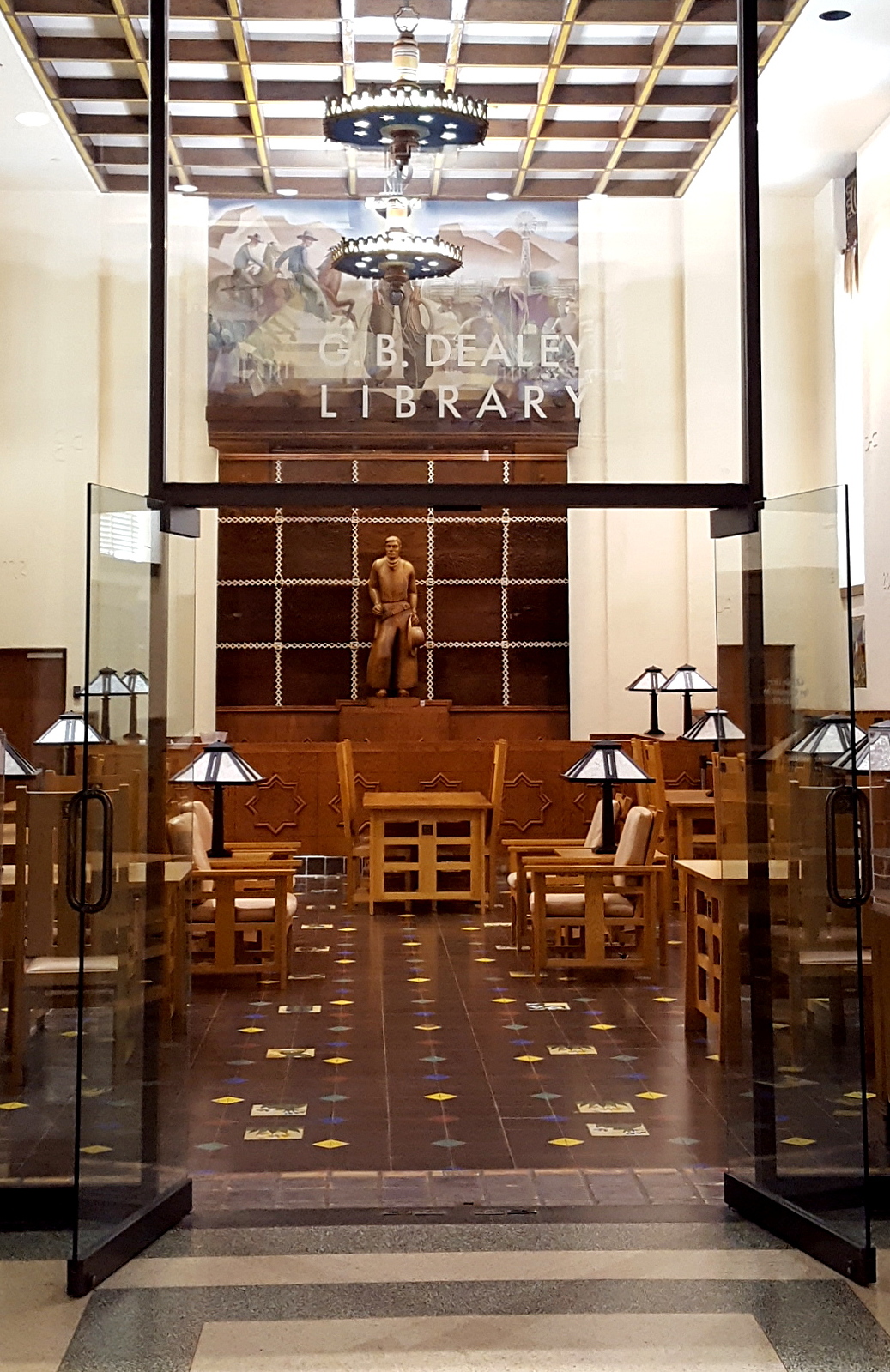
 

The G. B. Dealey Library and Reading Room at the Hall of State

hall-of-state_dealey-library_entrance_042517A quiet place to read or study… (click for larger image)

by Paula Bosse

I spent time this week walking around the G. B. Dealey Library and Reading Room at the Hall of State in Fair Park. It is part of the Dallas Historical Society, and it is a quiet, high-ceilinged, airy-but-cozy Western-themed oasis filled with lots of warm wood and featuring two large murals by legendary El Paso artist Tom Lea. If you haven’t seen it, I highly encourage you to go take a look.

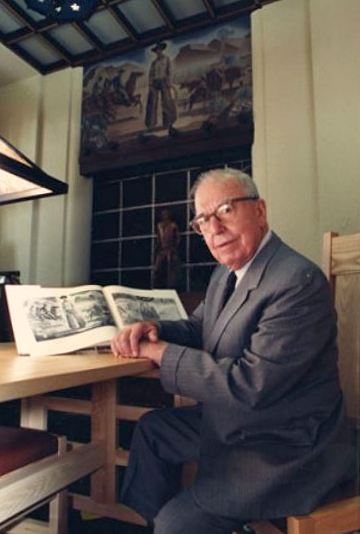
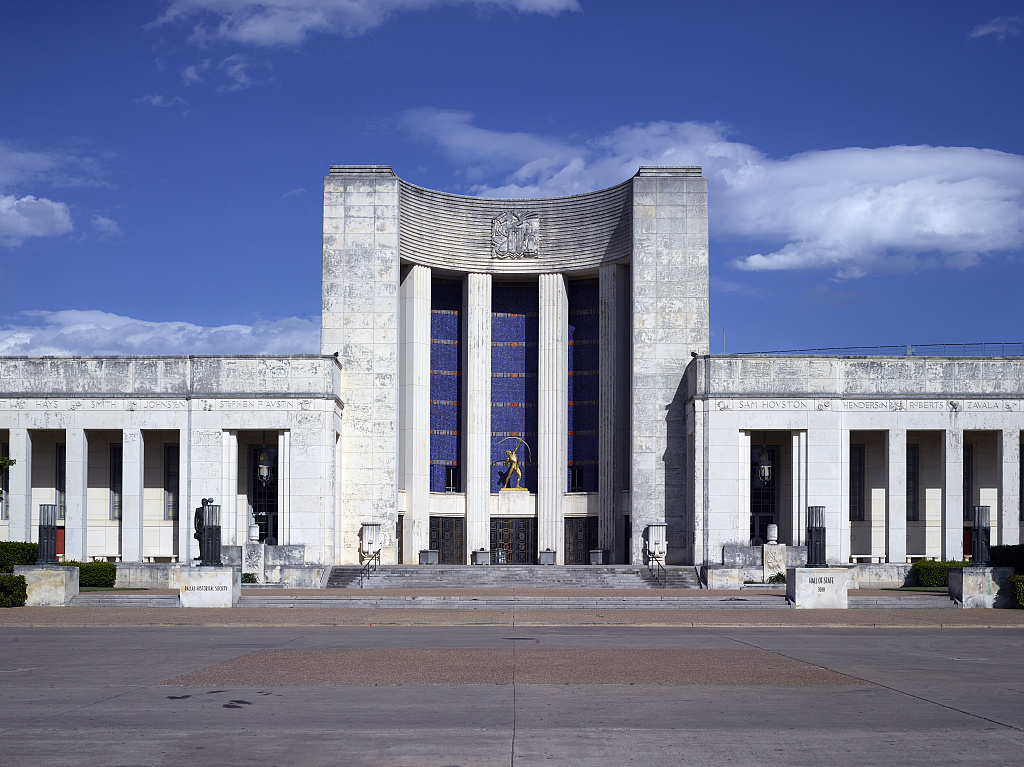
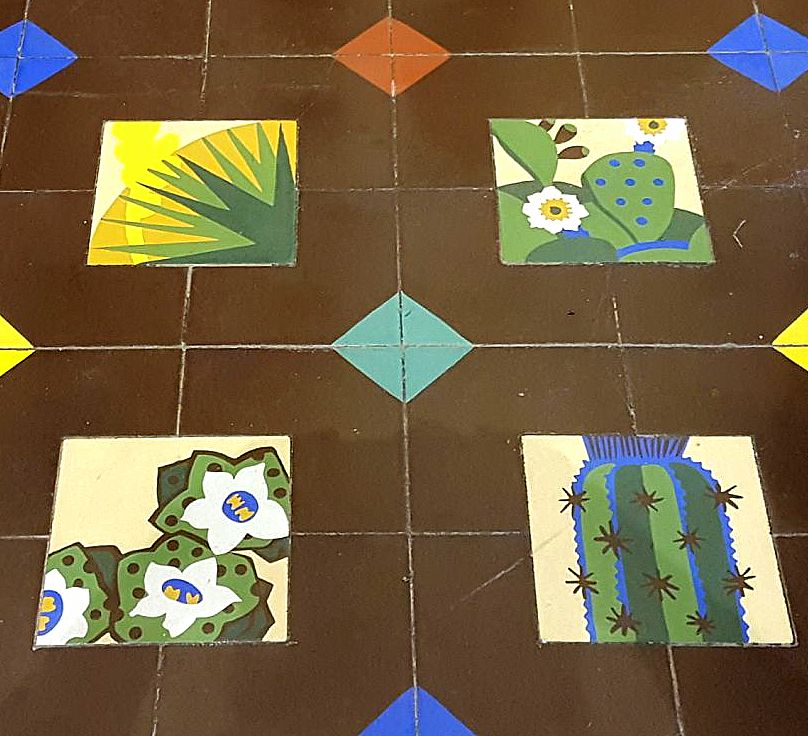
What we now call the Hall of State was the architectural jewel in the crown of the Art Deco splendor created throughout Fair Park for the Texas Centennial Exposition in 1936. The room now housing the Dealey Library was originally the West Texas Room — one of four geographically-specific rooms in the Hall of State. The two Tom Lea murals (one depicting a cowboy, the other, pioneers) are on opposite walls (walls finished with an adobe-like plaster, decorated with famous Texas brands, in relief). One wall is covered with cowhide. There are painted ceramic tiles set into both the walls and the floor (the ones on the floor decorated with images of cactus are great!). There is a wood sculpture of a cowboy, carved by Dallas artist Dorothy Austin, who was only 25 years old when the Centennial opened. And … well — like everything in the Hall of State — everywhere you look you see incredible attention to detail. Every fixture, grating, knob … everything is absolutely wonderful.

In 1989, after a two-and-a-half-year renovation, the West Texas Room became the home of the G. B. Dealey Library (named in honor of the former publisher of The Dallas Morning News). The project was headed by architect Downing Thomas who took great care in choosing the Arts and Crafts-style furniture (the chairs, tables, and bookcases were handmade by Thomas Moser in Portland, Maine, the chairs emblazoned with bronze Texas stars and upholstered in tanned leather), reading lamps with mica shades (made by Boyd Lighting of San Francisco), and a woven rug by Sally Vowell of Fort Worth (I don’t recall seeing a rug, but there’s a lot to take in and I might have missed it). I really love this room.

When the library opened in November, 1989, the first guest through the doors was Tom Lea who had been shocked to learn that his then-53-year-old murals were still in place. And they’re still there, 81 years after Lea created them. And you should go see them.

The library and reading room is open Tuesday-Sunday, same hours as the Hall of State. If you are interested in researching materials from the collection of the Dallas Historical Society, you are encouraged to contact the staff in advance of your visit and make an appointment; though the room is open to the public, research hours are limited. More about this and the hours of operation can be found here.

*

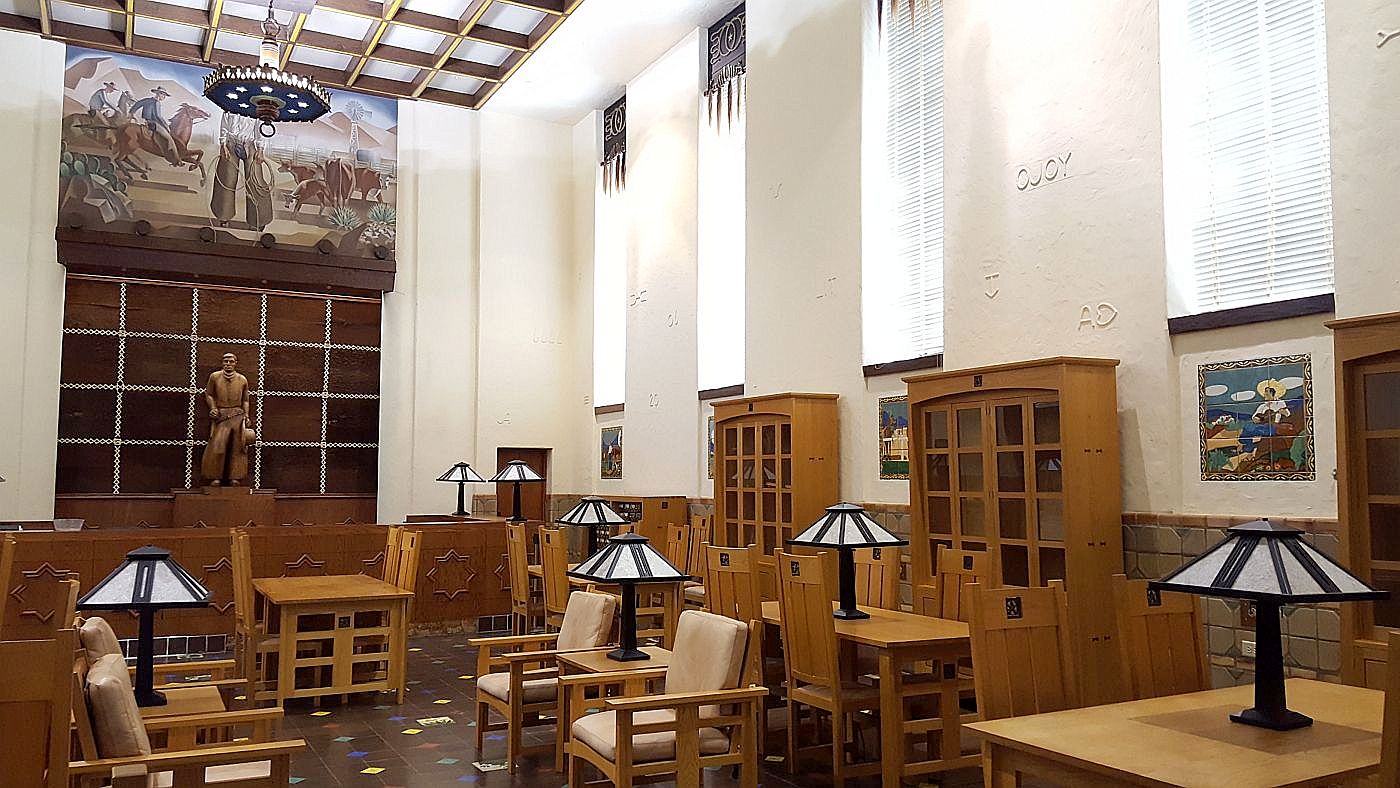
Below, one of the Tom Lea Murals can be (partially) seen above the cowhide wall-covering and above Dorothy Austin’s cowboy sculpture. (Click photo to see a larger image.) That light fixture is fantastic! (See the full Tom Lea mural here.)

hall-of-state_dealey-library_042517_inside-entrance

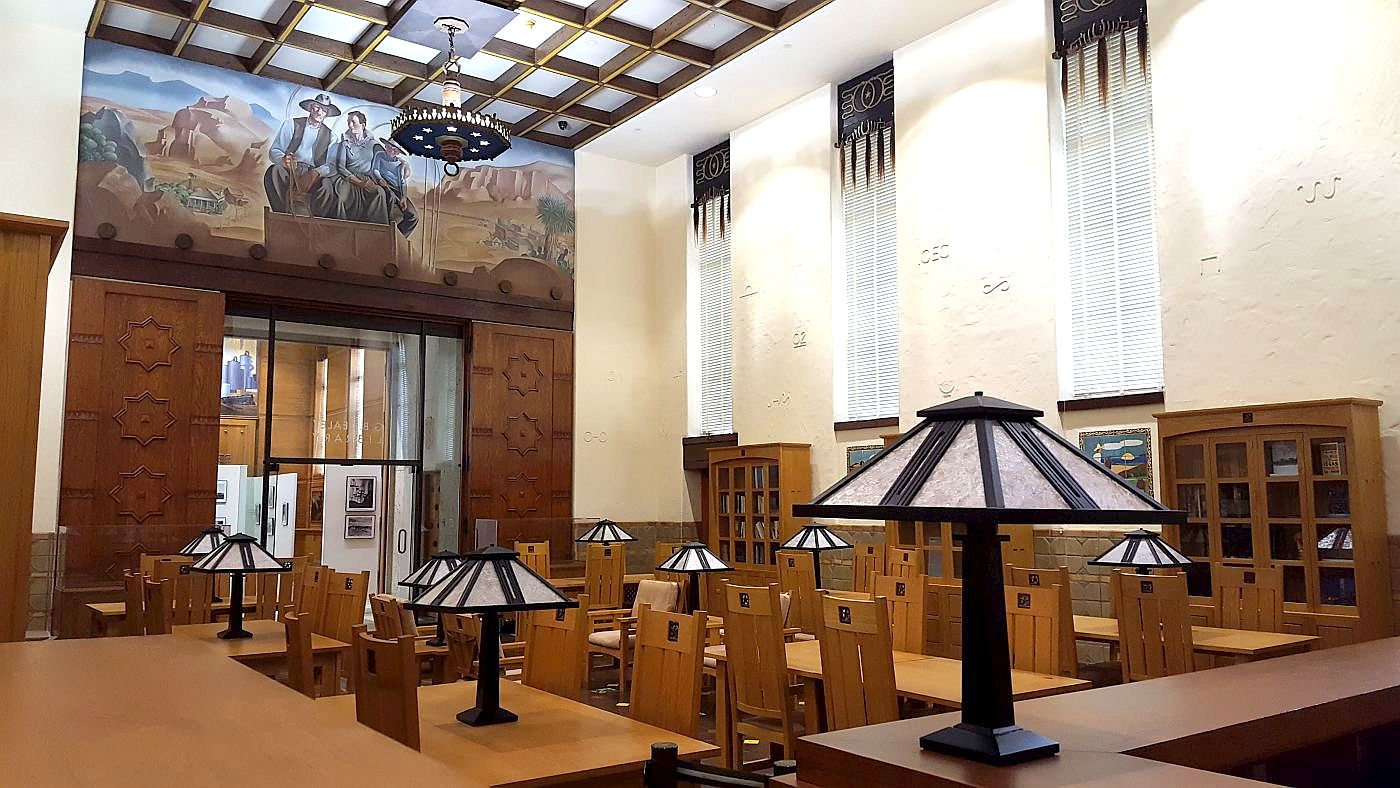
Here’s the view from the back corner looking toward the entrance, over which can be seen Lea’s second mural.

hall-of-state_dealey-library_042517_toward-entrance

In the photo at the very top, you can see the floor, which is studded with all sorts of cactus-themed tiles. Here are examples of four of them.

hall-of-state_dealey-library_042517_floor

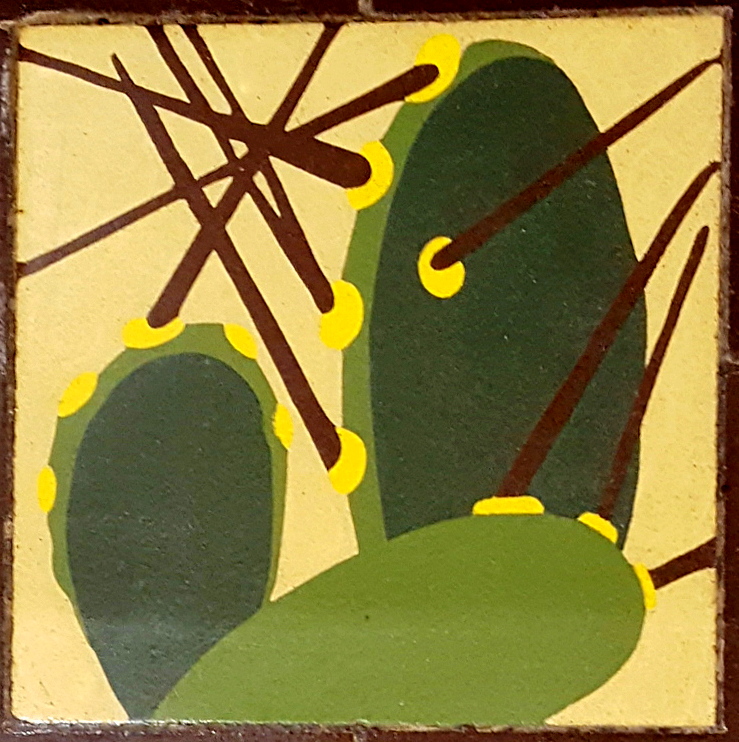
My absolute favorite of the cactus tiles is this one, in a very Japanese-like rendering.

hall-of-state_dealey-library_cactus-tile

*

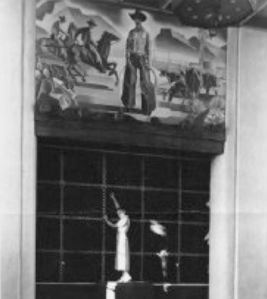
That’s what the room looks like today. Here are a few photos of the West Texas Room under construction in 1936 (photos from the Dallas Historical Society’s Centennial Visual Collection). The first one shows Dorothy Austin standing below the Tom Lea mural, about where her cowboy statue would be placed. Those ceilings are pretty high.

tom-lea_dorothy-austin_west-tx-room_DHS

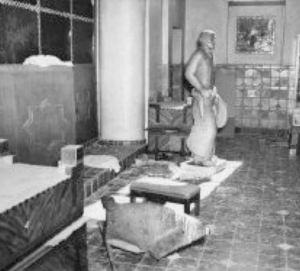
And here’s the statue. (See Austin’s statue close up, here, in a 2014 photo by Carol M. Highsmith, from the Library of Congress.)

dorothy-austin_cowboy-sculpture_west-tx-room_DHS

And here is a look into the room from the entrance, showing a construction crew at work.

west-tx-room-construction_hall-of-state_DHS

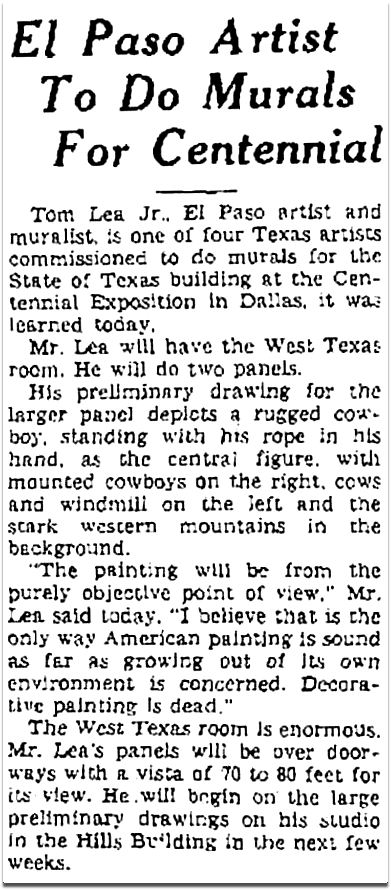
Below are 28-year-old Tom Lea’s thoughts on being informed of his important commission, from the El Paso Herald Post, March 24, 1936.  (Click to see larger image.)

tom-lea_west-tx-room-murals_el-paso-herald-post_032436

It seems strange that Lea was only in the preliminary-drawing stage of the murals’ creation in March — the Centennial was scheduled to open in June, less than three months away. (It’s worth noting that even though the Centennial — which ran for almost six months — opened in June, the Hall of State did not open to the public until September, three months behind schedule and the only Exposition building that did not meet its deadline. It was finally dedicated on September 5, 1936, the 100th anniversary of Sam Houston’s election as the first President of Texas.)

Below, a photo of Mr. Lea at the 1989 opening of the Dealey Library, with his 1936 mural behind him.

tom-lea_west-texas-room_1989_tom-lea-institute
via Tom Lea Institute

*

To read more details on the 1989 opening of the G. B. Library and the renovation of the West Texas Room, please check out these articles from The Dallas Morning News archives:

  • “A Rare Blend — Art Deco, Western and Shaker Unite for a Modern Adaptation at the Hall of State” by Mariana Greene (DMN, Nov. 12, 1989)
  • “G. B. Dealey Library Dedicated at Fair Park — Center Will House Texas Documents” by Todd Coplivetz (DMN, Nov. 13, 1989)
  • “How the West was East at the Hall of State Redo”  by Alan Peppard (DMN, Nov. 14, 1989)
  • “An Old Friend Triumphs Anew: The Hall of State Redo Affirms the Power of Great Architecture” by David Dillon (DMN, Nov. 14, 1989)
  • “Reviving a Cultural Paean to Dallas — Fair Park Changes Designed to Restore Centennial’s Glory” by David Dillon (DMN, April 9, 1986) (this article concerns Fair Park as a whole)

***

Sources & Notes

Photos of the Dealey Library and Hall of State door (below) are by me.

Photos of the West Texas Room from 1936 are from the collection of the Dallas Historical Society. You can search through low-res thumbnails of some of the images from their very large collection here.

As mentioned above, if you plan a trip to the Dealey Library in order to inspect or research items from the DHS collection, these materials must be requested in advance and an appointment must be scheduled (info here).

More on Tom Lea (1907-2001) can be found at the Tom Lea Institute website, here (with specific information on the Hall of State murals here); a profusely illustrated blog post with an emphasis on his time as a WWII artist-correspondent can be found here.

Obituary for Dorothy Austin Webberley (1911-2001) can be found on the Dallas Morning News site, here; family obituary is here.

Detailed info on the architecture and design of the Hall of State can be found in a Dallas Historical Society PDF, here. The Wikipedia entry is here (someone please correct the erroneous info that the Dealey Library is in the “East” Texas room!), and the always informative Watermelon Kid site has information on the East Texas and West Texas rooms here.

A series of photos of Fair Park, taken in 2014 by Carol M. Highsmith, can be found at the Library of Congress website, here. Her photo of the Hall of State is below.

hall-of-state_library-of-congress_carol-m-highsmith_2014

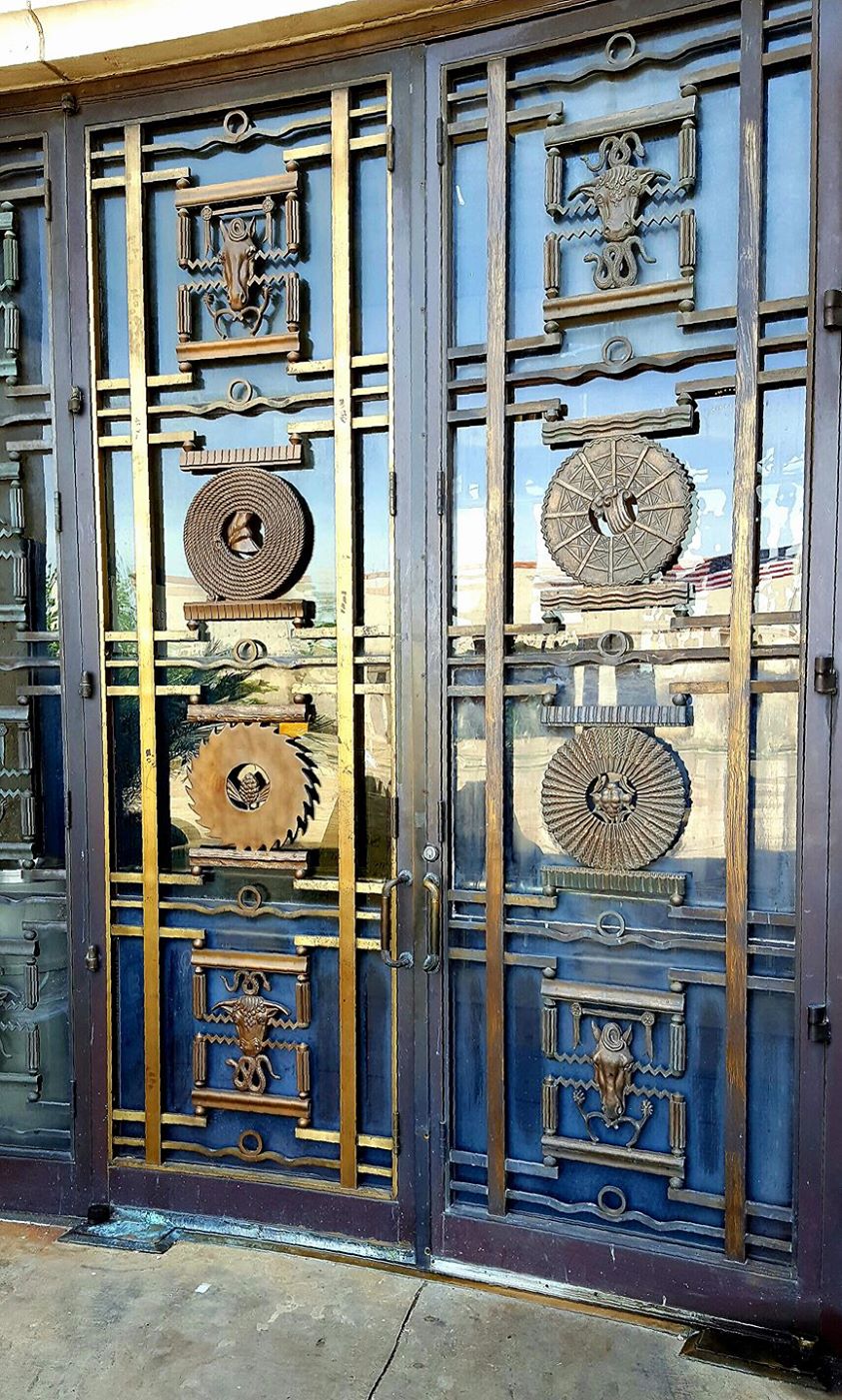
And, lastly,  a photo I took showing one of my favorite elements of a building packed with aesthetically pleasing details (seriously, everywhere you look): one of the doors of the main entrance to the Hall of State, designed by Houston architect Donald Barthelme, honoring Texas industry (ranching, timber, oil, agriculture, etc.). That sawmill blade gets me every time. And the aerial perspective of oil coming up through a derrick (middle right) is pretty cool, too. (Click to see a larger, more exciting image!)

hall-of-state-doors_042517_bosse

*

Copyright © 2017 Paula Bosse. All Rights Reserved.
 

The Saint Jude Chapel Mosaic by Gyorgy Kepes — 1968

gyorgy-kepes_mosaic_st-jude-chapel_websiteMain Street mosaic…

by Paula Bosse

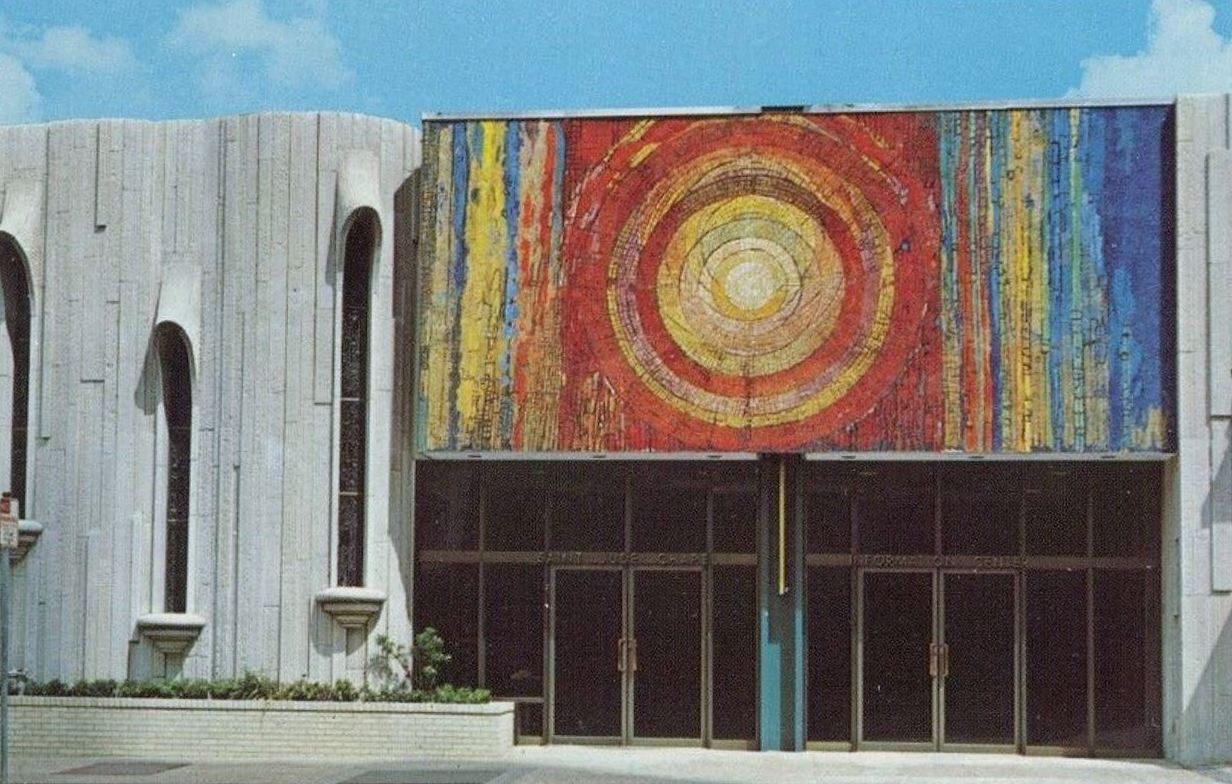
Perhaps you’ve noticed the intensely colorful sunburst-like mosaic that adorns the Saint Jude Catholic Chapel at 1521 Main Street, near Stone Place. It’s hard to miss. The artist is Gyorgy Kepes (1906-2001), an important Hungarian-born avant-garde painter, photographer, and educator who immigrated to the United States in 1937. He taught for a short time at North Texas State University (now the University of North Texas) in the mid 1940s, and may be known best in Dallas for his work as artistic director for Temple Emanu-El in the late 1950s, a project which artfully brought together contemporary art, architecture, and design into a sacred space.

At the time Kepes was commissioned to create the mosaic for the new Saint Jude Chapel (which opened in 1968), he was immersed in founding the Center for Advanced Visual Studies at the Massachusetts Institute of Technology (MIT). One wonders how he found the time!

This mosaic — which as far as I know is untitled — is probably a familiar sight to people who work and live downtown, but most who pass it are completely unaware of the name of the artist. I hope I’ve helped correct that a bit. Thank you, Gyorgy Kepes — and thank you, Saint Jude Chapel — for this nice little addition to Dallas’ public art.

gyorgy-kepes_mosaic_st-jude-chapel_website_video_closeup

gyorgy-kepes_mosaic_st-jude-chapel_website_video

gyorgy-kepes_mosaic_st-jude-chapel_website_video_bw

st-jude-chapel_kepes_postcard_ebay

st-jude-chapel_kepes_postcard_ebay-captionPostcard and info, eBay

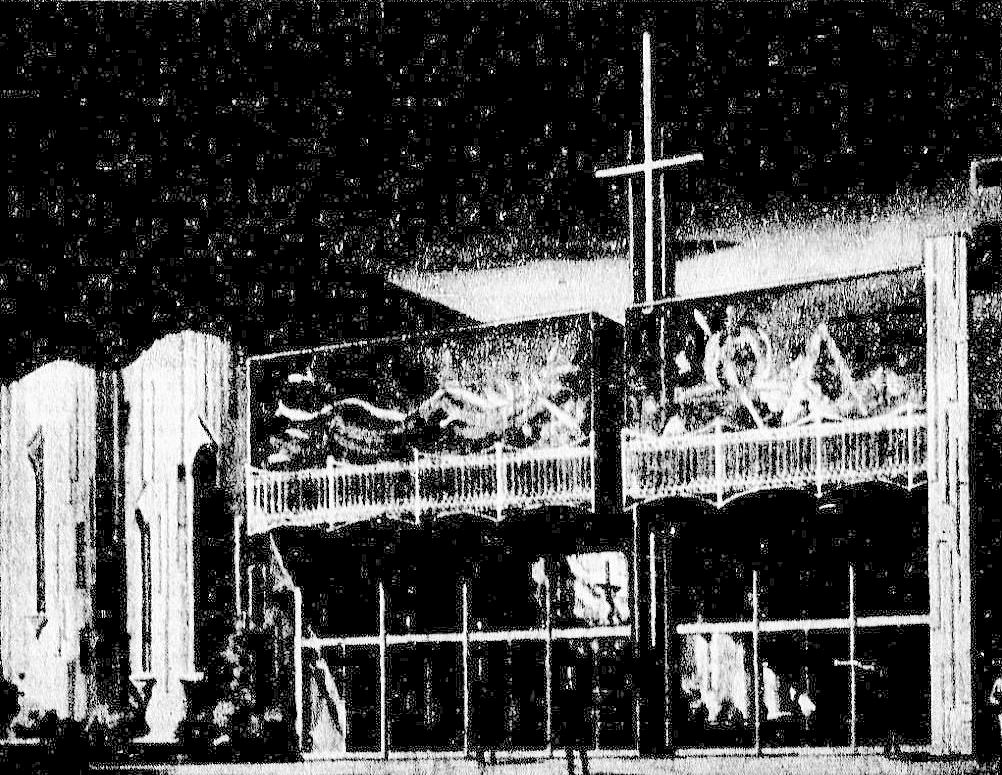
Below, an early rendering of the proposed building (1966), designed by architect Eugene F. Boerder. The vague mosaic design in this drawing suggests that Kepes might not have been attached to the project at this point, or that his design had not yet been determined.

st-jude_architects-rendering_1966_eugene-f-boerderArchitect’s rendering, Sept. 1966

***

Sources & Notes

Unless otherwise noted, photos from the Saint Jude Catholic Chapel website, here. The undated black-and-white photos are from a video history of the chapel, here.

Read about Gyorgy Kepes in overviews of his life and career from MIT, from the James Hyman Gallery, and from Wikipedia.

I have been unable to find any information about this mosaic. Had I not stumbled across Kepes’ name in a Sept. 14, 1968 Dallas Morning News article about the new chapel (which I was reading while researching the very interesting history of the building the St. Jude Chapel is in — and the building next to it) (that post is here), I’m not sure I’d be able to track down the identity of the artist. It’s surprising how little is out there about such a prominently displayed work of art!

UPDATE: Rather bizarrely, a few weeks after I wrote this, I learned that this mosaic was being restored — so I went downtown, met the restoration team, took some photos, and wrote the post “Mosaic Restoration at Downtown’s St. Jude Chapel.”

*

Copyright © 2017 Paula Bosse. All Rights Reserved.
“Dallas Skyline: Late Afternoon From Stemmons Freeway” by Ed Bearden — 1959

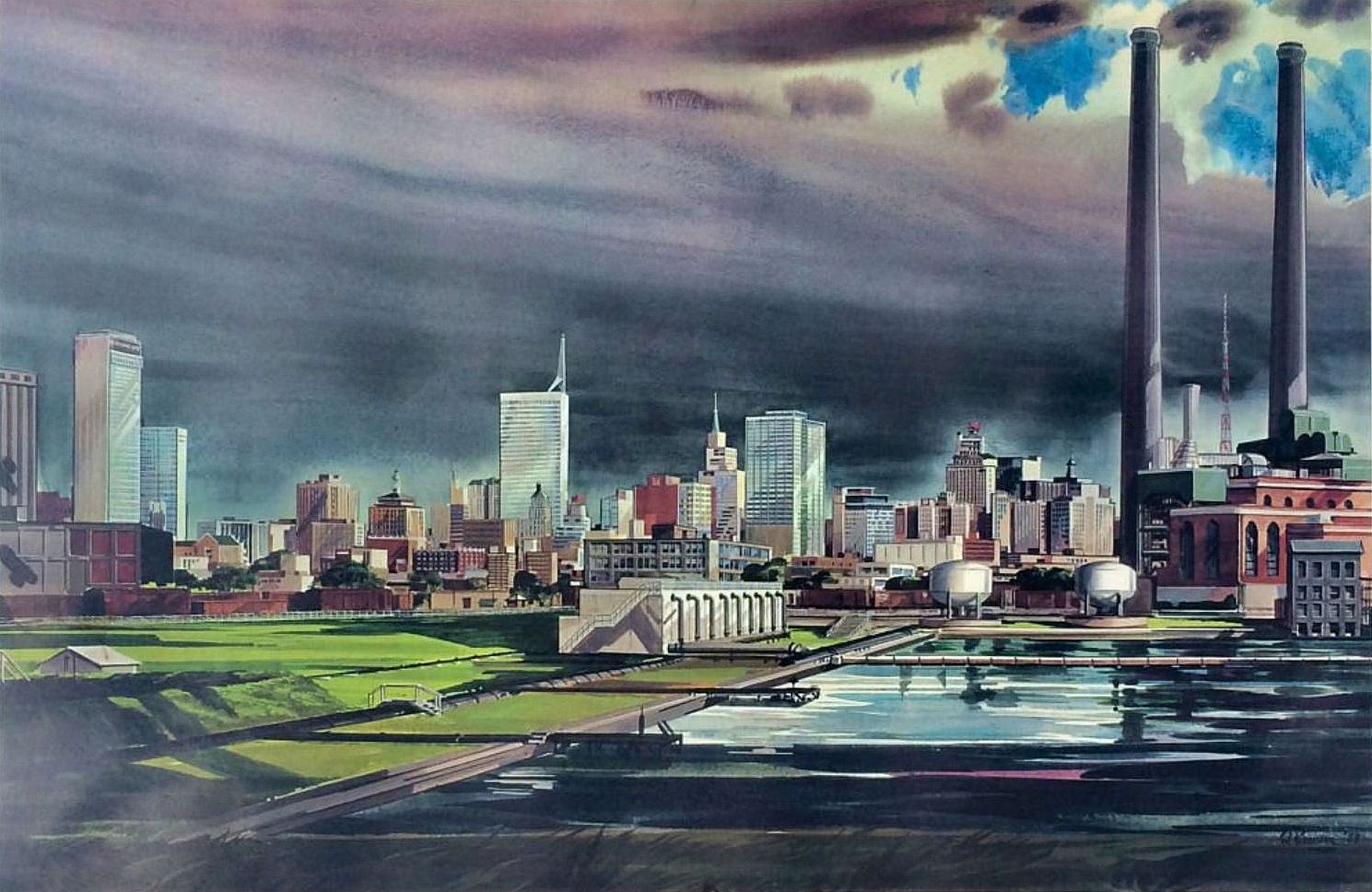
bearden_dallas-skyline-late-afternoon-from-stemmons-freeway_litho_1959Skyline and power plant… (click for larger image)

by Paula Bosse

I think the 1950s Dallas skyline is my favorite Dallas skyline. This lithograph by Dallas artist Ed Bearden shows all the usual superstars — the Southland Life Building, the Medical Arts Building, the Republic Bank Building, the Mercantile, the Magnolia — but it also shows a building that doesn’t often find its way into artistic renderings of the city’s skyline: the Dallas Power & Light plant (which was demolished several years ago and is now the site of the American Airlines Center). It looks really great here, with its familiar twin steamstacks and its oasis-like “spray pond” shimmering in the foreground. In fact, the presence of the DP&L plant is my favorite element of this artwork. The beauty of that workhorse industrial plant gives those fancy skyscrapers a run for their money!

This same view from the Stemmons of today looks like — brace yourself — this.

***

Sources & Notes

Lithograph by Ed Bearden; image from an auction listing on the Live Auctioneers site, here. (Thanks, “Not Bob,” for alerting me to this great artwork!)

See another Bearden skyline seen from a similar vantage point, here.

More on the cool-looking DP&L plant and its twin smokestacks can be found in these Flashback Dallas posts:

  • “DP&L’s Twin Smokestacks,” here
  • “A New Turbine Power Station for Big D — 1907,” here

*

Copyright © 2017 Paula Bosse. All Rights Reserved

Keeping Up With Busy Dallas — 1927

dallas-skyline_drawing_forest-avenue-high-school-yrbk_1927Spot the landmarks (click for much larger image)

by Paula Bosse

Here are two striking graphic depictions of the Dallas skyline, both of which appeared in the 1927 Forest Avenue High School yearbook. The skyline was impressive in 1927, but it would change a lot in the next few years. One important change would come with the addition of what became the unofficial symbol of Dallas: the Magnolia Building was already there in 1927, but Pegasus would not be installed on top of it until 1934.

Below, a drawing that appeared on the last page of the yearbook, showing a locomotive chugging away from the Big City, with the promise/threat “You may leave Dallas, but you’ll come back.”

dallas_you-may-leave_train_forest-ave-high-school-yrbk_1927

This is an interesting little tidbit from the same yearbook:

dallas-history_forest-ave-high-school-yrbk_1927

26.44 square miles in area?! Smallest of any major Texas city?! 42nd in U.S. population?! How times change. According to recent figures, the City of Dallas stretches across 385 square miles, is the third largest city in Texas, and is the ninth largest city in the United States. And the Magnolia Building — seen in both of the drawings above and once the tallest building in the state — is now dwarfed by taller buildings all around it. Dallas has been busy.

***

Sources & Notes

Drawings from the 1927 Forest Avenue High School yearbook, The Forester. (Forest Avenue High School was the original name of James Madison High School. The all-white South Dallas high school became an all-black high school in 1956.)

The artist of the top drawing appears to be someone by the name of “Bond” (which may be Ashley Bond who drew a great birdseye view of the city in 1925 here). The bottom drawing is signed “GWH” — George W. Harwood, Jr. I think Bond might have been a professional artist affiliated with the printing company that printed the yearbooks, but here is the dashing photo of GWH, Class of 1930 (I believe he left Dallas and didn’t come back…).

harwood_forest-ave-high-school-yrbk_1930

Click drawings to see larger images.

*

Copyright © 2017 Paula Bosse. All Rights Reserved.
 

“Dallas/The Big D” by William E. Bond — ca. 1962

dallas-big-d_william-e-bond_business-week-collection_ca1962Yonder lies Big D…

by Paula Bosse

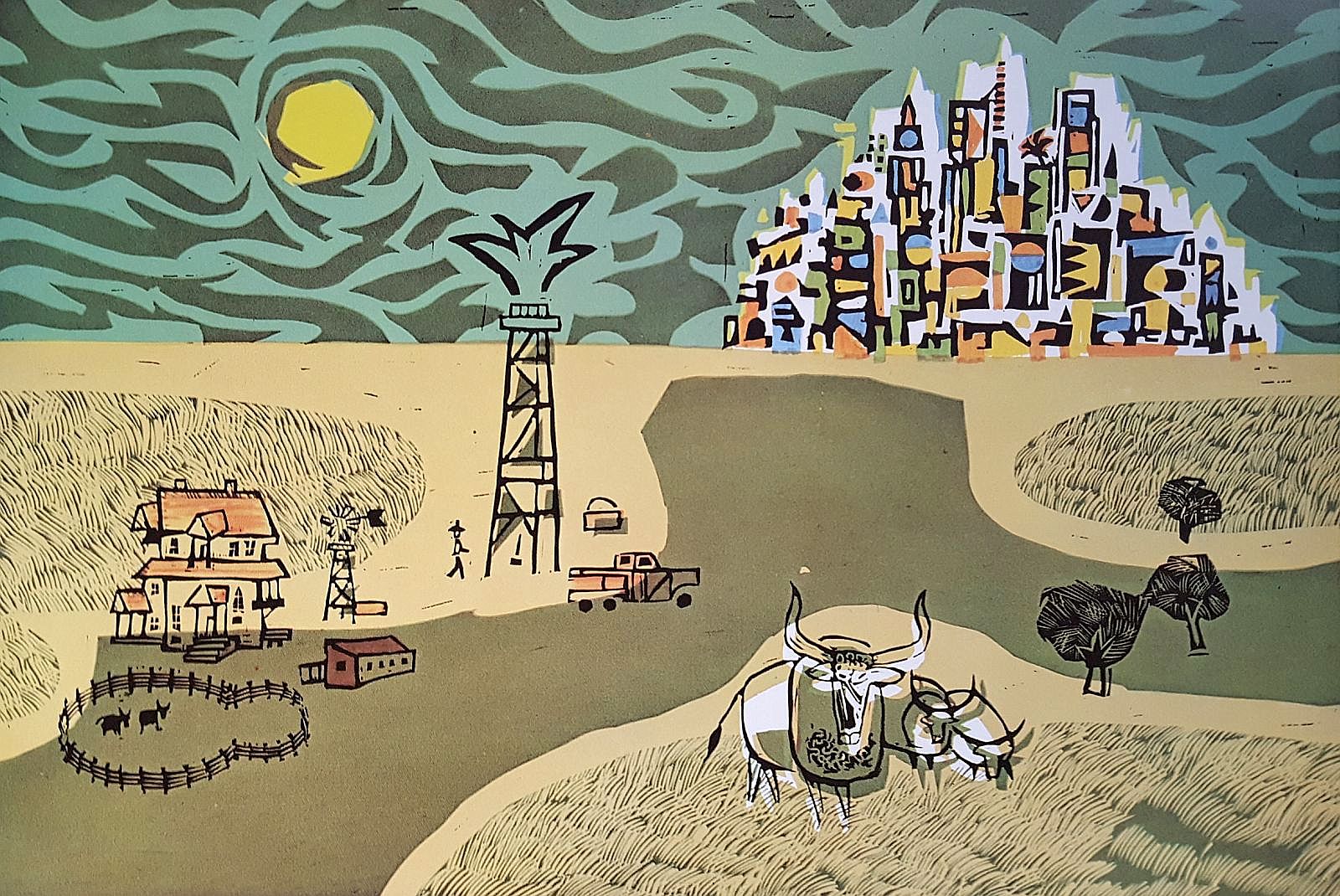
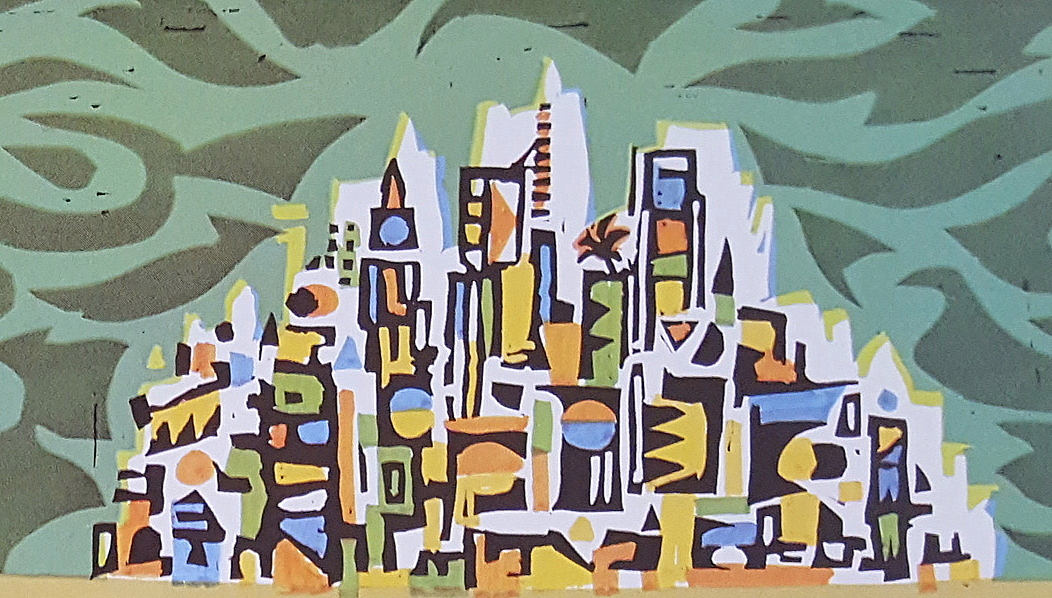
This print — titled “Dallas/The Big D” by native Texan William E. Bond (1923-2016) — is fantastic. I love everything about it. It was commissioned by Business Week magazine to be used as part of its “Business America” series, an advertising campaign showcasing fifteen American cities captured in woodcuts. Every element of this scene is great, but let’s look at a detail showing just the Dallas skyline, with a hard-to-miss Pegasus. I also see what looks to be the Mercantile Building and the Republic Bank Building in there. And … that sky!

bond_william-e_dallas-big-d_print_business-week_ca-1962_det

william-e-bond_sig

Bond’s homage to Dallas was reproduced in the 1963 book Woodcuts of Fifteen American Cities from the Business Week Collection. Below, text from the book (my assumption is that the first paragraph is the copy that appeared in a print advertisement for Business Week — it appears that the ad campaign used the artists’ works collected in this book to illustrate the ads, with each ad mentioning local companies with large BW subscribership).

Dallas … leapfrogging ahead commercially and culturally. Cotton, cattle, and oil put the Big D on the map. But aircraft, electronics and machinery keep it moving. Companies like Texas Instruments (682 Business Week subscribers), Ling-Temco-Vought (106), Collins Radio (135), Dresser Industries (123). In Dallas, and everywhere in business America, men who manage companies read Business Week. You advertise in Business Week when you want to inform management.

And this was Bond’s bio with a quote from him on “the Big D”:

“Dallas is a great many things. It is a giant of a city in the midst of a giant country – full of life and energy and the will to grow and keep growing. Anyone who knows Dallas feels this spirit. And it is this feeling that I have tried to capture.”

Born in 1923 in Crandall, Texas, Mr. Bond attended the Art Center School in Los Angeles. He has won many gold and silver awards in art director and illustrator shows, including a gold medal in the New York Illustrators Show in 1962. Mr. Bond uses a variety of media, including paper prints, sculpture, and painting. He has been an agency art director most of his career, and is now a free-lance designer.

**

Bill Bond was born in Crandall, Texas in 1923, studied art at the Art Center School in Los Angeles, and spent several years as an award-winning commercial artist in Dallas. He worked as an advertising art director for The Dallas Times Herald, the Sam Bloom Agency, and Tracey-Locke; during this time he frequently participated in group art shows around the city. When he retired, he focused his creative talents on sculpture, becoming known for his wildlife pieces and Western bronzes. He died in Kerrville in 2016 at the age of 92.

william-bond_obit-photo

***

Sources & Notes

The book that features a reproduction of this print is Woodcuts of Fifteen American Cities from the Business Week Collection (New York: McGraw-Hill Publishing Company, Inc., 1963). From the introduction:

One of the principal methods of communication in the 20th century, and one of the biggest businesses, is advertising. Here, too, industry has regularly and effectively used fine art – in the creation of some memorable advertising campaigns.

From 1960 to 1962 Business Week commissioned fourteen prominent woodcut artists to illustrate its “Business America” series. Reproductions of the fifteen woodcut illustrations which were produced appear on the following pages.

Bill Bonds’ obituary is here.

Thanks to Bob Dunn for posting an image of Bond’s print in the Retro Dallas Facebook group. I liked it so much I went out and bought a copy of the (large) book! A few copies are available online here.

*

Copyright © 2017 Paula Bosse. All Rights Reserved.
Dallas Scenes by Florence McClung — 1940s

mcclung_dallas-cityscape_1941_kever-collectionFrom the collection of Mark and Geralyn Kever

by Paula Bosse

Florence McClung (1894-1992) — a painter, printmaker, and pastelist in the circle of Regionalist artists known as The Dallas Nine — lived in Dallas and often painted nearby rural scenes as well as more rugged Western landscapes. I haven’t seen many urban scenes by McClung, but there were two oil paintings that appeared in a one-woman show at the Dallas Museum of Fine Arts in the spring of 1945 which I’d love to find images of: “Triple Underpass” and “Big D,” the latter of which sounds very similar to the one seen above, “Dallas Cityscape,” from the collection of Mark and Geralyn Kever (whose impressive collection of Texas art can be seen in the Jan./Feb. issue of American Fine Art Magazine — jump to page 53 in the PDF to find the story, “Cream of the Crop”). (UPDATE: “Triple Underpass” has surfaced! More here.)

Here’s another urban scene, “Industrial Dallas,” with what looks like the Medical Arts Building in the background.

mcclung_industrial-dallas_david-dike-gallery_jan-2016-catDavid Dike Fine Art

I always love to see artistic renderings of the Dallas skyline, and I really like these two city scenes which are so different from McClung’s usual subject matter.

Florence McClung (née White) was born in St. Louis in 1894. Her family moved to Dallas, and she eventually studied art under several of Dallas’ finest instructor-artists (including Frank Reaugh). After several years as a college art instructor in Waxahachie, she began to participate in numerous group shows, juried shows, and one-man shows, reaching the peak of her career in the 1930s and 1940s. She died in 1992 at the age of 97. Art-wise, that spans the years from Toulouse-Lautrec to Banksy!

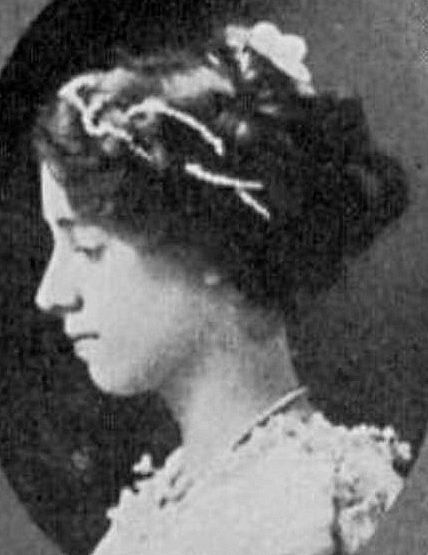
I had a hard time finding photos of her, but I managed to find two, including her senior photo which appeared in the 1912 yearbook of Dallas High School (more commonly known today as Crozier Tech) (where, incidentally, she was in the Art Club with Allie Tennant who went on to become a noted sculptor, best known for her Tejas Warrior at the Hall of State in Fair Park).

mcclung_florence-e-white_dallas-high-school_1912
Florence White, Dallas High School yearbook, 1912

mcclung-florence_circa-late-1930s
Florence McClung, circa late 1930s

***

Sources & Notes

I ran across the “Dallas Cityscape” painting on the CASETA (Center for the Advancement and Study of Early Texas Art) site.

The top painting has the title “Dallas Cityscape” and media mentions of it carry the date 1941. I couldn’t find a painting by McClung with that title (admittedly, my sources are limited!). Also, 1941 seems off because construction of the Mercantile Bank Building (seen in the painting) wasn’t completed until 1942. I wonder if it’s possible that this painting actually was the painting McClung titled “Big D” (which was most likely painted in 1944) and was included in her 1945 show at the DMFA? Might those planes have something to do with World War II? Because the Portal to Texas History has been so nice to scan them, McClung’s application for a show at the DMFA can be seen here, and her list of works to be shown is here.

“Industrial Dallas” is from a January, 2016 auction catalogue from David Dike Fine Art.

The Handbook of Texas entry for Florence Elliott White McClung can be found here.

A selection of works by Florence McClung from the Dallas Museum of Art can be found on the SMU Central University Libraries Digital Collections site, here.

UPDATE, Oct., 2018: “Triple Underpass,” from the same period as the two paintings above, has surfaced — more about it can be found in the post “‘Triple Underpass’ by Florence McClung — 1945,” here.

All images larger when clicked.

*

Copyright © 2016 Paula Bosse. All Rights Reserved.
 

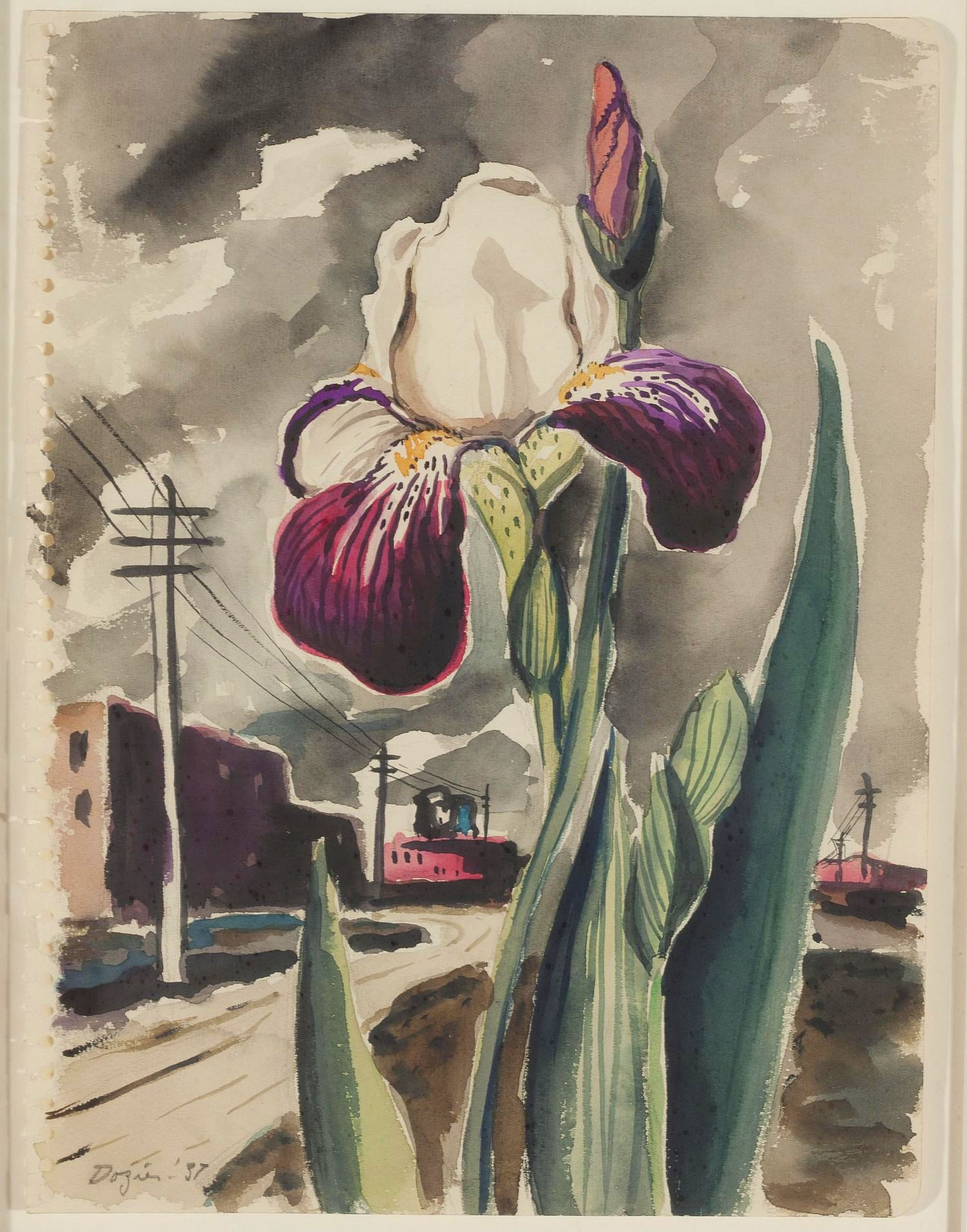
Spring, According to Otis Dozier — 1937

dozier_iris-purple_1937_dmaOtis Dozier’s purple iris (click for much larger image)

by Paula Bosse

My birthday is in March, and I always associate this time of year with irises, because the irises around our house would start to bloom in time for my birthday. There’s no better way to celebrate a (belated) start to Spring than by sharing this beautiful watercolor from Otis Dozier: “Iris (purple) April,” 1937.

***

This watercolor is in the collection of the Dallas Museum of Art, a gift of The Dozier Foundation; ©Denni Davis Washburn, William Robert Miegel, Jr., and Elizabeth Marie Miegel. More information is here.

More on the Forney-born Dallas Nine artist Otis Dozier (1904-1987), here.

Did you know there is an Iris Society of Dallas? There is!

Click picture for very large image.

*

Copyright © 2016 Paula Bosse. All Rights Reserved.
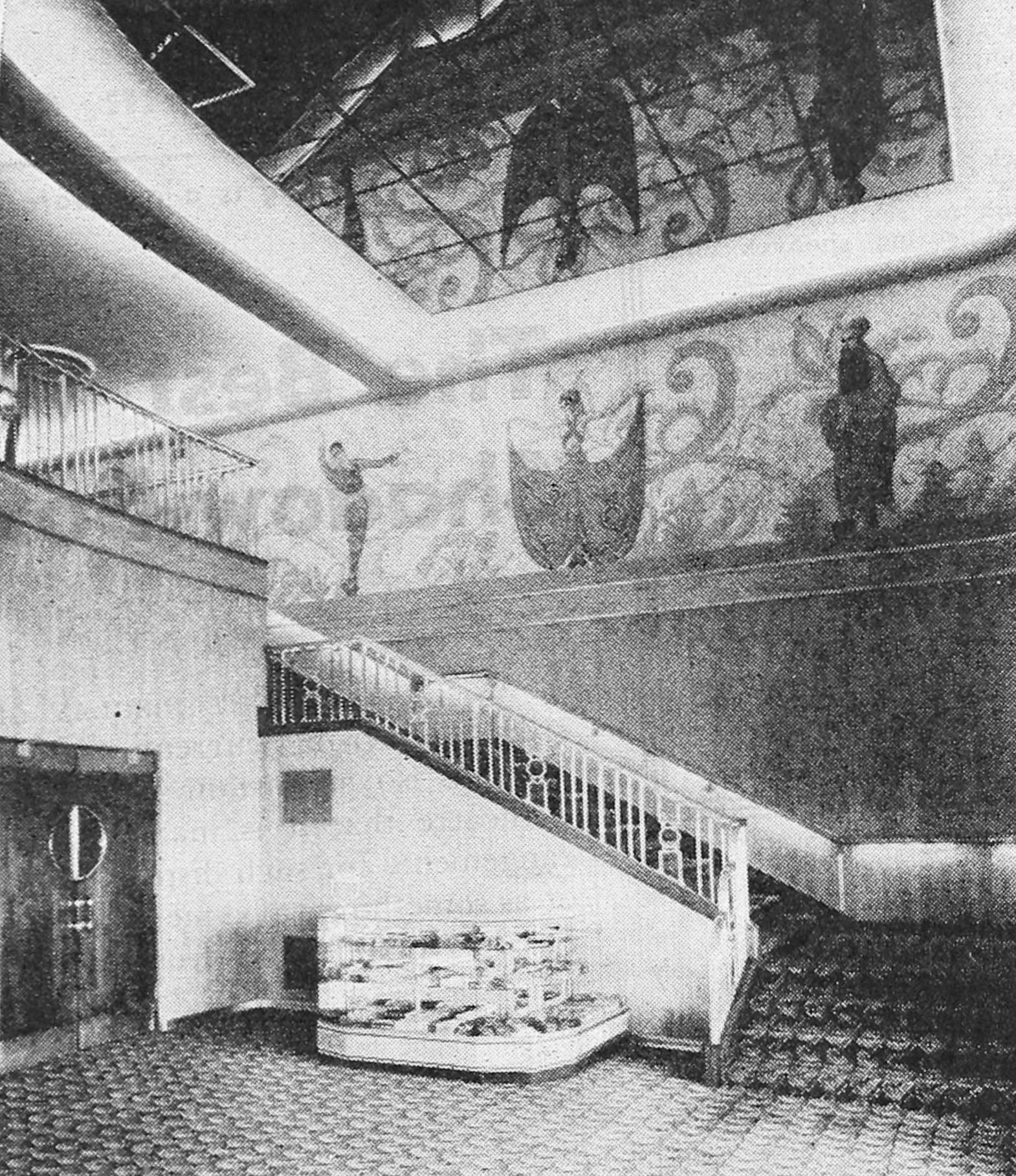
The Lakewood Theater — 1944

lakewood-theater_ad_inset_1944A well-lit staircase to the balcony (click for giant image)

by Paula Bosse

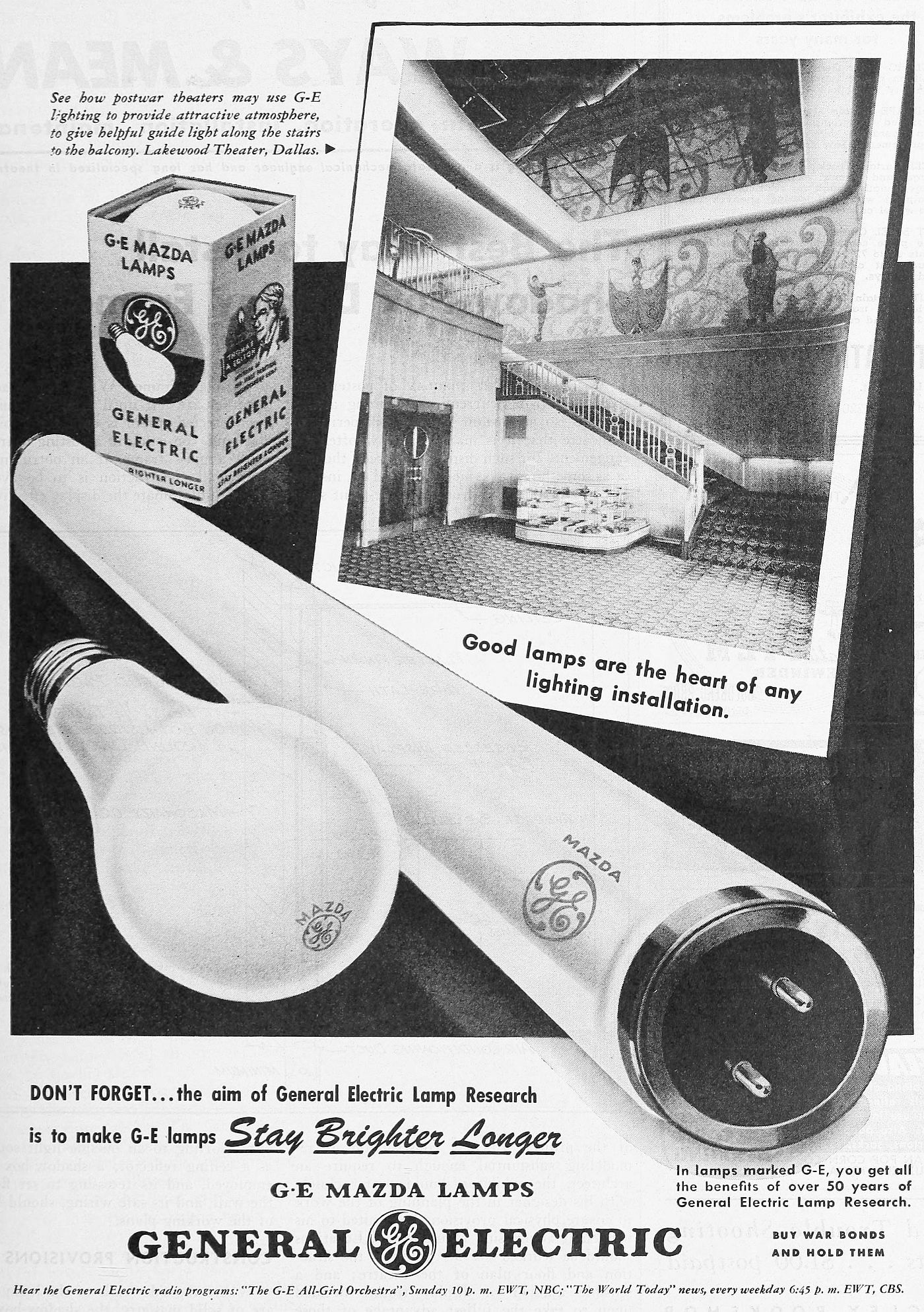
Occasionally one stumbles across a national advertisement featuring someone or something familiar to local audiences which elicits an involuntary exclamation like, “Hey! I know that guy!” I had a response kind of like that when I saw this General Electric light bulb ad featuring a photograph of the interior of the Lakewood Theater (showing a few figures from the mural by Woodrow boy Perry Nichols).

“See how postwar theaters may use G-E lighting to provide attractive atmosphere, to give helpful guide light along the stairs to the balcony.”

lakewood-theater_ad_MPH_072244_med

Yes, the Lakewood certainly did have an “attractive atmosphere.”

***

Sources & Notes

Ad for G-E Mazda lamps appeared in the July 22, 1944 issue of Motion Picture Herald. Click the above ad to see it much larger. To see it REALLY big, click here. (Apologies for the bleed-through of the ad on the other side of the page. If you’re a Photoshop wizard who can remove the offending ghost letters plastered across Nichols’ whimsical mural, I’d love a cleaned-up version.)

I have no idea what’s going on with the beleaguered Lakewood Theater these days, but if you’d like to see those murals in color, see the photos in the Lakewood Advocate, here.

*

Copyright © 2016 Paula Bosse. All Rights Reserved.

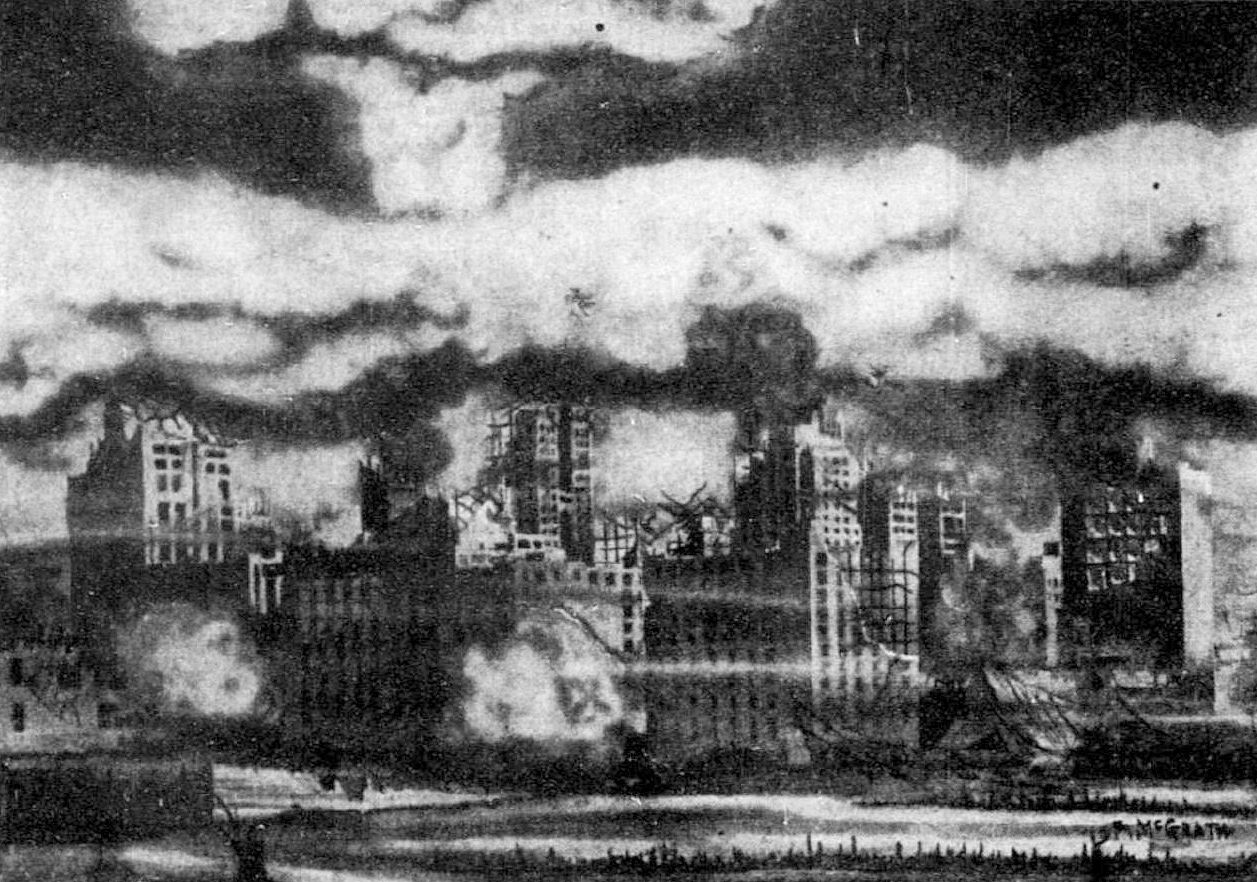
A-Bomb in Akard Street! — 1950

mcgrath-frank_atomic-aftermath-downtown-dallas_1950See Pegaus up there in the cloud of smoke and debris? (click for larger image)

by Paula Bosse

The image above, from 1950, is a depiction of what downtown Dallas might look like if an atomic bomb were dropped at the corner of Main and Akard (which is weirdly specific).

In 1950 Russia detonated a nuclear bomb during atomic tests and President Truman announced that the United States would increase and intensify research and production of thermonuclear weapons. It was a scary time for the world. The atomic bombings of Hiroshima and Nagasaki were still fresh in everyone’s minds, and news of the even more frightening hydrogen bomb was everywhere in 1950.

The drawing above is by Dallas artist Frank McGrath. It isn’t terribly realistic — Big D probably wouldn’t survive a nuclear blast —  but it’s nice that Frank spared Pegasus from annihilation.

***

Sources & Notes

There were bomb shelters all over the Dallas area. There was a (surprisingly) large shelter on the grounds of Fair Park. Watch a video tour here. And read the Flashback Dallas post “‘Dallas Is a Major Target Area!’ Know Where Your Nearest Fallout Shelter Is.”

Read about the tenor of the times in the article “Hydrogen Bomb — 1950,” here.

The title of this post is a direct reference to a great song by one of my favorite bands, The Jam. Listen to “A-Bomb in Wardour Street,” here. This time it’s nuclear apocalypse in London, but change the accent and, sure, it could be Dallas. (I knew I’d work The Jam in here one day!)

*

Copyright © 2016 Paula Bosse. All Rights Reserved.