Flashback : Dallas

A Miscellany: History, Ads, Pop Culture

Category: Disasters and Emergencies

Earthquake! — 1925

earthquake_dmn_0731_25

by Paula Bosse

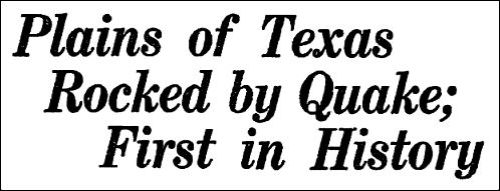
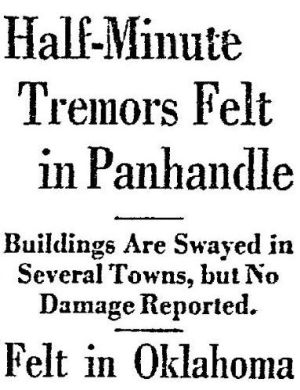
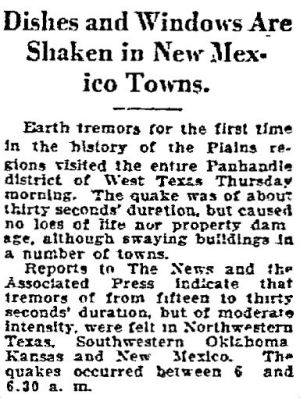
I think, perhaps, the reporter was incorrect on the earthquake of July 30, 1925 being the “first in history” to hit the Texas Panhandle, but it makes a great Page One headline.

earthquake_dmn_073125-a

earthquake_dmn_073125-b

Okay, so it’s not Dallas (…but only because I couldn’t find any historic articles about earthquakes in Dallas!), but it seems applicable, as today I experienced my first-ever earthquake — and it was in Dallas! Actually, the official tally for the day so far is four. FOUR! Eight. EIGHT! (Actually, we’re all losing count at this point.)

A 1983 article in The Dallas Morning News (“Quake Never Struck City, but SMU Prof Studies Them Anyway,” by Jane Wolfe, July 10, 1983) reported on earthquake-study being done at SMU. The very idea of this was amusing back then, because anyone who grew up here knows (and has boasted) “there are no earthquakes in Dallas.” My, how things change.

***

Sources & Notes

Top headline and snippet of first article from The Dallas Morning News, July 31, 1925. The full report of broken crockery from around the Panhandle and Oklahoma can be read in a PDF, here

An interesting Handbook of Texas article, “Notable Earthquakes Shake Texas on Occasion,” can be read here.

In case you’re preparing for a Jeopardy try-out, here are a couple of handy factoids on historic seismic activity in the Lone Star State (from another Handbook of Texas entry, “Earthquakes”): “The first known earthquake in Texas occurred in Seguin and New Braunfels on February 13, 1847. The largest earthquake in Texas occurred on August 16, 1931, near Valentine in Jeff Davis County; it measured about 6.0 on the Richter Scale.” And earthquakes never happen in Dallas. And it don’t rain in Indianapolis in the summertime.

*

Copyright © 2015 Paula Bosse. All Rights Reserved.

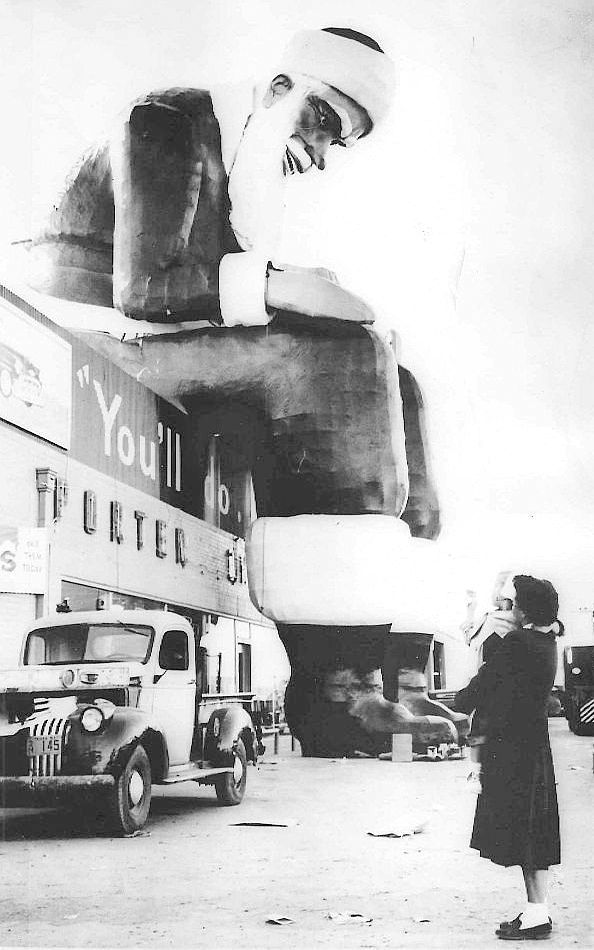
The World’s Largest Santa & The Christmas Tragedy — 1953

santa_chevrolet_color_observerSanta considers a test-drive, 1953 (photo: Roy Addis)

by Paula Bosse

Back in 2010, Robert Wilonsky (now a reporter for The Dallas Morning News, but back then a reporter for The Dallas Observer) posted a 1950s-era photo of a giant Santa Claus sitting on the roof of a Dallas car dealership. Robert had found the photo on eBay and wondered what the story behind the promotional stunt might have been. The thing that sparked my interest (other than it being a giant Santa Claus — holding a full-size car in his lap!) was the fact that the dealership, Porter Chevrolet (which I’d never heard of), had been just around the corner from where I grew up — it was in the 5500 block of E. Mockingbird, right across from the old Dr Pepper plant, about where the Campisi’s parking lot is now. I, too, really wanted to know more about that huge Santa Claus that had once been hanging out so ostentatiously in my neighborhood.

At about the time when Robert’s post appeared in 2010, I had only recently discovered that the Dallas Morning News archives were available online. For free. All the way back to 1885! (All you need is a current library card from the Dallas Public Library, and you’re on your way to losing absolute days while reading about one fascinating thing after another.) I had just begun to dabble with searches in the archives, so this seemed like a great opportunity to test my research skills and see if there was more to the story. And there was! I sent Robert what I’d found, and he wrote a great follow-up, here (which has yet another photo of the giant Santa). And a year later he did another follow-up, this one including the color photo seen above, sent in by a reader.

This is just such a great and weird holiday-related bit of Dallas’ past, that I thought I’d revisit the story, especially since some of the links in the original Observer posts no longer work.

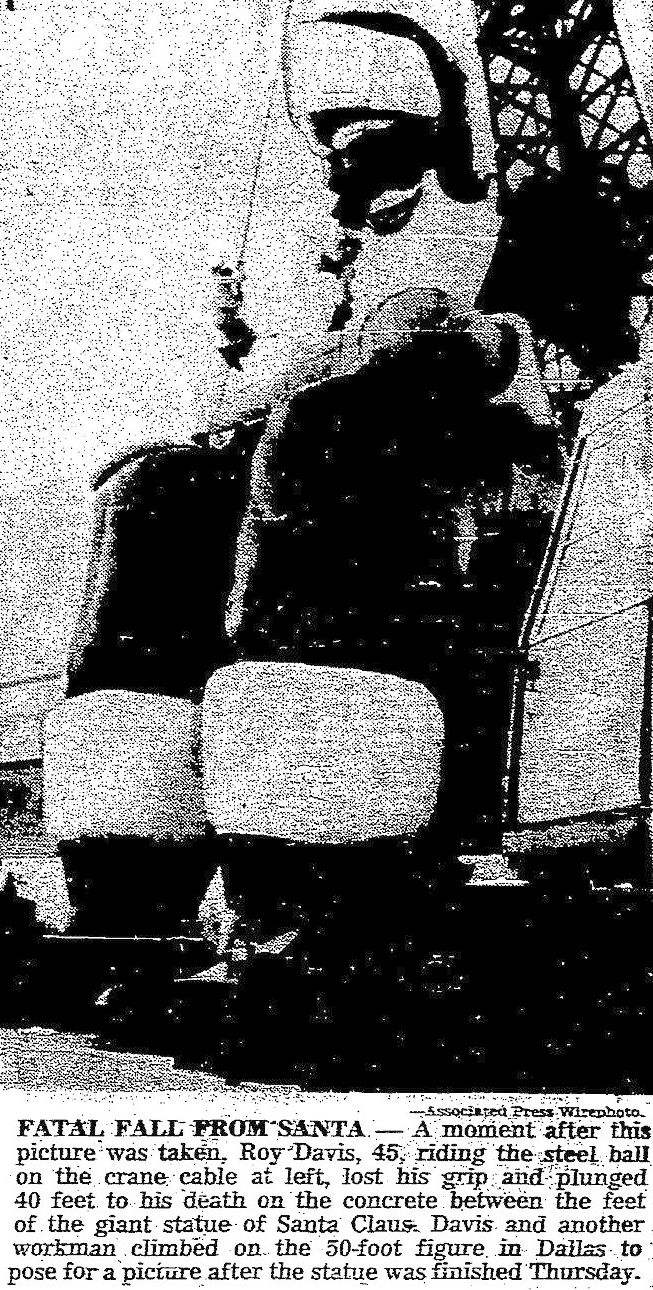
First, a quick re-cap (but, please, read Robert’s story, because you’ll enjoy  it, and it’s much more colorful than my quick overview here). During the 1953 Christmas season, Porter Chevrolet (5526 Mockingbird) commissioned Jack Bridges (the man who had previously made Big Tex (who was himself originally a giant Santa Claus)) to construct an 85-foot-tall steel-and-papier-mâché Santa Claus (he’d be that tall if he were standing) to sit on the dealership building and hold an actual 1954 Chevy in his lap. It was definitely a promotion that would grab people’s attention. The day the giant Santa was put in place, using a crane, a man whose company had done the installing (as they had with Big Tex), thought it would be a great opportunity to get a Christmas card photo of himself dangling from the crane next to Santa. The man, Roy V. Davis, was recovering from heart-related health problems, and, as it turned out, he experienced a “myocardial rupture” while hoisted 35 feet above the concrete parking lot. He lost his grip and fell to his death. This tragic news made the front page of local papers and was picked up by the Associated Press, but, oddly, it was never spoken of again. Giant Santa apparently remained at his perch throughout the holidays, but as far as I can tell, there was no further mention of Mr. Davis’ death — until Robert Wilonsky stumbled across the photo and wrote about it 57 years later.

Below is the AP photo and blurb which ran nationally, showing Mrs. John Ashmore and her 4-year old daughter Ruth Ann looking up at the towering Santa Claus. 

santa_porter-chevrolet_news-photo_1953_PEB
Photo: Collection of Paula Bosse

The caption (click for larger image):

santa-claus_porter-chevrolet_caption

**

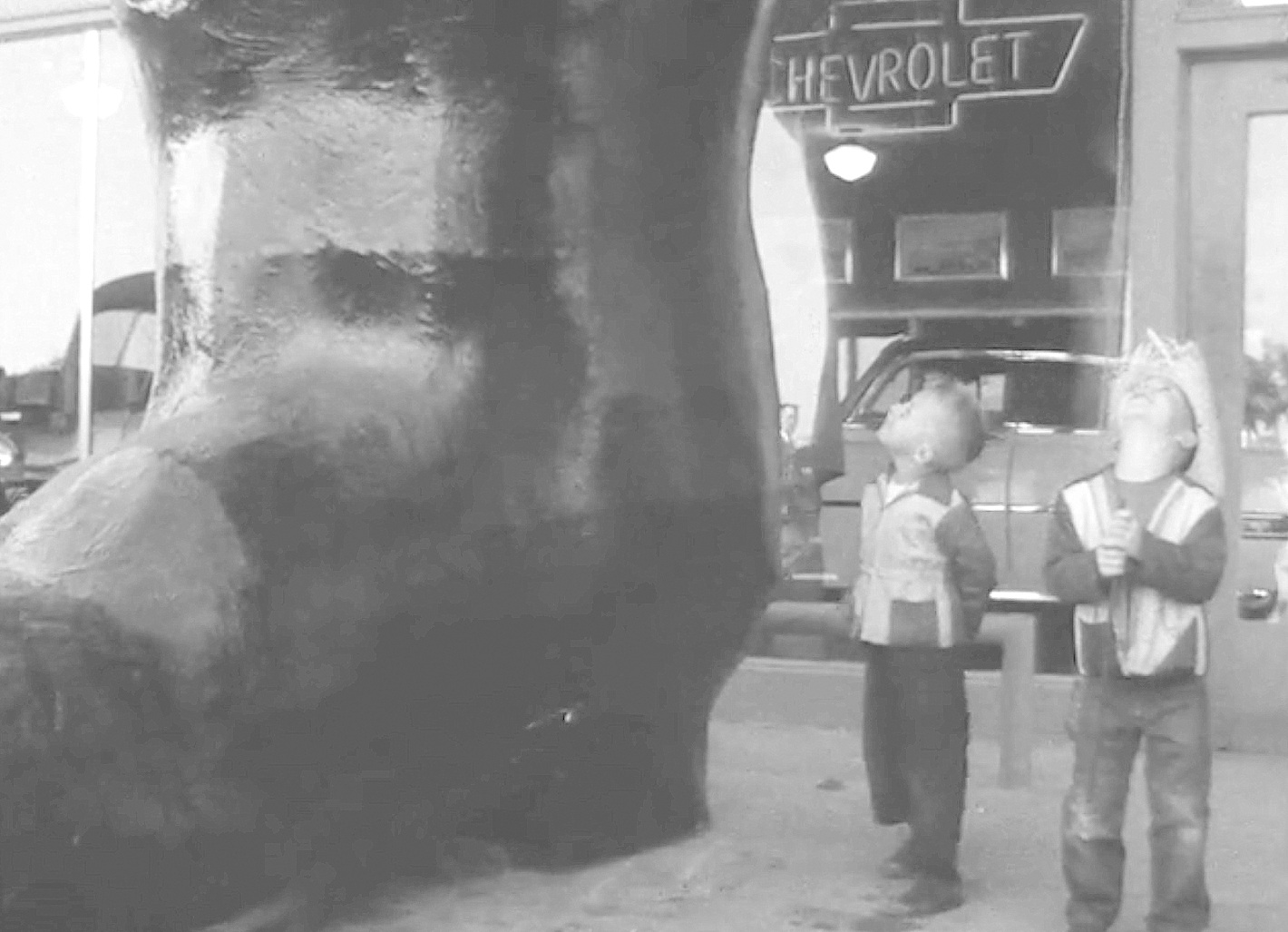
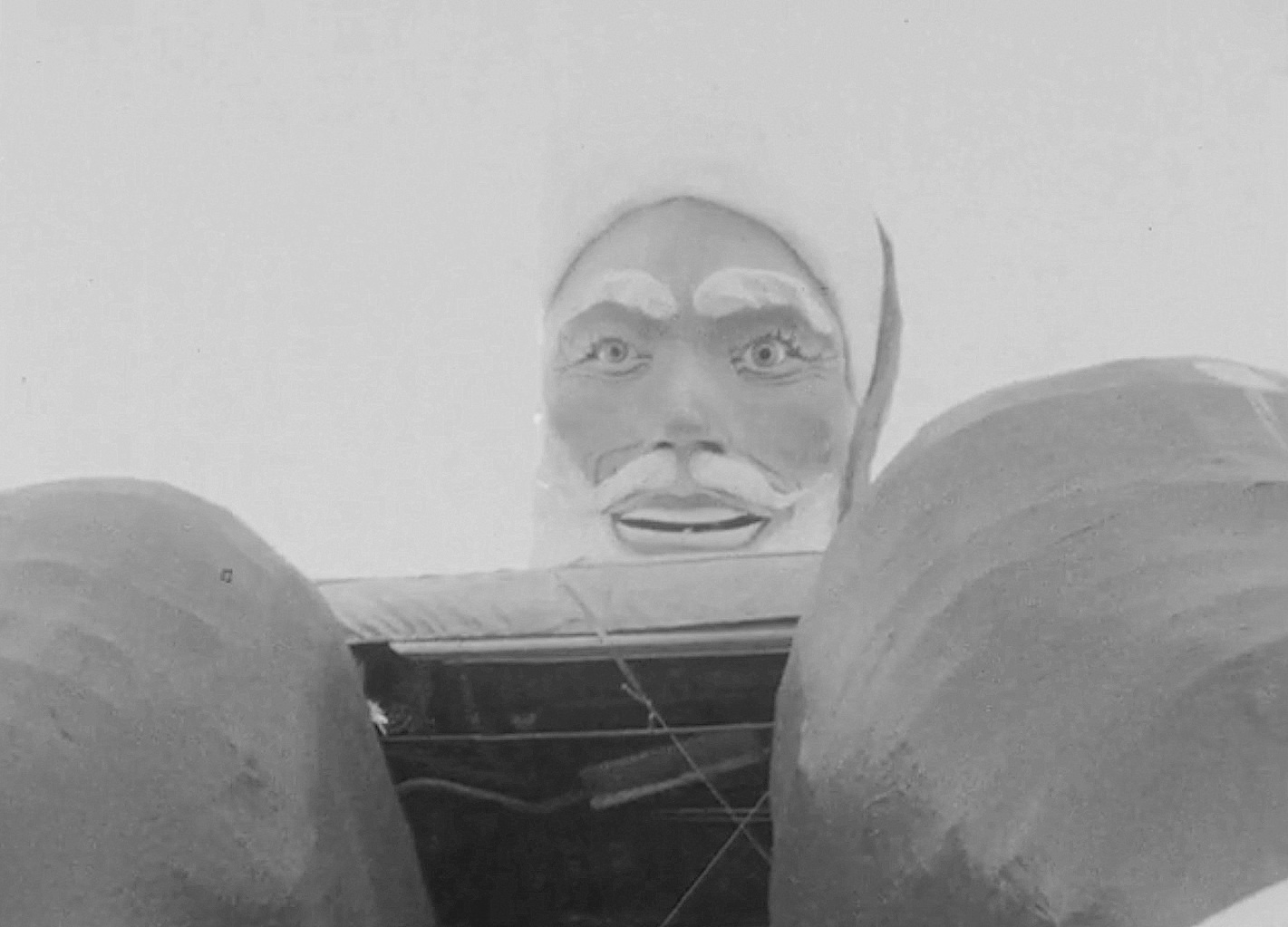
UPDATE: Okay this is VERY EXCITING — and also kind of chilling: there is WBAP-Channel 5 television news footage of the Giant Santa as well as the on-the-scene tragic aftermath of Mr. Davis’ accident. The Dec. 10, 1953 footage is without sound (the script the anchor read on the air as the film played during the newscast can be found here). The video starts off with children marveling at the giant Santa Claus but suddenly turns dark with shots of the bloody Mr. Davis being loaded onto a stretcher (helped by Jack Bridges, the man who built the giant Santa, seen wearing a beret and white coveralls). The one-minute clip titled “Worker Dies at Santa’s Statue” can be viewed on the Portal to Texas History site here.

Below are a few screen captures:

santa-kids_wbap-1_portal

santa-face_wbap-2_portal

santa-crane_wbap-3_portal

santa-dr-pepper-plant-ambulance_wbap-4_portal

**

santa_denison-press_122553Denison Press, Dec. 25, 1953

santa_FWST_121153_AP_photoFort Worth Star-Telegram, Dec. 11, 1953

santa_lubbock-avalanche_121153_APLubbock Avalanche, Dec. 11, 1953

***

Sources & Notes

Top color photo (which I’ve cropped) is by Roy Addis. It appeared in the Dallas Observer blog Unfair Park in Robert Wilonsky’s 2011 update to the previous year’s story — it was sent in by a reader who discovered it in his personal collection. To read that story, click here.

Wilonsky’s original Unfair Park post — which contained the photo he found on eBay — is here. And, again, his post containing “the rest of the story” is here. (Robert Wilonsky continues to write enthusiastically about Dallas — its past as well as its present — and his Dallas Morning News pieces are, quite frankly, where I get most of my news about what’s going on in the city. Thanks for the opportunity to be part of the unearthing of this story, Robert!)

The news photo of Mrs. Ashmore and her daughter is from the author’s personal collection.

The video is from the KXAS-NBC 5 News Collection, University of North Texas Libraries Special Collections, accessible on the Portal to Texas History site. The main page of the video is here (click picture to watch video in a new window).

Dallas Morning News articles on the giant Santa and the tragic accident:

  • “Santa Claus Turns Texan” (DMN, Sept. 23, 1953)
  • “Figure of Santa Claus Will Overshadow Tex” by Frank X. Tolbert, with photo of Jack Bridges (DMN, Nov. 18, 1953)
  • “Santa Claus Too Large For Trucks” (DMN, Nov. 29, 1953)
  • “Christmas Card Picture With Tragic Ending” (DMN, Dec. 11, 1953)
  • “Man Falls to Death Off Cable,” with photo of Roy V. Davis (DMN, Dec. 11, 1953)

UPDATE: Robert Wilonsky has written on the giant Santa in a new Dallas Morning News article, with some interesting new tidbits about Porter Chevrolet’s proposal to the City Council requesting permission to put this huge structure on top of the building. Read his 2017 update here. Robert keeps telling me we should write a book about this — or make a documentary. Which, of course, we should! After all these years now of visions of the giant Santa and sober thoughts of Roy Davis — more “real” now, having seen film footage of him bloody on that stretcher — I really do feel this is all part of some personal family Christmas lore, recounted every year around the table.

Pictures and clippings are larger when clicked.

*

Copyright © 2014 Paula Bosse. All Rights Reserved.


The Elm Street Cave — 1967

elm-st-cracks_flickr_red-oak-kid_smThe Elm St. Cave – tourist attraction…

by Paula Bosse

In the wee hours of the morning of Jan. 11, 1967, a giant hole opened up on the south side of Elm Street — 200 yards long, 20 feet wide, and 15 feet deep — running roughly the entire length of the block between Griffin and Field. It was assumed that there was some connection between the cave-in and the adjacent construction of One Main Place. During the ensuing investigation into a cause, the consultations with geologists, the lawsuits, the repairs, the backfilling, etc., this very busy stretch of Elm was closed for an incredible seven months (!). Most of that time it was a gaping hole.

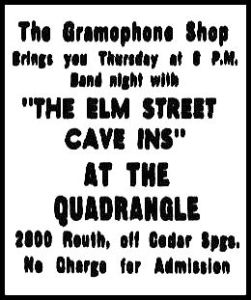
The hole was a major headache to city leaders and to downtown developers (…and to motorists), but it became an ongoing joke to everybody else. The “Elm Street Cave” and “Elm Street Cavern” were referenced everywhere for most of 1967. San Francisco had “The Summer of Love” that year, Dallas had “The Elm Street Cave-In.” It was the butt of endless jokes in local, out-of-town, and even out-of-state newspapers. A band sprang up calling themselves The Elm Street Cave-Ins.

cave-ins-band_dmn_062867June 28, 1967

A group of local lawyers known as The Skid Row Bar Association proclaimed to the press that it was “the last remaining scenic wonder in Dallas.” Curious tourists were drawn to the hole like camera-laden moths to a flame. “Talk about your ‘Deep Elm’!” became a punchline much bandied about by people who didn’t understand that something like that is moderately amusing once or twice, but that it tends to lose its sharpness after it’s repeated ten or fifteen times. And, bizarrely, it even found its way into an oddly defensive Sears ad (click to see a larger image).

ad_sears_dmn_070667-det_sm1967 Sears ad, detail

The hole was eventually filled in, and, in August — after months of jokes and inconvenience — the street was finally re-opened. Life returned to a pre-cave-in normalcy. The reason for the collapse was determined to be shifting rock formations below street level. One report said that workmen had “uncovered a huge crevice in the limestone beneath the street measuring 30 feet deep. They filled the crevice with concrete and tied together the broken sections of rock.” I’m not sure how comfortable I’d feel about a giant building sitting on shifting shale-covered limestone,* but apparently everything’s been fine ever since, and everyone — the engineers, the geologists, the One Main Place developers and tenants — lived happily ever after.

***

Sources & Notes

Associated Press photo of the lovely Judy Thedford and her fashionably large hair posing rather incongruously beside a car bumper appeared in newspapers across the country on Feb. 12, 1967. This scan is from the Red Oak Kid’s Flickr page, here.

The weird “Let’s quit apologizing! Dallas is worth seeing!” ad comes from a larger Sears advertisement that appeared in July 1967.

Related Dallas Morning News articles:

  • “Strip of Elm Collapses; Experts Remain Baffled” by Carolyn Barta (DMN, Jan. 12, 1967)
  • “Cracks on Elm Street Not Funny to City Hall” by Kent Biffle (DMN, Feb. 12, 1967)

*For people who (unlike myself) know something about geology, an article written in 1965 about the special problems regarding the One Main Place excavation and construction (“How to Support Skyscrapers” by Martin Casey — DMN, Nov. 28, 1965) might be interesting. There is much mention of Austin Chalk Limestone and Eagle Ford Shale, which made the One Main Place project quite troublesome to engineers. 

*

Copyright © 2014 Paula Bosse. All Rights Reserved.

Whither Water? — 1956

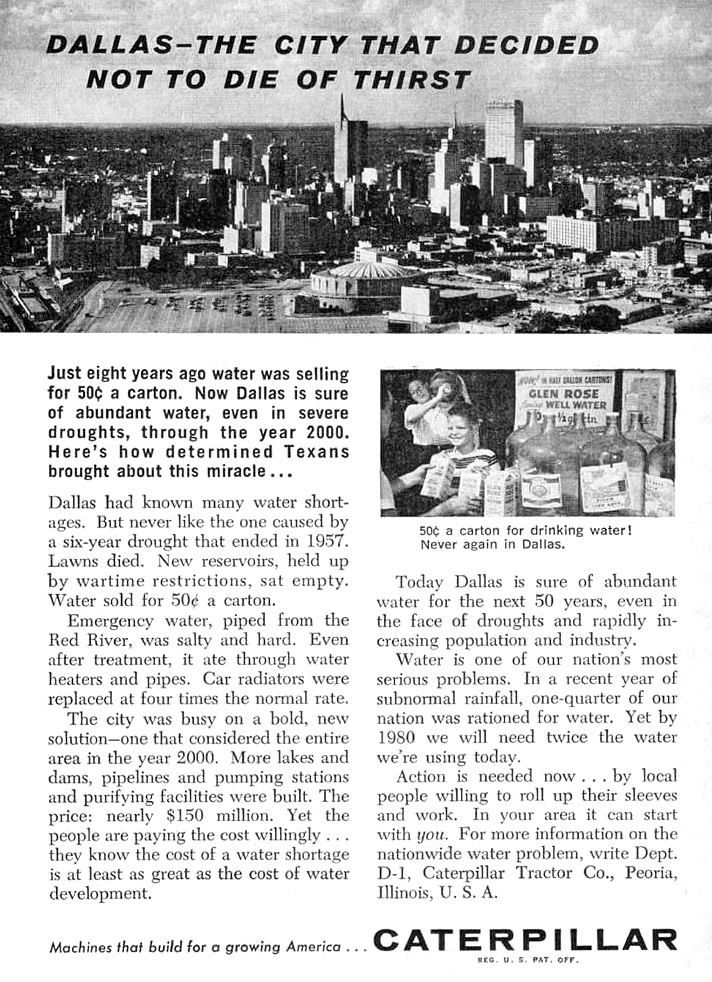
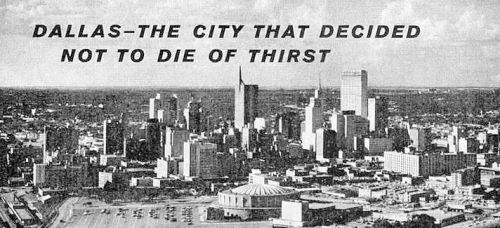
drought_caterpillar-ad_1962_det“Dallas — The City That Decided Not To Die of Thirst”

by Paula Bosse

Between 1950 and 1957, Texas suffered the worst drought on record. By 1957, 244 of Texas’ 254 counties had been declared disaster areas. In 1952, Lubbock recorded not even a trace of rain. Elmer Kelton captured the period perfectly in his classic novel, The Time It Never Rained. It might not have achieved the epic catastrophic proportions of the Dust Bowl days, but that doesn’t mean it wasn’t devastating.

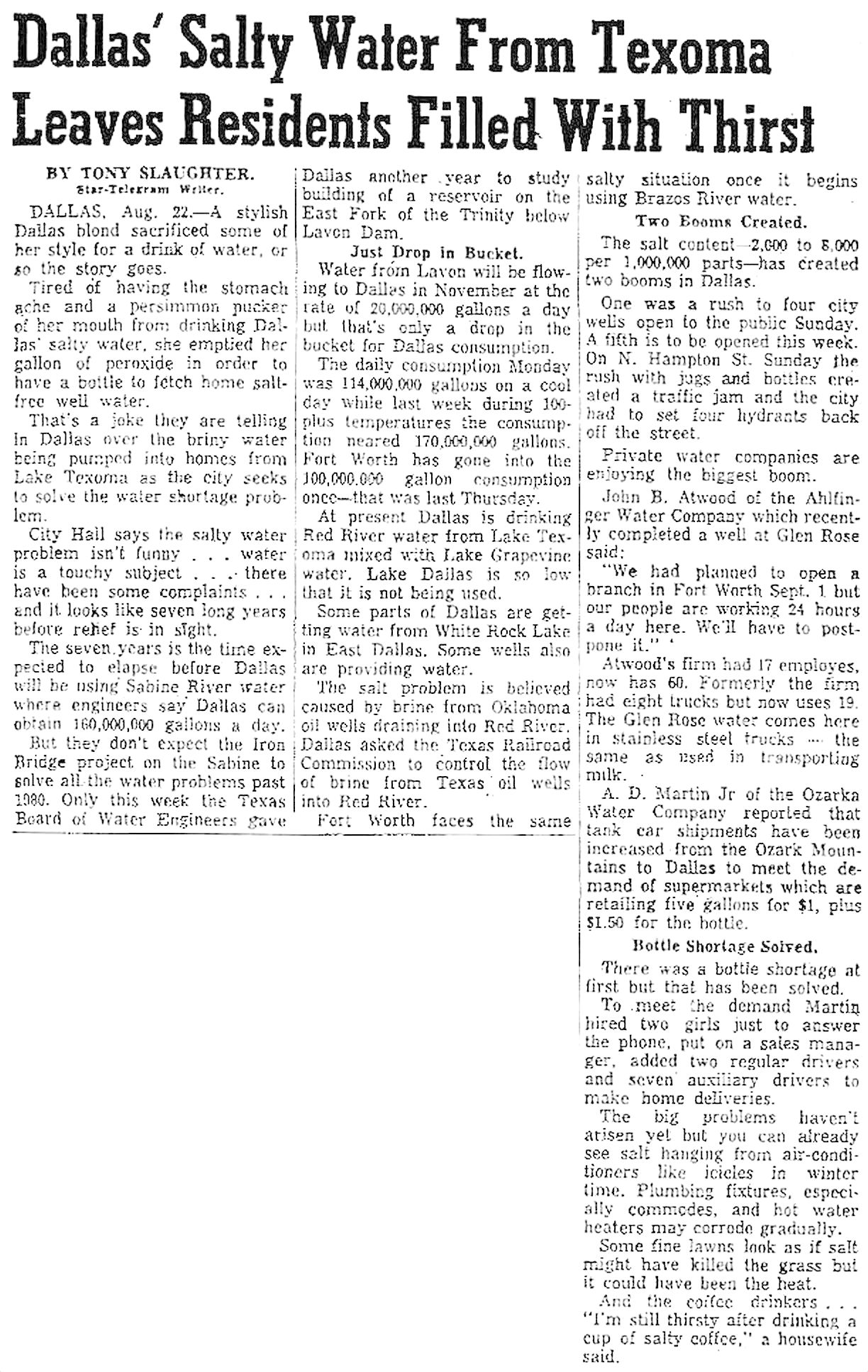
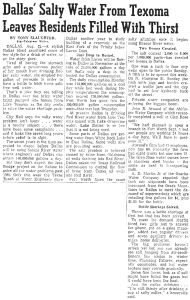
In Dallas, the lakes and reservoirs were hit hard. White Rock Lake dried up — one was able to walk across the parched lake bed without a drop of water in sight. Lake Dallas (now Lake Lewisville) fell to 11% of capacity. Dallas was desperate for water, and in 1956, it began “importing” water from Oklahoma. Red River water was appreciated, but it was considered by many far too salty to drink. In addition to the unpleasant taste, residents were concerned that there would be permanent damage to pipes and plumbing, and, to a lesser extent (since watering restrictions were being strictly enforced) to their lawns.

According to one report, salt content in the water supply had gone from the normal 39 parts per million gallons to over 800 parts (at the height of the problem, some news outlets reported it to be well over 2,000 parts per million). While the water was generally considered perfectly safe for the average person to drink, many looked for cleaner, more palatable drinking water.
drought_FWST_082356Fort Worth Star-Telegram, Aug. 23, 1956 (click for larger image)

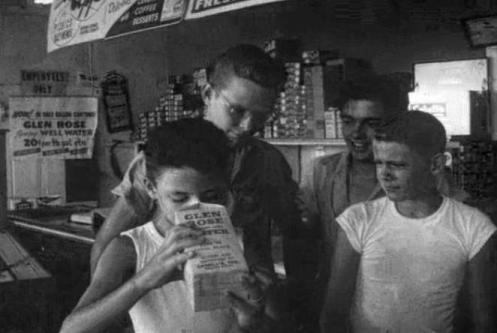
Suddenly bottled water became a boom business. Spring water was being trucked to Dallas from Glen Rose and Arkansas. Water was being sold in bottles and cartons — from 20 cents per half-gallon cartons to $2.50 for five-gallon bottles ($1.50 of which was for a deposit on the glass bottle). WBAP-TV news even sent a cameraman out to a Cabell’s convenience store to capture some boys testing out the Glen Rose water (watch it here, without sound).
water_portal_screencap

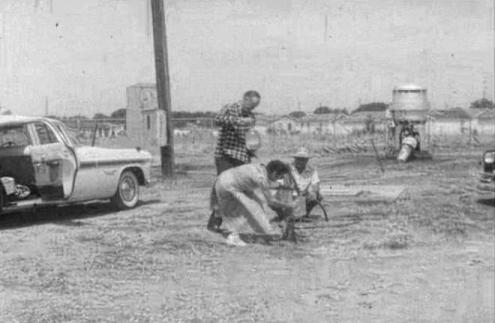
The other source of acceptable drinking water that summer was from city wells dotted around Dallas. Long dormant, the city opened the wells and offered free water to residents. From The Dallas Morning News:

If you don’t like that hard, salty water coming from your taps, you can get soft, unsalty water at four city wells beginning Sunday. City manager Elgin E. Crull Saturday said that the city has installed faucets at the four wells where people may take their buckets or bottles and obtain drinking water. No trucks will be permitted to fill up. (DMN, Aug. 19, 1956)

The four wells mentioned above — and two more opened within a few weeks — were located at the following locations:

  • 1325 Holcomb, near Lake June Road
  • Opera and 13th, near the Marsalis Zoo
  • 875 North Hampton, near Lauraette Street
  • 2825 Bethurum, in South Dallas, near the public housing project
  • Northwest Highway and Buckner
  • Matilda and Anita, on the grounds of Stonewall Jackson Elementary School, in East Dallas

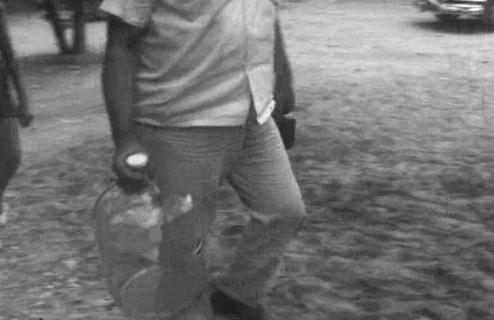
These wells were hugely popular, with thousands of people showing up with jugs, jars, kettles, canteens, and bottles of every conceivable size. (More WBAP news footage of people filling up at these wells can be seen here, without sound; details below).
well-1

well-2

The popularity of the city wells led to private citizens having wells dug on their own property. Not only were bottled water suppliers making a killing during the summer of ’56, so were the owners of drilling businesses. From The Dallas Morning News:

As salty water from city mains reportedly discourages shrubbery and affronts the taste, drillers of shallow residential water wells ride the crest of a boom. […] Luckiest of the water-seekers are residents of the southern section of the city in the Fruitdale, Pleasant Grove and Home Gardens area, and in the neighborhoods that border Loop 12. That is where drillers are finding pay dirt — water-bearing gravel — at shallow depths. (DMN, Oct. 7, 1956)

It wasn’t just professional drillers who were busy — it wasn’t uncommon for the DIY-ers to be out in the backyard on weekends, digging away, hoping for their own personal source of fresh water. And there were probably even some dowsers out and about, water witching their little hearts out.

The drought ended the next year, and personal wells were a thing of the past, but that mania for bottled water really dug its heels in.

Texas developed the Water Planning Act of 1957, and in 1962, this new mandate and what had happened in Dallas during the drought was used as the basis for a Caterpillar ad which had a bit of a hyperbolic headline, “Dallas — The City That Decided Not To Die Of Thirst”:
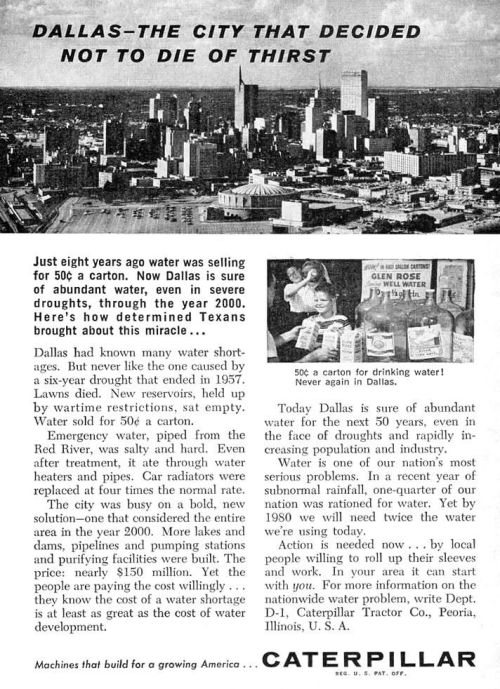
drought_caterpillar-ad_19621962 ad (click for larger image)

***

Sources & Notes

Picture of the four boys tasting the Glen Rose water is taken from the WBAP-TV news story that aired on Aug. 12, 1956. The silent, edited footage was shown as the news anchor read the script, seen here. Film footage (linked above) and script from the Portal to Texas History.

The two pictures of people availing themselves of water from the city’s wells are taken from the WBAP-TV news story that aired on  Aug. 19, 1956. The silent footage ran as the anchor read the script seen here and here. Film footage (linked above) and script from the Portal to Texas History.

1962 Caterpillar ad from eBay.

More on affect of the drought on Dallas can be found in these Dallas Morning News articles:

  • “Sparked by Salt: Business Booming For Bottled Water” (DMN, Aug. 5, 1956)
  • “Citizens Stock Up On Saltless Water” by Sue Connally (DMN, Aug. 20, 1956)
  • “Thirsty City Witnesses Revival of Well Drilling” by William K. Stuckey (DMN, Oct. 7, 1956)
  • “Resourceful Citizens Tap City Water Well” (DMN, Oct. 16, 1956)
  • “Continuing Drouth Produces Top Local News Story in ’56” by Patsy Jo Faught (DMN, Dec. 30, 1956)

Read about how the drought affected Texas water management here; read about the Texas Water Rights Commission here.

Read “The City of Dallas Water Utilities Drought Management Update” in a PDF, here.

Finally, I encourage everyone to grab a tall glass of ice water and settle down to read Elmer Kelton’s classic Texas novel, The Time It Never Rained. Or if you’re pressed for time, read Mike Cox’s article about the book in Texas Parks & Wildlife magazine, here.

*

Copyright © 2014 Paula Bosse. All Rights Reserved.


When the Spanish Influenza Hit Dallas — 1918

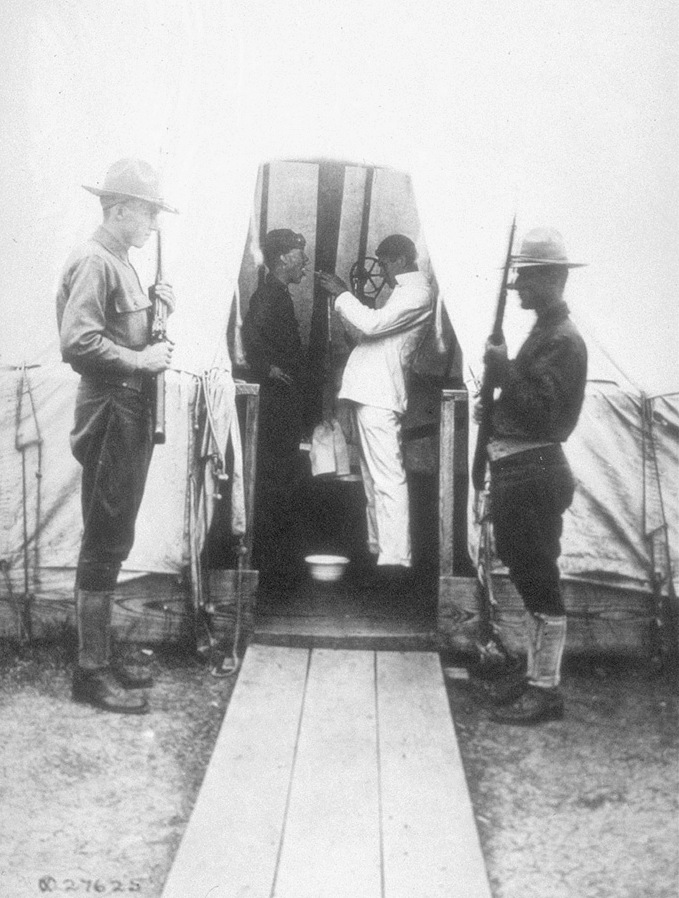
spanish-influenza_love-field_otis-historical-archives_nmhm_110618
American Red Cross at Love Field, spraying soldiers’ throats, Nov. 6, 1918

by Paula Bosse

The Spanish Influenza pandemic of 1918-1919 caused as many as 50 million deaths worldwide — about 600,000 of which were in the United States (11 times greater than the number of American casualties during World War I). Locally, the influenza first hit the soldiers at Camp Bowie in Fort Worth in September, 1918. The flu spread quickly, and on Sept. 27, it was reported that there were 81 cases in the camp. Well aware of the devastation the flu had wrought in other U.S. cities, most notably at military camps, Fort Worth was, understandably, taking the situation seriously. Dallas leaders, on the other hand, were all-but pooh-poohing the need for concern. On Sept. 29, The Dallas Morning News had a report titled “Influenza Scare is Rapidly Subsiding” — the upshot was that, yeah, 44 reported cases of “bad colds” had been reported in the city, but there’s nothing to worry about, people.

In the opinion of the military and civil doctors, the Spanish Influenza scare is unwarranted by local conditions. The few cases of grip, it is claimed, are to be expected as the result of the recent rainy weather.

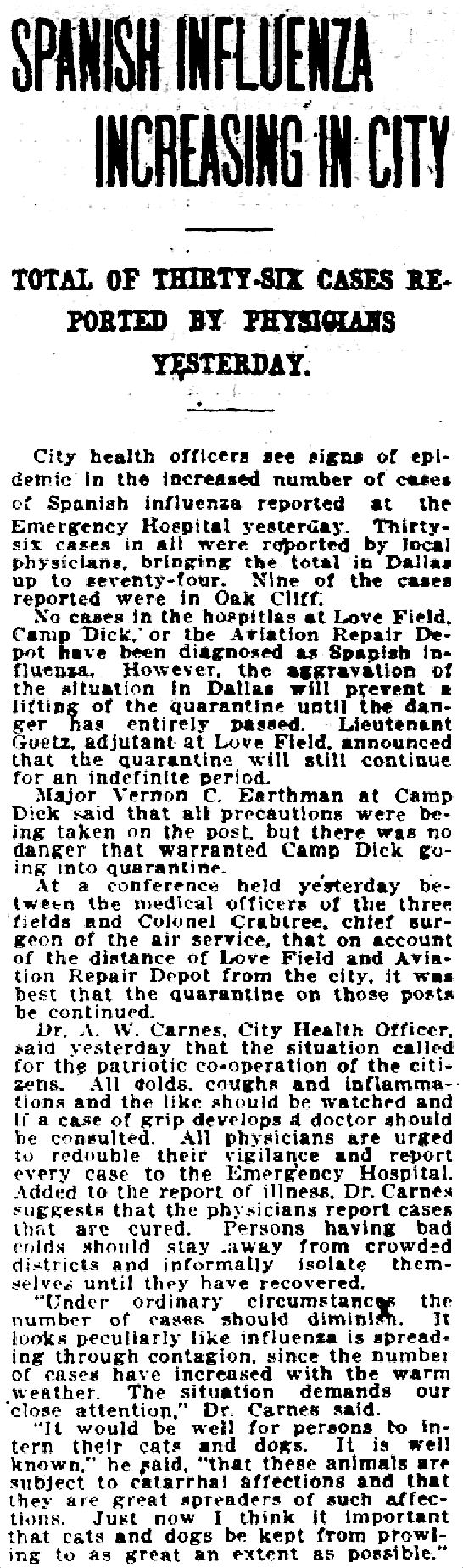
Just two days later, though, officials were jolted out of their complacency when the (reported) cases jumped to 74 (click for larger image):

spanish-influenza-dmn-100218DMN, Oct. 2, 1918 (click for larger image)

The months of October and November were just a blur: the city was plunged into an official epidemic. There was no known cure for the flu, so a somewhat ill-prepared health department preached prevention. People were encouraged to make sure their mouths were covered when they coughed or sneezed, and they were directed to not spit in the street, on streetcars (!), in movie theaters (!!), or, well, anywhere. (Handkerchief sales must have soared and spittoon sales must have plummeted.)

At one point or another, places where people gathered in large numbers — such as schools, churches, and theaters — were closed. Trains and streetcars were required to have a seat for every passenger (no standing, no crowding) (…no spitting). The number of mourners at funerals (of which there were many) was limited. And there was a major push for citizens to clean, clean, clean their surroundings in an attempt to make the city as sanitary as possible. Instructions appeared often in the newspapers.

spanish-influenza_dmn_101218_tipsDMN, Oct. 12, 1918

It was estimated that there were 9,000 cases of Spanish Influenza in Dallas in the first six weeks. By the middle of December, when the worst of the outbreak was over, it was reported that there had been over 400 deaths attributed to the Spanish Influenza and pneumonia in just two and a half months.

spanish-influenza_FWST_121118Fort Worth Star-Telegram, Dec. 11, 1918

As high as these numbers were, Dallas fared much, much better than many other parts of the United States.

spanish-influenza_ad_dmn_101818_pepto-manganAd, DMN, Oct. 18, 1918

***

Sources & Notes

Photo at top was taken on November 6, 1918 and shows American Red Cross Workers spraying throats of military personnel based at Love Field in hopes of preventing the spread of the influenza. The photo is from the Otis Historical Archives, National Museum of Health and Medicine; I found it on the NMHM site, here. (Click photo for larger image.)

Ad for Pepto-Mangan (“The Red Blood Builder”) was one of a flood of medicines and tonics claiming to be effective in the fight against Spanish Influenza (none were).

For a detailed and remarkably well-researched, comprehensive history of the Spanish Influenza in Dallas, see the article prepared by the University of Michigan Center for the History of Medicine, here. It’s pretty amazing.

To read about the history of pandemics (including several good links regarding the Spanish flu), see the Flu.Gov site, here.

And, NO, Ebola is not transmitted like the flu. But it’s still good practice to cover your mouth when you cough or sneeze,wash your hands frequently, and never EVER spit in the street, because that’s just disgusting. ((This post was originally written in 2014 while Dallas was the center of the Ebola universe.))

More on the Spanish Influenza pandemic can be found in the Flashback Dallas post “Influenza Pandemic Arrives in Dallas — 1918.”

*

Copyright © 2014 Paula Bosse. All Rights Reserved.
 

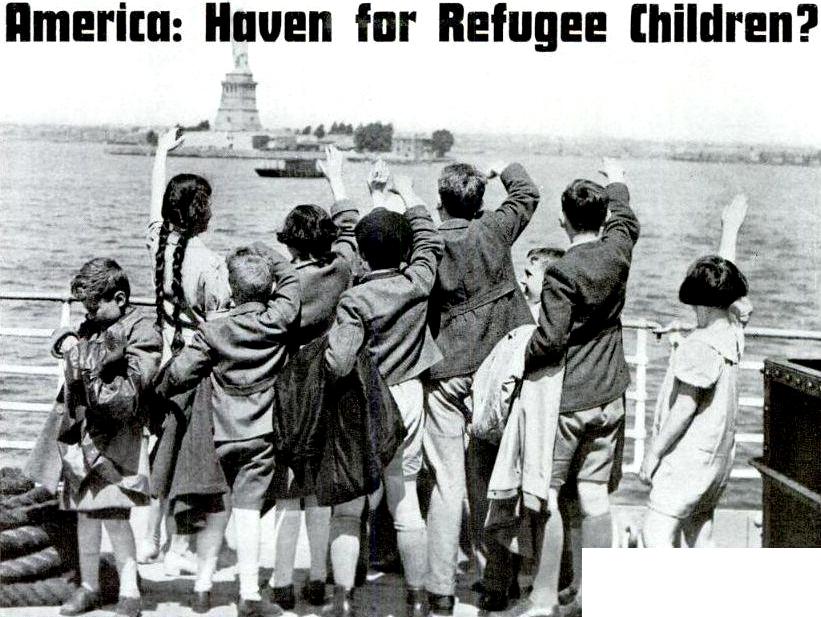
Wanted in Dallas: Refugee Children — 1940

refugee-children_rotarian_feb-1940

by Paula Bosse

In the summer of 1940, a group called The Children’s Evacuation Committee of Texas was organized to bring child refugees to Dallas, even if it meant sending a ship across the Atlantic Ocean to get them. Its chairman was local businessman George Edgley, a transplanted Briton who owned a music shop and performed around town as an actor and musician.

The group was formed in response to the heavily publicized plight of English children living under the constant threat of attack during World War II. The situation was of great international concern, and plans were drawn up to evacuate the children to safety. The United States had agencies working to bring some of the children to America, and communities around the country were organizing at a grassroots level.

George Edgley took up the cause in Dallas and was the driving force behind The Children’s Evacuation Committee of Texas. He worked day and night to sign up potential foster families, worked with American and British politicians and humanitarian relief agencies, and traveled to Washington, DC to petition for special immigration allowances. He even pleaded with Congress to authorize a special ship to carry children from the UK to the Texas Gulf.

Some Dallasites were adamant that only British children would be considered. One Briton living in Dallas made the following statement at an early meeting:

It’s the Anglo-Saxon race against the world, […] and we want Anglo-Saxon children brought over here  — not material for fifth columnists. We want English-speaking children. (Dallas Morning News, June 27, 1940)

Edgley disagreed vehemently, insisting that a humanitarian project such as the one under consideration should not be limited to British children.

Numerous Dallas families signed up to offer their homes to refugee children. Many were willing to take any child that needed a temporary home, and most were prepared to adopt the child should his or her parents be killed in the war. There was, though, this unsettling read-between-the-lines sentence in one of the reports in The Dallas Morning News:

A few stipulated that the children should be free of hereditary defects, should be from good families and of certain nationalities or have eyes or hair of certain color. (DMN, July 21, 1940)

A big supporter of this effort was Miss Ela Hockaday, who worked to get her school’s alumnae and patrons to offer their homes to the displaced children. She herself had adopted the children of British novelist Vera Brittain for the duration of the war.

After weeks of determined effort, though, the inability to find a way to safely transport children en masse from the UK became an insurmountable roadblock. The bureaucracy and logistics proved to be too big a hurdle. Edgley turned his attention to working one-on-one with Dallas families who agreed to be responsible for paying the transportation costs of a child and providing for all of his or her needs until the war’s end. It would cost a local family a substantial $188 to assure a child’s privately-arranged temporary adoption (equivalent in today’s money to just over $2,200).

I’m not sure how many children found shelter from the war in Dallas, but the tireless efforts of George Edgley on their behalf are to be admired.

***

Sources & Notes

Top photo and headline “America: Haven for Refugee Children?” from the February, 1940 issue of The Rotarian. You can read the magazine’s take on the issue here.

If you would like more information on George Edgley’s campaign to relocate refugee children from war-torn England, please contact me.

The Life magazine story “U.S. Opens Its Homes and Heart to Refugee Children of England” (July 22, 1940), can be found here.

Some background on the evacuation of British children during World War II can be found here and here.

*

Copyright © 2014 Paula Bosse. All Rights Reserved.
 

Always Have a Bucket of Water Nearby — 1890s

fire-dept_ervay-kelly_hose-co-2_1901Hose Co. No. 2, S. Ervay at Kelly, ca. 1901… (click for larger image.)

by Paula Bosse

fire-signals_souv-gd_1894

Dallas used to burn down a lot. Here is a handy tip sheet for residents and visitors printed in 1894, about the time the above photo was taken. I’m sure everyone in the city knew where the alarm boxes were and what the various signals meant. When to relax, and when to run. When to hold ’em, and when to fold ’em.

fire-boxes_fire-alarm-signals_souvenir-gd_18941894 (click for larger image.)

***

Sources & Notes

Top photo of Hose Co. #2/Fire Station #12 from The Dallas Firefighters Museum, found on the Portal to Texas History site.

List of fire alarm boxes from Souvenir Guide of Dallas. A Sketch of Dallas and Dallas County, their resources, business enterprises, manufacturing and agricultural advantages (Dallas: D.M. Anderson Directory Company, 1894).

*

Copyright © 2014 Paula Bosse. All Rights Reserved.
 

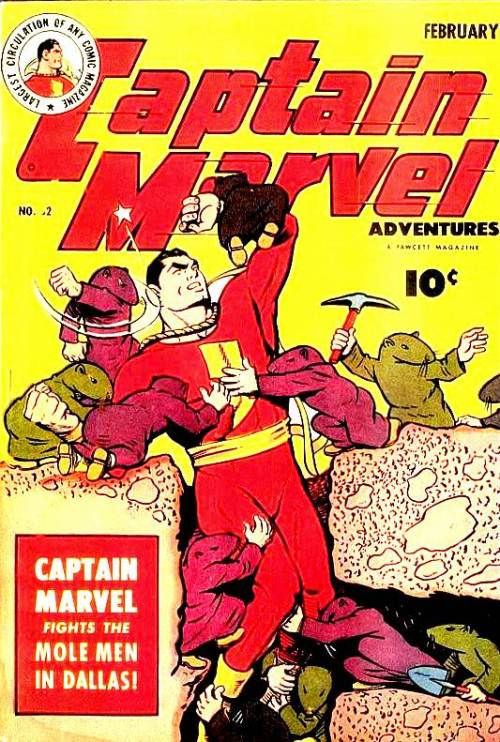
Captain Marvel Fights the Mole Men in Dallas! — 1944

captain-marvel-fights-mole-men-dallas_1944sm

by Paula Bosse

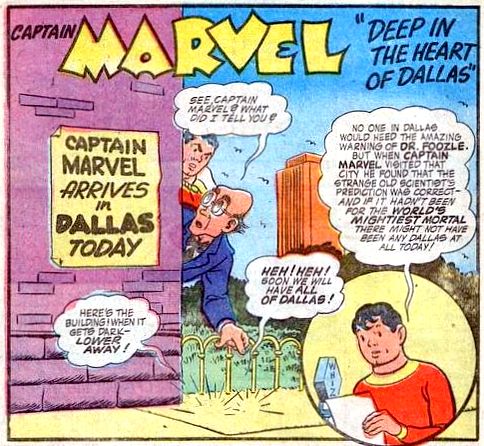
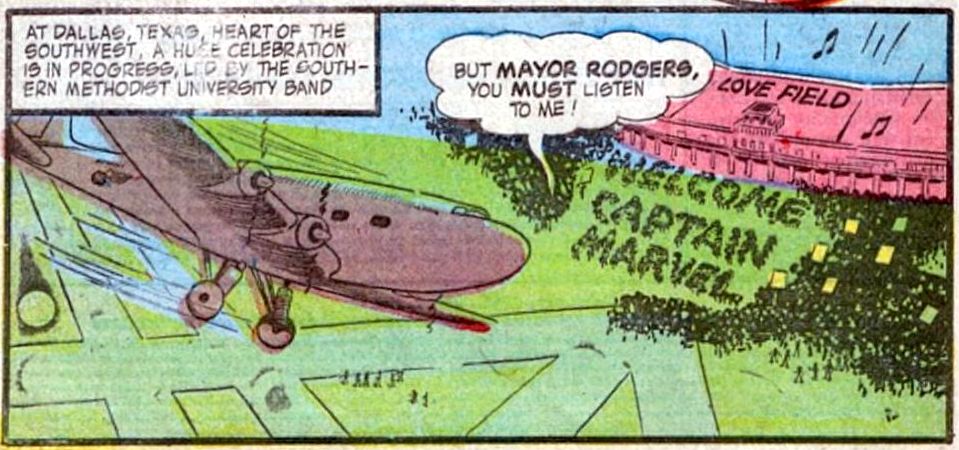
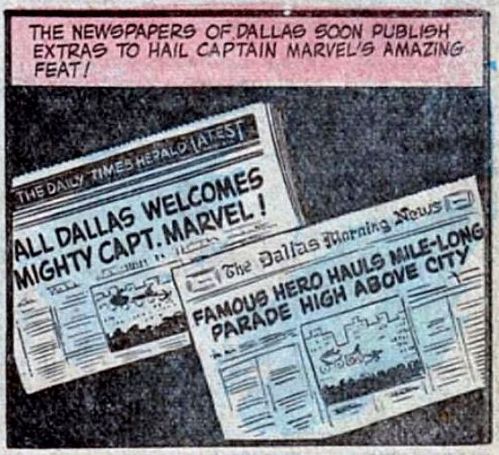
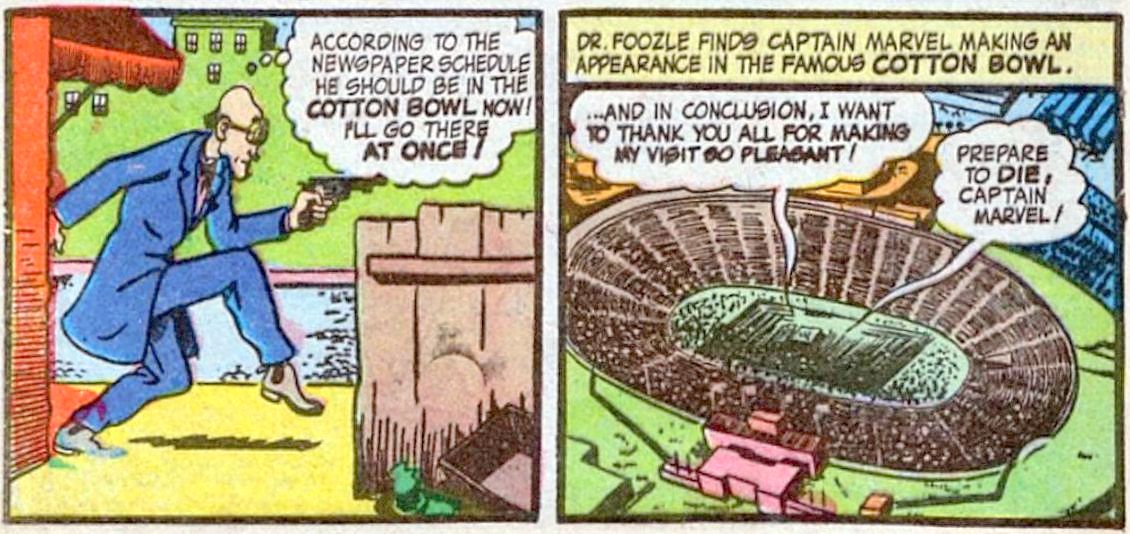
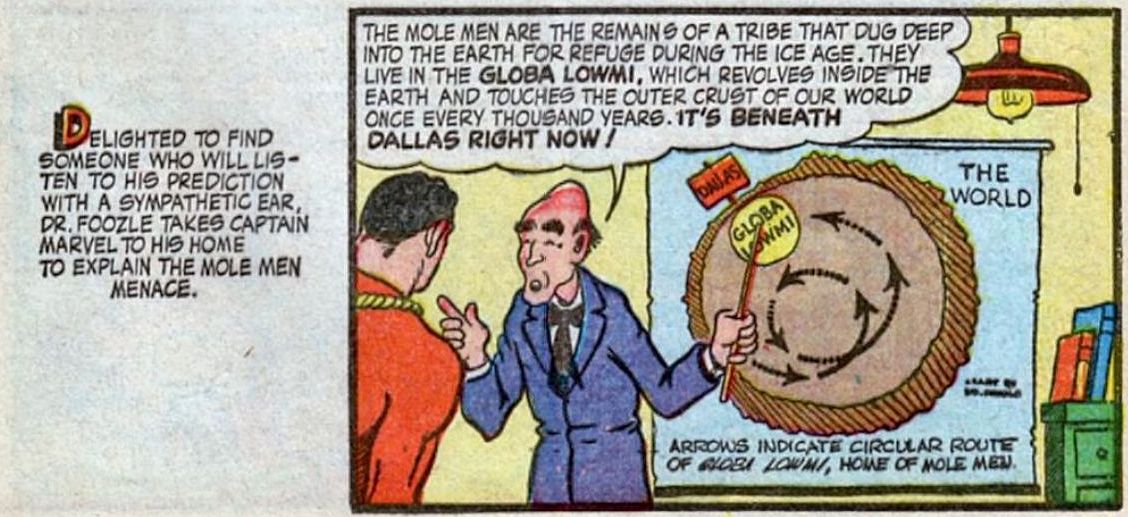
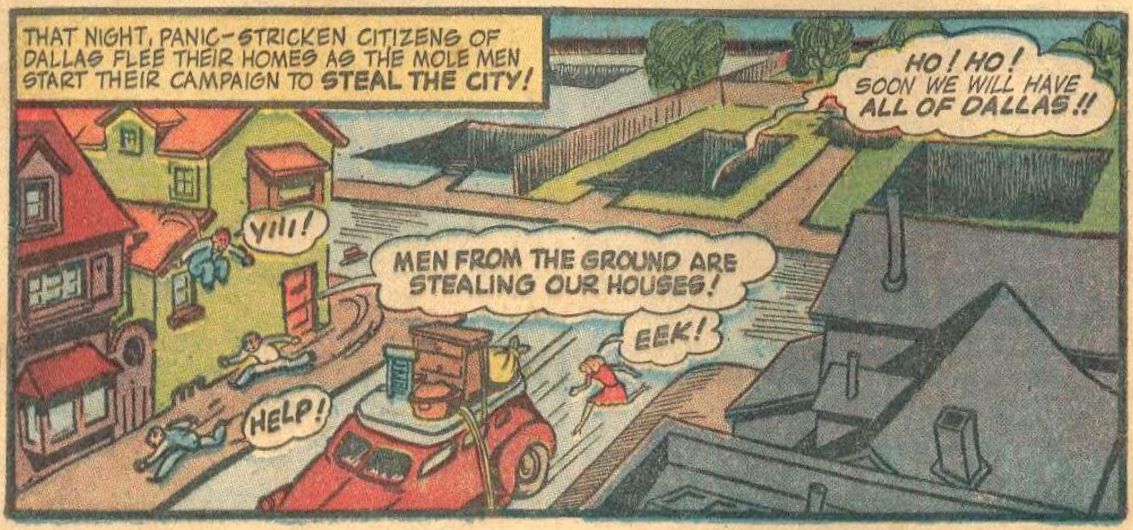
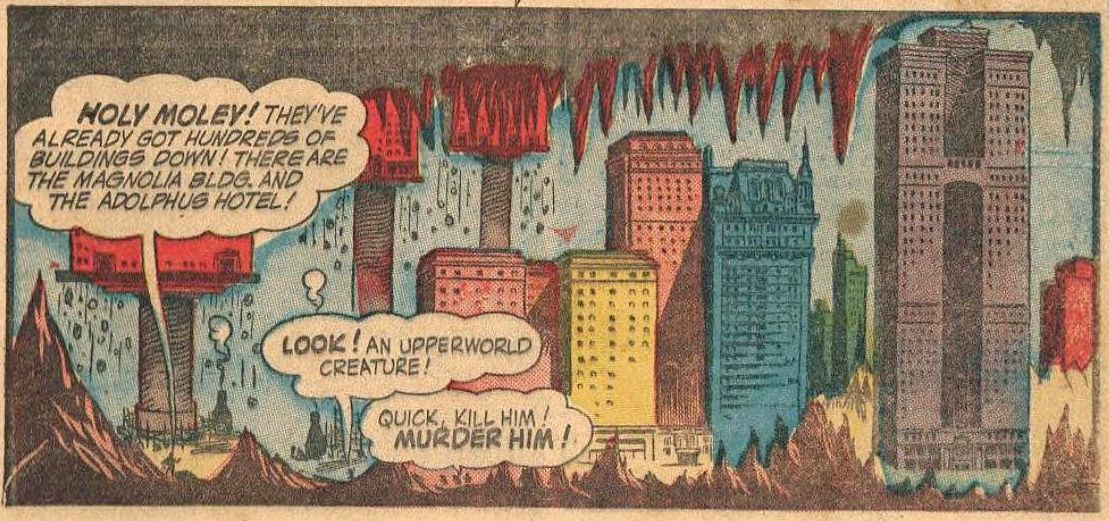
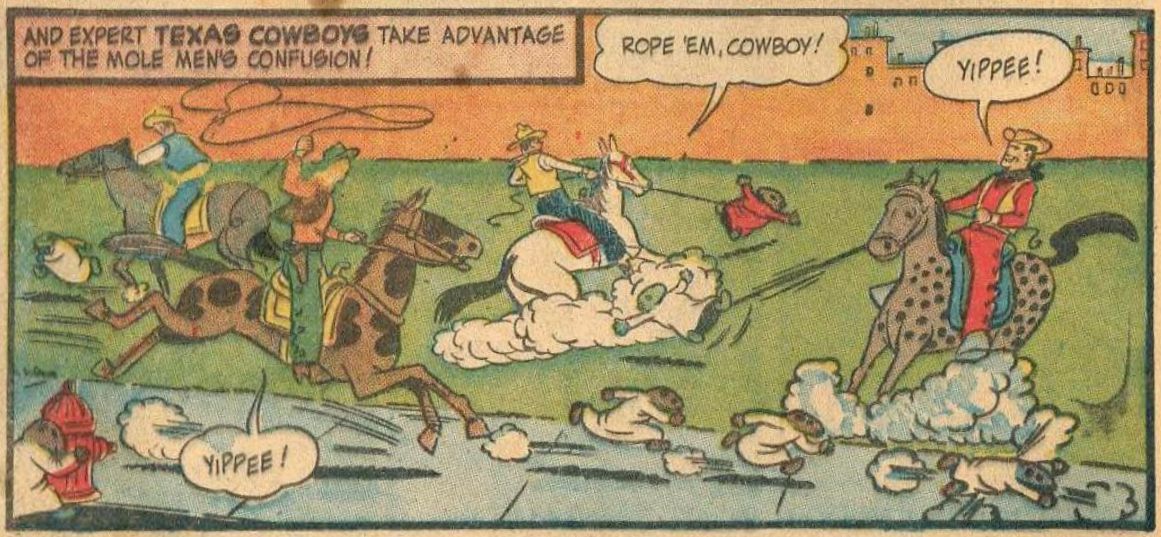
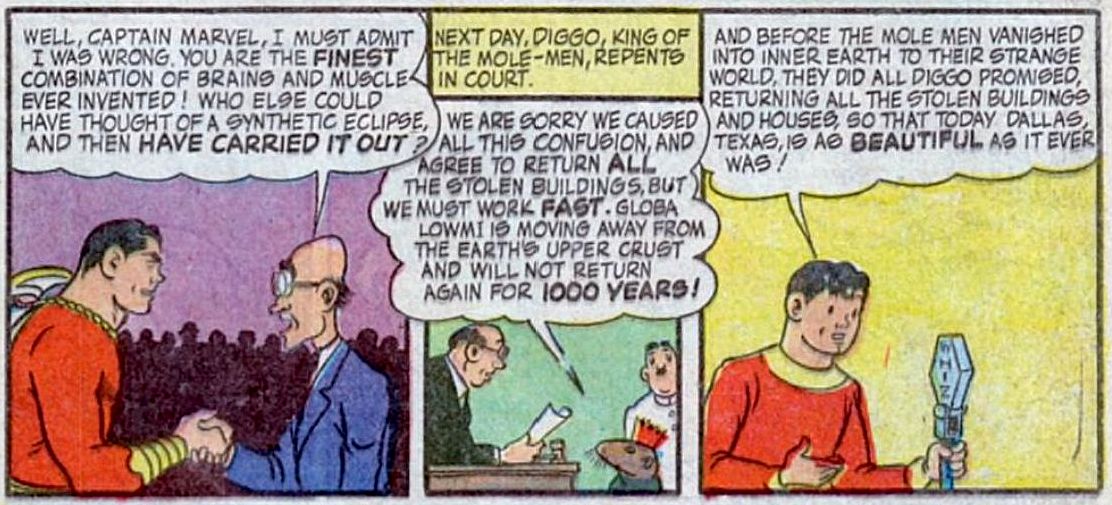
In 1944 Captain Marvel came to Dallas. He had brushes with the SMU marching band, Love Field, Mayor Woodall Rodgers, Fair Park, the Cotton Bowl, a sunken Adolphus, Ted Dealey, and a bunch of “expert lariat throwers.” And he saved us from the Mole Men (and their “mole-kids”). People, you have NO idea…. A few of the highlights below (click for larger images). (To go directly to the entire scanned comic book, click here.)

1capt-marvel_intro

2capt-marvel_smu_love-field

3capt-marvel_dth-dmn

4capt-marvel_cotton-bowl

5capt-marvel_globa-lowmi

6capt-marvel_panic

7capt-marvel_magnolia-adolphus

8capt-marvel_expert-cowboys

9capt-marvel_finale

Holy Moley! That was close! Thank you, Captain Marvel! SHAZAM!

***

To read the entire adventure “Deep in the Heart of Dallas” — in fact, to read the entire comic book (which also includes a trip to Greenpoint, Brooklyn…), check out the whole thing here. Enjoy! (And sorry about the spoilers!)

Some panels are larger when clicked.

*

Copyright © 2014 Paula Bosse. All Rights Reserved.

Building Collapse on Elm Street — 1955

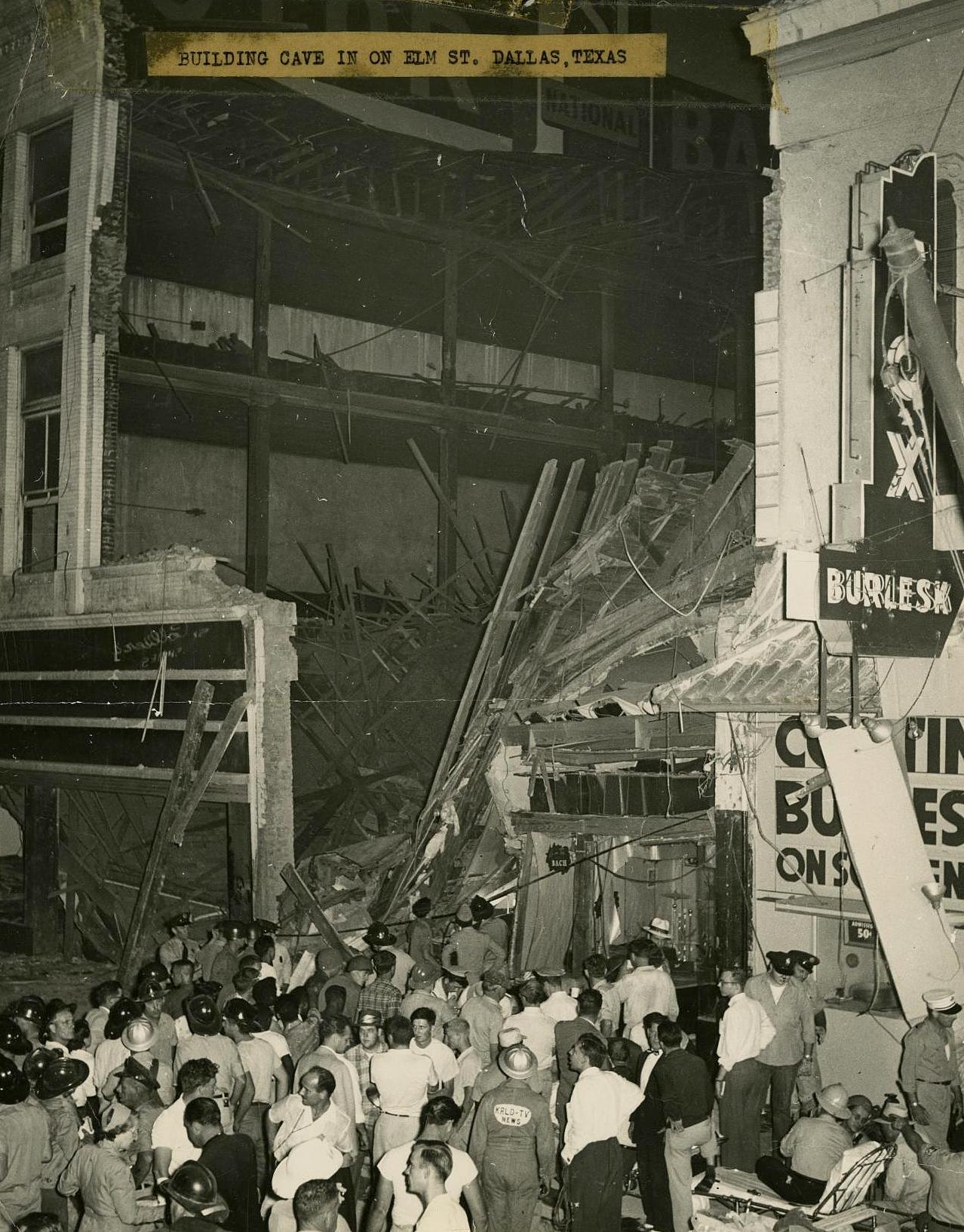
elm-st-collapse_1955
Aftermath… June 1, 1955 (photo by Gene Gauss)

by Paula Bosse

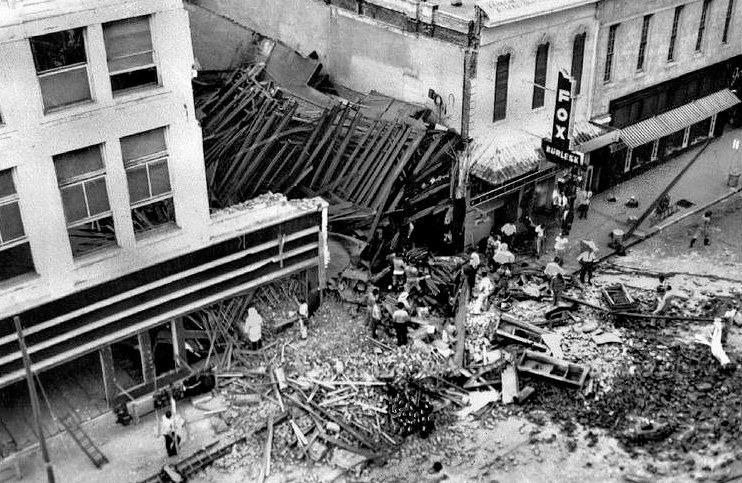
At 6:40 p.m. on June 1, 1955, a 3-story building in the process of being razed collapsed onto the smaller building next door at 1409 Elm St. The “story-and-a-half” building contained the Cline Music Company and Harry’s Fine Food, a bar and cafe. Four people were killed, and several people sustained major injuries; many were trapped for hours in the rubble.

The rousing report in The Dallas Morning News the next day described the scene as pandemonium. As emergency personnel arrived and rescue operations began, the street was roped off — there were fears a partially standing wall would topple at any moment. The Fox Burlesk house next door was quickly emptied of its 50-or-so patrons for safety concerns.

Witnesses said the building fell with a gigantic whoosh and spewed rubble about four feet deep across the sidewalk and into the street. Trolley wires were snapped and lay crackling sparks in the street for a while before the power was cut. A late-model station wagon parked at the curb was flattened under the rubble to a height of only about three feet. It belonged to [the owner of the music store]. (DMN, June 2, 1955)

Nine companies of firemen and several doctors — one of whom just happened to be passing by the scene — worked to rescue and treat the victims. A passing clergyman administered conditional last rites for those still trapped. A troop of Boy Scouts who had been nearby practicing civil defense drills, ran to help in the real-life emergency. And most cinematic of all, a Houston truck driver named Larry Ford — who just happened to be visiting Dallas and was standing in the crowd of spectators — was called in to help when someone noticed that he was wearing a truck drivers’ union insignia — authorities had obtained a winch truck to clear the heavy rubble but had been unable to find anyone to operate it. Ford sprang to action and worked through the night for 16 grueling hours. He was later hailed as a hero. Just like in the movies.

So what caused the collapse? The city manager was quick to say that the city was not to blame and, basically, had no responsibility to determine who WAS to blame.

City Mgr. Elgin Crull told The News an investigation by Chief Building Engineer Cecil A. Farrell has not been completed. “There won’t be anything on it for a long, long time — if ever at all,” Crull declared. “It’s not our responsibility to say why it fell or who was at fault. We’ll just seek to determine whether or not all the proper safety precautions were followed.” (DMN, June 3, 1955)

Well, all right, then.

As several people noted, had the collapse happened an hour earlier — in the midst of rush hour — many, many more people would have been killed and injured. I’m not sure if the cause was ever determined. The block (between Field and Akard) now contains the old First National Bank Building, built a decade later.

elm-st-collapse_060155

UPDATE: Just stumbled across this UPI photo, posted a few years ago by Robert Wilonsky on the Dallas Observer’s Unfair Park blog:

building-collapse_observer-090511

And below, a photo showing the 1400 block of Elm in the 1920s (looking west from Akard), with the “cafeteria” sign in front of the doomed building, to the left of the Fox Theater. The wall with what looks like the beginning of the word “Steinway” is the one that crushed its neighbor. (From Troy Sherrod’s Historic Dallas Theatres; photo from the Dallas Public Library.)

fox-theater_sherrod_dpl

***

Sources & Notes

The first two photos are from the collection of the Dallas Firefighters Museum, via the Portal to Texas History; they can be seen here and here.

The reports of the collapse that appeared in The Dallas Morning News are pretty exciting to read. You can find them in the newspaper’s archives.

  • “Three Killed, 10 Injured As Elm St. Building Falls” (DMN, June 2, 1955)
  • “Building Ruins Termed Clear Of All Victims” (DMN, June 3, 1955)
  • “Debris Yields Another Body” (DMN, June 4, 1955)

Click pictures for larger images (especially the first two, which are HUGE).

*

Copyright © 2014 Paula Bosse. All Rights Reserved.
Back When the Kessler Couldn’t Catch a Break — 1957

kessler-theater-after-tornado_1957

by Paula Bosse

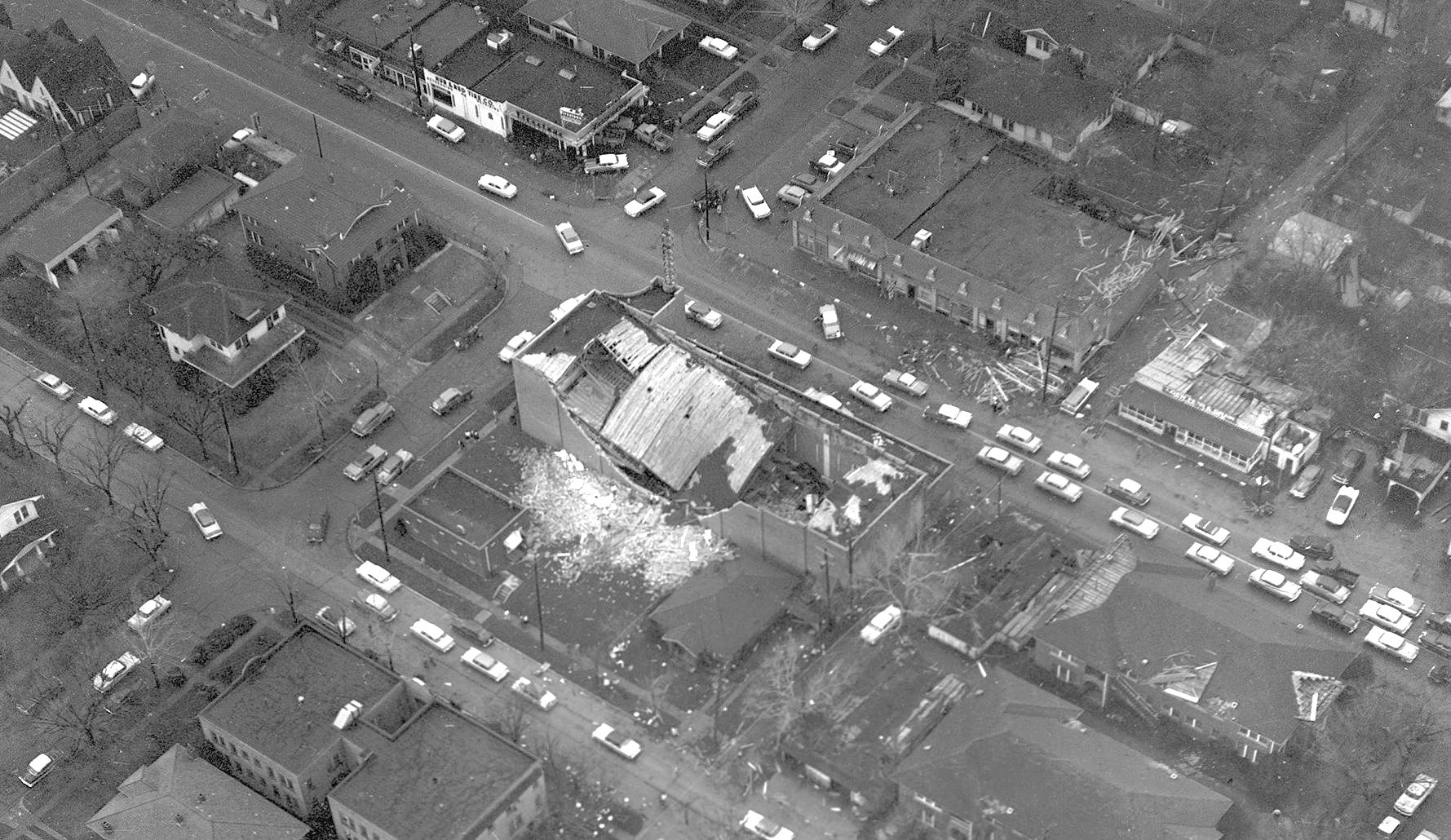
One of the casualties of the famous tornado that hit Dallas and Oak Cliff in 1957 was the Kessler Theater. In 1957, the Kessler — then only 15 years old — had hit hard times and was being used to house an evangelical church. It was rebuilt after the tornado, but soon after it was hit by a three-alarm fire. Conclusion? Do not disturb the entertainment gods — that place was meant to be a theater!

kessler_tornado_sherrod

From the post-tornado reports in The Dallas Morning News:

At the West Davis and Clinton business district, an evangelical church in a converted theater building at the intersection was caved in, leaving little more than two walls standing. The church’s cross from atop its more than 50-foot tower was crumpled in the gutter. (DMN, April 3, 1957)

And in a survey of the clean-up:

At Davis and Clinton, where the old Kessler Theater was being used as a revival center before the tornado, workmen were busy wrecking the building, completing what the tornado had started. […] J. T. Hooten, foreman for Winston A. Caldwell, explained that the damaged sections of the theater which might give way under a slight strain and cause further damage had to be torn out. His crew carefully but hurriedly dismantled the old Davis Street landmark. Hooten said the owner may rebuild the theater as a 1-story office building. (DMN, April 10, 1957)

Here is a detail of an aerial photo by photographer Squire Haskins, showing the damaged Kessler in the center (see the full, very large photo here):

kessler_tornado_squire-haskins_UTA_det

***

Sources & Notes

Top photo from an incredibly detailed website devoted to the 1957 Dallas tornado, the home page of which can be seen here.

Second photo from D. Troy Sherrod’s Historic Dallas Theatres (Charleston: Arcadia Publishing, 2014); photo from the collection of the Dallas Public Library.

Aerial photograph by Squire Haskins from the Squire Haskins Photography, Inc. Collection, UTA Libraries, Special Collections; more information is here (click the thumbnail to see a larger image).

Website of the recently (and beautifully) restored Kessler is here.

*

Copyright © 2014 Paula Bosse. All Rights Reserved.