Flashback : Dallas

A Miscellany: History, Ads, Pop Culture

Category: Hispanic Dallas

When a Virgin Sacrifice at Fair Park Almost Caused an International Incident — 1937
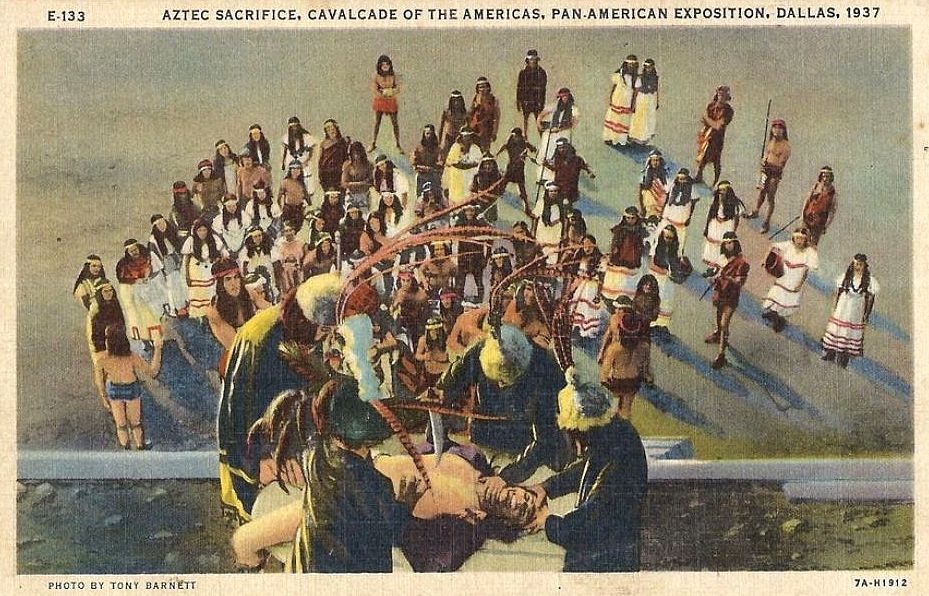
pan-american_aztec-sacrifice_colteraAztec sacrifice with a warrior, not a virgin, on the official postcard

by Paula Bosse

The Greater Texas and Pan-American Exposition at Fair Park was a four-and-a-half-month extravaganza which opened in June, 1937 as a follow-up of sorts to the previous year’s Texas Centennial Celebration. According to promotional material, its goal was to celebrate the Americas and “to promote the feeling of international goodwill between the twenty-one independent nations of the New World.” (It was also hoped that the city could rake in some more Centennial-sized cash.)

One of the biggest attractions of the Pan-American Expo was a huge production called Cavalcade of the Americas, which presented highlights from the history of Latin America and the United States. There were scenes from ancient Mexico, Columbus’ landing, the Revolutionary War, Stephen F. Austin’s arrival in Texas, the settling of the Old West, etc., right up to FDR’s participation in the Inter-American Peace Conference in Argentina in 1936. Utilizing much of the same infrastructure as the previous year’s Cavalcade of Texas, it was staged outdoors, in the old racetrack, with a 300-foot stage and elaborate scenery depicting an ocean, mountains, and a smoking volcano. Horses, wagons, “ships,” and a cast of hundreds took part in the production.
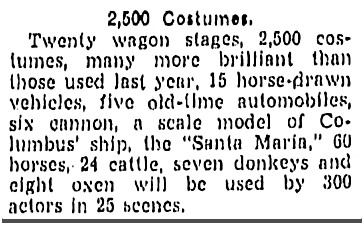
cavalcade-americas_FWST_060637Fort Worth Star-Telegram, June 6, 1937

It was quite elaborate. The postcard view below will give you an an idea of the scale of what was being billed as the world’s biggest stage.(I  believe the whole thing revolved — or at least part of it did — with another stage on the side facing away from the audience; the scenery, cast, and perhaps the donkeys, would change out before revolving to face the audience.)
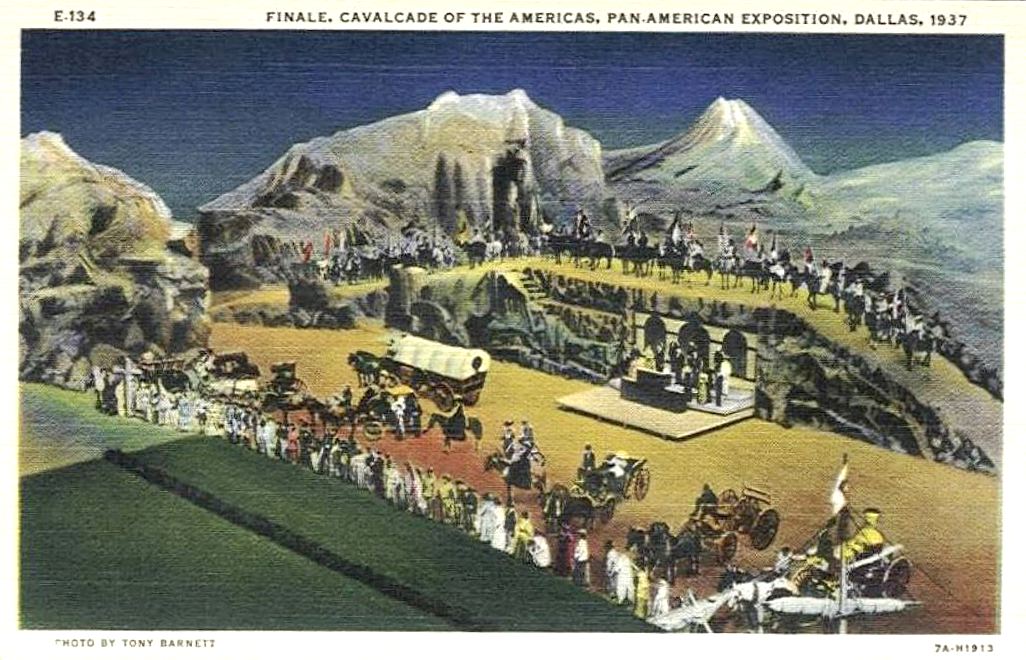
cavalcade_1937

The opening scene featured an Aztec sacrifice and an angry volcano. Start big! This relatively brief portion of the show caused a lot of headaches (and/or much-welcomed publicity) for the producers, State Fair organizers, and, probably, the image-conscious Dallas Chamber of Commerce. But why? As originally written (by the remarkably prolific Jan Isbelle Fortune), the Aztec sequence involved the sacrifice of a struggling young maiden atop a blood-stained pyramid. Two months before the opening of the Expo, a rather sensationalistic photo of this historical reenactment appeared in the pages of newspapers across the country, no doubt resulting in raised eyebrows and whetted appetites. (Click to enlarge!)
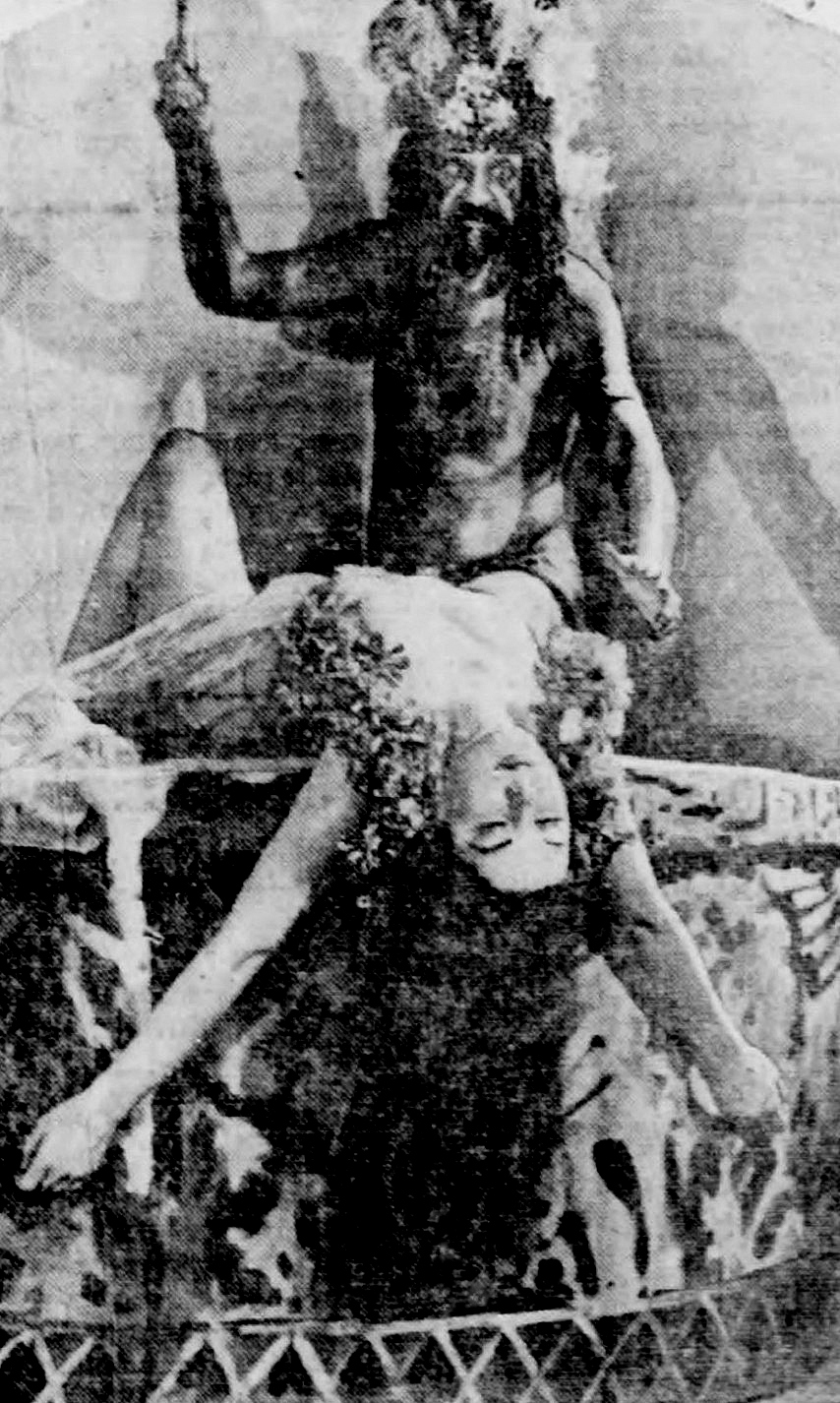
aztec_greencastle-indiana-daily-banner_080437Greencastle (Indiana) Daily Banner, 1937

The star of this scene was 17-year-old Geraldine Robertson, who had been crowned Queen of the Centennial the previous year and who played a multitude of roles in the current production, including Cortés’ “lover and interpreter,” a young woman in a Boston Massacre scene, Martha Washington, and the wife of Jim Bowie. Here she is in real life in 1936, with Jean Harlow platinum-blonde hair, posing for one of a seemingly endless number of publicity photos.

robertson-geraldine_queen-of-centennial_1936Geraldine Robertson, 1936

And the thing that caused so much trouble? Probably not what you would assume.

Before the Exposition opened, the Dallas-based Mexican Consul, Adolfo G. Dominguez, became aware of this casting choice. And that was when the mierda probably first hit the ventilador. Dominguez was adamant that the virgin be replaced with the more historically accurate male warrior. He probably said much the same thing to the Cavalcade producers when confronting them about his concerns before the Expo began as he did when he said this in a Dallas News article on the topic weeks later:

“We Mexicans feel that use of a girl in the role can bring nothing but racial prejudice and misconception of the true meaning of the Aztec human sacrifice as it was performed, not thousands of years ago, as has been wrongly represented, but as late as 1521.” (DMN, July 28, 1937)

The producers acquiesced, and when the Exposition began its run on June 12, 1937, the opening scene of the Cavalcade did, in fact, feature a sacrificial warrior. But on Sunday, July 25, the producer of the extravaganza brought the scantily-clad virgin back and nixed the warrior, hoping the added sex appeal and pizzazz would increase audience numbers. (Interestingly, when the Exposition opened, tickets to Cavalcade of the Americas cost 50⊄ — about $8.00 in today’s money — but on July 18, it was announced that, except for 600 reserved seats, admission to the show would be free. Promoters said this was being offered as a gesture of goodwill to Expo visitors, but one wonders if they weren’t having a hard time filling the 3100-seat grandstand.)

Señor Dominguez was not amused by this sexed-up revamping and protested. A. L. Vollman, the Cavalcade’s producer-director pooh-poohed the diplomat’s protestations and responded in true impresario fashion: “What history needs is more sex appeal.” That didn’t go over particularly well with the consul, who thought he’d already dealt with the problem weeks before. (Click to see larger image.)
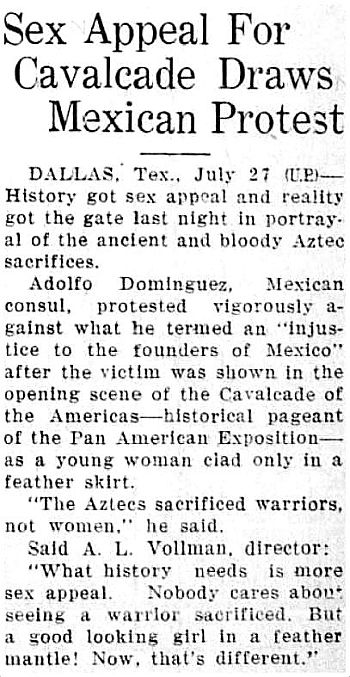
aztec_waxahachie-daily-light_072737Waxahachie Daily Light, July 27, 1937

Dominguez complained to Frank K. McNeny, Director General of the Exposition, saying that the scene was historically inaccurate and was an injustice to the founders of Mexico. McNeny disagreed, saying that the scene involving the plunging of a dagger into the breast of a sacrificial virgin was “a very lovely historic scene.” He declined to bring back the warrior, because, as Vollman noted, the revamping had increased attendance: “It’s packing them in the aisles.” An exasperated Dominguez said that if the change from maiden back to warrior was not made, he would take the matter to the Mexican government.
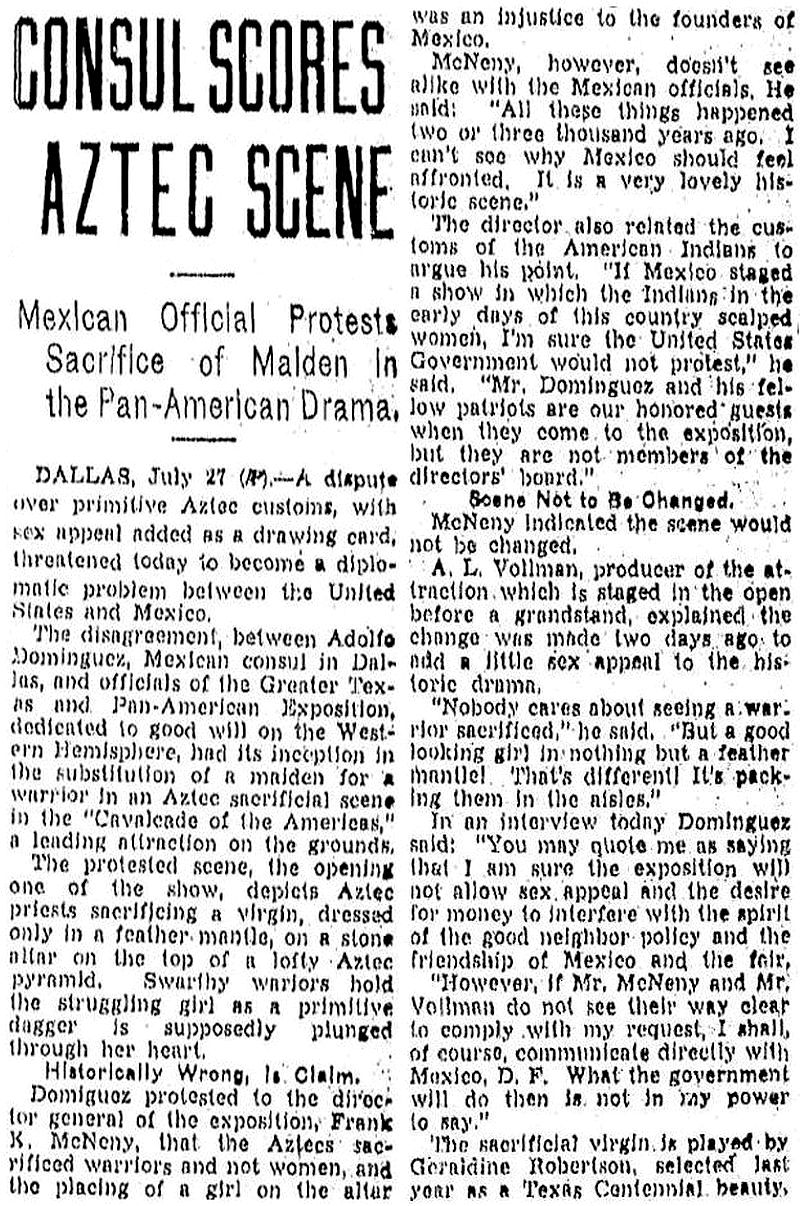
aztec_FWST_072837FWST, July 28, 1937

At this point, a disagreement over the gender of a character in what was, basically, an oversized school history pageant was dangerously close to setting off an international incident. It was also causing embarrassment for local civic leaders who were looking upon the Exposition as a major marketing tool for the city as well as a symbolic display of Pan-American solidarity and goodwill. Can’t we all just get along, amigo?

The refusal of the Cavalcade to UN-revamp the show did not deter the Mexican Consul who, by now, was probably more het-up than ever. Dominguez decided to go over McNeny’s head. He pulled out the written agreement he had made with fair officials back in the spring — which clearly stated that a male warrior and NOT a young woman would feature in the theatrical human sacrifice — and he took it to the top man, State Fair president Fred F. Florence. Florence discussed the matter with his board of directors who voted “to a man” to uphold the original agreement.

The warrior would be reinstated as the writhing victim on the bloody sacrificial stone. The sexy maiden would have to hand over the 30-foot-long robe, which had been made from 9,000 feathers and which had trailed behind her as she was carried up the great pyramid at Tenochtitlán. The actor playing the warrior was probably happy to get back in the spotlight. Geraldine Robertson, the virgin who had trailed that robe, was relegated to a role as a daughter of Montezuma.

Presumably the dagger kept plunging into the flailing warrior’s heart twice nightly for the remainder of the show’s run, and the memory of that short-lived international squabble was quickly forgotten (…until now).

And they all lived happily ever after. / Vieron felices por siempre.
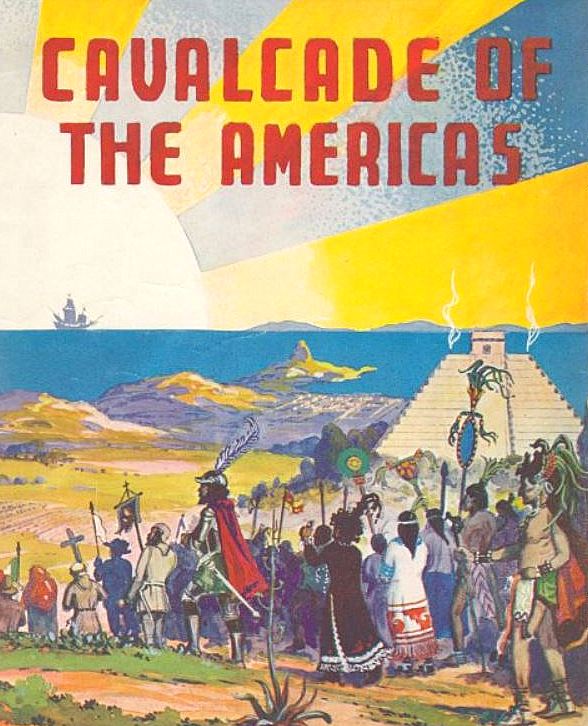
panamerican_cavalcade_watermelon-kid

*

Hey! If you’ve read this far, here’s a little reward. A Universal Newsreel titled “Pan-American Exposition Is Opened For 1937, Dallas, Tex.” — which contains 20 whole seconds of the Aztec (warrior) scene!  — can be viewed on the T.A.M.I. (Texas Archive of the Moving Image) site, HERE. The entire short newsreel is interesting (sadly, it has no sound), but if you want to jump to the sacrifice scene, it begins at the :49 mark. (If you’re watching on your desktop, make sure to click the little square just to the left of the speaker icon beneath the viewing area to watch it full-screen.
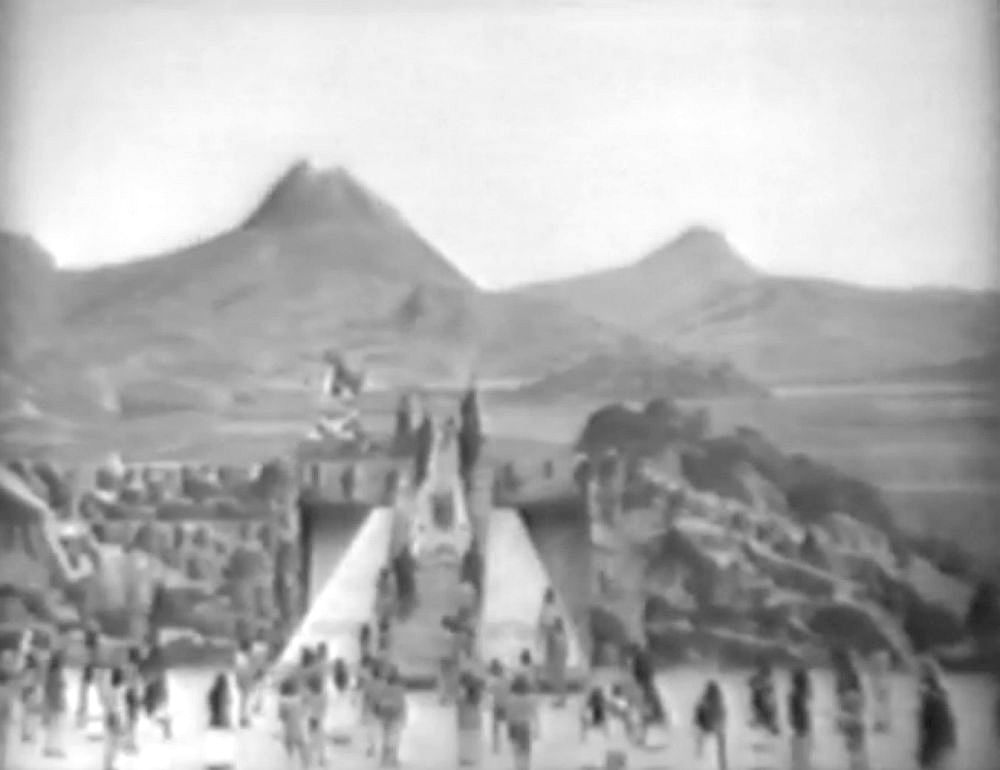
aztec_newsreelSuper-grainy screenshot from the Universal newsreel, 1937

***

Sources & Notes

Postcards of the Pan-American Exposition are from “the internet.”

Color souvenir program image from the Watermelon Kid site; background on the Pan-American Exposition can be found on the same site, here.

All other clippings as noted.

Related Dallas Morning News articles:

  • “As Sacrificial Virgin, Star of Cavalcade Put In Showy Opening Act” (DMN, July 26, 1937)
  • “Cavalcade Dispute Is Won by Consul As Virgin Is Replaced” (DMN, July 28, 1937)

Below, an interview with Jan Fortune on her Cavalcade of the Americas; it appeared in her hometown newspaper, The Wellington (Texas) Leader on March 18, 1937. She also wrote the Centennial’s big production, Cavalcade of Texas, the previous year, in 1936.
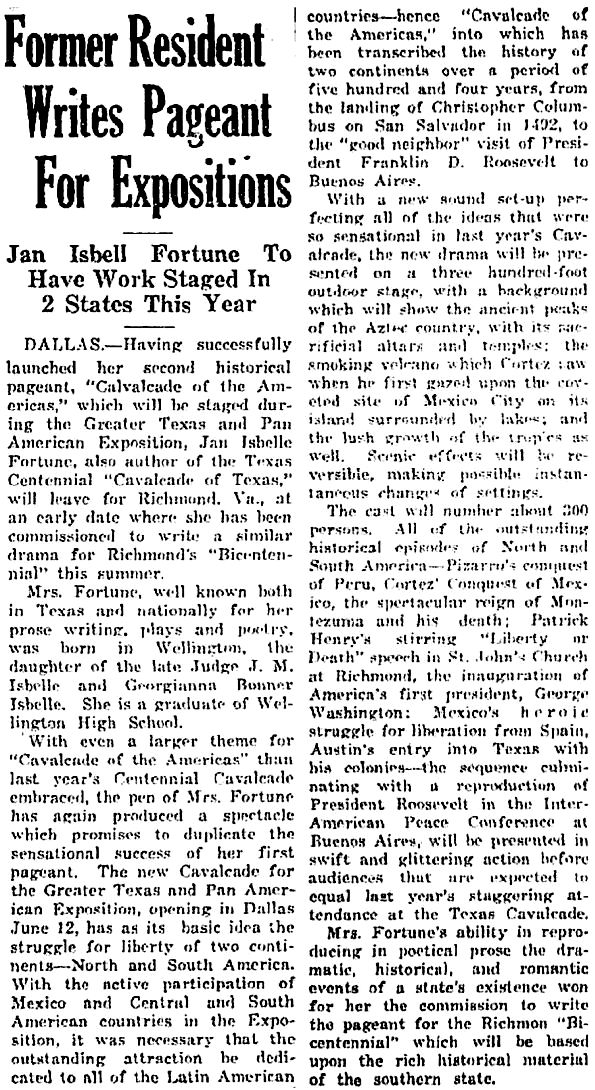
jan-isbell-fortune_wellington-tx-leader_031837

And, speaking of Aztec human sacrifices in DFW (a phrase I don’t believe I’ve ever written…), the following tidbit was contained in an article about Six Flags Over Texas’ 1970 season.
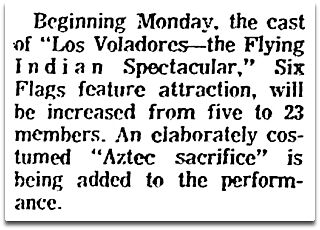
aztec_FWST_052170-six-flagsFWST, May 21, 1970

Promotional material about Los Voladores — a group of aerialists from Mexico — informs us that in their show “a beautiful maiden’s life is given as tribute to Tlaloc, the rain god.” Those beautiful maidens can’t catch a break. Sorry, Adolfo.

*

Copyright © 2015 Paula Bosse. All Rights Reserved.
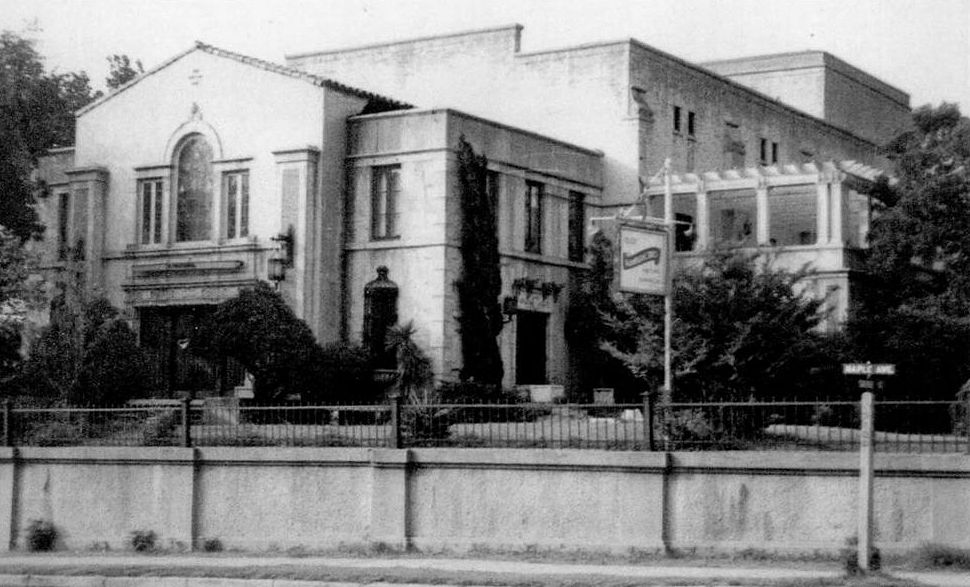
Teatro Panamericano / Cine Festival — 1943-1981

teatro_villasana_1950sEl Panamericano (click for larger image) (Villasana)

by Paula Bosse

In 1937, Joaquin José (J. J.) Rodriguez opened the first theater in Dallas to show Spanish-language movies. It was the Azteca, at 1501 McKinney Avenue, one block away from the still-there El Fenix. He soon changed the name to the Colonia and later to El Patio.

colonia_1938-directory1938 city directory

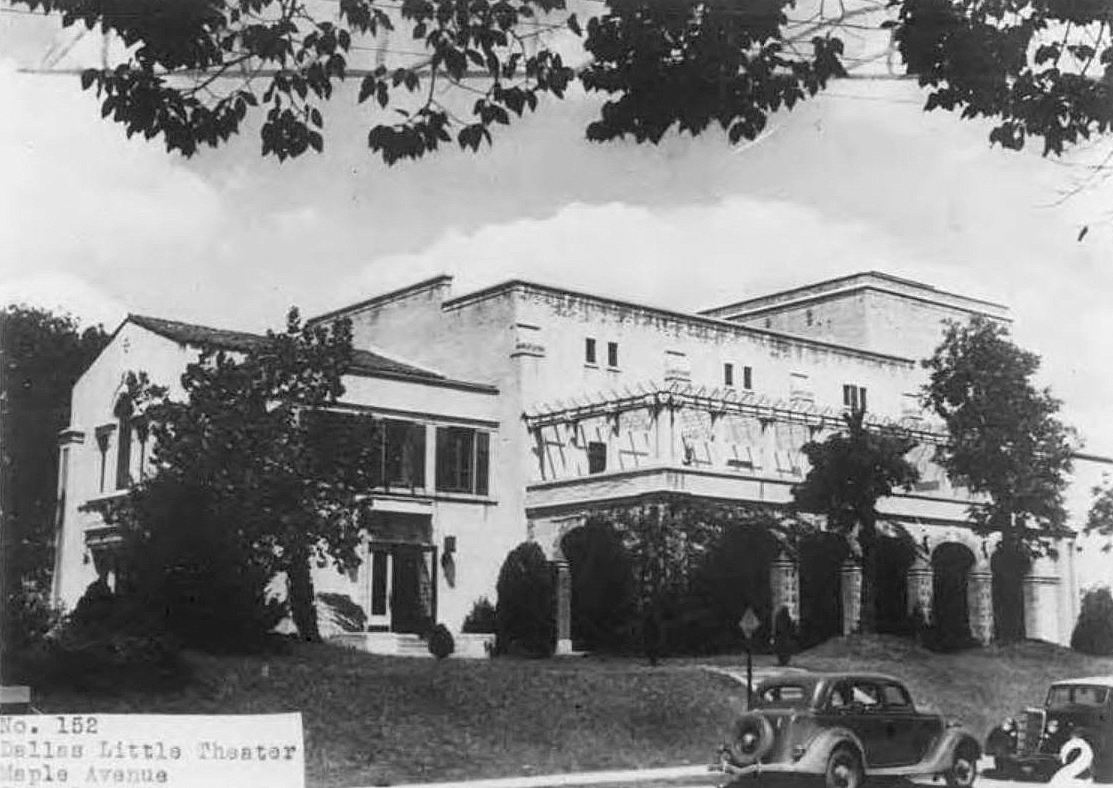
Even though a journalist later described this theater as being “dingy” and “unprepossessing” (DMN, July 31, 1944), the theater was quite successful, little surprise as the Hispanic community of the day was sorely underserved in almost every way. This endeavor was so successful that in the fall of 1943, the 36-year old entrepreneur made a big, BIG move: he bought the stunning and palatial Maple Avenue building that once housed the famed Dallas Little Theatre, an amateur theatrical group that had burst on the scene in 1927, but which had fallen on hard times in recent years.

dallas-little-theater_degolyer-lib_SMU1930s

Rodriguez raised the necessary $35,000 (equivalent to almost half a million dollars in today’s money), bought the beautiful building at 3104 Maple, and renamed it Teatro Panamericano. The angle of the article that appeared in The Dallas Morning News on Sept. 22, 1943 announcing the new theater had the new moviehouse as being a boon to students and Anglo members of the community who might need to brush up on their Spanish rather than as a welcomed entertainment venue for the “Mexican colony” living and working in the adjacent Little Mexico neighborhood.

El Panamericano was an immediate success and soon became not only a place to see movies, but also a place for Dallas’ Spanish-speaking community to meet and mingle, with PLENTY of room for all sorts of events. (It was so big that Rodriguez and his family lived in back. He also had TWO offices and more storage space than he had things to store in it. No skimping on the parking lot either — one ad touted an acre of parking space.)

The theater’s importance to the Hispanic community of Dallas was both cultural and social:

For Mexican-Americans growing up in Dallas during the ’50s and ’60s, the films at El Panamericano, were a link with their historical and cultural heritage. For some, it would be their only exposure to cultural ties; for those whose families were stressing their Americanization by using only English in the home, it was a chance to practice their Spanish. (“Festival Fades, but Mexican Movies Thrive,” DMN, Aug. 9, 1981)

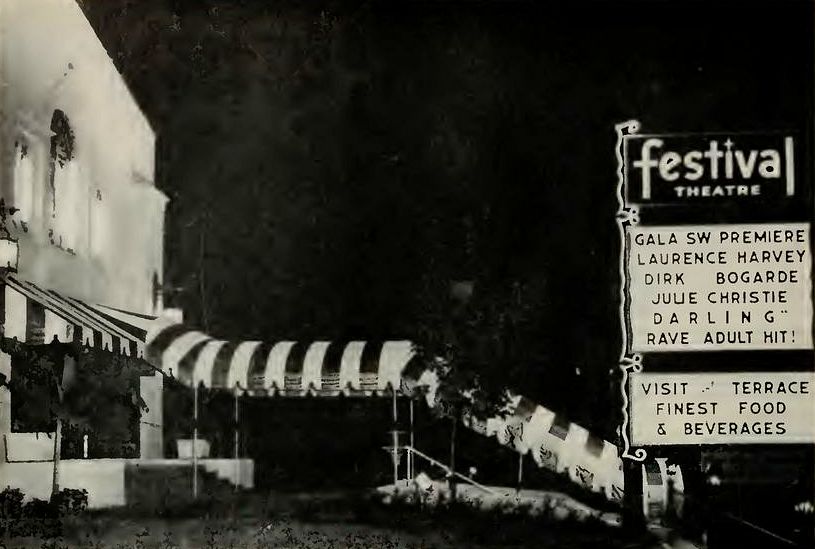
After more than 20 years of running a successful theater that catered to his core niche audience, Rodriguez was persuaded to change the theater’s focus. Mexican families had slowly moved out of the neighborhood, many to Oak Cliff where the Stevens Theater on Fort Worth Avenue had begun showing Spanish-language movies in the early ’60s and had siphoned off a large portion of Rodriguez’s audience. In 1965 the Panamericano became an arthouse cinema which showed mostly subtitled European films (and, later, underground and cult movies) — these were movie bills which were clearly aimed at college students and an upper-class Anglo audience. The Panamericano became the splashy Festival Theatre.

festival_box-office-mag_112265BoxOffice magazine, Nov. 22, 1965

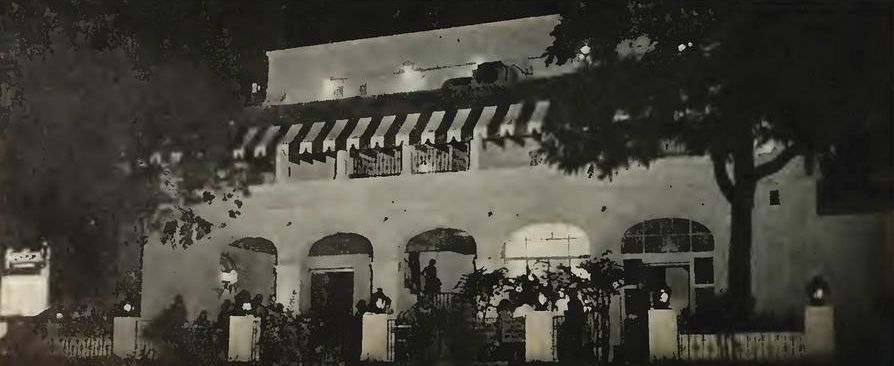
An indoor-outdoor restaurant — the Festival Terrace — was added, and it boasted of being “the only theater in the history of Texas with a wine and beer license.”

festival_box-office-mag_112265-restaurantBoxOffice magazine, Nov. 22, 1965

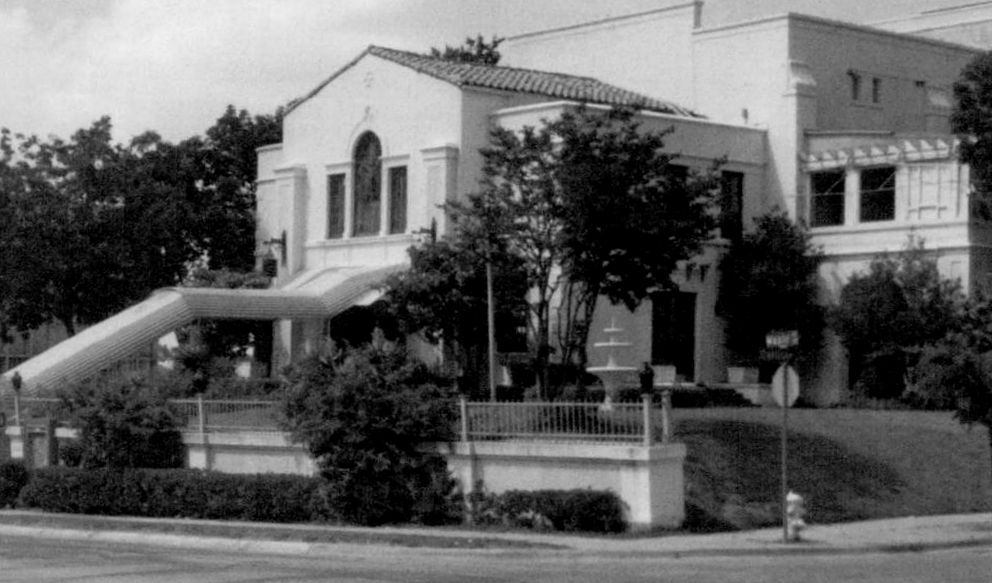
teatro_villasana_1960s1960s (Villasana)

As impressive as the Festival and its array of films were, the theater struggled, and Rodriguez later called this period a “big mistake.”

“As soon as I could, I changed it back to the way it was before. In fact, I lost money on that deal.” (DMN, Aug. 9, 1981)

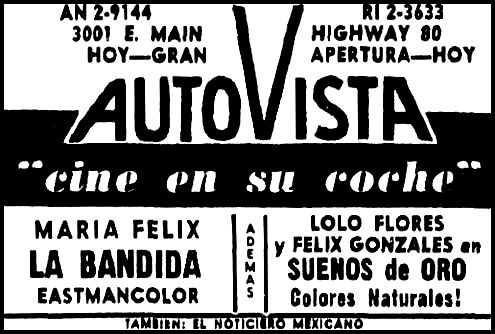
Another unusual misstep for Rodriguez at this time was his decision to open a drive-in that showed only Spanish-language films. What sounded like a great idea was another surprising failure for Rodriguez. Despite its non-stop advertising in the first half of 1965, the wonderfully-named Auto-Vista (located in Grand Prairie) lasted less than a year.

auto-vista_dmn_032565“Cine en su coche”! (March, 1965)

Rodriguez’s new-old Spanish-language theater — now the Cine Festival — was still popular, but it never regained its former glory. Rodriguez retired in 1981 and sold the property. Despite efforts by preservationists to save the beautiful Henry Coke Knight-designed building, it was demolished a few months later — in early January, 1982 — in the dead of night under cover of darkness (… that happens a lot in Dallas…). A nondescript office building was later built in its place.

J. J. Rodriguez died in 1993 at the age of 86, almost exactly 50 years after opening one of the most important entertainment venues for Dallas’ Hispanic population. He was a respected leader in the community and was for many years president of the Federation of Mexican Organizations, an organization he helped found in the 1930s. His theater was both culturally important and beloved by its patrons.

*

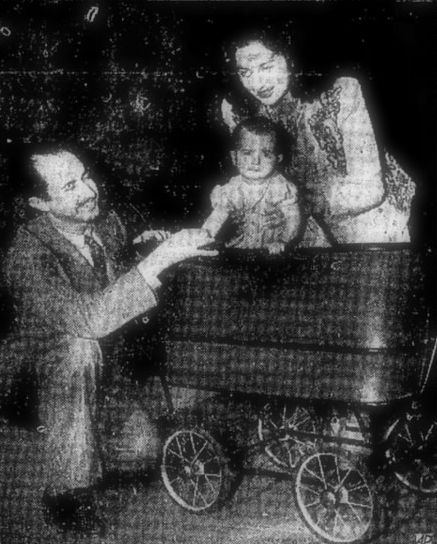
pampa-news_AP-073044J. J. with daughter and wife (Pampa News, July 30, 1944) AP photo

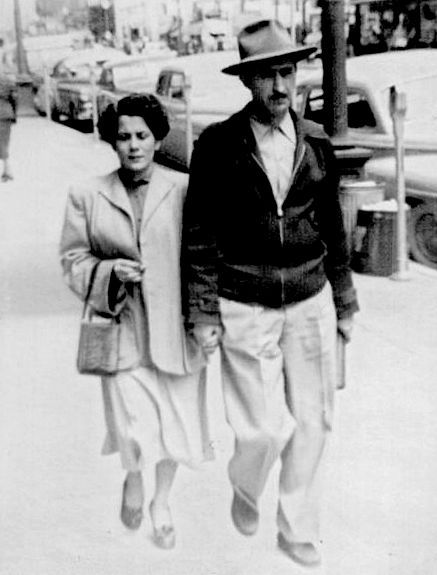
rodriguez_villasana_downtown_1940sWith his wife, Maria, downtown 1940s (Villasana)

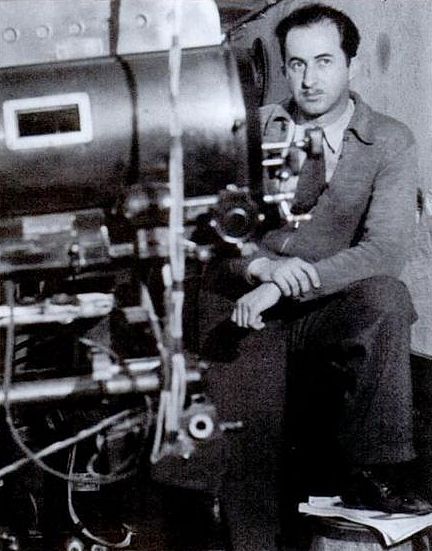
rodriguez_villasana_1950sIn the projection booth, 1950s (Villasana)

*

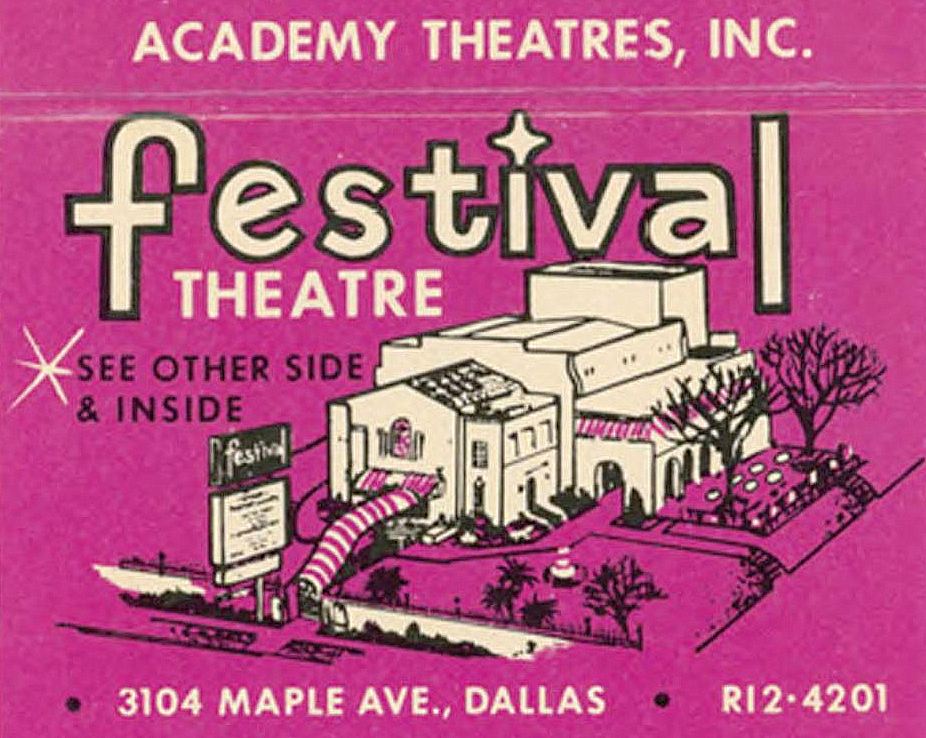
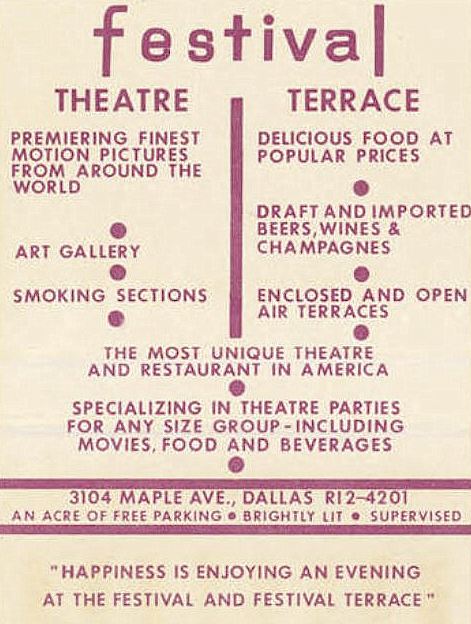
The matchbook cover image below gives an indication of how large the theater was. The building at 3401 Maple — at the corner of Carlisle, across Maple from the Maple Terrace — was gigantic.

festival-theatre_cook-collection_degolyer_smu_matchbook-cover

festival-theatre_cook-collection_degolyer_smu_matchbook-insideMatchbook via George W. Cook Collection, SMU

In a Dallas Phorum discussion (here), the space was described thusly:

It was an interesting building with an outdoor terrace restaurant, a full proscenium stage, rehearsal space downstairs below the stage, dressing rooms, shop/storage areas, and even a puppet theatre built into a wall in the balcony lobby area.

To see what the corner of Maple and Carlisle looks like now, click here (have a hanky ready). Can you imagine how wonderful it would be to still have that elegant building and still see it in use as a theater and restaurant?

**

In what may well be research overkill, I thought it was odd that there was an Azteca Theatre at 1501 McKinney a year before Rodriguez owned it. I wondered if, in fact, Rodriguez had owned the first Spanish-language movie theater in Dallas, or whether that distinction belonged to Ramiro Cortez (whose name is often misspelled as Ramiro Cortes). It seems that Cortez’s theater might have featured live performances rather than motion pictures. Like Rodriguez, Cortez had ties to Dallas entertainment — read about him here.

azteca_1937-directory1937 city directory

***

Sources & Notes

Photos with “Villasana” under them are from the book Dallas’s Little Mexico by Sol Villasana (Charleston, SC: Arcadia Publishing, 2011); all are from the personal collection of Mariangel Rodriguez. More photos of J. J. Rodriguez can be seen here (click “Next” on top yellow bar).

The full article from the Nov. 22, 1965 issue of the industry journal, BoxOffice, includes additional photos and information and can be seen here and here.

All other images and clippings as noted.

Articles on J. J. Rodriguez and his theaters which appeared in The Dallas Morning News:

  • “Pan-American Theater to Aid Spanish Study” (DMN, Sept. 22, 1943)
  • “Teatro Panamericano” by John Rosenfield (DMN, Oct. 12, 1943)– coverage of opening night festivities
  • “Maple Location Regains Swank” by John Rosenfield (DMN, Sept. 18, 1965) — about the change from El Panamericano to the arthouse Festival Theater
  • “Festival Fades, but Mexican Movies Thrive: Theater Owner Says Adios to Film Business” by Mercedes Olivera (DMN, Aug. 9, 1981) — about the closing of the Festival Theater
  • “Encore No More” (DMN, Jan. 4, 1982) — photo of the partially demolished theater
  • “Rites Set for Hispanic Leader J. J. Rodriguez — He Co-Founded Federation of Mexican Organizations” by Veronica Puente (DMN, Sept. 26, 1993) — Rodriguez’s obituary

“Dallas Theater Owner Is One-Man Pan-American Agency” — a syndicated Associated Press article by William C. Barnard — can be read here.

Read about Teatro Panamericano at Cinema Treasures, here.

Read about the competing Stevens Theater in Oak Cliff on Fort Worth Avenue, here.

*

Copyright © 2015 Paula Bosse. All Rights Reserved.

Teenagers, Hot-Rods — 1960s

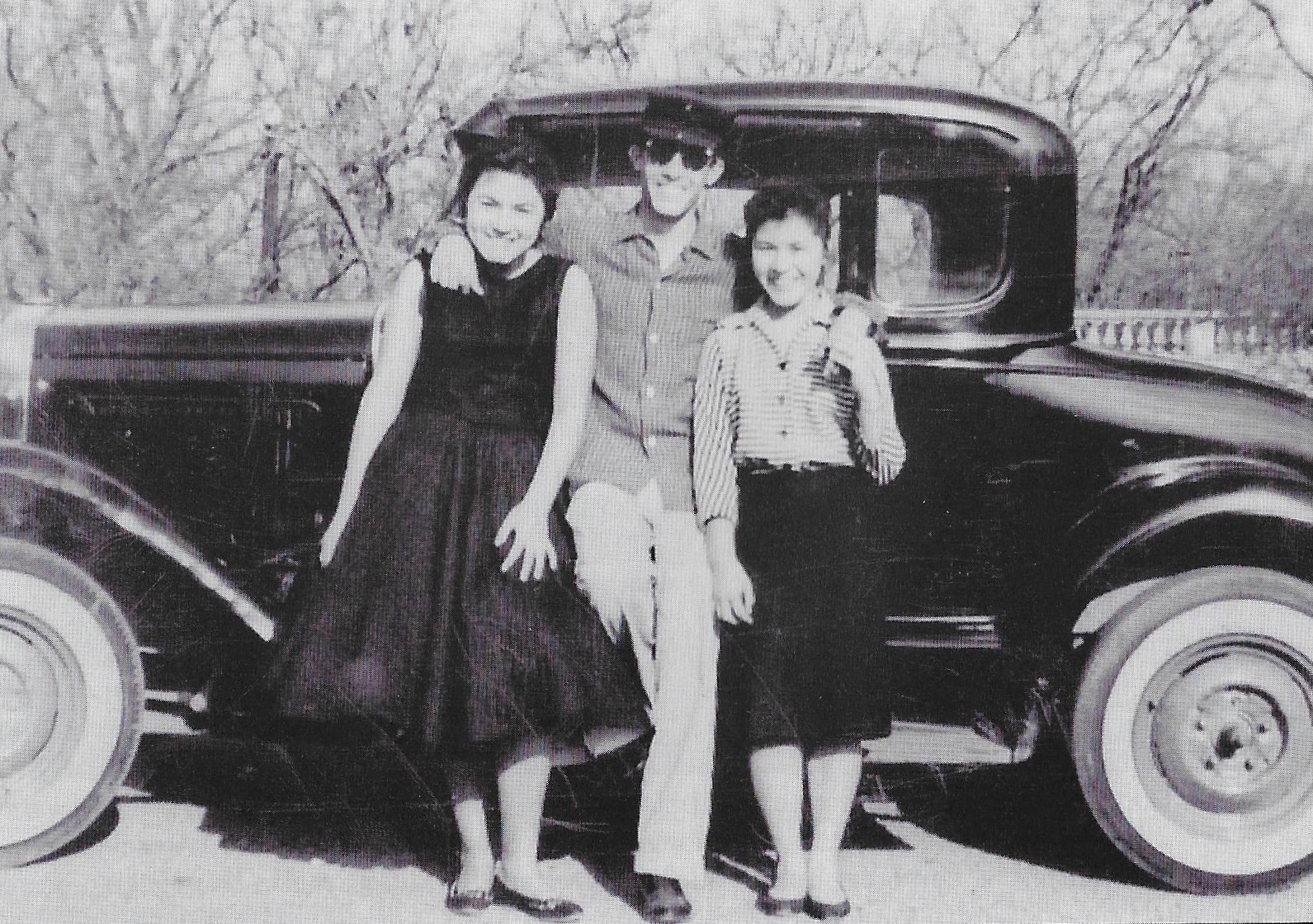
little-mexico_hot-rod_villasana A cool cat and his kittens… (via DMAHL)

by Paula Bosse

Teenagers and hot-rods, man. These kids are cool.

***

Sources & Notes

Photo from the book Dallas’s Little Mexico by Sol Villasana (Charleston, SC: Arcadia Publishing, 2011); photo is credited to Dallas Mexican American Historical League (DMAHL). Caption reads: “These Little Mexico teenagers show off their hot-rod in this 1960s picture. Shown are, from left to right, ? Santos, Rudy Trevino, and Maria Rodriguez.”

*

Copyright © 2015 Paula Bosse. All Rights Reserved.

El Presidente y Su Sombrero — 1975

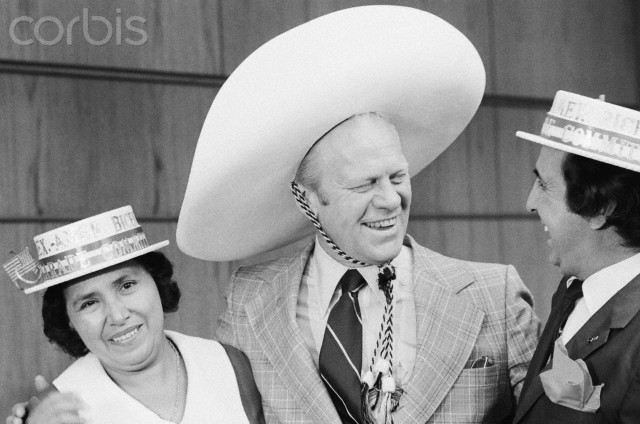
Pres. Ford In SombreroEl Prez at SMU, Sept. 13, 1975  /  ©Bettmann/CORBIS

by Paula Bosse

Politicians have to do a lot of silly things at public appearances, and some of them handle the baby-kissing and tedious chit-chat more gracefully than others. President Gerald R. Ford seems to have been pretty good-natured about this sort of thing, even in the wake of the Nixon impeachment and even while being incessantly lampooned by Chevy Chase on Saturday Night Live every week.

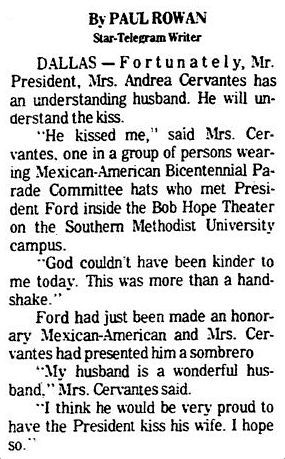
For reasons I’ve never understood, politicians and foreign dignitaries always seem to be presented with hats when they make an official visit somewhere, and when they come to Texas, they almost always get a cowboy hat. But on President Ford’s 1975 visit to Dallas and the SMU campus, he was made an “honorary Mexican-American” and was presented with a (very large) sombrero by Andrea Cervantes of the Mexican-American Bicentennial Parade Committee. He looks ridiculous, but it’s a fun ridiculous. I think he liked it — Mrs. Cervantes even got a kiss for her gift.

ford-sombrero_FWST_091475Fort Worth Star-Telegram, Sept. 14, 1975
The sombrero re-appeared a few months later, autographed and on display at Pike Park. It never left Dallas. What a shame. I would have liked to imagine the President and First Lady relaxing at Camp David, Jerry wearing his sombrero, smoking a pipe, and watching college football on TV, while Betty sat at the other end of the couch, chuckling to herself, and shaking her head.

***

Souces & Notes

Top photo from CorbisImages, here.

More on this in the Dallas Morning News article (with photo) “Ford Commends Group for ‘Feliz Cumpleanos'” (Dec. 15, 1975).

This sombrero-donning was just seven months before the now-legendary “Great Tamale Incident” in San Antonio. Read how NOT to eat a tamale here.

Ford took his gaffes in stride, even going so far as to appear on the show that made note of his every stumble, literal and figurative. Read a behind-the-scenes account of Ford’s 1976 Oval Office taping of one-liners for SNL — including his “Live from New York, it’s Saturday Night!” show opener (although I’m pretty sure he did it without the exclamation mark) — here.

*

Copyright © 2014 Paula Bosse. All Rights Reserved.

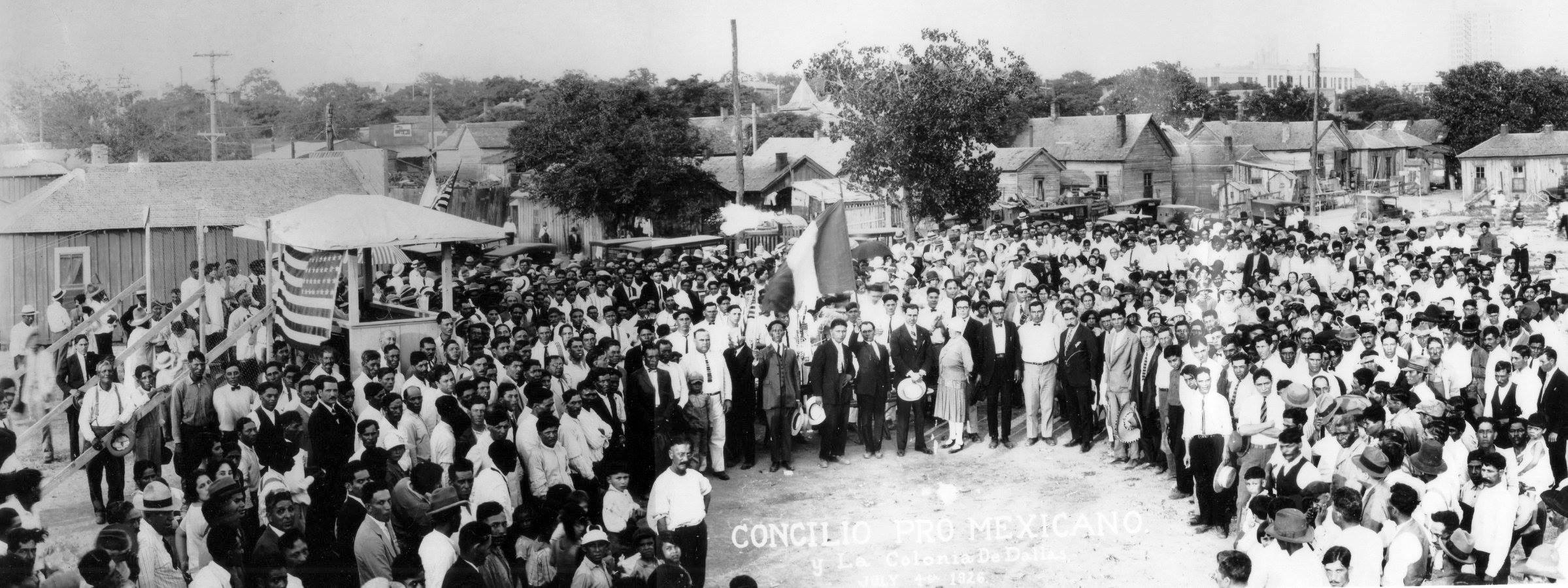
Pike Park, Fiesta Central — 1926

little-mexico_1926_dmahl-facebook-pagePike Park (click for MUCH larger image)

by Paula Bosse

Fantastic photo of a 4th of July celebration in Little Mexico’s Pike Park in 1926, with the caption reading “Concilio Pro Mexicano y La Colonia de Dallas.”

Today is Cinco de Mayo, which, before it was co-opted by the gringo, was primarily a big party in communities populated by Mexican-Americans and Mexican immigrants. In Dallas, that meant a fiesta of music and food at Pike Park. I remember going to a few of these when I was a child, and my unmistakably Anglo family stood out in the crowd, but we were always welcomed and we had a great time. I loved it. Not to be a killjoy, but I’m not a fan of what Cinco de Mayo has become — just another excuse to drink to excess (St. Patrick’s Day with margaritas). But, if you’ve pulled out that novelty sombrero from the back of your closet and you’re celebrating today, well … olé. But pace yourself, amigos.

***

Photo from the Dallas Mexican American Historical League; it accompanied a great Dallas Morning News blog post by Dianne Solís regarding Pike Park, here.

A CNN interview with the always-entertaining Gustavo Arellano — the man behind the very funny “Ask a Mexican” column — on why he believes the Cinco de Mayo holiday is “pointless” is here.

And Arellano’s article “Gringo de Mayo”  is here.

That photo is gigantic. Click for larger image.

*

Copyright © 2014 Paula Bosse. All Rights Reserved.

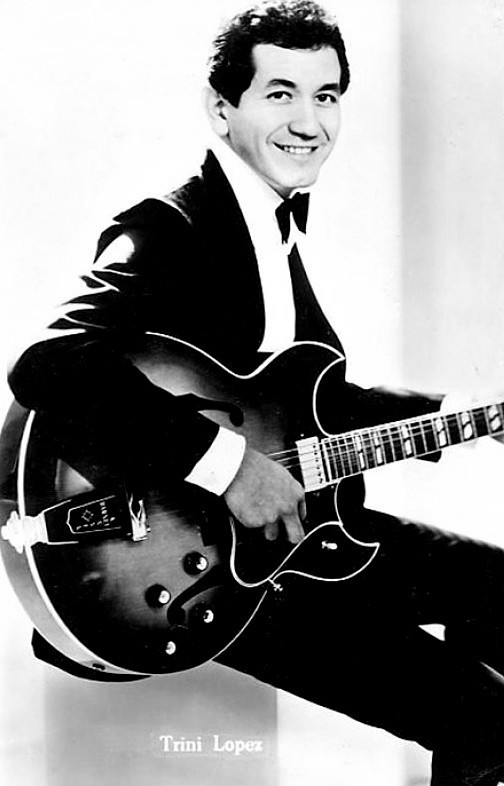
Trini Lopez: Little Mexico’s Greatest Export

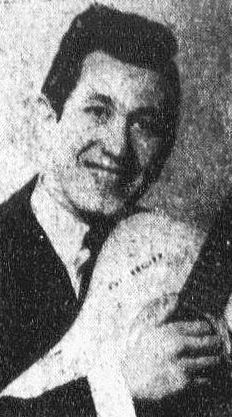
trini-lopez-photo_bw

by Paula Bosse

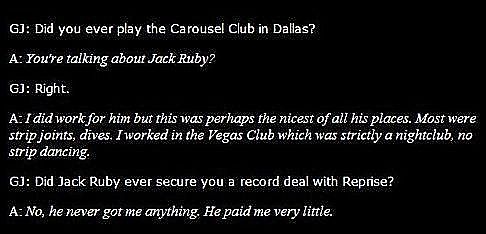
Trini Lopez has sold millions of records. MILLIONS. He was born in Dallas in 1937 and grew up in the Little Mexico area of town. He started his career when he was a teenager at Crozier Tech High School, singing and playing guitar in a popular combo. He played at dozens of school dances and parties, and, with a steady and faithful following, he was much in demand at countless venues around town, including a regular 2:30-6:30 p.m. Sunday matinee spot at Club Vegas (Oak Lawn & Lemmon), one of the many clubs in the city run by Jack Ruby.

Jack Ruby — the personable Latin from Manhattan, reports surprising success with his Sunday night Fiestas at Club Vegas….

“There is a wide demand for Latin music in Dallas,” said the Oak Lawn impresario…. He is opening at 2:30 p.m. Sundays for matinee dances featuring Trini Lopez and his orchestra. The versatile Lopez combo offers an occasional Yanqui tune in addition to the likes of the “Jack Ruby Mambo.” (Tony Zoppi’s column in The Dallas Morning News, Dec. 19, 1956)

(I really want to hear that “Jack Ruby Mambo”!)

Speaking of the “Latin from Manhattan” (?!):

trini-rubyHa! (From Gary James’ really great interview w/ Trini — see link at end.)

He also appeared on local TV, including Channel 8 shows hosted by a pre-Peppermint Jerry Haynes: “Jukebox” and “Top Ten Dancing Party.”

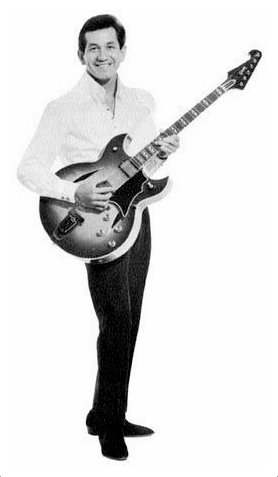
trini-lopez_19581958 publicity photo

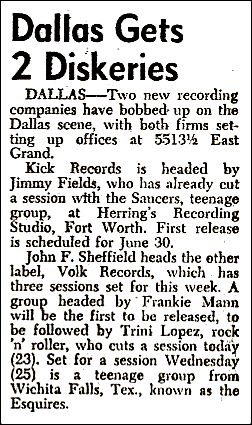
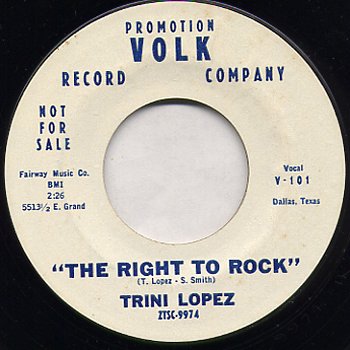
Trini’s first single was “The Right to Rock” — the first song he ever wrote — recorded in 1958 on a small Dallas label called Volk (did anyone else ever record for this label?).

trini_volk_billboard_062358Billboard, June 23, 1958

It’s a great little rockabilly number, but it didn’t really make any waves outside of Dallas (although it’s since found new life in the cult-y world of vintage rockabilly reissues).

volk-label

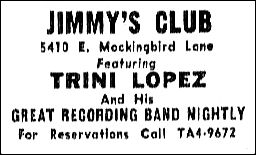
Trini then recorded a few singles for King, but those went nowhere as well, and Trini and his combo continued to play small clubs in and around DFW, wondering when the big break was going to come.

trini-lopez_jimmys-club_dmn_011159Jan., 1959

After a gig in Wichita Falls, Trini met fellow-Texan Buddy Holly who had been impressed by the young singer’s performance and encouraged him to contact his producer, Norman Petty, about recording some tracks at Petty’s studio in New Mexico. Trini jumped at the chance, but, unfortunately, the time in the studio at Clovis turned out to be a career low-point (see below for a link to the Gary James interview in which Trini gives a bitter and scathing account of that whole experience). Trini returned to Dallas and immediately fired his band and started a new one, determined that he would succeed, despite the prevailing (spoken and unspoken) racism he was continuing to run up against in the music business.

A few months after Buddy Holly’s death, the Crickets contacted Trini and asked him to travel to Los Angeles to discuss the possibility of becoming their new lead singer. Trini, seeing this as the big break he’d been waiting for, disbanded the combo and set out to the West Coast alone. The “audition” never really materialized, and Trini was stuck in California with no money and no prospects. He played a few small clubs and then settled into PJ’s for an extended and very successful engagement. It was there, in 1963, that the “big break” finally happened: he was discovered by producer Don Costa, who recommended that Frank Sinatra sign him to Reprise Records. Next thing you know, Trini had recorded his debut album, “Trini Lopez at PJ’s,” and the first single, “If I Had a Hammer,” was a huge smash hit, selling millions of copies and reaching #1 in 38 countries. Trini Lopez became an international star.

trini-lopez_photo_bw

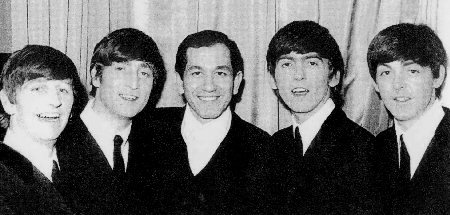
At the beginning of 1964, he was booked for a series of shows in Paris where he shared the bill with The Beatles, just as they were about to hit big in the US (their Ed Sullivan appearance was less than a month away). Beatlemania was in full force in Europe, but Trini was also getting his share of attention. 

trini-lopez_beatles_1964

And, the rest, as they say, is history.

*

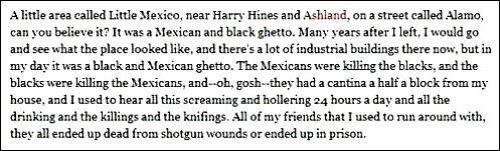
A couple of interesting things, Dallas-wise. My Trini Lopez knowledge is fairly scant, but having read a lot about him over the past couple of days, the one thing that keeps coming back when he talks about the Little Mexico section of town (invariably referred to by him as a “ghetto”) is how violent a place it was. He also recounts the deep and dehumanizing racial prejudice he and other Mexican-Americans experienced living in Dallas. When he left for Los Angeles in 1959/1960, he left for good. He came back regularly to visit his family (I remember having him pointed out to me by my parents in a restaurant once), but I’m not sure he would have ever wanted to live here again.

trini-lopez_wilonsky_052906From an interview by Robert Wilonsky (Dallas Observer, May 29, 2006)

*

Below are a few random interviews and tidbits.

Trini developed his own beat, a Tex-Mex style of rock and roll now popularly known as “the Trini beat” and which Trini describes as “American music with a Mexican feeing.” (DMN, July 12, 1964)

And from the same article:

“People in Dallas told me I had the talent but suggested I change my name. I said ‘No.’ I told them Italians had made it as Italians, Jews as Jews, and Negroes as Negroes. I wanted to make it as a Mexican. No one of Mexican-American heritage had made it before in the entertainment world. I wanted to be the first.” (DMN, July 12, 1964)

(According to Trini, the person who suggested he change he name was John F. Sheffield who owned Volk Records. Sheffield was okay with “Trini,” but he insisted the “Lopez” had to go. He suggested “Roper.” Trini refused and threatened to walk. Sheffield relented.)

trini-lopez_earl-wilson_july-1965a(Click for larger image – continues below.)

trini-lopez_earl-wilson_july_1965bEarl Wilson’s syndicated column (July 1965)

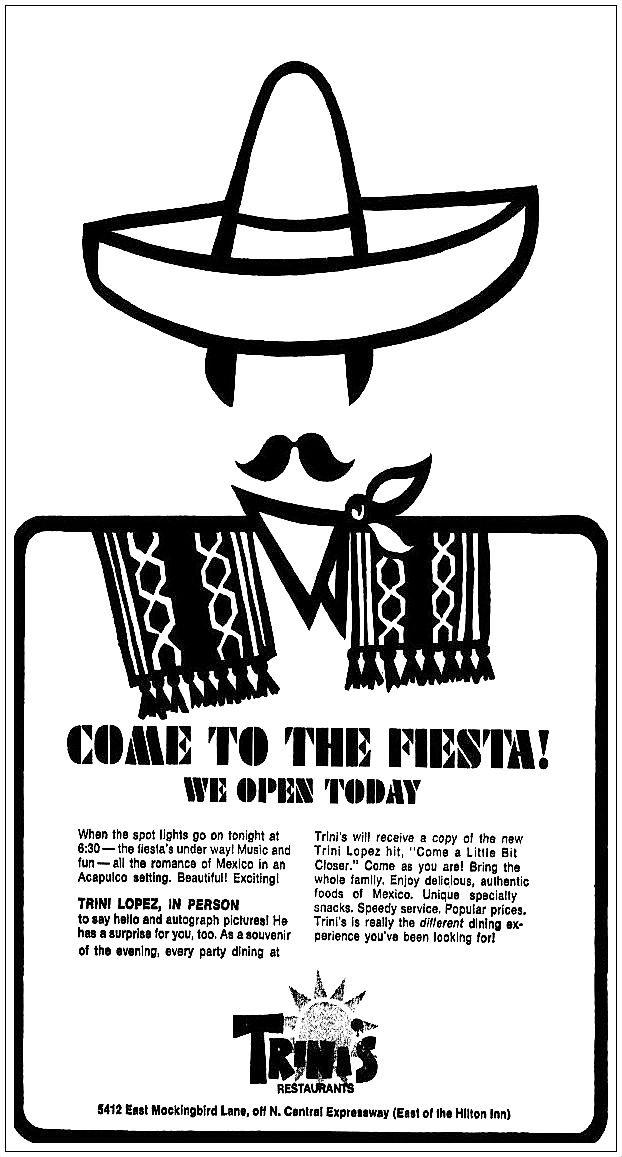
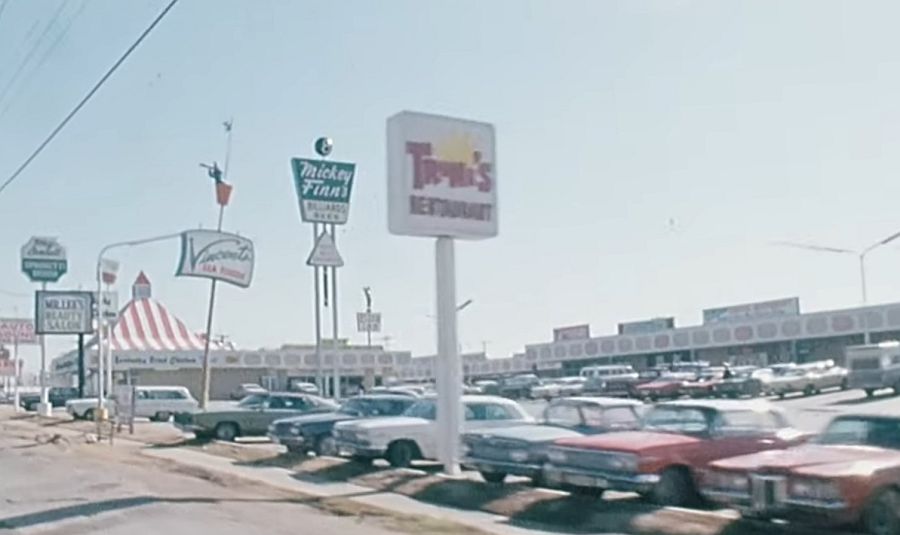
In 1969, Trini Lopez became a restaurateur and opened “Trini’s” at 5412 East Mockingbird, across from the old Dr Pepper plant (click for larger image):

trinis_restaurant_031969
March, 1969

trinis_sightseeing-film_KERA_1970_jones-film_SMU - croppedScreenshot, KERA, 1970 (Jones Film Collection, SMU)

**

UPDATE: Sadly, Trini Lopez died on April 11, 2020 from complications of COVID-19. He was 83. Read his obituary in Variety here

***

Sources & Notes

Full Dallas Observer interview by Robert Wilonsky is here.

There are a lot of garbled accounts of Trini Lopez’s career scattered across the internet. One that seems mostly right is here.

The essential  interview with Trini by Gary James I’ve mentioned a couple of times above, is here. I think the interview is from 2002. His memories of growing up in Dallas are interesting, unvarnished, and well worth reading. He also talks about the racial prejudice he met with when attempting to record with Norman Petty and the resulting mutiny of his band in Clovis which led to their being fired by Trini immediately upon their return to Dallas.

Read Trini’s tribute to his parents — an essay he wrote in the early 1980s — here

Trini Lopez’s official website is here.

Discovering Trini and his music has been surprisingly fun! Thanks, Trini! Check out this great, infectiously joyful performance of “La Bamba” with Jose Feliciano at a music festival in San Antonio in 1974. (Trini was performing “La Bamba” when he was still in Dallas, before Ritchie Valens had a hit with it — when Valens’ version hit the airwaves, Trini was crushed that someone had beaten him to recording it. He may not have recorded it first, but he had the bigger hit with it a few years later.)

*

Copyright © 2014 Paula Bosse. All Rights Reserved.