Flashback : Dallas

A Miscellany: History, Ads, Pop Culture

Category: HOF

Bel-Vick’s Anchor: The Angelus Arcade and The Arcadia Theatre — 1920s

arcadia-theater_exhibitors-herald-world_060730The 2000 block of Greenville Avenue, 1930… (click for larger image)

by Paula Bosse

I’ve written about the Arcadia Theatre before (here and here), but until I discovered the above photo from 1930, I’d never really thought about what had been on that site previously (the northwest corner of Greenville Avenue and Sears Street, now the home of a Trader Joe’s). There’s a lot going on in that photo, not the least of which is the fabulous Arcadia “tree” sign/marquee, made of sculpted concrete.

Greenville Avenue in the 1920s had a small business district with buildings clustered between Ross Avenue and Belmont, an area which many now call “Lowest Greenville” (the stretch of Greenville a little farther north which is now generally refered to as “Lower Greenville” was being developed but was not really an area of note yet — and “Upper Greenville” — which I don’t really hear people say anymore — was a rural highway which passed through small communities and was mostly surrounded by a lot of open farmland).

A look at city directories of the early 1920s suggests that business owners were trying to establish “Belmont” as the name of the area between Ross and Belmont, and many used the word in their business name (“The Belmont Pharmacy,” for instance). But things began to change in 1922 as development picked up, and “Belmont” suddenly became “Belmont-Vickery” (in a nod to the Vickery Place neighborhood), and then that very quickly became “Bel-Vick” or “Belvick” (a couple of rebel business owners went with “Belvic” but that didn’t seem to catch on). In the 1927 directory there were eight Belvick businesses, almost all of which were in the 1800 and 1900 blocks of Greenville, the blocks seen in the photo below (you can see the Arcadia “tree” in the distance on the left).
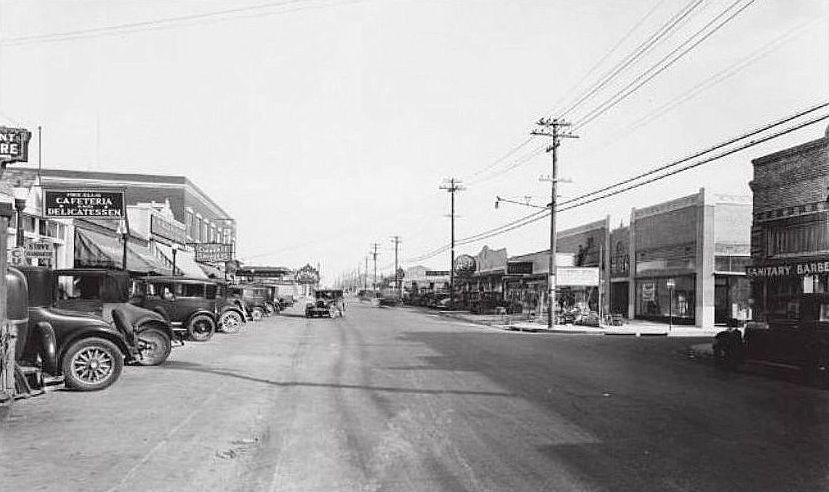
greenville-avenue_1930
Greenville Avenue, 1930 (Dallas Public Library)
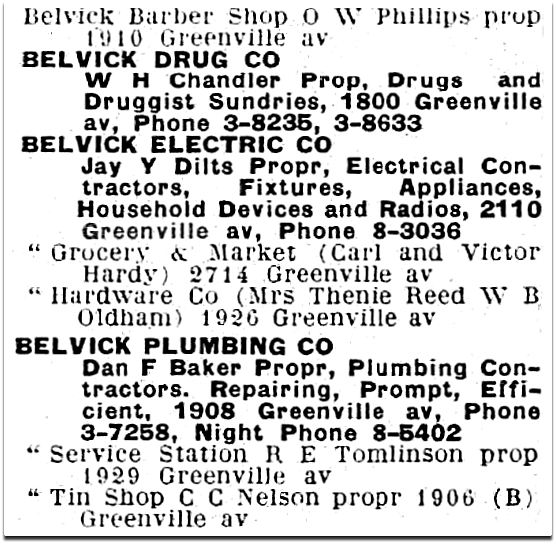
belvick_1927-directory
1927 Dallas directory

At least one business came up with a cutesy “Belvick” logo:

belvick-plumbing-logo_1908-greenville_1928-directory_ad-det
Belvick Plumbing logo, 1928

(One of these businesses, Belvick Electric Co., ended up on Garland Road, owned by the family of “King of the Hill” writer and producer Jim Dauterive, a name which should be familiar to all “King of the Hill” fans; I wrote about that tidbit of hyper-trivia at the end of this post.)

There was even a small theater at 1804½ Greenville Ave. for a year or two, pre-dating the Arcadia by five years. The Belmont Theatre opened in Sept. 1922, but when it changed ownership a few months later it became, you guessed it, the Belvick Theatre. I hope patrons didn’t get too attached, because it was out of  business by the time the 1924 directory was published. Here’s what that building looked like in 2012 (sadly, it no longer looks anything like this) — the theater was, I believe, in the right half of the building.
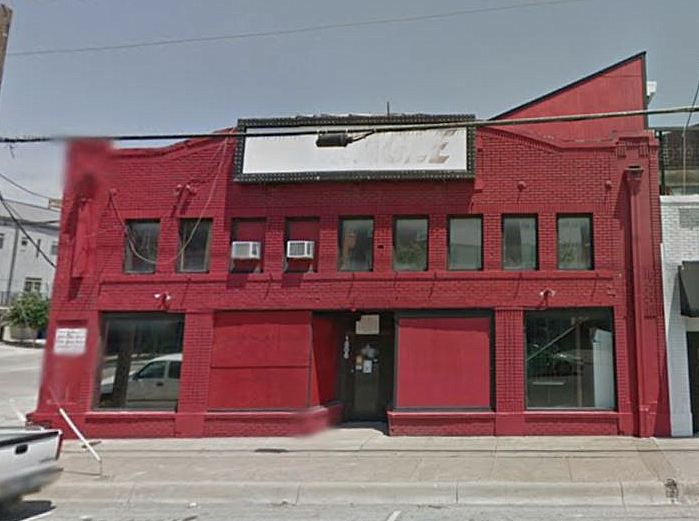
belvick-theater_google_2012
Google Street View, 2012

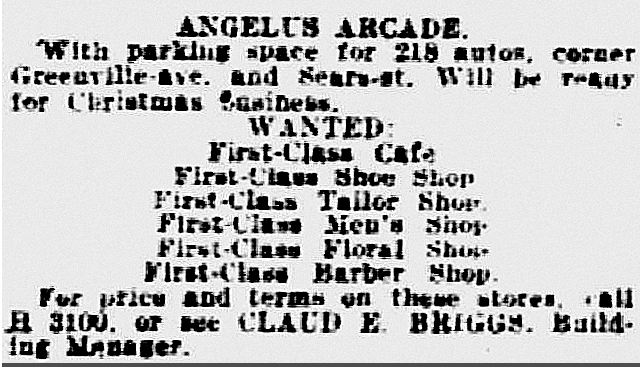
In 1923, a Greenville Avenue developer, Albert J. Klein, built a large building called the Angelus Arcade in the 2000 block of Greenville, at Sears Street. Here are a couple of woefully fuzzy classified ads for the under-construction “Greenville Market Place” and a list of the types of “first-class” businesses wanted to occupy the new arcade (click for larger-but-still-hard-to-read images).

angelus-arcade_070423
July, 1923

angelus-arcade_112823Nov., 1923

The arcade had several tenants and served as something of a public meeting place for the neighborhood — politicians frequently appeared in front of the large building to give speeches or talk to crowds in impromptu town-hall-like meetings. Like the use of “Belvick,” the name “Angelus” showed up in many of the less-than-imaginitively-named (first-class) businesses:
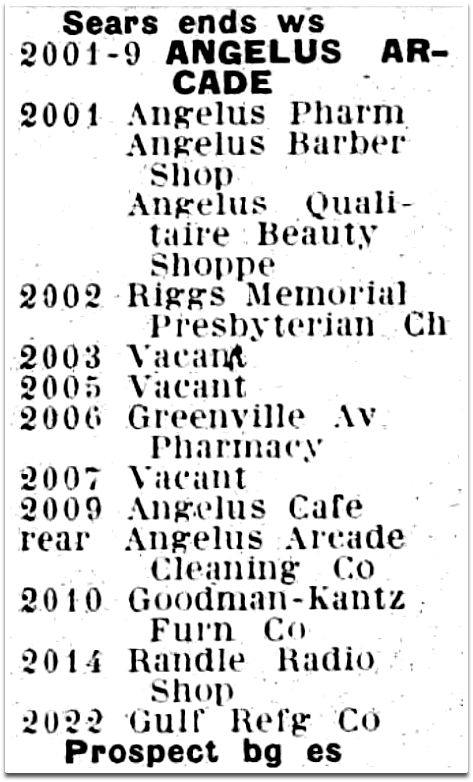
angelus-arcade_greenville-ave_1927-directory1927 Dallas directory

In 1927 Klein made a deal with the Dean Theatre company to build a new movie theater on the same premises as the Angelus — there would be additions and modifications made to the building, but it would still be home to several other businesses — there’d just be a movie theater inside. It would continue to be an “arcade.” Even though one newspaper article attempted to tie the name “Arcadia” to the new theater’s Italian garden motif which suggested a pastoral harmony with Nature, it seems more likely that people were already calling the building “the arcade,” and “Arcadia” was the next logical step.

The Arcadia Theatre opened on Nov. 4, 1927 with the Mary Astor movie “The Sunset Derby.” A newspaper report noted that “in spite of its remote location” the crowd-size was healthy. Patrons could even pop next door for a chicken dinner if so inclined.

arcadia-theater_exhibitors-herald-world_060928_front1928

One of the unusual things about the theater was the seating. The backs of the chairs were in a variety of colors (desert sand, cafe au lait, light blue, orchid, green, and “Chinese red”) which were placed in a randomly pattern throughout the auditorium. I think the operators probably thought this design-breakthrough was quirky and cutting edge, but it just looks a little odd. The Dallas Morning News described this feature as being reminiscent of a fun carnival; the Arcadia publicity person wrote that “the effect is as startling as it is pleasing.” …I’ll give you “startling.”
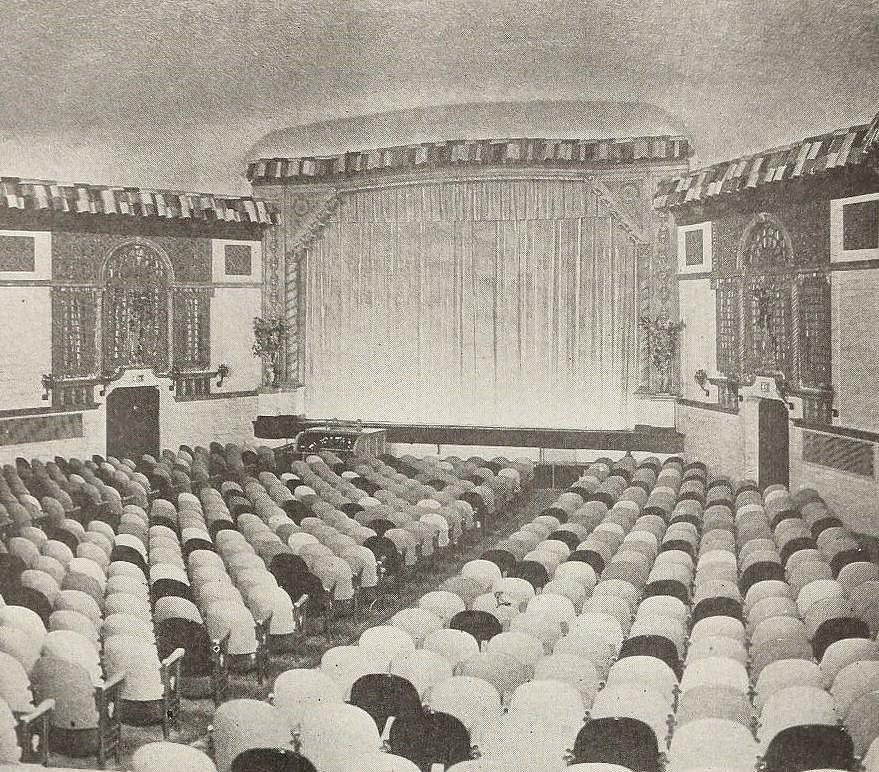
arcadia-theater_exhibitors-herald-world_060928_toward-screen1928

*

Below are a few more images of the Arcadia Theatre through the years.

First, just an odd little postcard from 1934 which found its way into SMU’s archive — a drawing of that cool tree!
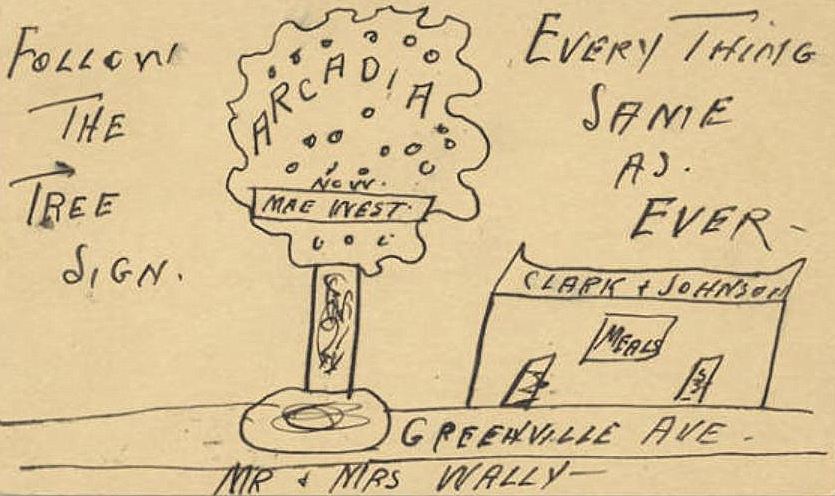
arcadia-sign_postcard_1934_cook-collection_degolyer-library_SMUvia George W. Cook Collection, DeGolyer Library, SMU

arcadia-marquee_1941_ad-det1941

The Deco years, and a painfully pruned tree, in the daytime, and at night:
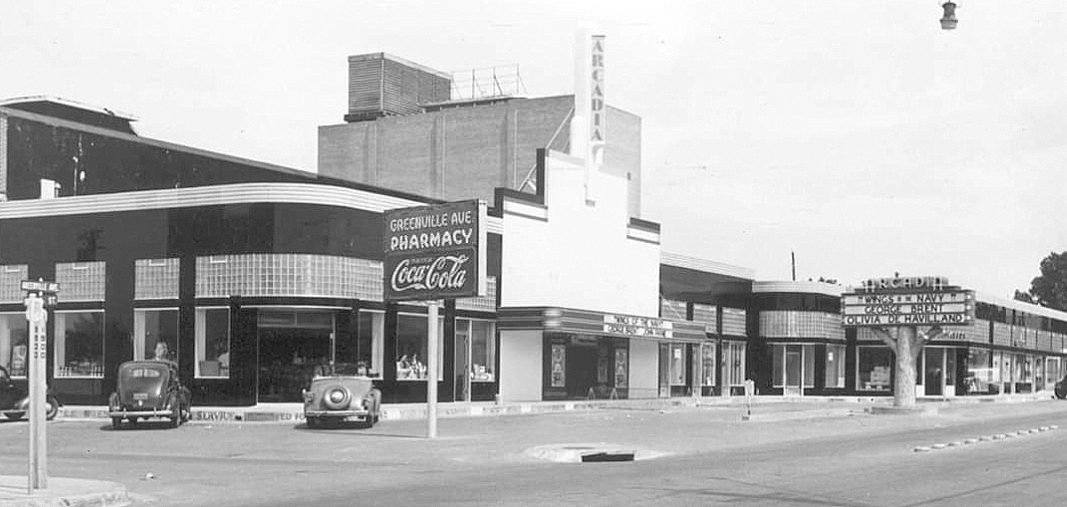
arcadia-theater_ca-1941_DHS1941, via Dallas Historical Society

arcadia-theater_mcafee_degolyer_SMUvia DeGolyer Library, SMU

arcadia-theater_mid

There were a few fires over the years — here’s one from November, 1958.
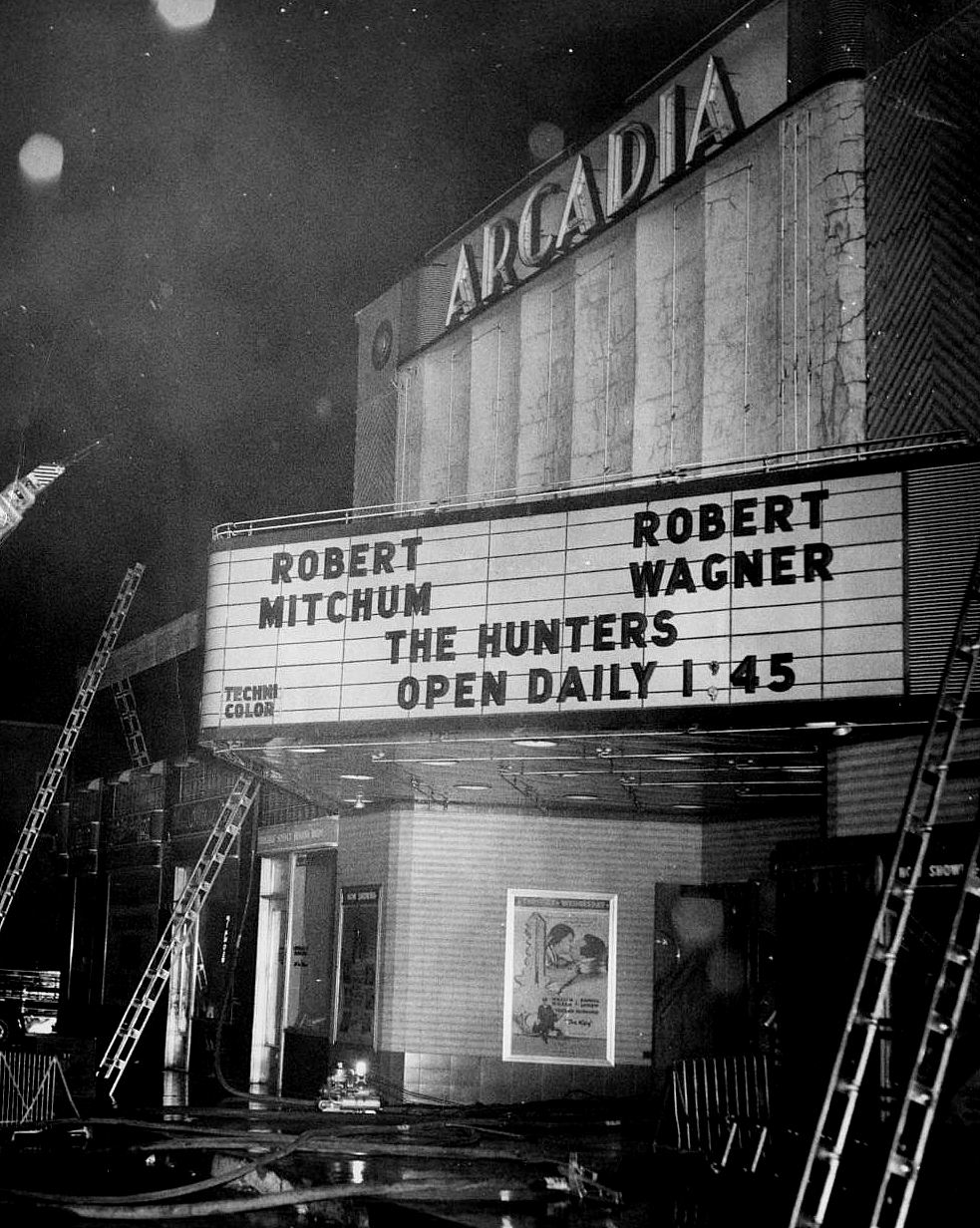
arcadia_fire_nov-1958_portalDallas Firefighters Museum, via the Portal to Texas History

Eventually its days as a second-run suburban theater dwindled, and it became a live-music venue for a while in the 1980s, as seen in this absolutely fabulous photo from 1985 (Joan Jett played the Arcadia on June 13, 1985) taken by Dan Allen, owner of super-cool clothing boutique Assassins.

arcadia-theatre_june-1985_daniel-m-allen-photo_FB©Daniel M. Allen 2014, via Facebook

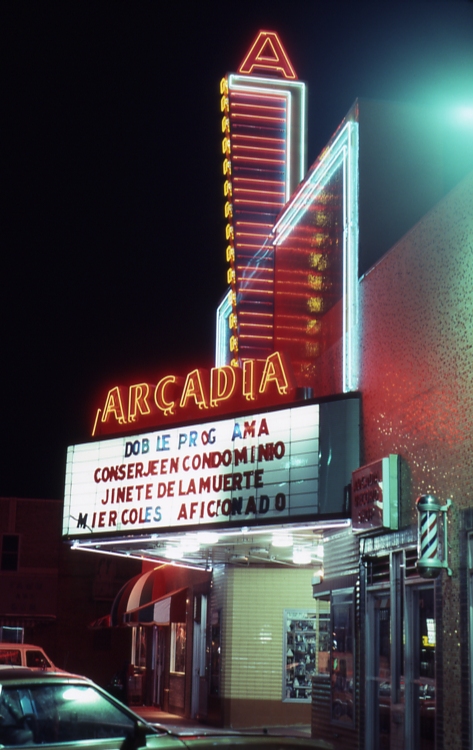
It also showed Spanish-language films for a few years.
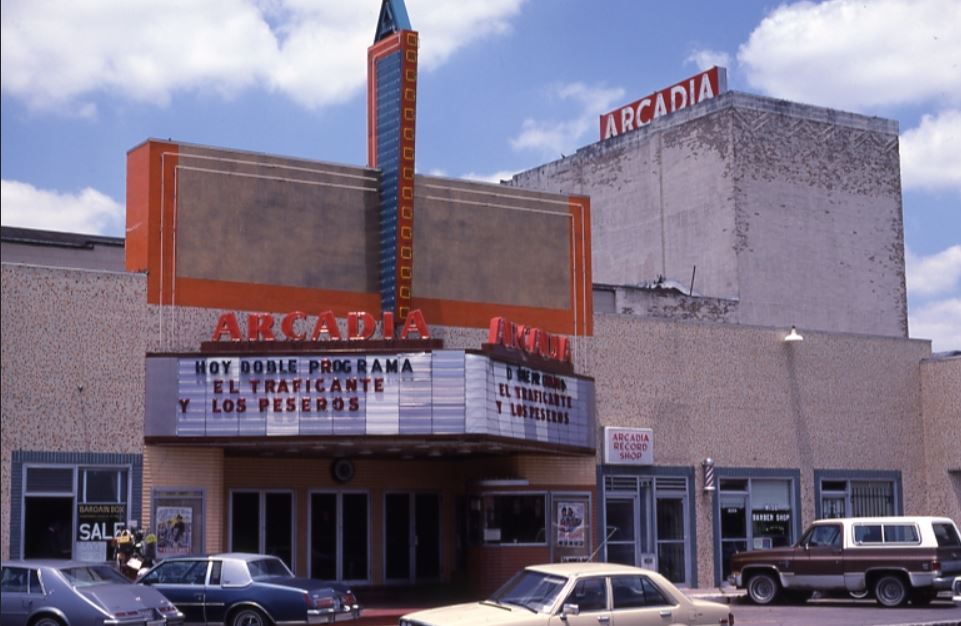
arcadia_spanish-language-theater_dayvia American Classic Images

arcadia_spanish-language-theater_nightvia American Classic Images

But, ultimately, a fire ended it all, on June 21, 2006: 120 firefighters responded to a six-alarm blaze caused by a fire that originated in a restaurant — all the businesses in the block were destroyed.

arcadia_on-fire_2006via Cinema Treasures

Bel-Vick hasn’t been the same since. RIP, Angelus/Arcadia.

***

Sources & Notes

Top photo from Exhibitors Herald World, June 7, 1930.

The 1930 view of Lowest Greenville, looking north from Alta, is from the Frank Rogers Collection, Dallas Public Library; titled “[Lower Greenville Avenue],” the call number is PA84-9/49.

The two photos from 1928 are from Exhibitors Herald World, June 9, 1928. To see the full 4-page article on the still-new Arcadia (with many photos of the interior) as well as a 2-page article from April 12, 1930 about how the Angelus Arcade building had been renovated to accommodate a theater — complete with floor plan — see a PDF here.

More on the Arcadia Theater — including additional photos of the ever-changing facade — can be found in these Flashback Dallas posts:

**

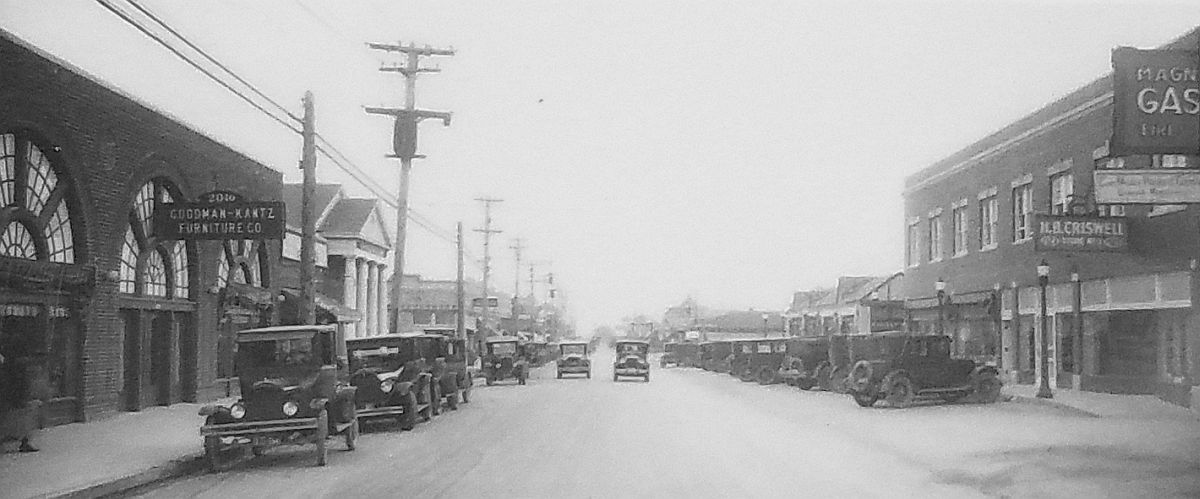
Here are a couple more photos of Greenville looking south from Sears, one from 1927 with buildings I’ve never seen, and one from 1930 with brand new buildings replacing those unfamiliar ones. Here’s the first, from 1927, which shows an unusual building with arches and a church (?!), Riggs Memorial Presbyterian Church, at the northeast corner of Greenville and Oram. (I used to have a little bookstore — Chelsea Books — at 1925 Greenville, in the space occupied by Criswell Furniture in this photo.)
greenville-ave_1920s_DPL
1927, Dallas Public Library, call number PA78-2/1047

chelsea-books_dallas_1925-greenville-avenue

And then, just three short years later… bye-bye, weird building and church. The buildings seen in the 1930 photo below are still standing (except for the gas station at the southwest corner at Sears). I love that this street has been immediately recognizable for decades, even though there has been some unfortunate architectural revision going on in ol’ Bel-Vick in recent years.

greenville-ave_south-from-sears_bud-biggs-collection_1930_DPL
1930, Dallas Public Library, call number PA84-9/48 

And here’s a detail from a 1931 Fairchild Aerial photo showing the Angelus/Arcadia at the center left (you can see the tree sign).

arcadia_fairchild-aerial_1931_detail_DPL
Dallas Public Library, call number
PA83-32/16 

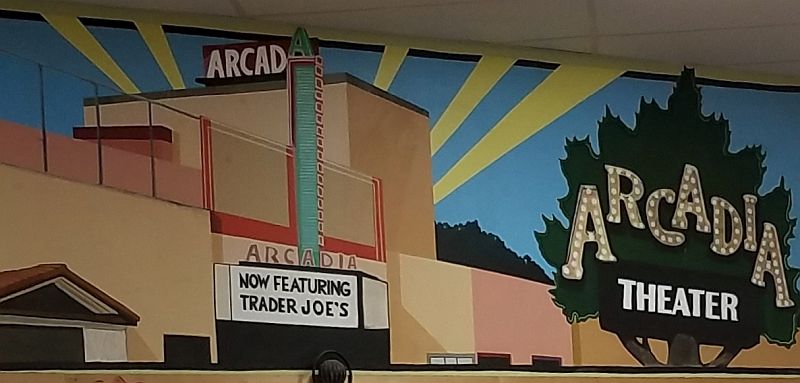
And, finally, the mural inside Trader Joe’s, located on the spot of Arcadia Theater.
trader-joes_arcadia_mural_dec-2020

*

arcadia-theater_exhibitors-herald-world_060730-sm

*

Copyright © 2020 Paula Bosse. All Rights Reserved.
Bright Lights, Big City — ca. 1948

elm-ervay-live-oak_weather-sign_ca-1948“Forget all your troubles, forget all your cares…”

by Paula Bosse

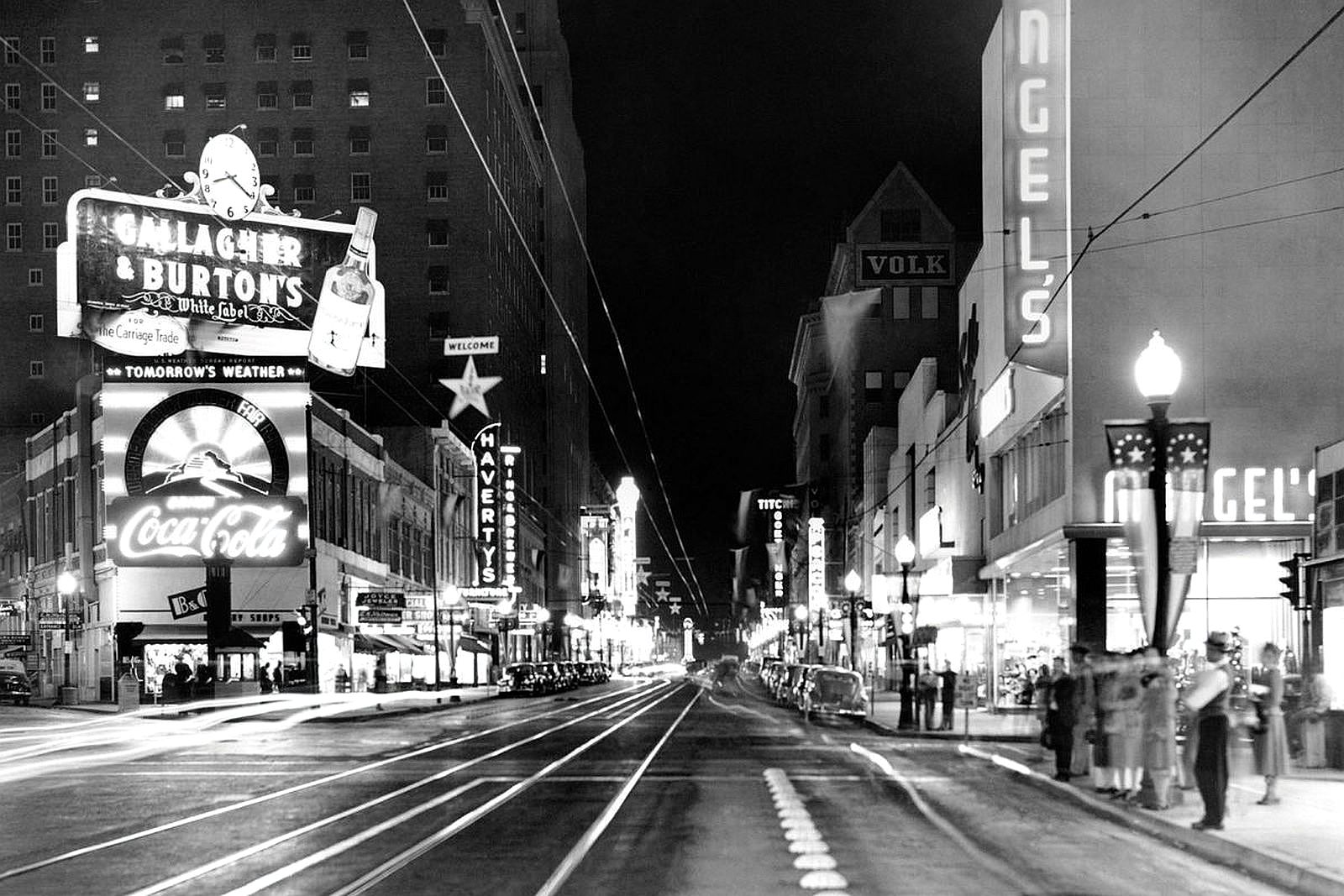
I think present-day downtown Dallas looks really great at night. But it pales in comparison to what downtown Dallas — especially Elm Street — used to look like at night. It was bursting with lights and signs and people. The scene above shows Elm Street looking east from Ervay around 1948. The Coca-Cola weather-forecast sign at the left is one of my favorite by-gone downtown landmarks (other photos of the sign can be seen here and here).

I wouldn’t really encourage anyone to click the link to see what this part of Elm Street looks like today, but if you must, it’s here.

Whenever I imagine times in Dallas history that I’d like to time-travel to, for some reason I always wish I could walk around downtown Dallas in the 1940s. It must have been quite something to have seen this pulsating view in person. 

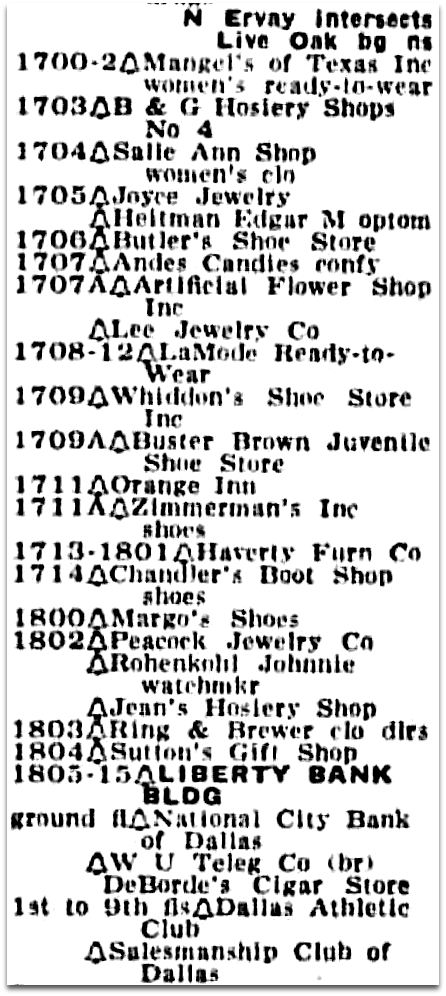
elm-street_from-ervay-live-oak_1948-directory
Elm Street, 1948 directory (click to see larger image)

***

Sources & Notes

I’m unsure of the source of this photo, but there is one almost identical to it in the collection of the Dallas Public Library, but the library’s copy is over-exposed and dated 1930 (it is titled “[Intersection of Elm, N. Ervay, and Live Oak streets]” and has the call number PA82-00324).

This photo was taken sometime between the end of 1947 and very early 1949. Mangel’s department store opened in its brand new building at 1700 Elm in September, 1947, and the Artificial Flower Shop (… “the artificial flower shop”?) lost its lease in early 1949. I can’t make out the lettering on the “Welcome” banners along the street, but there was a large hardware convention in Dallas in January, 1948.

elm-ervay-live-oak_weather-sign_ca-1948_sm

*

Copyright © 2020 Paula Bosse. All Rights Reserved.
 

The Legendary Christmas Cards of Ann Richards and Betty McKool

xmas_ann-richards_betty-mckool_1973_detFrom the personal collection of Mike McKool Jr., used with permission

by Paula Bosse

Ann Richards and Betty McKool were close friends in Dallas in the 1960s, sharing an offbeat sense of humor and a dedication to Democratic-party politics. They were founders of the North Dallas Democratic Women’s Club which was widely known for its revue of political humor and song parodies called “Political Paranoia” which Ann and Betty both performed in, wowing audiences with their larger-than-life charisma.

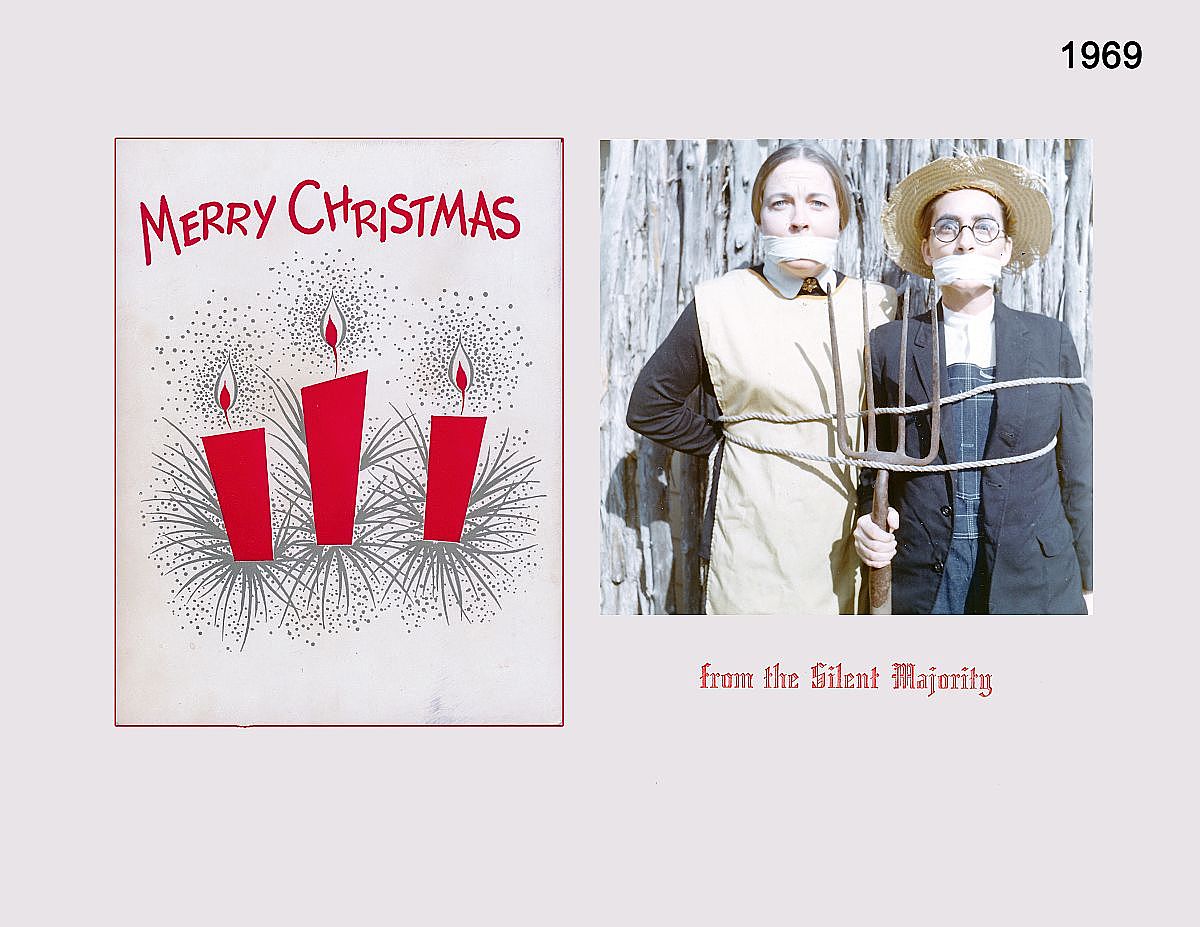
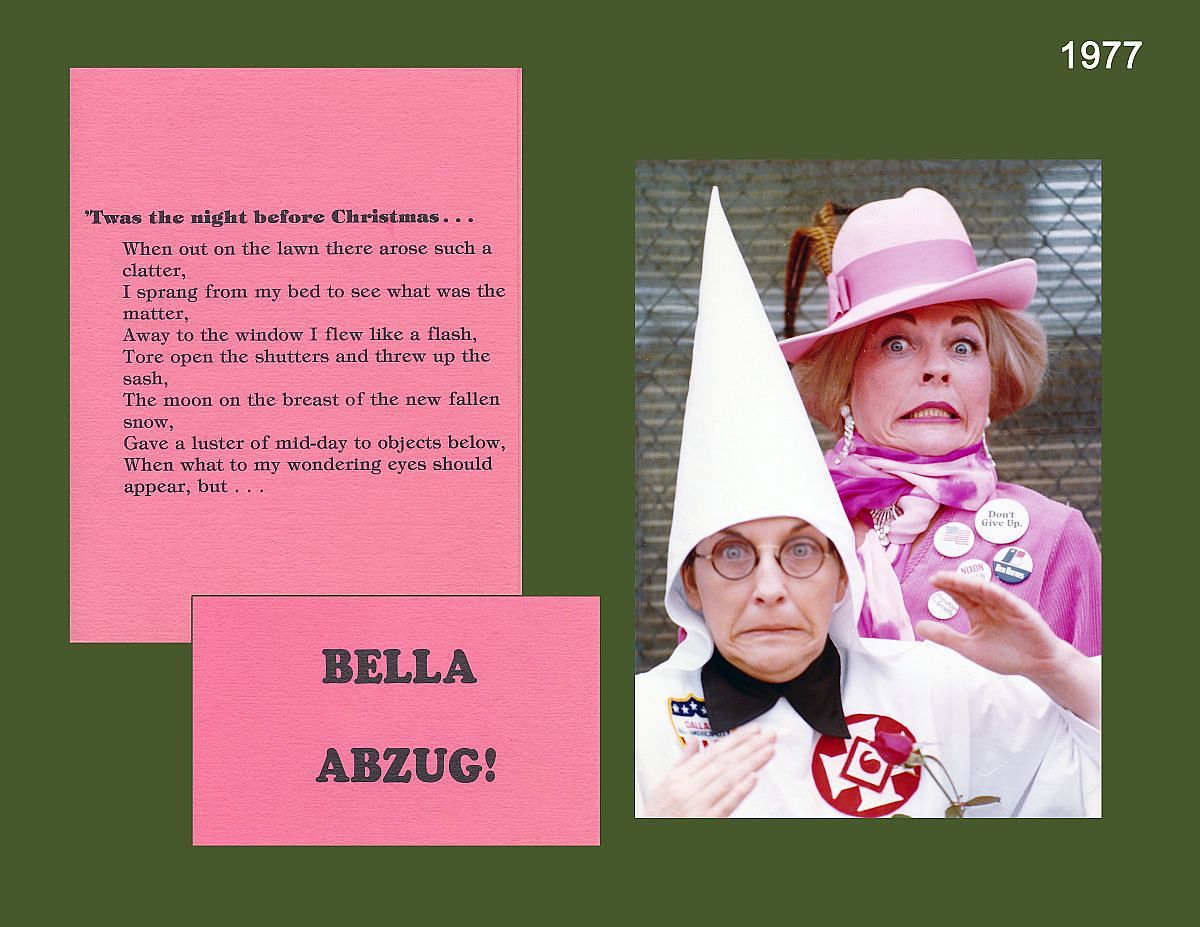
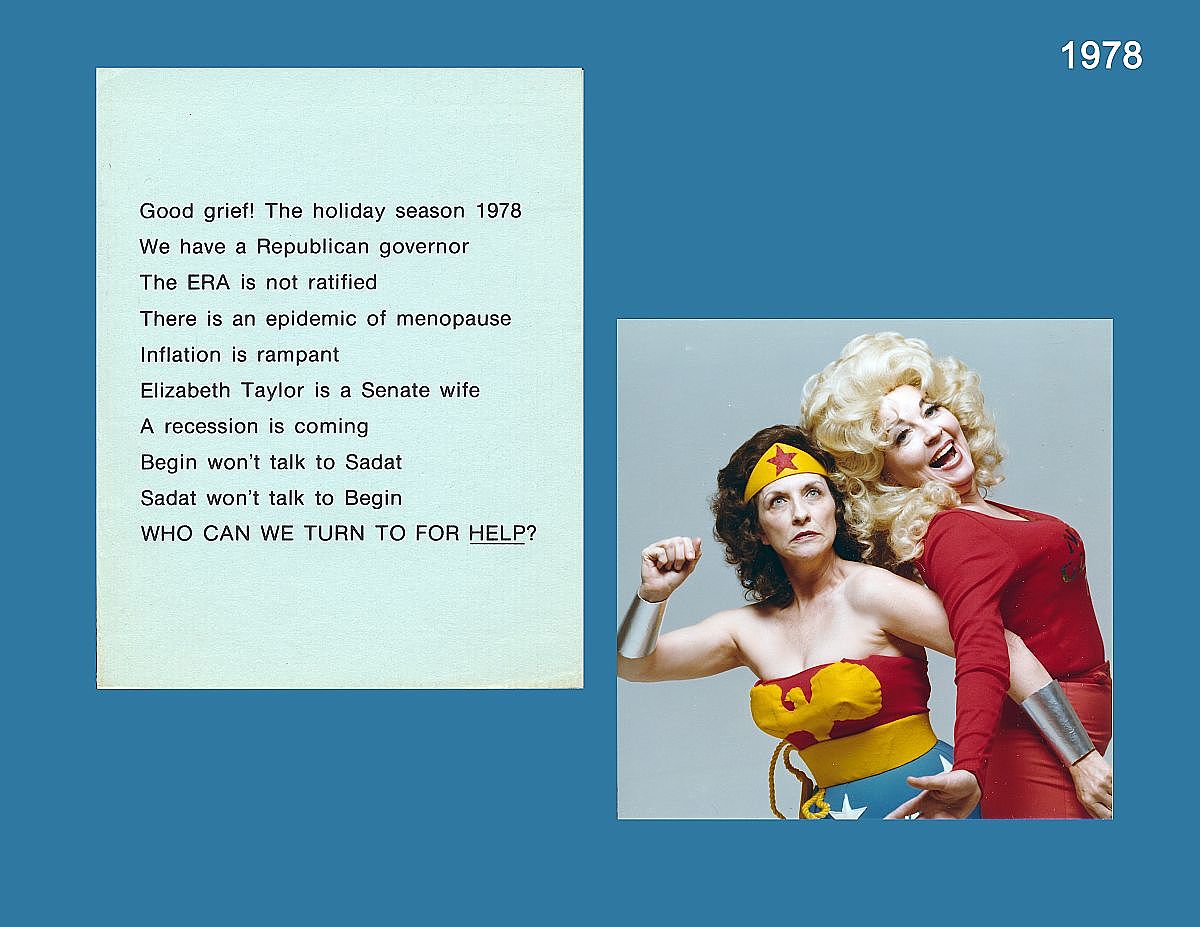
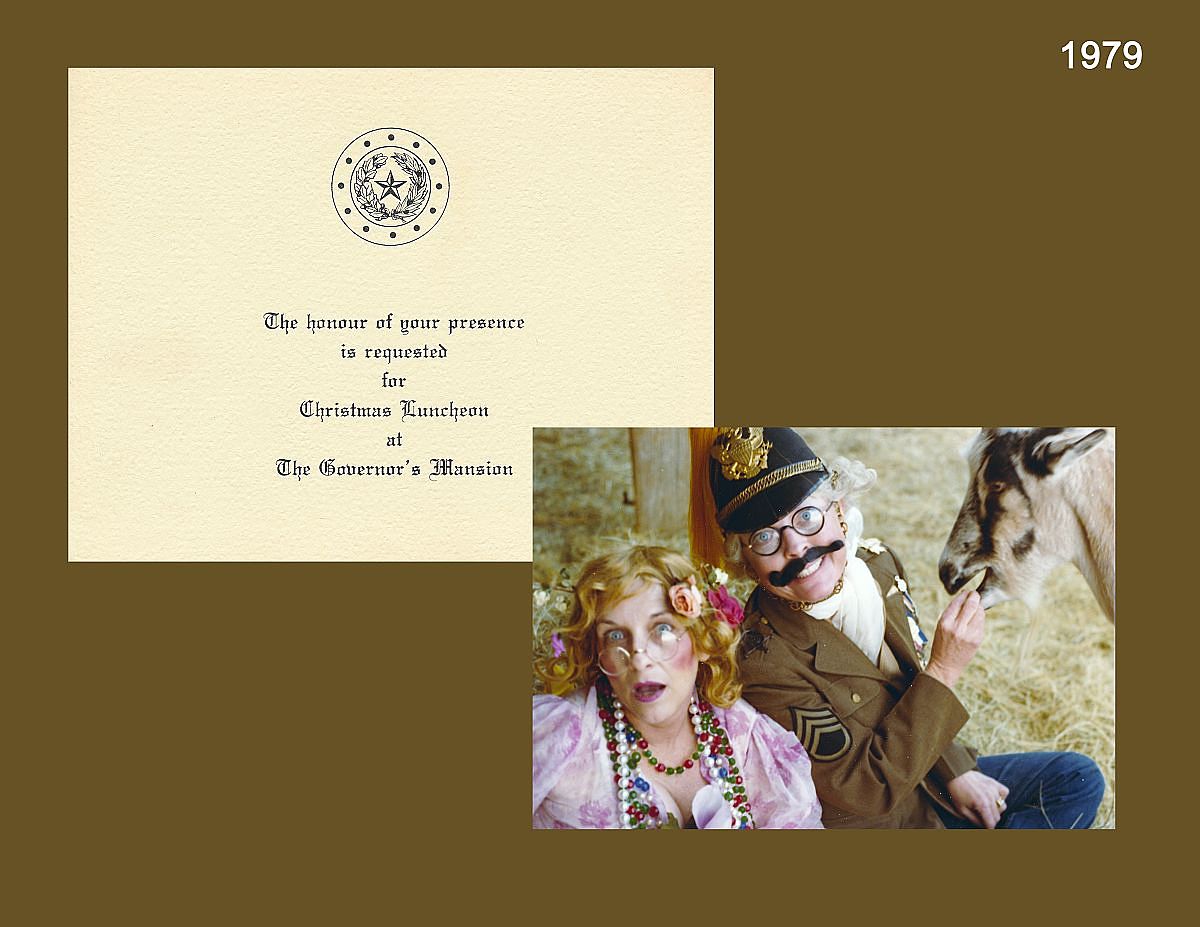
In the late ’60s, Ann and Betty — who loved dressing in ridiculous costumes and cracking each other up — began to issue satirical Christmas cards which featured photographs of themselves in outrageous situations accompanied by pithy captions and greetings, usually referencing a political hot-topic of the past year. The cards were sent out unsigned, and, as Ann Richards wrote in her autobiography Straight from Heart, not everyone knew who had sent them.

We mailed these to a lot of people, maybe a hundred, and we didn’t sign them. And we had such a good time thinking about people getting this weird card and trying to figure out who it could possibly be from, thinking maybe it was their wives’ relatives. Oh, we laughed about that. And we kept thinking of some guy opening it and drawling, “Mildred come here, look at this card we got in the mail.” No more than half our friends recognized us, maybe not that many.

Ann and Betty enjoyed doing the first card so much that they did it every year — it became something of an institution, and people on the Christmas card list waited expectantly each Christmas to get the latest crazy card. It was definitely a high point of the holiday season and the most anticipated Christmas card of the year. I certainly remember hearing about them throughout my childhood, as my parents were lucky enough to be on The List.

**

In her autobiography, Ann wrote that “our Christmas photo album lasted nine years” which is incorrect. After I wrote the post “‘Political Paranoia’ and the North Dallas Democratic Women’s Club, feat. Future Governor Ann Richards,” (which contains the newly unearthed film of “Political Paranoia II” from 1964 in which both Ann and Betty have standout performances), I received an email from Vicki Byers who is the Executive Assistant to Mike McKool Jr. (Betty’s son). That email contained scans of 12 of the Christmas cards from Mr. McKool’s personal collection! Wow! And he has allowed me to share these cards which have attained something of an almost mythic status — followers and fans of Gov. Richards have read about them, but not a lot of them have actually ever seen them. So thank you, Vicki, and thank you, Mike, for allowing access to this little treasure trove!

**

I’m not sure on the exact chronology of these cards. In her book, Ann writes about the “Temperance” card as being the first one that she and Betty did, but Mr. McKool has that card as being from 1976. It’s parodying a 1964 quote from Barry Goldwater, so it seems more likely to have been issued in the ’60s than in the ’70s — possibly in 1968. The cards were issued as late as 1983, and at some point the cards became posters. Ann moved from Dallas to Austin in 1969 or 1970, so she and Betty would have had to meet up during the year to plan and pose for their annual Christmas card, and from all accounts, the two women truly enjoyed creating the irreverent cards as much as people enjoyed receiving them. Here they are (all images are larger when clicked).

*

1969: “Merry Christmas… From the Silent Majority”

xmas_ann-richards_betty-mckool_1969

*

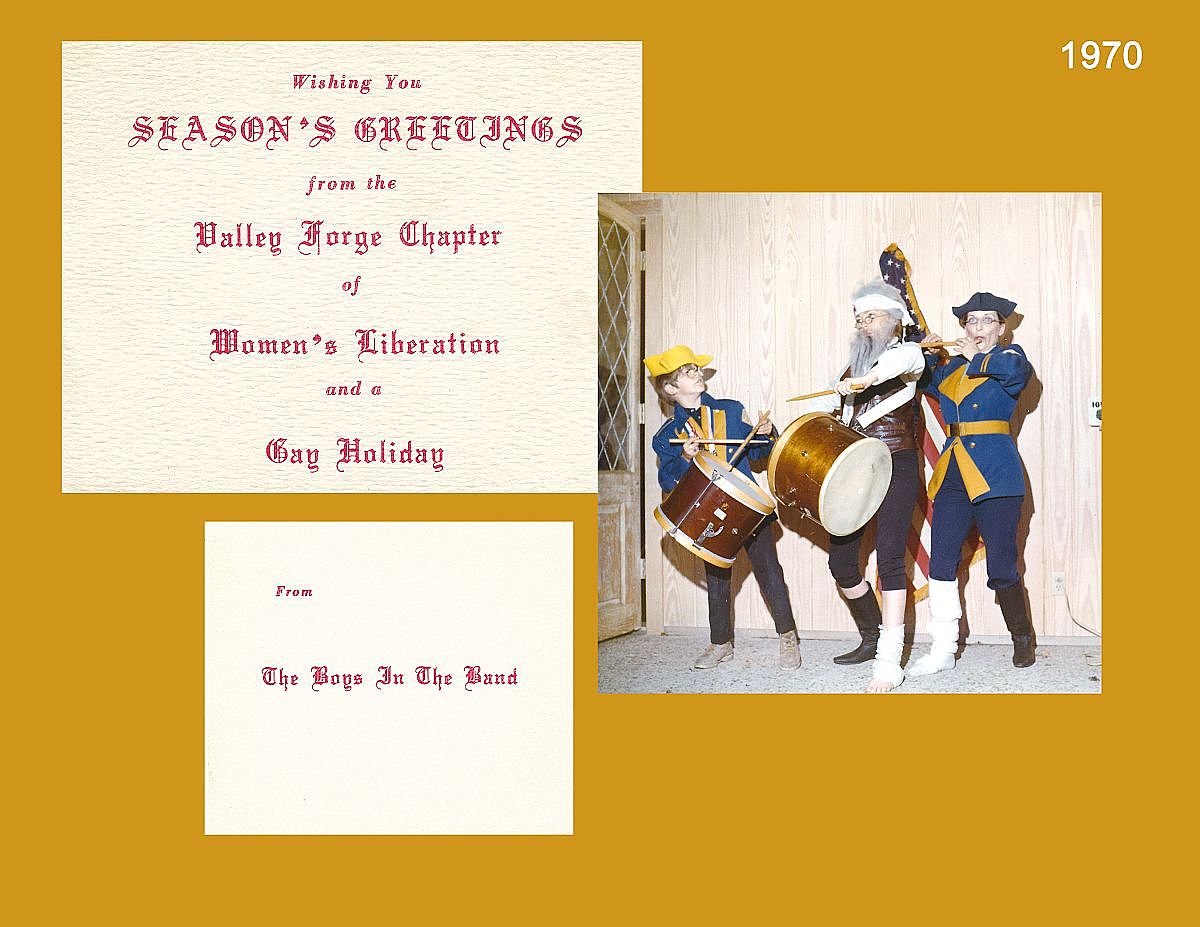
1970: “Wishing You Season’s Greetings from the Valley Forge Chapter of Women’s Liberation and a Gay Holiday… From the Boys in the Band”

xmas_ann-richards_betty-mckool_1970

*

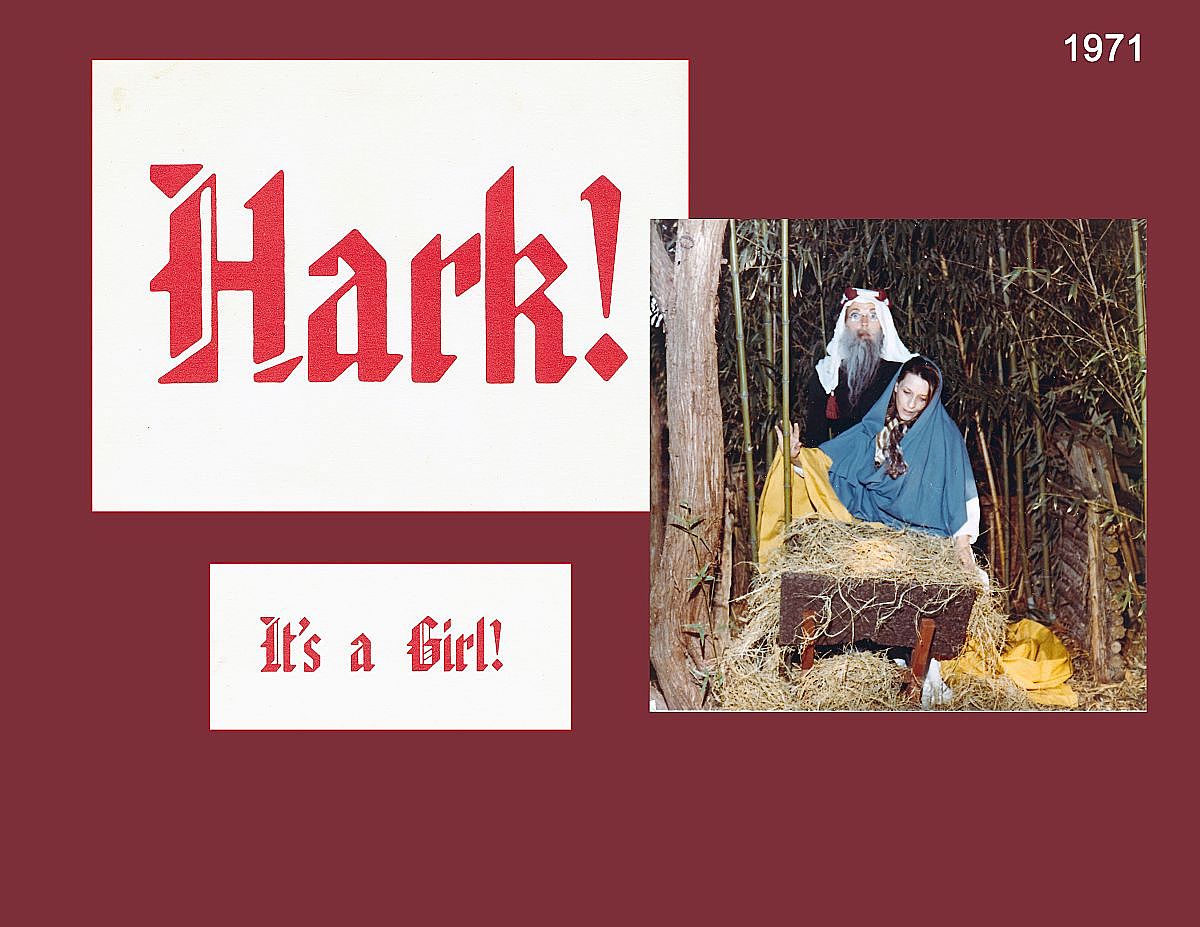
1971: “Hark!… It’s a Girl!”

xmas_ann-richards_betty-mckool_1971

*

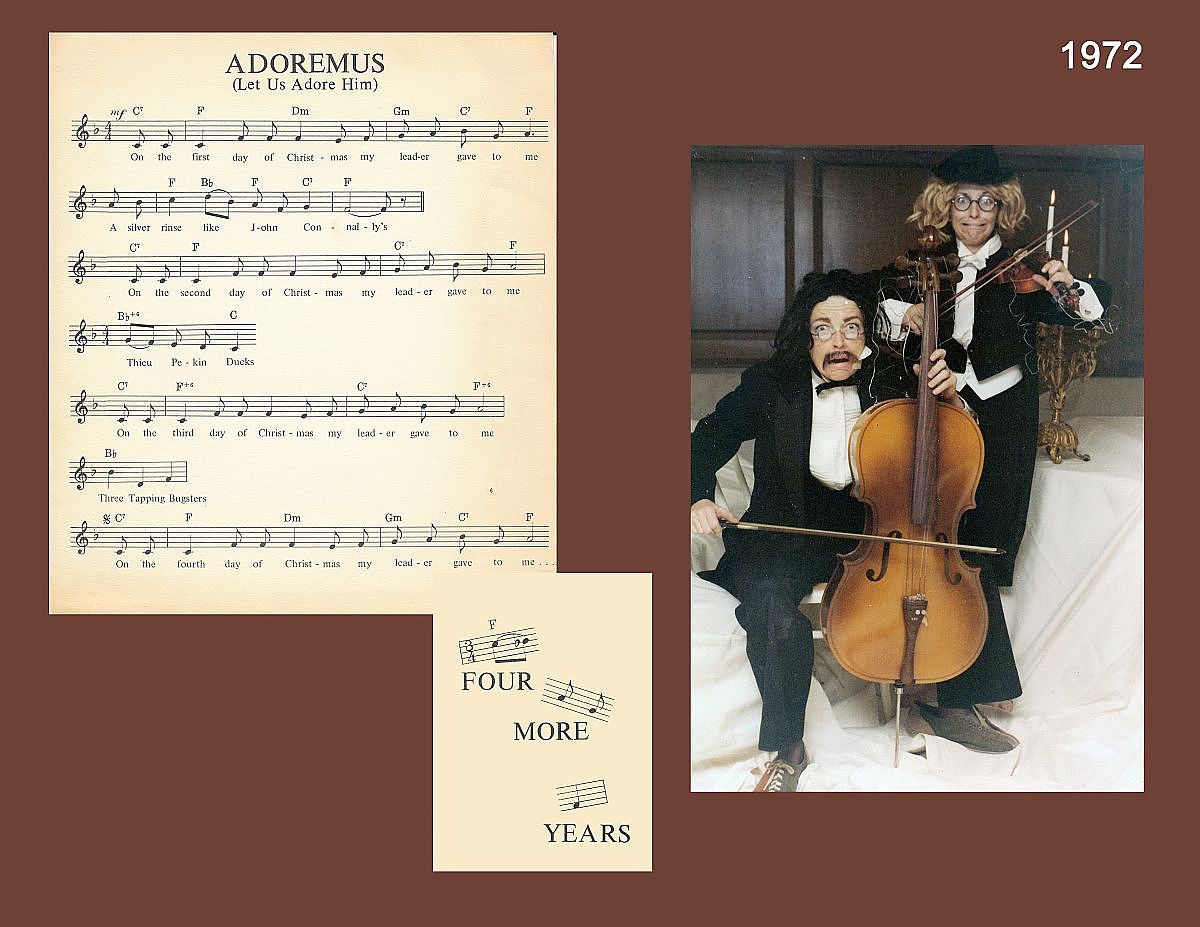
1972: “Adoremus (Let Us Adore Him)… Four More Years”

xmas_ann-richards_betty-mckool_1972

*

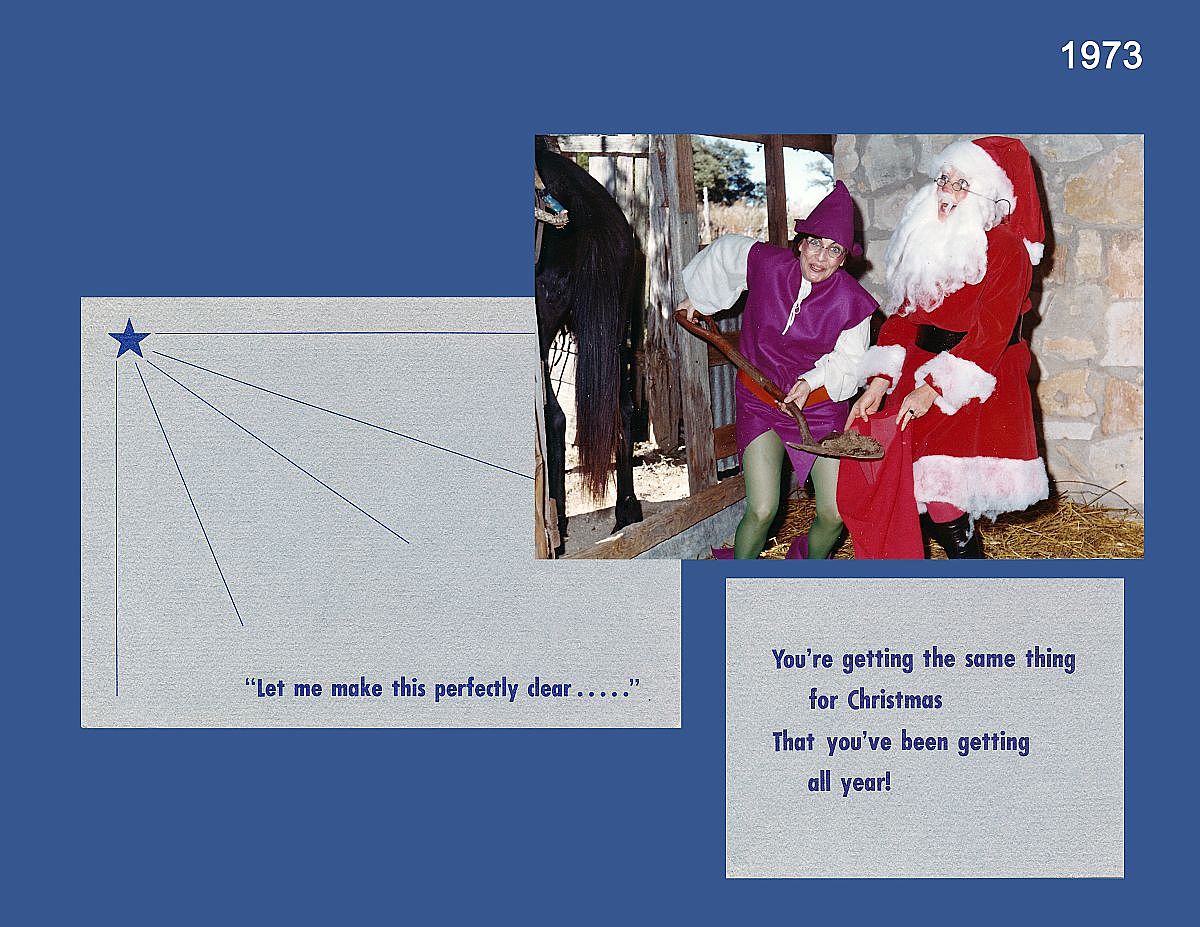
1973: “Let Me Make This Perfectly Clear… — You’re getting the same thing for Christmas that you’ve been getting all year!”

xmas_ann-richards_betty-mckool_1973

*

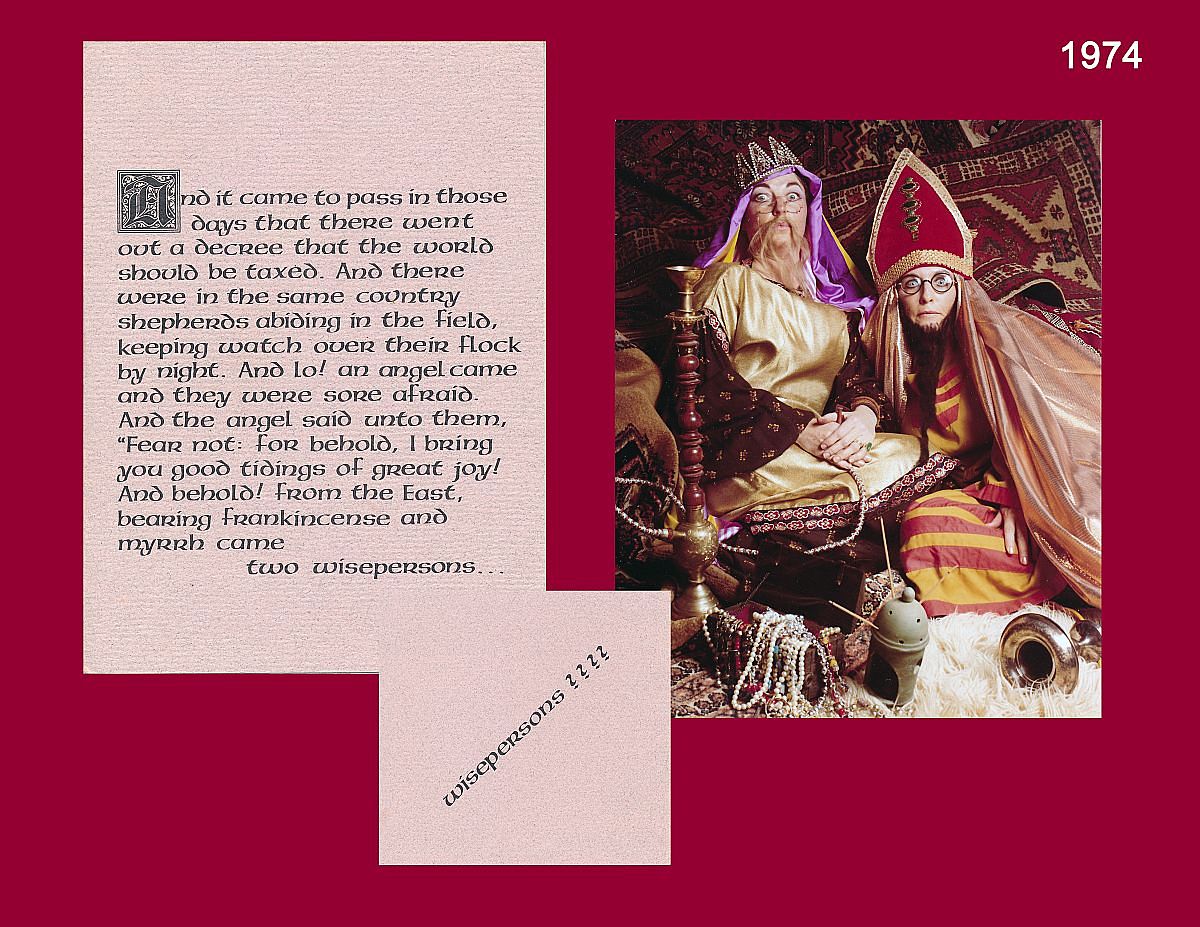
1974: “And it came to pass… — Wisepersons????”

xmas_ann-richards_betty-mckool_1974

*

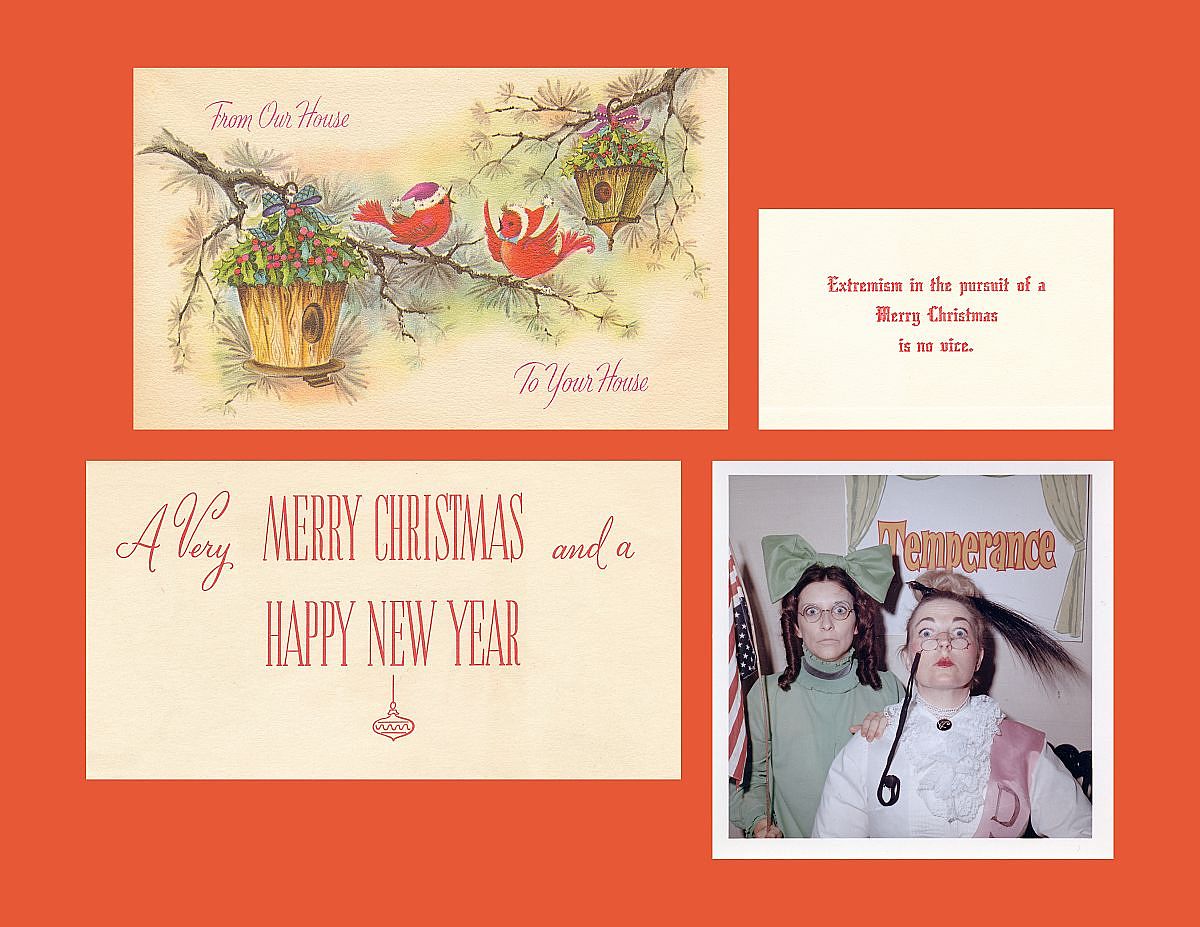
1976 [?]: “From Our House To Your House — A Very Merry Christmas and a Happy New Year… Extremism in the pursuit of a Merry Christmas is no sin.” (In her autobiography, Ann describes this “Temperance” card as being the first one she and Betty made — it’s possible this might be from 1968.)

xmas_ann-richards_betty-mckool_1976

*

1977: ‘Twas the night before Christmas…When what to my wondering eyes should appear but… Bella Abzug!”

xmas_ann-richards_betty-mckool_1977

*

1978: “Good grief! …WHO CAN WE TURN TO FOR HELP?”

xmas_ann-richards_betty-mckool_1978

*

1979: “The honour of your presence is requested for Christmas Luncheon at The Governor’s Mansion”

xmas_ann-richards_betty-mckool_1979

*

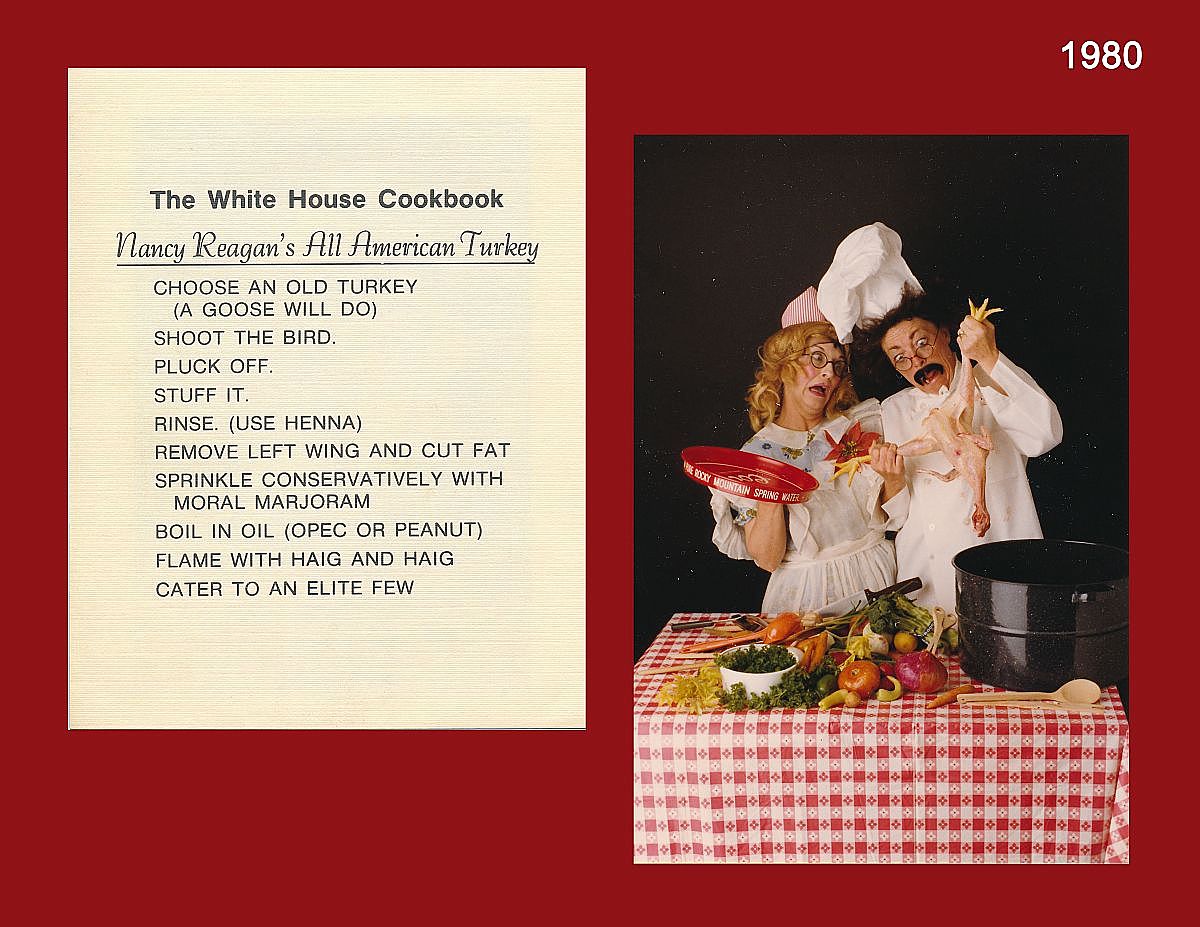
1980: “The White House Cookbook — Nancy Reagan’s All American Turkey”

xmas_ann-richards_betty-mckool_1980

*

1981 [No image available, but in a mention in the Austin American-Statesman, Ann and Betty are described as being “dressed as old hoboes, looking aghast” in a “poster-sized card,” commenting on the theory of trickle-down economics]: “Behold, I Bring You Tidings of Great Joy… In other words, the rich get richer and we get trickled down on!”

*

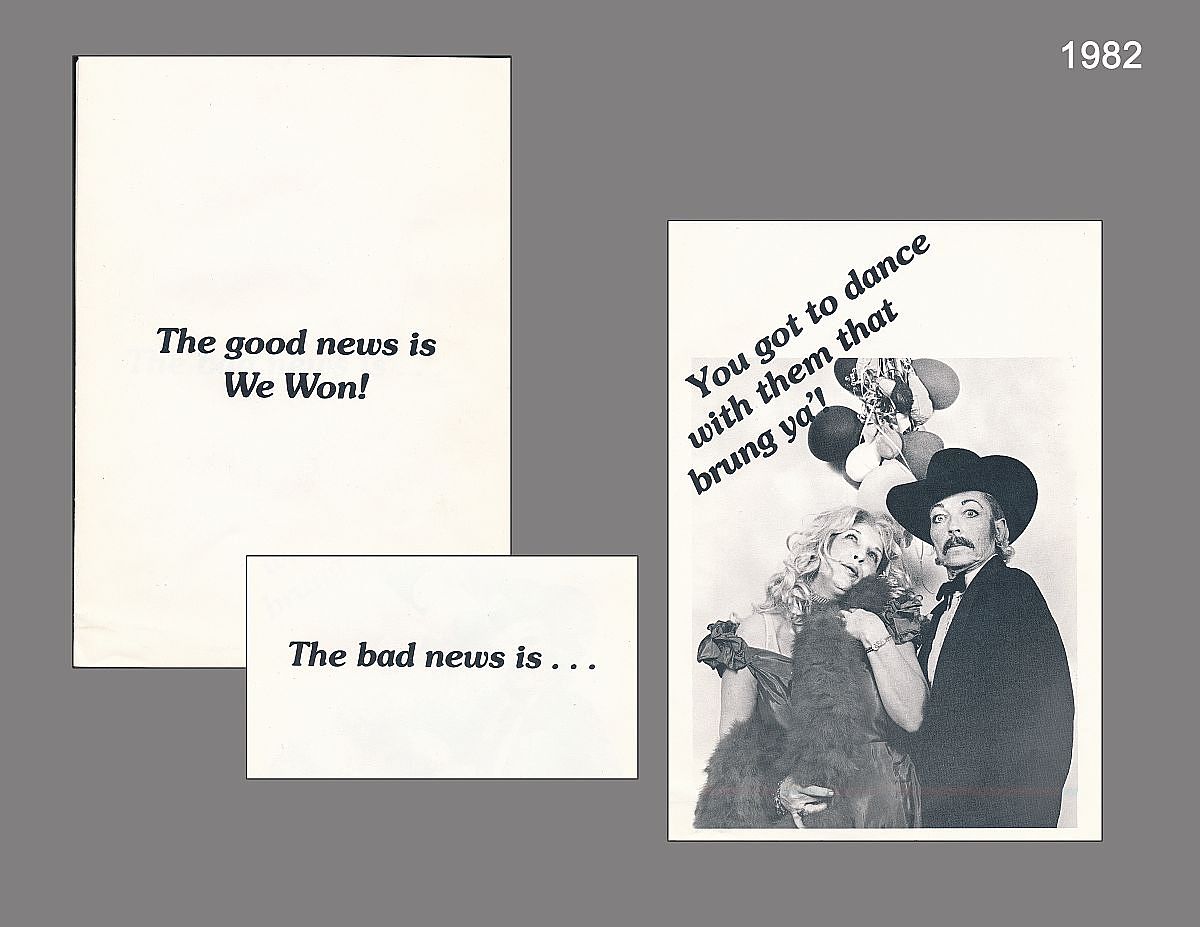
1982: “The good new is We Won! — The bad news is… You got to dance with them that brung ya!”

xmas_ann-richards_betty-mckool_1982

*

1983: “Dear Ronnie: I would have put the gender gap in your stocking but it was too big. Love, Mrs. Claus” (issued as a poster; from the collection of Frances Murrah, Betty’s sister)

xmas_ann-richards_betty-mckool_1983_nutcrackers_frances-murrah-collection_poster

*

There was also a card about which Ann wrote this: “Another year we donned cowboy hats and glittering western wear, and sent ‘Greetings from the Rhinestone Cow Chips.'” The Glen Campbell song “Rhinestone Cowboy” came out in 1975. The photo below appeared in Jan Reid’s book Let the People In: The Life and Times of Ann Richards, and I suspect it might have been sent out as the 1975 card.

xmas_ann-richards_betty-mckool_nd_ca-1975

*

And one other card was described by Ann in her book: “One of my favorites was when we hung a bunch of stuffed deer heads, like you see on the wall of a lodge, and cut holes where we could stick our heads through and put on these antlers. And the message was, ‘If you think I’m gonna pull that damned old sleigh one more year….'” (Could this perhaps have been issued in 1976?)

*

So that’s at least 16 Christmas cards (a few were posters) sent out by Ann Richards and Betty McKool. And people are still talking about them! (I would love to be able to add other Ann-and-Betty cards to this post — if you have scans of any of the missing cards/posters, or any additional information, please let me know!)

**

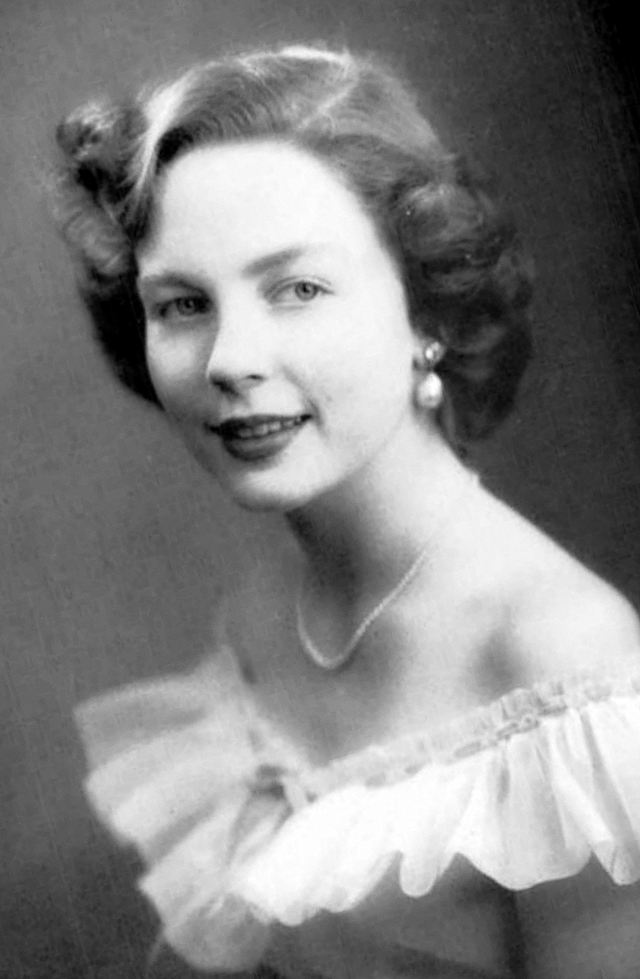
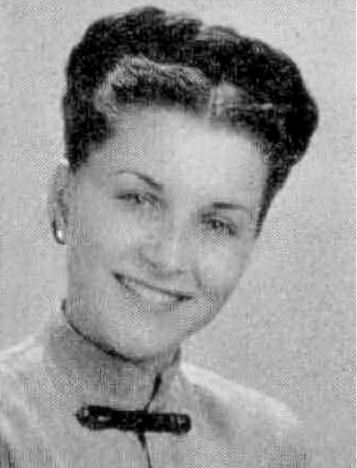
Dorothy Ann Willis Richards was born in McLennan County in 1933 and grew up in Waco. Here is a lovely photo of her from 1950, from the “Favorites” section of the Waco High School yearbook. She was in the class play and was a debate champion. She lived in Dallas for several years where she was very active in Democratic politics as an activist and volunteer; after moving to Austin she entered politics as an elected official and ultimately became Governor of Texas in 1991. She died in 2006.

richards-ann_waco-high-school_1950_favoritesAnn, Waco High School, 1950

political-paranoia-2_1964_jones-collection_SMU_lbj_ann-richards-3
Ann as LBJ, “Political Paranoia,” Dallas, 1964

Elizabeth Ann “Betty” Raney McKool was born in Dallas in 1929. She attended Crozier Tech High School (below is a class photo from the 1946 yearbook) where she was a cheerleader. She married Mike McKool when she was only 16, and the two were extremely well known in political circles. Mike McKool, an attorney, served as a State Senator in Austin and was a Democratic Party leader in Dallas. Betty died in 2018 (read her obituary here). There is a fantastic interview with her from a 1971 “Legislative Wives” series in the Austin American-Statesman here.

mckool-betty-raney_crozier-tech_1946Betty, Crozier Tech, 1946

political-paranoia-2_1964_jones-collection_SMU_rockefeller-2
Betty as Nelson Rockefeller, “Political Paranoia,” Dallas, 1964

*

On behalf of Ann Richards and Betty McKool, I wish you all a (bemused and slightly aghast) very Merry Christmas!

***

Sources & Notes

Thanks to Mike McKool Jr. and Vicki Byers for sending me the color images; these Christmas cards are from Mr. McKool’s personal collection, and I am grateful for his permission to share them here.

Also, many thanks to the family of Betty’s sister Frances Murrah, who allowed me to share the “Nutcracker” poster from 1983; Frances worked with Senator Lloyd Bentsen in Washington, DC for several years.

Quoted passages are from Chapter 7 of the book Straight from the Heart, My Life in Politics & Other Places by Ann Richards (Simon & Schuster, 1989). You can read these pages on Google Books here.

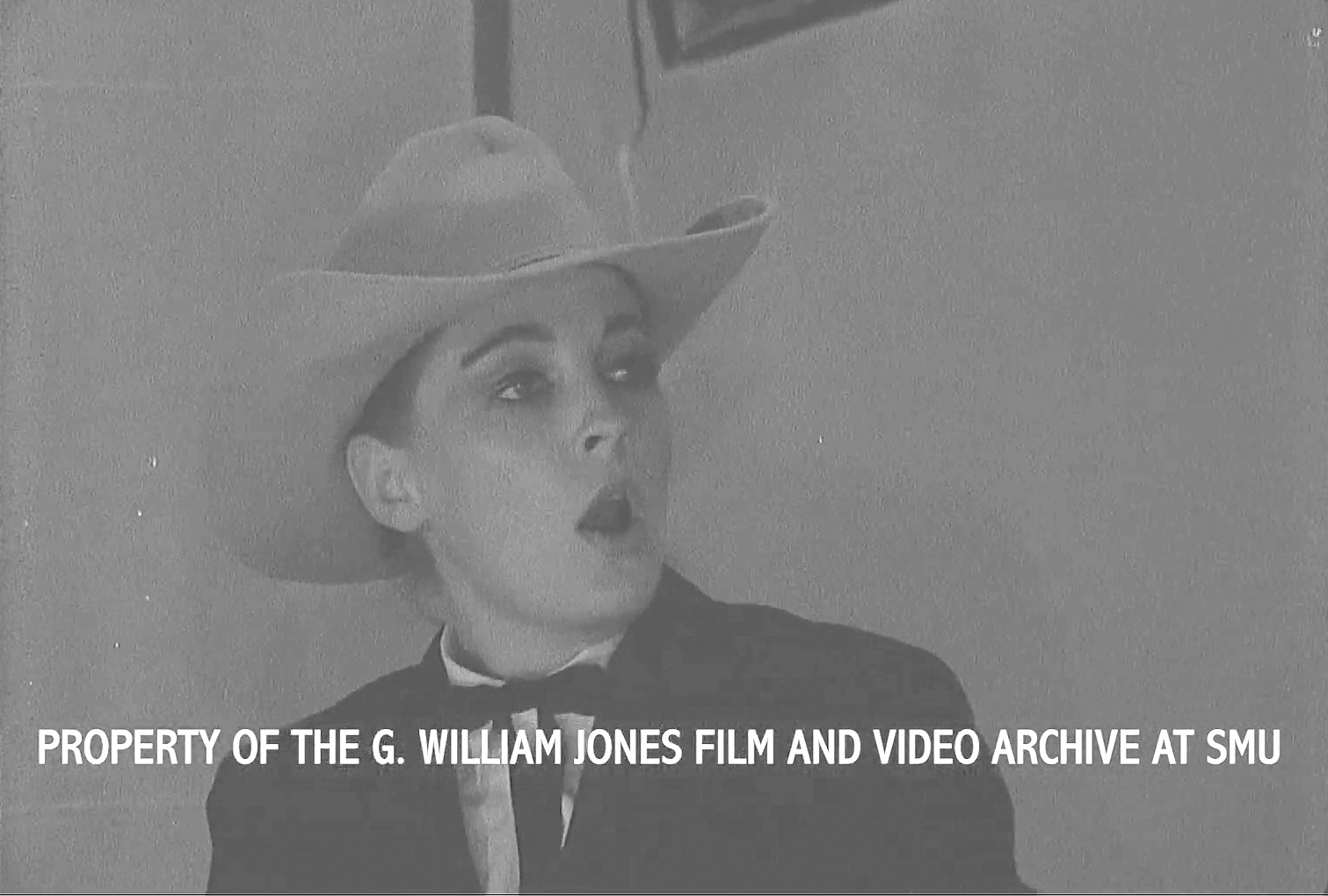
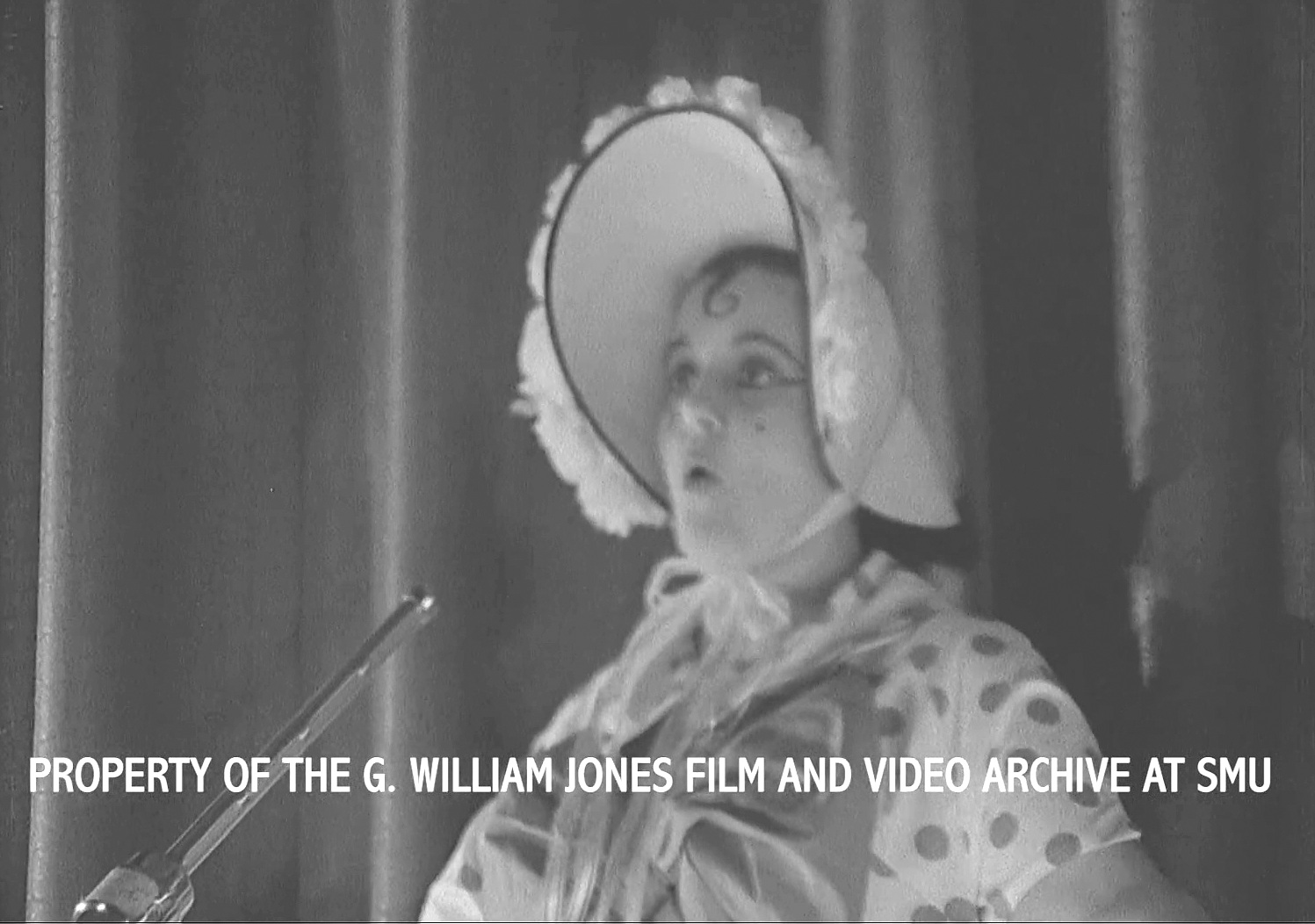
Screenshots are from the 1964 film “Political Paranoia II” from the G. William Jones Film and Video Archive, Hamon Library, Southern Methodist University; this film may be viewed on YouTube in its entirety here.

xmas_ann-richards_betty-mckool_1973_det_sm

*

Copyright © 2019 Paula Bosse. All Rights Reserved.
 

“Political Paranoia” and the North Dallas Democratic Women’s Club, feat. Future Governor Ann Richards

political-paranoia-2_1964_jones-collection_SMU_cast

by Paula Bosse

Ann Richards drove my carpool. She and my mother swapped out driving kids to the First Unitarian Church Cooperative Preschool on Preston and Normandy in University Park. I’m not sure anyone in either family was an actual member of the church, but that preschool was one of the only co-ops in Dallas (it might have been the first), and it was a magnet for the more progressive parents in the city. The Unitarian Church was also a major gathering place in the 1960s and 1970s for those involved in women’s issues, liberal activism, and Democratic politics, including my mother and the future governor of Texas, Ann Richards. I remember hearing about Ann (she was always referred to as just “Ann”) throughout my entire childhood. My parents weren’t close friends with the slightly older Richardses, but my mother was a keen admirer of Ann and my father described her as “the funniest woman I’ve ever known.” I remember their home on Lovers Lane which always seemed to be crammed full of kids.

When Ann Richards lived in Dallas she was a self-described “housewife,” who, when she wasn’t busy raising her four children, was volunteering for Democratic candidates and causes. She was an active member of the North Dallas Democratic Women’s Club, a group which, in 1963, gained instant attention for the fundraiser show they wrote and performed called “Political Paranoia,” a satirical revue of politics, complete with sharp satire, broad comedy, song parodies, and ridiculous wigs and costumes. The show was such a huge success that follow-up standing-room-only shows were performed in 1964, 1965, 1966, and 1968. The shows were written and directed by Carolyn Choate, Ruthe Winegarten, and Ann Richards, and the cast consisted of the members of the NDDW. Ann’s portrayal of LBJ seems to have made lasting impressions on those who saw it.

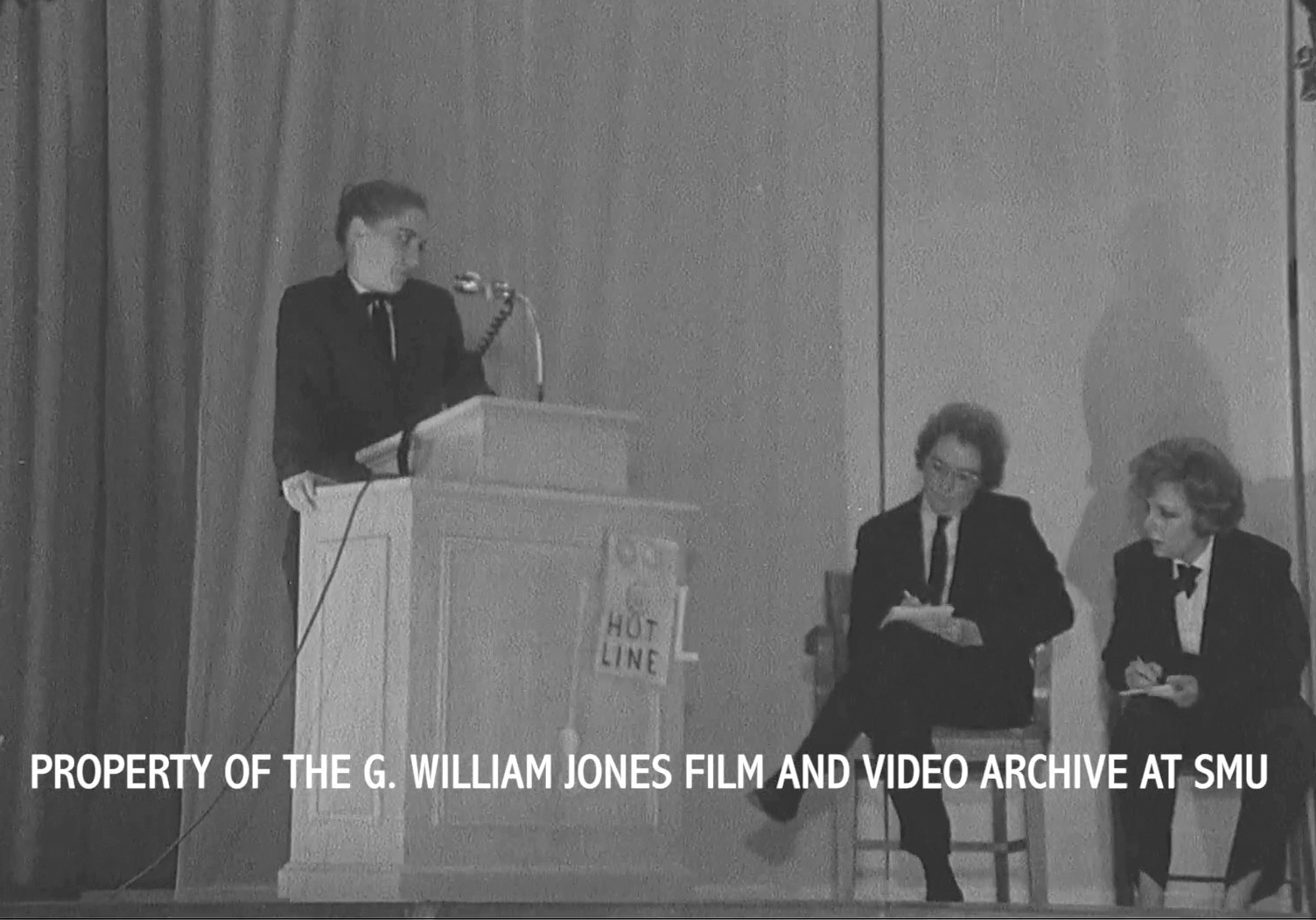
I have recently begun working on a project for the G. William Jones Film and Video Archive at SMU, and a reel of 16mm black-and-white film — with sound! — was discovered in the vault recently with no identifying information. Nothing. Nobody knows where it came from or how it ended up at SMU. But there it was: a lightly edited filmed document of the second installment of “Political Paranoia,” presented by the North Dallas Democratic Women in the auditorium of Hillcrest High School on May 16, 1964. I was sure Ann Richards would be in there somewhere — and she was! I was pretty excited by this “discovery” because this show has become something of a legendary touchstone in local Democratic politics. As far as I know, there is no other film footage of any of these shows. Not only that, this may well be the earliest footage of Ann Richards, the woman who would go on to become the governor of Texas (1991-1995) and one of the most celebrated women in politics and Texas culture. This is an amazing heretofore unknown historical document.

The show is full of smart sarcasm and “hey-kids-let’s-put-on-a-show” enthusiasm. The humor is more amusing than cutting, and these Democratic women were certainly not afraid of making fun of members of their own party. A lot of the hot topics of the day addressed in this show are lost to the mists of time, but that doesn’t take away from its entertainment value. This was a time when women had very little voice, impact, or power in politics, and the women here have firmly taken control of the reins and perform with an exuberance that crackles. 

The 34-minute film — complete with odd jumps and abrupt cuts — has been uploaded by SMU in its entirety here:

*

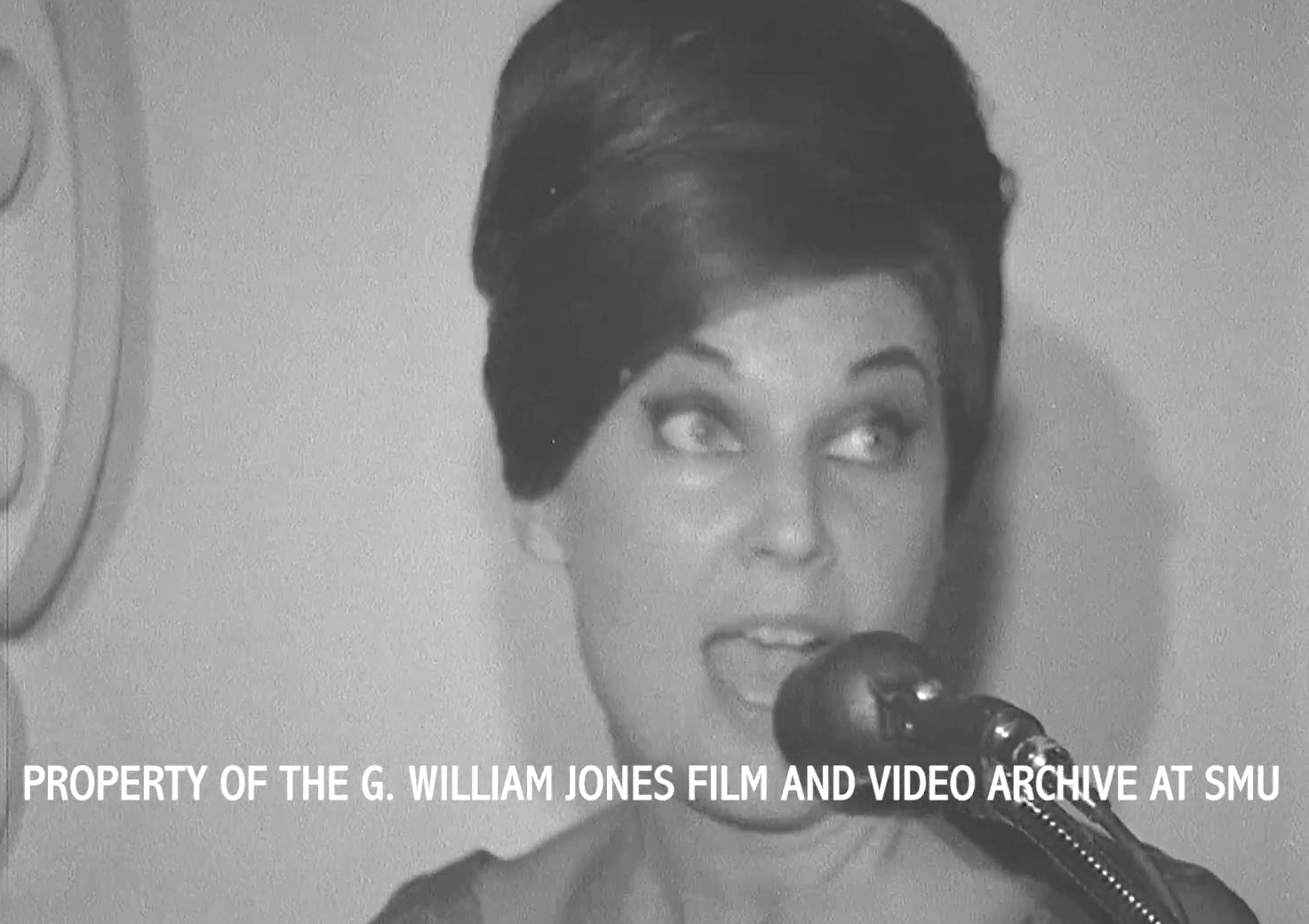
Here are a bunch of screenshots. I don’t know who all of the performers are — I would love feedback and corrections from the public. At the bottom is a list of names of women who were involved with the NDDW, but as they were invariably identified as “Mrs. Husband’s Name,” I have no idea what most of their first names are! I am especially interested in identifying Ruthe Winegarten, one of the prime movers behind these shows (and also a Texas and women’s historian of note).

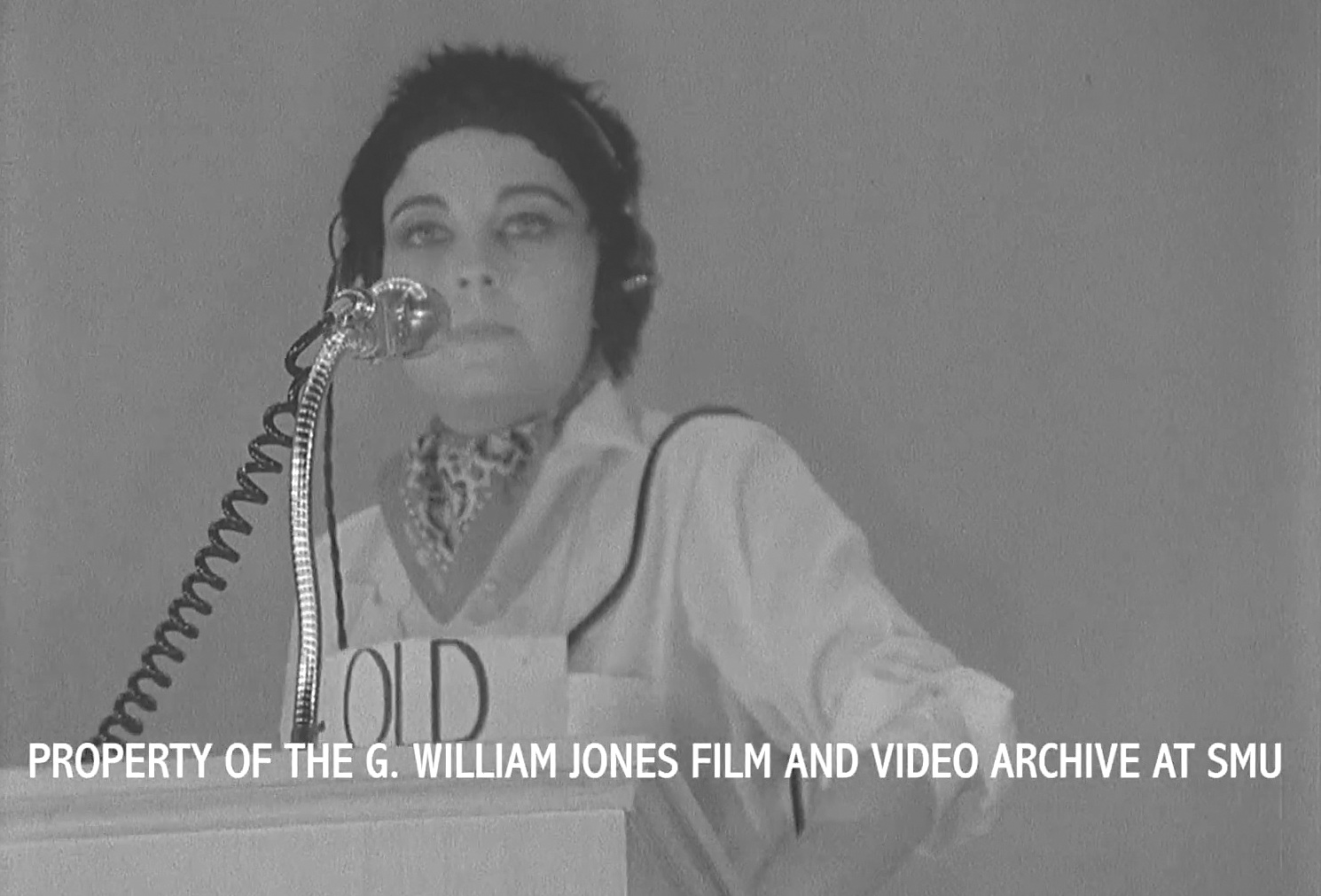
First, 30-year-old Ann Richards (or as she was identified in newspaper accounts, “Mrs. David Richards”) appearing as Gordon McLendon, Dallas media magnate, owner of KLIF, and one-time wannabe politician — “The Old Scotchman.” That voice is unmistakable.

political-paranoia-2_1964_jones-collection_SMU_mclendon_ann-richards-1

political-paranoia-2_1964_jones-collection_SMU_mclendon_ann-richards-2

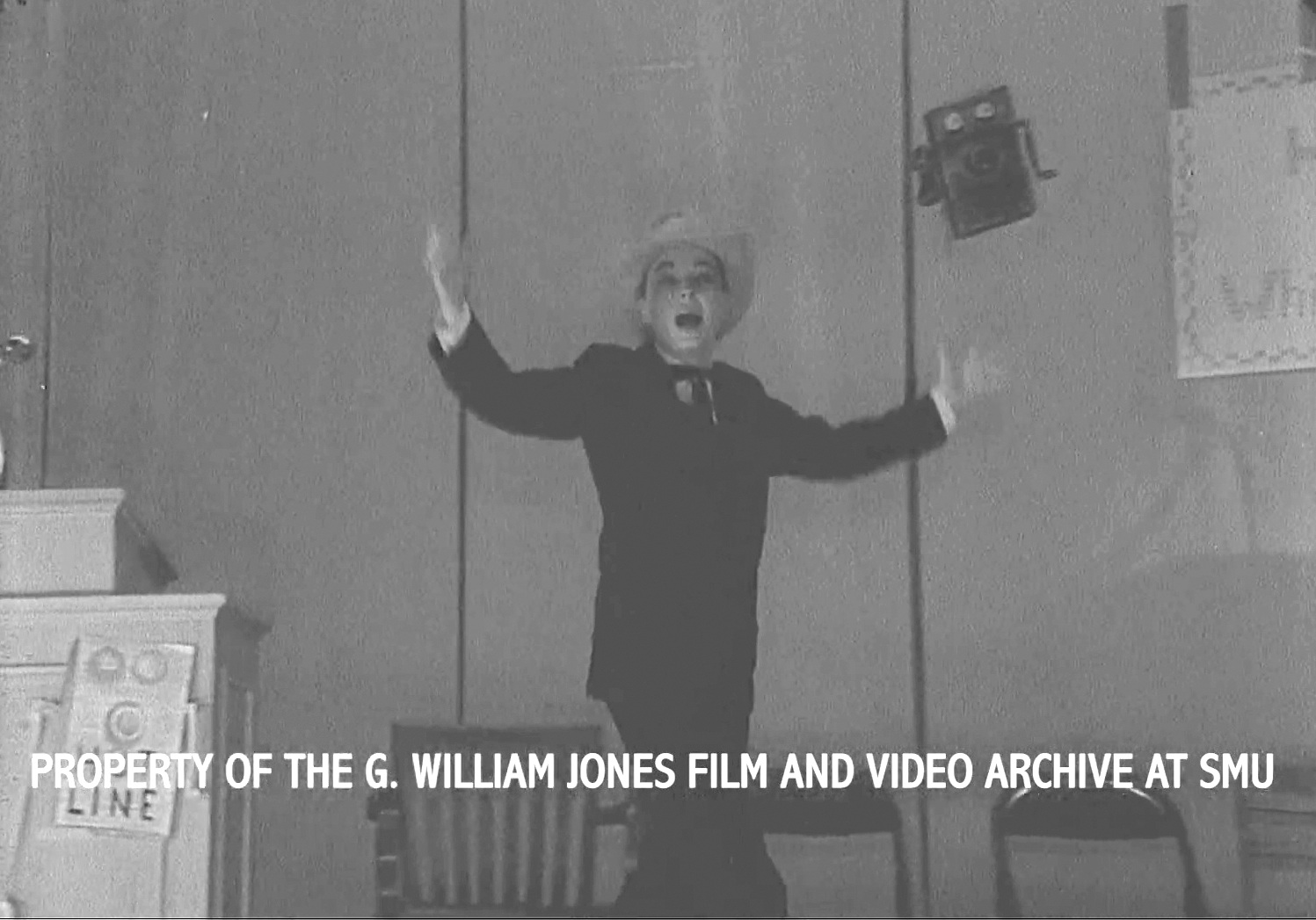
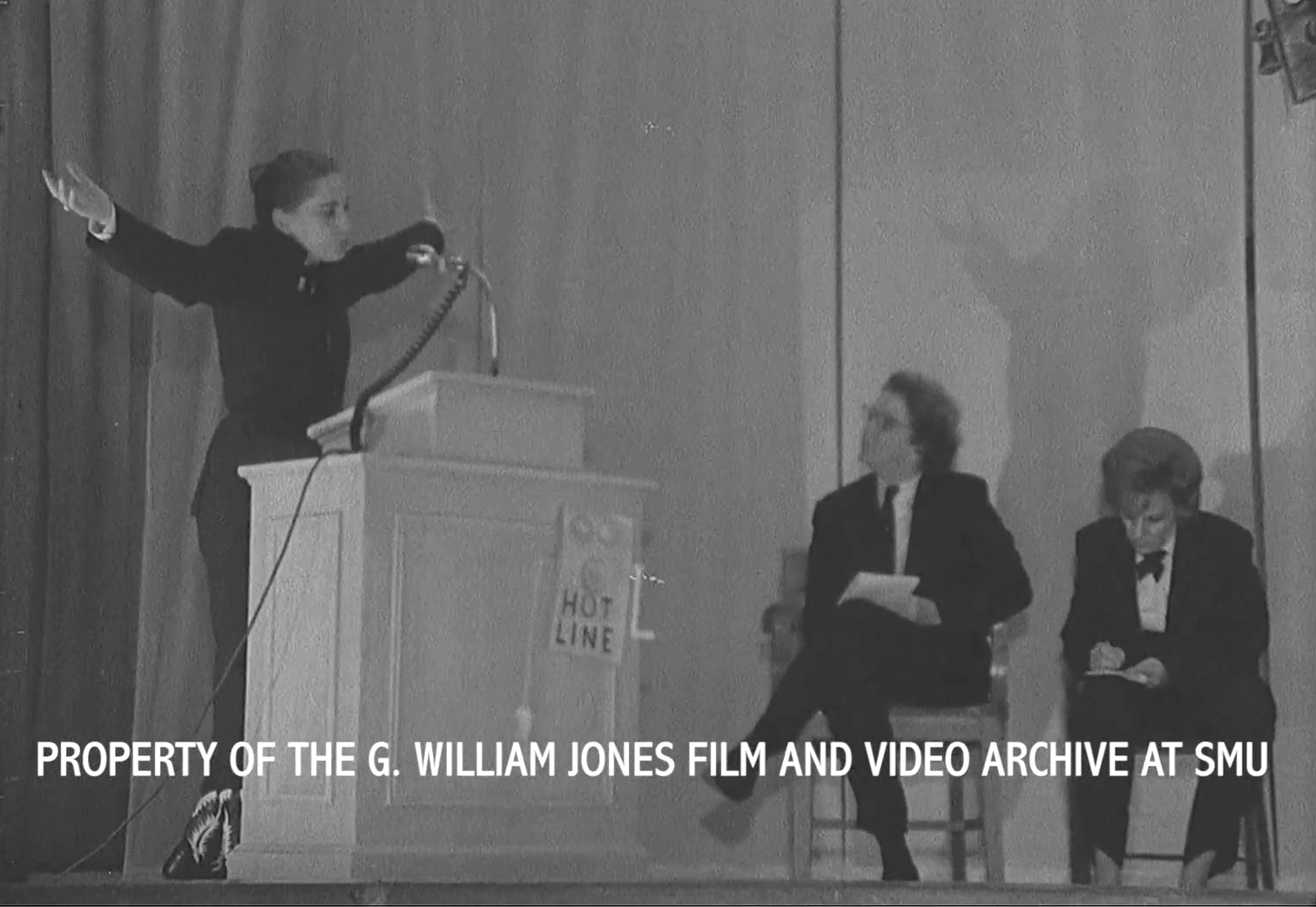
And here she is as LBJ:

political-paranoia-2_1964_jones-collection_SMU_lbj_ann-richards-1

political-paranoia-2_1964_jones-collection_SMU_lbj_ann-richards-2

political-paranoia-2_1964_jones-collection_SMU_lbj_ann-richards-3

political-paranoia-2_1964_jones-collection_SMU_lbj_ann-richards-4

political-paranoia-2_1964_jones-collection_SMU_lbj_ann-richards-5

political-paranoia-2_1964_jones-collection_SMU_lbj_ann-richards-6

Carolyn Choate, one of the writers and directors of “Political Paranoia,” wrote the music and performed many of the song parodies (she was also a contributor to the annual Dallas Press Club Gridiron Show).

political-paranoia-2_1964_jones-collection_SMU_carolyn-choate-1

political-paranoia-2_1964_jones-collection_SMU_carolyn-choate-2

I was really interested to see Betty McKool, Ann’s longtime friend with whom she issued a famous series of annual jokey Christmas cards (which I wrote about in the post “The Legendary Christmas Cards of Ann Richards and Betty McKool”) — and here she is as Nelson Rockefeller at the 1964 Republican National Convention in what I thought was a really great, incredibly confident performance.

political-paranoia-2_1964_jones-collection_SMU_rockefeller-1

political-paranoia-2_1964_jones-collection_SMU_rockefeller-2

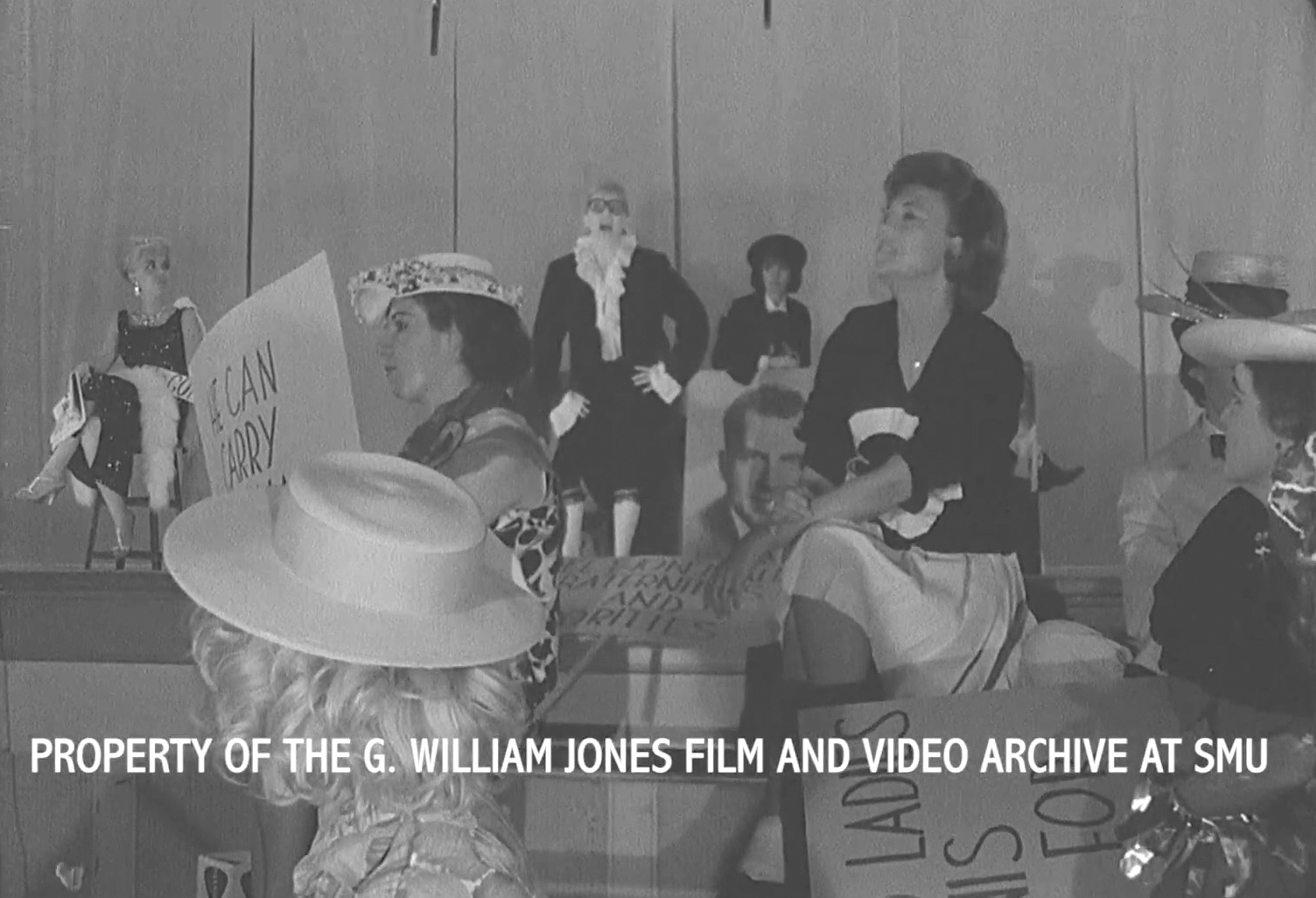
I’m not sure who the blonde with the glasses and ruffled shirt is, but she gives a spirited performance as Barry Goldwater at the Republican Convention. (Mrs. Ray Pearce portrayed Goldwater in the first “Political Paranoia,” so perhaps this is her revisiting the role.)

political-paranoia-2_1964_jones-collection_SMU_convention

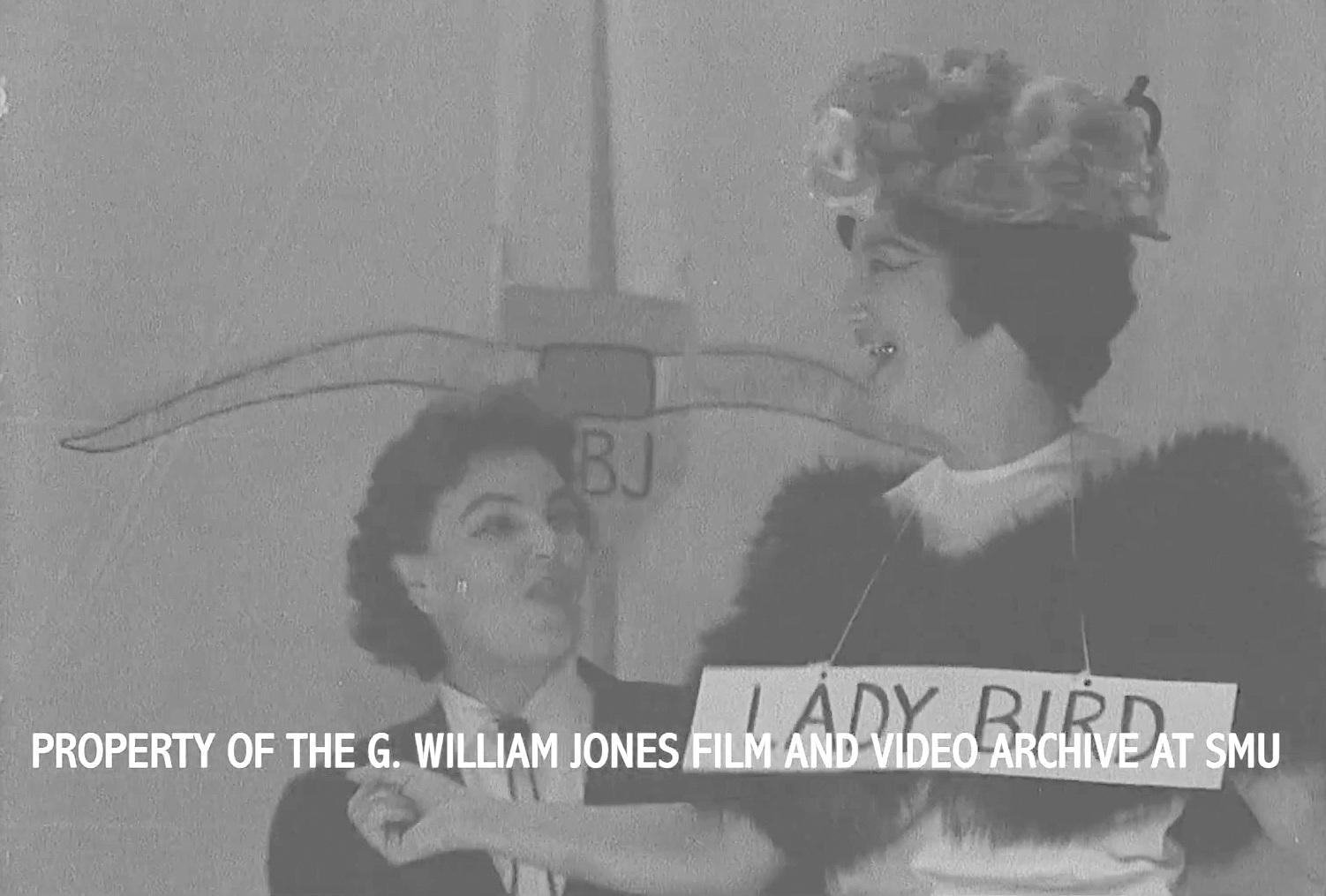
My preschool teacher (and, I believe, the founder of the Unitarian co-op school), Millie Seltzer, is seen below as Lady Bird Johnson. (There’s also a photo of her and Ann as Lady Bird and Lyndon from 1965’s “Political Paranoia III,” which is posted on the blog of Millie’s daughter’s here.)

political-paranoia-2_1964_jones-collection_SMU_lady-bird

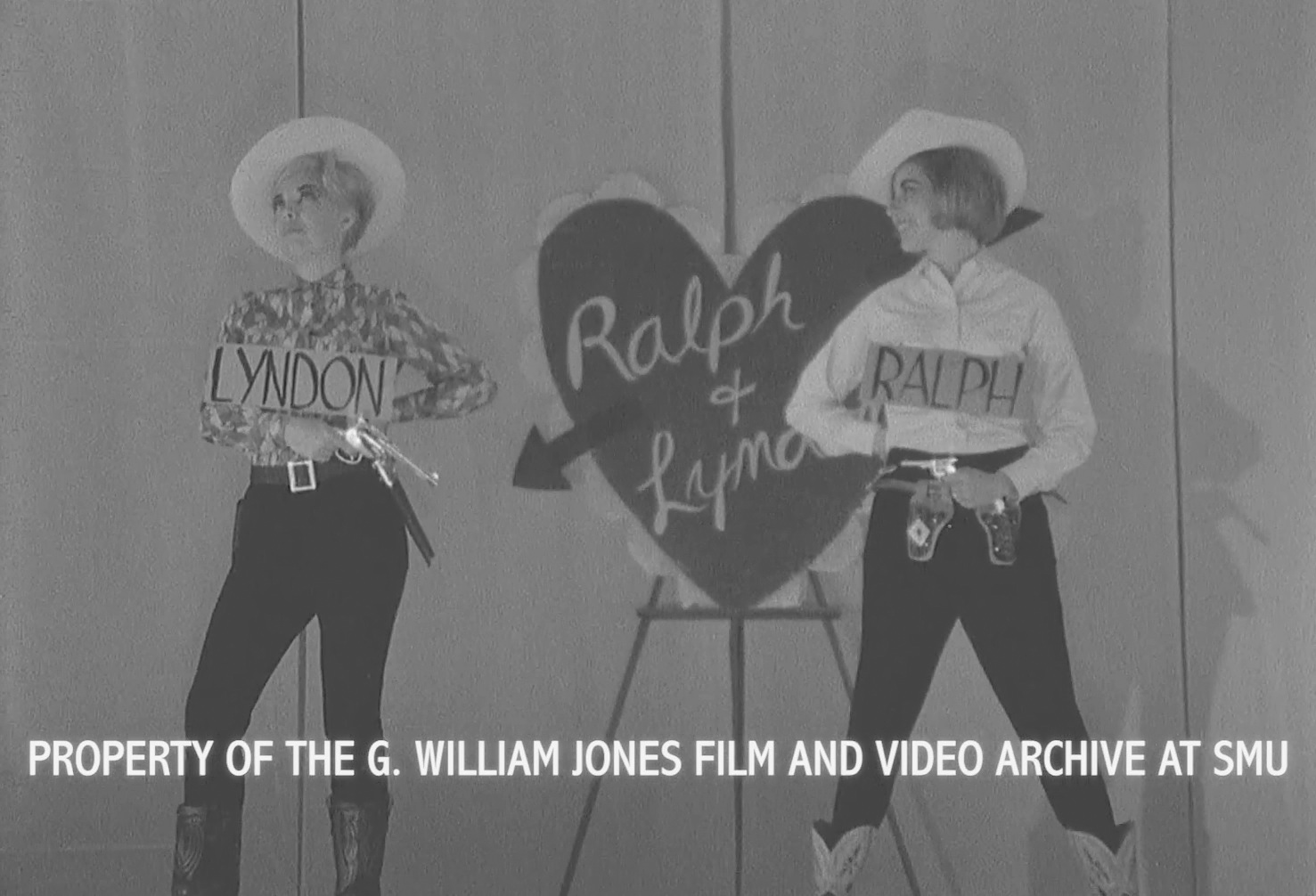
Speaking of Lady Bird, here’s Lyndon and Ralph Yarborough (I’m not sure who these women are, but “Lyndon” might be Mary Vogel).

political-paranoia-2_1964_jones-collection_SMU_ralph-lyndon

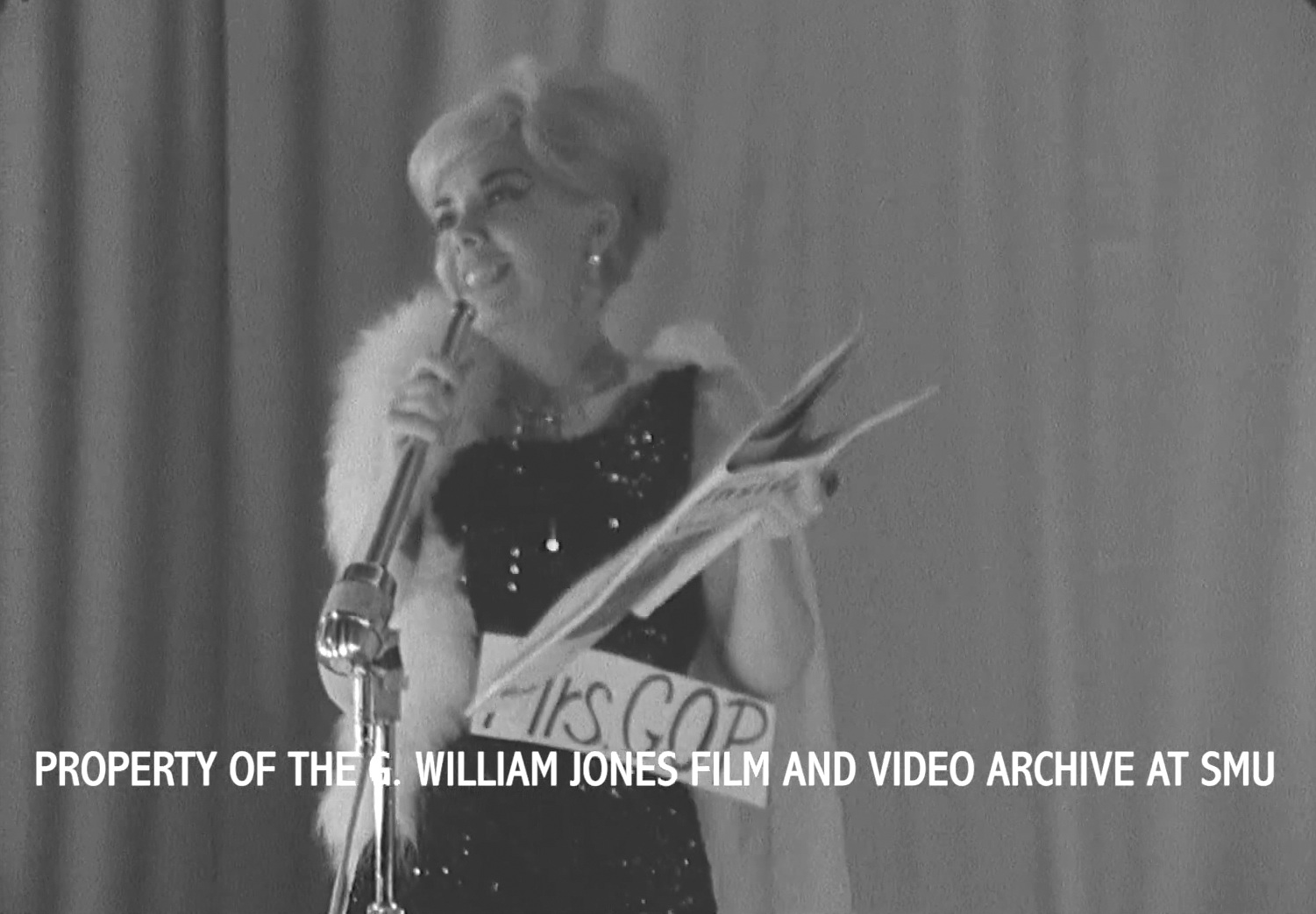
Possibly Mary Vogel again as “Mrs. GOP.”

political-paranoia-2_1964_jones-collection_SMU_mrs-gop

An unknown performer singing about John Connally.

political-paranoia-2_1964_jones-collection_SMU_family-connally

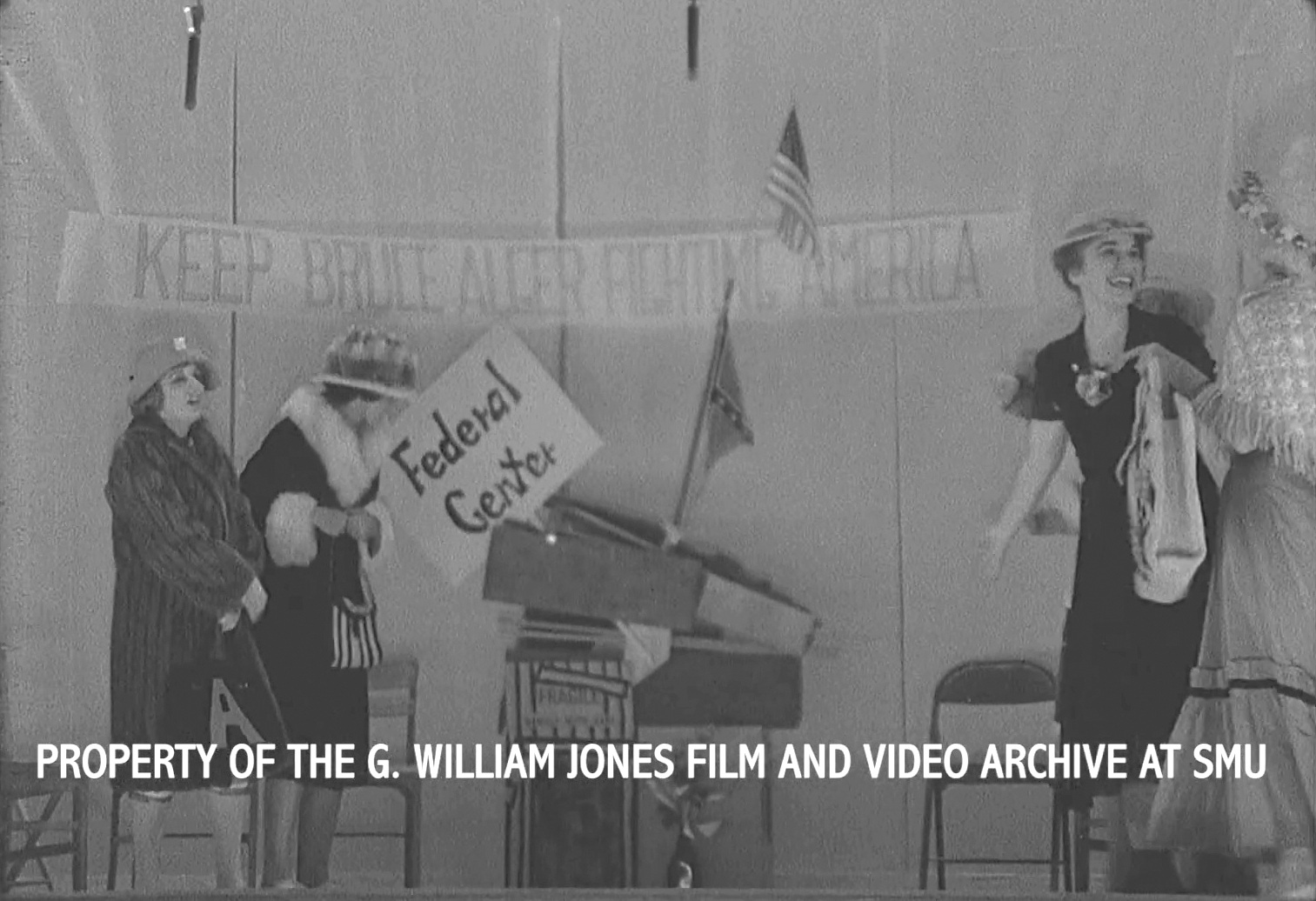
More unknown performers in “I Dreamed I Dedicated a Federal Center in 1994….”

political-paranoia-2_1964_jones-collection_SMU_fed-ctr

…dedicated by Republican congressman Bruce Alger.

political-paranoia-2_1964_jones-collection_SMU_fed-ctr-2

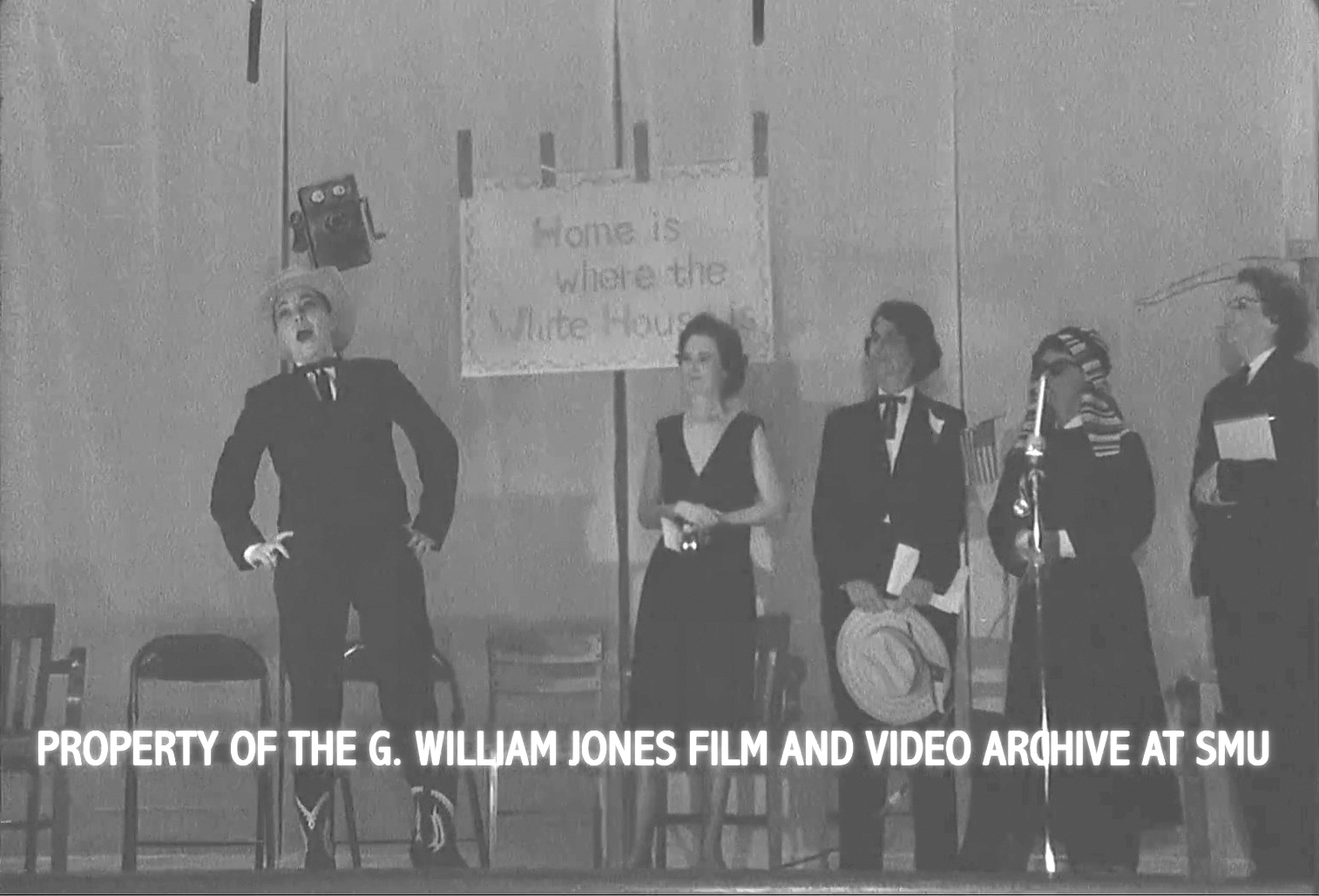
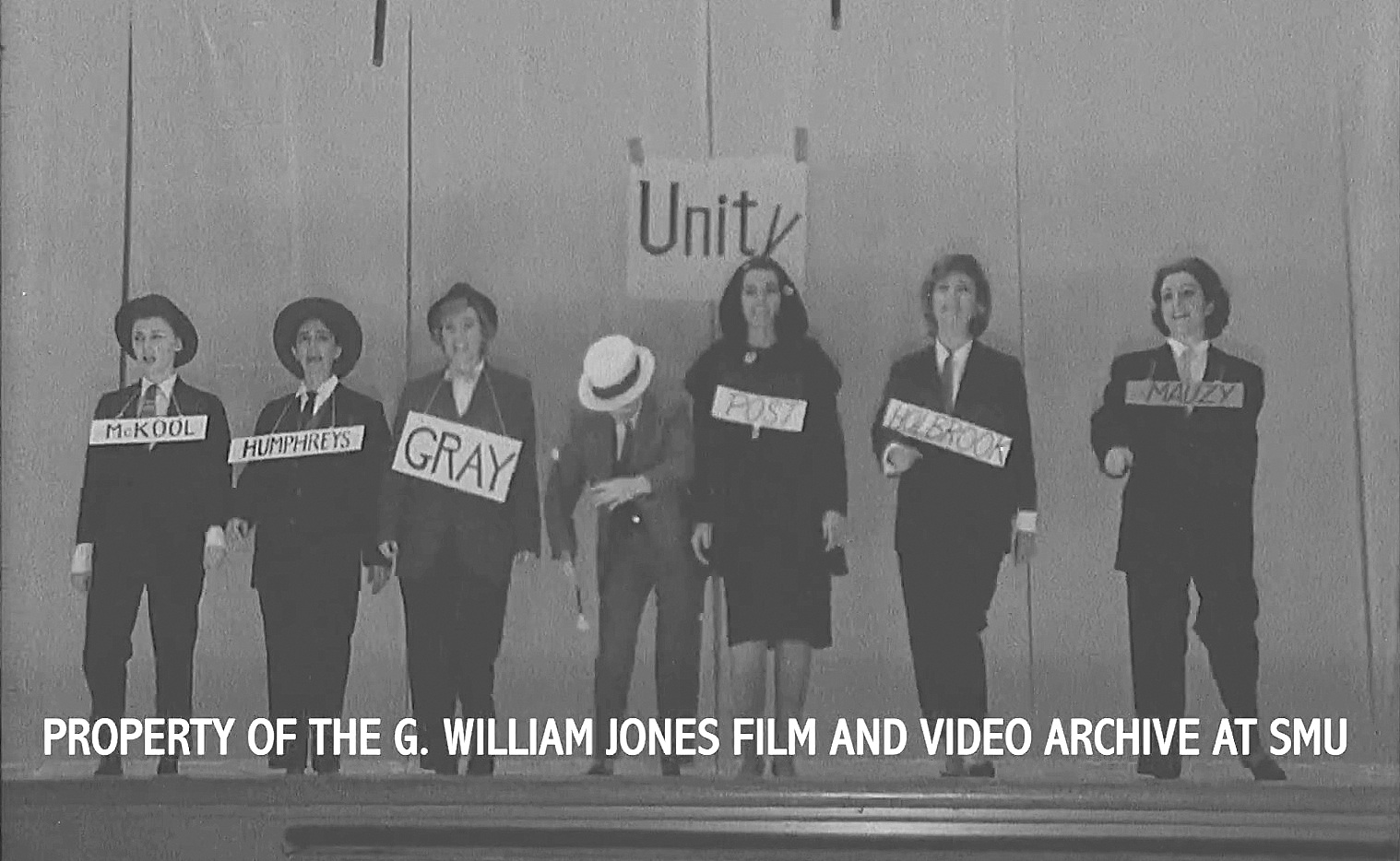
Again, possibly Betty McKool in the straw hat in the center (with someone else playing her husband, Mike McKool).

political-paranoia-2_1964_jones-collection_SMU_unity

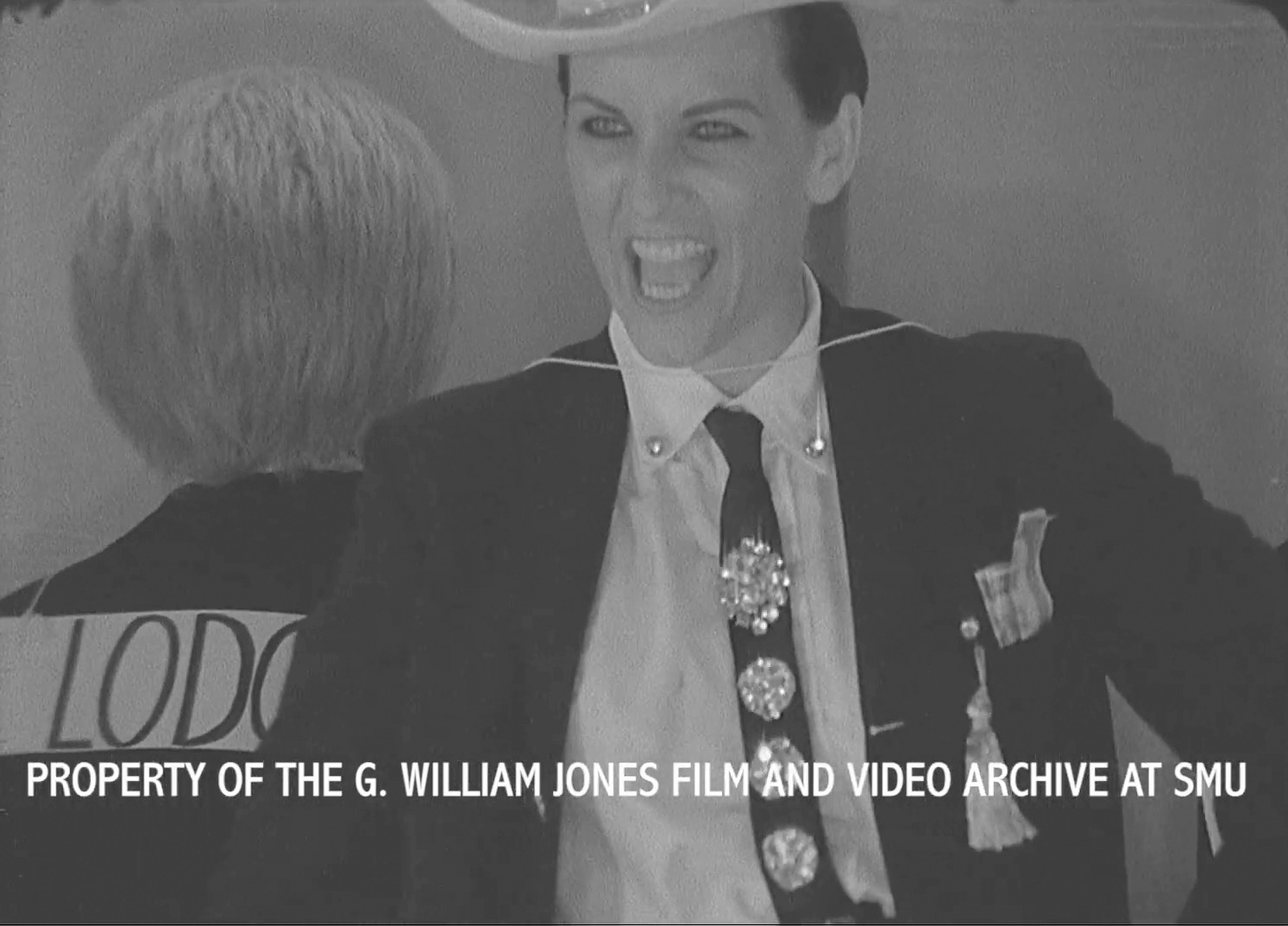
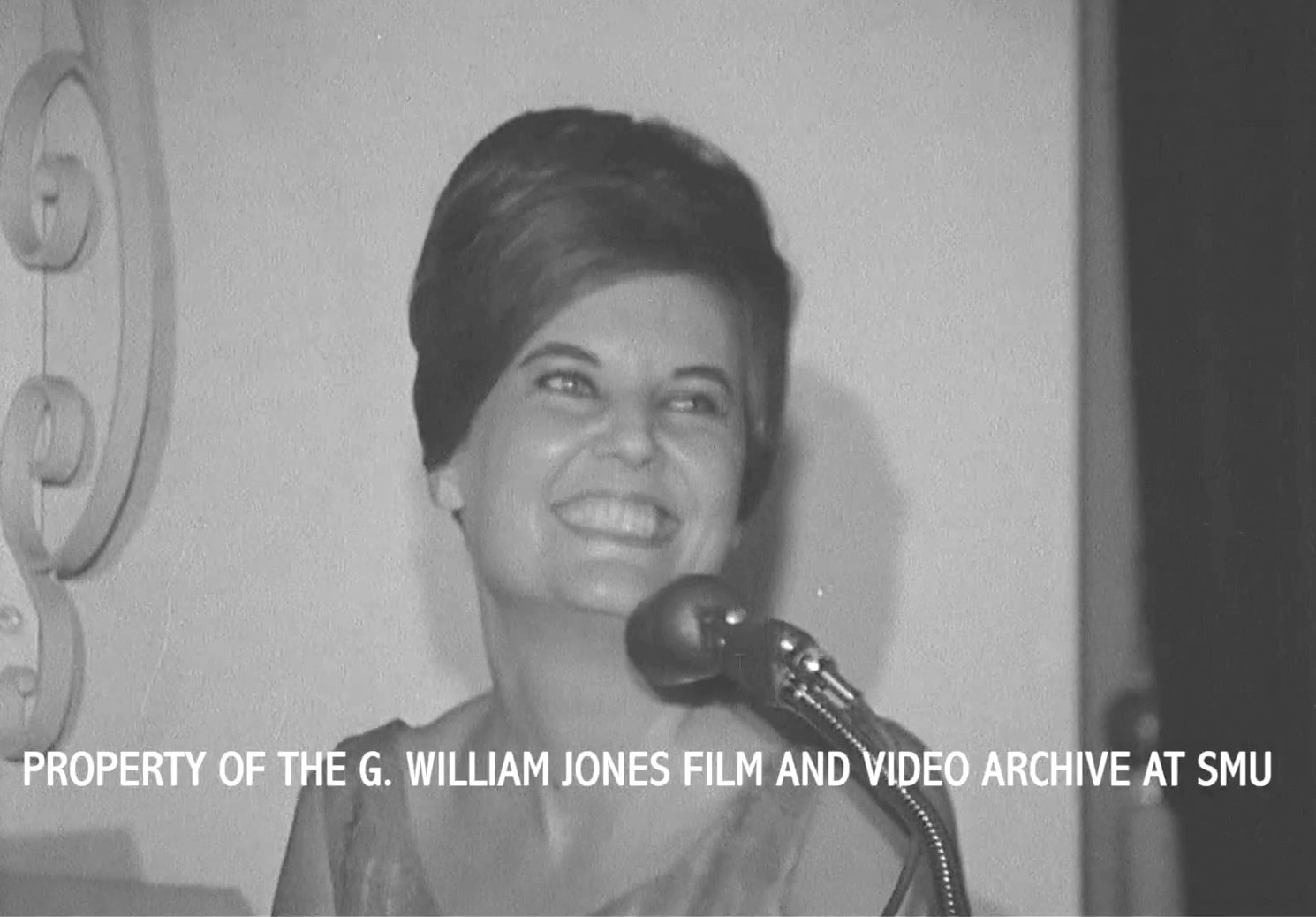
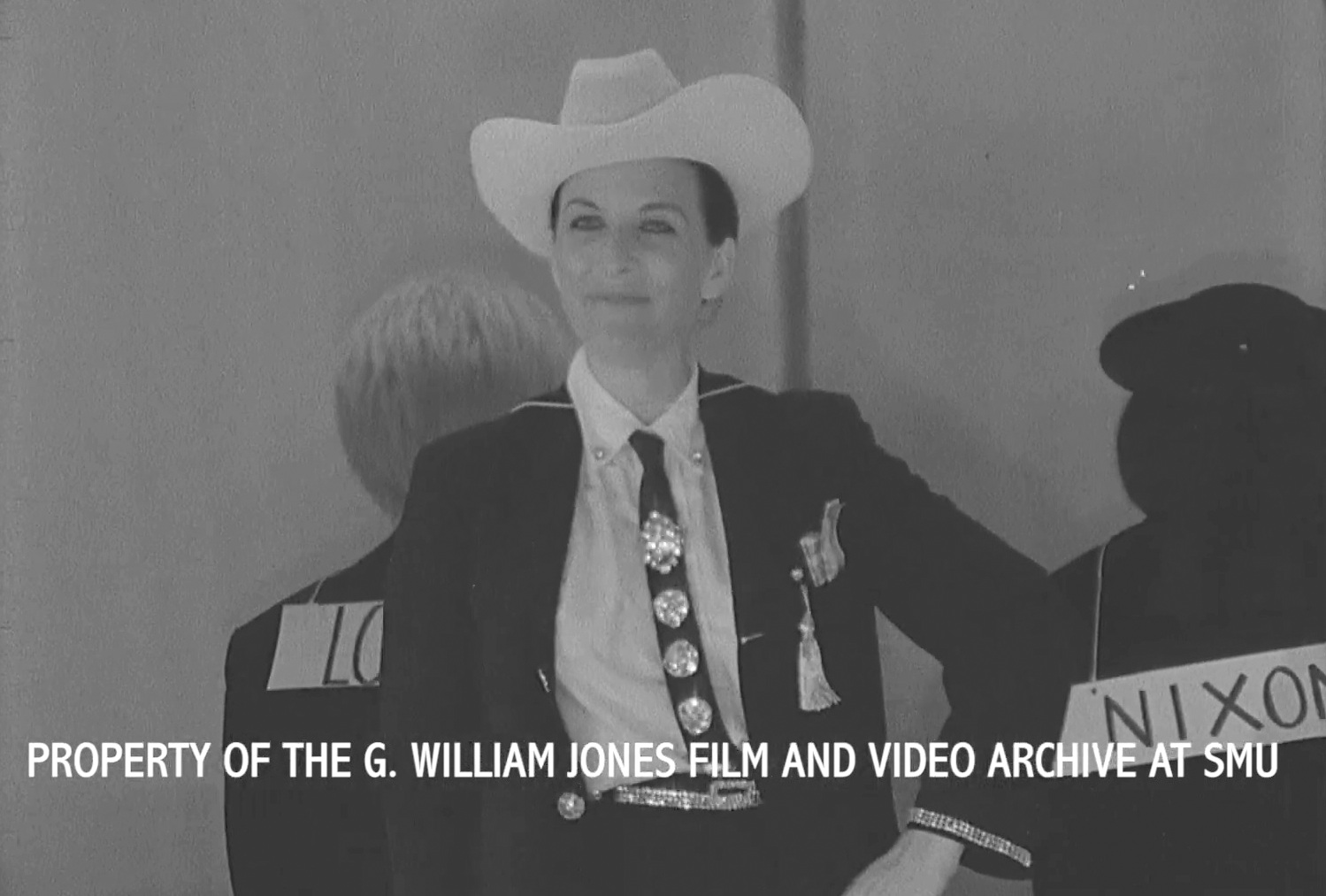
The cast, with leggy Joyce Schiff at the microphone (and Ann Richards behind her to the left, holding the cowboy hat).

political-paranoia-2_1964_jones-collection_SMU_cast

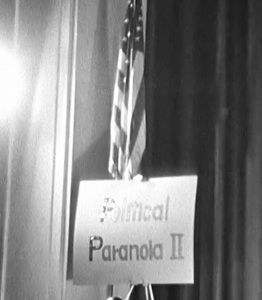
political-paranoia-2_1964_jones-collection_SMU_sign-flag

*

“Political Paranoia II”
May 16, 1964
Hillcrest High School auditorium

“Poop and patter from the Pedernales to the Potomac…”
“The most talked-about show from Euless to Balch Springs…”

$1.50 for Democrats
$7.67 for independents
$25.00 for Republicans

**

Below is a list of women who were members of the North Dallas Democratic Women who were known to have participated in the 1963 and/or 1964 productions of “Political Paranoia,” either on stage or behind the scenes. If you recognize any of these women in the SMU film footage, please make note of a time-marker and let me know where you see them and I will update the info.

Written and directed by:
Mrs. Alvin Winegarten (RUTHE WINEGARTEN)
Mrs. David Richards (ANN RICHARDS)
Mrs. Jim Choate (CAROLYN CHOATE)

Mrs. Mike McKool (BETTY McKOOL)
Mrs. Holbrook Seltzer (MILLIE SELTZER)
Mrs. Harry Weisbrod (BEA WEISBROD)
Mrs. Herbert Schiff Jr. (JOYCE SCHIFF)
Mrs. Philip Vogel (MARY VOGEL)
Mrs. Frederick Sparks (MERLENE SPARKS)
Mrs. Sam Whitten (VIRGINIA WHITTEN)
Mrs. Harry Hoffman
Mrs. Thomas L. Ford
Mrs. Harold Polunsky
Mrs. Kenneth Parker
Mrs. Charles Webster
Mrs. J. T. Mullenix
Mrs. Forrest West
Mrs. C. A. Hurst
Mrs. Jack Cohan
Mrs. Donald Fielding
Mrs. Don Kise
Mrs. Stanley Kaufman
Mrs. Richard Sandow
Mrs. Irwin Kaim
Mrs. James Taylor
Mrs. Ray Pearce
Mrs. Daniel Rosenthal
Mrs. Oscar M. Wilson Jr.
Mrs. Earl Granberry
Mrs. Jerome Meltzer 

***

Sources & Notes

Screenshots are from “Political Paranoia II,” a filmed chronicle of the 1964 political revue written and performed by the North Dallas Democratic Women’s Club at Hillcrest High School on May 16, 1964; the origins of the film are unknown, but this copy is held by the G. William Jones Film and Video Archive, Hamon Library, Southern Methodist University. All thanks to Jeremy Spracklen and Scott Martin of the Jones Archive. The direct YouTube link is here.

Thanks also to Margaret Werry and Jean Ball for their help in identifying participants and for taking the time to share their memories of Dallas’ political past.

A good account of Ann Richards’ time in Dallas can be found in her autobiography, Straight from the Heart, My Life in Politics & Other Places (Simon & Schuster, 1989).

political-paranoia-2_1964_jones-collection_SMU_cast_sm

*

Copyright © 2019 Paula Bosse. All Rights Reserved.
 

The Star Lounge, 4311 Bryan

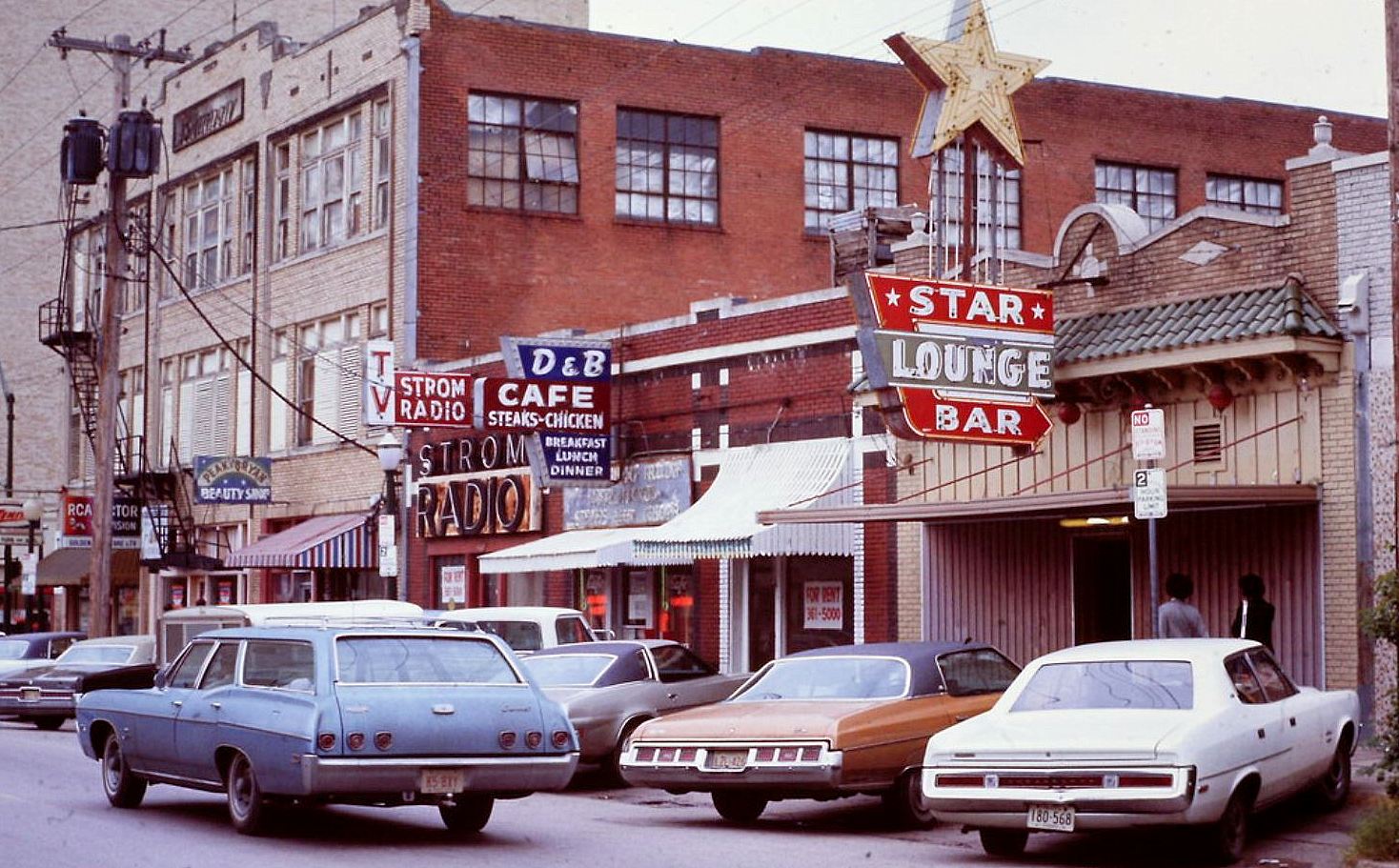
star-lounge_next-to-brannon-bldg_city-of-dallas-preservation-collectionThe 4300-block of Bryan Street… (City of Dallas photo)

by Paula Bosse

You know those photos that just really grab you? This is one of those for me. It shows the Star Lounge & Bar (that sign!), located at 4311 Bryan, just east of Peak in Old East Dallas. The Star Lounge was opened in 1962 by Mrs. Wanda Nolan; Clark K. Curtis closed it in 1978 or 1979: that’s a lot of beer and cocktails over the lips and through the gums.

The building was built in 1922 by J. S. Johnson (the building permit had the estimated cost of construction at $3,500). Before the arrival of the Star Lounge, previous occupants of the space had included a barber shop, a cleaners, and a floor-covering and linoleum-installation company. (In 1931, when ABC Cleaners was there, the back wall of the building was blown out when two sticks of dynamite were planted one night by racketeers who were attempting to control the dry cleaning industry in Dallas by threatening violence if small-business owners refused to raise prices as a bloc and funnel the extra cash — basically “protection money” — back to them. The bad guys were thwarted.)

Early classified ads for the Star Lounge were want-ads for waitresses; in 1965, want-ads for “waitresses” were replaced by ads for “amateur go-go girls and exotic dancers.” I’m not sure how long that lasted, but it’s interesting to note that both sides of the 4300 block of Bryan were, at one time, jammed with bars which had similarly-themed retro-cool names (but which probably were more seedy than cool): the Orbit Lounge, the Rocket Lounge, the Space Lounge, and the Apollo Lounge. I’ve never seen that before. By 1970 those space-age gin mills were joined by an adult theater/bookstore. So… lively place! I’m hoping there was a lot — or even some — neon strobage going on.

This photo was probably taken around 1974, the year that Strom Radio & Appliances seems to have left the neighborhood. Neighboring businesses seen in this photo are Golden Furniture & Appliances (which has signs for Zenith and RCA-Victor out front), Peak & Bryan Beauty Shop, and the D & B Cafe. The three-story building on the corner of Bryan and Peak is the Brannon Building. All those buildings still stand — see the (sadly) more sedate block these days on Google Street View, here.

star-lounge_google-street-view_june-2018Google Street View, June, 2018

***

Sources & Notes

This photo is from a really great, somewhat random collection of 35mm slides from the City of Dallas Historic Preservation Program archives — most are from the 1970s and ’80s. Read about the recently rediscovered photos here, and browse through the entire fantastic collection on Flickr, here.

*

Copyright © 2019 Paula Bosse. All Rights Reserved.
 

Rubber Stockpile: Forty-One Mountainous Piles of Tires — 1943

rubber-stock-pile_dallas-1943_ebay-det
Guarding wartime scrap rubber, near Love Field…

by Paula Bosse

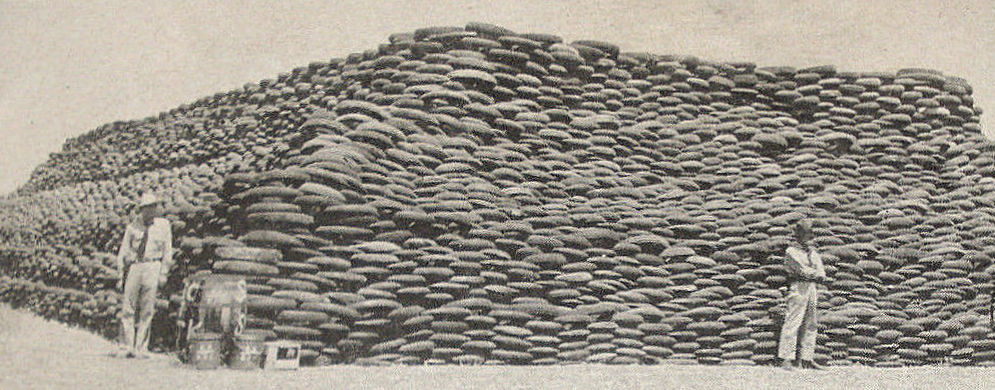
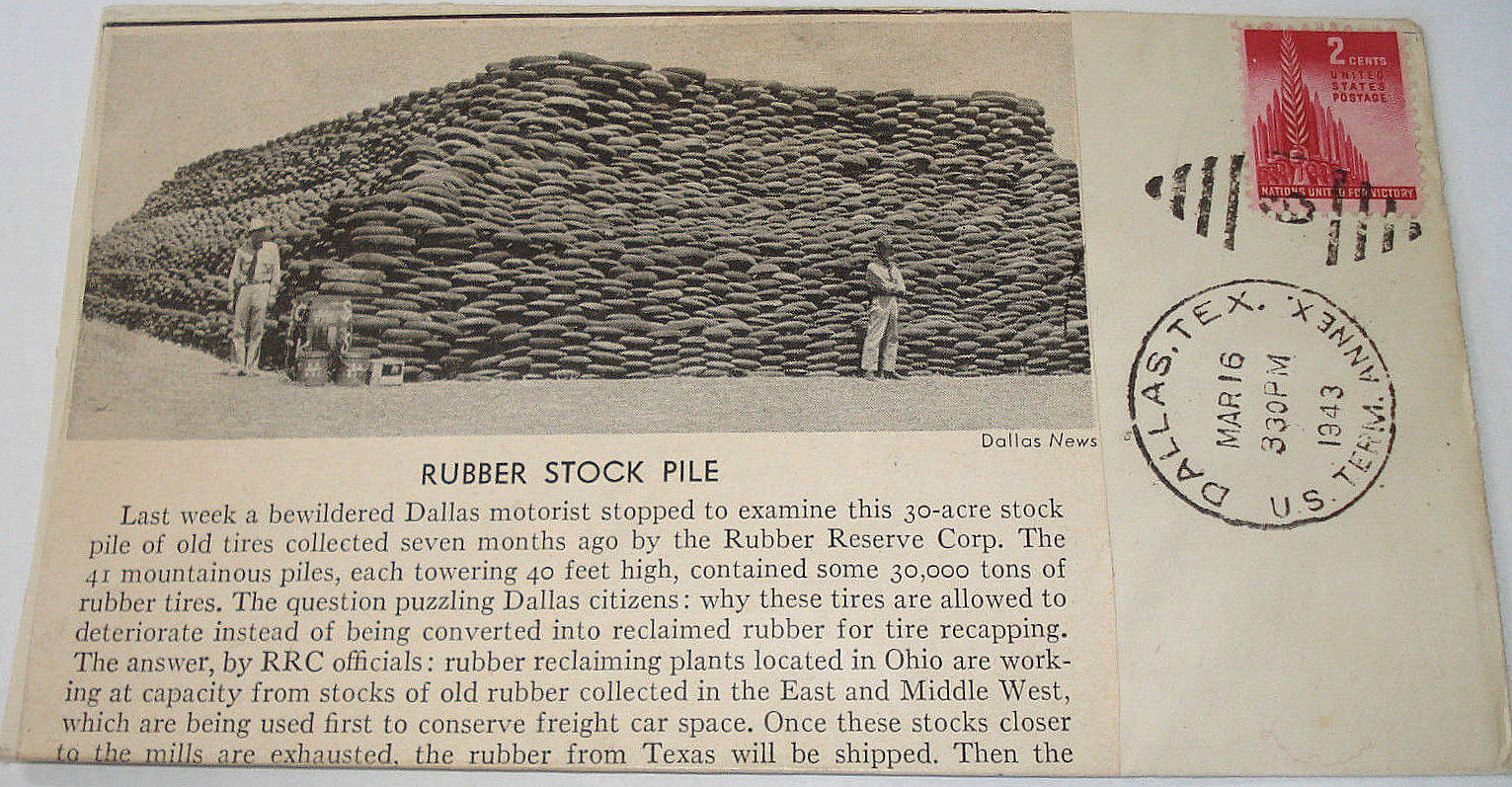
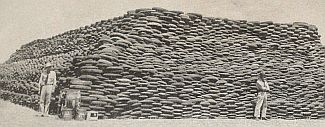
You don’t see this everyday: a photo of a pile of tires so large it dwarfs the armed guards who stand in front of it. (For that matter, you don’t often see armed men guarding tires.) What’s going on here? All is explained in the accompanying Time magazine article from March, 1943, which appears to have been cut from the magazine and pasted onto an envelope.

rubber-stock-pile_dallas-1943

The article reads:

RUBBER STOCK PILE
Last week a bewildered Dallas motorist stopped to examine this 30-acre stock pile of old tires collected seven months ago by the Rubber Reserve Corp. The 41 mountainous piles, each towering 40 feet high, contained some 30,000 tons of rubber tires. The question puzzling Dallas citizens: why these tires are allowed to deteriorate instead of being converted into reclaimed rubber for tire recapping. The answer, by RRC officials: rubber reclaiming plants located in Ohio are working at capacity from stocks of old rubber collected in the East and Middle West, which are being used first to conserve freight car space. Once these stocks closer to the mills are exhausted, the rubber from Texas will be shipped. Then the 25 armed guards, who watch Dallas’s [illegible] day and night, can go home.

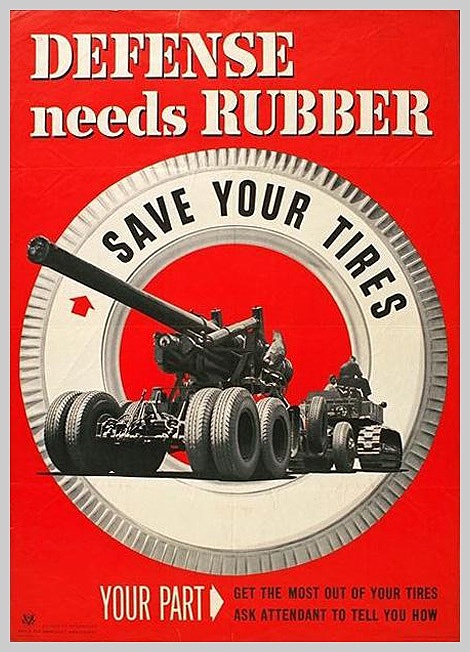
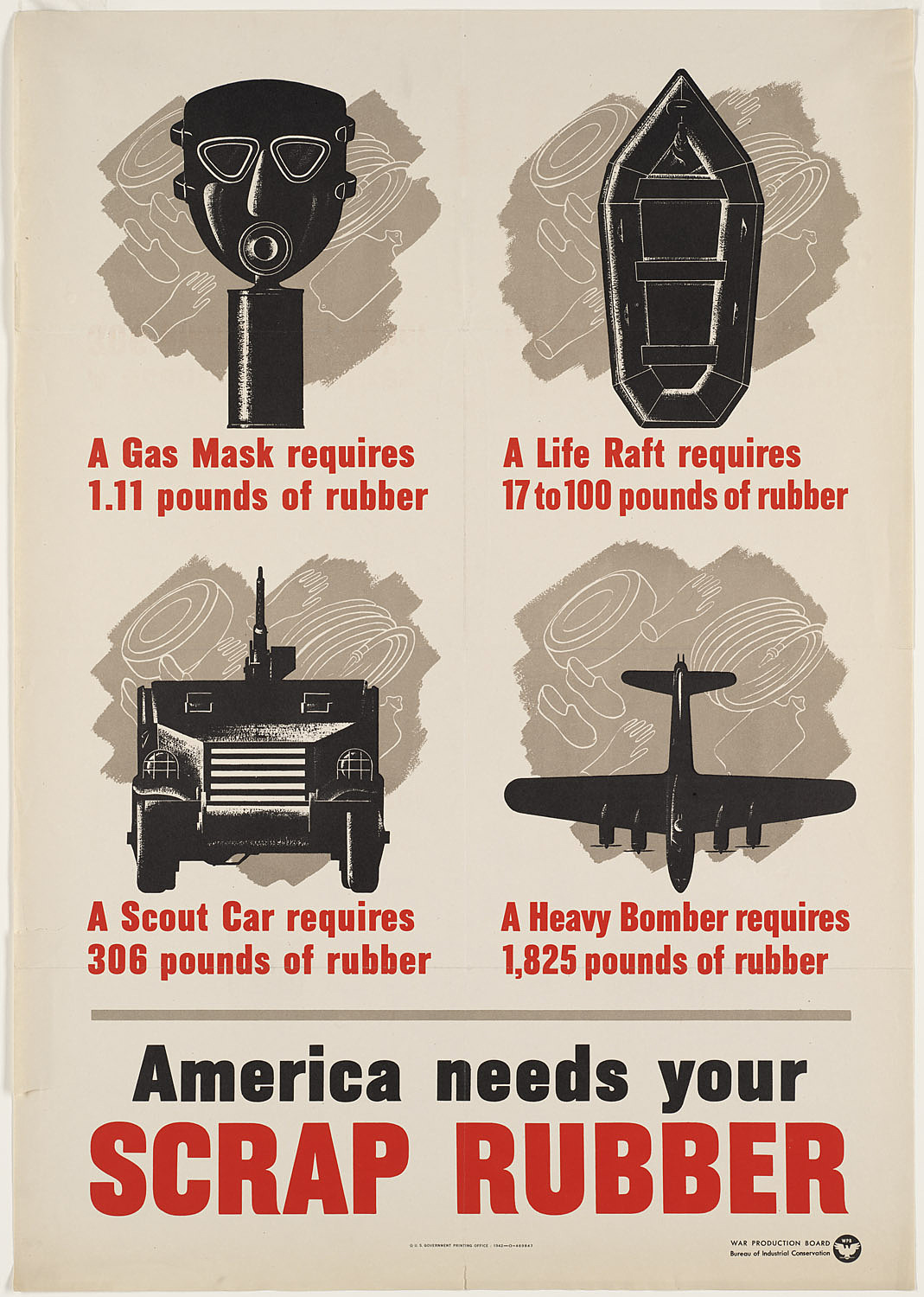
Ah, that mound of tires was the result of one of World War II’s many scrap drives. The national rubber drive ran from June 15, 1942 until July 10, 1942. The government requested that all Americans collect any old or unused rubber items in order to help with the supply of rubber in the U.S. (Japan controlled the bulk of rubber imports, and those imports had stopped when the United States entered the war). Rubber was needed for military purposes, but it was also necessary for essential domestic needs, mainly as tires needed to transport goods and people. Americans were told they needed to treat their automobile’s tires like gold: drive safely, drive slowly, and drive only when necessary — don’t wear your tires out, because you don’t know how long it’ll be until they’re manufactured again and/or how long it will be until large-scale production of synthetic rubber would become a reality. 

defense-needs-rubber_sarah-sundin

scrap-rubber-poster_sarah-sundinPosters via SarahSundin.com

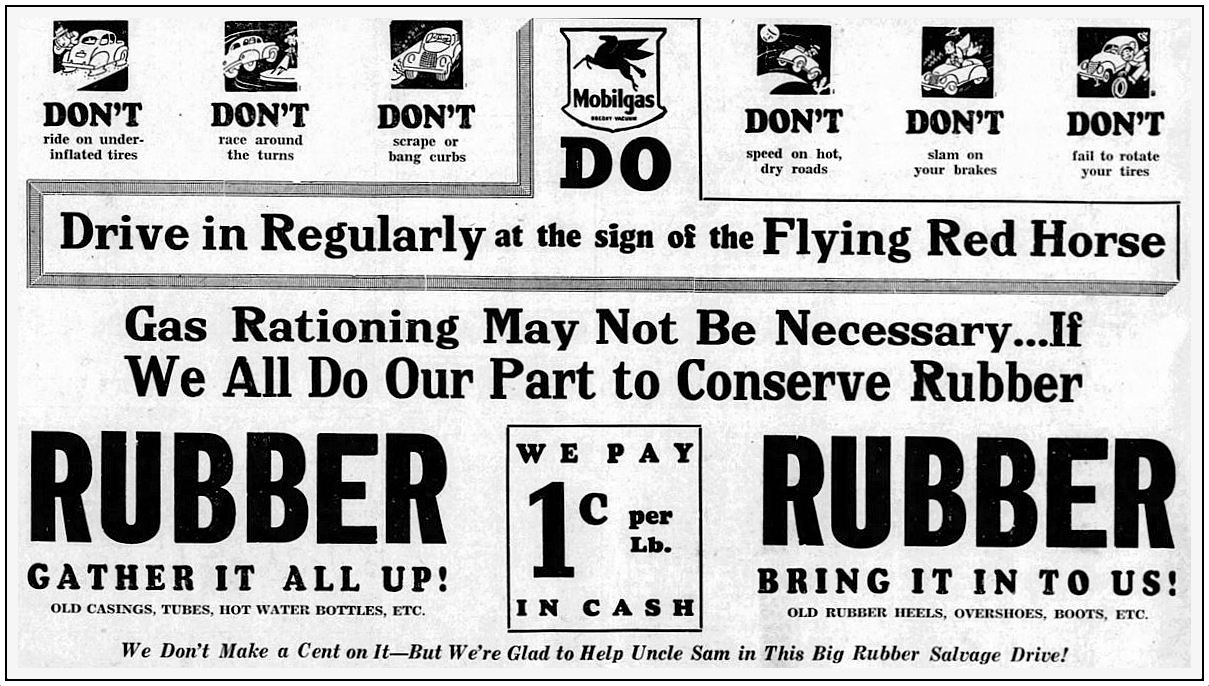
When the rubber drive began, people were basically told that if they collected enough scrap rubber, the dire prospect of nation-wide gas rationing might be unnecessary (at the time only a few states in the northeast had been suffering through the rationing of gasoline) — the thinking was that if the government withheld gasoline that citizens would conserve rubber simply because they were unable to drive as much. Texans really like their cars and trucks, and we have long distances to drive, so it’s no surprise that throughout the rubber drive, Texas out-performed almost every state in per capita tonnage collected. In the first day of the drive, a Dallas gas station at Harwood and Young reported that 4,500 pounds of collected scrap rubber had been left throughout the day by Dallasites performing their patriotic duty. And that was just one day and one gas station! The government was paying a penny a pound, but many people refused payment.

What sorts of things were people dropping off at their neighborhood gas station (the government-directed drop-off points)? Other than used tires, everything you could imagine:

  • Automobile floor mats
  • Galoshes and raincoats
  • Bathing caps
  • Hot water bottles
  • Garden hoses
  • Girdles
  • Doorstops
  • Tennis and golf balls
  • Rings from jelly jars
  • Baby pants
  • Dolls
  • Toy mice
  • Slingshots
  • Soles of athletic shoes
  • Roadside debris
  • Mats found under office furniture and cuspidors

That stuff adds up fast.

*

Below are several ads exhorting readers to do their bit for the war effort by collecting and donating scrap rubber during the national rubber drive. (All images are larger when clicked.)

conserve-rubber_ad_nebraska_061642Mobil ad detail, June 16, 1942

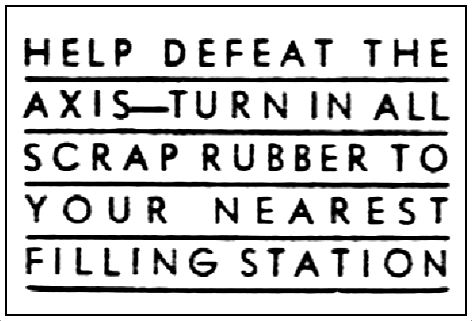
Scrap could be dropped off at any service station.

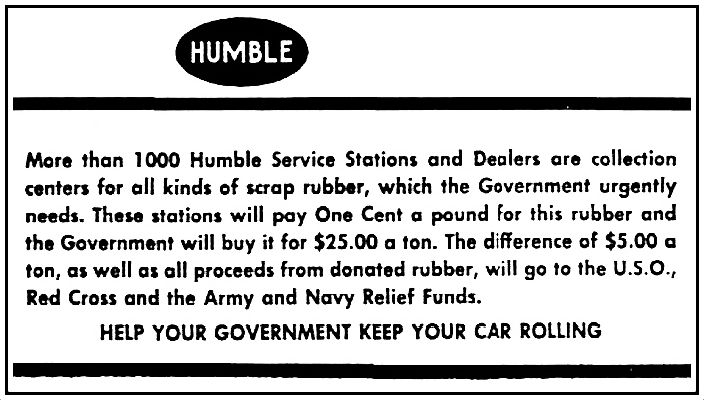
humble-ad_061742_detHumble Oil ad detail, June 17, 1942

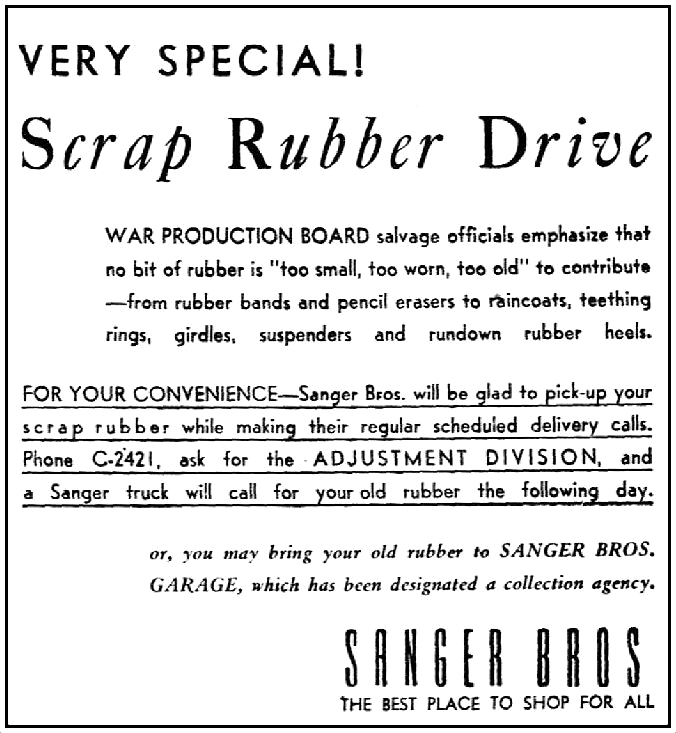
If you needed home pick-up service, Sanger Bros. would send a truck.

rubber-drive_sangers_061642Sanger Bros. ad, June 16, 1942

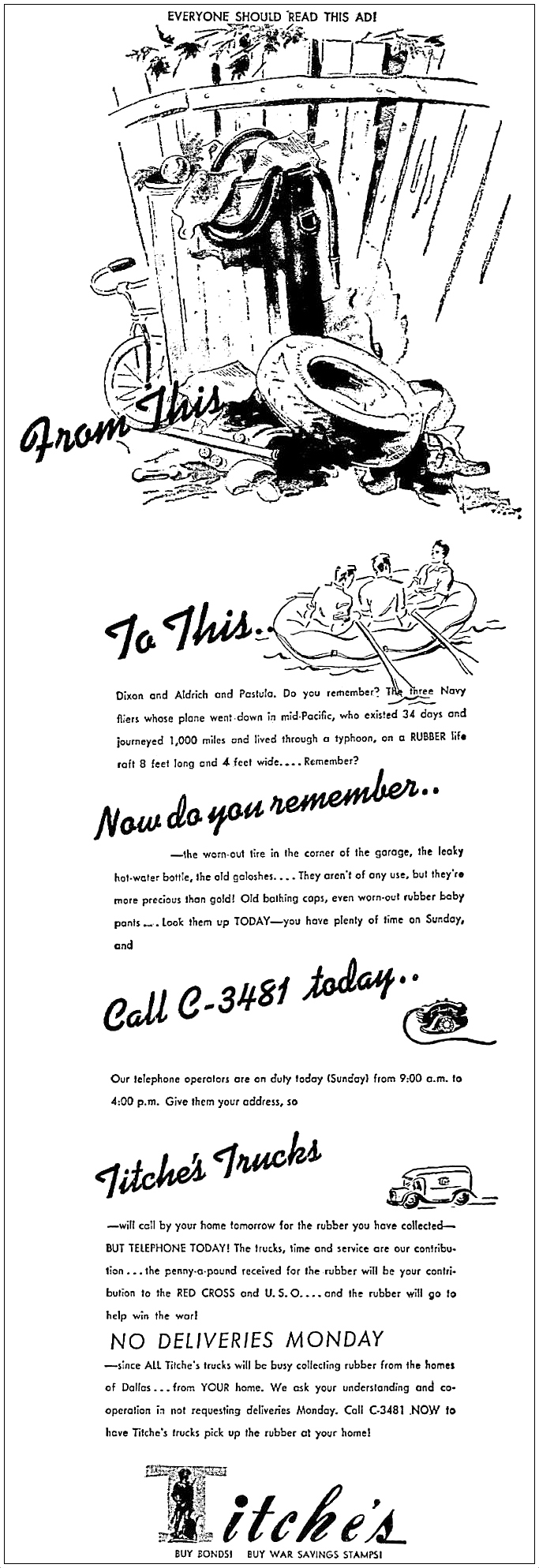
As would Titche’s.

rubber-drive_titches-ad_062142Titche’s ad, June 21, 1942

Reminders to ferret out that rubber were added to many advertisements, as seen in this detail from a larger grocery store ad. (The drive was originally intended to run through June 30, but ended up being extended through July 10.)

rubber-drive_safeway-ad_062642_detSafeway ad detail, June 26, 1942

This appeared in an ad from the men’s and boys’ clothing store Reynolds-Penland.

rubber-drive_reynolds-penland-ad_062642_detReynolds-Penland ad detail, June 26, 1942

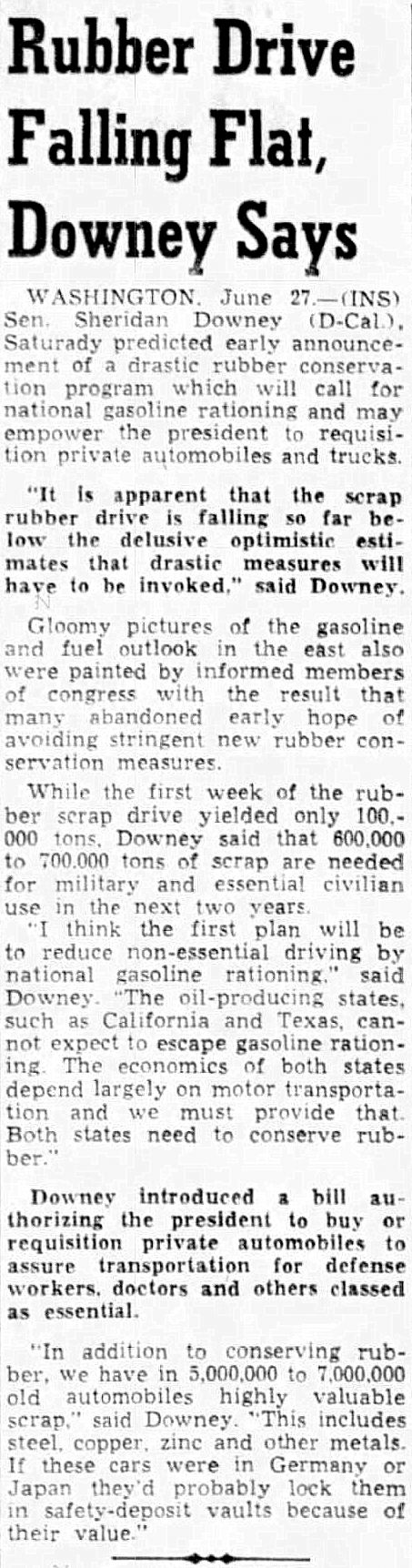
As well as things were going in Big D, according to the government, things weren’t going well nationally, and the powers-that-be were more loudly threatening gas rationing for the entire country, including the states which were actually collecting the most, Texas and California.

rubber-drive_austin-statesman_062742
Austin Statesman, June 27, 1942

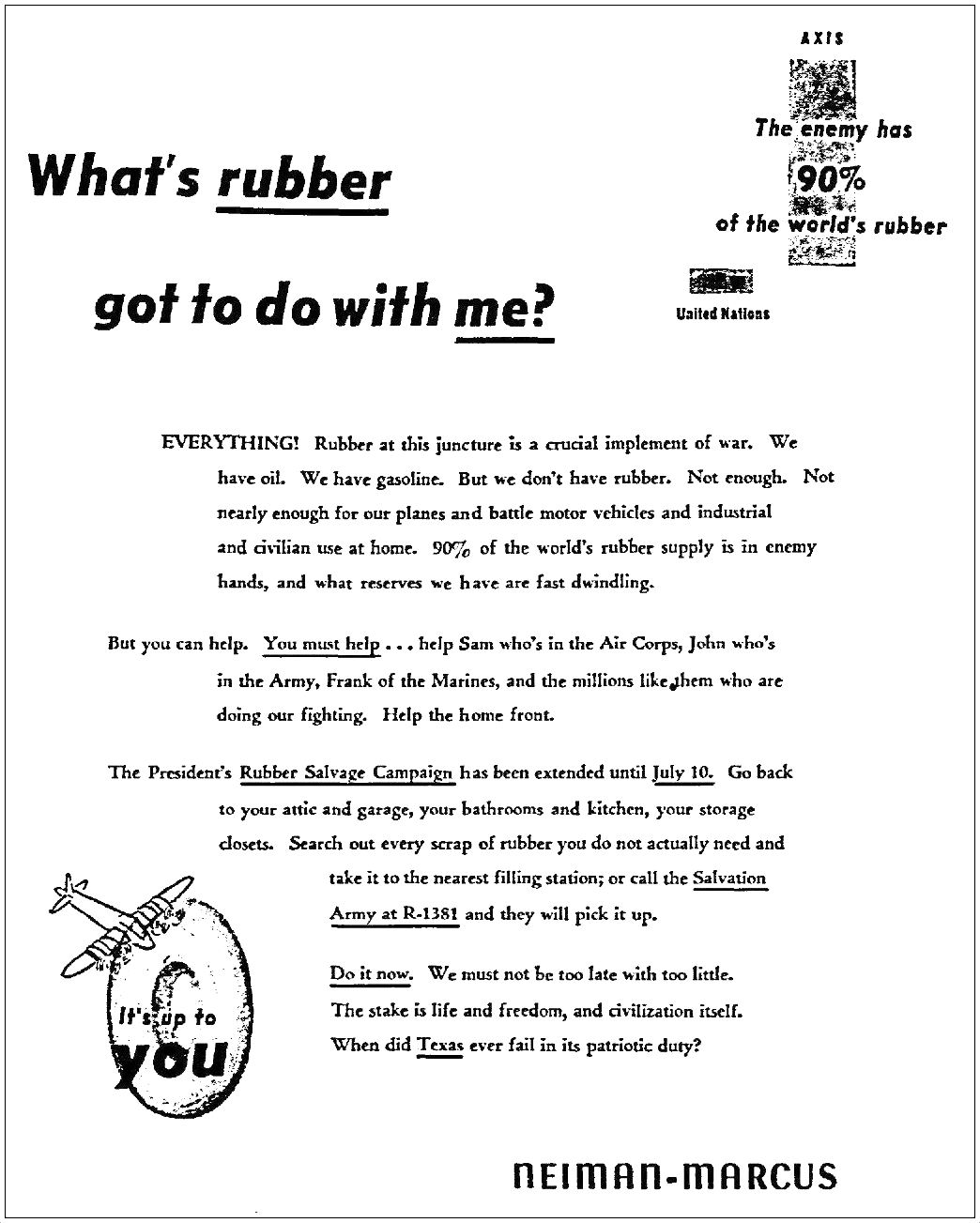
The deadline was extended until July 10, with hopes that people would knuckle down and collect much, much more. This Neiman’s ad asked the question “What’s rubber got to do with me?” and answered its own question with an emphatic “EVERTHING!” The ad ended with a barn-burner: “We must not be too late with too little. The stake is life and freedom, and civilization itself. When did Texas ever fail in its patriotic duty?”

rubber-drive_neiman-marcus_070342Neiman-Marcus ad, July 3, 1942

The drive ended with Texas and the western states collecting the most scrap rubber. At the very bottom were New York, New Jersey, and Pennsylvania, all of which were already rationing gasoline. Ultimately, FDR considered the rubber drive to have been a failure, but, like the other scrap drives, it whipped up patriotism and resulted in a feeling of shared community as people worked together for the sake of the country — something which might have been more valuable than rubber.

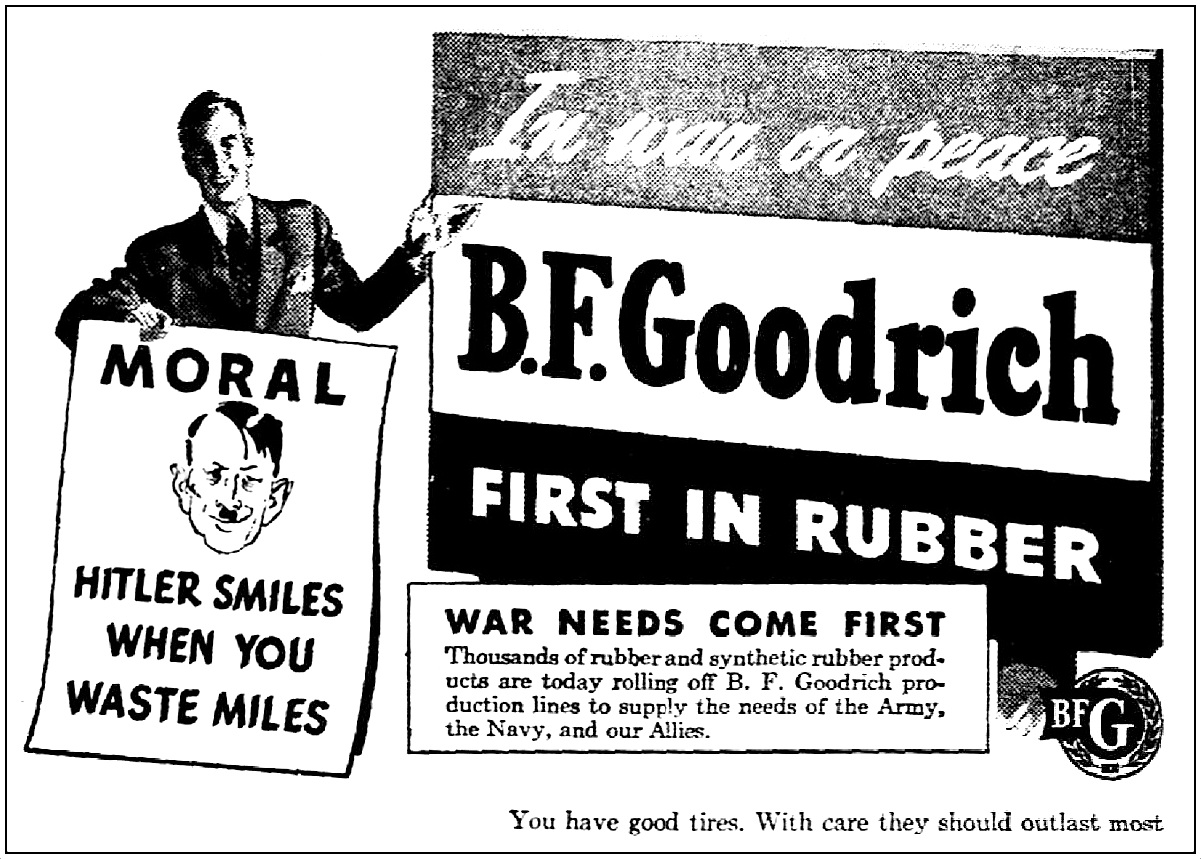
Synthetic-rubber production slowly increased, but, even so, tire manufacturer B. F. Goodrich wanted everyone to continue to make sure their tires lasted as long as possible, because, after all, ” Hitler smiles when you waste miles.”

rubber-drive_b-f-goodrich-ad_071942_detB. F. Goodrich Tires ad detail, July 17, 1942

**

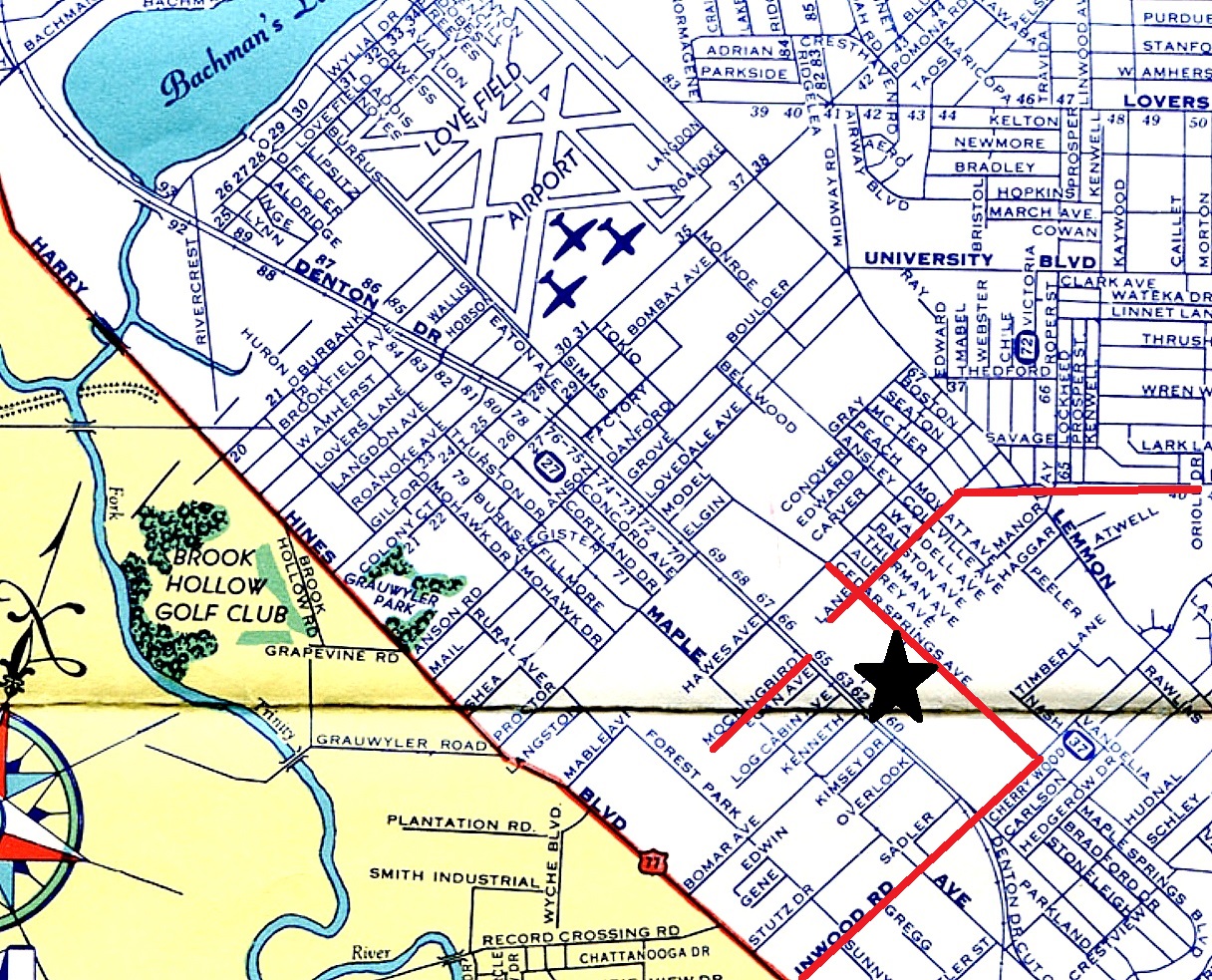
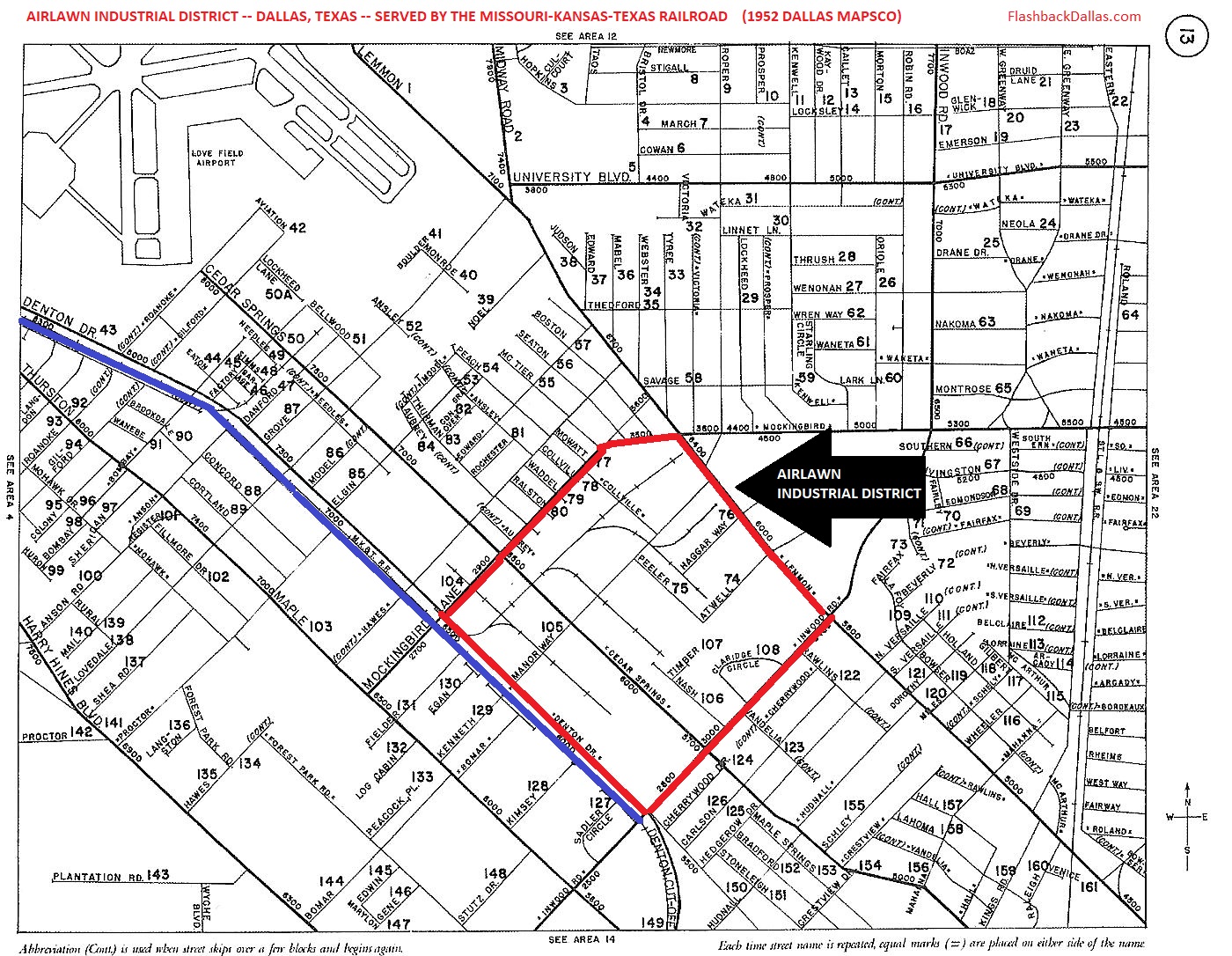
So where exactly was that massive used-tire mountain range? According to The Dallas Morning News, it was in a large open field “at the intersection of the MKT Railroad switch and Cedar Springs, just west of the Coca-Cola plant” (DMN, July 13, 1942), between Inwood and W. Mockingbird, not far from Love Field. The map below (from 1949) shows the general location of the yard, marked with a black star.

tire-mountain_1949-ashburn-map_dallas-freeways-site_det1949 Ashburns’ map detail, via DFW Freeways site

Initially, the salvage yard was to be contained on a 13-acre plot of land, surrounded by an 8-foot board fence. There were to be several tall guardhouses, and the “precious pile of vital war material” would  be patrolled 24 hours a day by armed guards “to protect it from fire hazards, thieves, or saboteurs” (DMN, Aug. 6, 1942). The fear of a potentially huge and uncontrollable fire was the main concern — a special fire plug was installed on the property and a direct phone/alarm line to the central fire station was set up. By August, the size of the yard increased by 50% to accommodate the 30 or more freight carloads which were arriving daily with scrap rubber from all over Texas (except the Panhandle). This huge salvage yard was meant to hold the rubber-drive scrap until reclamation plants in Ohio could accommodate it.

Several months later, the Time article put the expanded size of the yard at 30 acres, containing 30,000 tons of rubber material. By January, 1944, it was estimated the mammoth tire graveyard contained a whopping one million tires. Rather anti-climactically, a local tire dealer was contracted by the Rubber Reserve Corporation to “pick out the repairable and recappable carcasses” (DMN, Jan. 23, 1944) which were estimated to number about 150,000 tires; they would then be dispersed to Texas dealers who would either sell  them to consumers or vulcanize them. Despite the frenzied rubber drive of 1942 and almost a year and a half of sitting forlornly in an open field guarded by men with guns, it looks like those tires never made their trip to Ohio.

*

The land that these “tire mountains” occupied appears to have been leased from Carl C. Weichsel, member of a noted Dallas pioneer family. 23 acres of the land was sold to the Coca-Cola Company in 1937 — a $1,000,000 syrup plant and warehouses were built on ten of the acres, at Lemmon and W. Mockingbird. (Coca-Cola bought ten more acres in 1947 in order to expand.) A few weeks after the Coca-Cola land-purchase was announced, Dallas County granted the Missouri-Kansas-Texas Railway right of way across Cedar Springs, just south of Mockingbird, for a switch track to the Coca-Cola plant. 

In the mid 1940s, the Airlawn Industrial District sprang up in this area. The planning and development of Airlawn was spearheaded by none other than the Katy Railroad, beginning when Coca-Cola decided to move to the area. 

The […] plans were drawn up by the Katy’s industrial research and development department with the aid of experts versed in the problems of present day industry. […] The Katy maintains a Diesel switch engine on duty twenty-four hours a day to handle the switching operations in the Airlawn area. One section gang is assigned to this area to maintain the miles of track that interweave the industrial buildings. (DMN, Oct. 9, 1949)

The MKT was working to attract businesses along their lines: they needed the businesses, and the businesses needed them. Win-win! (It’s interesting to note that another major manufacturer that the Katy worked with on securing a location was another soft drink company: the Dr Pepper plant on Mockingbird, near Central.)

Below is a map from 1952 which shows the railroad spurs which were used by the Airlawn businesses. I’m not sure why I find this so interesting, but I do! (Are these tracks still in use?)

airlawn-industrial-district_mapsco-19521952 Dallas Mapsco

***

Sources & Notes

First and second image are from an old eBay listing; it appears that someone pasted a Time magazine article (March 15, 1943) to an envelope; the postmark and cancellation shows that it was mailed from Dallas on March 16, 1943, even though there does not appear to be an address on the front or back of the envelope.

A really interesting article on the various WWII scrap drives — “Getting In the Scrap: The Salvage Drives of World War II” by Hugh Rockoff, of the Economics Dept. of Rutgers University — is well worth a read, here. From his abstract: “While the impact of the drives on the economy was limited, the impact of the drives on civilian morale, may well have been substantial.”

Another very informative article on the national rubber drive of 1942 can be found in the post “Make It Do — Tire Rationing in World War II” by Sarah Sundin, here.

See a variety of patriotic posters encouraging Americans to participate in WW2 scrap drives here.

Pertinent Dallas Morning News articles about this rubber salvage yard:

  • “Work Begun on Rubber Storage Plant” (DMN, July 13, 1942)
  • “Close Guard Is Kept On Rubber” (DMN, Aug. 6, 1942 — includes a photo of the yard, similar to the one that appeared in Time magazine)
  • “150,000 Usable Tires Believed Salvageable From Waste Pile” (DMN, Jan. 23, 1944)

rubber-stock-pile_dallas-1943_ebay-det_sm

*

Copyright © 2019 Paula Bosse. All Rights Reserved


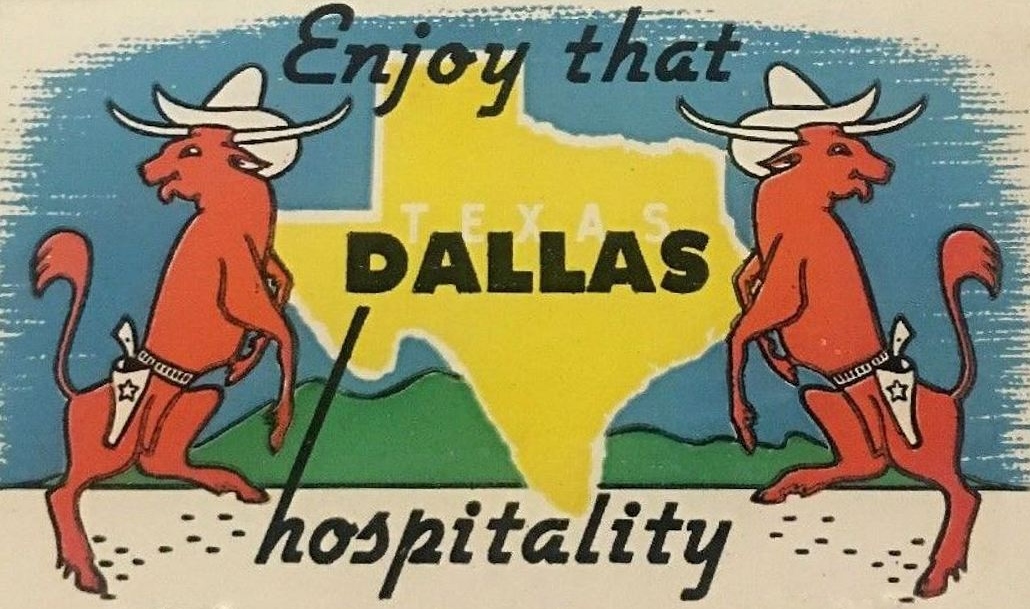
“Enjoy That Dallas, Texas Hospitality”

dallas-hospitality_matchbook-cover_ebay_b

by Paula Bosse

…Or else!

dallas-hospitality_matchbook-cover_ebay_a1

“Easy to reach … hard to leave.”

dallas-hospitality_matchbook-cover_ebay_c

***

Sources & Notes

Images from a great 1950s matchbook, found on eBay — like these.

*

Copyright © 2019 Paula Bosse. All Rights Reserved.
Bruce Channel, Delbert McClinton, and The Beatles — 1962

beatles_delbert_bruce_062162_mike-mccartneyThe Ringo-less Beatles with Delbert and Bruce, June 21, 1962

*

(CLICK HERE TO WATCH THE FILM DISCUSSED IN THIS POST)

*

by Paula Bosse

You know how you’re all excited about one thing only to discover something even more exciting sitting all alone over off to the side? That’s what happened when I took a look at the “Light Crust Doughboys collection” which has recently been uploaded to the Portal to Texas History site as part of the Spotlight on North Texas project via the UNT Media Library. I’m a huge fan of Western Swing and classic country music, and I spent an enjoyable hour or two watching home movies of the Light Crust Doughboys as they toured around Texas. When I looked to see what else comprised this collection, I saw the words “England Tour,” “Bruce Channel,” and “Delbert McClinton,” and a jolt went through me: oh my god, could there be film footage of the legendary meeting between the Beatles and North Texas musicians Bruce Channel and Delbert McClinton? Every Beatles fan worth his/her salt knows about the June 21, 1962 meeting when John Lennon eagerly chatted with Delbert McClinton about his harmonica prowess.

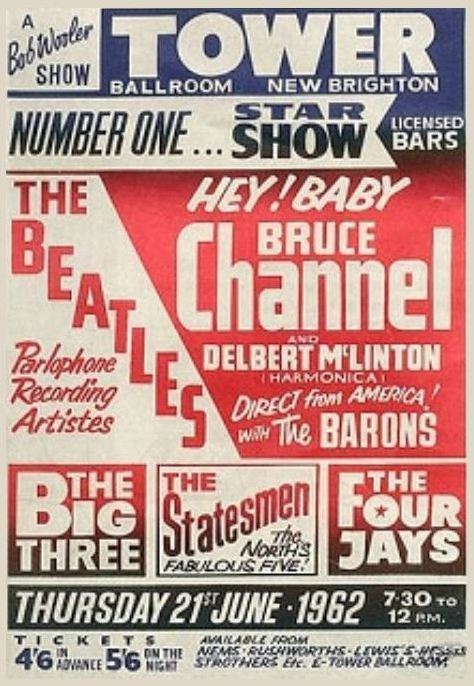
channel-beatles_poster_new-brightonvia Beatlesource.com

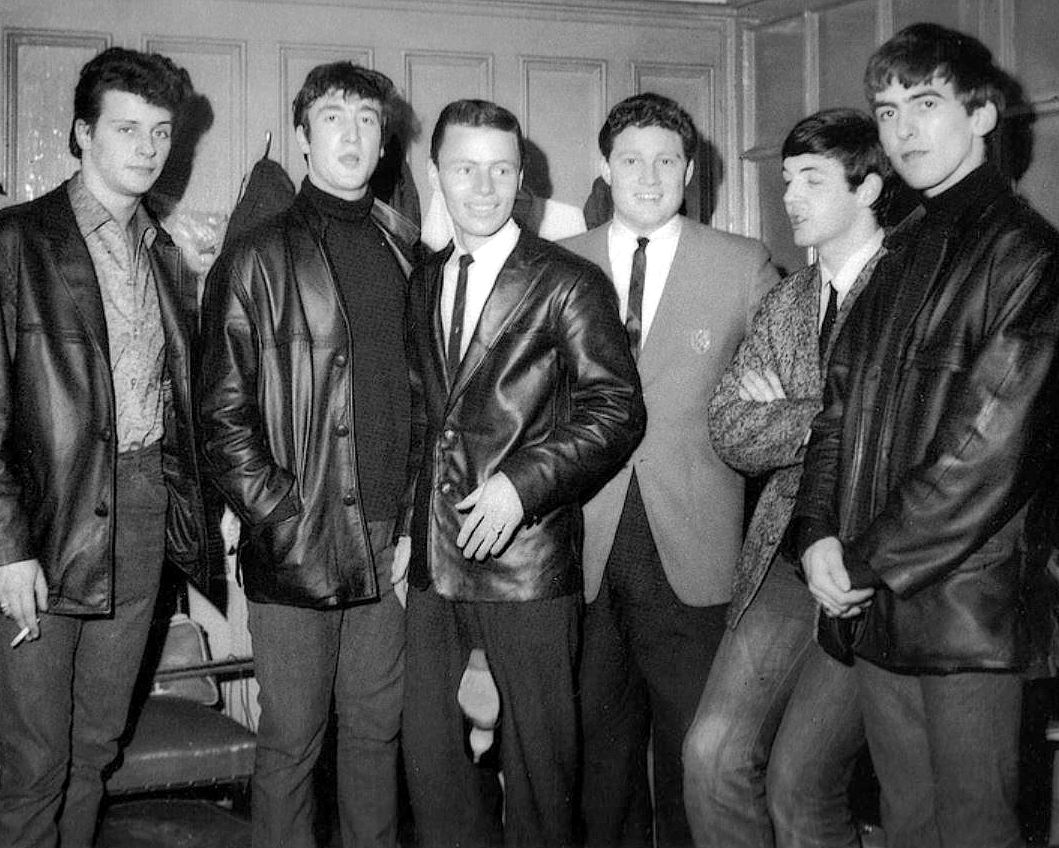
I watched the 27-minute home movie (shot by Marvin “Smokey” Montgomery, member of the Light Crust Doughboys and, from what I gather, Bruce Channel’s musical collaborator and, possibly, acting manager), and it does, in fact, capture glimpses of the famed tour in which Grapevine’s Channel, riding high on his #1 hit Hey! Baby, toured England with Fort Worth musician Delbert McClinton, who played harmonica on the record. One of their dates was the English town of Wallasey, just across the Mersey from Liverpool. On June 21, 1962 Bruce and Delbert played the New Brighton Tower Ballroom — their opening act was a popular local band on the brink of superstardom, The Beatles. Backstage, John Lennon asked for a few harmonica tips from Delbert whose Hey! Baby sound John really liked, and Delbert was happy to share. The photo above was taken at that meeting by Paul’s brother, Mike McCartney: from left to right, Pete Best (who would soon be replaced by Ringo Starr), John Lennon, Delbert McClinton (is he wearing Paul’s jacket?), Bruce Channel, Paul McCartney, and George Harrison. Another one, with Bruce and Paul, is below (I’m not sure who the girl is).

channel_mccartney_062162_mike-mccartney-photoBoth photos via Beatlesource.com

The home movie shot by Smokey Montgomery shows Bruce and Delbert (both only 21 years old at the time), their Fort Worth record producer “Major Bill” Smith, as well as several members of the package show of British performers that toured with Bruce, including Frank Ifield, Jay and Tommy Scott, and Beryl Bryden. …But, argh, no Beatles! So close! Still, this is great film footage of a famous tour — footage which may never have been seen by the public — and it is now available online for all to see, courtesy of the University of North Texas!

The 27-minute (silent) film can be viewed here (the good stuff is really only in the first 11 minutes or so — the rest is mostly tourist footage of the changing of the guards at Buckingham Palace). 

This may be thrilling to only a handful of people, but I am definitely one of those people!

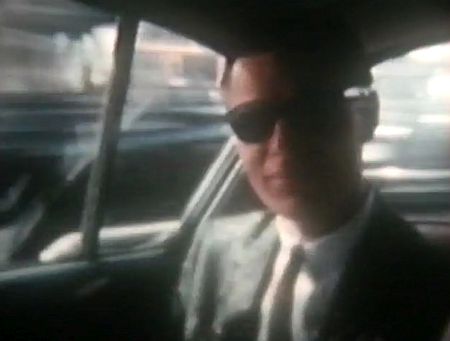
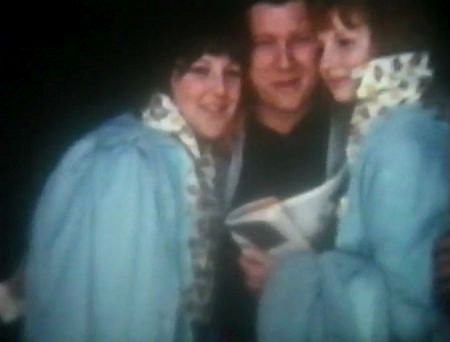
A few screen captures from Smokey Montgomery’s 1962 “England Tour” film (all images are larger when clicked):

channel-film_UK_1962_bruce_busBruce on the bus

channel-film_UK_1962_delbertDelbert in a taxi

channel-film_UK_1962_bruce_with-fansBruce with fans

channel-film_UK_1962_bruce_fansPerks of the trade

channel-film_UK_1962_bruce_kiss
More perks

channel-film_UK_1962_delbert_hands-up
Delbert

channel-film_UK_1962_bruce_delbert_bbc
Bruce and Delbert, London

You just never know what you’re going to stumble across…. Below is Bruce Channel’s monster 1962 hit, recorded in 1961 at the Clifford Herring Studios in Fort Worth, Hey! Baby, kicked off by Delbert McClinton’s distinctive harmonica.

**

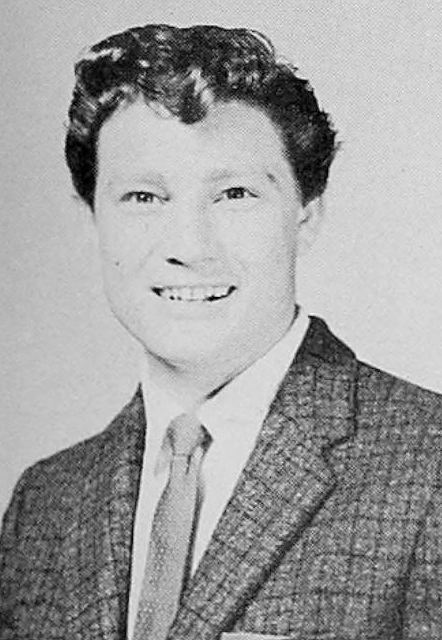
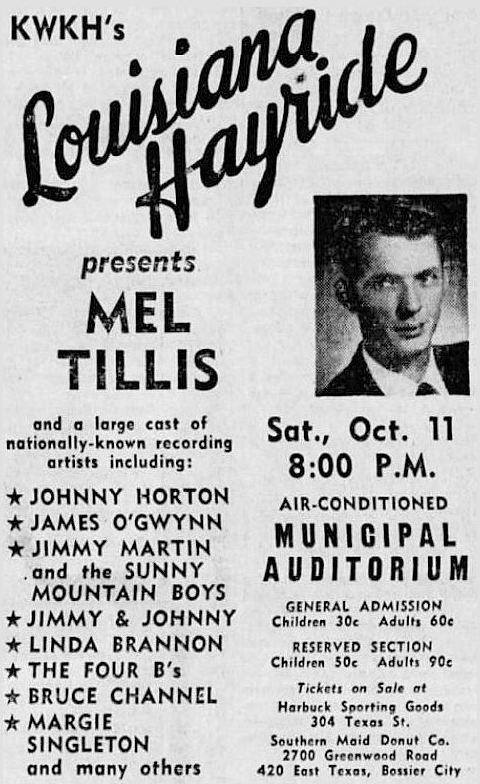
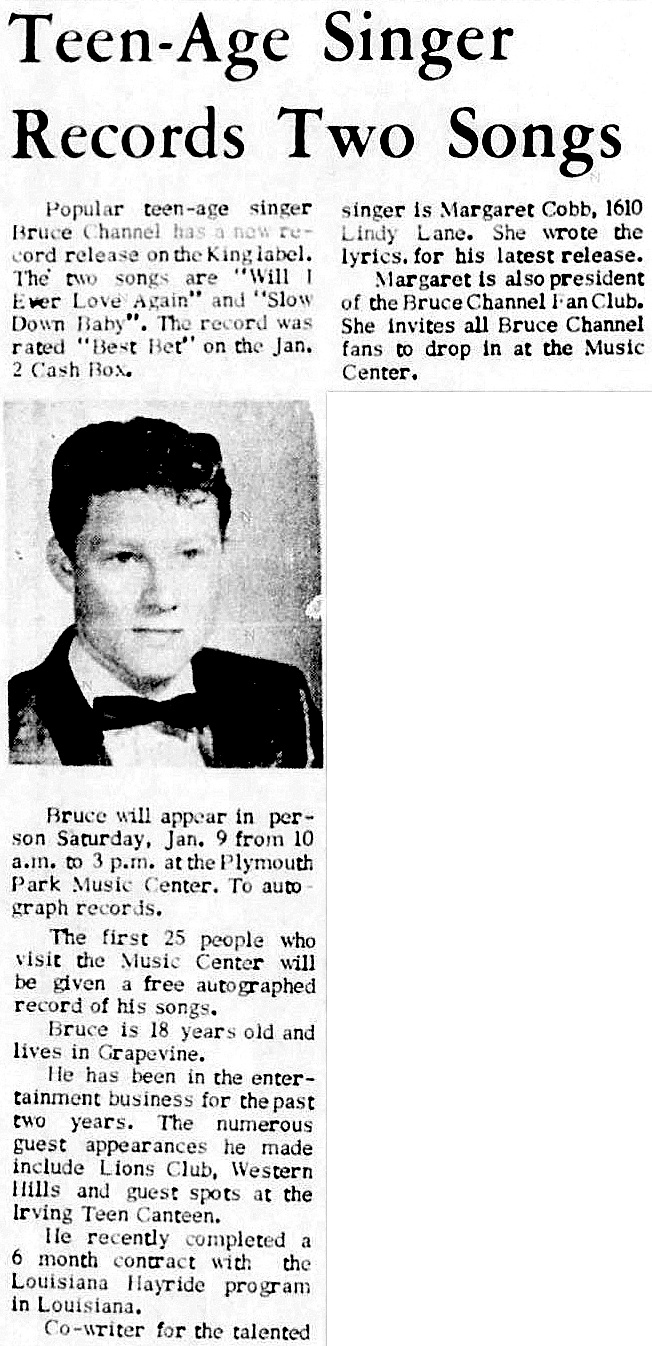
Bruce Channel (born Bruce McMeans — the “Channel” was his mother’s maiden name), was born at the end of 1940 and attended Grapevine High School. During his high school days he gained popularity as a performer, complete with lengthy commutes between Dallas and Shreveport, where he was a regular performer on the star-making Louisiana Hayride. Around this time he began writing songs with Margaret Cobb, an Irving woman who was 10-15 years older and the sister of a musician acquaintance. Dallas-Fort Worth-area musician Smokey Montgomery (known for decades as the banjo player in the Light Crust Doughboys) not only helped arrange those songs, but he also produced and played on some of Channel’s early singles, such as the cool (and fast!) rockabilly number, Slow Down, Baby (hear it here) and a song I like even more, Come On, Baby (hear it here).

The Cobb-Channel-penned Hey! Baby was recorded in 1961 and soon became a local radio hit, most notably on KLIF in Dallas, then worked its way up charts around Texas. The song finally reached #1 in the country in March, 1962. Channel had a few other lesser hits, but none ever reached the heights of Hey! Baby. He moved to Nashville in the ’70s and embarked on a successful songwriting career.

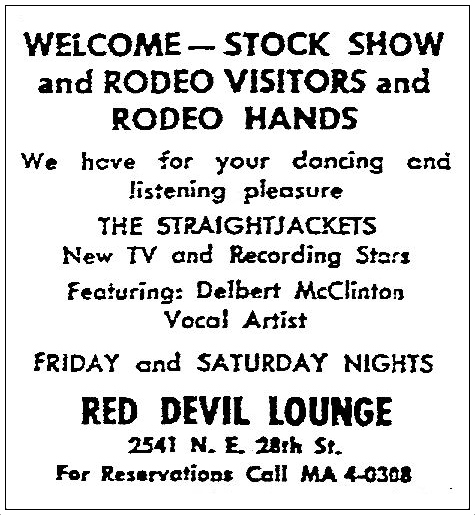
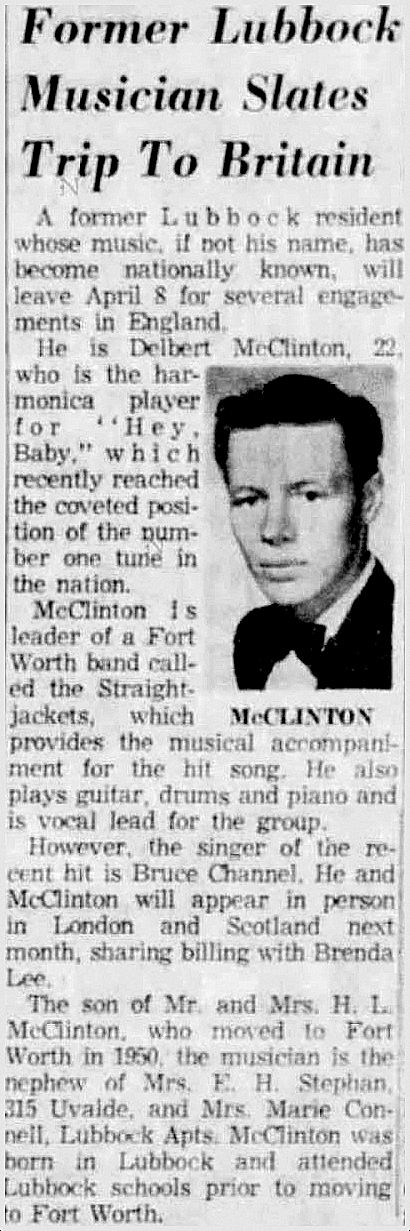
Delbert McClinton was born in Lubbock, also at the end of 1940, but grew up in Fort Worth where he, too, was a teenage musician, first gaining attention with his band The Straitjackets/Straightjackets and later the Rondels. He’s a bona fide Texas blues legend and continues to perform.

channel-bruce_grapevine-high-school_sr-photo_1960Bruce McMeans, Grapevine High School, 1960

channel-bruce_louisiana-hayride_shreveport-times_101058
Shreveport Times, Oct. 10, 1958

channel-bruce_irving-news-record_010760
Irving (TX) News-Texan, Jan. 7, 1960 (click for larger image)

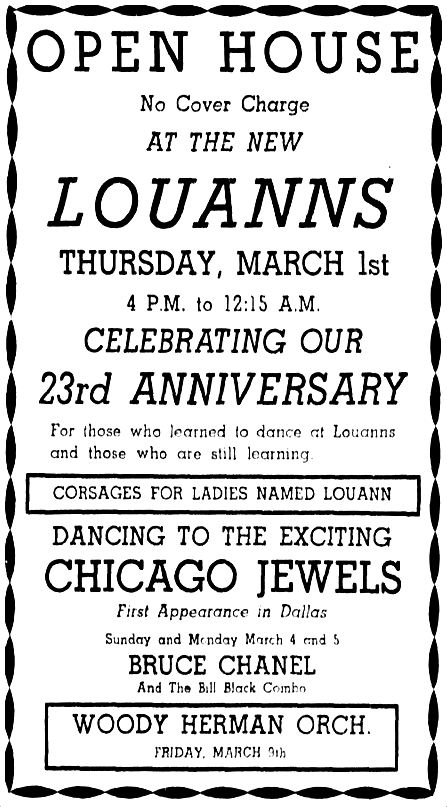
channel-bruce_louanns_march-1962
Louann’s, Dallas, March, 1962

bruce-channel_photo
British tour program photo, June, 1962, via Flickr

mcclinton-delnert_arlington-hts-high-school_1959_junior
Delbert McClinton, Arlington Heights High School, 1959

delbert-mcclinton_FWST_012558
Red Devil Lounge, Fort Worth, Jan., 1958

mcclinton-delbert_lubbock-avalanche-journal_032162
Lubbock Avalanche-Journal, March 21, 1962 (click to read)

channel-bruce_delbert-mcclinton-strait-jacketsFWST_010662
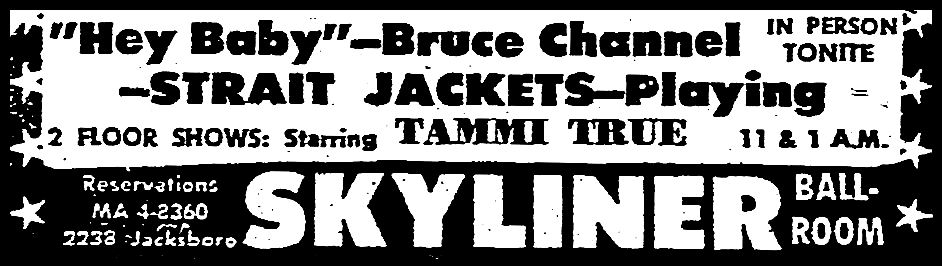
Bruce with Delbert (and stripper Tammi True), FW, Jan. 1962

***

Sources & Notes

The film featuring Bruce Channel and Delbert McClinton is titled “[The Light Crust Doughboys, No. 16 — England Tour]” and is part of the Spotlight on North Texas collection; it was provided by UNT Media Library to The Portal to Texas History and may be viewed here. It was filmed by Marvin “Smokey” Montgomery (who can be seen near the very end, sitting almost in silhouette in front of an airplane window). The film is part of a collection of Light Crust Doughboys and LCD-related materials donated by Art Greenhaw. (Special thanks to Laura Treat!)

Speaking of UNT, there may also be a film clip somewhere in the Denton vaults in which Bruce Channel, the “Grapevine farmboy,” was the subject of a WBAP-Ch. 5 news story (the April 18, 1962 script is here).

See the full printed program for Bruce Channel’s June, 1962 British package tour here.

Bruce Channel’s website is here. Read an interesting interview with him here. More Bruce on Wikipedia, here.

Delbert McClinton’s website is here. He’s constantly touring. Go see him!

The producer of (among other recordings) Hey! Baby and Hey, Paula (the song which has followed me around my whole life) was “Major Bill” Smith who was quite a polarizing character and was often described as a “hustler” (Delbert was not a fan). Read about him here. (Also, rockabilly god Ronnie Dawson might be one of the musicians on Hey! Baby — I’ve always heard he played drums on Hey, Paula.)

Marvin “Smokey” Montgomery is listed, along with Major Bill Smith, as a co-producer of Hey! Baby, which sold well over a million copies, but it rankled him that he did not get a songwriting credit (and, perhaps more importantly, did not earn royalties), which he contended he deserved: in a 1973 Dallas Morning News profile he said somewhat bitterly, “[*Now*] if I have anything to do with making the music or writing the words… you can bet your sweet life my name will be on that record.” (“The Man Who’ll ‘Listen To Your Song'” by David Hawkins, DMN, Oct. 18, 1973). More on Smokey’s long career can be found at the Handbook of Texas, here.

Read about the Beatles’ use of a perhaps Delbert-inspired harmonica sound on several of their early recordings, most notably Love Me Do, here.

Side note: Hey! Baby broke first locally on Dallas radio station KLIF and then on Houston’s KILT — both stations were owned by Gordon McLendon, which might explain why Bruce Channel was appearing at an April, 1964 political rally at Reverchon Park in support of McLendon’s race for U.S. Senate (?!) — see the ad here. (McLendon lost his Democratic primary challenge against Sen. Ralph Yarborough, who ultimately went on to defeat Republican contender, the elder George Bush.)

Bruce and Delbert weren’t the only DFW musicians with whom pre-Beatlemania Beatles hobnobbed: they also shared a bill in Paris with Dallas son Trini Lopez in 1963 — the Flashback Dallas post “Trini Lopez: Little Mexico’s Greatest Export” is here.

*

Copyright © 2018 Paula Bosse. All Rights Reserved.
 

The Palace — 1969

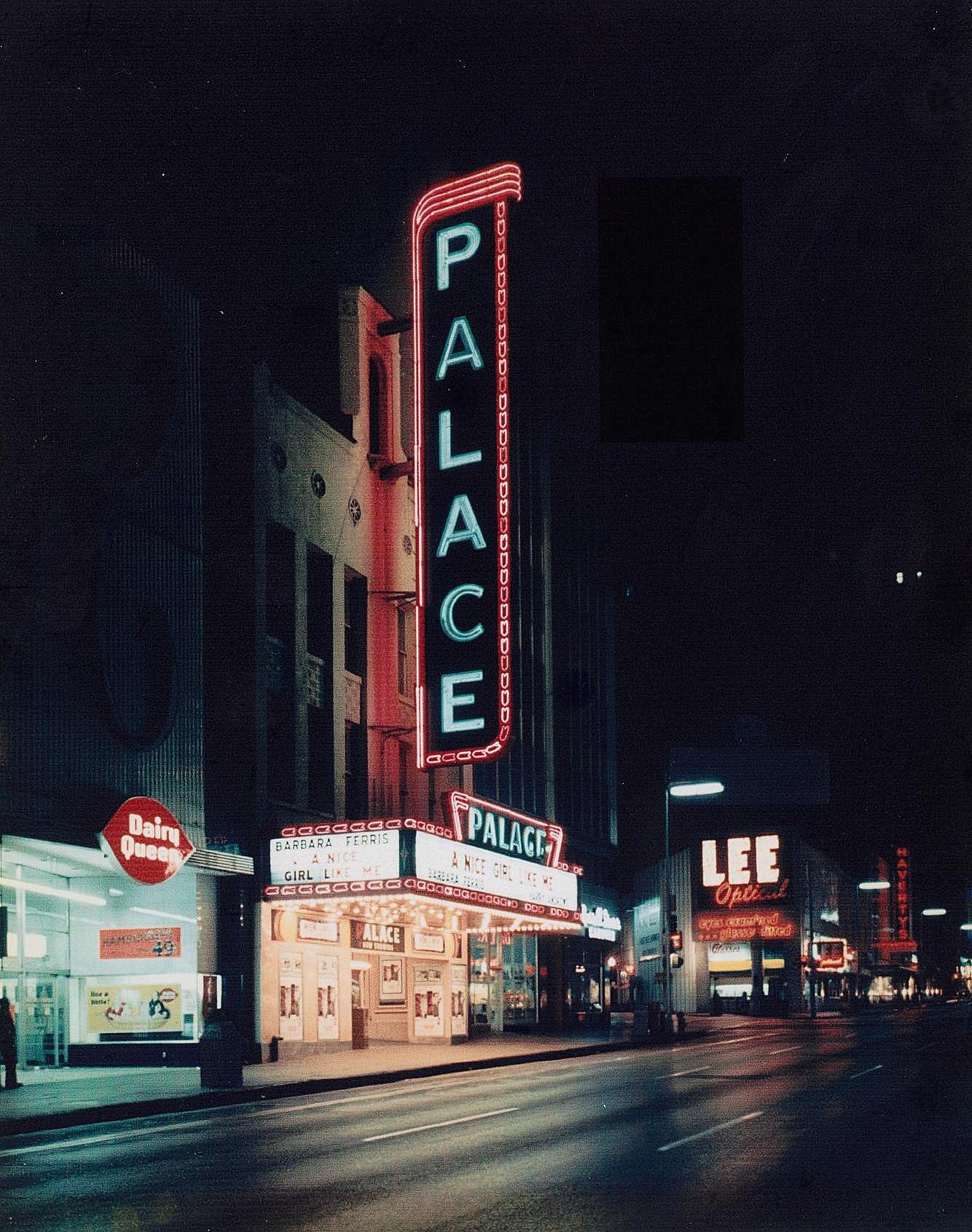
palace-theatre_1969_color_portalMovies and Dilly Bars, Elm Street, 1969…

by Paula Bosse

The only thing more exciting than seeing a cool nighttime photo of Dallas’ Theater Row with neon blazing, is discovering that there was once a Dairy Queen downtown!

**

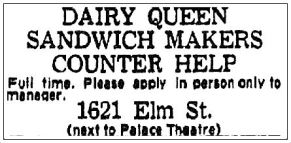
UPDATE: That DQ was there for a VERY short time. It shows up in none of the directories. In fact, its address — 1621 Elm — shows as “vacant” in the 1969, 1970, and 1971 city directories (it was occupied in 1968 by a newsstand — the Elm Street News — until it was raided that year for selling nudie mags). The address disappears altogether after the 1971 directory (it and the Palace Theatre were demolished in 1971). The only evidence I can find of the downtown Dairy Queen’s brief existence on Elm was in a handful of want-ads placed in October, 1969 (about the same time this photo was taken). My guess is that DQ bugged out when they learned the building was going to be torn down. It may have been there only a couple of months. Downtown DQ, we hardly knew ye.

dairy-queen_elm-street_100269Oct. 2, 1969

***

Sources & Notes

“Exterior of Palace Theatre at Night” is from the Lovita Irby Collection via the Spotlight on North Texas project, UNT Media Library, and may be viewed on UNT’s Portal to Texas History site here.

The movie on the marquee is “A Nice Girl Like Me,” starring Barbara Ferris, which opened at the Palace on Sept. 19, 1969.

The Palace Theatre was located on the north side of Elm Street, just west of Ervay, at 1625 Elm — by 1969, “Theater Row” consisted of only a handful of theaters. The Palace (and the building housing the Dairy Queen) was demolished in 1971; most of the north side of that block is now occupied by Thanksgiving Tower.

*

Copyright © 2018 Paula Bosse. All Rights Reserved.
David Bates — “Corny Dog” (1986)

bates-david_corny-dog_litho_tyler-museum-of-art_1986“Corny Dog” by David Bates, 1986

by Paula Bosse

First day, y’all. Here’s how David Bates, one of my favorite contemporary Texas artists, sees it. Click it to see that corny dog real big.
***

Sources & Notes

“Corny Dog” by David Bates (lithograph, 1986), shown at the Tyler Museum of Art this summer in the show “David Bates: Selected Works From Texas Collections.” More on that exhibition is here.

*

Copyright © 2018 Paula Bosse. All Rights Reserved.